Operator
Hello everyone and thank you for joining us today for the LCI Industries 3rd Quarter Earnings Call. My name is Lucy and I'll be coordinating your call today. During the presentation you can register a question by pressing star followed by 1 on your telephone keypad. If you change your mind please press star followed by 2. It is now my pleasure to hand over to your host, Lillian Edskorn, CFO to begin. Please go ahead.
Good morning everyone and welcome to the LCI Industries 3rd Quarter 2025 conference call. I am joined on the call today by Jason Lippert, President and CEO, along with Kip Emmenheiser, VP of Finance and Treasurer. We will discuss the results for the quarter in just a moment. But first, I would like to inform you that certain statements made in today's conference call regarding LCI Industries and its operations may be considered forward-looking statements under the security laws and involve a number of risks and uncertainties. As a result, the company cautions you that there are a number of factors, many of which are beyond the company's control, which could cause actual results and events to differ materially from those described in the forward-looking statements. These factors are discussed in our earnings release and in our Form 10-K and in other filings with the SEC. The company disclaims any obligation or undertaking to update forward-looking statements to reflect circumstances or events that occur after the date of the forward-looking statements are made, except as required by law. In addition, during today's conference call, we will refer to certain non-GAAP or adjusted financial measures. Reconciliations of these non-GAAP financial measures to the most directly comparable GAAP financial measures are available in our earnings release and investor presentation, which has been posted on the investor relations section of our website and are also available in our Form 8-K filed this morning with the SEC. With that, I would like to turn the call over to Jason.
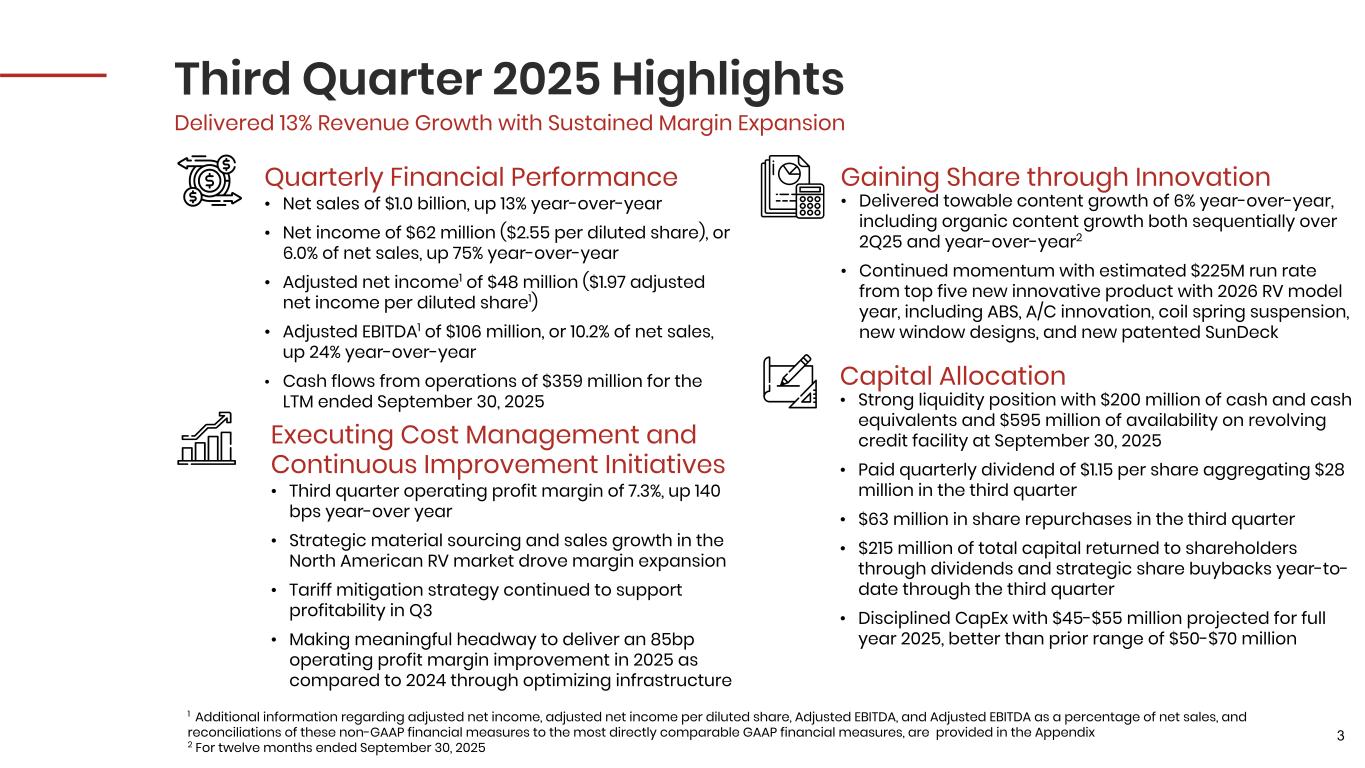
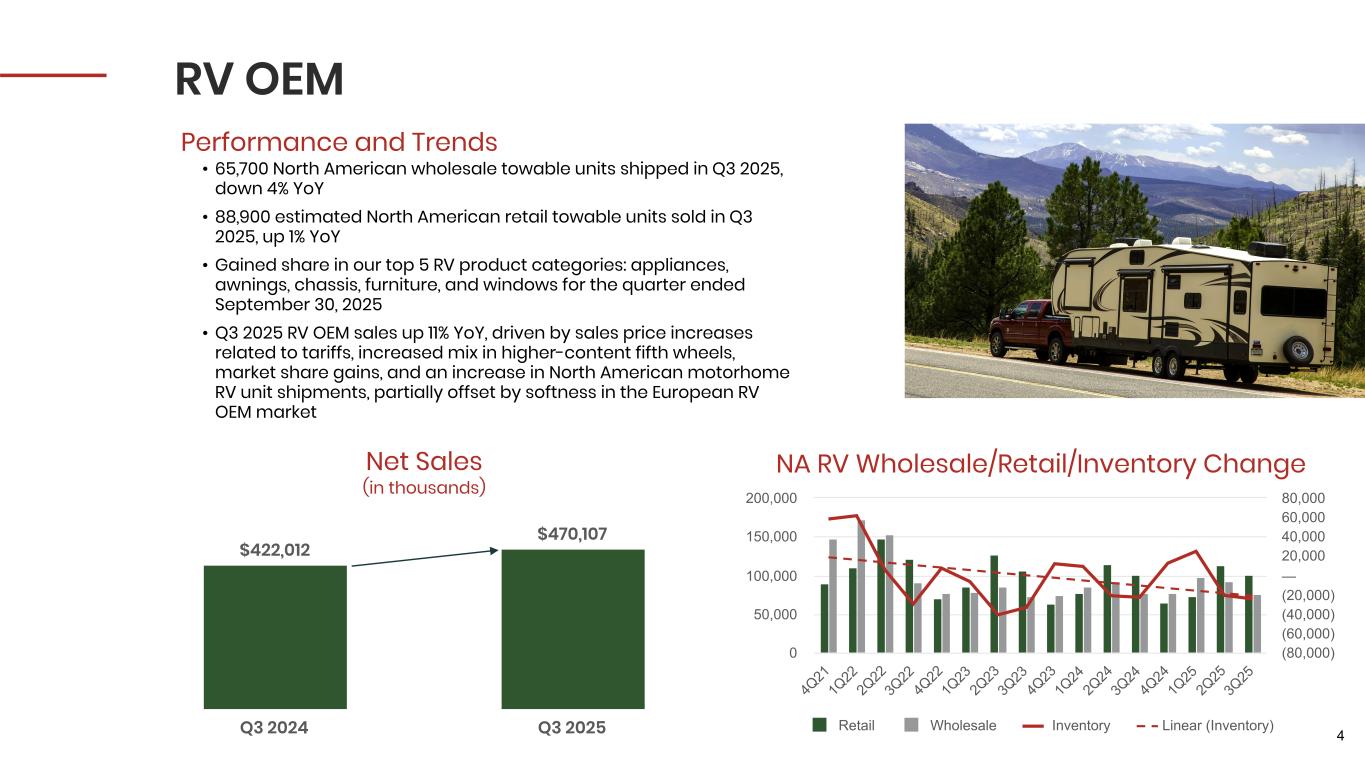
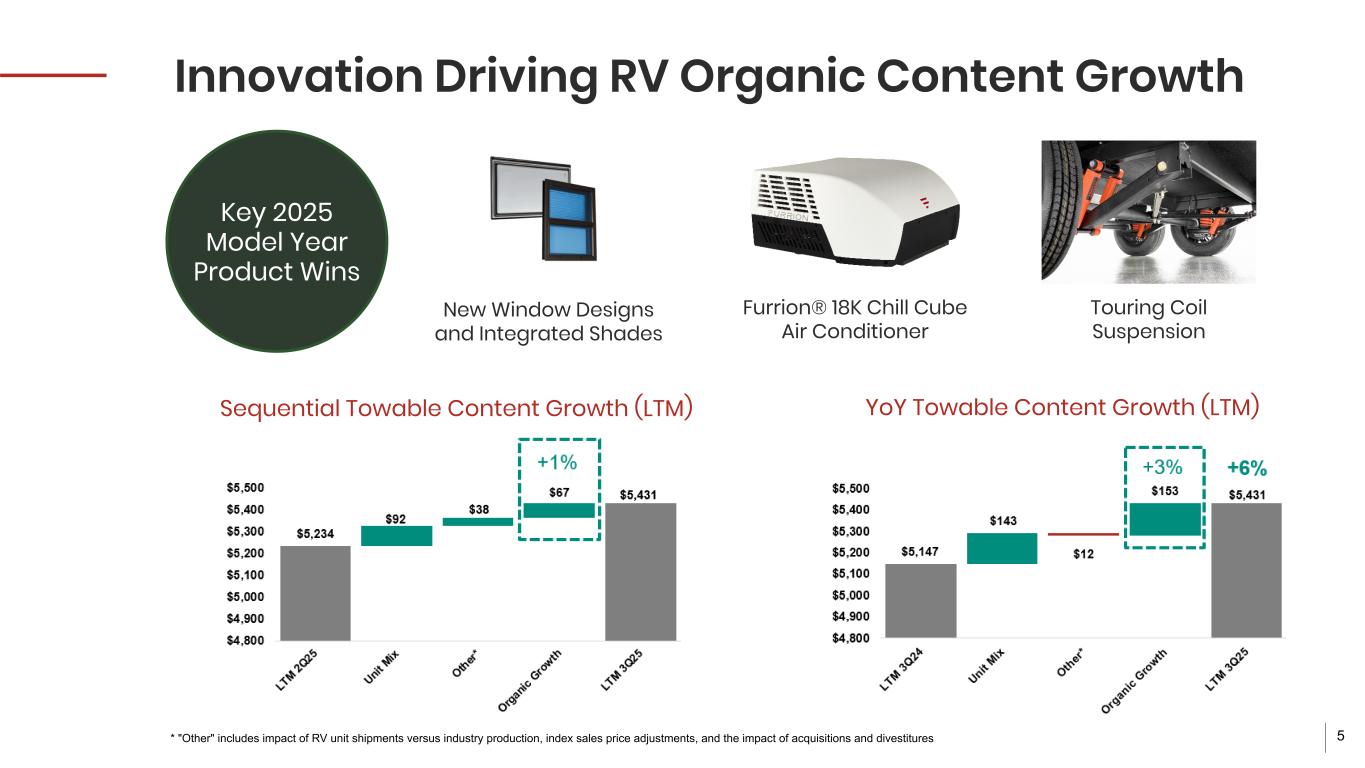
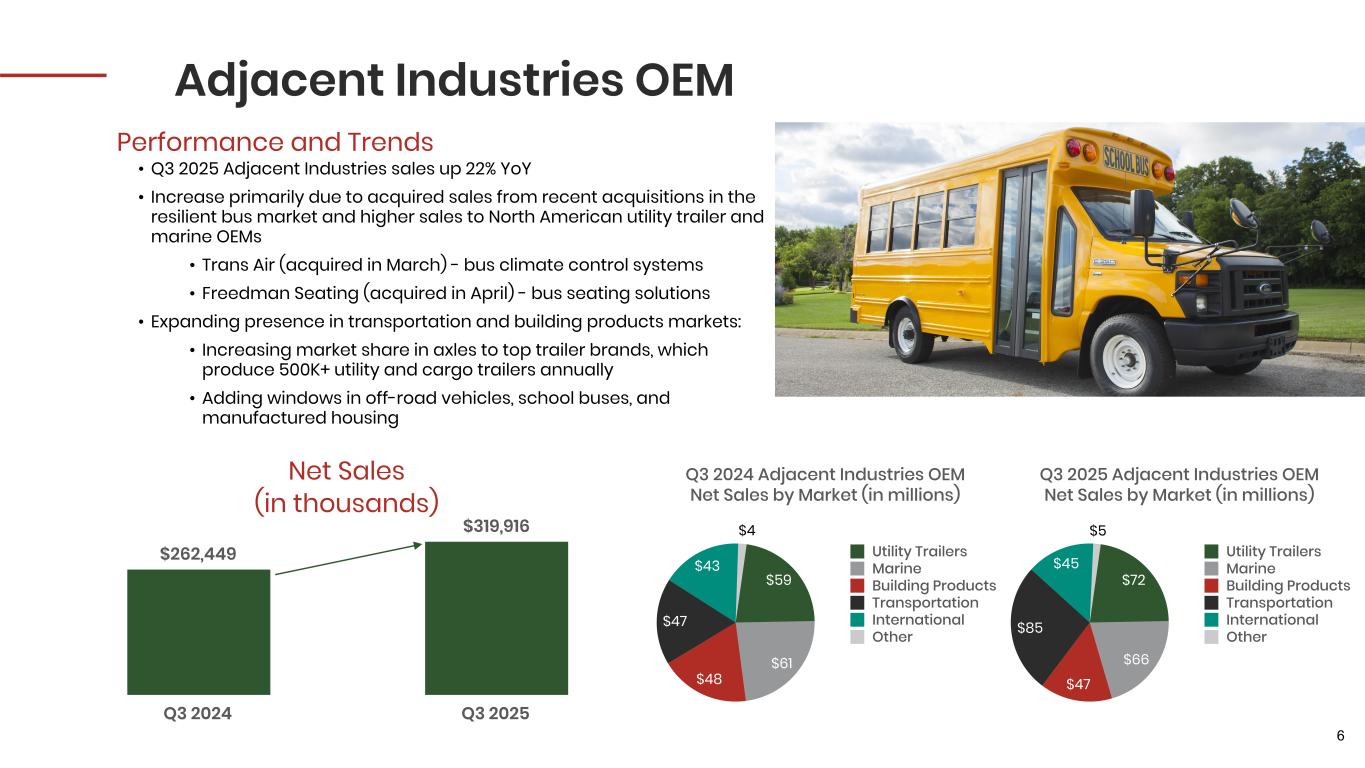
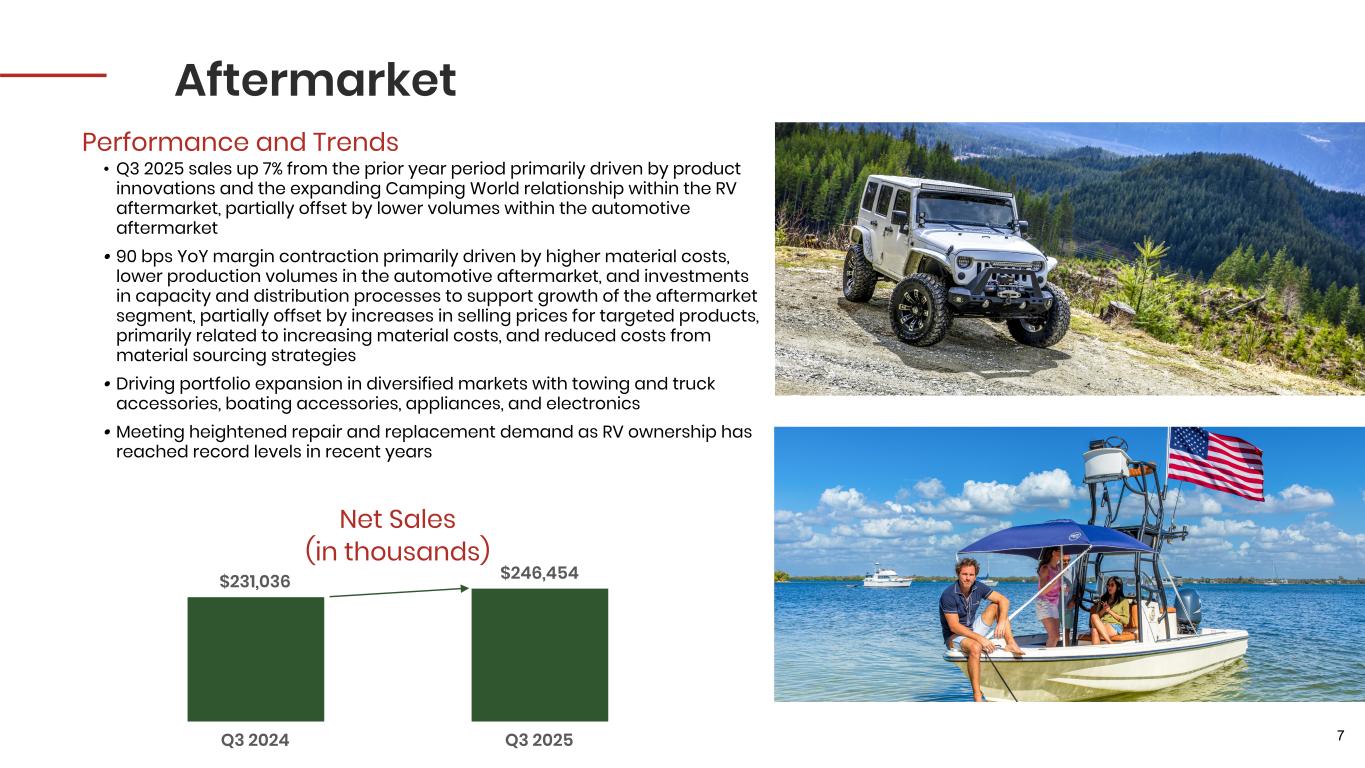
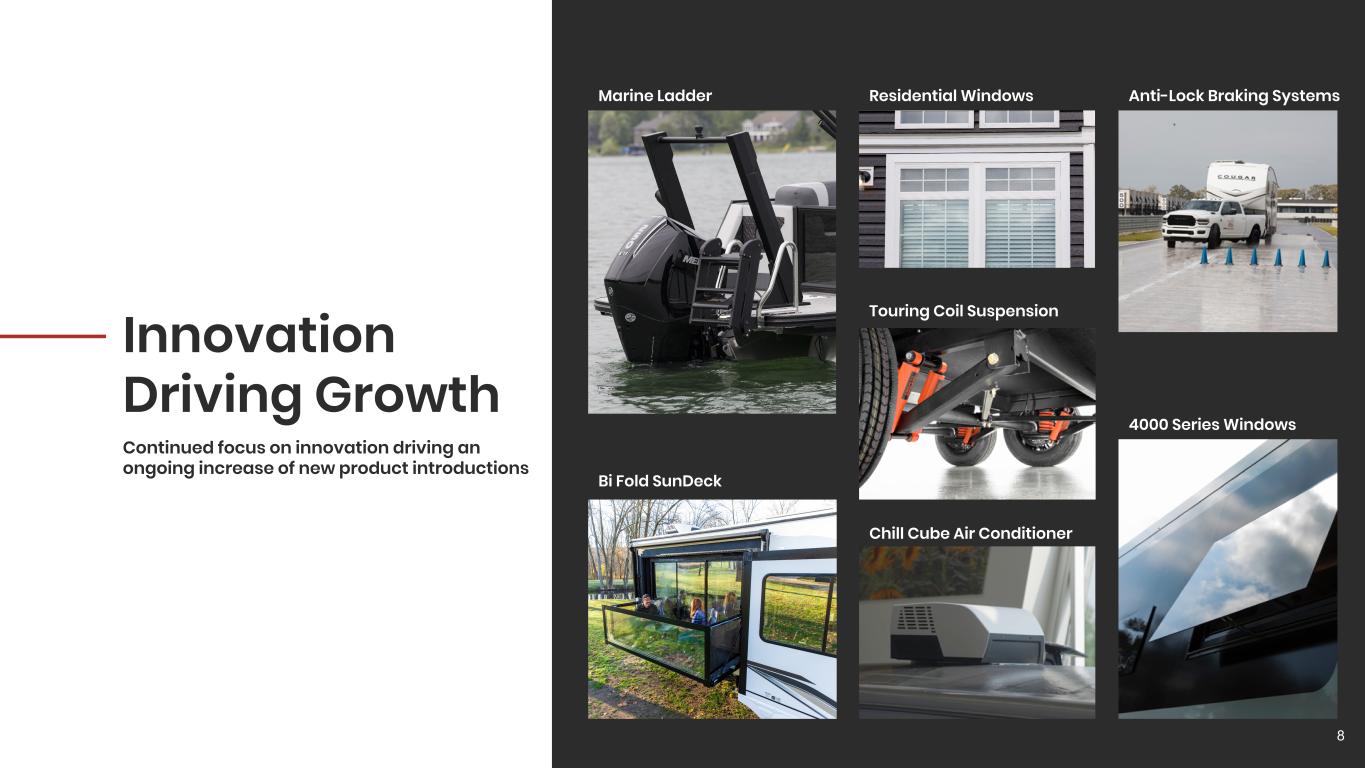
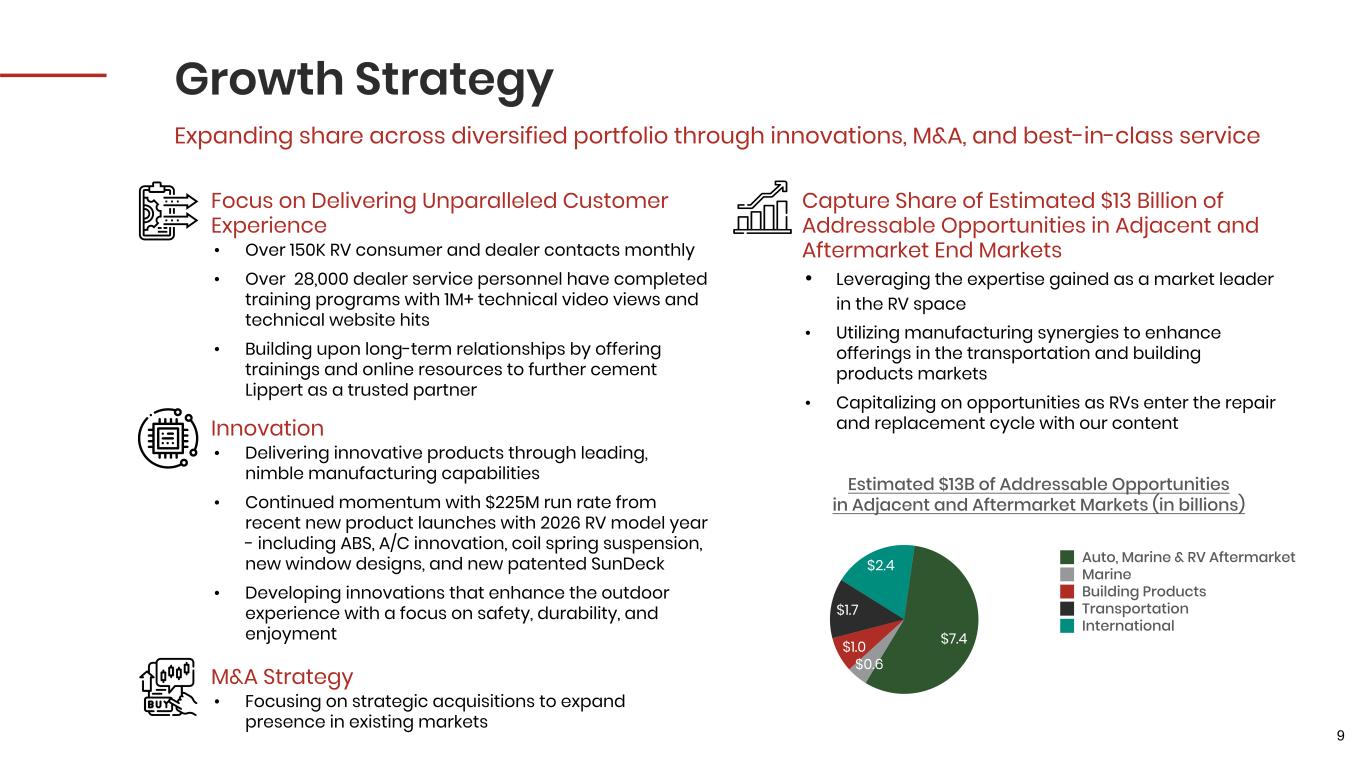
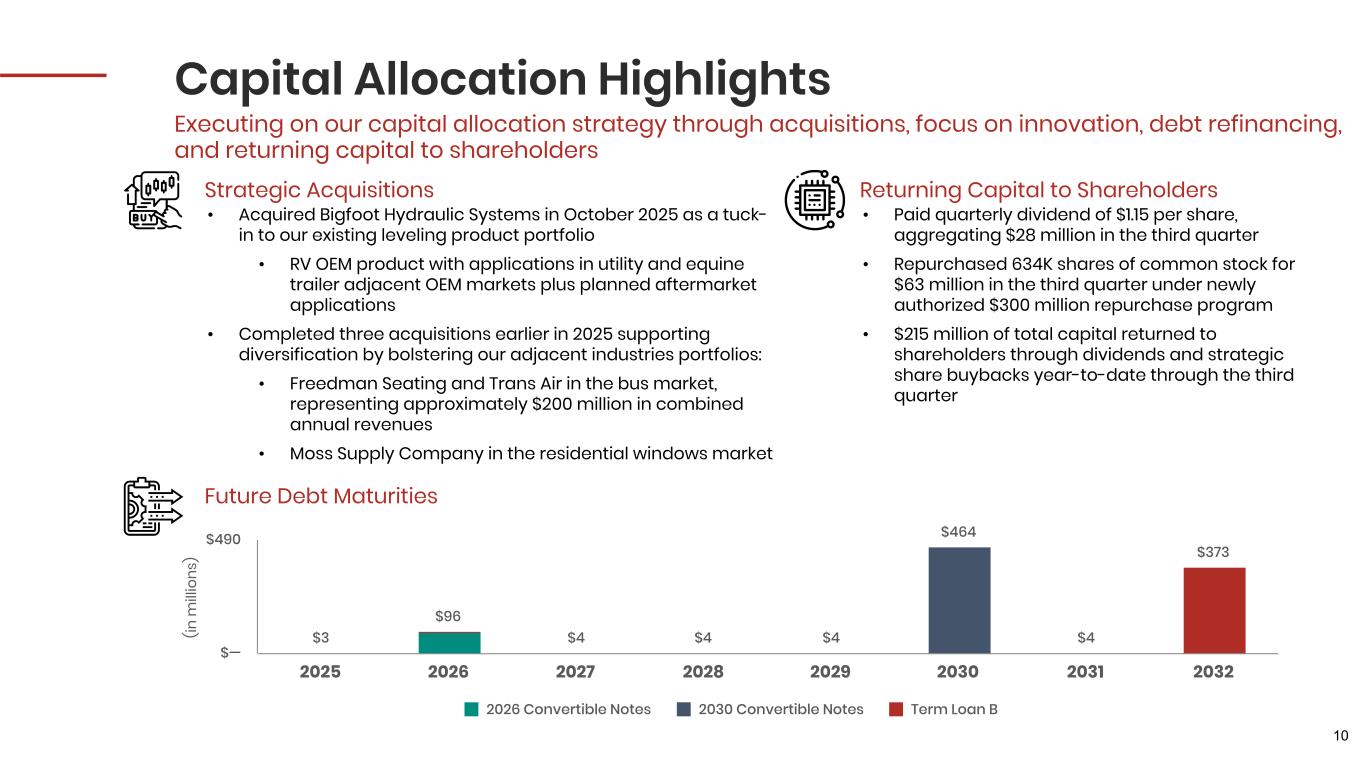
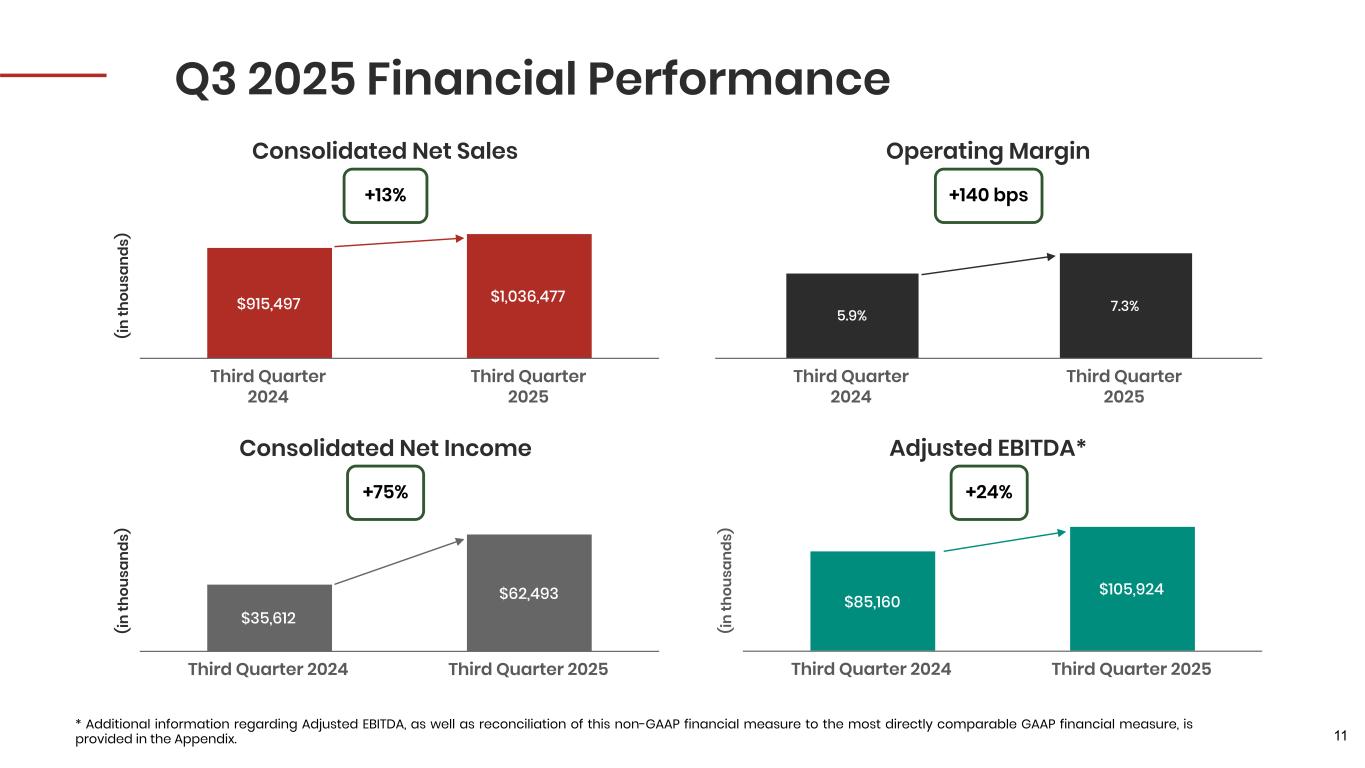
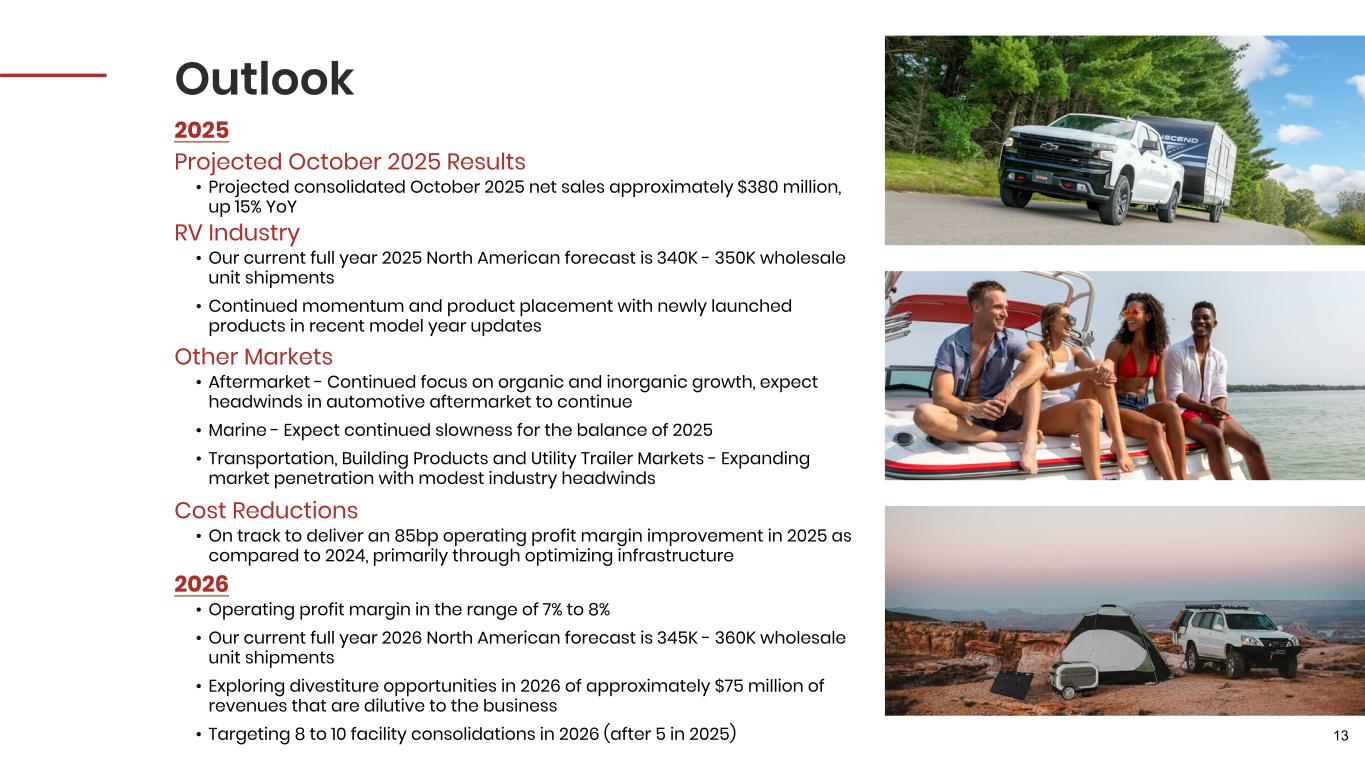
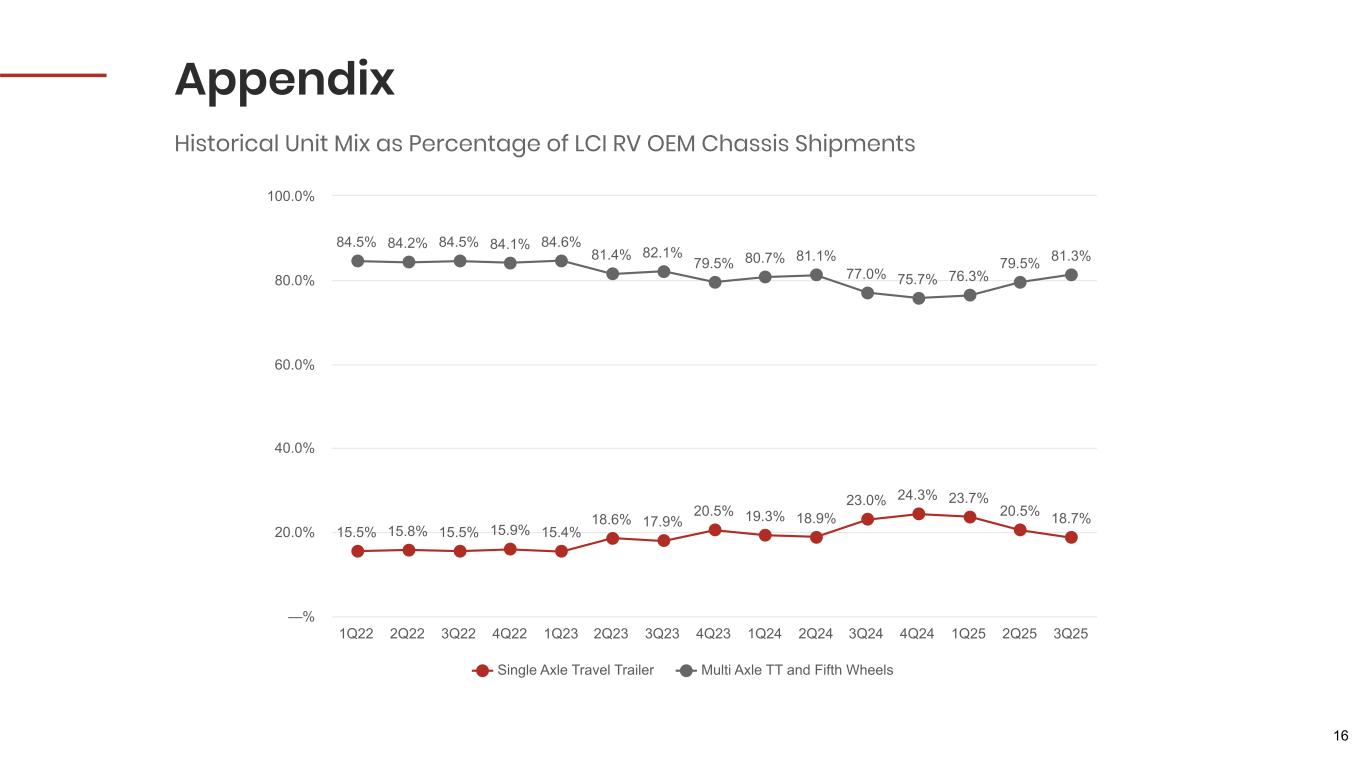
Thank you, Lillian, and good morning, everyone. Welcome to LCI Industry's third quarter 2025 earnings call. This quarter, we continued to build on our ongoing and successful efforts to drive efficiency and drive benefits from our years of diversification and our relentless focus on growth. To that point, we delivered an exceptionally strong quarter with sales growth of 13% to more than $1 billion, along with solid margin improvement driven by double-digit gains across our RV and adjacent businesses. This demonstrates the continued benefit of our innovation strategy and successful integration of our recent acquisitions. Our entire organization continues to work diligently to optimize productivity, footprint, and resources, positioning the company for outperformance as the industry begins to recover from this prolonged cycle. Operating margins improved to 140 basis points year-over-year to 7.3%, a direct result of of our discipline cost management, sustainable improvements in overhead and GNA, more favorable mix, footprint optimization, and ongoing productivity initiatives. Year to date, we successfully completed three facility consolidations, with two more expected by year end. Our facility consolidation actions completed in 2025 alone are expected to generate more than 5 million in annualized savings. Collectively, these initiatives position us to deliver our 85 basis point operating margin improvement goal for the year. On the wholesale front, following a strong Elkhart open house, we expect a near-term uptick in units produced. Our chassis orders in October are up roughly 275 to 300 units per week compared to prior months, an encouraging sign of OEM confidence and proactive dealer restocking ahead of the next selling season. Turning to RV OEM, net sales were approximately 470 million, up 11% year over year. This double-digit growth underscores the effectiveness of our innovation strategy and the strength of our competitive mode. Total content per unit increased 6% year-over-year to $5,431 as we continue to expand share across our top five product categories, chassis, appliances, axles and suspensions, furniture, and windows. Since 2020, our total content has grown an impressive 60%. Recent innovations like the Furion Chill Cube air conditioner, analog braking systems, 4K window series, SunDeck, and TCS Ascension systems continue to gain momentum. Together, these platforms have reached a combined 225 million annualized run rate, more than doubling from 100 million just two quarters ago. The enthusiasm around all our new products at the Elkhart Open House were tremendous. With strong OEM and dealer engagement, as these new innovations showed up on many leading brands, our ability to deliver high-impact innovation supported by our customer relationships, our expansive product portfolio, scale, and manufacturing expertise positions us to consistently capture 3% to 5% organic content growth annually. We also saw some easing in product mix pressure this quarter, as smaller single axle trailers declined from the mid-20% range earlier this year to about 19%, supporting both content and margin growth. Looking ahead, we expect North American RV wholesale shipments in the $340,000 to $350,000 range for 2025. As demand returns, our focus on innovation and shared growth will continue to drive solid performance. Net sales in our adjacent or diversified businesses were $320 million, up 22% year-over-year. This strong performance reflects growth across our building products, utility trailer, transportation, and marine markets. Of the total increase, approximately $39 million came from acquisitions, specifically Freedman Seating and Transair, where synergies are tracking well ahead of schedule. Since our acquisition of Friedman Seating, they have entered the heavy-duty bus seating market, a $150 million addressable opportunity where they are already capturing orders, showcasing our ability to scale our furniture manufacturing expertise. At Transair, we're streamlining operations and achieving early wins consistent with our proven acquisition playbook. Subsequent to the quarter, we also expanded through the acquisition of Bigfoot Leveling in October, which broadens our hydraulic leveling system offerings, and Moss Supply, which enhances our residential window capabilities, complementing our internal window lines. Utility trailer production remains healthy at around 700,000 units per year. We're accelerating content growth through innovative new products for this market like ABS, coil spring suspension, and tire pressure monitoring systems, all helping to elevate our offerings in this market. We're also leveraging our manufacturing expertise to expand into high growth sectors like OEM and aftermarket golf cart seating, an area experiencing strong growth in residential and community living markets. Collectively, LCI's total addressable market opportunity is approximately $16 billion and strategically aligned with our core manufacturing strengths. Turning to aftermarket, net sales were $246 million, up 7% year over year, as our strong OEM content continues to fuel aftermarket growth. The growth in OEM content directly fuels additional revenue streams with increased demand for product enhancement and service in the aftermarket. A great example of this is our Furion air conditioners. In 2022, our OEM share was less than 5% with virtually no aftermarket presence. Today, just three years later, we've captured over 50% OEM market share, and we expect more than $20 million in aftermarket air conditioner sales this year. This formula is clear. OEM success and momentum drive aftermarket growth. To support our continued growth in the service portion of our aftermarket business, we continue to invest in service infrastructure. Year-to-date, over 28,000 dealer service personnel have completed our technical training programs with thousands of in-person sessions and over 1 million visits to our online tech pages. These training efforts are driving higher quality service and strong dealer partnerships. We've also expanded our service footprint, adding three new facility sites in 2025 and doubling our mobile tech staff. These investments have already increased service completions by double digits improving speed convenience and customer satisfaction all in all lci is a huge right to win in the aftermarket lci is one of the only players in the industry that truly touches every rv consumer as our components are present in nearly every unit on the road that unmatched footprint fuels long-term aftermarket growth and positions us as a trusted partner across the entire life cycle of rv ownership we're also leading into new opportunities like upfitting solutions, allowing customers to add features like leveling and TCS if it wasn't included in their OEM packages. We are also partnering with campgrounds and storage centers to enhance service accessibility and convenience for our customers. With roughly 1 million RVs entering the service cycle over the next few years, we are exceptionally well positioned to capture recurring aftermarket demand. To meet rising demand in the aftermarket, we've recently opened a new state-of-the-art 600,000-square-foot distribution center in South Bend, Indiana. This facility further enhances our logistics capabilities, boosting speed, accuracy, and overall capacity, while supporting our margin performance as we transition from our older, less efficient Mishawaka location. We remain disciplined in capital allocation, maintaining our industry-leading dividend yield and executing meaningful share repurchases. Year-to-date, we have returned $215 million to shareholders with a repurchase of $129 million of stock and have paid $86 million in dividends. We have a solid balance sheet, having refinanced our convertible notes and other long-term debt earlier this year. In the third quarter, we refreshed and repriced our term loan, reducing annual interest expense by roughly $1 million and improving free cash flow. CapEx for the year is now expected to land between $45 million and $55 million, better than our prior range of $50 million to $70 million, reflecting disciplined capital project management. Looking ahead, our team's confidence continues to build given the multitude of innovation and efficiency efforts we have delivered and will continue to deliver that should result in the sustained future growth and enhanced financial performance. As we look beyond the end of the year into 2026, we expect continued 3% to 5% organic content growth from innovation and our competitive advantages, driven in part by a $225 million run rate in our top five product innovations manufacturing optimization including five million in annual run rate savings from 2025 consolidations and eight to ten additional consolidations planned for 2026 better product mix normalization as single axle trailers decline rv wholesale shipments to lift to 345 000 to 360 000 units in 2026 with near-term strength already evident aftermarket tailwinds with approximately 1 million rvs entering the service cycle and exploring divestiture opportunities of approximately $75 million of revenues that are diluted to the business in 2026. Together, we expect these targeted initiatives to lift operating margins to 7% to 8% in 2026. Most importantly, none of this will be possible without our incredible team, the dedication, resilience, and commitment of our 12,000 team members remain the foundation of our success. Over the past three years, we have navigated through some tremendous challenges, and today we're operating from a position of real strength solid cash flow and balance sheet healthy margins and strong customer sentiment i'd also like to recognize the passing of our founder my grandfather larry lippert whose vision ingenuity and perseverance built this company from the ground up his culture of grit innovation and courage continues to define who we are today to our teams across the globe thank you for relentlessly serving our customers and community every day together we are building a stronger more resilient and a truly differentiated lci industries i'll now turn it over to lillian who will provide more detail on our financial results thank you jason lippert's innovation competitive strengths and successful m a supported double
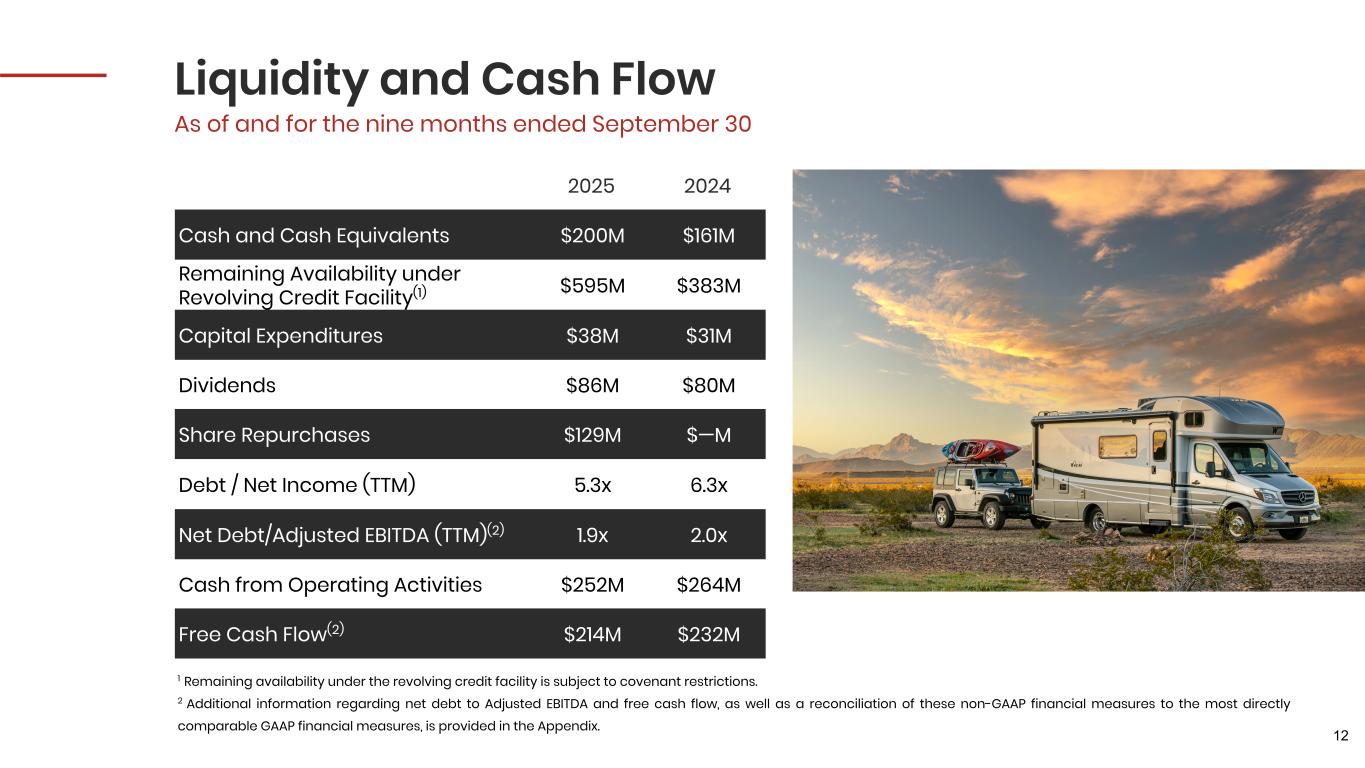
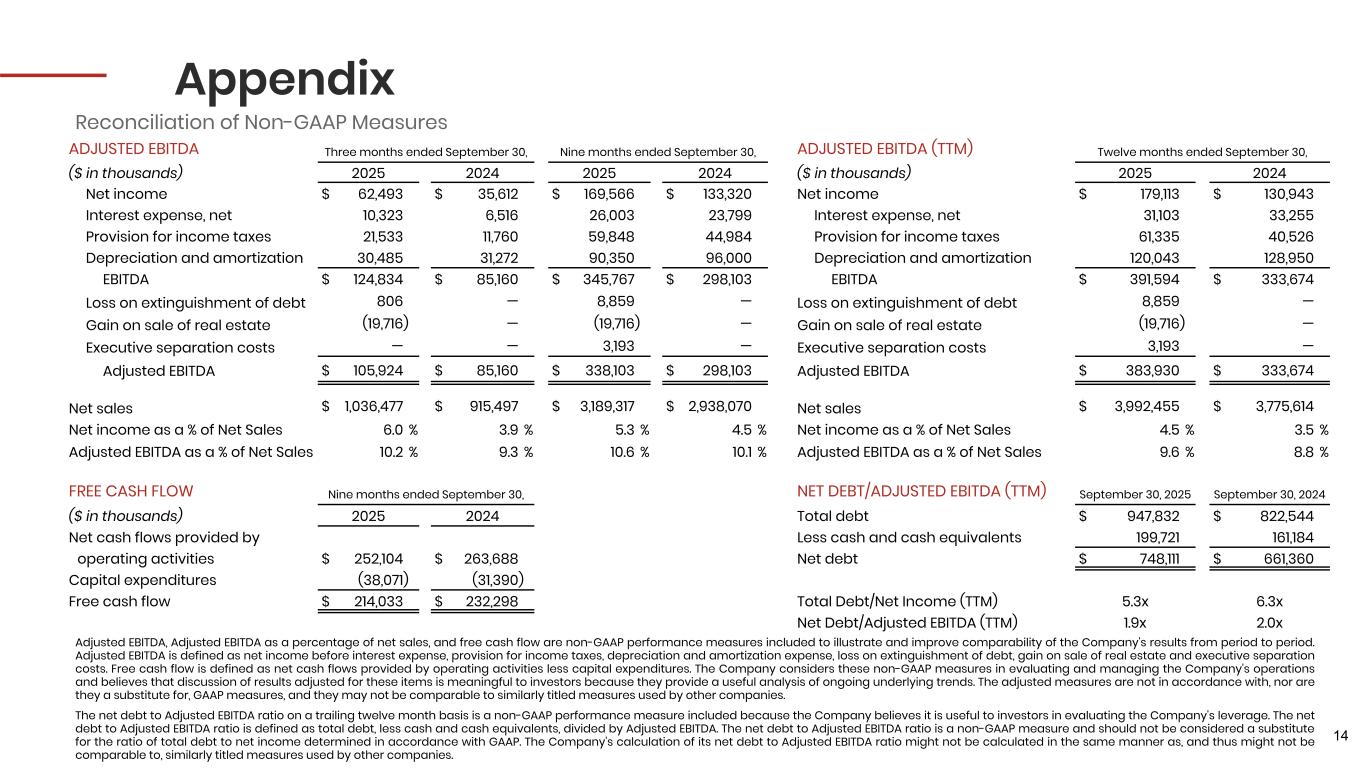
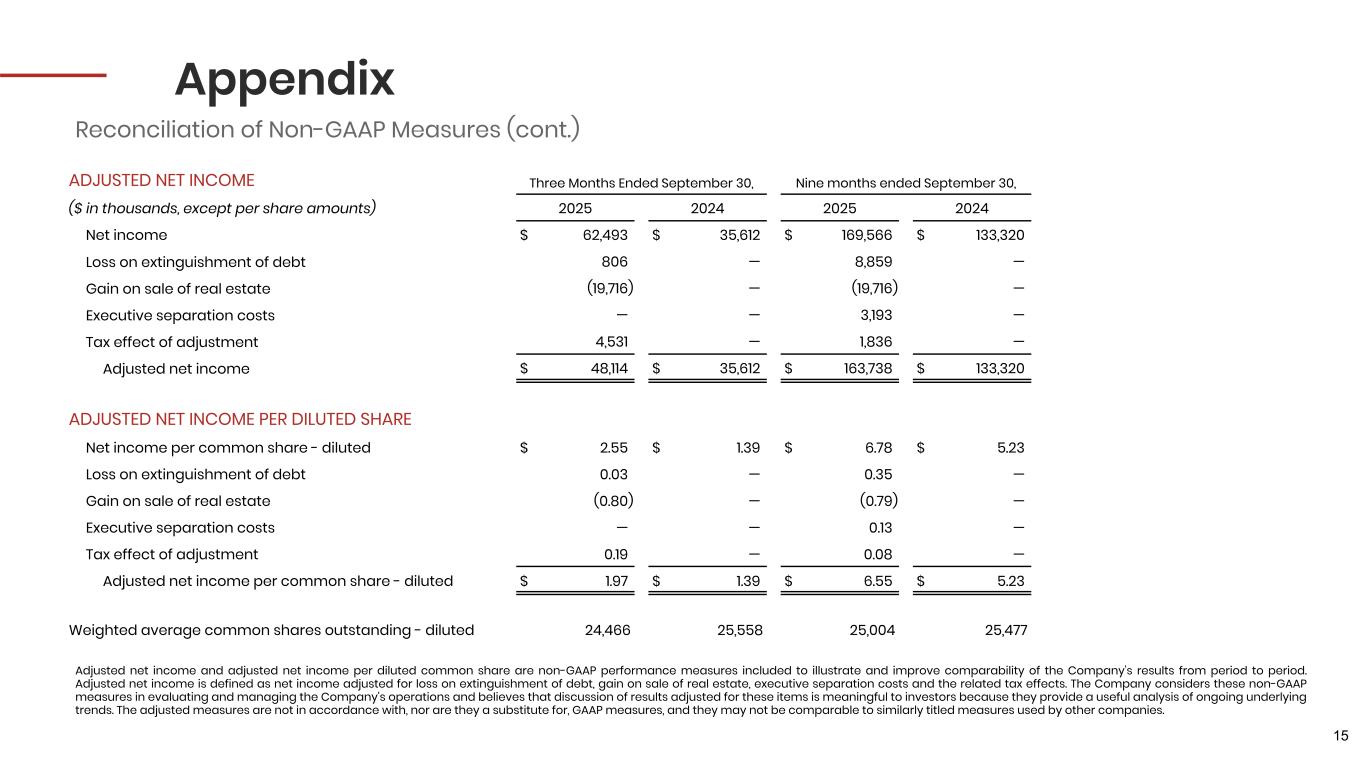
digit net sales growth this quarter while sustainable operational improvement initiatives translated into meaningful margin expansion our consolidated net sales for the third quarter were $1 billion, an increase of 13% from the third quarter of 2024. OEM net sales for the third quarter of 2025 were $790 million, up 15% from the same period of 2024, driven by RV OEM net sales of $470 million, which were up 11% compared to the prior year period. This increase was a result of market share gains and an increased mix of higher content fifth wheel units. Content per towable RV unit increased 6% year-over-year to 5,431, and content per motorized unit increased 2% year-over-year to 3,839. Towable RV organic content grew 3% year-over-year and 1% sequentially, supported by the share gains we delivered in the top product categories we supply to RV OEMs, specifically appliances, axles and suspension, chassis, furniture, and windows, as well as the continued adoption of recent innovations like our ABS, PCS, appliances, Durian Chill Cube, and the Sundex. Adjacent Industries OEM net sales were $320 million, up 22% year-over-year, Primarily due to acquisitions within the transportation market, which represented $39 million in the quarter. This increase was also supported by other markets such as utility trailers, where net sales grew 22%, and marine, where net sales rose 9%. We continue to further expand our presence across numerous diversified markets. Aftermarket net sales were $246 million, an increase of 7% compared to the same period in 2024, primarily driven by product innovations and the expanding camping world relationship within the RV aftermarket, partially offset by lower volumes within the automotive aftermarket. Consolidated operating profit during the third quarter was 75 million, or 7.3%, a 140 basis point expansion over the prior year period. This growth was primarily driven by reduced costs for material sourcing strategies and increased North American RV sales volume related to market share gains and increased sales mix of higher content fifth wheel units. The operating profit margin of the OEM segment increased significantly to 5.5% in the third quarter, compared to 3.2% for the same period of 2024, primarily driven by increases in selling prices for targeted products, reduced costs for material sourcing strategies, improved fixed cost absorption, and production labor efficiencies. Our aftermarket segment delivered a 12.9% operating profit margin, compared to 13.9% in the prior year period. This change was primarily driven by higher material costs related to tariffs and higher steel, aluminum and freight costs, lower production volumes in the automotive aftermarket as a result of lower retail volumes, and investments in capacity, distribution, and logistics technology to support future growth. These were partially offset by our ability to increase selling prices for targeted products. Adjusted EBITDA grew 24% to $106 million, compared to $85 million in the third quarter of 2024. Gap net income in the third quarter was $62 million, or $2.55 earnings per diluted share, up from $36 million, or $1.39 earnings per diluted share in the prior year period. Adjusted net income increased to $48 million, up 35% to $1.97 per diluted share, excluding loss on extinguishment of debt and gain on sale of real estate, net of tax effect. Non-cash depreciation and amortization was $90 million for the nine months ended September 30, 2025, while non-cash stock-based compensation expense was $17 million for the same period. We continue to anticipate depreciation and amortization in the range of $115 to $125 million during the full year 2025. At September 30, 2025, our cash and cash equivalents balance was $200 million, up from $166 million at December 31st, 2024. For the nine months ended September 30th, 2025, cash provided by operating activities was $252 million. Investing cash flows included $38 million used for capital expenditures and $103 million used for acquisitions. During the quarter, we refinanced and repriced our term loan facility, lowering interest by 25 basis points. This action strengthens our capital structure and should reduce annualized interest expense by approximately $1 million, supporting continued cash generation and balance sheet flexibility. We also continue to execute on the $300 million share repurchase program that we announced last quarter. During the quarter, we returned $38 million to shareholders through share repurchases and $29 million through our quarterly dividend of $1.15 per share. Year-to-date, we returned $215 million to shareholders in the form of dividends and share repurchases, underscoring our commitment to balanced capital allocation and shareholder returns. As of September 30, 2025, our net inventory balance was $741 million, which was about flat to prior year. At the end of the third quarter, we had outstanding net debt of $748 million, or 1.9 times pro forma EBITDA, adjusted for the impact of non-cash and other items. Looking forward, we expect October net sales of approximately 380 million, up 15% from prior year, and we anticipate mid-teams year-over-year growth for the full fourth quarter. As Jason mentioned, we project that North American RV wholesale shipments for 2025 will be in the range of 340 to 350,000. Margin expansion continues to run ahead of plan as well. Fourth quarter year-over-year operating margin expansion is expected to match third quarter levels. Efficiency initiatives and infrastructure optimization continue to drive these results. For example, we plan two more facility consolidations by year end for a total of five this year. This translates to five million run rate and annual savings. Looking to capital allocation for the full year 2025, capital expenditures are expected to be in range between 45 to 55 million focused on business investment and innovation. We continue to use our balance sheet to prudently pursue strategic opportunities that drive profitable growth and deliver shareholder value. Our long-term leverage target remains at one and a half to two times net debt to EBITDA and we remain committed to returning cash to shareholders. Our preliminary outlook for 2026 calls for North American RV wholesale shipments of approximately 345 to 360,000 units, and we continue to target organic towable content growth of 3 to 5% annually. From an efficiency perspective, we expect 8 to 10 additional facility consolidations and are exploring divestiture opportunities of roughly $75 million of revenue from lower-margin non-core areas in 2026. These factors, combined with identified operational improvements and further expansion of our presence in diversified markets, are expected to support operating margins in the range of 7% to 8% for 2026. In closing, we are confident that our operational flexibility, strategic diversification, and effective cost management, along with our strong balance sheet, will enable us to deliver sustainable and measurable shareholder value over time. With that, operator, we're ready to take questions, if you could please open the line.
Operator
Thank you. To ask a question, please press star followed by one on your telephone keypad now. If you change your mind, please press star, followed by two. When preparing to ask a question, please ensure your device is unmuted locally. The first question comes from Daniel Moore of CJS Securities. Your line is now open. Please go ahead.
Thank you, Jason, William. Thanks for the color. Congrats on the solid results. I want to maybe just parse out. Good morning. So in the quarter, adjusted operating margins rebounded quite a bit faster than expected. Can you maybe, if bucket or just rank order, those improvements between leverage to higher volumes, optimization, mix, and I'm wondering if maybe tariffs didn't have quite as much of an impact as expected as well.
Yes. So I'll start actually with the end of your question first. I'd say from the tariff perspective, things continue to progress through the year as we had expected. And, you know, frankly, as we were foreshadowing previously, the team has done a really solid job of mitigating the tariff impact to the business, you know, both from the resourcing, working with our vendors for options there to help drive the cost down. And then to the extent that we needed to, we've been negotiating with our customers to pass along pricing. So, you know, that definitely helped the results that we were able to effectively mitigate the tariffs. You know, clearly we saw the volume uplift. We've been seeing the strength in the industries, and I say that broadly, not just the RV, but also strength in other industries as we've been moving through the quarter, and that definitely helped. And you saw as well on the RV side of the business, the content expansion as our newer products continue to be very well received. And as we were going through the model changeover and through open house, you know, we've continued to be very successful in penetrating market share with those products.
And, Dan, productivity was a huge boost, too. I'll just give you, you know, a quick example. We, you know, I think we're down 50 team members year to date from the beginning of the year. And with all the acquisitions, you know, especially the two large ones we did, we've added, you know, 1,000 people there. there. So to be up a thousand with acquisitions, but down net 50 for the year kind of shows you the productivity gains we've experienced through some of the footprint optimization or the productivity initiatives we've been working on.
Really helpful. I wanted to clarify the Q4 outlook, revenue up mid-teens. Nick, can you maybe break that down by end market a little bit. Obviously, a little bit better outlook in RV is helpful. And then on the margin side, you mentioned similar improvements year over year. I'm assuming that's about 150 basis points adjusted, putting us in the 4% range. Just want to make sure I'm understanding your thoughts on Q4's margin profile, Lillian. Thank you.
Sure. So, yeah, I think you're getting to the right zip code with that um in terms of that year over year margin expansion um you know in terms of more specific market clarity um i guess best way to characterize that without getting into specific numbers you know we expect to see continued strength in the rv rv industry as we're going through the fourth quarter we're seeing uh continued strength as jason was commented about in his comments around um the the mix of product you know having having less of the single axler units and more of the fifth wheel coming through is definitely beneficial as well from a um from a top line perspective and and um for the business also keep in mind as we look
at the fourth quarter that does tend to be a seasonally low time period uh for some parts for business specifically aftermarket that's a light quarter for us um and and as well for international attempts to be a little bit late too it appears that you know volume you know volume lift and productivity gains will help as we've as we've mentioned it doesn't appear that there's any you know uh un you know down time that would be more than more than normal i mean everybody's taking off kind of normal normal off times during the the seasonality holidays so I think those are the biggies really helpful and appreciate the color on the margin uplift from from the some
of the divestitures and optimization steps that you continue to take you generated the 20 million dollar gain in the quarter you've got two more facilities consolidations this year eight to 10 next year. Are there any sense for the potential proceeds and or gains from those sales? I know they're one time, but it might be a nice cash benefit.
Some of the facilities are leased there. Some of them are owned. So to the extent we're going to fully get out of a facility and not use it for something else, then we'll certainly look to put those on the market. So there'll be probably a couple of those, but we don't have any dollars attached to those yet until we get that done. But we definitely have significant momentum in that category as we continue to really drive hard to consolidate and simplify the business.
Absolutely. Last, appreciate the outlook for kind of the RV wholesale shipments, the preliminary look for 26. Do you have a kind of a similar outlook for Marine at this stage?
At this stage, Dan, we don't. I think when we come out with the fourth quarter results, We'll have a more comprehensive outlook for next year.
And our big opportunity, Maureen, right now is just content growth through some of the innovation we've launched here in the last couple quarters.
Got it. All right. Well, hopefully all of the share gains that we're seeing come through, but some of that chatter to rest. Appreciate all the color, and I'll circle back with any follow-ups.
Operator
Thank you. The next question comes from Joe Altabello of Raymond James.
Your line is now open. please go ahead thanks hey guys good morning um i guess first question on the industry outlook you mentioned wholesale looks to be up modestly next year would you also expect retail to be up next year i think i think we're kind of expecting the same for them to kind of stay in line as they have you know in the last couple years um we're not we're not forecasting any kind of big jump in retail at this point okay got it and just in terms of the quarter you know the 13 percent revenue growth could you could you parse out how much of that was was pricing related um so we haven't parsed it out specifically um on that joe i mean it's it is there is pricing elements to that but it's also the overall volume uplift as well and and the acquisitions as we identified at the 42 million okay and maybe one one last one for me and he talked about the uh mix improving and i know you know this time of year with the model year changeover you usually see a little bit of a of a richer mix of of larger units are you seeing an improvement beyond what you would expect normally from from a seasonal perspective well i'd say that the you know the trailer the mix
to single axle trailers has changed significantly over the last it's been a you know it's been in process for the last eight years or so but i think what we've seen is the momentum slow down and start to retreat the other way, you know, a meaningful way quarter to quarter. So, you know, it could change next year. It could go back up a little bit, but our expectation is that it's going to kind of stick around where it's at with all the conversations we've had with a dealer. You know, the dealers are driving and seeing a lot of this retail activity. There's a lot of those units out in the market. So that's, I think, is one of the things that's going to hold that number down. You know, you can only sell so many of those.
Operator
So that's the short answer, Joe. okay super thank you guys thanks the next question comes from scott stember of roth capital your line is now open please go ahead good morning thanks for taking my questions and congrats on the very strong results as well good morning thanks i just want to square something away with what uh the largest dealer um indicated on their conference call yesterday uh pretty much saying that they're starting to see some elasticity issues um particularly given some of the price increases that have been put through uh i guess related to tariffs um have you seen any change or any commentary from your oem customers of any potential change in behavior uh suggesting that maybe they're want to pull back a little bit or is the comments we heard yesterday yeah i i think a little bit to the latter the last comment you made i think some of that might be you know Some of that might be there, but there's definitely overall price sensitivity in the market around how much RVs have gone up.
And it's really, you know, there's a few things going on. I think what's going to drive volume next year a little bit is the fact that, you know, suppliers, OEMs, they've reduced capacity. So there's less capacity. If dealers want to get to have product in their lots for the spring selling season, they have to think about ordering a little bit differently and a little bit further ahead because some of that capacity is restricted. um you know and then you know camping world they don't they don't supply i guess every single oem so i mean there's there's winners and losers out there in terms of the brands um the good thing about lippard and our our whole our whole strategy and uh we we supply the whole market so when you look at you know the forest rivers and and the brinkley's and the alliances um you know we're supplying a lot of content to those to those brands um so you know when i look at those
Operator
types of comments you're making i talk to a lot of dealers not just camping world and you know that's kind of how we're coming up with our assumptions for the next year there's a lot of positives awesome and maybe talking about uh i guess the one of the bigger components that you have to put price increases through for with steel and aluminum and um and In the past, there's usually been a timing delay of when you get those prices through. It seems as if you were pretty successful in getting those through. I just want to see how this time, if it is different than the last time that we saw steel and aluminum prices running.
Yeah, nothing's really changed there. I mean, those two commodities are the largest components of our BOMs, at least on the RB side. And they are all controlled largely by these indexes. So, you know, right now, steel is a good guy and aluminum is a bad guy. You know, aluminum pricing is going to be going up here for the next couple of quarters and steel pricing starting to come down. So there'll be a little bit offset there. You know, there was some tariff announcements this morning that there'll be some favorability. Hopefully we don't have timing on that yet, as it was just announced here in the last 24 hours. So, you know, I think the big headline for costs next year is the fact that tariffs seem to be at least settled in place where things are predictable and we can start working on costs better. And we're going to work with our OEMs the best we can and the discipline that they've had to real production back to make sure that we're getting them, you know, the best we can for costs. And as they redo bill of materials and recontent and decontent, that we're a bigger part of the solution as possible.
Operator
Got it. And the last one for me. the aftermarket very strong results uh very resilient i know you have uh a lot of tracks previous oem introductions that you're working into the aftermarket but just trying to get a sense of a breakdown of the business between kirk you know the automotive side and the rv side is there a big difference in growth between the two right now uh so you know the the rv aftermarket for us has grown sequentially you know almost almost since we've we've started it 10 years ago a little over 10 years ago.
The repair and the replacement service business is growing always for us because we're always putting more content in the RV. So, you know, I'll go back to the example I used in my opening remarks of, you know, we launched air conditioning. We've launched a lot of products in the last five years, but, you know, we launched air conditioners, you know, a few years ago, I think I said in 22, we had maybe 5% of the total OEM content, but we had no aftermarket business in ACs. And today, if you fast forward, we've got probably 50% market share OEM, which is fantastic, but now we're seeing close to, we'll see close to 20 million in AC aftermarket business this year. So again, the point is that when we launch new products, for most of the products we launched, there's a meaningful aftermarket once we penetrate the OEM business. And so we expect the aftermarket business to continue to grow, especially with the tsunami of units that were built in, you know, 2020 to 2022 that you're going to start hitting the repair and replacement cycle here in the next couple of years. And on the on the auto side, you know, we've we've had a lot of great success against our largest competitor who used to be Horizon Global, you know, went to first brands. And if you've read anything about first brands in the last month, they've got some serious issues. So, you know, our largest competitor, we're already starting to make some huge inroads here recently just because there's a lot of uncertainty around whether that business is going to continue to exist and who's going to own it. You look at the brands they have, like Reese and Fulton and Bulldog. I mean, Kurt's their largest competitor. So we've got some significant upside on that part of our business as it relates to the auto, you know, hitching, trailering components. So hopefully that's helpful, Scott.
Operator
No, no, that's great.
Thank you so much. thank you the next question comes from tristan thomas of bmo your line is now open please go ahead hey good morning um can i confirm i think you said two million from acquisition in the quarter and then have you quantified what you uh expect bigfoot bigfoot to contribute on an annual basis we've got it smaller i mean moth and moth and uh bigfoot are less than 25 million combined um and then for the quarter what for the quarter on acquisitions is 30 42 total 42 yeah okay great
and then uh for next year how are you thinking about kind of the annualized tariffs impact um either on a grocery net basis or maybe both i think as we think about the tariffs for next year you know really in terms of um what we would expect is really a continuation of this year in terms of that mitigation. You know, we've got the actions in place so that they're not impactful. So again, assuming that there's no changes with the global tariffs and they seem to have stabilized, I'd expect that we'd continue to, you know, have that full mitigation that we do presently going into next year.
Okay, and just one last question. How long do you think it's going to take to kind of get that single-axle versus multi-axle So I think that we'll make kind of back to that call at 84-ish percent range.
You know, it's hard to say. You know, Camping World is doing a great job pushing that product in the market. They're, you know, they're the single largest producer of that type of trailer. You know, the strategy is to get more first-time buyers in the RV lifestyle because of the price point entry on that of, you know, less than $12,000 in a lot of cases. So it's really hard to say, Tristan, but our expectation is that it will normalize. It won't go back to where it was probably 10 years ago, but we think it has a good chance of getting back into that 16% range, especially as all the people that have bought that type of unit over the last five years decide to, whatever portion of them decide to re-up and buy another RV, they're going to buy a bigger one.
Operator
Thank you. As a reminder, to ask a question, please press star followed by one on your telephone keypad now. The next question comes from Brett Jordan of Jefferies. Your line is now open. Please go ahead.
Hey, good morning. This is CJ DiPolino on for Brett Jordan. Thanks for taking our questions. I wanted to circle back to dealers real quick. Could you just give us any color into dealer sentiment and, you know, any insight into the probable timing of the restocking cycle as we move into the new year?
Yeah, I mean, like I said earlier, we talk to a lot of the big dealers just to try to get a feel for where everybody's at, because all the dealers have a little bit different strategy and they play in different markets. And I would just say that, you know, there is a sentiment that inventories are low. You know, the OEMs have had good discipline, like I said earlier. That's helped keep inventories low, but dealers have been just not ordering a ton of inventory. But again, like I said, you know, it's not just us that it's simplified our footprint and optimized. I mean, a lot of suppliers and OEMs have. So the capacity is less in the industry today. And I think that the dealers know that. And they've got to be a little bit cautious on how they look at restocking and not trying to get, you know, inventories too low because they're not going to be able to get the product when people need it for spring selling season. So I think that's why we're seeing a little bit of this. And again, our, you know, our forecast is very modest for next year. 345 to 360 is not a huge lift, but, you know, every 5,000 units that get added to the wholesale production is a really big deal for us considering our content at $5,400. So, and the innovation that's coming.
Okay, great. And then could you just comment on trends and contenting that you're seeing? More specifically, I just want to see if the decontenting of the RVs has started to stabilize.
I feel it has. And, again, I've always said that we're a little immune to that just from the standpoint that, you know, we tend to have a lot of the products that customers need to differentiate their products from others. And, you know, those would be things like the chill cube AC that we've talked about, the, you know, the bus dial square windows that we've launched in the last year and a half with the different colors on the exteriors, you know, TCS and ABS and things like that. They tend not to decontent those things. So, you know, the biggest thing that hurts us is mix when it comes to decontenting. It's just the biggest negative in content for us would be a mixed shift. But like I said, we're seeing a shift to the positive at this point in time. And just another anecdotal thing I was just thinking about with the dealers, I was talking to a dealer the other day and, you know, their multi-site dealer, you know, their most popular floor plan they had of what they sell, they had six on the ground, which doesn't lend itself to, you know, good sales for the dealers if they don't have, you know, really popular floor plans and the right geography. So I think that, you know, that's another reason we're seeing a little bit of positivity out there from some of the dealers that we're talking to.
Okay, great. Got it. Thank you. That's very helpful. That's all from us.
Operator
Thank you. We currently have no further questions, so I'd like to hand back to Jason for any closing remarks.
Well, the last three years have been tough being at the bottom of the cycle, but we've, you know, we've figured out how to have peak operating performance here in the trough. We're really proud and happy with the solid results that we've put out here in the last quarter, and I look forward to talking about that continued momentum next quarter. Thanks for the call.
Operator
This concludes today's call. Thank you all for joining. You may now disconnect your lines.