Operator
Hello, everyone. Thank you for joining us and welcome to the Lineage Second Quarter 2026 Earnings Conference Call. After today's prepared remarks, we will host a question and answer session. If you would like to ask a question, please press star one to raise your hand. To withdraw your question, press star one again. I will now hand the conference over to Keebin Kim, Head of Investor Relations. Please go ahead.
Thank you. Welcome to Lineage's discussion of the second quarter 2026 financial results. Joining me today are Greg Lemko, Lineage's President and Chief Executive Officer, and Rob Lemaster, Chief Financial Officer. Our earnings presentation, which includes supplemental financial information, can be found on our Investor Relations website at ir.onelineage.com. Following management's prepared remarks will be happy to take your questions. Before we start, I would like to remind everybody that our comments today will include forward looking statements under federal securities laws. These statements are subject to numerous risks and uncertainties as described in our filings with the SEC. These risks could cause our actual results to differ materially from those expressed in or implied by our comments. Forward looking statements in the earnings release that we issued today along with the comments on this call are made only as of today and would not be updated as actual events unfold in addition reference will be made to certain non-GAAP financial measures information regarding our use of these measures and the reconciliation of non-GAAP to GAAP measures can be found in our press release and supplemental package that was issued this morning unless otherwise noted reported figures are rounded and comparisons of the second quarter of 2026 are to the second quarter now i would like turn the call over to greg thanks kevin and good morning everyone let me walk through our agenda for this morning first i'll provide key highlights from the second quarter then i'll share our latest
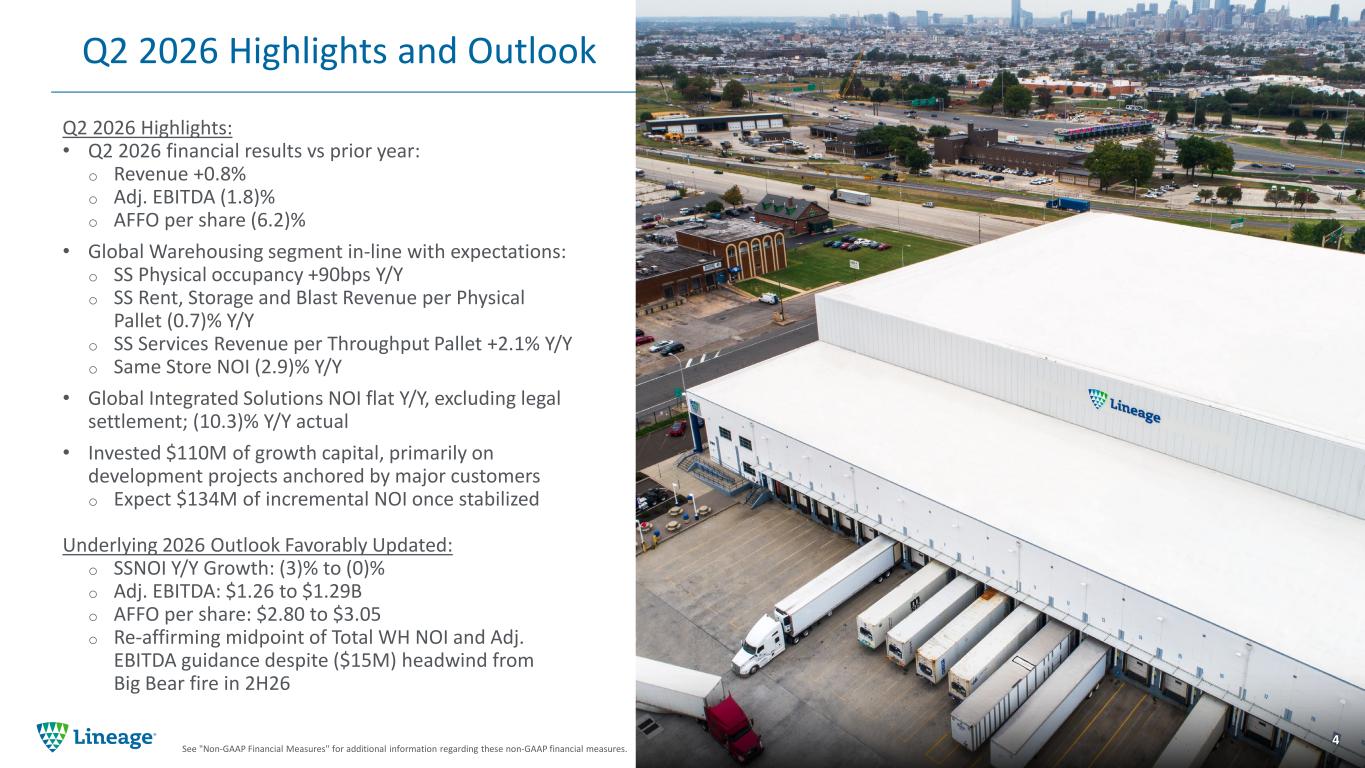
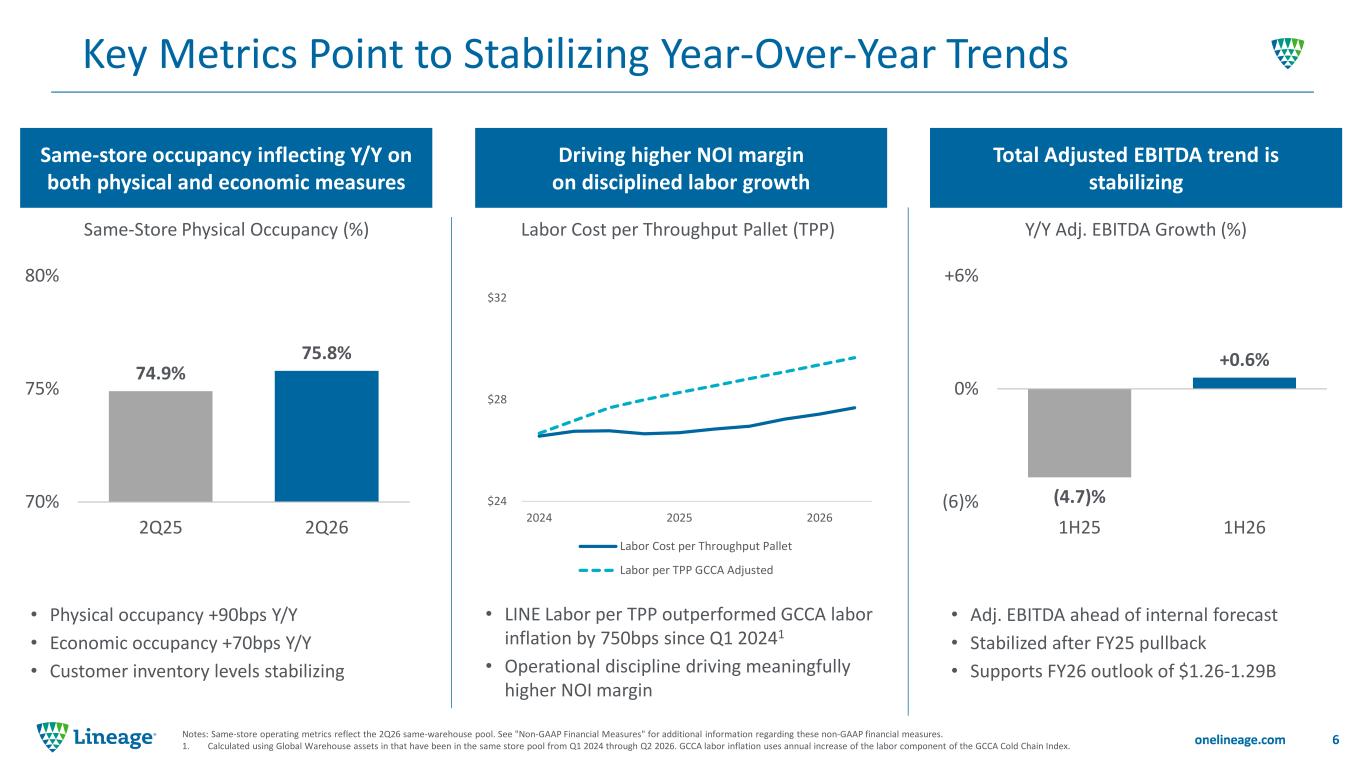
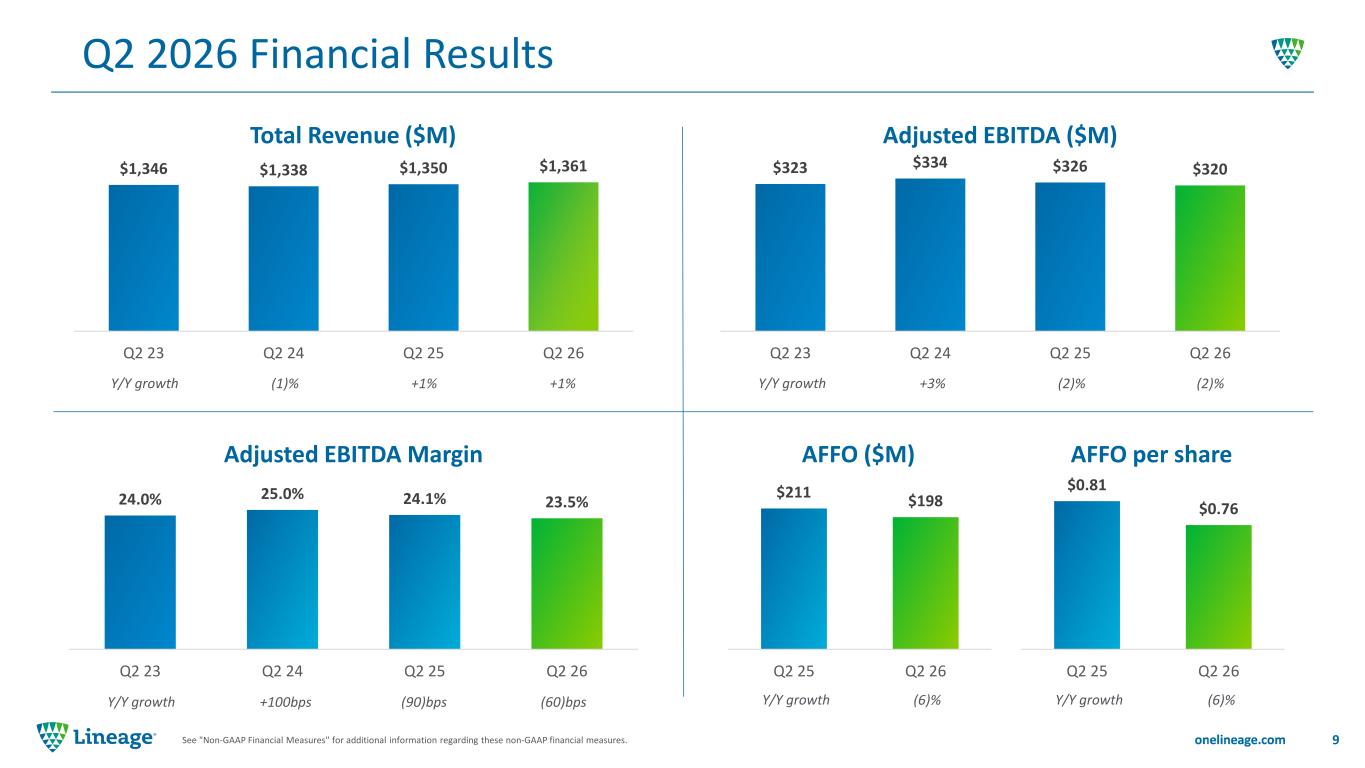
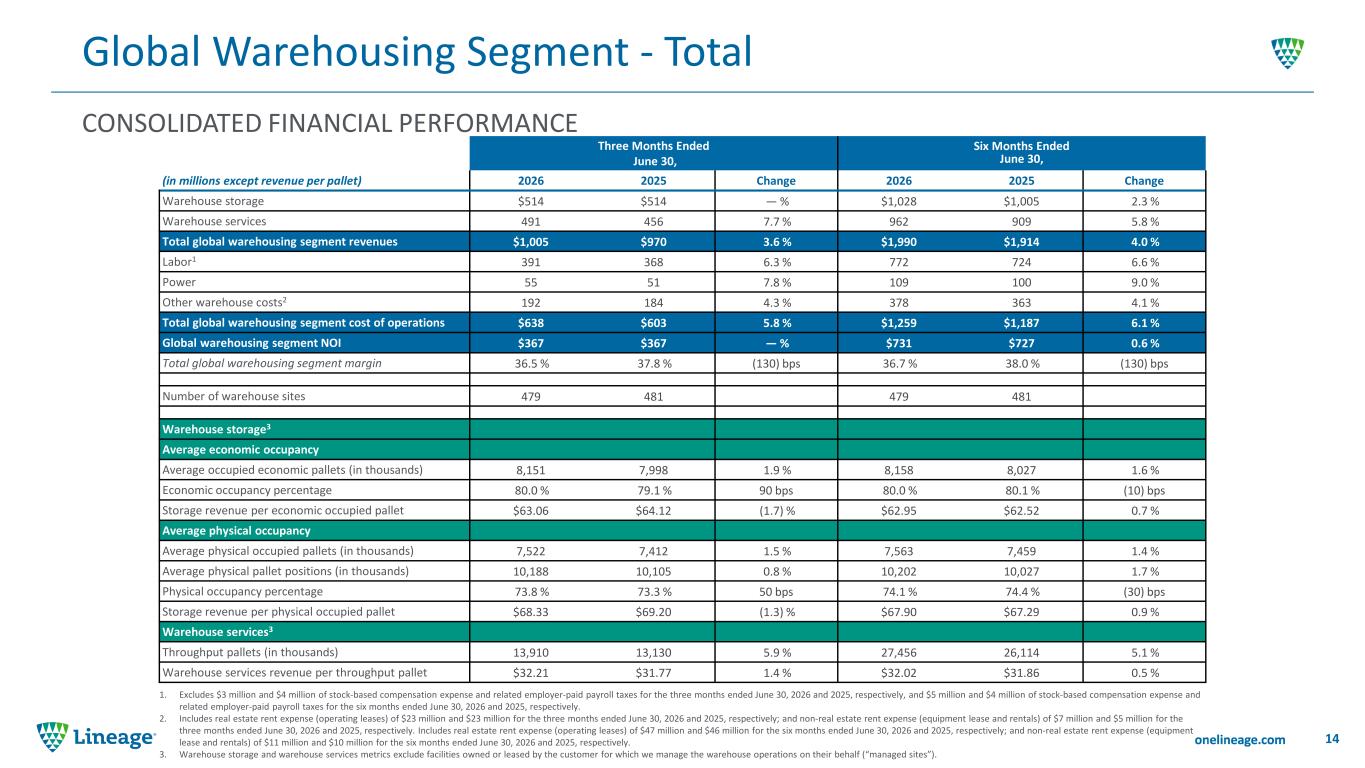
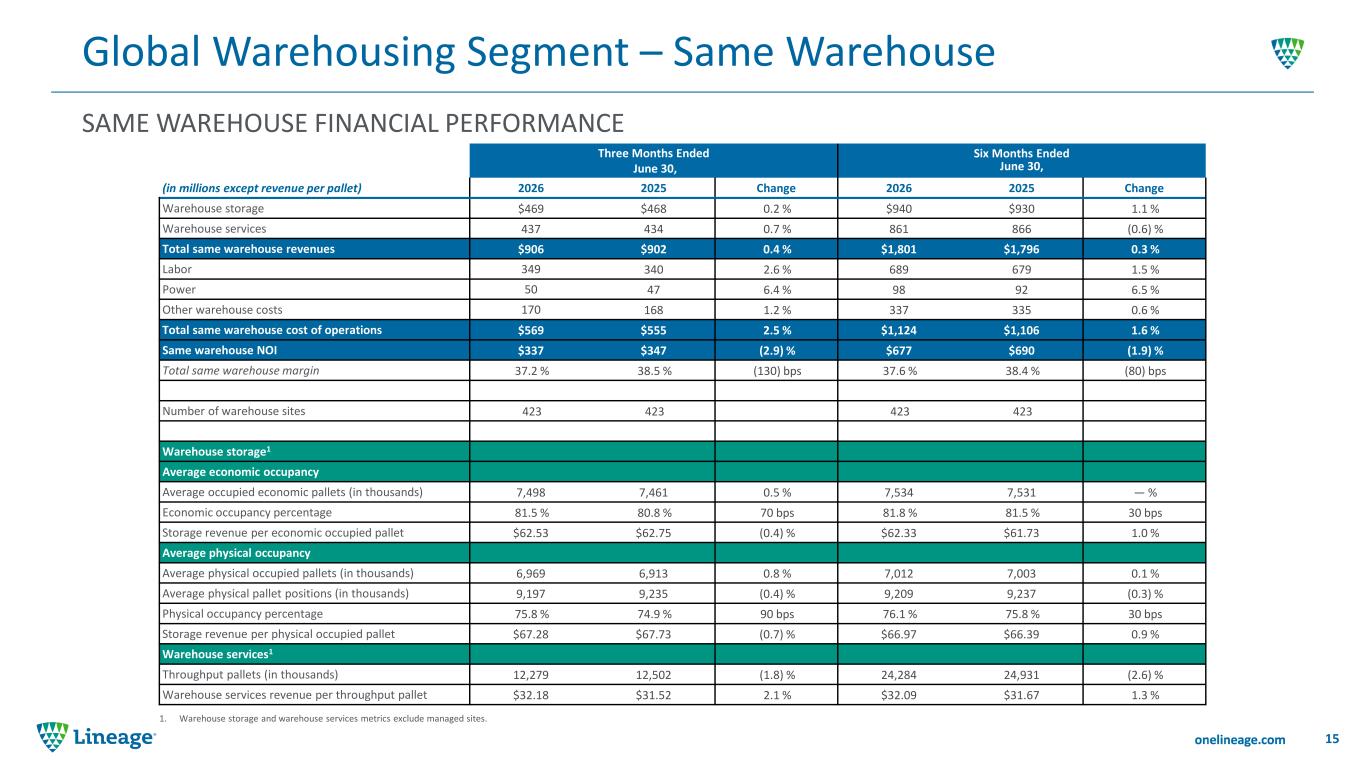
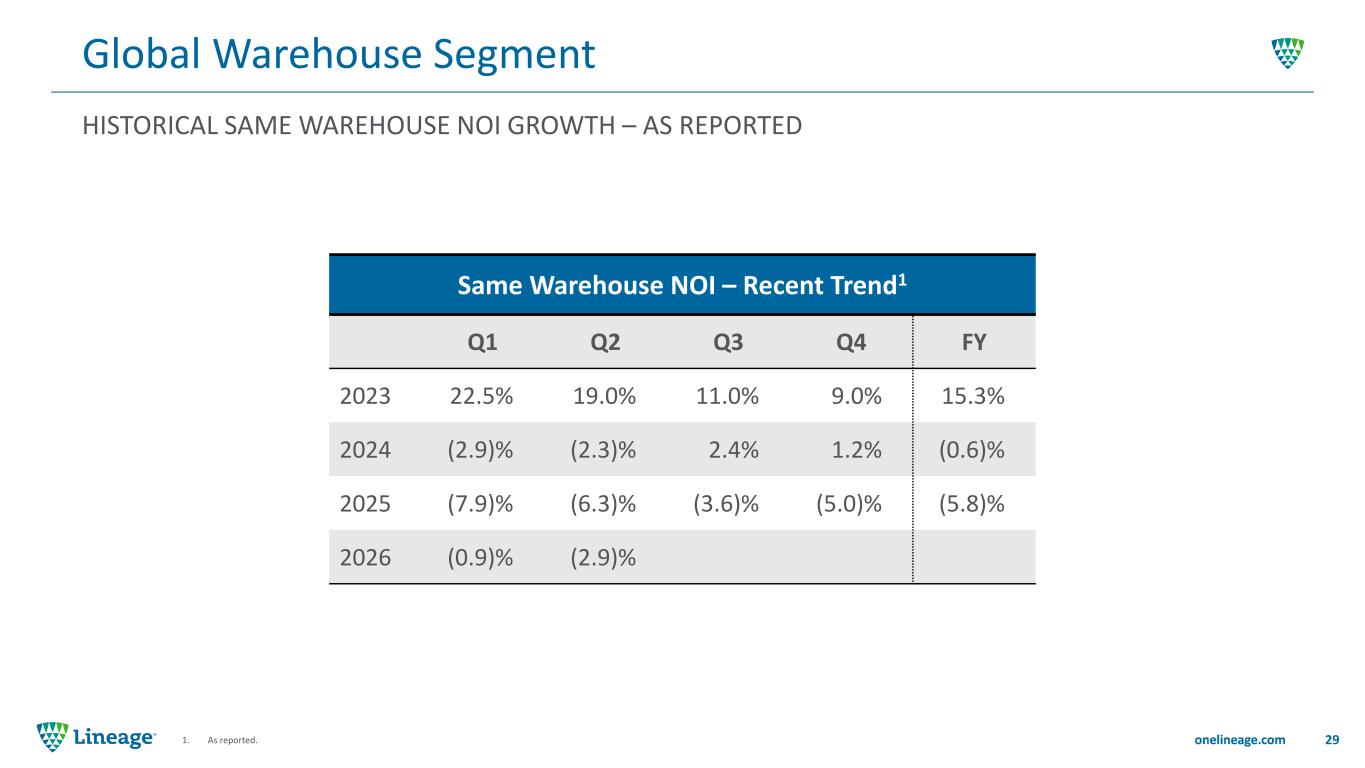
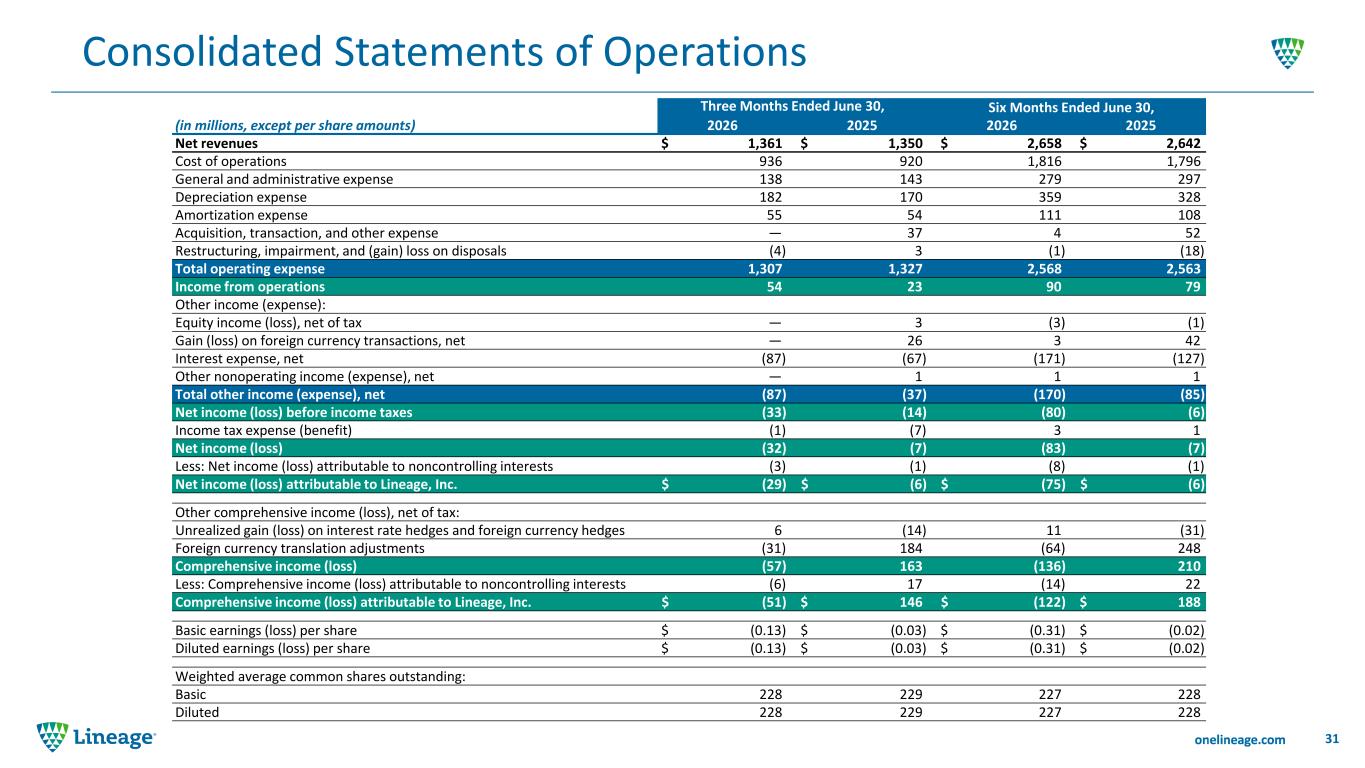
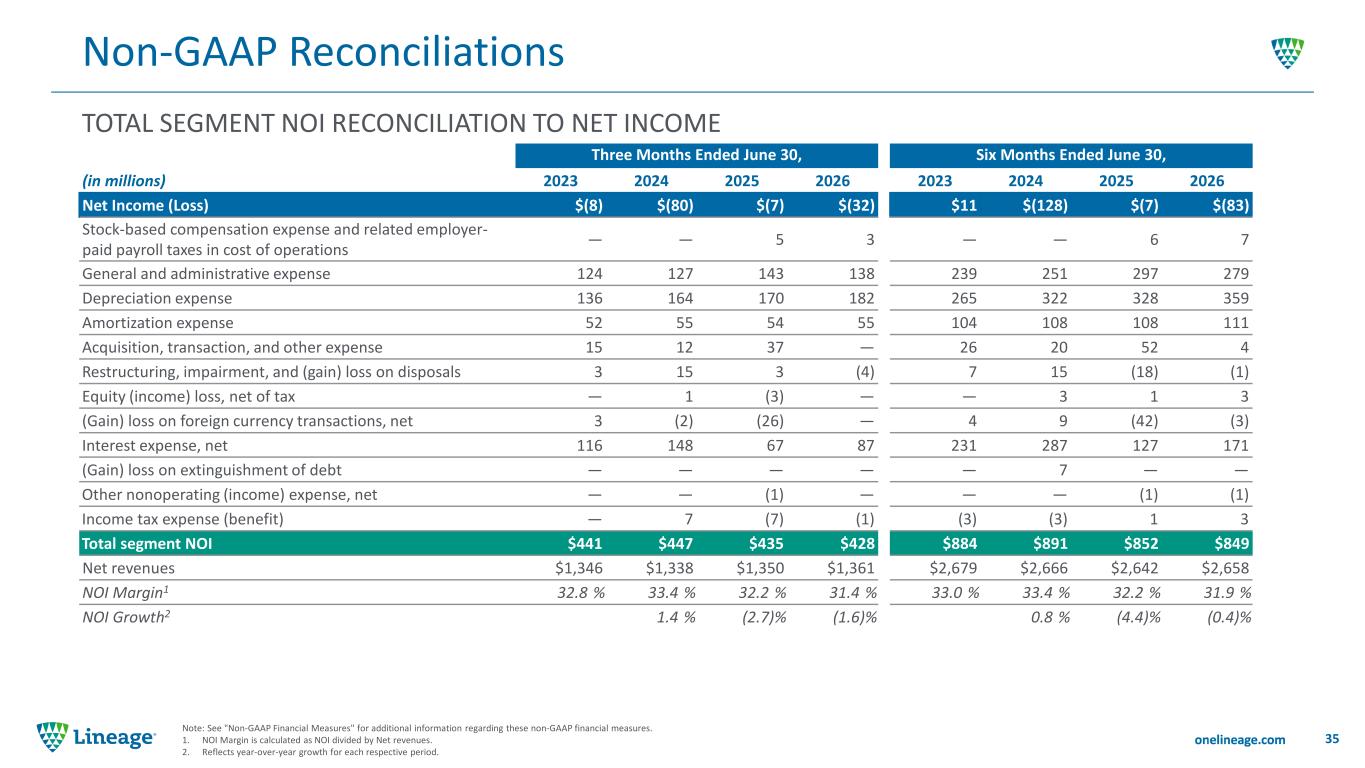
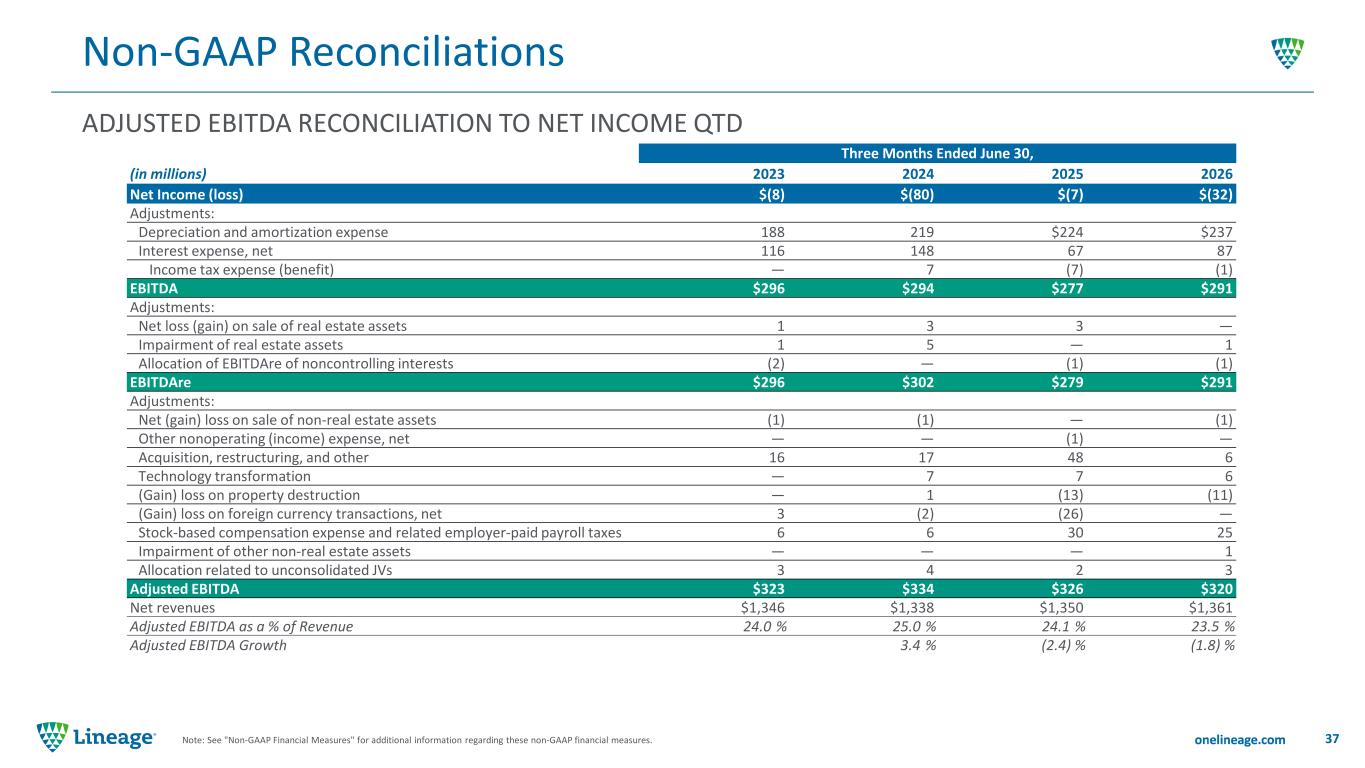
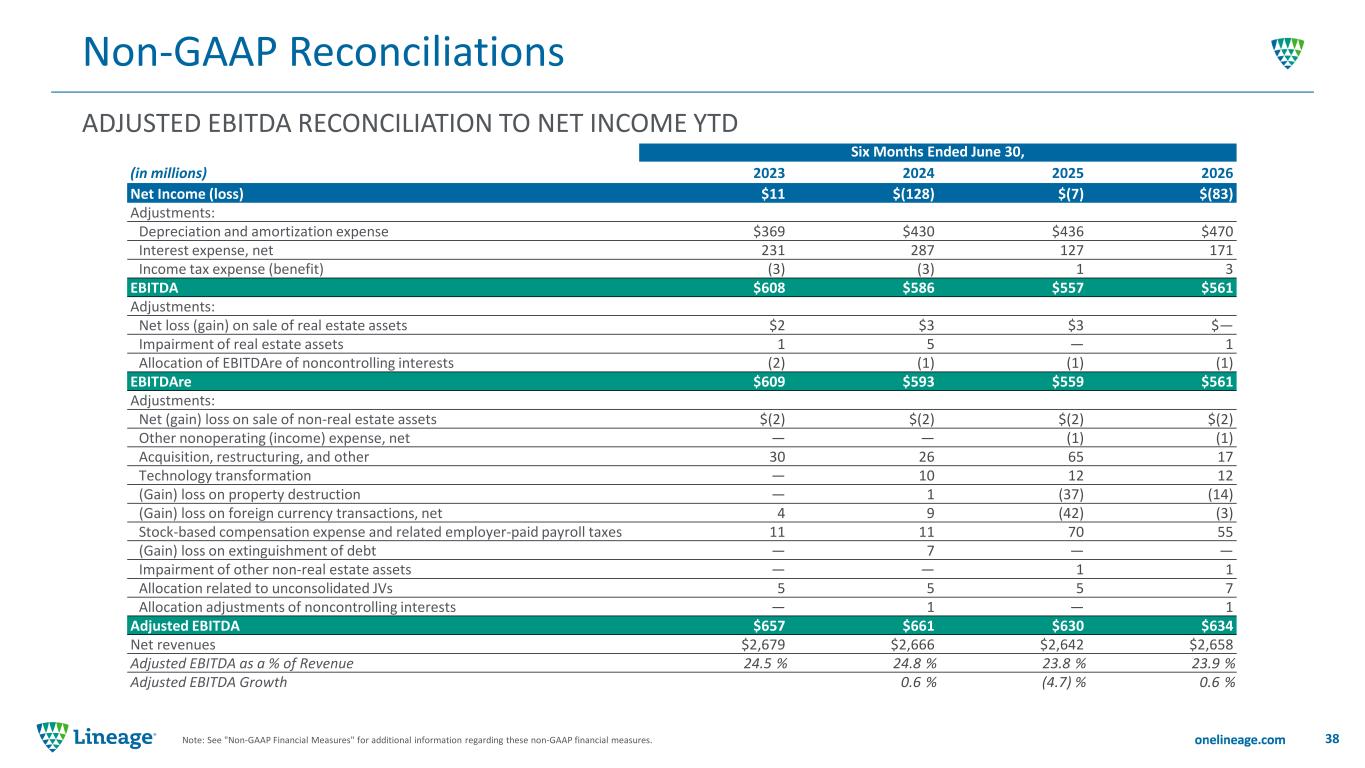
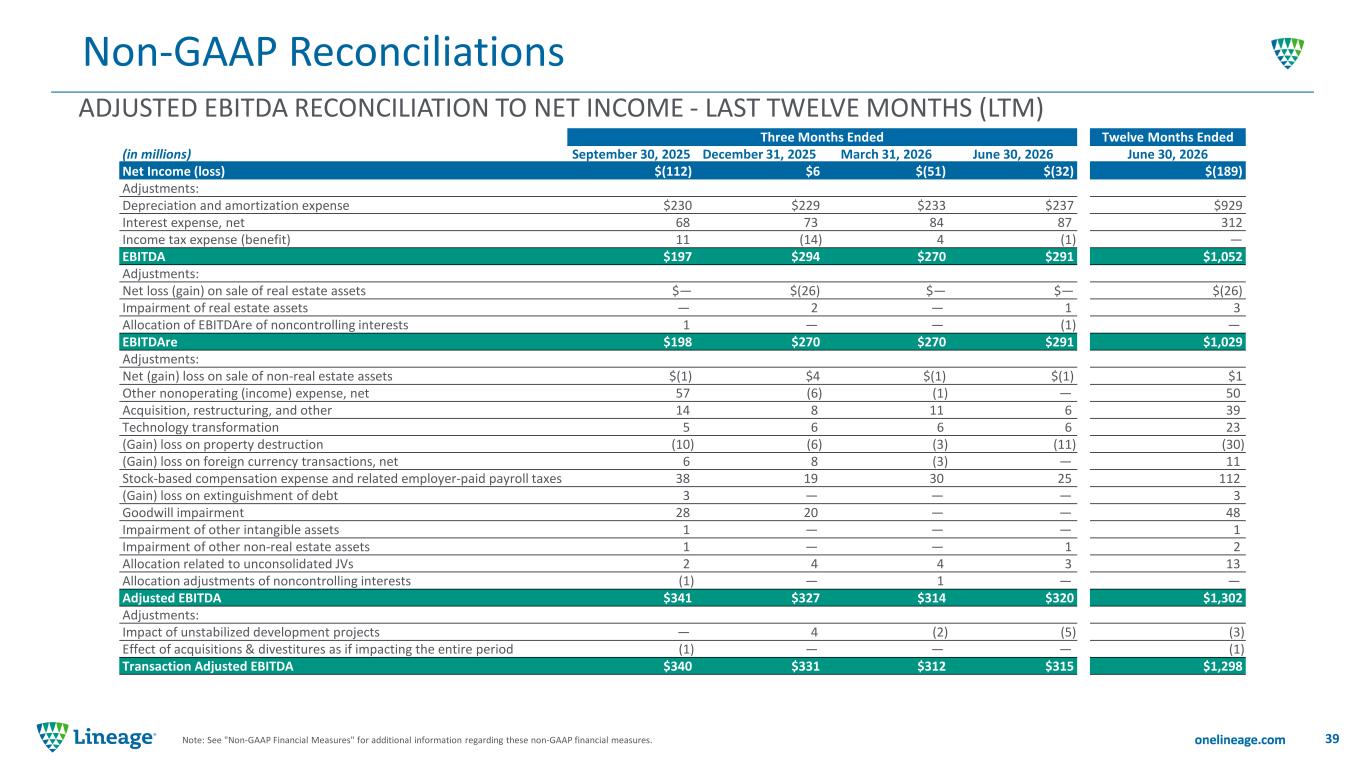
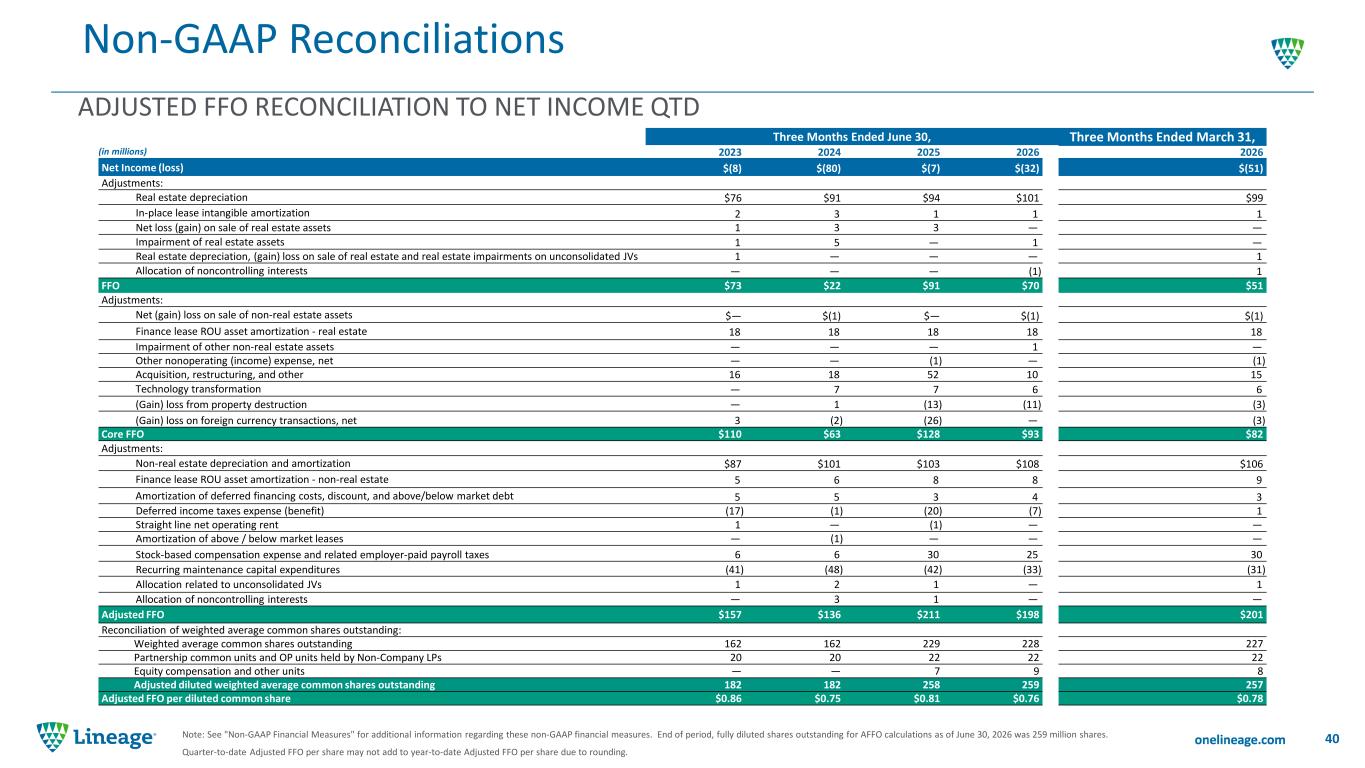
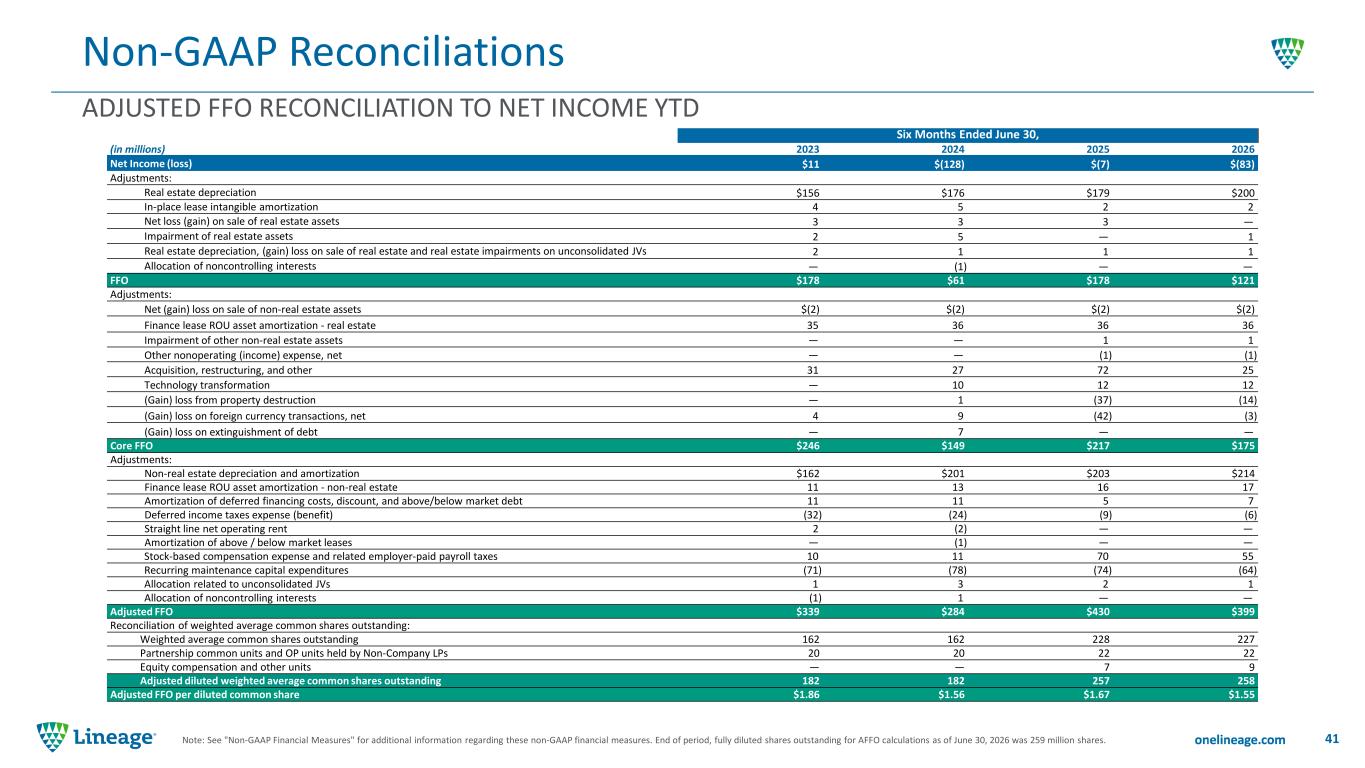
views on cold storage industry dynamics following my remarks i'll turn it over to rob le masters who will walk through the details of our segment performance capital structure and outlook i'll then return to share closing comments before we open up the line for your questions turning to our quarterly performance on slide four we are pleased to report another quarter of better than expected results. Operational trends continue to show signs of stabilization, and this quarter marks another step forward in demonstrating our ability to execute on our plan and navigate the industry challenges. During the second quarter, adjusted EBITDA was approximately $320 million, ahead of both our internal expectations and consensus estimates. Total AFFO was approximately $198 million, or 76 cents per share. The year-over-year decline in AFFO continues to be driven primarily on a comparable basis, excluding this, enjoying meaningful improvement. Turning to core operations, let's start with the following. We're pleased to see growth in same-store physical occupancy this quarter, increasing 90 basis points year-over-year. This is a welcome inflection point and the larger decline in competition, a function of our industry-leading offerings, but the sequential occupancy trends were slightly better than normal seasonality and economic occupancy compared to physical occupancy. Same-store palette increased. We've explained in the past customer commodity and geographic mix along with FX create some quarter-to-quarter noise in these metrics. So we tend to view them in a combined and trended basis versus a short-term proxy. Rob will go into more detail but we've completed the significant majority of our 2026 customer pricing discussions and remain confident we remain encouraged by this particular given the current environment. I'll reiterate that our full year outlook for slightly down turning to volume same store throughput pallets declined 1.8 percent year over year we continued to experience with container volume while this quarter's pace of decline represents an improvement relative to represent a change to how i'd also remind you that we adjust labor according to 2.9 percent year over year continued improvement from the compared to the prior quarter that's a wider decline than q1's negative 0.9 percent by the step down in FX benefit from roughly 250 basis points in Q1 to about 90 basis. Before turning to our outlook, I want to briefly discuss the fireability in Los Angeles. I want to sincerely thank our team members on the ground for their extraordinary response along with the first. Turning to our outlook, we have maintained our adjusted even and midpoint while narrowing the range.
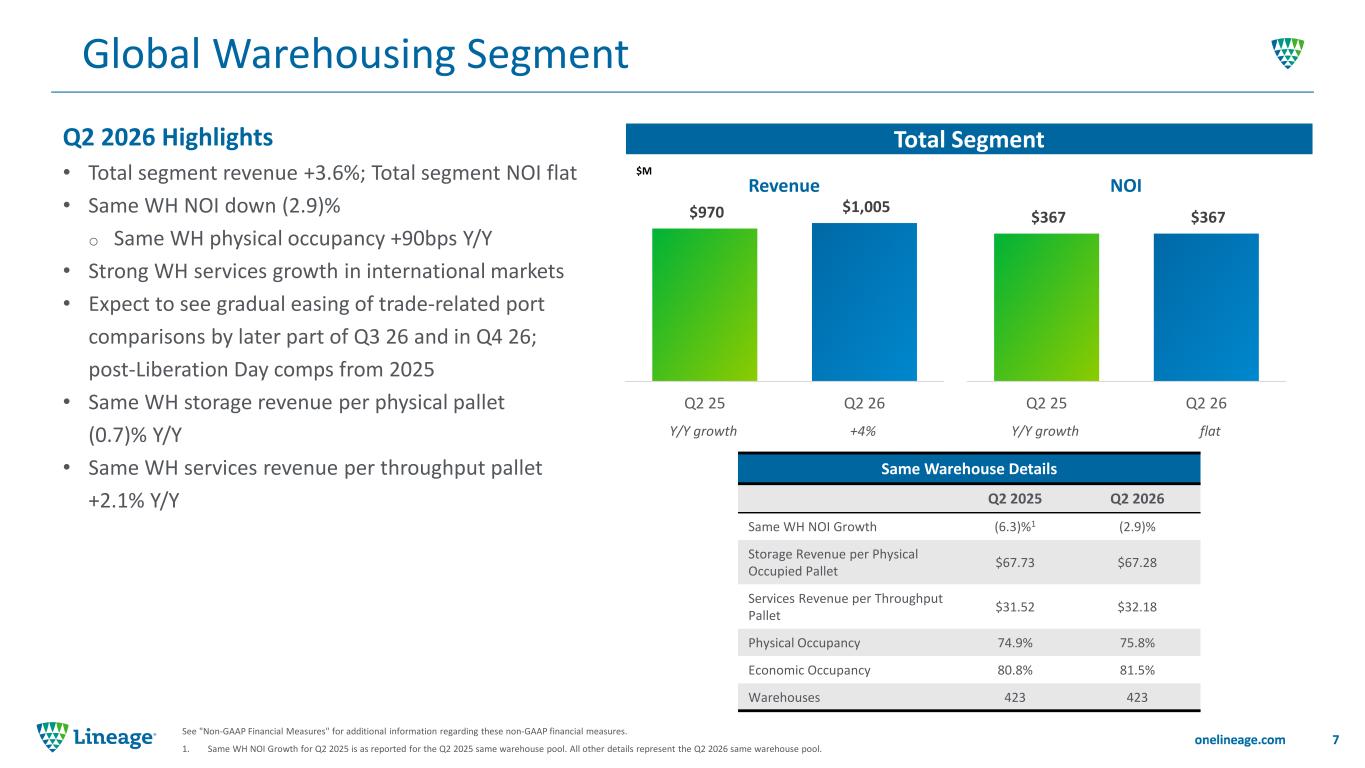
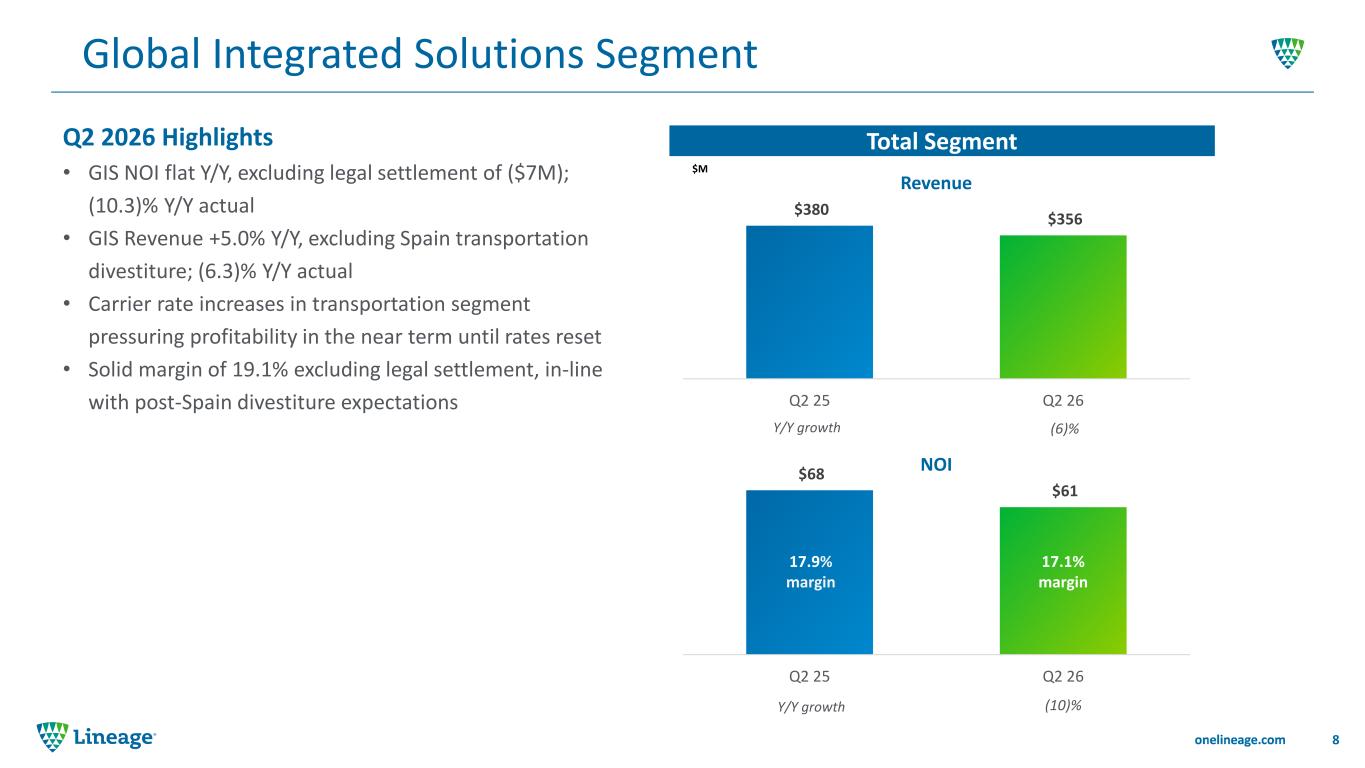
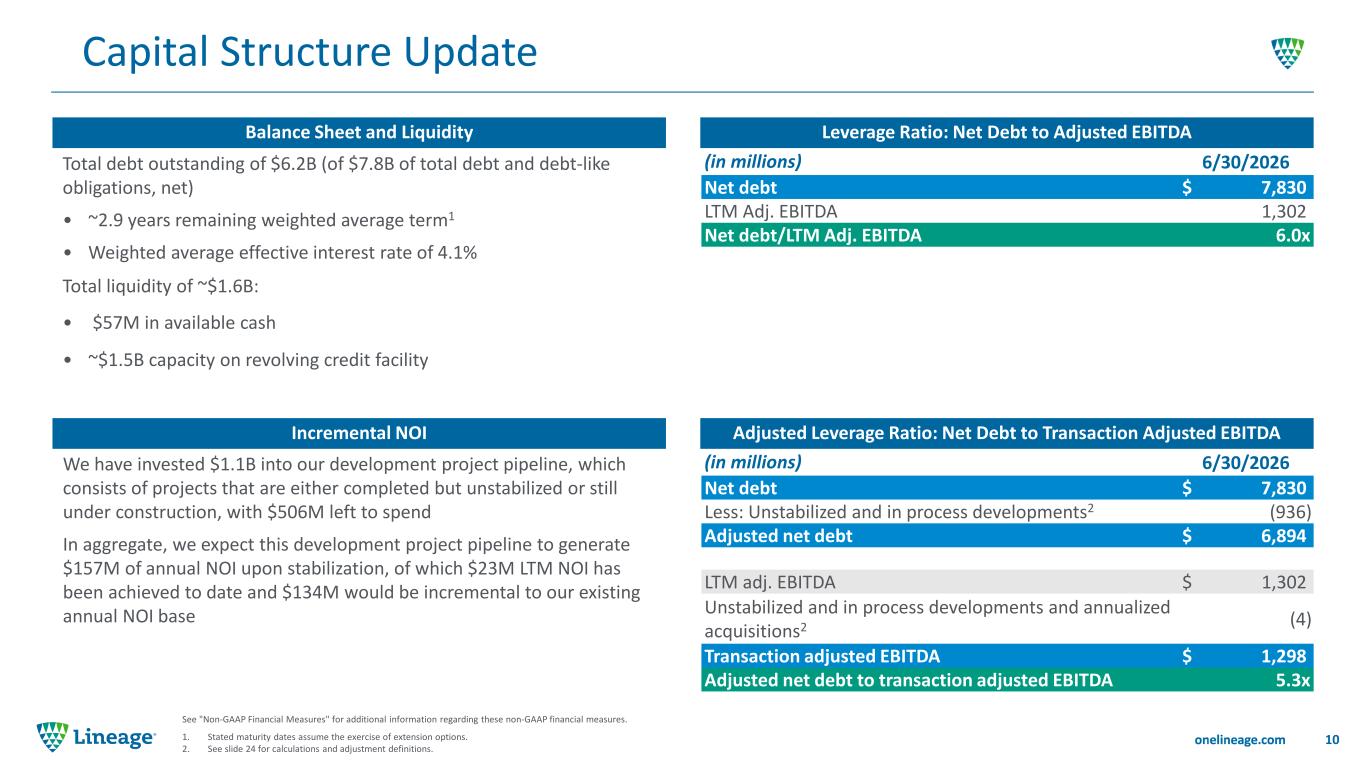
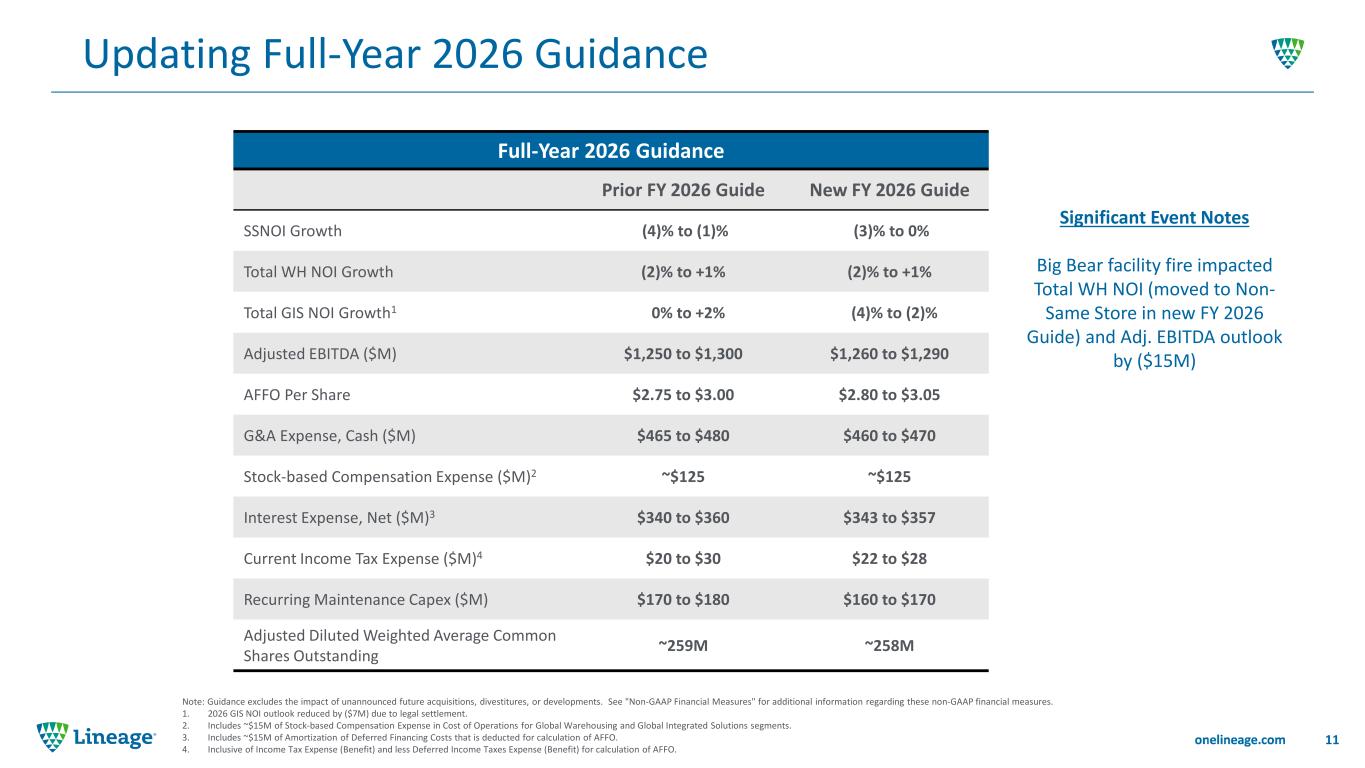
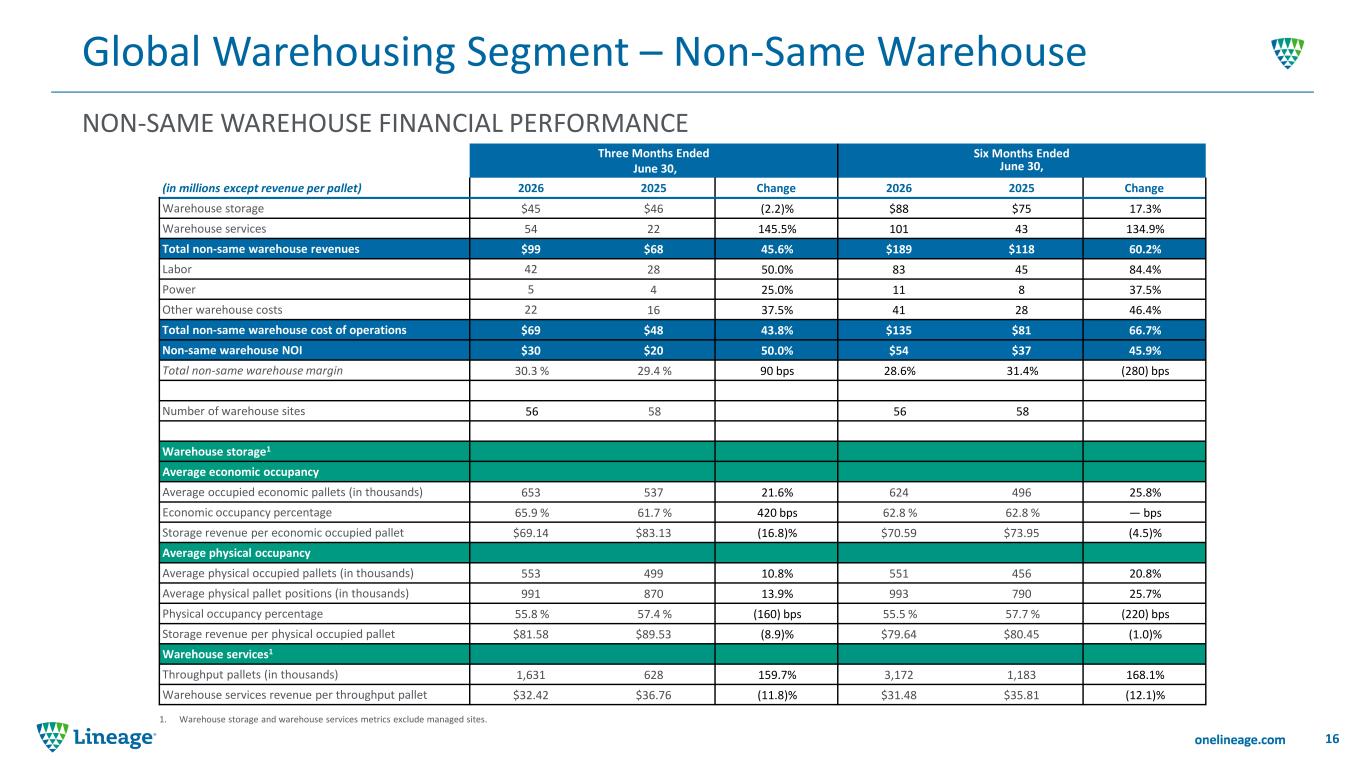
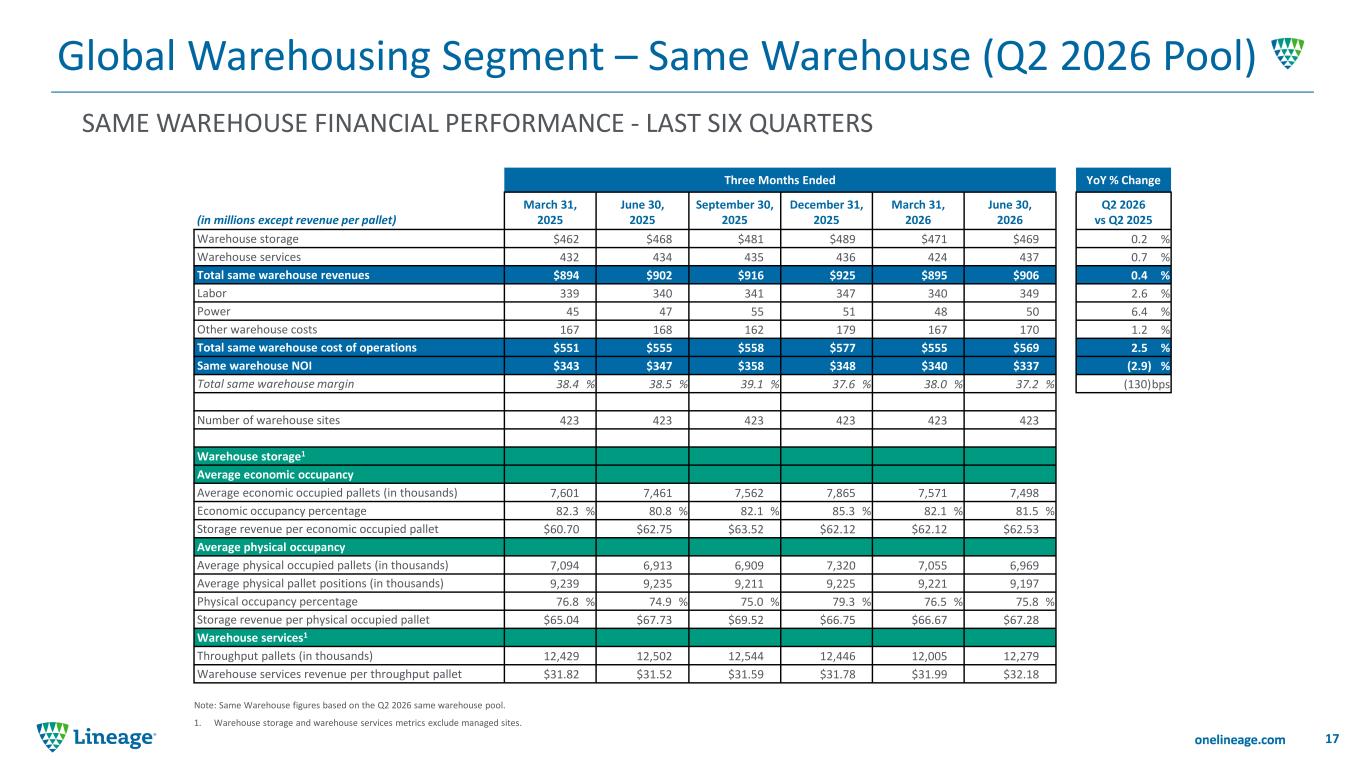
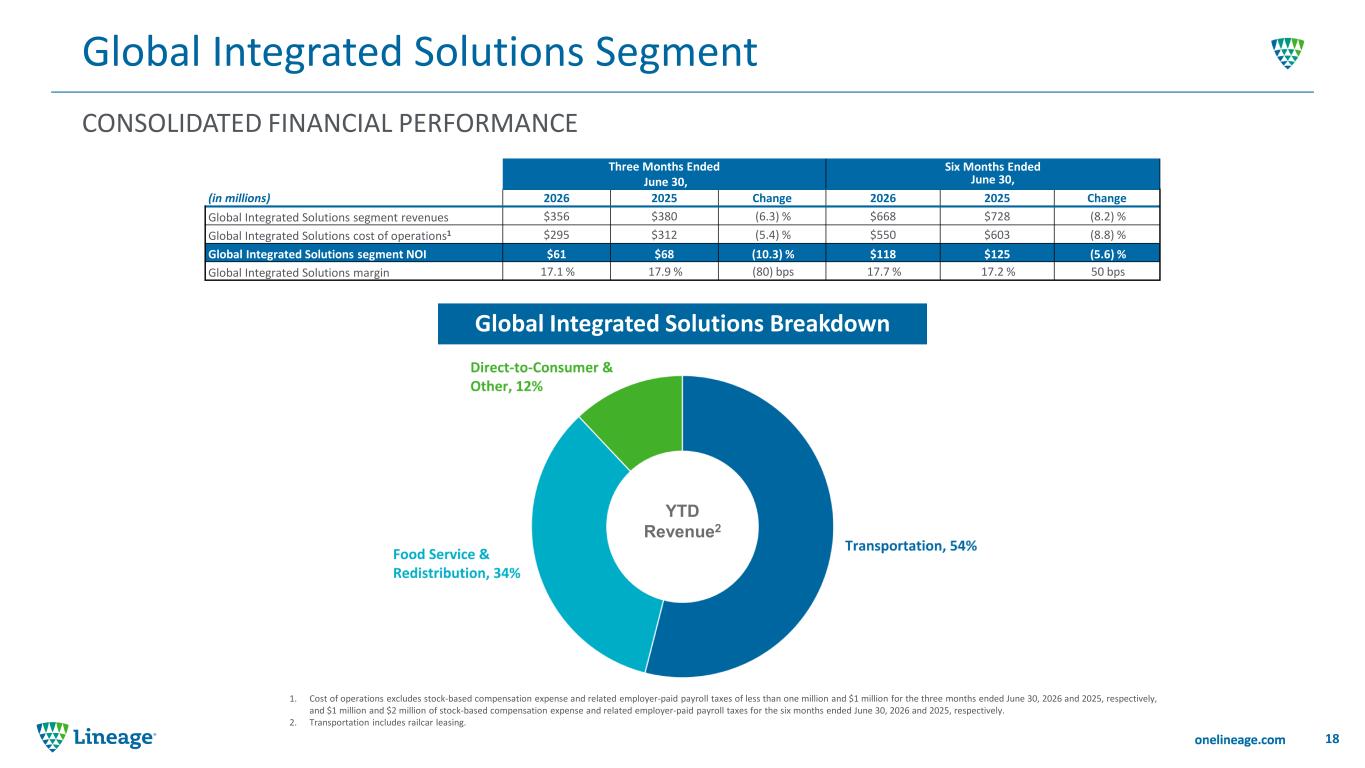
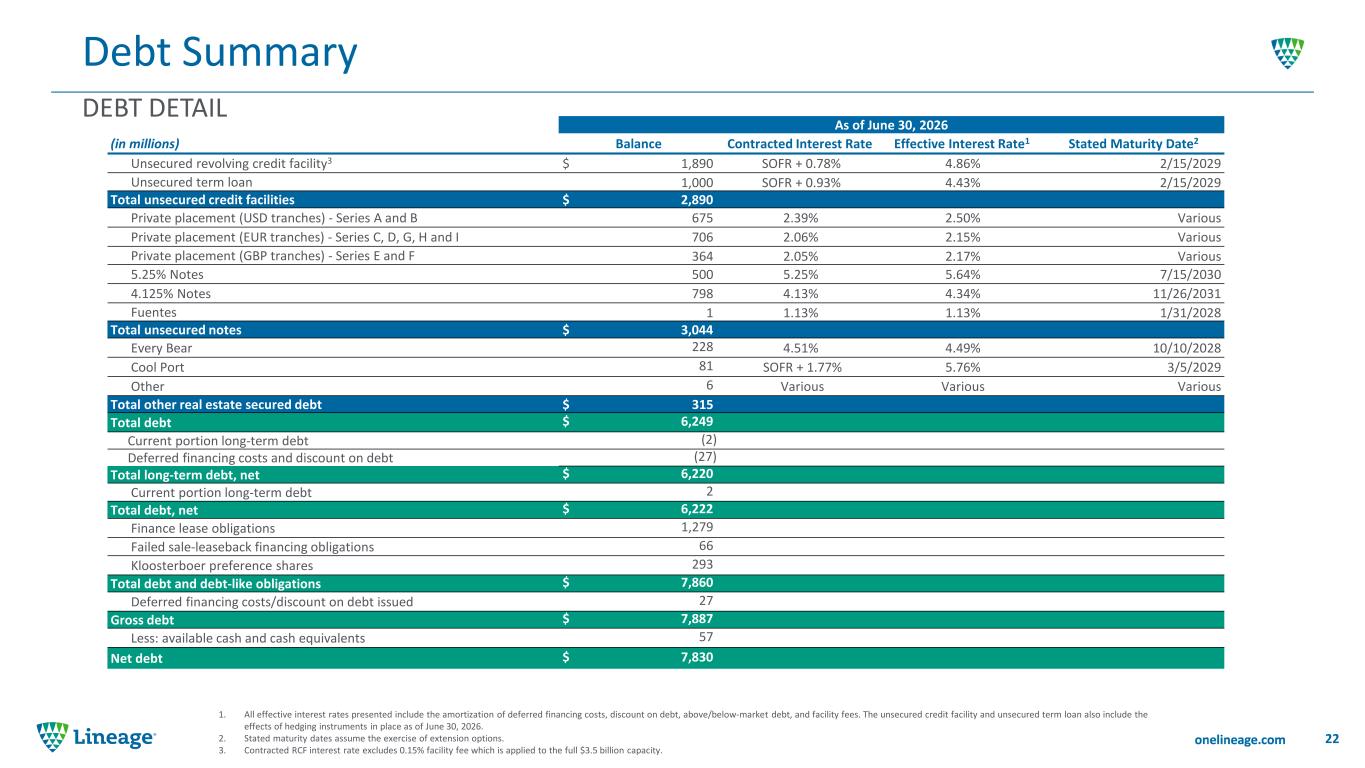
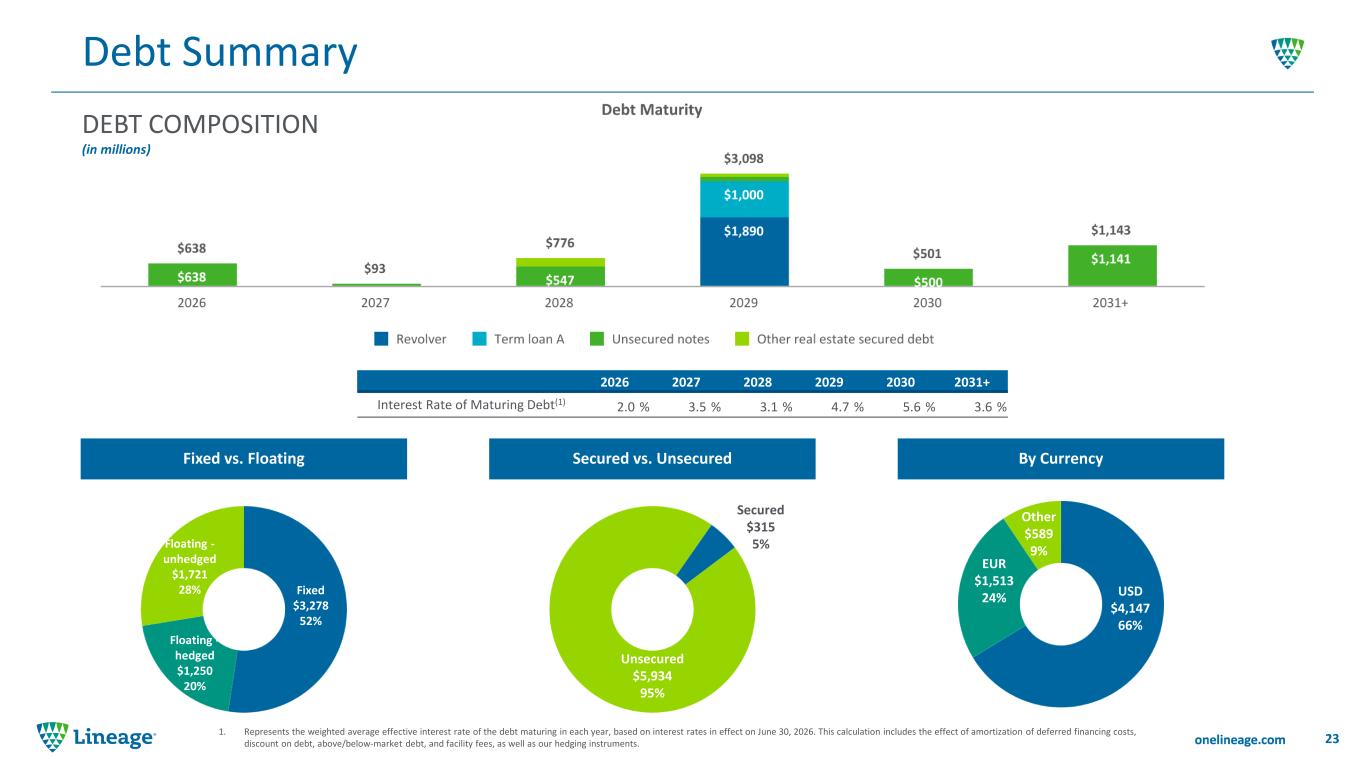
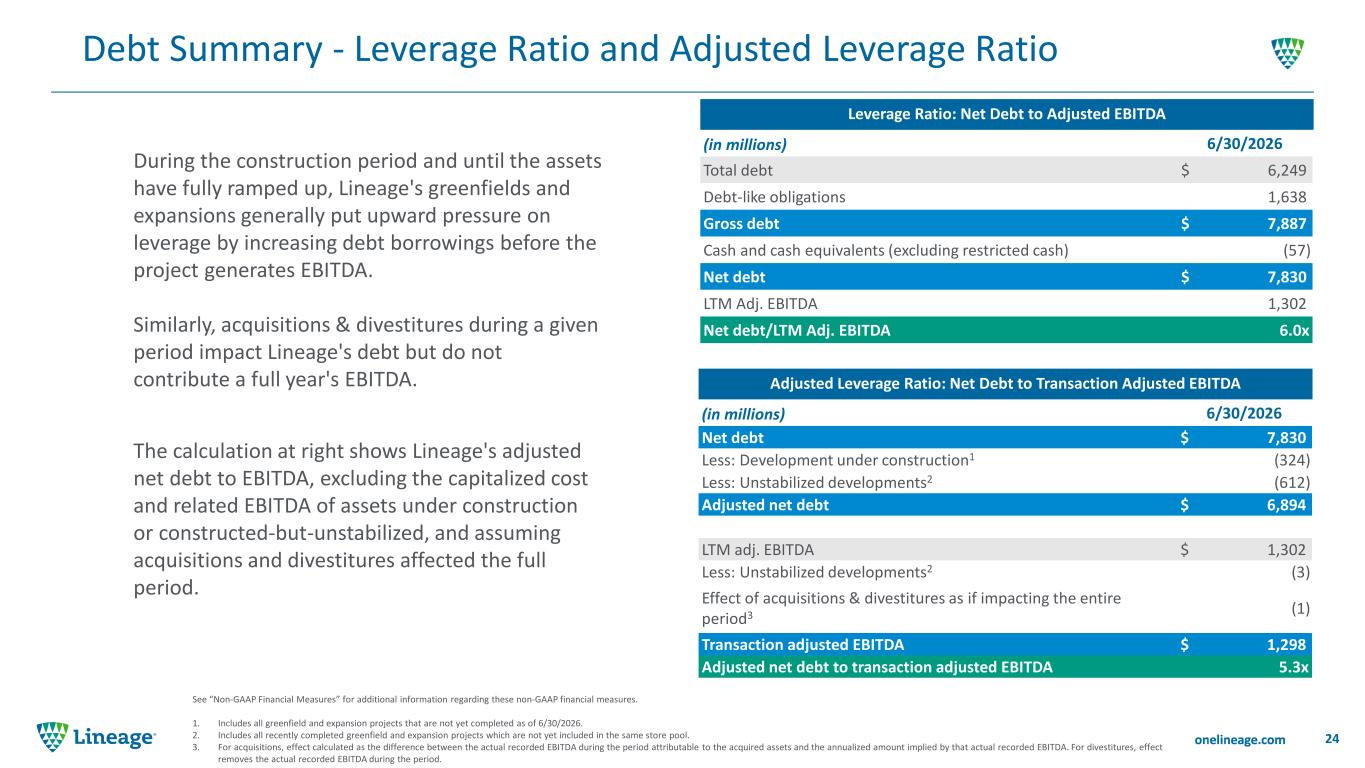
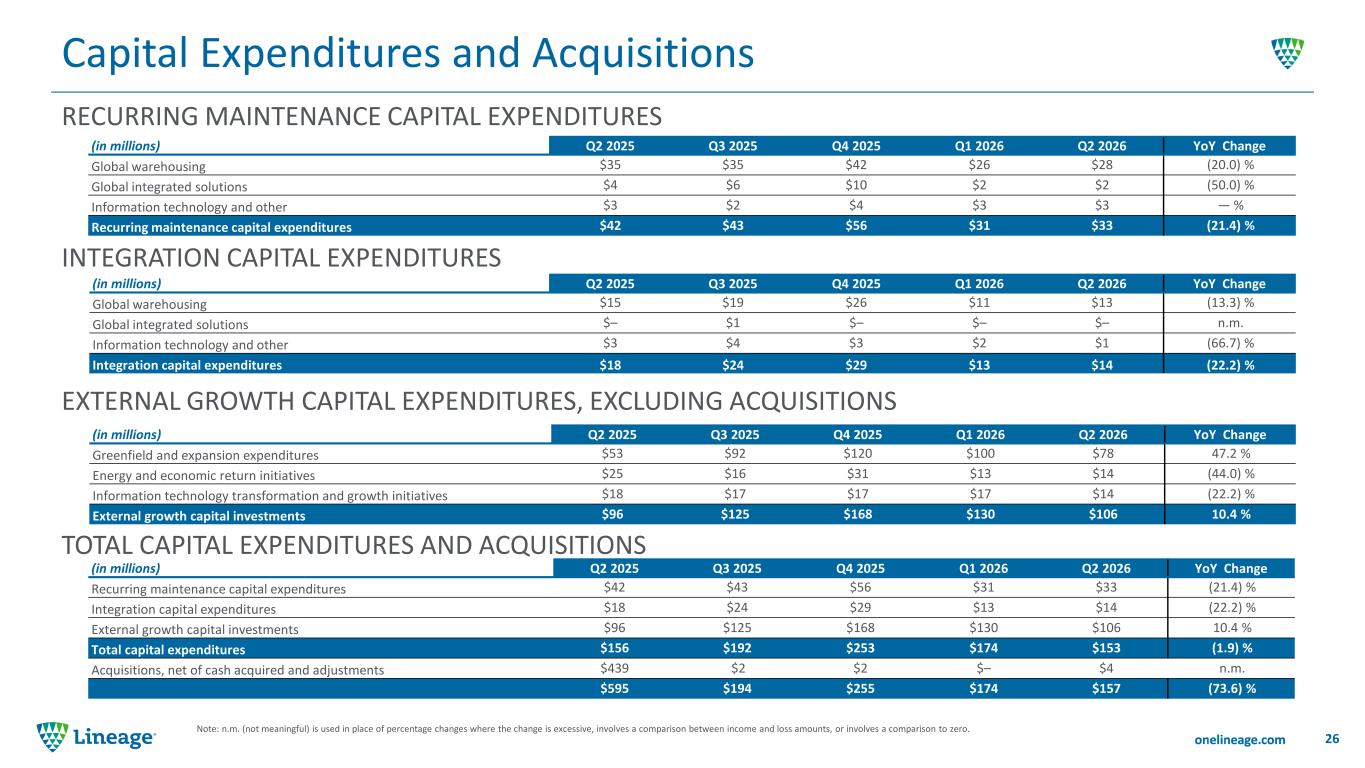
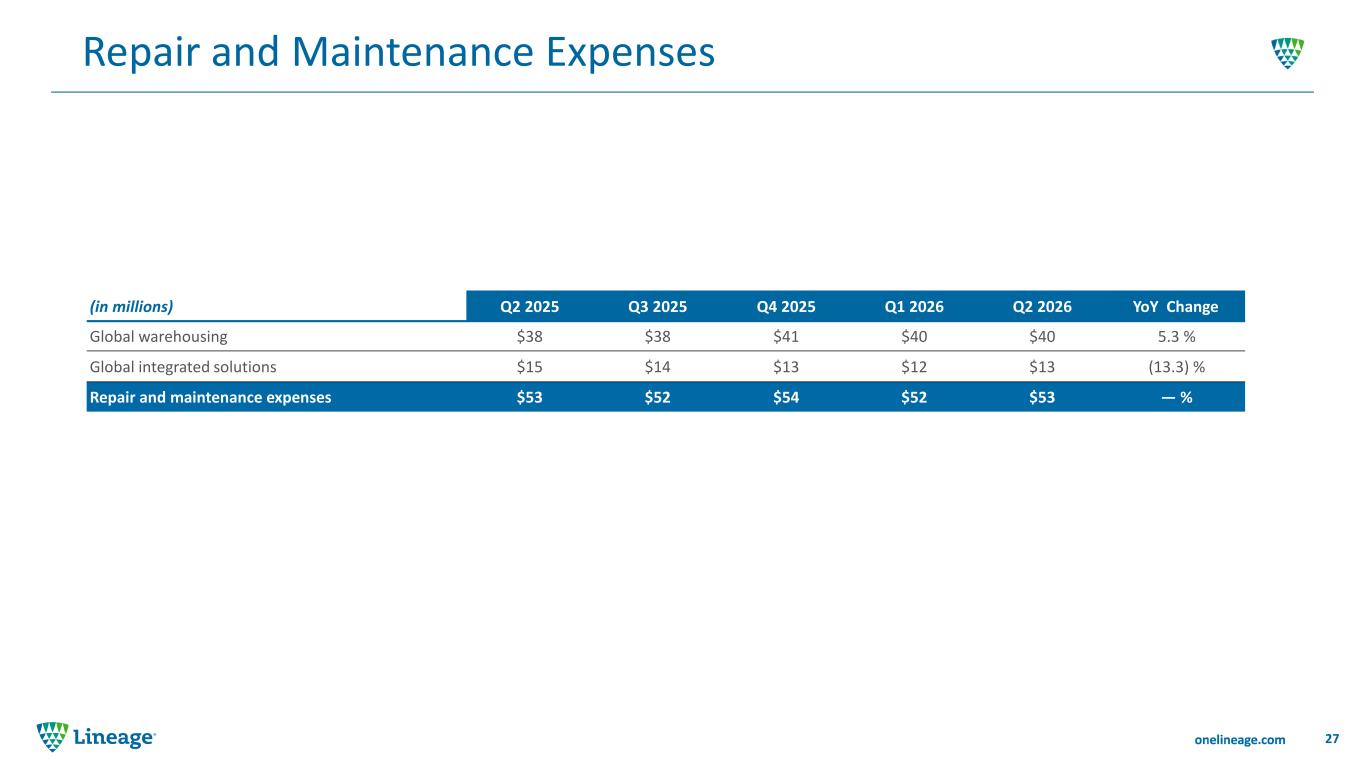
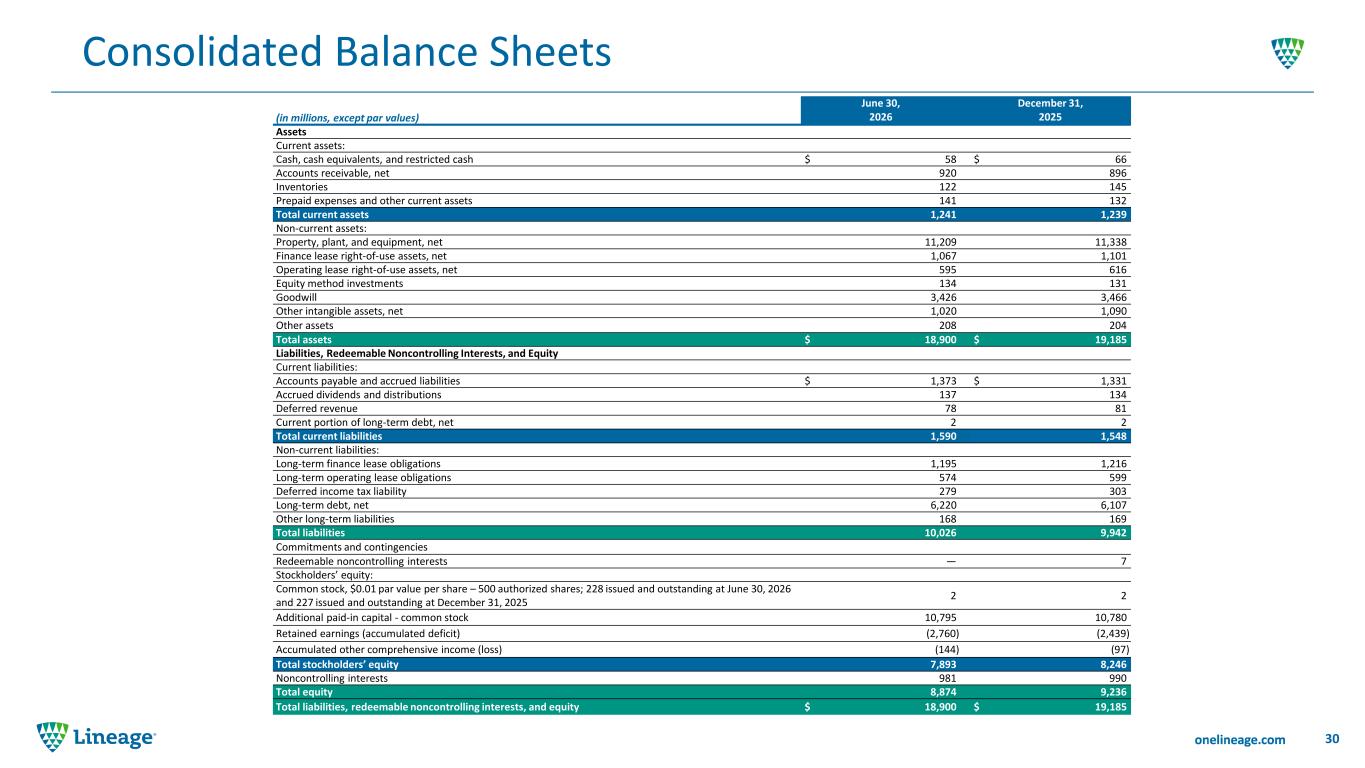
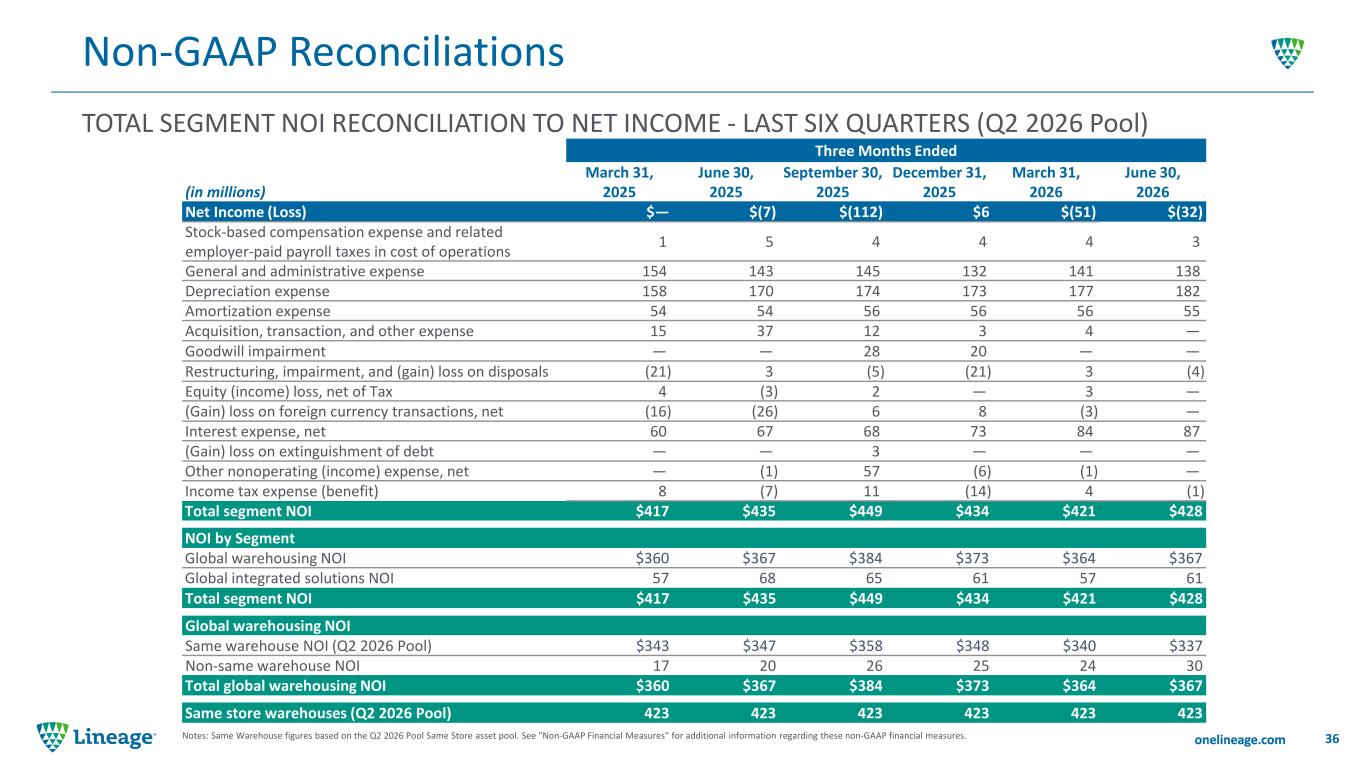
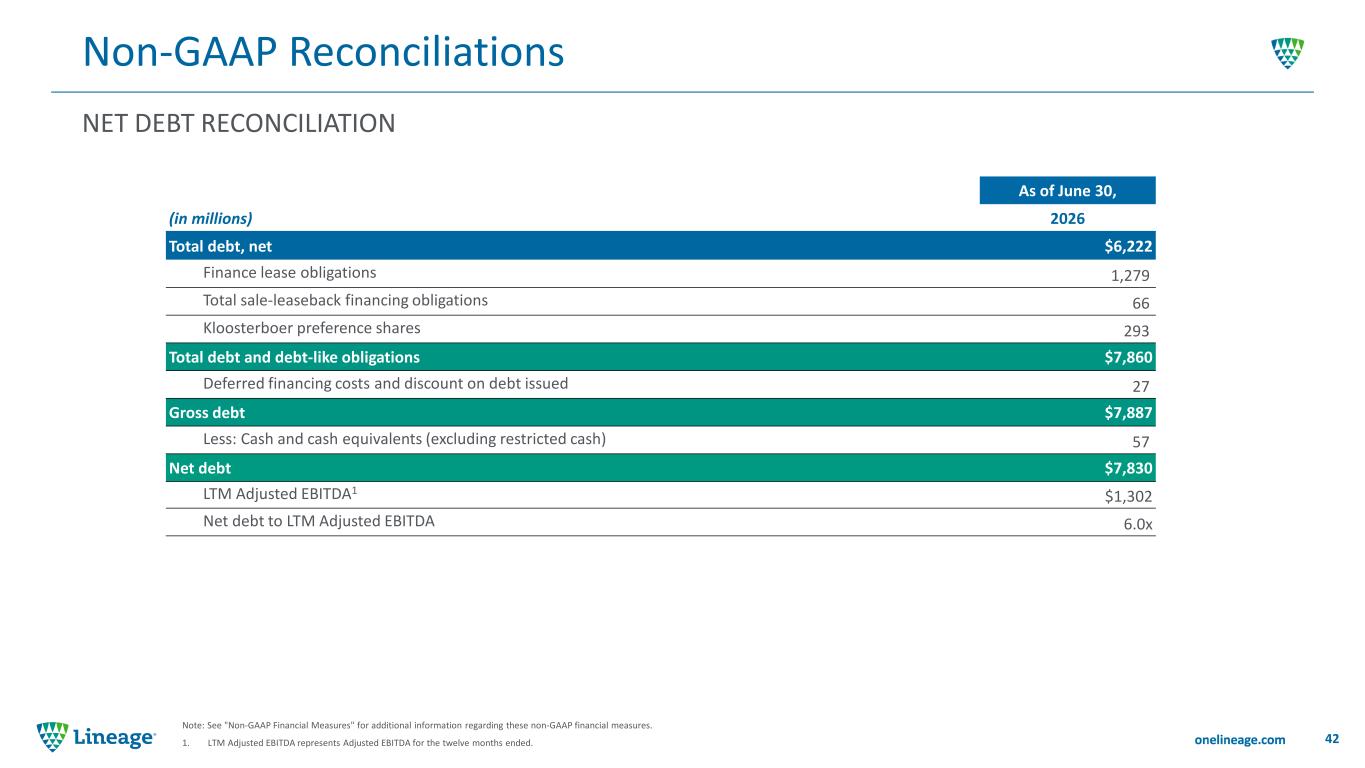
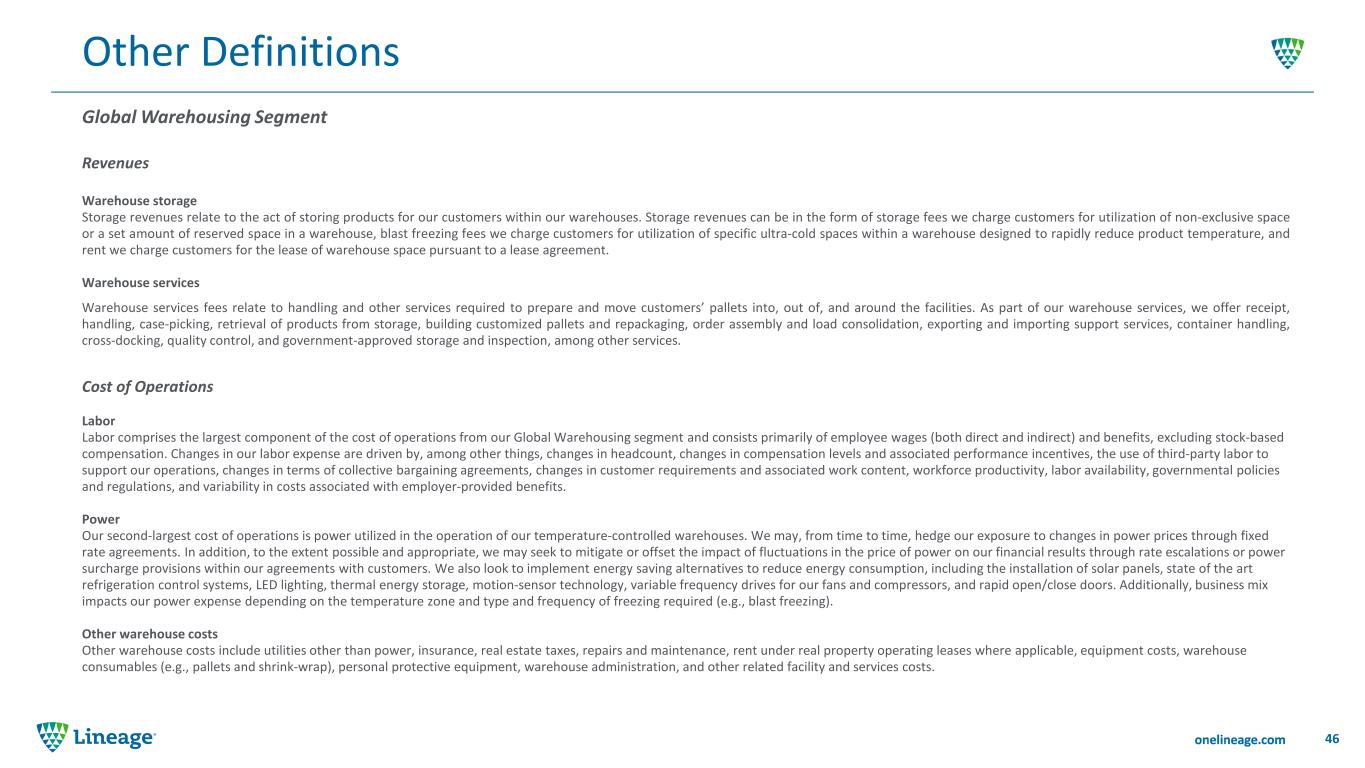
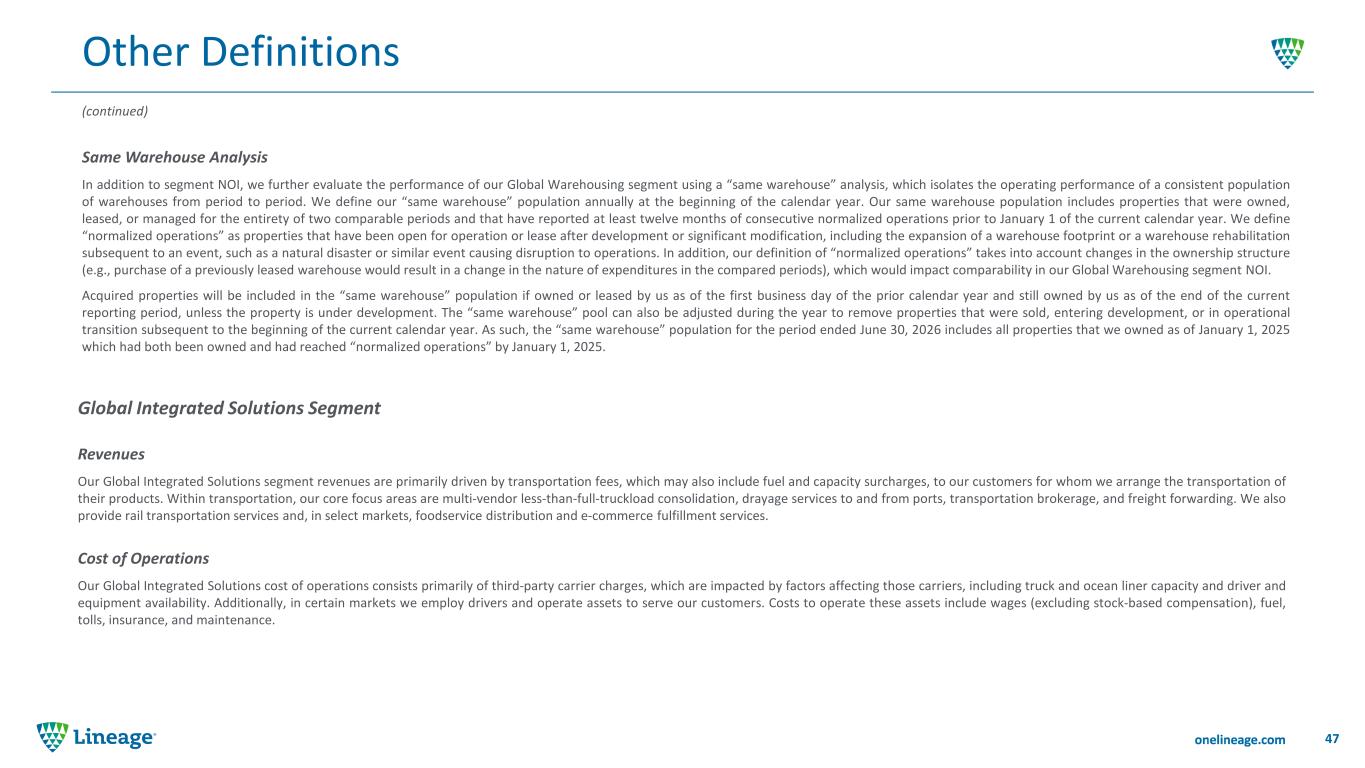
Year over year, both ahead of RX and Q2. Same store NOI benefited by 90 basis points year-over-year as we contemplated in our previously provided outlook. Looking forward, we expect FX to be a relatively minor year-over-year factor for the balance of 2026. Within the same warehouse pool, rent, storage, and blast revenue per physical pallet declined approximately 0.7% year-over-year, while same-store physical occupancy improved 0.9%, reflecting strong commercial execution by our sales team. That team has built deep relationships in the food space and is now extending the reach of our sophisticated cold storage and logistics offerings into adjacent cold chain categories. As Greg mentioned last call, we secured a key confectionary account that launched successfully in June. That ramp is off to a strong start, and we expect continued momentum from this and other candy customers positioning confectionary as a top 10 category for us over time. turning to services throughput and services revenue per throughput palette both came in slightly ahead of our expectations for the quarter a favorable mix helped offset what continued to be a challenging port volume environment tied to trade related headwinds as we look to the back half the comparisons do get a bit easier in the second half of the third quarter and then for the full q4 as we lap last year's post-liberation days downdraft that said we expect a mixed tailwind that benefited Q2 to pay. Netting those two dynamics together, we continue to expect full year throughput and service metrics to be down modestly, consistent with our prior expectations for the full year. Shifting to slide 8 to our global integrated solution segment, GIS NOI was $61 million. Excluding the impact of last year's Spain transportation disposition, the segment saw solid underlying revenue growth of 5 percent, driven by continued momentum in our U.S. transportation and food service businesses. While the underlying revenue growth was solid, two items impacted margins during the quarter. First, accelerating truckload and LTL carrier rates, which we passed through to customers but add a lag, created near-term pressure. We expect margin recapture as new market rates are absorbed into customer pricing over time. The second offsetting item was a $7 million legal settlement that was not contemplated in prior guidance stemming from an employment matter for prior years. Excluding the settlement, GIS delivered solid underlying margin. Together, these drove a lower noi for the quarter and we're lowering our full year gis noi outlook to minus four percent to minus two percent from zero percent to plus two percent previously ultimately the strength in the transportation and food service markets that is driving the higher carrier rates and providing this temporary profit squeeze should actually work in our favor and drive more customers to our unique value-driven offering customers will increasingly look to offset carrier rate pressure with a well-priced integrated storage plus transportation solution turning to slide nine adjusted EBITDA and AFFO second quarter adjusted EBITDA was 320 million dollars which includes the impact of the legal settlement i just mentioned second quarter AFFO was approximately 198 million dollars or 76 cents per share better than expected results were driven by both stronger than expected same store and non-same store NOI growth Administrative expenses, which exclude stock-based comp, were approximately $118 million in the quarter, modestly better than expected due to the timing of certain spending and better cost management. As a result, we're tightening our full-year admin guidance to $460 million to $470 million, which puts us at the lower end of our previously guided quarterly range of $120 million to $125 million for the remaining two quarters of 2026. On AFFO, in addition to the adjusted EBITDA fee, we benefited from favorable timing of maintenance, capital expenditures, and tax items, driving a result of 76 cents per share well above both consensus and our internal expectations. We're pleased to see both our core operations NOI and adjusted EBITDA come in ahead of expectations despite a challenging operating. Moving to slide 10, capital structure. We ended the quarter with net debt of approximately $7.8 billion and total liquidity of approximately $1.6 billion. We have manageable near-term maturities and ample flexibility to address them through a revolver or other available sources of capital, supported by our strong access to both the U.S. and European in public bond markets. Also, we continue to make good progress on our strategic portfolio review. We're evaluating a range of options here with the goal of increasing our financial flexibility so we can capitalize on potential M&A opportunities that market dislocations may present, while maintaining a strong balance sheet to invest in future high-return opportunities alongside our customers and being able to return capital to shareholders. As we've done this work, we feel even better about the disconnect between the private and public valuations for high-quality cold storage assets. We now have firm timetables around key transactional work streams, and we're confident we'll be in a position to provide a comprehensive update by year. Our adjusted net debt to transaction adjusted EBITDA stands at approximately 5.3 times. This metric accounts for intraperiod acquisitions or dispositions and capital invested in our development pipeline that has yet to stabilize. Keep in mind that these development projects have been significantly de-risked as the majority are anchored by customers with long-term commitments. For example, our new state-of-the-art, fully automated project in Hazleton continues to ramp in line with our expectations. These new automated buildings are genuinely complex megabuilds, and Hazleton is now one of 25 fully automated facilities in our portfolio, reinforcing our leadership in developing and operating highly sophisticated, productivity-enhancing cold storage solutions for our customers. Maintaining our investment-grade balance sheet remains a key focus for our company, and we remain committed to bringing reported leverage, currently approximately 6.0 times, into our targeted range of 5.0 times to 5.5. Before turning to guidance, let me provide a little more detail on the Big Bear fire that Greg mentioned. As a reminder, this facility is roughly 500,000 square feet with about 85,000 pallet positions, so call it approximately 1% of our total global capacity. We move quickly to engage our customers and were able to address their immediate needs by shifting volume to surrounding sites. We believe the fire originated during third-party testing of the rooftop solar array, which was owned and operated by Altus. This is the only site where we have a relationship with Altus, and we're pursuing all options to hold them accountable. In the meantime, we carry insurance for exactly this kind of event, and we are working with our insurance partners to cover immediate remediation costs and the financial impact while responsibility gets fully worked out. There are really two areas where we expect to see an impact. First, there will be a drag on the adjusted EBITDA we had expected to deliver in Q3 and Q4. That's driven by lost revenue during the recovery period, plus incremental costs to support our customers and team members through the transition. We do expect to retain the significant majority of this business, but there's a lag before inventory fully replenishes and when we're back to the level of service our customers expect. We've estimated that impact at approximately $15 million of adjusted EBITDA in the guidance we provided today. • Over time, we expect to recover that lost profit through our business interruption insurance, and that recovery will be recognized below the EBITDA line. • To be clear, our current guidance does not contemplate any BI insurance benefits. As we get more clarity on both the costs and the recoveries, we'll provide additional color next quarter. • Second, we'll incur repair and remediation costs for the building structure and freezers, along with legal fees, community support costs, and other one-time items. It's too early to precisely quantify all of that, but we'll exclude these costs and the offsetting insurance recoveries from adjusted EBITDA so we keep our core operating results comparable to other periods. Moving on to our outlook. We're raising our full year 2026 guidance for SameStore NOI and AFFO per share, with same-store NOI growth now expected at negative 3 percent to flat, up from negative 4 percent to negative 1 percent. On the non-same-store NOI front, the only substantial change is Big Bear moving into that pool. So, with the increase in same-store NOI offset by the Big Bear headwind, we still expect total warehouse NOI growth of negative 2 percent to positive 1 percent. Other minor changes include a slight reduction in GIS and OI from the legal settlement and temporary carrier pressure, offset by an improvement in the outlook of our admin guidance. Together, these puts and takes leave the midpoint of our EBITDA guidance unchanged. For full year 2026, AFFO per share is now expected to be $2.80 to $3.05, up from $2.75 to $3, reflecting better CapEx management from batching, CapEx projects, and procurement savings. We're pleased with our consistency and better-than-expected results in the first half. Our underlying trajectory of improving same-store service revenue, same-store occupancy games, and stabilizing development projects gives us a solid foundation. A few things to keep in mind on second-half cadence. Quarterly and seasonal month-to-month timing is always difficult to precisely estimate, but we want to give you as much visibility as we can sitting here today for modeling purposes. First, FX is a minimal factor year-over-year in both Q3 and Q4. Second, Q3 2025 is our toughest comparison of the year. Given that, we still expect Q3 2026, same-store NOI, to grow sequentially, but on a year-over-year basis, that same-store growth will likely be at its lowest reported level of the year, probably a bit below Q2 levels.
Q4 is where it gets more interesting.
We're lapping an easier import-export comparison from Q4 of last year, and by that point, we'll be ramping new business wins and the continued progress we are making on our key productivity initiatives. Taken together, we think that gets us close to flat year-over-year fourth quarter same-store analytic growth. On administrative expenses, which exclude stock-based compensation, we are expecting those should run toward the lower end of our previously guided quarterly range of $120 million to $125 million per month. On the non-same store front, our outlook reflects continued strong contributions from 2025 acquisitions and the ramp of new developments. Netting out the Big Bear impact, we expect a non-same-store NOI run rate of approximately $20 million per quarter in both Q3 and Q4. A stabilizing supply and demand environment and a sharper focus on revenue growth, coupled with expense management and balance sheet optimization, provide a solid foundation for 2026 and positions as well for long-term growth. I'll now turn it back over to Greg to wrap up our prepared remarks.
Thanks, Rob. Temperature-controlled warehousing is essential infrastructure, the connected tissue linking food producers, processors, distributors, and retailers. Cold storage exists to bridge the distance and time between where and when food is grown and when and where it's consumed. Data science, algorithms, and AI don't change this. The turkey on your Thanksgiving table this year was almost certainly frozen and stored for months in advance. People will always need to eat and food will always need to be stored along the way. And while we're not fully insulated from every permutation that can reshape our customers' behavior, we believe the core demand for what we do is structurally durable and will... Before I wrap up, I want to spend a moment on LinOS. In the quarter, our LinOS site will conventional sites. We saw significant progress in our productivity across locations, giving us increased confidence in this investment and in achieving the goal of 110 million in need in summary this quarter's results reinforce the trajectory we've built over the past several quarters operations are performing better than expected and our kpis continue we're encouraged by the continued signs of stabilization in our core business and believe we're well positioned to build on this momentum and thank our global team members for their continued dedication to our we will now begin the question and answer session
Operator
Please limit yourself to one question. If you would like to ask a second question, please rejoin the queue. If you would like to ask a question, please press star 1 to raise your hand. To withdraw your question, press star 1 again. We ask that you pick up your handset when asking a question to allow for optimum sound quality. If you are muted locally, please remember to unmute your device. Please stand by while we compile the Q&A roster. Your first question comes from Goldman Sachs. Your line is open. Please go ahead.
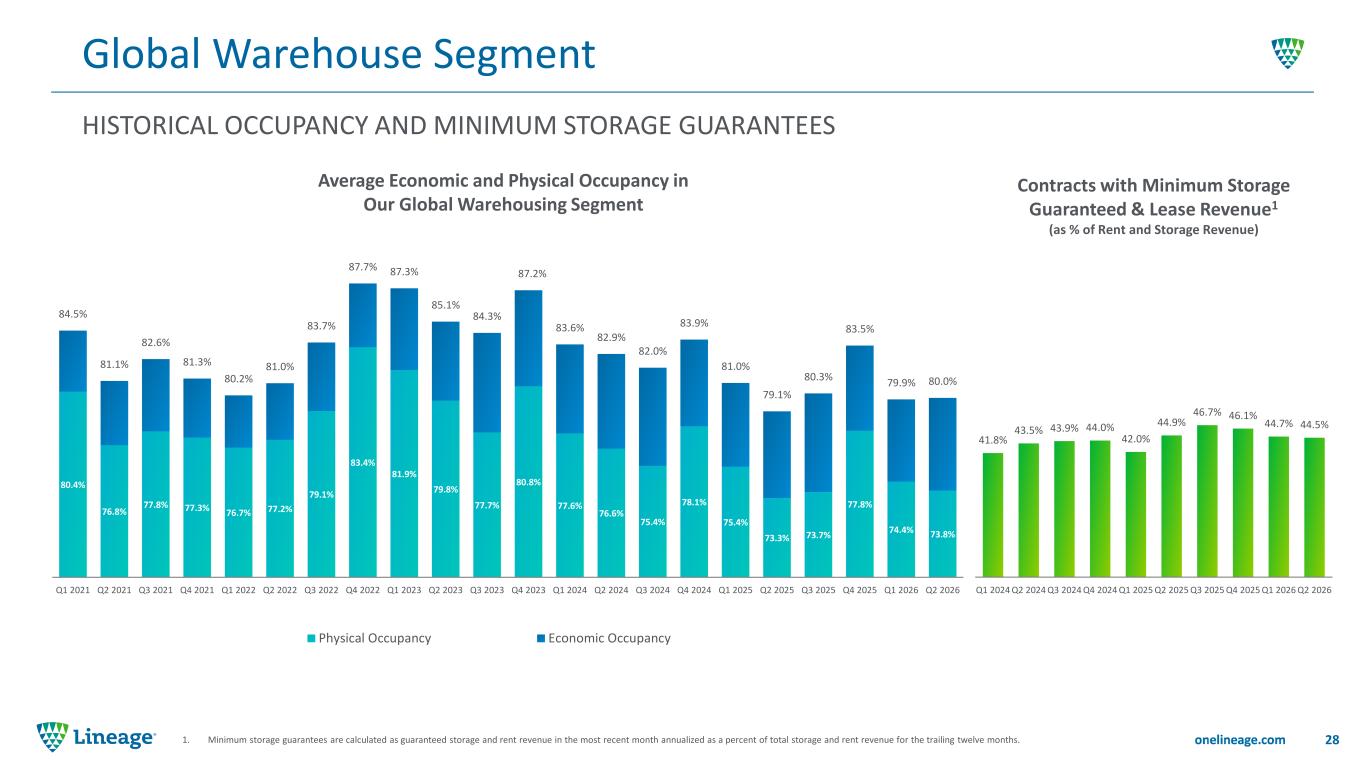
Good morning, everyone. Could you go through your take on white occupancy, so that's average warehouse occupancy of 80% from 79.9 in one queue. Why that was up sequentially? I realize it's only 10 basis points, but that's compared to 2Q normally being a seasonal step down. Do you think it was a function of something you did or customer actions or policies and whether it could potentially be related to the cyclospora outbreak?
Yeah, I mean, just to clarify, so year over year, you're exactly right. Occupancy was year over year on a same storm. It's a really great first-time outcome for us since going public. So that's a great turn looking year over year. Sequentially, we actually saw about what we thought actually a little bit better. So we were down sequentially in terms of occupied pallets, about 1%. You know, we revealed the USDA data is not perfect. Generally, it looks to be down about 3% sequentially. So we would know that that's slightly better than what we thought on occupancy and an occupied pallet.
Operator
Your next question comes from a line of Steve Sakwa with Evercore ISI. Your line is open. Please go ahead.
Yeah, thanks. Maybe just following up on the occupancy, you know, it's nice to certainly see things stabilizing. You know, as you kind of look out over the next couple of years, you know, maybe outside of taking market share, you know, how do you sort of see both the physical and economic occupancy kind of trending for the portfolio? And, you know, what do you think is a normalized level for the lineage portfolio?
Good morning, Steve. Thanks for your question. So on occupancy, I mean, we continue to see stability, basically. that the, you know, we broadly believe food inventory levels are healthy and relatively balanced. You know, that said, we have heard several customers say since the last earnings call that they're rebuilding inventories because they overcorrected during the de-stocking period that we've been discussing. I'm not saying that's a widespread trend, but I do believe it's another indication that inventories have at least stabilized. So, I mean, I think we're back into a normal period and we would expect, you know, outside of market share gains, consistent inventories that would reflect normal seasonality going forward.
Operator
Your next question comes from the line of Michael Carroll with RBC Capital Markets. Your line is open. Please go ahead.
Thanks. Craig, I wanted to follow up on your LinnOS comments that you made at the end of prepared remarks. I know the company continues to expand this pilot program or the pilot program this year. Should we expect it to be more rolled out broadly in 2027? And when will that start to impact numbers. I mean, Robin has prepared remarks, I believe, said that there are some productivity improvements expected in 4Q26. Is that driven by Lin-OS, or is that driven by other tech-type investments the company has made? Yeah. Good morning, and thanks for your question, Michael. So, you know, as you know, we've been successfully running Lin-OS in our automated buildings for some time, and we're now in the process of rolling out, as you mentioned, across our conventional warehouse network. We mentioned in the prepared remarks that Hazleton automated megabuild. I mean, this facility is delivering best-in-class service at an extremely competitive cost entirely because of our long-term investment in Lin-OS, in data science and automation. The remaining two Tyson facilities that we're building right now will use the same tech and deliver similar performance. I will just throw out there that the Hazleton building is a site to see. If anyone wants to see it live, we have an amazing team there that gives a great tour if you're interested in in seeing it just get with kevin or alex and we'd be we'd be happy to host but let me let me spend a couple minutes on updating you on the lino s uh conventional roll out uh i'll start just by saying that cold storage warehouses aren't uniform every facility has its own physical footprint and product characteristics racking maybe you know two pallets deep in one building and four pallets deep in another freezer freezer temperatures are different obviously cooler temperatures are different than freezers product categories have very unique customer requirements you know we don't handle seafood the docks and the yards are configured differently and so these variations are and complexity are core to our business and no doubt making building technology more challenging but in each quarter as we roll out linoesk we knew from the beginning that this was a major undertaking for our company and we're clear that the progress would probably not be perfectly linear last quarter on this call we discussed that we were discovering new requirements in some of our larger buildings while the smaller facility in q2 the team made very significant strides and in the larger buildings and i'm proud to say that we're hitting our internal savings target to deliver 20 conventional buildings by year end i mean we've been building the digital foundation to make this possible for over a decade we as you all know we own this platform. And the fact that, frankly, this is very complex and difficult and that it's performing as designed in 2014, just like it's already done on the automated side of it.
Operator
And lastly, your next question comes from the line of Michael Lewis with Truist Securities. Your line is open. Please go ahead.
Thank you. Early on in the call, you mentioned some headwinds the industry has faced in recent years that are now abating, obviously elevated supply, de-stocking, et cetera. I was wondering if you had an update on the impact of the GLP-1s since the usage there is still going up. I know it might be hard to parse, but any thoughts on the impact of those drugs on the food industry and on your business?
Yeah, great question. We hear a lot of noise around GLPs. And actually, since our last call, we've dug into the new Cornell research as well as several other independent studies, and I think the data is getting better. And so what we've learned is even under the most aggressive adoption scenarios, GLP-1 penetration lands in the mid to high teens as a share of the adult population. Critically, the steepest calorie reductions are concentrated in snacks and packaged foods, not fresh and frozen. And so when we apply the individual commodity impacts in the study to our actual commodity mix, even the most bearish studies suggest that the impact to our business is in the very low single digits. And the most current research points to something less than 1%. And so lastly, GLP-1s were designed to target obesity and diabetes, which is the fourth largest killer in the United States. And none of these steps, none of these studies factor in the potential impact of people living longer on total food consumption. So, you know, long story short, we're going to continue to follow this data extremely closely, but based on the most contemporary research, we don't believe the TLP1, you know, drug will have a material impact on our business.
Operator
Your next question comes from the line of Todd Thomas with KeyBank Capital Markets. Your line is open. Please go ahead.
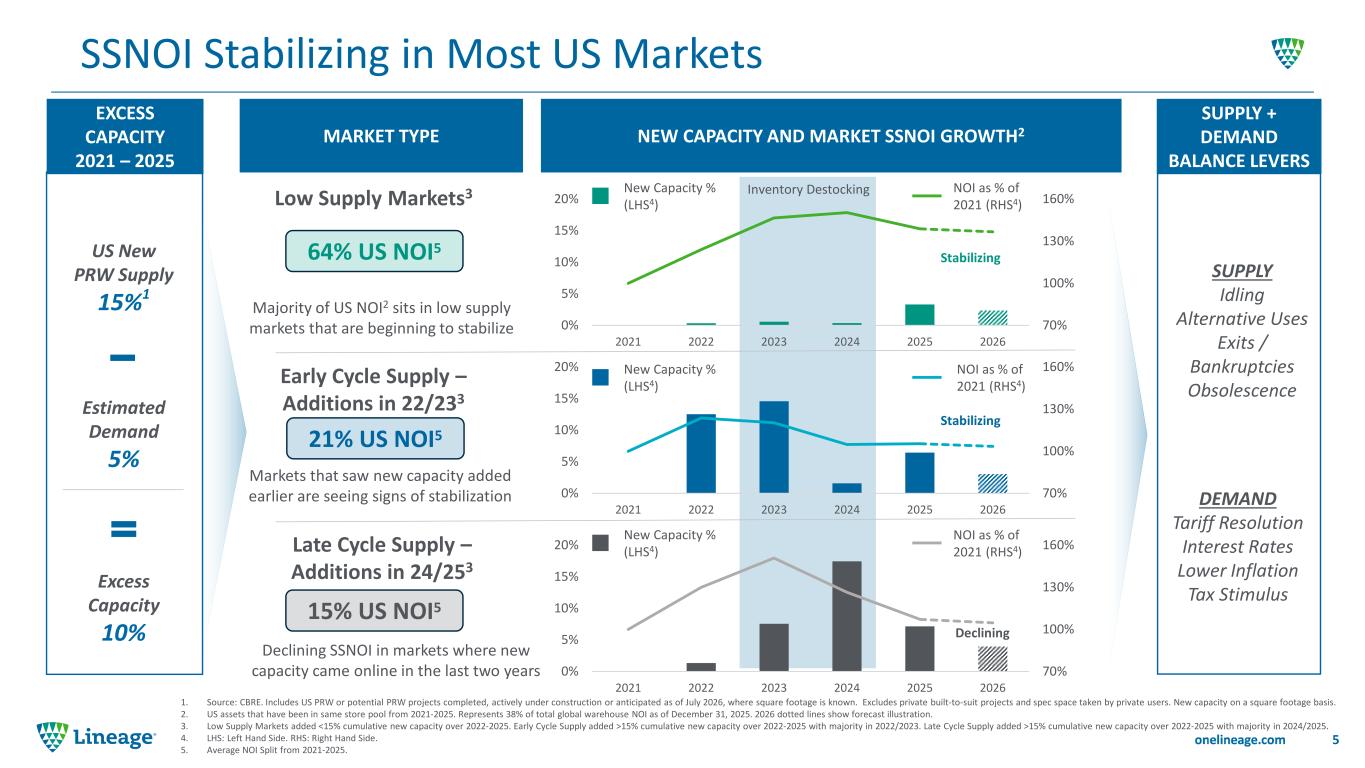
Hi, thanks. Good morning. Appreciate the commentary around new supply growth. I wanted to ask about supply. Last quarter, you commented that you thought you were past the peak impact from new supply, and you and your peers have been idling warehouses. Greg, I think you mentioned functional obsolescence, and you've talked also about customers, you know, sort of transitioning back to the lineage platform. You know, assuming a relatively steady demand environment, how are you thinking about the industry's return to a tighter supply-demand balance and what that timeline might look like?
Yeah, great question, and one we've been discussing openly for several quarters now. Now, you know, our view is that the cold storage industry right now is going through a real rationalization, and we think the outcome is going to be a story of winners and losers, and the larger, more sophisticated providers like Linese will be the winners. You know, as the largest, you know, company in our industry by a significant margin, we have advantages that are very hard to replicate. The scale of our network allows us to move customer inventory across the system in ways a regional or subscale operator just simply cannot. Our tech platform, I just talked about LinOS, our procurement capabilities, our customer relationships, the ability to deploy capital into sophisticated, purpose-built, automated warehouses like Hazleton for Tyson are all just compounding advantages that widen the gap between us and the rest of the field. And what we're seeing in the market is consistent with what you'd expect at this point in the cycle. Some operators overexpanded, lack the capital structure to absorb the challenges that we've been facing, and don't have the platform to deliver against both diverse and extremely stringent customer requirements and are under a lot of pressure. And so we wouldn't be surprised at all, and we're certainly hearing, you know, on the street, if you will, that there'll be a couple of competitor exits in the coming quarters, and we think this is just a natural way that supply gets rationalized in any real estate cycle and will ultimately benefit the operators who have the staying power, the capital, and the platform to absorb the volume and, in some cases, the assets. On the idling front, you know, I think, you know, we idled 10 facilities last year. We've idled five so far this year, taking out almost two and a half million square feet of capacity, or about 1% of our U.S. capacity. We're evaluating a handful more this year, but, you know, because our occupancy levels are strong and our new business pipeline is so strong, I wouldn't expect, you know, that pace to continue. We're happy with where we sit right now. And also, I think it's exciting to point out that a couple of the buildings that we've idled, we believe that we'll be able to turn those back on. I think the industry is shaking out, and we're in a great position to capitalize.
Operator
Your next question comes from the line of Omotayo Okasunia with Deutsche Bank. Your line is open. Please go ahead.
Yes. Good morning, everyone. I want to talk about GIF for a second. Some of the kind of like weaker productivity that you kind of noted impacting the business. Just kind of curious how you're thinking about that unfolding, you know, back half of 26 into 27, just given some of this kind of incremental information around taxes, tariffs from the Trump administration. And second of all, if you still feel like there's still opportunities to kind of lower labor costs in general within that business so that you can still kind of manage your margins.
Yeah, thanks for the question. Yeah, so GIS is a tale of a couple of positives and negatives as the year sort of unfolded for us. We clearly highlighted that the settlement was not contemplating our guidance, so that kind of came in the quarter. So when you back that out, in line just slightly. What we're really dealing with there is we have had some benefits overall in the business as it relates to fuel. That's generally a pass-through, but that's come through slightly better than we thought. But what's really hit us, as you mentioned, was on the dredge side, and we contemplated the container volume in our warehouse business. That was contemplated. I would say that's about in line, maybe a touch harder than we even thought in that business. And then we have the carrier rate situation, which is really just a tightening of the economy, ultimately drives up the rates and what's going on with supply and demand on the trucker side. That generally levels out. It can take a quarter or two. So as we made a comment, you know, we're lowering our guidance generally from the $7 million settlement and a little bit of softness. So I think that kind of covers all the different puts and takes as we roll forward, given your comments there. We still are positive about what's going to happen with the dredge long term and with import-exports on our warehouse business, but really haven't contemplated a pickup as it relates to the second.
Operator
Your next question comes from the line of Michael Mueller with J.P. Morgan. Your line is open. Please go ahead.
Yeah, hi. Greg, on your comments about confectionery becoming a top 10 category, talk a little bit about, like, where are you winning this business from? Where are they currently doing for storage and logistics?
Yeah, great question, Michael. So for the customer that we launched this building for, the product was flowing through the traditional food store or channel. It was not going through third-party cold storage, and they felt they could get better service and better costs through, you know, working with us, and we believe that's a trend that will continue with this customer and others. And so it is, you know, it does have specific requirements, specific temperature requirements, and pulling it out of just the normal food service channel made sense to them, and we believe it well for others. And so we are really excited about the next several years in growing this segment in our business, and it's a great example of how some of the excess supply could get absorbed.
Operator
Your next question comes from the line of Vikram Malhotra with Mizuho. Your line is open. Please go ahead.
Morning. Thanks so much for taking the question. I guess just I wanted to dig into the costs more in the warehouse segment, just if you can unpack a little bit more on labor, on power, et cetera. What's your ability to control costs from here? What's the impact positive negative from oil, perhaps? And then we just think about the occupancy bill. Do you mind giving us a little bit of color on how that should influence the margin? Thanks.
I'll take the first one you want to take. Sure. So, I mean, we have a culture of lead continuous improvement at Lineage, and we're making productivity energy gains every quarter. Our technology platform is a huge supporter of that. Lin-OS continues to ramp up, but we have a lot of other initiatives and technologies rolling out side by side with Lin-OS, like our easy metrics platform, which is a labor planning tool. And we have that just this year went from very few to 100 buildings, so we feel great about our ability to manage labor over time, and we think we have many years of runway to attack that cost, and it is obviously our largest controllable cost.
Yeah, and just in terms of guidance, in terms of thinking about the margin as well as occupancy and a couple of the factors that we generally go through with you guys, as we contemplate the guidance, there's a couple different aspects there. There's the volumetric side, the revenue side, the revenue per pallet side, if you will, and then margins. As we're looking through those different components and as the year has unfolded, on the volume side, really that has to do with keeping your eye on occupancy as well as throughput pallets, right? Those are two different businesses, the storage business for occupancy. And then as you think about throughput, that really drives what's going on in the services side. When you blend those both up, right? Seeing good stuff on the occupancy front and still seeing headwinds on the throughput. So generally slightly better than where we came in the year as it related to the total volumetric side, but still probably flat a little bit down when you blend up those two business lines in the volumetric side. On price, just to review that, on the storage business, again, we look at those kind of together. We have the RSP per physical pallets, and then we have services revenue per throughput pallet. You know, every quarter, there's both a price element of how we put it out to the street. Greg talked about how we're getting that in both businesses at a 1% to 2%, but then different quarter to quarter mix or commodities or different customers can really move that around. And so we've been consistent all year, and we still see that ultimately blending to a slightly down rate for the full year. Again, that's RSB side as well as services revenue per throughput side. So that will be a slight negative. And when you take those two, right, that kind of blends to a same store revenue flat to down a little bit. And Greg talked about that you try to offset that with a cost savings initiative, but you're fighting inflation, right? And so any business that has a challenge top line like that, which we're coming through, really hard to mitigate all the labor inflation you have. And Greg and the team are doing a great job. But the third component then becomes around margins. We generally are baking in a slight decline in margins because we saw that this quarter had a little bit of margin pressure. Last quarter we did well. So that's really our third component. But to keep margins almost flat in this environment is a stellar outcome. So those are the three, hopefully, that helps you kind of parse through how we're thinking about the minus 3 to 0 percent overall guidance.
Operator
Your next question comes from the line of Jamie Feldman with Wells Fargo. Your line is open. Please go ahead.
Great, thank you. I'm sitting in for Blaine, who's out today, but you know, I appreciated your color on the back half, kind of some of the comps for Samestra NOI and how to think about the model. Is there anything as we look ahead to 27 that sticks out as particularly easy or challenging comps? I know you also mentioned this year you had to drag from some refinancing, but just kind of like big picture line items, where do you think it gets particularly easy next year and where may it not be so easy based on how you did this year?
Yeah, no, I mean, just moving through the P&L, as you think about the different components, you know, generally a little bit early to go into 2027, but we're setting up good as we exit the year, right? We said we're scratching at a flat outcome I think Greg has really helped the team battle through those three headwinds, but there's a couple that are still kind of rolling over as we go into next year, import-export, political tension. So we'll see how that same-store NOI, you know, sort of builds as we turn the corner on the non-same-store NOI. I think there's good evidence that we're really building our greenfields. And admin, we've talked about that we've really gotten ahead of that. That's nice, but we will be fighting inflation again next year. So we've taken out the costs, and we want to continue to invest in the business, but I think you'll have a good outcome there. So generally, that's our view. A little bit too early to say, and still really attacking the problems at hand, so we don't want to get out of ourselves. We've had a good first half, but need to get through the second half.
Operator
Your next question comes from the line of Ronald Camden with Morgan Stanley. Your line is open. Please go ahead.
Yeah, thanks so much. Just wanted to follow up on some of the other uses this cycle. I mean, you talked about confectionary. I think we talked about sort of pharmaceutical and Nareed as well. And, again, just a little bit more color, if we could get some more hard numbers of what you think this revenue opportunity could be. Does that business price, like the rest of the business, is where the puts and takes? Because it does seem like this is different versus previous cycles.
Thanks, Ronald. Yeah, confectionary does price similarly to the rest of the business. know we like we love the business we like the margins and we think you know this could be you know multiple hundreds of millions in revenue over time um so you know that that's the way we're looking at it i think on uh on the other uh uses or absorption of supply uh there has been a couple of deals already where we've idled buildings where we've been able to make deals to either sell or We're working on leases for non-competitive uses. And so one was with a trucking company. One was with a producer that would clearly not, you know, that would ensure that that capacity exits the third-party public warehousing space. And so that just overall.
Operator
Your next question comes from the line of Craig Mailman with Citigroup. Your line is open. Please go ahead.
Hey, good morning, everyone. Maybe a two-parter here. I guess just first on conversations you're having with tenants. I mean, we're starting to see some in your tenant base kind of cut prices as a last resort to spur volumes. And so they're already getting pressured on margin there. Just kind of curious how that bodes for kind of your ability to push through rent increases as we go forward here, what you're discussing with tenants so far. Then just second on the guidance, you know, my understanding was always the second half was a ramp versus the first half on earnings. But if you look at the run rate, you guys are deselling in the back half of the year. And I understand Big Bear is a $15 million EBITDA headwind, but you also have a $7 million legal settlement. um and so you know it's that five six cents drag from big bear um i'm just trying to think about why guidance shouldn't trend towards the high end of the range versus the new midpoint so i'll take that i'll take the first one first and then i'll turn it over to rob to answer the second one so on price you know as the new supply hit us over the last couple of years we, you know, we had to contend with price challenges.
We reported already and discussed that this year we expect to get net price increases of one to two percent. And I think we've worked through, you know, the vast majority of that new supply getting delivered. And so, I would expect, you know, similar results next year where we would have net positive price.
Yeah. And then talking about the math around your question as to how the year unfolds, uh right to be clear what we've commented on is the year-over-year growth so so we do see the second half of the core business uh on the warehousing side being up the year-over-year you're quoting some year-over-year growth rates and i think the simple way to think about it is uh the first and the second quarter same story now i blends to about a minus two percent right the first quarter was about one minus one and we just reported a minus three so you blend those two together and that's a minus two and you know that our new guidance is minus three to zero so midpoint there is minus one and a half so you can see really you line up uh quite nicely so uh you know nothing really uh to deal with and then of course i'm sure you're adjusting so we're pretty proud of the team um and nothing to call out we are not seeing a deceleration your next question comes from the line of amy probant with ubs your line is open please go ahead i'm here with michael Goldsmith.
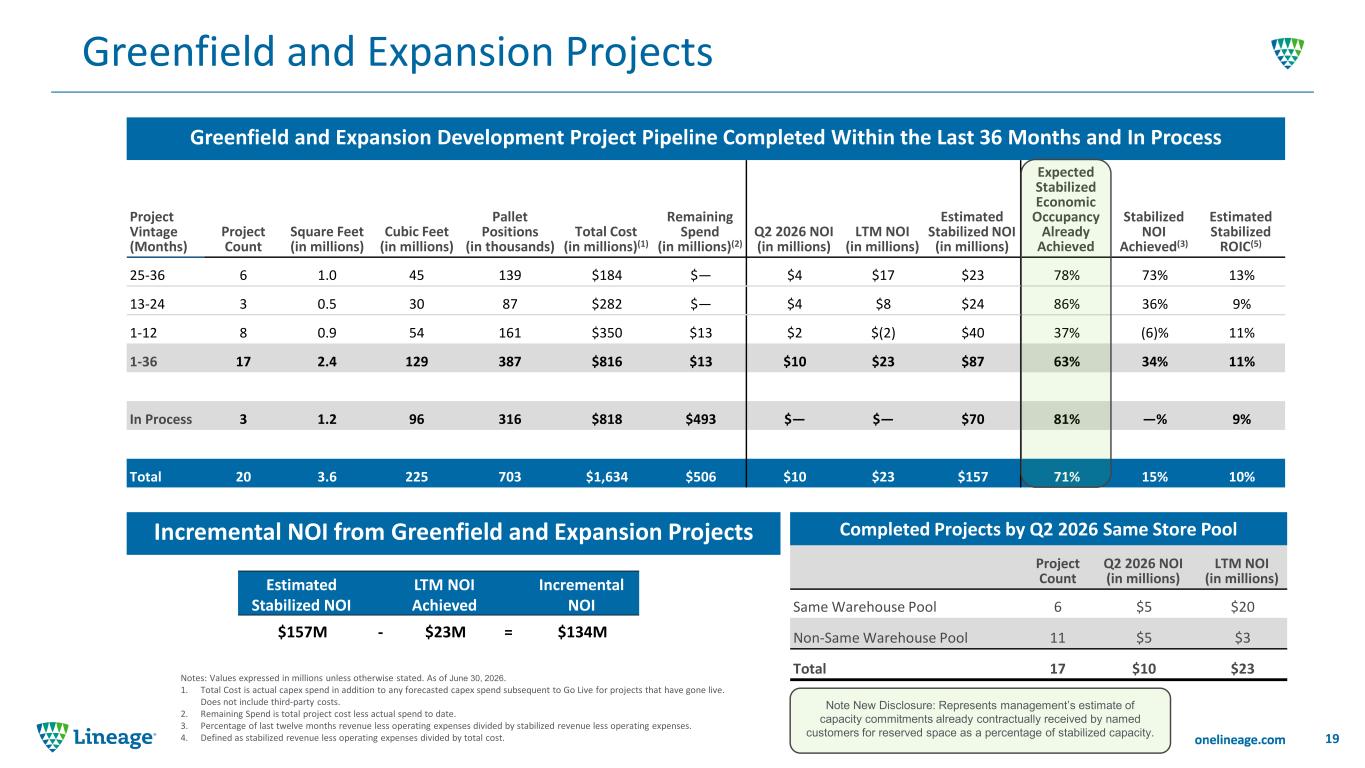
A couple of questions on the new development disclosure. First off, how fast do you expect to ramp occupancy at the development facilities, which were delivered in the last year? Should we expect a similar path to those delivered two or three years ago? And then for facilities, what is the, what's leading to the spread between the achieved economic occupancy and NOI?
Development pipeline. Yeah, we're seeing a very similar ramp across the portfolio. You know, really good outcome as you study that page, you'll see that the class that really, you know, you watch right before it becomes part of our base, the IRR that we're expecting actually notched a little bit up, right? So, sequentially from Q1 to Q2, that's what I keep my eye on. And you can see that that 25-month to 36-month class in Q1, we were expecting about a 12% return. Now we're expecting a 13%. These are small numbers, but generally just points to really the aging of our portfolio right before it becomes part of our base really is looking nice. So, nothing to call out in terms of the years. It's a multi-year ramp for projects. And then I think your question, your second question had to do with economic versus physical occupancy, I believe, but you can clarify if I didn't get it right. We're generally seeing the same trends in the second quarter. We've talked about that generally being a spread of about 400 to 600 basis points, and we came in right in that range, very consistent with what we saw in Q1. So we've addressed that in the last couple of earnings calls that we really worked with our customer and we do on a year-to-year basis and we generally feel like people have a need for for that extra capacity that they sign up for that that is what's caused the delta between economic and physical and and that range really feels like we're in the right zone right now with our customers they need that that for seasonal purposes or other means and so we really feel like we're in good shape there I don't think you'll you'll have any surprises though consistently at the past couple.
Operator
Your next question comes from the line of Vince Tibone with Green Street. Your line is open. Please go ahead.
Hi, good morning. Can you provide an update on the strategic review process? You know, at Nareid, I think you talked about, you know, selling potentially looking to sell up to a billion dollars. Just want to see if that's still the case and how we should think about kind of the most likely timing of any transaction. Is it possible something, you know, is agreed upon and announced for your end, or is this more of a, you know, 27 event now?
Yeah, thanks for the question. Yeah, again, we really took it upon ourselves to look at the portfolio and see the disconnect that we're seeing in the public versus private markets and take advantage of that, frankly, to solve where we want to get to from a leverage standpoint to have more optionality in the future. As you know, our reported leverage is six times right now, and we made a commitment to our rating agencies and all U.S. investors that we want to have flexibility to get into the range of the five to five and a half times, which is what we committed to at the IPO. If you do the math as to how you get there, you're exactly right. You need to divest a little over a billion dollars of proceeds at the multiples that we've outlined in the past in order to get in that zone. So we still see a really good path. What I've done over time is look at the various transactions that we could do. We've narrowed it down. We've hired advisors or consultants to kind of try to understand what the value could be. And I think our comments today just say we really have soft circled a couple interesting transactions that would get us there. We're encouraged by that. And we expect, to your question, that we'll have a meaningful update on on the lion's share of those transactions within this calendar year now the cash proceeds could spill over into into the early part of next year but i know everybody's watching kind of getting there by by year end and so we're feeling uh increasingly confident that we can uh can make substantial progress this year and um give give you an update by our year end your next question comes from the line of Alexander Goldfarb.
Operator
Your line is open. Please go ahead.
Thank you. Good morning out there. Just following on Vince's question, I realize, you know, Rob, you're not given 27, but overall, it sounds like the macro environment is the macro environment. It sounds like customers are settling out, maybe a little plus, maybe a little minus, but settling out. But if we think about you guys selling a billion of assets and deleveraging, It sounds like net-net 27 is a lower number than 26. I realize you're not giving guidance, but just conceptually from what you guys have talked about, the macro, and then what you're doing strategically, that's mentally sort of how the math seems to pencil.
And I just want to make sure if that's correct or if you do anticipate 27 would be positive versus 26 on a FFO basis. yeah no so again we're not guiding to to to aff over 2027 uh but you've you've laid out a couple pieces there i think we generally have outlined that if we find the right transaction the right pricing we don't find this to be a uh super dilutive event at at the affo it's it's hard when for a period of time you sell an asset and then you you put the cash on the balance sheet and you don't earn the same that's just a fact of of deal math but we don't think that that That AFFO dilution from that event alone will be substantial to be concerned about. And so then you just have the business. And as I commented earlier, it'll be too difficult to kind of talk about the business.
Operator
Your next question comes from the line of Victor Fediv with Scotiabank. Your line is open. Please go ahead.
Thank you. Good morning, everyone. On Big Bear Fire, you mentioned that you were able to relocate some of your customers to nearby facilities. So to what extent does that create a tailwind for your same store portfolio through higher occupancy and throughput? And is the estimated $15 million impact net of those benefits? And also, compared with the Kennewick incident, are there any meaningful differences in the insurance structure, expected timing, or potential scope of recovery that could result in some different financial outcome this time around?
Thank you. uh thanks for your questions i'll just start to talk uh just a couple of high-level comments on the on the fire and then i'll turn it over to rob on the financials but you know i i again just want to thank our team this was a very very very challenging situation uh and the our response on the ground is it was nothing short of extraordinary from literally day one standing side by side with the firefighters and helping them solve how to put out this fire uh was was simply remarkable. As Rob talked about, the facility is a relatively small portion of our overall network, just about 1%. And we've been working with customers literally from the first day to divert product across the network to provide solutions for them. It's also important to recognize another kind of network effect or benefit of scale is that we have almost 30 other facilities in the broader Southern California region. And those teams have jumped in and helped our customers in a in a heroic way and so you know right now we are focused on the cleanup entirely supporting the community we've given over 3.3 million dollars to the to the local residents uh through charities and directly uh and feel great about our remediation and community support efforts uh as far as the the kenwick piece and comparing it to that yeah our insurance coverage is adequate to handle this, and we wouldn't expect the cash flows to be much different than that played out.
Operator
Your next question comes from the line of Nicholas Thillman with Baird. Your line is open. Please go ahead.
Hey, good morning, guys. Maybe wanted to touch on some comments you made about just operators looking to exit and capacity potentially being flushed the North American market, but you also commented on potential institutional interest just within the Kohl's-Furge infrastructure and the public-private disconnect on valuations. Just curious how you think it could play out from a pricing impact if you're starting to see some of the private players get more involved and maybe get some reset basis on some of these assets. Does that put downward pressure on pricing for the portfolio overall? I guess how are you viewing being aggressive on the acquisition front versus just what letting capacity get flushed out of the system?
Yeah, I mean, I think we're in the best position to acquire the assets that we want as some of these companies, you know, take different strategic directions because we have the most synergies, because we have the densest network and we can, you know, have the technology and capability and admin structure to optimize these assets. As far as new, you know, private institutional investors coming in, you know, I think it's clear that it's very difficult for these small companies to compete with the more established providers. And so I don't think there's a lot of motivation for them to come and buy, you know, a five-asset company that's struggling because them buying them doesn't change their trajectory because they're not in a different competitive position. So we don't see that as a major threat. And we think if anything, this shakeout could firm up price over time and allow us to get closer over time to being able to recover the inflationary levels as it plays out.
Operator
That is all the time we have today for questions. Apologies to those whose questions we did not get to. I will now turn the call back over to Keebin Kim for closing remarks.
Thank you everyone for joining our second quarter earnings call. Have a good week. Thanks everybody. Appreciate it.
Operator
This concludes today's call. Thank you for attending. You may now disconnect.