Operator
Good day, everyone, and welcome to the Open Lending Third Quarter 2025 Earnings Conference Call. Please note this call is being recorded and I will be available if you need any assistance. It is now my pleasure to turn the conference over to Ryan Gardella, Investor Relations. Please go ahead.
Thank you. I appreciate you joining us. Prior to the start of this call, the company posted their third quarter 2025 earnings release and supplemental slides to its Investor Relations website. In the release, you will find reconciliations of non-GAAP financial measures to the most comparable GAAP financial measures discussed on this call. Before we begin, I would like to remind you that this call may contain estimates or other forward-looking statements that represent the company's view as of today, November 6, 2025. Open Lending disclaims any obligation to update these statements to reflect future events or circumstances. Please refer to today's earnings release and our filings with the SEC for more information concerning factors that could cause actual results to differ from those expressed or implied in such statements. And now I will pass the call over to Jessica to give an update on the business and financial results for the third quarter of 2025.
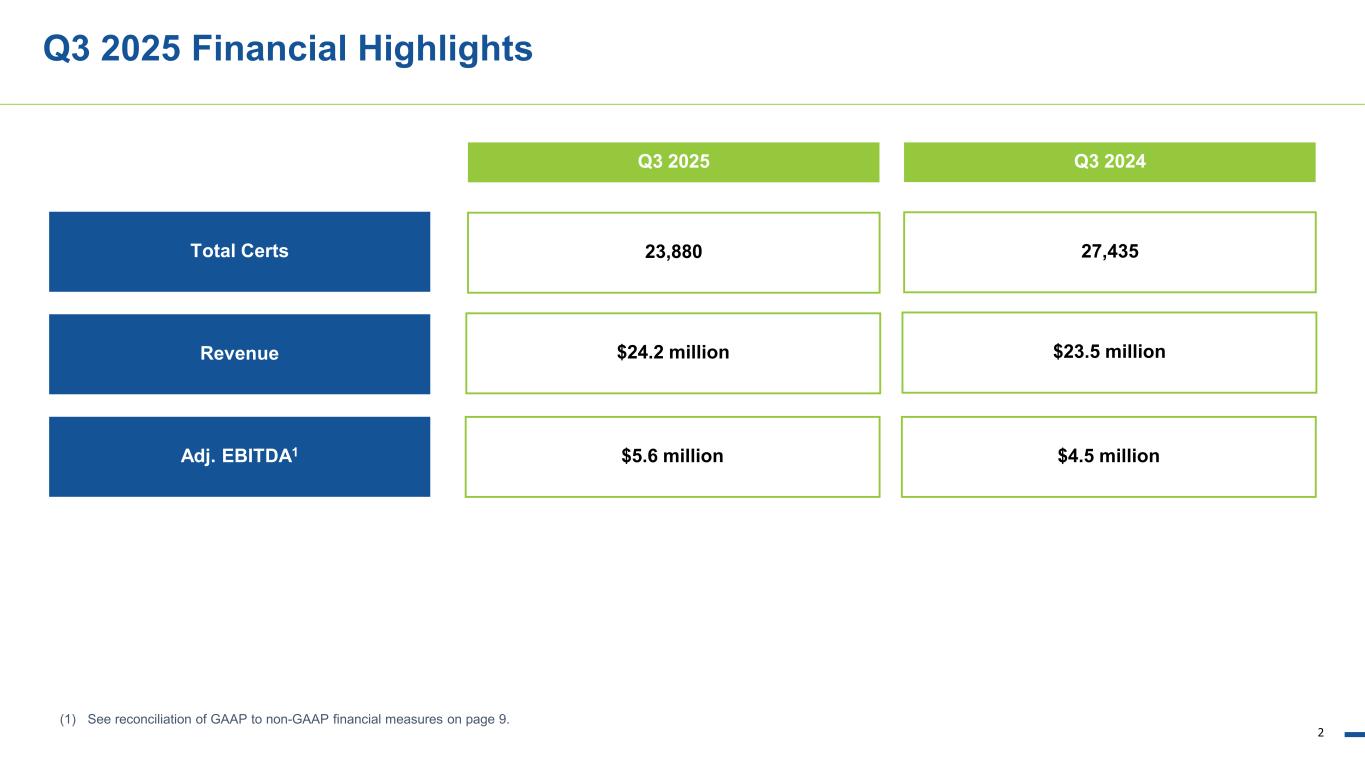
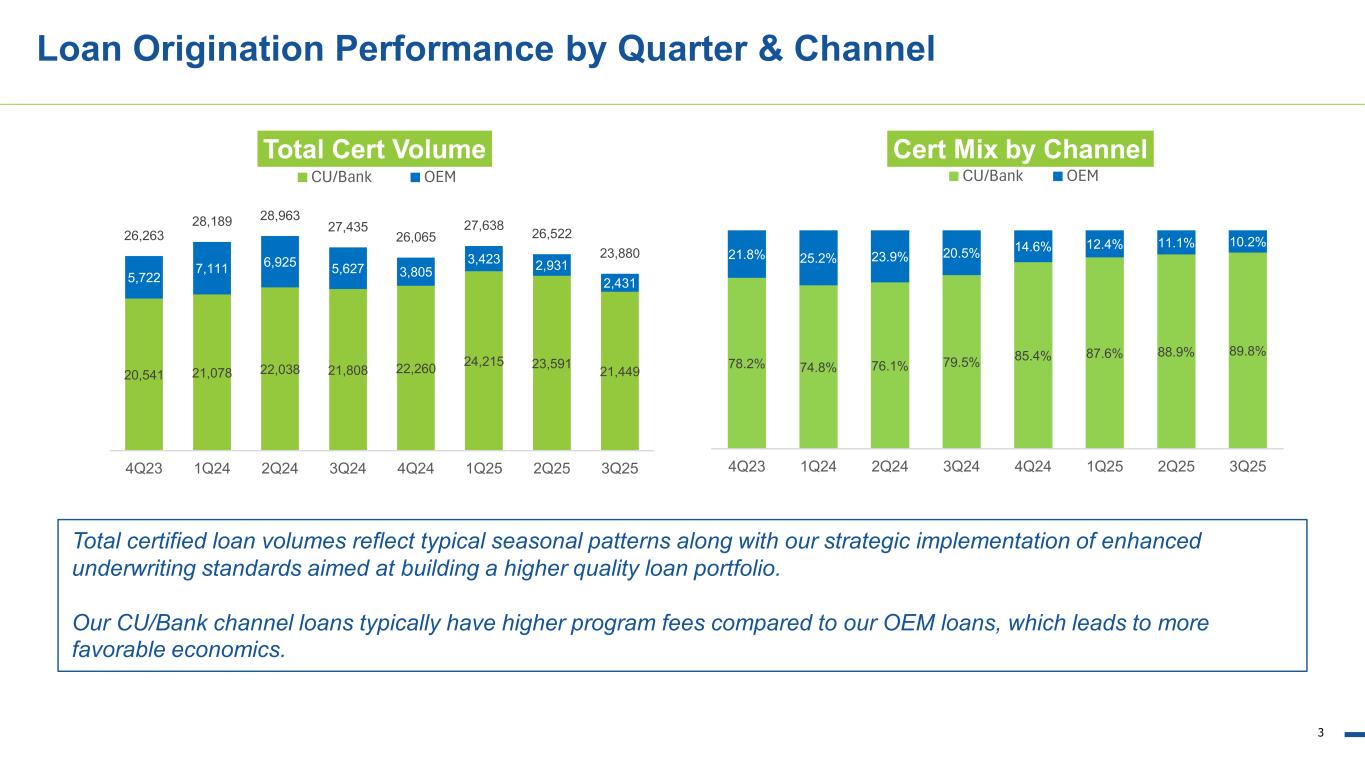
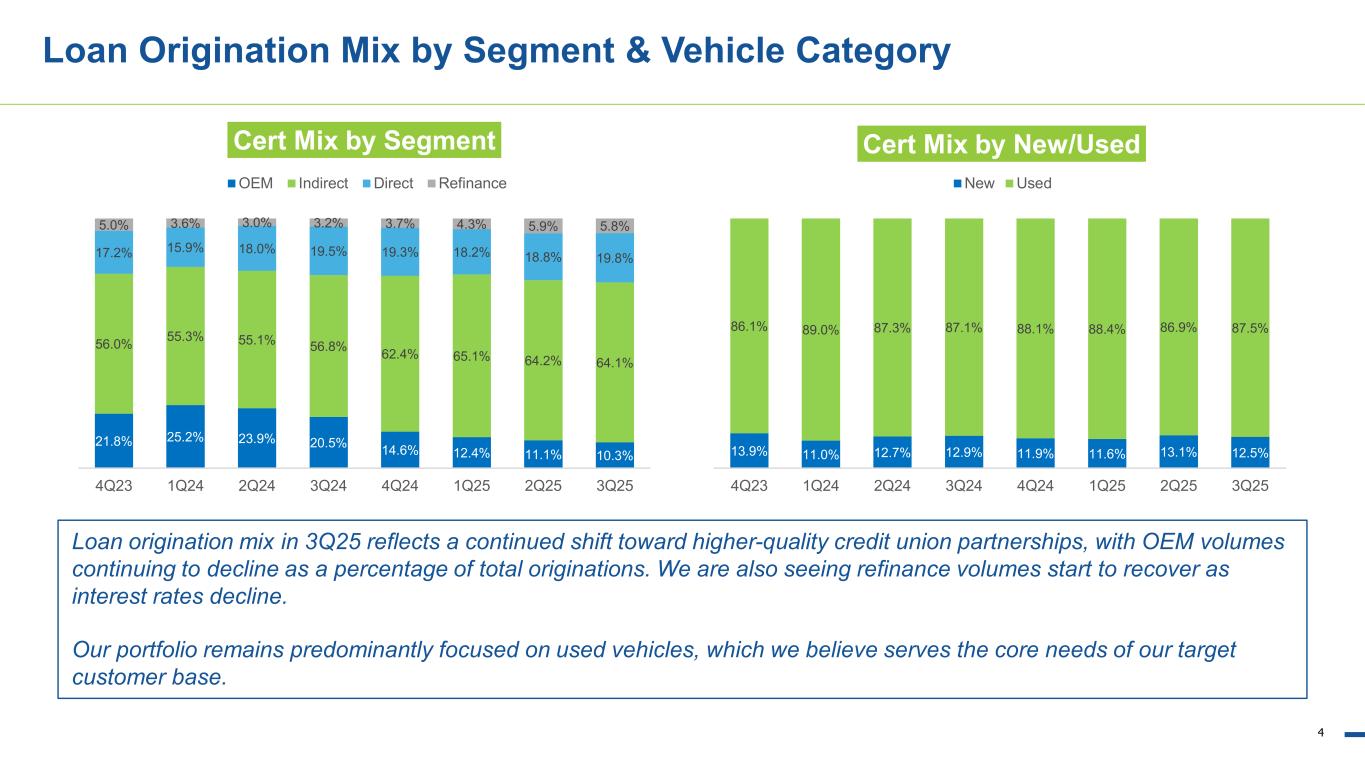
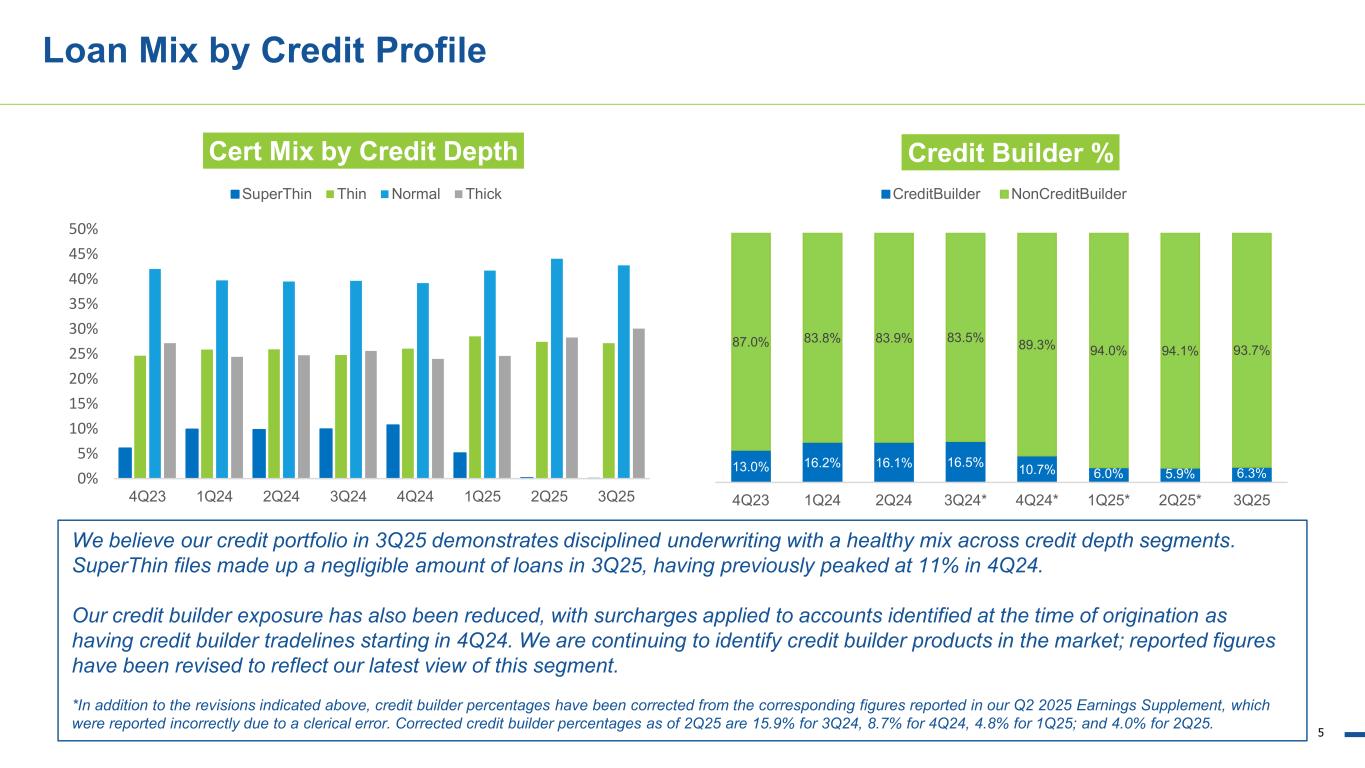
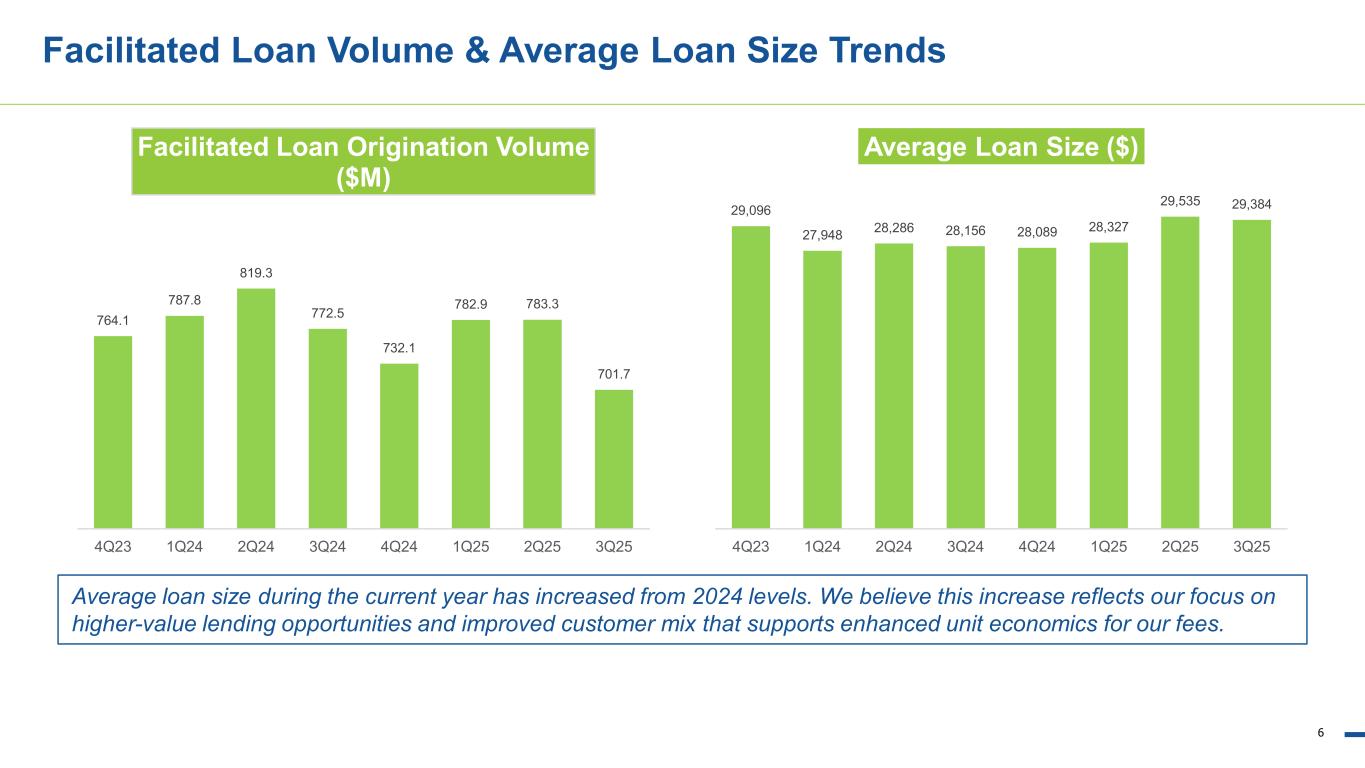
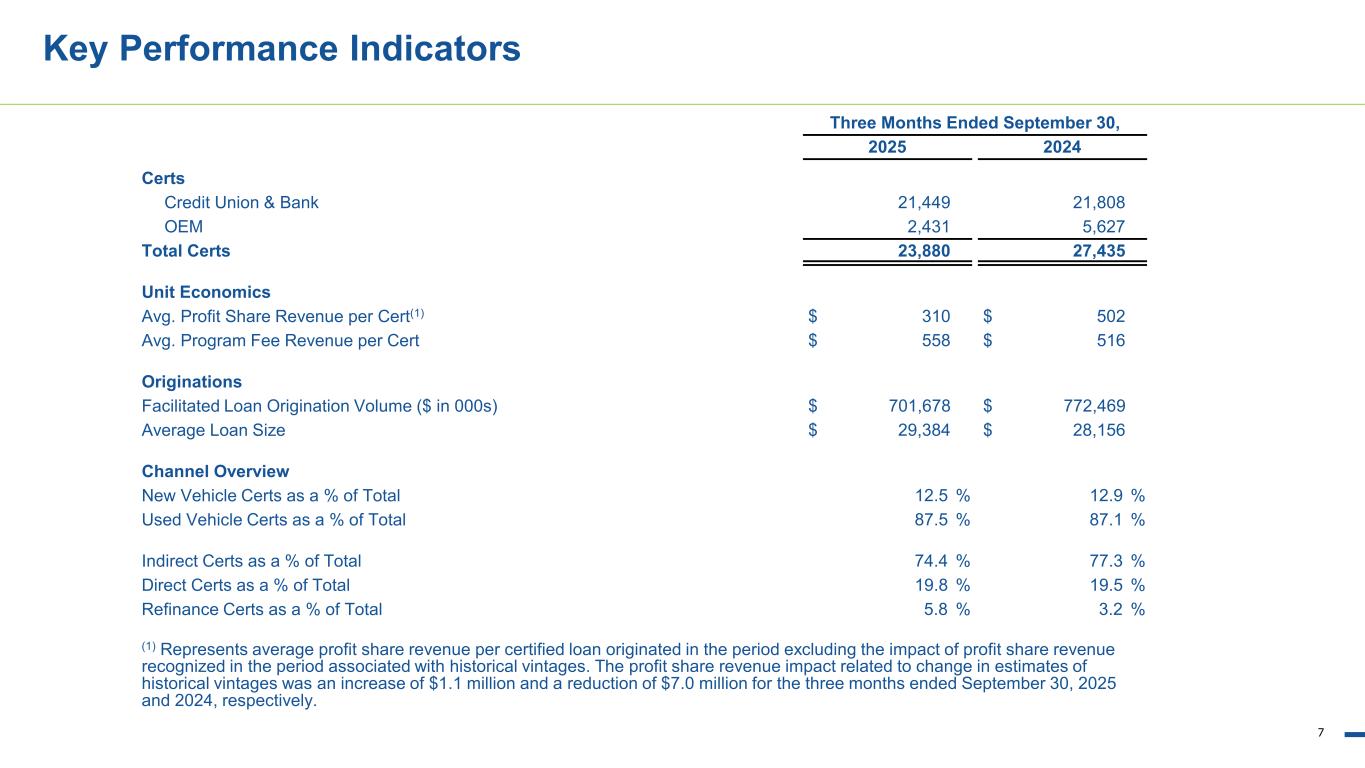
Thank you. Good afternoon, everyone, and thank you for joining us today. We are pleased to announce our results for the third quarter of 2025, which we believe reflects the transition we are making from a company stabilizing their business to what I would consider the new norm of running and operating Open Lending. When I assumed the role of CEO, two of my key objectives were to promote earnings stability and to guide the company towards predictable results for our shareholders. We have sought to achieve these objectives by fostering less volatile profit share unit economics and more segmented and sophisticated pricing changes. We have executed on both of these objectives with positive outcomes, as I will discuss today. In addition to the work we have done on our core Lenders Protection platform, we have recognized the need to diversify Open Lending's current offering to meet the evolving needs of our lender customers. Based on customer feedback, our first new product initiative was to deliver a pricing, underwriting and decisioning tool for our lender customers to use for their prime auto borrowers. Therefore, we are excited to announce the introduction of ApexOne Auto, our new prime credit automated decisioning platform. ApexOne Auto not only diversifies Open Lending's revenue by product but also adds a recurring revenue stream driven by subscription-based minimum application volumes. ApexOne Auto will address the approximately $500 million per year opportunity to serve segments of the automotive credit market that our current decisioning engine does not. Built on our core LPP offering, ApexOne Auto extends our analytics into the prime auto lending segment, a strategic expansion that addresses the industry's shift towards higher-rated credit, where our customers and their borrowers demand faster, more efficient, and more accurate loan decisioning and pricing. Over the years, we have received strong interest from our customers for products addressing the prime auto loan segment. To date, we've already launched with two customers with additional interest in the pipeline. There is strong applicability within our existing client base as the industry gravitates towards comprehensive solutions for the entire credit spectrum. Unlike our traditional LPP offering, ApexOne Auto Decision loans are priced and placed without the insurance wrapper or profit-sharing component, focusing purely on an automated advanced decisioning process that many financial institutions aren't equipped to handle internally. It is also worth noting that ApexOne Auto and LPP are complementary products with loans not approved in ApexOne Auto being seamlessly directed to LPP for review. As a result, we believe the use of ApexOne Auto by our customers may result in additional revenue from our core lenders protection platform over time. We believe ApexOne Auto is a logical expansion of our brand, helping to protect ourselves from competitive intrusion, while also giving financial institutions one vendor to provide them with decisioning support over the entire auto credit spectrum, which we anticipate will help us with customer retention. From an expense and investment perspective, ApexOne Auto was developed internally and no large outside capital investments have been made. ApexOne Auto gives Open Lending a new revenue opportunity that utilizes our existing expertise and, in the future, may contribute positively to our growth. We will continue to update our investors on our progress. While we recognize it is still early days as we begin the rollout of ApexOne Auto with our current LPP customers, we are committed to the future of Open Lending, and we are here to stay. Now I wanted to talk through our ongoing efforts to improve profitability and produce less volatile profit share unit economics in our core Lenders Protection platform. We are proud to say that we have delivered three consecutive quarters of positive adjusted EBITDA and reduced volatility in back book performance, including a positive CIE adjustment of $1.1 million. Further, we continue to apply conservative profit share unit economics to our current period originations, which we believe enhances the quality and sustainability of our earnings. Third quarter results also benefited from an 8% year-over-year increase in program fee unit economics, reflecting a more favorable mix of lenders. We facilitated 23,880 certified loans in the third quarter of 2025, down from 27,435 in the third quarter of 2024. This decrease primarily reflects our deliberate tightening of lending standards and targeted rate adjustments in lower-margin credit segments, particularly within SuperThin and credit builder profiles. We believe these tightening and repricing actions have positioned our book for more sustainable profitability in future vintages. Moreover, and just as importantly, we believe we have a higher quality book than we have had in the past in terms of having more loans with the characteristics that we believe drive profitability. We will continue to monitor and measure our progress to promote our desired outcomes. To that extent, I wanted to highlight three incremental pieces of data from our earnings supplement that I think deserve to be recognized on our call today. First, our certain mix by channel for the quarter was 89.8% through credit unions and banks with the remaining 10.2% coming from OEMs, with a drop in the OEM production primarily driven by our tighter underwriting requirements on lower credit debt files. As we have flagged in the past, we expect OEM 3 to perform more like a credit union, and we are now seeing them begin to steadily ramp up volume on our platform. There may be a dynamic of steadily or slightly increasing OEM share due to this ramping up. We expect these loans, however, to have similar loss ratio performance to those of our credit union customers and believe these loans will contribute positively to the overall quality of our book. Additionally, across the credit union landscape, we have seen financial health continue to improve with another quarter of strong credit union share growth. While we're mindful of ongoing challenges such as rising delinquencies, affordability pressures, and moderating wage growth, these dynamics also create opportunities, and we're taking a proactive approach to capture them. Second, while flat compared to the second quarter of 2025, we are continuing to see refinance volumes recover and believe that this could be a positive tailwind for certain volume in 2026. And third, we're dedicated to continuously enhancing and validating our disciplined underwriting standards. Our current credit builder exposure has been reduced, and SuperThin files now comprise a negligible amount of new originations. For the most recent quarter, our credit depth concentration in SuperThin and credit builder loans was 6%, down from 24% in the third quarter of 2024. On the pricing and predictive modeling front, we've partnered with a leading third-party expert to execute a series of one-time efforts aimed at reconfiguring and strengthening our pricing models. However, on the whole, this is not a one-time event. This will be regularly fine-tuning our pricing models with new data and new variables that reflect current and anticipated changes to macroeconomic conditions to stay ahead of the curve. This is a muscle memory that we will look to continue to build given our desire to be a best-in-class pricing and risk decisioner in the auto space. As further evidence of our commitment to making tough decisions and investing in the right places, we've also engaged with a third party to help our lender partners improve their performance with repossessions. We believe the servicing of claims is one of the driving factors of performance and severity once a loss occurs. Next, I wanted to walk through our progress on driving customer retention with enhanced service and technology. We've now rolled out the first phase of our lender profitability dashboards to customers, which have been well received thus far. These dashboards provide real-time data on the full life cycle value of our Lenders Protection platform, ensuring that customers see tangible value in our product before defaults start to happen. Since rollout, we have received early positive feedback from customers. I also wanted to mention that in the quarter, we added 10 new logos and had no customers cancel, which we believe is a testament to the changes we have made to improve customer retention. In the third quarter, we also hosted our 12th Annual Executive Lending Roundtable with 264 attendees, including credit union and bank partners. This was a fantastic and successful event that gave us an opportunity to hear directly from our customers and solicit feedback and ideas to help us increase the value of our products and relationships. We're thrilled to have had the opportunity to connect with our customers and are grateful they dedicated the time to identify and execute on the action items that we jointly feel are necessary to enable more opportunities to grow and to be better partners. Our industry has always been a relationship business, and there is no better return we get than on strengthening these relationships to ensure we continue to add value for our customers, their customers, and our joint mission. We hold this event annually and look forward to next year's event. In addition, I'm pleased to announce the amendment to our reseller agreement with Allied Solutions, which has been a strong and loyal partner to Open Lending for over 12 years. This revised agreement demonstrates the strengthening of our partnership with Allied and their belief in our product. Allied has been instrumental to our growth since the early days of Open Lending. This updated agreement builds upon our original partnership, which has enabled us to expand our reach within the credit union ecosystem through Allied's valuable introductions and endorsements. Recognizing the evolution of our business, we've thoughtfully realigned the terms to better support mutual incentives and long-term sustainability, ensuring both parties are positioned for continued success. The new terms align very well with the behaviors and outcomes we are trying to build into our culture to retain and grow both current customers and new logos. This amendment also brings us future cost savings, which Massimo will speak more about shortly. We've also made continued progress on reducing costs and improving the accountability of our employee base. We continue to execute towards our committed operating expense reductions and now have clear line of sight to achieving our cost-saving goals. On the talent front, we continue to focus on retaining and attracting top talent to further our mission. We're actively looking to bolster our team in certain areas where we feel there is room for improvement, including actively recruiting for a new Chief Revenue or Growth Officer. We also look forward to a refresh to our go-to-market strategy once we have identified and appointed a new Chief Revenue Officer. We are also pleased to announce Ben Massey, who has been with us since 2022 and our Assistant General Counsel since January 2024, has been named General Counsel and Corporate Secretary effective November 7. Lastly, I would like to formally introduce and welcome Massimo Monaco, our newly appointed CFO, to his first Open Lending earnings call. Mas has been with us for just over 2 months, and he has already made a tremendous impact on the organization in many areas. Before I pass it over to Mas for a review of the numbers, I wanted to address some of the macroeconomic movements we have all observed in data recently. We have seen a lot of headlines about the K-shaped economy, highlighting vulnerabilities in near and non-prime borrowers. As of mid-October, over 6% of below-prime auto loans in the industry were over 60 days delinquent, which is the highest currently on record. However, as you all know, we have been strengthening our book and tightening our credit box for over 8 months already. We believe we have taken steps to account for the conditions that are affecting others in our market segment right now, which we believe is why we have seen minimal impact to our profit share revenue in Q3 from the current credit environment on our prior vintages. As I mentioned earlier, we are constantly adding new information to our pricing and decisioning models to ensure we are ahead of the curve. And right now, we believe our changes starting in the first quarter of 2025 have positioned us well. The bottom line is that there is a lot of good news and insights within what appears to be another consistent quarter. And now I'd like to pass the call over to Mass for a more detailed review of the numbers.
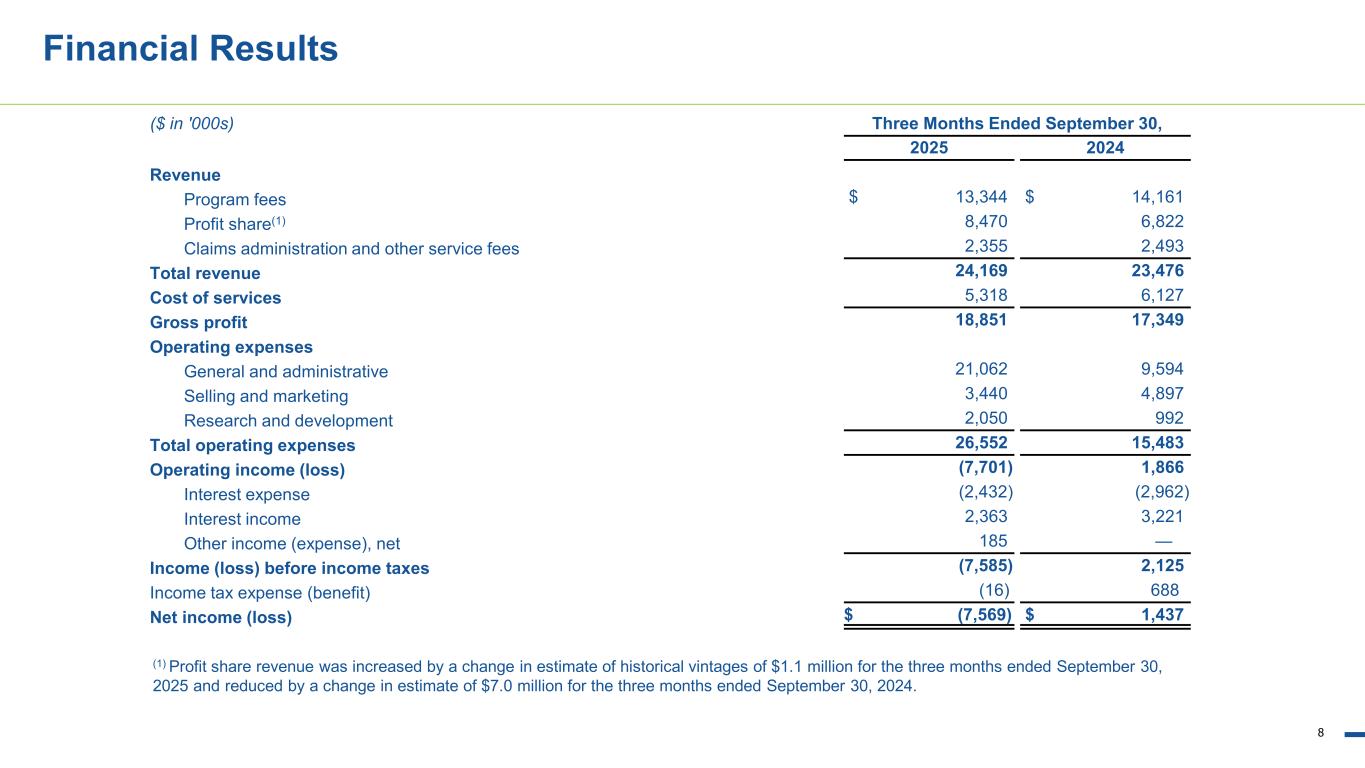
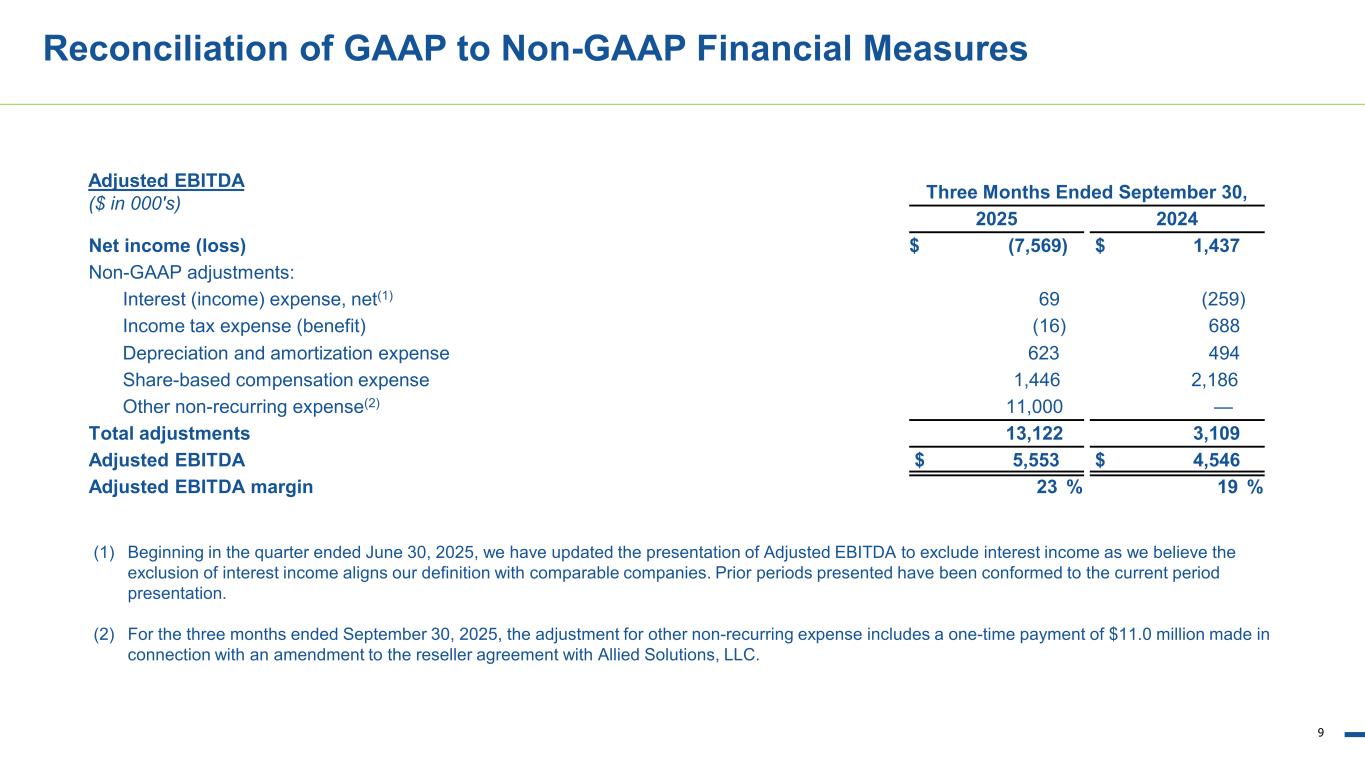
Thanks, Jessica. I'm pleased to join you all on my first earnings call as Open Lending's CFO. As Jessica mentioned, I joined in August after more than 2 decades in financial leadership roles across the residential mortgage and financial services industry. I'm excited to bring that experience to Open Lending as we continue to strengthen our financial discipline and pursue our growth strategy. It's a privilege to be part of such a talented team, and I look forward to connecting more with our investors and analysts soon. After spending a few months in the seat, I firmly believe that Open Lending has a bright future with significant potential and growth opportunities ahead. I look forward to building on the strong foundation already in place, driving renewed growth and value creation to our stakeholders, while advancing the company's mission to serve the underserved. Now let me walk through the numbers for the quarter and guidance before Jessica and I open up the line for Q&A. During the third quarter of 2025, we facilitated 23,880 certified loans compared to 27,435 certified loans in the third quarter of '24. Total certified loan volumes reflect typical seasonal patterns, and our strategic tightening of underwriting standards aimed at building a higher quality loan portfolio. To add on what Jessica mentioned earlier, when we exclude SuperThin and credit builder certs, our cert volume for the quarter was up approximately 7% year-over-year, highlighting continued momentum in our core higher-quality segment. While we anticipate volumes to remain relatively stable through the remainder of ' 25 on a seasonally adjusted basis, we believe we are well positioned for renewed growth in 2026 with improved underwriting and pricing actions. Our credit union and bank channel loans typically have higher program fees compared to our OEM loans, which leads to more favorable economics. Total revenue for the third quarter of 2025 was $24.2 million, up 3% from the prior year period, and includes a positive $1.1 million change in estimate profit share revenue associated with historical vintages compared to a $7 million reduction during the prior year quarter. To break down total revenue in the third quarter of 2025, program fee revenues were $13.3 million, profit share revenues were $8.5 million, and claims administration fees and other revenues were $2.4 million. As a reminder, profit share revenue comprises the expected earned premiums less the expected claims to be paid over the life of the contracts and less expenses attributable to the program. The net profit share to Open Lending is 72%. When cash constraints previously received is in excess of the expected profit share revenue, the amount of excess funds and the projected future losses are recorded as an excess profit share receipt liability. Profit share revenue in the third quarter of 2025 associated with new originations was $7.4 million or $310 per certified loan, as compared to $13.8 million or $502 per certified loan in the third quarter of 2024. As Jessica mentioned previously, one of the steps we've taken to reduce future volatility in profit share revenue related to the change in estimate is to book more conservative unit economics at the time of originations. At these levels, the unit economics equates to a 72.5% loss ratio. And with the pricing actions now in place, we expect newer vintages to ultimately perform closer to a mid-60s loss ratio. We plan to continue booking at conservative unit economics going forward. Additionally, we do not anticipate recording future positive change in estimates to these newer vintages until the vintages are more seasoned. As Jessica mentioned, in the third quarter, we amended our contract with Allied, which we anticipate will generate over $2.5 million in annual cost savings once the changes are fully implemented in 2027. As part of this contract amendment, we've made a one-time payment to Allied of $11 million, which will generate ROI by eliminating a portion of future commission fees from businesses that are referred to us by Allied. This evolution to our relationship with Allied reinforces our mutual commitment, extending the term through 2029, and underscoring our commitment to prudent partner management. We believe this will contribute positively to our financial outlook. Overall, this revised agreement positions Open Lending for sustained growth while supporting valued partners like Allied. Operating expenses were $26.6 million in the third quarter of 2025 compared to $15.5 million in the third quarter of 2024, representing an increase of 71% year-over-year. Excluding the aforementioned one-time payment to Allied of $11 million, operating expenses were relatively flat to the third quarter of 2024. One of my priorities moving forward will be to closely monitor and control operating expenses and find efficiencies in our spending. The reduction the team already made will have a full financial benefit in 2026. Net losses for the third quarter of 2025 was $7.6 million compared to net income of $1.4 million in the third quarter of 2024. Diluted net loss per share was $0.06 in the third quarter of 2025 as compared to a net income per share of $0.01 in the third quarter of 2024. Adjusted EBITDA for the third quarter of 2025 was $5.6 million as compared to $4.5 million in the third quarter of 2024. Our third quarter '25 adjusted EBITDA excludes the one-time payment of $11 million made in connection to the amendment to the reseller agreement with Allied. We exited the third quarter with $287.7 million in total assets, of which $222.1 million was in unrestricted cash. We had $214.8 million in total liabilities, of which $134.4 million was outstanding debt. Moving on to our capital allocation priorities. We have $21 million remaining on our share repurchase program, which expires in May of '26. Our intent is to utilize our balance sheet to invest in our organic business in a controlled and measured manner to fuel profitable growth. Further, the cash interest expense on our debt continues to be about equal to the amount of interest income being generated on our cash and cash equivalents on a quarterly basis. We remain in compliance with all of our covenants under our credit agreement and expect to remain in compliance based on our projected performance. Finally, I wanted to address our guidance. For the fourth quarter, we are expecting total certified loans to be between 21,500 and 23,500. With that, I will open it up for questions.
Operator
I will take our first question from Peter Heckmann with D.A. Davidson.
Speaker 4
It's good to hear about ApexOne Auto, the new credit decisioning tool. Jessica, I think you mentioned it would be on a subscription basis, but I recall you saying something about a volume component as well. Can you elaborate on how that might work? How much of the payment will be fixed versus volume-based?
Yes. It's great to hear from you, Peter. Thank you for your question today. ApexOne Auto will be a fully subscription-based product, and we are considering three-year contracts that will include monthly minimums. Any amount over the minimum per loan will incur an additional charge, similar to a per loan fee. There will be a minimum fee, making it stable, while the only variable cost would come from any overages. Additionally, as I mentioned earlier, any decisions not made in ApexOne can be directed to the LPP product, allowing them to complement each other. However, anything strictly associated with ApexOne will not have an insurance wrapper and will remain fixed in revenue once booked, following a subscription model.
Speaker 4
Okay. That makes sense. That makes sense. And then Mass, just a follow-up on the Allied change in terms. I think you said you would approximate about a $2.5 million annual savings. Did you say that, that was going to start phasing in next year? Or it was just going to be for the full year 2027?
A small amount we expect to phase in, in 2026, the second half of 2026, but the lion's share of it will be realized in 2027.
And Peter, it will have applicability then sort of going forward in perpetuity, right? It will have a benefit.
Speaker 4
Right. It's an ongoing benefit.
Operator
Our next question comes from Joseph Vafi with Canaccord.
Speaker 5
This is Will Johnson on for Joe. Maybe just one kind of high level on the macro environment. Just curious kind of any more color you can share on when you think things could kind of stabilize and trends, you're seeing in the Manheim Index? And just any thoughts on conversations with customers?
Yes. As we've sort of weave through our script, we feel like 2025 was a transition year. There was lots of tightening and changes we needed to make to our pricing models that we felt, and we do feel have proven to put us in a much better and less volatile financial position. We feel like we're very well positioned for sort of growth in 2026. There's a few things we can point to. We obviously aren't giving guidance into '26. We're seeing a lot more flow coming in from the refi channel. We believe OEM is starting to build some very positive momentum now live in 32 states with a few of the larger states coming live towards the end of the year. We are bringing in a new CRO, which we believe will also bring more of a strategic lens to how we approach our credit union. And of course, we are seeing an improvement in retention of our credit unions. If you were to actually look at year-over-year, our cert growth our cert volume, excluding credit builders and SuperThin's, which is where we took most of our underwriting action, our cert growth is actually up 7% year-over-year. So I think that gives us a good starting pad as we move into 2026.
Operator
We will move next with John Davis with Raymond James.
Speaker 6
This is Taylor on for JD. Maybe just to start on the 4Q certified loan assumptions. It looks like certs are supposed to be down about 14% year-over-year at the midpoint. So just curious what you're expecting from a refi versus purchase volume perspective, and then just also the contribution expected from your FIs, credit unions, and OEMs.
Yes. The fourth quarter is typically one of our lowest volume quarters, and we've taken that into account. We expect some impact from the OEM strengthening as it continues to unfold throughout the year. There may be some increase from refinancing as we are currently working to become more refi ready with active refinancing partners and our existing credit union base. It's uncertain whether we will see this increase in the fourth quarter or more into 2026. Additionally, there's still some uncertainty regarding when we will fully benefit from OEM 3. Approximately 90% of our business comes from credit unions and banks, and we anticipate that to stabilize as we progress into the fourth quarter and 2026. Our aim with OEM 1 and 2 is to keep that volume below 10% of our overall total. Mass, do you have anything else to add?
No, I agree. And we're comfortable with that OEM 3 or OEMs 1 and 2 at less than 10% of our volume or around 10%, but they could still grow as we grow the overall portfolio, the OEMs 1 and 2 could grow along with it. But the mix has been our focus.
Speaker 6
Got it. Makes sense. And then maybe just one more on ApexOne. It's obviously very early days with 2 customers launched, but just curious longer term, what you're expecting from an uptake perspective and then a growth contribution perspective as well? And then does this make sense for all of your lenders to use or just a certain subset, just love to hear some detail on that.
Sure. We are eager to share our enthusiasm about the launch of a product that we have been developing over the past couple of years, driven by feedback from our credit unions. Our goal is to diversify across the full credit spectrum. Currently, we estimate that around 25% of the applications we process are from subprime borrowers. If we can achieve the necessary adoption rate for ApexOne, which involves analyzing all applications, we estimate potential revenues between $30 million and $40 million, which we view as substantial. However, it’s still early, and this process will take time as we start onboarding credit unions. There has been significant interest from our credit union clients, especially given the current macroeconomic climate which has prompted a focus on quality. This situation may also help us remain resilient during various market cycles. We are optimistic about this product for multiple reasons and believe it has potential beyond just our credit union customers. Other financial institutions interested in auto decisioning may lack the necessary tools, and we could explore partnerships with them.
Operator
And we have no further questions at this time. I will now turn the call over to Chief Executive Officer, Jessica Buss, for closing remarks.
Thanks, everyone, for your participation and support today. The third quarter represented tangible progress against the initiatives I laid out in my first quarter as CEO and believe that Open Lending is now in a stronger position today than it was just 6 months ago. We believe we are well positioned for growth in 2026, and I look forward to updating you on our next call. Thank you.
Operator
Thank you. And this does conclude today's program. Thank you for your participation. You may disconnect at any time.