Operator
Ladies and gentlemen, thank you for standing by. My name is Krista and I will be your conference operator today. At this time, I would like to welcome you to the Omnicon's first quarter 2026 earnings conference call. All lines have been placed on mute to prevent any background noise. After the speaker's remarks, there will be a question and answer session. If you would like to ask a question, simply press star, then the number 1 on your telephone keypad. And if you'd like to withdraw that question, again, press star one. Thank you. I would now like to turn the conference over to Greg Lundberg, Investor Relations. Please go ahead.
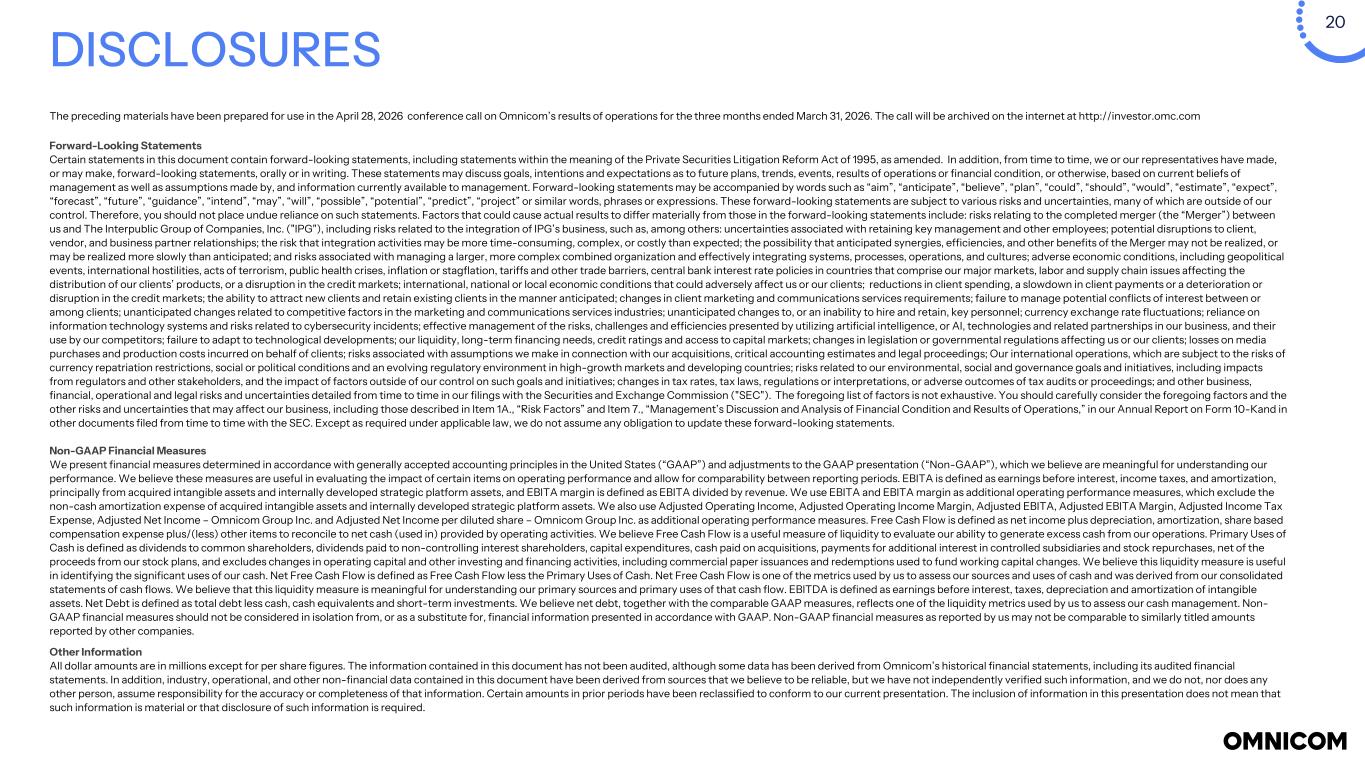
Thank you for joining our first quarter 2026 earnings call. With me today are John Wren, Chairman and Chief Executive Officer, and Phil Angelostro, Executive Vice President and Chief Financial Officer. On our website, OMC.com, you will find a press release and a presentation covering the information we'll review today. An archived webcast will be available when today's call concludes. Before we start, I'd like to remind everyone to read the forward-looking statements and non-GAAP financial and other information that we've included at the end of our investor presentation. Certain of the statements made today may constitute forward-looking statements. These These represent our present expectations and relevant factors that could cause actual results to differ materially are listed in our earnings materials and in our SEC filings, including our 2025 Form 10 . During the course of today's call, we will also discuss certain non-GAAP measures. You can find the reconciliation of these to the nearest comparable GAAP measures in the presentation materials.
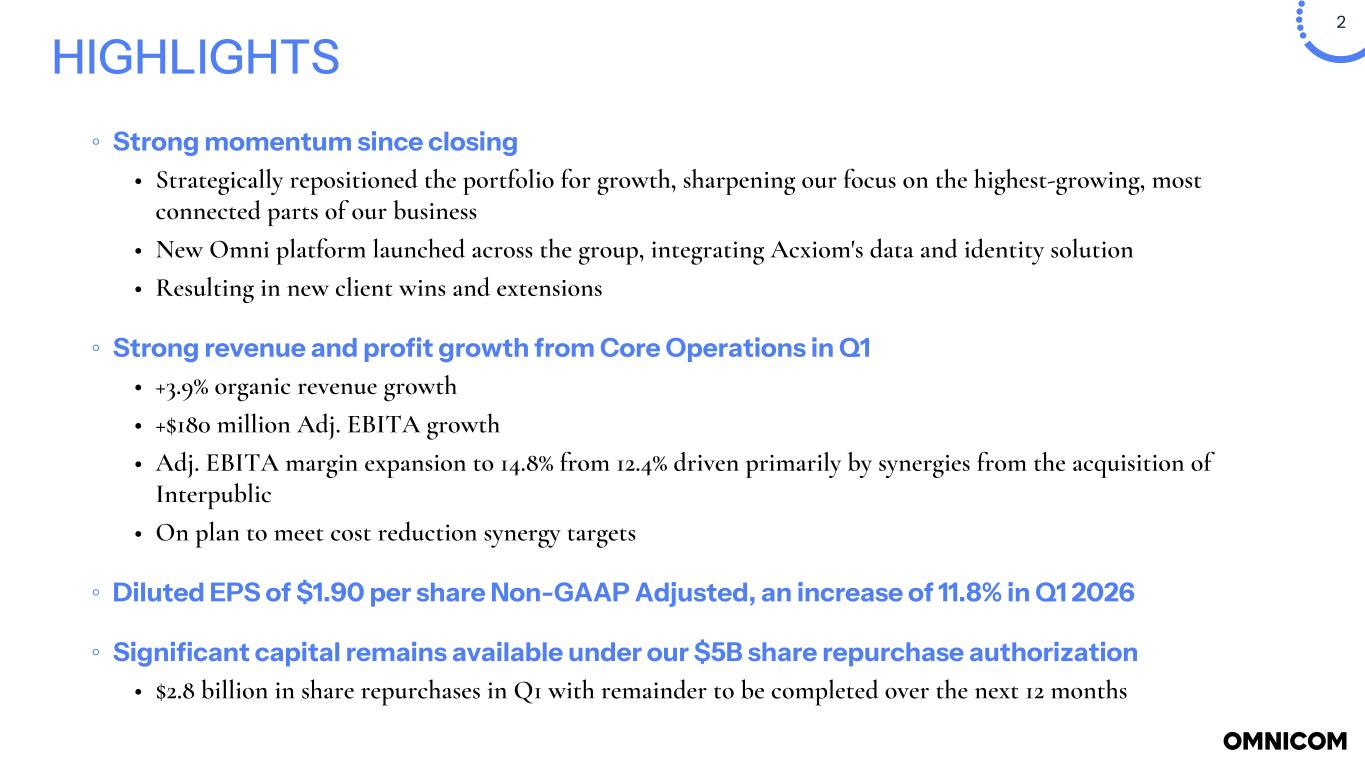
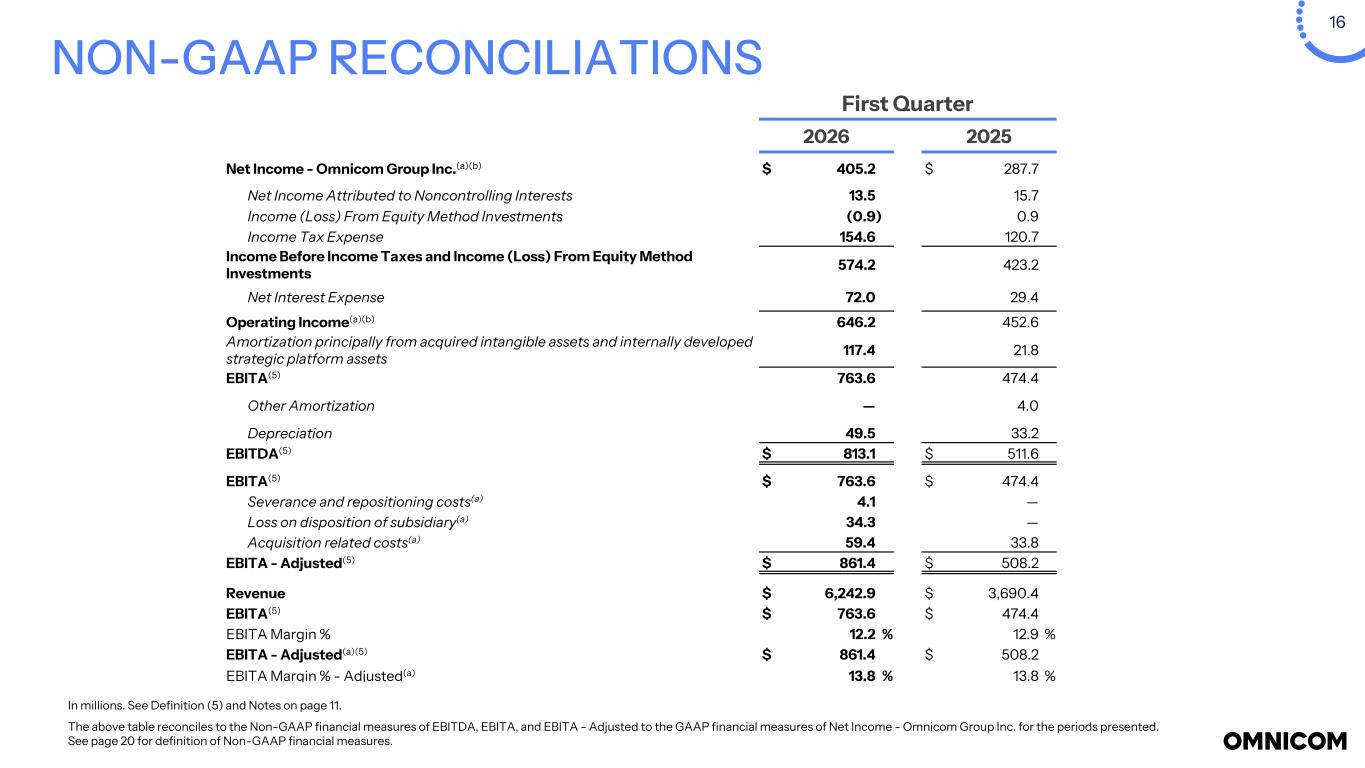
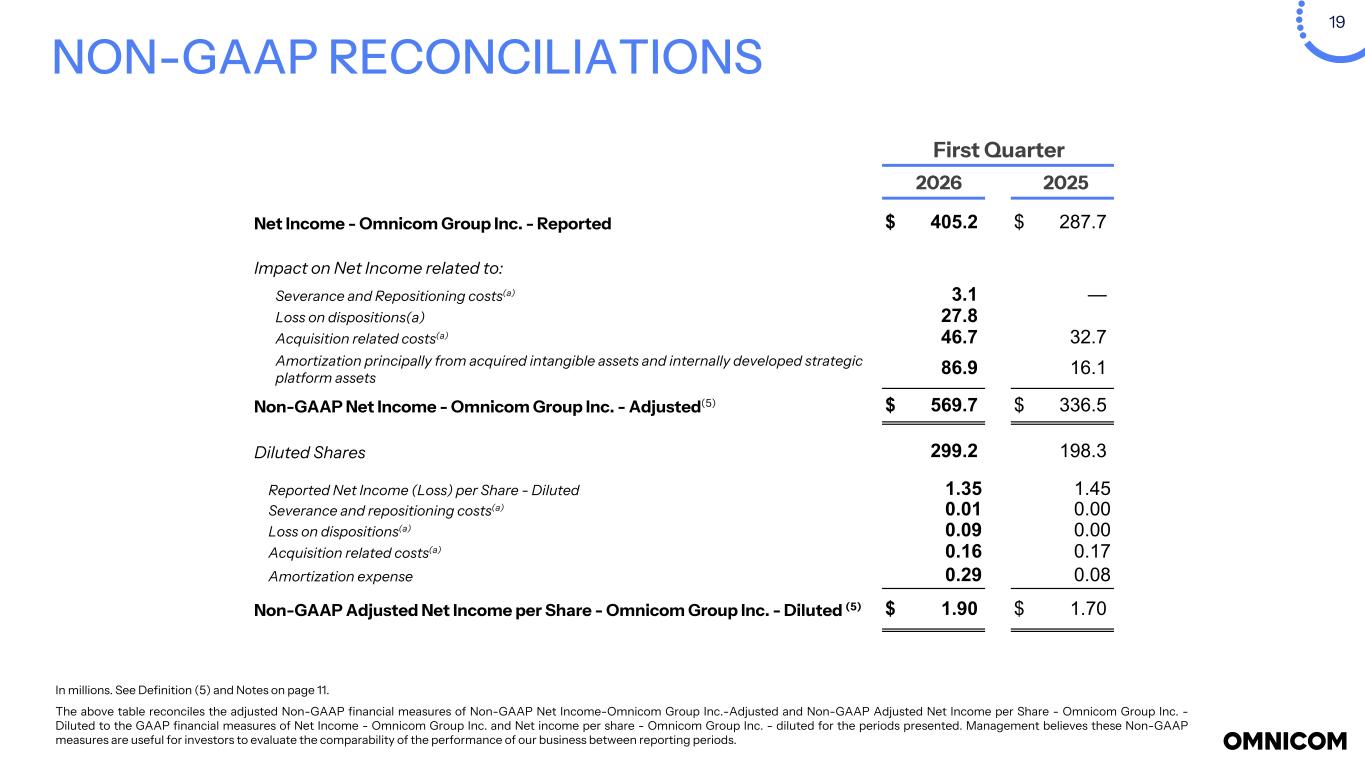
We will begin the call with an overview of our business from John, then Phil will review our financial results and after our prepared remarks we will open the line for your questions i'll now hand the call over to john thank you greg and good afternoon everyone thank you for joining us today i'm pleased to share highlights from our first quarter as the new omnicom since closing the interpublic acquisition just before the holidays we've seen momentum and cohesive growth across the organization our steady progress is reflected in our strong financial performance in the first quarter as you'll recall from our fourth quarter call and investor day we've strategically repositioned our portfolio for growth as part of the portfolio realignment we identified planned asset sales and disposition of businesses with approximately 3.2 billion dollars of annual revenue, of which approximately $1 billion was disposed of in the first quarter. Our plan is to sell or exit the remaining assets in the next several quarters. To clarify our focus on the operations that will drive growth, we've excluded assets held for sell and plan disposition from our core operations. Revenue from core operations was $5.6 billion in the first quarter, which increased $345 million when compared to Q1-2025 revenue from core operations for the combined Omnicom and Interpublic. Organic revenue growth was 3.9%. We also updated our revenue reporting to reflect our integrated operating model, which is central to driving our growth. Phil will walk through the details of our reporting changes in his remarks. One point I wanted to discuss was the increase in EBITDA performance. Our adjusted EBITDA margin increased 240 basis points to 14.8% as compared to the combined operations for Q1 2025. Our non-GAAP adjusted EPS in the quarter, which excludes after-tax costs for repositioning, dispositions and acquisition, integration, expenses, and amortizations of intangibles was $1.90 per share, an increase of 11.8% versus Q1 2025. Our solid performance for the quarter was the result of us realigning our portfolio for growth and moving decisively on our integration efforts. By integrating our capabilities upon closing, we merged or sunset more than 20 major agency brands with a long tail of smaller brands. This allowed us to quickly bring together the best talent from across the new Omnicom. Combined with our integrated client leaders and new strategy and growth teams, our efforts have translated into new business wins. In the first quarter, these include IBM, GSK, John Deere, Little Caesars, Acadia Pharmaceuticals, and Baileys. We're not just winning new clients, we're expanding our relationships with existing ones. Our integrated approach is making it easier for clients to access all their marketing and sales needs from a single partner. This model has gained traction across a number of our clients, including Clorox, Dyson, Delta, Exxon, Kroger, Merck, and Unilever. Our growth from integrated services is helping to diversify our revenue streams and deepen our client relationships, underscoring the strength of our offerings. As we discussed at our Investor Day last month, Omni, our AI-enabled intelligence, sales, and marketing platform, is connecting our talent, data, and services. We've scaled our next generation of Omni across the entire organization in Q1, putting the latest agentic AI tools in the hands of all of our employees. The new Omni is delivering on multiple fronts, driving stronger media performance, greater addressability, and improved measurement, increasing speed to activation and enhancing ROI with Axiom's Real ID, improving performance across retail and commerce channels, and enabling more effective marketing and client outcomes through deeper integrations with partners. like Adobe and Amazon. We also made significant progress to accelerate collaboration across the group. Throughout the quarter, we continue to move into hub building locations, deploy common HR and IT platforms, and migrate teams to shared workflow systems. As we look ahead, we will continue to work towards the initiatives we've communicated in our prior calls, including $900 million in 2026 cost reduction synergies and $1.5 billion by mid-2028, $5 billion in share repurchases over the next 12 months, including a $2.5 billion accelerated share repurchase program currently being executed. Through the ASR and open market purchases, we repurchased $2.8 billion of shares through the first quarter. Plan asset sales and dispositions of businesses with approximately $3.2 billion of annual revenue. Dispositions with approximately $1 billion in annual revenue have already been completed. we will continue to evaluate our portfolio to ensure we remain positioned for growth. Overall, I'm pleased with how we've executed it in the first quarter. Our results clearly demonstrate the significant benefits of the combination for our people, clients, and shareholders. While we remain bullish about the combination for the year ahead, we're also mindful of the broader geopolitical environment. The ongoing conflict in the Middle East, which represents less than 2.5% of our revenue, continues to create uncertainty in the region and across the world. As always, we are prioritizing the safety of our people in the region and monitoring developments closely so we can adapt quickly to changes that impact our business. Before I close, I want to thank every member of the Omnicom team for their outstanding efforts. None of this progress would have been possible without the exceptional commitment and hard work of our people over these past few months. With that, I'll turn it over to Phil to walk through our quarterly financial results.
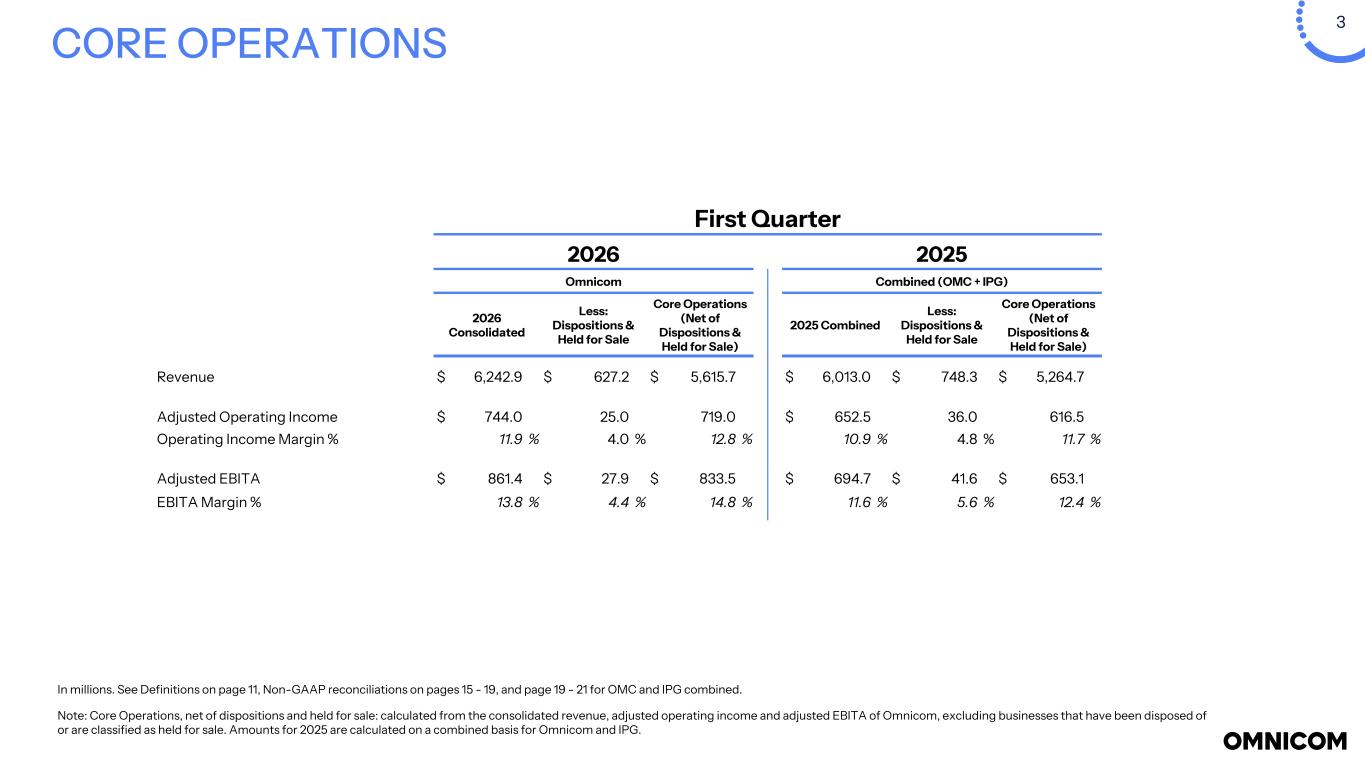
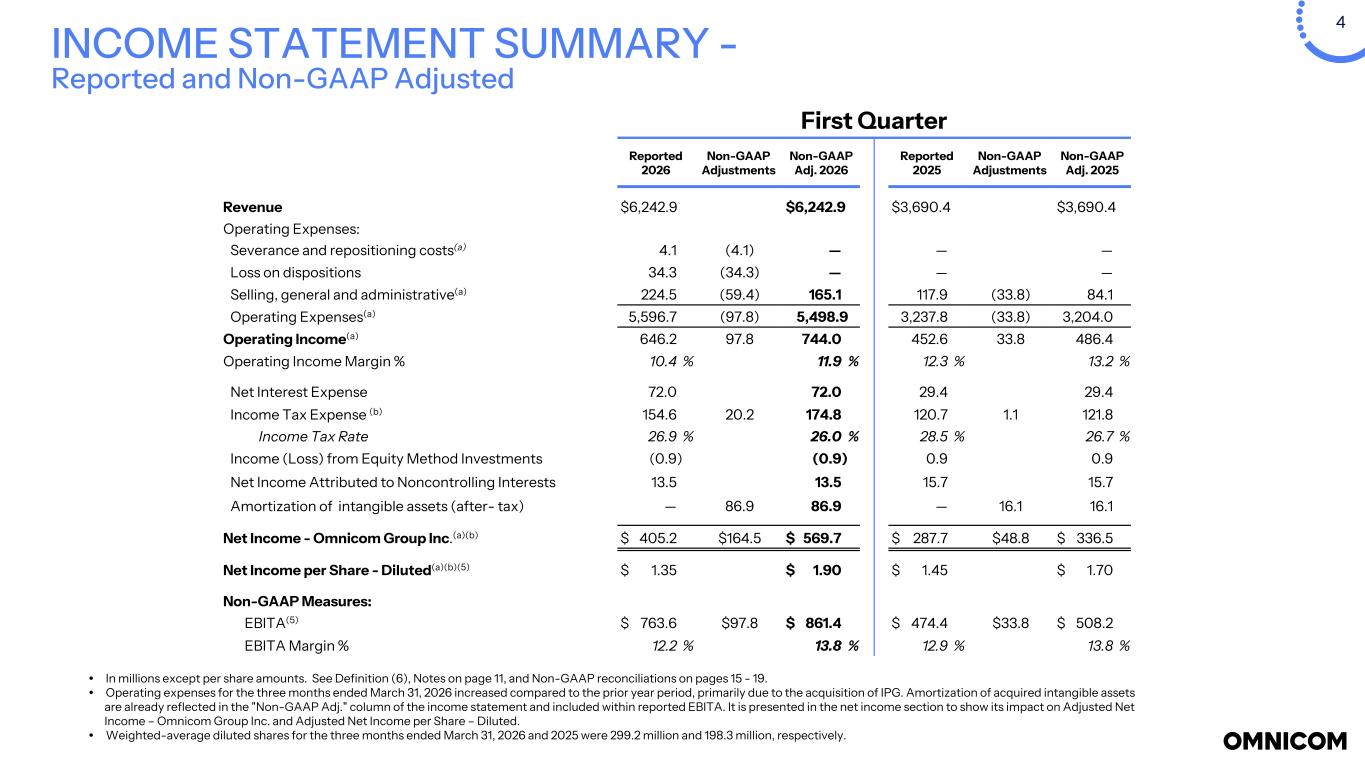
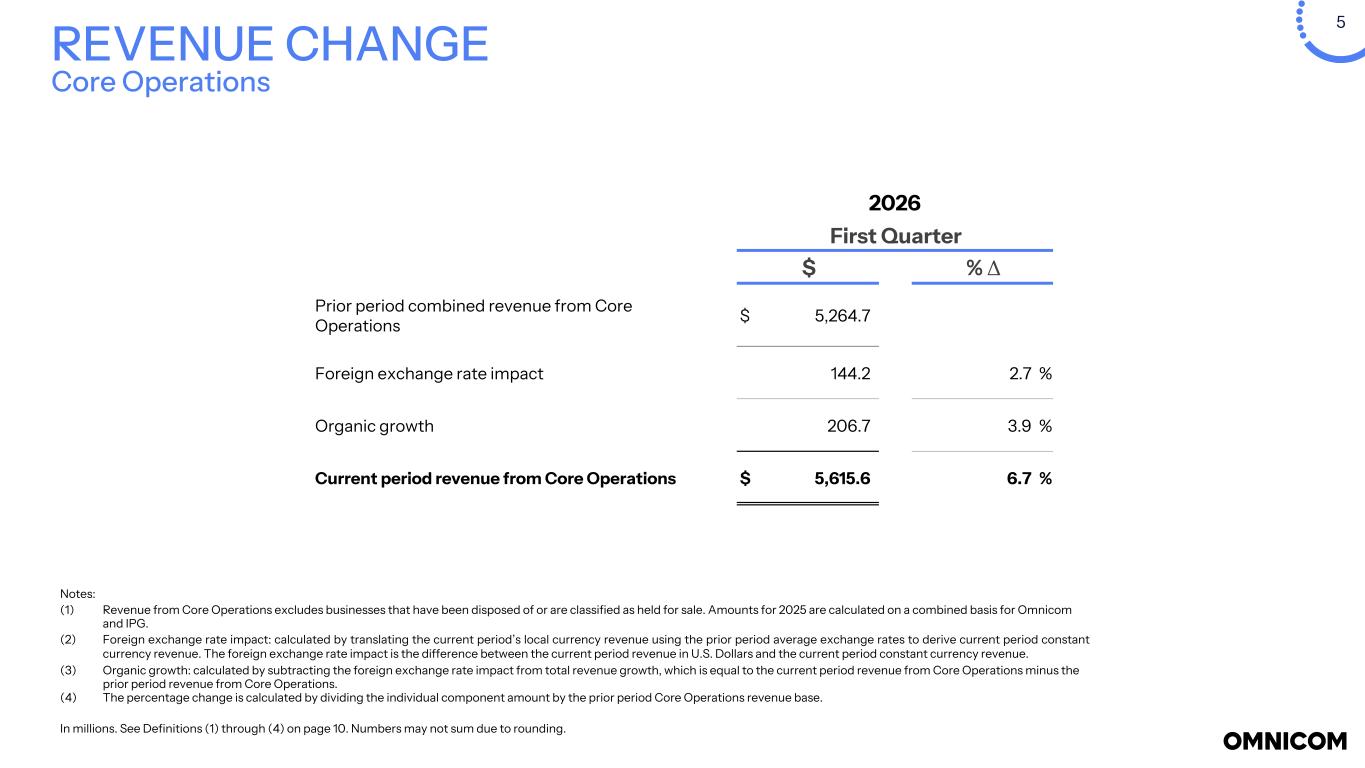
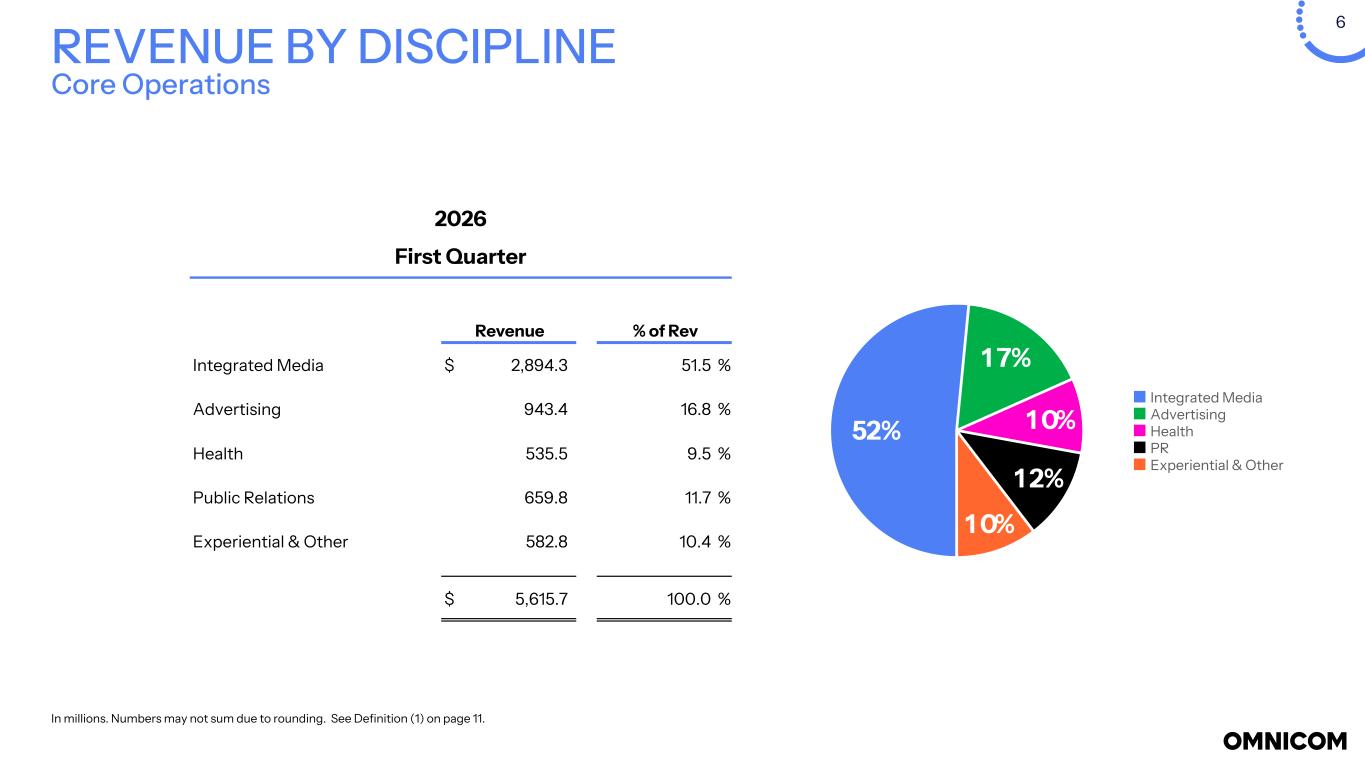
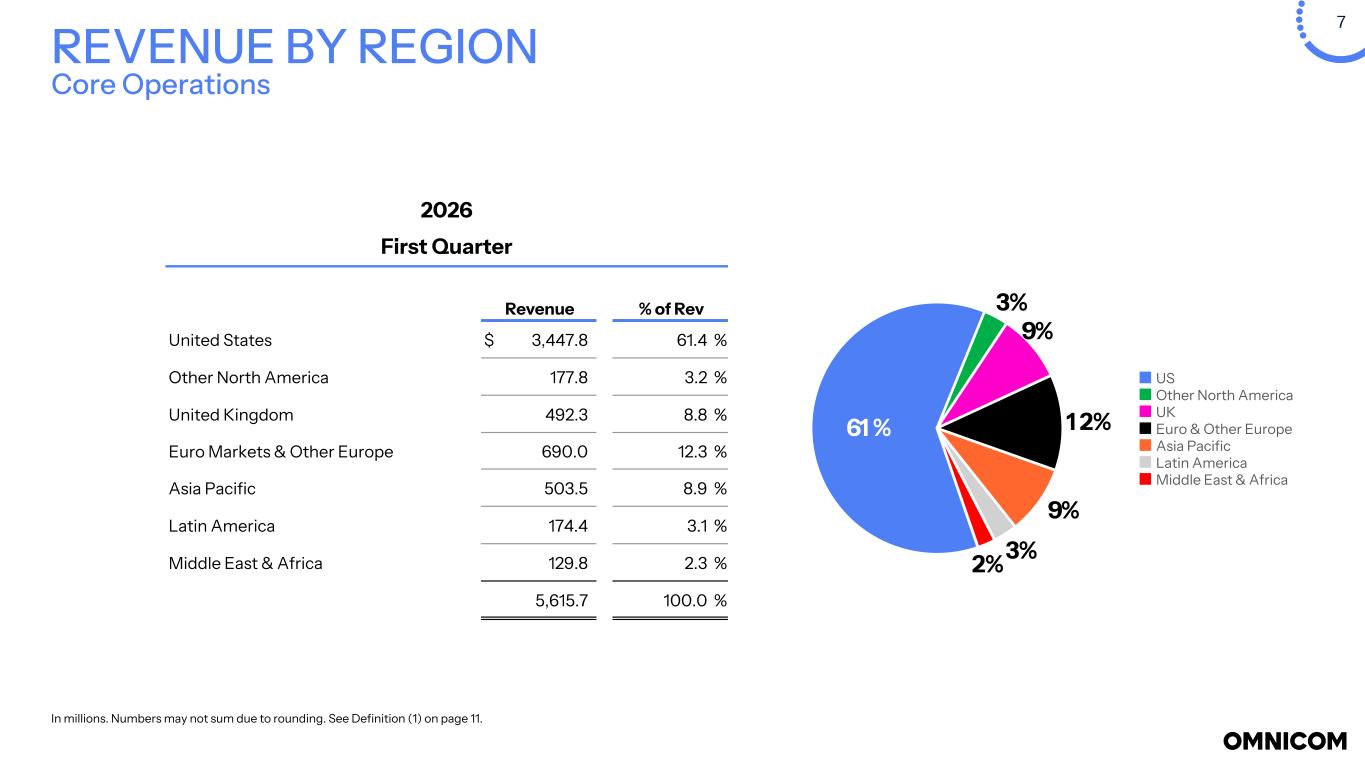
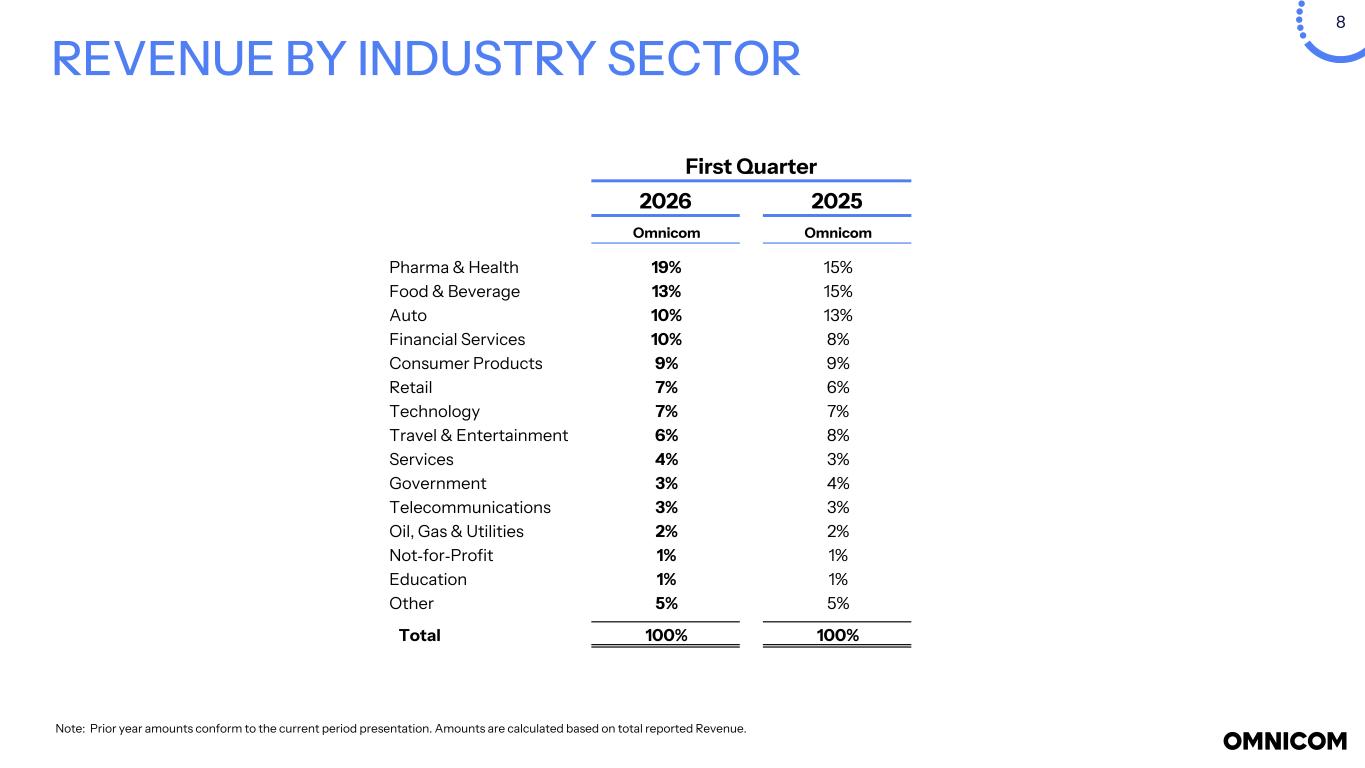
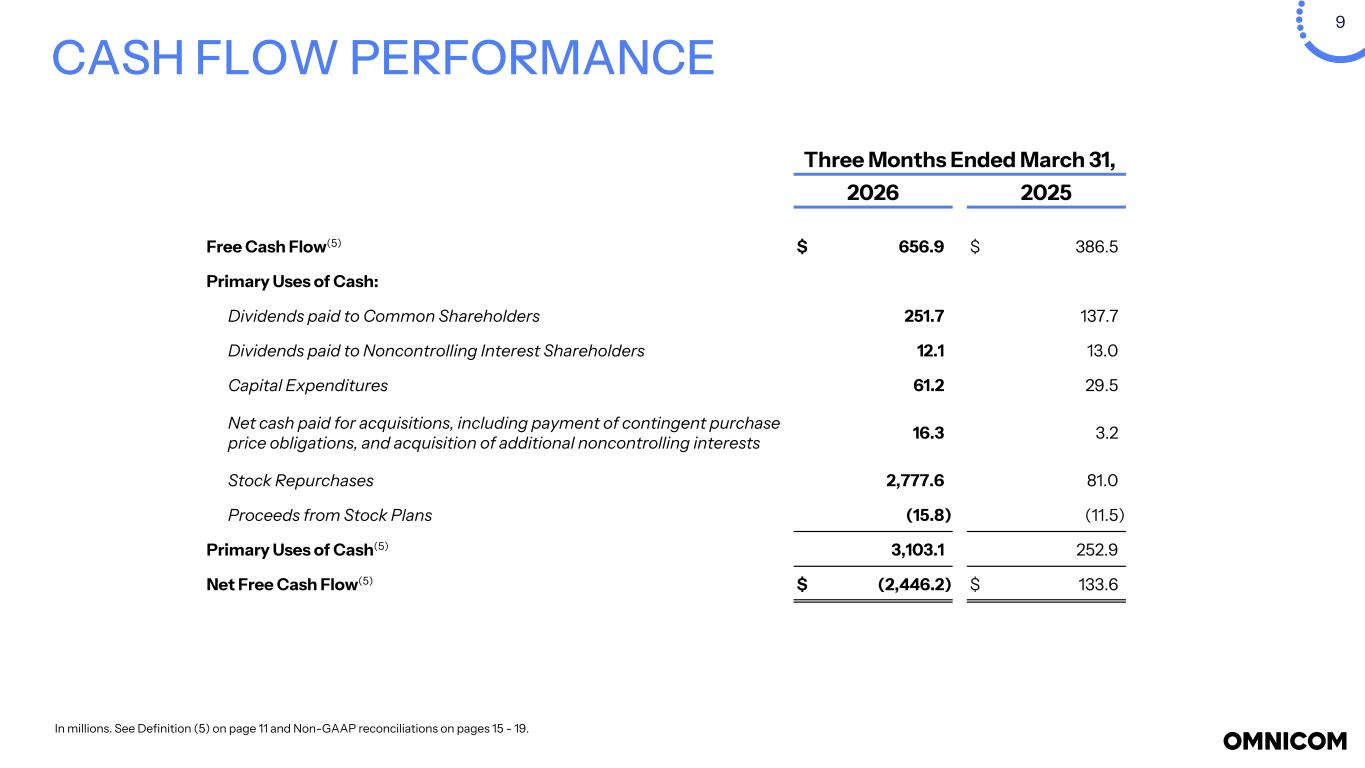
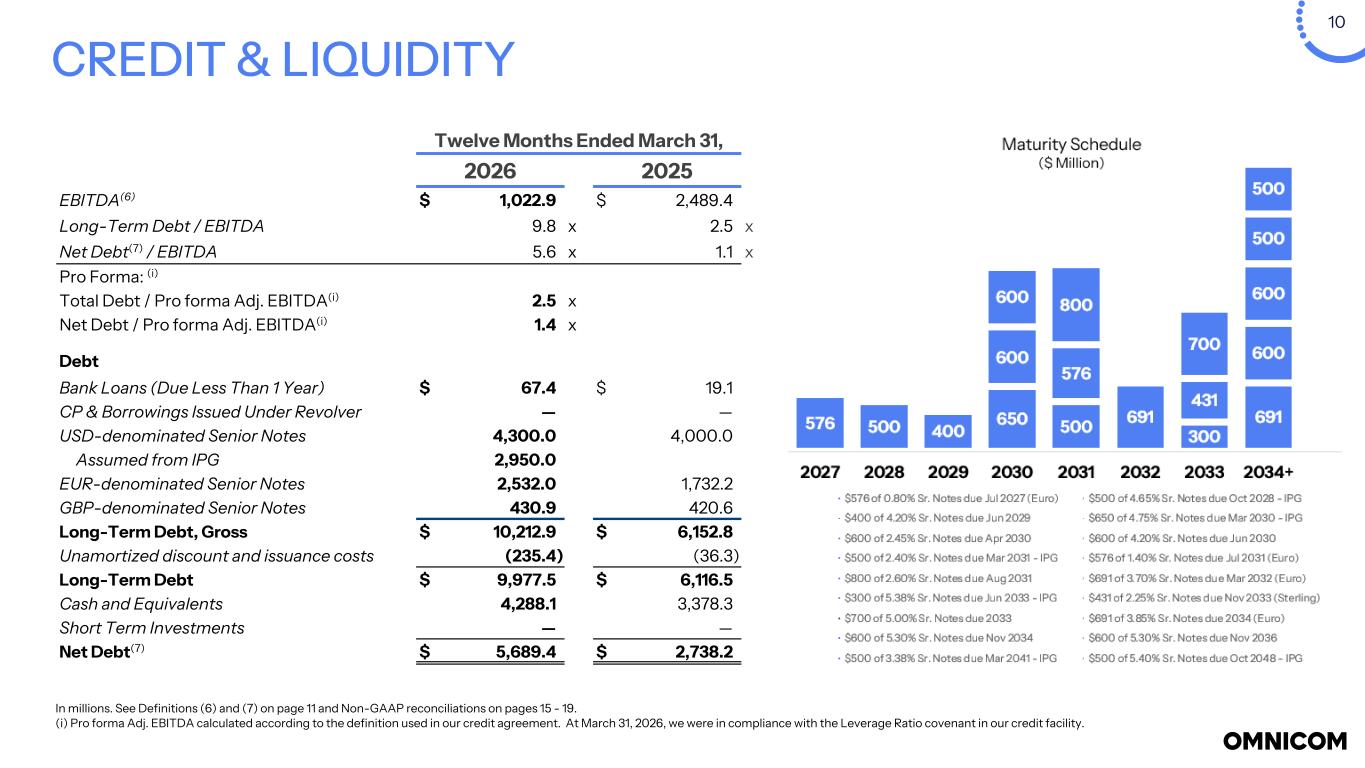
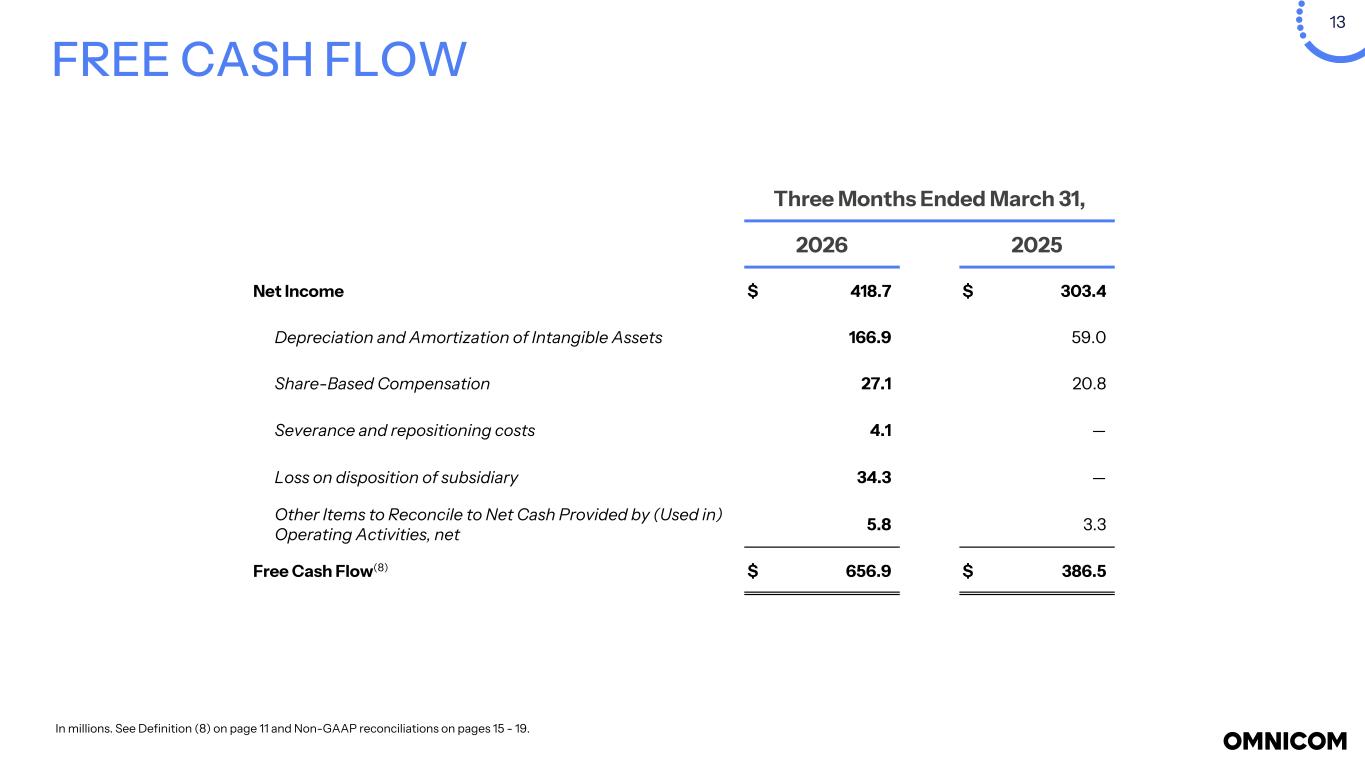
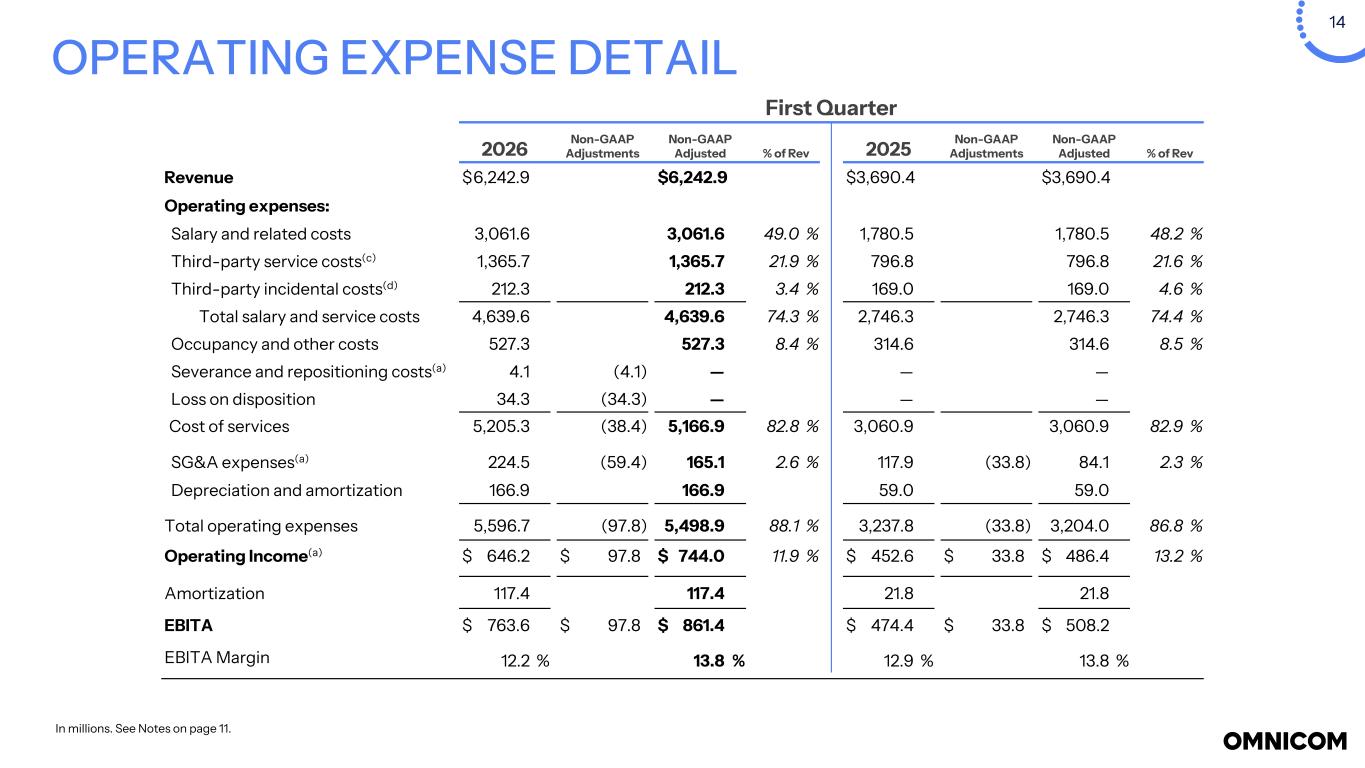
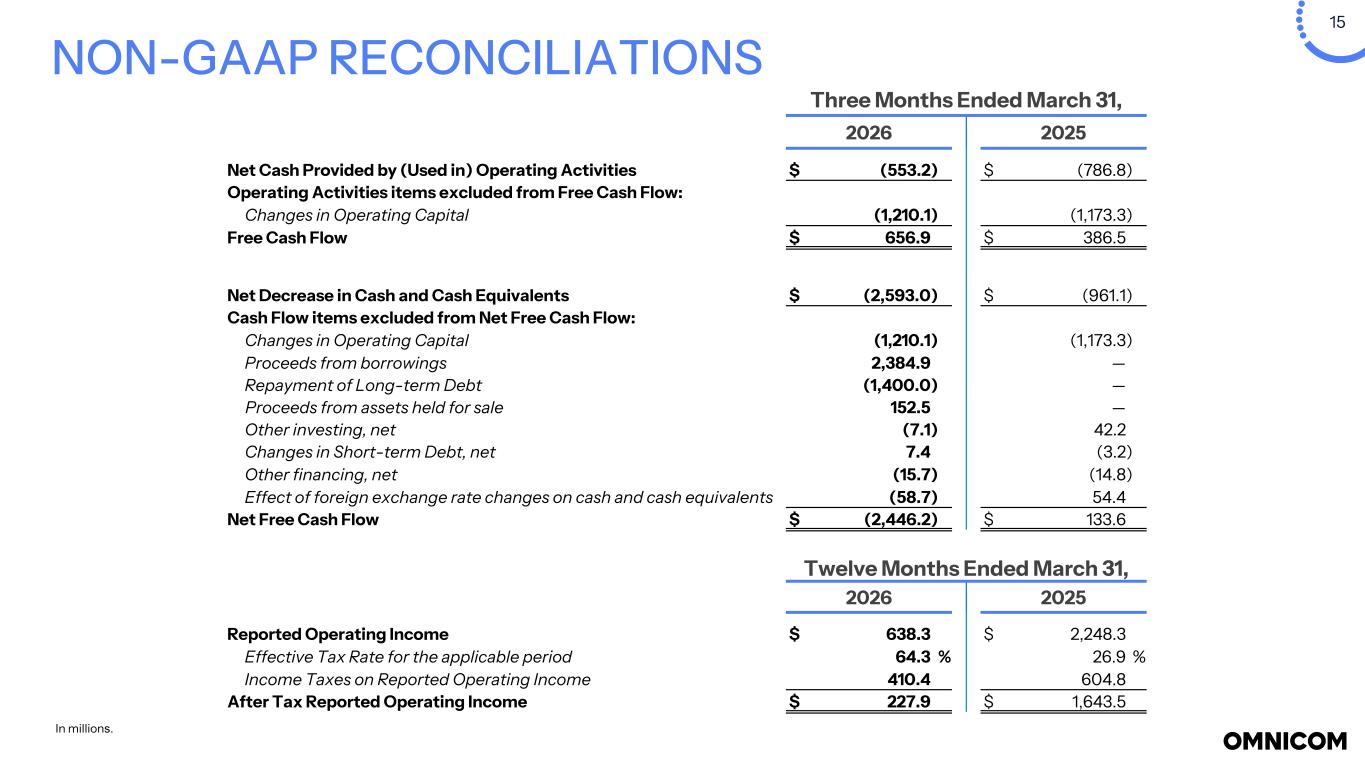
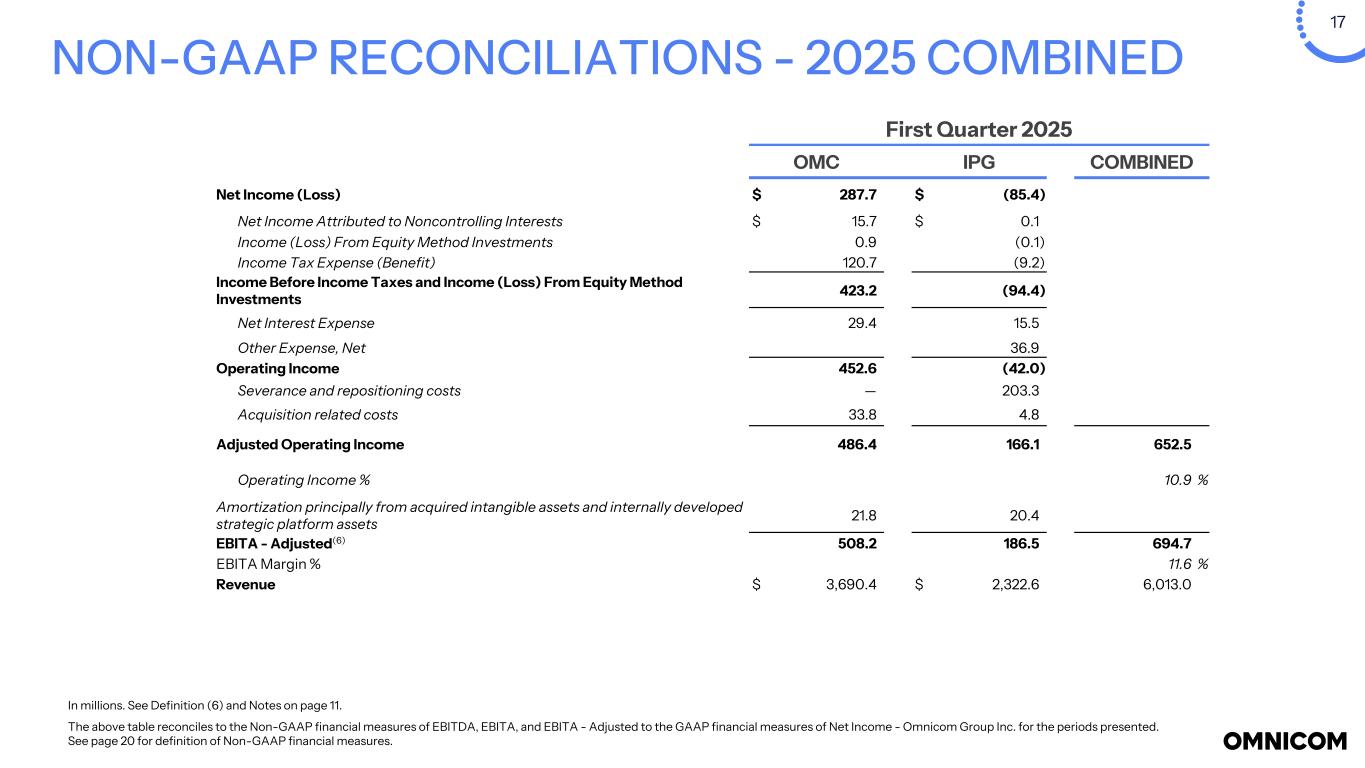
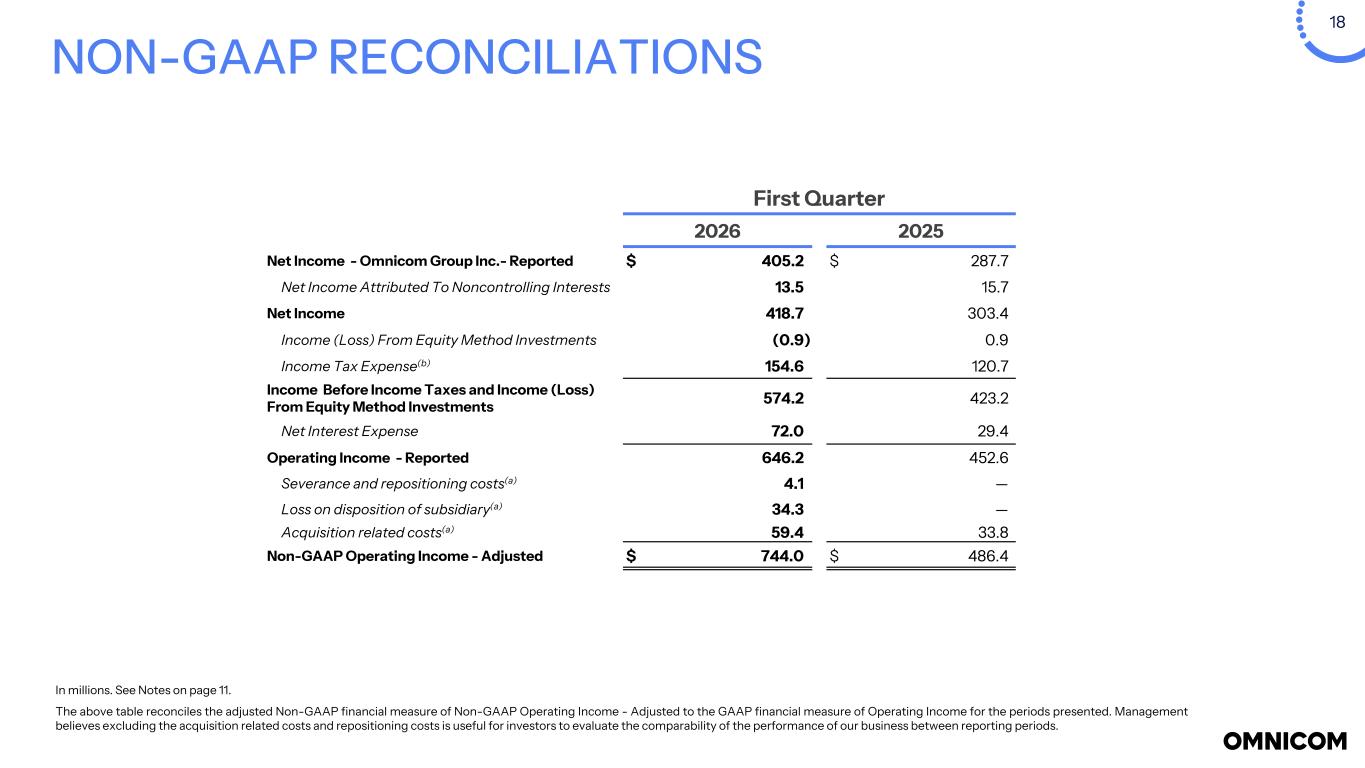
Thanks, John. This is our first quarterly report as the new omnicom with interpublic's operations included for the full 90 days of the quarter we started the year with strong performance in revenue growth and cost reduction with a meaningful amount of synergies flowing through to ebitda while we continue to invest for future growth we're making significant progress integrating interpublic's operations and positioning our portfolio for growth i will start on slide three we know that there are a lot of moving pieces right now and we want to make things easy for you to understand this slide should help it presents what we call our core operations our core operations are comprised of our operating businesses excluding dispositions and assets held for sale to ensure it's clear our main focus in driving the company forward is on our core operations. As we talked about at Investor Day, our core operations are the result of our ongoing strategic repositioning of the portfolio for growth and reflect our sharpened focus on the highest growing, most connected parts of our business. Businesses included in the dispositions and held for sale category will be sold in 2026, and they represented less than 5% of our adjusted operating income in the first quarter. And our only priority regarding these businesses is to complete these disposals in a timely fashion. This slide also presents operating income and EBITDA on a non-GAAP adjusted basis, excluding severance and reposition costs, loss on dispositions, and acquisition integration costs. For comparison purposes on this slide, we've included 2025 prior year combined amounts prepared on a similar basis. As you can see, revenue from core operations grew 6.7% in total. Adjusted EBITDA grew $180 million, or over 27%, and adjusted EBITDA margin increased to 14.8% from 12.4%, primarily driven by cost reduction synergies from the acquisition of Interpublic. We are pleased with this strong performance on both revenue and adjusted EBITDA, and we are on track to achieve our operating plans and targets for the year. Turning to slide four, we present our reported results, as we traditionally have, as well as the related non-GAAP adjusted amounts. This slide presents our reported results, including all entities, core operations, dispositions that occurred during the quarter for the period that they were part of Omnicom, and entities that are classified as held for sale. Since these are reported results, the 2025 presentation reflects the prior results of Omnicom and does not include Interpublic. The center column for each period shows the applicable non-GAAP adjustments. In the first quarter of 2026, we recorded integration-related costs of $59 million, which are recorded on the SG&A expense line. We recorded the loss on dispositions of $34 million, and we recorded severance and repositioning costs of $4 million. When considering the change in operating income on both a reported and adjusted basis, note that it includes $117 million of amortization expense related to the intangible assets acquired from Interpublic, an increase of $96 million compared to 2025. The change in operating income also reflects a $16 million increase in depreciation expense. below operating income that interest expense increased to 72 million dollars from 29 million in q1 of 2025 an increase of 43 million primarily resulting from assuming interpublic's debt of approximately 3 billion dollars in q4 2025. interest expense in q1 2026 increased by 60 million dollars primarily from interest expense from interpublic which added approximately 47 million dollars of which 3 million dollars is non-cash interest and higher interest expense resulting from refinancing activity completed during the first quarter of 2026 which resulted in approximately 1 billion dollars of incremental long-term debt note q1 includes one month of the incremental interest expense from the new debt issuance. Additionally, interest income increased this quarter by $17 million to $47 million, primarily due to interest income earned on higher average cash balances, including cash acquired with Interpublic. Our adjusted tax rate of 26% was down slightly from 26.7% in 2025. For 2026, we expect our annual tax rate to also be 26 percent income from equity investments and non-controlling interests declined by four million dollars in total finally non-gap adjusted diluted eps grew 11.8 percent to a dollar ninety from a dollar seventy last year our fully diluted weighted average shares outstanding for q1 2026 were $299.2 million. Actual shares outstanding at March 31, 2026 were $285.3 million compared to $313.4 million at year-end December 31, 2025, and compared to 196.1 million shares at March 31, 2025. On a year-over-year basis, our share count increased from last year due to shares issued for the interpublic acquisition, but they also declined as a result of our share repurchase activity, which I will discuss later. Now let's review our business in more detail, beginning with the components of our revenue change on slide 5. To assist in understanding the drivers of our underlying business, we've included an analysis of our growth beginning with core operations, which excludes businesses that have been disposed of or are classified as hell for sale. For the first quarter of 2025, presented on a combined Omnicom-Interpublic basis, revenue for Q1-2026 increased by 2.7% from positive foreign exchange rate changes and by 3.9% from organic growth. We expect FX will continue to be positive in 2026, and assuming recent FX rates stay the same, will benefit our reported revenue for the year by approximately one percent relative to our traditional presentation in this table there's no row for acquisition and disposition revenue because there were no acquisitions during the quarter and as we have noted dispositions have been removed from the opening balance of core operations revenue turning to slide six you can see our core operations revenue by discipline presentation of our disciplines has been updated from 2025. as we discussed that investor day the strategic reshaping of our portfolio through the interpublic acquisition will result in a business with more than half of our revenue coming from the faster growing integrated media business integrated media includes our media commerce data crm and consulting and content automation businesses revenue from our core operations in the first quarter of 2026 for integrated media was approximately 52 percent of our revenues and for advertising was 17 percent health 10 percent vr 12 percent and experiential and other 10 percent q1 revenue growth of core operations was as follows integrated media led the way with very strong growth in the high single digits vr and experiential and other grew in the quarter mid single digits health had positive growth and advertising was down in q1 we're not providing detailed prior combined revenue balances or organic growth by discipline or region because our integration process is ongoing and we continue to evaluate the portfolio slide seven shows our core operations revenue by region as we highlighted when we announced the interpublic acquisition the transaction gives us greater relative exposure in the u.s which was 61 percent of revenues this quarter together the uk and europe were 21 followed by asia pacific at nine percent in q1 revenue growth in the us was strong and delivered mid single digit growth europe latin america and asia pacific were also up low single digits and the uk and middle east and africa declined slide eight is our revenue weighted by the industry sectors of our clients. Because the first quarter of 2026 reflects a full quarter in a public, there are some changes worth noting relative to the prior year Omnicom 2025 amounts. The largest changes were the pharma and health and auto categories. There were small changes to our other categories, which moved up or down one or two points, with increases in financial services, retail, and services, and decreases in food and beverage, travel and entertainment, and government. Now please turn to slide 9 for our year-to-date free cash flow summary. The 70% increase relative to our last year, excuse me, the 70% increase relative to last year was driven by the addition of interpublic and improved performance in Omnicom's business. Our free cash flow definition excludes changes in operating capital, which is seasonal, with the first quarter generally the largest use of cash during the year. There's a reconciliation in the appendix that shows the change in operating capital for the quarter was flat compared to the change from the first quarter of last year. When the three months ended March 31, 2025, our primary uses of free cash flow included $252 million of cash paid for dividends to common shareholders and another $12 million for dividends to non-controlling interest shareholders. Dividend payments increased year over year as a result of the shares issued for the Interpublic acquisition and an increase in our quarterly dividend payment. Quarterly dividend payment approximates the combined dividend payments made by Omnicom and Interpublic in Q1 of 2025. Capital expenditures were $61 million higher than the prior year due to the interpublic acquisition, but at the same overall level relative to the size of the business. Total contingent purchase price payments and payments for the acquisitions of non-controlling interests were $16 million. Finally, our share purchase activity for the first quarter was $2.8 billion, excluding proceeds from stock plans of $16 million. The majority of this resulted from our accelerated share repurchase program, which drove a significant reduction in shares outstanding to $285.3 million as of March 31, 2026, a reduction of 28.1 million shares from December 31, 2025. We have significant remaining capacity under our $5 billion total share or purchase plan and our plan is to complete the five billion dollars over the next 12 months or by the end of april 2027. we estimate that relative to our shares outstanding at december 31 2025 of 313.4 million shares we will see our share count decline approximately 11 to 12 percent by December 31, 2026, and that weighted average shares outstanding for the year will decline approximately eight to nine percent. Slide 10 is a summary of our credit, liquidity, and debt maturities. At the end of Q1, 2026, our gross long-term debt was $10.2 billion. Since December 31, 2026, our debt is approximately a billion dollars higher, reflecting the retirement of our 1.4 billion 3.6% senior notes due April 15, 2026, and the issuance of new senior notes totaling 2.3 billion, including 1.7 billion of U.S. dollar denominated notes at a weighted average coupon of 4.9%, and 600 million of euro-denominated notes at a 3.85% coupon. The maturities range from three years to ten years which you can see in the maturity chart on this page our next maturity is not until july of 2027. net interest expense is expected to increase by approximately 200 million dollars in 2026 compared to 2025. of this increase 13 million is non-cash interest the change is primarily driven by higher interest expense from the inclusion of Interpublic's debt, the refinancing I just described, as well as interest on incremental commercial paper borrowings of approximately $10 million, and lower interest income on cash balances of approximately $20 million, primarily due to lower forecasted short-term interest rates on invested cash. Please note that the total and net leverage ratios on this slide, which compares the last 12 months ended March 31, 2026 and 2025, reflect the full assumption of Interpublic's debt, but only four months of Omnicom's EBITDA results, including Interpublic. However, at March 31, 2026, we're in compliance with the leverage ratio covenant in our credit facility, which makes pro forma adjustments for the impact of the acquisition. The calculation of total debt to pro forma adjusted EBITDA, done in accordance with the definition in our credit agreement, results in a total average ratio of 2.5 times. Cash equivalents in short-term investments at the end of the quarter are $4.3 billion. Our liquidity also includes an undrawn $3.5 billion revolving credit facility, which backstops our $3 billion commercial paper program. In closing, we've completed our first full quarter as the new Omnicom. Our operations delivered solid top and bottom line growth. We are realizing significant cost reduction synergies while investing for future growth. Our balance sheet is strong, and we are deploying capital for the benefit of shareholders in the long run. I will now ask the operator to please open the lines up for questions and answers. Thank you.
Operator
Thank you. We will now begin the question and answer session. If you would like to ask a question, please press star 1 on your telephone keypad to raise your hand and join the queue. And if you'd like to withdraw that question, again, press star 1. Your first question comes from Stephen Cahill with Wells Fargo. Please go ahead.
Thank you. First, I was wondering if you could talk a little more about some of the revenue by discipline. So I was just wondering if we could get some underlying trends or even growth rates, especially of what you're seeing in integrated media versus advertising versus health to kind of understand the trajectories. you talked a lot about those disciplines at the investor day. So we'd love to understand how they're trending. And then Phil, I was just wondering if you cared to provide any additional update to the adjusted EPS growth guidance. I think the prior guidance is double digit. You know, I mean, you said that the share count alone gets you to 8% to 9% this year.
So it seems like it's going to be a very, very healthy interpretation of double digit. and we saw some of that in the first quarter results so was wondering how we can think about maybe some guardrails around where EPS growth can come in for the year thank you so I'll give some detail and then and then John can have some color roots as far as disciplines go as I said in my prepared marks integrated media certainly led the way in terms of growing high single digits PR and Experiential and Other Group, mid-single-digits health was positive for the year, low single-digits, and advertising was down. I think there's an awful lot going on as we integrate all these businesses, and we're certainly pleased with our progress to date and the growth to date. um but in terms of additional details with specifics um you know that's about as specific as we're going to get um this early in the year in our first full 90-day quarter um in terms of trends you want to you want to give some comments john yeah steven the only thing i would add to what phil said was um and i mentioned this in my comments we we remain very healthy in terms of competition in terms of winning our fair share of business and that's great considering we're
bringing two big organizations together in such a very short period of time we're functioning very well but if there's an underlying trend that's out there it's really clients especially with the change in the landscape of the industry clients are becoming more focused on selecting a single provider to take care of most of their needs and we saw it during the quarter that we were able to extend the multi-year contracts quite a number of clients and that's a focus that we're going to continue to work on as we get further and further into the year that gives us security and that gives us a better ability to plan as we move forward and it's our size it's our influence that is contributing to all this, not to mention the state-of-the-art investments we've made in terms of Omni and Omni AI and the breakthroughs and the contributions we're making there. So that's all I would add to the color that Phil mentioned.
Yeah, and then I'll answer the EPS question. So certainly we're pleased in the first quarter, the diluted EPS grew almost 12%. I think as we go through the rest of the quarters for the year, when we talk about double digit, I think at this point we'd certainly say we expect probably the quarters as they roll out are going to be higher double digits than the first quarter performance. Um, I think at this point, we're going to leave it at that, but, um, we're certainly pleased with, with the quarter and, and we expect, um, you know, good performance to continue on that front.
Operator
Your next question comes from the line of David Karnofsky with JP Morgan. Please go ahead.
All right. Thank you. Um, John, just with the integration, I wanted to see if you could comment a bit more on healthcare and PR. I think these were two areas you talked in the past about the scale of combining with IPG and the opportunity going forward. So kind of what's been the experience to date and what are you seeing generally across these disciplines? And then, Phil, I'll revisit the investor day. Also, you guys had provided an expectation of 4 percent constant currency growth for the core businesses. You know, that was well within to the kind of macro volatility we've seen. But just, you know, I was curious if there was any update there to give.
You know, the healthcare business, the combination of both the size that IPG had as a business and we had as a business is extraordinary. We clearly have an incredible amount of talent and representation across the whole pharma business. And what leads that lets us attract the best and smartest people and makes us, every single former company has to come and speak to us if they want to do something in terms of their marketing. In terms of PR, PR is, you know, PR is a different type of business. We've been able to continue to grow it. In the past, we've been affected by elections, but any negative news is behind us from 25, and so we have good comps coming forward. And I think the only real comments I've made is that I'm happy with the performance of those units as we go forward. There's a lot of combination there, too, and there's synergies that are going to come out of, you know, probably the PR business more than the healthcare business. But, so it's all quite positive. It's a very solid contributor to overall growth, and we expect it to continue that way.
Regarding the question on organic growth and Investor Day and the 4% reference, certainly, as I said in my prepared remarks, we're on track to achieve our operating plans and targets, and that would include the organic growth reference as well. So, we're not changing, you know, that expectation at this point in time, but we're certainly comfortable with what we said at Investor Day. Thanks. Sure.
Operator
Your next question comes from the line of Jason Bazinet with Citigroup. Please go ahead.
Thanks. I just had a handful of questions around the disposed businesses and core operations. I guess the first one is, why did you decide to sort of focus the street on core operations? Why do you think that's the right way to look at the business? I'm sorry.
Go ahead. No, no, you go right ahead. Ask your questions. I'll write them down, and then I'll try to answer them. All right.
I think, and maybe I'm misremembering, you guys gave a rough benchmark of about 10% EBITDA margins for the disposed businesses. And if I'm looking at this slide three, which is quite helpful, it looks a bit lower than that. And then third, I was just struck by the disposed businesses. If I'm doing the math right, it looks like they shrank, I don't know, 16% or something like that year over year, which is far worse than I would have thought any business, you know, would be performing, even a bad business, to put it that way, that you might be disposing.
So those are my I mean, if you could repeat that, the last question, you're talking about the performance of the disposed businesses?
Yeah, it's just extremely much more than I would have thought.
Oh, well. Which numbers are you looking at, Jason? Because I think when you look at the year-over-year, yeah, when... Go ahead. Sorry.
Yeah. So some of those businesses that we're disposing of were actually disposed of. So there was a meaningful, as we said on the year-end call in February, we had closed on the sale of an experiential business, Jack Morton, kind of the day before February 15th. So the first quarter in that example has a month and a half of their revenue, but it doesn't have the second month and a half in the quarter. So the revenues are down because the business was sold. So it isn't a performance thing. It's just a timing of when the dispositions occur.
And Jason, I'm pleased you asked the question. I really am. What we decided when we closed the transaction and looking at our businesses is which are the businesses that are going to grow, continue to grow, and which are contributing a fair margin for the efforts that we're putting in. And the way we developed the initial list of the $3.2 billion of companies that we were going to hold for resale is based upon poor margin performance and unreliable growth. and and then after we went through that filter the second filter which was the governing filter was is this necessary for our clients is this what our clients are asking for and we reached the conclusion that no they weren't now there's a number of businesses in there some of them terribly large but there's There's a lot of units because we're spread out throughout the entire world. And what we're doing is we're working to dispose of them. And if there was another way to get them out of our financial statements, we would, but there isn't. We have to, until we get rid of them, we have to account for them. And that's why we decided to put them in, you know, in the columns that are reflected on slide three. Um, and, and, and we, um, maybe we were being a little optimistic or nice at Investor Day when we said the margins for these businesses are 10%. Um, it turns out that the margins of these businesses are probably not 10%. Um, they're probably something less. So the sooner, and, and, and because, and, and, and what was interesting is coming out of Investor Day, I could see that we had not clearly communicated that, you know, this distinction, that what we're calling core now are the operations that we're planning to focus on and will contribute to the ongoing growth of Omnicom, and the non-core assets that you see will hopefully disappear as we dispose of them throughout the rest of the Yeah, which is one other piece of input in terms of the margin.
Certainly, the margins will likely vary by quarter. So, you know, as we get through the year and we get through this process, you know, the historical reference is what we made. The historical reference was about 10% for that group. We'll see how each of the quarters play out. But certainly, it's a focus of ours to move expeditiously to complete those dispositions.
I can't wait for the day that you never have to ask me that question. But I do appreciate you asking it. Thank you.
Operator
Your next question comes from the line of Tim Nolan with SSR. Please go ahead.
Hi. Thanks for taking my question. I've got a couple actually related to really what a lot of people would think of as your core businesses, which are the media planning and buying businesses, and then the creative business. On the media planning, John, you made a brief reference to agentic AI, and I wonder if you could talk a little bit more about as these LLMs come more and more to market and enable direct communication amongst the various parties in the value chain, and as Omnicom is doing a lot of principal media buying itself, um can you more directly go to publishers yourselves in ways that you have not before and then on the creative side um i just want to push again why the advertising business was down and i'm wondering if there might be something of a trade-off with production uh which i think you hold in your integrated media business which you said was growing high single digits is there maybe a little bit of trade-off between creative advertising and production um there's a couple
very interesting questions. I'm going to answer some of them, and then I'm going to refer to Paulo, who leads our AI work to answer some of it too, Tim. Yeah, it's interesting that the quest right now, and I think every major, there aren't too many major groups that are working on it is is looking to have directly more direct relationships with the publishers that is an aim and it's an objective and it's something actually that we're investing in as we sit here today when you look at I'd be dating myself if I went back to the internet days of 90s but there's always a messy middle between the client, the advertiser, and what they pay for the media and reaching the consumer, and a lot of MarTech and stuff, which becomes exciting for a moment or two and then fades away. Most of those businesses don't last very long. And there are intermediaries today that stand between us and the publishers, and they take a toll. and the toll is paid for by the clients and by the industry itself. So that is something you can continue to ask me about in the future because that is something we're clearly working on. The second part of your question, as what happens with the quality and now I'll start to follow of our platform, In addition to being a common way for our people to communicate to both the clients and to look at problems, and the quality of our data gives us more information. Data itself doesn't mean too much unless you use it properly, and we think the best data at the moment in the industry, and it allows our creative and really smart thinkers to come up with some really different ideas and explore different opportunities. Part of the agentic revolution and what's going on is it reduces the need for what was previously manual work that was semi-manual work that was required to put together Excel spreadsheets and to do a lot of other things in the simplest terms and it makes us more productive. And we believe that the contribution that our creative people can make and the contribution that our media cloud size and influence can make will maintain and help grow our profits in certain parts of the business, exceeding any declines that come in because of the automation or efficiencies that we go through. And, you know, the court approves it. We grew 4%, you know, in a complicated world with a company that we've just been together for 90 days. I don't know, Paul, if you want to add anything to it.
Tim, I can address the agentic media buying. So as we mentioned in Investor Day, you know, Omicom is really leading the charge from our perspective on agentic media and the agentic media ecosystem. You know, we're first to market with things like ADCP, which is a protocol that's being defined and being evolved around agentic media buying. What I also mentioned in investor days, that we had already tested the pipes and being able to have money flow through to actually buy inventory available on certain publishers. Since then, we've actually executed real media buys for several clients using our agent and framework doing agent to agent buying, which is all in service to shortening the media supply chain as John articulated. How do we get drive higher value for our clients, deliver a greater amount of working media dollars for our clients, and ultimately making the entire process more efficient and effective? That's really helpful.
Oh, I just, yeah, go ahead, yeah.
If you have a follow-up for Paolo, we're on that go right ahead.
Yeah, can I just ask a follow-up then, which is, I wonder, everything you're saying makes sense. I wonder what happens to your pricing models and your ability to price for your services in a world where, as you said, Paolo, the media supply chain is shortening. I mean, And are you in a position of strength to leverage, to gain better pricing terms for your clients and to, I mean, so far you seem to be doing well for yourselves as well.
Yeah, the whole environment expands, Tim, and we will be rewarded as a result of that. And what we're talking about taking out, in effect, is the lower cost type of efforts which contribute to our revenue. And increasingly, we're moving towards performance. That's a change. It's ongoing. Nothing's overnight, even though I know everybody likes everything to be overnight. And it's not overnight. And the higher quality people with the higher quality approaches and reaching more customers and selling more product and building better brands, that's where we sit. That's where our clients trust us. That's why they buy our products. And as a result, we will get paid a very fair price for the efforts that we put in because we've made these investments. I don't know.
Yeah, in terms, just to close out on the production question, relative to, you know, our $23 billion annual base, it's not, it's just not a substantial component in terms of dollar value. The key to the portion of the business that's in integrated media is the intelligent content automation business, which is closely integrated with media and our platform. So that's what we were distinguishing at Investor Day.
That's all very, very helpful. Thank you all.
Operator
Your next question comes from the line of Michael Nathanson with Moffitt Nathanson. Please go ahead.
Thanks. I have one for John and Pablo and then one for Phil. John, I've had a date myself. I remember when InterPublic bought Axiom and I asked you about that strategy of buying Axiom and it wasn't the right time for you to buy it. Now is the second bullet point on the momentum of your company. So what have you found four months into owning Axiom? How has integration helped you? And how does that give you an edge from and maybe where the asset was used previously at IPG. And then fulfill on page 14, thanks for all the color, but would you ever put out a core and pro forma operating expense details so we could actually build models that, you know, that work in a pro forma basis on a core basis too on the cost side?
You know, I can't go back completely to 2018 and remember everything I was thinking, although I'm accused of remembering every number that I see. You know, at Axiom, I think Interpublic at the time paid $2 million, $2 billion for the company. You know, five years later, I paid $9 billion for all of Interpublic. So I think my waiting paid off, you know, from an economic point of view. And, but most importantly is the, and this was true then, and it's certainly truer now, is the quality and the fidelity of the data that Axiom gathers has not changed in that five or seven year period. They, because they've worked principally for regulated industries in the finance sector and the pharma sector, their data is not as haphazard as consumer data can be. And it has to have fidelity because there's a lot of laws and regulations that go around And so we're able to ingest and use this to develop our Axiom customer ID methodology, and I'll let Paula even comment a little bit on that. And it's been a real contributor to our overall efforts. Now, if I want to be really fair, we probably weren't ready for it in 2018, but we were certainly ready for it when we bought it now.
I would add to that, Michael, that, you know, especially now with kind of the proliferation of artificial intelligence and more specifically generative AI and how we've incorporated it into almost every facet of the marketing life cycle, the ability for us to actually drive value from that data is greater now than it's ever been. And it is exponentially more powerful for our clients.
So, just on the specific question that you asked, Michael, given the size of the acquisition, and not every number of schedule related to the prior year data is perfectly comparable. That certainly we understand, and we're working towards that.
We're happy to take any follow-up questions that you have on the detail, you know, certainly offline no problem okay thanks Phil thanks guys sure your next question comes from the line of Adrian de st. Hilaire with Bank of America please go ahead yes good evening from London thank you for taking the questions please two of them do you have any better visibility on how much proceeds you think you're going to get from the plan disposals I can see you you've fetched 152 million dollars in q1 but interested in your views for for the year um and then maybe for john um in terms of new business one of your peers seems to have a bit of a revival of late i'm just wondering if you're seeing a bit of a change in in the pricing dynamics are you seeing uh potentially any any pricing pressure around those uh those pictures more so than usual i understand there's always a bit of uh price pressure around those thank you very much sure um you know with respect Back to your first question, will you state it for me, please, Adrian, just so I answer it properly?
Hello? I think it's visibility on the approach.
On the approach, yeah, yeah, no, as you saw, you know, if you looked at our cashless, there For instance, there was money made on the sale of principally Jack Morton, and there's a number of companies that we expect to receive proceeds from the sale of a significant number of those units that we're holding in that bucket. There's some that are just disposables, just things that we have to go through the process because they are barely low growth. They've been around for a long time, but they happen to be in some instances in countries where the exercise of going through and shutting them down or paying out the proper severance and things to people cost us money. We've accrued for the downside as best we could, and so we're looking to sell and generate positive cash flow, but I don't think it's going to add to net income for the year so much as it is it will generate additional cash.
Certainly, we have an expectation, but it's really very difficult to estimate what those proceeds are going to be. Um, and, and we certainly don't want to give you any inaccurate expectations regarding what they're going to be. And, you know, when, when those deals happen and proceeds come in, we're certainly going to, going to keep you updated and letting you know.
And Adrian, yeah, after listening to me for years, um, I said earlier to her question, I'd love to see these things off of my P&L and not talking about them anymore, but that's not going to make me give them away either so um we're pretty confident that over the next several quarters we can get through uh into most of them and we have teams doing this and outsiders um we're focused on new business and growing our business and and and getting the teams that we brought together functioning um in a proper way so that that's why we even call them core assets That's where most of our focus is. There's a bunch of accountants running around trying to sell these things. And was there a second question?
Yes, it's on the new business environment. Oh, competitive pricing. Pitching environment.
Yeah, yeah. And I certainly know the ones you're talking about. There's been two or three. Everyone strikes me as if I've just been defeated because I hate losing. And some of it has to do with competitive pricing, but we win more than our fair share, and we'll continue to win more than our fair share. And every loss, there's no such thing as coming in second. Believe me, I'd do a root cause analysis of why we lost it to try to cure for the next opportunity that we have. So, yes, we lost, but not much, and I'm not happy about it.
Thank you so much, guys. Thank you.
Operator
And that concludes our question and answer session, and that does conclude today's Thank you all for your participation, and you may now disconnect.