Operator
ladies and gentlemen thank you for joining us and welcome to the omnicom second quarter 2026 earnings conference call after today's prepared remarks we will host a question and answer session if you would like to ask a question please press star one to raise your hand And to withdraw your question, press star one again. I will now hand the conference over to Greg Lundberg, Investor Relations. Greg, please go ahead.
Thank you for joining our second quarter 2026 earnings call. With me today are John Wren, Chairman and Chief Executive Officer, and Phil Angelostro, Executive Vice President and Chief Financial Officer. On our website, OMC.com, you will find a press release and a presentation covering the information we'll review today. An archived webcast will be available when today's call concludes. Before we start, I would like to remind everyone to read the forward-looking statements and non-GAAP financial and other information that we've included at the end of our investor presentation. Certain of the statements made today may constitute forward-looking statements. These represent our present expectations, and relevant factors that could cause actual results to differ materially are listed in our earnings materials and in our SEC filings, including our 2025 Form 10-K. During the course of today's call, we will also discuss certain non-GAAP measures. You can find the reconciliation of these to the nearest comparable GAAP measures in the presentation materials. We will begin the call with an overview of our business from John, Then Phil will review our financial results. And after our prepared remarks, we will open the line for your questions. I'll now hand the call over to John.
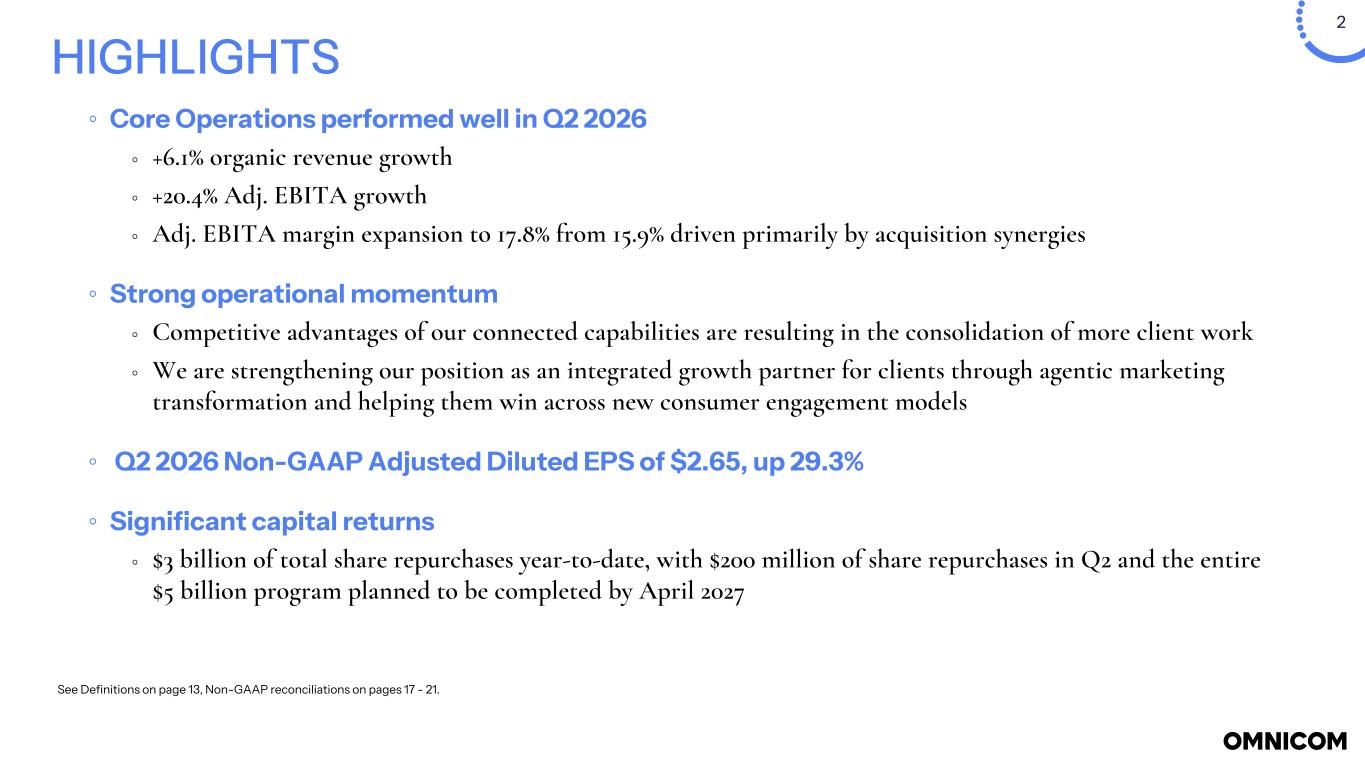
Thank you, Greg. Good afternoon, everyone. And thank you for joining us today. I'm pleased to share our second quarter results. Starting with revenue from core operations, which comprises our ongoing operations and exclusive assets held for sale and plan disposition, we achieved organic growth of 6.1% in the second quarter. These strong results were driven by our integrated media and experiential disciplines. Ongoing or core operations adjusted EBITDA growth was 20.4% and EBITDA margin increased by almost 200 basis points to 17.8% as compared to the combined operations in the second quarter of 2025. Our non-GAAP adjusted EPS in the quarter, which excludes after-tax costs from severance and repositioning actions, acquisition and integration expenses, as well as amortization of acquired intangible assets was $2.65 per share, an increase of 29.3% versus the prior year. We also continue to be on track to successfully achieve the initiatives we communicated on our prior calls, including $900 million in 2026 cost reduction synergies and $1.5 billion by mid-2028. In compliance with our board authorization, we're executing our plan to repurchase $5 billion in shares. To date, we've completed $3 billion in share repurchases, and we expect to complete approximately $500 million of additional repurchases during 2026, with the remainder completed by the end of the first quarter of 2027. Through July, we've completed a significant number of our planned dispositions. For the second half of the year, dispositions remaining to be completed will generate approximately $525 million in revenue. Results from ongoing operations in the second quarter and through the first half of 2026 demonstrate the momentum the new Omnicom has quickly gained from the combination with Interpublic. Over the past eight months, we've moved beyond combining our two companies to building the leading connected marketing and sales company for a fundamentally new era of marketing. The new Omnicom is an integrated operating company bringing together the industry's leading talent and capabilities across creativity, media, commerce, consulting, data, and technology. We have aligned leadership teams, connected our capabilities across the enterprise, and unified our data and AI assets through Omni. This gives clients easier access to the full strength of Omnicom and allows us to deliver smarter decisions, faster execution, and better business outcomes. The result is a more agile and connected organization, one that is better equipped to help our clients grow, transform, and compete in a rapidly changing world. Looking ahead, our focus will be on three areas where we see the greatest opportunities for our clients and us. First is a genetic marketing transformation. We have differentiated assets that help us excel in this area. In Kong, we demonstrated how Omni's agentic layer can be used for our clients to enable agent creation, activation, and orchestration across workflows, channels, and customer experiences. This is further enhanced by Omni's foundational data and identity layer powered by Axiom. Through Omni's agentic and data capabilities, we can achieve significantly better audience and activation strategies and more precise cost channel measurement. In addition, our marketing transformation consultancy and partnerships with leading technology companies will play a significant part in modernizing our clients' enterprise infrastructure for agentic marketing and connecting it with Omni to further optimize these results. Our assets and capabilities create a unified, intelligent layer that is the foundation for true agentic marketing. The second major opportunity is the new consumer engagement model. Brands are focusing on investment where they can build deeper and more direct relationships with their customers. This includes sports and entertainment, social and creator, connected commerce, and AI-driven discovery. The combination of Omnicom and Interpublic has enabled us to integrate solutions that operate at scale and are being deployed for our clients. Sports exemplifies this combined strength. Omnicom influences $9.9 billion in sponsorships, oversees one in every three sports media dollars, maintains more than 500 league and platform partnerships, and has visibility into 20,000-plus sporting events each year. Our client relationships and new business opportunities continue to grow across each of these areas. The third area of opportunity is expanding our client partnerships and attracting new clients. Our integrated client leaders are focused on deepening our relationships, identifying white spaces, and actively expanding the services we provide by bringing more of Omnicom's capability to each client. At the same time, our newly formed growth team is aggressively pursuing net new clients by leveraging Omnicom's connected offerings and new consumer engagement model. These efforts have already delivered meaningful results. Within the quarter, many of our wins came from expanding existing relationships. We added services in high-demand areas such as sports, media, production, commerce, social, and influencer for clients like American Express, General Mills, and Uber. These extensions demonstrate the value of true connectivity. During the quarter, we also secured new integrated media wins with Adidas, IBM, and Subway. This success clearly indicates that clients recognize the value we've created at the new Omnicom. It is reinforced by our high post-acquisition client retention rates and our recognition as the most effective company in the global FE index. None of these achievements would be possible without the outstanding people across our company. We brought together exceptional talent from both Omnicom and Interpublic and created something even stronger. I want to thank everyone for their commitment and contributions over the past several months. Overall, we're very pleased with our performance in the second quarter and the first half of the year. We remain optimistic and confident about the remainder of 2026. Given our first-half performance, we're raising our full-year guidance for 2026 organic revenue growth from ongoing operations from 4% to 4.5% to 5%. Phil will now provide more color on our financial performance and updated guidance. Phil?
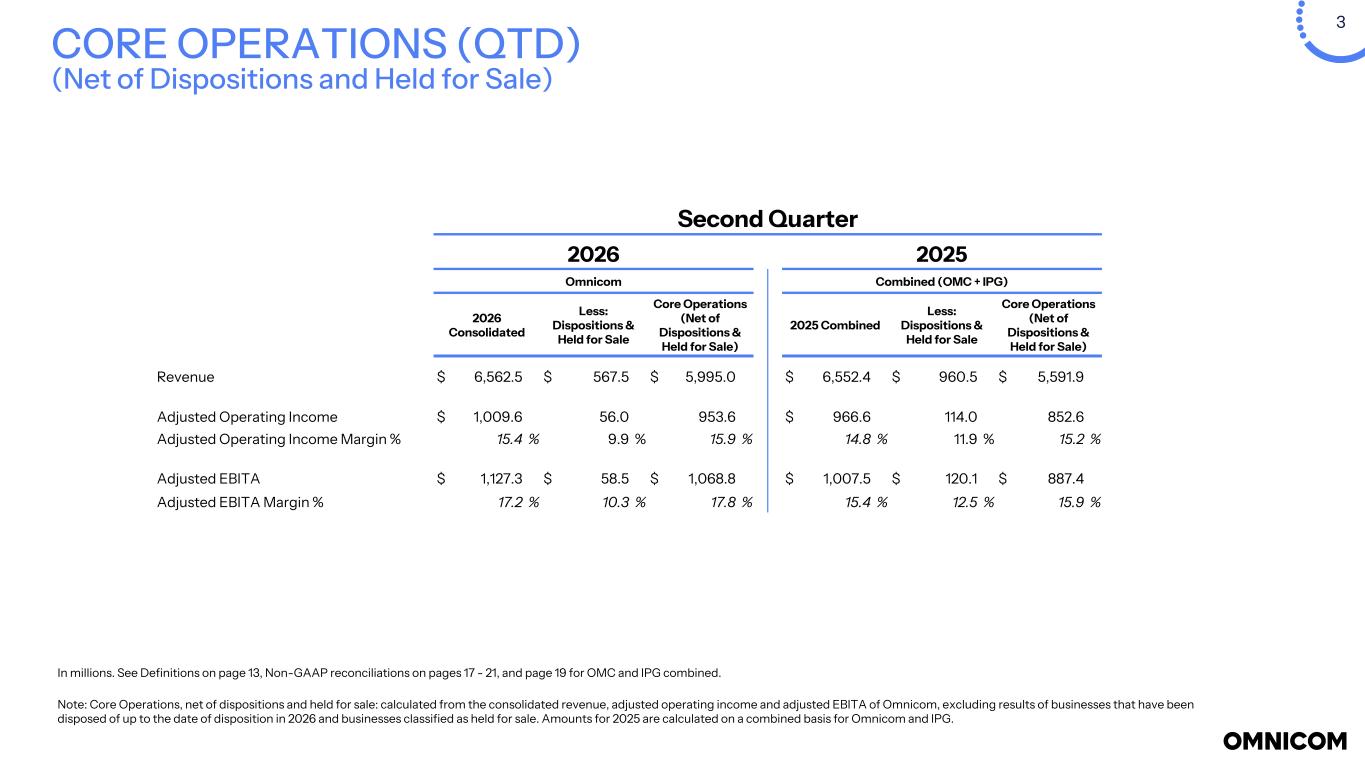
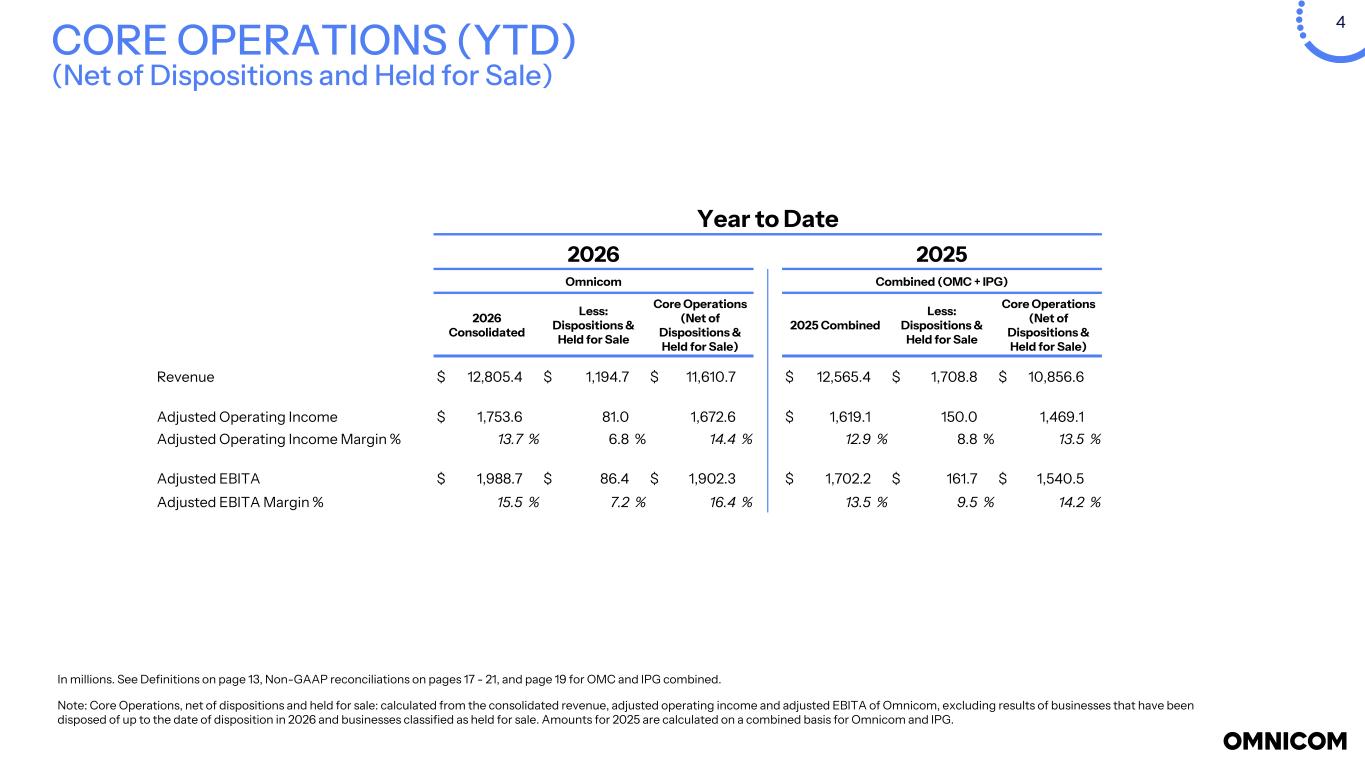
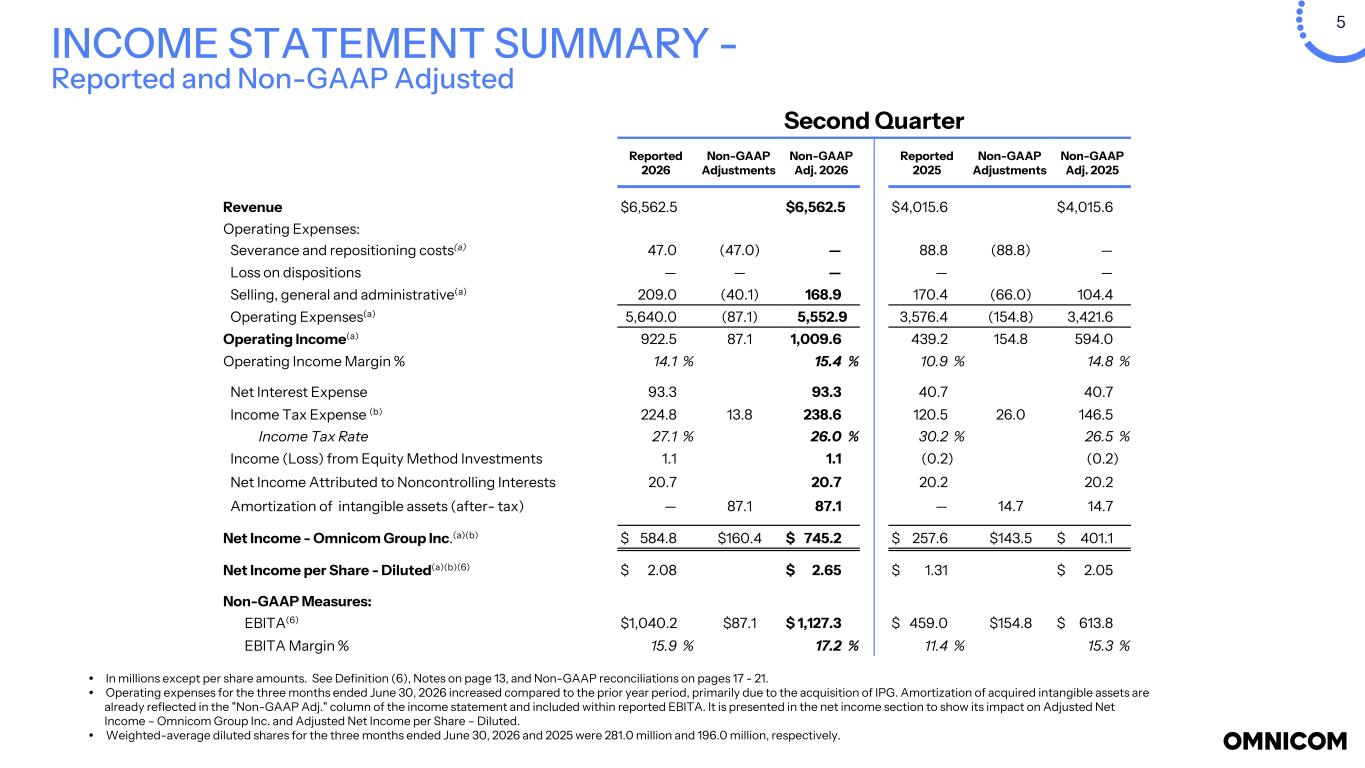
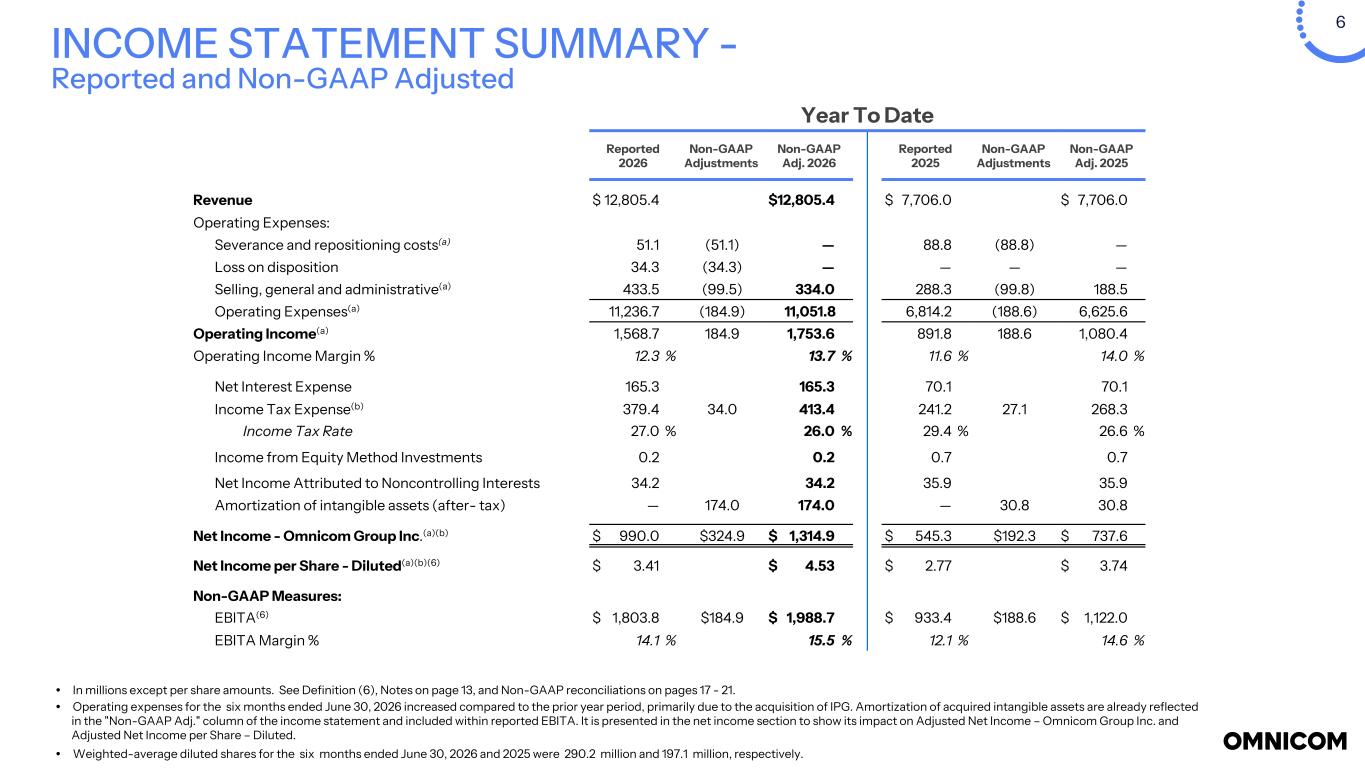
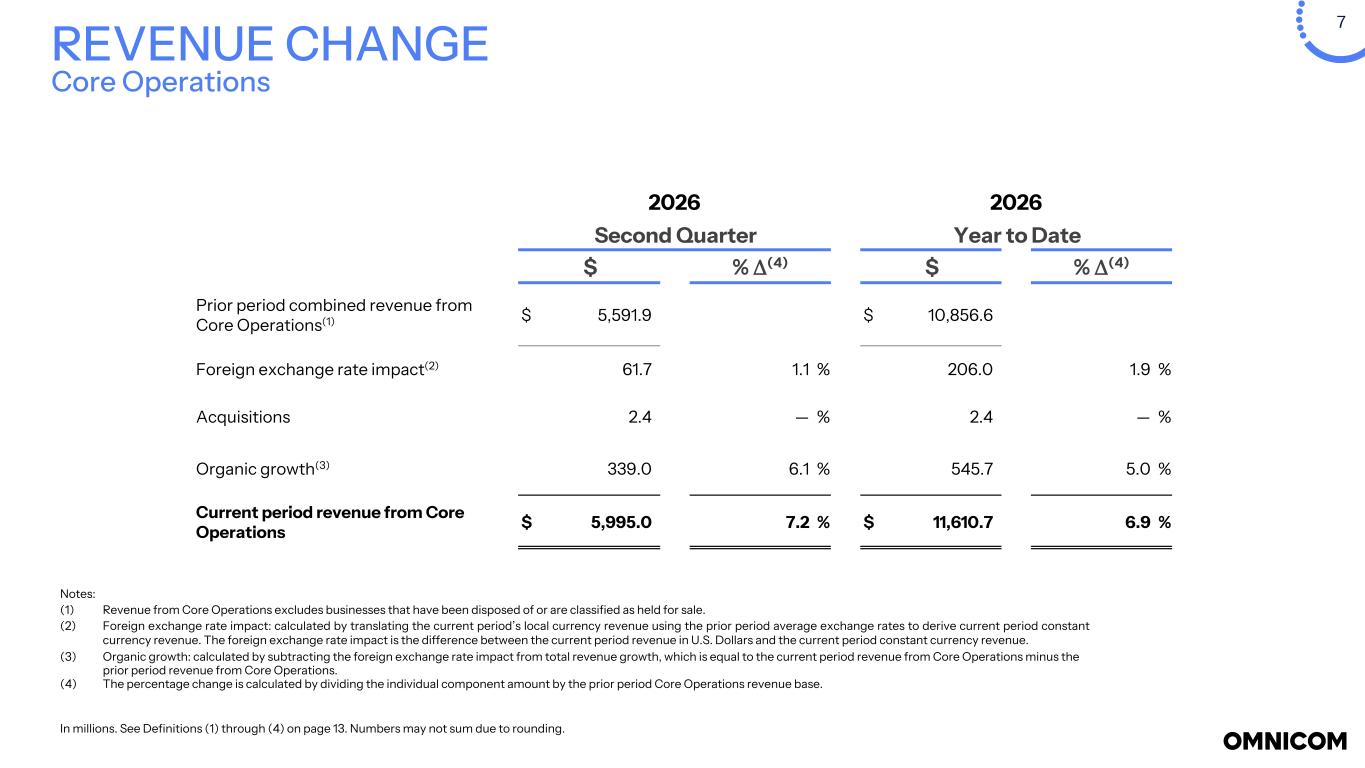
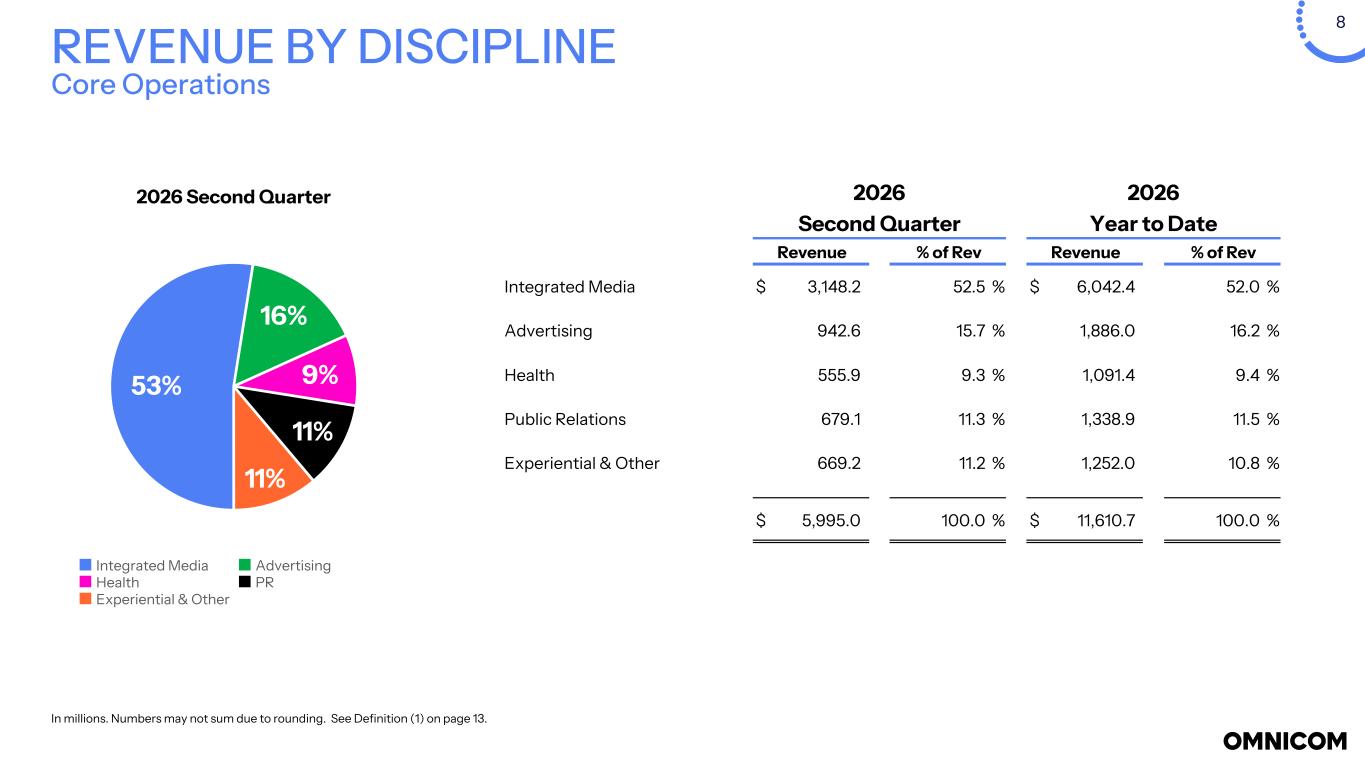
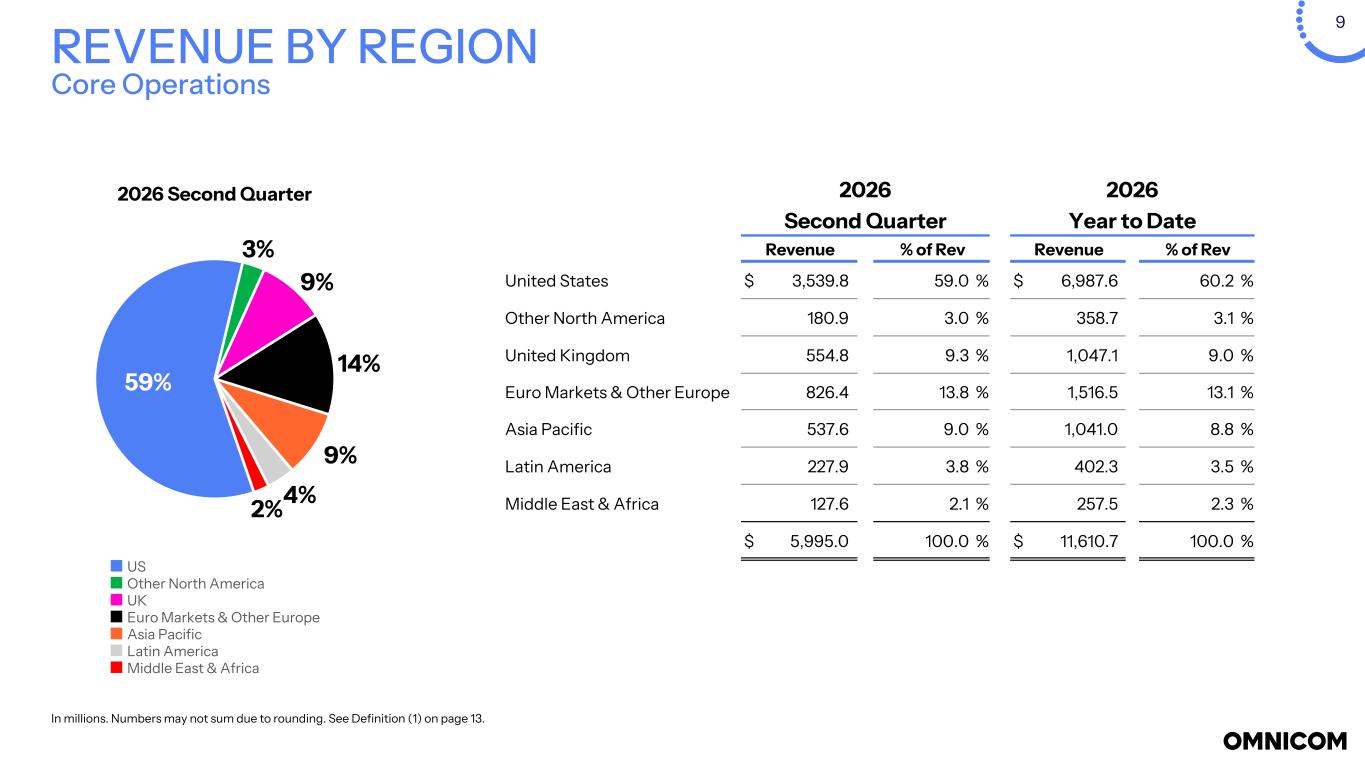
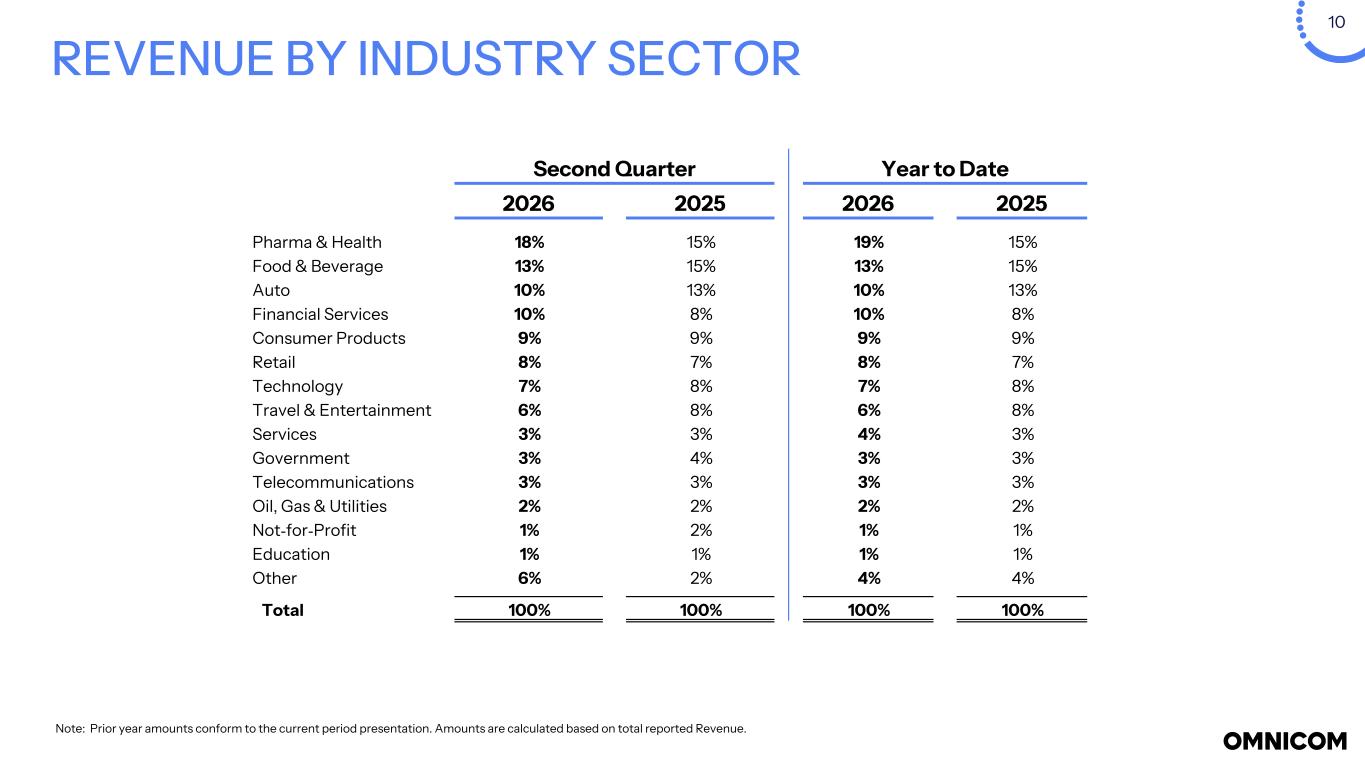
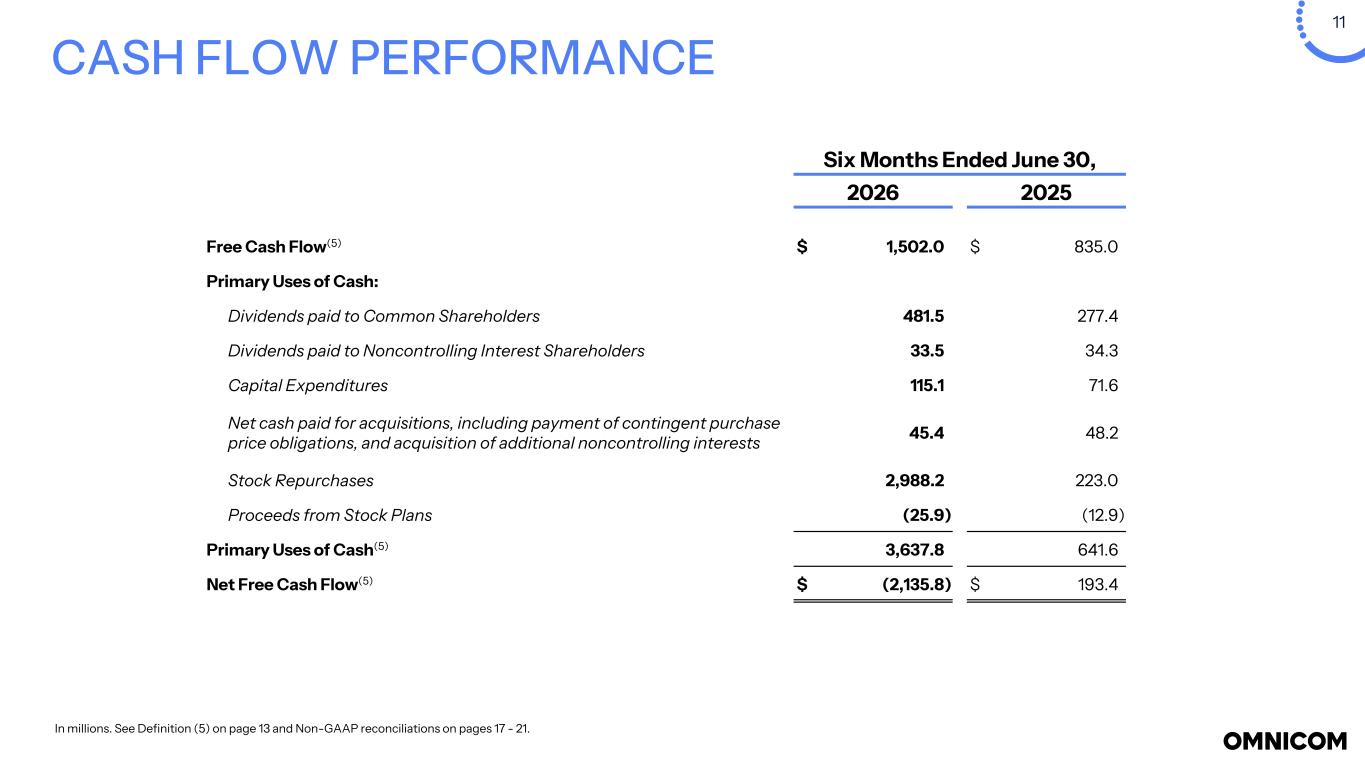
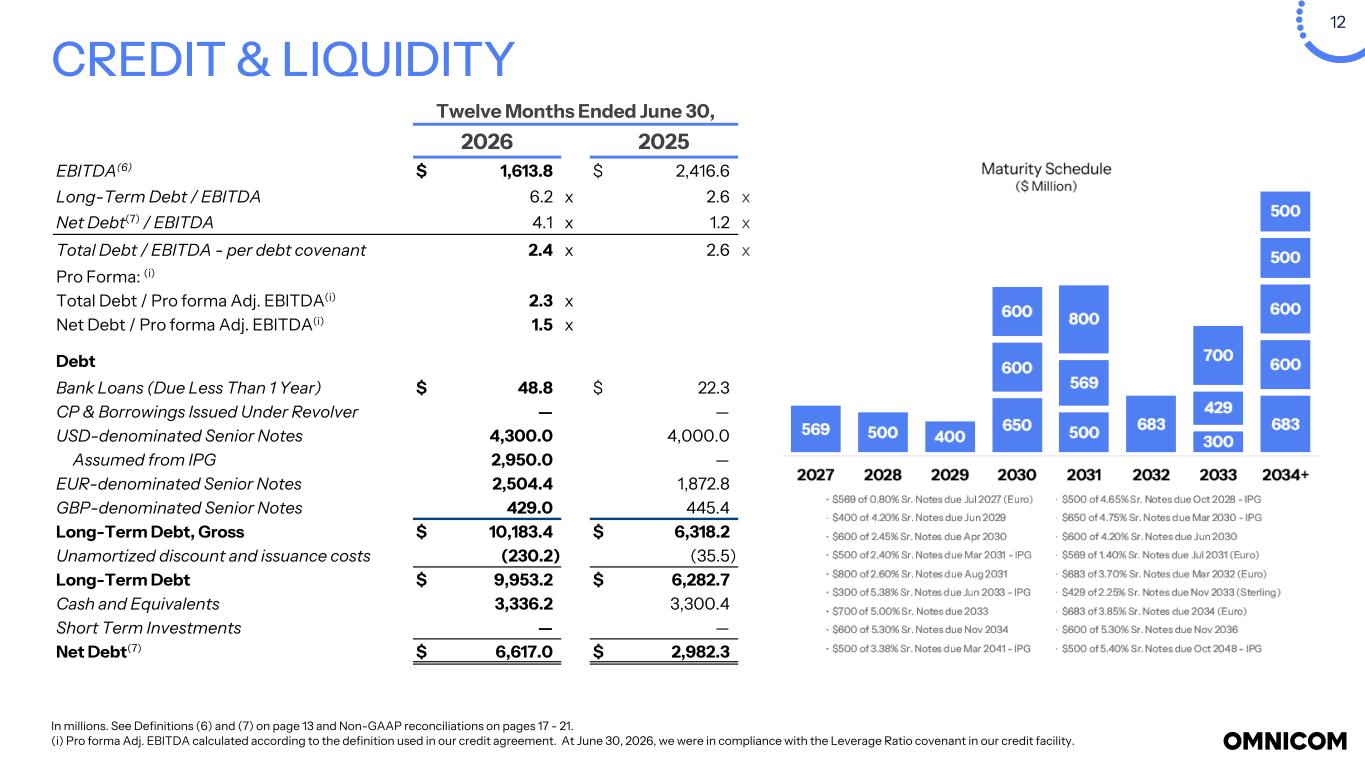
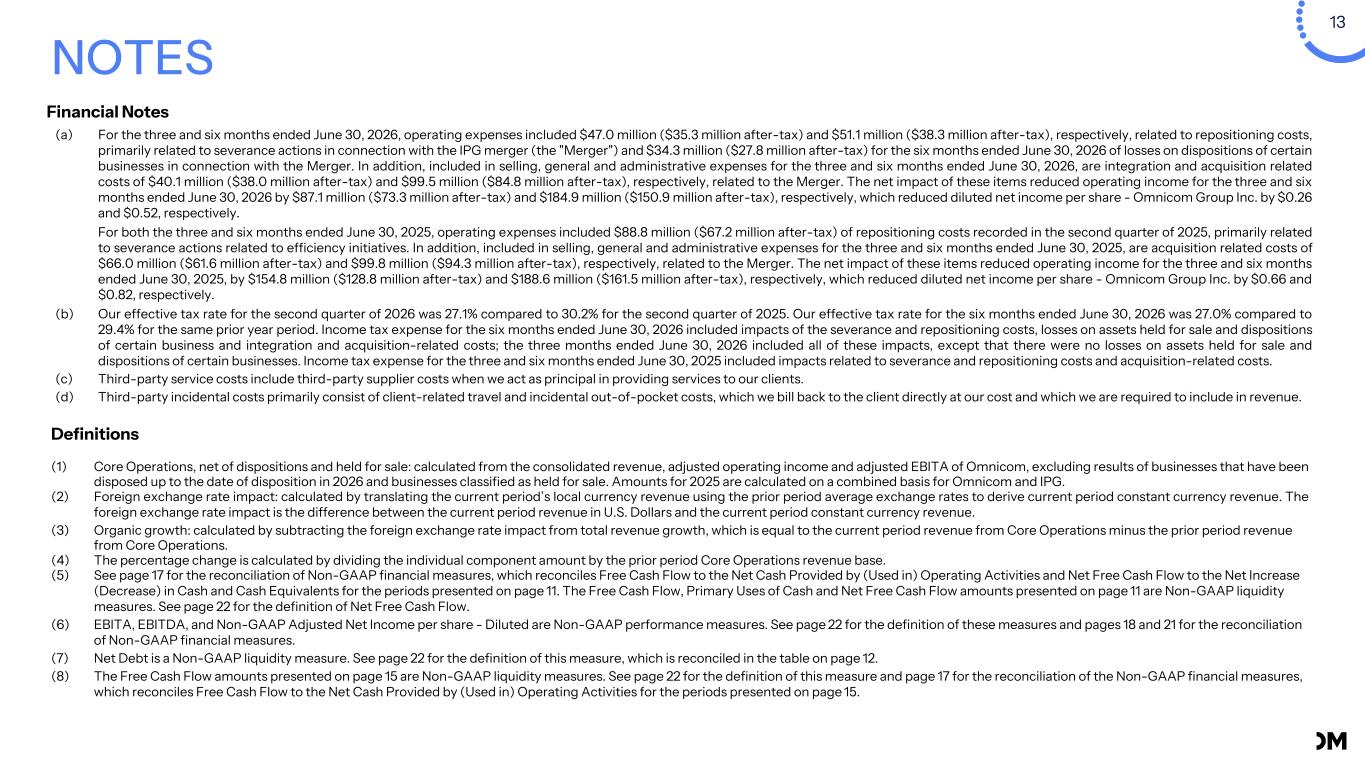
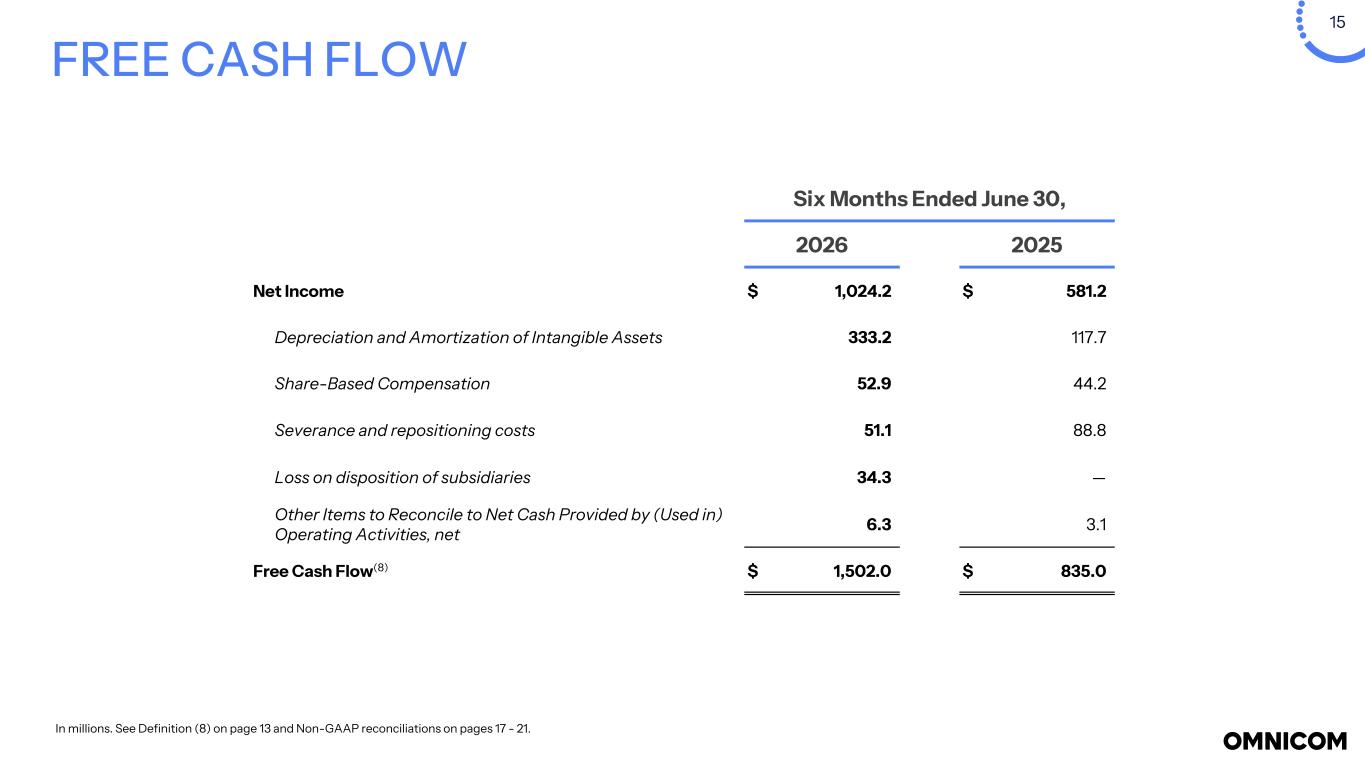
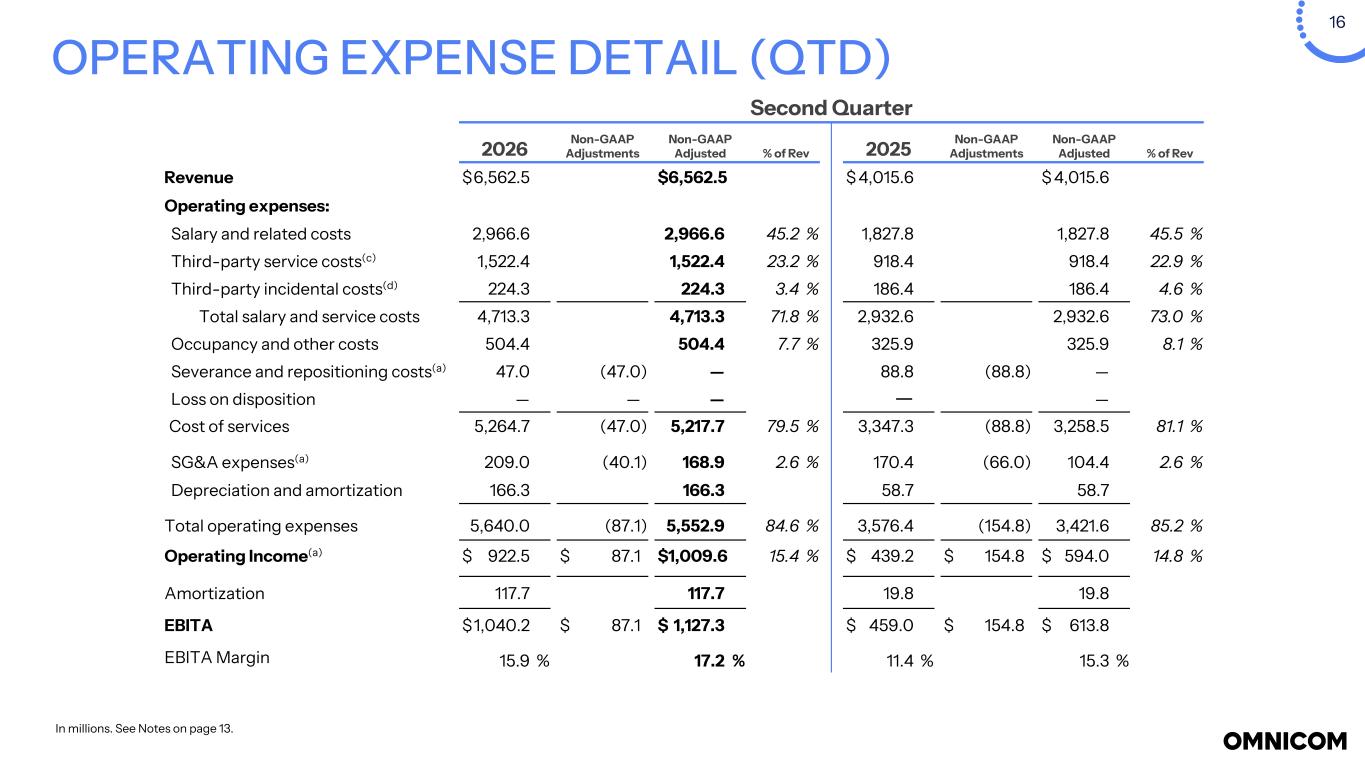
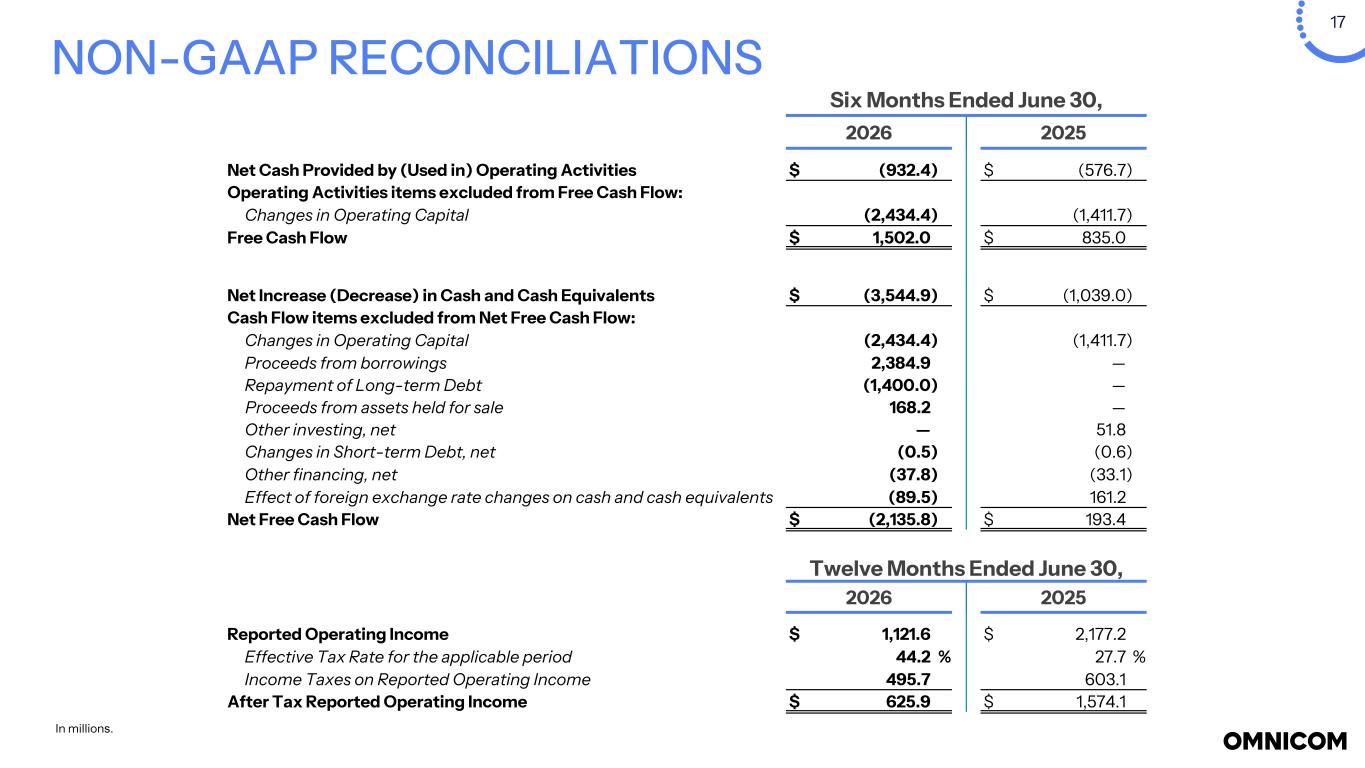
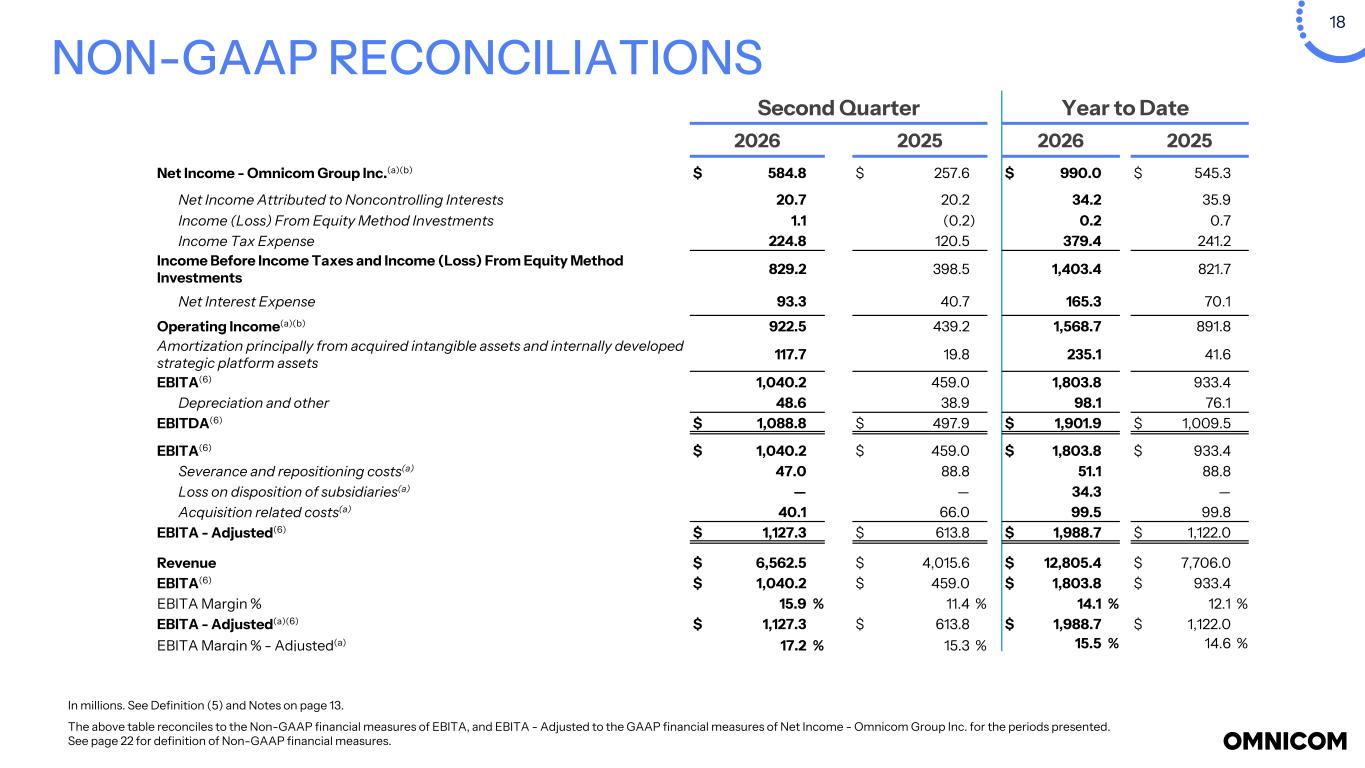
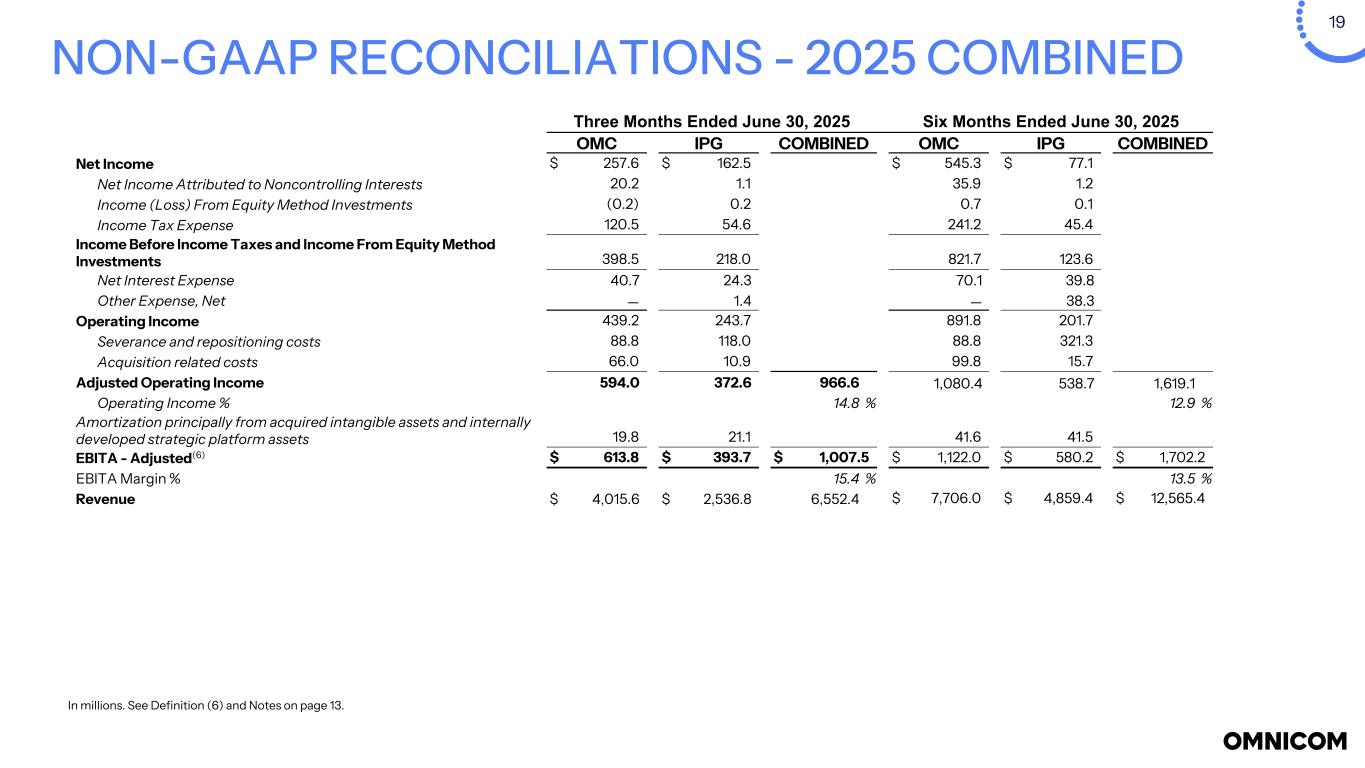
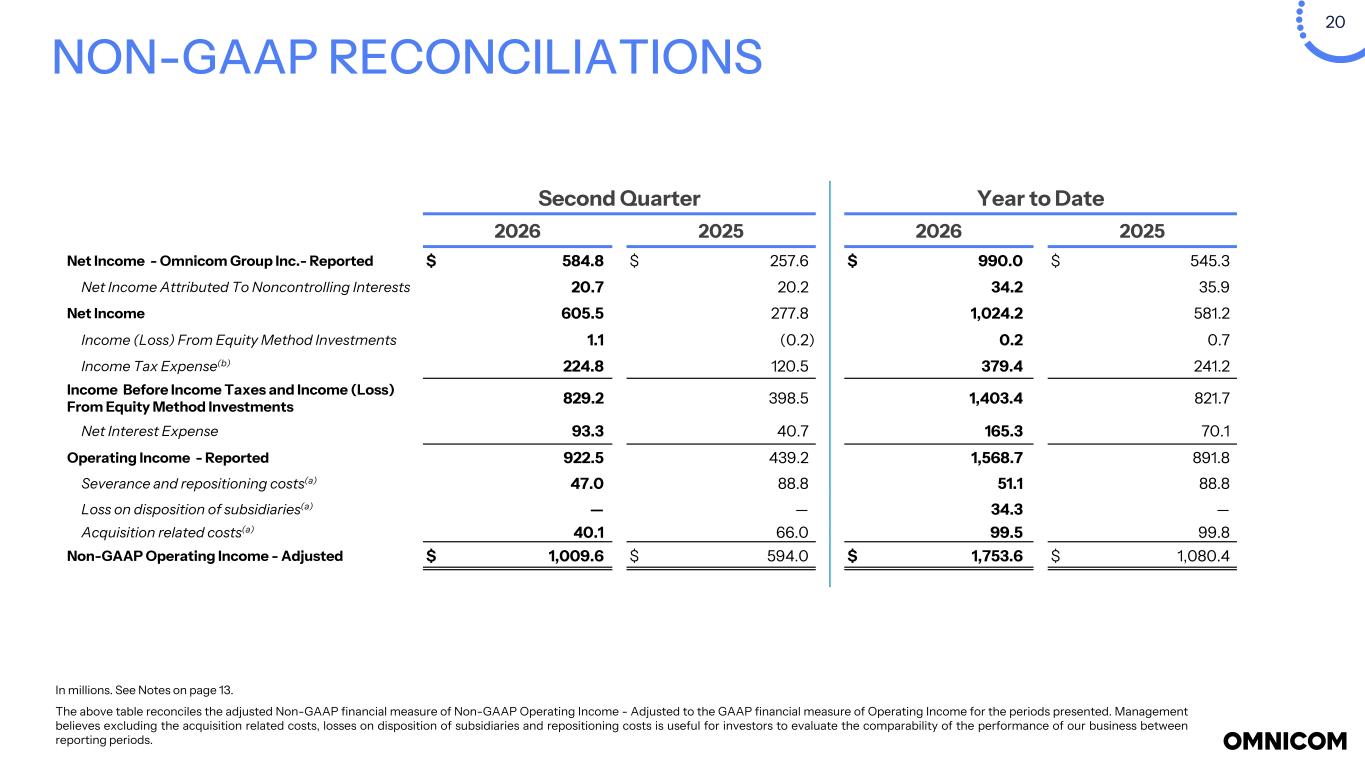
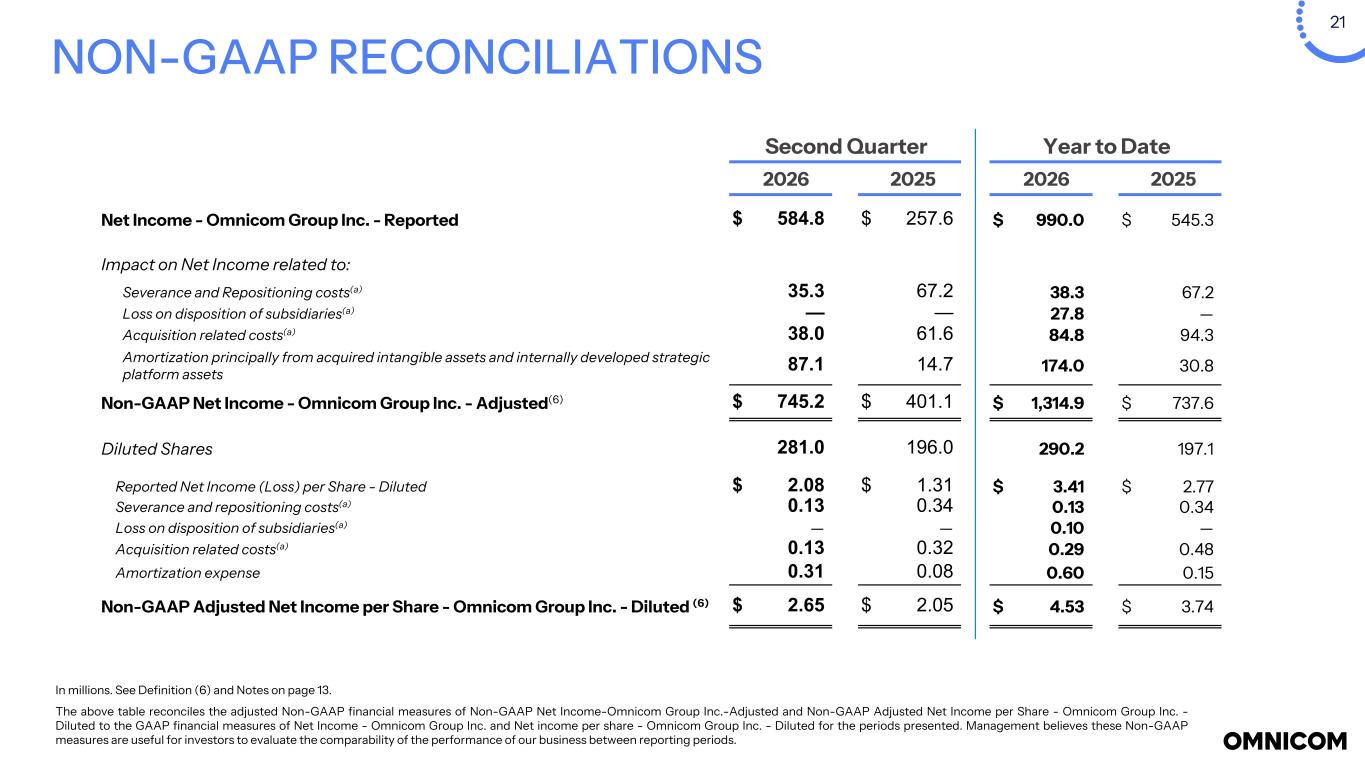
Thanks, John. I will start on slide three, which presents what we call our core operations, which consists of our ongoing operating businesses, excluding dispositions that we have completed and assets held for sale that have not yet been disposed. Our plan is to complete the disposal of the businesses included in the dispositions and held for sale category by the end of 2026. This slide also presents operating income and EBITDA on a non-GAAP adjusted basis, excluding severance and repositioning costs and acquisition integration costs. For comparison purposes on this slide, we've included 2025 prior year combined amounts prepared on a similar basis to 2026. As we previously discussed, our core operations are the result of our ongoing strategic repositioning of the portfolio for growth and reflect our sharpened focus on the highest-growing, most connected parts of our business. This slide presents the contribution of our core operations to our consolidated results in the second quarter of 2026 and 2025 for revenue, adjusted operating income, and adjusted EBITDA. Core operations represented 91.4 percent of our revenue and 95 percent of our adjusted EBITDA in the second quarter of 2026. Core operations revenue grew 7.2 percent in total. Adjusted EBITDA grew $181.4 million, or 20.4%, and the related adjusted EBITDA margin increased 17.8% from 15.9%, primarily driven by cost reduction synergies. We are pleased with this strong performance for both revenue and adjusted EBITDA, and we are on track to achieve our cost reduction synergy targets for the year. Moving to year-to-date results on slide four, core operations revenue grew $754.1 million, or 6.9% in total. Adjusted EBITDA grew 23.5%, and related adjusted EBITDA margin increased to 16.4% from 14.2%, again, primarily driven by cost reduction synergies. Turning to slide five, we present our second quarter consolidated reported results as well as the related non-GAAP adjusted amounts which include all entities core operations dispositions that were completed during the quarter for the period they were part of omnicom and entities that are classified as held for sale also because these are reported results the 2025 presentation reflects the prior results of omnicom only and does not include interpublic The center columns for each period showed the applicable non-GAAP adjustments. In the second quarter of 2026, integration-related costs were $40.1 million, which were recorded on the SG&A expense line, and severance and repositioning costs were $47 million. Below operating income, net interest expense increased to $93 million from $41 million in 2025, due primarily to the assumption of Interpublic's debt of approximately $3 billion. Interest expense increased by $61 million, primarily due to the Interpublic acquisition, including $3 million of non-cash interest, as well as interest expense resulting from refinancing activity completed during the first quarter of 2026, which resulted in approximately $1 billion of incremental long-term debt and some incremental interest expense from CP borrowings during the quarter. Interest income increased by $8 million to $30 million, primarily due to higher average cash balances. Appreciation expense in the quarter was $49 million, and amortization expense was $118 million. Both increased year-over-year, primarily due to the inter-public acquisition. For both, we estimate that amounts in Q3 and Q4 of 2026 will approximate Q2 actuals. Our adjusted tax rate of 26% was down slightly from 26.5% in 2025. In 2026, we estimate our annual tax rate will also be 26.0%. Our non-GAAP adjusted net income increased $344.1 million to $745.2 million. Finally, non-GAAP adjusted diluted EPS grew 29.3% to $2.65 from $2.05 last year, driven by an increase in related net income. A fully diluted weighted average shares outstanding for the second quarter to $281 million, down 10% from 313.1 million shares outstanding at year-end 1231.25. On a year-over-year basis, our share count increased from last year due to shares issued for the public acquisition, partially offset by share purchase activity, which I will discuss in a moment. Now let's review revenue drivers in more detail, beginning with the components of our revenue change on slide 7. To assist an understanding of drivers of our underlying business. This analysis focuses on growth from our core operations, exclusive of businesses that have been disposed of or are expected to be disposed of. Organic revenue growth in the quarter was 6.1 percent, and the impact from foreign exchange translations was positive 1.1 percent, along with a nominal impact from a small acquisition. In total, revenue from core operations was $6 billion. Year-to-date, organic revenue growth as of June 30th was 5%. During the quarter and through the end of July, we have completed more than half of the planned disposals included in our dispositions and held-for-sale category. We expect to complete the remaining dispositions in Q3 and Q4 of 2026, and we estimate the revenue related to those businesses will approximate $300 million in Q3 and $225 million in Q4, with EBITDA margins of approximately 10%. Through June 30, 2026, we received proceeds from assets sold of $168 million, and we expect additional proceeds from sales completed in July in excess of $200 million. Assuming recent FX rates stay the same, we estimate FX will decrease our reported revenue for Q3 by 1% and be flat for Q4, resulting in an expected benefit for the year of approximately 1%. Turning to slide 8, you can see our core operations revenue by discipline for the quarter. In the second quarter of 2026, revenue for integrated media was approximately 53% of our revenues, which includes our media, commerce, data, CRM, and consulting, and our content automation business. Revenue from advertising was under 16%. Health was 9%. PR was 11%. And experiential and other was 11%. percent organic revenue growth rates for these core operations disciplines were as follows integrated media led the way with very strong growth a little over ten percent health was flat pr growth was mid single digit experiential and other grew over ten percent in the quarter due largely to experiential growth related to the people world cup and advertising was down in the high single digits. Slide 9 shows our core operations revenue by region for the quarter. In terms of the top markets, the U.S. represents 59% of revenue. Together, the U.K. and Europe were 23%, followed by Asia-Pacific at 9%, Latin America at 4%, and Middle East and Africa at 2%. During the quarter, revenue growth in the U.S. was high single digit. Europe growth was low single digit and Latin American growth strong at over 10 percent. Asia-Pacific decreased slightly and Middle East and Africa declined double digits as a result of the ongoing conflict. Slide 10 is our revenue weighted by the industry sectors of our clients. So 2025 amounts reflect Omnicom only. In the second quarter, Pharma and Health was our largest category at 18 percent of revenue, an increase driven by the larger portfolio in this category at Interpublic. The auto category at 10 percent decreased due to Interpublic's smaller portfolio in this category relative to Omnicom. Slide 11 is a view of our free cash flow for the first six months of the year. The increases in free cash flow and capital expenditures are primarily due to the addition of Interpublic's business. Dividends increased $481.5 million, resulting from the additional shares issued for the IPG acquisition and the recent increase in the quarterly dividend amount. The most notable change in this table is the change in stock repurchases, which were $3 billion in the first half of 2026. This was composed of both the $2.5 billion Accelerated Share Repurchase Program and additional repurchases we made in Q1 and Q2. We plan to complete the $5 billion Share Repurchase Program announced in February 2026 by the end of Q1 2027. Our definition of free cash flow excludes changes in operating capital. We provide those changes in the non-GAAP reconciliations in the appendix. I want to point out that changes in operating capital in the first half of 2026 were negative $2.4 billion compared to negative $1.4 billion in the same period last year. This increase is primarily due to the addition of interpublic's business and operations in 2026 which are not included in the prior year amounts note for the six months ended june 30th of last year the change in interpublic operating capital was approximately negative 445 million dollars as well as incremental payments of approximately 550 million related to severance repositioning and integration costs, as well as lease and contractual termination payments. All other operating capital changes were close to flat year over year. Excluding any similar incremental payments in the second half, we expect operating capital changes to be flat for the remainder of the year. Slide 12 is a summary of our credit, liquidity, and debt maturities. At the end of the second quarter of 2026, our gross long-term debt was $10.2 billion. Relative to 2025, changes reflect the retirement of our $1.4 billion, 3.6% senior notes, due April 15, 2026, and the issuance of our new senior notes, totaling $2.3 billion, including $1.7 billion of U.S. dollar-denominated notes at a weighted average coupon of 4.9%, and $600 million of euro-nominated notes at a 3.85% coupon. Our next maturity is not until July of 2027, and we're comfortable with our maturity schedule. Net interest expense is expected to increase by approximately $200 million in 2026, compared to $167 million in 2025, and this includes $13 million of non-cash interest. The estimated drivers of this are higher gross interest expense of approximately $230 million, partially offset by higher gross interest income of $30 million. The majority of the increase in gross interest expense is due to long-term debt assumed from Interpublic as well as the new debt issued and debt refinancing activities in 2026. Please note that the total and net leverage ratios on this slide, which compares the last 12 months ended June 30, 2026 and the prior year reflect the full assumption of Interpublic's debt, but only EBITDA from Interpublic the seven months since the date of acquisition. However, at June 30, 2026, we were in compliance with the leverage ratio covenant in our credit facility, which makes pro forma adjustments to the impact of the acquisition. Calculation of total debt to pro forma adjusted EBITDA, done in accordance with the definition in our credit agreement, results in a total average ratio of 2.4 times, which is lower than the 2.6 times at June 30, 2025. Cash equivalents and short-term investments at the end of the quarter are $3.3 billion. Our liquidity also includes an undrawn $3.5 billion revolving credit facility. It backstops our $3 billion commercial paper program. We're very encouraged by the progress we've made over the first six months of the year, and we look forward to continuing to build on that progress going forward. I will now ask the operator to please open the lines up for questions and answers. Thank you.
Operator
We will now begin the question and answer session. Please limit yourself to one question. if you would like to ask a question please press star one to raise your hand to withdraw your question press star again we ask that you pick up your handset when asking a question to allow for optimum sound quality if you are muted locally please remember to unmute your device please stand by while we compile the q a roster your first question comes from the line of david karnafsky with jp morgan david your line is open please go ahead hi thanks all right thanks uh john
sizable acceleration and organic in the quarter can you speak to some of the drivers of the better performance including uh you know the excel and media uh was this reflective of new business wins or kind of better underlying marketer demand, any color would be great. And then for Phil, I heard you reiterate the $900 million synergies this year. You had at one point given an expectation of 75% to 80% of that as impacting EBITDA growth and margin. Is that still the case? And just how should we think about kind of balancing the synergies versus reinvestment in general?
And just one correction. Anybody who has more than one question, feel free to ask it. In terms of organic growth, our organic growth is coming from, and I tried to communicate this in my prepared remarks and I could do a better job the next time, expansion of services to our existing client base was a big contributor to our organic growth this quarter and the new business wins that we had. um and so that continues um and we now have a nascent organization of very qualified people at corporate in addition to what our units are doing that are looking for those opportunities where we have what we believe is appropriate subsidiaries that can service those clients needs and being proactive about going out and talking about it. And we also have a more sophisticated, I think, corporate approach to new business in general. So I think both of the combination of all those activities, which are still new and they're developing every single day, will continue to seriously contribute to our organic growth.
So on the synergy front, David, we certainly are on track, as we said in the prepared remarks, 75 to 80 percent of the 900 million in synergy towards what we expect to deliver for the year. And, yeah, we're definitely on track with that. That does include the fact that we're going to continue to invest in the business and invest in the Omni platform and other aspects of the business. So you see that in the delivery this quarter and in the first quarter in terms of the overall improvement in our EBITDA dollars and in the margin itself.
You know, and just going back to the first question, it'd be unfair since We invited Florian to the call to be available to us, and quite a number of the wins were Maybe he has something to add that I missed.
No, I don't think you missed anything. Look, I think we, David, you asked about, like, the client, client sentiment, right? I mean, they're looking for value from every dollar of marketing investment. Clients are looking for certainty in what they do and their future-related activities. They're looking for measurable outcomes. I think we've, together with the new assets as we have them assembled, we've built a modern and integrated ecosystem of growth, bringing together industry-leading data identity solutions, best-in-class commerce, and retail media. It's all unified in Omni. So, yeah, we're happy. We're satisfied with some of the new business wins that we're seeing. to john's point we're seeing existing existing clients growing as we help them to to better convert audience strategies and come up with more impactful smarter activation and also have a better closed loop attribution and measurement so overall we're seeing our business growing on new net new clients but also existing clients at this at this point and we would hope for that to continue your next question comes from the line of Stephen Cahal from Wells Fargo Stephen your
line is open please go ahead thank you so John as we think about the organic growth trend this year and the way you just talked about the contributors I think right now the street is still skeptical on the sustainability of growth at the new Omnicom. Pre-IPG, pre-synergies, the growth rate was certainly lower, you know, sort of typically than what you're seeing this year. How do you just think about the ability to sort of run rate these levels of growth? I'm not asking for medium-term guidance, but just, you know, you're divesting a lot of businesses that are slower growth. You're finding synergies in the business. So, you know, is there any way to sort of push back on that street skepticism that we've kind of just solved into it financially this year and how we think about the longer-term outlook for Omnicom's growth. And then, Phil, I was wondering if I could just pin you down a little bit on expectations for EPS growth. I mean, I think double-digit was the guide maybe at the investor day. The share count alone gets you there. Revenue is growing faster. I don't know what the incremental margin on the revenue raise is, but you've got synergies in there too. So how should we think about the EPS growth in 2026? Thank you.
Good. It's hard to predict the future. And if I was better at it, I'd probably have done something else as a career. But I'm very confident with the portfolio of assets that we have and the way that they're coming together in a way that is different than the way Omnicom operated prior to the acquisition of Interpublic. We're now more of an operating company than a holding company, and we're selling as a team with multiple capabilities and crafts because clients are asking for that, because they're asking for simplification in a complicated environment. And so I'm very comfortable with the teams that we have And with the geographies that we've selected, many of the companies that we had identified for sale were actually bringing us down in many quarters in terms of what our organic growth was. We were never explaining, gee, our ongoing companies were growing at X, and these slow companies that we should not have in our portfolio, they were bringing that great growth down. And so I know all that inside baseball, and we've gotten rid of most of the companies that were low growth or no growth. It gives me greater confidence because that top number really wasn't much different than what the top number was in the past, except for we no longer be burdened by what was dragging us down. The other thing which helps in certain businesses of ours, not all businesses, is scale. The combination gave us scale, gave us different assets that we could assemble in a different fashion as we approach our clients' needs. We were also able, in that first bunch of planned dispositions, we had a lot of, quite a number of countries in our portfolio where there weren't bad assets, but the marketplaces that they were in weren't growing. And so it was difficult to expect, you know, any kind of growth from them. What we decided in this approach is rather than exit those, we just simply sold down to minority. So we're getting the benefits of being able to service our clients in those markets that are global or need of service in those markets. But we're not burdened by this group of low-growth organizations that, again, drag down the calculation. Does that answer your question, or I'll try it again?
That's great, John. Thank you.
On the EPS front, Steve, we certainly said double-digit, and I think it's safe to say through the first six months what we expect for the full years. is certainly high teams, greater than 15%, I think for sure, is where we expect to be. And, you know, we're certainly satisfied with the performance of the first six months and we're on track with respect to the synergies and, you know, looking at the new business and the new portfolio we're certainly confident in in delivering um very strong uh diluted gps growth great thank you thank you your next question comes in the line of jason bezine from city jason your line is open please go ahead i just had one quick question on the quarter um the organic
growth was really good but um it didn't seem like there was as much flow through you know down to EBITDA or earnings or adjusted earnings. I didn't know if there was anything unique that you would call out that maybe caused the drop-through from that incremental revenue to be lower than what we all might have imagined.
I mean, we actually think low-through is pretty good. You know, we delivered EBITDA growth in excess of $180 million. We delivered EPS growth in excess of, you know, 20% for the quarter, well in excess of 20%, and, you know, at 200 basis point margin improvement, and we've done that for the first six months. So, you know, part of that comes from the flow through of the new business and the growth in the operating companies. Part of it certainly comes from, or the majority of it comes from, delivering the synergies. But we are continuing to invest in the business as we go. It's a critical part of what we're doing here as we bring these two companies together. And certainly we're focused on sustainable growth for the future, as John had talked about earlier. And in order to do that, we know we need to continue to invest in our platforms. And, you know, the critical businesses that are going to drive that growth going forward. So that's part of the equation, no doubt. And it becomes kind of a continuous, you know, process. We need to invest in the business to grow. We grow the business. We deliver, you know, improved operating results. And we can continue to invest in the business. So that's certainly the plan. and, you know, we're very focused on executing on it.
But not leaving it there for a second, this is a change in tack and I've only done 120 some odd quarterly calls. What were you seeing? Does that answer your question? Or what's your concern? Because I'd like to make sure we address your concern.
No, no, it's no concern. It's not really a concern. and I just want to make sure that we're sort of modeling everything properly as we go through the year and into next year. And I just want to make sure that, you know, if you're reinvesting in the business, that's sufficient. We'll adjust our numbers accordingly. Yeah.
Operator
Your next question comes from the line of Adam Berlin with Goldman Sachs. Adam, your line is open. Please go ahead.
Hi, good evening. So at the Q425 results, you talked about 3.2 billion dollars of revenue that was being held for sale that looks like it's going to be a much bigger number by the end of the year can you give us any guidance of what you think that number is now going to be given you've increased the amount of assets that are being held for sale um by about 200 million dollars in this quarter alone so that's the first question and then following on from that can you give us some idea of where that extra um those extra revenue dollars are coming from? Which disciplines are they coming from that you've added into the group of help to sell? And then can you give us an update on how much of the $900 million of synergies has been delivered at the first half? Please, thank you.
Sure. So I'll take each of them and follow up as needed, Adam, if you have any follow-ups. But And we describe it, I guess, this way. So the 3-2 of total annualized prior year revenue related to the dispositions, the equivalent of that number now is between 3.5 and 3.6 on an annualized basis. Um, you know, much of that, uh, increase probably, you know, 60% of it relates to businesses in the advertising category. Um, and, you know, when we look at what's remaining to go, um, yeah, a significant amount of that has been completed, um, as we, as we discussed or mentioned in our prepared remarks. So when you look at Q3 and Q4, the estimate of what we expect to still be in our P&L in Q3 and Q4 is revenue of about $300 million in Q3 and revenue of about $225 million in Q4 in the disposal slash held for sale category. And certainly we're on track right now to complete all of those dispositions by the time we get to year end. And, you know, we're pretty satisfied with the progress we've made in completing the dispositions so far through the end of this month. And we're going to continue to aggressively pursue the completion of, you know, the remaining transactions.
If I can add just one thing, At this point, and we said this, Adam, probably every other call, if not every call we've been on, that we're always looking at the portfolio and always making adjustments. Sometimes they're internal, and you don't see them, and other times you do. There still remains two assets, which are not going to seriously affect any of the information that we've given you, that we have under consideration. We haven't made a final decision six months into the deal as to whether we're going to keep them long-term or not keep them long-term. That will depend on a lot of factors, and a lot is the amount of money we're going to get for them if we do decide to get rid of them. So, you know, I think we've done an outstanding job and getting rid of over $2 billion of these assets in the first six months of this year. Or seven months, technically. I would say seven months. Quite a bit was completed in July, so I agree.
Just to follow up on the second part of your question, because I didn't address it, Adam, in terms of synergies, we're a little over halfway through. the 900 million um and you know we expect um you know a similar um you know progression in q3 and q4 um as we continue to pursue the plans that we had set out um you know when we announced the transaction uh back in december thank you very much sure your next question comes from the line
Operator
of Sean Diffley with Morgan Stanley. Sean, you're alive. Great, thanks very much.
Operator
Thanks, team. John, I was hoping you could describe the macro as you see it. You're obviously growing in excess of GDP, but there's a lot of cross-currents out there with oil and rates. So I was curious, the tone of conversations with your advertisers. And Phil, I think you said advertising was down high singles. Maybe just anything you'd call out from a vertical perspective there.
I would say this is generalization. So by definition, it's wrong. But in the clients that we speak to about futures and about what their plans are, I would say they're cautiously optimistic. Nobody's happy about what's going on in the Middle East. We're hoping that it ends soon. You know, there's a lot of what is remarkable, and I think has made clients a little bit more optimistic or cautiously optimistic, is that if you go back several months, these same events were in play, and they were more frightening, actually, then in terms of what the impact would be, you know, on business. It was what was the impact of tariffs going to be? What was the Ukrainian war? What was going to happen in the Middle East? People seem to have digested those or they've changed their supply outlets and have adjusted to these things, which is fairly remarkable. And we're pretty pleased. And we've been working with our clients through all this, and it's taught us quite a bit, too.
So on the advertising questions, certainly, you know, creativity is and continues to be a key part of our DNA for the advertising group, as well as all of our service disciplines. It's certainly a core in what we deliver throughout all our businesses and to our clients. You know, the advertising group continues to roll out our implementation of a more connected and centrally driven Omnicom advertising group, which we talked about on, you know, several calls, not just this year, but we started this a while back in, you know, 25 or maybe even late 24. And the process in that group to bring together the new assets from IPG with the Omnicom assets, you know, resulted in a number of changes in terms of realigning brands and, in some cases, eliminating brands. So there's been a lot of activity internally, you know, within the Omnicom advertising group. And we've also disposed of several small low-growth markets, as John had alluded to, in different parts of the world where we didn't need to have multiple agencies servicing clients in one market. So there's been a lot of activity in bringing these businesses together, and certainly we've made significant progress. Yes, NOAG is going to continue to drive our strategies of innovation and integrated solutions and will be a key part of, you know, all our global integrated pitches now and going forward. But I'd say, you know, some internal, you know, reorganization has been, you know, the driver of a lot of change in that business for the first six months here post-deal.
So, but let me just emphasize one thing that everything that Phil said is actually what's affecting the business, but creative is our IP, and we're completely dedicated to it, even as it goes through some of these difficulties, because we'll work through them. So, I just want to reinforce that point.
Your next question comes from the line of Julian Rock with Barclays. julian please go ahead yes uh good evening uh boring question for phil can we get the breakdown of the 568 uh in q2 this year and the 961 last year between what has been sold already and what is to be sold uh and then same question for first half um when you say five 568 and 961 julian what that isn't that isn't ringing a bell off the top of my head 567.5 and 960.5 those are the uh disposition uh revenue in q2 uh this year and last year and that's a mix of what you sold already and what you are going to sell so i was wondering whether we could get the split between what you sold already so you know if you sell something in uh so so yeah i'm not sure i can split those exact numbers for you but um you know i i think i would say um we we've completed if if you if you look at it as how much of what we expect to sell have we completed it's probably
it's probably about, um, you know, close to 60% of the businesses that we intend to sell have been sold. Um, and for 60% of the annualized revenue, um, which we talked about before a three point, you know, between three, five and three, six have been sold. Um, and if, if you then consider our expectations for Q3 and Q4 of what we have left to do. You know, the contribution of those assets that we're selling in Q3, we expect to be $300 million in revenue and around a 10% margin or so, and $225 million in revenue in Q4 and around about a 10% margin or so. So So we're not as focused on, you know, the deconstructing necessarily the previous numbers, but we thought there would be more clarity for the people on the call and investors if we gave you the estimate of what we expect those revenues and EBIT to be for the businesses that we're disposing in Q3 and Q4.
And the only thing I'd add is our focus has been and our investments have been in what we're referring to as core operations in those financial statements. The presentation that you see is driven more by the rules here of how we have to present the financials than anything else. And next year, with any good luck, we won't be discussing this any longer.
And feel that 60 percent. Is it today, end of July? or is it end of June?
The 60 is probably the end of July, yeah.
There were a few timing items that closed in July and didn't close at the end of June.
And do you know what it was at the end of June or not?
I don't think it's significantly different, but it's lower than 60%.
Sure. Thank you, Julian. Thanks for joining us late in your time.
Operator
Your next question comes from the line of Michael Nathanson with Moffitt Nathanson.
I have a couple. John, can I ask Florian a question? Is he there?
Go right ahead. So, Florian, one of the assumptions we're all making is that IPG Media Brands wasn't very modern when it came to principal media buying and planning. You can talk a bit about what changes have you brought to the media brand side of the assets you acquired and kind of how that has, you know, tracked versus what you expected and what role principal media buying has played there. And then, Phil, for you, just on those, if you look at your slides, $87.1 billion of adjustments, are those adjustments related to the assets you're selling or are those related to, you know, the kind of what's remaining? and then you call that also world cup as a benefit any way to quantify that is that you know impacting your look for the second half and maybe there's a little bit of a world cup benefit this quarter so anything there will be helpful thanks i'll take the uh the media question uh and michael look your uh your question was around uh ipg and then you added the principal media factor to it i think what i explained a moment ago around building an integrated platform capability
is really what we're doing. And what I found is two very, very strong, very sophisticated organizations coming together that complemented each other quite well. You, as we have discussed before, know that Axiom and its real ID is a true best-in-class asset. And around that ID and identity solution, what it is that we're creating is really this flywheel that delivers value, proven outcomes, and measurable returns to clients. And so I would not want to score either legacy operation as more or less sophisticated. I think the pieces that I was provided with and given, they fit to each other quite well. And so the scale combined with the capabilities, with the commerce, the retail, the platform piece that is all now AI-driven and unified in Omni, these things are coming together nicely. And principal media, because you addressed this, is part of the value equation. This is what the modern marketplace looks like. It gives clients what they need and what they want in terms of value extraction. So it becomes part of a very integrated go-to-market approach. And so that's where we are with this right now. And I will say the teams have come together brilliantly. There was an immediate cultural fit. And I think that has helped a lot as we looked at both sides and tried to ascertain the assets that we had and how to combine them across both legacy sides. side. So we really look at this as one company now, and there is no more legacy this and legacy that.
So on your other questions, Michael, the $87 million of adjustments was unrelated to dispositions. $47 million of that related to severance and repositioning costs as we continue continue to implement our synergy and cost reduction plans, and then $40 million of that related to integration-related costs as we continue a bunch of initiatives to bring the two companies together, common systems, common platforms, et cetera. And, you know, as far as the World Cup benefit goes, I think when you look at, you know, the experiential and other category and the numbers that, you know, we included in the investor deck, the majority of the growth in that sector, which was in excess of about 10% of that part of the business, was principally or primarily World Cup related. That drove most of the growth in that category.
And there will be some contribution in the third quarter. And it also caused us to relook at sports, which we mentioned earlier in the call, and our impact on sports because each has their own unique relationships, capabilities, which we're able to bring together for the benefit of our clients. So, you know, we'll be up against it for sure next year, but we're working very hard because sports are key to almost every one of our clients at this point.
Operator
Your next question comes from the line of Craig Huber with Huber Research Partners.
Great. On the AI front, from a cost savings perspective, can you just give us some more ideas here about where you're seeing the most significant AI-related cost savings in the portfolio? And then the more important question is those cost savings AI in general that you guys are getting are getting passed on to clients. Update us on your thoughts with clients about what the clients are doing with those cost savings that you pass on to them. Are they reinvesting that back into marketing and advertising so it's a flywheel, it's benefiting you guys? Or is there much leakage where it's come out of the system, they're saving money, and they're pulling out of marketing and advertising and spending it elsewhere, R&D, et cetera? Maybe just touch on those two points, please.
Sure. I mean, we've been using AI and generative AI for a long time now. And what's made easier is as we look at the agentic environment, which is nascent, and it's going to be something that will be part of the future and we'll be rolling out. But in a large part, these are tools. And, you know, ultimately, the Shorts and everybody else who have been out there saying, oh, my goodness, this service business is going to be replaced by AI, don't know what they're talking about. Plus, the other thing the marketplace hasn't seen is what the cost of this AI is, right? And that's going to weigh into the equation as well. So it's changing every moment. We have the person responsible for it here. Paolo, I don't know if you can add something to it. But, yeah, so what we're doing is we're there in savings. We're sharing them with our clients for sure, but we're still in the early stages of this.
Yeah, so hi, Craig. So, I think, you know, from an AI perspective and more specifically how our platforms are affecting how we deliver work, it's really allowing us to achieve two things from an efficiency perspective and from an effectiveness perspective. So, from an efficiency, deploying kind of agentic workflows is helping facilitate work in a far more efficient way, driving consistency across the decisioning that we're doing across our platforms in Omni. And then from an effectiveness perspective, because of the underlying assets, the data assets and the identity assets, fueling kind of those agentic workflows, it's driving to better results and better outcomes for our clients.
And I would say, in large part, any savings clients are deriving, they are, in fact, reinvesting immediately into the marketplace because we can also, as Flo mentioned in his comments, we're also focused on measurement and constantly going back to our clients and letting them know what we achieved.
Operator
Thank you. Your next question comes from the line of Adrian de Saint-Hilaire. Bank of America. Adrian, please go ahead.
Thank you very much. I've got one for Phil, please. You talked about the EPS growth being high teens. Can I just double check on what is the base that you're actually using? Is it the $870 of non-GAP EPS that you published last year, or is it something else? And then maybe for John, can you talk about the pitching environment just right now. There's been some comments by one of your peers that perhaps one of your other competitors may be aggressively pricing at the minute. Just wanted to know if that's also something that you observed, maybe for John or Florian.
So just quickly to get this out of the way on the EPS front, Adrian, the number is, I think, it's 865, which is our prior year actual 2025 5, Omnicom only, or Omnicom with IPG for the one month of December.
And in terms of the new business, any follow-up to that before I move on to your other question? The new business environment is as brutal as it's ever been, and we're winning. And we're winning our fair share. We can always win one or two more. Both of our competitors are very capable companies. And so I think the competition out there that we see makes us better. And that's what I take away from not only our wins, but from the accounts that we didn't win so you know complaints from other people I can't speak to anybody else's personal experiences there are no further questions at this time this concludes today's call thank you for attending you may now disconnect