Operator
Good day, and thank you for standing by. Welcome to the second quarter 2026 earnings call for Platica. At this time, all participants are in a listen-only mode. After the speaker's presentation, there'll be a question and answer session. To ask a question during the session, you'll need to press star 11 on your telephone. You'll then hear an automated message advising your hand is raised. To withdraw your question, please press star 11 again. Please be advised that today's conference is being recorded. I would now like to hand the conference over to your first speaker today, Ilad Amit, Senior Vice President, Corporate Finance and Investor Relations. Please go ahead.
Welcome, everyone, and thank you for joining us today for the second quarter of 2026, Earning Call for Platica Holding Corp. Joining me on the call today is Robert Tontocole, co-founder, president, and CEO, and Teh Lee, chief financial officer. I would like to remind you that today's discussion may contain forward-looking statements, including but not limited to the company's anticipated future revenue and operating performance, including the expected marketing investment activity, and the impact of AI on the company's business industry. This statement and other comments are not a guarantee of future performance, but rather are subject to risk and uncertainty, some which are beyond our control. These forward-looking statements apply as of today, and you should not rely on them as representing our view in the future. We undertake no obligation to update this statement after this call. We have posted an accompanying slide deck to our investor relations website, which contain information on forward-looking statements and non-GAAP measures. and we will also post our prepared remarks immediately following the call. For a more complete discussion of the risk and uncertainty, please see our filing with the SEC. As a reminder, we will not be taking questions related to the strategic alternative review. With that, I will now turn the call over to Robert.
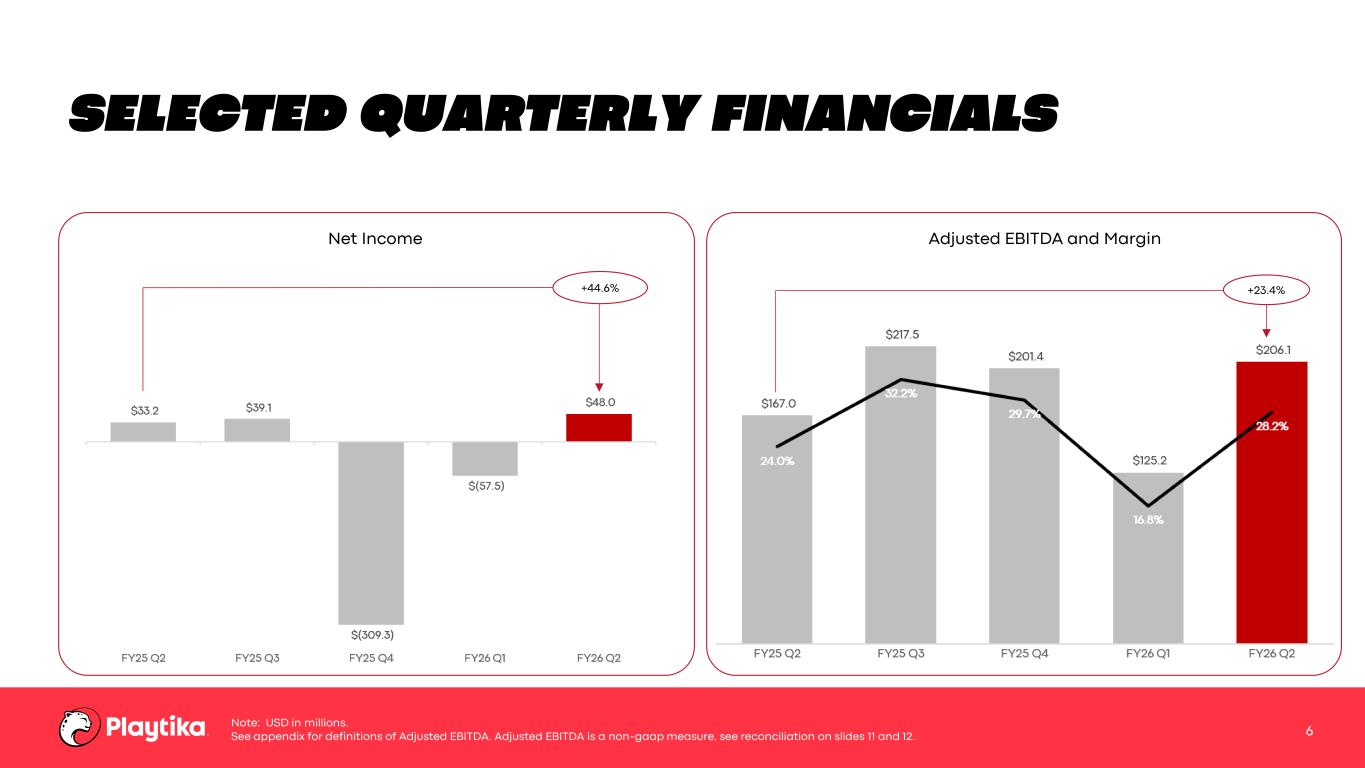
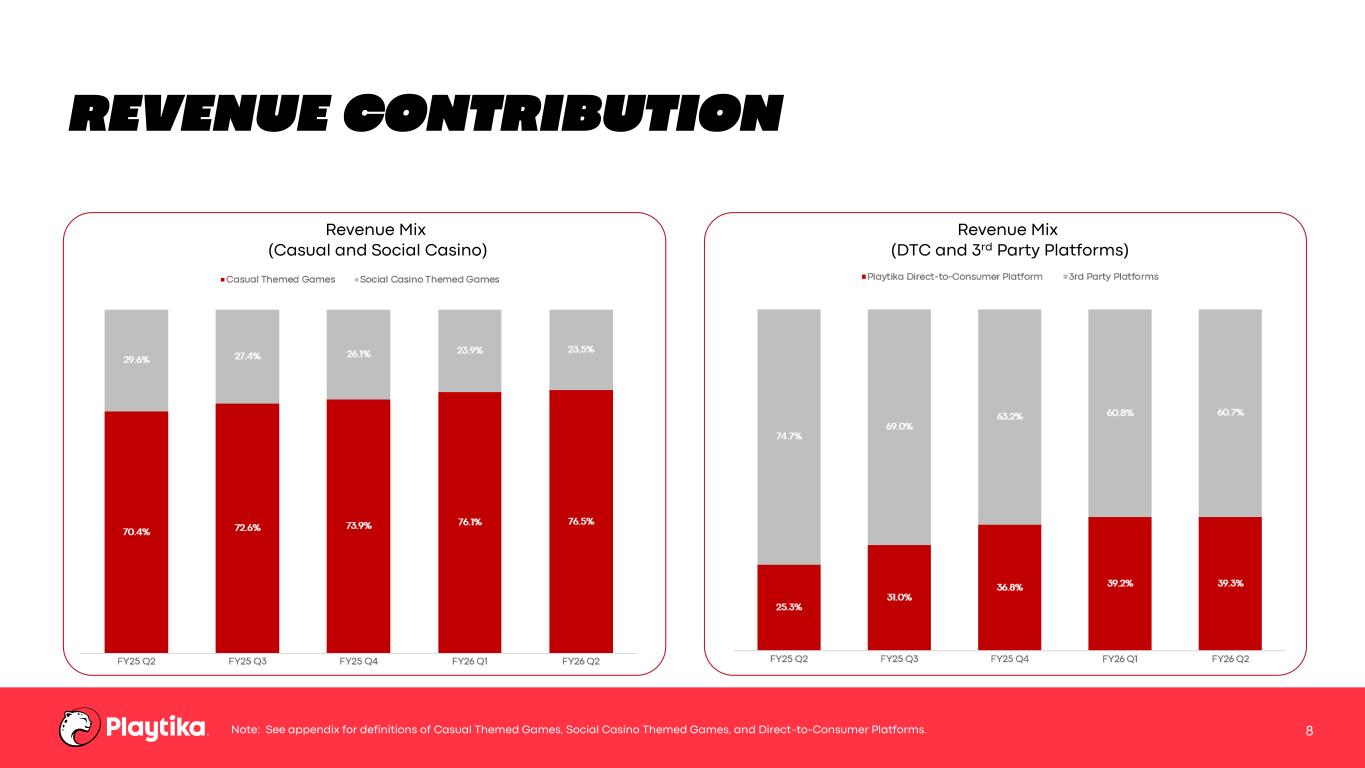
Good morning and thank you for joining us. I want to speak directly today. There are a few questions we know are on your mind about playtica can we grow can we launch a new hit and when we invest to grow does it last these are the right questions to ask and today i want to answer them with results no words let's start with what matters most our business model works when we bring players into our games. The goal is to have them stay, not for a quarter, but for years. They keep playing, they keep spending, long after we first bring them in. This is the heart of Playtica. It is what we have built since I have started this company 16 years ago. And this quarter, we clearly saw it again. Look at Disney Solitaire. In the first quarter, we increased our investment to grow this game. And you ask a fair question. What happens when you spend less? Do the player live? How sustainable is the growth? This quarter, we have a clear answer. We brought our marketing spending down and the game still grew. This only happens when the players you have added continue to stay with you, when they keep playing and they keep spending. And this is how we ask you to judge this business. This is the right way to judge a live game. It's over its full life. How long the players stay and how much they are worth over that lifetime. What matters is the long-term engagement. The players who stay for years. By this standard, Disney Solitaire has the potential to be one of the best games we have ever built. Our older game makes the same point. So Tomania started this company 16 years ago, and it is still one of the most important games we have in our portfolio, not because of its size today, but because of what it proves. 16 years ago, it is still here, stable performance for three quarters and still supported by community of players who have stayed within four years when a game holds its players for that long that is not a lack that is the model working we told you the last quarter that our marketing spending would come down as the year went on It did. And as it came down, our margin moved up. Our adjusted EBITDA margin this quarter was 28.2%, up from 16.8% in the first quarter. D2C is another area where we did what we said. We told you we would grow this channel and use it to protect our margins. That is exactly what we did. This quarter, D2C reached to 39.3% of revenue. This channel is the key part of our future. Let me close with this. Trust is earned. It is earned by saying what we will do and then doing it. We said the players will invest, will stay, and keep spending. And this quarter, they did. We said our margin would rise, and they did. We said we would grow D2C to protect margin, and we did. This is a company that does what it says. And that is how we will keep earning your trust. With that, let me hand it over to Tay to take you through the numbers. Thank you.
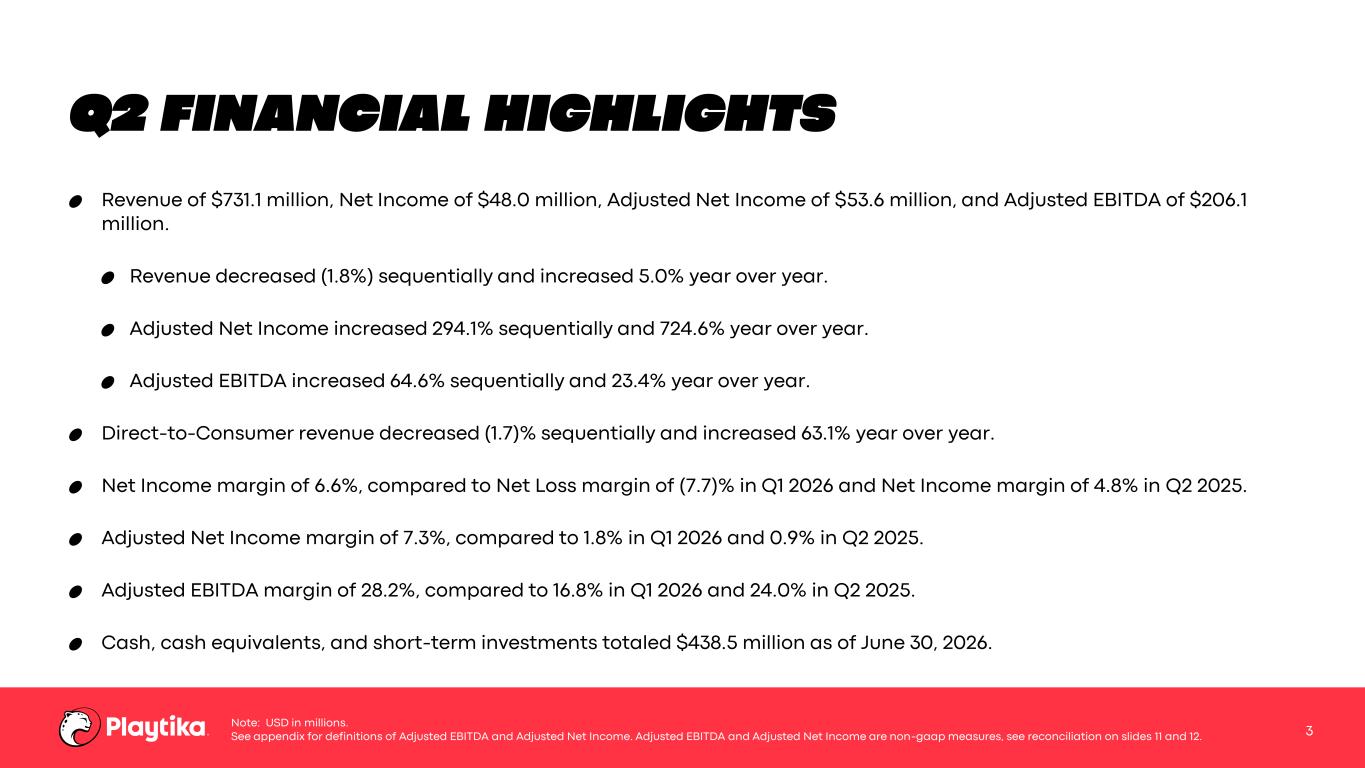
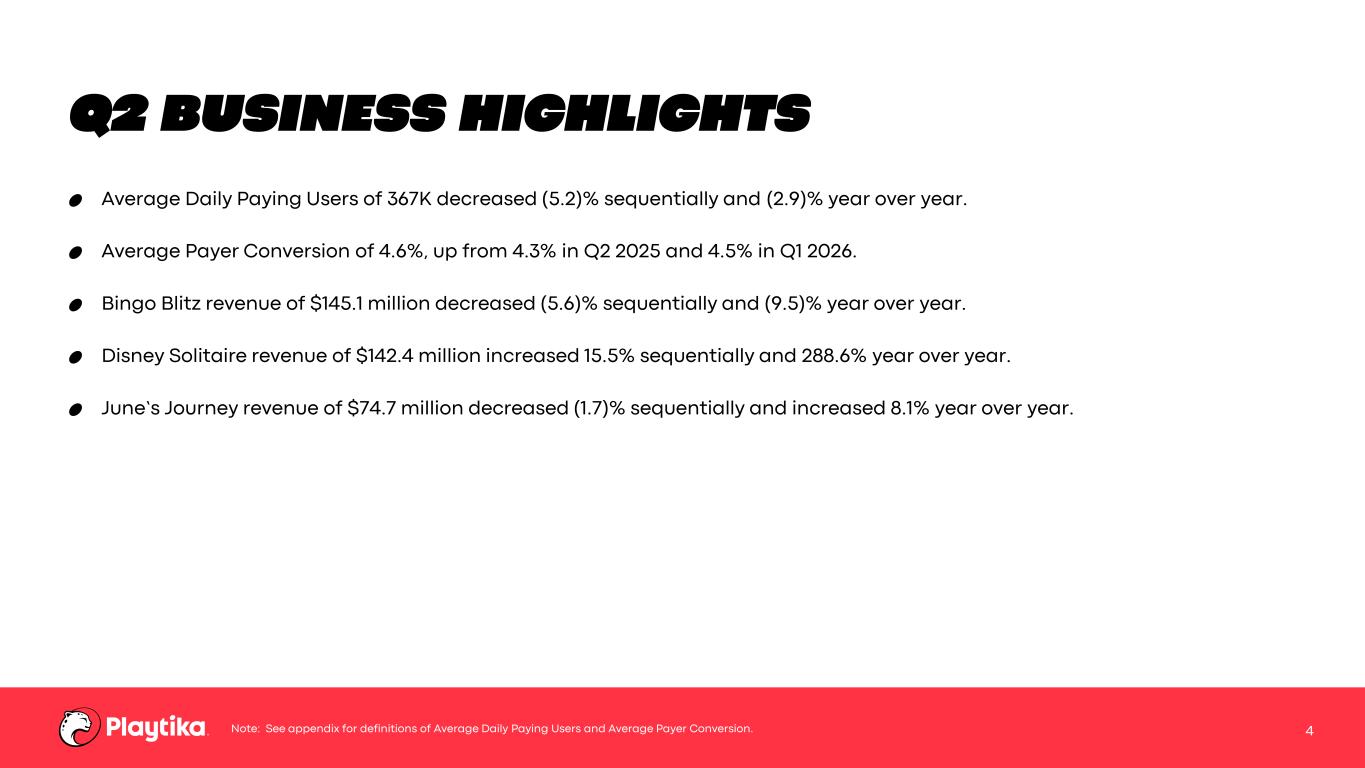
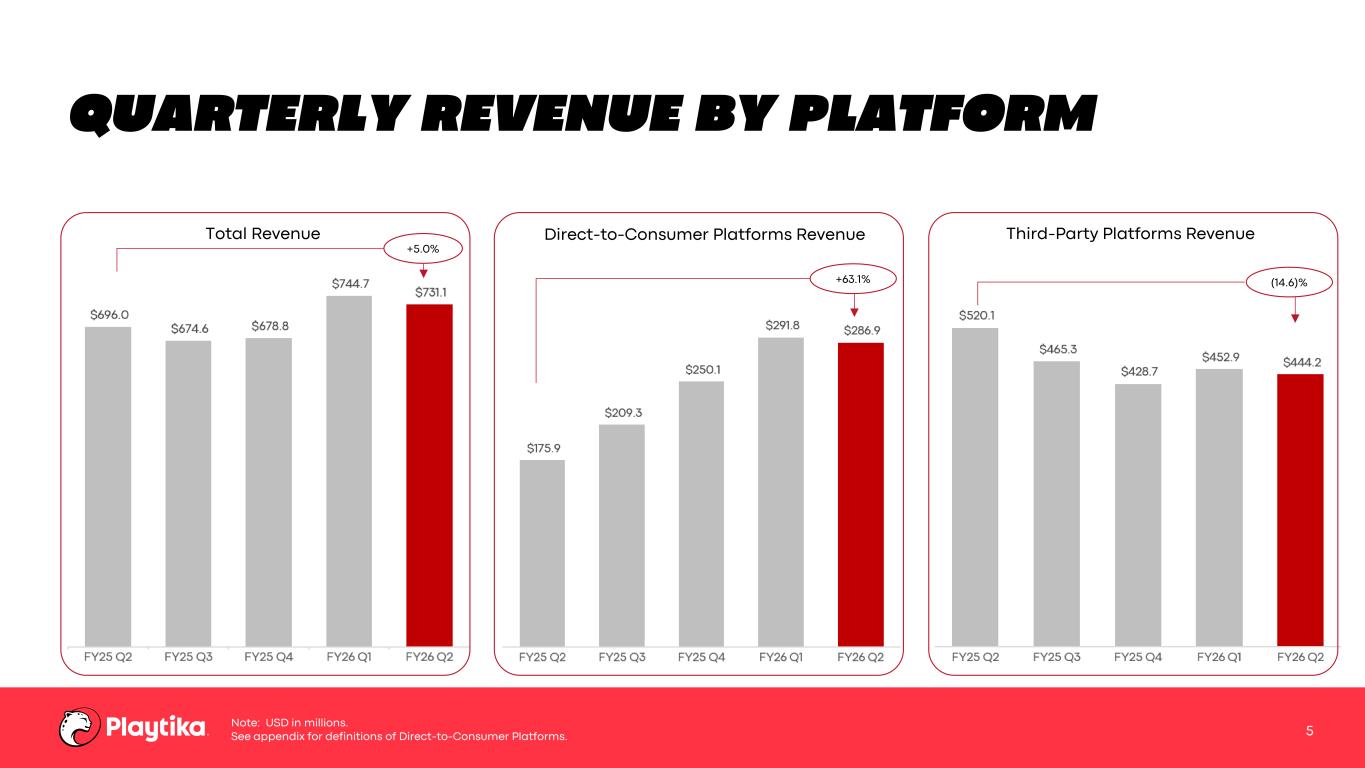
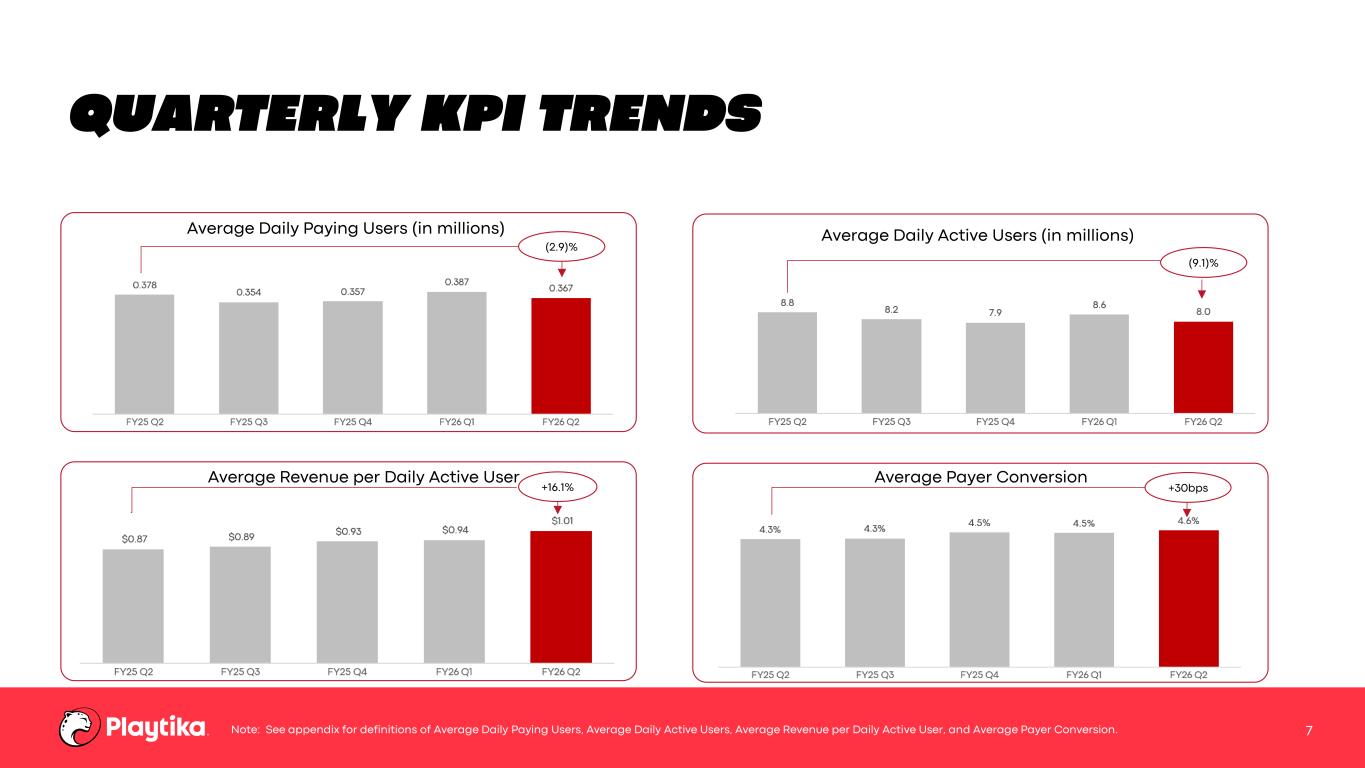
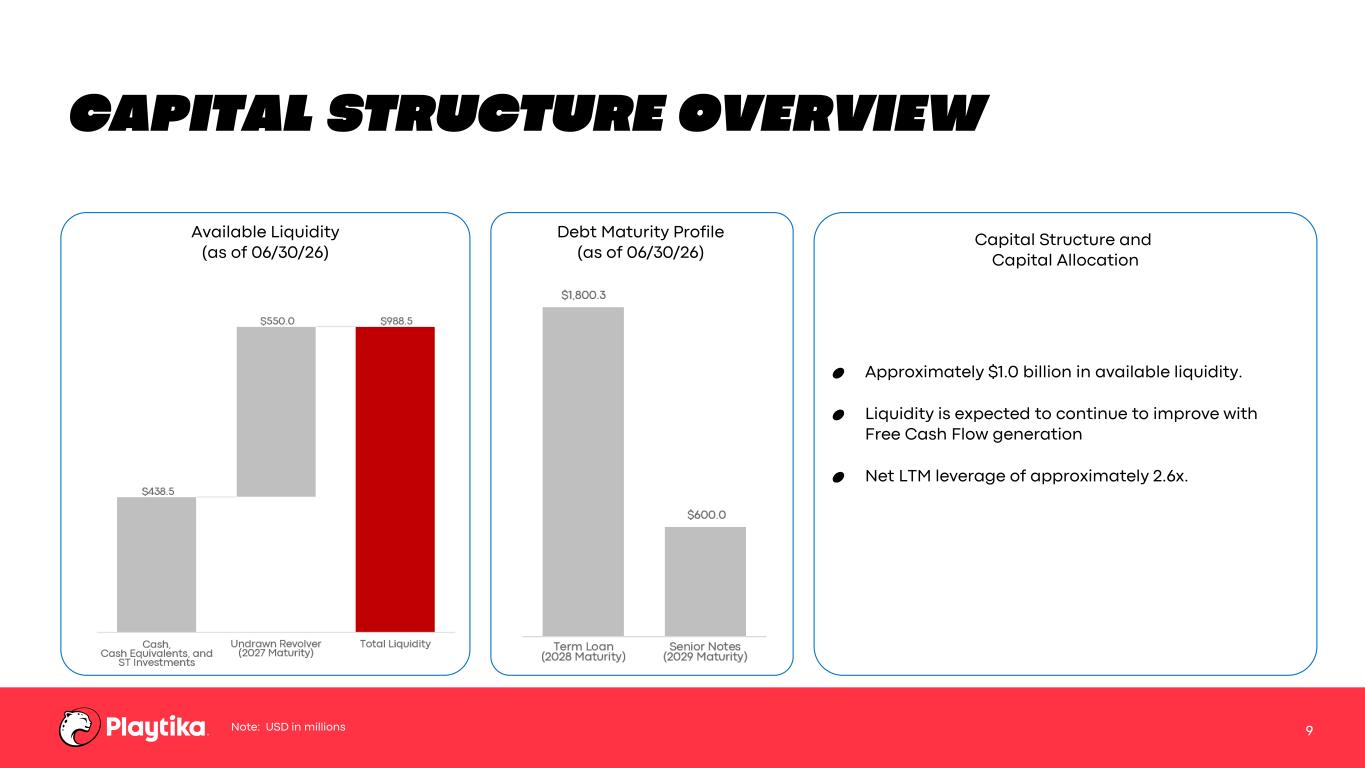
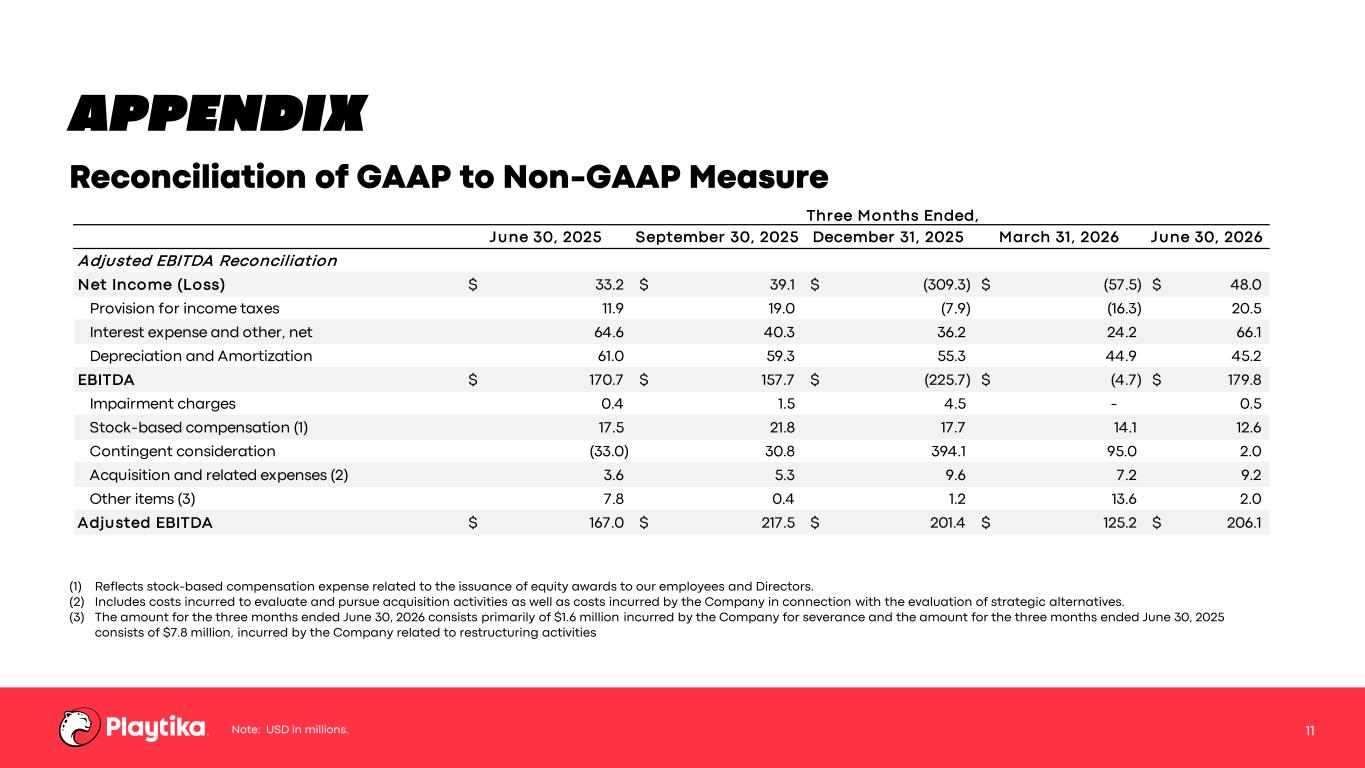
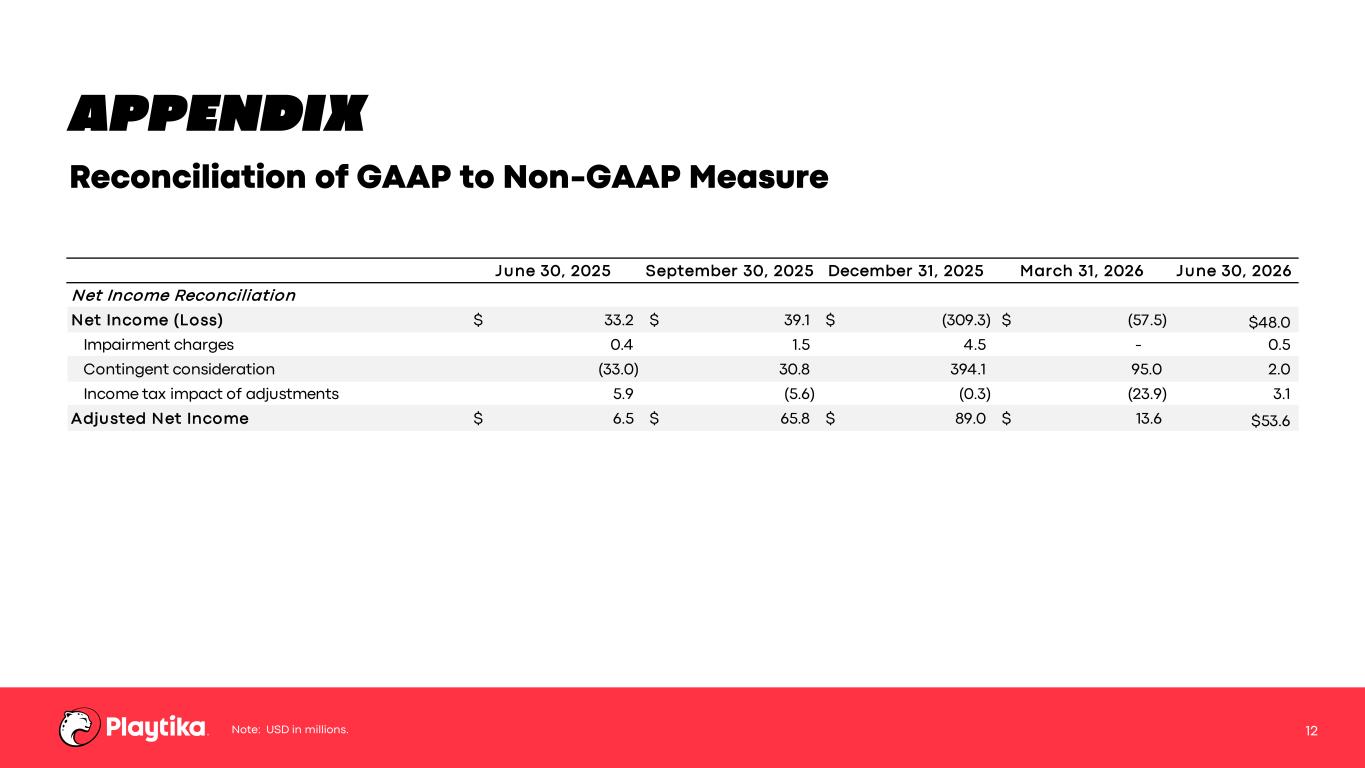
Thank you, Robert, and good morning. In the second quarter, we saw the dynamics we described last quarter play out. Our marketing expenditures stepped down materially as the year progressed. Margins increased, and Superplay became a positive adjusted EBITDA contributor beginning in the second quarter. Before I walk through the numbers, I want to give you three points to keep in mind as you interpret our results and think about the rest of the year. First, the margin recovery this quarter was not an accident. It was the plan. We front-loaded user acquisition spend into the first half, and especially the first quarter. And as that spend came down in the second quarter, the profitability of the business came through. This front-loading was driven largely by our Superplay titles, where the structure of the earn-out incentivizes concentrating investments early in the year. The result this quarter is the operating model working as designed. Invest to grow, and then let the profitability follow. Second, and closely related, the cadence of our marketing spend will shape the revenue trajectory for the rest of the year. Because so much of our user acquisition spend was concentrated in the first half, we expect revenue in our Superplay studio to decline on a sequential basis in the second half versus the first half, even as these titles grow year over year. I want to be clear about what this is. It is not a loss of momentum, and it is not the game's weakening. It is a direct result of a deliberate choice in the timing of our spend made in the context of the SuperPlay earn-out. We would encourage you to judge these titles on their full-year growth and their lifetime economics, not on the movement from one quarter to the next. Third, we saw the consumer sentiment soften as the quarter went on in Q2, and we are watching it closely. We started to observe a slowdown in the industry mid-quarter, which we attribute to weakening consumer confidence. Inflation has been a persistent pressure on the consumer this year, and we believe it weighed on discretionary spending, including in our category. We think this impacted our second quarter results, and it is a key reason we're taking a measured view of the second half, which I will come back to when we discuss guidance. With that framing, let us go through the financial results. In the second quarter, we delivered total revenue of $731.1 million, down 1.8% sequentially and up 5.0% year-over-year. Adjusted EBITDA was $206.1 million, representing a margin of 28.2%. Net income was $48 million, and adjusted net income was $53.6 million. We delivered DTC revenue of $286.9 million, down 1.7% sequentially and up 63.1% year-over-year. Now let's turn to the portfolio, starting with the performance in our top three revenue titles for the quarter, Bingo Blitz, Disney's Solitaire, and June's Journey. Bingo Blitz delivered $145.1 million of revenue this quarter, down 5.6% sequentially and 9.5% year-over-year. The revenue decline looks steeper than last quarter, so let me explain what's driving it, because the composition here matters. The majority of the year-over-year decline is concentrated in players acquired within the last 12 months, as we moved away from acquisition channels that brought in high volumes of short-lived, incentive-driven users and toward investing in our existing long-term players, the community that's always been the foundation of this franchise. Our long-tenured players who have been with Bingo Blitz for more than one year generate most of the game's revenue and remain the foundation of this franchise. BTC continues to support the game's economics, and Bingo Blitz remains the number one bingo title worldwide. Disney Solitaire generated $142.4 million of revenue this quarter, up 15.5% sequentially and 288.6% year-over-year. I want to spend a moment on Disney Solitaire, both on what the results tell you about the business and how you should model it for the rest of the year. The key point is this. We grew Disney Solitaire revenue this quarter while bringing your marketing spend on the title down meaningfully from the first quarter. Growing revenue on lower acquisition spend is only possible when the players you've already brought in stay and continue to engage. Now, how to model it from here? Our user acquisition investment in Disney Solitaire is unusually front-loaded this year, more so than we would run a new title in the normal course. This reflects the structure of the Superplay earn-out, where the studio is incentivized to grow revenue year-over-year while increasing EBITDA margins. Having concentrated that investment in the first half, we are reducing Disney Solitaire spend significantly in the back half, and that step-down converts into higher EBITDA margins as the year progresses. The direct consequence is that Disney Solitaire revenue is likely to decline on a sequential basis in the second half, even as it grows year-over-year. This is a function of the spend timing that I just described, not of the title's health or long-term potential. Disney Solitaire is early in its life, and we believe it will continue to scale. When our investment in the game normalizes, we would expect its trajectory to reflect that. The right way to judge this game is on its full year growth and its lifetime economics, not on the sequential movement that our spending timing creates. June's Journey revenue for the quarter was $74.7 million, down 1.7% sequentially and up 8.1% year-over-year. We continue to see strong trends in monetization, driven by improvement in our events, segmentation, and campaign tools. Engagement among our long-tenure players remains at elevated levels, and this past quarter, we launched a successful new IP collaboration with Agatha Christie, which was well-received by the June's Journey community. June's journey remains one of our strongest and most durable casual titles and a top revenue contributor to the portfolio. Let's turn to specific line items in our P&L. Cost of revenue was $192.9 million, down 1.5% year-over-year. Like the first quarter, the decline was primarily driven by lower platform fees, resulting from the continued growth of our DTC business, partially offset by higher royalty expenses. R&D was $96.4 million, down 15.8% year-over-year. The steeper decline this quarter reflects the full-quarter benefit of the cost actions we began earlier in the year on lower headcount and reduced outsourcing expenses, now without the severance costs that partially offset the savings in the first quarter. This is a good example of the discipline we brought to our cost structure carrying through the bottom line. Sales and marketing was $252.6 million, down 2% year-over-year and down 30% sequentially, reflecting the significant step down in marketing spend we told you to expect after our front-loaded first quarter. And we expect spend to step down further in the second half. GNA was $54.1 million of 202.2% year-over-year. The reported year-over-year increase is not meaningful on its own because the prior year quarter included a one-time benefit from the revaluation of contingent consideration, which reduced GNA in that period. Adjusting for that item, GNA was up 2.3% year-over-year. There were no significant one-time items in the second quarter. Average daily paying users was 367,000, down 5.2% sequentially and down 2.9% year-over-year. Average daily active users was 8 million, down 7.0% sequentially and down 9.1% year-over-year. ARPDAO was up 7.4% sequentially and 16.1% year-over-year. Turn to the balance sheet. As of June 30th, we had approximately $438.5 million in cash, cash equivalents, and short-term investments. Turning to guidance, we are maintaining our full year of revenue and adjusted EBITDA ranges. That said, based on what we see today, we expect to finish the year towards the lower end of both ranges. There are two factors driving this. The first is deliberate and within our control. As I described, we front-loaded our marketing investment into the first half, and we're stepping that expenditure down meaningfully in the back half. That reduces revenue in the second half by design while supporting the margin expansion you saw this quarter. The second factor is the consumer. As I noted earlier, we saw demand soften across the industry mid-quarter, which we believe reflects the pressure that persistent inflation has placed on discretionary spending. We are taking a prudent view of how that carries into the second half. Taken together, our investment cadence decision and our measured read of the consumer are the primary drivers why we expect to land toward the lower end of our ranges for the full year. We'd be happy to take your question.
Operator
Thank you. At this time, we'll conduct the question and answer session. As a reminder, to ask a question, you'll need to press star 11 on your telephone and wait for your name to be announced. To withdraw your question, please press star 11 again. Please stand by while we compile our Q&A roster. Your first question Come to the line of Aaron Lee with McQuarrie. Your line is now open.
Thanks for the question. I appreciate all the color on the call about guidance and the games. Maybe just starting with guidance. So I understand why revenue cut up in the lower end of the range, just given the factors that you've laid out, the planned marketing spend reduction and consumer softening. But if the marketing spend is coming down, wouldn't that imply a benefit to EBITDA? So it's winding up in the lower end of the range. Is that just costly leverage, or can you help me understand that?
Yeah, Aaron, thanks for the question. Listen, on the range, we reaffirmed it. Q2 came in ahead of consensus on revenue and adjusted EBITDA. You saw the margin uplift versus the first quarter, and you also saw SuperPlay turning EBITDA positive, as we said it would. What we're doing is guiding you where inside the range we currently expect to land because we want to find alignment in the shape of the remaining second half of the year versus how the street may be modeling the business. Our first half came in above where the street had it, and the full year range hasn't moved since we updated the range in the past call. And we want to close that gap, and we prefer to do it now versus later in the year after the third quarter. There's a couple different things driving the second half. We front-loaded user acquisition into the first half, especially into the first quarter, and that's largely driven by the structure of the earn-out. That spend steps down in the second half. The second half revenue steps down sequentially from the first half. One thing to note for back half of the year, that reduction is also weighted toward the third quarter. Down sits, and then you see more sort of an even spend in the last quarter versus the third. So the second half sequential pattern, it's not linear. It's timing. It's not trajectory. the titles that will see the biggest change in marketing spend in the first half versus the second half. We expect those titles to still grow year over year. Now, coming back to your question around some of the cost leverage, one aspect of it is also concentrated in players we acquired within the last 12 months following some of the mixed change in marketing that we made in 2-4 of last year. Now, that change annualizes through the back half, so the year-over-year comparisons do get a little bit harder, and the second half not easier. And so I'd underline the other side of that, which is that our players who've been with the game for over a year were essentially flat, and they do generate the majority of the game's revenue today. And that is part of the franchise we're managing, too. But, again, some of the portfolio mix shift does impact EBITDA. And in addition to that, you've kind of heard us say this before, which is we reserve the right to think about how spending, incremental spend also as the year sort of ends in order for giving us sort of that some of it is flexibility some of it is the portfolio mix shift and then the last point that I'll just emphasize which we spoke about on the call is around the consumer specifically why we're pointing to and just to give a little more color in our own level of seasonality every year it's just that this year we're seeing for external data whether it's consumer sentiment reacting to a lot of volatility as they assess the impact of inflation on what they have as discretionary spending. And so we're not going to over-attribute our quarter to it, but we do think it's real and our prudence on the back half is the right posture is our point of view.
Great. Thank you. That's helpful color. And then, yeah, I appreciate all the color you guys also gave on the call about, you know, the different game performance. Just want to dig a little deeper into slotomania. I believe you guys mentioned it's been three quarters of stable performance there. Can you just update us on, I believe in the past you've said that once you kind of get this in the stabilization area, then you could perhaps start leaning more into marketing. Like, is that still in the cards given the planned step down in marketing? And how are trends within your other social casino titles?
So, thanks for the question. And for me, and I spoke it a few quarters ago, Slotomania was really a big test for Playtica. Slotomania was our first game and we had a very hard year. But we said, always said that we believe in the title, believe in the game, and we know how to stabilize it. And actually, this is one of, when I look at the history of Playtica, this is one of the most important things that happened to us. To take a title that got held, to fix it, to stabilize three quarters in a row. this is not something a very easy mission and you are right about the marketing we are now starting to finalize new campaigns we started to to look at the future of the game we still believe in this title and we believe in the genre and we have two more titles and it looks much better than it looks a year ago and again as i said before i'm very excited about it and very proud about the work that the guys in the studio did.
Okay. Thanks, Robert. Thanks, Tay. Next quarter.
Operator
Thank you. Your next question comes in the line of Doug Krutz with T.D. Cowan. Your line is now open.
Hey, thank you. Presumably, your willingness to invest in user acquisition for a title is determined by what you have to spend to acquire the users and what the LTV of those users winds up being. I know that cost of UA is historically lower in Q1, which is why you've favored that quarter. It does seem that the Q2 results and the retention of the Disney Solitaire users suggests that the LTV is pretty high. And therefore, why wouldn't you want to keep spending on user acquisition, regardless of any considerations of earn out or anything like that? Thank you.
Thanks for the question, Doug. I think, you know, let me cover a couple different points here. So we made a significant reduction in the Solitaire Marketing quarter per quarter, and revenue still grew over 15% sequentially, along with sort of the right KPI metrics that you want to see. You know, revenue that grows with new installs coming down, that only happens if the players already in the game are staying and spending more. And so in terms of durability, I think you'd agree that's about as clean a read on durability. Equential revenue in a live game is what you earn from the players you bring into the quarter plus the carryover, right, from every cohort you've acquired. And in a mature title, that carryover base is the majority of the revenue. Think core titles like Bingo Blitz, Slot of Mania, and June of Journey. It's most of the revenue and it's very stable. That's what a deep cohort base is, the advantage of the cohorts you've built over time when you've been running a game for several years, Disney's author is only 15 months old. It launched last year. Global launch was April of last year. It doesn't yet have that base because we're still building it. And so when we take marketing investment down, you don't have enough carryover underneath it to fully offset it. And so that's why we expect, and from our point of view, that's not the game weakening. It's a young title behaving like a young title. And to put a little bit more of a finer point on it, reducing SuperPlay at roughly 70% of the revenue decline that we expect, it's nowhere close to that. Back to then, sort of the SuperPlay earn-out is measured. It's two conditions. Downs across the remaining months of the year, and then you step down, so the margins come through in the back half. The reason we emphasize the positive adjusted EBITDA contribution of SuperPlay in the second quarter was when you saw our Q1 print and you saw an adjusted EBITDA number with margins and the 16%, 17%, which is obviously much lower than what you're, again, that's a function of the SuperPlay games in our portfolio. It's margin dilutive this year, but we're okay with that. We set up the earn-out framework intentionally in a way to growth. and so there's a different way there's different ways to sort of grow a game and we've spoken in the past about how each game has a natural ceiling and right now frankly we don't know what default we're gonna keep on growing this game but we're gonna do it in a way that's profitable and that's the path that we've taken that's the path that we chose when we structure the deal in the first place when we acquire super play there's continued investment now just because we're decreasing user acquisition span in the second half that doesn't mean we're not investing in the game, right? The product roadmap is unchanged. We have new gameplay modes and content that will continue to shift in the third quarter and the fourth quarter. So again, I think it's a matter of us building and scaling this game in a profitable way. The point that I would just emphasize and leave you with is that we want to do it in a way where we're focused on retention, we're focused on monetization. The consequence is that because of the framework of the earn-out, some of the quarterly acquisition cohorts will be lumpy. You're seeing some of the quarterly variability, but on an annual basis, this matters much less. And so I just emphasized the point that we had in our prepared remarks, which is that we're asking that you judge these titles on their full year.
Operator
Your last question comes to the line of Albert Kim with UBS. Your line is now open.
Hey, thanks for taking the question. Just a quick follow-up on the outlook. Any caller on how much of the change and the update relates to super play versus performance in the legacy games? And just on the D2C side, the mix has been kind of strong towards the 40% mix you previously talked about reaching a few years. Can you provide any updated thoughts on that longer-term target and what kind of the upper limit on the penetration is in your view? Thank you.
Thanks for the question, Albert. You know, the 39% number, that's the number in aggregate. So if you look at it on a game-by-game basis, naturally you're going to have certain games that have DTC penetration that is higher than the overall number. And we also have games where it's lower than that number. And that really becomes a function of how long we've had DTC. So DTC is a multi-faceted platform, right? It's not just one channel. There's different ways to generate DTC revenue. And so each game, as it is at a different place in its life cycle of a game, same thing when it comes to DTC. So it's a function of what initiatives a studio is prioritizing. And so there's going to be continued sort of natural upside as across the game, DTC begins to become sort of a larger part of each game sort of revenue mix we're not giving a updated target today i think the point that we emphasize is that it continues to be something that defends our margin we intentionally prioritize this last year that's why you're seeing the rapid ramp up you've seen over the last 12 months and it's a key part of our strategy going forward In terms of the guide, I think we sort of already addressed that question of the different components. So I won't be breaking out exactly what is driving what. But again, we're reaffirming the range just to emphasize that point. But we are pointing you towards the bottom end of that given what we see in terms of the outlook for the rest of the year.
Operator
This concludes the question and answer session. Thank you for your participation in today's conference. This does conclude the program and you may now disconnect.