Operator
Thank you for standing by and welcome to Platia's first quarter 2026 Earnings Conference call. At this time, all participants are in listen-only mode. After the speaker's presentation, there will be a question and answer session. To ask a question during the session, you'll need to press star 11 on your telephone. If your question has been answered and you'd like to remove yourself from the queue, simply press star 11 again. As a reminder, today's program is being recorded. And now I'd like to introduce your host for today's program, Tay Lee, Chief Financial Officer. Please go ahead, sir.
Welcome, everyone, and thank you for joining us today for the first quarter 2026 earnings call for Platica Holding Court. Joining me on the call today is Robert Anticall, co-founder, president, and CEO of Platica. I would like to remind you that today's discussion may contain forward-looking statements, including but not limited to the company's anticipated future revenue and operating performance, including expected marketing and investment activity and the impact of AI on the company's business and industry. These statements and other comments are not a guarantee of future performance but rather are subject to risks and uncertainties some of which are beyond our control. These forward-looking statements apply as of today and you should not rely on them as representing our views in the future. We undertake no obligation to update these statements after this call. We've posted an accompanying slide deck to our investor Relations website, which contains information on forward-looking statements and non-GAAP measures. And we will also post our prepared remarks immediately following the call. For a more complete discussion of the risks and uncertainties, please see our filings with the SEC. As a reminder, we will not be taking questions related to the Strategic Alternatives Review. With that, I'll now turn the call over to Robert.
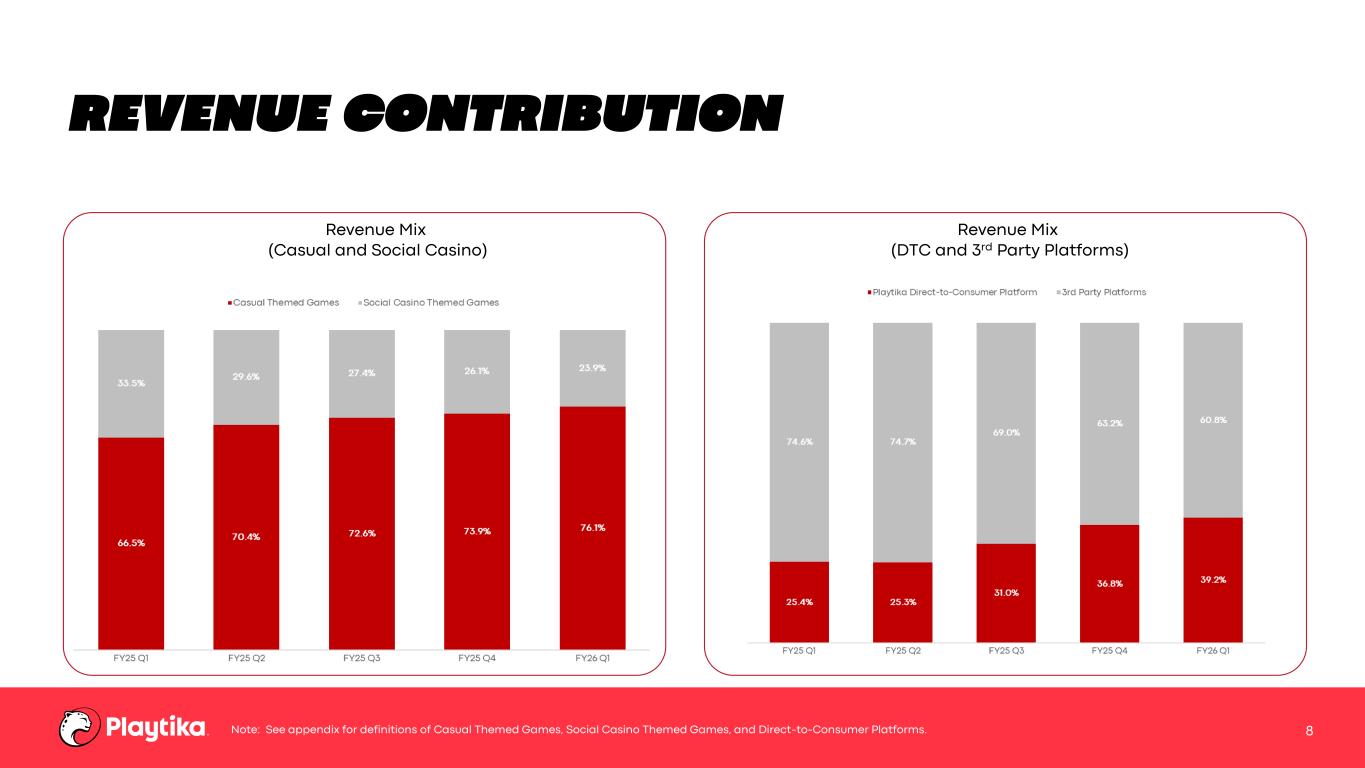
Good morning and thank you for joining us. This was a great start of the year, and we are seeing momentum across the portfolio. Our largest franchise continues to execute at scale. We are allocated investments toward the highest return opportunities, and DTC continues to grow as a key driver for unit economics. With that context, the headline for me is Disney Solitaire. What we are seeing is outstanding and it's rare at this scale. Disney Solitaire has scaled faster than any title in our 15 years history and continues to outperform expectations. Our Superplay Studio has taken world-class IP, built a strong game economy around it, and delivered extremely well. We are investing heavily in user acquisition behind Disney Solitaire, and the returns we are seeing support that level of investment. It is some of the best ROI we have seen in the portfolio. This is not a lucky outcome. Superplay is now operating at a scale that matters for Playtica. And it is validating the strategy behind the acquisition, investing in the right teams and backing them with the capital and operating discipline to build large, long-lasting franchises that compound cash flow over time. This in Solitaire is the latest example of that, and we believe it will not be the last. And it is not only super play. The core business is executing and we are seeing quarter over quarter stability across the organic portfolio. We are investing behind our winners and stepping back where the return profile is not there. That discipline is showing up in the revenue mix. Each year, more of our revenue comes from long-life casual gains with bold and rich. D2C has become a core part of how we run the business, improving unit economics and supporting more durable cash flow profiles. Casual is now 76% of our business, and that transition is largely complete. We are a casual mobile gaming company with a strong social casino business that generates strong cash flow. our casual franchise are in a leadership position with border reach and longer runway and we compete in the categories where scale and winners take most dynamics are more pronounced with superplay serving a growth engine our portfolio remains echoed in scale franchise with competitive advantage while we continue to manage our slow title in a fragmented landscape and the mixed shift doesn't mean we have taken our eye of social casino we are managing it with a clear goal to maximize lifetime value stay disciplined on returns and improve stability where we can on slotomania we encouraged by the start of the year last quarter we told you to expect quarter over quarter improvement in q1 and we deliver it so tomania grew four percent quarter over quarter in the first quarter this is a mature competitive category and we are not making a forward promise of continued growth from here flattening the decline and showing early stability is important milestone and it is matters for the overall durability of the portfolio only to see we have grown close to 1.2 billion dollars annual run rate few companies in mobile gaming operate at our scale and it matters beyond the margin benefit when you own the transaction You improve unit economics and gain more direct tools to engage and serve players over time. With support, durability, every quarter, this becomes more central to how we operate. Our results give me confidence. Superplay scaling. D2C is compounding, and this portfolio is in better shape and a stronger direction. We are executing with discipline. Tay will take you through the details. Thank you.
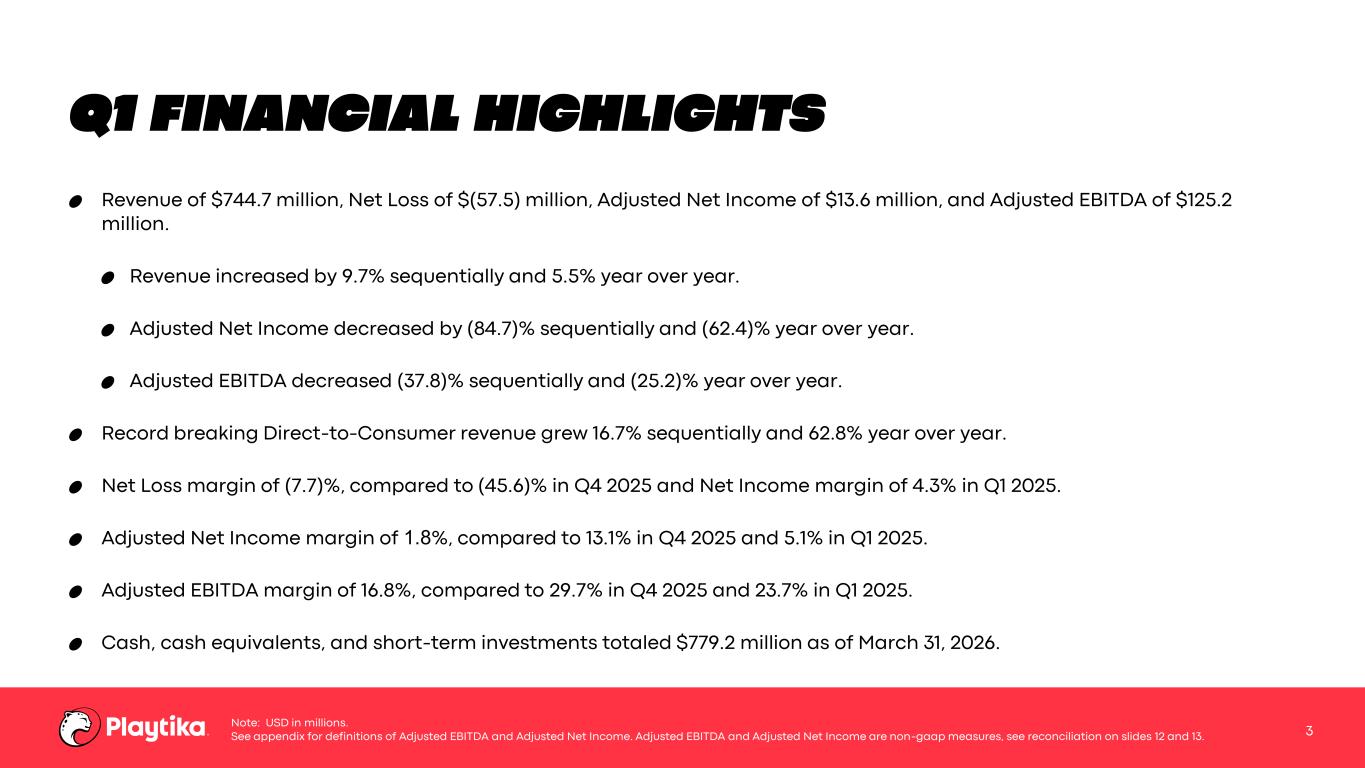
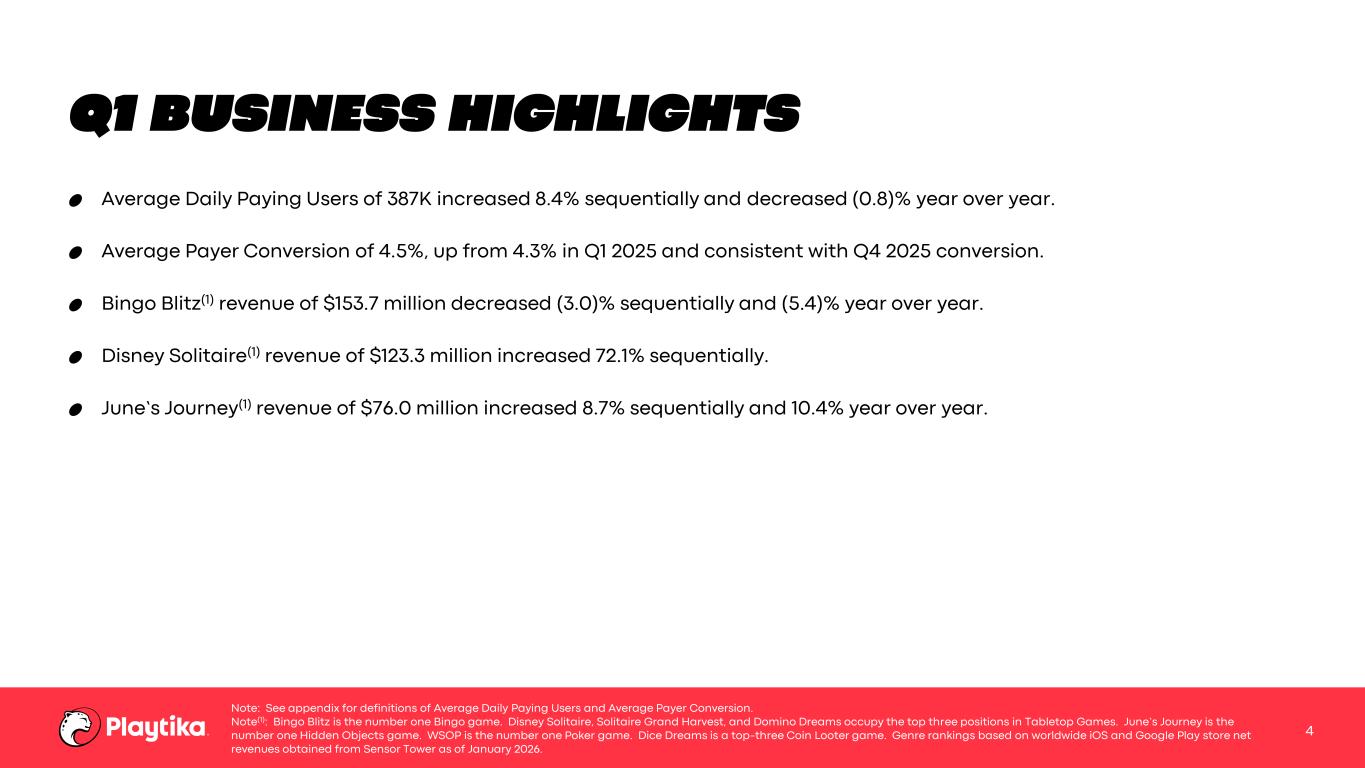
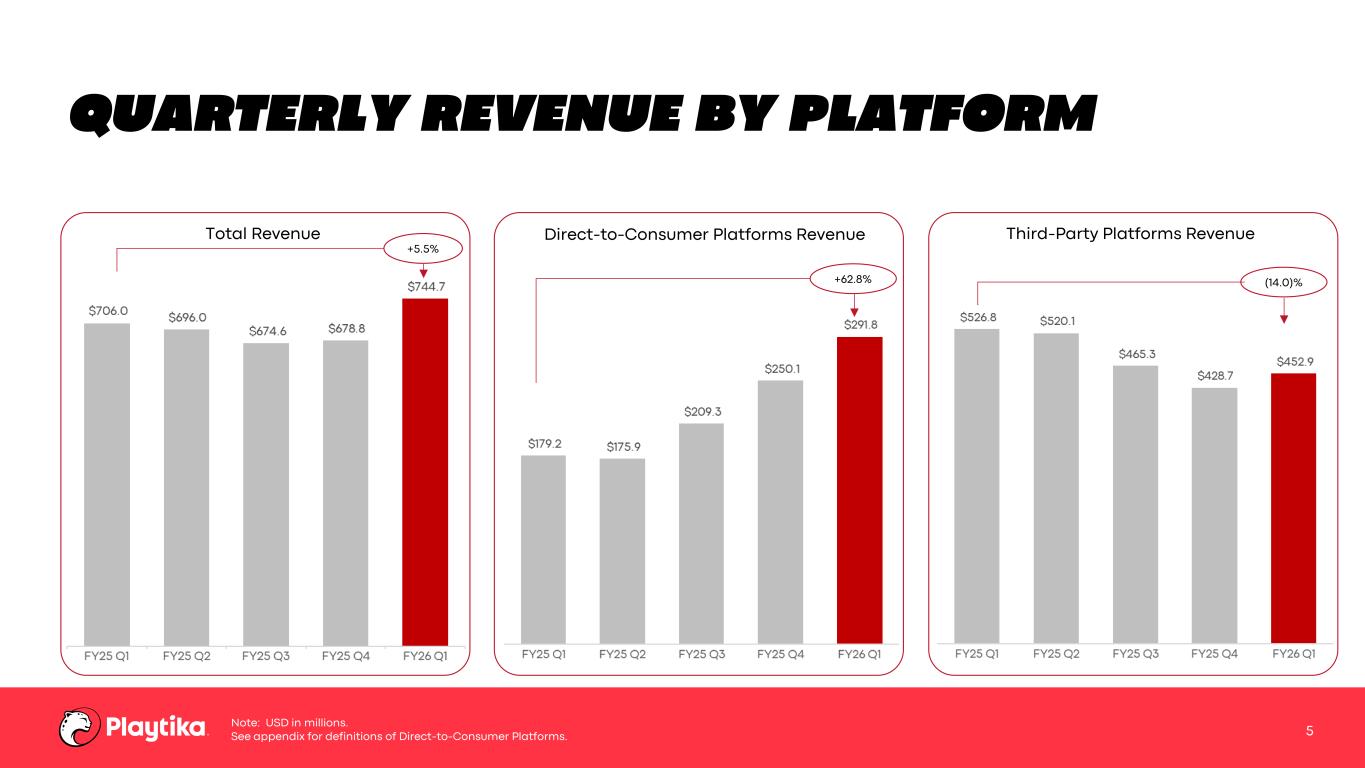
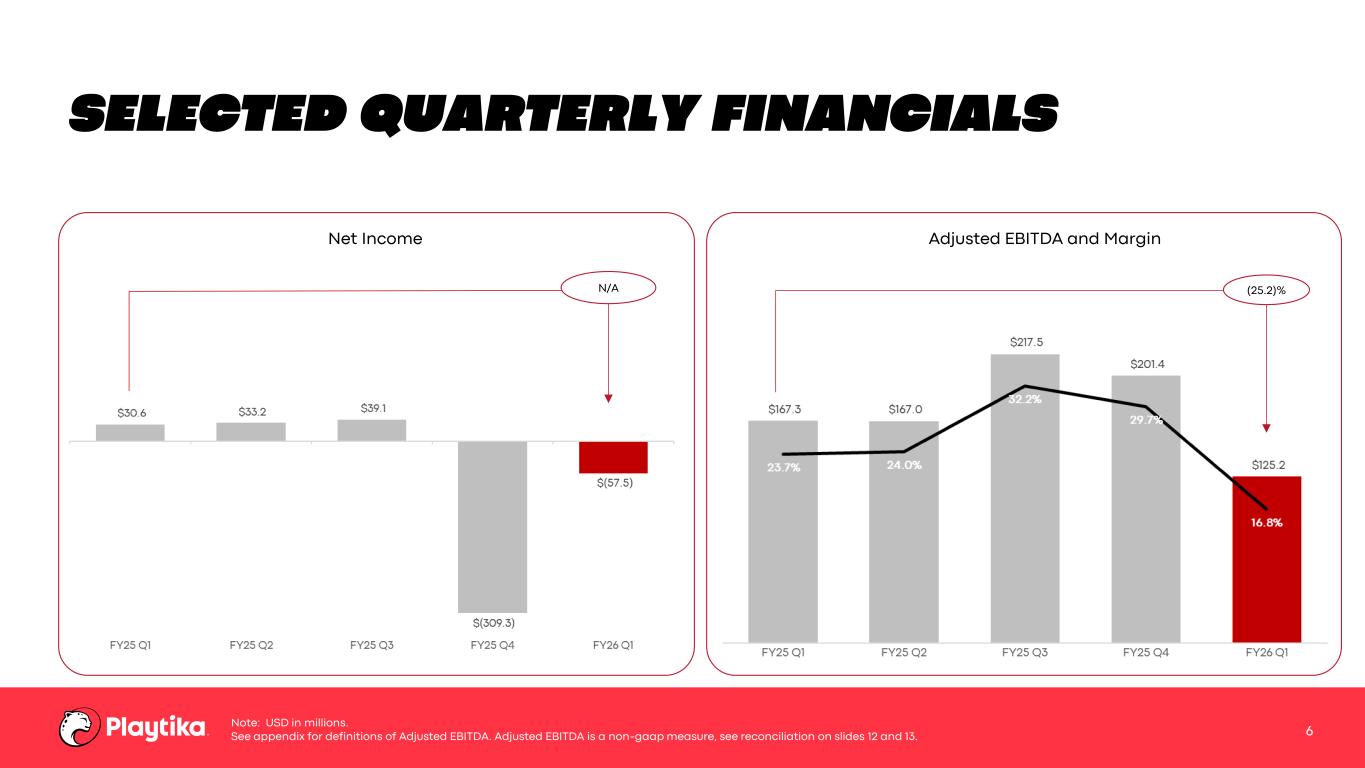
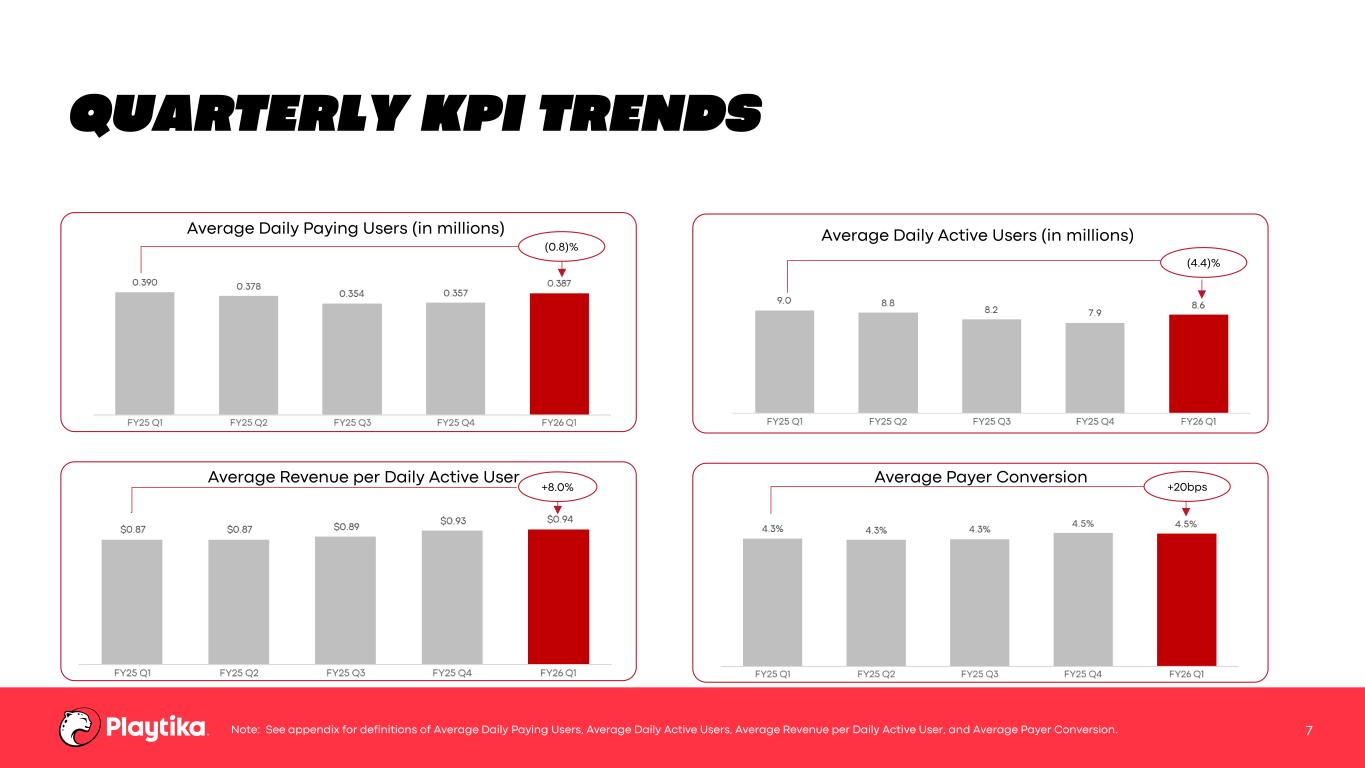
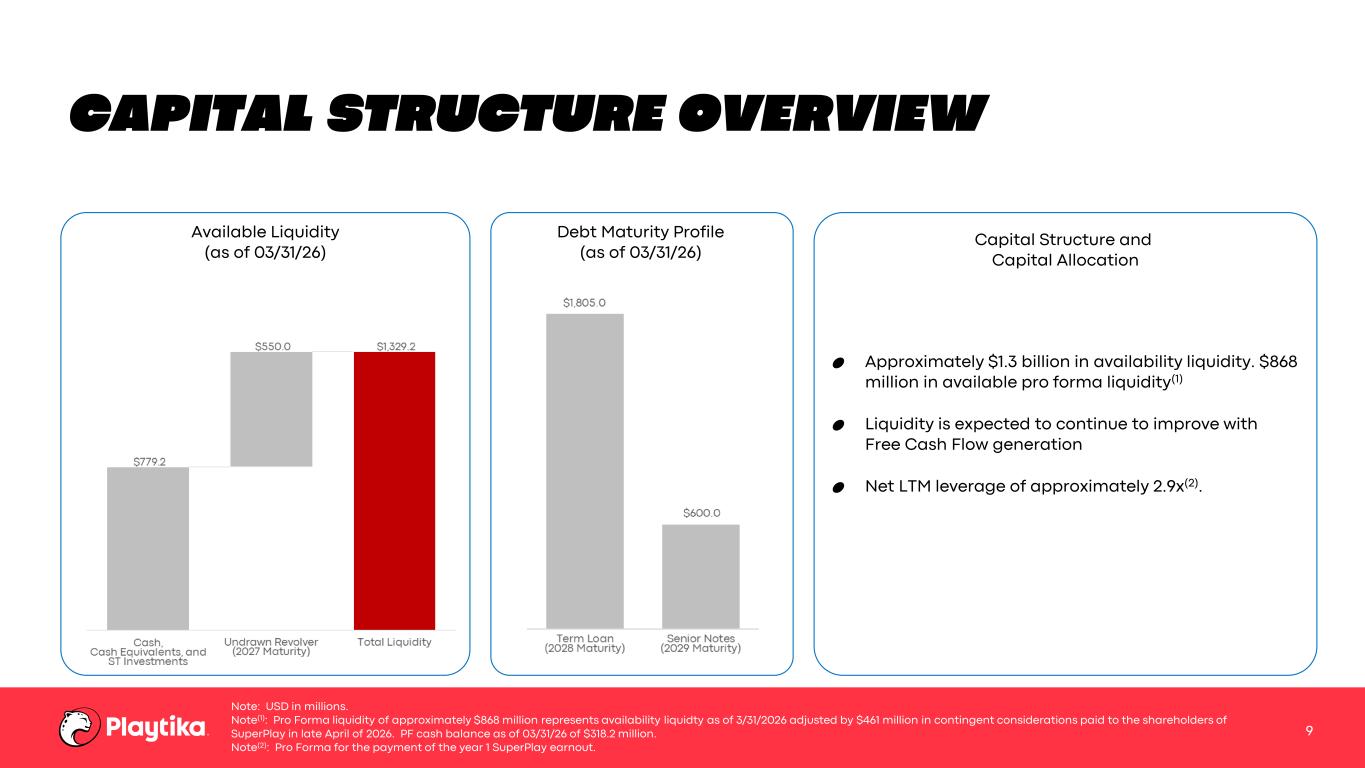
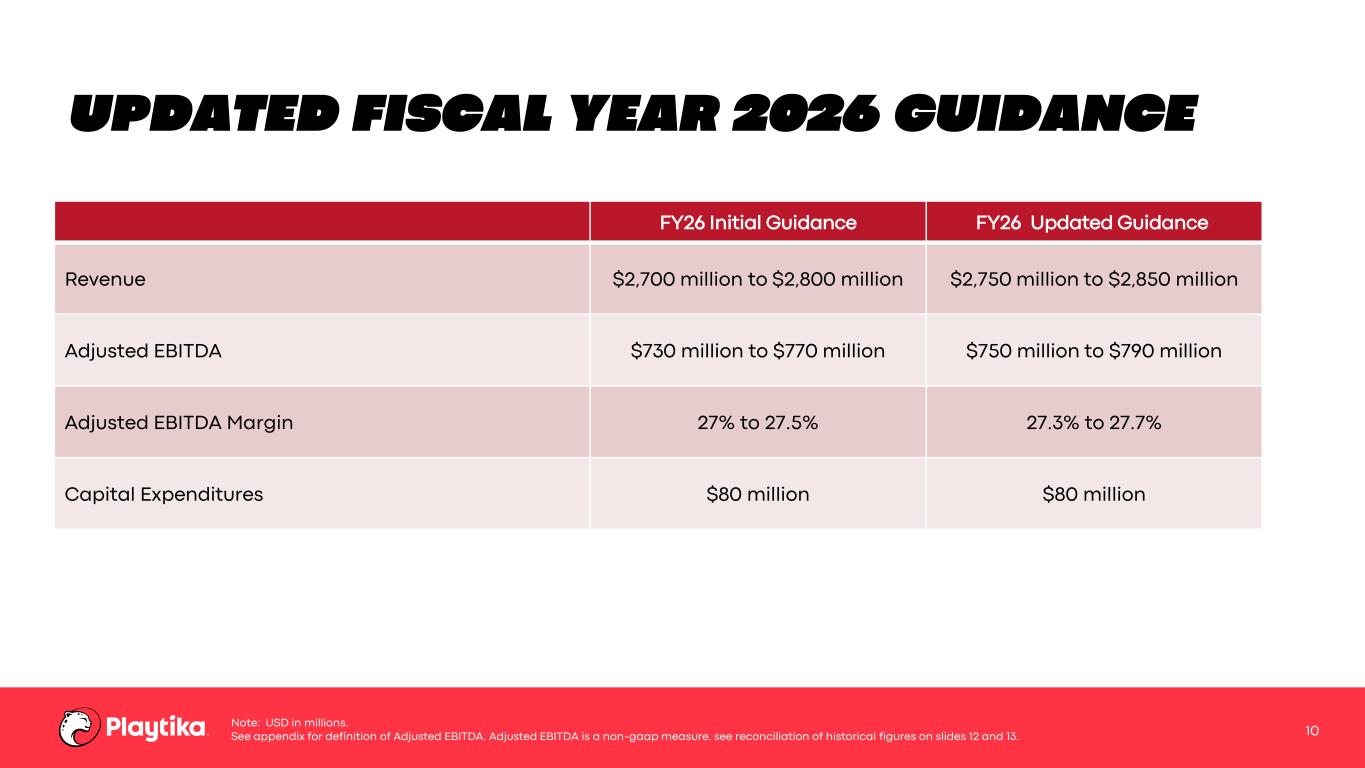
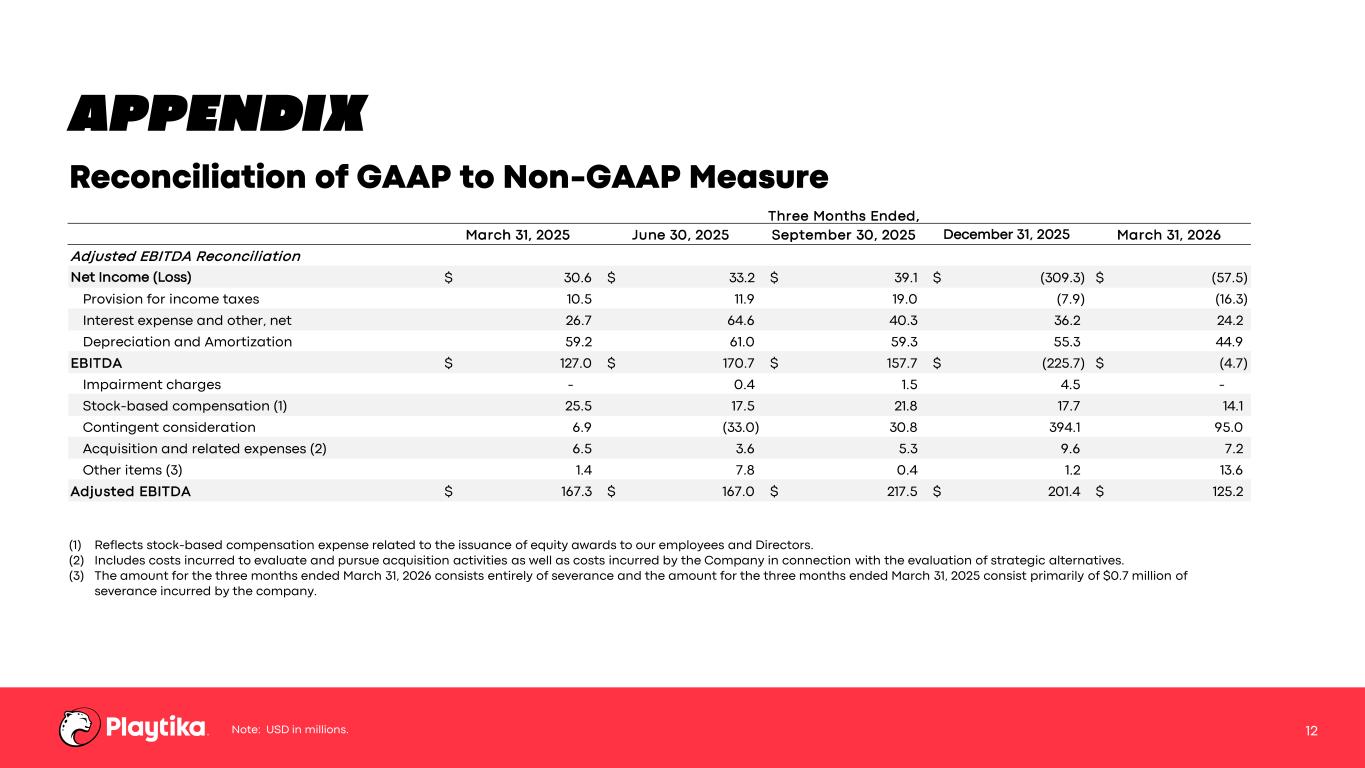
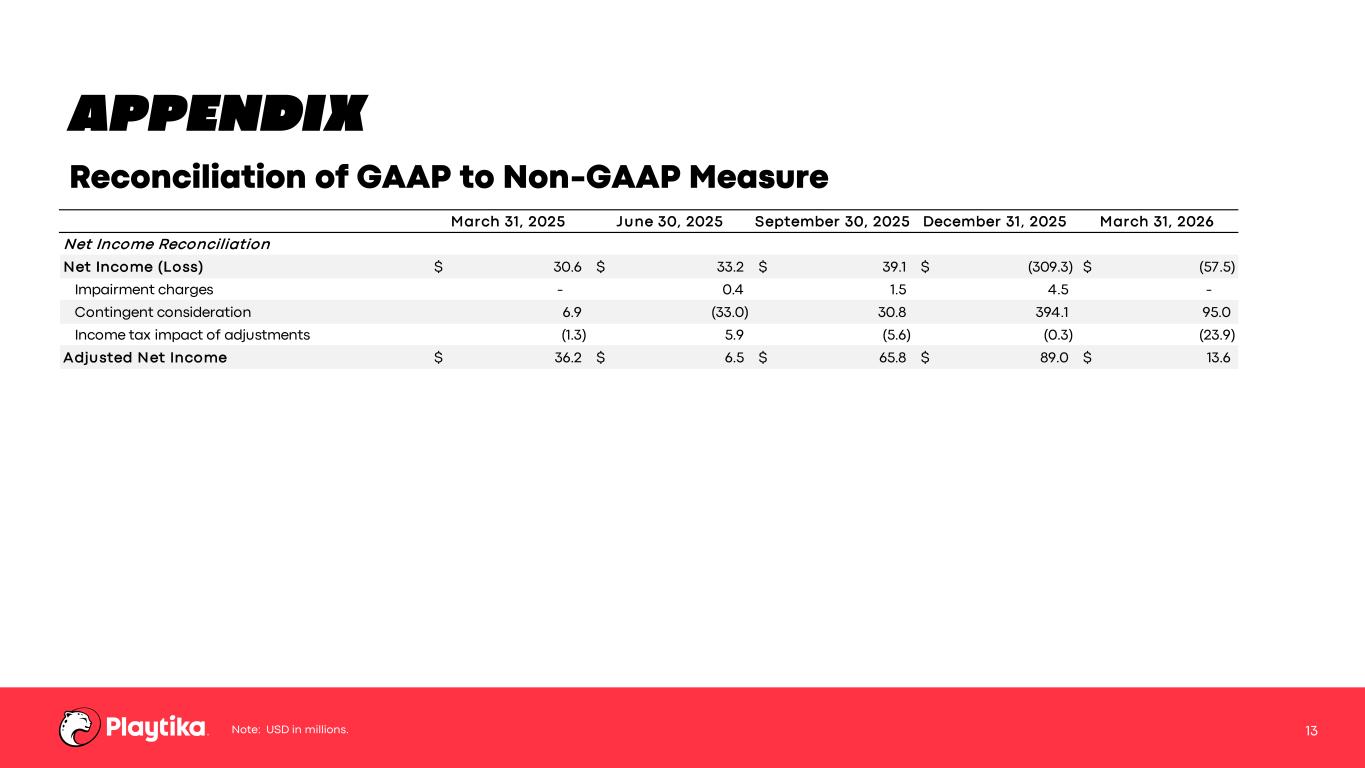
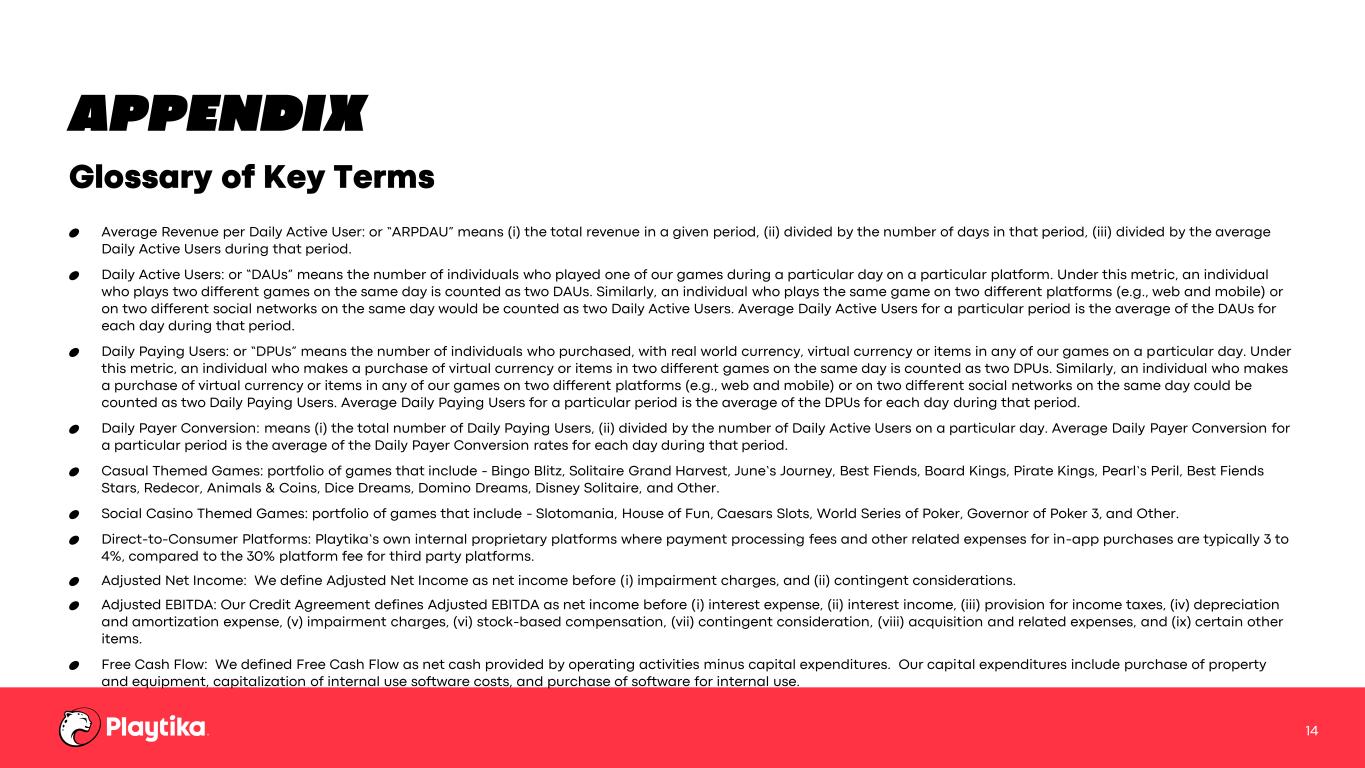
Thank you, Robert, and good morning. I'm going to start with the financial highlights for the quarter, and then I'll take a step back and walk through the key themes that matter for how to interpret a performance in the In the first quarter, we delivered total revenue of $744.7 million, up 9.7% sequentially and 5.5% year-over-year. Adjusted EBITDA was $125.2 million, representing a margin of 16.8%. Importantly, the core business, excluding SuperPlay, continues to generate meaningful adjusted EBITDA cash flow and the consolidated margin reflects the planned investment cadence of superplay we expect superplay to start driving positive adjusted ebitda in q2 net loss was negative 57.5 million dollars and adjusted net income was 13.6 million dollars our adjusted net income excludes the gap impact of incremental contingent consideration which increased this quarter as superplay is tracking ahead of the performance assumptions underlying our last reported results Our DTC business set another record in the first quarter. We delivered DTC revenue of $291.8 million, up 16.7% sequentially and 62.8% year-over-year. The headline is simple. Superplay is scaling and the core is generating meaningful adjusted EBITDA and cash flow. With that context, there are three points that matter for how to think about our results in the business. First, the core is durable, and we're focused on games with scale. In mobile gaming, the portfolio naturally concentrates around the titles with scale and community, and that shows up in our market positions. Across our largest franchises, we hold the number one or top three positions in multiple core categories, and that's the backbone of our strategy, focusing capital on games that can be winners in their respective genres. In tabletop games, we occupy all three top positions, with Disney Solitaire, Solitaire Van Harvest, and Domino's Dreams. Within Solitaire specifically, Disney Solitaire and Solitaire Van Harvest together represent category leading scale, giving us a leading position in a subgenre. Across our casual franchises, we hold leadership positions in large, enduring categories. June's Journey is the number one title in Hidden Objects. Bingo Blitz is the number one bingo game. And Dice Dream is a top three coin looter game. In poker, WSOP is the number one poker title. Sodomania remains a core legacy title, providing scale and stability as we focus incremental capital on titles with winner-take-mode dynamics. Second, Q1 margins reflect super play investment cadence, not structural pressure. Our in-app purchase business model is well-established and repeatable. We acquire players, convert them to payers, and scale live games supported by a durable community. When that community is in place, these titles generate cash over a long period of time. And that's the playbook we've successfully repeated for 15 years. Superplay is in a rapidly scaling phase, and our marketing spend is intentionally weighted toward the first half of the year. As a result, the near-term margin and consolidated adjusted EBITDA in Q1 reflect timing, not the long-term earnings and cash flow potential of the studio. Third, AI is a tailwind for scaled operators. Investors have asked whether AI changes to competitive dynamics in mobile gaming. Our view is that it's a tailwind. Content creation has never been the barrier to entry in our industry. The hard part has always been building and operating a live game at scale. live ops cadence retention and monetization systems and the communities that keep players engaged over time ai is helping accelerate how we build and run those systems if targeting and optimization improves companies with scale data and operating discipline should benefit but it doesn't change the fundamentals you still need product market fit and you still need to allocate user acquisition dollars ai will let strong operators do more with the same or fewer resources and we intend to be one of them now let's turn to the portfolio starting with performance in our top three revenue titles for the quarter bingo blitz disney solitaire and june's journey bingo blitz delivered 153.7 million dollars of revenue this quarter down three percent sequentially and 5.4 percent year-over-year importantly we believe this does not reflect a change in the underlying strength of the franchise. Bingo Blitz remains the number one bingo title worldwide across iOS and Google Play and continues to operate as a category leader in a winner-take-most market. While the quarter reflected a slower start to the year, the underlying economics remain resilient due to the strong growth of Bingo Blitz's DTC business. As we've noted before, DTC is a meaningful lever for bingo's economics, and that mixed shift continues to support the financial profile of the franchise. Disney Solitaire generated $123.3 million in revenue, up 72.1% sequentially. The key takeaway is the speed and consistency of that scale. Disney Solitaire is growing faster than any title in our history. The combination of a proven scaling engine and Disney's brand reach expands the top of the funnel meaningfully. Based on what we're seeing today, we believe the franchise still has room to grow from here. June's Journey delivered $76.0 million in revenue, up 8.7% sequentially and 10.4% year-over-year. It was the best quarter for the studio since Q2 of 2024. More importantly, this is a clear category winner. The leadership matters because it gives the franchise room to keep monetizing, not just sustaining, as we keep tightening LiveOps and expanding mixed levers like DTC where appropriate. And that's why we're excited about the runway. We see June's journey as a title that can become a million-dollar-a-day game over time, given its leadership position, durability, and the monetization potential that still sits in this franchise. Let's turn to specific line items in our P&L. Cost of revenue was $192.2 million, down 2.6% year-over-year. Lower platform fees from the continued growth of our DTC business provided a benefit, which was partially offset by royalty expenses. R&D was $98 million, down 5.6% year-over-year, driven by lower headcount and reduced outsourcing spend as we streamlined our cost structure, partially offset by severance related to workforce reduction. Sales and marketing was $360.6 million, up 32.7% year-over-year, driven primarily by incremental performance marketing spend for our SuperPlay game. As we move through the year, we expect spending to normalize in the Q1 peak and step down sequentially, consistent with the cadence we've discussed in prior periods. GNA was $143.5 million, dollars, up 120.1% year-over-year, driven primarily by the GAAP impact of incremental contingent consideration. Excluding that item, GNA would have been $48.5 million, reflecting lower share-based compensation versus the comparable period. As a reminder, contingent consideration expense from this past quarter is a non-cash, fair value adjustment that runs through GAAP results. It can fluctuate from quarter to quarter and is excluded from adjusted EBITDA and adjusted net income. Average daily paying users reached $387,000, up 8.4% sequentially and down 0.8% year-over-year. Average daily active users reached $8.6 million, up 8.9% sequentially and down 4.4% year-over-year. Monthly active users totaled $30.1 million, underscoring the scale of our global player community. ARPDAL increased 1.1% sequentially and 8% year-over-year. Turning to the balance sheet, as of March 31st, we had approximately $779.2 million in cash, cash equivalents, and short-term investments. Since then, we've paid $461 million to the former shareholders of SuperPlay as an earn-out We remain focused on maximizing cash flow and preserving liquidity, and we've taken actions to prioritize balance sheet flexibility, including suspending our quarterly dividends. From here, we're actively evaluating options to further strengthen our capital structure and extend our maturity runway. Addressing our maturity profile and ensuring ample liquidity is a top priority for management, and we're working deliberately toward the best long-term solution. Finally, guidance. We're raising our revenue outlook for the year from $2.7 to $2.8 billion to $2.75 to $2.85 billion. Superplay is performing ahead of plan. We're also seeing better-than-expected performance in the core portfolio. On adjusted EBITDA, we're raising our adjusted EBITDA range from $730 million to $770 million to $750 million to $790 million. At the same time, we want to be clear about how we're managing this. We're not optimizing the business to harvest near-term adjusted EBITDA at the expense of long-term value. We're managing performance carefully and intentionally to preserve the option to reinvest incremental dollars in the business in the second half, whether that's user acquisition or R&D. while still maintaining discipline or margins in cash generation. Said differently, our updated guidance ranges reflect strong execution, but they also reflect a deliberate choice to keep flexibility. If the opportunities are there, we want the ability to press our advantage and invest, rather than lock ourselves into a single, maximized EBITDA path. We entered 2026 with momentum in the business, and the first quarter gave us more reasons for conviction. We'd be happy to take your questions.
Operator
Certainly. And ladies and gentlemen, if you do have a question at this time, please press star one one on your telephone. Our first question for today comes from the line of Chris Scholl from UBS. Your question, please.
Great. Thank you. Given the front end loaded investment you flagged for the year, how are you thinking about the ability to retain users and sustain monetization as sales and marketing steps down in the coming quarters? And congrats to you on the new role. Any updated thoughts you can give around your capital allocation priorities and how you plan to balance investment with lowering leverage M&A and our buybacks here in the near term. Thank you.
Yeah, thanks for the question, Chris. So on sales and marketing, as you know, Q1 is normally our highest U.A. quarter, even without SuperPlay. And this year, that normal seasonality was amplified by the opportunity that we saw in SuperPlay. So going into the year, what the studio planned to spend versus what we ended up spending, we leaned in because the return profile supported it. So when we talk about the return profile, we're talking about with the increase in sales and marketing on a sequential basis, there was little leaned into. However, from here, the expectation is that step down in spend. And again, the important point is that weakening. It's about moving from a constant performance of the cohorts through the cycle. And as we looked at day 180 and day 240 return, the performance, your question on capital allocation, I think capital allocation is certainly top of mind.
Thank you. If I can just follow up on the SuperPlay earnouts, can you just remind us the timing and the amount of the cash payment this year? And along those lines, any color you can just give on the growth across the portfolio for SuperPlay and 1Q, it would just be helpful as we think about modeling the earnouts beyond 26.
Yeah, so we made the payment last month, so you don't see it reflected in our Q1 balance sheet since it's as of month-end March, but the payment went out last month. And so the way the agreement is structured, any incremental earn-outs that the studio earns, the earn-out gets paid in the second.
Operator
Thank you. And our next question comes from the line of Aaron Lee from Macquarie. Your question, please.
Hey, guys. Good morning. Thanks for taking my question, and congrats, Tay, on the new role. I wanted to ask about the social casino business. Nice to see the comments on Slotomania. So with regard to competitive pressure from sweepstakes casinos, we've seen a number of states kind of pass legislation banning the category and more states floating legislation to do the same. Wondering if you can comment on whether there's been any relief and competitive of pressure that you can see for the category?
Thanks for the question. Then when we're looking at the category of social casino, yes, we had last year some toughness of growing the business and our revenue was decreased, but our goal was always to stabilize the business. And I think when you look at the result of Trottomania this quarter, and I said it in the last conversation three months ago that we're going to grow this quarter. So this quarter will grow 4%. And when I'm looking at the future of our business, it's going to be stabilized. It's going to be a strong cash flow to the company. And I cannot, you know, react on the competitors or legal or illegal. It's not related to me. But it's related to me that I know I'm still leading the category and I'm growing there and I'm stabilizing the business.
Thank you. Got it. Okay. Thank you. And then on direct-to-consumer, another record quarter of D2C here. Nice job on that. You guys have always been the leader here, and I'm sure the App Store policy shifts are probably helping, but is there something incremental you've learned about the D2C platform that is unlocking this penetration? And how would you characterize the opportunity from here? Thank you.
So D2C was always one of our growth engines to be a profitable, strong cash flow company. And we were the first one and the leaders in this business. Right now, today, we still believe growing D2C. I think the changes that we see on the platforms is giving us some ads. but for us we are focusing at what we can do in our ability a not only cash flow it's not only a better profit is giving us a lot of a independency to work with the game and check game to do a Q&A to do a things that they we cannot do another platform so for us D2C was always one of our main benefits and you see the numbers. We are growing and growing and growing, and we still don't know where it's going to stop.
Yeah, and Aaron, just to add to Robert's point, as you know, our DTC business is also pretty diversified, and as you noted, the changes in the App Store policies certainly is helping as a tailwind, but I think the way we thought about it as a company, once that opportunity became available I think it's important to note that we didn't think about it as sort of a single game opportunity but made sure that we were tactically taking advantage of the situation across all of our games and so it's not you know historically you've heard us talk about you know pushing DTC as an opportunity at the right time depending on where that game is and its lifecycle the what you've seen in the last couple of quarters is that the DTC option available across all the games in our portfolio, including our SuperPlay games. And so you have the overall number of DTC, as Robert talked about, run rating at $1.2 billion a year. One of the biggest drivers of growth year over year comes from Bingo Blitz, which is our number one game, and it continues to grow the DTC business. And so, again, I think it's important to note that we saw the opportunity and we really took advantage of the situation.
Operator
I appreciate all the color, guys. Good luck. And our next question comes from the line of Colin Sebastian from Baird. Your question, please.
Yeah, thanks. I have two questions. Maybe first, Robert, can you talk more about the stability or durability you cited across the organic portfolio? Obviously, June's Journey is one that you called out doing really well. But more broadly, do you think the organic portfolio in aggregate can return to growth this year? And then I have a follow-up maybe for Tay. With the shift away from UA spend for Disney Solitaire, does that give you an opportunity to shift more resources over to the organic titles, or is it really just more of a shift towards retention over acquisition for the balance of the year?
Thanks for the question. I will take the first one.
We always looked at our games.
You know, we had last year the issue with Clotomania, and I always say that we have 10 games 8 games, 9 games and sometimes we have issues with 1 game but overall we are positive and I think when you look at this year and look at what we did in the last 6 months we changed many things in a few of our games we stabilized we are working to stabilize all the categories of social casino and the organic games is that last year, June Journey, their performance wasn't amazing. You see, you changed this year because we decided to take the approach to focus at four or five games. This is the main game that we are focusing. This is the game that we believe can take the organic portfolio to grow. And we still believe in it. And we showed the market.
It was always everybody was very optimistic about us, saying, okay, so tomorrow it's going down, what is going to happen?
No, we show the market that we know how to stop it. We know how to change. We know how to improve. And look at our portfolio. We have an amazing, amazing timing place right now in the organic category. Thank you.
Yeah, Colin, I think just to add to that too, I think the better way to think about our portfolio is not just Superplay and then the rest of the business, right? We've talked about how we approach capital allocation. And so separating the portfolio into areas where we're choosing to prioritize capital and resources versus the parts of the business that we're managing primarily for value, cash generation, as well as games that you've heard us say that we're deprioritizing. You know, you have the numbers for SuperPlay in 2025, and so if you isolate it, you kind of get at a rest of the business year-over-year change in revenue. But, again, I think it's important to note that you have to think about the category outside, honestly, better sequentially, although still down year-over-year with most. But, again, offset by the fact that DTC in bingo really accelerated in Q1, holding sort of the economic stable. If you look at what that Slotomania went through last year, but the trajectory in slots was more stable sequentially. And then, of course, the deprioritized part of the portfolio is now relatively Smith's expected. So the honest sort of answer is, yes, Dave Superplay still has a couple of years, and I think improved mix over time, healthier base of revenue, reached a longer, useful life. And again, direct return franchises and making sure that we're preserving cash generated. On the point about UA away from Disney Solitaire, Listen, if we think about the portfolio as a whole, so there's opportunities where, like I mentioned, there was no degradation in the return profile. You see meaningful continued growth coming that were acquired in the second half of last year, continuing to perform well in Q1 because of, again, our visitantly well over the lack of play game. That will come through the year. Very helpful. Thank you, guys.
Operator
Thank you. And our next question comes from the line of Doug Kreutz from TD Cowan. Your question, please.
Hey, thank you. You talked about how good the KPIs are for Disney Solitaire, and clearly that gave you a lot of confidence to invest in it in Q1. Can you talk about tactically why you think it's advantageous to load so much of your UA spend for the game into Q1 rather than spreading it more evenly across the year?
Is there something about the dynamics of the market in Q1 that make it that make it so is it is it about the cadence of content for the game can you kind of go into why why why you feel like it's better to have so much your marketing spend early in the year thanks yeah doug thanks for the question um so for us because we're in-app purchase space right you always have to think about the marketing spender campaign alongside but i want to going into the year it was always the plan that it would be in in q1 because we wanted to because again, because of the paybacks that we saw in Q4 to make it back, and then the strength of the cohort is asking to gain. The important thing to note is even with the sequential step-up in marketing that we saw from Q4 to Q1, that there was little degradation in the return profile. So then with that opportunity, it increased or accelerated the spend further. So that's what you're seeing in sort of the – Okay, thank you.
Operator
This does conclude the question and answer session as well as today's program. Thank you, ladies and gentlemen, for your participation. You may now disconnect. Good day.