Operator
Good day and welcome to the Priority Technology Holdings 3rd Quarter 2025 Earnings Call. All participants will be in listen-only mode. Should you need assistance, please signal a conference specialist by pressing the star key followed by zero. After today's presentation, there will be an opportunity to ask questions. To ask a question, you may press star, then 1 on your telephone keypad. To withdraw your question, please press star then 2. Please note this event is being recorded. I would now like to turn the conference over to Meghna Mayra, Managing Director of Investor Relations. Please go ahead.
Good morning, and thank you for joining us. With me today are Tom Priori, Chairman and Chief Executive Officer of Priority Technology Holdings, and Tim O'Leary, Chief Financial Officer. Before giving our prepared remarks, I would like to remind all participants that our comments today will include forward-looking statements, which involve a number of risks and uncertainties that may cause actual results to differ materially from our forward-looking statements. The company undertakes no obligation to update or revise the forward-looking statements, whether as a result of new information, future events, or otherwise. We provide a detailed discussion of the various risk factors in our SEC filings, and we encourage you to review these filings. Additionally, we may refer to non-GAAP measures, including but not limited to EBITDA and adjusted EBITDA during the course. Reconciliations of our non-GAAP performance and liquidity measures to the appropriate GAAP measures can be found in our press release and SEC filings available in the Investor section of our website. With that, I would like to turn the call over to our Chairman and CEO, Tom Priore.
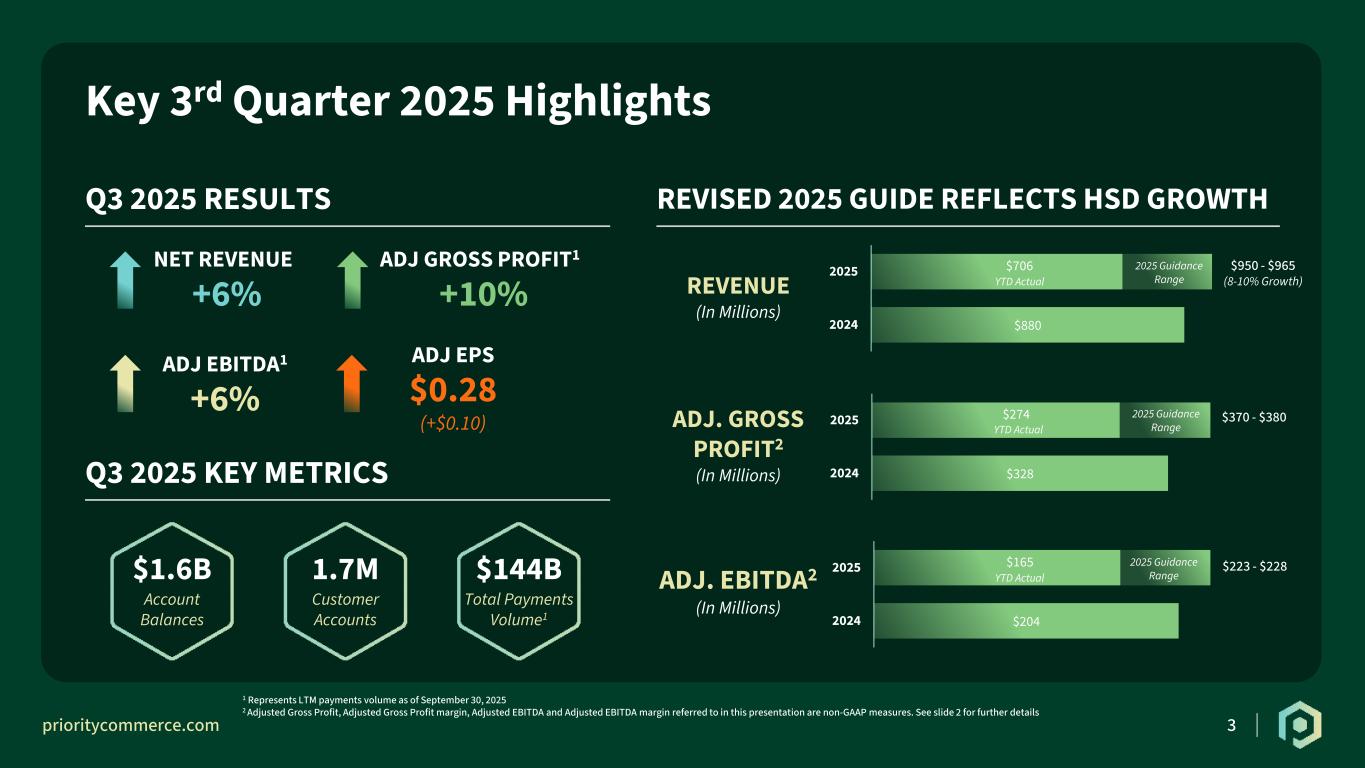
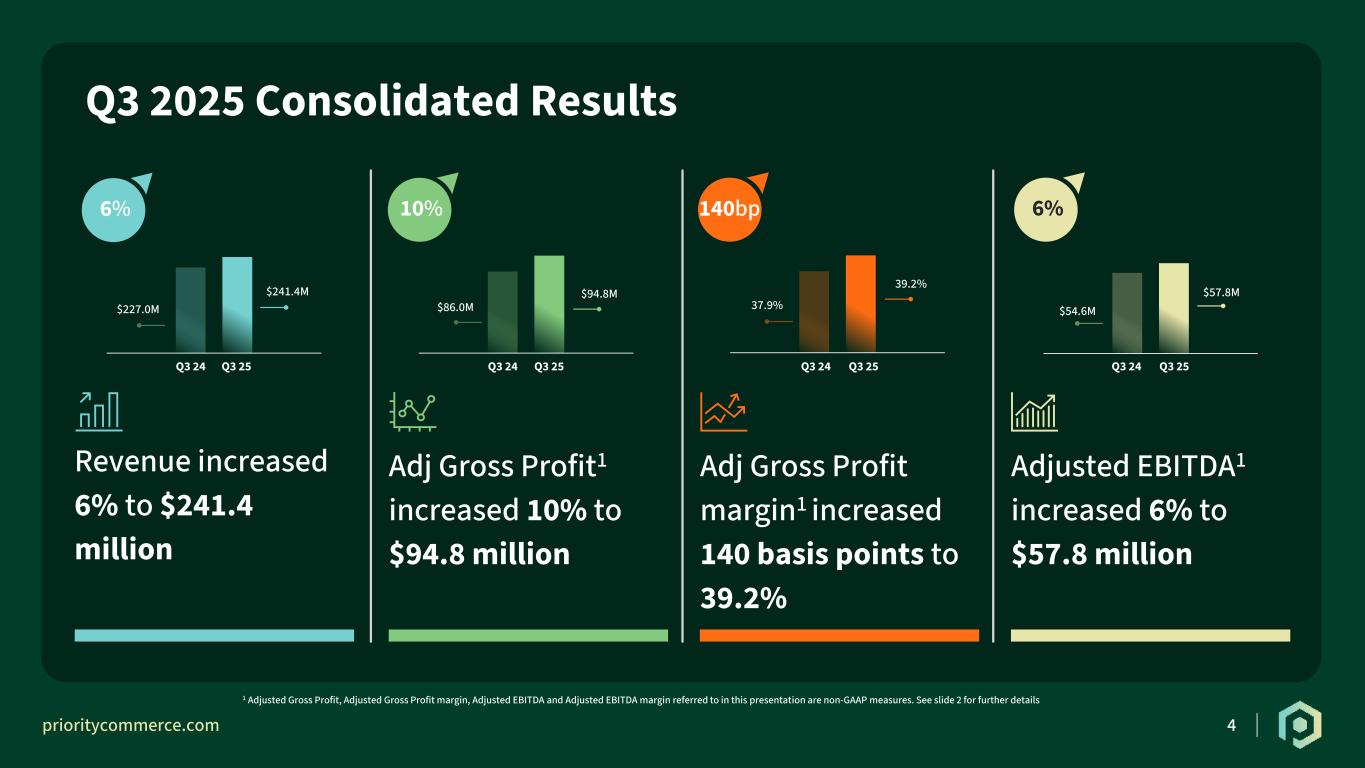
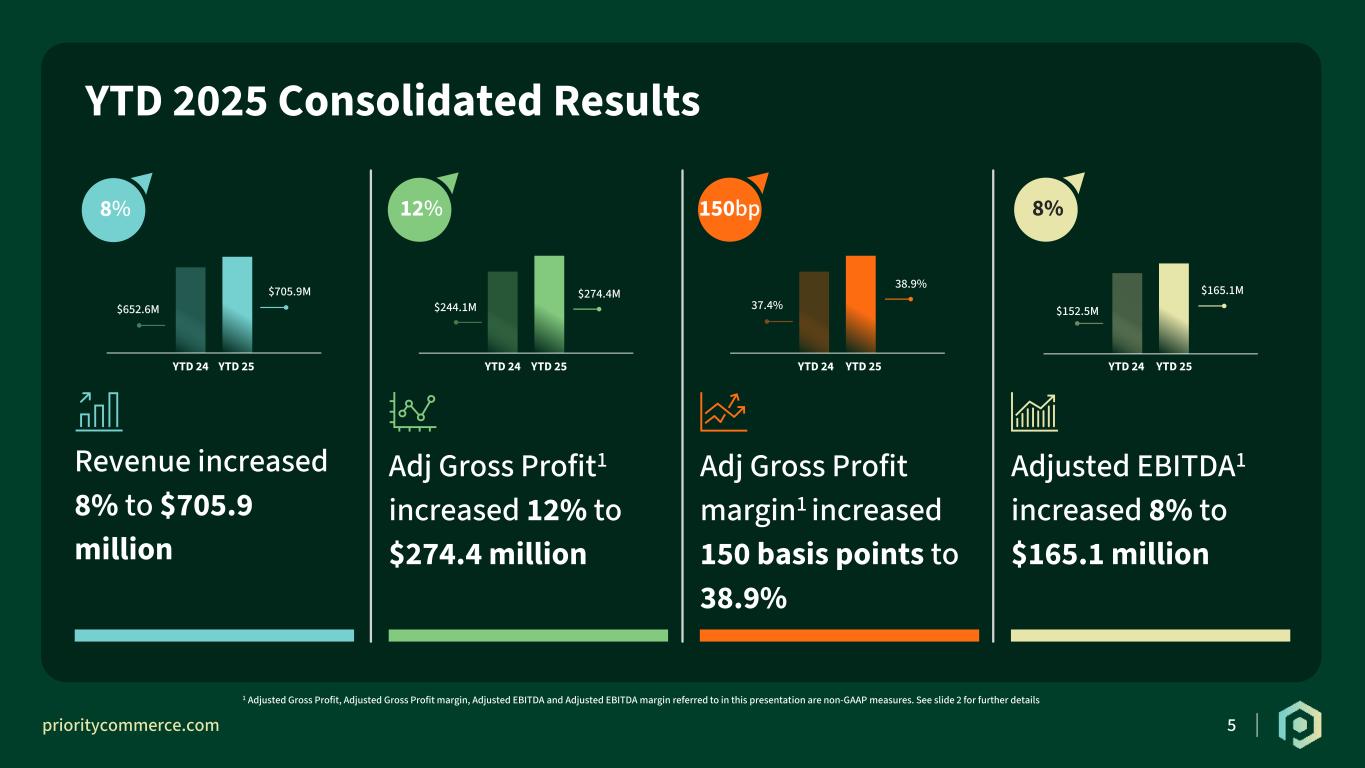
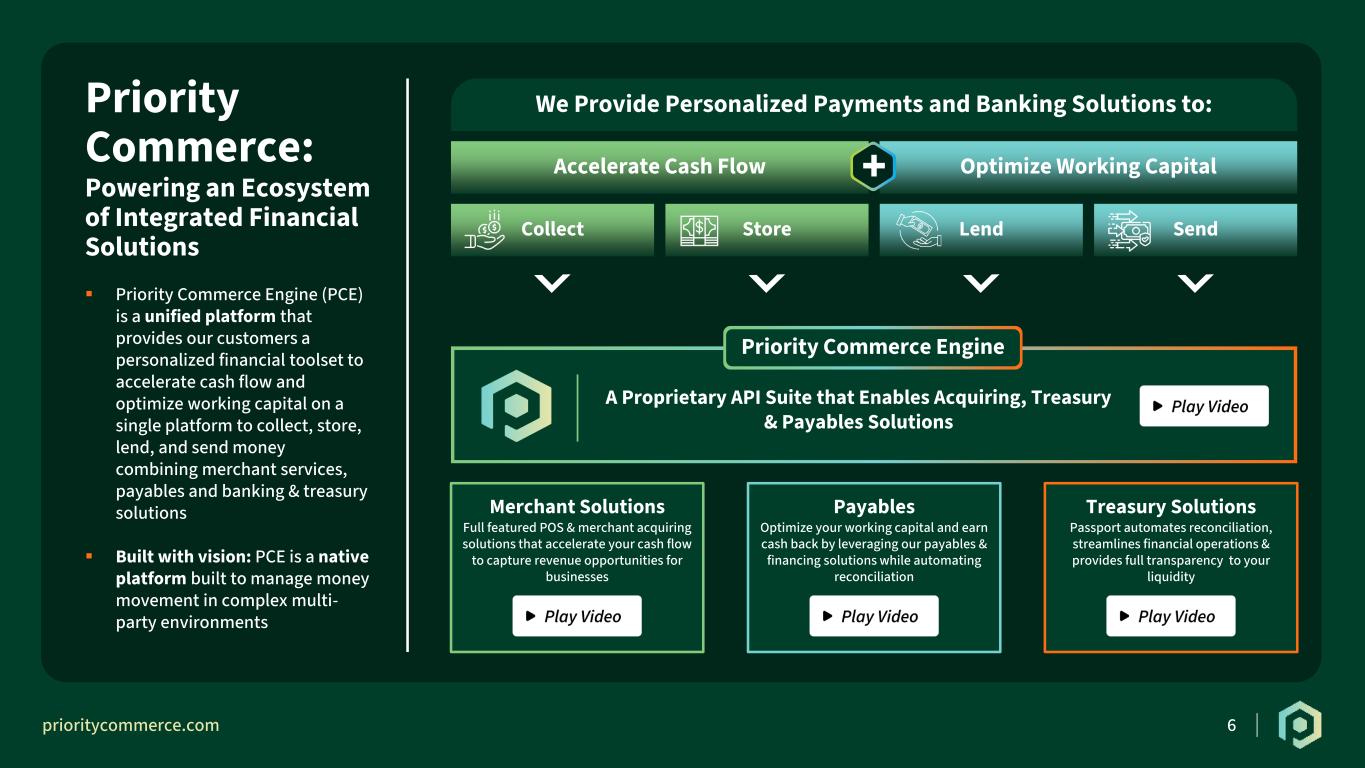
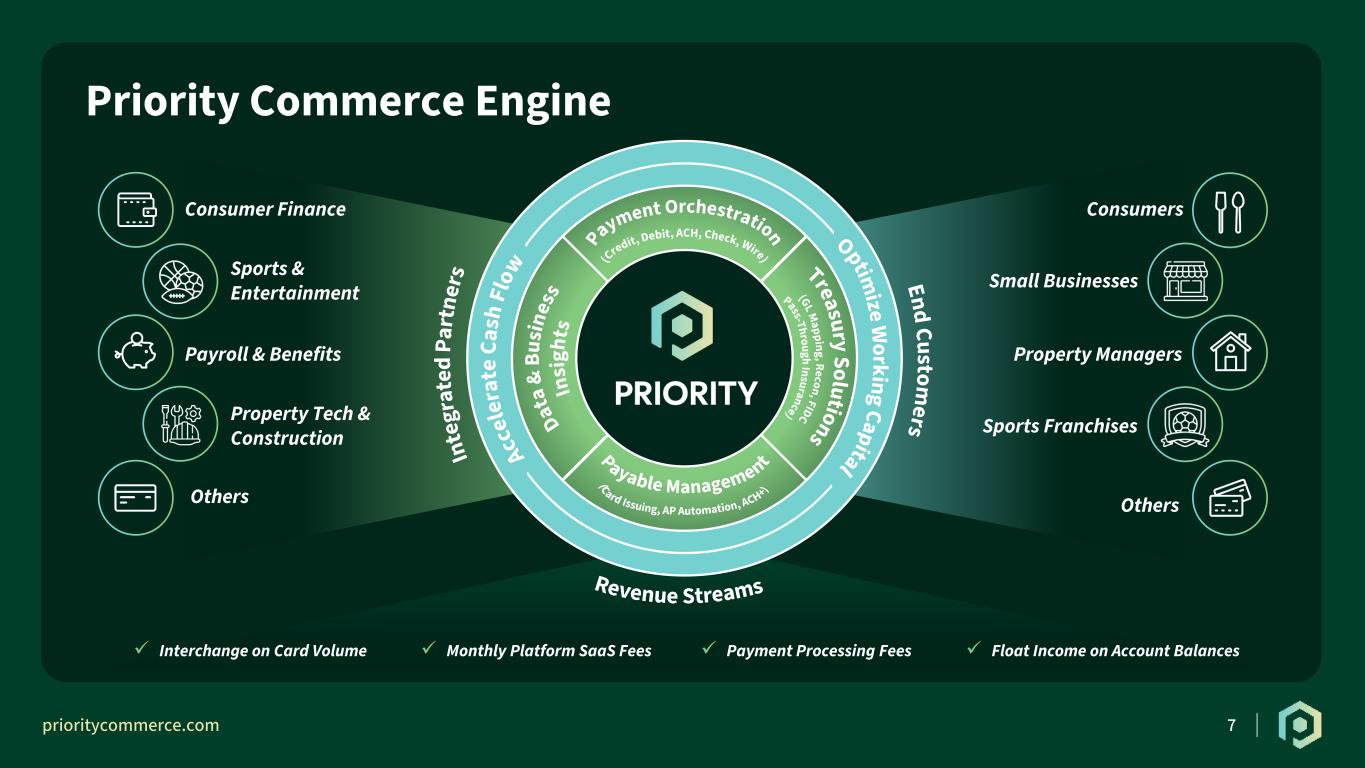
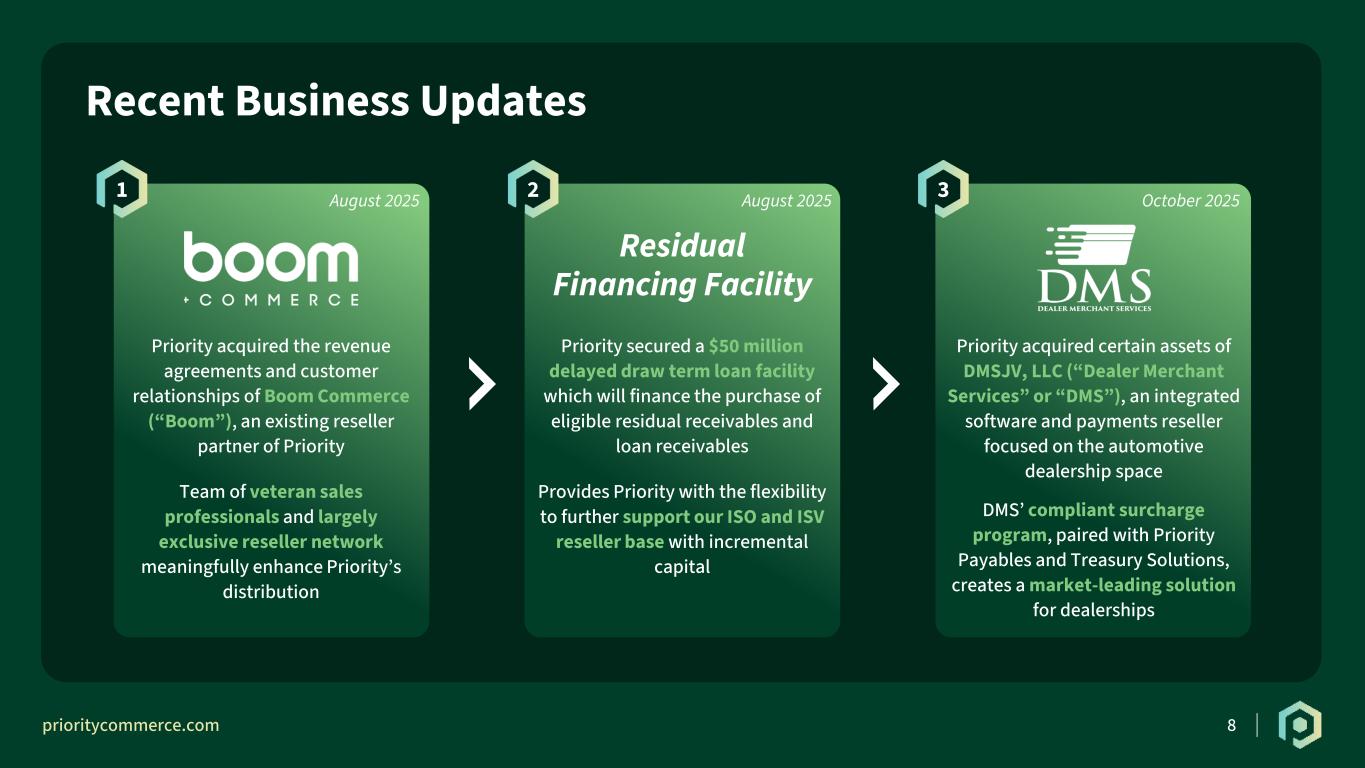
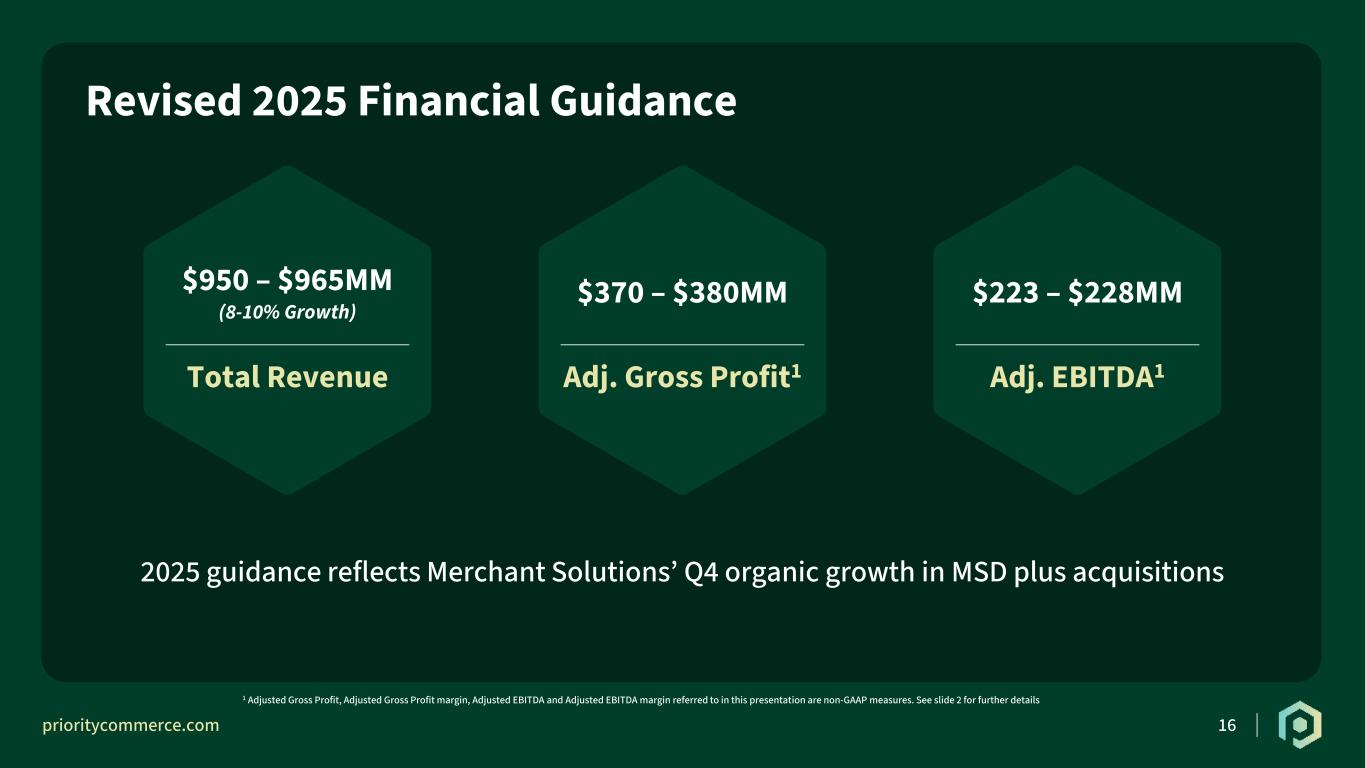
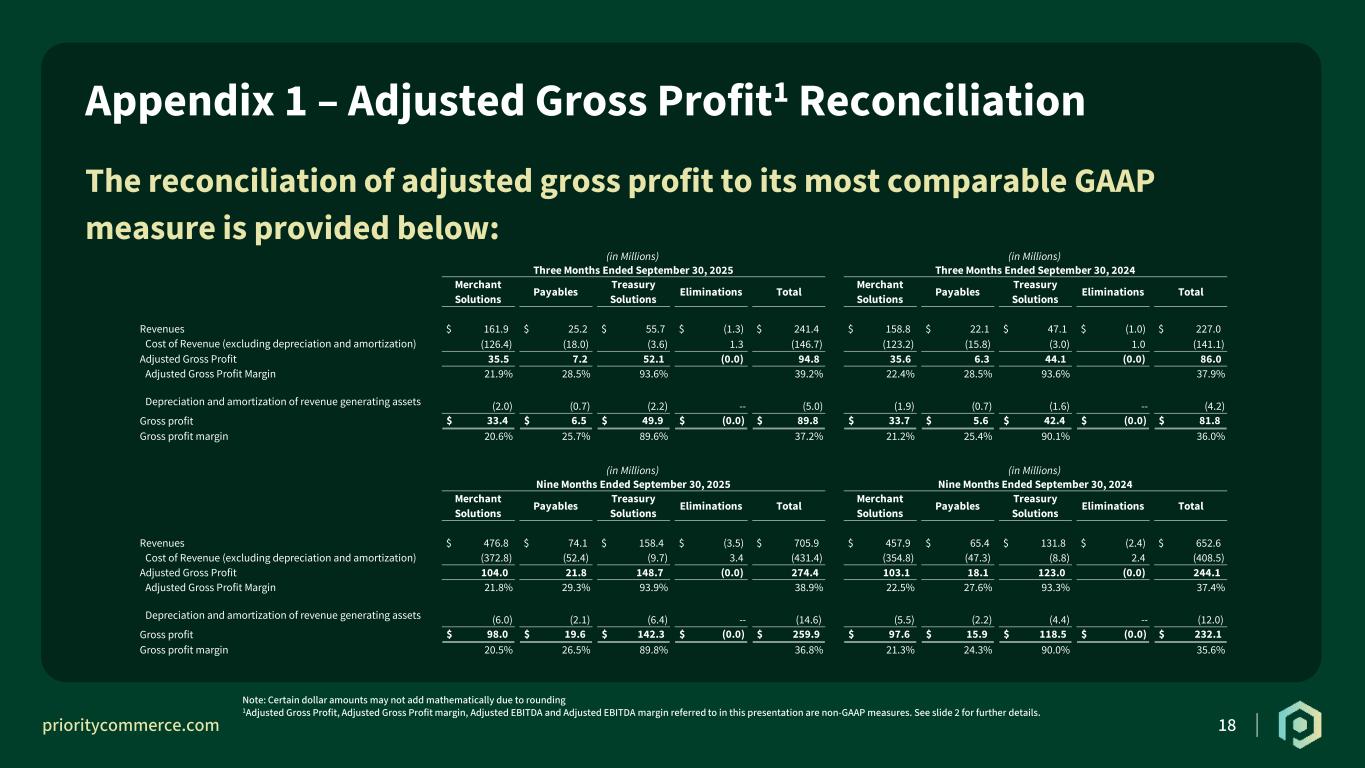
Thank you, Meghna, and thanks to everyone for joining us for our third quarter 2025 earnings call. I'll begin today's call by highlighting our aggregate performance, full-year guidance on revenue, adjusted gross profit, and adjusted EBITDA, and key strategic updates. I'll then hand the call over to Tim, who will provide segment-level performance, key trends, and developments across our business segments and priority overall. As summarized on slide three, priority grew net revenue by 6%, generated adjusted gross profit and adjusted EBITDA growth of 10% and 6% respectively, and increased adjusted EPS by $0.10, or 56% year-over-year to $0.28 in the third quarter. We ended the third quarter with over 1.7 million total customer accounts operating our e-commerce platform, up from 1.4 million at the end of last quarter. Annual transaction volume in the LTM period increased by nearly $4 billion from quarter two to $144 billion, and average account balances under administration improved by almost $200 million from the prior quarter. our largest quarterly increase to date to $1.6 billion. Certainly a solid showing for the quarter, but candidly with mixed performance at the segment level. We produce continued strong results by all key metrics within payables and treasury solutions on the strength of 14 and 18 percent revenue growth, respectively. However, growth moderated to 2 percent in our merchant solution segment as same-store sales decelerated in multiple areas. Constructively, merchant attrition remained stable, leading us to conclude that macroeconomic factors influencing spending are affecting performance and will likely persist through the remainder of the year. The result is that revenue growth we had projected of 10% to 12.5% for the full year is expected to come at the lower end of our range at 8% to 10%. The impact is a modest revision to our full year revenue guidance to $950 to $965 million, from $970 to $990 million. Importantly, however, as a result of our expanding gross profit margins, which has continued to 38.9% year-to-date, We are raising the low end of our full-year gross profit guidance from $365 million to $370 million, with the upper end remaining at $380 million, and modestly improving our full-year adjusted EBITDA guidance to $223 million to $228 million. I'd like to cover one bit of housekeeping before we dive more fully into our results. In our press release this morning, you'll note that we are now categorizing our operating segments as merchant solutions, payables, and treasury solutions, instead of SMB, B2B, and enterprise. As Priority's business mix and solutions set continues to evolve, we believe this will provide greater clarity to stakeholders about the revenue sources driving performance through our commerce platform. These categories also reflect the evolution of our client base with increasingly larger customers and a diverse set of reselling partners accessing priority for multiple features across acquiring, payables, and treasury solutions. Turning our attention to our aggregate Q3 results on slide four, revenue of $241.4 million increased 6% from the prior year. This led to a 10% increase in adjusted gross profit to $94.8 million and a 6% improvement in adjusted EBITDA to $57.8 million. Adjusted gross profit margin of 39.2 increased 140 basis points from the prior year's third quarter, reflecting the ongoing performance of our diverse, high-margin payables in Treasury solution segment. Highlighted on slide 5, our Q3 performance contributed to year-to-date revenue growth of 8% to $705.9 million, fueling a 12% increase in adjusted gross profit to $274.4 million, and an 8% improvement in adjusted EBITDA to $165.1 million, while expanding our adjusted gross profit margin by 150 basis points to 38.9%. For those of you who are new to Priority, slides six and seven highlight our vision for Connected Commerce. The Priority Commerce platform is purpose-built to streamline collecting, storing, lending, and sending money. It delivers a flexible financial tool set for merchant acquiring, payables, and treasury solutions, designed to accelerate cash flow and optimize working capital for the businesses we serve. I would encourage you to play the short one- to two-minute videos embedded in the product links on this slide to gain a deeper appreciation of why customers are consistently partnering with Priority to reach their commerce goals and why we are emerging as a go-to solution provider for embedded commerce and finance solutions. Slide 7 highlights a typical partner experience with our Commerce API's orchestration capabilities for payments management and treasury solutions. This enables partners to use a single API tailored to their specific objectives. Customers connecting via our API can access all routes for digital payments acceptance, create traditional and virtual bank accounts, issue physical and virtual debit cards, enable lockbox for checks, configure single vendor and advanced bulk vendor payment programs, and many other commerce options at their own pace. In the third quarter alone, we contracted with new enterprise ISV partners in hospitality, marina infrastructure management, construction supply, class action administration, and mortgage lending with over $10 billion in incremental annual transaction volume to harvest, while continuing to expand our success in sports entertainment, automotive, property management, and payroll and benefits. Given our expanding customer base and segments, our commerce platform creates two important benefits for priorities long-term. First, it enables our partners to develop their offering to seize new opportunities and respond to emerging trends as we add features and embedded solutions. Both parties maintain clear visibility into quantifiable revenue growth opportunities, building customer confidence and driving mutual success. And second, by standardizing operational workflows across diverse industry segments where money movement is critical to the value chain, we can identify and refine key operational metrics in compliance, payment operations, risk, and application support. This enables us to scale efficiently, maintain cost discipline, and ultimately improve profitability. This vision explains why we've been able to evolve priority into a consistently high-performing payments and banking financial technology company with strong recurring revenue prospects. Our customers and current market conditions reinforce our belief that systems connecting payments and treasury solutions to accept and distribute funds in multi-party environments will be critical as businesses put greater demands on software and payment solution providers to deliver a full suite of core business services on a single relationship. we're committed to meeting our customers where they are by curating the experience for our partners to make working with priority seamless and easy before we move on to a detailed segment level performance review i want to highlight a few key investments during q3 on page eight namely our acquisitions of boom commerce and dealer merchant services and the launch of our residual financing facility to power growth in ISO and ISV partnerships. The boom transaction adds veteran sales depth with exclusive distribution partnerships, expanding our West Coast capabilities, while the addition of the DMS team will underpin our strategy to lean into the future of automotive commerce with vertically focused distribution and integrated payments, treasury, and payable solutions to this steadily growing and historically defensive area of consumer spending. Last, our launch of the residual financing facility helps us put fuel in the tank of our ISO and ISV partners to grow their customer base on our commerce platform. At this point, I'd like to hand it over to Tim, who'll provide further insights into the health of our business the segments, along with current trends in each, that factored into our third quarter results and confidence for sustained performance through the end of 2025.
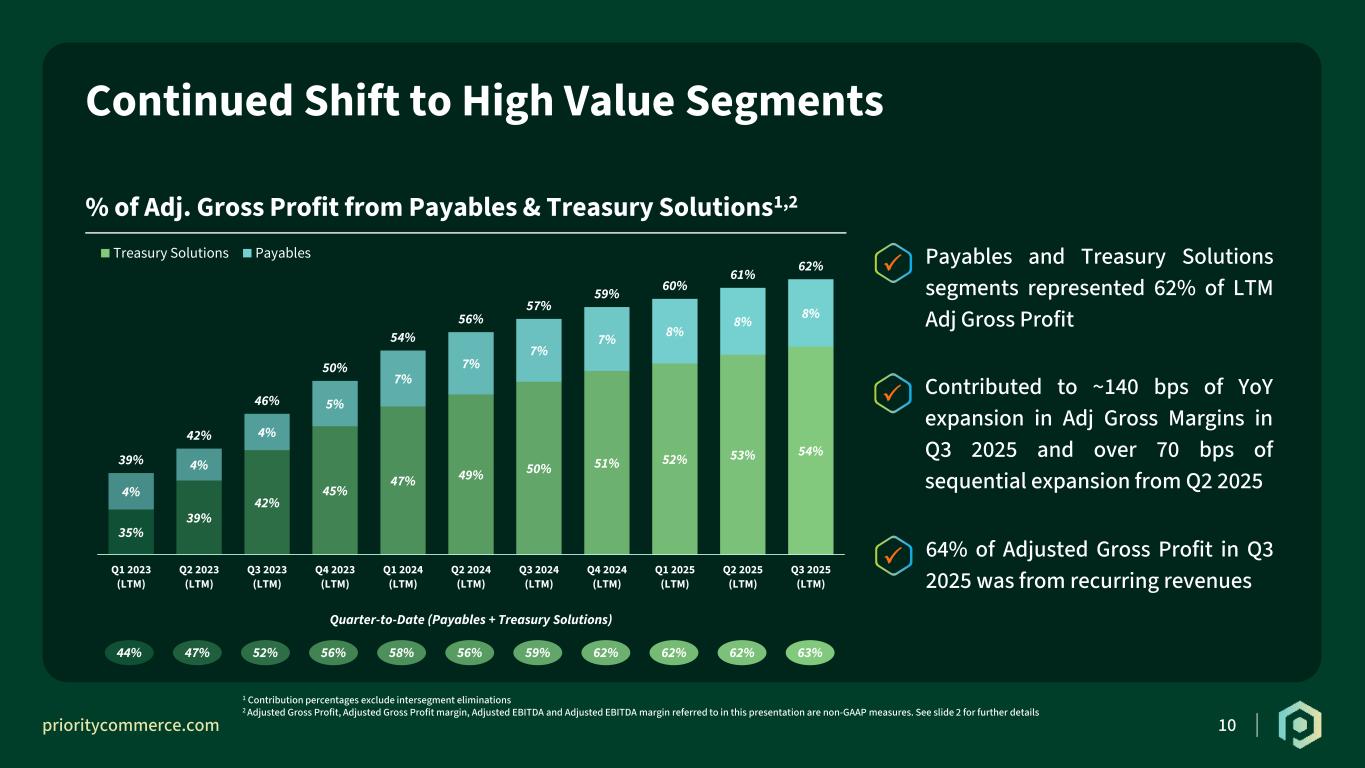
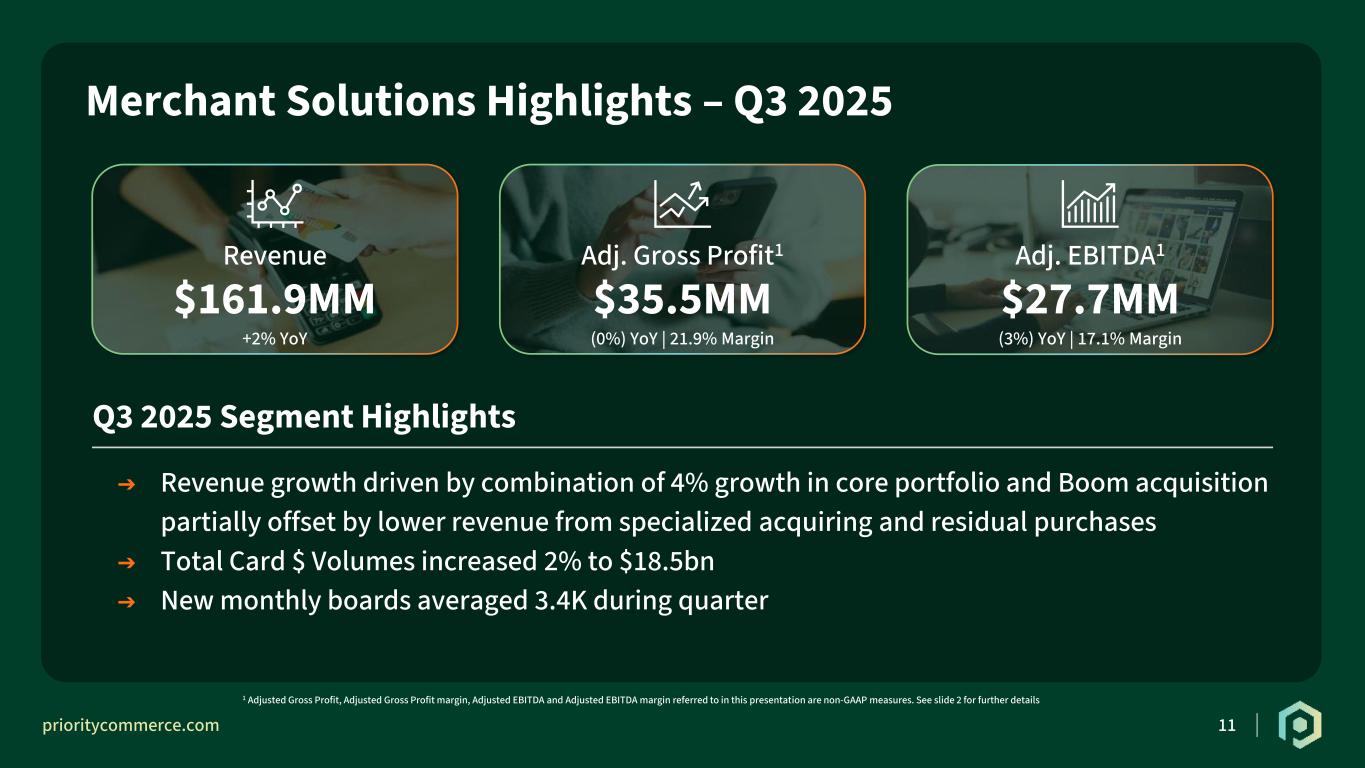
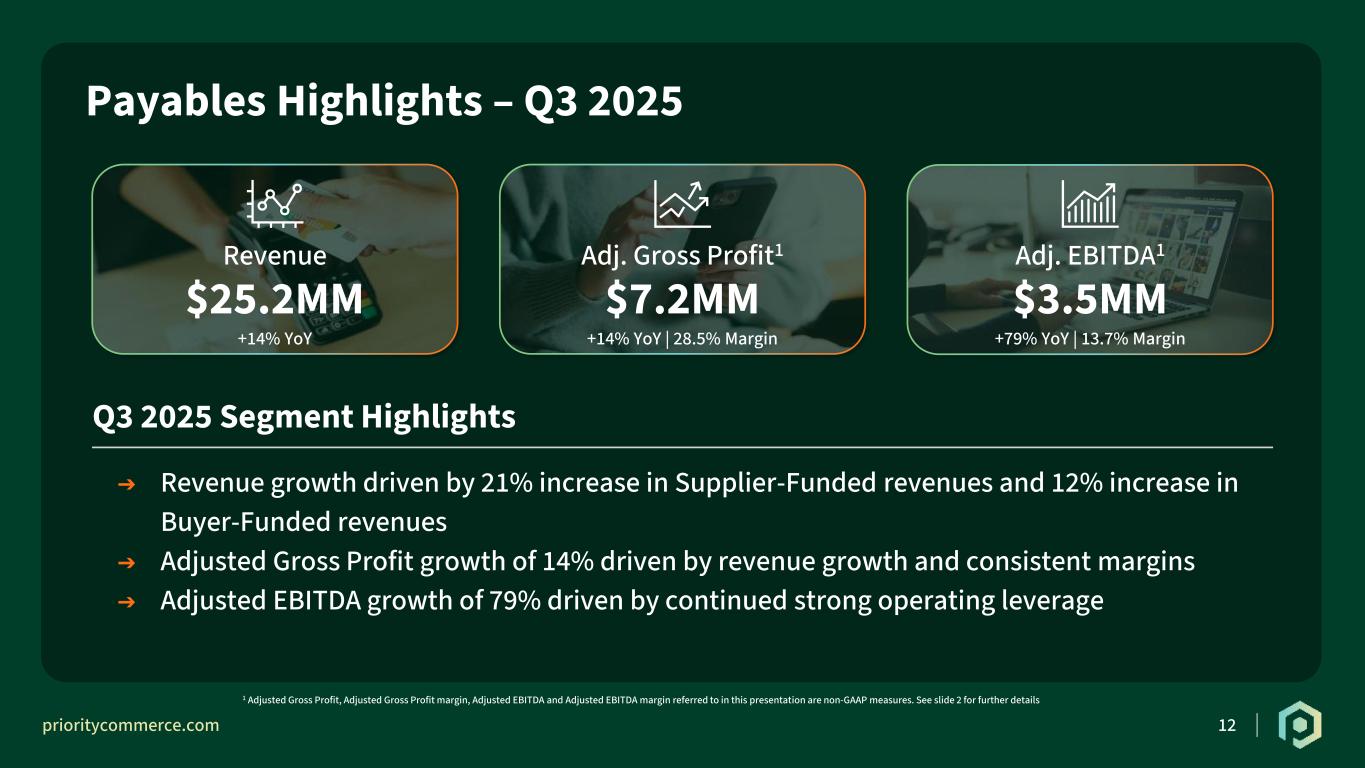
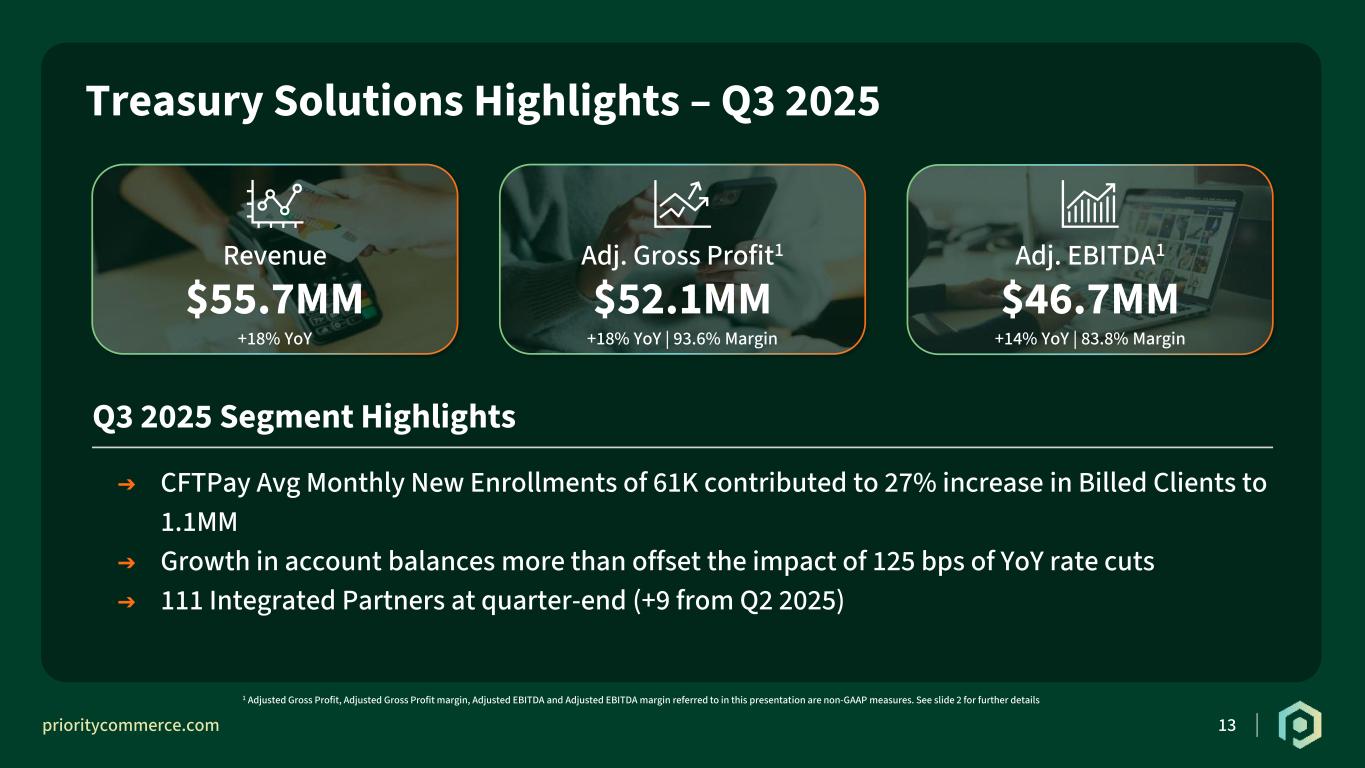
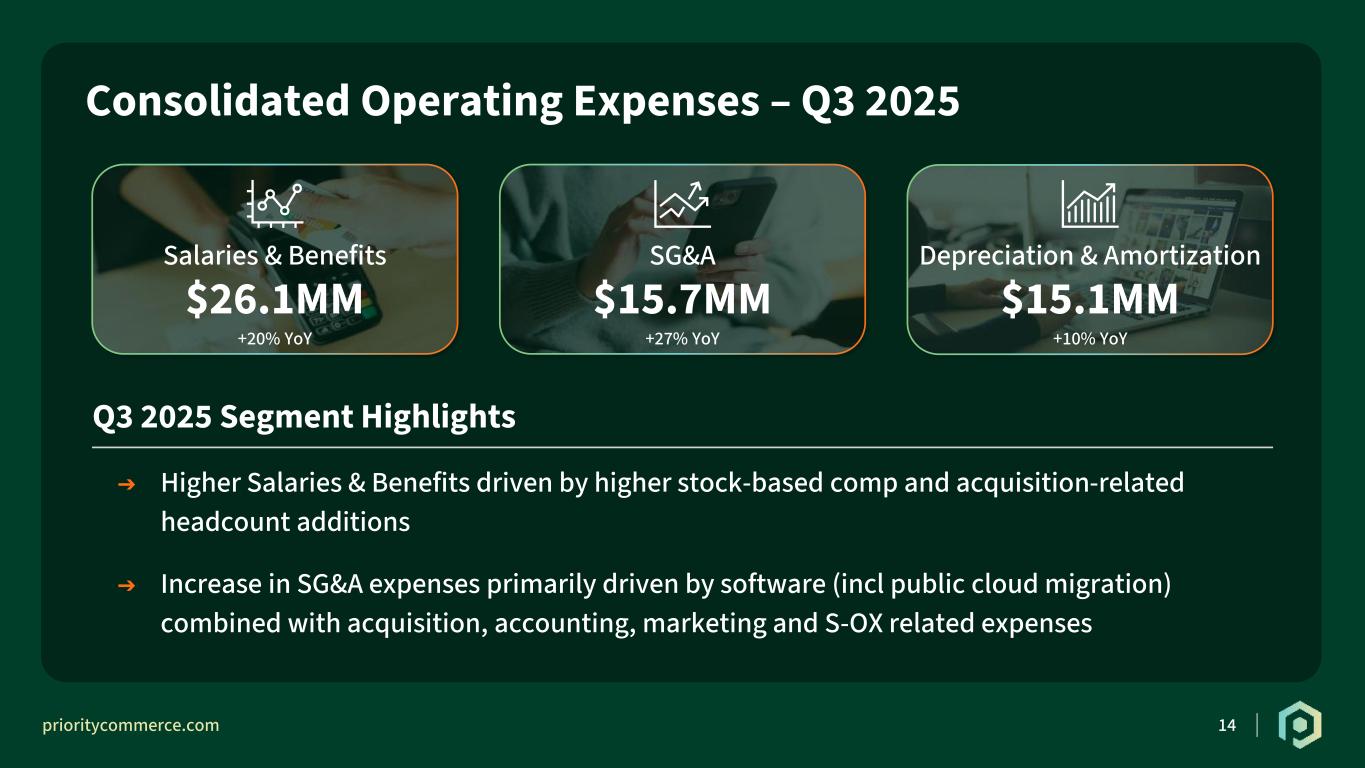
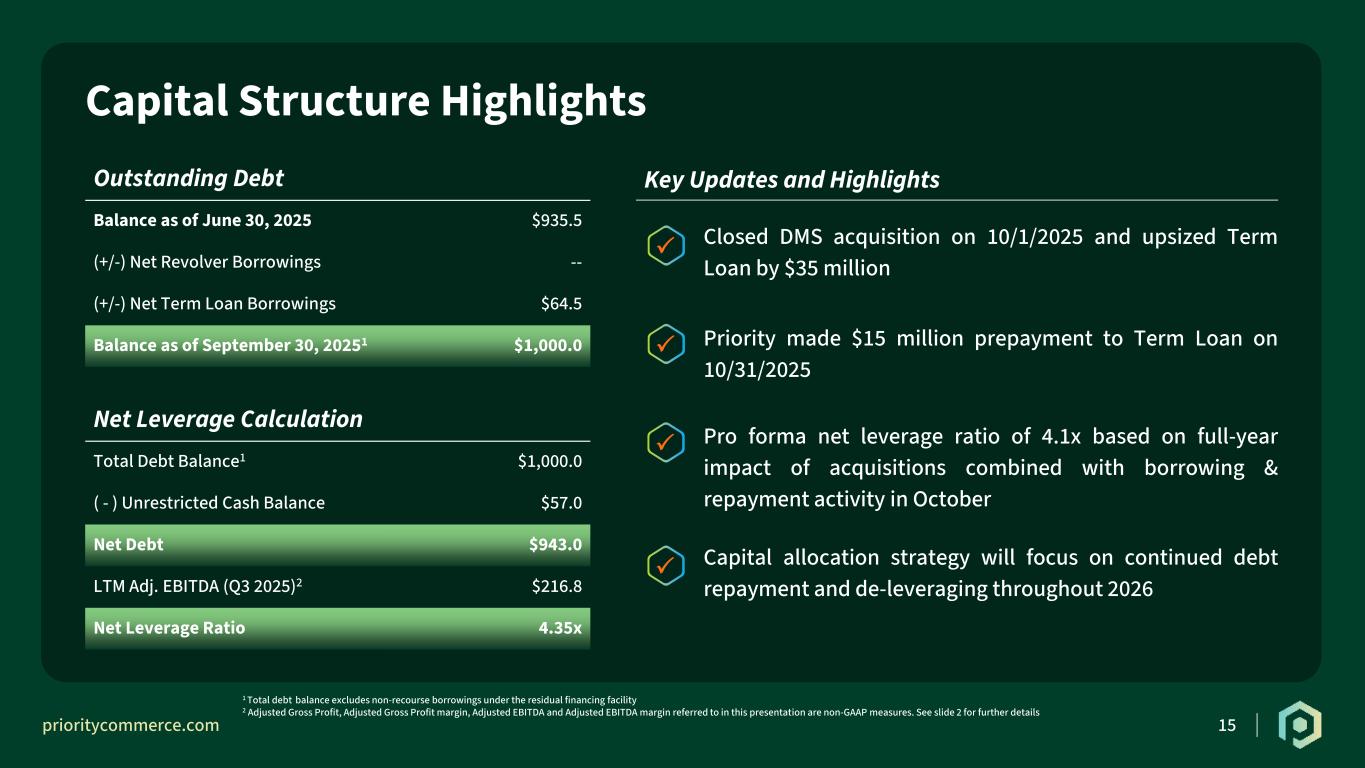
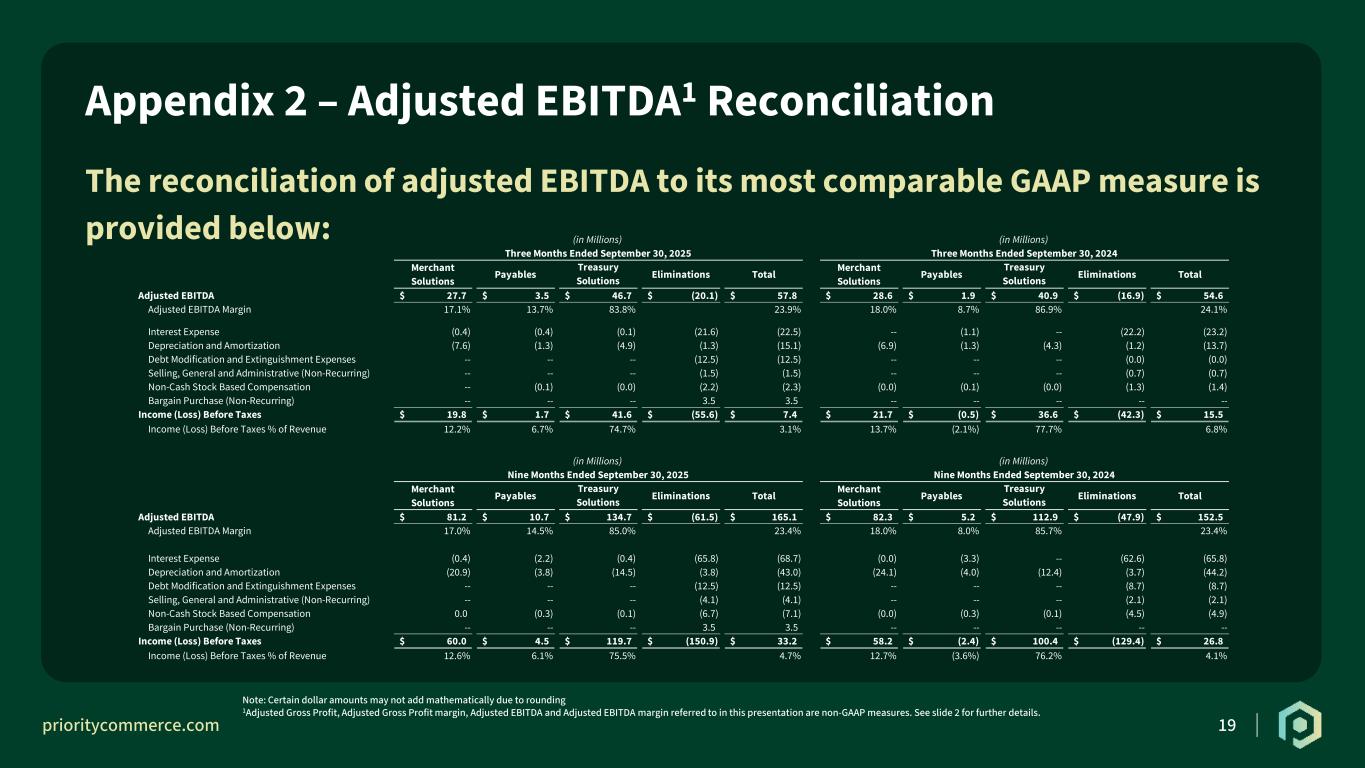
Thank you, Tom, and good morning, everyone. I'll start on slide 10. As Tom mentioned, we had solid overall financial performance in the third quarter that benefited from the diversification of our platform as strong growth in our higher margin payables and treasury solution segments offset the impact of slower growth in our merchant solution segment this quarter. The strong 14 and 18 percent growth, respectively, in payables and treasury solutions allowed for overall margin expansion as adjusted gross profit margins improved by nearly 140 basis points from Q3 last year and over 70 basis points sequentially from Q2 this year. Consistent growth from our payables and treasury solution segments also resulted in the continued favorable shift in priorities gross profit mix. For the quarter, payables and treasury solutions comprised nearly 63% of adjusted gross profit. If you evaluate that same metric on a trailing 12-month basis, payables and treasury solutions contributed over 62% of gross profit for the 12-month's end of September 30th, which represents a 23 percentage point increase from the beginning of 2023. This trend, which you can clearly see on the page here, is highly indicative of our commitment to investing in higher growth, higher margin operating segments, which will expand priorities, total addressable market, and in turn, enhance shareholder value. As noted on prior calls, the continued shift in our business mix also helps enhance the highly visible and recurring nature of our business model. During the quarter, over 64% of adjusted gross profit came from recurring revenues that are not dependent on transaction counts or card volumes, which compares to just under 60% in Q3 of last year. Moving now to the segment-level results and starting with Merchant Solutions on slide 11, Merchant Solutions generated Q3 revenue of $161.9 million, which is $3.1 million or 2% higher than last year's third quarter. Revenue growth was a combination of 4% growth in the core portfolio combined with just over $1 million of revenue in the quarter from the Boom Commerce acquisition, partially offset by lower revenue from both specialized acquiring and historical residual purchases. As expected, those headwinds moderated in Q3 compared to the first half of the year, but will continue into Q4. Lower growth in the core portfolio compared to first half of the year was largely attributable to a pullback in consumer spend within a few industry verticals, including restaurants, construction, and wholesale trade. Total card volume was $18.5 billion for the quarter, which is up 2.2% from the prior year. From a merchant standpoint, we averaged 179,000 accounts during the quarter, which is up from 178,000 last year, while new monthly boards averaged 3,400 during the quarter. Adjusted gross profit for the second quarter was $35.5 million, which is consistent with Q3 of last year. Gross margins of 21.9% are 50 basis points lower than the comparable quarter last year, largely attributable to lower revenue from both specialized acquiring and historical residual purchases. Lastly, adjusted EBITDA was $27.7 million, which is down $900,000, or 3.2% from last year, due to increased salaries and benefits and elevated software expenses related to the previously discussed cloud migration. Moving to the payable segment, revenue of $25.2 million was 13.6% higher than Q3 of last year and sequentially increased from $25 million in Q2. Our buyer-funded revenues grew 11.8% year-over-year to $20 million, while supplier-funded revenues grew 21.3% year-over-year to $5.1 million. Adjusted gross profit was $7.2 million in the quarter, which is a 13.6% increase over the prior year, For the quarter, gross margins were 28.5%, which is consistent with last year's comparable quarter. The payable segment contributed $3.5 million of adjusted EBITDA during the quarter, which was a $1.5 million, or 79%, year-over-year increase. The acceleration of adjusted EBITDA growth compared to revenue and adjusted gross profit was driven by strong operating leverage in the segment, including a 12.5% year-over-year reduction in operating expenses before DNA. To the Treasury solution segment, Q3 revenue of $55.7 million was an increase of $8.6 million, or 18.2%, over the prior year. Revenue growth was driven by continued strong enrollment trends and an increase in the number of billed clients enrolled in CFTPay, combined with an increase in the number of integrated partners and organic same-store sales growth from existing Passport program managers. Higher account balances in both CFT Pay and Passport were able to more than offset the impact of lower interest rates in the quarter compared to Q3 of last year. As a result of those factors, adjusted gross profit for the segment increased by 18.3% to $52.1 million, while adjusted gross profit margins remained strong at 93.6% for the quarter. Adjusted EBITDA for the quarter was $46.7 million, an increase of $5.7 million, or 14% year-over-year. Overall profitability in Treasury solutions was driven by consistent and strong high-teens revenue growth in CFT pay, combined with 100% revenue growth in Passport, which offset investments we continue to make in newer vertical software assets within Priority Tech Ventures. While many of these investments are still scaling, we view them as highly compelling opportunities to enhance Priority's already comprehensive product suite and expand further into new and existing markets, including construction, payroll and benefits, asset management, and sports and entertainment, including the NIL marketplace. Moving to consolidated operating expenses, salaries and benefits of $26.1 million increased by $4.4 million, or 20.2%, compared to Q3 of last year, but declined by $1 million when compared sequentially to Q2. The year-over-year increase was primarily driven by higher non-cash stock compensation expense, along with increased headcount from organic growth combined with acquisition-related activity. SG&A of $15.7 million increased by $3.3 million, or 26.7 percent compared to Q3 of last year, as a result of increased accounting and SOX-related expenses, along with higher legal, marketing, and software expenses. Now I'd like to take a moment to discuss our capital structure. Debt at the end of the quarter was $1 billion, and we ended the quarter with $157 million of available equity, including all $100 million of borrowing capacity available under a revolving credit facility, and $57 million of unrestricted cash on the balance sheet. As Tom noted earlier, we closed the new $50 million residual financing facility during the quarter, and we also refinanced our broadly syndicated term loan on more favorable terms. The residual financing is a securitization-style structure, and it is non-recourse to priority, which is why the outstanding balance of $23 million at quarter end is not reported in the totals you see on this page. Subsequent to quarter end, we upsized the $1 billion term loan by $35 million to finance the cash portion of the DMS acquisition, but as highlighted in our press release this morning, I'm pleased to reiterate that we made a $15 million prepayment to the term loan at the end of October. While the total quantum of our debt has increased this year due to acquisitions and the acceleration of certain deferred consideration related to the plastic acquisition, we've applied $25 million of prepayments to the term loan this year between $10 million and Q1, combined with the $15 million payment last week. Given strong free cash flow generation, we expect to continue to apply excess cash to debt reduction throughout 2026. With respect to free cash flow, we generated $29 million of free cash flow in the quarter based on adjusted EBITDA of approximately $58 million, minus $6 million of capital expenditures, $21.5 million in cash interest expense, and just under $1 million in cash taxes. On a year-to-date basis, that same metric totals $71 million. If you were to annualize that figure to $95 million and look at it on a per-share basis, we generate $1.17 of free cash flow per share, which I know is a metric that many investors have referenced in our prior discussions. For the LTM period, end of September 30th, adjusted EBITDA of $216.8 million represents $3.1 million of sequential quarterly growth from $213.7 million at the end of Q2. This growth in adjusted EBITDA combined with net debt of $943 million resulted in net leverage of 4.35 times at quarter end, which is up from 4.1 times at the end of Q2 due to acquisition activity and a partial quarter of acquired EBITDA benefit. If you were to recalculate leverage on a pro forma basis for a full year effect of the boom in DMS acquisitions and related balance sheet activity, net leverage would be 4.1 times, which is neutral to where we finished Q2. We will continue to evaluate opportunities to acquire strategic assets that provide priority with higher margin vertically focused sales channels, but debt reduction on both the dollar basis and the leverage ratio are focus areas for 2026. Moving to slide 16 and our revised financial guidance, we have adjusted our full-year revenue guidance to reflect the year-to-date results combined with our most up-to-date outlook for Q4. The revised revenue range of $950 to $965 million implies an 8% to 10% full-year growth rate and is reflective of mid-single-digit organic revenue growth in our merchant solutions segment for Q4. Despite lower revenue growth expectations for the full year, we have raised the low end of adjusted gross profit range by $5 million to $370 million, with the upper end remaining at $380 million. Adjusted EBITDA is expected to range from $223 to $228 million, which is up slightly from prior guidance of $222.5 to $227.5 million. The revised full-year guidance is inclusive of approximately $6 million of adjusted EBITDA related to acquisitions. While there is certainly some impact to adjusted EBITDA from lower revenue growth in merchant solutions, the full year guide is also reflective of continued investment in priority tech ventures. Lastly, we will provide more details related to our 2026 outlook during our fourth quarter earnings call, but preliminary expectations are for high single-digit revenue growth with adjusted gross margins expanding by 75 to 100 basis points or more. With that, I'll now turn the call back over to Tom for his closing and comments.
Thank you, Tim. Before concluding, I want to offer perspective on what it means to grow. In aggregate, Q3 was not among our best performing quarters purely as a measure of economic growth, despite the strong performance in our payables and treasury solution segments. But make no mistake, our third quarter was one of intense internal growth that has set critical foundations for developing and increasing enterprise value. During the quarter, we activated card acquiring in Canada, added real-time payment capabilities, and implemented a unique financing source to fuel our partner's growth. Additionally, we reduced our borrowing costs by 100 basis points, executed two accretive acquisitions without impacting net leverage, and generated free cash flow to pay down $15 million of debt, all while continuing to refine our operational muscle by integrating a host of ISV and enterprise customers on our commerce platform with addressable annual transaction volume of over $10 billion to capture in the coming months and adding more incremental deposits under administration, nearly $200 million, than in any other quarter in our history. While the scoreboard may not reflect it yet, we were busy grinding out wins each day that underscore how we are built with intention for the long term and built to last. It's why, since becoming publicly listed in 2018 through challenging periods, we have produced compound annual adjusted EBITDA growth of 18%. We will continue to curate Priority's commerce offering by connecting payments and treasury solutions on a single platform that centralizes all money movement at scale for our partners, allowing us to expand our portfolio of core business applications and addressable market segments to continue to deliver stable free cash flow and long-term shareholder value. As always, I want to thank all my colleagues at Priority who continue to work incredibly hard to deliver results. Your commitment and dedication to improving everything we do is clear, providing our partners and customers with a constant reminder that they made the right choice to partner with Priority. Last, we continue to appreciate the ongoing support of our investors and analysts. And for those in attendance who are new to priority, for taking the time to participate in today's call. Operator, we now like to open the call for questions.
Operator
We will now begin the question and answer session. To ask a question, you may press star then 1 on your telephone keypad. If you are using a speakerphone, please pick up your handset before pressing the keys. To withdraw your question, please press star then 2. At this time, we will pause momentarily to assemble the roster. And our first question will come from Hal Gost of B. Riley Securities. Please go ahead.
Hey, thank you, guys. Hey, thanks for – it's a good idea to reclassify these segments into Treasury. The different three segments you've renamed, I think that reflects what they do, and I appreciate that. But I just wanted to ask about, you know, given you reported Q2 in the, you know, August time period and there's been some same-store sales weakness, when did you start seeing that? I mean, another company called Shift 4 Payments mentioned the difficult same-store sales for restaurants as well. But, you know, what did you start seeing? Could you go over some of the segments you saw some weakness in? That's my first question.
Thanks for the question and the feedback on the segment names. Yeah, we started seeing some of that in August, and it certainly accelerated in September as we look across all the different verticals, you know, for the merchant solutions business. You know, there were a handful that definitely saw a trend line that was, you know, against us. It was relatively broad-based, though, but the ones we called out, you know, restaurants, construction, wholesale trade, were the ones that were a little bit even more onerous, you know, at the tail end of the quarter. There, you know, there were others that were down slightly, but, you know, not as much of an impact, you know, things like education and some other verticals. But, you know, we really started seeing it in August, and then that accelerated into September.
And you mentioned, like, some of the residuals. What was the impact of, you know, the merchant attrition was decent. Monthly ads were still really good. What were some of those other components that if you clarify what they mean and how long the impact will be from those? I think you mentioned some residuals and impacts. What were those again?
Yes, yes. So I was referencing lower revenue in the quarter from specialized acquiring, which we've talked about the last couple of quarters, given some of the dynamics in that end market, and then historical residual purchases. And not to rehash a lot of the nuances there, but we had done some larger residual purchases back in 2021, but from a capital allocation strategy, you know, the last few years we've been focused on deleveraging and taking out the preferred equity. So we haven't done a lot of additional residual buybacks. So those older portfolios, as they start to run off over time, that presents a headwind and you're running off effectively what is 100% margin because you bought back those residuals from the resellers. So that headwind has continued, you know, combined, you know, those two things had about a $2 million impact, you know, on the quarter, on a year-over-year basis. That's down from what it was in the first two quarters of the year where we talked about, you know, a more onerous headwind where that was, you know, $4.5 million or so. So, it's come down, which we expected it to moderate. We'll see another consistent, you know, type of headwind in Q4, but definitely less than we saw in the first half of the year.
Okay. Hey, Hal, just one One other point, which I think is important to reference, on the residual base question you have, one of the major drivers of putting together the financing facility that we have, it's non-recourse. Is that, I mean, really that positions us in our space. There's no one else who has something like this. That will enable us to, instead of having that financing be, you know, at the holdco level, we now have it at the facility level that's non-recourse, but gives us, that's a place where we'll buy those residuals. We will make other, you know, lending facilities to our ISV and ISO partners to put gas in their tank to supercharge their marketing, to do development. It will, you know, help them accelerate adoption on their products. So it's a very, very valuable facility that you will see reflected in that way going forward. And it will help us really not have that drag that, you know, Tim just alluded to.
I have one follow-up on that. This has been a real building year, an investment year. And I look at that based on maybe where, you know, maybe even the dollar increase in salaries and employee benefits. We've got a couple acquisitions. It's a cost of living. But it looks to be like a pretty solid dollar increase year over year in salaries and benefits. Will there be a moderation of that, maybe, based on the investment you spent this year going into 2026? I know you gave some initial sales commentary and gross profit margin guidance commentary, but give us a thought about, you know, some of the expense items that trajectories exiting 2025 into 2026. Thanks.
Yeah, so a lot of the increase was driven by acquisitions, right? So you go back and think about the acquisitions late last year with our payroll platform, the very beginning of this year with the lettuce business up in Canada. So we had a couple acquisitions that we haven't anniversary yet, so that's part of the increase. Benefit costs are also certainly higher, and we're going to see the same impact next year with health care premiums going up. And then there was also a, you know, a meaningful component of an increase which was non-cash related to, you know, stock comp and some mark-to-markets on long-term incentive plans. So a lot of it was, you know, non-cash, but, you know, definitely acquisition-related. In addition to, on the SG&A side, you had some of the increased, you know, software and public cloud expenses that we expected, and we'll continue to see some of that growth. But I think this is a, you know, a good run rate to think about going into next year, And we actually, we were down a million dollars from Q2, right? So we've actually continued to be very disciplined about the actual, you know, salary and benefits we have in the organization. But, you know, some of the acquisitions certainly added to that.
Operator
The next question comes from Jacob Stefan of Lake Street Capital Markets. Please go ahead.
Hey, good morning, guys. Appreciate you taking the questions. Just kind of first, you know, asking on the guidance as well. You know, some of these, the construction vertical, the, you know, the restaurants and wholesale trade, maybe can you kind of help us think through, you know, what potentially that represents as a whole of merchant solutions?
Yeah, so the restaurant sector for us, we still feel like we're underweight in that vertical compared to the broader market, but it's mid-teens, you know, high teens, 16%, 17% of our volume. You know, construction is in the mid-single digits from a percentage basis points. Wholesale trade is comparable to me, a little bit higher than that. But again, some of the slowdown we saw from same-store sales standpoint was broad-based. So those verticals were probably impacted a little bit more, but it was, you know, across a lot of the different end markets that we service.
And I know we talked a little bit about, you know, maybe potentially opening up a greater risk profile in the portfolio, but has this kind of shifted that thought process at all?
I don't know if we're looking to increase the risk profile. I think we managed that very effectively. I think we had pared back some of the risk earlier in the year, given some of the changes in the end market and some of the network regulations and getting in front of that to create some headroom. But we're not looking to increase the risk across the portfolio. I think we're generally a low-risk portfolio, and where we do play in the specialized acquiring segment, We're very disappointed about how we approach that from a risk standpoint.
Maybe one other point on that. And I'll point to the acquisition. We have a thesis around the future of automotive commerce. And the acquisition of DMS is a, you know, I wouldn't call it a first step. I'll just call it an evolution of sort of what we built in preparation of, you know, of really leaning into that segment. So where that kind of reflects the risk side is, say, we're looking at industries I would consider more defensive. In the auto segment, sales are slowing. They're moderating for sure. And what that typically means, and you're seeing this in the stats, is people own their cars longer, even if it's a pre-owned, you know, environment. It's just the cars are around longer, which means more service. So, leaning into that narrative and, you know, when sales go down, service goes up. So, you know, we really like the defensive nature of that. We're going to lean into that. we have some really good partners in addition to what we you know acquired with dms um so um those are those are sort of the types of strategies where you know we're going to lean into because we think they make tremendous sense just from a addressable market and the nature of of you know of the cash flow um they they're very stable um and they actually when the economy maybe isn't as great they they tend to go up so um we're looking for other segments you know we're examining other strategies and segments like that um you know tim alluded to this as well um you know our benefit costs are going up um there's a lot of controversy around affordable care and how that's all changing well um well we're leaning into payroll and benefits That's just a place to be because the money, we are fundamentally a commerce engine designed to move money through systems of commerce. Certainly, you know, card acquiring is one of them, but I can't underscore this enough. Two-thirds of our gross profit is coming from segments outside of requiring. That's not accidental. So as we lean into these segments that just are defensive in nature, getting into the benefit segment, getting into things like auto, like that's how you create, you know, stable cash flows to really reward our investors for, you know, thinking over the long term. So I just invite everyone to examine those conditions and where we're positioned because we have very good cost basis entering these markets and a lot of, you know, upside optionality to win.
Yeah, understood. And obviously, you know, we see that reflected in the guidance with, you know, both profit metrics actually moving up. So, let me ask this question. So, you know, there's a $15 million kind of delta on the revenue line with, you know, we're essentially almost halfway through Q4 here. You know, what are really the puts and takes that kind of get you to the high end versus, you know, where we might be at $950 for the full year?
So, I'll say, I'm going to ask Tim to follow up on this, but look, I'm going to just talk about our pipeline. And, you know, Tim will maybe talk to Trend. The upside guidance is activation of the pipeline. If it activates faster than, you know, we've kind of modeled, that all falls right to the bottom line. And these customers, they're considerable. These are not – these are coming from, you know, large enterprise segments. and it's why we have evolved our segment level reporting to reflect how customers are using commerce engine the customers that come in they're using everything they're using acquiring they're using payables they're certainly using the treasury solutions that we provide so this gives us better visibility into just what's generating the income if you will and then as a result of that, just how sticky it is. So that'll be one, you know, major influence in terms of, you know, where upside can come from. Let me let Tim comment on the trend line, and then, you know, I kind of have one other thought I want to share, but I want to let Tim weigh in here.
I think the other factor is certainly the volumes and merchant solutions, We took a pretty forensic analysis looking at quarter-to-date trends and looking at October trends compared to August and September, and definitely have seen a little bit of an uptick in October. Not dramatic, but certainly improvement from what we saw in August and September, which gives us the comfort to think about the guide for the balance of the year where we're referencing mid-single digits organic growth for merchant solutions. So you think about that core, you know, it grew 4% in Q3. You know, we think we'll do better than that in Q4, given some of the trends we've seen so far in October. Plus, you know, to Tom's point, you know, some of these larger, you know, customers and ISVs we've onboarded to the platform, which goes back to why we changed the segment names. As we interact with the investor community, there was an increasing confusion on, you know, what is SMB and what is enterprise because people were associating it with just the size of customer. And as we think about continuing to add some of these large customers that, you know, everybody was expecting that to go into enterprise, they might be coming on and the entry point might be acquiring where we're doing ticket sales for the Minnesota Wild or, you know, others like that, or they might come on for payables. We're working with them on automated payables. So we're trying to reorient the segments to the solutions that's provided because the customer sizes are certainly changing as we evolve the business and more of our clients are coming onto the full commerce platform.
Very helpful, guys. If I can add one last point, and look, this is just – let's be candid about it. We've outperformed certainly our segment peers for a considerable number of quarters, and that's not – I would say we're not rewarded for it. So, you know, having a measured expectation, you know, to ensure we just, you know, we stay on track and on target, you know, we think, you know, probably is, you know, is a more thoughtful approach. So, as we start to see this enterprise pipeline convert, I'll call it enterprise customer pipeline convert, you know, I think we'll feel a lot better about, you know, just how we model that throughput.
Very much appreciated. I'll hop back in the queue.
Operator
The next question comes from Brian Bergen of TD Cowan. Please go ahead.
Hi, guys. So in the merchant segment, just trying to think about as we step back and think on the remaining portfolio, how much of the book is still in specialized acquiring and potentially how much within the residual portfolio may still be a risk as we look to 4Q and beyond? Just trying to get a sense of the scale of these in a totality, just to get a sense on, you know, further potential volatility in performance just on a quarter to quarter basis.
Sure. Hi, Brian. Yeah, so specialized, it's actually, it's grown quarter over quarter as we've moved through this year. You're just coming off, you know, a much larger year last year. This year's obviously been dampened a little bit by some of the network changes. but we actually saw some improvement in that business from Q1 to Q2 and from Q2 to Q3, and we expect that to continue into Q4. So it's still a year-over-year headwind, but that business is improving and will obviously anniversary some of those headwinds as we move into next year. So I think that will dissipate itself. On the historical residual purchases, we still have a meaningful amount of residuals there that will run off over time. It's a slow burn, but you're seeing, call it a half a million dollars, a quarter of an impact, maybe a million dollars a quarter of a year-over-year impact as that runs down.
Okay, that's helpful. And then you have a large partner that's going through some challenges here and strategic changes driven by their new management. Just curious, are you seeing any impact in your business from that as you are a large distribution partner to their SMB offering? So just anything to call out on underlying changes there and your outlook on that strategic relationship.
You might be referring to – I'm not sure what you're referring to.
Look, I think we continue to see, you know, good trends across our portfolio with, you know, the POS systems. Tom, you can probably offer a little more color specifically, but we've still been very active in that market.
Yeah, and Brian, I apologize. I'm actually – I'm remote, so I'm on my mobile, and you broke up a little bit on your question, would you mind repeating it?
Yeah, just with all the changes going on with Fiservant Clover, repricing and things like that, is there any downstream impact to the activity that you may be seeing?
We haven't seen changes in trend on POS specific to Clover. We're one of their larger resellers, I can certainly reflect that. um there's um um we we actually uh um because of our positioning we've been able to um you know really have a constructive relationship on on uh material costs so um you know making some some bulk purchases has been has been helpful um so um i don't i don't know that that will necessarily continue with FISER based on, you know, some of the conversations that we've had. And just because they're, you know, the impact of tariffs are actually starting to flow through. With that said, you know, our other segment of POS, MXPOS, you know, we've been in the app, but again, it's starting from a small base. So, you know, that's really a 26 directive for us.
Operator
The next question comes from Vasu Govul of KBW. Please go ahead.
Hi, thank you for taking my question. I guess the first one, just on the gross profit guide, I know the guide implies a pretty meaningful step up here in the fourth quarter. I think, Tim, you alluded to it a little bit before, but maybe you could just remind us what drives that acceleration from 3Q to 4Q.
Sure, I think there's a couple factors.
So some of it is the higher organic growth. which we think we're going to see in the merchant solution segment based on what we've seen already in just some of the October trends, in addition to some of the onboarded, you know, larger customer wins. And, you know, we've been, we think, conservative relative to the ramp on those in the balance of the year. But then you've got the impact of the acquisitions, right? So we acquired BoomCommerce in the middle of the quarter, so we only had a partial quarter impact in Q3, and then DMS, you know, which we closed on October, you know, 1st, right, so we'll get a full quarter impact of that in Q4. So, you know, there is an acquisition-related impact there as well, which gives us a lot of comfort around, you know, what we see for Q4.
And that's super helpful. And I guess just thank you for the preliminary call on next year. I know it's still preliminary, and there are probably a lot of puts and takes there, but just, you know, historically, you have benchmarked yourself as a low-double-digit grower. Obviously, the macro is a little bit of a challenge here, but anything you can give us on sort of how you are thinking about the building blocks and the puts and takes to get to that high single-digit range?
Sure. I think it's continued, you know, mid-single-digit organic growth on the merchant solution side, followed by, you know, low double-digit growth in payables and, you know, what we think is going to be, you know, high teens, you know, 20% type growth in treasury solutions. Obviously, some of the growth rate in treasury solutions has come down just given a lot of large numbers, but continue to see very strong trends there. As Tom referenced, we had our largest quarterly increase in deposits under administration this quarter. We grew deposits under administration by 200 million since Q2 and see that accelerating. So despite some of the lower interest rates, we're outrunning that with continuing to grow the franchise and grow what we're seeing on the deposits under administration across our customer base. So to your point, And it is early. We'll have more details on our full-year outlook on the Q4 earnings call. But I just wanted to give everybody, you know, at least an initial guidance on how we're seeing next year based on current trends and the acquisitions in addition to, you know, just how some of the new customers we onboarded already that we're seeing some impact from, but not a lot yet.
Thank you very much. Again, if I may just remark on that, what will influence that, you know, as we guide through the year is enterprise clients, they operate a little bit differently in that you'll start to absorb their portfolio, particularly in the ISV space, right? you'll start to absorb their portfolio as they extend the solutions throughout their client base so to the extent those are those accelerate then things pick up um so that's really what we're what we're balancing out um and uh uh you know just prudent seems to be the you know the best path and we have a high degree of confidence and in what you know has been reflected thank you Tom thanks for the color yeah and thank you by the way for for joining us it's great to have you appreciate that this concludes our question-and-answer session I would like to turn the call back over to Tom Priori for any closing remarks all right well I want to thank everyone once again for you know, all of your focus on priority and, you know, for, you know, for really helping us deliver our value story to investors. And for those investors on the call, you know, thank you for your ongoing support.
We will get back to work.
Operator
The conference has now concluded. Thank you for attending today's presentation, and you may now disconnect.