Operator
Good morning, and welcome to the Renasant Corporation 2025 Second Quarter Earnings Conference Call and Webcast. Please note, this event is being recorded. I would now like to turn the conference over to Kelly Hutcheson, Chief Accounting Officer for Renasant Corp. Please go ahead.
Good morning, and thank you for joining us for Renasant Corporation's quarterly webcast and conference call. Participating in the call today are members of Renasant's executive management team. Before we begin, please note that many of our comments during this call will be forward-looking statements, which involve risk and uncertainty. There are many factors that could cause actual results to differ materially from the anticipated results or other expectations expressed in the forward-looking statements. Such factors include, but are not limited to, changes in the mix and cost of our funding sources, interest rate fluctuation, regulatory changes, portfolio performance and other factors discussed in our recent filings with the Securities and Exchange Commission, including our recently filed earnings release, which has been posted to our corporate site at the Press Releases link under the News & Market Data tab. We undertake no obligation and we specifically disclaim any obligation to update or revise forward-looking statements to reflect changed assumptions, the occurrence of unanticipated events or changes to future operating results over time. In addition, some of the financial measures that we may discuss this morning are non-GAAP financial measures. A reconciliation of the non-GAAP measures to the most comparable GAAP measures can be found in our earnings release. And now I will turn the call over to our President and Chief Executive Officer, Kevin Chapman.
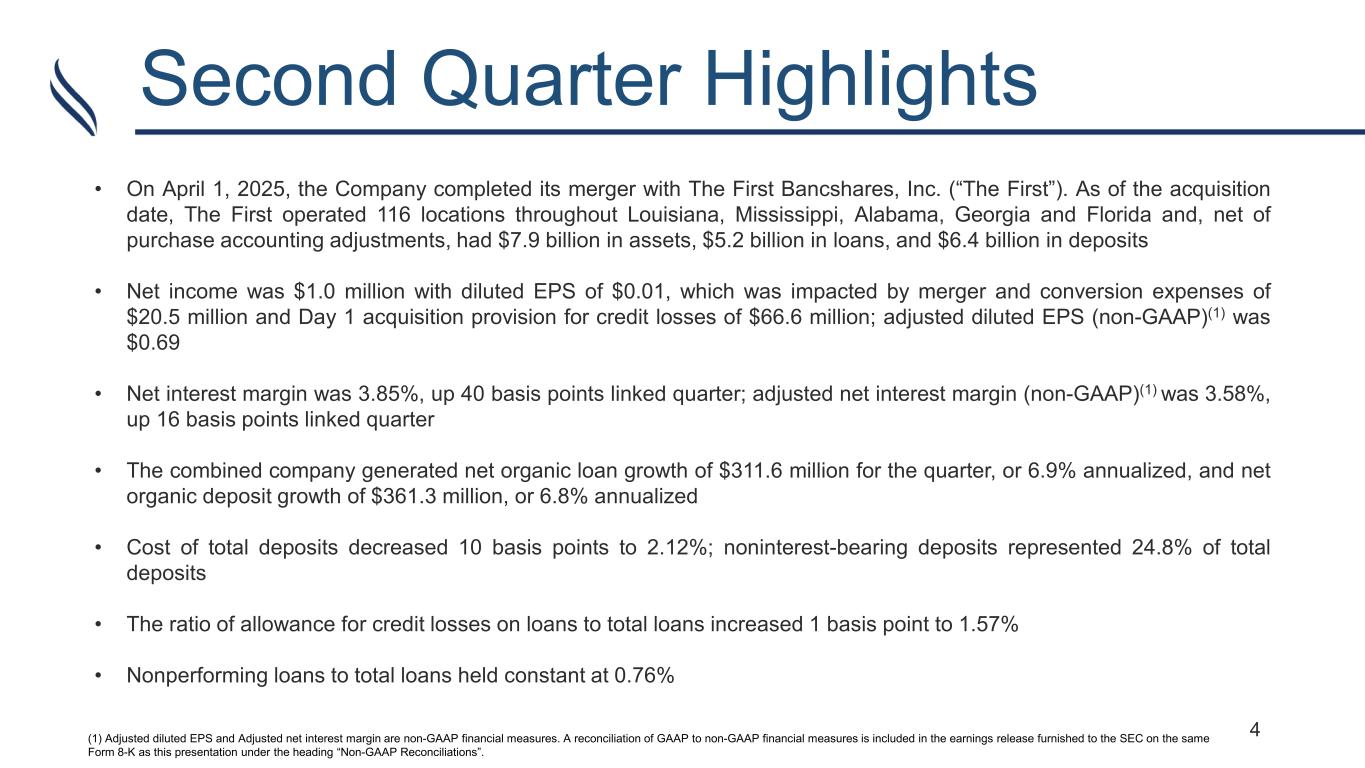
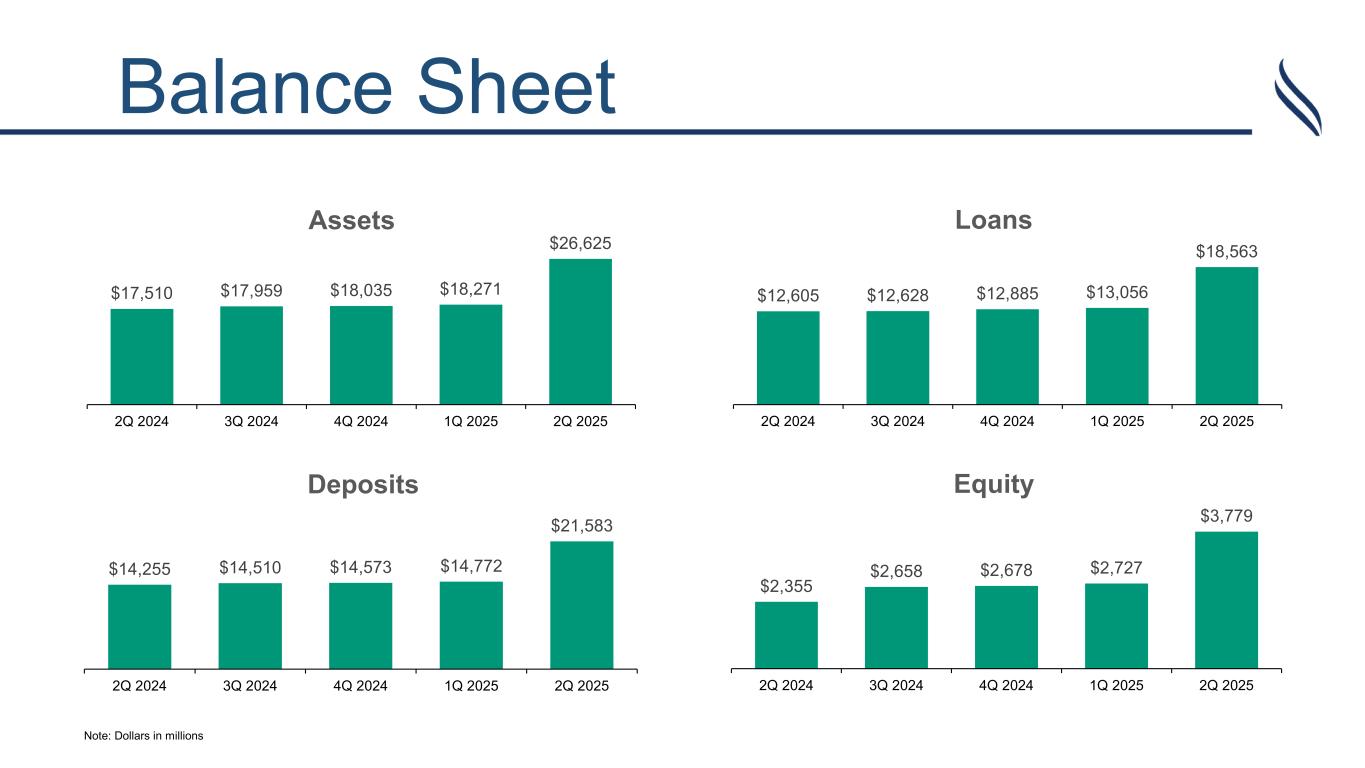
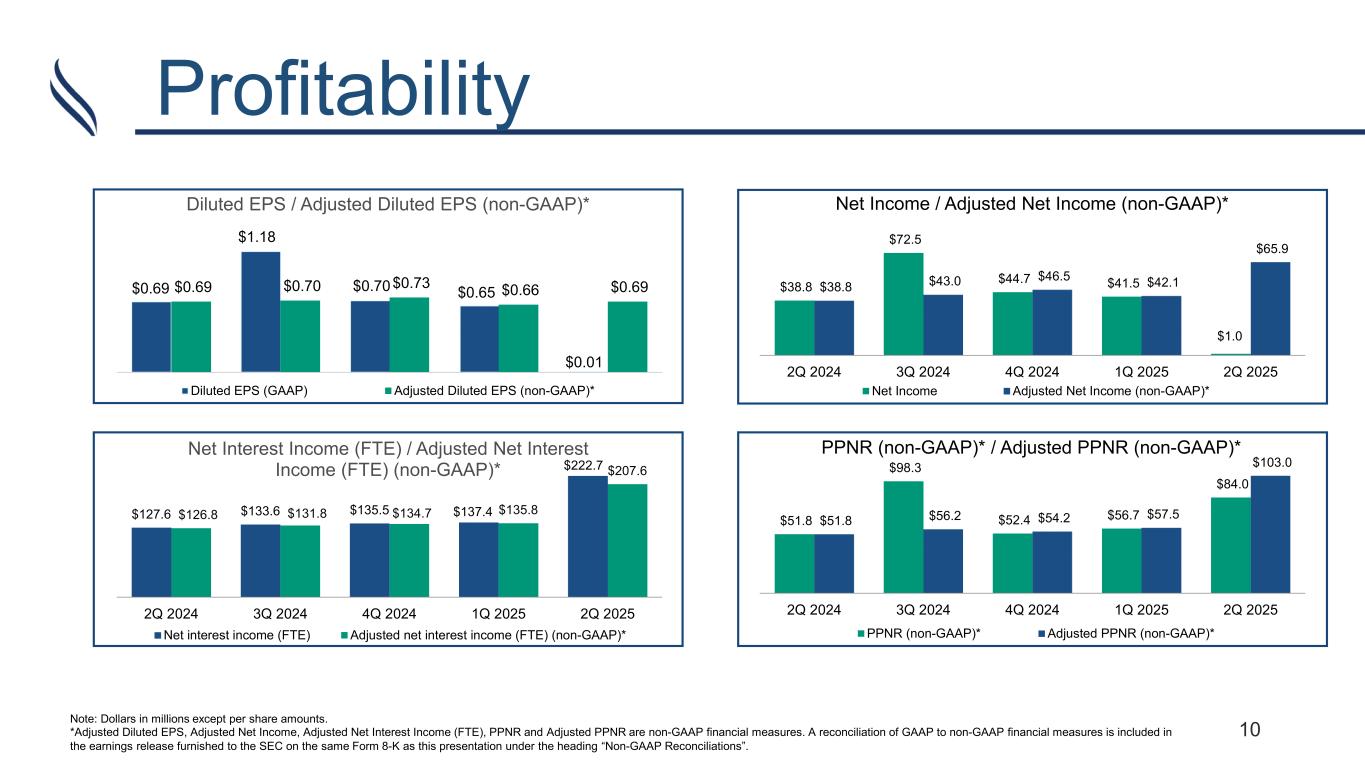
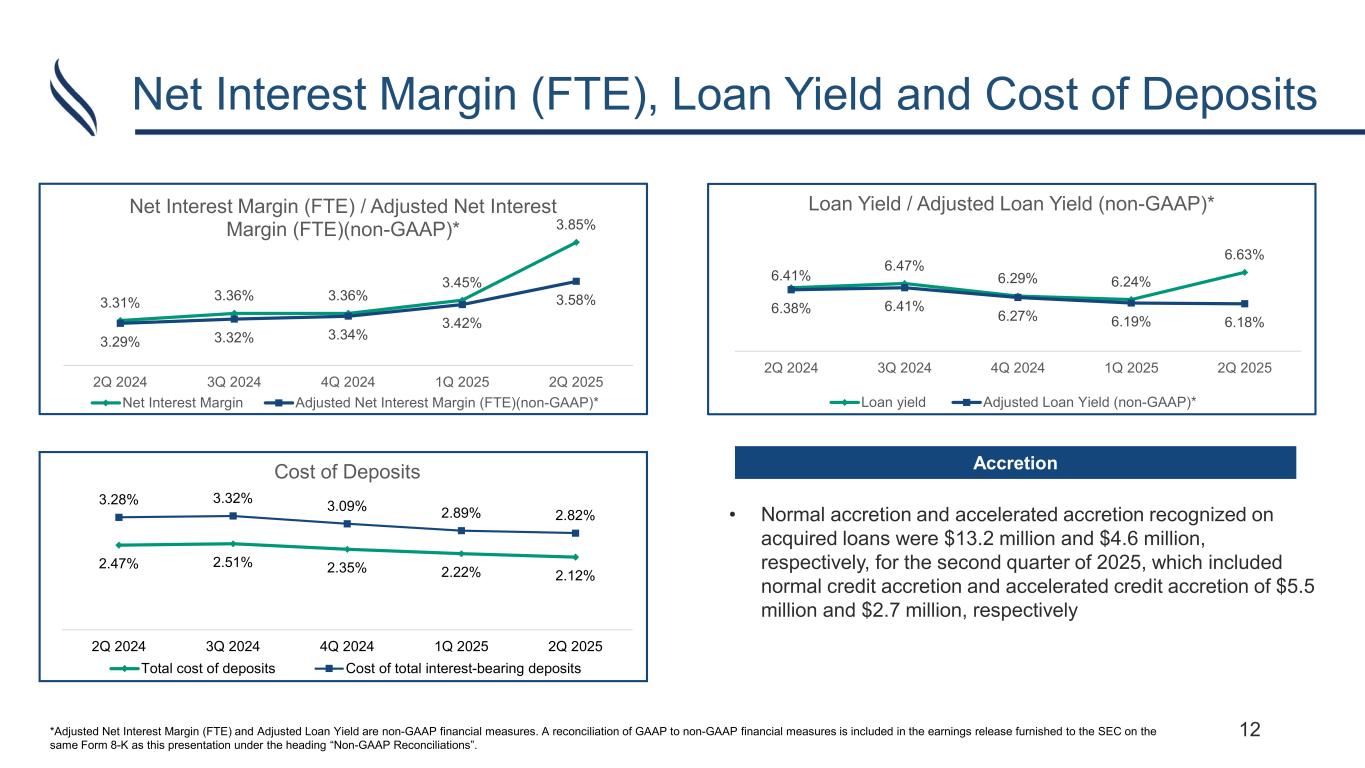
Thank you, Kelly, and good morning. We appreciate you joining the call and look forward to sharing results that reflect our merger with The First Bancshares and the successes we've enjoyed since the two companies came together. We closed the transaction on April 1, and our second quarter numbers reflect a full quarter of operations from both companies. I am proud of the results and believe they are a great reflection on the hard work of our employees in bringing the companies together. While we still have systems conversion in early August, the cultural integration of our employees and customers has gone well. The teamwork and collaboration from employees in all areas of both companies has put us right where we need to be from an overall perspective of the merger. We are very encouraged by these early results, and we will continue to remain focused on the work of meeting the needs of our customers by successfully integrating teams from both companies. I will now highlight a few of our second quarter financial results. Our reported earnings were $1 million or $0.01 per diluted share. Adjusted earnings were approximately $66 million or $0.69 per diluted share. Importantly, both sides of the balance sheet demonstrated positive growth for the company and reveal the work done to solidify employee and customer relationships. Loans were up $312 million or 7% from what the combined companies reported on March 31. Likewise, deposits were up $361 million or 7%. We also saw a meaningful expansion in the core net interest margin from 3.42% to 3.58%. Reported margin, which reflects purchase accounting adjustments, rose from 3.45% to 3.85% for the quarter. Our adjusted total cost of deposits decreased 18 basis points to 2.04%, while our adjusted loan yields decreased only 1 basis point to 6.18%. As you can see, our earnings trajectory and balance sheet strength are evident in the second quarter results. We are well-positioned for the second half of the year and are on track to realize the benefits of the combination. I will now turn the call over to Jim.
Speaker 3
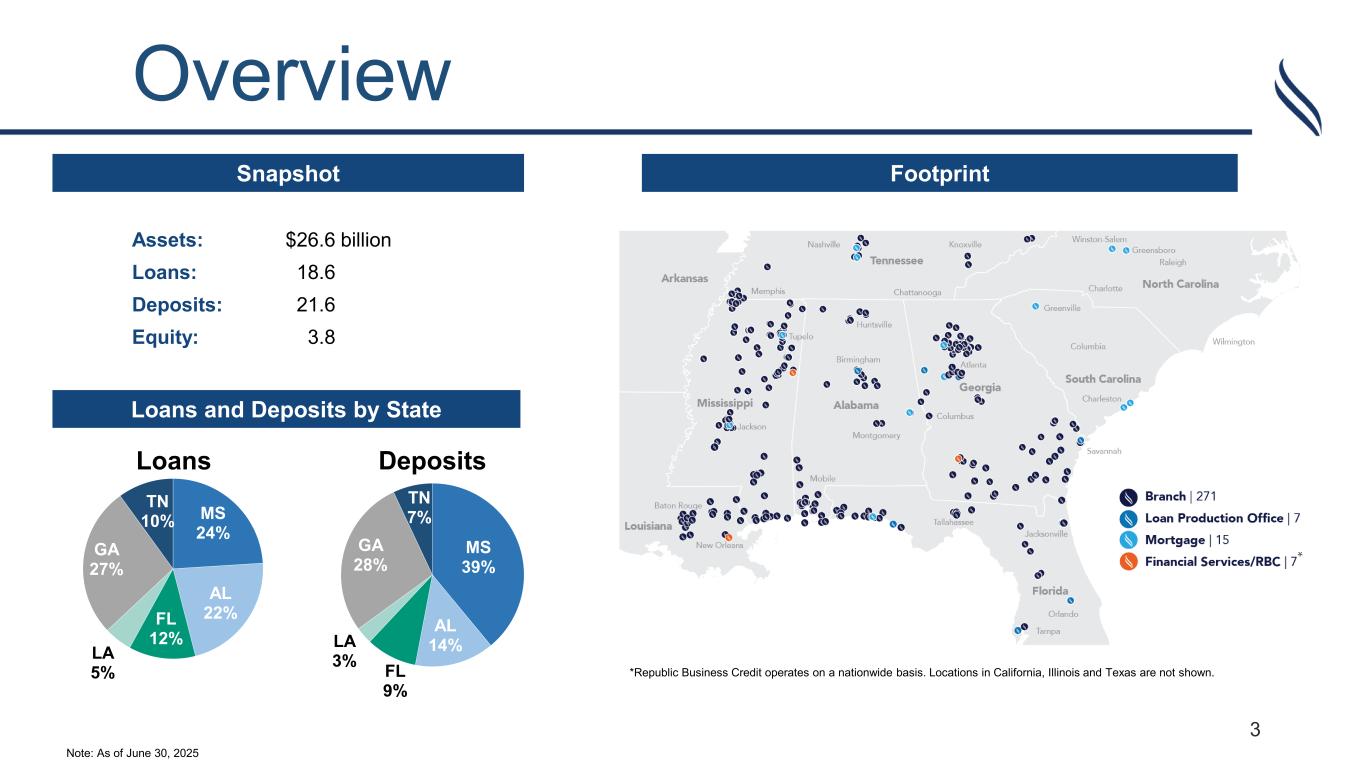
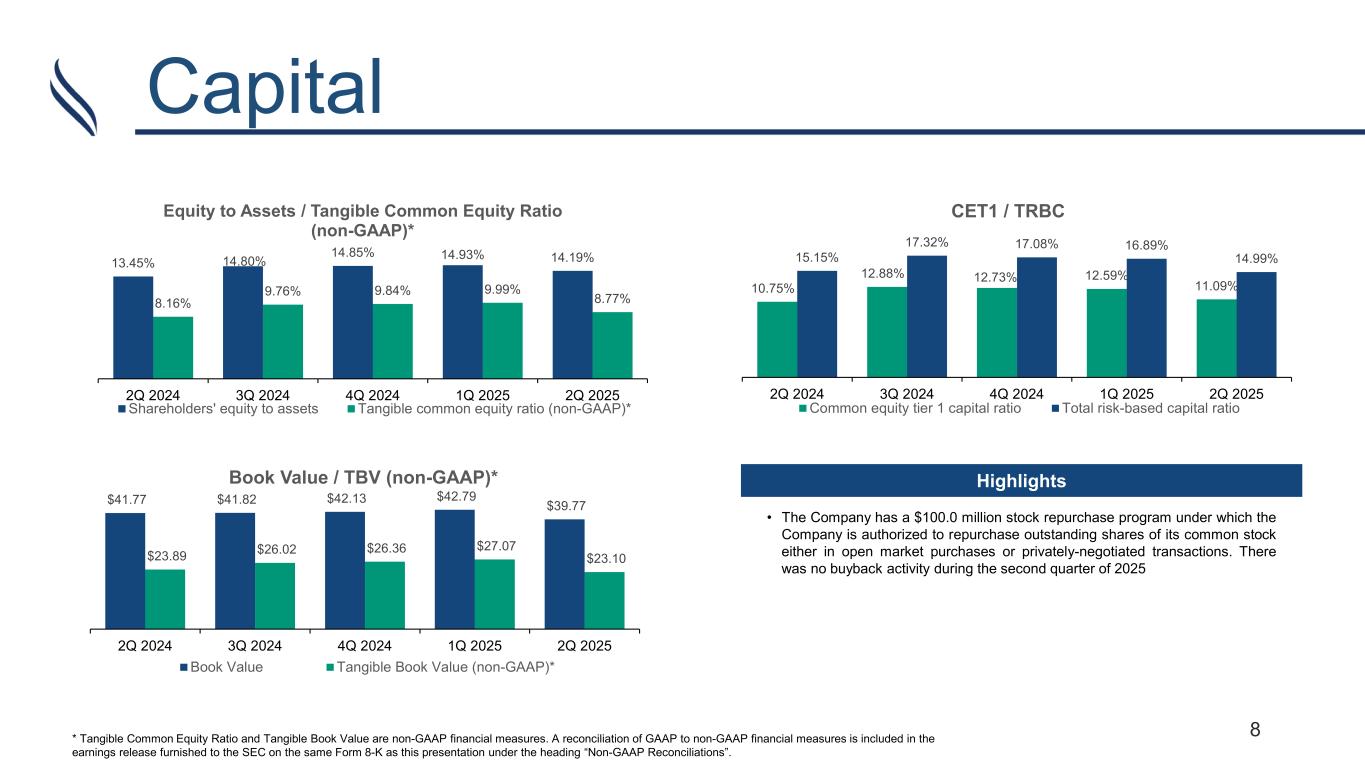
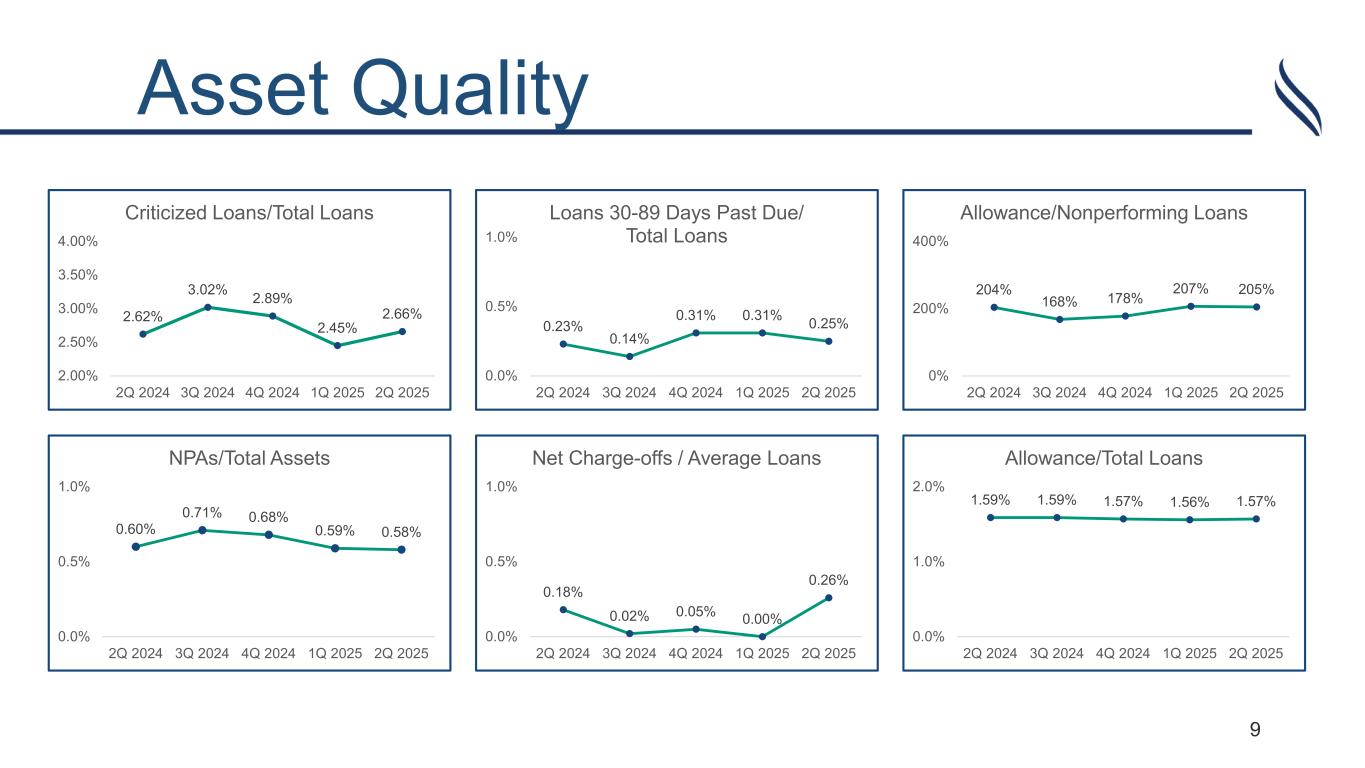
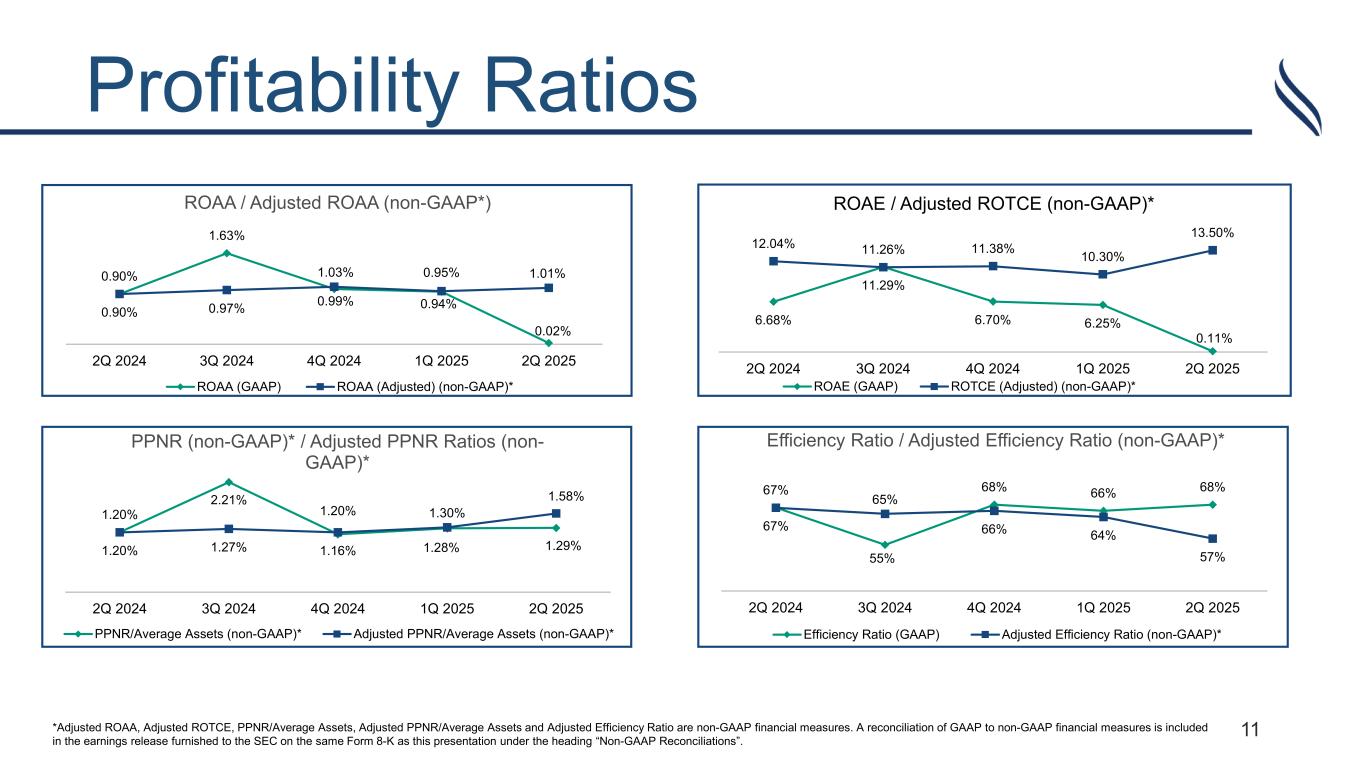
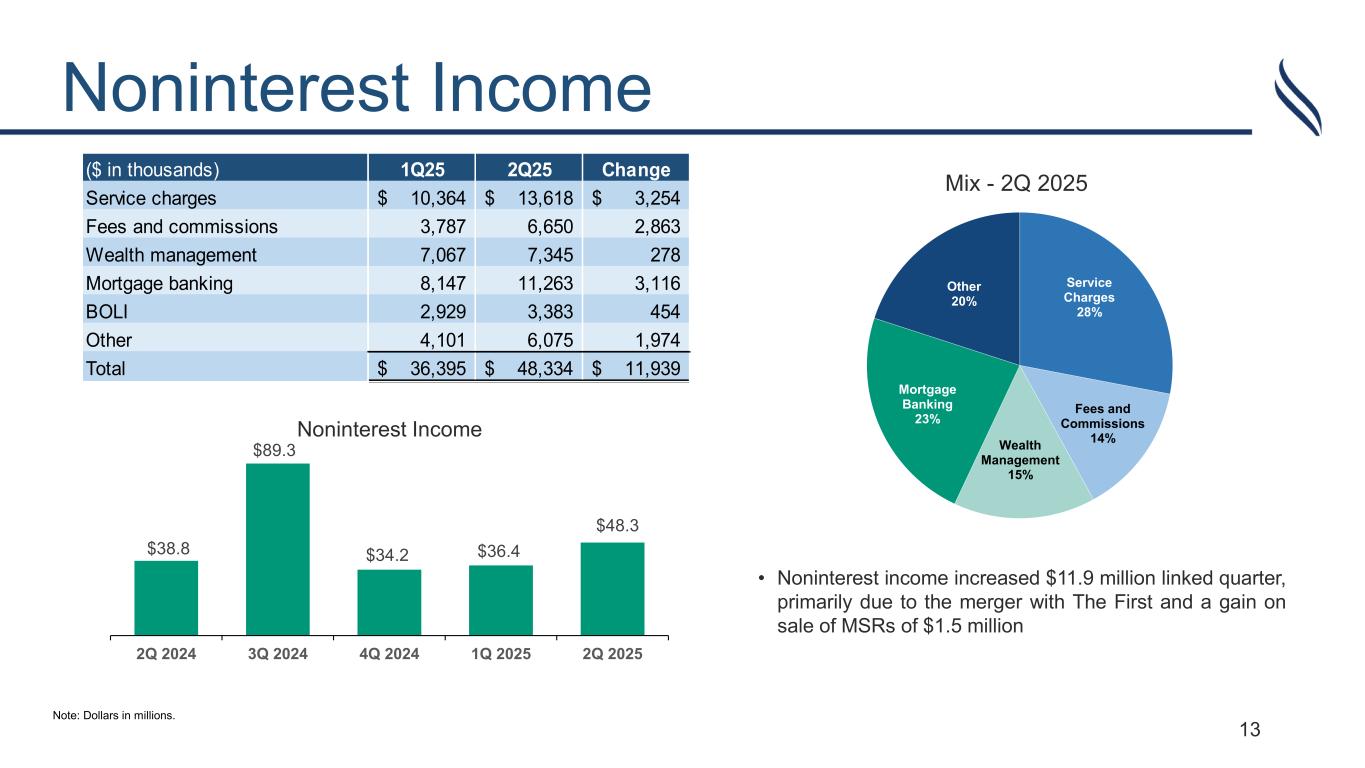
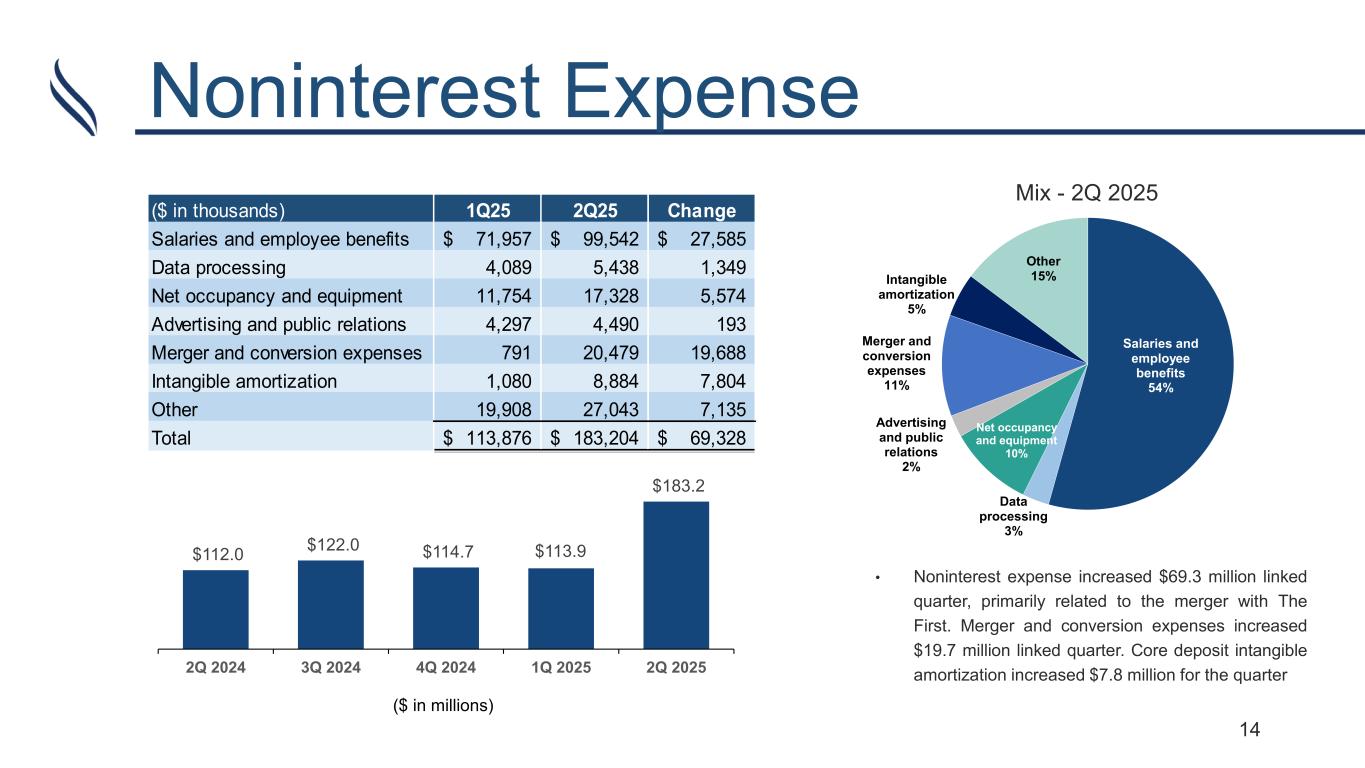
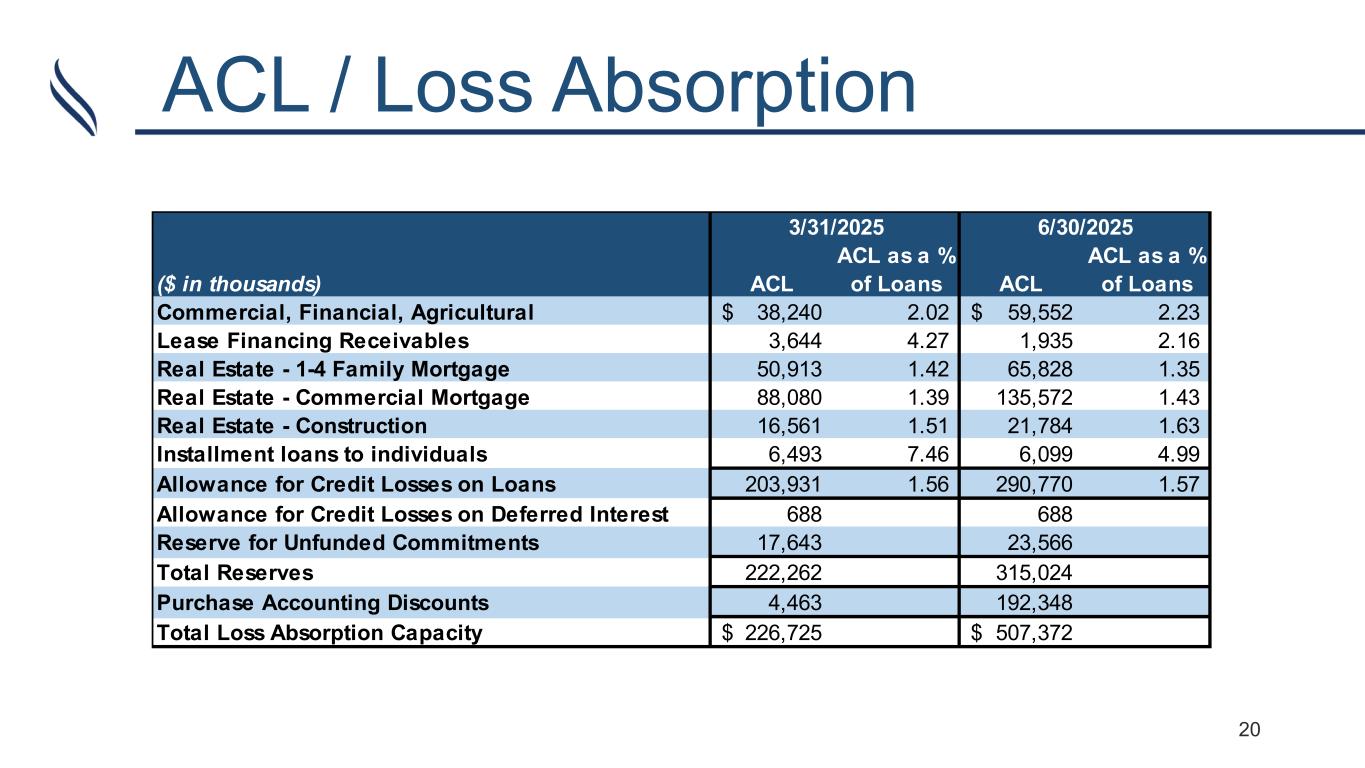
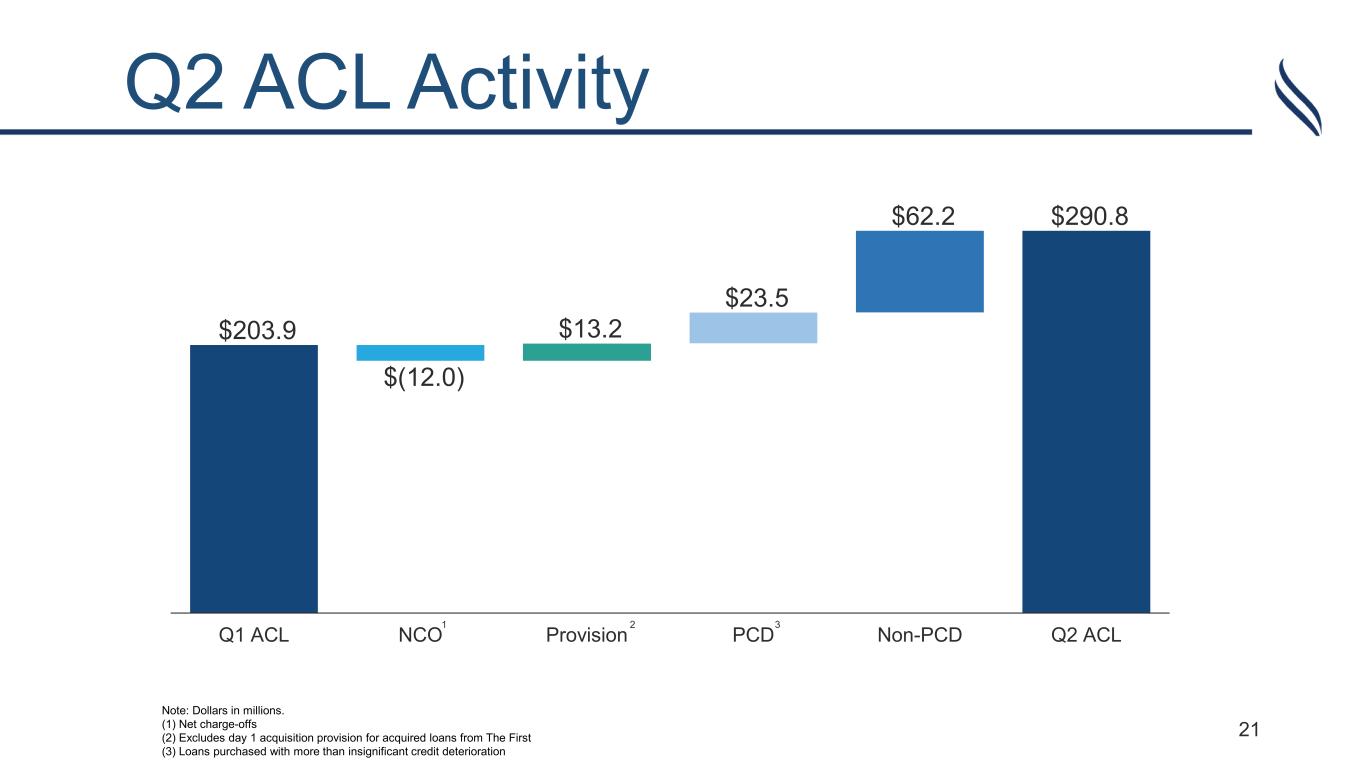
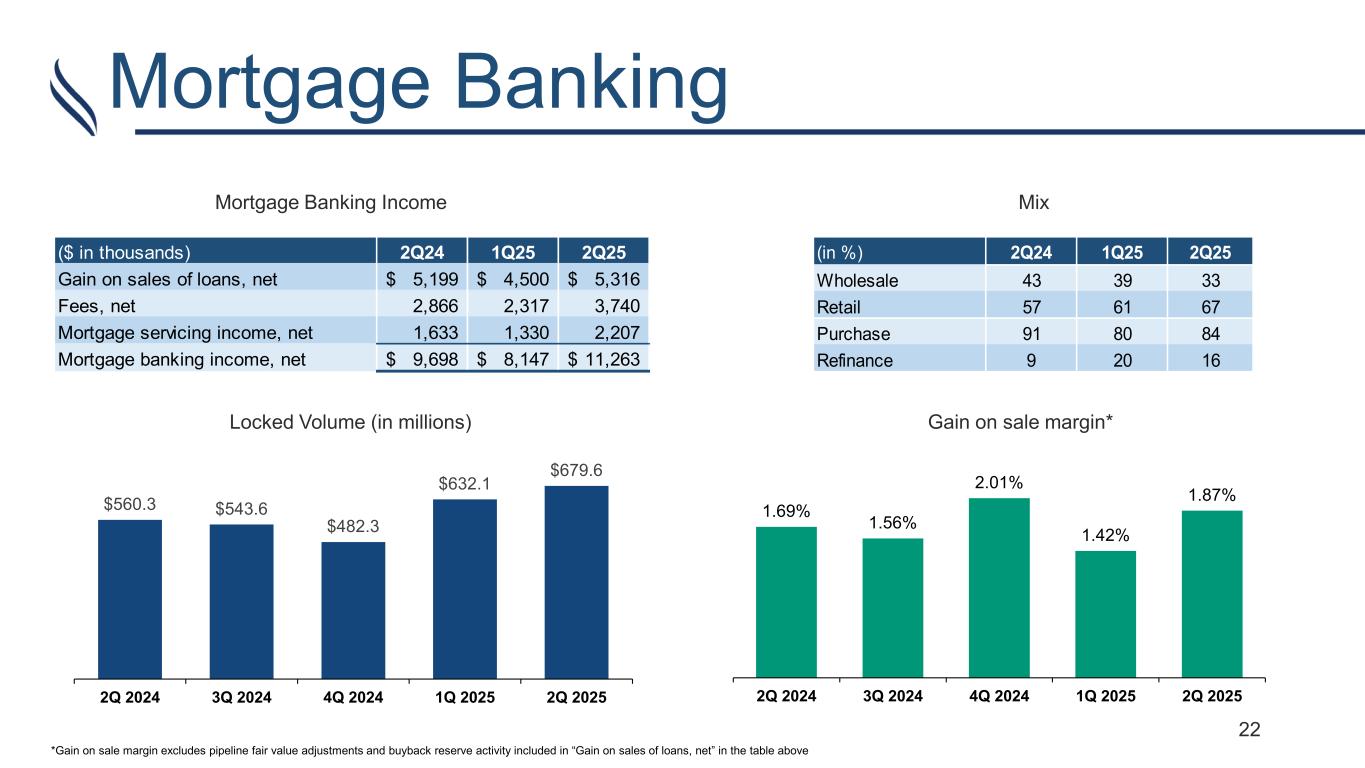
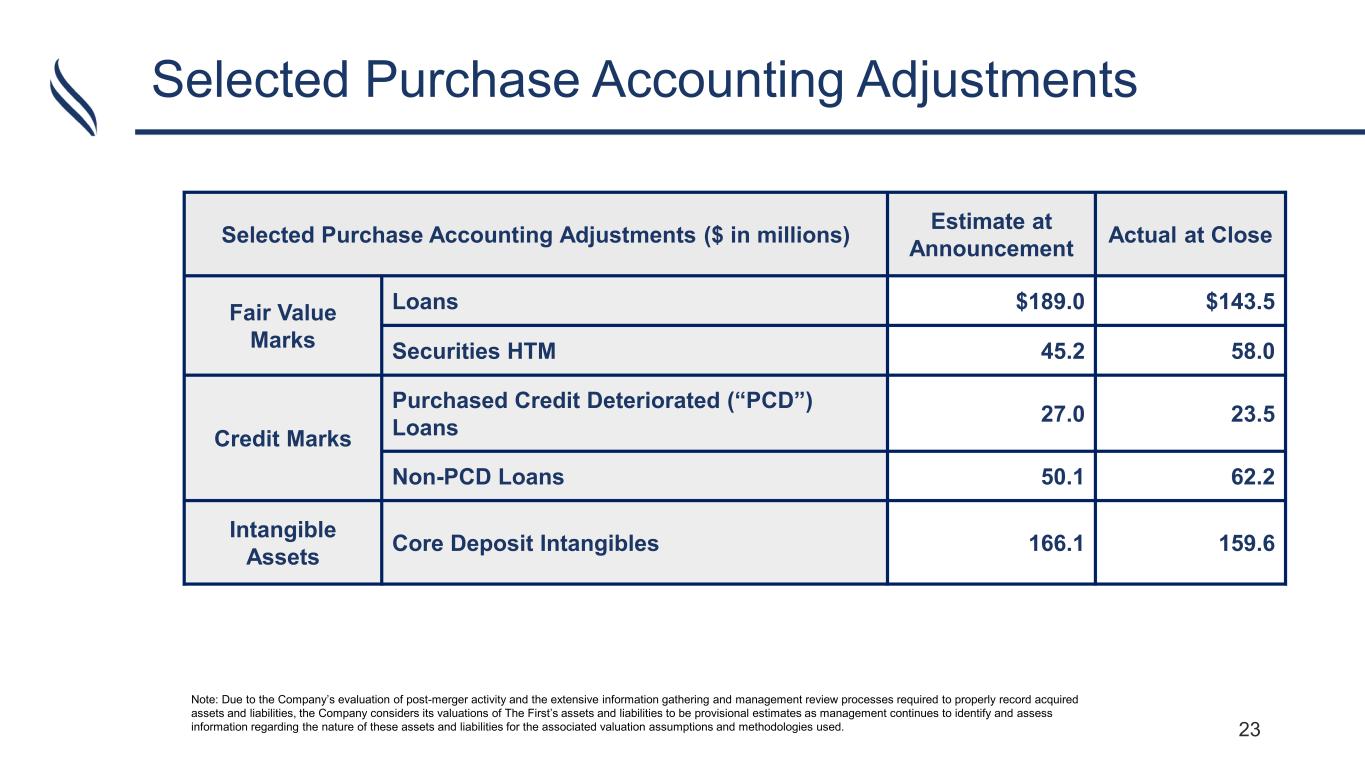
Thank you, Kevin. The merger creates an exciting but noisy quarter. I'll begin with highlights from the merger. The fair value of assets acquired totaled $7.9 billion and included total loans of $5.2 billion. The fair value of liabilities assumed totaled $6.9 billion, and included total deposits of $6.4 billion. Core deposit intangibles totaled $159.6 million and preliminary goodwill arising from the transaction totaled $428.7 million. From a capital standpoint, all regulatory capital ratios remain in excess of required minimums to be considered well-capitalized. Turning to asset quality. We experienced improvement in our past due loan percentage and nonperforming loans were flat. There was an uptick in classified loans that was largely driven by layering in the portfolio from The First and not due to deterioration. Excluding day 1 provisions, we recorded a credit loss provision on loans of $14.7 million, comprised of $13.2 million for funded loans and $1.5 million for unfunded commitments. Net charge-offs were $12.1 million, largely comprised of 2 credits. And the ACL as a percentage of total loans increased 1 basis point quarter-over-quarter to 1.57%. Turning to the income statement. Our adjusted pre-provision net revenue was $103 million. Net interest income growth was driven by improvement in the net interest margin and balance sheet growth. Noninterest income was $48.3 million in the second quarter, a linked quarter increase of $11.9 million, $9.7 million of this increase was attributable to The First, while our mortgage division drove much of the remaining increase. Mortgage experienced a solid quarter in terms of volume, resulting in an increase in income of $1.6 million from the first quarter after excluding a gain on sale of MSR assets. Noninterest expense was $183.2 million for the second quarter. Excluding merger and conversion expenses of $20.5 million, noninterest expense was $162.7 million for the quarter. With systems conversion a couple of weeks away, we expect to see additional conversion-related expenses in the third quarter. We remain on track to achieve modeled synergies by year-end. The improvement in net revenue coupled with cost containment from the combined companies resulted in an improvement in our adjusted efficiency ratio of about 7 percentage points. We are encouraged by the results of the second quarter and the momentum for the remainder of 2025. I will now turn the call back over to Kevin.
Thank you, Jim. We began the process of this merger over a year ago. There has been a tremendous effort by employees from both companies to create the new, higher-performing Renasant. We're excited about capitalizing on the opportunities ahead of us and delivering strong financial performance to our shareholders. I'll now turn the call back over to the operator for questions.
Operator
Our first question will come from Michael Rose with Raymond James.
Speaker 4
I have a couple of questions. Jim, could you walk us through the margin? It seems that the total amount of accretion is higher and the core margin was clearly up. Can you provide some insight into our expectations? I understand there are still many moving parts, including another full quarter of the combination. What are the factors affecting the core margin as we consider the merger moving forward? Additionally, what should we anticipate in terms of scheduled accretion for the upcoming quarters?
Speaker 3
Thank you for the question, Michael. To start, we focus on our core business. I will discuss the effect of purchase accounting on our overall margin shortly. Our outlook anticipates two rate cuts later this year, in September and December. While these cuts are accounted for, they have a minimal impact on our guidance for core margin. Looking ahead, especially in Q3 and to a lesser extent in Q4, we expect some modest expansion in core margin. As you are aware, we reported a core margin of 3.58% for Q2, and I want to be cautious about referencing a single month's margin. However, our spot margin in June was 3.60%, suggesting potential upside; just keep in mind that monthly margins can sometimes be misleading. For the near term, we expect modest expansion in core margin. In terms of accretion, think of it in two areas: interest and credit. Over time, we expect interest accretion to transition into the core net interest margin. For this quarter, the interest accretion was slightly below $10 million. Predicting how this will reflect in future income statements can be challenging, but Q2 serves as a good indicator for Q3 and Q4. The accelerated aspects of accretion are particularly difficult to project. I'll leave it at that, but I'm happy to provide more details if needed.
Speaker 4
Yes. So obviously, you had some purchase time deposit amortization and long-term borrowing amortization this quarter. But if I just take the kind of the $17.8 million, is that what you're talking about should be kind of in the ballpark for the next couple of quarters?
Speaker 3
We had approximately $16 million from purchase accounting accretion in the quarter, which might be around $17 million when considering additional factors. The standard portion was around $13 million, give or take. I believe this serves as a reasonable expectation for what you could see in the next couple of quarters. The accelerated segment is slightly less than $5 million, but it's more challenging to project, so making predictions about that is difficult.
Speaker 4
Totally got it. Just wanted to understand some of the pieces. Okay, perfect. And then maybe just as a follow-up, just as we think about the loan growth of the combined company, obviously, pretty solid again this quarter. Can you just touch on pipelines, hiring efforts and some of the benefits as we think about the combined company, larger balance sheet, etc., from a growth perspective as we move forward.
Michael, it's Kevin. Looking at what both companies accomplished in Q4, we experienced growth in our balance sheet, with loans and deposits rising in the 6% to 7% range. This occurred during one of the most disruptive times for the company, so I want to acknowledge the efforts of everyone involved in integration, planning for the conversion, and maintaining growth in our markets. We're very pleased with the progress made in growing the balance sheet during such challenging conditions. As for our pipeline, it remains stable. Comparing our historical pipeline and the current situation, the legacy pipelines of Renasant and The First are both flat. Combining the two, we still have a robust pipeline. It's worth noting that both companies' pipelines increased over the past two quarters compared to earlier ones. We see continued opportunities ahead, firmly believing we're situated in some of the best markets in the Southeast, which is evident in our pipeline. Looking forward for the rest of the year, we're still predicting mid-single-digit growth in loans and deposits. A couple of factors may influence this, specifically regarding payoffs. We had previously indicated we expected payoffs to rise throughout the year, which hasn't happened yet, but this could change depending on the yield curve's shape or any volatility. We're sticking to our mid-single-digit guidance and have proactively planned to meet these expectations. Overall, our pipelines are strong, and our team is dedicated to seizing market share opportunities across all our markets, as demonstrated in Q2.
Operator
The second question comes from Matt Olney with Stephens.
Speaker 5
I want to ask more about expense levels. The core expenses you mentioned look really good in the second quarter. It seems we should expect more noncore expenses in the next few quarters as you integrate. Regarding the core levels and the cost savings, I'm interested in your expectations for the core expense levels in the upcoming quarters. Previously, we indicated that the first full quarter of fully loaded cost savings wouldn’t occur until the first quarter of next year. I’m looking for more insight if that’s still accurate.
Speaker 3
As for the expense outlook for the upcoming quarters, there's no efficiencies reflected in Q2 from the merger, but that will start to appear in Q3. Our systems conversion is scheduled for early August, and we expect to see efficiencies after that. In Q3, some efficiencies will appear in the expense line, with a bit more in Q4. We aim to have a clean income statement by Q1 that shows all the efficiencies from the deal. Additionally, we had around $20 million in merger expenses in Q2, and we estimate about $25 million in merger expenses for the second half of the year, mostly in Q3.
Speaker 5
Okay. That's helpful, Jim. I appreciate that. And then just as a follow-up, maybe a bigger picture question. I think a year ago, we talked about getting the efficiencies from the transaction and strategic goals, ROA of 1.25%, 1.30%, and efficiency ratio down to 56%. So as you just look at the overall landscape now and kind of the first full quarter with the transaction, any updates as far as your longer-term strategic goals with respect to profitability, ROA and efficiency?
Matt, it's Kevin. No real update other than to say we're tracking right in line with what we laid out a year ago. If you look at the efficiency ratio for Q2, we are right on track. We've busted through the 60% hurdle that we've talked about for a long time. We're comfortably below that. And that doesn't include any of the cost saves yet to be realized in Q3 or Q4. The balance sheet growth that we expected, that will drive revenue, that's occurring. And so what we laid out was the combination would unlock potential on both sides of the company. And we think that's occurring. So no real update other than we are right on target with where we plan to be. If you look at the balance sheet that we projected in July of last year, we came in really on both sides, both Renasant and The First came in right on top of where we expected to be. So everything is lining up the way that we wanted to, and it will be our focus and our goal to continue to work and extract incremental improvements on the goals we laid out. But right now, we feel very comfortable about the guidance that we laid out over a year ago about ROA, ROE and efficiency, those profitability metrics that we key in on.
Operator
The third question comes from Catherine Mealor with KBW.
Speaker 6
Just one follow-up on the margin. Jim, can you tell us the duration of the amortization that we'll see on the time deposits accretion, assuming that runs off pretty quickly.
Speaker 3
It's about 5 months, Catherine.
Speaker 6
This quarter, we observed a slight increase in charge-offs related to problem loans, totaling around $2 million. Could you provide some insight into the reasons behind this and what would be a reasonable expectation for future charge-offs?
Speaker 7
The two credits we identified were problematic loans that we had classified as rated assets for some time. Both were in the commercial and industrial sector and were not indicative of systemic issues, as each had its own unique circumstances. We are willing to provide more details on these cases if needed. These were isolated credit opportunities that we needed to remove from our balance sheet. One of the loans had a charge-off that was nearly fully accounted for, while the other was related to a more significant change within the company and was also charged off. These issues are not reflective of our overall commercial and industrial portfolio. Historically, we've experienced a few challenging quarters as we've addressed problem assets on our balance sheet, but typically those figures tend to stabilize. Over the past year, we've averaged around 8 to 10 basis points, and I believe this will remain in a similar range going forward, perhaps slightly higher due to the current economic environment, but it should stay close to plus or minus 10 basis points, not exceeding 15 basis points.
Speaker 6
Okay, great. I have one more question regarding the buyback activity. Now that the deal is closed and the marks are set, along with your high levels of capital and ROTCE, you are accumulating capital quite rapidly. I'm interested in how you balance your thoughts on potential buybacks.
Speaker 3
Catherine, this is Jim again. I want to emphasize that the capital we are accumulating is primarily intended to support organic growth, and we are very pleased with our progress in this area. We've experienced strong growth over several quarters, which is encouraging. Additionally, we are open to considering small acquisitions that enhance our expertise in specialty finance sectors such as factoring and asset-based lending, although I do not expect these to be significant. We also value talent acquisition as part of our organic growth strategy and hope more opportunities will arise. Furthermore, we recently conducted two legacy Renasant restructurings in the securities portfolio, which factor into our overall strategy. While share buybacks are part of our considerations, they are not our top priority at the moment. However, they remain an option given our capital accumulation rate. Lastly, we are keeping in mind the need to maintain capital for potential future bank mergers and acquisitions. This outlines our approach to prioritizing capital allocation.
Operator
The fourth question will come from Stephen Scouten with Piper Sandler.
Speaker 8
Maybe just to follow up on some of the things you just said, Jim, about capital allocation longer term. I mean appreciating that you haven't even gotten to the core conversion on FBMS yet. But when would you guys be open to thinking about the whole bank M&A again if the opportunity arose? And would there be an area of focus or a size of focus at some point down the line? Or is it, again, just too early to think about that?
I'll take this. I think it's a bit premature to make any definitive plans at this stage. We are still engaging in discussions with various management teams, and we have maintained those dialogues while focusing on The First. However, we want to emphasize that our primary emphasis is on The First, as it is the most significant factor for both companies and shareholders. Our attention is directed toward cost savings and conversion. The management team is committed to managing the balance sheet and the revenue it generates, which is on track. We prefer not to let anything hinder our progress or divert our focus from the benefits associated with The First. As we move past conversion and complete the integration of both companies, we may reassess our stance on potential M&A opportunities. For now, our concentration is on the largest acquisition we've undertaken, which involves the most customers, branches, and employees. This focus is crucial since it holds the greatest impact for shareholders. Frankly, any other opportunity on our radar would not be as beneficial as what we have with The First. We are nearing the finish line and want to avoid any actions that could lead to setbacks regarding this opportunity. Therefore, our current priority is the successful conversion and integration of The First.
Speaker 8
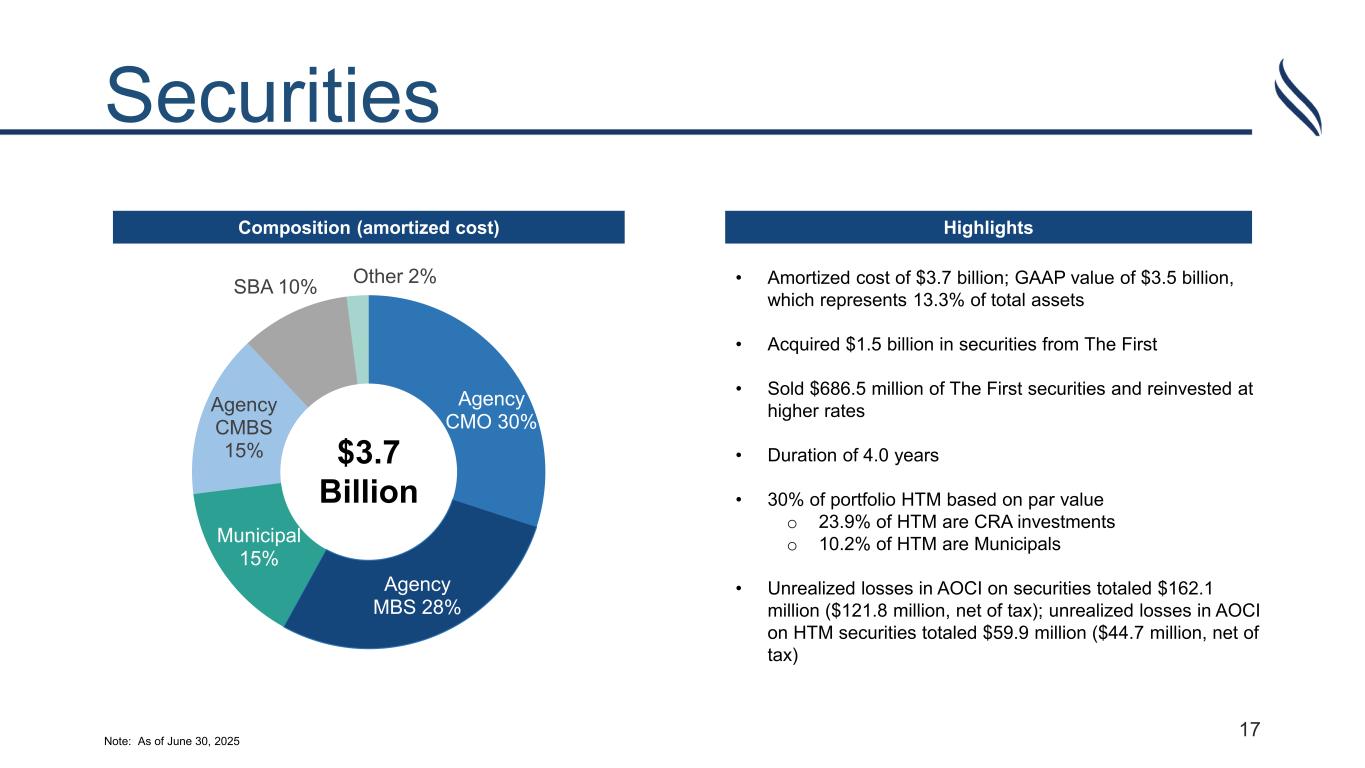
Yes, that makes a lot of sense. I appreciate that insight. Regarding the remaining securities from The First, I think you sold slightly less than half of their book. Was that the original plan for that securities book, or did you adjust your strategy regarding what you sold and what you retained? Is it still possible to evaluate this moving forward?
Speaker 3
So we sold approximately 50% of the securities at The First. Our team did a lot of work early on, and that number may have fluctuated a bit over time, but not significantly. What we ultimately sold and executed was planned for a while. While I don't want to rule anything out, I think if there's additional work to be done with the securities portfolio, it would mainly be associated with Renasant. Any potential future repositioning will likely be on the legacy Renasant side.
Speaker 8
Got it. Perfect. And then just one last thing for me. I appreciate the detailed information you provided. It seems that some of the fluctuations this quarter were related to specific deals and shouldn't be a major concern going forward. However, the provision was still noticeably higher than normal, even accounting for the one-time adjustments. Is this mainly due to how the model interacted with the combined balance sheet and maintaining a steady loan loss reserve percentage? Should we consider the reserve percentage to remain around the mid-150s range? What other factors contributed to the $14.7 million core provision?
Speaker 7
Stephen, this is David. As you mentioned, there is a lot of variability in the CECL number this quarter. The non-PDC marks related to The First are a factor. If we exclude those, the provision in Q2 mainly relates to the functioning of our model, especially due to a couple of charge-off losses this quarter that affected our factors. These losses specifically impacted the historical loss rates in certain segments, notably C&I and occupied CRE. The historical loss ratio was adjusted in Q2 for those loans, leading to a change in our model. Every quarter, we reassess our Q factors and their effect on our reserves, which isn't solely related to those two credits; it’s a regular practice. Additionally, the growth in our loan portfolio during the quarter significantly influenced our model from a provisioning perspective. All these factors contributed to the increase in provisions for the quarter, which was mainly driven by the model.
Do we still have anybody in the queue?
Operator
Are we ready for the next question?
We are ready for the next question, yes.
Operator
The next question comes from David Bishop at Hovde Group.
Speaker 9
I'm not sure what happened there. A question for Jim. Just curious, the interest rate risk position post close of The First acquisition, maybe how the balance sheet sets up for a potential 25 basis point Fed rate cut, just curious what your sensitivity looks like post merger.
Speaker 3
Sure, Dave. As you may remember, The First significantly enhanced our balance sheet and slightly reduced our sensitivity position. When considering those rate cuts, although they happen late in the year, they really have minimal effect on the margin guidance we provide. For the full year, it may vary a bit, but I can say this: without The First, the situation would have been different. The First has certainly improved our sensitivity position, making us less sensitive. This outcome was aligned with our expectations for merging the balance sheet.
Speaker 9
Got it. And then Kevin, Jim, just curious, you talked about the opportunities on the expense side of the equation. Are there any opportunities on the fee income side of the house that really haven't been tapped yet that aren't in the numbers yet that has you pretty excited as you look forward?
Yes, Dave, I think there are a few factors at play, and you're starting to see them reflected in the numbers. We've previously mentioned our challenges in the mortgage business over the past couple of years, but we experienced a nice rebound in Q2. In fact, our trends seem to be counter to the national averages, based on the data coming from mortgage bankers. In our new market with The First, there is significant inbound migration and many potential customers, which will bolster our mortgage business. Regarding treasury management, we are in the process of converting our systems and integrating them with The First, which has been ongoing. We see potential growth in fee income from this integration. Additionally, we have been working on various initiatives in capital markets and management, and some of these figures may currently be included in other noninterest income categories. Overall, these areas are growing at a notable rate, and our team members at The First have shown strong interest and adoption of these products, which can differentiate us in the market. There are several promising opportunities in the noninterest income category that we believe will generate additional revenue as we continue our full integration. Moreover, there is potential for increased top-line revenue from our secured business lines, lending options that The First may not have previously offered, such as asset-based lending, factoring, equipment leasing, and larger loan limits, along with our specialized expertise in certain real estate and middle market commercial and industrial sectors. We've already seen early successes and wins in these business lines during the first quarter, collaborating with bankers from The First and aligning with our colleagues at Renasant to seize market opportunities we might not have captured individually. We are enthusiastic about these early achievements at The First this quarter and what they could lead to in the future.
Operator
Again, I apologize for the technical difficulties. With no further questions, we will conclude our question-and-answer session. I would now like to hand the conference back to Kevin Chapman, CEO, for any closing remarks.
All right, and I appreciate all of you that were able to join the call today. We look forward to having future conversations at conferences coming up in Q3. And again, I appreciate everybody that joined the call today. Thank you.
Operator
The conference has now concluded. Thank you for attending today's presentation. You may now disconnect.