Operator
Good day, and welcome to the Renasant Corporation 2025 Fourth Quarter Earnings Conference Call and Webcast. Please note that this event is being recorded. I would now like to turn the conference over to Kelly Hutcheson. Please go ahead.
Good morning, and thank you for joining us for Renasant Corporation's Quarterly Webcast and Conference Call. Participating in the call today are members of Renasant's executive management team. Before we begin, please note that many of our comments during this call will be forward-looking statements, which involve risk and uncertainty. There are many factors that could cause actual results to differ materially from the anticipated results or other expectations expressed in the forward-looking statements. Such factors include, but are not limited to, changes in the mix and cost of our funding sources, interest rate fluctuation, regulatory changes, portfolio performance, and other factors discussed in our recent filings with the Securities and Exchange Commission, including our recently filed earnings release, which has been posted to our corporate site, www.renasant.com at the Press Releases link under the News and Market Data tab. We undertake no obligation, and we specifically disclaim any obligation to update or revise forward-looking statements to reflect changed assumptions, the occurrence of unanticipated events or changes to future operating results over time. In addition, some of the financial measures that we may discuss this morning are non-GAAP financial measures. A reconciliation of the non-GAAP measures to the most comparable GAAP measures can be found in our earnings release. And now I will turn the call over to our President and Chief Executive Officer, Kevin Chapman.
Thank you, Kelly, and good morning. 2025 was a transformative year for Renasant, marked by considerable improvement in our profitability and strong balance sheet growth on the heels of the completion of the largest merger in the company's history. As we discussed during our October call, systems conversion took place in the third quarter of this year, and we continue to build on the successful integration progress that has already occurred. Throughout the year, we have been intentional about maintaining and frankly, accelerating the momentum in the company and believe our financial results reflect that focus. Our goal is to create a high-performing company that leverages the opportunities presented by our presence in many of the country's best economies. We strive to deliver excellent customer service led by an exceptionally talented team. This was evidenced by the organic loan and deposit growth we achieved in 2025. Renasant's core profitability showed significant improvement this year, fueled by the benefits of the merger with The First, along with ongoing efforts to improve efficiency at legacy Renasant. Adjusted earnings per share for the year were $3.06, representing an 11% increase year-over-year. For the year, adjusted ROA grew 94 basis points in 2024 to 110 basis points in 2025. Likewise, the adjusted efficiency ratio saw an approximate 900 basis point improvement year-over-year to 57.46%, and the adjusted return on tangible equity grew from 11.5% in 2024 to 13.79% in 2025. I'm extremely proud of what our team has accomplished this year and excited about how we are positioned to grow on this success in 2026. I will now turn the call over to Jim.
Speaker 3
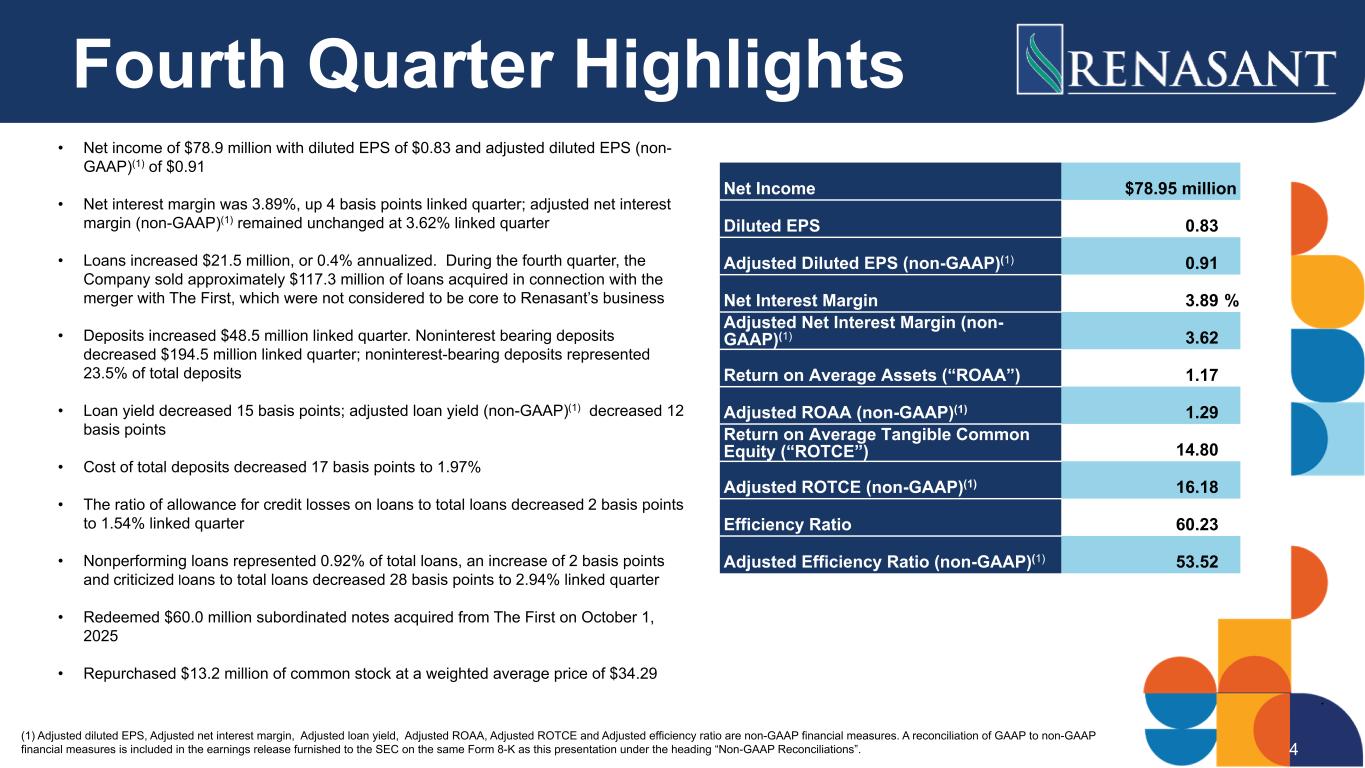
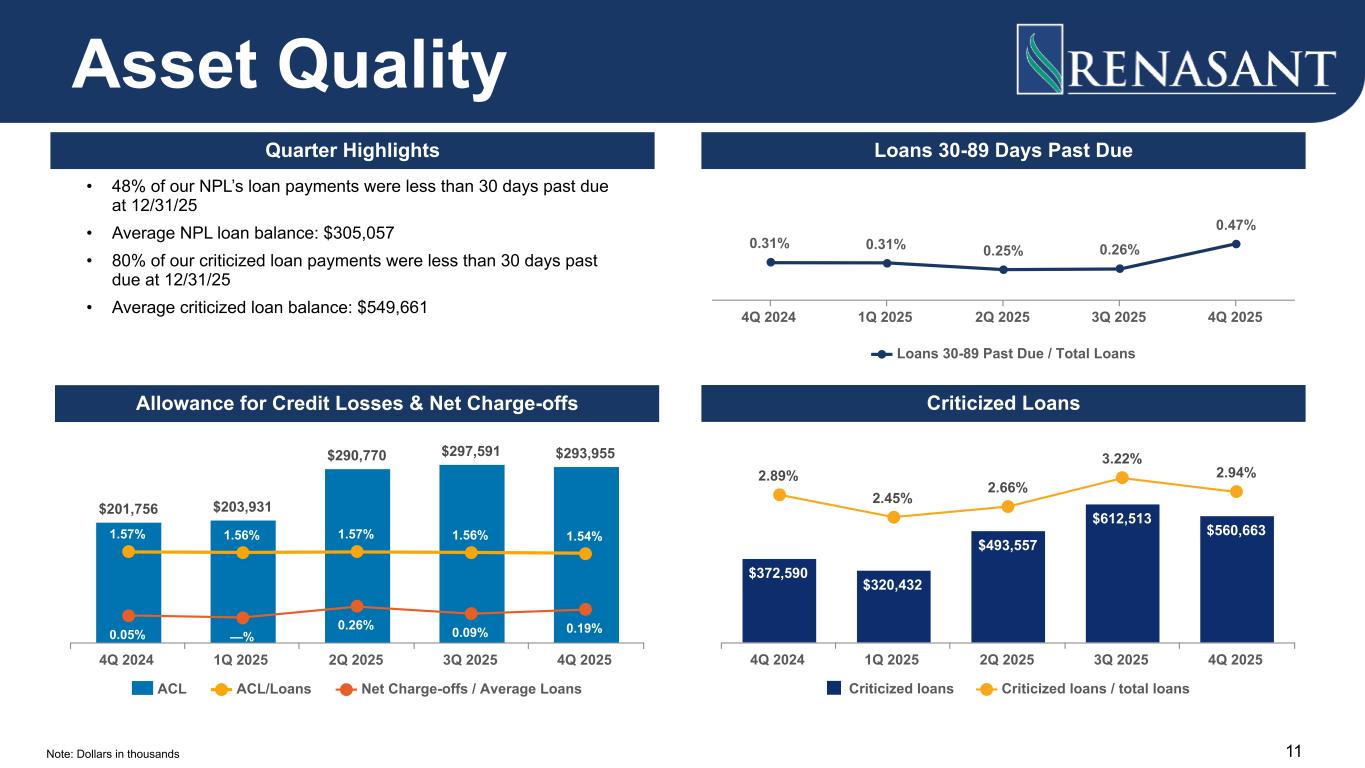
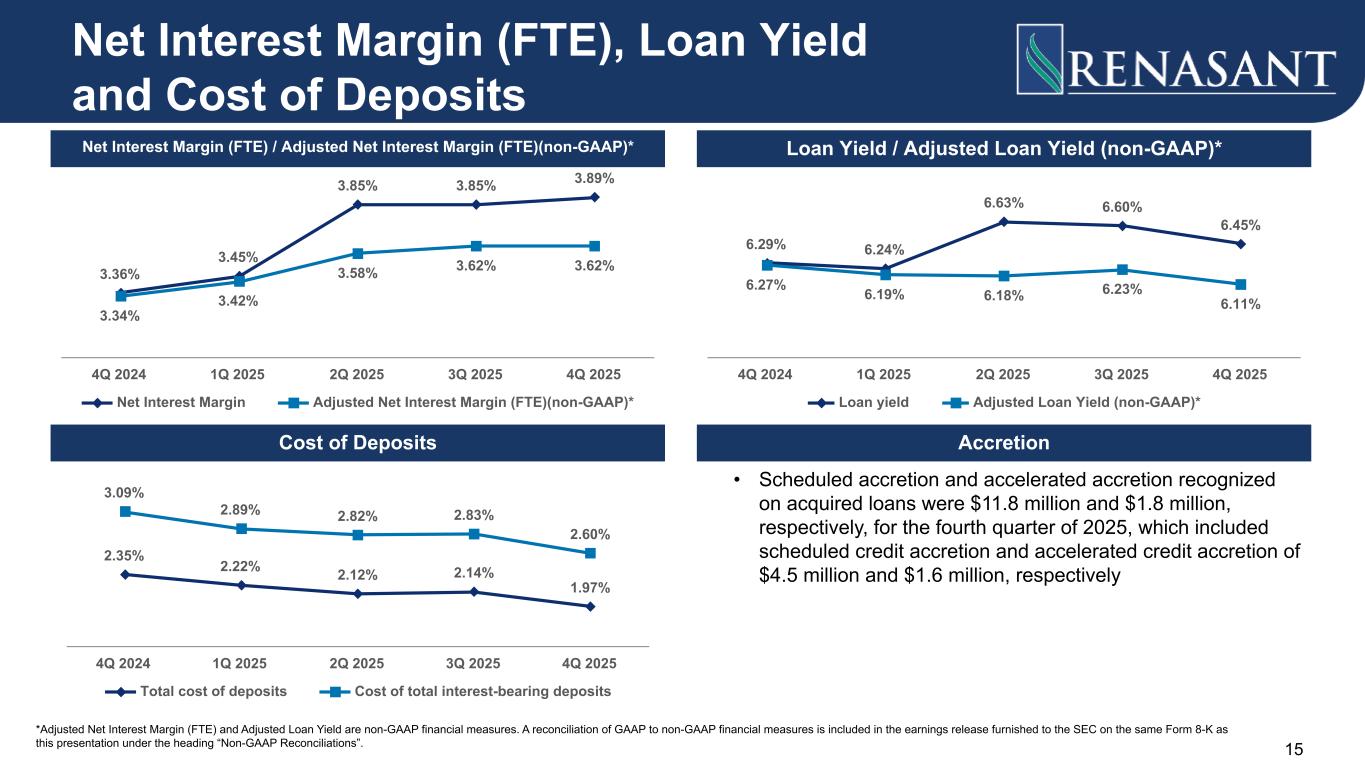
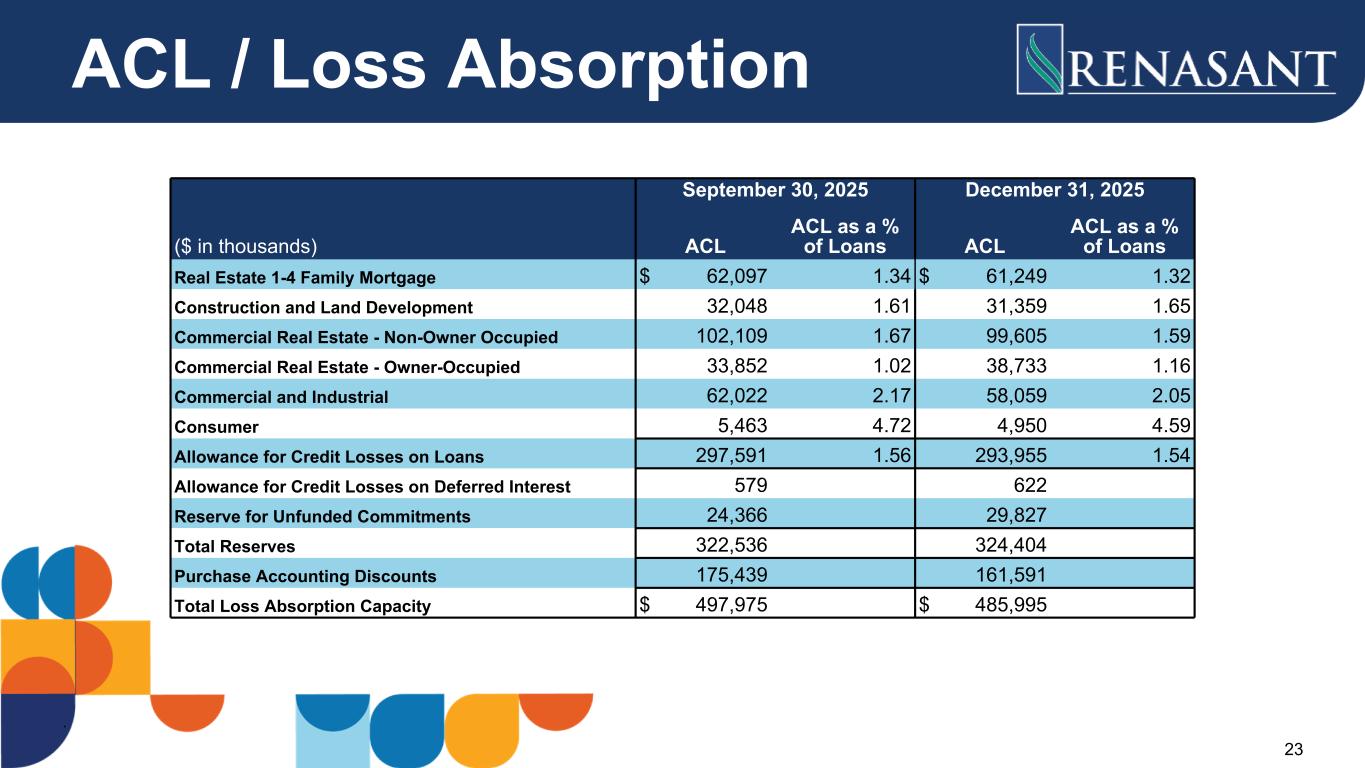
Thank you, Kevin, and good morning. I will now highlight financial results for the quarter. The company's net income was $78.9 million or $0.83 per diluted share. Adjusted earnings, excluding merger charges, were $86.9 million or $0.91 per diluted share. Our adjusted return on average assets of 1.29% for the quarter grew 20 basis points from the third quarter, and our adjusted return on tangible common equity of 16.18% for the quarter is an improvement of 196 basis points. Loans were up $21.5 million on a linked-quarter basis or 0.4% annualized. During the fourth quarter, the company sold approximately $117 million of loans acquired from The First which were not considered to be core to Renasant's business. Deposits were up $48.5 million from the third quarter or 0.9% annualized. From a capital standpoint, all regulatory capital ratios remain in excess of required minimums to be considered well capitalized. We recorded a credit loss provision on loans of $10.9 million comprised of $5.5 million for funded loans and $5.4 million for unfunded commitments. Net charge-offs were $9.1 million, which includes $2.5 million recognized in connection with the aforementioned sale of the acquired $117 million loan portfolio. The ACL as a percentage of total loans declined 2 basis points quarter-over-quarter to 1.54%. Turning to the income statement. Our adjusted pre-provision net revenue was $118.3 million. Net interest income increased $3.9 million quarter-over-quarter. Reported net interest margin increased 4 basis points to 3.89%, while adjusted margin was flat at 3.62% on a linked-quarter basis. Our adjusted total cost of deposits decreased by 11 basis points to 1.97%, while our adjusted loan yields decreased 12 basis points to 6.11%. Noninterest income was $51.1 million in the fourth quarter, a linked quarter increase of $5.1 million. This increase includes $2 million in income associated with the exit of certain low-income housing tax credit partnerships during the fourth quarter. Noninterest expense was $170.8 million for the fourth quarter. Excluding merger and conversion expenses of $10.6 million, noninterest expense was $160.2 million for the quarter, a linked quarter decrease of $6.2 million. This decrease includes an offset of $2.1 million in gains connected with branch consolidations during the fourth quarter. We are encouraged by the results of the fourth quarter and the positive momentum going into 2026. I will now turn the call back over to Kevin.
Thank you, Jim. As you have heard, Renasant is well positioned for 2026. We have a talented and motivated team, a strong balance sheet and an enhanced profitability profile. The banking industry continues to undergo significant change, and we are optimistic about our ability to take advantage of the opportunities. We appreciate your interest in Renasant and look forward to sharing our results. I will now turn the call over to the operator.
Operator
And the first question today will come from Michael Rose with Raymond James.
Speaker 4
Just wanted to start on expenses. Really nice step down, Kevin here on the systems conversion. I know this is kind of a long process, extending back to the previous administration to not only get this to the finish line, but also get the conversion done maybe a little bit later than I think you and we all would have hoped. But this was a nice quarter of progress. Can you just walk us through kind of the puts and takes of how we should think about expenses through the year? Clearly, there's been a lot of M&A in and around your markets and other deal announced in Texas today. Can you just talk about what's still left to go in terms of cost savings from the first? And then from an opportunistic standpoint, how do you see the hiring playing out? And then I guess, maybe for Jim to wrap up, how should we think about kind of the level of expenses over the next quarter or 2?
Speaker 3
Michael, this is Jim. I'll address your question in reverse order, but thank you for it. I want to apologize in advance if our responses aren't as fluid as usual since we're all in different locations this morning due to the storm. We're thinking about those affected in our market, as many people are still without power. Like other companies, our team has been working hard to reopen branches and assist our customers, so it's been challenging, but we're hopeful that things are improving. Now, regarding your question, in Q3 we mentioned we expect to see about $2 million to $3 million in core expense reduction in Q4 and again in Q1. The term 'core' is important as it relates to future expense management. We remain optimistic about seeing a decrease in that same range in Q1. Salaries have shown the most considerable reduction, dropping a couple million dollars in Q4, and we anticipate a similar outcome in Q1. Overall, our guidance for core NIE, as stated on the Q3 call, is unchanged. It's also worth discussing how things may unfold in '26, and I’ll let Kevin elaborate on that.
Thank you, Jim. Michael, you're correct. This quarter has been a long-awaited milestone for us. We announced the merger with The First back in July 2024 and aimed to highlight Q4 as a reflection of the company's future performance heading into 2026, showcasing the benefits and rationale of our initiatives from 18 months ago. Much of this centers on cost savings from the merger, as well as seizing opportunities to enhance the legacy Renasant business. As we navigated the largest conversion ever attempted by both companies, we still managed to grow in Q4, even with reduced resources and personnel. Jim provided an accurate overview of our expense trajectory. To add a bit more context regarding our focus, back in June 2024, we had over 3,400 employees between us and The First. By the end of this year, we expect to have just above 3,000, meaning we've reduced our workforce by 400 positions, not all of which were related to The First or the merger. Currently, our employee count is under 3,000. We continue to strive for efficiency and improved profitability while achieving more with less. It’s important to highlight, as Jim and you mentioned, Michael, that we are witnessing significant opportunities and disruptions, which we will embrace. We will also continue investing in talent that will enhance our position, customer service, reach, and ultimately profitability. This creates a nuanced message; we will maintain our focus on profitability and expense management at Renasant while also making strategic investments for future growth and profitability. We’re pleased with our current standing, the company’s momentum, and the commitment from our team to enhance our important metrics while remaining open to investing in future talent.
Speaker 4
Very helpful. Jim, if I can ask a clarifying question. So the $2 million to $3 million, I think, reduction you said in the first quarter, I think that's what you said. So correct me if I'm wrong. But what base is that off of? Is that off of the core excluding the merger charges? Or does it also incorporate the add-back from the gain that you guys booked, the $2.1 million gain? So I'm just trying to get a sense for what the base is.
Speaker 3
Yes, it does include that gain, Michael. To clarify, if we take out roughly $170 million, we should consider about $10 million in merger expenses and then we had an offset of around $2 million. I don't recall the precise figure, but it's close to $2 million. That's the starting point I have in mind for Q1.
Speaker 4
Okay. So the $162.3 million roughly versus just excluding the merger charge would be $160.2 million, right?
Speaker 4
Okay. Perfect. Maybe just switching to loan growth. If I exclude the loan sale gains this quarter, it appears that the growth was about 3% annualized. Can you walk us through some of the factors involved and possibly connect this with my earlier question regarding opportunities for both hires and market share gains, considering some of the dislocation? Should we expect any changes to what you outlined last quarter, which suggested a mid-single-digit growth outlook? Or could it potentially be better due to that dislocation and the new hires you have made and plan to make?
Thank you, Jim. Thank you, Michael. As we consider loan growth, there is no change to our guidance. We are still aiming for mid-single digits for the year. I believe that 2026 could resemble 2025, with some variability from quarter to quarter. While I can't accurately predict Q1, I can confidently say that over the long term, we are well-positioned for mid-single-digit growth. There is also potential for upside as market disruptions take place. Looking at the factors that contributed to the 3% annualized growth in Q4, we had good production levels, and our pipeline remains strong. We anticipated payoffs throughout 2025, but they did not occur as expected until late Q4, resulting in elevated payoffs. This will be a variable factor alongside our market share gains and capitalizing on disruptions, influencing our net loan growth on a quarterly basis. However, I do not believe it changes our mid-single-digit growth guidance for the year. Our operations with The First are fully integrated, and production across all markets and channels continues to be robust. The unpredictable factor is the payoffs, but we are in a solid position currently, with possible upside as market dislocations may offer additional opportunities throughout the year.
Operator
The next question will come from Stephen Scouten with Piper Sandler.
Speaker 5
Kevin, you kind of spoke to maybe the push-pull between investing in growth and trying to manage expenses and profitability. I mean, I guess how can we think about that? I mean, could there be like an overarching efficiency initiative, coupled with a hiring plan? Is it you're adding production people, but trying to normalize maybe back office? Or just kind of how can we think about that push-pull dynamic around those 2 concepts?
Yes, it's really a combination of various factors. For example, during the quarter, we made some changes in our production team by eliminating 12 producers, which was not related to the merger, and this was driven by accountability measures. We also added 6 producers. This reflects the ongoing balancing act we've been performing for the past couple of years, focusing on accountability and expecting higher performance from both our producers and the company as a whole. We may invest in back office talent to enhance scalability as we aim for a larger asset base than we currently have. It's challenging to predict specific hiring timelines due to potential disruptions. However, we are committed to achieving high performance overall, not just in selective areas. The hiring and staff additions we're making, whether for investments or back office support, need to be justified by increased performance. While it's difficult to quantify precisely where these improvements will materialize, I encourage you to review our progress over the last year to 18 months, which is reflected in our improving return on assets and return on equity, alongside a decreasing efficiency ratio. We will maintain this focus as we navigate through unique challenges while also striving to enhance Renasant's profitability.
Speaker 5
Yes. No, that's great context. I appreciate that. And then maybe thinking about kind of capital usage from here. You've obviously got a fairly sizable repurchase plan. Kind of wondering how you're thinking about that given the stock still appears to be undervalued relative to peers and kind of how you'd stack rank that relative to obviously using it for organic growth. And if M&A would even be on the table, I would think it'd be low down the priority list for you guys today, but just kind of curious how you think about that capital deployment.
Speaker 3
Jim here. I'll begin and then turn it over to Kevin. As you know, the second quarter was our first combined quarter following the merger, and we were pleased with how things turned out. We still wanted the reassurance of seeing third quarter results come in on time and as expected. With that, we felt more confident in exploring other capital uses beyond organic growth. Organic growth remains our top priority, and we are optimistic about having a strong growth year. However, in terms of capital options, the most appealing for us in the near term would be buybacks. We had some activity in the fourth quarter and expect that to continue into 2026. Kevin, would you like to discuss M&A?
Yes. I'll add to that. And look, as we look at our capital plan and capital deployment, Jim laid out many of what's on the table. I'll also add, and I think we did this in the Q4, also redemption of debt. So we've got our full capital plan playbook open right now. And Stephen, that does include M&A. And it's something that we'll continue to look at. It's just got to meet our metrics. It's got to be that right partner. And again, it's a little bit backdropped against all the other opportunities we have, but M&A is still part of our plan. And again, it's something that we're fully ready to deploy if we find that opportunity or when we find that right opportunity.
Operator
The next question will come from David Bishop with Hovde Group.
Speaker 6
Jim, I was wondering maybe some thoughts here. How should we think about the NIM outlook here? It looks like the Fed could be on the sidelines near term. Just curious maybe expectations for the margin here into the first half of the year and throughout.
Speaker 3
Sure. Let me take a moment to step back. The recent developments have really improved our asset sensitivity position and reduced our overall sensitivity. This has been evident over the last few quarters, particularly in Q4. Previously, we mentioned in the Q3 call that we were anticipating a slight decrease in margin for Q4, but that did not happen as we forecasted, and our performance was quite strong. Looking ahead to 2026, we have adjusted our margin outlook, anticipating two rate cuts around March and September, each by approximately 25 basis points. Despite these cuts, we expect margin stability with minimal fluctuations as we evaluate the situation now. As we grow our balance sheet, net interest income is expected to grow accordingly. We're beginning the year with a loan balance that is a bit lower than anticipated due to loan sales and payoffs in Q4. However, we maintain a stable margin outlook and anticipate an increase in net interest income dollars as we progress throughout the year.
Speaker 6
Got it. And then maybe as a follow-up, any commentary in terms of the specifics of the loan pipeline, how that broke down at the end of the year relative to the end of last quarter?
Yes, Dave. The results are in line with what we've observed over the past few quarters and are fully integrated with The First. Contributions are coming from all areas, similar to the production we are witnessing, with all segments contributing. We also see this reflected in the pipeline, which shows good activity and strong production potential across all segments, whether by geography in the states where we operate—Tennessee, Alabama, Georgia, the coastal areas, or Mississippi—or by loan size, including small business, middle market, larger corporate loans, and specialty lines. The pipeline is robust and encompasses all areas of the company. This trend has been consistent over the last couple of quarters, and it aligns with our positioning strategy for the company. Growth is not driven by any single group, but rather by a strong contribution from everyone. On the consumer side, we have noticed a slight pullback, but this seems to be more a matter of choice rather than a change in consumer behavior.
Operator
The next question will come from Jordan Ghent with Stephens.
Speaker 7
I just wanted to ask about the loan sale and then maybe if you could give any additional color on the types of loans. And then going forward, if we should expect to see any more loan sales?
Speaker 3
The loan sale involved a portfolio of loans backed by the cash surrender value of life insurance policies. It was a well-performing and high-quality portfolio that The First acquired through a previous deal. They determined that it wasn't essential to their long-term business strategy since there was no additional business associated with these loans, and they were somewhat outside their operational area. We identified this during the diligence process, and after completing our systems conversion, we began the sale of that portfolio. Currently, we do not anticipate selling or divesting any other portfolios or loans at The First. We found this match to be favorable, and David Meredith may have more insights, but our initial assessment is that we appreciated their strong client selection and their portfolio, and we don't foresee any other sales in the pipeline.
Speaker 8
Jim, thank you. The only thing I would reiterate exactly what you said, it was a solid performing book of business for The First when we went through due diligence, they viewed it as noncore. We viewed it as noncore. And it was with the ability to obtain probably full relationships out of those things, we've chosen to better focus our capital and our attention on those better in market opportunities for growth, be it other loan opportunities, other deposit opportunities.
Speaker 7
Okay. And then maybe just one follow-up. I wanted to ask what you're kind of seeing on the loan and deposit competition side, if you're seeing loan yields kind of come down significantly and as well as any irrational behavior?
Speaker 3
So, Jordan, generally what we're observing on both sides of the balance sheet in terms of competition is really unchanged. From what we've communicated over the last couple of quarters, the competition remains very intense on both sides. However, it seems to be slightly more competitive on the deposit side. For our outlook for 2026, we hope for some relief on that front, although we aren't counting on it in our projections. If someone were to ask about the potential vulnerabilities in our margin outlook, it would likely be related to the funding side, but we've factored that into our considerations for 2026 and our margin. The competitive pressure is definitely more pronounced on the deposit side than on the loan side. Our 5-month special rate has remained steady at 4% for about 18 months, and we would like to see that lowered. We are hopeful for some improvement in 2026. Overall, the competitive landscape regarding loan and deposit pricing remains unchanged.
Operator
The next question will come from Catherine Mealor with KBW.
Speaker 9
I wanted to follow up on your commentary on buybacks, Jim. You said that you expect the activity to continue into '26. Is it fair to assume that we should see a higher level than we saw in the fourth quarter? You've got a big authorization, but the activity we saw this quarter was pretty light relative to the authorization. Just trying to kind of frame the level of buybacks that's safe to assume in our modeling for '26.
Speaker 3
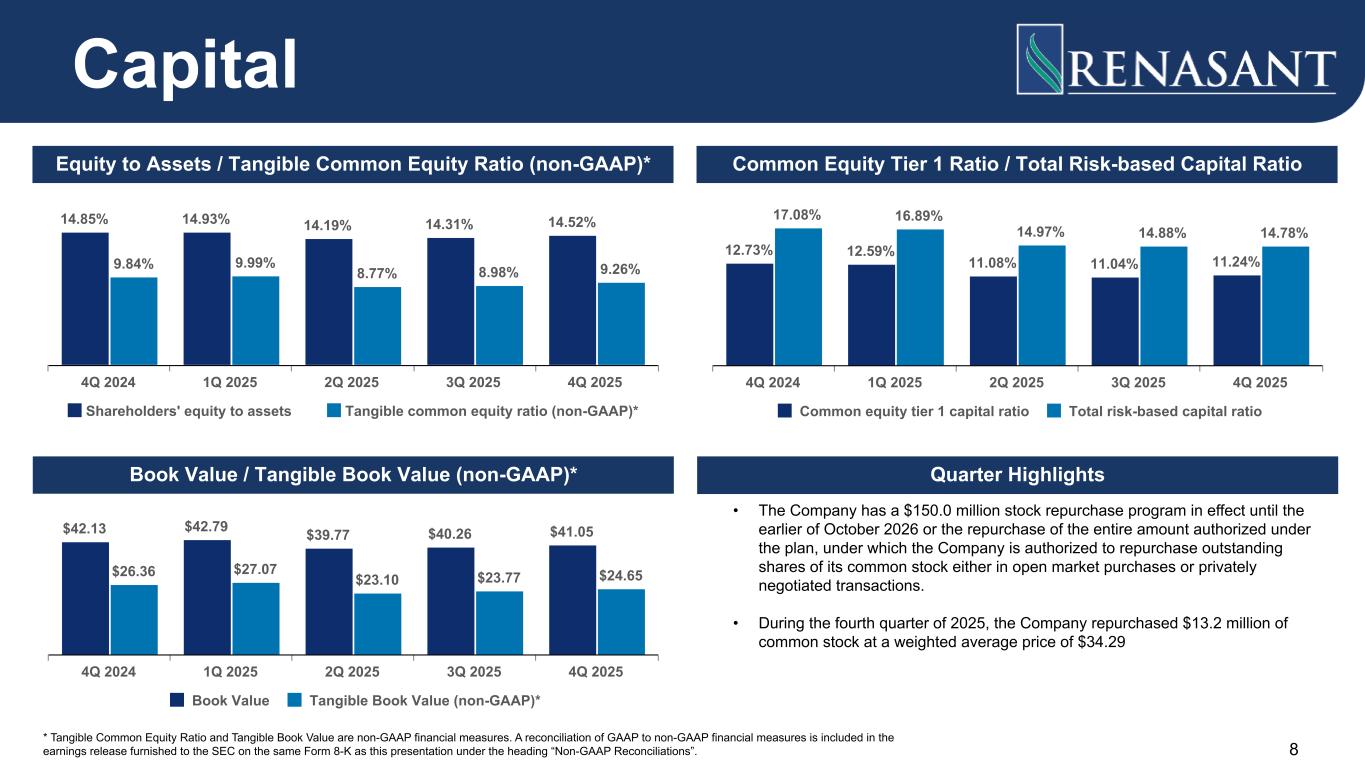
Sure. With the usual considerations regarding organic growth and market conditions, I would say that we are approximately at 11.25% CET1 at the end of the year. We aim to maintain or reach a similar level by the end of 2026. We'll have to see what the market conditions are for any adjustments, but that's how I view it. We are satisfied with the CET1 position and anticipate a growth of about 50 to 60 basis points in that ratio. Therefore, we would like to finish the year close to where we began.
Speaker 9
That's fair. That's great. And then maybe one follow-up just on the margin. You added a great new slide, Slide 19 to your deck, which just shows some of the detail around loan repricing and maturity. As I look at that slide and I see fixed-rate loans today are at around kind of 5.5% and then variable-rate loans are about 6.3%. Where those 2 buckets, as you see those loans reprice and new originations replace it, where are you seeing new loan originations come on kind of relative to those rates?
Speaker 3
If we look at new and renewed loans, I don't remember the December quarter specifically, but I would estimate that it was around 6%, likely in the upper 5s or low 6s. We have approximately $1.3 billion in fixed-rate loans that will reprice, and those loans are at about 5.25%. This gives a clearer picture of the opportunity related to repricing.
Operator
And the next question will come from Janet Lee with TD Cowen.
Speaker 10
Looking at the fourth quarter profitability metrics, such as ROA, ROTCE, and efficiency ratio, it appears you reached the targets you set following your first acquisition, as indicated in the slide deck you submitted earlier. This outcome was impacted in '25 by changes in purchase accounting, among other factors. Are there any updated thoughts on the direction you want your profitability metrics to take from this point forward, or have you achieved the levels you aimed for, and is it now primarily about scaling?
Speaker 3
Janet, this is Jim. I'll begin with that, and then Kevin can add his perspective. I think you summarized it well. We are pleased that, aside from a few assumptions, we are on track to meet the goals we established 18 months ago regarding the merger and its economic benefits. I feel confident about that. We have consistently pointed to the first quarter of 2026 as a time when we expect to see a clear demonstration of the advantages resulting from the merger. Additionally, regarding expenses, we do not expect any M&A costs in the first quarter. While there might be a minor amount that trickles in, I believe we have incurred the last of those expenses in the fourth quarter. You framed it accurately. We feel we are on track for 2026 to largely realize what we outlined 18 months ago. Now, I'll turn it over to Kevin to discuss how we think about future profitability in light of industry developments and other factors.
Yes, great question, Janet. It makes me think because, as you mentioned, we're right on track with what we projected 18 months ago. Back then, we would have been in the top quartile of our peer group based on the information we had. However, today, we're not in that top quartile; we've found ourselves in the middle, which isn't where we want to be. Our goal is to be a top-performing company across all areas, particularly concerning our financial metrics. So, we're not there yet. We didn't plan to just settle for where we are now. We intend to keep improving. What's exciting about the changes in our peer group is that it has pushed us to aim for higher goals. I see a lot of momentum and commitment within the company. Some may choose not to engage fully, but that's okay, as it allows us to achieve our higher performance aspirations. Overall, most people seem to be embracing this challenge, which is encouraging. Our aim is to continue improving and pursue a constantly moving target, ultimately striving for high performance. Reflecting on the past year, especially as we wrap up Q4, I'm not sure about our pretax pre-provision revenue projection from 2018, but I'm fairly certain it's significantly higher today than we initially forecasted. This year, we've maintained our allowance as we've noticed some shifts in credit conditions. We're not experiencing any major issues, but we have kept our allowances, which has slightly pressured our ROA. Overall, we’re ahead of what we anticipated for our 2025 results compared to our 2024 projections. If we adjust for that, we may be closer to that top-performing peer group. However, out of caution, we've retained some reserves. If you review our operating results, you'll see that we're likely performing better than we originally expected, but we’re not ready to declare victory just yet. The landscape has changed among our peers, which is actually exciting; it shows that we're relevant and in the game, ranking in the middle rather than the bottom. The gap between us and the top performers is just a few basis points. The effectiveness of our strategies and execution will determine our success against the peer group, and that's what makes this situation exciting rather than discouraging. Many might think we did all this work and ended up in the middle, but I feel a sense of excitement about our plan and team execution. I am confident that we will continue to rise in the rankings as we perform better. We just need a little more time to demonstrate our performance, which will lead to improved financial results and ultimately help us reach our goal of becoming a top-performing company.
Speaker 10
That's great to hear. For my last follow-up on loan growth, you reiterated the mid-single-digit guidance for 2026 and mentioned strong pipelines. I know you might not have a clear view on payoffs, but what gives you confidence? Are there indications that payoffs have slowed down compared to the level in the fourth quarter? What gives you that assurance?
I believe that our confidence is based on a longer timeframe, extending out to 12 months. This leads me to feel that, over the year, things will stabilize. While there may be some fluctuations on a quarterly basis, I think we are well-positioned to achieve a mid-single-digit growth rate over an extended period. This applies not only to loans but also to appropriately funding our liabilities with deposits. As for payoffs, it's early in the quarter, making it challenging to predict what they will be for Q1. We are projecting payoffs will be at a similar level to the elevated ones we saw in Q4, but this projection isn't necessarily influenced by what we've observed in the first 20 days of the quarter. Payoffs can be unpredictable and the initial days don't provide a clear picture of what will unfold over the next 90 days. However, when I assess our production and discuss the opportunities with our teams, I gain confidence that a mid-single-digit growth rate is a reasonable expectation for us throughout the year.
Operator
This concludes our question-and-answer session. I would like to turn the conference back over to Kevin Chapman for any closing remarks.
Thank you, Nick. And thank you to everybody that listened this morning, and we appreciate your interest in Renasant. We also look forward to meeting with investors throughout the quarter. Thank you.
Operator
The conference has now concluded. Thank you for attending today's presentation. You may now disconnect.