Operator
Good afternoon, and welcome to the Redwood Trust, Inc. First Quarter 2026 Financial Results Conference Call. Today's conference is being recorded. I will now turn the call over to Natasha Fothery, Senior Vice President of Finance.
Operator
Please go ahead, ma'am.
Thank you, Operator. Hello, everyone. And thank you for joining us today for Redwood's first quarter 2026 earnings conference call. With me on today's call are Chris Abate, Chief Executive Officer, Dash Robinson, President, and Brooke Carrillo, Chief Financial Officer. Before we begin today, I want to remind you that certain statements made during management's presentation today with respect to future financial and business performance may constitute forward-looking statements. Forward-looking statements are based on current expectations, forecasts, and assumptions, which include risks and uncertainties that could cause actual results to differ materially. We encourage you to read the company's annual report on Form 10-K, which provides a description of some of the factors that could have a material impact on the company's performance and cause actual results to differ from those that may be expressed in forward-looking statements. On this call, we may also refer to both GAAP and non-GAAP financial measures. The non-GAAP financial measures provided should not be utilized in isolation or considered as a substitute for measures of financial performance prepared in accordance with GAAP. Reconciliation between GAAP and non-GAAP financial measures are provided in our first quarter Redwood Review, which is available on our website, redwoodtrust.com. Also know that the contents of today's conference call contain time-sensitive information that are accurate only as of today. We do not intend and undertake no obligation to update this information to reflect subsequent events or circumstances. Finally, today's call is being recorded. It will be available on our website later today. And with that, I'll turn the call over to Chris for opening remarks.
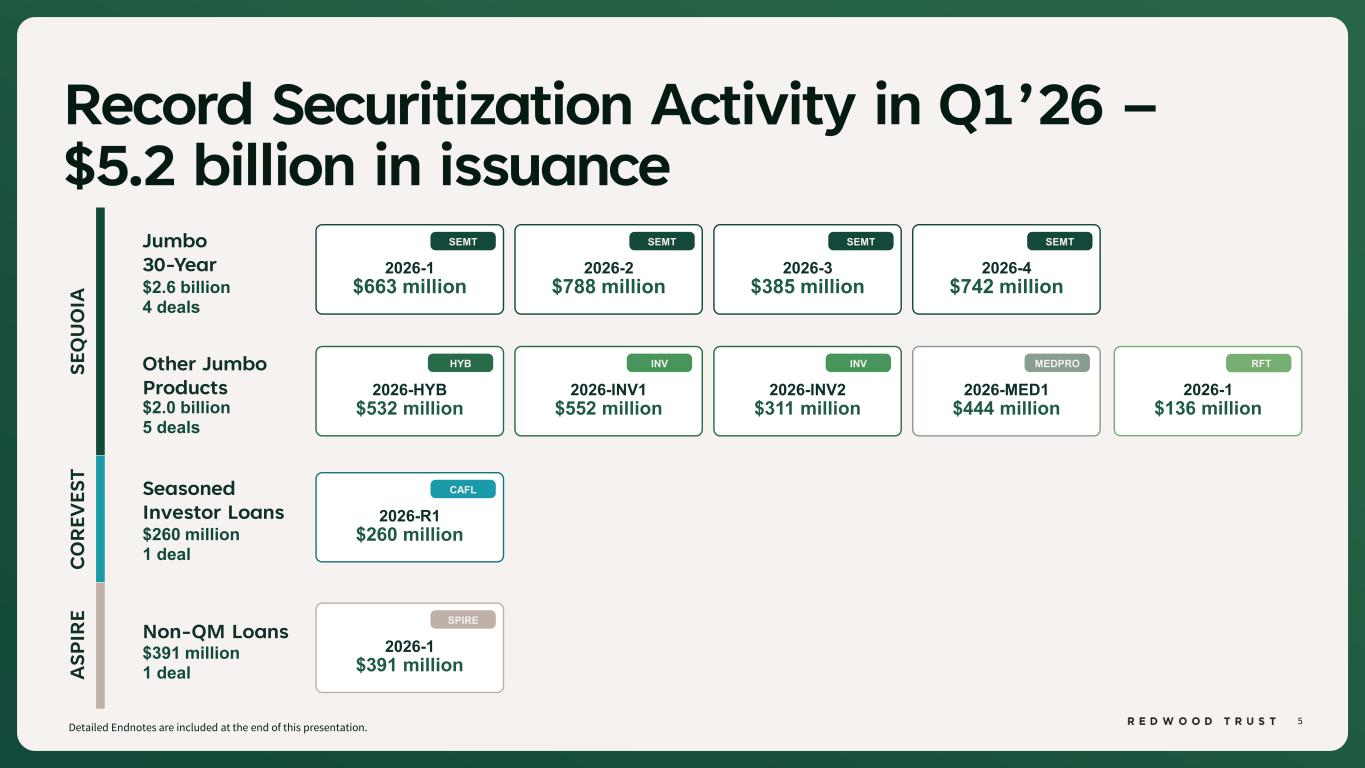
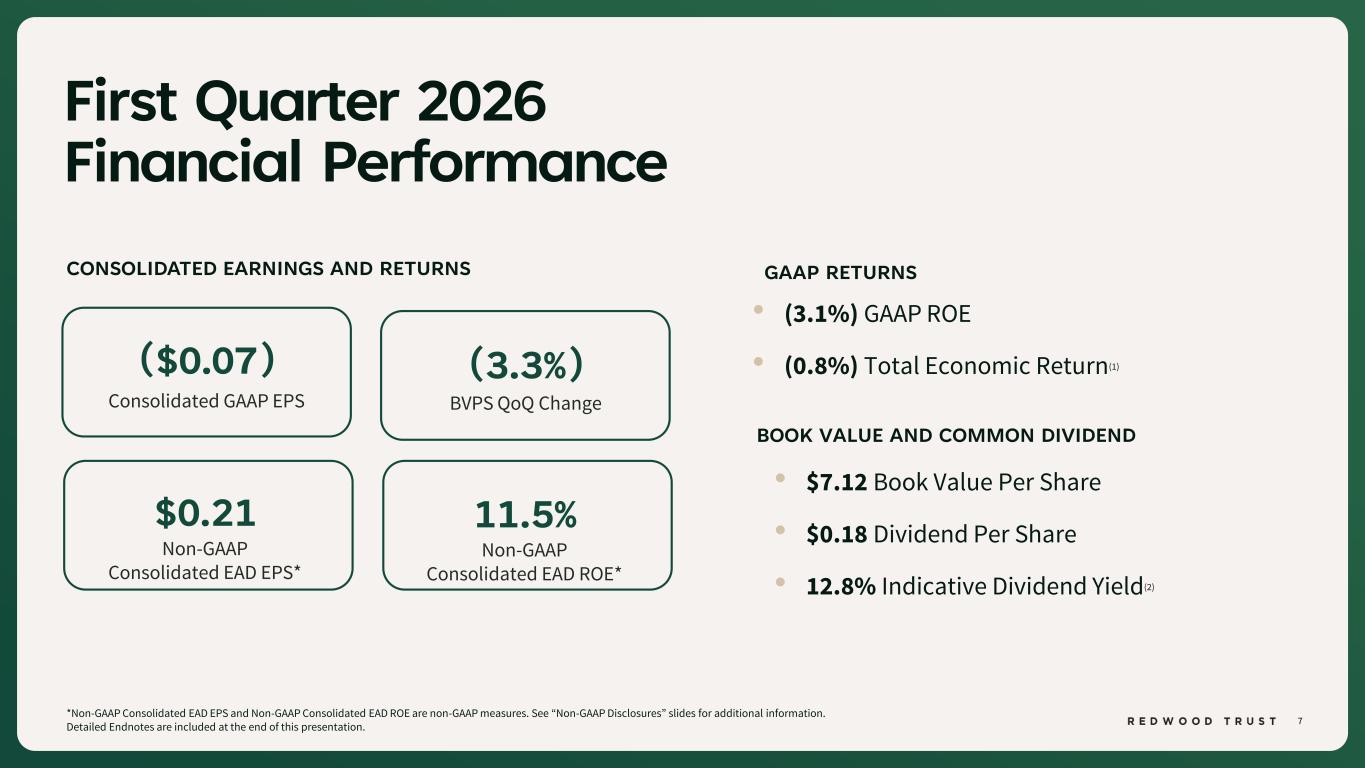
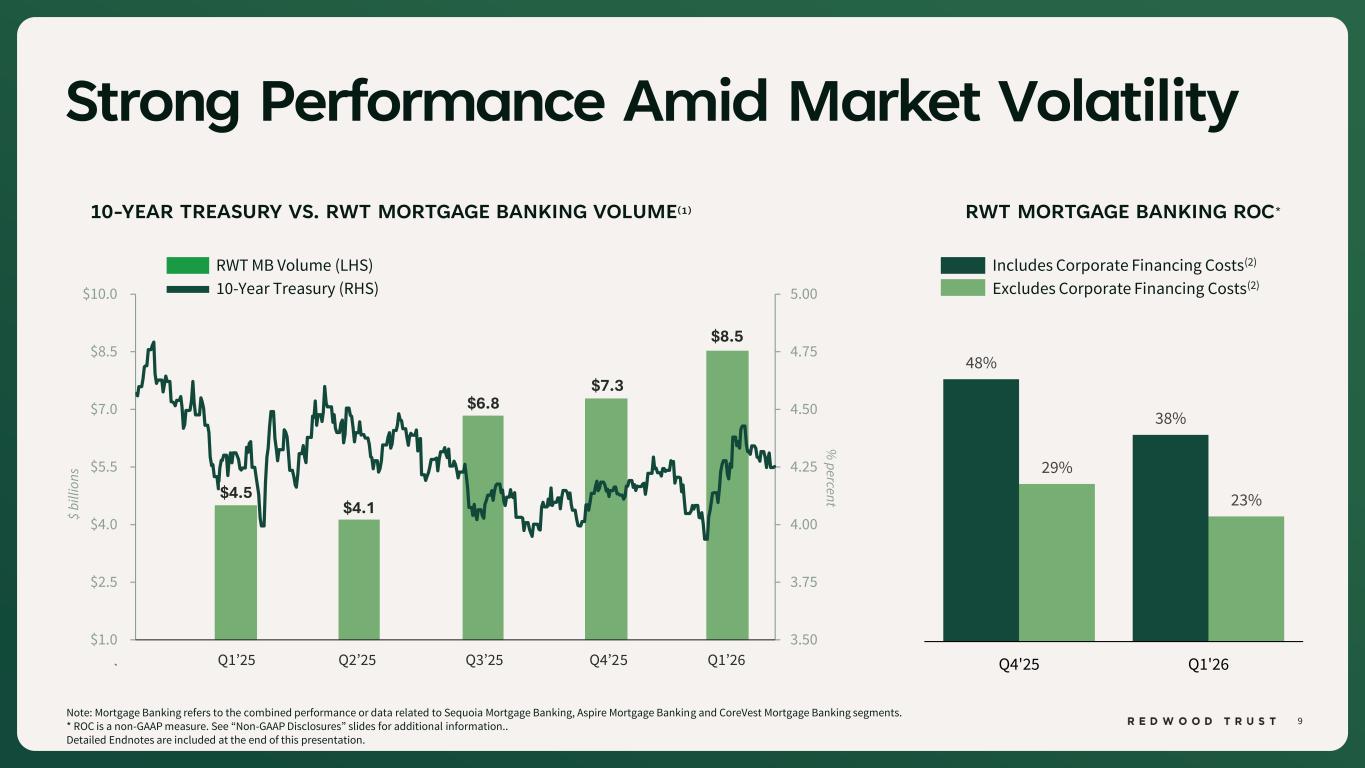
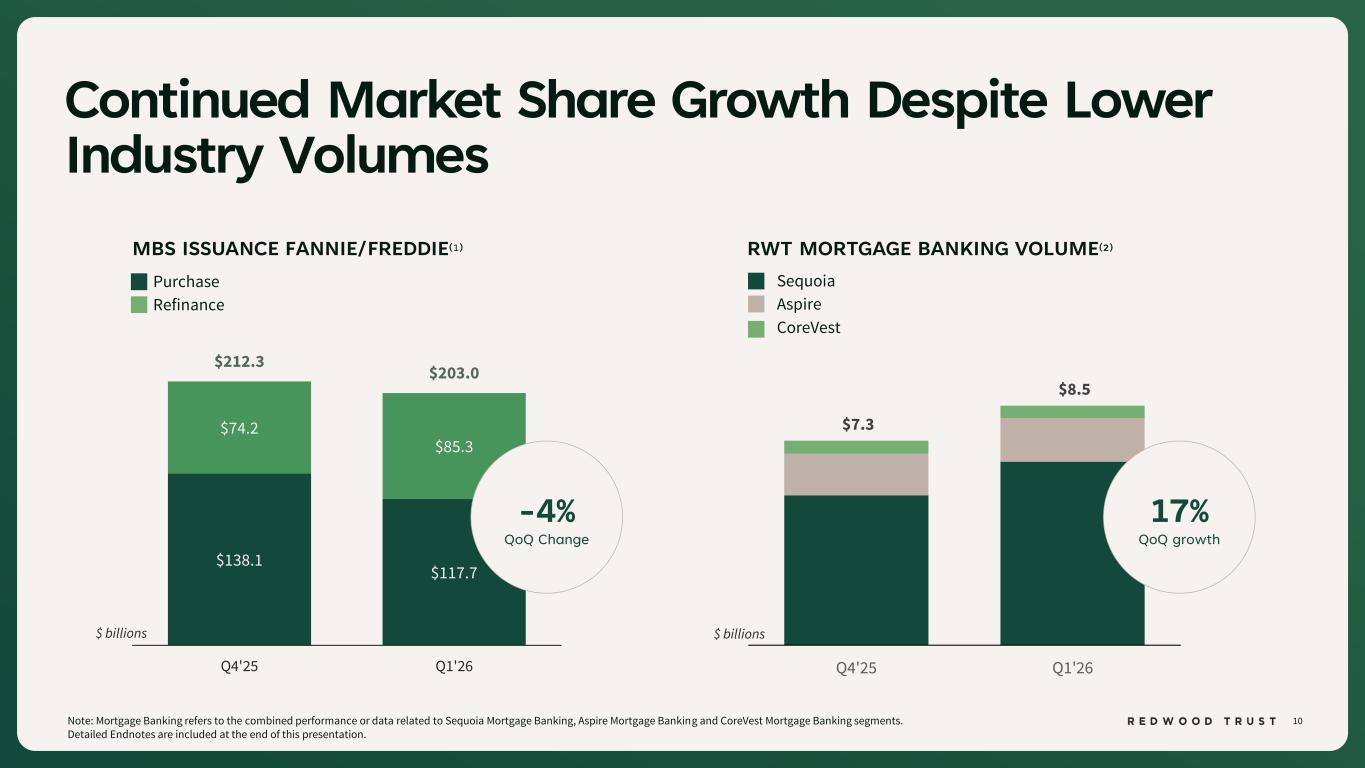
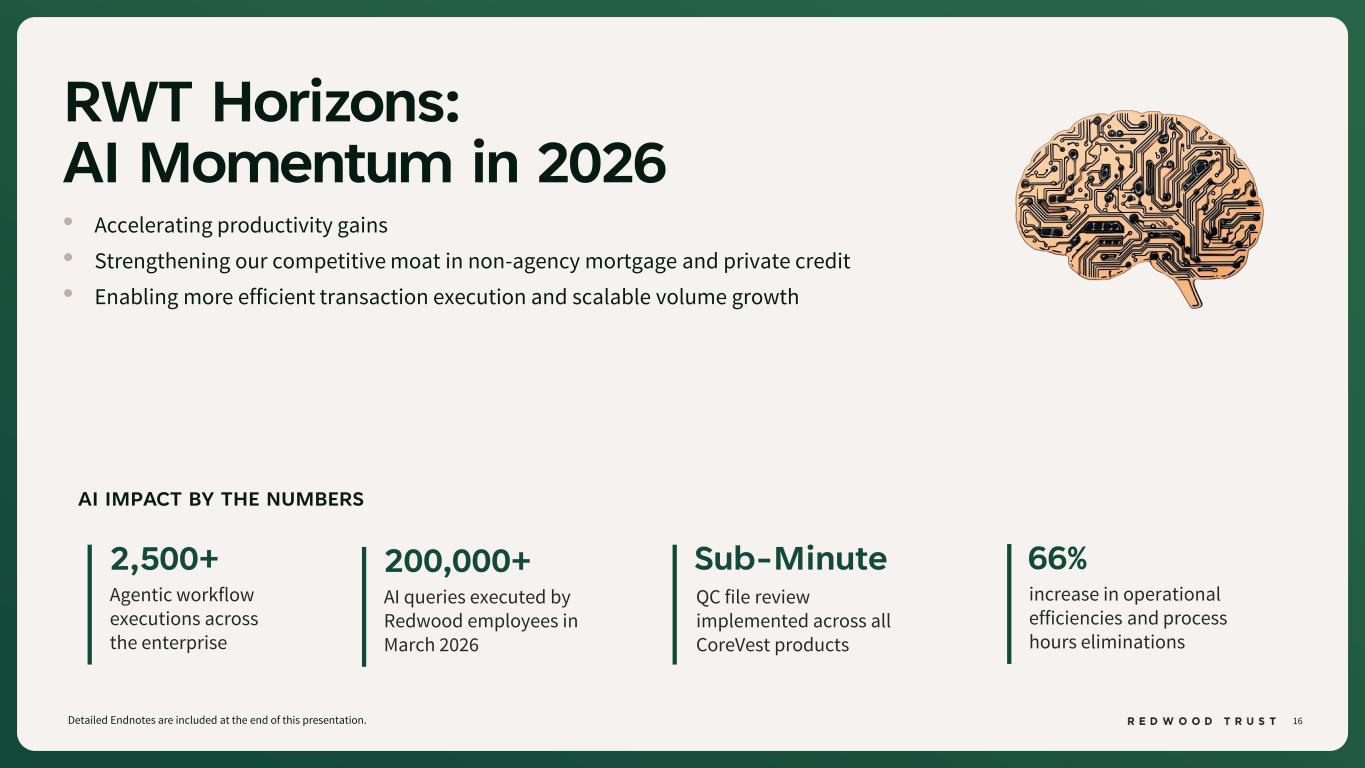
Thank you, and good afternoon, everyone. Before I turn the call over to Dash and Brooke, I want to share a few thoughts on our first quarter performance and what it says about Redwood's position as we move forward in 2026. As you all saw by now, Redwood generated a third consecutive record operating quarter, with mortgage banking volumes surpassing $8.5 billion for the first time and earnings available for distribution coming in a bit above last quarter at 21 cents per share, once again covering our dividend. Operating progress should garner some attention as our results came amid a broader mortgage market that has been stuck in neutral, with mortgage applications running close to 40% below pre-pandemic levels and jumbo mortgage rates having risen from the recent February lows, in large part due to the conflict in the Middle East. To zoom out and offer some context, our $8.5 billion of first quarter volume exceeded residential mortgage production at three of the top money center banks during the quarter. Our volume also clocked in at 10 times our March 31st reported gap book value, a very high capital turnover ratio. This means the loans we hold in short-term warehouse facilities are moving quickly and getting replaced with fresh production. All told, we completed 11 securitizations in the first quarter, another in-house record for Redwood. High turnover also indicates the tremendous operational efficiencies we've implemented in recent quarters, in part due to our strong adoption of AI across the enterprise. In the first quarter alone, we executed over 2,500 agentic workflows, spanning technology platform expansion to support both Sequoia and Aspire on a single unified platform, as well as automated QC and the elimination of significant work previously performed by outside In the quarters ahead, we aim to continue unlocking addressable market share by leveraging the many network relationships we've spent years cultivating, something that is neither easy nor cheap to replicate. Our longer-term objective of 20% market share or more for our primary products will require both capital efficiency and significant growth capital. We believe there is a compelling opportunity for common shareholders to participate in that growth alongside us in advance of the next monetary regime and mortgage rate cycle. In the meantime, we continue to see tremendous demand from alternative asset investors who are eager to partner with us and speak for the high-quality assets we source. Just this morning, we announced a major Sequoia Capital partnership with Castle Lake, a blue-chip global investment firm specializing in asset-backed credit. This partnership brings approximately $8 billion of incremental purchasing power to Sequoia as it scales and reflects a growing institutional demand to access our platform and the assets we create. We view this as an important step and a broader strategy to pair origination capabilities with third-party capital at scale. To that end, we've also been hard at work on an Aspire-focused joint venture and hope to announce a similar JV in short order. Such capital partnerships are timely as we're growing more optimistic about macro trends that could positively impact the housing sector, with the obvious caveat that the conflict in the Middle East seems far from resolved. As we like to say, mortgage was among the first sectors to be impacted by the Fed's historic tightening cycle to combat inflation in 2022, and we think mortgage could be among the first to benefit, now with the prospect of a more accommodative and housing-focused Fed. Based on recent publications and testimony, the presumptive new Fed chair, Kevin Warsh, seems to prefer the policy combination of lower rates and a smaller Fed balance sheet. While the reduction of QE had certainly removed a demand stimulus from the mortgage market, the prospect of a smaller Fed balance sheet should help reduce long-term inflation expectations and hopefully support lower long-term rates. The wildcard for mortgages continues to be spreads, which are still meaningfully above pre-COVID levels and still trying to find equilibrium. We expect any monetary policy tailwinds to be further supported by evolving regulatory dynamics, most notably the recently re-proposed bank regulatory capital rules, also known as the Basel III endgame. The proposed rules would ease the cost for banks to hold higher quality mortgages and mortgage servicing assets, a necessary step for banks to consider allocating more capital to their go-forward consumer mortgage operations. But lowering the capital rules is just one precursor for banks to re-enter the mortgage space. The ultimate decision, we believe remains risk-based and not profit-based. We consistently hear from bank C-suites that having a partner like Redwood to assist in the management of their interest rate and asset liability risks is a huge differentiator, especially because our support does not undermine their customer retention goals. Having the option to transact with Redwood when rates change quickly or priorities shift is the value differentiator we've now established throughout the banking system, and another example of the moat we've built around our franchise. Finally, before handing the call over to Dash, I want to remark on recent headlines stemming from the private credit sector. As we all have seen, pockets of weakness and underlying fundamentals are emerging for certain aspects of private credit, and constraints on liquidity and asset price visibility are in some cases impacting broader market sentiment. It's a timely moment for us to humbly champion Redwood's public credit model, where you can gain exposure to innovative mortgage banking and credit strategies, coupled with the liquidity that a publicly traded stock offers. We also strive to provide great transparency through the utilization of annual external audits, quarterly 10-Q filings, proxy statements, and perhaps most importantly, mark-to-market accounting through our income statement. It's times like these that we take pride in our shareholders knowing not only what they own, but also knowing what they don't. And with that, I'll turn the call over to Dash to discuss our operating results.
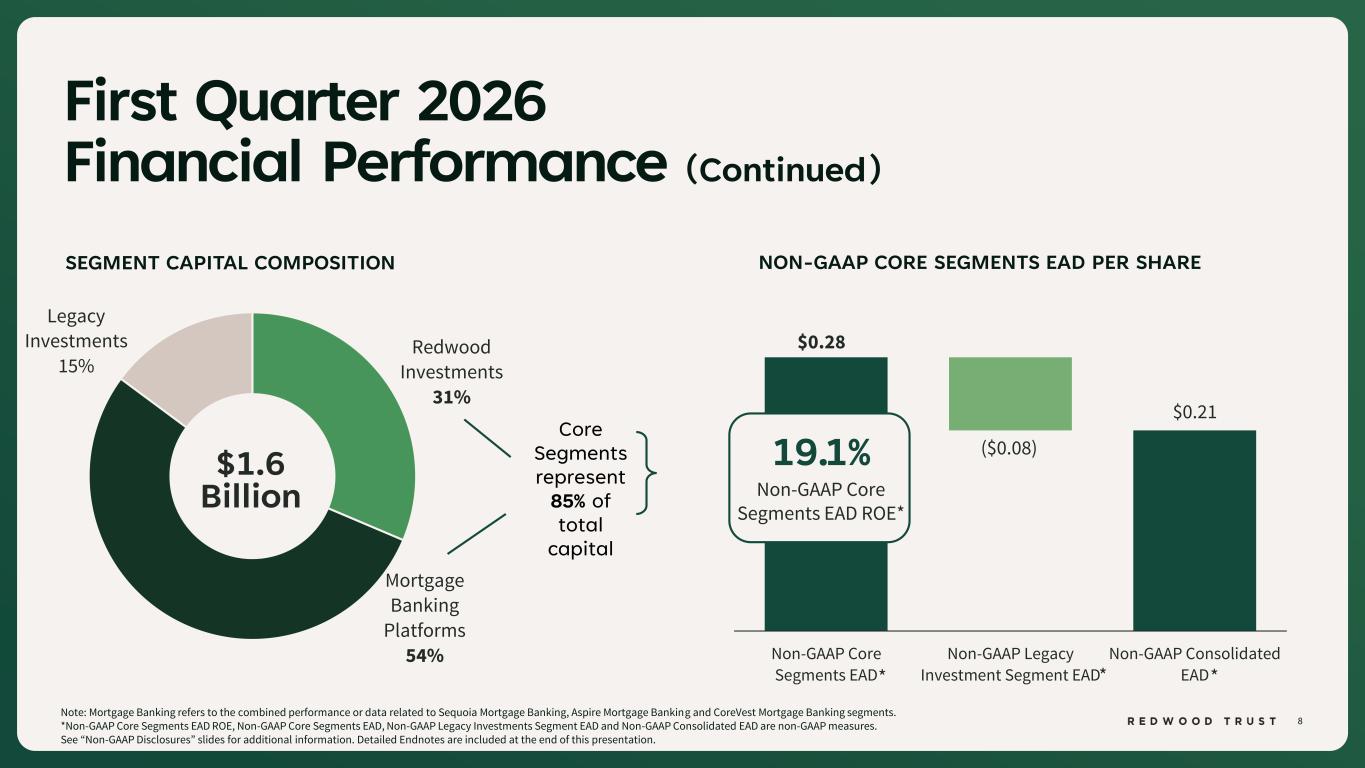
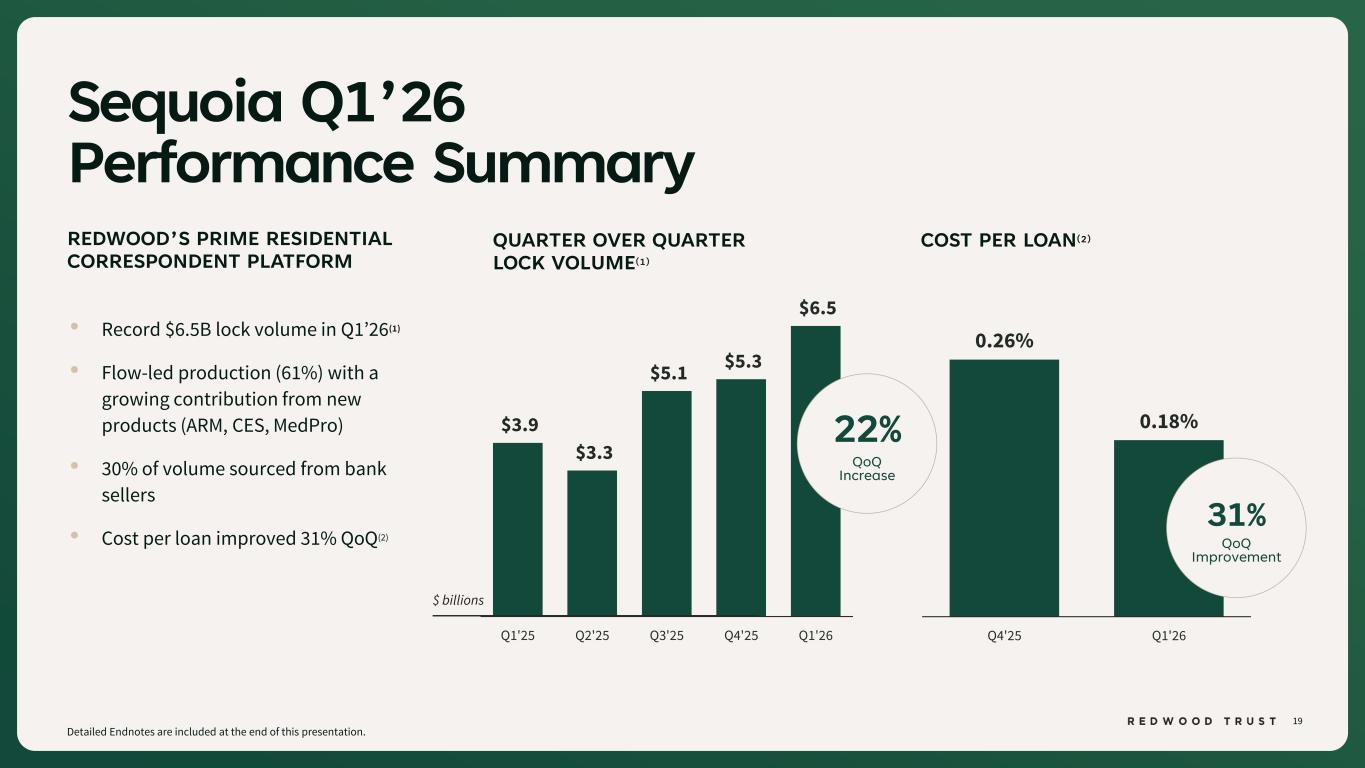
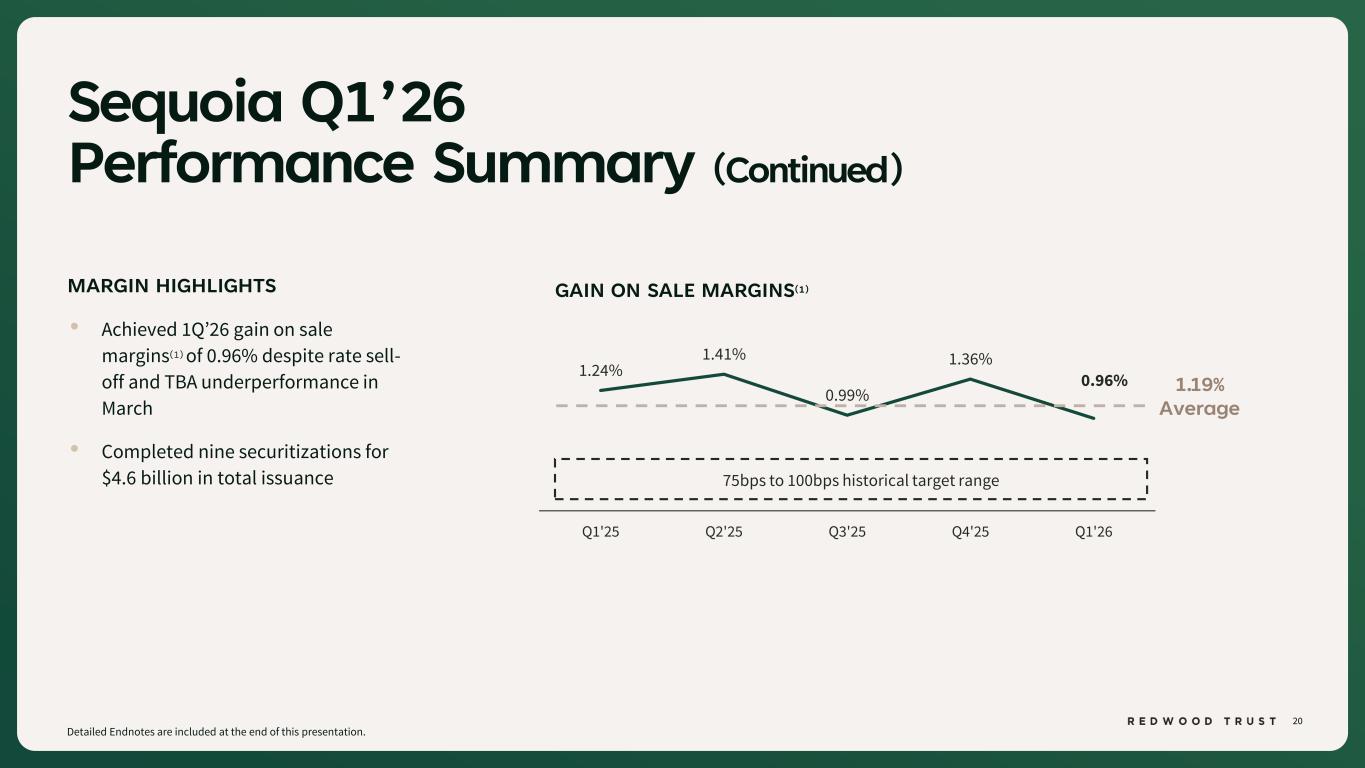
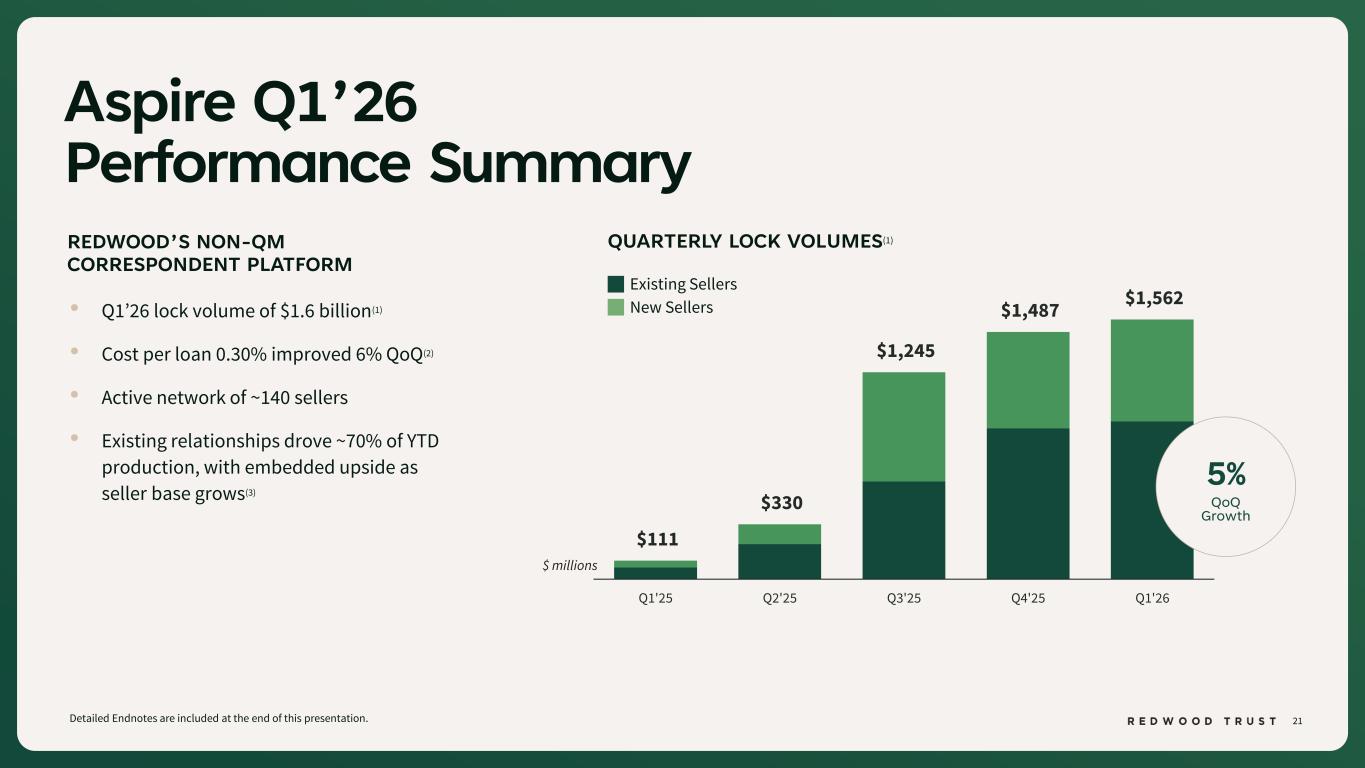
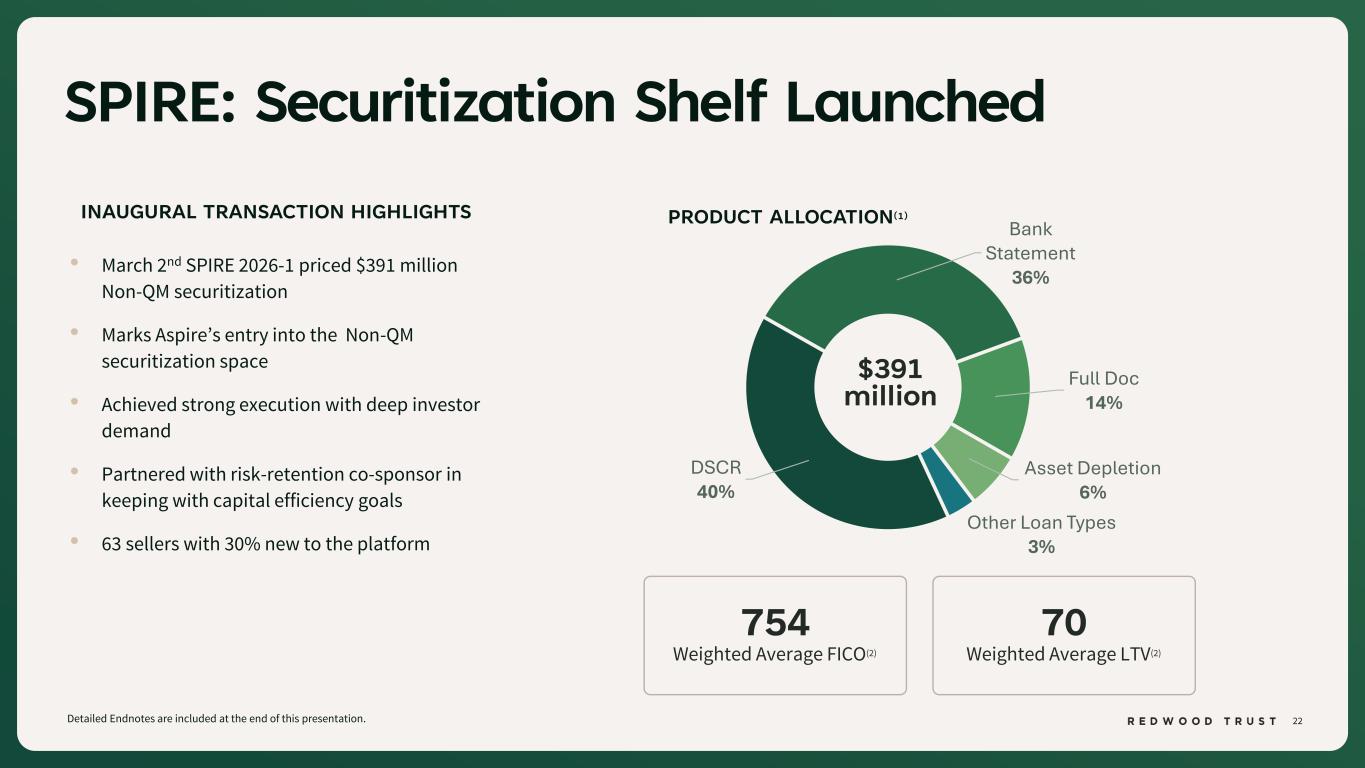
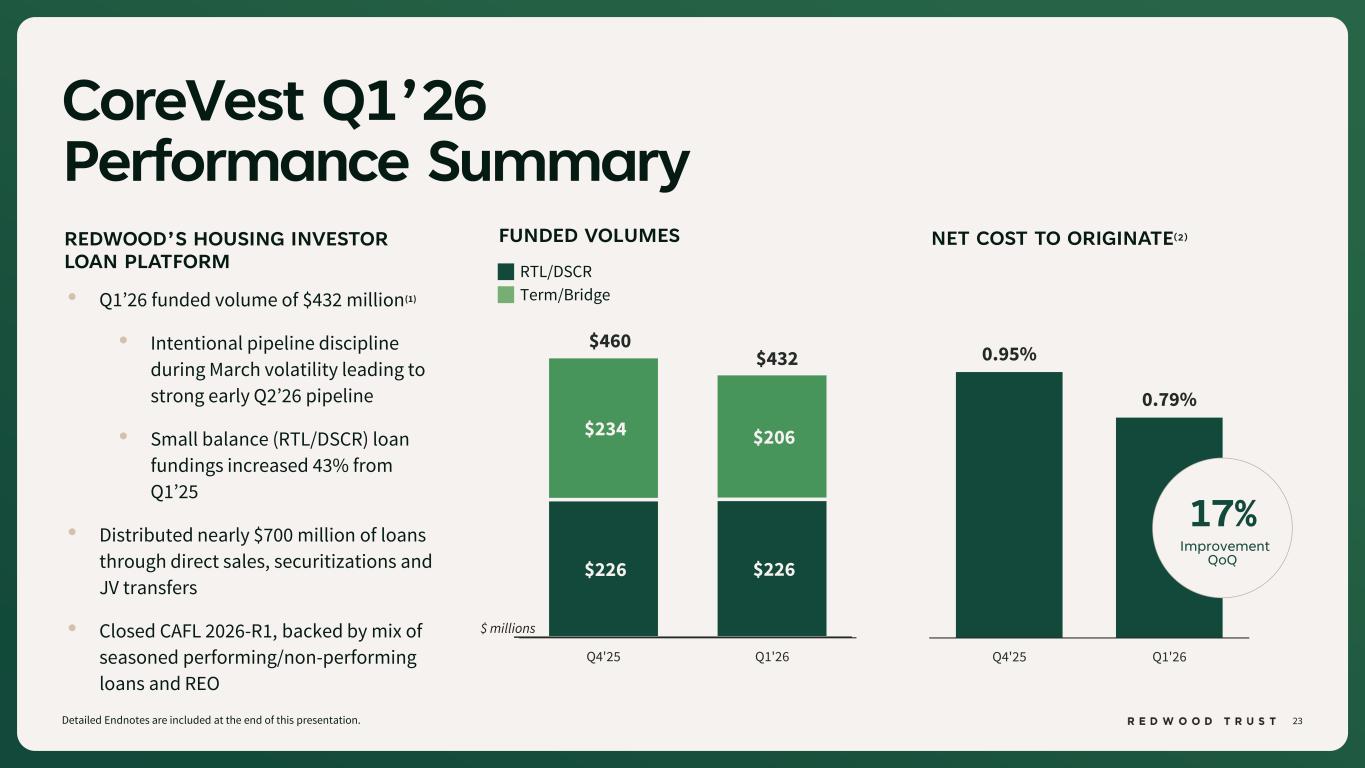
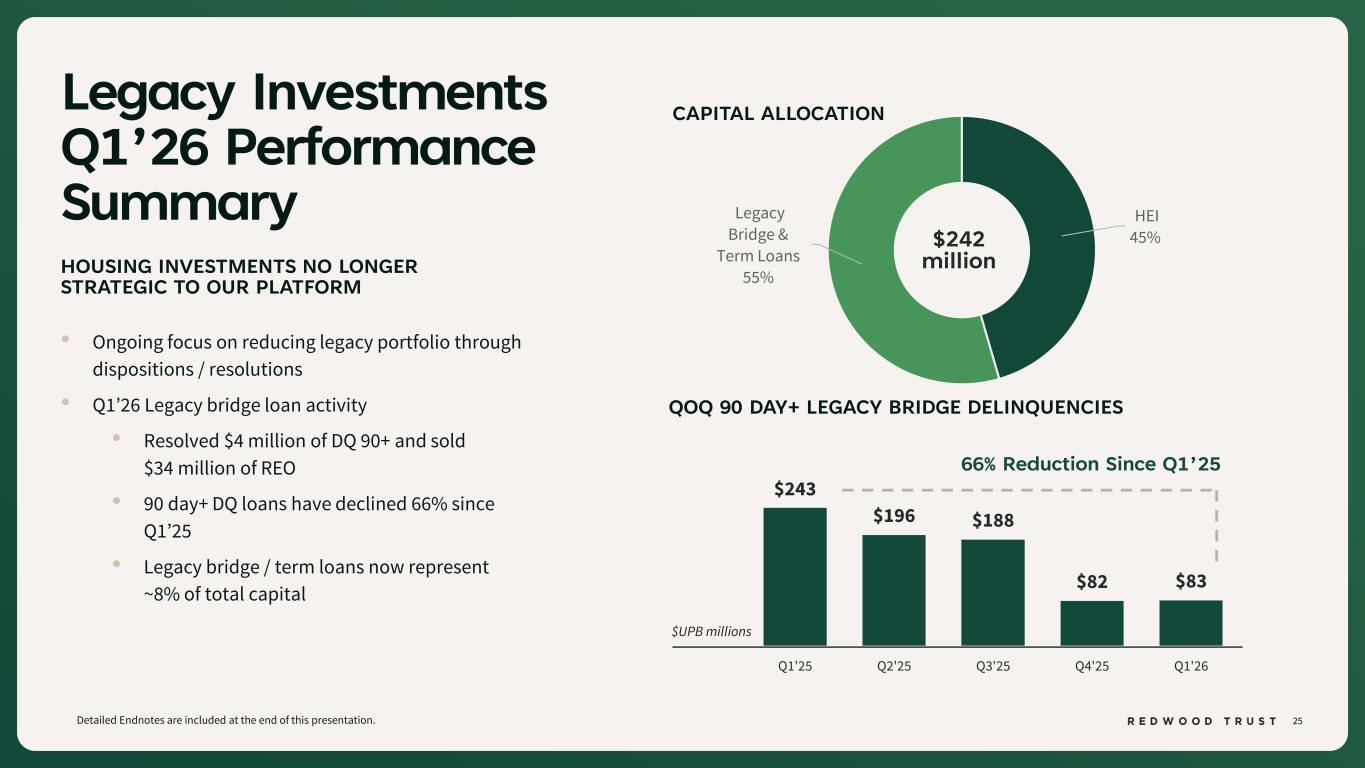
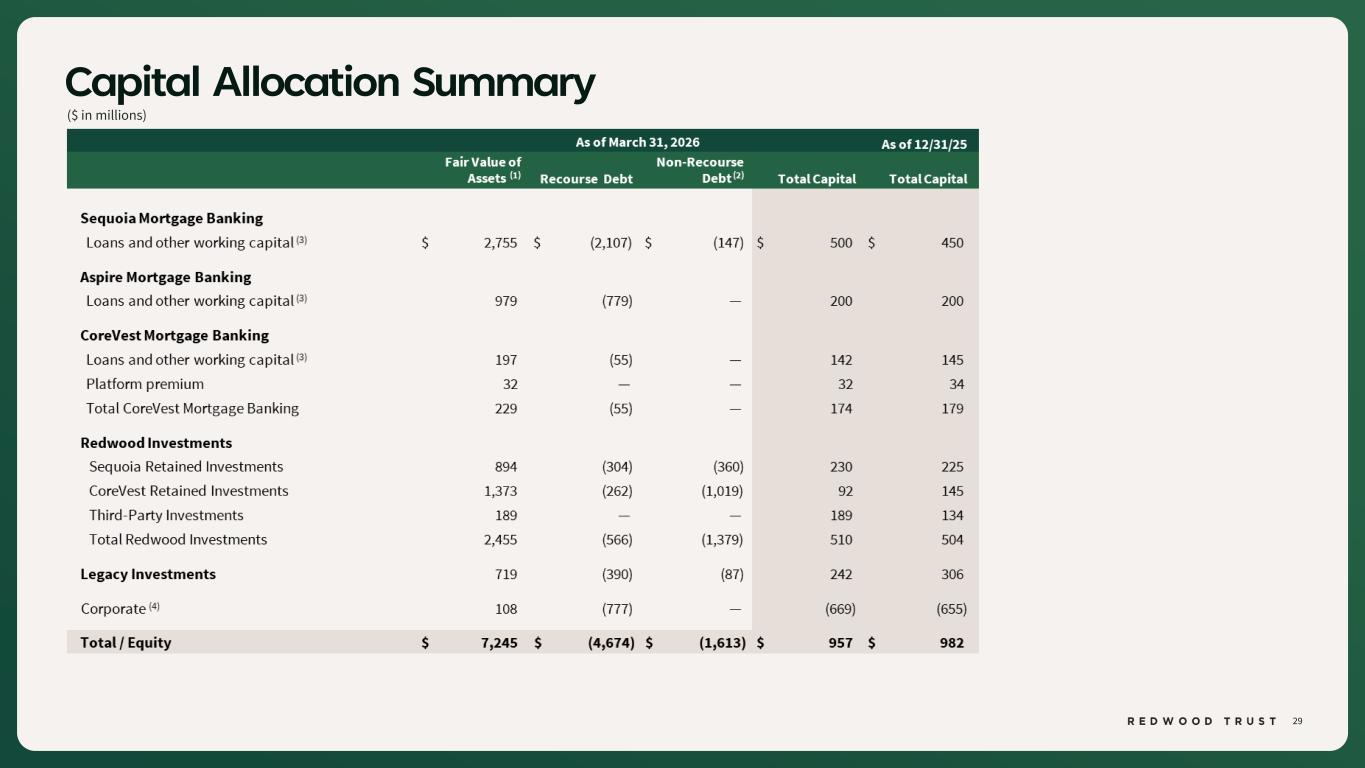
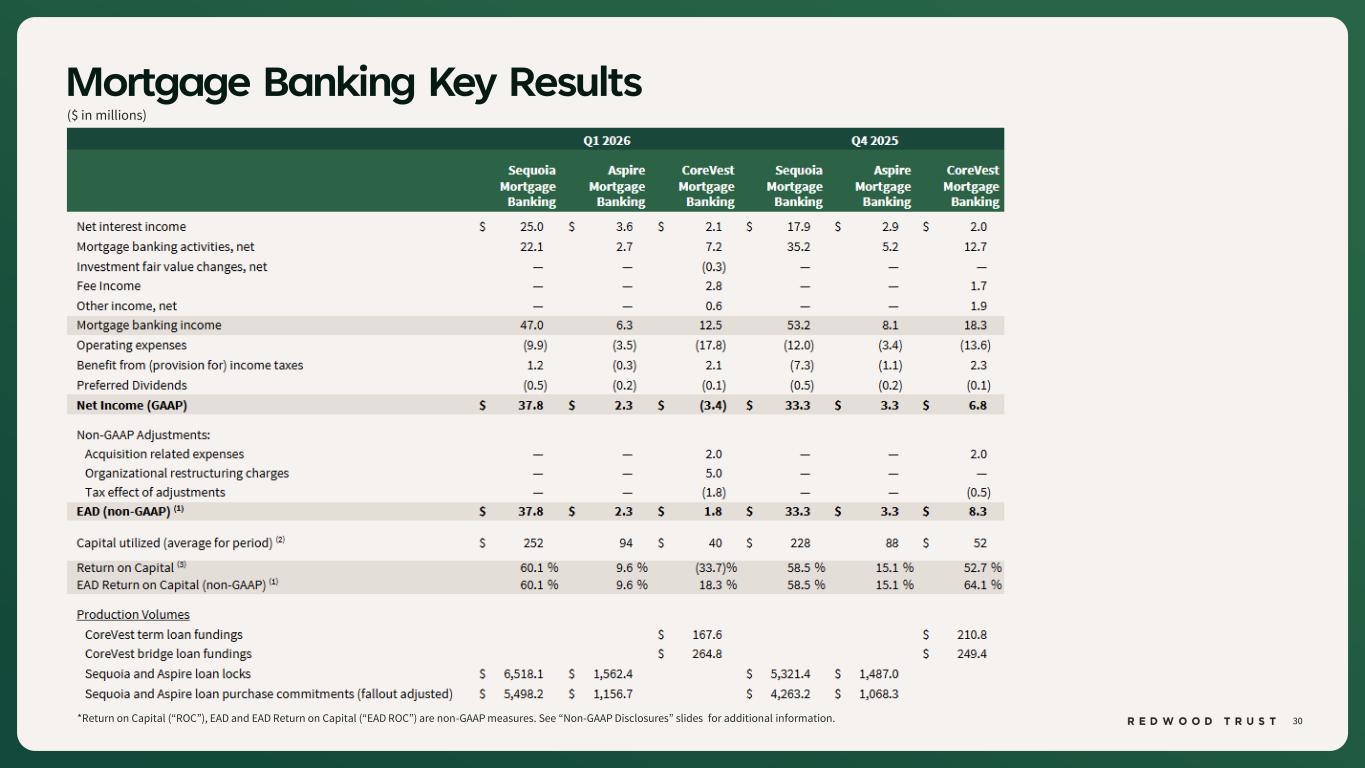
Thank you, Chris. Our first quarter operating performance reflects continued momentum across our mortgage banking platforms, supported by record Sequoia volume, ongoing growth at Aspire, and strategic progress at Corvest, including evolution of our production mix. Even against a more volatile backdrop beginning in March, our full quarter results demonstrated the scalability of our model and the additional operating leverage still to be unlocked. Sequoia once again headlined our results, logging another record quarter with $6.5 billion of locks, up 22% from the fourth quarter. That volume was generated in a housing environment that remains well below historical norms, underscoring the market share gains we continue to make across our originator network, now enhanced by several new products to complement our core jumbo offering. Cost per loan improved 30% from the fourth quarter to below 20 basis points, aided by automation initiatives that we estimate will free up close to 6,000 hours per year that our team members can utilize more productively. Capital turnover also improved quarter over quarter, with continued efficiencies expected from the new joint venture dedicated to Sequoia's jumbo production that Chris described. Gain on sale margins in the first quarter were 96 basis points, at the high end of our historical target range, despite substantial TBA underperformance into quarter end, much of which has retraced thus far in April. Margin resilience was driven in part by strong execution on $5.5 billion of dispositions, including $4.6 billion across nine securitizations. As Chris articulated, the recently reproposed Basel endgame rules represent a potentially meaningful tailwind for the business. While flow volume represented the majority of first quarter production, we are currently evaluating on an exclusive basis close to $5 billion of seasoned bulk pools from banks, underscoring our view that more benign capital charges against high-quality mortgages will promote more two-way flow of bulk pools, a positive for Redwood given our market positioning, as banks continue to prioritize prudent asset liability management. Away from bulk opportunities, our sourcing channels remain well diversified overall, with average flow lock concentration by seller of less than 1%. Product expansion also continues to support growth. During the quarter, we launched a new loan program focused on medical professionals, locking nearly $300 million of such loans on a flow basis during the quarter, and later in the quarter, successfully securitizing a bulk pool of MedPro loans we acquired from a bank, a first-of-its-kind transaction. In all, our expanded offerings represented 14% of total lock volume in the quarter, with over 100 of our sellers now actively selling us at least one new product. Aspire continued its growth trajectory in the first quarter, adding several new origination partners while further deepening our value with existing sellers. Aspire lock volume increased to $1.6 billion, with April lock volume ahead of that pace. Approximately 70% of Aspire's first quarter volume came from sellers already active with Sequoia, a significant competitive advantage for the platform that also is indicative of its growth potential. More originators are now recognizing the strategic benefit of non-QM products that serve a growing cohort of borrowers outside the traditional W-2 profile, including self-employed consumers and smaller-scale housing investors. We estimate Aspire's first quarter market share to be approximately 4%, which we expect to at least double by the second half of this year. As Aspire remains a relatively early-stage platform, an ongoing priority remains scaling operations ratably with volume growth and maintaining the cost discipline that supports long-term profitability. Aspire's gross margins were 73 basis points in the first quarter, impacted by spread widening in the pipeline at quarter end that has since largely reversed. The platform's inaugural securitization in March was an important milestone for the business, broadening distribution, improving capital efficiency, including through accretive distribution of the risk retention and subordinate tranches to a third party, and establishing Aspire as a programmatic issuer alongside Redwood's other leading securitization shelves. At Corvest, first quarter volume totaled $432 million, down modestly from the fourth quarter, but with continued progress in our smaller balance residential transition loan, or RTL, and DSCR products. In partnership with our borrowers, we managed the pipeline carefully in March as volatility increased, which reduced monthly volume but positioned customers to lock loans in April at more favorable all-in rates. Corvest's origination and distribution strategies are improving capital efficiency, reducing market risk, and aligning the platform with areas of demand well supported by our capital partners. Most notably, this includes our joint venture with CPP Investments, to which we have now distributed over $2 billion of Corvess production life to date, generating upfront fee income and building a recurring income stream as the joint venture grows. The broader housing investor market remains focused on a pending piece of legislation that may impact institutional ownership of rented single-family homes over the medium to long term. While the final outcome remains uncertain, we believe parts of the eventual framework could create longer-term opportunities for the platform, both within our smaller balanced loan programs and if the new rulemaking ultimately impacts the GSE footprint for single-family housing investors. Alongside record mortgage banking activity, we continue to pace with our reallocation of capital away from legacy investments, which stood at 15% of total capital at March 31st, down from 19% at year end. While segment returns were once again impacted primarily by net interest expense, Resolution activity during the first quarter combined with an accretive securitization reduced legacy bridge loans to approximately half of the legacy segment and 8% of our total capital overall. 90-day-plus delinquencies were roughly flat versus year-end in the legacy portfolio as we prioritize efficiently winding down the segment through outright dispositions or other structured sales that we believe will lead to the best outcomes through time. I will now turn the call over to Brooke to discuss our financial results.
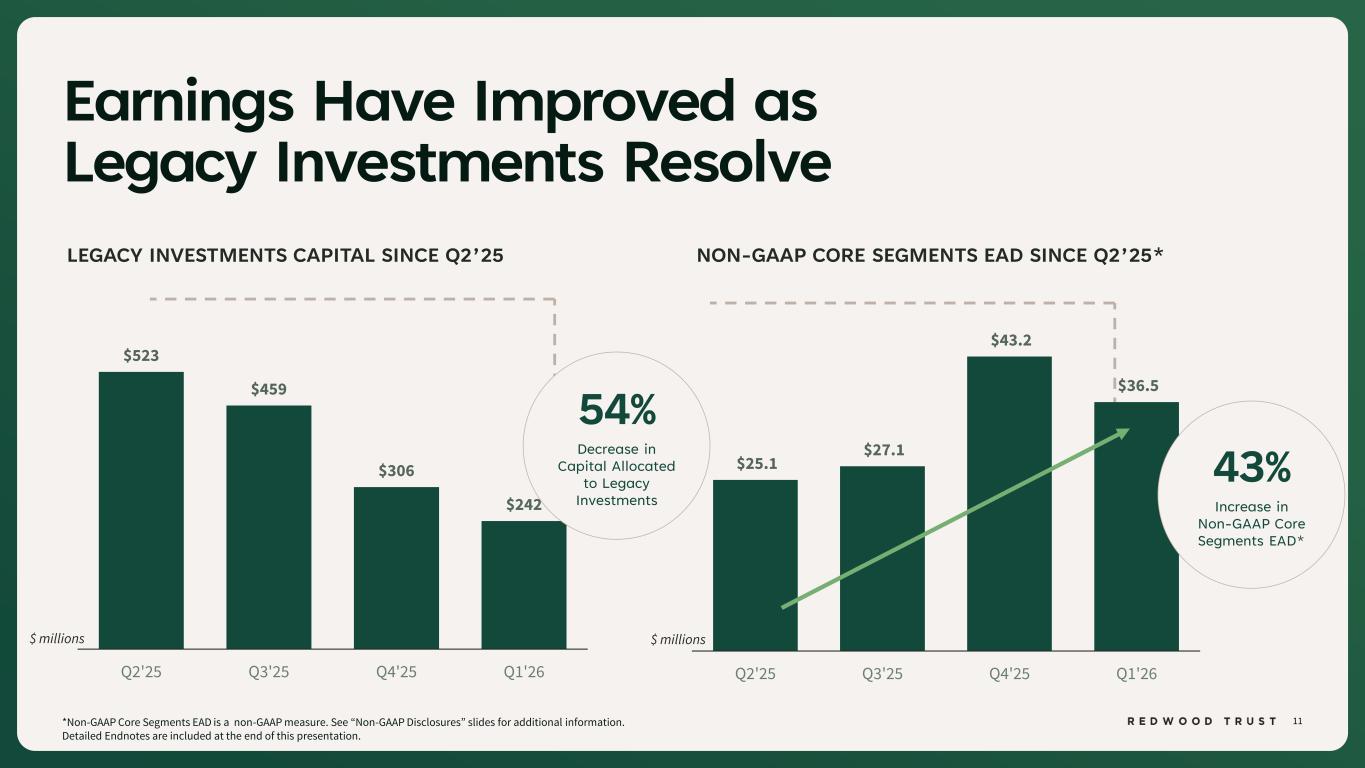
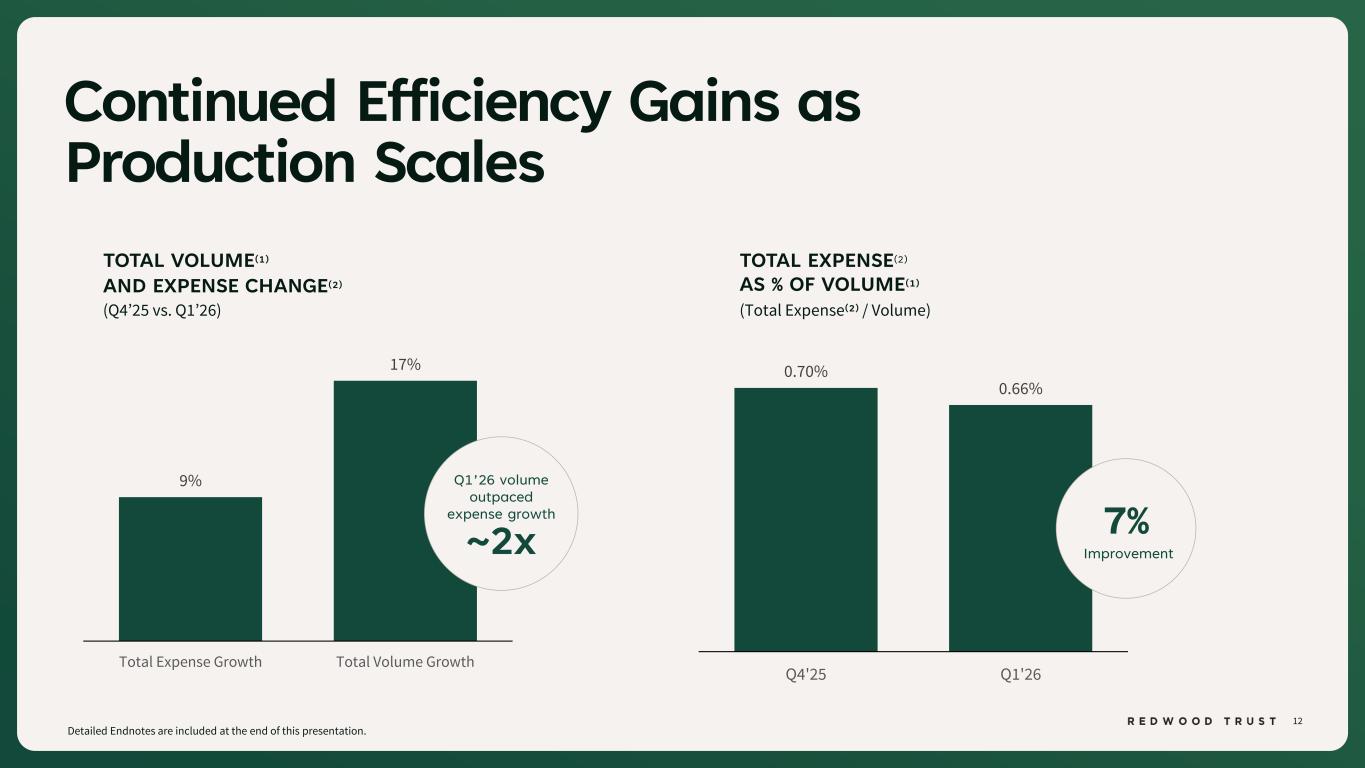
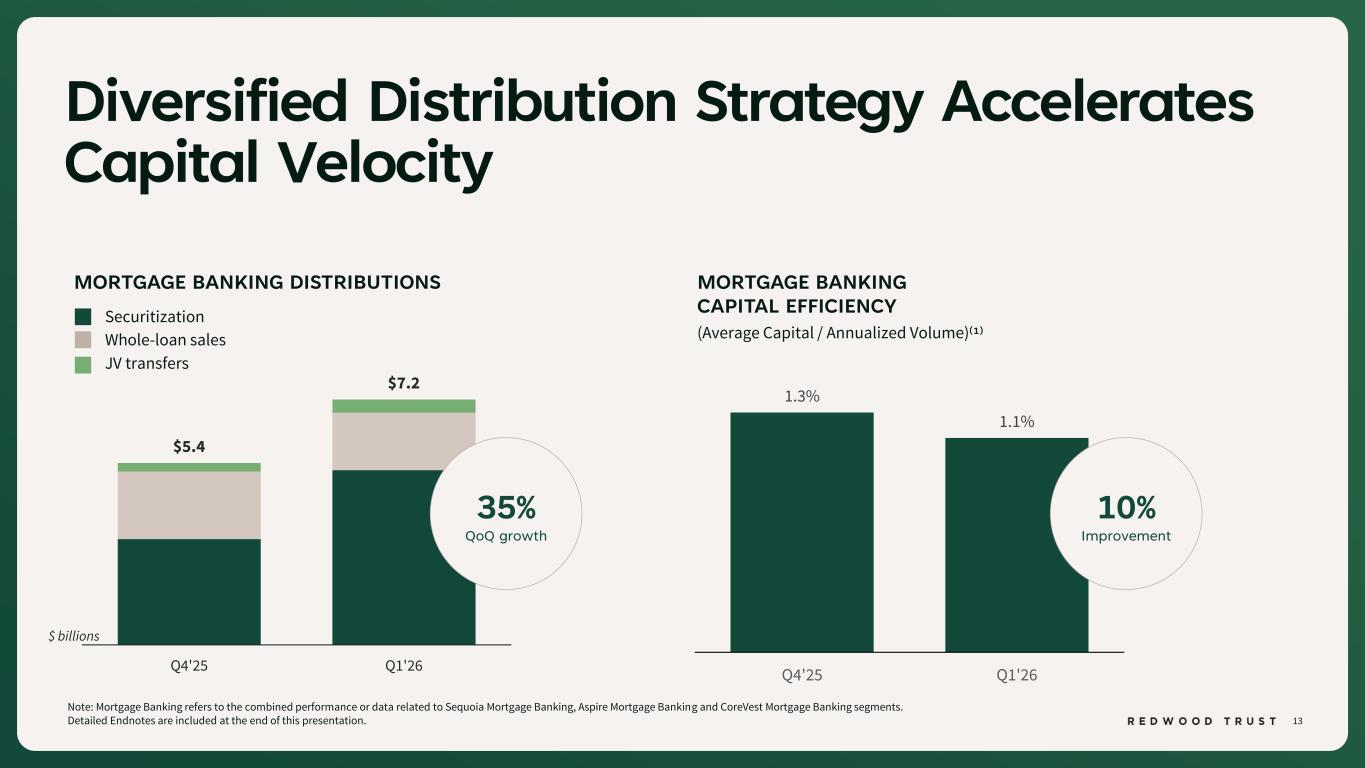
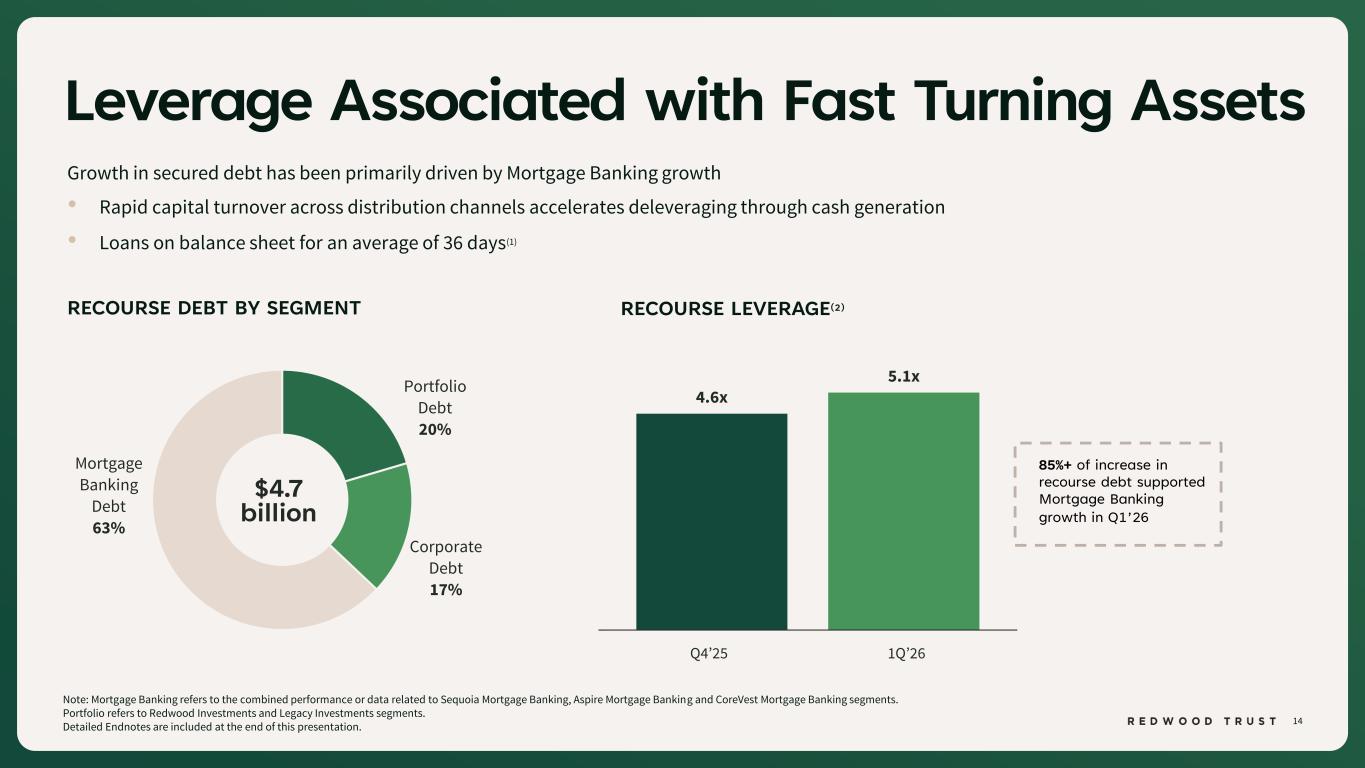
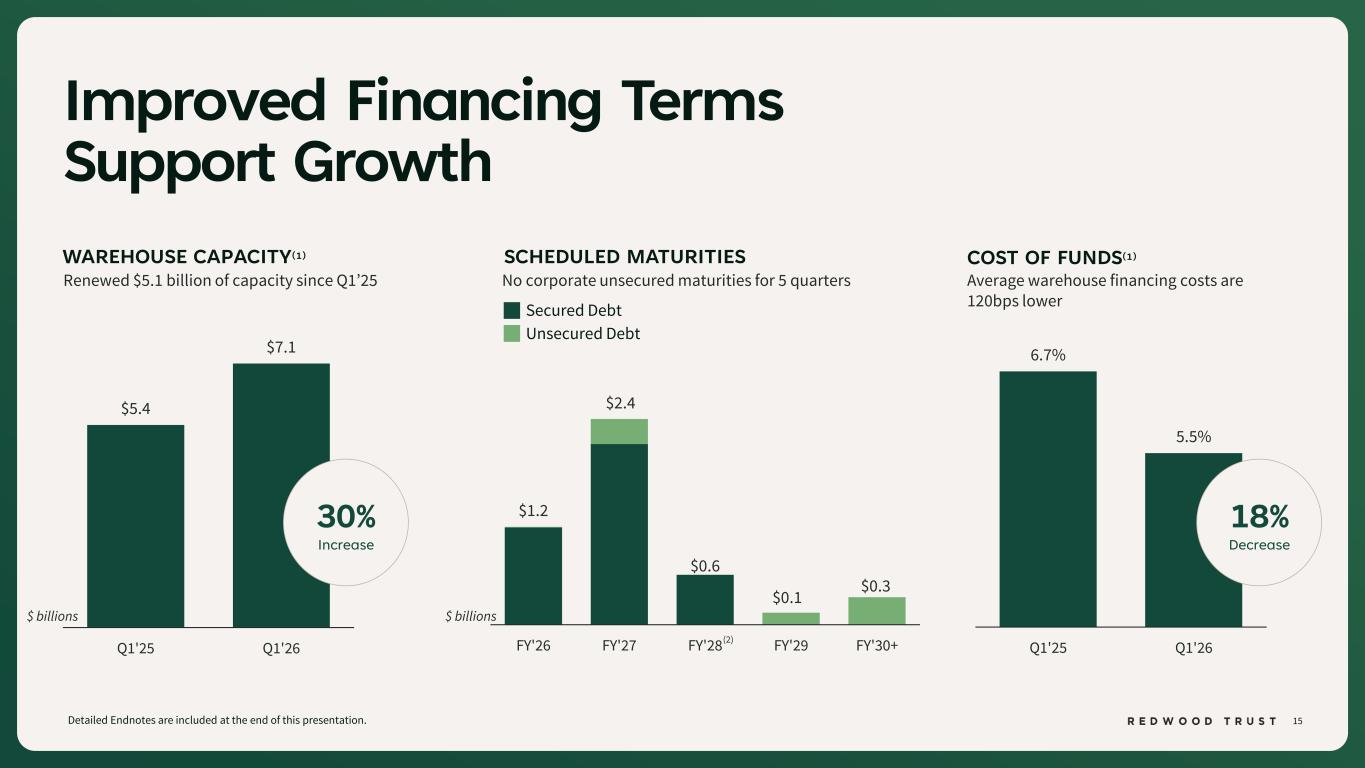
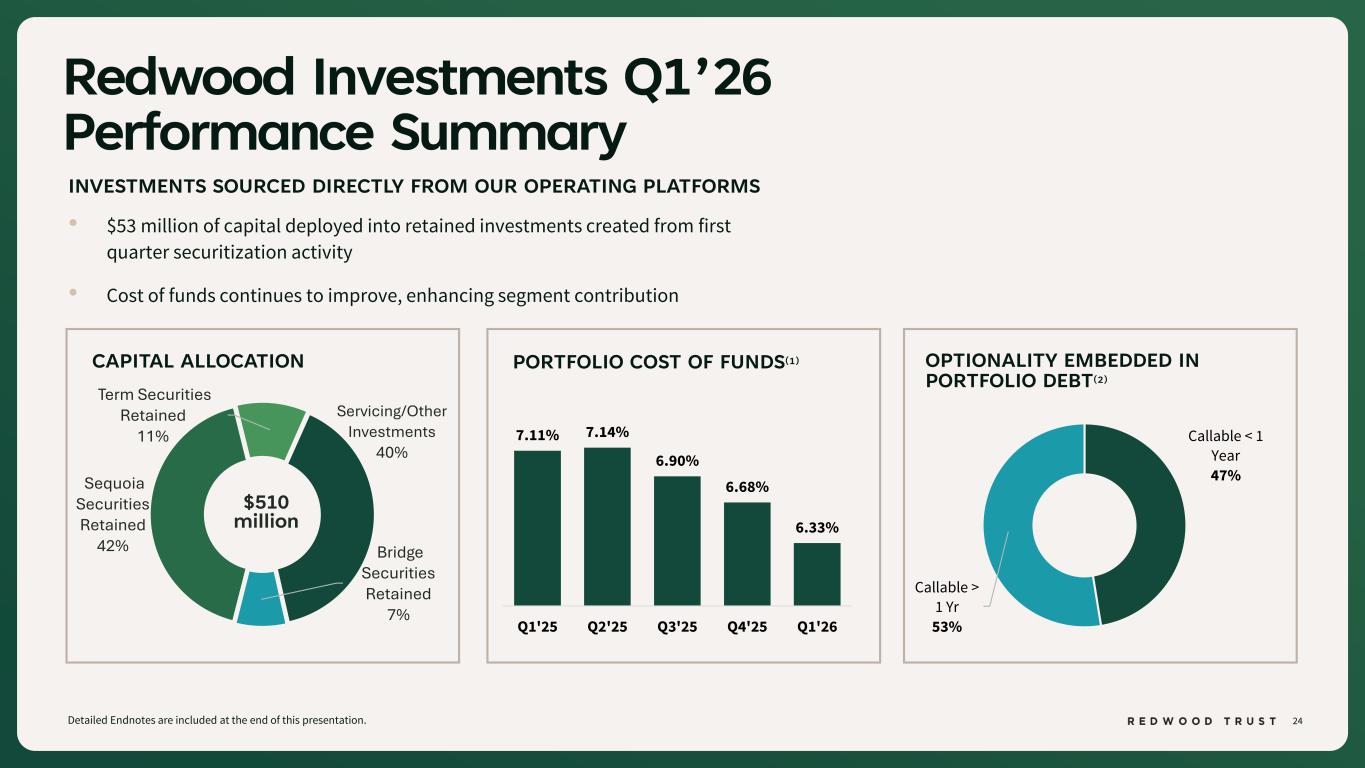
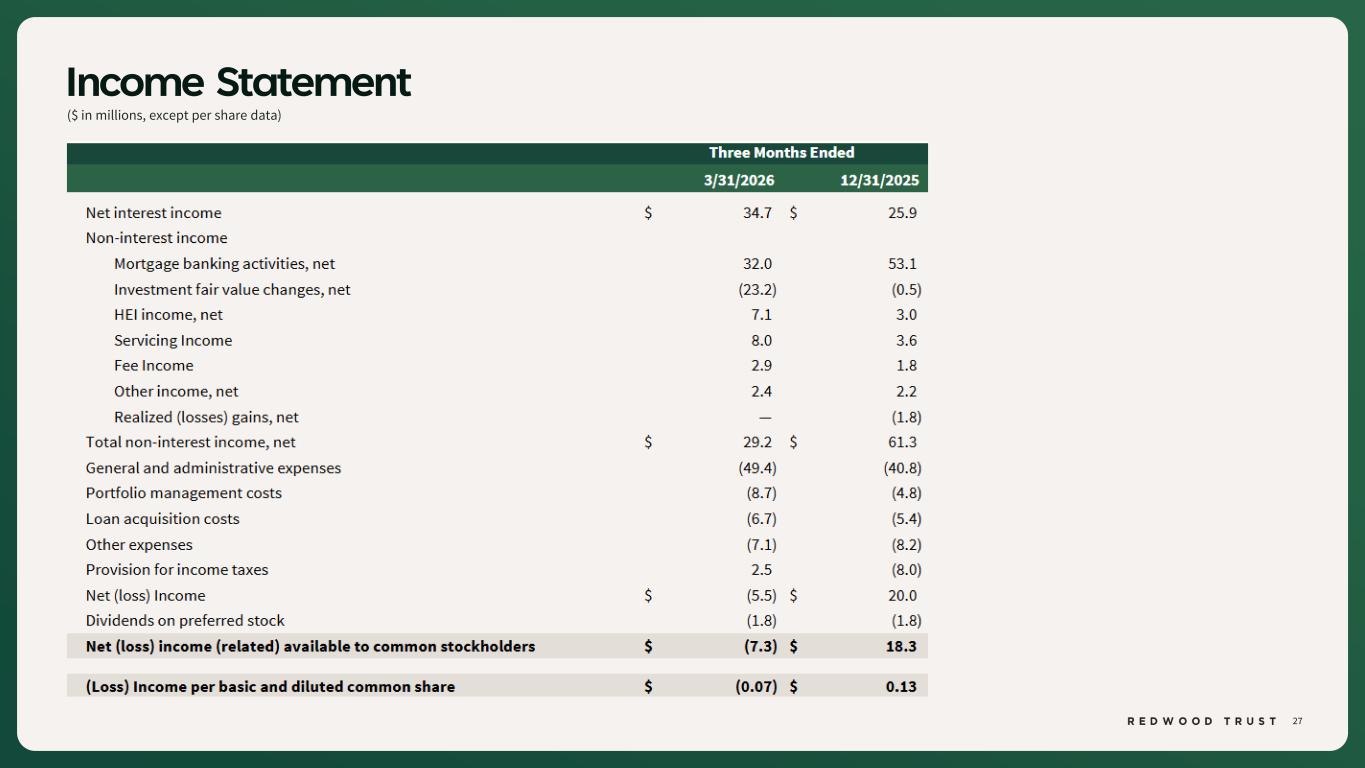
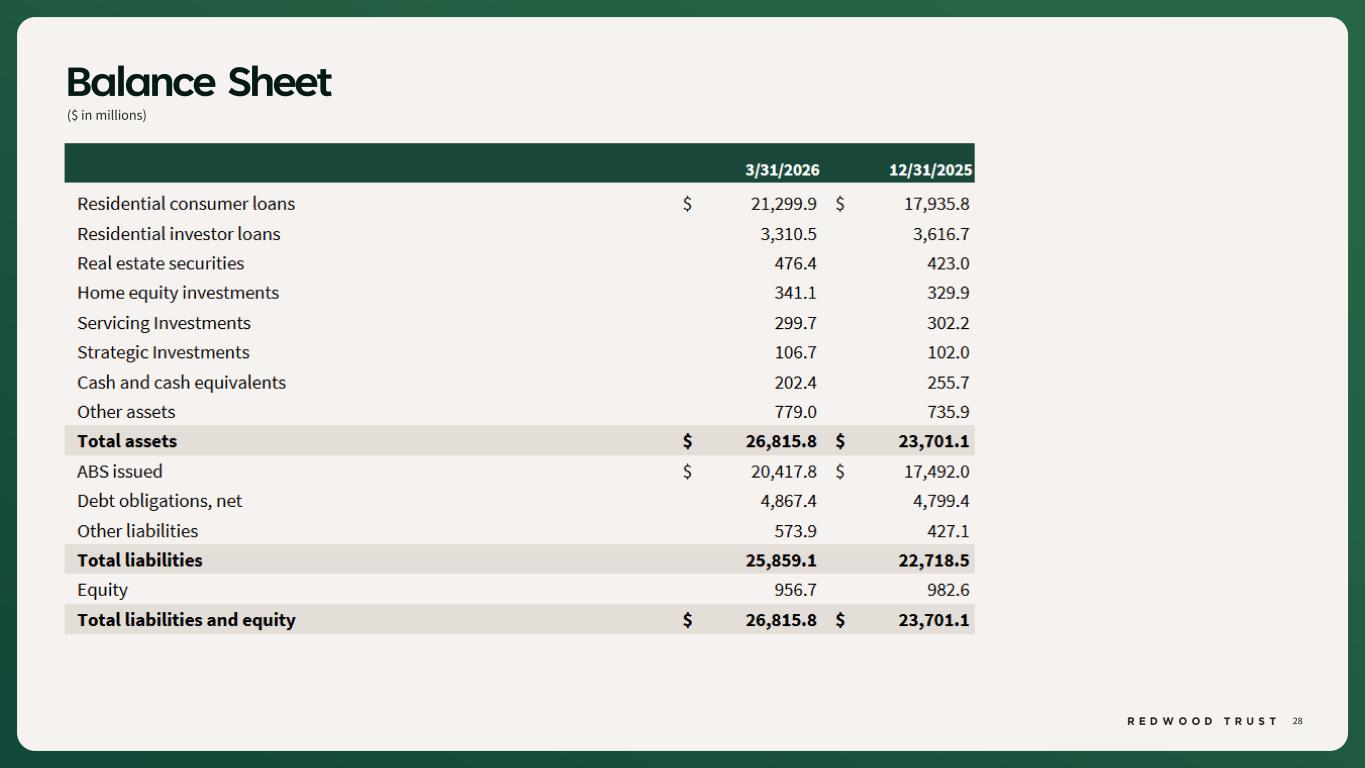
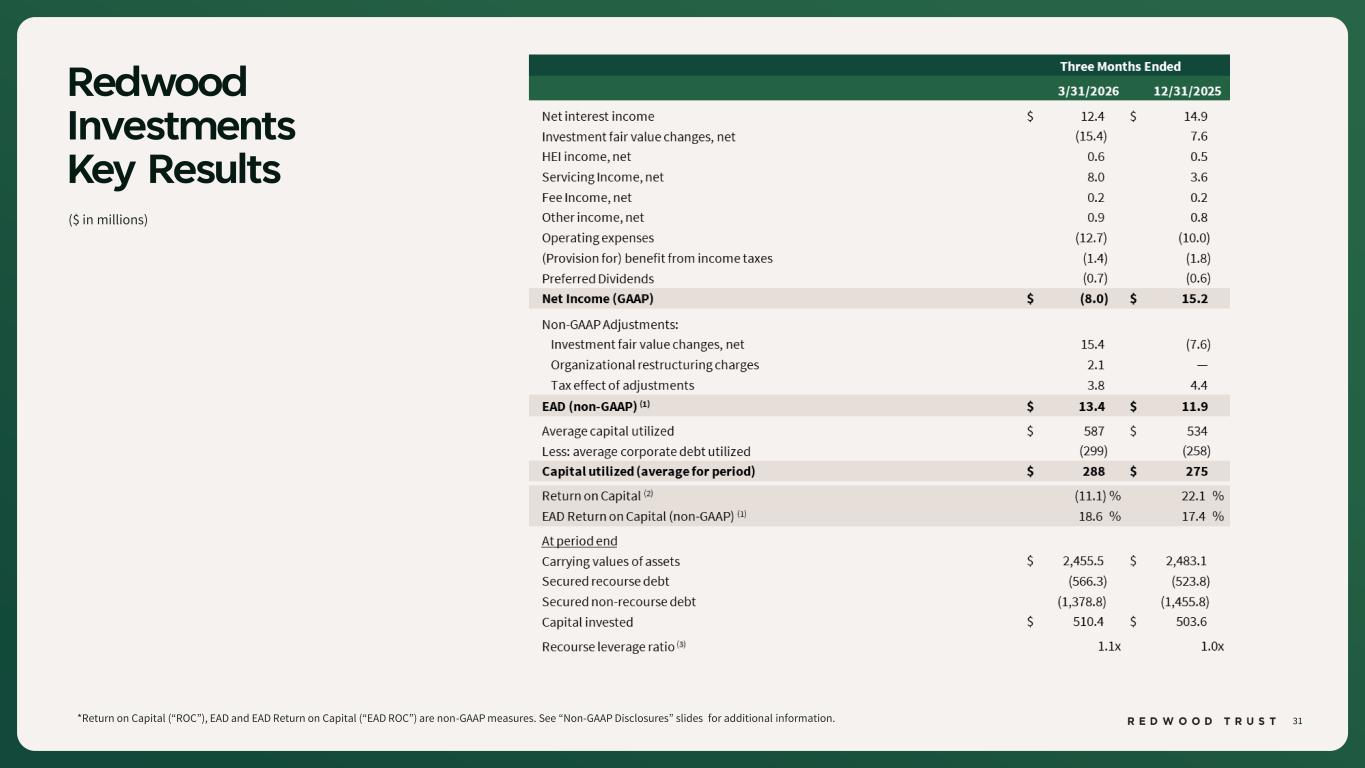
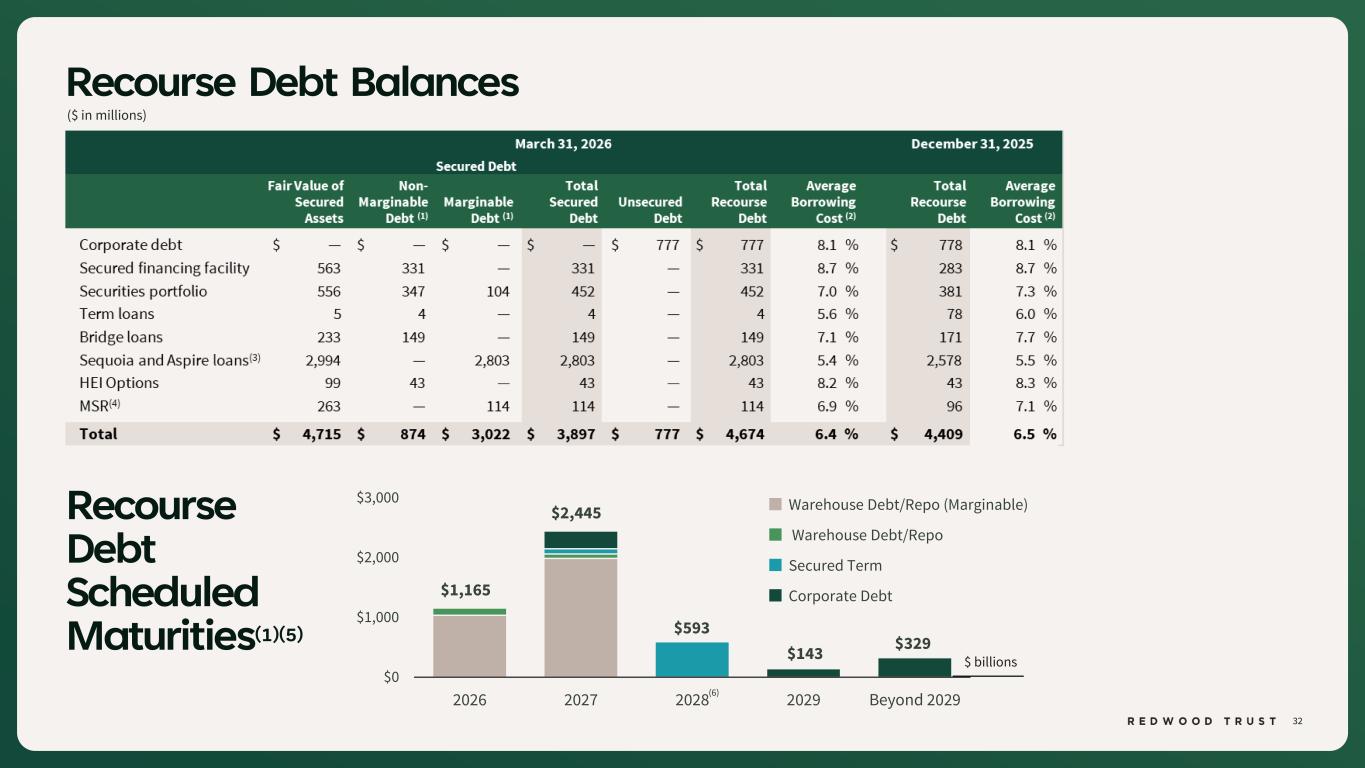
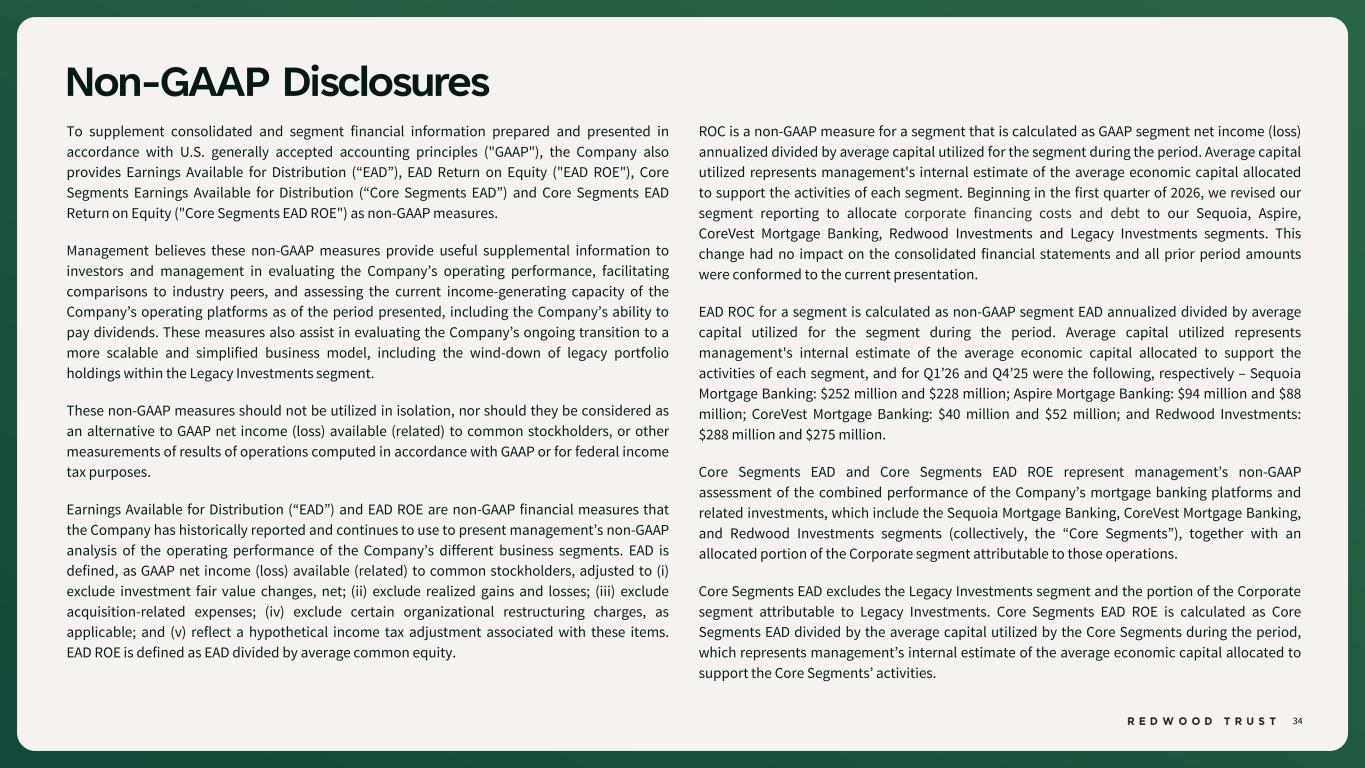
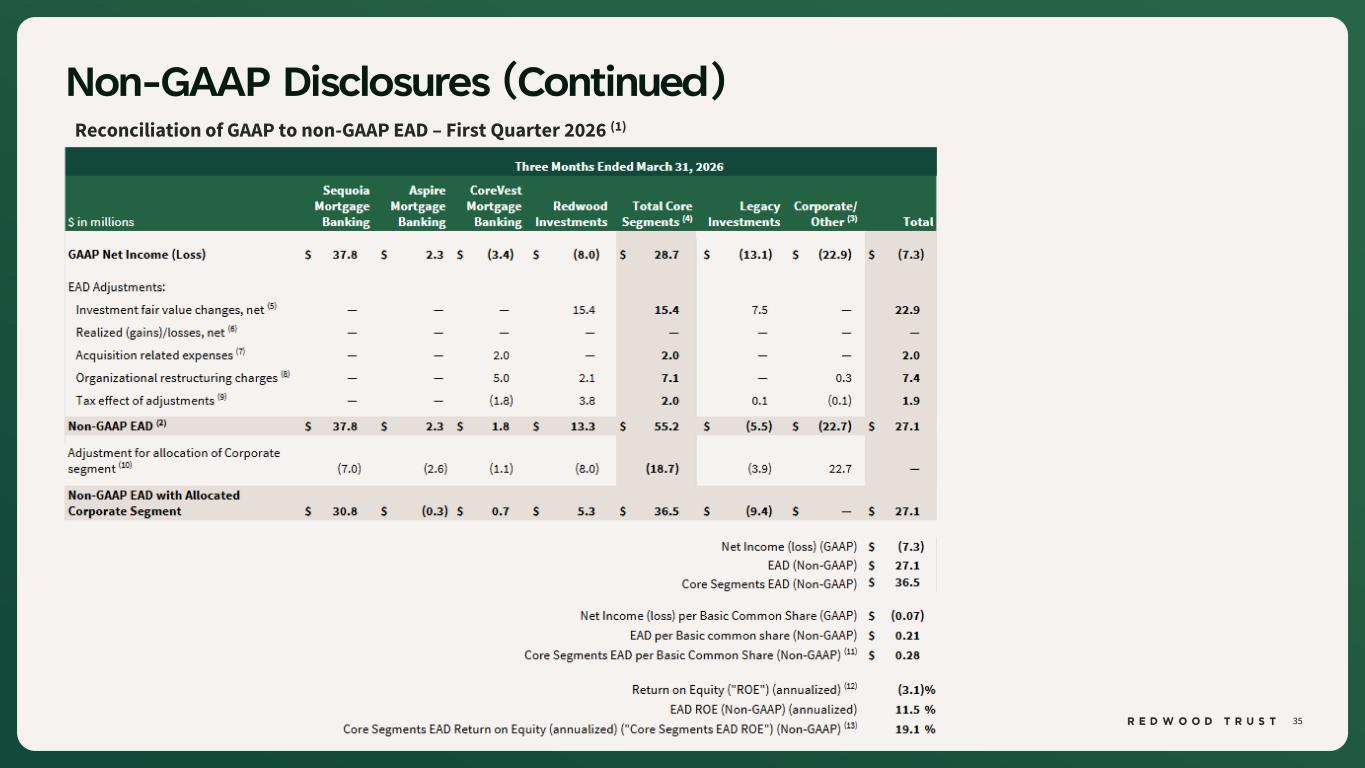
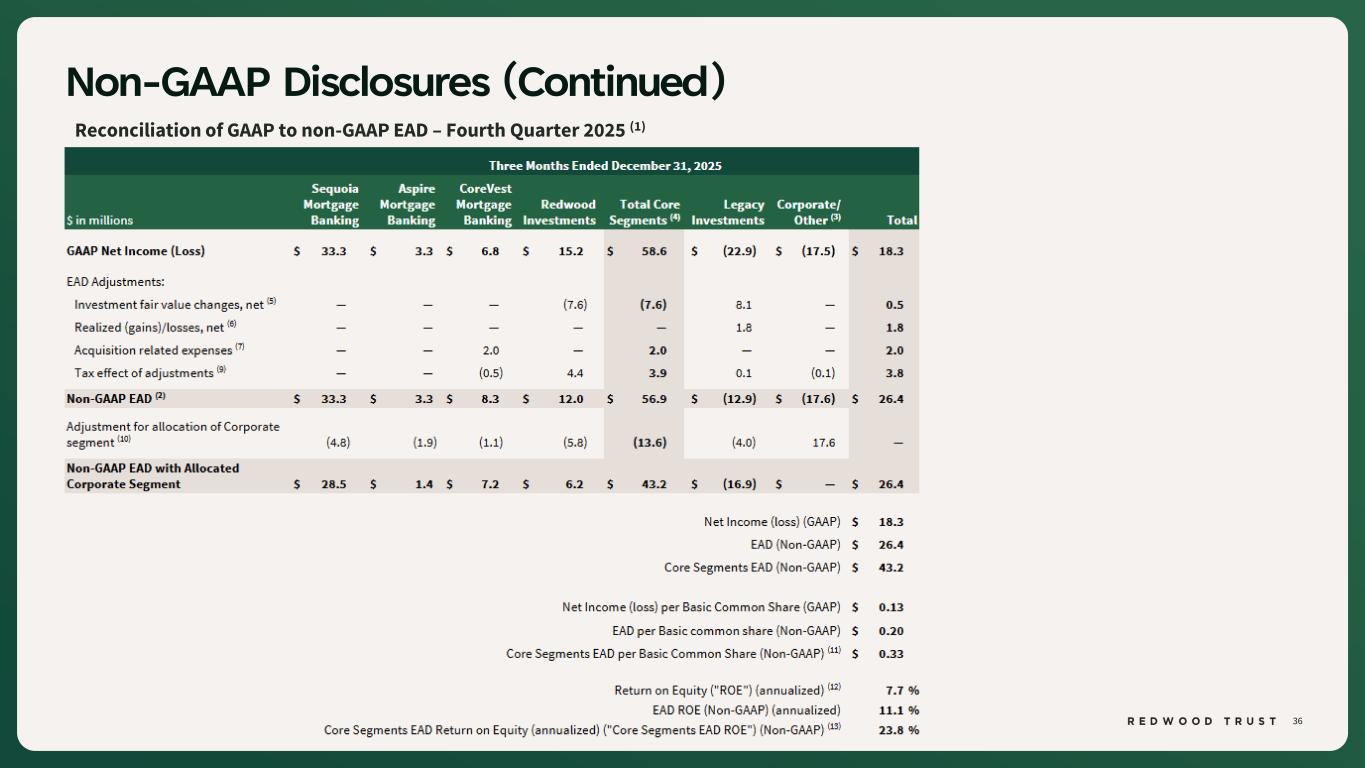
Thank you, Dash. Turning to our first quarter results, we reported a gap net loss of $7 million, or $0.07 per share, compared to gap net income of $18 million, or $0.13 per share in the fourth quarter. Book value per share was $7.12 at March 31st. The 3% decline from Q4 was driven by non-cash, market-related valuation changes and certain non-recurring expense items, rather than underlying operating performance. Book value also reflected the $0.18 dividend paid to common shareholders. On a non-GAAP basis, consolidated earnings available for distribution, or EAD, was $27 million, or $0.21 per share, up from $0.20 per share in the fourth quarter. Core segments EAD was $37 million, or $0.28 per share, representing a 19% return on equity. This performance was driven by strong mortgage banking volumes, efficient loan distribution and capital turnover, particularly during the more volatile period in March, and disciplined capital deployment into attractive, income-generating investments, which support a net interest income and margin. The difference between core segments EAD of $0.28 and consolidated EAD of $0.21 primarily reflects the legacy portfolio, which reduced consolidated EAD by approximately $0.08 per share in the first quarter. As capital allocated to legacy continues to decline, we expect that drag to further moderate. Our mortgage banking platforms generated $37 million of gap net income in the quarter, representing a 38% annualized return on capital. Capital efficiency improved, with capital required per dollar of volume declining by approximately 10% quarter over quarter to 1.1%. Just to note, this quarter, our segment returns reflect a full allocation of unsecured interest expense based on average capital deployed, with capital reduced by the corresponding allocation of corporate debt. The Redwood Review presents segment results on both this basis and our prior methodology, which reflected these items within corporate. Sequoia generated $38 million of gap net income in the first quarter. Heightened flow activity represented 61% of production, with a growing contribution from newer products, such as arms, clothes in seconds, and medical professional loans. As volumes scale, we continue to see strong earnings conversion and benefits of scale, with cost per loan declining to 18 basis points, a highly efficient milestone. We also see a deep and growing pipeline of attractive opportunities, with demand exceeding available capital. The joint venture announced today is designed to capture more of that opportunity in a capital-efficient manner by incorporating third-party capital alongside our own. Based on current expectations, the structure has the potential to contribute approximately $0.12 to $0.15 per share of incremental annual earnings as it scales, with additional upside through structured economics. Aspire generated $2 million of gap net income in the first quarter. As the platform scales and expands distribution, we are beginning to see improvements in capital efficiency. Margins were impacted by late-quarter volatility, but have largely recovered post-quarter end. Corvess generated a gap net loss of $3 million in the first quarter, including approximately $5 million of one-time restructuring charges related to organizational changes that position the business for profitability in 2026. Excluding these items, our net cost to originate declined from 95 basis points last quarter to 79 basis points in Q1, reflecting improved operating efficiency. Redwood Investments generated gap net loss of $8 million. Portfolio-related marks were primarily driven by widening in the TBA basis in credit spreads combined with the impact of higher interest rates late in the quarter. The cost of funds for our investment portfolio improved as we refinanced higher-cost debt and optimized our financing mix, supporting net interest margin. Legacy investments recorded a gap net loss of $13 million, improving from a $23 million loss in the fourth quarter. The improvement was driven by lower net interest expense on legacy bridge loans reflecting improved financing terms and lower balances as well as higher HEI income as capital markets conditions for the asset class improved. Total G&A was $49 million in the first quarter, up from $41 million in Q4, reflecting one-time costs associated with the previously discussed organizational streamlining initiatives as well as typical seasonal expense patterns. Excluding these items, run rate G&A was approximately $40 million, essentially flat to slightly below the fourth quarter. We continue to scale with discipline as first quarter volume growth exceeded expense growth by nearly two times, driving our expense to volume ratio down to 66 basis points. With a largely fixed cost structure tied to production, we see meaningful upside in incremental volume converting into earnings, reinforcing our confidence in ROE expansion as the business scales. Liquidity remains strong with $202 million of unrestricted cash and approximately $3.9 billion of excess warehouse capacity as of March 31st. Recourse debt increased modestly to $4.7 billion at quarter end, driven by higher warehouse utilization supporting record mortgage banking activity. Our ability to efficiently turn loans and inventory was evident in the first quarter, with 11 securitizations completed across $5.2 billion of collateral, alongside improved financing efficiency through tighter spreads and better advance rates, driving an approximate 50 basis point reduction in our cost of funds over the past 12 months. Over that same period, we increased warehouse capacity by 30% to $7.1 billion and renewed $5.7 billion of facilities, reflecting continued support from our lending partners. And finally, there are no corporate unsecured debt maturities over the next five quarters, and we maintain meaningful flexibility within our unsecured debt structure. And with that, I'll turn the call back to the operator for Q&A.
Operator
Thank you. We will now be conducting a question and answer session. If you would like to ask a question, please press star 1 on your telephone keypad. A confirmation tone will indicate your line is in the question queue. You may press star 2 to remove yourself from the queue. For participants using speaker equipment, it may be necessary to pick up the handset before pressing the star key. Thank you. And our first question is from Mikkel Goberman with Citizens JPM.
Good afternoon, everyone. And congrats on another record quarter of banking volume. If I could ask to start with the new joint venture announcement this morning, I see in your slide deck you mentioned you're expecting a meaningful annual EPS accretion for yourselves. Is there a target range that you guys are thinking about in terms of a number?
Yeah, we are anticipating that it has a potential for roughly $0.12 to $0.15 of incremental earnings. You know, this joint venture will really, as Chris knows in his prepared remarks, allow us to grow volume by another incremental third or 30 percent, kind of add double-digit ROEs without raising other capital to source that. So, you know, given our, you know, our incremental margin significantly outweighs our incremental cost to source that, we're really excited about the partnership and a dedicated distribution channel that really kind of aligns with our high capital turnover model that we've evolved into.
And as far as your comments in the call about a potential Aspire JV being announced in the near future, is there a size that you guys are thinking about there? I see the Castle Egg deal is about $8 billion. What are you guys thinking about in terms of size of a JV for Aspire?
Yeah, thanks, Mikael. We'll have a lot more to say, you know, when the details get finalized. but I think we are expecting a joint venture of this type to probably support 25% to 30% of Aspire's annualized production. That's probably the best way to quote it for now, just in terms of all the other initiatives we have with distribution, including securitizations and whole loan sales. Obviously, we need to finalize what we're working on, but that's the context I would give you as a percentage of Aspire's overall production mix.
Yeah, Mikhail, I'd also add, you know, obviously we've had joint ventures with Corvest up to this point. And so, you know, I think the in-house knowledge is pretty high. And so our ability to continue to add these to the platform is getting progressively more streamlined. So, you know, we want to continue to find partners to the extent we need capital and it's available. And hopefully, again, we'll have more to say on Aspire, as Dash mentioned.
Looking forward to that. Thank you all. Thanks.
Operator
Next we'll hear from Chris Love. It's Piper Sandler.
Thank you. Good afternoon. So you had another record quarter for mortgage bank production. Can you just discuss some of the momentum there and what you're seeing in April? Mortgage rates peaked around quarter end a little bit better now. So curious what you're seeing in April and what you might expect throughout the year.
Yeah, well, you know, I think on the one hand, you know, vol came down earlier in the month, you know, as we kind of settled into, you know, where we're at with the conflict in the Middle East and energy prices, you know, so mortgage rates came in a bit. Obviously, you know, the 30-year ticked 5% today, the 10-year is back up to 440. So that's not a positive for mortgage rates. And so I think that, you know, we're going to continue to expect to see some volatility here in rates. But I think the initial shock, you know, that occurred in March, you know, with this conflict in Iran, the market has somewhat processed that. And we've been, you know, much more business as usual, I think, as a sector these past few weeks. So from that standpoint, we've obviously got great inroads to taking market share. I think we've demonstrated that the last few quarters. Late in the quarter, sorry, late in the first quarter, early in the second quarter, we've added a few more regional banks from a flow perspective. We continue to unlock market share for the platform. And I think we're quite excited about the prospect of the Basel III endgame and being more or less an exclusive partner to a number of banks who work with us today. It's ironic that with the Basel III endgame, some of the capital changes pertain to credit, but I think many banks would tell you that the largest risk they're focused on with respect to mortgages, convexity, and that's what we help manage. Asset liability risk, interest rate risk, that's the big need right now, so that doesn't go away. And, in fact, if the capital charges go down, I think having a partner like Redwood to manage that, you know, our business case just gets stronger and stronger. So we feel good about the momentum. You know, the only thing we don't feel good about is the volatility, you know, in the macro economy. And, you know, we're doing our best to manage through that.
Thank you. Appreciate that. And then just for Sequoia, you called out the cost per loan, improving to 18 bits a couple of times during the call. Can you discuss some of the drivers there? Is part of it volume-related tech, AI? I believe you mentioned the automation initiative, so I'm curious on a little bit of detail there. And then are there additional efficiencies that you think you can drive that even lower in the coming quarters?
Yeah, I mean, we feel really good about, you know, our combination of, you know, hustle and hard work with adoption of tech and AI. I think we have in the review that, you know, our volume growth is outpacing our expense growth by 2x, which really demonstrates the scale of the platform at this point. We're operating very, very efficiently. During the quarter, we mentioned 2,500 agentic workflows. You know, we're eliminating vendors who have done a lot of QC for us or document intelligence. You know, we're smarter on due diligence reviews. You know, we're able to create a lot of efficiencies between Sequoia and Aspire using AI for our consumer platforms. So, across the board, it's been kind of, you know, full frontal on just finding efficiencies in the platform and making sure that, you know, each dollar is used wisely and we're leveraging our team and the tech that we're building.
Operator
To Marissa Lobo with UBS.
Thank you. Good afternoon. Just looking at the slide, it's noted that bank source volume at Sequoia dropped. It was about 30%. I believe this is lower than 4Q. Could you just comment on your outlook for that contribution going forward? And the CASEL-8JV, does it reactivate any, you know, recurring Sequoia program in the second half of 2026?
Yeah, I think the bank percentage ticked down maybe on a percentage basis, but continues to rise. We had another record quarter of volume, and a lot of that can be influenced by bulk one way or the other. So in the first quarter, we had some large bulk transactions with certain independents. You know, we have partners on flow, as I mentioned. And so we continue to expect, you know, that volume mix to evolve. You know, I think we've got really durable partnerships on the bank side. It represents about half our network today, more or less. And, you know, while we can't necessarily cuff it because I think bulk has such a big impact on that quarterly percentage. We expect it to continue to grow.
Okay, great. Thank you. And some of your peers have noticed, I've noted, institutional capital entering the non-QM market and the broader residential credit market. Are you seeing that competition manifest in your whole loan acquisitions or through tighter spreads on the AAAs? You know, how is that impacting the ROE and securitization.
Hey, it's Dash. I think that's largely been to an advantage for us, you know, as we continue to deepen our distribution channels. You know, we – first quarter, big milestone for Aspire was completing the platform's first securitization. We're actually in the market today with its second, which is really important because it shows institutional investors that the platform is, you know, is going to be in the market regularly, which obviously helps, you know, primary and secondary liquidity. We've sold whole loans, you know, out of the Aspire platform to now close to 10 discrete different counterparties, including a couple of banks, you know, which is a very big deal. And so I think from a supply-to-mand perspective, the amount of institutional capital coming into the space is a net advantage for us because, you know, there are some players, you know, in the space that, you know, have been established. But, again, Aspire is really leveraging, you know, not only, you know, the new sellers we're bringing in, but also obviously the foundation of, you know, sellers that we've been working with for years in Sequoia. I think we said in the prepared remarks that about 70% of Aspire's production is from sellers that we've already done business with or are doing business with in Sequoia. That's good news for a couple of reasons. You know, one is we're leveraging, you know, our existing seller base and becoming an even more relevant partner to them, you know, with these added products in addition to all the products that Sequoia is now offering. But it also reflects the room to the ceiling, you know, for Aspire in terms of growth because there's a lot of sellers that we're not engaged with right now that want to do business with us that, you know, we anticipate onboarding, you know, between now and the year. You know, we estimate our market share in Aspire at about 4% in the first quarter. We want to, you know, double that in the second half of the year to a run rate that will probably be close to a billion a month of locks. So the momentum on volume is there. The business is obviously still building, but I think, you know, a lot of the table stakes premise, you know, for getting into the business, you know, in a full-throated fashion a year and a half ago are definitely coming to fruition. The amount of capital that is coming into the space but can't really put that sort of risk on themselves and relies on us to do that I think is a net tail end for us. Great.
Operator
Thanks for the answers. And we'll move on to Jason Weaver with Jones Trading.
Hi, good afternoon. Thanks for giving me time. I was wanting to ask about the legacy wind down within Corvest. You took capital allocation down to 15% in one quarter. What do you think about the realistic finish line here to get below 10%? Is that end of year? And what sort of residual assets are sort of stickier on that resolution timeline? line?
Well, we want, you know, we have stated we want that percentage to be well below 10% by the end of the year. You know, one thing to unpack on that, Jason, and thanks for the question, is the legacy portfolio is at this point about 50-50 legacy bridge loans and then HEI. You know, legacy HEI we purchased a number of years ago, some of which, as you know, we've disposed of, you know, over the past year or so. We're pretty optimistic that we can, you know, recycle a fair amount of that HEI capital later this year. As Brooke articulated, you know, capital markets execution for that asset class has continued to improve. Just this morning there was an announcement that a new institutional investor was putting a few hundred million of capital towards a new production, you know, with a different originator. But the point is that capital is continuing to flow into that space, and that's translated to more optimal securitization execution. So that's definitely front burner. You know, on the bridge side, we are down to a few real focus line items, which will move the needle, which we are very focused on resolving in Q2, if not early to mid-Q3. That combination there will get us below, you know, 10%, and then we will continue to, you know, wind the position down from there, you know, in keeping with our goal of getting it below 5% by the end of the year.
If I could add just one thing on the financial impact of the wind down as well. I think the legacy book was around $240 million of capital at the end of March. That 5% or so translates to be below $100 million of capital by the end of the year. Every $50 million or so of capital that we free up, just given the drag from the legacy book, is about a $0.05 quarterly improvement in EAD as it's redeployed into mortgage banking. And we've seen that the legacy contribution was about $10 million better than we saw in the fourth quarter as well. So that is starting to translate into continued EAD. EAD trajectory.
Thanks for that. That's great color. And then I wonder if you could talk about the comparative economics between the Castle Lake JV and the CPP, you know, fee structure, risk retention, retained margin per loan.
They're very different asset classes, obviously, jumbo versus BPL. I think they are conceptually very, very similar. You know, So we are, much like CPP, we're the minority of the capital in the Castle Lake JV. You know, the economics to Redwood include, you know, certainty of upfront economics, you know, at time of transfer into the JV, as well as a, you know, a running essentially asset management or loan administration strip. So I think the economics are, you know, conceptually similarly. They do differ numerically, obviously, because the underlying assets, you know, are different. But the structures are very similar in that they're both sort of living, breathing ecosystems. You know, we would intend to securitize, you know, out of the Castle Lake JV, much like we've done, you know, out of the CPP JV. We could sell loans out of it, et cetera. So they're structurally very, very similar, but understanding there's nuances because of the underlying asset class differences.
Understood. Thank you for that.
Operator
George with KBW.
Operator
We'll have our next question.
Hey, everyone. Good afternoon. I just wanted to ask about trends at Corvest in April. And then can you just talk about the pipeline discipline in March, I guess the volatility that drove that, and is the sort of backdrop a lot better now in April?
Yeah, I mean, Bose, as you know, Corvest of our different strategies has kind of the most credit sensitivity. And as things got volatile in March, You know, I think it was pretty prudent to not, you know, spread lock, you know, too far in advance of outcomes, you know, that we were, you know, kind of waiting on, you know, from a macro perspective. So, you know, there too, most, the vast majority of that distribution is kind of spoken for with CPP and others. And so, you know, we kind of have somewhat baked economics in some respects. And so, you know, we decided to, you know, be a little bit more cautious there. I think that was the right call. And coming out of quarter end, you know, similar to the consumer business, things have picked back up. And it's very much business as usual. So there, you know, it's a little bit different than how we think about, you know, certainly Sequoia, which is a much more rate-sensitive, less credit-sensitive business, and, you know, Aspire, which is kind of a little bit of both.
Okay, great. Makes sense. Thanks. And then, actually, on the marks on the Redwood investments, you know, since quarter end, have you seen, you know, reversals of some of those?
Yeah, yeah. We've seen, you know, some reversals. You know, our business is quite a bit different than most others in the mortgage rate sector. But, you know, I think Book is probably up a percent, percent and a half based on kind of where the portfolio has evolved. But it's also still very early in the quarter. And I think what we learned in the first quarter is the last month of the quarter can have a pretty big, big sway. So, we're early in the second quarter, and, you know, hopefully things continue to kind of stabilize, and, you know, we're pretty happy with the credit profile of the book.
Operator
Okay, great. Thanks.
Operator
And we'll move on to Doug Harder with BTIG.
Thanks. Brooke, you mentioned that kind of pipeline adjustments negatively impacted kind of the gain on sale that you were able to achieve in the quarter. I was wondering if you could size that, and I think, just want to make sure I heard that you said that that has largely reversed in April.
Yeah, so we saw, you know, a decent amount of TBA widening throughout March. That probably had about, you know, we saw them about an eighth or so wider, and our execution, you know, widened a bit relative to where we were at the beginning of the quarter. A lot of that has since reversed, you know, in April to date, and so I think, you know, it was a portion of the delta between where we were in the fourth quarter on gain on sale. I think we quantified at the time, we had about 25 bits of margin outperformance in the fourth quarter due to TBA tightening, and we probably saw at least half of that in terms of the quantum of the impact from TBA widening on jumbo margin in March.
Great. And obviously, with Dash's prior comments in mind that it's still early in the quarter, but all else being equal, you would see, you know, some outperformance from TBA tightening, you know, what you've seen so far?
Yeah, I think we'd still guide to the high end of our historical range in terms of expected margins for Sequoia in the quarter.
Yeah, Doug, I would say similar for Aspire. You know, the Aspire pipeline was definitely impacted at 331 by, you know, empirical spreads in the securitization market. Those are probably 20 to 30 bps tighter today, you know, than they were at March 31st, which specifically to Aspire is probably worth about two to three cents of EAD in terms of where that pipeline was marked at 331 versus where we ultimately expect to potentially execute our current market conditions. So that would be sort of the Aspire part of the answer as well.
Operator
Great. I appreciate it. Thank you.
Operator
We'll move on to Don Vandetti with Wells Fargo.
Hi. Can you talk a little bit about the sort of ramp up of the Castle Lake JV, how quickly you could get to that sort of incremental earnings contribution that you talked about? And then is there any offset, meaning like canalization or less of your core mortgage banking business, or should we think of this as additive?
I'll start. I think the answer is definitively additive. Chris mentioned the amount of opportunities we're seeing out of both regional banks on a slow basis as new partners and also seasoned opportunities. So I think we are highly excited to have this up and running. The joint venture will use warehouse lines and other things that just operationally need to get set up in the second quarter. but there's, you know, this is fully expected to really be incremental volume for Sequoia.
Operator
Thank you. And we'll move on to Rick Shane with J.P.
Hey, thanks for taking my questions. I actually don't think I heard the answer to Don's question, which was one of mine. How long, given that this is a, the constraint seems to be capital, and it sounds like you have the pipes in place, Should we expect a very quick ramp to that $0.12 to $0.15 per year accretion, or how many quarters should we be thinking about here?
Yeah, I think you can think of that somewhat linearly over the next four quarters as we ramp fully.
Got it. Okay. Thank you. And then I want to understand a little bit better the G&A expense allocations this quarter. We saw Sequoias go down. There was a pretty significant increase at Corvest on a relative basis and an increase at the corporate level, and just want to understand what's driving that and how we think about that going forward so we can model the different business lines efficiently.
Yeah, no problem. Expected this one just given there's a lot of movement in the quarter. So just at a high level, let me start with some of the movement in G&A, and then I can talk about allocation as well. So, G&A was $49 million in the first quarter versus $40 million in the fourth quarter. The largest, you know, predominantly most of that was $8 million associated with the reward costs and other kind of one, about a million and a half of that as well with seasonally higher benefits that we actually always see in the first quarter. The run rate from here should really be inside the fourth quarter levels. The area where most of that came from was within both kind of corporate and Corvest, which is why you saw Corvest contribution impacted, which is, you know, we disclosed both our gap contribution as well as, you know, EAD for Corvest, just so you can see what the, really the run rate of that business looks like, excluding those, you know, the one-time costs in the quarter. The other corporate expense reallocation that was done on the quarter was really taking, which we showed on page 9 in the Redwood Review, our segment returns both pro forma for this presentation for what we presented both last quarter and this quarter. We were really just allocating our $777 million of corporate debt by segment rather than having it sit in a corporate segment. so that you can see the impact of that interest expense, you know, proportionally for each segment. So that is why, if you look on page 9, our mortgage banking, are we under our prior presentation, would have been 23%. It's 38% just given, you know, the capital, the impact of that capital coming out of the otherwise kind of dedicated working capital for each segment.
Got it. Okay. That's very helpful, Brooke. Thank you so much.
Operator
And there are no further questions at this time, and this does conclude today's teleconference. We thank you for your participation, and you may disconnect your lines at this time.