Operator
Good day, everyone. My name is Regina, and I will be your conference operator today. At this time, I would like to welcome everyone to the Sabra Healthcare REIT second quarter 2026 earnings call. All lines have been placed on mute to prevent any background noise. After the speaker's remarks, there will be a question and answer session. If you'd like to ask a question during this time, simply press star followed by the number one on your telephone keypad. If you'd like to withdraw your question, press star one again. I would now like to turn the call over to Lucas Hardwich, EBP Finance. Please go ahead, Mr. Hardwich.
Thank you and good morning. Before we begin, I want to remind you that we will be making forward-looking statements in our comments and in response to your questions concerning our expectations regarding our future financial position and results of operations, including our earnings guidance for 2026, and our expectations regarding our tenants and operators, and our expectations regarding our acquisition, disposition, and investment plans. These forward-looking statements are based on management's current expectations and are subject to risks and uncertainties that could cause actual results to differ materially, including the risks listed in our Form 10-K for the year-end of December 31, 2025, as well as in our Earnings Press release included as Exhibit 99.1 to the Form 8-K we furnished to the FCC yesterday. We undertake no obligation to update our forward-looking statements to reflect subsequent events or circumstances, and you should not assume later in the quarter that the comments we make today are still valid. In addition, references will be made during this call to non-GAAP financial results. Investors are encouraged to review these non-GAAP financial measures, as well as the explanation and reconciliation of these measures to the comparable GAAP results included on the financials page of the Investor section of our website at Soverealth.com. Our Form 10-Q, earnings release, and supplement can also be accessed in the investor section of our website. And with that, let me turn the call over to Rick Matros, CEO, President, and Chair of Sovereign Healthcare REIT.
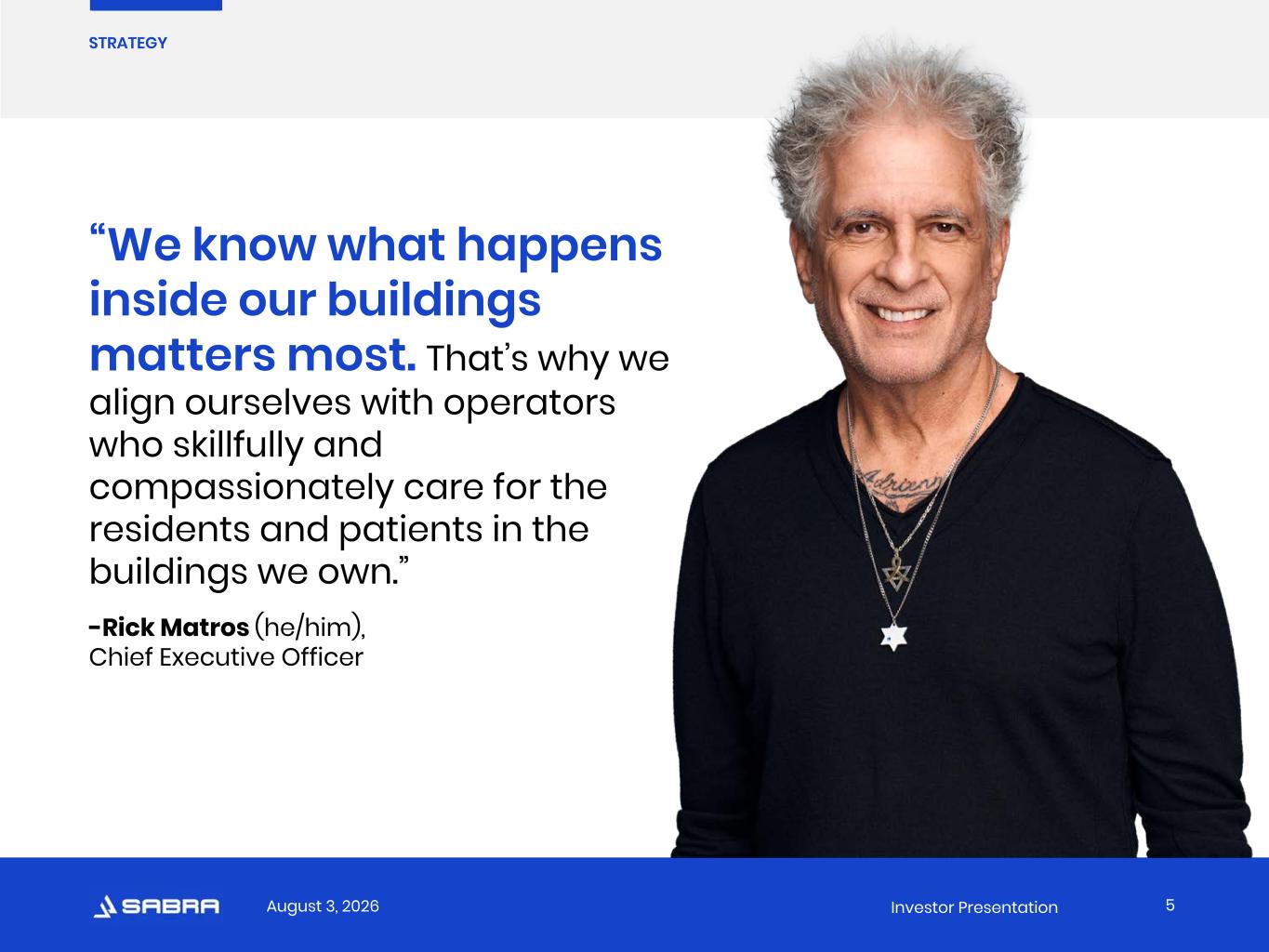
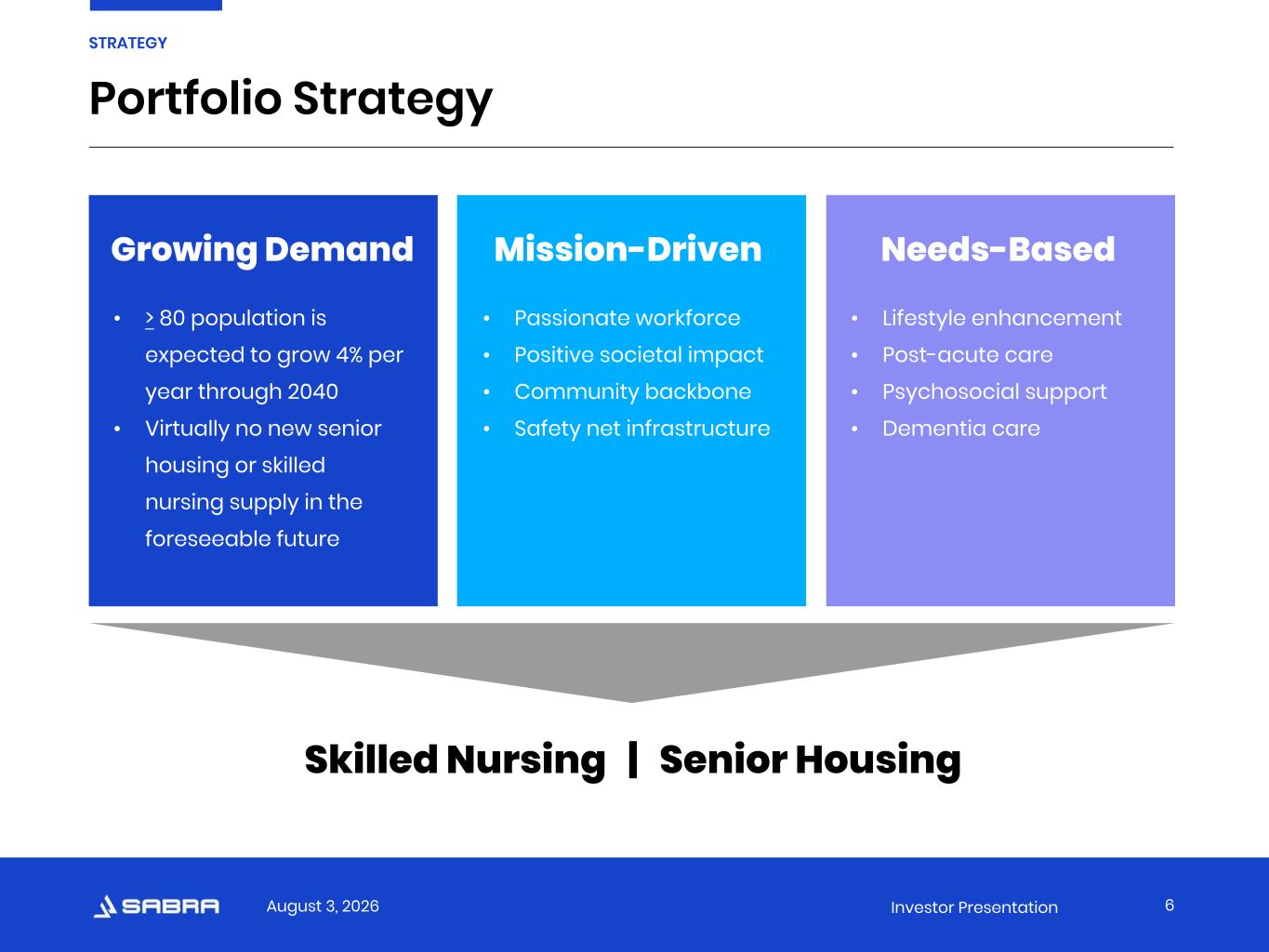
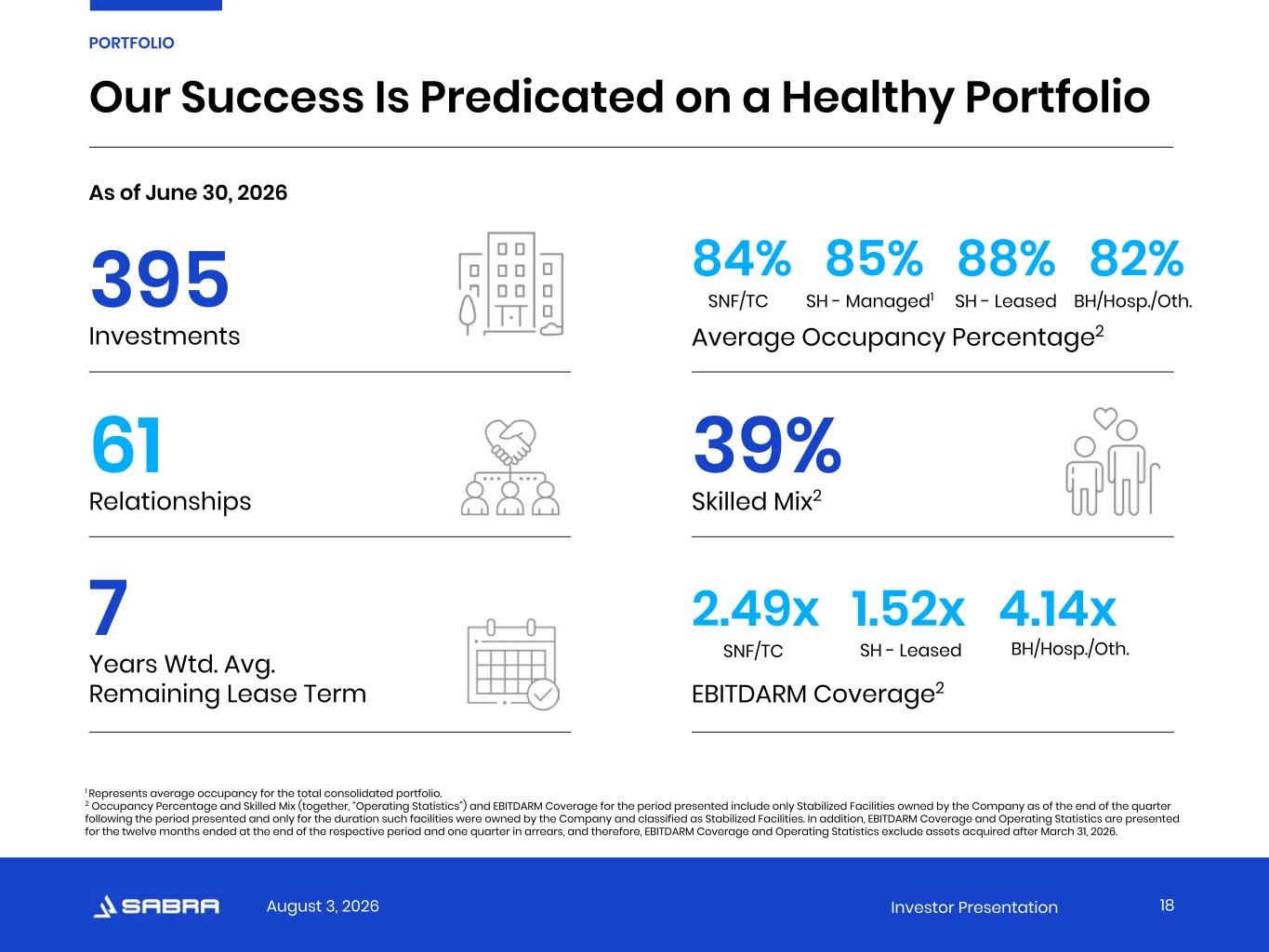
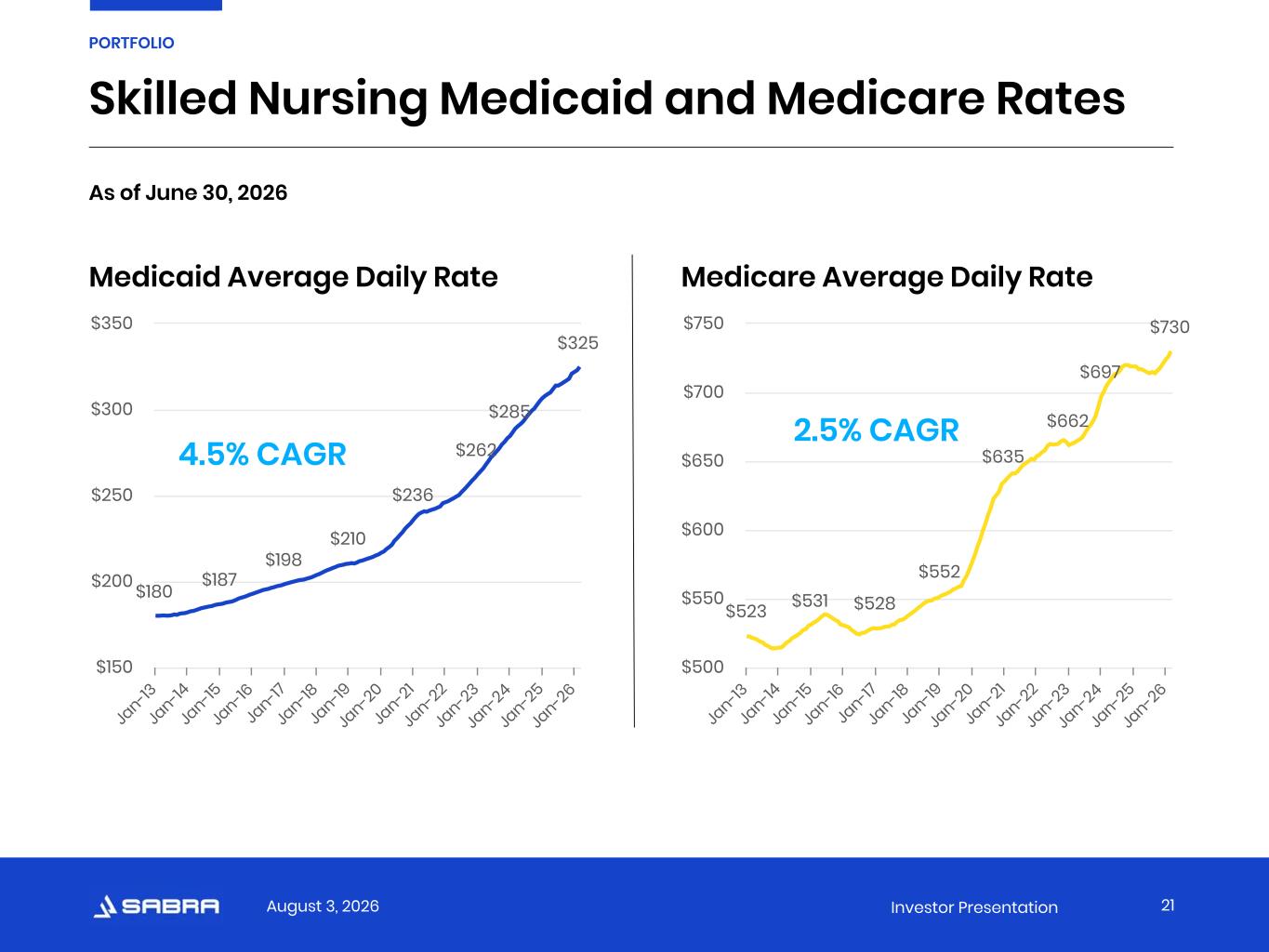
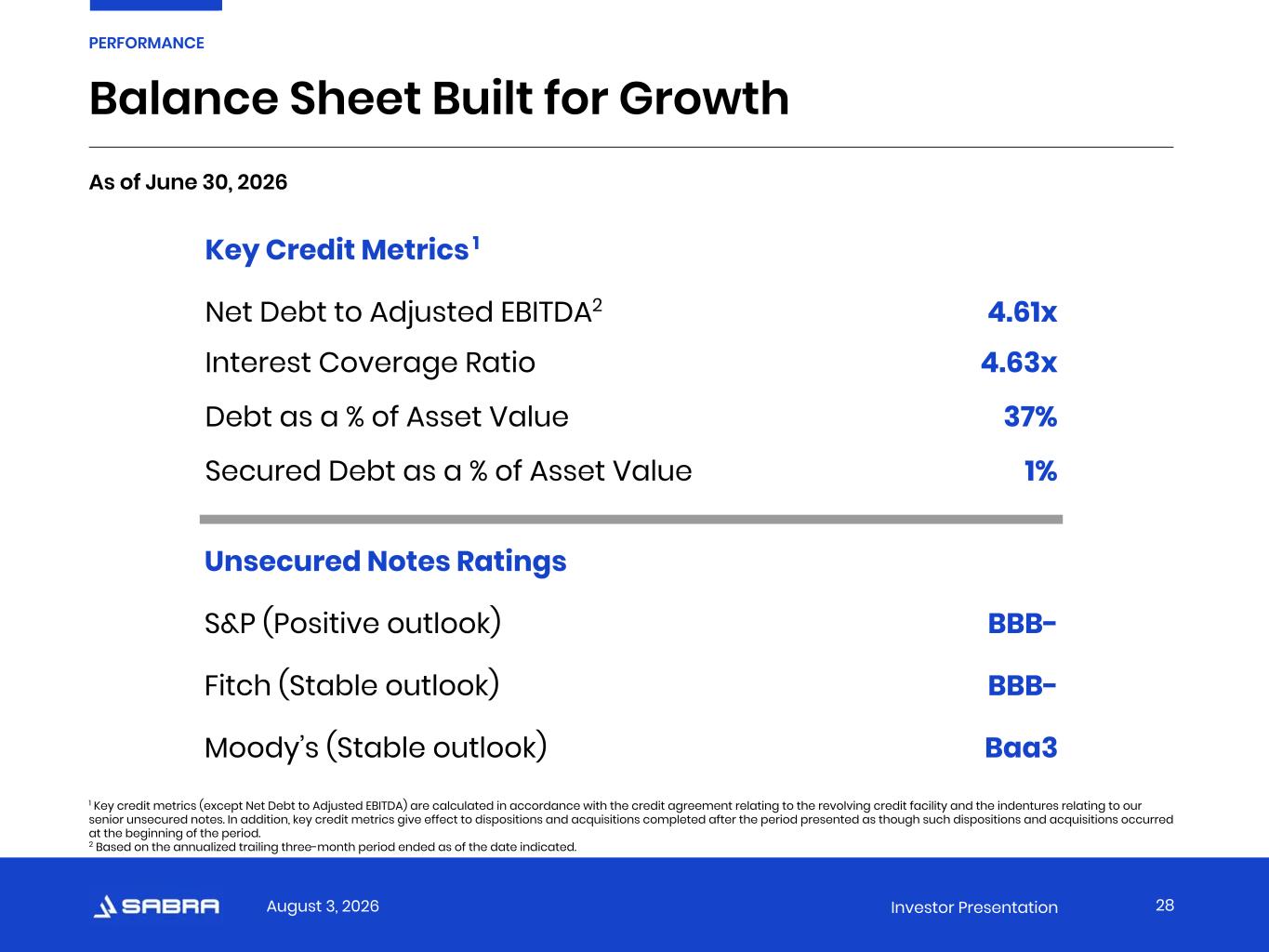
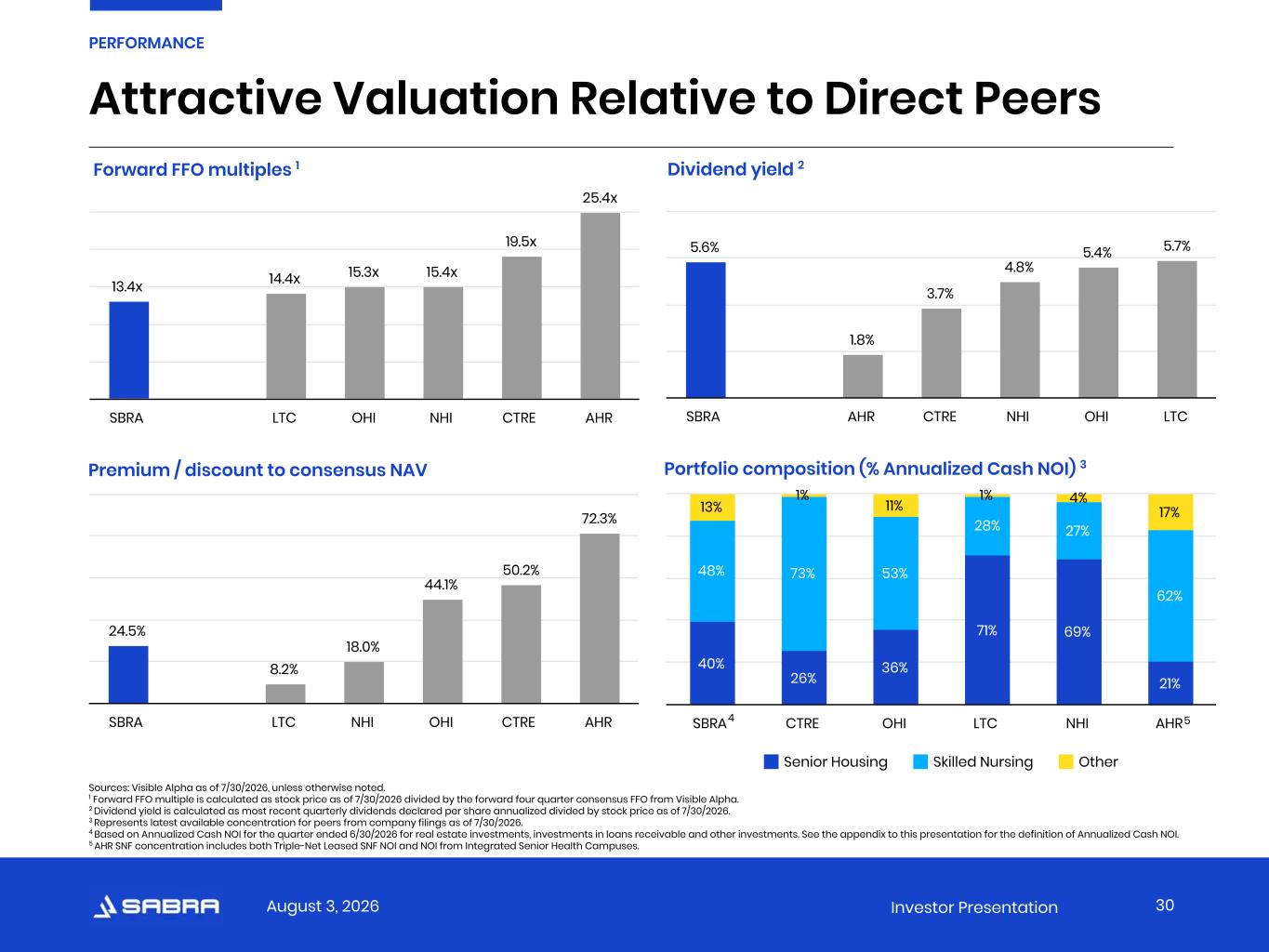
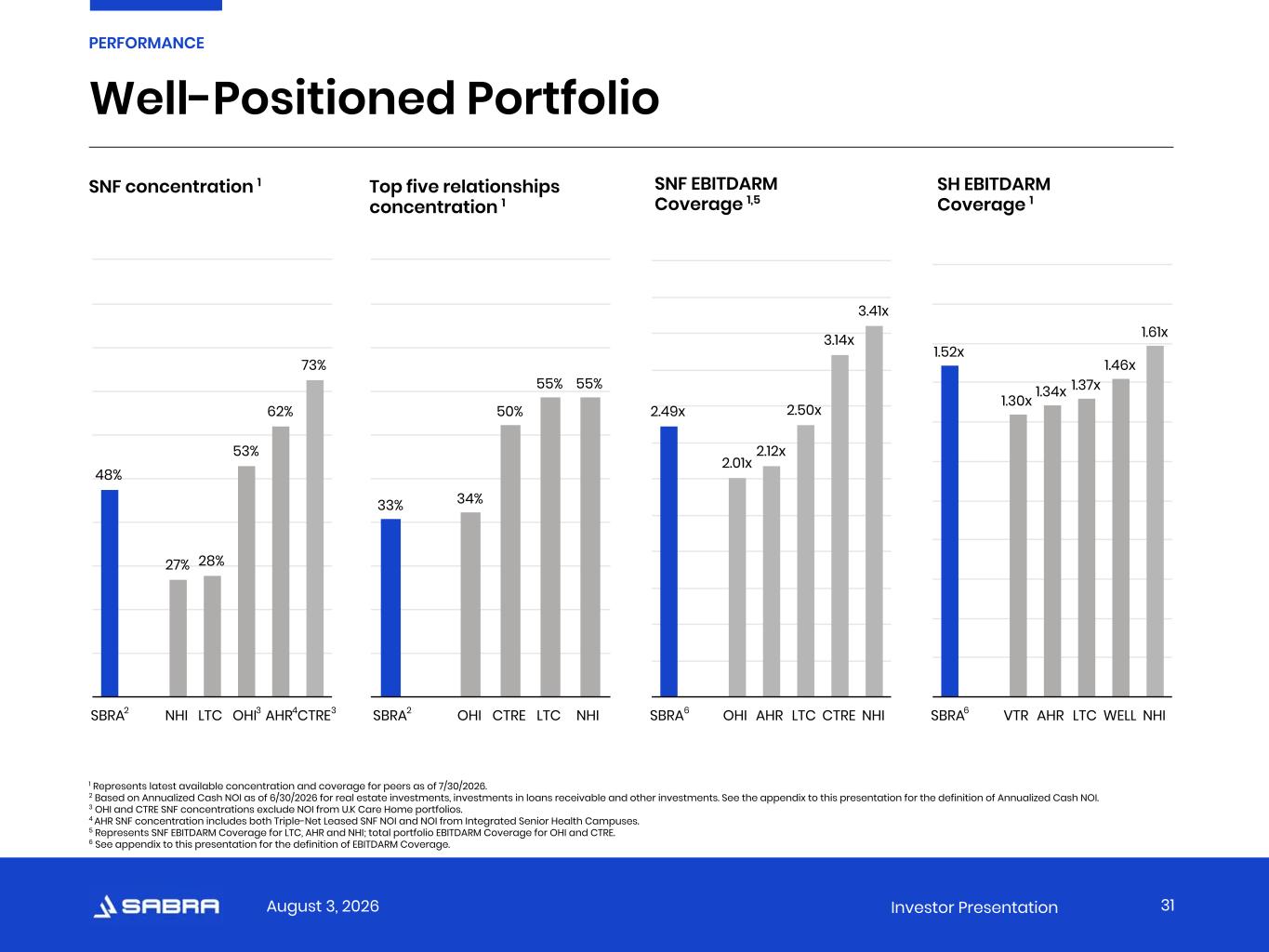
Thanks, Lucas, and welcome, everybody, to our second quarter earnings call. First, on to investment activity. We've closed approximately $600 million in investments, including $100 million in skilled nursing, and we're closing on an additional $100 million in shop investments. Our pipeline is as active as it's ever been. The deals that we've done have been closed at attractive yields, and we've got an immense amount of deals that we're looking at, and we were able to remain competitive within the range of yields that we currently announced. Going to operations. Our consolidated, unconsolidated, and same-store shop cash NOI margins continue to grow. Our triple net skill portfolio again shows increased rent coverage, as does our top ten in total. Our triple net senior housing did show a drop in occupancy in coverage, but that was specifically due to the transition of a high-performing asset from triple net to shop. Without that, the results would be still quite strong, but essentially be flat. We expect Medicaid rates taken together to come in around 2% as rates continue to revert to pre-pandemic levels, as we have been articulating. Even at that level, rate growth continues to feed the momentum of improved performance. The final rule for the Medicare market basket came in at 2.4%, the same as the proposed rule which met expectations. We don't see any regulatory changes that would create any new hurdles. And we're particularly pleased to see leverage drop to 4.61. And with that, I'll turn the call over to Darren.
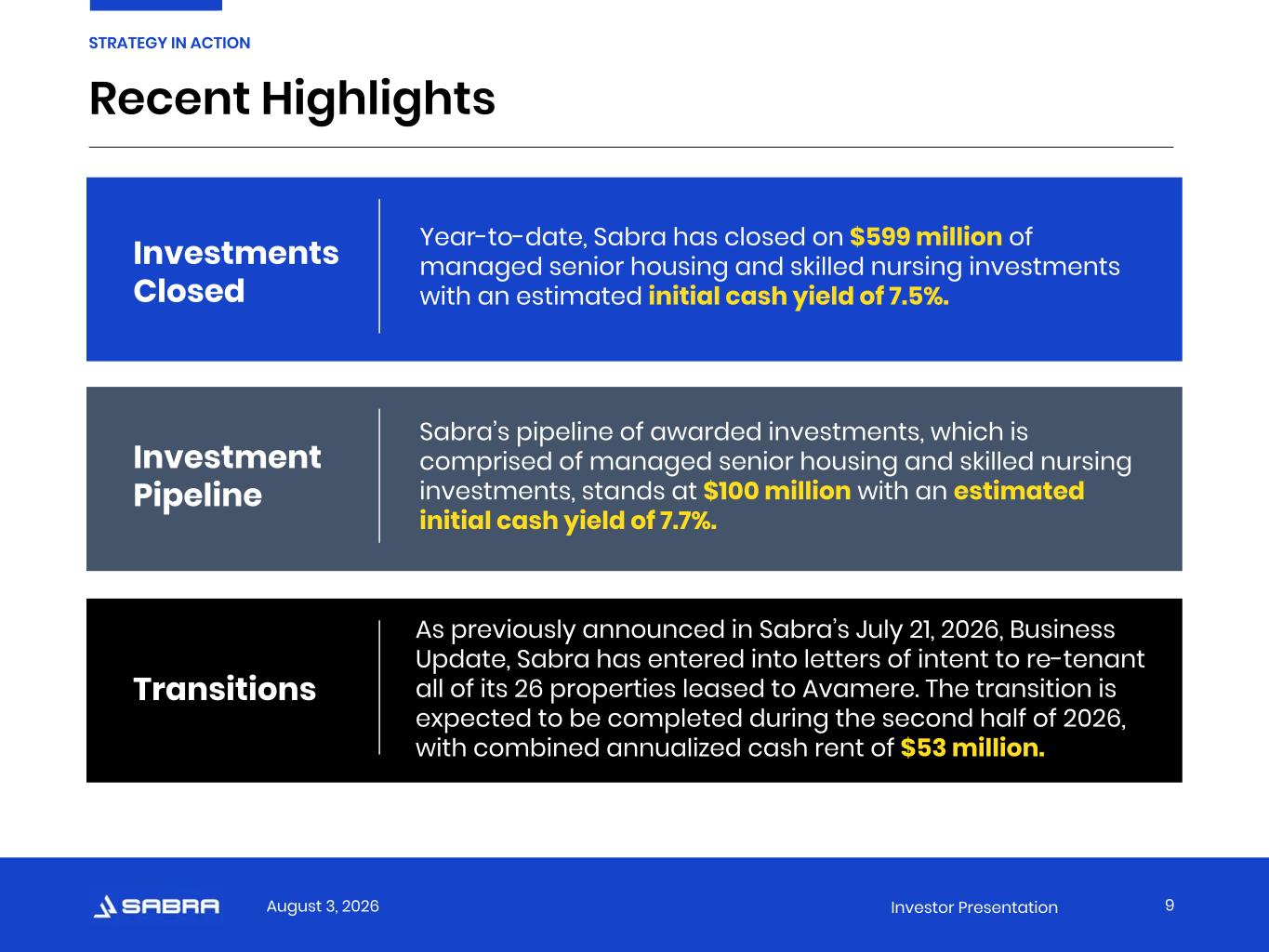
Thank you, Rick. Eric, Sabra's managed senior housing portfolio had another great quarter with continued growth. The total managed senior housing portfolio, including non-stabilized communities and joint venture assets at share, had sequential revenue growth of 9.6 percent, cash NOI growth of 14.4 percent, with margin expansion of 130 basis points. These statistics demonstrate sequential improvement in operating results that reflect the continued growth and strong performance in Sabra's senior housing portfolio. During the second quarter, Sabra invested $274.1 million, adding four properties to Sabra's managed senior housing portfolio, three skilled nursing communities, the redevelopment of a senior housing community, and the acquisition of the operations of one senior housing property converting to managed senior housing. Subsequent quarter in, SABRA invested an additional $223 million, adding seven properties to SABRA's managed senior housing portfolio, bringing total year-to-date investments to roughly $599 million with an estimated initial cash yield of 7.5%. Additionally, SABRA has another $100 million of additional awarded managed senior housing and skilled nursing investments, which should close prior to year end. In addition to the $700 million in closing award investments, SABRA has an additional $330 million of managed senior housing investments that we are actively pursuing. On a year-over-year basis, SABRA added 21 assets to our managed senior housing portfolio, a nearly 24% increase by number of assets and nearly 76% increase in total managed senior housing NOI. Deal flow continues to be extraordinarily robust and Sabra remains competitive on new investments. Moving on to the same store portfolio. Sabra's same store managed senior housing portfolio including joint venture assets at share continued its strong performance in the second quarter. The key numbers are revenue for the quarter grew 8.6 percent year over year with our Canadian communities growing revenue by 7.8 percent in the same period. Second quarter occupancy in our same store portfolio was up 170 basis points to 88.2% year over year. Notably, our domestic portfolio occupancy increased 170 basis points to 85.7% during that period, while our Canadian portfolio grew 160 basis points to 93.2% in the same period, marking the ninth consecutive quarter where occupancy was over 90%. Rev4 in the second quarter continued to rise with an increase of 6.6% year-over-year, with our Canadian portfolio increasing 5.9% in the same period. While REV4 and occupancy continue to grow, Expor increased 4.1% for the same period, providing for cash NOI growth of 13.7% on a year-over-year basis. With $700 million in closed and awarded investments to date, a very robust pipeline, and industry tailwinds at our backs, we should continue to see solid growth in our portfolio. And with that, I'll turn the call over to Michael Costa, Sovereign's Chief Financial Officer.
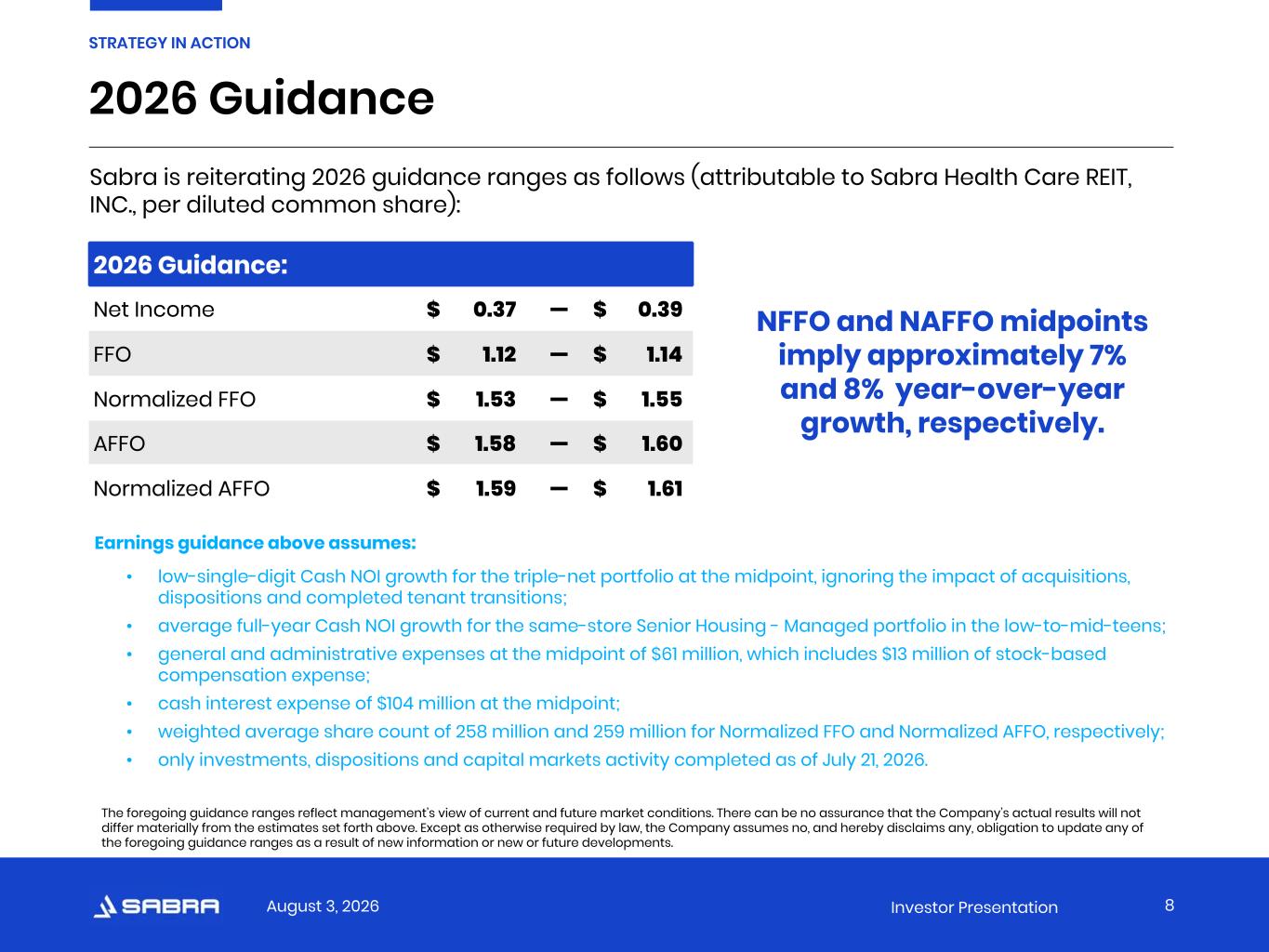
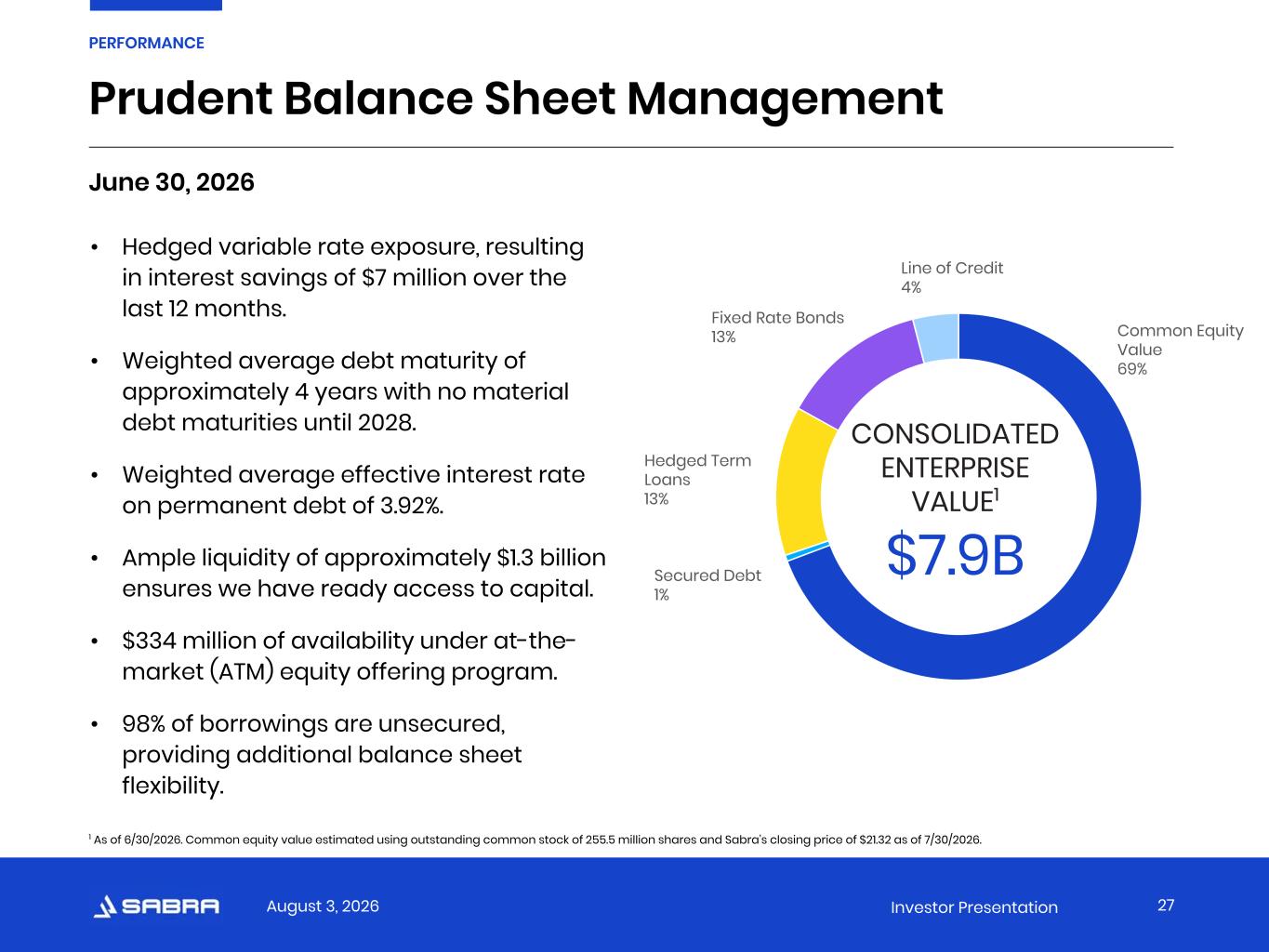
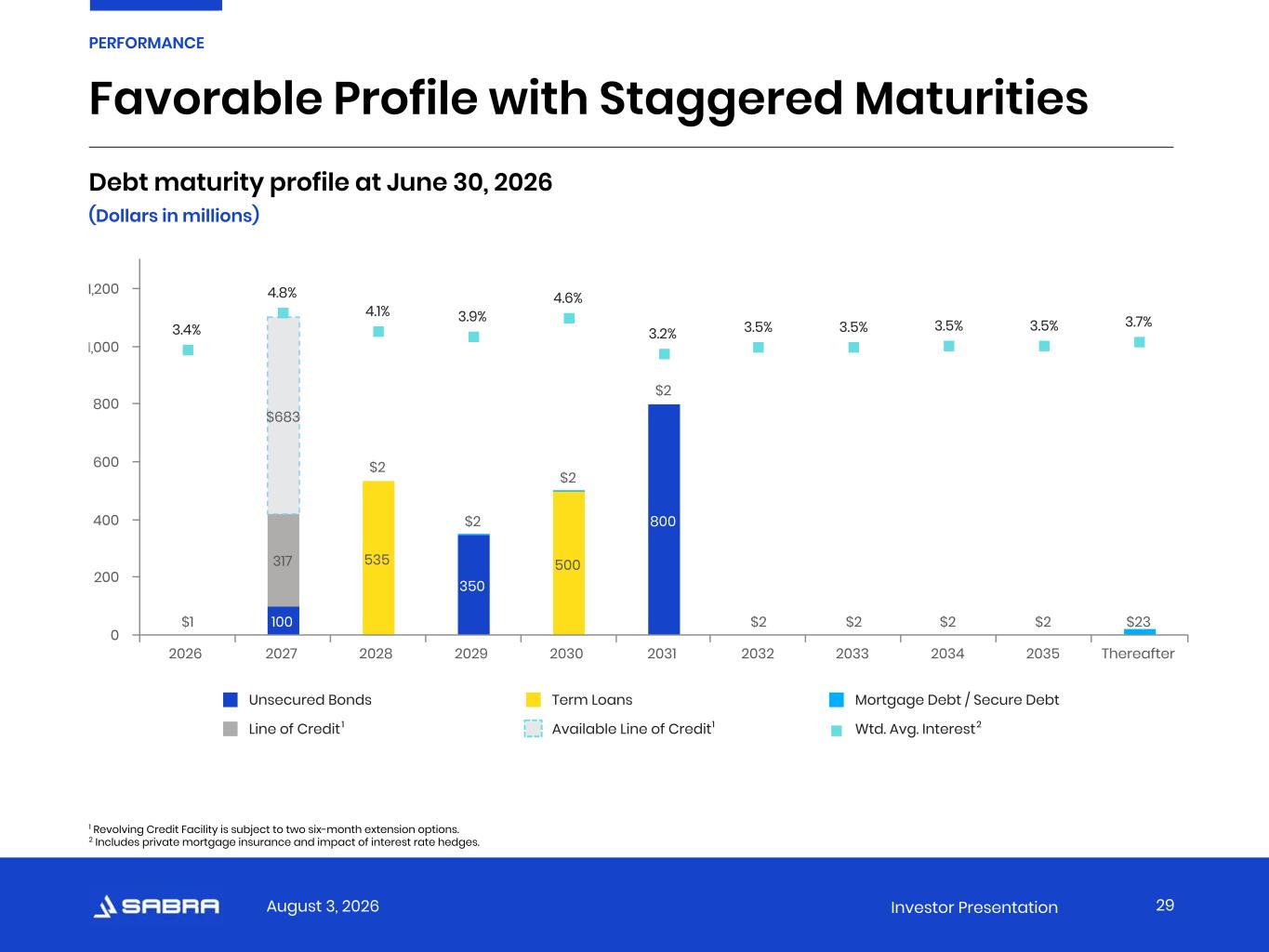
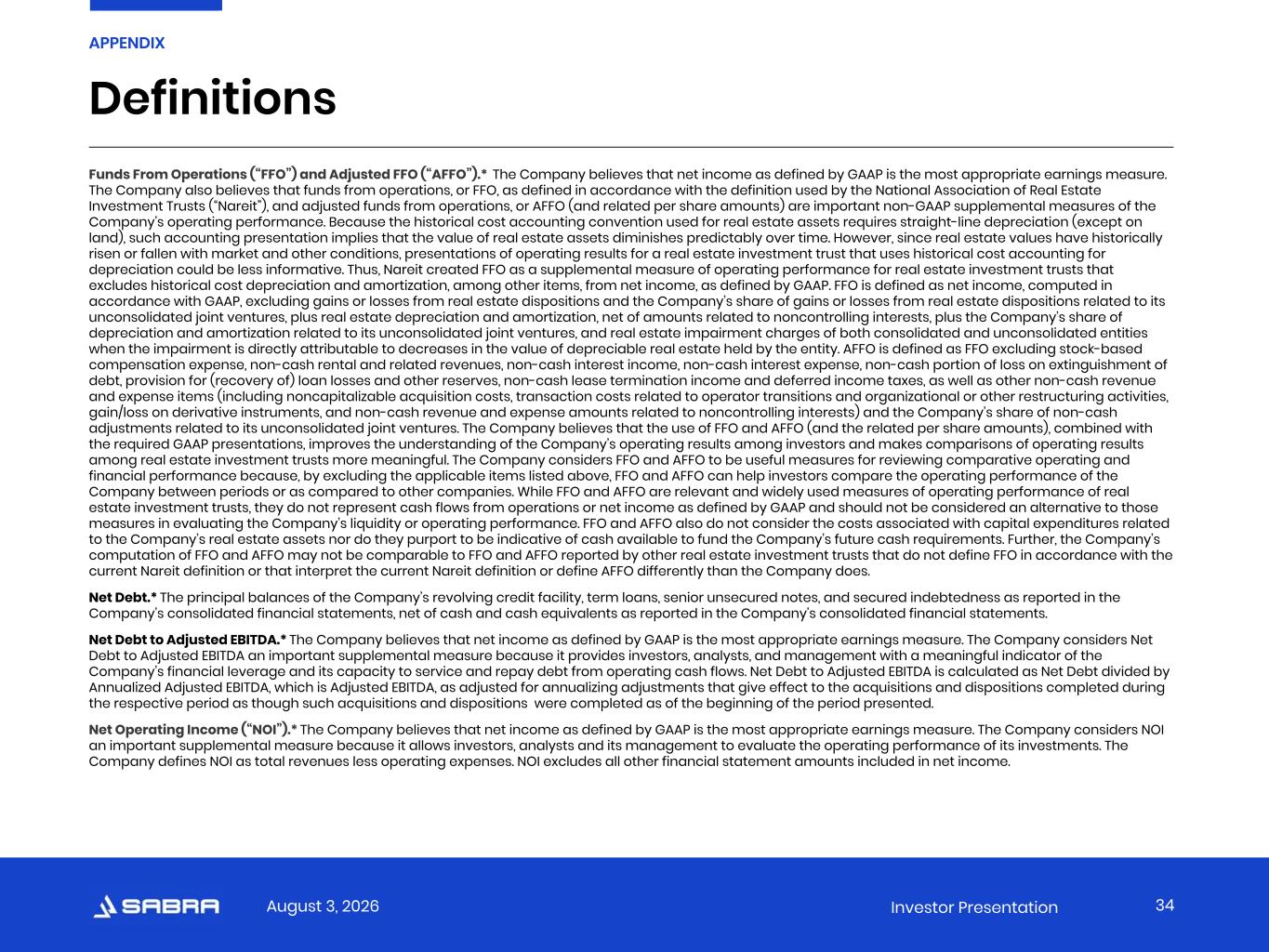
Thanks, Darren. For the second quarter of 2026, we recognized normalized FFO per share of $0.38 and normalized AFFO per share of $0.40, cents, compared to $0.38 and $0.39, respectively, in the first quarter. Year-over-year, our second quarter normalized FFO per share and normalized AFFO per share posted increases of 3% and 5% respectively. For the quarter, total cash NOI was $144.3 million, compared to $138.7 million in the first quarter. This $5.6 million sequential improvement was the primary driver of our sequential normalized ASFO for share growth and reflects continued operational improvement in our managed senior housing portfolio and the benefits to our triple net portfolio from diligent portfolio management. Cash NOI from our managed senior housing portfolio was $44.6 million this quarter compared to $39 million last quarter. This increase reflects both the contribution from recent investment activity and continued occupancy gains, rate growth, and margin expansion in the same store managed senior housing portfolio. Cash rental income from our triple net portfolio was $94.1 million for the quarter compared to $89.8 million in the first quarter. During the quarter, we exercised our option to reset the rent under our lease with Avomir to a fixed amount tied to the portfolio's historical performance. This increased the annualized fixed cash rent to $48 million and was retroactive to February 1, 2026, which compares to $41 million of cash rent paid in 2025. This added $3.2 million of rental revenue during the quarter, which includes $1.6 million of out-of-period revenues that we normalize in our quarterly results. We also recognize a $1.6 million increase in cash rental income from several smaller portfolio initiatives, including rent resets, lease amendments, and lease extensions. Our ongoing proactive portfolio management generally flies under the radar, but provides meaningful benefits to our earnings profile and portfolio quality and are a direct product of the incredible work that the Sober team does day in and day out. In addition, recent triple net acquisitions and investments added $823,000 of cash rental income sequentially. Offsetting these increases was a reduction of $1.3 million as a result of the Communicare sale announced last quarter and a $226,000 reduction related to the transition of a triple net senior housing facility to our managed senior housing portfolio. Interest in other income was $5.8 million for the quarter compared to $10 million in the first quarter. The decrease was primarily due to reduced interest income from the discounted payoff of the RCA mortgage loan discussed in our July 21st business update. Cash interest expense was $27.4 million for the quarter compared to $26 million in the first quarter. The increase reflects higher borrowings under our credit facility to fund completed investment activity. Normalized cash G&A was $10.7 million for the quarter compared to $11 million last quarter. This modest decrease is the result of incurred expenses in the first quarter related to hosting our 2026 operator conference partially offset by an increase in performance-based compensation expense this quarter. This quarter we recorded a 102.4 million dollar provision for loan losses and other reserves. This is primarily related to the discounted payoff of the RCA mortgage loan discussed in our July 21 business update and this charge was excluded from our normalized quarterly results. During the quarter we moved the leases with two tenants from cash-basis accounting to accrual-basis accounting. Accordingly, we realized a $3.1 million recovery of straight-line rent receivable and lease intangibles, of which $3 million is normalized in our quarterly results. This will have a positive impact on FFO going forward and, more importantly, reflects the continued strengthening of these operators' underlying performance and payment history. We also wrote off $1.3 million of straight line rent receivable from a triple net senior housing facility that was transitioned to our managed senior housing portfolio during the quarter. This amount was also normalized in our quarterly results. As noted in our July 21st business update, we increased our earnings guidance for 2026 and have reaffirmed that earnings guidance. At the midpoint, this represents approximately 7% year-over-year growth in normalized FFO per share and 8% year-over-year growth in normalized AFFO per share. Now briefly turning to the balance sheet. Our net debt to adjusted EBITDA ratio was 4.61 times as of June 30, 2026, compared to 5.04 times at March 31, 2026. This meaningful improvement reflects the payoff of the RCA mortgage loan and continued earnings growth within our portfolio, positioning us comfortably below our previous target leverage of five times. We had approximately $1.3 billion of liquidity at quarter end, consisting of $231.6 million of unrestricted cash and cash equivalents, $682.5 million of available borrowings under our credit facility, and $411.8 million related to shares outstanding under forward sale agreements under our ATM program. As of June 30, 2026, we were in compliance with all of our debt covenants. We continued to use the forward feature under our ATM program to efficiently fund future investment activity and preserve balance sheet flexibility. During the quarter, we utilized the forward feature of our ATM program to allow for the sale of up to 921,000 shares at an initial weighted average price of $20.72 per share net of commissions. As of June 30, 2026, 21.4 million shares remain outstanding under forward sale agreements at an initial weighted average price of $19.24 per share net of commissions, and we have $334.1 million of availability remaining under the ATM program. Finally, on August 3, 2026, Sober's Board of Directors declared a quarterly cash dividend of $0.30 per share of common stock. The dividend will be paid on August 31, 2026 to common stock holders of record as of the close of business on August 14, 2026. The dividend is well covered and represents a payout of 75% of our second quarter normalized AFO per share. And with that, we'll open up the lines for Q&A.
Operator
We will now begin the question and answer session. To ask a question, simply press star followed by the number one on your telephone keypad. Our first question will come from the line of Feral Granth with Bank of America. Please go ahead.
Hello, and thank you for taking my question. My first one is really just diving in a little bit deeper to your same-store shop guidance. I know maintaining that low to mid-teens with now the first half of the year averaging about 14.1% same-store NOI growth. And as we're heading now into peak leasing season, I wanted to touch base on really how you're feeling about the current market conditions, especially when we've seen the stabilization in same-store shop NOI guidance kind of across the peer set.
Yeah, sure, Farrell. So in terms of our shop guidance, we've reaffirmed that low to mid-teens growth rate that we put out earlier this year. As you noted, we've been right firmly within that range. And, you know, we continue to see opportunities for upside in that portfolio, but also at the same time want to preserve that flexibility with how the rest of the year pans out as we get further into the year and we have more visibility on what the second half is going to hold for us. You know, it's something that we'll revisit.
And I also just wanted to touch on in the press release, there have been mention about additional or a few value-add opportunities, especially in the shop pipeline, and I was curious if you can just dive in a little bit deeper of how you're evaluating those and kind of what are the hurdles that need to be reached for them to become under LOI or for you to move forward with a transaction of a value-add.
Sure. We've discussed previously that we were interested in investing in opportunities where there's bit of a turnaround opportunity opportunity but you know nothing monumental um these opportunities the the upside opportunities here encompass six properties and about 713 al memory care units with an average age of five years uh five of the properties are located in desirable atlanta suburban markets and the six is located in a solid denver market occupancy is roughly 80 percent and the expected year one yield is say roughly six percent um we see a clear path to stabilization in the next year or two with stabilized yields around nine percent and teen
irrs all these are being purchased well below replacement cost and both of these opportunities are with existing relationships and the incumbent operator an additional data point i'll give you farrell is a lot of this stuff that we've been buying over the last couple of years has been high 80s or 90ish occupancy so the value add for us is maybe closer to 80 percent it's not 70 or 65 percent right okay thank you for that our next question will come from the line of seth burgey with city please go ahead hey thanks for taking my question i just wanted to kind of talk about the pipeline of future opportunities um that you're seeing i think you mentioned um
kind of 100 million of shop opportunities and maybe 300 million of visibility after that. Just what's the mix between skilled and shop in that pipeline and where are you seeing the most kind of opportunity today?
So, the 100 million that we refer to, we're in the process of closing. So, that'll take our total for the year to 700 million. The other 300 plus we're working on is all shop and most everything else we see in the pipeline that's under review which exceeds a billion dollars as we sit here today is almost entirely shop.
And then I guess just a quick follow-up on that within shop like you know should we expect to see additional kind of value acquisitions or where are you seeing the most opportunity with shop today?
Yeah I would say the bulk of it will be stabilized, which is really what we've been articulating. But given the volume of investments that we're doing, we will continue to look for value-add as well, because as Darren noted, that takes us to the low double-digit IRRs, which is great, but it takes us to mid-teams on the IRR. So we're going to continue to look for those opportunities.
Operator
Our next question will come from the line of Austin Worsmith with KeyBank Capital Markets. Please go ahead.
Thanks. Good morning out there. Rick, I guess with the RCA loan now behind you, what are sort of the latest thoughts of exiting the behavioral segment altogether? I know it's something you've talked a little about and kicked around. Just curious what the latest thoughts are there.
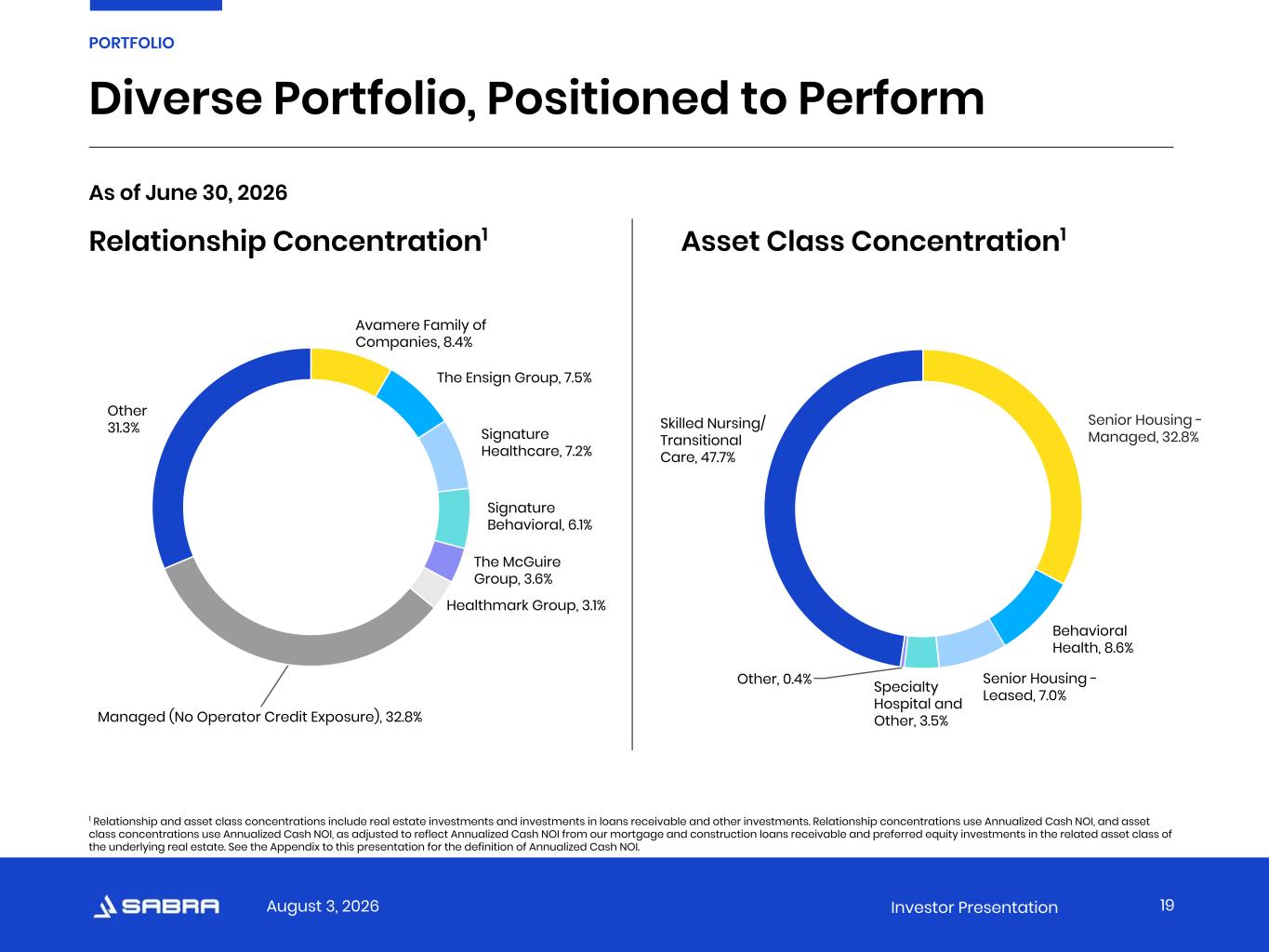
Yeah, sure. And so the bulk of what we have left is signature behavioral, the psych hospitals. Everything else is kind of in the process of going away and it's only a few things. So as it pertains to signature behavioral, as I mentioned before, they are interested in taking us out. They've been a very reliable tenant for nine years now. It's a completely different situation than RCA, obviously. So we'll see. We'd be open to it, having them take us out. It's going to have to be something that's compelling to us. And assuming that happens, then we're pretty much out. I think our other category, which is mostly a couple of hospitals and a rehab hospital, and those coverages are off the charts, so they just kind of knock out of the park, We'll be down to 4% or 5%, so we'll be 95% senior housing and skilled nursing.
That's helpful. I mean, any, you know, sense around what proceeds or pricing could look like on, you know, signature, you know, taking you guys out, you know, or out of the bulk of that segment altogether?
Not yet, but we do – we are confident that if there's a deal to be done, we'll have a really nice return on that investment.
Thanks for that. And last one is just on the billion-dollar kind of future pipeline, you mentioned, you know, entirely within the managed senior housing. Is that mostly, you know, one-off type opportunities? Are there any portfolio transactions in there that you're evaluating? Just kind of what comprises that kind of longer-term pipeline?
Yeah, there's a couple smaller portfolios, you know, say three to five assets tops, and most of it, though, is single asset opportunities.
Operator
Our next question will come from the line of Juan Sanabria with BMO Capital Markets. Please go ahead.
Hi, good morning. Just on the guidance that was reiterated from 721, Could you just talk to what's included in terms of the acquisitions closed subsequent to quarter end? I think you said they were in a six cap, and if they're not included, why?
Yeah, so everything that was included in our guidance from two weeks ago now, everything that was closed as of that date was included in there, and everything that's closed in the last two weeks is effectively included in that same guidance. You know, if you think about where we were two weeks ago and we had a good line of sight into what the rest of the year was going to shape up as, what the second quarter was going to shape up as. So that was all factored into that guidance. And, you know, the investments that were made subsequently in that two-week intervening period wouldn't move the needle for 2026.
For 2027 and beyond, yes, but given that it's only five months, it wasn't going to move the needle. and how much was closed uh subsequent to the 721 those last two weeks what's the dollar amount um i'd have to get that for you one we'll get a few while we're on the call yeah great thanks and then just uh as a follow-up just curious uh how we should think about export going forward and sort of the operating leverage inherent in the portfolio Yeah, I mean, in terms of export, you know, this quarter we saw a little bit of spike in that.
And, you know, it was a mix of things. You know, there's choppiness with things like repairs and maintenance, which is kind of a constant factor in this type of business. We saw some increases in things like incentive management fees. It was actually kind of a good outcome to see an increase there because it just shows that our operating partners are, you know, exceeding our expectations and their expectations for those portfolios. So I would say, you know, outside of, you know, lumpiness, when you have things like repairs and maintenance, the export growth should return. Our expectation is that it should return to what we've been seeing in the last couple of quarters, you know, 2%, somewhere in that range. Thank you.
Operator
Our next question will come from the line of Connor Mitchell with UBS. Please go ahead.
Hey, thanks for taking my question. The funding side of the transaction equation that plays into the targeted acquisitions, the stock price reacted positively following the business update in July, but it's come back a little bit since.
So when you experienced the improved cost of capital, does that change the type of assets that you would buy or add on to the pipeline? no um it doesn't we've been able to get things done at attractive yields even even where our cost of capital was before the business update and uh so no it doesn't it doesn't change that at all we're still in a better place when we're before the update there's been a pullback sort of across the space so hopefully that'll pass um seems to have a lot of stuff but um and hopefully having a solid core like we just announced will help as well but no it doesn't change that calculus it just makes things okay a little bit
more creative a little bit sooner that's all yeah of course appreciate that color um and then maybe just sticking on the funding side um you know you still have room to run with the forward atm the spot atm and then now your your leverage profile is lower um focusing on the equity issuances from the forward ATM and the regular ATM? Or do you kind of look at debt as more of an opportunity to bring the leverage profile back up to that five times target that you were mentioning?
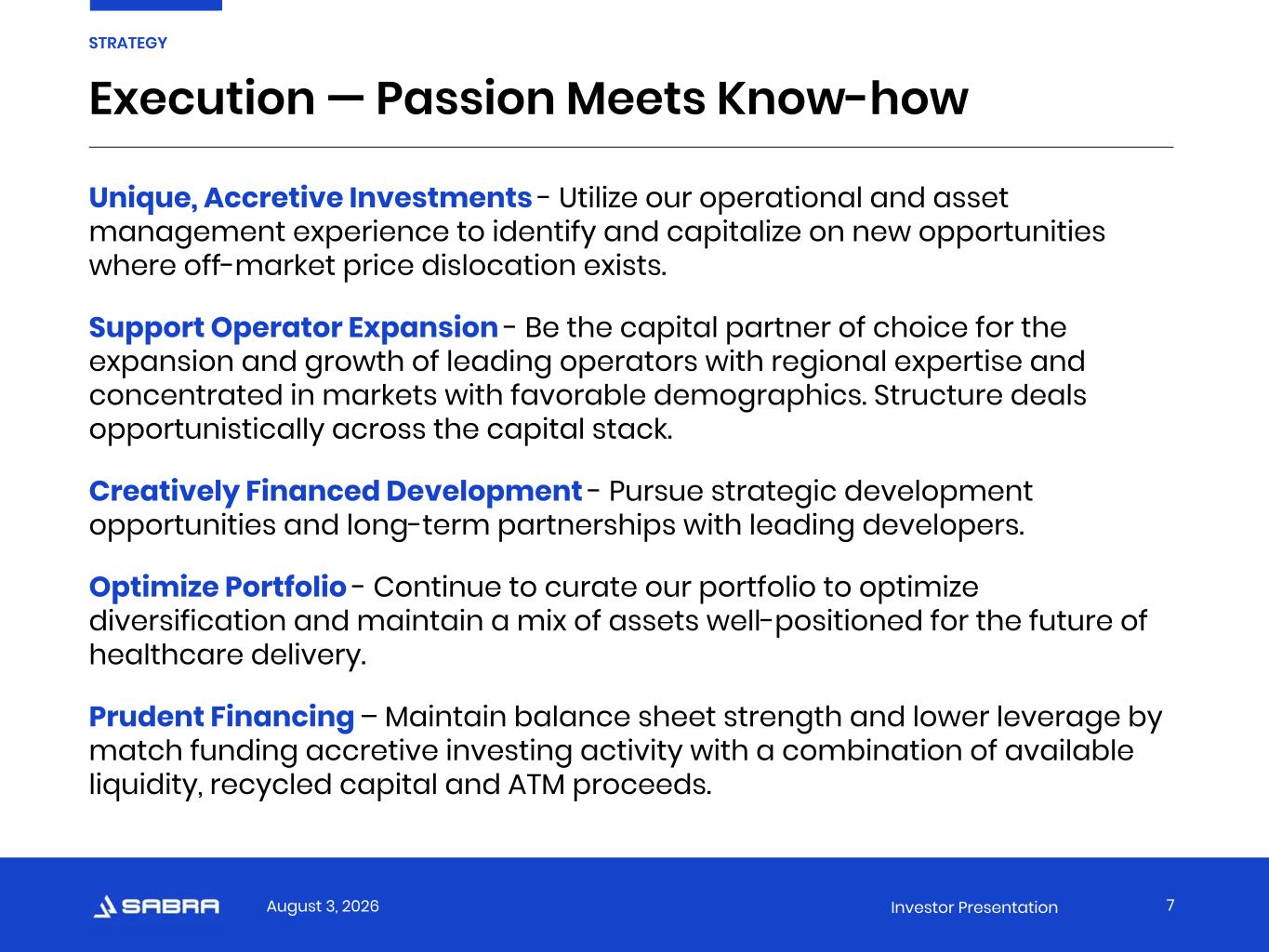
Yeah. In terms of the leverage, I mean, we're not looking to jack up our leverage back to five times with the next deal we do, right? So the beauty of having our leverage where it's at right now is that it gives us plenty of cushion as deals come up and as we finance additional opportunities that if the equity markets aren't cooperating, we could still execute on those transactions without being concerned about where our leverage level is at. So it just gives us a lot of breathing room in that regard. With regards to the forward equity issuances that we've already made and that are currently outstanding, when we look at executing on the forward, it's an internal conversation that we have with regards to what our line of sight is and our visibility is into investment opportunities. And if the stock price and the cost of equity at that point in time makes sense and allows us to transact on these opportunities accretively, that's when we look to lock in that cost of capital. So said differently, what we've already locked in in terms of forward ATM proceeds would allow us to close on all the things that Darren was talking about earlier at an accretive price. And that's just going to be our philosophy going forward. If we see the stock market and our equity price cooperating with us, vis-a-vis our investment opportunities, we'll continue to proactively take advantage of that.
And going back to Wad's question, we closed on $223 million in the last two weeks.
Operator
Our next question will come from the line of Vikram Malhotra with Mizuho. Please go ahead.
Good afternoon. Thanks for taking the questions. I guess this first one, going back to the value-add assets that you've bought, I know you flagged this maybe a quarter or two ago of shifting away, but I'm just, I guess, stepping back and wondering like what's compelling you to go down kind of more a bit more risk on into this value add uh you know kind of segment where there's a lot of competition cap rates are compressing um you've already sort of grown your uh correct me if i'm wrong i think your shop revenue is now 30 plus percent so it seems like you're in a good spot so i'm almost wondering like does it make sense to actually pause and you know just now see the benefits of the hard work you've done the last, call it, two years?
Well, a couple of things, Vikram. I appreciate the question. So, one, we're not doing very much of it. Two, it's not really risk attached to it because the value add that we're doing it is already at 80% occupancy. So, you're already at your leverage inflection point in terms of the revenue pull-through that you get as you get additional residents into the facilities. And we're only doing these with operators that we currently have relationships with and has already proven to us what they can do with other assets that were in the exact same place. So there's a clear path to going from 80 to 90 percent, say, on these assets. So if we were doing stuff that was at 65 percent, then I would really take your point and say, OK, we're not going to do that. And we're not going to do that. So, again, it's a small number relative to the amount of volume that we're doing, and it's relatively stabilized with a clear path to even improve stability. Does that answer your question?
No, that's helpful. I mean, I guess I was just saying you kind of had a year and a half ago stated you'd like to be close to 35%, 40% shop. I think you're there now. So I'm sort of wondering, you have a lot of embedded growth the next two years through the shop pool. So is it actually almost more accretive to just pause here and just see the benefit of the organic growth that everyone's going to see the next two years? That's kind of the point I was trying to get at.
No, I get it. And, again, if we were doing, I guess, true value add with much lower occupancy, I would agree with you. But we're not doing that. So, and then the other point I would make is we said that we wanted to be at a 40% shop NOI run rate by the end of this year, but that's not where we want to end. We want to continue to grow that shop exposure. So, we're not content to be where we are now, even though the 450 basis point improvement in shop NOI exposure from last quarter was significant. So, again, we're not taking real risk here. And again, we're doing this with operators that are currently, that we're currently partnered with that have taken assets that are very much like these and take them to the next level.
That's fair. Just maybe one more, I guess, maybe, you know, Michael, I guess on the, this year, I mean, in terms of the benefits that flow through, obviously next year you'd have the bumps, you'd have, I guess, half a year, correct me if I'm wrong, of the annualized the step up from the transition assets and then all the acquisitions you do and the benefit of the organic growth there. So I'm just wondering, like, are there any big pieces we're missing, like the streets kind of at 6% growth from what I can see on Bloomberg for next year, given all the acquisitions, like is there something we're all missing? Is there, and you don't have a lot of debt coming to you, doesn't seem to be like any other, you've got a lot of sources for funding. So I'm just wondering, as we look at any big-picture building blocks, given all the acquisitions you've done, we should think about next year.
Yeah, I think you named off all the major building blocks. Look, we have an increasing – a shop portfolio that's increasing by size, you know, by every quarter that passes, right? That's going to continue in our expectation, I think the market expectation as well, continue to drive outsized earnings growth compared to triple net. We have an extremely healthy triple net portfolio that's going to increase by those contractual rates.
We've been making these acquisitions that have, you know, solid embedded growth in them, and I think all those building blocks set us up to be able to deliver not just for 2027, but into 2028 and beyond with, you know, solid earnings growth on a year-over-year basis, and that's our overall objective. yeah i guess maybe just to clarify so like your peers who've also been kind of maybe i don't want to say taking on risk but like trying to you know accelerate the growth through other strategies have all started saying we're trying to create a growth profile which used to be four percent on affo to more like six plus and seems like you're getting there i'm just trying to figure out like
how sustainable is this you know six five six percent growth as we look forward into next year and beyond so i think it's quite sustainable we're actually at seven and seven and eight percent uh on our upgraded guidance at the midpoint um because in 2027 we're really going to start to see much more of the benefit of the um of the acquisitions that we've been doing and that'll flow into 2028 as well thank you our next question will come from the line of rich anderson with Cantor Fitzgerald.
Operator
Please go ahead.
Hey, thanks. Good morning. So, on the RCA payoff, you know, the $100 million of, you know, I guess called a discount that you offered, the $200 million, you know, is essentially a capital raise at over 11% cap rate. And if you if you apply that to a seven and a half percent return on redeployment, then that's about five cents of annualized dilution. First of all, do I have that right? And second of all, is that baked into this new guidance? Would your guidance been two and a half cents greater had it not been for that transaction?
Yeah. I mean, look, if we hadn't, well, let me answer your second question first. Yes, it is factored into our guidance And, you know, those proceeds, because we don't assume any investments over and above what's been completed in our guidance, in fact, we were assuming we're just paying down debt with those proceeds. You know, there's better use of our capital in the form of investments that that capital is going to be used for. But that's what's assumed in our guidance. So I think it is reasonable to assume that our guidance would have been higher absent that, right?
Yeah, understood. I just, you know, I hate seeing $100 million go poof like that. I understand why you do it, but it comes through in the numbers one way or another. So I just wanted to sort of get the numbers right in my model. Second, you know, more SNF transactions are popping up into the system. I understand a lot of your future is shop, but you did say $100 million SNF transactions. What do you think is causing that, Rick? I mean, you know, what's changing in the environment that has caused, you know, more in the way of SNF opportunities hitting, you know, passing the smell test for you guys?
So I don't think anything's changed. Those opportunities were off market, brought to us by existing operators. And I think that's where it's going to come from going forward. We're just not seeing the kind of sniff volume that we saw pre-pandemic where guys that didn't have to sell wanted to monetize and would sell. I think that operators got beaten up pretty badly during the pandemic, and they've been recouping their losses, and now they're doing well. And they're just not willing to put their assets on the market unless they have to for some other reason. And so there's such a small amount, and I'm talking about sort of the straight down the fairway, you know, triple net skilled nursing, not loan investments and things like that. There just isn't enough available for it to go around for all of us. And so the private guys that are buying Opcos and Propcos can always outbid us because we're just bidding on the real estate. So I think going forward, at least in the foreseeable future, it'll be more off-market opportunities that will come our way, hopefully. Maybe in 2027, we'll see behaviors that revert back to sort of the norm, the pre-pandemic norm, where folks finally were doing well enough for a long enough period of time that it's time for them to start monetizing their assets and moving on.
Okay. And last question for me, shop and specifically Canadian opportunities, you know, there's a little bit more of a ceiling in terms of your ability to grow rents in Canada, whether it's, you know, real regulatory stuff or social issues around rent growth for seniors. Does that make it a little bit more difficult to be active in that market, or can you still find the requisite return even going forward relative to your U.S. pipeline? Thanks.
Sure. So the Canadian market certainly still continues to be very active, and we're still bullish on the Canadian market. I think the biggest issue with investing in the Canadian market, at least for us, is that cap rates still are 100, 150 basis points or so inside of what they are in the U.S. So we see better opportunity in investing in U.S. senior housing today.
But do you agree with that about, you know, just sort of whether it's real regulatory issues in Quebec or something or social issues elsewhere? Do you feel that or am I maybe misstating that observation?
Well, we're still seeing very positive revport growth on a year-over-year basis, despite the fact that our Canadian same-store portfolio has been over 90 percent occupied for the ninth quarter, I think, in a row. There's definitely some more regulations in Canada, certainly, than there are in the U.S., but I don't think it's had a significant impact on rate growth today. To say it won't in the future is a guess.
Fair enough. I appreciate that. Thanks very much, guys.
Operator
Our next question will come from the line of Rich Hightower with Barclays. Please go ahead.
Hey, good morning out there, guys. So a couple from me, one on Avamir and the transition there, and just give us a sense of maybe any sort of risk factor embedded in I guess 26 guidance and even beyond as we think about timing for all the the approvals required if there's any potential delay transition expenses any anything related to that that we should be aware of no we don't see anything going forward that's going to impact guidance or performance there's a big difference when you do a transition that isn't friendly which was the case with the holiday transition and a transition like this which has been sort of planned for
quite a long time it's completely cooperative between the two parties and also in this case with cascadia they have already acquired other avenue properties non-stop properties and turned them around and those other properties had the same exact characteristics from an upside perspective that these have. So it's really a great transition, and we really don't have any concerns.
Okay, that's great. And then I guess maybe more broadly just on, you know, private market competition for shop assets specifically, what's your sense of what, you know, whether it's private or public or anybody else you're sort of competing against, you know, What are other buyers underwriting in your sense of things in terms of going in yields, unlevered IRRs, cash flow growth in the interim? Just give us a sense of what does it take to win a deal that might be a market deal rather than something that comes off market?
Yeah, sure. I think it's really deal-specific. Oftentimes, I think if you have a strong relationship with the owner or the operator, even if it's a marketed deal, that provides a little bit of an edge and some insight. It's hard to say what others are doing. We've certainly lost deals to competitors in the past where we've been scratching our head after you'd hear the announcement on what that yield was. It didn't make sense to us as far as how they were getting there. We've also, you know, not elected not to bid on transactions that some of our competitors have purchased as well at, you know, high six, low seven cap rates where we just saw too much risk for the, you know, the risk adjusted return associated with that. But it's really hard to guess at what our competitors are assuming as far as a stable occupancy or rate growth. I think it's really transaction specific. Yeah.
The other thing I would say is kind of like SNFs, when it comes to our peer REITs, we all pretty much value assets similarly. So, there was a huge discrepancy there. The private guys are a little bit different, obviously.
Operator
Our next question will come from the line of Alec Fagan with Baird. Please go ahead.
Hey. Thanks for taking my question. For the first one on the G&A front, which functions is cyber hiring for today?
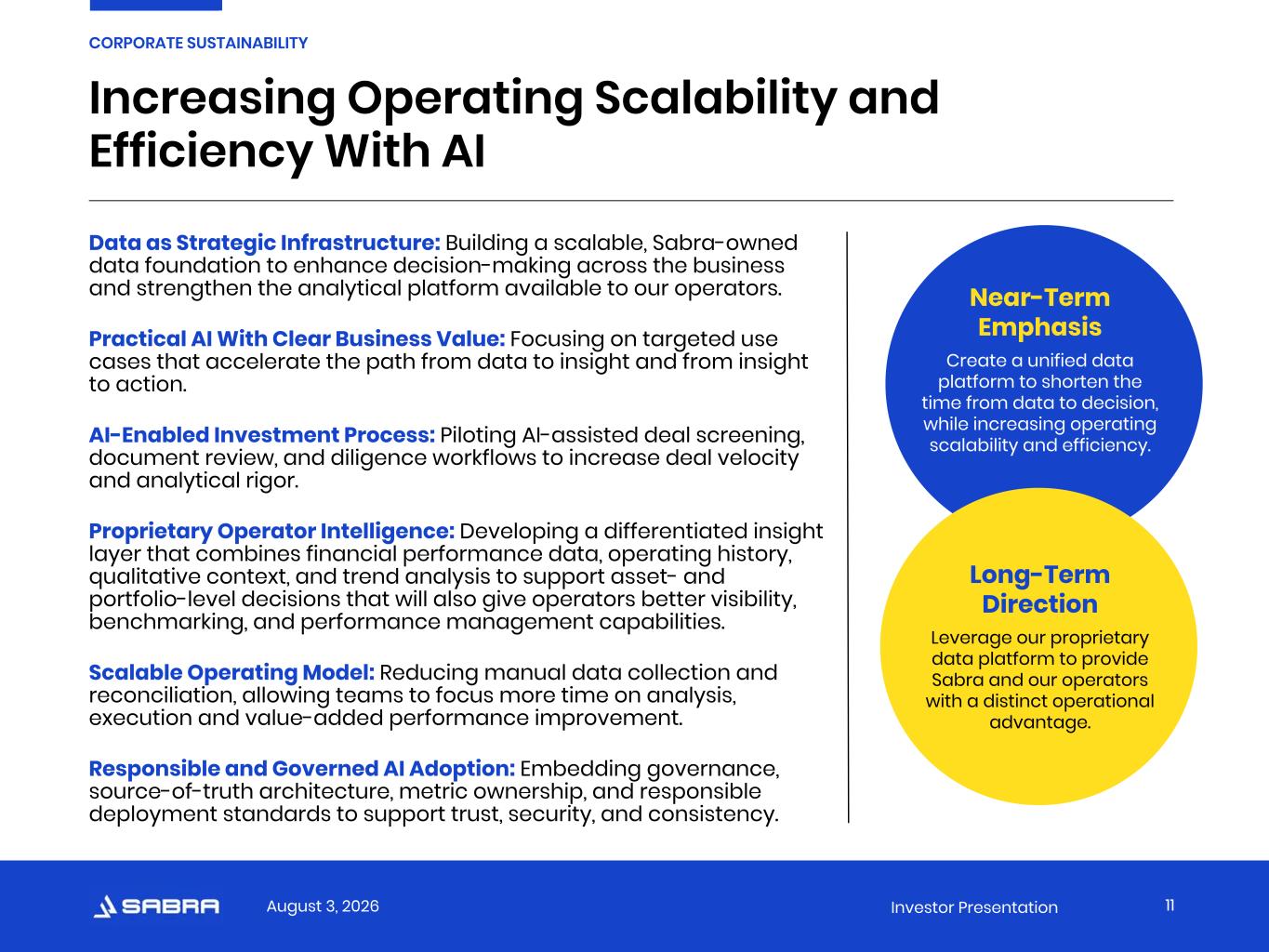
I mean, we're looking across the organization. Obviously, our investments team has been extremely busy for the last several quarters, and we continue to add resources there when necessary. You know, we're looking across the company to things like asset management, accounting, finance, other areas where, you know, we're experiencing growth, particularly areas that are more impacted by our growth on the shop side. On the other side of that, and we talked about it a little bit on the last call, there are several initiatives we're undertaking as we speak and have been for the last several quarters on the technology and AI side that are going to help us be more efficient and be able to perform those same duties at a larger scale without what would have previously been the requisite number of additional heads.
Another way maybe to think about it is we're not looking at reductions, but particularly with the AI initiatives, we're going to be a lot more scalable, so we won't need to add as many positions as we might otherwise need to add in the absence of those initiatives.
Got it. That makes sense. And then switching gears a bit, I think, Michael, you said that you moved two tenants from cash basis to accrual accounting. Can you tell us what is the percentage of ABR that is now on cash basis?
I mean, it's going to be the vast majority of our tenant base. I don't have the number in front of me. I could get that to you after the call, but we have a very small amount of tenants that are on a cash basis. And ever since this concept of cash basis accounting came into play, I don't know when it was, 2018, 2019, one thing I was always made a point to clarify is there's tenants that are on a cash basis because of the accounting rules, but they're paying their rent. They're paying their full rent. And, you know, there's not any variability in the revenues that we're recognizing period to period, but there were some that were paying, you know, varied amounts and that created some level of variability. The tenants we put on accrual basis, you know, have been paying their contractual rent for quite some time. So there's not, they weren't in the latter category, right? That's really the area we focus on. The people that weren't paying us their full rent, where's our real risk there and what can we do about those? And that number is such a small amount today, even more so after some of the initiatives I referenced in my prepared remarks of transitioning tenants, resetting rents, or amending leases, that's even further reduced because of those actions. So it's a very small amount, which is obviously a good place to be.
I mean, we're in the high 90s, so on accrual.
Okay. No, appreciate the color. Thank you.
Operator
Our next question will come from the line of Michael Strojek with Green Street. Please go ahead.
Good morning. Thanks for the time. Can you maybe provide a bit of color on what drove the acceleration in REV4 growth during the quarter? Is that greater than 6% growth rate sustainable in the near term? And has there been any broad-based change in pricing strategy among your operators given sequential REV4 growth was also quite a bit stronger versus historical seasonal levels?
No, I think it's nothing new. I think we should continue to see, as far as RAV4 is concerned, you know, mid-upper-mid-digit increases.
It's just the natural growth of occupancy and efficiency and a little bit of pricing power. So there's nothing strategically different that's happened, which is good news.
Yeah, makes sense. But maybe one on the transaction market, can you just talk about replacing costs? Where are you acquiring at and how does that compare to call it six to 12 months ago or so?
Sure. So we're acquiring at, it depends. It depends where Whatever the asset is, it depends on a lot of factors, but I think I'd say we're acquiring at somewhere between, you know, the mid-$200 per unit up to $500 per unit. And I think from a replacement cost perspective, that would compare to, say, $400 to $600 plus. It's really dependent upon where in the country those assets are. Understood.
In the aggregate, it's probably somewhere around 300-plus a unit.
Operator
Our next question will come from the line of Dave Rogers with Raymond James. Please go ahead.
Yeah, hi. Rick, I wanted to talk about the transitions, obviously a very successful quarter between Avamir and the other transitions that you were able to announce. Can you maybe talk about that other $9 million? I think you've discussed Avamir quite a bit. I think that other $9 million of annualized NOI that you pick up, how much of that is recurring in nature? How much of that can you do going forward? How many opportunities do you have? It all hit this quarter because it was a good time, you know, to offset RCA. Like, I guess, how did you think about kind of delivering so much in one quarter, and what are the opportunities going forward to kind of do even more of that?
Yeah, so the whole thing's been a little strange in terms of how quickly it's happened. There are a couple of other opportunities that we are pursuing, and my guess is there will be similar transactions, transitions there. It's really a group of individuals. I don't know that it's a trend or anything, but the pandemic really burned out a lot of people. We had operators during the pandemic that said, take us out. We're done. We want to retire. We've been doing this for decades. Now that things have been going well for a number of years on the skills front, that same thing has happened. In every single case that we're looking at, it's basically a CEO, founder, and perhaps other executive members that are ready to retire. And so that's why these things also go so smoothly is it's all very productive. they want to get taken out. They want it to work for them. They want it to work for us. They want it to be somebody that can take over and have a smooth transition. And there aren't any sort of cultural ruptures and things like that. So it's just, but it's interesting that the pandemic just took a lot out of other particularly operators that have been around for, you know, 30, 40 years.
Yeah. And Dave, the other thing I'll highlight too, you know, know we announced it this quarter with our business update we called it out in our prepared remarks this all didn't come together in the second quarter some of it did no doubt some of it came in the first quarter but they're all so individually small we wouldn't have spent any time talking about in the first quarter and stuff happened prior quarters before that right it's just these are like kind of the things we're doing day in and day out that don't grab headlines but when we're putting together that business update we're putting the pieces together like there's a big piece missing from it. What is it? Well, it's this stuff that we've never really talked about publicly, but it is extremely beneficial and extremely meaningful. So to Rick's point, there's going to be some of this stuff on a go forward basis. And we just are going to do the right thing in terms of improving our earnings profile and our portfolio. And we'll all be benefiting from that.
Maybe just to follow up on both of those, Rick, your comment in particular that there's people that want to get out. I mean, from a sizing perspective, are we thinking more like, you know, a couple of transitions that add up to the $9 million, or are there a couple of Avomir-sized transitions out there that you could envision, whether they happen or not?
These would be smaller transitions than that, and it's a couple that we're currently having conversations with, but they'll be much smaller than that. There'll be some incremental benefit to us in all likelihood, but it won't be material.
That's helpful. I appreciate the added color there. And I wanted to follow up on the G&A increase, obviously this year a little larger than the past couple of years. It sounds like a lot of that's related to shop. I guess as we think about going forward without talking about 27, 28 kind of guidance, but the increase we see this year, is that something we would expect to see continue if you were to buy $700, $800 million of shop a year? Or are there some of these one-time tech AI investments? Is it shop management fees that kind of bleed through? maybe just a little more color on what that run rate looks like, given what we've seen this year versus what we've seen in years past.
So, I mean, one of the biggest drivers in the GNA increase, both primarily in our full year guidance numbers, is performance-based compensation. And we set our board sets our performance targets at the beginning of the year. And as the year progresses, as we evaluate whether or not we think we're going to meet or exceed those targets. And as we put out guidance that was higher this quarter, which implies that we expect that performance to come in higher than what we initially estimated at the beginning of the year, which drove that increase. And in terms of a run rate, what we gave in terms of G&A at the beginning of the year for our guidance. That's effectively assuming, you know, no performance-based compensation or basically at our target performance-based compensation expense. So when we go into 2027 and future years, we sit down and we make an estimate. We sit down with our board. We come up with a performance target and where we land relative to that will determine whether we have an increase over that number. So I think probably the run rate we gave for our initial guidance is probably a decent starting point, adjusted upwards a little bit for inflation and the like. Now, to your point on additional, you know, AI initiatives and stuff like that, that is going to add some G&A cost to us, especially up front. What that is, you know, is to be determined. It's been very incremental to this point. But that'll add a little bit to it. But we expect to be saving on efficiency gains at the same time.
The only other point I'd make, Dave, is even in the absence of AI initiatives, which will make us more scalable. Any ads with the growth of shop would be incremental because we built our platform over 10 years ago. So everything that we've done over the last 10 years to add to that platform, both on the human resource side and on the system side has been incremental. So the AI piece of it will just make that a little bit better.
Operator
Again, for questions, press star one on your telephone keypad. And our next question will come from the line of John Kilikowski with Wells Fargo. Please go ahead.
Good afternoon. Thanks for taking my question. Rick, back on some of your comments on the value add stuff, you know, you talked about the 80% occupied versus maybe something in 70, 65% and noted that it's far, you know, less risky. However, there still is some risk. It's not tracking with the rest of the shop universe that's kind of mid to high 80s at So I guess what explains that occupancy delta? Is it just in that part of its lease-up process and you're seeing occupancy momentum gains maybe year-over-year, or are these assets stuck at 80% and there's something operationally that you and your operators can do that the previous owner isn't capable of?
It could be a number of factors. It could be a relatively new facility that's still in lease-up and everything's going fine. They're just not all the way there yet. It could be a facility that has an operator that just wasn't very good. And so we're bringing in an operating partner that has a track record with us and understands that market, which is an important consideration. So it's usually one of those two factors.
Yeah, and the only thing I'd add to that is sometimes you'll see ownership who's hired an operator, but the ownership wants to meddle in operations where they should be kind of staying a little bit more hands off. Oftentimes they'll be limiting, you know, marketing funds, other different things instead of just letting the operator do their thing and focus on leasing up and getting it stabilized.
Okay. Thank you. And then my second one, Mike, you gave some helpful color in the opening remarks, but plenty of moving parts in the quarter between the Avomir Cascadia step-ups that are to come. You've got the retenantings. We also have some straight line adjustments. Could you walk through, and the transition assets, could you just walk through what's a fair run rate number for your revenue items and your straight line number, given what's happened in the quarter versus what's due to happen post-quarter end?
You're referring specifically to Avomir?
Yeah, all of the above, if you could touch on what's included in the quarter number as far as Avamir is concerned, but also if any of that $9 million was already included, I think most of it's after. And then also, at the same time, the earnings impact from the transition, is there anything due to come after, or is that all captured within 2Q, and the accrual numbers as well, the cash basis of tenants flipping to accrual?
Yeah, so I could give you a couple of those items and have to get back to you on probably the straight line number. But in terms of the $9 million, about $1.6 million we saw hit in the second quarter. And that's due to a variety of things, namely timing of some of these things being completed. Some of that $9 million got effectuated post-quarter end. So that's probably the best way to think about it. I would say, you know, going into 2027, you should assume that full $9 million, right? And like I said, about $1.6 was recognized in this quarter. um for avomir i think the best way to think about it think about it like a two-step reset right so we triggered the rent reset um effective february 1st or retroactive to february 1st that took the rent from 41 million to 48 million and then we expect the transition to close sometime later on this year at which point that 48 goes to 53 right and you can make your own assumptions on The timing of that, you know, whether it's, you know, sometime late third quarter, early fourth quarter, what have you, going into 2027, however, that number would be $53 million.
Okay. And is the $1.6 a quarterly number or an annualized number?
That's a quarterly number. That's just, we recognize an additional $1.6 million in this quarter related to those initiatives.
Operator
And this concludes the question and answer session. I'll hand the call back over to Nick Matros for closing comments.
Thanks, everybody, for joining us. We'll look forward to follow up with you and hope the remainder of your summer is great. And I know we'll see a bunch of you at the BAML conference in September. Thanks again.
Operator
This concludes today's call. Thank you all for joining. You may now disconnect.