Operator
Good morning, and welcome to the Service Properties Trust Second Quarter 2025 Earnings Conference Call. Please note, this event is being recorded. I would now like to turn the conference over to Kevin Barry, Senior Director of Investor Relations. Please go ahead.
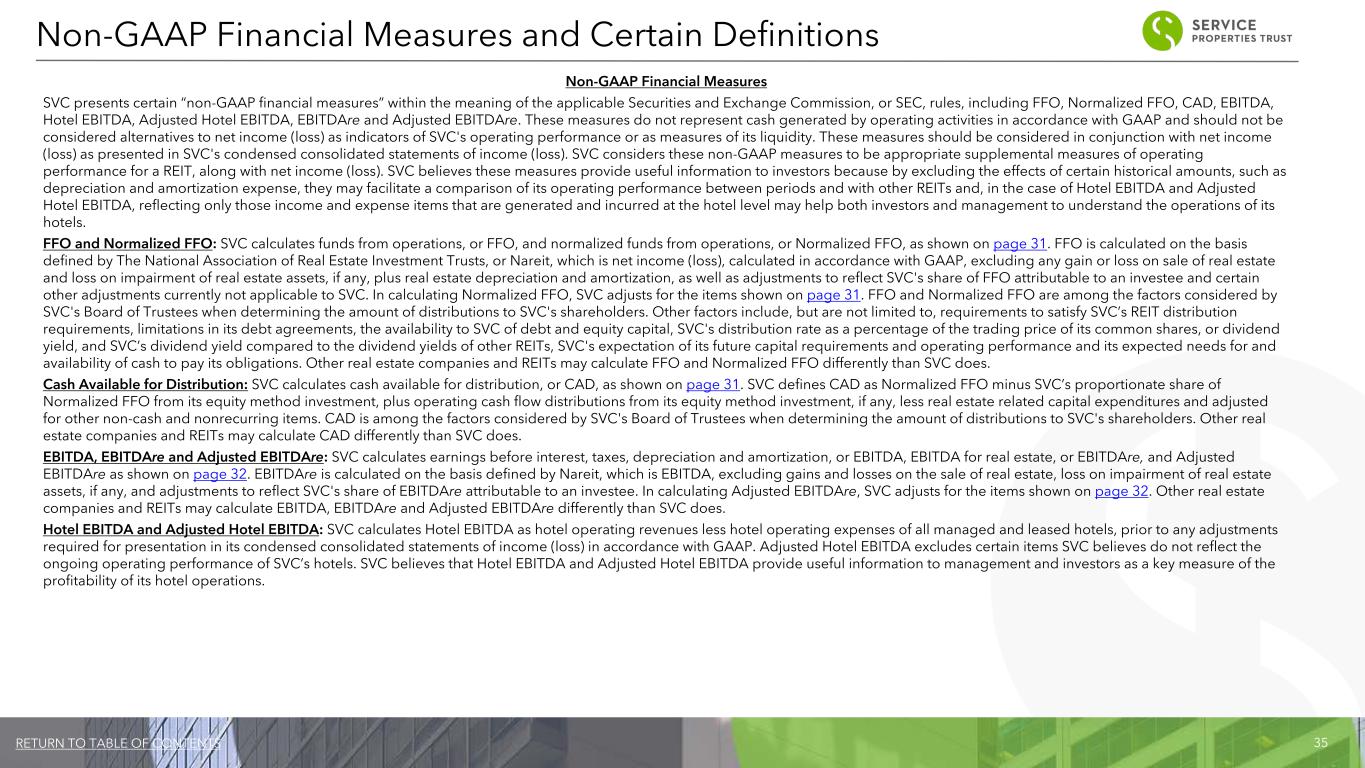
Good morning. Thank you for joining us today. With me on the call are Chris Bilotto, President and Chief Executive Officer; Jesse Abair, Vice President; and Brian Donley, Treasurer and Chief Financial Officer. In just a moment, they will provide details about our business and our performance for the second quarter of 2025, followed by a question-and-answer session with sell-side analysts. I would like to note that the recording and retransmission of today's conference call is prohibited without the prior written consent of the company. Also note that today's conference call contains forward-looking statements within the meaning of the Private Securities Litigation Reform Act of 1995 and other securities laws. These forward-looking statements are based on SVC's beliefs and expectations as of today, August 6, 2025, and actual results may differ materially from those that we project. The company undertakes no obligation to revise or publicly release the results of any revision to the forward-looking statements made in today's conference call. Additional information concerning factors that could cause those differences is contained in our filings with the SEC, which can be accessed from our website at svcreit.com or the SEC's website. Investors are cautioned not to place undue reliance upon any forward-looking statements. In addition, this call may contain non-GAAP financial measures, including normalized funds from operations or normalized FFO and adjusted EBITDAre. A reconciliation of these non-GAAP figures to net income is available in SVC's earnings release presentation that we issued last night, which can be found on our website. Finally, we are providing guidance on this call, including adjusted hotel EBITDA. We are not providing a reconciliation of this non-GAAP measure as part of our guidance because certain information required for such reconciliation is not available without unreasonable efforts or at all. With that, I will turn the call over to Chris.
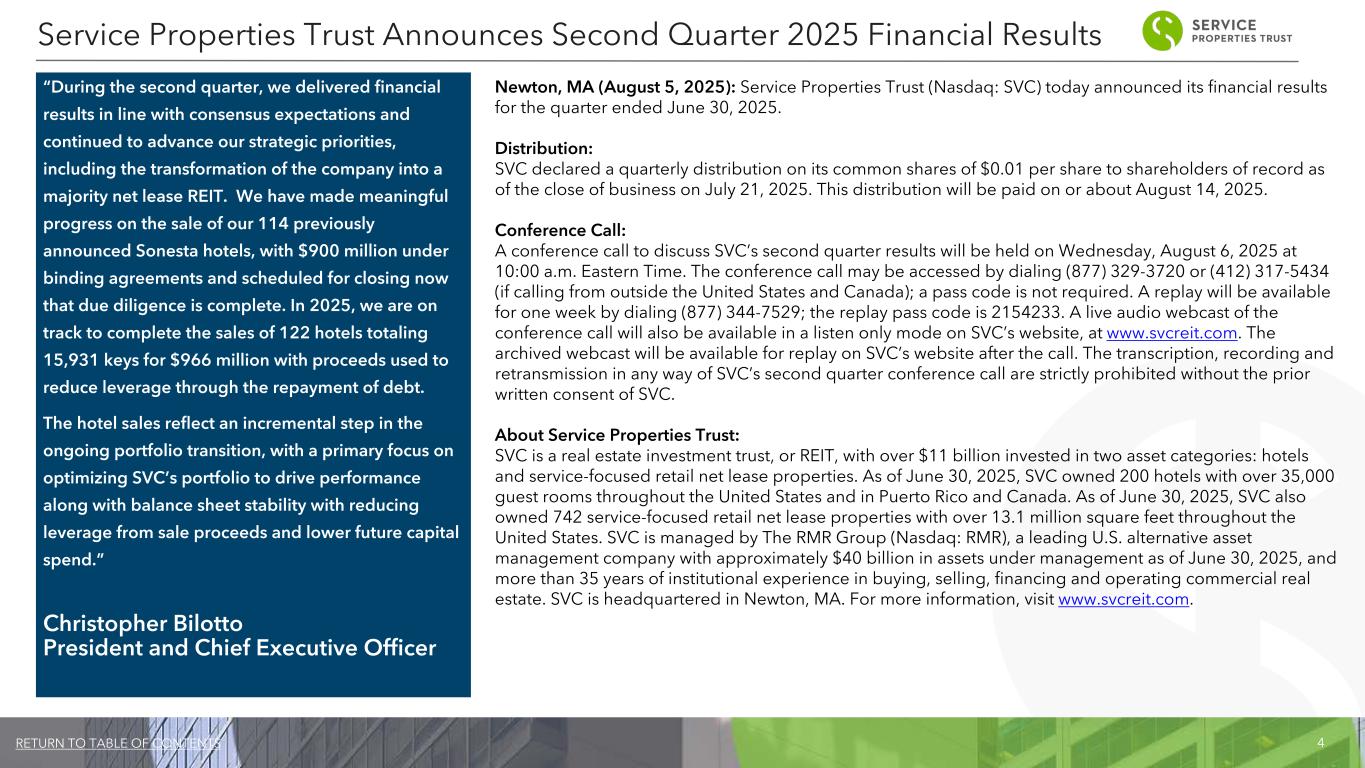
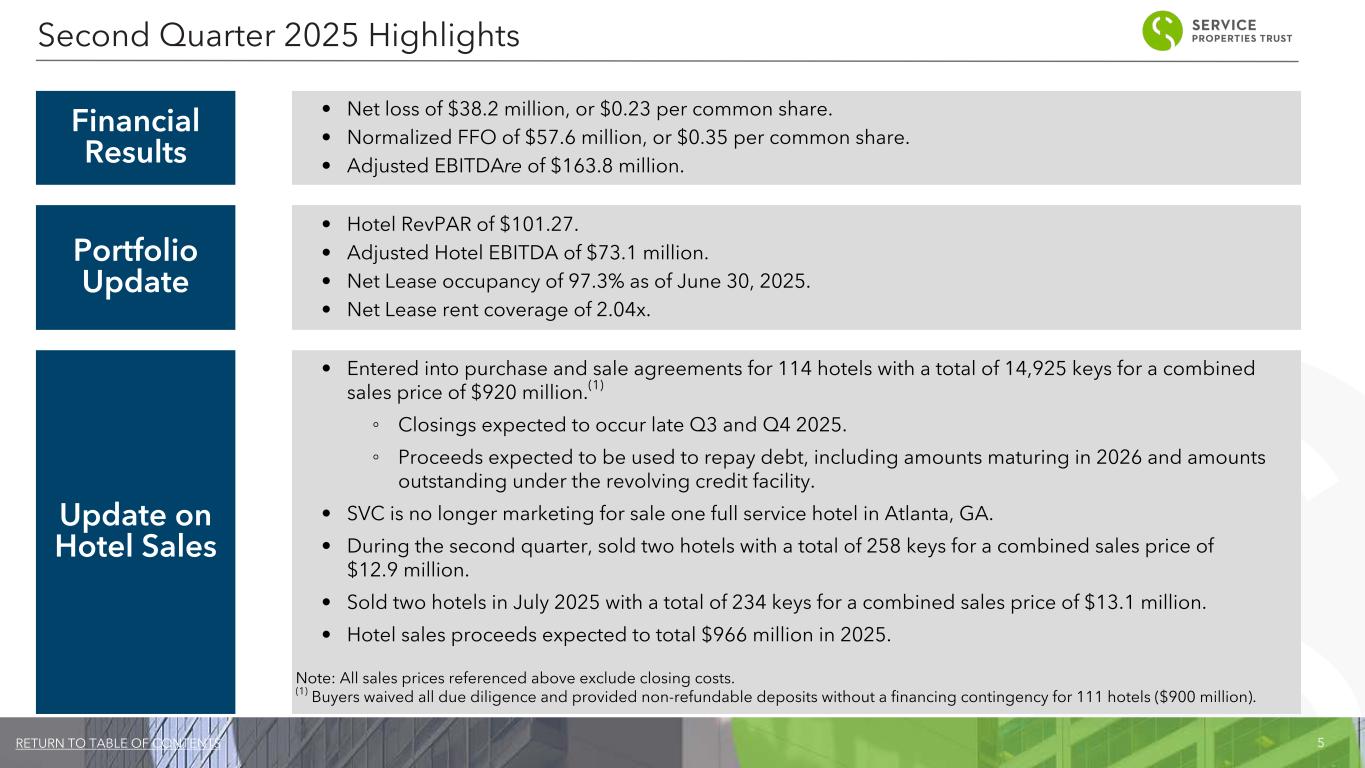
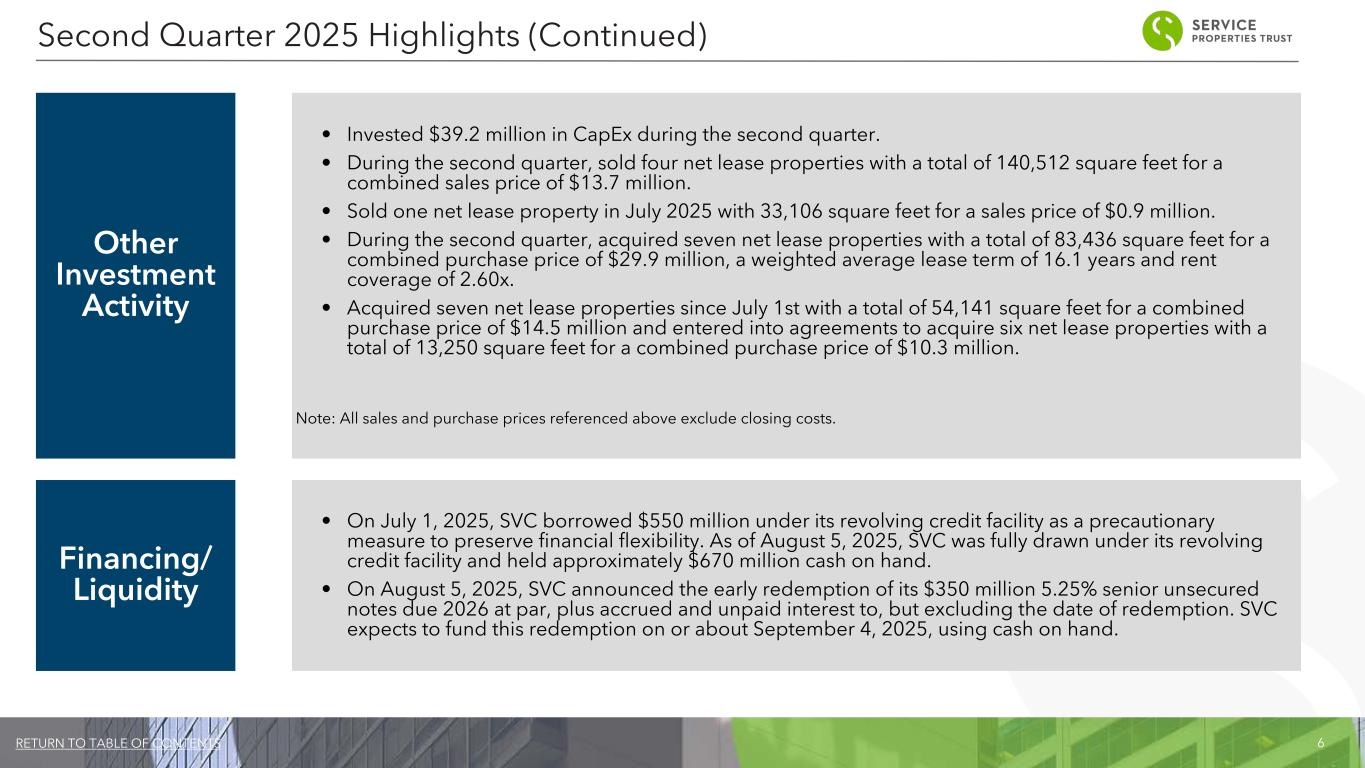
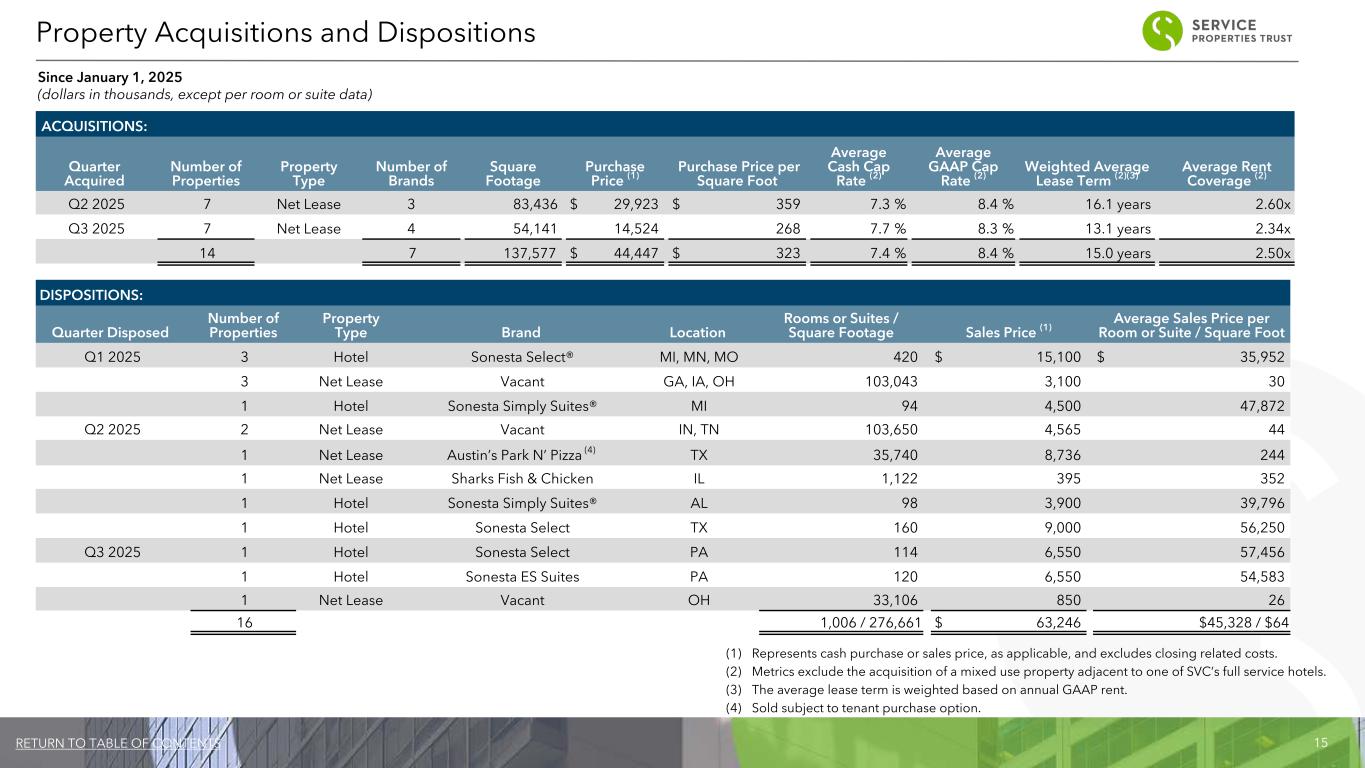
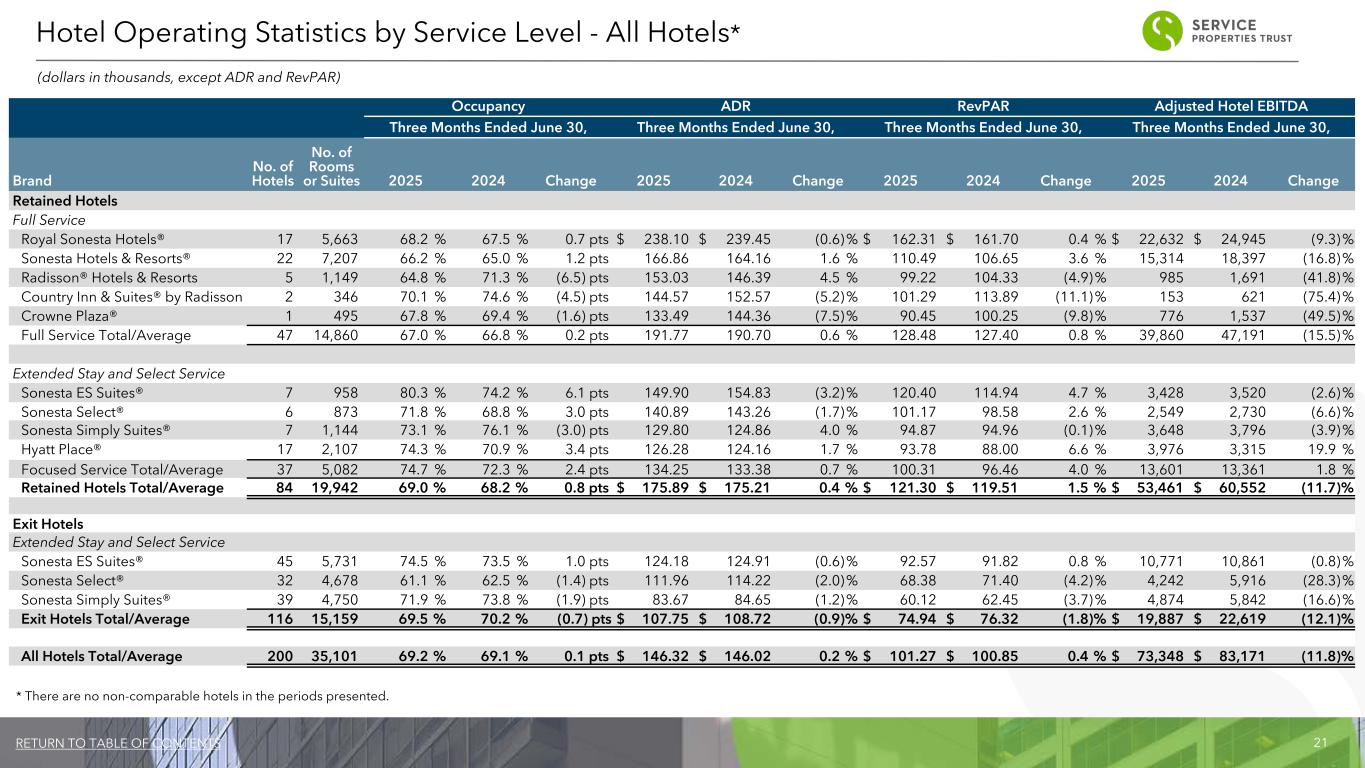
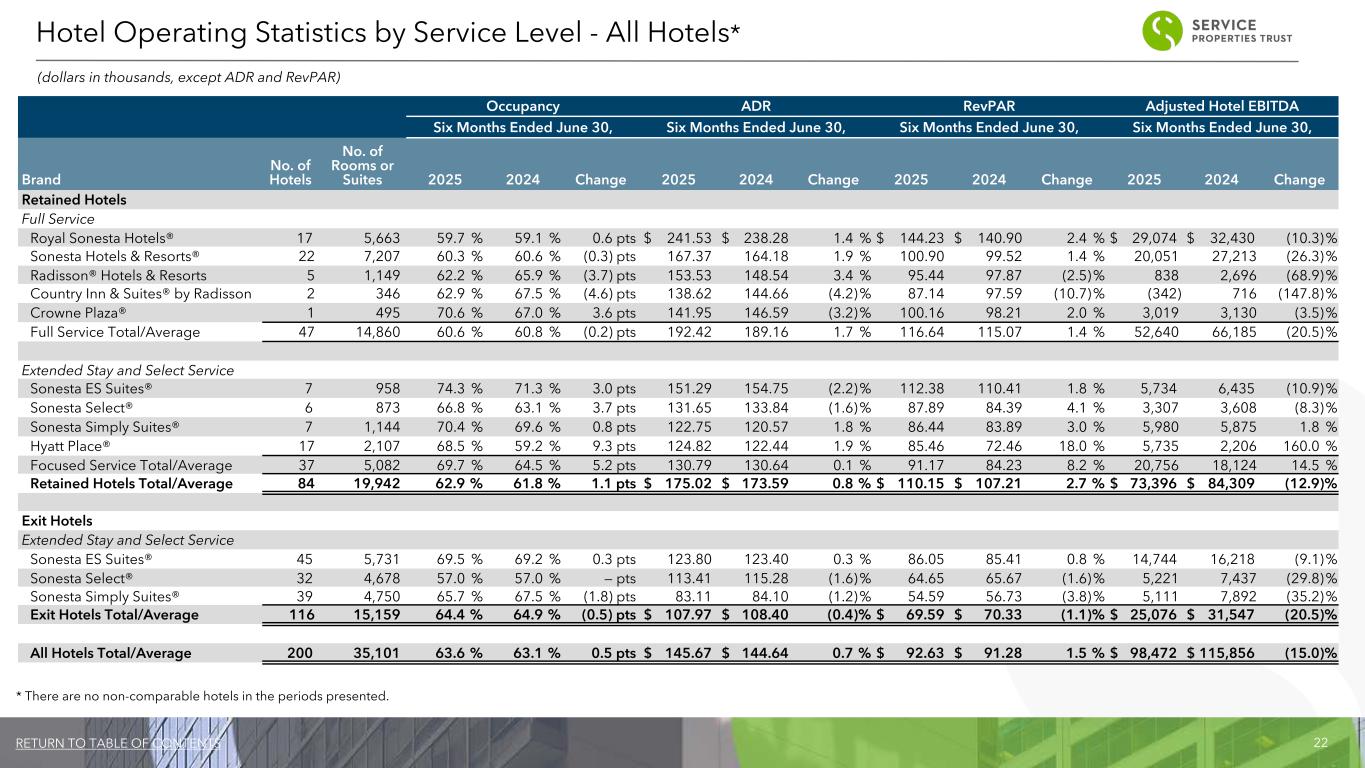
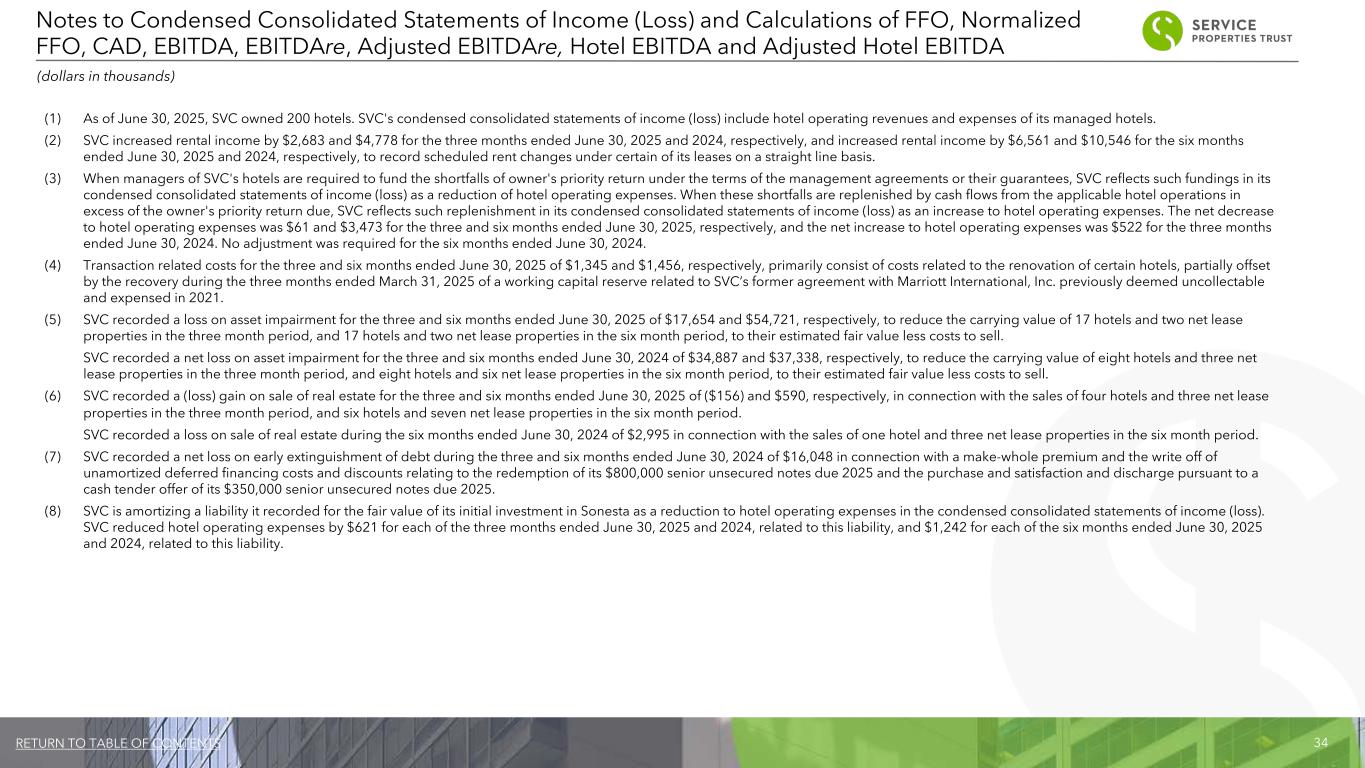
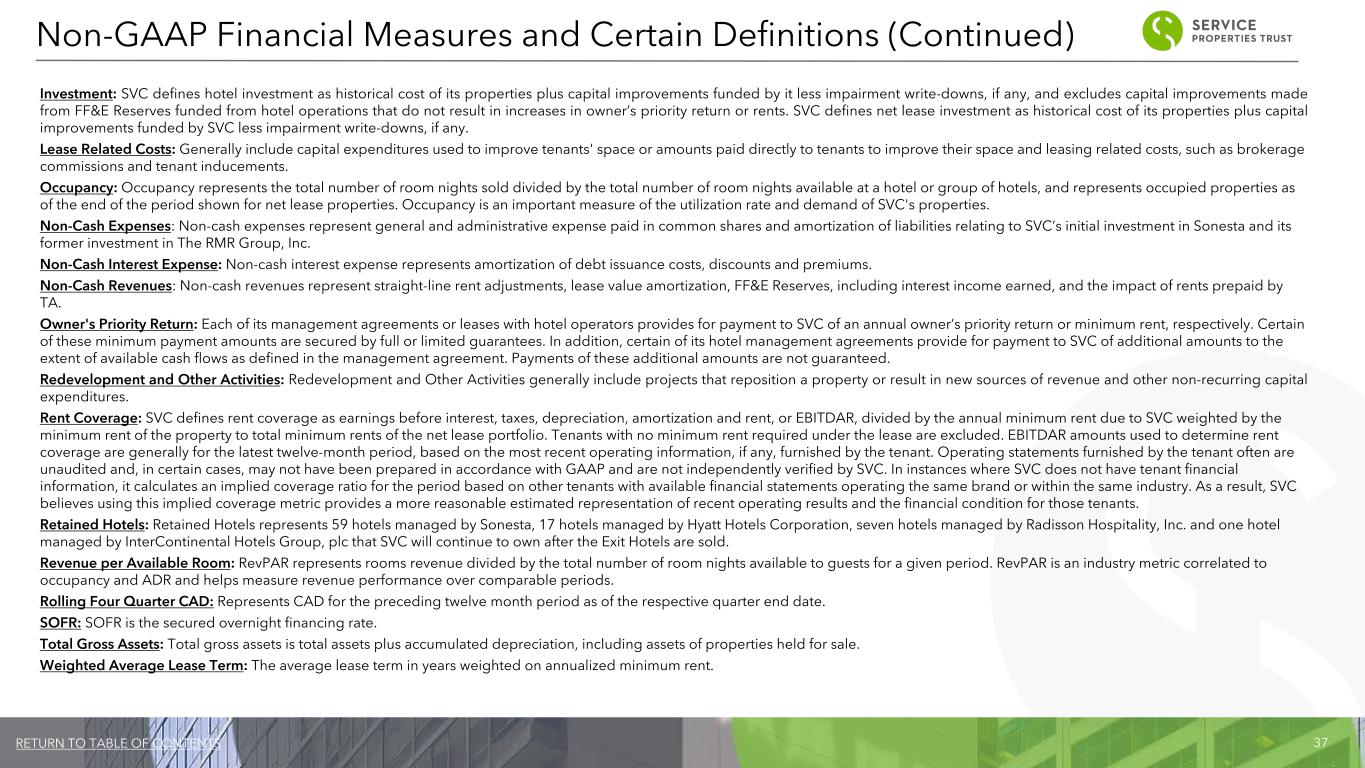
Thank you, Kevin. Good morning, everyone, and thank you for joining the call today. Last night, we reported second quarter financial results that were in line with our expectations and continue to advance on many of our strategic priorities. I will begin today's call with an update on our business plans, including the recent progress of our hotel disposition program and provide further highlights within our hotel and net lease portfolios during the quarter. Then Jesse will discuss in more detail our net lease portfolio and the acquisitions that we have made to build on our existing platform. Finally, Brian will review our financial results and quarterly guidance. Starting with our current business plan. During the past quarter, we have made significant progress on previously announced hotel dispositions, advanced many of our hotel renovations as a catalyst to drive performance and improve the quality of our assets, and pursued selective net lease acquisitions and dispositions. These efforts are part of our ongoing strategic initiative to transform SVC toward becoming a predominantly net lease REIT. Entering into 2025, we have continued to execute on our strategy of divesting select hotels while focusing our retained portfolio on primarily full-service urban and leisure-oriented properties that offer greater potential for EBITDA growth and enhanced overall value. To date, we have sold 8 hotels for proceeds of $46 million and continue to make meaningful progress on the previously communicated 114 Sonesta hotel portfolio. We removed from the marketing process 1 full-service hotel located in Atlanta as we continue to evaluate broader opportunities for the retained hotel portfolio. Regarding the 114 Sonesta hotel sales, due diligence has been completed and nonrefundable deposits have been received for 111 hotels with 4 unique buyers for a sales price of $900 million. Additionally, we have entered into a purchase and sale agreement with diligence underway for the remaining 3 hotels with a sales price of $20 million. Closing on the hotels is expected to commence in Q3 and finish before year-end. Including the 8 hotels we already sold this year, in 2025, we are on track to complete 122 hotel sales totaling nearly 16,000 keys for gross proceeds of $966 million. This pricing implies a valuation of 18.4x hotel EBITDA of $53 million over the trailing 12 months. Turning to hotel performance during the second quarter. RevPAR increased 40 basis points year-over-year, outperforming the broader industry by 90 basis points and marking the third consecutive quarter of relative outperformance. SVC's growth was driven by gains in both occupancy and ADR with group and contract segments outpacing transient business. Top-performing properties during the quarter are within our retained hotel portfolio and include our Royal Sonestas in Hawaii and San Juan, which benefited from strong leisure demand through OTA and wholesale channels. We also saw solid performance at our 3 downtown Chicago hotels and the Clift Royal Sonesta in San Francisco, supported by a rebound in citywide group business. Additionally, recently renovated hotels are consistently delivering double-digit revenue growth with notable strength across our Hyatt portfolio, Sonesta White Plains, and Sonesta LAX. Hotel-level EBITDA declined during the quarter, primarily due to elevated labor costs and broader inflationary pressures. Additionally, displacement in hotels with active renovations contributed to $2.4 million of year-over-year negative EBITDA. However, we expect this to moderate in Q3 and fluctuate modestly thereafter as renovations advance. The 84 hotels we currently plan to retain delivered relatively solid performance with RevPAR increasing 150 basis points year-over-year, driven by gains in both occupancy and ADR. Over the past several years, we have made substantial capital investments across our retained portfolio, enhancing many of our flagship properties and premier destinations such as Hilton Head, Hawaii, and San Juan. These capital enhancements are expected to drive ongoing EBITDA growth. Given our prior investments in the portfolio, coupled with the completion of our remaining hotel dispositions, this positions us to meaningfully lower capital spend with 2026 guidance now set at $150 million. Within our triple net lease segment, we are making steady progress with our capital recycling program and prioritizing accretive opportunities within our pipeline. Since the beginning of the quarter, we have completed the sale of 5 net lease properties for a total of $15 million, and we are in the early stages of marketing 6 additional properties, which are expected to generate between $2.5 million and $3.5 million in total proceeds. Concurrently, we have acquired or entered into agreements to acquire 20 net lease retail properties for $55 million. As Jesse will discuss further, our net lease portfolio continues to provide stable and predictable cash flows with minimum capital requirements, and we view net lease real estate as a naturally defensive and less volatile asset class. In conclusion, the second quarter marked meaningful progress in SVC's ongoing strategic transformation. Pro forma for our expected hotel sales, net lease assets are projected to account for over 70% of SVC's pro forma Q2 adjusted EBITDAre, representing a meaningful shift in our asset composition and positioning SVC shares for a potential re-rating at more attractive net lease multiples. Looking ahead, we intend to maintain our capital recycling and deleveraging strategy into 2026, pursuing further hotel dispositions as property performance and overall market conditions continue to improve. I will now turn it over to Jesse to discuss the net lease portfolio.
Speaker 3
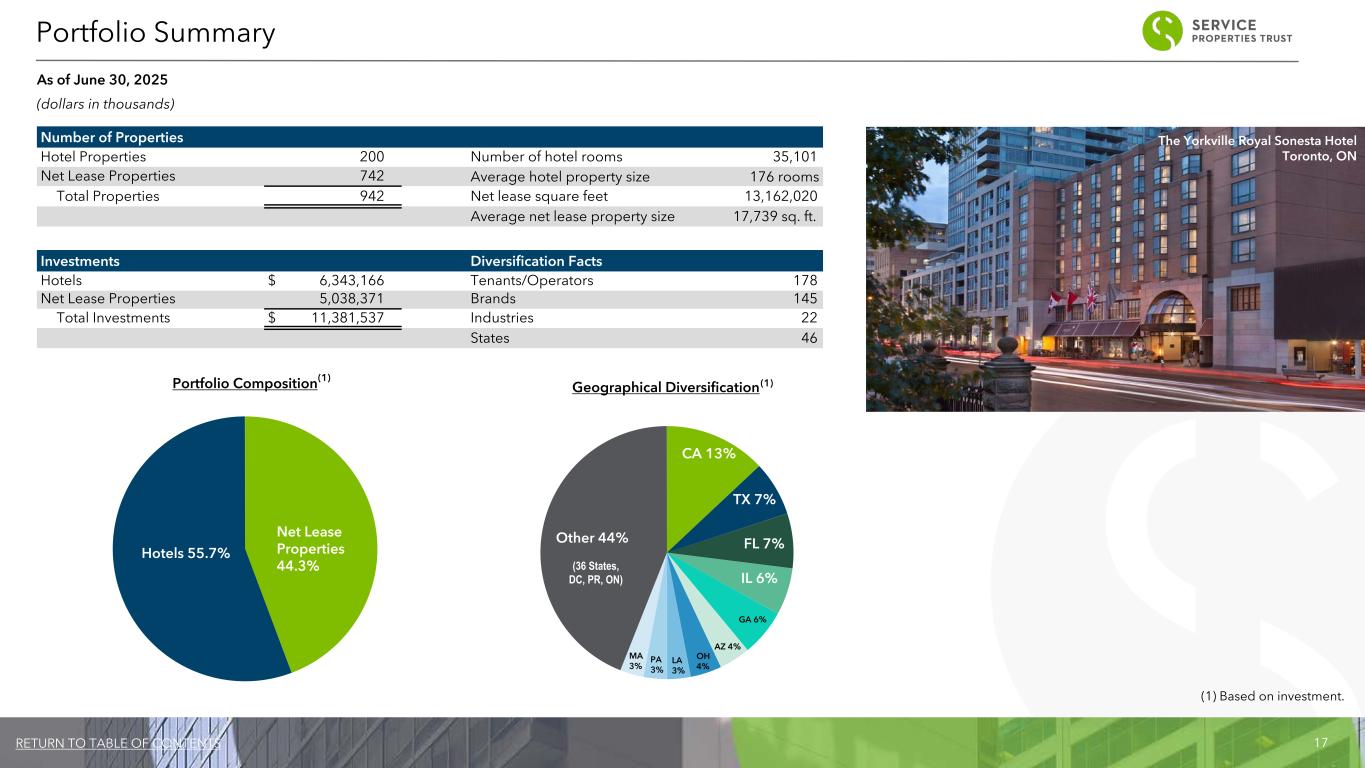
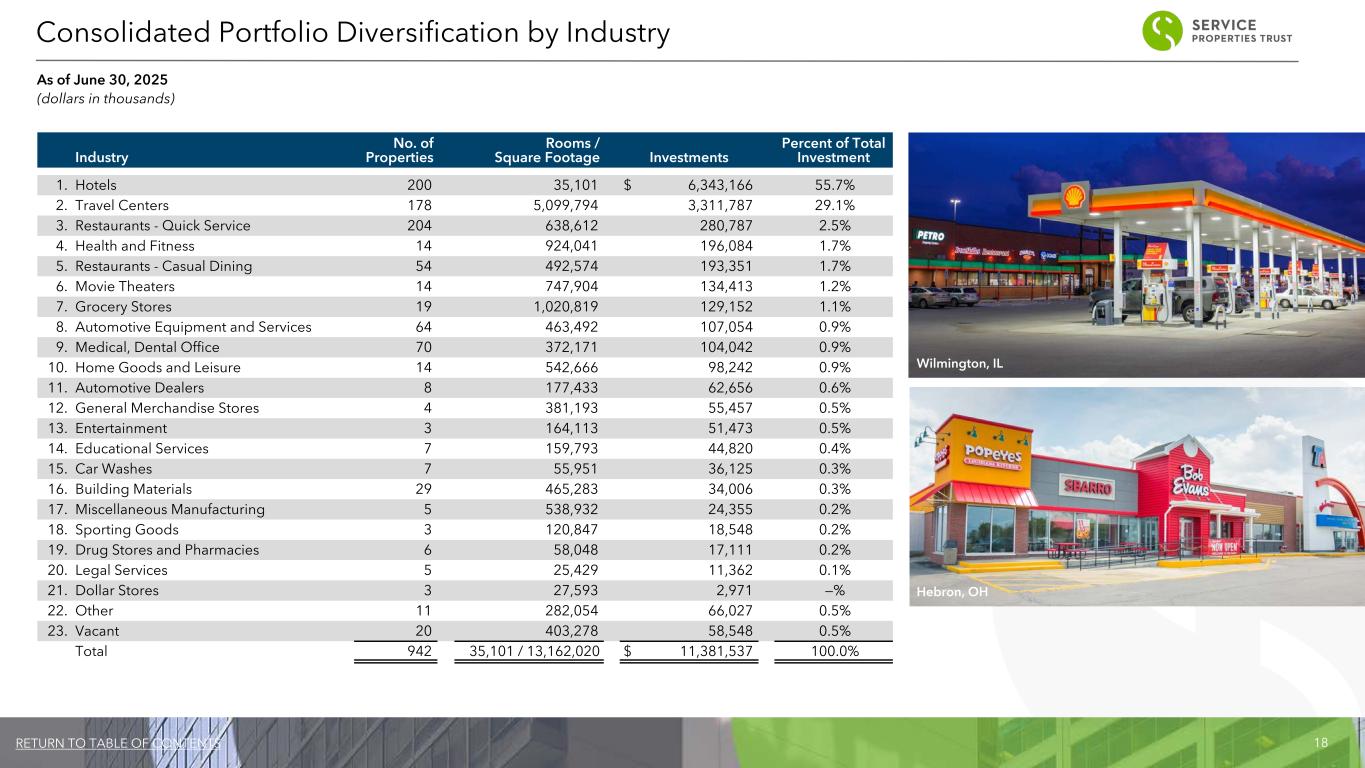
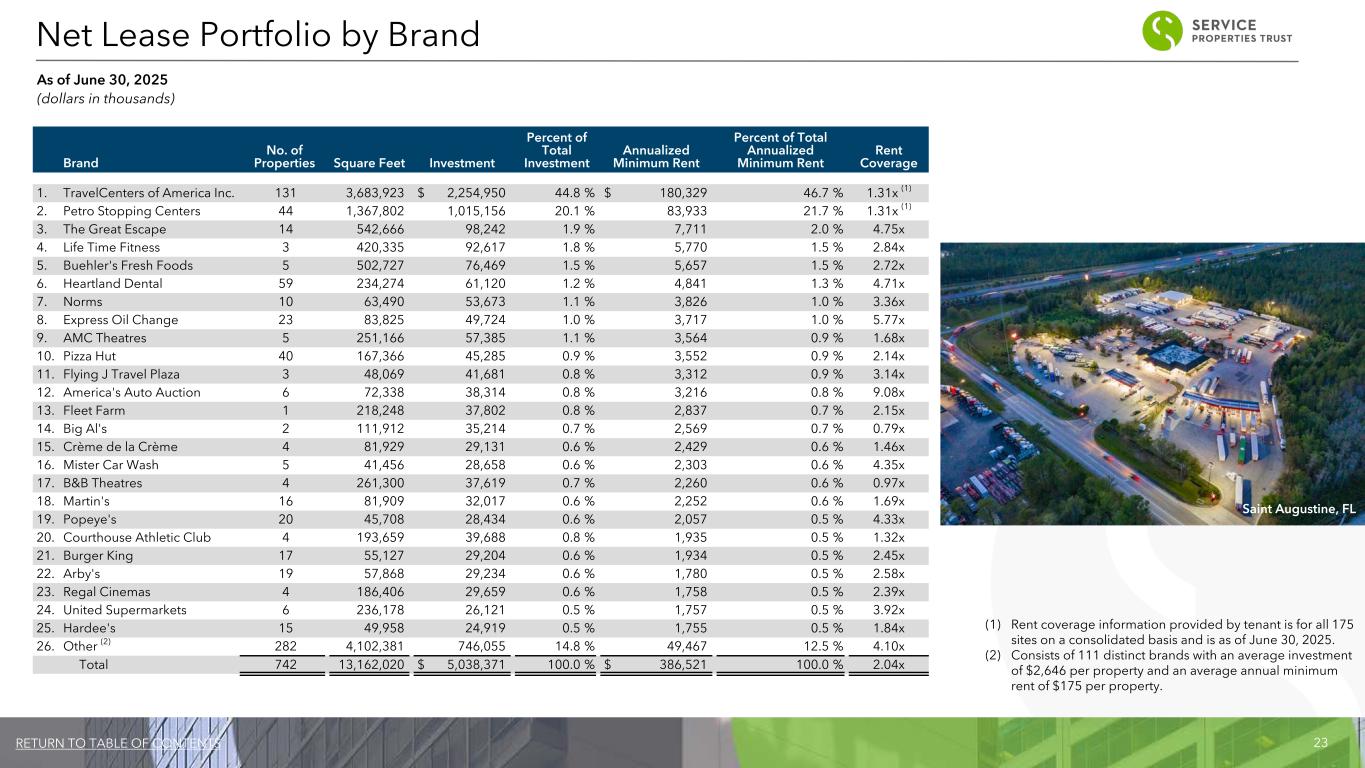
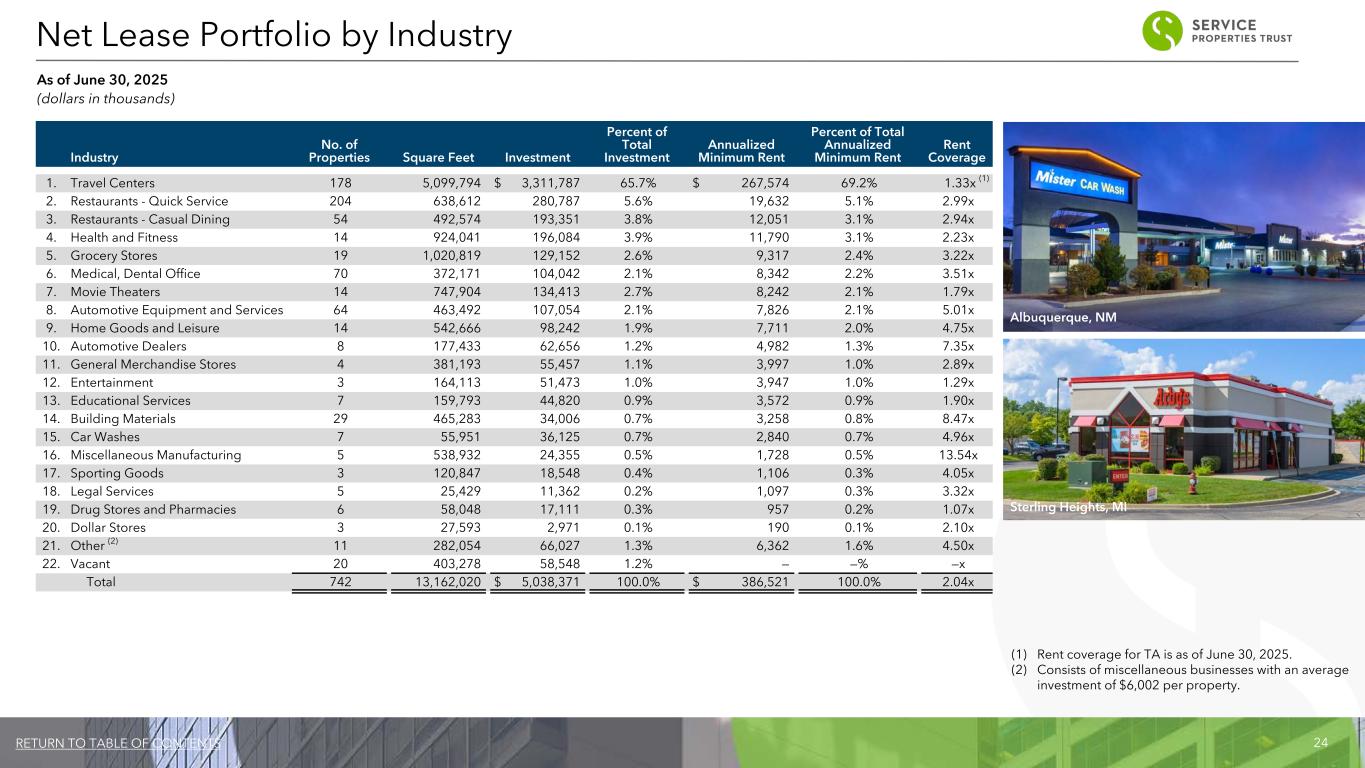
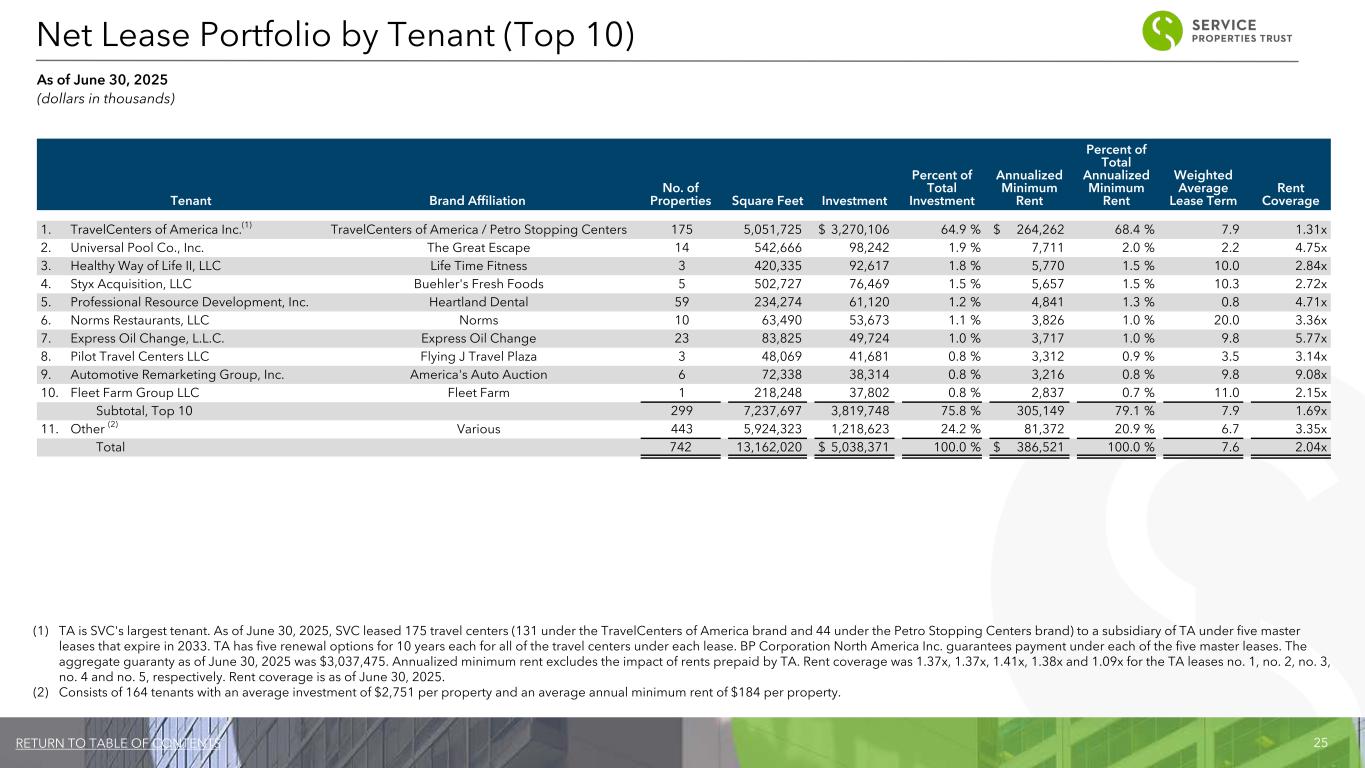
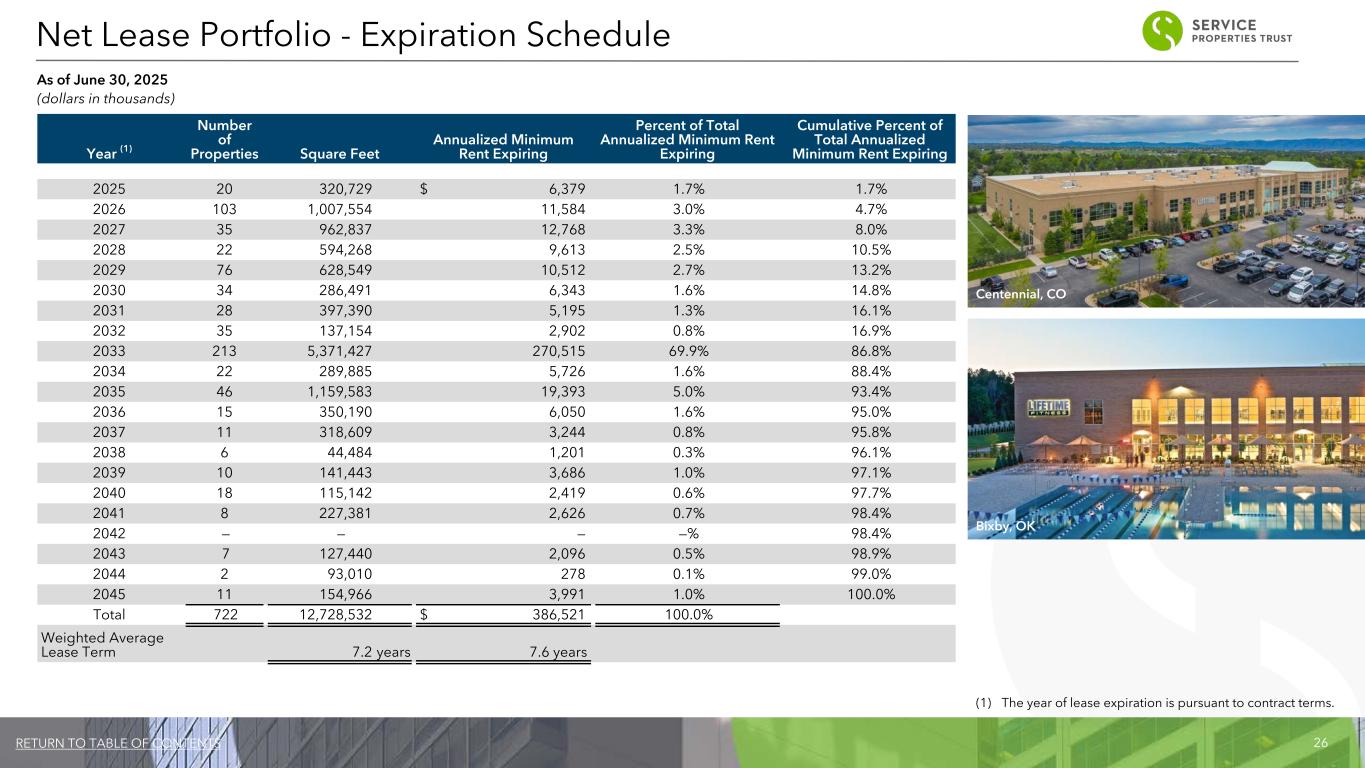
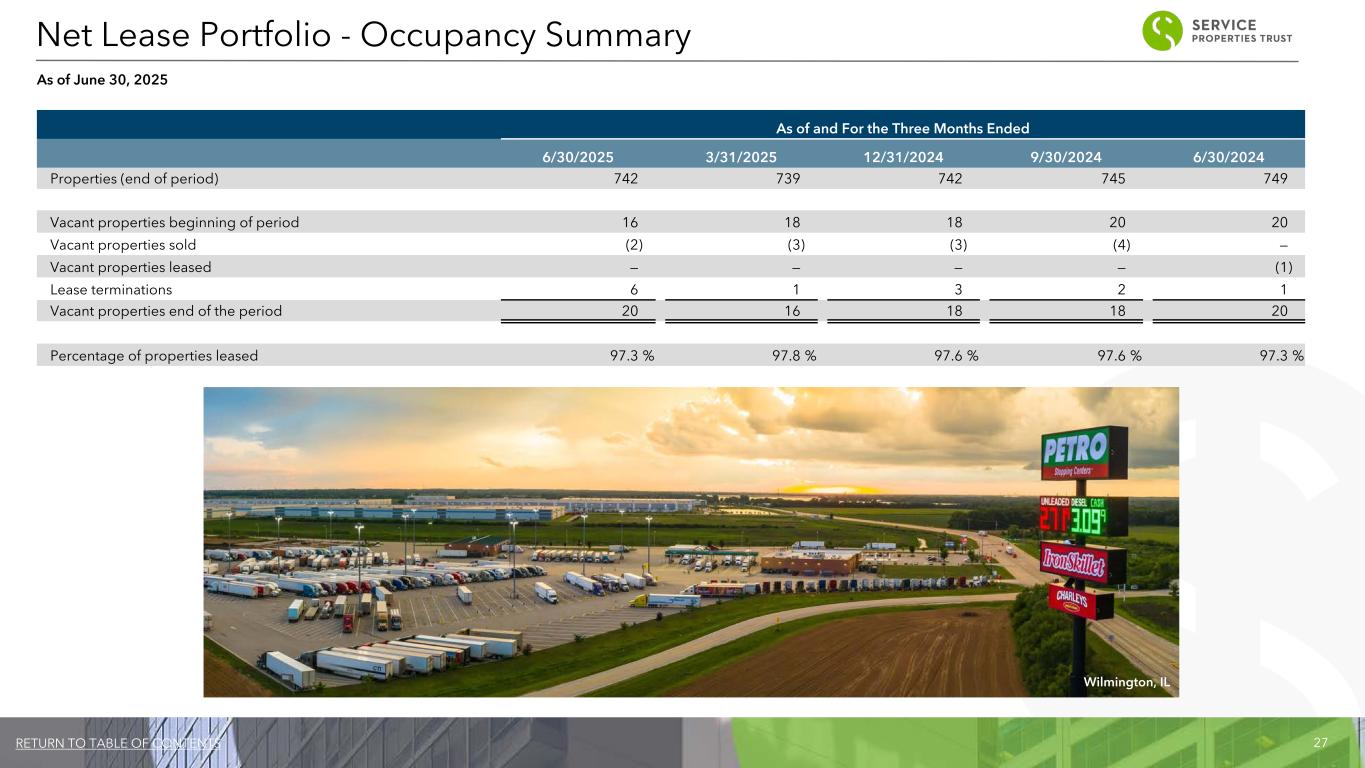
Thank you, Chris. The strategic shift underway at SVC will ultimately result in a portfolio that benefits from minimal CapEx needs, long-term leases with annual escalators that provide a bond-like risk-return profile, and cash flows that can be relied upon even in uncertain economic environments. The net lease market is deep, liquid and highly fragmented, creating conditions that are conducive to scalable expansion if and when we choose to do so. Additionally, as we have demonstrated with mortgage financing, SVC's net lease assets provide access to attractively priced financing options to support our growth. That growth will build up the existing backbone of net lease retail properties that we already own. Our portfolio is anchored by 175 TA travel centers backed by BP's investment-grade credit. As a reminder, SVC's current leases with TA have 8 years of remaining term and include 50 years of extension options. While the rent coverage for the TA assets has experienced degradation over the past few quarters, this decline has begun to level off as freight demand normalizes coming off its COVID-era peak. Moreover, we are seeing investments in real estate from BP in the form of EV charging stations and other initiatives that are intended to drive revenue from non-fuel offerings at these locations. The overall net lease portfolio consists of 742 service-oriented retail net lease properties with annual minimum rents of $387 million. These assets were more than 97% leased with a weighted average lease term of 7.6 years. We have 174 tenants operating under 136 brands, spanning 21 distinct industries. The diversity and breadth of the portfolio provide opportunity for organic growth as we continue to source modest transactions with both new and existing operators. Our lease expiration schedule remains well-laddered with 1.7% of our minimum rents scheduled to expire through the remainder of 2025 and 3% expiring in 2026. Our asset management platform has been actively engaged with our existing tenants as well as potential new tenants, resulting in over 350,000 square feet of leasing during the second quarter that averaged 12 years of term and a 5.7% roll-up in cash rents. As of quarter end, the aggregate coverage of our net lease portfolio's minimum rents was 2.04x on a trailing 12-month basis, remaining essentially unchanged from the prior quarter. Excluding the BP-backed TA leases, rent coverage remained strong at 3.7x. With respect to investments, we remain committed to growing and optimizing the portfolio in a manner that enhances tenant and geographic diversity, increases weighted average lease term, and expands annual minimum rents. Our investment thesis focuses on properties in e-commerce-resistant necessity-based sectors that have proven resilient across cycles. This includes quick service and casual dining restaurants, grocery stores, auto services, and other daily needs providers. Since ramping up our acquisitions platform in the second half of 2024, we have developed a robust pipeline, resulting in the acquisition of 14 net lease properties year-to-date for a total of $44 million. These transactions have a weighted average lease term of 15 years, average rent coverage of 2.5x and an average cap rate of 7.4%. We are also under agreement to acquire 6 additional properties in Q3 for a total of $10.3 million with similar economic terms as the closed transactions. As SVC migrates to a predominantly net lease REIT, our asset management and acquisition teams are actively curating the net lease portfolio and fostering new relationships with retail operators. These efforts, coupled with the strong foundation we have already established in this space, will put us in a position to efficiently grow this side of the business going forward. I'll now turn the call over to Brian to discuss our financial results.
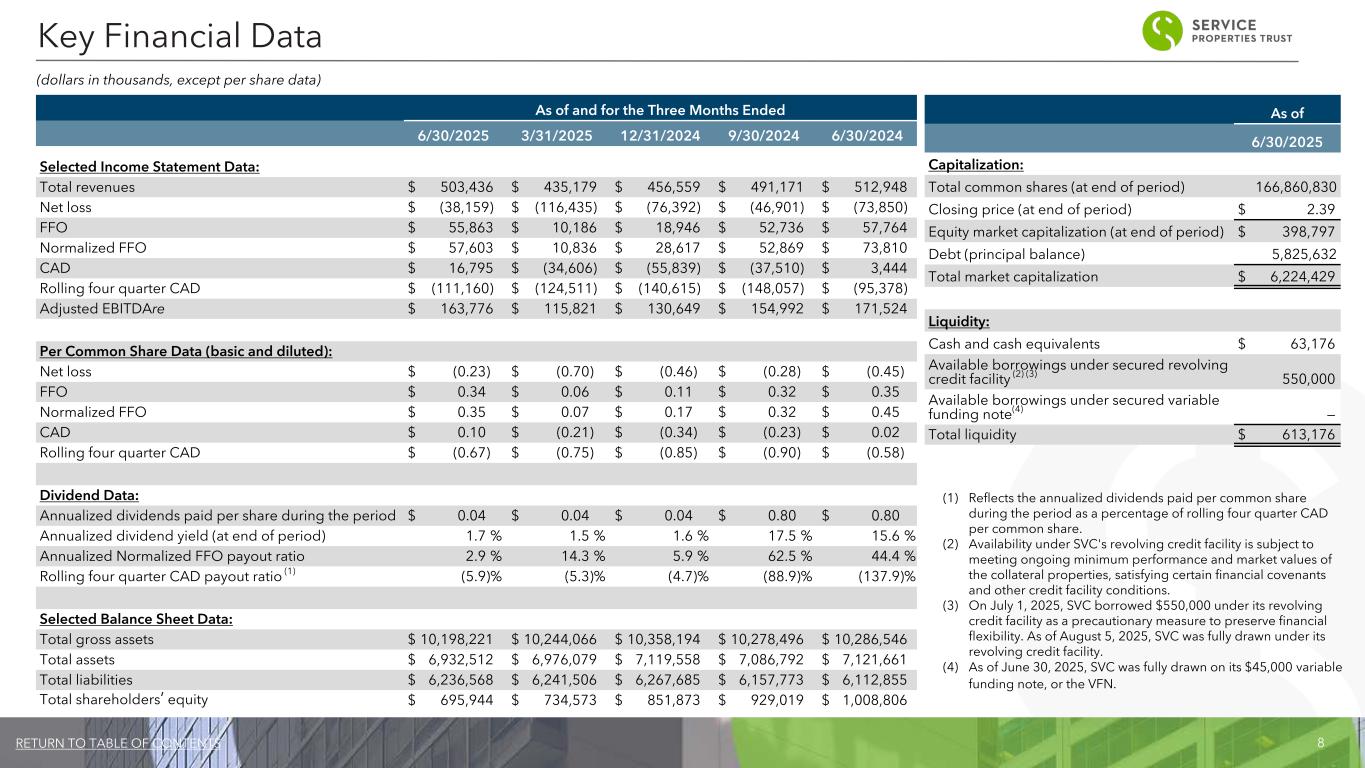
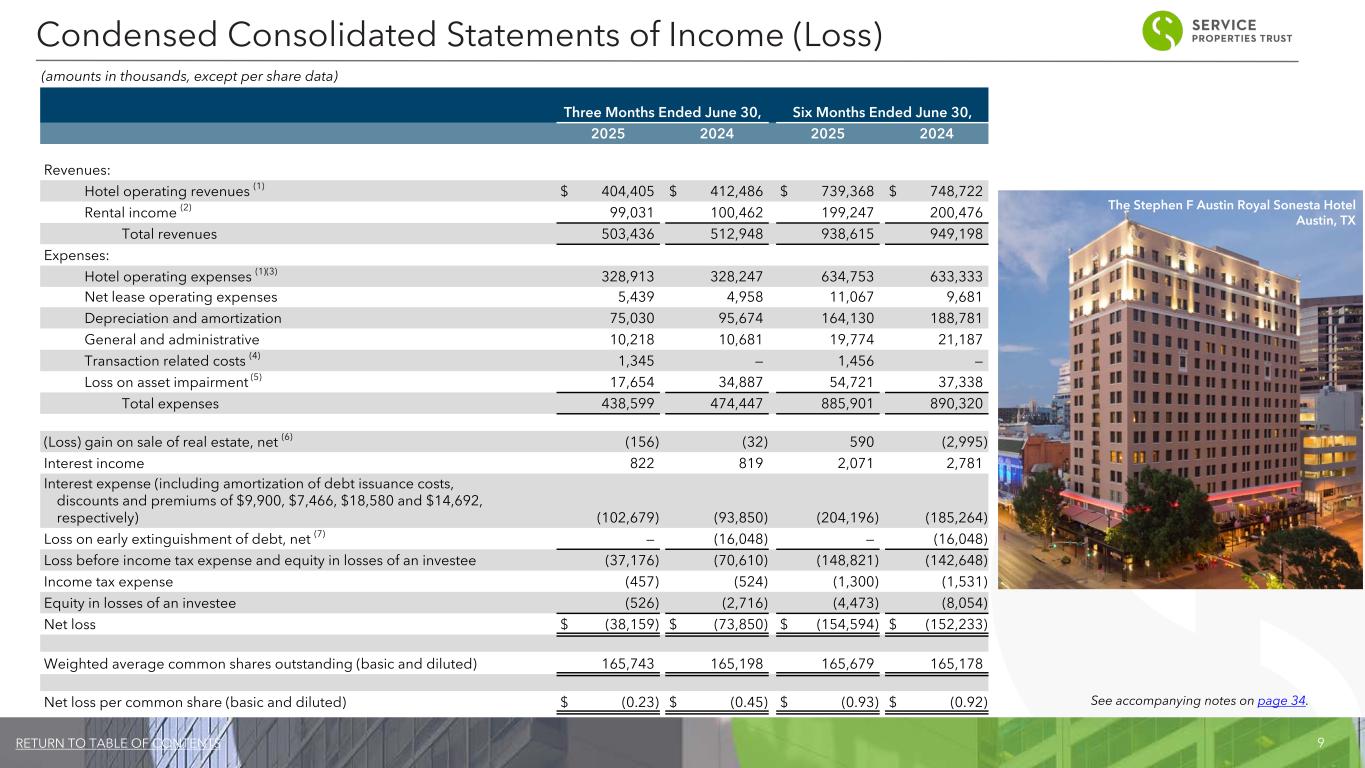
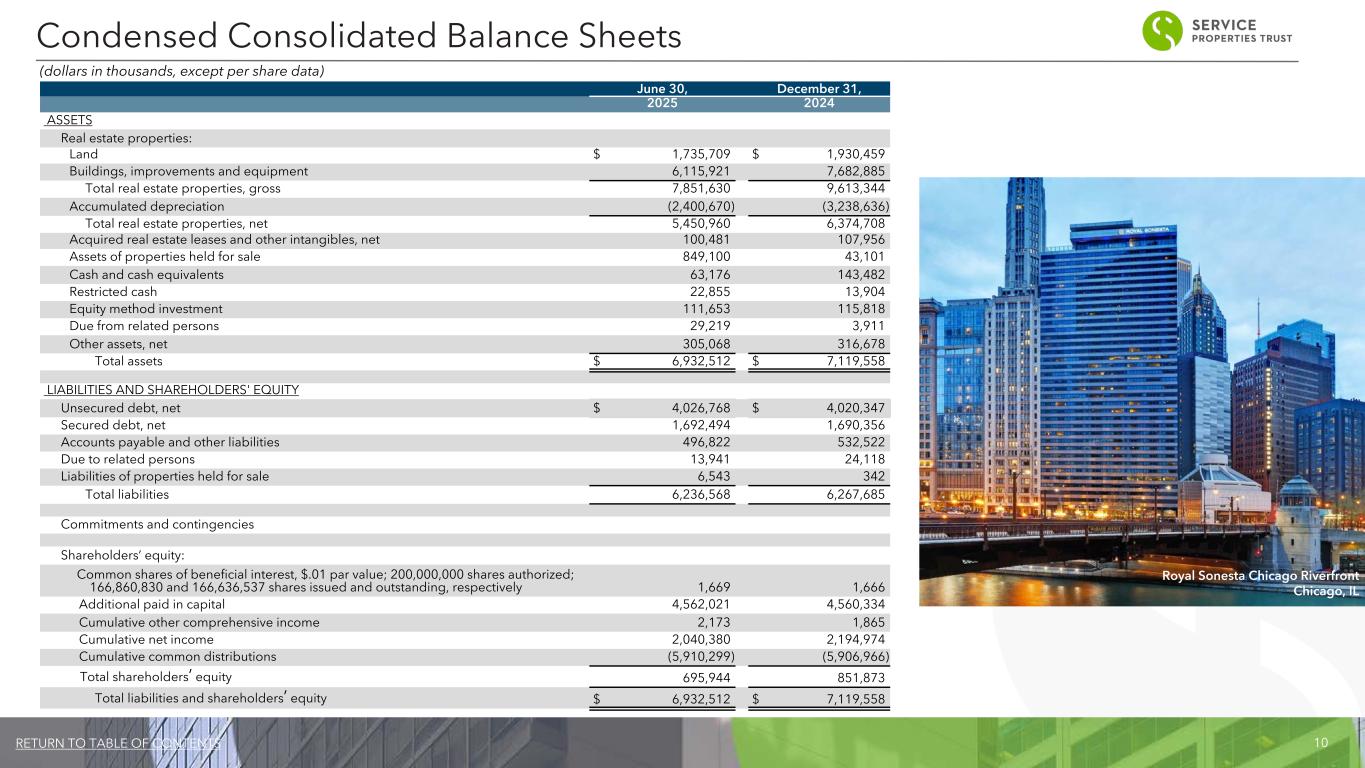
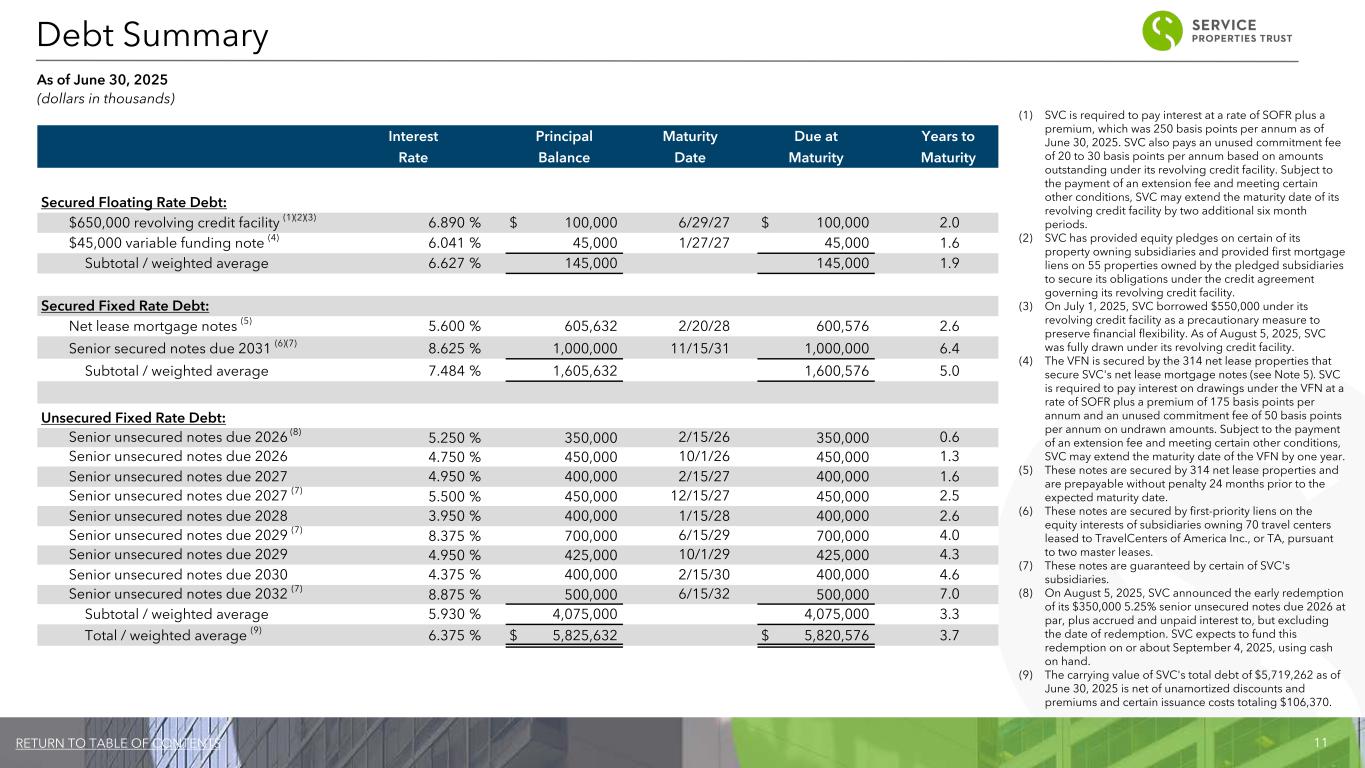
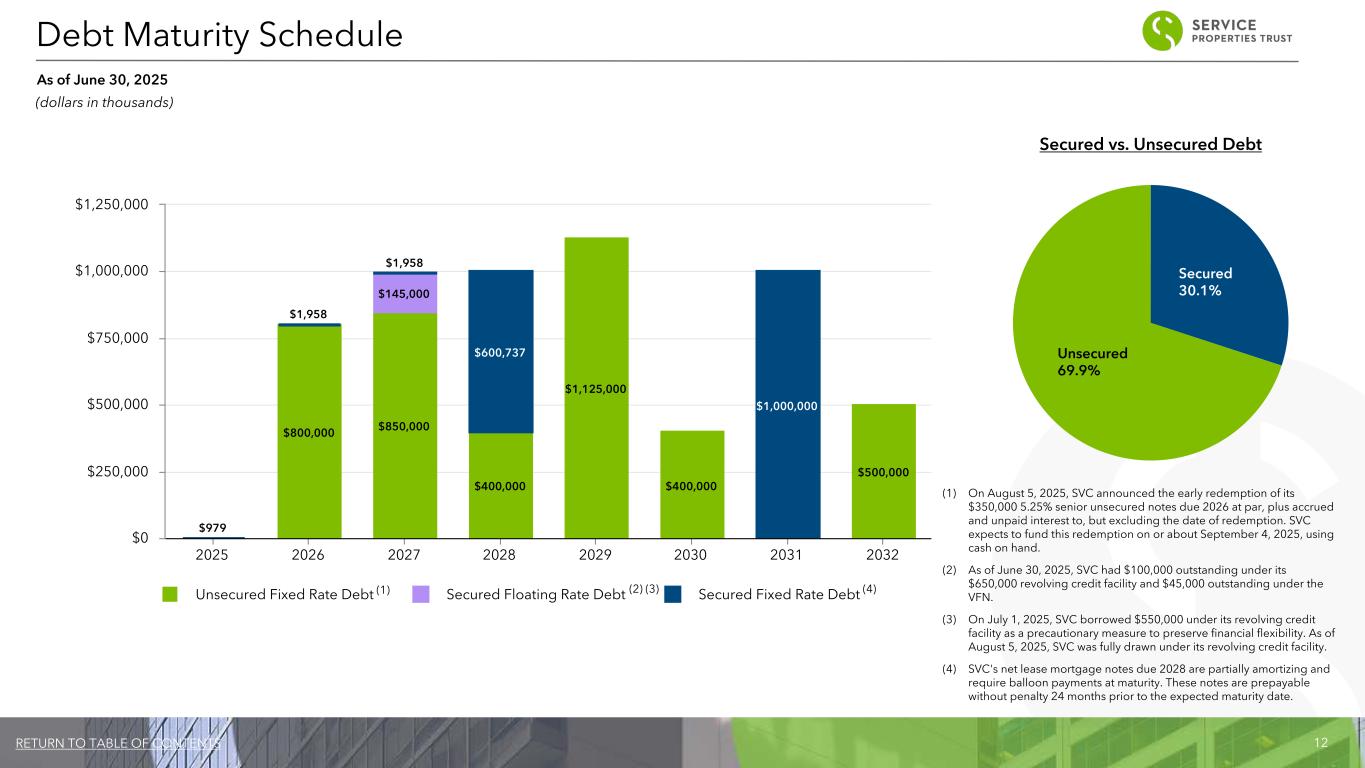
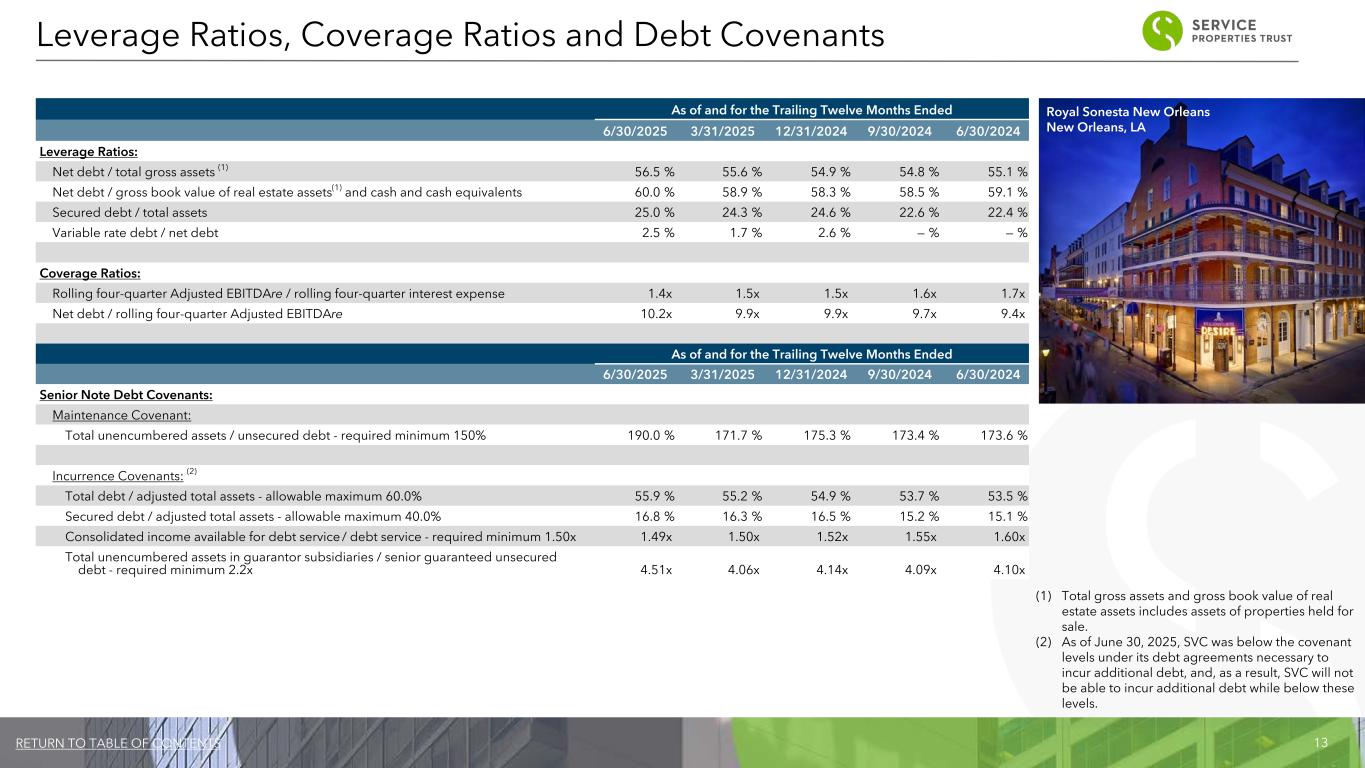
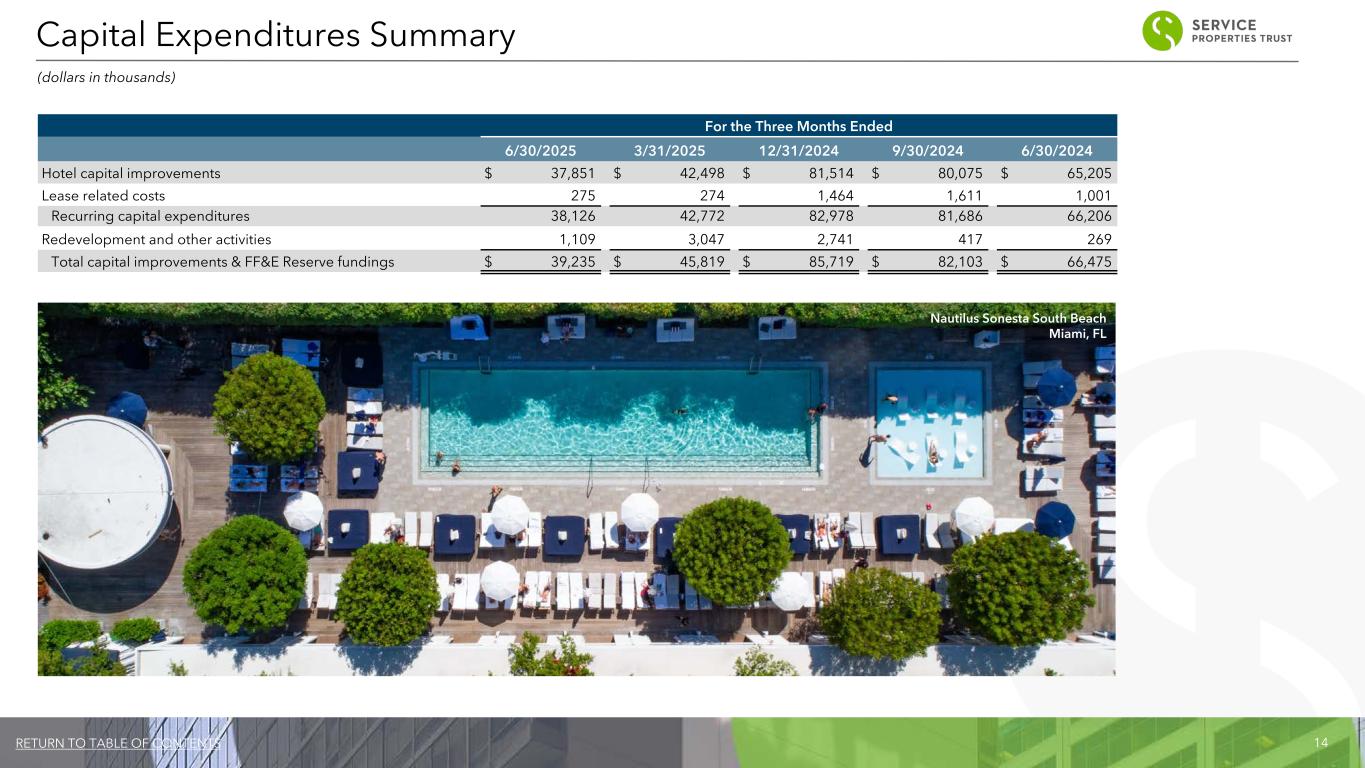
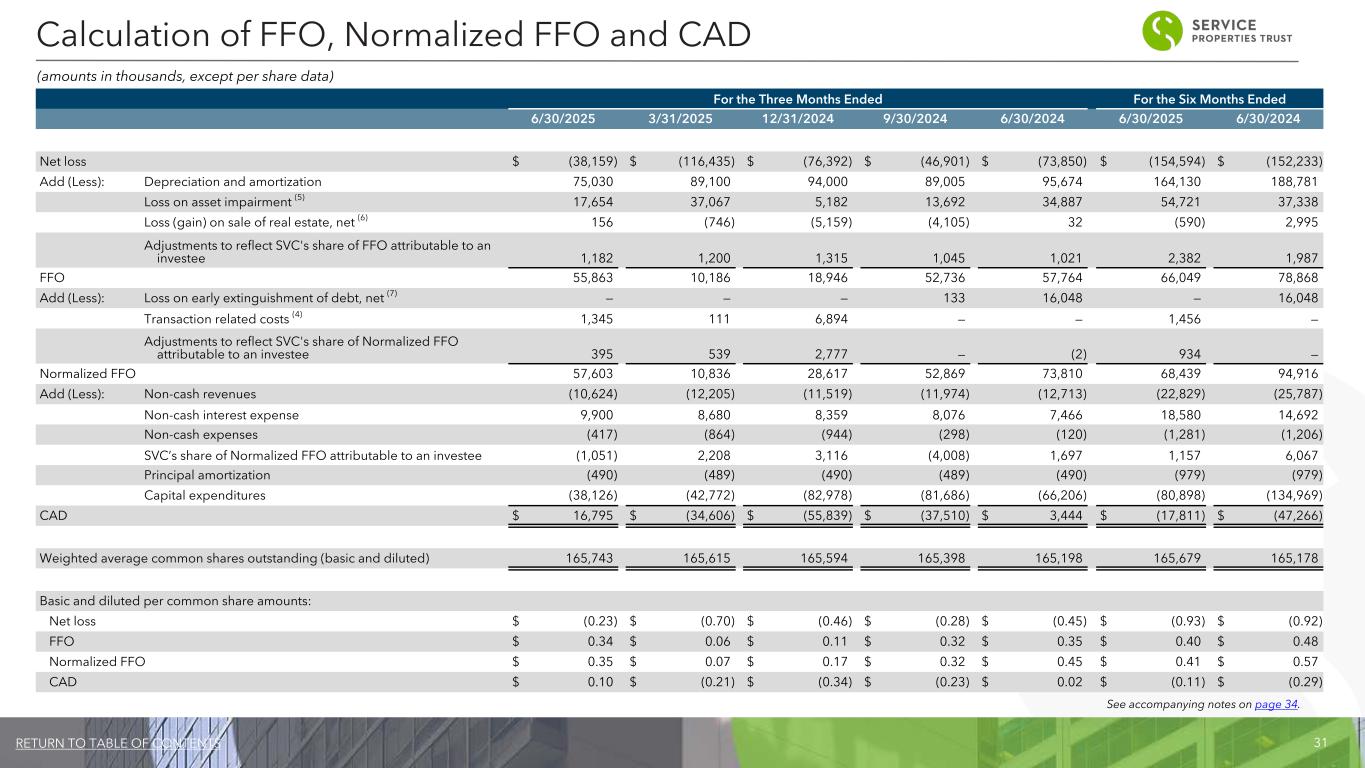
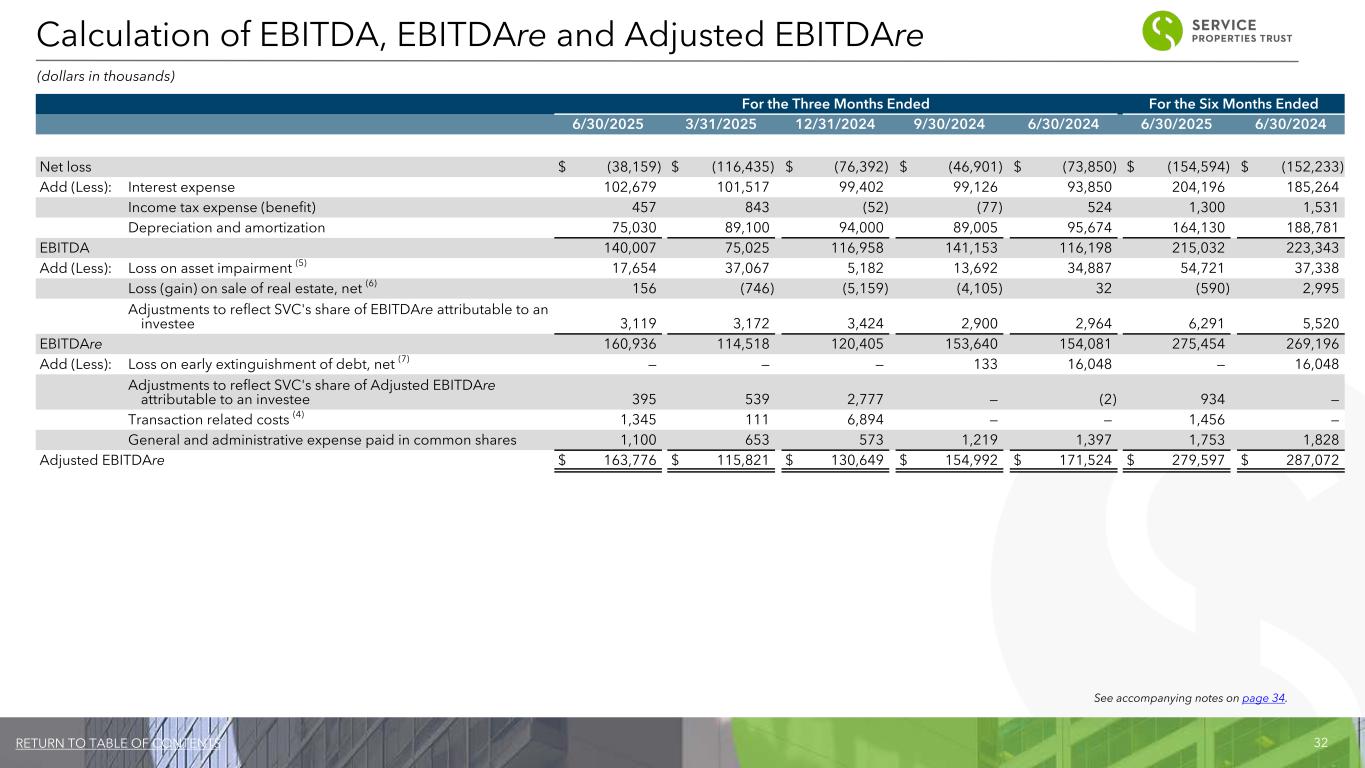
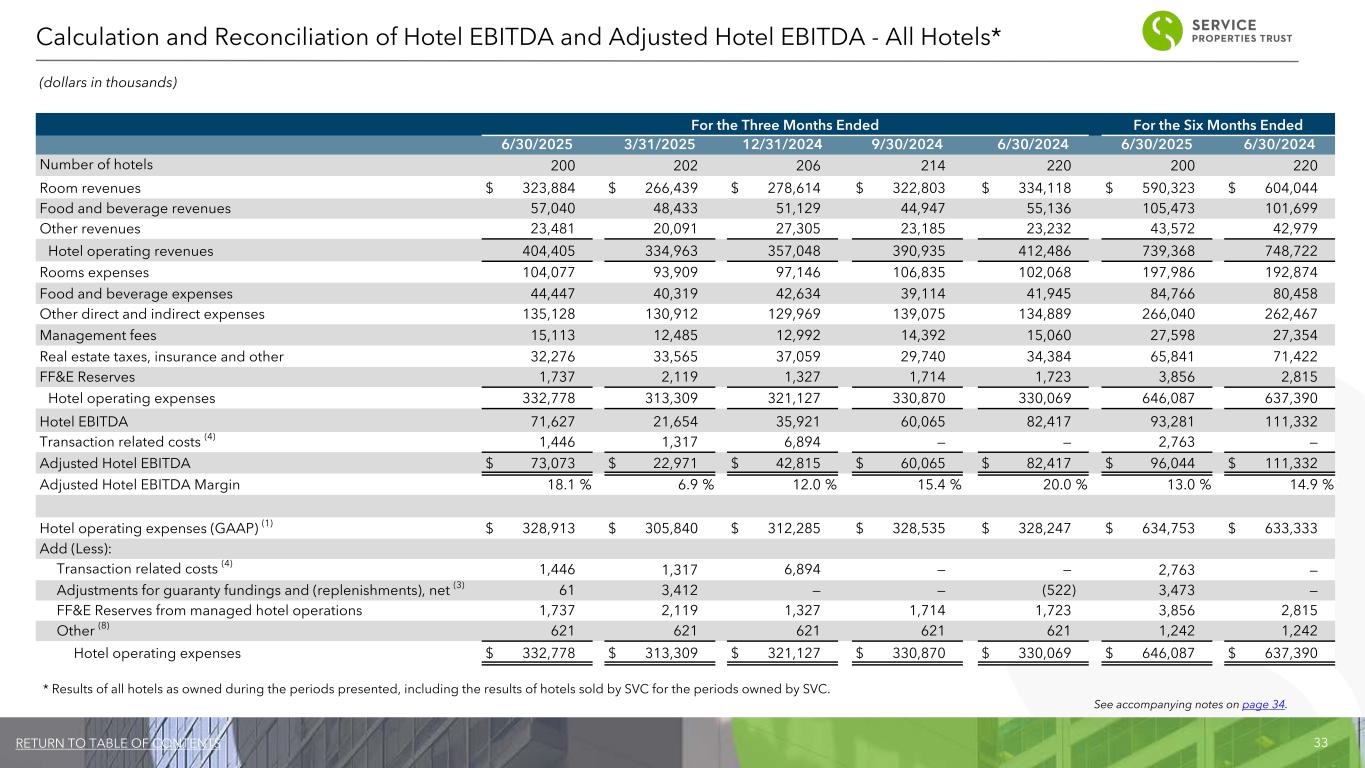
Thanks, Jesse. Good morning. Starting with our consolidated financial results for the second quarter of 2025, normalized FFO was $57.6 million or $0.35 per share versus $0.45 per share in the prior year quarter. Adjusted EBITDAre decreased $7.7 million year-over-year to $163.8 million. Overall financial results this quarter as compared to the prior year quarter were primarily impacted by an $8.8 million increase in interest expense and lower hotel returns. For our 200 comparable hotels this quarter, RevPAR increased by 40 basis points and gross operating profit margin percentage declined by 300 basis points to 30.2%. Below the line, costs at our comparable hotels decreased less than 1% from the prior year, driven by lower property insurance premiums. Our hotel portfolio generated adjusted hotel EBITDA of $73 million, a decline of 11.3% from the prior year but towards the high end of our guidance range. The 4 hotels that were under renovation during the quarter represented $2.4 million or 24% of the decline in adjusted hotel EBITDA year-over-year. The 116 Sonesta exit hotels, including 2 that sold in July, generated RevPAR of $75, a decline of 1.8% and adjusted hotel EBITDA of $19.9 million, a decline of 12% year-over-year. The 84 hotels we expect to retain generated RevPAR of $121, an increase of 1.5% year-over-year and adjusted hotel EBITDA of $53.5 million during the quarter, a decrease of $7 million or 11.7% year-over-year. Most of the decline year-over-year in the retained portfolio is related to elevated labor costs, repairs and maintenance expenses, and renovation disruption. Turning to our expectations for Q3. We're currently projecting third quarter RevPAR of $98 to $101 and adjusted hotel EBITDA in the $54 million to $58 million range. This guidance considers a sequential decline due to seasonality in the third quarter as well as recent headwinds in the travel and lodging industries. Guidance does not include the impact of completing any of the 114 Sonesta hotel dispositions expected to close later in Q3 and Q4. Turning to the balance sheet. A key objective for our hotel disposition program is to address our debt maturities and improve our credit metrics. At quarter end, we had $5.8 billion of debt outstanding with a weighted average interest rate of 6.4%. Our next debt maturity is $350 million of senior unsecured notes maturing in February 2026. As of our earnings release, our 1.5x debt service coverage covenant was below the minimum requirement at 1.49x. This prohibits us from incurring additional debt until we are back in compliance on a pro forma basis. In July, we fully drew down our $650 million credit facility as a precautionary measure to preserve our liquidity in anticipation of potentially not meeting the minimum level of debt service coverage. As of today, we have approximately $670 million of cash on hand. Yesterday, we announced the early redemption of the $350 million of 5.25% unsecured senior notes due in February at par plus accrued interest. The redemption will be funded with cash on hand in early September. The $920 million of expected proceeds from the sale of 114 hotels will be used to repay the $450 million of senior unsecured notes maturing in October of '26 and amounts outstanding on our revolving credit facility. We currently expect closing of the asset sales and the repayment of outstanding debt will have a positive impact on our financial covenants. We're also currently evaluating different strategies to improve our credit metrics and our covenant measures, including considering additional asset sales, operational improvements at our hotels, and potential financing opportunities. Turning to our capital expenditure activity. During the second quarter, we invested $39 million in capital improvements at our properties. Notable activity this quarter included projects at the Royal Sonesta Cambridge and the Sonesta Hilton Head Resort. For the full year, we continue to expect capital expenditures to be approximately $250 million, including $120 million to $140 million of maintenance capital with the rest going towards renovation and redevelopment initiatives. Looking ahead to next year, we expect full-year CapEx in 2026 to be approximately $150 million. Of the $150 million, we expect $64 million related to discretionary renovation capital with the balance going to recurring maintenance capital. We expect with the reduction in CapEx spending, the repayment of debt, and operating improvements expected from our completed hotel renovations, SVC's cash flows will improve significantly as we move into next year. That concludes our prepared remarks. We're ready to open the line for questions.
Operator
Our first question will come from Tyler Batory with Oppenheimer.
Speaker 5
First one for me on the guidance for the hotel portfolio. I understand on the EBITDA line, there's some seasonality there sequentially from Q2, but can you expand a little bit more on some of the renovation disruption in Q3 and then talk to you about the commentary you mentioned just some general headwinds in travel and lodging, please?
Sure. I'll start, Tyler. Thank you for the question. We definitely see some softness in Q3 and especially in the August time frame, we typically see a seasonal drop-off in activity in leisure travel as we get into early fall. Some of our forward-looking numbers and some of the group pace starting to improve as we get into Q4, but we definitely see some weakness in Q3. Things have been softer, and trends have been continuing. As we pace looking year-over-year, it's very comparable to what we saw in Q2 year-over-year, so some declines year-over-year.
Speaker 5
Then the CapEx commentary you gave for 2026 I appreciate that, the $150 million number. The remainder of that, that's discretionary, the $86 million. Is that still a little bit elevated compared to what you might think is more normal? Just how would you think about a maintenance cap ex-run rate long term for the portfolio?
Yes. I think as we look at '26, it's a significant reduction from what we've been spending in the last few years, the pace of our discretionary numbers. Just to clarify, $64 million, yes, will be discretionary of the $150 million with the rest going to renovations. Our overall CapEx spend, I think if you benchmark that to our current portfolio, it is closer to 15% of revenues. I think as we move forward, industry norms are probably closer to 10% to 12% of total revenues, and that's where we think we want to be longer term, but for '26, we still have some significant projects we're doing, including our repositioning of the South Beach Hotel and some other larger projects. But the pace of our renovations and just the scale of how much we're deploying will continue to trend down.
Yes. I think bigger picture, just there'll be less active hotels under renovation in a given year, albeit we're talking about the $150 million in totality. I think the other complement to that is less disruption in the business, and so we should see just EBITDA generally be more moderated in future years because we have fewer renovations underway at any given time.
Speaker 5
Just want a clarification on the asset sales. I think last quarter, you were talking about $1.1 billion of gross proceeds. Now the number is $966 million. I just want to be clear on just the delta between those numbers and what's changed?
Yes, there are two main points to consider. First, we decided to pull a full-service hotel from our marketing efforts, specifically a well-performing hotel in Atlanta. We were not satisfied with the pricing we were observing, so it seemed wiser to retain that hotel for now. Secondly, regarding the asset sales, we've completed the diligence on the majority of the $900 million in asset sales, and the deposits are secured, putting us in a good position for closing. Any potential pricing changes are no longer a concern, which explains the discrepancy in that figure.
Speaker 5
Last one for me. The net lease side of things, making a lot of progress on that strategy in terms of transaction activity. Talk a little bit more about the pipeline for deals. I understand part of this is capital recycling, but is there a point where maybe the acquisitions could be significantly larger than the dispositions? I'm just really trying to get a sense of expectations? I know you probably can't give specific guidance on this, but just trying to get a sense of maybe rough run rate or maybe some guideposts on how much in terms of dollars you'd like to allocate towards acquisitions, whether it's the next couple of quarters or the next couple of years? I'm just trying to get a sense of how that could evolve looking ahead?
Yes. Generally speaking, we initially aimed for modest acquisitions in the net lease sector. We have various strategies, and we've been primarily net sellers in that segment. As you know, we have a solid balance sheet supported by asset-backed securities and mortgage financing, which presents a good medium-term opportunity for the company at favorable pricing. Refreshing our portfolio with the right assets is a key factor in these acquisitions, alongside overall portfolio enhancements. What we appreciate now is that, aside from the types of assets we are acquiring and how we are growing the portfolio, we can finance part of this growth through asset sales. We are benefiting from capital recycling, as seen in Q2 when we began transactions at just under $30 million, followed by $14 million to date through Q3, with Jesse indicating an additional $10 million. This pace seems reasonable for now. We do not anticipate significant growth in the short term, but we will pursue opportunities for growth and sales to support balance. Regarding the types of assets we are currently acquiring, the focus has been more on casual dining and quick-service restaurants, along with some automotive-related uses like car washes. We expect to diversify further by exploring medical opportunities and some smaller Dollar General locations among other similar uses. Ultimately, part of our allocation will relate to how we can use it as a creative financing tool, given the parameters for the type of portfolio we can build.
Operator
Our next question will come from John Massocca with B. Riley Securities.
Speaker 6
Building on Tyler's question, is the outlook that if you wanted to pursue net lease investments more aggressively, that might occur after the closing of some of these strategic hotel sales? I'm trying to gauge the timing on when the net lease acquisition strategy could really begin to gain momentum.
Yes, I think that's a reasonable assessment. It will be stable based on the current run rate I mentioned. As we progress into next year and monitor performance across the portfolio, we want to maintain our focus on the deleveraging aspect that we are emphasizing. We are also aware of other factors that we need to keep in mind. However, coming out of this year's sales, we are considering selective sales next year and looking for ways to increase EBITDA through the retained portfolio while narrowing the margin gap. These are all positive developments, especially with the reduction of capital by $100 million year-over-year. As we navigate through the beginning of the year, we will be in a better position to evaluate the potential for more sales or acquisitions beyond the run rate we've discussed.
Speaker 6
Then as I think about the $900 million of hotel sales that are more advanced, what was left to do there between now and closing? Just given due diligence is done, deposits are hard. I mean, are there any variables or factors that could derail those transactions? I guess what's left to do from either your perspective or the buyer's perspective to get those across the line? Or is it just literally a matter of we have dates for their reasons, for our reasons, whatever it may be, it's going to close between 3Q and 4Q?
It's the latter. We have four unique buyers, and there are no contingencies associated with these sales. After completing the due diligence, we are now on a path to close. Given the size of the portfolio with each buyer, this will occur through a rolling close. We expect incremental takedowns between now and the end of the year. Currently, I would estimate that around 20% of those proceeds might be realized in Q3, with the remaining balance in Q4. There are specific deadlines associated with these transactions, which gives us confidence in executing by 2025.
Speaker 6
I understand they have obligations and won't affect their deposits, but I can't comment too much. However, these are strong counterparties and they don't have any financing needs on their end for completing these deals.
There's no contingency. The deposits are hard at this stage, and I would just echo that our experience in selling assets is this is just normal course. There's nothing in our view, that would suggest that the transactions won't close as planned.
Speaker 6
I appreciate that. Regarding the debt service coverage ratio covenant, how far are you from compliance? Is there a timeline or series of actions you believe will help you get back in compliance quickly? Given the performance variability of the portfolio, how soon could you return to being an active participant in the debt markets if necessary?
Sure, John. It's a great question. At Q1, we were right at the threshold of 1.50x. The numbers we reported yesterday, we were at 1.49x. Depending on which side of the ratio you're talking about, it's $4 million of EBITDA, $3 million of interest. We did announce to get to the 1.5x, we did announce the redemption of the February '26 notes. On a pro forma basis, moving that interest gives us some temporary relief on that, but we did draw the revolver. There are variables on how that ratio will work as we get into Q3. When we get the Q3 filing, we'll have to see where our earnings are at. We're not happy at the levels even if we are passing the covenant; we need to get more cushion there to not have to worry about an incurrence test, as you said, participate in capital market transactions, but there are things we could do in further asset sales, operational improvements that are going to give us cushion, and we're going to continue to think strategically about it.
Speaker 6
I have one more question regarding the hotel sales. Is the pricing what you were expecting, similar to what you discussed during the first quarter call?
Yes, aside from what I mentioned earlier, there were some minor adjustments, but overall, we're very satisfied with the pricing. Looking at that $900 million at just under a 16 multiple, I think it reflects the strong interest in those assets and the pricing we've managed to achieve.
Operator
Our next question will come from Jack Armstrong with Wells Fargo.
Speaker 7
Just picking back up on the debt side there. Can you walk us through the decision to fully draw the credit facility? In terms of other ways that you could look to address the debt situation, would you consider issuing a 0 coupon bond that would lower your cash interest and get you back into compliance with the debt covenant you could refinance existing maturities?
Sure, Jack, thank you for that. As we were getting close to the end of Q2 and looking where our May actuals and year-to-date actuals were trending on the hotel portfolio, we had anticipated our Q2 filing might put us right below that threshold, which is why we drew the revolver to protect liquidity because on a pro forma basis, if you're below the 1.5x, it's an incurrence test, so you can't draw on the revolver if you're under that level. We did that proactively to make sure we have access to that liquidity, which is important for us. The timing of the asset sales being later in the year and having the $350 million due all played into that decision. We'll continue to evaluate whether or not we hold cash, repay the revolver, and when we repay off the next tranche of notes that are due later in October of '26. Regarding your other question, the 0 coupon idea is certainly something on the table. We have a lot of exploratory conversations with stakeholders, bankers, and things of that nature, and that's something that can, yes, provide relief to this covenant and significant relief given the 0 coupon structure. Those are the things we will evaluate going forward.
Speaker 7
Then as we're thinking about the '27 maturities, when should we expect you to start addressing those maturities? Is that a kind of early '26 event as you start to consider some additional hotel sales? Or do you think you'll try and do a refinance instead of waiting for additional sale proceeds?
Look, I think as Brian alluded to, we're thinking about multiple levers that would ultimately benefit the company, but certainly, the structure around additional hotel sales in '26 will be used to delever and specifically around the '27s given with the current dispositions and the payoff Brian alluded to of the early part of the '26s, that's going to be covered through those proceeds. Again, looking out to '27 in asset sales and again, just being mindful of different opportunities as we continue to stay close to those 27s being the next tranche for us to address.
Speaker 7
Can you characterize what are the next hotels that you look to take out of the portfolio just from a chain scale, location, and brand perspective?
Yes, I think it's a bit early to draw conclusions. I want to stay focused on what we're currently finalizing, but it will likely involve a mix of different chain scales. There may be some full-service options we are considering, including one we removed from Atlanta, along with others that may underperform in specific markets. We're beginning to get a clearer picture of this, and we will be able to time our decisions appropriately. We have some time to work on this, and we plan to share more details in future calls as we compile our options across the chain scale.
Speaker 7
Then can you provide us with some updated return expectations on the hotel renovation program just from a cash-on-cash perspective and help us frame what the lift will look like in '26 and '27 in terms of how it breaks out between occupancy and rate?
Sure. I mean the way we've been looking at some of these projects, there's different tiers of what we expect from the money we're deploying, obviously, put aside the recurring maintenance stuff, but the renovations and redevelopment initiatives, there can be a wide range of expectations and how we pro forma some of those projects, whether it's normal course recycling/renovation programs in the 8% to 10% range as far as lift expectations and RGI improvements. We have some larger scale projects like the South Beach hotel I mentioned where we expect returns in the 20-plus percent range and other projects. There can be a wide range, but the lift can take 6, 12, 18 months to be realized on a pro forma basis as hotels stabilize and get reintroduced to the market. But we're seeing a lot of good early signs from some of the bigger boxes that we have completed in recent months, and we continue to be thoughtful around how we deploy capital, and that goes into part of the strategy to selectively pick renovations and how we're deploying CapEx.
Speaker 7
Then you mentioned in the deck some changes coming to the management agreement with Sonesta. Can you explain what those will look like? To the extent that there are just changes to structure and not in terms of the actual agreement with Sonesta, why are you not pushing for a more favorable contract with them, just given how much of a headwind to margins Sonesta management has been?
Yes. Look, I think that the overall terms for the agreement are market. Really, a lot of the strategy around reference to the management agreement is predicated on the fact that this is currently a pooled agreement. As we think about the sales that are underway currently and those that will likely happen in future years, I think a change to the structure so we can have and forego the pooled agreement and align incentives more specifically to performance-based initiatives is all part of the expectation with any changes to the management agreement. Again, I think economically, we don't anticipate any impact. It's more just to right-size and align with where we're going with the strategy and again, on market terms.
Operator
This concludes our question-and-answer session. I would like to turn the conference back over to Chris Bilotto, President and Chief Executive Officer, for any closing remarks.
Yes. Thank you for joining today's call. We look forward to keeping you updated on our ongoing strategic initiatives to transform the company, strengthen our balance sheet, and enhance overall performance. Please reach out to Investor Relations if you're interested in scheduling a meeting with SVC. That concludes our call.
Operator
The conference has now concluded. Thank you for attending today's presentation. You may now disconnect.