Operator
Good day, ladies and gentlemen. Thank you for standing by. Welcome to the Vici Properties Second Quarter 2026 Earnings Conference Call. At this time, all participants are in listen-only mode. Please note that this conference is being recorded today, July 30, 2026. I will now turn the call over to Samantha Gallagher, General Counsel with Vici Properties.
Thank you, Operator, and good morning. Everyone should have access to the company's second quarter 2026 earnings release and supplemental information. The release and supplemental information can be found in the Investors section of the Vici Properties website at www.viciproperties.com. Some of our comments today will be forward-looking statements within the meaning of the federal securities laws. Forward-looking statements, which are usually identified by the use of words such as will, believe, expect, should, guidance, intends, outlook, projects, or other similar phrases are subject to numerous risks and uncertainties that could cause actual results to differ materially from what we expect. Therefore, you should exercise caution in interpreting and relying on them. I refer you to the company's SEC filings for a more detailed discussion of the risks that could impact future operating results and financial conditions. During the call, we will discuss certain non-GAAP measures, which we believe can be useful in evaluating the company's operating performance. These measures should not be considered in isolation or as a substitute for our financial results prepared in accordance with GAAP. The reconciliation of these measures to the most directly comparable GAAP measure is available on our website and our second quarter 2026 earnings release and our supplemental information and our filings with the SEC. For additional information with respect to non-GAAP measures of certain tenants and our counterparties discussed on this call, please refer to the respective companies' public filings with the SEC. Hosting the call today, we have Ed Petoniak, Chief Executive Officer, John Payne, President and Chief Operating Officer, David Kieske, Chief Financial Officer, Jeremy Wassman, Chief Accounting Officer, Dave Wasserman, Managing Director of Business Development and VECS, and William McCluskey, Senior Vice President of Capital Markets. Ed and team will provide some opening remarks, and then we will open the call to questions. With that, I'll turn the call over to Ed.
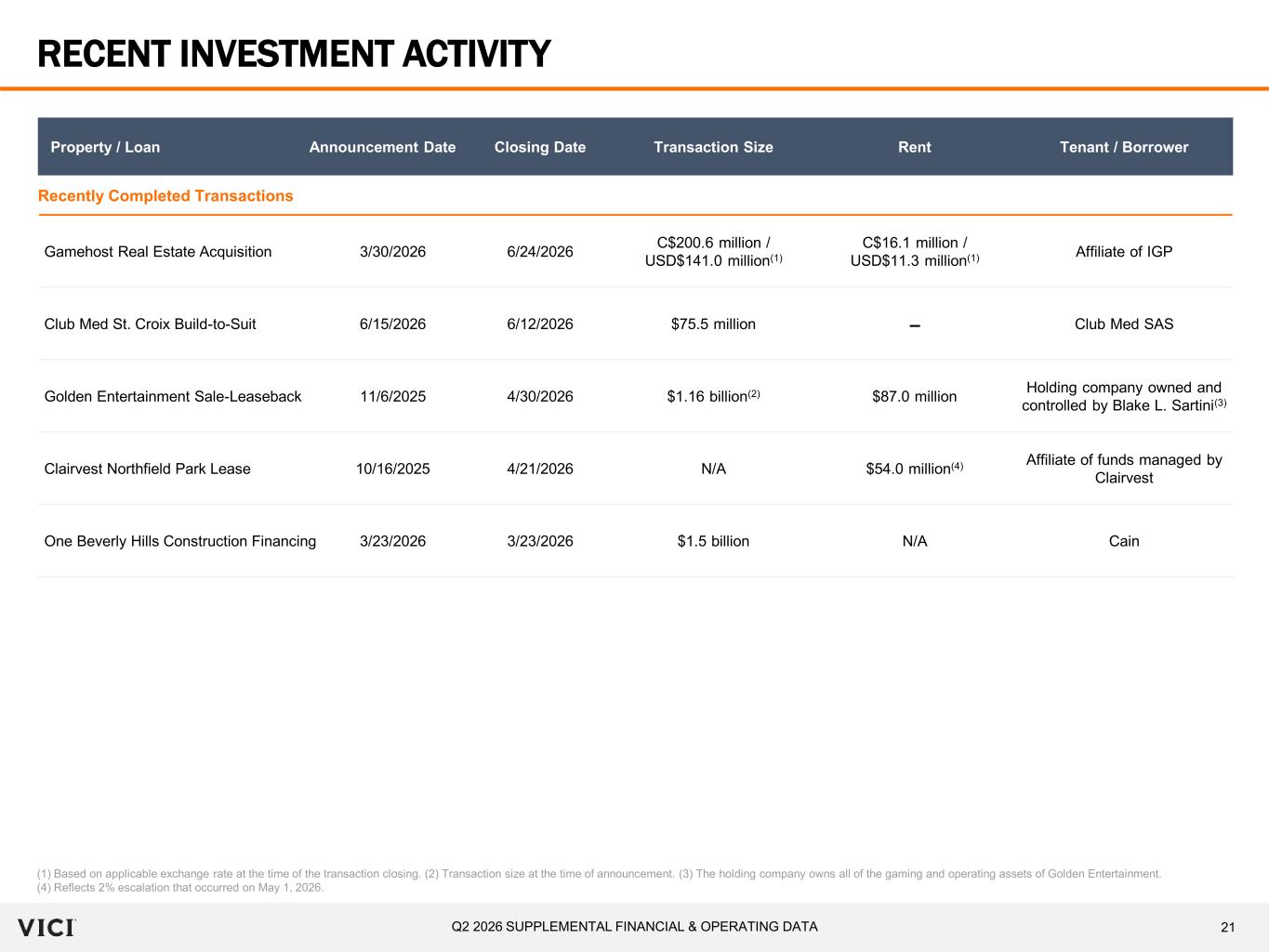
Thank you, Samantha, and good morning, everyone. and for the analysts on the call. We're especially grateful for your presence today because we know that yesterday after market, you dealt with an absolute flood of earnings releases in your coverage area. So again, thank you. In the next few minutes, you'll hear from John Payne on our growth outlook and activities and from David Kieske on our financial results, liquidity, and updated 2026 earnings guidance. To start, I'd like to spend a moment or two talking about how we think about, talk about, and manage the growth of our business. You've heard us say before, frequently, that we grow our business by growing our relationships, by growing new relationships, and growing the scale of existing relationships. Today, I'd like to take you deeper inside our approach to relationship building, and to do that, I'll tell you the story of our new relationship with Club Med, which we announced back in June with the news of our investment in St. Croix, where we've acquired a property initially developed as the rock resort, Carambola. We first began getting to know Club Med in 2025, and it's important to understand how we came to be connected with Club Med. The connection was not direct. In this case, it wasn't about calling up their global headquarters in Paris, nor their North American Caribbean headquarters in Miami. So believe me, we do regularly make cold calls on experiential operators. We did not receive a flyer saying there was a Club Med property or a Club Med opportunity for sale. We did not get connected through bankers or brokers. We connected with Club Med through a company that will remain nameless. This is a leisure and hospitality company we've been courting for partnerships since just about the birth of Vici. To date, we haven't been able to find the right opportunity with them, though to be sure, we won't stop trying. We've always worked hard to make our conversations with this unnamed company meaningful and collegial and frequent. In 2025, Club Med asked this unnamed company who they, Club Med, might partner with for financing of the St. Croix opportunity they were pursuing. The unnamed company said to Club Med, we should connect you with our friends at VG. And thus, in 2025, Club Med connected with John Payne and Aaron Ferreri to get a conversation started. When we commence a conversation with a potential new partner, we are not in sales mode. We are in learning mode. With Club Med, John, Aaron, and Matt Perkins and other members of the VT team set about seeking to understand Club Med's needs, financial, strategic, and cultural needs, not only in St. Croix, but into the future that Club Med envisions for itself. This is an approach that takes time, but we believe in its approach that leads to the strongest foundations upon which to grow together. And in this case, St. Croix became the foundation upon which we are building our relationship. When we first announced our new partnership with Club Med and our acquisition of the St. Croix property, the reaction from some was sort of a small deal. I'll offer a couple of quick thoughts on that take. First of all, the total projected investment of $75 million into one property is pretty meaningful by net lease standards, given that the typical net lease property tends to cost low single-digit millions. Secondly, and to reemphasize the point, when we make a first investment with a new partner, we are highly focused on the foundation we are building for potential future investment. Two weeks ago, a number of us on the VG team experienced a strong foundation when we joined our Club Med partners on the north shore of St. Croix for what Club Med calls its first stone ceremony. This ceremony celebrated the ecosystem of relationships that Club Med builds before it creates and in order to create great experiential resorts. The Club Med team of Global CEO, Stéphane McClure, North American Caribbean CEO and President Caroline Doyon, and North American Caribbean Senior Vice President of Development, Eileen Kett, brought together the St. Croix governmental, tourism, and developmental officials who've been and will continue to be instrumental in supporting the resort redevelopment, both strategically and financially, as well as the contractors who over the next 18 months or so will restore this resort to the glory originally envisioned by Lawrence Rockefeller while making it a distinctly Club Med experience. What I witnessed on St. Croix made me proud of the new partnership we've created with Club Med and excited for what together will contribute to St. Croix's competitiveness as an experiential destination. But what was also clear to me that day in St. Croix is the energy, creativity, and passion that Club Med brings to its growth activities. And with Club Med having a stated goal of growing its portfolio of destinations from 60 to 100 over the next few years, I'm hopeful and excited that Beachy will find ways to be supportive of and participative in that growth. If we do, it's because we will continue to grow our relationship with Club Med. With that growth, relying on our working every day to understand and better serve their needs, which is what we strive to do with every one of our growth partners. And with that, I'll turn the call over to John.
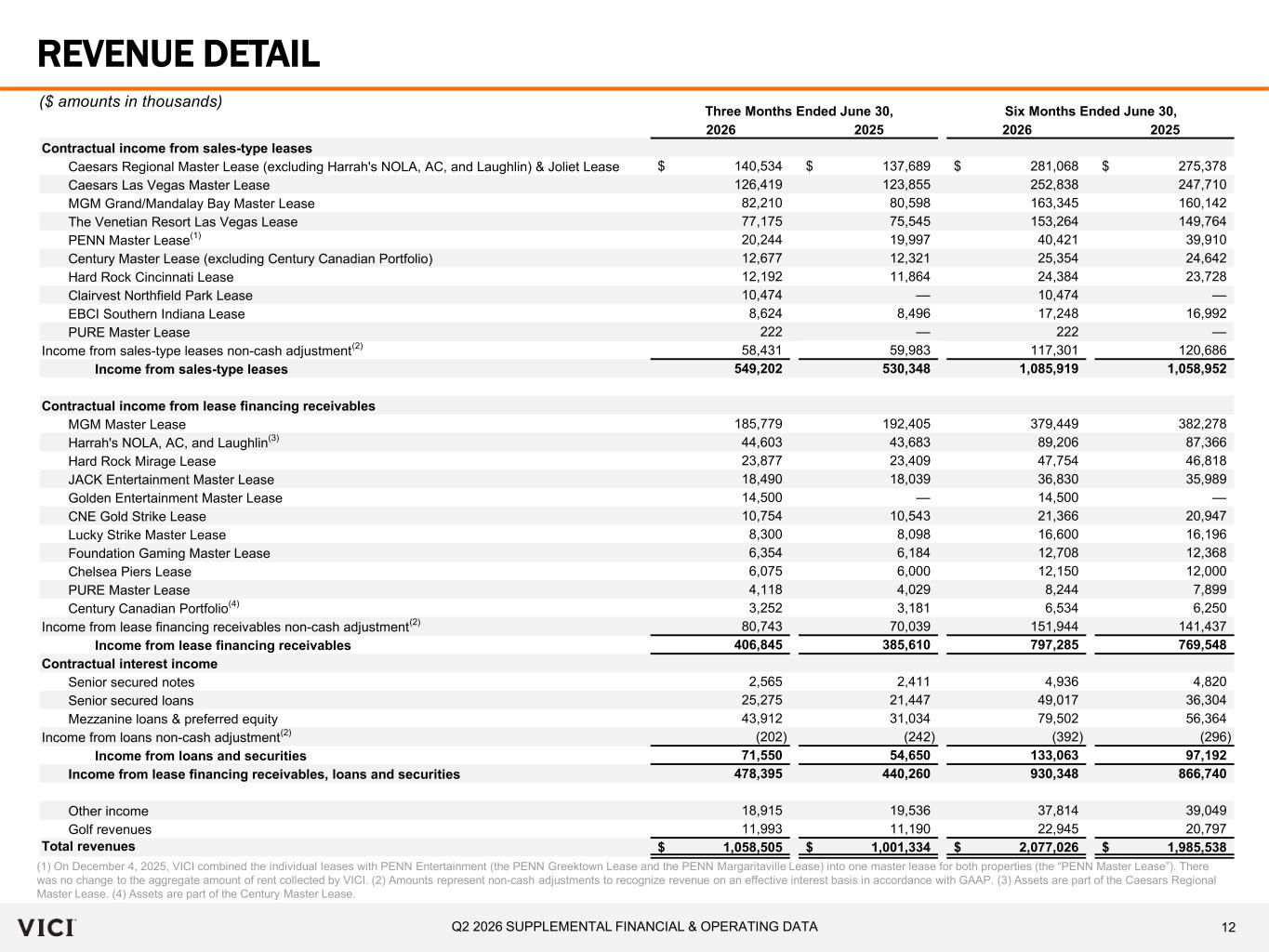
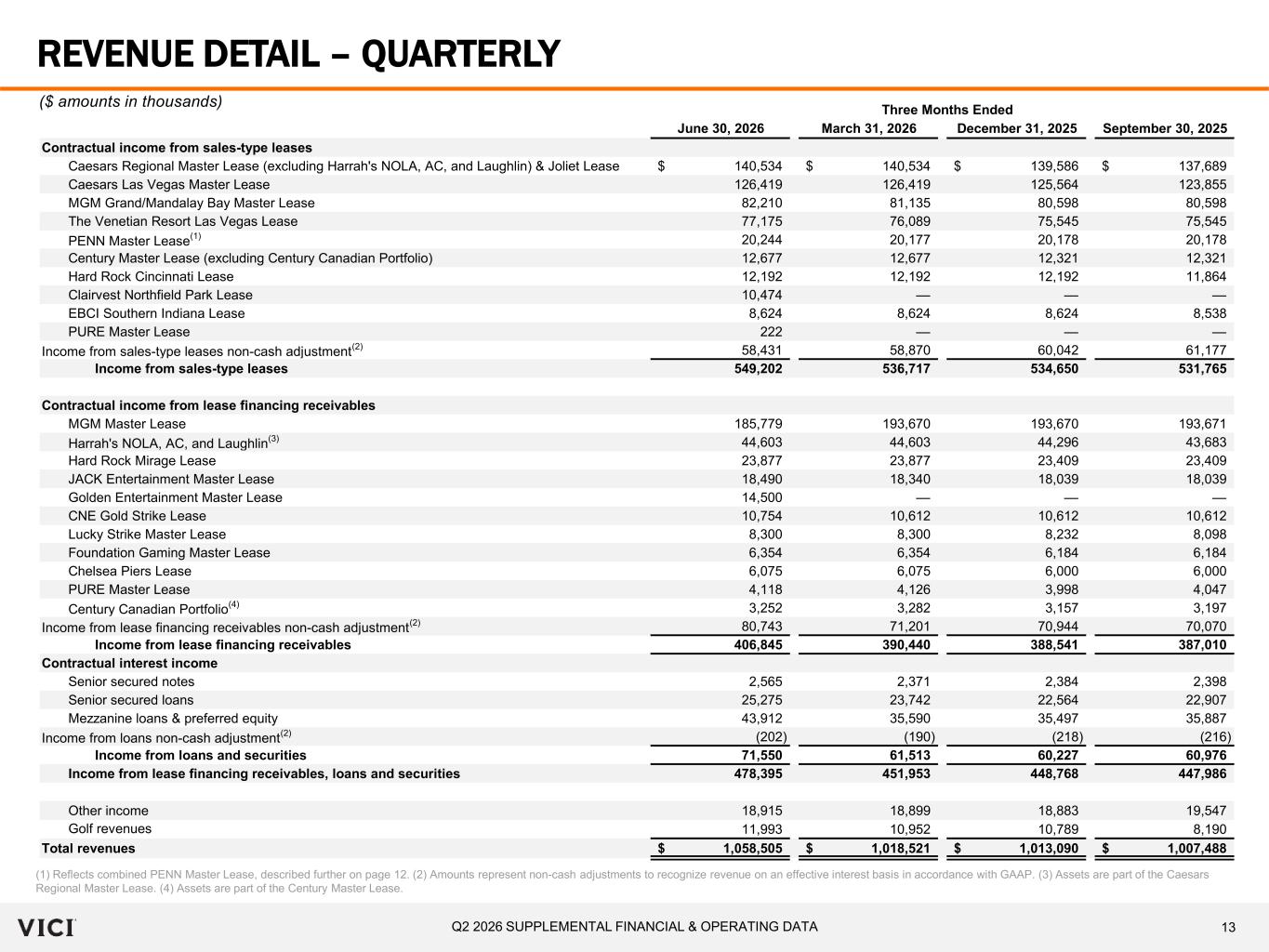
Thanks, Ed. Good morning to everyone. You just heard Ed tell the story of how our Club Med relation came to be. And I'll simply add two things. First, for our business development team, a partnership like this one is the payoff of years of patient relationship building. It's the way we like to grow. Second, the transaction itself marks several firsts for Vici, our first build-to-suit investment, and our first property acquisition in the Caribbean. At closing, we funded the $20 million acquisition of the Carambola Beach Resort, and we will fund Club Med's approximately $55 million redevelopment of the resort, which Club Med will operate under its premium exclusive collection brand following a targeted opening in the fourth quarter of 2027. As Ed said, we look forward to growing with Club Med for years to come. During the quarter, we also brought several previously announced transactions across the finish line. The closing of our $1.16 billion Golden Entertainment sale leaseback, the commencement of our new lease with ClairVest at Northfield Park, and the completion of the acquisition of the Game Host Real Estate in Alberta for approximately $200 million Canadian dollars alongside our existing partners at Pure. With the completion of these transactions, we've added ClairVest, Golden Entertainment, and Club Med as our 14th and 15th and 16th tenants, respectively. This tenant growth was achieved by partnering with experienced and tenured operators. From ClairVest's two decades of investing across 37 gaming assets, to Blake Sartini's more than 30 years operating in the Nevada gaming landscape, to Club Med's 75 years of all-inclusive operating experience, and the closing of the game host transaction reflects the other side of that same discipline, our capital continuing to serve the growth of partners already on our roster. Turning to the trends across the portfolio we already own. And there's no better place to start than Las Vegas. On a year-to-date basis, strip gaming revenue is running ahead of last year, with roommates continuing to demonstrate the pricing power of this market. The resilience of Las Vegas continues to be reinforced by the ongoing diversification of demand. We've noted many times how this city has transformed itself into an entertainment epicenter with experiences like Sphere. Then there's been the massive growth in professional sports with the addition of the Golden Knights, the Raiders, F1, the Aces, and the upcoming relocation of the Oakland A's. And now the prospect of an NBA franchise stands to extend the trajectory further. Every new demand driver makes Las Vegas that much harder to bet against. Then there's the convention segment, which we've long viewed as an underappreciated mitigate to the cyclicality of leisure demand, and it continues to strengthen. Last month, U.S. News & World Report named Las Vegas the number one convention city in America, with the Venetian ranked the top conference hotel on the entire list. This is a powerful validation of the convention infrastructure our operators continue to invest in, and of the nearly six million square feet of conference, convention, and trade show space Vici owns on the strip. We often say we aim to make Vici bigger only when it makes Vici better. This quarter, we got better. Three tenured and experienced tenants added to our roster, a new market in Las Vegas locals, a new geography and partner in the Caribbean, and continued growth with partners we know well. The roster-building, relationship-driven work is what will continue to define VG in the quarters ahead. Now, I'll turn the call over to David, who will discuss our financial results and guidance. David?
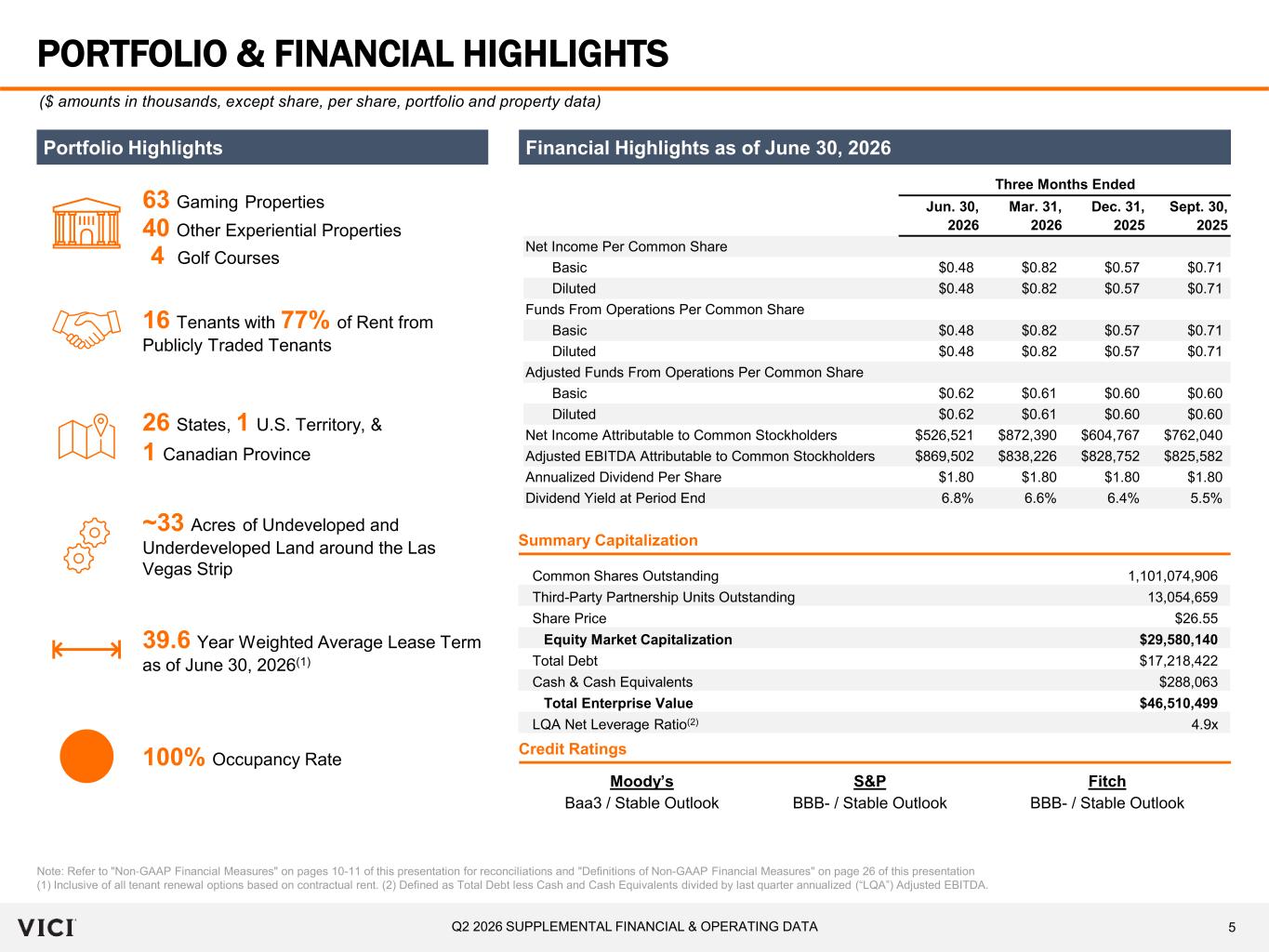
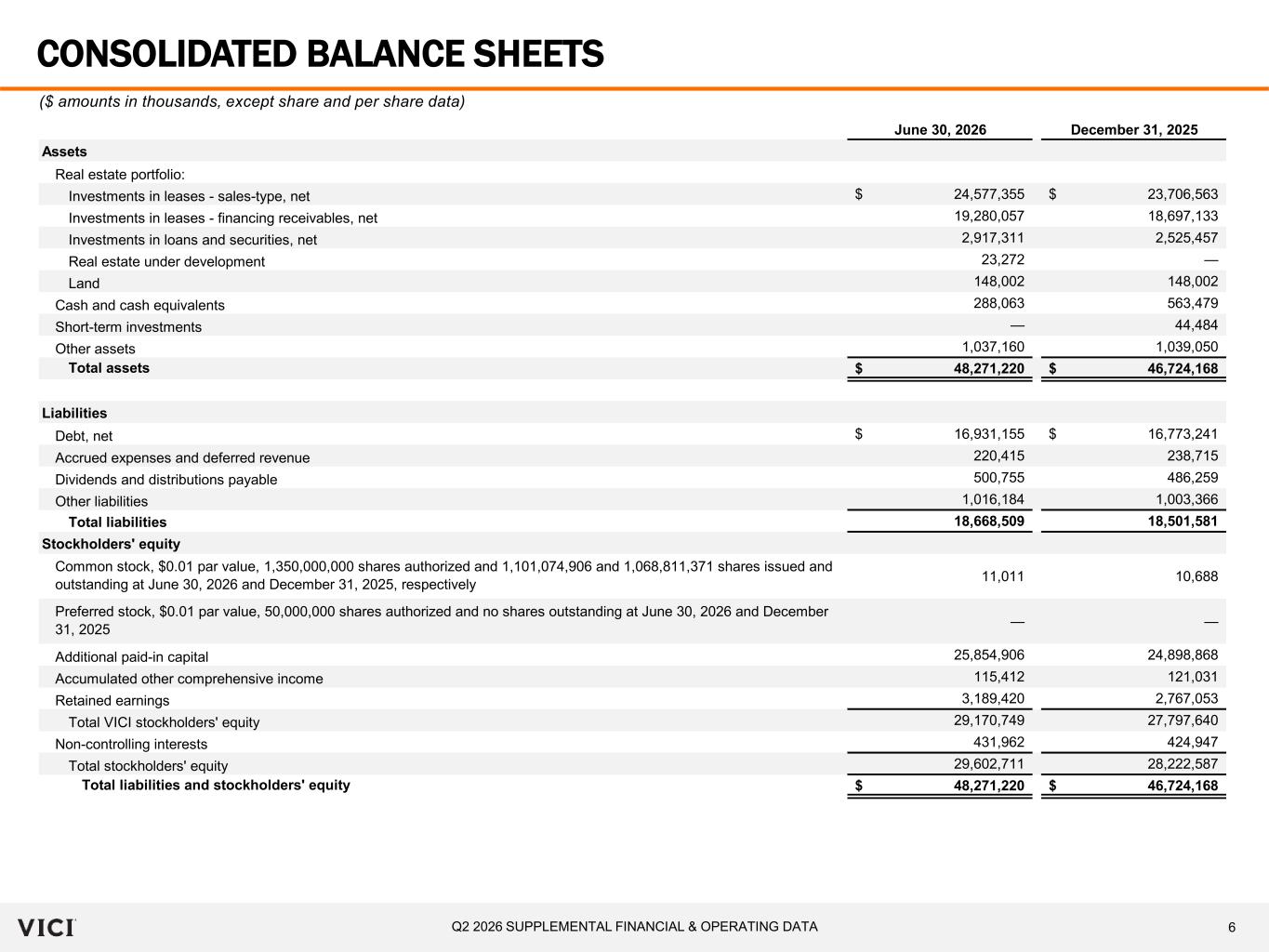
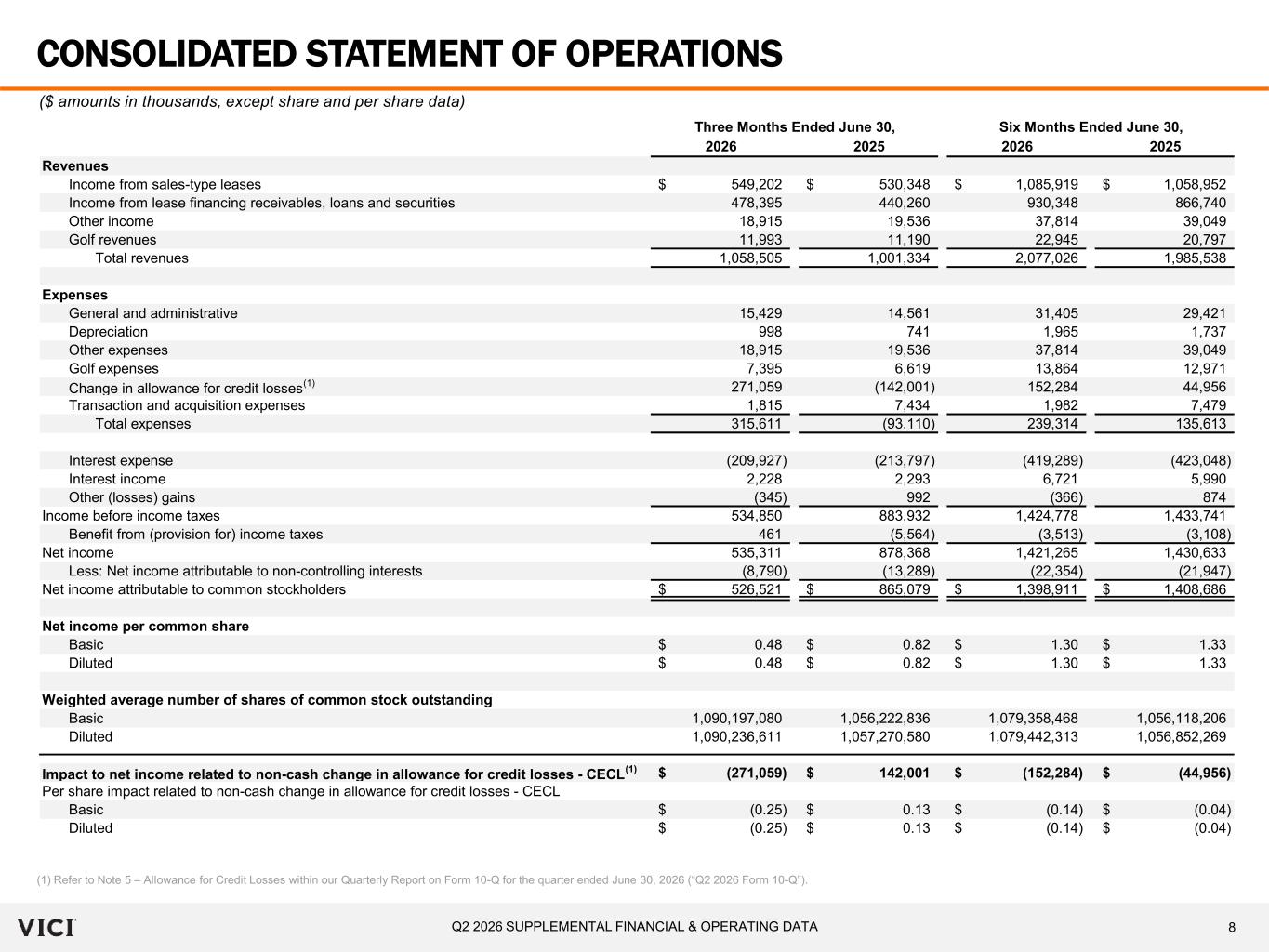
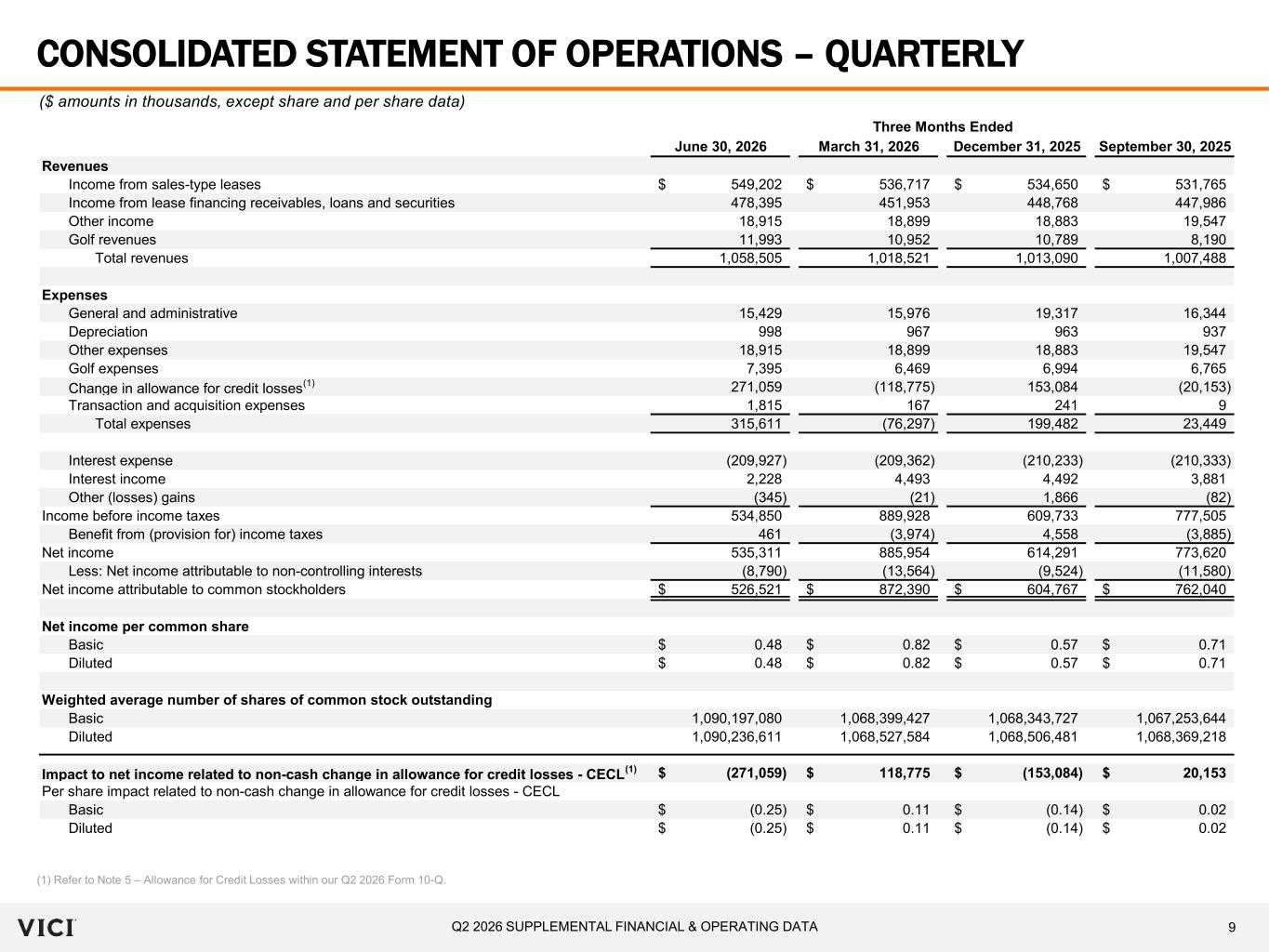
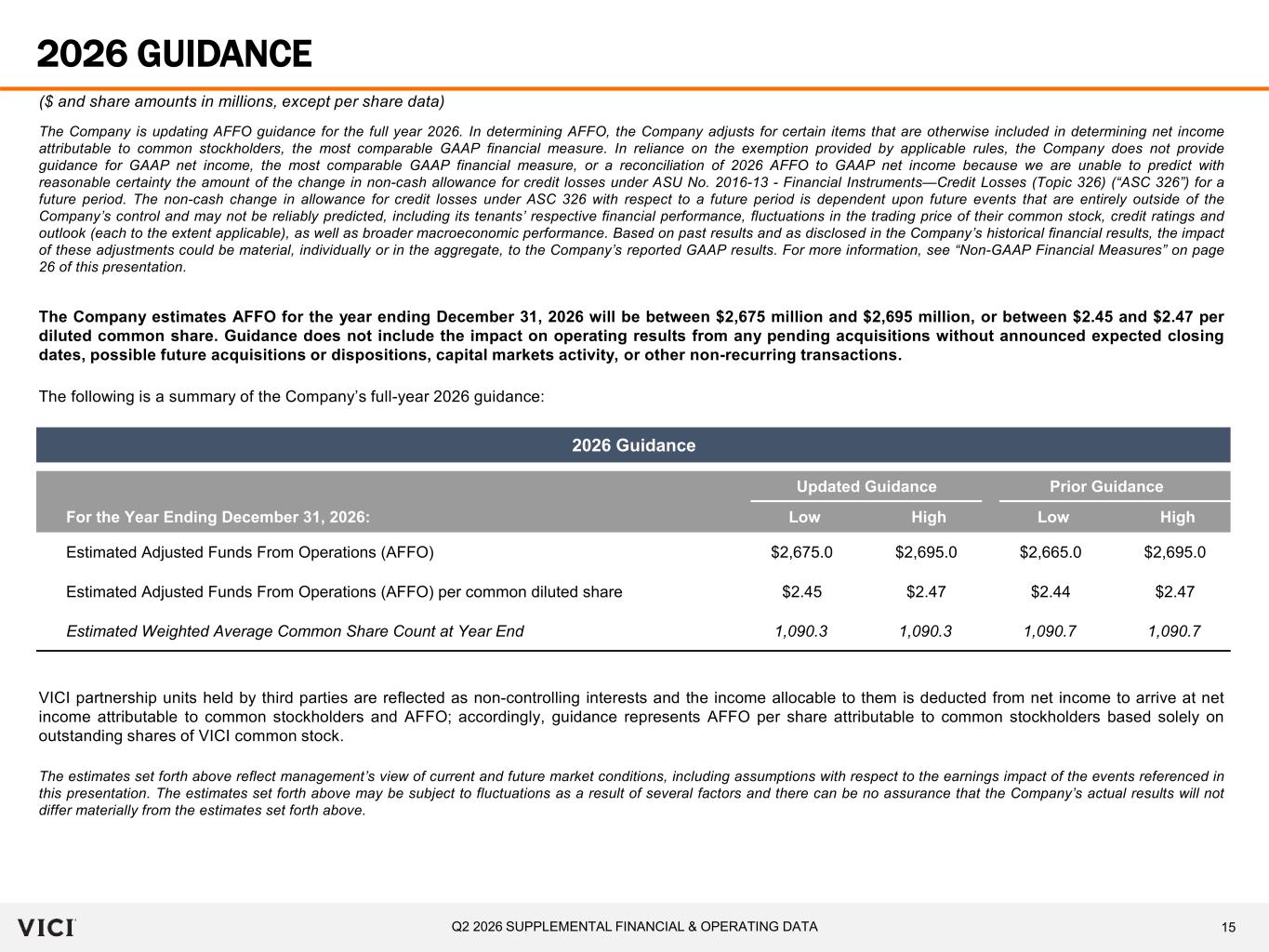
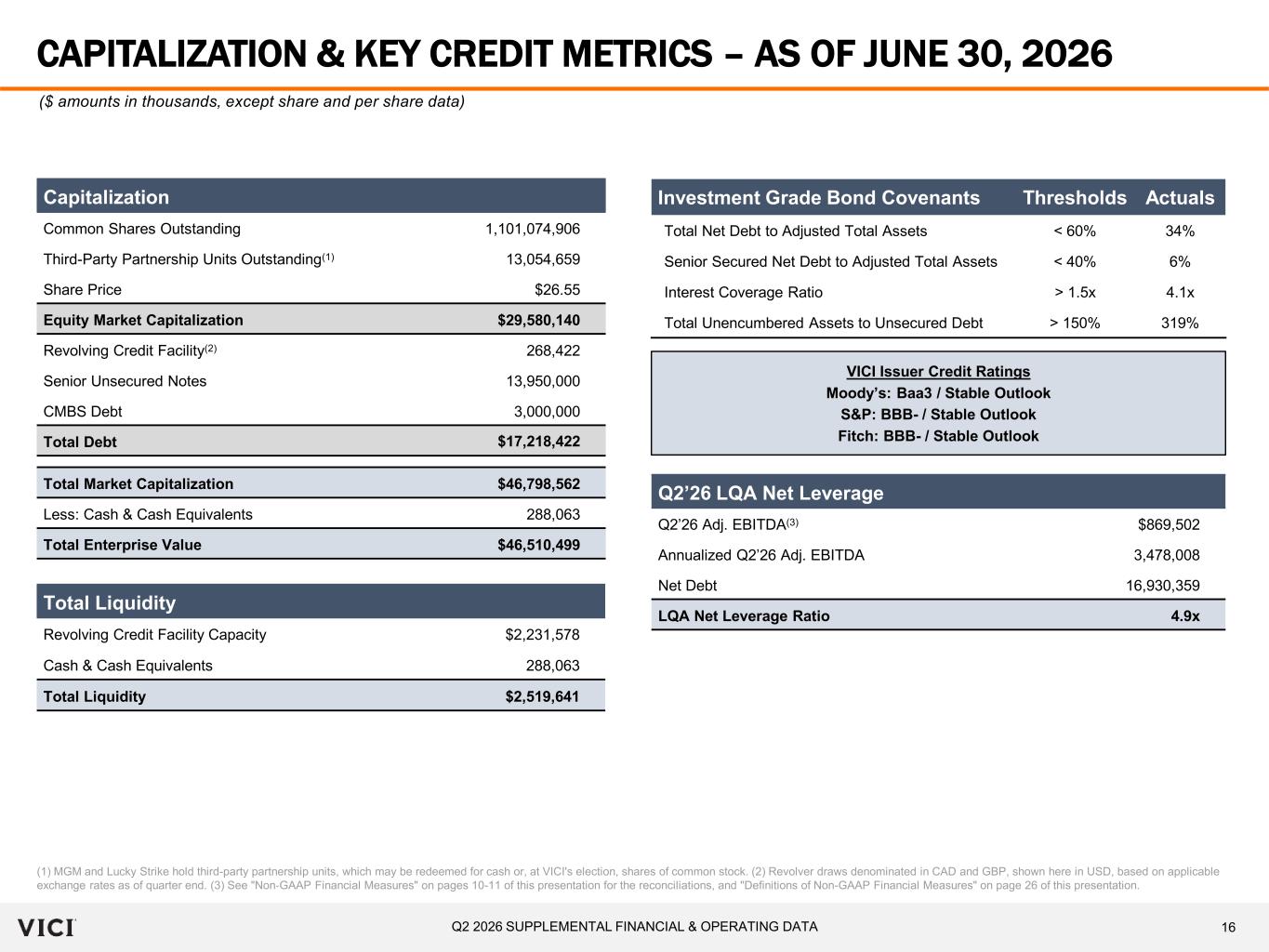
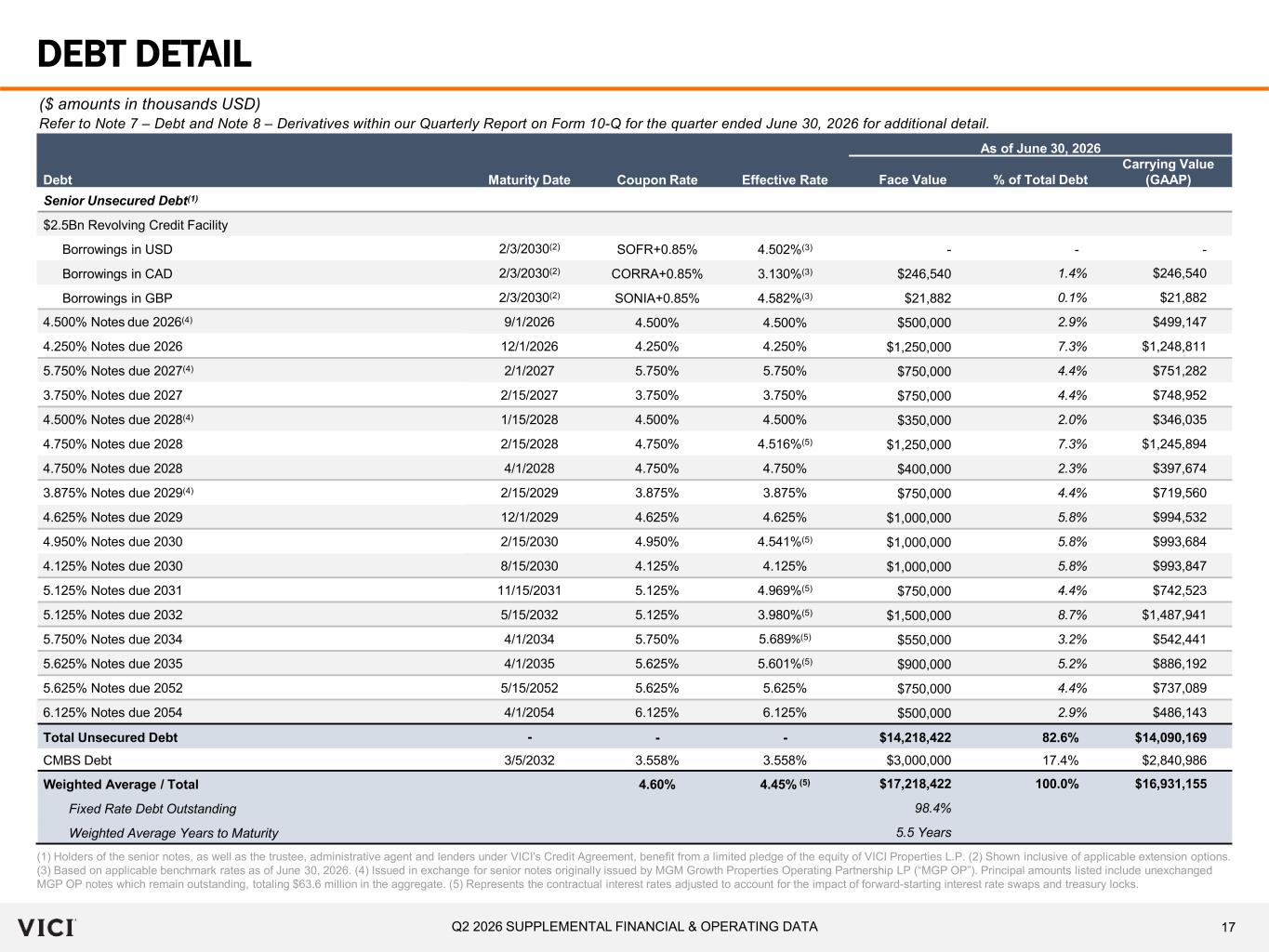
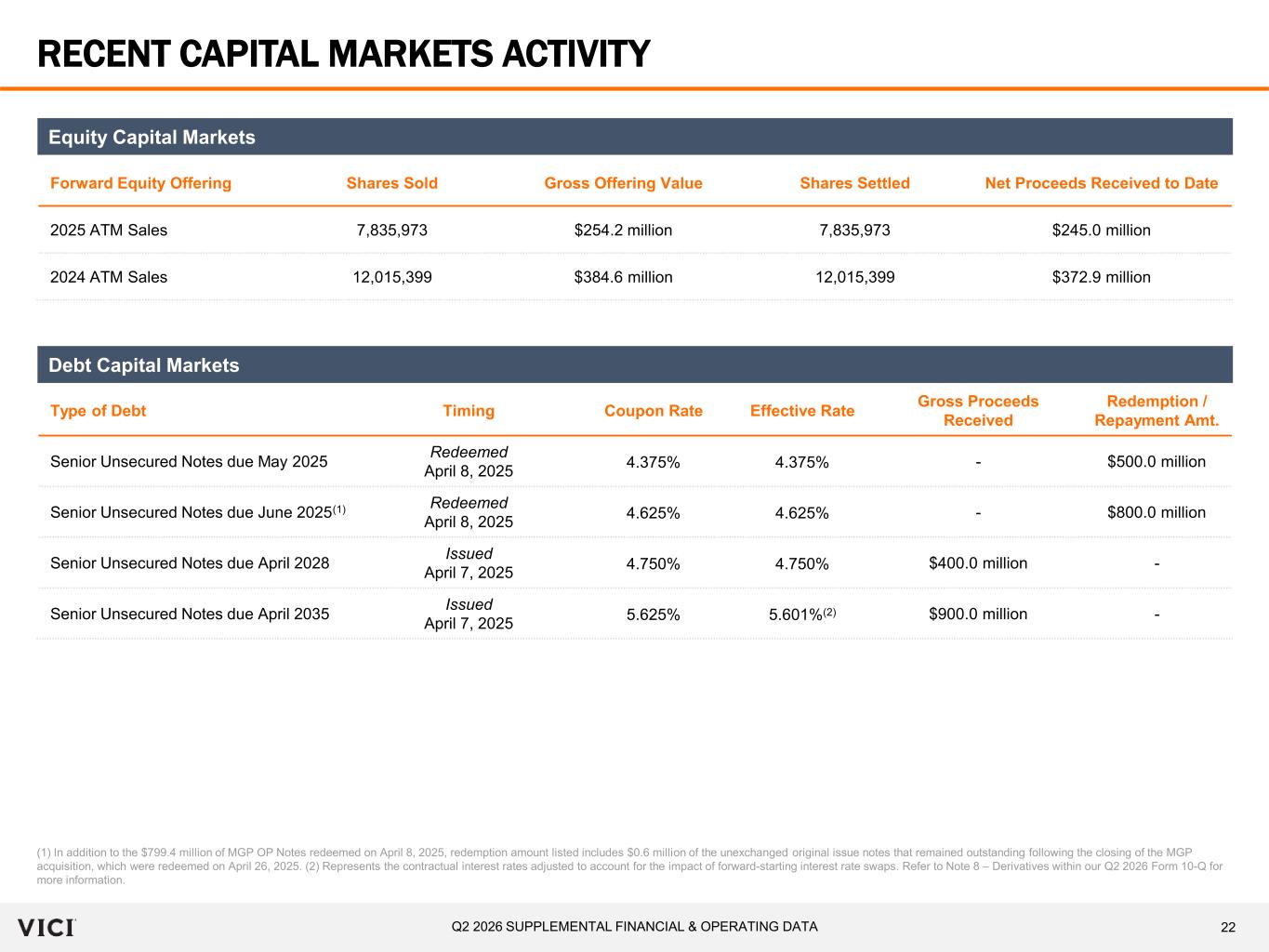
Thanks, John. Session on the income statement, AFFO per share was $0.62 for the quarter, an increase of 4.6 percent compared to $0.60 for the quarter ended june 30 2025. in terms of the balance sheet our total debt is 17.2 billion and our net debt to annualize second quarter adjusted ebitda is approximately 4.9 times below the low end of our target leverage range of five to five and a half times we have a weighted average interest rate of 4.45 percent as adjusted for our edge activity and a weighted average of 5.5 years to maturity as of june 30 2026 we have approximately two and a half billion in total liquidity, comprised of $288 million in cash and $2.2 billion of availability under a revolving credit facility. Turning to guidance, we are updating AFFO guidance for 2026 in absolute dollars, as well as on a per-share basis. AFFO for the year ending December 31, 2026 is expected to be between $2.675 billion and $2.695 billion, or between $2.45 and $2.47 cents per diluted common share. Compared to our prior AFFO per share guidance, the updated guidance represents an increase at the low end of the range by one penny. Based on the midpoint of our raised 2026 guidance, Vici expects to deliver year-over-year AFFO per share growth of 3.4%. As a reminder, our guidance does not include the impact on operating results from any pending acquisitions without announced expected closing dates, possible future acquisitions, or dispositions and related capital markets activity or other non-recurring transactions or items. With that, operator, please open the line for questions.
Operator
And ladies and gentlemen, we ask that you please limit yourself to one question and one follow-up. You may get back in the queue as time allows. Our first question comes from the line of Barry Jones from Truist. Your question, please.
Hi, this is Jeremy on for Barry. Thanks for taking our questions. With Churchill Downs announcing last night that it's looking to sell regional properties, what's your high-level expectations for regional M&A activity throughout the remainder of the year? And do you see regional valuations market-wide as reasonable at this point?
This is John. It's good to talk to you. I'll talk a little bit about regional gaming right now. I was adding up the years last night. I've been in or around the regional gaming space for 30 years. My colleagues are laughing at me right now, but the business is resilient. I mean, there's been a really amazing rebound here over the past six months or so in the regional markets. It's very exciting to see the innovation that's happening around slot product right now that's helping to drive growth in the regional markets. As it pertains to the, I think you're referring to the Churchill announcement that they are going to be selling their regional gaming portfolio. There are some assets in their portfolio that I'm sure we'll take a look at that would be a nice addition to our portfolio. I know there's some of our current tenants that are interested in those assets and we'll continue to better understand the opportunities there.
Got it. That's very helpful. And then should we expect to see more built to suit structure type deals? similar to the Club Med?
Yeah, Jeremy, it's very common across the NetLease universe, and it's something that we're excited about. And I think we continue to offer solutions to our partners, and this is a very attractive solution for those that are in growth mode.
Operator
Thank you. And our next question comes from the line of Caitlin Burroughs from Goldman Sachs. Your question, please.
Hi. Good morning, everyone. I guess just we'll figure out how to phrase it but just considering that your two largest tenants are in the news to potentially be bought we'll see what happens with them but I guess just considering the time period that we're in right now I was wondering if you could comment on how your conversations with those tenants today differ from a year or two ago and kind of what's normal course versus what's maybe I don't know on hold because their own structure is changing or potentially changing.
Yeah. Hey, Caitlin, good to hear from you. I would say that our conversations actually haven't fundamentally changed with our partners. We are in constant contact with all of our partners around various interactions involving our businesses. And, you know, they are obviously in very intense operational businesses day by day, hour by hour and we're always very respectful of that and making sure we don't waste their time but we we continue to have very positive conversations around opportunities that we see together whether with existing assets or incremental opportunities and I'll turn over to John here because he can give you an example of an opportunity that we are discussing with a partner despite the fact that that partner is also engaged in some very meaningful activities beyond us.
Yeah, it's good to talk to you this morning. Ed's referring to the opportunity in Las Vegas with the NBA. I think everyone has seen in the news that the NBA is looking to put another team into Las Vegas. There are many people bidding on that team. We own, in conjunction with our partner Caesars, and we're working with them, 50 acres of land behind Paris Horseshoe Planet Hollywood, and we are developing a plan with Caesars, Sean McBurney in particular, who runs Las Vegas, to house the arena that could be built for the new NBA team. So that's just an example of us working with one of our partners. The other thing I'll address is in my opening remarks, I talked about having our 14th, our 15th, and our 16th tenant. We're very different than other triple nets that have hundreds of tenants. We have, as you hear, 16, which then allows us to have deeper and more frequent conversations. So we're constantly talking to our partners about ways we can grow together, how our assets are performing, et cetera. So that's just another example of how we're a little bit different.
Got it. Okay. And then I think you've probably touched upon it briefly in the prepared remarks, but wondering if you could talk about some of the trends you're seeing more recently in Las Vegas and maybe how they differ, vary between your specific assets and the market overall.
Well, we continue to be very excited about the market. As I hinted, it's a place that constantly reinvents itself and not only has ways to make money in gaming, but you can hear it is becoming the number one entertainment epicenter I'll describe in the world. Someone can argue with me about that. But it is a place that continues to add different reasons to come and visit. We obviously are well invested there. We have numerous assets there. They all continue to have specific reasons why the consumer segment comes to their property. And we really like what the operators are doing, especially event-driven and creating these unique events that only can be done in Las Vegas. So we continue to be really excited, and we continue to like how our tenants are operating their businesses and being creative.
I'll just build on what John is saying, Caitlin, by pointing out what MGM disclosed yesterday with its Q2 results, and that was 93% occupancy for their strip assets in the second quarter, which is really an outstanding amount of occupancy, given the amount of inventory that MGM has on the Strip. And I think that embedded within that was the very meaningful, positive outcome they're getting on being promotional and offering all-inclusive packages at Luxor and Excalibur. These are operators that respond to changing conditions, and they respond, I think, as energetically and creatively as any hospitality and leisure operators I've ever known.
Operator
Thank you. And our next question comes from the line of Greg McGinnis from Scotiabank. Your question, please.
Hey, good morning. Hey, Greg. So I believe most of the free cash flow is spoken for this year with investments to make. But as you look ahead, are you considering share repurchases, or do you think you can find more creative investments with this capital?
Yeah, Greg, it's a question we get asked a lot. You have basically answered the question. I mean, when we're putting money out at SOFR plus 825, that's a much more attractive use of our capital. And that's just for the One Bear Villa Hills loan. And our loan book is close to nine and a half percent yield. We can find much more attractive uses of that free cash flow. And then the Club Med's a very attractive return. Everything we've closed this quarter is a very attractive return. And just, you know, the buyback for a REIT, especially a net lease REIT that is, you know, growth is dependent on deploying capital, just not something that makes a lot of sense, especially where we are now and within the investment prospects that we have in front of us.
Okay, thanks. And then we've seen in the news that there's a lot of cities basically pouring billions of dollars of capital into convention facilities. And I'm curious what impact you might think this may have on Las Vegas and also whether this represents an investment opportunity for you.
Yeah, Greg, it's a good question. I do think that the competitive superiority of Las Vegas as a convention destination is so well established that I don't know that anybody's tremendously worried about new convention supply in other American cities. And part of that, a large part of that has to do with the ecosystem that Las Vegas represents when it comes to appealing to and serving the needs, both convention needs and leisure and hospitality needs of convention goers. The entire ecosystem, including airlift, infrastructure, lodging quality and abundance, entertainment quality and abundance, F&B quality and abundance, there's really no city in America that can come close. And I think that probably has also a lot to do with, unfortunately, the somewhat beat-up condition of full-service lodging inventory across so many American city centers. So, again, I have very strong conviction around the competitive superiority of Las Vegas' convention center destination. As to the introduction of new supply in other cities, it could be something we would look at, but it would have to be a situation in which, obviously, we can invest it in accretively, and we would also have very high confidence that that destination can be competitive in what is a very competitive marketplace.
Operator
Thank you. And our next question comes from the line of John Decree from CBRE. Your question, please.
Hi. Good morning, everyone. Thank you for taking my question. I wanted to ask a little bit about the shift to private markets for your tenants. I think VG kind of had a unique exposure to public tenants relative to other REIT asset classes. But Ed, John, or David, curious if you find private companies that you work with in the casino space more willing or open, flexible to use refinancing relative to public companies. I think the last couple of years, we've just seen public markets kind of undervalue casino operators. And so, you know, curious that the shift we're seeing to private markets, if that's changing the outlook for, you know, M&A and refinancing in the casino space.
Yeah, I think it could. And I'll turn it over to John and David in just a moment. John, Dan, good to talk to you. You know, it's somewhat understandable given what I think a lot of operators have felt has been the somewhat lack of love that they've gotten in the public markets over the last few years. And I think a number of them that we talked to, and John can give you more specifics here in a moment, appreciate the fact that in the private markets, they truly can do what they believe are the right things to grow their business over the longer term. And, you know, an example of that is that once they go private, they tend to be not focused on what's going to be the earnings in a given quarter and more focused on what, if we make any incremental investments, what's going to be the IRR on those investments. And we have found, for example, that private operators are more responsive to the use of our capital through our property partner growth fund, because from an IRR point of view, that capital is very, very attractive to them. And I'll turn it over to John now, but I think we can confidently say that recent privatizations have left the now private operators feeling quite good about where they are.
Yeah, I think from the operations side, you were talking about the financing side, but just from an operations side, being in a private setting, I think is quite beneficial for this industry. These are very capital intensive businesses. And there's times, and John, I think you know, I'm a former or a recovering operator or a former operator, that there were times where I knew something needed to be refurbed, but it was going to be detrimental to a quarter or two quarters. And that's really not the way to think about it, to think about these businesses long-term. And when capital needs to be invested, and although it may disrupt the business for 60 days, 90 days, 120 days, you need to do it for the long term. IT is changing dramatically in this space. And the implementation of new systems and servers can be disruptive to an operation for 30, 60, 90 days. You need to do it. And in a private setting, you don't really worry about those 30, 60, 90 days, or in a public setting, you might. So I think we're enthusiastic about what we're seeing. We'll see how this all plays out over the coming months or years, but that's my take on how it's affecting the operator's view of their business.
Thanks, guys. I think you kind of covered my follow-up there as well, so I'll hop back in the queue. Appreciate it.
Operator
Thank you. And our next question comes to the line of Chris Darling from Green Street. Your question, please.
Thanks. Good morning. Can you provide an update on the sports infrastructure opportunity, any discussions you continue to have with universities? And then, you know, is there anything structural or maybe related to pricing that's top of mind for these institutions? Just anything specific that may have possibly prevented deals from closing to date?
Yeah. Hey, Chris, it's John, and then I'll let any of my colleagues who want to jump in here. Yeah, we've been very active in this space, and I would describe it as really educational. We opened my remarks by talking about being patient and relationship building. I would describe the university space as just that, in that we are explaining that we're long-term infrastructure investors and how we could help a university, particularly in sports, grow over the coming years. So I think that I don't think it's a you ask if there's a pricing or a cost cap. I'd say that's not the reason why we have not announced anything yet. I'd say it's a little bit of us. We're at a point where we're trying to understand, is this the right place for us to be? And I think many universities are deciding, is capital-like VG's the right way to grow their sports business?
Yeah, Chris, it's Gabe here. And just to answer the second half of your question with any kind of structural consideration. So a lot of universities want to make sure that debt and other debt-like instruments aren't on their balance sheet and impacting their credit rating. So we've kind of made sure that they understand how flexible VG's capital can be and that we're a long-term partner and provide a capital solution that works for the university's needs. also works for VG's.
Okay, that's all helpful thoughts. That's it for me. Thank you.
Operator
Thank you. And our next question comes from the line of David Katz from Jeffries. Your question, please.
Hi, good morning, everyone. Thanks for taking my question. I wanted to talk about regional gaming, you know, in a broader sense, because, you know, what we've seen is, you know, operators investing internally as, you know, they're finding some of those being their best opportunities and adjusting to some of the dynamics that have been going on across the United States. And, you know, frankly, you know, what we're seeing, including, you know, from your largest regional tenant, some pretty good numbers. And my question is, is that a function of, you know, them just dialing in their strategies? Is it a function of internal investments, you know, or do you think that it's just a, you know, an external demand, you know, moment that we're seeing show up, you know, in those numbers? And specifically as it relates to your tenants, where I'm most interested.
Well, David, I'm not sure there's been a person on the phone that's been around gaming longer than myself. I was going to say you, but you've been around a long, a long time. So you've watched this, you've watched how resilient these, you know, these local casinos, these regional casinos are there. I tell people, this is the people's country club. And what I've noticed over the past couple of years, as the competition has come, whether that's through iGaming or sports betting is watched these operators reinvigorate their offerings. I've also watched the manufacturers get even more creative with the products that they have to offer. And I think those combinations are paying off this year, and I think they'll pay off in years to come. I think tougher times and more competition, the great operators step up and think differently about their business, how they reward, how they incent, how they improve their service. All of that plays into why we're seeing an uptick in what everyone's described as the regional or local market. So I'm quite excited about what I'm hearing from our operators and I'm quite excited from the technology standpoint what I'm seeing myself.
You know, I will just add on to what John says, David, by also pointing out the amount of live entertainment in America now that takes place in regional casinos, both commercial and tribal, and to an extent that certainly didn't exist 30 or 40 years ago. And I think it's part of the very powerful relevance that regional gaming operators really work hard to achieve in relation to their geographic and demographic markets. And then finally, I'll just say that maybe not on this call, but I'd actually love to hear your thoughts on this and, you know, what you think are the key drivers of what really appears to be fundamental foundational strength in regional gaming.
I'm going to ask my follow-up question, and I'm going to just very quickly answer yours, which is, you know, I think that there is some dialing in of, you know, strategies on value propositions and recognizing, you know, where the competition is coming from and how to beat them. And to that end, you know, we have been, you know, able to discuss on this call, you know, in particular, you know, Caesars regional lease. And I'm just wondering if there's any appropriate comment we can make today about whether some of this improvement that we've seen and the backdrop, given that so much else has changed, Does that alleviate, you know, the need to sort of pursue that conversation in the near term?
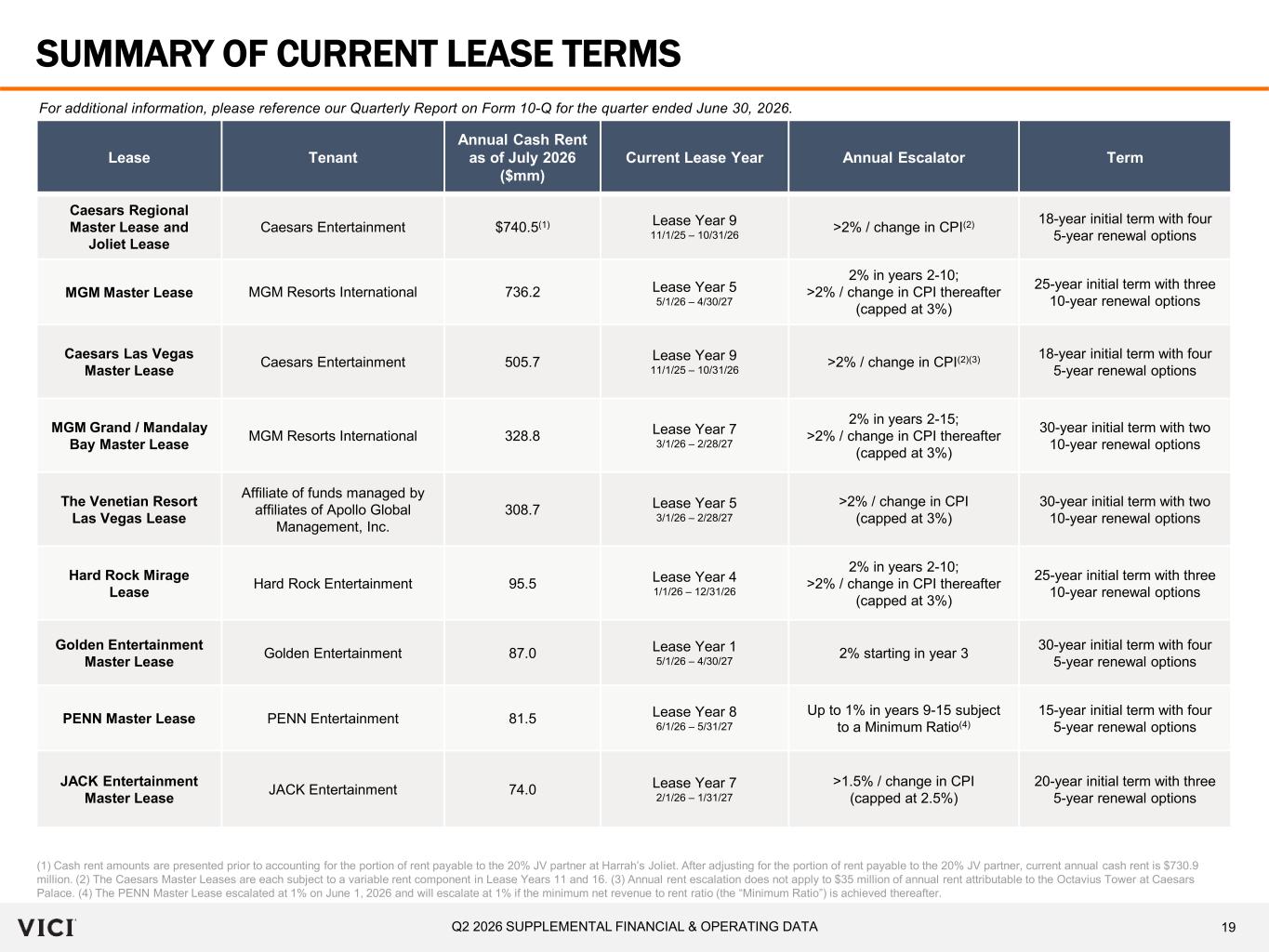
I wouldn't say it alleviates or eliminates, but obviously that's a conversation that will take place at some point as, you know, Caesars continues to develop its new ownership structure in due course. but would remind everybody that we obviously collect every dollar of rent in the meantime. And again, I think that we are very appreciative of the hard work that Caesars has been putting into the regional assets and the kind of results we were able to produce in Q2.
Operator
Thank you. And our next question comes from the line of Daniel Guglielmo from Capital One Securities. Your question, please.
Hi, everyone. and thank you for taking my questions. As a follow-up to John's question about public versus private gaming operators, I think there's an impression out there that maybe private gaming operators have kind of more like a black box for property owners around information, which I don't think is the case. So can you just talk through some of the information that you all use outside of public earnings, SEC filings that keep you up to date on private operator tenant trends?
Yeah, Dan, you're spot on. There's more transparency to the gaming operators than there are across traditional net lease landscape because of the monthly reporting that goes on at the state level. Sometimes it's by region, but oftentimes it's by assets. And then a lot of these private operators have public debt and they report whether it's to the terminal market or to the high yield market. And there's trading stats on the fixed income side and often a lot of your colleagues or other folks across research report on those private companies. So there is improved transparency, whether they are versus a broader triple net lease space.
Yeah, and this is Samantha. I'll just add, we spend a lot of time with each of our private tenants making sure that we're getting the necessary reporting through our leases. And Gabe's sitting here to my right, and he can talk about, we focus on it from an asset management perspective. So we're always meeting with asset management to ask, like, what do we need from a reporting perspective so that we are able to get the information that we need to monitor tenants in the same way we would with a public tenant?
Yeah, we get property level financials from all of our borrowers and tenants. And then as a group, we sit every quarter and go through every single lease and loan investment in the portfolio. So have visibility into our tenant and borrowers' financial performance, regardless of whether they are a publicly traded tenant borrower or private. Great.
That's really helpful. Thank you. And then, as you mentioned in the opening remarks, Club Med was a new tenant this quarter. The properties in the U.S. Virgin Islands, but they're well known as an international brand. As you continue to expand into experiential, have international properties, maybe outside of the U.S. and Canada, become more interesting to you all?
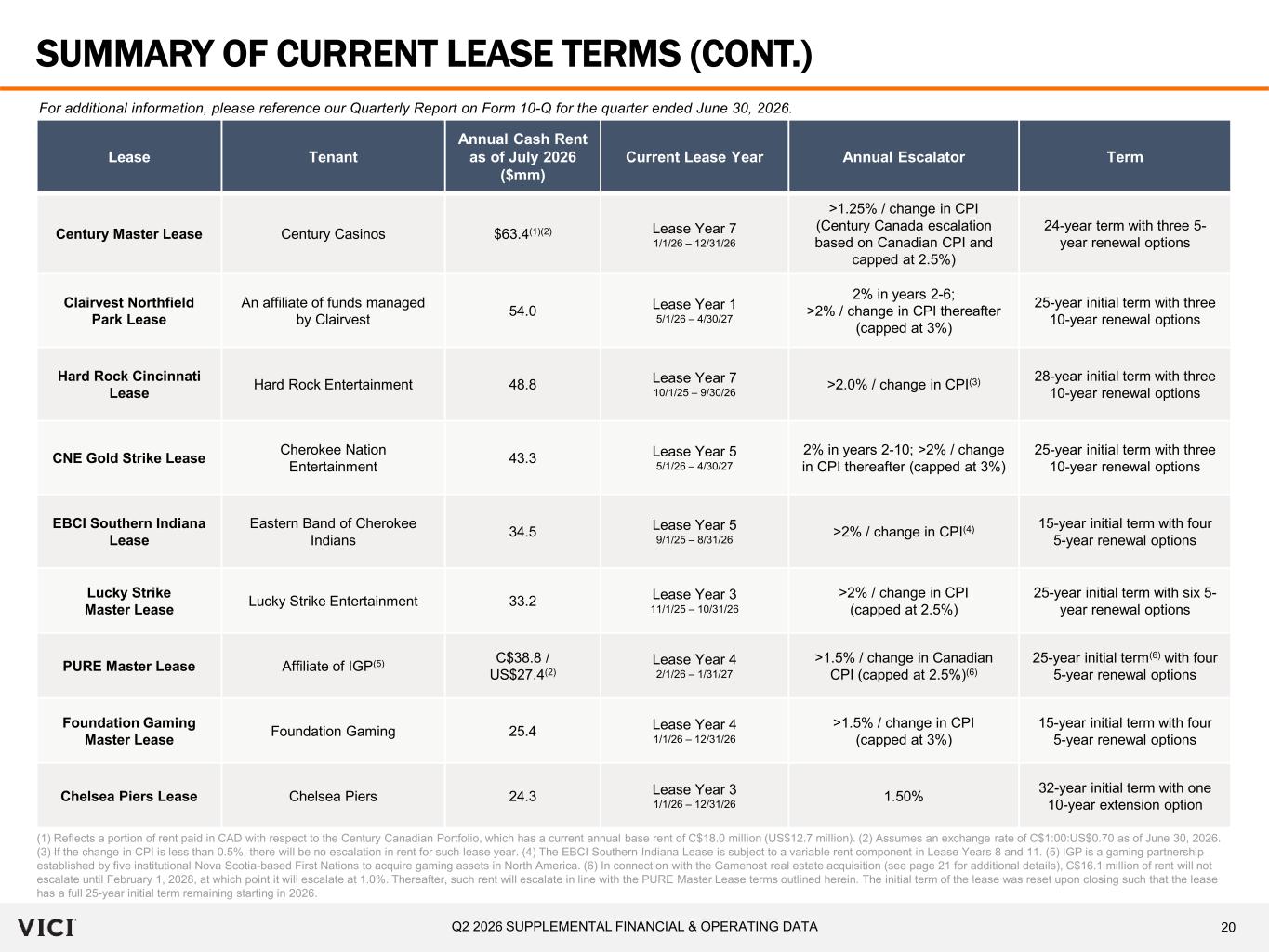
Yeah, this is Erin Ferreri, Dan. It's been a sector that we've, or a geography that we've looked at over the last five years, really spending a lot of time mapping and trying to understand the tax and legal structuring, as well as the financing markets that could support investments outside of the U.S. and Canada. St. Croix is a bit of a cheat because it's a U.S. Virgin Island, so it still is a U.S. territory, but it is a geography that we continue to look at expanding.
Operator
Thank you. Our next question comes from the line of Wesley Galladay from Baird. Your question, please.
Operator
Wesley, your line is open. You might have your phone on mute.
Operator
Our next question comes from the line of Ronald Camden from Morgan Stanley. Your question, please.
Hey, good morning. This is Jenny on for Ron. I just want to dig a little bit on the allowance of credit losses. It seems like on the 10Q note, saying a tenant issued a new senior secured debt at a lower credit rating. Maybe just talk a little bit more on that. Is Is it tenant-specific or macro-driven? Yeah, just provide some, like, I just want to have a better understanding on that. Thank you.
Yeah, it's Gabe here, and I can answer this one. So our CECL allowance, we look at the senior secured credit rating of our tenants and their parent guarantors. To the extent that that parent guarantor doesn't have senior secured debt, we use a proxy company. So for one of our private tenants, we had been using a proxy tenant, a proxy company historically to estimate the credit rating and their credit profile. Last quarter, they actually issued debt privately, and we used that updated credit rating to estimate the CISO allowance. So that's why we saw the big change quarter over quarter. Property is performing well. Great insight into the property performance, as we just spoke about, get the monthly financials. and this was just a function of additional information that was out there that we could put into our model.
That makes sense. As a follow-up on the watch list, anyone else that is kind of on your watch list right now, or you feel pretty good on the rest of your tenant?
Sure. So we actually don't have a watch list. As we discussed, we go through every single lease and loan in our portfolio on a quarterly basis. So we have complete transparency into our borrowers and tenant performance. That's why it's really important that we get tenant and borrower level financials. So, our ability to look at every single loan and lease in our portfolio is what we focus on and not individual investments.
Operator
Thank you. And our next question comes from the line of Todd Thomas from KeyBank Capital Markets. Your question, please.
Yeah. Hi. Thanks. I guess just following up on, you know, the credit profile or portfolio and the loan. So I was wondering if you could provide some additional detail around the loan modification in the quarter. I think it was $90 million. And can you clarify whether this is separate from the golf course development loan that I think last quarter was placed on a non-accrual status?
Sure. So we have a $90 million senior secured loan collateralized by a leisure and hospitality digitality asset. It's about 3% of our loan portfolio. During the quarter, we extended the maturity date and reduced the interest rate percent on that loan to right-size the yield as the asset continues to ramp. The interest on the loan is being paid monthly in cash. In return, we received additional collateral and the borrower will be making amortization payments to reduce our loan balance. This is a great example of the active asset management approach that we take with our borrowers and tenants. There's an issue. We work constructively with them to identify a solution that provides value to both parties. And then on the second half of your question, this is a separate loan and the loan we disclosed in Q425, which is on non-accrual staff.
Okay. All right. That's helpful. And then I wanted to follow up on prior question around on Caesars. And you've previously indicated that both parties would prefer a resolution to move forward rather than, I think, allowing it to remain a little bit of an ongoing distraction. And I realize gaming operations have improved somewhat, but with the annual rent escalator approaching and CPI still running above the contractual floor, does that create a greater sense of urgency around reaching a broader portfolio solution? Should we think about, you know, resolution occurring over the next several quarters rather than years? Any update around that?
Yeah, Todd, we wouldn't be able to give you any kind of precise timetable. I wouldn't say that's necessarily a major factor. I think the thing to keep in mind is that in the case of Caesars, they're obviously undergoing a very significant M&A transaction with many, many moving pieces and many stakeholders, including regulatory. So how any conversations will fit into that, which, again, is a fairly prolonged timescale. I believe Caesars recently, or it might have been Fertitta Entertainment, was indicating about a 12-month time frame for completion of that transaction. So there's so many moving pieces, it would be very difficult for anybody to predict with precision a timetable for any conversations that we might have.
Operator
Thank you. This does conclude the question and answer session of today's program. I'd like to hand the program back to Ed for any further remarks.
Well, again, we'll just thank everybody for their time today, both from the sell side and the buy side. We realize it's a very, very busy time of year. Wish you a good rest of the summer, and we will see you again in late October.
Operator
Thank you, ladies and gentlemen, for your participation in today's conference. This does conclude the program. You may now disconnect. Good day.