Operator
Good day, everyone. Welcome to Western Alliance Bank Corporation's fourth quarter 2024 earnings call. You may also view the presentation today via webcast through the company's website at www.westernalliancebankcorporation.com. I would now like to turn the call over to Myles Pondelik, Director of Investor Relations and Corporate Development. Please go ahead.
Thank you and welcome to Western Alliance Bank's fourth quarter 2024 conference call. Our speakers today are Dale Gibbon, interim CEO and CFO, Steve Curley, Chief Banking Officer for the National Business Lines, and Tim Bruckner, Chief Banking Officer for Regional Banking. Before I hand the call over to Dale, please note that today's presentation contains forward-looking statements which are subject to risks, uncertainties, and assumptions. Except as required by law, the company does not undertake any obligation to update any forward-looking statements. For a more complete discussion of risks and uncertainties, that could cause actual results differ materially from any forward list and statements, please refer to the company's FCC filings. Cuneiforme came out yesterday, which are available on the company's website. Now for opening remarks, I'd like to turn the call over to Dale Gibbons.
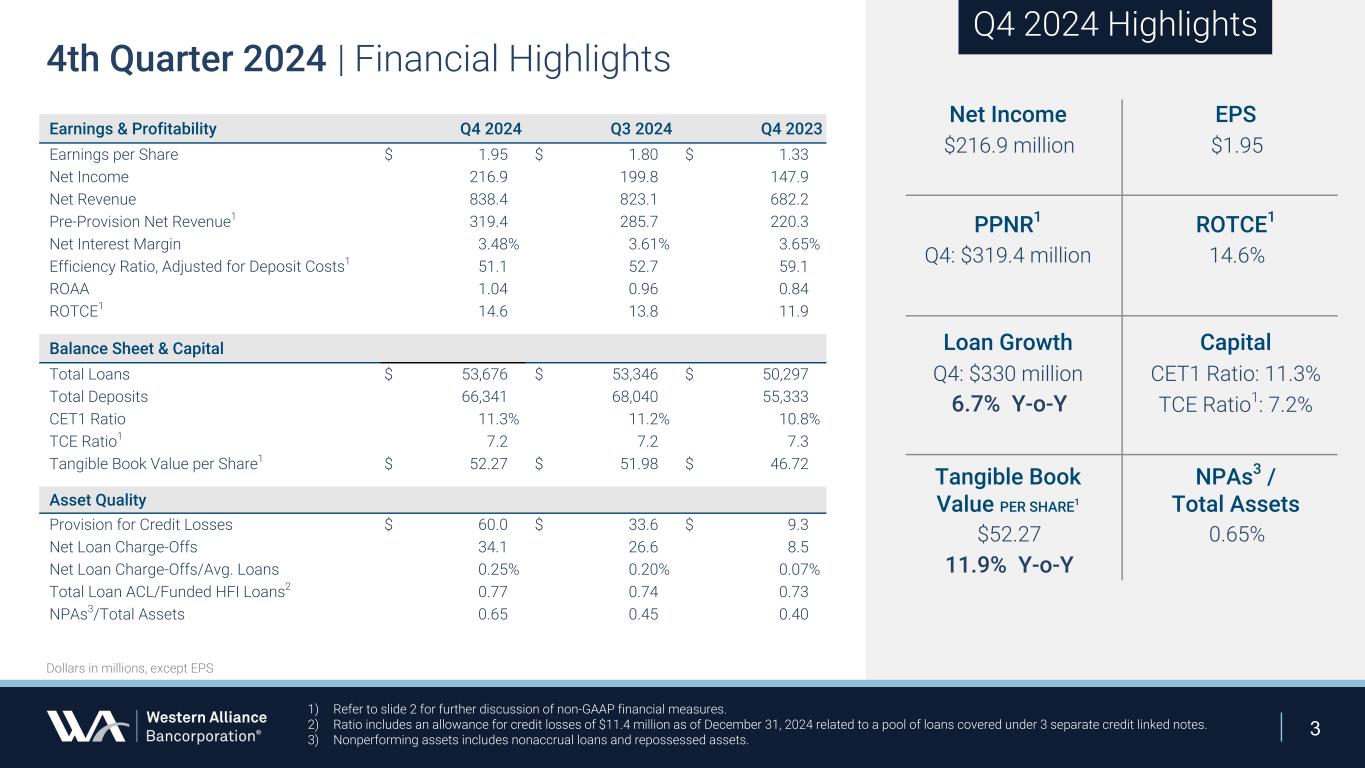
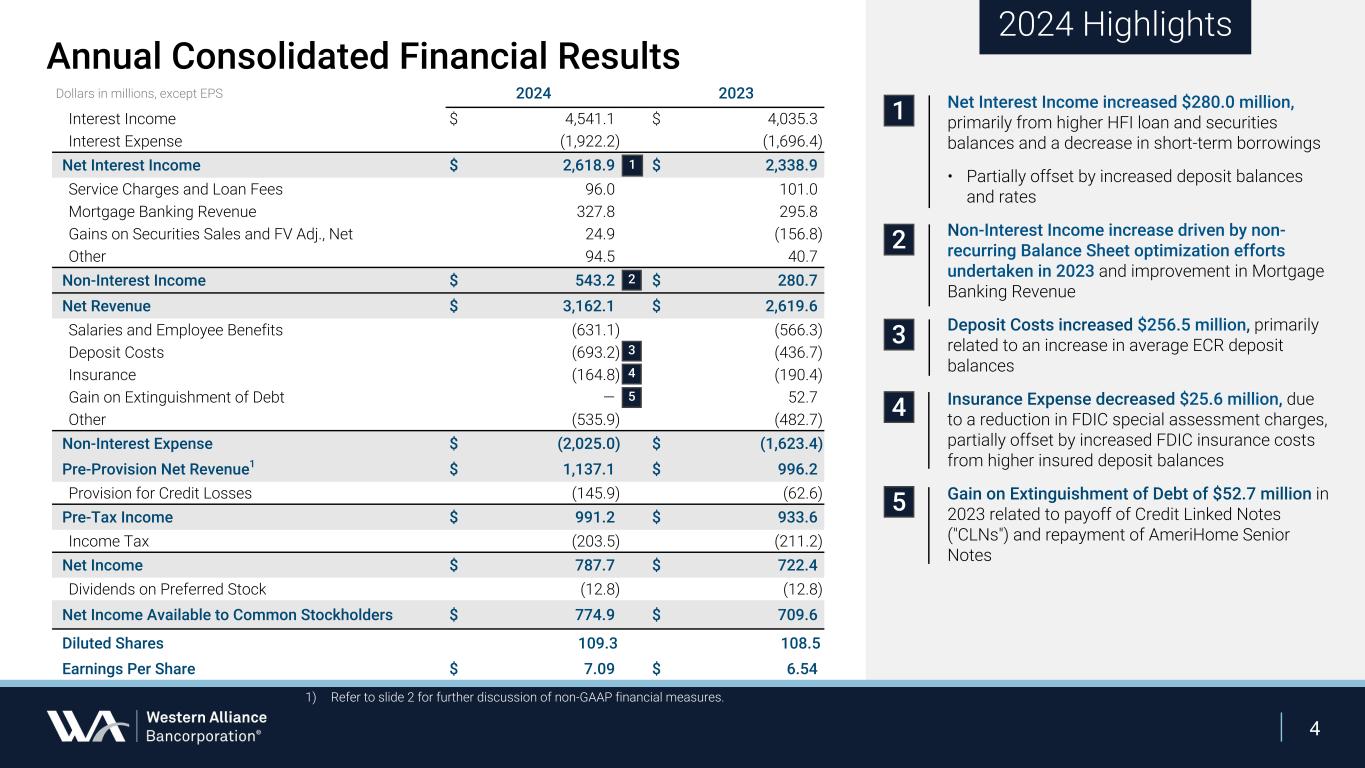
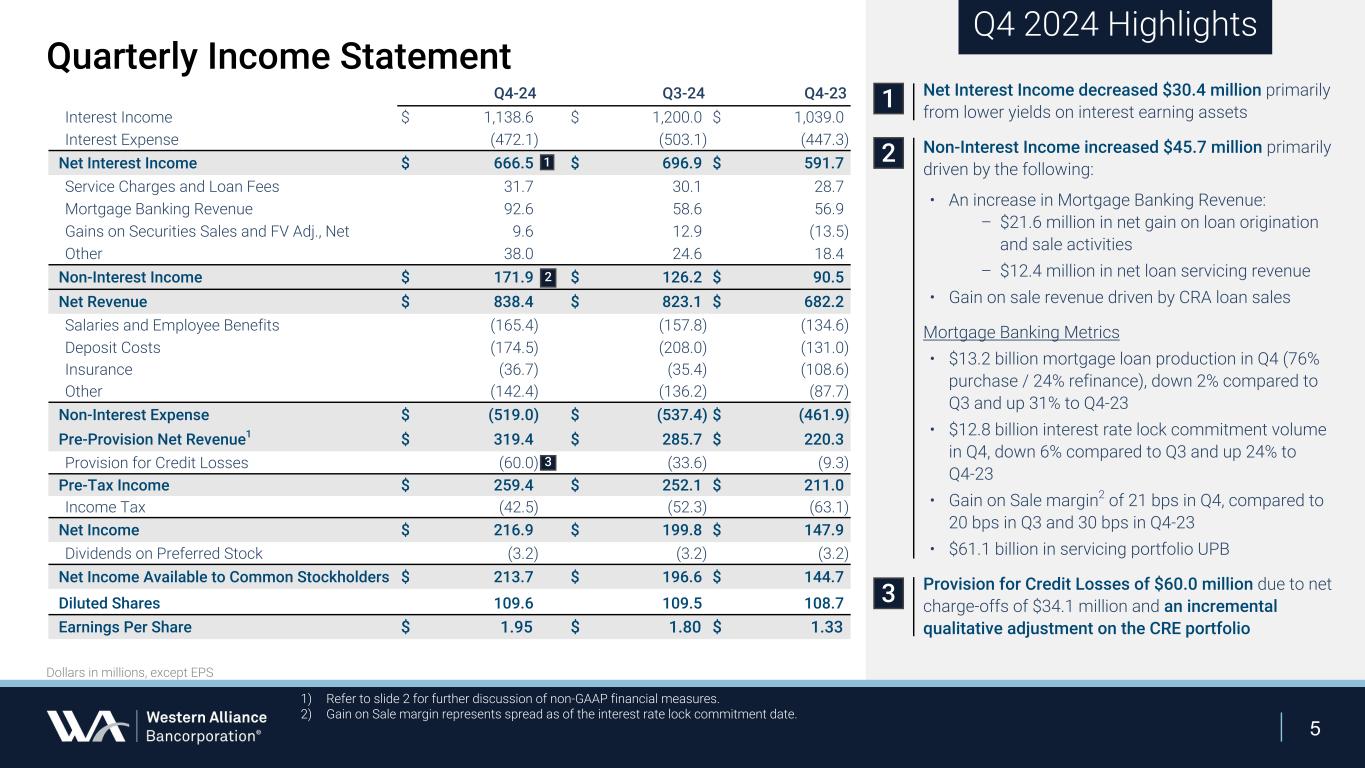
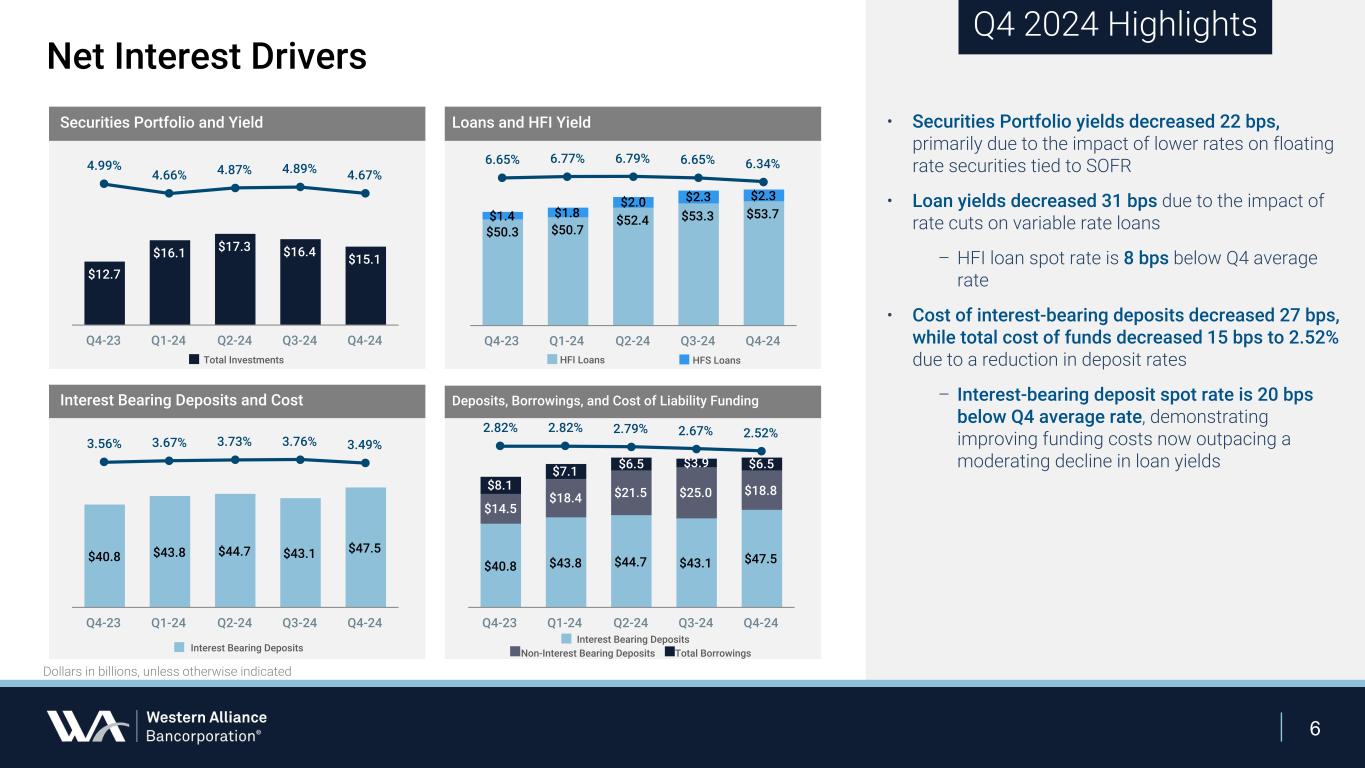
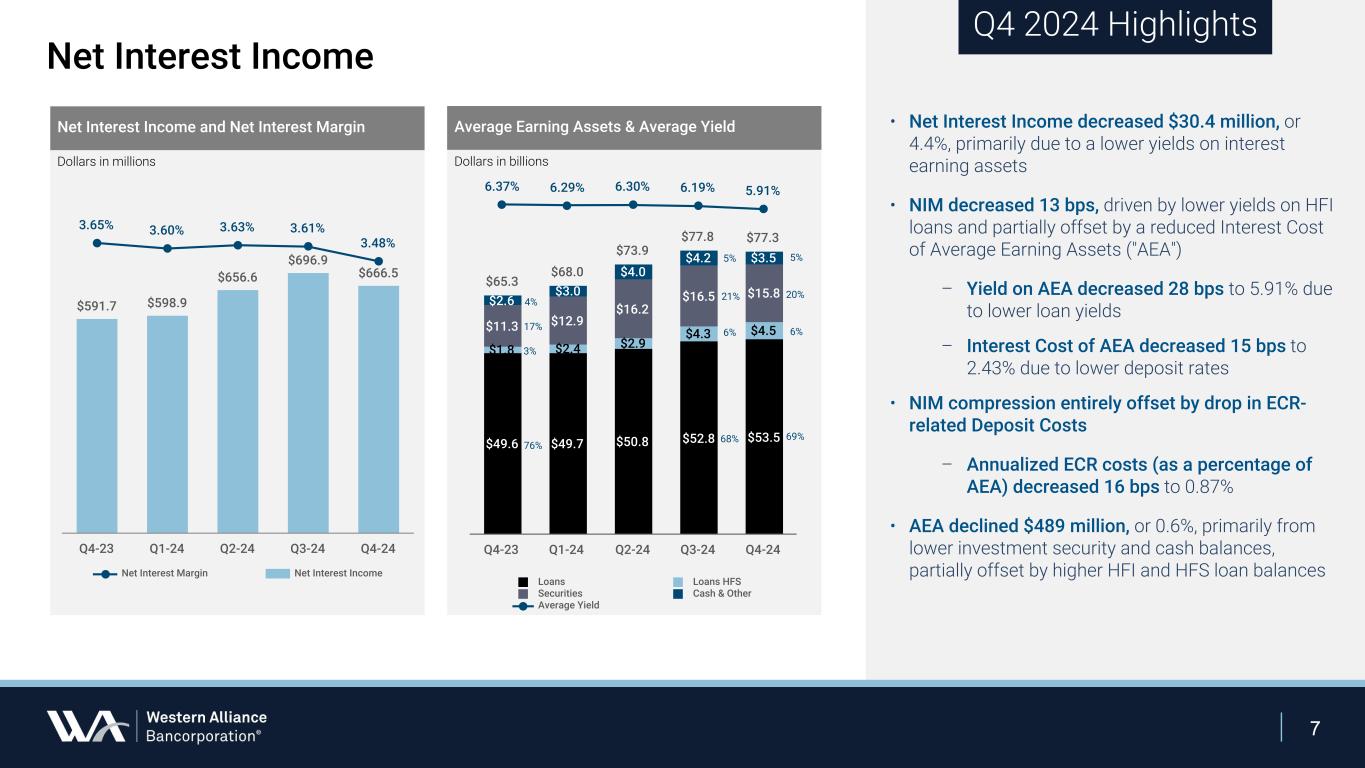
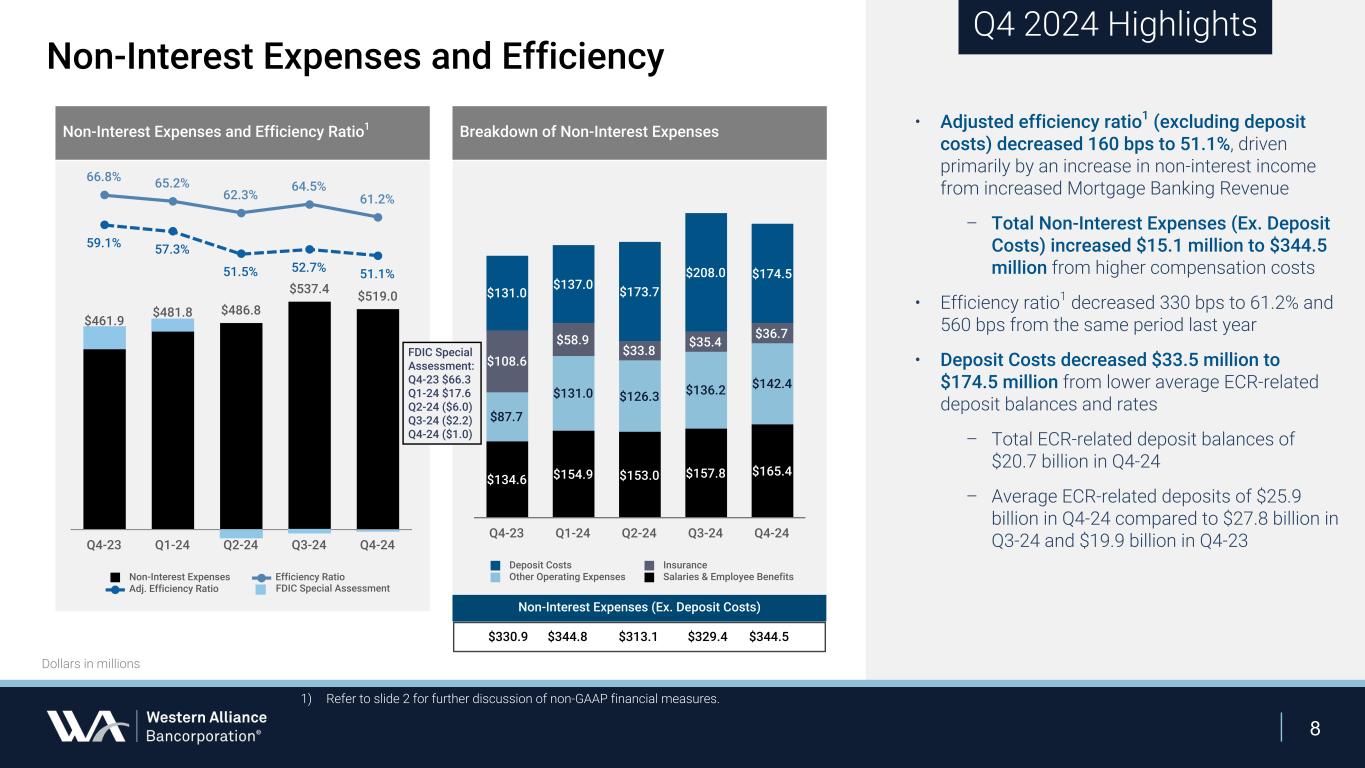
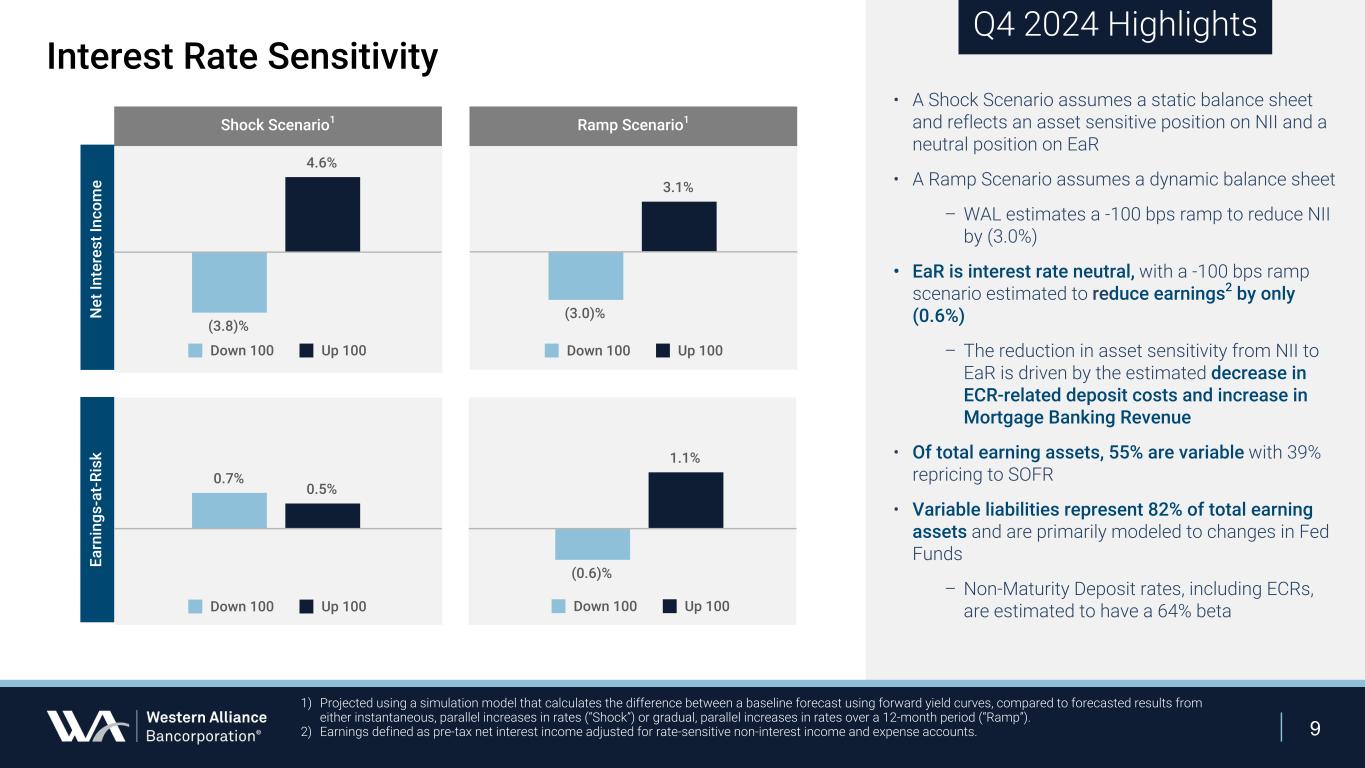
Dale Gibbons Good afternoon, everyone. I'll make some brief comments about our fourth quarter and full year 24-24 earnings, then review our financial results and drivers in more detail before handing the call over to the other two members of the executive committee leaving the company during Ken's absence, who's doing quite well and we expect to be back soon steve curly our chief ranking officer for national business lines will discuss our business balance sheet composition and loaded deposit for both drivers tim bruckner our chief banking officer for regional banking will then discuss asset quality trends i'll close our prepared remarks for reviewing our 2025 outlook before opening the call up for questions and answers before addressing our financial results i want to express our heartfelt sympathy to those affected by the southern california wildfire fires we have a a longstanding presence in the area and are saddened for those whose lives and livelihoods have been upended by this tragedy. Western Alliance has already taken actions and stands ready to support our employees, clients and communities in the rebuilding efforts. We are also currently in the process of providing direct financial support to relief efforts. Regarding borrower exposure for the company, we've identified 17 properties experiencing either a significant or total loss with a combined exposure of under 15 million. Each of these properties had sufficient insurance coverage above our loan amounts with Western Alliance designated as a loss payee. Therefore, we expect negligible direct financial impact to the company. Looking back over 2024, Western Alliance completed a significant liquidity build where we purposefully prioritized growing deposits in excess of loans and deployed this excess liquidity into lower yielding high quality liquid assets, which is demonstrated in our 31% net marginal loan to deposit ratio for the year. With this stout liquidity foundation, we are well positioned to resume deploying future incremental deposits into more normal earning asset mix that prioritizes higher yielding loan growth while maintaining a low 80s loan to deposit ratio. This positions Western Alliance in 2025 to further drive down cost of deposits, expand our net interest margin, improve profitability, generate significant operating leverage as our efficiency ratio closes in on 50 percent on an adjusted basis and a move toward a higher teens return on tangible common equity by year end looking at our financial performance western alliance ended the year with solid earnings generating a dollar 95 per share for the fourth quarter and 709 for 2024. i'm also pleased to report pre-provision net revenue growth was 12 linked quarter unannualized these results demonstrate the power of our credit and deposit platforms and are gathering success in earning fee income from clients while proactively managing asset quality during a changing rate environment lastly while tim will discuss asset quality in detail later i note the completion of the significant number of appraisals toward the end of 24 and a material decline in special mention loans make it makes us increasingly confident the bulk of cre migration to classify is behind us and net charge us in 2025 will be comparable to that experience in 2024. For the year, WAL produced net revenue of $3.2 billion, net income of $788 million, and earnings per share of $709. Net revenue and pre-provision net revenue increased 21% and 41% and 14% respectively from the prior year, demonstrating the strength of bank's earnings engine throughout the liquidity restocking process. Balance sheet repositioning actions that fortified our liquidity and capital basis now position the bank to resume greater risk adjusted balance sheet growth going forward notably net interest income increased 24 million more than ecr related deposit cost did during the following rate environment turning to fourth quarter trends and business drivers western alliance generated pre-provision net revenue of 319 million net income of 217 and EPS of 195. Net interest income decreased $30 million during the quarter to $667 from lower yields on interest-earning assets, along with approximately flat average earning balances. Loan growth was back-weighted as we experienced some deferral of fundings into Q1 2025 and pay downs. Non-interest income of $172 million rose $46 million quarter over quarter from higher mortgage banking revenue commercial banking fees and income from equity investments mortgage banking revenue grew 34 million quarterly to 93 million as mortgage loan production rose 31 year over year with a firming gain on sale margin of 21 basis points in the fourth quarter amerihomes earnings benefited from secondary sales from seasonally strong demand for cra qualifying loans and mortgage servicing rights where lack of industry supply benefits our business margins as a regular seller additionally we are making product investments to tap into new mortgage customers that could benefit us in a higher mortgage rate environment non-interest expense declined 18 million quarterly to 519 as deposit costs fell over 33 million to 174. deposit cost reductions are poised to continue pulling overall expenses lower throughout 2025. In aggregate, deposit costs fell by $3 million more than net interest income declined this quarter, which exemplifies our balance sheet flexibility and nominal net interest income related earnings volatility during a changing rate environment. Provision expense of $60 million resulted from a $34 million in net charge-offs and an incremental qualitative adjustment on the CRE portfolio. Lastly, our tax rate was lower than expected in Q4 due to several factors, including an increase in solar tax credits from projects placed in service turning to our net interest drivers you'll see the impact of falling rates on our asset yields but continued accelerating deposit repricing is reducing the overall cost of liability funding which will expand margins going forward for the quarter the yield on total securities declined 22 basis points to 467 help for investment loan yield decreased 31 basis points to 634 due to the impact of rate cuts on variable rate loans. The cost of interest-bearing deposits declined 27 basis points from a reduction in deposit rates, which continues irrespective of potential future rate cuts. Indicative of how funding cost reductions are offsetting lower asset yields, the 20 basis point difference between the year-end spot rate and the Q4 average rate for interest-bearing deposits exceeds the eight basis point difference for both held for investment loans and securities portfolio yields. Throughout the fall of last year, market expectations for steep successive rate cuts were so significant that one-month and three-month SOFR were lower than said funds effective. This pressured our margin as most variable rate yields are tied to SOFR, but index deposits and ecrs are usually tied to the fed funds rate as rate cut forecasts have tempered significantly this relationship has changed and now term SOFR is essentially aligned with fed funds effective this is why the difference between spot rates for loans and securities and those of deposits was 12 basis points wider to start 2025 than it was for the average during the fourth quarter Additionally, we have further reduced deposit rates and DCRs in January, while SOFR remains flat as no-cut action is expected from the FOMC tomorrow. Total cost of funds declined 15 basis points to 2.52 percent and would have fallen further absent the typical seasonal decline in deposits causing a larger portion of earning assets to be funded by borrowings, which we expect to repay fairly rapidly. In other words, we are seeing funding cost tailwinds emerge outside of just ecr related deposits in aggregate net interest income declined 30 million from lower yields on earning assets net interest margin compressed 13 basis points from q3 to 348 however i'll point out the overall balance sheet profitability continues to improve and as annualized ecr related deposit costs to average earning assets which they fund fell 16 basis points quarter over quarter, outpacing the net interest income decrease rooted in term SOFR pricing, moving ahead of effective Fed funds reductions. Overall, non-interest expense declined $18 million in Q4 as the positive cost fell $34 million from lower rates and average balances, while other operating expenses increased $15 million, mostly from the accrual tree-ups due to the annual bonus. We expect continued reductions in deposit costs and ECR rates as the full benefit of a lower rate environment is realized our adjusted efficiency ratio for the quarter improved by 160 basis points to 51 percent void by higher mortgage banking revenue regarding interest rate sensitivity we've included both a static shock and a dynamic balance sheet ramp scenario to better illustrate the factors that make Western Alliance interest rate neutral on an earnings at-risk basis. We are forecasting two 25 basis point rate cuts this year, which is similar to what the futures market currently expects. In the bottom left quadrant, you will see that our static balance sheet stock scenario interest-sensitive earnings should increase modestly in both the up 100 and the down 100 shocks, making us essentially rate neutral. This is exactly what happened in Q4, with a decline in net interest income more than offset by growth in mortgage banking revenue and a material decline in ECR-related costs. This dynamic is indicative of the interplay between our mortgage business and higher beta ECR-related deposits, which act as a natural hedge to earning assets at a more variable rate and thus make us appear asset sensitive on a reported net interest income basis. Depending on the trajectory of interest rates, we are prepared to make adjustments to our loan and securities mixes to maintain our largely rate neutral and earnings profile, if needed. Chief Curley will now take us through the balance sheet dynamics. Thanks, Dale.
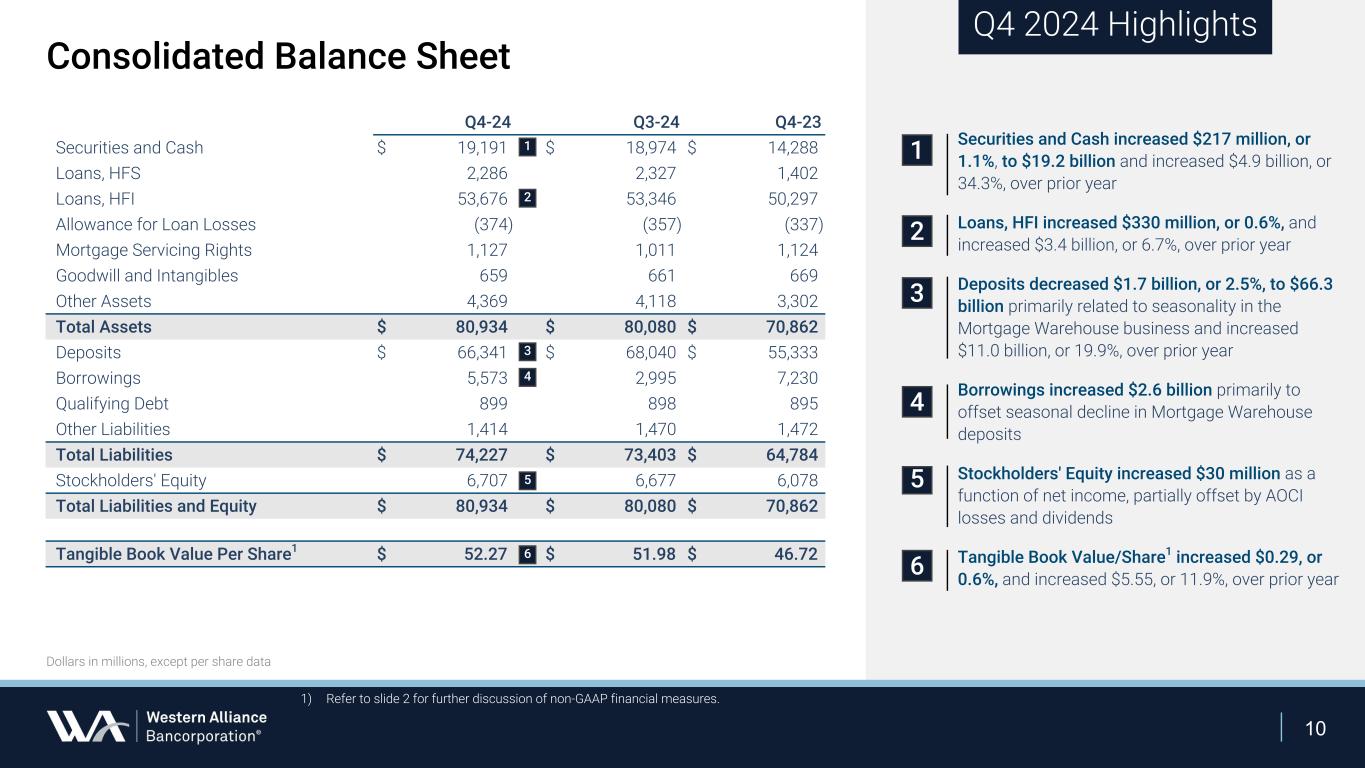
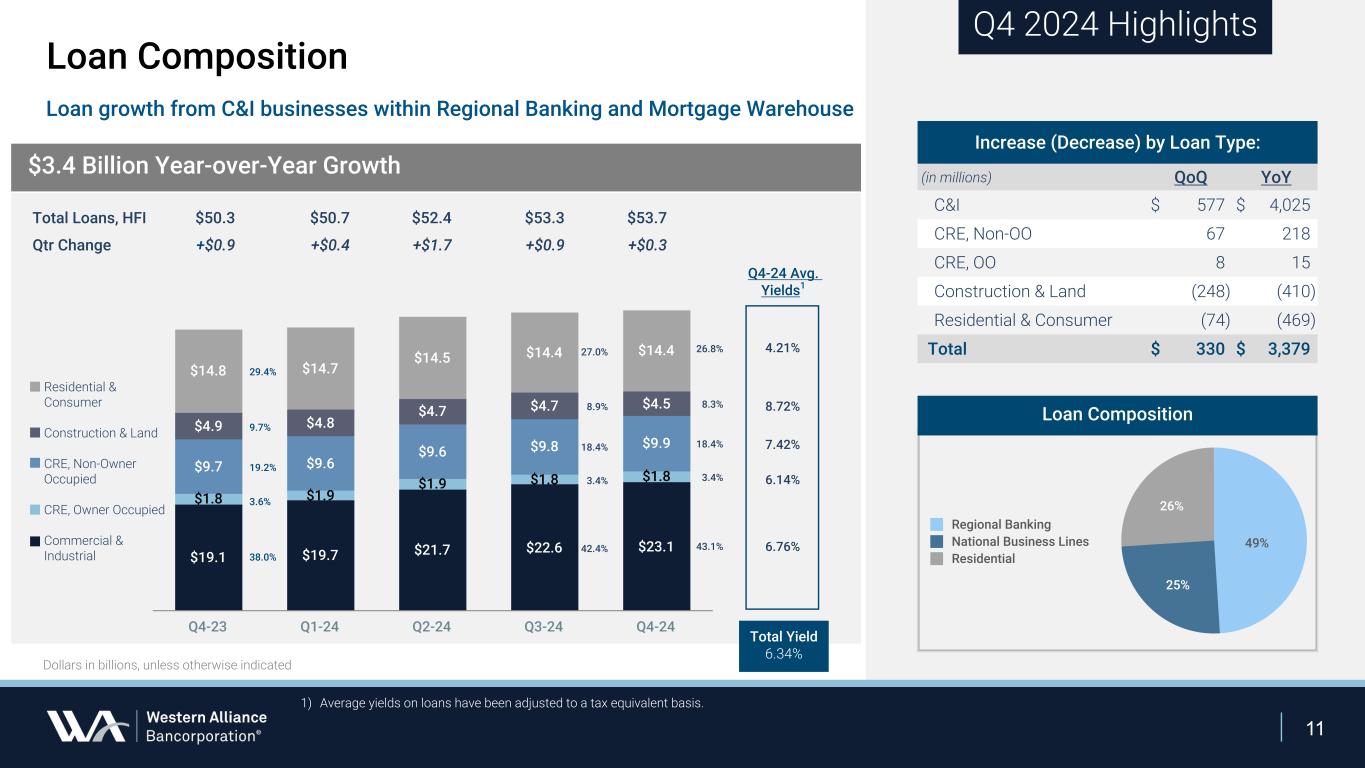
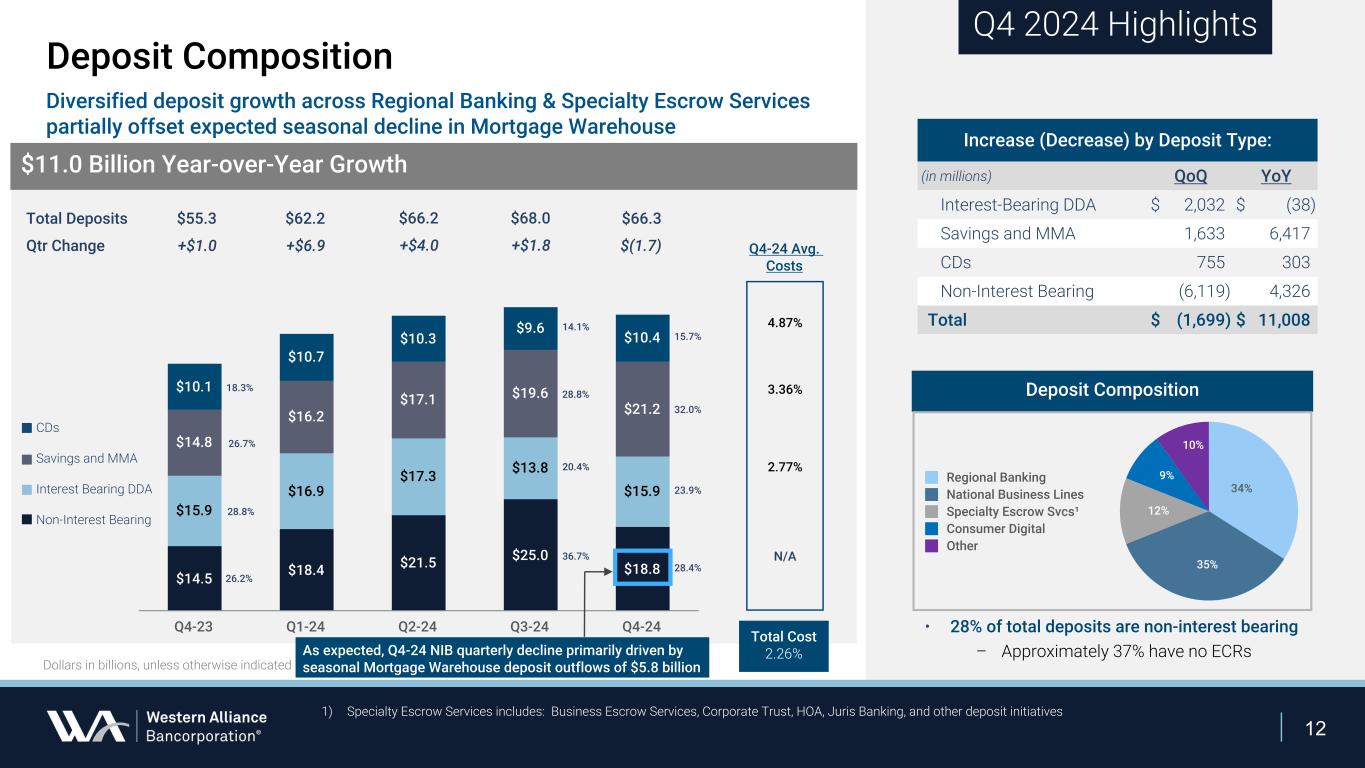
The balance sheet ended the year at approximately $81 billion, which reflected solid loan growth of $330 million and an increase in securities and cash of $217 million. As previously mentioned, deposits declined 1.7 billion, primarily driven by expected short term seasonal mortgage warehouse factors, but still grew 20% year over year from diversified strength across the franchise. Q4 outflows were comparable on a relative basis to the prior year. Borrowings rose 2.6 billion to offset the lower deposits, but we expect to reduce these high cost balances as deposit growth resumes in the first quarter. Echoing Dale's introductory comments, throughout 2024, half of the $10 billion in balance sheet growth was in cash and securities while we also reduced borrowings by $1.5 billion. With this important liquidity build behind us, we are poised to generate strong risk-adjusted earning asset growth going forward. Finally, Tangible book value per share growth was suppressed by a negative AOCI charge in the fourth quarter, but still increased 12% year-over-year to $52.27. Western Alliance credit platforms provide expertise to a variety of industries and clients, which have allowed us to repeatedly produce loan growth better than overall industry. loan growth of 330 million was more muted than expected but progress continues to be achieved in diversifying the loan mix into cni loans while design runoff occurs in our resi portfolio this trend continued in the fourth quarter with nearly all growth in cni while construction loans were down 248 million resident consumer loans decreased 74 million cni loans now account for 43 percent of for investment loan portfolio compared to 38 percent a year ago while resi and consumer loans are now just over 26 of the portfolio compared to 29 at the end of 2023. in the fourth growth in the fourth quarter growth was fairly diverse as our regional and national business lines contribute 186 million and 110 million in loans respectively growth in regional banking was primarily driven by home builder finance hotel franchise and tech and innovation for the national business line mortgage warehouse and msr finance were the main growth contributors turning to slide 12 deposits grew 11 billion dollars in 2024 primarily in money market accounts and ecr related non-interest bearing in the fourth quarter deposit growth in our other businesses lines resulted from strength across regional banking business of 327 million which fully funded its loan growth as well as 2.4 billion in contributions from escrow services businesses such as jurists hoa and corporate trust combined with 111 million of consumer digital deposit growth growth in these channels allowed us to partially offset 5.7 billion in mortgage warehouse deposit deposit outflow as expected. Our deposit-focused businesses provide diversified, granular deposits that complement other deposit-gathering efforts and support our loan growth. I'll now hand the call over to Tim Brukter.
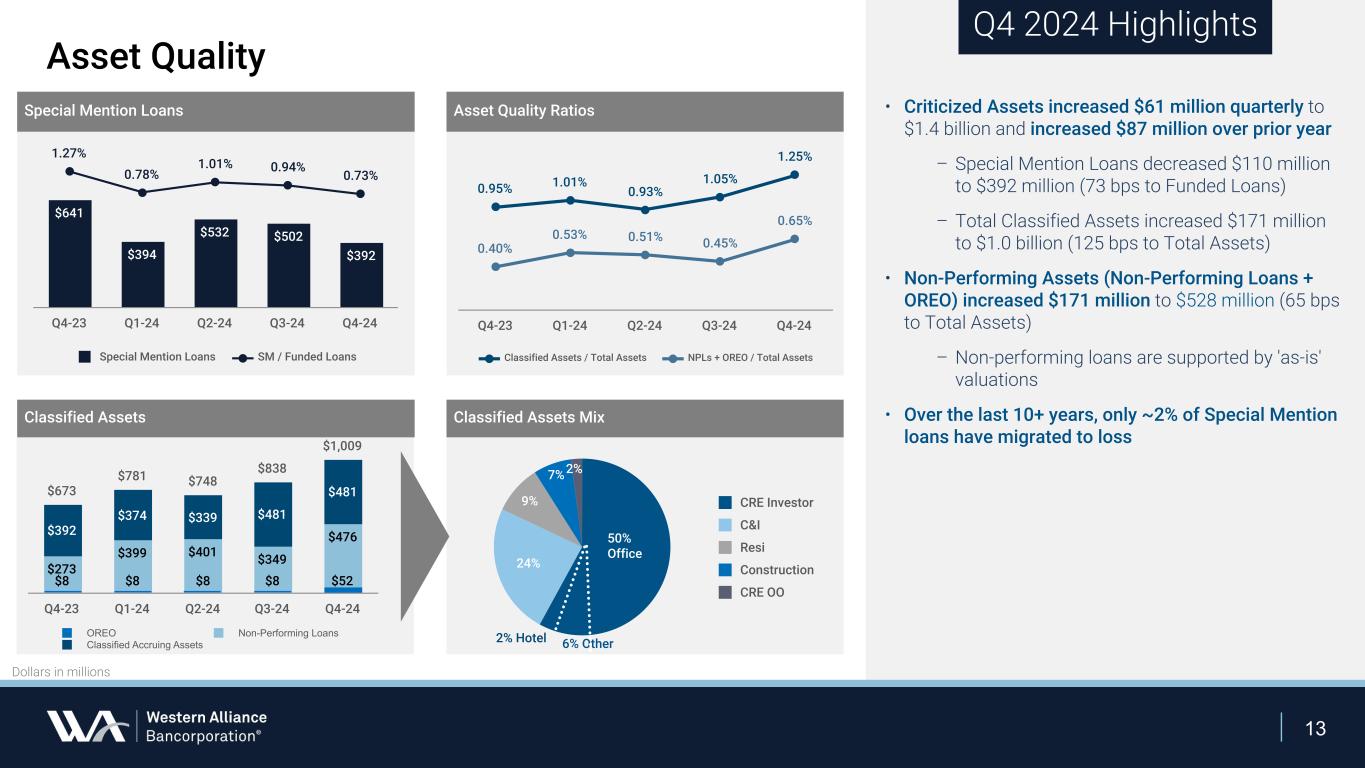
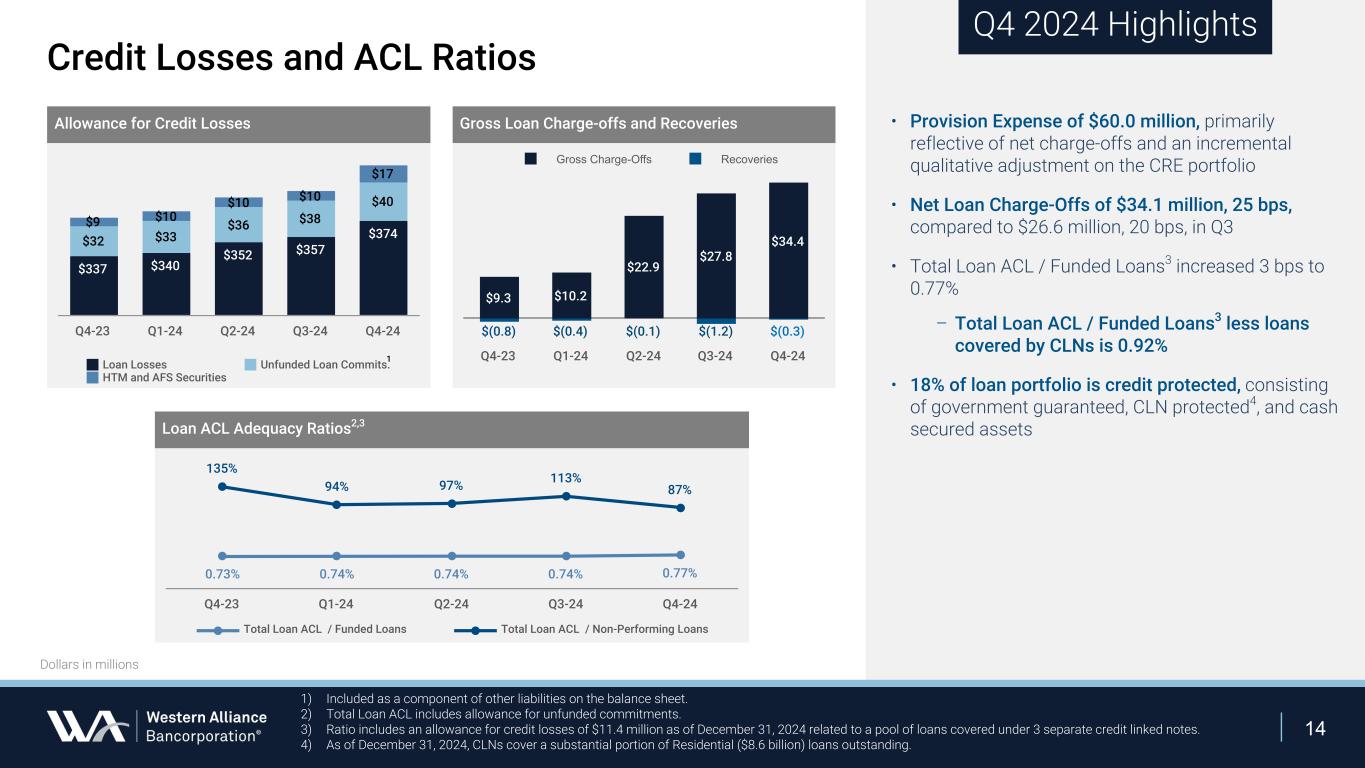
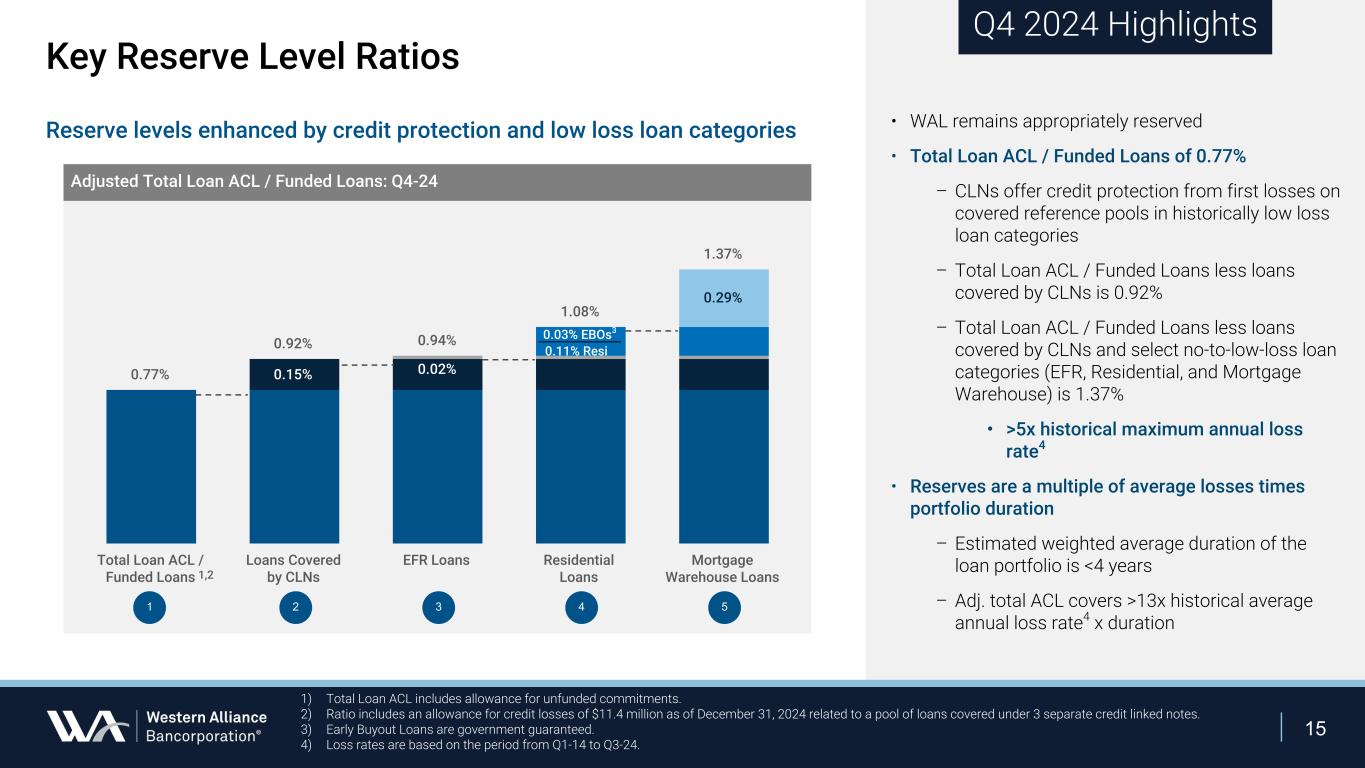
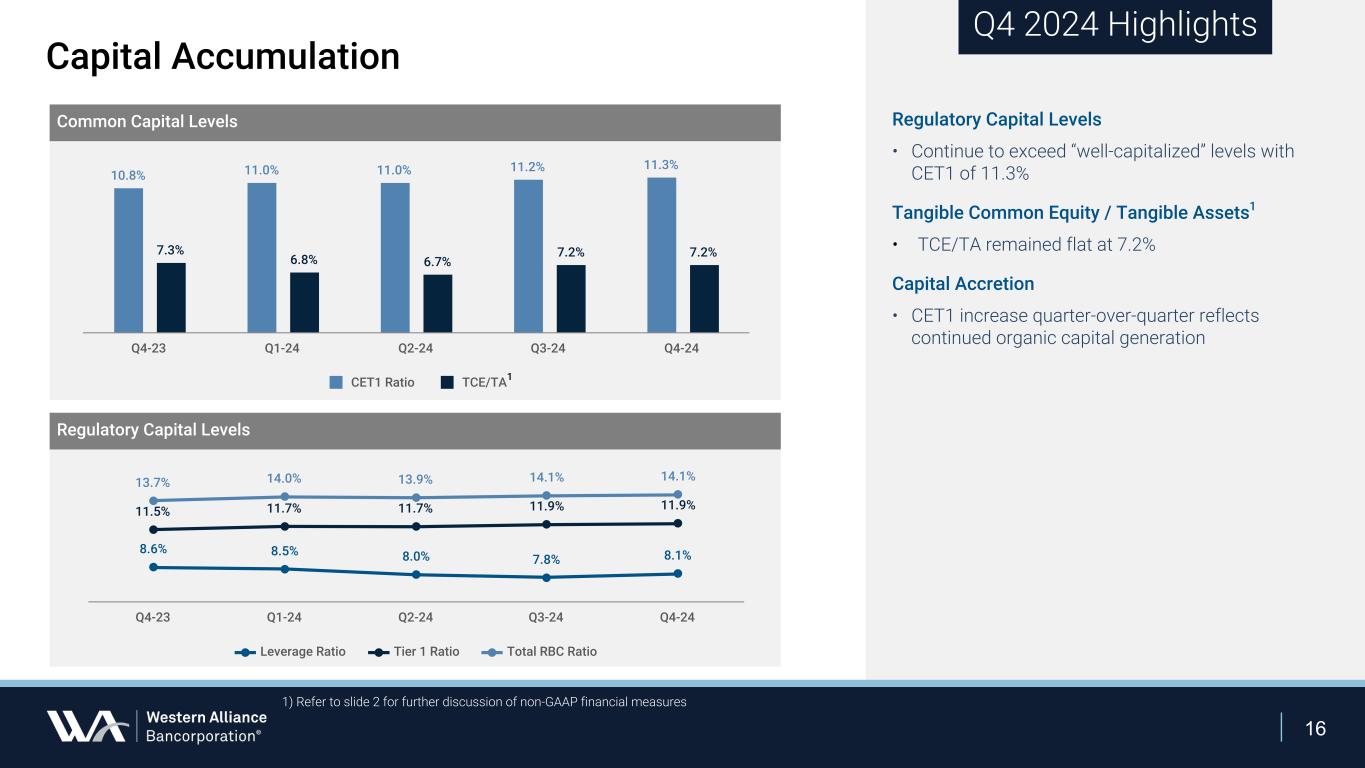
Tim Brukter Thanks, Steve. Overall, asset quality continues to remain resilient. In quarter four criticized assets rose 61 million, as special mention loans declined to 110 million, while classified assets increased to 171 million. Criticized assets are only 87 million higher from a year ago and declined from 1.85 percent to 1.73 percent as a percentage of total assets during the same time period, reflecting the interplay of upgrades and downgrades driven by our proactive risk mitigation strategy. We expect the total criticized asset pool remain stable in Q1 and and then declining throughout 2025. Due in part to our proactive management of trouble situations, which requires pressing for re-margin or ongoing borrower investment in troubled loans, non-performing assets as a percentage of total assets increased to 65 basis points during the quarter. We expect to see non-performing loans decline as we work through the resolution process. These loans have been reserved or charged down to current as-is values and are revalued on an ongoing basis our acl was increased in support of revaluations in the in the context of our proactive strategy as a green shoot we're beginning to see increased lease activity and office properties that have been reset a compelling example of this is the downtown san diego property which migrated into other real estate owned early in Q4. Since taking control of this asset and resetting the basis and rents to the market, we reached agreement to lease five and a half additional floors. Occupancy has rebounded from 44% to 62% in just a little over two months. Quarterly net charge-offs were $34 million or 25 basis points of average loans and 18 basis points for the year. We expect charge-offs to be relatively similar in Q1, followed by a generally declining trend throughout 2025 as we continue to make progress remediating our CRE portfolio. Provision expenses $60 million added to reserves to cover charge-offs and augmented our CRE reserve. Our classified loans are supported by as-is valuations giving effect to the present market conditions. Our ACL for funded loans increased 17 million from the prior quarter to 374 million. The total ACL to funded loans ratio of 77 basis points rose three basis points from the prior quarter. Slide 15 shows the updated ACL walk we've regularly provided to add more context behind our allowance methodology relative to our peers. Our ACL moves up from 77 basis points to 1.37 percent when incorporating the effect of credit link notes, as well as the low to no loss loan categories like equity fund resources, our low LTV and high PICO resi portfolio, and mortgage warehouse. Compared to our 50 to 250 billion dollar asset peer banks we benefit from greater credit link no support as well as a greater percentage of loans in the low to no loss categories emblematic of a balance sheet with a low risk profile our risk weighted assets to tangible assets ratio is one of the lowest among the largest u.s banks at just under 70 percent i'll now hand the call back to dale thank you jim our CET1 ratio increased approximately 10 basis points to 11.3 during the quarter.
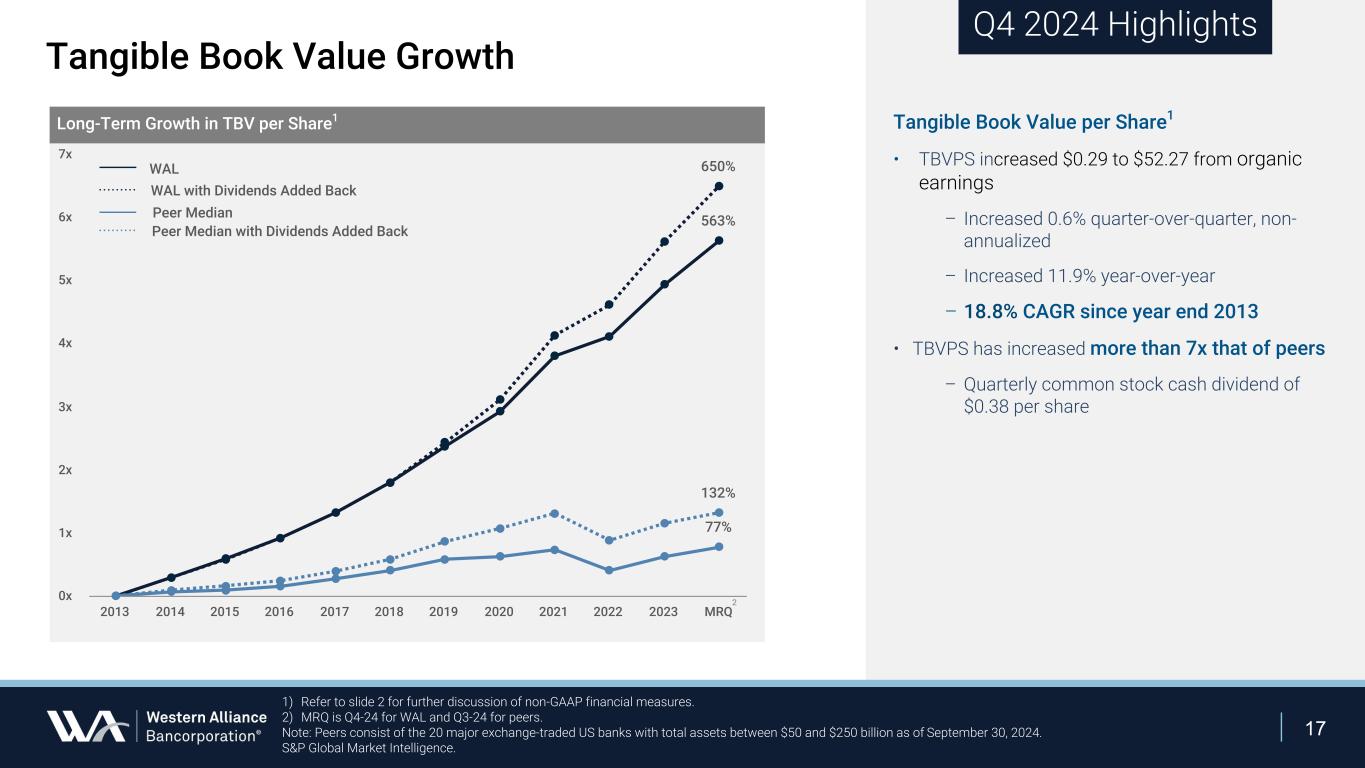
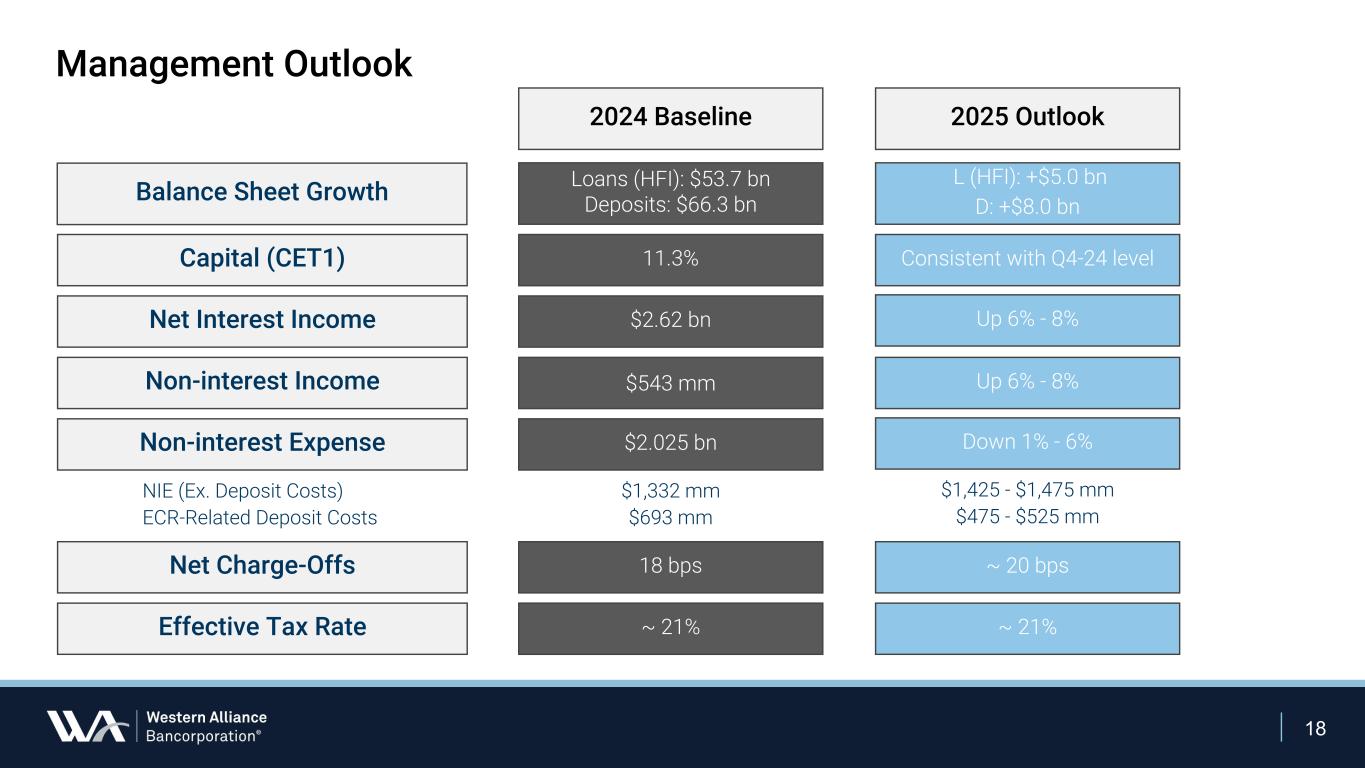
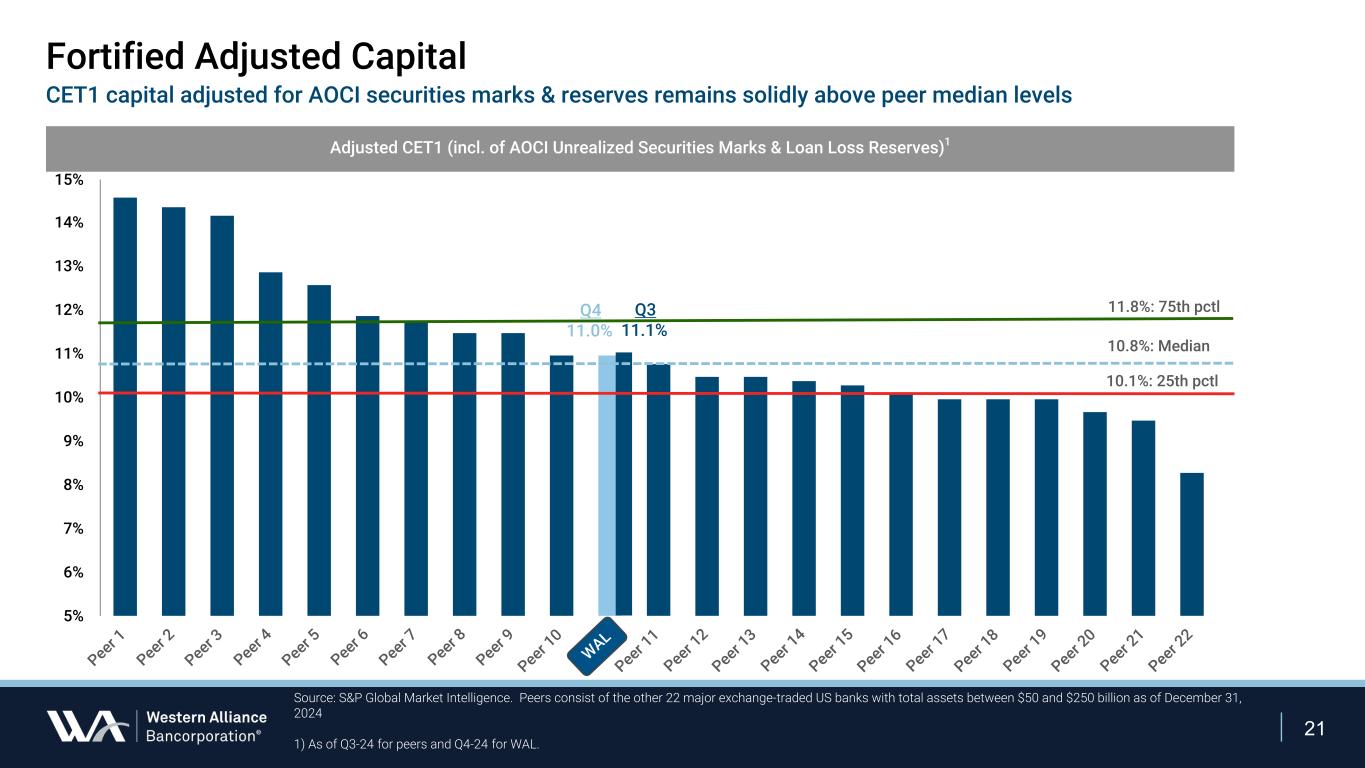
Our tangible common equity to total assets remained flat at 7.2. Given the evolving conversation on BASIL III endgame, but I mentioned that our CET1 ratio including AOCI marks as well as the loan loss reserve is 11%, which is down slightly from 11.1 at September 30th. Please note the peer data using the appendix of this presentation are from C3 when AOCI was pronounced across the industry for the peers. Even with our AOCI drag and Q4 applied to wall, our adjusted capital still ranks above the median of the peer group. As previously mentioned, our tangible book value per share increased 29 cents to 52.27 at year end, which reflects solid earnings growth that mitigated negative AOCI impacts of higher rates. Consistent upward growth and tangible book value per share remains a hallmark of Western Alliance and it's exceeded peers by seven times over the past decade turning to the management outlook exiting 2024 we have essentially completed our balance sheet transformation that considerably increased our deposits and liquidity buffer while still growing earnings and capital in 2025 we expect continued thoughtful balance sheet growth driven by a diversified credit and deposit platforms with an origination mix designed to drive net interest income growth and margin expansion We expect loan growth of approximately $5 billion for the year. It should hold a loan-to-deposit ratio of around 80 basis points, 80%. Deposits are expected to grow $8 billion with increased contributions from our regional banking and escrow businesses. Turning to capital, our CET1 ratio should remain fairly consistent with our year-end level of 11.3, providing balance sheet flexibility net interest income is expected to increase six to eight percent largely as a result of sustained thoughtful loan growth and expanding them that approximates 2024 level on a full year basis non-interest income is also expected to grow six to eight percent due to ongoing traction and cultivating deeper client relationships with commercial banking fee opportunities and stable mortgage banking revenue non-interest expense should decline one percent and six with ECR-related deposit costs between $475 and $525 million, which is notable moderation, primarily driven by continued rate reductions. Other non-ECR operating expenses should land between $1.425 billion and $1.475 as we continue to invest in future growth opportunities and crossing over the $100 billion asset threshold. We expect to make meaningful operating leverage that will drive our adjusted efficiency ratio below 50 percent by the end of this year. Regarding our ongoing LFI readiness efforts to transition to a Category 4 bank, we've completed significant foundational investments in risk and treasury management as well as data reporting capabilities over the last four years when we were 36 billion dollars in assets and expect incremental investments of 55 to 65 million over the next three years to make the bank cat4 ready. Of this amount, we only expect half to become incremental run rate operating expenses, which is already baked into our business plans and run rate and won't meaningfully impact our profitability. I'd also note these costs exclude total loss-absorbing capacity considerations, which are uncertain at this point. Asset quality remains resilient, and we expect full-year charge-offs of approximately 20 basis points compared to 18 basis points for 2024. Lastly, the effective tax rate for the full year should be approximately 21% as it was in 2024. So in conclusion, in 2025, you should expect Western Alliance to enter a renewed period of stronger profitability and robust earnings growth, significant operating leverage improvement, and return on tangible common equity climbing into the upper teens. At this time, Steve, Tim, and I look forward to answering your question.
Operator
Thank you. If you would like to ask a question, please press star 1 on your telephone keypad. If you would like to withdraw your question, please press star 2. Our first question comes from Ibrahim Poonawala from Bank of America. Please go ahead.
Good afternoon. I guess maybe first question just on capital. When we look at the capital, I think you mentioned you are pretty much there on CAT1 and maybe even TCE where you want to be. Like, given the $5 billion loan growth outlook, do you see the bank as having excess capital? And if you do have excess capital, would you consider buybacks or just how you're thinking about capital deployment priorities?
Yeah. So, you know, we're generating and we expect to generate certainly enough capital to support the balance sheet growth that I outlined. And we think that's kind of the highest and best use for us. But when it makes sense to be able to do something, to take advantage of a displacement at some point, should that occur in the market, yeah, I think that would be appropriate. It's not our first order of business, however.
And I guess just, Dale, when looking at slide nine, when we think about rates, I guess from a perception standpoint, it feels lower rates would be good for Western Alliance, both in terms of funding costs, mortgage banking pickup. Just give us, remind us, like, what would be the ideal rate backdrop for the bank as we think about overall earnings growth, be it on the fee income side, and as well as from a net interest margin, factoring the ECR costs?
Yeah, I think the rate decline is best for the company. So, you know, right now we're seeing, i'm going to say maybe capitulation from home buyers in terms of even going into seven percent mortgages um i you know if they were you know maybe in the low sixes i think that would be maybe more substantial and maybe avoid kind of the flash in the pan type of thing which maybe occurred during the pandemic when they dropped so sharply so if we could if we could have a you know a slowly declining rate environment that's what i would that's what i would prefer that obviously eases maybe credit concerns as well as debt service coverage costs also ameliorate to some degree. So, but, you know, conversely, you know, we're ready kind of for everything. I mean, we can handle, you know, an increase in rates. We can have, you know, a steeper decline. You know, right now we're showing that, you know, most of our loan growth has originated in basically SOFR tied variable rate, you know, but we can swap that fixed if it looks like that things are to be falling more precipitously but and just a quick follow-up your fee income guide does it assume a big uh pullback in mortgage rates or are you assuming 30 years seven years seven percent mortgage rates kind of holding for the rest of the year yeah we're not we're assuming but basically we're really aligned with kind of the the you know the futures market right now which i think would be i mean you know in terms of rates throughout the year um you know the mortgage bankers associations, and I realize that's an industry entity, came out looking for something a little more optimistic. We're not. We're looking for basically flat from 24 to 25, and I think we're kind of headed into that right now in the first quarter. The first quarter of 24 was really flat to the fourth quarter that we had of 24, so we think that looks fairly decent.
That's helpful. Thanks for taking my questions.
Operator
Our next question comes from Matthew Clark and Piper Sandler. Please go ahead.
Hey, good morning, everyone. Just on the ECR-related cost outlook, you mentioned you're assuming two rate cuts this year. What about the average ECR deposit balances this year? Is there an expectation maybe that there's not as much growth in 2Q3Q and the balances are just a little bit lower and helps keep the cost down? Any update or change there?
Yeah, so we had the seasonality drop, and I think we telegraphed that at the third quarter earnings call. In the fourth quarter, we have a lot of paydowns from ECR-related mortgage warehouse funds for property taxes. That's kind of rebounded as expected, but I do expect us to have a broader growth of our deposit base in 25 than we had in 24 and getting to your getting to your point Matt that that it's going to be there's going to be less expansion certainly in the mortgage side and we're growing in other categories we have our you know our other our escrow businesses which I think are doing well you know we've got our trust operation we have our settlement services we have our business escrow services we think the outlook for that might be a little bit better this year with the kind of the change in administration and maybe some more M&A activity going on. So, we're looking for a broader diversification in 2025.
And I'll just add, Daly, I've managed that business for quite a while. I think deposits there will be flat, but economics will be a bit better. There's not quite as much pricing competition.
So, I think, you know, you might see us improve the cost of funding beyond what just happens with the fed funds rate got it okay and then just um on average earning assets at least in the near term i think you're anticipating some growth in earning assets this year but how should we think about earning assets i guess here in the near term should we just assume you're you're paying off that debt that you took on with the seasonal inflow of uh ecr deposits here in one you well so yeah we said eight million for the year and and as we just saw you know the fourth
quarter tends to be a little bit of a contraction so it means you got to do more than eight for the first three quarters and and part of that is really kind of you know kind of paying that down no i'm looking for i'm looking for loan growth to be con you know more or less consistent you know throughout 2025 okay thank you i just said i think you know we carefully managed the loan growth in 2024 as we did the liquidity build but i mean our people are out in the market making sales calls and i you know i can kind of feel you know feel the the pipeline's filling up so you know we have exposure to private credit we like that business good risk adjusted returns
with our lender finance and build finance business so i'm bullish on my growth our next question comes from bernard von gaziski from deutsche bank please go ahead hi guys good morning um just on the expenses uh if we talk about the deposit insurance uh expenses related uh of 37 million in the quarter i know the sequential increase was due to higher insured balances are these costs that you'll be able to pass on to depositors or do you see this expense it's expected to continue to increase and assume in the $25 outlook?
Yeah, that's a great question. No, we don't expect it to increase. And we got here in part after some of the volatility last year and whereby we basically volunteered clients and said, you know what, why don't you move into an insured deposit a network situation, and there's a cost associated with that both to the FDIC as well as to the network manager. And so we did that. And so what we just implemented in the fourth quarter, I think December, we're now charging the client for that. It's actually a little bit surcharge. And we said, look, we're going to set it up that either way, you can move funds at will from fully insured or just to insured to $250,000. But note that there's a 40 basis point charge if you're going to go to the fully insured piece of it. And so some of them move back and forth. A lot of them are keeping it kind of in fully insured. And so we're actually doing a little bit better than we expected with that. But no, we've pushed that back to the clients. We've given them optionality now. And so far, it's usually working out.
And then just maybe on credit, I know, Tim, you mentioned the appraisals obtained at the end of the year. I know there was a pickup in net charge-offs in CNI, and I know that's been like kind of lumpy, you know, one-offs really throughout the year, the big pick up in 4Q. Just thoughts on, you know, your outlook for 25. I know it seems to be kind of flat and more positive, but just anything on CNI that you're seeing, any color you can elaborate on?
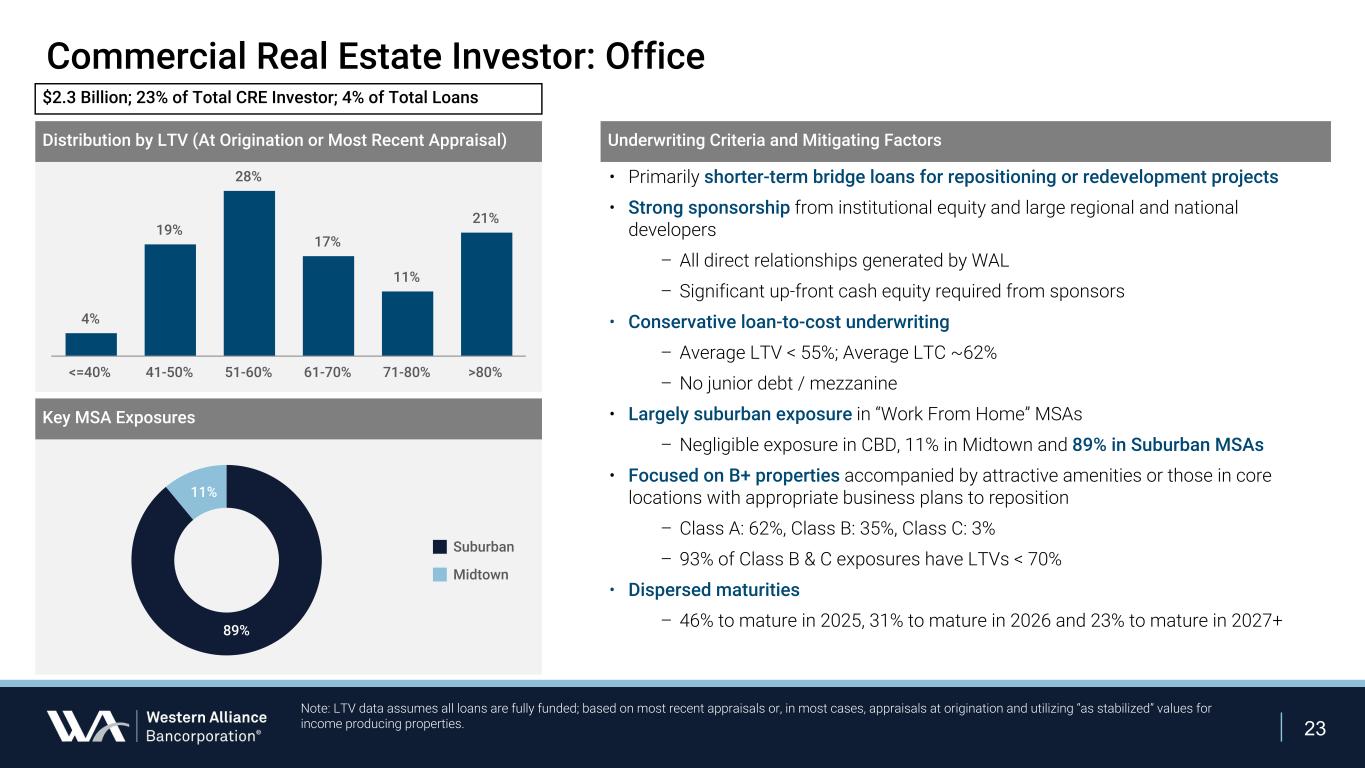
Great question. Thanks. Tim Bruckner. okay first outside of uh cre office we're not seeing any migration trends in any other in any other segment so our cni has been uh stable and and uh and very predictable in terms of performance we've we've made no um you know changes in our our business model or underwriting that would suggest that would change going forward. When we look at CRE office, I remind the listeners that we're a bridge lender in this area. So that entire portfolio is a floating rate portfolio that we underwrote on a path to stabilization or in a repositioning. So we don't have assets that come over the bow in that and surprises these are assets that receive high monitoring and uh and and very structured uh default provisions from the time we took the loan so these same assets uh are the ones that we you know we underwrote on a direct basis and we've been uh hand in hand uh with for the last you know 18 months as we as we work through the cycle so your your point of uh It is and can be chunky when we talk about the San Diego asset, that's really a good news story. We show the ability to reset the basis to something close to being a low below market and how quickly we can lease a property like that up. Having that kind of strategy at our disposal gives us the ability to do that again and again. And so we've been a little more aggressive with the reserve. We stepped up our reserve a little bit to give us that kind of flexibility.
We also note that, you know, that our total, I mean, our total exposure, you know, as we mentioned, been kind of relatively flat. So we don't have any more things kind of coming in the funnel in terms of this, you know, the criticized the asset situation.
Operator
Thank you. Our next question comes from Gary Tenner at DA Davidson. Please go ahead.
Thanks. In terms of follow-up on the ECR question asked a few minutes ago, can you just remind me, is the rate paid on kind of the non-mortgage warehouse ECRs, is that just a lower ECR rate, so it brings down the overall rate as the other segments grow?
Yeah. I mean, most of them are really binary. You're either getting interest or you're getting ECR. There's maybe a unique case with our HOA group whereby interest goes to the HOA itself, the owner of the funds, and then an ECR can go to the manager, and that's getting compensated for doing the work for these HOAs. And those are both lower, right? So, you have a lower rate and a lower ECR for those that combined is still lower than, obviously, what a market rate would be. okay um and then on the fee income guide for the year uh just curious does that include any embedded assumptions around equity gains you had almost 40 million dollars this past year uh is there a base assumption as part of that six to eight percent growth range or is that so that's not part of the growth i mean you know i mean we we do think that we're we're likely to see some you know those generally come about after an acquisition or sale of a company whether it's an IPO or from a larger, what we call sequential buyers. But yeah, we're not anticipating a growth in the equity piece to be able to get that growth rate.
Well, sorry, not growth so much, Dale, but is there a base assumption that it stays flat? Because I guess what I'm trying to understand is if i think you've mentioned kind of expectations of flat total mortgage revenue in 2025 uh so where is the growth coming from effectively especially if you kind of had a zero on that equity investment line so trying to see if it's a zero or flat or what you thought is i understand your question gary so yeah it's basically coming from two places one of them is our regions which we're getting good traction in and we expect to see growth there we implemented a service charge fee increase on January 1st to pick that up.
And then the second is what we're doing in the digital payment space, you know, with our digital disbursements, which, you know, is probably the largest in the world, I think, on some of these, you know, contracts that they've distributed and settlement services where there's payment revenue in there that we think is going to be stepping in.
Okay. And that revenue shows up in the service store is on as well?
It does. And other income at the bottom there. other other got it thank you thank you the next question is from chris mcgratty at kbw please go ahead oh great thanks dale if i look at your um your expense range um and you take out dcrs i guess what would what would make you be at the top of the low end of that expense core expenses um well so i mean we're you know we've got lfi in there that's certainly kind of a part of what's taken place um you know you know frankly you know i i would hope that that maybe we've got a little stronger performance than we're outlining here you know i mean we're you know we've we see where we've come out you know i mentioned that we want to hold kind of an eighty percent you know loan to deposit ratio that would imply a little bit better growth based on an eight billion dollar deposit number so things like that you know could uh could be a factor which would affect you know elements of incentive compensation and things of that sort okay and then it gets coming back to the to the margin for a minute it sounds like uh if we connect the the lag in the deposits and i think you said margins for the full year will be kind of high 350s uh if i heard you right so q1 should be q1 should see a rebound if i'm interpreting the uh the margin comments
Yeah. So if I look at the adjusted margin, which of course pushes the ECR cost to the interest expense, we were actually up. We're at four basis points from third quarter to fourth quarter. And that's going to show a more significant improvement than just the core margin itself, but the core margin itself we believe is also going to look okay.
Okay, great. And then maybe if I could slip a little more in the $8 billion, I just want to put a finer point on the ECR deposits. The $8 billion that you've laid out, I think around half of your deposit growth this year was related to the ECR. Is that about what's factored into that $8 billion, roughly half of that coming from, or would you point it to a lower number?
To a lower number, I believe less than a third.
Okay. Wonderful. Thank you.
Operator
Our next question is from Ben Gerlinger at Citi.
Please in terms of the fee income assumption instead of mortgage, you said you're assuming flat year over year in terms of total national volume, or are you assuming the MBA forecast?
No, we're assuming flat revenue for us. The MBA forecast would be more optimistic than that, I would say, but that's what we've dialed in to show you the estimates and the guidance we have for 2025.
Gotcha, okay. So that's kind of leads to my next question. it seems like you guys seem to have a pretty healthy pipeline to put up 5 billion and then if mortgage starts to do better it seems like it's both the revenue size both nii and fees could be a little better than expected would that mean you'd probably spend a little bit more too like you said that incremental build for life above 100 or is that kind of just baked in over the next 24 36 months yeah i appreciate that i mean we're we're you know in terms of the expense level, you know, we're really focused on PPNR growth.
And so, you know, if we can drive more revenue is what you're alluding to. Now, I got to tell you, I mean, the rate market has been so uneven since last summer, you know, here with, you know, now the 10-year up 100 basis points from when they first started cutting rates. So I'm not sure kind of what that means. And so we think that flat is, you know, is a reasonable basis for going forward. But if that were to be more attractive. You know, we're going to look at what can we do to, you know, again, build businesses, but also coincident with driving our efficiency ratio below 50%. We think we can adjust on an adjusted basis. We think we'll be there by the end of this year, irrespective of maybe the scenario you're outlining.
Gotcha. That's helpful. Thanks.
Operator
Our next question is from Nick Holoko at UBS. Please go ahead.
Good afternoon. I wanted to just circle back on the earnings at risk disclosure for the quarter. I know you pointed to the shock scenario, and it seems like you are fairly neutral under that situation. But looking at the ramp scenario, it looks like you swung from a liability-sensitive position to an asset-sensitive position.
So I was just wondering if you could unpack a little bit what drove exactly those changes there thank you yeah yeah so i alluded to this a little bit earlier but let me go into more depth so so the assumption set on the ramp scenario on on both the net interest income and earnings at risk is that is that we are we are basically putting most of our earning assets loan growth on and with a variable rate usually tied to you know one month so far or something like that. And we've done that in part because, you know, we think that that's, you know, been helpful to, you know, to the clients to some degree. And so we've kind of let that go. And of course, we get fees for that. You know, if we think this is going to play out where we are going to see rates down 100 basis points, and again, we're not calling for that, but could happen certainly, we expect that we'll be swapping that fix and hold those asset yields higher than they would otherwise be, you know, if they fell. And that's how we can really manipulate this and have earnings at risk also positive in a declining rate environment as it was as you directly as you stated as it was in the third quarter.
Got it. Thank you. And then maybe just one follow up again on the ECR costs. I know they came down maybe a little bit less than you anticipated in the quarter. Is an 81% beta like you had assumed in the prior earnings at risk? Is that still a fair way to think about the sensitivity there to rates?
Yeah, it is. We think it's going to pick up a little bit. So, you know, so we have this, you know, situation as, you know, going in, you know, basically starting from, you know, mid of the third quarter where, you know, you were going to see these successive you know jumbo cuts 50 basis points in a row and you know you know we ended up using three cuts aggregating to 100 basis points and then the expectation which was originally we were going to have seven cuts in 2024 you know kind of really dissipated and now we're we're kind of at two so as that's taken place we're not repricing our loans below a SOFR base rate um you know in terms of what you know what they were before and uh and so that has really you know kind of you know held that held that up you know in terms of in terms of the catch-up on the ecr side you know those were also you know it's a little bit of a i don't know it's a leap frog process you know in terms of what are we doing with the client what are they seeing elsewhere what are their other options and so it's been a successive cut and so we've cut these several times we cut them in december 1st we cut them again in january 1st and i think we basically kind of cut up. But that is why it's been a little slower on the ECR catch up than what we originally expected.
Yeah, and I think we, you know, this is Steve again. I think, you know, we had some outliers, you know, where we had to pin a little bit more. But we were able to kind of trim those back in and that kind of readjustment's done. But, you know, it was kind of, you know, we did it in an increment, you know, and now those cuts, you know, over and above Fed funds have now been made you'll see the benefit of that starting in 2025.
Got it. Thanks for taking my questions.
Operator
The next question is from Andrew Terrell at Stevens. Please go ahead.
Hey, good morning. Not to beat a dead horse on a mortgage, but Dale, was there a fair value mark on the HFS book that came to the gain on sale income this quarter? And if so, are you able to quantify that?
No, there wasn't. And it was stronger than kind of we anticipated. And, you know, seasonally, the fourth quarter tends to be a little bit lighter. I did mention that, you know, we sell CRA qualifying loan pools and securities pools. We'll securitize them for people that want, you know, some kind of a census track, zip code, whatever. And obviously those bespoke types of securities and pools come with a premium price from us. That helps. Maybe there's some seasonal elements to that, you know, for year-end window dressing for reporting purposes but in any event again i look at the fourth quarter revenue from amerihome and i compare it to the first quarter which is now a seasonally stronger period that we're entering now and it's really right on top of each other so so we think you know holding basically where we are in 4q for mortgage revenue going into 2025 is is reasonable and this is stevie and i just think you know in the fourth quarter what ended up happening is we assume the loan will be sold to fannie freddie or issued into jenny security but an often case i mean you know mayor home's you know a wonderful company and they will you know build spec pools
or they'll build a pool of loans and sell them to an insurance company or a bank that's exactly tailored hey we want you know 200 million in these five counties in florida and they'll pull that from inventory and so they'll kind of build you a semi-custom suit and then they get a premium for that they do a really nice job of of um you know building to suit for people that want to buy loans and that doesn't come through in the margin it comes through and kind of secondary gain we include margin is if hey we delivered the loan to fannie freddie a gain over and above that we take as a secondary marketing gain and we track it separately so we saw a nice yeah nice up ticket activity in the fourth quarter there got it okay i appreciate that um and then on the the fee income
guidance for 2025 do you assume any securities gains within there oh none okay um and then lastly just dale i know we talked some uh on crypto back in you know 2022 time frame i think you guys were at one point working with pass it uh this this administration is clearly um taking a bit of a different stance around crypto and we've seen a few banks talking about it more and more i just want to gauge your appetite on on kind of the crypto space overall and and whether it's something interesting to Western Alliance yeah I mean I I have long been you know an advocate for
blockchain technology I mean you know I look at Swift and what it takes to send money to Hong Kong versus you know USDC you know I can do that in less than a minute and and so I you know that there isn't a breakthrough here in terms of you know transferring funds and with you know all the Amal and everything else behind it, I think, makes sense. You know, we are a fully compliant process with regulators on this and we're working with them, you know, as we step into it. But we have about 2% of our deposits, you know, coming from this source presently. I think that there's, you know, kind of more opportunity there over time. But again, we're, you know, we're working with, you know, the, you know, the best, most well-heeled participants in this space. But, but you're right. I mean, I do think it is a little bit more accepted, you know, from this administration than maybe what it has been in the past.
Operator
Our next question is from Anthony Ellion at JPMorgan. Please go ahead.
Yeah, hi, everyone. Your NII outlook assumes two rate cuts in this year.
Can you talk about the impact still to the ranges and outlook for both NII and ECR deposit costs if we don't get any cuts this year? yeah i mean we're you know i mean i think that's you know kind of where we are i mean we're it's really flat for us um in terms of kind of this kind of net interest income guide so so again you know the the sensitivity report you see is changes off of the baseline and we think those are imminently manageable by us you know you know within this you know kind of relevant range of plus or minus 100 basis points the guidance we're giving you is really based upon what we think is going to happen so and we've got two cuts in there 50 minus you know minus 50 basis points say that zero which i don't think is a very i think that's a reasonable probability that there aren't any cuts this year um we have the same guidance because our variability on our rate environments both on a shock as well as a ramp scenario is i think fairly negligible and easily within our management capability to be able to pin down.
Thank you. And then just to follow up on capital, I want to get your latest thoughts on M&A, just given you're getting close to the $100 billion threshold, but we now have a regulatory backdrop with the new administration that's likely going to be more favorable for all banks. Thank you.
Yeah. So, you know, I mean, you know, I think different banks have different ideas of, you know, how they're going to cross over 100 billion you know there are additional costs associated with that that i think a lot of participants have kind of laid out i mean you know for us you know we're not dependent upon doing an m a deal to successfully move over we have a strong organic growth engine over the next two years um as we kind of final finally prepare for you know lfi status we're going to focus on you know having our our good kind of core growth deposits and loans but also improving our our performance metrics ie we still have some borrowed funds we still have some you know broker deposits we can push those down we can get higher quality sources that will drive up our return on tangible common equity that will drive up our roa and and our margin you know during this period of time so we're not sitting back and then let's say we're hovering you know kind of below 100 billion at that point in time it's like okay we got a green light let's go you know we could put in a little bit of that and move through say to you know north of 110 or something with our capital ratios you know high enough and still maintain you know what we say is our floor of above 11 and we'll be able to do that and swallow any additional charges to do that so we have a path to be able to do it without it i got to tell you if you're going to plan on doing m a on this it really does complicate your LFI transition life because now I've got to figure out a plan for how am I going to migrate all of their applications, either convert them to us or, you know, in advance, or how are they going to be compliant such that a consolidated basis you're compliant over 100? We think it's probably easier to wait until you're, you know, kind of through that hurdle before you do that of any size.
Our next question is from John Arstrom, RBC Capital Markets. please go ahead hey thanks good morning guys um dale dale or tim um on provision reserves should we assume a provision that matches long growth in your nco guide is that too simple or is that the right way to look at it yeah i mean it's too simple but it's still the right way to look at it i mean it's uh you know obviously there's a you know there's there's complex you know computations here there's overlays of of what's going to transpire we look at moody's analytics and what they expect on their you know adverse scenario and their consensus forecast but at the end of the day you know we put an overlay in that um you know that took us to you know took us up a couple of basis points we did that by taking a more dour view of you know of this s3 the adverse scenario we put an 80 percent weighting on that and that's how we came up with this you know additional overlay there I don't think we need it but you know we're aware that you know others have you know also have overlays and so you know that's kind of a situation that we added to I don't think that there's anything else that we need to do and so I think that could go forward like that yeah I'd add you know the very nature of the is if we had anything like that contemplated it would
already be in there so uh we've you know we've looked as as best as we can forward uh we've taken that and and brought it back to current and uh and we feel uh very comfortable with our acl okay good fair enough um and then uh maybe dale one for you the crystal ball um just your level of confidence in the high teen rotzi level as you exit 25 i i think you know suggests a pretty strong step up in the earnings run rate exiting 25 when you float through the model and you know just curious does the dales crystal ball say 15 to 17 17 to 19 and just you know overall level
of confidence in that thank you well yeah so i mean you know so we're you know what 14 and a half here um i see pretty easy to get over 15 um you know and then you know we're kind of you know where can we go from there i mean there could be some seasonality effects in there you know the fourth quarter with you know maybe a little bit of a deposit drawdown which is you know you know been our seasonal experience but you know so but in terms of kind of you know what we see in front of us with the business opportunity you know i don't think i mean i'm not going to necessarily kind of draw a straight line to something but you know i mean to me upper teens is you know north of 16 and you know you know no higher than 19 so yeah i'll call it that right uh well thank you
um and then just one more just on the expenses um you know you've got ftes that have grown quite a bit sequentially in year over year is that all just category four prep or how how would you split that between business growth and and maybe regulatory things you know it um you know there has been category for preparation uh but in addition to that we've actually been hiring people at AmeriHome, if you can believe it.
So with what's transpired there, they've done some things that kind of help their revenue, including some kind of direct originations in a limited basis. Those margins are a big multiple over what they get on the wholesale side. And that's been another kind of notable area of investment. Thank you.
Operator
Our next question is from Jared Shaw at Barclays. Please go ahead.
Hi, this is John Rauhan for Jared. Just a couple of quick modeling questions. What portion of the securities book is floating rate?
15 percent. Okay, perfect. Okay, great. Thank you. And then just Just going into the components of loan growth for 2025, it sounds pretty broad based. Any differences in the spreads on those loans or the yields on those loans that you're adding on relative to what was added to the balance sheet in 2024 based on this different mix competition level, anything in there worth commenting on?
Well, so, I mean, we resort through this regularly and look for opportunities based upon, you know, our risk assessment of these categories and obviously the return opportunity. You know, things that, you know, I mean, what we're doing in lot banking, you know, kind of has strong returns. We've seen some, you know, some areas will kind of tighten up on policies that, you know, we've been less interested in, but, you know, we saw opportunities in the post post, in the regional banking post. You know, I think we've calmed up a little bit in front of the market, you know, the market's well-off, and so I think we can see a little slower growth than we've had.
I just add, we've had some real lift and some of positive surprises in our investment funded costs and our science at the stage. We see the momentum as we move into 2025.
Okay, perfect. And then just one last one, the mortgage servicing portfolio looks like it has been trending down the last few quarters. Should we expect that to continue shrinking? Just I'll look for that besides that.
No, we're going to have that basically flat from here. I mean, it does move around a little bit just on valuation rates rise. It tends to increase, of course, with the extension of those mortgages and how long they're going to last before the refi.
But no, I think you should look for that to be fairly fairly flat going and going through this year yeah steve we you know we'll sell a pool and then it'll you know take a few months for us to replenish that you know i mean when you can sell in larger blocks uh you get better pricing so you'll see it kind of move down but but then we'll we'll replenish that you know over the next two three months so it's it should be should be relatively average the same number this concludes the q a session i will now hand the floor back to dale gibbons for any closing remarks uh thank you all for your participation today we appreciate your continued interest in our company have a good day thank you
Operator
all for joining today's conference. You may now disconnect.