Operator
Good day, everyone. Welcome to Western Alliance Bank Corporation's second quarter 2025 earnings call. You may also view the presentation today via webcast through the company's website at www.westernalliancebankcorporation.com. I would now like to turn the call over to Myles Pondelik, Director of Investor Relations and Corporate Development. Please go ahead.
Thank you and welcome to Western Alliance Bank's second quarter 2025 conference call. our speakers today are ken vecchione president chief executive officer and dale gibbons chief financial officer before i hand the call over to ken please note that today's presentation contains forward-looking statements which are subject to risk uncertainties and assumptions except as required by law the companies don't undertake any obligation update and forward-looking statements for more complete discussion of the risks and uncertainties that could cause actual results that differ materially from any forward-looking statements please refer to the company's sec filing including the form aka filed yesterday which are available on the company's website Now, for opening remarks, I'd like to turn the call over to Ken Becchione.
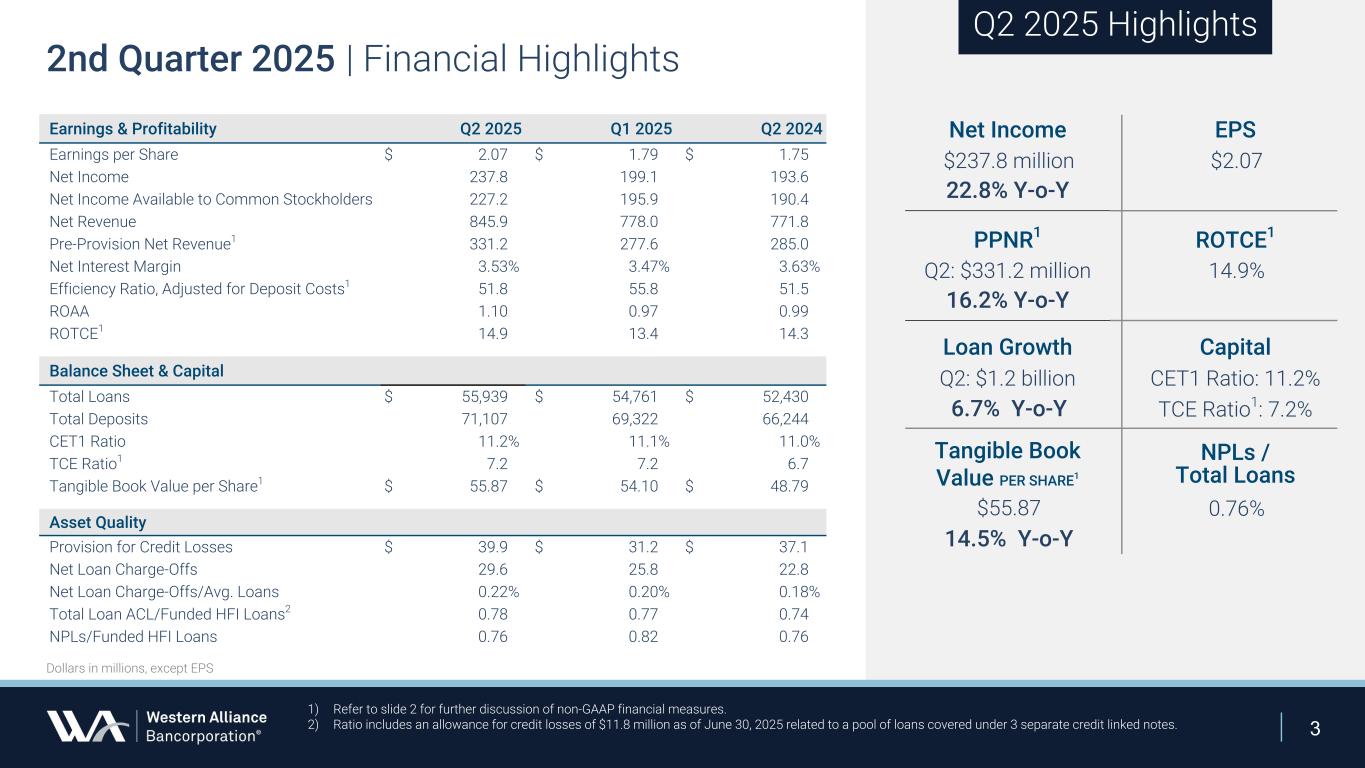
Ken Becchione Thanks, Miles. Good afternoon, everyone. I'll make some brief comments about our second quarter performance before handing the call over to Dow to discuss our financial results and drivers in more detail. I'll then close with some prepared remarks by reviewing our updated 2025 outlook. Our Chief Banking Officer for Regional Banking, Tim Bruckner, will then join us for Q&A. But before diving into my prepared comments, I'd like to take a moment to address a planned CFO succession announcement. Dale has been an outstanding CFO for Western Alliance for an impressive 22 years, which is more than five times longer the average CFO tenure. Throughout his tenure, Dale has been an instrumental leader, guiding the bank through both prosperous and challenging times. His unwavering dedication and availability at all hours of the day have made him an invaluable partner and friend to the senior management team. After the new year, Dale will transition his CFO responsibilities to Vishal following a thorough transition period. In his new role as Chief Banking Officer of Deposit Initiatives and Innovation, Dale will oversee six standalone deposit verticals, which generate strong liquidity. His contributions to the company are too numerous to list, but his skill and leadership were particularly evident during my absence at the beginning of the year. The board, the management team, and I are very excited to see him thrive in his new leadership role. Someone should pass the tissues over to Dale. Vishal will join us early in the fourth quarter, and after a 90-day transition period, he will assume the CFO responsibilities. Vishal has been a trusted advisor to the company and knows the bank very well. Over the past eight years, I have developed a strong professional relationship with him, and I am looking forward to fostering the same partnership I have had with Dale. Just feel free to reach out to both Dale and Fashal to congratulate them on their new assignments when you have a moment. Okay, let's get to the financial highlights and the quarter. A Western Alliance again delivered strong financial results, exceeding expectations in the second quarter as strong business momentum drove a meaningful acceleration across a broad array of financial metrics. sustained success in acquiring new client relationships, supported by our deep sector expertise, fueled strong risk-adjusted balance sheet growth, robust net interest income expansion, and enhanced profitability, which resulted in continued earnings growth. We generated over $1 billion of sequential loan growth for the second straight quarter, which was funded by nearly $2 billion of quarterly deposit growth. Net interest margin rose six basis points sequentially, rebounding back above 3.5% from robust average earning asset growth and CD repricing tailwinds, which lowered interest-bearing deposit costs. As the quality continued to perform as expected, as criticized loans declined $118 million in aggregate from Q1. Other real estate-owned increased to $167 million as we elected to repossess office properties where we can accelerate our normal credit resolution process and see value creation potential due to improving leasing, occupancy, and NOI trends. We have already secured an NOI for one property that we expect to be sold by quarter end. Total criticized assets increased negligibly and remained at approximately $1.7 billion dollars, which we expect to be the high watermark for this credit cycle and to drift downward in coming quarters. Our liquidity position and capital base both remain stout and able to support our solid and improving PPNR, tangible book value, and total shareholder return. Earlier this week, we announced plans to unify six legacy division bank brands under the Western Bank brand by year end. These brands have operated under the Western Alliance Bank Charter for over a decade, so this action will simply present a unified marketing present emblematic of the much larger national bank Western Alliance has become. Importantly, we are encouraged by the inflection and profitability experienced in Q2. Return on average tangible common equity of 14.9% and return on average assets of 1.1% were both notably higher from Q1. We continue to target upper teens return on tangible common equity as our near-term profitability north star. Dale will now take you through the results in more detail.
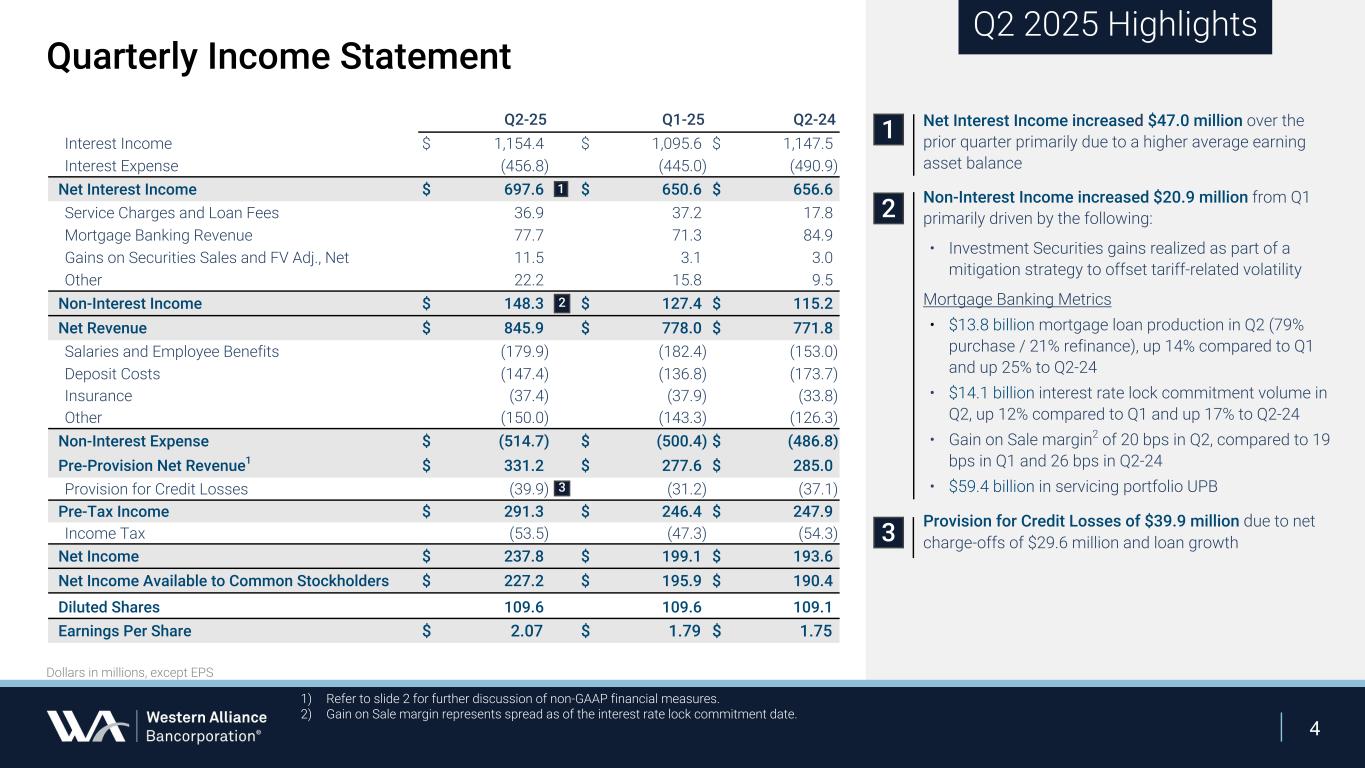
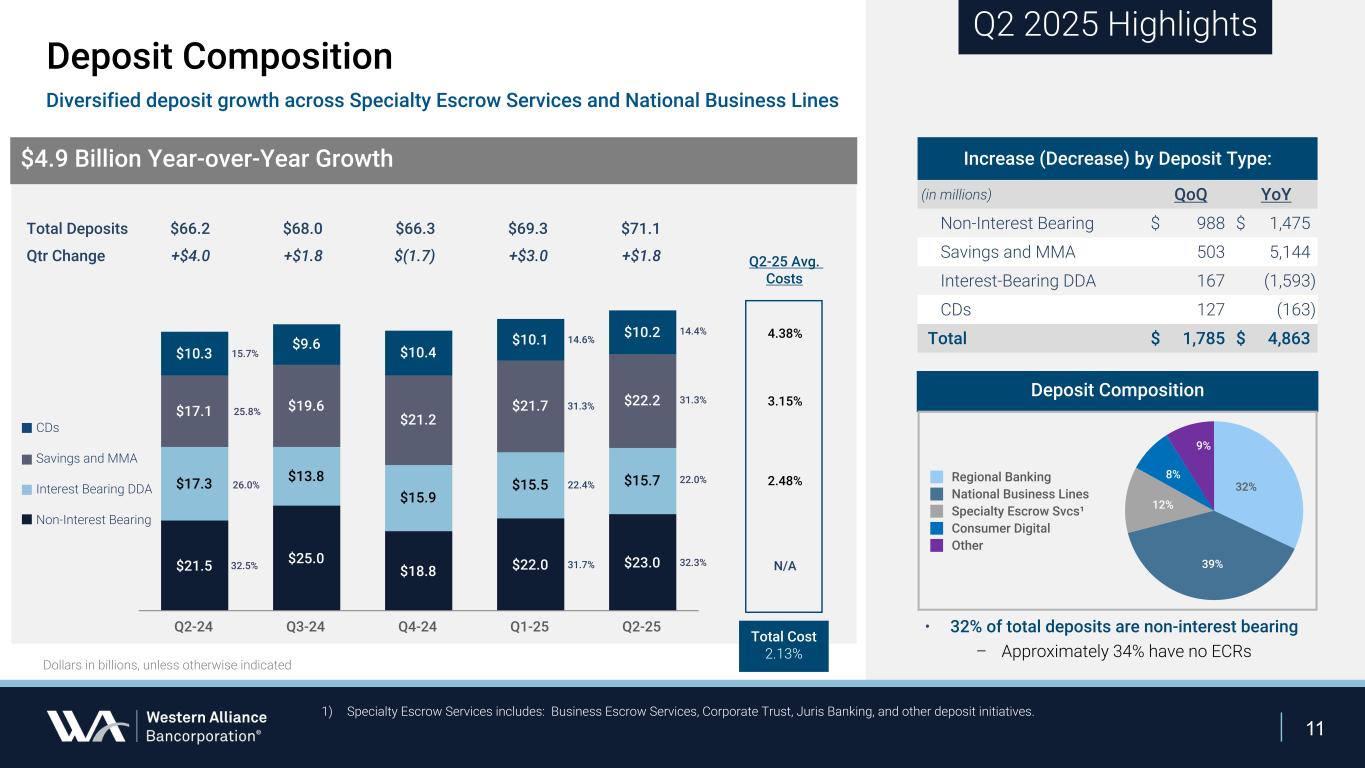
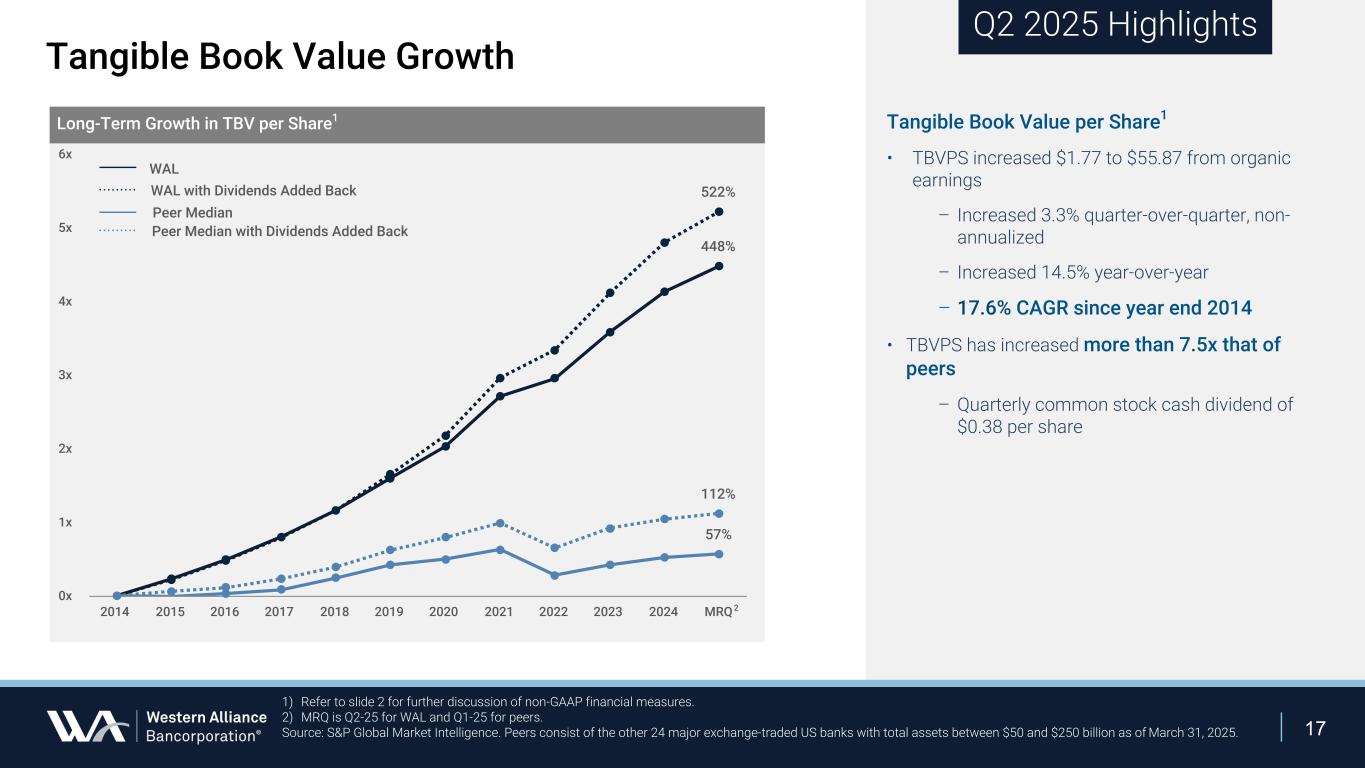
Thank you, Ken, for your kind words and tissues. Who could ask for more? Looking closer at the income statement, net interest income of almost $700 million grew 7.2% quarter-over-quarter, or nearly 29% annualized, driving PPNR up $331 million for the quarter, which equates to a 19% increase from Q1. Strong organic loan growth and higher average securities balances produced average earning asset growth of 17.3% on the late quarter-annualized basis. Non-interest income rose 16.4 percent, quarter over quarter to $148 million. Mortgage loan production volume increased 25 percent from last year, and the gain on sale margin edged up one basis point from the prior quarter to 20, resulting in mortgage banking revenue of approximately $78 million. Overall, we characterize core mortgage banking revenue as still tracking to flat year over year performance. In response to the volatility that ensued from proposed tariffs early in Q2, the company undertook a hedging initiative to mitigate earnings volatility by purchasing variable rate securities. As spreads tightened, we sold these securities which produced $8 million of the total $11 million gain of securities gains realized during the quarter, negating hedging losses at AmeriHome. Non-interest expense increased $14 million from the prior quarter to $515 million, mostly from the seasonal rebound and average ECR-related deposits, which drove the $11 million increase in deposit costs from Q1. Net interest income, inclusive of deposit costs, however, grew 7% from the prior quarter to $36 million. Overall, we delivered solid operating leverage this quarter, with net revenue growing nearly 9%, which outpaced sub-3% growth in non-interest expense. Provision expense of $40 million resulted from organic loan growth and a replenishment of approximately $30 million of net charge-offs. In our financial statements, you'll also notice a new line item for net income attributable to non-controlling interest that captures the pre-tax dividend impact from our recently issued REIT preferred shares. Turning to our net interest drivers, continued improvement in interest-bearing deposit costs and overall liability funding outpaced slightly lower loan yields. The securities portfolio yield increased 18 basis points to 481 from the prior quarter result of greater liquidity deployment into higher yielding floating rate securities. The HFI loan yield decreased just three basis points to 617, reflecting a mixed shift away from higher yielding construction into CNI. The cost of interest-bearing deposits declined seven basis points to 319 from CD costs compressing 22 basis points, as well as our ongoing efforts to manage IBD rates lower absent additional FOMC rate cuts. For the month of June, the average IBD rate was also 319, but we expect continued improvement from the deposit mix shifting away from CDs. As mentioned earlier, net interest income rose 47 million from Q1 to 698 million from strong loan growth and its average earning assets increased 3.3 billion. Net interest margin expanded six basis points to 353 as the reduction in funding costs exceeded the one basis point reduction in total earning asset yield. Non-interest expense increased 14 million or three percent quarter over quarter as deposit cost rose 10.6 million due to the normal seasonal rebuild and mortgage warehouse deposits which pushed average balances higher. Our adjusted efficiency ratio of 52% to improve from 56% in Q1 as we continue to achieve positive operating leverage from revenue growth outfacing deposit cost operating expenses, non-deposit cost operating expenses, which includes the incremental cost we're incurring in anticipation of becoming a large financial institution. Remain asset sensitive on a net interest income basis, but essentially interest rate neutral on an earnings at risk basis in a ramp scenario. This offset is supported by a material projected ECR related deposit cost decline this year and an increase in mortgage banking revenue in this scenario based upon our rate cut forecast. Our updated rate forecast calls for two 25 basis point rate cuts each in September and December. The balance sheet increased 3.7 billion from Q1 to 86.7 in total assets which reflected strong HFI loan and deposit growth of $1.2 billion and $1.8 million, respectively. Borrowings increased $1.9 billion due to the higher average HFS loan and securities portfolio balances in excess of deposit growth. Finally, total equity grew to $7.4 billion and tangible book value per share climbed 15% year-over-year. HFI loans grew $1.2 billion quarterly with end-of-period balances $1 billion greater than average levels in the quarter. CNI continues to lead this loan momentum, contributing over two-thirds of the quarterly growth from both regional and national businesses. Regional banking produced over $660 million of loan growth with CNI contributions from in-market commercial banking and innovation and technology banking, while home builder finance drove the CRE increase for the bank. With quarterly loan growth of over $150 million in innovation and tech, we continue to experience gathering momentum in banking the innovation economy nationally, following competitor disruptions over the past two years. National business lines provided the remainder of the growth with Mortgage Warehouse and Note Finance being the primary contributors. Note Finance remains a key area where our private credit relationships provide complementary opportunities with non-bank partners. Deposits grew $1.8 billion in Q2, to, inclusive of a $300 million decline in wholesale broker deposits. Solid growth was achieved in non-interest-bearing and savings and money market products. Mortgage warehouse seasonal inflows were the primary drivers of higher non-interest-bearing balances, but we also generated another quarter of non-interest-bearing, non-ECR balances of $140 million at a sub or a 7.5% annual rate. CDs were also higher quarter over quarter, but we expect runoff to occur going forward. Regional banking deposits were up nearly $800 million from the prior quarter, demonstrating continued relationship momentum within footprint commercial clients. National business lines posted a $650 million quarterly increase, primarily from the normal rebuild and mortgage warehouse, as well as steady growth in our consumer digital channel. Specialty escrow deposits continue to add to our growth as well, contributing nearly $300 million of deposits in Q2. Of note, our digital asset banking program generated $400 million of quarterly growth as we provide services for blockchain payments. Turning to asset quality criticized loans declined $118 million quarterly and benefited from special mention loans decreasing $16 million, classified accruing loans declining $77 million, and non-accruing loans falling $24 million. As Ken explained earlier, other real estate-owned increased $167 million as we took possession of a handful of office properties we have been closely monitoring for some time. We do not expect these properties to have an adverse effect on financial results as their aggregate operating revenues exceed expenses. We expect steady movement toward resolution and to begin dispositions this year of this portfolio. Stabilizing leasing and occupancy rates, as well as improving net operating income on these properties, reinforce our confidence that we will recover our recovering values as indicated by the positive cash flow from these assets. All in, criticized assets rose 50 million from March 31st. As we achieve resolution of these assets, we would expect Next, total criticized assets to begin to decline in the current quarter. Quarterly net loan charge-offs were approximately 30 million or 22 basis points of average loans. Provision expense of 40 million added to reserves in concert with loan growth and to cover charge-offs. Our ACL for funded loans moved 6 million higher from the prior quarter to 395 million. The total loan ACL for funded loans ratio nudged up one basis point from the prior quarter to 78. On slide 14, you can see Western Alliance's concentration in low-loss loan categories skews our ACL ratio lower relative to peers, reflecting the portfolio's lower embedded loss content. The top chart is our updated adjusted total loan ACL walk, which illustrates how credit enhancements such as credit link notes and structurally low risk segments like fund banking, our low loan, LTV, and high FICO residential portfolio, and mortgage warehouse elevate our normalized reserve coverage from 78 basis points to 135. Bottom table demonstrates that applying an industry median loan mix to our portfolio while still using our reserve allocations by loan type but reducing our outsized proportions of loans in lower risk categories like mortgage warehouse and residential and increasing our proportion of loans that higher risk categories like consumer our allowance would exceed one percent today our c21 capital ranks near median peer levels if you To add our lower adverse ALCI marks and the ACL, our adjusted capital ratio is 11%, which is flat since the prior quarter and ranks slightly above the median for our asset peer group on a one-quarter lag basis. We remain confident in our capacity to absorb any losses in concert with steady loan growth. As we view this, adjusted capital is a total amount available to absorb losses and support balance sheet growth. Our CEQ1 ratio rose to 11.2% despite our loan growth and SMSR sales provided some RWA relief. Our tangible common equity to total assets ratio was unchanged at 7.2%. Tangible book value per share increased to $1.77 from Q1 to 55.87 as a function of retainerings. Consistent upward growth and tangible book value per share remains a hallmark of Western Alliance and has exceeded peers by over seven times for the past decade. Our strong track record in compounding tangible book value per share stems from sustained reinvestment in our diversified and dynamic business model, which has consistently produced top-tier balance sheet profitability and growth for more than 10 years. This has led to excellent revenue growth and operating leverage, strong ROTC and EPS growth, as well as leading tangible book value per share accumulation. Ultimately, these are the drivers of long-term superior total shareholder return. Additionally, the metrics in the bottom row that track the last four quarters, which are NIM, Efficiency, and ROTC, are poised to improve from here. I will return the call back to Ken.
Thanks, Dale. Okay, let's talk about our 2025 guidance. We reiterate our loan and deposit growth outlooks of $5 billion and $8 billion, respectively, based on healthy pipelines remaining intact despite recent tariff-related noise. Regarding capital, we expect our CET1 ratio to hold above 11%, balancing our loan growth outlook with improving capital generation from an increasing return on tangible common equity. We are revising our net interest income outlook higher to 8% to 10% growth as our projection for two 25 basis point rate cuts have shifted back to September and later in Q4. As our loan portfolio is more variable rate weighted, delayed rate cuts combined with sustained strong loan growth should lift net interest income. Additionally, net interest margin for the full year should approximate 2024's upper 3.5% level. We are also revising our non-interest income outlook higher to 8% to 10% growth. We are pleased with the momentum in cultivating holistic relationships with our customers and the traction we've made in earning more commercial banking fees. Higher interest rates should also benefit servicing income and support MSR valuations. Non-interest expense is now expected to be 1% to 4% for the year. ECR-related deposit deposit costs are now projected to land between $550 million and $590 million for the year, and between $170 million and $180 million in Q3. ECR revision is attributed to a more back-loaded rate-cut forecast. Our improved revenue outlook should also drive higher associated incentive compensation. Operating expenses are now expected to be $1,495,000 to $1,515,000 for the full year. Asset quality should continue to perform as expected with full-year net charge-offs of approximately 20 basis points, while criticized assets are expected to decline over the next several quarters. Finally, we are maintaining our full-year 2025 effective tax rate forecast of approximately 20%. At this time, Dale, Tim, and I will take your questions.
Operator
Thank you. We will now begin the question and answer session. If you would like to ask a question today, please do so now by pressing start followed by the number one on your telephone keypad. If you change your mind or you feel like your question has already been answered, you can press start followed by two to withdraw yourself from the queue. As a reminder to please ensure that your device or your microphone are unmuted locally. Our first question today comes from Chris McGrattie with KBW. Please go ahead, Chris. Your line is now open.
Oh, great. Thanks. Thanks for the question. I want to start on the CFO transition. It feels like a big moment for the company. I'm interested, Dale, a little bit on the timing. Dale, what you plan on kind of focusing your efforts on, you know, the background of the new of your successor and ultimately broader succession conversations. So I know a lot's in there, but I'd love to hear your thoughts.
Sure. Well, I can't say how thrilled enough I am about this organizational change, which I had suggested. Augmenting the skill set of the team is going to make us more versatile, we'll capitalize on new opportunities, and it's going to free up my time to immerse myself in the array of deposit services we offer. Every single one of them appears to be at an inflection point in their growth trajectory. We are in the midst of a sea change in some of our business lines, not unlike when Moses parted one of them. And I see pathways opened, I see obstacles being removed, and I'm not just referring to genius or the digital asset space, but also executive orders and changes at the FTC. The time to move on them is right now, and I'm just delighted to be stepping into that. I'll just add one other thing.
It's important to note that this transition does not signal a change in the direction for the bank. Our focus remains steadfast on achieving organic growth up to and through the $100 billion large financial institution level, And that's where our focus will be on the next 18 months.
Back to you, Chris, if you're there. Sorry about that. I just wanted to extend our thoughts, and Dale, you've done a great job navigating this company with the team. I guess my follow-up would be on the back half, the deposit growth, the $8 billion, to get to the $8 billion. Can you help us reconcile getting there? I think Q4 is typically slow, which I think implies Q3 is going to be pretty big. any color on the cadence of deposit flows?
Sure. Sure. One of the things that we did was to our deposit growth this, you know, the past two quarters is we have through pricing pared down some of the more volatile mortgage warehouse funds and which has really been the driver of what you're referring to on the seasonal kind of a dip that we've had, particularly in the mortgage warehouse deposits in the fourth quarter. So that's going to be more muted. And so we're not expecting that that's going to, we need to necessarily cover that. So we're on track, we see, for our $8 billion target.
Yeah, I'd add that, you know, year to date, we're up about $1 billion. And some of the things that Dale will be addressing, specifically in the digital asset banking, should also increase deposits as we go forward. It had a good quarter this quarter and grew $400 million. And our technology and innovation group also had an incredibly strong quarter with their balances rising nearly $600 million. I think that is proof positive that staying reliable and accessible in that market, both on the loan and the deposit side, has begun to pay dividends for us.
Operator
Thank you. Our next question comes from Jared Shaw with Barclays. Please go ahead.
Hey, good morning. Thanks for the question, Dale. Congratulations on the new role as well. Maybe looking at the fee income and looking at the guide for fee income, Where – what are some of the broader assumptions, I guess, underneath that in terms of mortgage? You said earlier, I guess, still looking at flat year over year. Is that – where is the growth going to be coming from, I guess, on the fee side?
Yeah, so we anticipate a rise in fee income the back part of the year driven by an increase in generally mortgage-related revenue from seasonal activities and also commercial banking activities linked to the growth in our C&I business. All in, the mortgage business is forecasted to have the same flat year-over-year revenue growth. And we do that as a way to focus on our commercial banking activities, which will generate the bulk of earnings, not only fee income, but the bulk of earnings for the bank so that investors can feel comfortable that the year-over-year growth is coming from these commercial banking activities, while the mortgage business being flat at the moment will be prepared or be available to deliver alpha in terms of earnings if and when interest rates get cut and that mortgage buying begins to rise. When that happens, then we have an interesting decision to make here around the table, and that will be do we put some of those alpha earnings back into the business to support future growth, or do we let it fall to the bottom line, grow net income, improve our returns on average assets and tangible common equity, and or have different options for capital deployment.
The mortgage industry had a muted spring selling season as a result of one of the higher rate environments and also the volatility perhaps introduced from the tariff activity. And I don't think that that destroyed that demand. It just postponed it to some degree. So I think some of it as being stabilized might come forward. And again, everyone is projecting that, you know, we're going to have some rate relief sometime later in 2025.
Okay, thanks. And then I guess on the expenses, it's my follow-up. You know, when we look at the higher guide on expenses X, ECR, what's driving that? Is that incremental new investment? investments to support some of these initiatives? And then I guess, you know, if we do see relief on Category 4 thresholds, is there an opportunity to maybe see that come in lower than the range, or what's sort of the investment cycle moving to Category 4 looking like?
Yeah. Yeah, you've got two questions in there. First, let me just say, for Q2, our total expenses only rose by 2.9% or $14 million, of which nearly $11 million of the 14 were deposit-related costs. So our operating expenses were rather flat, Q1 to Q2, okay? And this modest rise actually improved our efficiency ratio by 400 basis points, quarter over quarter, to 51.8%. I should say adjusted efficiency ratio is the way we look at it. Now, going forward in the rest of the year, yes, I think we've been very clear that we are going to spend about $35 million cash spend in 2025 and another $35 million in 2026, which is embedded in our numbers. The operating expense number is about 30 of that $30, $35 million that will be in the year. And that will be a little bit more back-end loaded as we prepare to cross over $100 billion. Now, as relates to tailoring, okay, you know, we've been closely following the tailoring conversations and their potential impact on the bank. I'll say first, we're in favor of moving the LFI Category 4 threshold to $250 million or having it at least indexed to inflation. This adjustment would allow us to navigate through the threshold more deliberately while permitting the bank to continue its organic growth journey, right? In the short run, the other benefits to moving the LFI threshold to $250 billion would be to free up technology resources to support our product line and service improvement development. And it also would enable us to help build out some of our AI functions and features at a faster pace. But one of the things that we have to balance here is just because we hear the scuttlebutt that Category 4 will be moved up to a higher number, we cannot stop doing what we're doing because we anticipate crossing over the $100 billion threshold somewhere in early 2027, Q1, maybe Q2. If we postpone or slow that down and the LFI threshold is not raised, then we put ourselves at risk of impeding our total loan and deposit growth. So at this point, we have to continue as if that the LFI threshold raise is not going to happen.
But once it does, and we hope it does, then we'll adjust our spending accordingly so i hope that answers uh your questions there yeah that's great detail thank you thank you our next question comes from matthew clark with piper sandler please go ahead matthew uh thank you uh for the questions and congrats dale um can you just uh holding on the margin a little bit just give us a spot rate on deposits at the end of june i think you gave it last quarter but didn't see it this time around. And what's your kind of blended beta assumption through the cycle if you include non-maturity deposits that you touched on in the deck?
Yeah, so we see that our margin is going to continue to reflect positively from here, both on a reported basis as well as an adjusted basis, including kind of the ECR piece going forward?
Yeah, I would say that, you know, on a spot rate at the moment, investments, our investment book is running higher than our average rate for the second quarter. We also see deposits and borrowings being down a few basis points as well. And so I think that gives some confidence to our guide that the net interest margin will stay or grow from the level it was at the end of Q2.
We had a notable increase in the securities yield. That's not done. And I think that's going to be also an impetus for expansion on both of our margin metrics.
Got it. Got it. And then on the fee income side, in terms of the lift you're expecting there, part of it's coming from commercial commercial banking income i think it's a line item you no longer disclose but can you just maybe update us on how much that contributes to fee income and how that might have changed from the prior quarter the question is how much how much is coming from commercial banking versus uh the mortgage is that the question yeah yeah it's a you know it's probably embedded in you know the service charge line now i guess but i was just trying to get a sense for the magnitude of commercial banking fees and fee income, just to try to get a sense of how much that's growing.
Yeah, the mortgage business is going to stay flat year over year, which is about $328 million. We generated revenues in 24 and the same amount in 25. And other non-interest income, which is what you want to know, probably will rise in the order of, you know, 20 plus percent year over year.
Yeah, commercial banking-related income is 15 percent of, you know, of our revenue presently in the income.
Our next question comes from Tima brazilla with wells fargo please go ahead hi good morning starting on the funding side um just maybe maybe provide a little bit more color to the rationale on on growing the borrowings as much as you did to deploy that into the bond book and i think dale you just said that you know bond yields are are higher um today than where the average book is and that's not done yet is that implying that this strategy of lowering borrowings to put into the bond book maybe continues here to the back end of the year?
Yeah, what we've seen is, you know, spreads widened in the wake of Liberation Day. And as a result, you know, we're not incurring any interest rate risk here. We're not incurring any credit risk here because these are our Treasury obligations. But we see a, I don't know, a lack of continuity or similarity, you know, within that space. and so we're augmenting returns at this time related to that. And that's going to be based upon market conditions, but certainly presently it's working.
Okay. And then the increase in Oreo, just some more color there. How many properties, can you provide any color on just kind of the carrying cost LTVs here? And I'm wondering if some of the increased costs or increased expense guide is related to the higher carry costs of Aurea?
Yeah, this is Ken. So we took in five properties, and let me give you the big picture of what we're trying to do here. Right now, those properties generate, the revenues that the properties generate are in excess of the expenses. So yes, expenses show up in the expense line, the revenues show up in the fee income line, but net net, it's a positive carrying number to the overall performance. Now, what we'll do here is a couple of things. We have found that the sooner that we could take these properties in, manage them ourselves, we've had much more success in leasing them up and improving the occupancy rates as well as getting better rental rates. And that's what we did. The fact that revenues will grow in excess of expense also gives us the opportunity, if we need to, to fund improvements in these properties to bring them up to competitive levels in the cities that they're in. So it gives us that flexibility as well. And the last thing I'll say is when we take in these properties to REO. They're at current valuation values, less liquidation costs. So by taking them in now, these properties will not impact charge-off behavior unless there is a significant decline in the revenues or the valuations in those markets. And we just don't see that now. So it also helps stabilize charge-offs as well.
So for all those reasons and the fact that we feel more comfortable running these properties ourselves rather than having them wait and sit out there in a substandard category we're able to take them in quicker and be more proactive with it great and just maybe if i can one more just as every uh that pertains to the allowance i know you guys get this question quite often but now if you look kind of at the non-performing asset coverage ratio it's closer to 60 is there any consideration in increasing the allowance just given the increase in non-performing assets? And I guess just how are you thinking about that from kind of an investor perception standpoint versus what's actually coming in through the results?
Yeah, well, let me start on this and then I think Tim can pick it up. So, just talking about the reserve to NPAs, if there were to be a charge or a recovery in one of these Oreo properties, it would not touch the allowance. The allowance is only for the long book. These are already written down, these properties that Ken's alluding to, as is appraised value, less disposition costs. They're rock bottom, they're cash flow positive. We don't see any risk there, but even if there were, it wouldn't affect the ACL number. That's relative to the long growth that we've talked about, you know, kind of what our reserve levels are.
Yeah. Thanks, Dale. The ACL, we have a lot of constituents in the ACL, and the foundation of the ACL is built up from the asset values. Our assets that build the ACL are predominantly real estate secured assets. They're valued with conservative values. As those assets get distress, we value more frequently. And as Dale just said, less the disposition cost. So with the clear line of sight that we have into the assets in our portfolio, into our strategy around the disposition of those assets, we're absolutely comfortable with the values that we're carrying in our ACL?
Yeah, I might as well chime in to make it three for three. You know, not only do we believe our ACL reserve is not only adequate in its construction, but when you add it to CET1 inclusive of AOCI, adjusted other comprehensive income, all right, otherwise known as adjusted CET1, we are above our peer group median, peer group being $50 to $250 billion. And so I think that's the way we look at it. Are we appropriately capitalized? Yes, we are. And reserved? Yes, we are. And what you're seeing in the reporting so far to date, we're seeing a number of banks beginning to lower their reserve ratios and not increase them. We're keeping our steady at this moment. Great. Thank you for the question. Not that we expected this question.
Operator
Thank you. Our next question comes from David Smith with Truist Securities. Please go ahead, David.
Thank you. Can you help us understand the moving parts behind the deposit cost outlook? The 15 to 20 percent sequential increase in 3Q looks about in line with what we saw in 3Q last year, but the full year outlook seems to imply a 30 or 40 percent or so decline in 4Q, which is twice as big as what we saw in 4Q of last year, even though there was a benefit from falling rates last year. And I think you just said that you lowered some of the more high-cost, more seasonal mortgage warehouse deposits, which seems like it would dampen the seasonality, if anything. So if you could help us understand the cadence and the moving pieces behind that outlook, please.
Well, a couple things going on. So we have, you know, our ECRs aren't only from the mortgage warehouse piece. Our HOA group pays ECRs at lower rates than the MW sector, and that's continuing to cultivate. And so, that's kind of part of what we're doing. We're also showing that we do have a rate decrease in September and another one in December, so that kind of adds to that as well.
Okay. So, you're still expecting a mixed shift overall out of the mortgage warehouse towards the HOA and escrow and other lower ECR deposits?
We are. You know, there's other areas that also, you know, we're optimistic about what our near-term prospects are. Some of the ones that, you know, that I was alluding to a little bit in my comments earlier in terms of, you know, the digital space, our corporate trust operation. I mean, you know, we've only been at corporate trust for two years. And I'm not a lead table kind of person because we don't have a lot of businesses that they actually produce lead tables for, but we're the seventh largest CLO trustee in the world in a very short period of time, and frankly, with bright prospects.
Operator
Thank you. Our next question comes from Ibrahim Poonwala with Bank of America. Please go ahead.
Hey, good morning. So I guess I just wanted to follow up, Ken and Dale, on the topic of, one, Dale's new role, sort of overseeing all these deposit strategies, and you've emphasized some of the regulatory changes. We're seeing movement on sort of the Digital Assets Act or Genius Act today. Is there a case to be made that all of this combined should lead to a significant pickup on the deposit growth front relative to where we've been over the last six, 12 months for this year? I'm just wondering, is there a pickup that we should anticipate? And obviously, you've not given 26 guidance, but I'm trying to figure out if there's an infection there in terms of where things are going.
I think we have an opportunity to execute on these, you know, changes that you're alluding to, Ibrahim, and grow these businesses, you know, faster than they have in the recent past. I'm not sure that's going to drive total deposits a lot higher, as Ken indicated, that we're also looking at this LFI hurdle at $100 billion, and we don't want to cross over that until we're ready. But we have opportunities within the deposit mix, both in terms of some broker costs, as well as additional maybe mortgage warehouse that has an elevated ECR, whereby we could swap that out and should continue to push our NIM and our adjusted NIM higher throughout our forecast horizon.
That's helpful. And I guess just on the topic of LFI, would the Fed moving the LFI threshold higher to, I think Ken mentioned, maybe to 250 billion, is that enough? Or would you want to see a change to sort of the legislation? I think Dodd-Frank had a threshold that moved from 50 to 100 back in 2018-19. Like, would you want to see that? Or just the Fed moving that through sort of the proposal process enough for you to start thinking about things differently?
I was going to say, moving to 250, that gives us plenty of room to flex our muscles at a faster pace. First, I'll say there are some things that we like as we approach LFI readiness, and we're going to do them anyway. But this would give us a lot more room to grow at a faster pace. As I said, it also changes around the priority order in our technology stack of what we want to do. And it allows us to focus a little faster on AI developments and more so on improvements either in our product and service offerings we have today or bring in new products and services that we would do. So, yeah, it would be a net benefit to us if they were to move it upwards. If they only moved it up to, say, 140 or 150 for indexing, as some people I've read have suggested, that would still give us a benefit. But it would say to us that if and when we were ready to do an acquisition of another bank, we'd still need to be ready to be LFI ready because just an acquisition of a third of our current size would just put us about right at that revised 140, 150 level. But we're hopeful, and again, we hear this a lot from other people, not directly from the regulators themselves, that the consideration of 250 is in play. And if so, it would be beneficial to us.
That's helpful, Ken. And you think the Fed can move on this? You don't need an act of Congress here at all in terms of making this happen, correct?
No, not in terms of these levels. You know, I wouldn't want to wait for Congress to do something there. Got it.
Operator
Thank you. Our next question comes from Casey Hare with Autonomous Research. Please go ahead.
Good morning, guys. Yeah, congrats on the new role. I got some fun questions for you, but I do want to follow up on credit. So you guys obviously sound pretty optimistic that things are going to get better. But we've heard that before in the fourth quarter, right, with the San Diego office. Is there anything you can disclose around the size of the marks? And then also, you know, what gives you so much confidence that this migration is behind you?
Well, Casey, just to kind of reflect a little bit, this is the first time that we've called that we believe we're at a top. You know, we've said, previously we've said, you know, things are, you know, steady-ish, but we never said we think that this is the definitive, you know, kind of peak of where And so, you know, what that looks like, you know, kind of going forward. What we're seeing in terms of, you know, kind of lease-up activity, you know, dispositions by other institutions, we think that things are stabilizing. And like I said, in these particular properties, it all comes down to, you know, what do you You know, we've taken these back. They're making money. And so that should continue to support, you know, what's transpiring in terms of valuation. In addition, you had a big spike up in the cap rates back when there was a lot of concern about a recession, which seems to have largely abated. And as a result of that, if these cap rates come down, that should improve not just the appraisal process, but the valuations in the market.
All right. Well, and then you guys talk about this being a shorter duration book primarily. We're not really seeing these balances amortized lower. You know, they're about the same size that they were two years ago. So what is happening? When do we start to see this loan portfolio taper out?
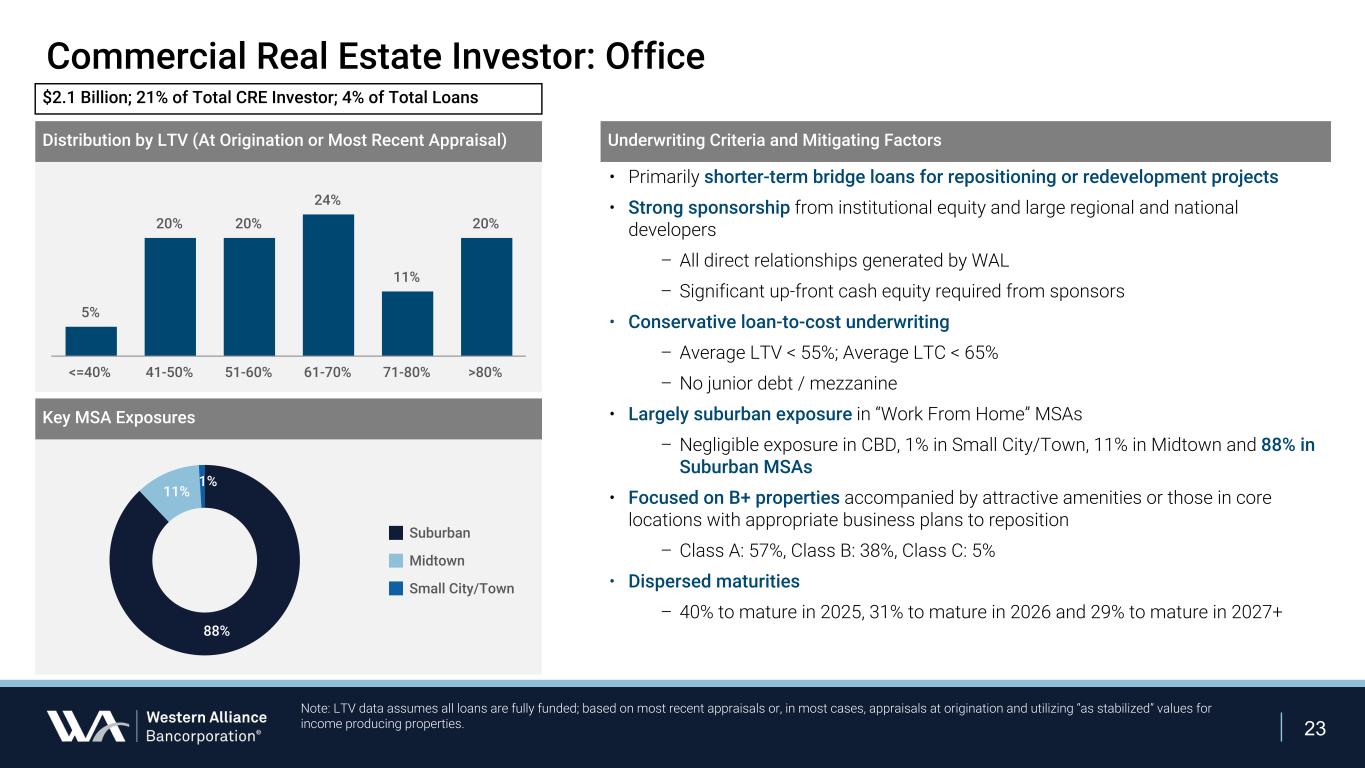
All right. I'll take that. First on San Diego, we've taken every opportunity to describe the market that we played in here as not being central business district. I think we've often said, you know, 85% to 90% is outside of Central Business District. That San Diego asset happened to be the area that we deviated from that. So if I didn't say that clearly on prior calls, I'll say that now. So that truly is uncharacteristic of the portfolio. We've also said that these assets were bridge assets. this isn't a PERM portfolio. This was not structured going in as a PERM portfolio. So, these assets reside. They're sponsor-backed with institutional sponsorship, and they have resided in funds alongside of other assets. So, the assets are in footprint predominantly. They're in our backyard. They're assets that we know that we're highly familiar with. and in the repositioning, that goes with the fund. So if the fund isn't funding its portfolio, we take those assets, get them repositioned, get them on a faster path.
So we're confident because we know the assets, because we have the assets marked at what we feel are conservative values, less the disposition costs, and we've got a plan and strategy on each of the assets that we can uh we can see uh unfold out in front of us gotcha thank you just one more uh on the loan growth front um i know you guys you guys are about the halfway mark of your guide um two quarters in historically the second half's been very strong for you you know just how are pipelines is there an opportunity to do better than that five billion and how do you expect the loan yields to play out in the back half?
So, on the loan growth, I would say that we're not going to move off of a $5 billion guide. We're tracking to that. I think, you know, we're at a run rate that's above on your annualized or number for the second quarter growth. We're at a run rate that's above other reporting banks and above the industry. So $5 billion seems to be the appropriate level. And, you know, you'll see loan yields come down a little bit as you go through the course of the year, just because, as Dale mentioned, we're forecasting a September rate cut of 25 and then one in December of 25. So naturally, you'll see our loan yields follow that path.
Operator
Thank you. Our next question comes from Andrew Terrell with Stevens. Please go ahead. Your line is now open.
Hey, good morning. And Dale, congrats on the new role. Just a question on kind of the Oreo and also kind of a point on the criticized loans. But just following the move this quarter, I mean, the way you describe it, it sounds like it's an advantageous situation for you guys to take these in. Should we expect, you know, we could see more Oreo built throughout the year and into 2026 even, or have you guys kind of identified all the properties that make sense from that standpoint?
Sure, thanks. We expect to see this flat to declining as we move forward. So, we will move assets out. If additional assets come in, we expect that the pace of moving assets out will outpace that. Again, we've been working the same portfolio. It's, as we've discussed, predominantly office. In fact, it's all office. And we're familiar down to the asset level at the most senior levels of our management. So the management's fully engaged in the strategy. We know the assets well, and we've got a clear line of sight here.
Okay, I appreciate it. And then on the San Diego loan that was put into Oreo in 4Q last year, I think at the time you mentioned that the occupancy had improved, I think it was mid-40s up to mid-60s in a very short time frame. something you could just refresh us on on the status of that that individual property whether occupancy has continued to to improve there just any more color you can provide yeah it happens so the occupancy is up to 71 now and we took that in at the very end of october so that's a a good working example of getting our hands around that property and and uh being very constructive
around leasing it up around rental rates. And that's what gives us some of the confidence that we could go ahead and do it with the other properties. And we are beginning to do it with the other properties.
Operator
Thank you. Our next question comes from Bernard von Gizicchi with Deutsche Bank. Please go ahead.
Hey, guys. Good morning. Just a modeling question. Just on the insurance costs, you have initiatives to pass them back to large depositors after previously absorbing them. The insurance costs were down slightly during the quarter. I know you can charge them through service charges if they want to keep the insurance, but any color or migration, are there still accounts you need to pass costs to, or has this been mostly taken care of?
It's largely behind us, I think, in terms of kind of the migration of what we're pushing back. Your mix matters there, too. I was pleased to see that with our deposits climbing, and it actually fell a little bit. Part of that is we've been paying down broker deposits every quarter and consecutively, including in Q2 here. And there's an elevated cost associated with those. If you swap out broker deposits for non-broker, you're going to see a lower FDIC charge from that alone.
And then just another modeling question, just on the equity investments, the $3 million gains during the quarter, was that mostly related to the reversal of losses from 1Q or just any color or expectations you expect for those losses to accrue back or anything you can just share for expectations in the second half for equity investment line?
That wasn't a recovery of a prior charge, but we don't see anything there that leads us to believe that we're going to be slower than what we've been historically. There's a loose correlation with market valuations. As you see, you tend to see more liquidity events from, say, a public company or even a private one that now has an elevated valuation from looking at other public companies. That tends to move it forward also. And if anything, we're in that kind of environment presently.
Operator
Thank you. Our next question, comes from Anthony Elian with JP Morgan. Please go ahead.
Hi, everyone. Dale, congrats on the new role, and I look forward to working with Vishal when he joins. My first question, you raised the outlook for ECR deposit costs two consecutive quarters now. I get that the rate outlook is volatile, but if we don't get any rate cuts in the second half, could you size up the impact to ECR deposit cost expense, assuming the same dollars of ECR deposit growth?
Maybe we pick that up on the later call, you know, kind of with that kind of detail. But yeah, yeah, we can assess that.
And then keep in mind that our adjusted net interest margin, which includes the deposit costs, you know, we have it projected to rise for the year. So when you talk about deposit costs and you talk about rate movement, when you get to the call later on, Keep in mind that if there is no rate reduction in the back half of the year, that means our net interest income is also going to be higher as well. So you can't look at any one item in isolation and say, what will it do to expenses? You've got to look at it as, what will it do to PPNR? That's all I'd say.
Thank you. And then my follow-up from Ibrahim's question earlier on the deposit opportunities, Dale, you noted in the prepared remark, you saw $400 million of quarterly deposit growth in the digital asset segment. And that's without the impacts from the Genius Act that passed yesterday. I know you've previously said that digital assets are about 2% of the company's deposits, but how large could you see that concentration getting to over time? And then is all of the infrastructure in place to support additional deposit growth from the digital asset segment and from the deposit segments that you'll be leading up? Thank you.
Yeah, so we have a limit right now of 4% on that category. I can see that moving higher. I've got to tell you one thing we're not going to do is we're not going to compromise our diversification, you know, even with, you know, a fast moving, you know, track on or a particular business line, digital or something else. So we think having that balance is really important in terms of our funding architecture. But I think there's room to have that continue to move forward. You know, like I said, I'm really enthusiastic about, you know, kind of what I see on the horizon in this space and others among these business lines. And I think that will give us optionality in terms of, you know, pushing out more expensive of funds, you know, having growth liquidity to be able to continue, you know, good underwriting on our loan portfolio.
Operator
Thank you. We have no further questions, and so I'll turn the call back over to Ken Vecchione for closing remarks.
Okay, well, thank you very much for your time and attention today. We look forward to our next earnings call, and have a great day and a good weekend. Thank you all.
Operator
Thank you, everyone, for joining us today. This concludes our call, and you may now disconnect your line.