Operator
Ladies and gentlemen, thank you for standing by. Welcome to the Acadian Asset Management, Inc. Earnings Conference Call and Webcast for the fourth quarter 2025. During the call, all participants will be in a listen-only mode. After the presentation, we will conduct a question and answer session. To be added to the queue, please press the star followed by one at any time during the call. If you need to reach an operator, please press star followed by zero. please note that this call is being recorded today thursday february 5th 2026 at 11 a.m eastern time i would now like to turn the meeting over to melody wong svp director of finance and investor relations please go ahead melody good morning and welcome to acadian asset management inc's conference call to discuss our results for the full quarter ended december 31st 2025.
Before we begin the presentation, please note that we may make forward-looking statements about our business and financial performance. Each forward-looking statement is subject to risk and certainty that could cause actual results to differ materially from those projected. Additional information regarding this risk and certainty appears in our SEC filings, including the Form 8K file today containing the earnings release, our 2024 Form 10K and our Form 10Q for the 1st, 2nd and 3rd quarters of 2025. Any forward-looking statements that we made on this call are based on assumptions as of today and we undertake no obligation to update them as a result of new information or future events. We may also reference certain non-GAAP financial measures. Information about any non-GAAP measures referenced, including the reconciliation of those measures to GAAP measures, can be found on our website, along with the slide that we will use as part of today's discussion. Finally, nothing here in Shelby theme could be an offer or solicitation to buy any investment products. Kelly Young, our President and Chief Executive Officer will lead the call and now I'm pleased to turn the call over to Kelly.
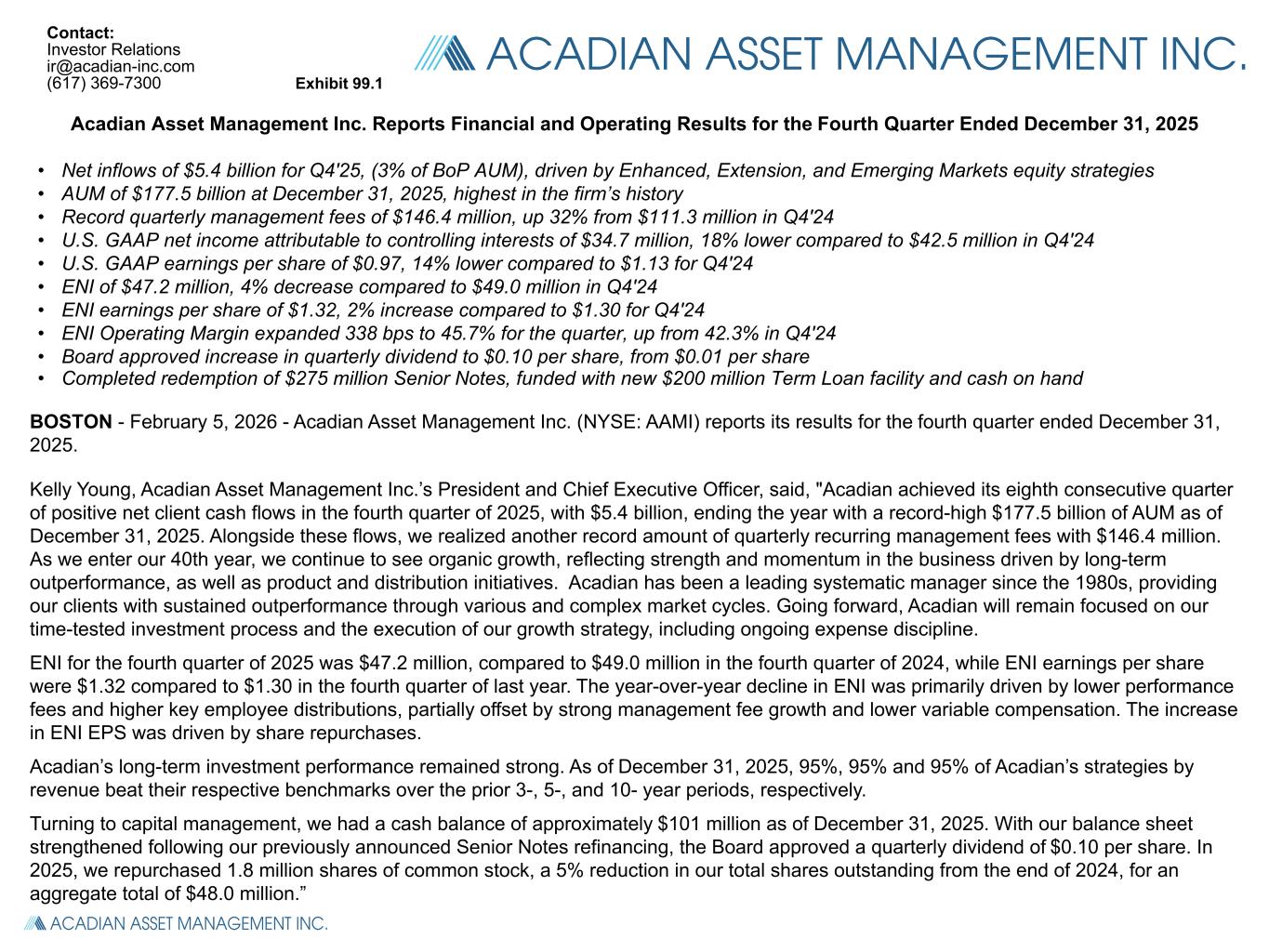
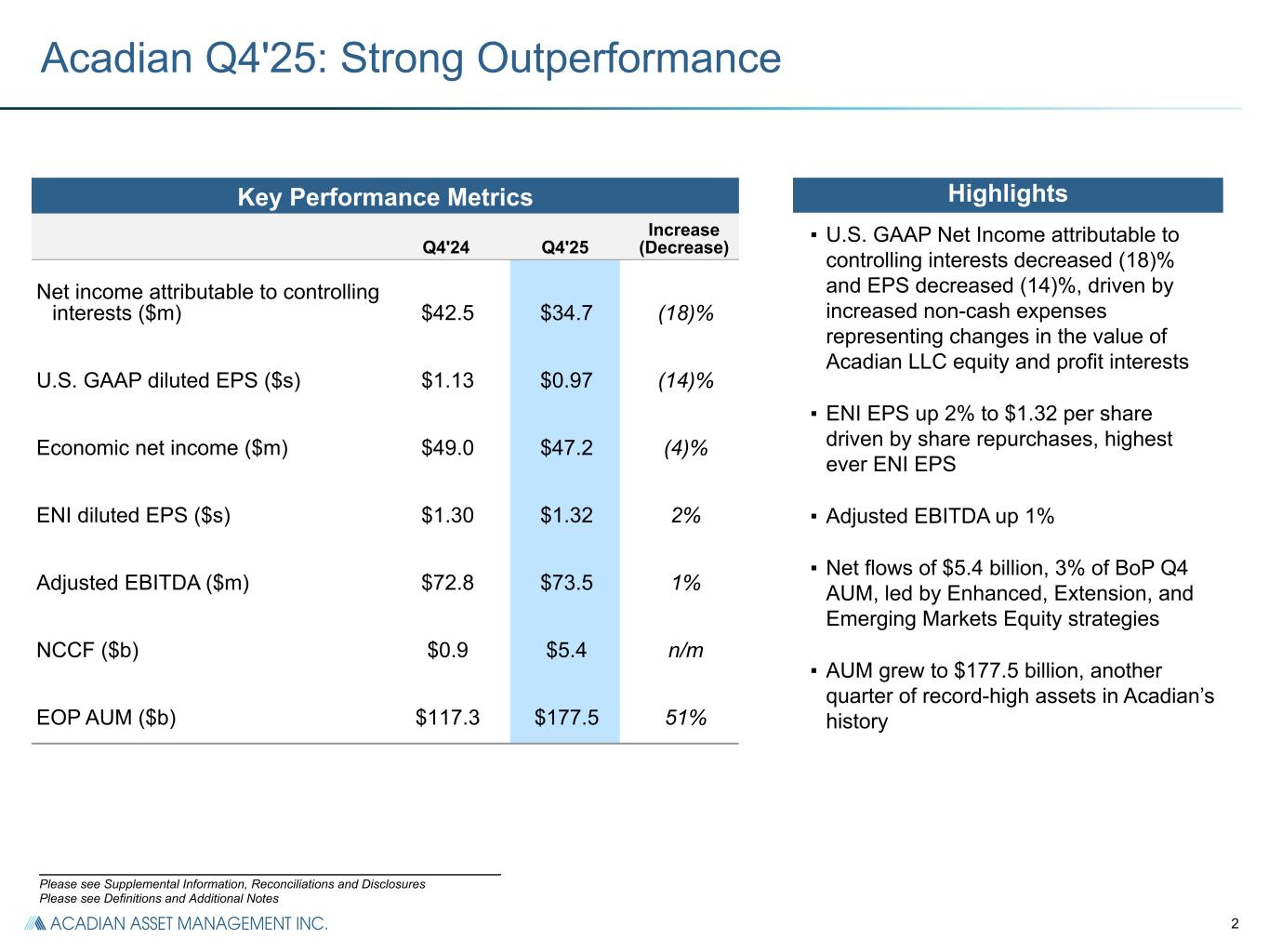
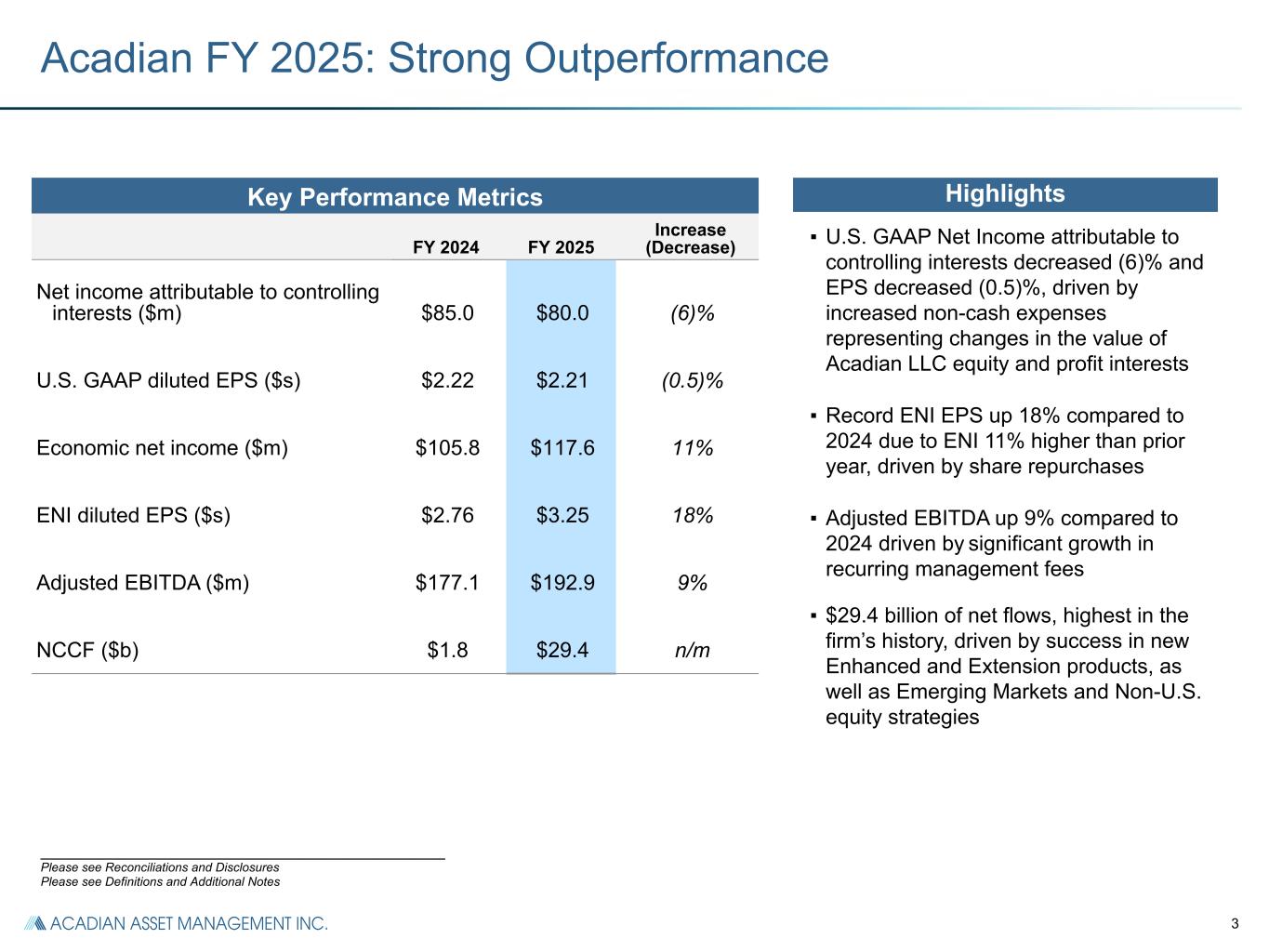
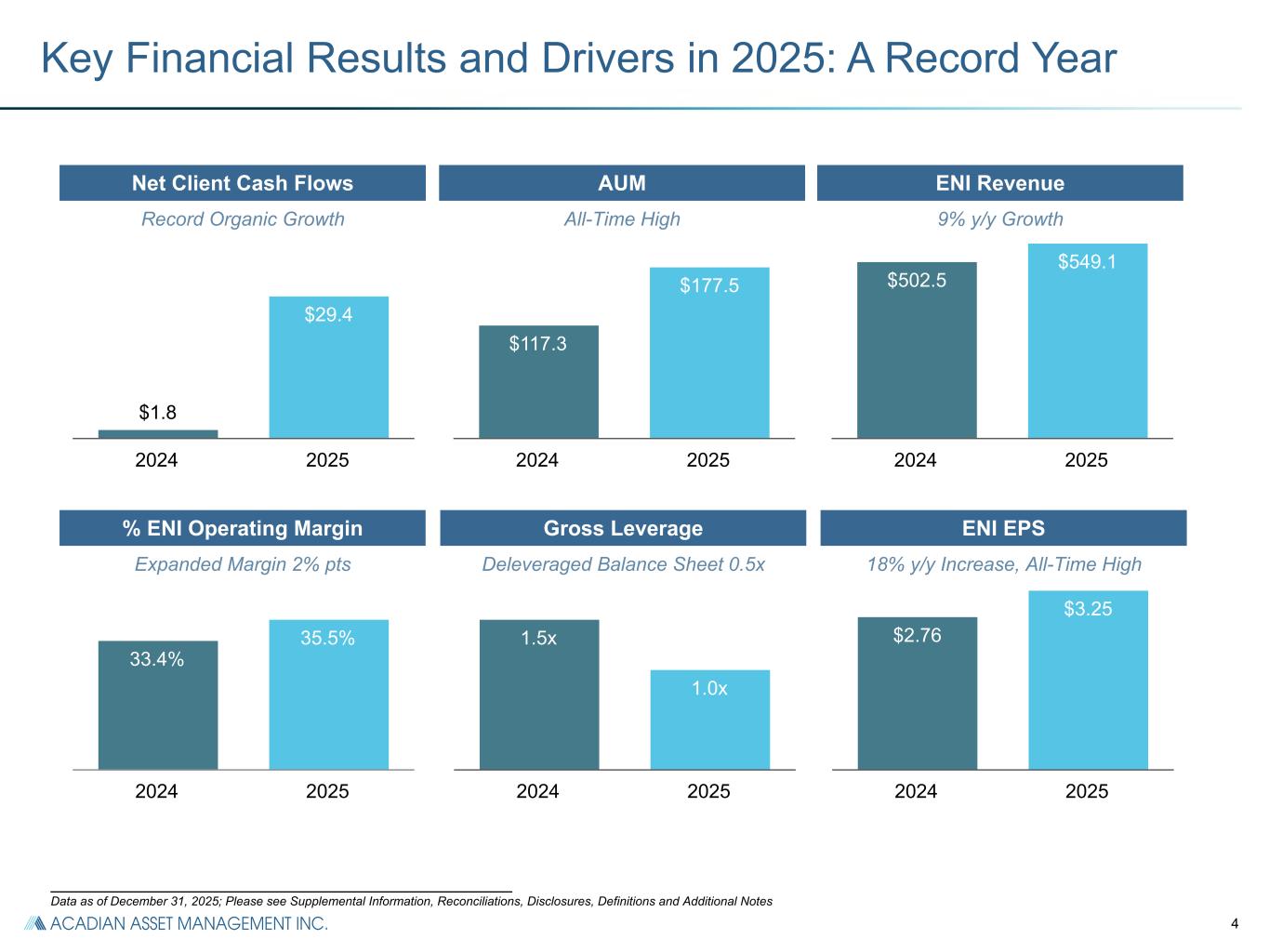
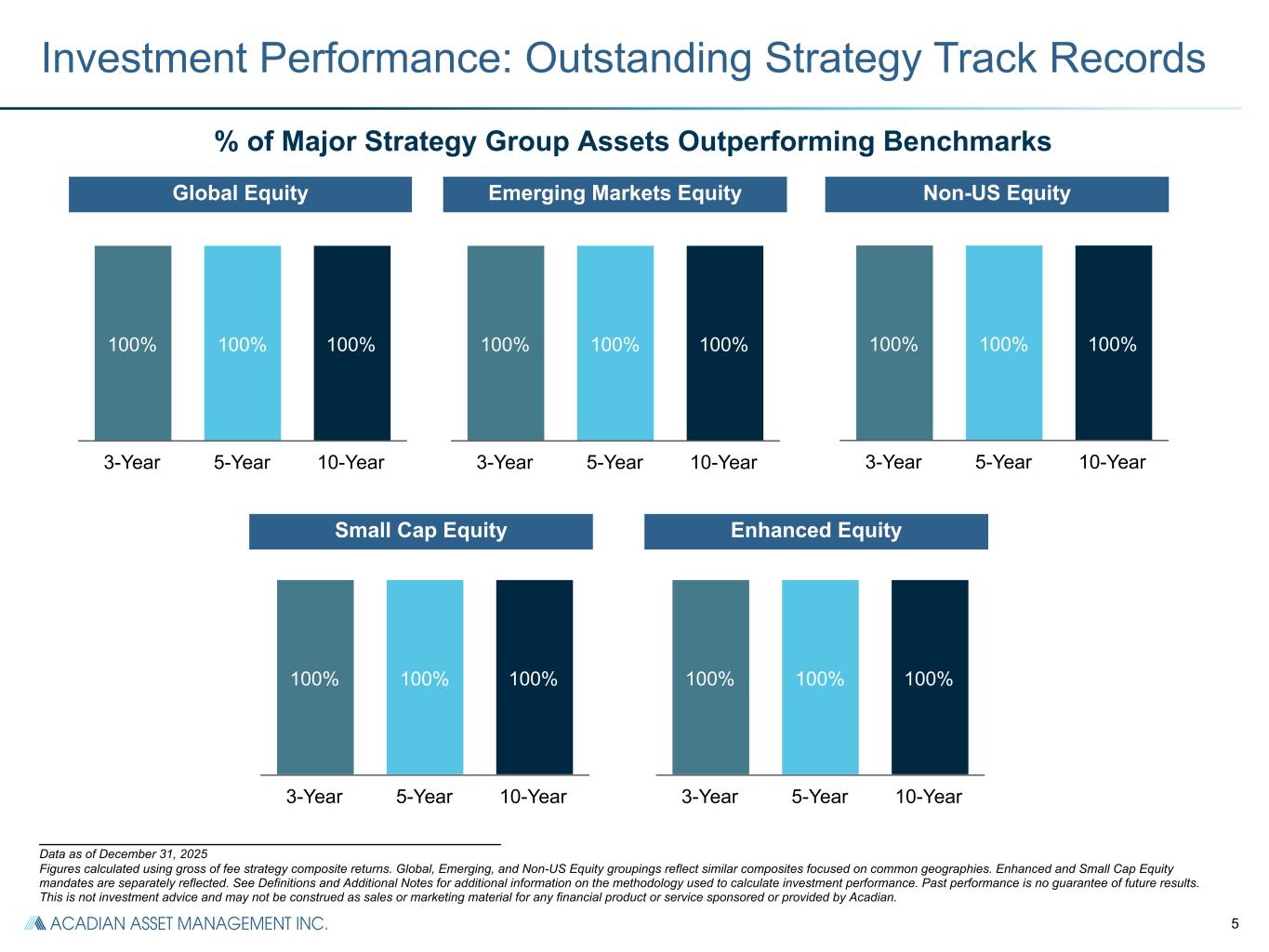
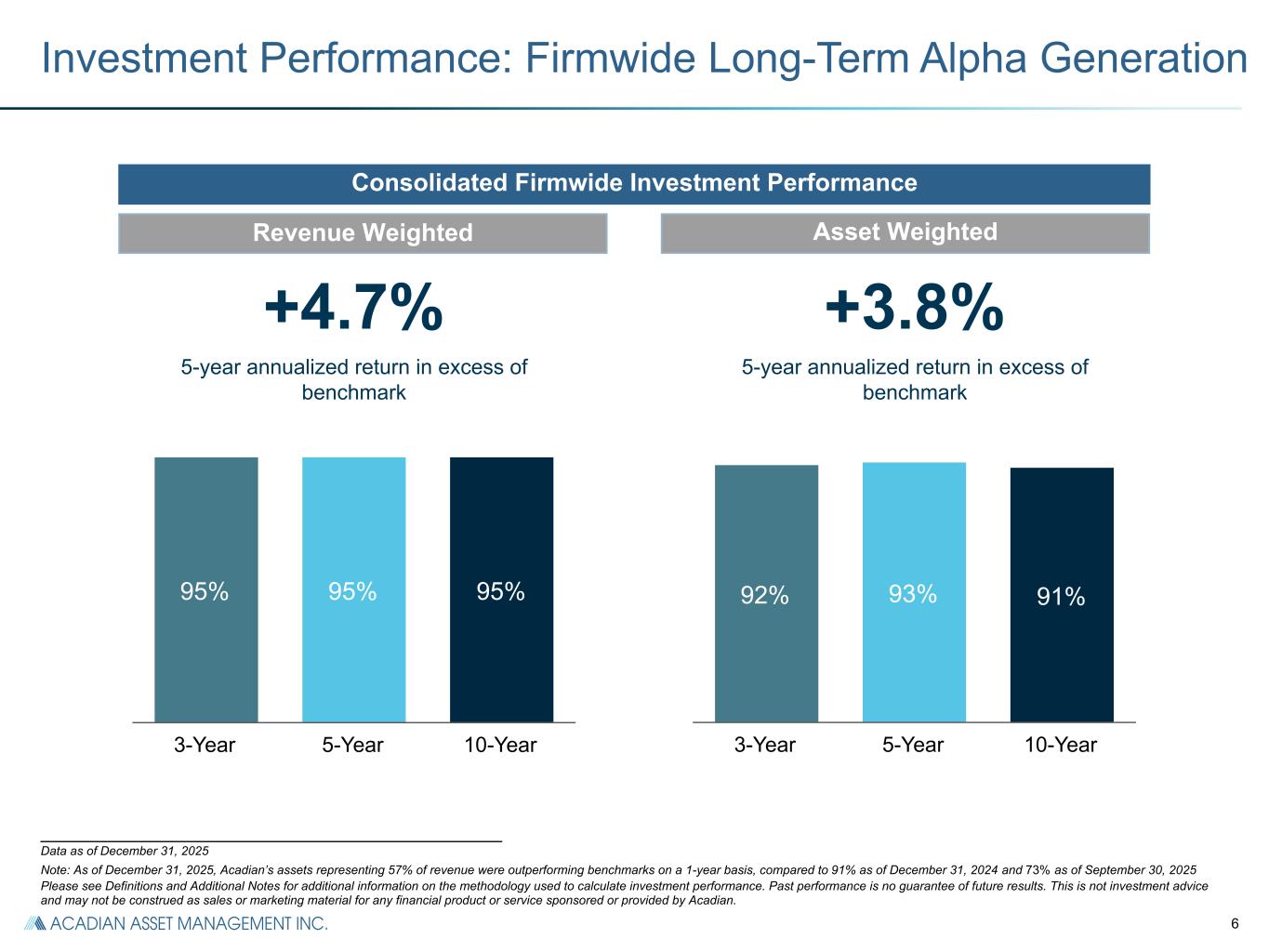
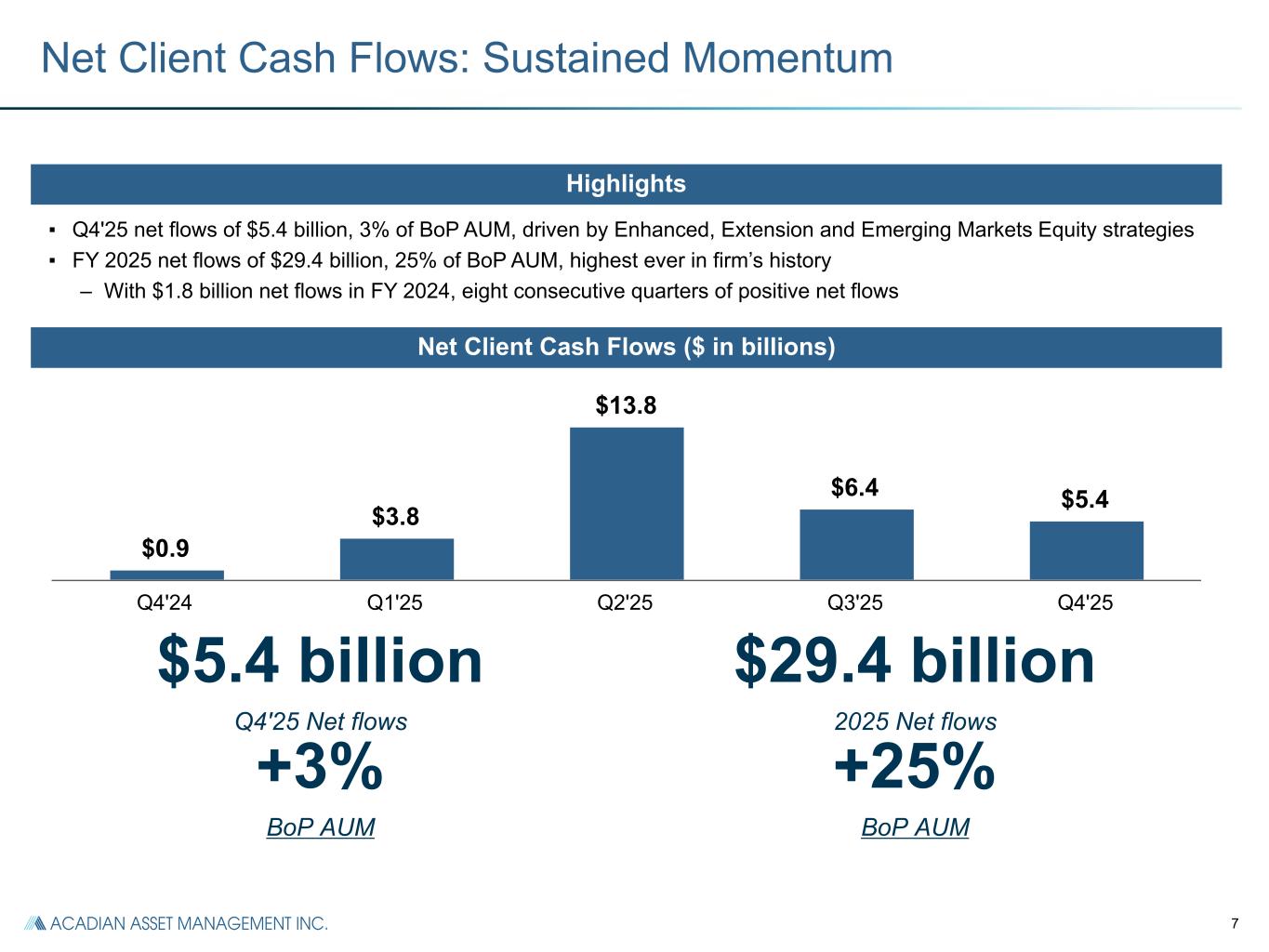
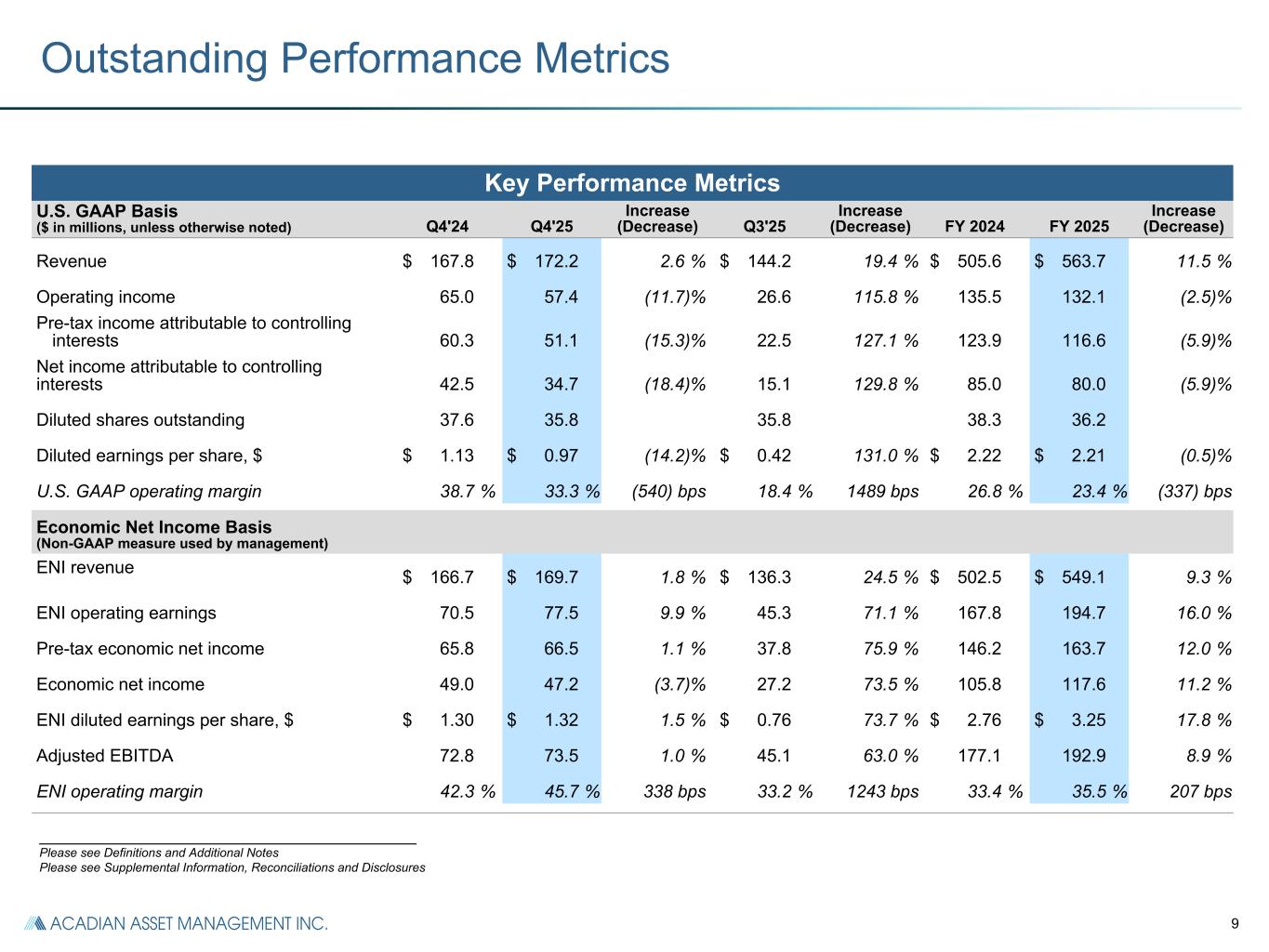
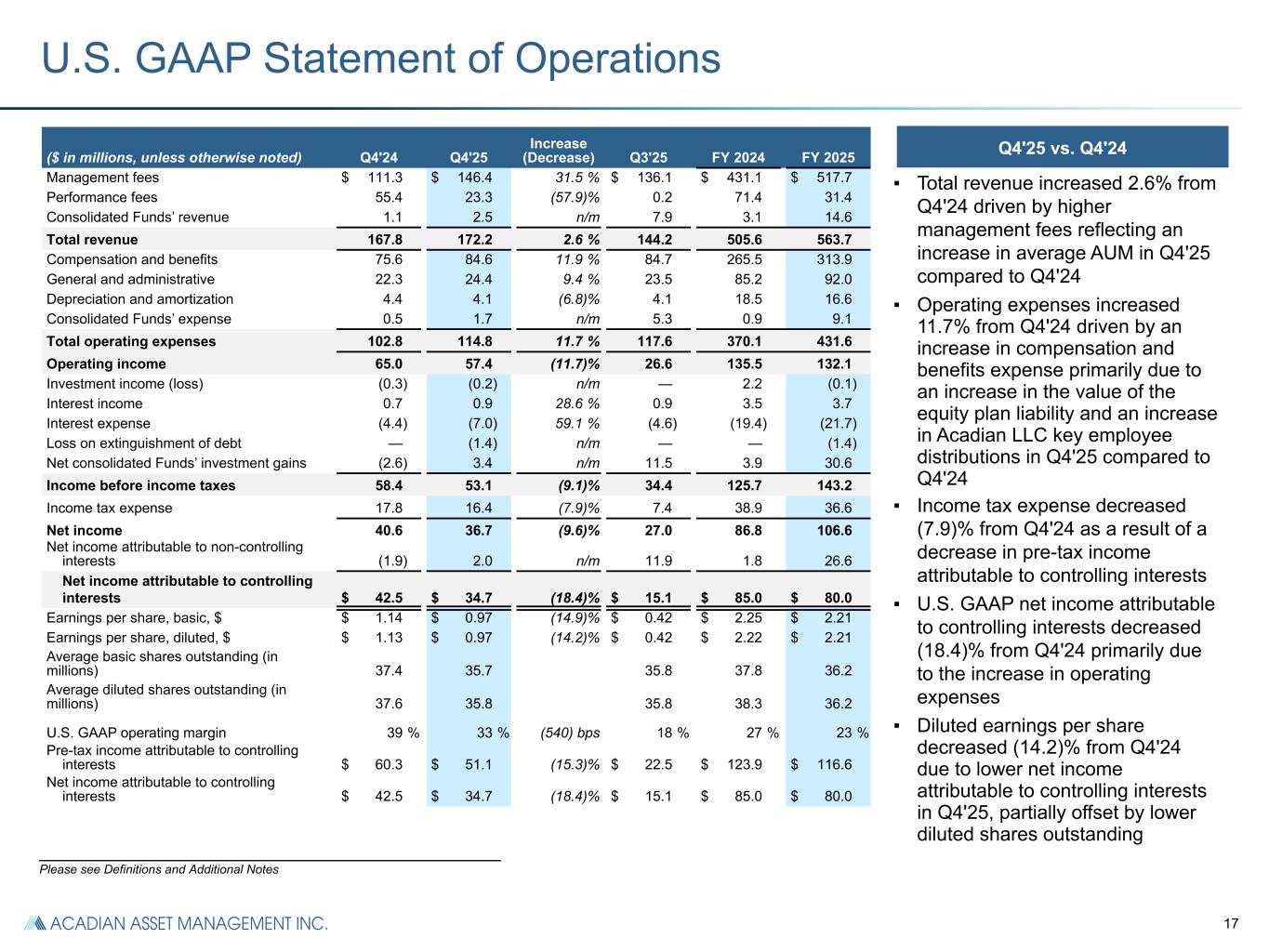
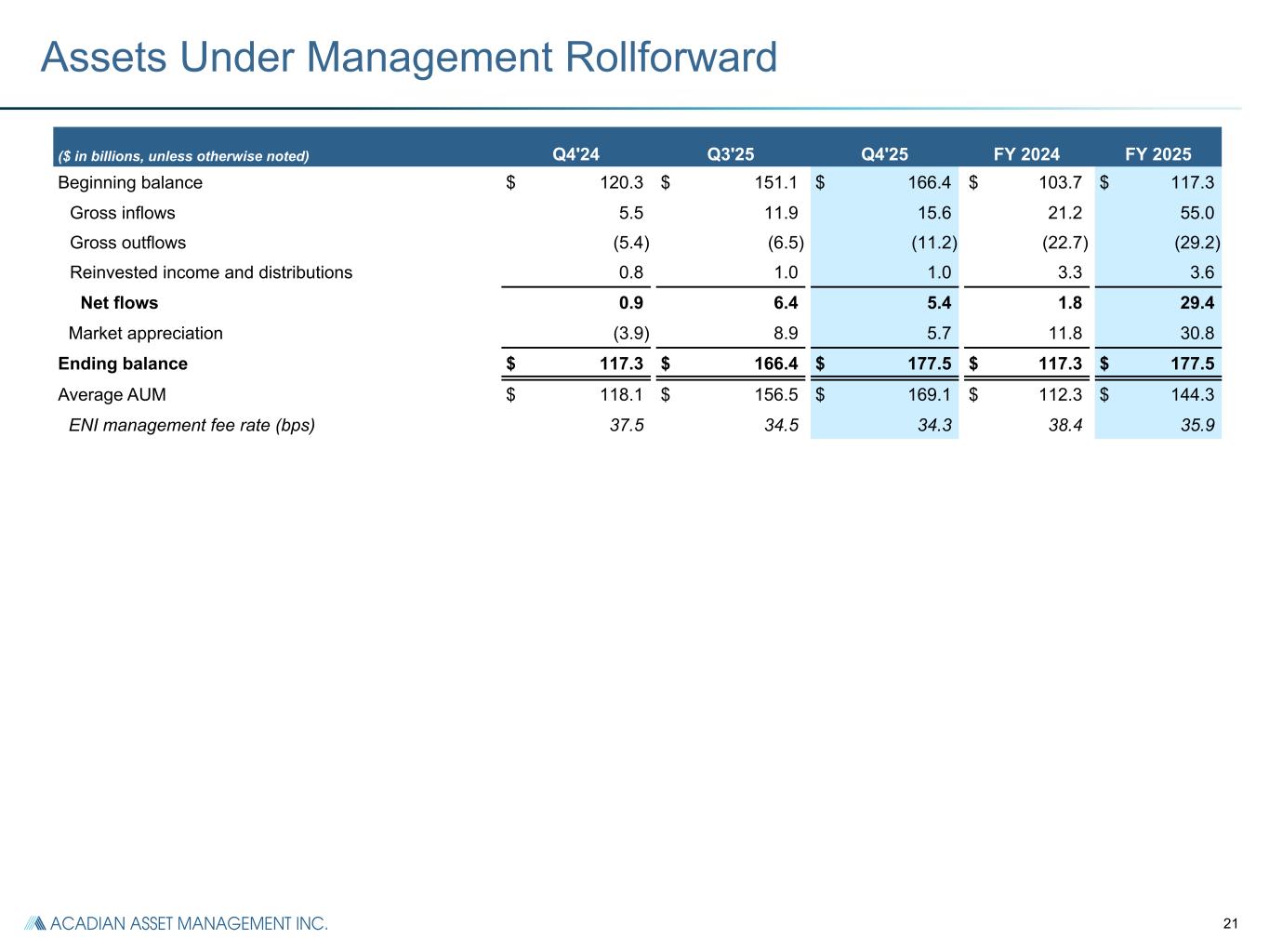
Thanks Melody. Good morning everyone and thanks for joining us today. I'm delighted to share our Q425 and full year 2025 results with you and pleased to highlight that we delivered breakout results across assets under management and profitability. We ended Q4 2025 on another high note. Our US GAAP net income attributable to controlling interest was down 18% and EPS was down 14% compared to the year prior due to increased non-cash expenses representing changes in the valuation of Acadian LLC equity and profits interest. Our E&I diluted EPS of $1.32 was up 2%, driven by share repurchases, the highest level of quarterly E&I EPS in the firm's history. Our adjusted EBITDA was up 1%. We realised $5.4 billion of positive net client cash flows in Q425, 3% of beginning period AUM, driven by enhanced extensions as well as emerging markets equity. And finally, AUM surged to £177.5 billion as of December 31, 2025, making another record high for Acadian. Moving to slide three, full year 2025 strong outperformance. A US GAAP net income attributable to controlling interest was down 6%, and EPS down 0.5%, compared to the prior year, driven by increased non-cash expenses, representing changes in the value of Acadian LLC equity and profits interests. We will discuss the full year EMI, EPS and net flows on the following slide. Our adjusted EBITDA was up 9% compared to 2024, driven by significant growth in reoccurring management fees. Focusing on slide 4, this slide captures the exceptional and historic year 2025 was for Acadia. We generated $29 billion in net client cash flows. That organic growth, combined with robust equity markets, drove our AUM to an all-time high of nearly $178 billion as of December 31, 2025. At the same time, our 2025 ENI total revenue grew to nearly $549 million, up 9% from 2024. We also expanded our ENI margin more than two percentage points to 35.5% and reduced our growth leverage to one times as of year-end 2025, down from 1.5 times at year-end 2024. Finally, we delivered record annual 2025 ENI EPS of $3.25, cents, up 18% year over year, supported by greater E&I earnings and the efficient return of capital to our shareholders in the form of share repurchases. These milestones and financial results reflect our team's discipline and dedication in executing the organic growth plan we articulated when I assumed a CEO role at the beginning of 2025. As we enter Acadian's 40th year in business, I believe we're better positioned than ever. we remain focused on delivering solutions and generating alpha for our clients, as well as expanding targeted product and distribution initiatives that promise to deliver long-term growth and value for our shareholders. Turning to slide five, Acadian's investment performance track record remains strong, despite a challenging 2025. We have five major implementations, which comprise the majority of our assets. As of December 31, 2025, global equity, emerging markets equity, non-U.S. equity, small cap equity and enhanced equity have 100% of assets outperforming benchmarks across three, five and 10 year periods. global equity markets delivered strong returns in q4 25 to close out 2025 however crowding in lesser quality high beta stocks created a more challenging environment for the fundamentally driven signals such as quality that drive occasion's approach particularly in the second half of the year toward the end of the year value and quality orientated stocks perform better a welcome change after their struggles in Q3 and our performance improved in Q4 25. As we enter a new year we remain confident in our disciplined, systematic approach and believe we're well positioned as markets begin to refocus on company fundamentals. Slide 6 details how our investment process has weathered various market cycles and generated meaningful long-term alpha for our clients. Our revenue-weighted five-year annualised return in excess of benchmark was 4.7% as of the end of the quarter on a consolidated firm-wide basis. Our asset-weighted five-year annualised return in excess of benchmark was 3.8% as of the end of the quarter. By revenue weight, 95% of Acadian's strategies outperformed their respective benchmarks across three, 3-, 5-, and 10-year periods as of December 31, 2025, and by asset weight, 91% of Acadian strategies outperform their respective benchmarks across 3-, 5-, and 10-year periods. The next slide highlights our sustained momentum in net flows. We realised positive net flows of $5.4 billion in the fourth quarter, representing 3% of beginning period AUM. The quarter's net flows were again diverse across products and client types. Enhanced, extension and emerging markets equities all generated strong net client cash flows. As I referenced earlier, for the full year of 2025, we generated net flows of $29 billion, and with positive flows of $2 billion in 2024, we've now generated eight consecutive quarters of positive net flows. Our current pipeline remains robust and active after the funding of a number of significant client wins in 2025, and we expect continued positive momentum in the year ahead. I'm now going to turn the call over to our CFO, Scott Hines, to provide you with more detail on our financial performance this quarter and an update on capital allocation.
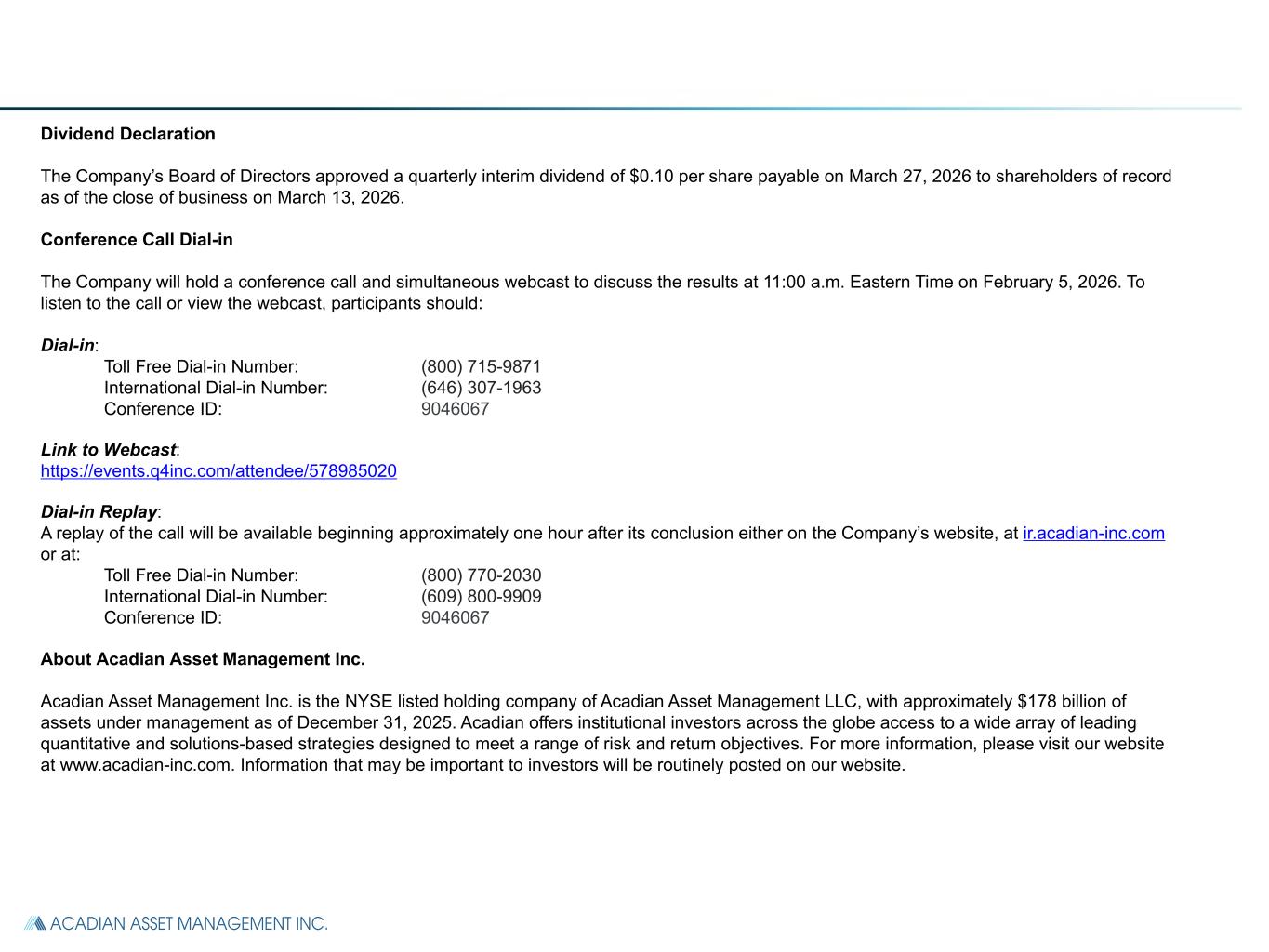
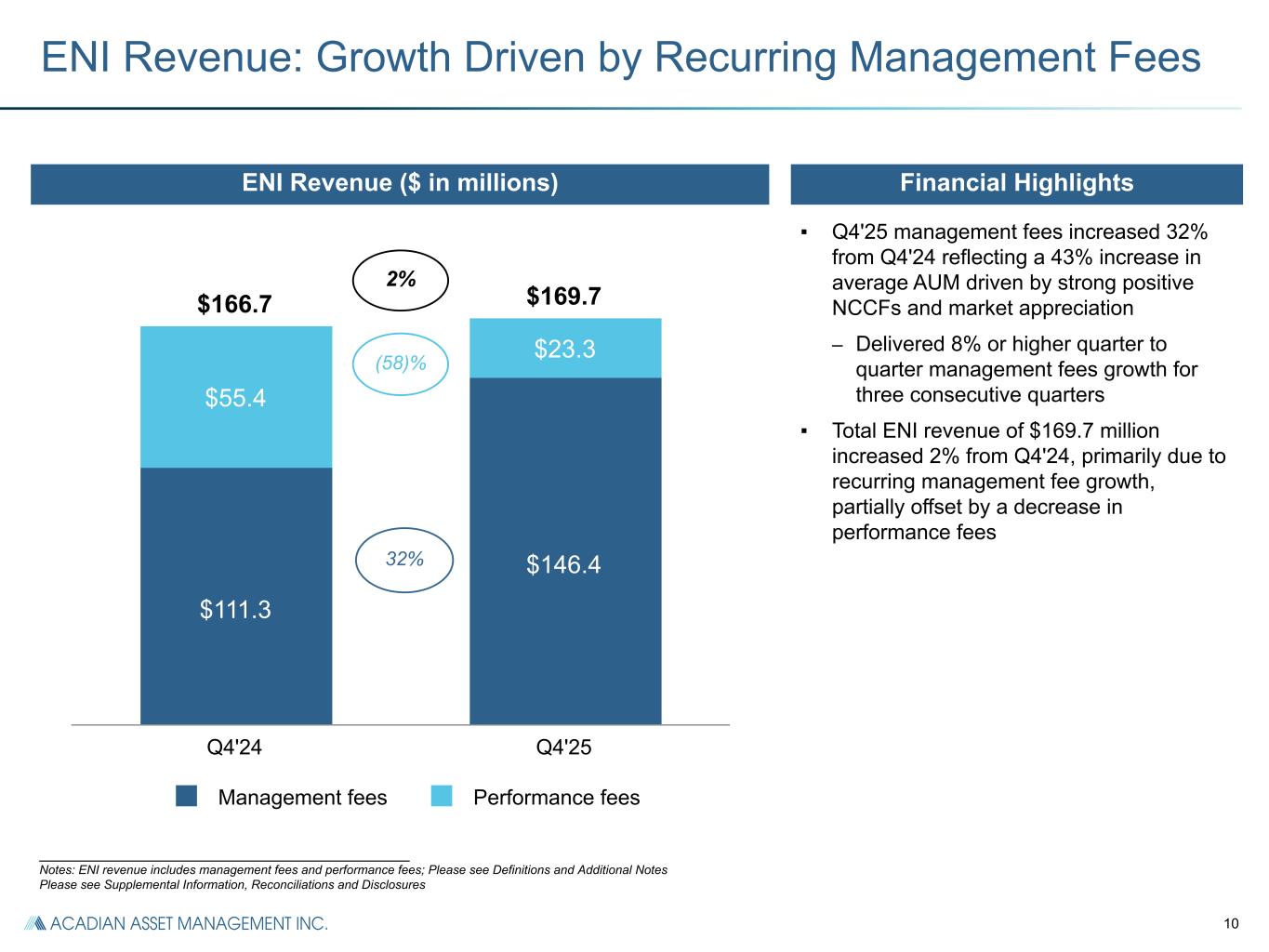
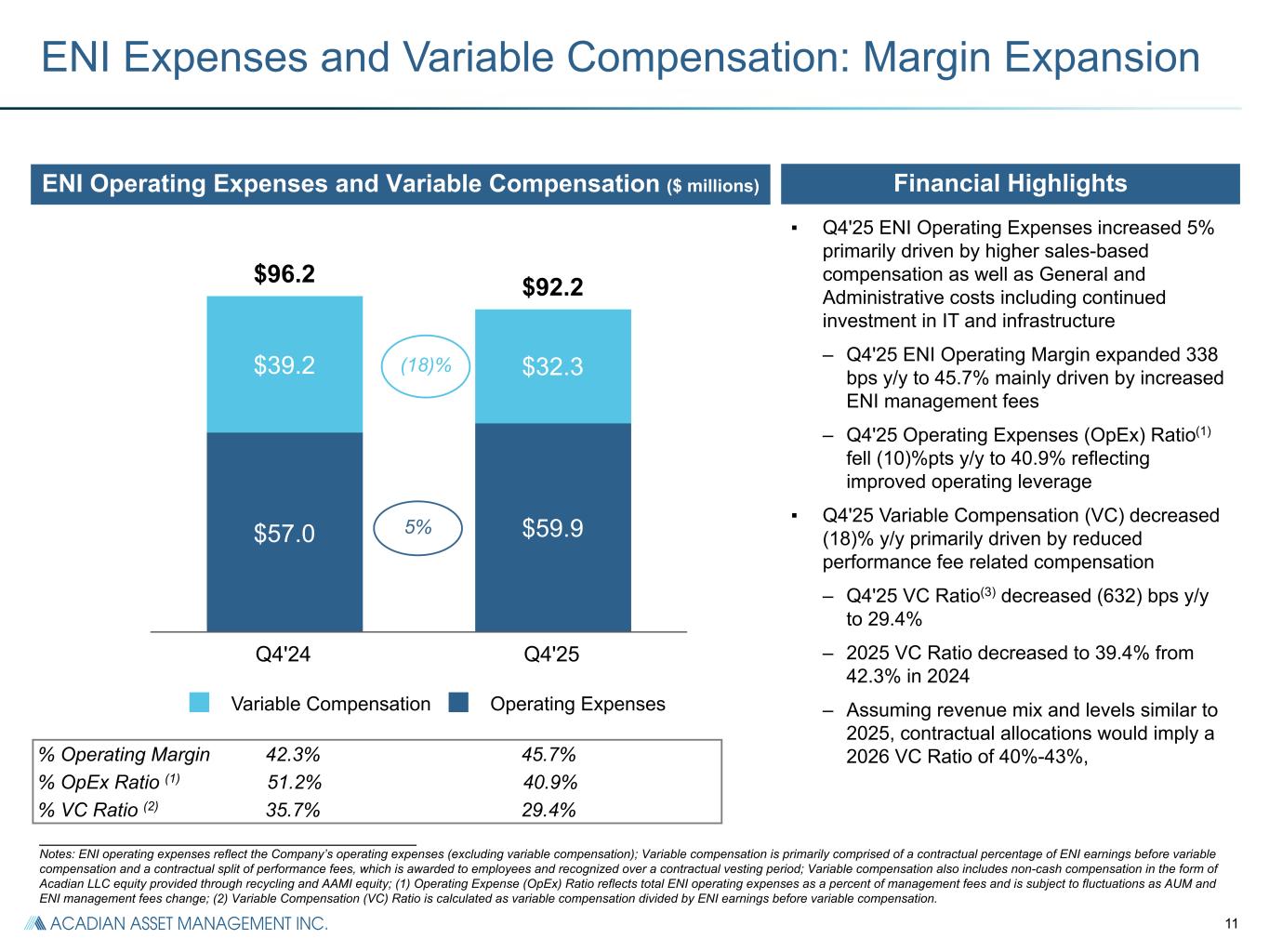
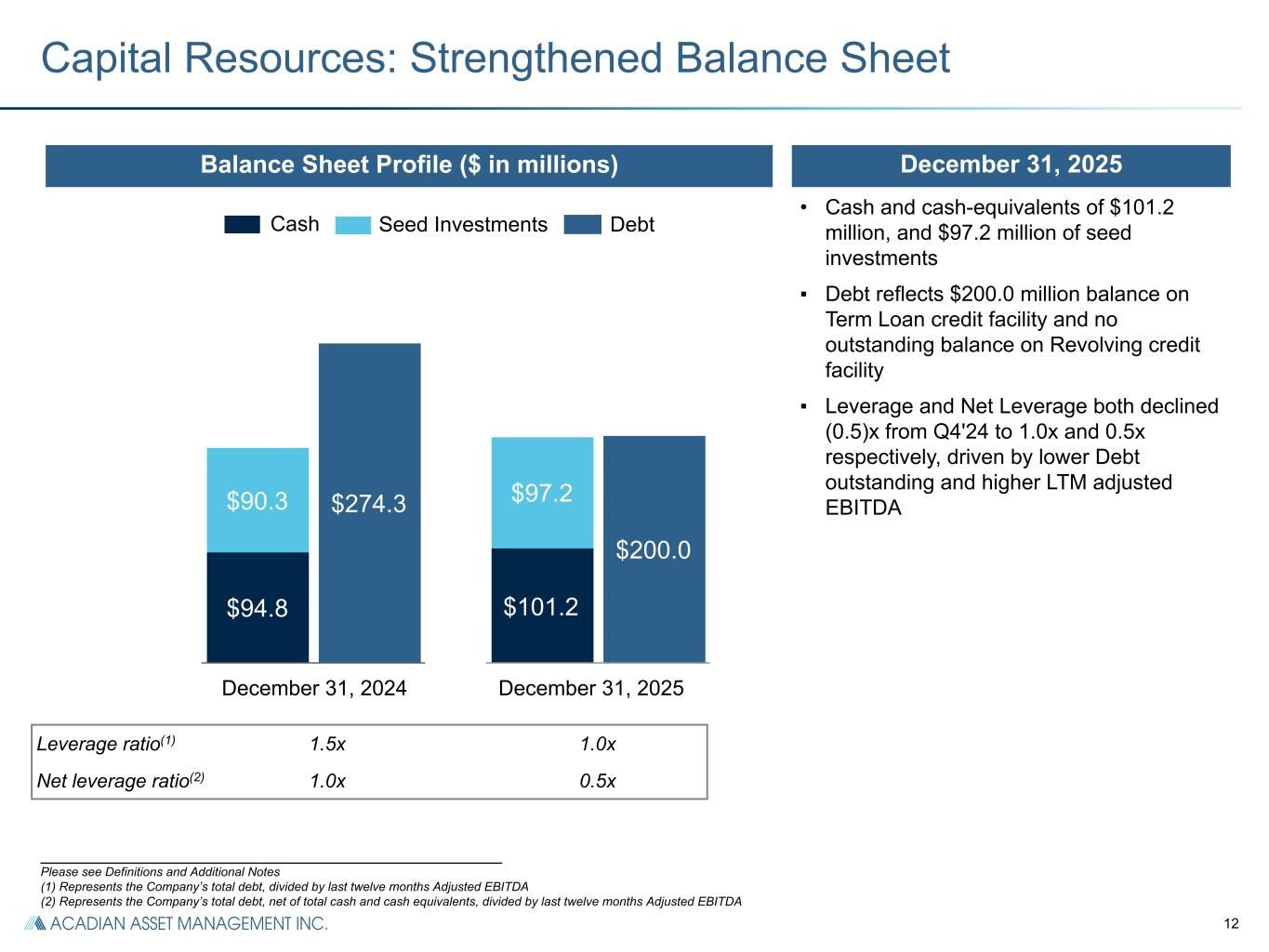
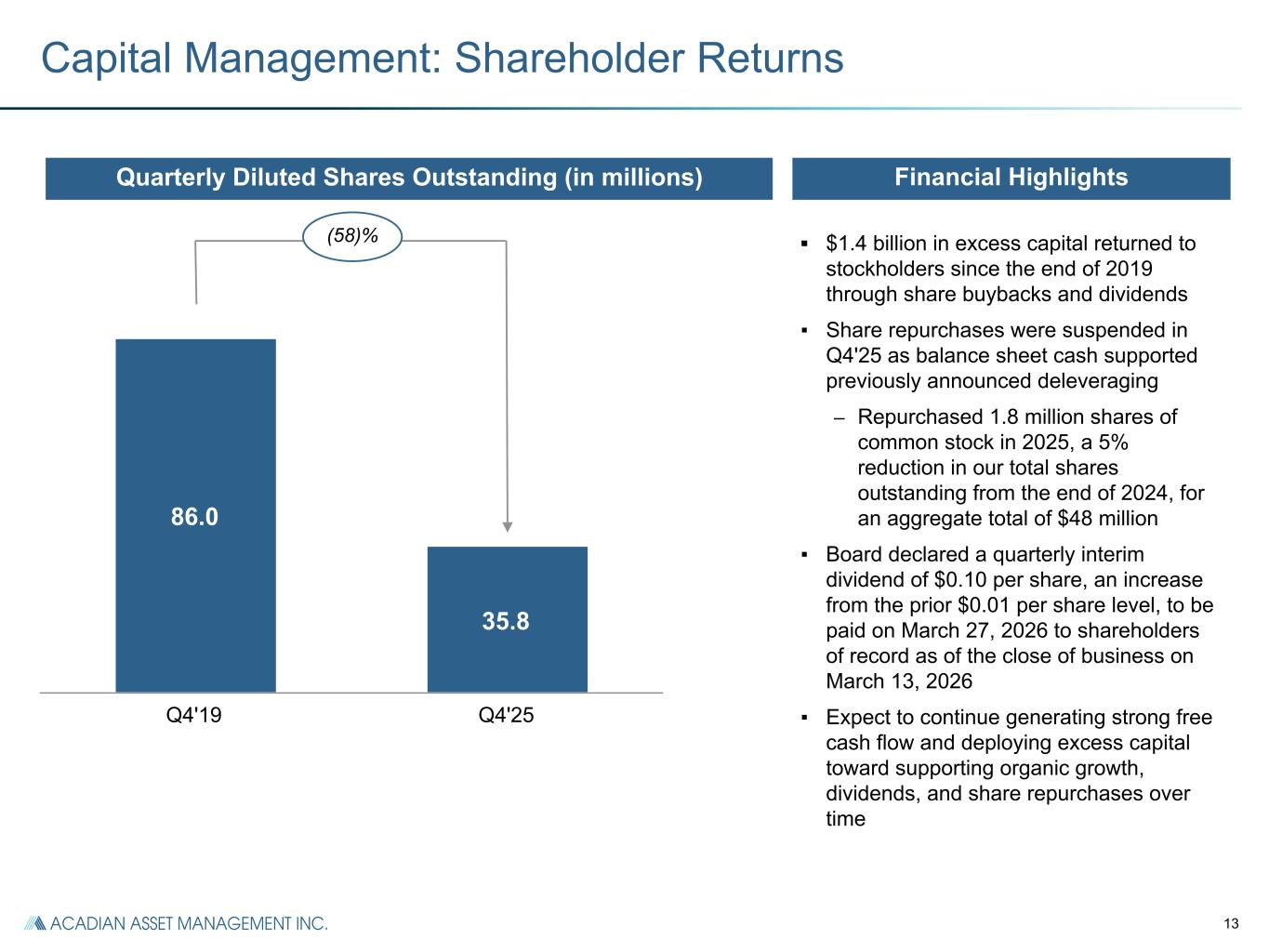
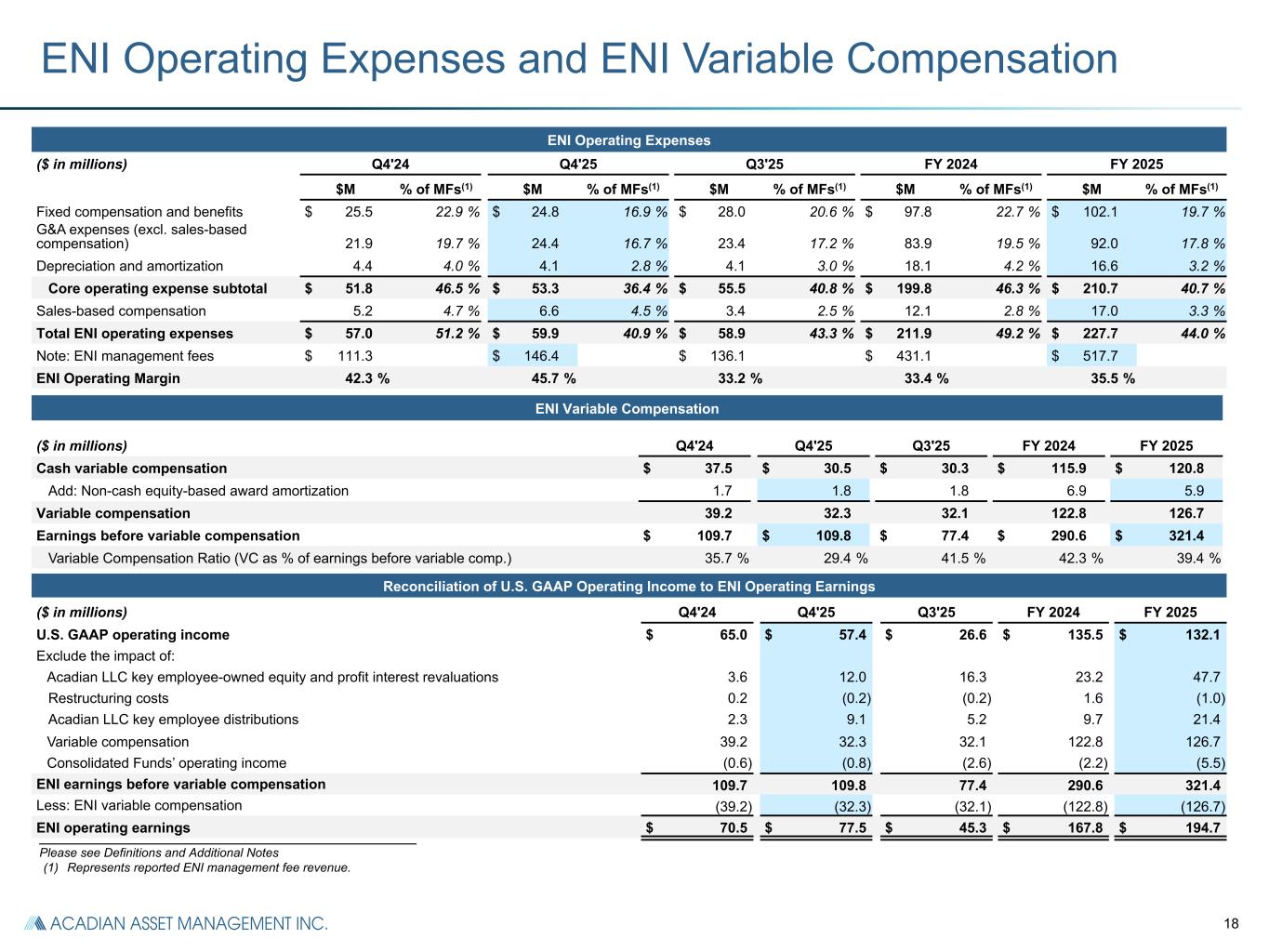
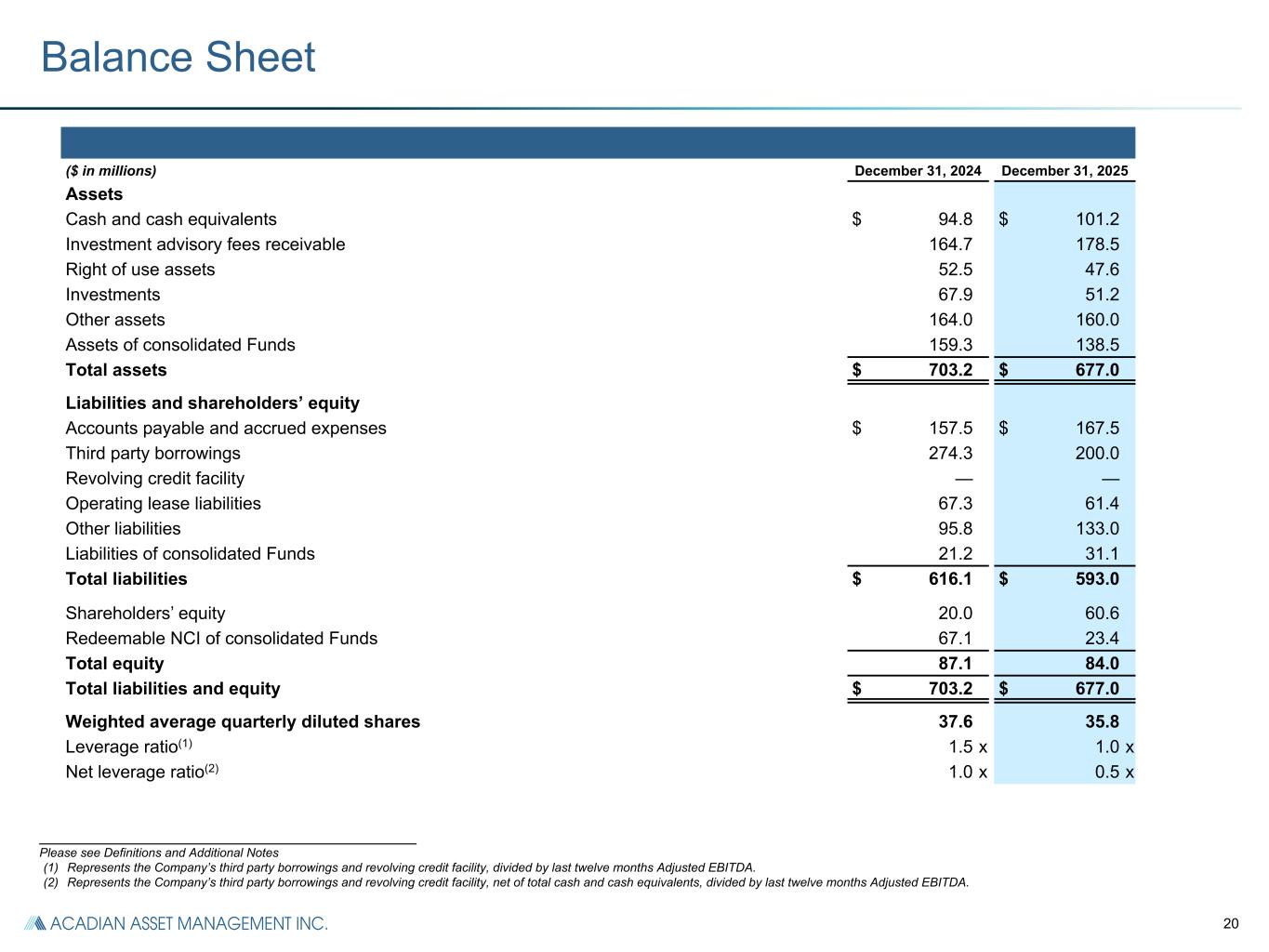
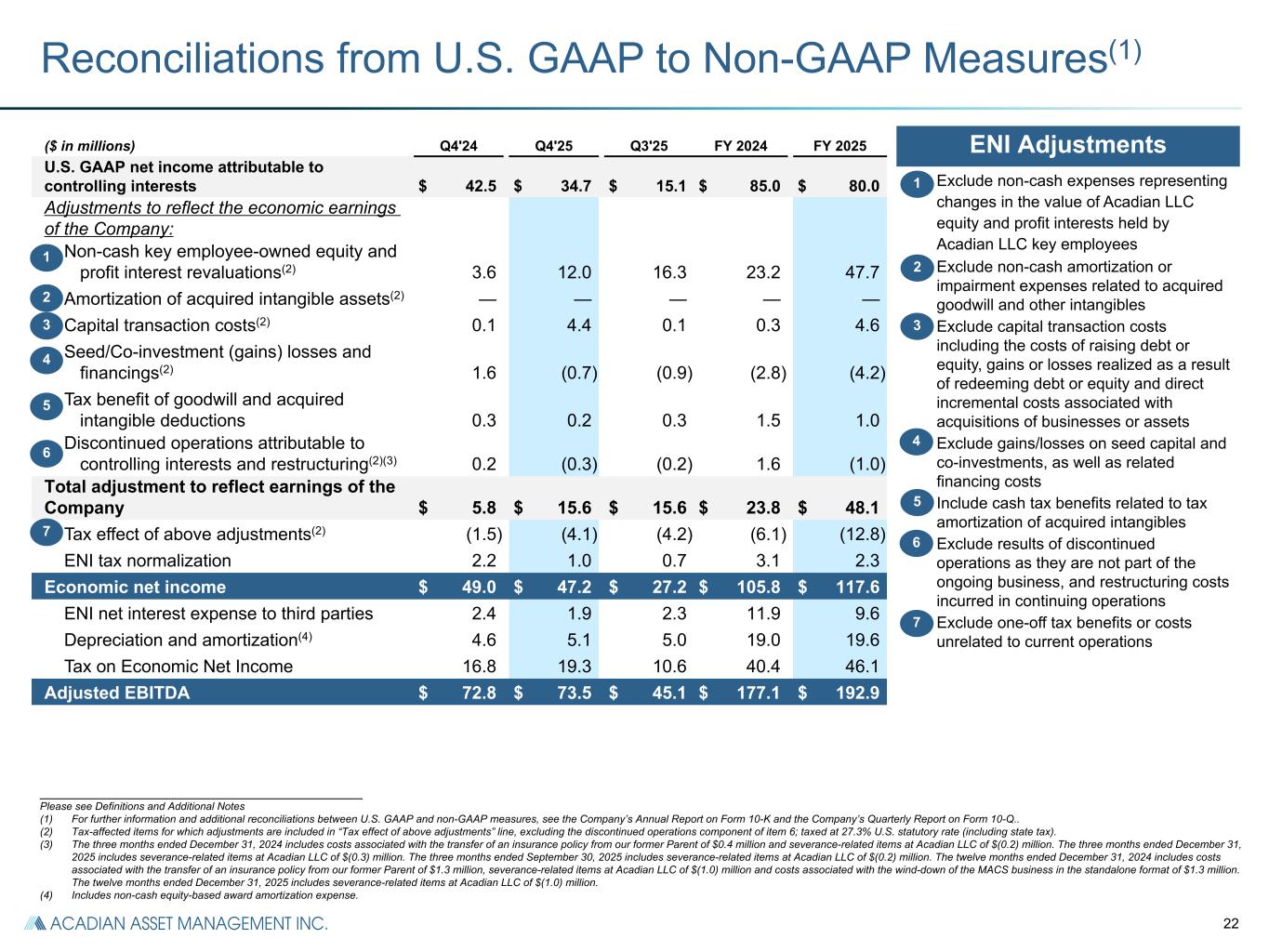
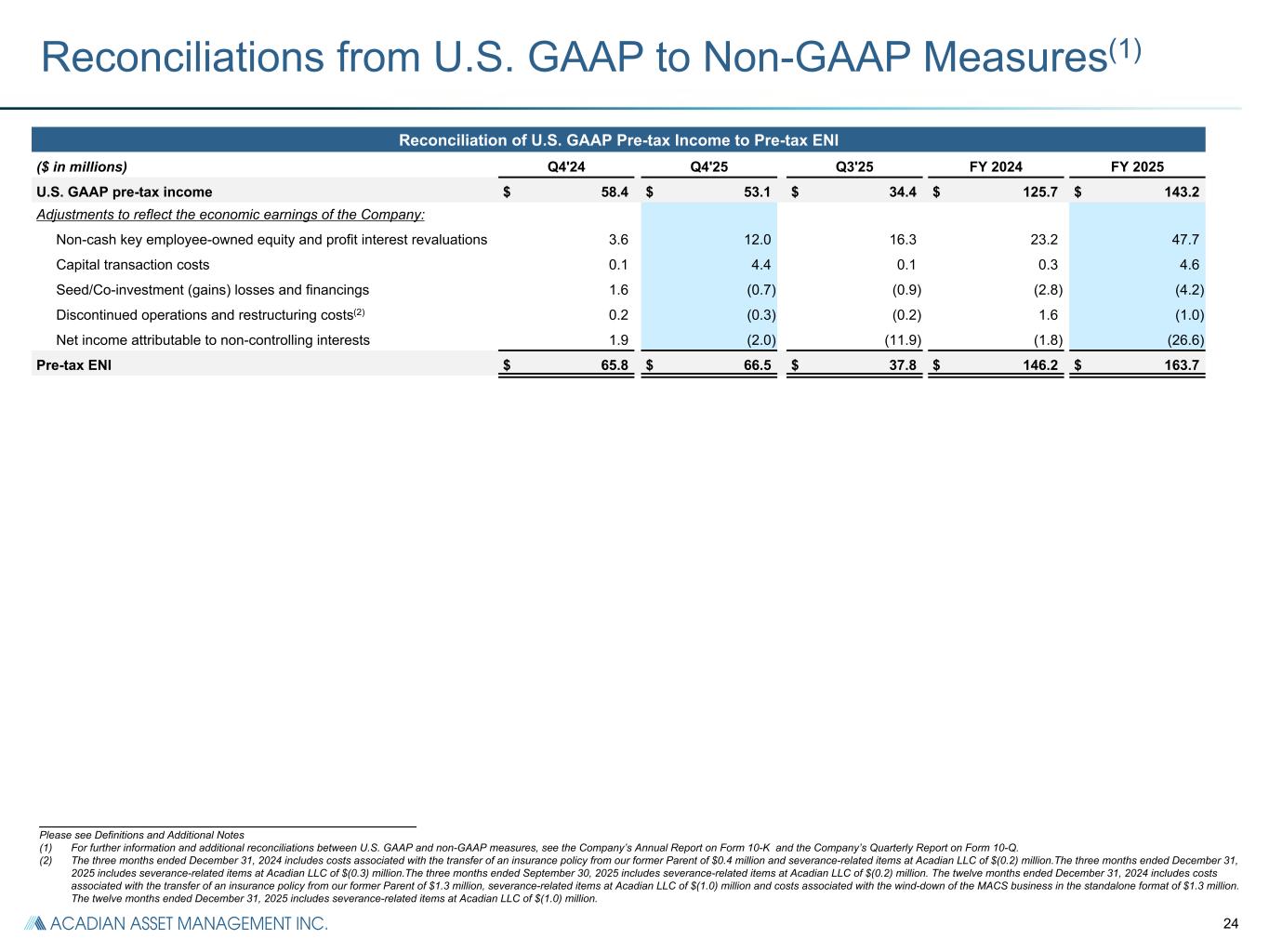
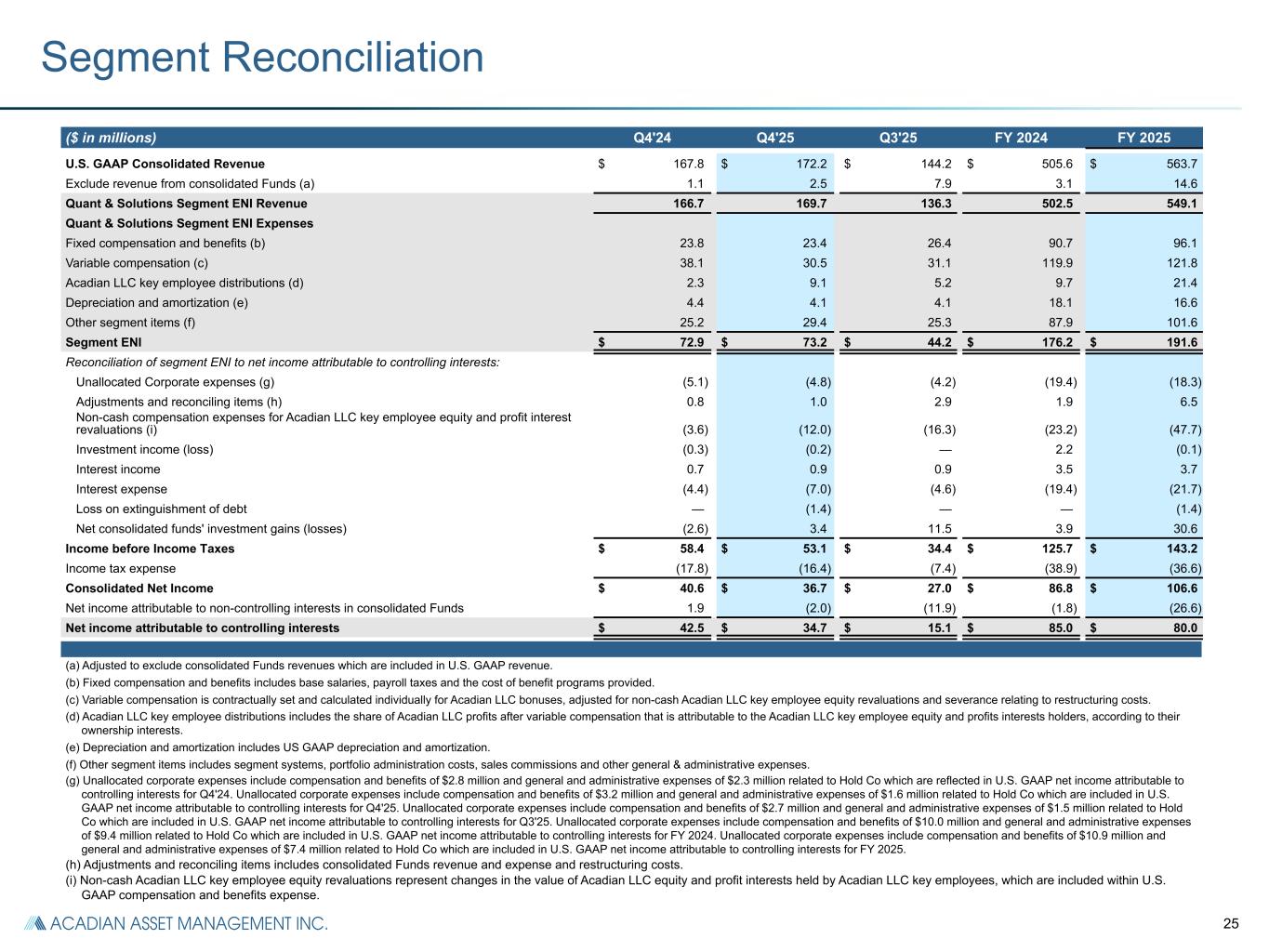
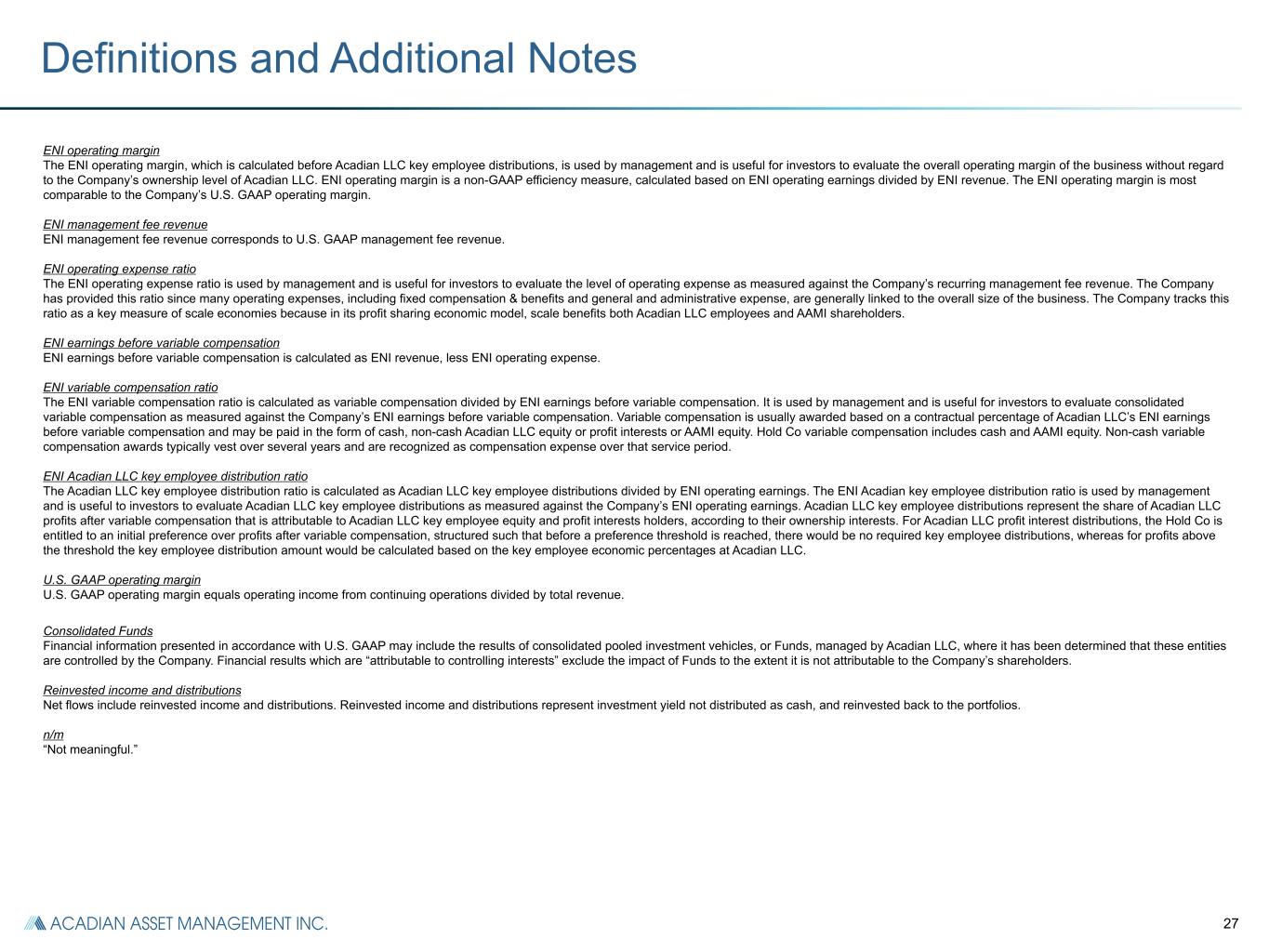
Thanks, Kelly. Turning to slide nine, our key gap at E&I performance metrics are summarized here on both a quarterly and full-year basis. As previously noted, we manage the business using E&I metrics, which better reflect our underlying operating performance. We can find complete gaps to E&I reconciliations in the appendix. Let me now turn to our core business results. Starting on slide 10, Q425 management fees of $146 million increased 32% from Q424, reflecting a 43% increase in average AUM, driven by strong positive net flows and market appreciation. Total E&I revenue of $170 million increased from 2.424 by 2%, primarily due to recurring base management fee growth, partially offset by a decline in performance fees. We have now delivered nearly 8% or higher quarter-on-quarter management fee growth for three consecutive quarters, and with fourth quarter end-of-period AUM of $178 billion, we enter 226 with a significantly stronger recurring revenue base. This stronger entry point enhances our confidence in our ability to deliver earnings, generate free cash flow, self-fund organic investments, and return capital to shareholders. Moving to slide 11, Q425 E&I operating expenses increased 5%, primarily driven by higher sales-based compensation, as well as general and administrative costs, including continued investments in IT and infrastructure. Our E&I operating margin expanded 338 basis points to 45.7%, from 42.3% in Q424, driven by increased E&I management fees. While our Q425 operating expense ratio fell 10 percentage points year-over-year to 40.9%, reflecting the impact of improved operating leverage. Q425 variable compensation decreased 18% year-over-year, primarily driven by reduced performance fee-related compensation, as well as increased non-cash compensation. In sympathy, our Q425 variable compensation ratio decreased to 29.4% in Q425, from 35.7% in Q424, while our full year 2025 variable comp ratio decreased to 39.4% from 42.3% in 2024. Assuming revenue mix and levels similar to 2025, contractual allocations would imply a 2026 variable compensation ratio of approximately 40 to 43%. Turning to slide 12 on capital resources, as of December 31st, 2025, we had $101 million of cash and $97 million of seed investments on the balance sheet, with a $200 million balance on our new term loan credit facility and zero balance on our revolving credit facility. We completed the previously announced refinancing of our $275 million senior notes in Q425, reducing our gross debt by $75 million and helping lower our gross leverage ratio from the prior year by half a term to one time and our net leverage ratio to 0.5 times. This refinancing has left our balance sheet stronger and more durable, better positioning us to navigate various market environments and to continue to return excess capital going forward. As a reminder, Acadian's leverage typically peaks in the first quarter of each year as we draw down on our revolver to fund annual compensation but then decline through the year as we generate cash and pay down the revolver. We expect this dynamic to continue in 2026. Moving to slide 13, we have a track record of creating significant value through share buybacks in recent years. Outstanding diluted shares have decreased 58% from 86 million in Q419 to 35.8 million shares in Q425. Over the same period, $1.4 billion in excess capital was returned to shareholders through share buybacks and dividends. Share repurchases were suspended in Q425, with balance sheet cash supported the previously discussed due leveraging. We've repurchased 1.8 million shares of common stock in 2025, with 5% reduction in our total shares outstanding from the end of 2024 for an aggregate total of $48 million. Acadian's Board has declared an interim dividend of $0.10 per share, an increase from the prior penny per share level to be paid on March 27, 226, to shareholders of record as of the close of business on March 13, 2026. This increased dividend level reflects the Board's confidence in a recurring revenue base and continued strong free cash flow generation. Going forward, we expect to continue generating strong free cash flow and returning excess capital shareholders through dividends and share repurchases. I'll now turn the call back over to Kelly.
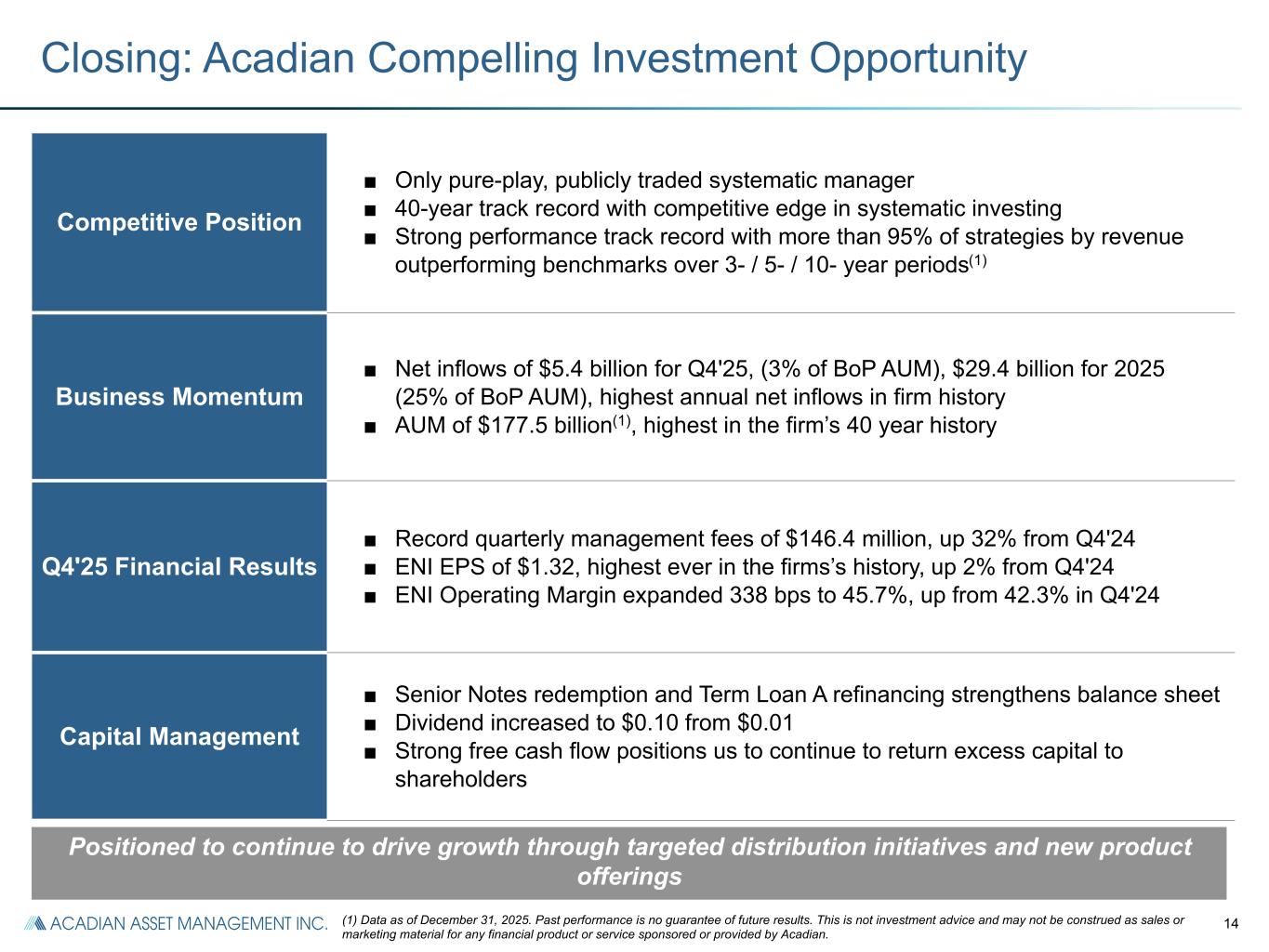
Before moving to Q&A, let me recap some key points on slide 14. Acadian is competitively positioned as the only pure-play, publicly-traded systematic manager with a 40-year track record and competitive edge in systematic investing. Our investment performance track record remained strong this quarter, with more than 95% of strategies by revenue outperforming over 3-, 5-, and 10-year periods. Business momentum continued to pace in Q4 of 25, with net inflows of £5.4 billion for the quarter and £29.4 billion for the year, the highest annual MCCF in the firm's history, and with record AUM of £177.5 billion. Q425 financial results included record management fees of £146 million, up 32% from Q424, record E&I EPS of $1.32, up 2% from Q424, and operating margin expansion to 45.7%, up from 42.3% in Q4-24. Finally, capital management remained a focus in the quarter as we strengthened our balance sheet with the senior note to redemption and term loan A refinancing and announced an increase in our quarterly dividend to 10 cents per share. Acadian is well positioned to continue to drive growth and generate value for shareholders through targeted distribution initiatives and strategic product offerings. Our talented and dedicated team is acutely focused on achieving these goals, and I look forward to building on the momentum we saw in 2025. This concludes my prepared remarks.
Operator
At this time, those with questions should list their phone receiver and press star, followed by the number one on their telephone keypad. To cancel a question, please press star one again. Please hold for a brief moment while we compile the Q&A roster. Your first question comes from the line of John Dunn with Evercore. Please go ahead.
Thank you. I wanted to go back to the institutional pipeline. You said it remains robust. Maybe if you could do the composition of it and maybe the cadence of timing you expect over the course of 2026.
Yeah, hi, John. Of course, thanks for the question. Yes, as I said, I think the pipeline remains very strong and the pipeline looks exactly how we would want it to, so in terms of very diverse by product types, by geographies and by vehicles. We continue to see a lot of interest in enhanced. As you know, that was a theme that we saw a lot through 2025. That continues, I think, to resonate with clients looking for lower risk but consistent returns at a lower fee, and we continue to see that as a key feature in the pipeline. On the other end of the risk spectrum, our extension strategy, we've seen real interest I'd say particularly from North America, but increasingly across the globe. So those are two key features, and again, two of the key tenants that we talked about in terms of our growth strategy last year. And then a real resurgence of interest in some of our core strategies, areas like EM, which has been muted over the last few years and that was a feature of cash flows in Q4 and we continue to see interest there I think as clients are looking for diversification away from the US and with strong tailwinds from dollar weakening so again it's very diverse really is I'd say that you know features of enhanced core and extensions continue to hold as seen and again we continuing to see that diversification and interest really across the globe driven by, you know, not just US clients but internationally as well. So again, broad pipeline, a continuation of some of the things that we saw in 25, but as I say, with areas like EM that historically has perhaps been a little more used over the last couple of years, continuing now to sort of feature everything.
John, it's Scott. I just add to what Kelly provided there that You know, since I joined, you know, last spring, and we obviously stare at very granular pipeline data, you know, the levels have been remarkably durable, even through, as you know, you know, the digestion or the realization of a really large wind. So, again, we feel incredibly well-positioned going into the year, and that's probably suggested, again, if anything, from my chair, it's just remarkable the extent to which we've seen that pipeline, you feel.
And then maybe just a word on your current areas of investment and looking over the course of the year, any changes we should be thinking about in the more, like, fixed?
I'll start. I'll tell you anything if you'd like. I mean, one, stepping back, I think we are very fortunate in this regarding our ability to continue to generate positive operating leverage. We're focused on scaling the business. We're confident in our ability, you know, to do so. um when we think about investment areas um you know i think there are some key areas some which are related um to to certain of the positive initiatives that we've already announced in last year so if you think about areas like systematic credit i know kelly and team have already talked to uh to you and others about some of the significant investments we make there that takes perform usually at this point of people um so to make that mobile dedicated sales people for instance systematic credit um you know when you think about technology that's obviously um a huge focus for us it's part of the mode around the business um so you're seeing continued investments there particularly around areas like data how we work with data that does involve some ongoing ai investments just so now our research team for instance to be more focused on um strategies, you know, some manipulating data, so to speak. So hopefully that gives you a bit of a flavor of where we're headed. But again, I think overall I'm expected we made a lot ahead of them this year in terms of realizing margin improvement, and as Kelly said, effectively self-fund.
Operator
There's certainly no – This comes from the line of Kenneth Lee with RBC Capital Markets. Please go ahead.
Hey, good morning, and thanks for taking my question. Just one on the outlook for capital returns and realize that you increased the quarterly common dividend there as well. How do you think about share repurchases in this context? Is there a certain level that you could be looking at or some kind of payout ratio, you know, any kind of?
Yeah, thanks, Dan. I appreciate the question. I think we're really well positioned, right, in terms of capital returns. And, you know, I know you know in a lesser investors and we completed a lease financing last year. We think that makes the balance sheet much, much more durable, provides a lot more flexibility here. The business is behaving really well, generating a lot of free cash flow. The dividend, I would add, up from a penny to $0.10 a quarter, is a signal, as I suggested. Do you want to be athletic? No, there's not. But a payout ratio per se that we're stepping back in terms of balance sheet management over time, and this is over the long term, I do think it is our intention to march newer toward a net cap position versus more net debt position. We put on provisive. That's certainly not a rush. Your purchases, that plan refinancing, that is over. That is done. And with more than $100 million on balance sheet as we printed at the end of 4-2, we are intentioned to just sit on that, right? we're going to be athletic, we're going to be active, it is an output. I think no step changes there. We've already had the investments in capital. We have a thing. That pause in your purchase position has its interest this year, and the business is behaving well. And we're going to be active in an athletic industry.
Gotcha. That's very helpful there. And one follow-up, if I may. I'm not sure whether I might have missed this early in the call, but what was the composition of NEPFLOs in the quarter, in the fourth quarter? Were there any particular outsized mandates?
Yeah, sure, of course, yeah, no, again, it was the sort of quarter that we really want to see from an NCCS standpoint, so no one big dominant mandate that's driving those numbers, again, very diverse across, I'd say, everything from enhancement to extensions on the higher-risk side, as I noted earlier, EM is the feature of Q4, which balance, I'd say, between international and our U.S. clients. So very diverse, not one large sort of theme there that's dominating on one particular. Very diverse, as I say, by graph, geography, and current, and then by vehicle types, some of those separate accounts, some of those coming into our existing funds. So broad and diverse, and exactly what we really want to see. Again, if you would like to ask a question, press star 1 on your telephone keypad. there are no further questions at this time this concludes our question and answer session I'd like to turn the conference call back over to Kelly Young in closing I'd like to reiterate our excitement for the business we were delighted by the 25% increase in net cash flow in the period the 52% increase in AUM and the 32% growth in management fees and we remain incredibly positive for the trajectory