Operator
Ladies and gentlemen, thank you for standing by. Welcome to the Acadian Asset Management, Inc. Earnings Conference Call and Webcast for the first quarter 2026. During the call, all participants will be in a listen-only mode. After the presentation, we will conduct a question and answer session. To be added to the queue, please press the star followed by 1 at any time during the call. If you need to reach an operator, please press the star followed by 0. Please note that this call is being recorded today, Thursday, April 30, 2026, at 11 a.m. Eastern Time. I would now like to turn the meeting over to Melody Wong, SVP Director of Finance and Investor Relations. Please go ahead, Melody.
Good morning, and welcome to Acadian Asset Management Inc.'s conference call to discuss our results for the first quarter ended March 31, 2026. Before we begin the presentation, please note that we may make forward-looking statements about our business and financial performance. Each forward-looking statement is subject to risk and certainties that could cause actual results to differ materially from those projected. Additional information regarding this risk and uncertainties appears in our SEC filings, including the Form 8K filed today containing the earnings release and our 2025 Form 10K. Any forward-looking statements that we make on this call are based on assumptions as of today, and we undertake no obligation to update them as a result of new information of future events. We may also reference certain non-GAAP financial measures, information about any non-GAAP measures referenced, including a reconciliation of those measures to gap measures, can be found on our website, along with the slides that we will use as part of today's discussion. Finally, nothing here shall be deemed to be an offer or solicitation to buy any investment products. Hallie Yang, a President and Chief Executive Officer, will lead the call. And now, I'm pleased to turn the call over to Kelly.
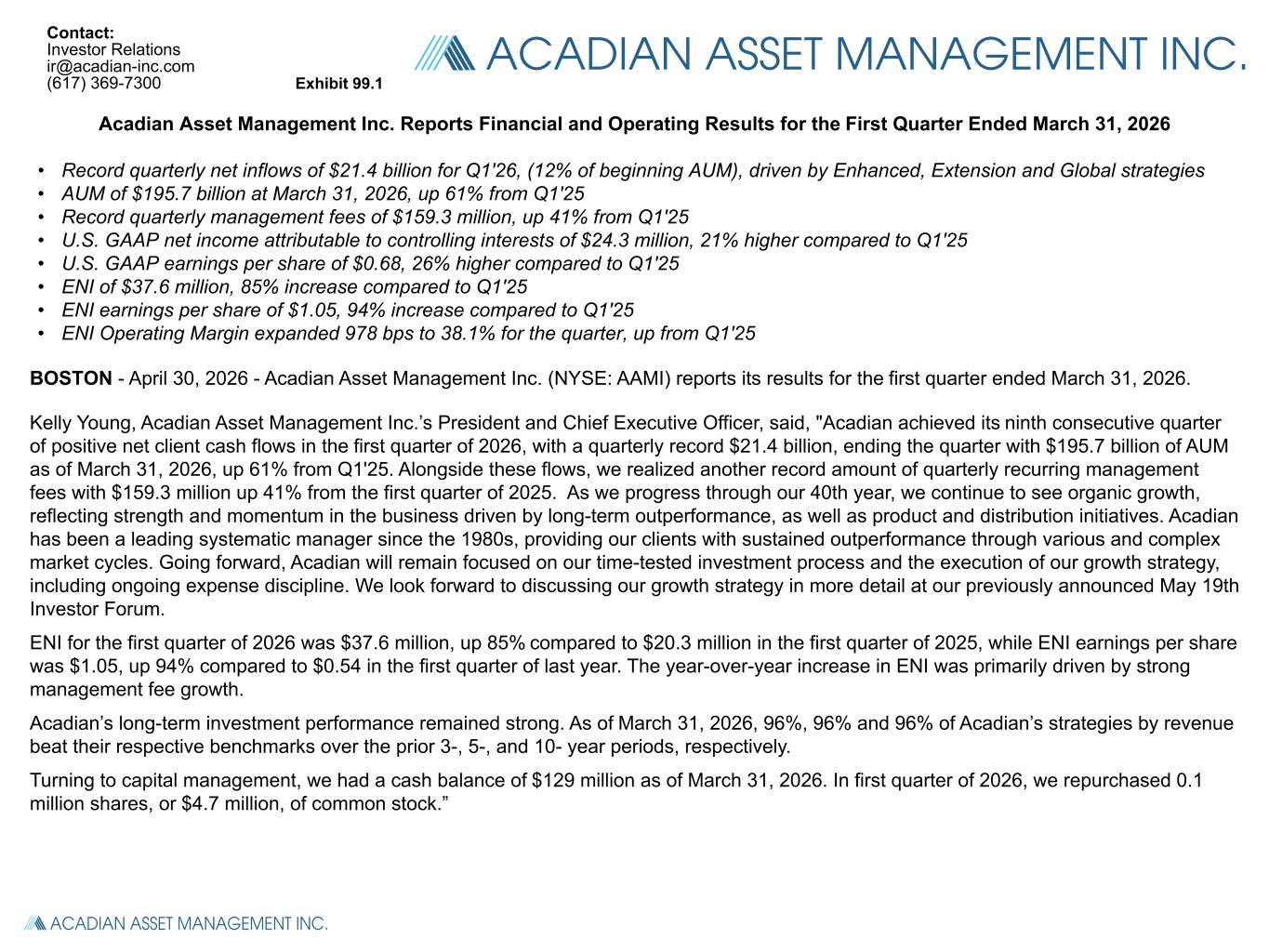
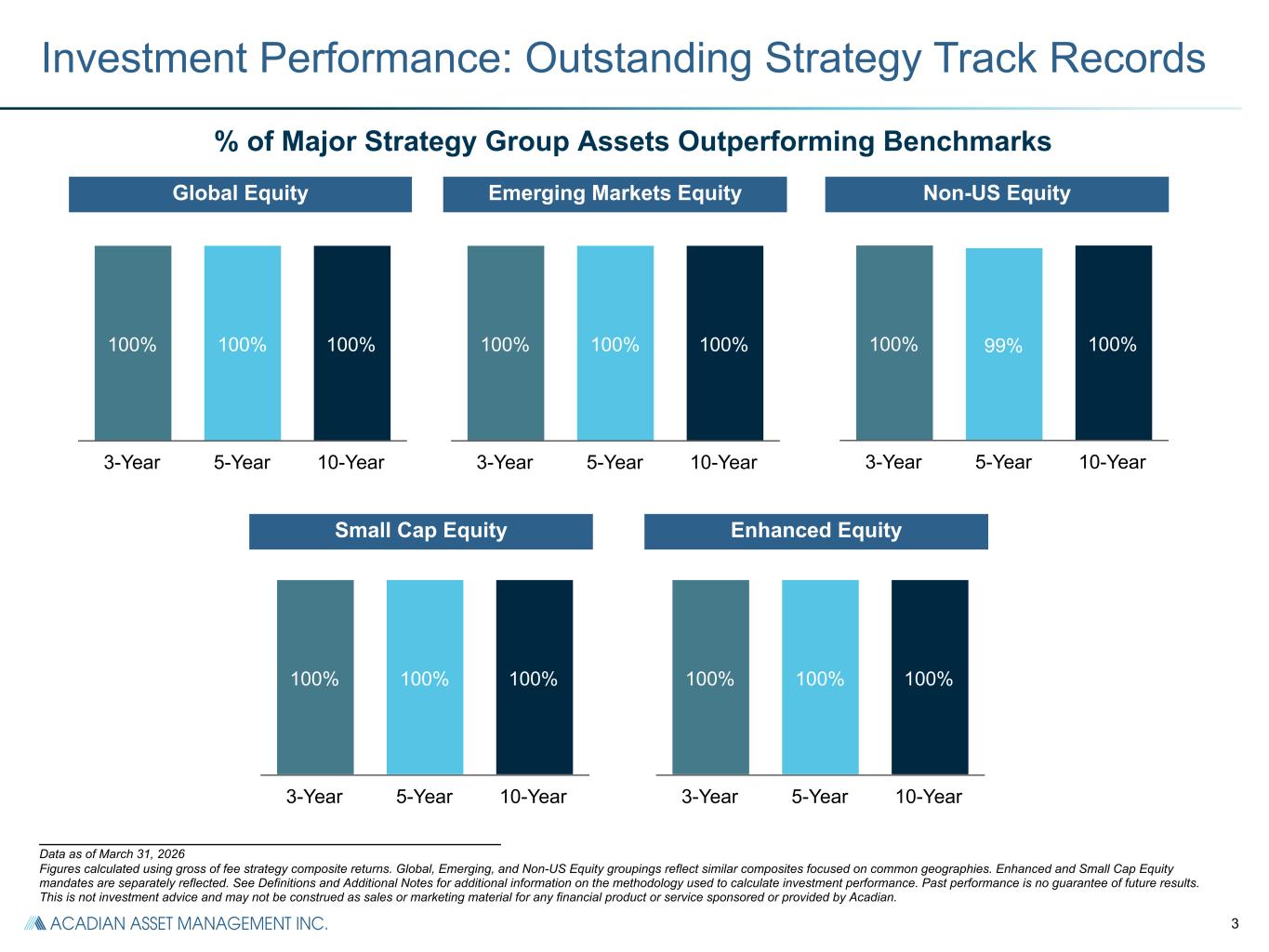
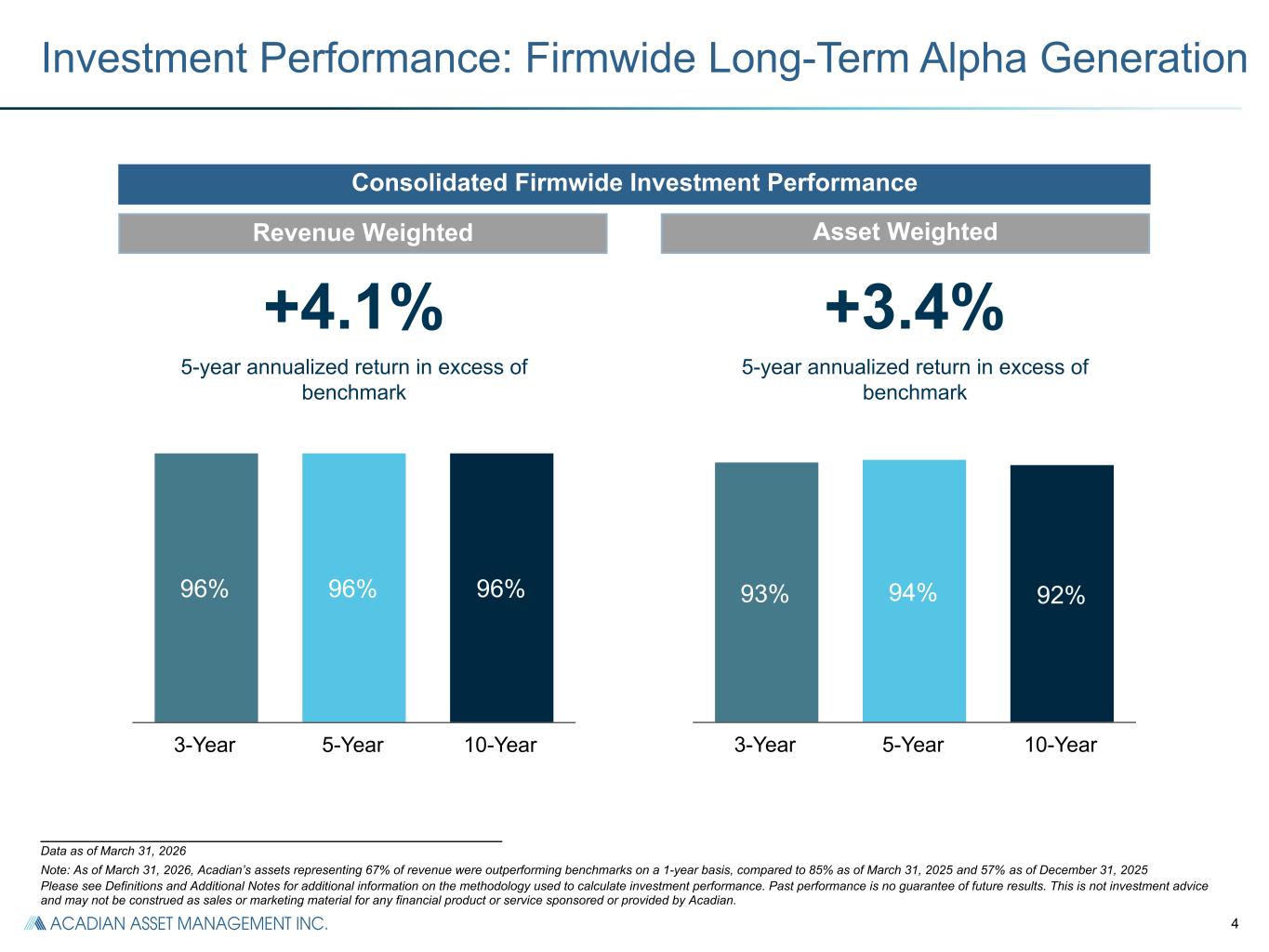
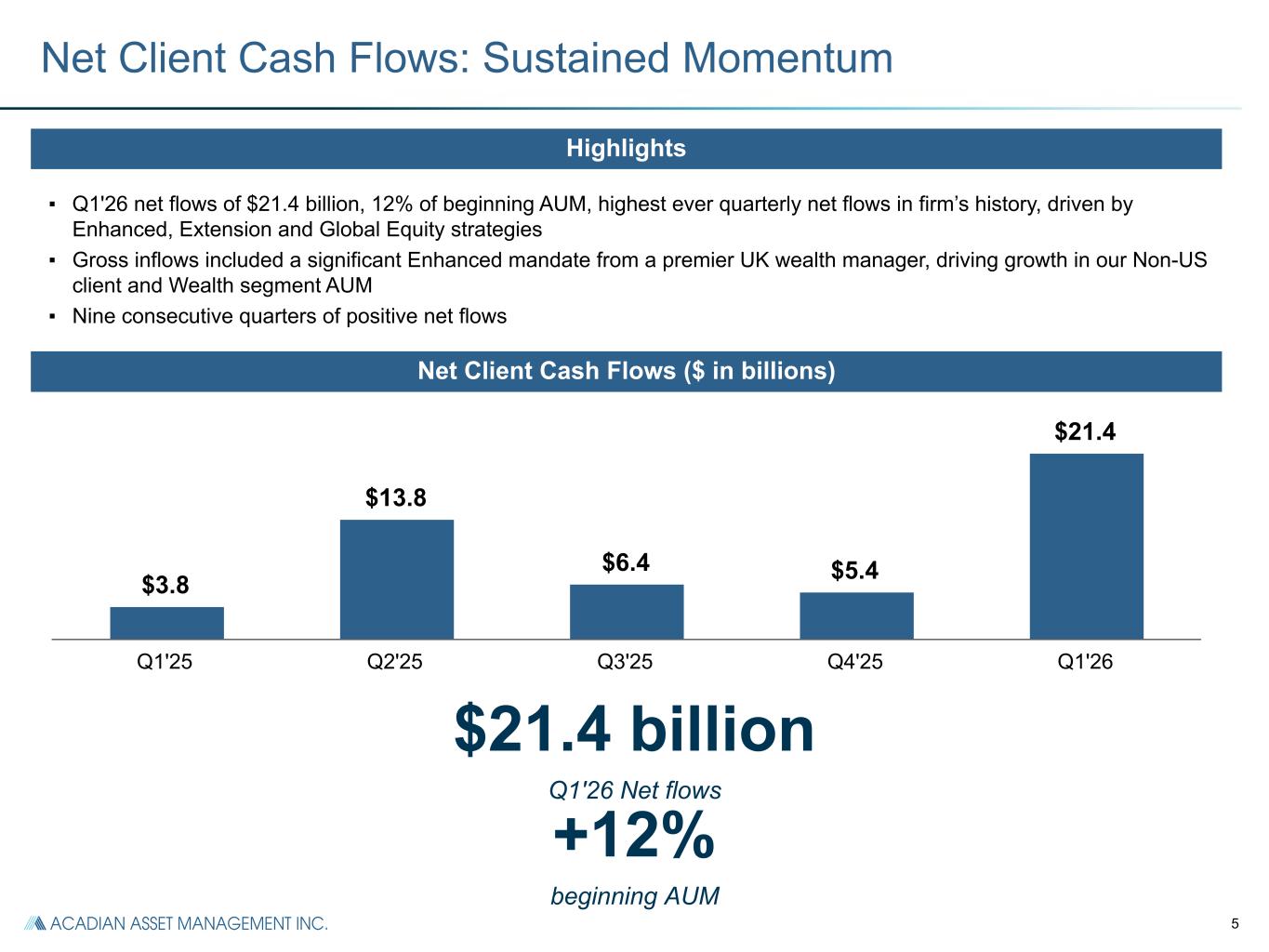
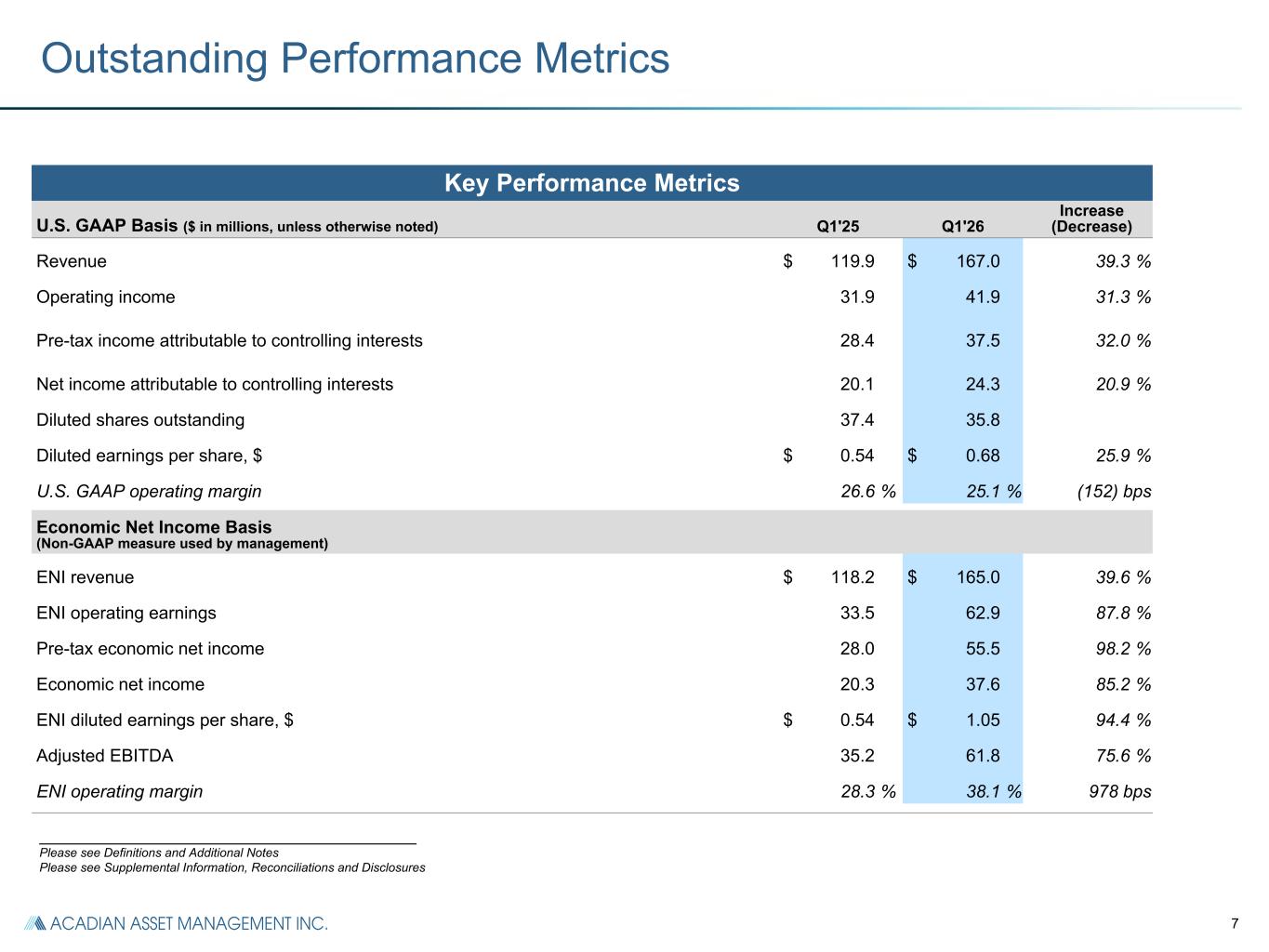
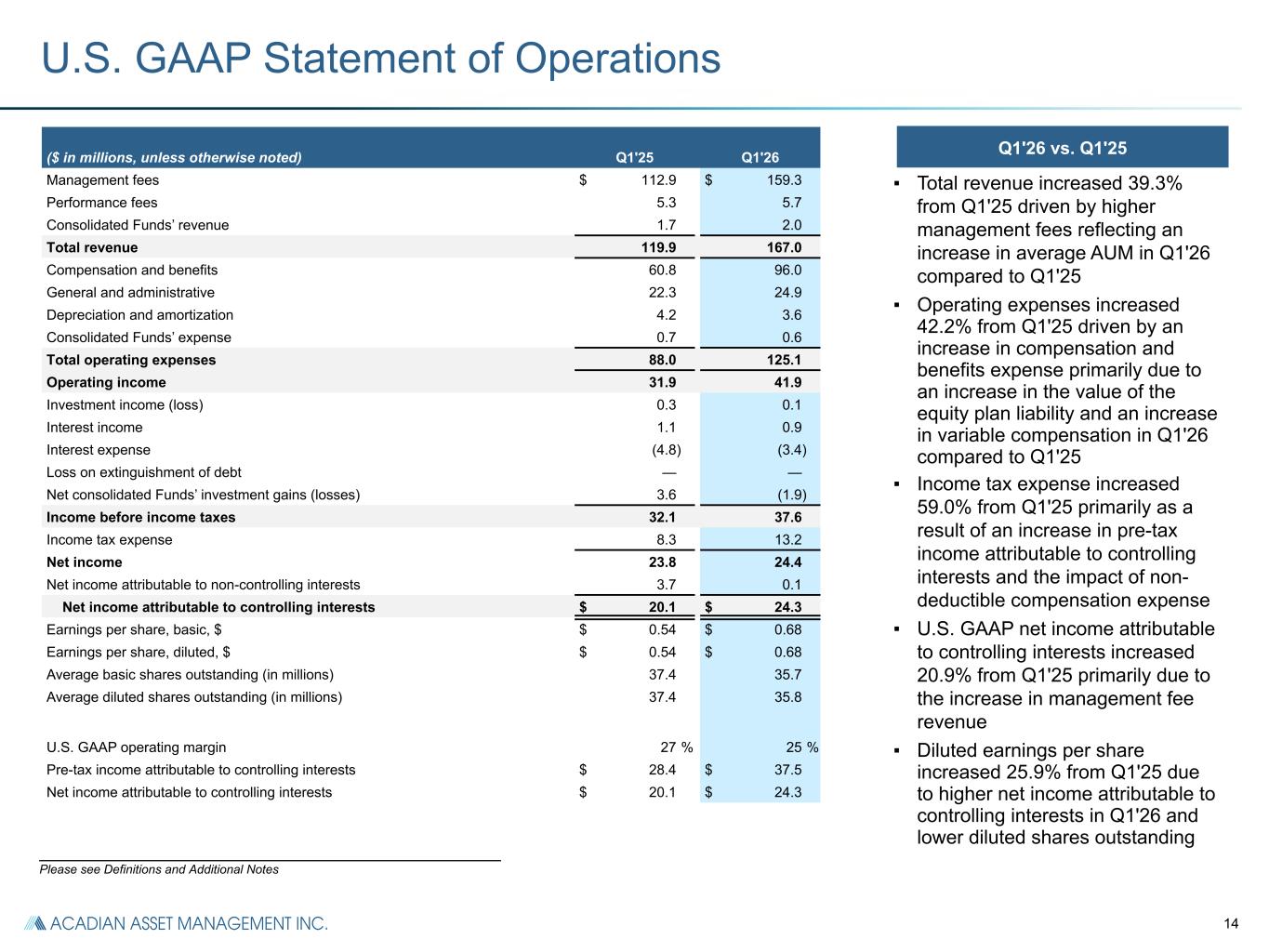
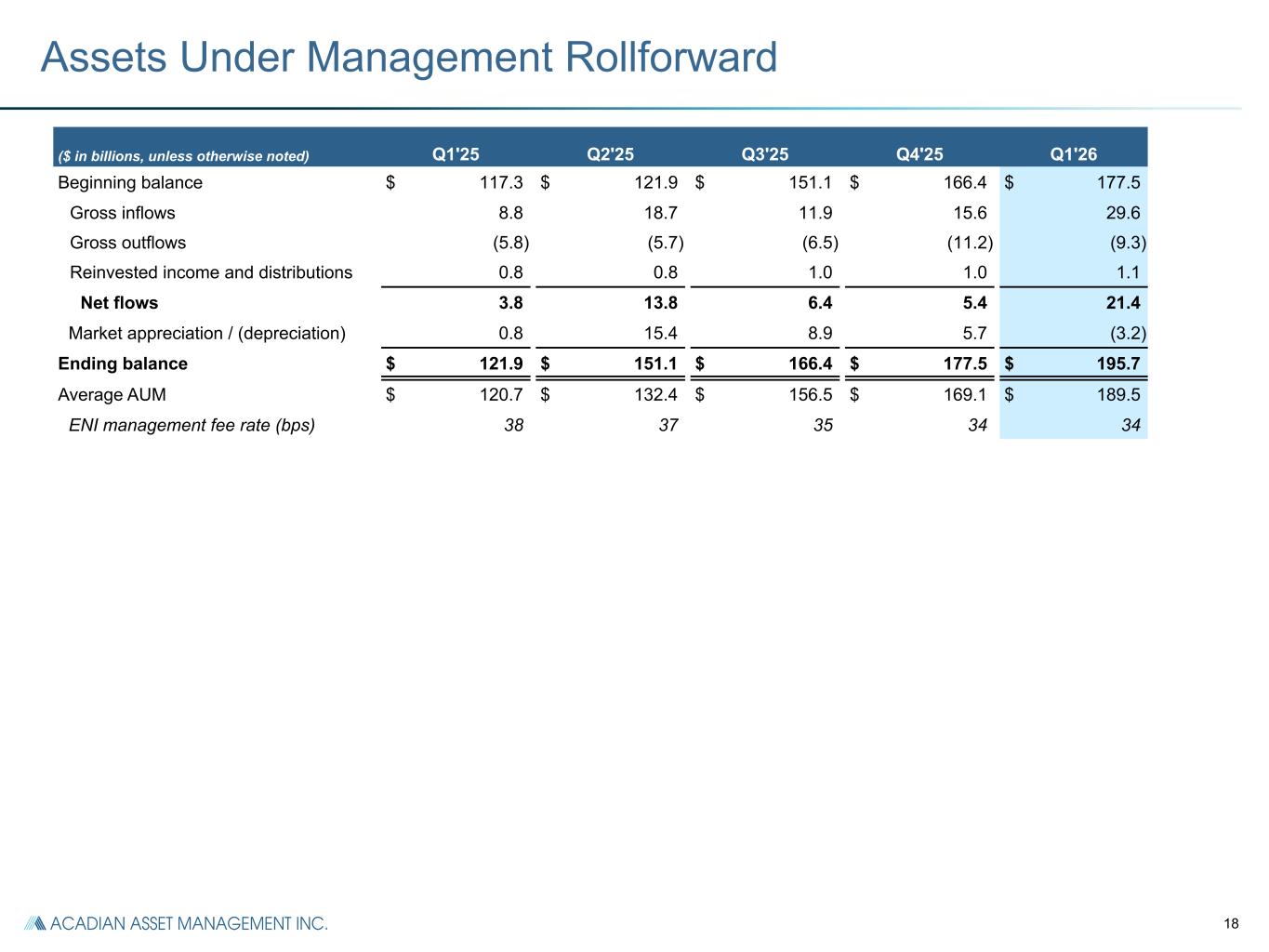
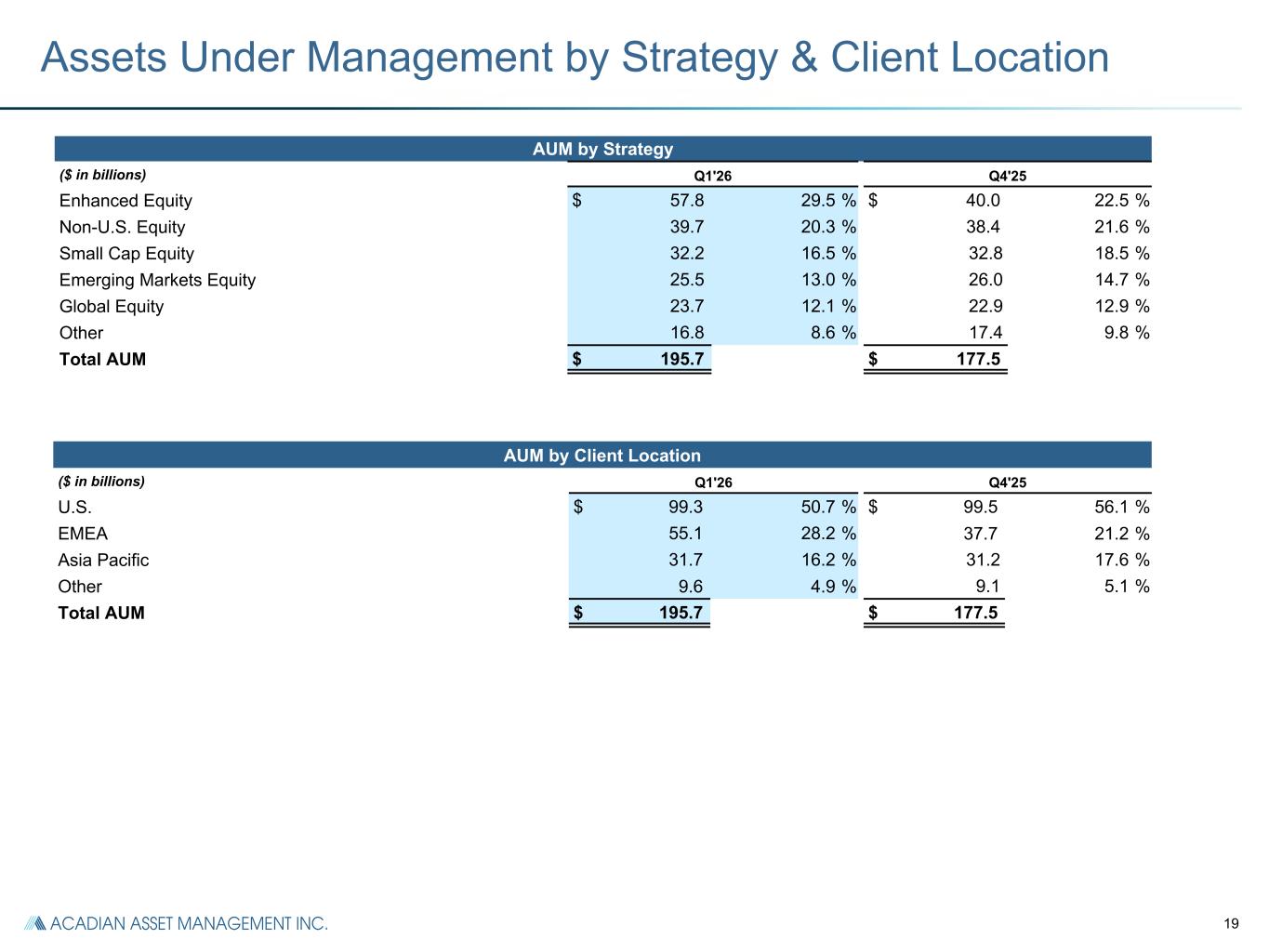
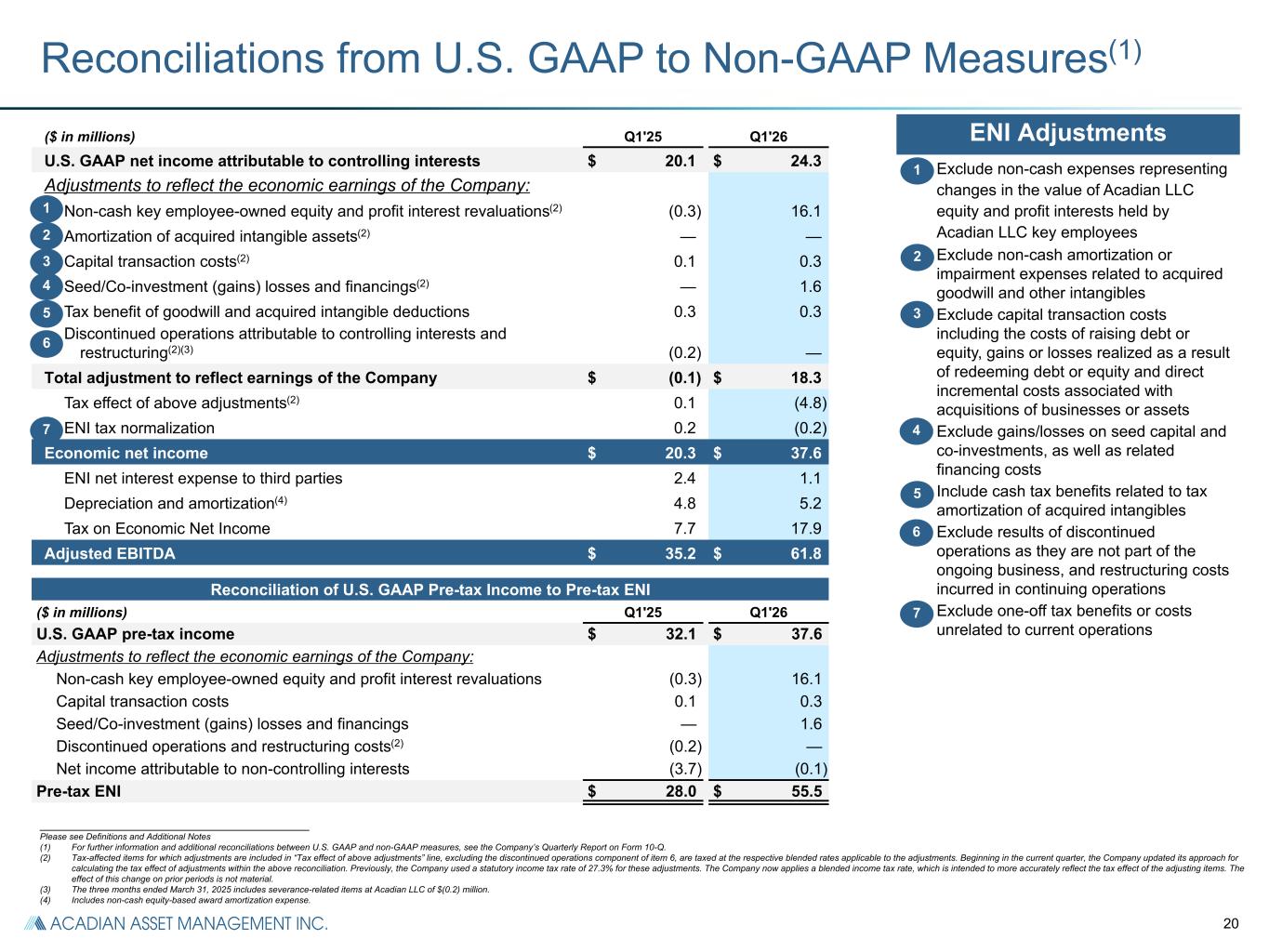
Thanks, Melody. Good morning, everyone, and thanks for joining us today. I'm thrilled to share our exceptional Q1 2026 results with you. Our assets under management and profitability continue to reach new heights, with strong recent growth underscoring sustained momentum in our business and disciplined execution of our strategic plan. We started 2026 by delivering outstanding results across all metrics. Our US GAAP net income attributable to controlling interests was up 21% and EPS was up 26% compared to the prior year, driven by increased management fees and partially offset by non-cash expenses, representing changes in the value of Acadian LLC equity and profit interest. ENI was up 85% to £37.6 million driven by revenue growth and our ENI diluted EPS of $1.05 was up 94%. Our adjusted EBITDA was up 76% driven by increase in management fees. We realised £21.4 billion of positive net flows in Q1 2026, 12% of beginning AUM, our new quarterly record, driven by enhanced extensions and global equity strategies. Finally, AUM grew 61% from Q1 of 25 to 195.7 billion as of March 31st, 2026, marking another record high for Acadian. Turning to slide three, Acadian's investment performance track record remains strong. Five major implementations comprise the majority of our assets. As of March 31st, 2026, global equity, emerging markets equity, non-US equity, small cap equity, and enhanced equity have 100% of assets outperforming benchmarks across three, five, and 10-year periods, with only one exception. Global equity markets experience volatility amid a complex macroeconomic backdrop in Q1 of 26. U.S. equities declined more than non-U.S. equities while the dollar strengthened. Despite the market uncertainty, our disciplined, systematic approach stayed the course and generated consistent alpha for our clients. Acadian's short-term performance track record continued to improve in Q126 after a challenge 2025. We remain confident that we are well positioned given our 40 years of experience through various market cycles and macro forces. Slide four details how our investment process has generated meaningful long-term alpha for our clients. Our revenue-weighted five-year annualised return in excessive benchmark was plus 4.1% as of the end of Q1, 2026, on a consolidated, firm-wide basis. Our asset-weighted five-year annualised return in excessive benchmark was 3.4% as of the end of Q1. By revenue weight, 96% of Acadian strategies outperformed their respective benchmarks across three, five and 10-year periods as of March 31st, 2026. And by asset weight, 92% of Acadian strategies outperformed their respective benchmarks across three, five and 10-year periods. The next slide highlights our sustained momentum in net flows. We realised positive net flows of $21.4 billion in Q1 of 26, representing 12% of beginning AUM, achieving a new quarterly record high. Gross inflows included a significant enhanced mandate from a premier UK wealth manager. This mandate expanded our non-US domicile client base, as well as our presence in the wealth channel. Excluding this large enhanced mandate, the remainder of the net inflows were again diverse across products and client types, with extensions and global equity also generating strong NCCF. We've now generated nine consecutive quarters of positive net flows. We continue to focus on renewing our pipeline, which remains very healthy and active after the funding of a number of significant client wins in Q1 of 26. And I'm now going to turn it over to our CFO, Scott Hines, to provide you with more detail on our financial performance this quarter and an update on capital allocation.
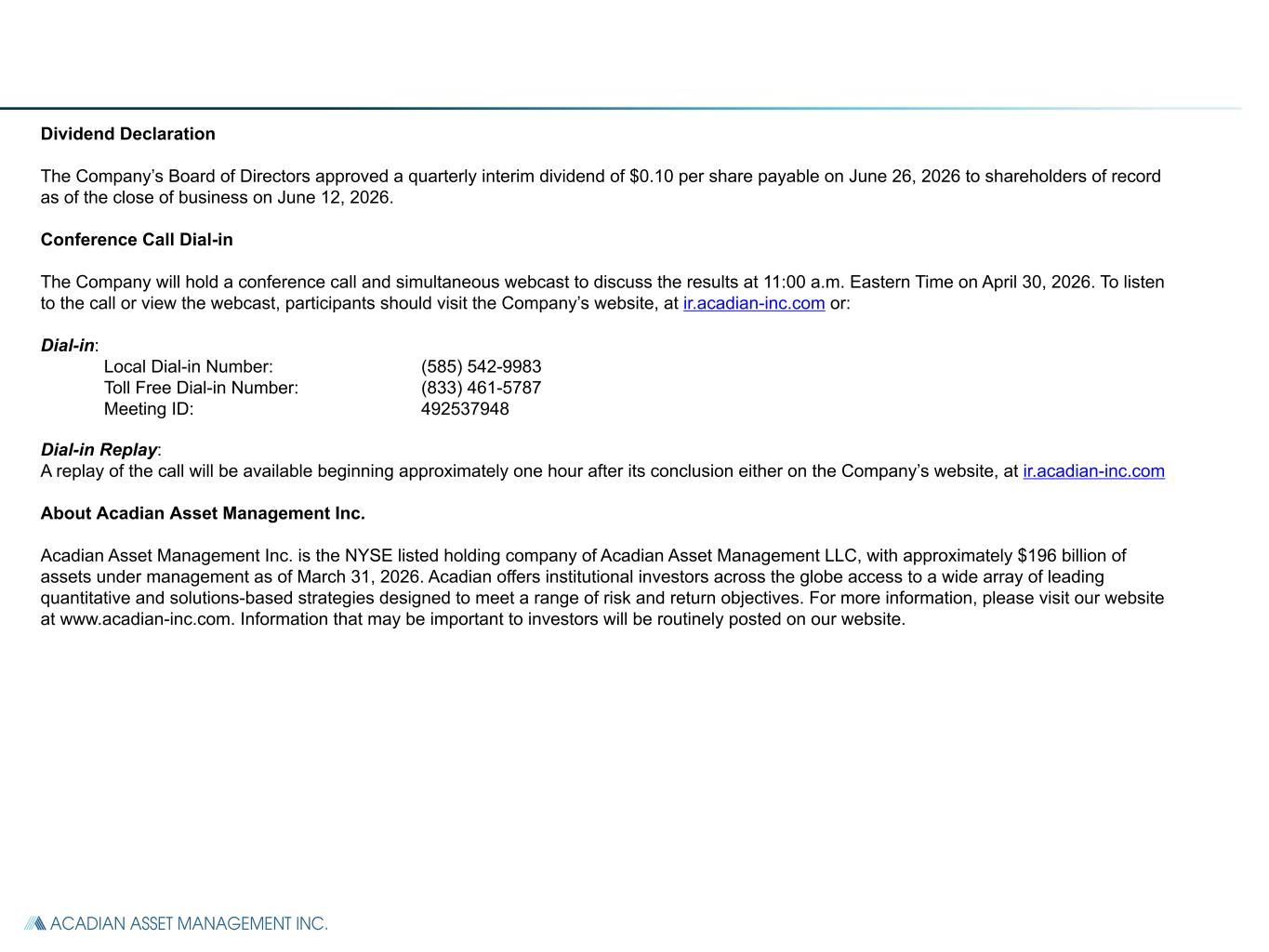
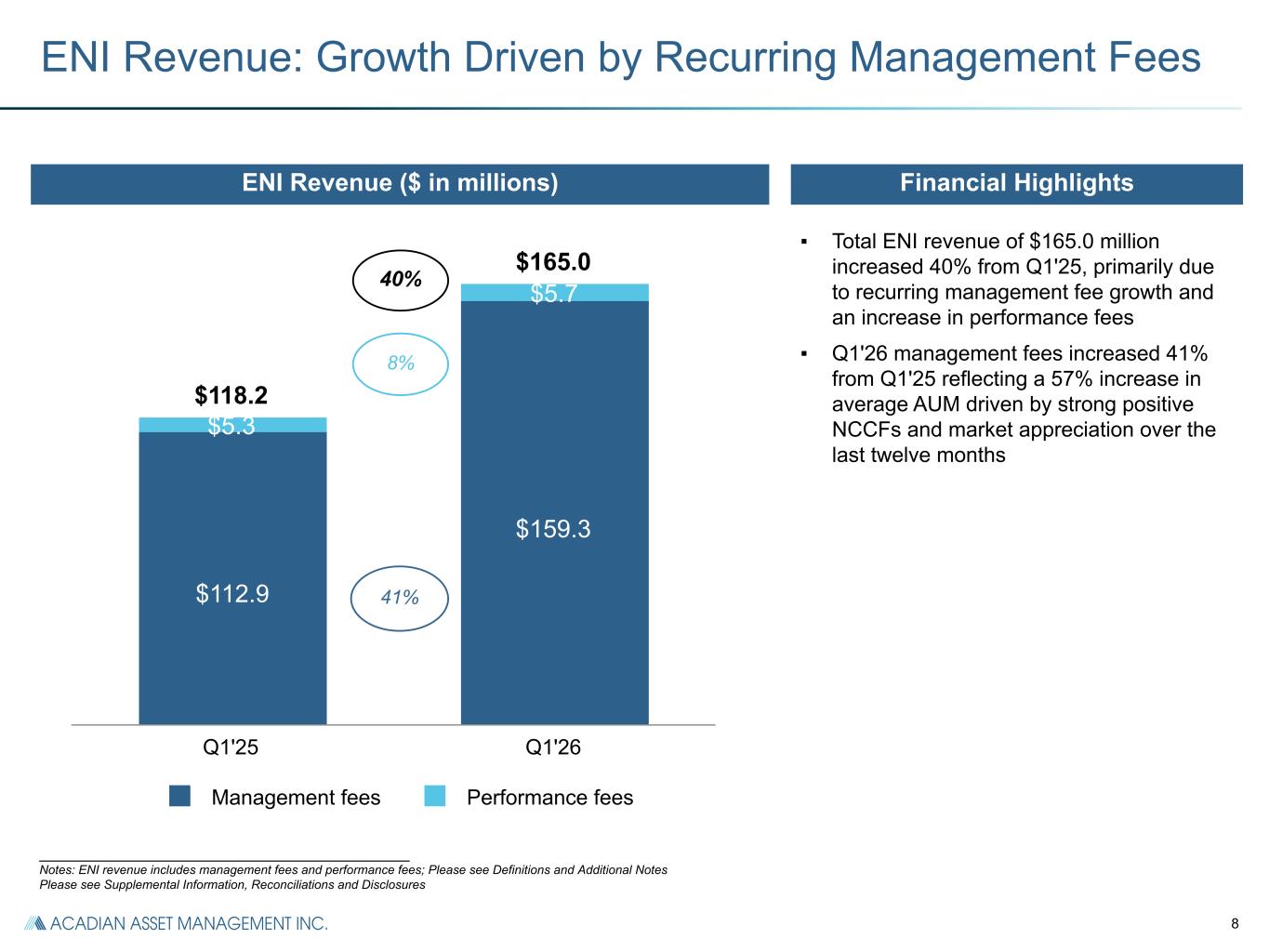
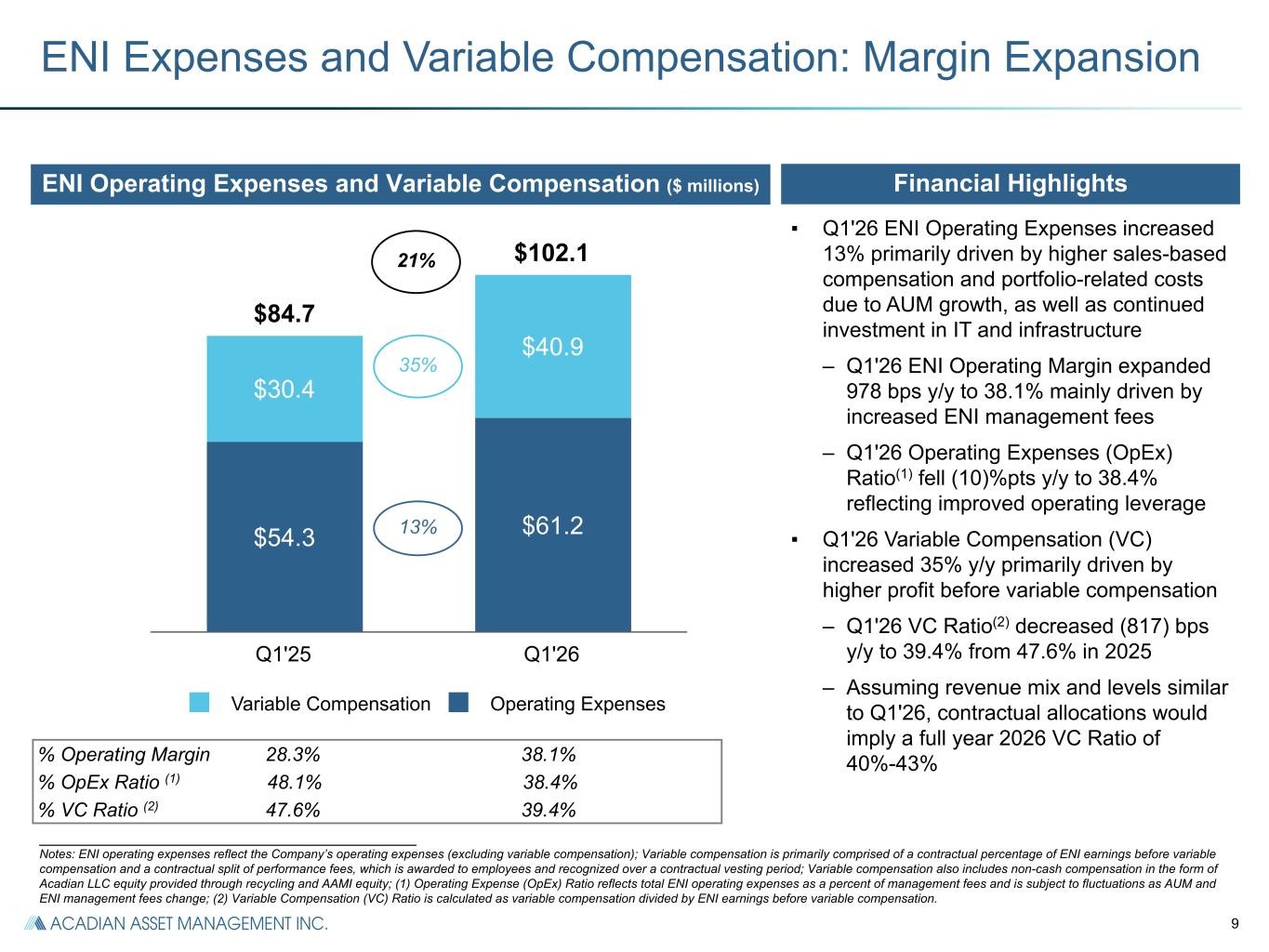
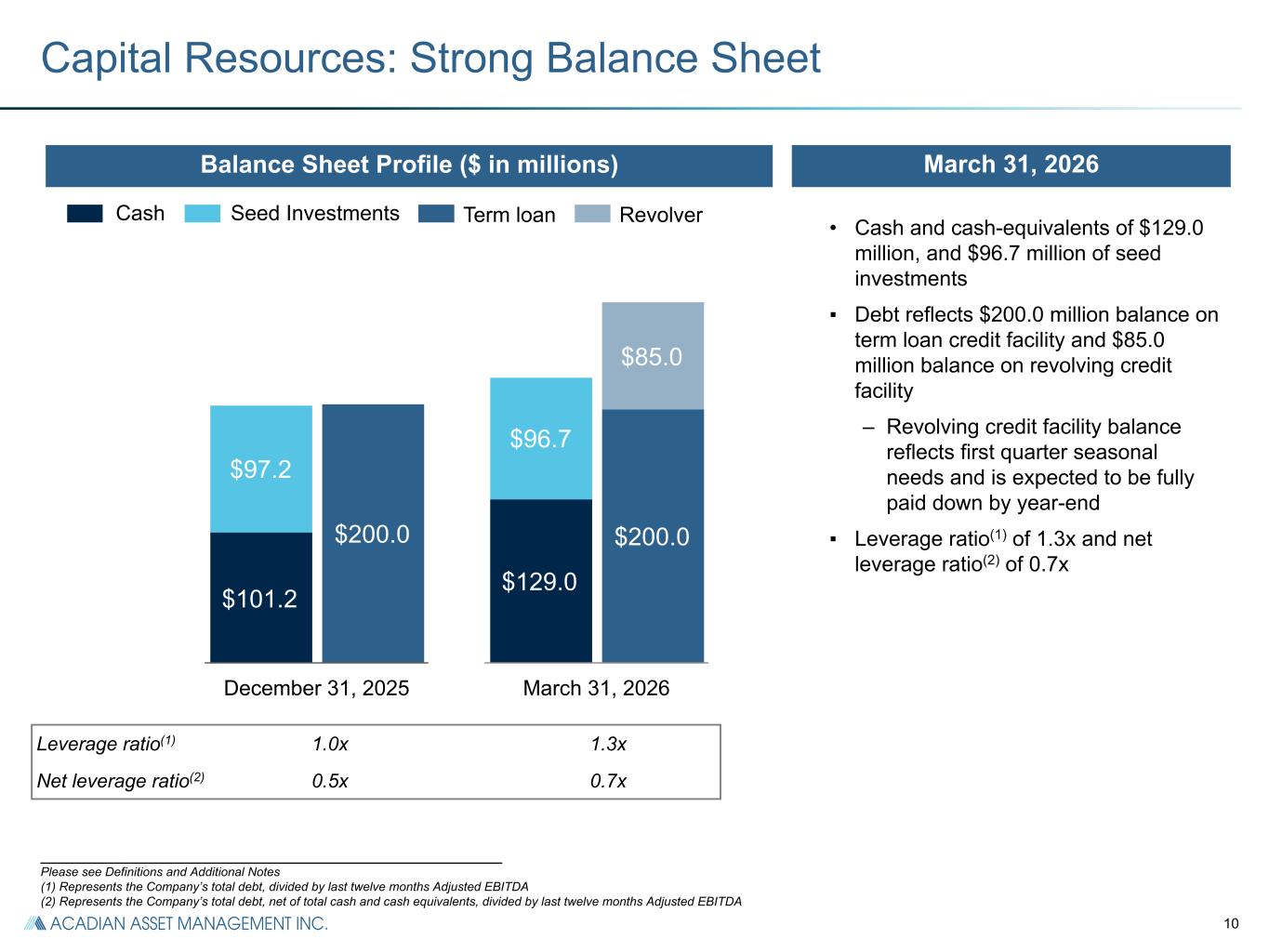
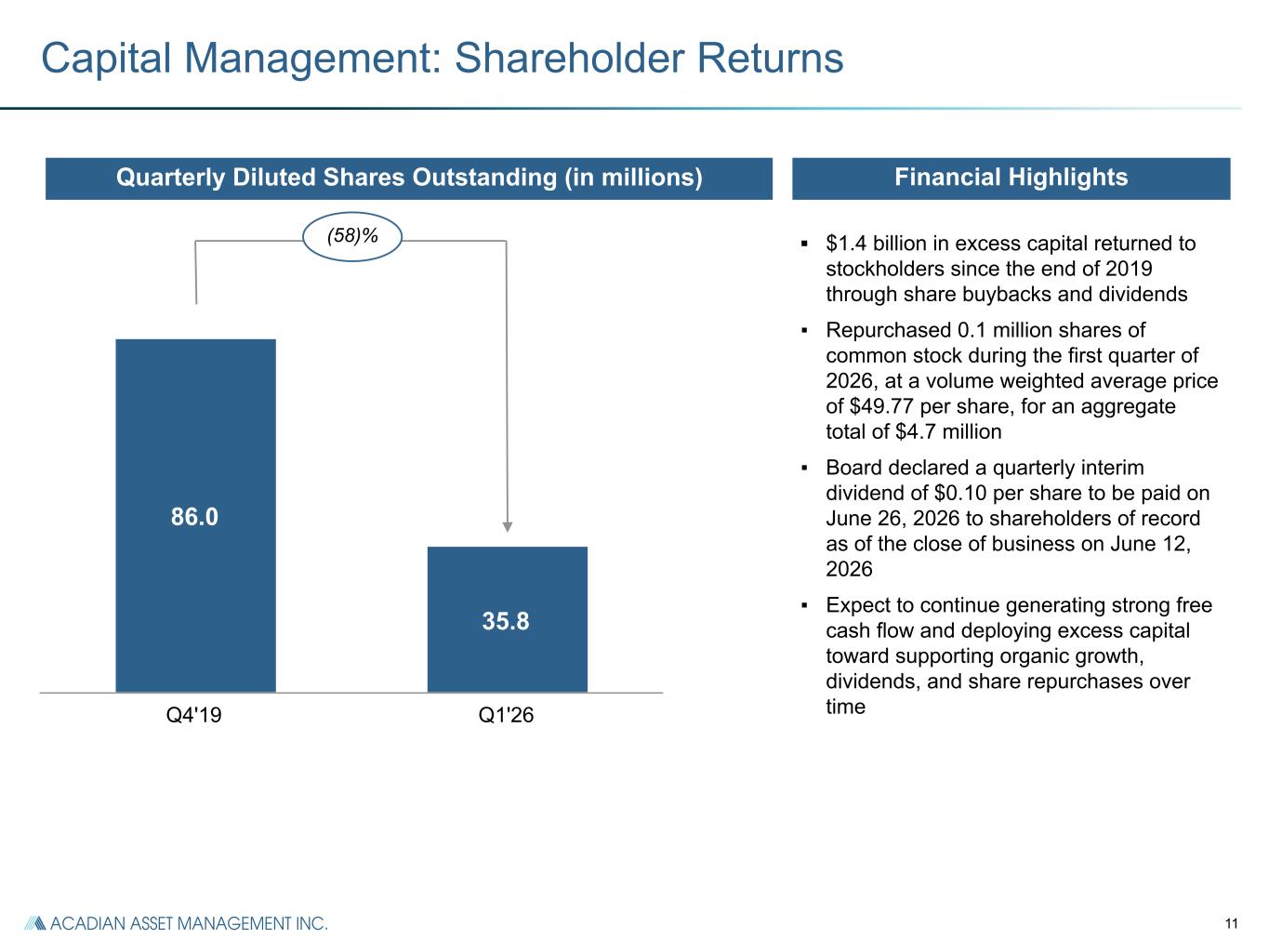
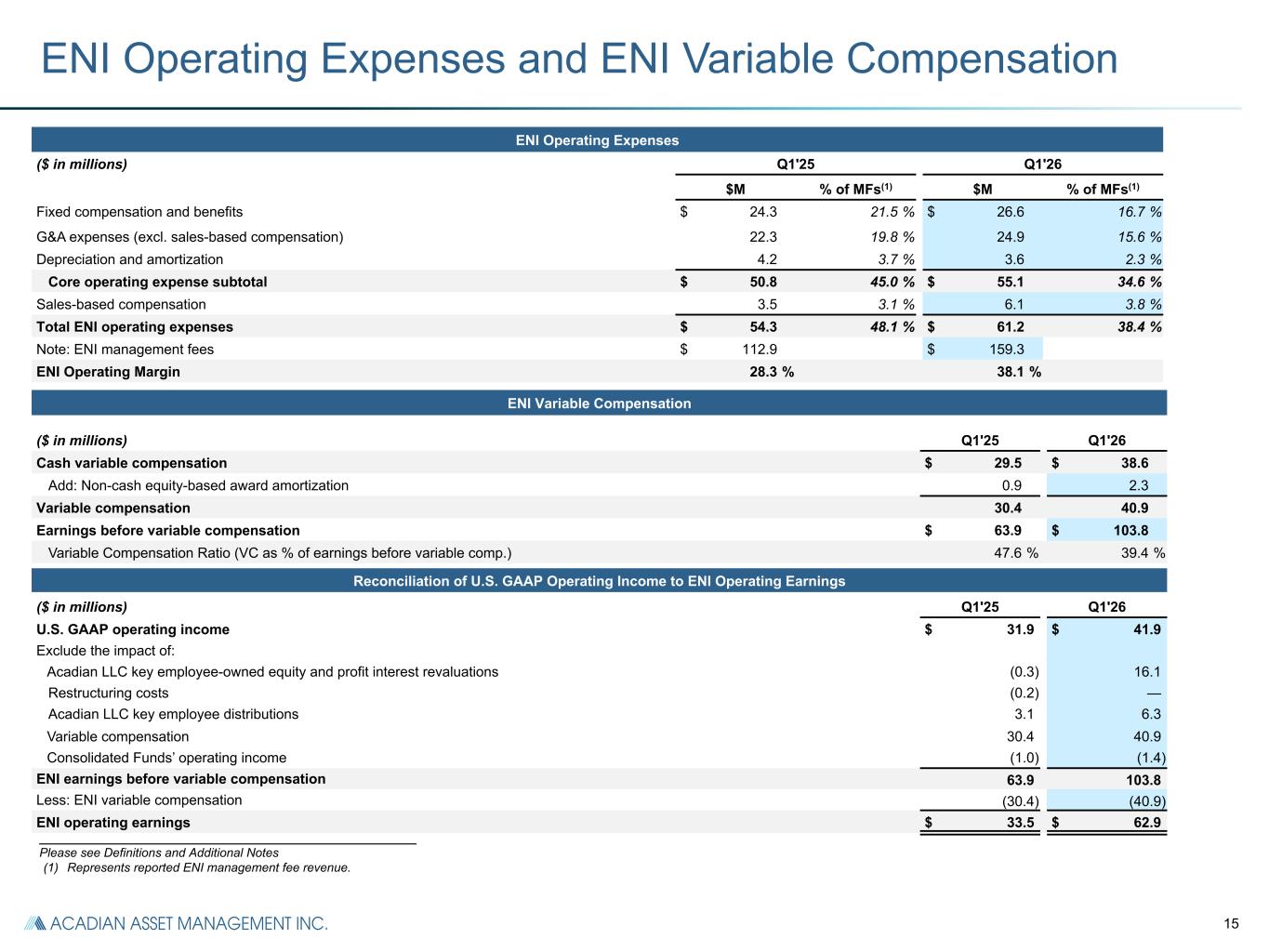
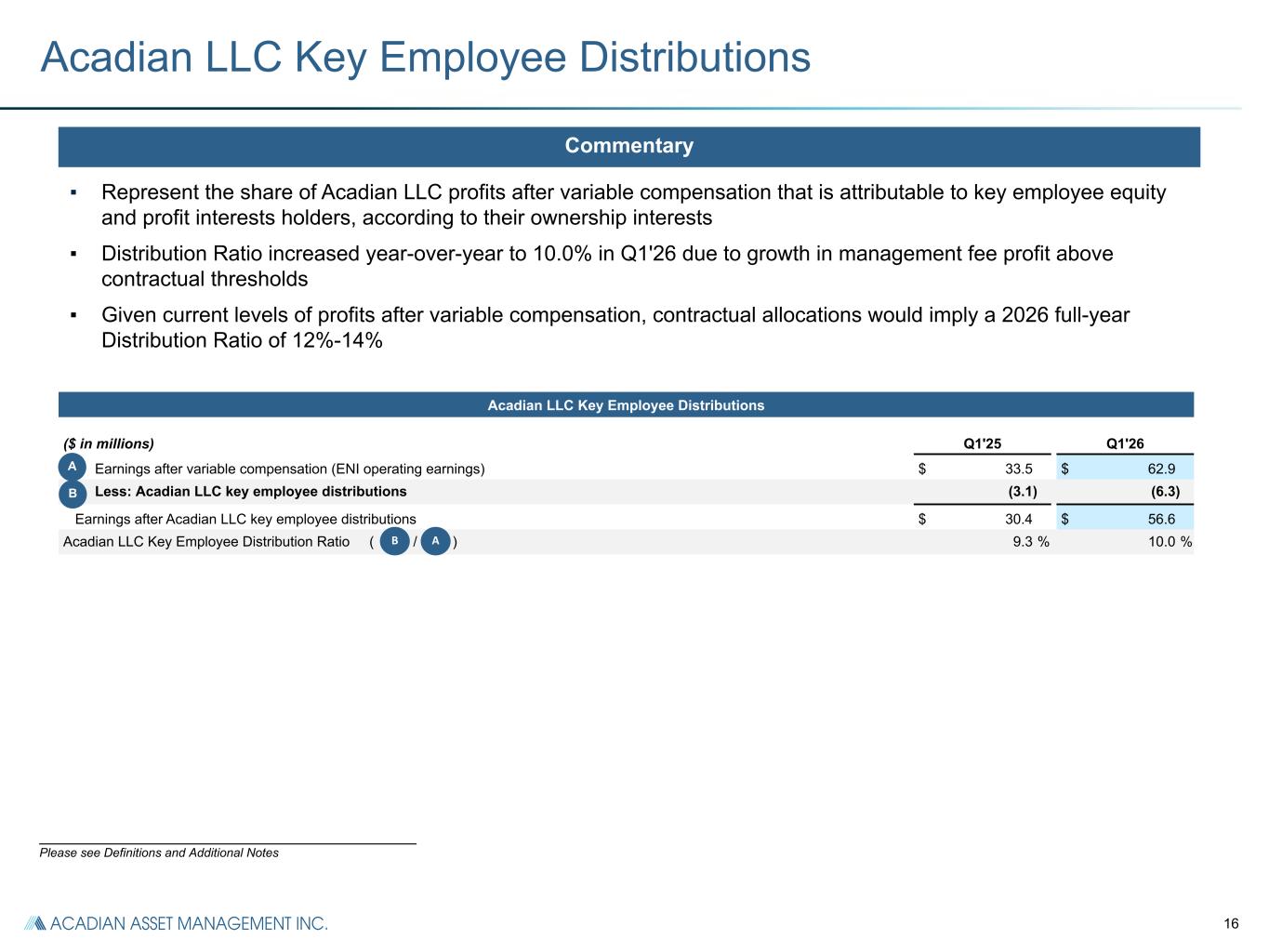
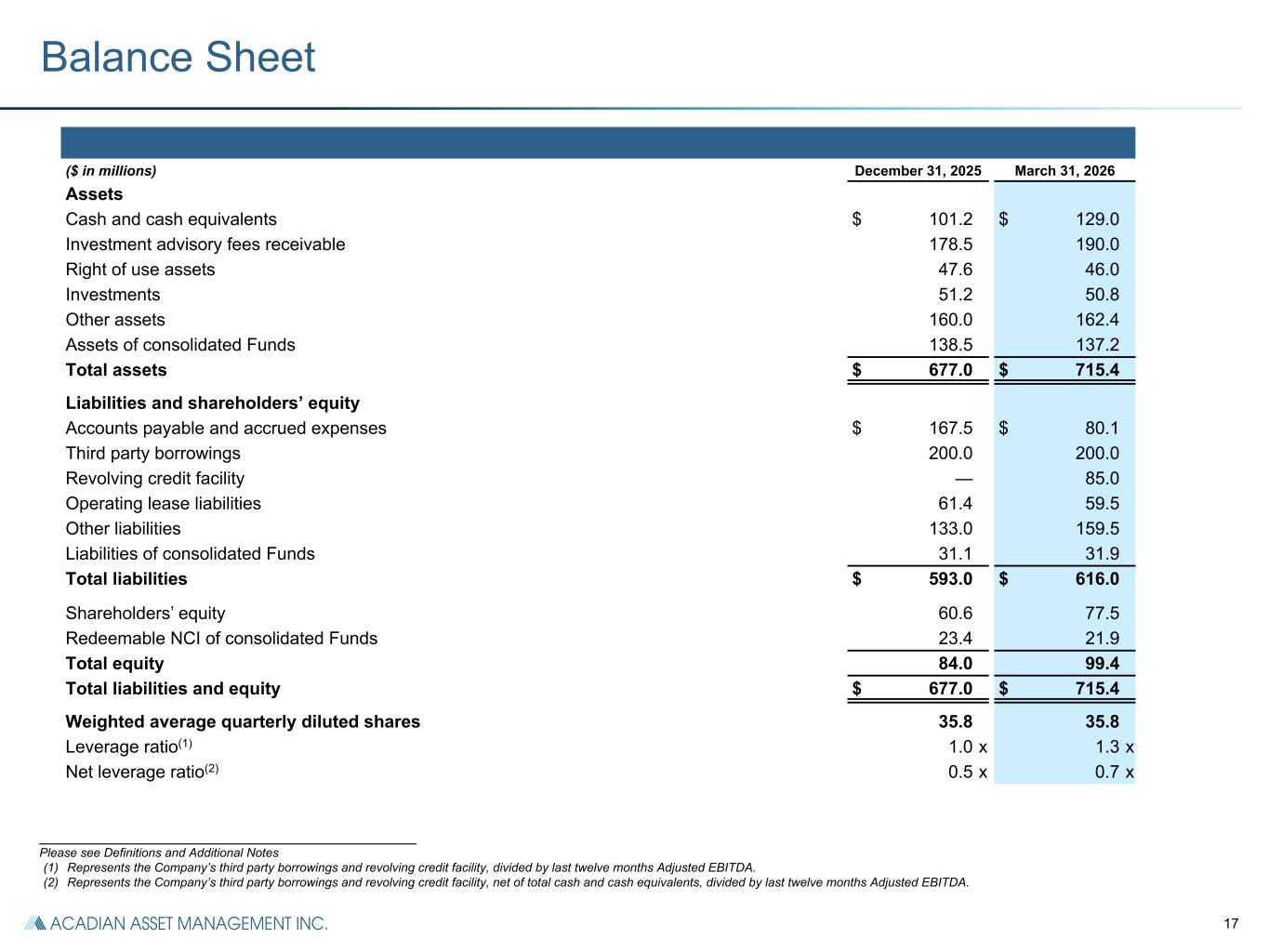
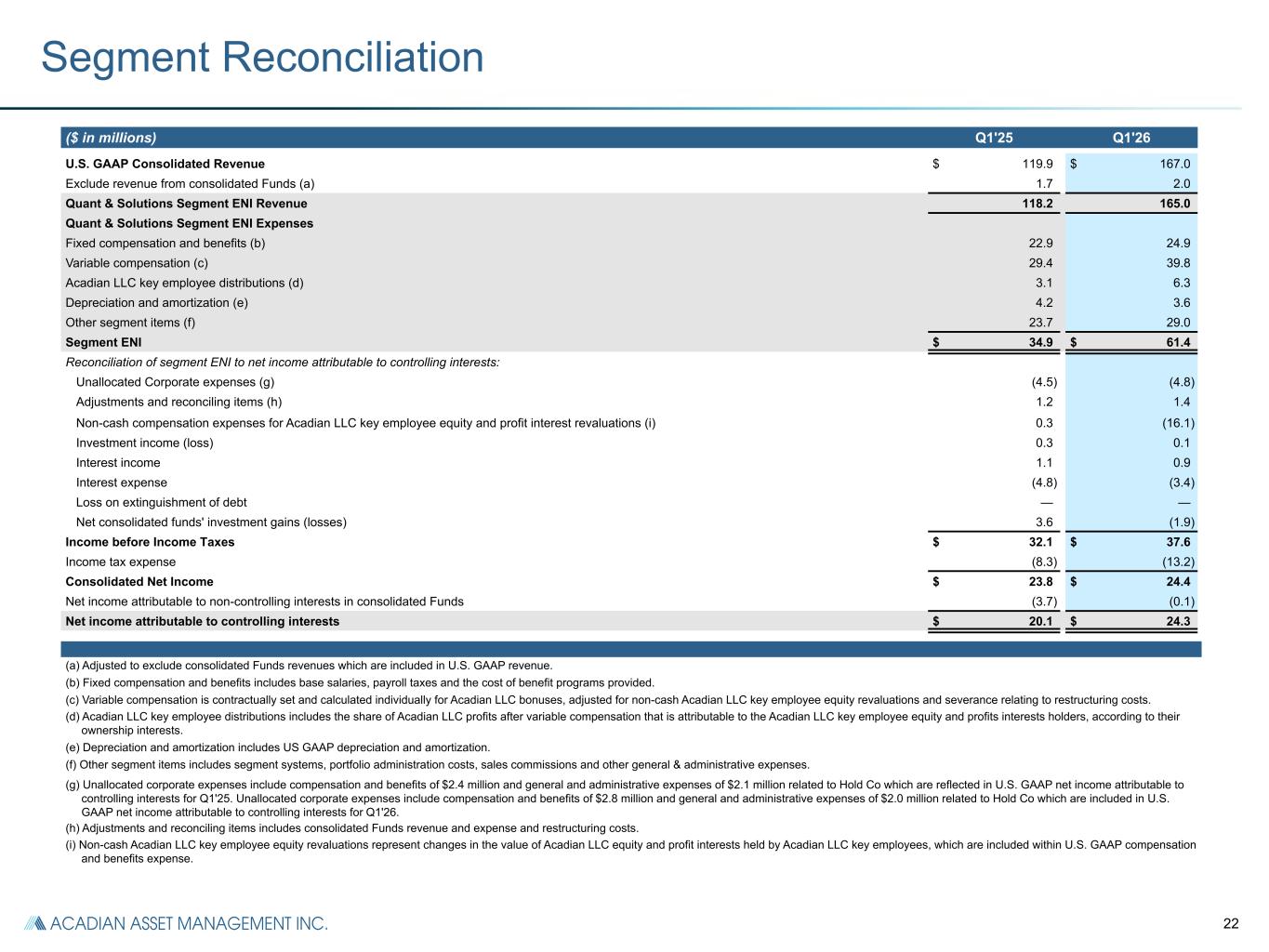
Thanks, Kelly. Turning to slide seven, our key GAAP and E&I performance metrics are summarized here on a quarterly basis. As previously noted, we manage the business using E&I metrics, which better reflect our underlying operating performance. You can find complete GAAP to E&I reconciliations in the appendix. Let me now turn to our core business results. Starting on slide 8, total E&I revenue of $165 million increased 40% from Q125, primarily due to recurring management fee growth and an increase in performance fees. Q126 management fees of $159 million increased 41% from Q125, reflecting a 57% increase in average AUM, driven by strong positive MCCFs and market appreciation over the last 12 months. Stepping back, with average AUM of $190 billion in the first quarter, we have materially expanded our recurring management fee base and significantly strengthened Acadian's earnings power. Moving to slide 9, in Q1-26, E&I operating expenses increased 13%, primarily driven by higher sales-based compensation and portfolio-related costs due to AUM growth, as well as general and administrative costs, including continued investment in IT and infrastructure. Our E&I operating margin expanded 978 basis points to 38.1 percent from 28.3 percent in Q125, driven by increased E&I management fees, while our operating expense ratio fell 10 percentage points year-over-year to 38.4%, reflecting the impact of improved operating leverage. Q126 variable compensation increased 35% year-on-year, primarily driven by higher profit before variable compensation. Our Q126 variable compensation ratio decreased to 39.4% from 47.6% in Q125. Assuming revenue mix in levels similar to Q126. Contractual allocations would imply a full year 2026 variable compensation ratio of approximately 40 to 43 percent. Turning to slide 10 on capital resources and our strong balance sheet, as of March 31st, 2026, we had $129 million of cash and $97 million of seed investments on the balance sheet with a $200 million balance on our term loan credit facility and an $85 million balance on a revolving credit facility. Note the revolver balance reflects first-quarter seasonal needs and is expected to be fully paid down by year-end. Our Q126 gross debt to adjusted EBITDA ratio was 1.3 times, and our net debt to adjusted EBITDA ratio was 0.7 times. Note that while both these measures are slightly higher quarter-on-quarter, reflecting our typical first-quarter revolver draw, they are down over half a turn year-on-year, driven by lower gross debt and higher adjusted EBITDA. Moving to slide 11, we have a track record of creating significant value through share buybacks in recent years. Outstanding diluted shares have decreased 58 percent from 86 million in 4Q19 to 35.8 million shares in Q126. Over the same period, $1.4 billion in excess capital was returned to stockholders through share buybacks and dividends. During Q1-26, we repurchased just under 100,000 shares, or $4.7 million of stock, at a volume weighted average price of $49.77. Amy's board has declared an interim dividend of $0.10 per share to be paid on June 26, 2026 to shareholders of record as of the close of business on June 12, 2026. Going forward, we expect to continue generating strong free cash flow and returning excess capital shareholders through dividends and share purchases over time. We look forward to discussing our broader capital allocation framework in more detail at our upcoming Investor Forum. I'll now turn the call back over to Kelly.
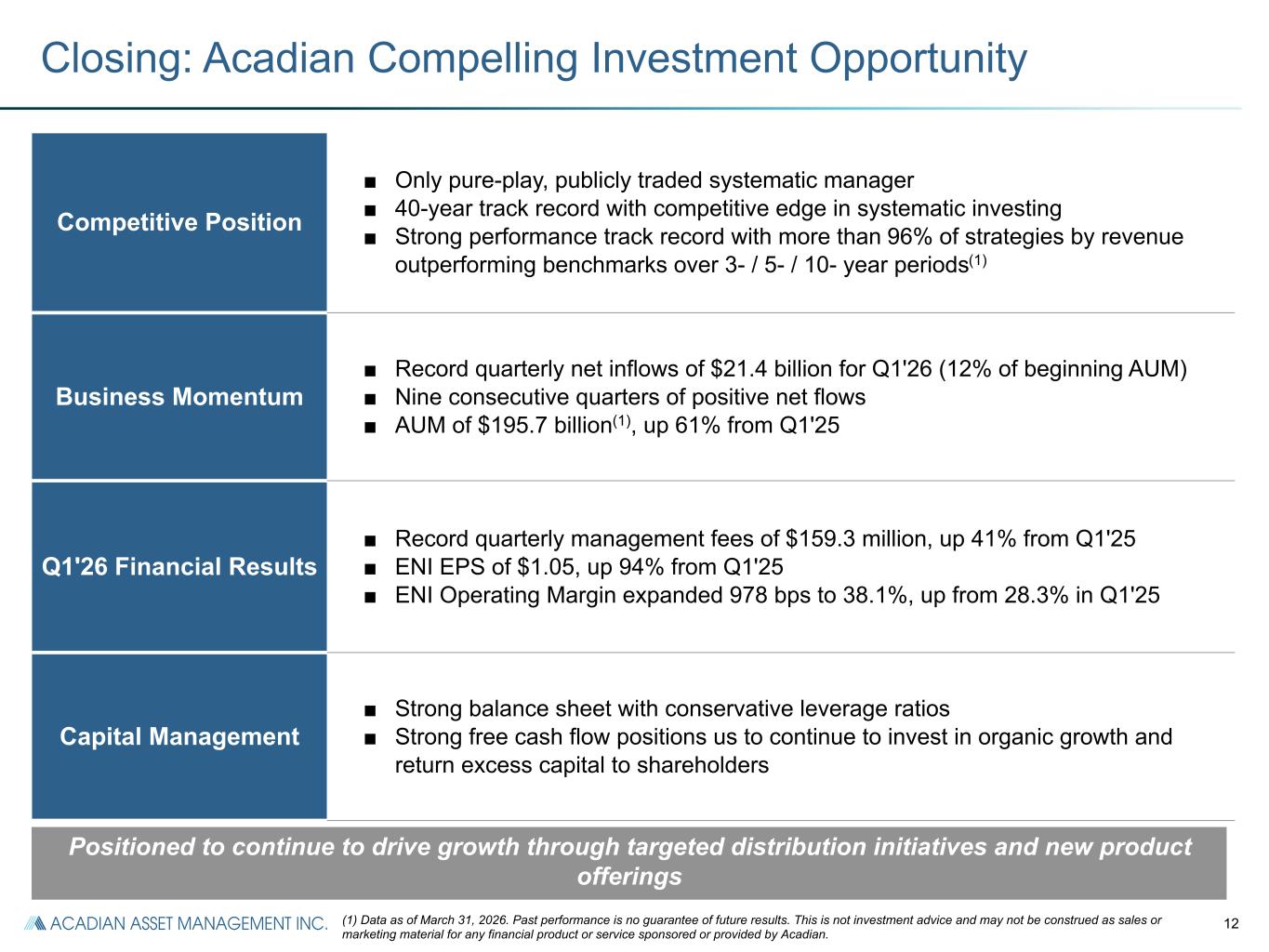
Before moving to Q&A, let me recap some key points on slide 12. Acadian is competitively positioned as the only pure play, publicly traded, systematic manager, with a 40-year track record and competitive edge in systematic investing. Our investment performance track record remained strong this quarter, with more than 96% of strategies by revenue outperforming over three-, five-, and ten-year periods. Business momentum continued a pace in Q1 of 26, with record net inflows of $21.4 billion dollars for q1 2026 12 of beginning a um reflecting nine consecutive quarters of positive net flows and reaching a um of 195.7 billion dollars up 61 from q125 the highest in the firm's history q126 financial results included record management fees of 159 million up 41 from q125 ENI EPS of $1.05, up 94% from Q1 to 25, and operating margin expansion to 38.1%, up nearly 10 percentage points from 28.3% in Q1 of 25. Finally, capital management remained a focus in the quarter as we strengthened our balance sheet with conservative leverage ratios, continue to invest in organic growth and return excess capital to shareholders. Pleased with our first quarter results, we remain focused on disciplined execution and look forward to discussing our strategic priorities more at our first Acadian Investor Forum on May 19th. This concludes my prepared remarks.
Operator
At this time, those with questions should lift their phone receiver and press star followed by the number one on their telephone keypad. To cancel a question, please press star one again. Please hold for a brief moment while we compile the Q&A roster. Your first question comes from the line of Kenneth Lee with RBC Capital Markets. Your line is open. Please go ahead.
Hey, good morning, and thanks for taking my question. Just one on the institutional pipeline. Wondering if you could just provide a little bit more color in terms of, you know, what you're seeing within there, what's the composition of strategies, you know, between enhanced and it looks as if you're getting some traction on the extension side there as well.
It looks very healthy. Hi, Ken, nice to speak to you again. The pipeline looks very healthy across a number of different strategies and client domiciles. As you'll see, you know, the enhanced story continued to dominate Q1 of this year, But once we X out that very large win from St. James's Place, which was about $16 billion, it was an incredibly positive quarter, with north of $4 billion in net flows over and above that. And that was very granular this quarter. About half of that remaining $4 billion were coming from our extension strategies. We've certainly seen a pickup in momentum and interest in extensions, and that forms a very solid part of the pipeline. as I say, enhanced this quarter's dominant theme, and that continues to, you know, to show up very healthily in our pipeline. But it is granular. Global, emerging markets, international equities, all of those sort of very broad core strategies that Acadian, you know, is well known for, and our flagship strategies are continuing to see a lot of interest and a lot of momentum. So the pipeline continues to be diversified. The team continues to do a great job in replenishing it, despite that very large NCCS number for Q1. So, again, it's very robust as we go into the second part of 2026.
And just one follow-up, if I may. Average fee rates didn't change much quarter to quarter, despite the sizable mandate inclusion there. Wondering whether there's a little bit of timing there in terms of impact. I wonder whether we should see some impact on average fee rates going forward, given the mixed shift there. Thanks.
Yeah. Hey, Ken. It's Scott. Thanks for joining us. I think the short answer to your question is yes, a little bit. Again, as Kelly suggested, very proud of the large win from St. James this quarter. It did fund later in the quarter. So for all intents and purposes, we haven't yet realized the full run rate impact of that. But as you know, the fee rate is subject to a whole bunch of things out of our control. It is an output of market conditions and where client demand comes in next quarter. And as Kelly already said, we have things that particularly when you think about extensions or the likes that can go above the current 34 basis point fee rate generally. But all else equal, if nothing else should change, I do think, you know, we're staring at a little bit of headwind, you know, in the next quarter as we realize the full run rate impact of this continued mix shift to enhance. Gotcha.
And one just final one for me, seed capital investments there, any particular outlook in terms of whether you could see that increasing over the near term? Just a little bit more color around that.
Sure. Yeah, you know, again, I think we appreciate that we've, you know, the board and others have been very supportive with a very active seed program. as you know, Ken. The majority of our seed has been deployed into our systematic credit strategies, and we remain very excited about the trajectory there and the performance track record that the team are building. But I think, as you know, we have three strategies launched today. Each of those are a little short of their three-year track record. We will hit three years in November for U.S. high yield, closely followed by the remaining two strategies early next year so um so i think we'll look to have that seed remain in place for some time although we are building momentum and the pipeline there for systematic and as i say we're very excited to hit the three-year anniversaries considering where where performance is trending um beyond that you know we have again as you know had an active seed program um we are looking you know at some other you know new strategies ensuring that we've got vehicles in place that meet the needs of you know and more diversified client base today um whether that be in the institutional wealth space. So I don't think that the overall needs are going to increase significantly from here, perhaps on the margins. But underneath that number, there has been, I think, quite an active recycling program as we've launched extensions, our dynamics extension strategies. And as we see those gain traction with clients and we're able to redeploy that capital to other new areas of growth.
And I would just add, Ken, onto that, Kelly hit the recycling. We just feel like we're very well positioned in this regard. It's obviously very important to the business. And as Kelly suggests, as the team continues to innovate and we as a finance team think about supporting them with just under $130 million in balance sheet cash today and this dynamic where we've been able to often just recycle with what we've already put in, again, we just feel like we're really well positioned to support the businesses that continue to innovate and meet client demand.
Great. Very helpful there. Thanks again.
Operator
Thank you. Your next question comes from the line of John Dunn with Evercore. Your line is open. Please go ahead.
Thank you. I wanted to ask about kind of just given where we are, renewed demand for particularly non-U.S. exposure, but also the managed vile strategy, which I think could benefit from the current environment.
Nice to speak to you again. Yes, you know, non-U.S. has certainly been a feature that I know we've talked about on these calls over the last 12 or 15 months or so. We're continuing to see a lot of interest in international strategies broadly. As you know, Acadian has a very strong, compelling track record there dating back many decades, and certainly we continue to see a lot of momentum there, particularly from U.S.-based clients. Manageable was a slight headwind in Q1, but we certainly have seen outflows there taper off quite dramatically versus two to three years ago. And I think certainly, you know, these types of strategies, when we've seen what has been a challenging macro backdrop in Q1 with, you know, the tensions and conflict in the Middle East, certainly that's where strategies like management will come into their own. And I think, you know, we have a number of longstanding clients in those strategies who have seen the real value of them at inflection points like that. So, Q1 wasn't an asset-gathering quarter for ManageVol, but a very slight headwind. But again, I'd say that those outflows have certainly tapered off, and I think it's at the forefront of clients' minds with the current environment that we're in that where ManageVol may play a role in their strategic asset allocation.
Got it. And then maybe just if you could opine on kind of the dynamics and potential for, you know, for systematic taking, you know, potentially from private strategies and then also from the passive side.
Sure. Yeah. I mean, I think, you know, we see this in the in the numbers of industry numbers. We see it anecdotally. And as we talk to clients every day, the systematic is is clearly a winner, you know, in the in the active equity space. I think, you know, when we talk about sort of private investments, particularly perhaps private credit, I think, you know, we are, as I said, we're excited about what we've built on the on the systematic credit side. We do think there's opportunities there as, you know, as investors continue to stare at their private investments, their private credit investments. Is there a place for something more like public systematic credit? So I think, again, we feel that as we build that track record and the story we think is compelling, I think the transparency, the liquidity will be compelling to investors, certainly on that side.
And, John, I would add it. Thanks very much. John, I was just going to go ahead and add. I think we may have lost you, but, you know, we're looking at an investor forum that we're excited about on May 19th. And as Kelly suggests, this all adds up as we think about our addressable market. We've been spending a lot of time as a management team thinking about it. It's rather large. It's diversified. And I think we'll look forward to talking about it in a more granular way on May 19th.
Operator
Your next call comes from the line of Michael Cypress with Morgan Stanley. Your line is open. Please go ahead.
Hi. Thanks for taking the question. more of a big picture question with all the advances in data science and AI models entering the genetic era. Just curious how you see that impacting potentially the competitive landscape or systematic investing. What are the risks, if any, of these quickly advancing models that could democratize access to folks creating systematic strategies, emerging new competitors? Just curious how you see that all evolving.
Sure. Hi, Michael. Thanks for the question. You know, we don't view AI as a strategic threat to the business model today. You know, systematic investing has relied on data, technology, increasingly sophisticated research tools, you know, throughout our history and throughout the time of this industry. So we view AI very much, I think, as an extension of that evolution rather than a disruption to it. But, you know, from our side, again, machine learning, AI, this has been within Acadian's DNA from, you know, from very many years. And we're using AI to, you know, enhance our research, development, our operating workflows. But, you know, I think it's key that you keep human judgment and your investment discipline and risk controls at the center of that process. So from my point of view, we all believe that firms that adopt these tools effectively are going to strengthen their competitive position. I think we're at the forefront of that. And we intend to remain on the right side of that equation.
And then could you just maybe elaborate on how you're using the newer generative AI tools as well as maybe even agentic AI tools across the firm today and how you're thinking about the opportunities out there?
Sure. I mean, again, I think, as you said, the landscape's changing very quickly. we think there's huge opportunities there as the ai isn't obviously new to us but the current generation of tools is is really allowing it allowing us i guess to apply it more broadly across the firm um our investments today are going to be focused on you know a couple of key areas one of those is like improving productivity and that's really through kind of enterprise ai tools but also like enhancing software development through ai assisted coding um you know building selected ai-enabled services you know that's going to support our research um but certainly you know we again we have people that are very comfortable have many years experience uh in computer science and machine learning and you know we're encouraging people within that kind of building that strong foundation sharing guard rails and from a security standpoint but encouraging people to to experiment um you know across different across different you know software and platforms And, Michael, and Scott, I'd just jump in again real quick on this.
To be clear, you know, we're proud of how we're scaling, and obviously there's another great quarter. We generated, you know, really meaningful positive operating leverage. But if you look at expenses from where we are growing and you strip out the sales-based commissions, we're about 8% up OpEx, the E&I OpEx year on year. A lot of that is the technology and the platform and the tools that Kelly's referencing, right? That is a driver, and as she suggests, the technology, our technology platform has long been thought of as part of the mode around the business, and we want to expand it. And I think this is an opportunity to do so. That's a very long way of saying this is an area where we're investing and excited about it.
And then just a final question on capital allocation. I was hoping maybe you could unpack how you're thinking about the dividend here, the particular growth rate or payout ratio that you're targeting, and then more broadly on buybacks and other uses, how you're approaching that, just given the significant free cash flow generation of the business?
Yeah. I mean, as you suggest, the free cash flow, which, you know, for all intents and purposes, the E&I that we disclose is a good proxy for the free cash flow that we're seeing. So, very strong. We think we're very well positioned. You know, this quarter, we remain dynamic. As I've suggested before, you know, we do have a capital management framework, and it starts with the organic investments. We already talked about seed capital, that sort of thing would be top of the list. I would also include, as we expand further down the list, these organic investments and things like AI. And then we get to a dividend and then a return of excess capital via buybacks. So, I've used the word athletic. That continues to be the case. We look at it every quarter. And as we look about organic needs and balancing those about returning excess capital, that's how we make the decision framework. Everything has an IRR frame. We do, of course, pencil out returns on any of the investments we're making. So, that informs us. In this quarter, we landed the way we landed. I would not say, Michael, since you mentioned it, a payout ratio, we do not manage to a payout ratio. I think it's much more dynamic than that. I know that's not an easy answer, particularly for modeling purposes, but I do think it's dynamic each quarter, given all the dynamics I just discussed and the various priorities. On the dividend, I would add, as you know, we recently moved from a penny to 10 cents. Very proud of that. That is reflective of, you know, the new size, right, that we've really realized, the confidence we have in that larger recurring management fee base and enhanced profitability. I would not, and I think we stepped into this, you know, on last quarter's call, I would not think about us continuing to try to revisit that dividend, you know, every quarter. We're sensitive to it. but we monitor it, but it's not something that I would think of as us revisiting in a meaningful way the dividend every quarter. If we get to a different place, another step up in profitability, we would revisit that, but I think there's no philosophy change here, and that when we think of a return of excess capital, I would continue to think the direction of travel would still be more geared towards share of purchases versus a dividend, but again, these things evolve. Hopefully, that's a goal.
Operator
This concludes our question and answer session. I'd like to turn the conference call back over to Kelly Young. Please go ahead.
Thank you, everyone, for joining us today. And we look forward to seeing many of you at our investor forum in Boston on May 19th. Have a great day.