Operator
Good morning and welcome to the Acre Realty 4th Quarter 2025 Conference Call. All participants will be in listen-only mode. Should you need assistance, please signal Conference Specialist by pressing the star key followed by zero. After today's presentation, there will be an opportunity to ask questions. To ask a question, you may press star then 1 on your touchtone phone. To withdraw your question, please press star 1 a second time. Please limit yourself to two questions during this call. Note, this event is being recorded. I would now like to turn the conference over to Ruben Treatman, Senior Director of Corporate Finance. Please go ahead, Ruben.
Good morning, everyone, and thank you for joining us for Avery Realty's fourth quarter 2025 earnings call. Before turning the call over to Joey and Peter to discuss our results for the quarter, let me first run through the cautionary language. Please note that during this call, we will make certain statements that may be considered forward-looking under federal securities law, including statements related to our 2026 guidance. Our actual results may differ significantly from the matters discussed in any forward-looking statements for a number of reasons. Please see yesterday's earnings release and our SEC filings, including our latest annual report on Form 10-K, for discussion of various risks and uncertainties underlying our forward-looking statements. In addition, we discussed non-GAAP financial measures, including core funds from operations, or core FFO, adjusted funds from operations, or AFFO, and net sets or recurring EBITDA. Reconciliations of our historical non-GAAP financial measures to the most directly comparable GAAP measures can be found on our earnings release website and SEC files. I'll now turn the call over to Joey.
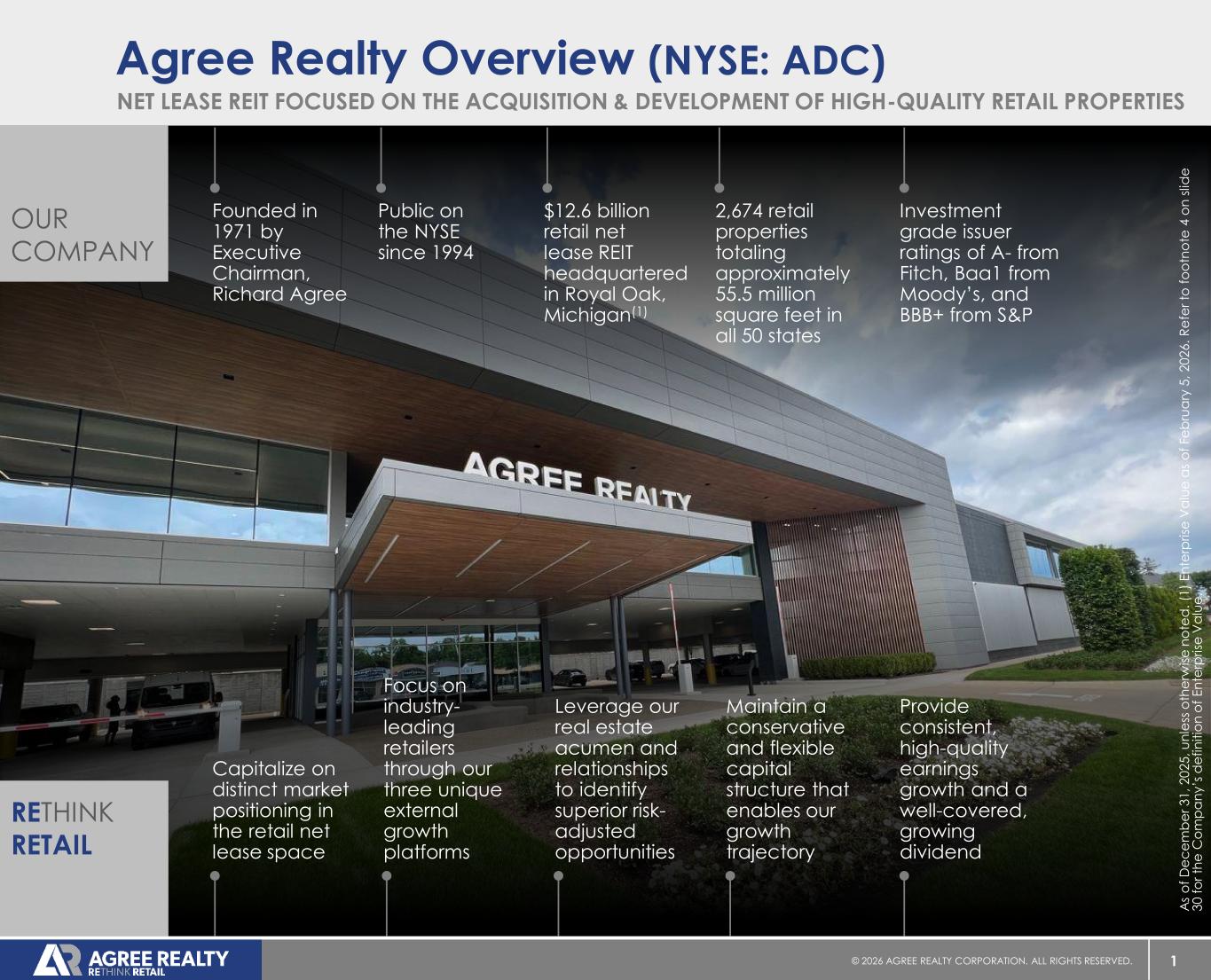
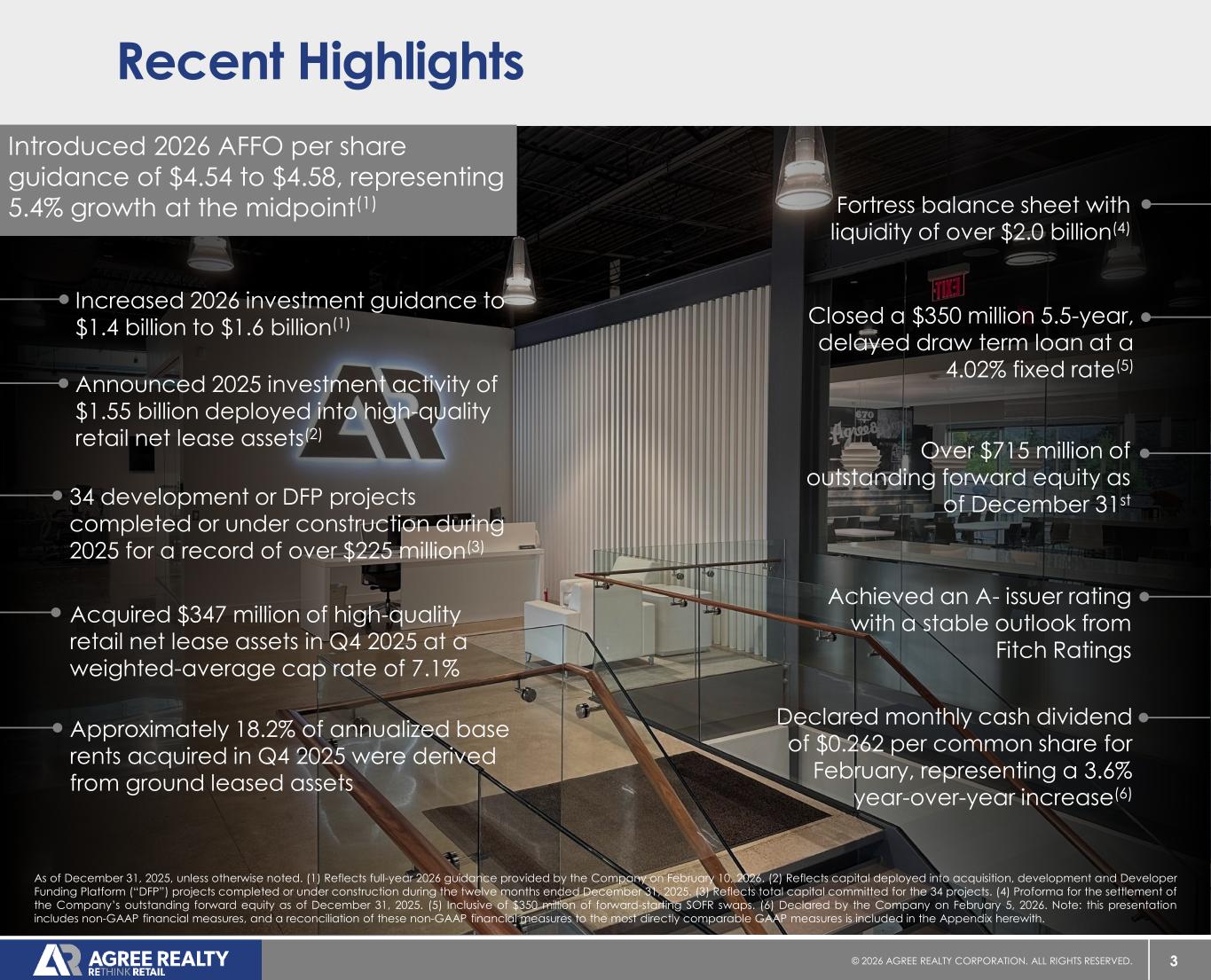
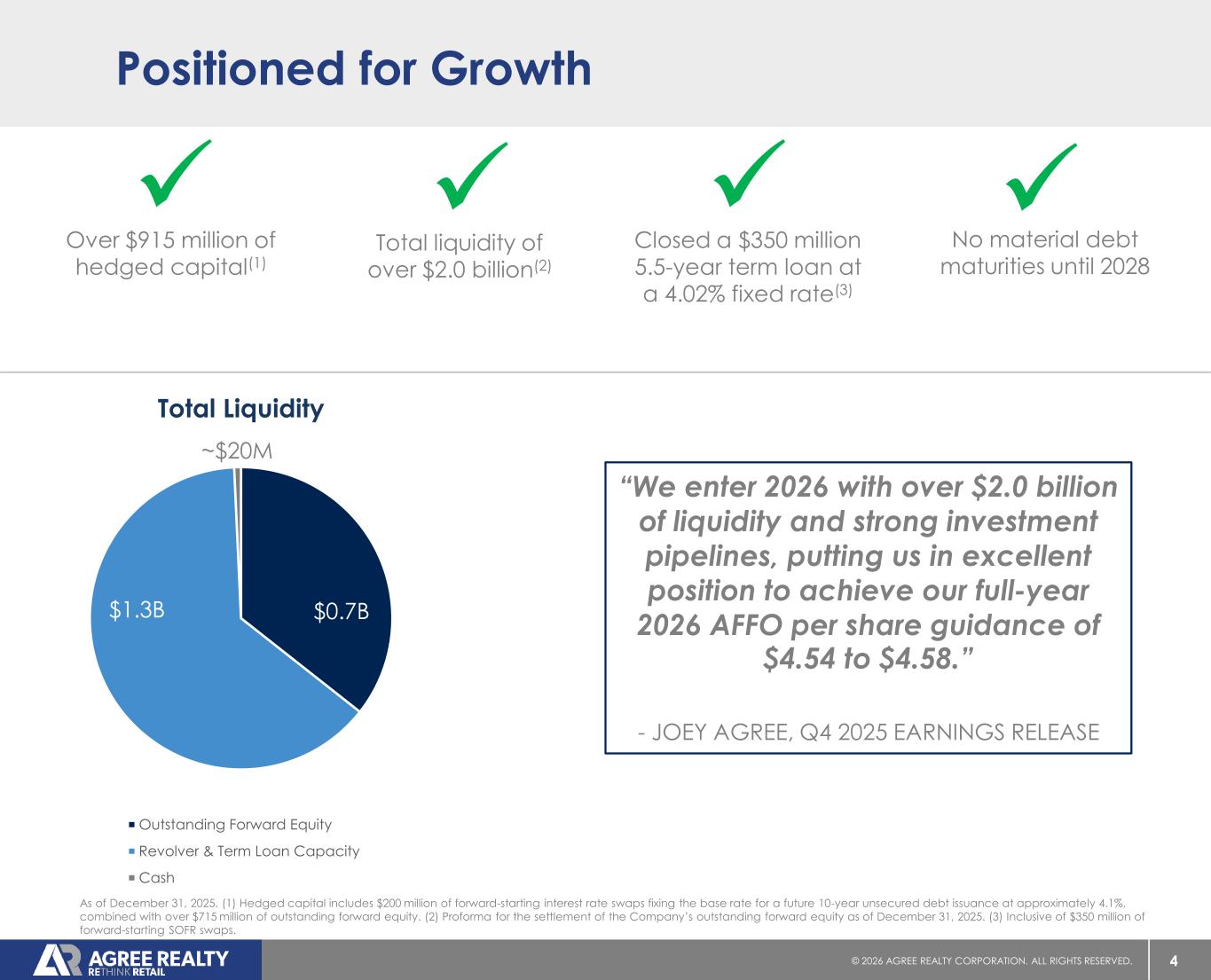
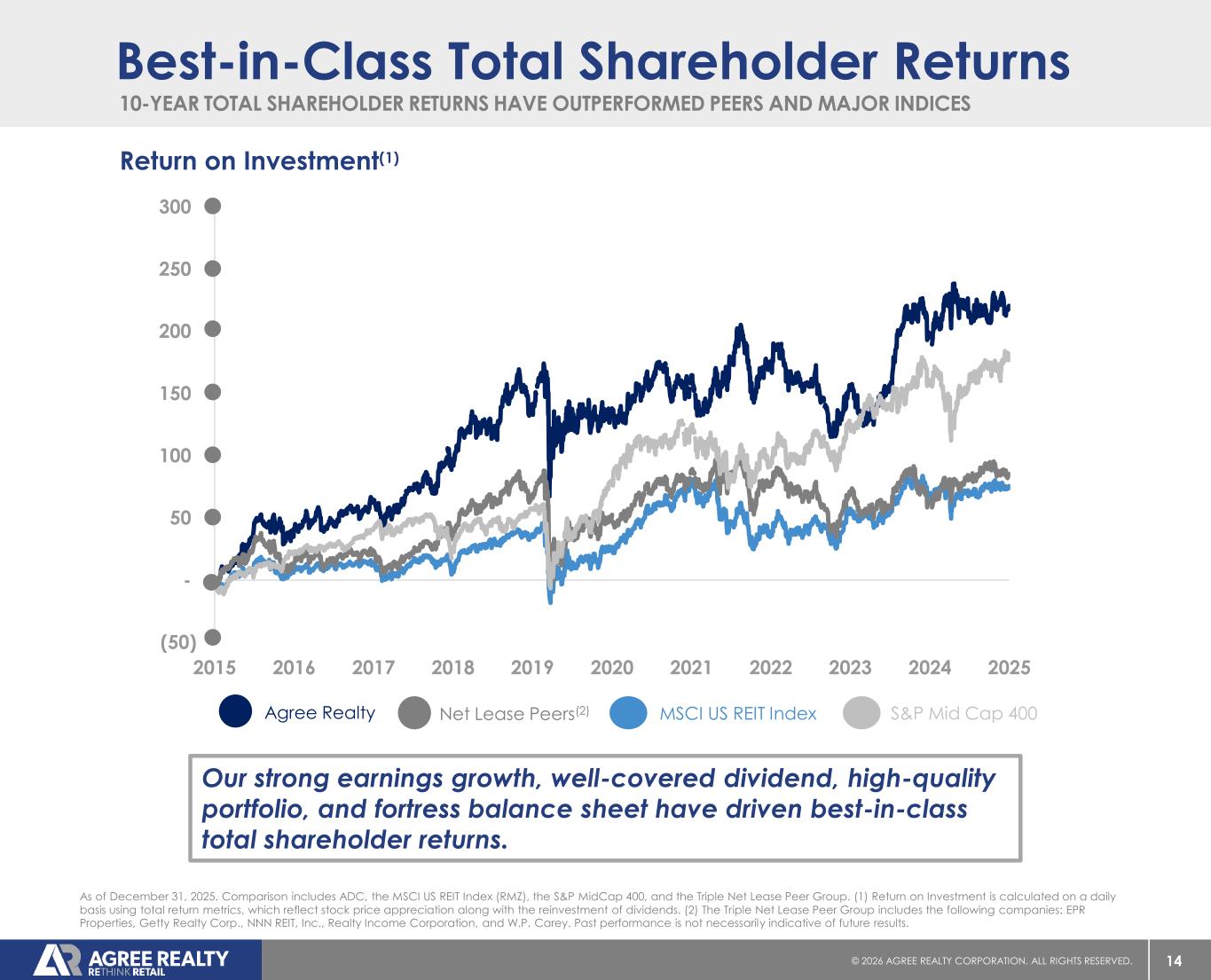
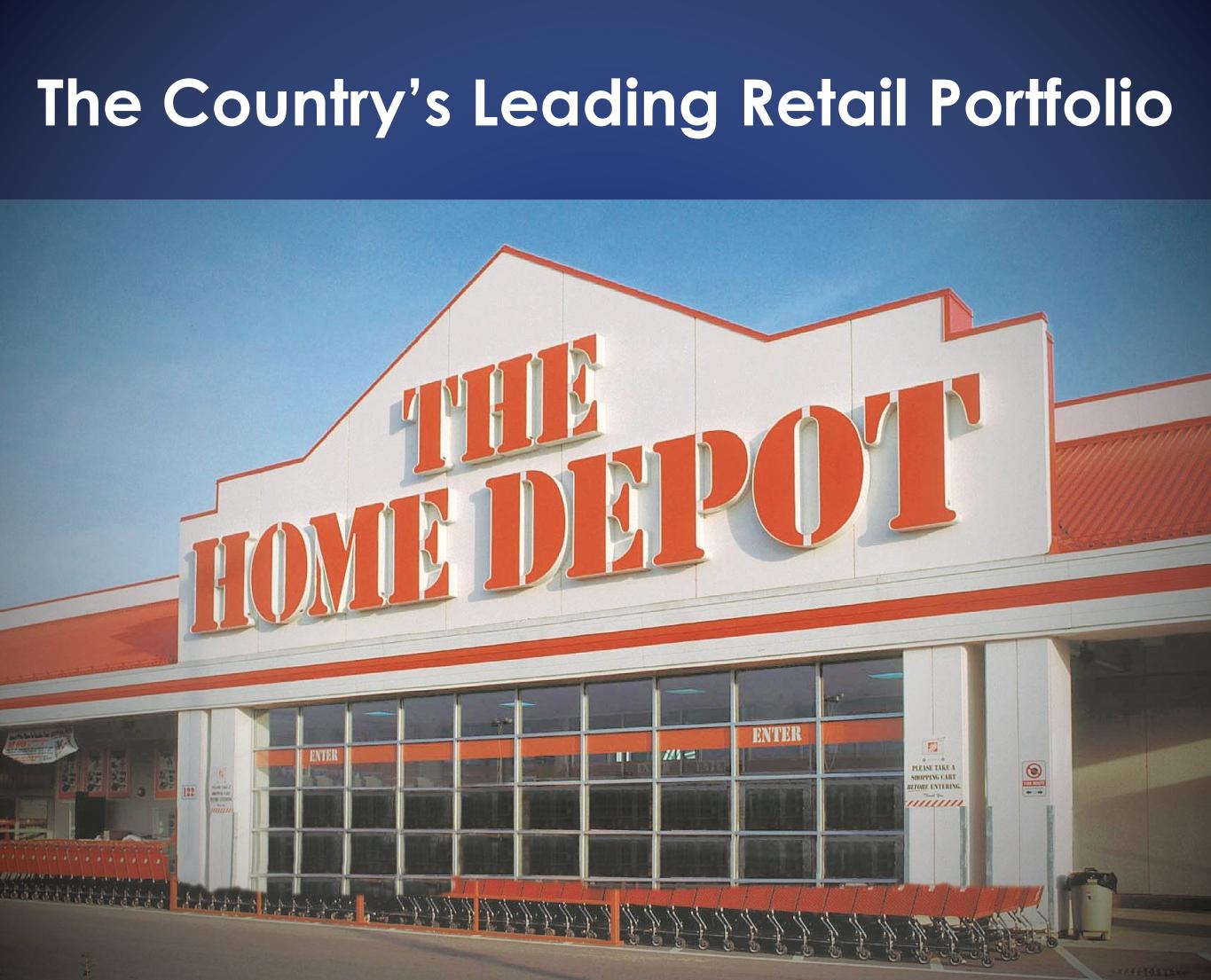
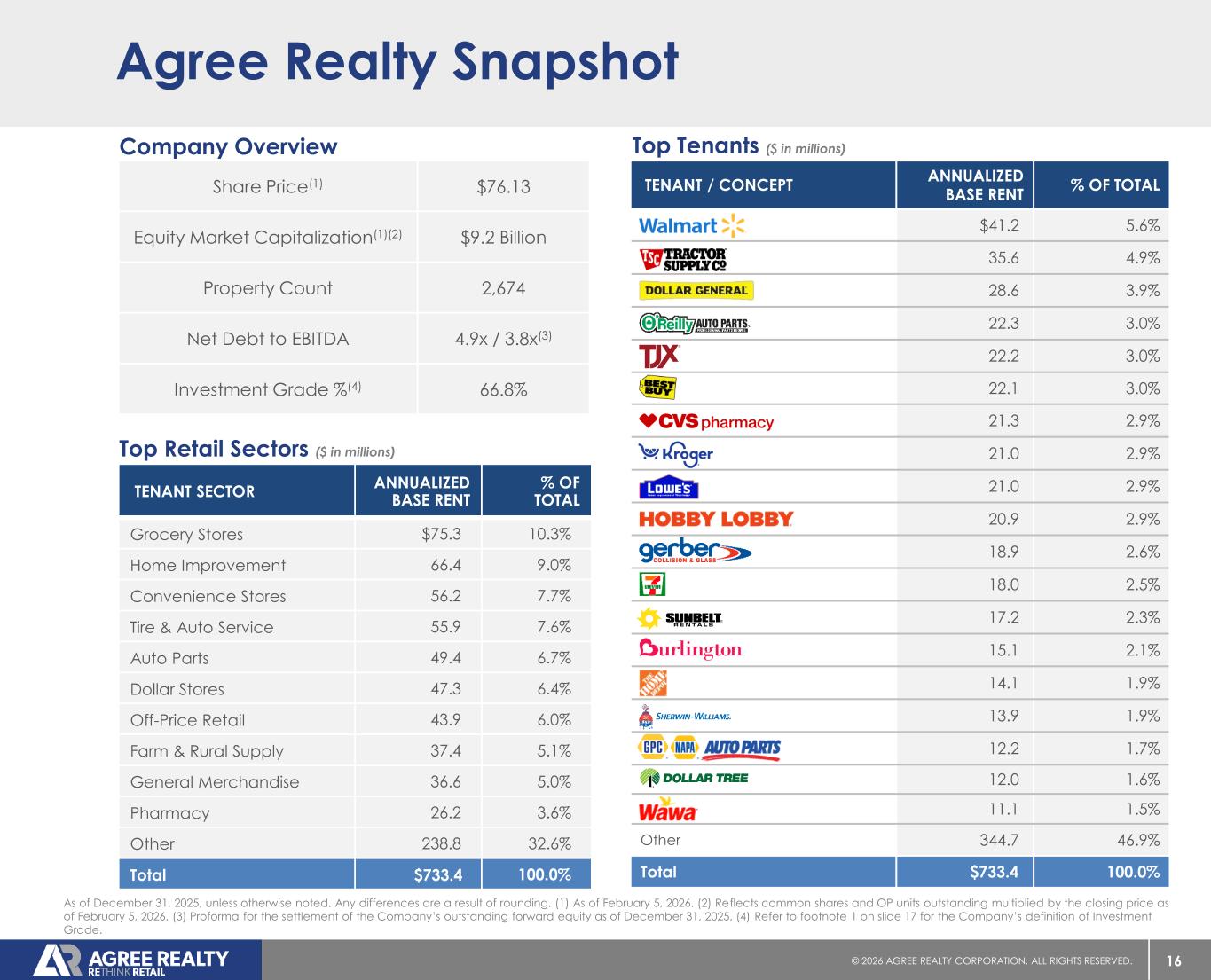
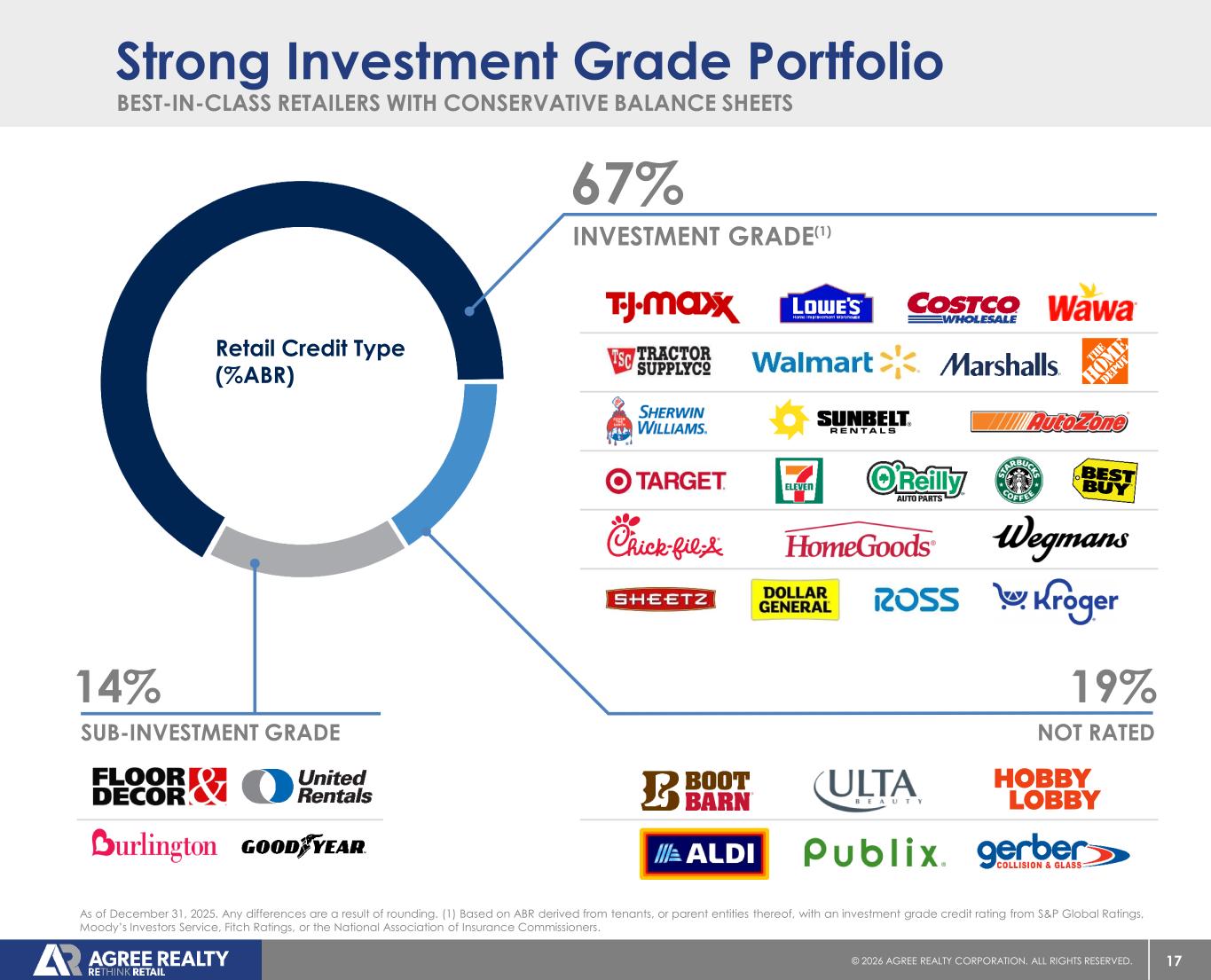
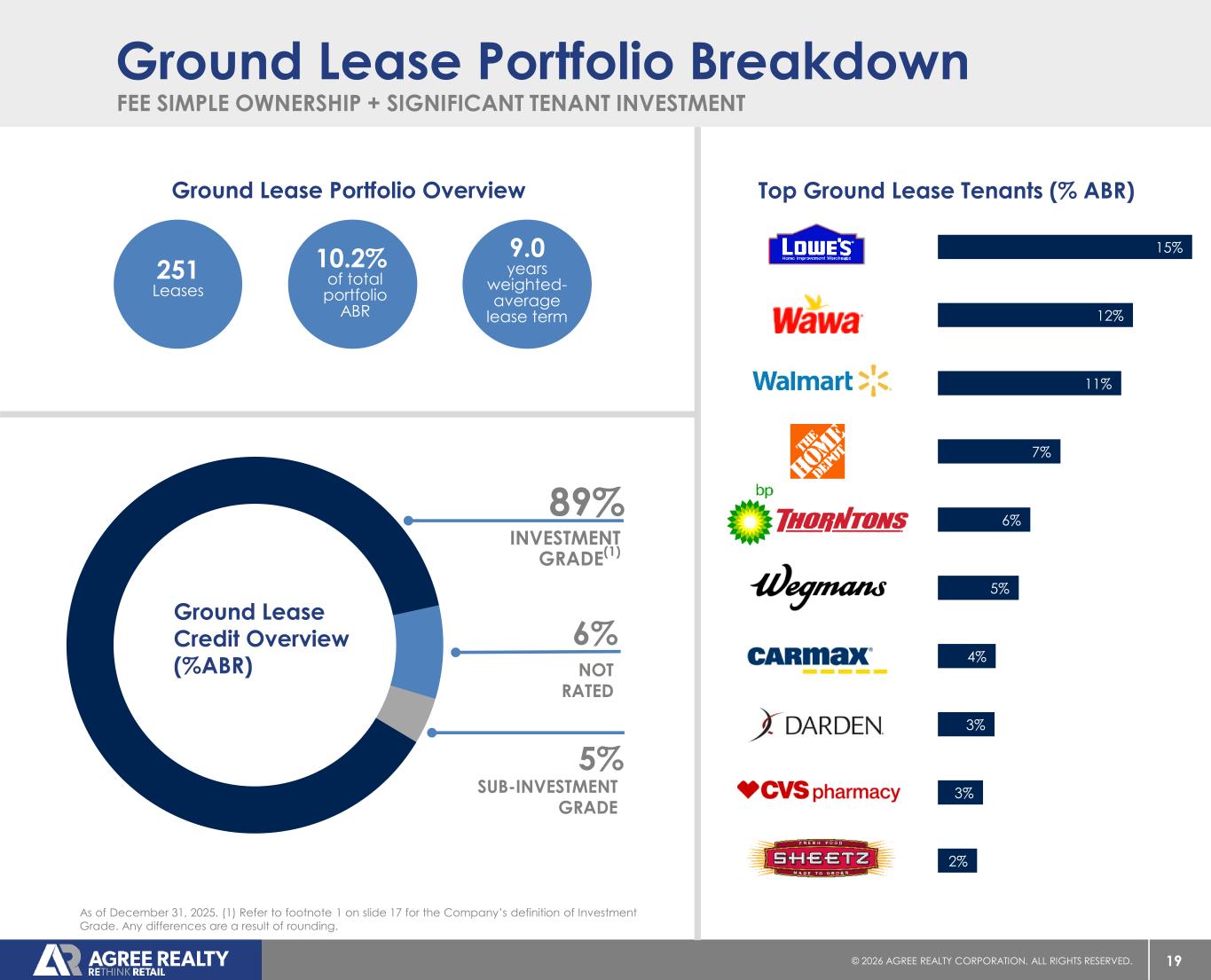
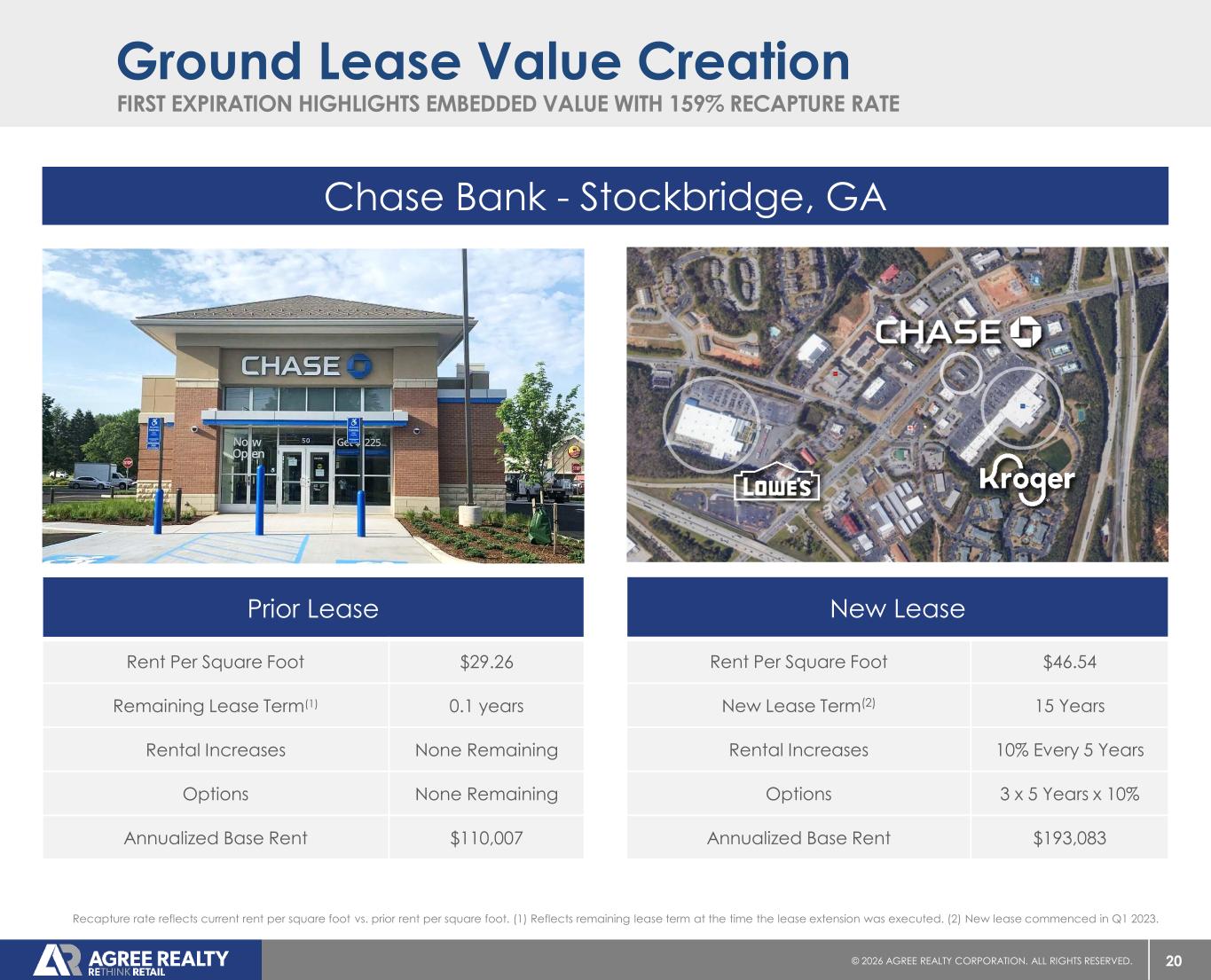
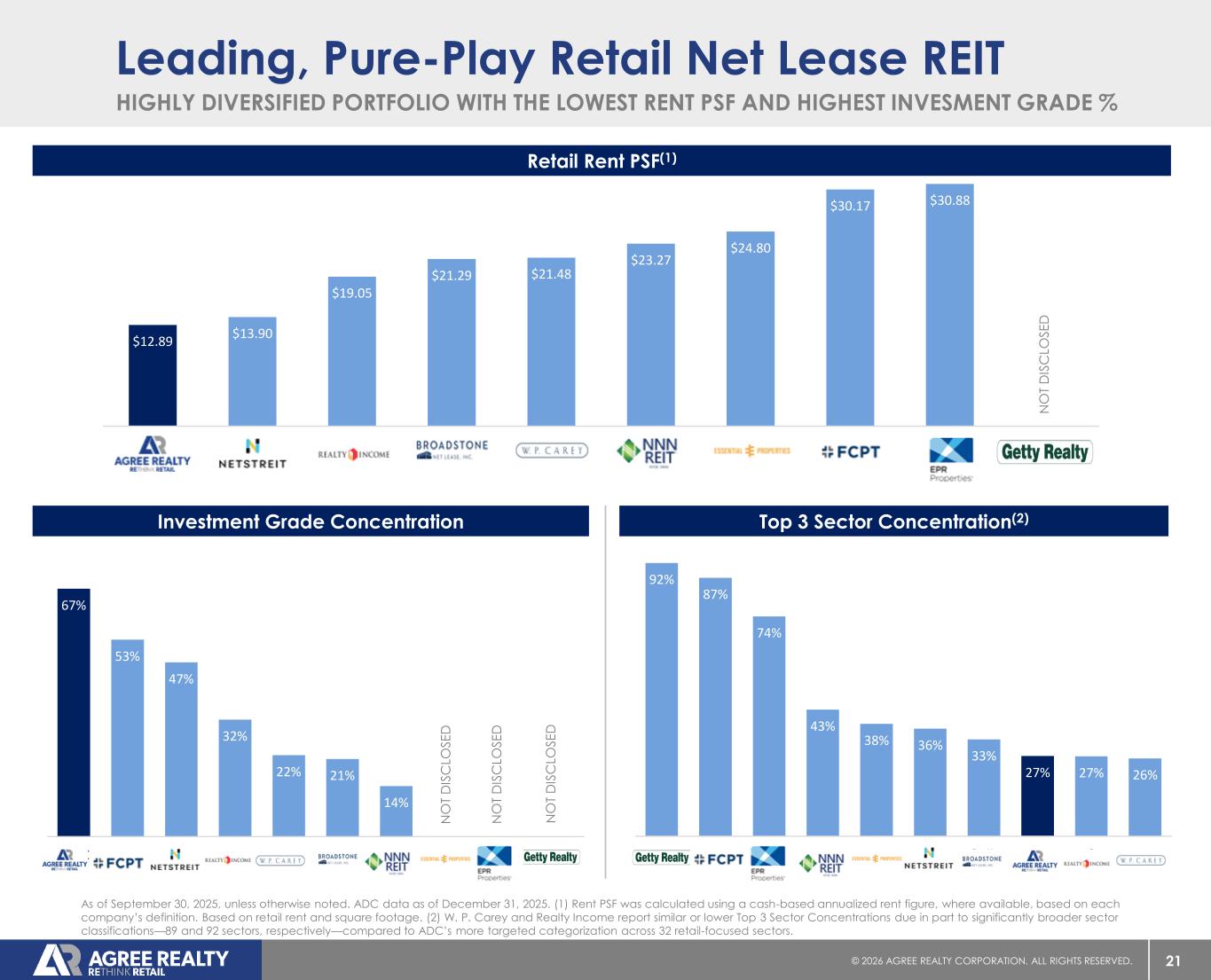
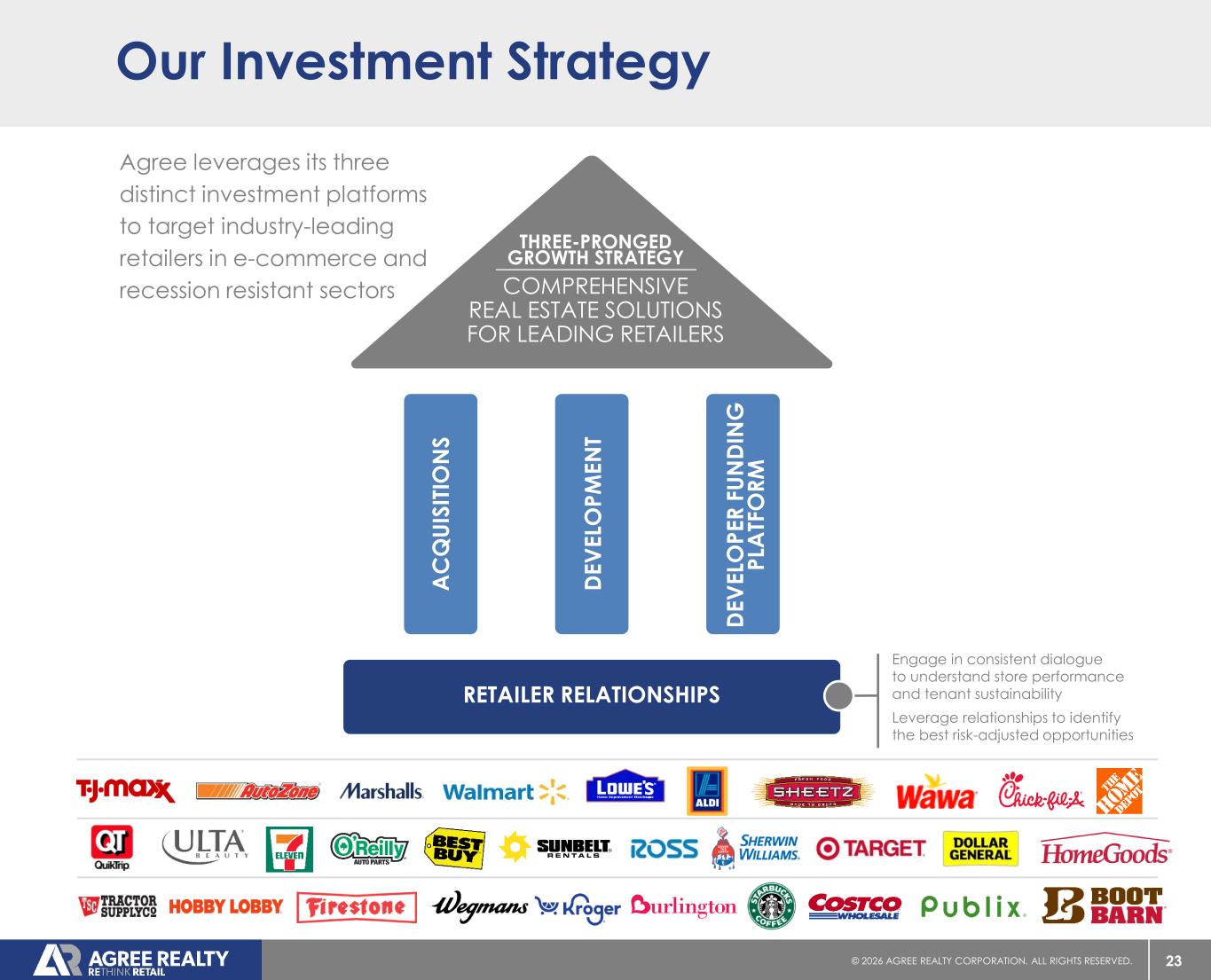
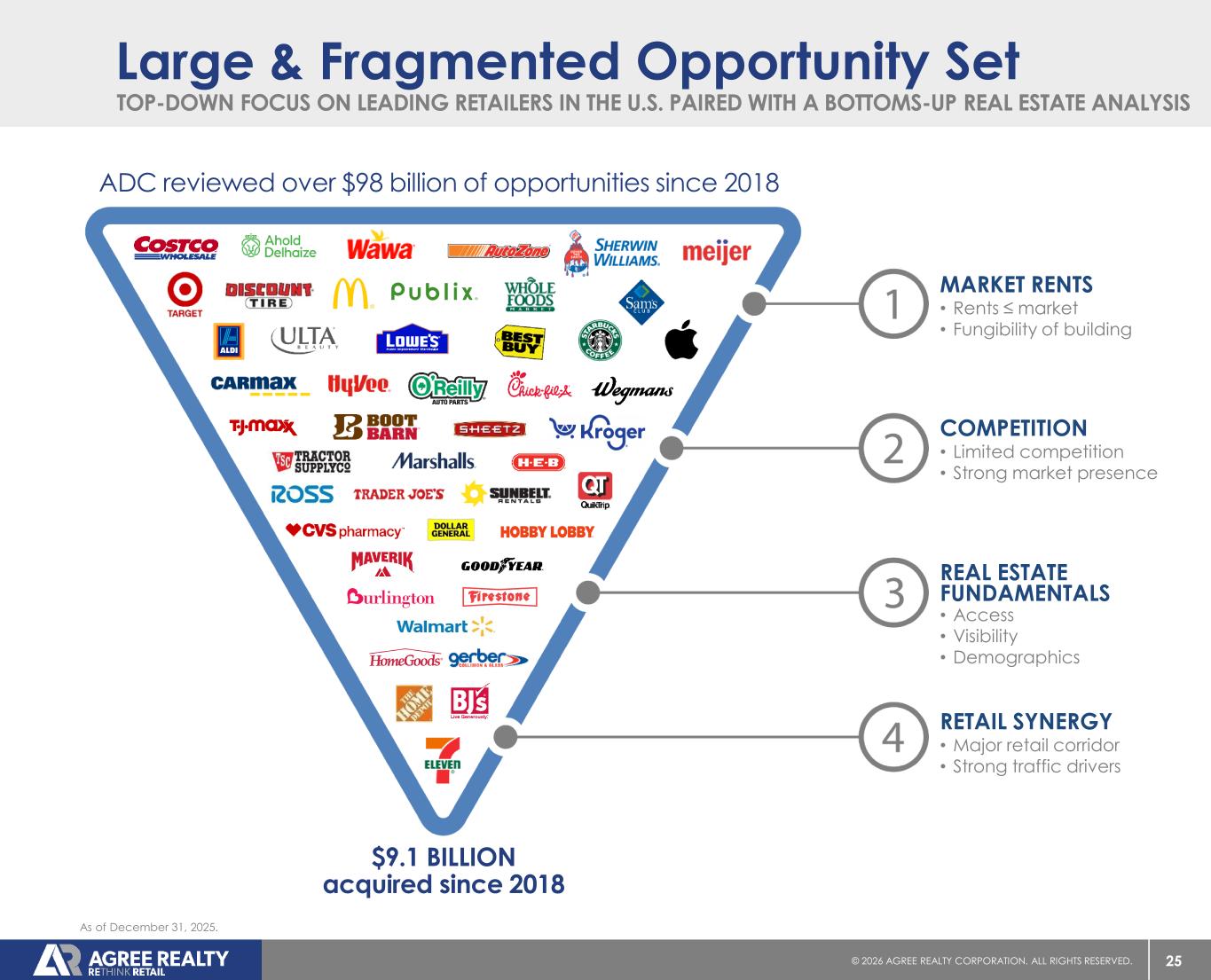
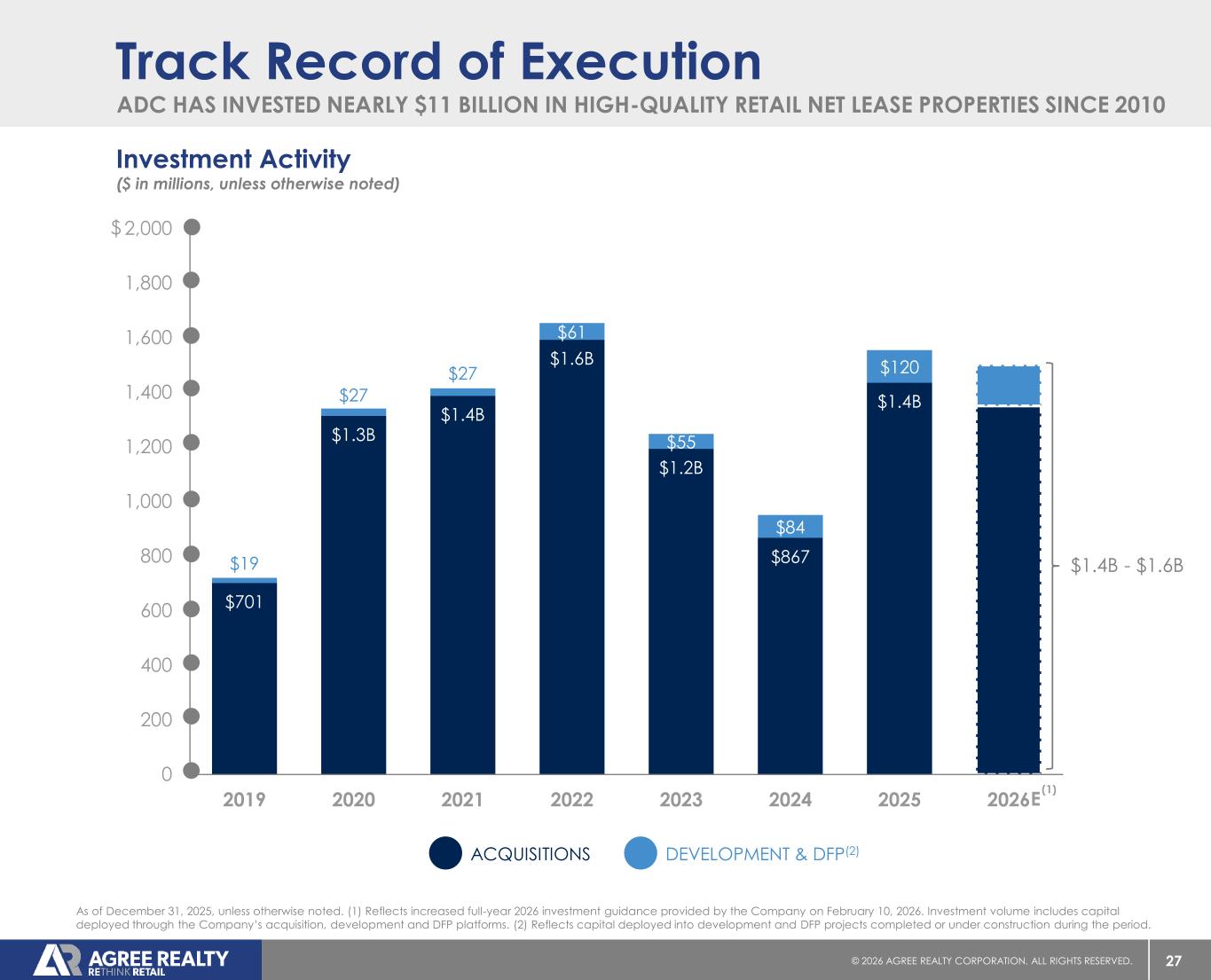
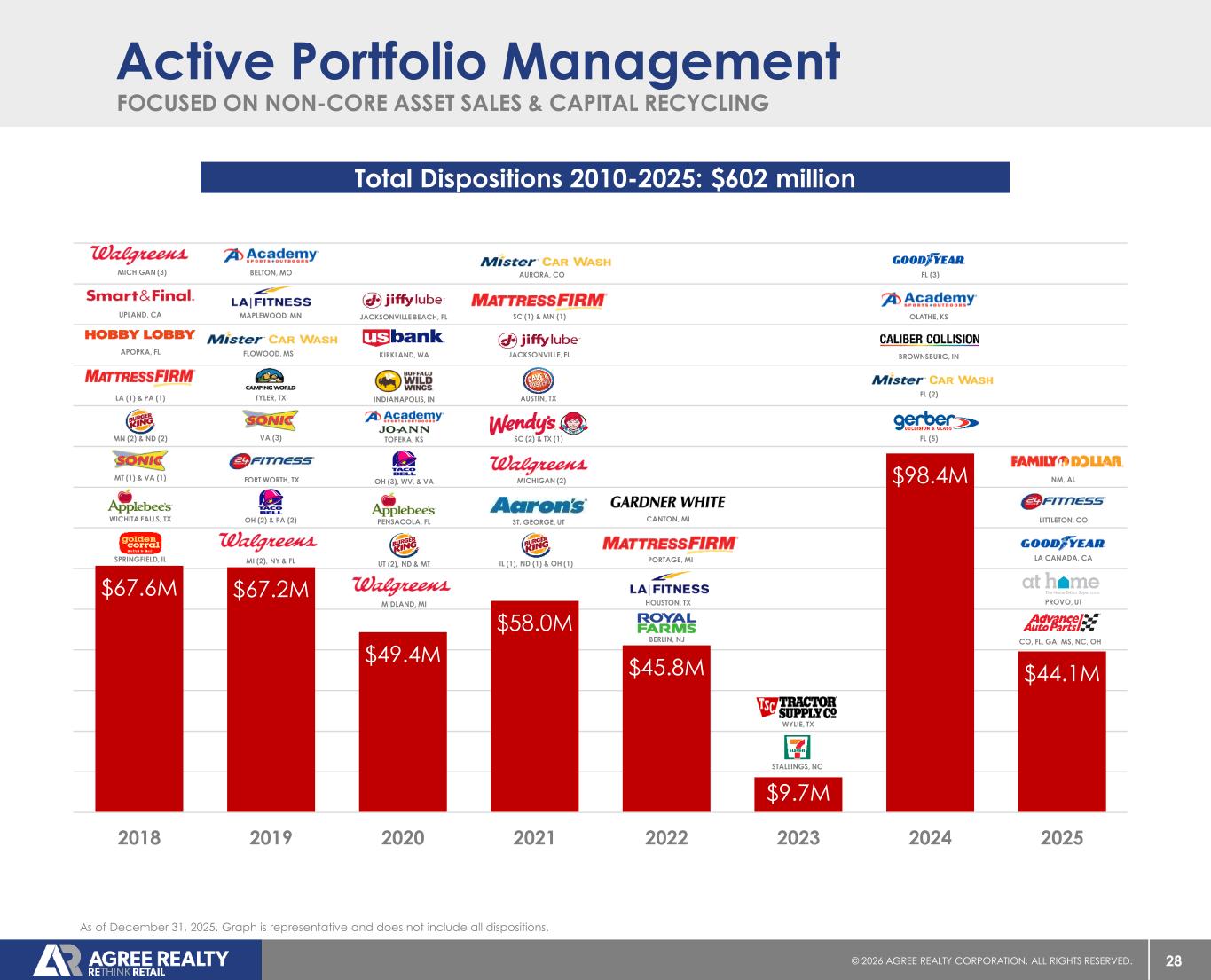
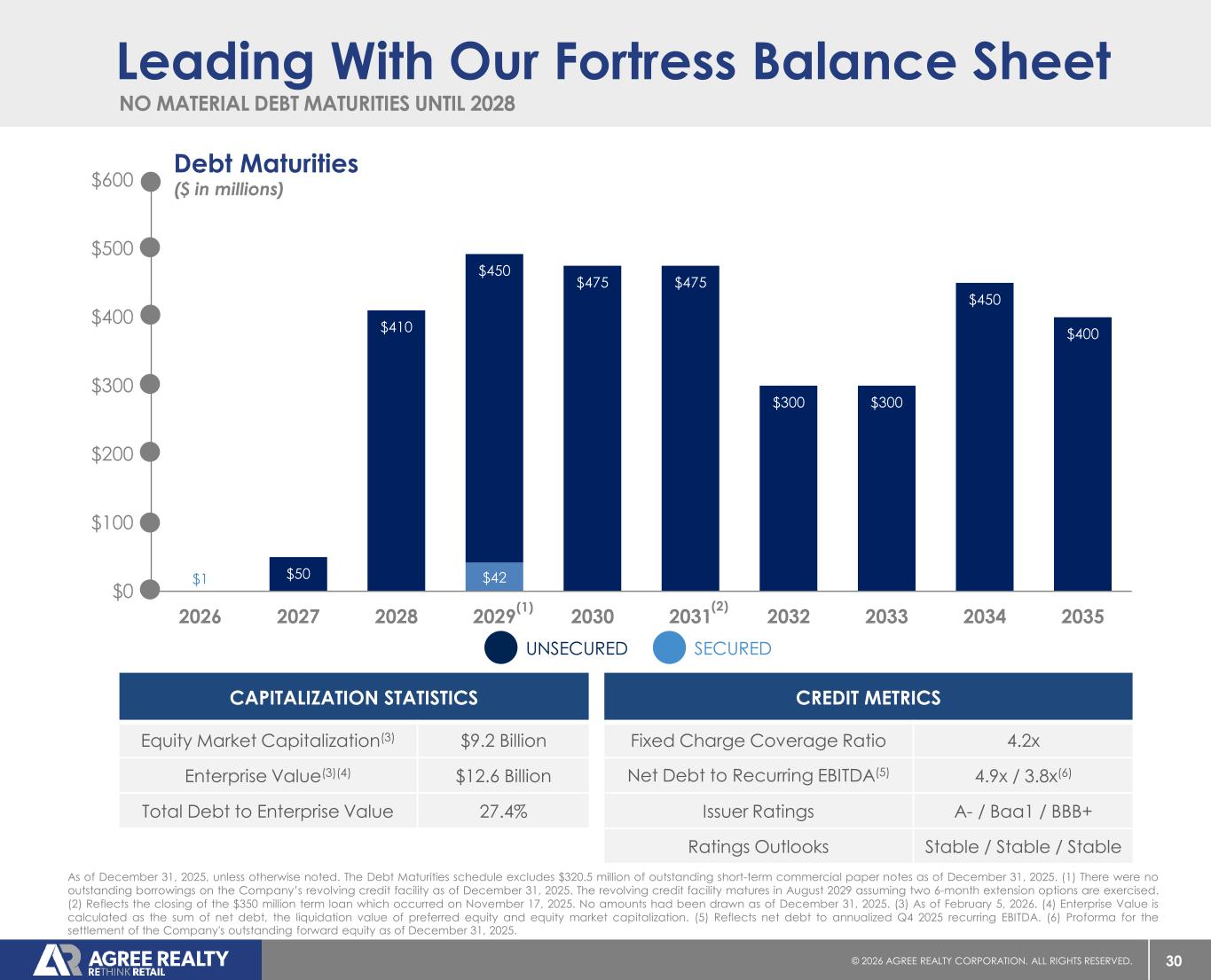
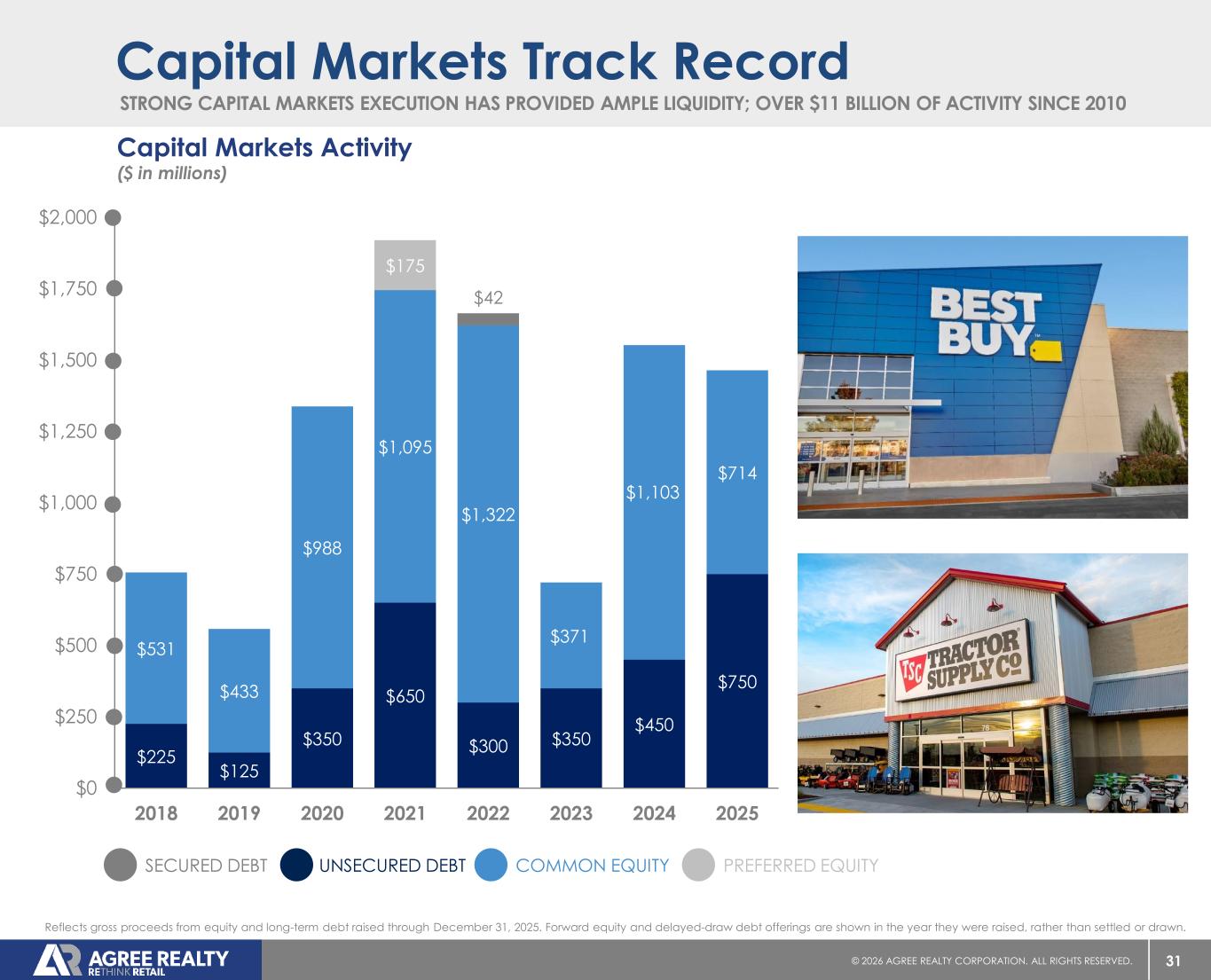
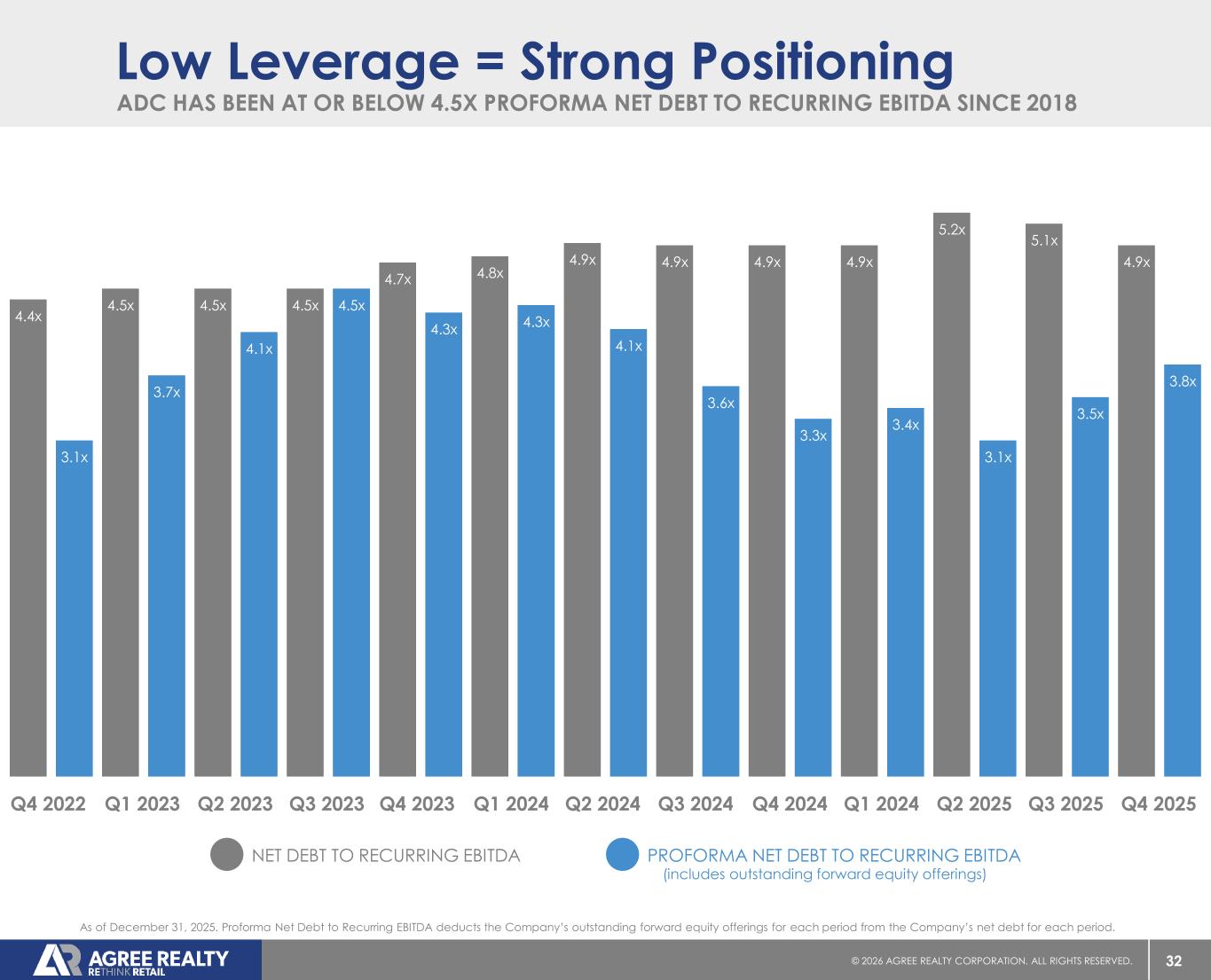
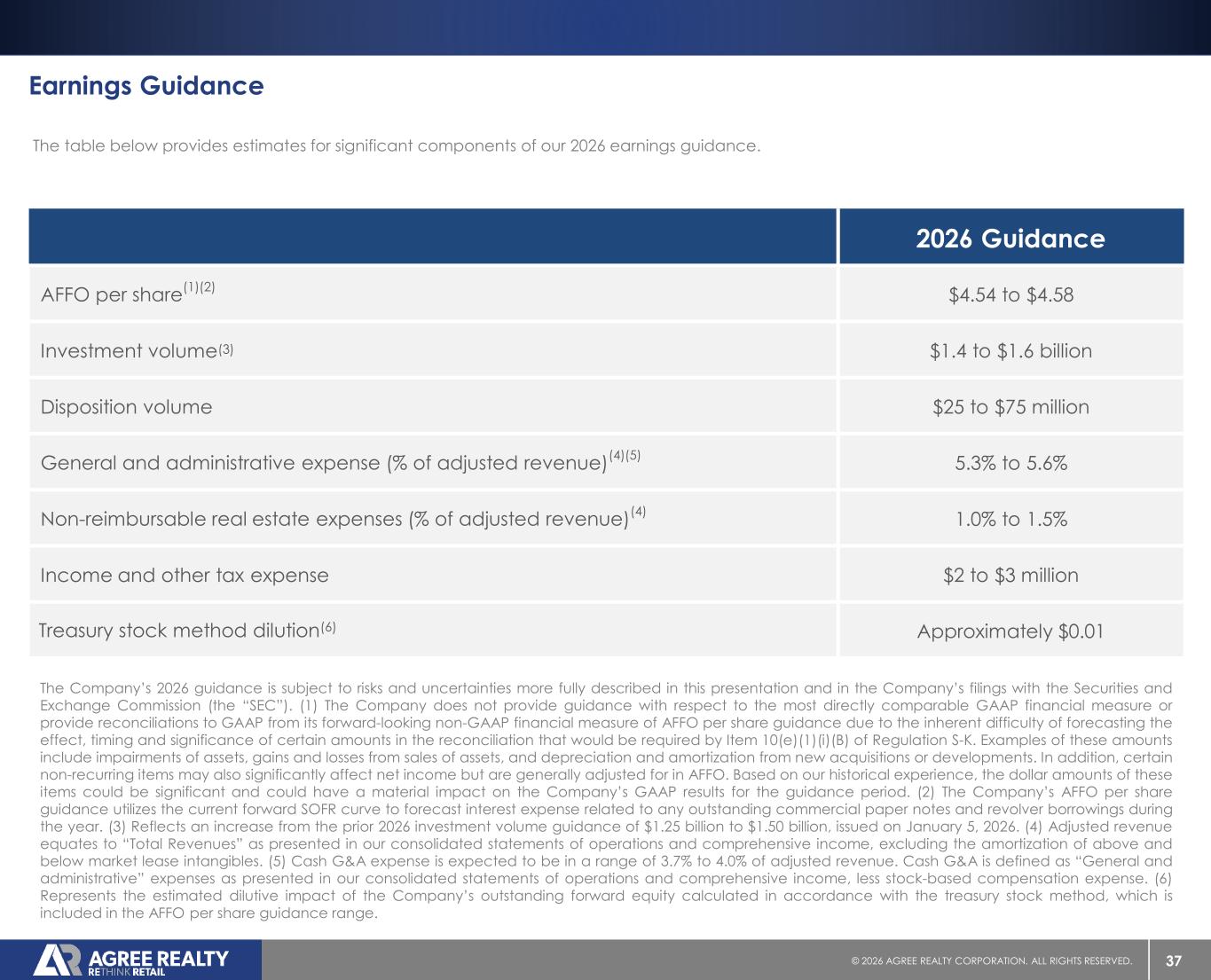
Thanks, Ruben, and thank you all for joining us this morning. 2025 represented yet another year of consistent execution for our growing company. In a dynamic macro environment, we remained disciplined, continued investing in our future, and delivered over 4.5% AMFO per share growth. The $1.55 billion invested across our three investment platforms was the second highest total in company history, representing more than 60% year-over-year growth. As demonstrated by our 2026 guidance, the fundamentals supporting our outlook are very strong. Our portfolio has never been better positioned, the depth and strength of our team is exceptional, and our balance sheet is in tremendous shape. We have commenced numerous IT undertakings, including the construction of the next iteration of ARC, and continue to drive efficiencies through systematic process improvement. These initiatives will support bottom-line growth this year and beyond, driven by ongoing growing efficiency gains, and a material reduction in G&A as a percentage of revenue. During the course of the year, we once again proactively fortified our balance sheet, raising roughly $1.5 billion in capital. We concluded 2025 with over $2 billion of liquidity, including over $715 million of outstanding forward equity. With no material debt maturities until 2028, our balance sheet is in tremendous position to execute on our 2026 investment guidance and provide significant flexibility. At year-end, pro forma net debt to recurring EBITDA stood at just 3.8 times, enabling us to execute on the high end of our 2026 investment guidance without incremental equity while staying within our target leverage range of four to five times. Our pipeline has expanded significantly over the past month and now represents over a half billion dollars and provides us confidence in increasing our 2026 investment guidance to a range of 1.4 to 1.6 billion dollars. Our updated investment guidance represents approximately a 10% increase from our prior range and the high end of the range is slightly above our 2025 investment activity. With yesterday's release, we have initiated full year AFFO per share guidance of $4.54 to $4.58. At the midpoint, this represents 5.4% year-over-year growth and two-year stacked growth of 10%. When combined with our current dividend yield, this implies a total operational return of our target of approximately 10%. Combined with a fortress balance sheet, best-in-class portfolio, and historic track record of execution, we believe that ADC offers one of the most compelling value propositions in the REIT sector. Turning to our three external growth platforms, our partnerships across the real estate spectrum have never been stronger nor more productive. Today, Hager Realty is the preferred one-stop shop for the country's largest retailers. These partnerships are translating into actionable opportunities, including one-off acquisitions, sell leasebacks, lend and extend transactions, programmatic development, and high-quality DFB projects. As a result, all three external growth platforms are accelerating and seeing increasing transactional opportunities. Moving on to recap last year, during the fourth quarter, we invested approximately $377 million in 94 high-quality retail debt lease properties across our three external growth platforms. This included the acquisition of 94 assets for over $347 million. The properties acquired during the quarter leased to leading operators in home improvement, auto parts, grocery store, farm and rural supply, convenience store, and tire and auto service sectors. Fourth quarter investment activity was a very high quality, evidenced by the largest quarterly percentage of ground lease acquisitions since 2021 at over 18%. Notable transactions included three geographically diverse ground leases leased to Lowe's, as well as a Home Depot in Michigan paying under $5 per square foot in rent. The acquired properties had a weighted average cap rate of 7.1% and a weighted average lease term of 9.6 years. Investment grade retailers accounted for nearly two-thirds of the annualized base rent acquired. For the full year 2025, we invested nearly $1.6 billion in 338 retail net lease properties spanning 41 states. Over $1.4 billion of our investment activities originated from the acquisition platform. The acquisitions were completed at a weighted average cap rate of 7.2% and had a weighted average lease term of 11.5 years, with roughly two-thirds of rents coming from investment-grade retailers. As a reminder, we do not impute credit ratings for non-rated retailers. Our development and DFP platforms had a record year with 34 projects either completed or under construction representing approximately 225 million of committed capital we're continuing to see increased activity across both these platforms as we partner with retailers and developers to execute on their store growth plans during the fourth quarter we commenced four new development and DSP projects with total anticipated costs of approximately 35 million dollars the new projects are with leading retailers including boot barn Burlington, Five Below, Ross Dress for Less, Alta, and 7-Eleven. Construction continued during the quarter on nine projects with anticipated costs totaling approximately $59 million. Lastly, we completed construction on three projects during the quarter with total costs of $29 million. On the asset management front, we executed new leases, extensions, or options in over 640,000 square feet of gross leasable area during the fourth quarter, including a Walmart Supercenter in Rochester, New York, and Lowe's in Rowland Park, Kansas. For the full year 2025, we executed new leases, extensions, or options on approximately 3 million square feet of GLA with a recapture rate of 104%. We are very well positioned for 2026 with only 52 leases or 1.5% of annualized base rents maturing. During the past year, we disposed 22 properties for gross proceeds of just over $44 million and a weighted average cap rate of 6.9%. This includes nine properties that were sold for $20 million during the fourth quarter and a weighted average cap rate of 6.4%. Our capital recycling efforts will continue to focus on select non-core assets as well as opportunistic dispositions. At year end, our best-in-class portfolio is approaching 2,700 properties and spanned all 50 states. The portfolio includes 251 ground leases representing over 10% of annualized base rents. Our investment grade exposure year-end stood at nearly 67%, an occupancy increase to 99.7%, reflecting a 50 basis point improvement since the first quarter of the year. Lastly, I want to recognize Peter and his team for their exceptional work in 2025. We achieved an A- rating from Fitch and successfully launched our commercial paper program, both milestones that will deliver meaningful savings and long-term benefits to our cost of capital. With that I'll hand it over to Peter and then we can open up for questions.
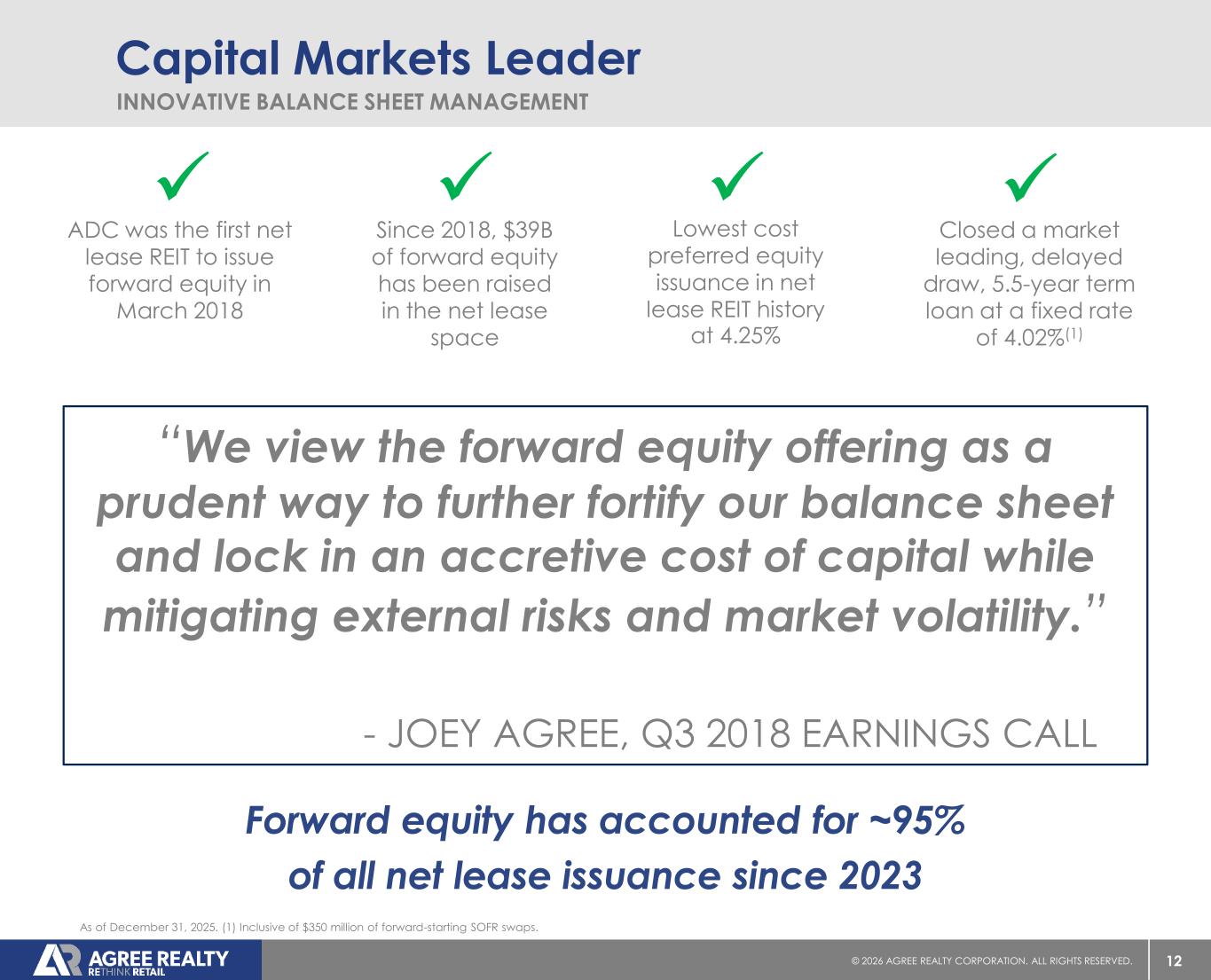
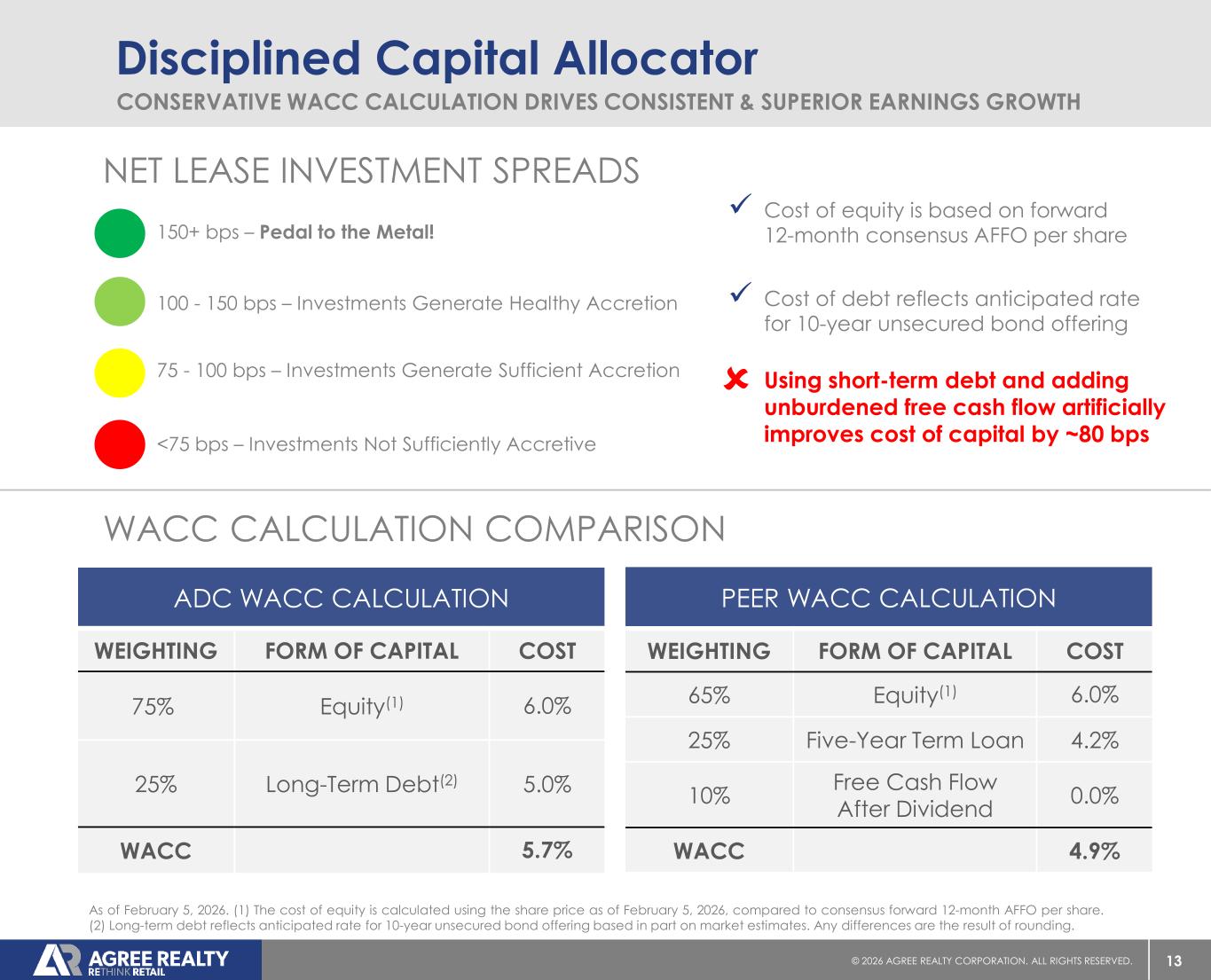
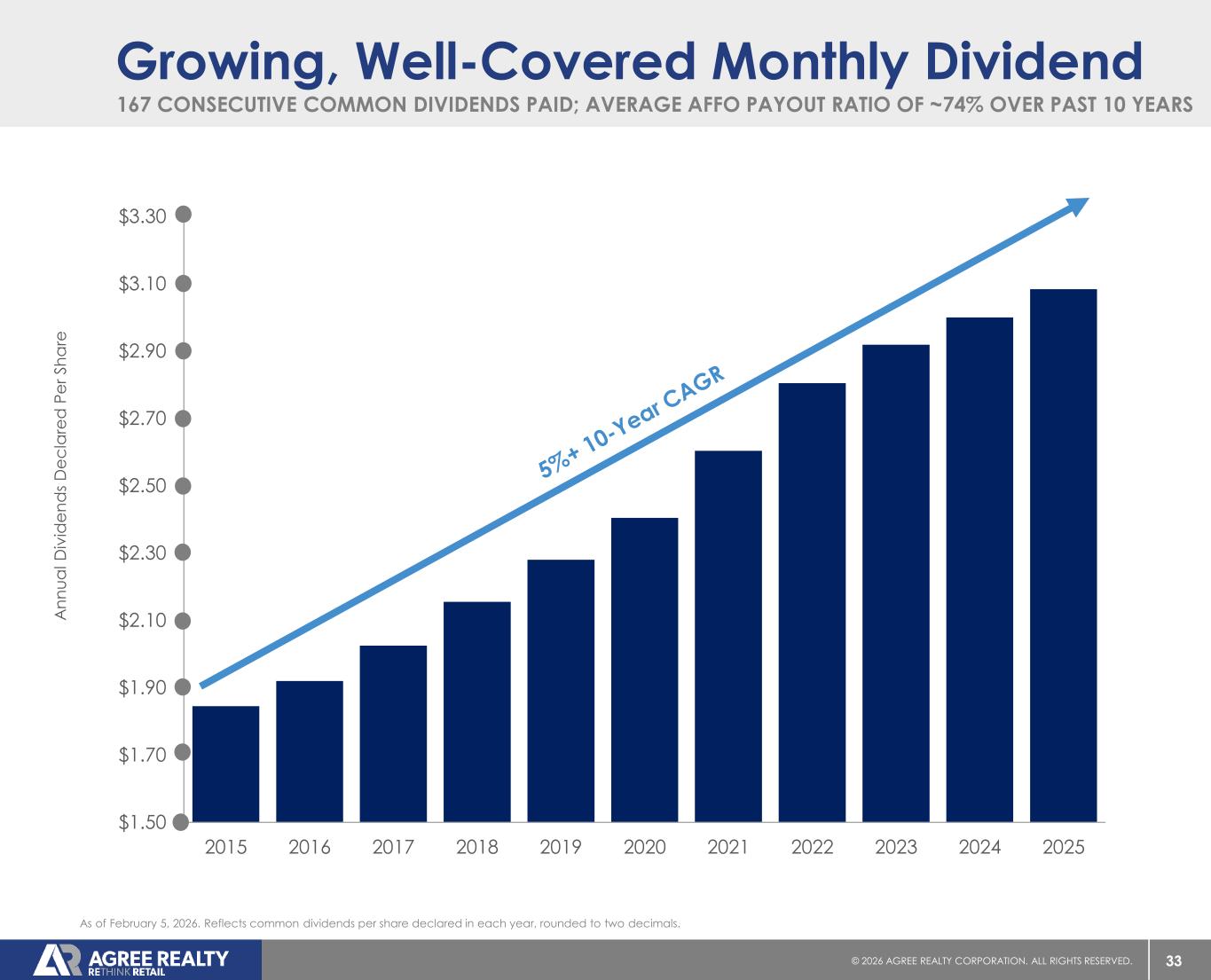
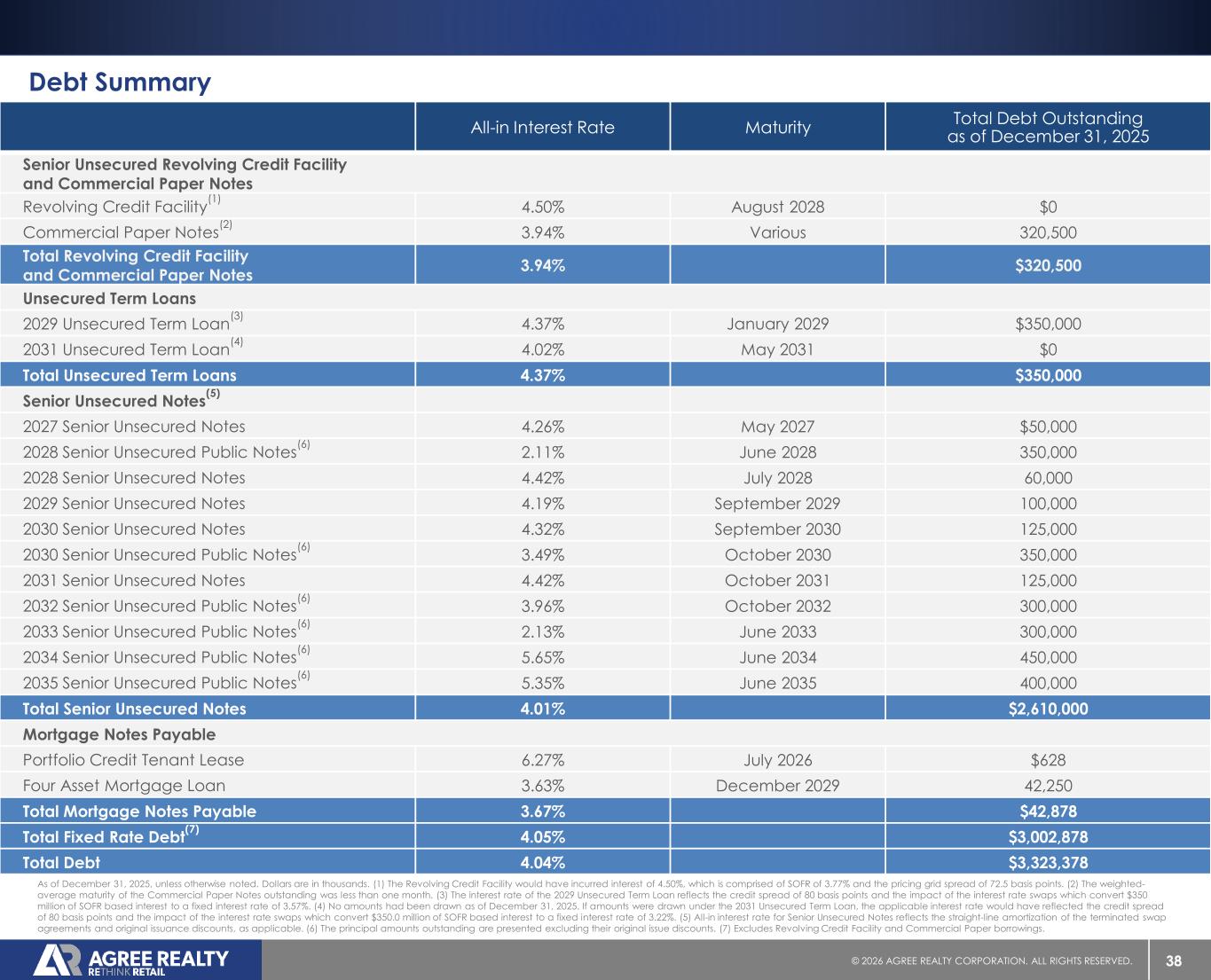
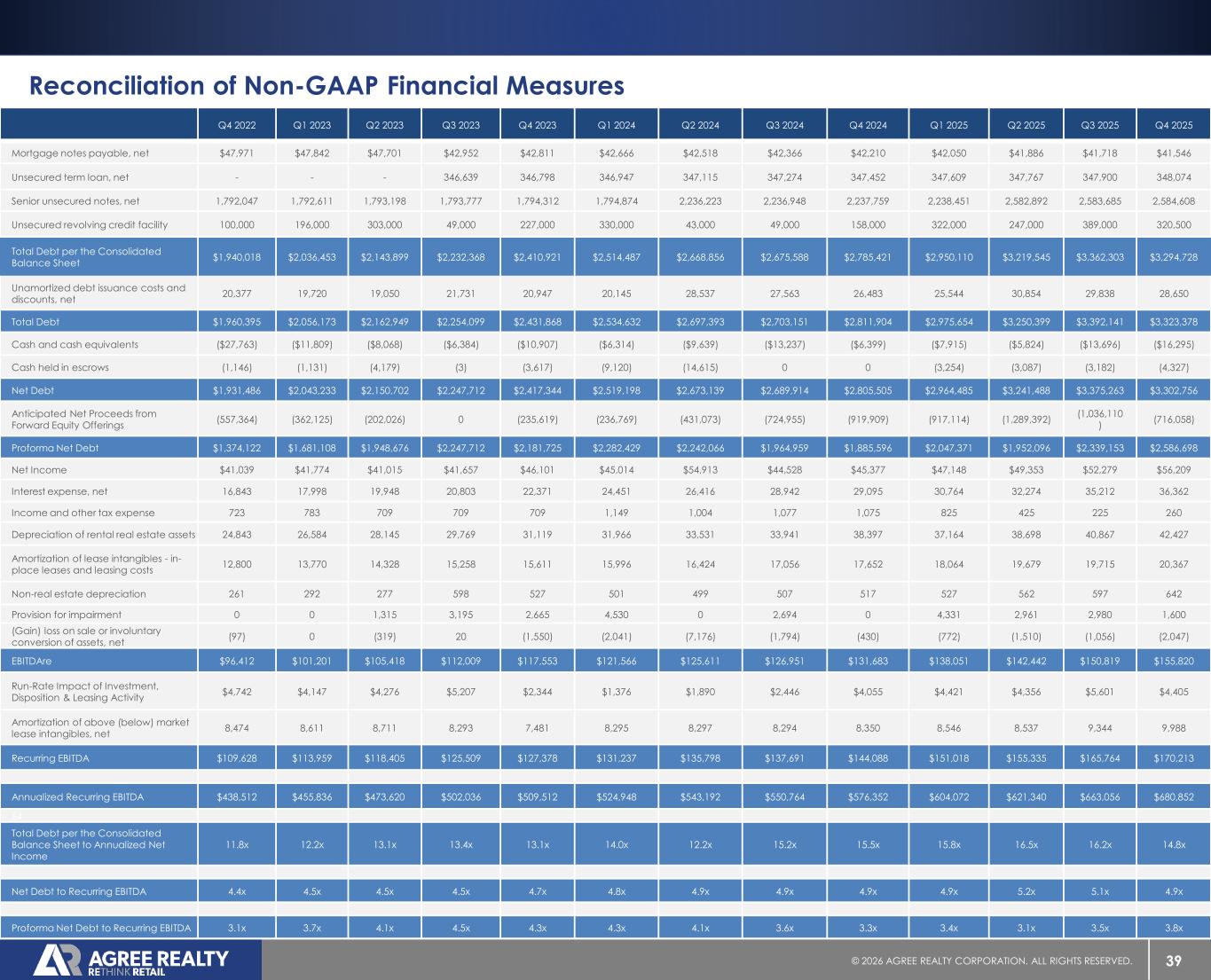
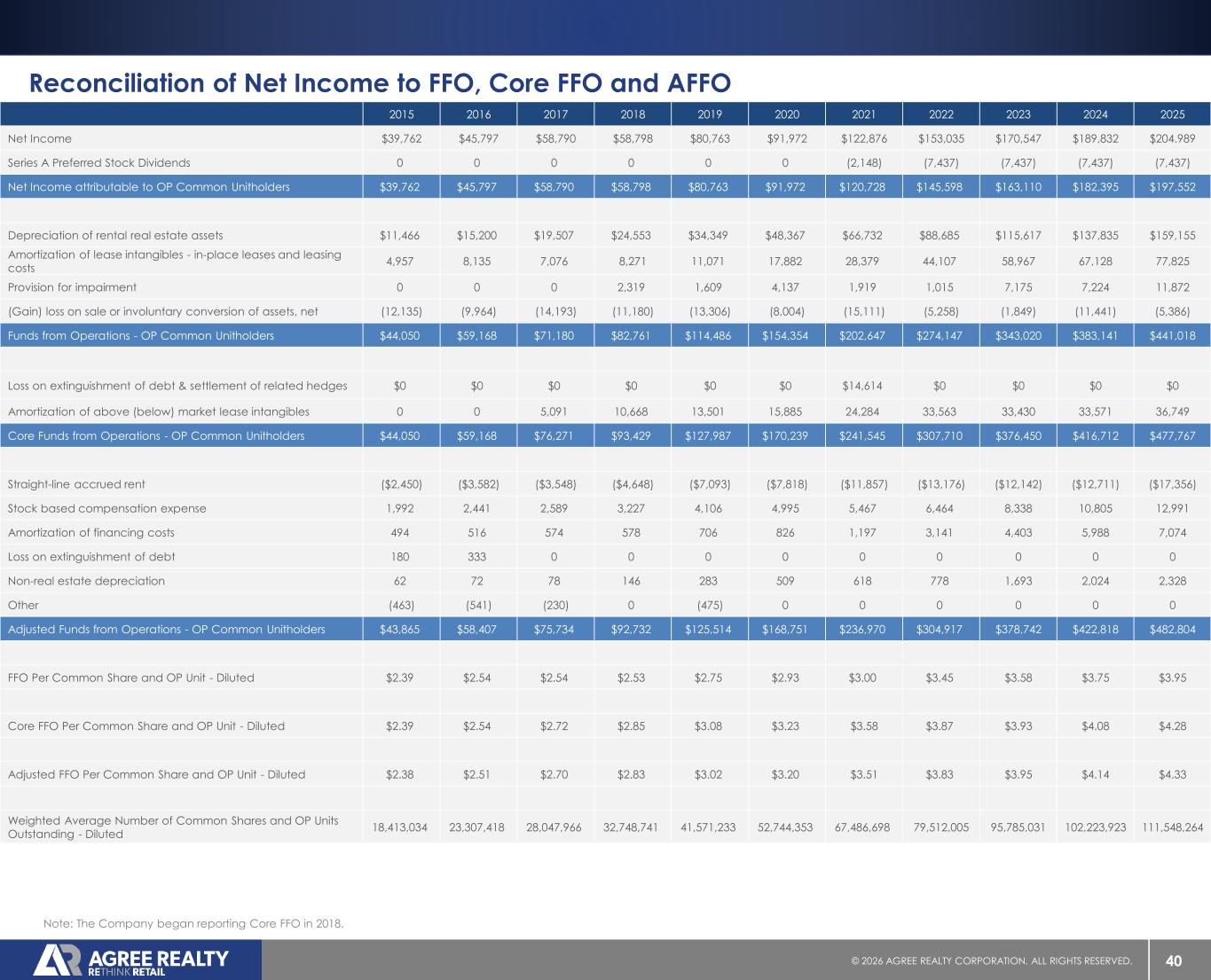
Thank you Joey. Starting with the balance sheet we had a very active year in the capital markets raising approximately 1.5 billion dollars of long-term capital including roughly 715 million dollars of forward equity, a 400 million dollar bond offering and closing on a $350 million term loan. Additionally, we established a $625 million commercial paper program, becoming one of only 19 U.S. REITs with a commercial paper program. This has become our preferred source of short-term capital, enabling us to issue approximately $28 billion of notes during the year and generate over $1 million in savings compared to borrowings on our revolving credit facility. During the fourth quarter, we sold 1.5 million shares of forward equity via our ATM program for anticipated net proceeds of approximately $109 million. We also settled 5.9 million shares of forward equity, receiving proceeds of over $428 million. At year end, we had approximately 9.6 million shares of outstanding forward equity, which are anticipated to raise net proceeds of $716 million upon settlement. During the quarter, we closed on the previously announced $350 million, 5.5-year term loan. Prior to closing the term loan, we entered into $350 million of forward-starting swaps to fix SOFR until maturity. Including the impact of those swaps, the interest rate on the term loan is fixed at 4.02%. The term loan fits well into our debt maturity schedule and demonstrates continued strong support from our banking partners. To date, no amounts have been drawn under the term loan, which has a 12-month delayed draw feature. We also entered into $200 million of forward-starting swaps during the year, effectively fixing the base rate for a future 10-year unsecured debt issuance at approximately 4.1%. This is consistent with our proactive hedging strategy, and combined with our outstanding forward equity, provides over $915 million of hedge capital to fund investment activity in 2026. As of December 31st, we have over $2 billion of liquidity, including approximately $1.3 billion of availability under our revolving credit facility and term loan, the previously mentioned outstanding forward equity, and cash on hand. Pro forma for the settlement of our outstanding forward equity, net debt to recurring EBITDA was approximately 3.8 times at year end. Excluding the impact of unsettled forward equity, our net debt to recurring EBITDA was 4.9 times. Our total debt to enterprise value was approximately 27%, while our fixed charge coverage ratio, which includes principal amortization and the preferred dividend, was very healthy at 4.2 times. Our floating rate exposure remained minimal with approximately $321 million of outstanding commercial paper borrowings at year-end, and as Joey mentioned, we have no material debt maturities until 2028. We are in an excellent position to execute on our increased investment guidance this year without having to raise any additional equity capital. The strength of our Fortress balance sheet was further validated by the A-minus issuer rating that we received from Fitch in August. The rating makes us one of only 13 publicly listed U.S. REITs to carry an A-minus credit rating equivalent or better. This achievement reflects the prudent, disciplined way we continue to grow the company and stands as a testament to more than 15 years of thoughtful portfolio construction and disciplined capital allocation. Over that period, we have invested nearly $11 billion in best-in-class retailers while maintaining a preeminent balance sheet and consistently leading the way in capital markets execution. Moving to earnings, core FFO per share was $1.10 for the fourth quarter and $4.28 for full year 2025, representing 7.3% and 5.1% year-over-year increases, respectively. AFFO per share was $1.11 for the fourth quarter, representing a 6.5% year-over-year increase. For the full year, AFFO per share was $4.33, which reflects the high end of our guidance range and 4.6% year-over-year growth. As Joey mentioned, our initial AFFO per share guidance of $4.54 to $4.58 for 2026 represents approximately 5.4% year-over-year growth at the midpoint, which would be our highest earnings growth since 2022. We provide parameters on several other inputs in our earnings release, including investment and disposition volume, general and administrative expenses, non-reimbursable real estate expenses, income and other tax expenses, as well as Treasury stock method dilution. Our guidance for Treasury stock method dilution relates to our outstanding forward equity. As a reminder, if ADC stock trades above the net price of our outstanding forward equity offerings, the dilutive impact of unsettled shares must be included in our share count in accordance with the Treasury stock method. Provided that our stock continues to trade near current levels, we anticipate that Treasury stock method dilution will have an impact of approximately one penny on full year 2026 AFFO per share. That said, the impact could be higher if our stock price moves significantly above current levels. Our accelerating earnings growth supports a growing and well-covered dividend. During the fourth quarter, we declared monthly cash dividends of $0.26.2 per common share for each of October, November, and December. The monthly dividend equates to an annual life dividend of over $3.14 per share and represents a 3.6% year-over-year increase. Our dividend is very well covered with a payout ratio of 71% of AFFO per share for the fourth quarter.
Operator
With that, I'd like to turn the call back over to Joey thank you Peter operator at this time let's open it up for questions we will now begin the question and answer session if you'd like to ask a question press star then the number one on your telephone keypad we ask would you please limit yourself to two questions our first question will come from the line of Michael Goldsmith with QBS please go ahead hi thanks this is Amy Crowman I'm with Michael I was hoping to start we could dig in a little bit on the increase in the 2026 investment guidance just 30 days after providing the initial guide how was this increased split across the platforms and were there any large transactions identified or is this more of an increase in one-off opportunities
good morning Amy since the initial release in January we've secured a number of transactions including a couple set leaseback transactions that will close in q1 and q2 respectively as well as some single credit portfolio portfolio transactions on the acquisition side. From the development and DFP side, we just have more confidence, frankly, in those projects commencing in Q1 and subsequently also in Q2. So all three platforms have seen accelerated activity. I would note that the increase after approximately 30 days in the investment guidance is primarily due to those leaseback transactions in that single credit portfolio.
Operator
Great. And then on the non-core asset sales, you highlighted dispositions of some retailers that I think we were expecting and some that we weren't, maybe Family Dollar, a fitness operator, a Goodyear store. What makes some of these tenants more ripe for capital recycling than others?
Yeah, so capital recycling, as I mentioned in our preparator market, the portfolio is in tremendous shape. There's opportunistic sales that were taking place in Florida, California, and Texas on good years, as you noted. We paired back advanced auto parts exposure as well. And so you'll see us continue to pair back exposure to retailers that we don't either have full confidence in on a go-forward basis. Select non-core assets. but then I would say the predominance of our disposition activity this year will just be valuations that are driven by the 1031 market or the beautiful bill where we don't see the value of the asset matching our prospective purchasers.
Operator
Our next question will come from the line of John and Galan with Bank of America. Please go ahead. Thank you. Good morning.
I was hoping you can maybe talk to you about, you know, the cap rate on acquisitions where you kind of see that trending, and then any other, you know, maybe there is cap rate stability, but anything changing on the escalators, lease terms, or options at expiration when you're speaking with your different retailers.
Well, good morning, Anna. Don't see anything materially changing on the cap rate front. Obviously, at the beginning of the year, we have a complete but pretty, you know, our Q1 pipeline is effectively filled at this point. No material cap rate deviations. Obviously, we won't move up the, we won't change our parameters and move up the risk spectrum. So, no change there. Also, I think that rent escalators have been embedded with the historic inflation that we've seen post-pandemic, and we haven't seen any reversal of that trend. or increase in that trend in terms of size of escalators or frequencies. I think most tenants have agreed today that escalators of 7.5 to 10% every five years are appropriate given just the inflation that we're seeing currently and as well as historically on a communal basis.
Thank you. And then can you just share some information with us on construction costs? We're hearing those are increasing.
Well, they certainly aren't going down in the 100-year field. look past the past hundred years, while commercial rental rates have peaks and valleys, construction costs just continue to migrate upwards. So we're seeing construction costs that are fairly in line with last year. We've looked at some alternative engineering and alternative mechanisms to reduce those costs in conjunction with our retailers. Those costs are embedded, obviously, in our development budgets. They certainly aren't going down, as I mentioned, the typical junior box in this country today is approximately $160 per square foot vertical costs. That's an off-price retailer today. Pre-pandemic, those were $95 per square foot. Obviously, a constrained labor environment doesn't help that. Tariffs don't help that. And so we've been able to look at sourcing domestically and, like I said, other alternatives here to try to reduce those costs, different construction methodologies, reducing labor when appropriate, using some prefabricated materials. And Jeff Conklin, our construction team, have worked diligently with our retailers to value engineer any buildings.
Operator
Our next question will come from the line of Smeets Rose with Citigroup. Please go ahead.
Thanks. It's Nick Chester, Tara Smeets. Just on the sale least back, is that more timing-driven that you've seen those deals come through, or are you seeing more interest broadly from corporates on that structure?
Yeah, Nick, it's a great question. It's really just frankly specific. We haven't seen a multitude of sale leasebacks come to market, certainly not within our sandbox. There are two that we will execute on in Q1 and Q2. Q1 will have the larger sale leaseback, a core tenant of ours, as a relationship tenant of ours who we are, we're very fond of and very close to an existing top 20 tenant of ours. So, haven't seen an increase in the, sadly, back velocity, but two tenants that we have historical relationships with will execute on here in the first two quarters of the year.
That's helpful. And then you mentioned kind of the potential for G&A savings with some of the efficiencies. How does that look medium and longer term versus where you are today as a percentage of revenue?
Last year, we were very clear that it was an investment year for us. Coming off of 2024, we started with the do-nothing scenario. We had effectively zero net new team members incremental to the team. Last year, we added almost 25 team members to the organization. We're approaching 100, as I mentioned, in the prepared remarks, and we're in a terrific position to continue to execute with depth across all areas and functional areas of the organization. At the same time, we continue to benefit from our IT improvements. The team here has done really a terrific job. I mentioned we're working on the ARC 3.0, the next iteration of ARC. We've put a Microsoft backbone in place and have a number of projects that the team is executing on for data efficiency and access, which will continue to make us faster and more efficient. We're utilizing AI, as we mentioned, on prior hire calls for the last three and a half years for lease underwriting checklists. We've deployed AI for lease abstraction. We anticipate deploying artificial intelligence for purchase agreement drafts and other forum documentation this year. And so I would anticipate that approximately 30-plus basis points of G&A savings relative to total revenues. And so I think we'll continue to see that in a go-forward basis. On top of that, as Peter mentioned, we're seeing just from our size scale, obviously obtaining the A-minus credit rating, a million dollars in savings from the commercial paper program. And so our size and scale now is giving us access to different tools, different capital, raising short-term capital. In this case, it saved a million dollars, so almost a penny last year, subject to the curve and obviously the commercial paper program that can move up and move down. But we just have more tools, frankly, at our disposable to drive savings. And so this year, I would anticipate single-digit hires, and I think we're in tremendous position to execute across all facets of the business on a go forward basis and continue to benefit from those efficiencies.
Operator
Our next question will come from the line of Spencer Glimcher with Green Street. Please go ahead. Thank you.
On the four DSPs commenced in the quarter, are you guys able to share if these are one-off projects for these tenants or are they part of larger store count expansions for the retailers?
Just trying to get a sense that there be an opportunity for more projects alongside these retailers they are not one-off projects there will be I think significant opportunity for us what we're seeing is is retailer and many of these are publicly issued statements retailer expansion with the desire that is greater greater than any time since the prior to the GFC so if we look across the board Home Depot Walmart Kroger, Keep Going, Tractor Supply, O'Reilly, all the off-price operators have realized in a 21st century omni-channel world their store base is critical. And so absent construction costs getting in the way of project feasibility here, we're going to continue to see that. I would anticipate us breaking ground on 10-plus projects over the course of the first and second quarter. And so we're excited about both the development pipeline.
We've announced three 7-11 Speedway projects last year we will continue to execute those on the in the first and second quarter this year as well as some significant DFP projects where we'll step in and finance and aid the developer and known them upon completion okay great thanks for the color and then just on the ground lease market well maybe first on the transactions that you've executed on recently are there purchase options on any of those at the end of the lease and then just maybe more broadly if you're able to share any color on the ground lease market in general, just in terms of opportunity set and or pricing that you're seeing?
Yeah, no purchase options at the end of the lease that I can think of that's very atypical. The ground lease market per se isn't really a market. I mean, oftentimes sellers aren't even frankly cognizant of the ground lease structure and look at it as a net lease transaction. We did one unique transaction, I would say, during the quarter in Flanders, New Jersey, which had a number of ground leases driven by a Lowe's ground lease, as I mentioned in the preparator marks. There's also a ground lease to Panda Express there, a ground lease to Wells Fargo, a ground lease to Wendy's there. And so a number of ground leases, all paths to that Lowe's. obviously 18 percent was elevated in Q4 driven by that the other lows I mentioned as well as the Home Depot about 20 minutes from here we'll have more ground lease opportunities in Q1 but I think you know thinking of it as a market is pretty challenging many times we're working with retailers on early extensions they're short term either retail or directed and so it's It's a unique seller pool, all the way from institutions to mom-and-pop owners here.
Operator
Our next question comes from the line of John Kilikowski with Wells Fargo. Please go ahead.
Great. This is actually Jamie Feldman here, pinch-eating for John. So how much of the high end of your investment guidance range, the $1.6 billion, is dictated by the available forward equity you already have versus what you think the true opportunity set could be this year?
None of it's driven. I mean, I would say they're all really separate. Peter, feel free to chime in, but I think we're confident in the uses with the $1.4 to $1.6 billion. As we mentioned in the prepared remarks, we can stay under our targeted leverage range of four to five times, really excluding dispositions. We anticipate having significant free cash flow after the dividend, even increasing the dividend this year. And obviously, with $700 million plus outstanding of forward equity, we're in tremendous shape.
Yeah, Jamie, just to echo Joey's comments, we have over $2 billion of total liquidity. But thinking about it from a leverage perspective, we have $1.6 billion of buying power without having to raise any additional equity. And we can end the year at the high end of our stated leverage range of four to five times. while executing really on the high end of our investment guidance range. And so we're very well positioned for this year from a balance sheet perspective, given that liquidity and outstanding forward equity. But I think that's really only one factor as we think about setting guidance.
Okay. So if I heard you right, you really feel strongly 1.6 is kind of the max of what you see out there?
Definitely not. I think it is our guide at this time. we have no visibility outside of development into Q3 or Q4 we started commencing sourcing Q2 acquisitions 15 days ago what I can tell you is there's a half billion dollars in the pipeline as I mentioned that we are very confident in and we'll continue to source for us all three platforms and update the market and everybody on this call as we continue to see activity but no visibility outside of development and a couple DFP projects beyond let's call it May right now okay thank you for that and then secondly you know I think we
had expected yields to compress more than they have any thoughts on on why you think that hasn't been happening given there is more competition in the space and then the developer funding program do you think that's better as a low in a low rate regime or a higher rate regime because we think about you growing that business.
So in terms of competition, we haven't seen any increase in competition due to the private capital that's entered the space. I think everyone on the call is familiar with the numerous different sleeves and operations that have launched. Our typical transaction is four to five million dollars. Twenty people touch it from letter of intent and are underwriting a letter of intent execution to close. We're a horizontally integrated machine that's closing two transactions per day. It's high touch, frankly. We are working with retailers to extend deals, to identify dealers. We're working directly with developers. We overcome obstacles and hurdles that are, again, high touch real estate exercises, not just sale leasebacks with middle market credits. And so it's a very different business, and the preponderance of capital that has entered the space is chasing. In terms of our DFP platform, I think what's really driving the increased activity is, one, our own efforts. Those are critical. But, two, we already touched on construction costs today. And so with vertical construction costs, primarily vertical, I should say, you know, penciling these projects is extremely challenging. You combine that with the availability and the cost of capital, as you mentioned, driven by the tenure, which drives equity returns to fill any gaps or potential MES debt. These projects are very difficult to pencil for private developers. And so our developer funding platform provides a unique solution to finance the entire project in order to find completion, really taking the risk off the developer unless they blow their budget. And then it comes out of, frankly, their profit payment. And so we're entering with a fixed return. We're providing not only our balance sheet as well of an exit, but our relationships with retailers, many of which we have formed leases and very strong relationships with, so we can expedite or accelerate that project. And so we see that looking pretty stable, and our goal is to continue to ramp it.
Okay. But I guess the question on just why yields have been so sticky, are you saying because you haven't seen that much competition? or is there anything else we should be thinking about?
I think the 10-year is obviously traded within a band, right? We've seen the 10-year trade within a band. There's no material increase in competition in the sandbox that we are operating in. And so we really haven't seen anything deviate over the past year plus here now.
Operator
Our next question will come from the line of Brad Hepburn with RBC Capital Markets. Please go ahead.
Yeah. Hey, Ray, thanks. You've had the medium-term goal of $250 million in development investment commitments per year. Do you think this will be the year that you see that number, and does that represent a steady state, or should we expect a higher goal at some point?
We're always raising goals here. We are built to scale, as we talked about on prior questions. I'm hesitant to say this will be the year because due to third-party timing that's retailer approvals municipal approvals access approvals often from DOTs and counties I think this will be a continued year of growth for us our pipeline is large the timing of those projects is often subject to third parties but our pipeline continues to grow across development as well as developer funding platform with projects in all stages from the shadow pipeline to breaking ground as we speak.
Okay, got it. And then, Peter, can you talk about what the assumed credit loss is and guidance and where you ended up in 2025 as well?
Sure. In terms of our AFFO per share guidance for 2026, we're assuming at the high end of that guidance range, 25 basis points of credit loss, which is relatively in line with where we ended up for 2025. I believe we're at 28 basis points to be exact. And then at the low end of our AFFO per share guidance range for 2026, we're assuming 50 basis points of credit loss for the year. So overall, the portfolio continues to be in great shape. It was 99.7% occupied as of year end and it's performing well. We're not seeing any significant changes to our watch list or any new entrance that are material from exposure perspective and anticipate the portfolio should continue to perform well in 26th.
Operator
Our next question comes from the line of Alec Bagan with Baird. Please go ahead.
Hey thank you for taking my question. So you just mentioned talked about how the development and DFP pipelines are growing. I'm curious now that you're you know as you said last year a full suite real estate platform how has that maybe changed conversations or seen other retailers that you haven't worked with come to you seeking out your full suite of capabilities no it's uh it's it's a timely question the team was down with a number of retailers yesterday that we are working with currently and aren't working with currently across all three platforms.
I think most importantly, it provides a holistic conversation with retailers.
I would add our asset management platform.
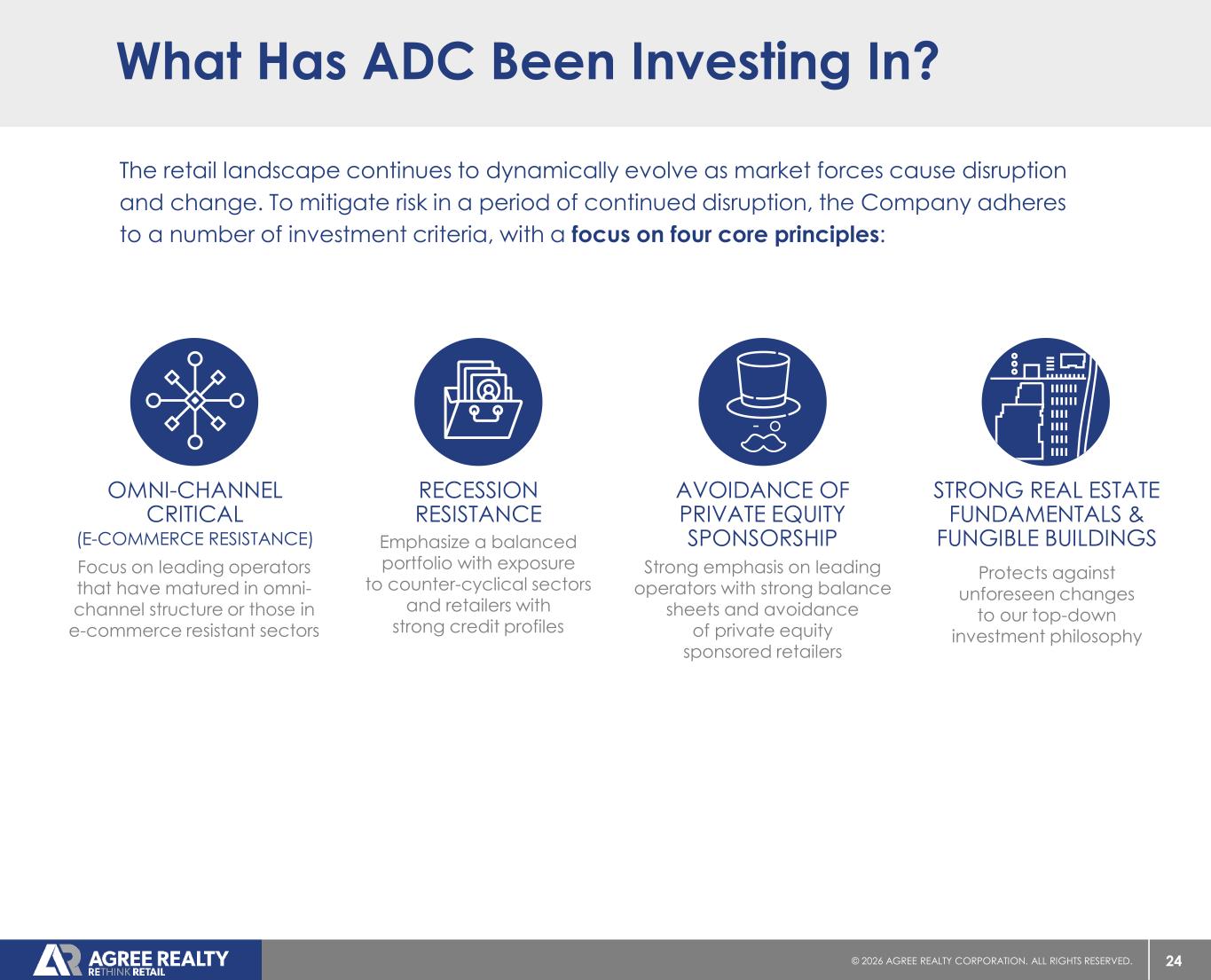
And so everything we manage is internally, property managed, lease administered internally, taxes, insurance, any ancillary responsibilities. The ability to sit down with any retailer in the country and provide an entrepreneurial platform that can execute across all phases of the lifecycle of a transaction from net new development to extensions of short-term leases to sale leasebacks is just a unique value proposition that is one of one. And so you combine the entrepreneurial DNA of a real estate company, of a private real estate company, with a $12, $13 billion balance sheet of an A-rated company that is a publicly We traded REIT with significant liquidity access and a premier cost of capital, and opportunities will arise. And so we continue to maintain dialogue with retailers, grow those relationships that are existing. We're always talking to retailers about net new projects and launching a vertical with them in conjunction with our standard acquisition third-party activities.
Thank you for that. That's it for me. Thank you.
Operator
Our next question will come from the line of Upal Rana with KeyBank Capital Markets. Please go ahead.
Great. On the forward equity, you know, you've got $700 million remaining to deploy. Is there any timing when you need to settle those shares? You know, you've done some significant forward offerings during 1Q last year and April last So just wondering if there's any timing related to those shares settling and expectations on when you need to deploy that capital.
We have a lot of flexibility in terms of settling the $715 million-plus of outstanding forward equity. I think the earliest tranche matures in June of this year, the latest tranche matures in May of 2027. And so we have a lot of flexibility in terms of when we settle those shares. I think it's fair to assume that most of those shares get settled at some point in 2026, subject obviously to uses and other capital sources but we have a good amount of flexibility in terms of when we decide to settle those shares and receive the proceeds.
Okay great that was helpful and then just given that we're halfway through 1Q already and you've already increased your investment guidance almost 10% you know could you share any preliminary 1Q or even 2Q visibility you're seeing on investment activity?
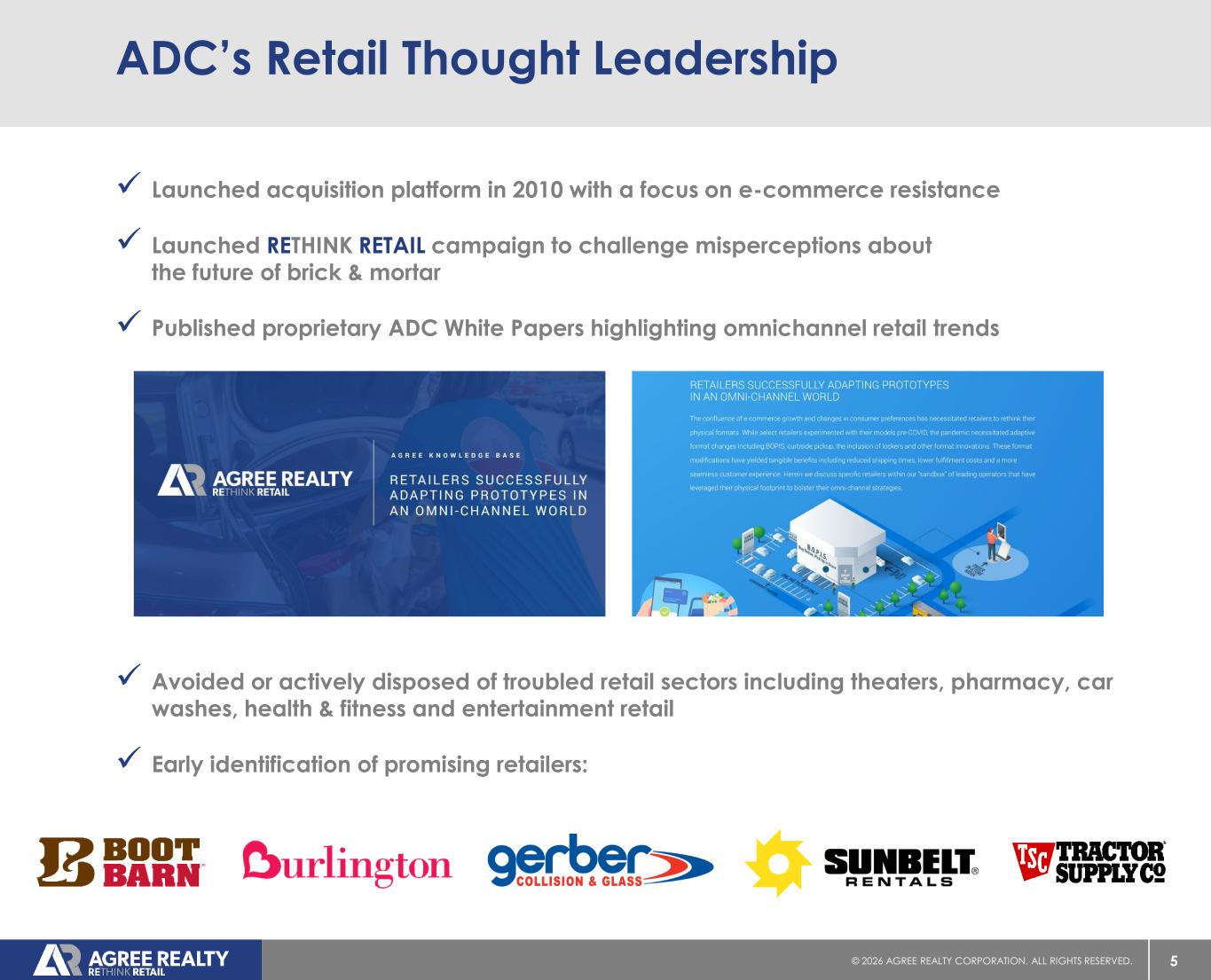
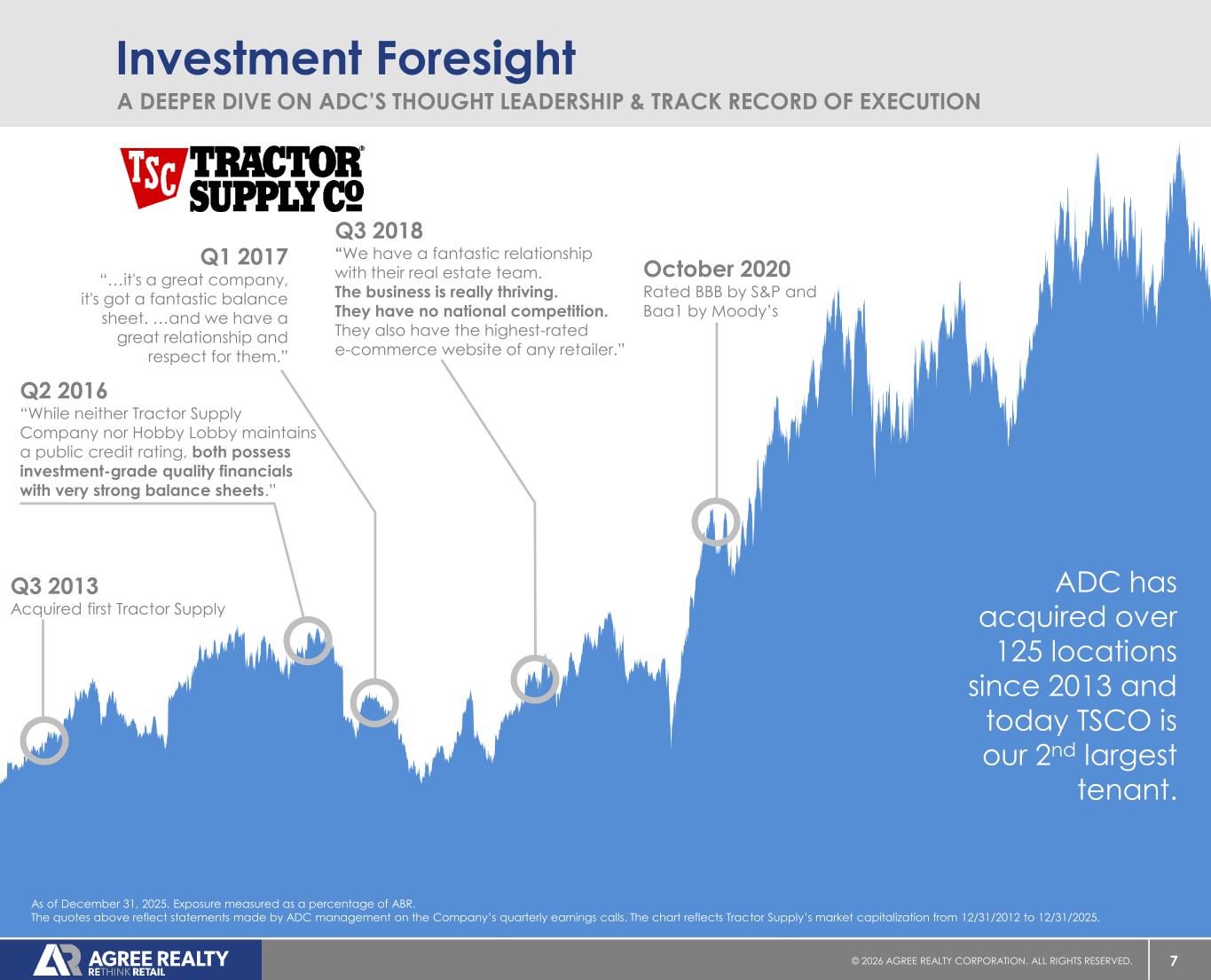
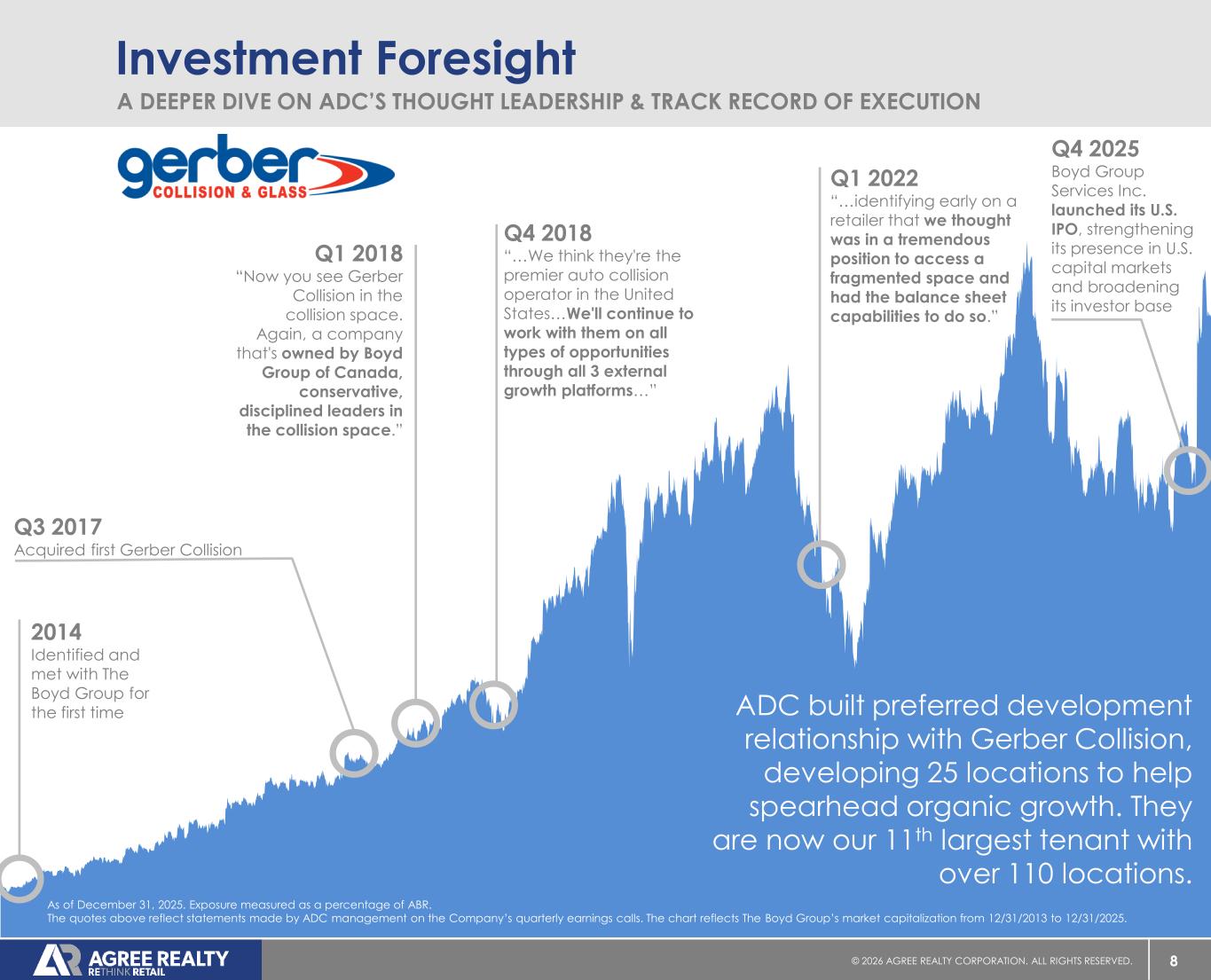
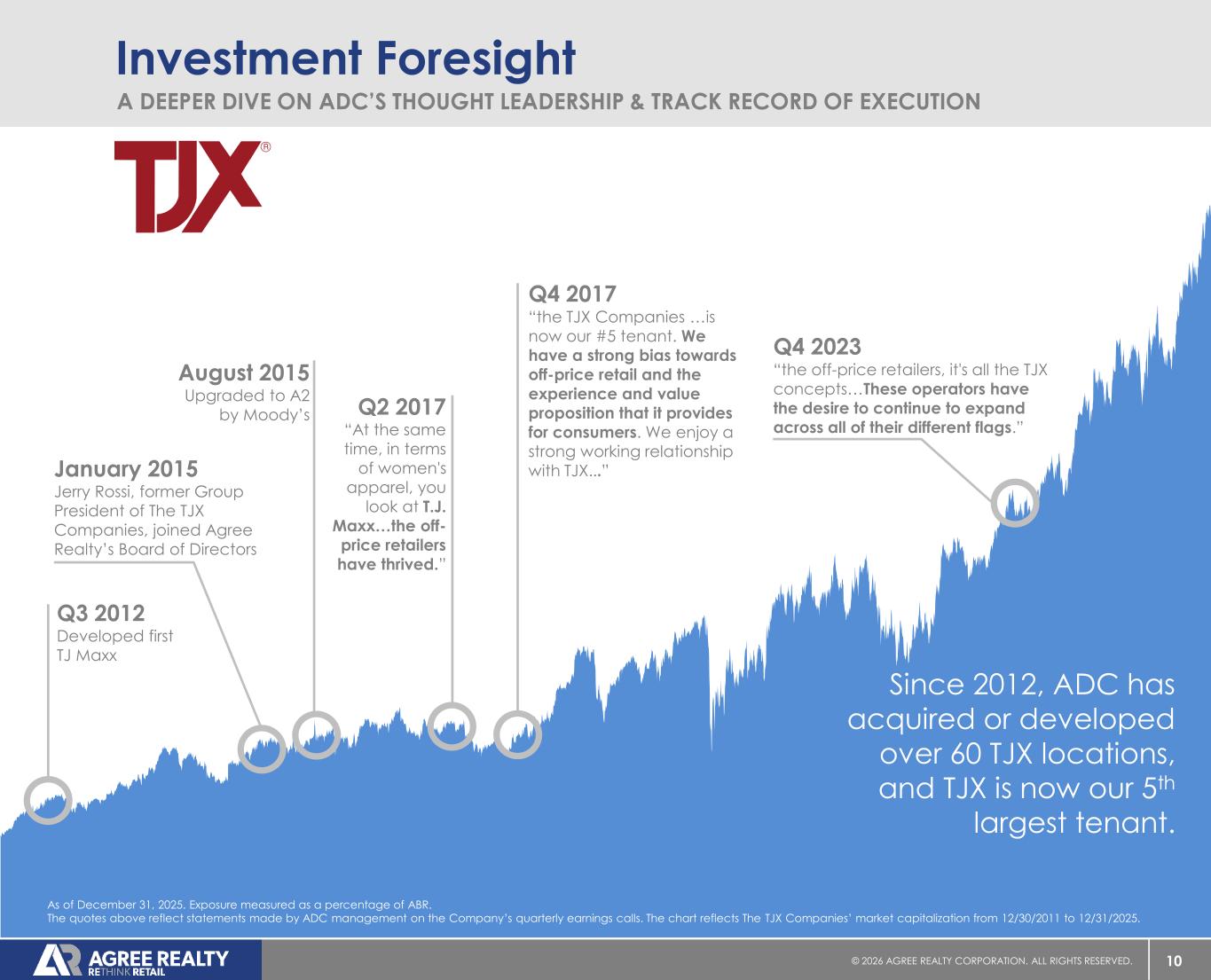
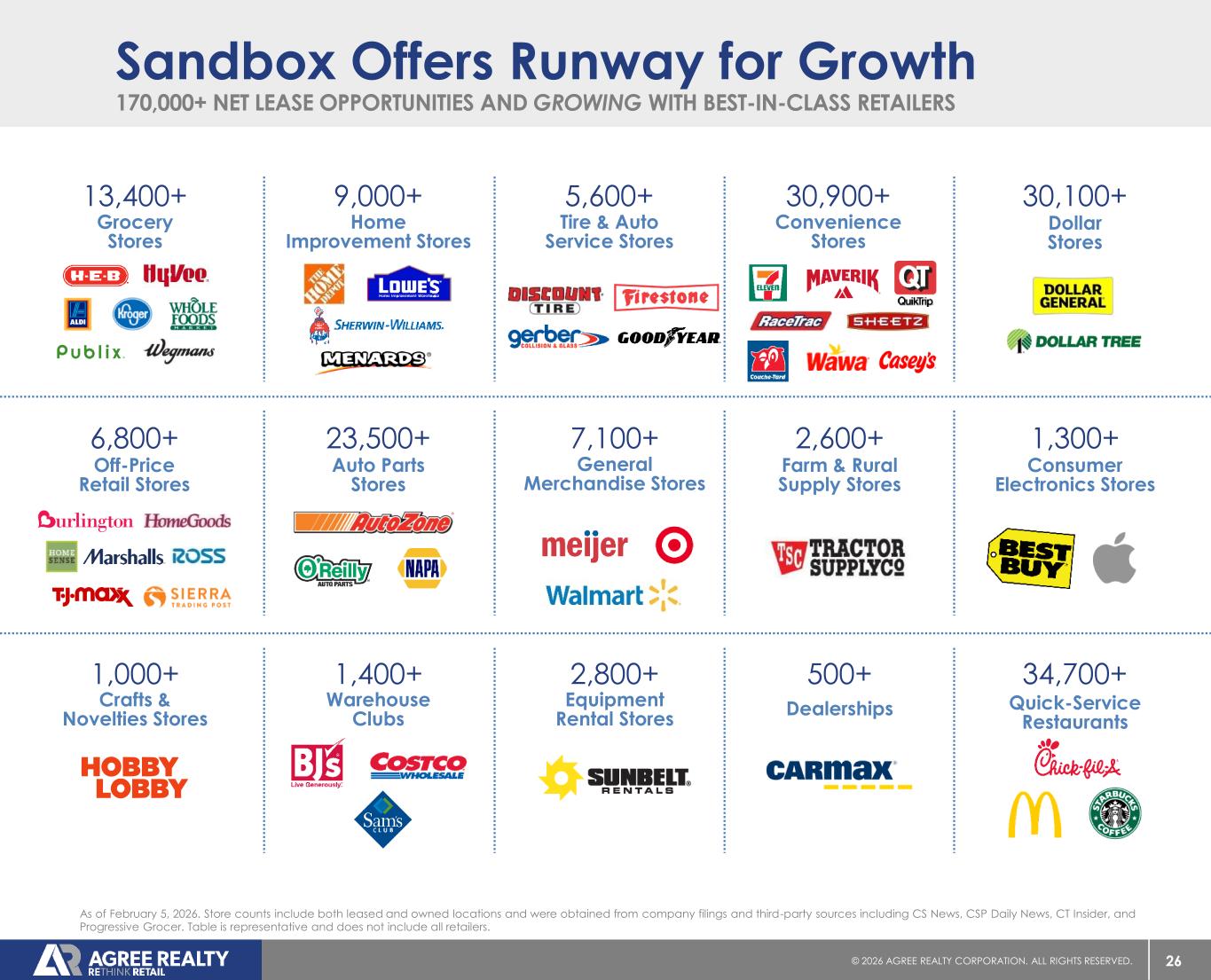
Yeah as I mentioned there will be a sale lease back in there with an existing top 20 tenant of ours in the first quarter the second quarter we'll have a sale lease back with another top 2010 and if there are two or three single credit portfolios one with the largest retailer in the world from a third-party seller another with the leading paint manufacturer and retailer in the world those are primary drivers I would say in there and then one-off transactions on the acquisition front they're typical of everything we do okay great that was helpful thank you thank you our next question will come from the line of Mitch Germain with Citizens Bank please go ahead thank you Joey you've been pretty good at predicting retail trends and I'm curious if there's like a tenant or maybe a sector that you think could become a bigger piece of the portfolio and to go forward basis yes I'm gonna hesitate to look we've talked about boot barn we've talked about our increased exposure there we foreshadowed Gerber collision we foreshadowed tractor supply obviously we're extremely acquisitive with off price that's TJX concepts Burlington Ross there are tenants that we're always been looking at that are I would tell you on the periphery of our sandbox or potentially even on the cusp of entering that sandbox I'm hesitant to mention them because as soon as we start frankly targeting them it seems that we get some copycats out there that then start chasing those credits and so there are always tenants that we're looking at we've been pretty outward with five the low in terms of developing, acquiring. So there's always tenants on the outsides of that sandbox that are making their way in. I think we'll hold off disclosing them until they are actually in our table.
Operator
Our next question comes from the line of Eric Borden with BMO Capital Markets. Please go ahead.
Joey, CVS performance appears to be improving. Have CVS's recent initiatives begin to show up in the performance metrics within your portfolio? And how does your exposure compare to their broader store base?
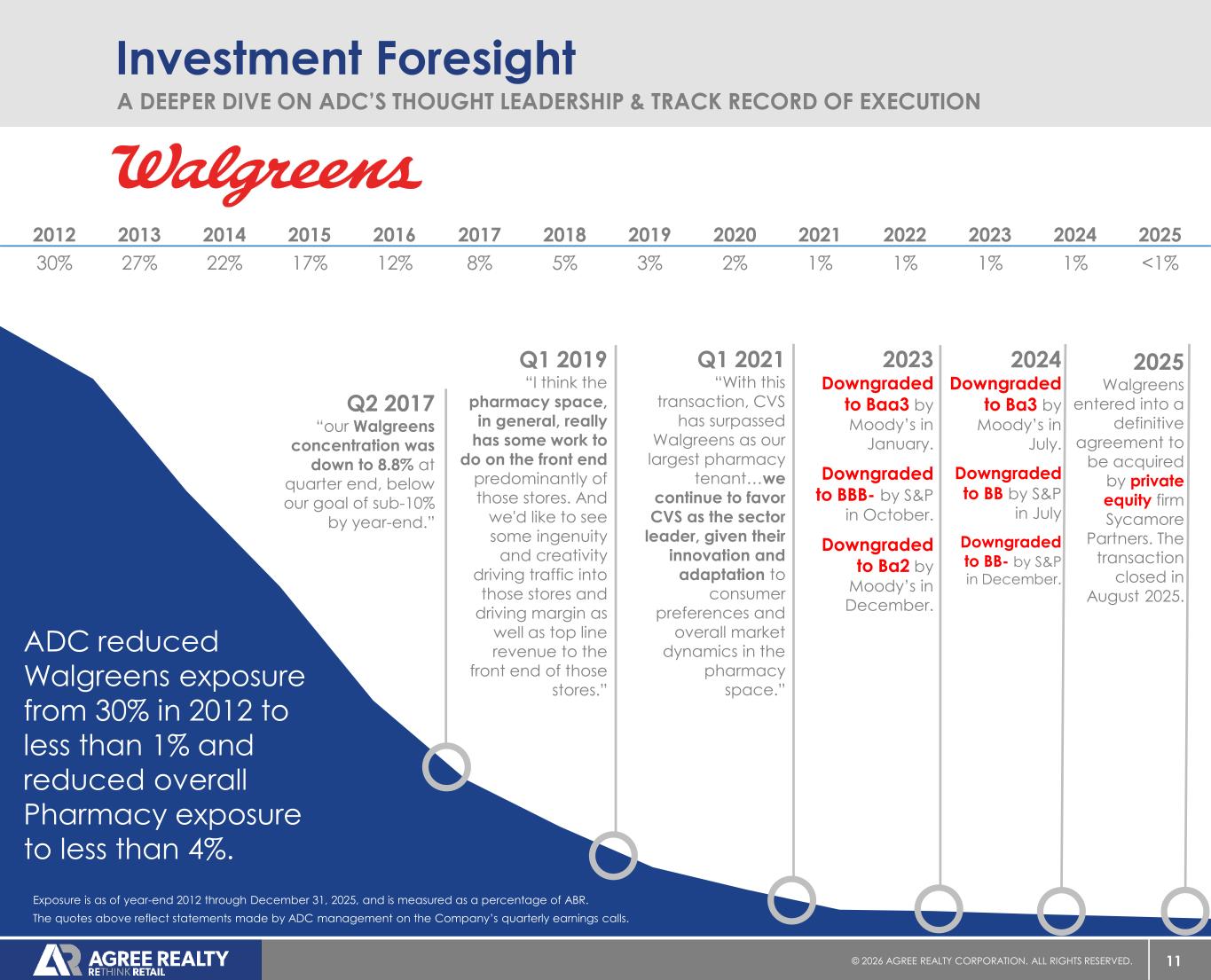
Yeah, look, we've got a tremendous relationship with CVS. I would note that pharmacy exposures at 1231 was down at 3.6% in totality. Again, that's versus in 2010 when it launched the acquisition platform of being 43% Walgreens exposure. There's a case study in the deck about that that's very de minimis for us now. Our focus with CVS is acquiring high-performing stores where, frankly, the fixed cost, the rents make sense. The days of dueling suburban pharmacies on opposing corners, we believe, is over. Ground leases, super high-performing stores, and then stores that have an extremely low rental basis and are productive. And so we're not interested in the suburban $400,000 per year pharmacy of 14,000 feet on two acres. Those are readily available on the market for anyone who wants to roll back the clock 10, 15 years. We're more interested in the pharmacies that are either on a ground lease or are paying a couple hundred thousand dollars in rent or have outperformance 24-hour operations or early extensions with our tenants there. And so it's a very selective acquisition process for us. It's a very informed acquisition process for us. We'll make select additions to the portfolio, but it's not a focus for us. You will not see any material growth in our pharmacy exposure or CVS exposure at this time.
Great. And then just on the quick service restaurant side, notice that the exposure increased to 2.3% of AVR. You just discussed the types of tenants you're targeting today, whether more QSR assets are coming to market, and how does the rent coverage within this segment compare to the overall portfolio? Thank you.
Yeah, to be frank, we're not targeting the sector. As I mentioned earlier, these are generally ground leases, and that's what you saw in Q4. So the Flanders Outlots, the Panda Express, the Wendy's. We acquired an Olive Garden ground lease with a Darden guarantee during the quarter. Restaurants, a McDonald's ground lease. So I would tell you, restaurants for us, we will continue to stay away from outside of the ground lease structure are a very unique opportunity. Not a focus for us, especially in today's economy. And then more important, when we look at the fungibility of the box and the rents per square foot, we just don't see the residual values there to mark the market. And so restaurants will be on the perimeter. If you see a Sequoia restaurant or any such single-purpose type structure or fit out, it will generally be on a ground lease.
All right. Thank you very much. I appreciate the time.
Operator
Our next question comes from the line of Omotayo Okusanya with Deutsche Bank. Please go ahead.
Yeah. This is Sam on for TIO. I was wondering if the exposure to lower income consumers present, you know, some sort of downside risk, particularly around categories such as dollar stores, off-price retail, or discount stores? And like, what are you guys doing to mitigate this risk?
I think it's the deficit. On last call, I said we are the trade down effect. What we're seeing in 2026 is just the steepening of the K. The theme in 2024, and I don't want to get, you know, this is about affordability, and I'll put it in quotes. The theme of 2024 and 2025 was the low-income consumer and the challenges they were having. The theme of 2026, and hopefully it gets resolved, but I don't see any resolution in the near term, is the middle-income consumer. We have dual working parent households in this country. Costs are increasing, whether it's automobiles, health insurance, residential costs, right? Costs of living across the board. Inflation, the cumulative inflation that we've seen since the pandemic has been devastating for these families. And so if you look at the prints of the targets of the world, and you juxtapose that against the prints of the Walmarts of the world and the dollar stores of the world, So the trade-down effect is palpable. You can see those consumers looking for bargains, four discounts. You see it, frankly, in the size, the basket size, the ticket size, and the frequency of the trips. You see five below retailers, like five below, really thriving in this environment. Dollar General performing extremely well. And Walmart, frankly, kicking ass, crossing a trillion-dollar equity cap. And so you'll continue to see us focus on those retailers that cater to that consumer. We avoid luxury. We avoid experiential. We avoid fun. It's goods and services that are necessity-based. And if they're not the lowest-priced operator, they have a unique value proposition. And so that's our focus. It has been our focus. I think it inners to our benefit what we're seeing out there, given the portfolio composition that you see, obviously, in our materials.
That's all I got. I appreciate the time. Thank you.
Operator
Our next question comes from the line of Linda Tsai with Jefferies. Please go ahead.
Hi. Earnings growth was over 4.5% in 25, and you're guiding the midpoint to 5.4% in 26. Do you view this 4.5% to 5.5% earnings growth cadence as a sustainable state?
Good morning, Linda. We've been very clear for months that our earnings algorithm would kick in this year. We drove 4.5% ASFO growth per share last year after only deploying $950 million approximately in 2024, and while investing and dealing with the big lots bankruptcy imagination. And so we were very clear that our earnings algorithm would kick in this year. We have no upcoming material debt maturity, and so we're all systems go, let's be clear, across all three external growth platforms, as well as from a balance sheet perspective. And so our goal has consistently been to deliver 10% operational returns. We will deliver 10% two-year stack to AFFO growth, whether it's last year, this year, this year, next year. We've been very clear about that while maintaining a defensive posture from a portfolio position, maintaining our strict underwriting criteria and a forecast balance sheet.
Thanks. And then in terms of new-to-market customers, not sure if you track it this way, but what percentage of ABR came from new-to-market in 25, and would you expect to increase your exposure to these customers in 26?
New-to-market meaning new to our portfolio?
Peter, I can't think of one new tenant to the portfolio that we added. No. If we did, it would have been in a pretty de minimis way. Yeah, extremely de minimis. We took on a bank ground lease for, I think, $80,000 or $100,000 as an outlot to one of the lows that we acquired. So it would be an ancillary small piece, but really no new tenants or new entrants of any substance at all. in the portfolio in 2025.
Just one last one, if I could. So Walmart's 5.6% of your ABR, obviously a gold standard in terms of tenant credit, but any ceiling to which you'd be comfortable with, you know, any specific, you know, tenant exposure?
Look, Walmart is the only tenant, as you mentioned, over 5% of the portfolio. We thought that that was a gray line for a while. It was breached by different operators within the space. We also look at 10% as a great threshold for sector, line of trade, groceries, just over 10%. We feel very comfortable there. I'm happy to add more Walmart exposure on a percentage basis as we go forward. We're always working on Walmart transactions, frankly, across our platforms. There are Walmarts in our pipeline right now. So with the percentage basis, we feel very good with where Walmart is. I mean, they are also our top three or top four ground lease tenant in the portfolio, number three, actually, in terms of ground lease ABR. And so we're very confident in our Walmart exposure. The company continues to perform tremendously. And so we're comfortable. I think at the peak during COVID, it went off almost up to 9%, Peter, correct me if I'm wrong, went up to 9%. I wouldn't anticipate that occurring. but we'll certainly pursue Walmart transactions aggressively.
Operator
Thank you and good luck.
Operator
Our next question comes from the line of Ridge High Tower with Barclays. Please go ahead.
Hi, good morning, guys. I want to go back to, I think it was Jamie Feldman's question, just on sizing sort of the forward equity component of the total sources. And so, you know, is the gating factor there at any given time related to the deal pipeline? Is it market impact on the share issuance? Is it, you know, something else? Just what would prevent you from taking, you know, 700-something million in ATMs, I'm sorry, in the forward, you know, unsettled shares today to a billion, a billion and a half or something like that?
Well, I think it's a confluence of factors. Most importantly is ultimately uses, right? do we have the uses of that capital? Obviously, we have the liquidity and the balance sheet tolerance and full flexibility to do whatever we want. The most important thing is to have that flexibility and never raise any type of capital. We want to continue to be opportunistic, but I think ultimately it's sources. So with no material debt maturity or uses, excuse me, ultimately with no material debt maturities in all of the capital that we raise effectively we're going toward net new investment activity. We'll monitor the pipelines across all three verticals, but I think that's the driver, Peter.
Anything else you want to add? No, I agree with that. I think staying ahead of our uses is ultimately most important, and that will allow us to continue to be opportunistic in terms of how and when we raise capital. And today, with over $2 billion of liquidity and $1.6 billion of buying power, as I referenced earlier, we are well ahead of our uses and well-positioned for the year.
And I guess just to follow up on that, I mean, is it a safe signal for the rest of us, I guess, on this side of the phone call that, you know, every quarter or so, you know, as you're kind of issuing forward shares, is that a signal that the pipeline is indeed sort of growing above and beyond the current target? Or is that not really the right way to interpret some of those movements?
We'll look at all capital sources. I hope we get back to the day where we can issue a perpetual preferred at four and a quarter. We'll look at all capital sources, see how they fit within our capital stack. Last year was the first year in a number of years with the five-and-a-half-year delayed draw term loan. We have a full suite, obviously, access to all four quadrants of longer-term capital. short term. We have the line of credit, the commercial paper program, significant free cash flow, as well as dispositions, which we anticipate ramping a little bit this year. So there's really no direct causation. Are they correlative? Sure, I would say it's correlative. As we see our investment pipeline grow further, it's wholly possible that we'll add incremental equity to fund that subject to other capital sources and obviously the respective cost of those capital sources. But look, we have been at the forefront of capital raising in the net lease space and I would argue reap them today, utilizing forward equity, first in 2018 on a regular way and then subsequently off of the ATM. And so we anticipate continuing, obviously, in an external growth business to be raising capital. We have swaps in place, as Peter mentioned, to tap the unsecured, long-term, unsecured bond market this year as well. And as the year progresses, we'll look at all, obviously, the sources and the uses and continue to match them to create an A- balance sheet that's on par with our expectations.
That's helpful. If I could sneak in one more, just on development and DFP, you know, just maybe help us understand where, you know, kind of across America, you know, this sort of development is taking place, you know, because I think otherwise, you know, retail, commercial real estate, you know, obviously is being underdeveloped more broadly, but you guys are finding these sort of pockets. I mean, is it infill, you know, is it redevelopment of sort of existing underperforming real estate? Is it, you know, greenfield kind of associated with new residential development in different Just what does that composition look like?
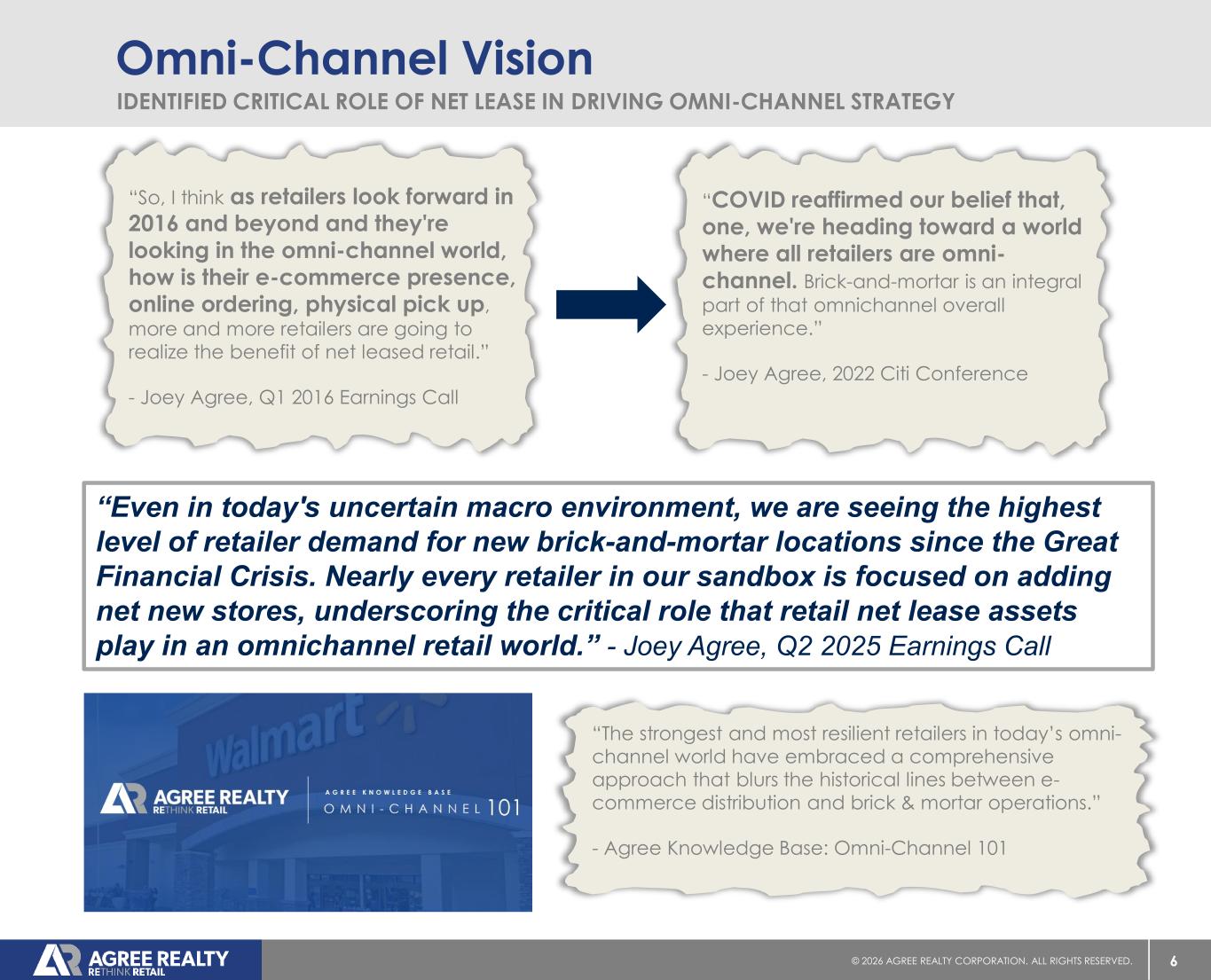
Interesting question. Look, the constraint today on net new retail development is not desire from retailers. It is cost and the project feasibility driven by the vertical construction costs primarily. And so we are operating from the West Coast to the East Coast, all the way down South. There are tertiary markets. There are primary markets. There are redevelopments of existing structures, splitting up larger boxes into junior boxes. There's ground-up projects that have TIFs or outlots or extremely low land bases to support it. It's highly diversified. It's hard corners for C-stores. It is exit ramps for CFL C-stores, larger commercial fueling locations that provide for diesel. And so if you look at the C-store sector today and the growth of the regionals and the nationals, the off-price sector, their voracious appetite to grow, whether it's TGX's buy banners, Ross's too, or Burlington's desire to get to 1,000 stores, and then the big box space, Lowe's, Home Depot, as I mentioned, Walmart, Costco, Kroger are even announcing net new stores. We see the tremendous appetite to growth, again, get the permutation correct in an omni-channel world. I would tell you all retailers have recognized that free shipping and then a 40% return rate does not work. And so they're trying to get stores in place to get our butts to the store to pick things up. And if it is delivered, to deliver from the store to fulfill that last mile or two in the most efficient way possible, whether that's tertiary or primary. And so there's tremendous appetite for growth. Again, most of these retailers are public. They're out there with their stated store goals. We're in a really unique position to fulfill that appetite with our three vertical external growth platform. Thank you.
Operator
Our next question will come from the line of Ronald Camden with Morgan Stanley. Please go ahead.
Hey, this is Jenny on for Ron. Thanks for taking my question. The first is we noticed the weighted average lease term on 4Q. Acquisition was 9.6 years versus like 10.7 years in Q3. I'm just curious more broadly, how do you think about lease terms when you underwrite acquisitions? Like, what's the right balance between lease duration and returns? Thank you.
All project-specific or opportunity-specific. We'll buy short-term leases when we like the real estate, the mark-to-market, or have strong performance feedback. Obviously, the sale leasebacks will have longer-term. Some of my favorite opportunities are pre-inflationary or construction costs, inflation opportunities in the junior box space. They're paying $10, $11 per square foot on a short-term deal when mark-to-market is $17, $18, $19 just due to those construction costs I've been talking about on this call. And so you'll see a variety of lease terms. This is a real estate operation here. Lease term is one input, store performance, underlying real estate fundamentals, access, visibility, fungibility of the box, signage, traffic counts and demographics are all playing a part in that role as well. So, I wouldn't think of Q4 as a static state at all. I think if we dive into the individual transactions, you'll see really what the driver was and really push it over through the approval threshold.
Appreciate the comment. The second question is, how should we think about the releasing spread for investment-grade tenants? I see you only have 1.5% of ABR being renewed next year, but how should we think about releasing spreads?
No difference. I think 104% of recapture rates have been pretty static.
Yeah, over the last few years, we've been at 103 or 104% in each year.
It doesn't seem to be moving, and the vast majority of our upcoming expirations, which will be handled with favorable outcomes here, I think that blended will fall into the same we don't anticipate many of these tenants leaving here gotcha thanks so much that's all for me thank you our final question will come from the line of John Kilikowski with Wells Fargo please go ahead great thanks it's Jamie again just with a quick follow-up the the disposition guidance 25 to 75 million I think you had mentioned you know 1031s and even OBBA being a driver of demand And how are you thinking about that range? And then, you know, can you talk more about what's changed and, you know, if you might be ramping up that pipeline due to pricing?
Well, I think I hadn't heard the acronym. I think the OBVA is a driver there for us. And so we have what I would call not economically rational real estate purchasers that are benefiting from accelerated depreciation that they're taking. aren't looking at the real estate fundamentals. And if someone wants to buy a Goodyear with a five-handle in front of it, we're sellers, I'll be honest. We're big fans of Goodyear. We're their largest landlord. We obviously did the sale leaseback with them and took their real estate that they owned on balance sheet and did a sale leaseback at extremely low rents. But they have control of that property through options. We don't see redevelopment potential. There are contractual rental increases. And so if someone wants to pay something that we don't think makes sense relative to where we can redeploy that capital, we'll do that. So a lot of it is the one big, beautiful bill, purchasers. Then you have some interesting alcoholic purchasers that seem to traverse Florida. That doesn't seem – the pricing often doesn't seem to make sense, and we take advantage there, California as well, and Texas as well, in some of these states. Now, you're not going to see, and then I'll tell you, we'll look at opportunistic sales on larger price point assets as well. And so if we think we can redeploy the capital at a material spread while increasing the credit profile and the real estate fundamentals of the tenant, we're going to jump on that opportunity, and overall it's an accretive transaction for us. So many of these are inbound, not even listed. When you have a portfolio of 2,700 properties, there's always inbound activity. you know we'll listen we'll look at those and vet those opportunities and the qualifications of the purchaser and if appropriate we're going to strike to drive ultimately accretion okay but it still sounds like it's more the smaller buyers rather than institutions when you think about the sales yeah yeah generally it's the the smaller 1031 net lease dominated 1031 purchaser or tax motivated purchaser, as you mentioned. You know, occasionally there is some institutional inbounds for a variety of reasons. Maybe they own the adjacent property. Maybe there's an overall redevelopment that they're trying to execute upon. But the vast majority of transactions, just like the entire space, is individual purchases.
Okay. And then I know it's a small dollar amount, but what are you targeting for cap rates and dispositions?
I would say on a blended basis in the sixes, right? Again, we'll continue to pare down. I anticipate advanced auto exposure to, frankly, a material level, but not very material today. There are some Goodyear transactions in the pipeline which are nonrefundable, which will close in the first quarter or have closed already. I don't see anything different in the second quarter or beyond this plan.
Operator
Great. thank you thank you this concludes the question-and-answer session I'll hand the call back over to Joey Agree for closing remarks well thank you all for joining us this morning good luck to the rest of earnings season and we look forward to seeing you at the upcoming conferences appreciate your time this concludes today's call thank you for joining you may now disconnect