Operator
Good day, and welcome to the AFLAC Incorporated Second Quarter 2025 Earnings Call. All participants will be in listen-only mode. Should you need assistance, please signal a conference specialist by pressing the star key followed by zero. After today's remarks, there will be an opportunity to ask questions. To ask a question, you may press star then 1 on your touchtone phone. To withdraw your question, please press star then 2. Please note this event is being recorded. I would now like to turn the conference over to David Young. Please go ahead.
Good morning and welcome. Thank you for joining us for Aflac Incorporated's second quarter 2025 earnings call. This morning, Dan Amos, Chairman, CEO of Aflac Incorporated, will provide an overview of our results and operations in Japan and the United States. Then, Max Broden, Senior Executive Vice President and CFO of AFLAC Incorporated, will provide more detail on our financial results for the quarter, current capital, and liquidity. These topics are also addressed in the materials we posted with our earnings release, financial supplement and quarterly CFO update on our investors.aflac.com. For Q&A today, we are joined by Virgil Miller, President of AFLAC Incorporated and AFLAC U.S. Charles Lake, Chairman and Representative Director, President of AFLAC International. Masatoshi Kuide, President and Representative Director, AFLAC Life Insurance Japan. And Brad Dislin, Global Chief Investment Officer, President of AFLAC Global Investments. Before we begin, some statements in this teleconference are forward-looking within the meaning of federal securities laws. Although we believe these statements are reasonable, we can give no assurance that they will prove to be accurate because they are perspective in nature. Actual results could differ materially from those we discussed today. We encourage you to look at our annual report on Form 10-K for some of the various risk factors that could materially impact our results. As I mentioned earlier, the earnings release with reconciliations of certain non-U.S. gap measures and related earnings materials are available on investors.aflac.com. I'll now hand the call over to Dan.
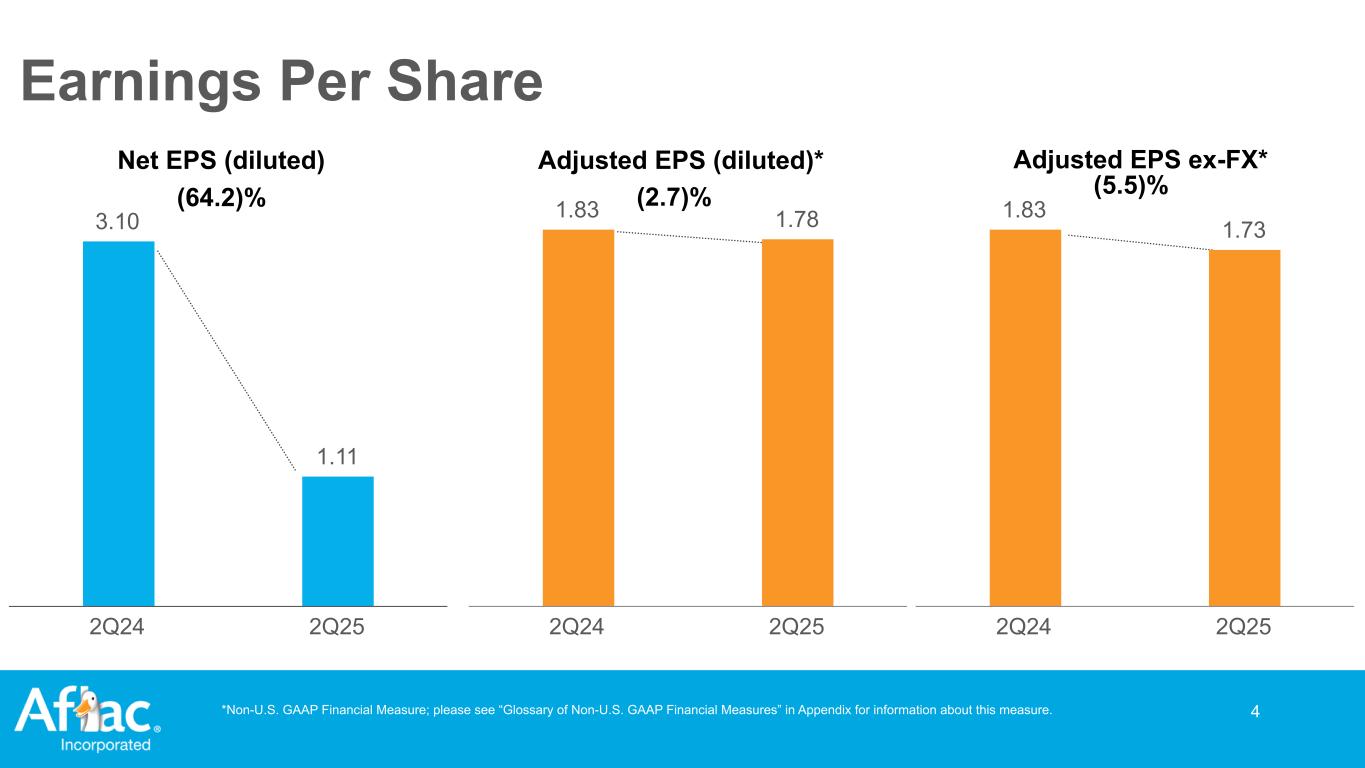
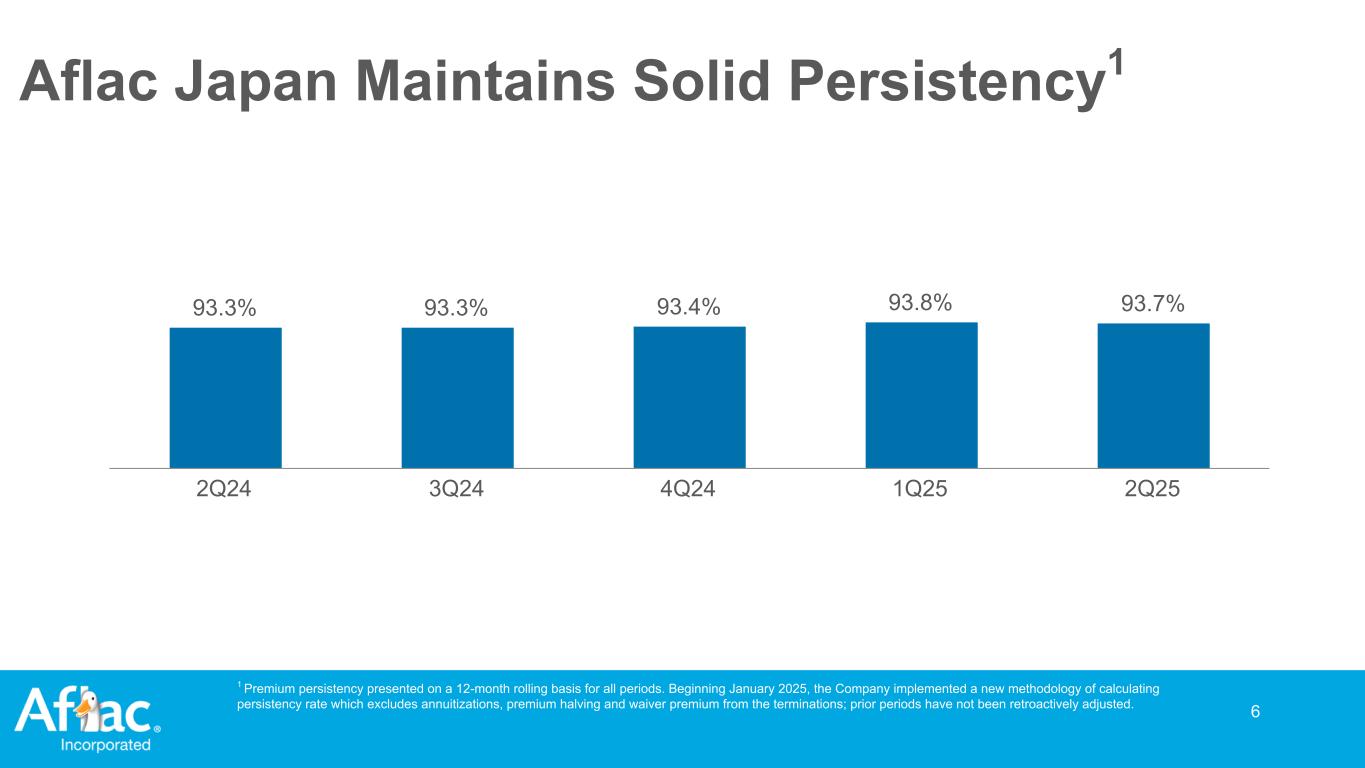
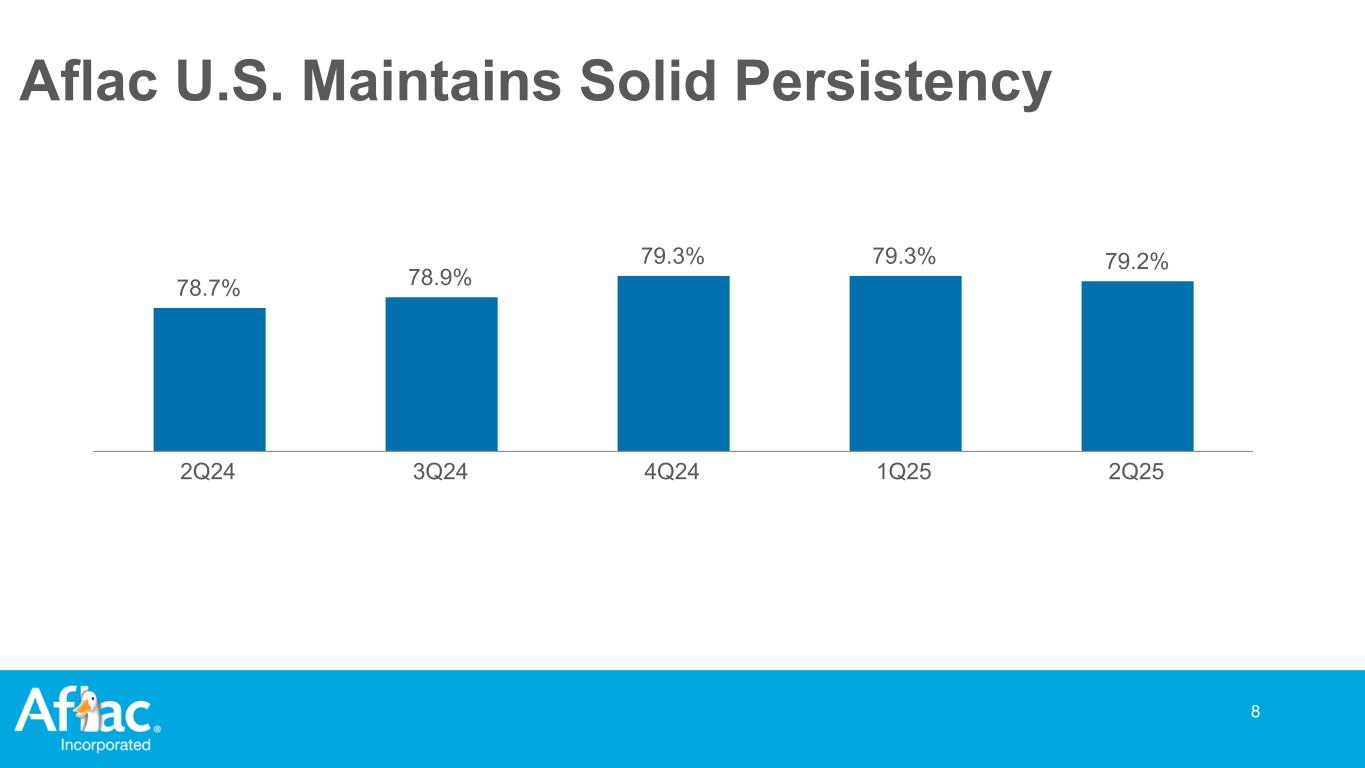
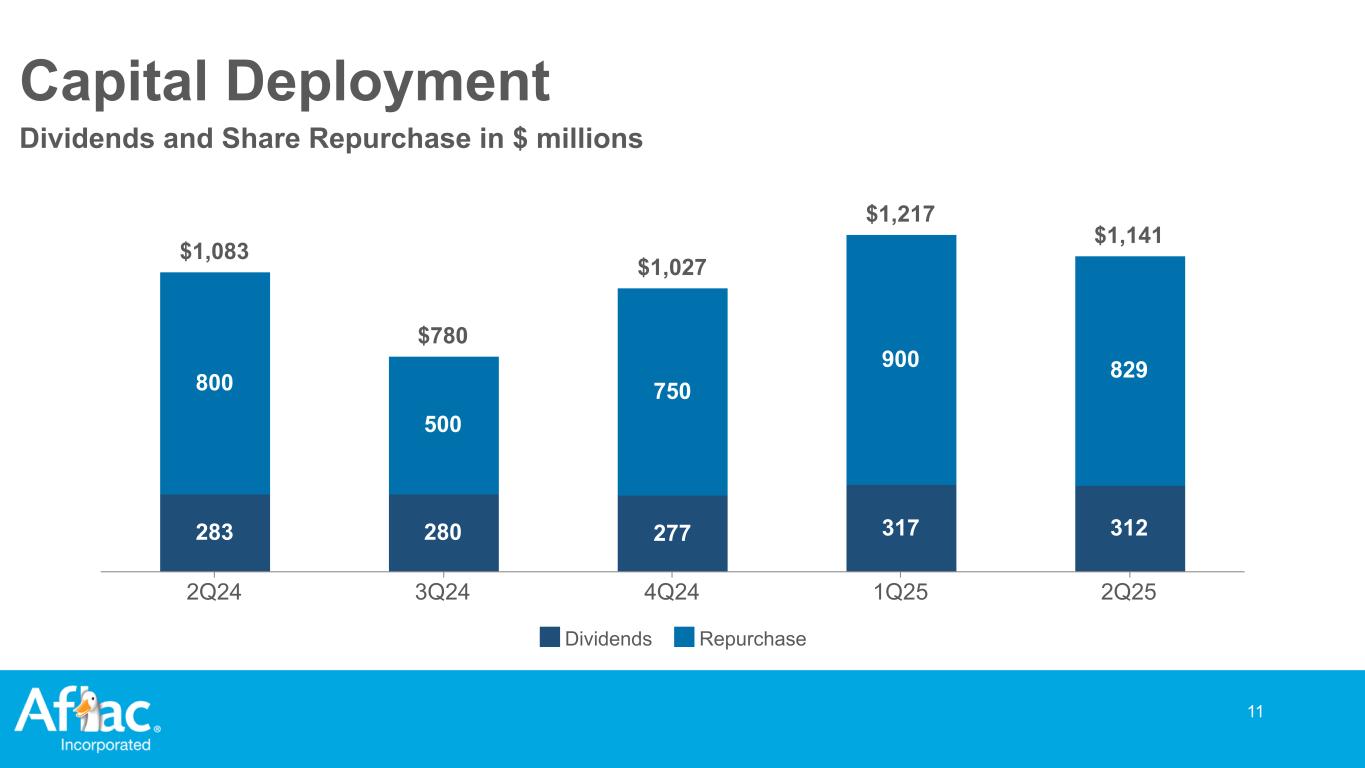
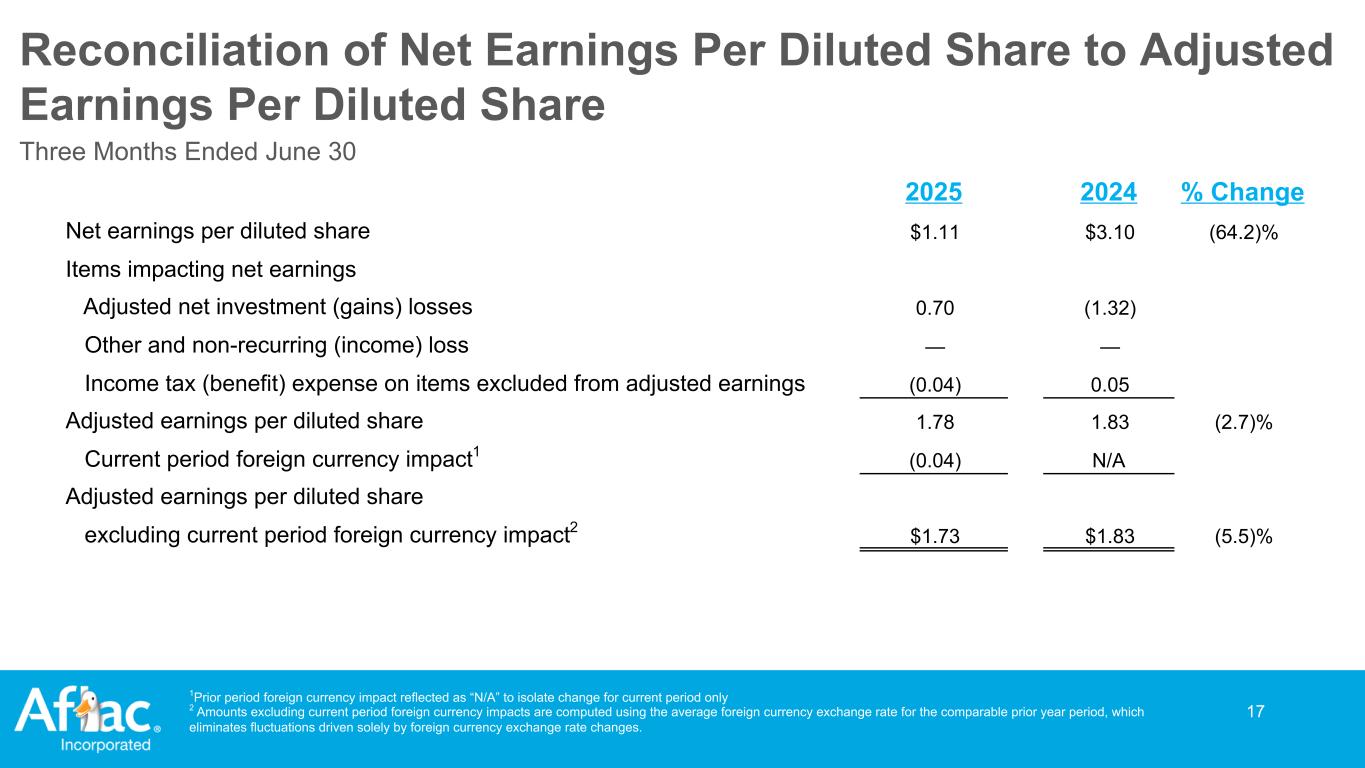
Dan? Thank you, David, and good morning, everyone. We're glad you joined us. Aflac Incorporated reported net earnings per diluted share of $1.11 and adjusted earnings per diluted share of $1.78 for the second quarter of 2025. We believe that these are solid results for the quarter, leading to a very good first half of the year. Max will expand upon these results in a moment, but before he does, I'd like to comment on our operations. Beginning with Aflac Japan, I am very pleased with Aflac Japan's 23.2% year-over-year sales increase, especially the 53% increase in the cancer insurance sales. These strong sales were driven largely, as expected, by sales of our newest cancer insurance product, MiRaito. They include the final stage of the launch of Japan Post Insurance and Japan Post in April. We also saw positive overall sales growth across all distribution channels. This positive results also reflects our new marketing and sales structure in Japan that integrates members of the actuarial, IT, and policy service into agile teams focused on bringing a specific product line to the market, like cancer, medical, asset formation, and nursing care. We also continue to introduce the need for the third sector protection to new and younger customers with our innovative first sector product, Sumitaz. which has third sector optional benefits. Overall, I believe we have the right strategy to meet our customers' financial protection needs throughout their different life stages. Our ability to maintain strong premium persistency is a testament to our strategy, Aflac's reputation, and our customer recognition of the value of our products. By maintaining this level of persistency and adding new premium through sales, we are partially offsetting the impact of reinsurance and policies reaching paid-up status. Maintaining strong persistency will be vital to the future of Applike Japan. Being where customers want to buy insurance has always been an important element of our growth strategy in japan our broad network of distribution channels including agencies alliance partners banks continually optimize opportunities to help provide financial protection to japanese consumers we will continue to work hard to support each channel as we evolve to meet the customer's changing needs. Turning to Aflac US, we generated $340 million in new sales during the second quarter, which was a 2.7 year-over-year increase. More importantly, we maintained strong premium persistency of 79.2% and increased net earned premium of 3.4%. We continue to see momentum within all areas of our group business, especially our group life and disability, as well as our network dental. In addition, we believe our efforts to drive more profitable growth with a stronger underwriting discipline have contributed to our strong premium persistency and net earned premium growth. At the same time, AFLAC U.S. has continued its prudent approach to expense management and maintaining a strong pre-tax margin, as Max will expand upon in a moment. In both Japan and the United States, I believe the consumers need the products and solutions AFLAC offers more than ever. For our policyholders who've become claimants, Aflac is more than an insurance company. We are a partner in health, a supporter of families during their times of need, and a pioneer and leader in the industry. We are leveraging every opportunity to convey our products can help fill the gap during challenging times, providing not just financial assistance, but also compassion and care. At the same time, we continue to generate strong capital and cash flows while maintaining our commitment to prudent liquidity and capital management. We have been very pleased with our investments, which have continued to produce solid net investment income. As an insurance company, our primary responsibility is to fulfill the promises we make to the policyholders while being responsive to the needs of our shareholders. Our solid portfolio supports our promise to the policyholders as does our commitment to maintaining strong capital ratios. We balance this financial strength and tactical capital deployment. I am happy with how management has handled capital deployment and liquidity. In the second quarter, Aflac Incorporated deployed $829 million in capital to repurchase 7.9 million shares of our stock and paid dividends of $312 million. Combined with dividends, that means that we delivered $1.1 billion back to the shareholders in the second quarter of 2025. Additionally, we treasure our track record of 42 consecutive years of dividend growth. At the same time, we have maintained our position among companies with the highest return on capital and the lowest cost of capital in the industry 2025 marks three important milestones for aflac in june we just celebrated the 30th anniversary of what is now known as the aflac cancer and blood disorders center of children's health care of atlanta we look forward to celebrating the 70th anniversary of the company's founding in november and we also are celebrating the 25th anniversary of the aflac duck this year Even though these milestones are noteworthy, it's not the number of years that matters most. It's the privilege of benefiting the lives of millions of people. We are reminded that one thing has not changed since the founding in 1955. Families and individuals still seek to protect themselves from financial hardship that not even the best health care insurance can cover. Today's complex healthcare environment has produced incredible medical advancements that have come with incredible costs. It's more important than ever for people to have a partner in their time of need. We believe our approach to offering relevant products makes us that partner. We also believe in the underlying strengths of our business and our potential for continued growth in Japan and the United States, two of the largest life insurance markets in the world. On an ongoing basis, we are taking actions to reinforce our leading position and building on our momentum. I'll now turn the program over to Max to cover more details of the financial results. Max?
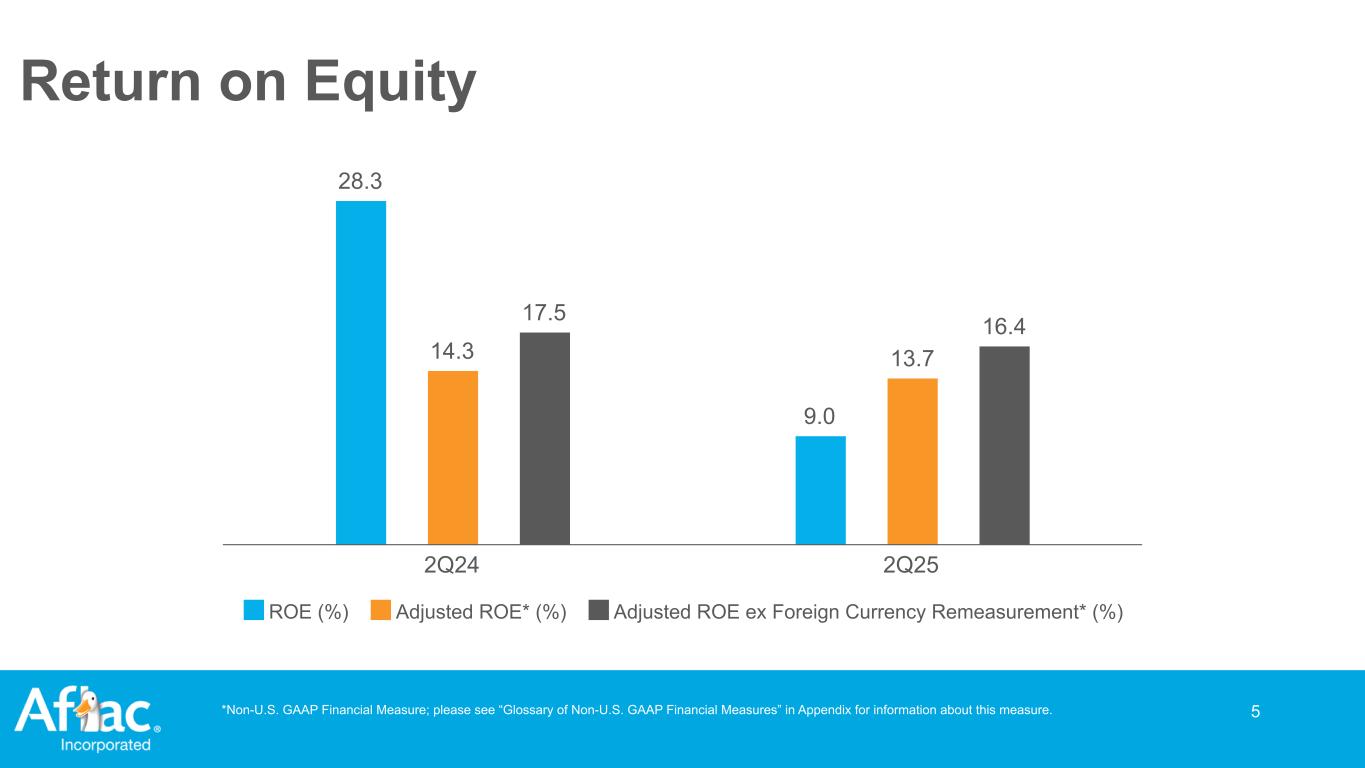
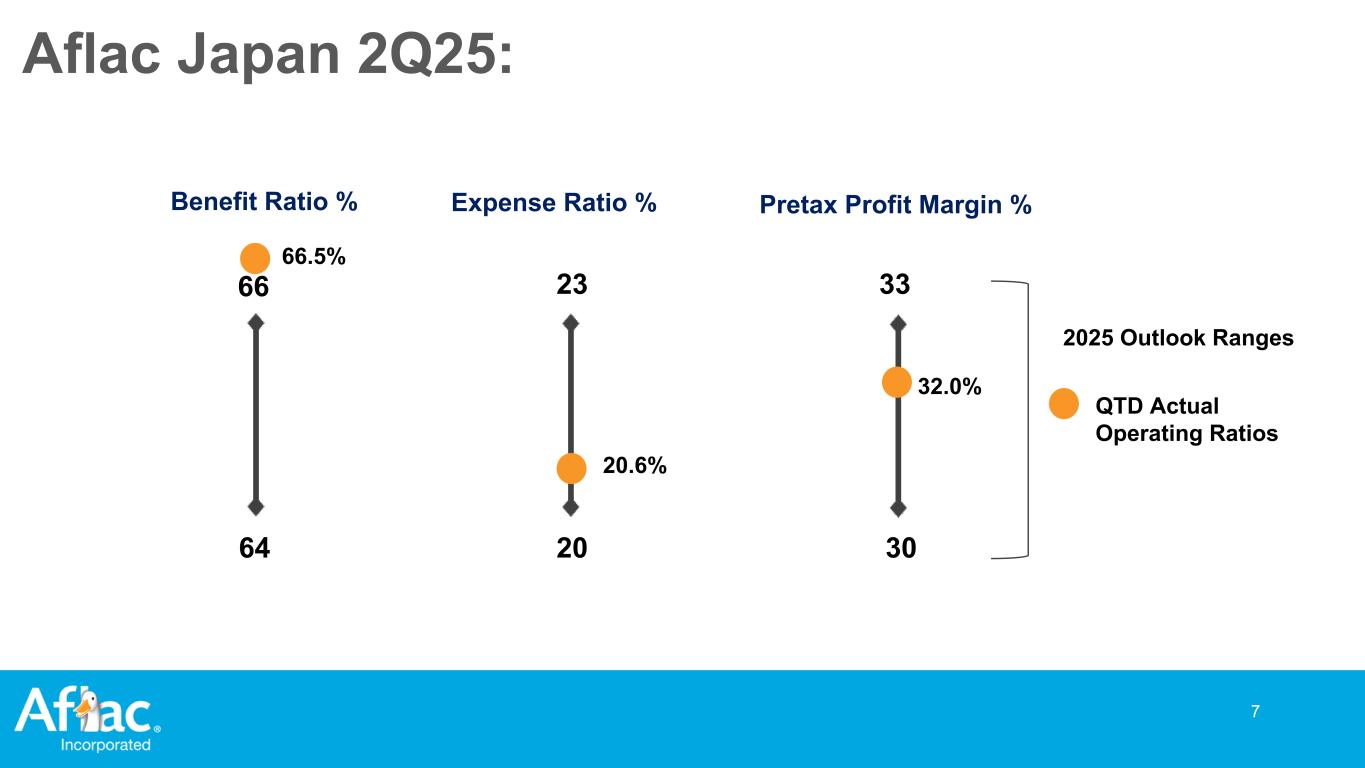
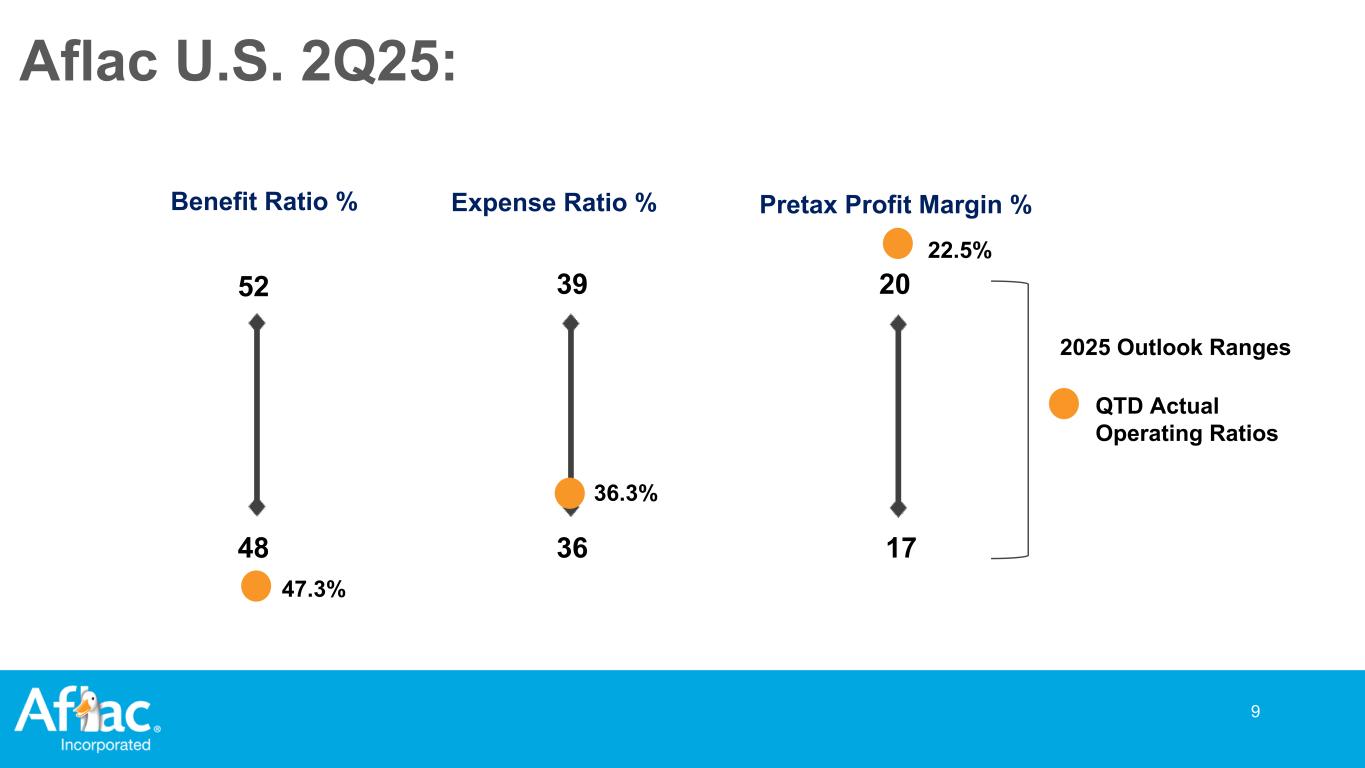
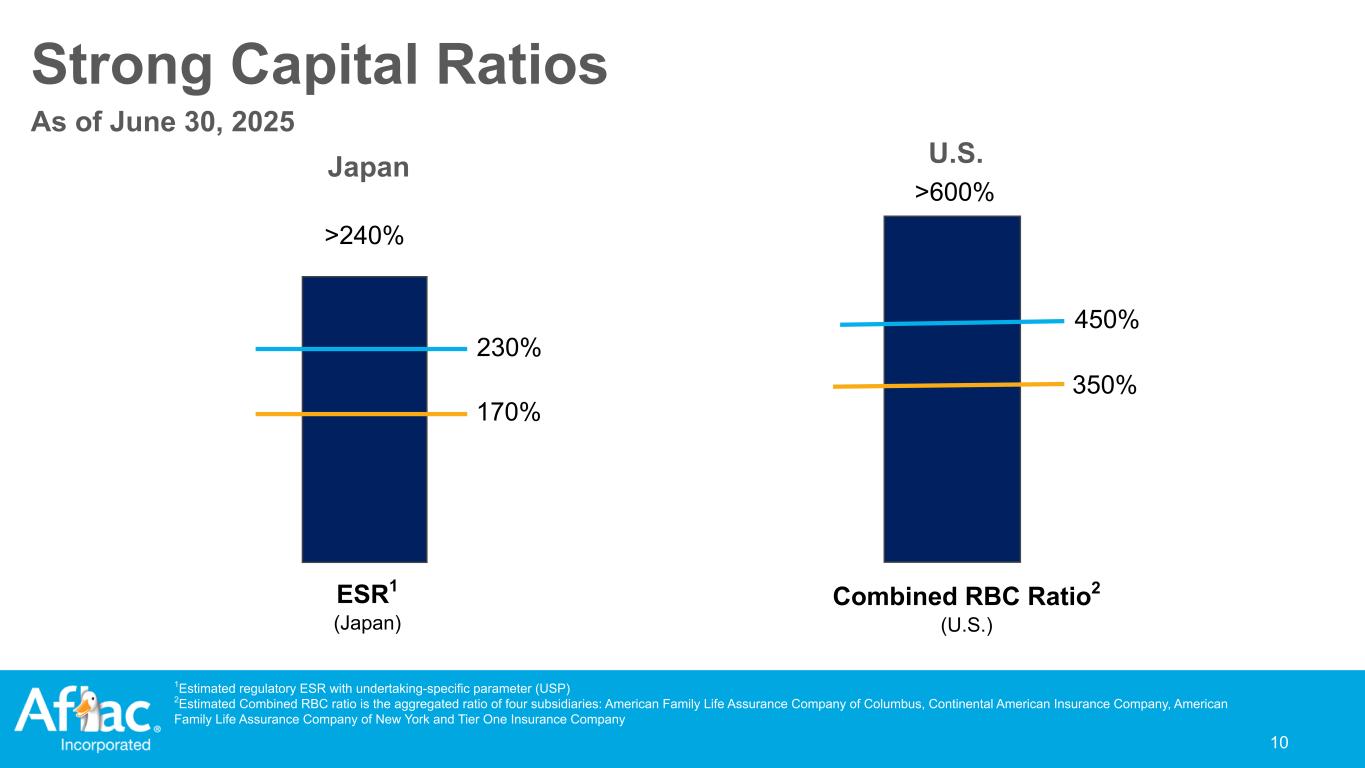
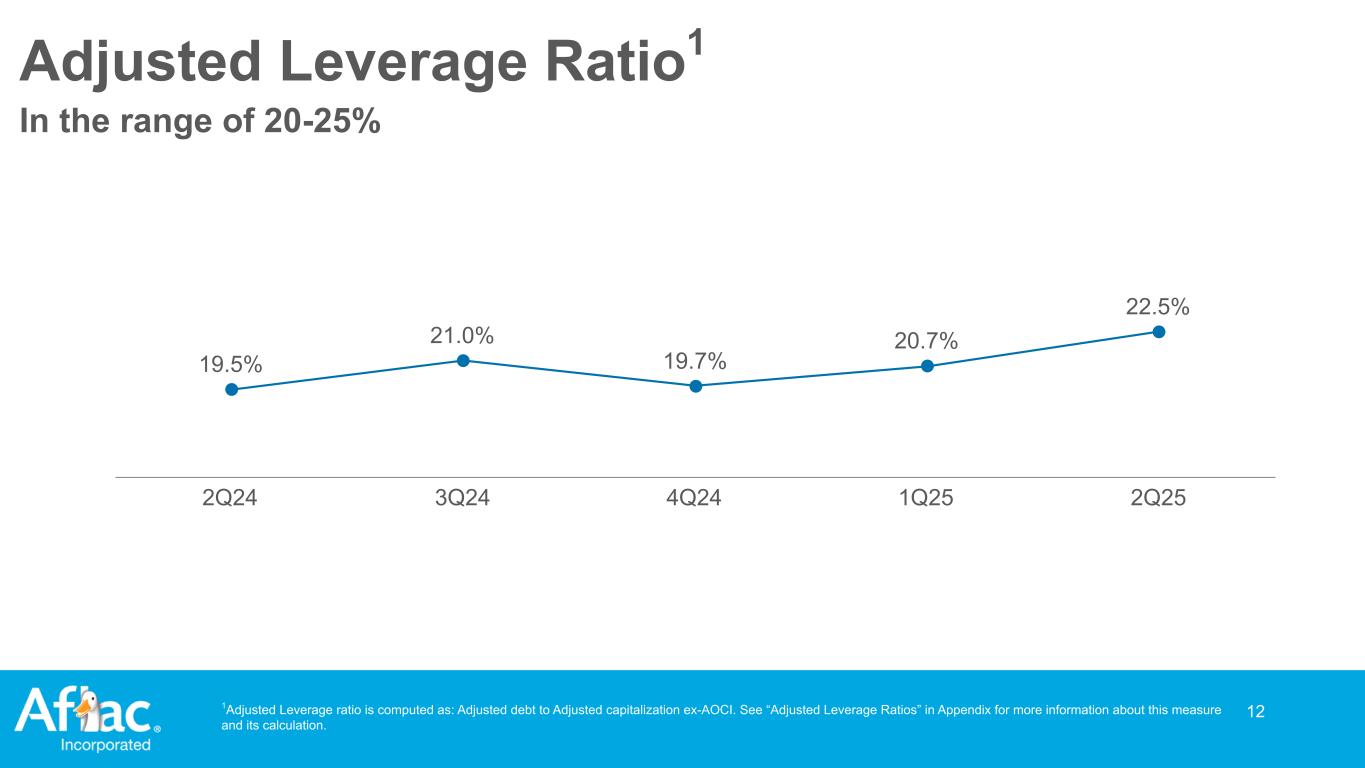
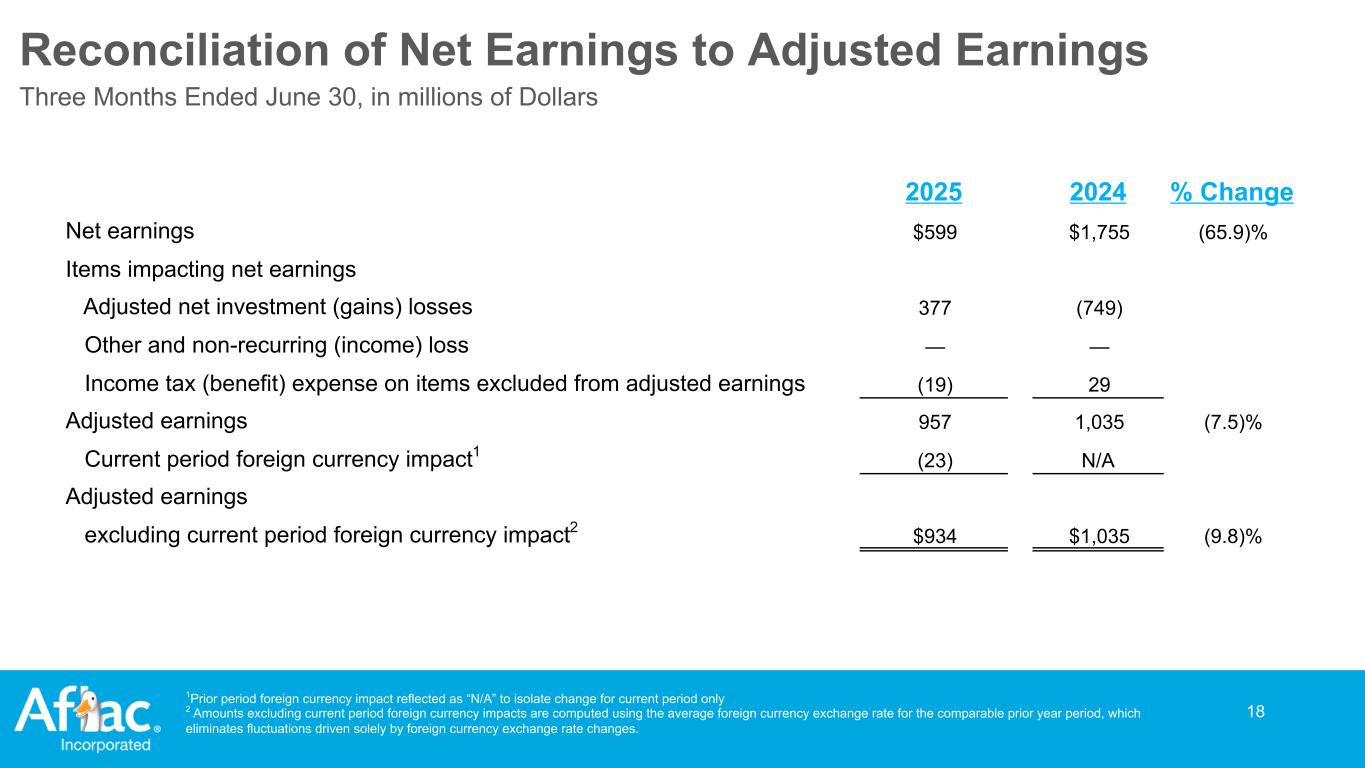
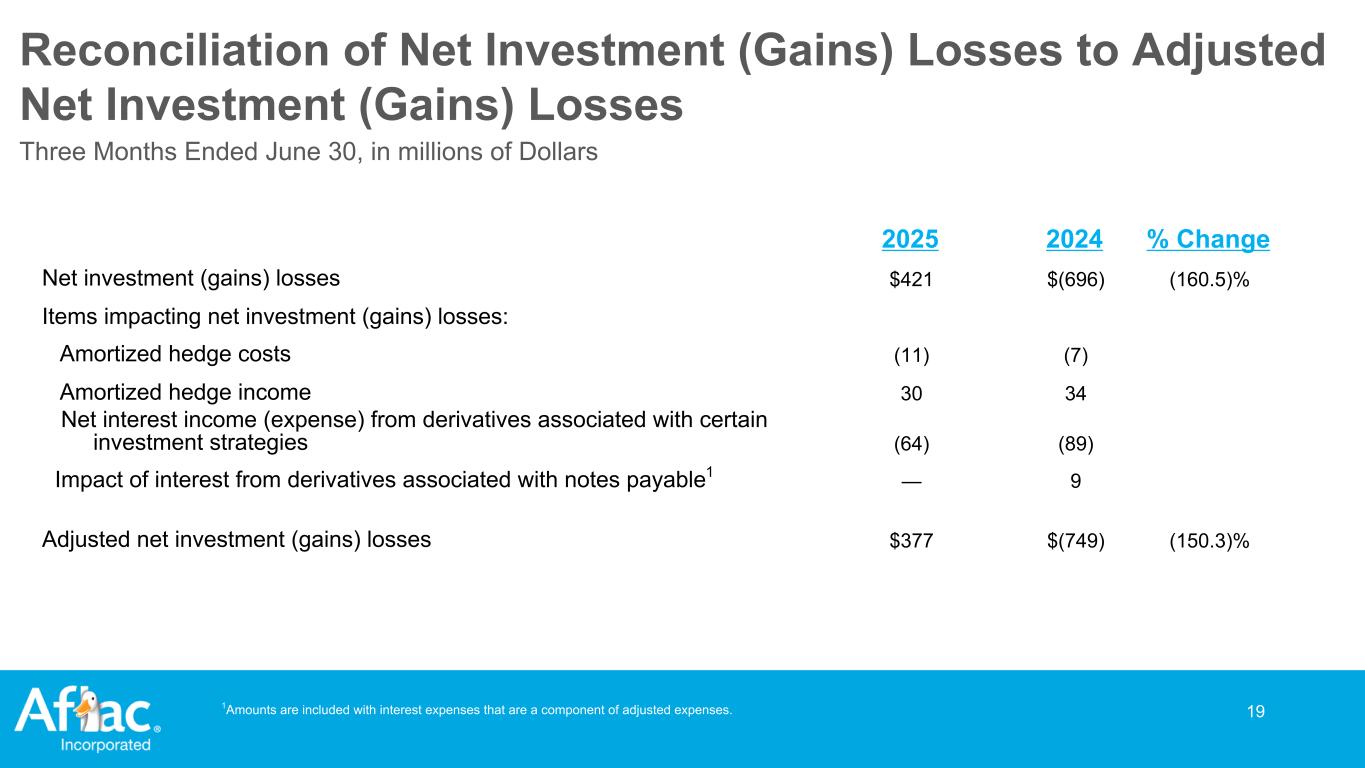
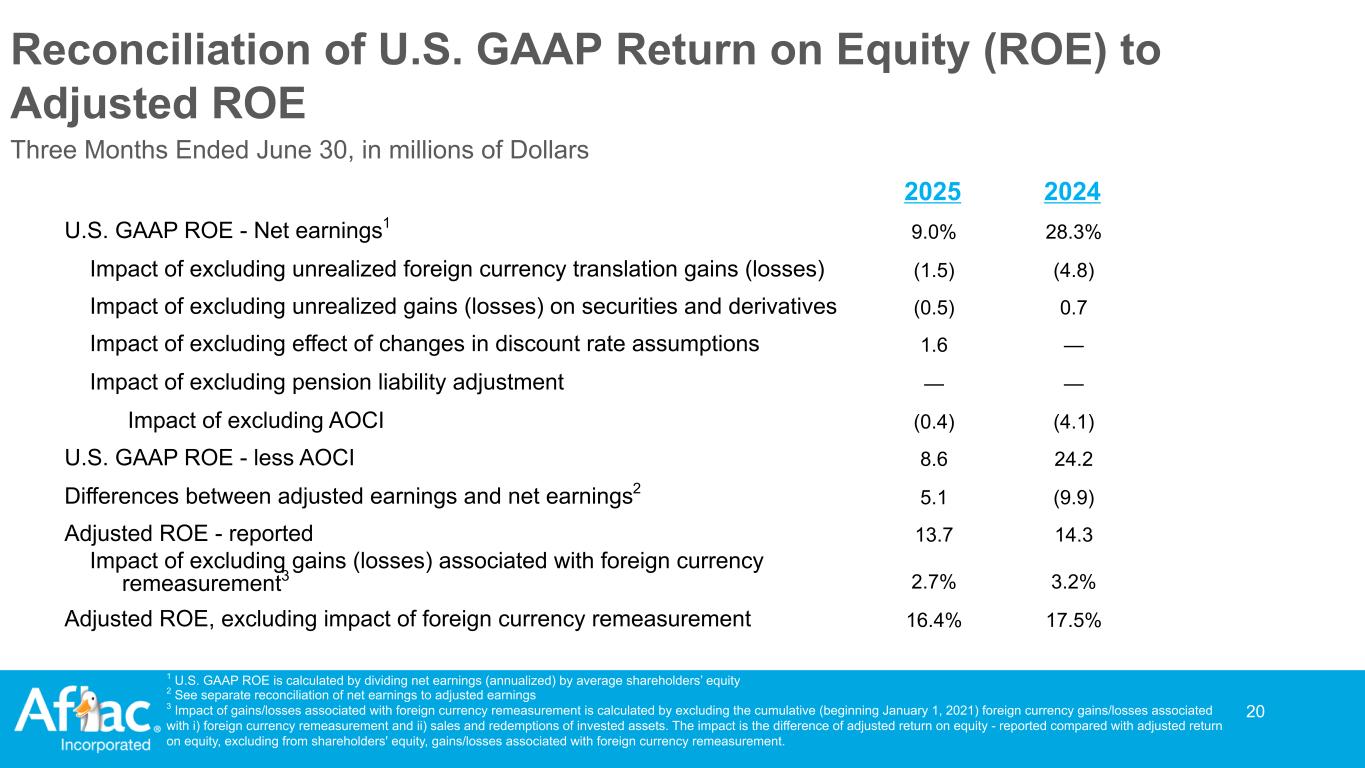
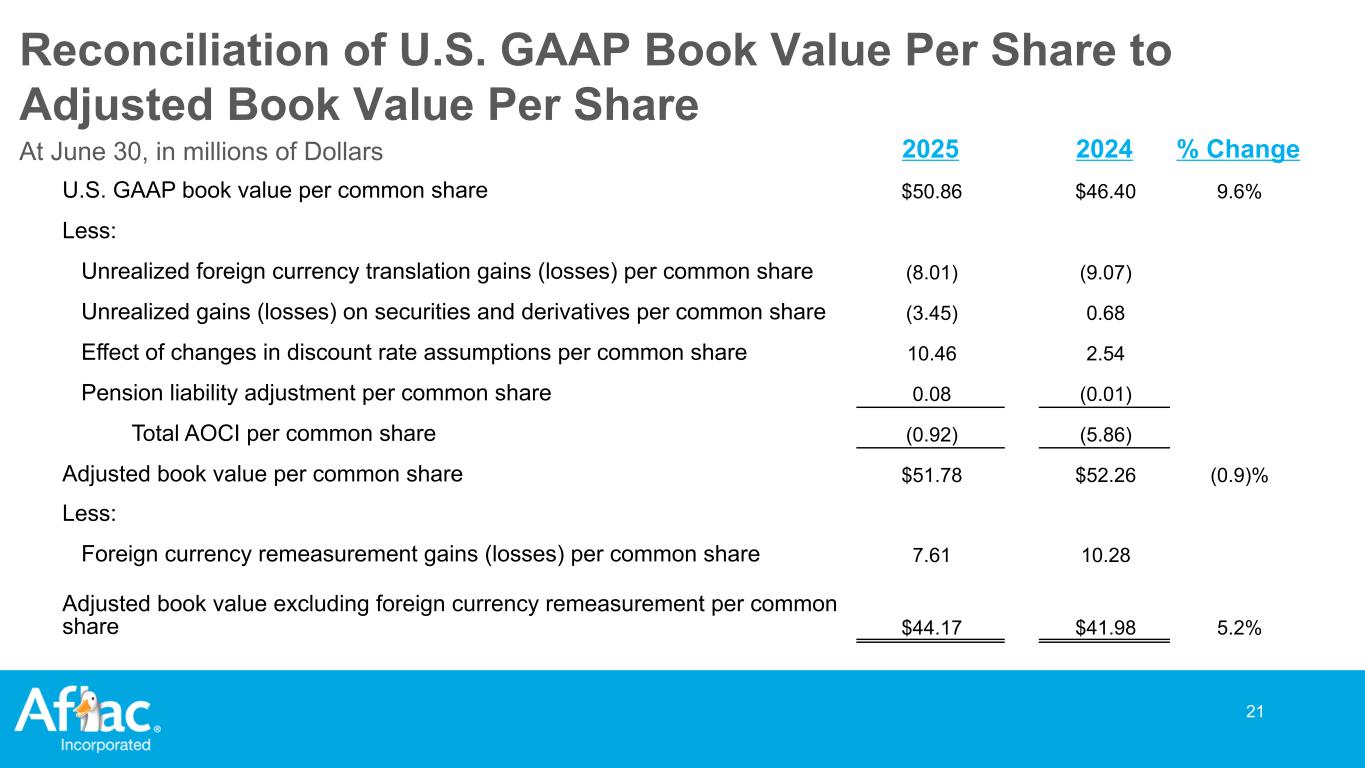
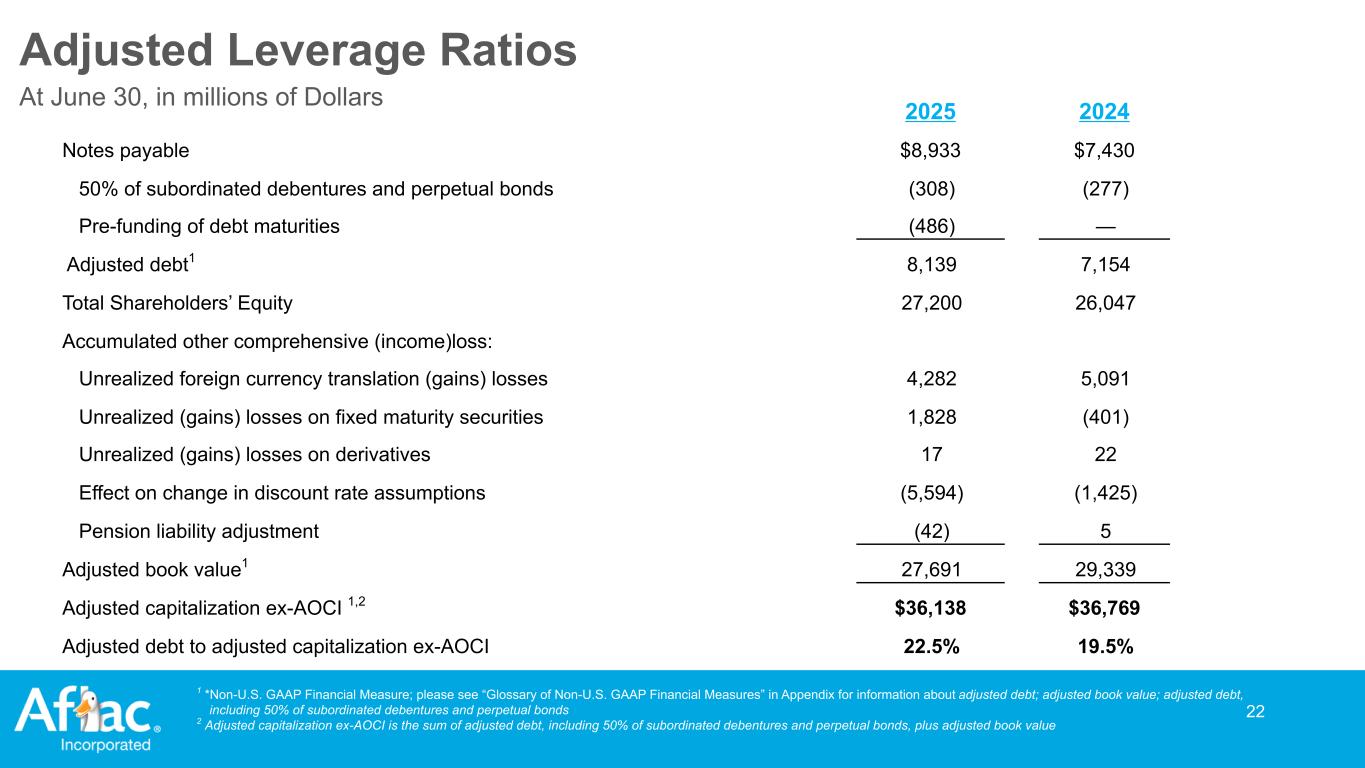
Thank you, Dan. I will now provide a financial update on Affleck Incorporated's results. For the second quarter of 2025, adjusted earnings per diluted share decreased 2.7% year-over-year to $1.78, with a $0.04 positive impact from FX in the quarter. In this quarter, remeasurement gains on reserves totaled $37 million, reducing benefits. Variable investment income ran $35 million below our long-term return expectations, while one make-hole call generated income of $35 million. Adjusted book value per share, excluding foreign currency re-measurement, increased 5.2%. The adjusted ROE was 13.7% and 16.4% excluding foreign currency re-measurement, an acceptable spread to our cost of capital. Overall, we view these results in the quarter as solid. Starting with our Japan segment, net-end premiums for the quarter declined 4.8%. AFLAC Japan's underlying earned premiums, which excludes the impact of deferred profit liability, paid-up policies and reinsurance, declined 1.1%. We believe this metric better provides insight into our long-term premium trends. Japan's total benefit ratio came in at 66.5 percent for the quarter, down 40 basis points year-over-year. The third sector benefit ratio was 57.4 percent for the quarter, also down approximately 40 basis points year-over-year. We estimate the impact from re-measurement gains to be 83 basis points favorable to the benefit ratio in Q2 2025. Long-term experience trends as they relate to treatments of cancer and hospitalization continue to be in place, leading to continued favorable underwriting experience. Persistency remained solid at 93.7%, which was up approximately 40 basis points year over year, in line with our expectations. Our expense ratio in Japan was 20.6% for the quarter, up 280 basis points year-over-year, driven primarily by an increase in technology expenses. For the quarter, adjusted net investment income in yen terms was down 10.5%, primarily driven by lower floating rate income, the impact on foreign currency on U.S. dollar investments in yen terms, and lower variable investment income. Somewhat offset by higher call income and higher returns on U.S. dollar fixed-rate portfolios. The pre-tax margin for Japan in the quarter was 32%, down 330 basis points year-over-year, but a very good result. Turning to U.S. results, net term premium was up 3.4%. Persistency increased 50 basis points year-over-year to 79.2%. our total benefit ratio came in at 47.3 percent 60 basis points higher than q2 2024 driven by business mix we estimate that remeasurement gains were in line with a year ago and favorably impacted the benefit ratio by 160 basis points in the quarter as claims have remained below our long-term expectations? In the quarter, we benefited from favorable underwriting on our small but growing long-term disability block. Our expense ratio in the U.S. was 36.3%, down 60 basis points year-over-year, primarily driven by platforms improving scale and continual focus on expense efficiency. Our growth initiatives, group life and disability, network dental vision and direct-to-consumer increased our total expense ratio by 70 basis points for the quarter. This is in line with our expectations and we would expect this impact to decrease as we continue to approach scale. Adjusted net investment income in the U.S. was down 5% for the quarter, primarily driven by lower floating rate income. Profitability in the the U.S. segment was very strong with a pre-tax margin of 22.5 percent, a 20 basis points decline compared with a strong quarter a year ago. In our corporate segment, we recorded a pre-tax gain of $20 million. Adjusted net investment income was $37 million higher than last year due to a combination of lower volume of tax credit investments and higher asset balances, which included the impact of the internal reinsurance transaction in Q4 of 2024. Our tax credit investments impacted the corporate net investment income line for US GAAP purposes negatively by $8 million in the quarter with an associated credit to the tax line. The net impact to our bottom line was a positive $1 million in the quarter. To date, these investments are performing well and in line with our expectations higher total adjusted revenues were offset by higher total benefits and adjusted expenses of 90 million dollars driven primarily by internal reinsurance activity higher costs pertaining to business operations and higher interest expense during the quarter we raised debt of 150 billion yen which translates into slightly over 1 billion dollars to pre-fund our 2026 maturities and to create liquidity and capital flexibility at the parent company. This debt issuance, combined with a significant dividend from Athlete Japan, increased our unencumbered holding company liquidity to $5.1 billion, which is $3.4 billion dollars above our minimum balance. Our capital position remained strong and we ended the quarter with an SMR above 900% and an estimated regulatory ESR above 240% following the previously mentioned dividend. While not finalized, we estimate our combined RBC to be greater than 600%. These are strong capital ratios which we actively monitor, stress, and manage to withstand credit cycles as well as external shocks we repurchased 829 million dollars of our own stock and paid dividends of 312 million dollars in q2 offering good relative irr on these capital deployments we will continue to be flexible and tactical in how we manage the balance sheet and deploy capital in order to drive strong risk adjusted roe with a meaningful spread to our cost of capital during the quarter we increased our CISL reserves associated with our commercial real estate portfolio by $33 million net of charge-offs as property values remain at this risk valuations. We also foreclosed on three loans, adding them to our real estate-owned portfolio, consistent with our strategy for maximizing recovery values. Our portfolio of first lien, senior secured middle market loans continued to perform well with decreased seasonal reserves of 23 million dollars in the quarter net of charge-offs for u.s statutory we recorded the seven million dollars valuation allowance on mortgage loans as an unrealized loss during the quarter on a japan fsa basis there were no security impairments in q2 but we did book a net realized gain of 17 million yen related to transitional real estate loans. This is well within our expectations and has a limited impact on regulatory earnings and capital. Our leverage was 22.5% for the quarter, which is within our target range of 20 to 25%. As we hold approximately 65% of our debt in yen, this leverage ratio is impacted by moves in the yen-dollar exchange rate. This is intentional and part of our enterprise hedging program protecting the economic value of AFLAC Japan in US dollar terms. I would like to reiterate our approach to managing foreign currency exposure. Fundamentally, we size our unhedged US dollar exposure to the estimated economic surplus associated with our Japanese business. At the end of Q2, we held 27.1 billion dollars of US dollar assets in our Japan general account. Forward contracts at Inc. with a notional balance of 1.9 billion dollars and 5.7 billion dollars of yen-denominated debt. We also hold 25 billion dollars notional of out-of-the-money put options, which provide tail protection against a large appreciation in the yen. Adding this up, we feel we are very well positioned on an economic basis. Thank you. I will now turn the call over to David.
Thank you, Max. Before we begin our Q&A, we ask that you please limit yourself to one initial question and a related follow-up. You may then rejoin the queue to ask additional questions. We will now take the first question.
Operator
As a reminder, to ask a question, you may press star than 1 on your touchtone phone. If you're using a speakerphone, please pick up your handset before pressing the keys. At this time, we'll pause momentarily to assemble our roster. And our first question comes from Ryan Kruger from KBW. Please go ahead.
My first question was on cancer sales. You obviously had a really nice pickup following the launch of the Morocco product. My question is more on how long you think the benefit from the new product could have on sales. and you know understanding that you tend to get the biggest benefit initially but you know do you think you'll continue to see stronger cancer sales to the balance of the year because of the new product launch thank you for your question this is yoshizumi let me answer We are feeling it is the product has got traction and it is doing very well so far.
And Mirai is responding to a diverse customer and maintaining a high competitiveness. The biggest feature of Mirai, though, is its flexible protection design. offered are offered as one package so that means even if the policy holder is not requiring a particular coverage it is already included to what they buy. But when it comes to Aflac's Miraito customers can purchase only the necessary coverage that is how flexible it is designed. So, for those who are wishing to have a rich coverage, they can buy a lot of coverage. And for those who already have enough coverage, they can buy a minimum level of coverage. People can purchase the policy in a customized way. That is the biggest characteristic of MIRAITO.
Speaker 1
ヨリソーがん相談サポートというサポートサービス
Speaker 1
さらにこれまでにアフラックが持っていなかった保証も付け備えています
And this has been developed thanks to our 50 years of expertise and the relationship with a specialist. And this consultation support is not available outside of Africa. So that was another characteristic of this part. And therefore, the performance is that at all channels, we are plus year-on-year, and also positive versus the plan. So we anticipate this strong performance to continue for the time being and or longer than that of the past cancer insurance product.
So let me reiterate once again that it has got attraction. and it is successful so far thank you great yes thank you and then one separate question on japan investment income it seems like um you know even if you make the adjustments for fx and bii and make holes just that there was like there was seemed to be a step up in the nii in japan can you give a little bit more color on things that benefited your trajectory there and if you think this quarter is sustainable going forward.
Sure. Thank you, Ryan. Good morning. We did have a nice, strong second quarter. It was a nice improvement over first quarter, and there were a few things that drove this. The largest contributor was our variable NII from our alternatives book. That was about half the improvement. There was a little bit of seasonality there in second quarter because of the timing of some of the marks we get on fourth quarter. It comes in a little bit late in the first half of the year. But we also just had better marks on the portfolio overall. There's the May call, which you mentioned. That was a nice pickup second quarter over first quarter. And then the rest was a combination of things. We accelerated some deployment. We pulled forward some activity to capture attractive opportunities that we saw in the first half. And then we were quite active in what we call switch trades, where we sold lower-yielding JGBs, and we bought current-yield JGBs at the current higher yields, and we also swapped into some nice credit assets to pick up yields there. In terms of the outlook for third quarter, we do think you should probably adjust for the make-hole, although we've had two this year. Those are the one-off items that are very difficult for us to predict with any certainty. On the variable NII, we are optimistic that we'll see a good, solid second half of the year. There's a lot of reasons to be optimistic for a pickup there, but that does remain very difficult to predict Q on Q. And then the benefit from the acceleration in the switch trades should continue to roll through for the back half of the year. So net-net, we think we're very well positioned for a solid third quarter.
Operator
Our next question comes from Sunit Kamath from Jefferies. Please go ahead.
Thanks, Morning. Max, I wanted to ask on ESR for a minute. One of your competitors disclosed their view that some of the companies in Japan are using sort of adjusted metrics that aren't true to the FSAs, I guess, formulas. I just wanted to get your thoughts on that and how you're approaching this ESR as you give us the disclosure every quarter.
Thank you, Nathan. I'll kick it off, and I'll also ask if Steve Beaver in Japan have any comments as So ESR overall, you have today three versions of ESR. You have the regulatory ESR, you have the regulatory ESR with USP, and you have the internal models. We use the regulatory model with USP. The reason why is because this is what we believe that we should manage to. And that gives us the opportunity to adjust the regulatory model using risk factors that are specific to our business. And that means that they are more realistic on our business than the regulatory model is. Right now, that gives us roughly an uplift over the regulatory model of about 30 points. And over time, we would hope that there will be an approval of our internal model as well, which obviously is closer to the real economics of the underlying business, because in the internal model, we would use our full internal experience. We believe that this is the right approach, and this is the right model to use.
Okay, that's helpful. Thank you. And then, I guess on the cancer sales, can you just talk about how much of an impact was lapse reissue, if at all, in the quarter? And are you targeting these sales to newer customers, or are you sort of going back to your in-force customer base and selling the cancer policy? Thanks.
Let me kick it off on that, and Japan might want to give some more color. The early data that we have on lapsed and reissue indicates that we are roughly in line or slightly below our internal expectations. So we have not seen a spike greater than what we normally would expect when we have a refreshed product out in the marketplace as it relates to lapsed and reissue. Now, you always have a little bit of an uptick, and that is expected, but so far the data is indicating that we are in line with our expectations. There is always a little bit of a lag, though, and that means that as we go into the third quarter, we wouldn't be surprised if we see a little bit of an uptick in lapsation.
Let me answer from the sales perspective from Japan. We are selling both to our existing customers and new customers. And for existing customers, we can offer additional coverage that the policyholders do not have present. And with this flexible nature of this product, we can develop the new customer base. And one of the characteristics of this Miraito is the plan for children. The premiums are extremely low, and they can enroll to the service. They can continue enrolling until the children become the age of 23. And they can switch the policy to the regular cancer insurance. is gaining a great deal of attention from customers. And we are seeing new enrollment, especially from the younger and middle-aged customers. By leveraging such characteristics that I just mentioned, we anticipate to expand the new and their business to new policy holders in the future, too. That's all, thank you for your question.
Operator
The next question comes from Jack Matten from BMO. Please go ahead.
Hey, good morning. Just one of the remeasurement gains that you've been continuing to see in both Japan and the U.S. I guess given those, should we be thinking about any kind of change in your assumptions as part of the unlocking next quarter? And I'm just curious in Japan, do your assumptions assume to have further improvement in cancer and hospitalization trends, or are you already assuming some degree of improvement but the actual experience just continues to be even better than your expectations?
Let me just remind you of our policy. So each quarter we threw up the experience in that quarter and that will then flow through as remeasurement gain losses in that recorded quarter. And then obviously in the third quarter of each year we unlock our actuarial assumptions as it relates to our forward-looking assumptions. When we look forward, and I'm going to go back to Q3 of 2024, in our assumptions that we set back then, there is a small improvement in the forward-looking trend of hospitalization trends in Japan. It's relatively small, but it is not flat. There is a small, small improvement expected in those assumptions that we incorporated when we set those actuarial assumptions in 2024. for. And obviously, we will often make these assumptions in the next quarter.
Got to make sense. Thanks. And just one on capital deployment, you're running with, I think, $3.4 billion above your target at the holding company, healthy levels of the subs too. I guess, can you just remind us where Rathlick might be interested in terms of potential M&A? I don't know if it's something to accelerate growth in the U.S. group business is a priority. Maybe ask M&A any kind of alternatives that you'd be thinking about in terms of capital deployment.
Well, our philosophy as it relates to capital deployment is that it is a function of the capital generation that we see from the operating companies going forward, the capital that we have at hand, and the future capital generation. And then we try to deploy that firsthand into our operations and grow where we can grow at good IRRs. And then we also extend our business, and that can be evaluating M&A. But that is predominantly lately that has deployed capital back to shareholders through dividends and buybacks. And we believe that we have achieved very good IRRs on those capital deployment actions.
Operator
The next question comes from Jimmy Buehler from J.P. Morgan. Please go ahead.
Hey, good morning. So I had a question first on U.S. sales. We thought the business would be growing the last couple of years, but its sales have actually consistently been weaker than expected. I think last year you were down. This year they've been positive, but fairly sluggish low-sing. So maybe, Virgil, you could just talk about what's going on in business and just general expectations for sales results over the next year or so.
Yeah, thank you. Good morning, Jeremy. Let me give a macro view first and just say that we're continuing to take some deliberate actions to drive long-term sustainable value. So some of this is some deliberate intentional actions where we are really looking to get the right type of business that we want on the books. And you can see that when you look at our overall performance for the quarter. When you look at our earned premiums being up 3.4%, look at the persistency, we continue to move on that. It was up about 50 basis points for the quarter. And then you look at our expense ratio. Expense ratio is one of the best we've had in about five quarters in a row. So I'm really looking at the overall totality. Now, the 2.7% increase for the quarter was certainly at a lower level of our range. What I'm expecting, Jimmy, is a stronger second half, really driven by four-quarter bookings. Our pipeline looks strong. We're seeing good performance in our lab business. We have built a strong reputation there. You may have seen a press release we did recently where we are now taking over with the state of Maine for FML, PFML management, just like we're currently doing with a renewal for the state of Connecticut. So we're also pleased with the performance we saw with our dental property. I had mentioned before that we had some operational concerns that we have now overcome. Strong momentum, double-digit growth in the first half of the year. I expect that it continues throughout the second half, and we'll continue to see a bright spot with our consumer markets or the consumer platform. So all in all, I expect to see a stronger second half, driven really by four-quarter enrollments. Our focus will be, though, on recruiting. We've got to pick it up in our traditional business. That's driven by our career channel. I'm looking to increase. Right now we're relatively flat for the first half of the year. I'm looking to put up some positive numbers with recruitment, convert those, and they can continue to see the trend. We have a higher productivity that we're getting out of our field. So over now, I hope that helps, Jimmy. And just let me know if you have any more questions on that.
No, and just maybe a little bit on the dental product. Has it gotten to what you'd expect to be a normal level of sales for that business, or is it still there's a catch-up related to the platform change?
Yeah, I will tell you, during the second quarter, again, because of the underperformance of last year, you have to be careful with the numbers. Now, we were up 43%, but, again, it's on a small base last year. I will tell you we're certainly at a high range of my expectations for this year, and I'm expecting that to continue.
I think it's important, Jimmy, to note that dental and vision is part of the overall strategy we have going forward. So I think it's a number you can look to that we're counting on. We think it's because it's the number one, number two choice among consumers. It's a door opener for us in the supplemental area by putting it in first. So I think monitoring that will be important as we believe it is, and we're monitoring it even weekly to see how it's picking up because we're frustrated with some of the issues we had early on. And that's that learning curve that you have when you get into things new. And we're glad we're there. We're glad that hopefully all the major issues are behind us and that we'll just see positive growth going forward with it.
Operator
Our next question comes from Elise Greenspan from Wells Fargo. Please go ahead.
Hi, thanks. Good morning. My first question, I guess, is on the expense ratio within Japan. That's trended favorable, I guess, relative to your guide. And I think, you know, expenses are somewhat typically higher in the back half. So just how are you thinking about, you know, that ratio trending from here over the course of the year?
So we still expect to be within our guidance range of 20% to 23% for that expense ratio. Obviously, in the first half, we are at the lower end of that range. That includes, obviously, a product refreshment marketing campaign associated with our cancer launch. So as we look out into the second half, there are some continued technology projects that will continue to drive expenses higher year over year. But in terms of the range of 20% to 23%, it would probably be in the middle or lower end of that range.
Thanks. And then my second question, you know, I guess, you know, goes back to capital, obviously, elevated holdco cash right now. Is there a, you know, certain time period that you guys would look to take that down, you know, whether that's organic, inorganic growth, you know, as well as repurchases? And how should we think about, I guess, you know, buybacks in the second half of the year? Should we think about that elevated relative to the first half, just given the higher whole-scale cash?
So the timing of it, right now, you know, you have a U.S. dollar yield curve that is essentially flat, which means that the so-called, if you can call it the tax of holding cash right now, is not what it used to be. So we're earning a decent yield on that cash. Obviously, the yields are below our cost of equity capital, which means that over time we would certainly expect to deploy the capital. But the rush to do so is not necessarily there to the same extent that it may have been in the past when yields were much, much lower at the short end of the yield curve. So I think we're in a very good spot. In fact, we did intentionally move up in terms of hold co-cash this quarter through the debt issuance that we did. This was a debt issuance that we did denominated in yen. We had room for having more yen debt on our balance sheet. That helps with our overall foreign exchange exposure. And it also gives us a positive carry. So if you think about our cost of that debt, it's about $230, $235. And we can invest in low fours in U.S. dollars right now. So we actually have a positive carry on it. So it made sense for us to pre-fund those debt maturities and go early. It relates to deployment going forward. It continues to be our capital deployment process where we will look across the company and the enterprise to look for where we have opportunities to deploy capital at good IRRs that being organically or deploying it into tactically into dividends and buybacks.
The next question comes from Tom Gallagher from Evercore ISI. please go ahead good morning one one on japan sales and then a follow-up on esr um so i guess my question is you know 21 billion yen sales that's if i if i annualize that um we're back to pre-pandemic levels now i don't want to get ahead of ourselves here who's one very good quarter but can you provide some perspective on how you're viewing this i mean do you think there was a big kind of one-time benefit or do you think we might see a higher level of sales sustained here for a while? Because the other thing I noticed was your Sumitas product also held up. Normally when you see a new product launch like the cancer product, you see a fall off of some of the other products, but you do seem to, there's some sustainability in the Sumitas as well. But But anyway, main question on all of that is, where do you see, do you think it's sustainable? And if so, what does it mean for premium revenue growth? Is it a game changer or is it too early to tell whether we might start to see a flattening out or actually improvement or growth on earned premium in 2627 from what you're seeing right now?
Speaker 1
Thank you for your question.
Yes, we are aiming to make a recovery to the level of pre-COVID in terms of sales. And one of the initiatives in order to further increase the sales is to focus on the Cancer Insurance Miraita, which is doing very well so far. We will continue to make effort throughout the channel. And Tumitas, which is supporting that sales, And Tumitas is also maintaining a certain level of sales. And Tumitas being successful also means that there is a positive contribution to the third sector. We are not recommending distributors to offer or sell Tsumitas on a standalone basis. We instruct and train them so that they will always offer together with a third sector product when they sell Tsumitas. And with that effort, not only Tsumita's, but also the third sector sales is growing. And about the medical insurance?
Speaker 1
And about the medical insurance?
The competition is very intensified in this market. And the medical insurance sales is yet to reach to an expected level. However, any new product requires regulatory approval. But we expect to launch a new medical product within an year, which will carry the similar characteristics with Miraito. And another point about the channel. Our main state channel, Associate channel. And Associate channels are doing very well and their sales are growing. And from two years ago, we started an effort to reinforce our solicitors. And last year, we hired 1,100 agents. And this year, we are trying to be at the same level or more. Of course, a number of agents will have an impact to our productivity. And also about the organization. In this January, we have brought out a major marketing and sales transformation.
Speaker 1
Led by the new chief marketing officer, we are working in a data-driven methodology.
And those are conducting an end-to-end initiative with agility. With this all in mind, we expect that we reach to the pre-COVID level as early as possible. So I am confident that the 2025 sales will exceed that of 2024.
Thank you for your question. guidance period. Obviously, we're very encouraged by the launch of Miraito, and in Q2, we were down on an premium by 1.1%, so it's certainly pushing us towards the lower end of that range, but clearly, we still remain in negative territory.
But I want to say that, as I've been watching Japan all these years. There was a shift, in my opinion, in marketing and sales in terms of the job that they are doing. They are doing a better job overall than they were doing a year and a half ago. And they had a wake-up call when we saw the stock drop a little bit, and we had some discussions about it and things pick back up. And I think, as was said just a minute ago, we had a new director of marketing. The Moraito product is different in that businesses that are helping us with people and on how to deliver the product and to make sure they've got abilities to talk to people and work through processes from doctors to whatever it might be. It's just a little bit of a shift. I don't think we know exactly how long or what, but my sense is we are better today than we have been in a long time, and we are prepared. And the Marita product is also doing very well for us and is bringing on younger people. which is one of the things we hope would happen, and that has been reinforced that it has helped and will continue to help. Saying that, as Max said, we are cautious about the number change because it's such a big number to move. But all in all, I think we're writing better business, and we're growing, and we'll just have to monitor it going forward. But I give them kudos for the job that they've done in terms of picking back up the pace and turning things around.
Thanks for that color, Dan. Just one quick follow-up on ESR, if I could. Max, are you managing to 170 to 230, including the internal modeling benefits, or should I knock 30 points off of that until you get the FSA to approve those? So in other words, is the real number for now 210, 210 plus, which would put you in the middle of your range, or are you still well in excess of your range that you're managing to? I just want to understand how you're thinking about that. Thanks.
Yeah, so the range is set based with our including of our USP. So the 170 to 230 includes the USP, and that's what we obviously are managing towards.
Operator
The next question comes from Sean Barnage from Piper Sandler. Please go ahead.
Thank you for the opportunity. My question is on the distribution for the Muriato product. Was it completely rolled out in totality by the end of 2Q25 for all distribution that will be selling it?
Speaker 1
Let me take that question.
Do you mean that whether we are rolling out to all channels? This is to confirm your question.
Whether it's been rolled out to all channels that it's planned to be rolled out to by the end of the second quarter.
Speaker 1
So the answer is yes to that question.
We launched Mirai-ta on March 17th. And for bank channel and Japan Post, we have started to offer this in April. So it is available at all channels now by launching in March and also in April.
Great. Thank you for that. And then my follow-up question. How do you think about the frequency with needing to refresh products now that you're trying to bundle products and solutions together? Is it an annual and every other year cycle? I'm asking maybe in relation to the product that you introduced in late last year that sold quite well. How should you be thinking about the refresh cycle for that?
Operator
The next question comes from Wes Carmichael from Autonomous Research. Please go ahead.
Hey, good morning. I had one follow-up on ESR again, and Max, you confirmed on using the USP, this undertaking specific parameter, and that adding about 30 points. I guess, can I just get maybe a little bit of color on what that USP adjustment is and your view of the likelihood and timing of that? And then, I guess separately, the internal model you mentioned, is that timeline a few years down the road, or how should we think about that?
Yeah, so just to remind everybody, the USP gives an uplift of about 30 points. We do expect to buy March very shortly thereafter, and we think we're in very good shape in order to have all of those approvals done, and that's why we feel confident that we can continue to manage and record out based on these metrics. As it relates to the full approval of our internal model, I think we will have something similar to the rollout of Solvency 2, where it will take some time until that is the case. And that is why we have chosen to, even though we obviously produce and we also use it for management decisions, our internal model today already, We will not report out on the internal model until that has been approved. And I think we're quite some time away from that.
Got it. That's helpful. And maybe just a macro question on Japan, but we've obviously seen long JGB rates march pretty significantly higher this year. Seen a bit of yen strengthening, even if that's reversed a little bit, I guess, more recently. But just curious overall, on your view of first sector savings products in this environment, Is the macro changing that, either at the margin or materially, your appetite to sell additional products outside of third sector?
Well, let me make first a comment, and then I'll let Athlete Japan also comment on it. But clearly, higher yen yields is good for our yen-denominated savings products, and especially at the long end of the curve. Keep in mind that what we are selling is a product that is priced off of the long end of the curve. A lot of the savings products that goes into retirement accounts, being sold by banks, asset managers, etc., they price their products from the short end of the curve. So, with the steepening of the yield curve, it creates an advantage for life insurance companies to manufacture and sell long-duration yen-denominated products. So, from that standpoint, what we've seen recently in the market is beneficial for…
This is Koide speaking from Aflac Japan. Let Japan's comment a little bit. Financial markets are stabilizing and recovering from the yen's sharp appreciation and stock prices declined in early April. Additionally, after the late July announcement of the agreement reached in the US-Japan tariff and trade negotiations, those prices have risen to near record highs. However, uncertainly related to US trade policies centered on high tariffs continue. As the implications for exports and global production becomes clearer, we will closely monitor potential risks to the domestic economy, particularly regarding household income and consumer sentiment, along with the possibility of further market volatility. And as regards to the impact of asset formation product, Without uncertainty and volatility in the markets, customers may look towards Sumitas, which offers stable yen-denominated long-term fixed rate asset formation. But this will also mean that this dynamic may drive competitors to consider offering similar products to Tsumitas, which would contribute to increased competition. We regularly monitor interest rate and competitive environment trends and are prepared to revise premiums in an agile manner. With this agility manner, we have decided to revise the premium rate for Tumitas, and we will continue to closely monitor the trends in the future. the financial market and respond promptly as needed.
Operator
The next question comes from William Burtis from Raymond James. Please go ahead.
Good morning. Was there any pause in U.S. sales due to the data breach that happened in the quarter?
This is Virgil. No, we saw no impact. We're not seeing anything material that comes to operational to our financials. We are operational currently and continue to service our customers.
Okay, thank you. And some of your competitors have reported higher claims due to the increasing cost of cancer treatments. Is it correct that Affleck wouldn't be exposed to this type of inflation due to the fixed benefit nature of the product? And could this increase the attractiveness of the product given expensive but effective treatments are becoming more widely available?
Yeah, Wilma, as you pointed out, we are primarily exposed to frequency of cancer diagnosis, not necessarily the severity of treatments or cost of treatment that tend to fall on the primary insurance coverage that policyholders have. Our products are supplemental, and because we sell products with predefined benefits, with premiums that do not increase over the lifetime of the policy, that means that we are not necessarily exposed to the inflation risk and therefore the severity that some other insurance companies that sell other types of health insurance are seeing.
Well, one of the things that we do carry out is when we revamp or change our new product, we take into account any new treatments that are out there to make sure we're paying for those particular treatments, if possible, that are approved by the American Medical Association and whatever. So as these new things are coming, we're updating our policies and allowing them to buy it if they want to buy the additional coverage for that. So that's very important, and that's how we go back and rework our accounts and add additional business to that by taking care of that. What people ask me, what if you find a cure for cancer? And my answer is they're finding cures every day for cancer. But it's the treatment of those cures that we have to cover. And that's what we do in our business and want to continue to do going forward.
Operator
The next question comes from Alex Scott from Barclays. Please go ahead.
Hey, thanks for taking the question. I wanted to ask about the larger dividend out of Japan. It seemed more significant this quarter. I just wanted to see if any, you know, is there anything underlying that's kind of changing the dividend policy there? And, you know, does it have any impact on, you know, appetite for reinsurance the way that you guys have done towards the end of the year? And, you know, just decision-making around that.
Yeah, Alex, there's really no change in either the appetite for reinsurance or dividend policy here. It's primarily a function of very strong regulatory FSA results, and we closed the books for the fiscal year of 2025, and because of those strong results, we then paid the final dividend in Q2 of 2026 as a function of that. So it's really the function of very strong results that we had in the previous year on an FSA earnings basis.
Got it. Okay, that's helpful. And then maybe my last one on some of the things you're doing to invest in digitization in Japan. I'd just be interested to be coming a little bit more about that. Is that something that can be sped up just given I think there's more advanced tools using AI around some of the things you'd need to take policy forms and maybe digest them into a system, et cetera?
This is Koide from Aflac, Japan. We are working on the two areas under digital transformation. One area is to improve the customer experience value.
Speaker 0
We are working on the two areas under digital transformation. One area is to improve the customer experience value.
We are providing various types of digital services to our customers, associates, and our employees. So therefore, we're making sure to incorporate the new Gen AI. And this GenAI is making a great deal of contribution not only to our employees, but also to part of our associates that they use this tool to improve their productivity. And just from this month, we have started to roll out the digital human avatar services to respond to part of an inquiry sent from our customers. We believe this service will increase the overall customer experience or services as this human avatar will be able to respond to customers' inquiries 24-7. Another point is regarding the operation efficiency improvement by utilizing the DX. And we are now moving ahead of the project. our original schedule in terms of the implementation of the Gen AI and its involvement. For the policy administration services, normally when the operation expands, we have to increase the resources or cost. However, along with the utilization of DEX, even if the operation expands, we do not increase the people as the DEX will do the job by itself. So this will contribute to our cost reduction.
Speaker 0
That's all for me.
Operator
This concludes our question and answer session. I would like to turn the conference back over to David Young for any closing remarks.
Thank you, and thank you all for joining us today. We hope that you will reach out to us if you have any follow-up questions, and we look forward to talking to you then. Have a great rest of your day.
Operator
The conference has now concluded. Thank you for attending today's presentation. You may now disconnect.