Operator
Good day, and welcome to AFLAC Incorporated First Quarter 2025 Earnings Call. All participants will be in listen-only mode. Should you need assistance, please signal a conference specialist by pressing the star key followed by zero. After today's presentation, there will be an opportunity to ask questions. To ask a question, you may press star, then one, on a touch-tone thumb. To withdraw your question, please press star, then two. Please note this event is being recorded. I would like now to turn the conference over to David Young, Vice President of Capital Markets. Please go ahead.
Good morning and welcome. Thank you for joining us for Aflac Incorporated's first quarter 2025 earnings call. This morning, Dan Amos, Chairman and CEO of Aflac Incorporated, will provide an overview of our results and operations in Japan and the United States. Then, Max Brodin, Senior Executive Vice President and CFO of AFLAC Incorporated, will provide more detail on our first quarter financial results, current capital, and liquidity. These topics are also addressed in the materials we posted with our earnings release, financial supplement, and quarterly CFO video update on investors.aflac.com. For Q&A today, we are also joined by Virgil Miller, President of AFLAC Incorporated, in AFLAC U.S., Charles Lake, Chairman and Representative Director, President of AFLAC International, Masatoshi Kouide, President and Representative Director, AFLAC Life Insurance Japan, and Brad Dislin, Global Chief Investment Officer, President of AFLAC Global Investments. Before we begin, some statements in this teleconference are forward-looking within the meaning of federal securities laws. Although we believe these statements are reasonable, we can give no assurance that they will prove to be accurate because they are perspective in nature. Actual results could differ materially from those we discussed today. We encourage you to look at our annual report on Form 10-K for some of the various risk factors that could materially impact our results. As I mentioned earlier, the earnings release with reconciliations of certain non-US GAAP measures and related earnings materials are available on investors.aflac.com. I'll now hand the call over to Dan. Dan?
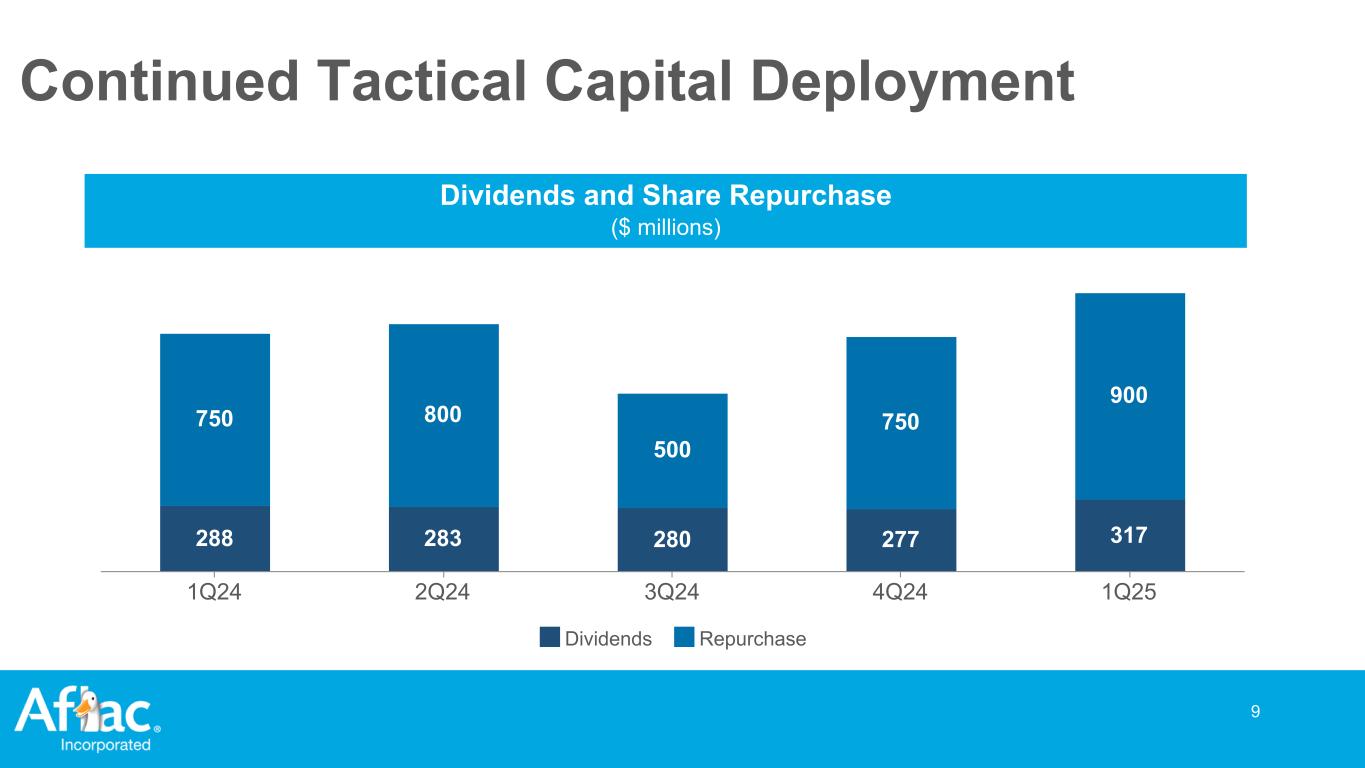
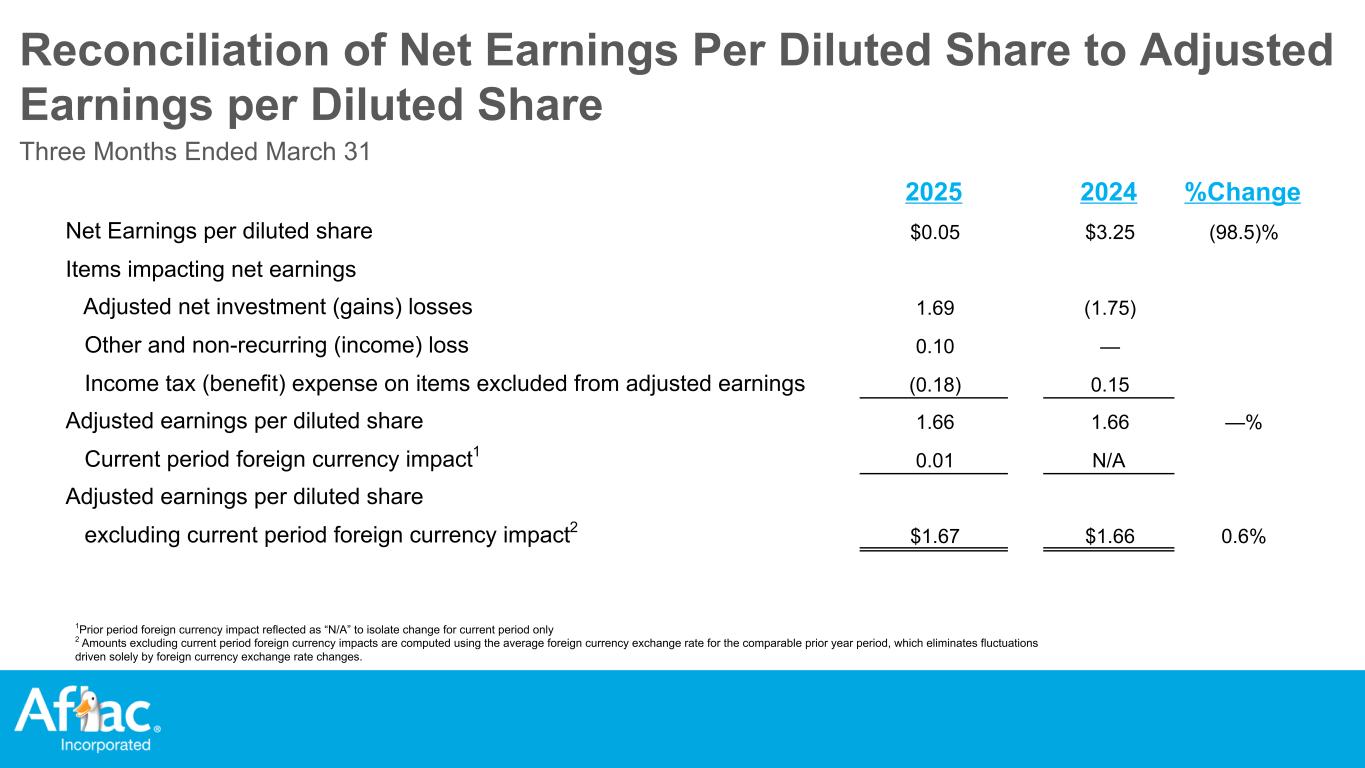
Thank you, David, and good morning, everyone. We're glad you joined us. Although we just have one quarter under our belt, the first quarter marked a good start for the year. AFLAC Incorporated reported net earnings per diluted share of five cents, which was significantly impacted by net investment losses this quarter compared to net investment gains in the first quarter of 2024. At the same time, the company reported adjusted earnings per diluted share of $1.66, which is unchanged from the first quarter of 2024. Beginning with Affleck Japan, I am pleased with the 12.6% year-over-year sales increase. This quarter sales reflected a continued significant contribution from Sumitas and a 6.3% increase from cancer insurance sales, taking into account Japan's demographics and product strategy is to fit the needs of customers throughout all stages of life. Acquiring younger customers is critical to our success. We believe Sumitas helped us appeal to and more importantly reach younger customers in Japan. Our strong sales in Japan reflect the success our agencies have had selling Sumitas. As the pioneer of cancer insurance and leading third sector insurer, we also aim to sell these sumitas policyholders a medical policy or cancer policy. We have also launched the initial stage of sales in Miratok, our newest cancer insurance, on March the 17th. While it is still very early, the results that we have seen thus far have been positive. As of April the 21st, the product has been available through all of japan's sales channels our ability to maintain strong premium persistency is a testament to aflac's reputation and customer recognition of the value of our products by maintaining this level of persistency and adding new premium in through sales we are partially offsetting the impact of reinsurance and policies reaching paid up status this will be vital to our future growth of aflac japan turning to aflac us i was pleased by the 3.5 year-over-year increase in sales and encouraged by the momentum we are seeing within in all areas of our group business, especially our group life and disability, as well as network dental. In addition, we believe our efforts to drive more profitable growth with a stronger underwriting discipline have contributed to our strong premium persistency and net earned premiums growth. At the same time, AFLAC-US has maintained its prudent approach to expense management and maintaining a strong pre-tax margin as max will expand on in a moment in both japan and the united states i believe that consumers need the products and solutions aflac offers more than ever for our policyholders who become claimants aflac is more than an insurance company we are a partner and help, a supporter of families during their times of need, and a pioneer and leader in the industry. We are leveraging every opportunity to convey how our products can help fill the gaps during challenging times, providing not just financial assistance, but also compassion and care. At the same time, we continue to generate strong capital and cash flows while maintaining our commitment to prudent liquidity and capital management we have been very pleased with our investments which have continued to produce strong net investment income as an insurance company our primary responsibility is to fulfill the promises we make to the policy holders while being responsive to the needs of our shareholders our solid portfolio supports our promise to our policyholders, as does our commitment to maintaining strong capital ratios. We balance this financial strength with tactical capital deployment. I am very happy with how management has handled capital deployment and liquidity, and specifically how well we've adapted to this environment. In the first quarter, Applac Incorporated deployed $900 million in capital to repurchase 8.5 million shares of our stock. Additionally, we treasure our track record of 42 consecutive years of dividend growth. At the same time, we have maintained our position among companies with the highest return on capital and the lowest cost of capital in the industry combined with dividends this means we delivered 1.2 billion dollars back to the shareholders in the first quarter of 2025. we believe in the underlying strengths of our business and our potential for continued growth in japan and the united states two of the largest life insurance markets in the world on an ongoing basis we are taking action to reinforce our leading position and build on
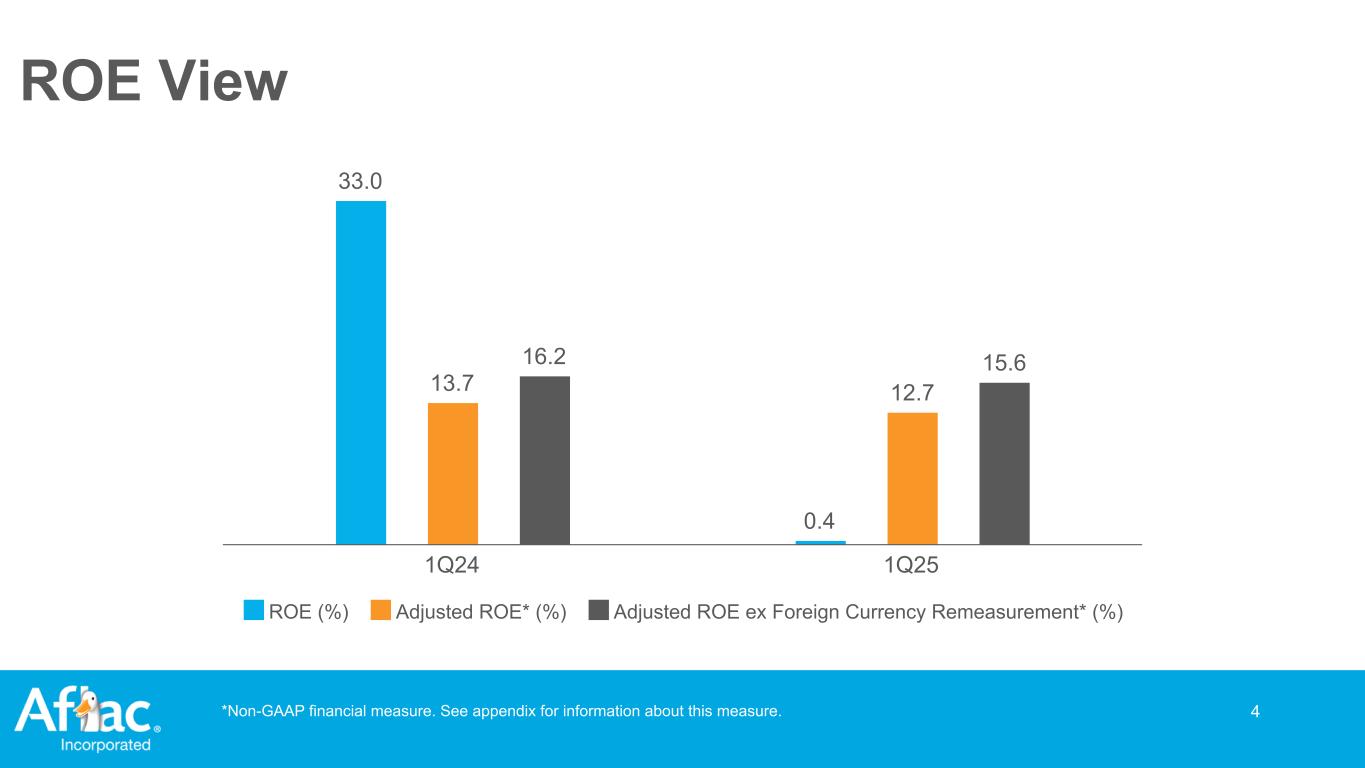
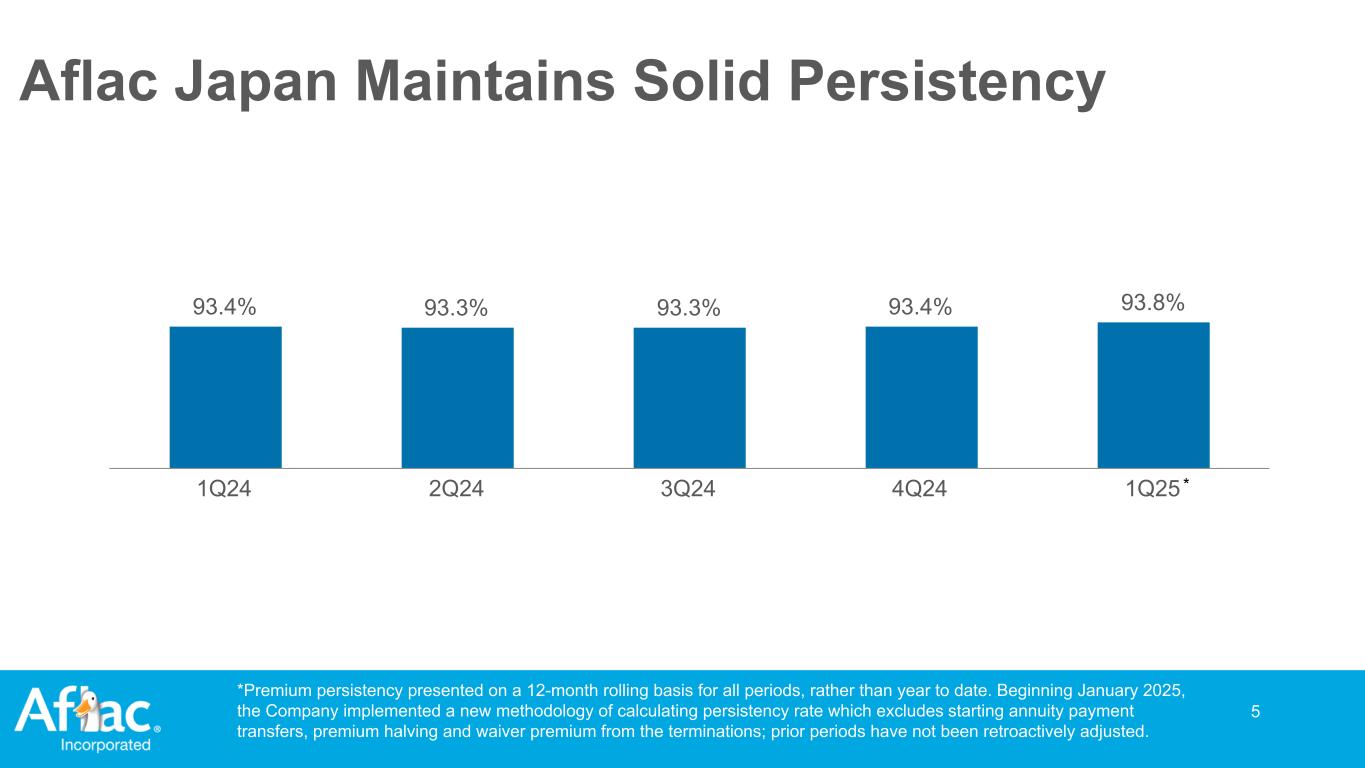
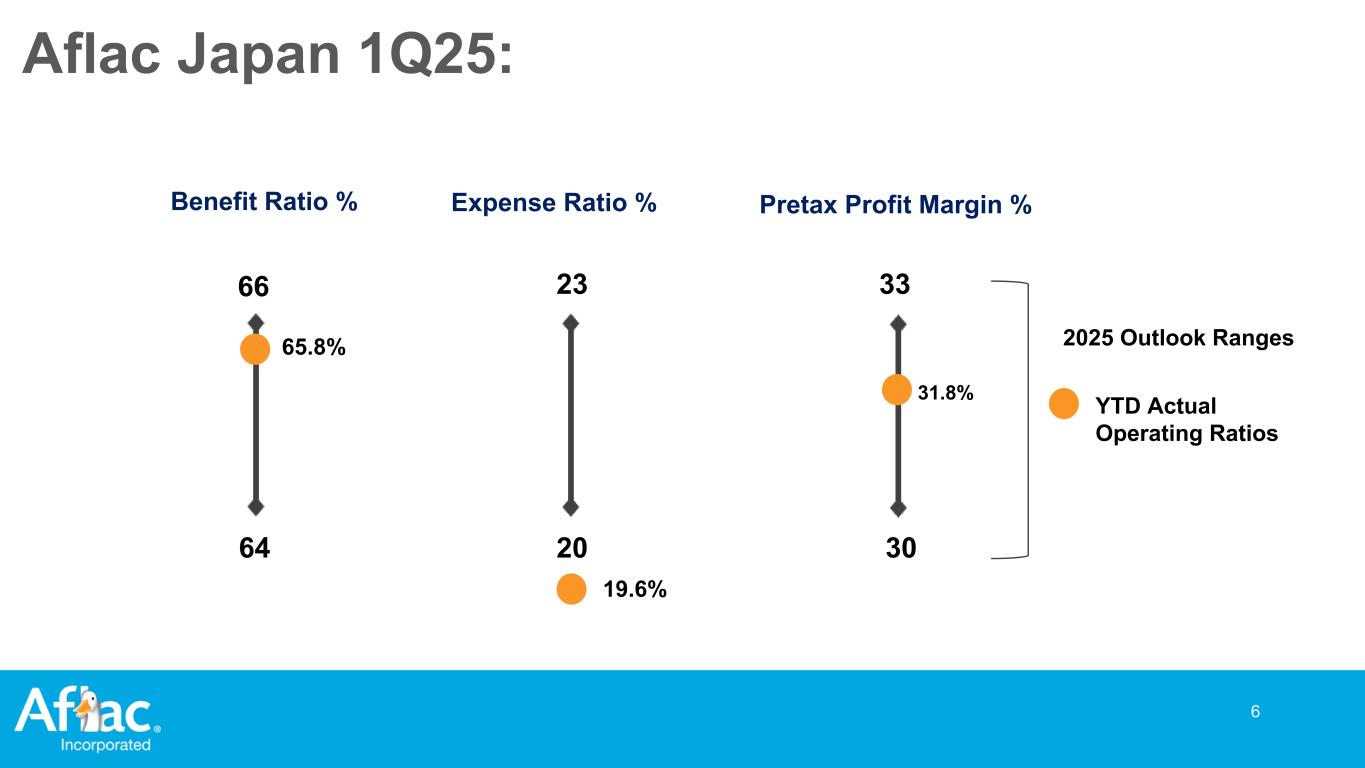
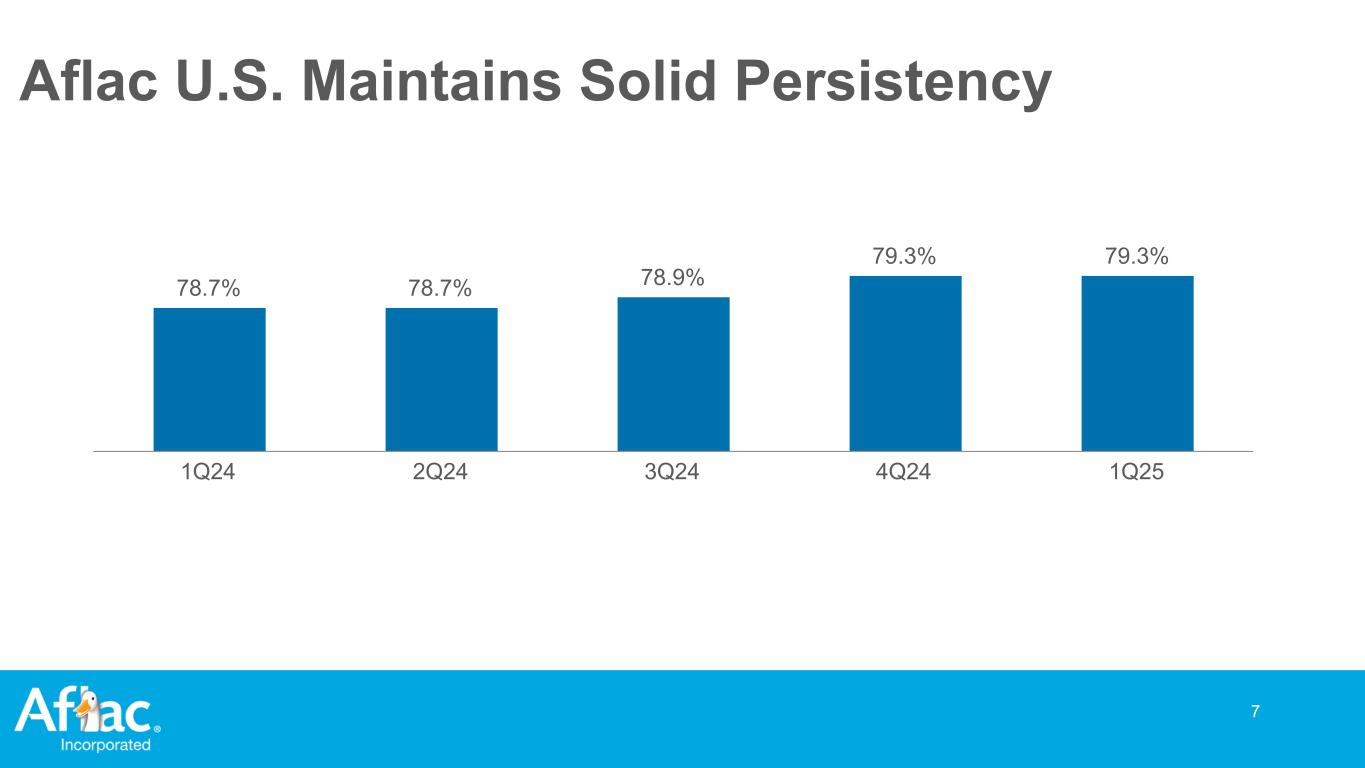
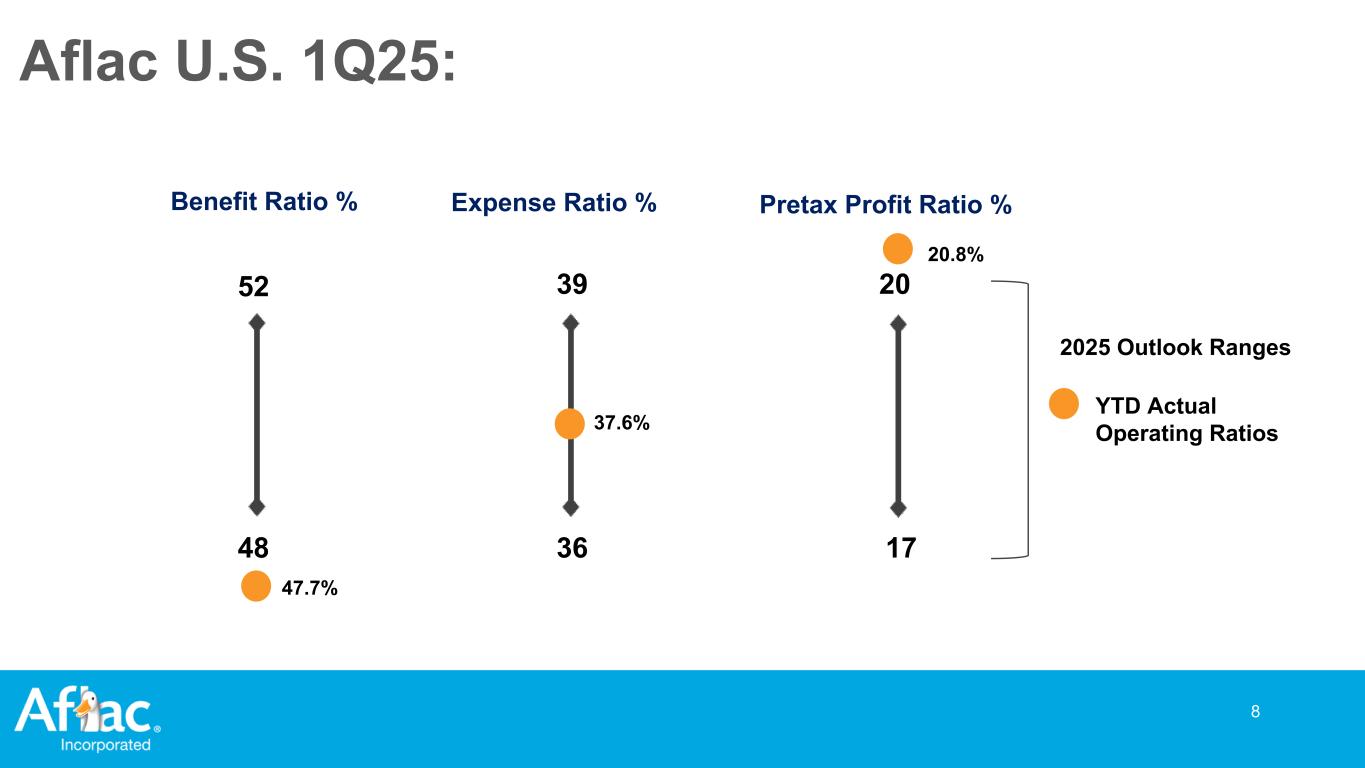
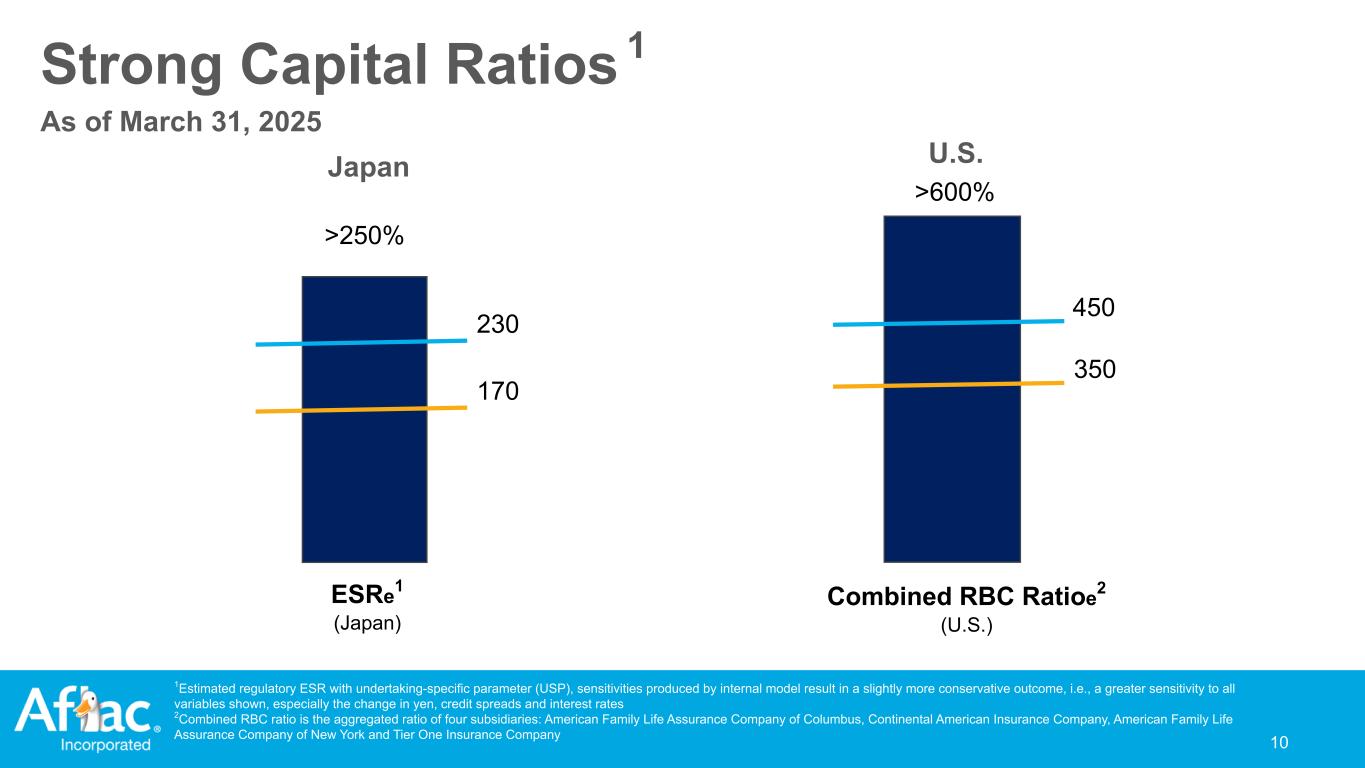
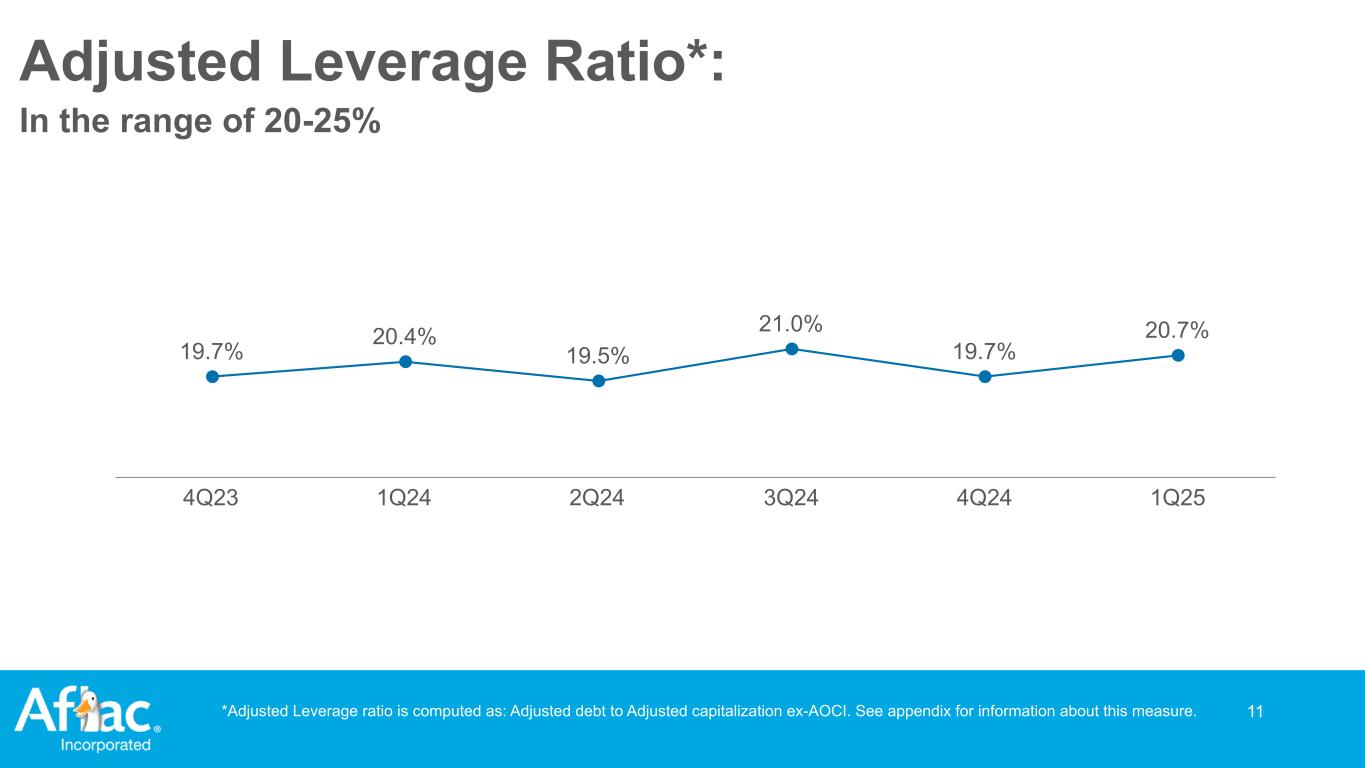
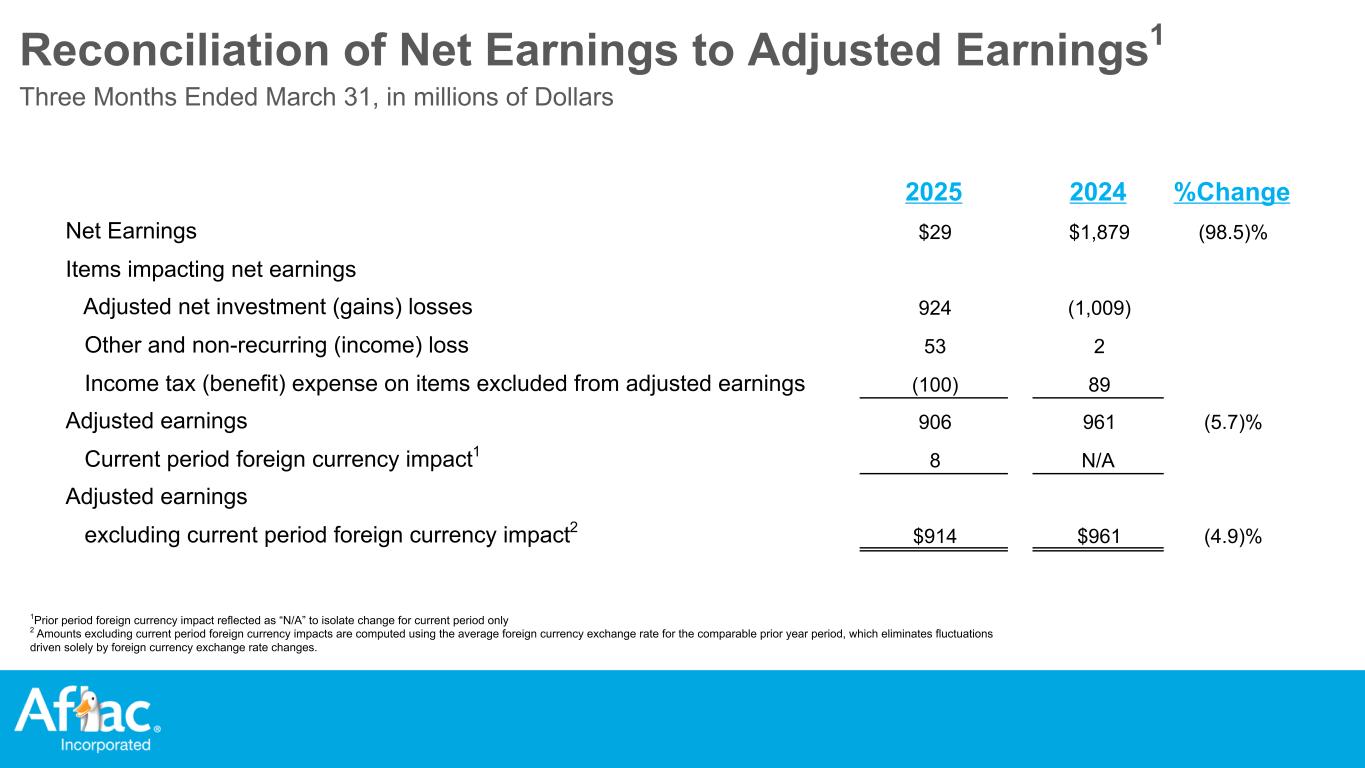
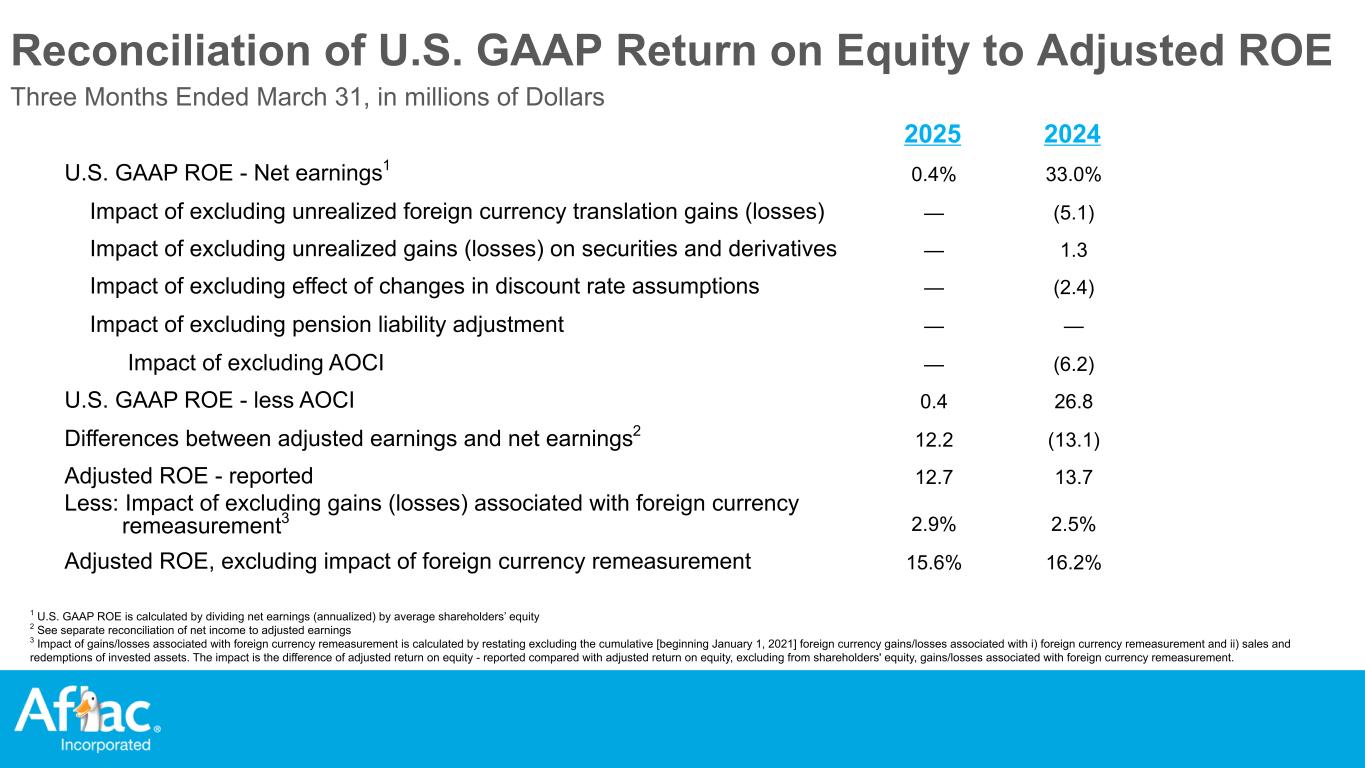
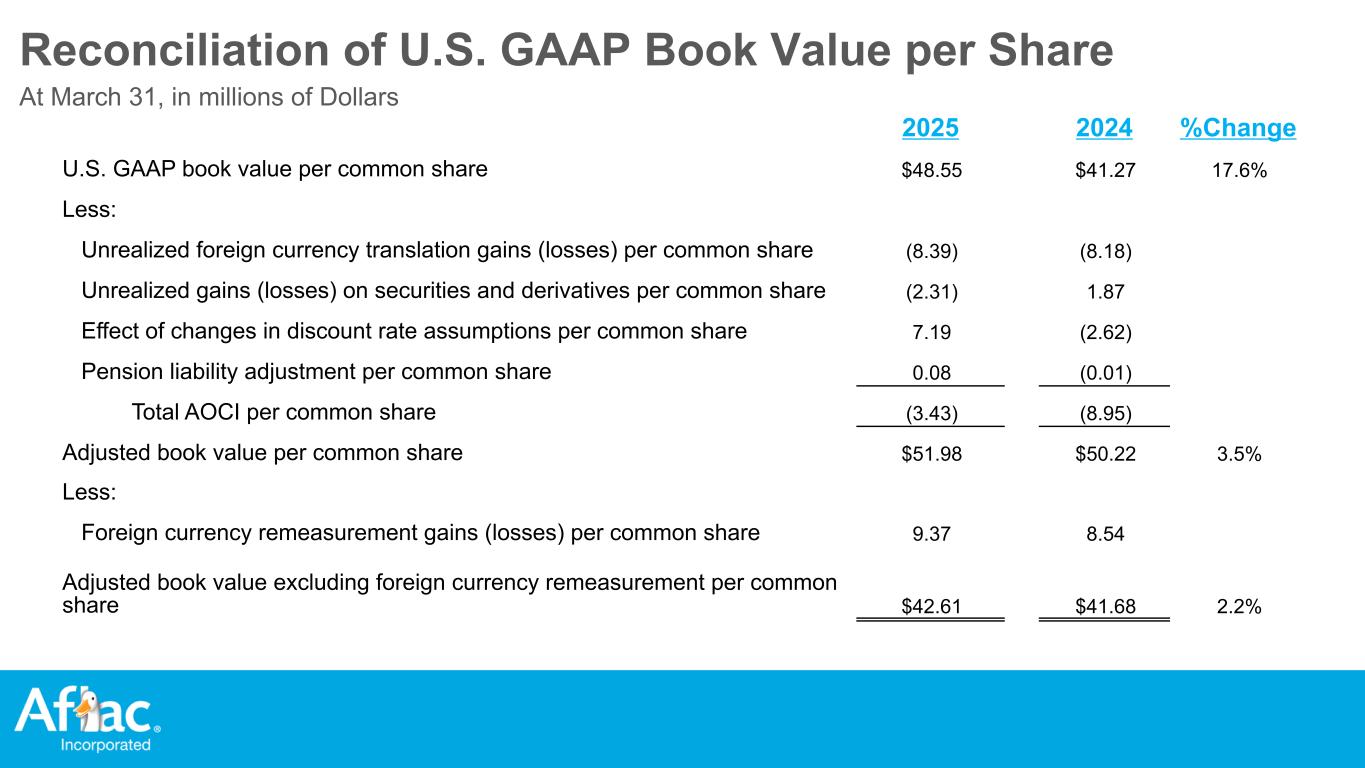
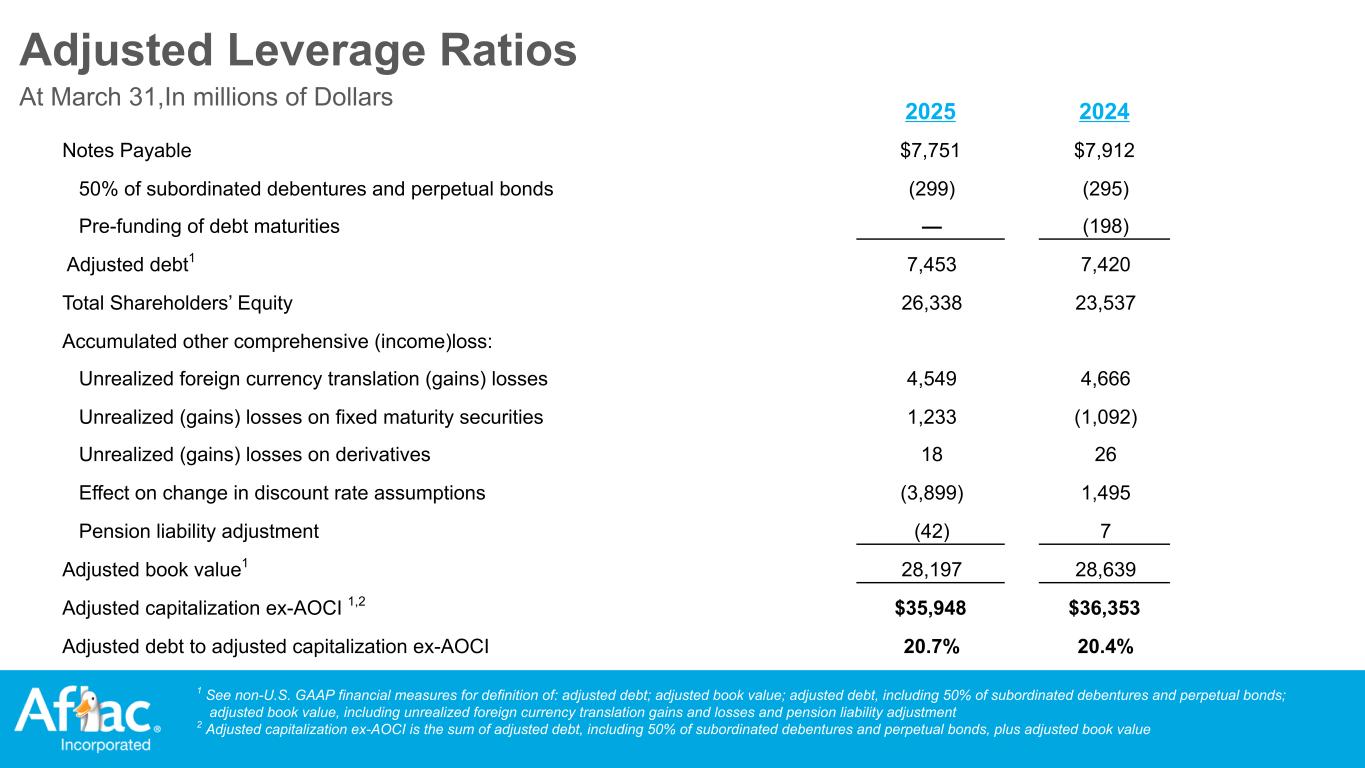
our momentum i will now turn the program over to max to cover more details of the financial results max thank you dan thank you for joining me as i provide a financial update on aflac incorporated results for the first quarter of 2025. For the quarter, adjusted earnings per diluted share was flat year-over-year at $1.66, with a one-cent negative impact from FX in the quarter. In this quarter, remeasurement gains on reserves totaled $41 million, reducing benefits. Variable investment income ran $27 million below our long-term return expectations, while one make-hold-call generated income of $16 million. Adjusted book value per share, excluding foreign currency remeasurement, increased 2.2%. The adjusted ROE was 12.7% and 15.6% excluding foreign currency remeasurement, an acceptable spread to our cost of capital. Overall, we view these results in the quarter as solid. starting with our japan segment net and premiums for the quarter declined five percent aflight japan's underlying earned premiums which adjusts net earned premiums to exclude the impact of deferred profit liability paid up policies and reinsurance declined 1.4 percent we believe this metric better provides insight into long-term premium trends japan's total benefit ratio came been at 65.8% for the quarter, down 120 basis points year over year. The third sector benefit ratio was 56.3% for the quarter, down approximately 120 basis points year over year. We estimate the impact from remeasurement gains to be approximately 150 basis points favorable to the benefit ratio in Q1 2025. Long-term experience trends as they relate to treatments of cancer and hospitalization continue to be in place, leading to continued favorable underwriting experience. Persistency remains solid at 93.8%, which is up 40 basis points year over year and in line with our expectations. However, beginning in this quarter, we have revised the premium persistency definition to better reflect the economic trends of the business. As a result, we do not treat annuitization as a lapse for persistency purposes, and this revised definition raised the reported persistency by roughly 30 basis points. Our expense ratio in Japan was 19.6% for the quarter, up 160 basis points year-over-year, driven primarily by an increase in technology expenses. For the quarter, adjusted net investment income in yen terms was down 7.6%, primarily driven by lower floating rate income, the transfer of assets to AFLAC-Bermuda, associated with reinsurance, and variable investment income, somewhat offset by high returns from the structured private credit portfolio. The pre-tax margin for Japan in the quarter was 31.8%, down 100 basis points year-over-year, but a very good result. Turning to U.S. results, net-end premium was up 1.8%. Persistency increased 60 basis points year-over-year to 79.3%. Our U.S. total benefit ratio came in at 47.7%, 120 basis points higher than Q1 2024, driven by business mix and lower re-measurement gains than a year ago. we estimate that the remeasurement gains impacted the benefit ratio by approximately 100 basis points in the quarter, as claims have remained below our long-term expectations. In the quarter, we benefited from favorable underwriting on our small but growing long-term disability block. Our expense ratio in the U.S. was 37.6%, down 110 basis points year-over-year, Primarily driven by platforms improving scale and continuous focus on expense efficiency. Our growth initiatives, group life and disability, network dental vision, and direct-to-consumer increase our total expense ratio by 50 basis points for the quarter. This is in line with our expectations, and we would expect this impact to decrease as we continue to approach scale. Adjusted net investment income in the U.S. was down 1.9% for the quarter. primarily driven by lower floating rate income. Profitability in the U.S. segment was very strong with a pre-tax margin of 20.8%, a 20 basis points decline compared to a year ago. During the quarter, we increased our CECL reserves associated with our commercial real estate portfolio by $2 million net of charge-offs as property values remain at distressed valuations. We also foreclosed on two loans, adding them to our real estate-owned portfolio, consistent with our strategy for maximizing recovery values. Our portfolio of first-lean, senior-secured, middle-market loans continue to perform well, with increased CISO reserves of $7 million in the quarter net of charge-offs. In our corporate segment, we recorded a pre-tax gain of $43 million. Adjusted net investment income was $47 million higher than last year due to a combination of lower volume of tax credit investments and higher asset balances, which included the impact of the reinsurance transaction in Q4 2024. Our tax credit investments impacted the corporate net investment income line for U.S. gap purposes negatively by $8 million in the quarter with an associated credit to the tax line. The net impact to our bottom line was a positive $0.4 million in the quarter. To date, these investments are performing well and in line with our expectations. Unencumbered holding company liquidity stood at $4.3 billion, $2.6 billion above our minimum balance. We repurchased $900 million of our own stock and paid dividends of $317 million in Q1, offering good relative IRR on these capital deployments. We will continue to be flexible and tactful in how we manage the balance sheet and deploy capital in order to drive strong risk-adjusted ROE with a meaningful spread to our cost of capital. Our capital position remained strong and we ended a quarter with an SMR above 950%, an estimated regulatory ESR above 250%. Our combined RBC, while not finalized, we estimate to be greater than 600%. These are strong capital ratios which we actively monitor, stress, and manage to withstand credit cycles, as well as external shocks. For U.S. statutory, we recorded a $6 million valuation allowance on mortgage loans as an unrealized loss. We ended the quarter, March 31st, with net 5.2 billion yen of Japan FSA realized gains, net of losses for securities impairment. This is well within our expectations and with limited impact to both earnings and capital. Our leverage was 20.7% for the quarter, which is within our target range of 20 to 25%. As we hold approximately 59% of our debt in yen, this leverage ratio is impacted by moves in the yen dollar exchange rate. This is intentional and part of our enterprise hedging program, protecting the economic value of Affleck Japan in the US dollar terms. On a U.S. GAAP basis, we are impacted by moves in the yen, as our yen-denominated earnings will translate into U.S. dollars at different exchange rates. We currently estimate that every 5 yen to the dollar move would impact our underlying EPS by roughly 7 cents. As foreign currency markets have experienced a marked increase in volatility, I would like to reiterate our approach to managing foreign currency exposure. Fundamentally, we sized our unhedged U.S. dollar exposure to the estimated economic surplus associated with our Japanese business. At the end of Q1, we held $25.5 billion of unhedged U.S. dollar assets in our Japan general account, forward contracts at Inc. with a notional balance of 2.7 billion dollars and 4.4 billion of yen-denominated debt. We also hold 24.2 billion dollars of notional out-of-the-money put options, which provide tail protection against a large appreciation in the yen.
Operator
Adding this up, we feel that we are very well positioned on an economic basis i now turn a call over to david to begin q a thank you max before we begin our q a we ask that you please limit yourself to one initial question and a related follow-up you may then rejoin the queue to ask additional questions we'll now take the first question to ask a question you may press star then one on your touchtone phone if you're using a speakerphone please pick up your handset before pressing the keys if at any time your question has been addressed and you would like to withdraw it please press star then two at this time we will pause momentarily to assemble our roster our first question today sorry for the wait everyone our first question today comes from tom gallagher of evercore isli please go ahead hey good morning um max just had a few questions on Japan solvency and overall macro sensitivities.
I guess my first question is, why did the ESR ratio decline by so much in Q1? If I just look at the sensitivities, I think the sharp rise in Japan rate should have offset the strengthening in the end. Anyway, I'll start with that, and then I had a follow-up.
Thank you, Tom. I appreciate the question. And you're right that in the first quarter, we saw a small drop in our ESR, and that is driven by the yen strengthening that you saw. That is partially offset by higher Japan interest rates, especially the 30-year JGB rose in the first quarter, and that certainly helped us. That being said, we also had relatively high dividends flowing up from AFLAC Japan to AFLAC Inc. during the quarter as well. And that's the reason why you see the cash balances at Inc. increasing as much as they did, despite very significant capital deployment in terms of dividends and buybacks in the quarter. So I think that's the missing piece, is the dividends flowing up to the holding company.
That makes sense, Max. And then my follow-up is, just in light of everything that's changed macro-wise with the yen now strengthening and looking at where long rates are in Japan, how should we think about that when you think about forward capital planning? Do you still feel that drawing down excess and returning it is the best path forward? You still have considerable excess, so I'm not suggesting you don't. But I guess the volatility of capital seems kind of on the high side when I think about sensitivities to what's happened in macro recently. So just curious, are you looking maybe to change philosophy at all on capital return? and or how about just the way you're hedging this? Because I think right now you have some very deep out-of-the-money hedges. Any thought of maybe locking in all of that capital strength or are you fine with the structure you have? Thank you.
So, Tom, when we design our capital management, it's really done with a long-term view. It's done running many different scenarios, including stress scenarios as well. And so if you use that as a base, that means that fundamentally we are not changing the way we are doing our capital management or in the way we are structuring the different instruments that we use for it. And I want to take you back and just think through the underlying business that we conduct, which we sell products that are relatively defensive in the way they behave. that going through lapsation, that going through volatility in benefit ratios, and underlying profitability as well. That is mirrored up with a relatively low asset leverage, which means that the risks associated with our asset portfolio are somewhat limited as well. And when you bake all of that together, it means that our profitability and cash flows are relatively stable and predictable. Now you point out one item and that is the volatility of our ESR as it relates to FX and that is something that we have designed ourselves. So when we protect the economic value of AFLAC Japan, the main component of that is the 25.7 billion dollars held in U.S. dollars on our Japanese balance sheet. And that is there to obviously help protect the long-term economics of our Affleck Japan business in U.S. dollars. But it does introduce volatility to our ESR ratio. But what we have done is that we have protected details, i.e., we have looked at how much risk are we willing to take on FX as it relates to the volatility in the ESR ratio. And that's where we have executed a put option program where most of those puts are currently out of the money by 25 to 30%. And that helps cut the tail and the volatility of those. These are one-sided. That means that we have protection if the yen strengthens. But if the yen were to weaken, we keep all of that upside. So if I look at the moves that we have seen in rates, the move we've seen in FX, I don't see at this point us making any significant changes to the way we are approaching this or hedging this. That being said, obviously, it's something that we closely monitor, and there may be tactical moves in the future around it. but I would assume that those are relatively minor in the scheme of things. So, so far, we feel like the FX etching program is working very well and in line with our expectations.
Operator
The next question comes from Jack Matten of BMO Capital Markets. Please go ahead.
Hi, good morning. Just a question on the new cancer product launch. Can you talk about what you're seeing so far in the uplift of sales you saw this quarter. I know at the end of launching stages, so maybe you'd see more of a benefit in the second quarter as well. Just curious what your expectations are for sales of that product this year.
Well, yeah. This is Dan. Let me make a couple of comments, and then I'm going to turn it over to Afflight Japan. But just in general, I think that we're going to be fine. I think you're going to see these things the new cancer policy continue to grow but all in all I thought Virgil has spent a lot of time in this quarter in Japan and I'd like for him to take a high level view and go over both the U.S. and Japan and then have the Japanese operation talk about it Yoshizumi can cover that and then follow up with Max and Brad on any comments they might have in those regards. So, Virgil, why don't you just give a few comments and then let's turn the program over to Japan.
Yeah, well, thanks, Dan. I'll just make a few comments. It was a great visit I had to Japan. And I would just say that, as Max pointed out earlier, our business is really more viewed from a long-term perspective. And we remain confident in the strategies we have with our products and our services that what we have is what customers need and want um i think too dan i would just add though that as you look at japan in particular what we've done with the launch of the cancer product also how we're approaching the market though the market with sumitas and the focus that we have on selling more third sector products is what will help us during this time yeah we do look at economic downturn max just shared with you about how we go through that methodology but specifically on the cancer though i'm going to let japan talk about how the launch went into what we see for a major year so i'm going to turn it over to you guys thank you for the question i'm in charge of the marketing and sales and let me take that
The new cancer insurance was just launched in May this year, but it is progressing as we expected. Sorry, Correction, it was launched in March.
Let me briefly talk about the characteristics of this new cancer. products.
First, it has full and simple coverage. In addition to strengthening coverage, not only during, but also before and after treatment, the qualification for payment of benefits have been changed to be easier to understand. And it has the flexible coverage design that enables combination and cross-selling with existing policies and other products, i.e. add-on plans for those who already have medical insurance. On March 18th, our sales was made available, our mainstay associate channels, Daido and Daiichi.
4月になって金融機関と日本郵政グループここに発売を開始しました.
And in April, we started the sales at Bank Channels in Japan Post Group. And all the channels have made a great start, and we are still seeing a positive result from all of these channels. And let me talk a little bit about our forecast for 2025. And we have changed the structure in this January and established a new position, CMO, and this position will supervise the sales and marketing and all brands. ガン医療資産形成介護この領域において徹底的な顧客主権に基づき商品の設計から営業推進まで一貫性をもって実施しています and we at this position will look after the asset formation cancer and medical and all areas and will be totally design oriented and to develop the sales plan
またこのブランド別にIT 数理 契約管理等のメンバーを含むクロスファンクショナルなチームを組成し 機動的かつ柔軟にお客様にお客様の変化に変化するニーズに対応しております
And we are responding to the ever-changing customer needs with an agility in a cross-functional way by engaging our IT, actuarial and policy service department.
This is why the marketing of the 3月 is a good product.
And we are proud to see this successful marketing activity with optimum activities conducted at each channel under the lead of the CMO and we are seeing a positive with this effort we are seeing a positive result from cancer insurance that was launched in March. We believe that third sector sales will continue to grow with now having a very extensive product line up.
And we are now also focusing on hiring activities as agents and mainstay associates. that's all thank you very much and then I just follow up on on the medical insurance market in Japan and he can talk about competitive dynamics there and how you see the the outlook for for sales of your medical products and this
is Yoshizumi once again let me talk about our competitor First of all, about the third sector overall. Based on the latest data, we have the largest share of total new policies of cancer and medical insurance are core products in physical year 2023. In 2020, we expect to maintain our number one share of new policies by expanding sales of cancer and medical insurance. Let me talk about cancer insurance. Although competition has increased, we are a pioneer in cancer insurance, having faced cancer for the longest time in Japan, and the knowledge we have accumulated over 50 years of history is something no other company can have. We continue to provide services like Yoriso consulting services, unique concierge service that no other company offers in addition to insurance coverage. By doing so, we will meet the needs of our customers and maintain a competitive advantage. And we aim to achieve further sales growth with the new cancer insurance product launched in March.
Moving on to the medical insurance.
And moving on to the medical insurance.
And moving on to the medical insurance. And moving on to the medical insurance.
The medical insurance sector is a much more competitive market than cancer insurance. This is largely due to the large number of insurance companies entering the market and launching products. We will revise their product line every two years or so in order to gain a higher market share. And under this intensified competition in the medical market, we will conduct some optimized activities on each channel and bring about the better results. And let me talk about the specific activities that were carried out in Q1. We have strengthened the training to our sales agents so that they can provide an easy to understand explanation to the goods. And with Sumitas, we're proceeding the concurrent sales with a third-sector product.
Operator
Our next question comes from John B. Barnage of Piper Sandler. Please go ahead.
Thank you for the opportunity to ask a question. So my question is focused on remeasurement gains. They continue to be present in both Japan and the U.S. We're further removed around the dislocation in individuals' behavior. How should we be thinking about the waterfall or decay of remeasurement gains? And will they primarily be concentrated in third quarters?
Let me kick it off. And I'll also ask Alicia to maybe give some comments from her perspective as well. So, obviously, the third quarter is when we unlock our actuarial assumptions. That means that the third quarter is when we will have the more significant remeasurement gains and losses associated with the claims patterns that we're seeing in the marketplace. In the other quarters, we are truing up the experience from those quarters. That means that they are generally going to be smaller. That being said, we have experienced favorable claims utilization both in the U.S. and Japan, and this has been in place for a long time. And it goes back to pre-LDTI as well, where under legacy gap, you did see this come through as IB&R releases, and that was feeding through into our benefit ratio. And now you're seeing it as remeasurement gains losses coming through under LDTI. So it's a continuation of, especially in Japan, the long-term trends that we've been seeing there. and in the U.S., to some extent, the shift in claims patterns that we've seen post-COVID. I'll stop there and see if Alicia, if you want to add any color from your perspective.
Thank you, Max. The only thing I'd add is that we do unlock our assumptions annually in the third quarter to reflect all of our best estimate actuarial expenses and our experience to date, and then you'll see that flow through the third quarter earnings. Thank you so much.
Operator
Thanks for the answers. That's it for me. The next question comes from Jimmy Bular of J.P. Morgan. Please go ahead.
Hey, good morning. So first, I had a question just along the lines of what you were commenting in terms of the dental or medical product in Japan. Sales have been weak, and you've pointed out competitors coming out with maybe lower benefit-type products and just that affecting your business. Should we assume that if the competitive environment stays the way it is, sales will muddle along at these levels? Or are you doing anything that would suggest that there could be a recovery? Because that line's been sort of steadily dropping over time.
I'm going to answer that. Let me just say that everything that we do tends to be cyclical in nature with a rebound of a new product. And although we can't talk about that because of FSA and the way they operate, as Yosuzumi mentioned, every two years or so, we come back to the table with changes in the marketplace, whether it be consumer and what they want or need or medical treatments and what are happening, whether it's more outpatient than inpatient. whatever it might be from a medical standpoint or even the cancer insurance standpoint. So this year is the year where cancer insurance should be dominating along with our new product. So we should continue to see that. I can't stress enough how much we like what's going on in the life insurance area of adding new and younger policyholders that we've never had before, and that opens the opportunity to go back and add cancer and medical to them. So this year will be that. I think you can look for next year us to revisit which campaign we'll be looking at, but all in all, I'm very excited about us making our numbers this year in sales and believe we'll ultimately do that. And the breakdown, although we continue to watch and monitor is the overall sales numbers that we want to see us achieve because the profit margins are there for our success long term.
And then just for Virgil on the dental business in the U.S., it seems like sales have stabilized following the change in the tech platform, but are you expecting normal production this year in open enrollment, or is it more likely that that'll be next year hey well thanks jimmy this virgil i do expect us to have a consistent momentum you know what i mentioned in the fourth quarter our focus was on stabilization of that platform but making sure that the brokers and our veteran agents knew about that we were open for business and we had a slow start there in q4 but off to a much better start here in q1 i can tell you a few things about that. We did invest in making sure we got the right talent. We hired some additional talent from the industry. We maintained the talent that we have there. We continued to invest in the technology to make sure we've got the best portals for the dentists that are doing business with us, as well as making sure there's an easy enrollment process for our agents, for our brokers. And then the final thing I mentioned, though, is the partnership we launched that we announced last with sky gen they're doing a great job of the administrative services that they're providing for us behind the scenes uh they are industry leading uh third party administrator out there and we're pleased with what we've seen and having said all of that we have been going around to each market letting the agents know to try it for those agents that sold the dental product in q1 along with our voluntary benefits products their sales were up 20 percent my point is that that's the strategy, it works because we look at selling both together. And I think that the more we get that message out, you will see that momentum carried forward. I expect us to hit the plan that we set for it this year, Jimmy.
Operator
Our next question comes from Sunit Kamath of Jefferies. Please go ahead.
Great. Thanks. Max, I wanted to come back to the ESR and the one-way hedge that you have is that program designed to keep you at your esr target or is it possible if we see the dollar we can significantly before those options sort of kick in your esr ratio could fall below your target thanks thank you suneet um so that always depends a little bit of what your starting point is um generally speaking we originally designed this to uh size the risk associated with effects that we're willing to take on.
And we generally size that at around 40 to 45 ESR points. So that would give you a little bit of a sense for the impact and how we have overall sized that program. So that means that at that level, we are no longer having any significant FX volatility associated with our ESR. And our starting point today is, and I ran these numbers this morning, that we estimate that our ESR as of this morning is around 250%. So it's a good starting point for us.
Okay, that's helpful. And then I want to come back to something that we talked about last night in terms of the US weekly average producers. And I think one of the comments around why it was down year-over-year, I think 11%, is that more of your agents are selling other non-AFLAC products. I just want to get a sense of how prevalent is that? How common is that? And does that create some issues for you in terms of the recovery in sales if they're focused on other companies' products? Thanks.
Hey, this is Virgil. I'll take that question. I would say that it's anecdotal. I don't have any data for that. And here's what I mean by that. We have engaged our veterans to look at their productivity. Now, you can see overall our productivity is up when you're looking at the FAP supplement. And that's driven mainly by the production we've got from our veterans, but with brokers also that are in that number. And we're having success in larger case of FAP flight. But when you look into the smaller cases, I mean, accounts generally averaging less than 50 employees this is where we need to focus and i think that comment was made in particular when we saw last year our agents were having success with selling the dental product if you look at the newest statistics that are out there from lemra and from eastbridge dental is still in the top two products that are being requested and being sold so having said that they sold other carriers product and when you sell that product you tend to sell the other voluntary benefit products alongside it what we've done this quarter though as i mentioned it's starting to see them return back i had a 23 increase in dental sales for q1 and we again i mentioned to jimmy a few moments ago that when they sell that dental overall they had a 20 overall sales increase for those agents that sold it What we're going to do this year is focus on those veterans. I've made some compensatives that are tied to that. We're going to explain to them that the dental is stable, is working, and really get them back to selling back on a normal basis to our flight. I have seen the momentum in Q1. I expect that momentum to continue throughout the year.
Operator
Mr. Hurwitz, interline be muted.
So, hey, good morning. Sorry about that. On Sumitask, I know you're targeting younger customers, but I believe in the past you've indicated that existing customers were a larger percentage of the sales last year. Is that still the case? Are you seeing more new and younger customers buy the product?
The short version is we're seeing more younger people buy the product. So that's what I'd give you as an answer.
And then just shifting to NII. So last quarter, you indicated there would be some pressure just given the floating rate portfolio, which we saw. I'm just curious how you see NII trending through the rest of the year. Is there further impact from last year's rate cuts to still flow through?
Sure. Thank you, Joel. You're right. We have seen some pressure in first quarter. It's predominantly from the floating rate portfolio. it's both a reduction in balances as well as the roughly 100 basis point decline we've seen in SOFR year on year. We're going to be facing that headwind throughout the year. The comps do get a little better later in the year when the differential in SOFR is less because of the Fed action to cut later in the year last year. We are taking steps to try to offset that. We're doing more things to reposition the portfolio to capture higher yields both in Japan and the U.S. We've also been able to deploy a significant amount of capital in first quarter and take advantage of the wider spreads. And we also took advantage of the wider spreads in April and deployed a significant amount. So, you know, we are facing that floating rate headwind, but we think we've got some things in the toolkit that's going to help us offset that.
And, Joel, just as a reminder that our floating rate portfolio, it resets with one-month and three-month so far.
Got it. Thank you. Just to follow up, I went and got the number. Over half of our sales are from younger people, so I wanted to validate that number for you. Pursumi Toss, and that was a question you had. Thanks.
Operator
Our next question comes from Ryan Kruger of KBW. please go ahead.
Hey, thanks. Good morning. One more question on the yen sensitivity. We've been talking mostly about the ESR impact from a strengthening yen. Can you talk more about the offsets, though, within the rest of the organization? I believe you're more economically insensitive on a consolidated basis.
Yeah, that's right. I mean, the other components of this is that we hold $2.7 billion of forward contracts at the holding company. And obviously, as the yen strengthens, they will move more into us being out of the money on those forwards. Now, we also hold roughly $4.4 billion of yen-denominated debt at the holding company as well. That means that when the yen moves our leverage will move with that as well so you will you will in a strengthening yen scenario all things being equal see our leverage ratio increase somewhat all of these obviously then work in the negative category as you think about the esr as you think about settlements on our forwards at inc and as you think about our leverage ratio the offset to this is that we now expect higher future dividends in dollar terms from AFLAC Japan. So when you then think about the long-term dividend cash flows in U.S. dollars, they are now going to be higher. That offsets the decline that you see elsewhere on these other instruments. And that's what I mean by when we take an economic approach, we think about sizing what our expected cash flows are, and they are offset by these other instruments.
So that means that we are very well hedged, protected in U.S. dollar terms around the And then just a quick, you gave a lot of detail on the new cancer product and your strategy around both cancer and medical. I know you said you thought cancer sales, I mean, overall Japan sales would be up in 2025. I was just, can you give any more color though? So I think you've typically seen a bit of a surge in sales when you have a new product introduction like this, see a pretty meaningful positive impact from the cancer launch.
Yosuzuni, that's how we think.
So this is Yosuzuni once again.
Operator
Thank you. Our next question comes from Wilma Burtis of Raymond James. Please go ahead.
Hey, good morning. Could you provide any updates on the Japan Post? I think it was a data breach or something like that, but if you could just give us any updates. Thanks.
Wilma, you were asking about it. The Japan Post.
This is Koide from Affleck Japan. I believe that question is regarding the Japan Post Company's inappropriate uses of non-publicized financial information. And right now, JPC or Japan Post Company have now established a preventative measure than implementing them. And Japan Post Company is now focused on addressing this issue, so there are certain impacts on the cancer insurance sales. And within the Japan Post Group, there's another entity called Japan Post Insurance.
And Japan Post Insurance is not directly impacted by this recent news.
And also, this recent matter regarding the inappropriate usage of the data has nothing to do with an AFLAC insurance product. So, therefore, the cancer insurance sales activity are still continuing today. And as Yoshizumi described earlier, Japan Post Group have started the sales of new cancer products this April. And Japan Post Company has also started the sales of this new product.
Operator
The next question comes from Nick Anito of Wells Fargo. Please go ahead.
Just one more from Max on the ESR and appreciate all the comments before on it, but how should we be thinking about the future use of Bermuda in terms of reinsuring the Japan balance sheet? You know, if the end continues to appreciate further, does it impact any of the ability or willingness to do more of the balance sheet reinsurance?
So our ability to execute reinsurance is not really associated with our ESR levels. It's not making it more difficult or easier depending on where the ESR level is. That being said, it is absolutely clear that when we execute reinsurance between AFLAC Japan and Aflac Bermuda, we tend to structure their transactions in a way to lower the overall risk for both the enterprise and for the seed and Aflac Japan in this case. That tends to have the outcome that the ESR is going up. So it's obviously a tool that we have available to us that we can use, but it's one of the tools that we have and that we use in overall to manage the capital base of Athlete Japan and the ESR ratio. We have a relatively broad toolkit that we can use. At this point, obviously, we are trading significantly above our target operating both range and midpoint. So at this point, we feel very good about where we are as it relates to our ESR ratio.
Operator
The next question comes from Mike Ward of UBS. Please go ahead.
Thank you. Good morning. I was just wondering how you guys are seeing the environment in Japan. And I'm just kind of curious, you know, you guys are well tapped into their sort of cultural attitude. But is there any anti-U.S. sentiment brewing there from the trade war that could pose incremental sales challenges?
Let me let Charles take that on. Charles?
Yes, thank you. This is Charles Blake. We do not see any reaction in a way that will be anti-American. As you know, the Japan government is a strong supporter of the U.S.-Japan alliance. Deep economic relationship is the basis of the confidence that Japan has in the United States. As you know, in the past five years, Japan was the largest investor into Japan. So when you look at the national security side, when you look at the economic relationship side, it's a deep relationship. In addition to that, because of the exchange rate, there's a large visitor from the United States to Japan that's booming in terms of inbound tourism. So at this stage, of course, the trade talks are getting a lot of attention, but it is not affecting in any way, in my view, the sentiment among the Japanese people about the United States.
Super helpful. Thank you. And then maybe for Max, just high level on the buyback, pretty solid amount this quarter. Just if it ends up that there's incremental sort of, or ongoing, I guess, you know, sales headwinds, you know, should we think about you being comfortable continuing in excess of of operating income and um or you know even at this level right um for as long as those uh headwinds may or may not persist yeah the um our buyback it's it's truly a function of the capital and liquidity we have on hand the capital and liquidity we see coming through to us in the future?
And then obviously, the investment opportunities we have for that capital. And we look at the IRRs that we can get on different types of capital deployment, that being organic growth, i.e. what returns are we getting by selling new products? And that's generally our number one source of where we deploy capital. That's where we want it to go. We want to grow our franchise and grow it at strong IRRs. When there's capital over, we are looking at other deployment opportunities. And obviously, buyback has been one of the greatest sources of that over the last couple of years. And that has given us very good IRRs. So this framework, we just continue to run and operate.
Operator
The next question comes from Alex Scott of Barclays. Please go ahead.
Hey, thanks for fitting me in here. I had one on the corporate segment. I guess just from the outside, it's a little difficult to model given there's the derivative program in there, there's the Bermuda reinsurance in there, and then there's the typical kind of what we think about as a corporate segment in there. So, you know, could you help us think through, you know, the different components and how we should think about the trajectory, you know, maybe, you know, where you see it running more near term versus where it, you know, may build to just based on the Bermuda business?
So, Alex, I understand the difficulties in modeling this segment, given that you have so many different pieces that are sort of rolling up into it. If you think about the most of the biggest pieces that are moving that number, it would be around any further reinsurance that we would do. The reinsurance profitability is very stable and predictable, but any further transactions that we would do would obviously increase the profitability of this segment. The other piece is interest expense. So if we were to issue any more debt and go up in leverage, that obviously would impact the profitability of this segment as well. And the last piece is the strategy that we have around tax credit investments and the way this is accounted for. And that is particularly interesting in this quarter. When you compare it year over year, there was a significant delta where in the first quarter of last year, we had pretty significant tax credit investments. They were lower this year. And as you know, the way they work is that we have a negative component to the net investment income in the corporate segment with more than offsetting credit to the tax line. So in this quarter, we only had, I believe, $8 million of tax credit investments hitting the net investment income line. And that is why you also saw the tax line having a higher tax rate than what we normally run at on a quarterly basis. So, if you boil all of that together, it means that you will continue to see some volatility in this number, but I would certainly expect the number to be, on a pre-tax basis, positive, but generally speaking, lower than what you saw in the first quarter. Got it.
Okay, that's helpful. I can leave it there. Thank you.
Operator
This concludes the question and answer session. I would like to turn the conference back over to David Young for any closing remarks.
Thank you, Alan, and thank you all for joining us this morning. We appreciate your time. If you have any other questions, please reach out to Investor Relations. We'll help you with what we can and look forward to speaking to you soon. Thank you.
Operator
The conference is now concluded. Thank you for attending today's presentation. You may now disconnect.