Operator
Good afternoon, ladies and gentlemen, and thank you for standing by. My name is Kelvin, and I will be your conference operator today. At this time, I would like to welcome everyone to the Allegiant Travel Company's third quarter 2025 earnings call. All lines have been placed on mute to prevent any background noise. After the speaker's remarks, there will be a question and answer session. If you would like to ask a question during this time, simply press star followed by the number one on your telephone keypad. If you would like to withdraw your question, please press star one again. Thank you. I would now like to turn the call over to Sherry Wilson, Managing Director of Investor Relations. Please go ahead.
Thank you, Kelvin. Welcome to the Allegiant Travel Company's third quarter 2025 earnings call. We will begin today's call with Greg Anderson, CEO, providing a high-level overview of the quarter, along with an update on our business. Drew Wells, Chief Commercial Officer, will walk through demand, commentary, and revenue performance. And finally, Robert Neal, President and Chief Financial Officer, will speak to our financial results and outlook. Following commentary, we will open it up to questions. We ask that you please limit yourself to one question and one follow-up. The company's comments today will contain forward-looking statements concerning our future performance and strategic plans. Various risk factors could cause the underlying assumptions of these statements and our actual results to differ materially from those expressed or implied by our forward-looking statements. These risk factors and others are more fully disclosed in our filings with the SEC. Any forward-looking statements are based on information available to us today. We undertake no obligation to update publicly any forward-looking statements, whether as a result of future events, new information, or otherwise. The company cautions investors not to place undue reliance on forward-looking statements, which may be based on assumptions and events that do not materialize to view this earnings release as well as the rebroadcast of the call feel free to visit the company's investor relations site at ir.legionair.com and with that i'll turn it to gray sherry thank you and thank you everyone for joining us today as i reflect back on the past year plus as ceo i am proud of the great strides we have made to strengthen our core airline and our focus on making sure we return to our groups at a solid double-digit operating margin business.
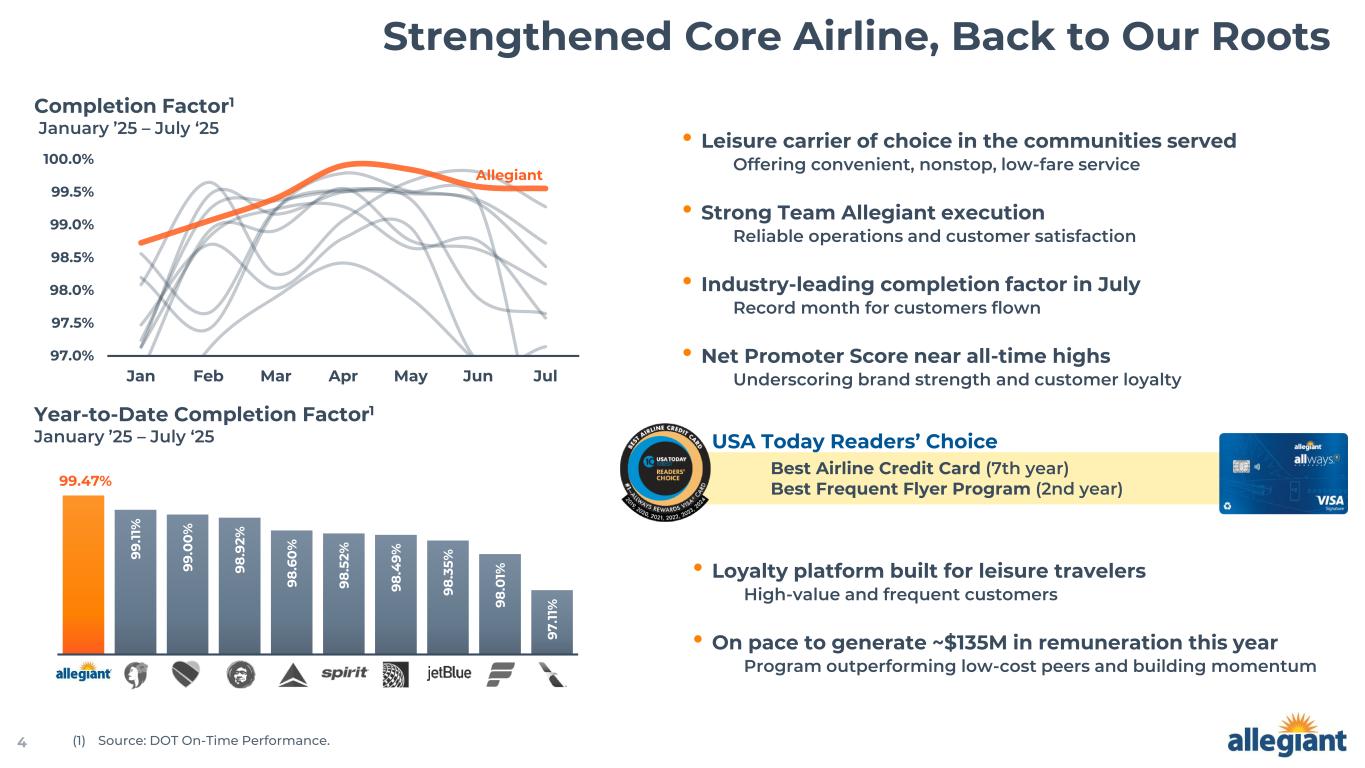
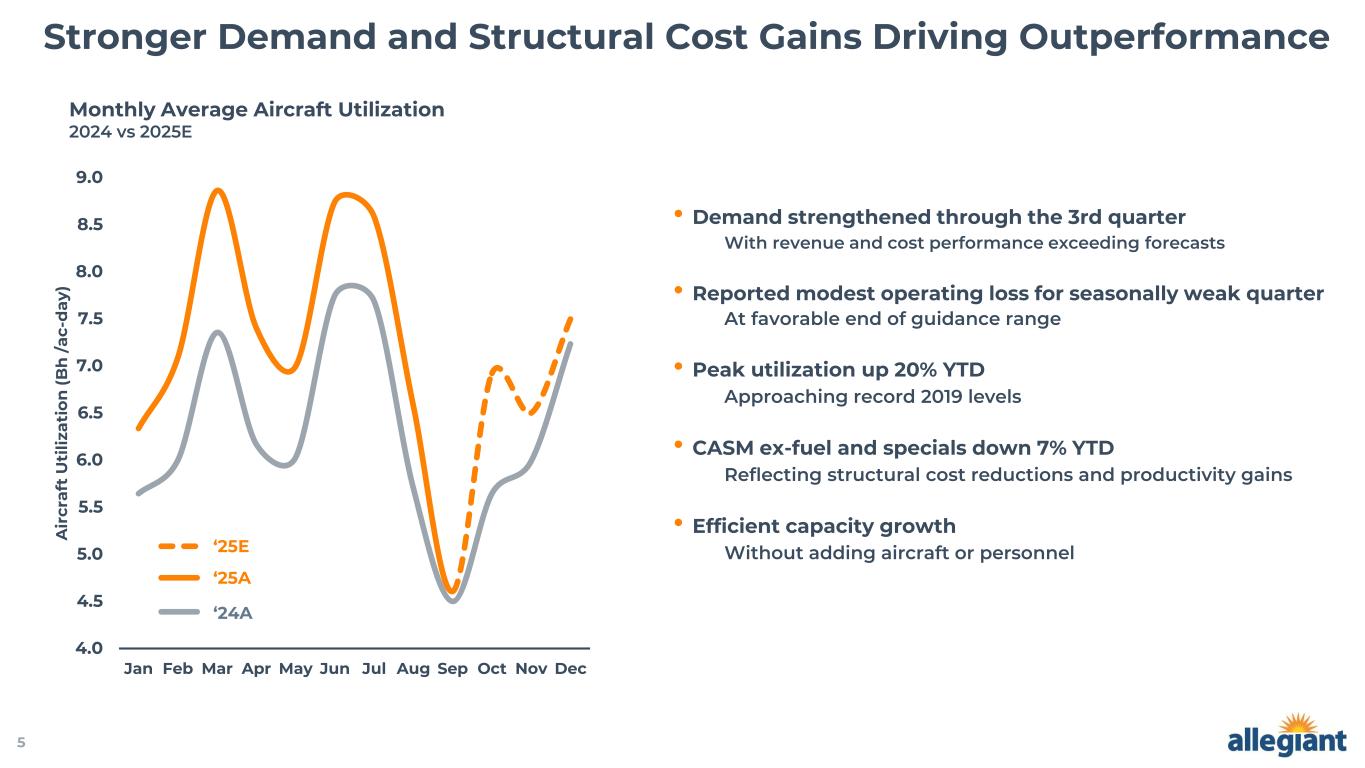
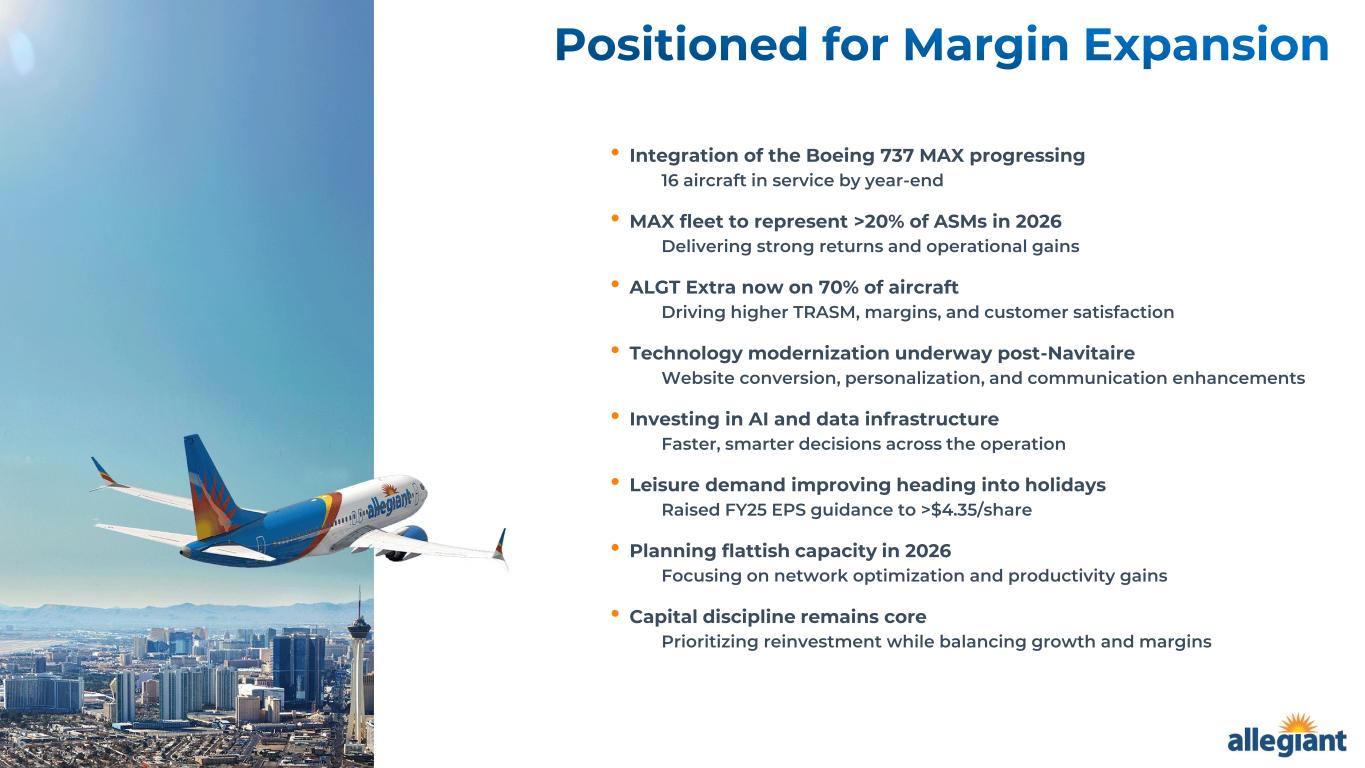
A hallmark of our success is that we are the leisure carrier of choice in the communities we serve by offering convenient on-stop flights at the Lotus Fairs. That success is also because of Team Allegiant's dedication and execution that underscores our ability to provide consistent and reliable operations for our customers. our performance is demonstrated by our industry-leading completion factor for july a peak period that set a new monthly record for the number of customers flown it is also reinforced by our net promoter scores which remain near all-time highs reaffirming the loyalty of our customer base and the strength of our brand i am particularly proud that we were recognized by usa today's breeder's choice award for the best airline credit card for the seventh year in a row, and Best Frequent Flyer program for the second consecutive year. We designed our programs to serve the needs of our leisure customers, which include high value and frequent travelers. The success of our loyalty program and the fact that we are on pace to generate $135 million in remuneration from it this year underscores our relevancy in the markets we serve, and we see a lot of opportunities to enhance these programs to drive outsized growth in the years ahead. turning to the third quarter we saw steady improvement in the demand environment allowing us to outperform our initial forecast in both revenue and cost as expected we reported a modest operating loss and was typically our weakest period of the year but it was at the better end of our guidance range so far this year average daily peak utilization per aircraft is over nine hours near record 2019 levels and we are delivering one of our best operational performances despite the higher level of the flying on these two days the fruit of our cost structure initiatives can be seen in our industry-leading chasmx which is down seven percent year-to-date that reflects our efforts to remove structural costs and grow asms without adding aircraft or personnel as discussed on prior calls there are several continuing heat initiatives driving financial performance improvement by year end we anticipate having 16 max aircraft in service bringing on this fleet type has been a long time coming and its integration this year has gone very well we are now on pace for the max fleet to comprise over 20 of our asms in 2026 and earn strong returns on the investments we have made in them over the past few years the max fleet continues to perform nicely both operationally and financially and is much improved from our older gen a320s in addition owning our aircraft rather than leasing gives us important flexibility to respond to dynamic market conditions. Our Allegiant Extra product is now available on 70% of our planes and is exceeding expectations in demand and customer satisfaction with positive benefits to TRASM and Martin. We continue to modernize our technology. Now that our Navitare system is post-implementation, we are turning our sights to other technology initiatives for improvement. such as website conversion, customer personalization, customer journey, and enhancing communication throughout all phases of travel. Additionally, we are investing in our technology staff to take advantage of the power of AI and optimize our infrastructure for faster interactions and data-driven decision making. As we turn towards the remainder of 2025, we are seeing improvement in leisure demand, particularly around the holidays. We expect a fourth quarter operating margin in double digits and a full-year airline operating margin of approximately 7 percent. As a result, we raised our airline EPS, our airline-only EPS guide to more than $4.35 per share for the full year 2025, and we are optimistic if we look forward to 2026. From an industry perspective, carriers are moderating their domestic capacity plans, and we are planning on flash capacity next year as we drive a higher percentage of peak day flying and harness a full year of benefits from the initiatives I just mentioned. When you put it all together, we are poised to deliver margin expansion that continues to set us apart from our peers, further highlighting our low utilization flexible capacity model is truly differentiated. Our capital allocation priorities remain the same. Our top priority is reinvesting in our business. we will remain disciplined in our goal to balance broker margins and maintain flexibility, which has served us well throughout our history. And before I conclude, I'd like to congratulate BJ on his promotion to President. He will also continue to serve in the Chief Financial Officer role. BJ has been an exceptional partner and leader, instrumental in driving both the Legion's financial and operational strengths alongside our strategic execution. He knows our business and this industry well, and I look forward to continuing to work closely with him and the rest of our excellent management team in shaping Allegiant's bright future. I also want to extend my sincere gratitude to the entire team of Allegiant. Their hard work and discipline have meaningfully strengthened our foundation and positions us well for 2026 and beyond. Lastly, I also want to thank the aviation professionals across the system, both within Allegiant and throughout the industry, who have continued to work tirelessly throughout the government shutdown program and ongoing ATC constraints. Thanks to their dedication, we have successfully minimized disruption and protected the journeys of our customers. And with that, let me turn it over to Drew to provide details on our commercial performance.
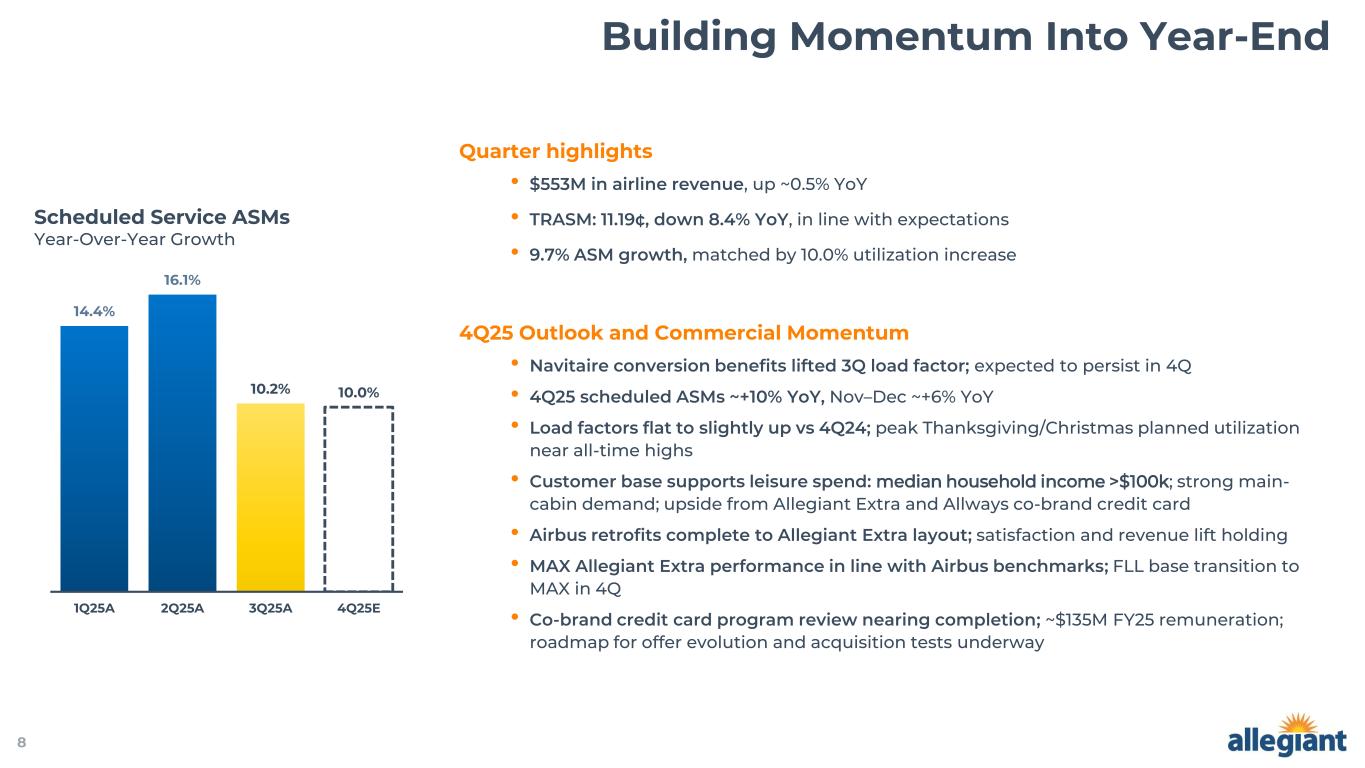
Thank you, Greg, and thanks to everyone for joining us this afternoon. We finished the third quarter with $553 million in airline revenue, approximately half a percent above the prior year producing a third quarter travel of 11.19 this is down 8.4 percent year over year in line with our internal expectations from our mid-quarter update inconsistent with the original expectation of sequential year-over-year improvement allegiant grew total asm 9.7 percent for 3q24 with overall utilization of 10 percent also consistent with our audit call was the expected unit revenue improvement in the same capacity markets first the second quarter which recovered approximately one point to down about five percent year over year again perhaps oversimplified with a growth expected trash and headwind of approximately four points we slightly outperformed the combination of core flat capacity performance and the expectation from our elevated growth rate further within the quarter we saw all three months produce better year over year unit revenue figures than any month on the second quarter and the best low-factor results for its prior year of any month year-to-date. Meanwhile, the profile of new market ASMs as a percent of the total steadily ticked higher. The third quarter ended around 5%, while the fourth quarter will ramp up to over 5.5% of scheduled service ASMs and is expected to rise again in the first quarter. 51 routes operated in December of 2025 that did not operate in the previous summer. of those approximately 85 percent of contributed positively to earnings in their first summer of operation the results from these markets rolled into announcing more new and exciting route opportunities through the third quarter 19 new routes are set to begin thanksgiving to early spring including 40 cities fort myers florida puntsville alabama atlantic city new jersey and bourbon california we're encouraged by the early performance of our new cities and markets and and continue to see customers embrace our reliable and convenient travels at unbeatable The third quarter of 2025 marked three consecutive years of industry commentary around out-long PE to off-PE relationships in the quarter, be it the tail end of the post-pandemic demand surge into a more typical fall in 2023, or the relatively sluggish July marked by late summer demand uptick into the fall over the last two years. All three of those quarters saw sequential travel declines from the second quarter below pre-pandemic median levels meanwhile a fourth quarter has remained more resilient with each of the last three years hitting a travel above 13 cents a feat we'd accomplished in just one quarter pre-pandemic as a result of the diverging quarterly trends our 4q performance have looked relatively better each year and that pattern is expected to continue in 2025. as mentioned on the last call we expect sequential improvement in the year-over-year travel intervals for the fourth quarter and that should hold into the first quarter of 2026 as well the converting benefits from natural development we discussed in the last call yield a load factor benefit in the third quarter as i described earlier and should persist into the fourth quarter despite a roughly 10 percent scheduled service asm growth profile in 4q25 we expect load factors to be flat to slightly up in the fourth quarter versus 4q24 and raw capacity for the quarter as the whole is expected to grow roughly 10%. Much of that is due to the weather-impacted comparisons of October 2024. November and December 2025 expect the volume to be approximately 6% higher year-over-year for scheduled service ASMs. Our peak Thanksgiving and Christmas week utilization profiles slightly higher than prior year and around all-time highs during the peak period. We are incredibly encouraged by peak holiday demand profiling similar to last year as well. our customer base remains well positioned for leisure travel our network lends itself to a lower cost of living profile with median household income over 100 000. we continue to see demand turning closely to legacy common commentary on main cabin performance as well as continued opportunity with our legion extra cabin our award-winning allegiant always co-brand and credit card loyalty programs and beyond we completed a multi-year journey retrofitting our airbus aircraft with the allegiant extra layout we continue to see results hold through the expanded offering and repurchase rates growing further the results on the max aircraft are in line with the expectations set by current airbus performance and we should see start to see efficiency benefits from the transition of our fort lauderdale base to solely max aircraft in the fourth quarter our formal review of the co-brand program is nearing an end we expect to receive approximately 135 million dollars of remuneration in full year 25 but as we've expected given the time since program launch we believe there will be meaningful opportunities for evolution and improvements however there are a few of the easy parts of course and we will soon shift into execution mode working through the negotiations logistics and bringing the plan to life in the short term we continue to test new acquisition tactics and offers we realized mid 20 percent lift on new card acquisition in the month of september and october as a multi-year core system transition moves into the rear view mirror our foundation and technology can enable further commercial and business and we're excited to bring the customer experience at a value into focus the legion extra co-brand program updates and other commercial developments allow us to better segment for a broad spectrum customer preferences and now i'd hand it over to robert hill mr president thanks and good afternoon everyone i'll go ahead and walk through our results and provide an update on our outlook and financial position as with prior calls my comments today will reference results that have been adjusted to exclude special items
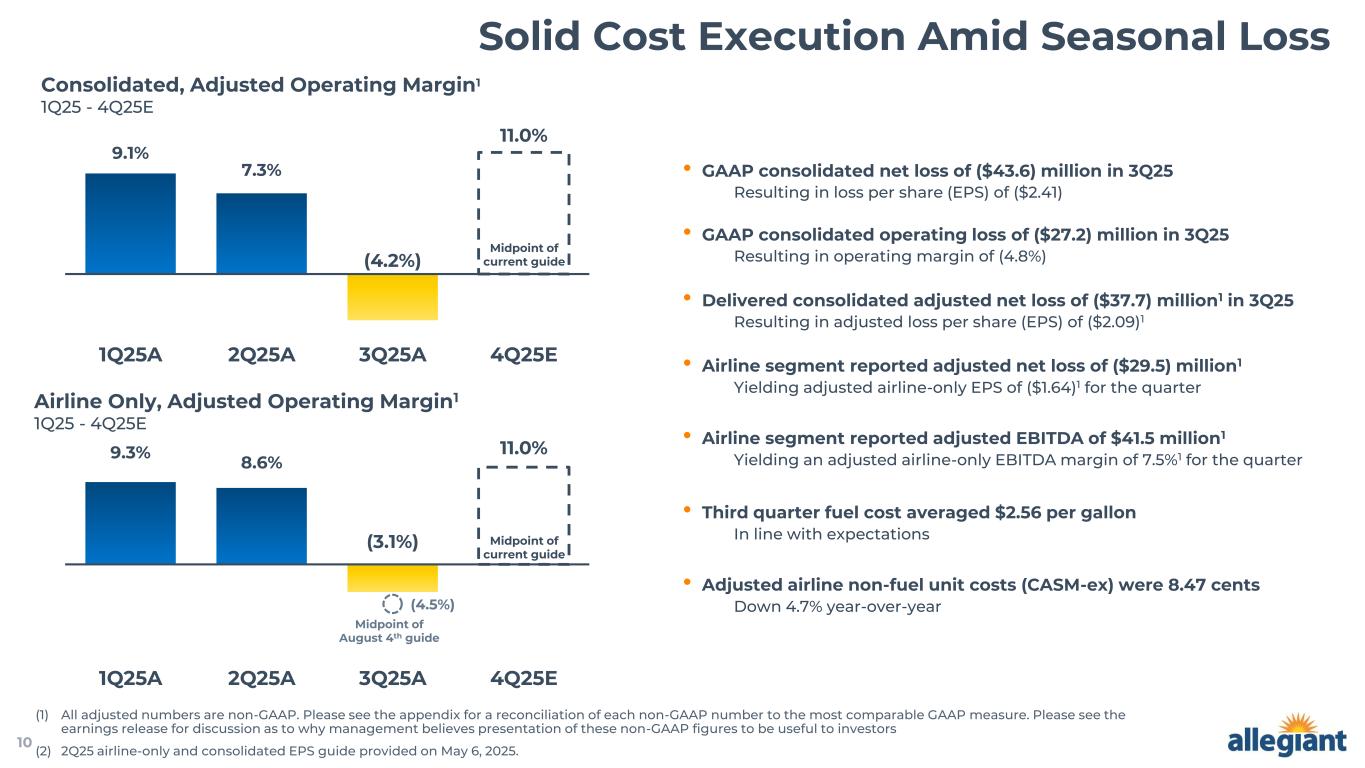
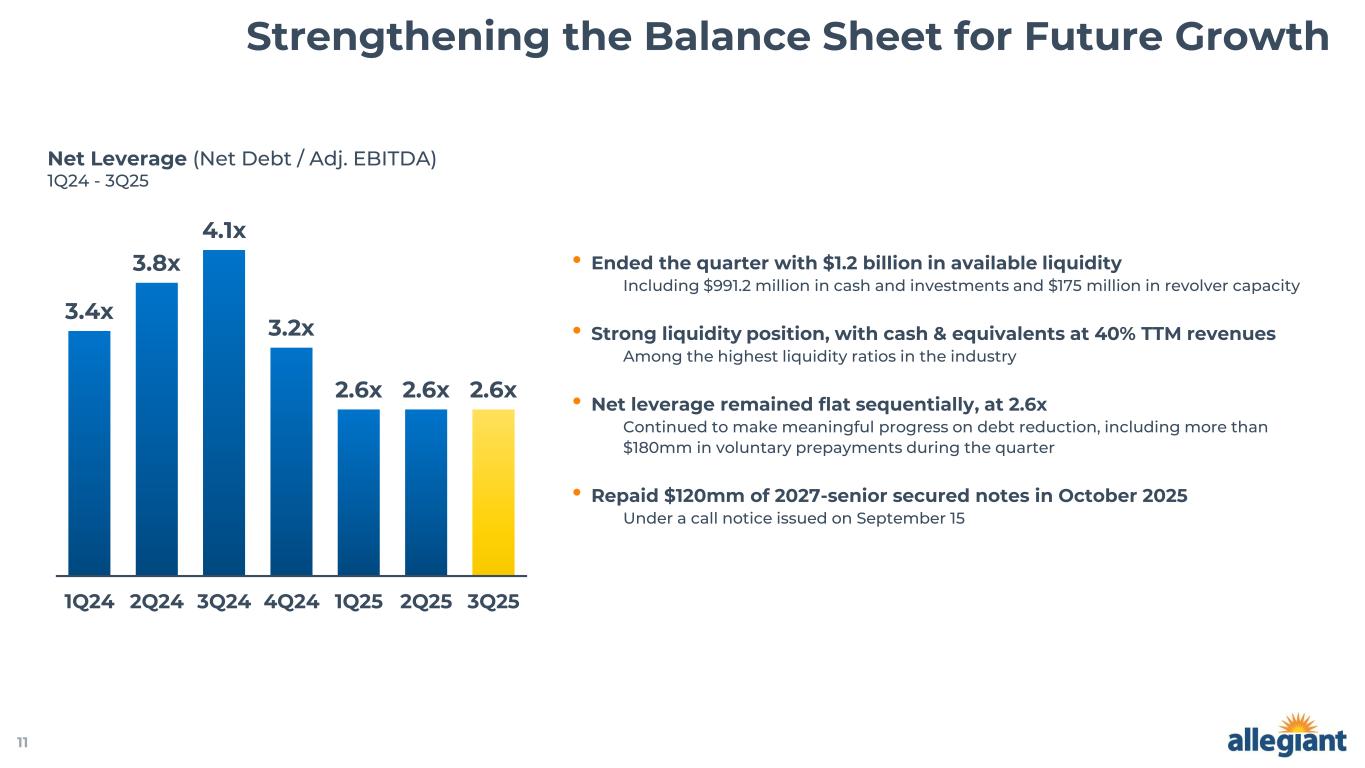
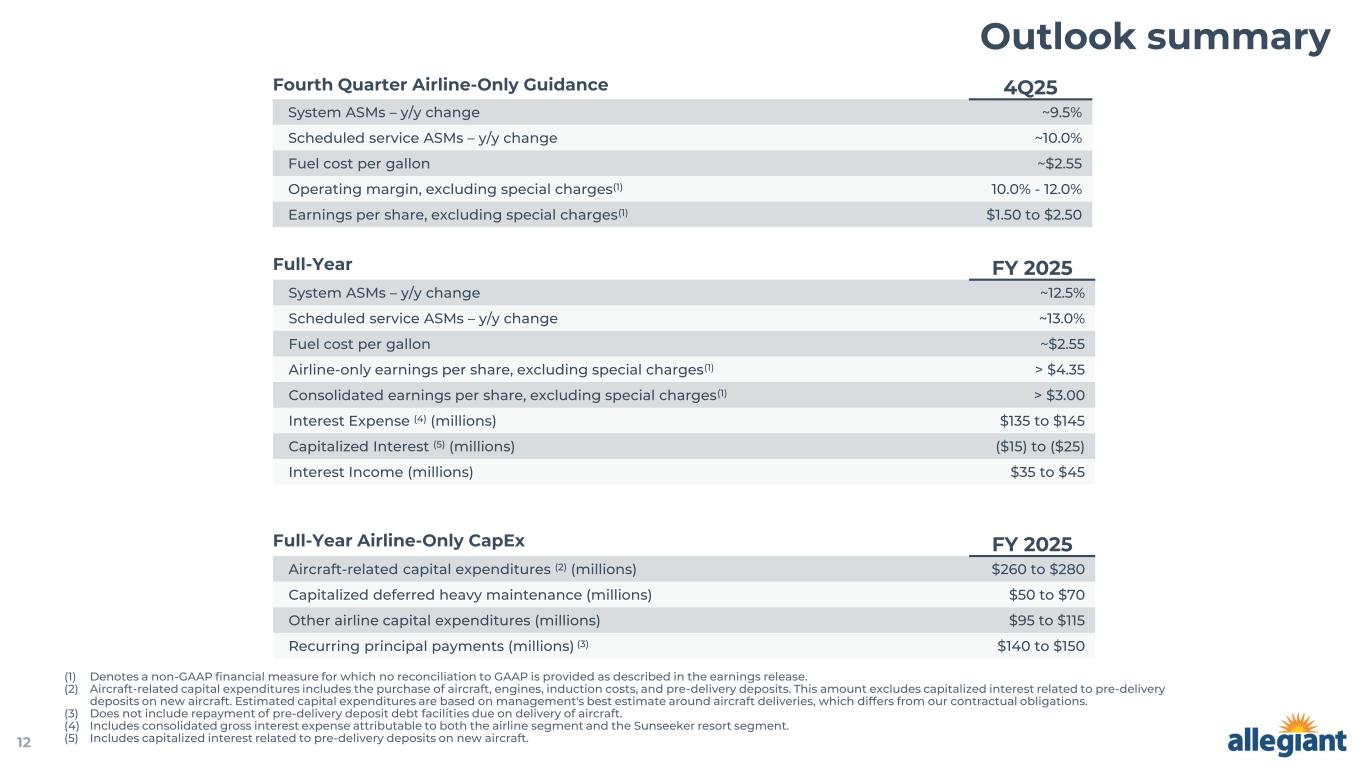
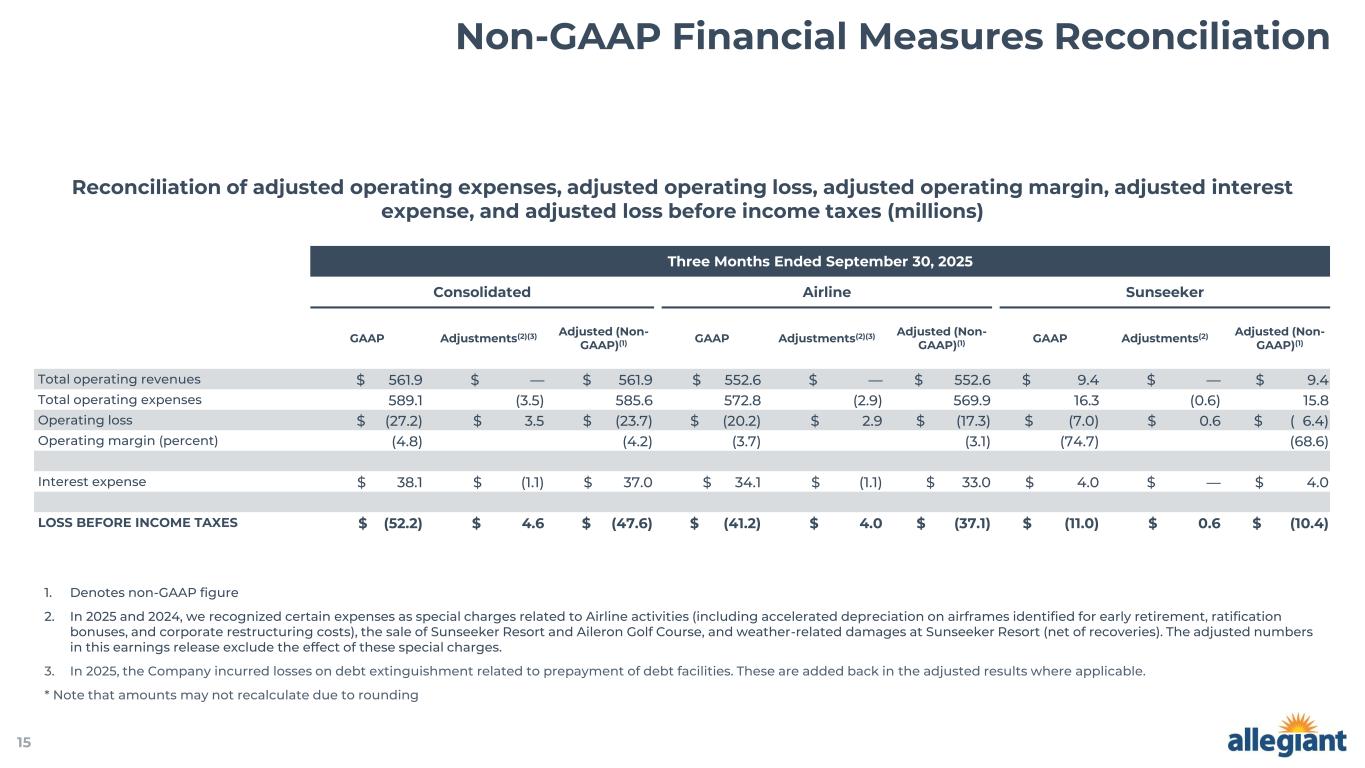
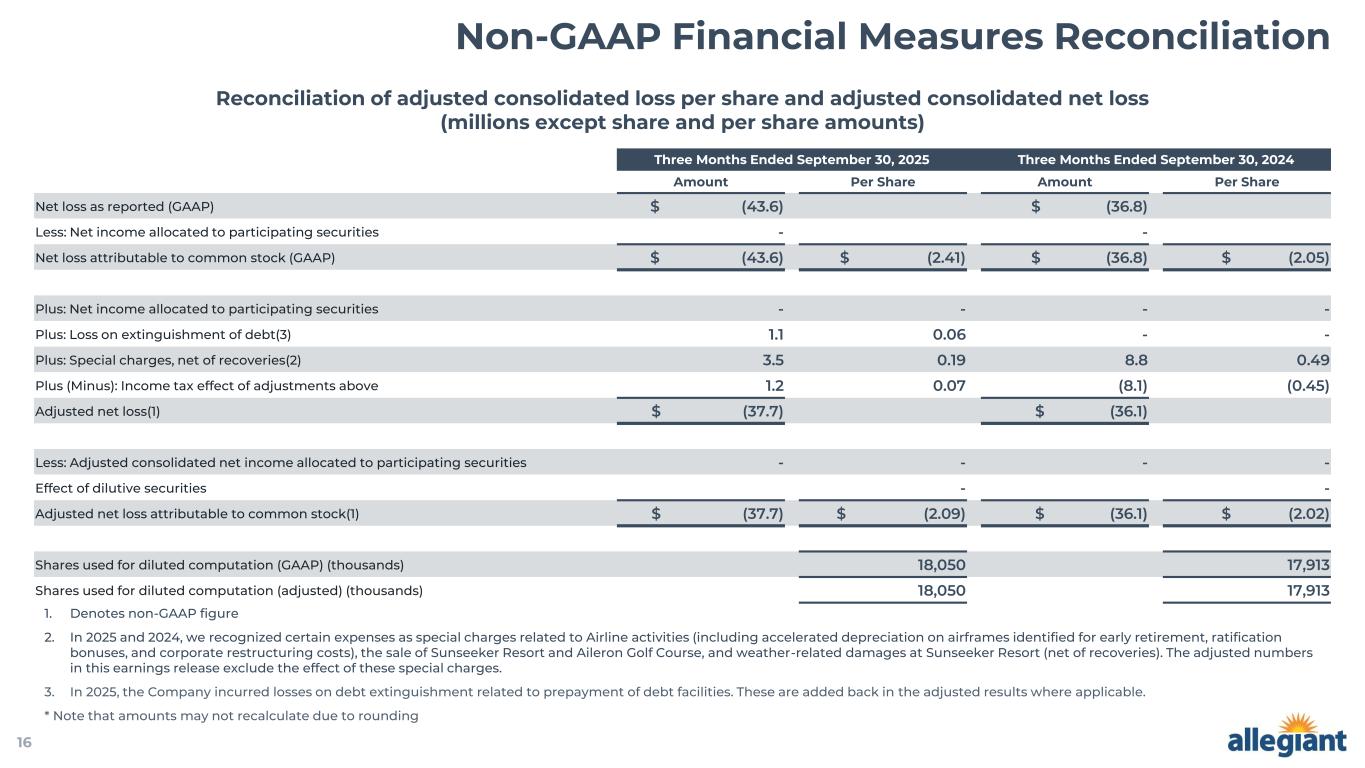
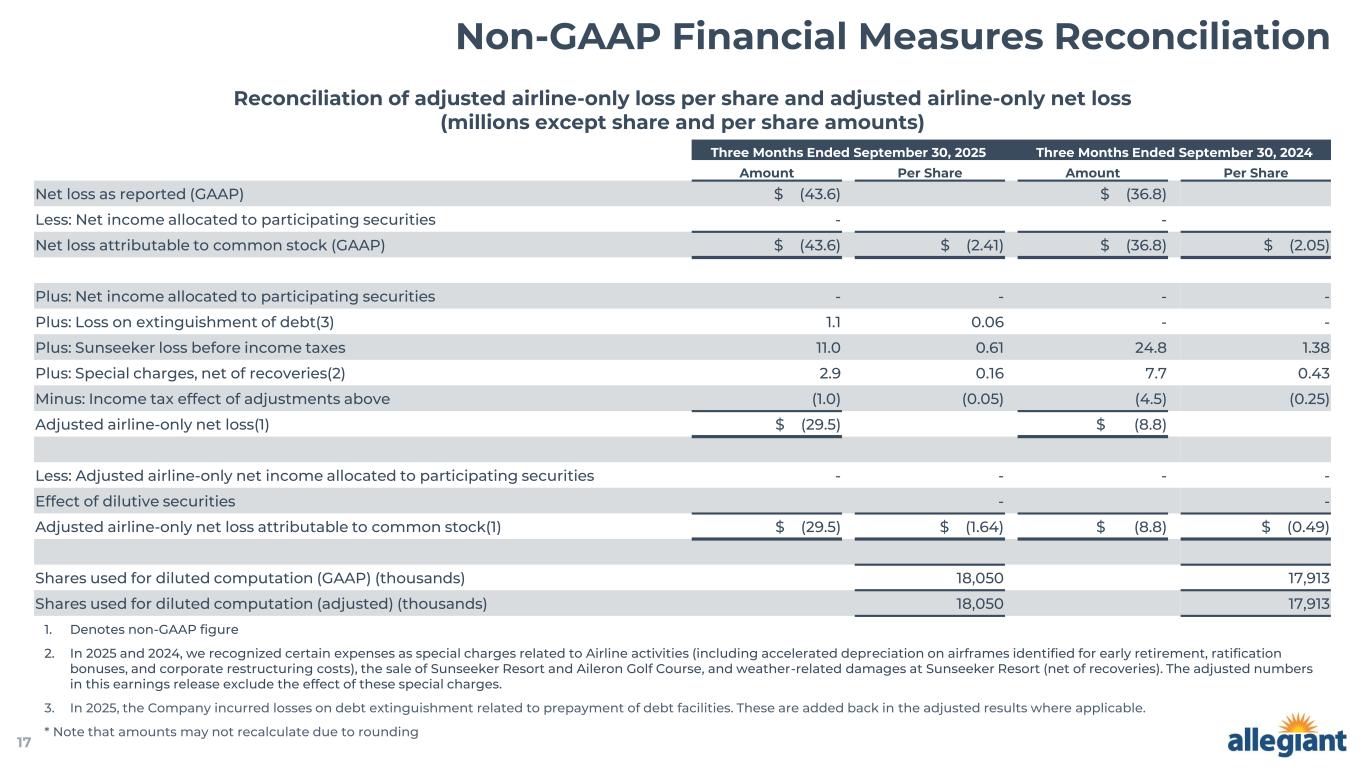
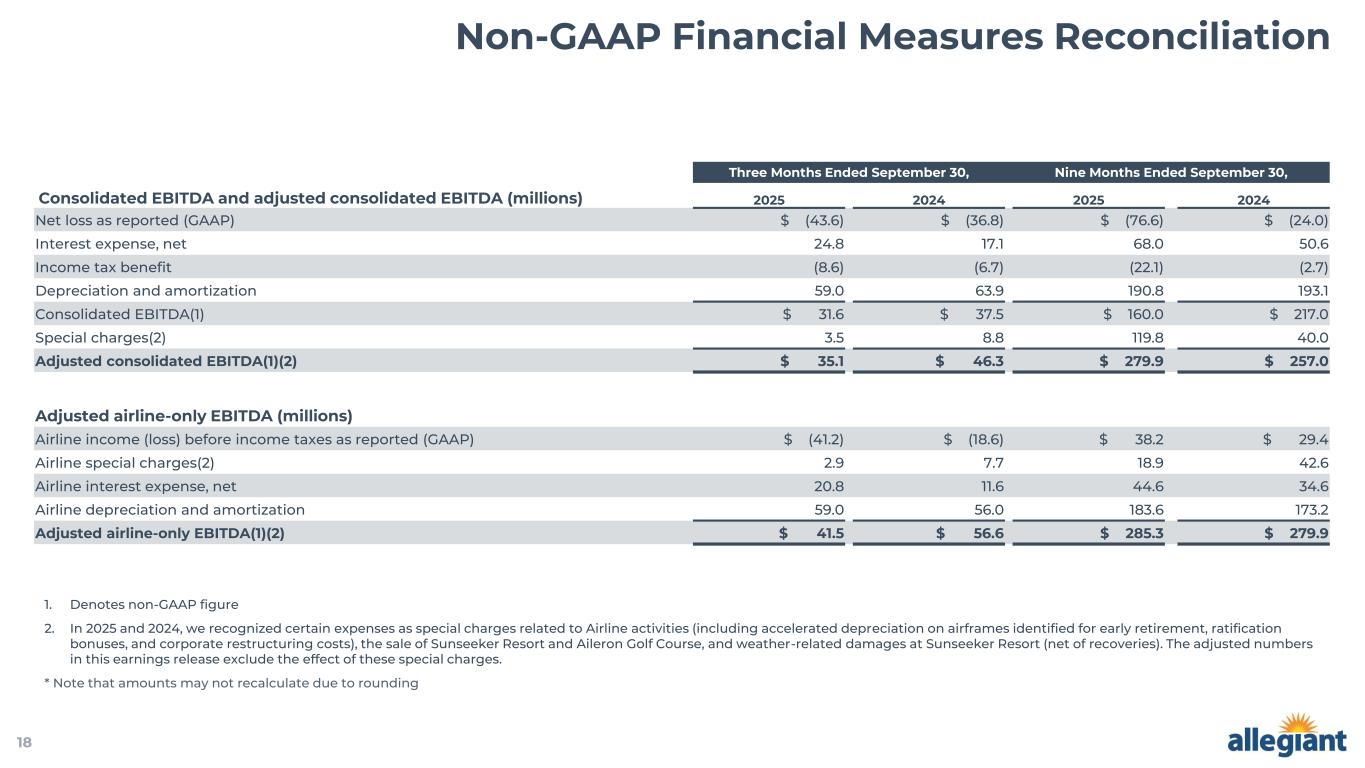
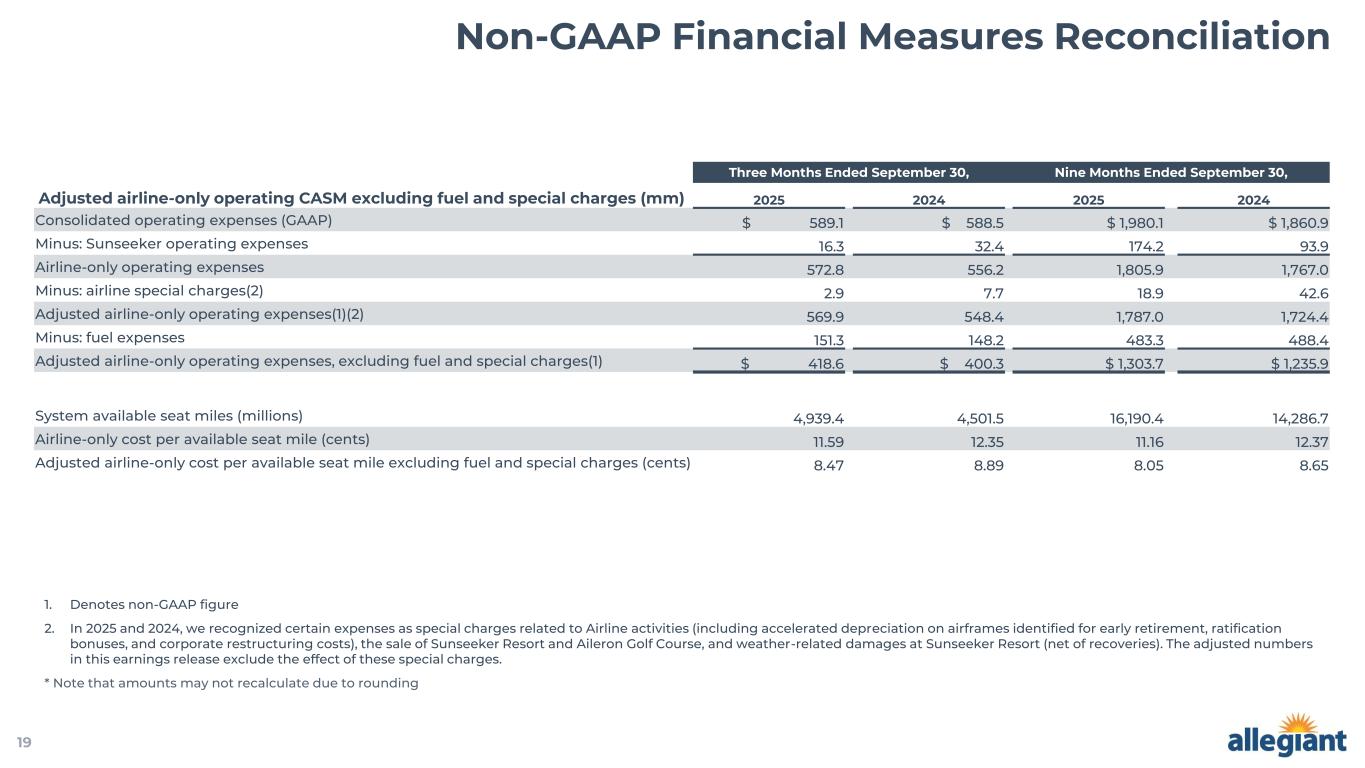
unless otherwise noted this afternoon we reported a consolidated net loss of 37.7 million dollars for a loss of two dollars and nine cents per share we had a net loss in the airline segment of 29.5 million for a loss of one dollar 64 cents per share our airline segment generated a negative 3.1 operating margin which was at the better end of our original guided range as suggested in our august traffic group traffic release the quarter came in ahead of our forecasts on both costs and revenue while a reduced tax benefit brought eps slightly below our september expectations this was driven predominantly by a change in our estimated tax rate which reflected with an improved revenue outlook for the remainder of 2025. Notably, the sale of Sunseeker Resort closed on September 4th, marking a significant milestone for the company, supporting balance sheet improvement and driving better consolidated earnings. Airline EBITDA for the quarter was 41.5 million, giving us an EBITDA margin of 7.5%. Through the peak summer season, our team delivered operational excellence for our customers, which underpinned cost performance that continue to exceed our forecast third quarter non-fueled unit costs were down 4.7 percent year over year our ability to leverage existing infrastructure grow into our workforce and execute on the cost initiatives outlined on prior calls has resulted in industry leading cost performance year-to-date with a nearly seven percent reduction in cabin next fuel through the first nine months of the year our unit cost performance kept the shape we expected at the start of the year despite removal of four and a half points of capacity growth during the year primarily coming from the third quarter with full-year capacity growth of 12 and a half percent on flat aircraft and reduced head count we are on track to see full-year casimetics down mid single digits and i want to thank the entire league and team for their remarkable execution our cost structure remains a top priority as we look ahead to 2026. we are realizing the full benefit of approximately 20 million in run rate savings initiatives implemented this year which delivered ahead of schedule and will carry over into next year i'm very pleased with the continued focus and discipline the team has demonstrated on this front before i move on from costs i will mention the increase in the maintenance line this quarter a portion of this was timing related and a shift from the second quarter largely related to an elevated number of road board repairs there There was also some maintenance then associated with aircraft lease returns, and to a lesser degree, some tariff costs on parts. Although this will continue for much of the fourth quarter, I view nearly all of this as transitory. Our unique flexible capacity model is rooted in a strong balance sheet. At the end of the quarter with total available liquidity of $1.2 billion, consisting of $991.2 million in cash and investments, and $175 million in undrawn revolving credit facilities. Cash and investments sat at 40% of trading 12-month revenue at quarter end. With this robust liquidity position, we continue to make meaningful progress on debt reduction, including more than $180 million in voluntary prepayments during the quarter. Additionally, in October, we repaid $120 million of 2027 bonds under a call notice issued on September 15th. We expect total debt to decline a bit further by year end. Net leverage remained unchanged from the end of the second quarter, and we anticipate ending the year at a similar level we're continuing to make long-term lasting investments in the business capital spending was approximately 140 million for the quarter including 107 million for aircraft related capex and 22 million in other airlines to spend while deferred heavy maintenance capex was 11 million we ended the quarter with 121 aircraft in our operating fleet down from 126 at the end of the second quarter during the quarter we took delivery of three aircraft one of which entered revenue service while four leased aircraft exited service and two airframes were sold to a third party looking ahead we expect to induct six 737 aircraft into revenue service and retire four leased a320 series aircraft during the fourth quarter bringing our year-end fleet count to 123. boeing have produced ahead of plan with all of our 2025 aircraft having been received by the end of the third quarter and we continue to expect four-year capex of approximately 435 million now on to our fourth quarter operating outlook the improvement in bookings observed in late july has continued at the midpoint of our guidance we expect to produce an 11 operating margin and deliver consolidated earnings of approximately two dollars per share which following the sun seeker sale reflects solely the airline segment the fourth quarter performance should result in four-year airline only earnings of more than four dollars and 35 cents per share although we're not going to provide guidance on 2026 i will share some high-level commentary we expect to take delivery of 11 737 max aircraft next year all of which will replace a319s or a320s resulting in flat year-over-year flea craft flea count with respect to capex we're working with boeing to update 2027 and 2028 delivery schedules following their recent approval for increased production rates which will inform the requirement of pre-delivery deposits and overall capex profile for 2026. we expect capex to be above 2025 levels though we do not expect this to place meaningful pressure on that leverage we're not anticipating notable capacity growth in 2026. while not guidance we expect the year-over-year increase in traffic driven by limited growth industry supply moderation and revenue initiatives as Drew has mentioned, to exceed any increase in CASM-X. Not fuel unit costs will experience some pressure given limited growth, but the team has done an excellent job driving structural costs out of the business. Additionally, with approximately 20% of our ASMs going on fuel-efficient MAX aircraft, we expect the differential between TRASM and CASM to result in margin expansion next year. In closing, I'm very pleased with the team's operational execution and financial discipline throughout this year. throughout 2025 team allegiance ability to manage through what has been an earning setback for the industry has been impressive it's an exciting time at allegiance as we turn the corner to 2026 with the sale of sunfeaker completed a strong balance sheet and continued progress on cost and food initiatives we're structurally well positioned to deliver higher and more consistent earnings in 26 and beyond and now calvin we can go to analyst questions thank you ladies and gentlemen we will now begin the question and answer session.
Operator
During the Q&A, we ask that you please limit your inputs to one question and one follow-up. I would like to remind everyone to ask a question. Please press the star button followed by the number one on your telephone keypad. If you would like to withdraw your question, please press star one again. One moment, please, for your first question. Your first question comes from the line of Savvy 6 of Raymond James. Please go ahead.
Speaker 1
Hey, good afternoon, and congrats, BJ, and maybe I'll give the first question to you as a result. You mentioned a little bit about CapEx stepping up but not meaningfully impacting leverage, but could you talk a little bit more about how you're thinking about the balance sheet now that there's a little bit more stability across the operation and with FundSeeker out the way just how are you thinking about cash levels and uh leverage um and just cash flow generation thanks thanks abhi i appreciate the comments yeah um so when we think about next year i guess i would remind you we had a limited uh a limited amount of pvp capex in 2025 because we were catching up from pre-delivery deposits that had been made in prior years in the face of some
the aircraft away so i expect those to come back into the capex profile uh next year uh as i think you're getting out we were carrying um quite a bit of cash at the end of the quarter that was partially a result of the sun seeker sale and then also and i think maybe i mentioned on a previous call we kind of over financed our max deliveries at the beginning of the year and that was just um out of caution with what we were seeing in some of the economic headlines back around the april time frame. So I do think we can get to a point where we're carrying a little bit less liquidity on the balance sheet. We've historically talked about two times air traffic liability. And as things have started to stabilize and some figures behind us, and especially as we have aircraft demands further out, we can bring those cash levels down a little bit. We will continue to use cash to invest in the business, though, for the rest of 25 and, of course, 26.
Speaker 1
But that's helpful. And if I might, just on the, I'm not sure if this is Drew or Greg, on the kind of AI and data infrastructure side investments that you're talking about, you know, generally you think of kind of large organizations as having an advantage there. Could you talk about just maybe how it's being implemented at Allegiant and maybe what advantages, disadvantages you have versus some of your bigger peers?
Sure. Let me take it off and Drew will add some color, I'm sure. But starting on the AI front, Savi, just as an organization, really proud in the way we're embracing AI to make our business better. We've been working over the past year or so on our structured and unstructured data to ensure that it's in the right place for advanced technology and deploying solutions here at HQ across the board, such as Copilot for our developers, GitHub, which is improving productivity in that regard. We're reshaping functions across the board, but in areas specifically like the call center, our operations, where we're using AI and use cases to drive more efficiency, productivity, and we're just scratching the surface. One of the things, though, I think that's important is a lot of the changes that come from AI are through change management, and as an organization, we're building that muscle, and the reason we're feeling confident about kind of building that muscle and it's crawl before we walk, walk before we run type attitude is because of the transformation of technology stack that's in place now, which is best in class, and I, we've talked a lot about it, what the IT team has done over the past couple of years. They've definitely taken what the whole airline is built on proprietary software and moved did to state-of-the-art systems we talked about navitaire sap tracks and other systems and so now that we have all those in place we're really able to start harnessing and leveraging um where that's at to be a little bit more nimble and drew's got a whole list of priorities and initiatives along with the rest of the team but drew i kind of went off on on it a little bit anything that adds up from your perspective no i'll be fairly quick you know on the ai front there's you know There's wins as it pertains to revenue modeling and how we think about offer management as we think about right-sizing the combination
of air pricing and ancillary pricing, which is sort of a major challenge to solve. There'll be some wins there. You're right, as a small organization, we have to be a little bit more nimble. We won't get the benefits of scale that the larger ones will. That's not to say there's not wins here. I'm really bullish on what this could mean for 26 and beyond, but we're kind of in the development phase now.
Operator
Your next question comes from the line of Duane Fendingworth of Evercore ISI. Please go ahead.
Hey, thank you. On the flattish 26 capacity outlook, how are you thinking about the shape of that by quarter and specifically how are you thinking about 1Q growth?
And I don't know if it's too early, but, you know, can you characterize maybe the difference between uh the shape of off peak versus the shape of peak uh within that flattish outlook sure dwayne i'll give it a try here um so that the shape will be kind of you know down low to mid single digits in each of the first couple of quarters um just following the the shape of flea um we'll be slightly down but i guess more down on off peak at that uh in the first quarter while keeping relatively flat you know utilization through the march peaks in particular with easter pulling forward a little bit you'll see if april come down a bit more but similar story in in the second quarter is off peaks will underweight relative to peak periods to to form that um back half the year kind of you know inverse you know it'll be off low of this you know just get back to that flattish outlook and duane i'll just add the true point there is there's going to be a higher percentage we're planning on a higher percentage of peak capacity uh next year than say this year that's helpful and then i don't i don't know if you're able to do it but on the max can you speak to how you were able to deploy those aircraft you know what base limitations you may have had this year uh and how those constraints ease up
I guess I'll stay with you, Drew. Maybe you could just speak to the types of routes the MAX had to fly this year versus the optimal routes you'd like them to fly on.
Yeah, so through, I mean, really from the time of the first delivery until this week, next week, we've flown very heavily on short haul markets trying to maximize the number of takeoffs and winning things to help facilitate some of the transition training needs. uh we had to get pilots certified and ready to fly um as we beefed up that number of pilots efficiently um we'll we'll see that shift more towards longer halls uh taking a little more advantage of uh of the stage length and dual burn benefits there um as we flipped the fort lauderdale base to solely max what we'll get um we'll get a stage length benefit there as well as a little bit longer haul than the land of and st keek um we didn't necessarily have base constraints we opted to split sanford and st p to start um just help provide a little bit of resiliency in the event of uh changes to the delivery schedule from boeing i have a little bit of a shock absorber there where airbus could replace that we know we could do more boeing flying as the deliveries are shaped up um and then with four longer we're keeping things fairly geographically uh centralized uh to ease and just some of the logistics uh that may come about. As we get to the back half of next year, you know, we'll kind of hit our next wave of base considerations as more deliveries come in and stay tuned. But as of this point, there's no real constraints, at least that I'm aware of, only to the rest of the team family, but this has all been kind of our choice on trying to maximize both the efficiency of the introduction of the fleet, but as long as just the continued operation.
Operator
Your next question comes from the line of Scott Group of Wolf Research. Please go ahead.
Hey, thanks. Afternoon, guys. Can you maybe just talk a little bit about some of the underlying RASM, CHASM assumptions for Q4? And then, I don't know, any color on what you're seeing with the government shutdown? Do you think maybe are your smaller airports being less impacted? Does it start to have any impact on demand? Just any thoughts there.
Thank you. hey scott it's dj here i'll start on on the chasm side it's probably uh a bit easier you know i talked about the shape of our um chasm performance this year um generally holding with comments that we made at the beginning of the year which should get us to um make single digits by the end of the year um and i guess you can back into what that does for the fourth quarter but i would tell you that um you know we expect continued goodness year over year in the salaries and benefits and DNA line that you've seen in the prior quarters, and then continued pressure in the fourth quarter in the maintenance line and the rent line, both of which I think are transitory.
Yeah, on rent, all we've really said publicly is that we expect the continued sequential improvement on a year-over-year basis. We know that the implication here is we're pushing towards the extreme of the fourth quarter versus third quarter performance, but I tried to address that a little bit in prepared remarks that it's as much a four or three key story that is four q as those are kind of diverging from a just a customer base and demand base it seems um on on government shutdown we haven't seen anything meaningful flow through bookings or or demand at this point yeah i do feel pretty confident that the longer this drags on that the more likely we are to see impact and certainly if it does stretch all the way to thanksgiving uh that that would be a huge huge problem for the industry as a whole. I have some confidence that we will get through this as a country and a government ahead of that and strongly urge Congress to unlock this.
And then, you know, your comments about TRASM exceeding CHASM next year, I guess if you have any more color there, that'd be great.
And then, you know, as I think about what you were saying on one of the earlier questions first half capacity is down a bit so pressuring chasm a little bit do you think you see trasm exceeding chasm all year or is that should we think about that more as a back half trasm exceeding chasm sort of comment hey scott it's great maybe let me i'll start at a high level and then guru bj will add in some color and shirt uh just just of taking a step back we've accomplished quite a bit here in 2025 uh strengthening the airline we're going to build on those accomplishments in 2026 so that i think about the margin improvement for 2026 and if you break it into three or four areas one the travel tailwinds which at a high level you know with flash capacity that should also obviously help on the universe side but but also applying a higher percentage of peak days, right? Versus off-peak were helpful. The commercial initiatives that we've been talking about all year, Legion Extra, Navitare, are larger contributions next year than in 26. And this year, loyalty contributions are exceeding revenue growth. Drew may wanna hit some more on the Trasm front there, but on the cost side, just BJ and team, and they've gone through a couple of passes of the budget. So while we're not final, we're in the, I guess, mid-innings of it. And I think the costs have come in to a point where it gives at least us confidence today in the area that we can control on the cost side, that we can keep those at a point of which, if all else being equal on the demand side or the revenue side, that we'd be able to see, you know, margin expansion. The max performance, we've talked a lot about that. 20% of our ASMs next year will be going on the max. to kind of frame that and the benefits we get from a fuel perspective. The ASMs per gallon on a max are just over 100. It's like 105, I want to say, versus the A320 series is closer to 80. So call about a 30% benefit in that regard at the same ownership cost.
So that and then coupled with all the technology initiatives and just continuing to get better, drive more productivity and efficiency, our plan now has for margin expansion next year. um and we think we can build up to that all right yeah i'll just add a couple things here so scott we're um in kind of the second phase of our um budget planning for next year so it's not final i don't want to go so far as to give guidance but you can kind of read into what uh drew talked about in terms of the shape of capacity next year relative to fleet counts um with uh being down a little bit in the first two quarters that's going to put the most pressure on cabin x um in the first two quarters of next year. And then, like Greg said, I'm relatively optimistic that even given limited growth, that we can hold the line on cost next year, just given some of the structural cost improvements that we've made this year.
Thank you, guys. Appreciate it.
Operator
Your next question comes from the line of Ravi Shankar of Morgan's Family. Please go ahead.
Great. Thanks, everyone. So it seems like it's a clear coast ahead. Obviously, SunSeeker is behind you now. Margins are starting to improve. It feels like you're on a better path with stable capacity and the chasm present relationship with everything else. So can we start to dream the dream about what normalized EPS looks like again? Obviously, coming out of the pandemic, it is a very different level than you guys are right now. How do you think about what that long-term trajectory looks like and that destination as well?
Thanks, Ravi. Let me kick it off. Again, we're not going to guide 2026 or long-term EPS at this point, but our goal is to get back to solid double-digit operating margins, and that's what we're executing towards. We talked about the work, the great work that's been performed by the team this year in harvesting all that work in 2026, and we expect margin expansion there, and all that's being equal. I think in 2027, there's still more initiatives as we prioritize and continue to improve in different areas of the business. We think continue to expand into 2027. And Drew and his team, I think, have done a really good job of kind of walking through a framework of our commercial strategy. And this is more tied to the longer term, I think, margin, improving margins or driving higher margins. And I mean, it's from continued loyalty enhancement to different products, non-ASM revenue in different areas on that front. I think BJ and team on the cost side has done a terrific job. We're unique in the industry in the sense that we have high variable costs, low fixed costs, but it doesn't mean that fixed costs aren't material for us. And so when demand stopped in this year, by way of example, I think the team reacted quickly. We scaled back growth, but then we went in and took out some of the structural costs. And so I mentioned that because looking ahead towards 2026, 2027, and beyond, we're always going to take a hard look at our cost structure. We're going to continue to find ways to better optimize the business. I think the max please as well. If you think about 27, 28, the efficiencies we're seeing there, by the time we get to 2028, I'd expect 50% of our ASMs are flown by the MAX aircraft and driving a nice tailwind on the fuel side. So we've talked about it. We teased it on the last earnings call. We probably think it's helpful at some point next year to have an investor day to really walk through some of these initiatives, the guardrails and what we think our objectives are and our opportunities are. But I think it's just a high level on the earnings call today where we sit. We feel confident that 2026 we can drive higher margins all seen equal in the demand and fuel backdrop. And we can continue to build on that momentum in 2027.
Got it. Those are helpful building blocks. And maybe as a follow-up, can you give us an update on the Vegas market and what you're seeing there and remind us of seasonality there again? Also kind of easier comps next year.
Do you think that can bounce back from some of the headwinds earlier this year? yeah obviously vega still you know underperforms where we'd like it to be it has definitely shown improvements uh over you know through the summer and through the fall um maybe on the seasonality front it's historically been a very unseasonal market you know pre-pandemic it was it was very reliable year-round um it definitely feels more seasonal today um than it had which is unfortunate um given how much of a rock star it has been for so long um fees are definitely coming out of the market, I think there's room for more improvement. I've seen more from the Vegas resorts in terms of innovative ways to recapture customers and recapture trips. So I think there's better times ahead for Vegas, but we're still kind of climbing out of the hole a bit.
Operator
Your next question comes from the line of Michael Lindenberg of Deutsche Bank. Please go ahead.
Hi there. This is Shannon Daugherty, on for my crew starters. Congratulations on your promotion, BJ. This first question is probably not for you, but maybe to Drew, can you guys speak to how your competitive landscape is evolving, moving into new cities like Atlanta City and Burbank? And I'd also be very interested to hear more about the 15% of new routes that you launched this summer that did not perform to expectations. What did you see there?
Yeah, so maybe first on what I think was about kind of the new city selection, you know, continues to be the same the same pillars that guide all of our network selection um looking for unserved and underserved markets uh that that fit you know our customer profile well um Atlantic City we've seen some reduction in seats at the market we've an airport we've been talking to since 2017 2018 and we felt like the time was right um for us to move in there um on on Burbank and we've talked at length about LAX and the cost structure there was becoming a bit untenable for us and so we we kind of diversified our our basin um capacity between burbank and and fna uh where we've been in for a few years now um you know i think burbank's going to be going to be a great addition um so that's going to be that's going to be helpful for us um on the competitive capacity front within those cities obviously you know there is some capacity on on atlantic city and and on half of our Burbank selection. Yeah, it's not something that we're running away from capacity or capacity at any front. We're trying to do what's right for Allegiant, run our rates, and we've found success on some of these markets. And on the 15% where we weren't successful, we'll take a look at each of those some. You know, it's the first year. It may or may not be meeting expectations, but there should be some level of maturity and run rate associated with those.
And for those we don't see a future that'll come out. we won't operate them next year uh it's kind of that simple we've got a long runway of new opportunities um so i have no issue cutting bait on the outcomes and finding something new shannon it's great i just want to add to this commentary there that you know for serving the domestic leisure space our low utilization taxable capacity model works works well i i was interested i thought drew uh provided an interesting comment in his opening remarks uh i paraphrased but it's along the line of the resilience of our leisure customers who they represent all facets and facets of the economy they like to travel they have the means to do so and what he and his team
are doing and continuing to find old markets that are low fares and convenient non-stop service um it's a strong value proposition that's great and maybe just bigger picture right is is the demand that you're seeing today supportive of higher growth in the peak periods than slattish like expecting next year i guess i'm just trying to figure out how constrained you are from a utilization perspective um for the the you know most peak periods you know and you know really that's that's the holidays and and spring break sprints um well maybe not a hundred percent at our max utilization but we're pretty close we're pushing as hard as we've ever pushed um through the holiday period i think we have just a little bit of slack in march um you know kind of more growth would come in the off-peak, such as the environment called for, where demand would peak up or fuel would meaningfully come down. You can find a little bit more in there. I think as we get toward the summertime and that schedule comes out, is out now, we'll be in the oral public things in the coming weeks, you'll see a little bit more slack that we can add into on that front.
Operator
Your next question comes from the line of Conor Cunningham of Milius Research. Please go ahead.
Hi, everybody. Thank you. Congratulations, BJ, on the promotion. I was hoping we could talk. So, yeah, the MAC situation, you're obviously talking that up a fair bit with, I think, Greg, you mentioned that it's going to be 50% of your capacity in 2027, 2028 or something in that timeframe. Can you just talk about – in the past, you've talked about, like, a rule of thumb around EBITDA per aircraft, and I would just think that there's – the max EBITDA contribution is way higher than the current A320 fleet. So, just any, like, high-level thoughts around that? I think you mentioned 30% fuel efficiencies, but is there anything else that's within it that could be helpful in building that type of thought process?
Yeah. Yeah, maybe let me kick that one off. And we talked in the past, Connor, quite a bit pre-pandemic, I think, that $6 million of EBITDA per aircraft was our true north. I want to say right now, what are we, roughly $3.5 million of EBITDA per aircraft thereabouts. I won't go into all the detail on the initiative that we've either completed, are completing, or plan to complete, that I'm talking about around margin expansion, because I think you want to zoom a little bit more in on the max aircraft. uh a couple comments that i think are interesting one that the earnings on it today now it's still early are 20 30 higher than the a320 seriously i want to dig on that and dig in on that a little bit here um but the other thing is the operational reliability it is outstanding it's it's not quite a point but nearly a point higher than the um in the 320 seriously uh but some of the questions as you think about the way we deploy capacity drew and his team when you think about utilization uh i think about it in thirds so in terms of lines applying so you have the first third what drew utilization roughly eight to ten hours per aircraft per day and the middle third of the middle trance roughly six hours and then you go from three to four hours on the lower trance but so obviously with these aircrafts we're going to put them in on our highest lines of flying just because of their performance and their um reliability but drew did an interesting study where because of our base structure was comparing the highest lines of flying in base a versus a max performance in respective bases and it's still flight for life significantly outperforming um the 320 just given you know just given the economics that we've talked about in the past
but drew i i'm excited about the max and what we're seeing continuing to take more deliveries of those aircraft we have the same ownership costs in general as a 320 uh so it's commercially a good deal for us and uh bj anything else you want to add no i'll say one step but i mean that was comparing the highest lines of flying regardless of base on the airbus to the max performance um and in the output of that 20 to 30 percent uh putting it on a highly utilized uh base like fort lauderdale is going to have immense benefits and will continue to be selective on where those aircraft go to make sure that we're getting the most value for those going forward it's improved yeah and I'll just add one thing thanks Connor um you know we we've talked about the overall
earnings of the max at this point being you know it's about 30 better than the system average as you would expect most of that comes from fuel efficiency um but there's still uh there's still a bit of improvement in other optics as well primarily coming in uh on the maintenance line just don't want to underappreciate the value of the maintenance honeymoon we had gone a few years where we weren't adding any new airplanes and that meant two things you know one we weren't getting any relief on maintenance costs of aging aircraft but two we had a larger percentage of our overall fleet unavailable during peak periods for revenue service and so by introducing you know some component of new aircraft again we've got more of the the fleets available for service
Okay. That's super helpful in detail. Just around the co-branded credit card program review and nearing a completion, I was hoping you could drill down on that a little bit more, just talk about what you've learned, what needs to be tweaked, just if there's anything else there behind it. I know that you've talked about it for a couple quarters. As we're closing on the end, just any thoughts in general? Thank you.
Yeah, probably still a bit early for me to get too detailed um but there's obviously a lot of work left to go um what we've learned i think um some of what was in my in my remarks we do have uh you know a fairly affluent and well-off customer um as a subset of our overall base and you know we haven't been providing i think probably the best value proposition to all of the subsets of customers that we can um so you know i think something that's a bit more segmented something that provides um a better value proposition than And, you know, what we were offering 10 years ago is going to be really helpful. You've watched, you know, most other carriers go through a few evolutions of their programs since, whereas, you know, our annual fee is still the same today that it was at launch. So, you know, there's a lot of opportunity there just in terms of how the overall market has evolved, as well as leaning a little bit more into what we know with our customers specifically. You know, one area that's, you know, pretty obvious and something that's I've heard mentioned elsewhere, you know, we weren't giving our customers a great reason to spend on our card, It's great when you're interacting with Allegiant specifically, but, you know, how do we broaden that to be a bit more relevant more often? And I think that's been pretty low-hanging fruit to drive very scalable and efficient volume in terms of contribution to us.
Operator
Your next question comes from the line of Dan McKenzie of Seaport Global. Please go ahead.
Hey, good afternoon. BJ, congrats on the promotion here. So, you know, I know you guys are guiding to flat capacity in 2026, you know, but probably, you know, the biggest change over the past quarter is just spirit, you know, filing for Chapter 11 and downsizing. And I know that your overlap with them is very de minimis, I think 2.5% or something like that but you know i guess the question really is you know is spirits downsizing causing you to you know rethink the network composition so you know have you picked up more gates either for lauderdale or elsewhere or just kind of thinking about the percent of flying that you have either in the west coast versus into the state of florida yeah we haven't i mean we haven't seen kind of those direct benefits to date um you know i'm sure if we will and i think there's still a lot of support um for spirit maintaining a fairly large board log rail presence we've certainly seen
some pull down capacity out of there um you know we're very excited about for larger we obviously we're putting our max aircraft there um trying to grow capacity where we can so we're very interested but uh you know i don't know that i point to a lot of direct benefit yet we'll remain opportunistic and mindful of what happened, but maybe not as much to point you directly.
Yep. Understood. Okay. And then, you know, CapEx above 2025 and 2026, but not meaningful pressure on leverage to go back to the script. I'm just wondering if you can provide a little bit more perspective on that.
Are you, you know, planning to pay cash for some of the aircraft next year or you know how should we think about you know the decision to lease versus um uh to purchase and you know how do we think about you know year-end leverage at 2026 versus 2025. thanks dan yeah i'll uh give it a shot here so when i think about next year you know i kind of mentioned in response to soggy's questions some of the capex um i guess lift if you want to think it that way next year is really going to be driven by by a pdt and those will those will come due throughout the year uh our aircraft delivery schedule is back half weighted and so with the way the business produces cash in the first quarter certainly we could pay cash for the amount due to boeing at delivery for our airplanes um probably for the first half of the year that said you know we'll be opportunistic and keep our ear to the ground on the markets to look for the most attractive way to finance those airplanes i would tell you and we've spent a lot of time on this this year i would tell you that we expect to continue owning airplanes and that's why we try to grow at the pace that the balance sheet allows for owning airplanes in our minds is is half the cost of losing airplanes over the life of the asset and we think that that's one of the key ingredients that supports our real utilization model so i would suspect that we'll continue to be focused there we'll always keep an open mind and look at offers that come in but that's my expectation very good thanks for the time you guys your next question comes from the line of brandon oglensky of barclays please go ahead hey good afternoon everyone and thanks for taking the question and congrats as well robert um So, Greg, I guess I've heard a lot of questions tonight around growth.
And, you know, now that the hotel is behind you, I think, like, what's the next phase for Allegiant here as you focus on the core of the business? Historically, we've always heard, you know, there's, what, 500 or 600 markets out there that could be Allegiant-esque. Is that still the case?
And especially, you know, in lines with Dan's question just previously, I mean, airlines are still losing money even as some of the low-cost capacity comes out. so do you just need to see the industry still right-size itself in the next year before you can start thinking again about you know future network expansion thanks brandon i'll kick it off and ask her to come in on his views around the broke and a little more details but the good thing about us is we have optionality so as vj just mentioned to dan we own our aircraft we plan to own the new aircraft that are coming to us and we own our news 320 complete uh in prior calls i we've talked at least at a high level about the importance of earning the right to grow and so that fleet flexibility is managed i think that's something we have that gives us the ability to determine what that growth rate looks like and this is to drive better discipline to ensure that we grow that we grow profitably and that we run a really good airline i think what we've seen from tyler hollensworth and the operational teams over the past couple of years our ops game has really stepped up uh and we're pleased with what we're seeing but we're not going push it to a point uh to where it's gonna you know be uh do more harm than good uh in terms of our model and what we do we think it's unique um we think there's a lot of opportunities for us uh to continue to uh to grow and if the industry as you kind of mentioned there brand i i think is the industry particularly our sector or segment of the industry i guess for lack of a better term finds its equilibrium or kind of works its way through we think a run well or well-run carriers like the legion there's going to be opportunities uh for a flexible capacity model like ours but true i mean you feel like there's a lot of network and runway uh ahead so you want to talk about how you do with the opportunities yeah i kind of take it in two pillars here maybe number one right uh we talked in the remarks about over 50 new routes that operated this last summer that weren't operating the summer before um i believe there's an immense amount of opportunity that remains we've talked about 1400 plus um you know well beyond the five six hundred that i think will
work well for us um certainly not all of them will but i think the vast majority are perfect for what we do um so i think there's no shortage there second and you know greg mentioned kind of this post navitaire implementation time frame it's not you know a big secret that we didn't have the cleanest of implementations with our navitaire system and you know taking us a little over two years to start to turn toward okay what's what's the next thing that we can start to build on our foundation to help further develop the commercial stack and how we're interacting with customers that providing the right experience um you know throughout the journey um and that's where that next phase goes is kind of a little bit of catch-up candidly to where others have seen success uh which tells me there's a lot of low hanging through for us to go get uh so it's not just on
the network front it's about the entire commercial um strategy to make sure that that the current network and future network uh work as well as they possibly can appreciate that response and i guess greg as you think about you know potential industry m a if that does play out i don't know where does a legion fall within that context thanks brandon um just some high level thoughts right eighty percent uh the domestic market is controlled by you know the big four carriers and what the industry is showing is that size, scale, and relevancy, I think, have their advantages in our industry. But, you know, and we believe that it's in everybody's best interest, well, certainly consumers' best interest, maybe I should be with that, in having stronger airlines competing against the big four. I'll tell you, for us, we like our model. We like our ability to outperform, especially given everything we're doing. um and that we've been talking to the street about for some time now uh so i i don't want to say i don't think consolidation is needed for us to get back to our historic earnings profile but at the end of the day and what we're focused on is driving gerald about it thank you your next question comes from the line of katherine o'brien of goldman sachs please go ahead hey good afternoon everyone Thanks for the time, and congrats, BJ.
Maybe a follow-up to Shannon's question earlier. Is the flat capacity outlook next year a function of the fleet being maxed out, or if demand got significantly better, could you and would you delay retirements or push utilization higher in the off peaks?
And I guess, like, if the answer is yes to that, how much better would demand have to be for you to consider doing that, and what are the guardrails you assess in making those kinds of decisions? yeah so we're you know i i think like i like i mentioned you know we're operating probably about as heavily as as we're able to in the peak weeks through thanksgiving through christmas and into spring break um there's absolutely room for us to grow um in the in the off-peak periods or even some off-peak days within within those peak weeks um such that we have a booking curve um if the demand environment were to improve or fuel environment were to get meaningfully cheaper um yeah i don't know that i have a specific um value would be looking for say
demanding to get five percent better to add one percent capacity i'm not sure that i have that for you today um but it's something what we'll continue to monitor we certainly have the bandwidth for anything in the spring and then summer is so far away that lots of time to react regardless of what may happen katie i'll just take the fleet side of that um just keep in mind the aircraft reduction that we see in the first part of 26 is a result of eight east airplanes returning really exiting service from late third quarter through late fourth quarter these were transactions that originated back in the pandemic and those airplanes need to go back because they're much much more expensive if we had chosen to keep them and then as we move through the year There's probably some more flexibility with a few shells to extend retirements, but just don't underestimate how expensive that gets when you start talking about 24-year-old A320 family aircraft. The return is just much better when we invest that capital into our max order. And we start to see the max deliveries pick up in the back half of the year anyway.
Sounds like a prudent plan. I guess, you know, as you've – for my second question, as you've increased the proportion of the fleet with Legion Extra over the course of this year. Any updates on the impact of the financial impact of that configuration versus your aircraft without it? And then, you know, just annualizing the higher proportion of Legion Extra in 26 that you put in place over 25 on flat capacity, you know, roughly speaking, any sense of how much of a razzm till when that could be into next year? Thanks so much for the time.
Yeah, so the contribution has remained pretty be flatter on that $500 per departure, you know, obviously, as we put more and more on to that layout, it's a little bit harder because our counterfactual or our control is a little bit smaller. So that's, you know, re-measuring gets a little more challenging moving forward. I feel good about the 500. From a full year basis, I think we'll be something around 10 points of departures incremental on a full year basis.
So you can think about the 500 per departure across roughly 10 percent uh more flights or 10 points the distribution should be great thank you your next question comes from the line of atul mahizwari of ubs please go ahead good afternoon thanks a lot for taking my question and congrats on your promotion dj um i had a question in the fourth quarter of razms last year's fourth quarter was really a tail of two halves for the industry and i also think for allegiance as well first half was difficult last year with the elections and and some weather and then the back half of fourth quarter especially december last year was very strong that would create very lumpy year-over-year compares to you for this uh for this fourth quarter the question really is does your guidance assume i'm slowing in rasm over december as you lap difficult compares are you simply expecting current booked yields for the fourth quarter to persist for the rest of the quarter that's unbooked?
Yeah, I mean, the lumpiness is nothing new for Allegiant, right? As being a leisure carrier, we're going to ride the highs and lows of leisure demand, which means in just about every year, Thanksgiving and Christmas are good. The shoulder and off peaks are a little bit weaker. We'll certainly get the benefit of having the weather in our comparison through October. I would expect you know more of that that flat capacity weakness to persist in in the off-peak period call it early November early December um while the holiday period I think will be much closer to on par with last year uh probably not flat but much closer to on par so um it's very very resilient holiday periods with kind of typical um fluctuation within the quarter between the peak and the off-peak that is that's helpful then just quickly uh are you able to share what portion of the fourth quarters booked uh uh by month if you can um the portion books i can talk to the quarter maybe we have about 75 percent of the fourth quarter booked at this point um we do have about 100 of october books um so you know we have some pretty good line of sight you know the fourth quarter in particular the holidays tend to be the longest booking curve of the year um so we could get a little bit of forward insight there um looking forward to the first quarter it's obviously much lower we're probably something closer to you know 15 percent booked is all so uh we won't get a lot of insight the first quarter until the calendar slips really understood uh thanks for that and good luck with the fourth quarter thank you there are no further questions at this time and with that i will turn the call back to shara wilson for closing remarks please go ahead thank you
all for joining the call while chatting in next quarter ladies and gentlemen this concludes today's call.
Operator
Thank you for participating. You may now disconnect.