Operator
Good morning and welcome to Armour Residential REIT's Second Quarter 2026 Earnings Conference Call. All participants will be in listen-only mode. Should you need assistance, please signal a conference specialist by pressing star, then zero on your telephone keypad. After today's presentation, there will be an opportunity to ask questions. To ask a question, you may press star, then one on your telephone keypad. To withdraw your question, please press star, then two. Please note this event is being recorded. I would now like to turn the conference over to Scott Ulm, CEO. Please go ahead, sir.
Good morning, and welcome to ARMA Residential Reads' second quarter 2026 conference call. This morning, I'm joined by our Chief Financial Officer, Gordon Harper, as well as our Co-Chief Investment Officers, Sergei Lesyev and Desmond McCauley. Now I'd like to turn the call over to Gordon to run through the financial results.
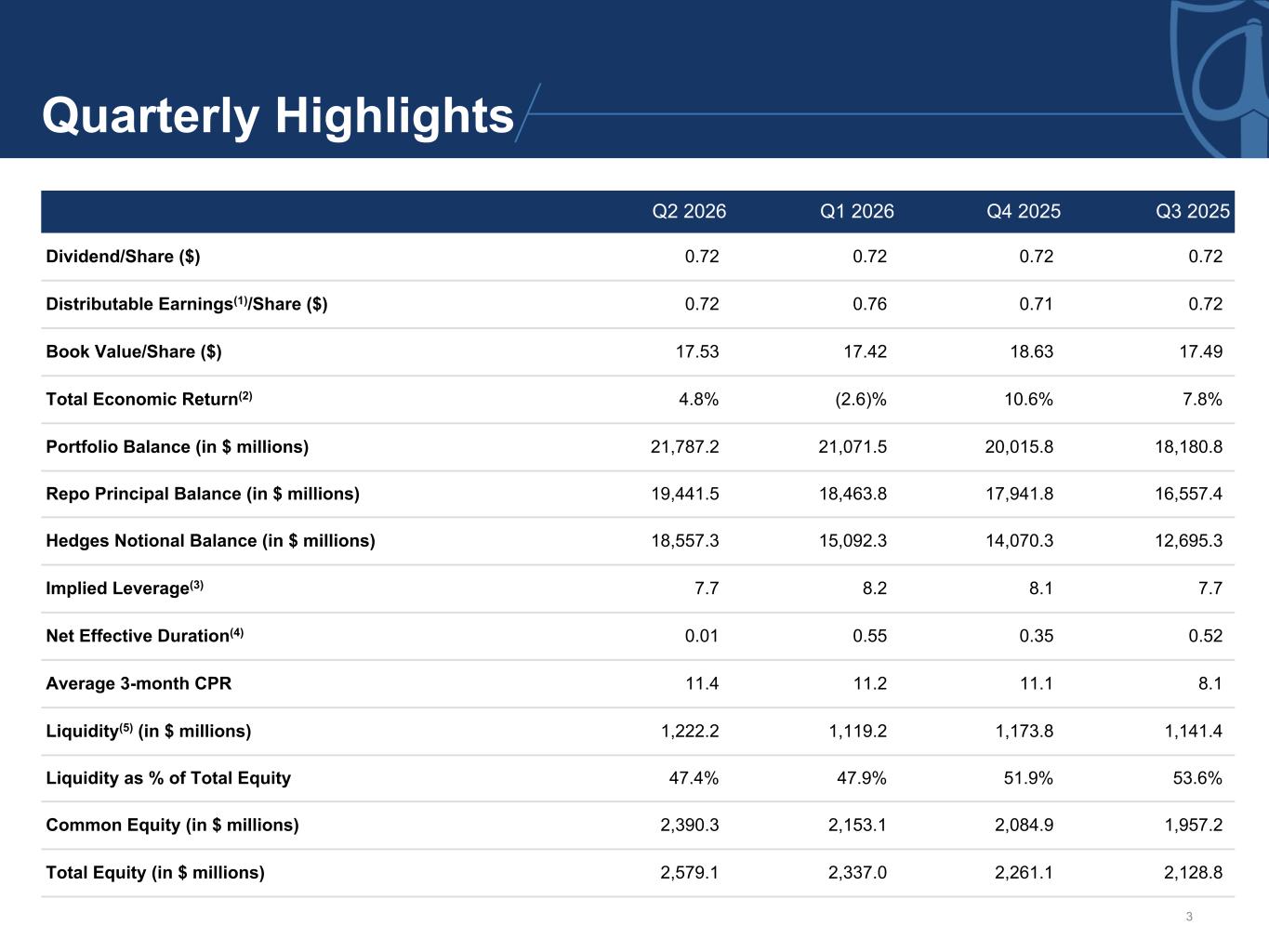
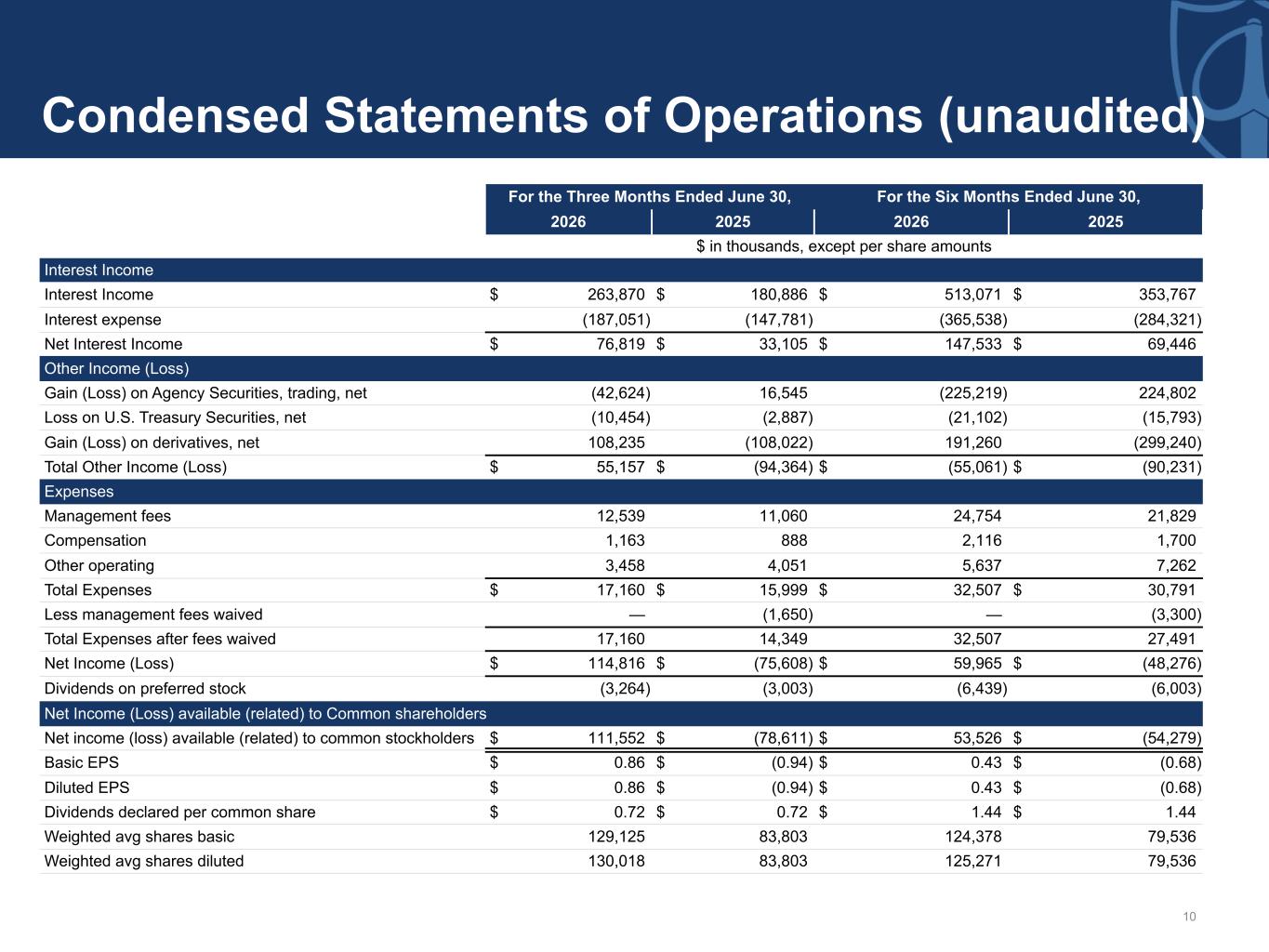
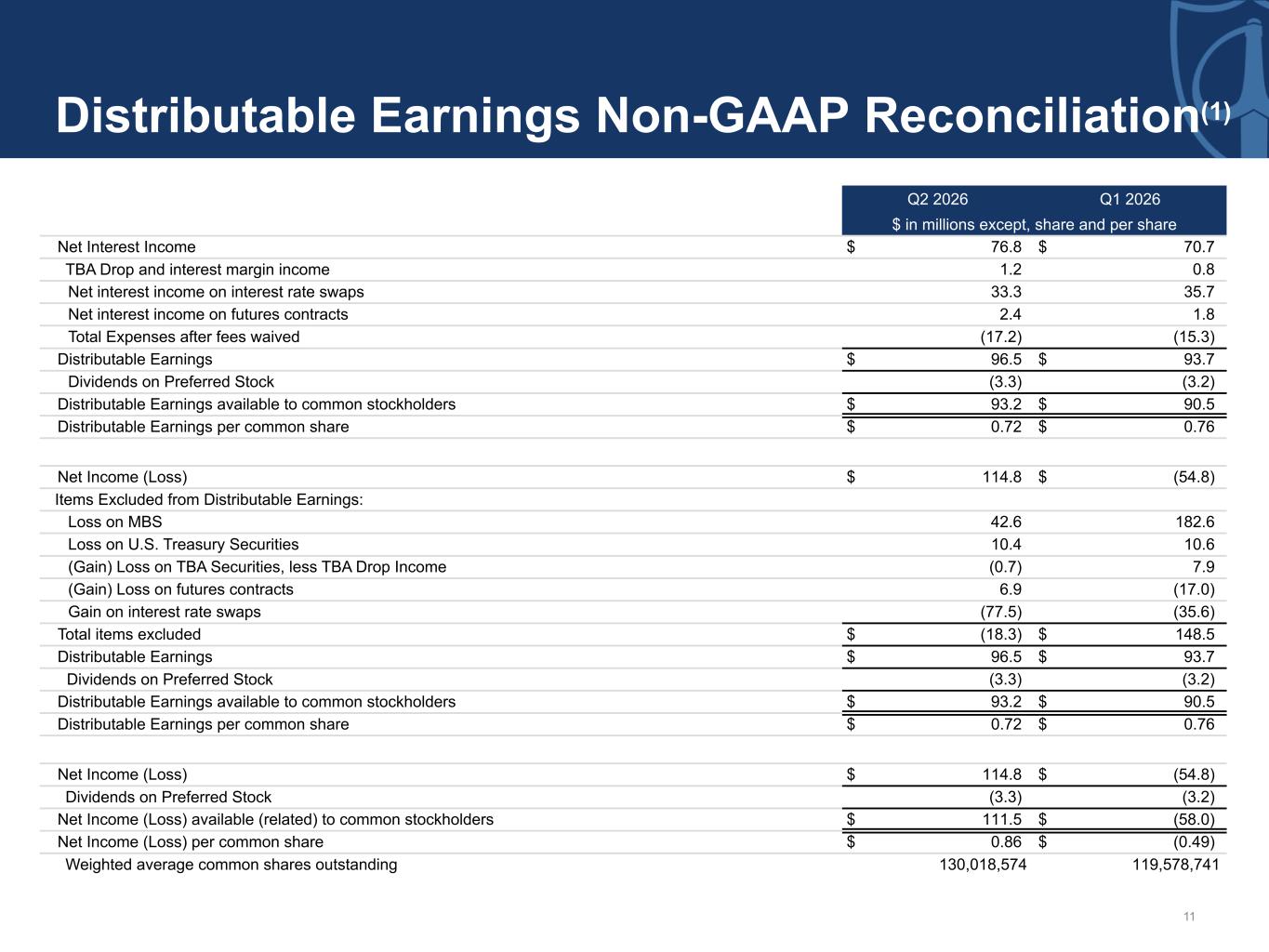
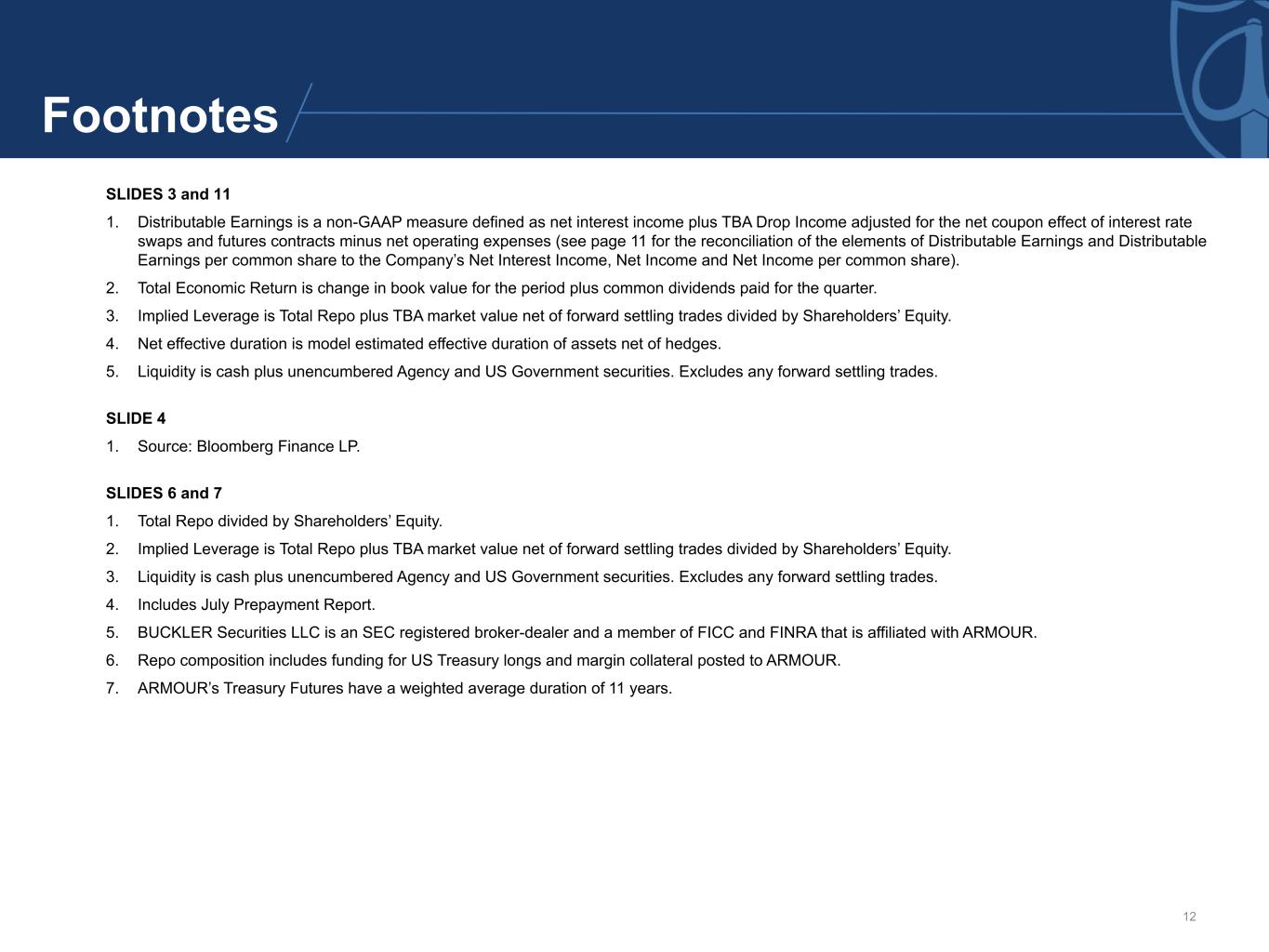
Thank you, Scott. By now, everyone has access to Armour's earnings release in our Q2-2026 investor presentation, which can be found on Armour's website at www.armourreak.com. This conference call includes forward-looking statements, which are intended to be subject to the Safe Harbor Protection provided by the Private Securities Litigation Reform Act of 1995. The risk factor section of Armour's periodic reports, followed with the Securities and Exchange Commission, describe certain factors beyond Armour's control that could cause actual results to differ materially from those expressed in or implied by these forward-looking statements. Those periodic reports can be found on the SEC's website at www.wsec.gov. All of today's forward-looking statements are subject to change without notice. We disclaim any obligation to update them unless required by law. Also, today's discussions refer to certain non-GAAP measures. These measures are reconciled with comparable GAAP measures in our earnings release. An online replay of this conference call will be available on Armour's website shortly and will continue for one year. Our portfolio benefited from MBS spreads tightening. We delivered strong results for the quarter with total economic return of 4.8%. Armour's Q2 gap net income available to common stockholders was $111.5 million, or 86 cents per common share. Net interest income was $76.8 million. Distributed earnings available to common stockholders was $93.2 million, or $0.72 per common share. This non-GAAP measure is defined as net interest income plus TBA drop income adjusted for income or expense on our interest rate swaps and futures contracts minus operating expenses. During Q2, Armour raised approximately $218.7 million of capital by issuing approximately 12.7 million shares of common stock and $4.1 million of capital by issuing approximately 108,000 shares of preferred stock through our at-the-market operating programs. Through July 14, 2026, we raised approximately $88.3 million of capital by issuing 5.2 million shares of common stock through our common stock at-the-market operating program. Armour paid monthly common stock dividends of $0.24 per common share per month for a total of $0.72 for the quarter. We aim to pay an attractive dividend that is appropriate in context and stable over the median term. On July 30th, a cash dividend of $0.24 per outstanding common share will be paid to the holders of record on July 15th, 2026. We have also declared cash dividends of $0.24 per outstanding common share, payable August 28th, 2026 to the holders of record on August 17th, 2026. Quarter-end book value was $17.53 per common share, up 0.6% from March 31, 2026. Our estimated book value as of Monday, July 20, was $17 per common share, which reflects the accrual of the July common dividend of $0.24 per share. I will now turn the call over to Chief Executive Officer, Officer Scott Holm, to discuss Armour's portfolio position and current strategy.
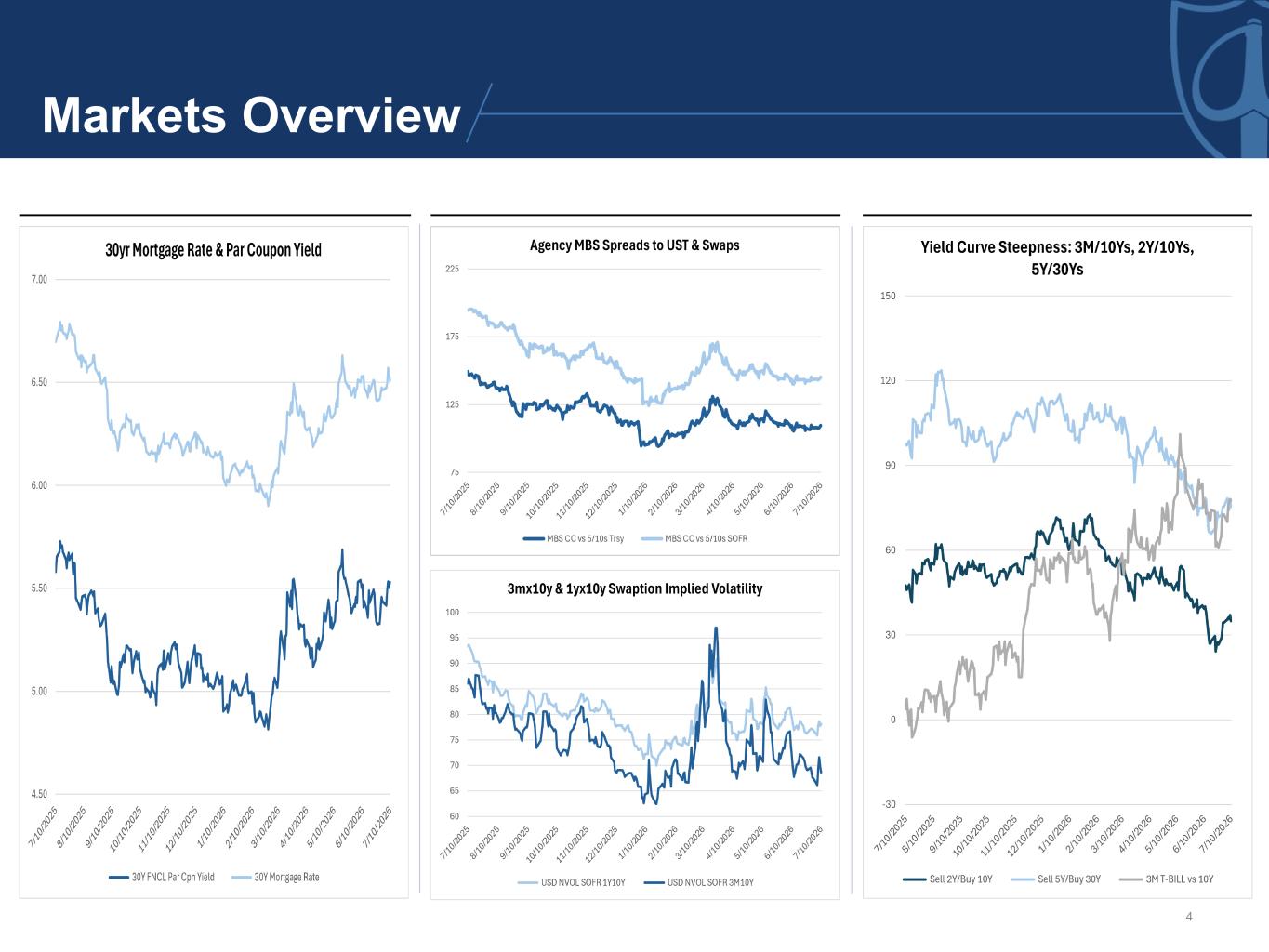
Thanks, Gordon. Agency MBS delivered a positive second quarter performance despite a macroeconomic backdrop that would normally weigh on the sector. The U.S. Treasury curve continued to bear flatten, with the two-year yield rising 38 basis points compared with a 15 basis point increase in the 10-year yield, while geopolitical uncertainty in the Middle East remained elevated. Strong economic data and an energy-driven rise in headline inflation exposed divisions within the Federal Reserve and led markets to shift from pricing year-end rate cuts to rate hikes. Under Chairman Walsh's new leadership, with traditional forward guidance receding and the Fed's broader policy framework under review, a less predictable central bank could push interest rate volatility higher. Historically, this combination of elevated uncertainty and a flyer yield curve has produced a meaningful headwind for mortgages. Even so, mortgage option adjusted spreads tightened seven basis points across Armour's asset classes. helping deliver a positive book value gain in the second quarter. Second quarter has reinforced an important point. Market supply-demand dynamics are currently exerting greater influence on agency MBS valuations than the broader macroeconomic narrative. Looking ahead, the technical backdrop remains supportive into the third quarter. Elevated mortgage rates are constraining new loan production as net issuance of Fannie Mae and Freddie Mac securities continues to run negative this year. On the demand side, strong inflows into bond funds from domestic and international investors continue to support agency MBS, which remain as an attractive alternative to tightly valued corporate credit. The modest contraction in the GSE's retained portfolios in May was not surprising, given less compelling valuations than in March, when they added nearly $20 billion in mortgages. Even so, the pullback contrasted with the broader strength of investor demand. With more than $100 billion of capacity remaining under their regulatory cap, we continue to view Fannie Mae and Freddie Mac as potential backstop buyers at wider spreads, helping support a stable spread environment. Heading into the third quarter, mortgage spreads are modestly wider, but still just inside of their long and short-term averages. While favorable market technicals are expected to provide a range-bound environment through the summer, we remain mindful of forces outside our market that could threaten to disrupt this stability. Permanent inflation, more hawkish Fed, and a sustained rise in volatility could prompt investors to demand greater compensation for mortgage risk, pushing spreads in yields wider. These risks warrant discipline at current valuations until markets have a better understanding of the Fed's reaction function in response to shifting macroeconomic factors. I'll now turn it over to Desmond for more detail on our portfolio.
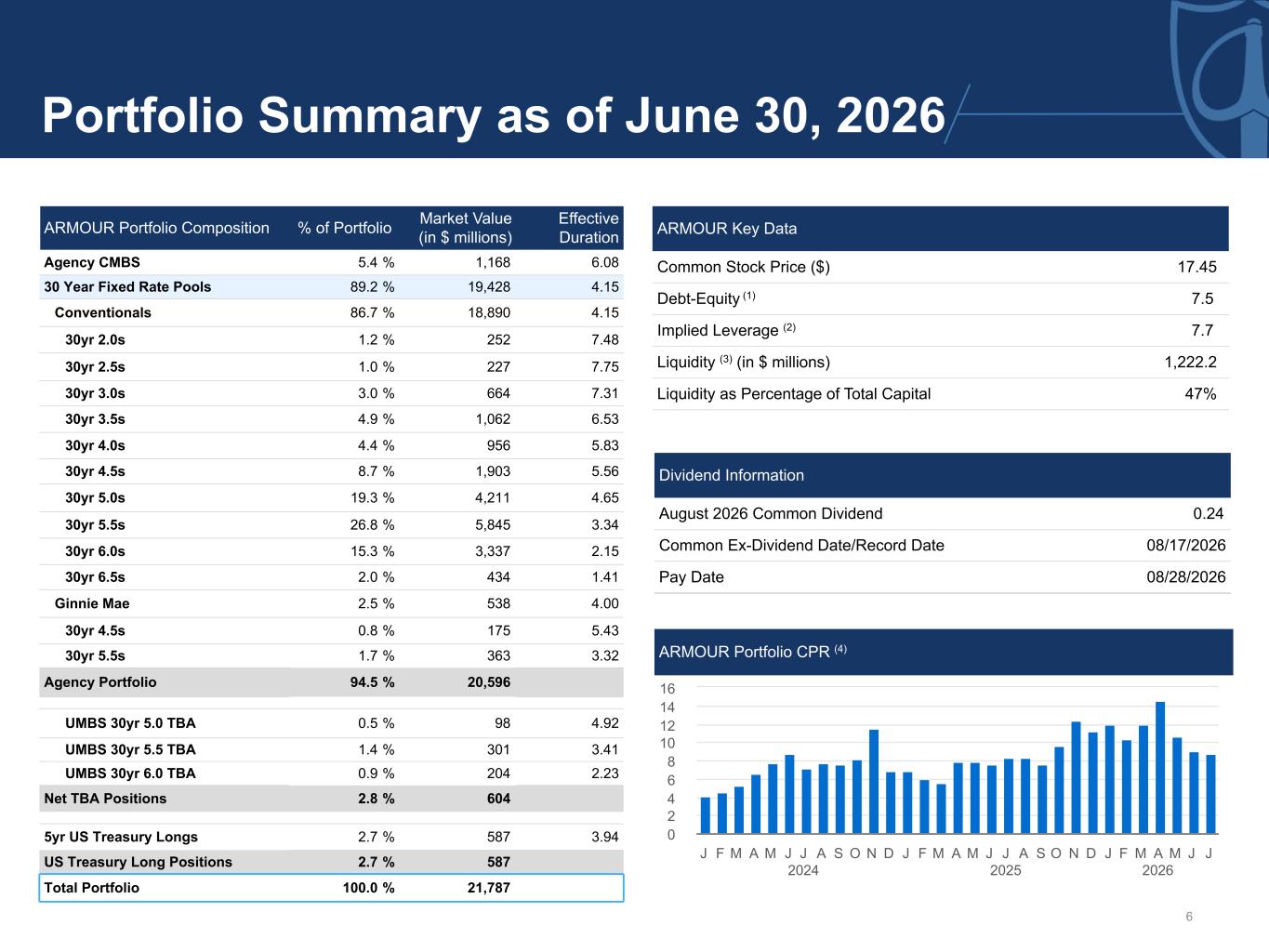
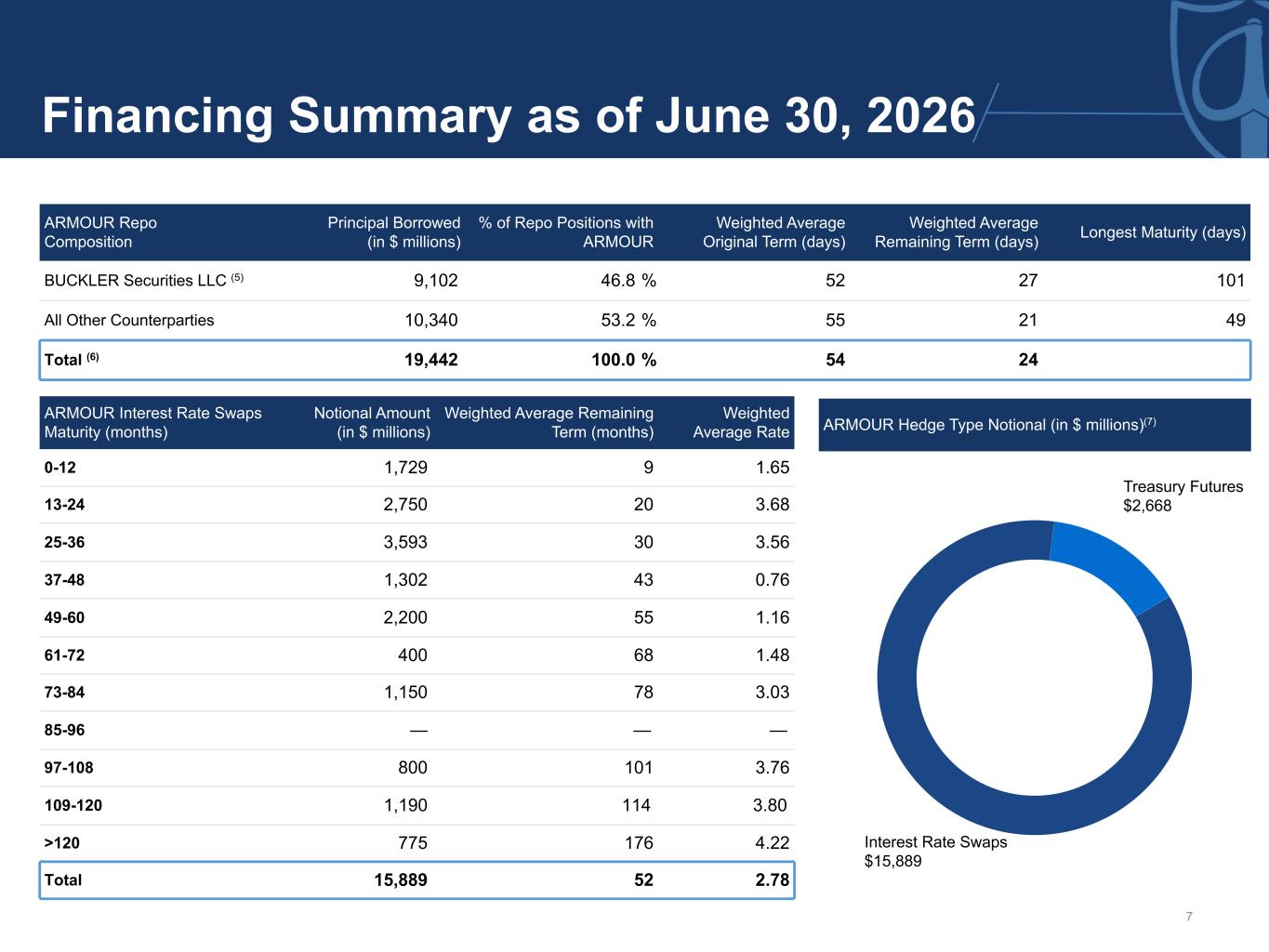
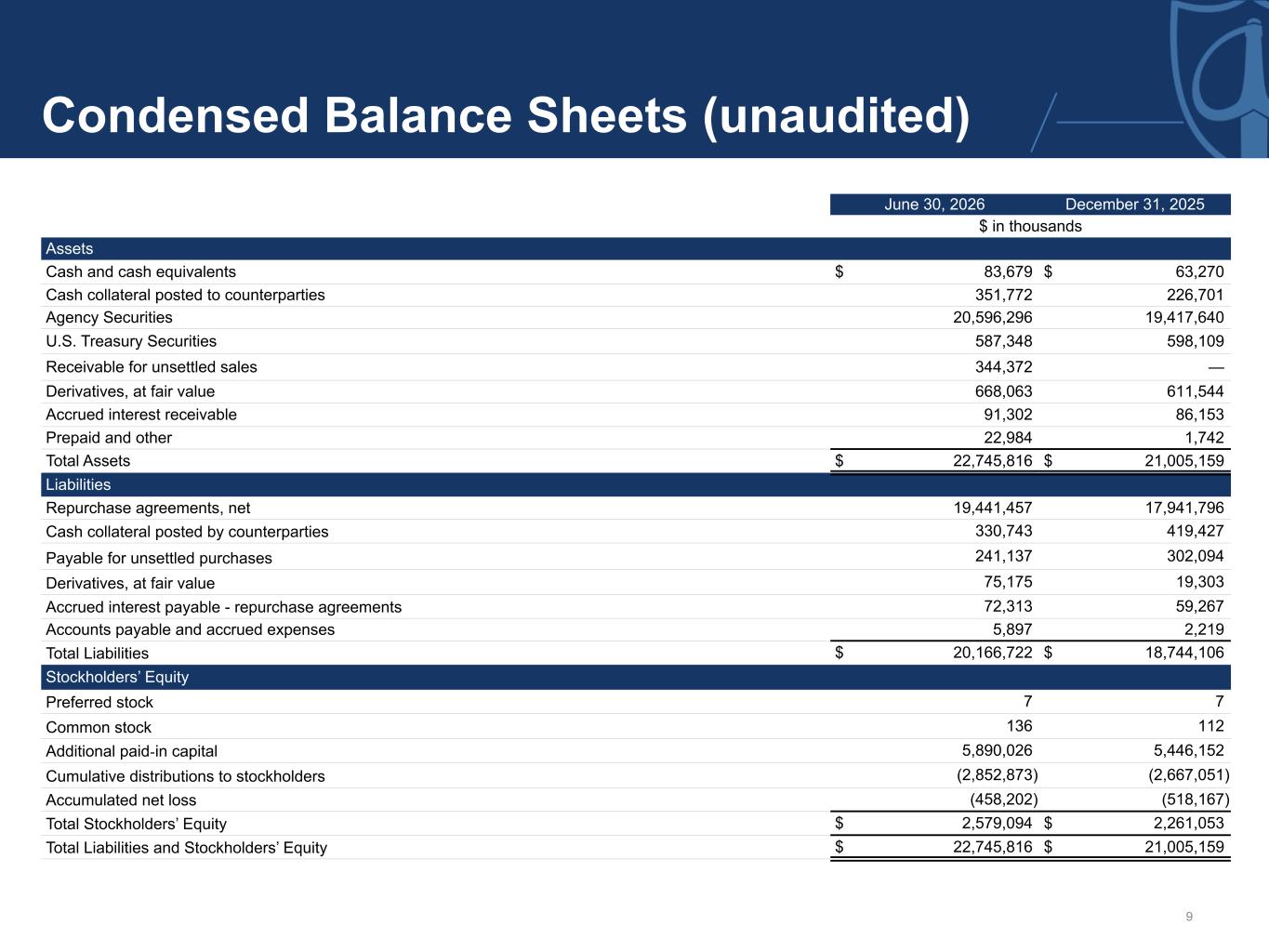
Thank you, Scott. ARMA's end second quarter net balance sheet duration registered at near zero, reflecting our more neutral view on interest rates and the shape of the yield curve than in prior quarters. The remaining positive bias incorporates our expectation that the Federal Reserve will remain on hold through the fall, as signs of cooling economic activity and inflation have emerged in recent weeks. Our implied leverage, excluding Treasury holdings, was around 7.5 turns, a modestly lighter level to reflect some caution while allowing the portfolio to continue to benefit from carry in an environment where volatility remains subdued. Our expected July month-end liquidity position, including monthly paydowns, remains strong. at over $1.2 billion, or nearly 50% of total equity. Armour's asset portfolio remains 100% agency MBS, agency CMBS, and U.S. Treasuries. The portfolio size is over $22 billion, nudging a fifth consecutive quarter of growth in both our assets and capital base. Consistent with our balance sheet growth, we've net added nearly $1.3 billion of new mortgage assets since Armour's last conference call in April. Our purchase mix has been concentrated in par and slide premium coupons that benefit from a slower prepayment environment overlaid with positive convexity and near-bullet-like structure of 5-year and 10-year DOS bonds. The portfolio remains concentrated in specified pools with favorable prepayment characteristics which represent over 95% of Armour's MBS holdings. Q2's aggregate portfolio prepayments average 11.4 cpr, just above the first quarter average of 11.2 cpr. Recent prepayment speeds have since declined meaningfully, falling to 8.8 cpr in the July report, and we expect speeds to persist around these levels in the current rate environment. Our hedging strategy is designed to reduce duration risk across the yield curve using both long and short hedge instruments to protect against sharp rallies and sell-ups about 86 percent of armor's hedges are ois and sofra pay fixed swaps we continue to favor swaps in shorter and intermediate maturities where spread volatility is lower at longer maturities where swap spreads sit closer to historical averages, we prefer a more balanced mix of swaps, treasury futures, and treasury shorts. Although the Fed has reduced its treasury bill purchases to $10 billion a month, repo spreads to SOFRA remain tight, providing stable funding for the portfolio. With some probability of rate increases now embedded in the front end of the SOFRA curve, term funding carries a larger premium, making shorter-dated and overnight financing through Buckler, our broker-dealer affiliate, a more attractive proposition. Our base case remains that the Fed stays on hold, which allows current repo conditions to persist. While Fed's share wash has moved quickly to establish policy task forces, we do not expect balance sheet proposals disruptive to the repo or agency MBS markets, particularly as we approach midterm elections. Back to you, Scott.
Thanks, Edwin. The company delivered strong results for the second quarter of 2026 with total economic return of 4.8%, despite a macroeconomic background that normally weigh on our sector. We continue to prioritize maintaining common share dividends appropriate for the intermediate term rather than focusing on short-term market fluctuations. Our approach remains unchanged. We stress test our liquidity, apply systematic hedging, and deploy capital appropriately. We're well positioned to attenuate downside risks while taking advantage of opportunities that present themselves. Thank you for joining today's call and for your continued interested in armor. We would now like to open up for any questions.
Operator
We will now begin the question and answer session. To ask a question, you may press star then 1 on your telephone keypad. If you're using a speakerphone, please pick up your handset before pressing the keys. If at any time your question has been addressed and you would like to withdraw your question, please press star At this time, we will pause momentarily to assemble our roster. The first question comes from Doug Harder with BTIG. Please go ahead.
Good morning. Scott, hoping you could talk about your outlook for capital raising, you know, kind of tie that to your comments that, you know, on the one hand, you expect kind of range bound spreads, but kind of mindful of the risks. So if you could just kind of tie all that together and how you're thinking about capital raising.
Yeah, you know, the way we've always approached capital is, you know, to look at what we can do with it and what the opportunities are. And so, you know, so we continue along that course. You know, we're also mindful that, you know, raising capital lowers our costs. you know we you know we're able to to spread costs obviously over over a much larger a much larger capital base and and we also you know as you as you know our marginal fees 75 basis points so you know we we lower our costs on average with every with all with any capital we raise so you know look we you know we look at we look at all those factors uh and tie them together and figure out what the opportunity set is in the market, and then figure out how we're going to execute on it.
Okay, that makes sense. And can you talk about what you're seeing in terms of incremental returns as you kind of raise and deploy capital in today's market?
Yeah, Desmond, Sergey, why don't you run through the investment horizon here for us?
Yes, sure. Hi, Doug. So we see static returns in the mid-teens for, say, 30-year fives to sixes, where we've been adding most of our reinvestments of late. And this is assuming about eight tons of leverage and hedge to half a year duration, which swaps. Now, if spreads were to tighten by, say, 10 basis points in OAS, that could add another 4% to 5% that would accrue into a total return to book value. We are not penciling that in at this time, given that we expect spreads to stay range-bound near term. But we are constructive on the market longer term.
Okay. That makes sense, Desmond. Thank you very much.
Operator
Thank you. The next question comes from Marissa Lobo with UBS. Please go ahead.
Good morning, and thank you. Could you speak to just how you're thinking about specified pools versus TBAs today? Has the relative value of prepayment protection changed given current dollar roll economics?
Yes, good morning, Marissa. This is Sergey. Yes, so we view specified pools as probably fully valued here versus TBAs. Some specialness has come back into the TBA market, but it's been still quite volatile. So, you know, we look to buy assets into the portfolio over the longer term. So, even being kind of fully valued versus the implied financing on TBAs, We view, you know, finding good convexity collateral, you know, still additive to the portfolio, to book value over the long term. We still focus on credits, you know, lower loan balance stories, but we play mostly in the, you know, most liquid section of specified market, kind of under 32 ticks or so. So that allows us to continue to grow the asset book from a specified pool standpoint. But we have also increased size in TBA positions as well since last quarter, but they remain more of a tactical play rather than, you know, alternative to specified pools.
Okay, thank you. And just thinking about supply demand in the market, you know, It's been talked about money managers seeing relative value for MBS versus corporates. Are you still seeing continued inflows at these levels, or are valuations reaching a point where you see demand beginning to moderate?
Yeah, so we are still seeing, you know, both foreign and domestic inflows into bond funds. Now, like you said, a lot of those inflows are coming into the corporate sector. But just even on the margin, we continue to see that in the mortgage funds and ETFs. Having said that, you know, we are seeing signs of demand cooling a bit this quarter. Obviously, we had the GSEs report their first net decline in their retained portfolios. And the overall picture signals that investors may be waiting to see what the Fed's reaction function to shifting macroeconomic picture will be. Having said that, given how low supply has been and projections continue to decline since beginning of the year, You know, we feel like this strong technical picture will remain is just really the – some of the mindfulness is around the outside forces to the mortgage market and particularly, you know, Fed's monetary policy.
Great. Thank you for the answers.
Operator
Thank you. The next question comes from Trevor Cranston with Citizens JMP. Please go ahead.
All right. Thanks. Good morning. um it looks like on the the hedge side of things the swap portfolio notional increased a decent amount this quarter um and your net duration position uh declined a little bit um can you guys talk about kind of generally how you're approaching uh your your rate hedging given the flattening of the yield curve and if the you know potential for fed hikes uh coming up later this year has any impact on the choice of using swap versus treasury hedges? Thanks.
Yes. Hi, Trevor. So, as we mentioned in our prepared remarks, our net balance sheet duration ending the quarter was close to zero. We look to maintain a flat profile both in duration and the shape of the curve. On the back end, we look for that to be roughly flat, and on the front end, there's a slight positive bias there, and that's because we think that the Fed could stay on hold for longer, And market pricing at this point is for hikes to take place by the end of this year and over the next year as well. In terms of our hedge, our swaps versus treasuries, it's really about what our view there is on swap spreads. Currently, we favor adding swaps in the front end of the curve. There's less spread volatility there up to, like, the five-year point. And we look for a more balanced mix when it comes to the longer-duration instruments. So we use both treasuries, treasury futures, and swaps in the longer end of the curve. Now, from our perspective, though, it's really more if we see inflation normalize, we may actually be looking to increase our position in duration and position more for bull steepener. But, you know, we are not there yet. Obviously, we're seeing oil prices are higher. So, yes, there is a tail risk that the Fed could hike if oil prices stay in a more sustained period at a very high level, then that can flow over to headline inflation. But our view here is more along the lines of looking to see whether we might even add to our duration positioning if we see inflation normalized.
Okay, that makes sense. Thank you.
Operator
Thank you. The next question comes from Jason Weaver with Jones Trading. Please go ahead.
Hey, guys. Good morning. I was wondering, can you talk a little bit about the new CMB, how the new CMBX position complements the portfolio and if you expect that to grow materially ahead in proportion?
Yes. So, you know, currently we feel like it's an appropriate position given where we see the valuations. It's very similar how we look at mortgage spreads. very opportunistically. Having said that, we began rotating out of some of the five-year pools in the CNBS position out to the 10-year where negative swap spreads allow for pick and carry as well as a better convexity profile versus some of the other mortgages we own. So that really serves two things. Number one, it helps our portfolio optimization from the negative convexity side. And number two, it allows us to have a more targeted approach to where we want to be longer on the yield curve, how we want to hedge, and how we want to kind of provide a substitute to some of the more expensive specified pools by using the CNBS position.
Got it. Thank you. And then just talking about the migration upward in coupon, Can you talk about specific call protection on those fives and sixes amid some of the softer economic data we've seen the last couple weeks?
Yeah, so, you know, like you pointed out, certainly the last few prints, both on labor and inflation data, have been a little bit more favorable to what the Fed's looking for. At the same time, you know, we're seeing real-time oil prices continue to increase. So we have to be prepared for both scenarios, and that's why we continue to look at both loan balance, something that's maybe over $300K size, as well as relative value stories in credits, geo stories. So we're starting to look at that seasoning a little bit. So everything is on the table. We want to protect the portfolio convexity from both sides of the rate move and really just kind of try to avoid the more generic paper that has very high average loan sizes. And we know the propensity of technology and servicer capacity have grown. So, yeah, any rate move could continue to worsen the deliverability of more generic TBA-like pools.
All right. Thanks for the color, guys.
Operator
Thank you. Again, if you have a question, please press star then one. The next question comes from Dave Storms with Stonegate Capital. Please go ahead. Morning. Thank you for taking my question.
Just want to circle back. You mentioned earlier that inflation normalization would maybe cause you to increase duration. Would you also consider levering back up in this situation? Maybe you said it a different way. How are you thinking about your leverage position right now?
Yes. Hi, Dave. So there are a number of factors that actually go into how we set our leverage targets. First, we have to look at spreads and think what our view is on spreads, the macroeconomic environment, and that includes what's going on geopolitically as well, and our liquidity, and not just our current liquidity, but we stress test our liquidity to ensure that it can withstand extreme scenarios. So that all plays into it. In terms of whether we could increase our leverage, so yeah, So if spreads could widen, for example, if we think it's a temporary bout of volatility, then that may cause us to increase our leverage with the view here that if the Fed stays on hold for longer, then that volatility will decline subsequently and spreads will tighten again. So that could be a scenario there, but right now we are comfortable with where our leverage is cognizant of the current risks in the market and a phase reaction function that we still need to get better understanding of, which we will over time.
That's perfect. I appreciate that. If I could just ask one follow-up on that. With your current liquidity profile, I see as a percent of common equity, it's up a little bit. year over year, but it's kind of been on a downtrend for the last couple quarters. Are you comfortable with your liquidity as a percent of total equity, or is this something you might focus on in the short term?
We are comfortable with our liquidity. As I mentioned, we stress tested over, you know, some extreme scenarios. We did add some longer-duration hedges, and they have – their haircut percentages are higher so that's um part of the reason why um our liquidity is lower but um with that we are still very comfortable with where we are understood thank you for taking more questions thank you the next question comes from timothy d'agostino with b riley securities please go ahead yeah hi thank you and good morning uh just a quick question for me on raising capital You know, looking at the press release, you talk about raising $219 million through your common stock ATM versus about $4 million on your preferred ATM.
I guess, could you just provide a little color on why you prefer, you know, the common stock ATM compared to the preferred? Just trying to understand the rationale and, you know, how you think about both programs.
Well, it's price. and, you know, preferred has been, it's been trading at a strip yield that's still pretty attractive, but its volume is relatively low in that. And so the existing issue that we're adding to is not particularly big. You know, we certainly have room for more preferred, but, you know, we got to see prices that we like. So, you know, that is really it. You know, Obviously, the volumes are vastly higher on the common side of things, and despite the attractive accretion for common shareholders of preferred issuance, we just have to see prices that we like. and whether that is adding to our existing or someday a new issue. But we haven't seen the real opportunities in volume there that we'd love to see. And I think we remain pretty convinced that the preferred is a compelling value and credit story. Okay, great. Thank you so much. That's all for me.
Operator
Thank you. This concludes our question and answer session. I would like to turn the conference back over to Scott Ulm for any closing remarks.
Thank you very much. We appreciate your interest in Armored Read. And feel free to give us a ring if any follow-up questions occur. Thanks so much.
Operator
Thank you. The conference has now concluded. Thank you for attending today's presentation. You may now disconnect.