Operator
Welcome to Bristol-Myers Squibb Fourth Quarter 2025 Earnings Conference Call. All participants will be in listen-only mode. Should you need assistance, please signal a conference specialist by pressing the star key followed by zero. After today's presentation, there will be an opportunity to ask questions. To ask a question, you may press star than 1 on your telephone keypad, and to withdraw your question, please press star than 2. Please note, today's event is being recorded. I would now like to turn the conference over to Chuck Triano, Senior Vice President and Head of Investor Relations. Please go ahead.
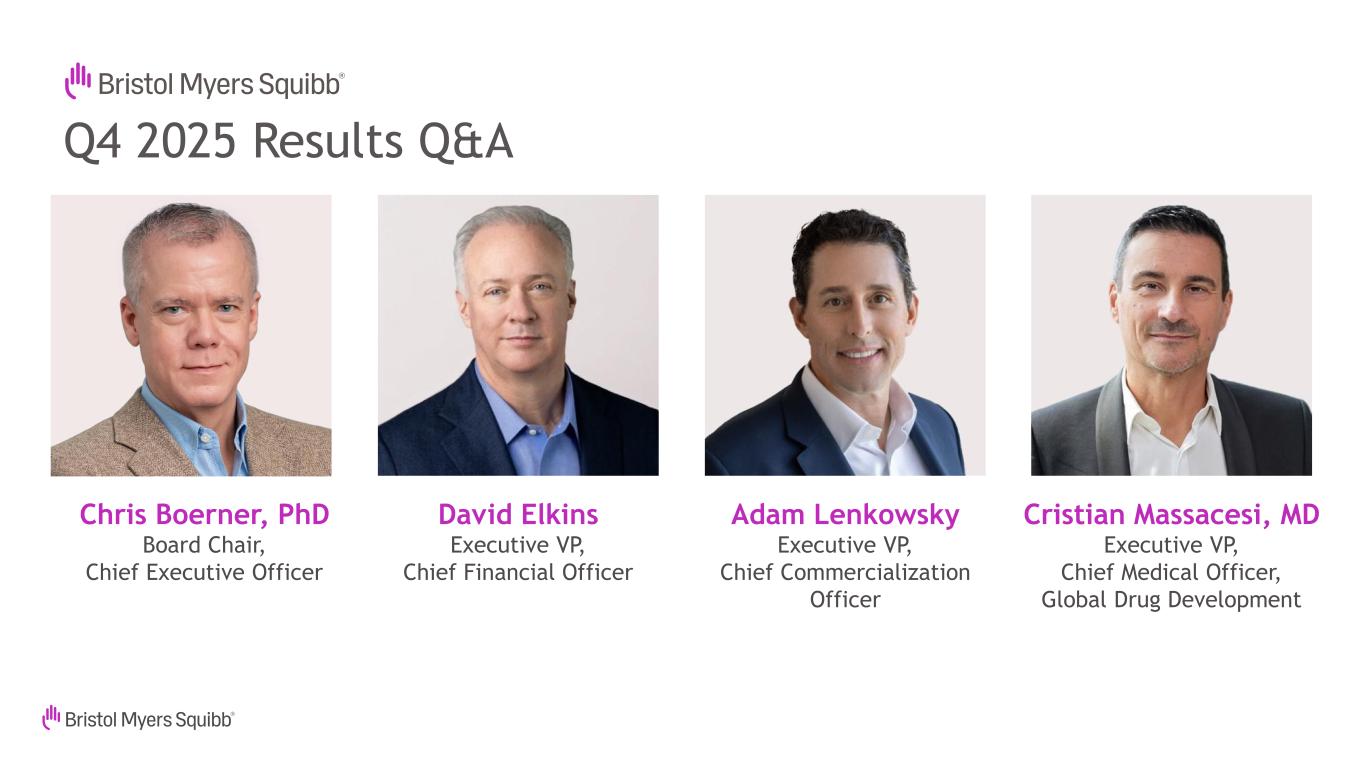
Thank you, and good morning, everyone. We appreciate you joining our fourth quarter 2025 earnings call. With me this morning with prepared remarks are Chris Berner, our Board Chair and Chief Executive Officer, and David Elkins, our Chief Financial Officer. Also participating in today's call is Adam Lenkowski, our Chief Commercialization Officer, and Christian Masacezi, our Chief Medical Officer and Head of Global Drug Development. Earlier this morning, we posted our quarterly slide presentation to BMS.com that you can use to follow along with Chris and David's remarks. Before we get started, I'll remind everybody that during this call, we will make statements about the company's future plans and prospects that constitute forward-looking statements. Actual results may differ materially from those indicated by those forward-looking statements as a result of various important factors, including those discussed in the company's SEC filings. These forward-looking statements represent our estimates as of today and should not be relied upon as representing our estimates as of any future date, and we specifically disclaim any obligation to update forward-looking statements, even if our estimates change. We'll also focus our comments on our non-GAAP financial measures, which are adjusted to exclude certain specified items. Reconciliations of certain non-GAAP financial measures to the most comparable GAAP measures are available at BMS.com. Finally, unless otherwise stated, all comparisons are made from the same period in 2024 and sales growth rates will be discussed on an underlying basis, which excludes the impact of foreign exchange. All references to our P&L are on a non-GAAP basis. And with that, I'll hand it over to Chris.
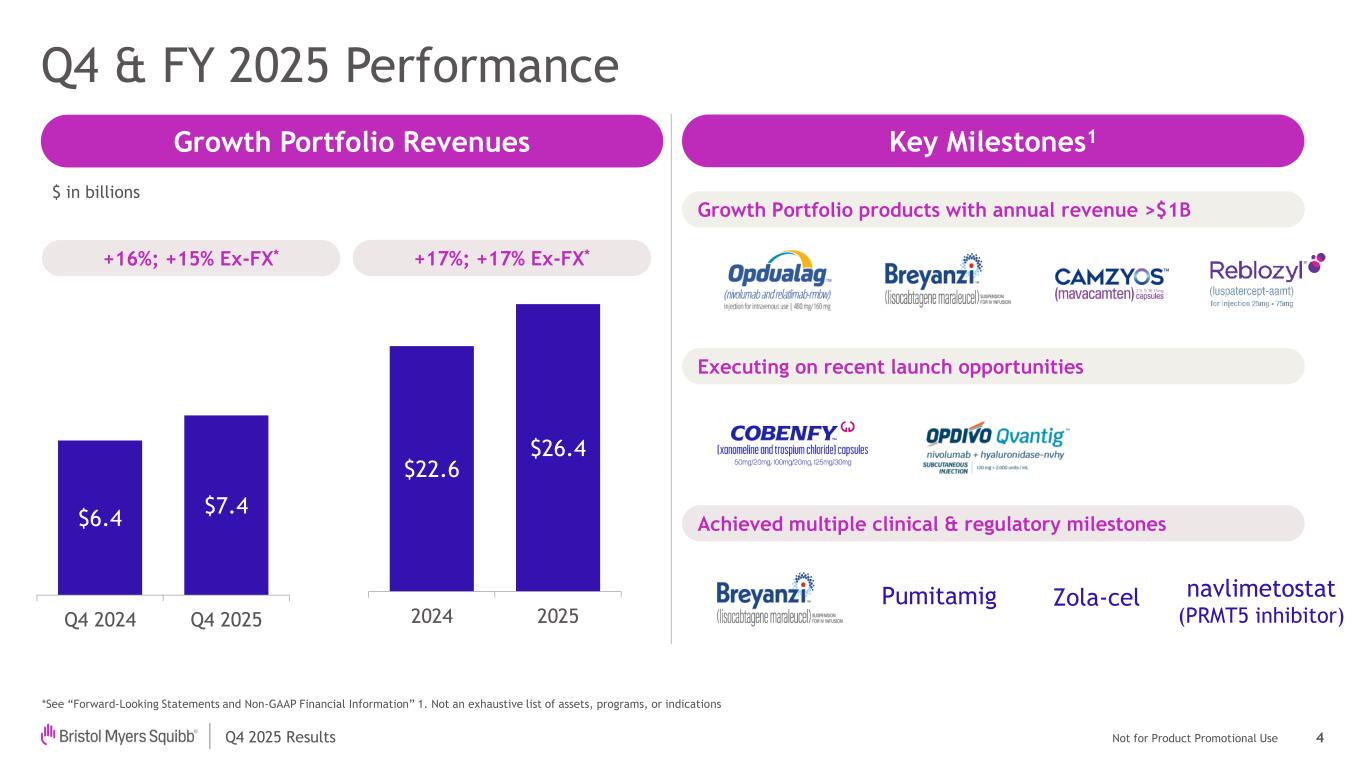
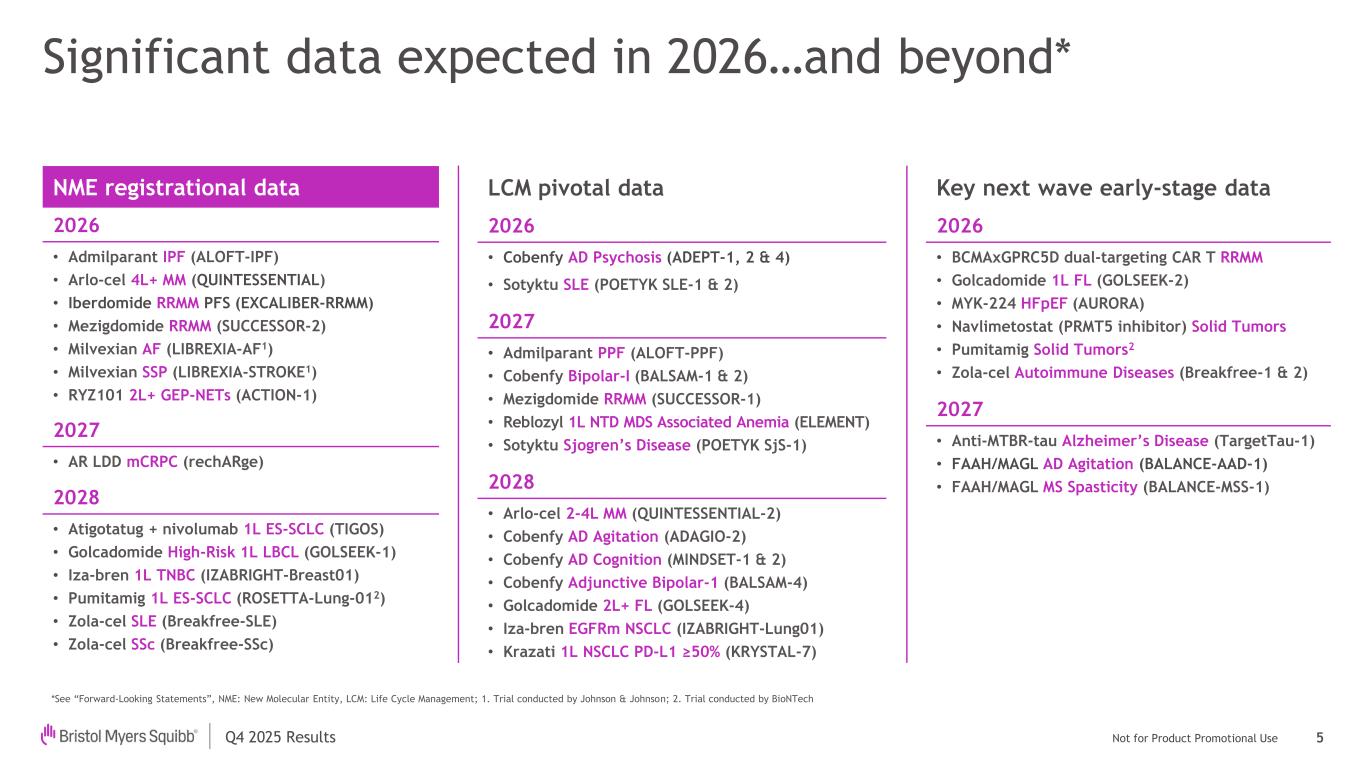
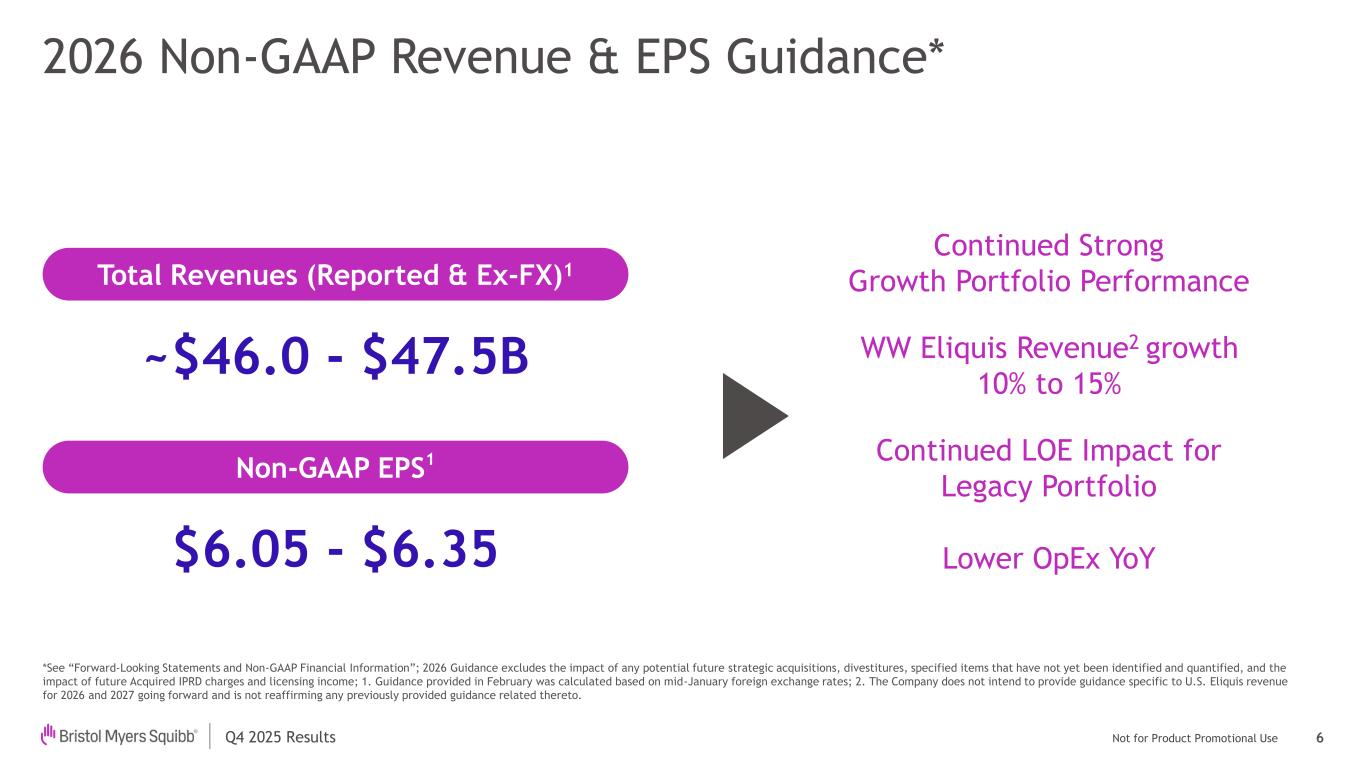
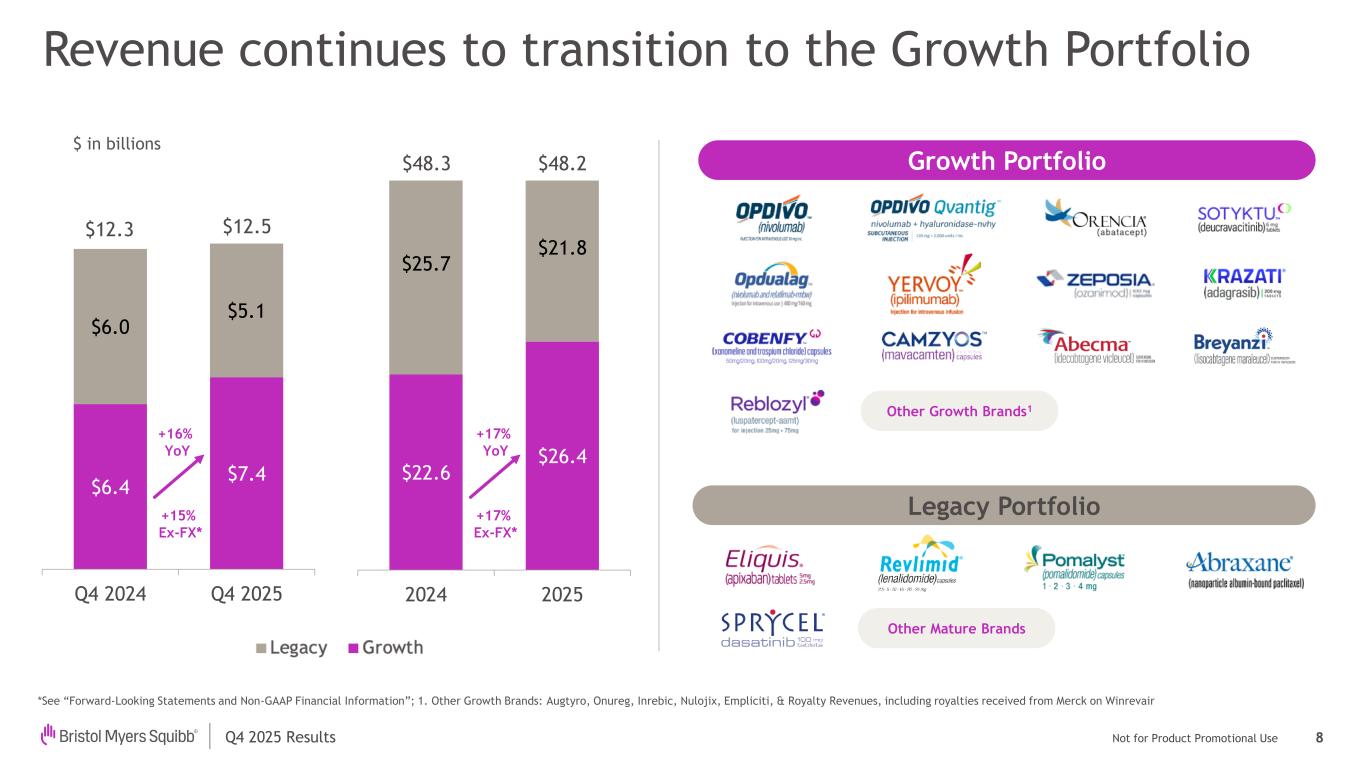
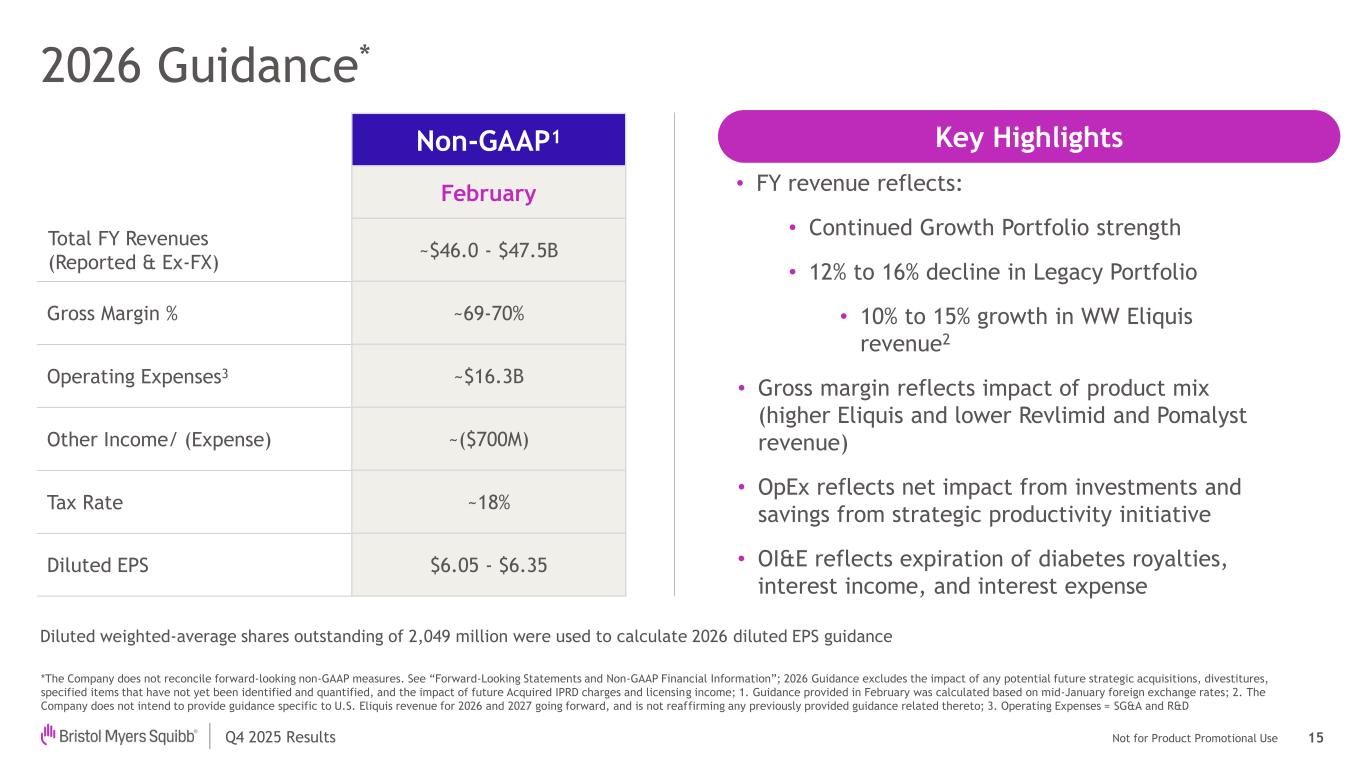
Thanks, Chuck. Welcome and thank you for joining us this morning. 2025 was a year of focused execution across the business. We believe our results further demonstrate the ongoing strength in our growth portfolio as we advance our multi-year plan to rewire BMS for long-term growth. These efforts enabled us to enter 2026 with good momentum. Let me start by highlighting our recent progress on slide four. We closed the year with strong fourth-quarter performance. Our growth portfolio grew 15% year-over-year in Q4 and 17% for the full year. In terms of building out breadth with newer products, Optulag, Brionzi, and Camzaios each contributed over $1 billion in sales for the full year, while Reblazil delivered over $2 billion. These are differentiated, durable products early in their life cycles with meaningful runway ahead that further strengthened the foundation for long-term growth. And on a full year basis, it is worth pointing out that despite a decline of roughly $4 billion in revenue from our legacy portfolio, the growth portfolio nearly offset all of that. CoBINFY and QVANTIC also continued to progress well and in line with our expectations. With CoBINFY, we saw steady growth as we expanded access and deepened adoption across community and hospital settings. And we expect this steady growth to continue throughout the year. Tuvantik continued to receive positive early feedback from users with improved practice efficiency and patient preferences as the main drivers. David will provide more detail on our portfolio's performance shortly. Turning to recent clinical and regulatory highlights. In December, Brionzi received FDA approval as the first and only CAR-T cell therapy for adults with relapsed or refractory marginal zone lymphoma. It is now approved across five cancer types, strengthening its leadership position among CD19-directed CAR-Ts. In December, with our partners at BioNTech, we also shared the first global Phase II data for permitibig in locally advanced or metastatic triple-negative breast cancer. These data showed encouraging antitumor response and a manageable safety profile in both the first and second-line treatment settings. Triple-negative breast breast cancer remains an aggressive disease where there is an urgent need for new treatment options. And within the overall Pamitamig Development Partnership, we recently announced three additional planned studies, resulting in eight registrational studies we expect to have underway by year We are pleased to announce that two of these studies in non-small cell lung cancer are now initiating in unresectable stage 3 disease and in first-line high PD-L1 expression. We also just posted details regarding our global phase 3 study, Break-Free SSC for Zolacel, our CD19 CAR-T, now initiating in patients with active systemic sclerosis. Finally, we very much look forward to the first oral data presentation for Nablometastat, a potential first-in-class PRMT5 inhibitor. This will be combination data in the pancreatic setting and will be showcased at the ESMO-targeted Anti-Cancer Therapies Conference next month. These milestones reinforce the momentum of our pipeline, with more readouts to come this year, which I'll talk about on slide five. As we shared last month, this is a data-rich period for BMS, which could drive the introduction of more than 10 new medicines and over 30 meaningful launch opportunities by 2030. The increasing pace of pivotal readouts later this year will serve to better define the potential of our pipeline candidates. We are confident in our ability to deliver an attractive and durable growth profile heading into the next decade. The breadth and depth of these opportunities is illustrated on this slide. This year alone, we expect to report top-line registrational data for six potential new products. Milvexian in both atrial fibrillation and secondary stroke prevention, Admilparent in idiopathic pulmonary fibrosis, Ibertamide, where we have already demonstrated a significant improvement in MRD negativity rates, mesignamide and Arlocel in relapsed or refractory multiple myeloma, and RAISE-101 in second-line-plus GEPNETs. We also anticipate meaningful pivotal line extension readouts for SOTIC-2 in lupus and Covenphe in Alzheimer's disease psychosis. Most of these readouts will occur in the second half of the year, and we have more data readouts coming beyond 2026. Together, these represent an attractive set of near-term catalysts that can meaningfully enhance the long-term growth profile of our current growth portfolio. We communicated at the start of last year that getting the long-term right means executing well in the near and medium terms. As you can see from our results, we continue to deliver across the organization in 2025. Maintaining this strong say-to-do ratio by consistently delivering on our commitments has now been embedded in our culture and will continue to be core to how we operate. As you have seen in our financials, we delivered on our cost savings initiative in 2025 and will continue to expand the use of AI to help us move faster, operate leaner, and reinvest strategically in growth. Our financial strength continues to allow us to invest in our business and bring exciting science into the company through the pursuit of high return business development. Our North Star remains to deliver industry-leading sustainable growth into the 2030s and beyond. Now let me give you a high-level overview of our 2026 guidance on slide six, and David will speak to it in more detail shortly. We currently anticipate 2026 revenue in the range of $46 to $47.5 billion. This range reflects continued strong performance from our growth portfolio and a projected revenue decline for our legacy portfolio of between 12 and 16 percent given the ongoing LOE impacts. Within the legacy portfolio, we project Eloquist growth this year to be in the range of 10 to 15 percent. This is driven by continued global demand growth and the recent price reduction, which expands patient access and eliminates the associated inflation penalty.
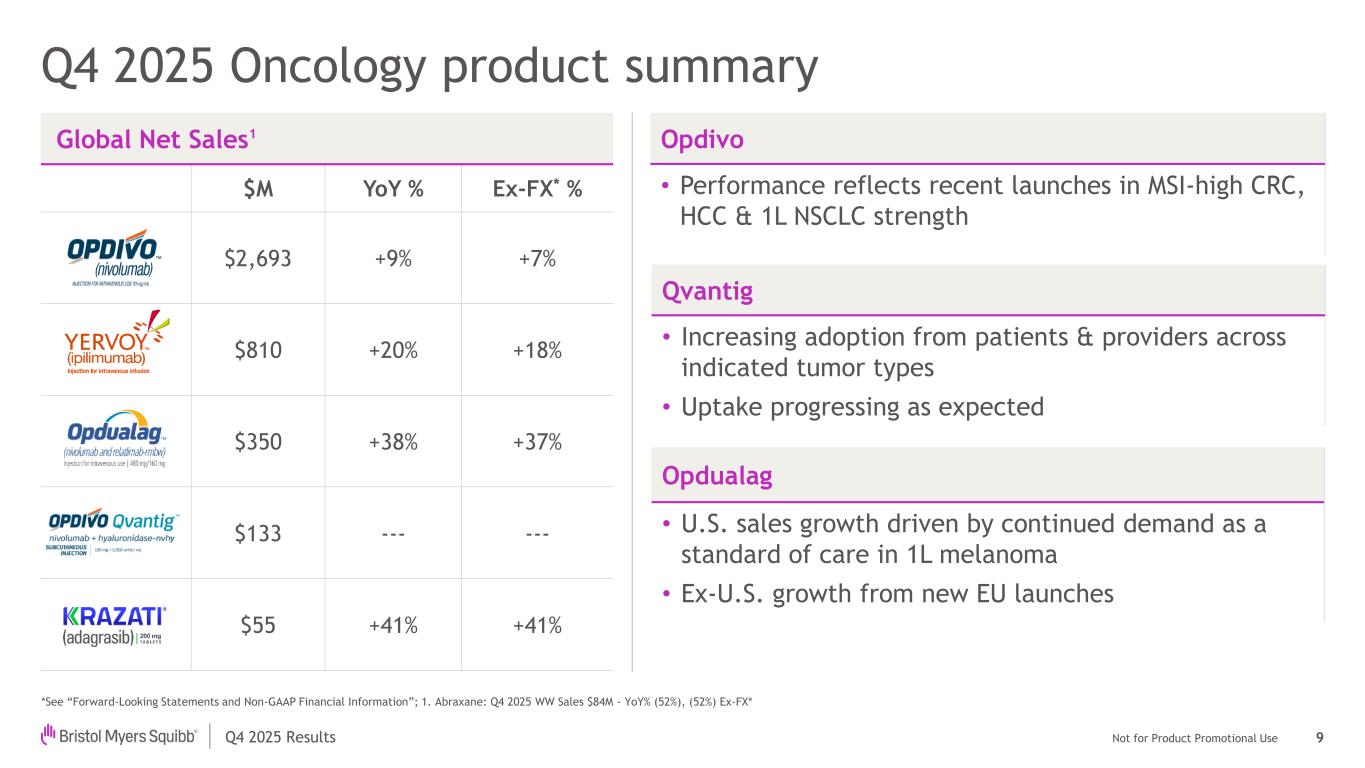
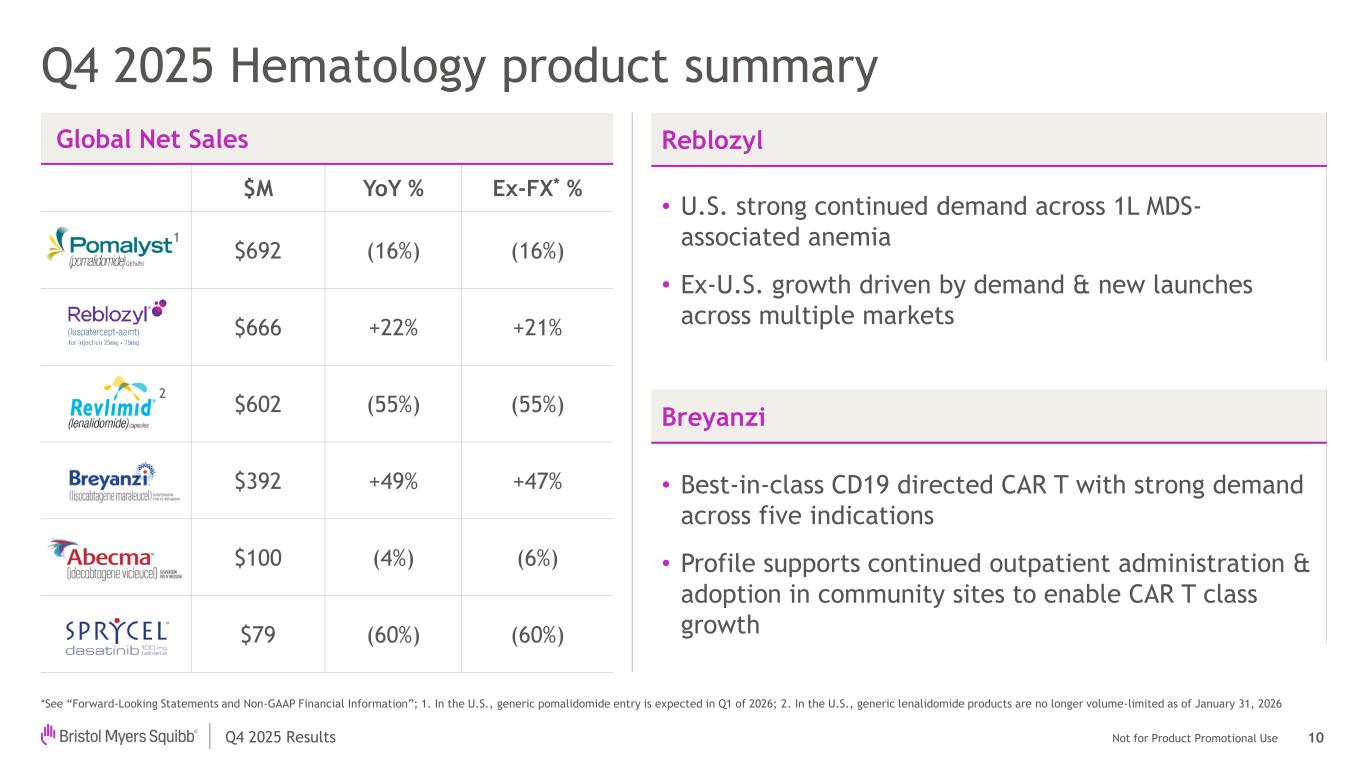
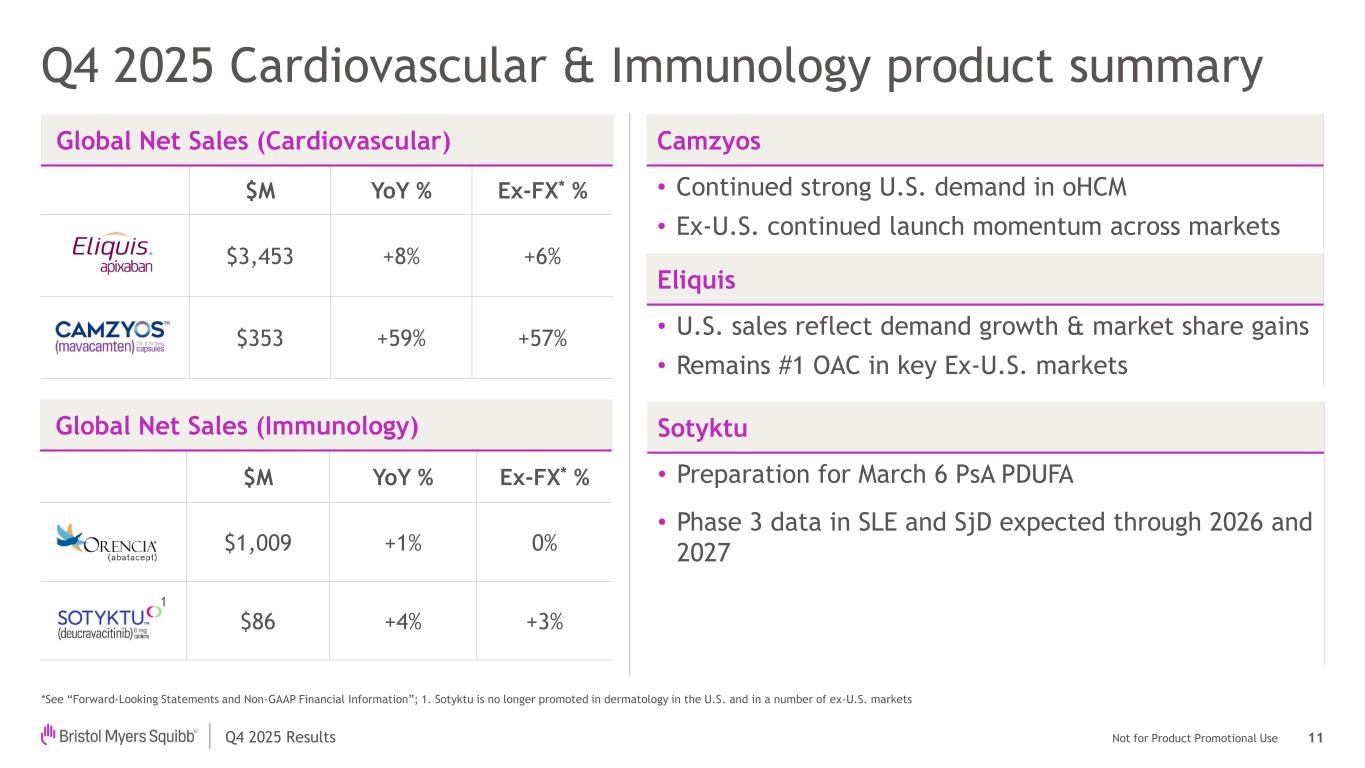
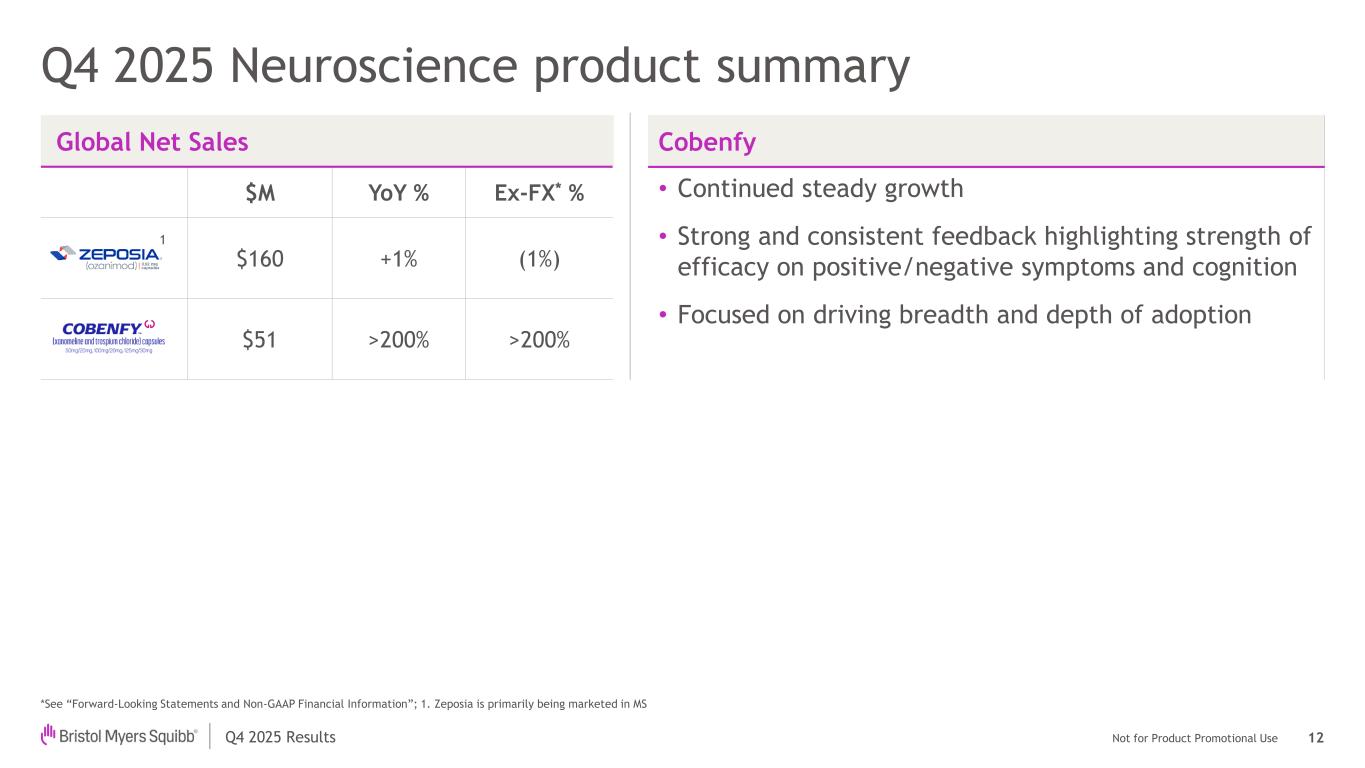
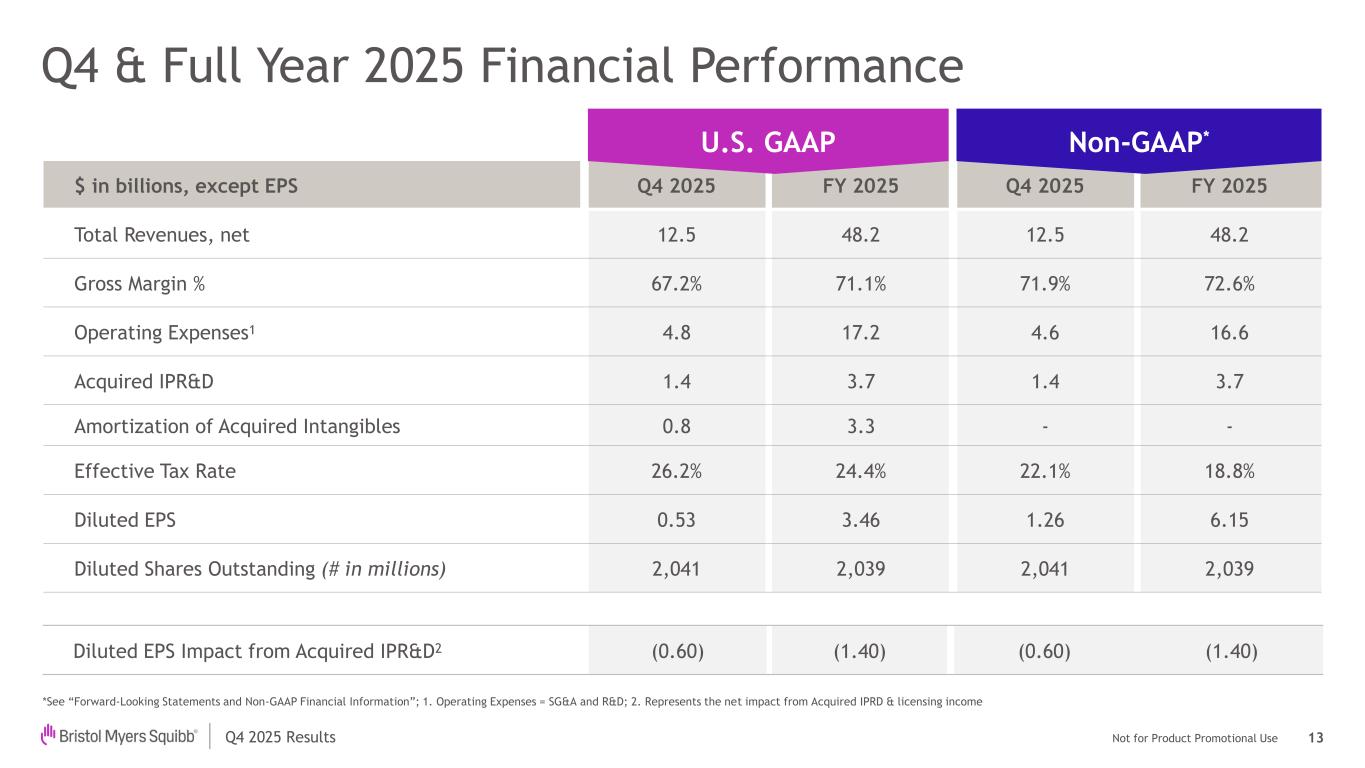
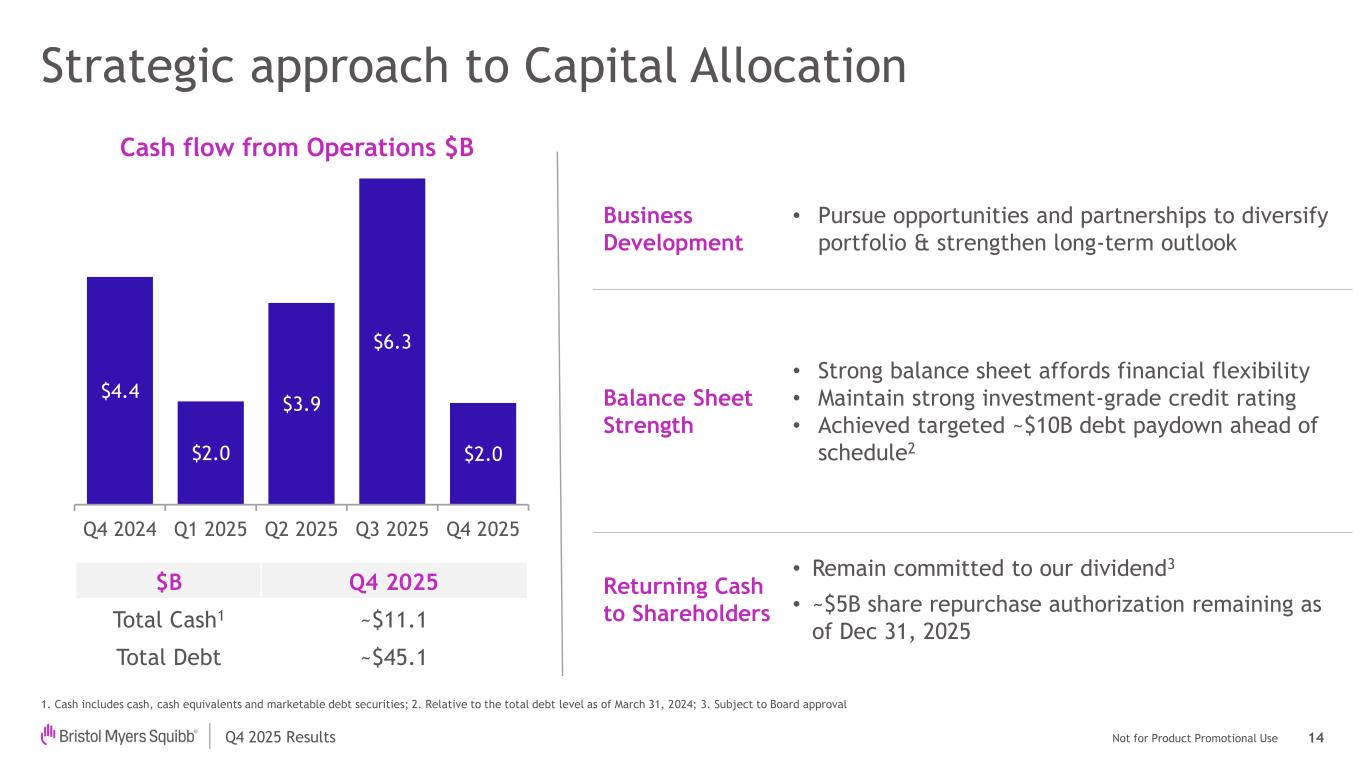
We expect lower operating expenses compared to last year due to our ongoing cost savings program and we expect adjusted diluted earnings per share between six dollars and five cents and six dollars and 35 cents with that i'll turn it over to david thank you chris and good morning everyone i will begin my review of our 2025 financial results focusing on our fourth quarter performance i will follow up with the introduction of our non-gap financial guidance for 2026 and some considerations to help you better understand our financial outlook for this year We had very strong commercial and financial performance in 2025, marked by focused execution on driving top-line growth and generating strong cash flow by strengthening our balance sheet and continuing to manage our cost structure. We've entered 2026 in a position of strength with a solid foundation which we can continue to build upon to deliver on our long-term growth strategy. Starting with slide eight, total revenue in the fourth quarter was flat year over year at approximately $12.5 billion. Our growth portfolio continued its positive momentum with revenue increasing 15% to $7.4 billion and representing close to 60% of our total revenue in the quarter. Key brands, including Reblazel, Rianzi, Kim's iOS, and our IO portfolio all achieved significant growth and were further supported by our early launches of Kabenfy and Kuvantic. Within the legacy portfolio, higher revenue from Eliquis was offset by continued impact of increased generic volumes across several other brands. All in, we are very pleased with the results in the fourth quarter and the full year, as our growth portfolio performance continues to reshape and redefine BMS as we strive to be one of the fastest growing pharmaceutical companies into the next decade. Turning to product performance on slide nine, starting with oncology, Omdivo again delivered solid growth in the fourth quarter, with revenue up 7% to nearly $2.7 billion. This was driven by new indications and continued share growth within the first-line, non-small-cell lung cancer setting. Kvansig's launch continued to progress well, with revenue of $133 million in the quarter. With Optilag, we delivered another quarter of strong double-digit growth, driven by demand in the U.S., where it remains a standard of care and first-line melanoma. Turning to slide 10, Rebozil delivered 21% growth with performance reflecting solid uptake across first and second line MDS-associated anemia patients. Over the past two years, we've delivered a very strong launch for Rebozil. In cell therapy, Brionzi's fourth quarter revenue continued to show impressive growth with revenue up 47%, driven by its desirable profile and continued strong demand across its approved indications. We continue to be encouraged by Brionzi's growth prospects into 2026 moving to cardiovascular on slide 11 eloquist delivered nearly 3.5 billion dollars in the fourth quarter revenue an increase of six percent this was driven by demand growth and market share gains with the u.s revenue increasing four percent turning to chemzius revenue in the fourth quarter grew 57 percent to 353 million dollars benefiting from continued demand growth globally in the u.s We expanded the number of physicians who are prescribing the drug, and outside of the U.S., we have now launched in over 50 countries. Now moving to immunology, global revenue of Surtictu grew 3%. We look forward to our upcoming PDUFA date for cirrhotic arthritis and our Phase 3 readouts for lupus and Sjogren's disease. I will wrap up by reviewing our product performance for the quarter on Slide 12 with Neuroscience. CoVemphi revenue in the fourth quarter was $51 million, with continued steady uptake among prescribers and patients. CoVemphi's uptake has surpassed all schizophrenia comparators and relevant analogs in the first year of launch, and we continue to expect steady growth throughout the year. Let's move to the P&L on slide 13. As expected, gross margin declined 210 basis points in the fourth quarter to 71.9%, driven primarily by product mix, notably Eloquist and Revlimid. Regarding our operating expenses, we made significant progress during 2025 against our $2 billion strategic productivity initiative. As of the end of the fourth quarter, we delivered on a target of approximately $1 billion in savings in 2025 and are on track to realize the remaining billion dollars over 2026 and 2027. Excluding in-process R&D, operating expenses for the full year were $16.6 billion, a decrease of $1.2 billion from 2024. This reflects our ongoing cost savings program partially offset by a continued investment behind growth initiatives. Our effective tax rate in the quarter was 22.1% compared to 19.9% in the prior year, with the effective tax rate in 2025 reflecting the one-time, non-tax-deductible, in-process R&D charge related to the orbital acquisition. Overall, diluted earnings per share were $1.26 for the quarter. In full year, diluted earnings per share came in at $6.15. Both include a net charge related to in-process R&D and licensing income, which totaled $0.60 per share in the quarter and $1.40 for the full year. Now turning to the balance sheet and capital allocation highlights on slide 14. Our financial position remained strong with approximately $11 billion in cash equivalents in marketable securities as of December 31st, 2025. We completed our targeted $10 billion of debt paydown ahead of schedule and generated strong cash flow from operations of approximately $2 billion in the fourth quarter. In terms of capital allocation, we continue to ensure we employ a strategic and balanced approach. Business development remains a top priority while also returning cash to shareholders through our commitment to the dividend. Now, let me walk you through our non-GAAP 2026 guidance on slide 15, starting with revenue. As Chris mentioned earlier, we estimate revenue to be between $46 and $47.5 billion in 2026. We expect our gross margin to be between 69 to 70%. This reflects the impact of product mix, notably the combination of higher Eliquis and lower RevelMed and Pommelist revenue. We expect total operating expenses to decline from 2025 levels to approximately 16.3 billion dollars. Our cost savings program has provided us with the flexibility to increase commercial investment where appropriate and support newer development programs, such as our partnership on Pimitimi and our orbital therapeutics program. Even with these investments, we expect to reduce costs year over year. We are expecting our OI&E expense of approximately 700 million dollars, which reflects the expiry of our royalty-bearing license of diabetes products at the end of 2025. We expect to maintain our tax rate of approximately 18%. Considering these factors, we expect to deliver non-GAAP earnings per share in the range of $6.05 to $6.35. Before closing, let me provide some insight regarding our expected quarterly progression of revenue for 2026. As it relates to quarterly phasing, we expect our typical sequential revenue decrease in the first quarter due to the seasonal inventory destocking we see each year following the build in the fourth quarter and two points on Eliquis first we anticipate that the second half revenue will trend higher than the first half of the year and second in terms of Eliquis specific updated guidance we currently expect 2027 Eliquis sales compared to 2026 to show a step down in the range of 1.5 to 2 billion dollars which is broadly consistent with analysts existing estimates in closing our strong performance in 2025 demonstrated our confidence in our ability to deliver long-term value for our patients and shareholders we remain focused on executing our growth strategy advancing our pipeline and optimizing our cost structure we look forward to updating you on multiple data readouts this year and with that i'll now turn the call back over to chuck for q a thank you we'll now begin the question and answer session To ask a question, you may press star than 1 on your telephone keypad.
Operator
If you're using a speakerphone, we ask that you please pick up your handset before pressing the keys. To withdraw your question, please press star than 2. We'll pause for just a moment to assemble our roster. And today's first question comes from Seamus Fernandez with Guggenheim Securities. Please go ahead.
Thanks for the questions, and congrats on the good quarter and the guide. You know, now that we're past the guidance, you know, this is a question for the overall team, but, you know, it's been a long time since we've seen, as, you know, an overall analyst community, a series of Phase III pivotal catalysts that Bristol has ahead of it in 2026. Chris, I know you counted six. There may be, in addition to that, potential benefits from royalty agreements around Sotatercept and Cadence. Just wondering, you know, if you could help us position the areas that you see the most kind of relative upside. The cell mods are obviously something that Bristol has been working on for a very long time, and we're just on the cusp of seeing the material data. We've got Melvexian and a very different approach that Bristol took to dosing in a recent publication that plays along those lines to sort of explain that. Ed Milperant I think is an underappreciated story that was maybe negatively impacted by comparisons to a competitor asset. There's just a whole host of opportunities here that we see in the overall story this year, hoping you might be able to help position some of those for us as we move through the balance of the year. Thanks so much.
Thanks for the question, Seamus, and I agree with the overall sentiment, and maybe I will start, and then I'll turn it over to Christian and Adam, and they can provide their perspectives. I think that when we look at what's particularly exciting for this year, I would highlight a few things. First of all, we've got good growth just in the products that we have on the market today, and I think that growth is going to continue into this year. As you know, we have a slew of data readouts coming this year, now just a few months away, for six products. And when you look at the actual number of Phase 3s, we could have over 10 Phase 3 data readouts this year alone, with more coming in 27 and then another big slew of them coming in 2028 the things that i think stand out for me you've already mentioned them actually the cell mod program is beginning to to bear fruit we've already demonstrated pfs data for ibertamide we'll see follow-up data on that with pfs this year we've got admilperin data coming we've got the milvexian data and i agree also with your assessment of that where I think we'll see the SSP data from a competitor today, but as I look at our profile, I think we have the potential to be best in class there. And of course, in AFib, we have the potential to be the only factor 11 oral therapy there, which is obviously a big opportunity. But maybe I'll ask Christian and Adam to quickly add anything to that.
So thank you, Chris. Thank you, Seamus, for the question. And let me go a little bit more on the technical side, because, as you said, we have a very data-rich year with at least 10 pivoted readouts. I like to cluster them also in terms of area, therapeutic area. In hematology, I think you mentioned Excalibur, Averdomide, we will have the PFS. MRD is already readout positive. We didn't share the data because, of course, the PFS was coming. We wanted to preserve the integrity of the study. But we are very confident that what we have seen in MRD can translate also in benefit in PFS. We will have the second cell monitor readout, MEZI. And, you know, this is an add-on study. We had MEZI on top of KD versus KD. So considering the level of activity we have seen with this drug, I am confident on the first redout with the second cell model, a very potent drug. And then we have also ArloCell. ArloCell is a Phase II registration study. The Phase III is ongoing in myeloma in patient post-BCMAs, GPRC5D CART. You know, this is an entry with another CART that is very, very relevant for us. So myeloma, very rich here. I am very, very confident in what we have seen so far and what I'm expecting. Then we go into, as you said, Amir Parant. Amir Parant, I'm very happy because what I have seen is Phase III conducting and enrolling patients that are very similar to what we have seen in Phase II. And you remember, in phase two, we had a very good reduction of the risk of decline of FVC, 60% in IPF and more than 70% in PPF. So IPF is coming this year. PPF is closer. Actually, we'll be very, very closer compared to what we guided before. So this is very exciting, very high medical need. Malvexian, I think Chris already spoke about. But stroke has already been the risk, in my view, from the data we will see in a few hours. There is no reason to believe that we will have a different, if not better, outcome. And AFib, the confidence is all there. Then I would not underestimate ADAPT program. The ADAPT program is coming by the end of the year, as we guided, we are on track. All of this is moving apace. So, as you said, four different therapeutic areas where we'll have a major readout, and these are very transformative regimen. Adam, you want to?
No, I think, Chris, and you covered it extremely well, so why don't we go to the next question.
Operator
Thank you. And our next question today comes from Chris Schellett and J.P. Morgan. Please go ahead.
Thanks very much. Just two for me. First, you just elaborate on Eloquist Dynamics for 2026 contributing to growth this year. and maybe just a bigger picture one on business development priorities. Just to elaborate a little bit more in terms of your focus right now, is this more on deepening presence in existing therapeutic area? I know, as you just highlighted, you've got a lot of important readouts coming this year. Should we think about Bristol waiting to see how these programs pan out, and that might help guide where you want to go with BD, or is that not a rate limiter for the company?
Thanks for the question, Chris. I will start on the BD question. I'll turn it over to Adam. So, as was said earlier, BD continues to be a top priority. As you well know, we have always sourced innovation, both internally and externally. And the good news here is that we're in a very strong position, as you allude to, with the late-stage pipeline. We don't need to chase deals. That said, we're going to continue to be looking out for opportunities to add strength and depth to our portfolio. In terms of the opportunities we're looking for, we've got a lot of opportunity to continue to build depth across each of our therapeutic areas. So if an opportunity is in an area that we know well scientifically where we can add clinical or commercial value and ultimately deliver that value to patients, the company, and shareholders, we obviously have the financial ability and the muscle to execute. And so that's generally how we'll be approaching BD this year. and timing-wise, I think that obviously we're going to be opportunistic.
Yeah, Chris, thanks for the question. Let me start by saying that we continue to see strong performance with Eloquist, and this performance will continue throughout 2026. We have approximately a 75% NREX share in the U.S., and we will continue to grow that. Now, the broader pricing dynamics starting this year for Eloquist was the impetus for us to reevaluate our pricing strategy, And, of course, there's some pushes and pulls. Recall the IRA price was effectuated January 1st, and this includes the removal of the Medicare Part D liability, both in the initiation and in the catastrophic phase. We also finalized our $0 Medicaid agreement with the administration. And we took a step back and were able to reassess our commercial contracting strategy as well. The roughly 40% WAC reduction eliminates the inflationary penalties or CPI penalties of statutory rebates that have been accumulating over many years for the brand. And taken together, the continued increase in Eloquist market share in the United States coupled with these net pricing changes, they're going to enable Eloquist to be an important driver of growth this year.
Thank you, Adam. Rocco, let's go to the next question.
Operator
Yeah, of course, absolutely. And our next question today comes from Michael Yee at UBS. So please go ahead.
Great. Two questions. One on Milvexian and AFib. Previously, you've suggested that there are lower blinded safety event rates, bleeding particularly. Can you just remind us how often that study is looked at and whether that generally continues with DSMB safety looks across the blinded rates into 2026 here and how you feel about And then second, just following up on the BD question. I know that you obviously want to focus on key strength areas. Is metabolic obesity a fair question or a fair area that investors should be understanding of, and is that still an area that actually you would engage in?
Thanks for the questions. Let me start with metabolics, then I'll turn it over to Christian. Look, metabolics is obviously an exciting area. You've seen it this week. We continue to pay attention to the evolution of that market and, of course, the science. That said, we're really looking at opportunities to build breadth and depth in our existing therapeutic area. These are areas we obviously know well. We can assess the science and commercial opportunities, which is significantly important, particularly as we think more broadly. And it's also an area of the areas that we can best add value from patient, company, and shareholder standpoint. So that's our primary focus.
So thank you, Michael, for the question. As you know, we completed the enrollment in Librexia atrial fibrillation study. We have more than 20,000 patients. And, you know, we well passed the point, for instance, in which oceanic atrial fibrillation study was terminated by the DMC because of lack of efficacy. And as you said, the DMC regularly continued to endorse the trial progression, and this happened also very recently. They check efficacy and safety. We remain blinded to the study. What I can tell you is that recently, and there is a lot of data that tell us what is the bleeding rates with Eloquies. And, you know, in an AFib study is a net-wed Melvection Eloquies. And we remain blinded, but what the DMC is telling us and what we see in a blind fashion in terms of bleeding rates give us confidence that we are still very much on target to achieve the benefit that we hope, showing that Eloquist and Malvexian are similar in terms of efficacy, but that Malvexian can bring benefit in reducing, importantly, the bleeding risks, measured bleeding risks, and also non-measured clinical element of bleeding risks. These are, we are fully on track on this, and the study is coming this year.
Thank you, Christian. Next question please.
Operator
Absolutely our next question today comes from Courtney Breen with Bernstein. Please go ahead.
Hi guys thanks so much for taking the question today. I just wanted to double click on our quick question as well as on cost savings in 26. I know your intention is to take more cost savings in a 26 period and so it would be great if you can kind of perhaps characterize those relative to what you're able to achieve through the year in 2025. And then on Aliquris, thanks for giving the details around kind of some of those 2026 dynamics. I think you made some additional comments on that 26 to 27 transition of a $1.5 to $2 billion further step down. Can you just help us understand kind of what is driving that primary change at that moment in time relative to this new baseline on pricing that we've just spoken through now? Thanks so much.
Thanks for the question, Courtney.
I'll ask David to take both and go from there yeah so on the call savings program as you saw this year we made really great progress against the two billion dollar strategic productivity initiative achieving over a billion dollars of that and you know sitting here today we got really solid line of sight in to you know the additional billion dollars which will be spread over 26 So you'll continue to see a step down in our expense phase. What I'd also say is it's also enabled us to reinvest in growth drivers. Some of the investments we did last year with as well as but also with a couple of the deals that we did with Orbital Therapeutics, as well as we'll be analyzing those costs here in 26. And we're still reducing our cost basis as a result of that.
Adam, do you want to just hit on Eloquist Dynamics this year, and then you and David can speak too, 26 to 27?
Yeah, so I spoke about the Eloquist Dynamics, and as Courtney said, around the pricing changes that took place effective January 1, including the removal of the Medicare Part D liability and the 40% WAC reduction. And so we wanted to guide against the 2026. You know, David will talk about, you know, our decision not to guide for 2027, which, you know, had started, you know, when Chris initially became CEO in our decision not to provide longer-term guidance. But, David, do you want to expound that?
Yeah, Courtney, and thanks for your question. If you remember back in August of 2024 when the IRA came out, there was a lot of questioning about what that impact was. So we provided guidance at that point in time. We thought it was important just to update you on that 27. So what we said this year is that, you know, we expect Alquis to grow 10%, 15%. And as you think about next year and my prepared remarks, I said that you should expect a similar step down, about $1.5 to $2 billion from 26 to 27, which is consistent with the step down consensus has now. So hopefully that's helpful.
Just a reminder, Chuck, here, remember the EU patents largely expire late in 26, So that's going to be a factor in 27 that we'll see as well in terms of driving the step down. Operator, can we take the next question? Oh, David?
Operator
Absolutely. Our next question comes from Mohit Bansal with Wells Fargo. Please go ahead.
Great. Thank you very much for taking my question. I have a question on LPA1. So from the feedback we have received from some KOLs is that the toxicity burden that is associated with the existing standard of care combo therapy may be reserved for most severe patients uh and and for the widespread use of uh lpa1 monotherapy patients may still want to see some kind of efficacy benefit over existing therapies here uh i don't know how you are thinking about it but would love to get your thoughts on like what it takes for for for for for new therapy like like LPA1 to become a new standard care, either as a monotherapy or a combo therapy in this space. Thanks for the question, Mouid. Adam?
Mouid, thanks for the question. So, IPF and PPF are progressive pulmonary diseases, and prognosis for these diseases is not dissimilar to what we see with some metastatic cancer diagnoses. In fact, there's less than 50% five-year overall survival rate. So this is a significant need for newer therapies that provide greater efficacy and tolerability. What we're excited about with AdMilprant, which is RLPA1, is that this is a potential first-in-class product that we believe could redefine the standard of care in pulmonary fibrosis, offering improved efficacy and improved tolerability profile. Remember, AdMilprant works by slowing the progression and can actually potentially halt the progression of disease. And when we look at the adverse event profile, we're seeing low rates of GI tolerability, which has been a real challenge for some of the older therapies as well as some of the newer therapies that have been recently introduced to the market to help manage their disease. In fact, about 50% of patients abandon treatment by 12 months. We've also seen some newer agents have some formulations that may limit uptake. So we would expect to see AdMilprant used in combination and as a monotherapy, similar to how we're studying the drug, and we really look forward to the data readout in the second half of this year. Thanks, Adam.
Let's move to our next question, please.
Operator
Thank you. And our next question today comes from Terence Flynn at Morgan Stanley. Please go ahead.
Thanks so much for taking the question. I just had two. One is just on the Milvexian AFib study. Christian, wondering if you can speak to what you view as a clinically meaningful delta versus Eloquist. That would be enough to support broader payer coverage there. And then just, David, on the guidance, the math that we're doing suggests kind of mid-single-digit growth year-over-year on the growth portfolio, which includes Opdivo. So just want to know that we're in the right ballpark there.
Thanks for the question, Terrence. Maybe Christian and Adam combine on Milvexin and then David. Thank you, Terrence, for the question.
The study, primary endpoint, is showing non-inferiority versus Eloquist versus Pixaban on efficacy. And, you know, we selected a dose that was very scrutinized to balance activity, potential activity and, of course, the bleeding risks. This is why we are using 100 milligram BID. It is a dose much higher than, for instance, we use in stroke prevention. So I would say there is a possibility that, of course, malvection shows a better outcome, But the real end-person point is showing non-inferiority. Let's not forget that the oceanic AFib actually did not, was able to show that level of similar activity versus apixaban. Then after the non-inferiority will be met, we're going to test the superiority for bleedings. So, this is also where we want to show a clinically meaningful differentiation on the bleeding rates. I don't give you the deltas and everything. Of course, we believe that if the study will be a target, it will be seen as clinically meaningful. Adam, you want to?
Yes, Taryn, thanks for the question. So, Modoxian represents a significant commercial opportunity, particularly in AFib. AFib is a very large market, and we believe that Mobexine has the potential to replace first-generation DOACs, and this is a market that we know very well. Fear of bleeding continues to be the main reason why clinicians hold back from using factor Xs in more patients. Roughly 40% of patients remain either untreated or undertreated, leaving them at risk for a stroke, and they have significant concerns around bleeding. and so we know safety is important. We believe a differentiated bleeding profile will drive demand versus standard of care. We've had a number of payer discussions already that suggest that the potential of improved benefit-risk profile will be a strong value proposition, and we would also expect there to be an economic benefit of using Milvexian over Eloquist in terms of bleeding events that are avoided. So we look forward to the data readout at the end of 2026, and we're confident that this product has multibillion-dollar potential.
Yes, and Terrence, you're absolutely right in your math and thinking about the growth portfolio. We feel really good about the growth portfolio, mid-single-digit growth, but also we have the risk of our Red Sea Generics coming this year, which would impact that growth portfolio. But, you know, we feel really good about where we exited 25 and about the prospects heading into 26 now.
Right. Thanks, David. Let's take our next question, please.
Operator
Thank you. And our next question today comes from Jeff Meach from MidCity. Please go ahead.
Oh, great. Morning, everyone. Thanks so much for the question. I have a couple. So, one for Adam, I guess, on CoBenfy, you know, there's a lot of excitement earlier last year. You just give it some mechanism and lack of innovation in the category, but we really haven't seen an inflection point in sales. I guess, is there a bottleneck in access that you really have to still work through? I'm just trying to figure out the steps to see, you know, sequential acceleration. And then on puminomig, I guess maybe for Chris or Christian, is there a data set, a tipping point maybe of data that you want to see before you really scale up the Phase III investment? You know, just given its foundational mechanism, you know, what's the upper end of either Phase III studies or tumor types that you ultimately have a capacity for for the drug? Thank you.
We'll start with Adam, and then Christian can handle the puminomig question.
Thank you, Jeff. So we're pleased with the progress that we made in CoBENVY's first full year on the market. In fact, CoBENVY delivered over 100,000 TRXs since launch, and that surpassed all relevant schizophrenia analogs. We have very strong access, virtually 100% access, across Medicaid and Medicare, and now we're approaching 70% commercial access. So that is certainly not a bottleneck. You know, we made good progress in Q4, as you were able to see, with an acceleration of anorexia as well as increases in both new and repeat trialists after our full field force expansion was in place in both the community and the hospitals. So we see continued opportunity for growth in schizophrenia as we stated we're confident in our ability to deliver continued steady growth and new indications are going to be the driver of inflections there but we hear from physicians the feedback continues to remain positive. We are making very good progress with adding the number of trialists, which continue to grow steadily. And importantly, what we have seen is that those physicians who have had a positive experience with covency have shown an increased propensity to repeat prescribing. So this year, we will present several new Phase IV studies, including a switch study later on in the quarter, which is the top question that we get from physicians on how to switch from a D2 over to CoBENFI. We'll have real-world data as well to support that and we're increasing investment in peer-to-peer activities. So taken together, we are making good progress and based on all the leading indicators we're seeing, we believe CoBENFI has the potential to become a leading treatment in schizophrenia over time and we're confident this could be a big drug for the company.
Thanks for the question, Jeff. Let me break down your question. The first thing is the confidence. First of all, we have data sets in triple negative and in small cell lung cancer showing that the drug is active. And there are also very large data sets from competitive assets that reinforce the message. The second thing is more on these are two very well clinically validated targets, PD-1, PD-L1, and DGF. And you know that when you deliver mechanisms through bispecifics, sometimes you increase the selectivity, and this can be even more powerful than just delivering the two mechanisms to different drugs. Then when you look, we are actually already scaled up the development of this drug. The confidence is very high. We believe the strategy is very simple. We want to replace, and then we want to expand. We want to replace where PD-1, PD-L1 inhibitors are playing today in those indications through do this by specific, and then we want to expand because we believe that bringing BGF on top of PD-L1 inhibitions, we can also tackle some of the indication when PD-1, PD-L1 inhibitors are not working well enough or not at all. So this is the reason why we already have started or are in flight to start the seven pivoter studies across multiple indications, and there is an eighth one that we announced And when you look at the indication, of course, there is a concentration in osmosellin cancer, very important indication, but this goes beyond gastric, colon, other neck, breast. So this is a program that has a top priority in oncology, and we represent the backbone of our portfolio. The next wave will be to novel novel, and that will be the next wave of studies where we will continue continue to improve on the regimens that we are creating today.
Excellent. Thanks, Christian. Let's move to the next question, please.
Operator
Thank you. And our next question today comes from Asad Haider with Goldman Sachs. Please go ahead.
Thanks for taking the question, and congrats on the quarter. Most of my questions have been answered, but maybe one for Adam. Just any update on how the Updivo Subcube formulation launch is progressing? We've had four quarters on the market now, two with the J code. Do you believe you're still on track for the 30% to 40% patient conversion by 2028?
And any cut on the types of patients who are utilizing it would be helpful.
Thanks, Asad. So we're very pleased with the QVANTIC launch performance in its first full year on the We're encouraged as we're seeing use across multiple tumor types. We're seeing uptake across monotherapy indications as well as in the combination setting. So patients who are treated for RCC, GI, metastatic melanoma. As you said, we did receive our permanent J-code last July, which eased the reimbursement process for physicians. And post that, we've seen a nice acceleration of new accounts adopting. You know, we're focused on continuing to drive depth and breadth of account conversion and reinforcing the benefits that we know are there for both practices and for patients. and we're tracking well against our expectations and remain very confident in our expectation that physicians will convert 30% to 40% of the IV business ahead of the LOE. So we're pleased with the performance and what this means for patients and for physicians. Great. Thanks, Adam. Let's go to the next question, please.
Operator
And our next question today comes from David Rissinger with Lyric Partners. Please go ahead.
Yes, thanks very much. So I have two questions, please. First, with respect to Admiral Perrant, could you just talk about the hypotension risk and how you would contextualize that for us? And then second, it would be helpful to just better understand what is in the guidance and what you're assuming for generic competition. So, for Eliquis, could you just talk us through when you're expecting generic entry in major markets, XUS, in 26 and 27? And then for Arendtia, how many players do you anticipate launching and when? Thanks so much.
Thanks for the question. I'll ask Christian to start and then David.
Thanks, David, for the question. The hypotension and syncopal episodes was one of the tolerability risks that we had with Amapalanta in the Phase 2. But what I can tell you is that actually in the context of the Phase 3, this is going very well. Let me give you a little bit more context. When we ran the Phase 2, we tested two doses, 30 and 60 milligrams. And, of course, there was a dose relation outcome in terms of efficacy, but also safety. But then when we completed the study, we have seen that the risk of syncope was well managed. And, actually, we decided to, because there was a dose relation on efficacy, we decided to introduce in the Phase III 120 milligrams. And, actually, we are running the Phase III studies, IPF and PPF, with 120 and 60. And the 120 that was run in, just to assess the safety and the risk of hypotension, the DMC allowed us to go in Phase III, and in a blinded fashion, we didn't see any rate that raised any concern. So this is definitely associated to the profile of the drug. It's very well managed, even when you go with a higher dose, that, of course, can translate to a better efficacy.
Yes, just to add, Christian, what we're hearing from physicians is that this is a very manageable side effect. And when you look at the totality of the drug, not only have we seen exciting results around FDC, but, you know, I talked about earlier, when you look at the rates of GI toxicity that have really plagued some of the assets that are out there today, as well as some of the newer products that are coming to the market that have significant cough issues or dyspnea issues that can lead to, you know, significant exacerbations, I think, you know, we have an opportunity to truly be a best-in-class product, both from an efficacy and a safety standpoint.
Yeah, and the question on Eloquist, you know, it talked about it in total, that $1.5 to $2 billion step down as we go into 26, and that is driven by generic entries that we're assuming are going to happen. It's really spread throughout. It's a country-by-country basis on how that goes, and we're in litigation. We're in appeals in several of those markets, so we have to see how that plays out, but we make broad-based assumptions about generic entry.
And I think the last part of the question, David, was around Orencia. So Orencia continues to perform well with great cash flow for the organization, And as far as a biosimilar for Orencia, you know, we do know that Dr. Ready Labs has posted an opportunity to file. Their manufacturing facility is out of India, and, you know, we've had this product now since 2006, and we recognize the challenges that it takes to manufacture a product like Orencia. And so, you know, we do expect to see continued cash flow from this important product for patients.
And, Dave, I would just underscore in the EU, it's country by country for sure, the bigger countries are clustered around late in the year, in the November timeframe late in the year. And with that, can we go to our next question, please?
Operator
Absolutely. Our next question today comes from David Amselm with Piper Sandler. Please go ahead.
Hey, thanks. So I wanted to ask about CoBemphi and a bigger picture question. There are a number of companies developing their own M1, M4s, and in some cases without a peripherally acting anticholinergic. So I wonder how you think those agents down the road could impact CoBemphi growth, health, if at all. That's number one. And then number two is, can you just talk more to how big of a priority is it to add a late-stage or commercial-ready psychiatry-focused asset or assets where you could leverage the commercial infrastructure that you've built to support CoBMPH? Again, how big of a priority, how aggressive do you want to be here? Thank you.
Well, let me start on the business development question, then I'll ask Adam and Christian to address the specifics of the COBENFI pipeline question or competitive question. So from a business development standpoint, as I said earlier, our focus is on continuing to build out breadth and depth in each of our therapeutic areas. Obviously, we've shown a willingness to do business development to build out our presence in neuroscience, and I think you can expect that if there are attractive opportunities where the science is compelling and where the financials allow us to add value to the company and ultimately to shareholders in the neuroscience space, we would certainly be looking at it.
Yeah, thanks for the question. When we were doing the work for Karuna, we were really excited by the novel mechanism of action, not just the fact that it was, you know, working on Muscarinic, but the fact that the M1, M4 component of that, which we saw brings an opportunity for increased and improved cognitive benefit and schizophrenia as well as negative symptoms, and we're seeing that in the market today. Additionally, when you look at the incredible life cycle management program that we have in place with a significant number of studies that are ongoing in Alzheimer's disease, in Alzheimer's disease psychosis, Alzheimer's disease cognition, as well as agitation, coupled with bipolar disorder, this has the opportunity to be a very significant drug in the neuropsychiatric space. And we also have a very significant head start on other competitors coming. And I'll turn it to Christian to talk about, you know, Coventry and also the pipeline as well that we have from the Kuna acquisition.
So, David, you raise an important point. There are many, there are M4 agonists, there are M4 PAM, positive allosteric modulators. You have other M1, M4 that are emerging. First of all, we are ahead of everybody else. This is the first point. The second is we still don't know how M4 agonists or M4 PAMs can play out versus an M1, M4 inhibitor like Cobemphi is. And we still don't know if you change your peripheral anticholinergic drug, how this can impact the brain penetration and additional control of some of the cholinergic symptoms. We believe that Cobemphi with xenomelin and throspion has the right approach. As Adam said, we have a very rich pipeline coming from Corona, from our internal research that, of course, keep investigating these mechanisms. And we will disclose at the right time how these programs are progressing, and we are focusing very much on these receptors. And, of course, we have assets that go beyond that, because some of them are to control symptoms in Alzheimer's, others are disease-modifier assets. So our Alzheimer's pipeline is very rich and we are very excited about it actually.
Thank you, Christian. Next question, please.
Operator
Thank you. And our next question today comes from Jason Gareberry with Bank of America. Please go ahead.
Thanks for squeezing me in. So just for me, on Milvexian, can you remind us why you opted not to enrich in the SSP trial for atherosclerosis? And do you think that in any way poses a risk in terms of reading across from the positive efficacy result from the buyer data later today in SSP? And then my second question is just, you know, as we look at the cell mods and the second line plus refractory multiple myeloma space, it's obviously getting increasingly complicated with recent data from the bispecifics. And so I'm just kind of curious how you guys are thinking about, you know, the relative positioning here if data are confirmatory on phase three. Obviously, there's a lot to be kind of sussed out with your data. But do you see these as agents that maybe, you know, appeal more to community providers, more as like third, fourth line drugs? Or do you think they get used earlier? Just any color, how do you see it kind of positioning within an increasingly complicated space?
Well, let me start, and I'm going to ask Adam, and then Christian can chime in on your Milvexian question. As we look at the Selma program generally, we're very excited about the data that we've already seen and about the commercial potential, particularly in light of some of the changes taking place in that landscape, but Adam, do you want to elaborate?
Yeah, Jason, thanks for the question. Just building on Chris's comment, we've got good momentum coming off the ASH meeting last year and we see excitement building around our overall cell mod portfolio I've heard of my vasignamide and glucadamide in hematology and you know this is a market Jason that we know very well this is a competitive market it's a fragmented market but there remains a need for more effective and safe treatment options that can address the majority of patients particularly those that are treated in the community setting and roughly 70 to 80 percent of patients are treated in the community. Now, while REV and POM-based combinations are the backbone of treatment across early lines of multiple myeloma, there's an opportunity to improve upon their depth and durability. There's an opportunity to improve on their tolerability, and we expect ibertamide will provide that balance of high potency, manageable toxicity profile, combined ability with anti-CD38 with the convenience of an oral treatment, and we continue to hear positive feedback from physicians. So our goal is to make both Iber and Mezi foundational in multiple myeloma, replacing Imidz in earlier lines of treatment. So this is going to be, for Ibertamide, a second-line product largely used in the community in combination with baritumumab. Ultimately, longer term, we believe that these can serve as partners for TCEs and cell therapy. So we'll be studying that there. We presented data with Pfizer CC at ASH. So once approved, you know, we expect good adoption over time in the community. In second line, as most patients just don't have access to cell therapies or biospecifics due to safety and accessibility challenges. So our teams are ready for the launch of Iverdomide. We know the work that we need to do to establish both Iver and Medzi in this competitive market, and we're excited to bring them to patients.
So, Jason, thank you. It's a very good technical question you're asking, but let me help you to clarify. Some of the eligibility criteria from the stroke study that Bayer is running and our Librexia stroke studies can be different, but when you look, we didn't disclose our baseline patient and disease characteristics like they did. And in a few hours, we will see also the outcome. But I can tell you that the two studies are very similar in the patient population. When you look at the events that are causing the stroke, you have three categories. Large artery atherosclerosis, these are events that are coming faster. You have events that are coming from lacuna strokes. These are when you have occlusion of small arteries in the brain. And then strokes that are coming from embolic events that you don't know the source, unknown source. So this will not be very different between the two studies. And we believe that there is nothing – and by the way, we control the number of events coming from lacuna. So we will not have a disproportion of that because it's capped in terms of event. So this gives us confidence that the two studies and the way we run our study, at least, is the right way.
Thank you, Christian. Next question.
Operator
And our next question today comes from Evan Siegerman at BMO Capital Markets. Please go ahead.
Hi, I'm Malcolm Hoffman on for Evan. Thanks for taking our question. I wanted to ask two commercial questions real quick. So first on Upduoleg, in the fourth quarter, we saw in the U.S. a particularly strong growth, even relative to maybe prior years in 2024 can you talk about some of the dynamics that may be contributing here obviously the standard of care on melanoma but are there particular physician engagement efforts that are contributing in the u.s and then secondarily on reblozol i know highly penetrated in mds anemia can you just help contextualize how much more room there is for growth in this indication thanks yeah thanks for the question so optolag has become a standard of care in first-line metastatic melanoma in the United States.
Optalag is now approaching four years post-launch and has over 30% market share. In fact, when you look at the totality of BMS market share in metastatic melanoma, we're now over 65%. So our objective is to continue to expand our share. There's still roughly 15% of patients that continue on PD-1 monotherapy. And so there's an opportunity there to source that business this year. Additionally, we started to launch internationally in markets like Australia, UK, and France that will contribute to growth in 2026. We also expect an all-commerce indication in Europe in Q2, which will drive significant growth internationally. So we see opportunities to increase sales of Optalag in the U.S., as well as ex-U.S. with a broader label. As far as Revlozil, as you mentioned, Revlozil delivered continued strong growth. As you heard from both David and Chris, Revlozil is now annualizing over $2 billion of sales worldwide. We're continuing to drive demand across first-line RS-positive and first-line RS-negative patients. We expect to see continued strong growth, particularly in the RS-negative patients where there's an opportunity for growth. We saw a very rapid uptake initially post-commands in RS positive, and RS negative provides the greatest opportunity for growth in the United States. And outside of the U.S., you know, in many markets, we're just starting to launch and get reimbursed in first line. So overall, we see continued solid growth for Rebizil in first line this year, and we expect strong performance.
Thanks, Adam. And operator, we'll have one more question, then Chris will make a brief closing. Thank you.
Operator
Thank you. And our final question today comes from Stephen Sculler with TD Cowan. Please go ahead.
Thank you so much, and apologies. This is an eloquence question. But I don't think this product has grown double-digit in several years, but then will in 2026. And it's still not absolutely clear why there will be a step down in 2027. If the 2026 is boosted by a higher commercial price, why won't that also boost 2027? I understand about OUS patent expirations, but OUS in its totality is only $4 billion, and I think some patents have been off for years. I think it's striking for a product to go from double-digit in one year to billion-dollar declines in the following. So it seems like what you're really saying is U.S. prices coming down in 27.2, and it's not clear why. And related to this, how did the contributing $7 billion of Eloquist API to the U.S. government impact the P&L?
Great, Steve. Thanks for the question. Just, you know, just at a higher level. Number one, we continue to see strong demand performance with Eloquist, and that's going to continue in 26. When you look at the price reduction that took place in the United States, that will eliminate the inflationary penalties, the CPI penalties of the rebates this year and into next year. When we look at in totality, you're right, roughly 70% of the Eloquist business is in the U.S. This is a very large brand.
And so we expect in November of this year that we will lose exclusivity in Europe and we would expect rapid and steep decline like we have seen with other small molecules outside of the US and so that's why you know we would expect to see that step down in 2027 and just on your question on the strategic reserve that's not a material impact on the overall business just given the magnitude of the business as well as just the amount of product that will be provided in that reserve so no impact there so thanks for the questions and maybe just in conclusion we have spent as we've discussed on these calls for the last number of quarters significant time on execution as a as a company across functions I think what you see in the numbers we put up today is that we're doing what we said we would do we become much more focused we strengthen execution across all of the relevant functions in the organization we built a growth portfolio that has very strong momentum coming into the year we have a pipeline as has been discussed on this call differentiated assets that is now within months of meaningful data readouts and finally we've continued to strengthen the company financially and that of course gives us strategic flexibility to not only return capital to shareholders but continue to add substrate for growth I'm incredibly proud of the strong foundation we have coming into this year which we couldn't have contributed to without the commitment and dedication of my colleagues at BMS so thank you all for joining us today as always the team is going to be available for any follow-ups and have a great rest of the day thank you that concludes today's conference call we thank you all for attending today's presentation you may not have and have a wonderful day.