Operator
Good morning, and thank you for joining us today for Concentra Group Holdings Parent, Inc. Earnings Conference Call to discuss the second quarter 2026 results. Speaking today are the company's Chief Executive Officer, Keith Newton, and the company's President and Chief Financial Officer, Matt Dicanio. Management will give you an overview and then open the call for questions. Before we get started, we would like to remind you that this conference call may contain forward-looking statements regarding future events or the future financial performance of the company, including, without limitation, statements regarding operating results, growth opportunities, and other statements that refer to concentrous plans, expectations, strategies, intentions, and beliefs. You are hereby cautioned that these forward-looking statements may be affected by the important factors, among others, set forth in Concentra's earnings release and in reports that are filed or furnished to the SEC. Consequently, actual operations and results may differ materially from those discussed in the forward-looking statements. These forward-looking statements are based on the information available to management of Concentra today, and the company assumes no obligation to update these statements as circumstances change. At this time, I will turn a conference call over to Mr. Keith Newton.
Good morning, and thank you for joining us today. Before we comment on our second quarter results, I would like to share my perspective on the announcement that was made yesterday afternoon in our press release. After more than a decade as Consentra's Chief Executive Officer and a relationship with a company that has spanned over 30 years, I have decided, effective November 1st of this year, to transition from the CEO role into a new role at Concentra as its Executive Chairman of the Board. At that time, Matt Dicanio, our President and Chief Financial Officer, will become Concentra's President and Chief Executive Officer. Bob Ortenzio, our current Chairman, will continue to serve on our Board as a Director. Many thanks to Bob for his leadership and guidance over the last 11 years, especially over the last couple of years as a public company. Leading this organization and its more than 13,000 colleagues has been the privilege of my career. I could not be prouder of what we have accomplished together at Concentra. Today, we stand as the clear leader in occupational health, powered by a best-in-class team that remains focused every day on our mission of improving the health of America's workforce. The company has experienced tremendous growth, particularly over the last decade, driven by the dedication and execution of our teams. Together, we have reached significant milestones throughout our journey, including the successful completion of our IPO in 2024. This transition is the result of a multi-year succession plan that we have worked on with our board of directors, and there is no better time to turn the role over to Matt. The business is performing exceptionally well. Our strategy is delivering, and Matt has been central to both. Over more than a decade working side by side, he has shaped nearly every dimension of Concentra, leading our de novo and acquisition growth engine and integration efforts, developing and executing strategies that support our operating model, running the IPO process, and leading our public company efforts since the IPO. He knows this business, he knows our customers, and he knows our people as well as anyone. Importantly, Matt will assume this role supported by one of the most experienced leadership teams in our industry. The members of our executive and senior leadership team across the country have an average tenure with Concentra of approximately 20 years, reflecting a deep understanding of our business, a strong commitment to our culture, and a proven ability to execute through changing market environments. As Executive Chairman, I plan to remain actively engaged with the board, Matt, and his executive leadership team, and I have complete confidence that Concentra will continue to prosper in its next chapter in his hands. So with that, I will turn it over to Matt to talk about the quarter, where you will see we continue to have great momentum with the business.
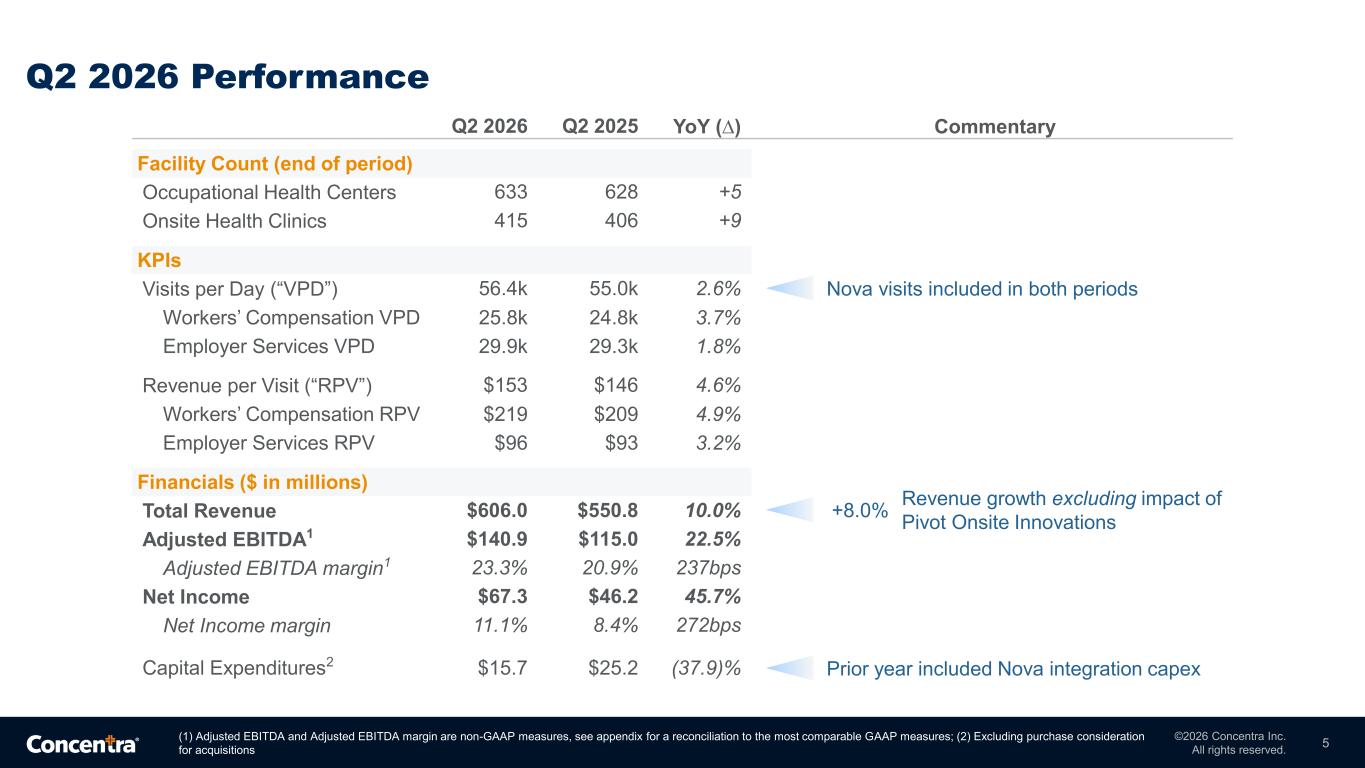
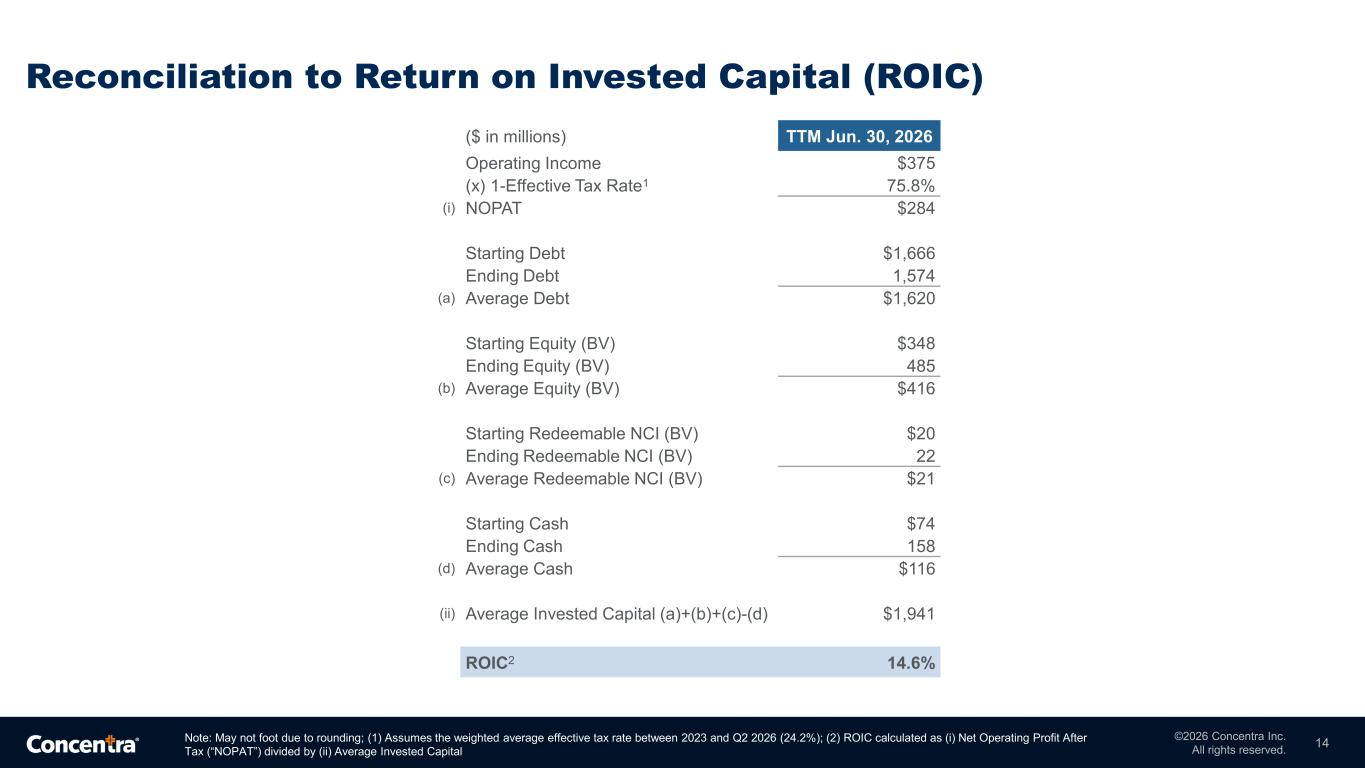
Matt? Thank you, Keith. Before turning to the quarter, I would like to say what an honor it is to be selected by the Board of Directors as Concentra's next president and chief executive officer. Keith, on behalf of all of our colleagues, thank you for your leadership. Over the 11 years we've worked together, you've taught me what it means to lead this company, making sure the right people are in place, enabling teams to do what they do best, and supporting the culture we have And I'm grateful that I'll continue to benefit from your partnership and counsel as Executive To our shareholders, my message is simple. This transition reflects continuity. The strategy we've articulated since our IPO, delivering on our strong customer value proposition, expanding access through de novo development and discipline acquisitions, and driving operating leverage across the platform is working, and it will not change on November 1st. Just as importantly, I have the privilege of working alongside an exceptional tenured executive and senior knowledge and commitment to our mission, provides tremendous stability, and positions us well for our next phase of growth. So with that, let's turn to our second quarter results. Total company revenue was $606 million in Q2 2026, compared to $550.8 million in Q2 of the prior year, representing 10% growth year over year. Excluding contributions from the Pivot acquisition in both the current and prior year where applicable, revenue was $589.1 million this quarter, resulting in an 8% increase over the prior year, representing one of our strongest core revenue growth quarters in some time. Total occupational health center patient visits increased 2.6% to an average of more than 56,000 visits per day in the second quarter. Our work comp visits per day increased 3.7% and our employer services visit volume increased 1.8% relative to prior year. As we expected, work comp visit growth rates were lower relative to the first quarter, but visits remain strong and above long-term growth averages. We believe that this reflects both a resilient blue-collar labor market where we generally operate as well as market share gains. Importantly, the growth in visit volume has been nicely distributed across industries and geographies. While it's still a little early to definitively point towards reshoring as a key driver of the recent uptick in visit growth, we are seeing indications of improved activity in the manufacturing and construction sectors, and in particular, some encouraging activities in markets proximate to data center development. With respect to market share, as mentioned last quarter, we are continuing to deploy new tactics and technologies to help us target and efficiently communicate with prospective customers, which we think is having a positive impact. those efforts combined with customer satisfaction and retention metrics remaining at or near all-time highs are likely contributing to our market share gain. In sum, there are solid secular tailwinds supporting a growing market in the near and long term, and we are actively investing and utilizing all available levers to increase our share. We'd also like to highlight the acceleration employer services growth this quarter, which we view as an indicator of relatively resilient hiring trends across the economy. On the occupational health center rate front, revenue per visit grew 4.6% during the second quarter relative to prior year. This growth was driven by a 4.9% increase in work comp and a 3.2% increase in employer services revenue per visit. We had expected rate bumps in the state of California and Tennessee on March 1st and April 1st, respectively, helping drive the increase in the work comp rate. Additionally, we had some mixed dynamics at play with higher reimbursement initial injury visits comprising a larger percentage of total work comp visits this quarter. We expect rate growth over the remainder of the year to fall closer to 3%. Adjusted EBITDA was $140.9 million this quarter versus $115 million in the same quarter of the prior year, an increase of 22.5%. Adjusted EBITDA margin increased nearly 240 basis points from 20.9% in Q2 2025 to 23.3% this quarter, reflecting strong rate and volume growth, coupled with good execution and operational efficiencies across the business. Additionally, Q2 2025 included just under $4 million of estimated NOVA acquisition-related costs tied to one-time integration activities or expenses that have since been eliminated through synergies, creating an incremental tailwind for year-over-year earnings growth. Both our pivot and NOVA acquisitions continue to perform very well and are ahead of underwriting. Adjusted net income attributable to the company was $66.7 million and adjusted earnings per share was $0.52 for the second quarter of 2026, representing approximately 40% growth over prior year adjusted net income of $47.7 million and adjusted earnings per share of $0.37. sense. Next, to provide a little more detail in our occupational health operating segment, total revenue of $553.5 million this quarter was 7.2% higher than the same quarter of prior year. Work comp-specific revenue of $361.2 million this quarter was 8.7% higher than prior year. and employer services-specific revenue of $183.2 million increased 5.1% in Q2 2026 versus prior year. Our on-site health clinics operating segment had yet another strong quarter, with reported revenue of $38.8 million, a 72.1% increase from the same quarter of the prior year, excluding the impact from the pivot acquisition in June of last year, the on-site health clinics operating segment revenue grew 27.9% year-over-year during this quarter. As mentioned last quarter, we continue to be encouraged by both the realized growth in this business as well as the pipeline of new opportunities that the team is building. While mid to high 20s organic growth percentage may not be sustainable long-term, we see a lot of opportunity here and do expect this segment to continue to grow at a faster clip than the core business. Finally, other businesses, including telemed or pharmacy operations and other occ health-related service businesses, generated revenue of $13.7 million in the quarter, a 13.3% increase compared to the same quarter. Moving on to expenses, positive services was $413.9 million or 68.3% of revenue in Q2 2026, an improvement from 70.7% of revenue for the same quarter of the prior year. We continue to do well with our staffing efficiencies, which has precipitated nice flow through from our visit and rate growth. Additionally, as previously noted, Q2 2025 included one-time expenses related to NOVA integration activities and other costs within costs of services that have since been eliminated through Synergy Realization. Our total general and administrative expenses were $56.7 million, or 9.4% of revenue in the quarter, compared to 9.6% of revenue in the same quarter of the prior year, excluding items that are added back for the purposes of calculating adjusted EBITDA, including equity, comp, expense, one-time select separation costs, and M&A transaction costs. G&A expense was $51.1 million for the quarter, or 8.4% of revenue, compared to 8.5% of revenue in the same quarter of the prior year. As with cost of services, we had NOVA expenses in Q2 2025 that have been synergized, offsetting expected year-over-year increases in personnel and systems-related overhead related to our separation from select medical. Now to touch on cash flows. In the quarter, we generated $135.2 million in operating cash flow. This compares to $88.4 million in the second quarter of last year, with the year-over-year increase largely resulting from higher earnings and year-over-year variances in timing associated with payments of current liabilities. Investing activities used $14.2 million of cash in the second quarter and was driven by additional investments in DeNovo centers, relocations, renovations, and maintenance, as well as IT investments. On the DeNovo front, we opened one center near Phoenix in Q2, and subsequent to quarter end, we opened two additional centers in Boise and Kansas City. The Boise Center is our first location in Idaho, which represents our 42nd state with an occupational health center, a great milestone for our company. We are still targeting a total of 8 to 10 de novo centers this year and have a nice development pipeline that we expect to potentially support double-digit new sites in 2027 and beyond. We are also continuing to work our bolt-on M&A pipeline and anticipate additional announcements on that front over the remainder of the year. Free cash flow or cash flow from operations, less cash flow from investing activity, excluding business combinations, totaled $121 million, an increase from prior year second quarter free cash flow of $63.2 million. This was driven by a combination of higher cash flow from operations and lower capital spend in Q2 2026 relative to Q2 2025. Finally, financing activities during the quarter resulted in net cash outflows of $24.7 million as we repurchased approximately 424,000 shares, totaling $11 million and paid $8 million in dividends. At the end of the second quarter, we had approximately $54 million remaining under the original $100 million pre-purchase program authorized by our Board of Directors. We ended the quarter with a total debt balance of $1.57 billion and a cash balance of $158 million. Our net leverage ratio per our credit agreement at the end of June was just under three times, down from 3.4 times at the end of the first quarter. We made significant headway this quarter on both the numerator with strong free cash flow generation as well as on the denominator given our growth in adjusted EBITDA. We have reached this leverage milestone well ahead of schedule, and absent opportunistic M&A and share repurchases will continue to work towards our long-term leverage target of near two and a half times. One additional note here, we expect the interest rate spread on our term loan B to step down 25 basis points to 175 basis points now that we are below three and a quarter times leverage, meaning that we should see a nice reduction in interest expense going forward. Finally, we are pleased to announce a continuation of our dividend this quarter with Concentra's board of directors declaring a cash dividend of six and a quarter cents per share on August 5th, 2026. The dividend will be payable on or about August 28th, 2026 to stockholders of record as of the close of business on August 20th, 2026. Now, I'll turn it back to Keith to close us out with some comments on separation activity as well as our updated guidance.
Thanks, Matt. I wanted to take a minute to congratulate both the Select Medical and Concentra teams on the great work they have done together to separate the companies for the last 24 months. There are still a few loose ends remaining related to projects that need to be wrapped up, but we are substantially complete with our efforts. We've hired all the new employees that we expect to hire and have largely finalized all process and technology implementations, including the conversion of our ERP system to our own instance in May of this year. Q2 was a big milestone in this regard, and we are pleased to have almost all of this activity behind us, which now allows us to focus our internal resources, work on higher-value projects, initiatives going forward. Our monthly spend on TSA services, select medical, which at this point is largely immaterial and limited to knowledge transfer will continue to decrease each month and will be entirely eliminated by November when the agreement officially ends. I commend the teams on how they delivered on our plan. It's been impressive, to say the least, to watch this execution while also seeing our company continue to grow and expand margins despite such a heavy lift and complex process. With respect to our updated guidance, given the continued strength of the business, we are once again raising our 2026 guidance, including the low end of our target revenue range by $50 million, resulting in a new revenue range of $2.325 billion to $2.375 billion. The low end of our target adjusted EBITDA range by $25 million, and the high end of our target adjusted EBITDA range by $15 million, resulting in a new adjusted EBITDA range of $485 million to $495 million. And then both the low and the high end of our targeted free cash flow range by $5 million, resulting in a new free cash flow range of $220 million to $240 million. Our target CapEx range, $70 million to $80 million, remains unchanged. Year-to-date performance has exceeded our initial expectations entering the year, driven by strong visit and rate growth, disciplined expense management, successful execution of our growth initiatives, favorable market tailwinds. We're in a great position to continue this as we look to finish strong in the second half of 2026 and position us for another great year in 2027. This concludes our prepared remarks, and we thank everybody for the time today. We'd like to turn it back over to the operator to open the call for questions.
Operator
Certainly. At this time, we will be conducting a question and answer session. If you would like to ask a question, please press star 1 on your telephone keypad. A confirmation tone will indicate your line is in the question queue. You may press star 2 if you would like to remove your question from the queue. For participants using speaker equipment, it may be necessary to pick up your handset before pressing the star keys. One moment please while we poll for questions. Your first question for today is from Ann Hines with Mizuho Securities.
Great, good morning and thank you and congratulations Matt on your appointment. So it looks like obviously this is a great quarter. You beat consensus estimates by 13% and you raised guidance by 4%, maybe what was the beat versus your internal expectations? And if you beat by a similar amount to street consensus, are you just being conservative or is there something you're seeing in the market? Why you wouldn't raise guidance more? And then my second question is, obviously workers' comp volumes are very strong. Thank you for the detail on ensuring AI data information information but can you remind us what is it two to three percent we should assume like long-term growth and workers visits and then if this onshore and data center work actually happens what do you think it could add to long growth long-term growth over time thank you yeah good morning and thanks for the note appreciate it and the question uh so on your first question on guidance so yes we we've obviously had a really strong start uh to the year halfway through the year.
Q1 and Q2 exceeded our expectations. And we've raised our guidance by more than our beat. So, you know, we continue to talk about the second half of the year, similar to how we talk about our long-term algorithm. Low single-digit visit growth, 3% rate growth. POSTA services, we expect, we'll continue to see some improvement. Obviously, Q2 is our best efficiency quarter in quite some time. And GNA, we expect to be roughly flat quarter over quarter. So I think there could potentially be a little conservatism in the outlook for the rest of the year. So it's definitely not something we're seeing. We continue to see strong visit growth and And obviously, it had a great rate quarter as well. And with the cost side of the equation working, it's all kind of clicking together. So nothing that we're seeing. And, you know, obviously raised the EBITDA guide by about $20 million to the midpoint.
Yeah, I was going to add, relative to the conservatism, you know, we, as Matt mentioned, And so far, we continue to stay pretty consistent with what we have seen, but still several months left in the year, a lot of things going on out there, and just wanted to make sure that we stuck a stake in the ground that we felt really good about.
Yeah, and on your second question, Ann, I think it was around the long-term growth rate expectations for work comp. So we still point to the low single-digit visit growth rate as our expectation over a long period of time. Now, obviously, the last three quarters of last year were in the 3% to 4% range. We had an outsized Q1 at 6.2%, and we're back in the 3% to 4% range this quarter. So it's above our long-term algorithm. And as we noted in the prepared remarks, we are seeing some early signs of the manufacturing and construction, reshoring efforts, and the data center trend. So if those continue, and we're paying close attention to it, and I think we're positioned well with our geographic footprint to capture any gains there.
Speaker 10
Great. Thank you.
Operator
Your next question is from Joanna Gajuk with Bank of America.
Oh, hi. Good morning. Thanks so much for taking the question. So actually, in terms of the conservatism, in a way, for this year and the strength in this quarter, so I understand that year over year, but even when you just look on its own, the Q2 margins were very strong, and now your guidance implies EBITDA margins of, call it 20.9%, right, 20.8% to 9%, so very close to 21%. So now the question is, you know, how should we think about EBITDA margins, you know, going forward? Should we kind of, you know, look at this and say, hey, this is the new starting point and you can still grow from there? Because obviously you will not have any, you know, separation costs, right? So there should be, I guess, sort of, you know, more of a tailwind in 27 versus 26 to help us understand how to think about margins. I know you're ready maybe to give a specific number, but just like philosophically in terms of the, you know, biggest tailwinds and headwinds when we think about margins going forward.
Yeah, sure. Thanks for the question, Joanna. So keep in mind, you know, Q2 and Q3 are the highest margin quarters. So you've got to factor in seasonality when you look at the overall margin profile. But I think when you're correct, when you look at the midpoints of our guide, we're anticipating roughly 21% margins this year. And as we've talked about in the past, we've had four or five years at about 20%. And we've taken on public company costs and separation costs. So, we do anticipate the margins to move up as we continue to grow visits, rate increases, execute on our M&A strategy. And I think, you know, this quarter, you can really see the visit and rate strength and how that flows through the margin, closer to the margin, combined with the efficiencies that we had in the quarter.
Yeah, I would agree. And, you know, we had probably the best quarter we've ever had in this company, and it's reflected in this quarter in those numbers. And I think as we look to the future, we feel pretty good about the direction we're heading. And with what Matt said about the margins and where they are right now, we think we can hold the line on those. But, again, seasonality will take a little bit of the impact on the second half of the year.
Perfect. And if I may squeeze in a follow-up on something you said. But actually, two quick ones. So one on the Tennessee increase, I couldn't remember whether you told us what it was. I think California was a 5% increase. And then the second one on the pricing, similar driver, when you mentioned the mix of injury visits. So can you tell us what it was and what drove that?
Yeah, sure. So Tennessee went into place on April 1st. I believe that was roughly a 30% increase, depending on the visit type. just that's a blended number. And then your other question on the visit mix. So our work comp rate growth was 4.9%, which was above our expectations. We did have a lighter Q1, if you remember, and we expected California and Tennessee to kick in on March 1st and April 1st. And so we did expect a decent increase in the year-over-year rate profile for work comp. Part of the 4.9% was also driven by visit mix. We had higher initial injuries, which are a higher rate per visit. And we also had some year-over-year comparisons to last year, where we had 67 NOVA centers where we were putting systems in and preparing for the integration process. So there's a little bit of noise just year over year. That's why we expect the work comp visit growth rate to come down a little bit in the next couple quarters, although the revenue per visit we expect to be roughly flat quarter over quarter going forward.
Speaker 10
All right. Thank you so much.
Operator
Your next question for today is from Justin Bowers with Deutsche Bank.
Hi, good morning. Matt, congrats on the appointment. And Keith, congratulations on the run. It's been several decades of great architecture here. So I want to talk about the strength in the workers' comp visit. And you are running above trend. But Matt, it doesn't sound like you're talking about a mean reversion anytime soon. It sounds like, if anything, there could be maybe a cyclical upturn with some of the data center activity, and maybe you could run above the low single digit over the next, you know, year or so, contingent upon whether that activity continues. Can you just elaborate or clarify on that? Then I have a follow-up.
Yeah, Justin, this is Keith. Yeah, from a workers' cop perspective, we've really had a strong year, probably one of the best years we've seen in 20 years so far. And we continue to see strength in those visits as we go forward. a lot of it's what we've seen in the manufacturing and construction area. And that's, that's evidence with some of the things we're seeing on the employer services sides, as far as growth in those visits also, which ultimately would yield to the comp visits. So we, which will actually yield to future comp visits. So we feel pretty good about what we're seeing. We think a lot of that's just a result of some of the dynamics that are happening and the tailwinds in the industry combined with the market share gains and the things we've done internally over the last few years with technologies to get better at identifying potential customers and also retaining those customers. We've got much higher retention rates at this point in time from a company perspective than we historically have had from a customer perspective with some of the technologies we put into place to make use of our facilities a much easier process for them. So a lot of different levers we've been pulling that I think we're seeing the fruits of the labor pay off at this point in time.
Thanks. And just one follow-up on that. It is clear that, like, you're taking market share out there. And one of the thoughts was, you know, how much runway is there even within the Fortune 500? Is there still opportunity to continue to consolidate that market? And then as you look beyond there, how much opportunity is there, you know, below that in that SMIT cohort?
Well, I think there's a lot of white space for us. We've done some analyses recently just looking at pins on the map, where we could be, what's out there, and it's a nice runway for us relative to that. And as far as continuing to penetrate deeper into existing customers, it seems every time we continue to add pins on the map, what that does, it makes it easier for those larger customers to use this more as far as more sites. And we've seen some transition as far as that. But, you know, the large Fortune 500 companies, you know, they drive visits to us. But as you know, we've got over 200,000 small customers out there, which drive a large majority of visits to us. So, you know, we continue to prospect those, identify them through technologies, and continue to penetrate the market. And I think just with the stickiness we've done with technologies within our centers, providing information to the employer decision makers on a quicker basis than others, upgrading the level of service the patients are experiencing, you know, all those levers are what's yielding the, you know, the results that we're seeing within the bricks and mortar right now.
Thank you. I'll jump back in queue.
Operator
Your next question is from Stephen Baxter with Wells Fargo.
Yeah. Hi, thanks. I wanted to follow up on one of the Q2 drivers that you called out. You mentioned that within the workers' comp business, there was some feasibility from NICS related to higher, I guess, new first injury and assessment visits. Can you help us understand why you think that's occurring? And then as you look back across the company's history, when this tends to occur, does it tend to be more transitory in nature? I guess I'm wondering why this wouldn't be something you think might not be a durable trends we move into the back of?
Yeah, sure, Stephen. So thanks for the question. Yeah, initial injuries, we had one of our strongest quarters in quite some time. That number can fluctuate over a period of time. But I'd point back to a lot of what Keith was just going through about market share gains, a lot of the things that we're working on from a sales and marketing standpoint, technologies we put in place to make sure we're in front of customers, and also all the great work that our teams are doing at the center level with the operating KPI metrics that we track are at all-time highs. And so the patient experience, the customer experience is driving a higher retention percentage right now, which is already at a high level. But I think it's a combination of higher retention and overall market share gains and also some of the macro backdrop that we see. So, you know, hard to predict that number going forward into the future, but what we've seen over our history is it does fluctuate, but we like what we're seeing right now.
Got it. Okay. That's great. And then just with the progress that you've made on leverage? You know, I guess, how should we be thinking about the deal pipeline? How do we think about the balance between, you know, what might interest you in kind of the core occupational health business or some of your other opportunities? And any thoughts generally kind of on the size of assets and how that might compare to some of the things you've done more recently? Thanks.
Yeah, I'll take that one. We've got a strong deal pipeline at this point in time, both from a bricks-and-mortar and an on-site perspective, prospecting them all, moving them all along the pathway. As far as anything the size of a Nova, that's not going to happen. But several nice mid-sized ones that we think can get across the goal line in the coming months, and we don't think it will really impact our leverage at all. In fact, based on the cash flow of the next months and what's in the deal pipeline, we think we're going to be able to manage that very well and continue to handle the leverage and continue to bring that down. So we feel good about what's in the pipeline, feel good about how we're going to handle the leverage simultaneous with that, and nothing out there of a NOVA-type size at this point in time.
I would just add a couple points. Obviously, we did some M&A and de novos to start the year, but the back half of the year looks good, especially from a de novo standpoint. Also, we're incredibly pleased with the leverage getting below three times. That was a goal of ours by the end of this year. We did it by the second quarter, obviously, because of the strong cash flow and also because of the EBITDA growth. But I think that's a great sign for some investors who target leverage ratios below that number.
Got it. Thank you. And congrats to both of you on the new rules. Thank you.
Operator
Your next question is from Scott Fidel with Goldman Sachs.
Hi, thanks. Good morning, and glad I was able to get on the earnings call in time for the transition announcement today, so congratulations to both of you. And I wanted to just ask in that same context, Matt, maybe if you just wanted to take a moment to just, you know, talk about, you know, any particular, you know, areas of the strategy or operations that you expect to, you know, lean into a little bit more in terms of where your focus is. I'm assuming it's going to be very consistent in terms of the strategy and the operations and would keep, you know, still a executive chairman. But just curious if, you know, from the capital deployment perspective or priorities on operations and strategy, if anything that you think you'd see yourself, you know, maybe focusing in on even more or conversely a little bit less.
Yeah, no, Scott, I think the story is going to stay exactly how it is today. We've got a great strategy in place. It's working. as Keith mentioned in some of his remarks, focusing on providing great clinical outcomes and care at the center level, great patient experience, great customer experience. We're going to continue to focus on technologies to make it easier to do business with us, and we've got a great growth strategy from an inorganic standpoint. So, no, there's no plans to change anything. We really like where we're at, and we just need to continue to execute what we're doing.
I was going to add to that, you know, we've got a, as we mentioned several times, that we've got a very tenured executive team. The executive team itself is well over 20 years average experience here at Concentra, and then you take the next 50 to 75 people below that from a senior management team, and it's probably close to 20 years also. So we've got a great foundation built here, a great culture. It's a very collaborative decision-making process. It's not just Matt and I making the decisions and pushing them down. It's bought in by all those individuals that I just spoke of, a lot of smart people weighing in on the decisions and the strategies and executing on them. And so we've got a tremendous recipe here that we've been working on for a long time, and we'll continue to execute on that recipe.
Okay, great. And for my follow-up, I'm going to ask a two-parter, I guess not entirely related, but still do it anyway. First part, just around the free cash flow, you know, which was very strong there, sort of close to doubling year over year and, you know, did reflect those EBITDA margins getting to sort of higher levels and then the lower cap backs. Could you maybe just talk about the sustainability of, you know, the free cash flow or what type of sort of level you think is more sustainable and sort of implied in the back half and, you know, sort of, you know, how we should be thinking about that. And then the other part was just on the industrial injuries, just interested if just around the whole theme of sort of the new construction and activity around sort of the AI infrastructure hyperscaling and the opportunities that are there. Are you seeing any evidence yet of the – I know you talked about sort of seeing some emerging indicators there, but just curious around like the industrial industry injuries themselves? Are you seeing any sort of impact from that, or is it still too early to really see that in terms of your mix? Thanks.
Sure. I'll hit the free cash flow first. So, approximately $120 million in the quarter, obviously an incredibly strong quarter. You look at our guide, we bumped it up slightly. There is some timing, as we mentioned, as it relates to the cash flow. So we had some current liabilities that impacted timing from a favorable perspective. And also our CapEx was slightly lower in the front half of the year. So we have some planned CapEx, especially related to the de novos and some of our other IT investments in the back half of the year. So sometimes from a quarter-to-quarter perspective, there is some timing there. But overall, we expect a very strong free cash flow year, well north of $200-plus million. On the second question, on the data centers and the injuries, we are seeing some early positive signs. We're seeing really closely, close to a lot of the major construction companies across the country. We're seeing some nice growth in Texas, Oklahoma, things like that. I think the NOVA acquisition really helped us expand into markets that we weren't in, that those markets have some of the data center build happening. So we'll continue to monitor it closely, but we definitely are seeing early signs of it.
Yeah, I was going to add, and some of the early signs that we do see, typically employer services is a leading indicator that ultimately yields work comp, and definitely in the construction and manufacturing area, we've seen our employer services tweaking up at a better rate than potentially some of the other industries out there. So, you know, it's anecdotal whether that's a result of the data centers, but we think that because of that, the construction activity and some of the things that may be coming down the pipeline, that that could be happening.
Operator
Your next question for today is from Benjamin Rossi with J.P. Morgan.
Hey. Good morning. I appreciate you taking my questions. Regarding expense trends during 2Q, cost of services improved nicely. quarter-over-quarter on a per-visit basis despite volumes picking up. What specific operating levers are driving center-level efficiency? And then, how are you thinking about primary expense trends for the remainder of the year, and what assumptions are embedded in your guidance race?
I can talk about some of the operating levers within the bricks and mortar. Personnel labor is by far our largest cost, and in the past, we've been asked quite often how we manage that relative to what some of the other healthcare entities have been seeing. And, you know, our business is a little different than the others. We didn't have the RNs. We didn't feel a lot of the pressures that others felt. And so we've been able to manage the per FTE cost. In addition to that, as far as the number of FTEs within the centers, we continue to get more efficient with patient visits per FTE within the practices. And a lot of that has to do with the technologies that we put into place to try to eliminate the inefficient work that any of them are doing. And we continue to see that tweak up and leverage that cost as a result. So our individuals, our people, our colleagues within the centers are able to see more patients on a per-person basis than what they've done in the past, purely because of some of those technologies and the elimination of a lot of non-clinical activities that take place within the practices. So that's how we're really leveraging that cost within the bricks and mortar. I don't know if you want to add anything.
Yeah, I'll just add a little bit to what Keith said, Ben, to your question. On a rolling TTM basis, our cost of services as a percentage of revenue has come down pretty much every single quarter since the IPO, and it really speaks to what the teams are doing out there across the country, as Keith mentioned. Also, obviously, we had strong revenue growth this quarter, which helps that metric. And we also noted, when you look at the year-over-year comparison, we noted that last year, in 2025, this quarter, we were preparing and beginning or NOVA integration efforts, and we also had some costs at the cost of services line that has since been synergized. And those are not center-level costs, but costs to support the centers. So hopefully some of those comments help. Yeah, great.
Just thinking about employer services during the second quarter, Valium stepped up. there pretty nicely for that segment on a sequential basis. Between your lower dollar drug screens versus some of the higher dollar physicals, what was the service line mix and 2Q for employer services? And then what does guidance anticipate for shifts and mix during the back half of the year? Thanks.
Yeah, so we saw 1.8% overall employer services growth. We don't really get into the breakdown of drug screens, physicals, but as far as the back half of the year, we're anticipating low single-digit visit growth implied in our guidance for employer services. But as Keith mentioned, we're seeing positive signs there. It is a nice indicator of future economic activity, and so we like what we're seeing there.
Operator
Your next question for today is from Jared Hasse with William Blair.
Hey, good morning. Thanks for taking the questions and i'll echo the congrats to matt and keith to you both on the new roles here um maybe uh i wanted to ask about the on-site business you had another really strong growth quarter on an organic basis can you just take a step back and give us an update on sort of the pipeline you know deal flow how you feel like the offering is positioned here with the broader services that you have now with the advanced primary care uh capability and i'm also curious I mean, clearly it seems like you must be taking market share here, but just, you know, are you seeing a little bit of demand acceleration here? I'm just thinking about all the pressures that employers are facing from a cost trend perspective. Is that playing out at all, or do you feel like this is truly just, you know, share gains for your business?
No, we definitely feel there's increasing demand for these services. Our sales pipeline is as robust as it's ever been. And the pivot combination with our core on-sites really helped us leverage a lot of things and relationships. We've been able to expand with existing customers on both sides that were common customers. So you do that without having to go out for an RFP. So we continue to grow what our core business has been. The transaction with Pivot has helped us out a lot as far as the visibility and getting bigger and leveraging that platform. And then you combine that with added traction and momentum that we're starting to gain with our advanced primary care services. With the implementation of Epic, it's really put us on the map in relationships that we're developing with the broker community out there. where historically we did not have those relationships because we didn't need them on the occupational health care side. Those are starting to foster, and we're starting to win those RFPs. So I don't know if you want to.
Yeah, I just want to also give our team a big kudos. Obviously 20-plus percent organic growth, but also the execution on the pivot transaction was flawless. The two leadership teams came together and are working together so well, brought a lot of talent over from the pivot acquisition, and our core leadership team is strong. The sales and marketing efforts are going really well. Just execution across the board in that segment is going incredibly well.
That's great to hear. And then maybe just for the follow-up, so I just wanted to clarify, when we think about your de novo expectations. And I think your full year target sort of implies a bit of an uptick in the back half of the year. To what extent is there any sort of incremental volume lift associated with those de novos in 2026 guidance? And, you know, when I think about how quickly they can ramp, is there any potential upside from the 2026 cohort? And then I guess sticking with the de novo thread, I'd love to hear a little bit about just your pipeline and opportunities that you have earmarked both for 2027 and then maybe starting to think about even 2028 at this point?
Yeah. So the way I think about DeNovo is we're targeting eight to 10 this year. We're targeting double digit next year. We have a funnel of 30 to 40 different sites that we're looking at and just prioritizing across the country. As far as the contribution, we've been doing them for a long time. They start out at zero, obviously. They do ramp quickly. Really excited about some recent improvements we've made from a sales and marketing standpoint, even though historically we've done such a great job ramping quickly. Their contribution from a visit standpoint is minimal. So, you know, less than 1% overall. So the strategy is working. And again, we, as Keith mentioned earlier in the call, we have a lot of white space out there to add, you know, a decent bit of these over the next 5, 10, 15 plus years.
Yeah, I was going to add the first 6 to 12 months from a de novo perspective, it's really not much contribution at all. You're going to start out with some cash flow losses that break even and start to go positive. But the net-net of everything, we really don't see much until they get into the 12 to 24 months and start to really ramp up. So the hope would be what we're doing in 26 really benefits us more in 27 and 28. There are really no benefit either way or drag per se in 2026.
Speaker 10
Okay. That's very helpful. Thank you.
Operator
As a reminder, if you would like to ask a question, please press star 1. Your next question for today is from Ben Hendricks with RBC Capital Markets.
Thank you very much. Just hoping you can give us a quick update on the state regulatory and rate horizon. Now that we have California and Tennessee updates, just what kind of is next in terms of the outlook? Is there anything catalytic on the horizon you're waiting for or anything that we should be aware of from the right perspective going forward?
No, I think as it relates to 2026, nothing is really on the horizon for the remainder of the year. It's just kind of digesting what has happened at this time. And it's still really a little too early to know what's going to transpire completely in 2027. We'll know more as we get into latter part of Q3, early part of Q4. But the indications and the things that we do see for next year, what we can see, it seems it'll be a nice year for us as far as we know at this point in time. And there's nothing of concern at all at this point in time. And we should see, hopefully, something similar to what we've seen in the past years.
Just apologize if I missed this. But now with leverage down at your target level, I just wanted to see if you guys are setting a new kind of intermediate term target. Are we taking it down another half a turn? Would that be optimal or do you think we'll maintain at three?
Just wanted to get your thoughts on kind of where that target goes now. yeah no our our goal is to get it down uh optimal uh from our standpoint is call it in the range of two and a half times um and we're going to continue to prioritize m&a de novos um we did the share repurchases in the quarter we have the dividend in place that the board approved again this quarter so we're going to stick with the strategy and the leverage we expect will continue to come down.
Thanks, guys, and congrats.
Operator
We have reached the end of the question and answer session and conference call. You may disconnect your lines at this time. Thank you for your participation.