Operator
Good afternoon, ladies and gentlemen. Thank you for standing by and welcome to the Central Pacific Financial Corp. Second Quarter 2025 conference call. During today's presentation, all parties will be in a listen-only mode. Following the presentation, the conference will be open for questions. This call is being recorded and will be available for replay shortly after its completion on the company's website at www.cpb.bank. I'd like to turn the call over to Ms. Dana Matsumoto, EVP, Chief Financial Officer. Please go ahead.
Thank you, Rebecca, and thank you all for joining us as we review the financial results of the second quarter of 2025 for Central Pacific Financial Corp. With me this morning are Arnon Martinez, Chairman, President, and Chief Executive Officer, David Morimoto, Vice Chairman and Chief Operating Officer, Ralph Misik, Senior Executive Vice President and Chief Risk Officer, and Anna Hu, Executive Vice President and Chief Credit Officer. We have prepared a supplemental slide presentation that provides additional details on our earnings release and is available in the Investor Relations section of our website at cpb.bank. During the course of today's call, management may make forward-looking statements. While we believe these statements are based on reasonable assumptions, they involve risks that may cause actual results to differ materially from those projected. For a complete discussion of the risks related to our forward-looking statements, please refer to slide two of our presentation. And now, I'll turn the call over to our Chairman, President, and CEO, Arnold Martinez.
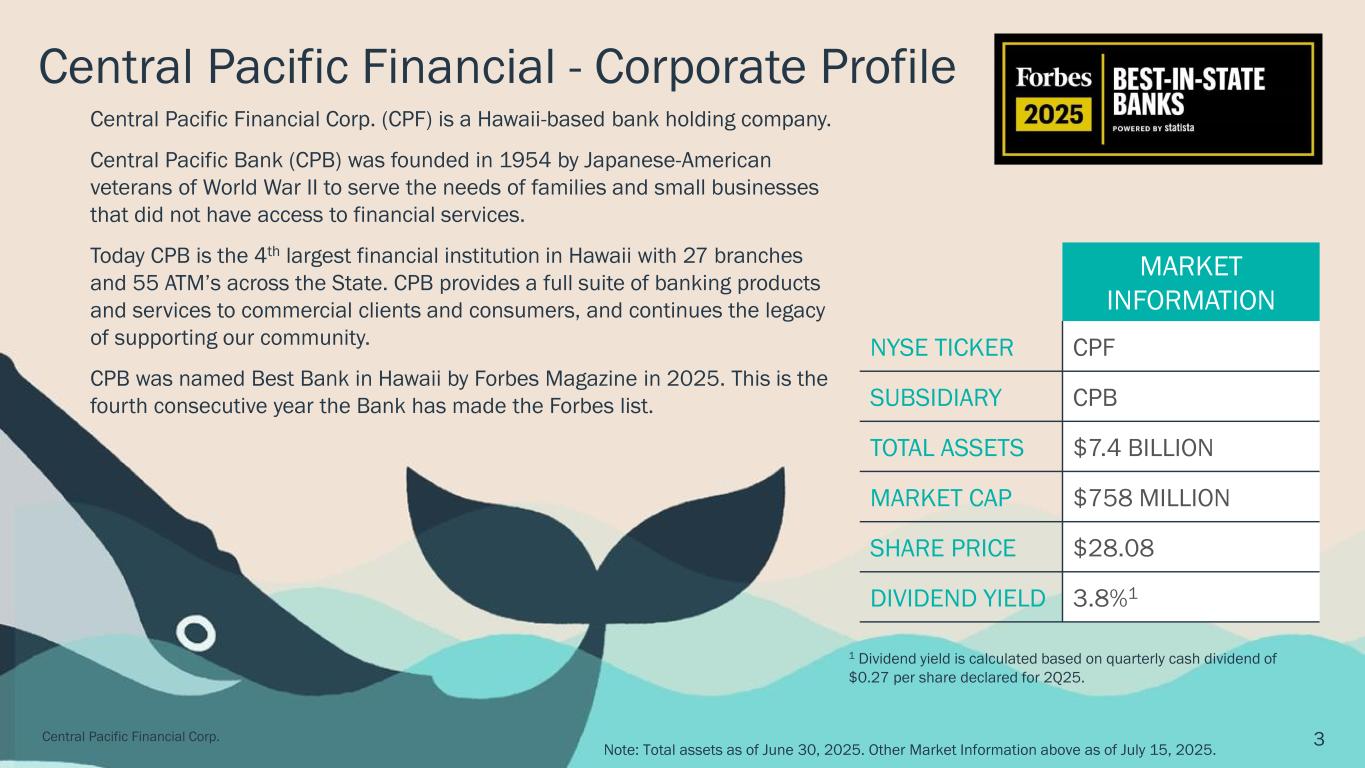
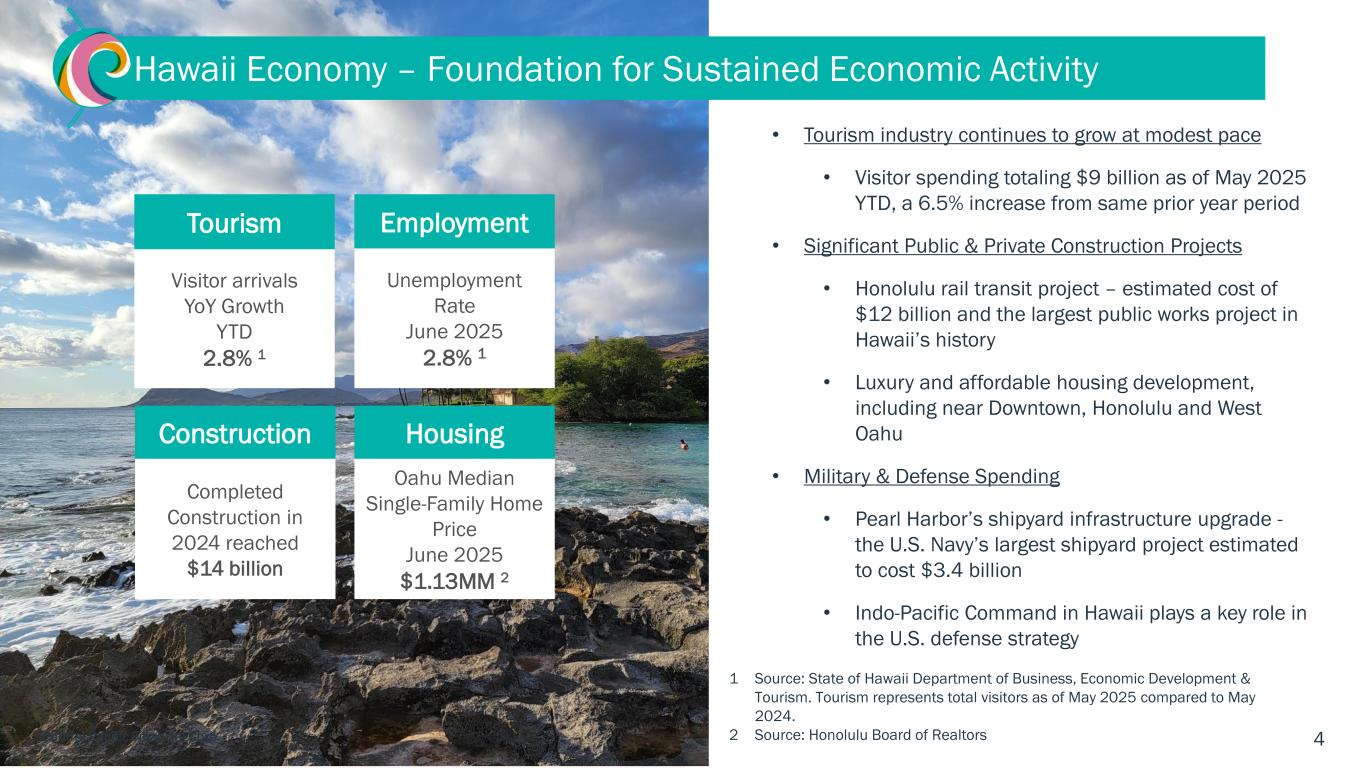
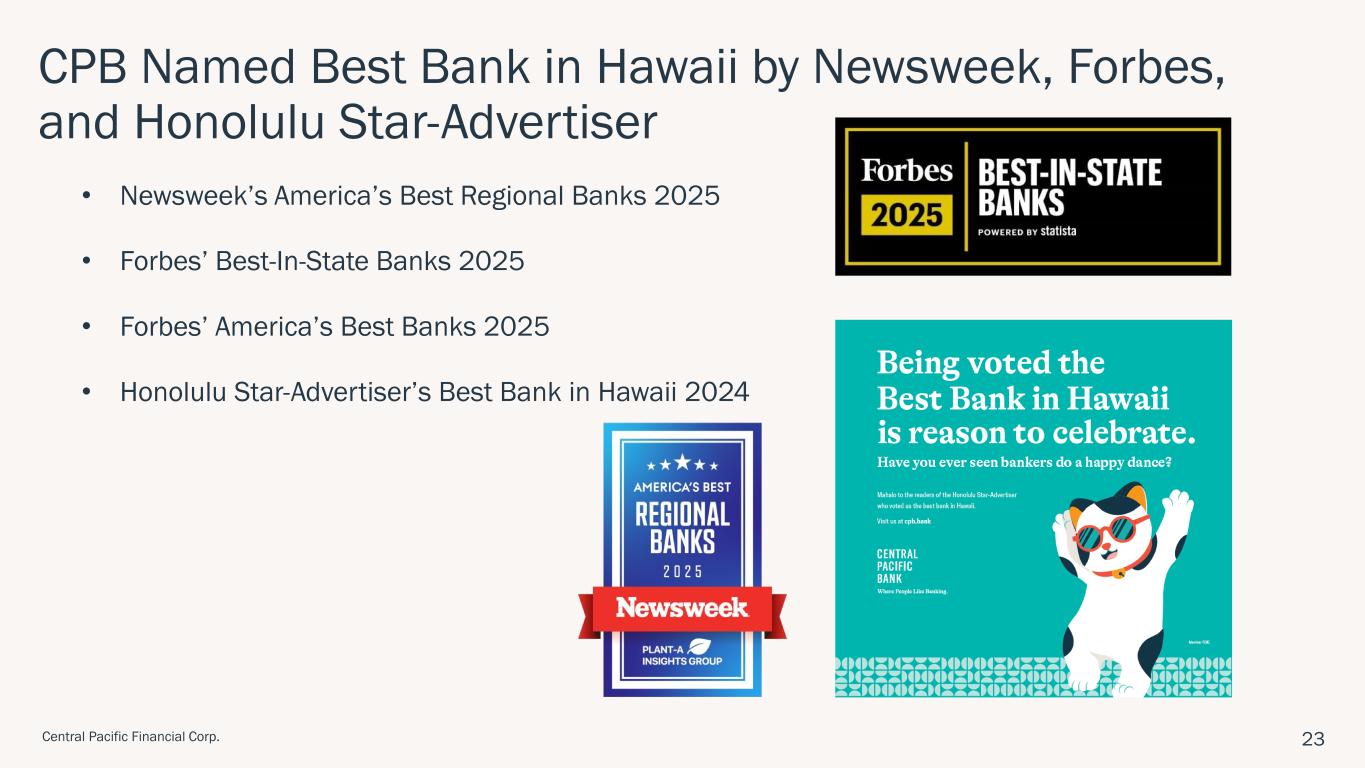
Thank you, Dana, and aloha, everyone. Before diving into our quarterly results, I'd like to take a moment to proudly share that CPB was named the best bank in Hawaii by Forbes magazine in 2025. This is the fourth consecutive year the bank has made the Forbes list. Our second quarter financial results demonstrate the continued strength of our core business and ability to execute effectively in a dynamic market environment. The bank's strong asset quality, capital, and liquidity positions will enable us to grow grow our business by continuing to support the needs of our customers and the markets we serve. I want to thank our dedicated employees, customers, community, and shareholders for your continued support of our bank. Turning to our Hawaii market update, the state's economy continues to demonstrate resilience across multiple sectors. The construction industry remains solid with completed construction in a stage reaching $14 billion in 2024. Activity in 2025 is expected to show steady growth driven by several major infrastructure and residential developments. Tourism, a key driver of our economy, shows encouraging trends. Through May, year-to-date, visitor arrivals were up 2.8% from the prior year and down just 3.9% from pre-pandemic 2019. Total visitor spending was up 6.5% from the same prior year period and up 24.3% from the same period in 2019. The majority of the growth is from domestic travelers, while the recovery of Japanese visitors continues to be low. Hawaii's statewide seasonally adjusted unemployment rate remained very low at 2.8% in June and continued to outperform the national unemployment rate of 4.1%. The strong labor market continues to support consumer confidence and spending in our local economy. The Hawaii residential real estate market remains steady. Single-family home prices in Hawaii rose 0.4% in June, with a $1.13 million median sales price. Home sales volumes for June year-to-date dipped 2.1% for single-family homes and dipped 6% for condos, compared to the same prior year period. The housing supply in Hawaii continues to be tight but has picked up in recent periods and now has a positive outlook with a number of large housing projects in development. Looking ahead, we maintain a cautiously optimistic outlook for Hawaii's economy. While we are mindful of potential headwinds from global and domestic economic conditions, Hawaii's fundamental economic drivers remain sound and have proven to be resilient. Overall, we feel good about our core business environment and the opportunities ahead. With that said, I'll now turn the call over to David who will talk about our growth strategy and outlook. David?
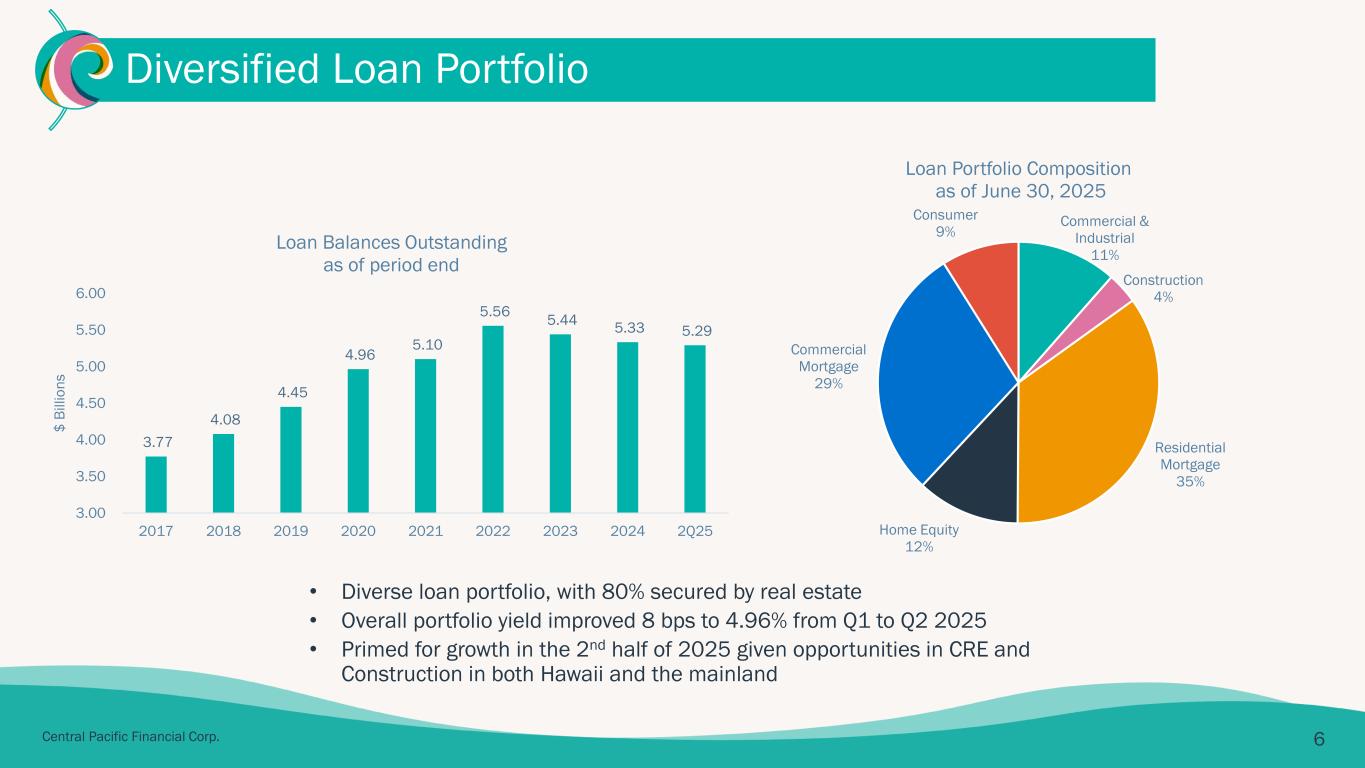
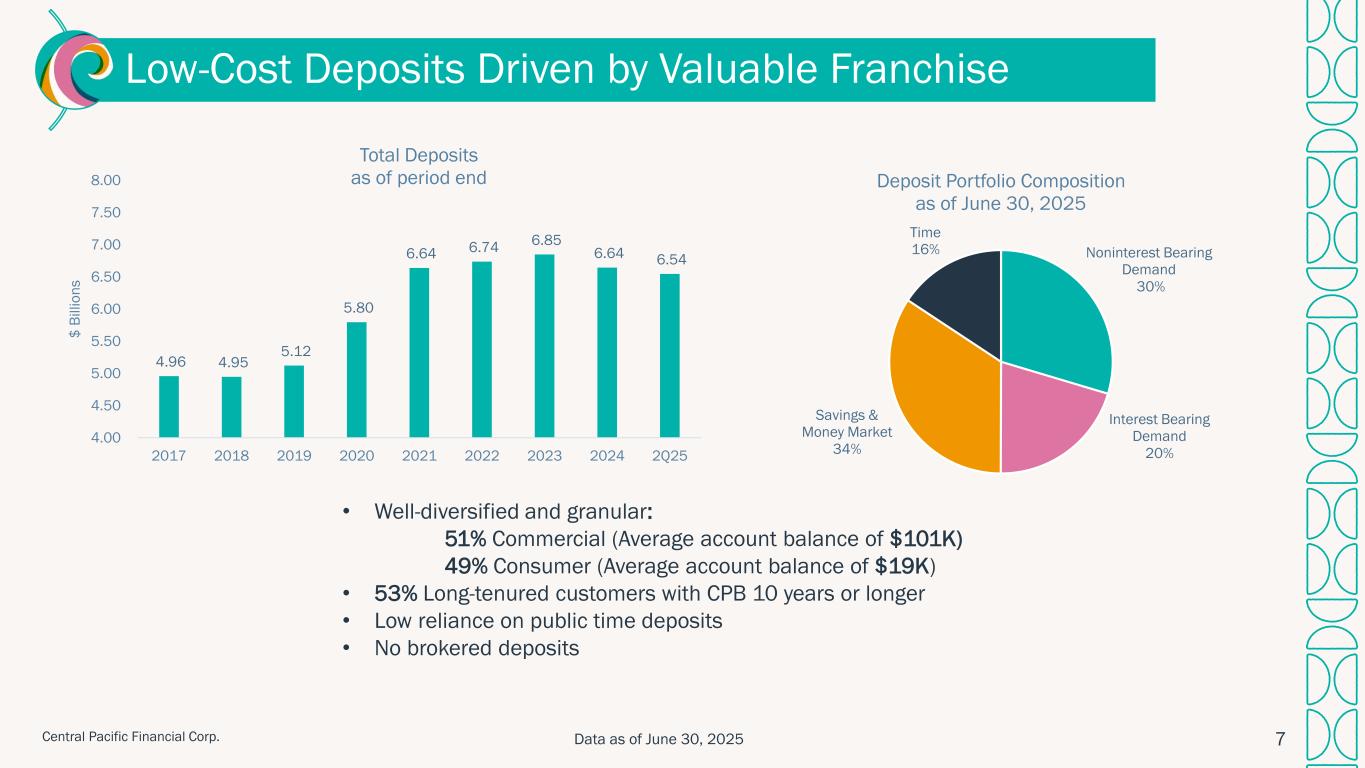
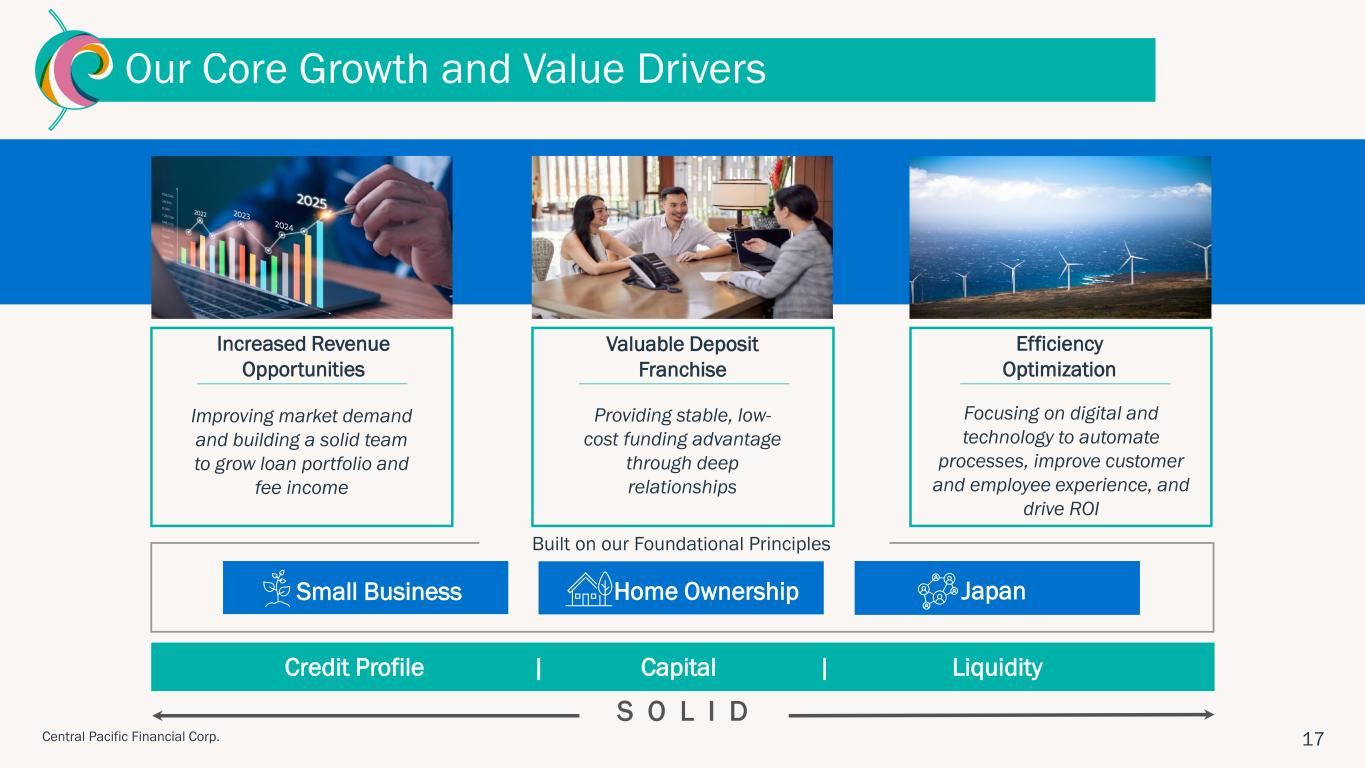
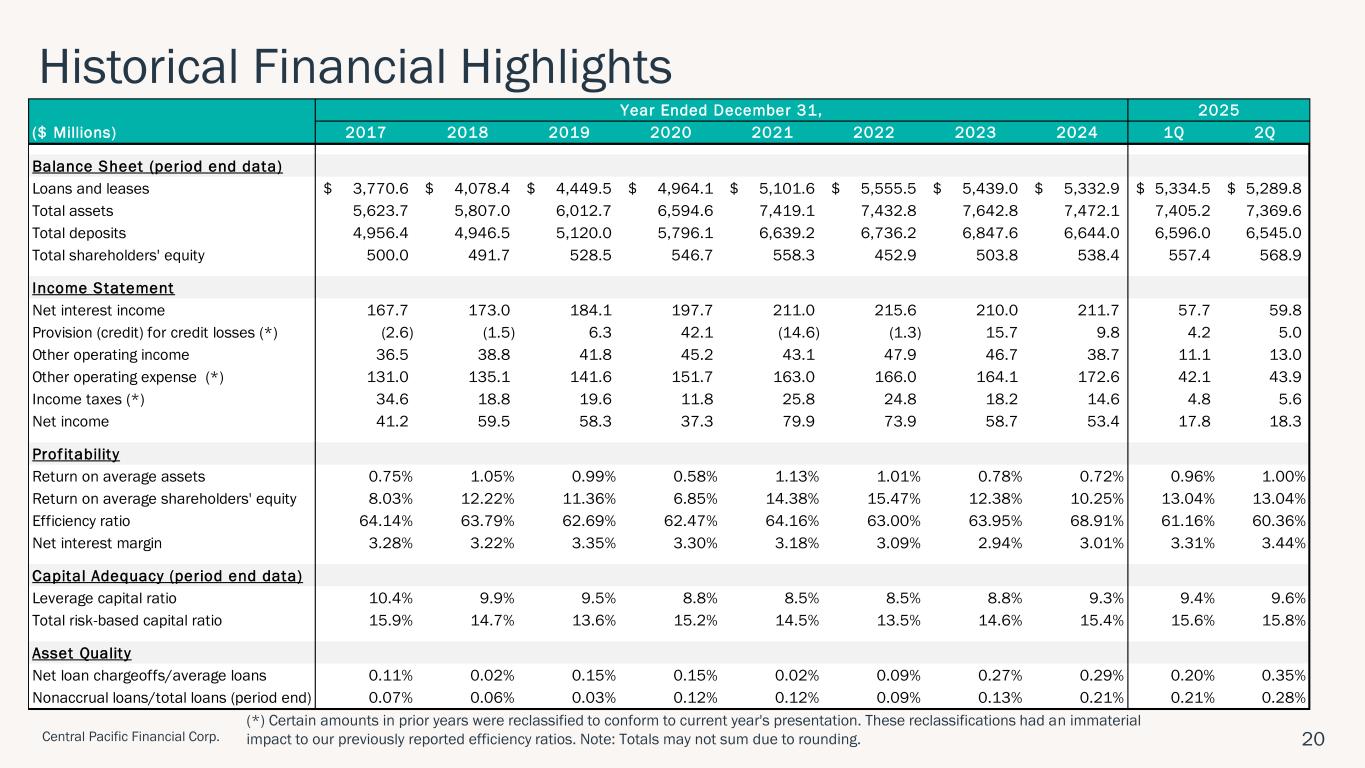
Thank you, Arnold. Our loan and deposit growth strategy continues to focus on deepening customer relationships and growing market share in Hawaii, in select mainland markets, and in Asia. While growth was muted in the first half of 2025 as anticipated, the outlook for the second half of the year looks favorable. We continue to target low single-digit full-year growth for both loans and deposits in 2025. In the second quarter, our loan portfolio declined slightly and ended at $5.29 billion. By segment, growth was achieved in construction and consumer loans, while declines occurred in all other categories. Average yields earned on loans during the second quarter increased to 4.96% from 4.88% in the prior quarter, as we continue to add new loans at current market rates. Our loan pipeline remains healthy, including several CRE and construction loans that we are booking in early third quarter, which will provide revenue lifts for the second half of the year. On the deposit front, we ended the second quarter with total deposits of $6.54 billion, dollars, which also declined slightly from the prior quarter. The deposit mix continued to shift favorably with an increase in non-interest-bearing DDA deposits. Our teams remain focused on growing core deposits while managing the cost of funds in this competitive environment. Additionally, our deposit generation initiatives related to Japan and Korea are gaining traction and play a role in our overall growth strategy. I'll now turn the call over to Dana who will provide an update on our financials. Dana?
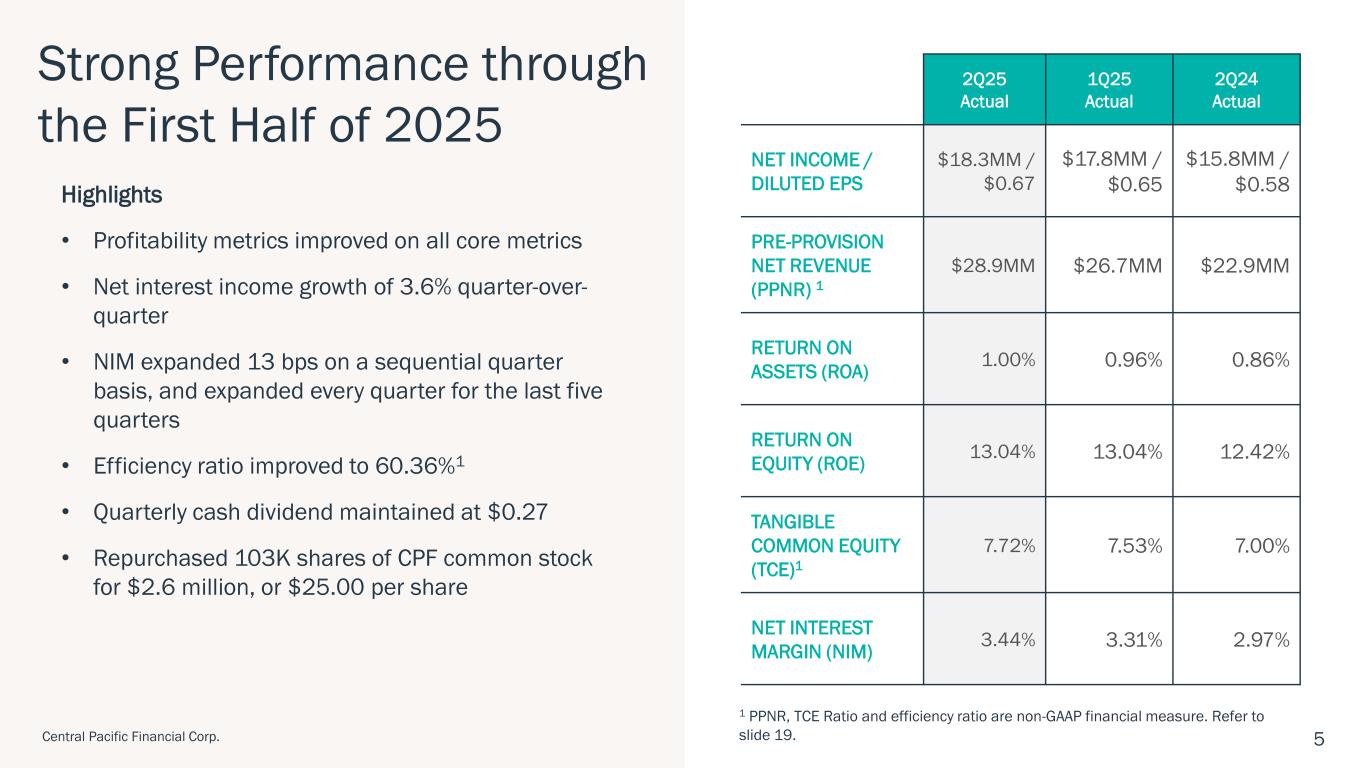
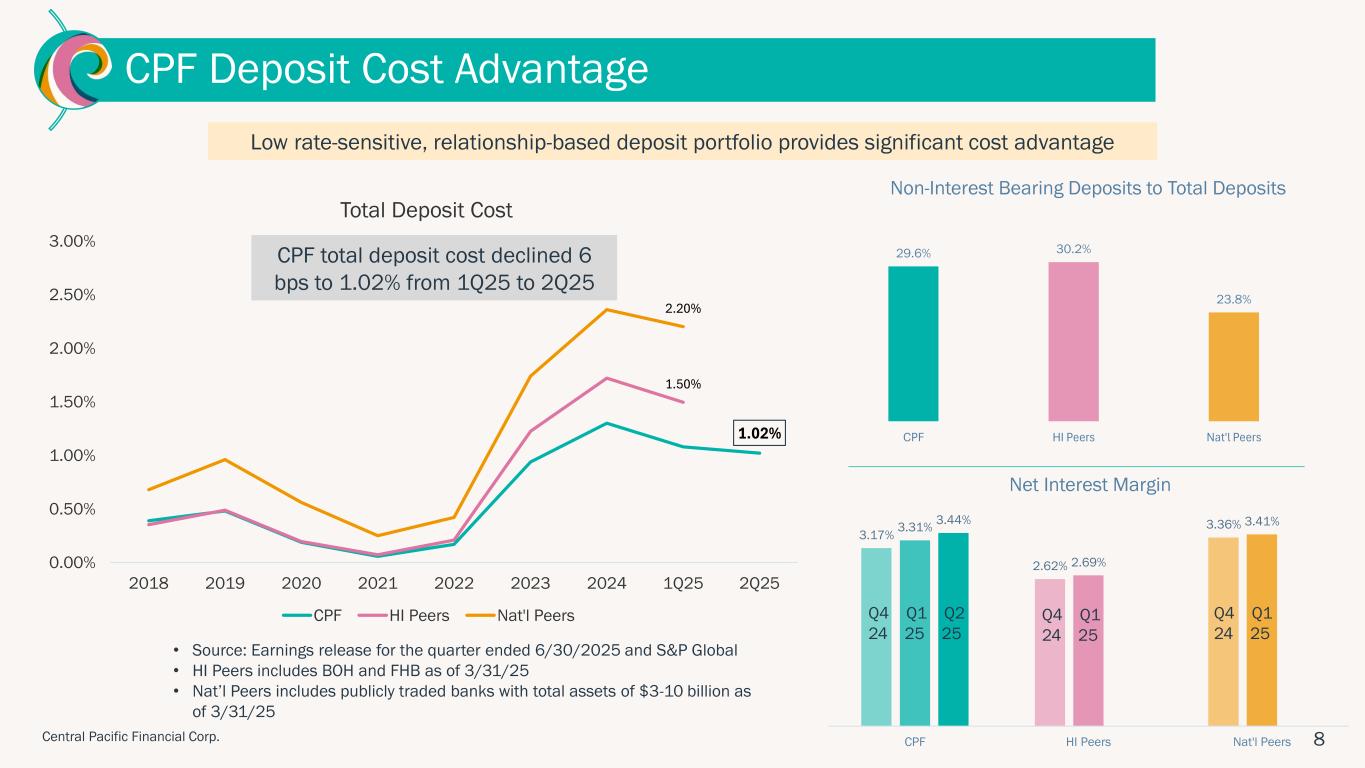
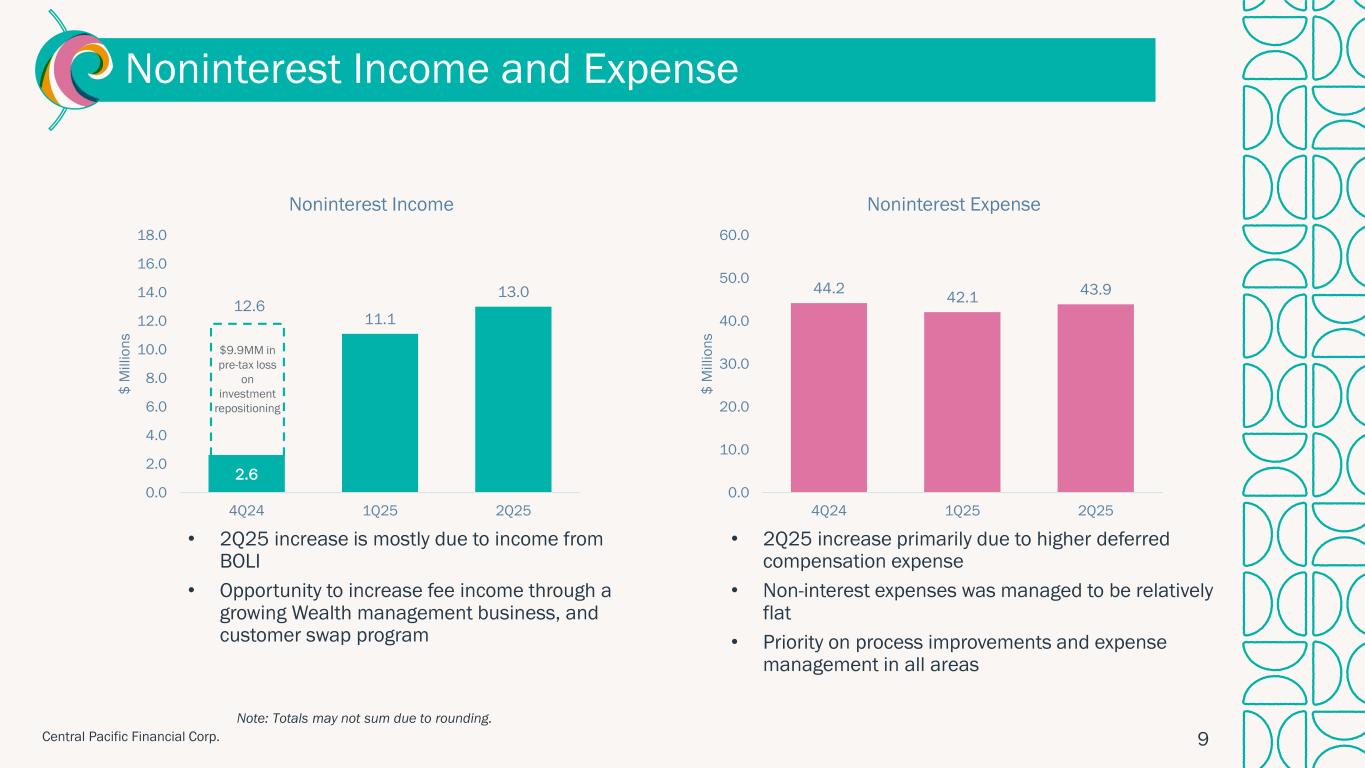
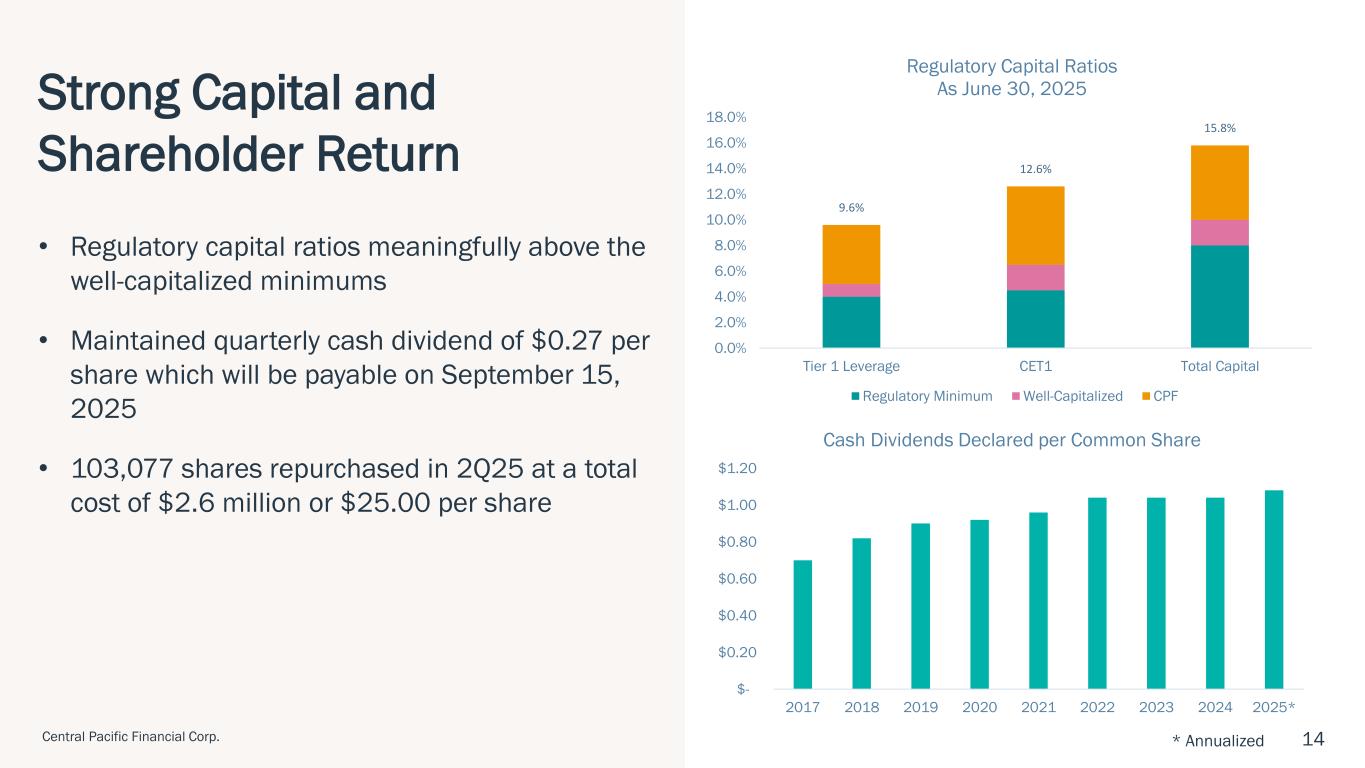
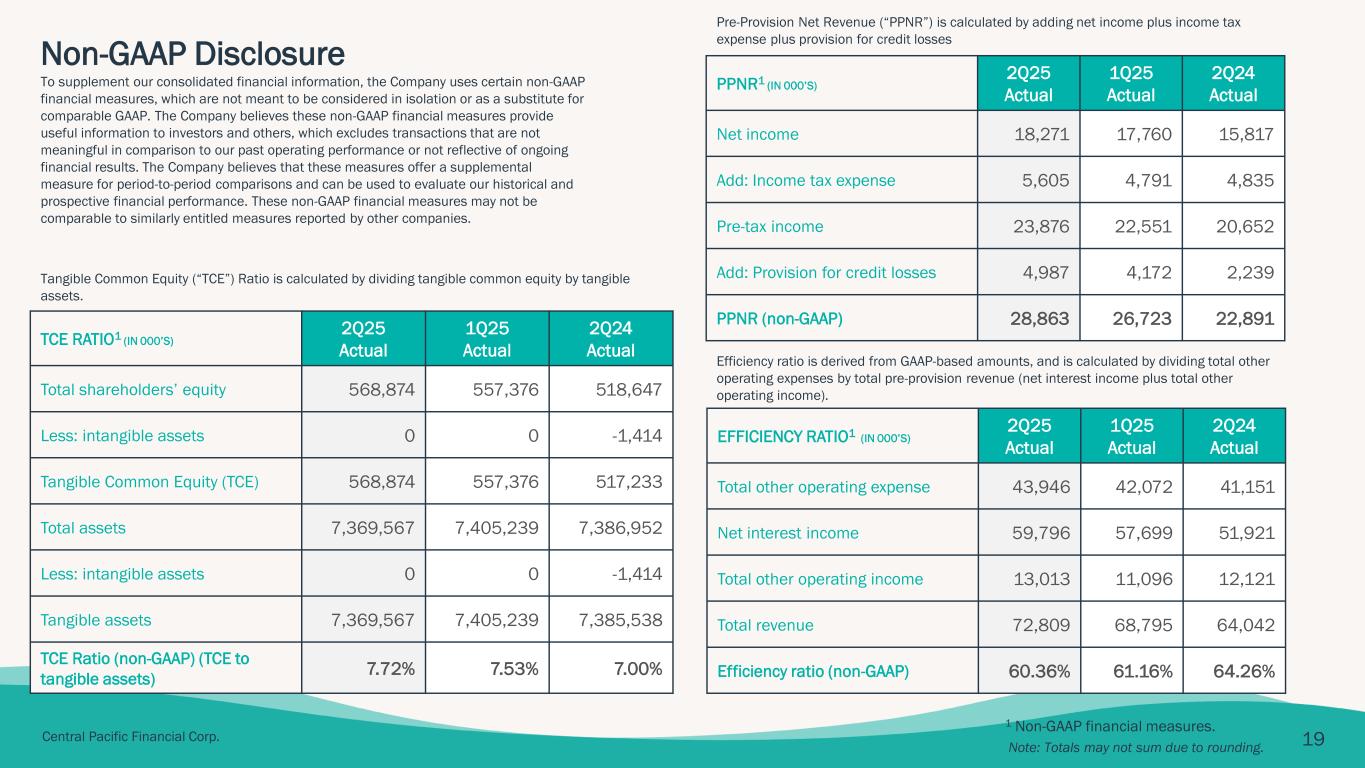
Thanks, David. Our financial results continue to trend positively for the second quarter of 2025. Starting with our core earnings metrics, we reported net income of $18.3 million or 67 cents per diluted share. Return on average Assets was 1.00% and Return on Average Equity was 13.04%. We achieved an improved efficiency ratio of 60.36% as the focus continues to be on driving positive operating leverage through revenue expansion, internal efficiencies, and expense management. Net interest income showed strong performance, increasing 3.6% quarter over quarter to $59.8 million dollars. Our net interest margin expanded by 13 basis points to 3.44%, driven by the loan portfolio yield increasing by 8 basis points, combined with total deposit costs declining by 6 basis points. Our total cost of deposits was just 1.02% in the second quarter. We are pleased with our NIM expansion and continue to manage our balance sheet in the current rate environment while maintaining a disciplined approach to pricing. Total Other Operating Income was $13.0 million in the second quarter. There was a $1.9 million increase quarter over quarter primarily due to higher BOLI income resulting from equity market gains. Total Other Operating Expense was $43.9 million in the second quarter, which was an increase of $1.9 million quarter over quarter due to higher deferred compensation expense also related to equity market gain, as well as higher computer software expense. The computer software increase was driven by our new data center, which had offsets in several other expense line items, and was slightly elevated this quarter due to overlap of services during conversion. The exit of our Operations Center building discussed on our prior quarter call is expected to happen by year end and will result in a one-time pre-tax write-off of $2 to $2.5 million. Going forward, we expect to realize total annual savings from reduced lease, operating and maintenance expenses of approximately $1 million. dollars. Our effective tax rate was 23.5 percent in the second quarter and is expected to remain in the range of 22 to 24 percent. During the second quarter of 2025, we repurchased approximately 103,000 shares of common stock at a total cost of 2.6 million dollars or 25 dollars per share. As of June 30th, $25.3 million in share repurchase authorization remained available. Finally, our board of directors declared a quarterly cash dividend of $0.27 per share, which will be payable on September 15th to shareholders of record on August 29th. I'll now turn the call over to Ralph.
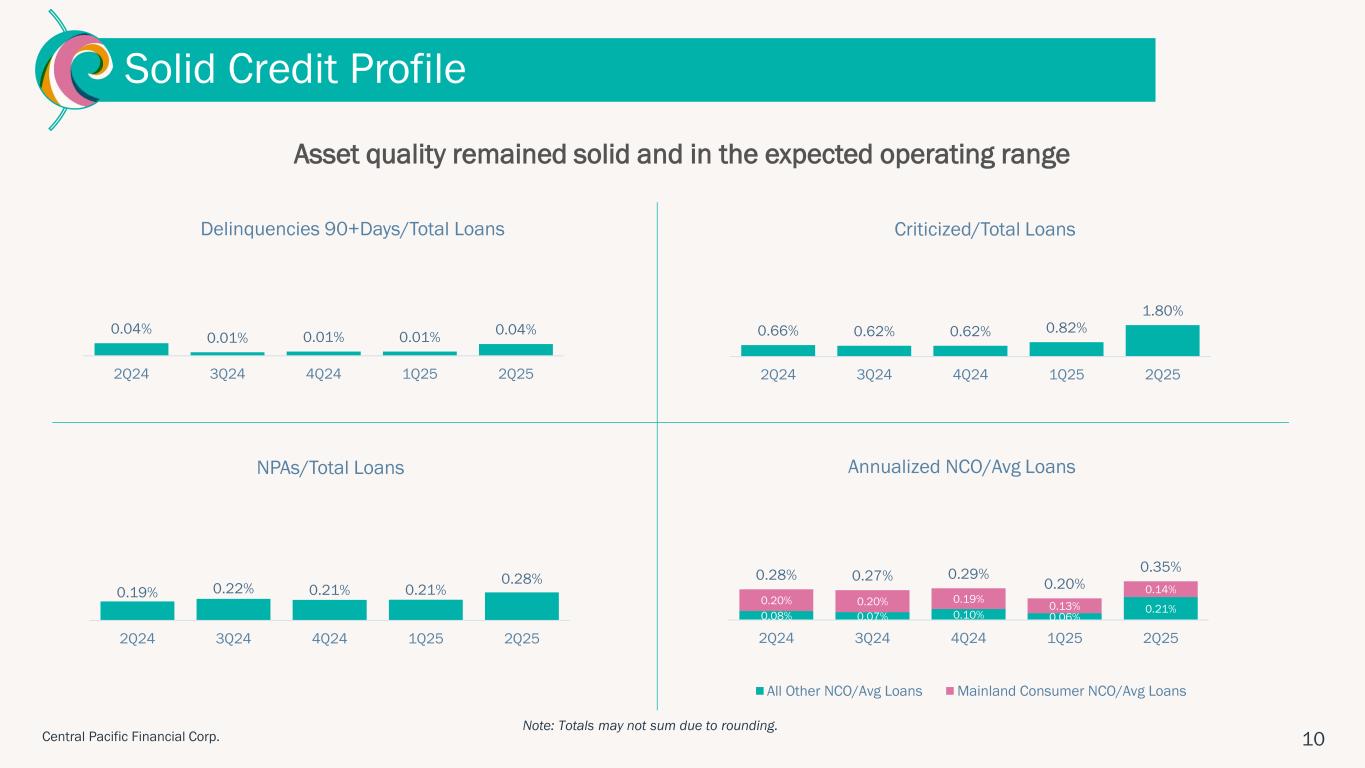
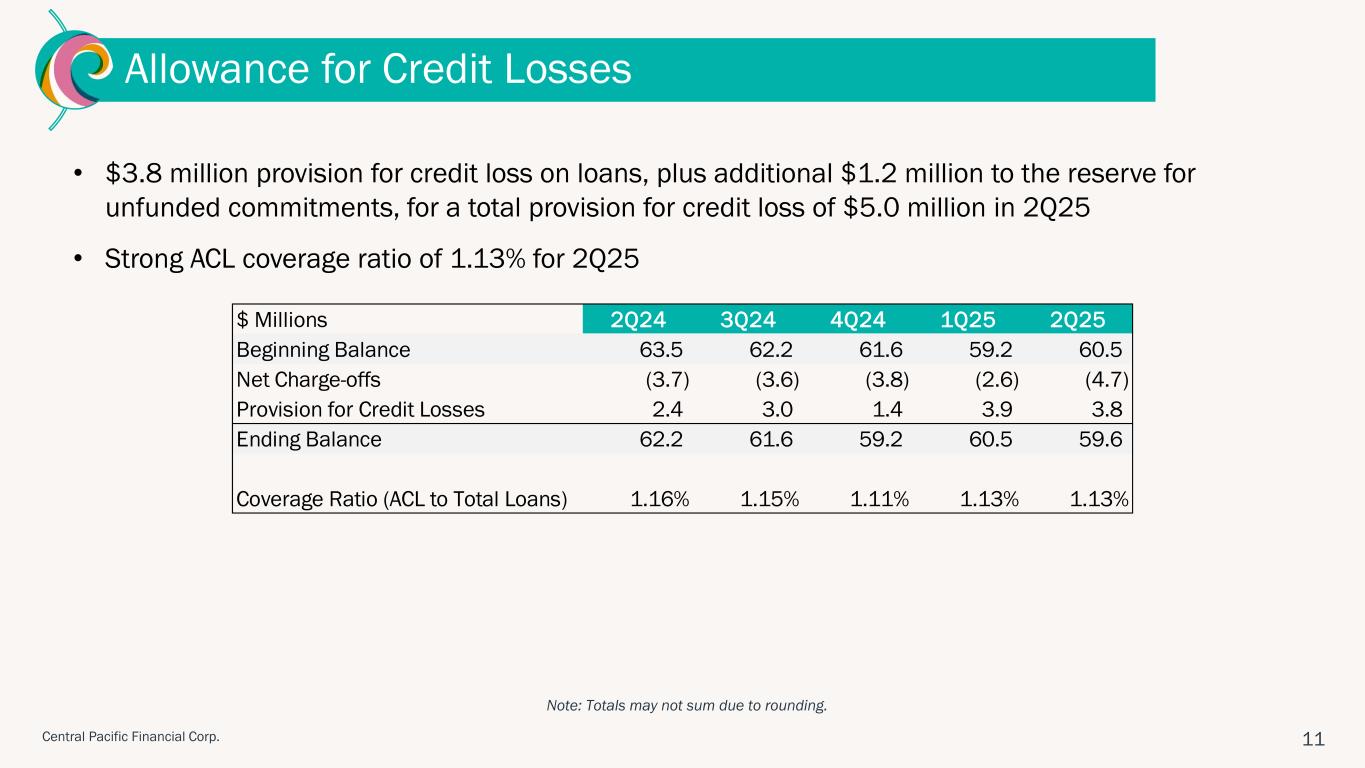
Thank you, Dana. Strong credit performance and asset quality continued in the second quarter. Credit costs were up, but within our expected operating range, and the level of NPAs, past dues, and criticized assets remained low. Net charge-offs were $4.7 million, or 35 basis points annualized on average loans. The increase in net charge-offs this quarter was related to the write-off of a single commercial loan after the borrower lost a legal dispute and effectively ceased operations. Losses in the consumer book were relatively flat for the prior quarter and down year over Non-performing assets were $14.9 million, or 20 basis points of total assets, at quarter end, an increase of five basis points from the prior quarter. The increase came in the residential mortgage and HELOC portfolios. Residential mortgages comprise the bulk of our NPAs. Past due loans, 90 days plus, increased $2.1 million and represent four basis points of total loans. Criticized loans increased to 180 basis points of total loans, but remained at low levels. As part of the enhanced monitoring effort we implemented at the start of the tariff declaration, we downgraded two large loans this quarter, a hotel participation and an owner-occupied CRE loan. Both loans are performing and adequately collateralized. The provision expense was $5 million. In the quarter, we added $3.8 million to the allowance, an additional $1.2 million to the Reserve for Unfunded Commitment. The higher provision was primarily driven by increases in the construction loan commitment, combined with higher net charge-offs incurred this quarter. We continue to maintain a strong level of capital as additional support. Total risk-based capital was 15.8% at the end of the second quarter. At these levels, the bank can readily absorb the financial impacts that may result from a period of prolonged stress. Looking ahead, we will continue to rely on a well-tested management approach that considers risk through a cycle, anticipates a range of outcomes, and builds a margin of safety to deal with adverse conditions. With that, let me now turn the call back to Arnold for closing remarks.
Thank you, Ralph. As we conclude, I want to emphasize the solid performance we've delivered. It demonstrates our ability to optimize performance in a dynamic market environment. I want to express my gratitude to our employees, whose voyaging spirit navigates us through these uncertain times. To our customers, thank you for your continued trust and loyalty. And to our shareholders, thank you for your ongoing support and confidence in our strategy and execution. At this time, we will be happy to address any questions you may have.
Operator
At this time, I would like to remind everyone, in order to ask a question, press star, then the number one on your telephone keypad. We'll pause for just a moment to compile the Q&A roster. And your first question comes for the line of David Feeder with Raymond James.
Hey, good morning, everybody. Morning, David. I wanted to start on the growth side. I mean, it sounds like there's some pretty encouraging trends here heading in the back half of the year. The pipeline's healthy. I was just kind of curious maybe what you saw in the quarter. I mean, how's, you know, the pulse of your client, how's demand trending? Or is this more of a function of payoffs and paydowns offsetting otherwise solid originations? Just kind of curious on that. Just, again, the pulse of the competitive landscape from your perspective.
Yeah, David, this is Arnold. Let me just start and I'll turn it over to David Muramoto for more color. Yeah, you know, the loan growth for the first half was fairly muted, but that's expected given the operating environment. The team has done a really good job in working together and engaging the marketplace and our customers and prospects. And we feel, you know, we feel good about the second half of the year. We are still looking at low single-digit percent range growth for the full year. David can talk a little bit about what he's seeing and what we expect in the next quarter or two.
Hey, David. Yeah, in the second quarter, you know, there was the continued runoff of the expected, It continued runoff of the residential mortgage and HELOC portfolios, and that likely will continue. We did see a few payoffs in the mainland shared national credit portfolio, but that was, you know, that was by design. We had a couple of deals where the deals were recut, and we just chose not to continue participating because we have other growth opportunities, growth levers. On the positive side, we have a robust pipeline, and we had a handful of deals that were expected to close late second quarter that slipped into the third quarter. And as we mentioned in our prepared remarks, we did close a handful of loans in the first three weeks of July. And we have strong net loan growth already in July that will help revenue growth for the full year, the back half of the year. Okay. Okay.
And then, again, how's just competition? I mean, are you seeing much competition increase? And then, again, kind of along the same lines to some degree, I mean, there's been a lot of disruption on the islands recently. I'm just curious how you think about your positioning to capitalize that, maybe gain share and dislocate maybe some talent and clients.
Yeah, David, it's David again. On the competition front, there always is good competition in the local Hawaii banky I wouldn't say it's any stronger or weaker. I think it's been pretty average. and then on the second part of the question about the um recent changes in the hawaii banking market i haven't noticed any change with regard to um territorial or american you know they remain you know solid competitors but uh no real change in strategy that i've noticed okay okay um maybe shifting gears to the other side of the balance sheet you're you're you're not just bearing deposit growth was extremely impressive.
I'm curious, maybe where do you find that you're having more success driving that? And then as we think about your margin trajectory over the next couple of quarters, how much deposit cost leverage do you have to support that? Or is it primarily going to be loan growth and back book repricing driven as you think about the margin side?
David, let me just start. This is Arnold, and then I'll turn it back over to David. But I just wanted to comment that I think our team has done a really good job in keeping close to our customers, ensuring that we're meeting the needs of our customers, as well as focusing on prospecting. And we're doing that in collaboration internally to really manage, you know, manage, you know, the balance between deposit growth and margin. And it shows in our core operating results. So I'm really pleased with that.
But David can comment on, you know, kind of what we're looking at and the outlook and kind of what we're seeing that's kind of translating to, you know, our results. yeah thanks arnold um yeah david um we we we have a good plan to grow core deposits low-cost core deposits and as every as as you know to grow core deposits it's really um you know moving relationships and so it's it's really blocking and tackling uh prospecting and uh we're ramping up our efforts on that front and we're seeing early success and i think that's what you saw in the second quarter with the positive mix shift in our deposits. Okay.
On the expense side, Dana, you touched on it a bit. There's some puts and takes there with the BOLI stuff, the lease savings. Could you help us think through maybe what's a good core expense run rate as we look forward and maybe what are some of the areas that you're investing in?
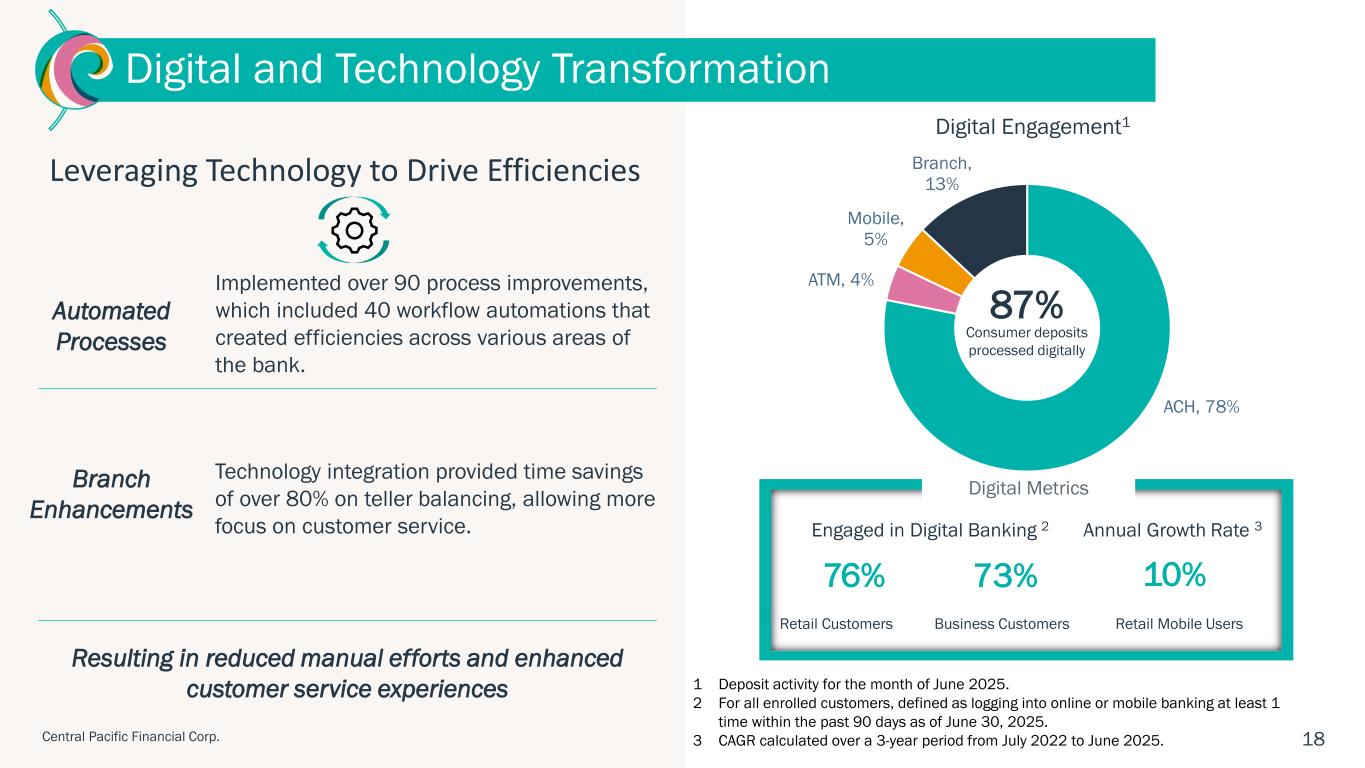
Sure, David. Thanks for the question. So on the expense side, yes, we are pretty pleased with our progress on the efficiency ratio and driving positive operating leverage. As we had noted previously, we do continue to invest in the business, including in technology, facilities, as well as people, you know, where it makes sense strategically. And those investments are to create efficiency savings and ultimately drive greater revenue. So with all of that said, you know, pulling it together, our near-term guidance for total other operating expense is going to be in the range of $43.5 to $44.5 million per quarter. And that would be excluding any one-time impact.
Okay. Okay. That's helpful. And then maybe just last one for me, Ralph, circling back to you to hit the whole team. I appreciate your commentary on the credit side. I'm just curious, maybe high level, we had one larger loss this quarter. It sounds kind of idiosyncratic, and it seems like the consumer side is kind of stabilized. I'm just high level. Is there anything that you're seeing that's making you a bit nervous or cautious on, or just kind of your thoughts on the credit side more broadly?
Yeah, David, you know, the uptick in the AQ metrics is really a function of being at a low starting point. I think if you consider the endpoint, we're well within our risk appetite. And then I would not extrapolate the charge-off or the two downgrades to be related to anything systemic. The circumstances around the three credits that we highlighted were specific to each name. And I think that perspective is kind of reflected in the reserve actions we took this quarter. The level of expected loss we see in the portfolio is relatively unchanged. And then I think if you think about those losses based on the composition of our loan book, we'd expect credit losses between 25 and 50 basis points. And if you look at our incurred losses over the last few years, they've run between 10 and 40 basis points. We were at maybe the higher part of that range this quarter annualized. But if you back out that one credit, which was unexpected, the incurred losses would have been at the lower end of that range. You know, we're continuing to call on our customers regularly. We are looking at large exposures very frequently. I think the cadence has become more rigorous because of where we're at in the cycle. And I think when you look at those two credits that were downgraded, that is really a function of the outlook we have today. We've identified some weakness that warrants closer attention. But we've evaluated those loans for impairment and they're well collateralized. We don't anticipate any losses. And it's important to point out that both credits are performing.
Okay. That's helpful. Thanks, everybody. Thank you, David.
Your next question comes from the line of Matthew Clark with Piper Sadler. hey good morning everyone hi matthew um maybe just starting on the margin uh nice lift there this quarter again um deposit cost down just want to get a sense for you know exiting the quarter where the spot rate was on deposit costs if you had it at the end of june and then if you also had the the average margin in the month of June that would be helpful hi Matthew it's Dana so yeah I can start with the spot rates so the spot deposit costs on June 30th it was point nine eight percent and then for the month of June our margin was three point four nine percent okay great and then you Can you remind us what you have coming due on the CD repricing side, you know, how much you have over the next couple of quarters that are maturing and, you know, the rates that they're maturing at and where you're offering new CDs?
Sure. So, on the CD portfolio, we have about 430 million maturing in the third quarter and then another about 350 million maturing in the fourth quarter. This excludes our government CDs. As far as the roll-off rates on a weighted average basis, it's about 3.6%. And our current CD promotional rate that we're offering, it's at 3.4%. So, we continue to have some opportunity to lower our CD costs as those roll over.
Okay. And then assuming we get a couple of rate cuts in this back half of this year, Any thoughts around the beta that you might realize with those cuts? I mean, your cycle-to-date beta on interest-bearing, I think, is about 42%, which is better than – it's more than on the way up, I should say. But, yeah, just curious how much of the Fed rate cuts you might be able to pass through on the deposit side.
Sure. Sure. So when the Fed cuts rates, we believe we can continue to successfully lower our deposit costs with a pretty minimal timing lag. The deposit pricing market here continues to be pretty rational. As far as the betas, you're correct, so far it's been about 42% on the total interest-bearing deposits. When you look specifically at our more rate-sensitive deposits the money markets and the cds the beta has been close to 100 percent so with the upcoming fed rate cuts we expect it to be similar on the betas and we think we'll continue to be successful with our pricing strategies and continued discipline great okay thank you and then on the loan yields up uh nicely here um up six six basis points i believe at least by our calculation um do you can you give us a sense for the for the new loan production what kind of rates you're
getting maybe on a weighted average basis just trying to get a sense for the lift on on loan growth hey hey matthew it's david morimoto um in the second quarter the weighted average new loan yield was roughly 7.2 which obviously compares favorably to the portfolio yield that you mentioned is just about five percent.
Okay great and then on the net charge-offs I think you mentioned kind of without this one CNI credit it would have been toward the lower end of the range in terms of net charge-offs but can you just quantify I'd have to go back I can go back to the transcript but But if you could just quantify the amount of net charge that's associated with that one credit dollar terms.
Yeah, it was about 21 basis points of the amount. So if you back that up, we would have been at about 14 basis points.
Okay, perfect. And then just the increase in criticize, you called out those two credits. I think one was the hotel participation. The other one, I can't recall. But can you just give us some more color on what's happening with those two credits and kind of plan for resolution and timing?
Yeah, you know, I want to be as transparent as possible, but I need to be sensitive to the information we disclose on these calls. So I can't really say more than that. And I think it would be inappropriate for me to say, you know, provide more details. But as I said, we do not expect any losses on these two credits, and we do believe that there will be some resolution in the coming couple of quarters.
Thank you. And then last one for me, just on the mainland SNCC portfolio, can you remind us how large that portfolio is?
Let's say it's about $403 million, and that breaks out roughly $152 million of that is B&I.
Operator
Again, if you would like to ask a question, press star 1 on your telephone keypad. And at this time, there are no further questions. I will now turn the call back over to Dana Matsumoto for closing remarks.
Thank you very much for participating in our earnings call for the second quarter of 2025. We look forward to sharing our progress with you next quarter. Thank you.
Operator
Ladies and gentlemen, that concludes today's call. Thank you all for joining. You may now disconnect.