Operator
Today, please press star 0. Welcome to the INTEGRAS 3rd Quarter 2025 Earnings Conference At this time, all participants are in a listen-only mode, and the floor will be open for questions following the presentation. If you would like to ask a question, please press star 1 on your telephone keypad. If at any point your question has been answered, you may remove yourself from the queue by pressing star 2. So others can hear your question clearly, we do ask that you please pick up your handset for best sound quality. Lastly, should you require operator assistance, please press star zero. I would now like to turn the conference over to Bill Seymour. Please go ahead.
Good morning, everyone. Earlier today, we announced the financial results for the third quarter of 2025. Before we begin, I would like to remind listeners that our comments today will include some forward-looking statements. These statements involve a number of risks and uncertainties and actual results could differ materially from those projected in the forward-looking statements. Additional information regarding these risks and uncertainties is contained in our most recent annual report, subsequent quarterly reports that we filed with the SEC. Please refer to the information on the disclaimer slide in the presentation. On this call, we will also refer to non-GAAP financial measures as defined by the SEC and Regulation G. You can find reconciliation tables in today's news release as well as on the IR page of our website at integris.com. On the call today are Dave Reeder, our CEO, and Linda LaGorga, our CFO. With that, I'll hand the call over to Dave.
Thank you, Bill, and good morning. This is my first earnings call as the CEO of Integris. I want to begin by expressing how honored and excited I am to lead this exceptional company. Throughout my long career in the semiconductor industry and during nearly two years on the Integra's board, I've developed a deep appreciation for the company's culture, its commitment to innovation, and its consistent track record of delivering value to both customers and shareholders. In the two months since I started as CEO, I've met with many of our customers around the world in their home country. And during that process, I also visited many of our local manufacturing sites and technology centers, engaging with hundreds of our team members. These interactions have only deepened my conviction in the strength of Integris, our people and culture, our capabilities, and the tremendous opportunities ahead. In my conversations with customers, one message came through loud and clear. Integris is a trusted, highly engaged, and indispensable partner. Our customers rely on us, not only to support their technology roadmaps and node transitions, but also to help solve complex challenges. To continue earning their trust, we must consistently engage, innovate, and execute at the highest level. Starting with our Asia facilities and continuing throughout the U.S., I've had the opportunity to visit many of our manufacturing sites, seeing firsthand the capability and capacity that we've built. Our existing manufacturing base, including our new facilities in Taiwan and Colorado, are valuable and strategic assets. Assets that, when fully ramped, will enable us to capture more of the demand that we were unable to support during the last industry upturn and better serve our customers. Finally, over the past few months, I've also had the opportunity to meet with many of you, our investors. The feedback has been clear. their strong appreciation for our business model, our historical outperformance, and the compelling opportunities ahead. I've also heard and noted some of the candid feedback regarding growth, capital intensity, and leverage, all of which we have plans to address over time and which are reflected in my top initial priorities. I have three initial priorities, all based upon my observations over the last 10 weeks. First, and most fundamental to our success, is customer intimacy. We will continue to support our customers' technology roadmaps with our deep application expertise, strong organic innovation, and accelerated product development. Execution in these areas will continue to translate into winning critical positions of record, PORs, which will increase our SAM, and accelerate our revenue and content per wafer growth. We're already seeing encouraging momentum in liquid filters, liquid purification, deposition materials like MOLLE, and CMP consumables at the most advanced nodes and within the most complicated processes. In addition to these efforts, we are extending our customer engagement model to more customers and more ecosystem partners than ever before. While these efforts are nascent today, we believe they'll help us drive long-term incremental growth. Our second priority is accelerating the qualification and ramp of our new facilities in Taiwan and Colorado. Ramping these sites is critical to meeting future demand and offsetting the margin pressure driven by the cost of these investments, including incremental depreciation and foregone fixed cost leverage our taiwan facility is expected to increase volume in 2026 and our colorado facility which has just been put into service is expected to substantially complete customer product qualifications next year exiting this quarter we will have largely worked through the majority of the significant manufacturing investment cycle that began in 2022. We subsequently expect CapEx to materially decrease on a year-over-year basis. At our current mix, we believe that our existing manufacturing footprint, when fully ramped, will enable us to support meaningfully more revenue with limited incremental investment. Third, we're committed to improving free cash flow. Thanks to our team's efforts, we've already seen excellent progress delivering record operating cash flow in the third quarter, which Linda will discuss more in her section. Looking forward, operating cash flow improvements in combination with reduced CapEx are expected to enhance free cash flow, enabling us to accelerate debt reduction and reduce leverage. Turning to the third quarter. Third quarter revenue, EBITDA, and non-GAAP EPS were all approximately at the midpoint of our guidance ranges, while gross margin percent was roughly 100 bps below guidance, directly driven by the underutilization of our manufacturing assets. Though these assets are underutilized in the current semiconductor environment, I am confident that, longer term, our expanded global footprint will enable us to capture share during the next market upcycle, enable peak-to-peak gross margin expansion, and enable us to better manage a dynamic international trade environment. With respect to the semi-market, advanced logic continues to show strong growth, largely driven by AI-enabled applications. In mainstream logic, while inventories have normalized, end demand is still mixed and well below prior peak levels. In memory, pricing trends in recent months have firmed, with HBM benefiting from the same AI trends as Logic, a continuation of strong growth. And more recently, we've seen a notable shift in sentiment regarding 3D NAND. After a prolonged period of weakness, our NAND customers are now expressing renewed optimism. This renewed optimism is fueled by the potential of accelerating AI-driven demand for 3D NAND as the industry shifts from training large language models to inference workloads. From an industry wafer starts and CapEx perspective, trends remain consistent with what they've been all year. Wafer starts are modestly higher this year, led by advanced logic, but other markets, as referenced, have remained muted. From an industry CapEx perspective, WFE continues to grow solidly, but industry facilities-related spending, where Integris has the most exposure, remains muted, down approximately 10% this year due to slower year-over-year fab construction. These industry trends correlated well with our third-quarter performance. Overall, our year-on-year unit-driven revenue grew, led by C&P slurries, pads, cleans, and liquid filtration. Notably, liquid filtration achieved record quarterly sales in Q3. Conversely, our CapEx-driven revenue declined high single digits year-on-year in the third quarter, reflecting the slowdown in industry fab construction. This year-over-year slowdown has continued to impact FOOP and fluid handling revenue in our APS division. Looking into next year, AI-driven growth, both advanced logic and memory, is expected to remain strong. And despite pockets of optimism for the rest of the semi-market, like others, we are prudently taking a wait-and-see approach, diligently managing our costs while operationally and commercially preparing ourselves for the optimism to translate into orders. In closing, I'm truly excited to lead Integrus into its next chapter. Over the past several weeks, I've gained an even deeper appreciation for the unique and indispensable role we play with our customers and across the semiconductor industry. As devices become more complex, our expertise in material science and materials purity becomes increasingly critical, helping customers enhance performance and achieve optimal yields. Because of the uniqueness of our value proposition and the quality of our execution, we expect to significantly grow our content per wafer and outperform the market in the coming years. I look forward to connecting with many of you in the coming weeks and months as we close out 2025. Let me now turn the call over to Linda. Linda?
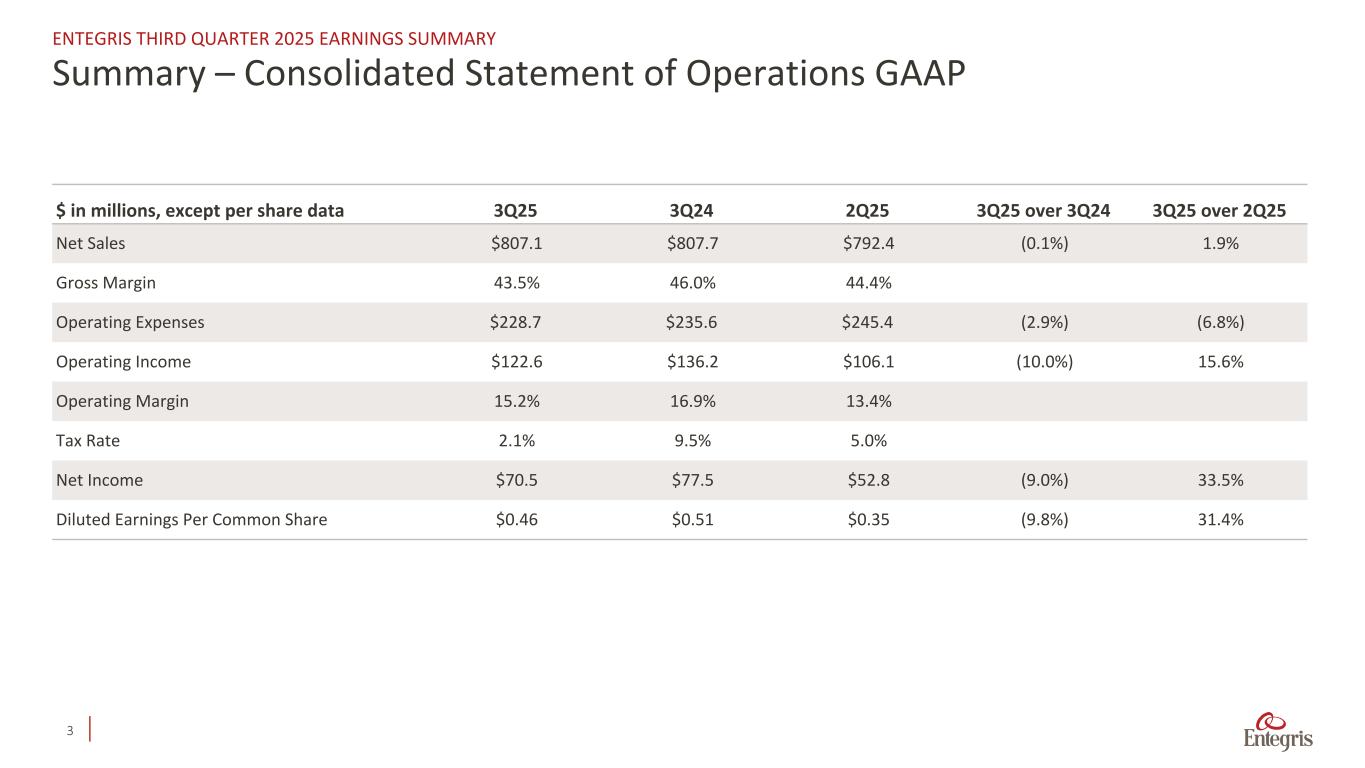
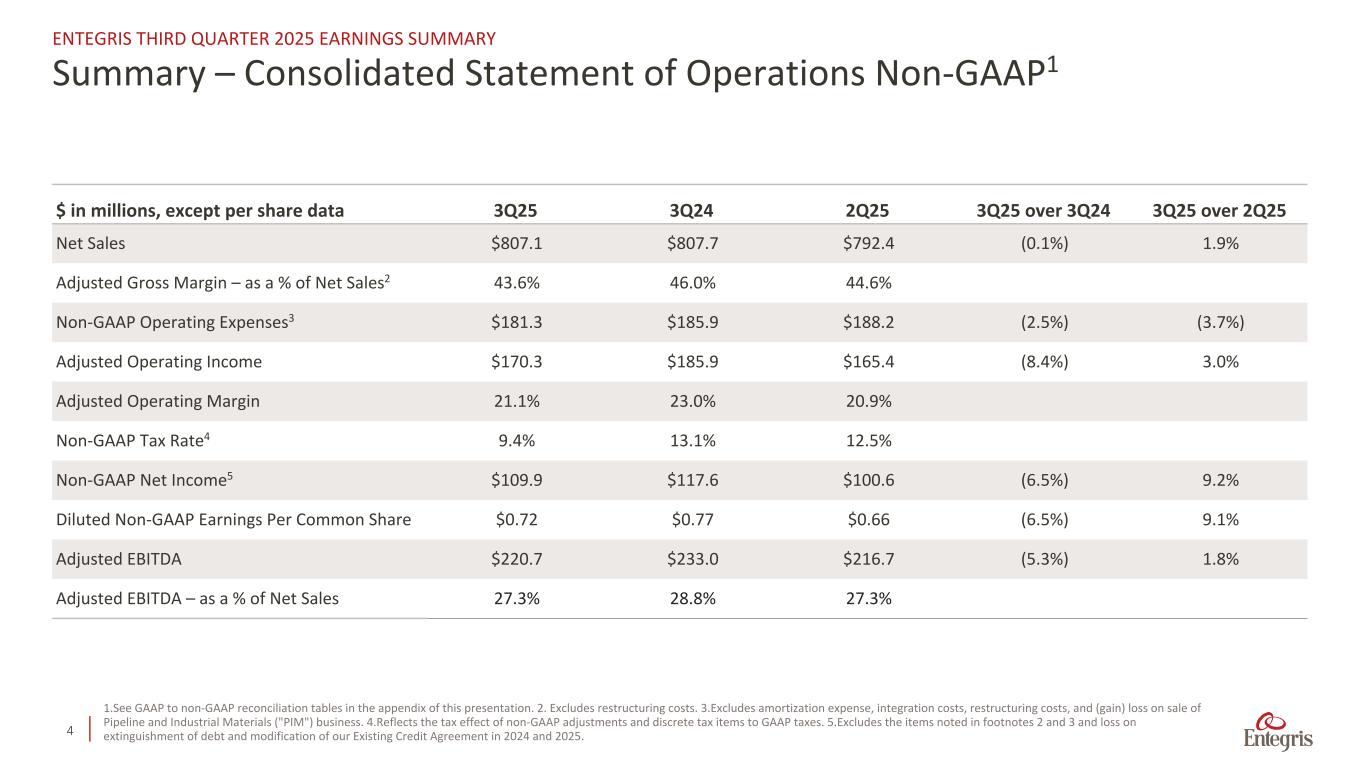
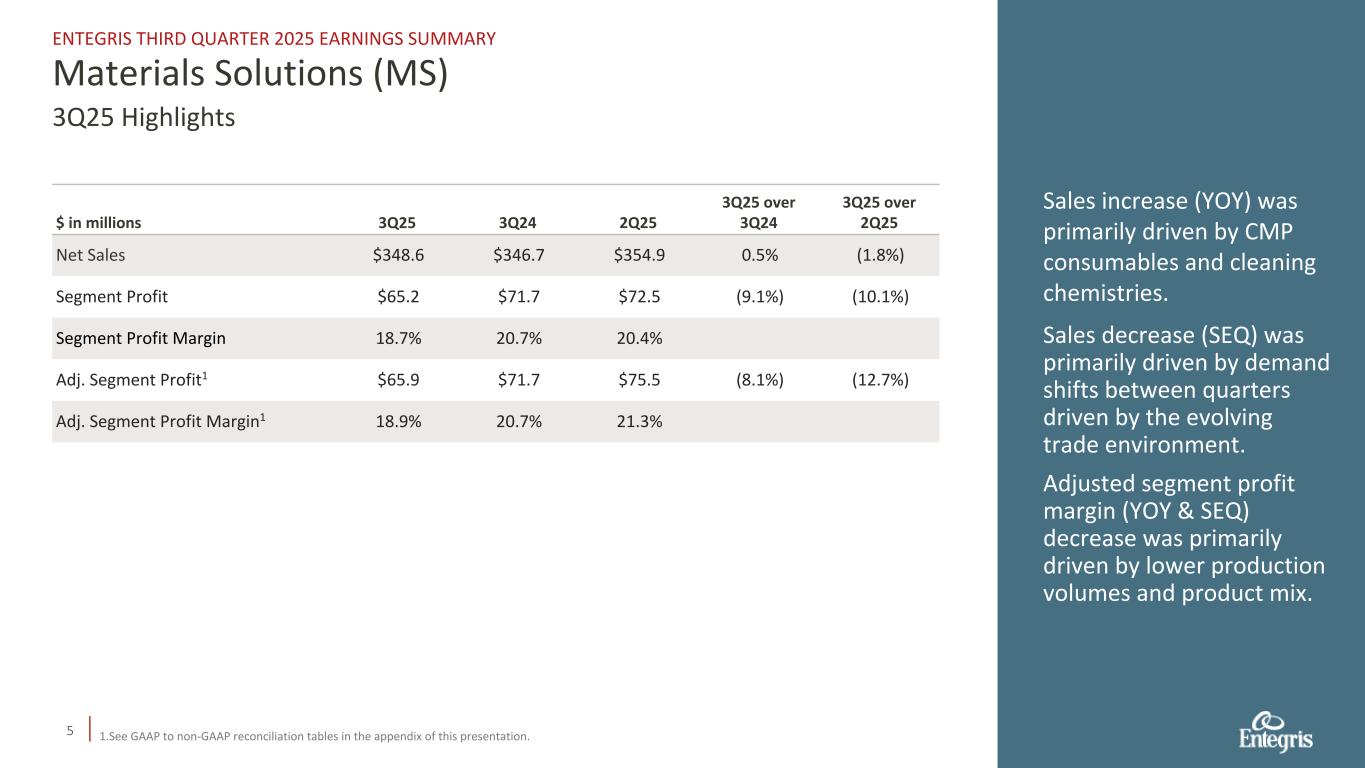
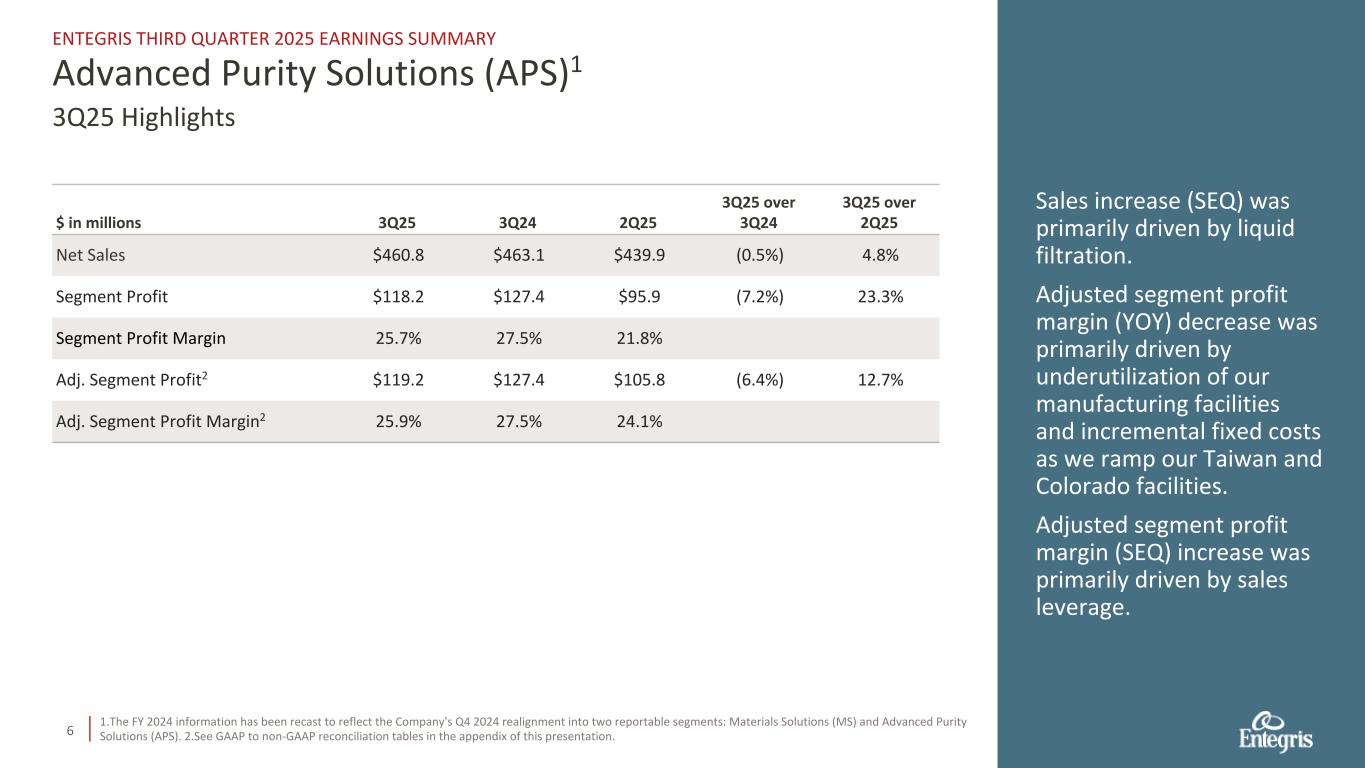
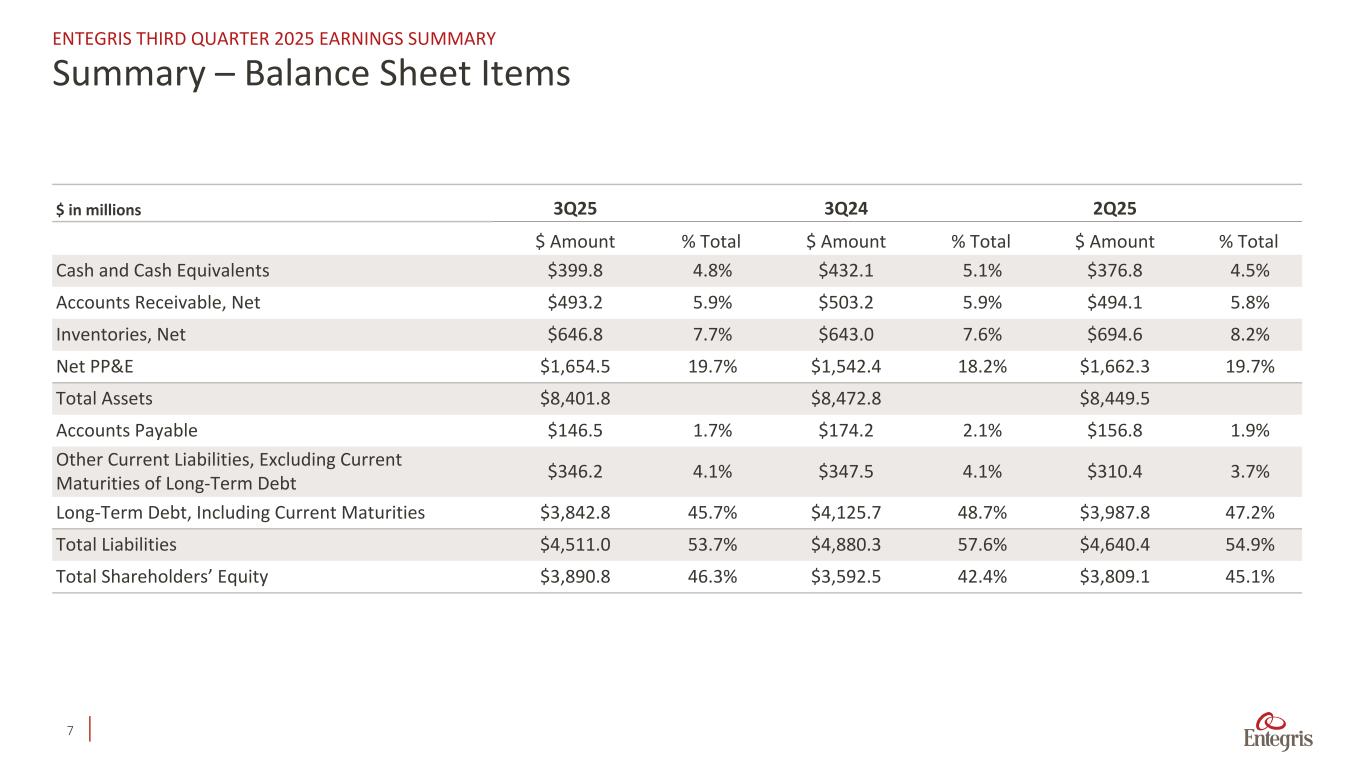
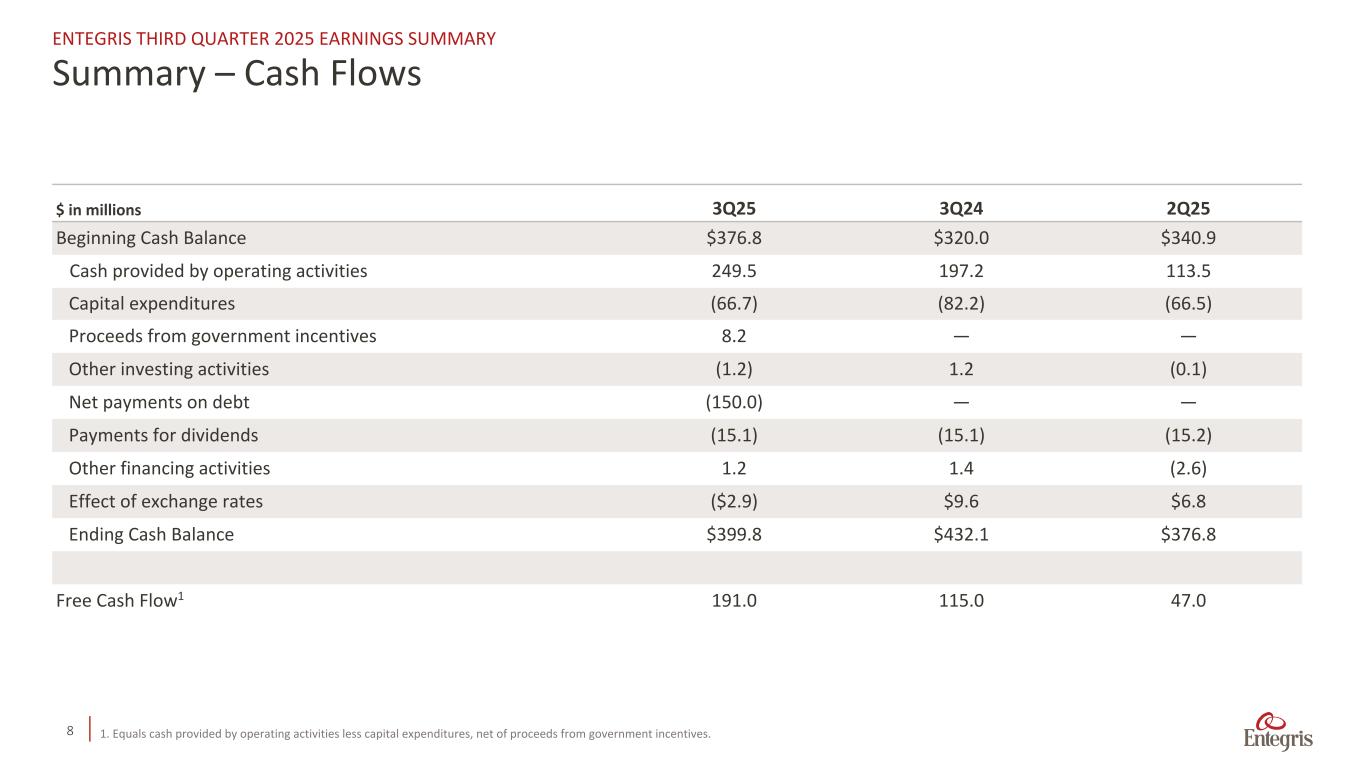
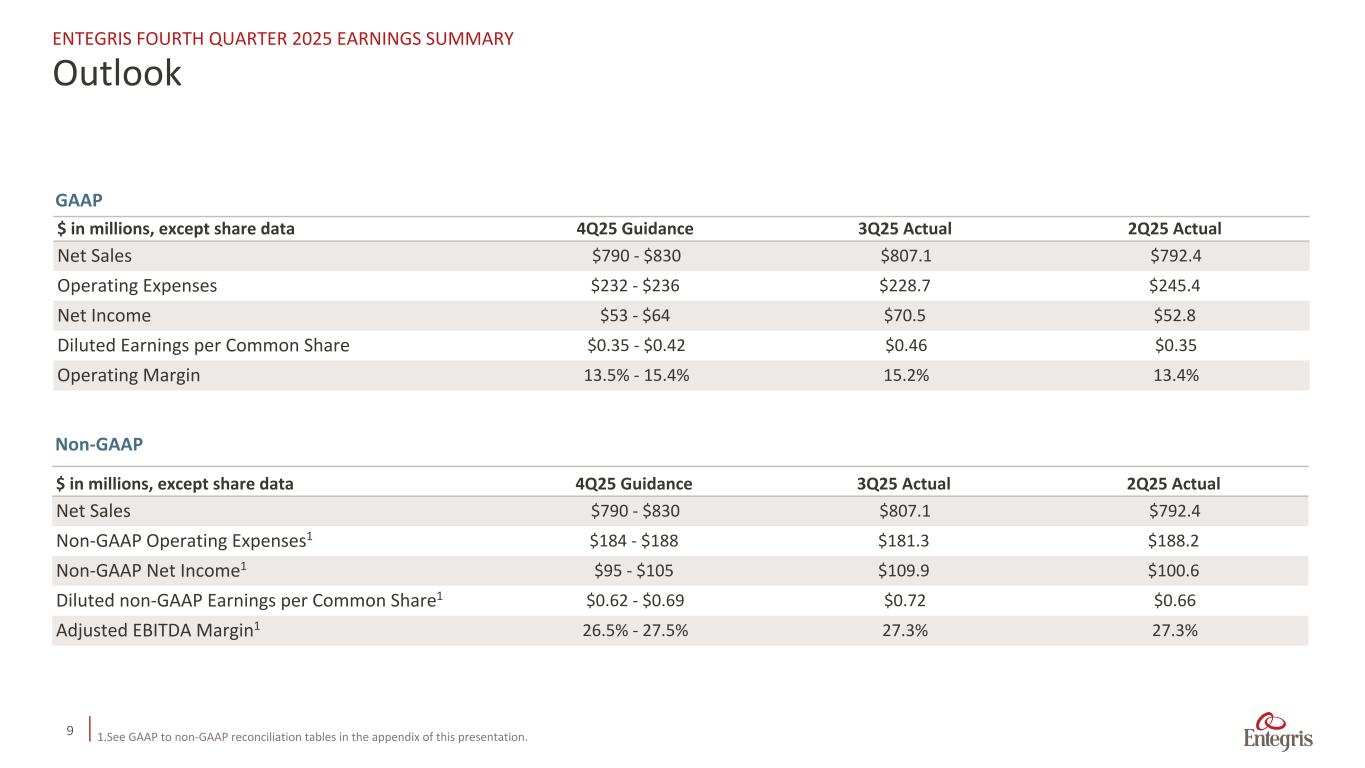
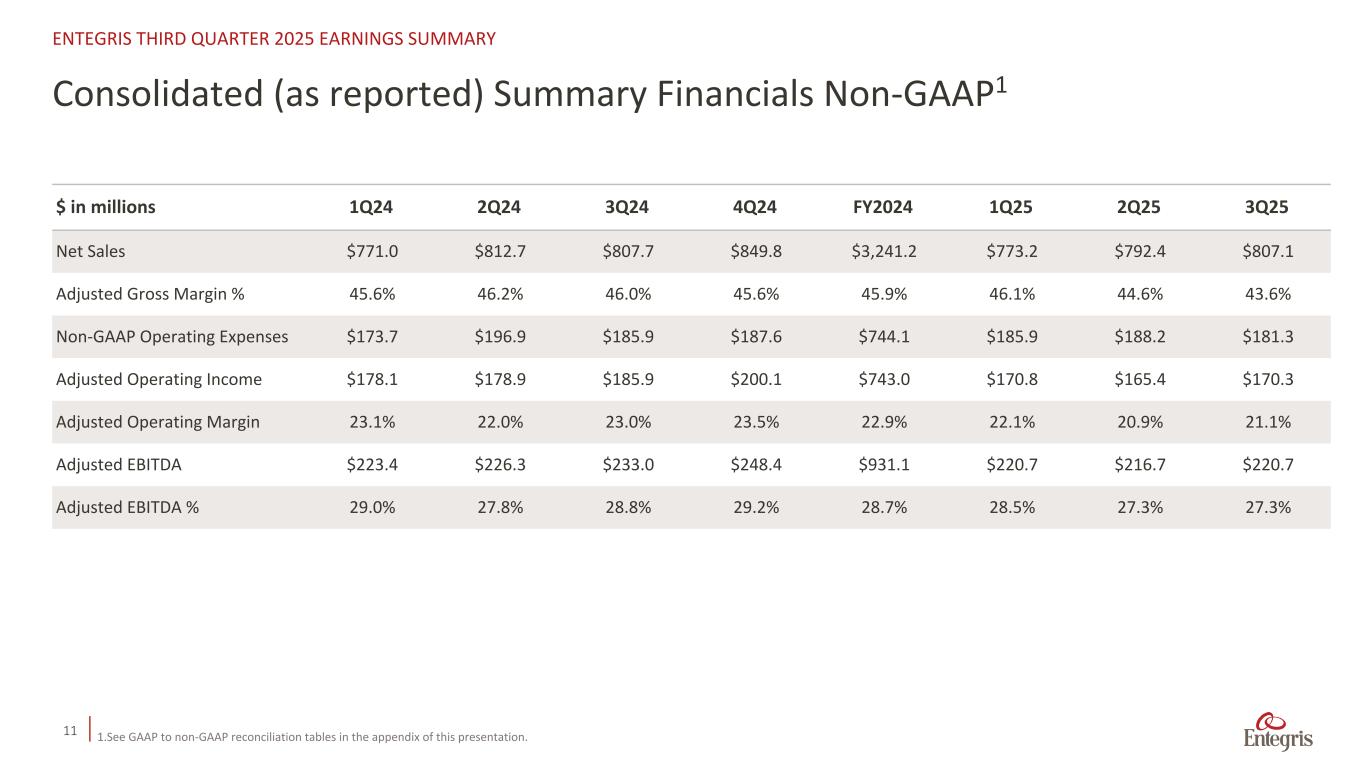
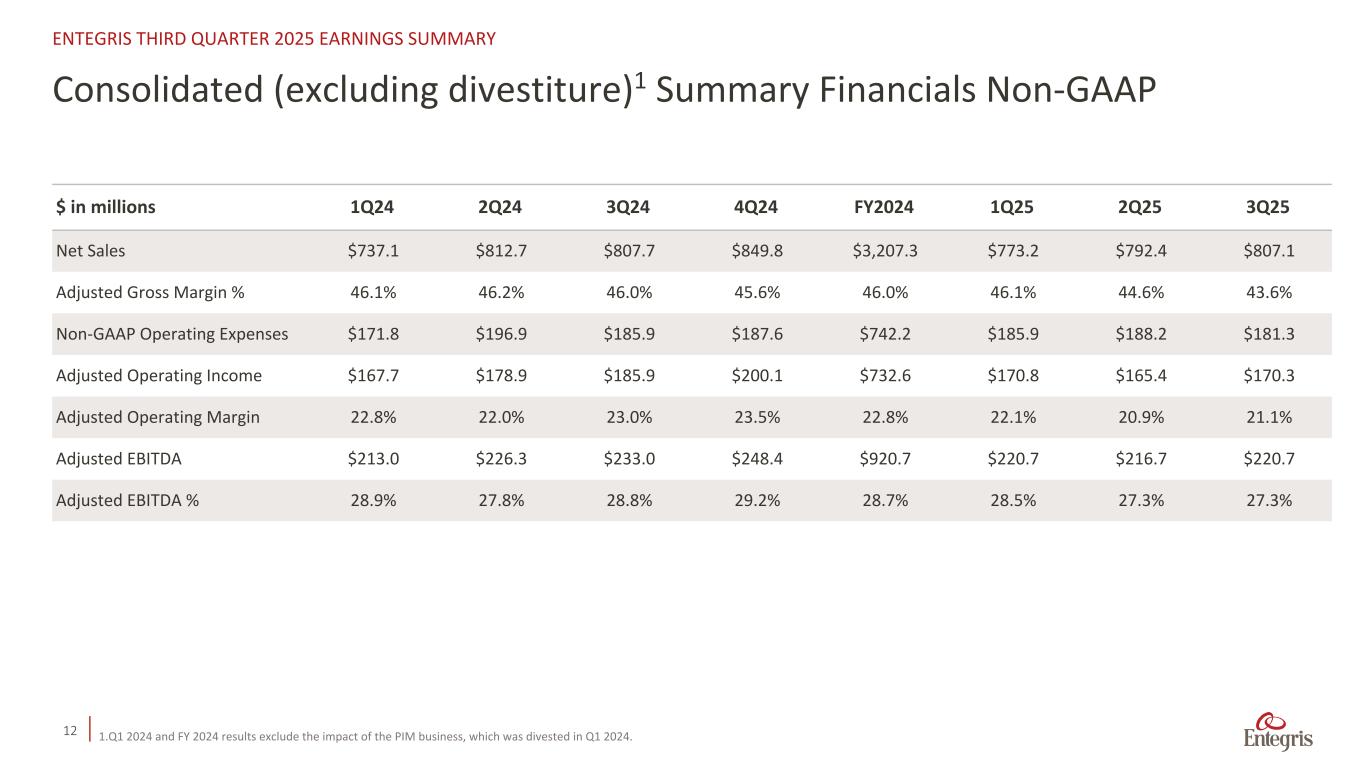
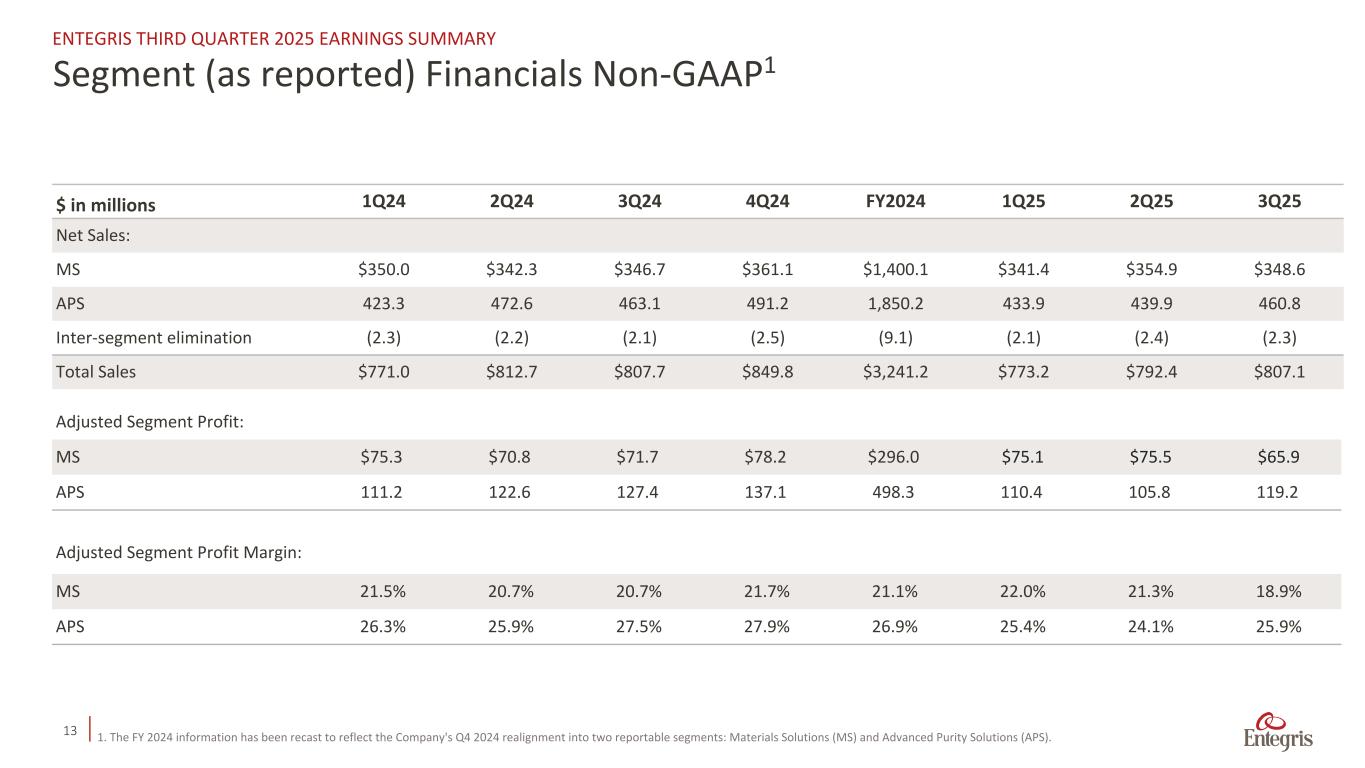
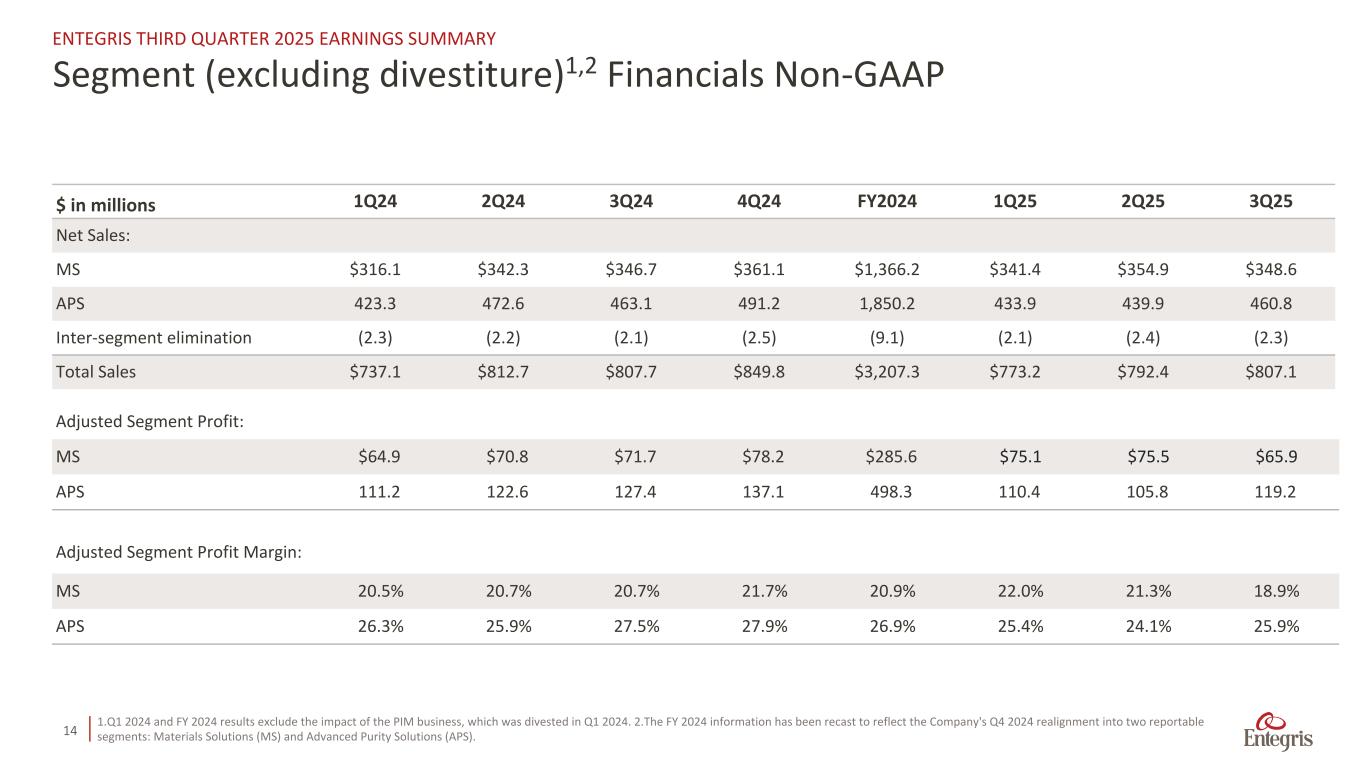
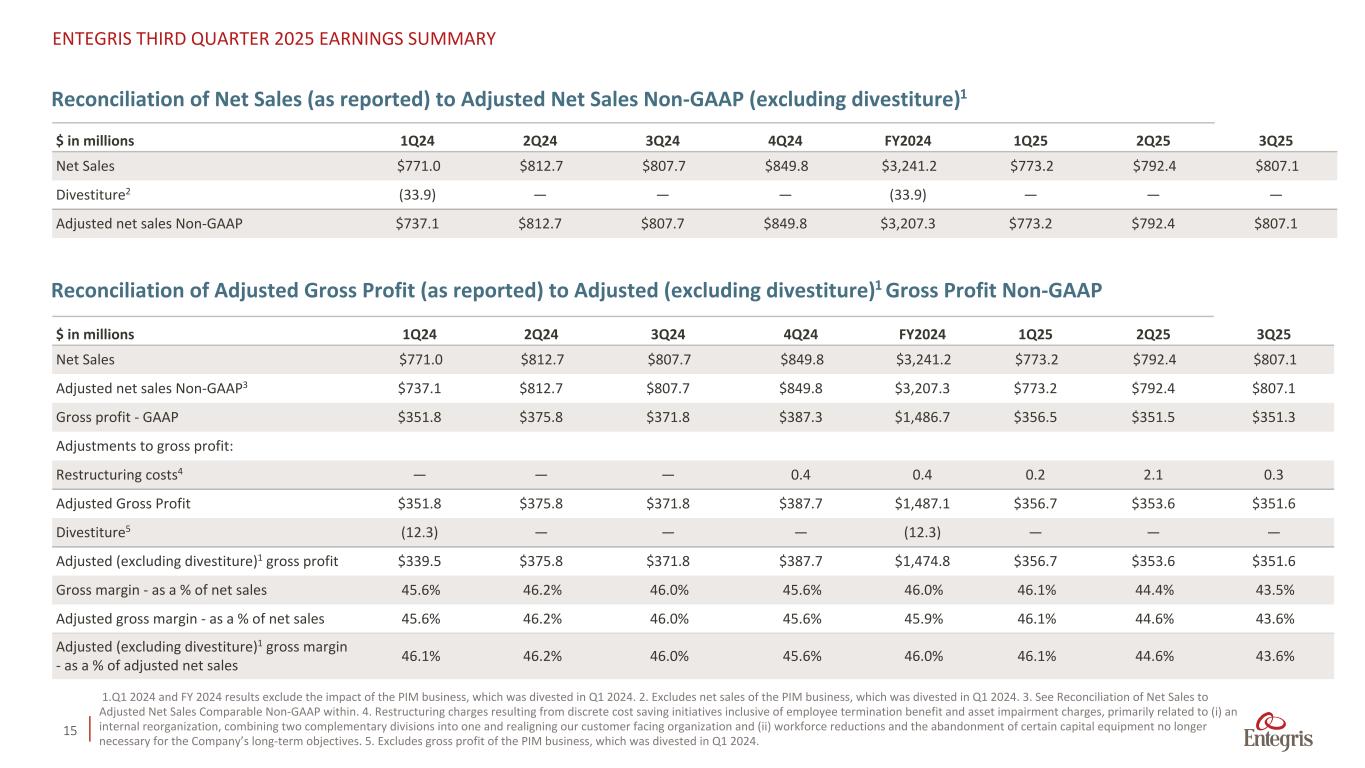
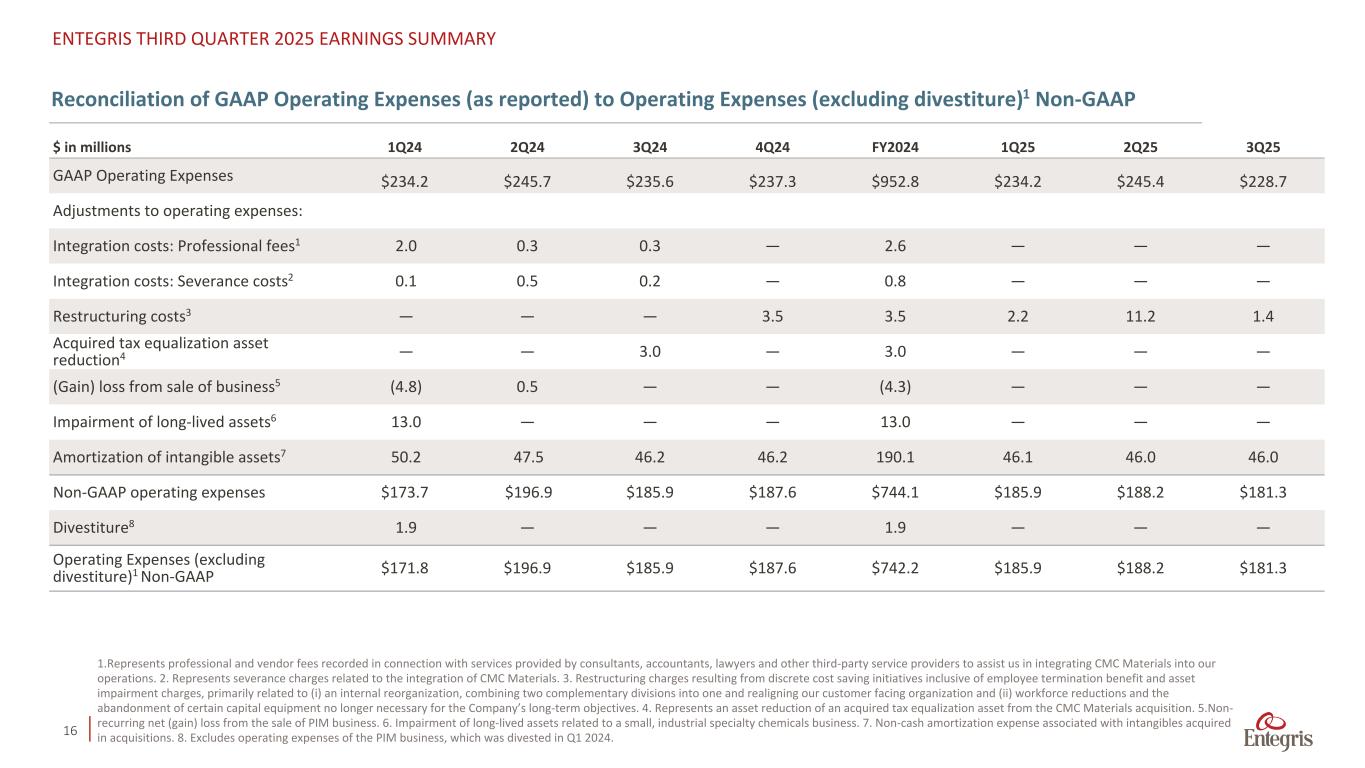
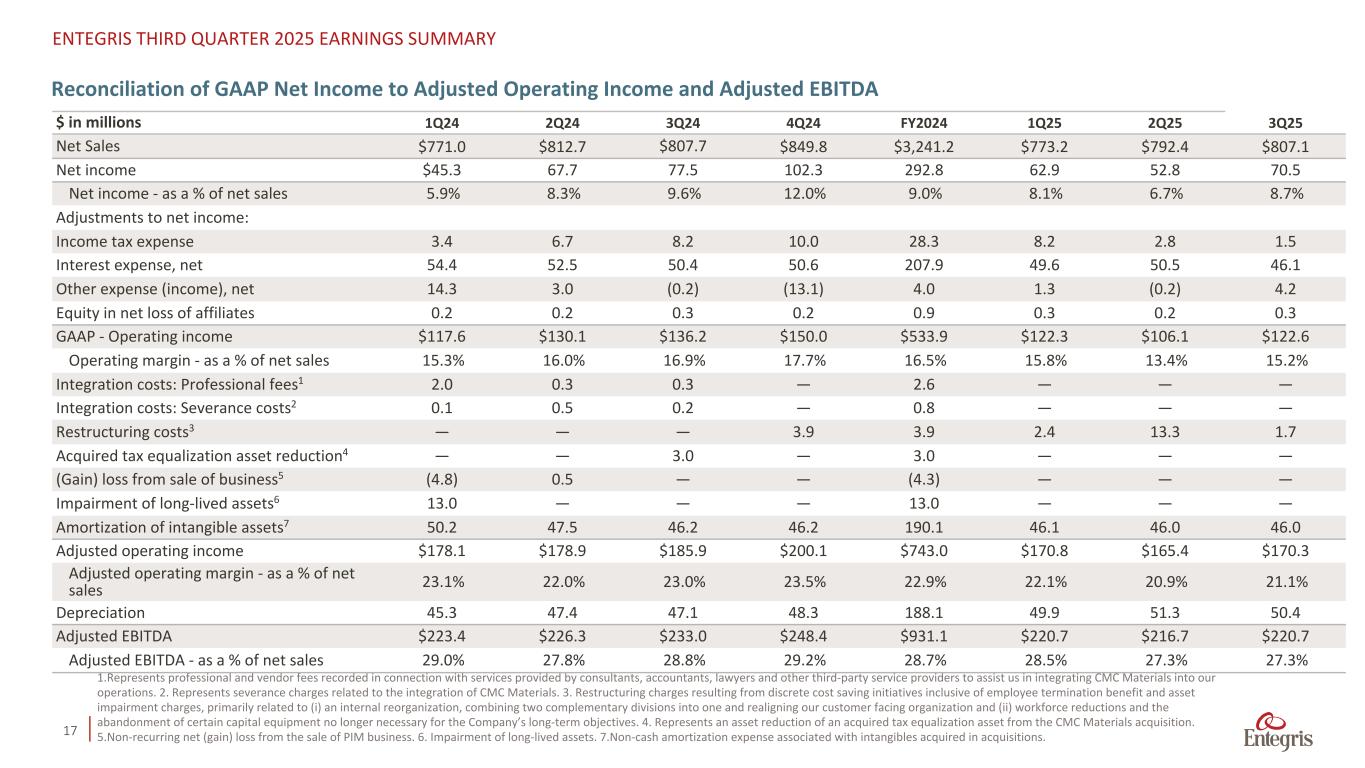
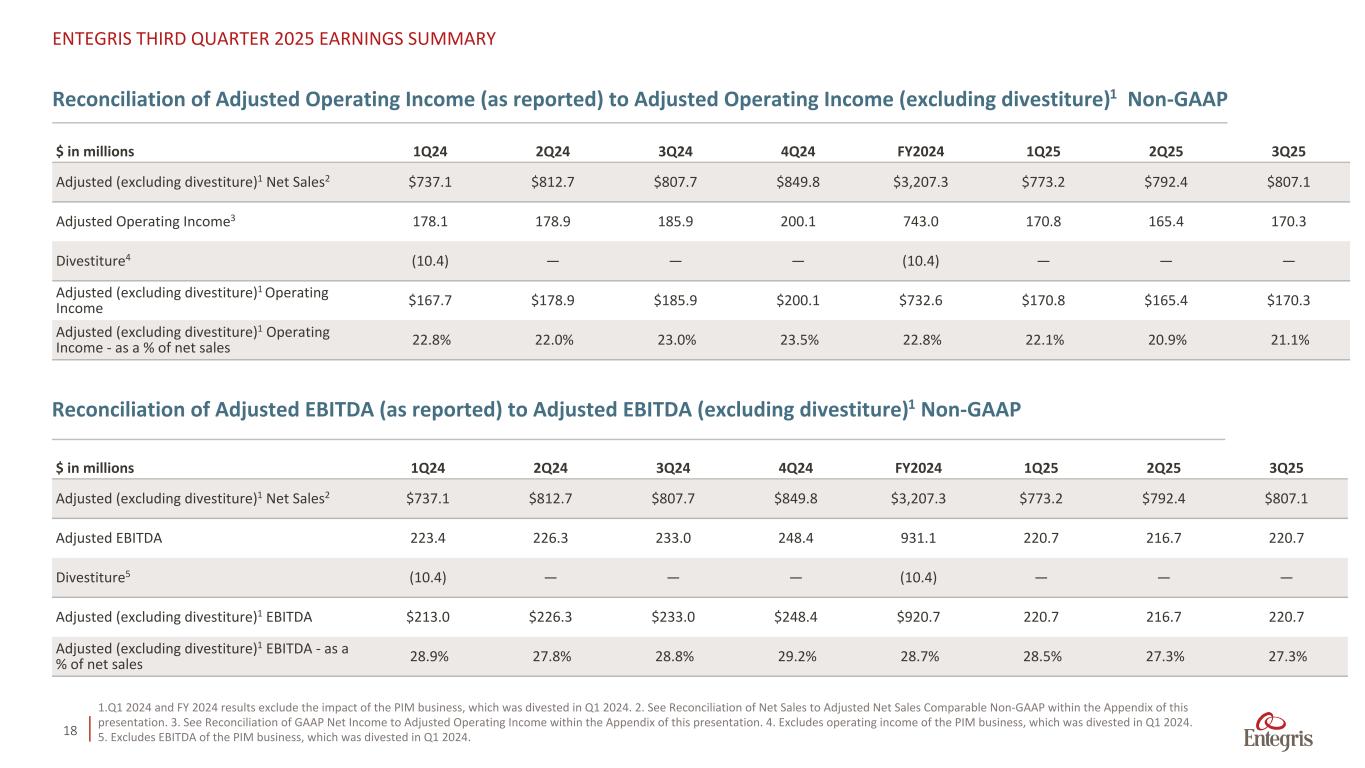
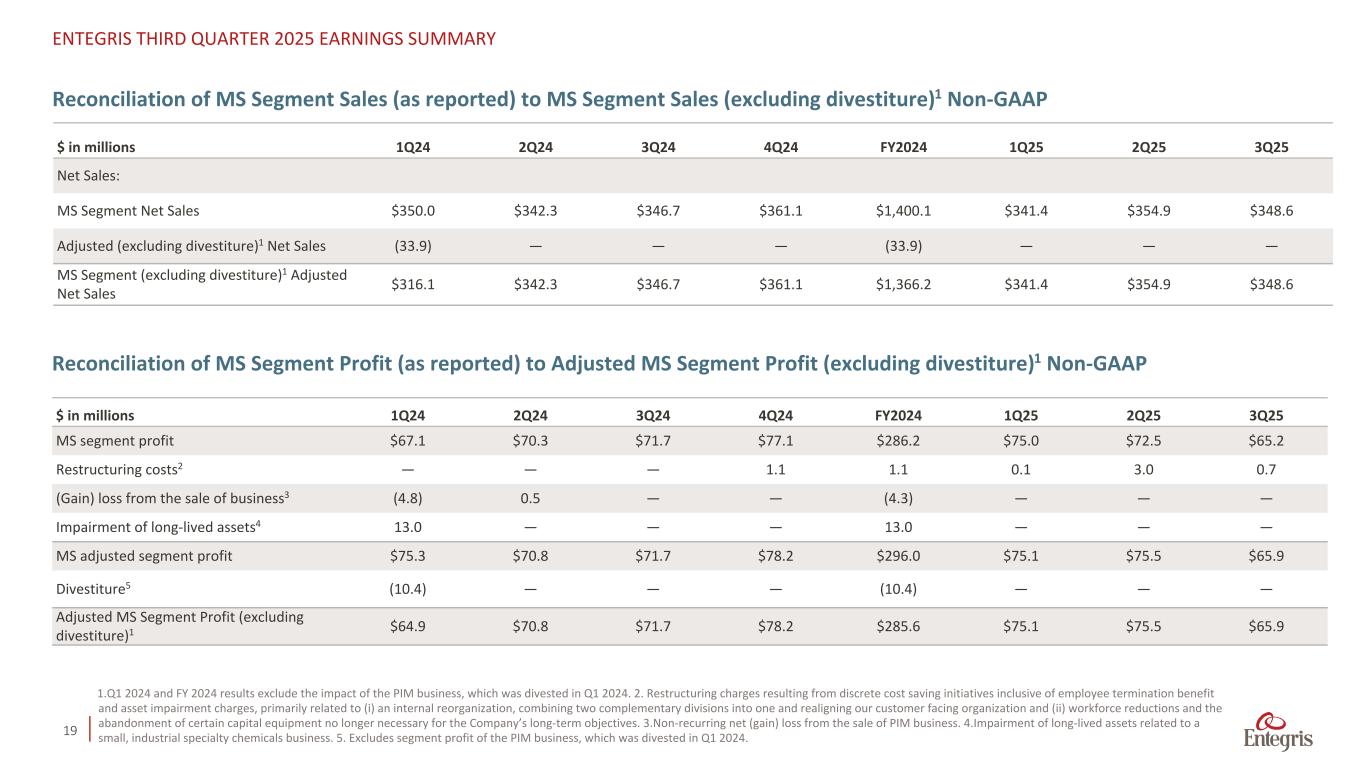
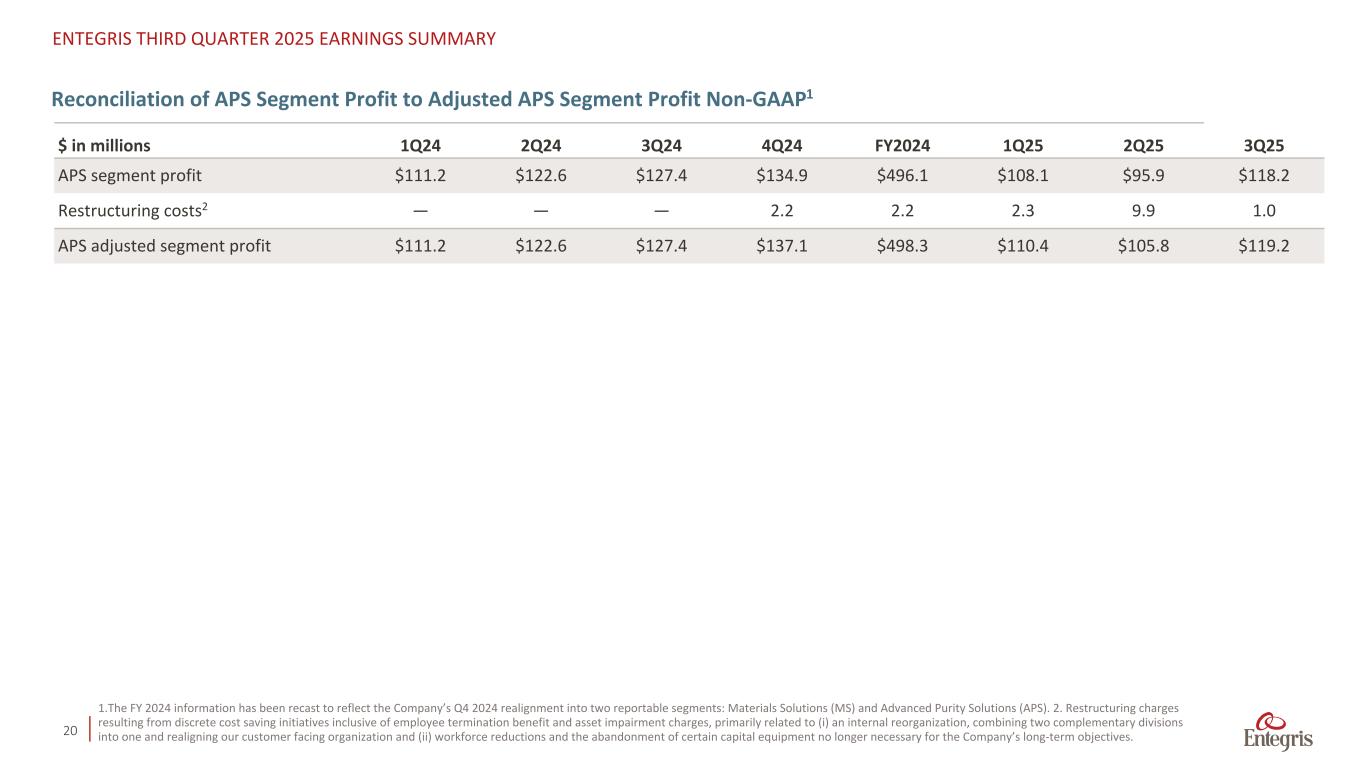
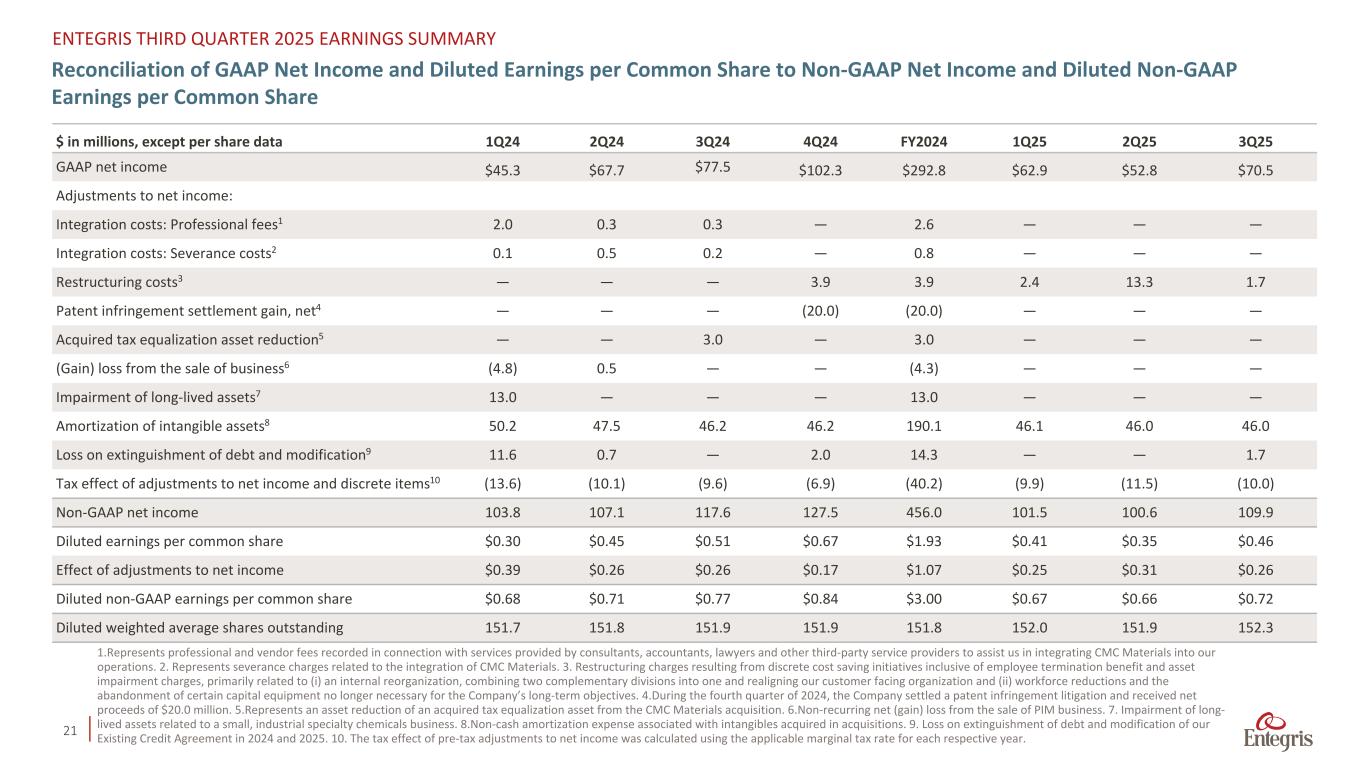
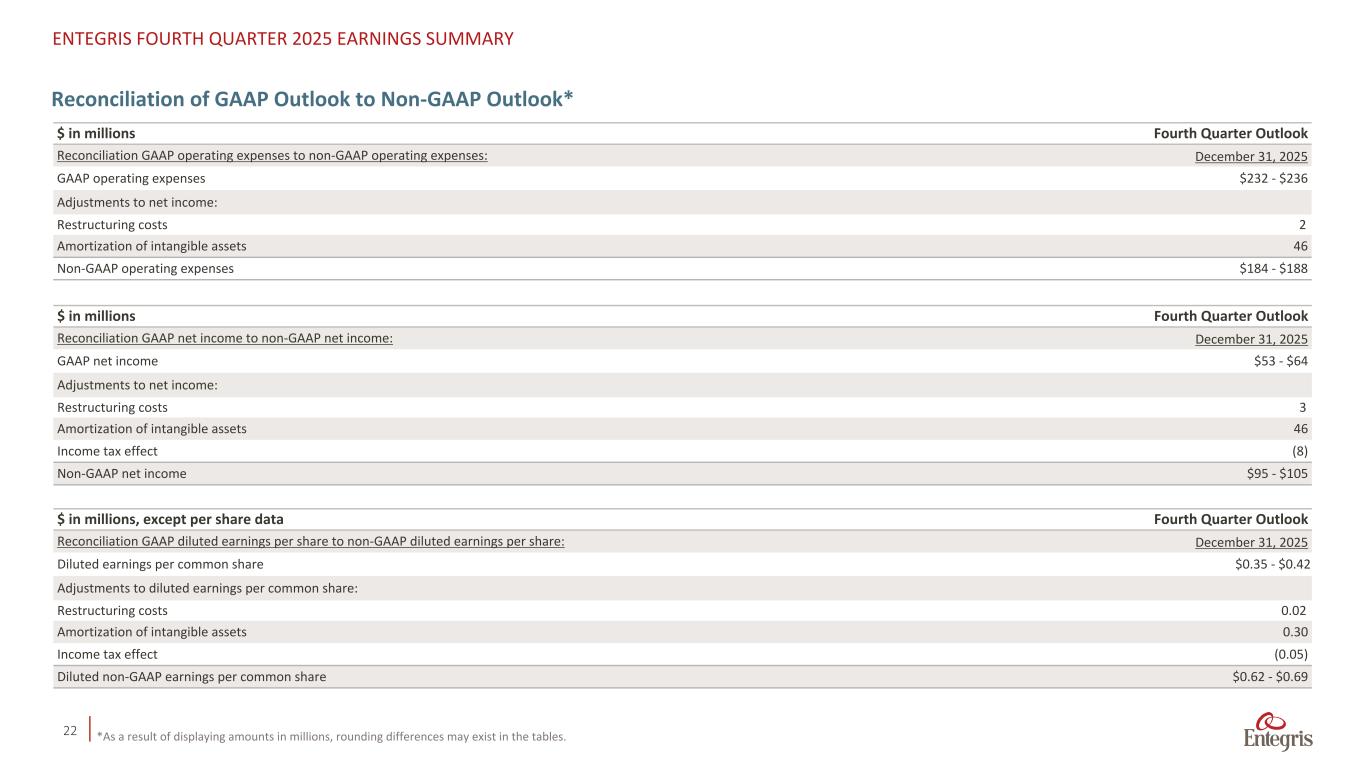
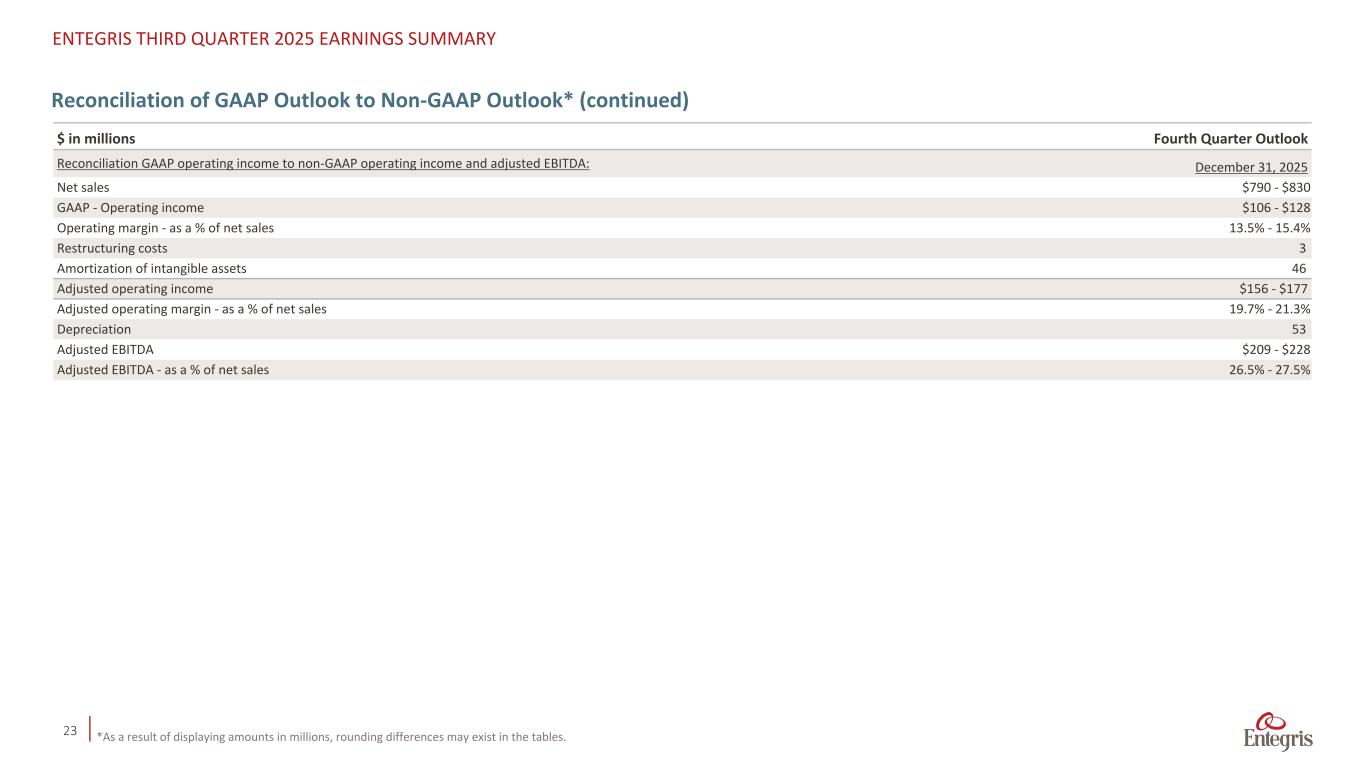
Good morning, and thank you, Dave. Our sales in the third quarter of $807 million were flat year-over-year and up 2% sequentially in line with guidance. Gross margin on a GAAP basis was 43.5% and 43.6% on a non-GAAP basis in the third quarter, below guidance. The sequential decline in gross margin was primarily driven by the underutilization in our manufacturing facilities, including our new facilities. I want to provide a little more color and clarity on our gross margin. Today, our facilities are underutilized, including our new Taiwan Rado facilities, reflecting the current muted industry growth environment, and our decision to add new capacity to support our local-for-local strategy. In addition, we have made short-term decisions to lower production volumes at some of our manufacturing sites to reduce inventory to maximize free cash flow. Based on our current visibility and inventory plan, we believe that gross margin has stabilized in the current range and expect it to increase as we continue to normalize production levels. Back to the Q3 P&L. Operating expenses on a GAAP basis were $229 million in Q3. Operating expenses on a non-GAAP basis in Q3 were $181 million. The reduction in our operating expenses in the second half of 2025 reflects our continued focus on cost management. adjustment. Adjusted EBITDA in Q3 was 27.3% of revenue, in line with our guidance. The GAAP tax rate in Q3 was 2%, and the non-GAAP tax rate was 9%, in line with our guidance. As a reminder, our tax rate was lower in Q3 due to the expiration of a tax reserve. GAAP diluted EPS was $0.46 per share in the third quarter. Non-GAAP EPS was $0.72 per share in line with guidance. Sales for our material solutions in Q3 were $349 million. Sales were up 1% year-on-year and down 2% sequentially. The modest growth year-on-year was driven primarily by CMP consumables and cleaning chemistries. The sequential sales decline was driven primarily by demand shifts between quarters, driven by the evolving trade environment. Adjusted operating margin for MS was 18.9% for the quarter, down both year-over-year in sequentially, driven by lower production volumes and product mix. Sales for advanced purity solutions in Q3 were $461 million, essentially flat year-on-year and up 5% sequentially. The sales increase sequentially was driven by the strength of our liquid filtration business, which had a record quarter in Q3. Adjusted operating margin for APS was 25.9% for the quarter. The year-on-year decline in margin was driven by underutilization of our manufacturing facilities and incremental fixed costs as we ramp Taiwan and Colorado. The sequential increase in margin was driven by sales leverage. Moving on to cash flow. Our free cash flow of $191 million was our highest in six years. The significant improvement in cash flow was driven by our team's focus on working capital, most notably reductions of approximately $50 million in our inventory levels in the third quarter. Free cash flow margin was 11% year-to-date, and as expected, this is a significant improvement from our first half of 2025 free cash flow margin. We continue to expect our free cash flow margin to be in the low double digits for the full year of 2025. A quick overview of our capital structure. During the third quarter, we paid down $150 million dollars of the term loan from cash on hand. At quarter end, our gross debt was approximately 3.9 billion dollars and our net debt was 3.5 billion dollars. Gross leverage was 4.3 times and net leverage was 3.9 times. From a capital allocation standpoint, our single priority remains paying down our debt and reducing our gross leverage to below four times. Moving on to our Q4 outlook, we expect our Q4 sales to range from $790 million to $830 million. Gross margin of 43% to 44%, both on a GAAP and non-GAAP basis. GAAP operating expenses of $232 million to $236 million and non-GAAP operating expenses of $184 million to $188 million. We expect EBITDA margin to range from 26.5% to 27.5%. Net interest expense of approximately $47 million. We expect our non-GAAP tax rate to return to a more normalized tax rate of approximately 15% in the fourth quarter. As I mentioned earlier, the increase in Q4 from our lower Q3 tax rate was driven by the expiration of a tax reserve that benefited Q3. GAP EPS between $0.35 to $0.42 per share, and non-GAP EPS between $0.62 and $0.69 per share. And we expect depreciation of approximately $53 million in Q4. The incremental depreciation is primarily driven by our Colorado facility being placed into service in October. Before I hand the call over to the operator for Q&A, 2026 is our 60th anniversary as a company, and we plan to host an investor day on May 11th next year in New York. We will share more details on this in the coming weeks. With that, operator, let's open the line for questions.
Operator
Thank you. The floor is now open for questions. At this time, if you would like to ask a question or comment please press star one on your telephone keypad if at any point your question has been answered you may remove yourself from the queue by pressing star two again we do ask that you please pick up your handset when posing your question to provide optimal sound quality thank you our first question comes from a Jim Snyder with Goldman Sachs your Your line is now open.
Good morning. Thanks for taking my question. Dave, I realize you've been part of the Integrus Management Structure for a little while now as a member of the board, but I appreciate also the strategic priorities laid out. But maybe you could focus on a couple of differences in terms of maybe one strategic or commercial difference you hope to implement and maybe something operationally that you hope to improve.
Good morning, Jim. It was good to reconnect, and it was good seeing you at Simicon West. Starting with the first one, from a commercial perspective, you know, we're going to continue to do the good things that Integrus has always done, which is engage directly with the fabs, the foundries, the IDMs, as well as the broader ecosystem and help work with them on their technology roadmaps and bring our innovation in both purity and materials to their technology roadmaps and capture those plan of records that we've always spoken about. So we will continue those activities. New activities, we're looking to bring the model that we have worked with our largest customers and the most advanced manufacturing technology, that customer engagement model, we're looking to expand that out. We're looking to expand that upstream into the ecosystem partners, as well as bring some of those advanced capabilities into the mainstream logic as well. So those are the two big differences that we're looking to bring their nascent today. We're working on them. We have been working on them for the last 10 weeks. But in terms of what would be different, it would be the focus on the ecosystem partners, both upstream as well as the OEMs, and then additionally expand that out into the mainstream logic partners. Operationally, we've invested a lot of capital into Rock Remen. more recently, which we plan to open this quarter, as well as southern Taiwan and Kaohsiung KSP South. And so we need to qualify those facilities, get them fully ramped. We have migrated through a large portion of the qualification process with KSP South, so we're looking to ramp that more meaningfully in volume in 2026 versus 25.
And then for Rock Remen, we're looking to put that facility into production this quarter. complete qualifications largely in 26 and then start to ramp volume towards the end of 26 into 27. did you have a follow-up jim yes please that was helpful um and then in terms of broadening the customer base in terms of more mainstream you know to what and how far do you intend to take that and specifically can you address whether you be willing to use price as a lever there even if it means, you know, growing to the top line faster at the expense of gross margin percentage.
So let me start with the broader ecosystem for just a moment. As you think about the most advanced nodes, one thing that we've learned working with the most advanced manufacturers for semiconductors on the planet is that as you start getting into the sub-5 nanometer technologies, the materials that go into the manufacturing process not only have to be more pure at origination, but they also have to be delivered at point of use in a much more pure way. And so those are two areas where we've actually started migrating upstream from the fabs and from the IDMs into the broader ecosystem so that the actual input materials into those process start more pure and then ultimately are pure at point of use with our filtration technology. So that would be an example of moving into the ecosystem. With respect to moving into the mainstream logic, you know, mainstream logic cares deeply about performance and yield, just like the most advanced nodes care about performance and yield. And we've actually learned a lot at the most advanced nodes with respect to how we can continue to deliver yield and performance at the mainstream nodes. So I won't necessarily get into pricing discussions on this call. But what I can tell you is that we have a lot of value to bring, not only upstream into the broader ecosystem, but also across the mainstream logic portfolio. Thank you.
Operator
Thank you. Our next question will come from Tim R. Curry with UBC – I'm sorry, UBS. Please go ahead.
Thanks a lot. Dave, can you speak to whether these – the BIS bans, the affiliate ban, did that cost you any revenue in September, and how much are you accounting for that in your December guidance? And can you just speak, you know, generally, will it – if it didn't hit you in December, is it going to hit you next year? no it didn't it didn't contribute uh this quarter it didn't hit us this quarter and we're not expecting it to really impact us in 2026 did you have a follow-up tim yeah yeah i do so um i guess i'm still trying to understand where utilization is across all the sites um i know that you're ramping up the new sites but i i guess i'm sort of a little wondering why you wouldn't just fill those sites up as quickly as you could. And it sounds like you made the short-term decision to lower production. And I don't know if that was in those locations or in other locations. So can you speak to that and just speak to where, you know, utilization is across your whole, you know, network?
Sure. You know, in my prepared commentary, one of the things I included in the script was that we had the capability to significantly increase revenue from current levels with the capacity that we have. I didn't necessarily quantify what significant means, but it certainly means more than a billion dollars from these levels. So we have a lot of capacity that we've invested in. Starting in 2022, we've been in a pretty intensive capital investment cycle for manufacturing capacity, given that we were unable to really satisfy the demand during the last upterm. We've also added to that with some of our local-for-local manufacturing, given some of the decoupling that's occurred geopolitically with trade. And so, those two things have combined to really create an incredibly strategic manufacturing footprint, but yet one that's underutilized today. So, when we think about utilization from here, when we looked at the third quarter specifically, we had the opportunity in the third quarter to really focus on cash from operations, free cash flow. Those are two areas that have been highlighted from the investment community, particularly with respect to reducing our leverage. And so we took the opportunity in the third quarter to reduce the inventory, deliver that to the bottom line or the cash line, I should say, with record cash from operations and the highest free cash flow for the last six years. We'll continue to kind of balance inventory build with utilization and free cash flow. We'll continue to balance that going forward. And then as we look into 2026, we expect to expand profitability levels from here, increase utilization levels from here. And as we do that, we'll be able to do it with very limited incremental capacity investments. So CapEx will be down in 26 versus 25, and we'll still be able to deliver incremental revenue growth, utilization, and profitability. Linda, anything you'd add to that?
No, I would just say, Tim, to your point or your question, you know, the decisions on reducing inventory were very selective, and the one thing I would add is we will continue to do that a bit more in Q4, but I don't expect the inventory impact to be as much in Q4 as it was in Q3. Okay.
Operator
Thanks, Tim. Thank you. Our next question will come from Melissa Weathers with Dolce Bank.
Your line is open. hi there thank you um i wanted to touch on dave some of your commentary on wafer starts and your wait and see approach as we go into 2026. it seems like we're pretty i mean hopefully we're pretty close to the bottom of the cycle especially in the nand business and you guys obviously benefit as soon as utilization start to expand at those fabs so any incremental color on why you're taking this wait-and-see approach? What are you seeing on wafer starts? And maybe any color on the linearity of orders in the quarter, given that it seems like recent weeks have been a lot stronger than the beginning of the quarter.
Thanks, Melissa. First, you know, 10 weeks in still, so forgive me if I'm not quite ready to make a definitive call on 2026 yet. But the commentary with respect to wait-and-see approach, obviously, we're preparing internally for multiple scenarios. We're obviously preparing qualifications and capacity for orders so that we can ramp. We're also continuing to work on the innovation that I spoke about earlier. and that stated in referencing some of the commentary really from the script, all of which has been informed over the last 10 weeks. Advanced logic, it'll continue to be strong. We expect it to remain strong, really driven by the AI trends that we've seen all year this year as well as last year. Mainstream logic, we believe those inventories have largely normalized. In-demand still seems a bit mixed. The recovery, we think, continues, but the pace seems pretty slow at this point. I think you've heard very similar stories from most of the early reporting over the last couple of weeks. HBM, obviously, that remains strong. That's continuing to be driven by AI. Memory in general, I would say we started seeing some renewed optimism. Around the time of Semicon West, you started to see pricing really kind of firm up across all memory, DDR, as well as NAND. 3D NAND in particular, there's renewed optimism for really accelerating AI demand, largely on the basis of migrating AI workloads from large language model development to really inference workloads, which, as you know, requires a different type of memory. And so, you know, given all of that, what we've positioned the company to do is we've positioned the company to be ready, both with raw materials inventory, work in process, finished goods inventory, though obviously we're managing that a bit more aggressively for free cash flow. And we've continued to work with our customers on their plans for RAMP. I think there was some good news out from the major memory providers or manufacturers, I should say, this week. In fact, over the last couple of days, that news does seem to be a bit more optimistic than things that we've heard, you know, two months ago when I first joined. But we'll be ready irrespective of the environment. Did you have a follow-up, Melissa?
Yeah, thank you for all that. um maybe as my follow-up just on the december quarter um guidance you're guiding about flattish sequentially on revenues um i was a bit surprised to see that especially because we have a certain gate all around and two nanometer nodes ramping in high volume in the december quarter i thought that that would maybe be an uplift to your ms business maybe a little bit of uh the micro contamination control as well. So when it comes to gait all around in two nanometer, can you help us size how much of a growth driver that could be in December and then maybe into 2026 as well? What is that content uplift when you go to gait all around?
Great. Let me start maybe at a higher level. The way we thought about fourth quarter, let me put it in the context of the way we thought about third. In third quarter, we guided 780 to 820, midpoint of 800 million of revenue. We delivered 807. In fourth quarter, we're guiding 790 million of revenue to 830 million of revenue, so midpoint of 810. So obviously, we're feeling a bit better going into fourth quarter, given where we are with backlog, where we are in the quarter, where we are with our engagement with customers. We're feeling better in the fourth quarter versus third quarter. But I'd like to remind you that 75% of our business is driven by Waifer Starts and about 25% of our business is driven by CapEx. And so Waifer Starts, we have seen kind of continuing to improve, albeit slowly. Yes, AI is doing well, but that's only about 5% of the volume. And so, the other kind of 95% of the volume has been very modest in terms of growth. So, that's the 75% portion of our business. The 25% portion of our business, which is CapEx, is pretty heavily levered towards fab and facilities construction and build-outs. And that has been down, call it low teens, very high single digits on a year-over-year basis. that continues to create a little bit of a drag in terms of our top line revenue growth and so really for the fourth quarter you saw us kind of give guidance related one to the broader market and two specific to our mix of business thank you and welcome to the call dave thanks thank you our next question comes from john roberts with mizuho your line is open um thank you um in In the material solutions segment, you talk about the demand shift between quarters.
Did the September quarter benefit more from customer inventory build, or is it the December quarter is going to have more destock that you're anticipating? Or maybe just talk about maybe the month-to-month volatility that you're seeing around this demand shift?
Yes, John, I'll go ahead and take that question. And when we were referring to the demand shift around material solutions, it was more in relation to the Q2, Q3. It's starting to seem like it was a while ago, but as we remember, Q2, there was a lot going on in the trade environment, and it was difficult at that point to know exactly how demand was shifting between that Q2 and Q3. So, as you just look at that growth on MS across those quarters, that's what we were referring to.
Okay. And then, Dave, I think you expect some product rationalization as part of the requalification of your U.S.-produced products into China. Will that be a material sales drag in 2026?
You know, really, with our sales into China, maybe it would be helpful if I just kind of outlined that broader strategy a bit more fully. We'll be about – we'll be greater than 80% local-for-local manufacturing for our Chinese customers by the end of this year. And when I say local-for-local, I mean that we're satisfying from the region into China without some of the restrictions that you get when it originates from the United States. We expect that number to be greater than 90% in 2026. We don't believe that number will get to 100% just simply because there are small volume, small running products that from a capital perspective, it would not make sense to kind of move some of that production overseas, local for local manufacturing. So those types of products will either satisfy through paying a tariff on those products, or obviously we work with our customers to find a different source, neither of which we believe will materially impact our revenue in 26. We believe the vast majority of our products will be local for local manufacturing in 2026. And our China market, we've actually been quite pleased with. If you were to look at our China markets, we're up about 8% sequentially. We're up 3.5% year-over-year for the quarter. In fact, Asia in general, if you exclude China, is up 7.5% year-over-year in the third quarter, up 8.5% year-to-date. So we're quite pleased with all of our Asia sales, with all of our Asia teams. And then specific to China, we think we have a very capable team in China that has enabled us to manage a pretty complex environment quite well, and the internal teams continue to execute well with respect to local-for-local manufacturing.
Operator
Thank you. Our next question will come from Elizabeth Sun with Citi. Your line is open.
Hi, good morning. Thanks for taking my question. I guess first question for Dave, as a follow-up to our earlier question, if we think about the ramp of 2 nanometers going into next year, maybe you could help a little bit, quantify a little bit about your content growth opportunities going into next year from 3 nanometers to 2 nanometers.
And I'll start again with this is my 10th weekend, and so I probably won't get too much commentary on 2026 at this stage. Obviously, we're entering the fourth quarter, I would say, with a bit more optimism from both advanced logic as well as from memory. So I think those are two things that we're entering the fourth quarter and will most likely be entering 2026 with. Mainstream will continue to most likely have a muted recovery as it kind of continues to work through its demand cycle. With respect to node transitions, we actually feel quite good about the node transitions. As the manufacturing becomes more complex, you need more products from Integris, both products with higher purity as well as products that at point of use and at source have to have the same purity as origination. So, for liquid filtration, we feel good about our plan of records for advanced logic, photo bulk, as well as point of use. We've talked about some of the advanced nodes with respect to memory, particularly 3D NAND with MOLLE and some of the PORs in that space. CMP slurries. We have two times more plan of record wins at N2 versus N5, so we feel quite good about our wins there at Advanced Logic. We also have some significant growth plan of records in HBM as well for CMP solutions. And then, of course, we just talked about setting a record quarter for liquid filtration. So, I think as you think about these node transitions, node transitions will drag higher content per wafer from Integris. It hits a lot of, you know, the core assets of the company. So, as that becomes a larger portion of total volume, then you would expect that portion of our business to grow accordingly. I think the only caveat I would add to this perhaps would be just keep in mind that, you know, the advanced nodes still represent a very small amount of total wafers. You're talking about AI-driven wafers of something like 5% of the total wafers that will be started in 2025. And so, while we're excited about the node transitions and we're excited about the content that it pulls from Integris as we transition through these nodes, they still today represent a small portion of total waste of storage. Did you have a follow-up, Alyssa?
Yes, please. So, as a follow-up for Linda, for the GST and Colorado FABs, is there any incremental help with gross margin are you expecting with the two are still ramping?
Yes, so overall with Taiwan and Rock Rim, and again, just stepping back to, you know, these are amazing facilities for us, very strategic assets, really critical to our local, for local. To your question, Elizabeth, we did put Rock Rim into service in October, and in our Q4 guide, you do see that incremental depreciation. And the way I think about it going forward, you will see depreciation in 2026 for the full year. But I'd frame it like this. The Colorado facility is smaller than the Taiwan facility, and that incremental depreciation, you know, I view as very manageable. Really right now, you know, going back, as we said, all of our facilities are underutilized. as the volumes ramp across our facilities, we're going to see that benefit to gross margin for the company.
Operator
Great. Thanks. Thank you. Our next question will come from Bavesh Lodea with BMO Capital Markets. Your line is open.
Hi. Good morning, and welcome, Dave. Good morning, Bavesh. Maybe following up on the capacity utilization question, just one more angle to it. I appreciate that CapEx is moving lower from here, and you have also moved some capacity or some production across regions. As you look at your global footprint today, do you see opportunities to perhaps reduce some capacity, increase utilization of the newer plants, or do you see yourself as the right size and just waiting for volumes to grow from here?
Well, that's just, David. I think it really depends on rate and pace of ramp from here. You know, we have a lot of strategic assets now from a manufacturing perspective. We believe that we're well positioned with some additional qualifications to satisfy kind of local for local in region based upon where the demand is located we can source from local production. We also believe that we have ample capacity to capture demand in an upcycle, which would generate significantly more revenue from here with very limited incremental additional manufacturing capex. So we feel good about all of those things. Would we rationalize our manufacturing footprint at this stage? I think I would just take a step back. I would say, well, what's the rate and pace of industry growth from here? And I think we'll look at that rate and pace and then make real-time decisions based upon what's happening in the broader semiconductor market did you have a follow-up of us yes and maybe a question around around your priorities as you look at look forward to capital allocation clearly clearly leverages leverage reduction is top of mind here uh lower capex should help with that but after after that is achieved how do you see capital allocation for integrity is going ahead it's probably it's probably worth just commenting again on on the big priorities so the the big priority is again kind of 10 weeks in and informed by being on the board uh for a couple of years uh as well as 10 10 weeks at the company i would start with you know the customer it all starts with the customer and technology and semiconductors as you know um so it starts with the customer and capturing those node transitions and those technology roadmaps and having the innovation to be relevant in the industry, all areas where the company has excelled. And what we want to do is we want to take that now and we want to expand it out to more of the semiconductor market than perhaps we've focused on in the past. So I would start with customers. From an operations perspective, obviously we've got a very large and strategic manufacturing footprint and so now it's you know the blocking and tackling that you expect from operations which is the qualification and the efficient production site by site such that we can squeeze the most out of our manufacturing assets and we believe that we can significantly increase revenue with limited incremental capex so that's why you'll see that capex come down on year-over-year basis. And then finally, it's using that good customer intimacy with excellent operational focus that will result in more of the cash from operations and free cash flow that then is necessary and required for us to reduce our leverage. So that's kind of the high-level framework from a priority perspective. Now to get to the basis of your question is, our near-term priority for capital allocation is to continue to pay down debt. You saw us in the third quarter, we were able to generate meaningful free cash flow. We paid down the debt an incremental $150 million in the third quarter. We expect to generate more free cash flow in the fourth quarter, use that free cash flow subsequently to then reduce the debt load further. That will be the near-term focus will be to reduce our leverage. Obviously, once we get our leverage to a place that's less than three times, and I would prefer closer to two than three, then we'll be able to start looking at other perhaps more interesting and strategic capital allocation strategies.
And I'll just save that kind of commentary perhaps for Capital Markets Day in the second quarter that Linda mentioned, as well as for conversations in the future. thank you thank you our next question will come from Chris Parkinson with wolf research your line is open great thank you so much um can we just dig in a little bit more into what you're seeing in an APS um and just how we should I understand you don't want to talk too much about 2026 but just in terms of the trends in the second half have they been surprising to you better or worse and you know how do you see things through at least the balance of the year thank you Good morning, Chris.
Specific to APS, obviously we're seeing good trends in liquid filtration. We commented that we had a record quarter in the third quarter for liquid filtration. That's driven from some of the ecosystem that I spoke about earlier needing higher purity, as well as from direct engagement with some of the most advanced manufacturers. And we're looking to kind of extend some of those learnings then to the broader market. So all of those comments kind of fit and tie together with what we saw in the third quarter. Fluid management in Boots, those are a bit more CapEx-driven, as you know. So they've been challenged with respect to when you see facilities and fab build-outs on a year-over-year basis. a number of something like high single-digit, low teams, depending on which service you're looking at. Obviously, that CapEx-related portion of our business, fluid management, has been impacted by that. It's been impacted by that all year. It was impacted by it in the third quarter. We expect it to be impacted, and our guidance includes the fact that it would be impacted continuing into the fourth quarter. We'll see what happens with that trend in 2026. The good news is that the base has come down in 25, and then we'll see how it develops further into 2026. I think that's probably the best high-level color I can give you for APS. Did you have a follow-up, Chris?
Yeah, just, you know, in your initial conversations with shareholders, and obviously I'm sure you already had some familiarity, But just what was the most surprising thing that you heard in terms of, you know, broad-based feedback from the position you were in to the one you're in now in terms of was there anything surprising? Is there anything you thought that perhaps the organization needs to do a little bit better in terms of communication? Just what was that, you know, you mentioned some blunt feedback. I'd love it if you could expand on that.
Yeah, I think when I spoke to shareholders and I had the opportunity to meet with shareholders on four different occasions in the last 10 weeks as a member of the company, the feedback from shareholders were really related to the growth, the profitability, and the leverage. I think those were the – and I know I'm kind of grouping those into high-level categories, but those were the three categories that almost all of the commentary fit in. There was a lot of feedback with respect to, you know, how long will it take you to generate more free cash flow to get through the investment cycle to help reduce this leverage. I think that was probably the category that had the most commentary, given the understanding of the current state of the semiconductor market. But I wouldn't discount the commentary on growth. So as you think about those as direct feedback from investors delivered in multiple forums, and then you look at from a company perspective, what can we do to kind of address all three of those? the growth perspective or the growth category, I should say, that really starts with the customer. It starts with the customers that we tend to spend the most time with historically, which are the most advanced manufacturing customers. And then what we want to do is we want to extend that further up into the ecosystem. These are the suppliers to those customers. And then we also want to extend more of those learnings to the mainstream logic customers, given that those are not opportunities that we've historically focused on. So that would address largely the growth. Obviously, we're continuing to invest in innovation. We're continuing to invest in no transitions, all those things the company has always done, but really just kind of expanding our lens with respect to where our products can play into the market so that we can start to drive not only top-line growth, but then also start to fill some of these facilities that we have invested in that have significant available capacity. And then as we do that, not only, obviously, do we get the utilization, start to get some of that fixed cost absorption that you'd like to get out of these facilities, but then that would also then translate into cash flow. And so that's how the priorities hang together. That was the feedback from investors. It was also the observations, you know, in my 10 weeks kind of on the ground here at Integris. And, you know, to address the second part of your question, I'll address it two ways. You asked what could we do better. Let me just talk briefly on what I think we do well. I have been very impressed with the quality of the teams. And when I say the quality of the teams, I'm specifically talking about the technical expertise as well as the quality of the teams in region. We have some amazing employees around the world, and I had the chance to start in Asia. And the quality of our teams in Asia is very impressive, both technically as well as commercially. And so that's an area that I was incredibly – I had high expectations, and it's exceeded my expectation on that front. Things that we could do better, we do great work in region, in all the regions. So whether it's Europe, the U.S., or Asia, we do great work in region. Sometimes we're a little slow in communicating across regions. So that's an area that we've already worked to improve, and so that's an area that we've focused a bit more on. And then, of course, you know, we're focusing on ramping these facilities. I think that's an area getting through the qualifications, getting the volume and release to manufacturing done so that we can start to produce more out of these facilities that we've invested in. That's another area that we want to continue to work on through 2026.
Operator
Thank you. Our next question will come from Aleski with KeyBank Capital Markets. Your line is now open.
Thanks. Good morning, everyone. I wanted to ask you about qualification of the KSP site. Where are you in that process relative to your goals? And once you fully qualify that site, do you expect that to have a positive effect on your margins? Or is this neutral because you're just replacing production of one site with the other? Hi, Alex.
We're happy with our qualifications in KSP, though I would say that we're behind schedule. We have worked diligently to qualify some of the highest runners. We still have some more products that are in qual, but we do have some of the higher runners now qualified. We do believe we're going to be able to materially increase our volume in 26 versus what we were able to deliver in 25. But we still have some qualifications to go, and we are a little behind schedule with respect to where we thought we would be at this point in time. And so that's an area that has gotten renewed focus from us. We have put additional and incremental leadership into Taiwan to help facilitate this process. We're getting very frequent updates with respect to how we're performing, not only on production, but also on incremental qualifications of products. So this is very much a top of mind process for us.
In terms of positive impact, Linda, do you want to- Yeah, let me help you a bit as you think about the margins and how it might relate to Taiwan. You know, I step back and think about our ecosystem, our facilities. And as we mentioned, you know, we're underutilized across the facilities. And then with our new facilities, Taiwan and Colorado, we have some incremental fixed costs. We also have state-of-the-art processes. These are state-of-the-art manufacturing facilities. So there is some marginal benefit there to margin. But think about it as the whole ecosystem. And again, as we start to see the volume and we mentioned we do expect to see some volume uplift and and some growth in 2026 that's going to then you know help us see that improvement in the margins overall okay thanks a lot i think you already answered two questions so i'll let somebody else ask i think we have time for for one more question thank you our last question today will come from edward yang with Oppenheimer, your line is open.
Hi, good morning, Dave, Linda. My question is on AI. You know, the 5% exposure that you referenced, is that for Integra specifically or the industry? You know, one of your competitors talked about getting closer to 15%. And related to that, one of the HBM manufacturers announced a long-term CMP agreement with a peer of yours. Do you have something similar? And is your C&P positioning within HBM, is that an area where you over-index or under-index relative to the rest of your business?
Thanks, Edward. The 5% that we're referencing for AI, that's a percentage of total wafer starts. And so while those 5% wafers represent about 30% of the revenue, they're only 5% of the wafer volume. And so when you look at the total wafer volume that will be shipped and started in 2025, 5% of those wafers will be AI. That portion of the market is doing incredibly well. The other portion, the other 95% of the market is probably still something like 15% down from peak. Obviously, it's slightly different by technology. Mainstream's probably close to that 15%. NAND is probably closer to 25-ish percent down from peak, although that's a layer discussion with respect to how much capacity is actually absorbed based on how many layers. But in terms of total industry, it's still down pretty meaningfully from peak. So the 5%, again, that's really just a reference with respect to what percentage of the wafers are driven by AI. Obviously, our business, especially on the most advanced nodes um which commands tends to command premiums that portion of the business is doing is doing quite well across the board and so much higher than the type of growth rates that we're reporting from unit volume but it's being offset by by the rest of the market as well as by capex um with respect to hbm and cmp um let's just talk maybe maybe it's worthwhile talking briefly about advanced packaging advanced packaging in general is a portion of the market from a capex perspective is growing something like 25 i don't have a number for you from a unit perspective but advanced packaging is a portion of the market is growing quite rapidly and the reason it's growing rapidly obviously is because it's connected both to the ai logic as well as to the high bandwidth memory And so advanced packaging is a portion of the market where historically we've not played in a significant way. We are going to generate about $100 million of revenue from advanced packaging this year. We do have some strategic initiatives for some SAM expansion into the space, which will develop over time that we look forward to talking about at Capital Markets Day. But as it fits today, that's a portion of the market where we're playing a bit more narrowly because we tend to just, in general, be focused more on the front end. On the C&P process that you referenced, we do have some C&P wins in the HBM space. I think that portion of the business, albeit off a small base, is up 100%, I believe, on a year-over-year basis. So we've been quite pleased with that, but obviously it's starting from a small base. Edward, did you have a follow-up?
Yes, and I'm looking forward to the upcoming analyst day. Last year's analyst day talked about outperforming the market long-term by a pretty significant amount. Do you think that growth formula still holds? And, you know, in the context of the industry looking for about 5% MSI growth next year, you know, where would you sit in the level of outperformance, you know, within that? I think you referenced like plus 3% to 6% range outperformance.
Let me broaden the question out, and then at the end I'll come back to it. You know, we are doing quite well in the markets where we compete and where we do focus and participate. For example, slurries and pads are up 15% over the last 12 months. Selective etch is up 40%. Cleans are up more than 10%. And, you know, as we mentioned earlier, we just had a record quarter for liquid filtration. So if you look at the areas where we compete, we actually feel very good about how those areas are performing. and we feel quite good about our plan of record. On the CapEx side, you know, we've spoken about it, but CapEx, and we're particularly tied to facilities build-outs and construction, that portion of the market's down about 10%, and we're not that different. We're a little bit better than that, but we're down in a very similar vein and of a similar magnitude in that portion of our business, which is creating a drag, if you will, on our top line. The advanced packaging portion of the business, which is growing quite well, that's an area where our exposure is fairly small today. Obviously, we're expecting about $100 million in 2025, but that represents a big opportunity for us in 26 and beyond. So to come back to your question, with respect to the three to six points outperformance, 10 weeks in, I do believe that we have the opportunities to significantly outperform the market, and I do think that I look forward to talking to you about that at Capital Markets Day.
Operator
Thank you. I'm not going to call back over to Bill Seymour for any additional or closing remarks.
Yes, thank you for joining our call today. Please reach out to me directly if you would like to follow up. Have a good day, and you can now disconnect the call.
Operator
Thank you. This concludes today's Integra's third quarter 2025 earnings conference call. Please disconnect the lines at this.