Operator
Greetings and welcome to the Eve Holdings second quarter 2026 earnings call. At this time all participants are in a listen-only mode. A question and answer session will follow the formal presentation. If anyone should require operator assistance during the conference please press star zero on your telephone keypad. Please note this conference is being recorded. I will now turn the conference over to your host, Lucio Aldworth. Please go ahead.
Thank you, Operator. Good morning, everyone. This is Lucio Aldworth, the Director of Investor Relations at EVE, and I want to welcome everyone to our second quarter 2026 earnings conference call. Our CEO, Johan Bourdain, and CFO, Eduardo Cotto, are joining me on the call today. After their prepared remarks, we're going to open the call for questions, at which point Marcelo Bazzilli, our Chief Flight Prototype Engineer, will also join us to address more technical questions. We'll have a deck with a few slides and additional pictures that showcase our achievements in the quarter, including, of course, the more recent stages of the test slide of our full-scale prototype. The deck is available on our site at ir.eveairmobility.com. Please feel free to download and follow along. And in fact, we just published on our investor relations website, a video of our most recent transition flight, and we encourage all investors and analysts to watch it. Let me first mention that today's conference call includes statements about events or circumstances that have not yet occurred. These are primarily based on our current expectations and projections regarding future events and financial trends that will affect our business and future economic performance. These forward-looking statements are based on current expectations and involve risks and uncertainties that could cause financial results to differ substantially from those expressed or implied in this conference call. We undertake no obligation to update publicly or revise any forward-looking statements because of new information, future events, or other factors. For a more detailed list of these risks and uncertainties, please refer to our SEC filings, which are available on our website. Now, I'll turn over to our CEO, Johan Bourdais.
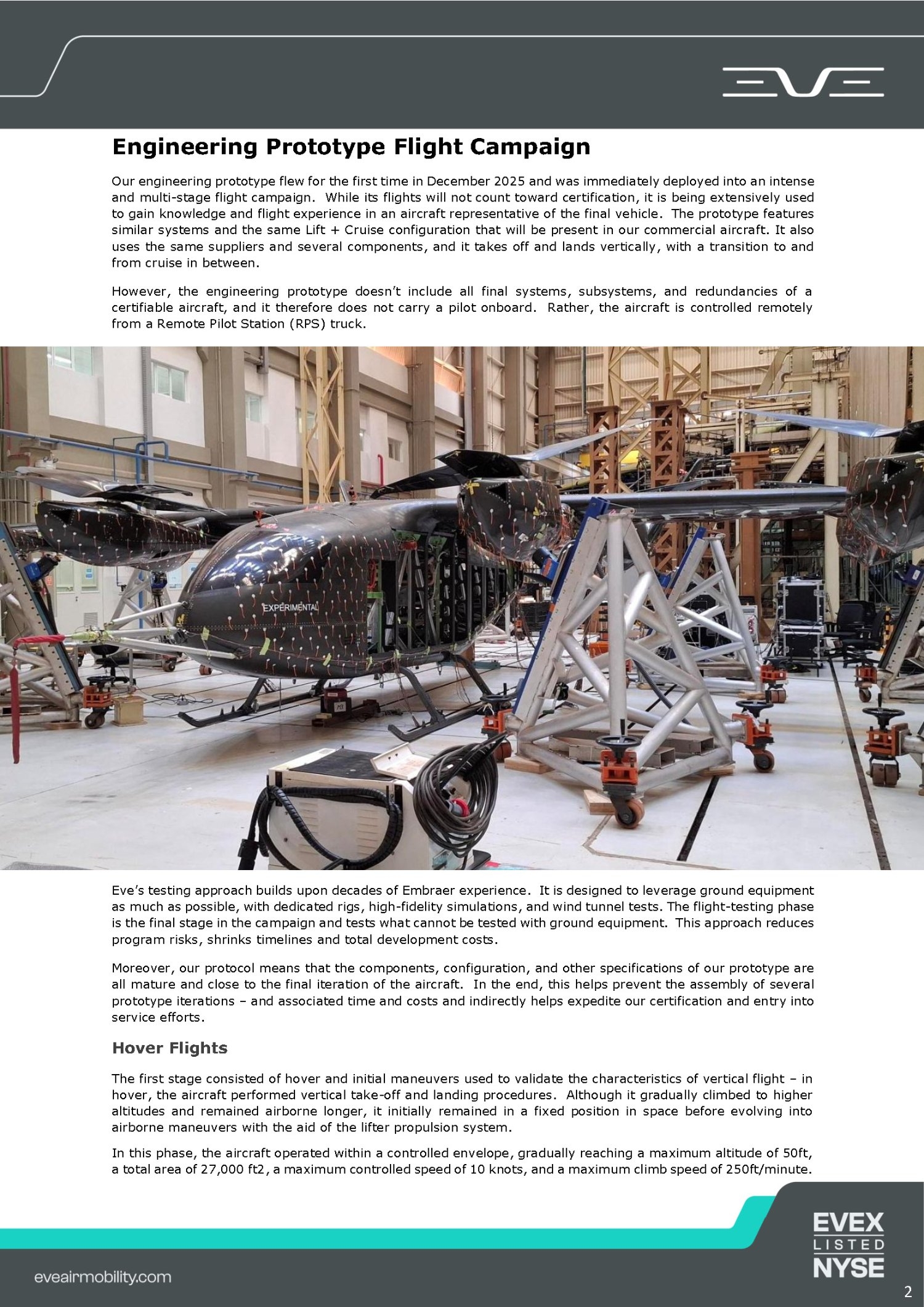
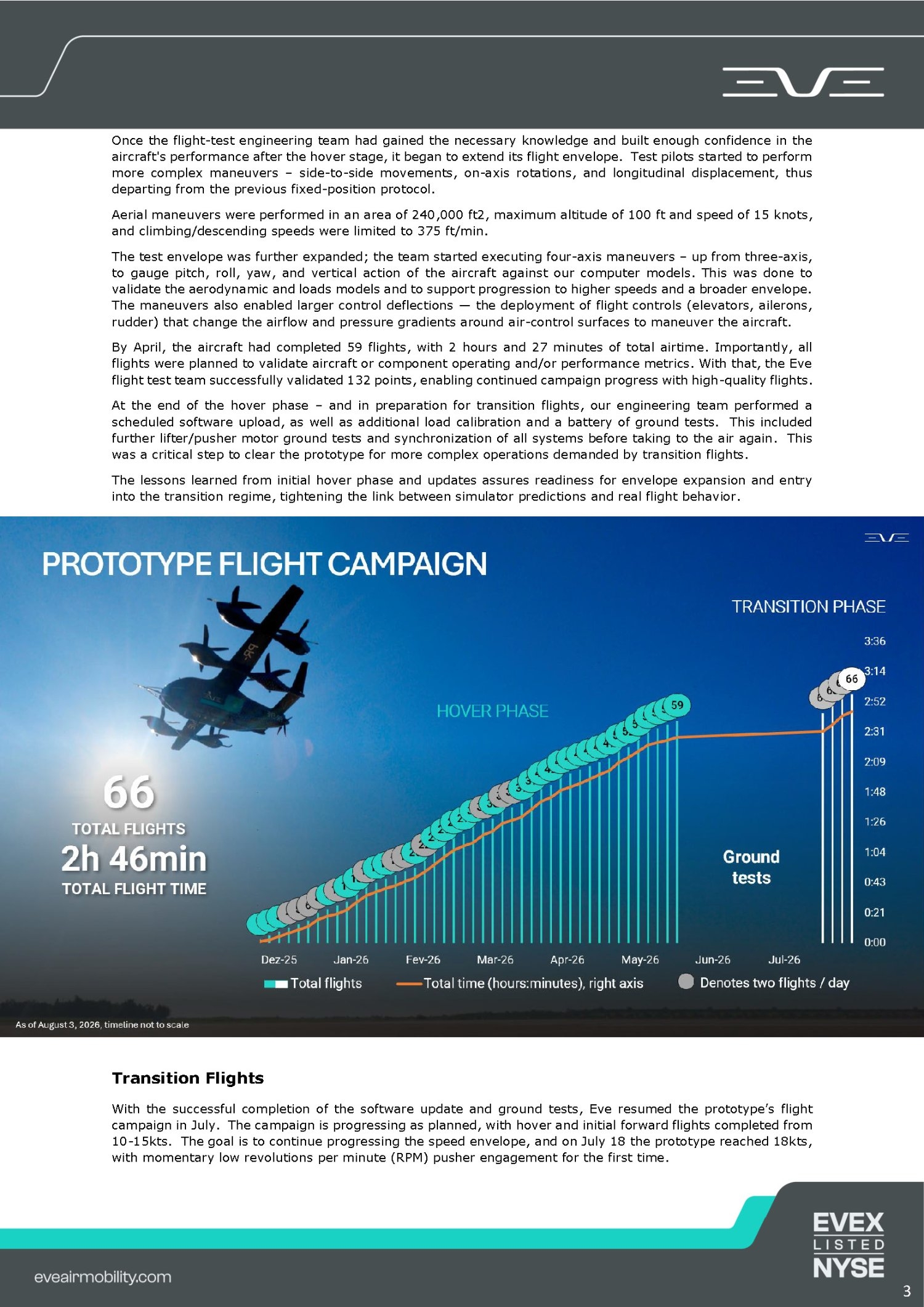
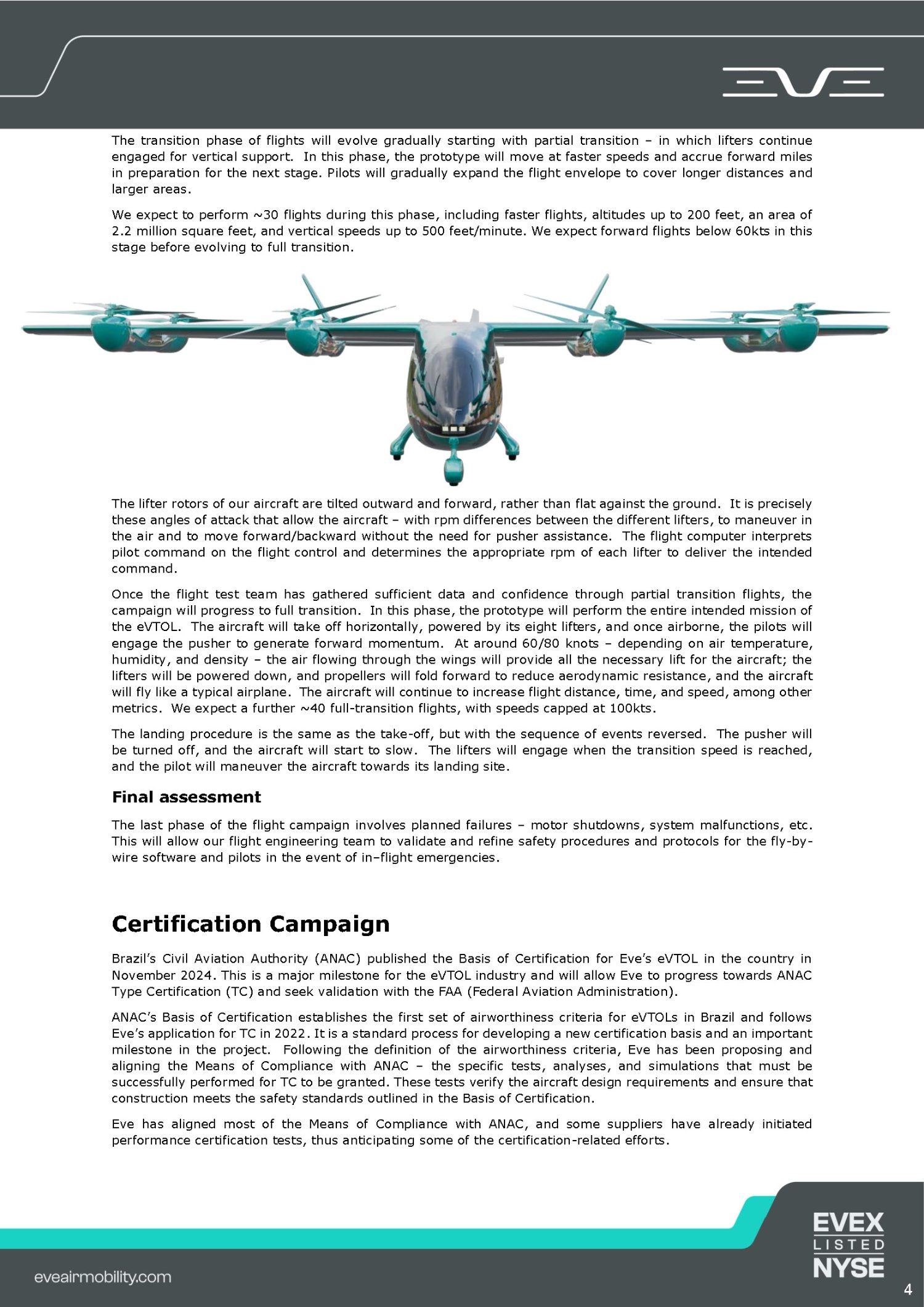
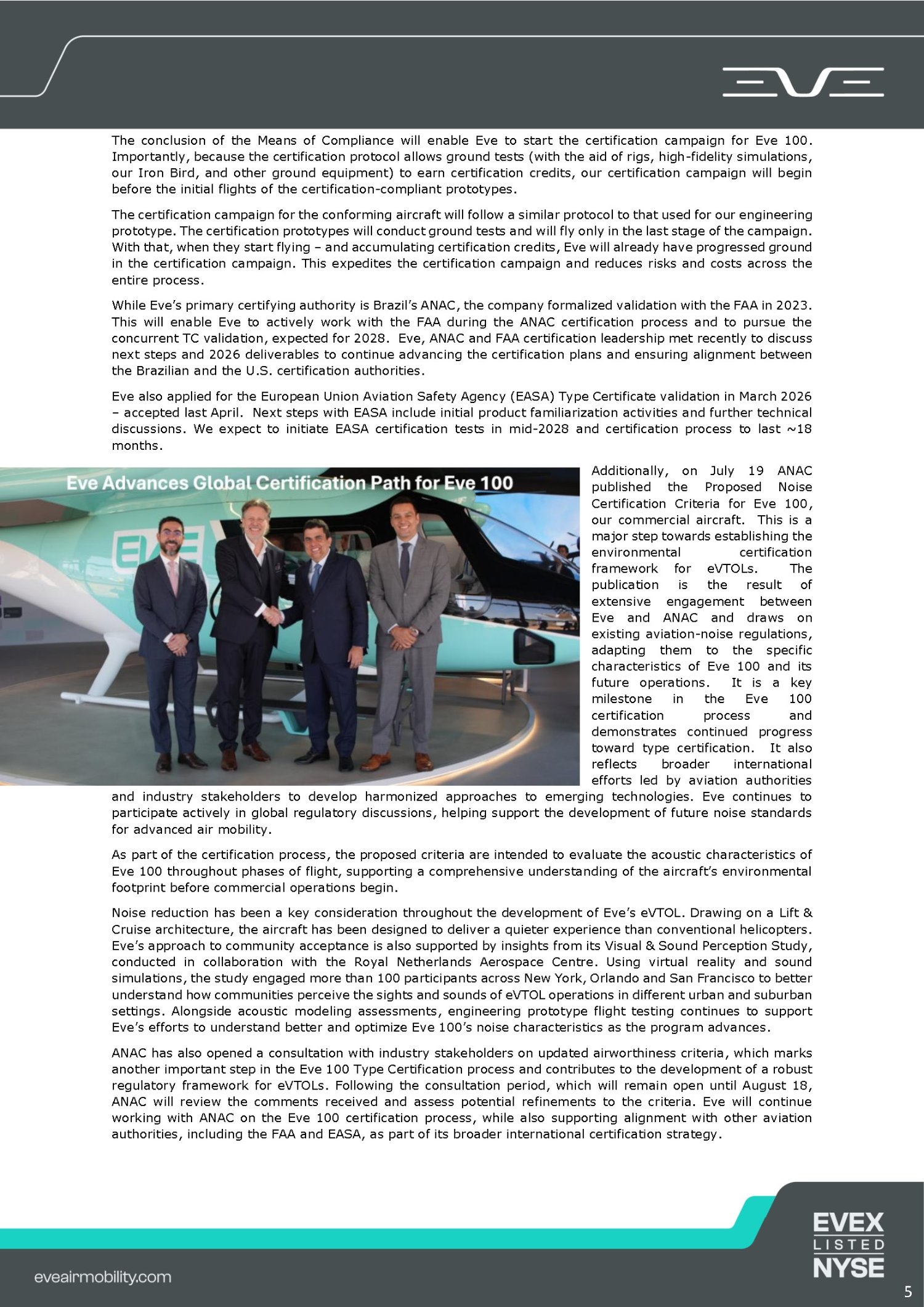
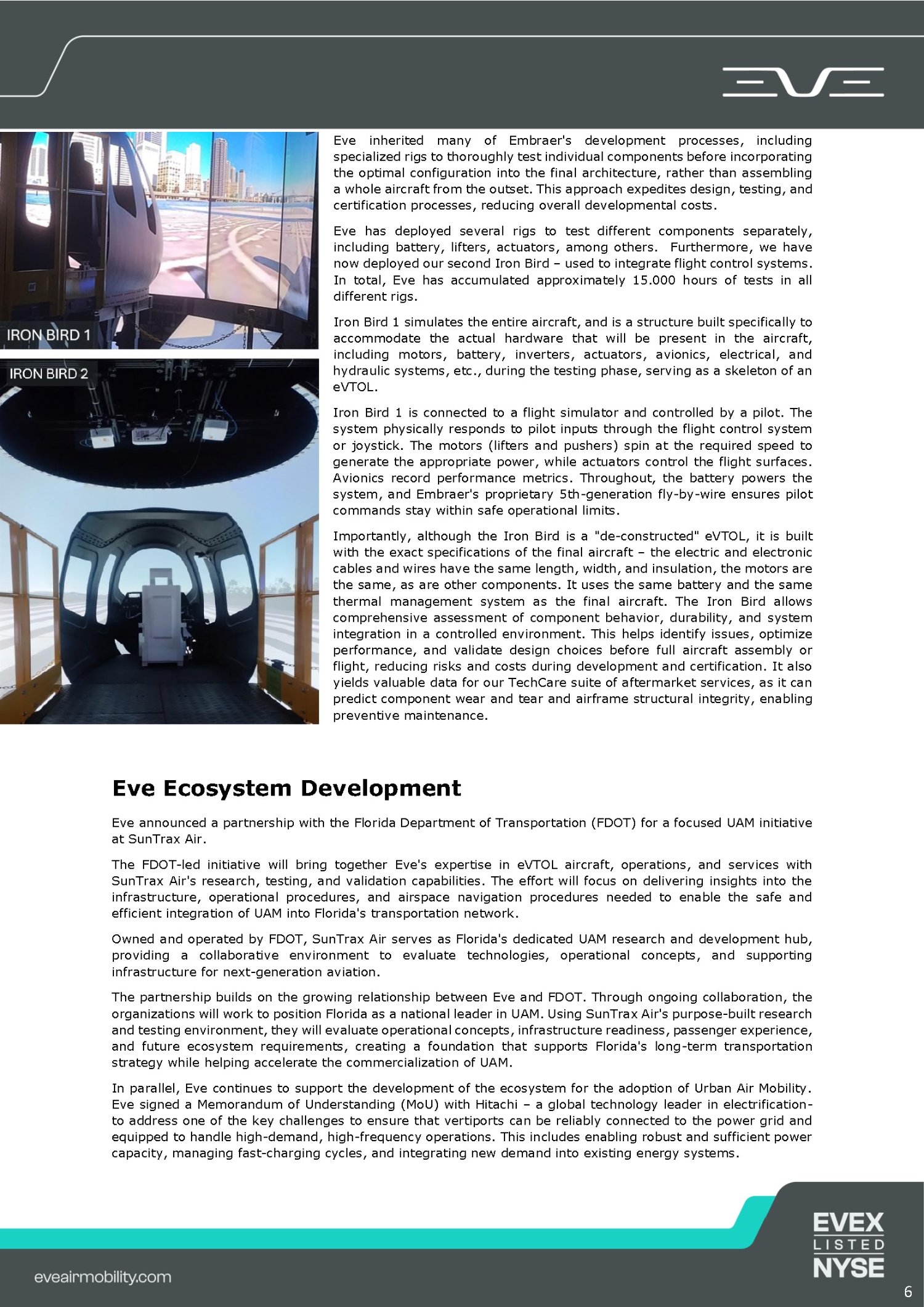
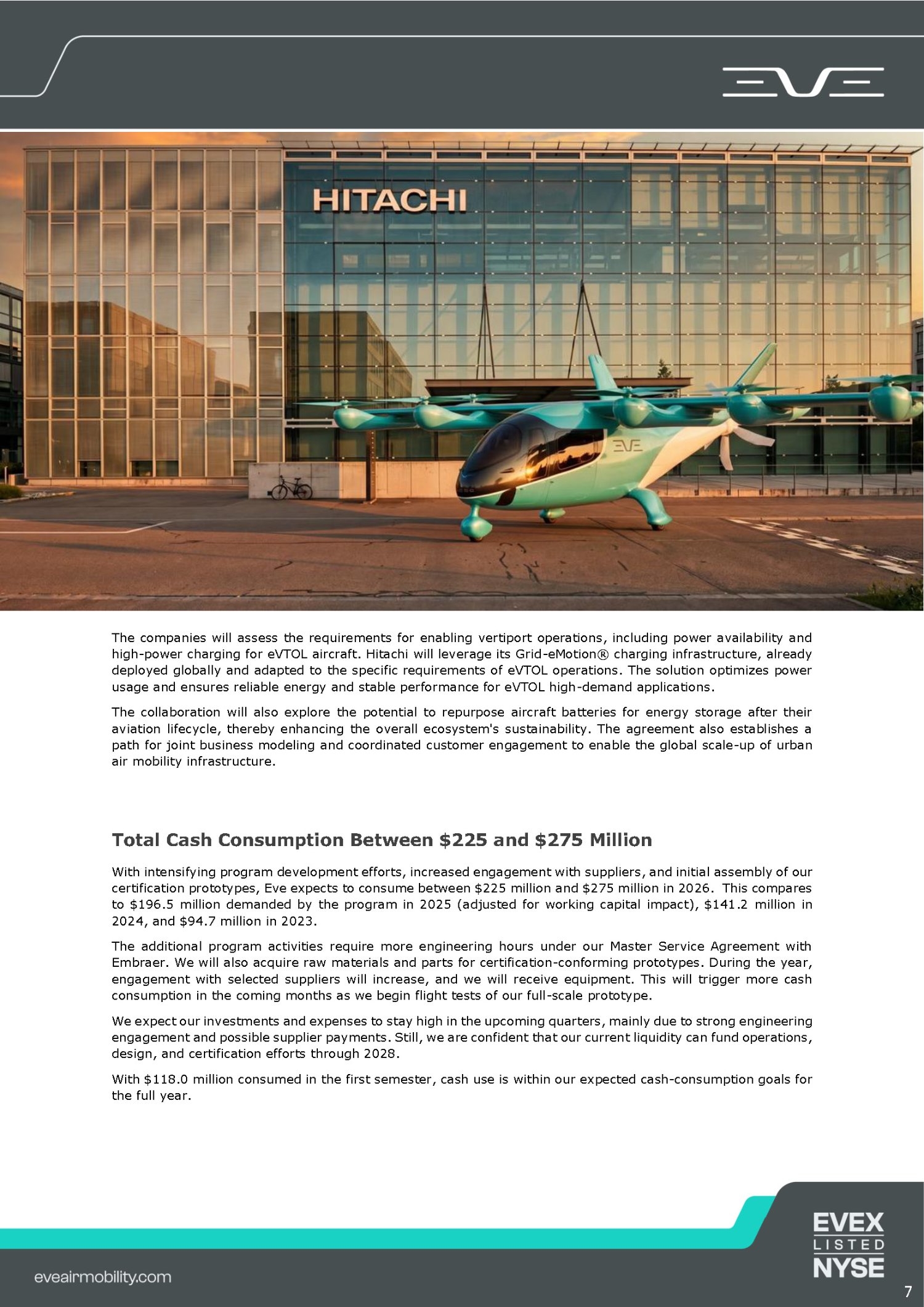
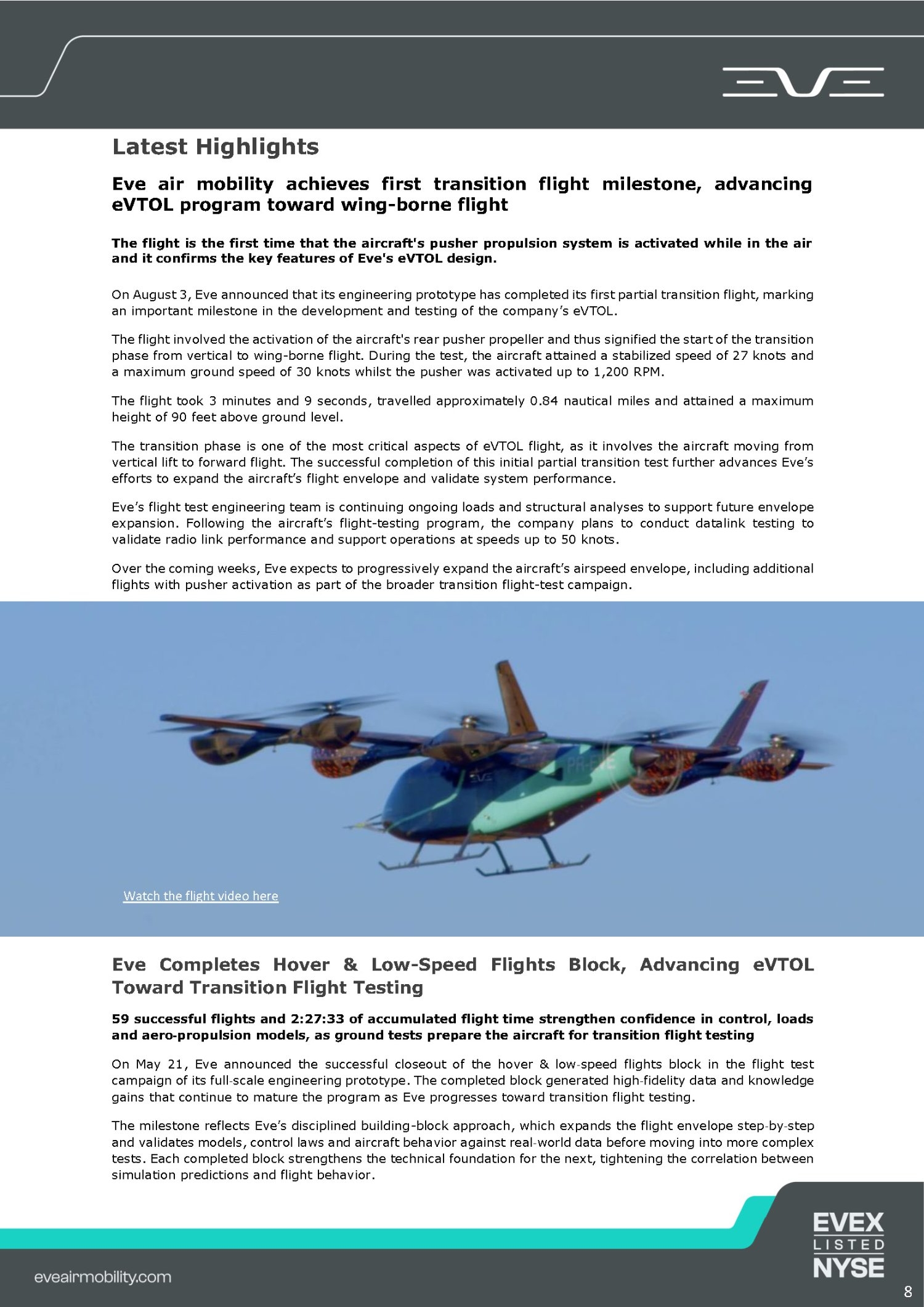
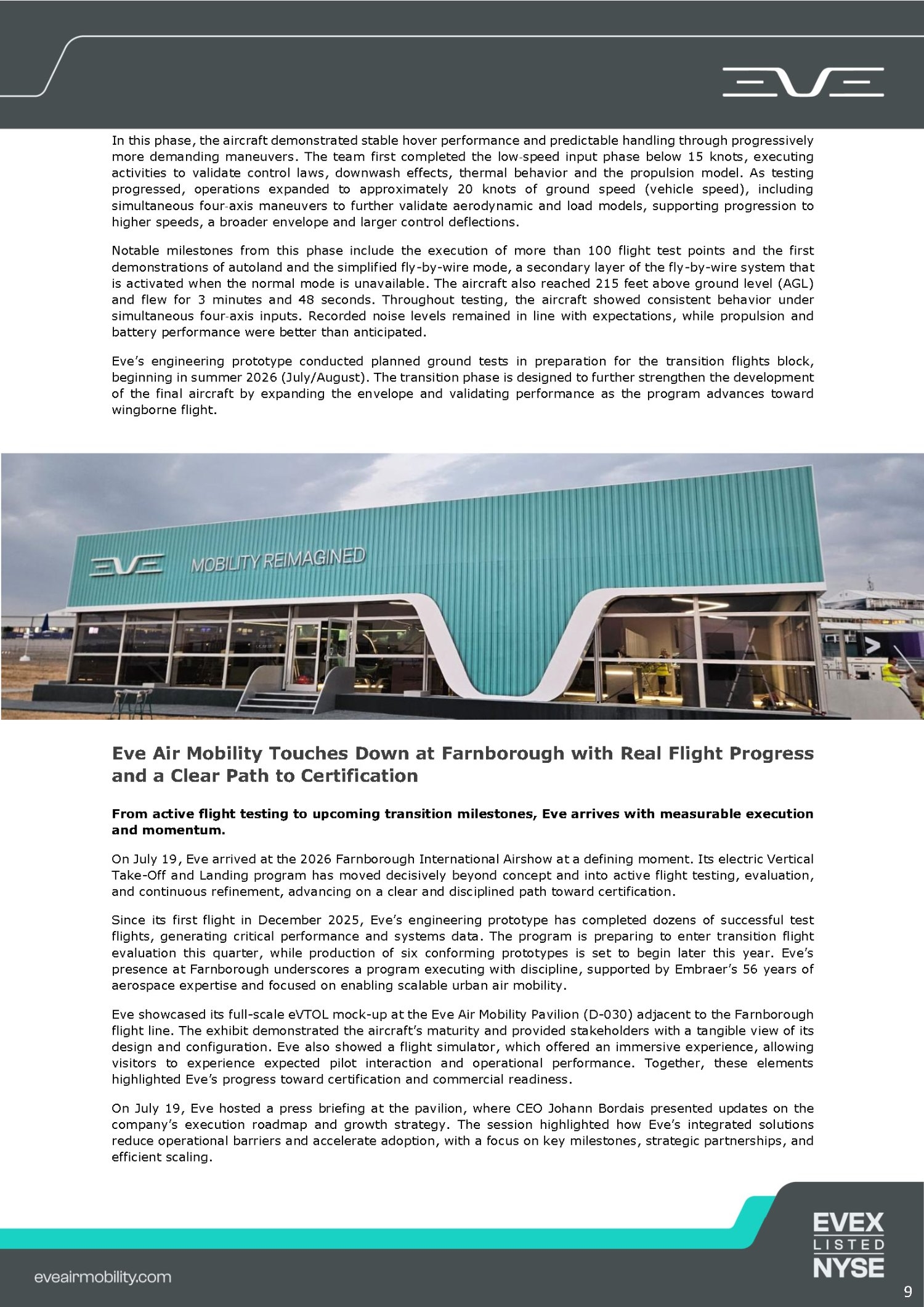
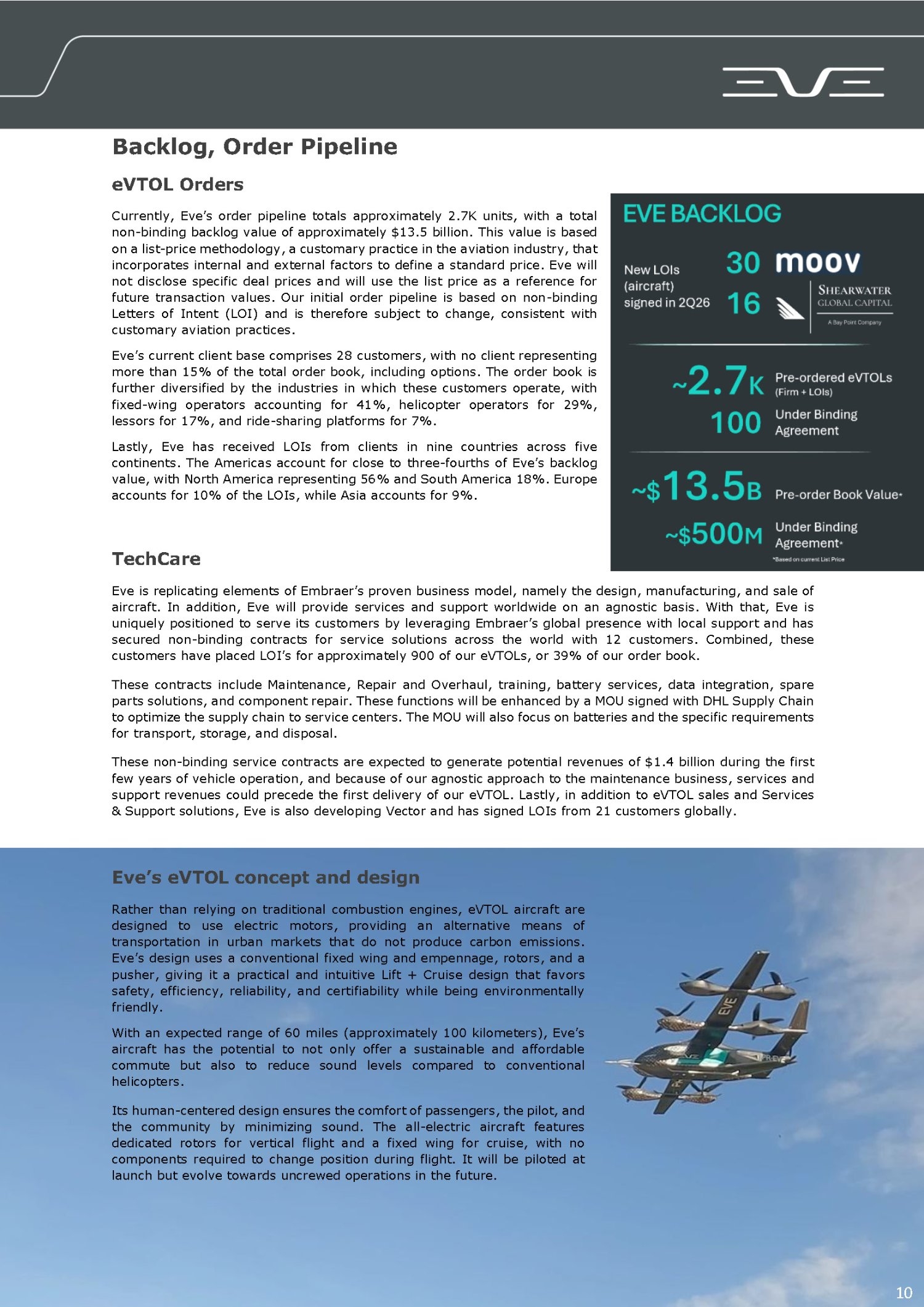
Thank you, Lucio. Good morning, everyone, and welcome to our second quarter 2026 conference call. We had a good quarter with several milestones demonstrating steady progress. After the inaugural flight of our engineering prototype last December, we went through a series of hover flights. We concluded a planned ground test period of three months of software upgrade, and which led to us to resume our flight campaign towards full transition by the end of this year. These three major phases validate not only our building block concept by extensively testing every part, but also the integration of critical systems such as fly-by-wire and fixed-pitch lifter rotors. In parallel, we continue our rig testing of different components for our commercial aircraft and interact with certification authorities and partners. Lastly, we will go through the new LOI agreements announced at the Farnborough Airshow. The slide three details some of the tests we performed between May and July in preparation for transition. As I mentioned previously, we uploaded new software to optimize the synchronization between the lifters and the pusher to sustain lift during all the phases of flight. We also made sure that pusher, avionics, actuators, flight control, and other systems were tested again on the ground, this time with motors powered on and the aircraft anchored on the ground. On slide four, we wanted to show you some additional details of the vibration test we perform on the ground. Because of wing-borne flights bringing to the aircraft different pressure points, vibration, or aerodynamic loads, we attach a shaker device to the lifters to simulate and assess resulting oscillation in the entire aircraft. Slide five shows the progress of our accumulated flights. With successful completion of our ground test, we cleared the prototype to get back in the air and start transition flights. In total, our prototype flew 66 times and logged 2 hours 46 minutes of airtime. Importantly, the prototype now enters a new phase with partial transition. This is when we gradually accelerate the aircraft by engaging the pusher, but still maintain the lifters powered on for the lift. The pusher was engaged at first with low RPMs and then powered up to around 1,200 RPMs, allowing the aircraft to fly forward at 30 knots speed, which is about 35 miles per hour. In the coming weeks, speed will progressively increase to 60 knots and then to 80, 90 knots to complete the full transition. At that moment, the lifters will be powered off, and all lifts will come from air passing through the wing, flying like an airplane. This is the aircraft's ultimate mission. Take off vertically, transition to wing-borne flight, and then transition back to vertical flight for landing procedures. Slide 6 shows some pictures and has a link of a video of one of the latest transition flights. The video is also on our website and social media platform. Now, more than quantity, our flight campaign also demonstrates quality. Every flight is digitally planned to test and validate specific aircraft components or flight metrics, and in total, we have validated 150 test points. It is precisely these validations that allow us to move ahead with confidence. Moving to slide 7, we can see here part of our physical infrastructure that supports our entire program development with more than 15,000 accumulated hours of testing. We continue testing different components separately in specific rigs to continue optimizing their individual performance and have now deployed a second Ironbird dedicated to flight control system integration. As a reminder, our first Ironbird is a deconstructed eVTOL in which we integrate all the different actual components of an eVTOL into a physical system to make sure all the system work properly together. This is part of our testing process that should expedite the testing and the certification efforts, which also reduce the program cost. In parallel, on slide eight, we continue to advance our certification process with Brazilian certification authority ENAC. The means of compliance are almost completed with ENAC. These are the tests that need to be successfully performed on different component to certify the aircraft. Interestingly, few suppliers have already started testing some of the components that have means of compliance aligned already with ANAC. Separately, ANAC opened a new consultation with either three stakeholders on updated airworthiness certification base, reflecting the requirements alignment with FAA. This is another important step in the E100 certification process and contributes to the development of a robust regulatory framework for eVTOLs. Following the consultation period, which ends on August 18th, ANAC will review the comments received and assess the potential refinements on the criteria. In addition, ANAC published the proposed noise certification criteria for the EVE-100, which is the result of an extensive engagement between EVE and ANAC drawing on existing aviation noise regulations. Lastly, we applied through ANAC for type certification validation by EASA. And it is expected to certify our aircraft for European markets 12 to 15 months after ANAC and FAA. On slide 9, we continue to prepare readiness of necessary infrastructure for safe operation and EV tools. We have partnered with Itachi, a global technology leader in electrification, to ensure the VertiPorts can be reliably connected to a power grid and equipped to handle the high-demand, high-frequency operations. This includes enabling sufficient power capacity, managing fast charging cycle, and integrating new demand in existing energy systems. In Florida, we also partnered with Florida Department of Transportation, focused on delivering insight in the infrastructure, operational procedures, and airspace navigation procedures needed to enable the safe and efficient integration of UAM into Florida's transportation network. On slide 10, you can see the timeline to certification. As I mentioned previously, we are now in a transition phase. We are around 30 flights away to full transition. Meanwhile, we are conducting a critical design review with our suppliers for each system and component that will be featured in our coming conforming prototype. This will allow us to release drawings and continue manufacturing components within the required specs to produce and test our conforming vehicle in 2027. Without certification, an entry to service is expected for 2028. Considering that we will need to fly our conforming prototype for around 12 months after the first crewed conforming prototype flight planned for the second half of 2027. Slide 11, we had a successful outcome at the Farnborough Airshow. We met with several industry leaders, customers, and partners, and we met several investors at the show. We also announced the two new LOI for a total of 46 aircraft from MOVE for operations in Capo Verge and Shearwaters, a Bay Point Capital company, a new lesser in-hour backlog. This is a good segue into slide 12, which shows a total pre-order backlog of approximately 2,700 aircraft valued at about $13.5 billion at the list price, including the two new LOIs signed this quarter and announced at the Famborough Airshow. And now, I hand it over to our CFO, Edu, for the second quarter of 2026 financial review.
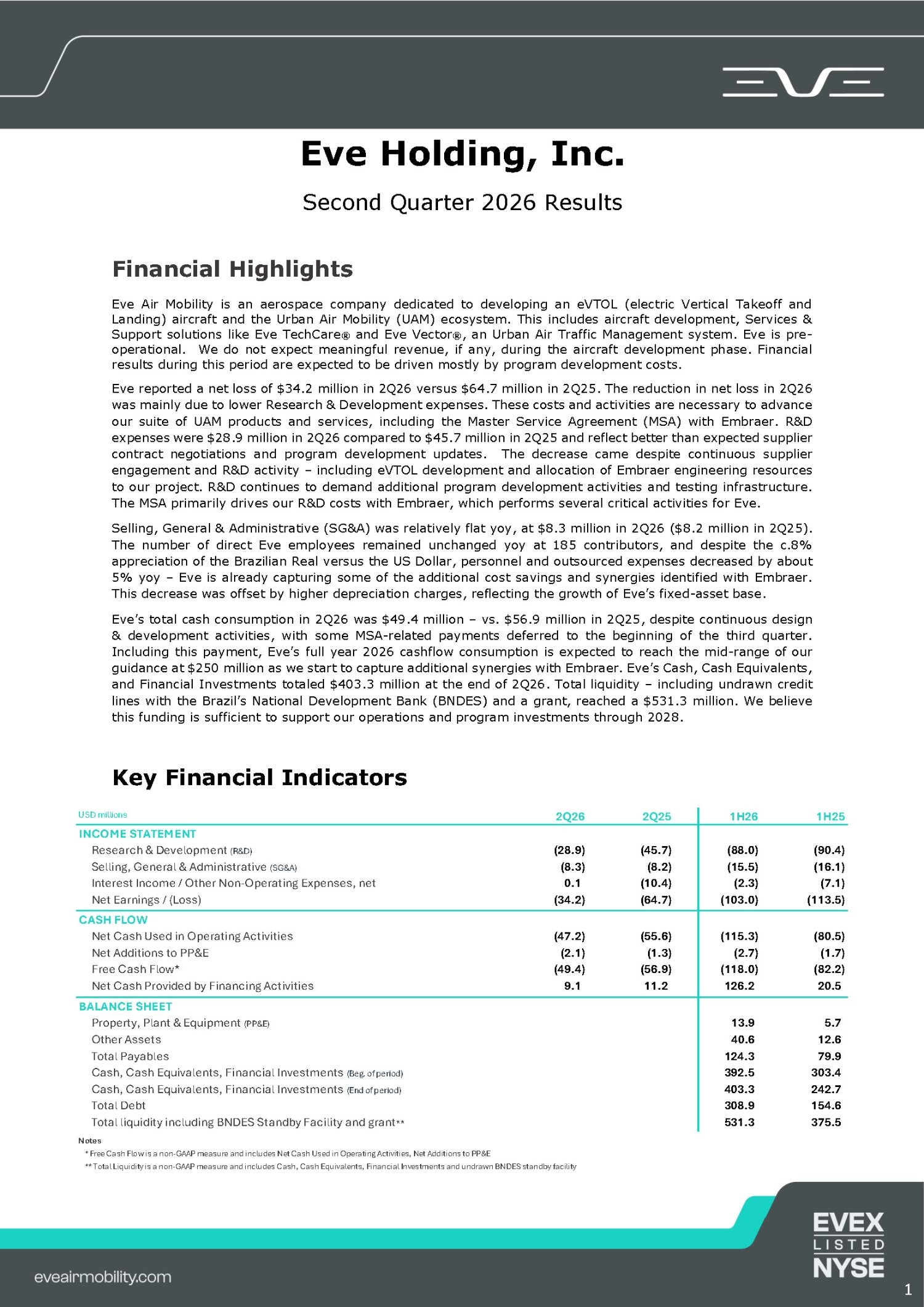
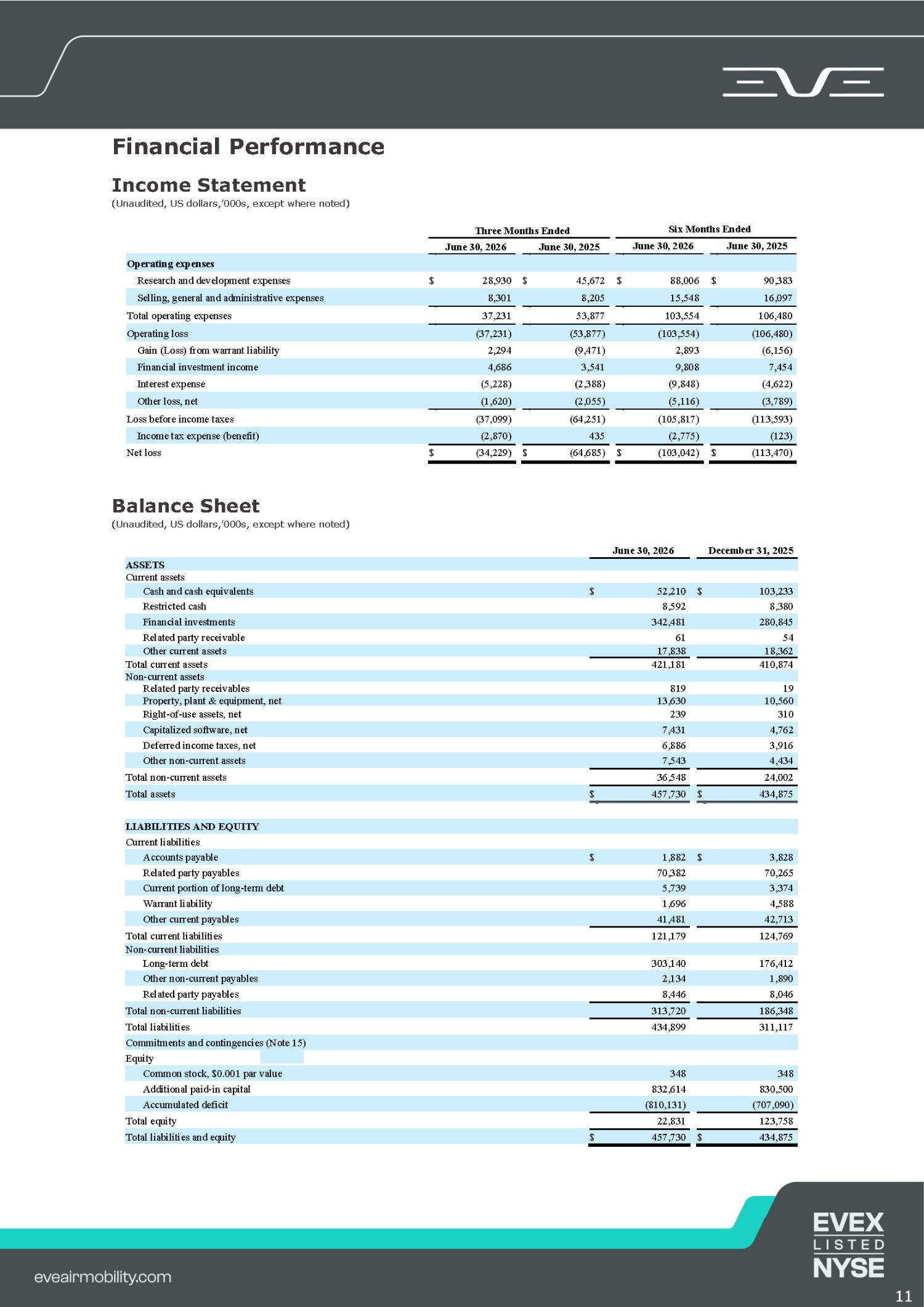
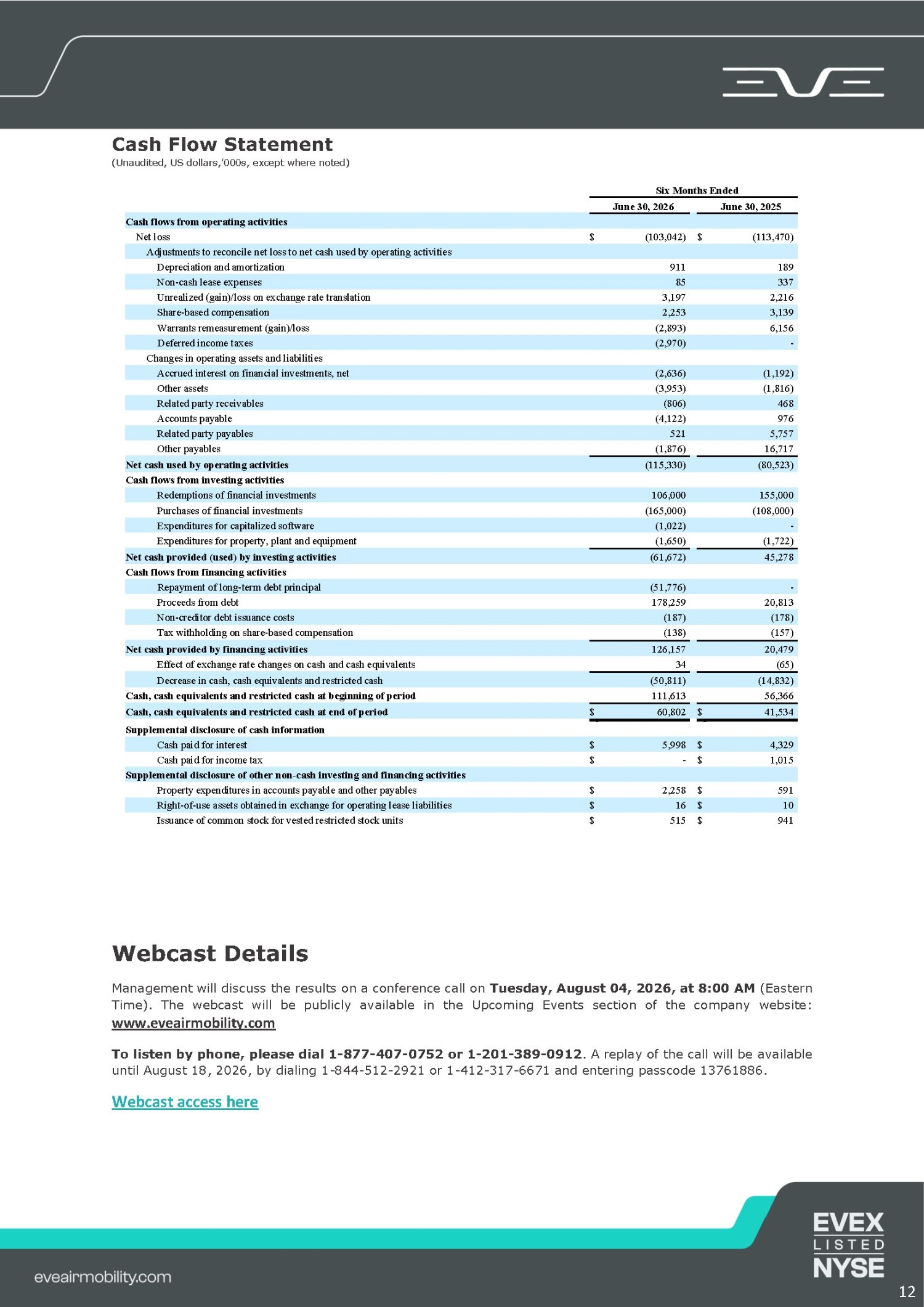
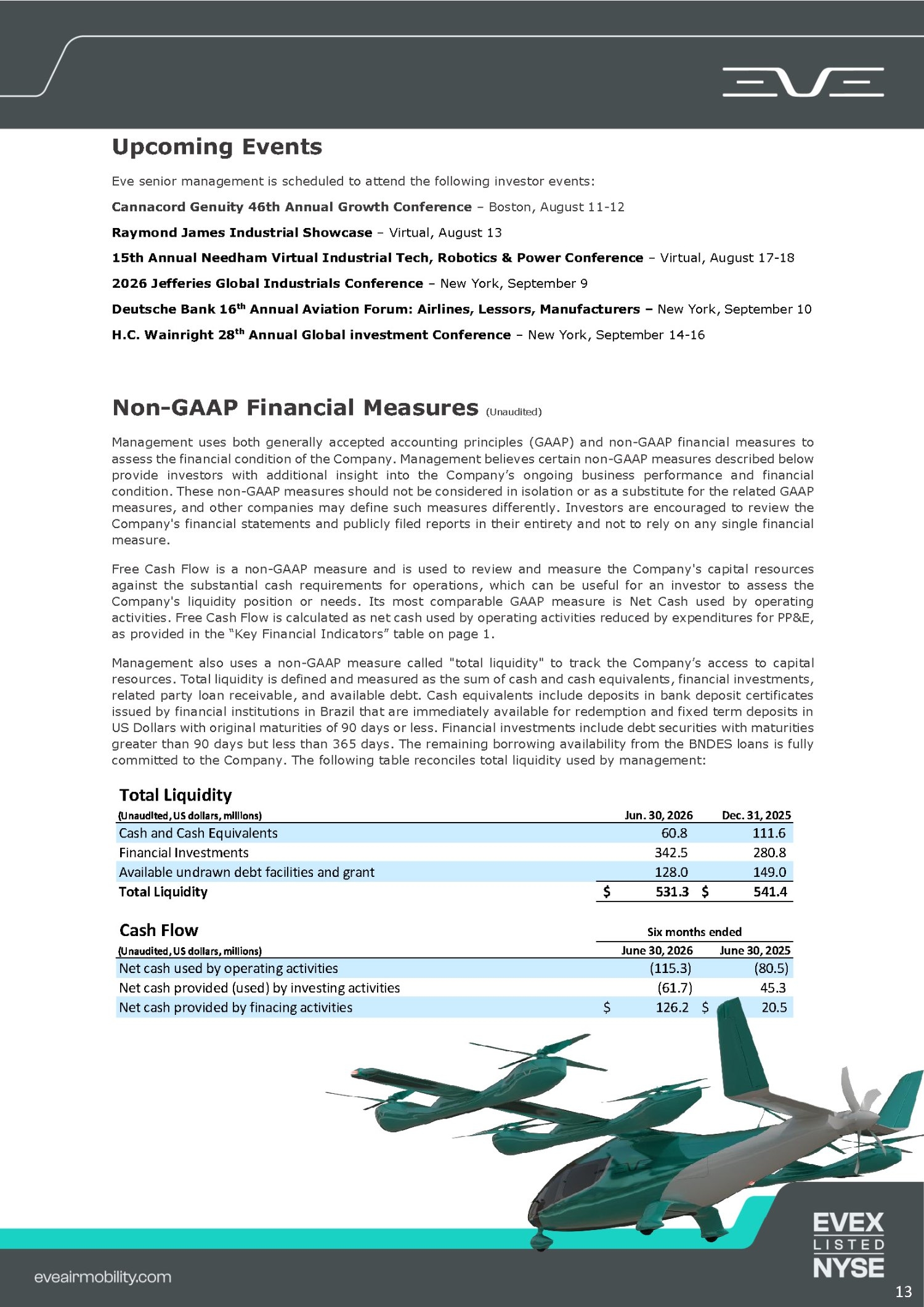
Thanks, Johan. On slide 13, EVE ended second quarter 2026 with $403 million in cash and total liquidity of $531 million, which includes $128 million in non-draw credit facilities. We believe the current level of liquidity is enough to support operations through 2028 without new funding. Importantly, we have already started to capture some of the synergies and cost avoidance we had identified and announced in the first quarter. Again, we have worked extensively with Embraer to find new ways to reduce our cash burn until certification. And our initial review indicates we can achieve $100 million to $150 million in potential synergies in the next three years, supporting our cash runaway. In the first semester of 2026, total cash burn was $118 million, and our total consumption for the year should remain close to the midpoint of our guidance between $225 and $275 million. Now moving to slide 14, just to highlight some of our numbers, research and development in the second quarter, 26, was $29 million. This is lower than around $55 million in previous quarters, and it reflects better than initially expected agreements with some of our suppliers and program development updates. Going forward, we expect R&D levels to return to around $50 million per quarter. SG&A has been mostly stable at $8 million as we continue to capture synergies and control costs on general and administrative expenses. Including R&D and SG&A, net loss was $34 million in the second quarter, 2026. Finally, as mentioned previously, we ended the quarter with $403 million in cash and $531 million in total liquidity. Cash consumption in the second quarter was $49 million, and in the first six months of the year was $118 million. This shows some of the early benefits of synergies with Embraer and reinforces our confidence that our current financial position is sufficient to fund our operations until 2028. With that, we conclude our remarks, and I would like to open the call for questions. Operator, please proceed.
Operator
Thank you. We will now be conducting a question and answer session. If you would like to ask a question, please press star one on your telephone keypad a confirmation tone will indicate your line is in the question queue you may press star two if you would like to remove your question from the meeting is being recorded this meeting is being transcribed using speaker equipment it may be necessary to pick up your handset before pressing the star keys and our first question will come from I'm Savi Sith with Raymond James.
Hey, good morning, everyone. Maybe, you know, it was really helpful to get some of the forward color on R&D. I was curious if you could share how we should think about kind of CapEx into the second half as well and how much, if any, of the kind of 100, 150 million synergies have been kind of realized or are in kind of a run rate for this year. Yeah.
Yes. Hi, Savi. Good talk to you. So the synergies we're implementing, right, we did a lot of workshops to make sure we are as efficient as possible in terms of cash burn until certification and make sure we keep our cash burn not only this year, but until certification, right, in 2027 and 2028, as efficient as possible. we identified these 100 to 150 million in synergies for these three years we are already capturing that so I think that is when we say we are confident to stay in the mid-range of our guidance it's already capturing part of those synergies I believe little less than one third of those synergies come this year and the rest comes in 27 and 2028. Regarding CAPEX for the manufacturing that's another area that we have been doing a lot of studies how to be more efficient. We are going to be able or we are studying to use the existing Embraer facilities as much as possible so that we can only invest in manufacturing facilities as later as possible. So probably this year, we're talking about $20 million in CapEx investments. Next year, this number should go higher, something around $50 million and probably another $30 million, $40 million in 2028. So overall, we're going to be investing around $100 million to have, I would say, a modular production capacity, and we can grow this capacity, of course, as demand grows. So that's kind of what we're planning.
That's helpful, Carl, and great capacity discipline there. If I might, just on the flight timing, it looks like maybe full transition flights have flipped a bit into 4Q from 3Q in kind of thinking when those will be done. I'm just wondering if that impacts the timing of when you start building certification-conforming aircraft or if those two things aren't really connected.
Yes, Avi, this is Johan. Yeah, both are connected, obviously, but the full transition flight is planned by the end of this year, right? We'll see exactly, you know, we've resumed the flight campaign. We're thrilled about it. We just made, as we announced yesterday, also the transition with turning on the pusher. So it should be 30 to 40 flights until we really complete the full transition. This is when we'll go to the 90 knots, and then we'll turn off the lifters. So, yeah, by the end of this year, we'll see how it goes. Obviously, we'll have some more information in the next quarter. And then it really triggers also the conforming product of the first one. We'll be debuting the assembly. We already have parts of suppliers that are ready, you know, and then shipping out to us. And then we'll start the assembly, and then the assembly will be finalized next year. And then second half will be the first flight of the conforming prototype.
Operator
Thank you. And our next question comes from Andres Shepard with Cantor Fitzgerald.
Good morning. Thank you for taking our questions, and congratulations on the quarter. Johan, I wanted to start with maybe the transition flight. Congratulations to the team on the beginning of the transition flight campaign, as you mentioned. My question there is just can you remind us, you know, you talked about it a little bit already, but how do you expect this program to ramp up going forward? You know, what do you see as the major validation from the flights? And then can you remind us kind of where we are on the design and build out of the six conforming aircraft, which you'll also be using as part of your flight campaign.
Now, thank you, Andres. Thank you for your question. This is important. Obviously, you know, since the very beginning, we elected to have the lift and cruise configuration, which we understand is better for certification purpose, but also for the aftermarket operation for the operator customers. And this is exactly what we're doing with the engineering prototype. Separating the vertical flight from the horizontal flight is what has led us to have this broad building, what we call it, a methodology that Embraider has been doing for the last 56 years and has been proving, you know, efficient. As we go, we test its component, and this is what we've been doing, right, since the last flight and even prior to this, the first flight that we had on 19th of December, and then we've been having the first phase, which is the hover phase, and then we had the three months of grading and software, We're integrating also with a pusher that we will turn on. We did turn it on, on the ground first, but now in flight. So this is part of the flight campaign, and, yeah, it's going to take us to the end of the year. So, you know, we like to progress, like I like to say, progress with purpose, right? I mean, we don't want to cut any corners. You know, we know all those tests are important. We've tested more than 150 points of testing, which is very important in our process, and expanding the envelope of flight, right? And then we're learning as we're doing this. With this, we're transferring this to the conforming prototype as much as possible. And this is exactly what we're doing. We're going to be freezing in the design of the aircraft by the end of this year. We call the CDR phase with all the suppliers. The 21 suppliers also will be done by the end of this year. And then, like I said, just assembling. Some of them, by the way, the CDRs are done with the suppliers. Some others are not yet. And then we'll transfer this knowledge to the conforming prototype. We'll have six conforming prototypes built up next year with the first slide. As I said, it's going to be crewed with a pilot. It's going to be the second half of next year. Six prototypes to go until the certification for 2028. It takes about 12 months from the first slide. This is a rule of thumb that we have at Embraer that has been proven also for certification with ENACT.
Excellent. Thank you, Johan. And maybe just as a quick follow-up. So, you know, at the Farm Bar Air Show, you added two LOIs to the backlog. So I guess the question, how significant are these orders? How are you thinking about converting those to binding orders going forward? And what do you see as maybe the main differentiator of the backlog?
Thanks, Andres. It is important for us, right? I mean, whether it's a new LOI or it's an order conversion, I think it's just important is to move on and also prepare the entrance to service. And we do sign those contracts when it makes sense. It's just not, you know, adding up aircraft numbers to the 2,700 aircraft under LOI and the firm orders, 100 airplanes under the firm orders with Revo and Airex that we announced early on. But it is to make sense. It's exactly what we have the right mission to fit what the aircraft is meant for. And if you look at MOVE, which is the Cabo Verde network and operation, that's exactly what we want, right? It's really to start with the ecotourism going and the whole country is also investing massively in the tourism. And we feel that the eVTOL is definitely needed so they can grow together with the country. And then we also have another one which is important to us is the leasing community with Sharewaters, right, recently purchased by the Bay Point Capital Company. And it also shows, you know, adds up to the other leasing company that we have, those different models that's going to be sold. You know, we sell to a leasing company and then they leave the aircraft to operators or we sell directly. to the operators, very similar to what we see in the aeronautical business, which is a rotary aircraft or the fixed-wind aircraft. So as you can see, it's getting interesting from the leasing community, which I think is super important for us.
Wonderful. Thanks, Johan. Congrats again. We'll pass it on. Thanks, Andrei.
Operator
And we'll go next to Amit Dayal with H.C.
Wainwright. thank you good morning everyone thank you for taking my questions um with respect to the synergies um edu maybe can you elaborate a little bit on what the components of those synergies are these you know mostly from engineering or is there any ip or infrastructure like can you maybe just give us some color on what the you know different aspects of these cost synergies and where you are going to capitalize on are yes uh when we talk about the synergies we break that in three pockets.
One pocket is the EVE structure, where we look at everything that we do at EVE and see, you know, things that Embraer already does on the parent level, right? And we analyze what we have to do at EVE, and also what could have been done by Embraer, right? So this is more on the administrative side, right, general expenses, and we have been able to find, you know, things that Embraer is doing and they can do for us, so we don't have to have a dedicated team at EVE doing that. So this is one type of, you know, synergy we do. On the EVE structural level, what could be done by Embraer, what could be done, what needs to be done by EVE. The second thing is the master service agreement with Embraer. Embraer has this, you know, big pool of engineers that has been working for us They do a lot of activities for us We are the whole time, you know, taking a look on that How we can be more efficient You know, what transactions we can pay Sometimes we can pay things directly to the suppliers of Embraer So it doesn't need to go through Embraer so that we can save some money So, you know, a big work on this service agreement with Embraer. And the third pocket is industrialization, right? As I said, we want to be as efficient as possible. Embraer has a lot of existing assets and a lot of investments that were already done that we don't need to do it again. So, we were discussing what is the most efficient way to produce our EVTO so that we don't need to duplicate infrastructure investments that Embraer has already done. So, those are the three pockets, EV structure, the Embraer Air Service Agreement, and the industrialization.
I will give two concrete examples of exactly what Edu has mentioned here on those three pillars of synergies. The first one is on the organization, as you mentioned. This is something that we have at EVE, 176 employees, Evers, that's how we call ourselves. And then we'll also have the MSA with Amber Ayer that involves about 800 people. So if you think about it, that's 1,000 people, you know, organized. But the way it was organized before, we would have some mirror organization, right, like program, for example. And then we figured, you know, we could get more synergy by having one program on one side, which comes with the responsibility, right, and ownership, which belongs to EVE. But on the other part, as I do, they mentioned, some other team, you know, would go to Embraer, and because of the volume of people that they have, they could get, you know, some work, you know, with maybe less people and then direct some workforce to other projects within Embraer. So we've seen those gains. That's the first tangible example. The second one, which I think also is important, is on the certification program. As you remember, last year we did announce that we would put the landing gears and wheels, you know, on our vehicle. Well, the conforming prototype will have those landing gear, and it allows us to move around the prototype and get on Peixoto faster. And with that in mind, what we could come up with with Embraer is use the existing facilities and hangers that they have instead, and maybe add up, you know, a couple of containers in the kind of startup style, let's say. And then, you know, it will allow us, we have the FedO and VertiPort, and it will avoid, you know, some cost avoidance on the building of a brand new hangar that we had originally planned. So those are substantial savings that, you know, it's a reflection of a direct synergy with Embraer.
And then going forward, can this continue to add up for you guys? I know the range is 100 to 150 now, but in the future, can you potentially find more areas of cost synergies?
Oh, yeah. I think the focus right now is the synergies related to the certification, right, until we get certification in 2028. But when we think about, for instance, services and support, right, Embraer has a lot of MROs and a lot of facilities spread worldwide that we can also leverage and don't need to invest. so the focus now is certification synergies but once we enter into service there is a lot that we can use from existing you know assets that are Embraer already has understood thank you for that just one last question guys you know this partnership with Hitachi is this more for ease you know operational you know execution and infrastructure or are you targeting you know the general EVTOL infrastructure opportunity with this partnership yeah thanks I mean
since the beginning and we're strongly believe in the agnostic way right this is the way how we're going to be creating the UAM if we are able to have different type of OEM and different verter ports and this is what we want we want to scale up UAM and and we'll do this only if we standardized or you know whether it's the electrification whether it's the BTMS which is the battery thermal management system and so on right same thing with the FETO and and I think this is what we're looking for and and this non-exclusive partnership with Itachi is exactly going in this direction it's a it's a great partner you know into the electrification around the world already on the on many industries and and and they're naturally you know coming to the eVTOL world and they their knowledge will be paramount to make sure that we can spread you know with their system or any other system spread the UAM. Understood. Thank you, guys. That's all I have. Appreciate it.
Operator
And as a reminder, it is star one to ask a question. And we'll go next to Austin Moeller with Canaccord Genuity.
Hi, good morning, Yodhan Nidu. For tech care, how should we think about the process of revenue generation on the $1.4 billion and MRO contracts. What kind of work might need to be performed on these aircraft in their first year after delivery to customers?
Thanks for the question. This is since the beginning, the inception of EVE, we think about three pillars, which is the vehicle itself. This is about the customer support and services strong from the Embryer experience, obviously and network. Edu mentioned it, right? The MRO, for example, but not only, but it's all about the spare parts, about the training of pilots and mechanics and so on, right? Technical services and you name it. So, and then the third one is the vectorist about the UATM. When it comes to tech care, it's the name of our solution, the suite of solution, technical solution that we have. It's a fly-by-the-hour program, not fly-by-the-way, but it's based on this system, well-known in the industry. But what happened is that during our negotiation with the suppliers, with our partners, the 21, 22 suppliers that we have. It's a lifecycle contract that we have. So not only it's for the prototype, confirming prototype, but also contracts for the production of the E-100, but it's also for the customer support and services. And we want to be the face to the customer. This is something that the model that customers have been asking us. We're going to be creating a new category of aircraft and a new segment of aviation. And they want to make sure that we're committed. And this is exactly the spirit of EVE. just to make sure that we are embedded in the operation, right? They want two things. They want to make sure our operators will want to have the availability of the vehicle when needed, you know, really ready for the mission, and also the operating costs. The best way to do this when it comes to customer support and services is for you to be the face of the customer, right? And that's how we've got to be doing. So it's basically MRO, material availability with an exchange program, and the repair, also a network, right, that we do this for the face of the customer, and the training, remembering that we do have a contract with ECTS, which is a joint venture between CAE and Embraer that today do all the Phenom and also the E2s, and, yeah, and the technical services. On top of this, very important, we're also piggybacking on the Head Pro, which is a prognostic service that Embraer provides to their customers that we will have so it, you know, with sensors all throughout the machine, the eVTOL, then we'll be able to see, you know, what's the prognostic, the maintenance of the aircraft. When it comes to the aircraft and the needs, it's an electrical vehicle, so it's definitely less maintenance task. But again, I mean, this type of program, it's all about predicting, you know, the future. Murphy is really keen on trying to break those machines, and they make sure that breaks where it shouldn't. And then with that tech care services, we will return the operation as fast as possible, and this is what the operator wants.
Okay. And can you comment on the component or part-level differences between the six CERT-conforming prototypes that you're expected to start building this year and will be completing different tasks?
You mean compared to the current engineering prototypes? No, no, I think the difference between the six, right? Right. Between the six? Oh, okay.
Are you talking about the difference between the six conforming prototypes, or are you talking the difference between the conforming prototype and the engineering prototype also?
The six conforming prototypes.
Yeah, we do have Basil here on the line.
He can give you a little bit more detail. I can help on that. Good morning. This is Marcelo Basile, Austin. And the difference of those prototypes are related to what the matters of certification we have ahead. So the first one, you'll be related to the envelope expansion, and we're dealing with handling quality, performance. The second one, you'll be going deep on the handling quality and on some tasks regarding also in performance. The third vehicle, you'll be dealing with systems and the most likely propulsion and electrical system. The fourth system, the fourth aircraft, you'll be dealing as well going deep on systems, but with focus on avionics. The fifth prototype is more related to the interior cabin systems. You'll be the first one that will have the aircraft with the full cabin implemented. And the sixth one, you'll be dedicated to the function and reliability testings. Basically, are the most close to the series prototype, series aircraft. And the design plan will be compliant with the function reliability. Basically, it's the last thing that we have before entry-to-service under the type certification achievement.
Really helpful detail. Thanks, everyone.
Operator
And as a final reminder, that is star one if you would like to ask a question. And moving on to Andre Madrid with U.S. Bank Court.
Joanne, Edu, Lucio, good morning. Good morning. So, looking at, you know, the supply chain, can you maybe give us an update there?
And also, as you're going through production and you're conforming prototypes, do you think there's room to add additional suppliers still? Good question. Supply chain, we do have 22. I keep saying we have 21, 22, because as a matter of fact, there's a few of them remaining, but there's what we call the up-the-shelf type of components, like, you know, an ELT or, you know, those type of things that, you know, there's not much of a negotiation or customization to our vehicle. It's something that comes, you know, with the aircraft. It needs to be on the aircraft. But all those contracts were closed and negotiated. Back, the first contract was on the battery and the, back in 2023, and with the battery and the engines. We are going through this development phase, right? Right. So back and forth for the requirements that we have. And we we send it to the to the suppliers and then the answer back. You know, we make changes as we're evolving also and testing the vehicle. But like I said previously, we will have to freeze the design of the aircraft, the E-100, by the end of this year. We can accept afterwards minor changes, right, but for certification and for exactly all the test phases that Basil actually mentioned on the sixth vehicle, then we really need to have this configuration frozen by the end of this year. So this is what we're going to be doing with all the suppliers, so it's going to happen by the end of this year. And then it's those contracts are it's one also of the big synergy and knowledge that we're getting from the Embraer team. You know, for the last 56 years, they've been negotiating this contract and it's a life cycle contract. Yeah. Like I said, it's not for only the production. It's really to make sure that all throughout the life of and the operation of the eVTOL, our eVTOL, then they will be supporting us and wrapping up. So we do have clauses, important clauses that allow us to increase the ramp up and the production, for example, based also on the experience of Embraer. And we know that Embraer has been very good to manage and really a spirit of partnership throughout the pandemic. But after the pandemic, with our suppliers, and that's the same methodology that we're using, locating people also at suppliers to follow up with the development and engineering teams. So, this is how we, you know, that's the DNA of our relationship with the suppliers.
Got it. That's very, very helpful. I'll leave it in one.
Operator
And this now concludes our question and answer session.
I would like to turn the floor back over to Lucio Aldworth for closing comments. thanks Gary and thank you everyone who joined the call today as you saw we achieved several important milestones this quarter and that we're going to continue evolving quickly and forward and all of our achievements are going to be much more clearly visible to all in the investment community we look forward to meeting you in the next upcoming event we're going to be participating and as always if you have any questions don't hesitate to reach out to me or my team thank you and have a good day ladies and gentlemen thank you for your participation
Operator
this does conclude today's teleconference you may disconnect your lines and have a wonderful day