Operator
Welcome to the First Horizon Second Quarter 2026 Earnings Conference Call. After today's prepared remarks, we will host a question and answer session. If you would like to ask a question, please press star 1 to raise your hand. To withdraw your question, press star 1 again. I will now hand the conference over to Tyler Craft, Head of Investor Relations.
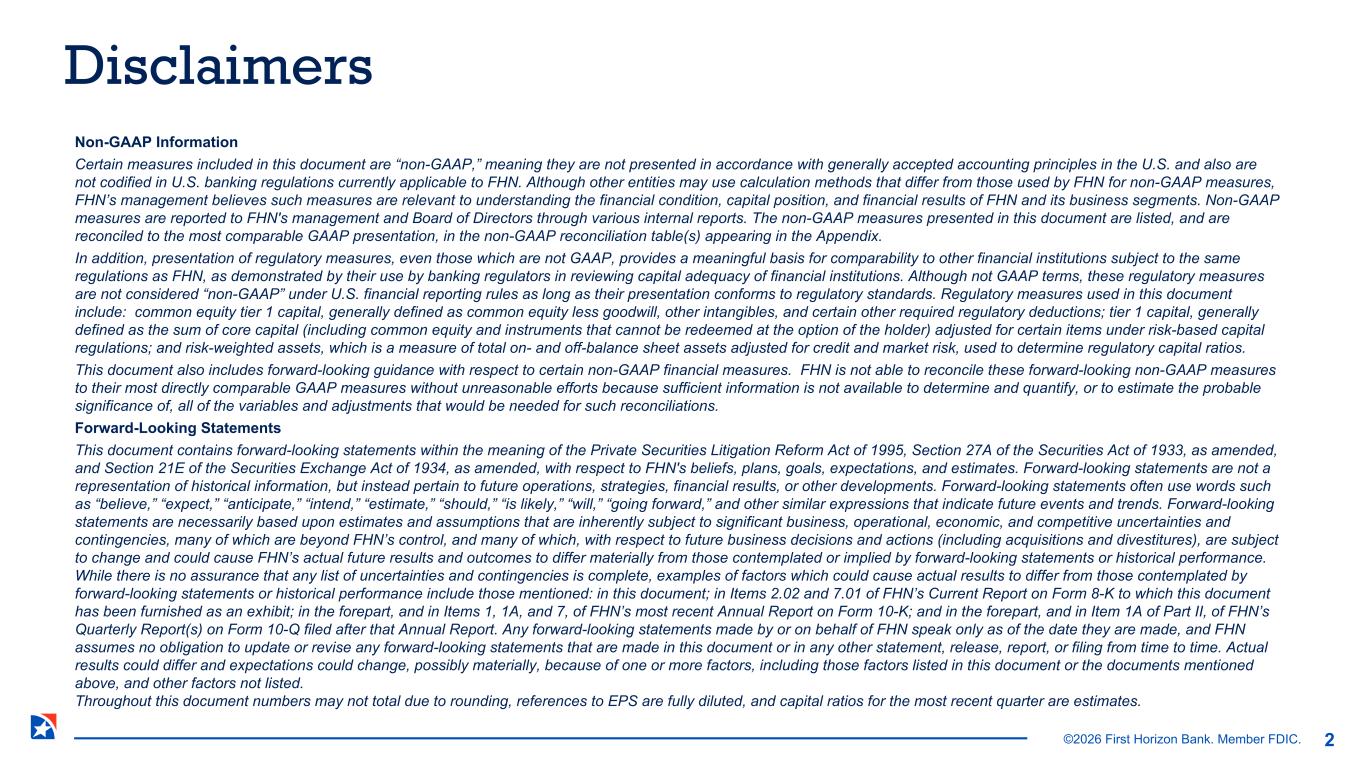
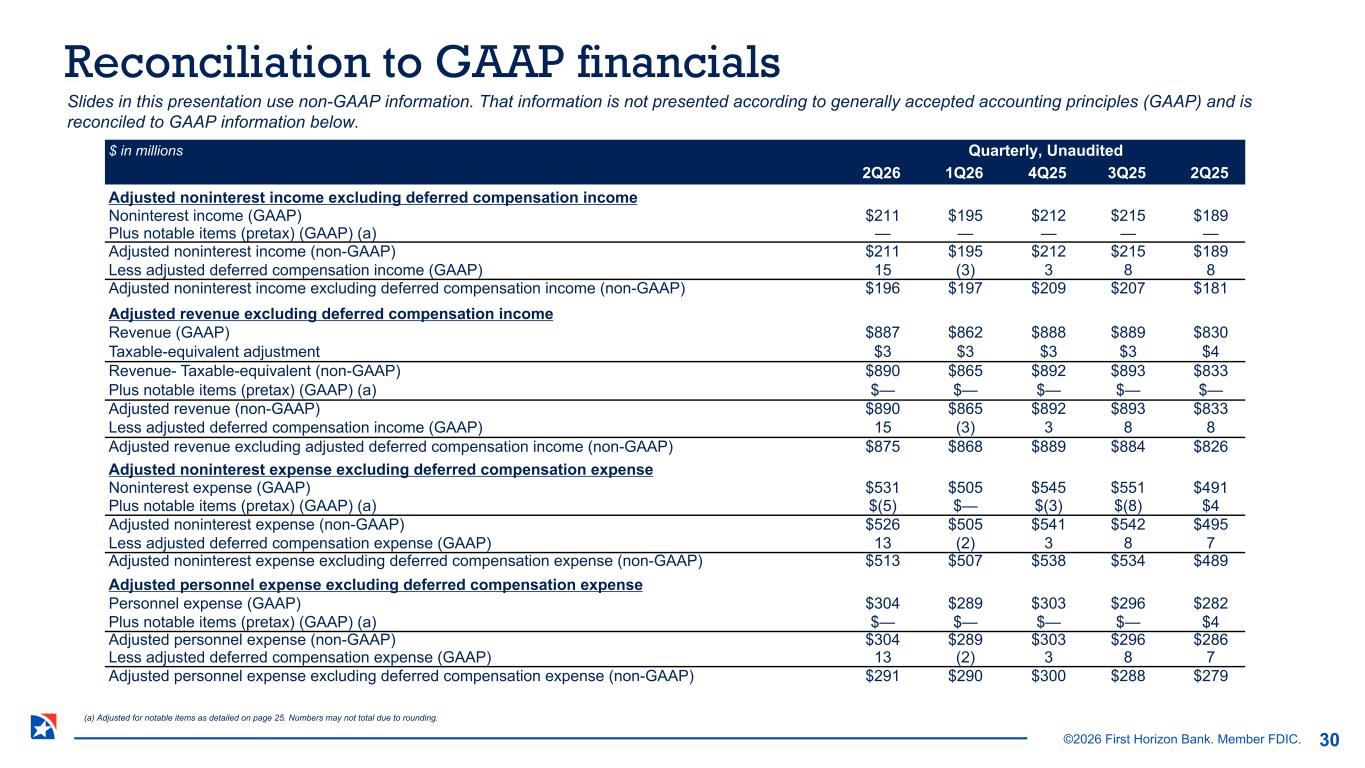
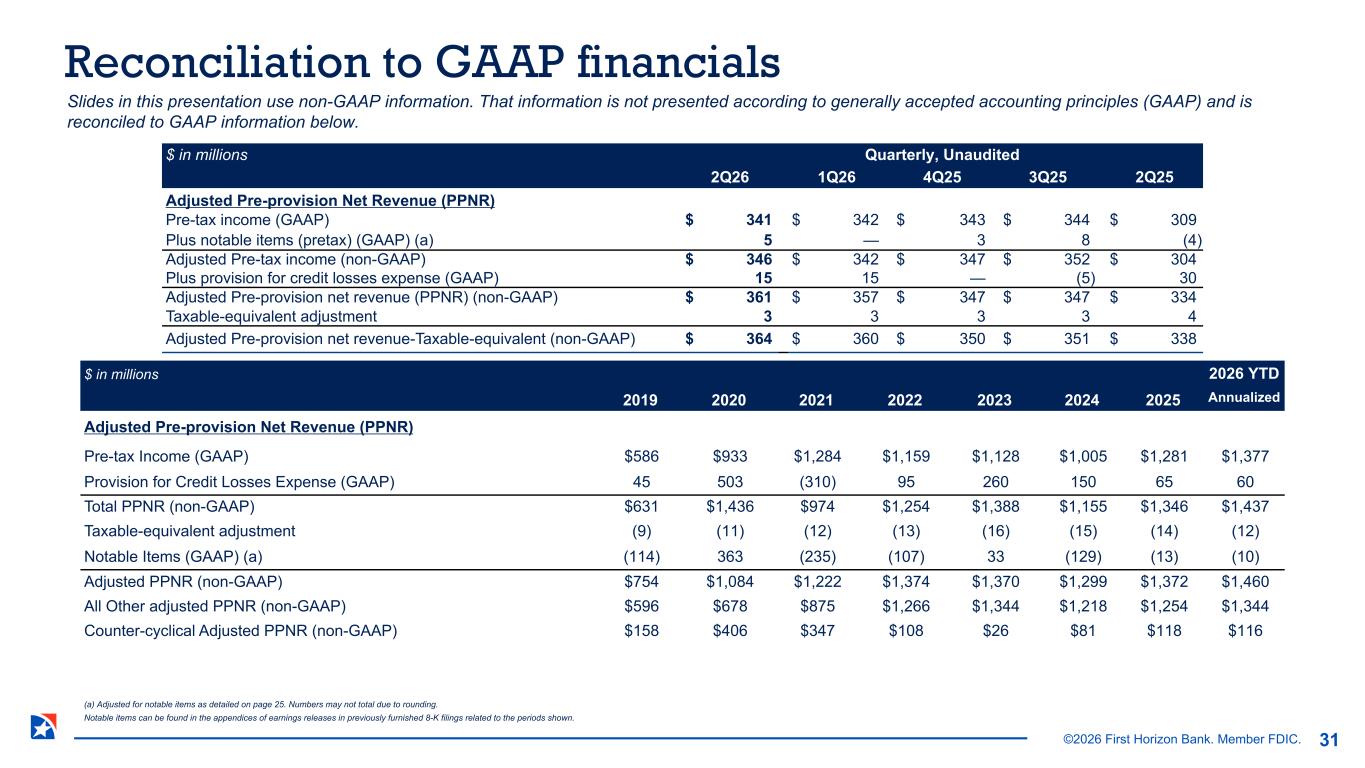
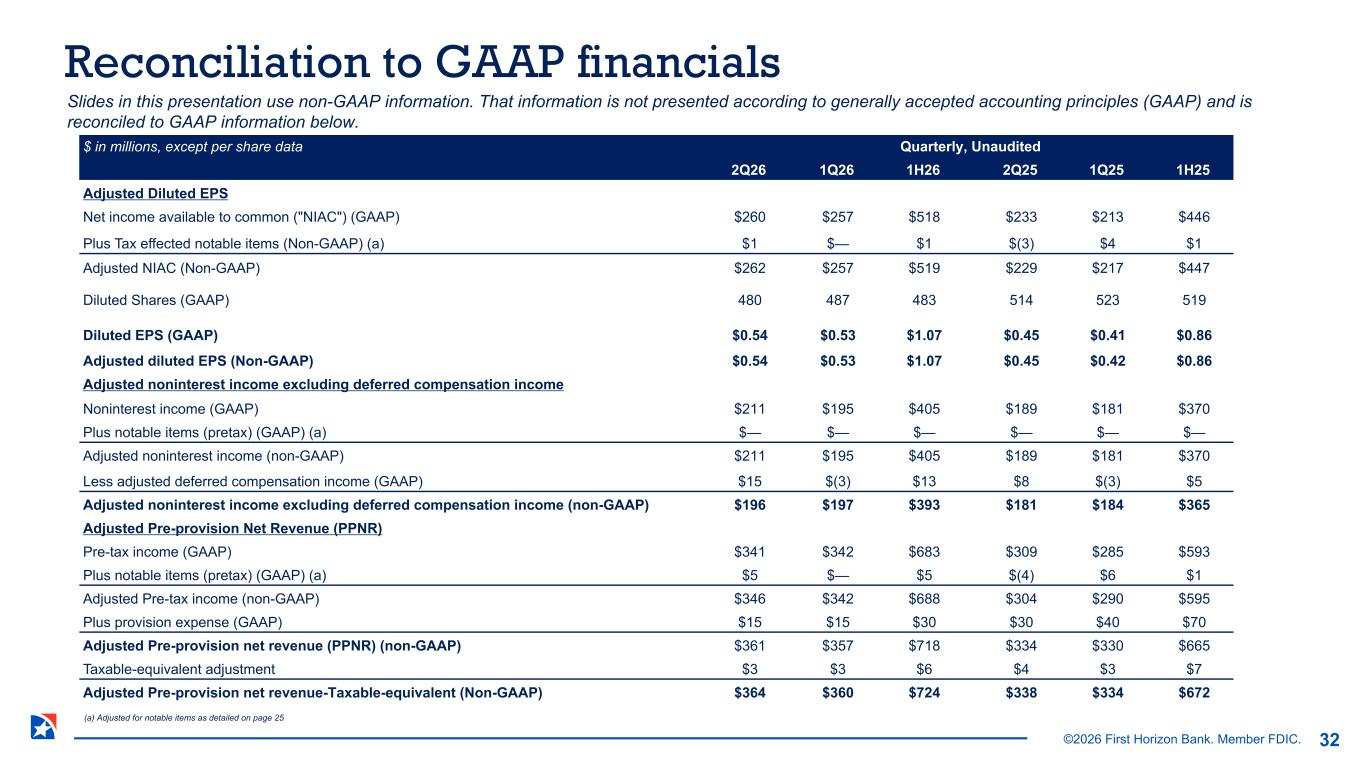
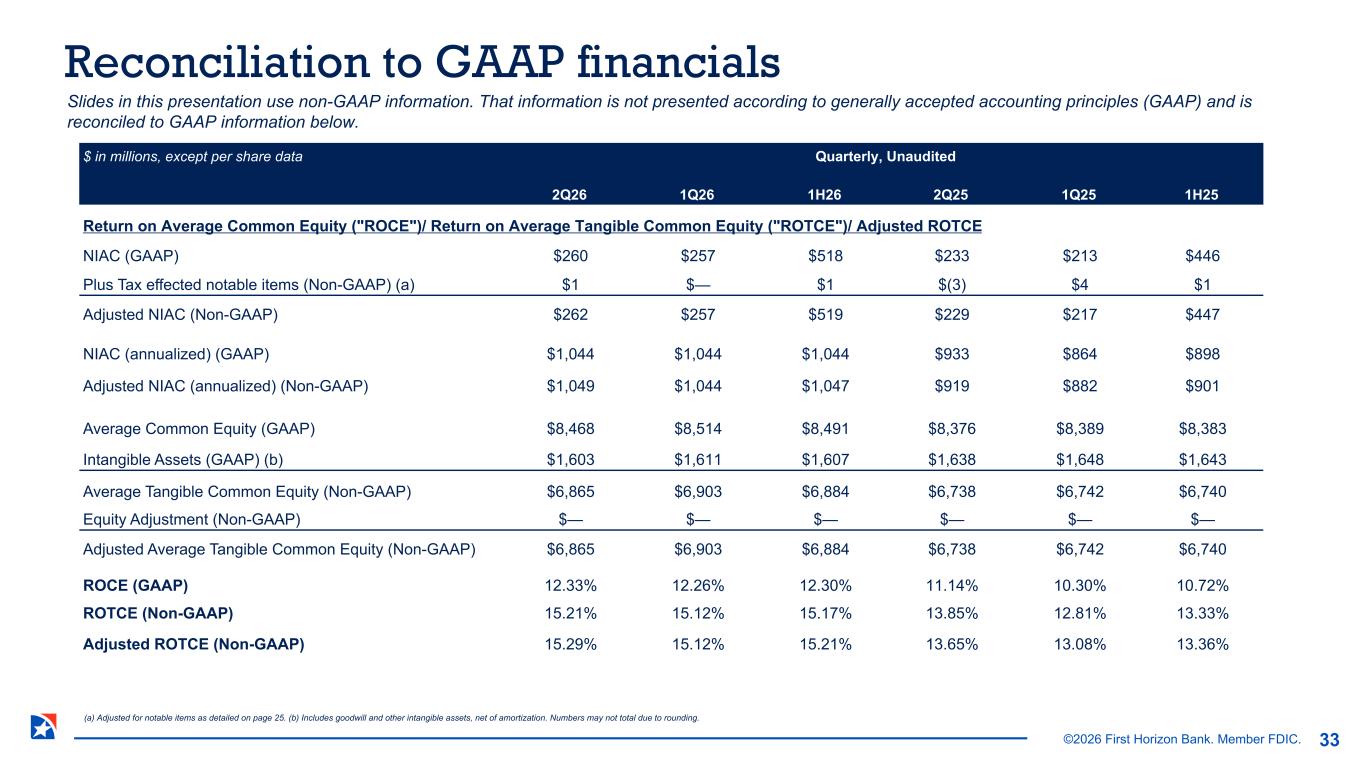
Thank you, Rebecca. Good morning. Welcome to our second quarter 2026 results conference call. Thank you for joining us. Today, our Chairman, President, and CEO, Brian Jordan, and Chief Financial Officer, Hope Donchowski, will provide prepared remarks after which we'll be happy to take your questions. We're also pleased to have our Chief Credit Officer, Thomas Hahn, here to assist with Our remarks today will reference our earnings presentation, which is available on our website at ir.firsthorizon.com. As always, I need to remind you that we will make forward-looking statements that are subject to risks and uncertainties. Therefore, we ask that it may cause our results to differ from our expectations on page 2 of our presentation and in our SEC filings. Additionally, please be aware that our comments will refer to adjusted results, which exclude the impact of notable items and to other non-GAAP measures. Therefore, it's important for you to review the GAAP information in our earnings release, pages 2 and 3 of our presentation, and the non-GAAP reconciliations at the end of our presentation. And last but not least, our comments reflect our current views, and you should understand that we are not obligated to update them. And with that, I'll hand it over to Brian.
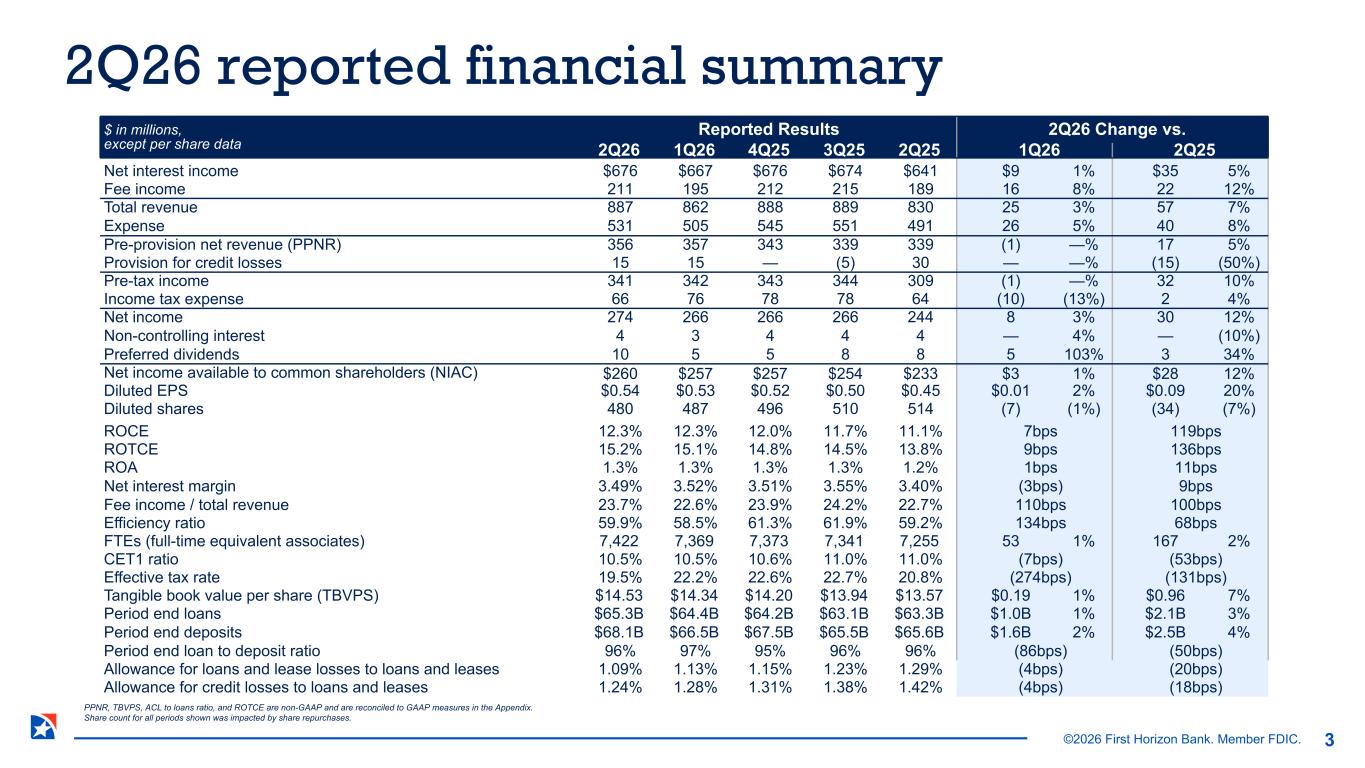
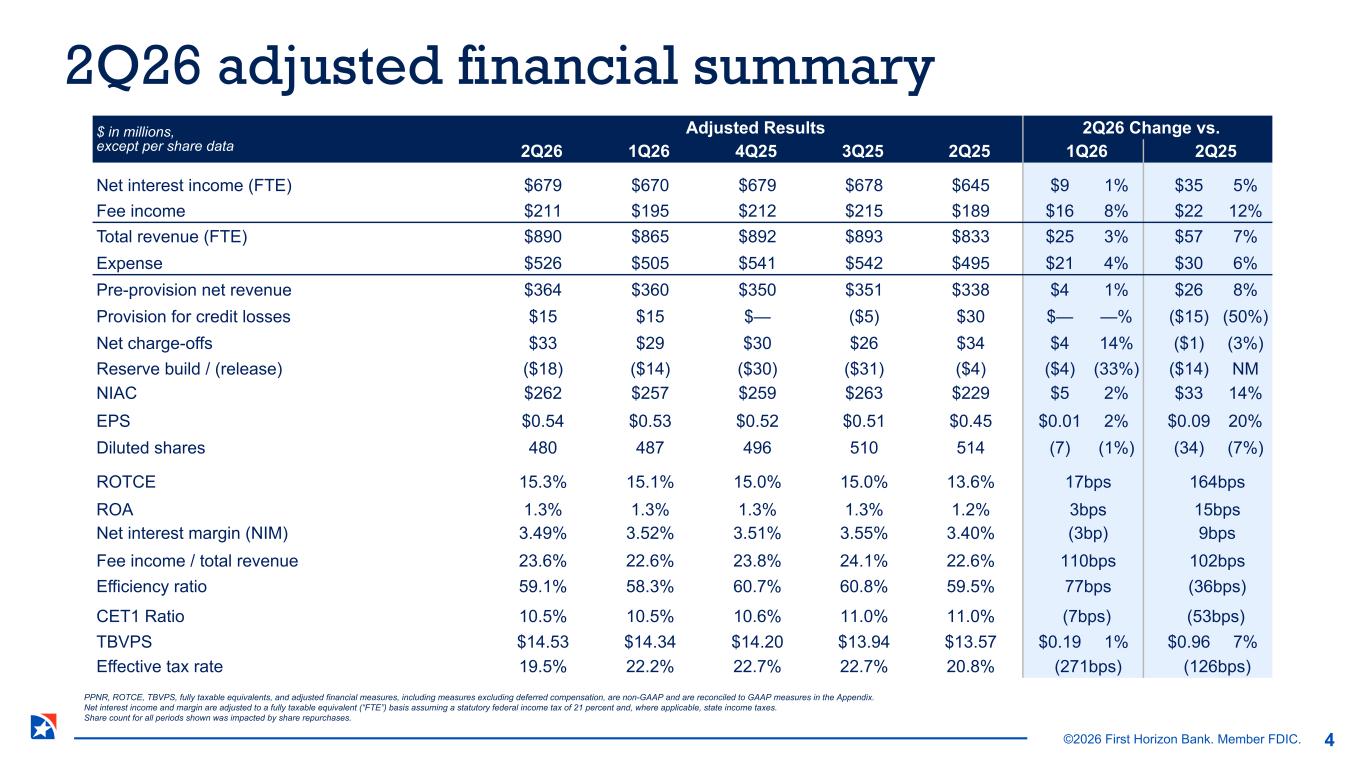
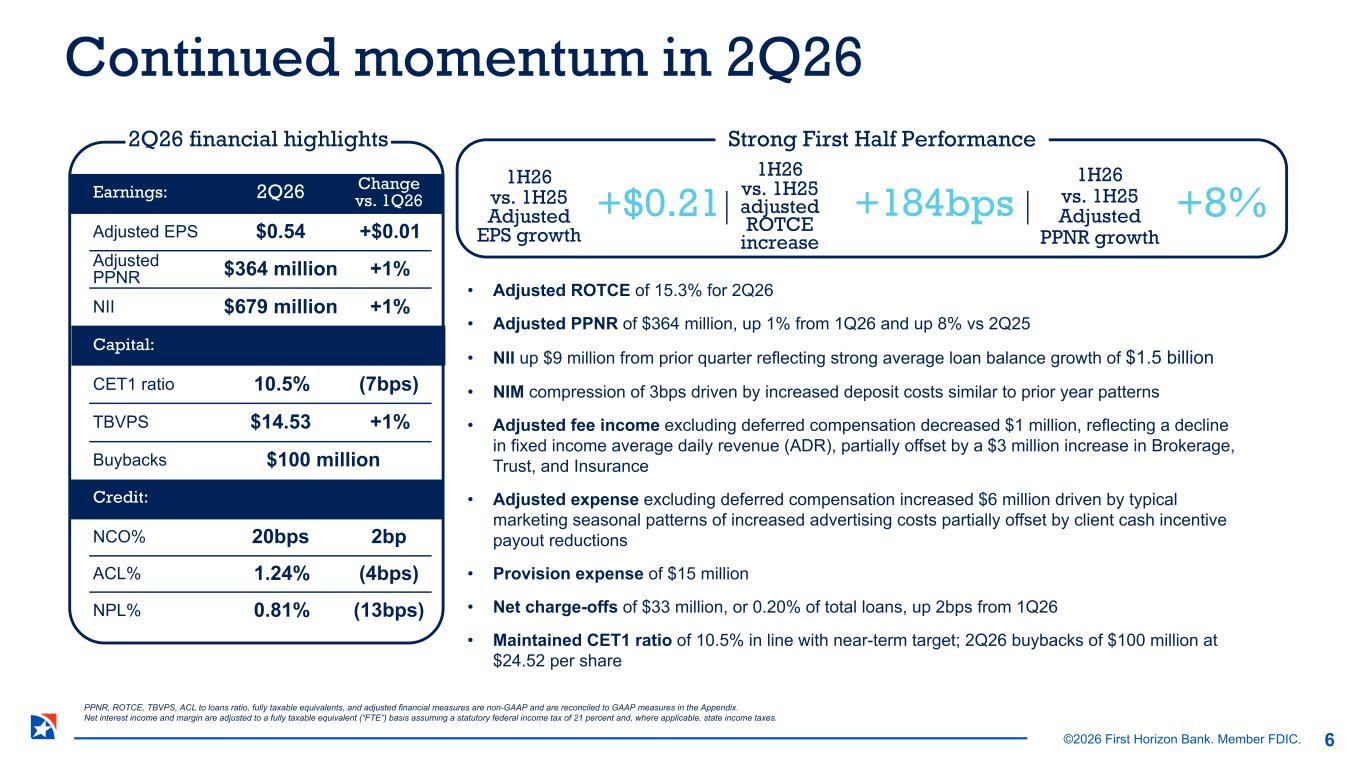
Thanks, Tyler. Good morning, everyone. Thank you for joining us. Hearing our year-over-year performance, adjusted earnings per share for the quarter are up 9 cents or 20%. We saw an 8% increase in adjusted PPNR, and period in loan balances grew by approximately two billion dollars these outcomes are the direct results of our clear objectives and the value we demonstrate the clients day in and day out we see continued growth momentum going into the second our entire organization is on performance through the site or regional it's building long-term value we continue to grow and in our turn at
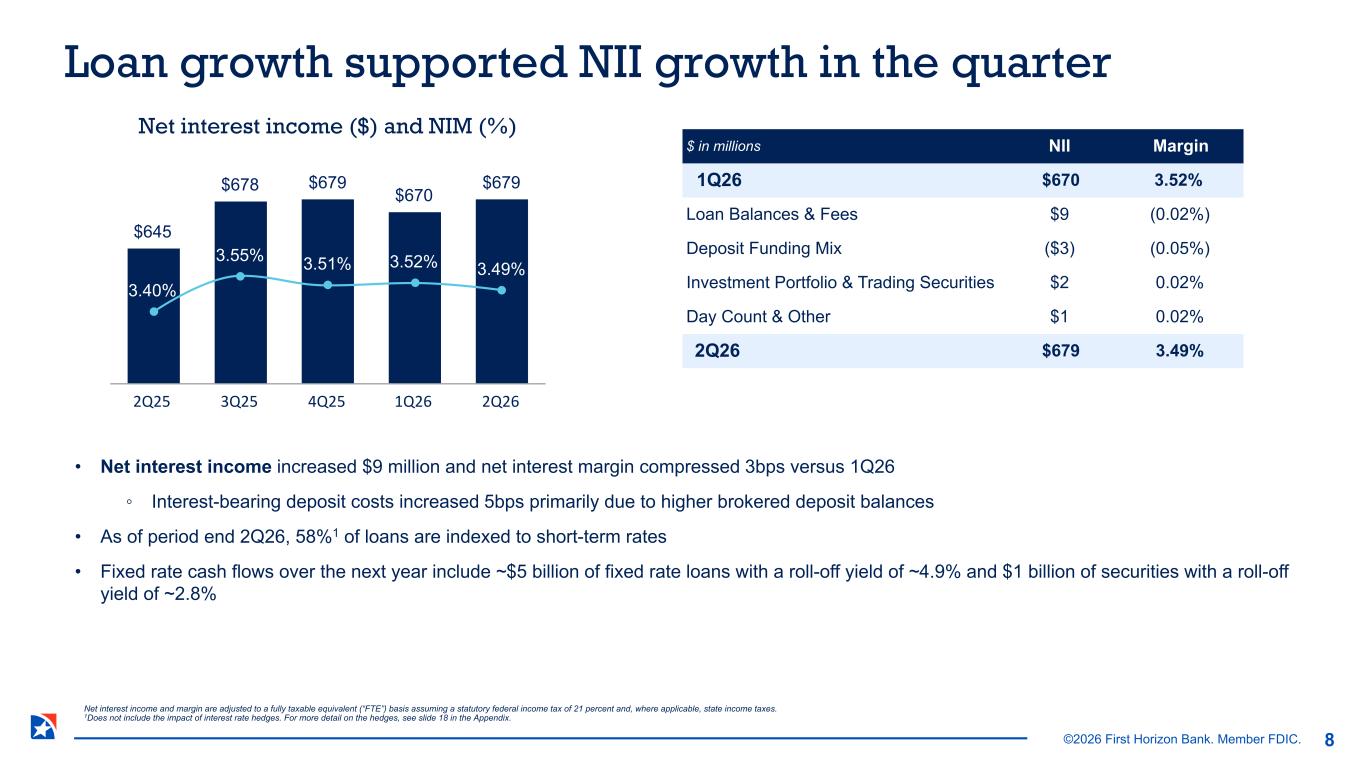
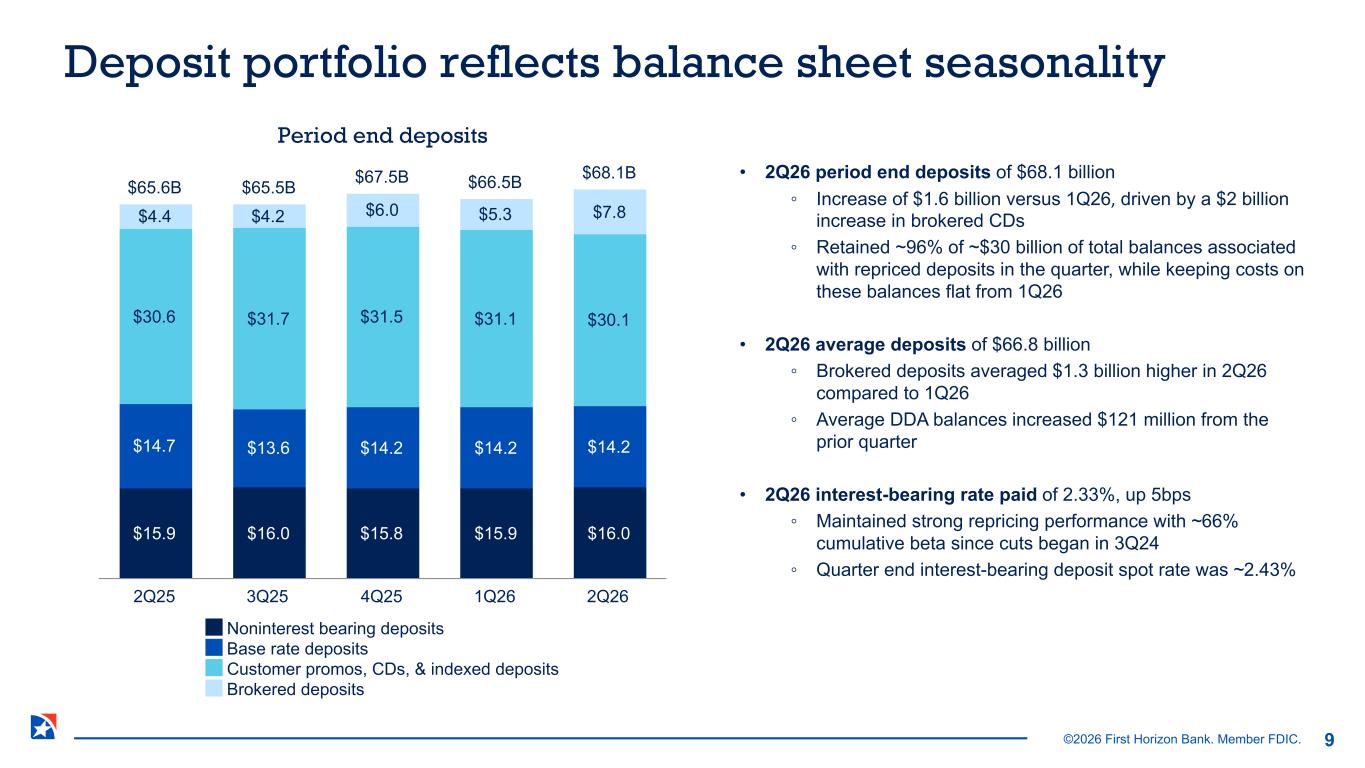
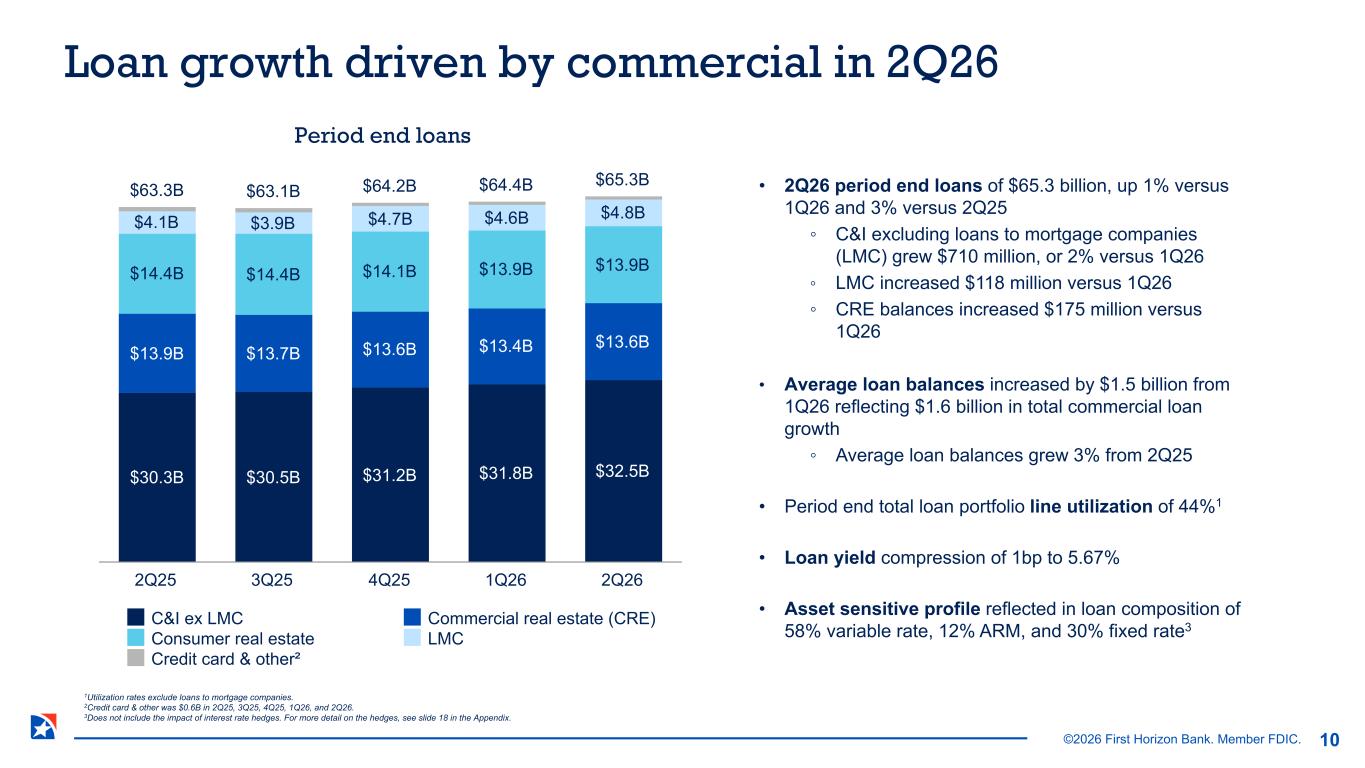
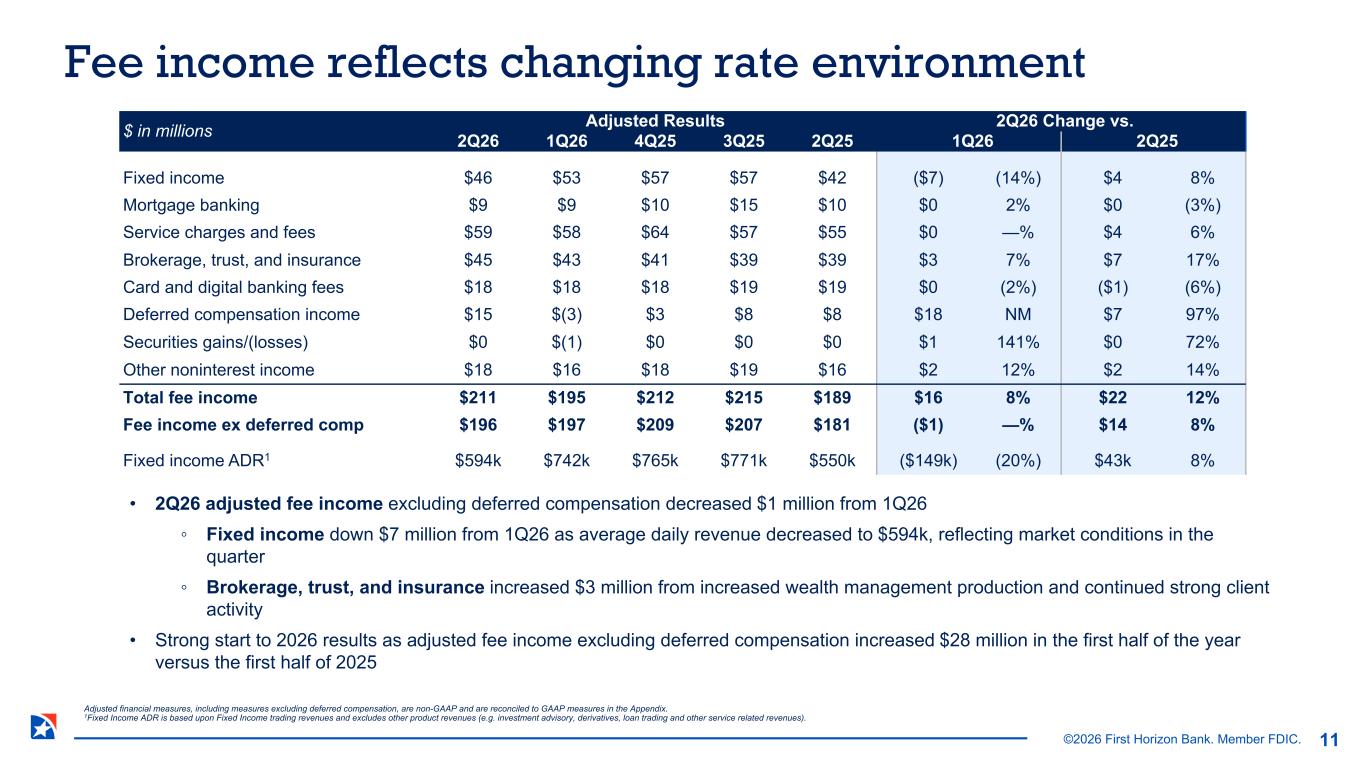
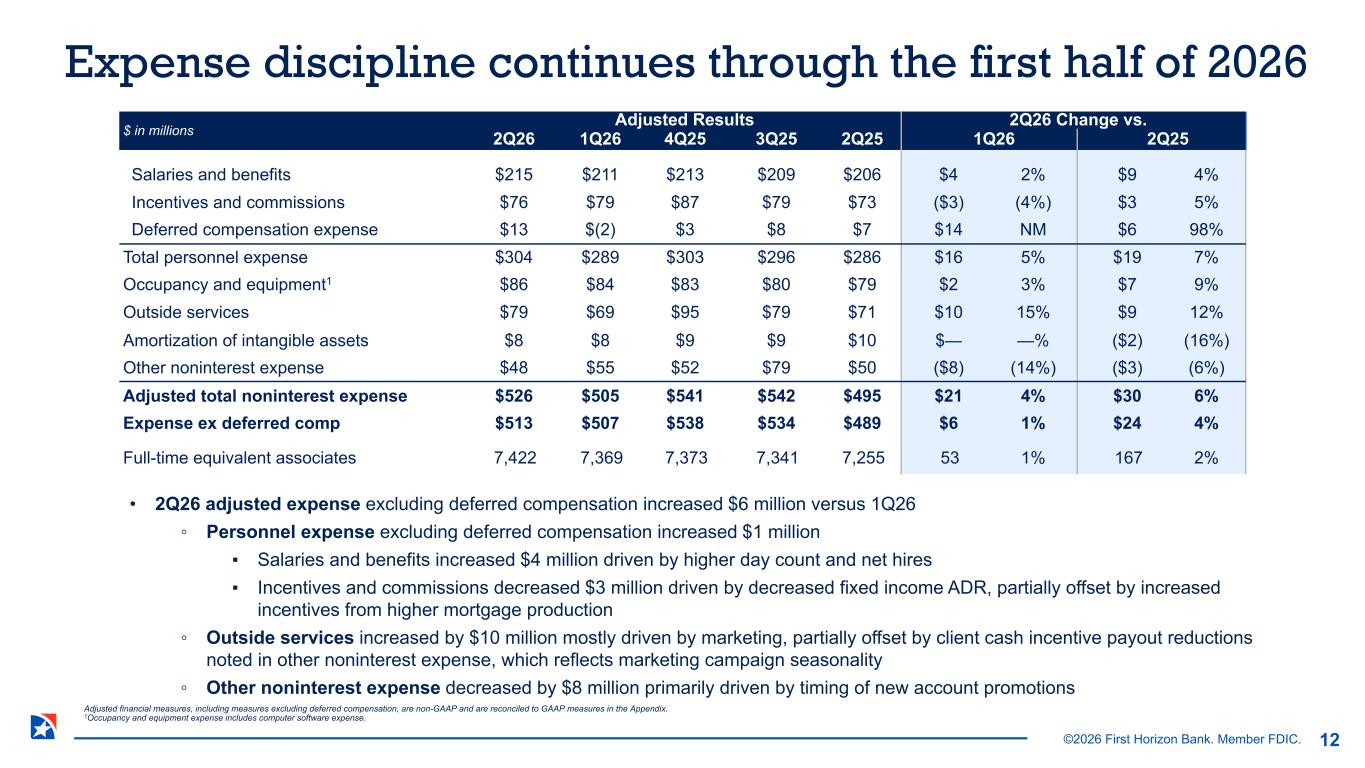
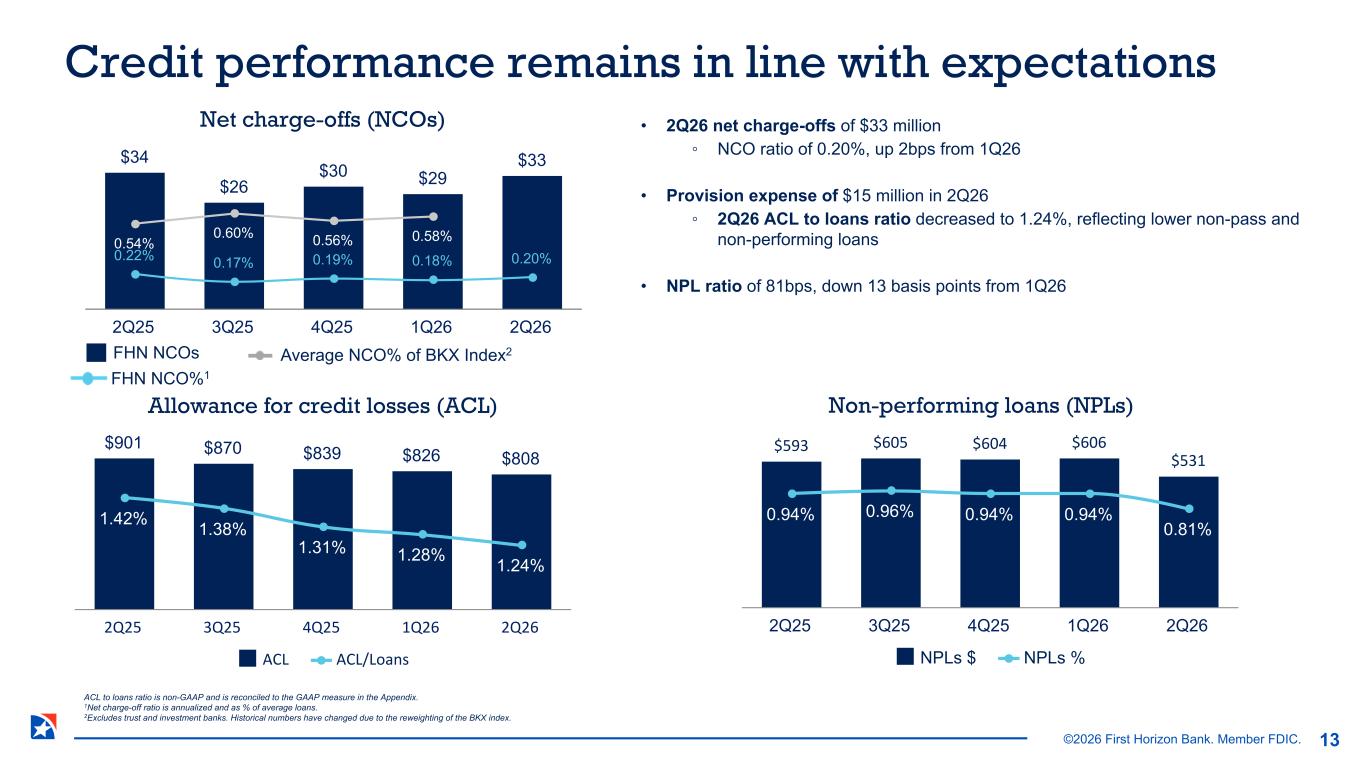
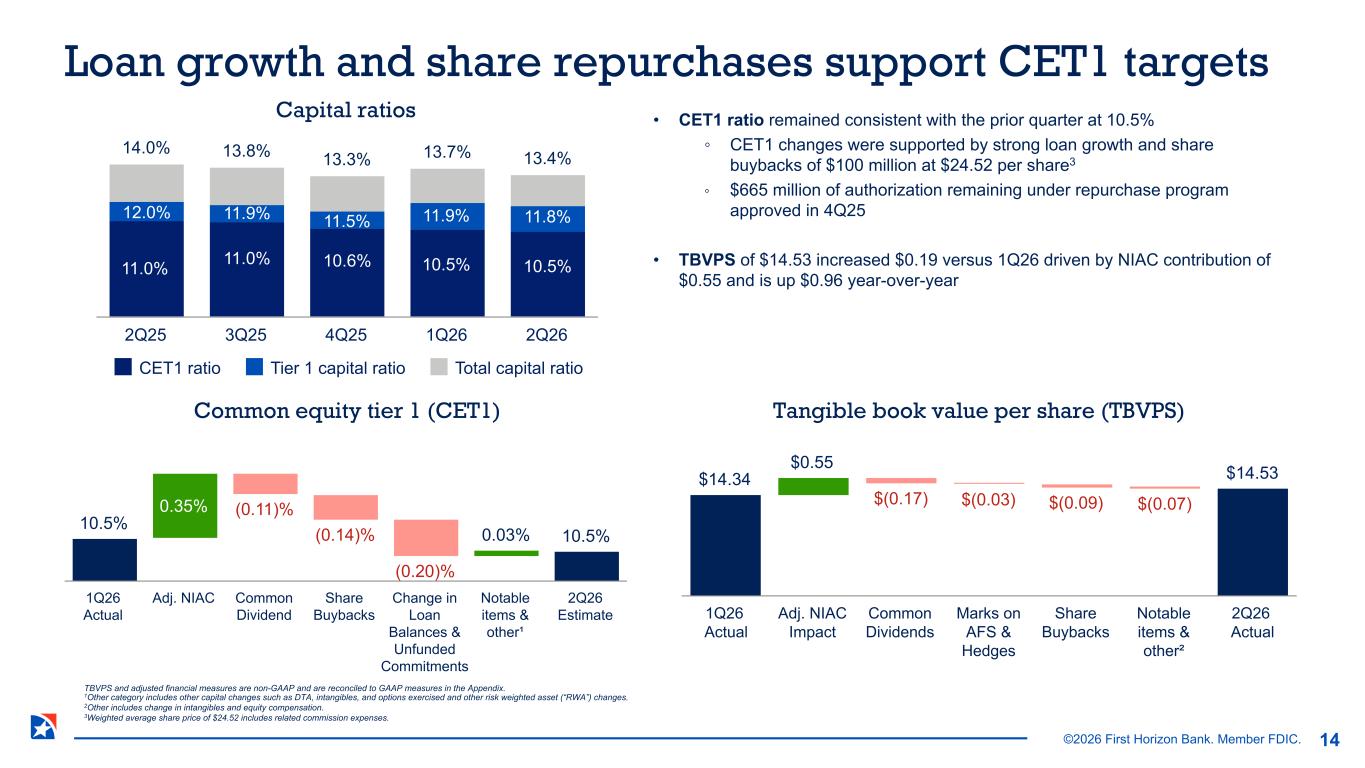
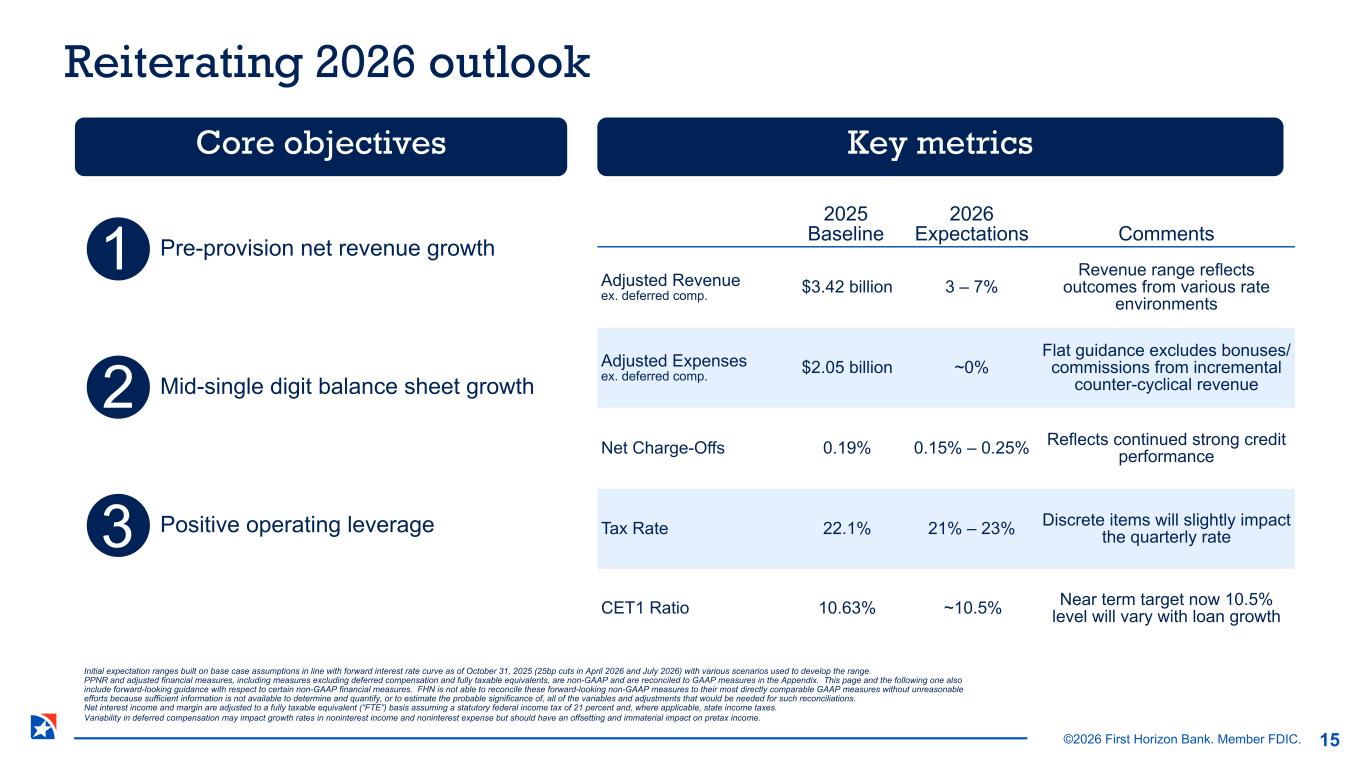
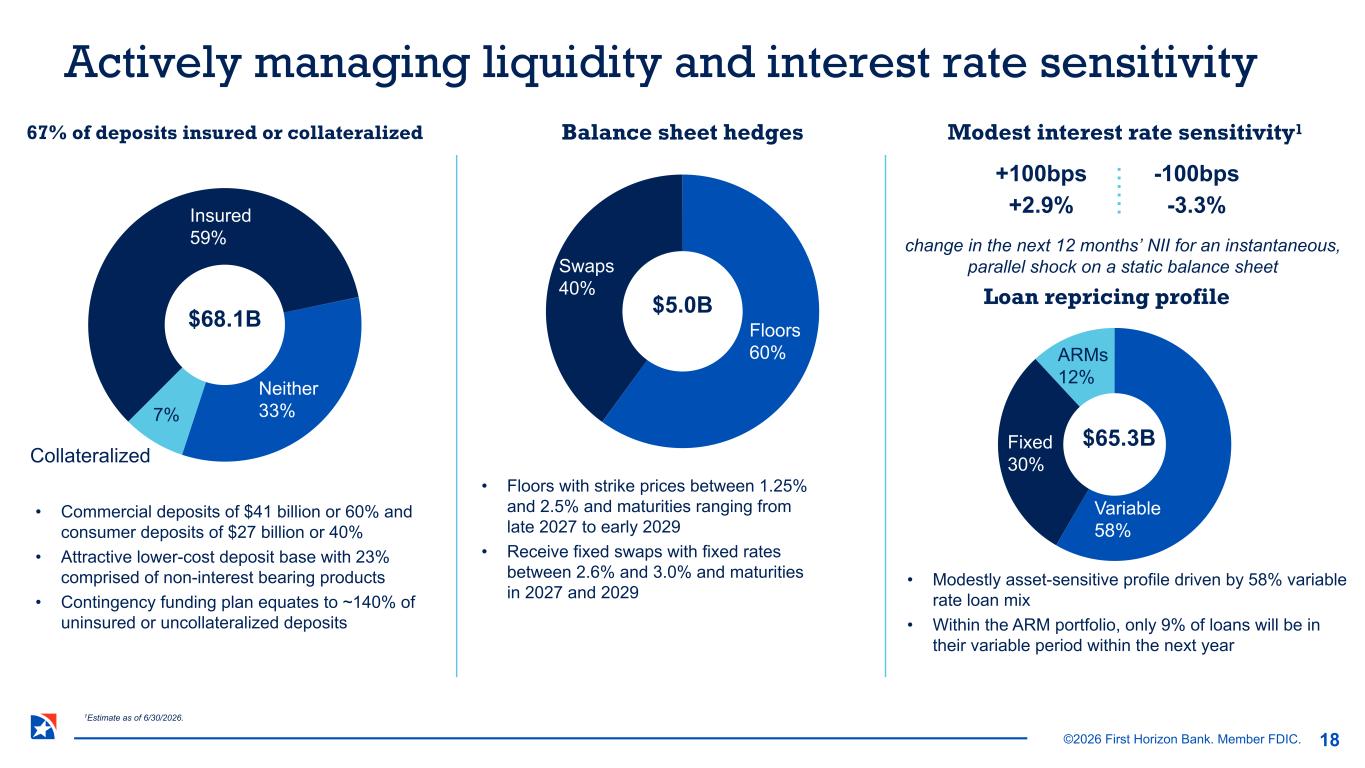
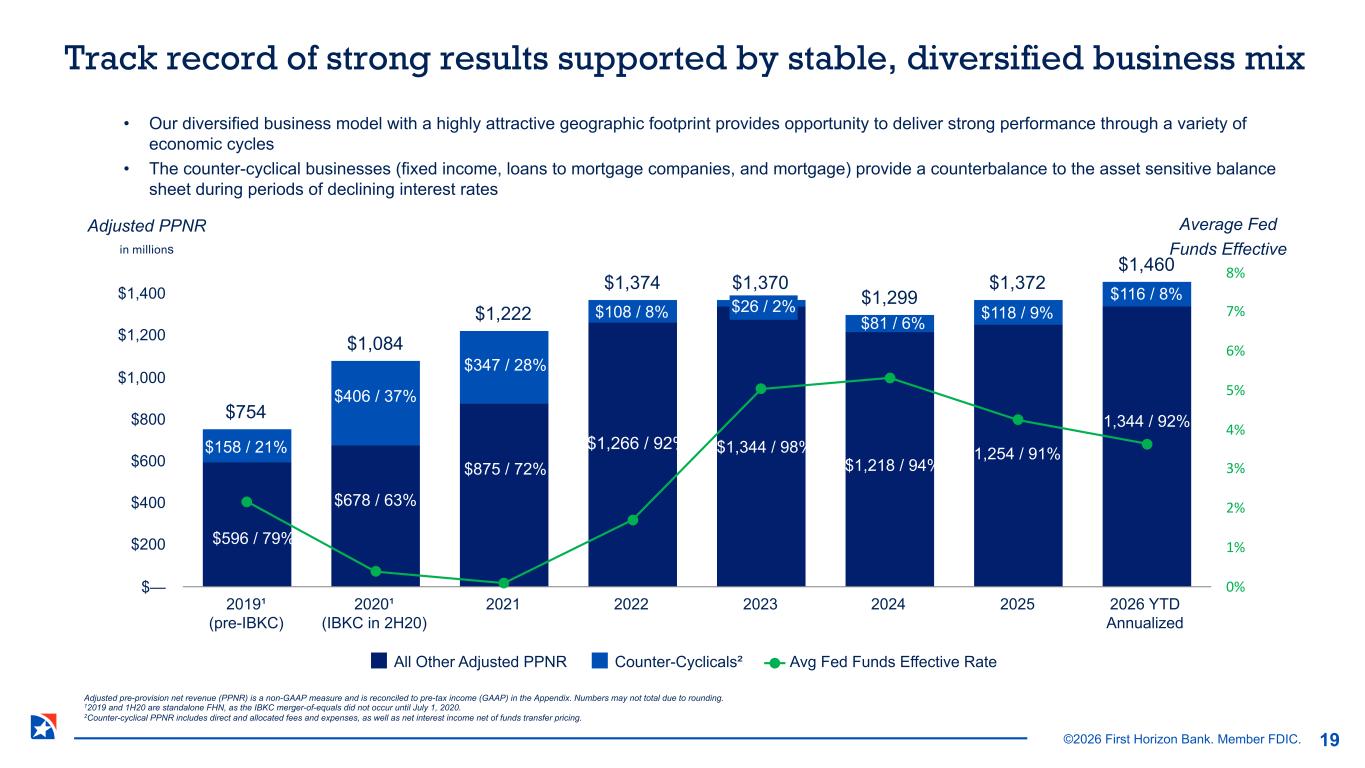
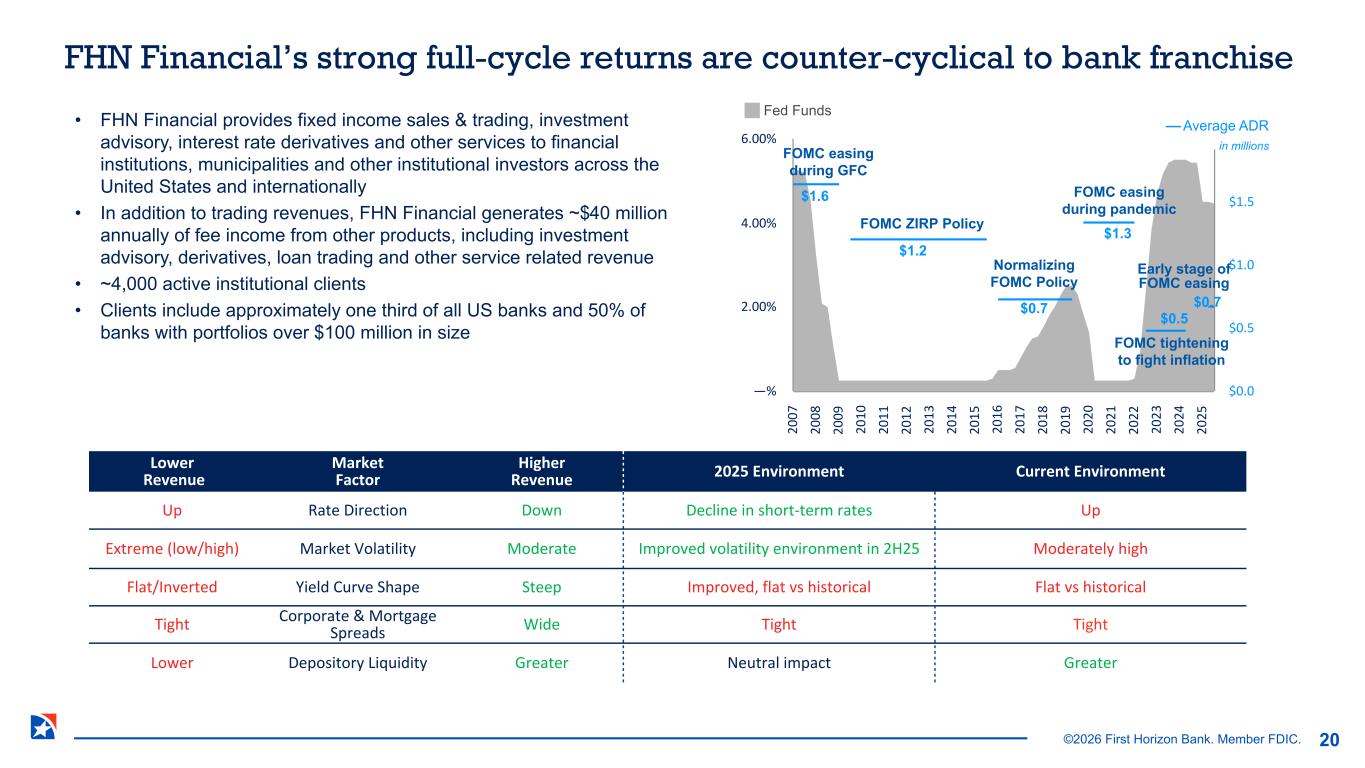
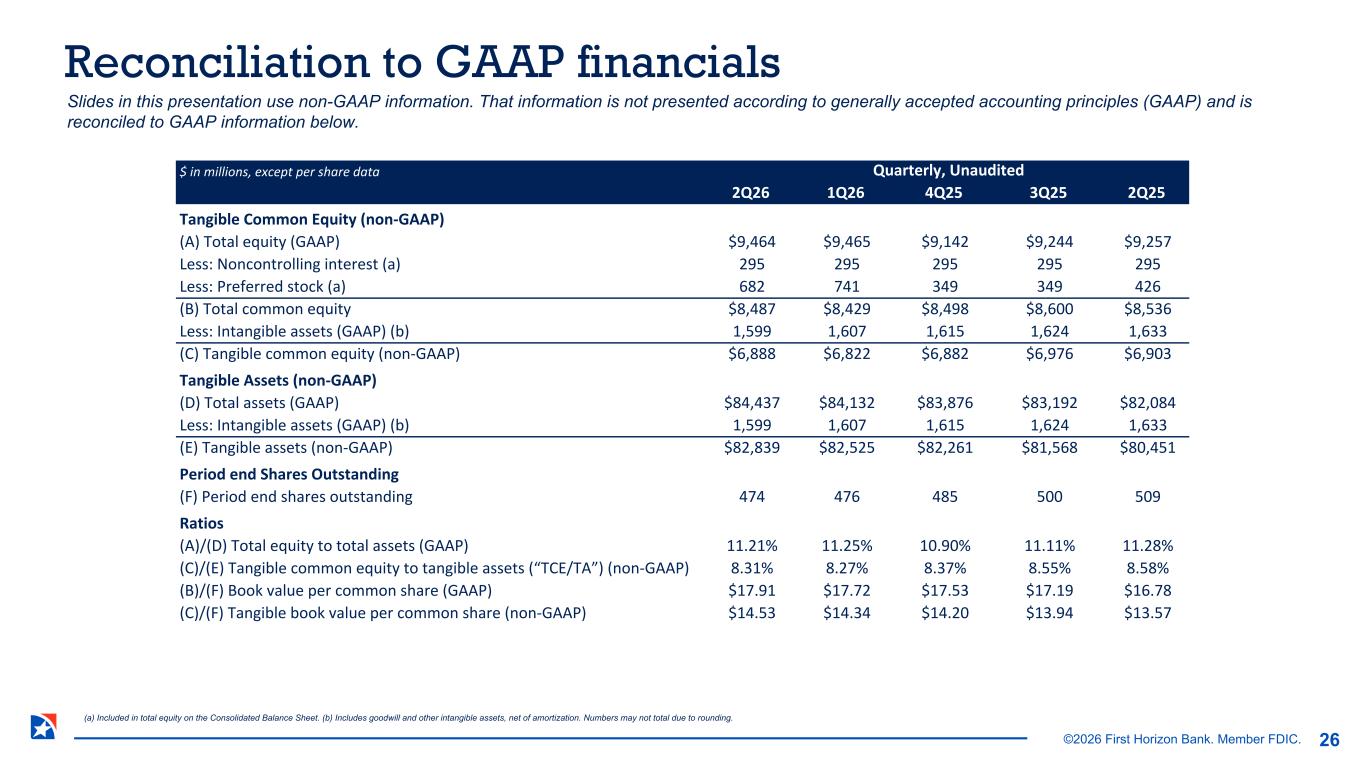
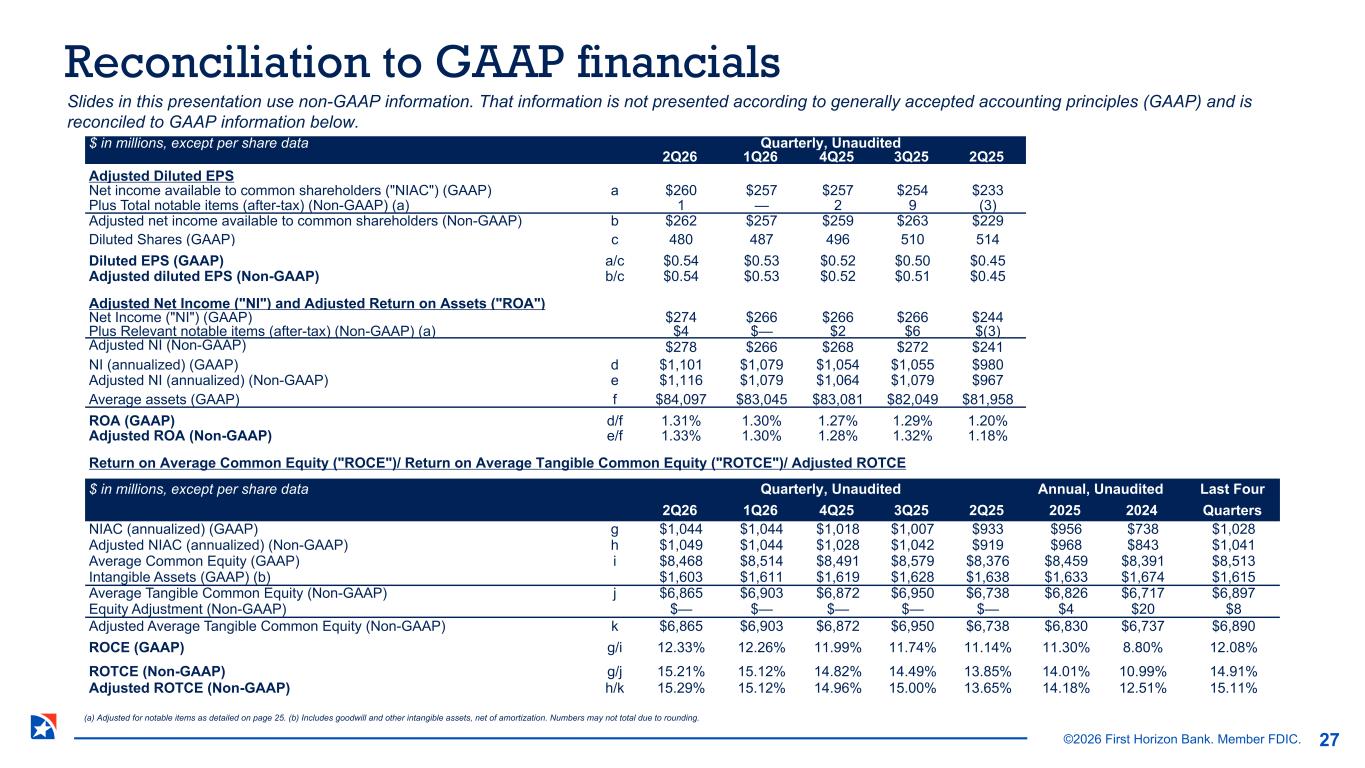
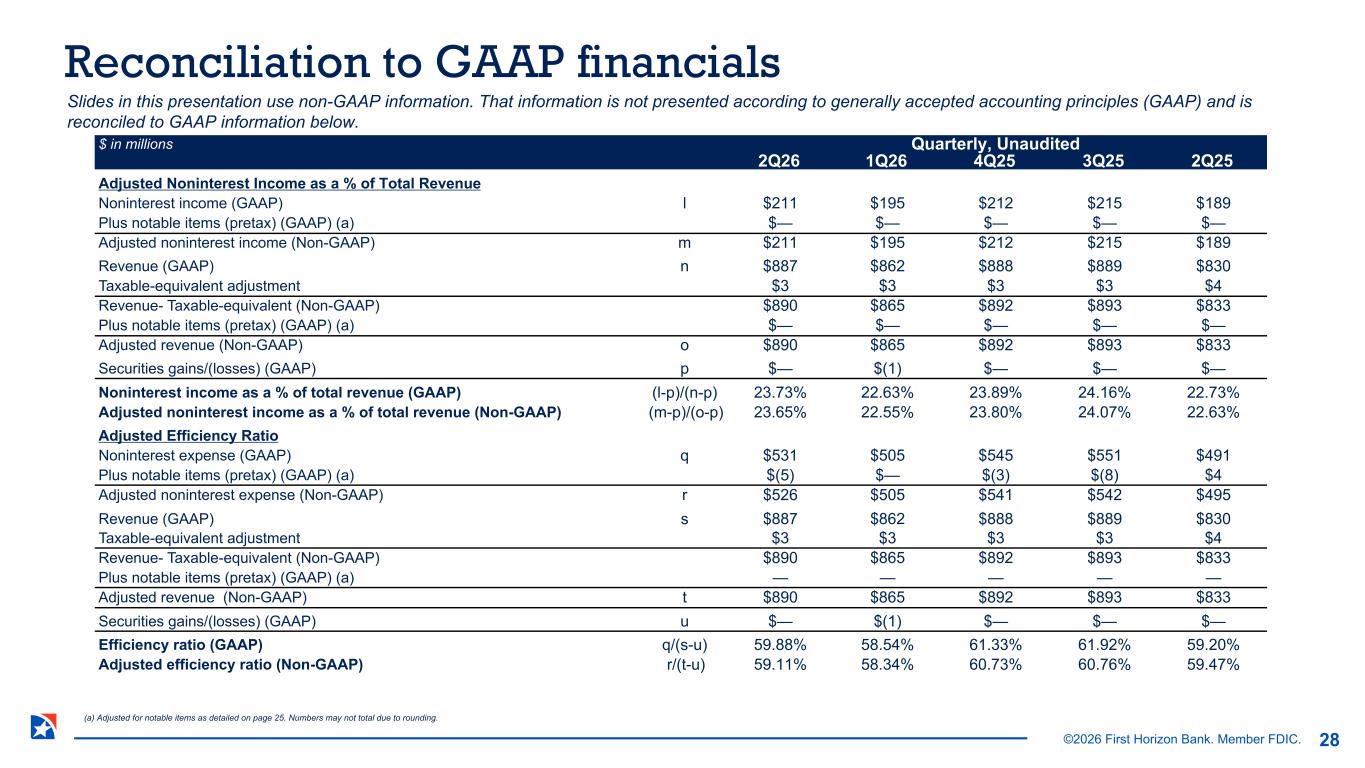
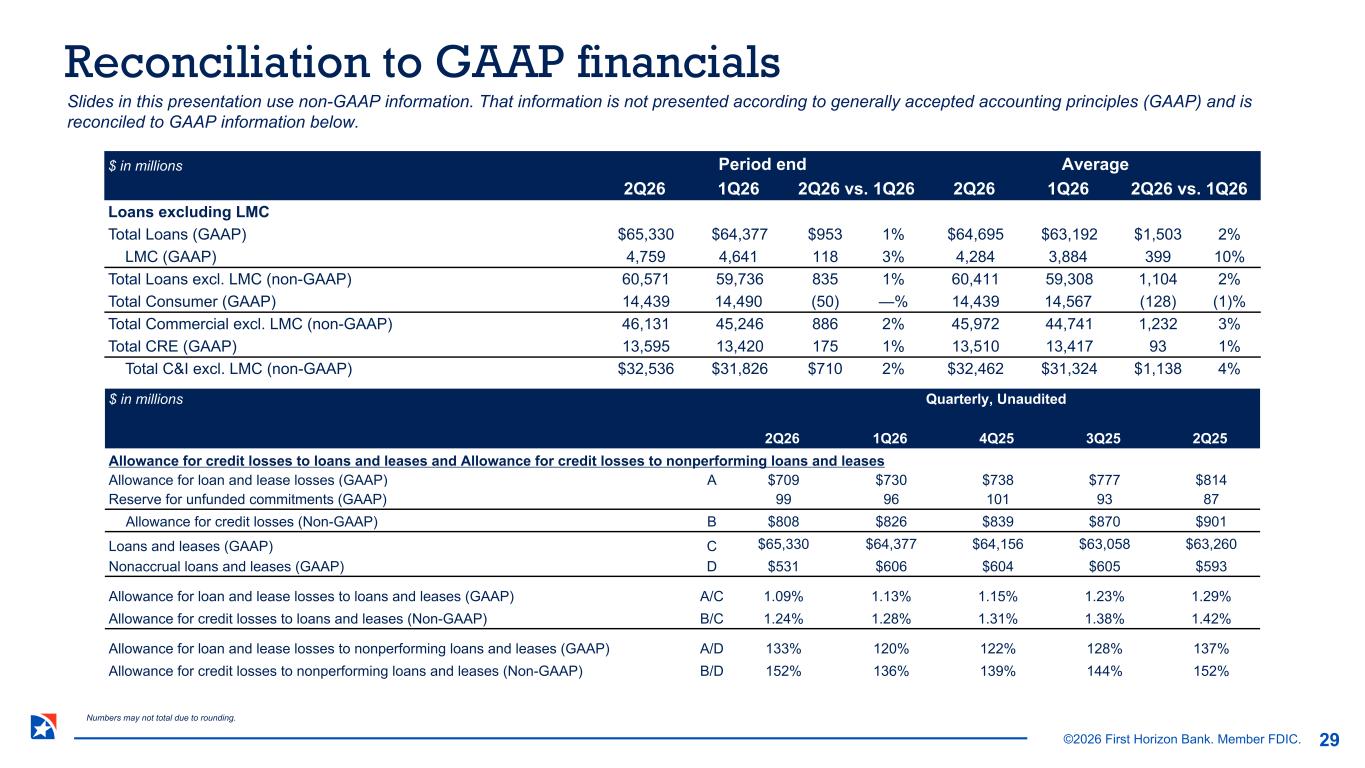
the end of the call momentum shown by our results for both the second quarter and the first year, we grew adjusted EPS by a penny to $0.54, adjusted PPNR by 1% to $364 million, and average loan balances by $1.5 billion. Compared to the first half of 2025, our adjusted RODSE increased by over 180 basis points, adjusted PPNR increased 8%, and adjusted earnings per share was up 21 cents. As we move through the detailed slides, we will walk through the drivers of this performance in more detail. On slide 8, we walked through our net interest income and margin performance in the second quarter. Our margin compressed by three basis points, which saw NIMS settle into the high 340s as we expected, reflecting the rate environment evolution into a flat to up expectation. We grew NII by $9 million this quarter, reflecting our strong loan growth. On slide 9, we covered details around our deposit performance in the quarter. Period end balances increased by $1.6 billion compared to prior quarter, driven primarily by growth in brokered deposits. The average rate paid on interest-bearing deposits increased to 2.33%, which is a five-phasis-point increase from the prior quarter. While deposit costs came up due to the competitive environment and portfolio blend, our key-live deposit data remains strong at 66% since rates started to fall in September 2024. The rate paid increase in the quarter are in line with the patterns we saw in 2025. While the environment remains competitive, we saw average cost of client interest-bearing deposits remain roughly flat in the quarter. As always, we remain focused on growing our core deposit base and prioritizing relationship growth to sustainably and profitably grow our balance sheet. On slide 10, we cover our quarterly loan growth. Period-end loans increased by $953 million from the prior quarter, driven by $1 billion in commercial loan growth. This growth includes $710 million in C&I growth, excluding loans to mortgage companies, and $175 million in commercial real estate growth, which reflects the momentum we have seen in that portfolio over the last few quarters. Loans-to-mortgage companies grew $118 million in the quarter, which reflects normal home buying seasonality with some headwinds from the rate environment. We saw strong production in the quarter with new commitments up more than 50% year-over-year driven by commercial real estate activity. This creates an opportunity for flat to slightly up Cree balances this year as construction projects fund up over time. Additionally, our pipelines remain strong across our business lines and throughout our footprint. Our commercial loan spreads remain generally consistent with prior quarters amidst the competitive environment for loan growth. Turning to slide 11, we detail our fee income performance for the quarter, which decreased $1 million from the prior quarter, excluding deferred compensation, and is up $14 million year over year. We saw a quarter-over-quarter decline in fixed income revenues due to a decrease in ADRs to $594,000, though this is still an 8% increase year-over-year. Lower ADRs were driven by macroeconomic volatility amidst a changing geopolitical environment and uncertain rate environment. The decline in fixed income is partially offset by increased brokerage, trust, and insurance income from continued momentum in our wealth management business and increased client activity. This is one of the revenue-driven profitability lines that we see driving our $100 million-plus PPNR opportunity. On slide 12, we cover adjusted expenses that, excluding deferred compensation, increased $6 million from prior quarter. Personnel expenses, excluding deferred comp, increased by $1 million from last quarter, driven by a $4 million increase in salaries and benefits. This reflects hiring as well as higher day count. Slide services increased by $10 million, which primarily reflects typical seasonality with higher market expenses that are partially offset in other non-interest expenses by reduced client cash incentive payouts from prior quarters marketing programs. Turning the credit on slide 13, net charge-offs increased by $4 million to $33 million. Our net charge-off ratio of 20 basis points remains in line with our expectations for the year. Our provision for credit losses was $15 million in the quarter, and our ACL to loan ratio declined to 1.24%, driven by mixed change in the portfolio and continued credit resolutions as NTL declined 13%. Our teams continue to do an excellent job of working with our clients to resolve credit issues. As rates decreased over the last several quarters, we have been able to consistently find ways to resolve credits and maintain our strong credit performance. On slide 14, we ended the quarter with CET1 of 10.5%, which is in line with our near-term target. We had strong loan growth as well as buybacks of 4 million shares, totaling $100 million this quarter. Our tangible book value per share ended the quarter at $14.53 and is up 7% year-over-year, which includes buybacks of $857 million and an increase to our dividend. We continue analyzing the potential impacts of Basel III and currently expect an approximate 10% reduction in risk-weighted assets in the standardized approach as it is currently proposed. I'll wrap up on slides 15 and 16. We continue to reiterate our full year expectations as outlined on slide 15. While the macroeconomic environment and competition may change, our business model creates resilient earnings, and our associates consistently deliver on expectations, including our $100 million PPR opportunities. Now, I will give it back to Brian.
Thank you, Hope. The second quarter of 2026 was very similar to what we saw in the second quarter of 2025 regarding deposit competition and increases in macro volatility impacting fixed income revenue and various other seasons. Ultimately, we create value for our shareholders, for our personal clients. The work we've done over the last 18 months to create a common understanding of the ways we strategically invest near-term will continue to support. We'll stay thoughtful on capital deployment and an opportunity to see if we can operate a lower seat as conditions allow. Our operating model continues to serve as competitive advantage. Community bank types, full client relationships, and grow with the markets and lines of business. Thank you to our associates for their hard work and to our clients and shareholders for their continued comment. Rebecca, with that, we will open it up for questions.
Operator
We will now begin the question and answer session. Please limit yourself to one question and one follow-up. If you would like to ask a question, please press star 1 to raise your hand. To withdraw your question, press star 1 again. We ask that you pick up your handset when asking a question to allow for optimum sound quality. If you are muted locally, please remember to unmute your device. Please stand by while we compile the Q&A roster. Your first question comes from John Armstrong with RBC Markets.
Hey, good morning. Good morning, John. Hey, just wanted to ask a couple questions about the revenue environment. Hope, can you touch a little bit on the deposit cost outlook and, you know, help us understand what you're seeing? I know you said the average client interest-faring deposits were roughly flat sequentially, but what can you expect from here on deposit costs and funding costs in general?
As we look out as to where we're in the rest of the year, I expect it to look very similar to last year. As you looked at what happened in 2025 following the success of rate cuts at the end of the year, rates came back up. The competition increased, and if we continue to see this trajectory, I do think that, you know, our beta will continue to shrink slightly, but I want to make the point in that we said at the end of last year, both Q3 and Q4, we were maximizing the decrease in our deposit costs, knowing that we give some back once rates stop cutting. So, this is as expected, John. Also, Q2 and Q3 is the most competitive time for offers. You see in our expenses every year in Q2, we talk about the increased marketing cost that goes with those acquisition offers. I think really the trajectory for the back half of the year, we start looking at Q3, Q4, it does depend on which way rates go. I mentioned in my prepared remarks, as did Brian, the uncertain outlook is the next rate move this year and is it an increase or decrease will drive that. But I do expect it to continue to increase consistent with what we saw last year as a great cut.
And then I guess loan competition and yields, you know, see a little bit of compression this quarter, but do you feel like it's still rational, Brian, anything you'd like to flag in terms of yields and anything that's more, you know, competitive than other areas?
Continue to be just an anecdotal conversation. People are still very optimistic about the economy and very forward. Loans, at the end of the day, for deposits and lending continue to profit to the balance sheet.
A little pressure on spreads, but feeling good about volumes, isn't it?
Operator
Your next question comes from Michael Rose with Raymond James. Please go ahead.
Hey, good morning, guys. Thanks for taking my questions. Maybe we can just start on the ADR side. I mean, obviously, you guys kind of gave the update intra-quarter just based on, you know, where the curve is now, what the expectations for rates are. I know it's hard to forecast, but can you just talk about, you know, the puts and takes in that business just given where we are?
Given the market is – I think we're in a channel where the policy – real – or repeat real. It's a real, real-time effect on what's happening in the fixed income business trending down. I think you'll see less.
Perfect. And maybe just a follow-up there. When we do get capital reform that's obviously going to benefit the system as a whole, would you expect to see more volume from that? Because not all of it can be returned through buybacks and dividends. I would assume that some of it would be put in securities, and that could benefit the business. I just wanted to see if you guys have thought about the potential uptick from higher capital levels in reg reform.
I think it's possible. I agree. I don't think that.
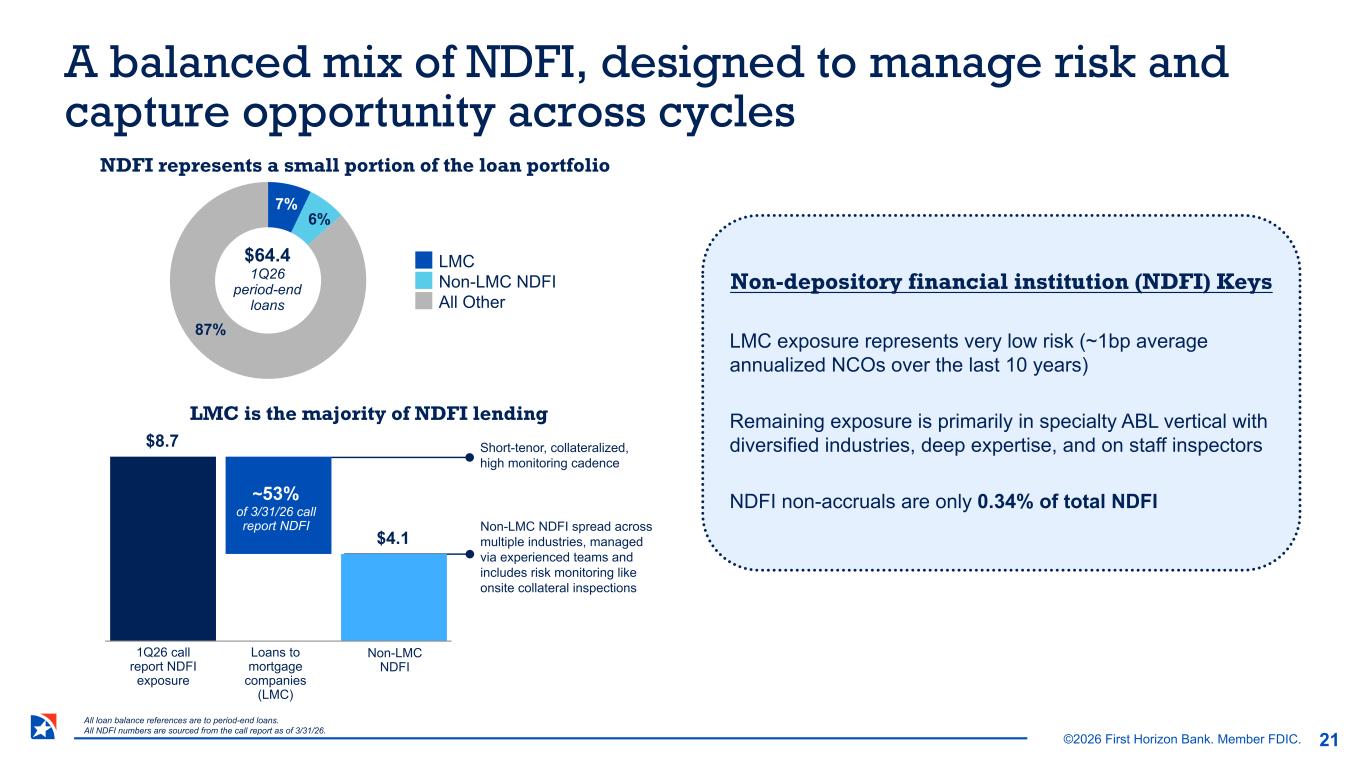
All right, great. Maybe just one follow-up, just as it relates to credit. You know, last quarter we spent a lot of time talking about NDFI and things like that. It doesn't seem to be a real topic this quarter. Obviously, the improvement was good. But I guess how much better can it really get in your eyes? And if volatility does persist, could we start to see things maybe turn the other way?
Hey, Michael. Good morning. I think the short answer on NDFI is there's been no real change since the last quarter. It continues to be a relatively steady performing portfolio for us. No part of me is necessarily looking for it to get better. It would be – that's what I'm expecting. All right, great.
Thanks for taking my questions. Thank you.
Operator
Your next question comes from Jared Shaw with Barclays. Please go ahead.
Thanks, and good morning. Maybe going back to the deposit discussion, were there any unique drivers of some of the non-time interest-bearing runoff, and how should we look at sort of the outlook for broker deposits? from here.
It's not long. Is money moving from traditional money market or CVs back into the equities market in our wealth business? We've seen a little bit of a turn there, but no real main theme. I think just as we know, the consumer has less cash flowing through their checking accounts and they're spending down their savings and our commercial clients are funding up projects and putting that cash.
And then looking at the securities side, you continue to run that down and use that to fund other growth. How low should we expect the securities as a percentage of assets to go? And are you doing anything differently in that right now in terms of purchases compared to what we see for average yields in the second quarter?
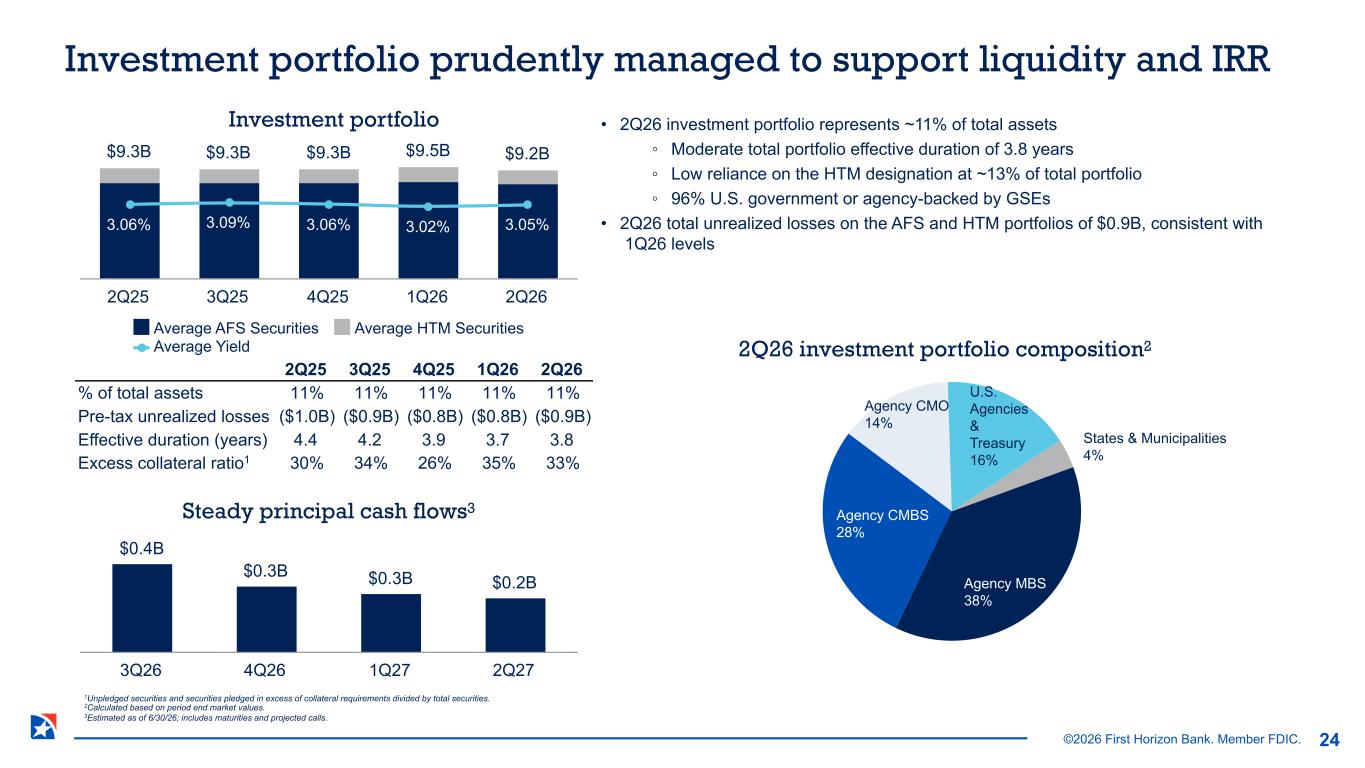
We continue to reinvest. We have $1.2 billion rolling off, 2.8%, and we're replacing that at 4%. I say now, because as we just talked about earlier, the rate outlook continues to change. But, yes, there's positive momentum for earnings there, but we do not expect a shift.
In that securities portfolio today, Jared, is about 11%. Great. Thank you.
Operator
Your next question comes from Bernard von Gizicchi with Deutsche Bank. Please go ahead.
Hi, good morning. Just the first question on the brokerage trust and insurance fees. They've been growing nicely versus a year ago period, as well as versus the first quarter. Could you try some color on what's driving results? Is it a combination of the macro and micro factors? Just talk on how you expect revenues to trend in the second half of the year. I believe you mentioned increased wealth management penetration across the footprint with $5 million recognized and $1.526 as part of the growth. deepen our new clients all.
We've been building out the deepening initiative. And I think that momentum, or I expect that momentum to continue as we continue to get the benefit of growth.
Great. And just maybe a follow-up on the hirings that you mentioned in wealth. I know you added a headcount of 53 during the quarter. Just any color on the mix of front versus, say, mid-back office during the quarter or year-to-date? And just any expectations on hirings in the second half of the year?
We are continuing to hire bankers across our footprint as we did last year. Some key growth areas, as we just talked about, not investing that support areas without having to add the support partners. The one exception to that in headcount growth is fraud. We're continuing to invest people into our fraud business as it gets more and more difficult to prevent fraud for our consumer and our commercial.
Thanks for taking my question.
Operator
The question comes from Janet Lee with TD Cohen. Please go ahead. Good morning.
Following up on deposits, is there room for a broker deposit balance to unwind versus the $2 billion increase in the quarter and interest-bearing deposit cost in the third quarter could potentially come in below the $243 spot rate given the CISL strength and core deposits?
Absolutely. that is a possibility. And we do not try to fund loan growth as a priority with deposits. We have seen two successive quarters, strong loan growth and the seasonality of deposit campaigns when clients move deposits, as well as the balances that there are to go after. It does tend to take up in Q2 and Q3, and we would trade that in paying down brokers. However, is it going to come in lower than where we ended the quarter? It's really hard to know this early in the quarter. It's really hard to know, you know, with the changing macroeconomic outlook and the rate outlook, what we will see. But it is our goal to continue to grow customer deposits to fund loans.
Got it. And on 2026 Revenue Growth Guide, if we assume, you know, current mid-single-digit long growth, relatively stable, cyclical, counter-cyclical businesses, and then likely coming down if deposit costs are rising, that implies revenue growth coming in at the low end of the 3% to 7%. Is that the fair baseline expectation or assumption that we could assume? Or if not, what are the levers to do better at the low end?
Yeah, I think that is one assumption that you can run. We run a, you know, a series of different scenarios in the changing rate environment and economic outlook. One of the comments you meant is you said is compressing NIM. If NII is growing and NIM is compressing, that's still positive to revenue growth over the year. We are, for the first half of the year, at the average for revenue growth. When I look at the back half of the year, it really depends on what happens with the rate outlook and how our counter-cyclicals perform. Our FHN financial, as Brian mentioned earlier, had a great second half of last year. So, to get to the higher end of that range, you would have to be equal or outperforming that. But a rate increase, we have an asset sensitive balance sheet, so early rate increase is another scenario you can run. and we would pick up more NIIs not on the exact same balance sheet without proof. And so I think you've got to play all those factors out not knowing if we'll have a rate decrease or increase this year. And we've run all of those scenarios in the back half this year, and we feel confident that we will be well within that range.
The other lever that Hope mentioned earlier in her prepared comments was we're really focused on how we improve the profitability of the balance sheet. And if you look at loan growth over the last year and improvement in PPNR, we're outpacing the growth in the balance sheet. And there is a real positive effort, and we're getting very good. And I think the combination of all of those gives us confidence in what it essentially is, is the framework for 2026. Even in the context of all the 90 days in the Middle East, we still have.
Operator
Thank you. Your next question comes from Casey Hare with Autonomous Research. Please go ahead.
Good morning, everyone. I wanted to touch on expenses. So the expense guide, which you reiterated, it assumes that expenses kind of hold flat with this second quarter run rate. The outside services was up quarter to quarter, and it kind of ramped last year. So just wondering, you know, do I have that right, that expenses kind of hold flat with the second quarter run rate, and, you know, what's the outlook on the outside services?
Casey, you said it perfectly. You answered the question for me. We are expecting expenses to be flat from here on out, and we did have in the back half of last year one-time expenses related to finishing up some projects and some initiatives that will not repeat in the back half of this year. So we do expect it to be flattish here. We will see some movement between outside services and other, and that's really related to the marketing campaign. Right now we're in the acquisition phase, so it hits above, and then when we pay the cash incentives, you'll see our DDAs are up this quarter. We're pay out in future quarters. You'll be able to switch a little bit in the P&L, but we do expect flat expenses the next two quarters.
Great, thank you. And then, Tom, a question for you, two-parter on credit. So, the ACL down 18 bps over the last year. You did have a very nice NPL redux this quarter. I guess first question is, you know, how low can that ACL ratio go? and then separately that the NPL ratio, can this momentum continue, you know, is there an outlook that you can drive that lower from 81 basis points?
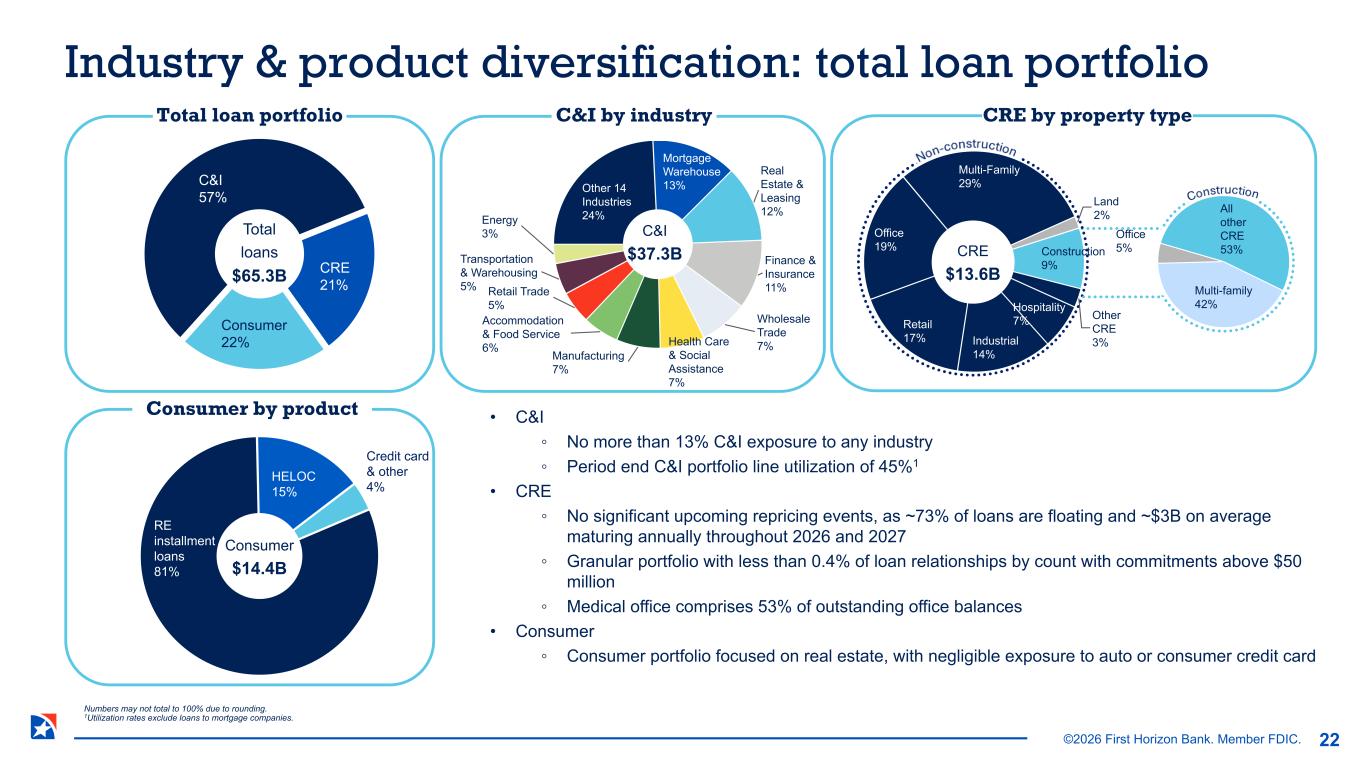
Yeah, sure. Hey, Casey, I'll answer that in a few different parts. I'll start with the 18 basis points reduction that you mentioned. That is one of the different factors. We have been very diligent in how we manage our portfolio, So what you've seen is a continual decrease in our special mention and substandard assets. We've been very diligent in our underwriting and how we resolve those credits. And so that 18 basis points is a combination of improving portfolio credit quality. It's also got all the positive resolutions you've mentioned, especially in NPLs in the last quarter. It also reflects just economic outlook as well. There are internal factors we control. There are also external factors around economic factors that you add all of that together. And I missed a major one, which is obviously our very consistent and low net charge-off performance. All of that put together is why we've had the decrease in ACL. You know, I would point to the 124 that we ended this quarter at. It's still over six over the last year and more than seven times over the last two years. As I look out ahead, where does ACL go, I think that's something that I would not speculate on because, as I mentioned, there are internal things that we absolutely can control, and I continue, our whole team, our whole bank continues to prioritize minimizing losses and maximizing recoveries as opposed to, say, timely resolutions, and that I think we control the things we can control, But there are external, such as unemployment, interest rates, economic outlook, consumer spending power, inflation, geopolitical risks. So many things that can influence ACL going forward that I wouldn't speculate on kind of where that can go. The last piece, you mentioned NPLs. You know, I think that's a real highlight for credit this quarter, down 13 days' points. Once again, that's a combination of a lot of different things. We've been working very diligently on focusing on our NPLs, and we had a number of positive resolutions this quarter. What you're seeing there is a combination of upgrades, payoffs, restructurings, and as I mentioned, our focus continues to be on minimizing losses and maximizing recoveries as opposed to timeliness. So we will absolutely focus on continuing to reduce that number, but like I said, I take a long-term view on all of this rather than trying to get quick resolutions.
Operator
Your next question comes from Abraham Poonawalla with Bank of America. Please go ahead.
Hey, good morning. Just have two follow-up questions. I guess I hope, Brian, for you. One on capital, if I heard you correctly, I hope you mentioned risk-related assets down about 10% under the standardized approach. That's roughly, whatever, 100, 110 basis points of CET1. Just talk to us in terms of, as we think about capital allocation, given where your CET1, arguably at the higher end, when we think about the 10 and a half, just how are you thinking about where you could deploy that capital? Would buybacks be attractive once we get some finality on these rules? Or just, yeah, in terms of beyond organic growth, because it doesn't feel like organic growth is going to absorb all that excess capital.
Ibrahim, thanks for the question. Yes, it is a combination of those, and it depends on the outlook. As Brian and I have talked about multiple times, when we look at capital, we look at it when we do our annual stress test. Although we're not required to do it, we do do it. We review it with our board, and we look through, you know, the next one to two years for capital, which is what do we believe we're going to need to fund loan growth? Loan growth being the priority for how we want to use capital. Second is what is the right level of dividend for a company, and third is share buyback. And so when we look out towards that 10% reduction, we will look at not just this quarter, how do we put that all to work, but what do we reserve so that we have it to grow our balance sheet. It's hard for me to know when it will all go into place, Abraham, and what the economic environment could be. We came into this year, you know, expecting load of mid-single-digit loan growth. I do see an environment where we can get back into the high single digits and 10% loan growth as an economy, especially in the southeast as quickly as our markets are growing. I just don't know when that market starts to turn in timing with when Basel III endgame will be implemented.
Got it. And then I guess just separately, so appreciate you outlining the $100 million PPNR opportunity ahead of the bank. But just talk to us. We are seeing competitors either acquiring banks, adding branches, acquiring bankers. Just talk to us. If you think about the top three areas where investment spend is going from a growth standpoint, like how would you sort of characterize that in terms of either banker hiring, are you opening branches in new markets? If you can talk through that. Thanks.
Yeah, we're investing across a number of fronts, and one you didn't mention. We're building branches, not so much in new markets. We're building branches in existing markets where we think we have tremendous opportunity to improve our density, our 24 by 7 always on advertising and commitments to those markets. The Carolinas, as I mentioned earlier, I feel good about the hiring. we're doing across the organization. We've hired in Type, and we will continue to, we made a huge determination of the merger agreement. That work is largely, if not fully completed, but we continue to invest in our mobile banking system and how we deploy AI. I thought Hope did a really good job describing expenses earlier and that's the one part of them and that's the one thing that we can control continue these in fact thank you thank you your next question comes from Ben Gerlinger with city please go ahead hey good morning
but more and capable but clearly people are pretty focused on their funding mix, if not interest rate and cause the cost. Given that you guys have a pretty seasonal balance sheet, is there any reason why 4Q26 should have a materially different overall kind of percentages of funding than for relatively 4Q25, i.e. like broker comes down? I'm just trying to get a sense of like, you do that seasonal. Is there anything to assume that seasonal doesn't really play itself out again?
Ben, no, there's nothing to say that we expect the seasonality. And Brian mentioned that in a pair of remarks, and I mentioned my first question. This year, deposit costs and deposit growth is trending just as we've seen in the last two years following rate cuts that then stop abruptly. We don't know when or what the next. You know, the only thing that would move that is if we saw a late-in-the-year mortgage warehouse spike. We saw a mortgage refinance late in the year. That would be the only thing that would change that material. But, no, we did not expect a material.
Got it. Okay. That's helpful. That's pretty much all in there. I appreciate it. Thank you.
Operator
Your next question comes from Anthony Ellion with J.P. Morgan. Please go ahead.
Oh, good morning. Another one on deposit costs. Last quarter, you pointed to a slight pick-up in deposit costs, and you saw a five-basis point increase on average in 2Q. Would the pace of deposit cost increases in the second half be higher than the increase you saw in 2Q, given where the spot rate is now and your earlier comments on 3Q and 4Q being the most competitive for deposit offers?
The biggest piece is how much loan growth we get. We talk about having another great quarter of originations that we'll fund up. And so how do we fund growth? What does the growth on the balance sheet look like? As Ben just pointed out well, mortgage warehouse seasonally is higher in the summer. That is a traditional home buying season. We've already We've seen that. We do match fund mortgage warehouse with wholesale funding traditionally. So I think you've really got to look through this cycle and not just quarter to quarter with the seasonality. But it really is hard for me to tell you exactly where we're going to be within a couple of basis points, you know, 75 days from now. But we're trending, you know, consistently, as we just said, and we're continuing to manage customer costs.
I will add to Hope's comment. My instincts are in the marketplace and anecdotally, I think, in the near term with the uncertainty around interest rate direction and being able to lock in funds today for the marketplace you're seeing still very competitive and aggressive money market rates in the marketplace. And at the end of the day, as I remember from our perspective, relationship, we look at all of it in the context of a market that is moving a good bit. So at the end of the day, my gut is maybe up a little bit, but it's hard to know given all the moving parts in the marketplace.
Thank you. And then on the NIM, so last quarter's quality gave us a range hope of high 340s for 2Q. If I look at consensus, it has you hovering at that level over the next couple of quarters. I'm wondering how you're thinking about NIM for 3Q, given, again, your earlier comments on deposit costs. Thank you.
I think, you know, NIM, we expected to settle into the high 3-4s. That'll vary. You know, a basis point or two on NIM for us is really about fixed, not just deposit costs. Mortgage warehouse is our highest-break business. So as that sums up, you know, you can see some margin compression there. but it's positive NII. So, I think the really important thing when we talk about NIM compression is our deposit growth is – our deposit increase in our deposit growth is to fund loan growth. So, it's still driving positive NII with slight NIM compression. We've been saying for about three-quarters now, we think a normalized for 2026 is the mid to low 3.4s, and we're at the mid to high 3.40s, and we're at 3.49s. That gives us a lot of room to come in in that full-year guidance we've given on them and feel confident on the full year we will but to Brian's point there's a lot of moving parts right now but I don't want to disconnect the deposit growth is tied to one growth which is positive for NII right what I would say is you can't spend a NM which is a ratio you spend in which is dollars thank you thank you your next question comes from Timur Braziller with UBS.
Operator
Please go ahead.
Hi, good morning. Hope, on the seasonal deposit campaigns that you guys are running, can you just maybe talk through the magnitude of those and where you're pricing those seasonal campaigns?
A few times, the headline rate, one of you on this call actually calls branches and puts a report out saying this city hears the offers, we have gotten to the point in our industry, and us as well, where we do have different rate specials in different cities. We hear, you know, lower end deposits versus higher. Jumbo CDs are back with a much more premium rate. So unlike 2023, where I could tell you, you know, we were offering 525 to everybody in all states above 25,000. That's not how we're doing deposit competition anymore. It's not how we're doing promos. So it is a mixed issue of how do you grow with where the market is. The Southeast is a very competitive market. Forward deposits continue to have migration in and additional competitors either grow their footprint or enter, but it's not equal in all states and all cities. And so we're getting much more intentional about where we can grow at what rate, which is how we're able to manage that deposit cost more consistently through the cycle than we were back in 22 and 23, not just for us, but as an industry.
As you mentioned earlier, Hope, we've invested in cash offers for non-interest bearing deposits. We're starting to see very positive traction there. Essentially, that is an effort to build primacy. We're investing our market dollars both in non-interest bearing and interest bearing deposits. As Hope said, it depends on market. It depends on the part of the curve we're trying to go at.
Okay, and I guess in that same light, if we do get a 25 basis line hike of the forward curve, it actually does play out. I guess, what does the margin trajectory look like with one hike?
It's going to be the opposite of what we saw with decreases, which is the loan side reprices up first and the deposit price will lag. What we've seen in a decreasing environment is the loan yield and the deposit lag. So, you'll have some margin expansion in that first quarter and then you'll see it compressed back as the deposits repriced. You know, we have anywhere from three-month to 13-month commitments on, you know, something like a jumbo CD. So you've got to let that play through in either a rate increase or a rate decrease. So there is a lag quarter to quarter, but over the whole year or over, you know, a 12-month period, you would expect it to – we expect it to be matched.
Our business model is very balanced through the cycle. Given where fixed-income ADRs are today, a rate increase is more positive because ADRs have already been at a relatively low level. So, if the bid were to move up 25 basis points, it would look more like the interest as opposed to the interest.
And, Brian, if I can speak one more in for you, just would love to get your thoughts on broader M&A in the environment. Are the conversations as dead as the deal activity has been more recently? I guess what are you seeing from your seat in terms of, you know, books coming across your desk or broader conversations had?
2025 and the relative absence of that in the first time, but it does feel more benign today than it did.
Operator
Your next question comes from David Chiaverini with Jeffries. Please go ahead.
Brooks
Analyst — Jefferies (substituting for David Chiaverini)
Hey, good morning, guys. Brooks.com for David Chiaverini. You guys have mentioned and referenced the $100 million-plus revenue opportunities several times today across initiatives like treasury management, CRE pricing, wealth management, and the regional specialty partnership model. As you sit here today, which of those initiatives do you think is the longest runway for growth, and where are you seeing the strongest client adoption?
Maybe the most significant in terms of a loan-only or near a loan-only are TM folks for making significantly more calls with their management teams. But essentially, it has to be, not to repeat a point I made earlier, but you see it in the balance sheet when you look at the improvement in PPNR versus the growth in the balance sheet. You can assume underneath that that there's some relationships. We've traded out some loan growth over the designs, and I've laid out. It's built into the expectation about a couple of times for this year, but we feel very good about our ability to achieve it.
Brooks
Analyst — Jefferies (substituting for David Chiaverini)
Thank you very much. Thank you.
Operator
Your next question comes from Christopher Maranak with Breen Capital. Please go ahead.
Hey, good morning. How do you think about the return on tangible common equity as it relates to kind of matching charge-offs with provision or having provision slightly less? I know Tom talked about this earlier. on the call, but just kind of curious how you think about ROTC from that framework.
Yeah, I think, you know, I start with the buy and return we can on the capital we have deployed in the business. I think it's harder to think about provision and charge-offs vis-a-vis return on capital because if I've been in recovery, you know, for every loan that's on the balance, what happens to the economy expect? I think our industry, I feel good about a 13 basis point reduction, net reduction is still very, continues to, our bias is to continue to improve the profit. And if we can do those things, we will continue to drive improved and improving ROTCs over time.
That's fair, Brian. Thank you very much for your perspective and thanks for taking all of our questions this morning.
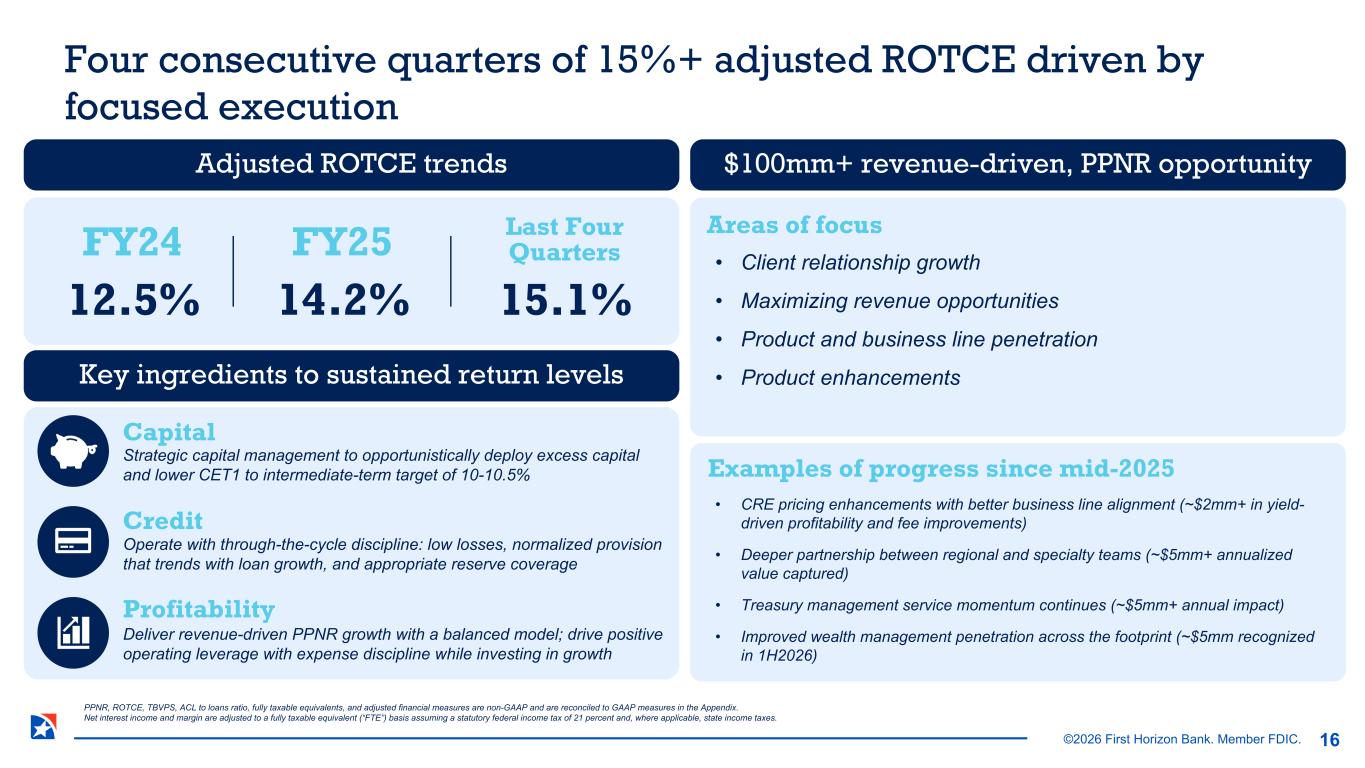
Appreciate it. your next question comes from chris mcgratty with kbw please go ahead oh great thanks for pushing me in um i just want to go to slide 16 for just a moment i like the lower quadrant right quadrant of what you've accomplished towards that 100 million cpnr i just want to get a clarification is the message here that you're roughly 15 to 20 percent of the way to that hundred that's question one and point two is when do you think you'll get that full hundred when when I originally hundred million dollar as and we have
continued to make progress and I referred to it in this and profit I said at the time and I think tended to signal that we're continuing to work on it and we've we continue to focus on driving that profits that initial hundred
Joy Swing
Analyst — Evercore (substituting for John Pancari)
me and i'll be disappointed if we're not continuing to work on the plus part of it so i think there's a lot of opportunity in our existing book on slide 16 we said here's a couple examples that's not meant to be an inclusive one got it okay thank you your next question comes from john pancari with evercore please go ahead hey good morning this is joy swing here for john just want to follow up on credit sound pretty healthy there on last Corey's colleague mentioned keeping eye on the consumer sensitive areas like trucking, auto, and restaurants. Would you say these are performing better than you expected so far in 2Q and 3Q, or are these still areas you're watching, and if not, any other areas to even eye on?
Yeah, happy to answer that. Those are the sectors we continue to watch closely. I will say they have proven to be very resilient so far. We need to continue to monitor it, but I do believe there is increasing pressure on especially lowering consumers and their spending power but all of that said within the sectors that you mentioned retail restaurants things that are closest it's being surprisingly resilient and so we'll continue to monitor it but those do remain elevated in terms of credit risk relative to other industries and so we'll continue to monitor closely you can't thank you and then yeah i was just going to add that that you know you you see but overall as tom said the consumer more than anything that is tight understood thank you then
Joy Swing
Analyst — Evercore (substituting for John Pancari)
last one for me just on all the hiring comments that you put on this call what do you think is any bigger driver of uh attracting talent to first horizon and you know have you seen opportunities from m&a in your markets where could create you know relationship managers getting dislodged or you know otherwise creating efficient I think clearly drivers is a platform giving relationship anything it is great thank you very much thank you there are
Operator
no further questions at this time I will now turn the call back to Brian Jordan chairman president and CEO for closing remarks thank you Rebecca thank you all for joining us this morning thank you again to our associates and our shareholders for all that you do for the organization please reach out if you have it is concludes today's call thank you for attending you may now disconnect