Operator
Good morning, ladies and gentlemen, and welcome to the first Interstate Bank System, Inc. third quarter earnings conference call. At this time, all lines are in listen-only mode, and following the presentation, we will conduct a question-and-answer session. If at any time during this call you require immediate assistance, please press star zero for the operator. This call is being recorded on Thursday, October 30, 2025. I would now like to turn the conference call over to Ms. Nancy Vermeulen. Please go ahead.
Thank you very much. Good morning. Thank you for joining us for our third quarter earnings conference call. As we begin, please note that the information provided during this call will contain forward-looking statements. Actual results or outcomes might differ materially from those expressed by those statements. I'd like to direct all listeners to read the cautionary note regarding forward-looking statements contained in our most recent annual report on Form 10 filed with the SEC and in our earnings release, as well as the risk factors identified in the annual report and our more recent periodic reports filed with the SEC. Relevant factors that could cause actual results to differ materially from any forward-looking statements are included in the earnings release and in our SEC filings. The company does not undertake to update any of the forward-looking statements made today a copy of our earnings release which contains non-GAAP financial measures is available on our website at fibk.com information regarding our use of the non-GAAP financial measures may be found in the body of the earnings release and a reconciliation to their most directly comparable GAAP financial measures is included at the end of the earnings release for your reference again this quarter along with our earnings release we have published an updated investor presentation that has additional disclosures that we believe will be helpful the presentation can be accessed on our investor relations website and if you have not downloaded a copy yet we encourage you to do so please also note that as we discuss our financials today unless otherwise noted all of the prior period comparisons will be with the second quarter of 2025. joining us for management this morning our jim reuter our chief executive officer david de la camera our chief financial Officer, and other members of our management team. Now, I'll turn the call over to Jim Reuter. Jim?
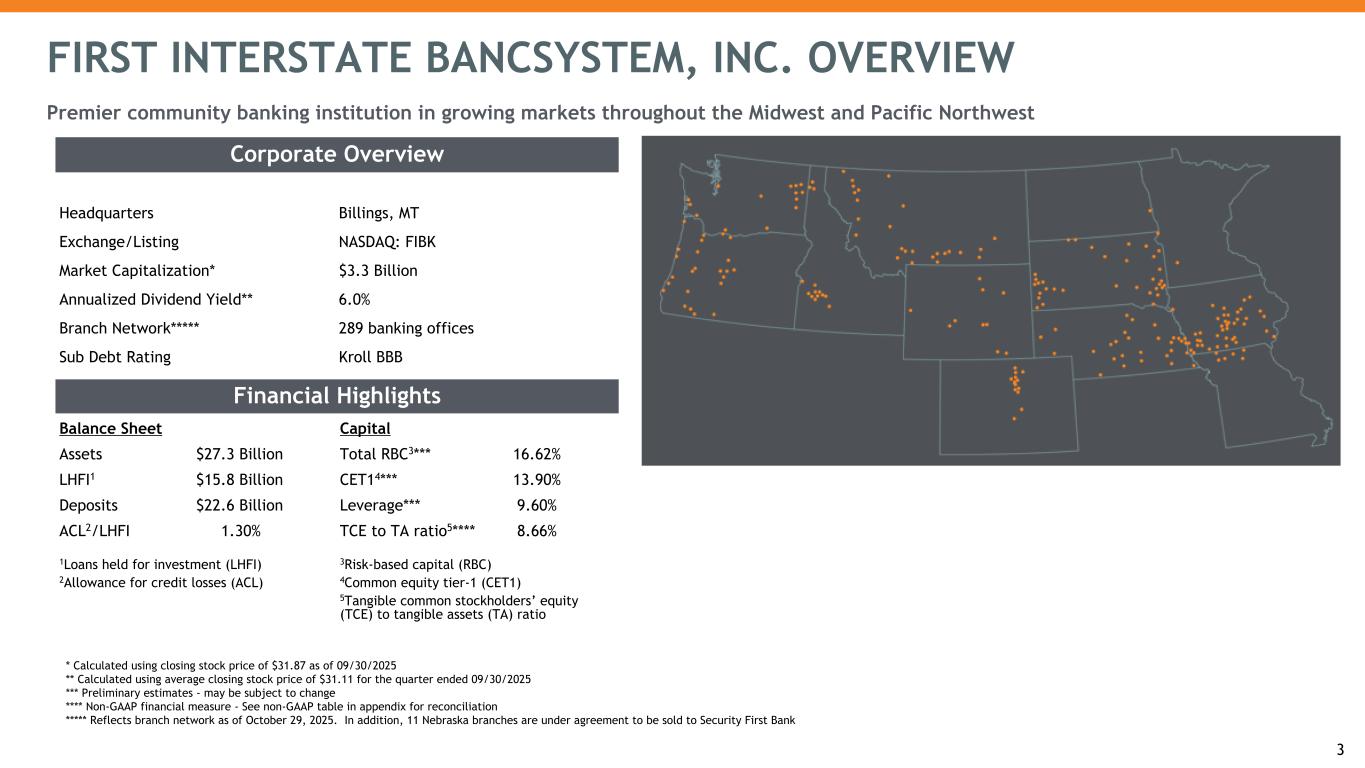
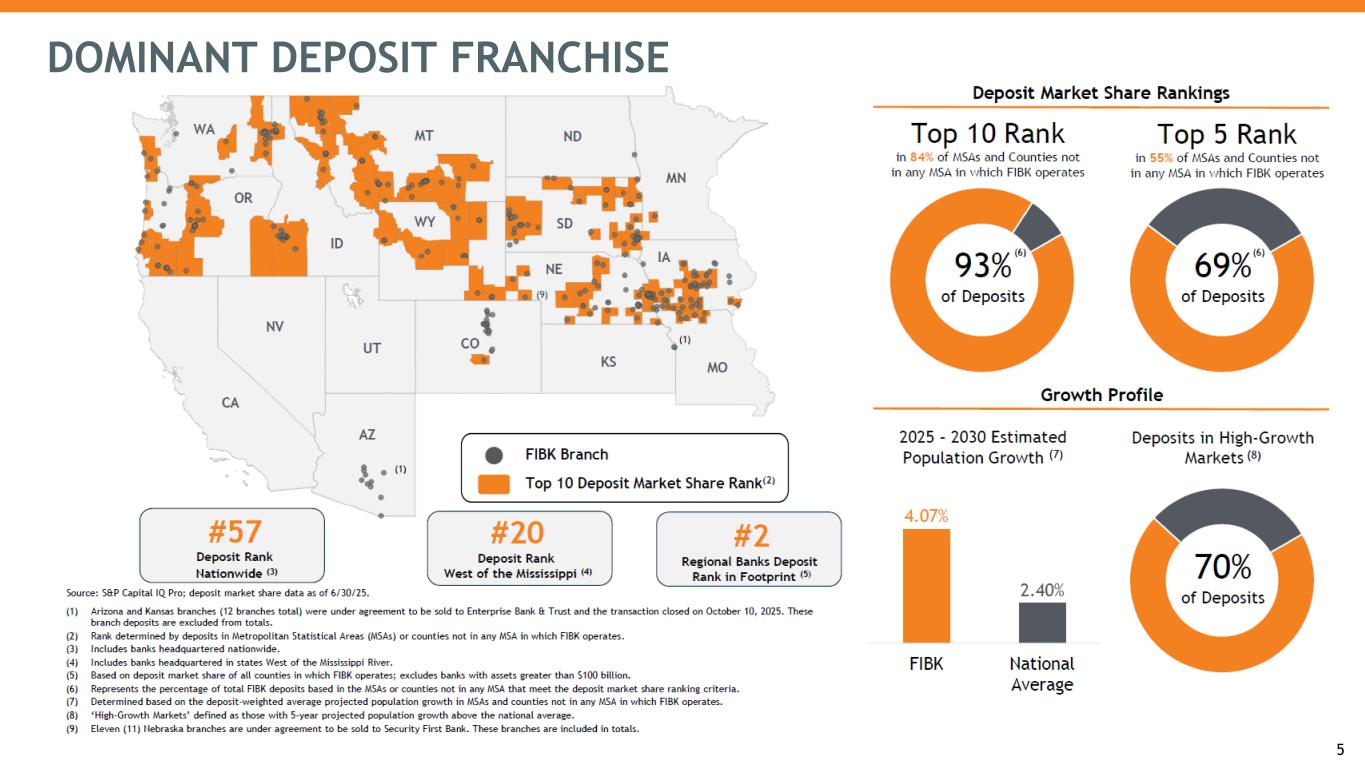
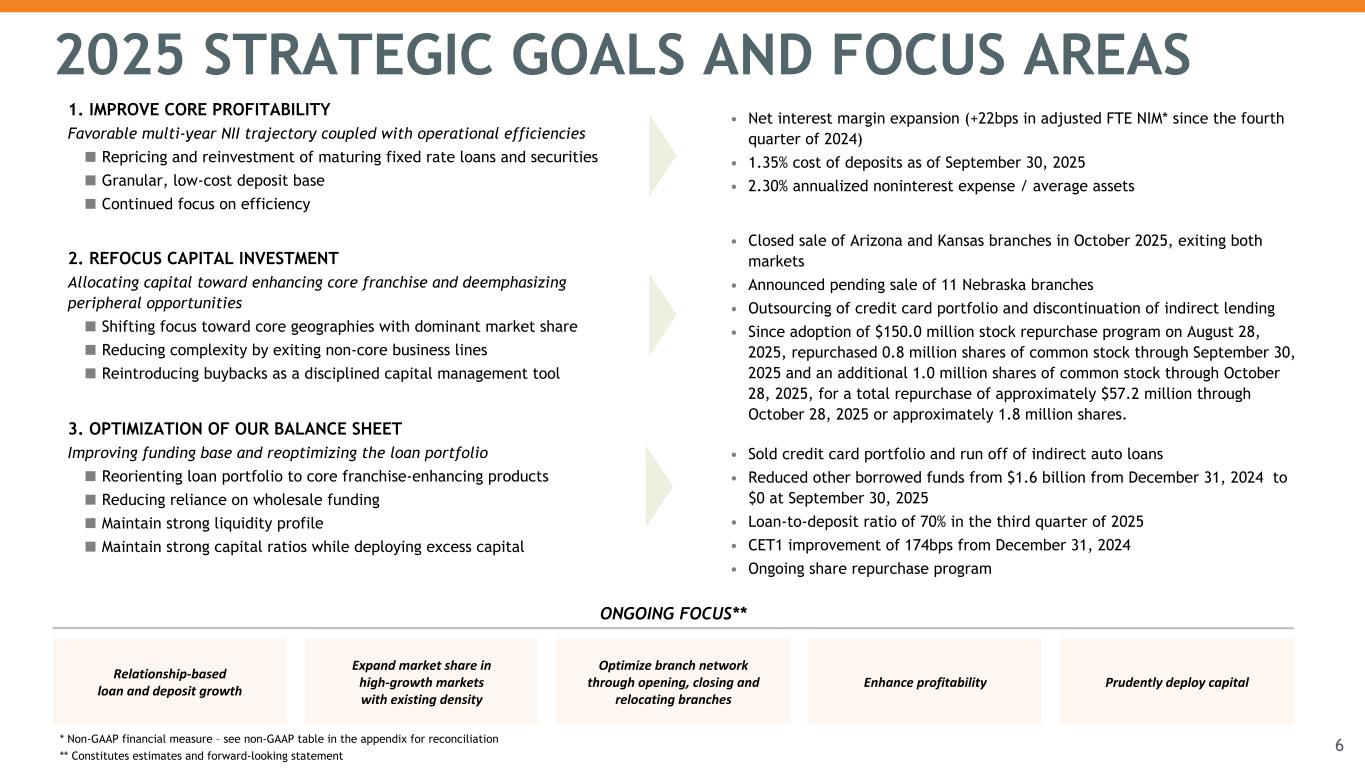
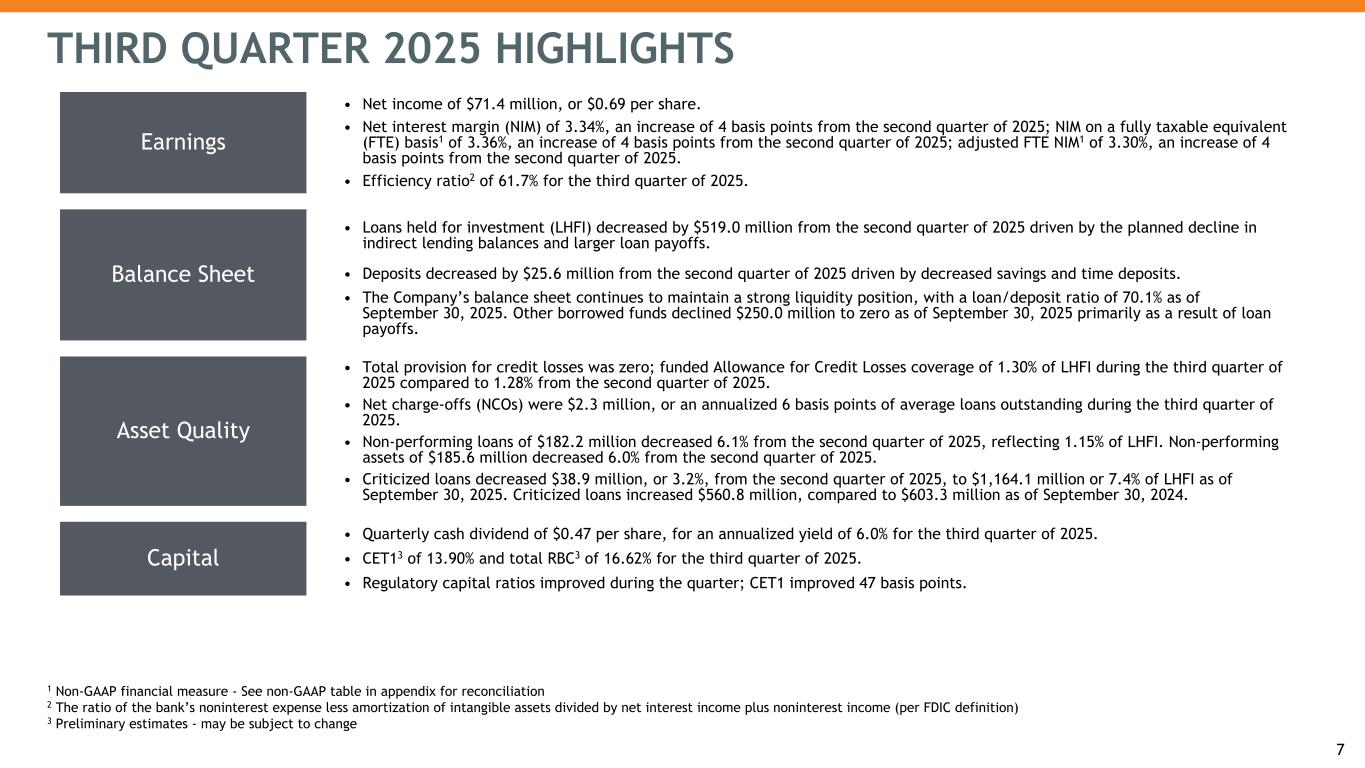
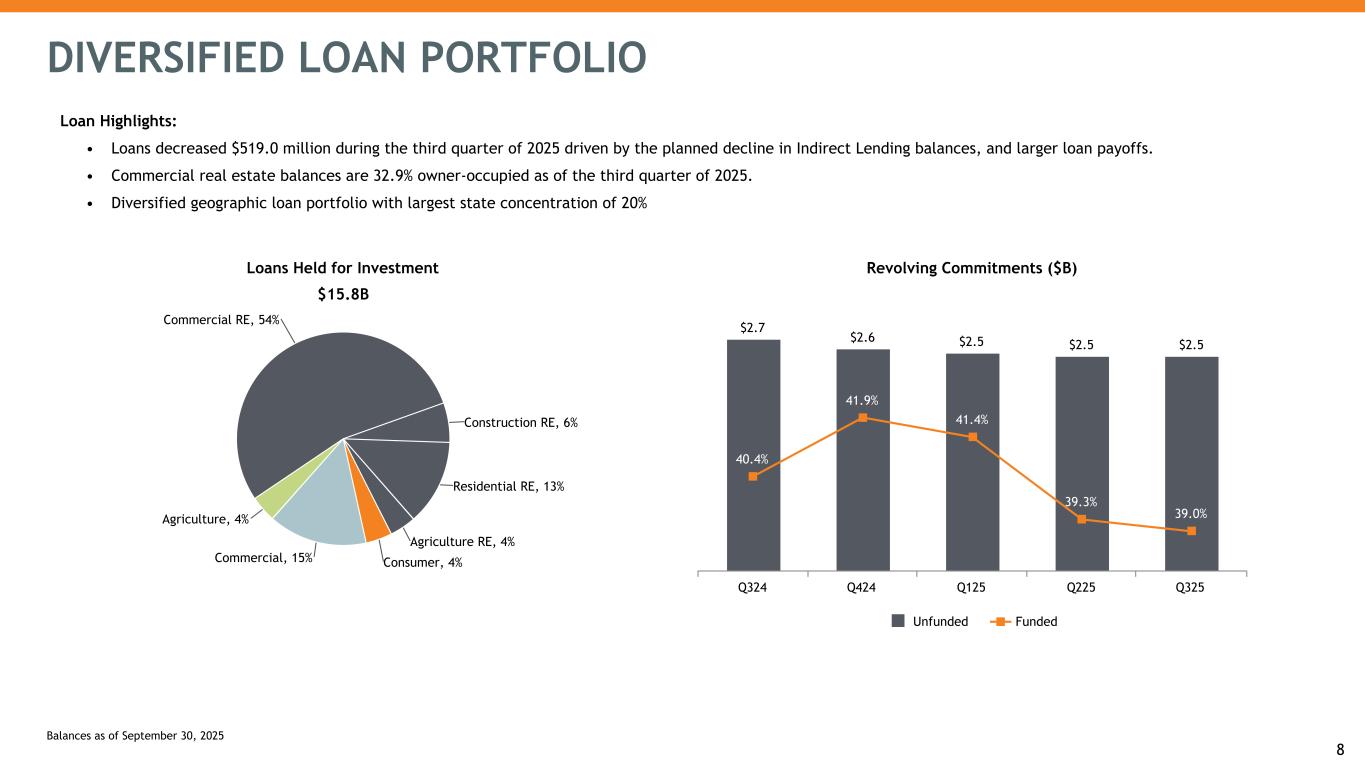
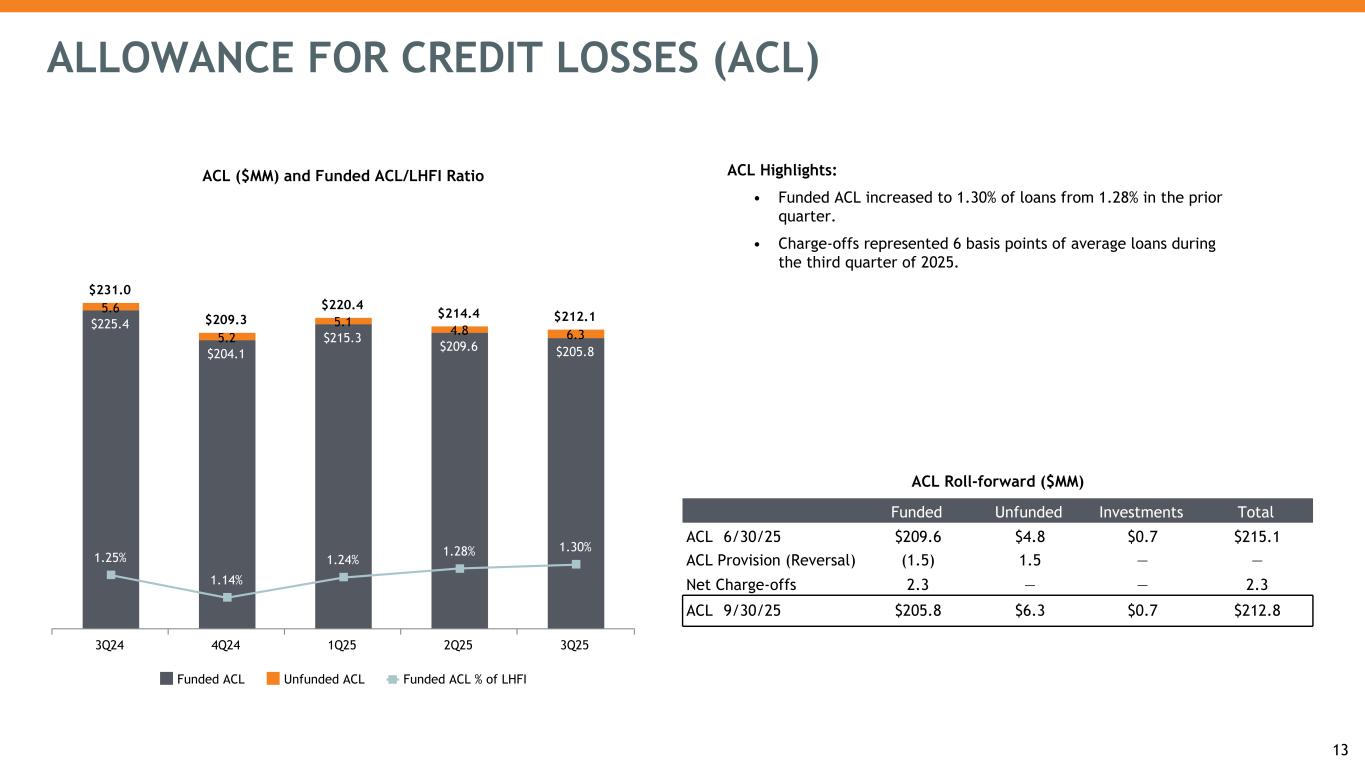
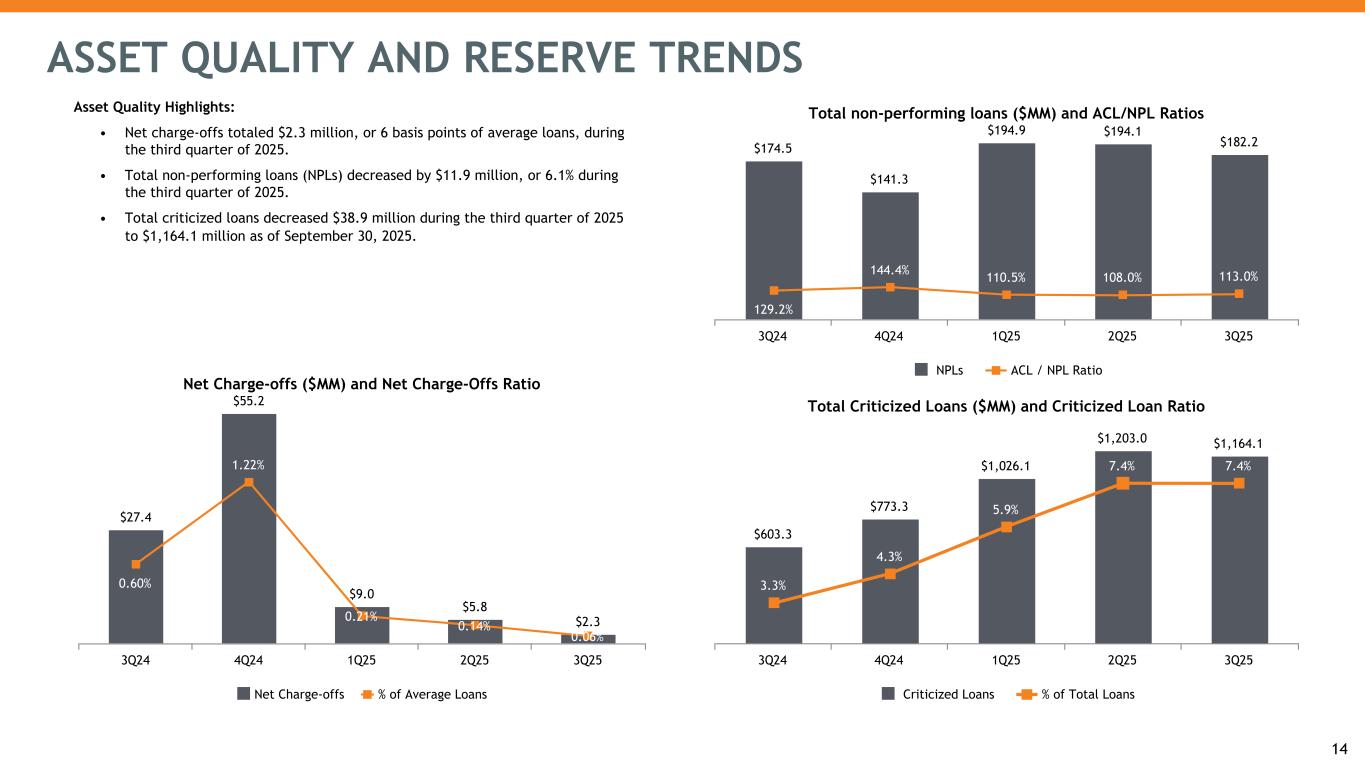
Thank you, Nancy, and good morning, everyone, and thank you for joining us on our call today. This continues to be an exciting and busy time at First Interstate. Last quarter, I opened the call by stating our three ongoing priorities, which are refocusing our capital investment, optimizing our balance sheet and improving core profitability. We continued executing on those initiatives in the third quarter, and in August, we announced a share repurchase authorization and are actively executing under that plan. As we've discussed in prior calls, we are continuing to perform our state-by-state review across the footprint. One of our goals is improving density in areas where we have strong market share and growth potential, which should improve our return on capital over time and drive long-term shareholder value. As part of this effort, we closed on the previously announced divestiture of our branches in Arizona and Kansas on October 10th and announced the sale of 11 branches in Nebraska the following week. We also will be closing four branches in eastern Nebraska in the first quarter of 2026 to optimize our branch network in those markets. As we look to future growth, we continue to make investments in the franchise, including smaller actions like opening another location in Billings, Montana in early 2026 and adding talent in markets where we see growth opportunities. We look forward to continuing to share incremental progress over coming quarters. Looking at the Nebraska transaction announced on October 16th, the 11 branches involved in the sale comprise a total of roughly $280 million in deposits and about $70 million in associated loans. we were pleased to find a partner whose business strategy fits those locations well we view this as a positive outcome for our customers employees and shareholders we anticipate this transaction closing at the beginning of the second quarter of 2026 pending required approvals altogether these optimizations further improve density across the footprint while also further streamlining our operations and increasing our average branch size We remain focused on organic growth as a driver of long-term shareholder value. Our approach will focus on growing full relationships in a disciplined manner. The combination of our strategic actions and slower-than-expected recent growth has resulted in increasing capital ratios, which we are actively managing to enhance long-term shareholder value. David will cover this in more detail. Now we'd like to spend a moment discussing our recent balance sheet trends. Some of the decline in loan balances is due to intentional refocusing of our production to ensure consistent credit quality and to drive stability and long-term performance. This includes the actions we previously communicated, such as the discontinuation of indirect lending originations, the intentional runoff of some non-relationship loans, and the outsourcing of our consumer credit card products. With that said, production has been weaker than we anticipated over the past couple of quarters. We believe there are a few factors driving this. First, we have seen increased competition for certain deals with some instances of structures we were unwilling to match and in recent months increased pricing competition. While organic growth will always be the top priority, we will do so in a disciplined way to drive long-term stability in our credit and financial results. Second, demand for real estate lending remains muted and new construction activity is soft finally while activity is picking up expected production is below replacement levels today in light of known and expected payoff activity this informs our view of a decline in loan balances in the fourth quarter which is included in our guidance this includes some criticized and larger loan payoffs anticipated in the fourth quarter on the subject of credit we were pleased to see credit quality stabilized in the third quarter. We believe our proactive approach to credit risk management, disciplined underwriting standards on new production, as well as lack of exposure to national nontraditional lending positions us well. Non-performing assets decreased $11.9 million, or 6%, to $185.6 million as of September 30, 2025, from $197.5 million as of June 30. Net charge-offs decreased $3.5 million in the third quarter, or 60% to $2.3 million. Our largest criticized loan, which totaled just over $50 million, paid off in full at the beginning of October, providing a positive start to the fourth quarter results. Following this payoff, we now have only two customers with balances over 50 million, both of which are pass-rated credits. Credit risk management is an ongoing process within a bank, and while we won't be providing a specific forecast for criticized loan levels over time, we believe our proactive approach to credit risk management puts us in a good position to continue managing lost content while resolving individual credits. We are optimistic that we will see continued improvement in reported credit levels from here. As noted, our charge-off activity in the third quarter was very muted at six basis points. We maintain our long-term charge-off guidance of 20 to 30 basis points, noting that charge-off activity can fluctuate on a quarterly basis. With that, I will now hand the call order to David to discuss the results in more detail.
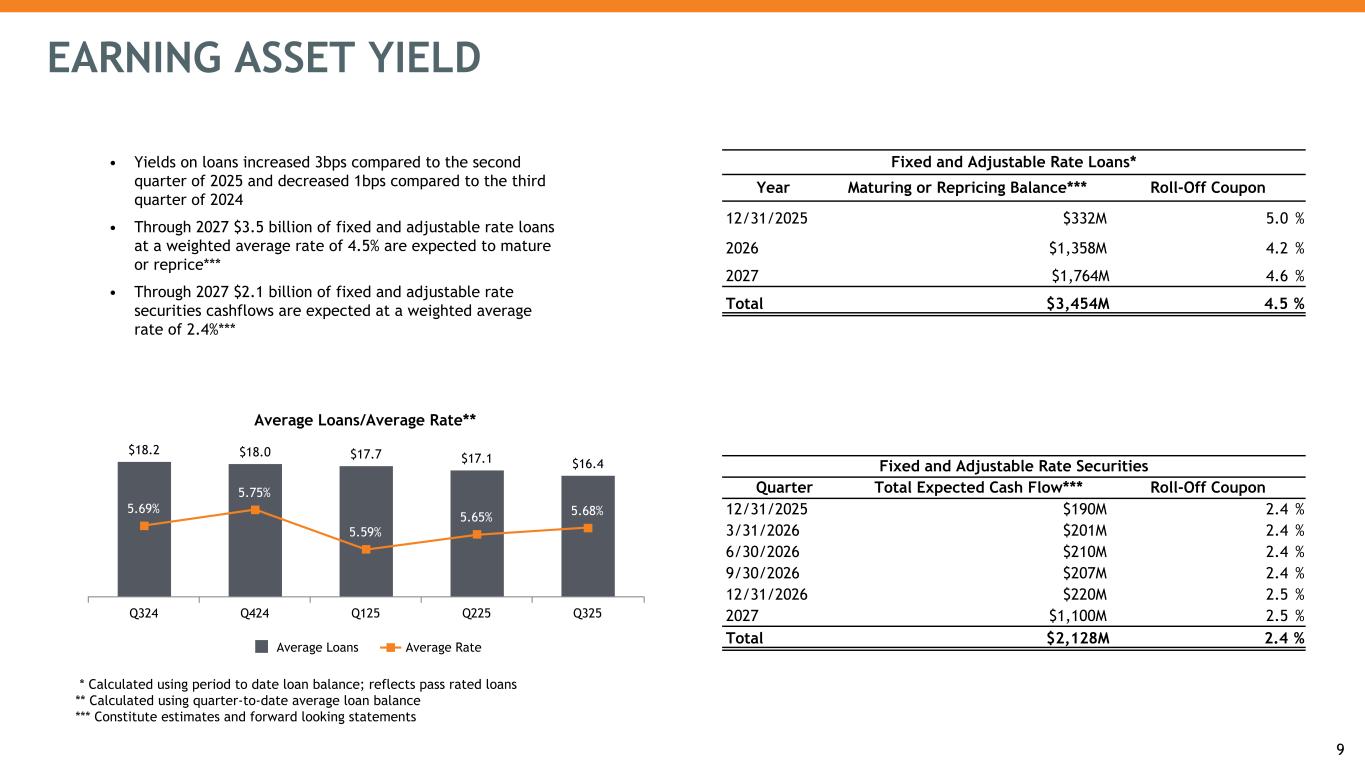
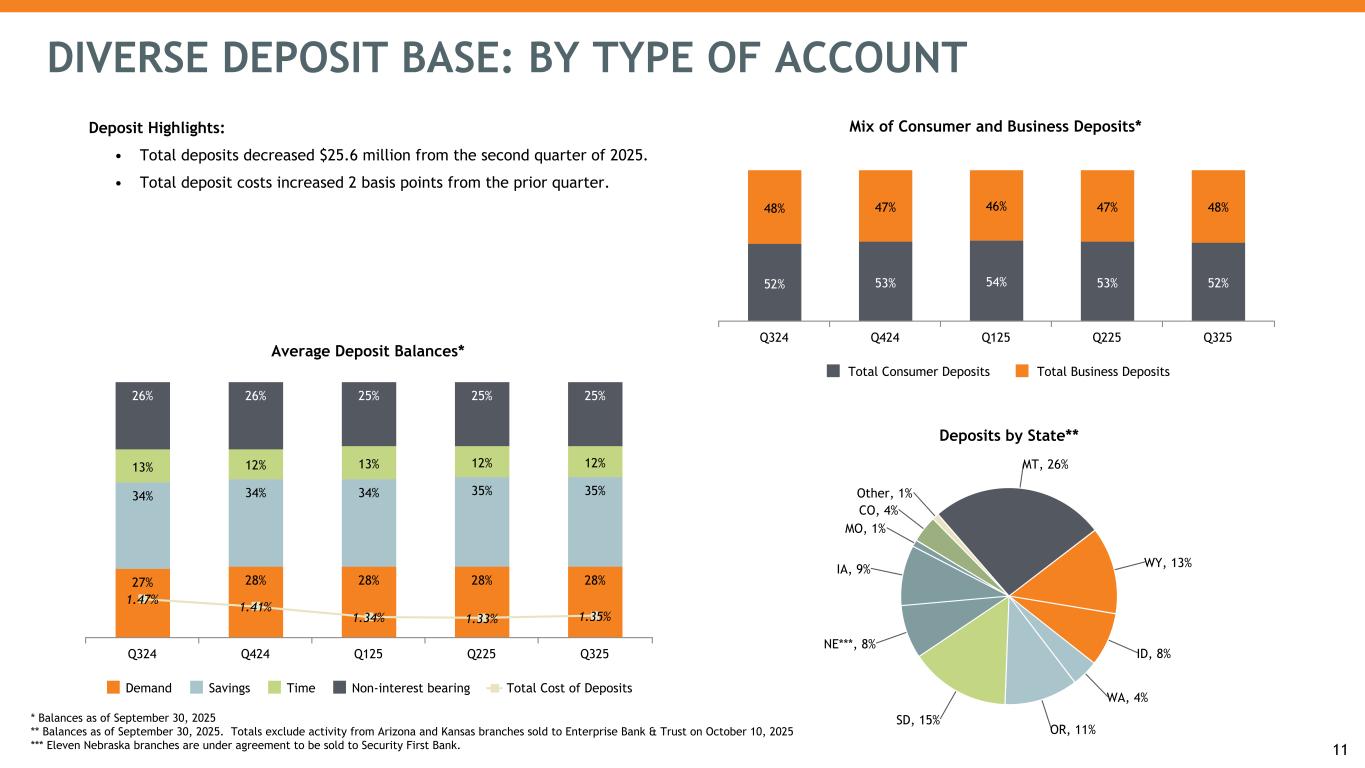
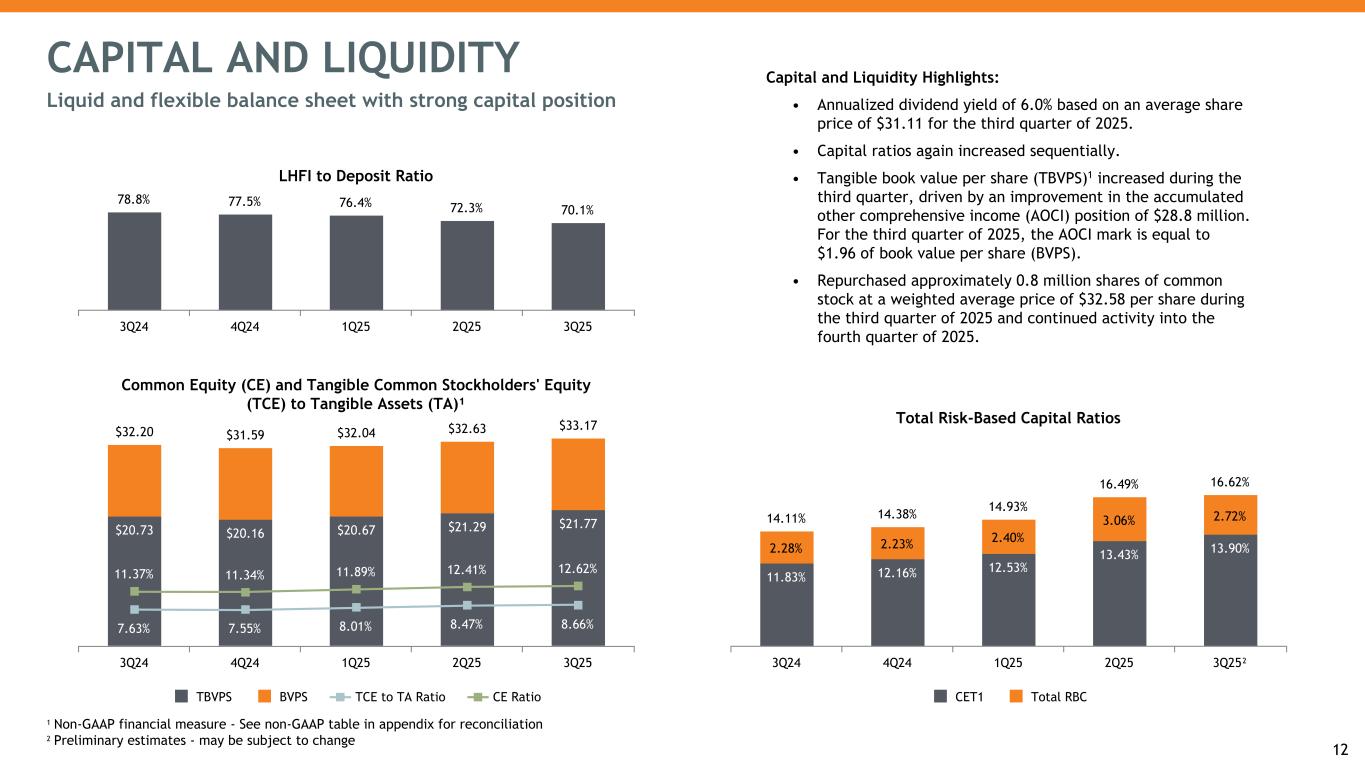
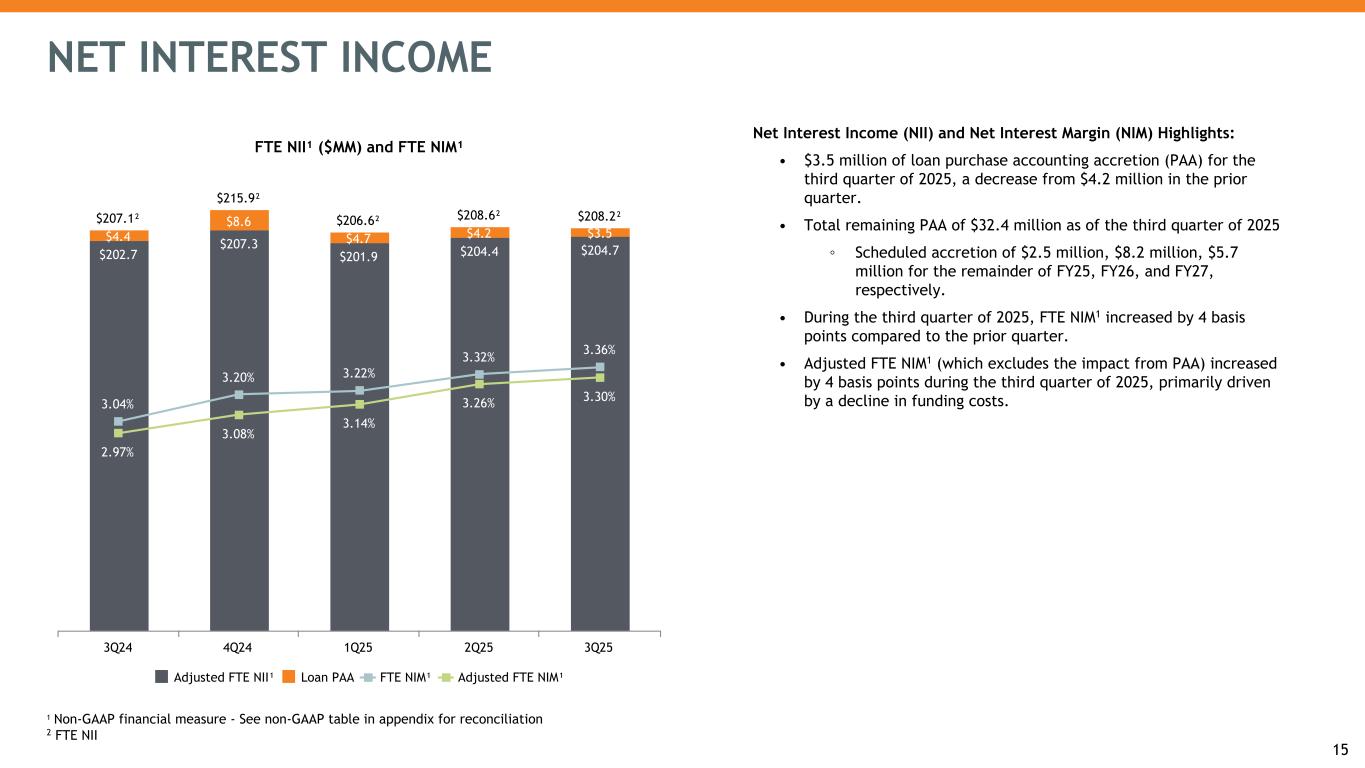
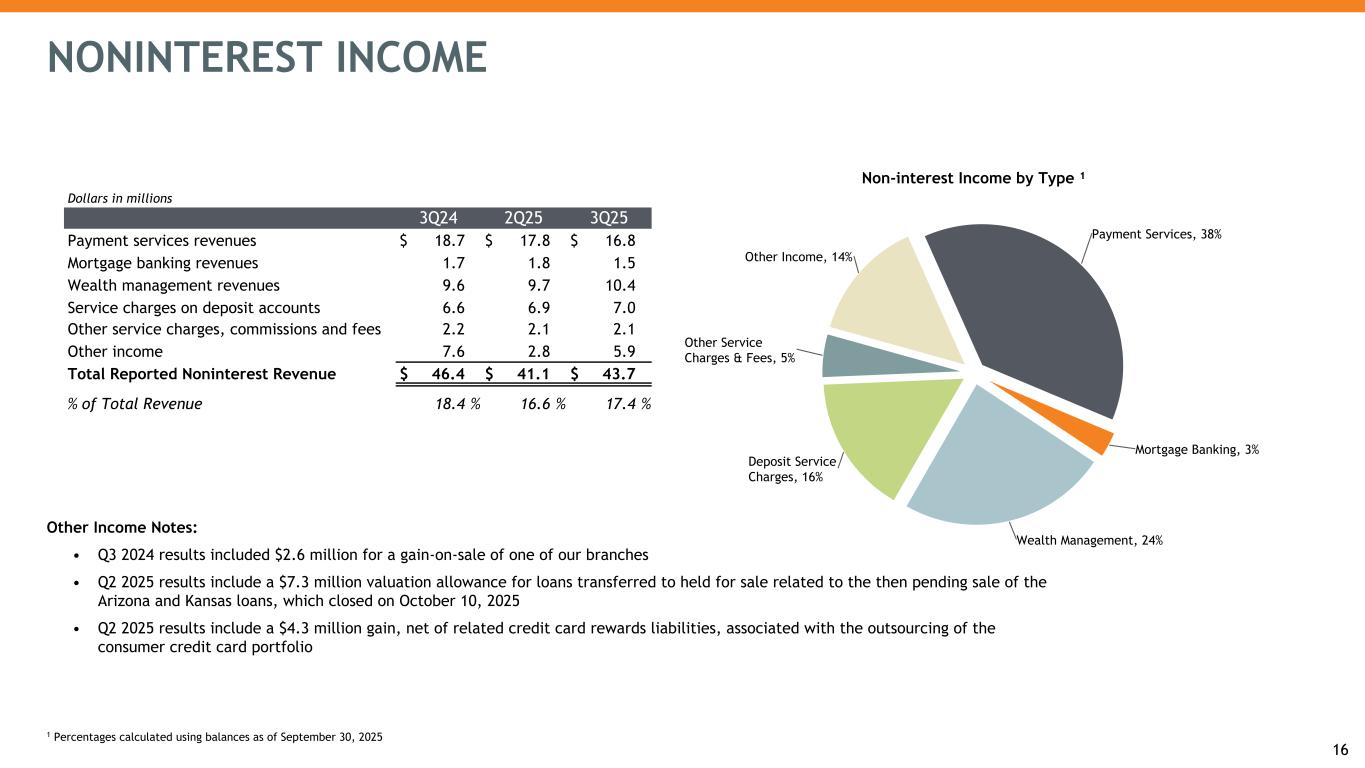
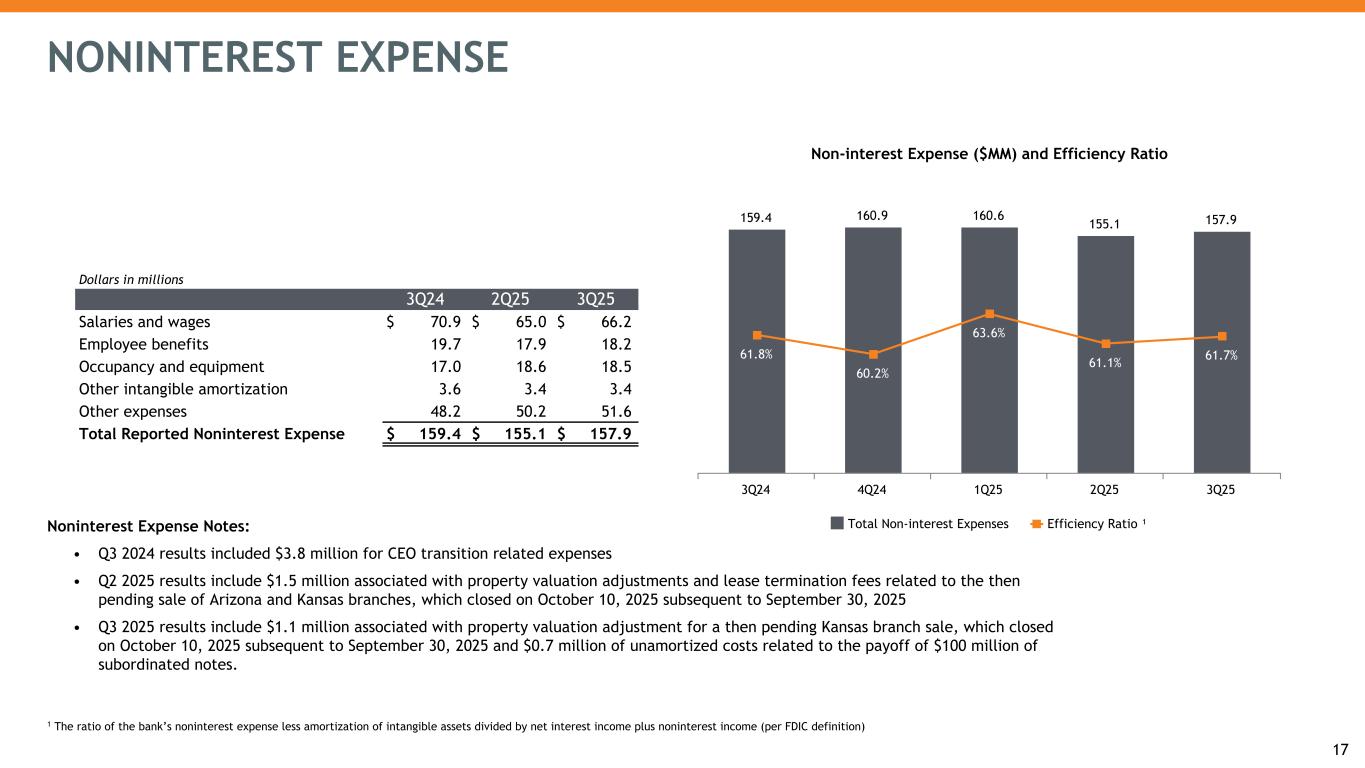
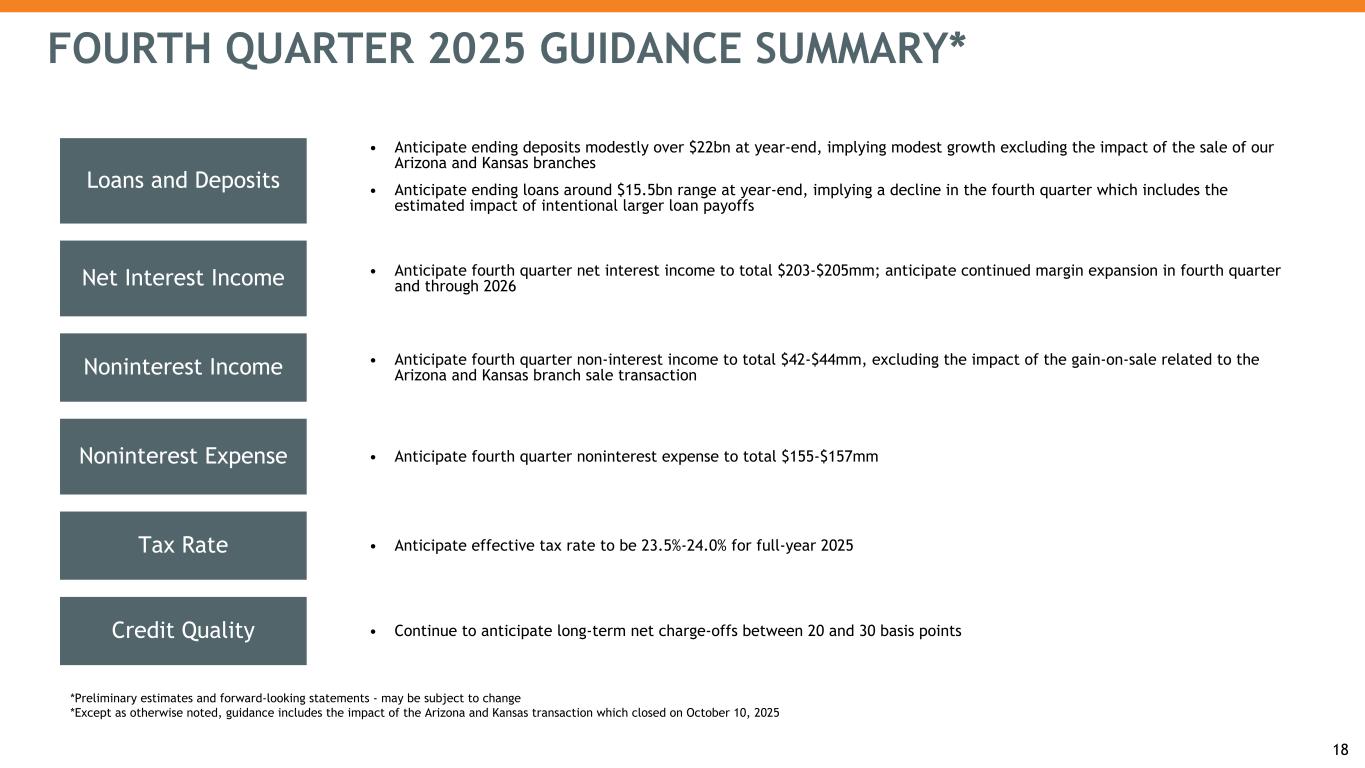
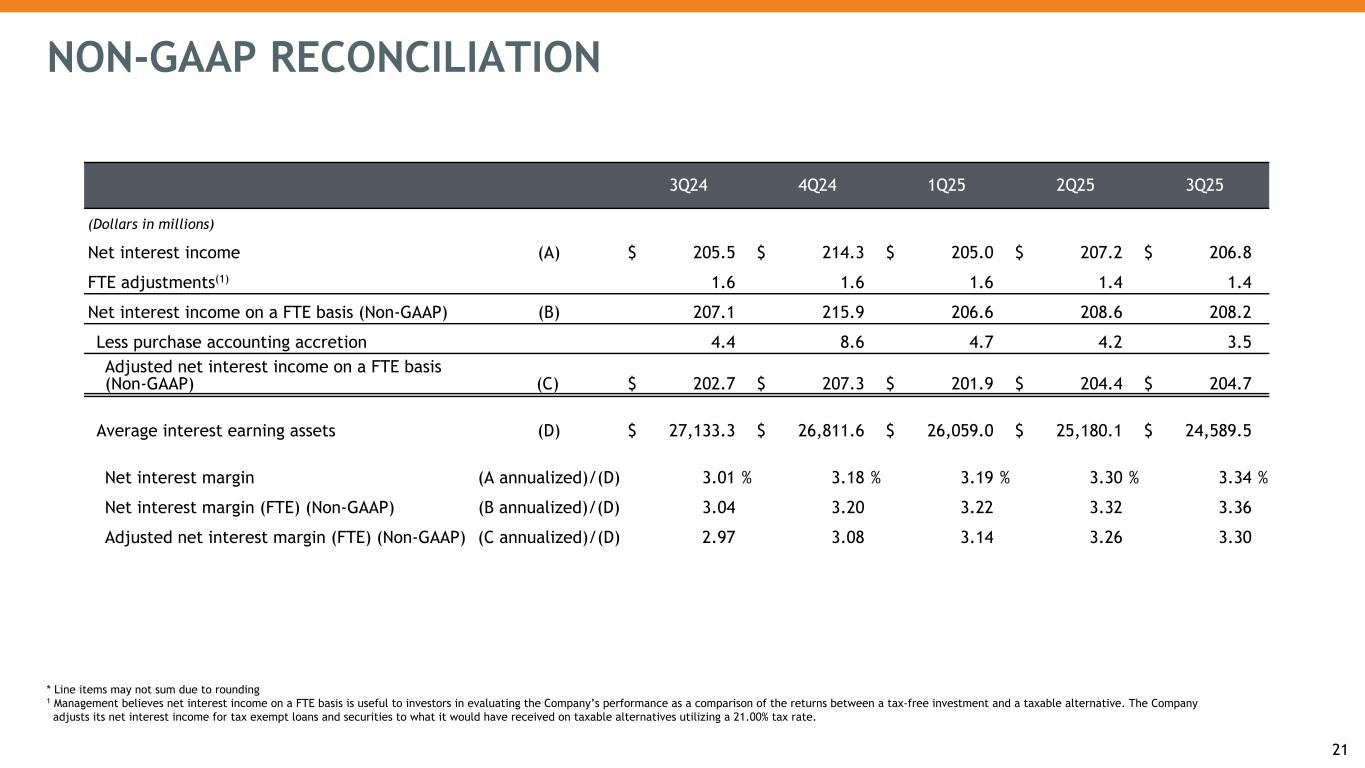
Thanks, Jim. I'll start with our results for the quarter and then discuss capital. For the third quarter of the year, the company reported net income of $71.4 million, dollars or 69 cents per diluted share compared to 71.7 million dollars or 69 cents per diluted share in the second quarter. Net interest income decreased 0.4 million dollars compared to the prior quarter or 0.2 percent to 206.8 million dollars. Net interest income increased 1.3 million dollars compared to the third quarter of 2024 or 0.6 percent primarily due to a decrease in interest expense resulting from decreased rates and average balances of other borrowed funds. Purchase accounting accretion decreased $0.7 million in the third quarter versus the prior period. Yield on average loans increased three basis points to 5.68% in the third quarter. Total deposit costs increased two basis points compared to the second quarter, with total funding costs decreasing five basis points. Our fully taxable equivalent net interest margin was 3.36% for the third quarter, compared to 3.32% during the second quarter and compared to 3.04% during the third quarter of 2024. Excluding interest accretion from the fair value of acquired loans, the adjusted FTE net interest margin was 3.30%, an increase of 4 basis points from the prior quarter, primarily driven by lower or interest expense resulting from decreased borrowings. Non-interest income was $43.7 million, an increase of $2.6 million from the prior quarter, driven by a valuation allowance on loans transferred to held for sale in the second quarter, and partially offset in that same quarter by the gain on sale from our credit card outsourcing. Non-interest expense was $157.9 million for the third quarter of 2025, an increase of $2.8 million from the prior period. This includes $1.1 million associated with a property valuation adjustment for a branch included in the Arizona and Kansas divestiture, which closed after the end of the third quarter, and $0.7 million of unamortized costs related to the payoff of the 2020 $100 million subordinated note issuance, which was paid off in the third quarter. Turning to credit. As Jim mentioned, net charge-offs decreased $3.5 million in the third quarter to $2.3 million, representing six basis points of average loans. Total provision for credit losses was zero for the third quarter, and criticized loans decreased $38.9 million, or 3.2%. Our total funded provision increased to 1.3% of loans held for investment from 1.28% in the second quarter. Moving to the balance sheet. Loans decreased by $519 million in the third quarter, which included $66.8 million of continued amortization of the indirect portfolio and larger loan paydowns and payoffs. Total deposits decreased $25.6 million to $22.6 billion as of September 30, 2025. The ratio of loans held for investment to deposits was 70.1% at the end of the quarter compared to 72.3 percent at the end of the prior quarter and 78.8 percent at the end of september in the prior year finally we declared a dividend of 47 cents per common share which equates to a six percent annualized yield based on the average closing price of the company's common stock during the third quarter our regulatory capital ratios continued to increase with our common equity tier one capital ratio ending the quarter at 13.9 percent an increase of 47 basis points from the prior quarter driven by lower risk weighted assets tier one capital was approximately unchanged as retained earnings were utilized to repurchase shares in the quarter before we outline our guidance we'd like to provide some detail on the impacts we anticipate from the two branch transactions we have discussed with respect to the arizona and kansas divestiture they closed earlier in october we anticipate recognizing an approximately 60 million dollar pre-tax gain in fourth quarter results the impact of this transaction is included in our guidance on a go forward basis excluding the impact of the gain we anticipate the quarterly impact on net interest income to be about six million dollars we anticipate a quarterly ongoing expense reduction versus third quarter levels in the three and a half to four million dollar range which includes the benefit of some operating efficiencies gained from exiting those two states in their entirety regarding the nebraska branch sale we have just announced this month we view this as approximately one percent dilutive to annual net interest income and reducing non-interest expense by about one percent on a run rate basis upon closing we anticipate around 15 basis points of cet1 accretion moving to our net interest income results for the quarter and our forward expectations net interest income was essentially flat quarter of a quarter excluding purchase accounting accretion while modestly lower than our prior expectations this is reflective of a near-term change in asset composition we continue to expect sequential improvement in the margin and that interest income from our fourth quarter levels into 2026 and 2027 and on that front we have expanded our fixed and adjustable rate repricing disclosure and the investor presentation to provide 2027 expectations first within the earning asset base we would note a couple of items in the quarter. As Jim mentioned, loan balances declined more than expected. We were pleased to seek sequential improvement in our loan yield as the portfolio continues to reprice over time. As a reminder, just over 20% of the loan book is variable and we do not have any active swaps. Within the investment portfolio, call activity was elevated across multiple security types, including some higher yielding bank sub debt. Given the significant spread tightening in this type of credit that occurred in the quarter, we reinvested proceeds in lower risk-weighted securities, which, while impacting near-term NII slightly, we view as accretive on a return on capital basis. Additionally, approximately 10% of our investment portfolio is comprised of AAA CLOs, which we hold in the context of our interest rate risk management to provide a natural hedge to our more fixed-rate lending book. During the quarter, as spreads tightened, more than half of these securities were called, and we actively reinvested in a new issuance market. This resulted in both less carry during the quarter, as well as an impact on average balances as presented in the margin calculation, as the longer settlement periods resulted in higher average unsettled balances. The impact of higher unsettled securities, while not affecting net interest income, reduced reported net interest margin by about two basis points in the quarter. We believe the continued amortization of low-yielding mortgage-backed securities, as well as other select maturities in the portfolio, will provide us an earnings tailwind as we move through the next few years. While not included on our slide, our 2028 to 2030 cash flow expectations in the investment portfolio, based upon current market expectations, are roughly $1 billion in each year at around a 2.5% yield. In total, our current expectation is that about two-thirds of the investment portfolio, excluding the CLO exposure, will cash flow through 2030. On the funding side, we ended the quarter with no other borrowed funds outstanding, a decline of $250 million from the prior quarter. Additionally, we paid our $100 million sub-debt issuance in full in August, which it converted to its variable rate prior to being called. This will provide additional benefit to the cost of funds in the fourth quarter, as compared to the third quarter. Our interest-bearing deposit costs increased three basis points in the third quarter as we experienced select customer movement into higher-yielding products ahead of the anticipated Fed rate cut. This activity resulted in deposit costs modestly higher than our prior expectations in the quarter, but we believe it was prudent to protect key relationships. During the quarter, we did take steps to capture interest-bearing deposit beta in the fourth quarter. We have reduced our offered CD rate by 55 basis points from the level on June 30th and anticipate seeing the benefit of this reduction beginning in the fourth quarter and more meaningfully in 2026. We have also proactively managed our exception pricing book, shortening duration in preparation for Fed moves and providing more immediate flexibility in managing deposit costs, with the initial benefit of this action occurring in October. We are optimistic for a slightly higher beta in the coming quarters than we experience in recent periods. As we look to 2026, while we will provide more explicit guidance on our January call, we wanted to provide some commentary today. We have intentionally managed the balance sheet to what we view as a mostly neutral position, which we feel is prudent over a long horizon. As we think about the impact of Fed cuts to our net interest income, the ability of the bank to move interest-bearing deposit costs lower will be a key factor. We have taken an intentional approach to thoughtfully achieve the necessary beta, and early results are positive. With that said, we would acknowledge there will be some lag in beta in the near term. From the anticipated fourth quarter annualized level, which includes the impact of the Arizona and Kansas divestiture, we anticipate net interest income expansion around mid-single digits in 2026, assuming approximately flat total loans and modest deposit growth. On the expense side, our current expectation is to keep expense growth to a low single digit increase over the anticipated full year 2025 level. Moving to capital, we are making balance sheet decisions with a long-term view to enhance returns and shareholder value. As we continue to communicate, our long-term strategy remains focused on generating well-priced organic growth within our markets where we have brand density and are well-positioned to serve the needs of our customers. In addition to the strategic actions to date that have successfully generated capital, in recent periods, risk-weighted assets have declined more than anticipated. While we look to drive growth, we will do so in a disciplined manner, ensuring that assets placed on the balance sheet are accretive to our return profile. with that in mind regulatory capital levels are strong and continue to improve as we have previously stated we do not intend to hold excess capital in august we announced a share repurchase authorization and begin executing shortly thereafter this included entering into a 10b 51 plan in early september we have repurchased about 1.8 million shares through october 28th or about 1.7 percent of common shares outstanding we believe that the current valuation of our equity does not reflect the long-term fundamental earnings power of the franchise, given the meaningful gap to market rates in our investment portfolio, as well as an expectation for improving core spread between our loan yields and deposit costs over time. As a result, we view share repurchases as our immediate capital allocation priority, in addition to our ongoing focus on organic growth, which provides us the opportunity to drive EPS growth and excessive net income growth. And now I'll turn the call back to Jim. Jim.
Thanks, David. We continue to execute on our strategic plan to focus on organic growth and leverage our strong balance sheet to support our customers. One year in, I would like to reflect on what we have achieved as a team since arriving here in November of 2024. Over the past year, we have shifted our company to focus solely on organic growth and relationship banking. We have completed a deep dive on credit management that has brought about stability, positioning us for performance in various economic scenarios. We have exited non-relationship businesses and exited transactional loans. We have made significant progress assessing our branch footprint, exiting markets that do not make sense for our organic growth strategy, and focusing investments in areas where we have strong share and growth opportunities. We have taken capital freed up by these efforts and are returning it to our shareholders through share repurchases with a goal of creating long-term shareholder value. These efforts have positioned us for an exciting future as we look to 2026. And now I would like to open up the call for questions.
Operator
Thank you. Ladies and gentlemen, we will now begin the question and answer session. Should you have a question, please press the star followed by one on your touchtone phone. you will hear prompts that your hand has been raised should you wish to decline from the polling process please press the star followed by the two and if you are using a speakerphone please lift the hands up before pressing any keys one moment please for your first question and your first question comes from andrew terrell from stevens please go ahead hey good morning um maybe just to start just on on kind of the the loan growth outlook i appreciate you know of the 4Q guidance and, you know, 2025 has been somewhat of kind of a transition year.
I guess I'm just curious, as you look at it at 2026, do you think you're in a position to return to net loan growth? Can you talk about, you know, the opportunities and the headwinds to getting the balance sheet back to net growth?
Yeah, good morning, Andrew. This is Jim. That's a good question. And loan growth's our number one focus, as you pointed out, based on the trends. And I touched on some of this in the call. You know, we've seen some challenges here in the last quarter, just less demand, both real estate and construction. And we also had some higher payoff activity associated with non-relationship loans and their loan types that, you know, we're not interested in renewing. The other thing, there's just been less construction loan tailwind funding as we've originated fewer construction loans the last couple of years. And then we also had some loans go to the secondary market. Your questions on the go forward, we do see improved opportunity for growth. We've made a number of changes to our credit culture and the team's comfortable with that new playbook. In fact, we also just implemented some streamlined approval processes because speed to market matters. We actually just had four meetings where we got the teams together in Boise, Billings, Denver, and Omaha with a real focus on business development, development, growing the pipeline. And, you know, we're in the process of determining our goals for 2026. And there are incentives tied to these goals, you know, what you measure is what you move, which includes not only loan growth, but also deposits. But, you know, we've been intentional about setting us up for growth, you know, refocusing the footprint and prioritizing our deployment of capital, as well as putting in a risk culture to support smart growth. And we're now on the offense. And given our growth communities and strong balance sheet, we're optimistic about our growth in 26.
Great. I appreciate that, Jim. If I could ask just on on capital, you know, your CT1 is built pretty materially over the past year or so. And I think given the guidance and the branch on the fourth quarter should continue to build pretty nicely in the near term. You've got the buy bag that you're active on currently, but $150 million on the buyback doesn't feel like it moves the needle a lot relative to the capital that you've built. So I guess the question is, should we expect you to get more active on the buyback front, or are you interested in securities restructuring transactions? Two-thirds of the bond book sounds like cash flows before 2030, but that's a decent ways out. Would you entertain a securities restructuring with the excess capital?
Yeah. Hey, Andrew, good morning. I think I'll take that question backwards and start with the securities restructure. You know, I think if you think about our recently announced buyback and kind of how we're thinking about our capital priorities, we don't view that as our priority right now. So we think the tailwind, the combination of those cash flows, and then the tangible book value accretion we'll get over the next few years, we think that's meaningful. So our focus right now isn't on the securities restructure, it's on the repurchases. So to your point, the $150 million, it moves us towards our objectives, but there is optionality there. So whether it's organic growth accretive to our return profile or additional return of capital to shareholders, that's what we'll be looking at as we execute that buyback. Like we said, we're not intending to hold excess capital. So as we get through that buyback, we'll obviously look and see what makes sense at that time and then consider additional repurchases if it makes sense at that time. Obviously, we manage capital through a few different lenses, looking at our capital ratios, holding company, bank, regulations, bottom build market assessment all those things you'd expect and we our current analysis does indicate we have healthy capital levels relative to those lenses so we'll be looking at additional actions as we go forward based on the facts and circumstances perfect thank you for taking the questions thank you your next question comes from kelly mata from kbw please go ahead hi good morning thanks for the question um you know i i appreciate the um preliminary outlook for mid-single-digit NII growth next year.
Just wondering if you could help us kind of put together, you get great disclosures on the roll-off, but where new loan originations have been coming on?
And if you could, I know that your commentary mentioned that it's been a bit slower than you've expected, just if you could size kind of what production has been this quarter and the past couple, that would be helpful as we look forward thank you morning kelly so i think from a yield perspective we've talked in the past kind of that five-year point of the curve is where we're most sensitive from a new production standpoint that's of course come down a little bit in recent periods so if you look at pricing over the third quarter where we saw roll on july august was higher than september right so kind of moving into the sixes into september it's going to depend on composition of course what those loans look like, what the types are, et cetera. But given where the five year is, anywhere from kind of low sixes to high sixes, depending on, I know it's a wide range, but kind of depends on where the curves are and what the composition looks like. And then, you know, I think Jim talked a little bit about production. There's obviously a gap today between that and flat loans. So I think that's kind of how we would size that.
Got it. That's helpful. And your guidance here implies some additional larger payoffs as you look ahead to 2026 is there is there any way to size kind of how much more of a headwind could come from some of this intentional runoff which results in a smaller balance sheet but is prudent from from a risk adjusted perspective thank you thank you yeah so i think we've been pretty intentional about that in 2025 it doesn't mean more won't occur as we go forward and we look at individual loans, but we feel like we've done a good job making our way through that process and we feel like we're getting closer to where we're
comfortable from that perspective.
Okay, that's super helpful. Last question to close the loop on loans and production.
Jim, you've mentioned now you have these branch sales to kind of redistribute some of um uh the expense base and capital to where you see better opportunities for growth can you speak to any anything you've done on the recruiting side and the opportunity there as you look ahead thank you yeah so we um you know as you mentioned we've re continued to refocus the footprint and reinvest where we see growth opportunities so yes we have acquired some talent in Colorado in specific and because we see opportunities there but we've also just seen some additional opportunities in kind of that Rocky Mountain Northwest part of our footprint a little bit more activity but yes to answer your question we recruited talent and I've been player coach on the ground as well great thanks for all the color I'll step back thank you and Your next question comes from Jeff Rullis from DA Davidson.
Operator
Please go ahead.
Thanks, good morning. A couple of questions on credit. Wanted to, first, I don't know if you've got the size or the balance of that criticized loan that paid off in October.
Yeah, so the October payoff on that criticized loan was just over $50 million.
Okay, great. Thanks, David. And just to kind of course correct on the net charge-offs, I think you've got about 13 basis points year-to-date, and you've mentioned a couple times muted and continue to reiterate the 20 to 30 basis points. Is that visibility on some of the credits that you're running through? I just want to – and is that a historical years out, or is it the 20 to 30 kind of in the next six to nine months type of guide?
Yeah, good question, Jeff. I think the way we think about our charge-off guide is that's kind of our longer-term expectation. Given our loan book has a smaller consumer portion, it's less consistent on a quarterly basis, and charge-offs are going to be driven, of course, by unknown actions as well as resolution of credits on a quarterly basis. So there might be volatility on a quarterly basis. Obviously, we've seen positive results year-to-date, but we think 20 to 30 is the right long-term expectation there.
Okay, so nothing like a Q4 specific, something's coming down the pike that you're happy to operate below that, but you're just going to kind of put that guide out there. Is that fair to say?
Yeah, it's going to depend on resolution of specific credits, right? So we're not specifically guiding to any individual resolutions, but there could be quarters where there's higher or lower figures depending on activity in that quarter.
Thanks. And did you guys have a classified assets number, maybe link quarter? I didn't see it in the release.
I think it's kind of midway through the release, up very slightly on a reported nominal basis there.
Okay. Sorry, I missed that. And then I guess – sorry, last question. just on the margin appreciate slide nine and the earning asset yield quite a bit of roll off here coming on loans and securities i don't know if you'd hazard a sort of a terminal margin level other than you've guided towards upwards in the near term but as you kind of exit 26 is there a a broader range that you think you've kind of settled in at um that's a lot of loans a lot of securities coming off at below market rates so just want to kind of obviously execution on the deposit side as you mentioned but any thoughts on the margin as we exit 26
yeah so the mid single digit flat loan guide would imply a north of 350 x purchase accounting exit rate through 26, kind of around that 350 for the full year, and then an exit north of that. It's obviously going to depend on the curve, you know, the level of loan and deposit growth. But that's kind of what that would imply. We think our long-term margin can be higher than that, right? And you can look at the historical performance as well as just the current yield on the investment portfolio.
But that's kind of how we think about that and jeff david touched on this in the opening comments but you know we've also shortened the duration of except exception priced deposit relationships and things just in anticipation if we have further rate cuts we have flexibility and can be nimble there as well appreciate it thank you thank you and your next question comes from jared shaw from barclays Capital, please go ahead.
Hey, guys. Good morning. Good morning. Can you hear me?
Yep. Good morning, Jared. Sorry.
Hey. So just going back to the growth discussion and your focus on, you know, I guess you could call it better markets or more dense markets. How does that sort of match up with your commentary on pricing and terms becoming more difficult? You know, Jim, in the past, You talked about the attractiveness of Denver and your background there, but it feels like from just hearing other banks that that's a target for a lot. Do you see the competitive environment moving in your direction where you're going to be able to actually execute on some of that desire to grow in those markets, or do you think you end up having to change some of the parameters?
You know, I can just tell you in general, and I think this holds true probably across everybody's footprint, it's more competitive in metro markets than it is mid and smaller markets. You know, we have a pretty strong presence in mid and smaller markets. You know, the thing is, Jared, we'll remain disciplined. You know, I touched on it in the opening that we've seen some efforts from a competition standpoint on structure and pricing. And, you know, those are 100% risk-weighted assets, and so they're rated at that level for a reason.
So you want to be disciplined, and we're not going to chase growth for growth's sake, but, you know, we want to grow, but we're going to be smart about it because, you know, in these times, I think that chasing growth for growth's sake isn't a good decision either. okay and then just looking at the you know david's commentary about sort of flat loans after uh after a bit of a decline in fourth quarter but then your answer about optimistic for growth in 26 um what's what's the optimistic for growth in 26 is that production and sort of the the early stages or or you know as we move through the the year maybe that growth increases jerry i'll take the
first half and then turn to Jim for the second half of the question. So I think just on that 26 discussion we had in the prepared remarks, our intent there was to help with our view of 26 if loans were flat. That isn't necessarily a loan guide at the current time, but that's kind of our view of the underlying repricing of the balance sheet.
Yeah, and Jared, on the reason for the optimism in 26, you know, I mentioned we just went on the road and there was a number of us executives that did that and met with the teams, brought everybody together, which hasn't happened for a few years, and got them in the same room. And I can see, you know, the talent. I've met all the talent out on the road, but getting everybody in a room together, sharing ideas, best practices, what's working, and talking about the importance of growth makes a difference. We are in, you know, relationship bankings, both internal and external.
And so I look at that, and then I just look at, you know you look at our balance sheet it is a really strong balance sheet i mean we have liquidity we have strong capital it's a position of strength to operate from um and then you combine that with the core low cost funding source i just think we're in a really good position for 26. okay thanks and then maybe shifting to the expenses um you know david i guess the the guide for next year is low single digit growth and expenses versus the full year 25 so that I guess it includes the the benefits from the branch divestitures that should we be looking or is there an expectation for positive operating leverage in 26 and are there any
investment initiatives in systems or technology or maybe even incrementally new branches as you as you go through the year that's included in that yeah so i a couple things i think you know to to be clear on that low single digits it's low single digits right so we're we're very focused on expenses and we're being careful and thoughtful and investment's important and we're continuing to make investments there are some branches we're adding we mentioned we mentioned branches in the prepared remarks but it's a thoughtful approach as we wait to see that that growth come um and so broadly yes there is an expectation for improved operating leverage great thank you yeah and jared we're going to be you know until we see the growth uh we're going
to be very disciplined as david mentioned on expenses and same goes with uh our capital levels i mean if uh absent organic growth um you know we already talked about the authorization for a stock buyback uh you know we will continue to to make sure we're enhancing shareholder return thank you and your next question comes from matthew clark from piper sandler please go ahead hey good morning thanks for the questions um first one for me just on on capital again you you mentioned you don't want to hold excess capital but your ct1 is 13.9 percent what's
What do you view as your CET1 target and how quickly can you get there?
Yeah, so I think it's a good question. I think, you know, capital levels lag balance sheet a little bit, right, when you see these type of changes in risk-weighted assets. I think, you know, from a target perspective, we'd kind of guide you from a CET1 perspective more in line with the peers in the near term. And, you know, I talked before about kind of our process, right? So that does imply a significant amount of optionality, which I mentioned earlier as well. So the 150 starts to move us in that direction, but there is optionality for us to consider additional return of capital and grow organically. So we feel like we're in a good position to continue to enhance returns.
Okay. And then do you have the spot rate on deposits at the end of September?
Yeah. So interest-bearing deposit costs in September were 1.8%. Like we said before, we've seen some positive movement into October as it relates to capturing beta, but 1.8% interest-bearing was the September spot.
And then your core loan yields were up three basis points, I think, to 568. Because what's your view of the core loan yield outlook with the back book repricing next year and assuming the forward curve plays out?
Yeah, so it's a good question. Obviously, you know, timing of rate cuts mattered 20% of the loan, but a little over 20% variable. So each cut is about five basis points in immediate change in loan yield. So next year or over the next 12 months, if there's, you know, four or so cuts, we think that probably broadly will offset a lot of the, you know, expansion, right, which is kind of how we talked about in the context of expanding spread between loans and deposits. So what's helpful in this environment to us is we do get that back book repricing, which helps offset some of that rate impact as rates move. So obviously the five year is important as we think about that repricing, but we see it as an improving core spread story.
Okay, great. Thanks again.
Operator
Thank you. And your next question comes from Timur Brazil from Wells Fargo. Please go ahead.
Hi, good morning. Good morning, Timur. Good morning. I'm trying to tie the NII guidance for next year to the deposit side. It looks like deposit betas in 3Q take down a little bit as cost of deposits went up by two basis points. I think in your ALCO disclosure, the assumption is a 31% beta almost immediately on future cuts. Cycle-to-date beta is closer to 12%. And I guess, how do you calibrate those two? And as you talk about 26 NII, I guess, which beta assumption are you guys using?
Yeah, Timur, I'll take that in a couple different responses. So, you know, I think to your point, we have seen lower beta to date than we would have expected. And we talked about that a little bit in our prepared remarks. We think from here, given some of the actions we've taken, and we're seeing that in October so far, we anticipate capturing a higher beta than that. but we do when we talk about the lag that is a lag to that expected longer term beta right because I think where you see that lag is a little over 10 percent of our deposits or cds and those of course lag the vast majority reprices in a 12-month period around seven months is kind of where we see most of our activity there but that lag so we think that impact starts coming more meaningfully in 26 as we see those rates come down but our guidance does assume some lag in deposit beta versus our expectation for a more 12-month period.
And I guess kind of some of the branch sales and the balance sheet movements, I mean, is it fair to say that much of the NII growth is kind of back-end loaded next year?
We think of it sequentially, yes. That's how we think of it. I think, you know, the Q4 and our guidance includes the impact of the branch sale, right? the Arizona and Kansas branch sale. So that does step down the near term. And then we see it as sequential through 26. Q1 is always a lower NII period for us, just given the two fewer days and just how our loans, you know, accrue. But yes, we view it as sequential through the year.
Okay. And then on the loan side, you know, I asked this last quarter as well, but it looks like, you know, low teens of outstanding loans reprice or reset over the next 12 months. And last quarter I asked if this was an opportunity or a potential threat. It seems like production, at least now to your point, is below replacement levels. I guess how are you thinking of that, you know, of those resets, reprices kind of over the next 12 months? Is there incremental optimism that production starts to pick up? And if that's the sense, then maybe you just give us a little bit of color as to what asset classes you see picking up and absorbing some of those loan runoffs.
Yeah, Timor, that's a good question. You know, the asset classes, I think one of the strengths of the bank, I'll start with that, is the diversity of our balance sheet. I mean, and our footprint lends to that. so you'll see we see opportunities in cni as well as cre and uh as far as you know backfilling what what will be maturing and coming up there was more intentional runoff this year of things that just didn't fit the profile of what we wanted to do on an ongoing basis as well as some large transactional loans there's less of that in 2026 and so when you combine that with uh production that I think we can achieve in 2026, I think you'll see a return to some loan growth.
Great, thanks. And if I could just one more on M&A, maybe you had some of the BMO branches where we're in your footprint. I'd love to hear your thoughts around how that played out and if that was something that you guys were potentially looking. And then maybe from the other side, can you just take us inside the boardroom? I know there's been a lot of change with Class A, Class B shared. the solution over the last years and still some family ownership. Can you just give us some thoughts as to how the board is thinking about the franchise and if they're at all open to potentially partnering with another institution and taking advantage of some of this recent M&A activity?
Yeah, Timur, as we've stated in our earnings calls from day one, we're focused on organic growth and believe our brand density and branch network and, you know, in the growing markets combined with our strong balance sheet give us the growth opportunities in front of us so uh you know mna is not something we're focused on and you know absent near-term growth uh and given our current valuation you know we're going to buy back stock but we're focused on executing our strategic plan and uh around organic growth and you know our board takes their fiduciary responsibility seriously so um you know anything that would come our way they would uh certainly evaluate to look at what's best for shareholders. But we're focused on executing on our strategic plan because we're really confident of our future success.
Great. Thanks for the questions.
Operator
Thank you. There are no further questions at this time. Mr. Jim Reuter, you can continue.
All right. Thank you. And thank you, everybody, for your questions today. And as always, we welcome calls from our investors and analysts. So please reach out if you have any follow-up questions and thank you for tuning into the call today. Have a good day.