Operator
Hello, and thank you for standing by. My name is Regina, and I will be your conference operator today. At this time, I'd like to welcome everyone to the Flagstar Bank second quarter 2026 earnings conference call. All lines have been placed on mute to prevent any background noise. After the speaker's remarks, there will be a question and answer session. If you'd like to ask a question during this time, simply press star, then the number one on your telephone keypad. To withdraw your question, press star 1 again. I would now like to turn the conference over to Sal DiMartino, Director of Investor Relations. Please go ahead.
Thank you, Regina, and good morning, everyone. Welcome to Flagstar Bank's second quarter 2026 earnings call. This morning, our Executive Chairman and Chief Executive Officer, Joseph Fodding, along with the company's co-president, co-chief operating officer, and chief banking Officer, Rich Raffetto, and Co-President, Co-Chief Operating Officer, and Chief Financial Officer, Lee Smith, will discuss our results for the quarter. During this call, we will be referring to a presentation which provides additional detail on our quarterly results and operating performance. Both the earnings presentation and the press release can be found on the investor Relations section of our company website at ir.flagstar.com. Also, before we begin, I'd like to remind everyone that certain comments made today by the management team may include forward-looking statements within the meanings of the Private Securities Litigation Reform Act of 1995. Such forward-looking statements we may make are subject to the safe harbor rules. Please review the forward-looking disclaimer and safe harbor language in today's press release and presentation for more information about risks and uncertainties which may affect us. Also, when discussing our results today, we will reference certain non-GAAP measures which exclude certain items from reported results. Please refer to today's earnings release for reconciliations of these non-GAAP measures. Now, I would like to turn the call over to Mr. Otting. Joseph, please go ahead.
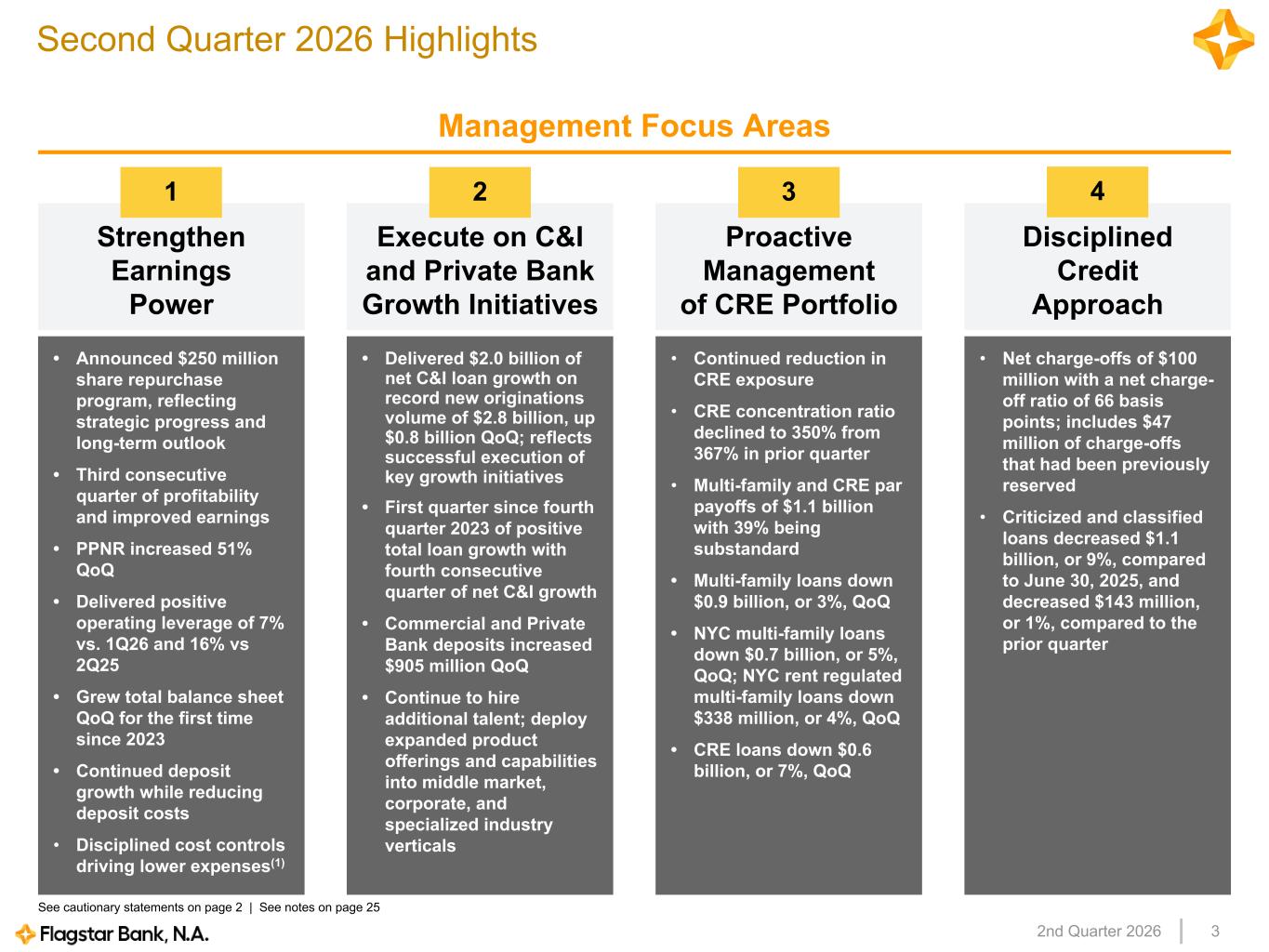
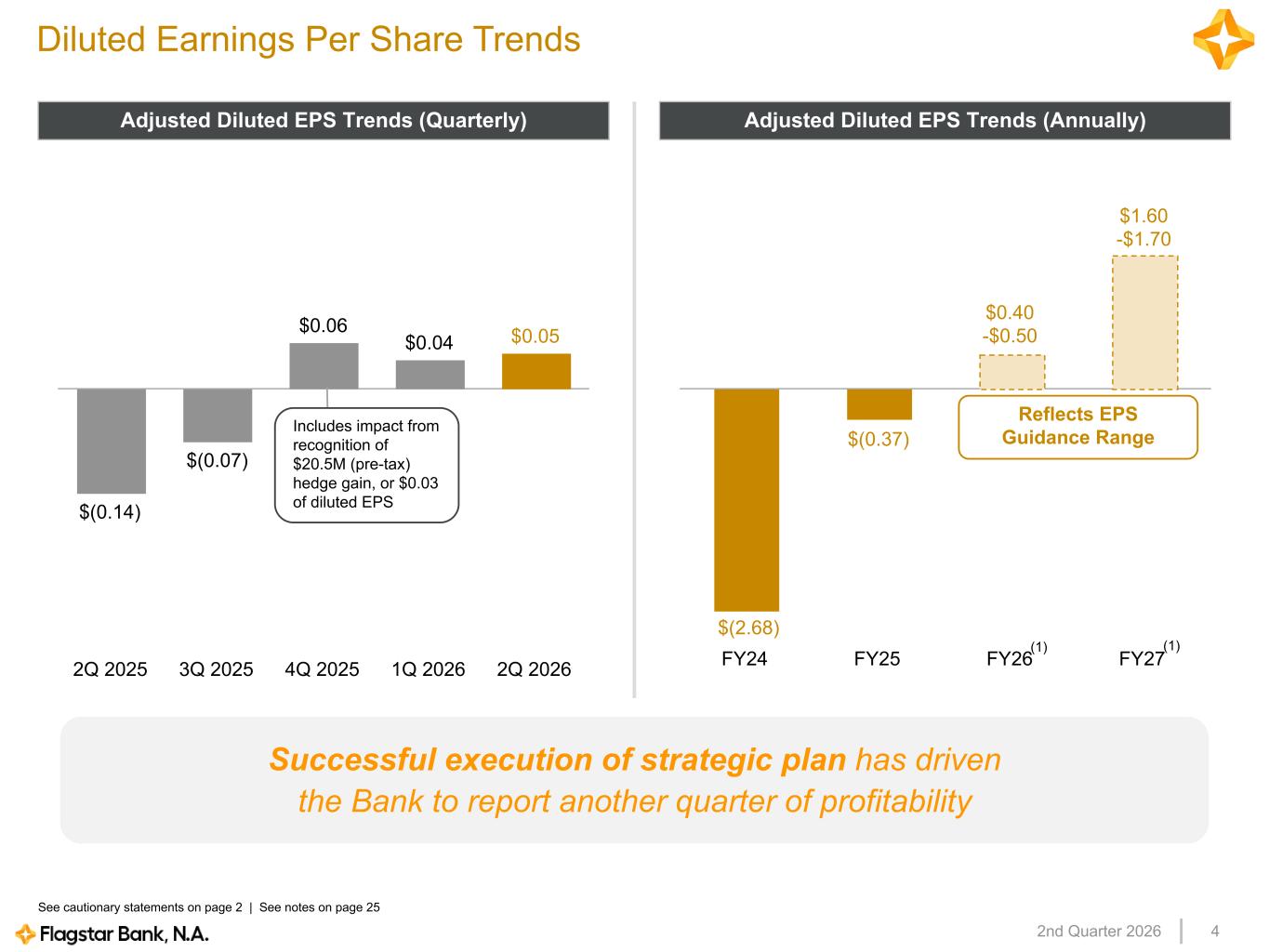
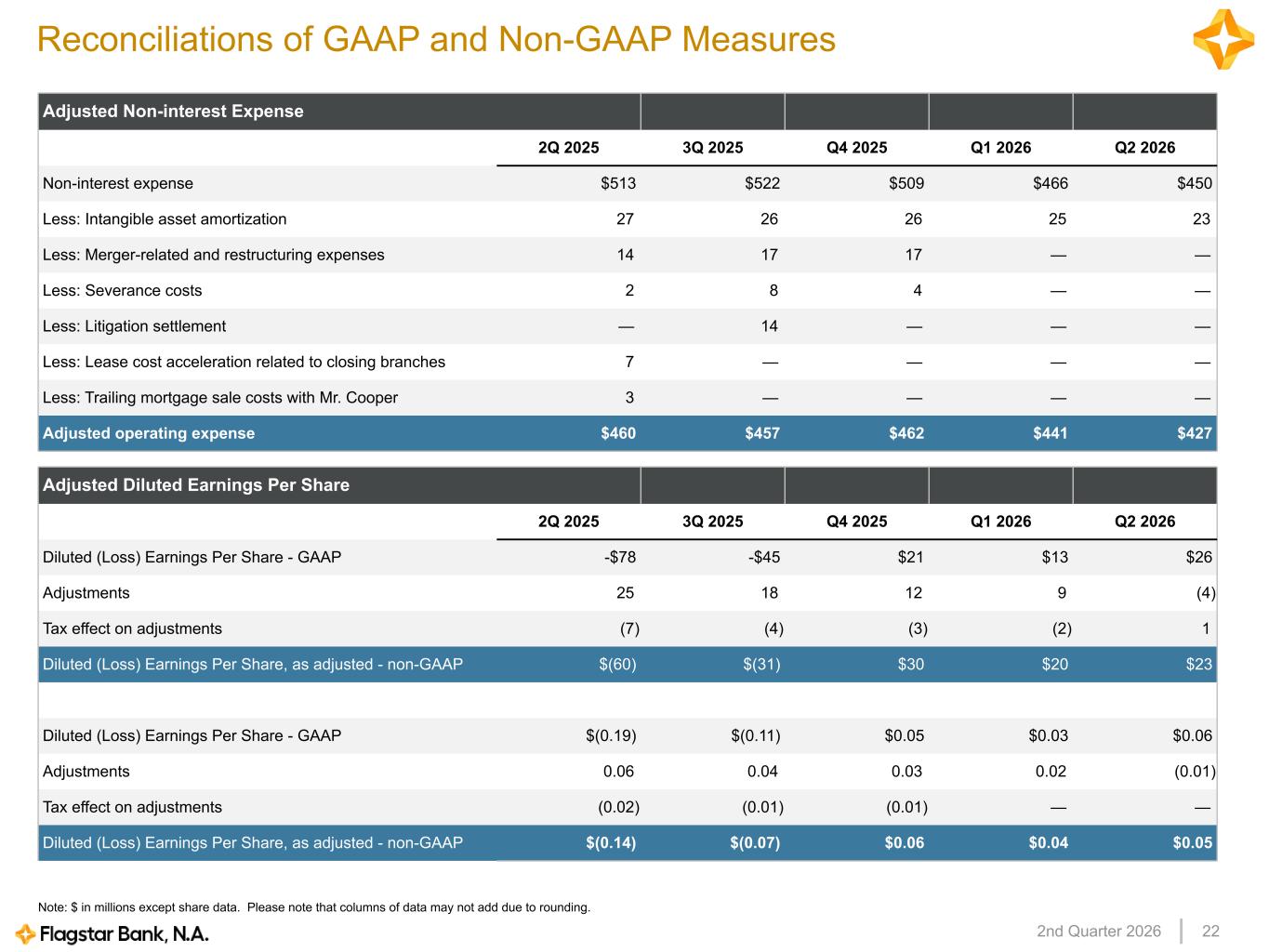
Thank you, Sal, and good morning, everyone, and thank you for joining us today. We are pleased to report another quarter full of meaningful progress across our franchise. Our results reflect continued execution against each of the strategic priorities we've outlined over the past two years. Our second quarter operating results reflect our third consecutive quarter of profitability and improved earnings. Higher pre-provision net revenue, the resumption of balance sheet growth, disciplined expense management, and the continued strategic reduction in the commercial real estate loan portfolio, a record level of CNI loan production, solid deposit growth, all while reducing our deposit costs, and a decline in our criticized and classified loans. This is the result of a clear strategic plan that we have laid out with discipline, execution, and the talent to build this across our organization. We are in the early stages of a multi-year growth story and we are confident that we are on the right path. For some more color, I'd like to turn to slide three. This slide demonstrates the underlying strength and momentum of our core banking business, as well as the tangible progress we are making against each of our four focus areas. Let me walk you through each one. Under our first focus area, we believe that our capital position remains a competitive advantage, providing flexibility to support our organic growth and return capital to shareholders. In that regard, I am pleased that this morning we announced a $250 million share buyback, a clear signal of the progress we're making on our strategic plan and long-term outlook for the bank. We are also pleased to report our third consecutive quarter of profitability and improved earnings as our pre-provision net revenue increased 51% compared to last quarter. Disciplined expense management has been a key contributor of our return to profitability. And in the second quarter, they declined 3%, helping drive positive operating leverage. Also, the second quarter marked an inflection point in our growth trajectory as the balance sheet grew by almost $600 million, as we indicated in the last call. And in terms of deposits, we grew core deposits this quarter by over $600 million while reducing deposit costs. Second, a key component of our transformation strategy is to diversify our loan portfolio by growing the CNI book of business. This quarter, we delivered $2 billion of net CNI loan growth on record origination volumes of $2.8 billion. This is our fourth consecutive quarter of net C&I loan growth, and the first quarter of overall loan growth since the fourth quarter of 2023. In addition to the strong loan growth, we also grew C&I in private banking deposits this quarter by approximately $900 million. Third, we continue to systematically reduce our CRE exposure as multifamily and CR par payoffs totaled $1.1 billion, which 39% of those were substandard rated loans. While the CRE concentration decreased to 350% from 367% last quarter and well over 500% when we originally came to the company. Four, in terms of credit, our criticized and classified loans declined 1% compared to last quarter, and are down 1.1 billion, or 9%, on a year-over-year basis. In the second quarter, we did experience an increase in net charge-offs to 100 million, but half of those were previously 100% reserved for. Next, turning to slide four, the EPS progression tells a compelling story of the bank's underlying momentum. On an adjusted basis, we moved from a loss of $0.14 in the second quarter of 2025 to earning $0.05 in the second quarter of 2026, representing our third straight quarter of profitability. Now I'd like to turn it over to Rich for FEDO. With our recent reorganization, Rich assumed responsibility for all the banking activities in the company. This is his first earnings report with us, and so I'd like to welcome Rich, and Rich, please, I'll turn it over to you.
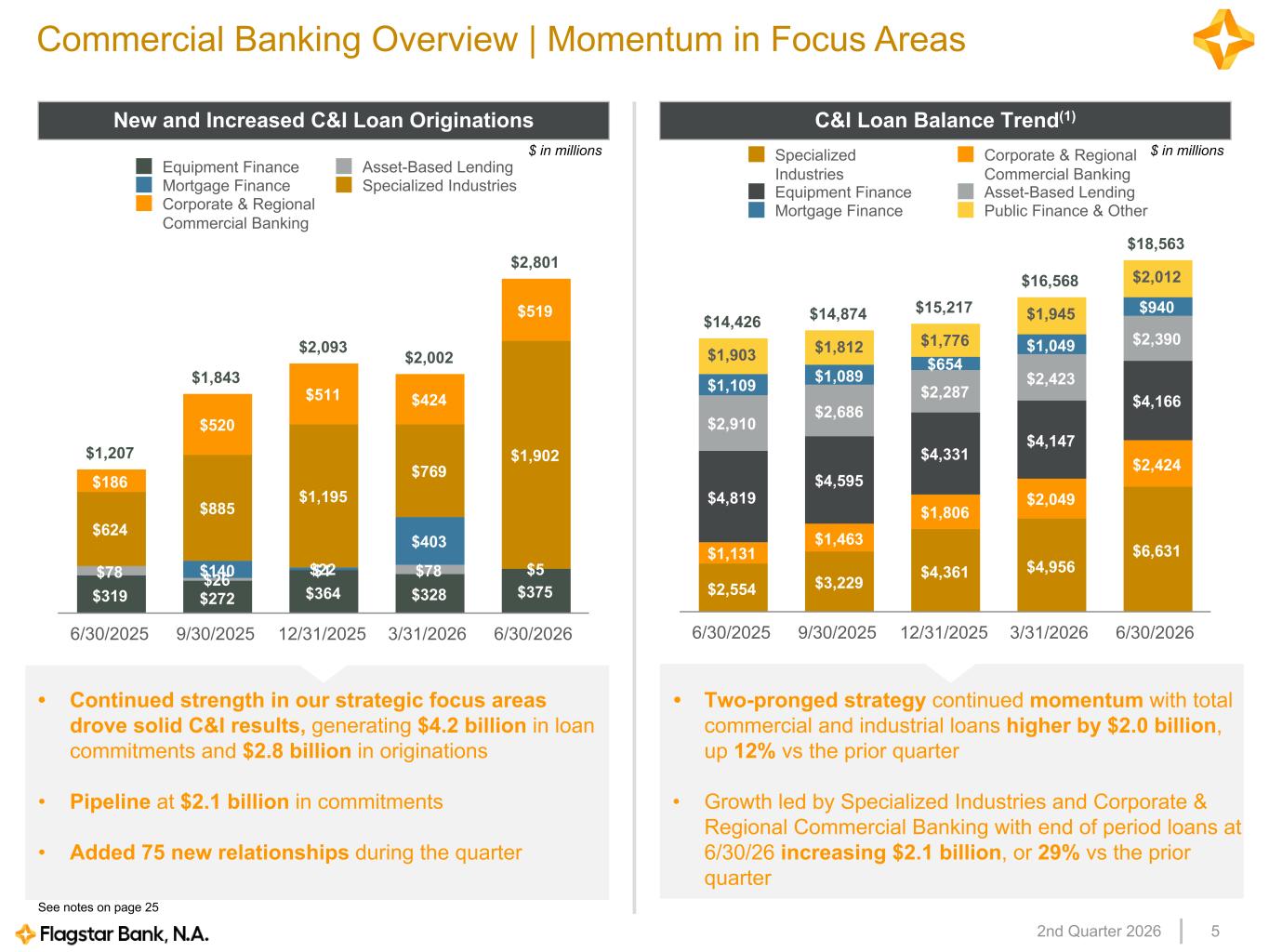
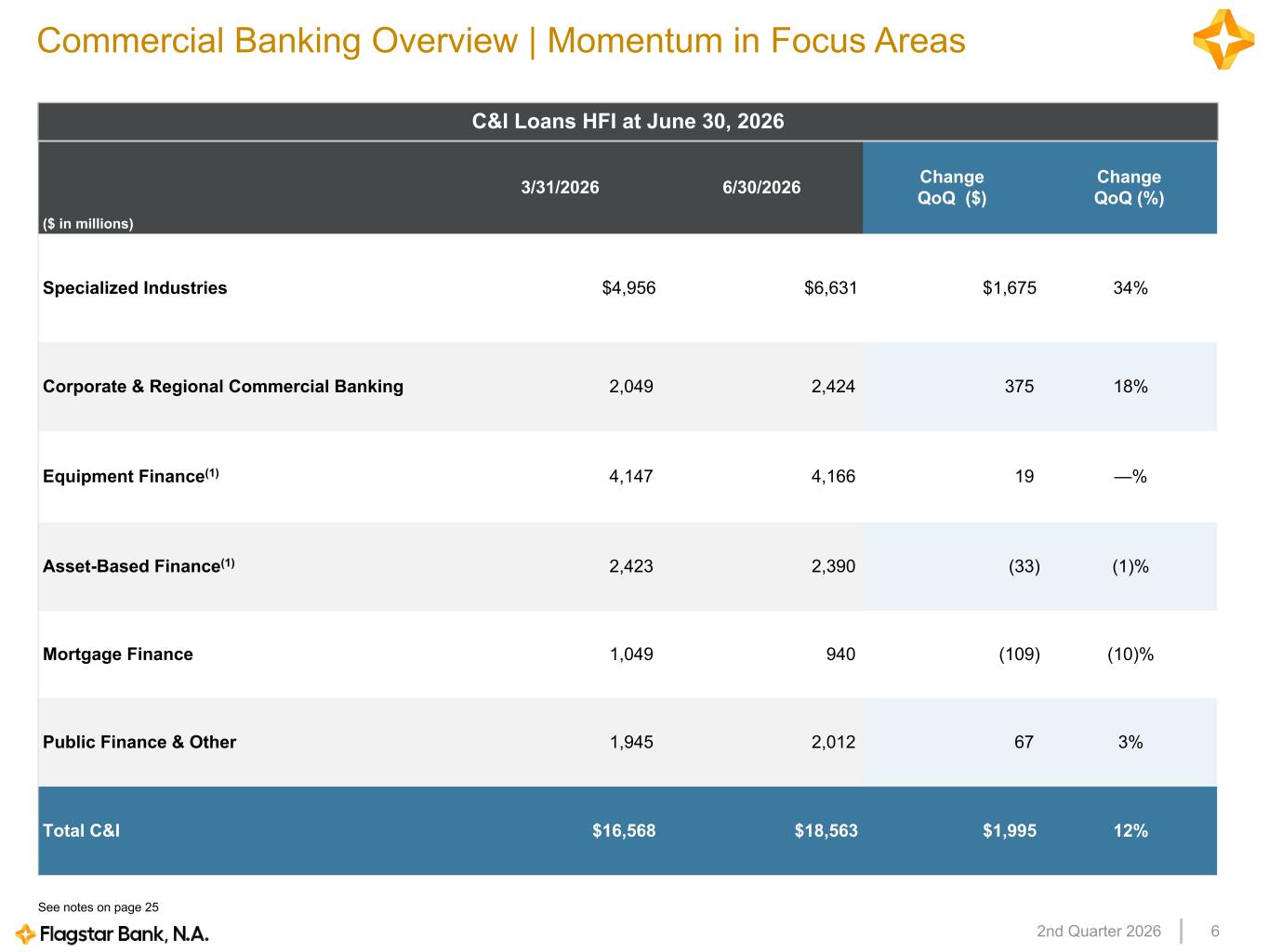
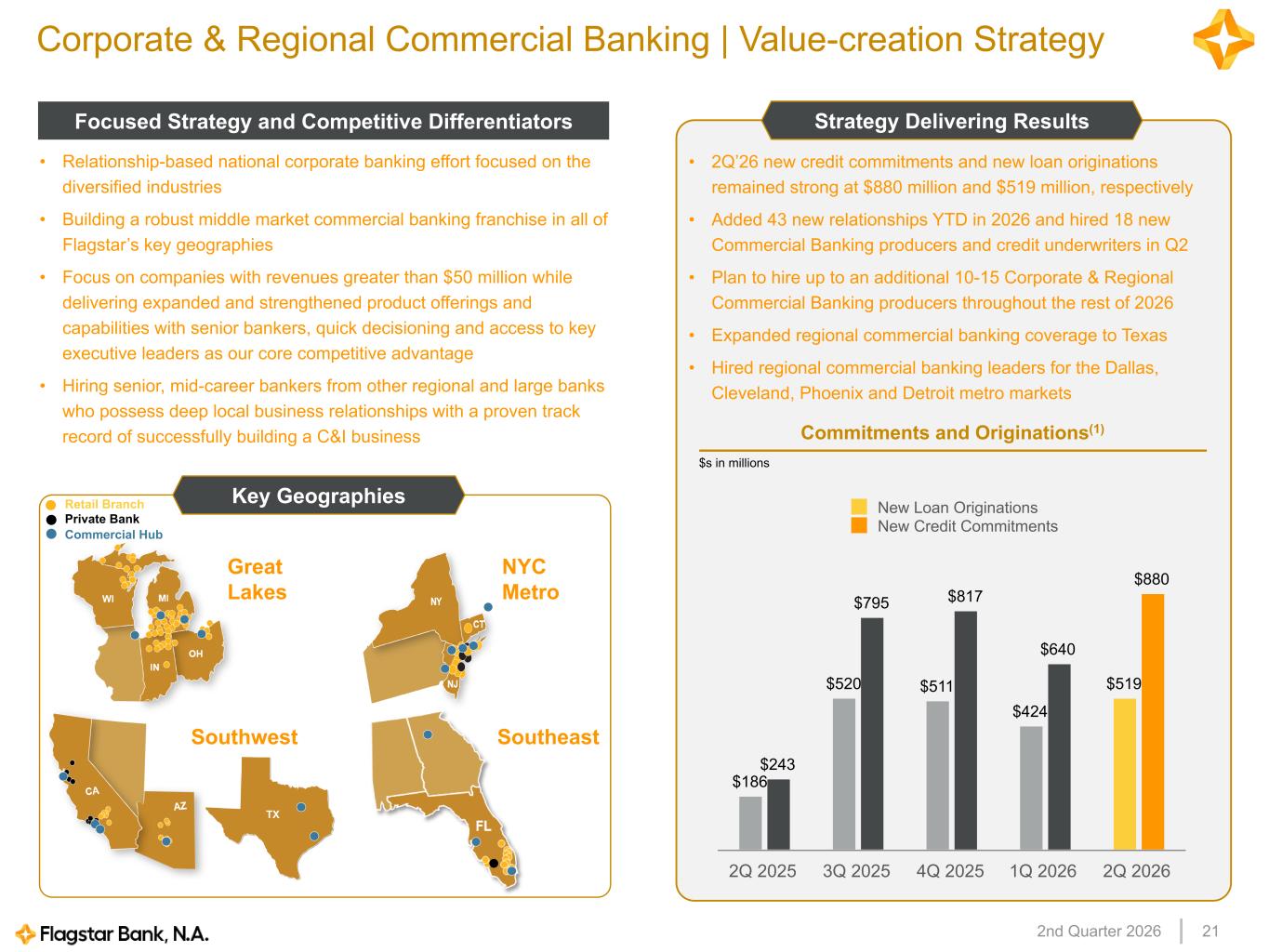
Great. Thank you, Joseph, and good morning to everyone as well. On the next couple of slides, I'd like to highlight the tremendous progress we are making in building out a scaled, relationship-based commercial banking business. As you turn to slide five, I am pleased to report that our commercial banking franchise continued to build significant momentum during the second quarter. Our two-pronged focus growth strategy, combining specialized industries banking with corporate and regional commercial banking, is clearly delivering results. In the second quarter, we generated $4.2 billion in new and increased credit commitments, which yielded $2.8 billion in new CNI closed loan origination, which was up about $800 million, or 40%, from the prior quarter, representing a record quarter in terms of loan production from our growing team of seasoned relationship managers. We added 75 new to bank CNI relationships during the quarter reflecting the strength of our CNI banker recruitment efforts as well as our expanding market presence and our pipeline going into the third quarter stands at over two billion dollars in CNI commitments providing strong visibility into continued CNI loan growth and momentum. Looking at the CNI loan balance trend on the right side of slide five total CNI loans grew from $16.6 billion last quarter to $18.6 billion this quarter, an increase of $2 billion or 12% quarter over quarter. And this growth was broad-based, but particularly concentrated in our core strategic focus areas. Specialized industries and corporate and regional commercial banking together drove 2.1 billion dollars of end of period loan growth which was up 29 percent quarter over quarter this is the direct result of the talent that we have been recruiting the product capabilities we have been building and the relationships we have been cultivating across our target markets and industry verticals the cni growth was well diversified both by industry segment and geographically, with particular strength in our energy, financial institutions, healthcare, technology, and sports and entertainment verticals, as well as our large corporate diversified and our New York and Southern California-based regional commercial banking teams. During the second quarter, we hired 32 new producers and credit underwriters to our CNI banking efforts, as well as support staff to drive further growth, especially in specialized industries and corporate and regional commercial banking. In addition, we hired new commercial banking team leaders regionally in the Dallas, Detroit, Cleveland, and Phoenix markets, and we also launched specialized industries verticals during the quarter, food and beverage, leisure hospitality and gaming and education and non-profits we also launched a new regional commercial banking initiative in texas which represents a new geography for us continuing on the next slide which is slide six we show a more granular look at the cni portfolio composition at june 30th 2026. with specialized industries as a stand standout performer this quarter It grew 1.7 billion, or 34%, compared to the previous quarter, and reflecting the depth and breadth of our industry verticals and the quality of the bankers that we have brought on board. Corporate and regional commercial banking grew 375 million in the quarter, or 18%, to 2.4 billion, as we continue to build out our middle market franchise across key geographies. And finally, our equipment finance team returned to growth in the quarter, as well as our asset-based finance team, which was relatively stable, while mortgage finance declined 109 million, reflecting seasonality. So with that, I'll now turn it over to Lee Smith to review our financials and credit quality.
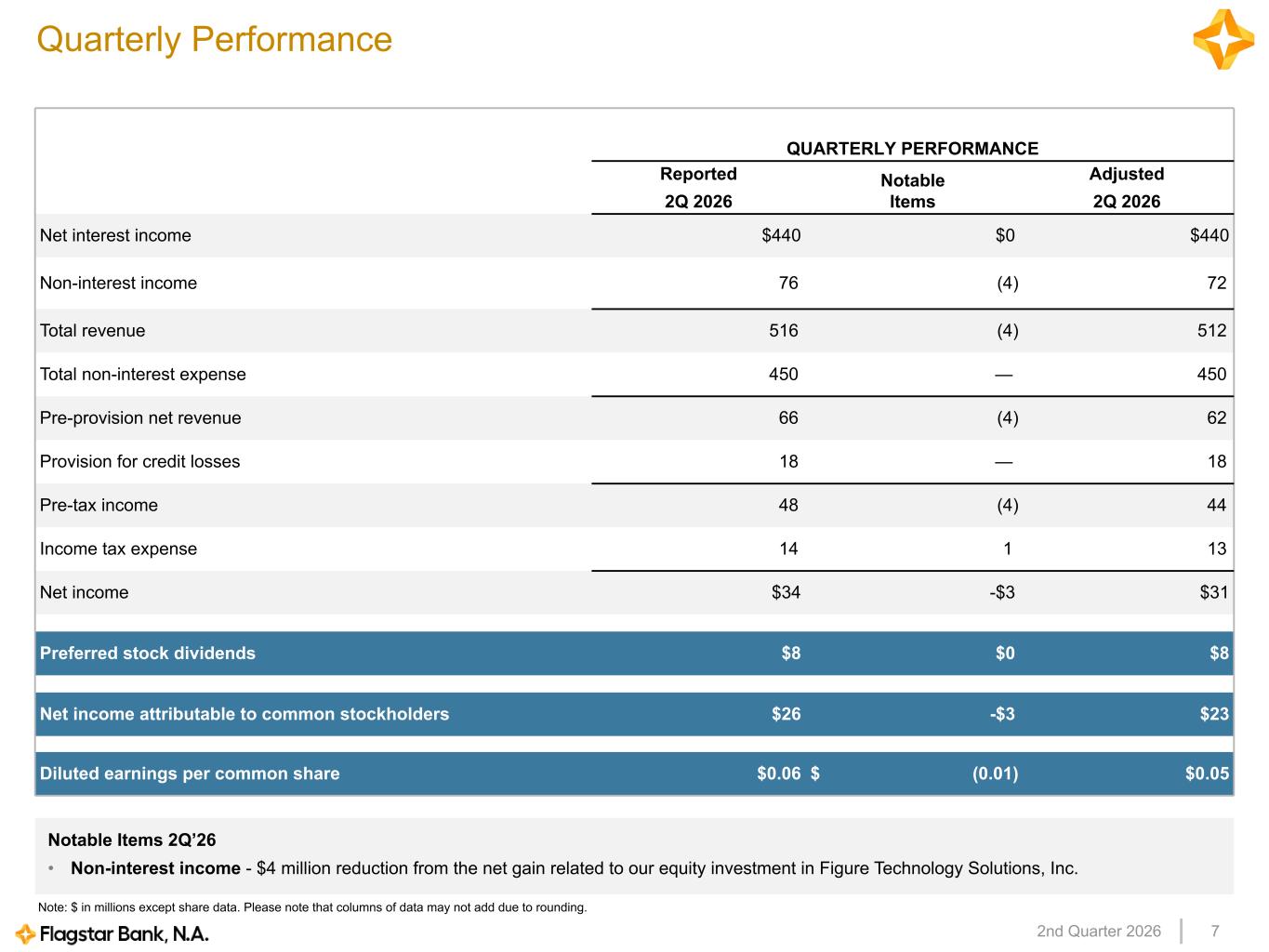
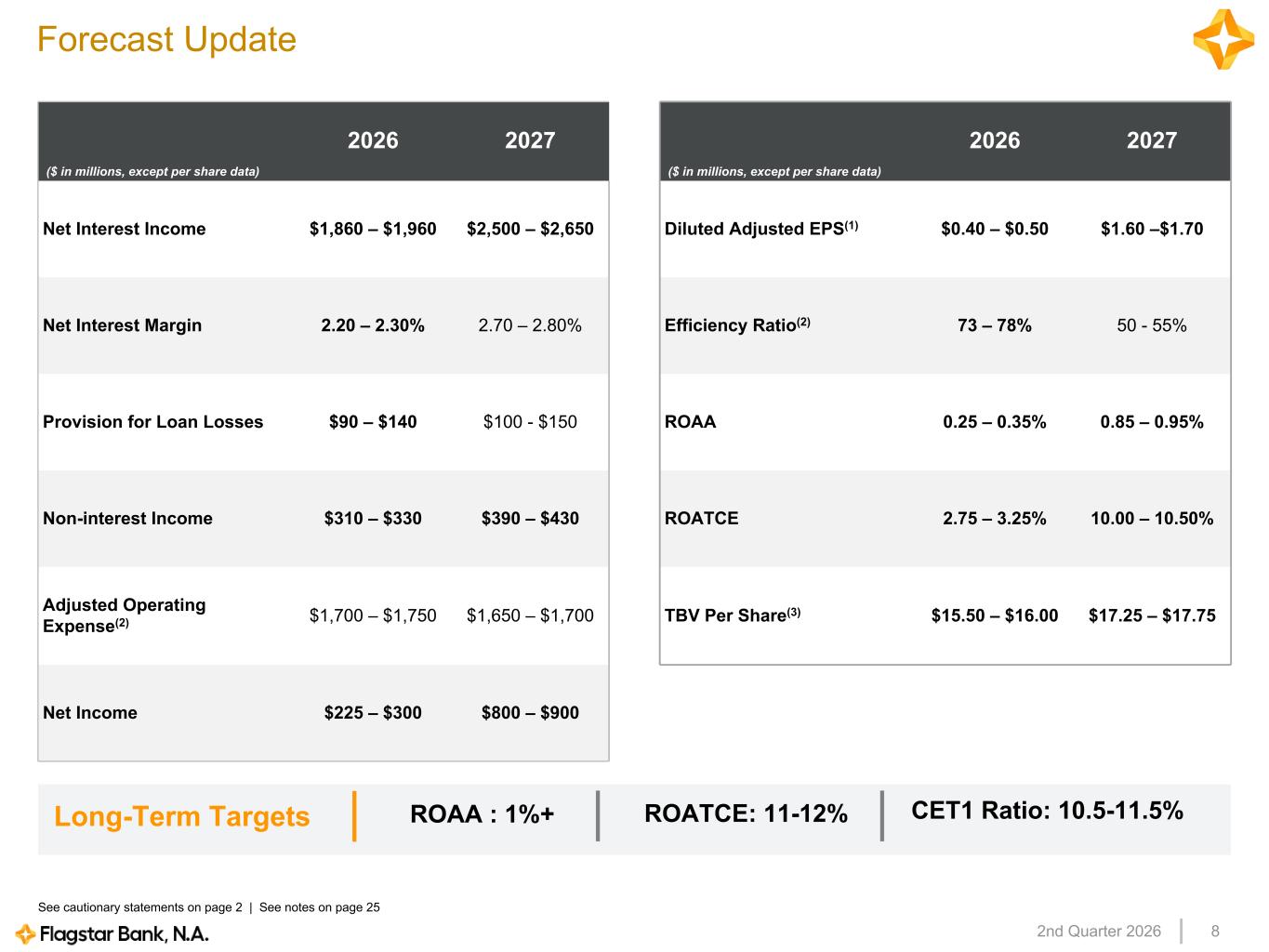
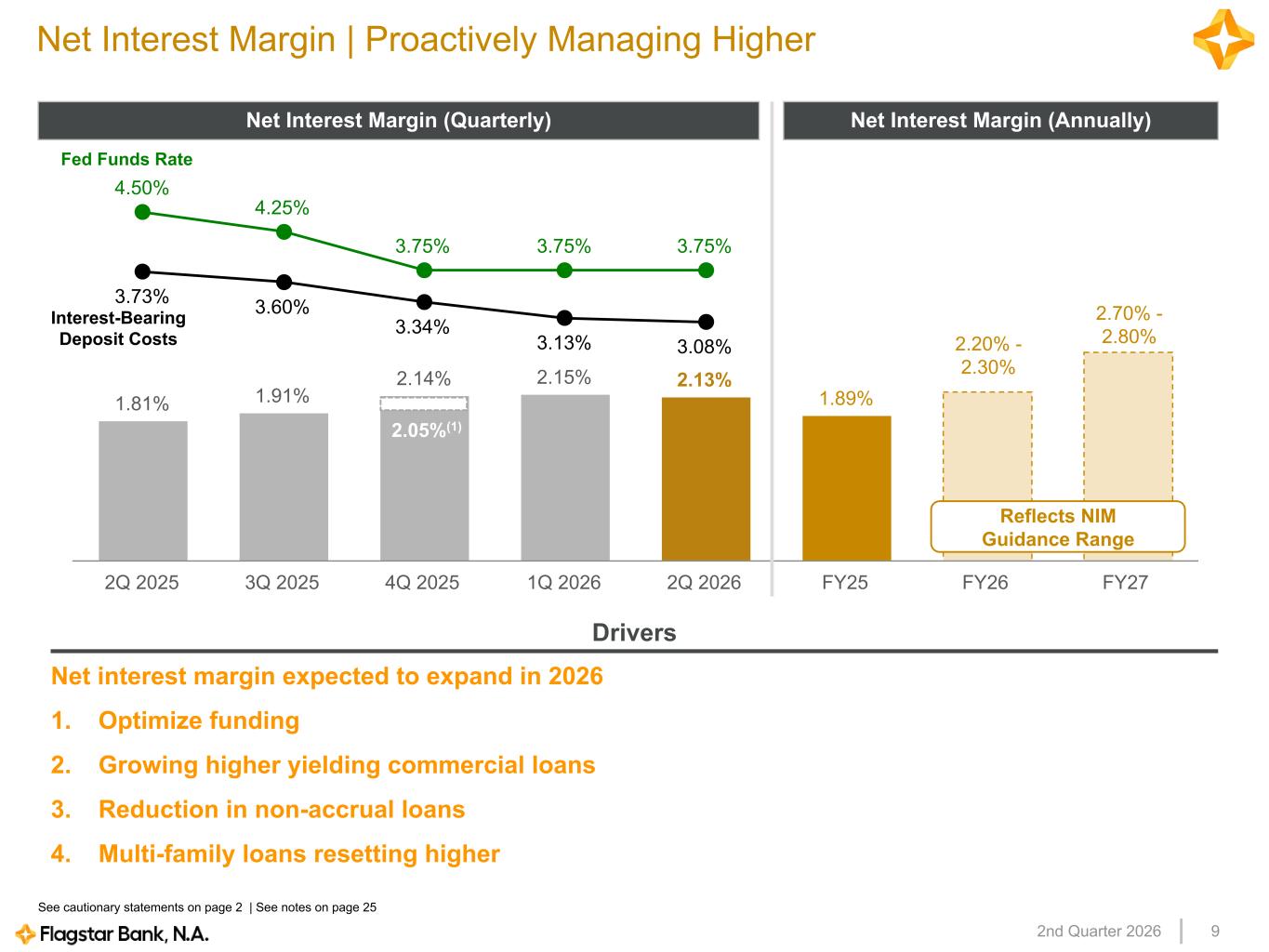
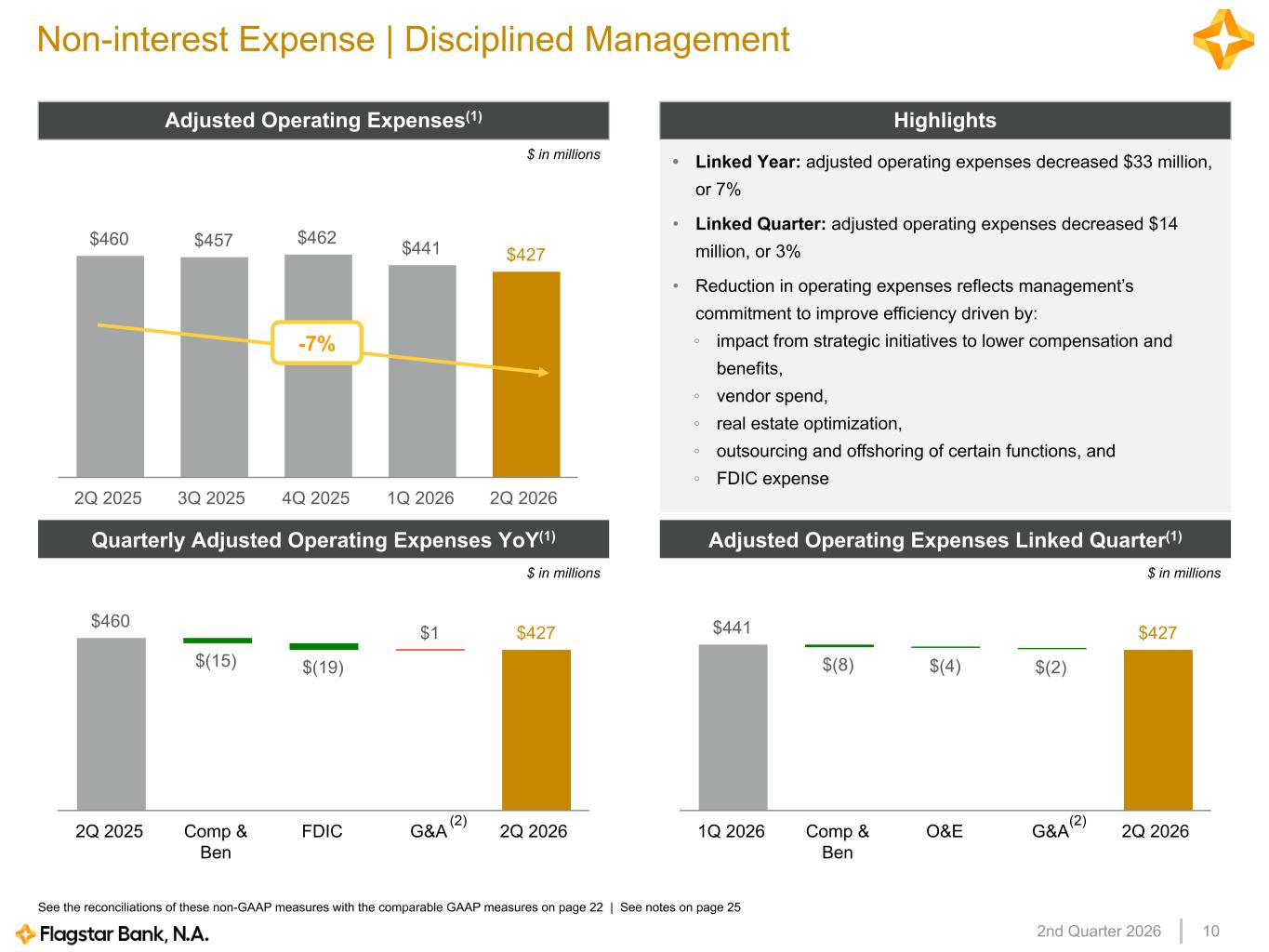
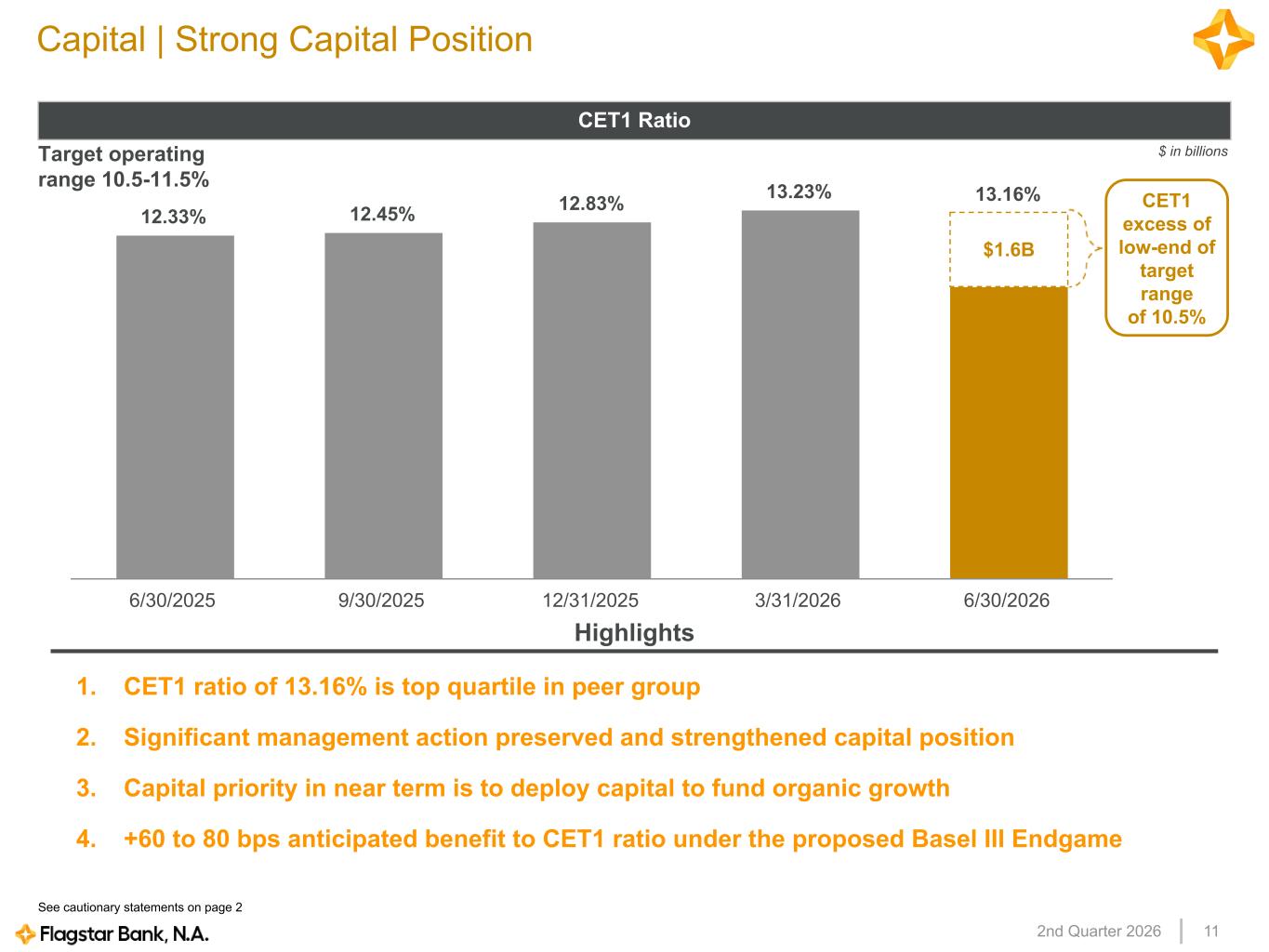
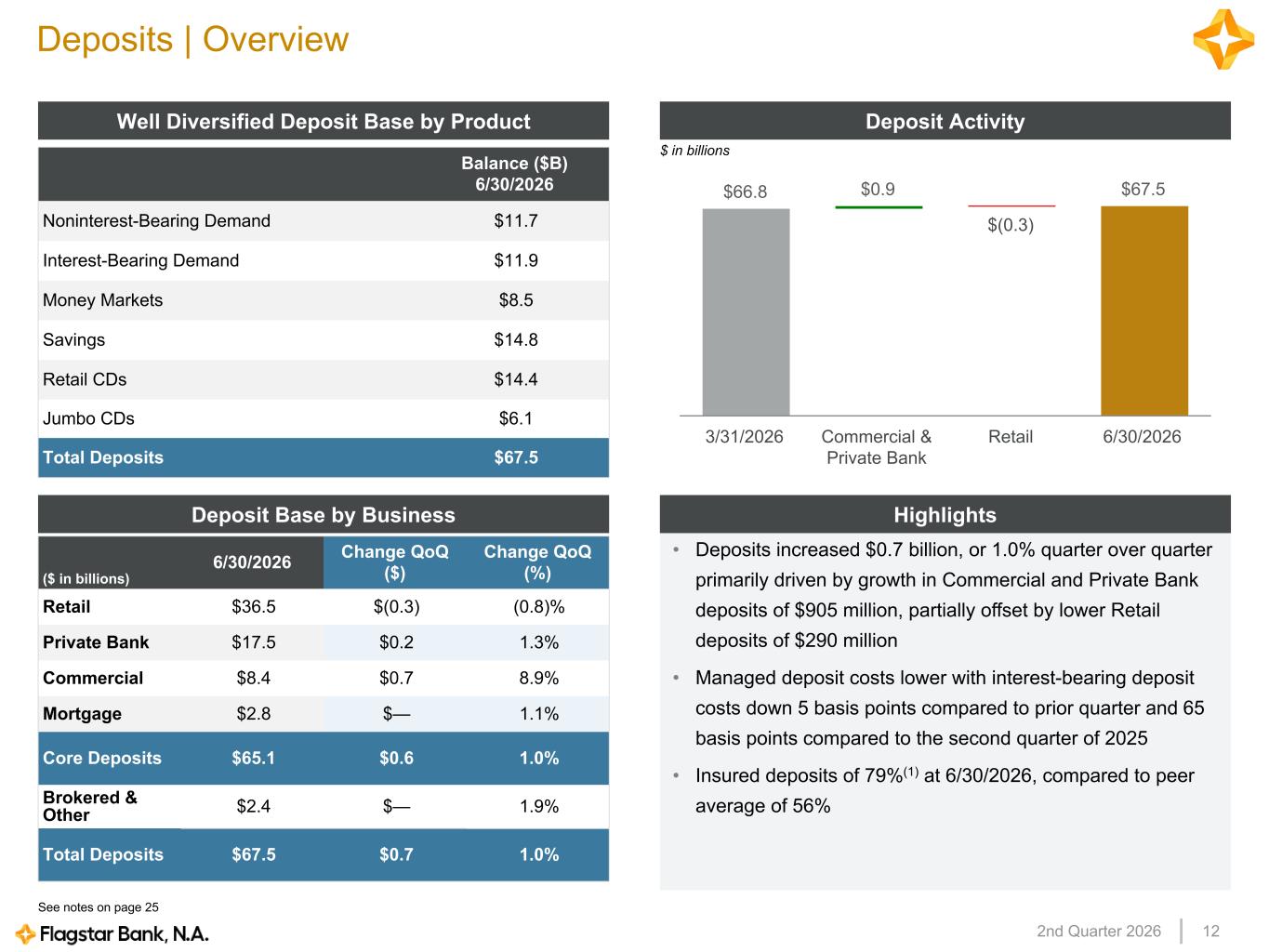
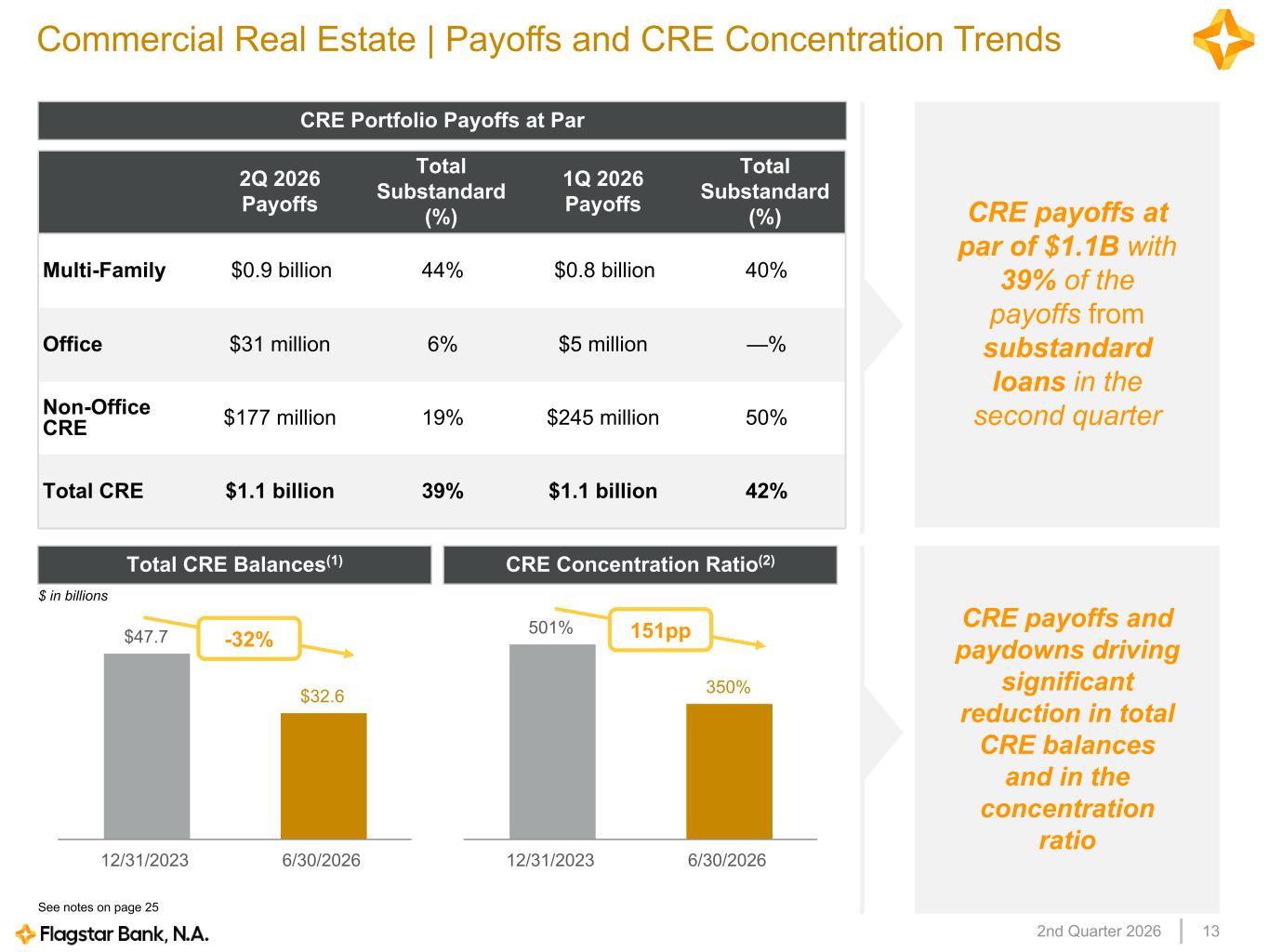
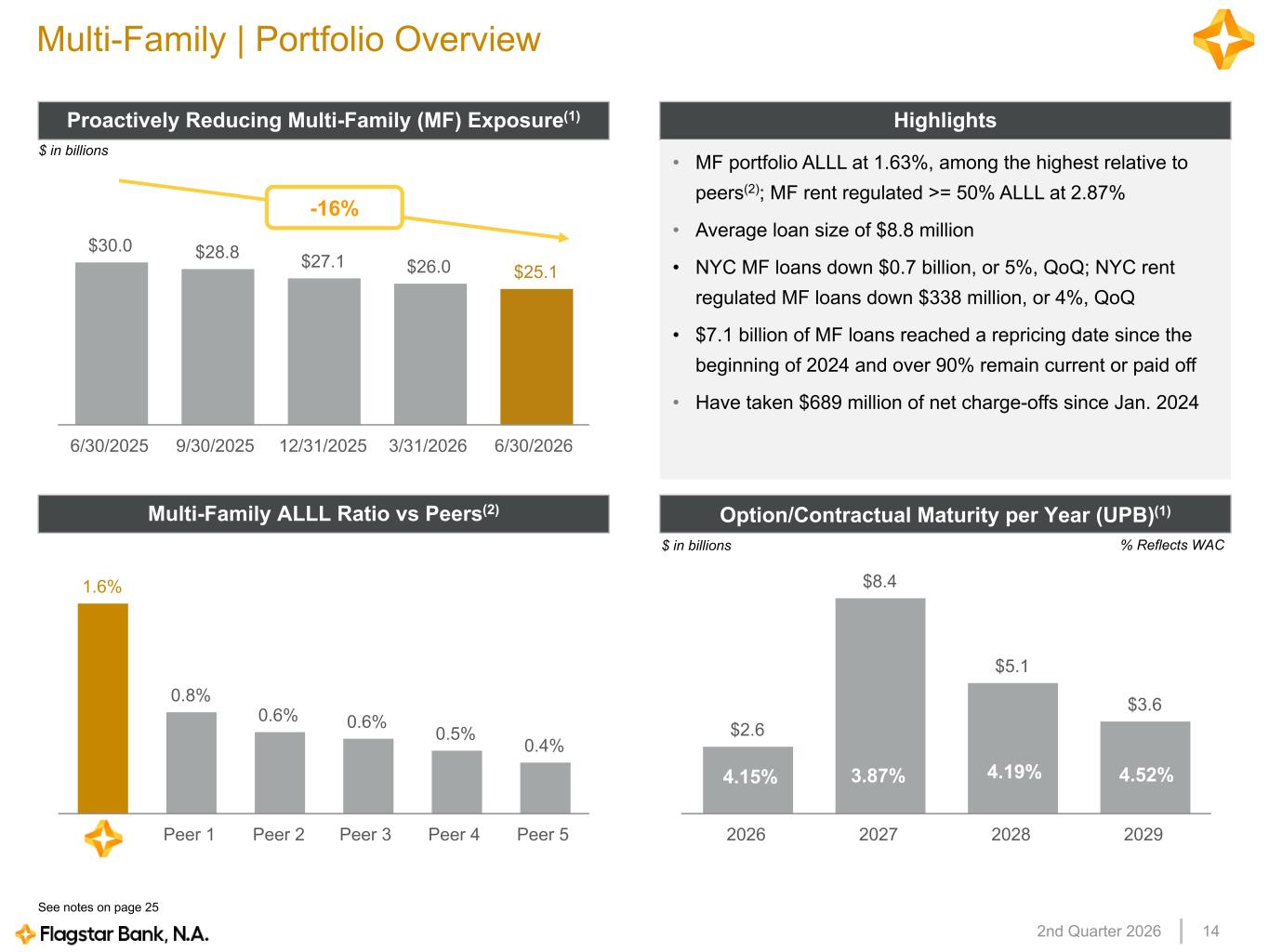
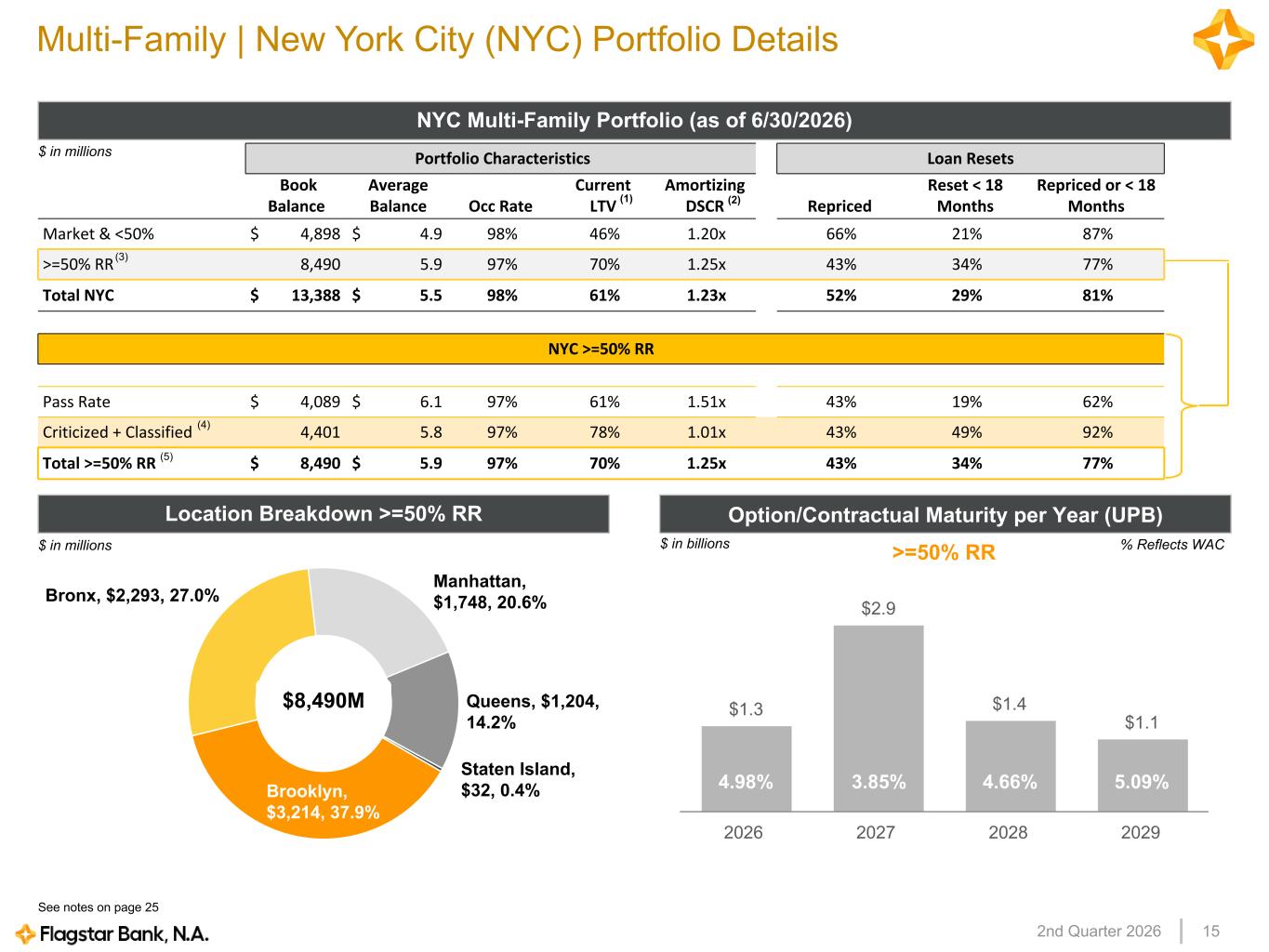
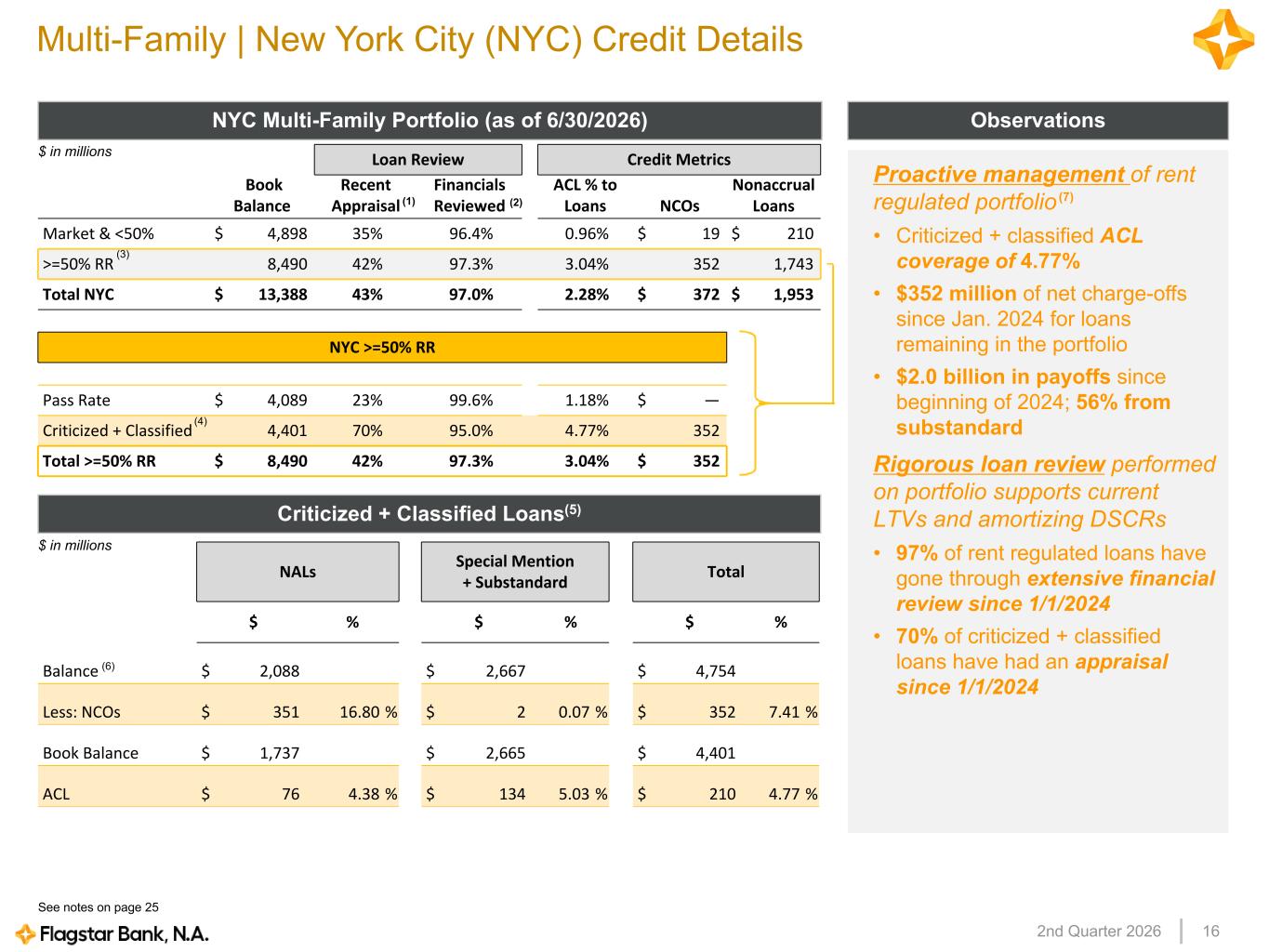
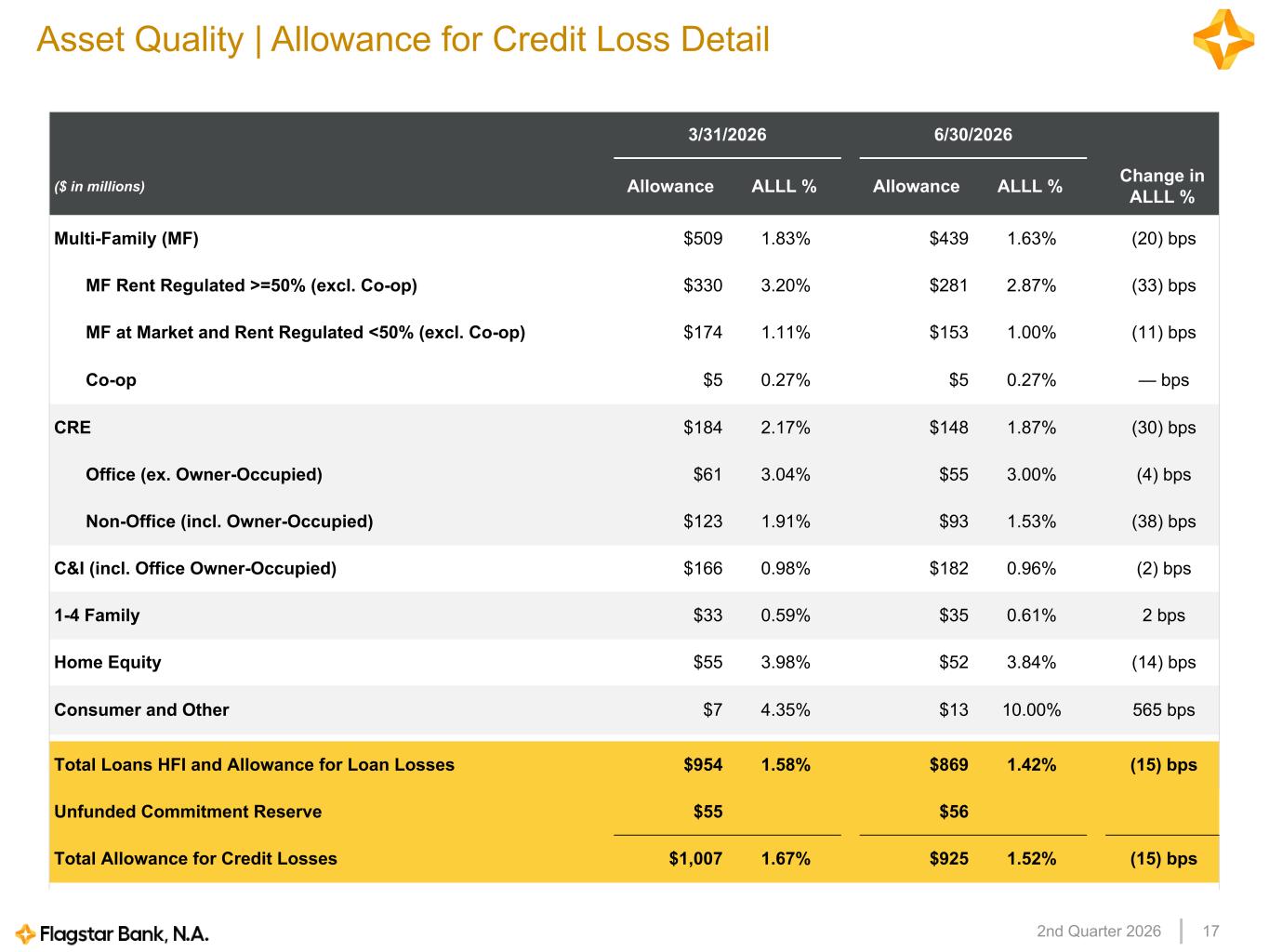
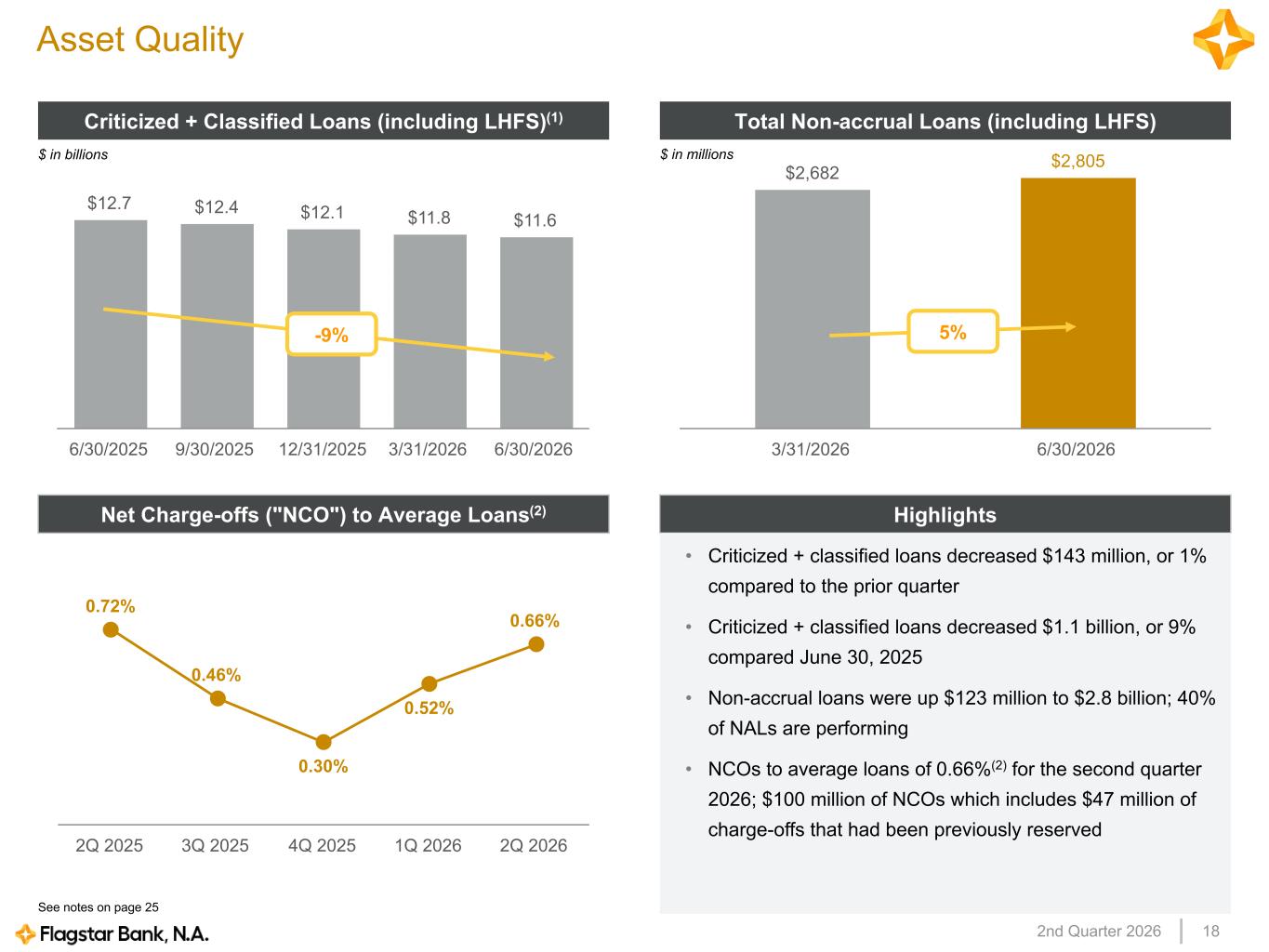
Thank you, Rich, and good morning, everyone. We're very pleased with our third consecutive quarter of profitability, where we continue to execute on our strategic vision to transform Flagstar into one of the best performing regional banks in the country. As Joseph mentioned, this morning we also announced the 250 million share repurchase program. This action reflects the bank's strong capital position and our commitment to creating long-term shareholder value. In addition, we achieved several other accomplishments during the second quarter, including pre-provision net revenue increased $34 million on an unadjusted basis and $22 million on an adjusted basis. Our balance sheet grew approximately $600 million quarter over quarter, driven by strong C&I loan and deposit growth. As Rich discussed, the C&I loan portfolio increased $2 billion, or 12%, compared to the previous quarter. Core deposits, excluding broker deposits, increased 700 million and have increased approximately 1.8 billion during the first half of the year. While deposits grew, we were also able to reduce deposit costs by five basis points, despite a higher for longer interest rate environment. We continued to deleverage the balance sheet by paying off another $250 million of flood advances as we continued to reduce our reliance on higher cost wholesale borrowings. Without this deleveraging, the balance sheet would have increased over $800 million quarter over quarter. Multifamily and commercial real estate payoffs were again gained elevated during the quarter at $1.5 billion, $1.1 billion of which were par payoffs and 39% of the par payoffs were substandard rated loans. The ACL decreased $81 million driven primarily by lower multifamily and CRE loan balances, higher charge offs of which a significant amount were already reserved for and more appraisals leading to reductions on qualitative adjustments on individually evaluated loans. We also witnessed the reduction in substandard loans of $375 million quarter over quarter. Operating expenses were again well contained, down 3% quarter over quarter to $427 million, well within our previously provided guidance range. And finally, we ended the quarter with a 13.16% CET1 capital ratio, comfortably one of the strongest CET1 ratios of any other regional bank, and a driving factor behind our stock buyback announcement. Now turning to slide seven, we reported net income attributable to common stockholders of six cents per diluted share on a gap basis, and five cents per diluted share on an adjusted basis. The one notable item this quarter was related to our equity investment in bigger technologies, which we exited in full during the quarter for a gain of 3.5 million. On the next slide, I'd like to walk you through our updated forecast for 26 and 27. We have adjusted our interest income guidance downwards for both years as a result of increased multifamily and CRE payoffs, paydowns, and amortization. This is both good news and bad news, as it accelerates our diversification strategy by reducing our CRE exposure, but it reduces interest income and NIM in the short term. Lower non-interest-bearing DDA growth in the second quarter. While we had good deposit growth in the quarter, it was from interest-bearing deposits. While we expect to grow non-interest-bearing DDAs going forward, the timing has been pushed out and we have changed the mix of deposit growth to more interest-bearing deposits, which impacts interest income and NIM. Non-accrual loan balances at the end of the year are expected to be slightly higher than previously forecasted. And the higher for longer interest rate environment is impacting mortgage gain on sale revenues and therefore we reduce non-interest income versus our previous guidance. EPS for 26 is now forecast to be in the 40 to 50 cent range and EPS for 27 is forecast to be in the $1.60 to $1.70 range. Moving next to slide nine and the trends in our net interest margin, the second quarter NIM of 2.13% compared to 2.15% in the first quarter, but was impacted by an extra day in the quarter. Excluding this, the net interest margin would have been 2.16% in the second quarter. Furthermore, June net interest margin was 2.19% as we began to see NIM expansion from the larger balance sheet. Turning now to slide 10 and non-interest expense, which remains a key pillar of our strategy to optimise efficiency and therefore earnings and drive positive operating leverage. Operating expenses continued to decline during the second quarter, down 14 million or 3% compared to the prior quarter and down 33 million or 7% on a year-over-year basis. Moving on to capital on slide 11 which shows that we maintain a strong capital position with a CET1 ratio of 13.16%. This places us in the top quartile of our peer group. At this level we have approximately 1.6 billion of excess capital after tax relative to the low end of our target CET1 operating range. And as we mentioned earlier, we're going to put some of this excess capital to use with our 250 million share buyback programme. The next slide is an overview of our deposits. Core deposits excluding brokered increased 700 million on a linked quarter basis or 1 This growth was primarily driven by growth in commercial and private bank deposits of 900 million, partially offset by lower retail deposits of 290 million. On deposit costs, we continue to make progress as the cost of interest-bearing deposits declined 5 basis points quarter over quarter and 65 basis points year over year. This improvement reflects our disciplined approach to deposit pricing and the benefit of growing commercial and private banking relationships. During the quarter, 4.8 billion of retail CDs matured with a weighted average cost of 3.98% and we retained approximately 85% of these balances as they moved into other CD products that were approximately 15 to 25 basis points lower than the maturing CDs. In the third quarter, we have another 4.4 billion of retail CDs maturing with a weighted average cost of 3.87%. We also continue to deleverage the balance sheet by paying down 250 million of flood advances with a weighted average cost of approximately 3.95% during the quarter. Moving next to slide 13, which shows total commercial real estate par payoffs. In the second quarter, par payoffs remained elevated, totaling $1.1 billion, 39% of which were rated substandard, which is a particularly important data point. We're not just reducing the size of the CRE portfolio, we're improving asset quality by clearing out the lower quality credits and executing on our strategy to diversify the balance sheet. These payoffs are resulting in a significant reduction in combined multifamily and CRE balances. In total, CRE balances are down 14.9 billion or 28% since 2023, including a 1.5 billion or 4% quarter over quarter reduction. Additionally, the payoffs have lowered our CRE concentration ratio to 350%, down nearly 150 percentage points since 2023. Turning now to slide 14 and an overview of the multifamily portfolio, we continue to proactively reduce our multifamily exposure as total multifamily balances have decreased 4.9 billion or 16% year over year and 0.9 billion or 3% quarter over quarter. The reserve coverage on the overall multifamily portfolio was 1.63%. Additionally, the reserve coverage on those New York City multifamily loans where 50% or more of the units are rent regulated is 2.87%. Currently, we have about 11 billion of multifamily loans with a weighted average coupon of approximately 3.90% that are either resetting or maturing between June 30, 2026 and December 31, 2027. Moving now to slides 15 and 16, where we provide a more detailed view of the New York City rent regulated multifamily portfolio. As of June 30, this tranche of the portfolio was $13.4 billion, down $677 million, or 5% quarter over quarter, while the tranche where 50% or more of the units are rent regulated was $8.5 billion, down about $338 million, or 4% quarter over quarter. This portfolio has an occupancy rate of 97% and a current LTV of 70%. Approximately 48% or $4.1 billion of the $8.5 billion are pass-rated loans and the remaining $4.4 billion are criticized or classified loans, meaning they are either special mentions, substandard or non-accrual. Of the $4.4 billion, $1.7 billion are non-accrual and have already been charged off to at least 90% of appraisal value, meaning $351 million or 17 percent has been charged off against these non-accrual loans. Furthermore, we also have an additional 76 million or 4 percent of reserves against this non-accrual population, meaning we have taken 21 percent of either charge-offs or reserves against this population. Of the remaining 2.7 billion that are special mention and substandard loans, between reserves and charge-offs, we have 5% or $134 million of loan loss coverage. We believe we're adequately reserved or have charged these loans off to appropriate levels. And with excess capital of $2.1 billion before tax, we think we're more than covered were there to be any further degradation in this portion of the portfolio. Slide 17 details our ACL coverage by category. The $81 million reduction in the ACL was largely driven by lower CRE and multifamily balances, higher charge-offs, and lower individually evaluated reserves as we received more appraisals. Our coverage ratio, including unfunded commitments, was at 1.52% quarter-over-quarter. Slide 18 provides a broader view of asset quality trends during the second quarter. Criticised and classified loans decreased $152 million, or 1%, quarter-over-quarter, and $1.1 billion, or 9%, year-over-year. Non-accrual loans increased modestly to $2.8 billion, up $123 million or 5% quarter over quarter. During the quarter we did experience an increase in special mention loans of $100 million as a result of that comprehensive and prudent internal process of looking in detail at all loans with a reset or maturity date 18 months forward. 18 months from June 30th brings us to the end of 27, and 27 is our largest reset year, where approximately 9 billion of CRE loans either reset or mature. We have applied pro forma interest rate calculations to these loans based on contractual reset terms and have adjusted the risk ratings accordingly. This look forward was also the main driver for the quarter over quarter increase in non-accrual loans. I would also highlight that 40% of our non-accrual loans are current and paying. Three other items of note, we are now 100% through analysing 2027 loans in their entirety. We continue to see a significant amount of substandard loans paying off a par each quarter and all of this analysis is reflected in our ACL reserve. At the end of the quarter, 30- to 89-day delinquencies were approximately $368 million, down almost $600 million quarter over quarter. The biggest driver of the decrease is June being a 30-day month. As we previously discussed, any time a month has 31 days, it spikes the delinquency number for those borrowers paying on the last day of the month, given that we calculate delinquencies at precisely 30 days. We continue to deliver on our strategic plan, and are excited about the journey we're on and the value we will create for our shareholders over the next two years. With that, I will now turn the call back to Joseph.
Thank you very much, Lee and Rich. Before moving to Q&A, let me close with a few summary thoughts. When we put our original forecast together, we were unaware of the change to interest rates that we would be experiencing, a perspective in the market that interest rates would be rising versus decreasing. We also saw a sizable increase of cost of energy to our customers. The Rent Control Board, while we had focused on and did a lot of modeling, ultimately voted not to increase rents for the one- and two-year leases going forward. In spite of this, overall, we are still pleased with the trajectory of the business. We achieved our third straight quarter of profitability. We grew the balance sheet for the first time since 2023, both in aggregate and in our loan book. We delivered record C&I loan growth. We grew our deposits, and we continued to reduce our CRE exposure while maintaining strong capital and the announcement of the $250 million share path. In addition, I'd like to thank our executive leadership team and all our teammates for their dedication and commitment to the organization and our customers. I'd also like to thank our board of directors for their support and counsel. And now I would be happy to answer questions. Operators, you can please open the line for questions.
Operator
We will now begin the question and answer session. If you've dialed in and would like to ask a question, simply press star then the number one on your telephone keypad. We kindly ask that you limit your initial question to one and return to the queue for any follow-ups. Our first question comes from the line of David Ciaverini with Jeffries. Please go ahead.
Hi, thanks for taking the question. So jumping right to the buyback, great to see the $250 million authorization. Your excess capital is significantly above this level at $1.6 billion. Can you talk about how you're balancing capital priorities between growth and buybacks?
Yeah, thank you for the question. You know, we have been very consistent in that there are three variables that management and the board are observing. The number one is the growth in core earnings is an important part of the story. The second is that, you know, the trends that we see and the credit quality of the loan book. And then the third being, you know, this balancing between the amount of CRE payoffs and the amount of capital that we'll need to support the CNI growth. So those are the variables that both internally and at the board level we're using to make a determination of, you know, how much capital in the form of a share buyback it will return to the shareholder.
Great. Thanks for that. And then on the CNI loan growth outlook, in the quarter, very strong, $2 billion. Pipeline looks strong as well at $2.8 billion. How should we think about growth going forward? Is a similar pace, you know, reasonable? How should we think about that?
Rich, you want to take that question?
Sure. Happy to take it. I would suggest that we see consistent loan growth going forward, consistent with what we delivered in the second quarter. We continue to onboard new to bank hires, and they are building their pipelines, so we see increasing momentum going forward in our loan growth expectations, including new geographies and new verticals. In addition, I would mention that our commercial real estate team has started to originate loans more nationally, and that will also help us reduce CRE payoffs on a net basis.
Operator
Our next question will come from the line of Dave Rochester with Cantor. Please go ahead.
Just a quick one back on a buyback. I knew you said it was for the next 12 months, but you guys are obviously still trading below adjusted tangible book value, and you do have that excess capital. Is it reasonable to assume that you can potentially get through this 250 and then go back to the board and ask for something? I guess maybe what I'm really asking is, in your conference, back and forth, did you get the sense that the board could be willing to work?
Yeah, Dave, I think it's those three variables. As we progress through the year, they clearly want both the management and the board want to see the increases in the core earnings. That, you know, we see a downward projection continued in the loan portfolio. And then it really gets into, you know, how much capital are we going to see? You saw a little bit that our CET1 was down this quarter because of the expansion of the balance sheet, and we probably will continue to see that, you know, as our projections show us, continuing from this point forward to expand the balance sheet.
So it's a little bit of, as we march our way through the rest of the year and into 2027 looking at those three variables and then making a decision and a recommendation to the board okay great and then just um as a follow-up on the margin guide and the 219 uh that you mentioned lee uh for june are you looking at that as more of a floor going forward for the margin because it seems like your guide is baking at a decent amount of expansion in the second half of the year to get to the bottom of that dim range for 26 so i just wanted to get your thoughts on that and your confidence around that and what's going to be the major drivers of that. Thanks.
Yeah, I am looking at that as a floor. And that was the reason for pointing out the June NIM margin. And I think, as I mentioned in my prepared remarks, what you're seeing is the NIM expanding as we grow the balance sheet. This is the first quarter we've shown overall balance sheet growth since 23. And a lot of that growth occurred towards the end of the quarter. And you obviously saw the margin pickup in June. But the other drivers of the NIM expansion, as we've spoken about before, is that multifamily book is going to continue to reset or mature. And effectively, between now and the end of 27, you've got about 11 billion of low coupon multifamily loans that are going to hit their reset or maturity dates. That's obviously a big driver. We're going to continue to grow the C&I book at market rates. And the 2 billion that Rich and his team put on in the second quarter came on at an average spread to SOFA of 226 basis points. Rich also mentioned we're going to start originating, well we have started originating new CL3 loans again at market rates. That will offset some of the runoff that we saw in Q1 and Q2 of this year. You may have noticed if you look at the balance sheet, while our overall cash and securities balance on a combined basis was flat, we actually swapped more cash into securities, about 2 billion And we think that that will help us from a NIM expansion point of view. And then, as we mentioned on the liability side, we were able to reduce deposit costs five basis points. And we did that as well as increase deposit growth, 700 million in the quarter. We paid down another 250 million of wholesale borrowings. That's something that we're always looking at. And then we do expect to reduce non-accrual loans between now and the end of the year. And then again, as we get into 27, and the reduction of those non-accrual loans has a positive impact on NIM as well.
Perfect. Thank you very much.
Operator
Our next question will come from the line. It's Casey Hare with Autonomous Research. Please go ahead.
Great. Thanks. Good morning, everyone. So I wanted to touch on credit. Lee, you just mentioned NPL reduction. You still expect that? I think you guys have been targeting, you know, a billion dollar reduction, just, you know, a little bit of a setback this quarter. I'm just wondering, is that still a reasonable target as well as, you know, what is your forecast for net charge offs in the next couple of quarters?
Yeah, on the non-accrual loans, as we look through the end of the year, we expect to end the year at about $2.3 billion. million. So that would be a reduction of sort of 450 to 500 million from the end of June. But as I mentioned in my prepared remarks, slightly higher than what we thought we'd end the year at about 2 billion, 2.1 billion, and we would end the year at 2.3 billion. So slightly higher than where we previously were, but a reduction of about 450, 500 million from the end of June. In terms of the charge-offs, and Joseph alluded to this in his prepared remarks, while net charge-offs were $99 million in the quarter, $47 million of that was already fully reserved for. So if you back that out, you're at $53 million. And if you look at that on the net charge-off ratio, it would put us at about 35 basis points.
Okay, very good. And And just a question on the reserve. So can you give us a sense of where the reserve is on your C&I production? Just trying to get us – like the reserve was down this quarter. Obviously, the momentum on the C&I front is applying pressure to the provision. Just want to get a sense of where the new production is coming on so we can get a sense on the landing point for the reserve.
Yeah, sure. So you can assume that new C&I is coming on at about 1%. But what I would add is what is rolling off is much higher risk and has a higher coverage ratio. So I mentioned that we had about 375 million of substandard par payoffs. So a lot of that CRE and multifamily payoff and activity has a much higher coverage ratio. So we're reducing the higher risk, higher coverage assets. And the C&I that's coming on is coming on at a much lower coverage ratio at about 1%. Great. Thank you.
Operator
Our next question comes from the line of Jared Shaw with Barclays. Please go ahead.
Hey, everybody. Good morning. Hi, Jared. Morning, Jared. Can we just look maybe at the loan yields? This quarter, there was the decline. What was the yield on the par payoffs? I guess maybe more of those had hit reset than I was expecting. And was there any significant impact from interest reversals from the MPL growth this quarter to try to figure out where we should expect to see loan yields trending for the rest of the year?
Yeah, so here's what I would say, Jared, great question. If you look at the 1.5 billion of CRE total par payoffs, so I'm not just including the par payoffs on the multifamily, I'm looking at this in totality. It was about just over 5% were the yields on those loans that paid off. So that obviously had an impact. The fact that non-accruals kicked up a little bit in the quarter, quarter over quarter, that obviously also has an impact. The other thing that I've mentioned is when you look at Q1, we did have a little bit more deferred income. And so these were legacy signature loans that had been marked through purchase accounting that refinance. And we got sort of that benefit from a yield point of view in Q1. There wasn't any of that in the second quarter, or there was very little of that. So the way I look at the asset yields right now is this should sort of be a bottom, a floor, what you saw in the second quarter.
Okay. All right. That's good. Thanks. And then just a quick follow-up on the credit. You mentioned going through and re-evaluating all of 27 now. How has your success rate been on sort of these re-evaluations? If you look at what happened in 26, have those dispositions come in close to where your original or your updated assumptions were?
Yeah, I think, I mean, one thing I'd remind everybody, remember we, as part of the strategy when the new equity and the new investors came in, we re-underwrote the multifamily and CRE book in 2024. And we took over 900 million of charge offs and significantly increased our reserve. So you've got to remember that we did all that work in 2024 and so I think it's worked out uh it's worked out that we were pretty close um to what we thought because if we weren't close to what we thought you would see it in the ACL reserve um and and you're not sort of seeing that and and the other thing that I'd say Jared just remind everybody is remember we're getting annual financial statements now on all of these borrowers We're also prudently doing that 18-month look forward for everything that is resetting or maturing in the next 18 months. And I think if we had been off or were off, you would see it reflected in the ACL reserve. And if you look at what has happened to the ACL reserve, certainly over the last three quarters, you haven't seen that. So I think we feel that all the work we did in 2024 was pretty close to the mark. Great, thanks.
Operator
Our next question will come from the line at Bernard von Gazzicchi with Deutsche Bank. Please go ahead.
Speaker 14
Hey, guys. Maybe we could just talk about the 18-month forward lookout. If we do get a rate hike or two, how has that impacted the stress that you see there? Like, what are the changes and, you know, what are you incorporating when you look at the 18 months? Is it a hike? You know, just can you give us some thoughts on the sensitivities that you're running?
Sure, yeah. So if you look at our forecast, Bernie, we have one rate hike assumed that is in October of this year. And so as we do our 18-month look forward, it's underpinned by a very thorough DSCR analysis. And so we are looking at all of that and factoring that in based on the contractual terms that we have in our contracts, which I think as you know, people have two options. It's five-year plus 300 or prime plus 275, and we really haven't wavered off of that much. I think what I would say is if there are interest rate hikes, what it's more likely going to do is um people will wait to the last minute before they act because remember these reset dates and maturities those are casting stone it doesn't matter what happens to interest rates you know that time is going to come and they're going to have to act if rates were declining that might encourage people to move sooner to take advantage of the lower rates so i think all the rate height does it just means that people are going to hang on to the last minute but as i've said you know in my prepared remarks and during the q a uh we have 11 billion of multi-family loans that are going to hit their reset or maturity dates between now and the end of 27 and that has to force the borrower to take action okay and just as a follow-up uh lee i think you mentioned that the balance sheet growth would be a little bit higher than you previously uh forecasted for this year uh could just update us on what is that 94 95 billion and what do you have for 27 if you could provide any updates yeah sure so right now bernie i think we we believe that we'll end the uh this year 26 at about 91 and a half to 92 billion and then we think we can get to 100 billion by the end of 27 total balance sheet solid okay great thanks for taking my questions our next question comes from
Operator
the line of Manan Gosalia with Morgan Stanley. Please go ahead.
Hey, good morning. On the forward guide, you know, revenue is going down a little bit. Expenses you're keeping relatively in line with the prior guide. Is that a function of the hiring and the investments you're making, or is there a little bit of flexibility there as we get into next year?
On the expenses, I think I think we, I mean, expenses is something we've been myopically focused on and the team has done an unbelievable job reducing expenses as we have done. So I think we feel good about the guidance that we've provided around expenses because not only are we cutting costs, we continue to invest in riches business, technology as well. And so, you know, there is investment we continue to make and we're still able to offset that investment and bring our costs down, as you've seen. So we feel pretty good about the guidance we've provided around expenses.
Got it. And then on the C&I growth side, there's some really nice C&I growth coming through your adding relationships. Can you talk about how many of those relationships are coming with the deposits and fee-based revenues as well? and how you're thinking about that going forward if there's more opportunity to bring in more deposits and fees from those relationships.
Sure. Thanks, Manon. This is Rich. I'll tell you, on a year-to-date basis in our C&I and private banking businesses, we've experienced net loan growth of over $3 billion and deposit growth of $1.4 billion on a net growth basis. In the first six months of the year, we've brought in roughly 130 new-to-bank CNI relationships, and we feel good about our momentum in both deposits and fee income generation from these new relationships, not just with spread income from deposits, but also fees. We expect our capital markets fees and treasury management fees in particular to show significant growth in 2026 and beyond as we further build out the product set and the natural synergies between our commercial bank growth and our private banking capability set drives business customers to also become personal customers and personal customers to also become business customers. So we are very bullish about our opportunity set in both deposits and fees based on our relationship-based banking strategy.
Operator
Our next question will come from the line of Chris McGrady with KBW. Please go ahead.
Oh, great. Morning, everybody. Joseph, I appreciate the comments about, you know, coming in and setting a bar for the profitability targets when you first joined. And, yeah, there's been a lot going on. I guess the question that I'm getting is the degree of confidence in the NII. Is this the last revision? Because I think if it is, I think the pieces fall into place with the buyback and the stock. So any comments on conviction level in NII? be great. Thanks.
Yeah, I think we feel pretty good, Chris. I mean, you know, when you go back to our original projections, we were expecting, you know, CRE payoffs in the six to $800 million range per quarter. And this quarter was, you know, almost a billion five last quarter was a billion five. So, so that has far outstripped, you know, like double what we originally forecasted kind of going forward, we're looking for net CRE payoffs to be about a billion dollars. And that's also with us originating $200 to $300 million a quarter and new CRE originations. So I feel really, really good about what's going on in the CNI book and our ability to continue to have net growth in the CNI business. And the variable to that is the CRE. And I think now that we have new production occurring in there, that will help offset, you know, what has been really enormous payoffs. And Lee mentioned it's good news, bad news. You know, the good news is we are fast approaching, you know, the lower 300 percent level where, you know, is our target as a percentage of real estate concentration. We will get there probably a year and a half to two years earlier than what we originally forecasted so so yeah i think we feel good about expanding the balance sheet as we saw this quarter and the variable really comes down to how much cre gets paid off and then yeah chris and joseph yeah if if i might add chris i think everything we said we were going to do, we've done.
And remember, this was a complicated, multifaceted turnaround. There were a lot of moving parts, and I think everything we said we were going to do, we've done. And as I said on the last call, everything we can control, I think we're delivering on. We obviously don't control interest rates. We didn't know rates were going to be higher for longer. Six months ago, never mind, sort of 18 months ago. But we've reacted and I think we've got a balance sheet that is pretty neutral. And the way I look at this is we're on track. And the worst case scenario is maybe it takes us one or two quarters longer to get to where we said we were going to be by Q4 at 27. And I don't think that is a bad thing at all, given the hand we were dealt two years ago where we are today and I think where we will be 12, 18 months from now.
I appreciate that. That's a great color. And then just a kind of a technical question with the guide. I think, Lee, correct me if I'm wrong, the guide historically has not assumed buybacks.
Does the updated guide now that you have an authorization include buybacks or is this still without it it's uh chris it's without it there are no buybacks including the 250 million we announced this morning that is not included in the forecast uh uh and the guidance that are provided okay so it would be additive if if you do correct execute okay understood thank you so much our next question comes from the line of ben gerlinger with city please go ahead hey good morning so you guys are saying like you've done everything you've said you're going to do at least on the initiatives
that you have control of and the market keeps giving opportunities for people to pay off a little earlier than expected so the floor keeps moving on you with that respect like if you're thinking about growth that's a big usage of capital so I could see you're understandingly reluctant to do a big buyback But if payoffs continue to be elevated, you're going to have excess capital. You have the ability to kind of walk it into bubblegum at the same time. So, like, is price sensitivity on the buyback a big factor, or is it just something out there for buying dips?
Just trying to get a sense of, like, how active you'll be, especially if you have the pace of the balance sheet doesn't grow as much as you're anticipating because of those things that are out of your control. yeah you know ben i think you know clearly we recognize the amount of capital the bank has and that really we build up through a process you know that capital a lot of you know we had the original capital injection and then we took action to sell the mortgage uh warehouse business and the mortgage uh servicing businesses that created excess capital so i think now as we turn the corner and go in the other direction, we'll be looking at the variables of how the capital is being used and what our forecast looks like. And really, we think we're on track to meet our core earnings, revised forecasts. We do think Rich is going to net grow in excess of $2 billion now a quarter. And then the other variable is, as we work our way through the non-accruals and the problem loans is, can we execute on that to the way that we forecast it? So, I'd say we're in the early innings of all of those coming together, and we'll get better clarity as we move through the rest of the year, which will then give us the ability to make recommendations to the board about future buyback action.
Gotcha. And then just wanted to follow up again on the sensitivity. If for some reason your stock went to like $10 or something much lower than what it is, Can we anticipate you use the whole thing like immediately?
You know, I think clearly we, you know, that would be an incredibly attractive price then for us to execute on our stock buyback. So I think there would definitely be dialogue about, you know, should we move quickly at those kind of price levels?
Operator
Our next question comes from the line of David Smith with Truist Securities. Please go ahead.
Hey, good morning. Rich, within CNI, it was a really strong quarter for the specialized industries with, I think, $1.9 billion of origination and about $1.7 billion of funded balances. What are the industry groups contributing most to this? Because I know you stood up a few new groups this quarter that presumably aren't contributing very much yet.
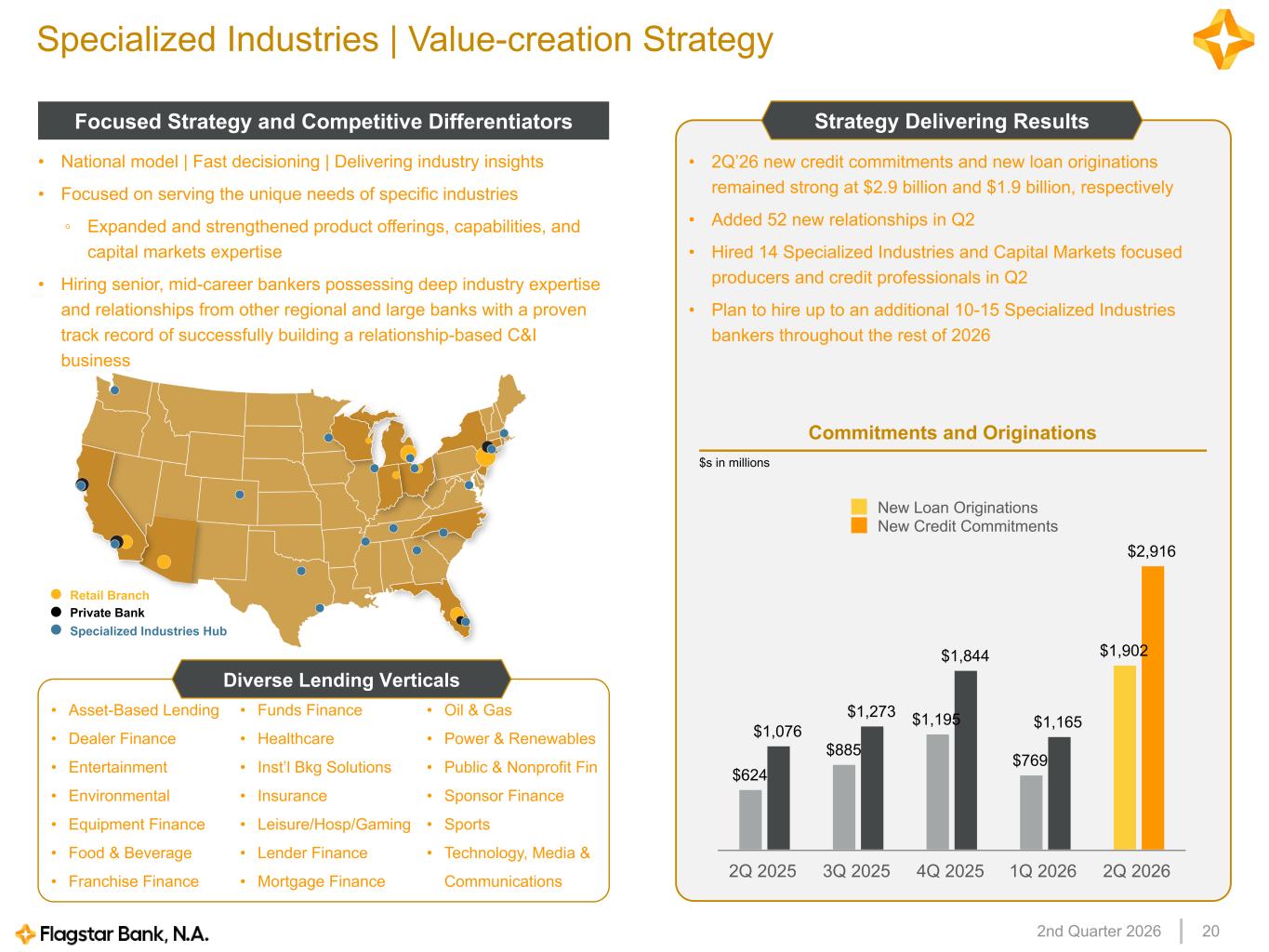
Yeah, thanks, David. I would underscore in our specialized industry groups the ones that are a little bit more mature that we started over a year ago, and those include our energy sector banking group, especially our oil and gas unit, but as well, we have a power and renewables team, so both of those teams are contributing significantly to that significant loan growth in the second quarter. Our healthcare team had a very good quarter, as did our technology and government services team. we also saw particular growth in our entertainment and sports verticals and our financial institutions verticals and that includes a lender finance team an insurance team a fund finance team and a sponsor finance team so those would be the units on the specialized side that i would call out where we saw particularly strong loan growth in the second quarter thanks and then shifting gears to multifamily um there's obviously been some legal action um announced about the rent stabilized rent freeze in New York City?
Could the outcome of that have a material impact on Flagstar either way?
Well, we've gone through a process, as we indicated before. In the allocated reserve side of it, you really couldn't capture that directly with that. So we had overrides in the ACL process. We, this last quarter, were able to kind of really build a model around the specific boroughs and looking at, you know, the cap rates and the direction. And when we kind of brought all that together between allocated and unallocated, there was a slight uptick in the ACL for the rent-regulated multifamily. But I think what we've tried to indicate before, you know, we've tried to stay on top of that portfolio and make sure that our reserves were satisfactory. And I think, you know, this process and that we went through kind of proved that out. Okay. Thank you.
Operator
Our next question comes from the line of Timor Braziller with UBS. Please go ahead.
Hi, good morning. Another one on the margin guidance with 2027 being left unchanged change and second quarter coming in a little bit. I guess, can you just maybe walk us through the stair step and the progression to get to that 2027 level?
In your mind, is it pretty even per quarter or given the fact that maybe some of the DDA production is being pushed out, MPLs are a little higher that's largely skewed kind of towards the back end of that of that timetable yeah the margin the margin continues to improve quarter over quarter and that's driven largely by the continued multi-family and CRE loans in their reset and maturity date so we're carrying fewer lower coupon multi-family CRE loans. So by the time you get to the end of 27, as I've mentioned, you know, there's about 11 billion of those multifamily loans that are hitting their reset or maturity date. And if you look at the balance sheet, they have a weighted average coupon of less than sort of 3.9%. So, you know, we continue to sort of work through that overhang. Rich continues to originate new C&I loans, $2 billion in Q2 at an average spread to SOFR at $226. So we're going to continue to add C&I loans to the balance sheet every quarter. So the mix of the balance sheet is improving every single day. And so that is another big driver. We're going to be originating, and we've already been originating new CRE loans at market rates. So as we see par payoffs, particularly the lower coupon par payoffs, we're replacing some of that runoff with market rate CRE loans. As I mentioned, we've used some of our cash to buy more securities and that helps from a NIM point of view. We're going to continue to manage our funding costs both core deposits, you know, and where we have opportunities to continue to pay down wholesale borrowings, we will do that. And then we expect to reduce our non-accrual loans. Now, the reduction of the non-accrual loans isn't necessarily linear, because every single loan has its own story and workout strategy. But we do expect to reduce the non-accrual. So it's all of that that goes into the NIM expansion. And look, the balance sheet as of 1231.26, which is the jump off point for 27, will look a lot different than it does at June 30, because we're going to have fewer lower coupon multifamily CRE loans. And we expect to add, you know, several billion of C&I loans between now and then as well.
Great, thanks for that. And I guess on that 11 billion of lower yielding multifamily that's expected to mature between now and year-end 27. What's the expected retention there? I mean, that divide by six, you get kind of 1.8 billion. That's all leaving. That's still seemingly a pretty big headwind. Are you expecting to retain a decent portion of that, or is this larger chunk going to remain a headwind to net long growth?
Yeah, no, we're retaining about 35% to 40% of loans that are resetting typically just that's the kind of way we are. Great. Thank you.
Operator
Our next question comes from the line of Matthew Brees with Stevens. Please go ahead.
Hey, good morning. Good morning. First, a quick one. And Lee, just curious what the spot cost of deposits were at the end of the quarter, and curious on how you feel about your ability to maintain or further lower deposit costs from here, just given kind of industry dynamics.
Yeah, so this spot cost, and I always mention this, so I'm going to give you the spot cost, including all of our non-interest bearing. It does include the broker deposits as well, so it's all in. It's about 2.49. And just to answer the second part of your question, we were able to reduce deposit costs five basis points in the second quarter. It's going to get, without rate decreases, it definitely gets a little tougher. There are strategies that we're able to deploy, especially as we have retail CDs maturing and sort of, as I mentioned, we're retaining typically about 85% of those and we're moving them into lower cost CDs. You know, there's certain strategies around back books that we're looking at. But the other big driver for us of reducing funding costs is paying down those wholesale borrowings, those slub advances. And so, you know, So that is something that, as we have the opportunity, we'll continue to pay down flood advances going forward.
Got it. Okay. Then the other question I had, bigger picture, we've talked about it a couple of times, is the Rent Guidelines Board, the one and two year rent freeze. And, you know, what is your 18 month look forward modeling for rent freezes, I guess, for the remainder of the mom donning term? it seems much more real that there could be a four-year freeze while expenses, regardless of the rent guidelines for determination, continue to climb higher. It feels like another material valuation risk of the asset class, and I'm curious if that's baked into your assumptions and showing up in the appraisals as well.
We have previously, and I mentioned this last quarter, we have done an exercise where we assumed that there was a rent freeze in place for three years, and we assumed the operating costs were going up 2.75% and market rents would be able to increase 2.1%. And what we found was the demarcation line was 70%. So any building that was 70% or less rent regulated, the NOIs aren't impacted because they cannot set the rent freezes by increasing rents on the market rate units. For the buildings that are more than 70%, it had an impact of about 7% to 8% on NOI over that three-year period. And Matt, if you look at our deck, we lay out our exposure to New York City rent-regulated buildings, and we've got about $8.5 billion that are more than 50% regulated. $4 billion of that are pass rated loans with very strong DSCRs. So we don't feel that it has a significant impact there. And then of the $4.4 billion that's criticized and classified, as I mentioned in my prepared remarks, you know, between charge-offs and reserves, reserves, we've taken a significant amount of sort of coverage between those, you know, the charge-offs on the non-accruals are $351 million, and we have another $76 million reserved against that population, which is more than 20%. And then we have $134 million on the special mention and substandard. So we feel we're adequately covered. We do the 18-month look forward. We get annual financial statements. We're looking at the violations and lien lists. We're looking at the worst landlord list. You know, we're doing a lot of homework on this. And I think if we had an issue, you would see in our ACL reserve. And as Joseph mentioned, we had previously reserved for this eventuality. And as we sort of got, we refined our analysis in Q2, it had a nominal impact, as you can see by, you know, what happened to the ACL reserve and provision this quarter.
Understood. I'll leave it there. Thank you.
Operator
Our next question comes from the line of Janet Lee with TD Cowan. Please go ahead. Morning.
On your anticipated 500 million-ish decline in NPLs, I believe about 75 percent of that of your total NPLs are coming from the New York City regulated can you assume that roughly the similar proportion of that NPLs are NPL reduction is coming from the rent regulated or is there a difference in composition there the you can't every so what I would say is the majority of the NPLs will be multifamily because it's the biggest portfolio.
In terms of the resolution, as I mentioned earlier, every loan has a different story and so you can't really sort of say on a percentage basis that it's going to be the same percentage that drives the reduction because, For example, you may just find that you're able to resolve Siri office non-accruals in a particular sort of stretch versus multifamily. So it's not linear and mathematical in that regard. But what I would say is, you know, we have a SAG team that is doing a tremendous job applying multiple strategies, workout strategies, you know, DPOs, sales strategies in order to reduce that non-accrual book.
And as I say, we feel that we can reduce that as we look forward, not just through the end of this year, but through the end of 27 as well. got it fair so so it is you know so regulated multi-family non-accruals are still expected to come down but obviously the composition might be a little uh different um and janet again the other thing i just remind everybody 40 40 of our non-accrual book is current and pay right um and And on your deposit costs, so does your NII contemplate a decline in your deposit, further decline in deposit costs, or are relatively stable if a rate hike materialized, or maybe in a flat rate environment, what is your baseline expectation baked in there?
Yeah, we think that we would be relatively flat, even with the rate hike. I mean, I think, look, given the current rate curve, we don't feel we have to reprice the entire back book, and we'll continue to manage our deposit costs diligently, as we always have done, and you've seen us do so.
Hey, Janet, I would offer also, as Rich's businesses becomes a much bigger part of the company, and their deposits affiliated with those are business deposits, they're generally less price sensitive. And so you see the mix moving more towards wholesale customers versus just consumers, which we have predominantly today. So that mix helps us a little bit as well.
Got it. If I can squeeze in just one more. For buybacks, is TCE ratio also a binding constraint for you? Or just CG1?
Is TCE tangible common equity, TCE ratio? So is that a binding constraint for you when you consider the amount of buybacks or not so much?
I mean, not in light of where our capital levels are today.
Operator
Okay, fair. Our next question comes from the line of Anthony Elion with J.P. Morgan. Please go ahead.
Hey, everyone. Joseph, if I step back to the three variables you're looking at for the buyback, you're projecting continued growth in core earnings, but then credit quality of the loan portfolio took a step back this quarter, and you're still seeing elevated Cree payoffs and strong CNI growth. To me, that doesn't sound like a recipe to deploy much of the buyback, but I'd love to hear your thoughts on that.
I don't, perhaps clarity around, I don't see that necessarily being a governor on the buybacks it's more when people were asking the question about future dollars being dedicated to the buyback i said that's what we'll be using as a guide is are we are we you know performing well on those three variables okay and then my follow-up you reduce the fee income outlook i think you attributed some of that to gain on sale it still implies a meaningful step up in the second half.
Could you comment on some of the drivers you expect in 3Q and 4Q? Thank you.
Yeah, sure. So a lot of this is driven by Rich's businesses. So I'll sort of start and then I'll pass it to Rich. But we do expect to see more capital markets and syndication fee income, FX swap derivatives income. As we're originating more CRE loans, I think you'll see some more CRE fee income. I think we expect more fees from the consumer or retail side of the bank, including deposit fees. And even though we've taken our gain on sale down from our previous forecast because of the interest rate environment, I think we still think we might see a little bit more gain on sale versus sort of Q1 and Q2, certainly in Q3. Q4, there's going to be seasonality again, but certainly in Q3. So most of it is coming from the expansion of the commercial business, and I'll let Rich comment further.
Yeah, thanks, Lee. Anthony, I would agree. Largely driven by loan originations, which are largely floating rate we are experiencing good opportunities for interest rate hedging with those customers including not just the cni book but as the cre book we start to do more new business in commercial real estate there are very good interest rate hedging opportunities our commercial clients are often you know sourcing or selling internationally so there's fx opportunities we would consider that flow business um we are with the with the volume of originations we have very good loan origination fees which amortize uh over the life of the fee of the loan or can be taken up front if we are a lead arranger or a joint lead arranger where we can capture immediate syndication fee income for those arranger fees on the operating services side with more operational deposits. We expect to continue to have higher service charges on deposits. We're also looking aggressively at our back book of deposit customers across the bank and being more disciplined around fee collection for services rendered, and that's providing some good uplift. We're also expanding the product set around commercial card capabilities and wealth management, and that is driving fees both in the consumer bank and the private banking and wealth side of the organization. So, I hope that's helpful, Anthony.
Operator
Our next question comes from the line of Manuel Novice with Piper Sandler. Please go ahead.
Staying on the C&I track and the C&I business, with all those goals and with all those expectations on relationship wins. How has talent competition progressed? You were able to hire 30 plus people this past quarter. Has there been any shift in the competitive landscape for CNI talent?
Great. Thanks, Manuel. I'll take that. It's rich. We are pleased with our progress and we continue to be very constructive about the quality of the talent, the seasoned bankers that we're bringing onto the platform, both in pure production roles, client coverage, relationship management roles, as well as our credit underwriters and our product specialists. We've added a number of subject matter experts on a year-to-date basis. From a talent perspective, we've added 62 professionals across the CNI businesses in the first half of 2026. 36 of that 62 count are client coverage, sales, producers, and another 26 are credit support professionals, credit underwriters, portfolio management, and product subject matter experts that are jointly covering clients and are client-facing from that perspective. The outlook for talent, the reason I'm very constructive about the outlook for talent is, you know, certainly with other banks going through M&A integration regionally around the country and with our ability to grow, I think bankers view our platform as very attractive, given the stated enterprise goal to grow our commercial businesses and our corporate businesses over the next number of coming years. So they view our platform as very constructive and a great next place for their next part of their career development. We do expect to continue to hire, albeit at a slightly lower pace in quarters three and quarter four, with an expectation of another 20 to 30 additional producers and credit underwriting and product sales professionals as we look out into the third and fourth quarters. I would say that every bank you hear from will tell you about their expectations and aspirations around C&I loan growth. We are delivering that, and we're still very constructive about adding additional talent to our platform.
I really appreciate that. Going from that portfolio to the NII range, what's kind of – there's been plenty of discussion about it, but just to kind of sum up, what are some of the wild cards against the high end or low end of the NII range?
Yeah, I mean, I think it's, as I mentioned previously, I mean, if you look at sort of the adjustment to the forecast this quarter, you know, we saw higher theory, you know, payoffs, paydown, paydowns and amortization. And Joseph mentioned, you know, we thought it would be sort of around 800 million or so. And the last couple of quarters, it's been over a billion and a half. The deposit growth has been more on the interest-bearing versus non-interest-bearing side, and we think we will grow non-interest-bearing because that's the most efficient form of funding, but the $1.7 billion, $1.8 billion of deposit growth today has been on the interest-bearing side. So we've tweaked the mix of deposit growth as we look forward, and that's contemplated now in the new forecast. Non-accrual has picked up slightly in the quarter, and we think we're going to reduce them, but we're going to end the year slightly higher than we've previously forecasted. And then the higher for longer rates mean that we've moved our gain on sale, mortgage gain on sale revenues down slightly. So there's a lot of things at play with us. I think we've proven our ability to originate new C&I loans, and we expect we will continue to build off the $2 billion that you've seen this quarter. I think the rate of CRE payoffs, we think with new originations and retention strategies, we can limit that going forward. But that's obviously a factor. We're working to bring down those non-accruals, but again, that's not mathematical. That's a negotiation with every single borrower, so it's not necessarily linear. And then we're going to work to grow deposits, but do so without significantly increasing our deposit costs and reduce wholesale borrowing. So, you know, there's a lot of variables, but, you know, we feel good about the guidance that we've obviously put out this quarter.
On those variables, it sounds like you've tweaked payoffs. You've tweaked your deposit mix expectations.
Will you continue to do that to maintain your current guide? will you be more aggressive on retaining multifamily or some CRE if it keeps that guide more set? Just wanted to make sure that you're doing as much as you can to adjust to get to your targets.
We absolutely are. I mean, we've obviously talked about rich hiring a lot on the see on our side. We have been hiring CRE bankers as well across the country. So we think that will drive more new originations. And we are looking to retain more of the better quality CRE loans and would be more aggressive in our strategies and pricing in order to retain those loans. So the answer to that is yes.
Okay. I appreciate the commentary.
Operator
Our final question will come from the line of Chris McGrady with KBW. Please go ahead.
Oh, great. Thanks for the follow-up. Lee, can you help us on the tax rate for the back half and into 27 of the earnings rent?
Yes. So, basically, the tax rate in Q2 was 28.2%. our marginal tax rate is 26.5%. So we're a little bit north of that because of various add-backs, including FDIC expense. As we get more profitable, you'll see us move more towards our marginal tax rate of 26.5. So I think the back half of this year will probably be somewhere between the 26.5 and the 28.2. Okay, thank you.
Operator
And that concludes the question and answer session. I'll hand the call back over to Joseph Odding for any closing comments.
Okay. Thank you very much, Operator. We remain, you know, focused on executing on our strategic plan, which we've laid out for everybody, including transforming Flagstar into a top-performing regional bank, creating a customer-centric, relationship-based culture, and effectively managing risk to drive long-term value. So I want to thank you again for taking the time to join us this morning. and for following in your interest in Flagstar Bank. Thank you very much.
Operator
This concludes today's call. Thank you all for joining. You may now disconnect.