Operator
Greetings and welcome to the Gaming and Leisure Properties second quarter 2026 earnings conference call-in webcast. At this time all participants are in a listen-only mode. A question and answer session will follow the formal presentation. If anyone should require operator assistance during the conference please press star zero on your telephone keypad. Please note this conference is being recorded. I will now turn the conference over to your host Joe Giafone. Thank you. Please go ahead.
Thank you, Carrie, and good morning, everyone, and thank you for joining Gaming and Leisure Properties' second quarter 2026 earnings call and webcast. The press release distributed yesterday afternoon is available in the Investor Relations section on our website at www.glpropinc.com. In addition to the second quarter press release, GLPI also posted supplemental earnings presentation, which highlights the events of the quarter, recent developments, and future considerations that can also be accessed at www.glpropping.com. On today's call, management's prepared remarks and answers to your questions may contain forward-looking statements as defined in the Private Securities Litigation Reform Act of 1995. Forward-looking statements address matters that are subject to risks and uncertainties that may cause actual results to differ materially from those discussed today. Forward-looking statements may include those related to revenue, operating income, and financial guidance, as well as non-GAAP financial measures such as FFO and AFFO. As a reminder, forward-looking statements represent management's current estimates, and the company assumes no obligation to update any forward-looking statements in the future. We encourage listeners to review the more detailed discussions related to risk factors and forward-looking statements contained in the company's filings with the SEC, including its 10Q and in the earnings release, as well as the definitions and reconciliations of non-GAAP financial measures contained in the company's earnings release. On this morning's call, we are joined by Peter Carlino, Chairman and Chief Executive Officer at Gaming and Leisure Properties. Also joining today's call are Brandon Moore, President and Chief Operating Officer, Desiree Burke, Chief Financial Officer and Treasurer, Steve Ladney, Senior Vice President and Chief Development Officer, and Carlos Santorelli, Senior Vice President, Corporate Strategy and Investor Relations. With that, it's now my pleasure to turn the call over to Peter Carlino. Peter, please go ahead.
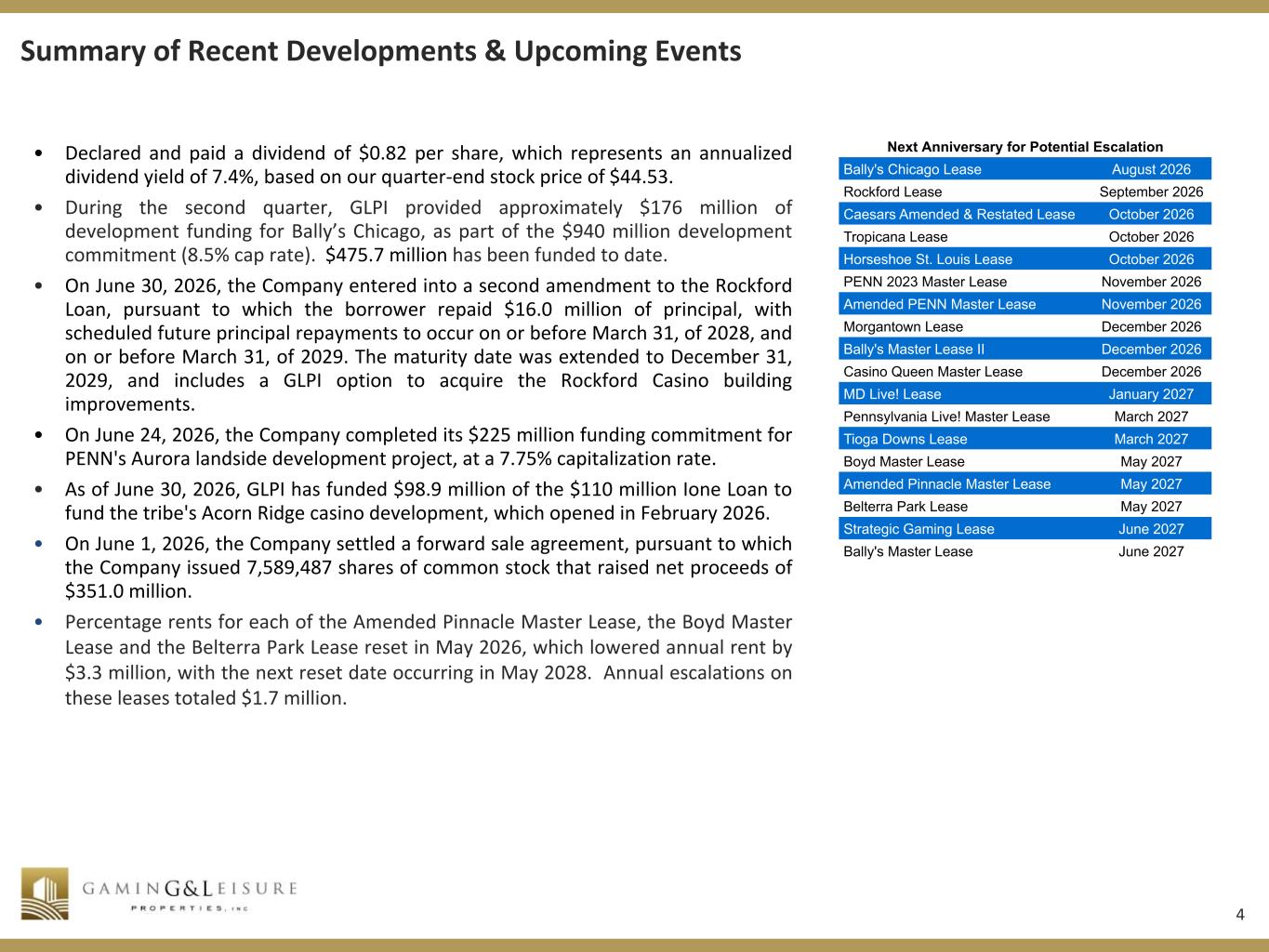
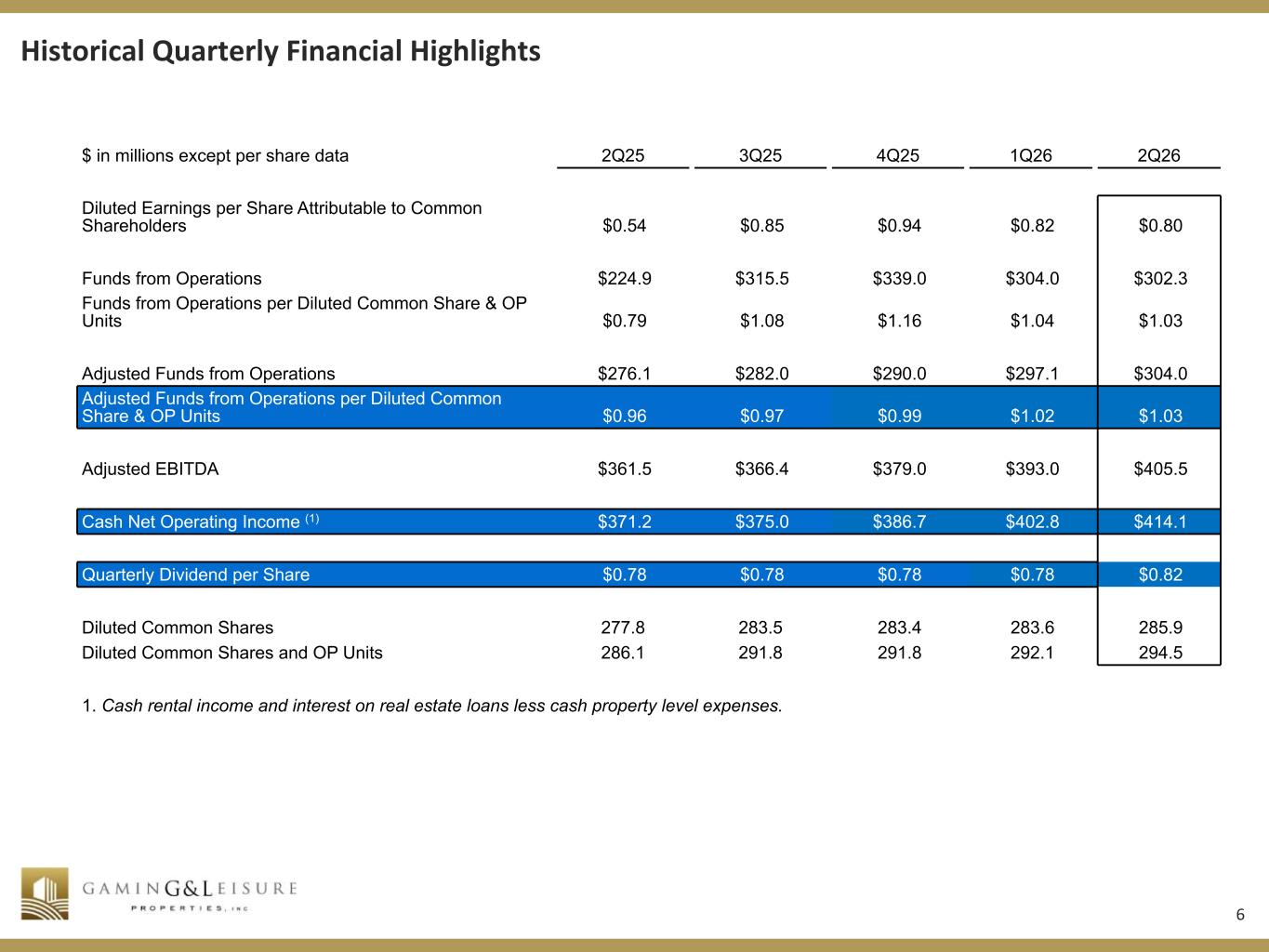
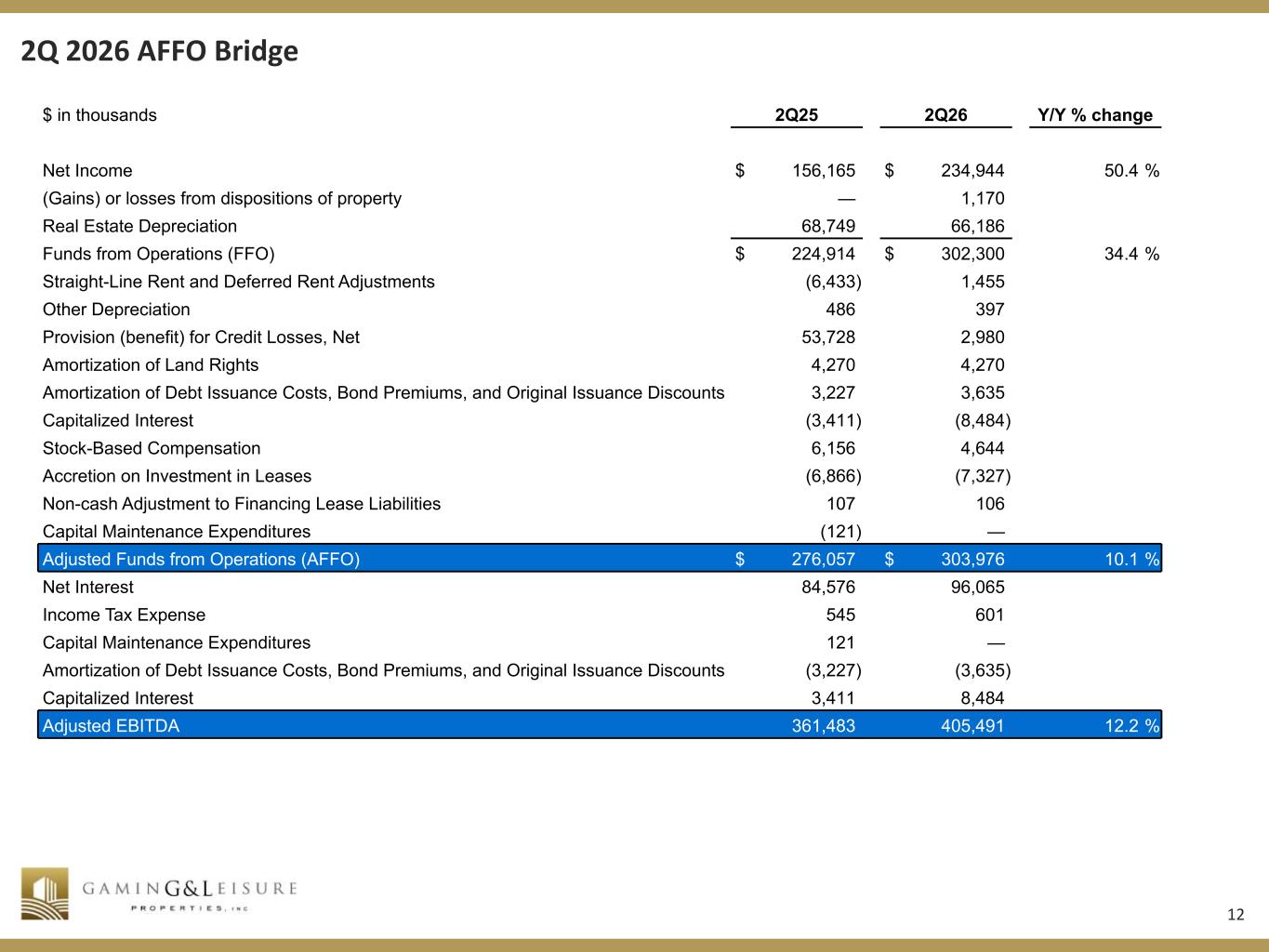
Well, thank you, Joe, and good morning, everyone, and thank you for joining us this morning. So we're happy to announce another strong quarter that sees our AFFO expanding 10% year over year, and we anticipate healthy growth in the near and medium term as our pipeline, which you all could can see pretty pretty clearly provides a lot of visibility into the pace of our growth which continues to remain strong so we believe the environment for continued transaction activity remains healthy and we're optimistic that this trend will continue to the balance of this year and and beyond of importance and I think critical importance during the second quarter is that the regional gaming market remains strong. I hear a lot of weeping and gnashing of teeth that suggest that somehow the gaming, regional gaming business is weak. It is absolutely not. In fact there's some lovely numbers being produced by some of our tenants with properties existing and and new and expanded. So the operating environment in the regional world is still very very strong our tenants are benefiting from good same-store growth and return on investment where they have opened new properties or expansion of properties so it's it's very strong I have said for many many years and I'll stand by it today despite all the grexion in the marketplace the gaming revenues are bulletproof you can write that one down They're bulletproof, and gaming companies just are as stable an investment as exists on the planet. So I would also note that, by the way, this quarter our dividend was increased by 5% to $0.82 per share, bringing our three-year dividend growth compounded to 4.4%. So our balance sheet remains strong, providing flexibility for ongoing projects. We can finance everything that we've got announced with what we have available today. We have no need to go to the market if we don't feel like it. Given our progress today, we feel good, by the way, about the second half of 2026. The first half has been very, very strong. So with that, we're happy and believe that the company remains well positioned to continue on the path that we've set. and that gives me the great opportunity to turn the microphone over to Desiree who can't wait to get to you.
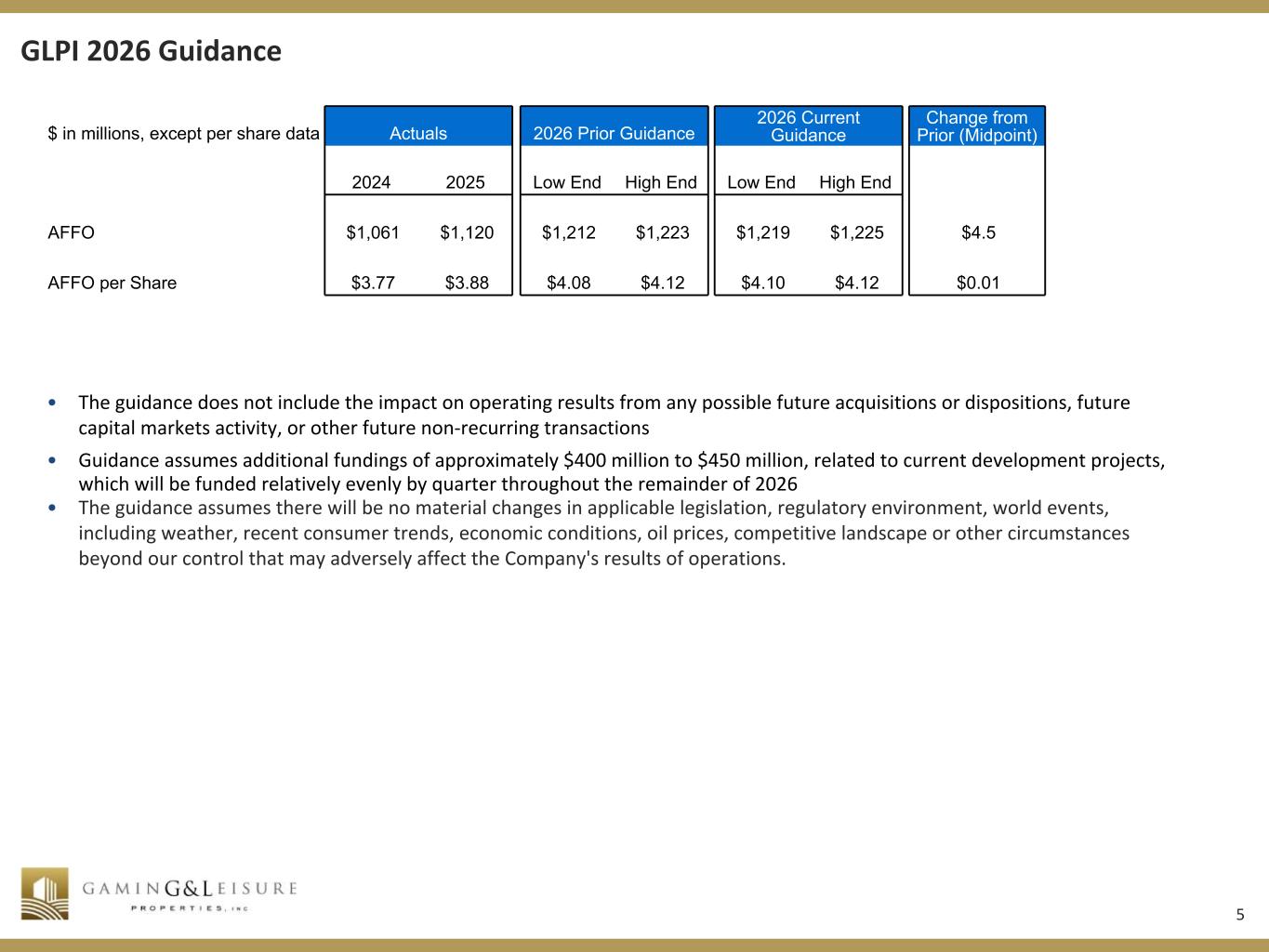
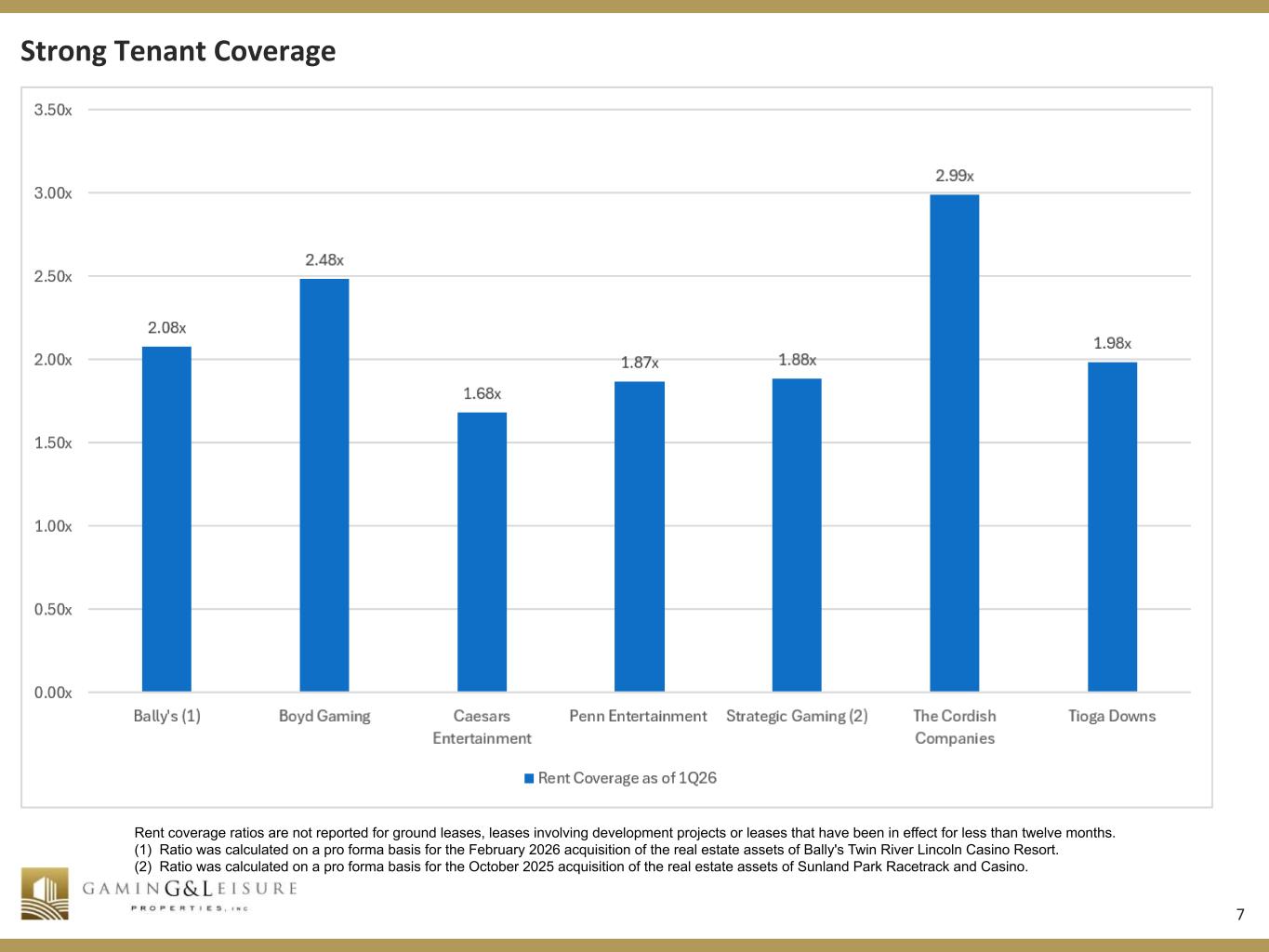
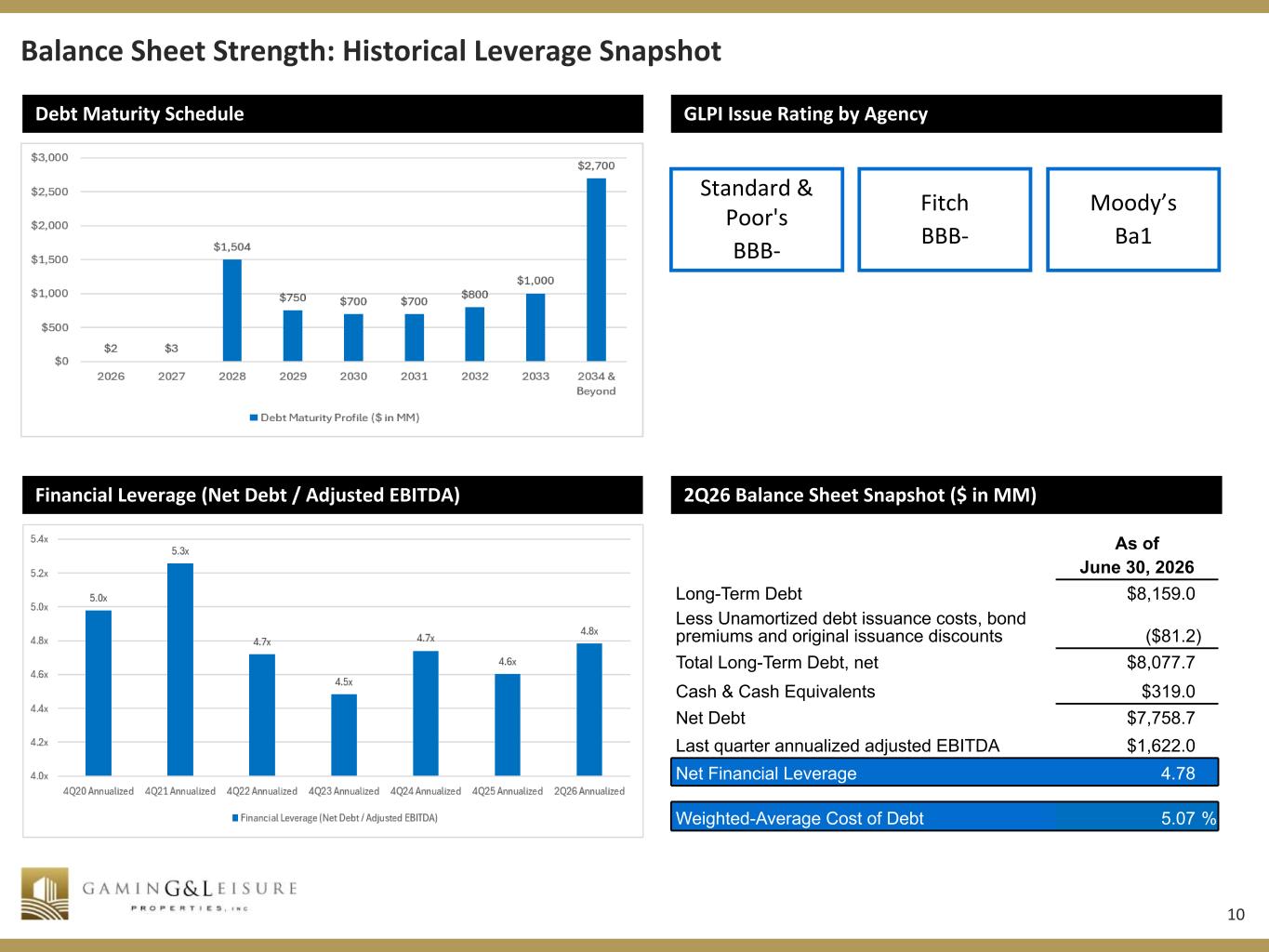
Thanks Peter and good morning. For the second quarter of 2026 our total income from real estate exceeded the second quarter of 25 by over 35 million dollars. The growth was driven by approximately 43 million in increases in cash income resulting from acquisitions and escalations. For Bally's, the acquisition of the Lincoln Real Estate increased our cash income by $14 million, the Chicago Lease increased cash income by $9 million, and the Bell Development Project increased our cash income by $2.4 million. For Penn, the Joliet, Aurora, and M Resort funding increased cash income by a collective $5.8 million. The Sunland Park Strategic Acquisition increased cash income by $3.8 million, and the Dry Creek, IOWN, and Cordish, Virginia loans increased cash income by $4 million. The recognition of escalators and percentage rent adjustments on our leases added approximately $4 million of cash income, and then the combination of our non-cash items from revenue gross ups, investment and lease adjustments, and straight line rent adjustments resulted in a decrease of $7.2 million. Our operating expenses decreased by $54 million, mainly due to the non-cash adjustments in the provision for credit losses. We also included in today's release guidance of between $1.219 billion and $1.225 billion, or $4.10 to $4.12 per diluted share and OP unit. The guidance does not include the impact of future transactions, however, it does include additional development funding of approximately $400 to $450 million, which will be funded relatively evenly over the next two quarters, bringing our total development spend to $750 to $800 million, the same as what we projected last quarter. From a balance sheet perspective, Peter mentioned that our leverage ratio is at 4.8 times, slightly below our target level of 5 to 5.5 times. we did settle our forward contract issuing 7.6 million shares and raised net proceeds of 351 million. I'll end with a reminder that our significant development projects pay us cash income upon funding and our rent coverage on our master leases ranged from 158 to 246 this quarter as of the prior quarter end that is. With that I'll turn it back to Peter.
Thanks Desiree. Yeah look I I hope this highlights that we see all the companies in a terrific position, scarcely ever been better. So we're very positive here as we sit around this table with what we have in front of us. So with that, let's get to your questions. Carrie, please go ahead.
Operator
Thank you. We will now be conducting a question and answer session. If you would like to ask a question, please press star 1 on your telephone keypad. A confirmation tone will indicate your line is in the question queue. You may press star 2 if you would like to remove your question from the queue. For participants using speaker equipment, it may be necessary to pick up your handset before pressing the star keys. And our first question will come from Ronald Camden with Morgan Stanley.
Hey, great. Just two quick ones. Obviously, there's been a lot of news about some of the operators potentially going private and so forth in the industry, would just love to hear some thoughts just from your perspective sort of how you thinking about the impact GLPI how do you think about this trend overall for the industry any color there would be helpful thanks I'd like to take that hey Ron this is Carlos so look I mean obviously to two larger operators that have announced what would be effectively take private transactions we have no relationship with with MGM Caesars we do have a relatively small portfolio.
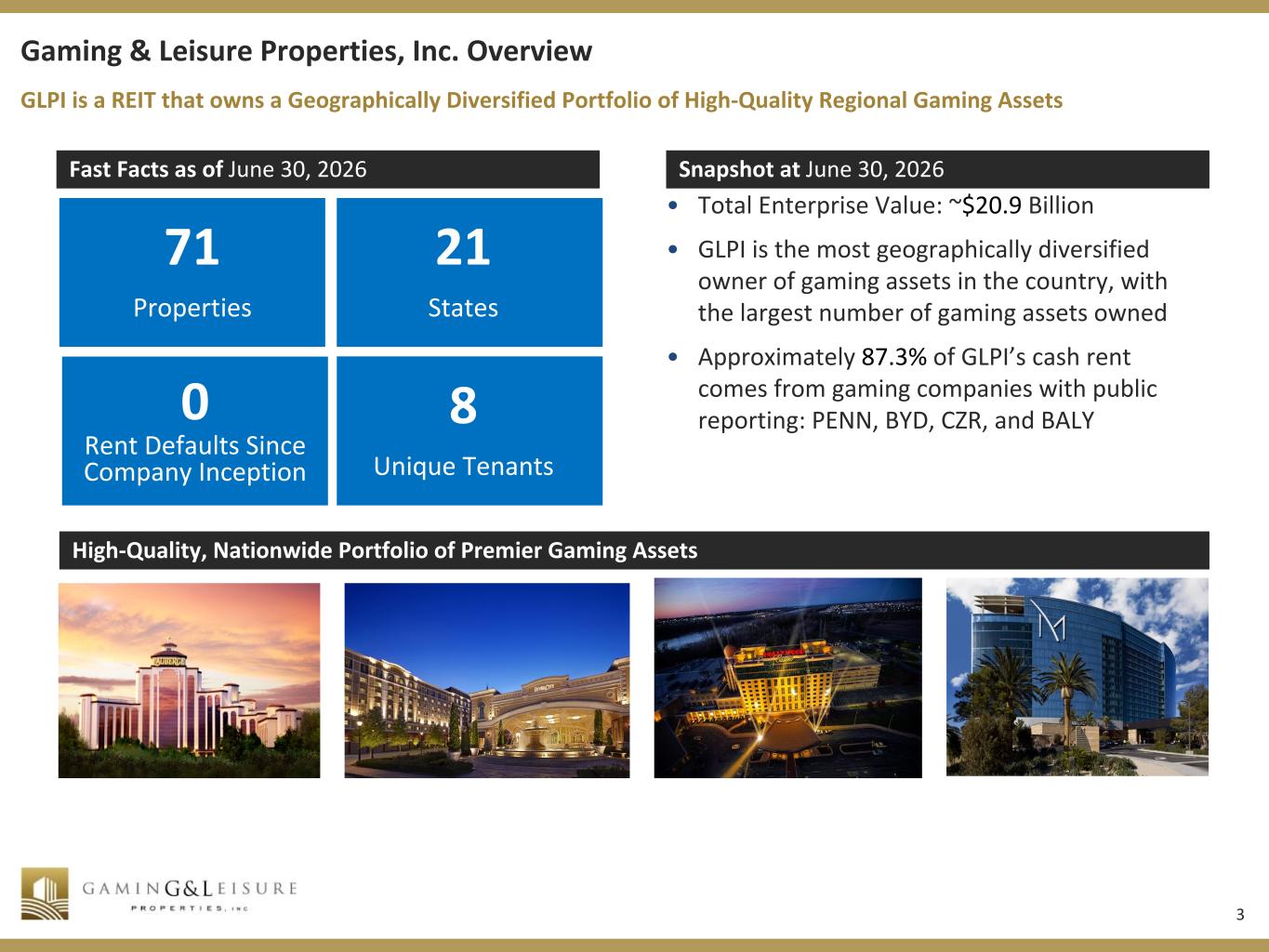
That's about 7% of our cash rent. I think the biggest thing that it shows is something we've believed all along, which is that the business, the gaming business and the operator business in the public markets has been undervalued. So I think from our perspective, that's been pleasant to see that others kind of view similarly. I'll turn it over to Steve to kind of talk about what he thinks it could mean for us from an opportunistic standpoint.
Yeah, that's fine. I don't think that there's any reasonable, there's not a reason to believe that there will be definitive M&A that will fall out of those transactions. In other words, I don't think there are set divestitures that will be required to occur or meaningful divestitures that either of the potential buyers will require to occur. So I think from our perspective, we have a phone. We're happy to answer it whenever someone calls. We have dialogue with our tenant there, and we would be receptive to any discussions if there were certain avenues they were pursuing or things they were interested in discussing. But I think as a base case, we are not assuming that there's derivative M&A that comes out of this. Great.
Helpful. And then if I can ask just the second one, just one more specific on the guidance, the $4 to $450 million. Is that obviously it sounds like a big piece of that is going to be Bally's. But is some of that, the Live Virginia project as well, just any color there? And if I could take a step back and just ask a broader question on your pipeline and how that's changed, given what we've seen with the 10-year movement. Thanks so much.
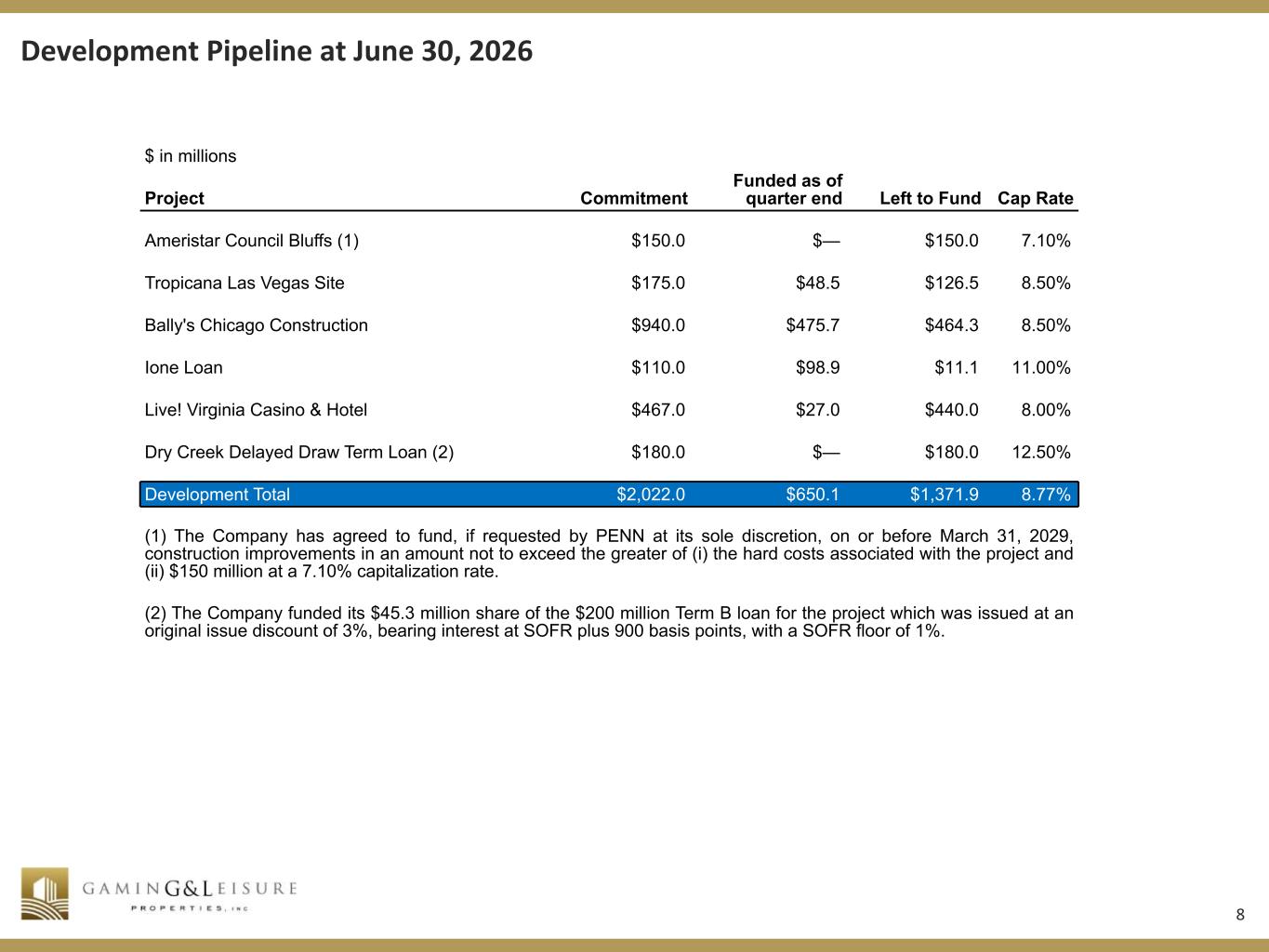
I'll start with the beginning of your question. Yes, the $400 to $450 million includes Chicago, I own, Dry Creek, and Virginia projects. So all four are included in our guidance, and they are all moving forward and expect to have – we expect to put money out during 2026. As for the second part of your project, I will turn it over to Steve.
With respect to the 10-year Treasury, that's what you were asking about?
Yeah, and how that's potentially impacting sort of the pipeline and conversations. Thanks so much.
Yeah, no problem. So, with respect to the existing pipeline, obviously, there's no real impact. We're committed to provide that capital, and we will provide it. With respect to future potential transactions and things we're talking to folks about, I think it's a double-edged sword in that, obviously, it impacts our cost of debt and our borrowing costs. So that is a factor that weighs into where we could price potential transactions. I think the opposite end of that pendulum is that it does, because borrowing costs are going up not only for us but also for operators, I think it does create another level of discussion and a little more interest as far as people seeking out alternative financing routes as they move forward with their capitalization.
Operator
That's it for me. Thank you.
Operator
And our next question will come from Greg McGinnis with Scotiabank.
Hey, good morning. Thank you. I was hoping you could just touch on the Rockford loan extension and what the option for the building improvements would look like in terms of how you would execute on that option, what the amount might be.
Thank you. yes Greg I don't think we're gonna get too much into the details on the option piece but look I mean that was 150 million dollar loan it's it's it's good yield for us the property is ramping nicely you could all see the GGR results obviously that property has been very well received the city of Rockford has announced plans to put a hotel around the site which should only further kind of help that property ramp so I think just in talking with the partner and Steve could perhaps opine more on this it just felt like a good move for us to kind of let that money roll forward while also kind of cementing that option
on the building down the road yeah I think look the obviously the the partner is would prefer to not sell the building improvements to us down the line so so obviously that's an item that we'll see where we where we land as we get further into the loan term. But I think the reality is they're excited about the property. The GGR continues to perform. We're comfortable with the loan, and therefore, it just made sense for us to roll it at that.
Okay. Thanks. And then on the financing side, potential acquisitions, leverage is low relative to the range you guys typically target. Cost equity is a little expensive versus where I'm sure you'd like it to be. Should we expect that any potential acquisitions or investments will just be funded with leverage at this point?
I really think it depends on what the opportunity is. Obviously, we will be pricing in our cost of capital to any opportunity that we decide to, anything we decide to acquire. I wouldn't just assume we're always going to use debt for now. I think we'd have to price in our cost of equity if it was a larger transaction.
Yeah, look, our business, of course, is a spread to our cost. And some of the yields that we're able to attain because of the skills and capabilities that we bring to the table, the development ability and understanding construction, willingness to do some things maybe some others are less well-equipped to do, we can command a price that gives us the margin that we need. So it's deal by deal. I think Desiree answered it perfectly well. We're not going to do it. And I underscore, again, you won't be seeing us doing anything crazy.
Operator
Okay, thank you.
Operator
We'll go next to Brad Heffern with RBC.
Yeah, hey, everybody, thanks. There's obviously been this fight over VGTs in Chicago. Can you talk about if you expect that to have a meaningful impact on the Valley Chicago project one way or another and if it would have affected your underwriting?
Yeah, thanks, Brad. So the VGTs, quite frankly, were in our underwriting. It's, you know, Chicago, it's Illinois, it's been, you know, it's a very long, obviously, relationship that we will have, you know, with that asset. So clearly you can imagine everything and anything would have been in our underwriting. The thing I will point out is I read something recently. I believe there's about 7,000 sweepstakes machines already in that market. it. So to believe that this type of gaming wasn't already taking place I think would be naive. Clearly, you know, Bally's is going through some things right now with the city as it relates to how this impacts some of the agreements that they've previously come to. But in our view, you know, the VGT concept was included in our underwriting. And another thing that was included in our underwriting also was Hawthorne, which seems to not be coming to fruition. So I would say that the puts and takes there are pretty benign overall. Okay.
Thanks for that, Carlo. And then on the Las Vegas stadium site, can you give an update there if and when you expect your remaining committed capital to be used? And then if you have any more thoughts about participating in a larger project there sometime down the line?
I can take that one. I think the timing of the 125 is somewhat uncertain still. The stadium is proceeding quite nicely. I think you would hear from the A's that the stadium's ahead of schedule and we've had the opportunity to visit that stadium with Peter and I this year and I think it'll be a spectacular event venue and and that will drive a lot of value to the site so we're keeping an eye on it. Valleys is coming close I think to a more concrete plan for some of the critical infrastructure that needs to support the stadium and by that I mean excess ways, the podium, utility, utility conduits, things like that. There may be an opportunity for us to invest more in that property and some of that key critical infrastructure. And we'll take a look at that when that time comes. But I don't think we're prepared at the present time to commit to anything over the 125 and we'll continue to work with valleys and see if that makes sense.
Operator
And we'll go next to Barry Jonas with Truist securities.
Hey, guys. Churchill Downs formally announced they're exploring the sale of most of their gaming assets, and I believe they said they're looking to execute in the coming months. Just curious if that's something you're looking at in conjunction with or without specific tenants at this time.
Yes, it's something that we're aware of. I think any broader process that's run we'll definitely be involved and we'll definitely take a look I would just I would assume that most of the processes you're you're not supposed to be working with anyone in particular per your your NDA so I can't speak to any discussions that may or may not be happening on on those fronts but I can tell you that we're definitely aware of the assets we've spoken we've spoken with various folks that are involved in that process and we will we will see how it proceeds there are there are assets there that are there are their quality assets there are other assets that are maybe a little more challenging but at the same time depending on whether it's an existing tenant that we have a relationship with that finds value in certain assets or more importantly or equally as important potential new tenant relationships that might find interest in certain assets, whether it's because of ability to cross-manage and garner synergies or the like, we're willing to have discussions with anybody and see if there's...
And then just as a follow-up, I think this week, a large casino operator, they kind of voiced increasing optimism for iGaming legislation to pass this year. They stated Virginia, Maryland, and Indiana. You guys have been certainly vocal with your views on iGaming, but just curious if you share that view on those states or just in general iGaming legalization in the near term. Thank you.
So with respect to the three states you mentioned, I agree that there is legislation moving in those states, and there does seem to be some momentum, but whether or not that will get across the finish line is unclear. I think from a broader level, predictive markets, sports betting, it's all coming under some level of attack in a lot of states, both when it comes to predictive markets, certainly the federal level, and even sports betting on the state level, where people have started to take a closer look at some of the social ills that are occurring in certain demographics, online gaming and sports betting. And I think that's garnering a lot of attention in a lot of states. And I think in the three states you mentioned, that's still a hot topic of conversation as to what impact allowing mobile and social type gaming, what impact that's having on certain segments of the population. And so I know depending on who you talk to, people are either overly optimistic that they can expand iGaming or overly optimistic that they can put an end to iGaming. I think both arguments have some momentum in different areas. And the three states you mentioned, I would agree, have some momentum toward iGaming. But on balance, I think you'll see most states are proceeding very, very cautiously with increased online gaming.
Operator
Perfect. Thank you for that.
Operator
Our next question will come from Smeeds Rose with Citi.
Hi, thank you. You provided an update on the Las Vegas opportunity. AND I WAS JUST WONDERING IF THERE ARE ANY UPDATES YOU CAN PROVIDE ON THE NEW YORK OPPORTUNITY WITH THE BALLEYS AT THIS JUNCTURE?
FROM OUR PERSPECTIVE, NOT MUCH HAS CHANGED ON BALLEYS NEW YORK. WE REMAIN OPTIMISTIC THAT THAT'S GOING TO BE A POSITIVE AND ACRETIVE PROJECT FOR THE BALLEYS TEAM. I DON'T THINK IT MAKES A LOT OF SENSE FOR US TO BE INVOLVED WITH OUR COST OF CAPITAL AT THE FRONT END OF THAT PROJECT, AND I THINK THAT'S SOMETHING BALLEYS KNOWS AND WE KNOW. we remain close to them and there could be opportunities needs for us as that continues we do have a roper in New York on certain aspects but I think it's way too early in that process and they're pulling together their financing and construction financing cost of capital and those things for us to really know what kind of role we'll play but we'll stay close to it I think we remain interested in being a part of New York if it's the right part and it's something we can do at an accretive level okay okay um and then i just wanted to ask you last
quarter you had mentioned a few um challenges at the tropicana in um atlantic city and it looks like the coverage there ticked down just a tiny bit i mean i still realize it's still strong but um any sort of issues or challenge or updates you can provide on that property no i mean i i think he did have that that one challenging quarter which would have been the calendar 4Q25 coming in at that point.
What I saw when you look at it sequentially is stability as you move through the first quarter. You know looking at the results from from the likes of Caesars and Boyd and even Churchill from the regional properties in the second quarter and remember we're reporting those coverages one quarter in arrears so we won't see that until we report 3Q, but looking at the 2Q trends and the performance of each of those tenants that I just mentioned, I think that there should be a nice tailwind, you know, in their operations and certainly things have strengthened for those operators in the regional market. So I think broadly speaking that that's a pretty good leading indicator for us as we look ahead.
Operator
We'll go next to David Katz with Chipreen.
Hi, good morning, everyone. Thanks for taking my question. So to that, you know, very same comment you just made, you know, Carlo, you know, we are seeing some real strength out of regional gaming. And I'm curious to get, you know, your collective perspective on, you know, whether that is, you know, economically driven, macroeconomically driven, whether that's, you know, a function of some of the smarter operators having put forth some capital into their properties and improve their value proposition, you know, which we've seen pretty broadly, including, you know, the one company, Peter, you founded, right? You know, what is the driver of that? And what, you know, gives you that confidence that, you know, a year from now, we're still going to be having that same conversation?
You know, my sense is the consumer market generally is still pretty strong despite all the negativity you see sometimes in the in the press the economy is strong some there are areas of course of weakness but by and large I think people are in the marketplace you know you've heard me say many many times David that that people don't give up their entertainment you know food shelter and gambling are the priorities in people's lives so the across the board where we're sensing because we get numbers when you get them, that demand is extremely strong, extremely strong. And I have talked broadly with some of the folks at Penn. Their new projects and their investment of capital in hotels and so forth has been apparently off the charts. I mean, we'll all wait and get the final result quarter to quarter, but just a terrific result. So, I mean, we viscerally feel just a lot of enthusiasm out in the marketplace. right now. And I think it's just a broad look at the economy generally.
Yeah, David, and I'll just add to that. I think, you know, going all the way back to kind of void spend at Treasure Chest, what you've seen is really healthy returns on incremental capital dollars put in place, including, as Peter just mentioned, Joliet. You know, the early results out of the temporary at Live Virginia have been incredibly positive, you know, for a temporary facility. So I think dollars being put to work, you're seeing very healthy returns on them. I think that bodes well.
Well, besides the new project, you've got a new hotel in Columbus, which I understand is going well. You've got the hotel at M, the expansion there that has also been apparently very strong. So this is all good stuff for us.
Operator
Understood. Thank you.
Operator
Moving on to Daniel Guglielmo with Capital One Securities.
Hi, everyone. Thank you for taking my question. questions this is shaping up to be an interesting year across gaming with mergers asset sales and development but so much happening can you just remind us what you all look for in deals to make sure that they align with the long-term sustainable growth focus yeah i think look i think when we go through our underwriting process and anybody can add on at the end here but i think we go through our underwriting process on on really any transaction regardless of how big or small it may be.
We're going to look for the things you would expect. So stability, long-term performance, competitive, the competitive threats or opportunities, the credit quality of the tenant, diversify not only geographically, but just based across the portfolio and the asset base. So we're going to take a lot of factors into account. I think we would do that whether it was this year or last year or 10 years ago. So I don't think our underwriting process has changed. There's obviously, with the expansion of gaming into new jurisdictions over the last few years, I think that definitely changes the way we look at things. And I think it continues to mold the way we think about potential new jurisdictions and whether they were come to fruition and where would the asset that we're looking at be located on a geographic map as it relates to potential future competition. So those are all things we think about. I don't know if anybody else has any.
I think it's important to double back on something Carlos said in the beginning, which is some of the M&A activity in the regional markets, whether it be Valleys, MGM, or Caesars, is probably being driven by a dislocation between the perceived value of these operations and assets and the actual value of these operations and assets. sense. And I think what you're finding is people get the stock prices get to the point where people say this has gotten to the point where we're just going to act on this and take it private and realize the value that the market's not seeing. And unfortunately for GLPI, I think the same dislocation feeds into our stock. We have very strong tenants that operate in markets that are doing quite well. And despite what some of the reports have written, we see a lot of strength in our tenants operations in the regions and I think you're seeing that drive M&A and I think you're seeing that I think you're seeing that in some of the M&A activity out there so as long as those dislocations persist I think you'll continue to see activity there look the gaming broad-based gaming world has been around for more than 30 years and all I commend anyone go back and just take a look at the track record of properties and performance over over the long long term this is an incredibly stable industry incredibly stable we'd love these assets getting the market to appreciate the value of what we've got has been really a challenge yeah and I think whether our coverage is 2.5 or 2.3 or 1.8 or 1.6 these assets are all performing quite well these are all portfolios and leases that that our operators will want to continue to own and pay rent on so so while we remain frustrated at times with the equity cost the capital here, we're still very happy with the performance of our overall portfolio.
That's great. I really appreciate all that color and info. A quick follow-up. One of your tenant partners did decide to forego funding on a smaller project this year. So thinking farther out, what do you all think of as GLPI's main value proposition for current and future operator tenants where it makes it worth it for them to fund development through you all versus raising capital themselves?
I'll jump in and then Desiree maybe can add something. I think the reality is there are some benefits that the operator gets and the initial onset decision is going to be somewhat dictated by their cost of capital. I think as we move forward, the only other aspect I think they consider is the ramp they can get from the capital, whether their return on the EBITDA side is great enough that they could then sell the improvements to us later for a value that's larger than the cost to build. So I think those are the three things that the operator is probably considering when they make that decision. And I don't think it's a matter of will they sell the improvements to us ever. I think it's a matter of when will they sell them to us. Because at the end of the day, when it's the improvements constructed adjacent to a building we own on land we own, it's probably a foregone conclusion that we'll end up owning it at some point in time.
I agree with all that. And I also think you have to look at it, I think, as a cross between debt and equity, right? So we're giving 35-year funding, which is more akin to equity than it is to debt. And most of the gaming operators typically barely get to a 10-year bond, much less 35 years. So So our cost of funding vis-a-vis their cost of equity is definitely a plus.
Operator
Our next question will come from Chad Bainon with Macquarie.
Hi, good morning. Thanks for taking my question. I wanted to go back to the funding guide, the 400 to 450. In your slide deck, you display what's left to fund. I think Chicago is still expected to open. in the first quarter of 27, obviously live in Petersburg is deeper into 27. So I'd assume most of that 4 to 450 between these two larger loans is going to come from Chicago. But can you maybe just put a little bit of finer point on that 4 to 450, where the range is coming from? Is that really just kind of a timing thing? Probably more on Chicago, kind of when they're finishing up, given that Virginia would probably be pretty straightforward, at least at this point in their construction cycle. Thank you.
I mean, it's really just our best estimate of the timing of their funding. I mean, look, somebody could pull money in January instead of December, and that's why we have four to 450. And we are funding all four of those projects during 2026, and will continue. They will continue into 2027. So the range is just simply it could it's just timing as to when they're pulling the funding.
Okay, thanks, Desiree. And then moving on to, you know, Boyd announced that they're going to be doing another barge to land project. Carlo, I think you talked about the success in treasure chest. Do you think there's more opportunities or any other markets where there could be, you know, some of these Generation 1 riverboats kind of moving to land? Are there any other, you know, proposals or availability either in Louisiana or in other markets that you could see in the future?
I can tell you that we have a list of those boats. You know, what I would also say is I think that the success that we've seen with these transitions over the last several years bodes very well for others, you know, a willingness to make that leap and go forward. You know, to the extent I could identify anything specific at this point that operators have talked about, no, perhaps maybe Steve could, but I tend to think we have an eye on it. I think the history here has lent itself to promoting more such activity as we look out in the future.
Yeah, I don't know of any – there are things that we've had private discussions on. I don't think that there are many things public at this point. But, look, I think if you think about Penn's capital improvements, Bally's has made capital improvements and land side moves, and then Boyd, the proof's in the pudding. Like, they've each put the capital forward. They've each seen the returns, and you could safely assume that they will continue to look for other ways to deploy that type of capital and achieve those types of returns. So I think that they've proved it for themselves, and I think they'll continue to look for opportunities, and we've had discussions, and we'll continue to be open to having more discussions.
Thank you very much. As you've seen, the results have been stunning, nothing short of stunning. So it's really transformed the opportunity market.
Operator
Agree. Thank you.
Operator
And moving on to John Tuckery with CBRE.
Hi, everyone. Thanks for taking my question. I know we talked about the two big take privates out in the market, but big picture, Peter, everyone, you've worked with both public and private companies in terms of getting transactions done, development, M&A, sell-e-spec. But I'm curious if you could speak to, you know, any differences in working with public-private companies on transactions, any advantages or disadvantages that would be worth talking about.
I don't see any material difference, just as long as it's the quality of the people and the nature of the deal. I mean, we like visibility. Public company visibility is nice to be able to see what's going on, as do you.
We have a little less, obviously, with a private group. but no I don't see anything materially different Steve I agree and the public company nice to have disclosure can go away the next day when they decide to go private so we've all seen that happen a couple times our leases do require them to report to us on a monthly basis balance sheets income statements information that we request so we will have we do have information on our private tenants just like we do on the public tenants so from an information perspective, I'm not concerned at all. And quite frankly, kind of understand why the operators are doing what they're doing, right? They're not being rewarded in the market today. And, you know, if they can find a cheaper cost of capital, they should do that.
Yeah, I think our bigger problem is not the information we get. The bigger problem is we're unable to convey it to you folks. That's the bigger problem that we have. So we'll have continued transparency into what's going on at these properties. Unfortunately, it puts us in a tighter box to be able to discuss those things publicly.
Got it. And maybe a quick follow-up on that. I think you touched on it a little bit earlier, but in the same topic, the valuation that public markets have been ascribing to your tenants and casino companies. With the private companies, do you see going forward a better opportunity to transact with those companies as they're not maybe beholden to kind of public market valuations? Do they at moment have more flexibility? So I guess looking ahead, would you expect to see more activity as more companies are private, more operators are private? You know, we've certainly seen even some of your tenants, the growth, M&A development coming from private companies. So are they less encumbered, better cost of capital, or what have you expect them to be more active than public companies going forward?
Yeah, that's a little difficult to answer, John, just because I think there's a wide swath of what it means to be a private gaming operator. There are some family-owned businesses that are kind of small, and their access to capital is probably somewhat limited. And then we're talking about some of the largest gaming companies in the country becoming private. So if I kind of think about this smaller side of the spectrum, I'd say most of those folks, I'd say their ability to be active in the market is somewhat predicated on their access to capital. I think obviously the Illich family just completed the transaction. They have plenty of access to capital, but as far as the size of their corporate structure and their team, I think it's going to take some time for them to digest that and to then be able to look for the next thing to hunt. So I think there are different nuanced realities that come with each of these private companies that you have to be thoughtful about when you're trying to transact with them. But I think, look, at the end of the day, things like Greenfield are significantly easier for the private companies to do. They're not out there publicly reporting their cash flow metrics and their EBITDA impacts when they have none coming from the projects in which they're building. And I think that's why we've seen in some states companies like Rush Street be able to do so many greenfield development projects and be so aggressive in expansion because they haven't had the same analysis and scrutiny from the public markets. So I think it will be a trend that will continue and we'll see it probably more widely spread if we see some other jurisdictions legalize gaming.
Operator
Awesome. I really appreciate that, Keller. Thank you, everybody. Thank you.
Operator
And our next question will come from Mitch Germain with Citizens Bank.
Thank you. You guys were previously pretty optimistic about some additional tribal financing transactions. I'm curious about your enthusiasm about possibly getting some more over the finish line.
And Steve can probably jump in. Look, I think, Mitch, we remain enthusiastic about the opportunity and the opportunities that are out there in the tribal gaming and financing world as we indicated early on in this process things move very very slowly in tribal gaming and in tribal financing and we are having we have had and continue to have a lot of very productive conversations both on developments refinancing and other potential uses of capital on tribal land held in trust whether or not to handicap whether or not some of those things will come to fruition in 2026 is hard hard to do it would be speculative for us to do it but it's certainly possible we have a number of things we're discussing at the moment with a with various tribes and I think whether it's 2026 or 2027 I do think you'll see some future activity out of us with respect to those tribes if we can get over a few homes it's been a continual education process.
And I think there's been growing receptivity, which we're now trying to cultivate and convert into growing adoption. And as we do that, I think we're also looking to try to prove out that there are additional use cases beyond just tribal greenfield. So we're working on all those fronts. And I agree with everything Brandon said. I don't think timing is known, but efforts are real.
And I think, Mitch, just to give you a little more comfort in how we look at this, we continue to look at high levels of coverage and a margin of safety around these tribal transactions. And in everything we're looking at currently, we're side-by-side with some other traditional banking and financing sources. So we're not a full solution for anybody at the moment, but trying to fill gaps and create a long-term piece of capital or a long-term piece of debt to complement what these tribes otherwise have with their traditional financing sources.
Operator
And we'll go next to Robin Farley with UBS.
Great, thanks. I just wanted to ask a little bit about, you know, what the competitive landscape looks like, not for the operators in, you know, regional markets, but for you in terms of, you know, other sources of financing, whether it's private equity or, And Churchill Downs, that competitive environment may be different than some of the interest in Vegas assets in the past, but just would love to get your take on that.
Yeah, I think with respect to the Churchill Downs, I guess, competitive process, I would expect, obviously, our main publicly traded competitor to be involved in that process. And they said that yesterday on their call. I also think that there are some different funds that have been, you know, I would think you would call them more private credit, like Blue Owl. I would expect that they would be active participants in this process. But beyond the three of us, I'm not sure that it goes much, much further, much deeper. As you pointed out, for strip assets, premier strip assets, I think that has brought others to this. I think if a premier strip asset were to come to market, I think the same thing would happen yet again. But for a regional portfolio of, you know, a number of assets across a number of states, I think it's probably a pretty limited scope, most likely.
And I don't think it changes a lot, Robin. The way we look at this is we have a cost of capital. We have an underwriting of these facilities, what we think they'll do, what we think they can do, the competitive threats that they might be under. And we come up with a number that we think we're comfortable paying and a construct we're willing to do in a lease. And if we're outbidding that, fine. That's okay. Like, I don't think you'll see us chase any transactions just because there's competition. We'll have the same underwriting process and an auction process that we do privately. So it may reduce the likelihood of success on our part, but it won't change the way we approach the underwriting.
Yeah, you've heard me say for many years, there's no deal we have to do. It's just not what drives us here. So we're perfectly willing to walk away.
Operator
And moving on to Todd Thomas with KeyBank Capital Markets.
Operator
Yeah, hi, thanks.
I just wanted to ask, you know, Peter, you talked about, you know, a couple of important things on this call. You know, you talked about the dividend that's yielding over 7%. You seem very encouraged by the regional beaming landscape. The stock's trading at north of a 9% AFFO yield at the midpoint of your guidance and nearly 8% implied cap rate on current NOI. I'm just curious where stock buybacks fit into the equation. I know there are some potential investment opportunities on the horizon, and you have other commitments and uses of capital. But, you know, you've been opportunistic, and it seems like you're a little frustrated with where the stock's trading. I'm just curious if you could talk about how you're thinking about buybacks and how that might fit into the equation.
Well, look, I mean, that's always the last choice. I mean, that's where you throw in the towel and admit that the game is kind of over. At some level, sure, I think you'd have to responsibly look at that possibility, but we're not there yet by any means. We honestly think there's opportunity to be had, as I said earlier. and we have capabilities that others don't. I wouldn't sell short the development capability that we've already demonstrated, that we'll step up and take a project from ground up. That is most unusual, but we have the skill to do it, and that's where we can add value and get returns that are a little bit different. You know, I've said many, many times that I'm not sure I ever want to be the winner at an auction. I mean, it's just, I've sometimes said the winner loses, so, and there's certainly some examples of that where there have been auctions that have, let's say, not quite worked out the way the winner had hoped. So, we like to find an opportunity where we can add value, and that's unique and different, so that we have, we're not really competing with others. That's kind of our goal, and that's what we've been doing largely.
Operator
All right, thank you.
Operator
We'll go next to Michael Herring with Green Street Capital.
Hi, thanks. You guys offered some thoughts on online gaming and the likelihood that there would be legalization in various states. I'm just wondering, how does that impact how you underwrite incremental capital deployment or new casino sales specs relative to states without any sightline to iGaming?
Look, I think overall not much because the reality is in states where iGaming has been prevalent for five or six years, it hasn't had an impact on the viability of our rent. In other words, in a state like Pennsylvania, what we've seen is slower growth in bricks and mortar, not a deterioration in that business, and certainly not something that has gone to the level of impacting our tenants' ability and desire to pay rent. So we keep a close eye on iGaming and the proliferation of iGaming and what it might mean. But I don't think it plays a significant role in how we would underwrite the acquisition of an asset. Now, that being said, if iGaming came into these states in a way that would be detrimental to the bricks and mortar, in other words tax rates and things like that that could that could effectively cause an operator to or disincentivize an operator to invest in their bricks and mortar property we'll have to take that into consideration and certainly would so i don't think we see it as the end game to gaming i think as peter said many times we feel like people do enjoy the entertainment they enjoy going out to do it it has resulted in a supplemental source of revenue for some of our tenants and states that at it which has been a benefit to us when we have things like parent guarantees
because it's just created additional revenue to pay our rent but I'd say we're cautious about it but I don't think it has a tremendous impact on on anything at the moment yeah let me let me note that Pennsylvania is the poster state for excess yeah they were a state that at one time had been circumspect about expensive gaming has sort of limited nothing and yet in in spite of that, the bricks and mortar facilities continue to do, let me say, acceptably well. They've been impacted, but not disastrously.
Michael, I'll just add to that. I mean, when you think about our underwriting and you look at our coverages and you look at the longevity of how healthy these coverages have been over a decade plus, when we underwrite things, you know, we're underwriting 30, 40, 50-year leases, anything and everything is kind of included in the what could go wrong category, and that's how you kind of keep rent coverages where they are and healthy. You know, so when we do think about stuff like that, obviously, you know, iGaming is certainly a consideration in those bear and base cases.
I appreciate all those thoughts. And maybe just going back to the encouraging, you know, regional gaming trends that have been discussed, how does that, has that impacted how you've been looking at structuring rent coverage. And then on a similar note, do you have any sight line to your operators underwriting new redevelopments or CapEx into those properties?
I think on the rent coverage piece, it's more validated our model for rent coverage, right? We've always been somewhat cautious around two times rent coverage from the time we spun out in 2013. I think as you've seen those rent coverages bounce around a little bit, they're still very healthy. Here we are 13 years later. I think what you're seeing in these gaming markets is they ebb and flow, and there are different economic cycles that impact gaming just as it impacts other things. But gaming has been very resilient in the regional markets, as has it been on the strip, quite frankly. It may have more volatility, but it's still there, and people are still investing. So I think from my perspective, it sort of validates where we were in our rent coverage thought process initially, and that's why it continues to be healthy today. That's for the other pieces.
What was the other question again? I'm sorry.
It was just, you know, considering the strong trends and, you know, the success that you've seen from some of the properties that have received additional CapEx, do you have much sightline to, you know, new investments?
Sorry. On the CapEx front, if in fact one of our tenants was going to pursue a larger capital improvement, there's a notification process. They would come to us, and if they're interested in discussing with us potentially us funding the capital, they would obviously provide us with additional information. So at the times in which they are pursuing those things, yes, we are receiving information, but just generally, more generally speaking, nothing we can share.
And I think you have an increase, CapEx. I mean, Penn in particular, in the last two years, has had a renewed emphasis on putting capital back into the bricks and mortar. And you've seen that in some other tenants as well. I think you'll continue to see that as the regional performance supports that CapEx spend.
Yeah, look, balance is a great illustration in Baton Rouge. Taking those two, dare I say, nondescript almost, in one case, pretty dreadful properties, and converting it into a real asset has been just phenomenal. And in a very, very stable and established market, has actually grown the market, which we would have thought would be a long shot, but has actually created more demand. Amazing.
Operator
Okay. Appreciate the thought. Thank you.
Operator
And this now concludes our question and answer session. I would like to turn the floor back over to Peter Carlino for closing comments.
Well, not much to add that we haven't shared already. We appreciate your dialing in today. Look forward to seeing you again down the road next quarter. So see you then. Thank you. Operator, thank you very much. Joe, thanks.
Operator
Thank you. Ladies and gentlemen, thank you for your participation. This does conclude today's teleconference. You may disconnect your lines and have a wonderful day.