Operator
Hello and welcome to the Hamilton Insurance Group Earnings Conference Call. As a reminder, this call is being webcast and will also be available for replay with links on the Hamilton Investor Relations website. I'd now like to turn the call over to Darian Niferados, Vice President, Investor Relations and Finance. Please go ahead.
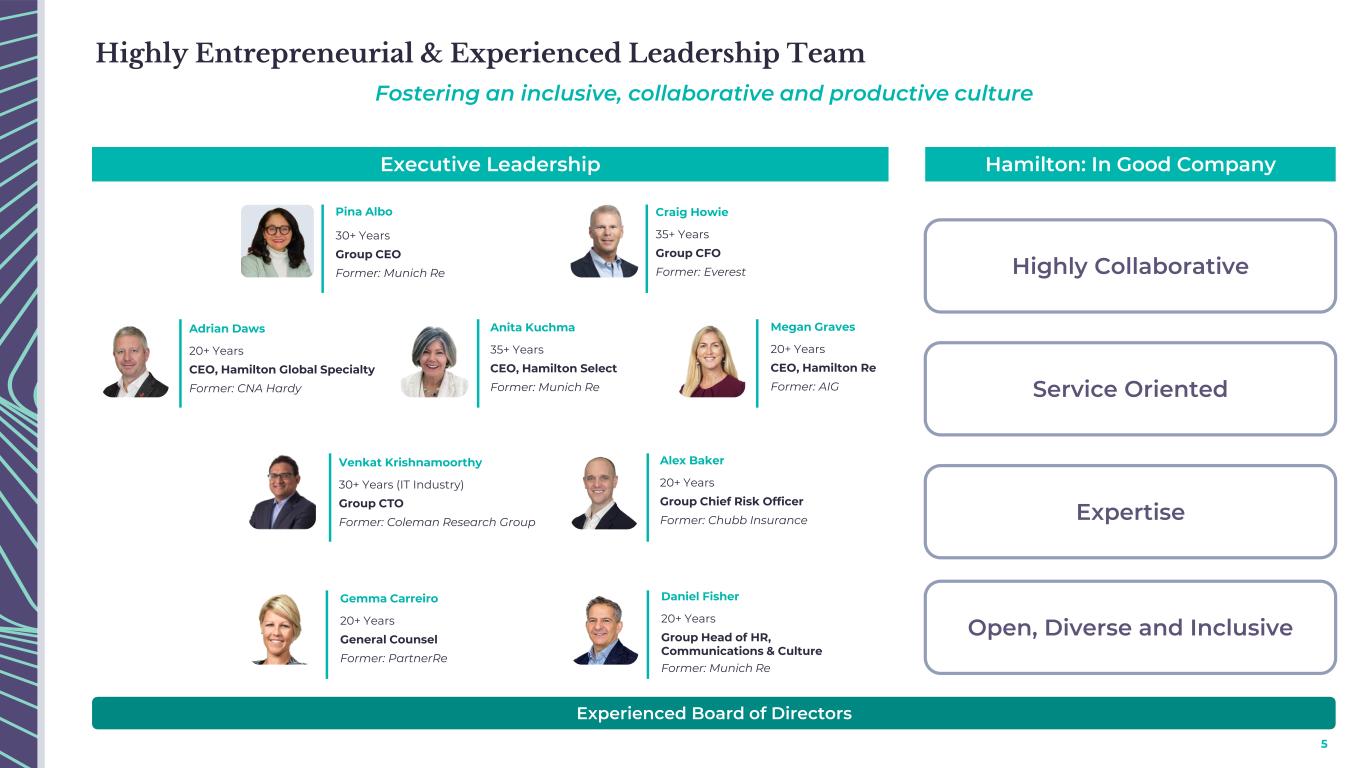
Thanks, Operator. Hi, everyone, and welcome to the Hamilton Insurance Group First Quarter 2025 Earnings Conference Call. The Hamilton executives leading today's call are Pina Albo, Group Chief Executive Officer, and Craig Howey, Group Chief Financial Officer. We are also joined by other members of the Hamilton management team. Before we begin, note that Hamilton financial disclosures, including our earnings release, contain important information regarding forward-looking statements. Management comments regarding potential future developments are subject to the risks and uncertainties as detailed. Management may also refer to certain non-GAAP financial measures. These items are reconciled in our earnings release and financial supplement. With that, I'll hand it over to Pina.
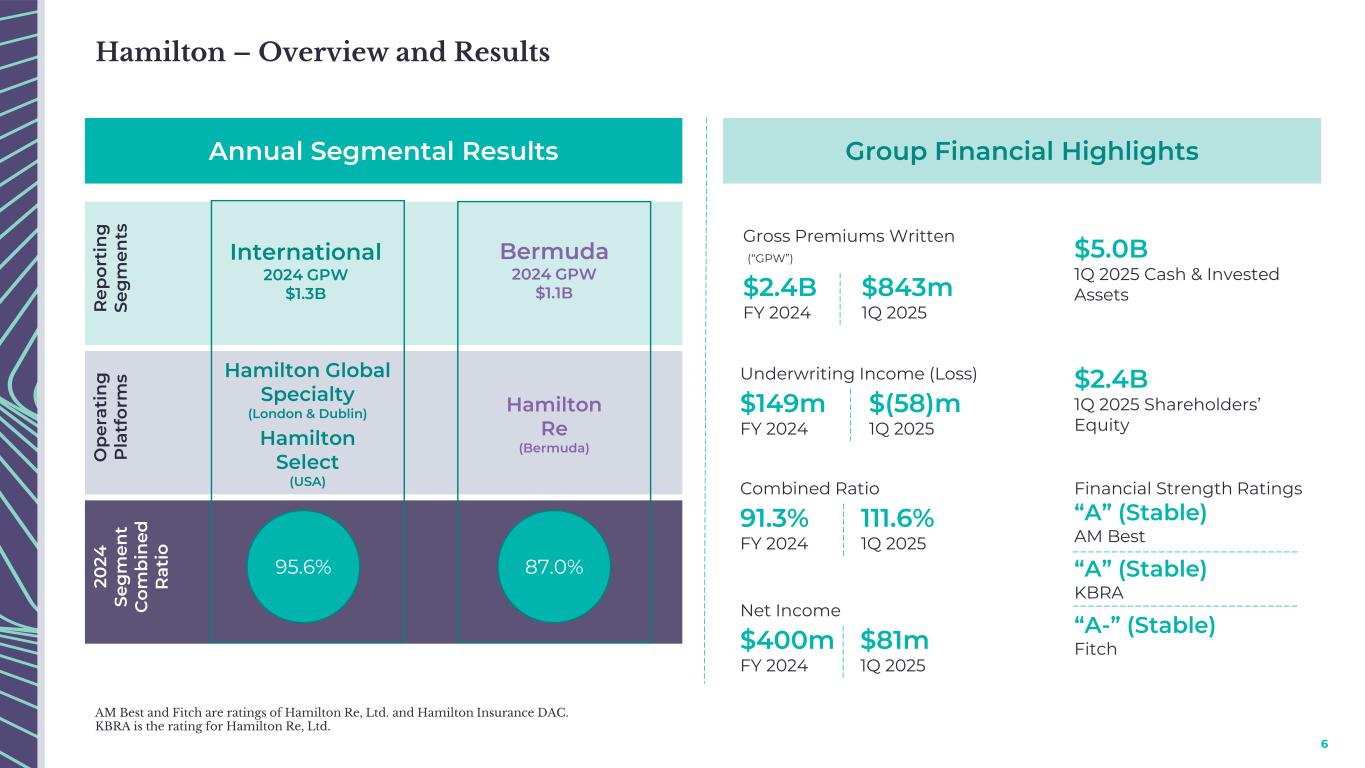
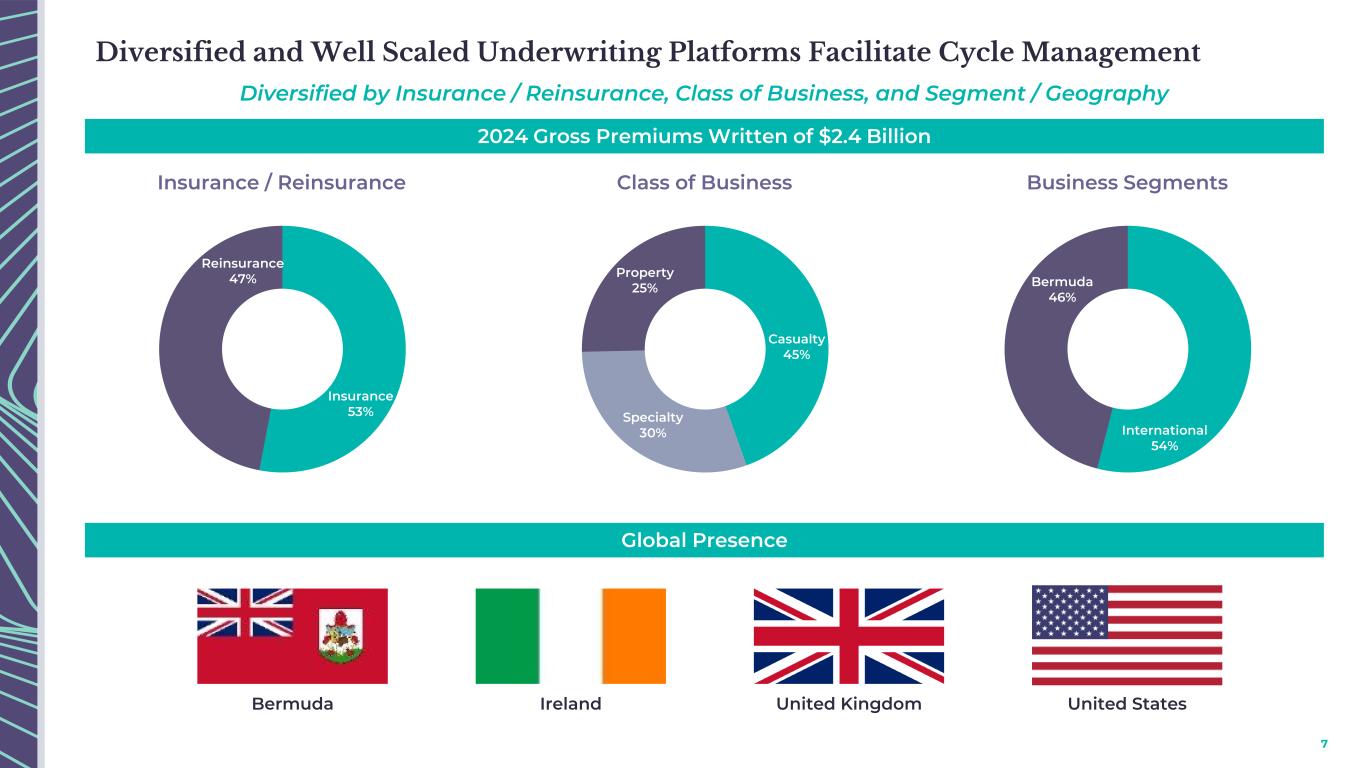
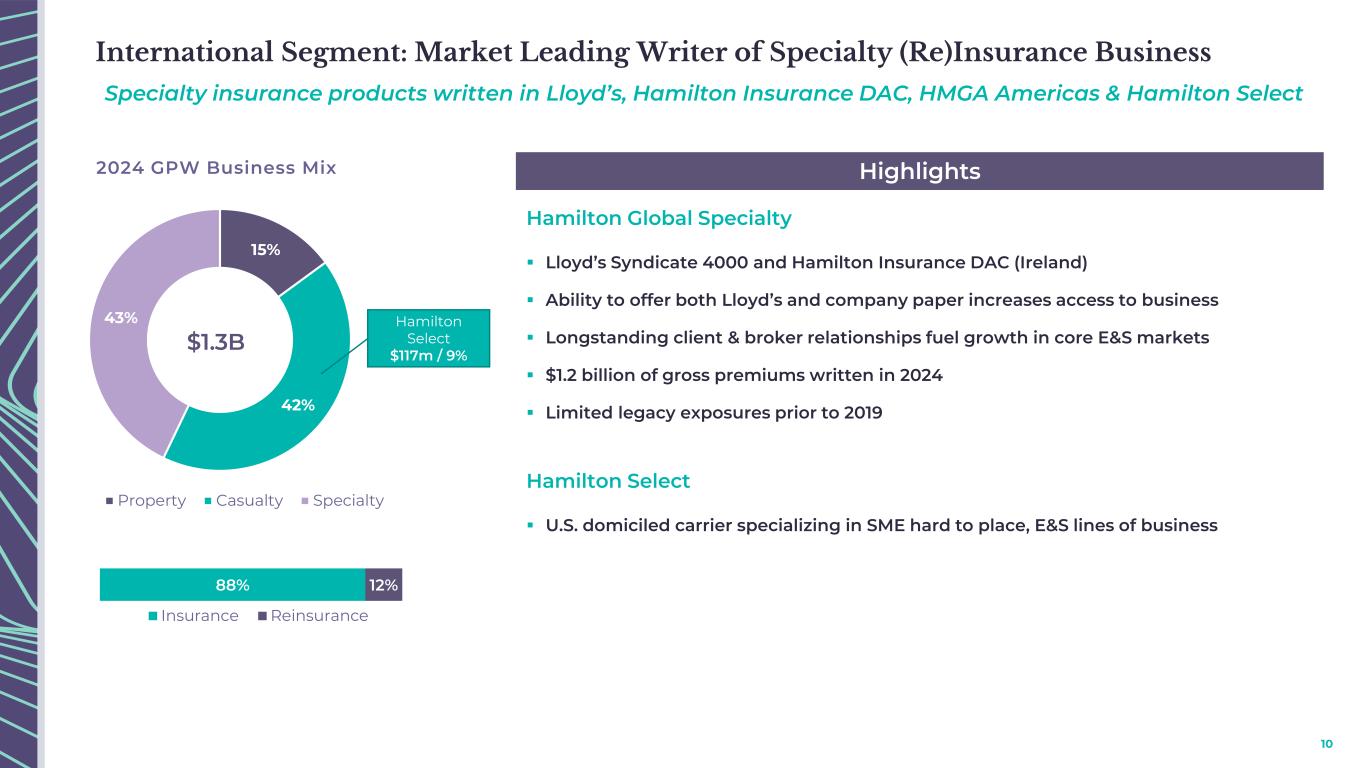
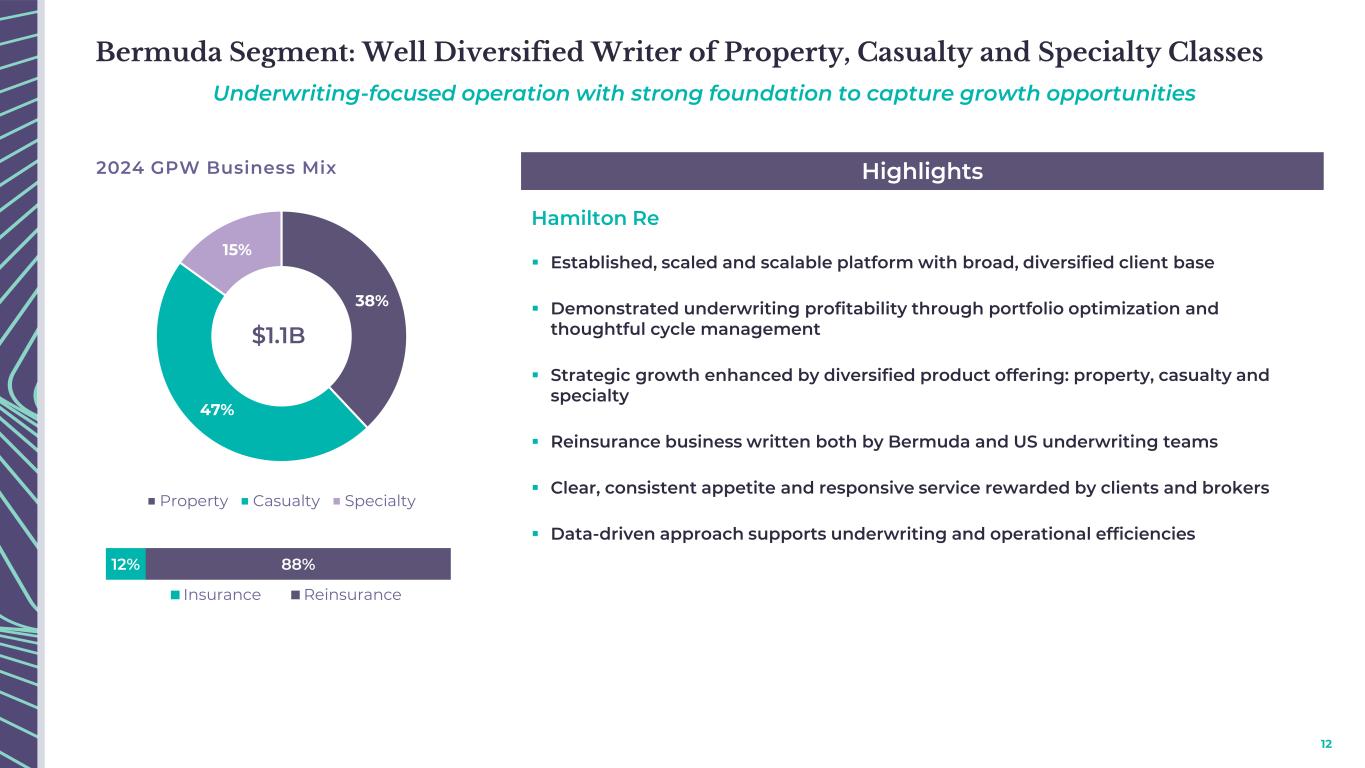
Thank you, Darian, and hello, everyone. Let me start by welcoming you all to Hamilton's first quarter 2025 conference call. I'm very pleased to report another profitable quarter for Hamilton, despite the fact that global insured catastrophe losses were over $55 billion for the quarter, driven primarily by the California wildfires. Starting with the headline results, our catastrophe loss ratio this quarter was 30.2%, which includes our California wildfire net loss estimate of $143 million. This number is net of reinsurance and reinstatement premiums and does not take into account any potential recovery benefits for example for subrogation also as a reminder this estimate is within the 120 to 150 million range which we announced during last quarter's earnings call notwithstanding the catastrophe losses hamilton had a very strong start to the year our attritional loss ratio was 51.9 percent exemplifying the stability of our underlying book which is running where we would expect our gross premiums written increased by 17% in the first quarter investment results were significant with a total investment return of 167 million dollars a result that more than offsets our catastrophe losses finally in terms of headline numbers our net income of 81 million dollars represents a 13.7% annualized return on average equity for first quarter. I would now like to focus on our two reporting segments, particularly their top line growth this quarter. Each of our segments, Bermuda, which is comprised of Hamilton Re and Hamilton Re U.S., and International, which houses Hamilton Global Specialty and Hamilton Select, enjoy double-digit growth. Starting with Hamilton Re, which renews approximately 40% of its business during the first quarter we wrote 473 million dollars in gross premiums an increase of 18 over last year this increase was primarily driven by casualty and property classes in casualty we continue to take advantage of two things first the favorable market environment with tighter limits and stronger underlying rates, and second, our AM Best rating upgrade to A. The latter led to new business as well as opportunities for us to increase a number of the line sizes on our renewal business across both our Hamilton Re Bermuda and our U.S. underwriting platforms. In property, a significant portion of the increase was related to reinstatement premiums from the California wildfires. That said, we were also successful with some targeted new business growth and therefore still showed growth over the prior year when excluding reinstatement premiums. In general, we feel property cat business is still attractively priced and it also enjoys the improved terms and conditions and higher attachment points from the market reset in 2023. Before I move on to international, I'd like to say a few words specifically about Hamilton Rees' recent growth in casualty. Again, we view the current casualty environment as attractive, so we continue to lean in, albeit in a highly selective and disciplined manner. By selective, I mean that we focus on building strong relationships with key clients with whom we enjoy a broad trading relationship and on becoming a more relevant trading partner with them key target casualty clients for hamilton are those that have a very strong underwriting and claims handling culture are good at actively managing market cycles and keep a significant amount of their exposure net thus ensuring alignment of interest by disciplined i mean that each casualty deal is actuarially reviewed with a view of risk and a loss ratio that is independent from those of our sedents and brokers and reflects what we believe to be a cautious view of loss trends including social inflation moving to our international segment we wrote 370 million of gross premiums an increase of 15 percent over the prior year this growth was primarily due to a healthy flow of US E&S business we saw in the quarter. US E&S makes up the majority of the business we write in International. Our product diversification and expertise in both Hamilton Global Specialty and Hamilton Select allow us to grow in the areas we deem most attractive and shrink or exit those where we do not believe we are getting adequate rate. Hamilton Global Specialty, which is the largest contributor to the international segment, increased most in property and specialty classes. In property, we grew most with a particular long-standing account which has been very profitable for us historically. In specialty, we grew most in personal accident, fine art and specie, and marine lines where our expertise is well recognized. As a reminder, Hamilton Global Specialty houses our Lloyds underwriting operation, Hamilton Syndicate 4000. A few weeks ago, we reported our 2024 Lloyds results and I'm proud to say that our Syndicate remains in the enviable position of being amongst the Syndicates with the highest profitability and lowest volatility over a 10-year period. We have a consistently strong tax record at Lloyds, and each year we continue to build on that success. Lastly, the international segment includes Hamilton Select, our hard-to-place U.S. E&S platform, which grew 51% this quarter. Our strongest growth came from excess casualty, products and contractors, and general casualty classes. We are keeping a sharp eye on pricing trends in all of our offerings and will adjust our underwriting appetite as needed. I will now turn to the April 1 and upcoming mid-year reinsurance renewals. I will be brief as I'm sure you've heard plenty of commentary regarding movements and rates, trends, and the like on earlier calls. Regarding the 4-1 renewals, which are largely Japanese accounts, attachment points and terms and conditions remained relatively stable. Pricing saw some modest decreases, as expected, because this market is largely decoupled from the losses seen in the U.S. For U.S. 4-1 property cap renewals, consistent with what we said last quarter, loss-free U.S. programs renewed with modest rate reductions, while loss-affected programs experienced rate increases. There were a handful of casualty renewals at 4-1, and market discipline remained there too, with rates largely keeping pace with loss costs. As for the upcoming mid-year renewals, which are largely property-driven, we are seeing increased demand and stable supply. This will likely result in pricing being similar to what we experienced so far this year. Loss-affected accounts will see rate increases, and it is important to note that a number of the larger accounts affected by the wildfires and the 2024 hurricanes are renewing in this period. Before I turn the call over to Craig, I'd like to address the continued economic and geopolitical uncertainty the world is facing, particularly the more recently announced tariffs and the potential for a recession. Regarding tariffs, it is still early days, but it is important to note that they have an indirect impact on our business as we are a financial services provider. While there remains much uncertainty around tariff policies and their impacts we are currently anticipating that the primary impact will be lost cost inflation in certain lines and the secondary impact could be to the broader trading environment when we think about potential lost cost inflation we believe our exposure is most material in property lines however we perceive this exposure as very manageable at the present time and we have the framework and the models already in place and fully operational to react to this risk as it develops when it comes to the broader trading environment we are used to thinking about this kind of risk and will continue to monitor it closely and react accordingly regarding the possibility of a recession as you will have heard from many of my peers insurance and reinsurance are not luxury purchases and therefore rather resilient in this context against this backdrop we believe we are still in an attractive trading environment are capable of navigating risk and are therefore able to enjoy thoughtful and selective double-digit growth in our top line our attritional loss ratios, the barometer of the health of our underlying business are stable, and we have an experienced and disciplined team and a strong balance sheet. With that, I will now turn the call over to Craig to go over our financial results in more detail.
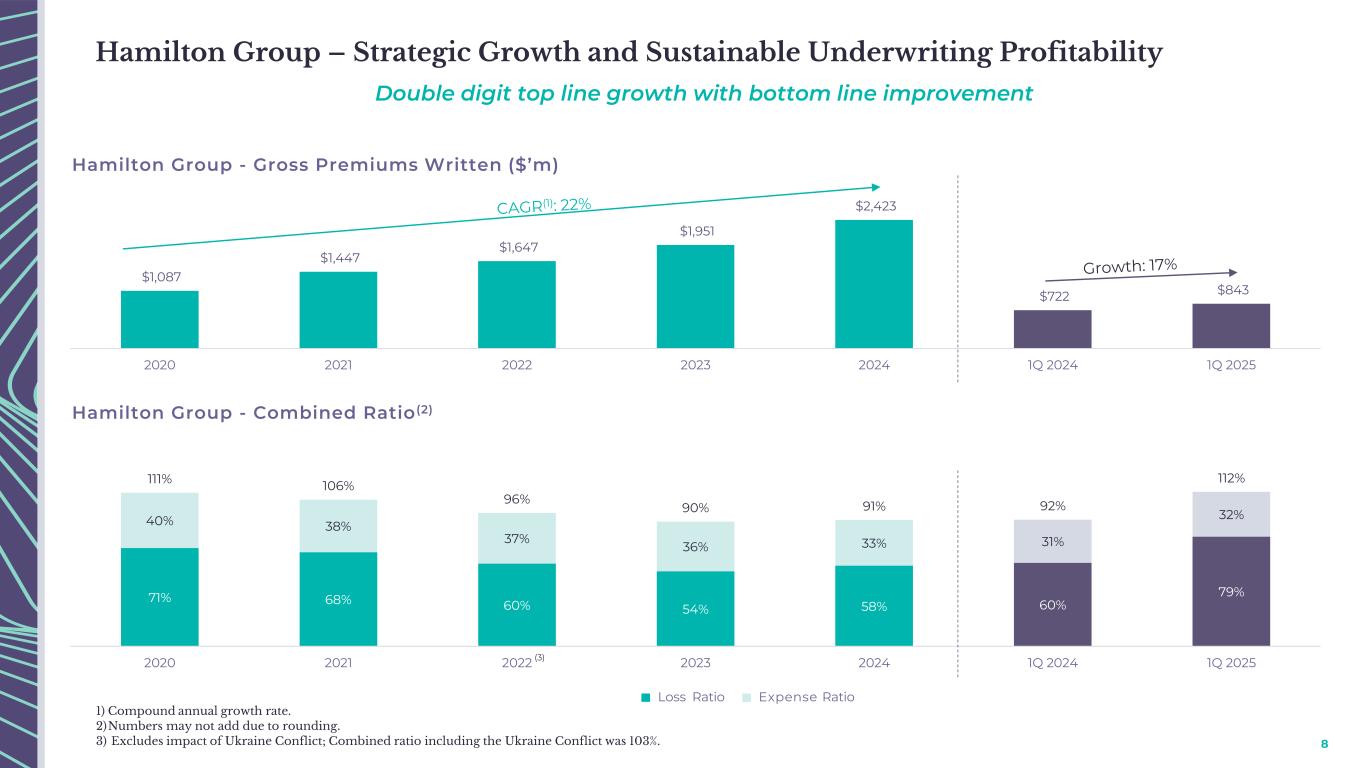
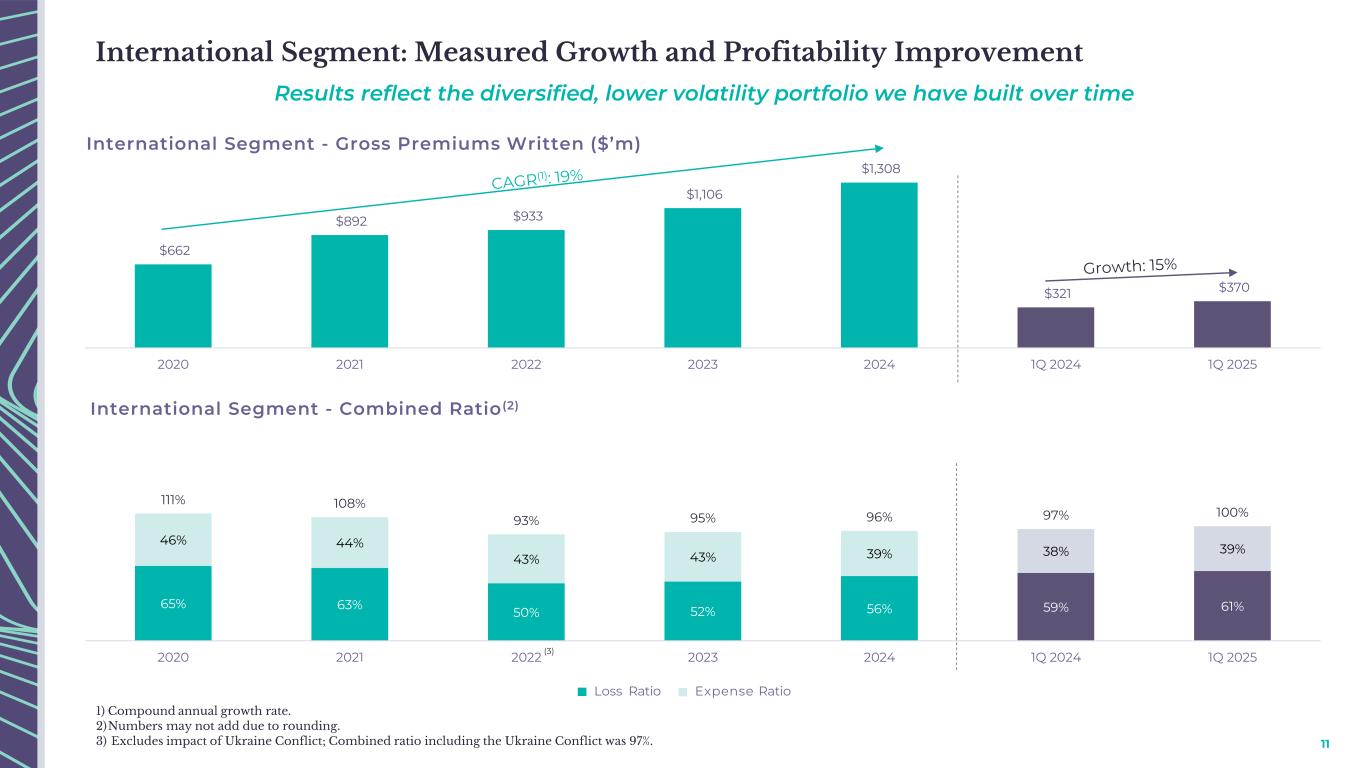
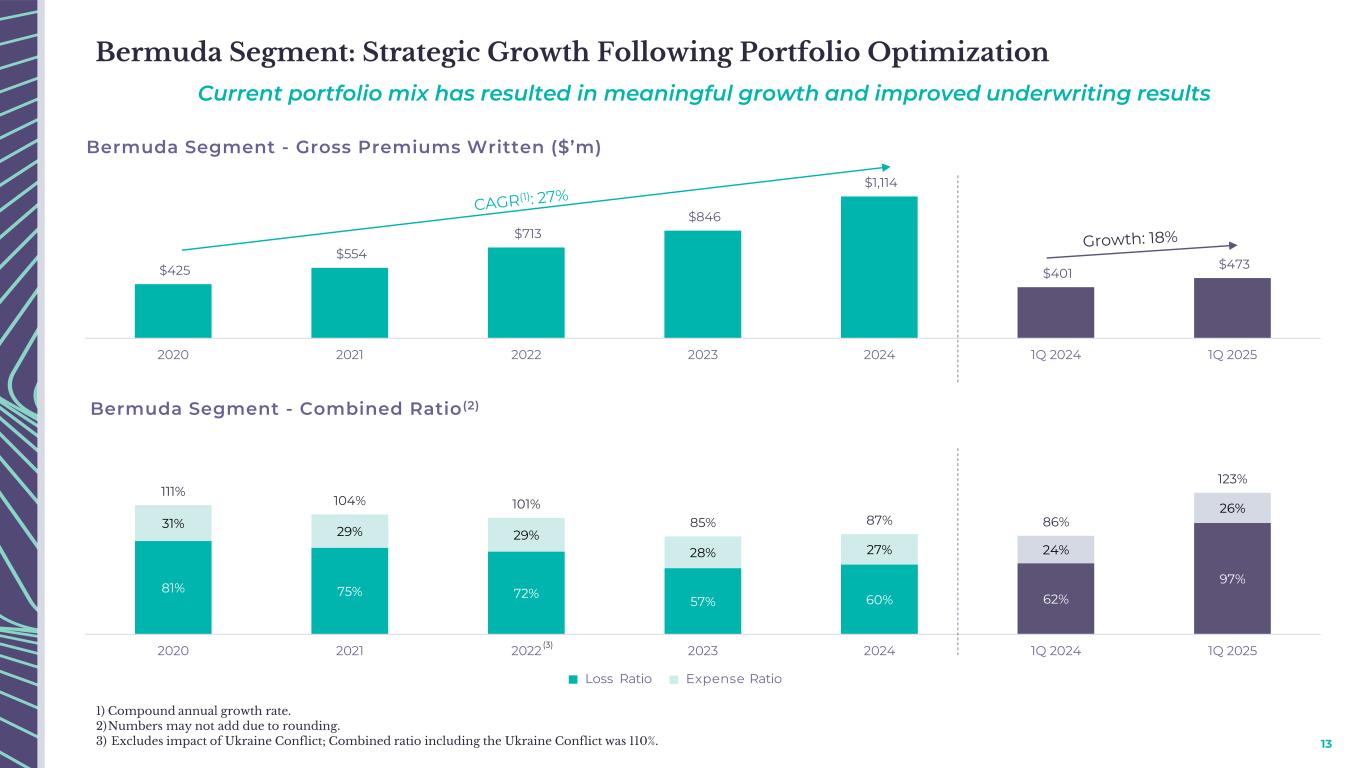
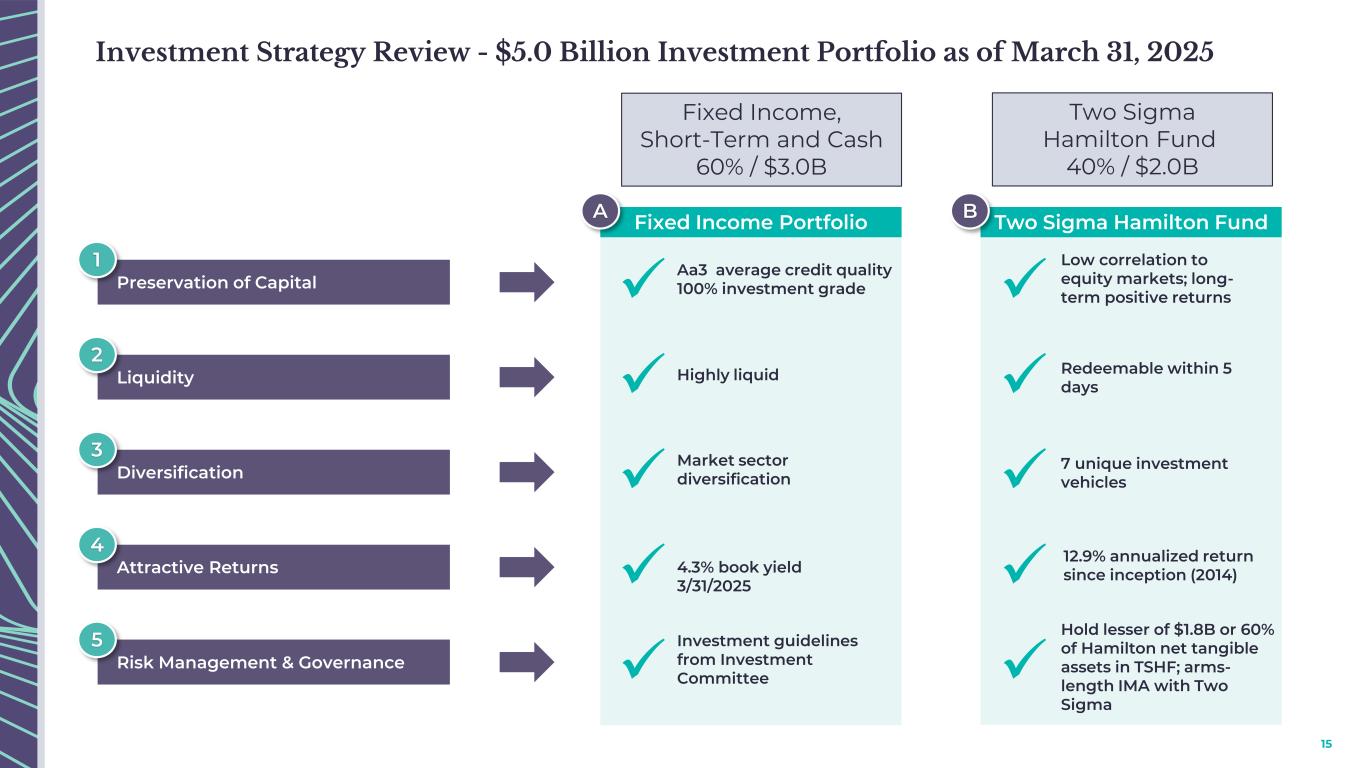
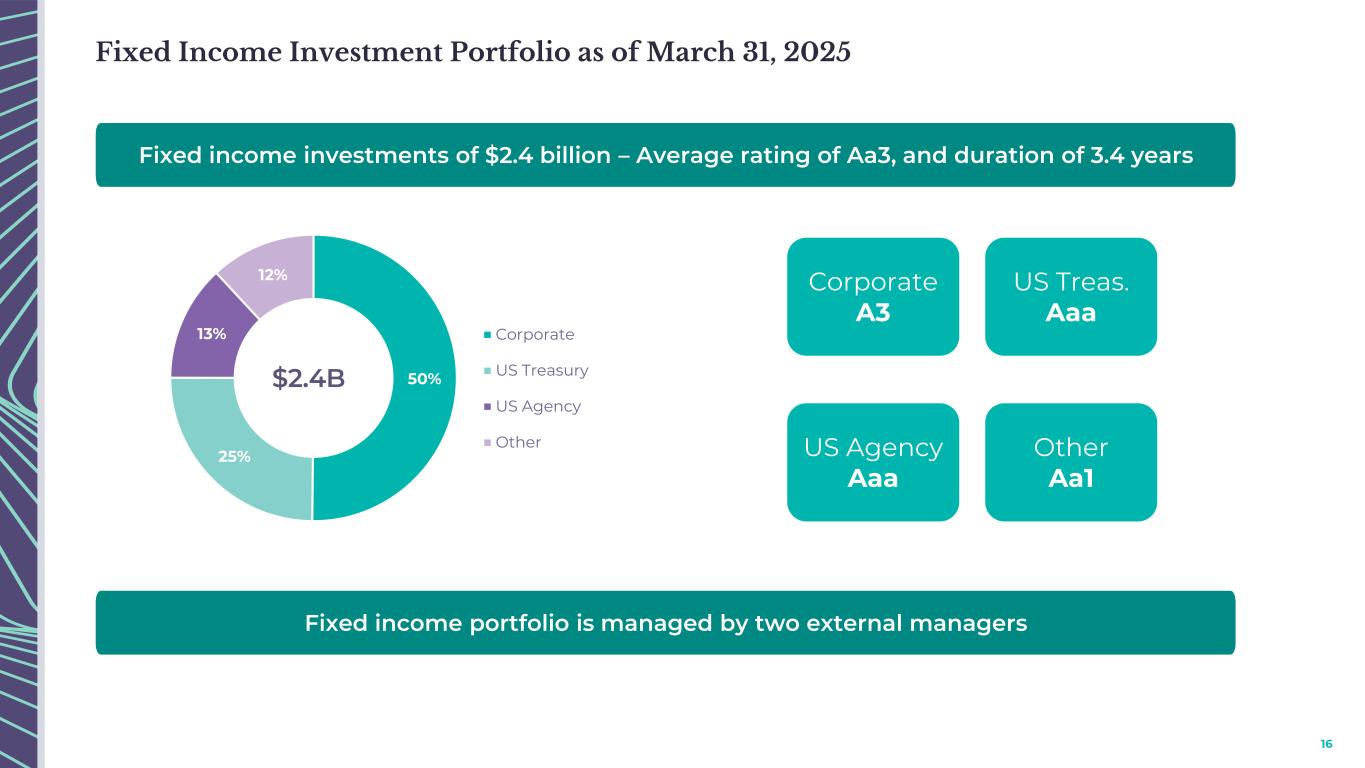
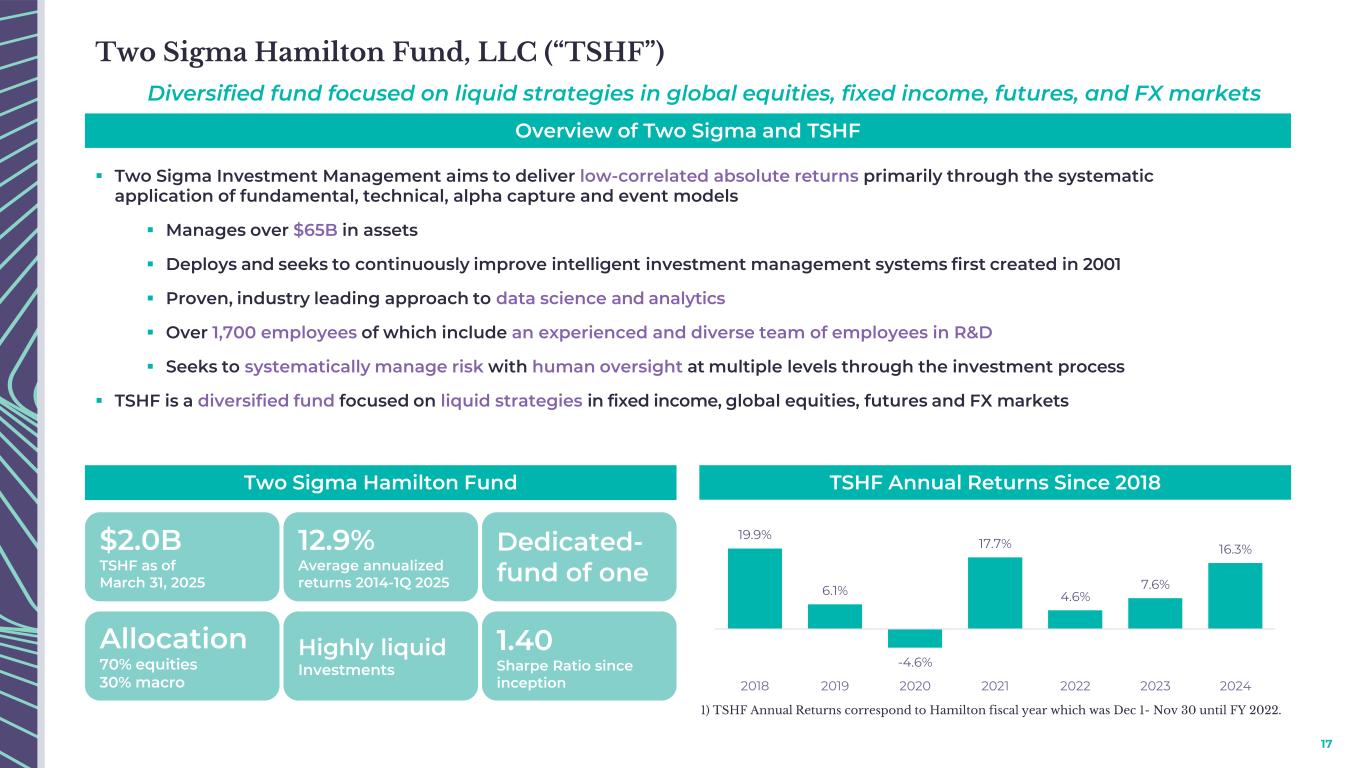
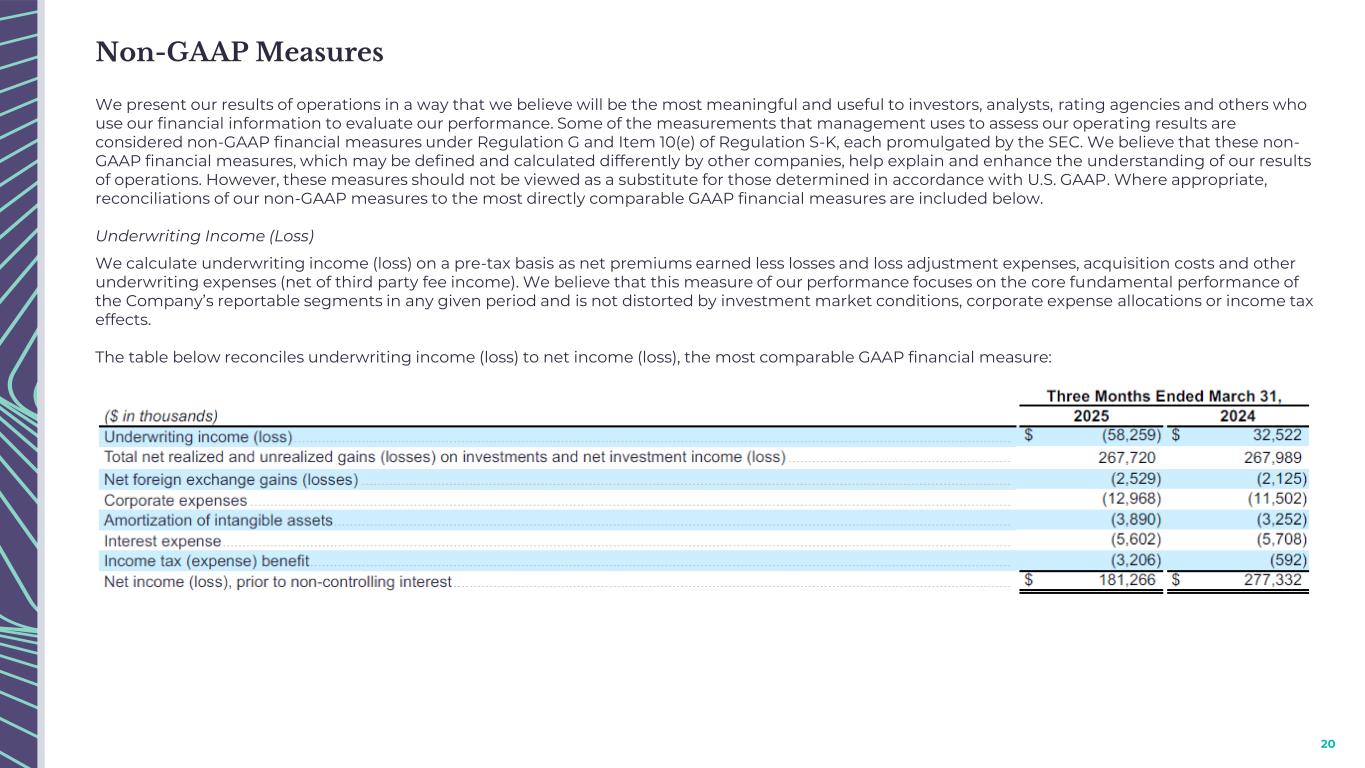
Thank you, Pina, and hello, everyone. Hamilton is off to a strong start for the year with net income of $81 million equal to 77 cents per diluted share, producing an annualized return on average equity of 13.7%. We also increased book value per share to $23.59. This compares to net income of $157 million, or $1.38 per diluted share, and an annualized return on average equity of 29.5% in the first quarter of 2024. Before I move on to details around our underwriting and investment income components for the quarter, I wanted to point out some new metrics we've added to our financial supplement disclosures this quarter. We are now reporting operating income, operating income per share, and operating return on average equity. We define operating income as net income, excluding one, net realized and unrealized gains or losses on investments in our fixed maturity and short-term investment portfolios, and two, foreign exchange gains or losses. To clarify, we are including the realized and unrealized gains or losses from the Two Sigma Hamilton Fund in our definition of operating income. We understand that many of you have asked for a disclosure of operating income to more readily compare Hamilton with some of our peers. While I will not discuss operating income in any more detail on today's call, we will begin providing commentary around this result next quarter. In the meantime, if you have any questions, please feel free to reach out to Investor Relations. Moving on to our underwriting results, Hamilton continues to grow its top line at a thoughtful double-digit rate. As Pina mentioned, our first quarter 2025 gross premiums written increased to $843 million, compared to $722 million this time last year, an increase of 17%. Both our reporting segments, International and Bermuda, continue to lean into favorable market conditions. For the first quarter, Hamilton had a $58 million underwriting loss, primarily driven by the California wildfire catastrophe loss estimate in the quarter. This is compared to underwriting income of $33 million in the first quarter last year. The group combined ratio was 111.6% compared to 91.5% in the first quarter of 2024. Again, the increase in the combined ratio was primarily driven by the catastrophe losses. Starting with the loss ratio, in the first quarter, the loss ratio increased 18.9 points to 79.2 percent, compared to 60.3 percent in the prior period. The increase was primarily driven by $151 million, or 30.2 points, of net current and prior year catastrophe losses, primarily driven by the California wildfires. This compares to catastrophe losses of less than a half a million dollars reported in the first quarter last year. The attritional loss ratio was 51.9%, a decrease of 5.3 points compared to the first quarter last year. The primary reason for the decrease was the first quarter of 2024 included the Baltimore Bridge loss. Again, our underlying diversified book of business continues to perform well. We had favorable prior year attritional development of 2.9 points, driven predominantly by specialty and property classes. This compares to 3.1 points of unfavorable development in the first quarter last year. The expense ratio increased 1.2 points to 32.4 percent, compared to 31.2 percent in the first quarter last year, with acquisition costs being slightly higher and other underwriting expenses being slightly lower. The increase in acquisition expenses was mainly driven by higher profit commissions and a change in business mix. As always, I'd encourage you to use the full year 2024 attritional loss and expense ratios as an indication of where we expect the current book to perform. Next, I'll go through the first quarter results by reporting segment. Let's start with the international segment, which includes our specialty insurance businesses, Hamilton Global Specialty and Hamilton Select. For the first quarter of 2025, international gross premiums written grew to $370 million from $321 million, an increase of 15%. This was driven by growth in our property, casualty, and specialty insurance classes. International had an underwriting income of $1 million and a combined ratio of 99.7%, compared to underwriting income of $5 million and a combined ratio of 97.2% in the first quarter last year. The increase in the combined ratio was primarily related to catastrophe losses in the quarter. International had $29 million of net catastrophe losses, completely driven by the California wildfires, compared to negligible net catastrophe losses in the first quarter of 2024. The international current year attritional loss ratio decreased 3.9 points to 52.1% in the first quarter, compared to 56.0% in the first quarter last year, which included the Baltimore Bridge loss. The expense ratio increased by 0.9 points to 39.1% compared to 38.2% in the first quarter last year. The increase in the expense ratio was primarily driven by increased profit commissions included in the acquisition expense ratio, partially offset by a lower other underwriting expense ratio. I will now turn to the Bermuda segment, which houses Hamilton Re and Hamilton Re U.S., the entities that predominantly write our reinsurance business. For the first quarter of 2025, Bermuda gross premiums written grew to $473 million from $401 million, an increase of 18%. The increase was primarily driven by new and existing business in casualty and property reinsurance classes, including non-recurring reinstatement premiums related to the California wildfires. Bermuda had an underwriting loss of $59 million and a combined ratio of 122.8% compared to underwriting income of $27 million and an 85.5% combined ratio in the first quarter last year. The increase in the combined ratio was primarily related to catastrophe losses in the quarter. Bermuda had $121 million of net catastrophe losses primarily driven by the California wildfires of $131 million and partially offset by favorable prior year catastrophe development of $9 million. This compares to no net catastrophe losses in the first quarter of 2024. The Bermuda current era traditional loss ratio decreased by 6.6 points to 51.8% in the first quarter compared to 58.4% in the first quarter last year which included the Baltimore Bridge loss. The Bermuda expense ratio increased by 2.3 points to 26.2 percent compared to 23.9 percent in the first quarter of 2024 due to a change in business mix, specifically an increase in quota share business, and reduced performance-based management fees, partially offset by growth in the premium base. Now turning to investment income. Total net investment income for the first quarter was $167 million, compared to investment income of $148 million in the first quarter of 2024. The fixed income portfolio, short-term investments, and cash produced a gain of $64 million in the quarter, compared to a gain of $5 million in the first quarter of 2024. As a reminder, this includes the realized and unrealized gains and losses that Hamilton reports through net income as part of our trading investment portfolio. The fixed income portfolio had a return of 2.4 percent, or $59 million, and a new money yield of 4.8 percent on investments purchased this quarter. The duration of the portfolio remains at 3.4 years. The average yield to maturity on this portfolio was 4.5 percent compared to 4.7 percent at year-end 2024. The average credit quality of the portfolio remains strong at AA3. The Two Sigma Hamilton Fund produced a $104 million gain or 5.5 percent for the first quarter of 2025, compared to a $143 million gain, or 8.3% in the first quarter last year. The latest estimate we have for the Two Sigma Hamilton Fund year-to-date performance was 7.9% through April 30, 2025. The Two Sigma Hamilton Fund made up about 40% of our total investments, including cash investments, at March 31st, compared to 39% at December 31st, 2024. In the second quarter of 2024, we announced a $150 million share repurchase authorization by the Hamilton Board of Directors. During the first quarter of 2025, we used $10 million of that authorization to repurchase shares that were priced below book value. With $112 million dollars remaining under our share repurchase authorization, we are able to continue repurchasing shares, growing the book of business, all while maintaining our strong capital position, even during times of uncertainty. Next, I have some comments on our strong balance sheet. Total assets were $8.3 billion at March 31, 2025, up 7% from $7.8 billion at year-end 2024. Total investments in cash were $5 billion at March 31st, an increase of 4% from the $4.8 billion at year-end 2024. Shareholders' equity for the group was $2.4 billion at the end of the first quarter, which was a 3% increase from the $2.3 billion at year-end 2024. Our book value per share was $23.59 at March 31, 2025, up 3% from year-end 2024. Thank you. And with that, we'll open up the call for your questions.
Operator
To ask a question, please press star followed by the number one on your telephone keypad. We ask that you please limit yourself to one question plus one follow-up and then rejoin the queue for any additional questions. Our first question comes from Mike Zaremsky from BMO. Please go ahead. Your line is open.
Hey, morning. A first question, maybe a more broad question on the casualty line of business. Pina, I heard your comments about the AM Best upgrade, which I believe unlocks on the casualty reinsurance side. You don't get, you know, look at more business. I mean, it also sounded like you all were on top of that, you know, playing some offense in that line of business, too, maybe in both, you know, reinsurance and insurance. I'm curious if you could offer any maybe high-level thoughts on, you know, what loss trend assumptions you and or your students are applying. You know, is it, you know, low double-digit teens, single digits? I don't know if there's any context you can offer.
You know, you brought up social inflation earlier. it seems to still be kind of a key question we get from from investors that's why i asked uh great mike um why don't i just start generically and then i'm going to get to that specific question at the end i think i'm going to start by saying we are you know very happy about the client and broker response to our a invest upgrade and and what we've seen as a result both in terms of new business and the opportunity to upsize what were traditionally you know rather small participations on casualty in the past and just for for some flavor we grew 40 million of casualty premium in the first quarter that's predominant sorry that's a premium in the first quarter on the back of that ambus upgrade predominantly casualty premium and what we're seeing is that the market conditions remain very attractive double digits it's keeping place with with trend for the lines that we're writing, so I'm going to say in those lines we're seeing low to mid-teens on our clients' books, but we're very, very selective about the clients, as I mentioned, that we are targeting for casualty growth and those parameters that I set out about, you know, the underwriting culture, the claims culture, and specifically their willingness to retain a significant portion of their book are very key components to the clients that we are that we are partnering with here. So all in all, we think that the opportunity of this AMBEST upgrade coming at a time where underlying market conditions are strong on casualty and where others perhaps are still backing away because they may have been outsized gives us a very particular opportunity at this time.
That's helped on the pricing levels. So I'm going to get kind of back into assuming lost cost is probably a little lower than that. um i'm switching gears a bit um um you know the overall combined ratio just to be clear you know kind of you know in line with kind of what consensus was expecting i know there's always kind of movement and expense ratio and attritional loss ratio and it was good to see a lot of reserve releases too but um the underlying loss ratio was um a bit higher than expected consensus wise in both segments um i know that you know um in the mix i think international on casualty uh it grew a lot i think in bermuda but not didn't it casually didn't grow as in total proportion as that much international and which i i assume casually would have a higher attritional loss ratio so just curious any any color any guidance you want to offer on whether um some of the movement and the attritional loss ratio, we should not run right or maybe it's just quarterly and normal fluctuations. Thanks.
Hi, Mike. This is Craig. I'll take that question. You know, our current year attritional loss picks for the first quarter are in line with our expectations for sure. It really depends on the mix of business. For example, writing more casualty or more pro rata business would carry a higher loss pick, and that's what you're seeing here. I also want to remind you, you may recall that we increased our 2024 casualty loss picks in the third quarter last year when we saw indications of higher social inflation, and that continues in our loss picks for 2025. What I would tell you, again, I would tell you to look at the full year 2024 loss ratios as a guide for how we expect our current book to perform.
Okay, got it helpful, and i'll just sneak one last one in um did um you all quantify the reinstatement premium level this quarter i don't feel like i i saw it in the release we did mike uh we put it in into the press release as well uh with 17 million uh on a net basis between the two between reinsurance and insurance okay miss that thank you our next question comes from tommy mcjoint from kbw please go ahead your line is open hey good morning guys thanks for taking our questions um when you talk about the the shift in the business mix can you talk about um how that's impacting the expense
ratio um that came in a little bit different than we were expecting and if you could break it down by perhaps the two pieces of that expense ratio that'd be helpful thanks yeah tommy what i would say to you you know from an overall perspective it does impact your acquisition expenses and that's really where you're seeing this. So from a business mix perspective, the acquisition expenses went up for two reasons. One is business mix and two is profit commissions. In other words, that are paid out, that get included in the acquisition expense ratio. But from a business mix standpoint, as I just said, Bermuda, you saw, wrote more casualty business and more pro rata business. So both of which would have higher acquisition costs. And on the international side, i would point to something like property binders that would have a higher acquisition cost so that is clearly in line with the business mix the change in business mix from an other underwriting expense ratio standpoint um that is not the same um what i would say to you is that is something that we have control over and as we continue to scale up our book um we would expect uh those other underwriting expense uh ratio to continue to decline which it has defined that ratio has declined each and every year since 2019.
Okay, got it. And then switching gears, your comments sounded pretty positive on the casualty growth opportunity. When we listen to some of your peers across the insurance and reinsurance space, we hear instances of significant amounts of non-renewals across various casualty businesses.
When you feel like you're gaining market share in the casualty side is the way you get comfortable around winning that business is is it just price is it um you know a change in terms of conditions what gives you you know conviction that the casualty business you guys are winning is indeed good business hi there um i'll take that um so i think when you look at a number of our peers uh they've been around for a lot longer than we have so they're um firstly their exposure to those casualty classes and also the amounts that they have written is significantly larger than ours. We only started really leaning in, and again, modestly into the casualty space, you know, in end of 2020, 2021, and that's when underlying rates started picking up. With the benefit of this AMBEST upgrade, you know, we are – it's very opportune Because as some of our clients who have this longer tail exposure or are overlined are cutting back or backing out, we are being given the opportunity to see the business. And again, we see a lot more business than we actually write. Again, we have targeted the clients that we want to do business with in advance. And those are the ones that we seek and try to do business with. So ours is a very selective approach. And again, I think it's also important to note that even on some of this growth you're seeing, it's not massive line sizes. We have smaller line sizes on these accounts, but over a swath of accounts, it gives us the balance. So I'm going to have 1% to 2% share on some of these quota shares. So that's how we are getting comfortable with the growth at this time.
Thanks, Dean. And then this last one to sneak in, I just want to clarify. The Two Sigma return, I think is 7.9%. Was that a year-to-date return? Was that an annualized return? Could you clarify what that number is referring to?
That's our year-to-date return through the end of April. So in other words, it was 5.5% through the end of March. That number that we gave on the call was through the end of April.
Operator
As a reminder to ask a question, please press star followed by the number one on your telephone keypad. Our next question comes from Elise Greenspan from Wells Fargo. Please go ahead. Your line is open.
Hi, thanks. Good morning. My first question is on the buyback, right? You guys bought back 10 million in the quarter. Obviously, you know, shares still trading below book. As you guys think about growth outlook, I think you mentioned Pina, you know, continuing to talk, you know, I think you guys can, you know, hit double digit top line growth as you think about that, you know, pricing and competitive views as well. And how do you think about just growth needs, you know, capital for growth needs, I'm sorry, and balancing, you know, incremental capital return with where your shares are trading?
Hi, Elise. This is Craig. Thanks for the question. First of all, I would say, yes, the buybacks this period were only $10 million. And when I say only $10 million, it was a very short open window for us during this period because of the year-end financials coming out later and then just having a very short open window. We still have plenty of capital for both growth as well as continuing to buy back shares even in an uncertain market place like this, and especially at the valuation of where our shares trade today.
So don't see any constraints on a growth or a buyback side. and then you guys had mentioned um you know i think having another 80 million this year right from um the am best upgrade um in terms of premiums what did you guys see in the q1 and is the expectation still that we'll see um you know 80 million this year thanks elise um i think i mentioned we wrote an additional we track the new business or additional line sizes uh that are related to our upgrade.
And in the first quarter, I think I mentioned we did 40 million. That's predominantly casualty. There is some specialty class in there as well, but it's not a major part of that. So 40 million in the first quarter. So I guess all I can say to that is that we are comfortable with the previous guidance we gave of 80 million for the year, based on that, for sure.
And then one last one on reserves. Craig, you highlighted, right, the favorable development in the quarter. I guess two things was, were there any adverse development, right, that the releases offset or was it just releases? And then what accident years was that concentrated in?
Elise, so first of all, it was predominantly property and specialty that we released. There were some casualty reserves, roughly a million dollars, that were unfavorable during the quarter, but that was not what was driving the favorable development for sure. What we did see this quarter, you may recall, we don't really complete any of our reserve studies in the first quarter. What we saw were a couple claims that were settled for less than what we had reserved for. An example was one of the claims settled at half of the industry loss estimate. So we were able to reduce our reserves upon that settlement and reflect that in our favorable development in the quarter. That's essentially what came through. From a catastrophe standpoint, point. We also went back and looked at Hurricane Ian. That review was not completed in the fourth quarter with the rest of our property reviews that were done in the fourth quarter of 2024. But when we reviewed that in the first quarter, we determined that we could adjust or lower that reserve estimate. But we do still hold IBNR for that event that happened in 2022, Hurricane Ian.
Operator
Our next question comes from Mike Ceremski from BMO. Please go ahead. Your line is open.
Great. Just a couple of quick follow-ups. Craig, on the short window for buybacks, just curious, is Hamilton Group's window shorter than most companies? If you can remind us kind of the technicalities around when the 10K comes out or how that works.
Yeah, it's really when we release our 10. And at the time we released our 10K and after we had our board meeting was later in the process than some of our other peers. So maybe a couple weeks shorter that will, you know, that will change in the future. Number one. And the reason I said that is, is our board dates were set prior to becoming a public company. So we were just a little bit later in the process than many of our peers. And we actually, you know, filed in the first week of March was when we filed the K. What I would say to you now is we are an accelerated filer. So, in other words, those reports are going out faster and we will have a longer open window to be able to buy back those shares.
Got it. And one more probably for you, Craig. Greg, on the Two Sigma returns, are you apprised of those returns kind of on a monthly basis or do you find out like towards the end of the quarter or after the quarter? Or is it, you know, I'm just curious on the kind of how those returns are shared with you all.
Yeah, we have those returns on a monthly basis, which is why I gave in my remarks on the call, I gave the number at the end of April because that was the latest information that we had on the Two Sigma account. That's the reason we give that to you during the call.
Okay. Perfect. Thank you.
Operator
Our next question comes from Matt Carletti from Citizens. Please go ahead. Your line is open. Thanks.
Good morning. Just a question on the XCAT accident year loss ratio. There were a couple, a few large risk losses in the quarter we've heard about on some other calls and American airlines crash a couple energy sector items is there any noise from whether those or others um any kind of large risk losses in those numbers this quarter or are they pretty clean devoid of that all right hi matt um i i would say certainly we have exposure to those losses that you you've heard from from other people with respect to aviation we didn't have any significant aviation losses this quarter.
They were included in our current attritional loss PICS. Just as a reminder, we write aviation reinsurance. We do not write aviation insurance. As far as the other large losses, the fires, yes, again, exposure to those events, but manageable, and again, included in our current year attritional loss PICS.
Great. Thank you. Appreciate it.
Operator
Thank you. That will conclude our question and answer session for today.
Now I'll turn the call back over to Pina Albo. um thank you again for uh being with us uh today and we look forward to speaking to you again soon this concludes today's conference call thank you for your participation you may now disconnect