Operator
Hello, everyone. Thank you for joining us and welcome to the Hippo Holdings, Inc. second quarter 2026 earnings call. After today's prepared remarks, we will host a question and answer session. If you would like to ask a question, please press star 1 to raise your hand. To withdraw your question, press star 1 again. I will now hand the conference over to Charles Sebesky, Investor Relations. Charles, please go ahead.
Good morning, and thank you for joining HIPPO's second quarter 2026 earnings call. Earlier today, HIPPO issued an earnings release announcing its Q2 results and a financial results presentation, which will be webcast during today's call, both of which are available at investors.hippo.com. Leading today's discussion will be HIPPO President and Chief Executive Officer Rick McCatherin and Chief Financial Financial Officer, Guy Zeltser. Following management's prepared remarks, we will open up the call to questions. Before we begin, we'd like to remind you that our discussion will contain predictions, expectations, forward-looking statements, and other information about our business that are based on management's current expectations as of the date of this presentation. Forward-looking statements include, but are not limited to, HIPPO's expectations or predictions of financial and business performance and conditions and competitive and industry outlook. Forward-looking statements are subject to risks, uncertainties, and other factors that could cause our actual results to differ materially from historical results and or our forecasts, including those set forth in HIPPO's Form 10Q and 10K. For more information, please refer to the risks, uncertainties, and other factors discussed in HIPPO's SEC filings, in particular, in the section entitled Risk Factors in our Form 10Q and 10K. All cautionary statements are applicable to any forward-looking statements we make whenever they appear. You should carefully consider the risks and uncertainties and other factors discussed in HIPPO's SEC filings. Do not place undue reliance on forward-looking statements as HIPPO is under no obligation and expressly disclaims any responsibility for updating, offering, or otherwise revising any forward-looking statements whether as a result of new information future events or otherwise except as required by law during this conference call we will also refer to non-GAAP financial measures such as adjusted net income our GAAP results and description of our non-GAAP financial measures with full reconciliation to GAAP can be found in the second quarter 2026 earnings release which has been furnished to the SEC and is available on our website. And with that, I'll turn the call over to Rick McCatherin, our President and CEO.
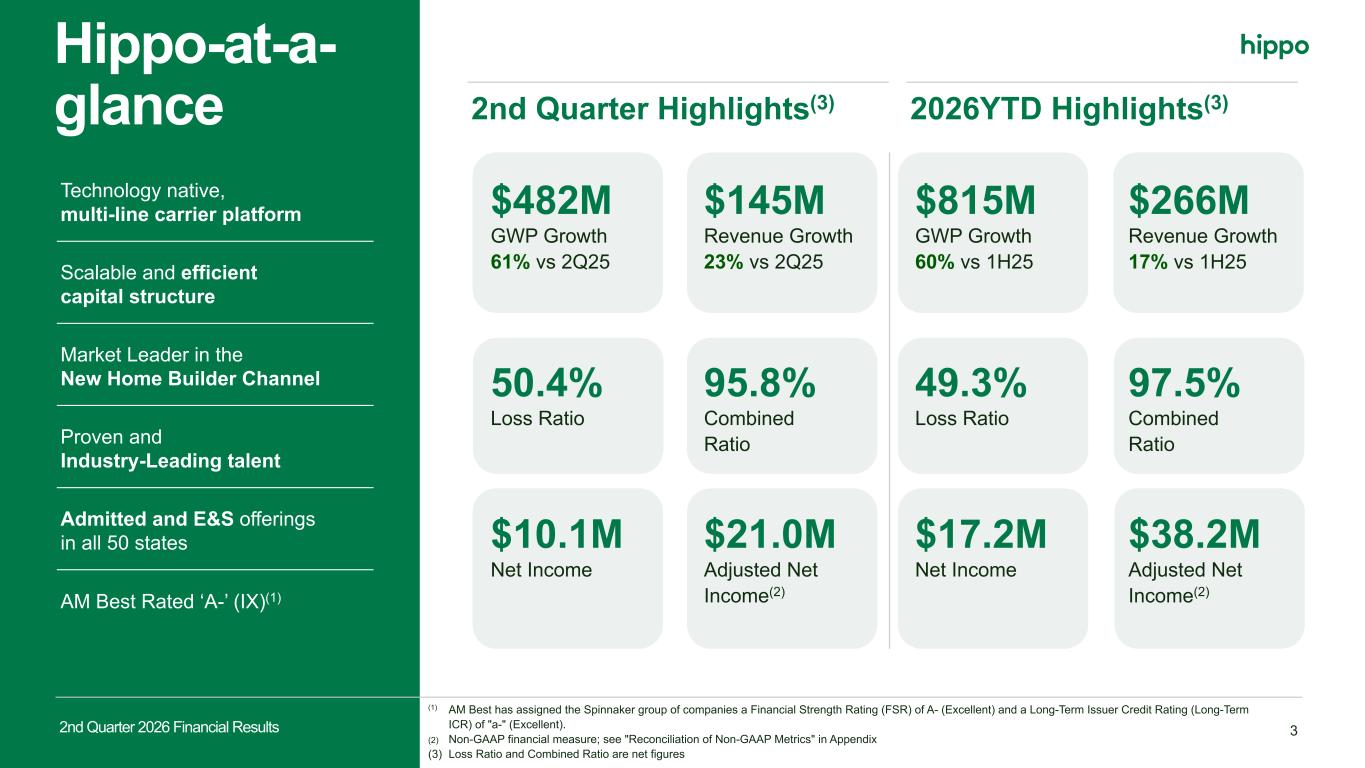
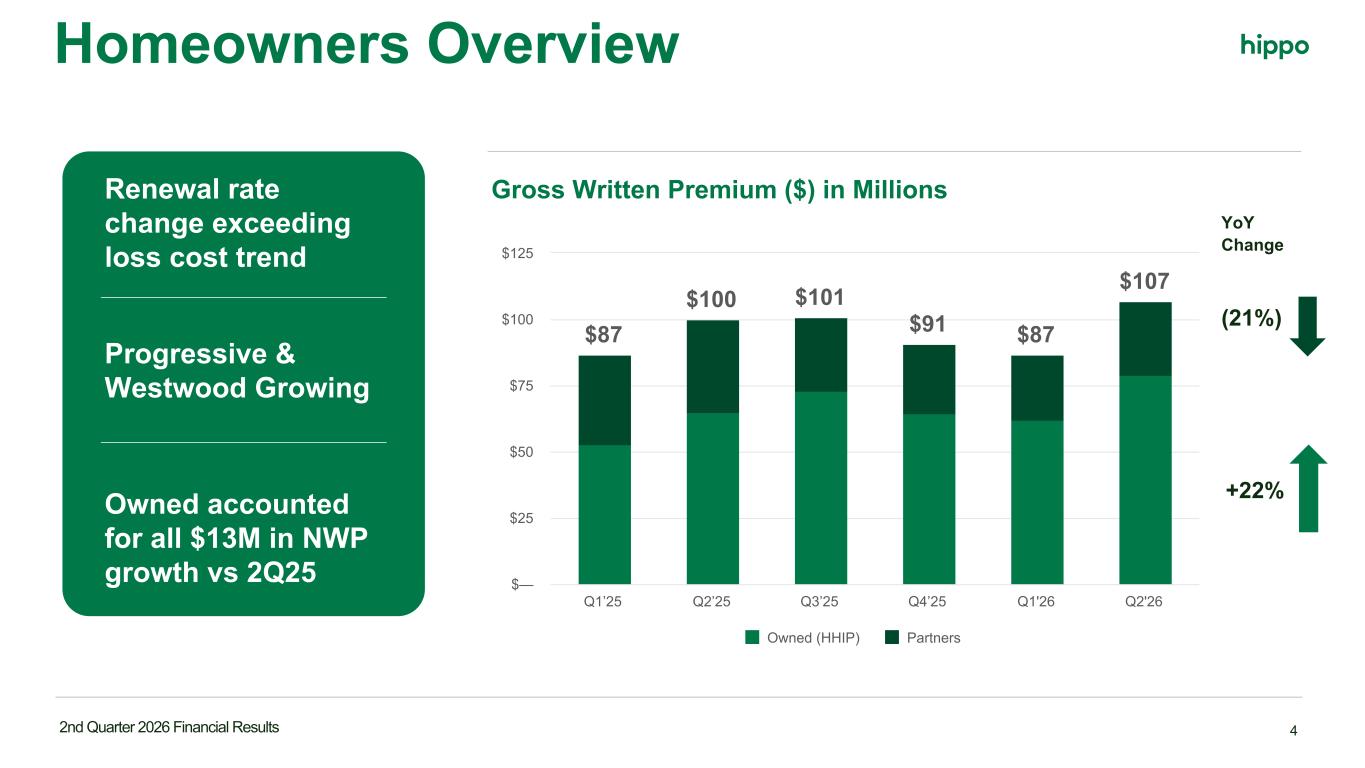
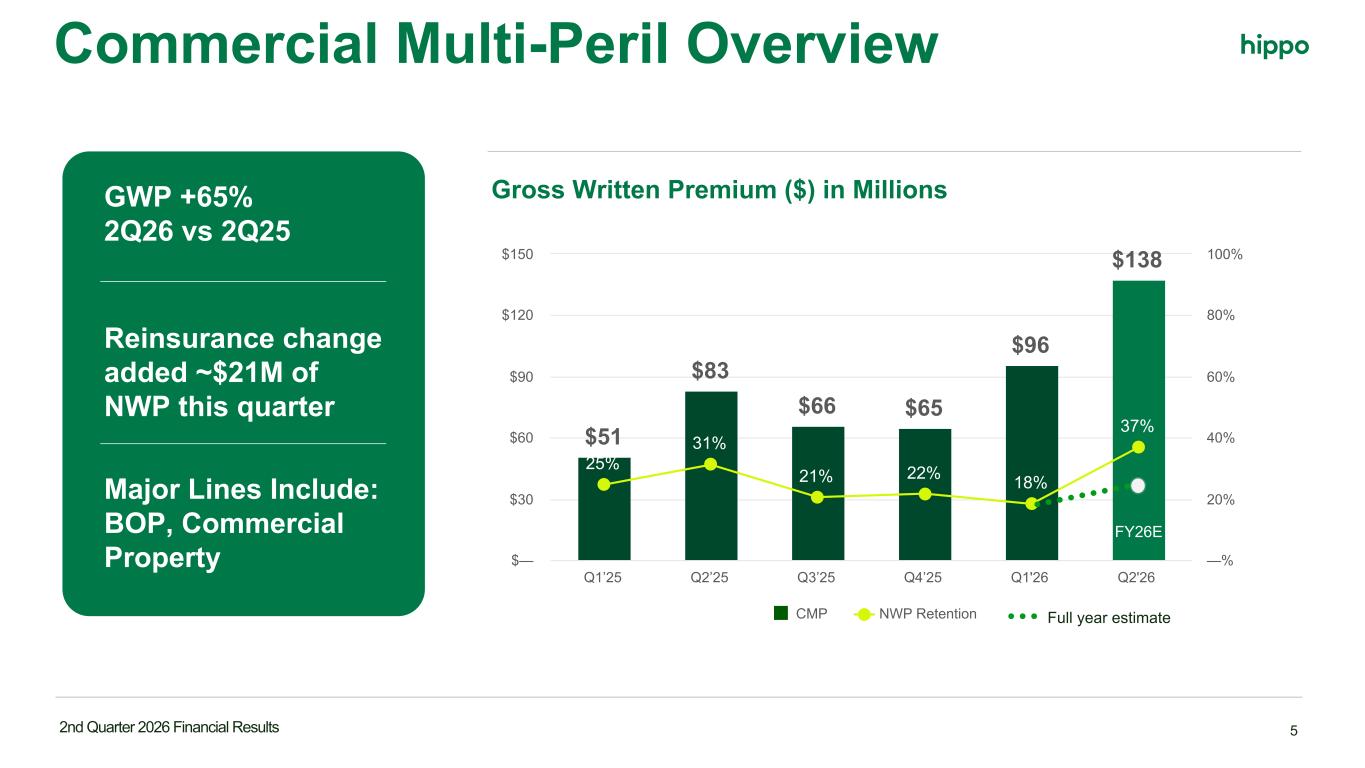
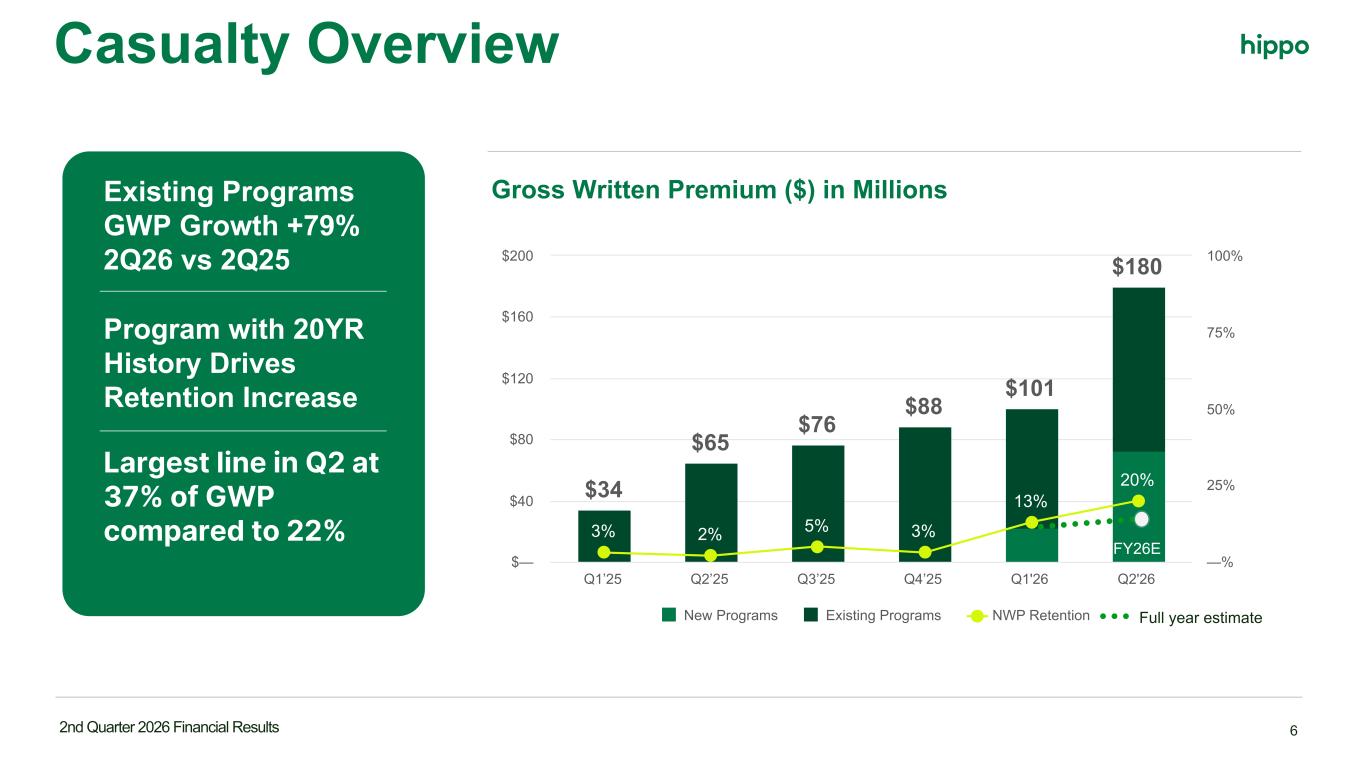
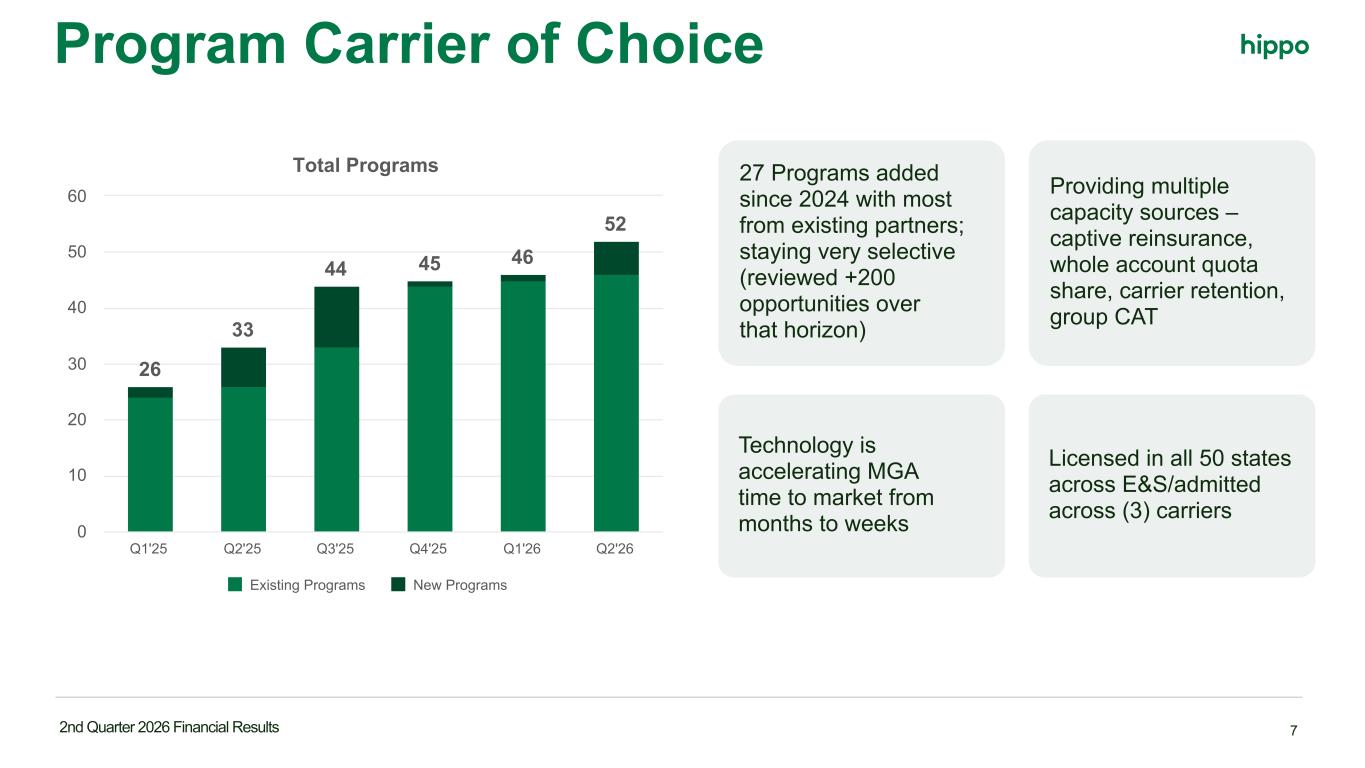
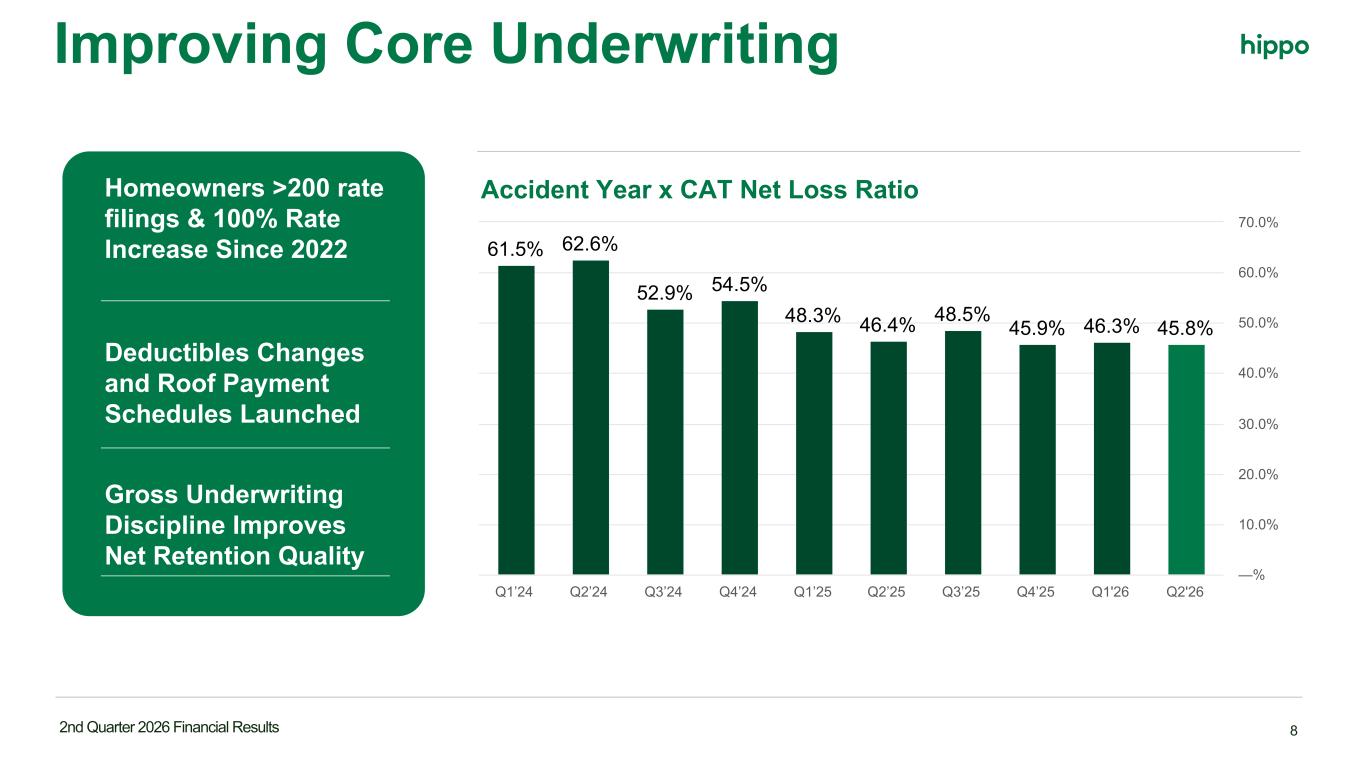
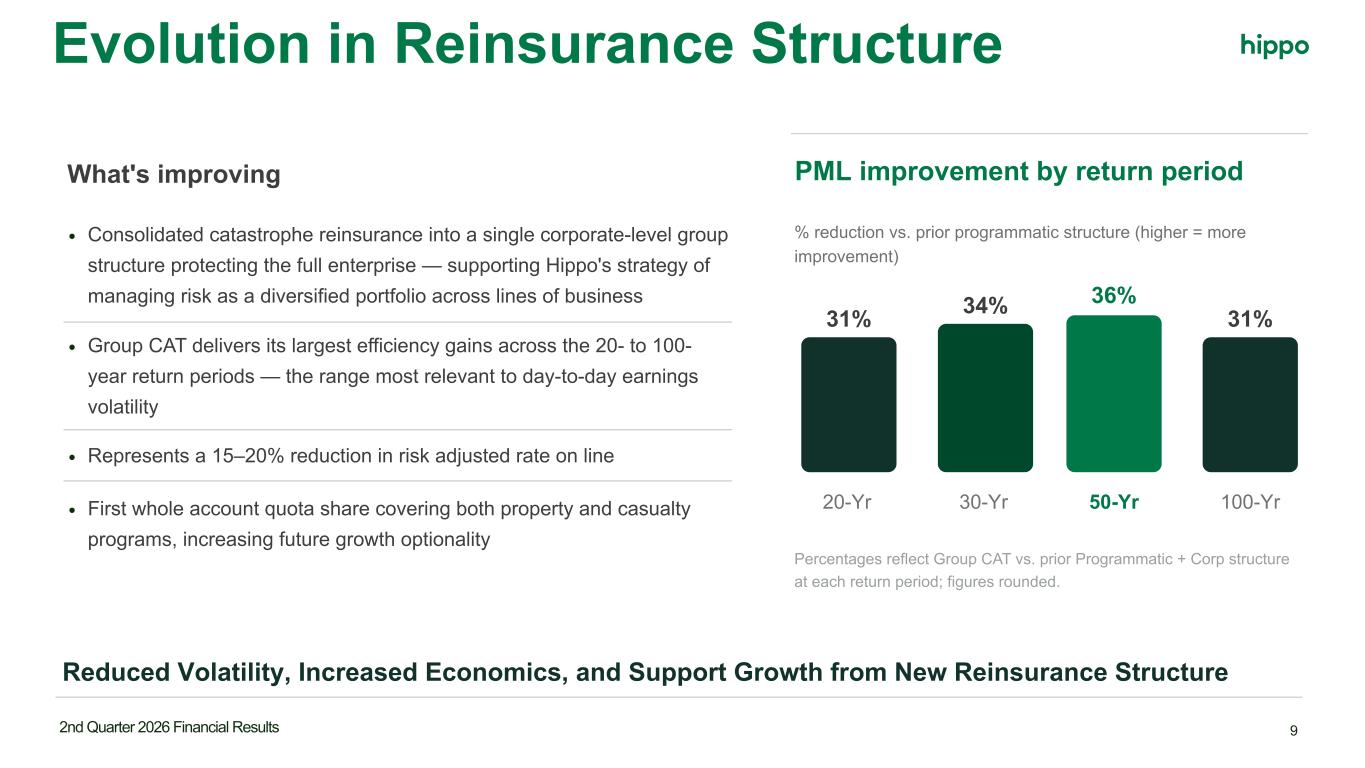
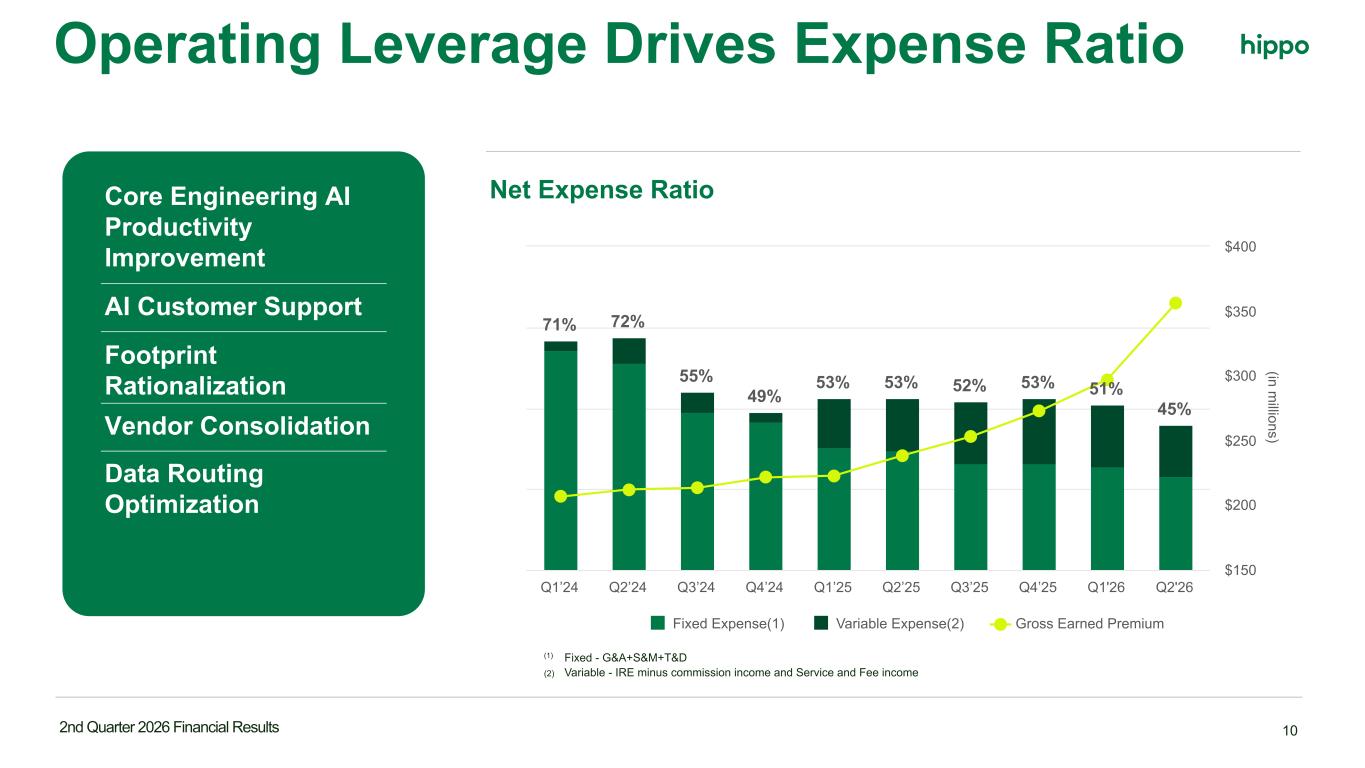
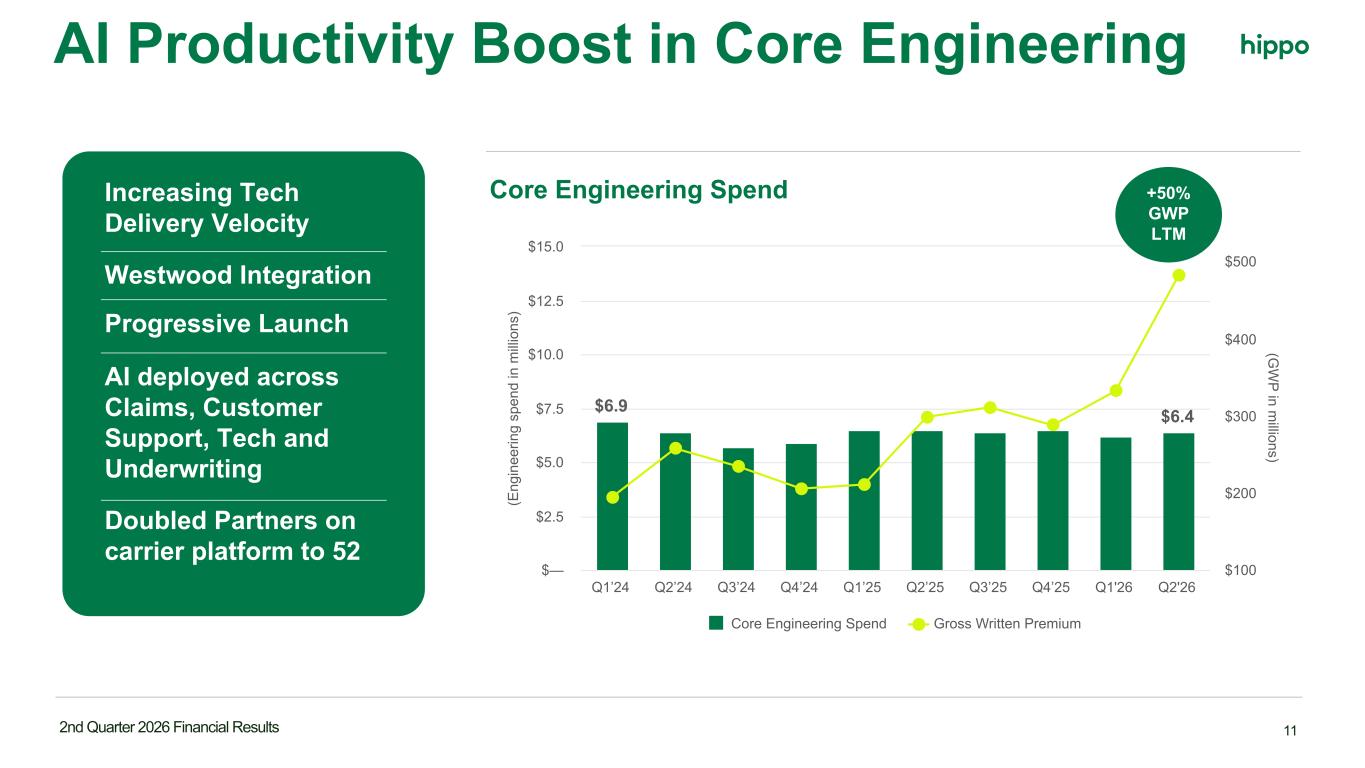
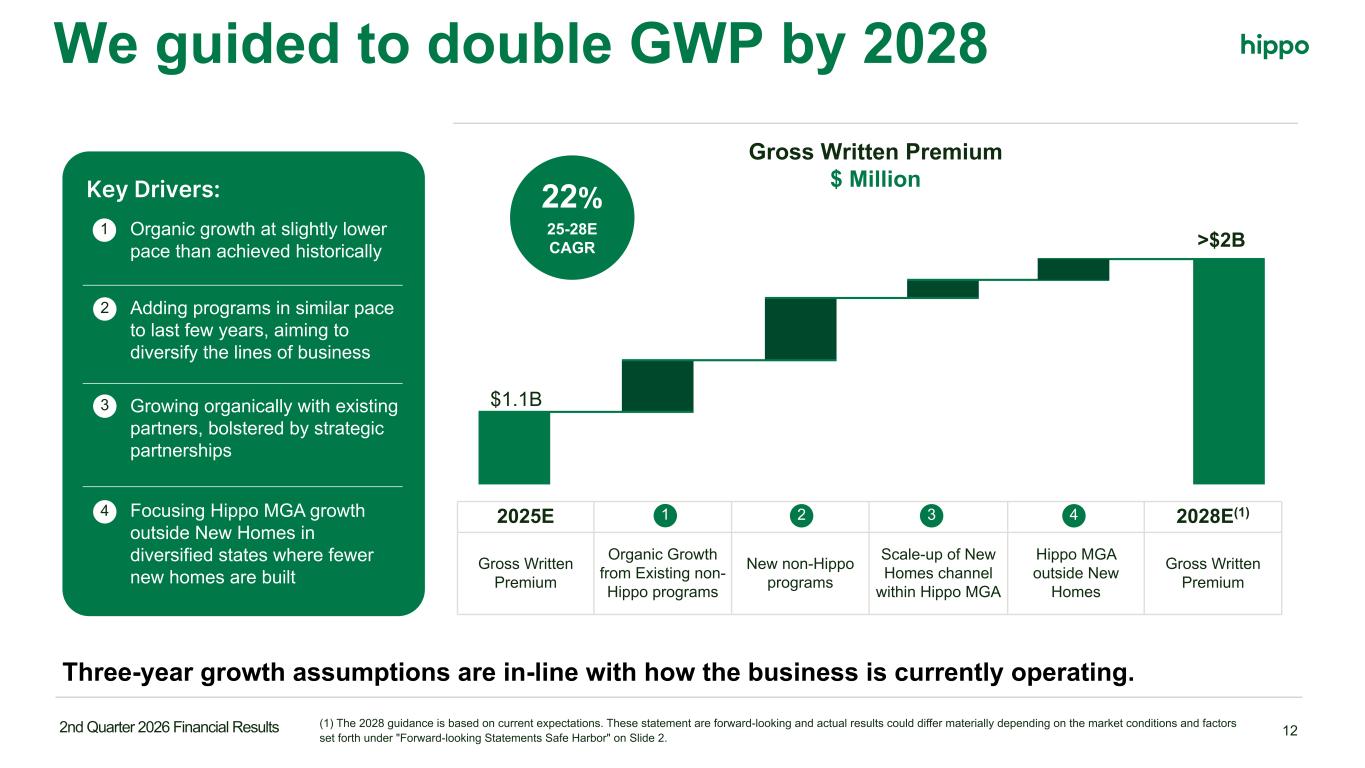
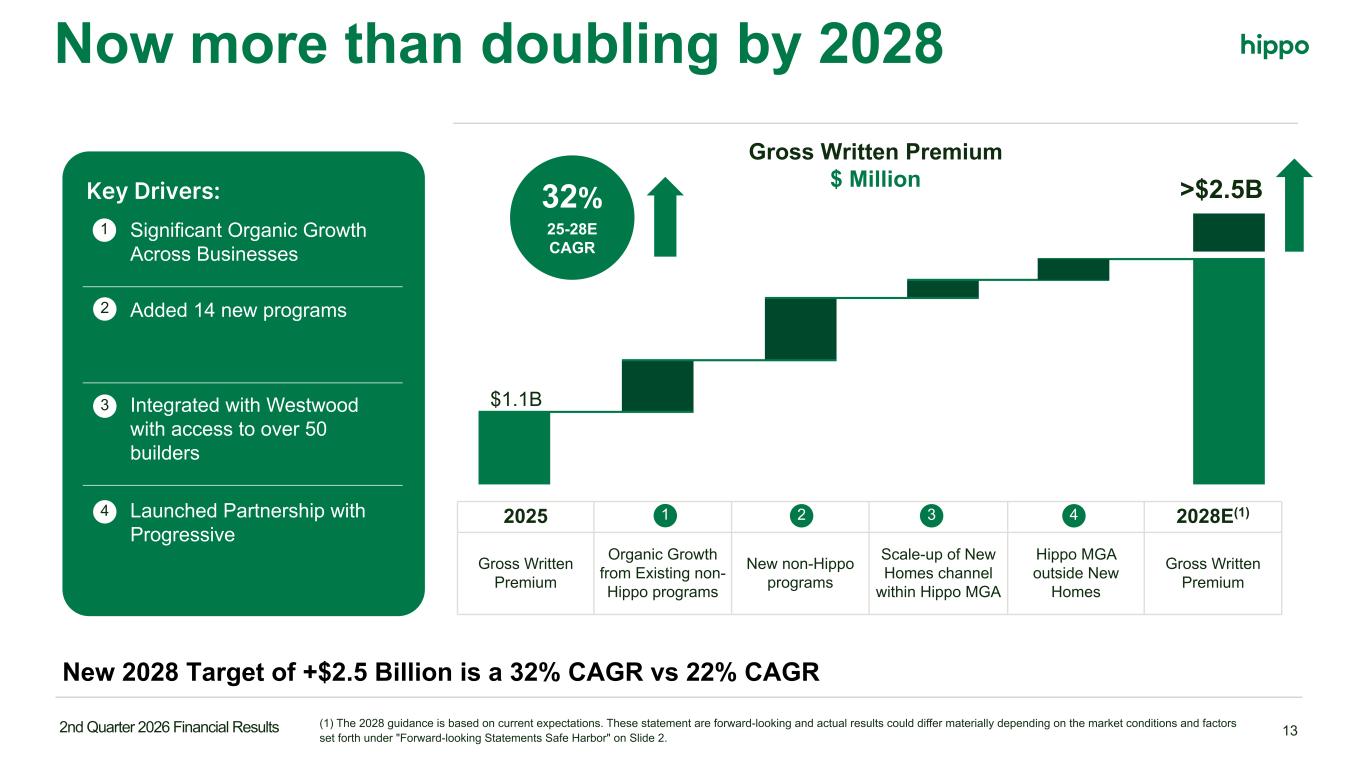
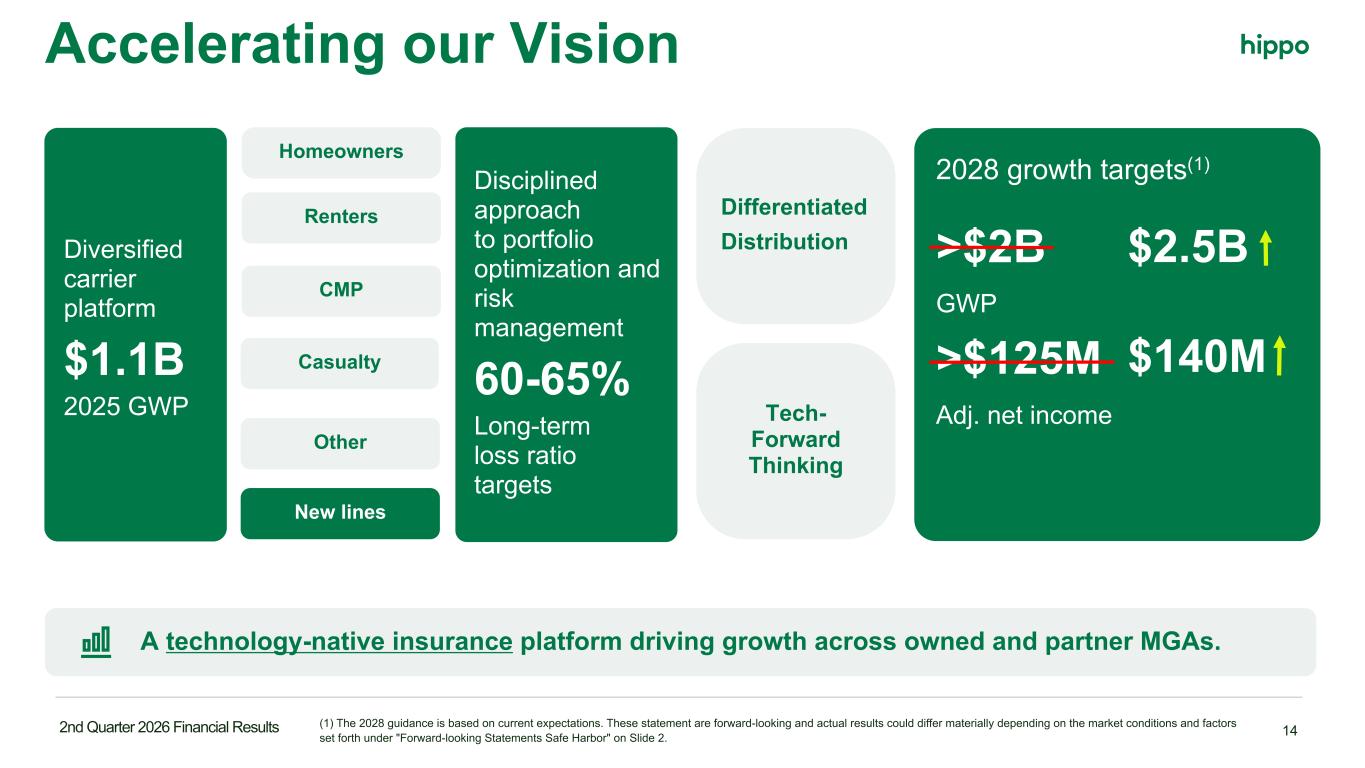
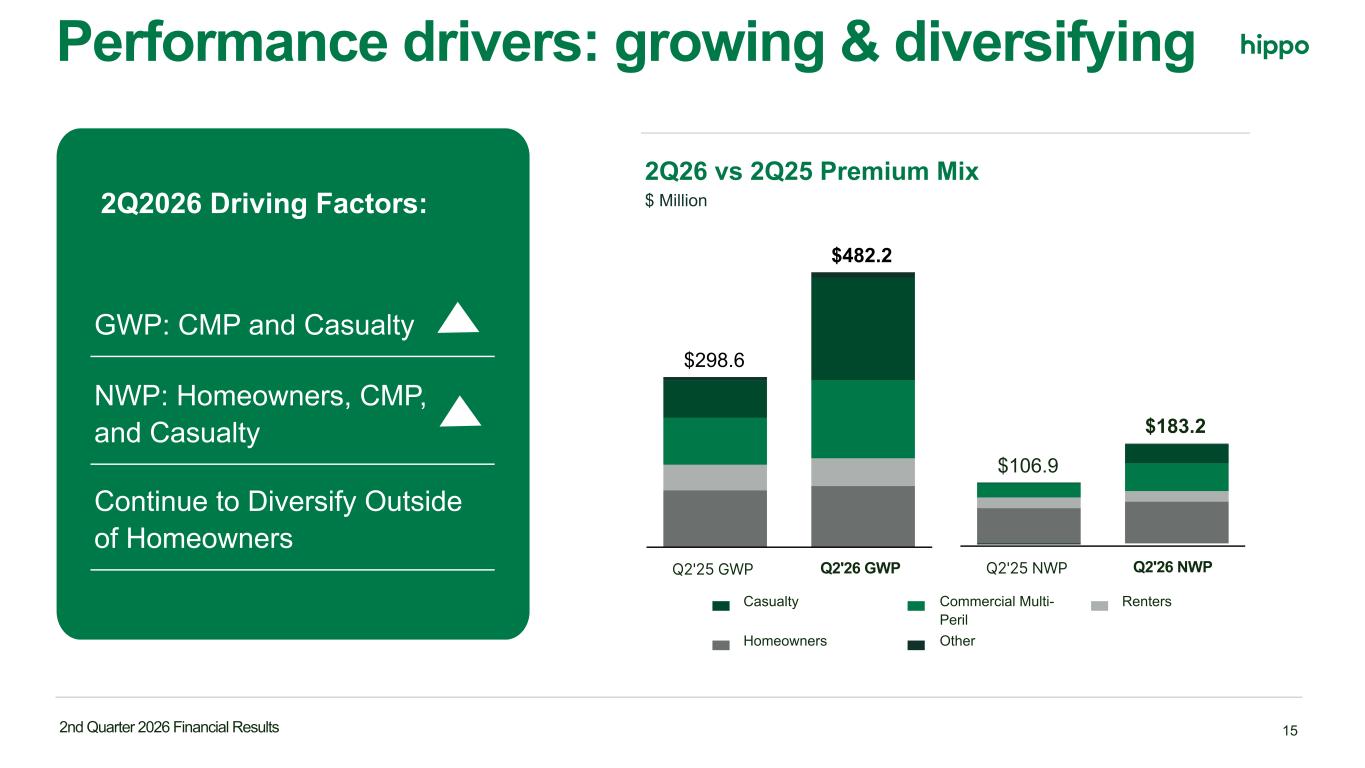
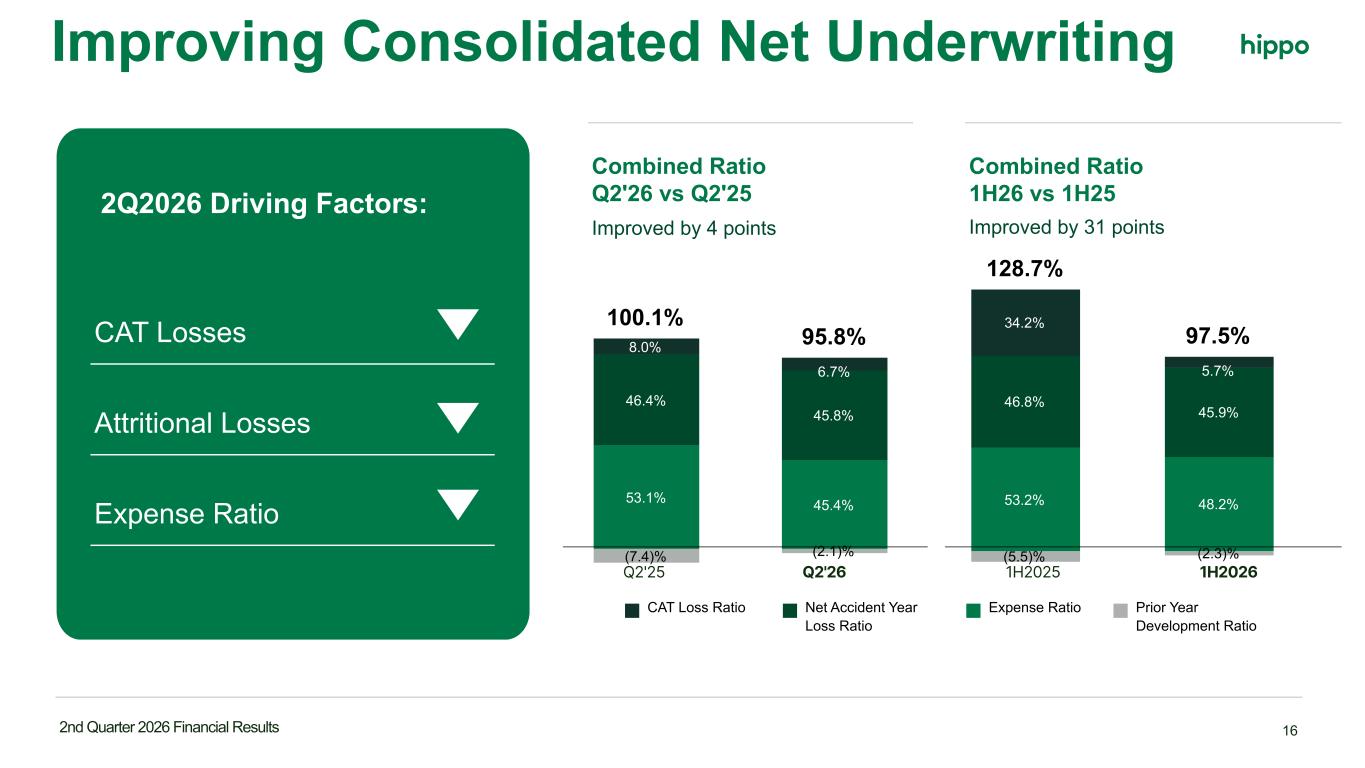
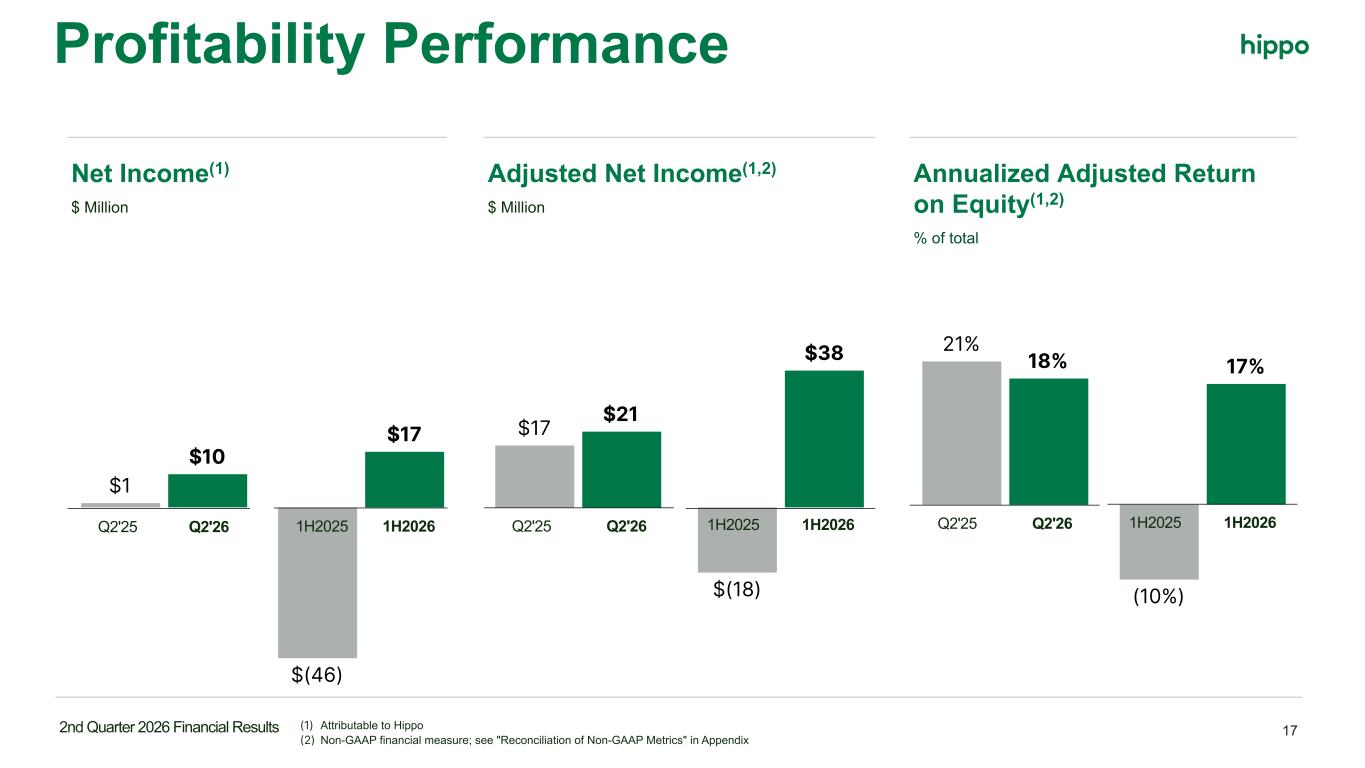
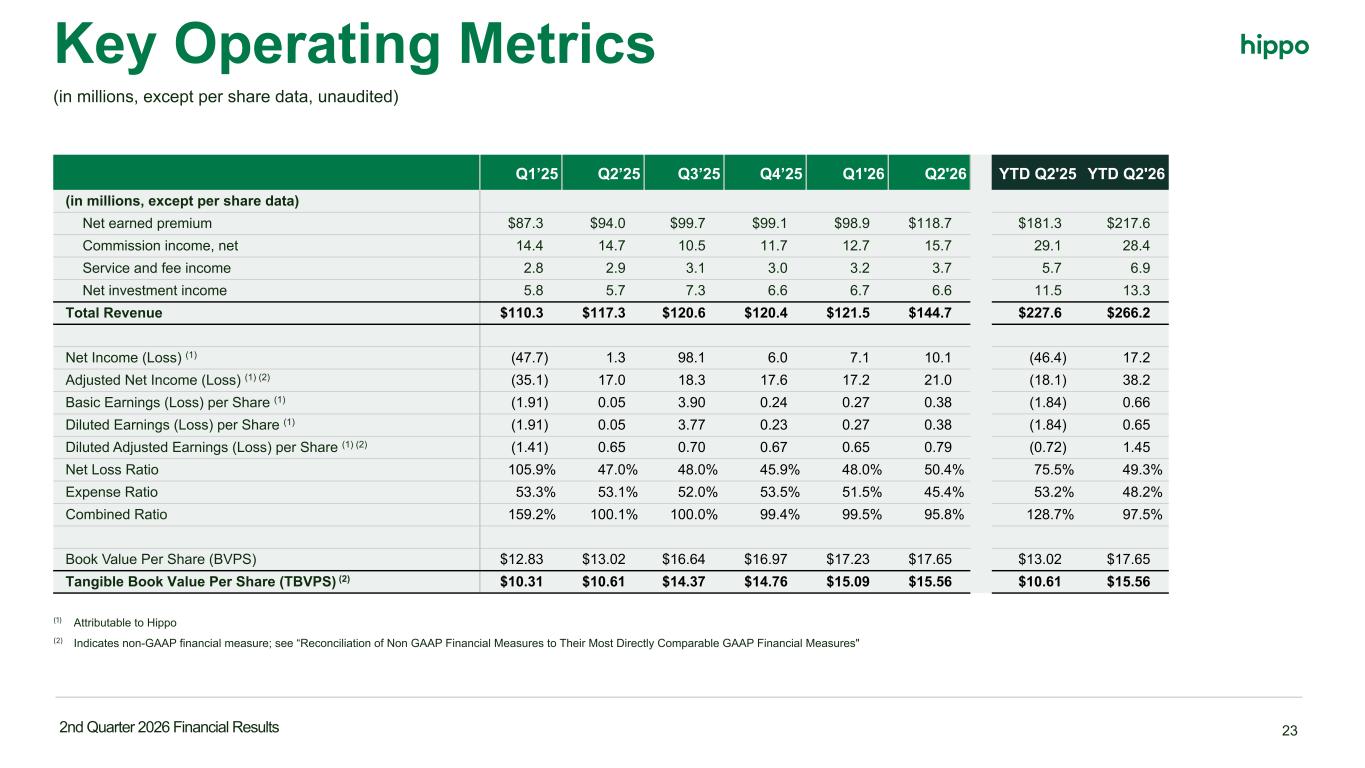
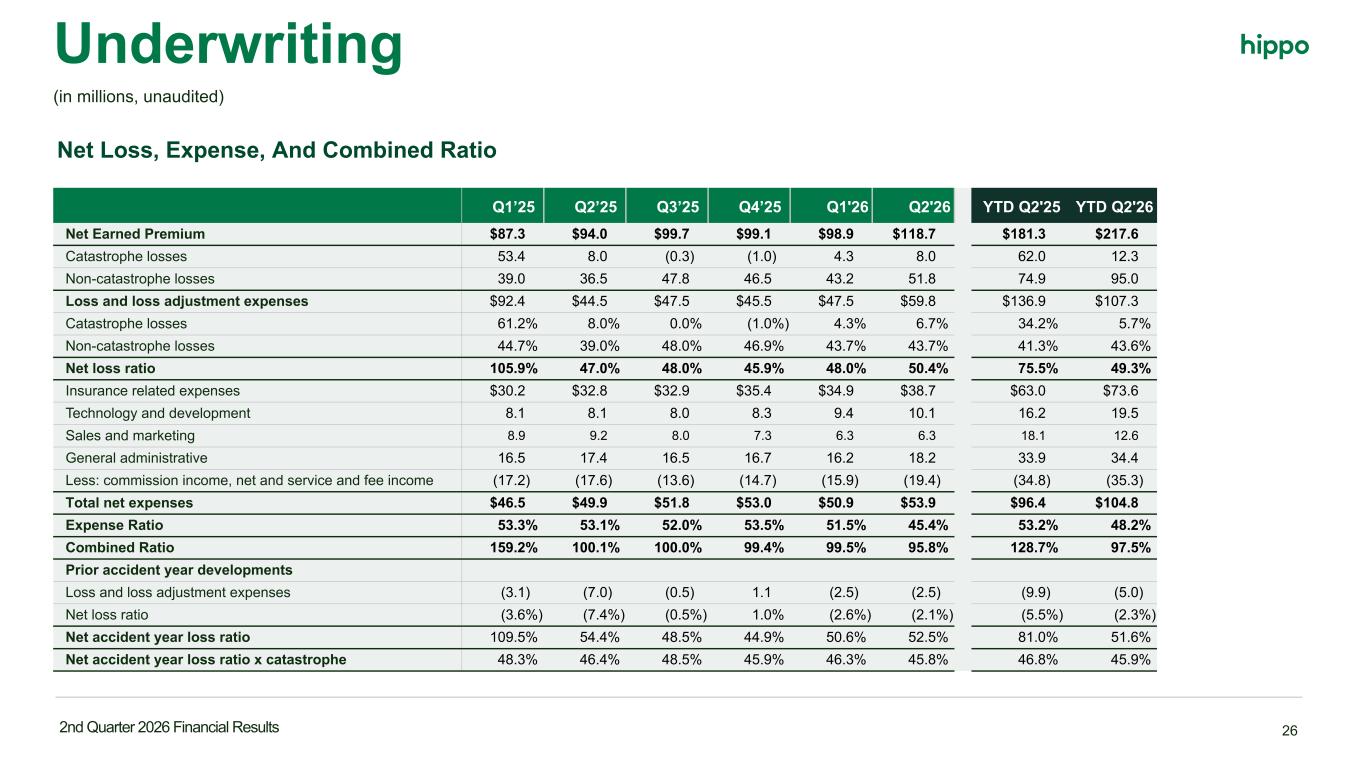
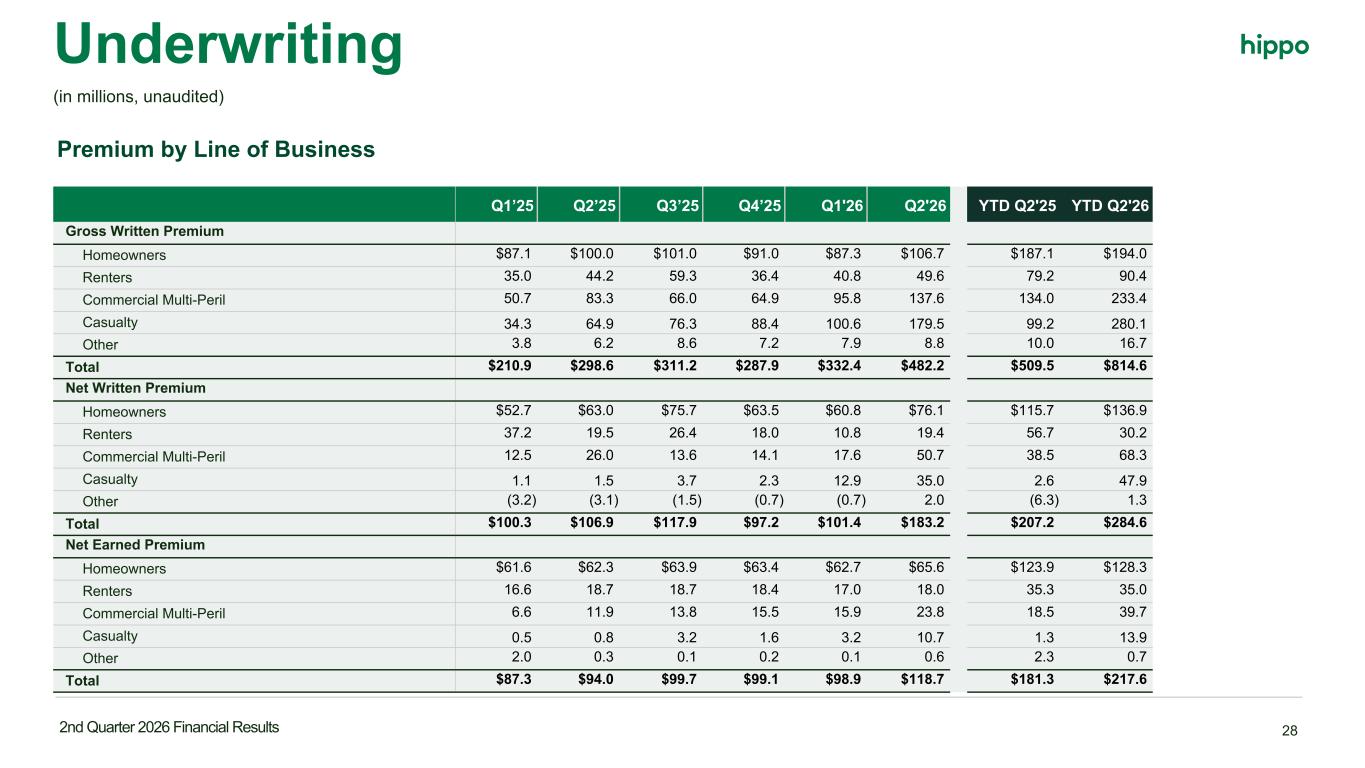
Thank you, Chuck, and good morning, everyone. Thanks for joining us. Hippo delivered another strong quarter, building on the momentum we started the year with. We grew top and bottom line together, making our fifth straight quarter of profitability on both a stated and adjusted basis. For the quarter, we generated $10 million of net income, a nearly eight-fold increase over last year, and $21 million of adjusted net income, a 24% increase over second quarter last year. Growth written premium came in at $482 million, up 61% over last year, led by the continued expansion of existing program partners in our casualty and cmp lines of business and a return to growth in our homeowners line however what stands out most isn't the growth itself it's that we grew profitably our combined ratio improved four percentage points year over year to 95.8 percent and we're at 97.5 percent year to date a 31 percentage point improvement over the first half of 2025. That combination, growth and underwriting discipline, moving in lockstep, is the story of the quarter. Let's walk through it in more detail. In homeowners, we wrote $107 million of premium, up 7% over last year. Growth continues to come from our Progressive and Westwood partnerships, with admitted growth more than offsetting the pullback in E&S as the market becomes more competitive. Rate remains adequate with mid to high single-digit renewal rates this quarter, though we expect rate trend to moderate from here, but to keep pace with lost trends. We want this business to grow, but only where we believe there's a high likelihood of profitability. Commercial multi-parallel had another strong quarter up 65 percent over last year to 138 million now following casualty as our second largest line on a gross basis and second largest on a net written basis behind homeowners retention increased to 37 percent impacted by a reinsurance structure change however we expect retention to return to more historic levels in the low 20s for the year casualty was our fastest growing line again this quarter, with gross written premium up sharply to $180 million, now our largest line on a gross basis, though third on a net basis. That growth continues to be led by one of our longest tenured partners, a program with a multi-decade track record, which is exactly the kind of program we want to drive growth, one we know well. As we said last quarter, we're starting to lean into higher retention and casualty and this quarter's uptick reflects both a new excess program and a reinsurance change with an existing partner. We expect retention to settle back into the mid-teens from here. We achieved this growth in a competitive market because we believe we've built the program carrier of choice in the MGA space. We now have more than 50 programs, double what we had in the first quarter of last year, and most of that growth is coming from existing partners expanding with us, not just new logos. Our longest-tenured partner has been with Hippo for over a decade. We keep investing in the platform, capacity, and technology to support that partner program growth, such as fully automated monthly data ingestion process, shortening the border row integration from new programs by 90% and reflecting back real-time insights to programs. We have continuously been focused on improving our underwriting, and over the last several years, that has included over 200 rate filings and over a 100% aggregate rate increase to HHIP. To support our program underwriting, we now have two program managers overseeing every program and three on our fastest-growing casualty programs. All of this work shows up in our underwriting results. Core accident year ex-cat loss ratio came in at 45.8 percent, an improvement over last year and among our strongest quarter results in recent years, and nearly 17 points improvement from Q2 2024. This quarter, we evolved our reinsurance structure in ways we think are significant both for our partners and for HIPPO's own risk appetite, something we've been signaling to investors for some time. We renewed our cap bond on attractive terms and added wildfire as a named peril. More importantly, we moved to buying catastrophic reinsurance at the corporate group level rather than program by program, which lowered our PMLs by more than 30% across the return periods that matter most to earnings volatility. We also introduced our first whole account quoted share across the portfolio, giving us more optionality as we build a track record managing risks at the enterprise level. Put simply, this reduces our volatility, improves our economics, and gives our partners more room to grow, and those goals reinforce each other. Scale and expense discipline are doing what we said it would. Our net expense ratio came in at 45.4%, down nearly 26 points from where we started 2024. As operating leverage continues to build, during that same period, our fixed expense ratio dropped by 39 points to 29%. AI continues to move from experiment to infrastructure across our business. Hannah, our AI service agent, and Clara, our AI first notice of loss agent, are both live this quarter, and together, they're a big part of why we can grow the top line without growing overhead at the same pace. We've also rolled out Devin, Cognition's AI software engineer, across our tech organization, nearly a third of our roughly 500 employees. tech is core to hippos value proposition and this is about making our best people even better at building it our tech native roots also show up and how fast we move our full integration with westwood and our accelerated launch with progressive are both proof points and we believe both have plenty of runway left we'll keep investing here because we believe a unique and targeted distribution model is an opportunity to further differentiate our business. Given everything this quarter, I want to remind everybody what we told investors at last June's Investor Day, that by 2028, we'd reach at least $2 billion of gross written premium, a 22% CAGR through organic growth, new programs, scaling our builder channel, and relaunching homeowners outside of Builders. So, how are we doing against that? Over the last year, we've simultaneously added 14 new programs, completed our Westwood integration, now quoting more than 50 Builders, and launched our progressive partnership, accelerating homeowners' growth outside the Builder channel. Additionally, this quarter, we significantly advanced our business partnerships, which now brings our expected 2027 premium above $2 billion, hitting our prior 2028 goal a year early. That's real progress against all four drivers we laid out. Given that momentum, we're raising the bar. Gross written premium to more than $2.5 billion, a 25% increase over our prior target, representing a 32% compounded annual growth rate, and adjusted net income of more than $140 million in 2028, doubling our current year 2026 guidance. I'm proud of this quarter and even more excited about where HIPPO is heading. We're executing with discipline against our long-term goals, and the progress we're seeing gives me real confidence in what's ahead. Now, I'll turn it over to our CFO, Guy Zeltzer, to walk through the numbers in detail, and then we'll take your questions. Guy?
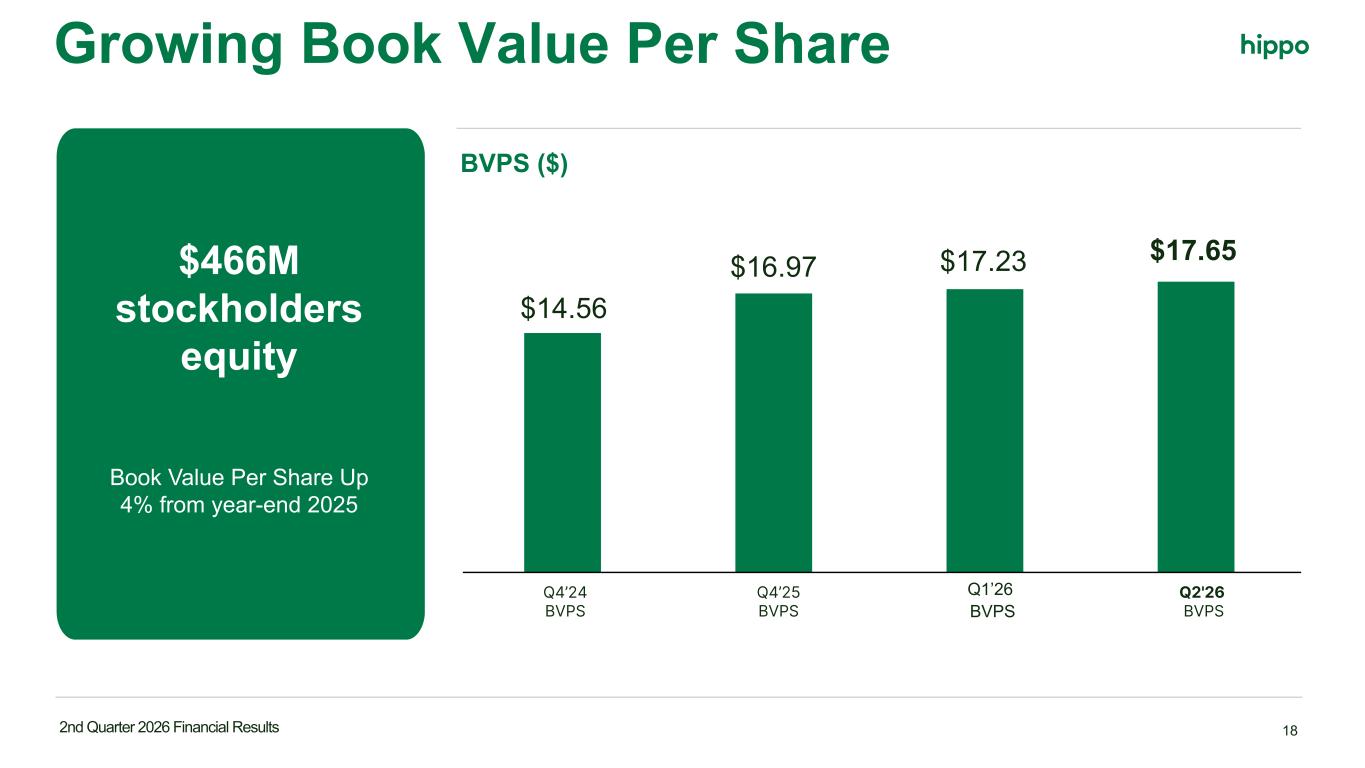
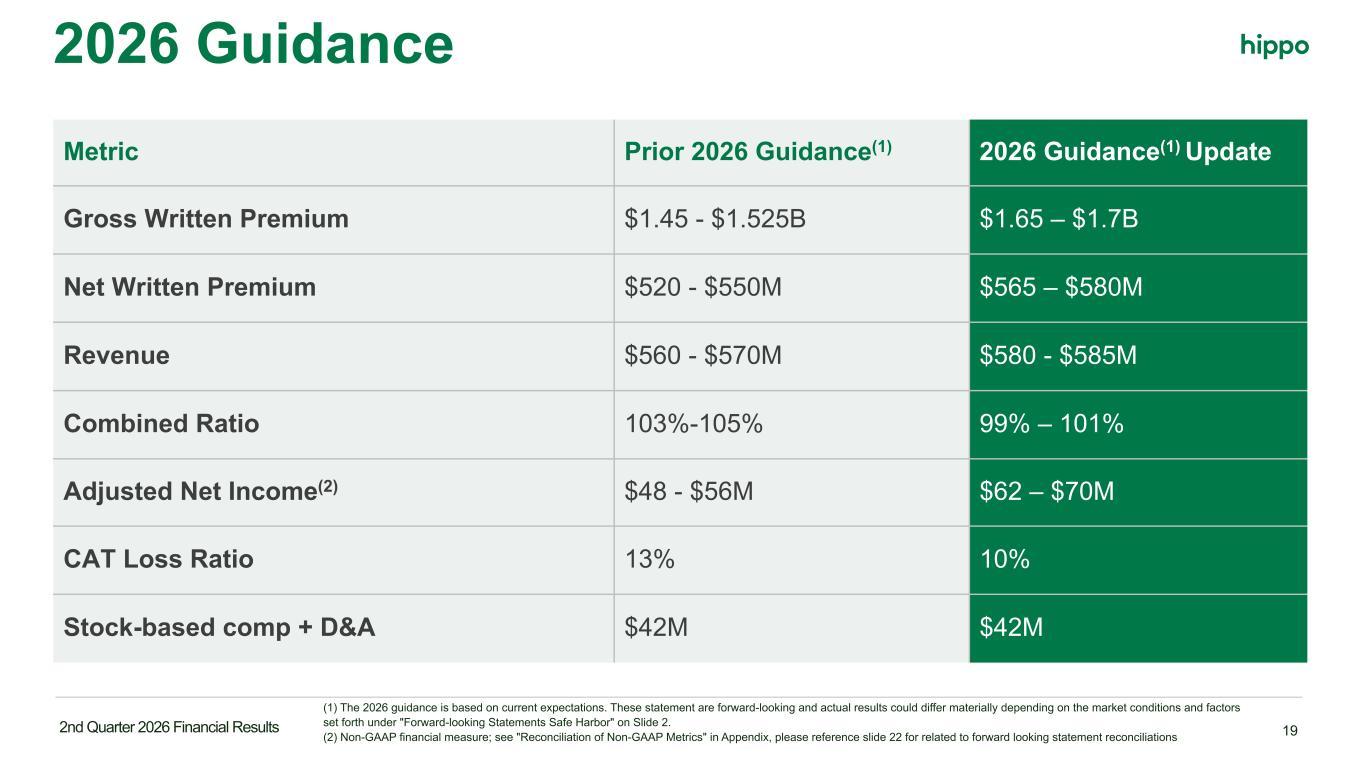
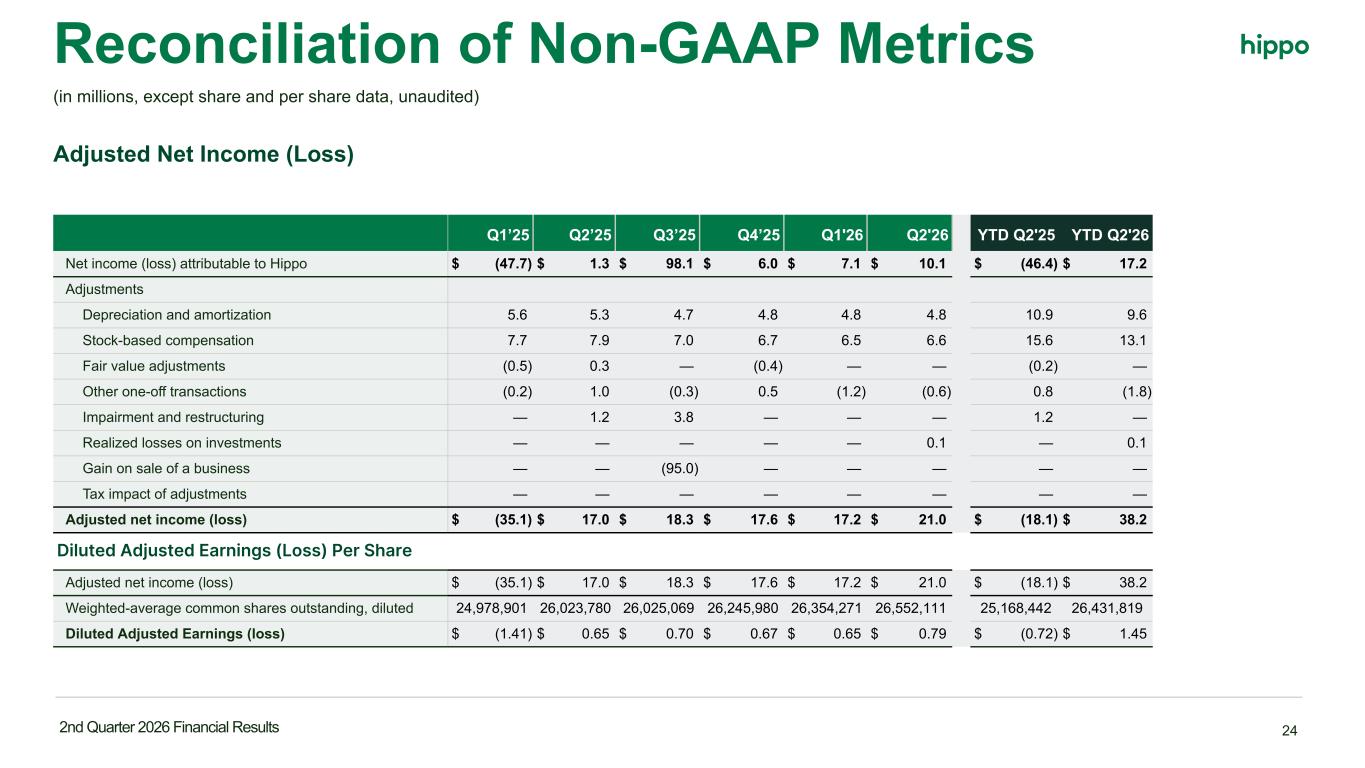
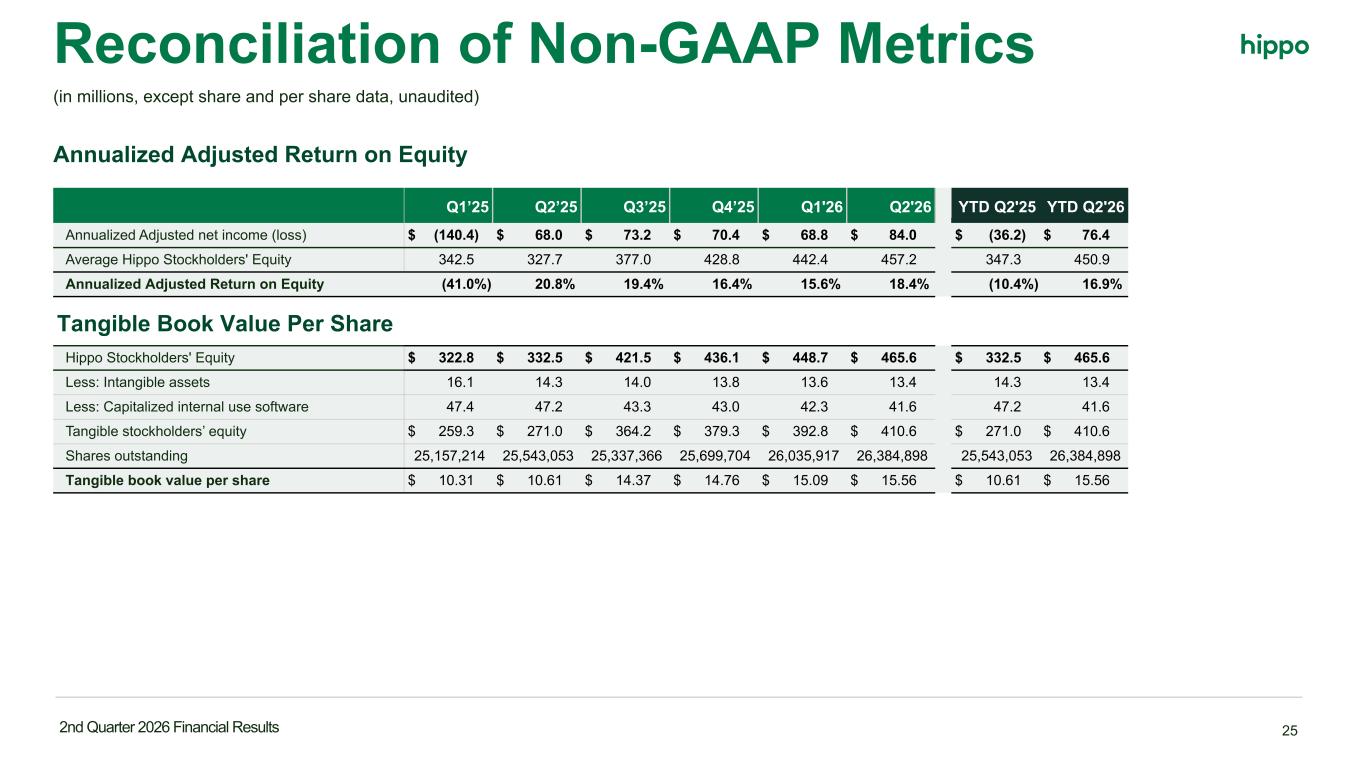
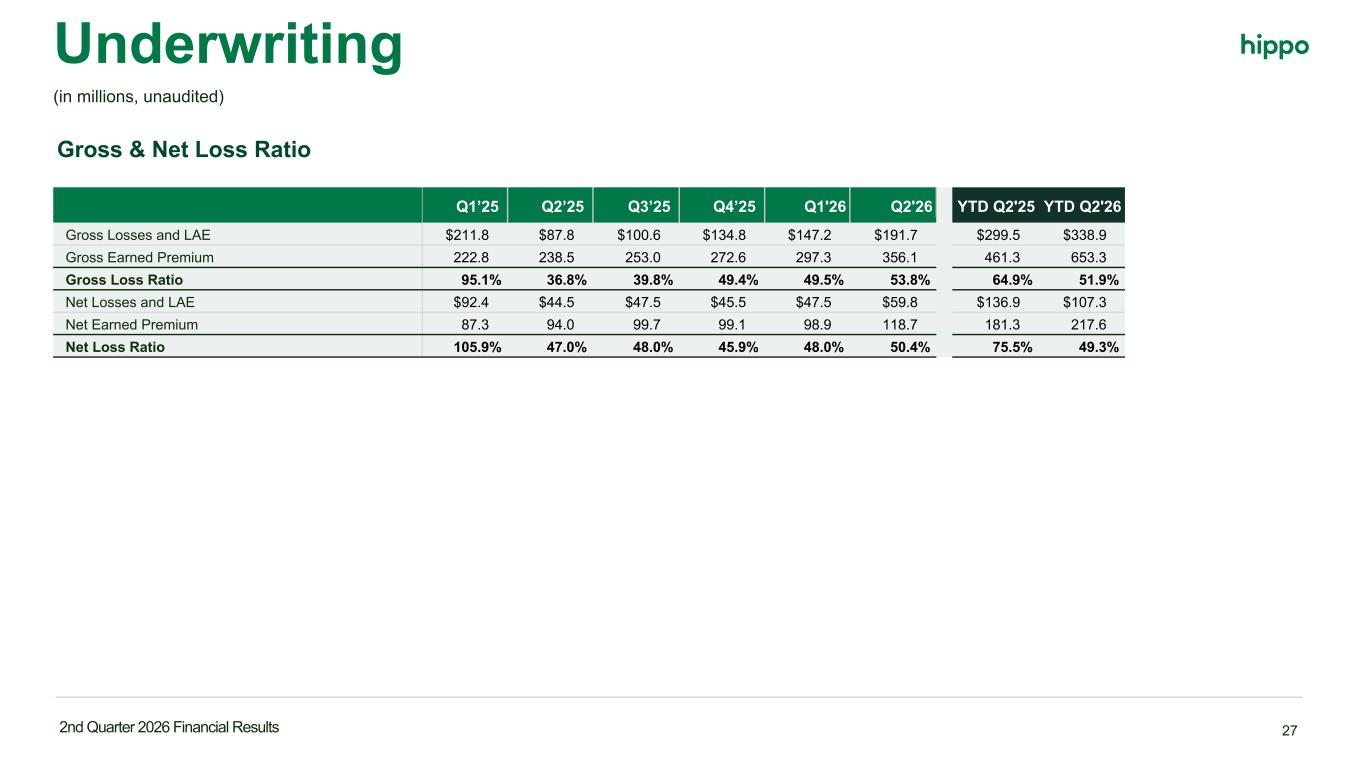
Thanks, Rick, and good morning, everyone. In the second quarter, we once again delivered strong top-line premium growth, improved underwriting, and increased profitability. Q2 gross written premium grew 61% year-over-year to $482 million, up from $299 million in Q2 of last year. Growth in the second quarter was achieved across all our lines of business, with especially strong performance in casualty and commercial multi-parallel lines, and more modest extension in renters and homeowners. I will now highlight a few additional details of how diversified our gross return premium has become. Homeowners grew slightly to $107 million and accounted for 22% of the total gross written premium, down from 33% in Q2 of last year. Commercial multi-peril generated $138 million, accounted for 29% of total gross written premium, up from 28% last year. Casualty generated $180 million, representing 37% of total gross return premium, up from 22% last year. Net return premium in Q2 grew 71% year over year to $183 million, slightly ahead of the extension of gross return premium, driven by a program-specific range change, accounted for $27 million dollars of net written premium this quarter. Consequently, our retention rate in the quarter was 38 percent compared to 36 percent last year and is slightly ahead of our full year guide. In general, we view retention levels on a full year basis as timing of program renewal can lead to quarterly variances in that metric. From a mixed perspective, homeowners generated 76 million dollars of net written premium in the quarter, representing 42 percent of total net written premium, down from 59 percent last year. Commercial multi payroll generated 51 million dollars and accounted for 28 percent of total net written premium, up from 24 percent last year. The aforementioned program reinsurance change this quarter drove 21 million dollars of net return premium in this line. For the full year, we would expect retention levels to be in the low 20s. Casualty generated $35 million compared to roughly $2 million in Q2 of last year. As we previously indicated, the increase in casualty retention was intentional and driven mostly by the long tenured program Rick mentioned earlier. However, the 20% retention rate this quarter was also bolstered by the aforementioned program range change so for the full year we expect the casualty retention level to be in the mid teams revenue in second quarter was 145 million dollars up 23 percent over q2 of last year we expect revenue year-over-year growth to accelerate in the second half of the year as the net return premium growth in the quarter is going to earn in. In Q2, our net combined ratio improved four percentage points to 95.8 percent compared to Q2 of last year. This was achieved by improvement in expense ratio and accident year loss ratio slightly offset by a lower prior accident year reserve benefit in Q2 versus Q2 of last year. Our Q2 net loss ratio increased three percentage points year over year to 50.4 Excedent year X-CAT loss ratio improved to 45.8% from 46.4% last year, reflecting our continued focus on underwriting profitability. Generally, we view Excedent year X-CAT loss ratios in the mid-40s as excellent results. Cap Loss Ratio improved 1 percentage points to 6.7%, as Q2 this year and last year both experienced relatively light cap losses. Prior X&D Reserve Development was 2% in the second quarter, compared to roughly 7% in Q2 of last year. In Q2, Net Exchange Ratio improved 8 percentage points year over year to 45.4%. As Rick mentioned previously, we believe that our continued focus on operating leverage through AI enables us to grow our business while keeping fixed expense largest assets, which in turn has helped driving the expense ratio improvement. Q2 net income came in at $10 million or 38 cents per diluted share, a $9 million improvement year-over-year. The year-over-year improvement was primarily due to the continued improvement of underwriting results and strong premium growth. Q2 adjusted net income grew 24% year-over-year to $21 million, or 79 cents per diluted share. Total EPO stockholders' equity at the end of the quarter was up 4% to $466 million from $449 million at last quarter and up 40% from the $333 million at Q2 of last year. Total group value per share at the end of the quarter was up 2% to $17.65 per share from $17.23 per share at last quarter and up 36% from $13.02 per share at Q2 of last year. Following this quarter's results, we are raising our food year guidance. We're increasing gross return premium from a range of $1.45 and $1.525 billion to a range of $1.65 and $1.7 billion. dollars. We are increasing net return premium from a range of 520 and 550 million dollars to a range of 565 and 580 million dollars. We're increasing revenue from a range of 560 and 570 million dollars to a range of 580 and 585 million dollars. We are lowering our net combined ratio from a range of 103 and 105 percent inclusive of a 13 percent cash loss ratio to a range of 99 and 101 percent inclusive of a 10 percent cash loss ratio and finally we're increasing adjusted net income from a range of 48 million and 56 million dollars to a range of $62 and $70 million, while maintaining the expected impact from stock list compensation and depreciation and amortization to roughly $42 million. And with that operator, I would now like to open the floor to questions.
Operator
We will now begin the question and answer session. Please limit yourself to one question and one follow-up. If you would like to ask a question, please press star 1 to raise your hand. To withdraw your question, press star one again. We ask that you pick up your handset when asking a question to allow for optimum sound quality. If you are muted locally, please remember to unmute your device. Please stand by while we compile the Q&A roster. Your first question comes from the line of Randy Binner with Texas Capital. Randy, your line is open. Please go ahead.
Hey, good morning. Hopefully you're hearing me okay. I had a tough connection there, but I have a question about just the business mix going forward. It was a good result this quarter, but the casualty lines in particular were a lot of the premiums. And so is this a function, you went through retention and growth opportunities and program, but should we think of HIPPO as being more like a third or less homeowners longer term? you know i i think a lot of people have thought of it as more of a home insurer obviously you've had a lot of success with the programs but just trying to understand looking out in the future you know what the business mix is of this kind of multi-line carrier uh good morning randy this is rick and uh we can hear you loud and clear so appreciate the question i think the way everybody should really consider and think about hippo is it's our objective to build a very diversified
portfolio that allows us to optimize mix based on a market cycle and market segment. So for us, as an example, we talked about the ENS market is softer right now, so we can toggle that back while we're growing the admitted market. Homeowner's business is looking favorable, so we're growing that with our Westwood and Progressive partnerships on the admitted basis line. But for us to get to a fully diversified portfolio where we have a blended and balanced book, we want to make sure that our commercial multi-parallel, our casualty lines gets up to a point where it does create optimal balance for our homeowners line. So we still emphasize the quality of HIPPO's home insurance program. We continue to grow that program. We will continue to grow that program. But we want to make sure the portfolio stays in balance over time. So the more we grow homeowners, the more we're going to want to grow casualty to create that balance that I mentioned before. So from an optimal mix perspective, it's very important for us to make sure that we are driving against favorable trends and favorable product lines and favorable market cycles. And again, toggling back when the market cycle might be distressed.
Okay. Understood. And then just a couple of quick follow-ups. When you, the ENS reference the market being softer, that is in homeowners? You're seeing softer ENS?
Or, okay. And that makes sense. And then I guess just for the casualty lines growth, I think a common reaction is that that's kind of growing in a softer area of the market, but of course you have a lot of control to your program. So just maybe like just a little more granularity on, you know, kind of like the partnerships, the market opportunity in writing those programs and kind of seeing, you know, outsized casualty growth and which broadly is seen as a softer casualty market.
Yes, Randy, happy to talk about that. I think one thing that is really important to recognize is most of our casualty growth is concentrated in existing known long-tenured programs to us. This is not us going out and chasing new opportunities, chasing rate, chasing growth. If you look at like CMP as an example, we tie that back to we are fast becoming the program carrier of choice. We have 50 programs in that space. We know these programs well. These programs are growing with us. We reviewed in the last 12 to 18 months approximately 200 programs and selected a relatively small percentage of those as somebody that we want to partner with on a go-forward basis. So from our perspective, it comes through a combination of organic growth with existing long-tenured partners and, lack of a better term, cherry picking new programs that we believe are very well-operated and ones that, again, help us get to that diversified balance that I was talking about.
All right. Thanks. Thanks for the responses. Appreciate it.
Operator
Your next question comes from the line of Tommy McJoint with KBW. Tommy, your line is open. Please go ahead.
Thanks for taking my questions. To start off, can you talk a little more about the partnership with Accelerant that you announced in June? I guess the important question that we want to ask is thinking about premiums that are coming through that channel with accelerant and the economics or the bottom line impact of those premiums. How do they compare with non-accelerant revenues that are coming through?
I just want to understand the difference as we think about modeling those premiums. yeah tommy this is rick happy to start and then guy can jump in with any other detailed questions i think first and foremost the way we view the accelerant program is a way for us to grow the premium with a partner that has access to a large number of mga programs i think we've we've published that we believe and expect us to be in excess of 500 million dollars next year but i also think there's more opportunity in that particular space, but we do generally look at each program in great detail before we agree to be the carrier to support Accelerant with that particular program. So again, I'd really like to emphasize today, our growth comes with thoughtful quality, not just growth at all costs. Accelerant gives us an opportunity to look at those programs and then take those programs on and then continue to grow it. We, of course, have our own sourcing of business in the program space outside of Accelerant. And in those, we generally look for things, as I mentioned before, with Randy's question, operators that have a long track record, high quality, ones that have been in business for quite some time or at least have the expertise uh in the particular product line space and then we also go out and hire internally to hippo experts in both underwriting and claims handling in that particular segment so we are an additional backstop or an additional uh vet on the quality of business that comes in both on a per risk basis on a claims handling basis and in the aggregate it. So this is the way we look at Accelerant for the most part. I think Accelerant continues to grow. Therefore, they need lots of capacity. We're proud to be one of their capacity providers, and it allows us to get views of programs that maybe we normally would not have been able to take a look at.
And Tommy, this is Guy, I just wanted to also comment on the economics. This is a fairly standard transaction. So when you model the business going forward and the commission income side specifically, it's very standard to other deals that we're doing. So, it should be viewed as a scale-up in line with seeded earn premium.
Okay, got it. That'll make sense. And then switching over, a question on the property books across homeowners and in the commercial side as well. We hear from a lot of competitors that competition in the space is is intensifying. You are seeing, you know, some rate deceleration there. And some of that, frankly, you know, reflects the lower cost of reinsurance. And you guys reported that as well. So if you just talk about the competitive environment and where you see sort of margins heading in the various property books of business that you have.
Yeah, I think this is one of the, Tommy, I think this is one of the real benefits of our platform because we do write across multiple product lines and multiple barrels. We're not in the business of chasing risk and chasing growth in a softening market. I agree with your sentiment that the homeowners market is absolutely softening right now, which is one of the reasons why you're seeing an uptick on the commercial and casualty sides of our business. But we do believe we have so much room to grow in the property space, both in our own homeowners program and some of the MGAs that we support, that we think that our growth won't slow into the soft market, again, because we are relatively small compared to the industry in that particular space. However, what we will commit to is that if we find ourselves in a position where we do not believe that growth in any particular product line will be accretive to our bottom line and to our combined ratio, we won't grow in that space. And so that's, again, the force of what we've built here is those levers for us to pull across cycle, across product line, and across programs and both owned and non-owned business.
Tommy, this is Guy again, just wanted to also add two points on top of what Rick just mentioned. So on the homeowner side, one of the reasons why we love the partnership with Progressive is that it gives us access to a lot of lead generation, a lot of flow. We're right now live with Progressive at eight states, but we do plan to triple the state footprint by the end of this year, and that is giving us even more volume. and the impacts of volume allows us to still be very, very disciplined and only buying businesses will feel very good about from a profitability perspective. And the second thing, you also asked about property within the CMP line. We also see the same trend. So even though the CMP is growing, we do see with commercial property specifically some softening, which is why we're pulling back, which is why the growth that you're seeing is actually coming from other lines. So it's the same thing that Rick has mentioned, where we are seeing softness, we have no problem of putting back. And the most important thing, again, is to be disciplined across each and every line.
Yeah, Tommy, one thing I'll add to what Guy had just mentioned is, you know, the growth that we are experiencing in Progressive. We only expose a rate to progressive customers for a particular business that we want to write, both from a geographical basis, but also from an inherent underlining per policy basis. So we do not expose a price or a HIPPO quote on any customer of progressives that doesn't fit into our desired footprint and our desired underwriting box.
Thank you. Thanks, Tommy.
Operator
Your next question comes from the line of Andrew Anderson with Jeffries. Andrew, your line is open. Please go ahead.
Hey, good morning. This is Sid on for Andrew. I'm curious if you could expand on why right now was the right time to add the whole account quota share and what economics made the transaction attractive. And then I know you touched on casualty and CMP, but should we expect any change in the retention and homeowners moving forward?
Hi, this is Rick. Thanks for the question. I'll go ahead and start with this one. The whole account quota share is more of a capability. The amount of our risk seeded in our whole account quota share is very, very small. But what it does is it creates a capability that as we continue to grow over time, again, another lever for us to pull to put more risk to third party re-insurers if we feel like it's the best way to stick within our risk tolerance framework. And so for us, it's more of a capability. I don't think it meaningfully impacts the economics of the business, certainly not at this size of business that we're placing through it, but it's a capability that we thought it was important for us to have as we experience continued growth throughout. Sid, remind me, what was your second question?
Yeah, just curious if, I know you guys had touched on casualty and C&P retention, but if we should expect any changes in the homeowners retention moving forward?
Yeah, that's right. Thank you, Sid. First of all, for the HIPAA Home Insurance Program, from an attritional loss perspective and even at the lower levels of CAT, we, for all intents and purposes, maintain near 100% of that risk. So there's really nowhere to go up with that because we're already taking most of it. For our program partners in the property space, we do participate in a sizable amount of risk.
It ranges between 20% with some partner programs and up to 40 percent with others we think our risk acceptance and our retention for property is right where we want it to be so we would not expect it to increase in the foreseeable future yes this is a guy here the only thing i would add uh is from if you just look at the homeowner's line uh you can tell that we you can see that we have provided the mix between the admitted and non-admitted um and as rick mentioned because we are retaining more on admitted side and that's the piece that is growing faster you should expect a bit of an uptick in the overall retention of that line but not i would say not significantly above what you're seeing
right now but for all every intent and purpose i think you can triangulate the almost 100 retention on the attrition outside on the on the admitted side of the business and then the rest will just be a flag number okay thanks for that and then just as a follow-up i'm curious to hear if you're seeing any competitive changes on fronting fees or economics as more capital enters the MGA and fronting markets, or maybe you're seeing the opposite occur?
Yes, it's a really good question. I think for the most part, we are not seeing changes in that because despite what I think a lot of people believe, the fronting business is not a commodity business. And I think you're seeing that by the amount of deals that we are winning. We are not winning based on decreasing fronting fees or economics back to the MGA. We are winning on more capabilities we can provide to the MGA, both in the form of services, in the form of data, data insights, the ability to share some of the technologies that we've been building from an AI perspective. So when programs are coming to a fronting carrier they generally fall into one of two buckets the bucket where the the program will take any carrier at the lowest price or the lowest seed commission we don't play in that game the other bucket is those that say we want a long-term partner that has enough capital to support our growth can retain risk can provide other valuable services and capabilities far beyond just access to the balance sheet and to the rating i'll also reinforce we had a size increase last quarter so now we're able at our uh am best uh a minus nine we're able to really
Operator
participate in even more opportunities than we were previously thank you as a reminder if you would like to ask a question please press star one to raise your hand your next question comes from the line of Timothy D'Agostino with B. Riley Securities. Timothy, your line is open. Please go ahead.
Hi, good morning. Thanks for taking all the questions. Just one question on my end. On the 2028 growth targets on slide 14, Timothy, you emphasize, you know, potential new lines. I was just kind of just wondering, you know, for HIPPO entering new lines, is that really a 2028 idea, or could we see that in 2027? And then could you just kind of remind us of the game plan when entering those new lines? Thank you.
Yeah, Tim, this is Rick. I'm assuming your question is around HIPPO entering new lines on a manufactured basis, so products we manufacture, as opposed to products that we front for. So I'll answer both questions. First of all, for products that we manufacture, sure. I would expect us to enter into either new lines or new flavors of lines before the 2028 target. By flavors, I mean new things that we might be doing within the personal homeowners or property space and other things that might be tangential to that particular space. So we're not ready at this point to share what those are, but I think in future quarters prior to 2028 we'll be able to share a lot more in detail but we do want to grow the owned pre the own premium side and the owned product side on the fronting business we will enter new lines if we believe those lines are diversifying to the business that we already have just as a reminder HIPPO has lots of different carriers within its Spinnaker insurance group both admitted and non-admitted. We have lots of certificates of authority, not just property and casualty, but also with accident and health. There are opportunities that come to us every day, and we go through a fairly detailed analysis of every opportunity to determine, is this accretive to that diversification goal, and will that individual program positively impact the bottom line of the business? Although I can't give you specifics of what those might be at this point, I can tell you that we are looking at other opportunities that meet those strategic goals of ours.
Okay, great. Thank you so much. Thanks, Tim.
Operator
We have reached the end of the Q&A session. I will now turn the call back to management for closing remarks.
Well, I appreciate all of you joining us this morning. We're excited about the quarter that we've had and even more so about the future. So we look forward to speaking with you again next quarter. Thank you.