Operator
Greetings, ladies and gentlemen. Welcome to the Home Bank Shares Incorporated 3rd Quarter 2025 Earnings Call. The purpose of this call is to discuss the information and data provided in the quarterly earnings release issued after the market closed yesterday. The company presenters will begin with prepared remarks and then entertain questions. Please note that if you would like to ask a question during the question and answer session please press star then one on a touch phone. If you decide you want to withdraw your question please press star then two to remove yourself from the list. The company has asked me to remind everyone to refer to their cautionary note regarding forward-looking statements. You will find this note on page 3 of their form 10k filed with the sec in february 2025 at this time all participants are in a listen only mode and this conference is being recorded if you need operator assistance during the conference please press star then zero it is now my pleasure to turn the call over to donna townsell director of investor relations thank you good afternoon and welcome to our third quarter conference call with me for today's discussion is our chairman john allison stephen tipton chief executive officer of centennial bank kevin hester president and
chief lending officer brian davis our chief financial officer chris polton president of ccfg and scott walter ashore premier finance the third quarter was another record-breaking quarter for home and our team is excited to show the results with you opening remarks today will be from our chairman John Allison.
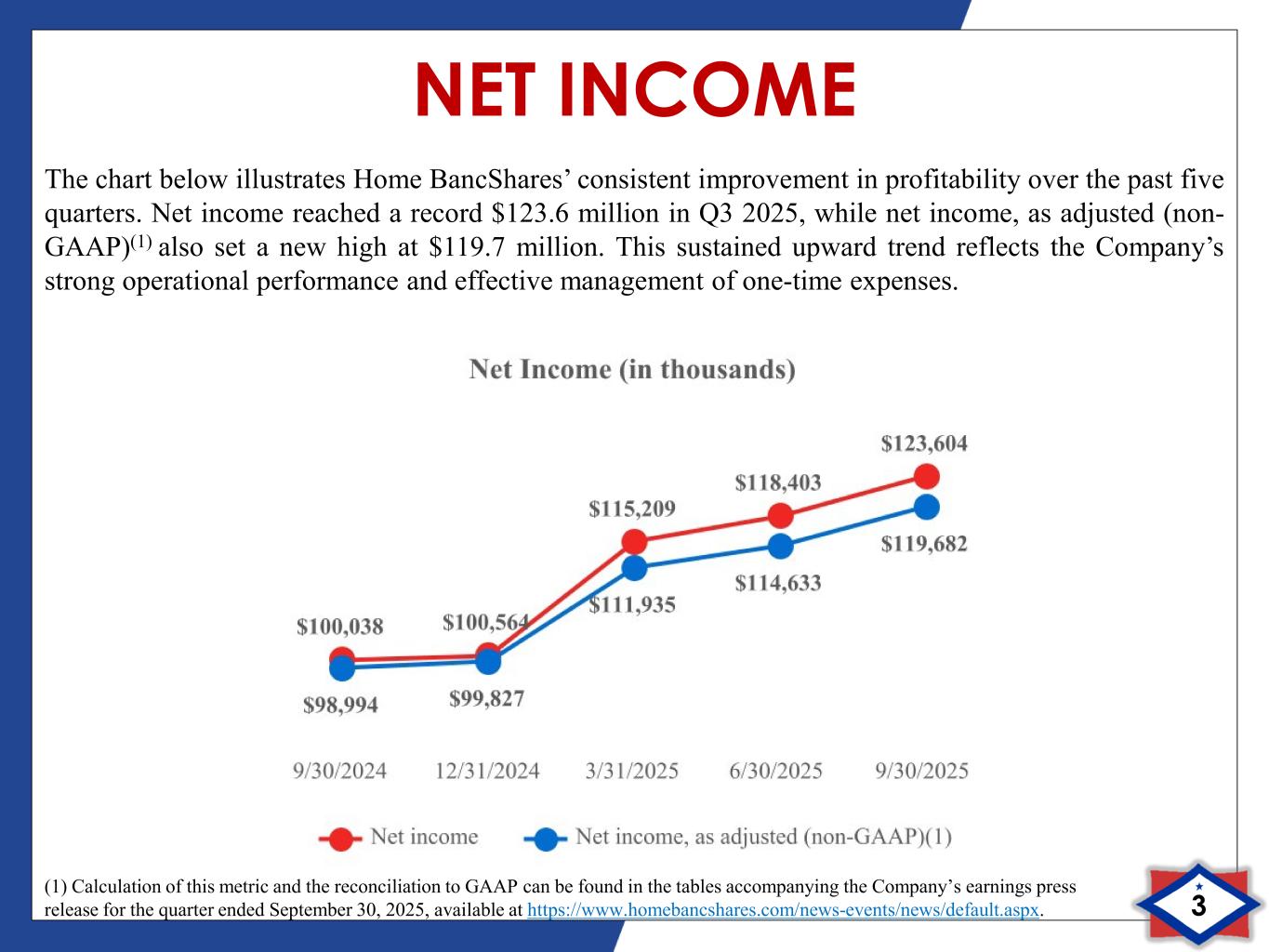
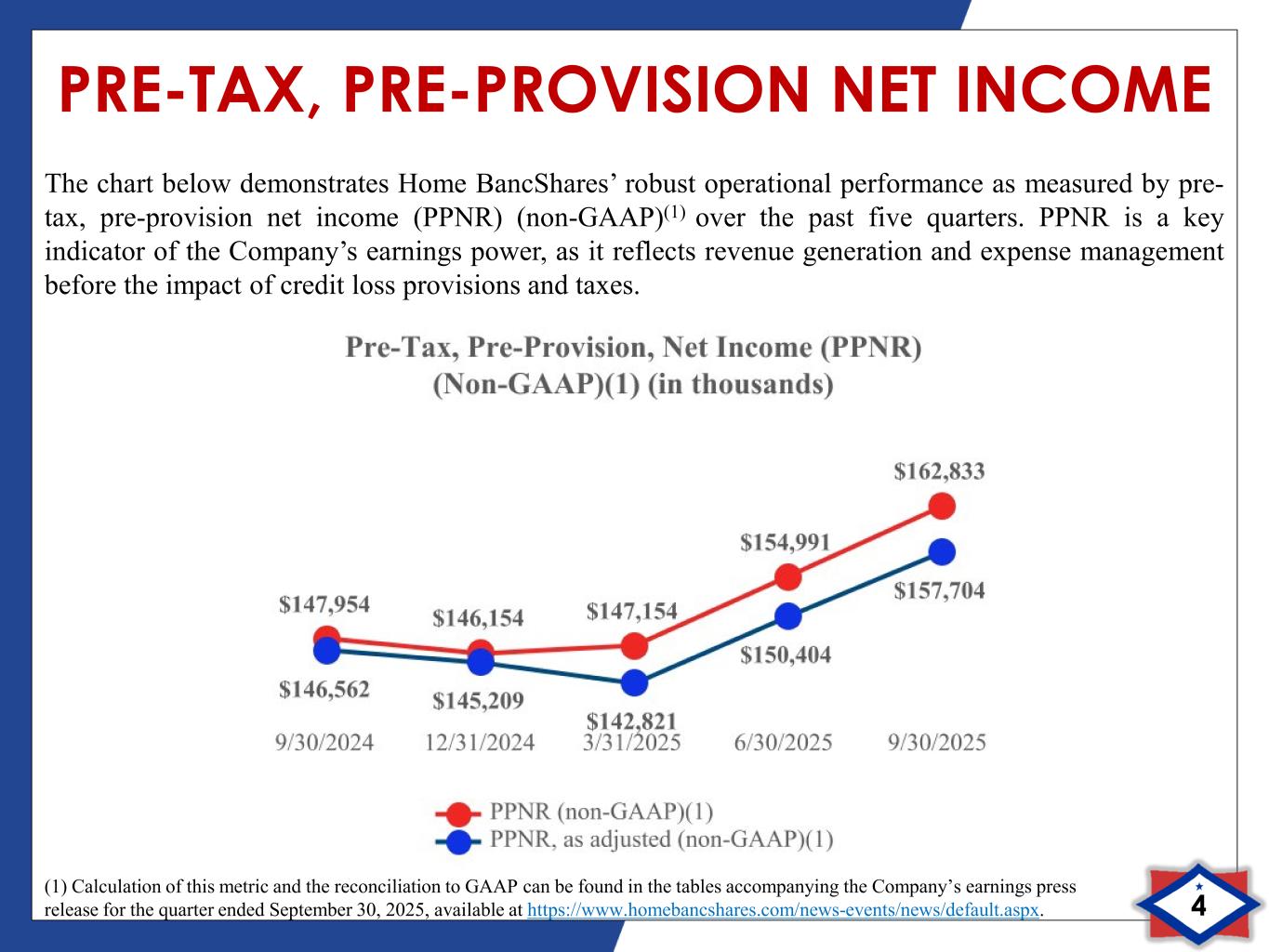
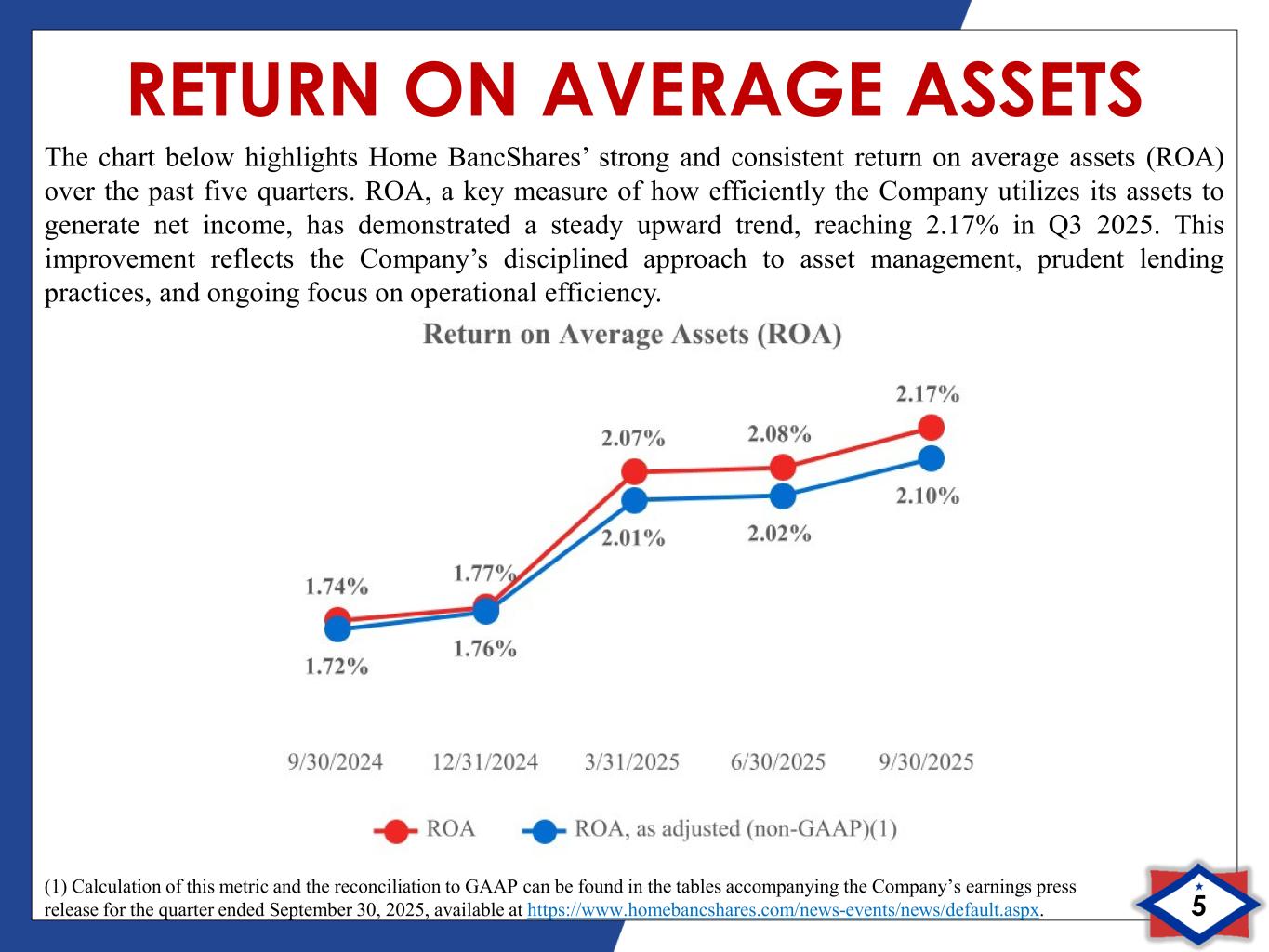
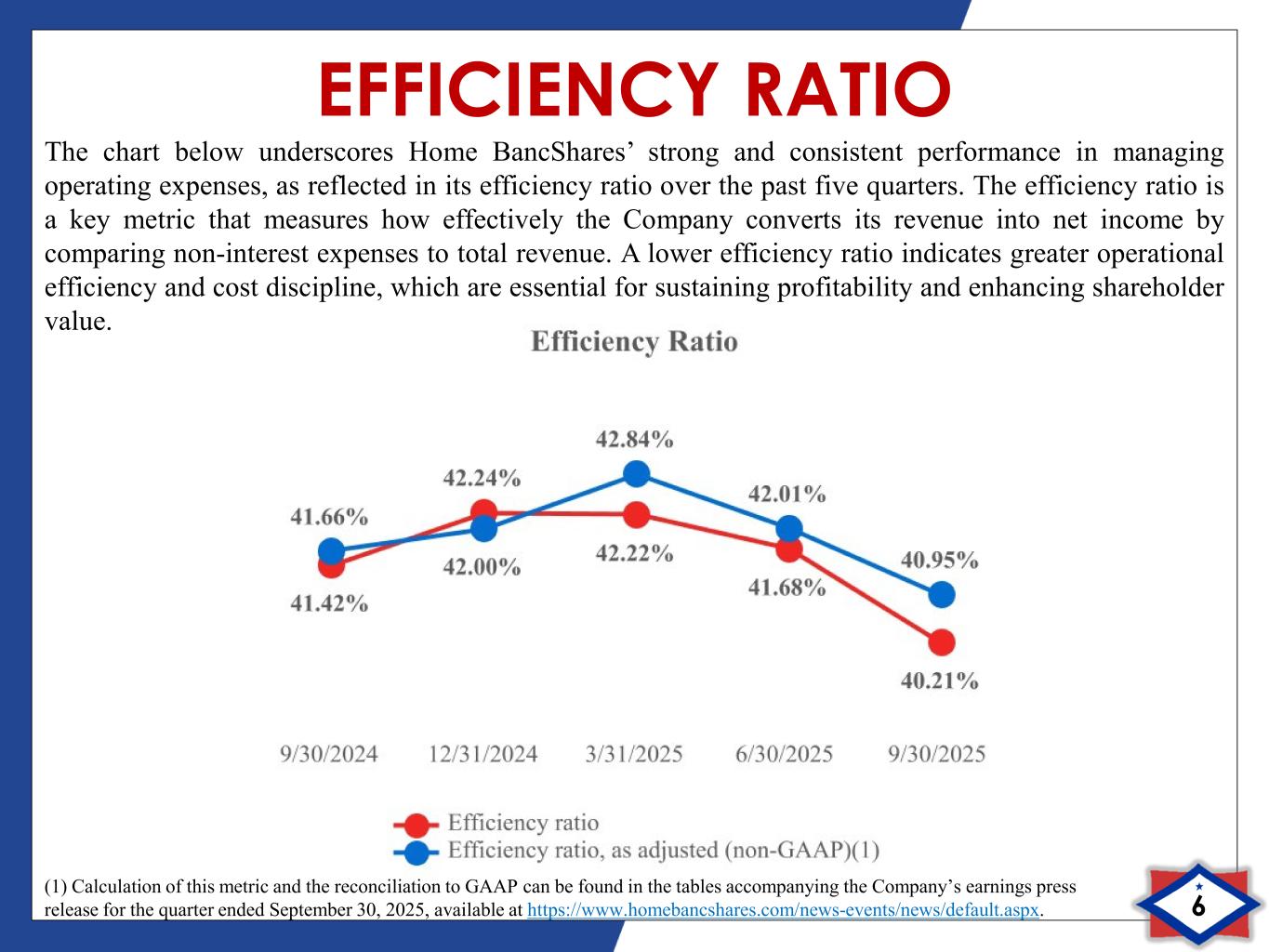
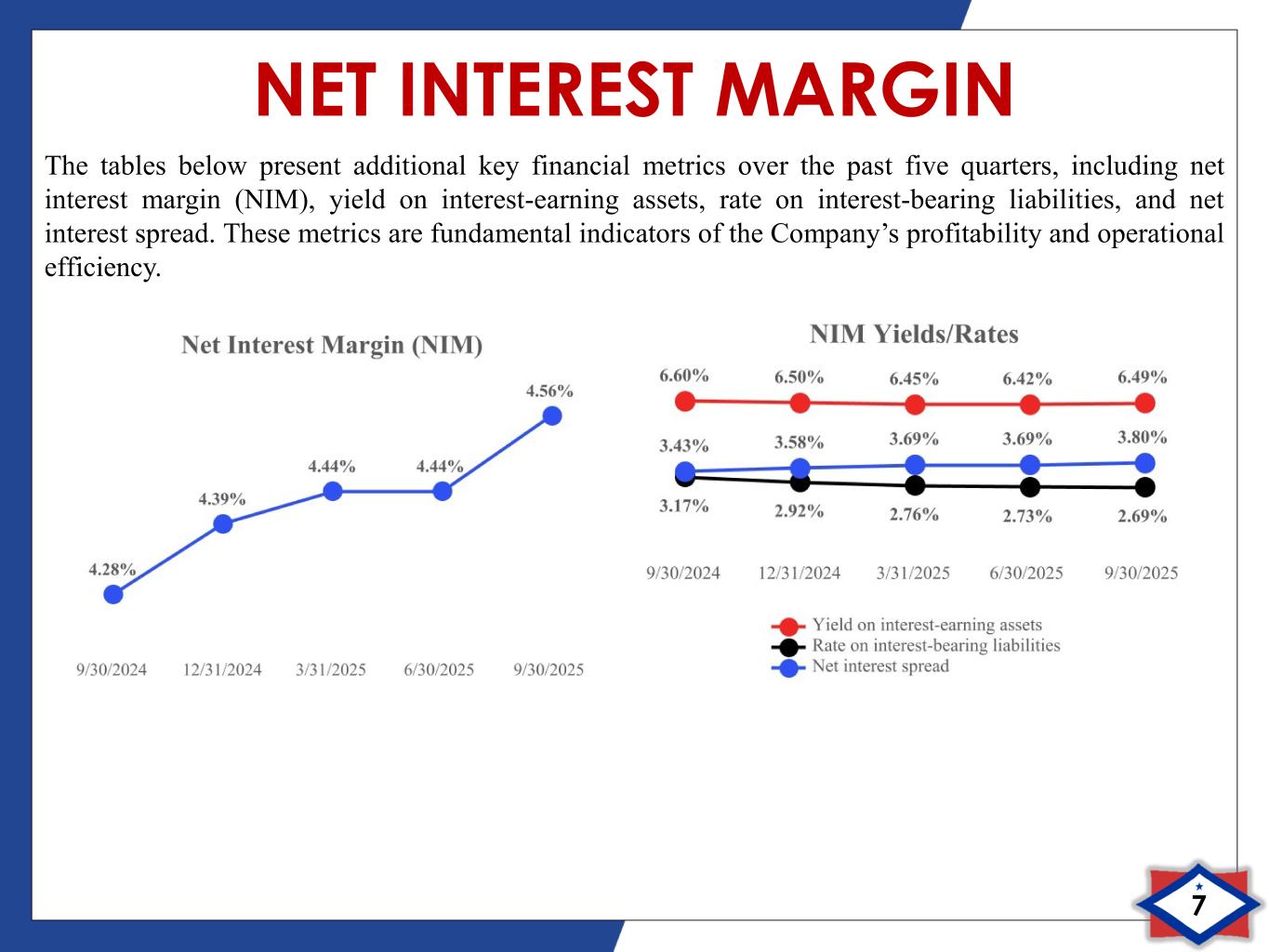
Thanks Donna. Welcome third quarter 2025 home bank shares earning release and conference call. It's really hard to believe it's already mid-October and and home has had another great quarter. I think that's three in a row. We've added some graphs this time Donna to our presentation that you're welcome to look at that run from 9 30 24 to 9 30 25 and I think you'll see in those graphs what we're seeing here at the company. Just talk about some highlights for the third quarter. We have record net income of 123.6, record EPS of 63 cents, revenue of 277.7, pre-tax, pre-provision net revenue of 162.8, P5NR profit percentage of 58.64. That's the best in last 12 months that's not 60 Stephen but it's pretty close to 60 percent pretty proud of that efficiency ratio some naysayers said was going up was down and efficiency ratio was the best in 12 months at 40.21 margin kicked up a little bit some said our margin to go down our margin kicked up 12 basis points to 456 and that's the best it's been in 12 months our OTCE continues to remain in the high teens at 18.28%. Just some balance sheet, strength highlights, common equity assets is 18.56%. We continue to grow that. Tangible equity, tangible assets, 13.08%. That continues to grow. And loans has a record level of $15.18 billion for the quarter. Equity is $10 billion dollars. More good news the Texas lawsuit has been settled and we've received our first partial payment of the settlement. We expect most of the balance during the fourth quarter. Hopefully we'll get it all in this year. We'll be lucky if the proceeds will match up with the expensive litigation costs and that does not include the loss of growth and profits we've suffered over the last couple of years. However, we had no intention of just mildly standing by while damage was being done to our company. Management has a fiduciary responsibility to protect the assets of the shareholder, especially when we didn't do anything to any of those people that participated in this fiasco. I believe because of our conservative nature, we've been criticized by some. I think that home bank shares is not growing fast enough. We don't really argue with that point, but I have to disagree with that discussion point because timing and discipline matter moving too fast or scaling too fast can be fatal i believe in fixing your existing problems before you make a new move that's exactly what home has been doing for the past three years dealing with multiple this i have been involved in over 45 deals in my banking career but never anything of this magnitude enough of that forget the bad guys The saddest part is what happened to some happy employee shareholders who, during the merger with home, in a tax-free exchange, happy shareholders exchanged their private, non-liquid happy stock for home stock. That is, a New York Stock Exchange publicly traded dividend paying with strong liquidity and a strong balance sheet. And after getting the home stock, they listened to some smoke oil salesman who talked them into selling their home and investing the proceeds into another privately held, stupid, non-liquid investment. There may be where the biggest lawsuit is, misleading or unsophisticated individuals. It may be too late. Excuse me. It may not be too late. If my information is correct, every one of the investors have lost money in a home. and we were even forced to use the legal system to protect the assets of our shareholders. As bad as it was, the rest of the company stepped up to help us while we fought Texas lawsuit and was resolving the issues in front of us before moving to another opportunity. In other words, we waited until we had our arms around multiple problems before we moved again. During that time, I feel confident we missed several growth opportunities, opportunities, but we needed to fix what was in front of us first. Well, you can see from the charts we're back producing top two best-in-class numbers once again. We would have been there a couple years ago had the annoyances of these unusual situations not come up. More good news during the first quarter of 2025, for all banks over $10 billion, home rent number two in the nation in return on assets. During the second quarter of 2025, for all banks over $10 billion, HOME ranked number one in the nation in return on assets.
During the third quarter of 2025, HOME outperformed both our first and second quarter ROA. It's early to be able to tell, but we're expecting to be once again one of the best, if not the best, in the market of all banks over $10 billion.
With the performance of the company back producing current leading numbers, we're ready to move forward and do a large transaction or a couple of smaller transactions. So those of you pushing for growth, the time is right and we agree with you. I said last quarter I was looking for $500 million in income in 2026. I'm holding that number so far this year through three quarters home has earned 357.2 million dollars with one quarter left to go add a couple acquisitions and a little growth and i think the number is achievable and maybe a little better last year at this time we'd earned 302 million so far we're up about 55 million dollars this year or 18.21 from last 21 from last year with the third quarter showing even stronger earning growth up 23.6% for Q325 with $123.6 million in income versus Q324 of $100 million. During the fourth quarter, a bank was selling bonds including a $20 million piece of home bank's sub-debt and a discount and repositioning. They were paying the paper, I guess I say, but they incurred on AOCI losses and home was given the opportunity to buy and we did buy that we bought that we bought that to 20 million dollars worth of piece 20 million dollar piece of our sub debt and picked up 1.9 million dollar gain nice trade being as profitable as home is home is allows us to move quickly on opportunities during the third quarter we opened up an exciting new branch in san antonio and we met several of the local business people great market we're wishing Michael Rodriguez our team leader and his team in San Antonio Market much success strength is no accident that's our slogan another reason home has been hesitant on acquisitions is the hesitancy to take on banks ALCI problems we're expecting many more bank failures than what happened we were told to keep our powder dry. We missed on that call on bank failures, but the big one, the one that most banks got in trouble, we got that one right, the interest rate call. Many banks and their shareholders are and will continue to suffer from an earnings perspective because their management made huge mistakes of investing their liquidity into long-term securities and loans during the low-rate environment that we all experienced, and now they must pay the piper. The problem is, how long is it take to fix it. It relates to how long a bank's duration is on both its loans and security, whether fixed or variable, five years, 10 years, some shorter, some longer. Making a decision at home not to invest in long-term securities and loans is the single best decision we have ever made or I have ever made in my 50 years of running companies. As I said, when a bank gets in that dilemma their options are do nothing and write out the duration until the bonds and loans mature, praying all the time that interest rates come down. Or if they have enough capital, they can sell the bonds and or loans at the market and reinvest the proceeds and recognize loss. This can create a capital problem, forcing banks to raise capital by selling more stock. Since banks trade on the multiple of tangible book value, the losses incurred will reduce tangible book value, thus resulting in a lower stock price. The recovery period can be long and painful, and sometimes a death sentence, as we saw with Signature by Silicon Valley and Republic. Regardless of the decision that is made, at this point, there is commensurate damage to the balance based on interest rates, duration, and quality. Regardless of why the bank is trying to recuperate by whatever methods they are losing years of earnings power, either way, if they decide to write it out or recognize an unrecurable loss in income in a tangible book, the loss is a loss regardless of how it's presented. It reminds me of the Fram Oil Filter guy, quotes you can pay me now pay me later or another analogy is reminds me of losing park place while playing monopoly you never get it back the whole time watching others that did not make the same mistake busy sacking up capital as their ship leaves you at the port last option is to find a partner that you like that likes your operation understands your dilemma and has lots of capital and is willing to use their capital to mark the balance sheet to take the hit immediately, which allows the company to accrete the mark into income over the duration of the paper. A huge example of this is the latest deal that was just done, CMA Co-America, who was acquired and the stock shot up $11.77 in one day. That was extremely positive for both the buyer and the seller or shareholder. There is no easy answer to resolve these mistakes that were made, But if your shareholders will ride with you, maybe you live to fight another day. But regardless, it's not an easy fix. And if they don't want to ride, they sell their stock and invest in companies that are already out there that didn't have the problem stacking up equity. Donna, I think that's pretty much it. Companies humming along pretty good. And I told you last quarter, the deal done this quarter, we probably don't have one yet, but we're getting close.
Thank you, Donna. I'm sure when you get a deal, it'll be the right deal. So patience is a virtue, right? Our next report today comes from Stephen Tipton.
Thanks, Donna. As Johnny mentioned, the third quarter was another strong performance for home and Centennial Bank and produced records in several areas. Highlighted by strong revenue and continued net interest margin expansion, we were able to produce an adjusted return on assets of 2.10% and adjusted operating earnings per share of $0.61. The reported net interest margin improved to 4.56% up 12 basis points from Q2 and up 28 basis points from the same period a year ago. The core margin excluding event income was 4.53% versus 4.43% in Q2 driven by an increase of two basis points in the overall loan yield and a decline in interest-bearing deposit costs of two basis points. Deposits ended slightly lower in Q3, down $161 million, driven largely by customer tax payments made in July. We continue to focus our regions on growing core deposits and relationships, evidenced by wholesale deposits only comprising 2.3% of total liabilities. Although the adjusted efficiency ratio improved to 40.95%, our presidents and leadership group are closely monitoring core expense trends and controlling those in a tight range. Loan production was strong this quarter at nearly $1.3 billion, highlighted by $800 million from the community bank footprint, with more than half coming from our Florida regions. Congratulations to our regional and division presidents and all of our bankers on another great quarter. With that I'll turn it back over to you Donna.
Thank you Stephen. Next we will hear from Kevin Hester on the lending portfolio.
Thanks Donna. Asset quality improved overall again in the third quarter with improvements in NPLs, MPAs, past dues, and total criticized loans. As you know there's always good and bad as you work through problem loans. On the good side, I'm pleased to announce that we have the DFW apartment non-accrual loan under an agreement for sale with a hard deposit of over 10% of the purchase price and a closing date in the fourth quarter. However, on the large Texas C&I credit that we charge down at year end, they continue to struggle to recover, and it is entirely possible that it moves to non-accrual before it gets to a resolution. At this time, we still do not believe that there is any additional loss in this relationship. Despite the headwinds resulting from heavy payoffs in September, we were still able to post loan growth of $105 million for the third quarter, continuing our recent history of linked quarter loan growth. The third quarter of 2025 marks eight times in the last nine quarters in which we have posted organic loan growth. From time to time, we've been questioned by analysts and investors about our level of loan growth being less than others that they cover or follow. and we always state that we will take what the market allows. Frothiness in the overall market generally leads to aggressive pricing and leverage by our competitors, and we will not participate in those situations. On the other hand, periods of volatility lead to banks exiting asset classes or markets and generally results in improved pricing and leverage, and we usually fare well during those times. That said, I would like to take a moment to point out that regardless of which situation that we are in, I believe that we are not given enough credit for whatever level of loan growth that we post. Keep in mind that because we are best in class in both net interest margin and efficiency ratio, our loan growth produces greater results than our peers. We have posted year-to-date loan growth of $522 million, which results in an annualized growth rate of 4.71%. Not a bad number, and certainly more than the percentage increase in GDP over that period. However, we operate at a net interest margin of 4.48% and an efficiency ratio of 40%, compared to a net interest margin of 3.59% and an efficiency ratio of 55% for all banks from $10 billion to $50 billion. When you add the effect of our best-in-class NIM to that nominal loan growth number, the impact feels like loan growth of $653 million or 5.89% annualized in terms of our peers. Layer in the effect of our better-than-peer non-interest expense, and that impact grows even further to 6.73%. The point of this analysis is to highlight that lower-performing peers must post much higher nominal loan growth results just to provide the same profitability impact as the 4.71% that we've posted year-to-date. This focus on high performance in all areas when combined with even reasonable loan growth is the formula for a best-in-class ROA. Donna, that's all I have. I'll give it back to you.
Thank you, Kevin. Appreciate the color on that important analysis on loan growth. Now, Chris Poulton will provide an update on CCFG.
Thank you, Donna. Good afternoon. Q3 was quite busy for CCFG, but you might not know it from our asset number. We ended the quarter down about $60 million from Q2 as payoffs, slightly outpaced new funding. That masked what was an active quarter for originations with just under $400 million of new loan commitment. There were a couple of loans closed at the end of the quarter that funded post-quarter, and a few loans that we had anticipated to close by quarter end that pushed into Q4. All of that to say, we've already seen our loan balances bounce back in the first few weeks of October. and based on what we see in the pipeline, I do expect growth from here. We did and do continue to see positive rotation out of the portfolio, and we have generally been able to replace the loans that pay off with new loans. Through Q3, we originated over a billion dollars in new loans, which is a bit ahead of pace for us as we generally do not hit that mark until Q4. I look forward to sharing our Q4 results with you all in the new year. Until then, I'll hand it back over to you, Donna.
Thank you, Chris. And, Johnny, before we go to Q&A, do you have any additional comments?
No, I don't. I hope everybody looks at the charts. I think you'll see what we're seeing or what we're feeling here at the company. I think the charts speak for themselves, Donna.
We will turn it over to the operator for questions.
Operator
Thank you, Donna. If you would like to ask a question, you can do so by pressing star followed by one on your telephone keypad. if you decide you would like to withdraw your question please press star then two to remove yourself from the list and when speaking please remember to pick up your handset before asking a question we'll pause here briefly whilst questions are registered the first question we have on the phone line comes from dave roster with cantor fitzgerald you may proceed guys hey johnny you
highlighted that you guys hey how are you um you had highlighted earlier you had some nice NIMH expansion this quarter that that looked good how are you thinking about that trend and the NII trend going forward just given the September cut we just had and potential for getting another couple of cuts by year end are you expecting that lower rates could put some pressure on that or do you think that you see more expansion going forward and and what's the NIMH sensitivity on that next cut. Thanks.
Well the world says as rates come down we're going to reduce our net interest income but I have to give credit to Stephen Tipton who deals with that every day and Kevin Hester who deals with it every day also as he writes the loan. So I think they're on top of that. We react in a hurry when there's a rate cut. Stephen we were at a conference and he left the conference and lowered rates immediately in our company so we react in a hurry and I think you can go back over history and see that home has been able to maintain a margin where a lot of people have not because of reaction and how management looks at it and our you know we have about 13 15 about 15 regions that report upstream and they they move immediately those guys know what it is you don't have to hold their hand you don't have to rock them in a rocking chair they know what's going on and they react that team reacts they already know which moves are going to make immediately it's already pre-programmed and i probably stole a little steven's thunder
here but i'll let him take it from here but i'm proud of proud of how we react to those situations no i i'd say this steven i appreciate what johnny said and agree i mean a credit goes to the presidents that are out in the field they're dealing with the customers and you know we're able to very quickly go through our negotiated accounts and lower those where we can. We've got rate sheets in all the regions that they go through and then we've got some indexed municipal accounts that are moving as variable rates move. So we screen a little asset sensitive but as Johnny and group have always said that kind of goes off the bottle assumptions and our job is to react to that and try to get rates down to offset the loan side.
Appreciate that caller. Hey, maybe just on the deposit side, how are you guys thinking about growth going forward there in a lower rate environment?
Well, we've never, you've never seen a CD ad at a home bank. We don't run them. We just run strength ads.
We have the ability to pay out all uninsured depositors and we like that position to be in and we'll continue to do that. We paid, this quarter we paid off sub debt was 140 million. and we had tax times that came up so deposits are down a little bit plus we had a little loan growth about 100 million so some of those factors impacted Brian you got a comment no just because we did the 140 and then we did another 22. yeah we bought that an opportunity to buy a piece of our sub debt back and we bought that back for at a discount we liked that move so uh we we're probably we're not going to be the high we're not going to be the high guy bidding on money that's not our game but there's there's plenty of money out there if you want it you can get at a reasonable price so we're not we're not too concerned about it at that point even you got
any comment on that yeah i think just function of the market that we're in johnny mentioned we just opened the the branch in san antonio uh a month ago we've got another location uh east of dallas that will be open sometime in the first quarter i saw the the market share data came out a couple weeks ago and there's there's 1.1 trillion in deposits in texas and 900 billion in deposits in florida and we've got a meaningful president in both so great appreciate that maybe just one last one how are you guys thinking about the government shutdown are you concerned at all about it from a credit perspective and if not how long would this have to drag on before you guys
get more concerned about it thanks you know I don't you got us plowing new turf here I I don't know what to think about that I've seen no impact as of yet I don't I don't I don't think we've seen or felt anything so maybe it's good to be in the south be away from Washington DC have all those unemployed I'm sure we got unemployed people in Arkansas as a result of it but You know, I'll tell you more later.
You'll probably figure it out. We'll probably all figure it out. It'll be good or bad, right? So I don't know the answer that day, but we just, we'll keep plugging. And I don't, Kevin, you got any comments? You see anything when you're in?
No, I mean, I haven't seen anything. We've talked about, you know, being able to offer deferments to individuals that are hurt by it. We certainly can and will do that where it's necessary. other than that i'm not saying anything i've not felt any any issues from the government being shut down for 20 something days we see things we'll call you dives that fair yeah sounds good appreciate it guys thanks again your next question comes from john astrom with rbc you may proceed with your question okay thanks good afternoon hi don um hey there um Just it's probably a topical question.
I'm not as concerned about it for you guys, but it's it's a it's a bloodbath out there in the bank stocks on credit fears. And, you know, obviously you put up a great quarter, but your stock's off. How are you feeling about credit right now and maybe what you're seeing on your own credit trends? And then, you know, I know that you guys kick the tires on a lot of other banks, but what you're seeing broadly in some of the other banks you look at.
Well, interestingly enough, we have an asset quality meeting monthly.
And in that asset quality meeting, we cover every past due or problem loan in the entire company. As you can imagine, more has been focused on the Texas book than it has been the Florida book or the Arkansas book. but we have we go down every loan and and we talk about it where we are what's happening with it and it's really pretty interesting we had the i wrote down the and i write down john what i think the loss is on that loan if i think it's a million dollars to put down a million or five million or ten million whatever it is i put it down and and the rest of the group does it accordingly too steven does it and kevin does it and then at the end we look at each other what you put down and I had the lowest amount of dollars in that asset quality meeting that I've had since I started that process and that's been years ago so from that aspect I'm pretty proud we got that one Texas credit that we got our eye on but outside of that everything's holding together pretty good uh getting that having a deal on that with a piece of property in Texas that Kevin reported earlier I'm glad to have that hopefully that deal gets closed we got a 10 deposit so hopefully that gets done it gets out of the bank so overall I'm I could be that one deal in Texas I'm pretty happy camper so I can't say we're the exception I can't say we're the exception I think Jamie Dimon said there's cockroaches out there and it always is cockroaches but you know I'm sure there are some cockroaches that we hadn't seen but I was amazed at the last that quality meeting how many dollars I wrote that I usually write from 15 to 30 million that's possibly not don't get me wrong I exaggerate a little bit but I just put the maximum around i think it could be and we usually always beat that if one of those credits happen but last time i think i was less than five million dollars john kevin you got a comment okay i mean i can't that's that's best color i can give and we go through them at a detailed level and each come up with
our own number and you know i feel like you do it we i think we have addressed we we watch all these closely and you know things come out of left field at times but we feel pretty good about where we're at this point low leverage helps that a lot yeah i remember i remember back john when we didn't we had high leverage and they pitched us the key so it's it being in a position with low leverages is pretty sweet um i'm sure others will ask about mna but i i'll go to growth quickly.
And I hear you guys. I'm probably guilty of pushing you on growth at times. But it sounds like you're more willing to grow. I'm just curious if the pipelines support it and you're seeing the kind of loan demand that could push your growth rate a little bit higher. Here I go again, pushing you on growth. But are you seeing the pipelines improve and it sounds like you're more willing to grow the balance sheet? Is that right?
I don't know that it's that we're more willing. I think the pipeline is supporting it, particularly right now. I don't know that it's necessarily a willingness more than, you know, we're finding the right deals. We've got people in the right places in good markets that have kind of hit their niche. The hard thing to project is that we have a lot of, we do a lot of construction. And so that means there's a lot of churn uh in in our community bank construction book and chris's book is meant to churn you know over a three to four year period anyway so there is a lot of turnover on a quarterly basis and that's the hard thing to project uh the pipeline has been really pretty strong for several quarters and continues to look that way yeah it looks like we just missed uh we let the grease pig get away from us in the second quarter chris did on a big loan uh looks like that loan's probably going to close so chris you don't comment on this on when you think that might close oh certainly yeah we
had we had one that was scheduled to close at the end of the quarter and the our borrower just needed to delay their their purchase uh a couple weeks we've i think we're scheduled for monday right now that may you know that may move around a little bit but again that's more just sort of timing issues we continue to see good good demand so i think that one will will probably get done so anyway we we were prepared we thought we're going to be up much stronger than we were but chris didn't get that one closed but i think it's it's going to get closed so we're starting out we usually start out in the hole we're starting out ahead i don't know if that means we'll be
behind at the end but usually when we start out strong we get behind it then we start out Sloan would get strong at the end. So we just have to wait and see. You never know what your customer's thinking. He may be buying, he may be selling, right? You don't know and he may be working on something for months and then bang, he just hits it. Hey, we got to do this trade. So that happens a lot. But we could have a good run here this quarter. it could be uh it could be a nice quarter and they're good price the well-priced loans and it could give us a little give us a little uh revenue boost all right thanks for the help i appreciate it thank you we now have brett rabbiton with hovty great please go ahead hey good afternoon everyone um johnny wanted to start you know m a hasn't really been addressed
fully and i think everybody knows you're you're out looking for looking for assets can you maybe just talk about you know your experience here the past quarter what's what's been the impediment is the pricing is a culture of a seller um just the pure math what's what's been the impediment and then just how do you think about the outlook with uh these stocks a little lower obviously seller expectations are not as variable as the market well you know how conservative we are we have to find the right target uh to say that we are not in the m&a business we are we have signed the loi
we uh we'll be moving forward on that it's someone that uh we like and runs a good business we've got a good business and we're we're excited about that opportunity and i'll tell you where it is it's in the united states and it's several billion dollars you'll be able to narrow that down you'll be able to narrow that down so uh it it we have some LOI and we have his permission today to say that we've done that so that's that's about all you're not going to get anything else out of me other than that so no that's uh that's helpful johnny so it sounds like we we got something in the hopper so that's that's um that's good to hear um well and they just wanted to hear we got we got i mean we had the happy mess to deal with and we we got that behind us pretty well and uh we just don't move until we I mean you just create if you got a fire out there put it out so we had all those multiple problems in the happy transaction it just didn't we we got that got that under wraps right now so it's time for us to move forward and I I agree we have not moved forward and I admit that but we we are we are moving forward okay um and then the other question I had was just around profitability
You know, in the past two quarters, I think it felt like your profitability topped out in this quarter. It moved up again. You know, are we at the peak, do you think, in terms of ROA, ROE, ROTE, just given, you know, the efficiency ratio? Or any thoughts on profitability and how you see it maybe going into 26?
Our expenses were up a little bit this quarter. so I've already commented to Stephen and Brian Davis and they're going to work on that so our expenses were up we still had some expenses out there that we didn't need to have so we got to work on that and I don't think we're done no I don't think we're done you get the expenses back to 111 you see what happens right so it that's more money for us we've kind of had the wind our back we're pretty tough on if we charge off a loan we're pretty tough on staying after them until we get our money so we've had the windfall the wind our back we've had some income we got some this month too this this quarter haven't we Brian some yeah I mean we had several things and we had a two million dollar recovery we had 1.75 gain on our lawsuit and we had 1.9 million gain on our uh sub debt tie down yeah we we'll probably we'll have some more recoveries on that lawsuit i'll probably put it in reserve so uh just to build our reserve we built it a little bit this time went from 186 to 187 we'll probably take that extra money we don't have anything that pops its head up to be charged off we'll uh we'll probably put that in reserve okay appreciate all the color thank you thank you we now have steven scooting with hyper sandler on the line
hey good afternoon um so johnny i kind of want to challenge you that maybe you can't get expenses down to 111 just so you you get that and personal wrong and get them back there but um do you think there there really is two three million bucks to cut if you continue to go to the bank do i think there's two or three million what that we could gather if we is what you said in fences that you could cut yeah because i think you're at you know uh 13 14 million which is phenomenal still hey steven this steven yeah there's a handful of kind of one-time items in this quarter from an
expense standpoint and then i know we talked a little last quarter uh around incentives being up in in q2 and they were they were basically at the same level in in q3 as they were in q2 so there's obviously some revenue that comes along with that to pay those but um you know like johnny said we've got our presidents uh had a good conversation last week and everybody kind of reviewing their numbers and and what opportunities we have to trim uh where we can hard hard to beat 41.7 efficiency ratio but impressive to hear you might be able to get a little better so that's encouraging um maybe on um loan growth around ccfg in particular i'm wondering if chris could comment
on just you know obviously we've seen a few rate cuts here and prospectively we're going to get a few more what he would think that could do to loan demand within ccfg i mean i think that book is down maybe 400 million or so from its peak when we ran a lower rate environment so just kind of curious what what we think could uh could kind of transpire there chris that's yours i was curious what you might say um yeah no like i think uh lower rate environments generally will will be beneficial to us because i think people set on the sidelines on some transactions or some projects that just don't make sense at a higher rate environment so you'd like to think that there
stimulates a little bit of demand on some things that maybe don't pencil out so well in a higher rate environment and i assume we get our fair share of those um yeah in general i mean I think demands for us has been has been good you know we don't really chase growth but if it comes our way we'll take it and I do think in general you know you see a hundred point decline from where we were you ought to see a few more deals pencil out a little better got it yep that makes sense and maybe just last thing for me I mean I know I think Arstrom said it earlier but it's been kind of a bloodbath out here today but y'all stock is outperforming by I don't know 200 basis
points which probably doesn't feel that way but it's it's great relative to everyone else how do you think about using that stock in m a transaction versus you know using all this excess capital that you have to buy back your own stock is it is it both and or do you have a preference on using that currency to buy new assets or or just repurchasing your own stock more aggressively Well, I think that depends on the stock price, but, you know, we'll be in the market.
Let me say this, home will be in the market come tomorrow when we're cleared, right? So we'll be in the market buying stock. So, you know, when there's opportunities, you know, when you look at home, we were second in the nation in ROA in the first quarter and first in the second quarter, and we outperformed the first and second quarter, and they take us down 3%. you know if they're going to take us through the rest of the market it ought to be down 10 so you know it will come back home will come back home will bounce back this is and all the banks will bounce back at some point in time but right now we're all afraid they're throwing the baby out with the bath water and we just have to as painful as it is when you come off of a you know you see the performance of the company for the quarter and you come off of that and you get your ass kicked like this it's a little frustrating but it is what it is and there's a lot of people that a lot more shape than home bank shares is today so it's just a little frustrating but we'll be fine you know we'll be fine we'll continue to use our stock for acquisitions and we'll continue to buy our stock back and you know the good news is when you run a 212 217 roi you can increase your dividend, you can buy your stock back, you can pull every capital handle that's out there and still as you see home has done grow your tangible common equity up pretty strong. So these people running a 0.7 or a one percent ROA they don't have the ability to do what home's doing.
Home has the ability running a two percent ROA to pull every capital handle out there so we can we can make the decision of which one we want to pull or we can pull them all don't you agree with that stephen uh absolutely i think you did a chance to buy more cheaper so you know congrats on a great quarter and i like this new chart too i like seeing those nice up into the right lines keep up the good work thank you appreciate it we now have matt only with stevens inc you may proceed with your question hey great thanks for taking the question um uh i was
encouraged to hear about the lawsuit settlement i know that's something you've been looking for for a few years now as far as the impact that had on expenses were the legal bills still coming through in the third quarter was this one of the headwinds that you that you mentioned the third quarter i'm just trying to appreciate it that uh 111 million dollar goal could be something we could see in the fourth quarter or could we get need a few quarters to get there i'll let steven answer yeah this is steve matt um there wasn't much i'm gonna say 100 grand or so in in legal expense related to that suit in the quarter.
We had a handful of other kind of one-time items and donations. We did a nice donation to the city of Kerrville from the flood damage earlier this year so that was in the quarter and a handful of other things so we're working through all that now and like Johnny said a portion of the settlement proceeds were in revenue this quarter and the rest will be in Q4.
Okay. Our bank in Kerrville raised $250,000 for the tragic flood to kill those little baby girls, and we matched it. So we had about a $500,000 donation. We feel good about that.
And then on the M&A strategy, just help us appreciate the size thresholds of those targets i think johnny you mentioned there could be a larger deal there could be a few smaller deals just help size up for us what a larger deal would be for home bank shares versus what a series of small deals would look like anything from 25 billion dollars down and anything from a billion dollars up so i can tell you the attorney's already fussing at me so they i knew this question was coming it's somewhere between zero and 25 days i think so that makes you feel good i'm not going to go there and we're going to buy stock as soon as we can get over we're going to buy stock they said you got to be careful and i said i'm going to be careful but i'm going to tell you what's happening we like this operator i can tell you that we like the guy we like like this guy so we think he's done a good job and we think he'll be a great partner with that okay strength of having home bank shares balance sheet backing him i think he'll i think he'll do what he needs to do Well, we'll keep an eye on the home bank news the next few weeks.
Hopefully, we'll see something good. Thanks for all the comments guys.
Operator
We now have Catherine Miller with KBW. Thanks.
Good afternoon. How are you?
I'm great. All right. My last question is to start going back to the margin, and I just wanted to see if you could remind us the percentage of loans that are floating rate that will reprice immediately. And then my kind of follow-up on the deposit side, I know, Stephen, you talked about a billion one of CDs repricing in the second half of the year. Just if you could give us a little bit of data around where that's coming off and coming back on or where you think that will happen. I know rates are moving all around.
Sure. so on the on the variable rate side it's about 6.3 billion or so there's about three and a half billion that's tied to Wall Street Journal Prime and and the rest is is tied to SOFR between uh Chris's book and and the community bank portfolio so that's what's moving you know this quarter and X that we would consider truly variable and then on the CD side we've got here we've got about we've got over the next three quarters our book our CD book which is relatively small is also relatively short so a billion eight or so in total size. We've got about a billion 350 that matures over the next three quarters and it's an average rate of 367 so it starts a little bit higher and tails off over the next three quarters but you know we've we still have to negotiate deal with competition we've got peers in market and around our markets that are still north of four which is frustrating but our group's done a fantastic job in negotiating those with customers that want to negotiate and able to retain the vast majority of what we have and whether we can pick up some yield on what's coming off over the next three quarters we'll see just kind of relative to what competition's doing but I would say broadly our folks are negotiating down in the mid threes and lower today.
Okay great that's perfect. And this is a really nitty question, but the sub debt that you paid off this quarter, when in the quarter was that? Is some of that reflected in this quarter's margin, or will that be more fully reflected next quarter?
We paid it off in July. It was the happy sub debt that we got that was $140 million, and then we bought back $20 million of our sub debt in September. So $140 went out at the end of the month.
Yeah, so that's mostly been in this margin. Got it. Okay, thanks so much.
Steven had some comment for you.
On the 140, we paid off at the very end of July, 1st of August. So there's, you know, two thirds benefit this quarter.
Okay, that's great. Thank you.
Operator
Thank you. We now have Ryan Martin with Johnny. You may proceed with your question.
Hey, good afternoon, guys. Hey, Brian. Hey, Stephen, maybe just one, just on the margin. It sounded like earlier when you talked about, you know, the question about rates being down, it didn't sound like there was a big concern that the margin was going to fall significantly, despite being, you know, as Johnny said, maybe asset sensitive. I guess is, in general, your expectation, if we do see the rate declines, that, you know, the margin is still relatively stable, kind of where it's been, you know, absent kind of the movement within that event income line. I know that's a little bit, moves around a little bit in the quarters, but just kind of the core X that event income, if we do get a couple cuts, it sounds like it's, you know, relatively stable, plus or minus a few basis points is still the way to think about the outlook.
Yeah, that's been our message over the last year or so. You've seen rates come down a little bit. We screen in an ALCO model that NII goes down 5% or whatever, but that assumes a 40% beta on deposits, and like I said, Johnny's always said it doesn't give management credit for what our team does. So, like I said earlier, the President has done a great job thus far addressing deposit rates and, you know, the daily run rate that we monitor has held in pretty good over the last month since the Fed cut rates.
Okay. And just to remind you, Stephen, I guess maybe you said earlier, what's left in terms of fixed asset repricing, you know, in the next couple quarters or the next 12 months, I guess, maybe what you haven't hit your hands in terms of what opportunities are.
Yeah we've got so Q4 we have 478 million in loans and fixed rate loans that mature at an average rate of 6.17 so there should be some lift potentially on those again kind of depends on what competition does and I think we've said before we'll we'll defend our our balance sheet with uh with competition and then there's There's about a billion and a quarter next year in 2026 that matures at an average rate of five and a half, basically.
Still a little bit of room on that one. Great environment. Yeah, some of that could come up, potentially.
And then just the last couple. Well, it sounds like the that near term, there's still it sounds like there's opportunity in the expense side that, you know, we're we're going lower, not not higher than at this point. You know, all else equal that. That sounds fair. And then on the fee income side, Brian, I guess, is is there it sounds like there's an extra two million dollars in in the in the fees this quarter that I guess after next quarter, fourth quarter, it's not sustainable. Like, I don't know, the amount of the settlement that you expect in 4Q versus this quarter. Sounds like there's a bit more in fourth quarter that is coming, and then do the fees kind of back off the run rate they're at now, given, you know, that gain is kind of a 3Q and 4Q event?
Well, another income, there's about $5.7 million of kind of what I'll call an income. And 1.9, I mean, 1.75 of that is from the lawsuit, and so we'll have another round of gain from the lawsuit.
Right, so all else equal, the 1.75 doesn't recur after, you know, let's say beginning 1Q next year. You're going to have something more in the fourth quarter. It sounds like it's more than the amount this quarter. But after that, that kind of line item specifically normalizes to zero? it could carry into the you could have you don't like it okay i think we're going to get it all this but you'll get it all okay i didn't know if someone might bleed over in the first quarters okay that's it all right yeah that's that and uh and and steven the the margin still has a little bit of a tailwind on you know from the from the sub debt you know the full quarter benefit of the sub debt as you go into uh into fourth quarter you know just kind of start is that that's still correct?
Yeah, that's fair. Like I said, the timing of when we paid, we paid the happy 140 off was, you know, a third of the way to the quarter already. So Q4 will obviously be a full quarter.
Yeah. So, gotcha. Okay. Yeah, I think, and maybe just the only other, the only other item was in terms of just the loan, Kevin maybe talked about this, just the loan pipeline and And maybe one for you, Stephen, just on that. It sounds like you talked about the origination activity in the quarter. I assume payoffs were pretty significant in the quarter. Maybe just comment where the payoffs were this quarter. And then just sounds like just to confirm, Kevin, that the loan pipelines are still pretty healthy and primarily, I'm guessing, in Florida and in Texas. But maybe if you just comment a little bit on that.
Hey Brian Steve I'll give you the numbers real quick and then let Kevin give you the color there so payoffs were between 750 and 800 million for the quarter so nothing necessarily out of line with where we've been running the billion three that I mentioned on production was was our origination volume which you know generally about half of that or so is funded at that quarter end because of some of the uh construction type projects that we do so that's color there on payoffs kevin yeah those payoffs were were more heavily weighted towards the end of the quarter so we had a little higher uh quarter that we were looking at than it actually ended up because of
some stuff that as johnny said moved into fourth quarter and then the payoffs that hit in the third quarter um you know you'll see with us each quarter it's a little bit different um you heard chris's comments his third quarter their book was a little bit down we got the growth from the community bank market this quarter it may it probably will shape up the opposite if his if the deal that he has closes next week it's probably going to be you know flip the other direction so the good news is we have we have different levers that get pulled at different times certainly florida and texas are are the markets where there's a lot more activity and and we're plugged into some some good areas that tend to see that and and i think that's
showing in the pipeline so we'll continue to play into that gotcha and in the community bank pipelines or the markets kevin texas and florida still where that's maybe a bit more uh activity than elsewhere yeah it's just where the that's where the activity is i mean you know arkansas does does well too and they they're showing growth as well it's just they're just not as many opportunities as there are in the other two states yeah okay and last one for me johnny just on m&a is was just in in the past you've talked about the opportunities that you may consider you know given uh that maybe they're a little bit you know not it's not quite the performance that you guys are up to just so you can you know kind of buy something and fix it or get the get the return on Is that still kind of the opportunities you're looking at in terms of M&A, kind of a, I don't want to call it fixer-upper, but, you know, something that you can improve the profitability on? Is that relative to your profitability?
Well, this is from an AOCI problem is the only thing we have. It's a good management team, a good operation. They're a good company. so I just think we give them the opportunity with our balance sheet to do some things they haven't been able to do so I think that's a big plus it's not a it's it this one's not a only from the fact we're sharing our balance sheet with them is to help them with their liquidity and their ALCI so we'll we'll clean that up we'll fix that on day one you'll see them coming out like you'll see them coming out pretty strong when we get our arms around it so it's not a broken company only from the aspect they got in the ALC as 95 percent of all banks did throughout the country so that's that's not they all got that problem so some people as I said in my opening remarks some people take their hit and move on down the road some people hope that rates come down everybody does different things and when you I said in my prepared remarks you can hook with somebody that's got strong capital like home and we got the ability to spread that over them and help them help them with their problem and fix it overnight so that's what we suspect to do and that's what we'll probably do gotcha okay I appreciate the the caller and look forward to hearing from you guys in the future.
Operator
Thank you. Our final question comes from Michael Rose with Raymond James. Please go ahead.
Hey, good afternoon, everyone. Thanks for taking my questions. Maybe just going back to John's comments and his question. You know, as I think about you guys, and Johnny, I think you've mentioned this, you know, over the years, you know, you can't push a rope as it relates to loan growth. You have a lot of banks out there. They're actively trying to hire record numbers of, in some cases, record numbers of loan officers and producers. Maybe now is not the time to grow. Spreads are going to be under kind of increasing pressure. You do see some softening of some of the economic data, at least. There's probably some debate there. Now you've got credit concerns creeping in. Is maybe now not the time to chase loan growth? And then just following up on that, one other thing that I think you guys haven't talked a lot about over the years is just hiring plans where a lot of other banks have. So maybe if you can just kind of address that more broadly, not so much from an expectation point of view, but really is now the right time to actually want to accelerate loan growth here? Thanks.
Hey, Michael, this is Kevin. I'll take the last one first. So I think Johnny mentioned on the last call that it's not been our history to go out and look for. It's not been part of our our our real plan to go out and find teams of people and bring over lots of teams outside of a whole bank whole bank has been our our m&a strategy for you know really the our life um and then you we've been through two long court cases that had you know that were part of that it's kind of that same mentality so it's just not something that we've done a lot of would we do it in certain circumstances sure we would we'll do it we'll do it the right way and and it has to fit our culture now I think that's probably the bigger the bigger thing in all of this is our culture what what what does our lending culture look like and we have one and we follow it pretty closely and so to the degree that a that a group fits that we'll bring them in it's not our main strategy Our strategy has been whole bank. It tends to be things that we can go in and fix because we do a pretty good job of that over the course of our lifetime. So I think that's why you haven't seen that particular part from us. Is it the time to grow? We're in some pretty good markets that I think will withstand any weakness that comes into the market. I like our Texas and Florida markets for, you know, for staying above that. So we continue to follow our lending strategy and our policy. And if it underwrites well and we like it, we like the people that we do business with, it results in growth. We'll do that.
All right, great. That's all I had. Thanks for taking my questions.
Thank you. Appreciate it.
Operator
Thank you. I can confirm that does conclude the question and answer session. And I'd like to hand it back to Mr. Allison for some final closing comments.
Well, thank you. Thanks, everyone, for joining today. It's as hard as this entire bunch worked for the last 90 days, it's not a good day to release earnings, you know, where the world, where people have beaten up bank stocks.
But home continues to perform, as you've seen, year after year, quarter after quarter, and we'll continue to do that. we'll continue to perform at a high level and hopefully with a new acquisition or two they'll report they'll come in and shortly won't be long they'll get to that high level themselves and we'll be kicking out some additional income so I'm I couldn't be more pleased I'm not pleased with the stock price going down today as I said they throw the baby out with the bath water when you report the best roa in the nation and i would suspect we probably got it or one of the best and your stock's off three percent but as steven scout said he said you're better than most people so i i guess we're i guess we're one of the best of the worst today so anyway i i do appreciate everyone's support and uh home will continue to do the right thing month after month and quarter after quarter and we'll be standing when others may not.
So anyway, thank everyone for your support. We'll talk to you in 90 days. Donna, you got any comments wrapping up? Steven, anybody got it? Kevin, anybody got it? You got a comment on the quarter?
No, great quarter. I think we've hit all the highlights and we'll keep trying to do better.
Donna, you got any comments? Brian? No, I'm good. Kevin, you got anything else? All right, well, we appreciate it. Thank you very much.
We've got an important meeting Friday, and then we'll be back to work.
Our people can rest all day Saturday and Sunday, because Monday we've got to go back to work.
Operator
Thank you all for attending the Home Bank Shares fiscal third quarter earnings call. Today's call has now concluded. Thank you all for your participation, and you may now disconnect.