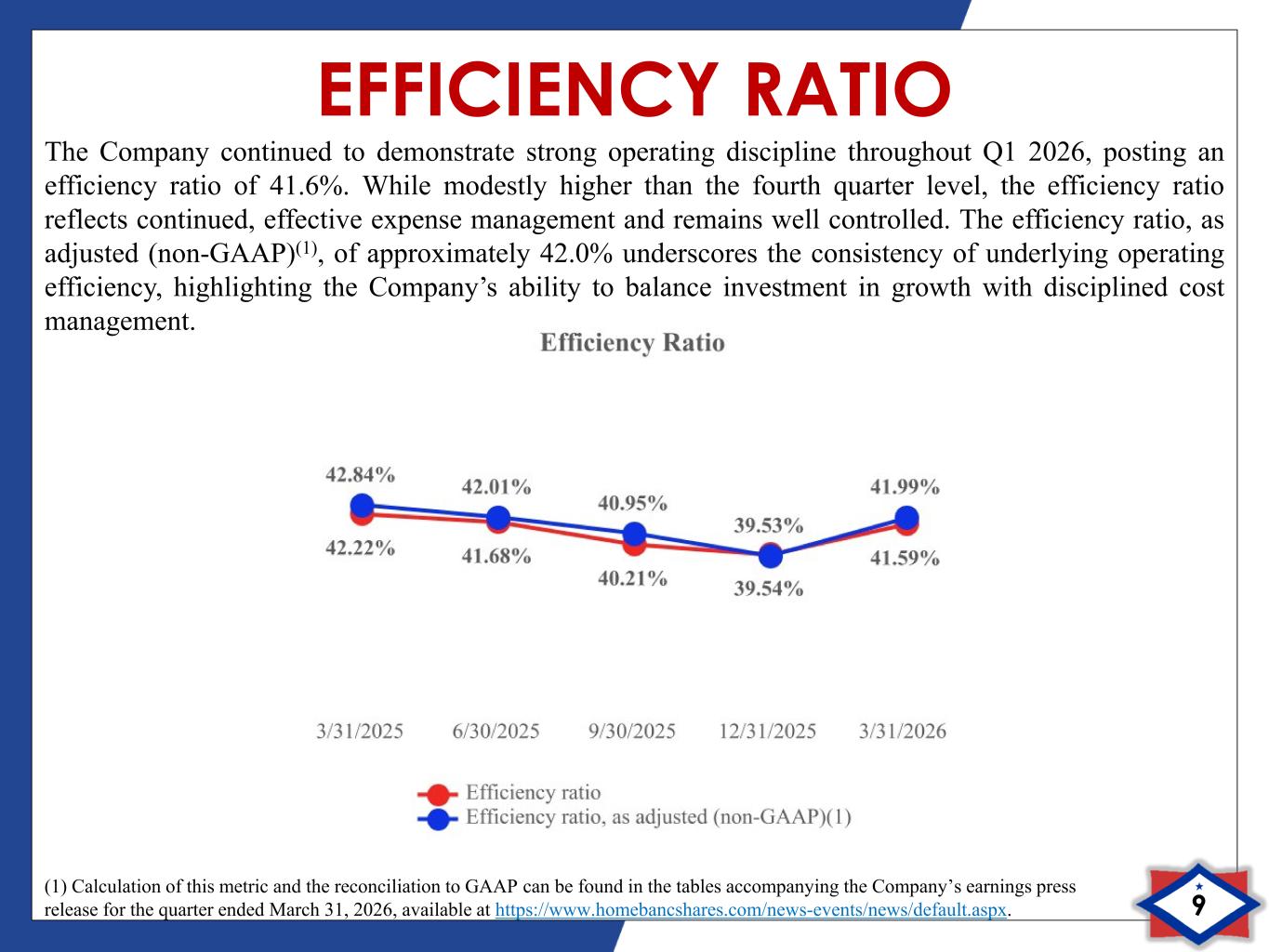
Thank you. Good afternoon and welcome to our first quarter conference call. With me for today's discussion is our chairman, John Allison, Stephen Tipton, Chief Executive Officer of Centennial Bank, Kevin Hester, President and Chief Lending Officer, Brian Davis, our Chief Financial Officer, Chris Colton, President of CCFG, and Scott Walter of Shore Premier Finance. Our first quarter sets a strong tone for 2026. Results demonstrate sound expense control, consistent operating performance, and attractive returns, including record-setting metrics of book value per share of $22.15, tangible book value per share of $14.87, which is $1.72 per share increase year-over-year for a 13% increase, by the way, CET1 at 16.7%, leverage of 14.3%, and Tier 1 capital of 16.7%. In today's economic environment, that is a meaningful accomplishment, and our team is pleased to walk through the quarter's results with you. Our opening remarks today will be from our chairman, John Allison.
Thank you, and welcome to Home Bank's first quarter 26th earning report. Thank you for joining us today, and I think the headline and the quotes pretty much summarized the first quarter. I want to thank our team for getting us all. For those of you who are not already HomeBank shareholders, I think it's important that you look at the story. Home didn't suffer both this elite ranking after the number one position last year. Maybe we'll get it this year. We're happy to have completed the merger with our acquisition of Mountain Commerce and look forward to a successful combination. Due to the back office computer upgrade that was already in progress before, we will not be able to start converting Mountain Commerce until November. As a result, the maximum anticipated savings will not be realized until probably the end of 26th. Once accomplished, we believe our new partners can soon begin helping us to continue the outstanding performance of Home Bank Shares that is known in the U.S. and worldwide. Home is proud of our reputation, always known as one of the strongest, safest, most conservative, and best-performing banks in the world. We'll continue to try to make our shareholders proud and happy to be part of this outstanding company. We know who we work for, and that is our shareholders. If you loan money, we all know problems can and will arise from time to time it has to be worked through. We had a $110 million Texas credit that we decided to non-perform this quarter. This is the same credit we've been talking about for a year and a half or two years. The credit remained current until this quarter. It has been one we've been monitoring intentionally for about eight months. We've entered into a short-term forbearance agreement with multiple deadlines and requirements. We are advised by legal counsel not to discuss and vet. I can say we're either going to get paid off or we'll liquidate the existing . I anticipate any additional loss, but if things were to result in some loss, home strength puts us in a position to deal with whatever comes. Because of the conservative balance sheet, we're carrying right at $300 million in loan loss reserves, one of the highest reserve percentages in the world. Couple that with the strong reserves, with a consistent quarterly pre-tax, pre-provision net revenue of $150 to $160 million, and we're confident of our ability with whatever happens and do not expect this loan to have any major impact on earnings, if any, at all. It is, I believe, I'm pleased with the results comparing Q1 to Q1 last year. The first quarter only had 90 days, and we had two extra, if we'd had the two extra days in the normal quarter, plus just a little touch of wind. I think I said last year we had the wind earn back two or three times. We had no wind this time. This quarter got zero wind, right? You didn't, you always come up with wind. you didn't come up with any juice this time.
Well, we did have that FDIC assessment, but we got a reduction.
Okay. Well, we had a ride off the ballot in the non-interest income category being the lowest since December of 24. Maybe next quarter will be the best. On M&A, I want to congratulate the Trump administration and the Fed along with the Arkansas State Bank Department for the fast approval. They possibly give time for another deal this year. We're certainly in the market and looking for another good fit. We continue to repurchase stock as the volatility of uncertain world, as the war, Canada, that is makes it uncertain, had provided opportunities for us to purchase more recently. That is, before we were in a blackout period. However, we did file our normal 10B5 for this time. If the volatility continues, we will be very active on the repurchase side. I think we have essentially bought back, if not all, of the shares issued in the happy bank transaction and will endeavor to do the same for Mountain Commerce bank transaction. Particularly if volatility continues, repurchases will take some time, but once MCB is converted on our system, the additional share reduction should have a positive impact on earnings. Be very careful on the long side because of the uncertainty of the war, the consumers, business, asset class, and what this cycle may ultimately evolve into. The talking heads have all said rates are coming down, but we have cautioned they will go back up before they come down. Inflation is not dead. Let me say that again. Jamie Dimon would say that's the major cost. How aggressive the Fed is going to be with the escalating interest rates to try to get a handle on inflation. Remember the late 70s and the early 80s, time to be very careful, the normal structure of some asset class in advance, as Jamie Dimon would say, hear from Chris Paulson today about his attitude on private credit and the changes made because private credit was outstanding. The good news, market pricing on acquisition deals are more in line with the correct value and slowed the insane delusion at least for a while. One of the CEOs that did a fairly flagrant, I use the term here, maybe it's a johnny word, It may have been delusionary actually, the trade was so silly. He did a trade sometime back, came up to me at a bank conference and said, I'm here to get my butt chewed out, and I proceeded to do just that. Then I gave him a hug and we discussed the pros and cons and the impact and the damage done to long-term loyal shareholders and agreed that dilution is not the friend of the shareholder. Enough saying. With all the attention that diluted transactions are getting, maybe publicity and management embarrassment has slowed the shareholder damage. At least I certainly hope so. I hope it's finally the start of a fee change that forces management to do the right thing for the shareholders. Donna, great quarter. I'm pleased with the strong continuation of homes earnings, and again, I'm going to hand it back to you. And let's go, since I teed up Chris, if you don't mind, let's go to Chris first, let him comment and carry forward, and then we'll go to Steven and Kevin and Brian and back to you to wrap up.
Sounds good. Thank you, Johnny. So, up next, we have a report on CCFG from Chris Fulton.
Thank you, Donna. Today, I'll provide a brief update on CCFG's first quarter, and then, as Johnny said, we'll share some perspectives on the private credit market. During Q1, we grew the portfolio to approximately $2.1 billion. This represents a roughly $60 million increase, supported by $370 million in new loan production. Loan productions remain steady, and this number is in line with prior year levels. Payoffs for the quarter total just under $200 million, which is also consistent with historical averages. We do expect slightly higher payoffs in Q2, though I do think our Our pipeline should allow us to replace those balances either this quarter or the next. Over the past several years, I've discussed declining balances in our corporate lending portfolio. This is an appropriate time maybe to provide some additional context, and particularly in light of recent news around private credit. CCFG has long participated in the private corporate credit market. Our exposure has varied over time, but we've maintained a consistent presence and have long-term experience in the space. Our private credit balances peak to just under $500 million at the end of 2022, and today, outstandings are $87 million. That's a reduction of over 80% in the past three years. So why did we make the choice to reduce our private credit exposure? Well, beginning in 2023, we observed several trends that influenced this decision. First, we saw a new bank entrance. As some banks looked to reduce their reliance on commercial real estate, many chose to lend into the growing private credit space through participations in structured facilities. This led to broad yield compression across the private credit market and, as often happens, some loosening of credit structures and underwriting standards. At the same time, we saw significant equity inflows from individual investors or retail investors into these sponsored vehicles. We've seen this movie a few times before, and we haven't always enjoyed the ending. We have historically maintained an intentional focus on the shorter-duration position, typically under three years, and as a result, we were able to actively exit credit facilities as they reached the end of their reinvestment period. In total, we exited eight corporate lending facilities through repayment during this time. Our remaining exposure is limited to a few facilities, primarily within AA-rated structures. Our attachment points approximately 58% of par value of the underlying loan, which provides 40% sponsor equity support beneath our senior position. While market dislocation often creates opportunity, we believe it's still early in the cycle. And as a result, we are remaining cautious and at present are biased towards further reductions while continuing to monitor this closely. With that, Don, I'll turn it back to you.
Thank you. That was a great call, Chris.
Yeah, thank you for keeping your eye on the ball with product credit, Chris. Next, we will hear a few words from Stephen Tipton.
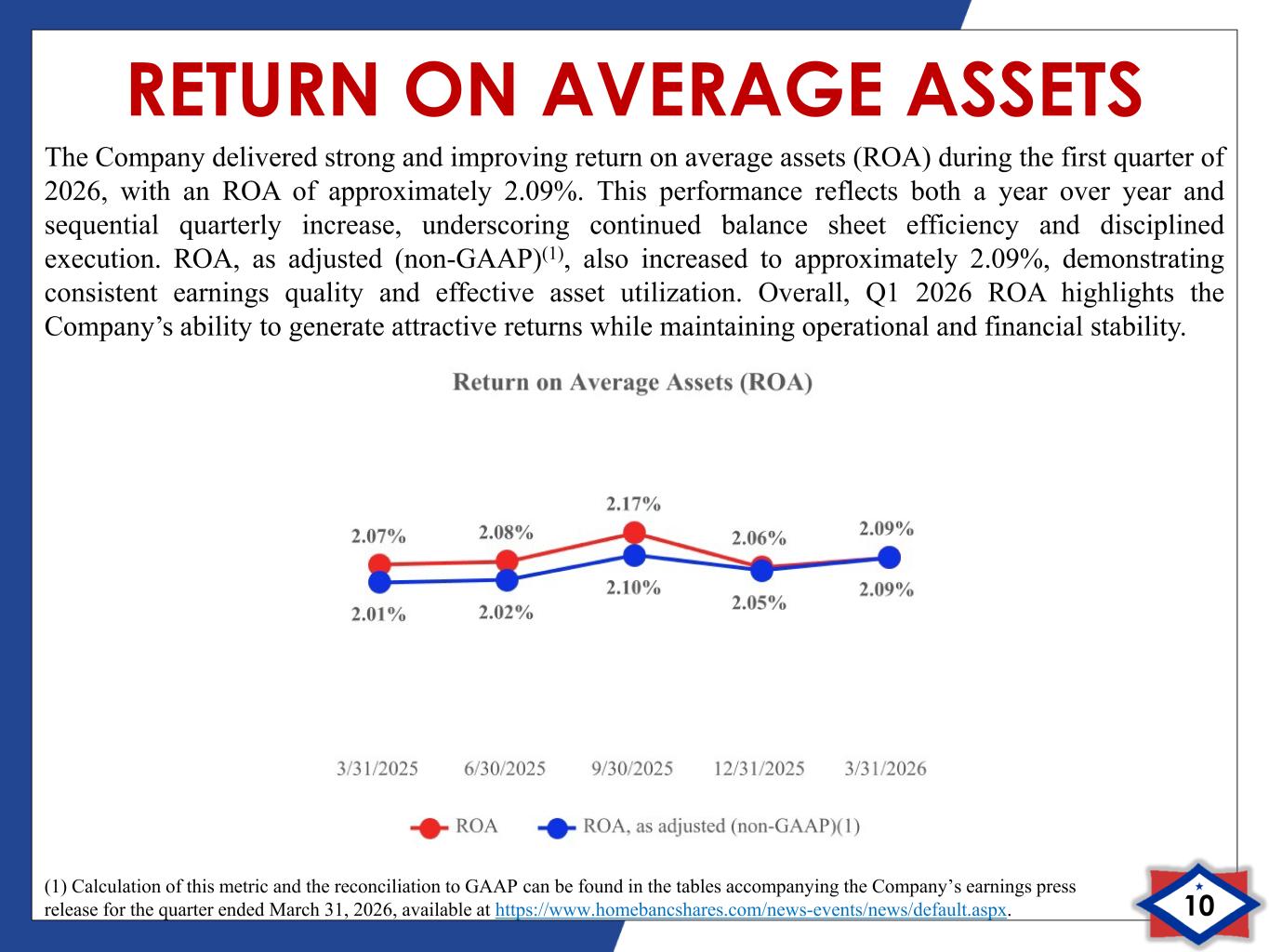
Thanks, Donna. Chris, we appreciate your approach and discipline over the last 11 years with us. As Johnny mentioned, the first quarter of 2026 was a good start to the year with $118.2 million in net income, a 2.09% return on assets, and 16.56% return on tangible common equity. Q1 earnings were in line with the prior quarter, despite too few days, and were up $3 million, or 2.6% from the first quarter of 2025. The reported net interest margin was 4.51%, down 10 basis points from Q4, as there was zero event income in Q1, and up seven basis points from the same period a year ago. The core margin, having no event income, was 4.51% versus 4.56% in Q4. The overall loan yield declined by 15 basis points to 7.08%, while interest-bearing deposit costs declined by 12 basis points to 2.35%. Total deposit costs were 1.83% in Q1 and exited the quarter at 1.82%. Deposit balances increased $258 million, driven by all of our Florida regions. I would expect some headwinds in Q2 from tax payments, but we're pleased to start the year strong. Non-interest-bearing balances grew by $126 million to almost $4 billion and now account for 22.5%. As we typically see in Q1, loan production softened coming off of a very strong fourth quarter. We had a total loan production of $917 million, with over half of that coming from the community-based footprints. Switching to capital, we repurchased 507,000 shares for a total of $13.9 million. And as Johnny said, we will continue to be active with our share repurchase plan. Capital levels continue to build, with Common Equity Tier 1 capital ending at 16.7% and total risk-based capital at 19.5%. Lastly, we're thrilled to have the Mountain Commerce employees, customers, and shareholders on board and look forward to growing the Tennessee franchise for home. With that said, I'll turn that back over to you, Donna.
Thank you, Stephen. And to close out our prepared remarks, Kevin Hester has a lending report.
Thanks, Donna. Given our strong showing in 2025, it can be easy to look at this quarter as boring. I think that shows the high bar that we've set for ourselves because any quarter that posts a return on assets of 2.09% maintains solid asset quality and is an earnings beat over the same quarter a year ago is not an easy task and should be inspiring. As I anticipated last quarter, ending loan balances dropped by a little over $50 million, but it happened very late in the quarter, which resulted in average loan balances actually being up $174 million on a linked quarter basis. I see this downward trend continuing in the legacy bank into the second quarter because Q2 and Q3 projected payoffs. The MCB acquisition will, however, add over $1.4 billion in loans to the balance sheet. Based on my meetings with their lenders, I expect them to settle into our credit culture quickly and be accreted to loan production in short order. Johnny mentioned the nonaccrual of the Texas C&I credit that we've been wrestling with since 2024 and this increased non-accrual balances significantly but we have made recent progress with the executed forbearance agreement which leads us to a couple of ways to exit this credit we are continuing to work with the small same set of issues that we've been dealing with for a while now we took our medicine in 4q24 but maximizing the exit sometimes takes more time and effort than you would like. It's wonderful to have the level of capital and reserves that we have, which allows you to work to maximize the recovery on this limited set of problems. Criticized assets were flat on a late quarter basis, and early stage past dues were below 50 basis points. Even with the large increase, the reserve coverage of non-performing loans is still over 160%. As a point of reference, our loan loss reserve would cover 15 years of our historical charge-offs if you use the last five years of average charge-offs as a base, and that base includes the large 4Q24 Texas cleanup quarter. There's nothing wrong with a workmanlike quarter where you meet expectations. I expect that a majority of banks would trade results with us. On that note, Donna, I'll send it back to you.
That's great. You're right, Kevin. Thank you for that report. Before we go to Q&A, does anyone have any additional comments?
Well, I thought, you know, we think about deposits, we have a good deposit growth, and then tax time coming up. It's good to have real customers. That's right. And we do have real customers. As evidence, now the tax checks we're seeing go out right now. I mean, that's good and bad, right? But they are our customers. They're not transactions. They are relationships. So I'm proud of that. We'll take a little. I think we've said in the past, our assets, and that's what Mike Mountain Commerce has done for us, and we've been consistent, our earnings have been consistent quarter after quarter through this process. And we do need more access, right? So we'll get this under wraps and savings out of, and we'll have another deal before.
I think we'll go to live Q&A.
Operator
Thank you. If you would like to ask a question, please press star followed by one on your telephone keypad. If you would like to withdraw your question, please press star followed by two. When preparing to ask your question, please ensure your device is unmuted locally. First question comes from Stephen Scutton with Piper Sandler. Your line is open.
Please go ahead. hey good afternoon everyone appreciate the time um i guess johnny maybe um if you can talk a little bit more about how how the uh progress is going to acquire even more assets on top of mountain commerce i mean like you said that your returns are phenomenal so it just feels like you need to be able to multiply that on a larger balance sheet so what have conversations been like and how aggressive would you be and kind of within that would you ever think about loosening this might be a crazy question for you loosening the the the triple accretive mantra to get a deal done i think folks we hold pretty tight to our philosophy around here you know that my fear is
my fear is they'll say well he lied you know he lied i can hear i can hear the market say oh he he broke it. He diluted the deal. So I just don't believe it. You know, I'm the largest individual shareholder and I'm not interested in diluting myself. So I think I hurt our shareholders when we do it. You know, we stretch as much as we can on a train, but people have joined this company because we don't dilute. And if I dilute it now, I think it would be kind of in And as I'm getting older in my career, I think people say, well, he got weak and gave up. But I have it as of yet, and I think it's known when we're talking to another prospective seller, we say, we don't dilute. You need to understand, we're not going to be your highest prize. But if you're going to sell the stock tomorrow, it doesn't matter. If you do a deal and the buyer dilutes the hell out of himself, if you sell a stock tomorrow, it doesn't matter. Just get out and get gone. But if you're going to ride with him for a while, it makes lots of sense not to do him and do the deal. So if you want to hold the stock and keep it for a period of time, I think our buyers appreciate the fact over the years that we haven't diluted. So I know there's another deal out there right now that they're bidding up on, but I'm not going to bid up on it. You know, we'll bid it to the maximum we can bid it, and then if we don't get it, we don't get it, you know. A lot of it depends on the seller, what the seller wants to do. They want to stay, they want to be part of it, or they want to go to the house. So I think that's how they don't go to the house to get the best price and sell the stock tomorrow and get gone. Otherwise, I think if you want to be in it for a period of time, you need to have a good partner that's not going to lose you. I know I rambled a little bit, Stephen, but anyway.
No, that's helpful. That's helpful. And just in terms of the pipeline of conversation, it does, it does. And in terms of the pipeline of conversation, what is that? I mean, we haven't seen as many deals here in the first part of the deal get announced. I mean, are sellers just kind of not interested because the environment is pretty good? Or is it just in the volatility of the stocks? What are you kind of seeing in terms of conversations?
Well, there's conversations going on, but there's other conversations going on. And bankers have called us and said, hey, what about this and what about that? And I said, well, we're not ready to do that. Let's get Mountain Commerce, kind of get our arms around it, and then we'll be ready to go. But we're having conversations. I mean, at a bank conference recently, we ran into a couple people, and I said, we ought to talk sometime. And they've followed up since then, you know, just a conversation in a bar. I said, yeah, visit. Don and I are sitting at one deal and I said, well, visit sometime. And that brought about a banker into the deal to talk to us about these two possible options. So, I think the conversation is going on. I actually think that people are embarrassed to dilute the hell out of the shareholders right now. I think they're embarrassed because they've all been called down for the dilution and we see what's happened to the market prices of these bike stocks. I mean, we went from 22.5 times projected earnings to 11 times earnings, right, or 7.5 times earnings. So, you know, where did the money go in the bike stock? We just, we ran out, my contention is, we ran all the good investors out, but we just beat them up and dilute, dilute, dilute. So, I only get back to the old days where we were 21.5 times earnings, and everybody was happy, got on a quiet horse, everybody made lots of money. So anyway, it's just a different world now, and I think it's directly a result of the delusion.
Yeah, thanks, Ben. Yeah, valuations are crazy. We got to start calling you homebankai.com or something like that. I guess one other question I have is around loan yields. There was like a pretty big move in the loan yields this quarter. I don't know if you could get some color on how much of that was kind of core, declining loan yields, or where the new loan yields are coming on at versus maybe how much of the NPA affected those reported loan yields, quarter of a quarter?
Yeah, so first, on the impact from the non-accrual, we don't have any of that in our margin for the quarter. Had we had it on the books, the impact was about five basis points to the loan yield, and it was about four basis points to NIMS. So, you know, the 451 that we reported, you know, had it been on the books and on non-accrual or on accrual, we would have been 455 versus 456, so a little color there. You know, some of the other decline in loan yields really just a function of, you know, variable rate resets from the Fed news last year that occurred, you know, January 1 and other certain frequencies. So, you know, we would have been – if you normalize for the non-accrual, we would have been down 10 or 11 basis points and kind of matched what occurred on the deposit side. Production yields, I think we averaged 7.25 for the first quarter of this year. I think we're at 699 or 7% in the community bank footprint. So, you know, we're north of prime and getting our fair share.
Appreciate all the time, everyone. Thanks for the time.
Thank you, Staden. Appreciate you.
Operator
We now turn to Dave Rochester with Cancer Fitzgerald. Your line is open. Please go ahead.
Hey, good afternoon, guys. I wanted to talk about the loan trend real quick. It sounded like you mentioned pay down activity being a little bit elevated, possibly in 2Q and 3Q. I was just wondering how you guys are thinking about the organic loan trend. I know you got the deal closed this quarter, so that will bump things up a bit. I'm just trying to understand the underlying organic trend there. And then what part of the book are you seeing those paydowns in? Is it kind of more of the same? Is it anything new? And is there any difference across the different geographic regions that you have?
Hey, Dave, this is Kevin. I'll ask that. It's going to be a little bit of a long answer because I'm going to give you some color on how we do the pipeline process. So our pipeline process is probably more – we have more visibility into the payoffs than we do the new loans that are coming on. We know because of CCFG's portfolio being, you know, a two- to three-year turn, and a lot of what we're doing on the large side is construction deals, and we know when those are finishing. So we probably have a four- to six-month lead time on a payoff where we might have 30 to 45 days to put it on a pipeline for a new credit because we don't put new credits on the pipeline until they're fully approved. And for Chris's group, CCFG, they may close it in 15, no longer than 30 days, and in the community bank footprint might take 45, but it's probably closer to 30. So I would say our pipeline process is more highly skewed towards knowing our payoffs. That said, we do see second and third quarter payoffs being higher than they have been the last couple of quarters. Will we have some production that will offset that? It's possible, but it's going to come in in the next 45 to 90 days, and it's not on our our pipeline yet because it hadn't gotten fully approved second piece of that is that MCV is not yet in our pipeline process so I really don't have a good feel for what they might contribute in second third quarter I'll know that probably in the next week to two weeks I'll have a good handle on that so the short answer is it feels a little soft second quarter and could we outrun it, we could, but we're going to have to get the production in here and get it on the books.
Okay. Great. Appreciate all the detail there. Go ahead. Sorry.
It seems like when we forecast big payoffs, we have long growth and when we forecast long growth, we have big payoffs. You've heard my comment. I catch a pretty big ditch. You think you got him and it gets loose. So, as Kevin said, we never know what our customers are. We've got a lot of big projects coming on. You just never know. One of our big customers, FBO, did it. He said, I bought another FBO, and I said, yeah, you just never know. I didn't know what he was working on.
That deal's on the platform. Yeah, that deal's on the platform. The runway's on the platform.
Maybe just switching to the margin, what do you guys think is going to be the rough margin impact from the close of the deal? and that if we don't get any more rate cuts or rate hikes or whatever, if we have a stable Fed fund going through the end of the year, how do you think that margin kind of trends from there after this?
I think the purchasing marks, I do expect the non-accrual. We were able to make it at maturity as they come through here, and that's five days.
Yeah, okay. Appreciate that. Maybe one last one. Just back on M&A, I know you're open to deals in all your markets, but I was just curious if you're prioritizing any of those markets now with a tendency in the mix. Is there any focus? Sounds good. Thanks again. Appreciate it.
Operator
We now turn to Brett Ravitan with StoneX. Your line is open. Please go ahead.
Hey, good afternoon, everyone. I wanted to start on expenses, and you guys managed to keep expense growth pretty limited last year, like 3% growth. And I know Mountain Commerce will create a little bit of noise. But, you know, I was just wondering if there's anything that you guys, Grant, spend money on, either as a result of that deal or just as you're getting bigger. You know, and just any thoughts on maybe core growth this year relative to 25?
Hey, Brett, this is Steven. You know, core expenses were about $115 for the quarter. we'll have some normal raises throughout the year just with merit increases, contracts here and there but that's a decent base today. Mountain Commerce probably adds seven, seven and a half million a quarter to that number right now until we get to the latter part of the year and get there and convert again and begin to recognize the majority of those cost safes. There'll be some cost safes along the way throughout the year, but the majority will come.
And then, Johnny, just thematically, you know, I know you're interested in M&A, and you've historically, you've got a term for people that hire lenders from other banks. But wanted to see in Tennessee, you know, there are markets in the southeast where everyone's talking more about disruption, you know, due to a big deal or two. and just wanted to see if you might let Bill hire some folks on the lender side in Tennessee or if that was still just not a part of the equation in terms of how you think about it.
That's not the way I think about it, but Bill may think differently about it, and we really haven't discussed it, but we're headed over next week. All right. Headed over next week to meet their customers and shareholders and have a little talk about home bank shares and now the commerce and the partnership together. So I'll visit and I'll catch up with you a little later, I think, to see what Bill's thoughts are. I don't know if he's had anybody run at him. Kevin, do you know who's had anybody looking for him? You don't know?
I'm not aware of any teams that he's talking to. I'm not saying it wouldn't be out of, you know, of the realm of possibility in that Nashville or Knoxville market that, you know, to Johnny's point, it's not been the way that we generally try to do that. But if it's due to disruption, that's a little different premise than just going in and taking away folks that are at a place that they've been happy at, you know, for some period of time. I get the disruption concept, and there could be something there, but we'll see.
And then if I could stick to one last one just around the pipeline, you know, I understand that it's easier to see the payoff activity coming versus, you know, the pipeline building, but just wanted to see if any of the pipeline, if you want to call it trepidation, you know, is just around any competitive pressures. It seems like some banks are being more competitive here recently on rate. I know you guys are pretty strict on rate. You know, is the competitive landscape having any impact on what you guys are looking to do in the back half of the year?
Yeah, I mean, I think some markets are, you know, are harder than others for that. And I think it is not the same players in every market. It's different players in different markets. But there is some rate pressure. There's even some underwriting and structure pressure that people have given in to a little bit over the course of 25 and early 26. So that's always a challenge. We always have to fight that because we're pretty consistent in what we do.
Fair enough. Appreciate all the color, guys.
Operator
We now send you Catherine Milo with KBW. Your line is open. Please go ahead.
I had a follow-up on just deposit costs. I know you mentioned the 182 exit deposit rate, which is kind of similar to where you were for the average in the quarter. Just curious, as you think forward for the rest of the year, I mean, if we don't have any more rate cuts, do you feel like deposit costs will start to increase as it is through the year, especially, you know, maybe once we get past second quarter and growth improves? Or how are you thinking about kind of incremental deposit costs coming on?
Hi, Catherine. I mean, certainly, you know, with NCV, you mentioned what they have coming, you know, through the maturity pipeline and, you know, certainly expect theirs to come down. You know, on the legacy home portfolio, you know, we have some deposits that are tied to the T-bill, or short-term T-bill, 91-day T-bill, which trickled up a little bit in the first quarter and kind of put the pressure on the other changes that we're able to do. CDs will continue to mature that we'll try to reprice down. So I'm still optimistic that we can inch out a basis point or two as we go throughout the year. But I'll couch all that with competition, like Kevin talked about on the loan side. I mean, we're seeing, yeah, you're still seeing banks offer 4% for CDs and 375 to the 405 money market. So we'll defend our customer base both here and in Tennessee.
I'm beginning to think that 4% might be cheap if Frank's doing what I think they're going to do. It looks silly when you see people doing it out there. We're still seeing some sexes, too. So, I mean, if you think about that, how ridiculous that was. It might turn out to be... We obviously haven't stopped inflation. It depends on what Trump does and how aggressive the Fed is. If they're too aggressive, I mean, if they have to be as aggressive to slow inflation, it may take 200 basis points. If they lower, I think that would be a huge mistake.
I mean, Johnny, you've been right on the rate trade. Yeah, but you've been right, I feel like, on the way you've been looking at rates for the past couple of years. So is there anything that you're doing in your balance sheet just to prepare for the risk of higher rates?
Not really. We're just careful with our pricing. That's all. We're just careful with our pricing. You know, I was mad at myself last cycle. I said what was going to happen, and then I didn't bet it. You know, and I ran into a friend. I heard you, Johnny, and I bet it. I went out and bought $4 million worth of money cheap. And he said, I still got it. And I said, good for you. And I said, he said, I did it because of what you said. And I said, well, I didn't bet it. And I said, I have. And that is a good thought maybe to take a look at that description out there a little bit. We, I mean, this is almost, it's almost the dead toe of the 70s and the 80s. And, you know, we've got this war now. And we've got all. And we know what that does. and we saw producer price index, but at 4%, that's what they annualized, 4%. We haven't seen those numbers in a while. It could get a little crazy here in a little bit. I just don't have the answer. I don't have that answer yet. So hopefully it will come to us.
And then, Michael, anything on the credit side that you're seeing? I know I appreciate that you don't want to talk about the credit, the $92 million credit that moves to NPA this quarter until you get it resolved. But maybe just outside of that, are you seeing any other trends or any kind of weakness across the book to be aware of?
No. I mean, I said, you know, criticized assets, which includes all of our OLEM and below, those were flat quarter over quarter. and early-stage past dues are as low as they've been at below 50 basis points. So, you know, we're, as I said in the remarks, we're working with the same set of issues that we've been working with for the last few quarters. And I think I said a couple of quarters ago that that small group might get worse before it gets better, and that's what happens when you have to put it on non-accrual and start working it out. So we've already taken what we believe is our maximum loss, and we would expect to recover some to all of that, depending on the way it resolves and which path of resolution it goes through. But we at least have some – talking about the larger credit now – we at least have a good visibility into how that happens, and it could happen as early as this quarter or next so we at least feel good about that and it is the same set of problems I'm not seeing anything you know of any materiality that that we're that concerned about so I don't think we're going to lose any money on this bill.
The guarantors, I like the asset in this, in-demand assets being leased. We had sold some of these assets in the past on a 70-30 basis. We got 70% and the customer got 30% and we sold those assets and they paid down. Just assuming the rest of them bring the same value, we're going to take 100% of the proceeds from this point. I think if there's any hole left in this deal, everything they've ever said to us that they would do. If I was left, they'd put it in your note or something, you know, so whatever type of a sign.
And does the price in oil have any impact? Sorry, sorry, John. That's all my questions. Thank you very much.
If anything, it might help, quite honestly.
Yeah, well, that's what I was thinking, actually. I know you have to value the assets. Thank you so much for the call. I appreciate it.
Yeah, thank you. Appreciate it.
Operator
We now send you Michael Rose with Raymond James. Your line is open. Please go ahead.
Hey, good afternoon, guys. Just two follow-ups. First, just on the large Texas loan, was there any interest reversal this quarter? And if so, do you have the math as to kind of what the impact on the margin might have been this quarter?
Yeah, so the 451 margin doesn't have any accrual in that number. So it was about a million six impact for the quarter, which is about five basis points to the loan yield and about four basis points to NEM. So, you know, if we had had it on accrual for the whole quarter, you know, 451 would have been 455 compared to 456 last quarter. So that's kind of the math around it.
Okay. Really, really helpful. And then just as it relates to the scheduled payoffs that you guys have talked about, can you kind of quantify at least with the scheduled payoffs and paydowns are kind of expected to be over the next quarter or two?
They look to me like the second quarter looks like close to a billion dollars, and third quarter could approach that. And those are both – that includes kind of abnormal paydowns and principal paydowns too. So that's what you'd have to do to stay even in each of those quarters.
Yeah, and just for some context, payoffs in Q1 were about $650 million, but they were $950 million in Q4, you know, $750 to $800 million in the quarters prior to that. So that's a big – it sounds like a big number, but that's what we run, you know, in that range, a quarter in and out, just depending on seasonality.
And that doesn't include NCB. None of that, even what I'm quoting, doesn't include MCB because they're not in my pipeline, yeah.
Got it. And then do you have a sense for – are there any loans with MCB that you've identified that maybe don't fit your standards, that you may kind of plan to run off over a period of time? Just trying to, you know, kind of appreciate the puts and takes on loan growth as we move forward. So I appreciate all the color.
I'm not aware of anything. I mean, I looked at every loan that we looked at in due diligence. I don't remember anything necessarily that I would say that I would run off. I think, you know, we have a credit culture in the way we look at things, and theirs is pretty close to ours. They're maybe a little bit higher leverage in some areas. We'll work on that over time as we can, and they're going to have opportunities with us that they haven't had because they've not been willing to do much construction so you know any any decisions we make to go a different direction than what they've been doing I think will be more than offset by the opportunities that they have to do things they haven't done before so I look at them as being a positive as I send my comments pretty pretty early I would expect them to hit the ground running pretty early on. We've already had a couple of hotline discussions over three or four credits as of last week.
I told Bill, I said, Bill, nobody cares what your numbers were. I said, you just get ready for the future. You've got the thing you need to write down, write it down, get right out of it. Get it gone, get it out of here. So, I think we're coming in with a pretty clean check coming in the front door.
I appreciate it. I'll tell you guys. Thanks.
Operator
We now turn to John Ostrom with RBC. Your line is open. Please go ahead.
Just a couple things to follow up. Johnny, did you say in your prepared comments that you think deal pricing has moderated?
I said that deal pricing.
Oh, yeah. I think it's lightened up a little bit. I don't see the urgency out there that I did see. However people are talking, they're continuing to talk, and they're continuing to want to do something. And some of them want to do it with home. So I think it's out there. It's just a matter of if we're ready to do that, right? It's just a matter of if we're ready to make the move yet. And we're probably getting close to ready to look at something else. But we're not going to be able to convert it about the same time we convert Mountain Commerce in November. So the answer to that is yes and no. I haven't pushed hard, but we've been pushed a little bit ourselves. We've had people calling us outside of bankers, calling us directly outside of investment bankers and saying, we met you, your company, two or three years ago, and we're thinking about doing something, and we wanted to talk to you all. That happened with a couple of one Florida and one Tennessee that came at us. So when we do that, we'll have the opportunity. We're going over to see Bill and his team. We'll have to talk to Bill when we get over. So we'll get over to Tennessee and see where we're going, where we're thinking. There's a Tennessee deal out there. There's a Florida deal out there. So we'll see how they work out.
Okay. I guess it's somewhat related, but how do you feel about being more aggressive on the repurchase plan? Do you have like an optimal capital level in your mind, or are you just kind of warehousing this capital for future acquisitions? Because it's obviously 13% TCE, and to ET1 is 17, those are high levels.
Well, if we spend it as fast as we're making it, so it's a pretty good position to be in. but we're, I mean, we made $118 million, pretty nice, right? Pretty sweet.
I don't know, you know, we got so much capital right now that we really like our position, but I'm ready to buy stock. I mean, I'm looking at it today. We can't buy today, damn it. Tomorrow. Tomorrow we can't. We can't today. So, you know, it gives us some opportunity, and it's about, I want to buy back all of Mountain Commerce. So it's about five and a half million shares. I want to buy that back. I think we bought essentially all a happy back. So I want to buy all the mining and commerce back and just kind of develop it out there. We can do it pretty quick with the capital position we're in, and it wouldn't take us long to get that done. I like to buy it. I know it's a little diluted to us, but I like to buy it with stock.
It's not an either or in your mind. Not either or. You can do both, I guess is what you're saying, right?
Operator
We now turn to Matt Olney with Stephens. Your line is open. Please go ahead.
Thanks for taking the question, guys. Just sticking with M&A, you mentioned some potential bank targets in Florida and Tennessee. Can you just speak to the appetite of doing M&A in footprint in existing markets versus expanding into new markets? Is the bar set higher if you were to expand the franchise into new markets? Just trying to appreciate how you think about doing M&A in an existing footprint versus something outside the existing footprint.
No comparison to me. I mean, if there's a Florida deal out there that we can do, you know, we've got management from West Florida, Pensacola. We've got management all over the state of Florida, and we can just add it to someone. You've heard me talk about porting one of those guys' buckets. I mean, they're great managers. I mean, the performance of our Florida operations, all operations are outstanding, but those guys know what to do and how to do it, and it just makes it simpler and easier. We made the big move to Tennessee because we like Bill and his team, and we made that move, so I think we need to grow there. We need to build better and muscle up Tennessee because I think there's opportunities in Tennessee. There's a little disruption over there, and I think he'll give up. an opportunity to pick up and build some muscle in that state as we've done in Florida, and I think it's an opportunity for us. So the reason being, you just get more consolidation savings. You know, that's really the key. If you think about closing branches and doing a deal where you can close some branches, those are big savings. So we'll continue to focus more on where we are than outside of that. When we look outside of that, one of those deals that I'm talking about that your bankers call me about is outside of that. And I really like the operators. And we like the guy. We like his company. We like what he does. They don't have the growth that a Florida's got, but he runs a good, clean operation. So someone said, why would you go there? And I said, because it's simple and it's clean, and they do a good job running their company. So it kind of builds mass. So that's outside of where we presently operate today. He's a guy that runs it, and you don't have to hold his hand. So that's really what you're looking for. You're looking for somebody. If you're going outside the market, you better get somebody like Phil that knows what they're doing and knows how to run one.
Appreciate the commentary. And then just as a follow-up, if Chris is still on the line, I've got a question about private credit. And, Chris, you had some good insightful comments about private credit and kind of what you had there a few years ago versus what you have today. I want to dig more into the views you have today and kind of your outlook here. I think you said that the current bias was for further reduction of the remaining private credit exposure that you have. I was hoping you could expand on this. And how do you see the private credit market playing out the next few years? And I'm also curious, when do you expect to see some opportunity here for growth for CCFG?
Yeah, thanks, Matt. Yeah, probably two things there.
One, you know, right now the uncertainty here is what's the underlying, you know, what do these underlying loans look like and where do they go? It feels early because I think you're going to see a little bit of a false bottom where, you know, There's a little bit of maybe some price expansion or there's a little bit of some markdowns in these doses. Everybody goes, oh, okay, that's it. And then there's always, as they say, the third shoe to drop, right?
So right now we're not seeing a lot of capitulation on the price side, and there should be, but we're also not seeing any activity.
You know, nobody's pricing a new facility today if they don't have to. so i think we'd want to see you know one of the things we look at a lot in ours is we'll have these loans been marked appropriately right um you know what's happened to the uh what's happening to the underlying credit uh have you had evita expansion or not have the loan been marked etc we'd like to see a little more of that before i think we get comfortable i mean we've certainly had people you know come to us and say you know i'd like to get out of some of our positions my risk eyes are getting on to me, what would the price be? And I think right now our answer is, you know, price doesn't fix credit, and so, you know, an extra 50 basis points isn't going to save me when I need the credit support. So, I think right now we're just biased towards, let's figure this credit thing out. This may turn into nothing, right? I mean, it may turn out all these things are fine. AI doesn't destroy the world, and all these software companies are fine. I just don't think you should take that risk today. So we'd want to see a little bit more capitulation, I think, before we would do that. But as I said, we've been in this market for 10-plus years. So I think people that came into the market, quite frankly, need to take some losses before I feel comfortable. It seems like that's how you get discipline, is you get new entrants in, and they thought they were getting something very risk-free, and they priced it that way, and then it turned out not to be, and then everybody gets religion again. So, we'll look for that, and when we see signs for that, we might consider, you know, expansion again. We're still set up that we have facilities that will roll off, and right now, if a facility rolls off, we probably just wouldn't replace it. We wouldn't go into the next one, or we just take the payoff and move on. That's on the C&I side. Real estate, we continue to see good pipeline growth. We are going to have elevated payoffs, but, you know, one of those is just a credit we've had that I've been saying. We've been two weeks from payoff for six months, and I think it's paying off today. We'll find out. Not a worry for us on the credit. They've just been in the sale process, and it's just dragged on a little bit. But we like the credit. I'd like it to stay longer, but I get nervous when things stay a little too long, right? Because that's supposed to move. We're in the moving business. And so, but we continue to see great opportunities. I think our pipeline is pretty strong. It might take me more than a quarter to replace what comes off, but it won't take a lot more than that, I don't think.
That's helpful, Chris. I always appreciate your insight. That's all for me, guys.
Operator
We now turn to Brian Martin with Brain Capital. The line is open. Please go ahead.
Hey, guys. Just maybe one follow-up, Chris, if you're still there, just on your outlook for the year. I know you talked about a payoff last quarter, something like that maybe got pushed back a little bit, but just your kind of outlook for growth is still kind of mid-single-digit type of growth this year, kind of with the puts and takes of the payoffs and the pipeline you've got?
I think that's right. That's what I'd like to see. I think if we don't have that, I'd be a little disappointed. We really look at it on more like a rolling basis, right, which I know is harder for you because you look at it on a calendar basis. But, you know, I'd say from here over the next, you know, rolling 12 months, will we grow? I think so, based on what we see. We booked, you know, quite a bit last year. We had really good production last year. Not all that's funded, so we would expect some of that to roll through. And I do like where we are right now on pipeline. I'd say there are – Kevin talked about a little bit, you know, we're in constant contact with our customers. Most of our businesses repeat business, whether it's, you know, somebody borrowed from me three years ago or somebody borrowed from me last year. So we're really always kind of early on in discussions with our customers about what they're buying, what they're planning, what they're doing. Some of that moves around, and then I was talking to somebody last week. They called me up. They said, I've got this thing. We may be buying it. We want to move quick, et cetera. Would you be – where would you be? They said, that sounds great. Then they called me, you know, yesterday and said, I think we're going to pass on that. And so I would have told you last week there might be a pretty interesting deal there, and, you know, today there isn't. but they may call me back on Monday and say it's back on. So we're flexible, and because we're flexible, we get a lot of looks at things. And so generally speaking, you know, on a rolling kind of three, four-quarters basis, I can usually say, yeah, I think we're probably going to expand.
Okay, perfectly. That's helpful. Thanks, Chris. And maybe just a couple follow-ups for me. Johnny, I think you talked about the M&A, just not to beat a dead horse, But just any change now that you've gotten Mountain Commerce in terms of sizing, you know, a lot of people are asking, do you look at something smaller, bigger, is it just what's available? Just any context on kind of what your preference would be in terms of moving forward with M&A?
Well, in the size or larger, then maybe Mountain Commerce would be nice. But we would probably do a smaller deal. You know, if it fits them, you know, if it's in a market to where the bill's not, if it fits them, we'd probably step down and do a smaller current. To me, this is a pretty good size state. You know, we're in about four or five locations, six, seven. We've got room to grow in that state.
Gotcha. That's helpful. And maybe just, Stephen, just on the margin, I think you talked about the opportunity on the cost of deposits at Mountain Commerce. You've still got some room, maybe not as much room on legacy. But on the asset side, what's the opportunity for what's remaining to be repriced this year for home? And then, I guess, any impact of consequence from Mountain Commerce in terms of that repricing on the asset side?
No, I don't think any impact necessarily from Mountain Commerce. You know, I would say, you know, what we're seeing, you know, here most recently on what's maturing as we go, given where competition's at, is, you know, essentially trying to, you know, kind of blend in with overall where it's maturing, maturing front. It's a benefit that maybe banks thought with what we're seeing in loan pricing competition.
Okay. And just then maybe in terms of – you gave the – I think someone gave the payoffs and maybe it was – I guess – but in terms of the production, I think you said it was around $900 million this quarter. I guess what – just in recent quarters, has production been similar at that level or has that moved around a little bit?
A little like for – yeah, the 917 for this quarter, you know, we were two – a little over $2 billion in Q4, but, you know, seasonally usually are at the end of the year. But, you know, prior quarters in that, we've been a little north of a billion.
Okay. Yeah, and some of that is not funding day one. Some of that's a good, you know, fair portion of that's construction, and that's not going to fund until, you know, six months from now when it will start funding generally. So that's a little hard to pencil out at one time.
And maybe just the last couple for me. I think just in terms of the credit quality, I mean, I guess the one credit, the Texas one you've talked about, the other couple of credits that are out there, I think the Dallas-Fort Worth one, the Boat one, I guess those are still just being worked through and, you know, no real update in terms of, you know, how the timing may proceed there. Just trying to get a read on, you know, when you see some of the improvement that you expect here, you know, kind of flowing through the numbers, you know, as we go through the range of the year.
We've had those credits every day. That damn boat, we're going to a jury trial. Except for trial in June. Trial in June. We have not. It's been a year. We've had it. We have the boat.
We have the boat. Not a question of where it is.
We actually have the boat.
We just can't. I mean, absolutely. They just keep going to judge. Then they've got a new judge. Now we've got a new judge. Third judge. and we're going before the judge in a trial now. I mean, it's $5 million dollars owed on the boat. It's a $7, $8, $9 million. It may be a $3 million by the time we get it sold. It may be too damn old. I've never seen anything quite like that deal at all. It's just the frustrations in Dallas that we're rassling with. We'll get it sold eventually. At some point, six, seven buyers on it, we'll get it sold. at some point in time, but it's, I mean, we've marked, there's no loss in that.
You've got to get, it's in a receiver, and you may find somebody to take it where it's at. We're working with all the leads we got, but realistically, we may have to need to be completed before you, there's an opportunity there if somebody wants to jump in and do it. If you find the right person, then we'll get it, we'll get it sold and moved. Like I said, some of the challenges.
Yeah, and just the outlook on charge-offs, I mean, it sounds like that's a pretty diminished number, a pretty low number here, given, you know, what's happened with, you know, these credits are just something you're working through. We've kind of adored the impact, so the charge-off outlook in your term is still pretty benign in terms of the portfolio today.
I would agree with that. Yeah. Yeah.
Yeah. Okay, and maybe the last one for Brian. Go ahead, Jay.
I'm I don't anticipate any more losses on the bid credit or the apartment credit. That's really the ones we're working through. So I don't anticipate it. They're marked and written down. And if there was, I mean, if the $100 million credit, if there was some loss in it, I'd be shocked. And I've been fooled before, but I think we're fine. And it'd just be a bump in the road for us because, I mean, we've got the PPNR and you've got the cruisers, yeah. If you didn't lost in it, maybe, I don't know, maybe it's nothing. I don't think, if I thought there was a loss in it, you know, maybe if I thought there was a loss in it, I'd take it. I would have admittedly written it down, but we haven't, no need to write it down at this point.
Fifteen years of charge-offs in our, you've got fifteen years' worth of charge-offs in our return.
We've got 15 years of charge-offs in reserve right now, so we have a pretty good history of not having a lot of charge-offs that we've had for a year. We had Texas clean-up, which is probably the biggest one.
Just the last one for me, Brian. I think you talked about the B&M being, you know, just kind of some of the noise the last couple quarters. This quarter seemed pretty clean, around $44 million. And is that kind of a decent level to think about as we go forward? And then I know you talked about a couple of maybe get some wind at your back, but, you know, at least the baseline, that seems pretty clean with absent all kinds of noise that's kind of flowed through there in recent quarters.
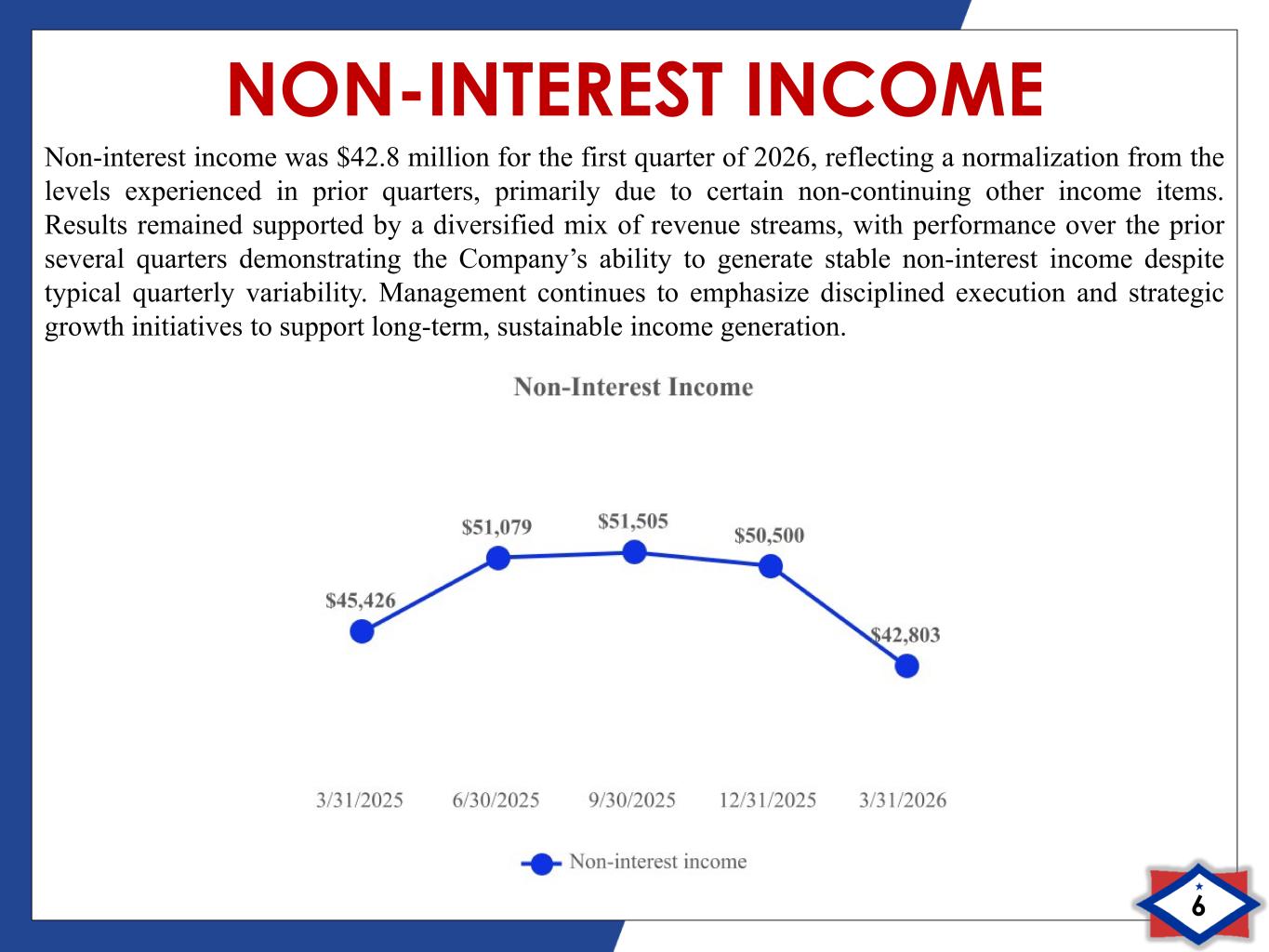
Yeah, I mean, you're right, because over the last four quarters, we've had somewhere between $4 and $5 million every quarter that's dropped down in this other income line item. and it's a whole variety of different events ranging from 5.7 million in the third quarter of last year to 3.9 million in the first quarter of last year, but this quarter we didn't have any of that.
Okay, so it's a good baseline to work off of and then, you know, expectation, and it's hoping that you see a trend upward. So, okay, perfect. Congrats on the quarter, and thanks for taking the question, guys. I appreciate it.
Operator
We have no further questions. I'll hand back to Mr. Allison for any final comments.
Yeah, thanks. It's been a long day. A lot of questions, a lot of answers. Thank you for your support. We'll continue to do our part, and hopefully we'll continue to run the 2% ROAs, and I see they beat us up a little bit on the stock today. They kind of hammered us on the stock, so I don't think we deserve to be off 3%, but it's an opportunity to buy, so it's a great opportunity to buy, so timing can be good for us. And that's it, because anybody else got anything else? Anybody else got anything? Thank you very much. It's 6 o'clock to you in 90 days.
Operator
Ladies and gentlemen, today's call is now concluded. Give us thanks for your participation. You may not just connect your lines.