Operator
Good day, and welcome to the Independent Bank Corp First Quarter 2025 Earnings Call. All participants will be in a listen-only mode. After today’s presentation, there will be an opportunity to ask questions. Before proceeding, please note that during this call, we will be making forward-looking statements. Actual results may differ materially from these statements due to a number of factors, including those described in our earnings release and other SEC filings. We undertake no obligation to publicly update any such statements. In addition, some of our discussion today may include references to certain non-GAAP financial measures. Information about these non-GAAP measures, including reconciliation to GAAP measures, may be found in our earnings release and other SEC filings. These SEC filings can be accessed via the Investor Relations section of our website. Finally, please also note that this event is being recorded. I would now like to turn the conference over to you, Jeff Tengel, Chief Executive Officer. Please go ahead.
Speaker 1
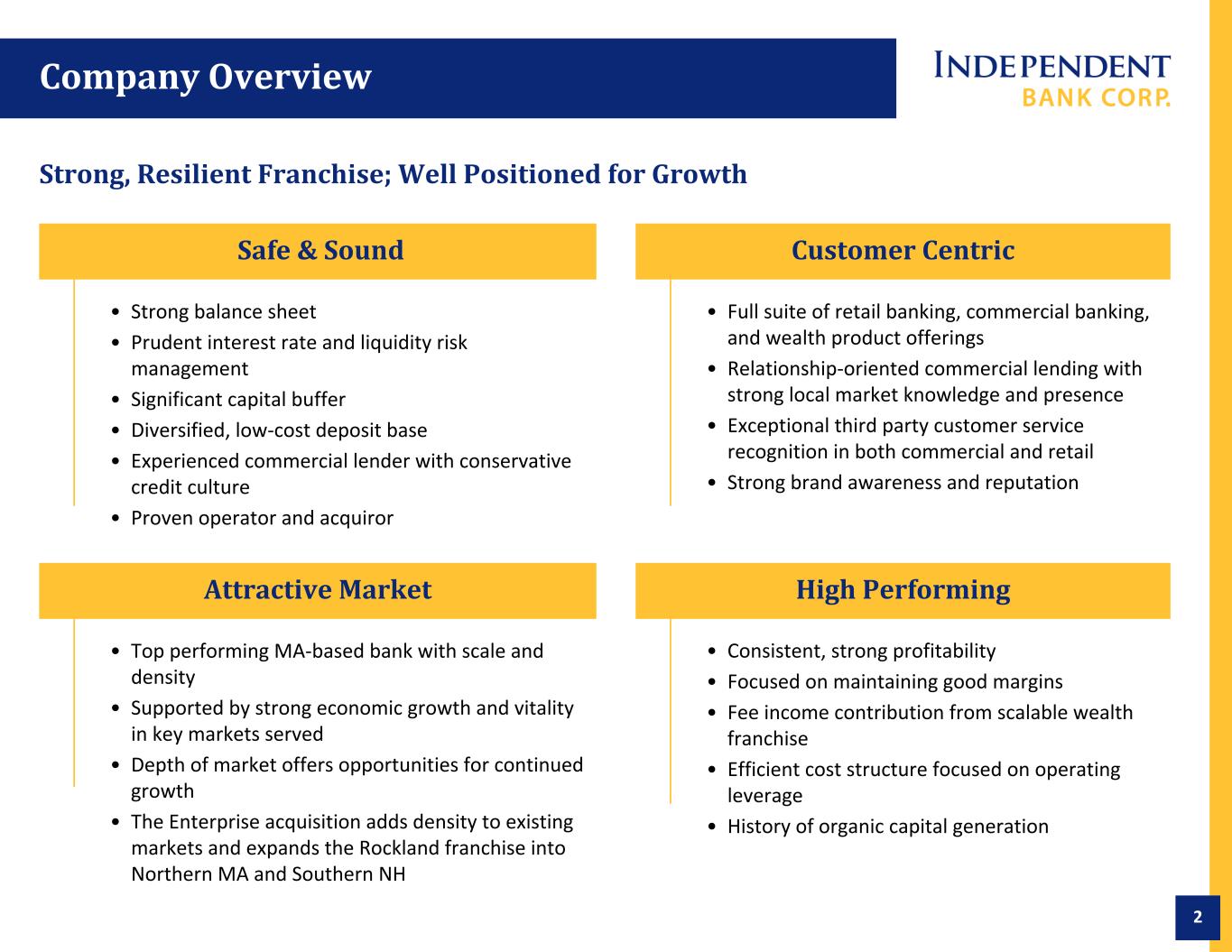
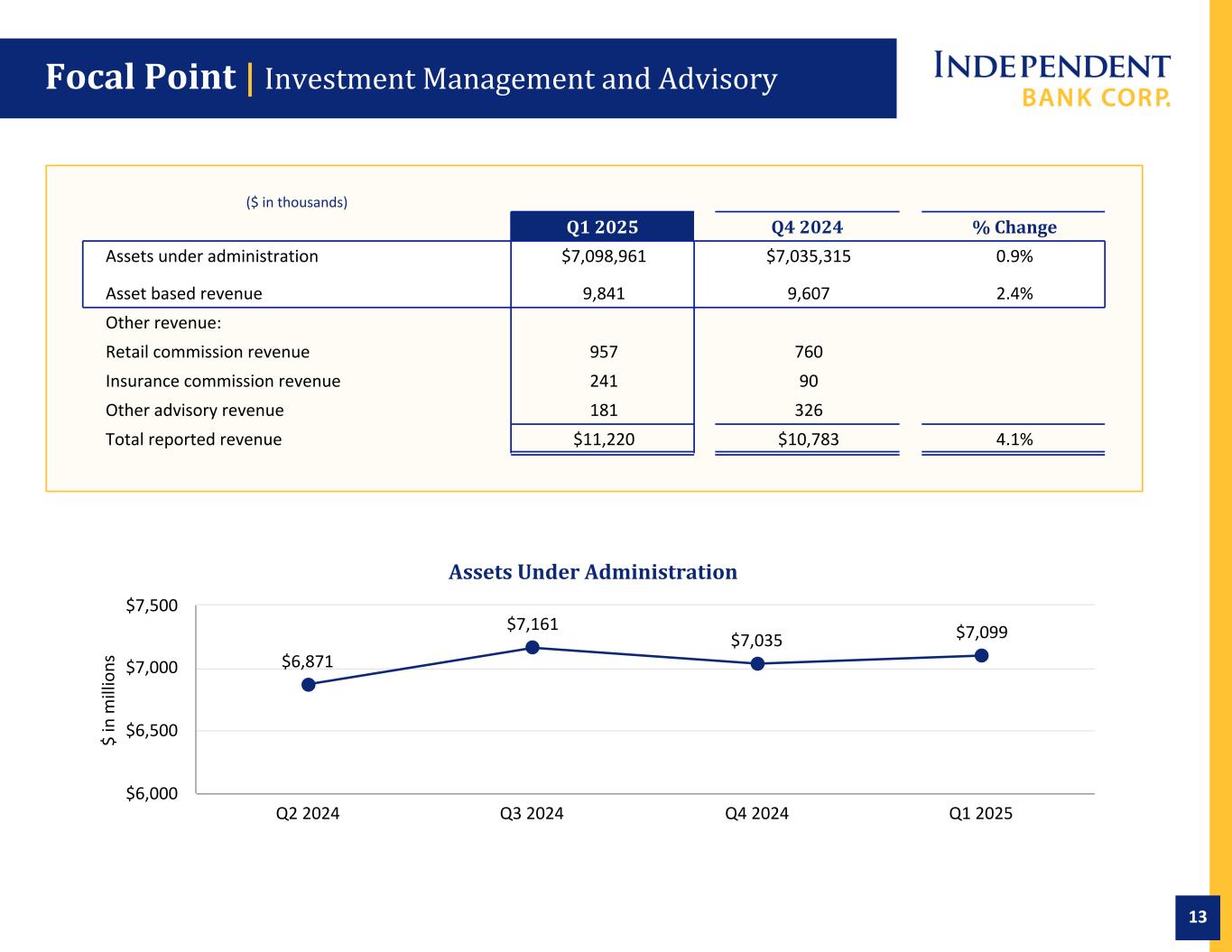
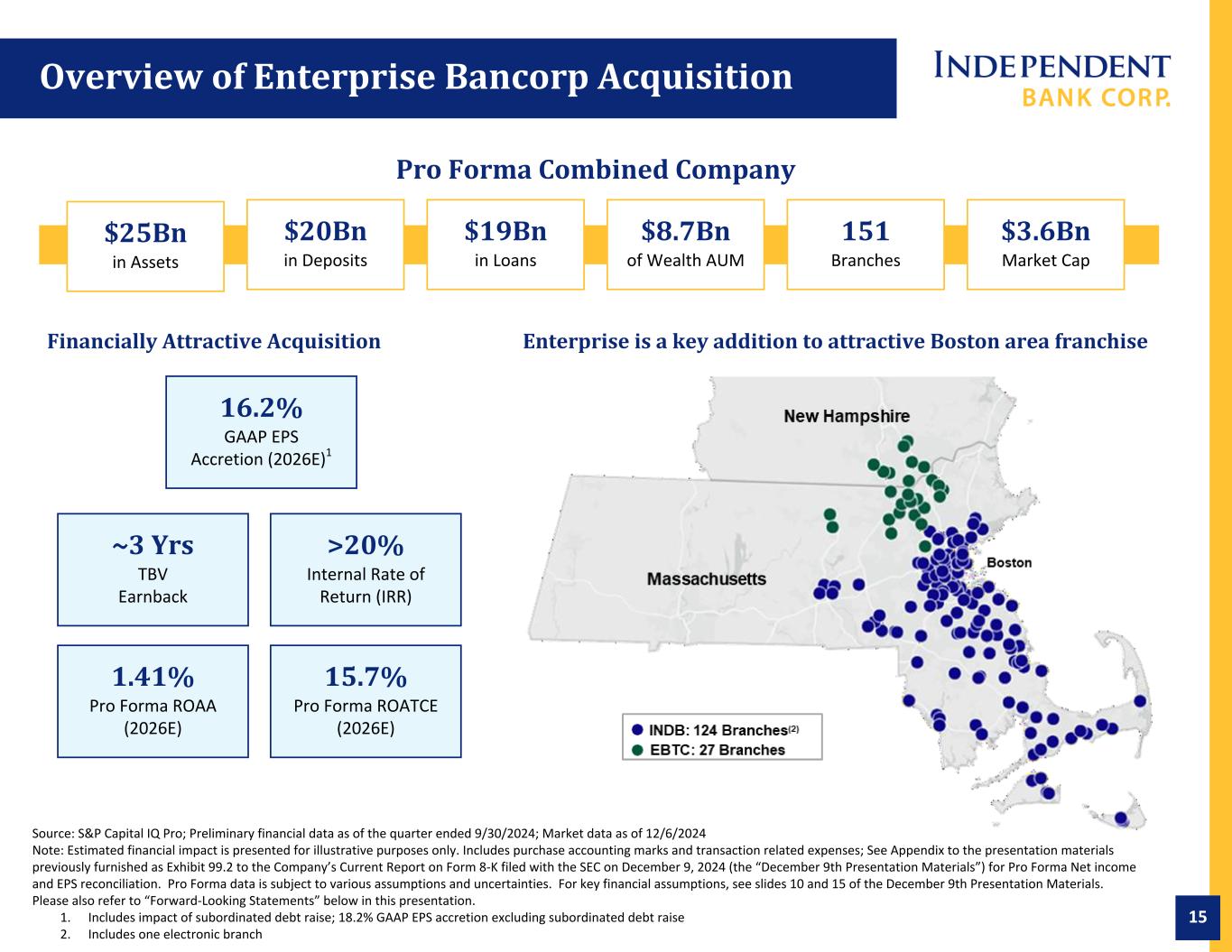
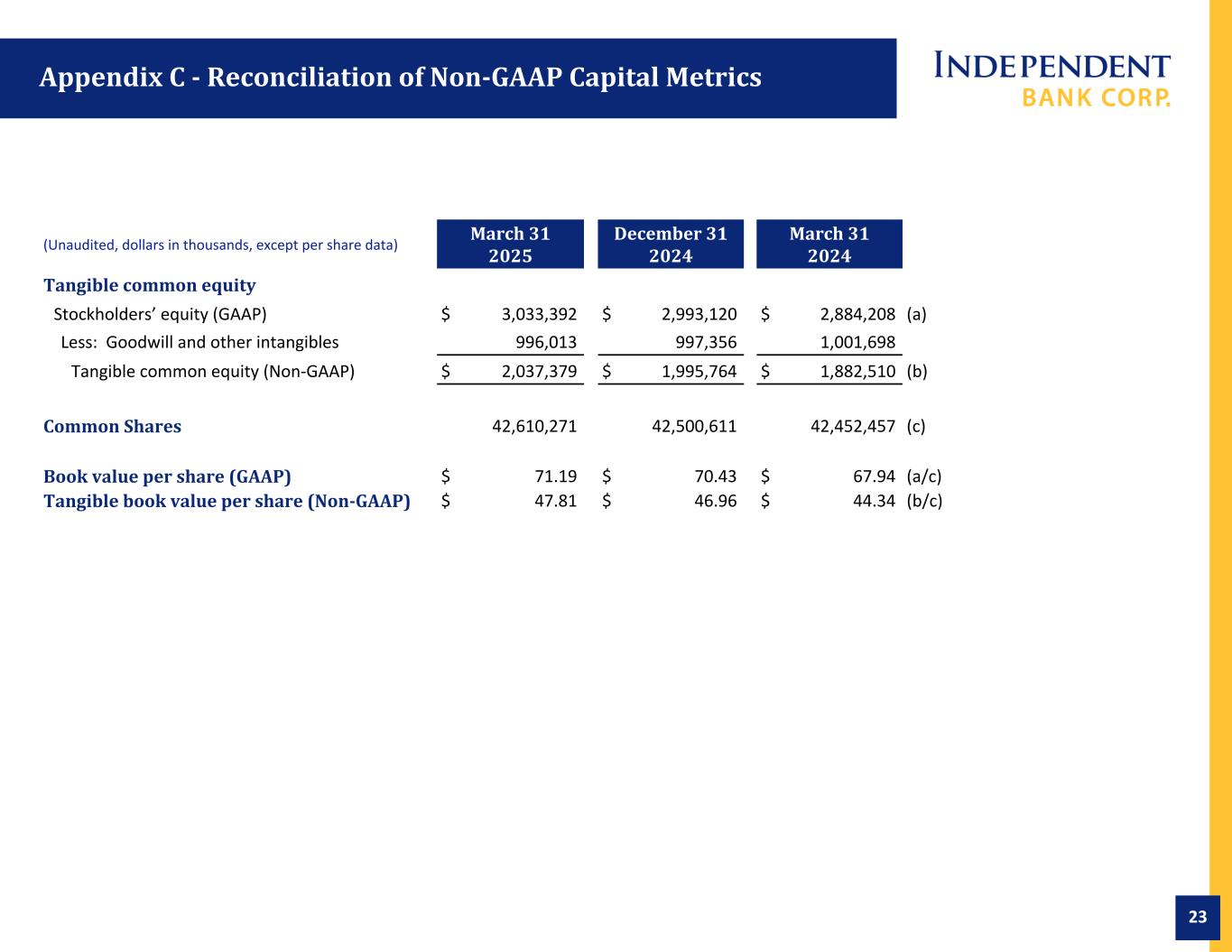
Thank you, and good evening, and thanks for joining us today. I'm accompanied this evening by CFO and Head of Consumer Lending, Mark Ruggiero. On a core operating basis, results for the first quarter were reflective of solid pre-provision net revenue growth offset by higher credit costs. PPNR growth was driven by net interest margin improvement, solid fee revenue results, and well-controlled expenses. Operating leverage was positive on both a linked-quarter and year-over-year basis. Our PPNR ROAA was 1.52% on an operating basis, and our tangible book value improved 1.8% from the fourth quarter and 7.8% from the year-ago quarter. Notwithstanding the operating results I just mentioned, credit costs for the first quarter were elevated as we continue to move through the resolution of several previously identified problem loans. We signaled last quarter that we expected our largest NPL to be resolved in the second quarter. It is still on track to do so. We had one other large NPL we thought would be resolved in the first quarter, which has slipped into the second quarter. Finally, as we signaled during our year-end earnings call, we have one large problem loan that moved to non-performing status in the first quarter. Mark will go into more detail during his comments, but we have not seen any material increase in our problem loans and feel that we have identified the significant stress loans and have a detailed action plan for each one of them. From a business perspective, clearly the combined impact of tariffs and other potential federal government actions has increased economic uncertainty. While it is too early to tell what the impact of the tariffs will be or what the tariffs are for that matter, most of the clients I've spoken to are taking a wait-and-see approach. The lack of certainty is causing them to pause any significant expansion or growth initiatives at the moment as they assess the economic landscape. Despite the noise, we made solid progress on several of our key strategic priorities in the first quarter. We continue to reduce our commercial real estate concentration. C&I and small business loans were up 2.1% and 2.6%, respectively in the first quarter. Conversely, CRE and construction loan balances were down 1.2% due to normal amortization, the intentional reduction of transactional CRE business, and charge-offs. As we have said in the past, we will continue to reduce transactional CRE business and free up capacity to support our legacy commercial real estate relationships. Mark will provide more detail later on about our successful $300 million sub-debt raise, but that's going to lead to an expected pro forma CRE concentration slightly north of 300%, inclusive of the impact of the Enterprise acquisition. Continuing the shift towards C&I, over the past year, we've added seven C&I bankers, increasing the total to 31, reflecting the desirability of our platform and the award-winning culture of Rockland Trust. In addition, two recent hires include a highly respected and very experienced individual as our Regional Manager for middle-market C&I and Specialty Banking and an experienced international banker to lead our efforts in FX and trade finance. We expect both to make an immediate contribution. We continue to prepare for the closing of our pending acquisition of Enterprise. We expect the transaction will close in the third quarter of the year. The more time we spend with the Enterprise team, the more convinced we become about the strategic and financial merits of the deal. Importantly, a vast majority of customer-facing Enterprise employees have accepted offers to remain with Rockland Trust post-close, including 32 of Enterprise Bank's 33 commercial bankers who will remain post-close. Preparation for our core FIS processing platform upgrade scheduled for May of '26 is ongoing. The move to a new platform within the FIS ecosystem will improve our technology infrastructure, enhance efficiency, and support the future growth of the bank. We prudently grew deposits in the first quarter, which has been a historical strength of ours. Non-time deposits were up 2.8% year-over-year and 3.2% from the fourth quarter. In the first quarter, the cost of deposits was 1.56%, highlighting the immense value of our deposit franchise. Mark will provide additional color on our deposits in a few minutes. Finally, our Wealth Management business continues to be a key value driver. We grew our AUA by nearly 1% in the first quarter to $7 billion. Organic growth or net positive flows totaled $41 million in the quarter. IMG had positive returns in the first quarter despite the fact that the S&P 500 was down over 4%. Total Investment Management revenues increased 4% from the fourth quarter and nearly 13% from the first quarter of '24. This business works seamlessly with our retail and commercial colleagues to deliver a holistic experience that resonates with our clients. The breadth of these services provides one-stop shopping for our clients that includes not only investment management, but financial planning, estate planning, tax preparation, insurance, and business advisory services. This full suite of products is a differentiating factor for our wealth business. Enterprise Bancorp will add approximately $1.5 billion in AUA to our platform and offer additional cross-sell opportunities with our broader product offerings. Underscoring every measure of success is a talented team of engaged, passionate, and highly skilled colleagues focused on making a difference for the customers and communities we serve. That is why we are proud to be named a top place to work in Massachusetts by the Boston Globe for the 16th consecutive year. In addition, Rockland Trust was recently ranked number two in New England in the 2025 J.D. Power Retail Banking Satisfaction Study for the second straight year, underscoring our exceptional customer service. We remain confident about our abilities to navigate a volatile interest rate and economic environment. In times of uncertainty, we are fortunate to have an enviable deposit franchise, a strong liquidity position, and a robust capital base. We will continue to focus on those actions we have control over and look to capitalize on our historical strengths, which include a skilled and experienced management team, attractive markets, strong brand recognition, operating scale, a broad consumer, commercial and wealth customer base, and an energized and engaged workforce. In short, I believe we're well-positioned to realize the benefits of the Enterprise acquisition and continue to take market share in the Northeast. On that note, I'll turn it over to Mark.
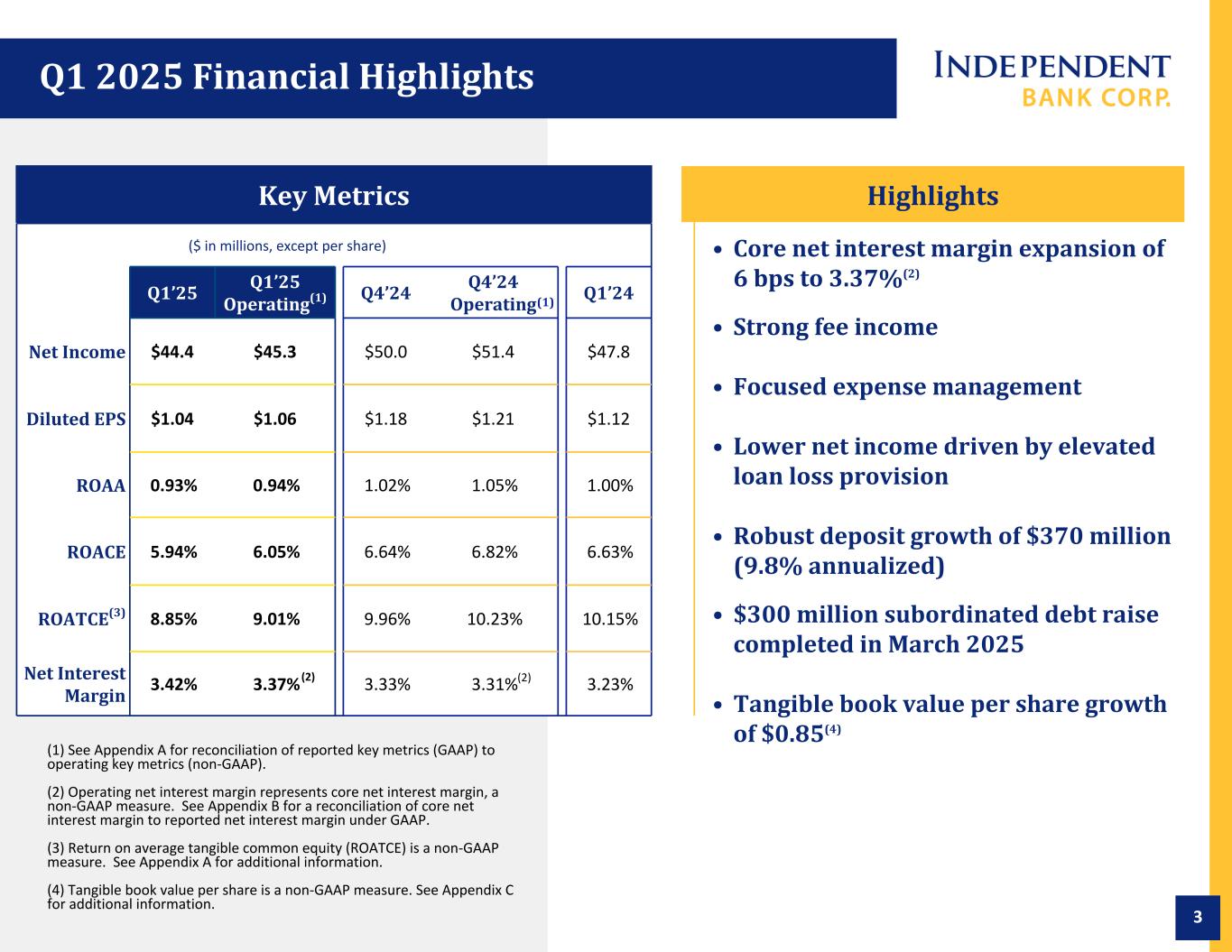
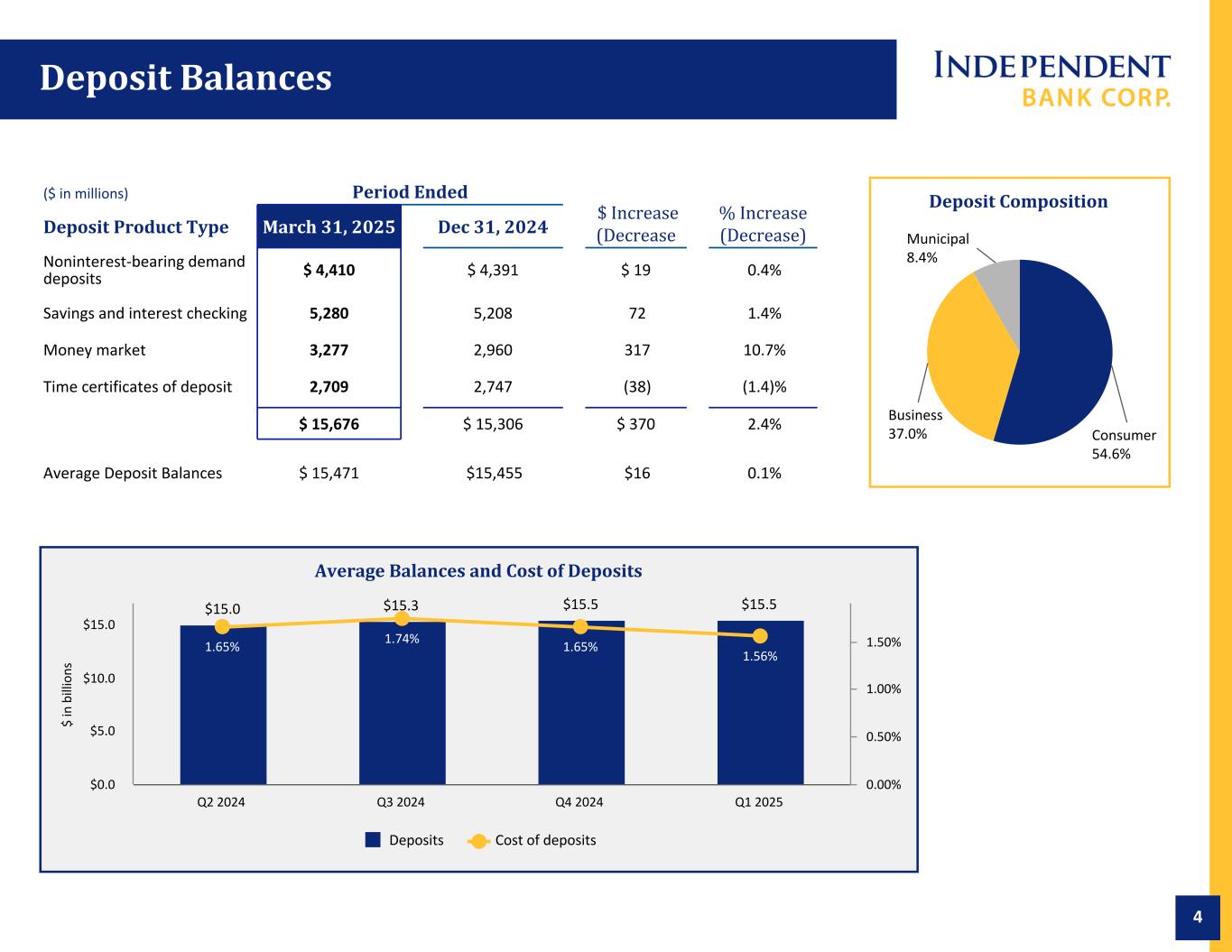
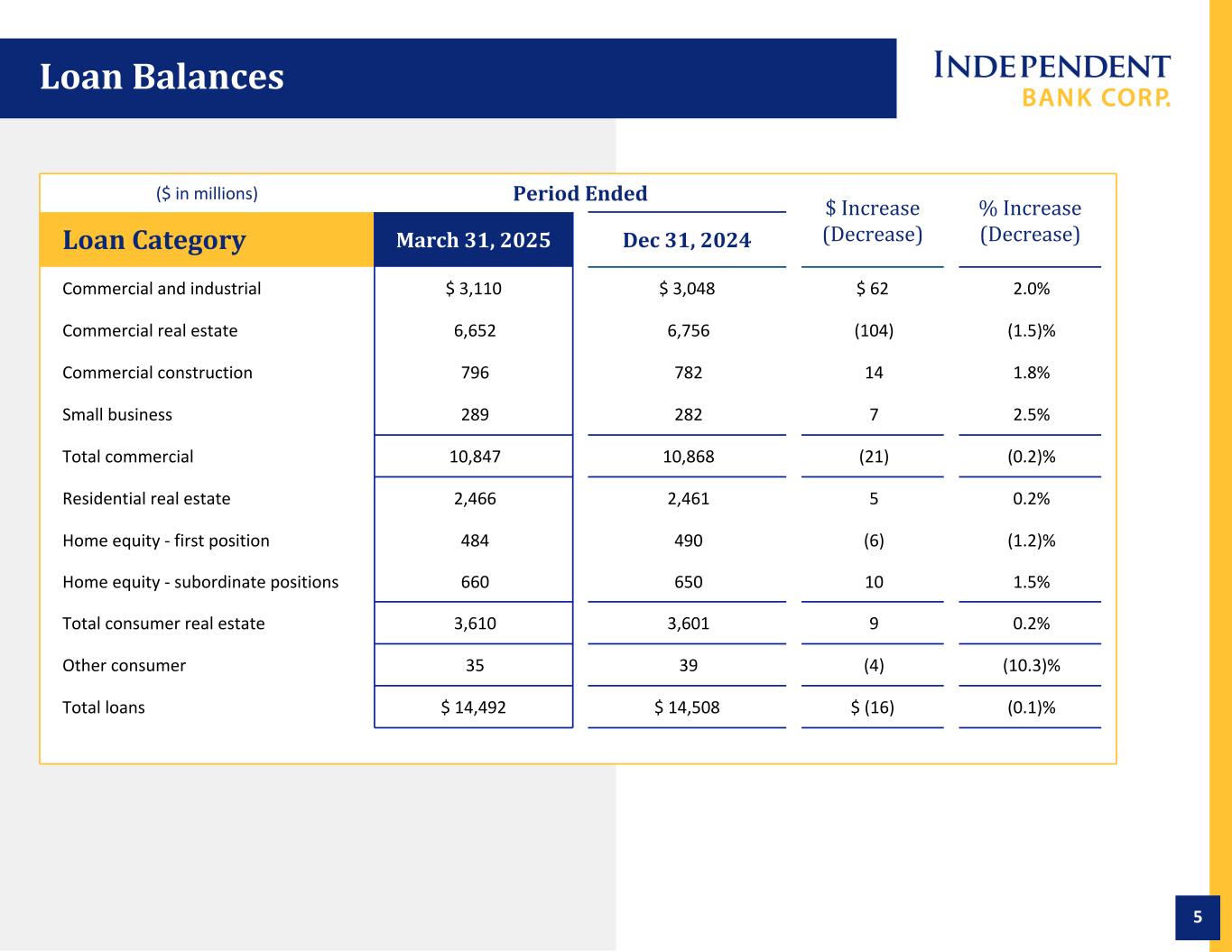
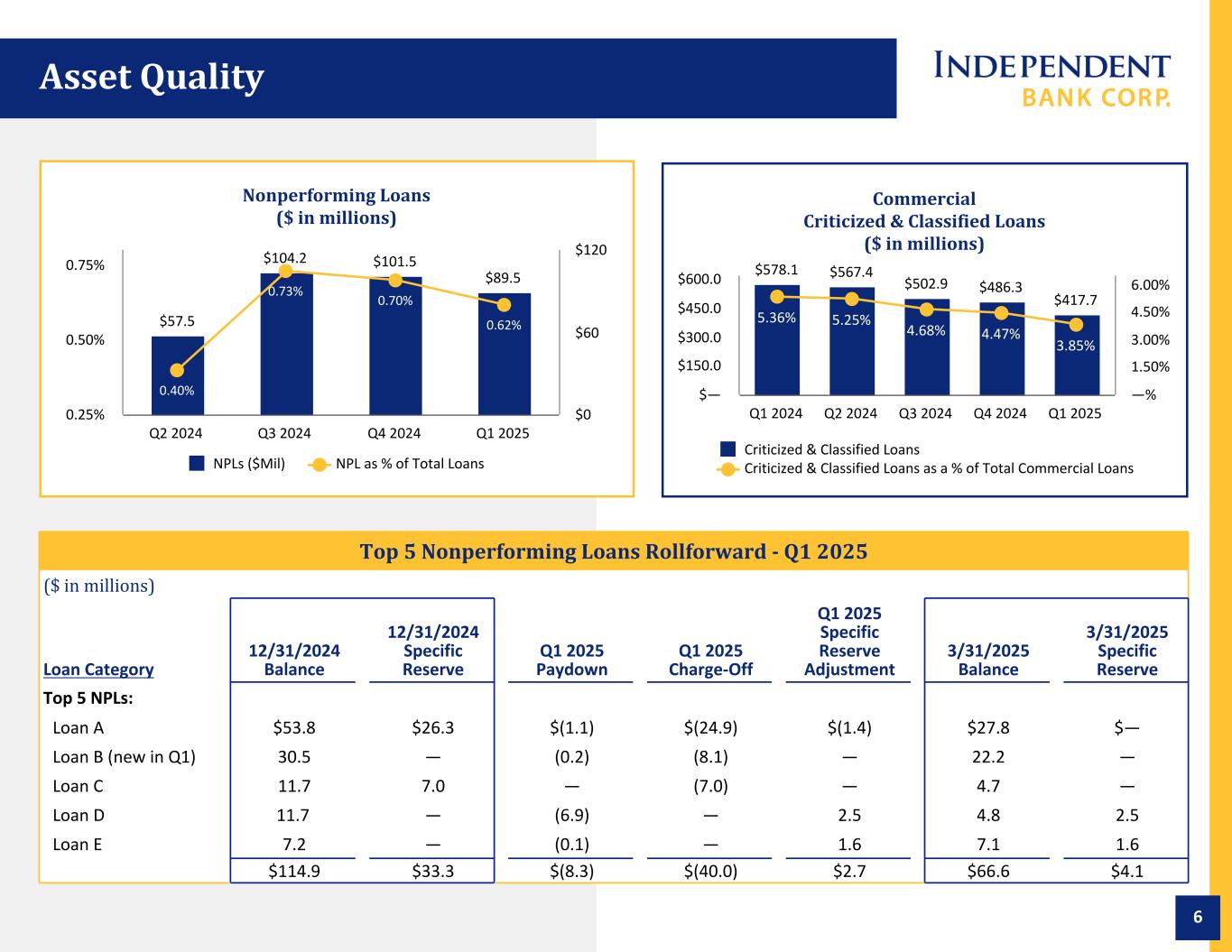
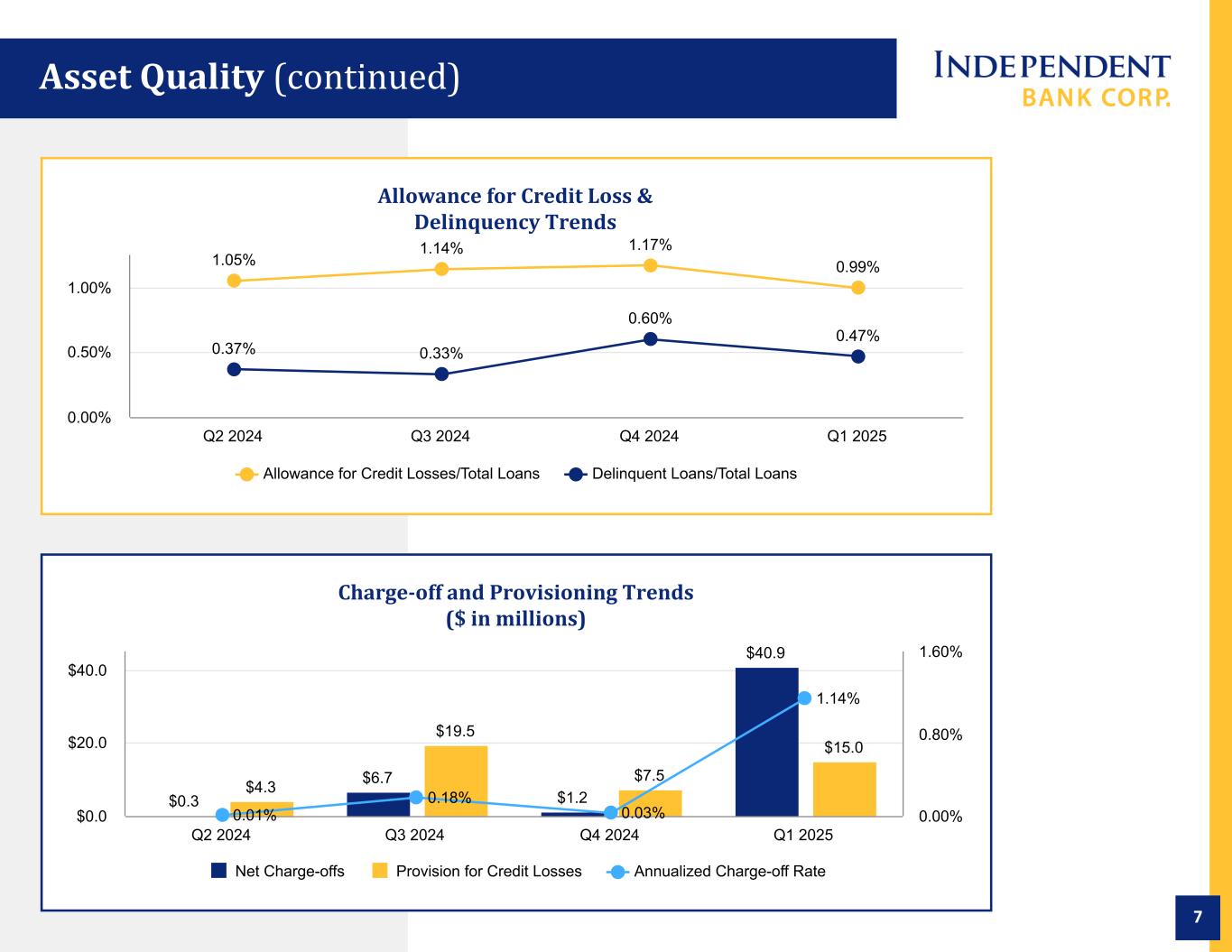
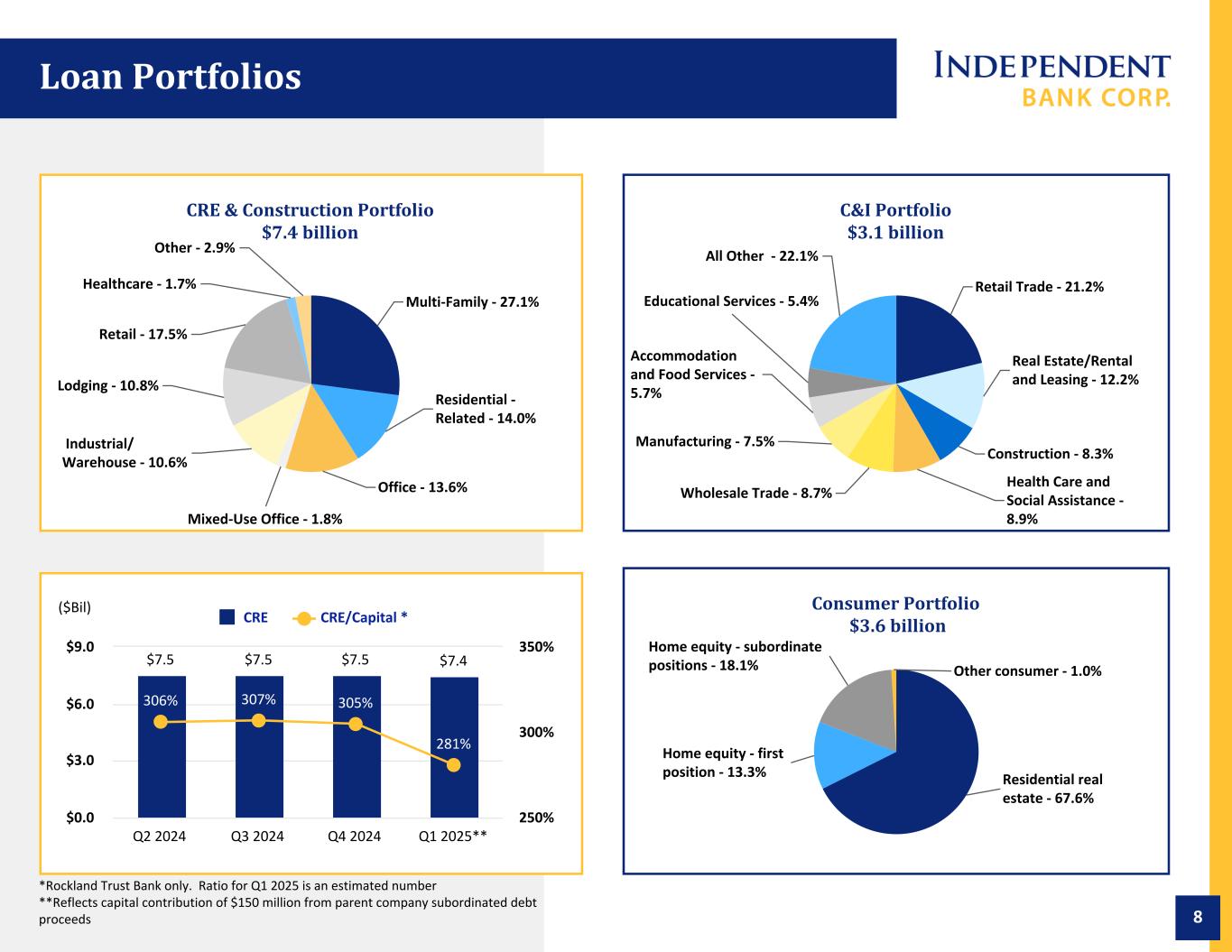
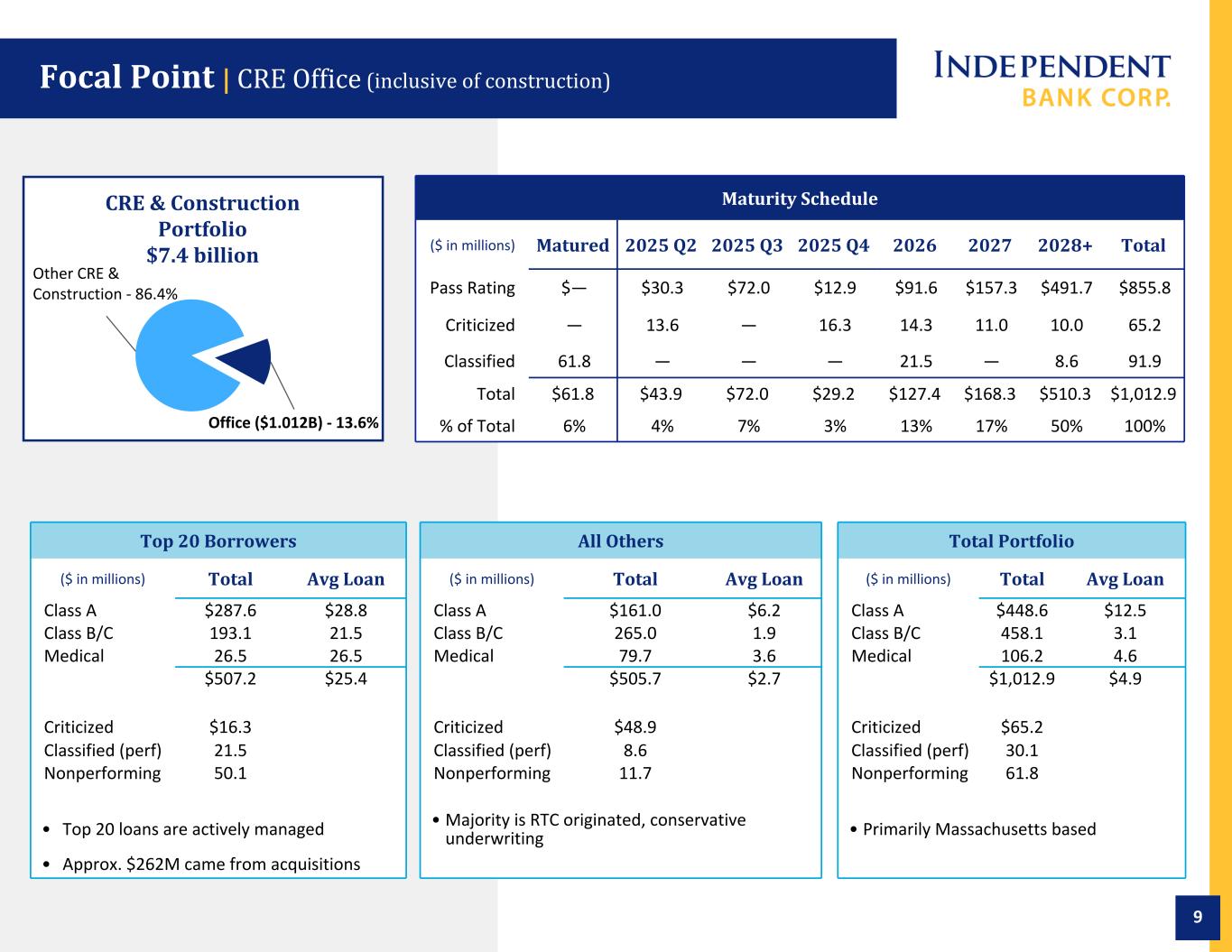
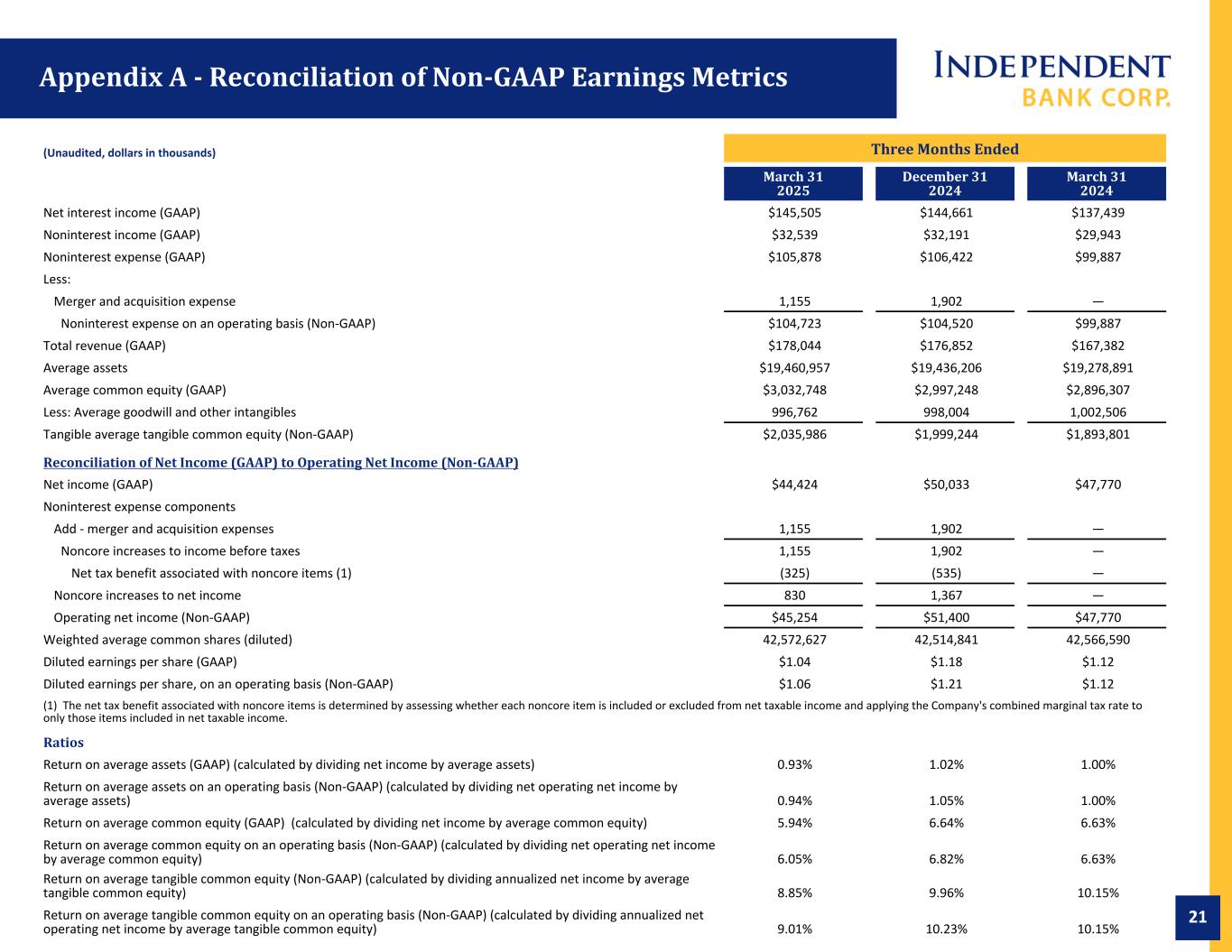
Thank you, Jeff. I will now take us through the earnings presentation deck that was included in our 8-K filing and is available on our website in today's investor portal. Starting on Slide 3 of the deck. 2025 first quarter GAAP net income was $44.4 million and diluted earnings per share was $1.04, resulting in a 0.93% return on assets, a 5.94% return on average common equity, and an 8.85% return on average tangible common equity. Excluding $1.2 million of merger and acquisition expenses and their related tax benefit, the adjusted operating net income for the quarter was $45.3 million or $1.06 diluted EPS, representing a 0.94% return on assets, a 6.05% return on average common equity and a 9.01% return on average tangible common equity. The results are driven largely by strong core fundamentals, which were in line with expectations with elevated provision for loan loss impacted by a few credits that I'll cover in detail shortly. In addition, as Jeff mentioned, tangible book value per share increased by $0.85 during the quarter, reflecting solid earnings retention and a $0.47 benefit from other comprehensive income. Turning to Slide 4, highlighting a key component of our core fundamentals. Deposit activity was very positive for the first quarter, which as a reminder, has historically been subject to some level of seasonality, which typically challenges growth in the first quarter. Despite that, average deposits increased modestly, while period-end balances increased by $370 million or 2.4% for the quarter with non-maturity consumer, business, and municipal all increasing in the quarter, while the CD portfolio contracted slightly. The overall mix of deposits remains very stable with non-interest-bearing DDA comprising 28.1% of total deposits at quarter-end. We continue to view our environment to grow core deposits favorably, as we have the depth and breadth of products to compete with the national players, combined with a high-touch community bank customer service experience. Moving to Slide 5. Total loans stayed relatively flat for the quarter as expected. As Jeff alluded to earlier, recent hires and strategic emphasis on full service C&I relationships led to a 2% or 8% annualized increase in C&I balances, while total CRE and construction decreased by 1.2%. On the consumer side, total consumer real estate balances reflected modest growth with mortgage activity split between saleable and portfolio volume, while home equity demand remained strong. Turning now to Slide 6. We point out that total commercial criticized and classified loans decreased to 3.8% of total commercial loans, with paydowns and charge-offs driving the overall reduction. I'll now walk through some key first quarter updates regarding the largest non-performing loans noted on this slide. The $54 million office loan remains on track for resolution through a property sale, which is expected to close in late second quarter. As such, during the first quarter, we charged off $24.9 million, which represents the difference between the expected net proceeds versus the carrying value. The charge-off amount was slightly less than the previously established specific reserve. Second is another large loan that we discussed had reached maturity last quarter. This is a $30 million syndicated office loan in Downtown Boston, which migrated to non-performing status during the first quarter. The bank group is in the process of working through a potential loan modification with the borrower, however, we felt it was appropriate at this time to charge-off the balance down to its appraised value, resulting in an $8.1 million charge-off during the quarter. The next loan on this slide is an office loan that is also in the process of a note sale with an identified buyer. Based on the negotiated offer and expectations for a second quarter close, we charged off $7 million during the quarter, which was equal to the specific reserve that had already been set up in the prior quarters. The next loan is a C&I relationship that remains in a collateral liquidation process. During the first quarter, $6.9 million of paydowns were received, reducing the carry-in amount to $4.8 million. And based on estimated net proceeds on remaining collateral sales, an additional $2.5 million of a specific reserve was established in the quarter. And lastly, the final loan on the slide is an office loan that is being marketed for sale with an updated appraisal liquidation value supporting an additional $1.6 million reserve in the first quarter. As noted on Slide 7, reflecting the impact of the large moving pieces I just described, provision for loan loss for the quarter was $15 million, as a significant portion of the Q1 charge-offs related to loans with previously established reserves. And as such, the allowance as a percentage of loans decreased to 99 basis points at quarter-end. In addition to the allowance levels, the company increased its Tier 2 capital despite the market volatility experienced in the last month. We continue to believe our strong levels of total capital give us significant flexibility to be opportunistic in any major capital actions going forward, whether it be to support accelerated organic growth in the newer markets, additional M&A opportunities further down the road, or share repurchase activity. Slides 8 through 10 provide additional detail on our loan portfolio composition, with the notable developments for the quarter that I just discussed.
Operator
Pardon me, ladies and gentlemen, it appears we have lost connection to our speaker line. Please stand by while we reconnect. Thank you for your patience.
Thank you. We apologize for that. We're not sure what happened there on the disconnection, but I believe we may have lost connection on Slide 4. So I apologize if I'll recover ground here that didn't maybe come through, but we'll start there. So on Slide 4, highlighting a key component of our core fundamentals, deposit activity was very positive for the first quarter, which as a reminder, has historically been subject to some level of seasonality, which typically challenges growth in the first quarter. Despite that, average deposits increased modestly, while period end balances increased by $370 million or 2.4% for the quarter, with non-maturity consumer, business, and municipal all increasing in the quarter, while the CD portfolio contracted slightly. The overall mix of deposits remains very stable with non-interest-bearing DDA comprising 28.1% of total deposits at quarter end. We continue to view our environment to grow core deposits favorably, as we have the depth and breadth of products to compete with the national players, combined with a high-touch community bank customer service experience. Moving to Slide 5. Total loans stayed relatively flat for the quarter as expected. As Jeff alluded to earlier, recent hires and strategic emphasis on full service C&I relationships led to a 2% or 8% annualized increase in C&I balances, while total CRE and construction decreased by 1.2%. On the consumer side, total consumer real estate balances reflected modest growth with mortgage activity split between saleable and portfolio volume, while home equity demand remained strong. Turning now to Slide 6, we point out that total commercial criticized and classified loans decreased to 3.8% of total commercial loans, with paydowns and charge-offs driving the overall reduction. I'll now walk through some key first quarter updates regarding the largest non-performing loans noted on this slide. The $54 million office loan remains on track for resolution through a property sale, which is expected to close in late second quarter. As such, during the first quarter, we charged off $24.9 million, which represents the difference between the expected net proceeds versus the carrying value. The charge-off amount was slightly less than the previously established specific reserve. Second is another large loan that we discussed had reached maturity last quarter. This is a $30 million syndicated office loan in Downtown Boston, which migrated to non-performing status during the first quarter. The bank group is in the process of working through a potential loan modification with the borrower, however, we felt it was appropriate at this time to charge-off the balance down to its appraised value, resulting in an $8.1 million charge-off during the quarter. The next loan on this slide is an office loan that is also in the process of a note sale with an identified buyer. Based on the negotiated offer and expectations for a second quarter close, we charged off $7 million during the quarter, which was equal to the specific reserve that had already been set up in the prior quarters. The next loan is a C&I relationship that remains in a collateral liquidation process. During the first quarter, $6.9 million of paydowns were received, reducing the carry-in amount to $4.8 million. And based on estimated net proceeds on remaining collateral sales, an additional $2.5 million of a specific reserve was established in the quarter. And lastly, the final loan on the slide is an office loan that is being marketed for sale with an updated appraisal liquidation value supporting an additional $1.6 million reserve in the first quarter. As noted on Slide 7, reflecting the impact of the large moving pieces I just described, provision for loan loss for the quarter was $15 million, as a significant portion of the Q1 charge-offs related to loans with previously established reserves. And as such, the allowance as a percentage of loans decreased to 99 basis points at quarter end.
Operator
Pardon me, this is the conference operator. It appears we have lost connection to our speaker line. Please stand by while we reconnect. Thank you for your patience.
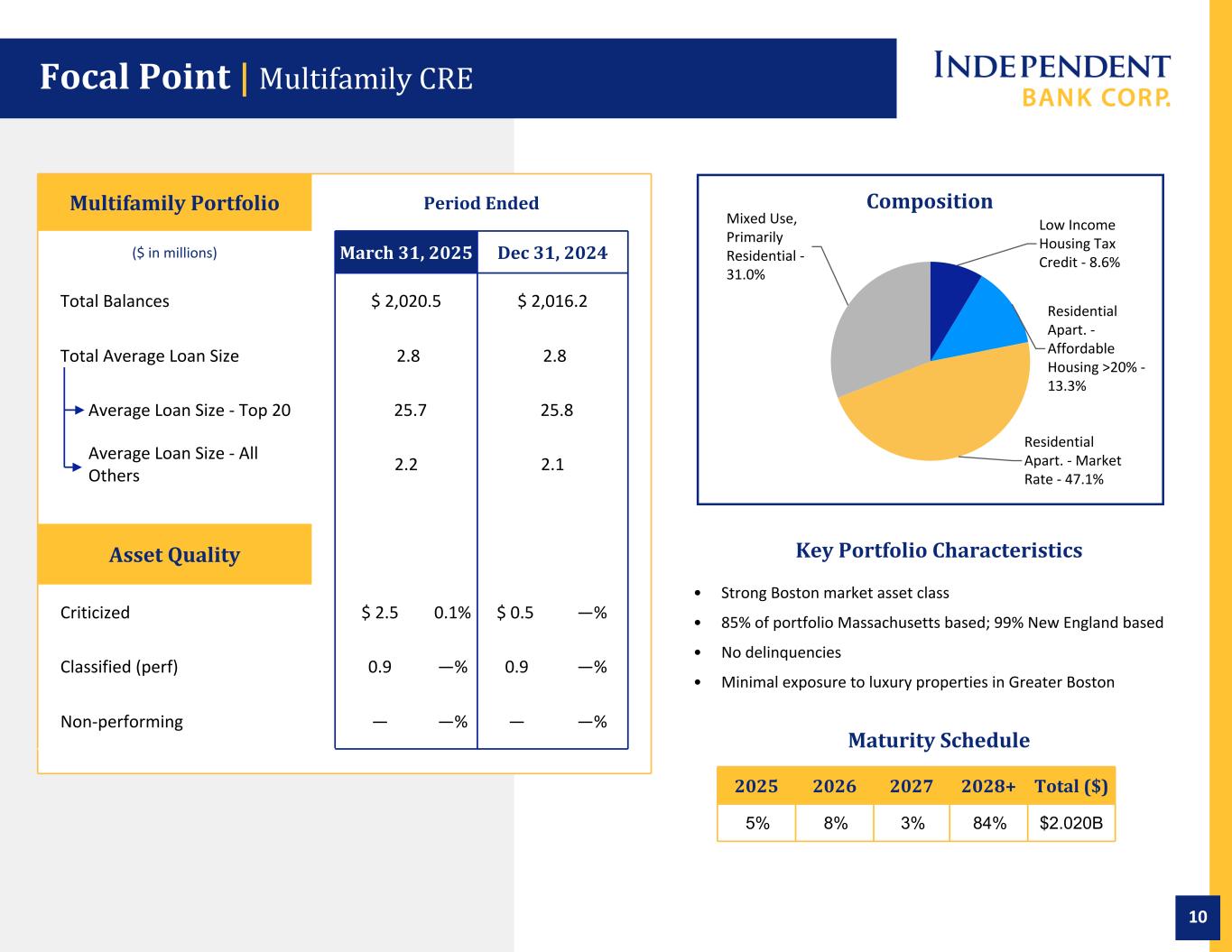
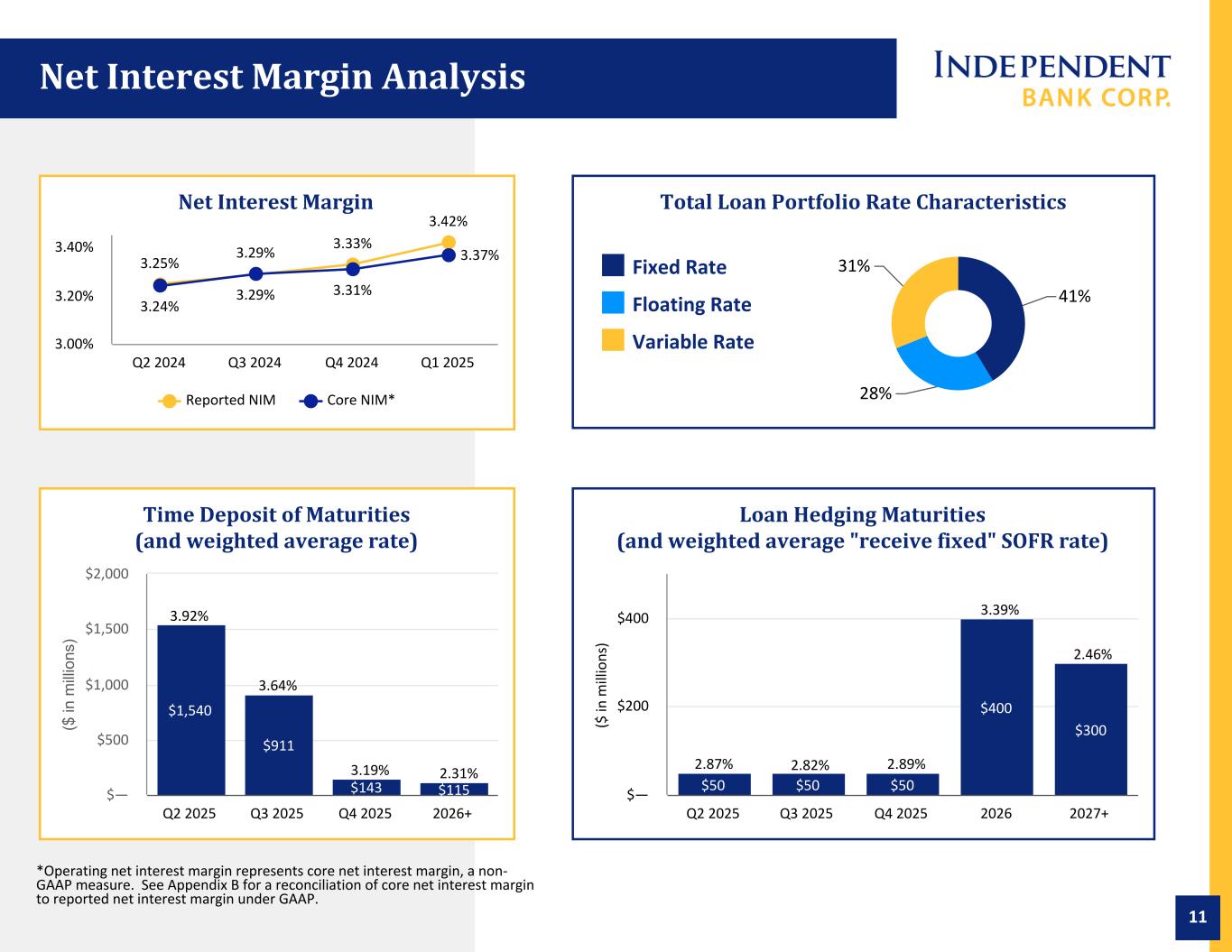
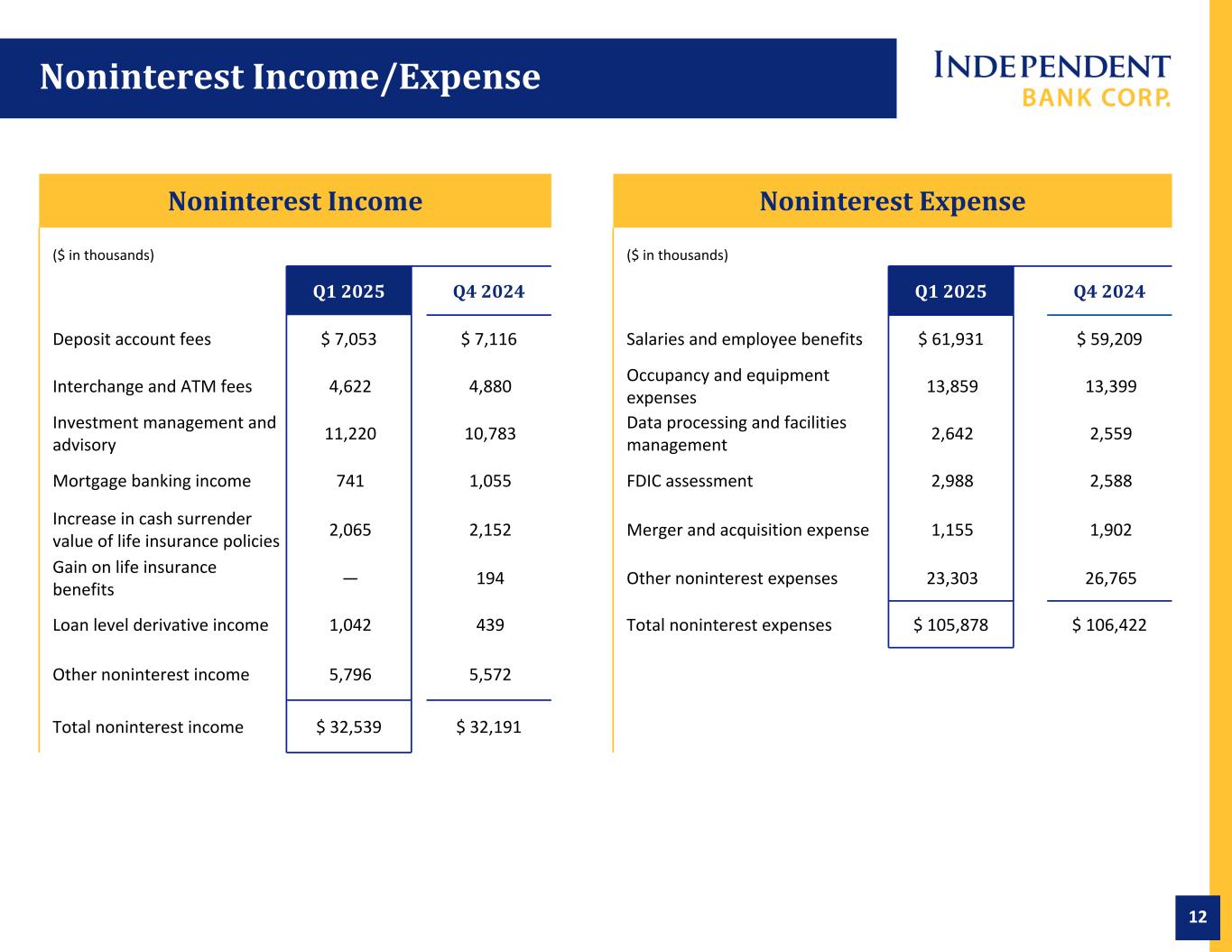
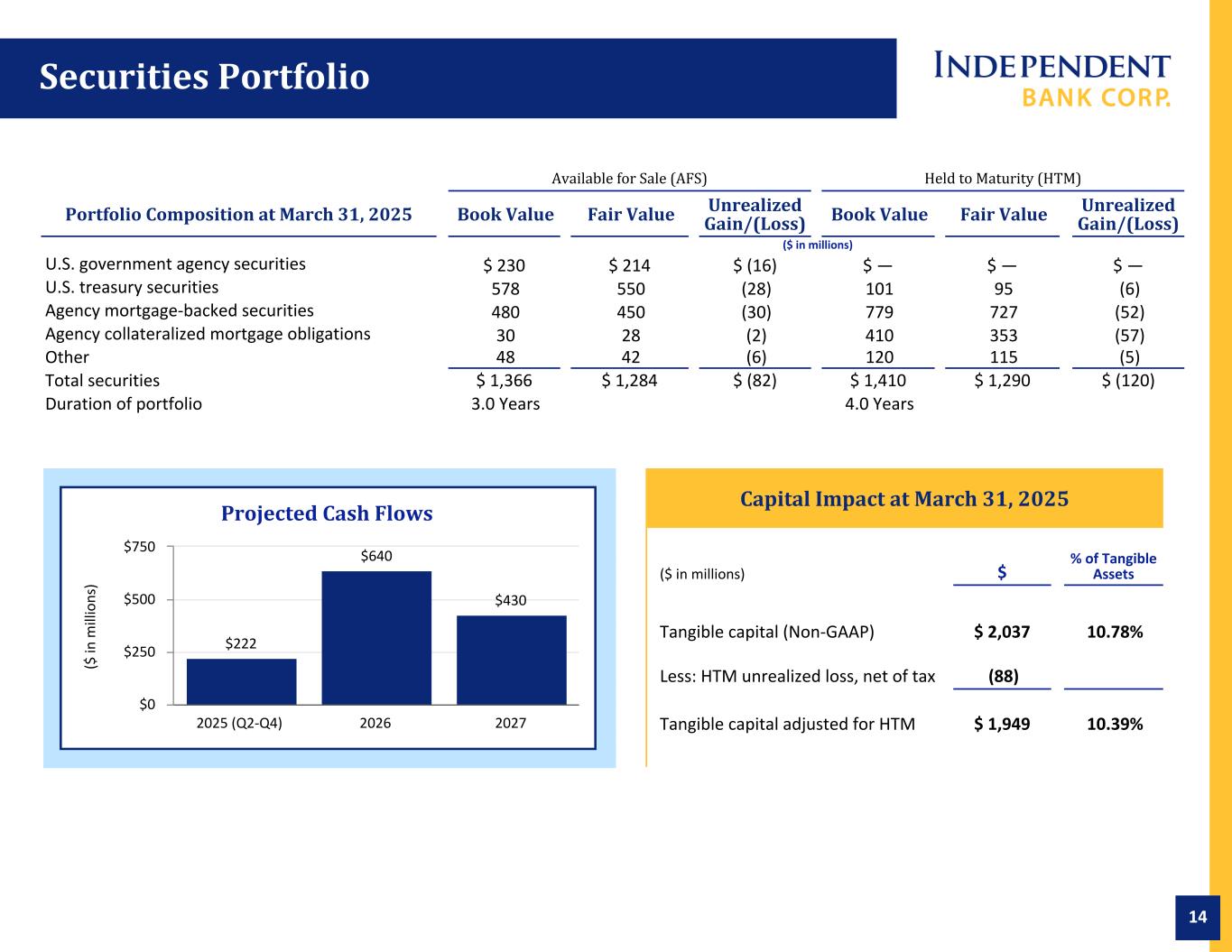
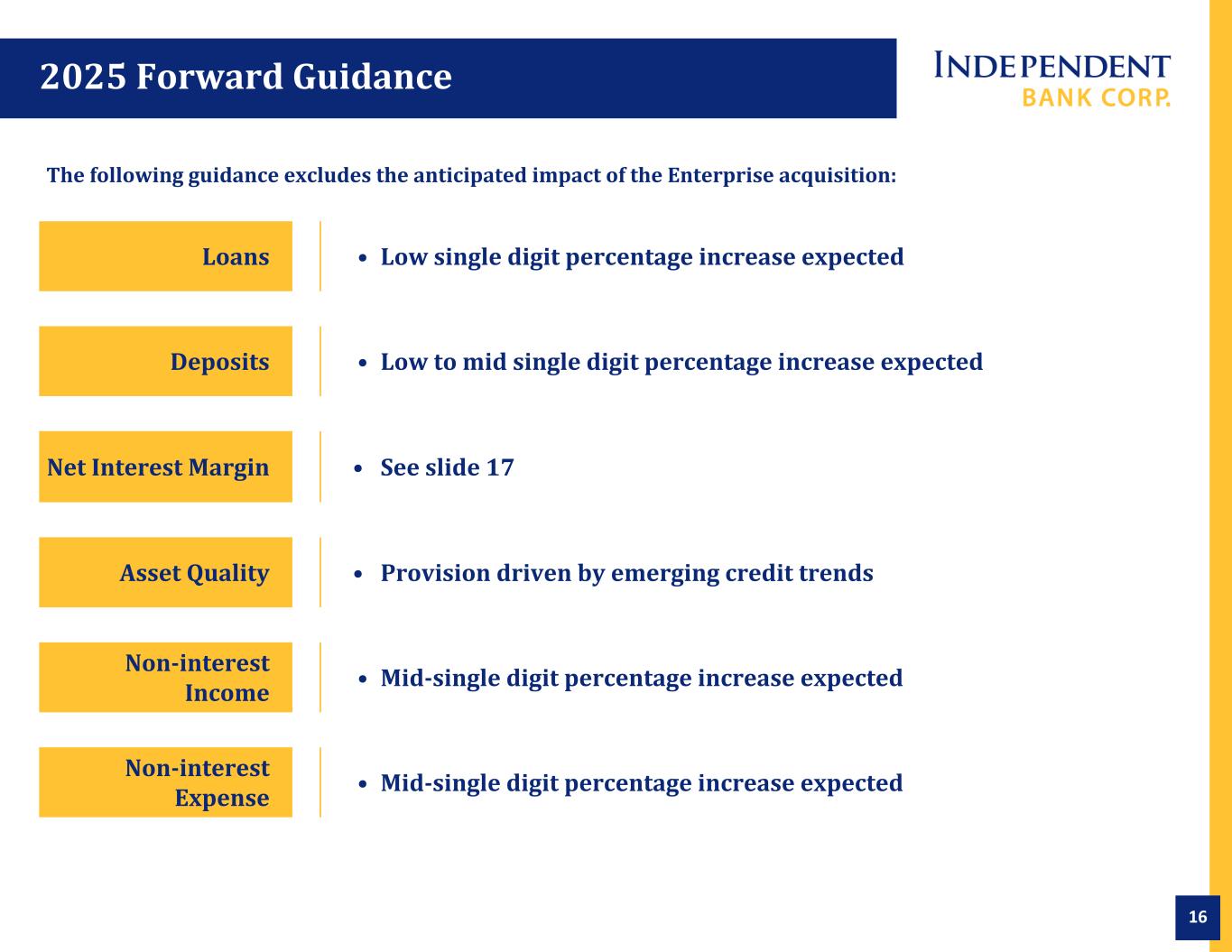
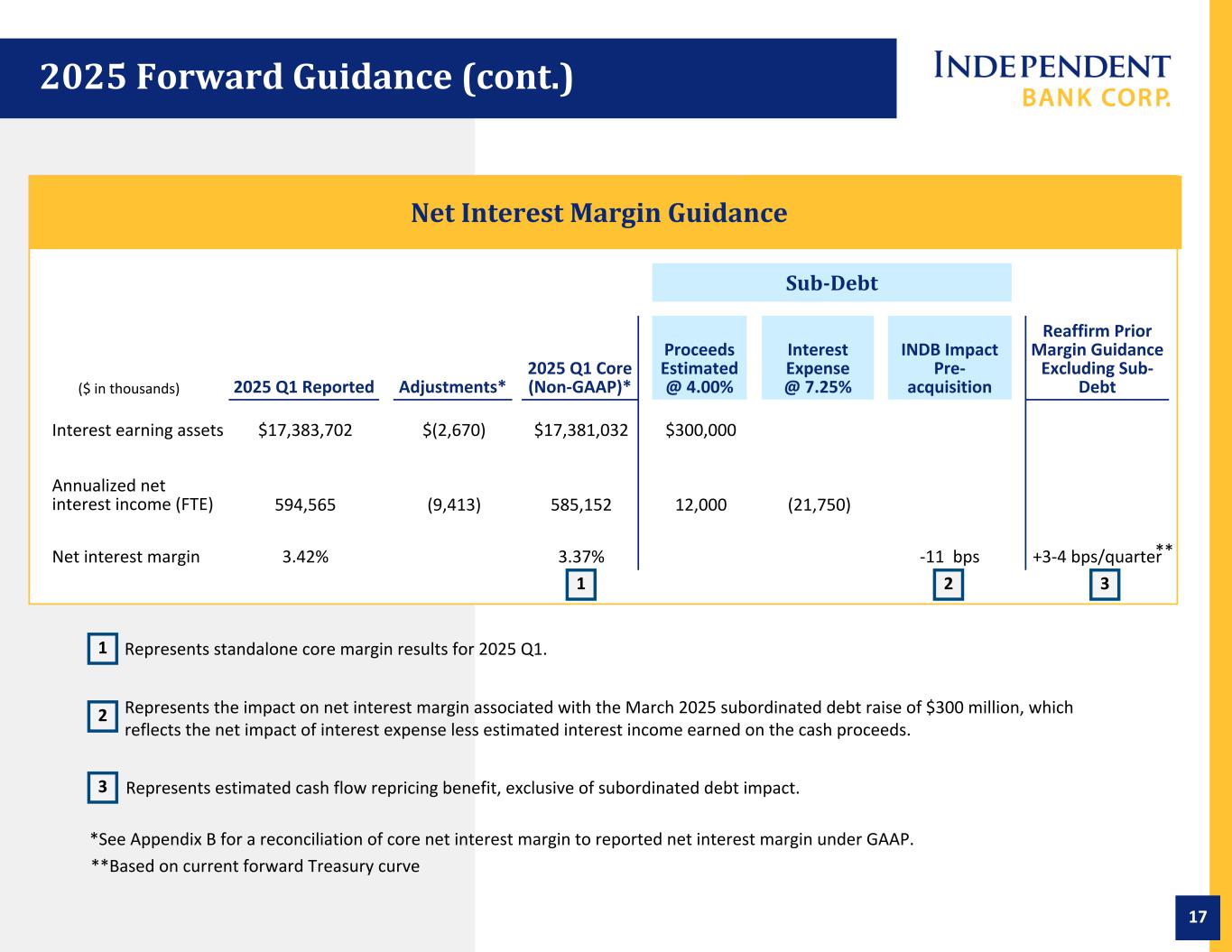
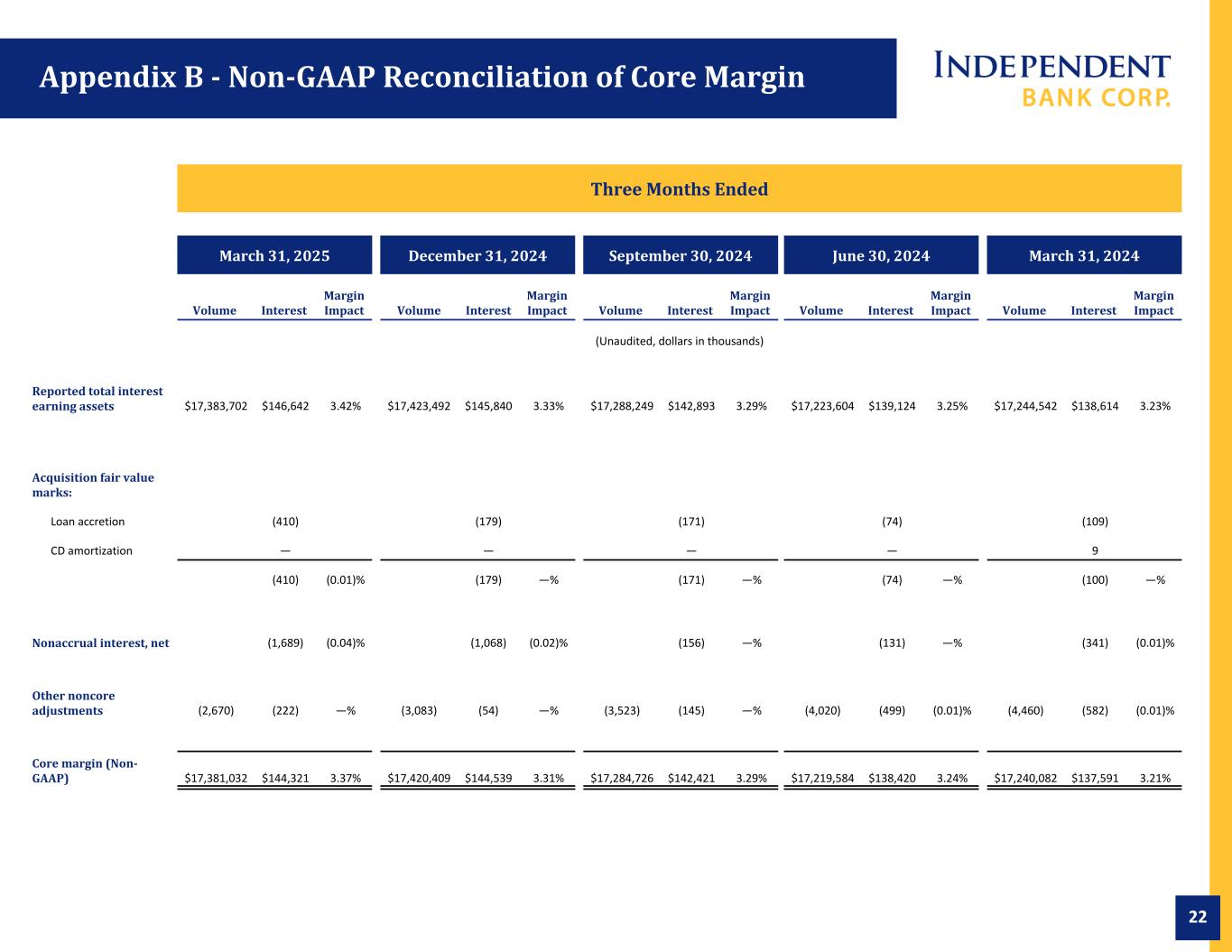
Again, apologies for that. Not sure what the issue is here, and I’m not sure where the cutoff went. So I'm going to pick back up. Hopefully, you all heard the updates on the individual credits, but we can certainly cover that in Q&A if that got cut out. But why don’t we start? Just adding some color, during the quarter, we did increase Tier 2 capital with a $300 million subordinated debt raise, which closed in late March. With the upcoming Enterprise acquisition expected to push our commercial real estate concentration a bit higher, we were pleased to be able to execute on this debt raise to shore up additional capital despite the market volatility experienced in the last month. We continue to believe our strong levels of total capital give us significant flexibility to be opportunistic in any major capital actions going forward, whether that be to support accelerated organic growth in newer markets, additional M&A opportunities further down the road, or share repurchase activity. Slides 8 through 10 provide additional detail on the loan portfolio composition, with the notable developments for the quarter that I just discussed. The net interest margin on an FTE reported basis improved 9 basis points in the first quarter to 3.42% with the FTE core margin of 3.37%, up 6 basis points, which excludes outsized benefit from interest recoveries on payoffs and purchase accounting accretion. The first quarter margin improvement reflects two high-level drivers of our interest rate risk profile. First, we remain relatively neutral to Federal Reserve actions impacting the short end of the curve. And second, we remain asset-sensitive to the middle and long-end of the curve with cash flow repricing dynamics and hedge maturities expected to improve both securities and loan yields as evidenced in the first quarter. Moving to Slide 12. Non-interest income increased modestly in the first quarter despite fewer business days versus the prior quarter, with wealth management income results weathering the volatile market storm nicely as well as increased loan-level swap income as compared to the prior quarter. In addition, total expenses, when excluding merger and acquisition costs, stayed relatively flat with the prior quarter. Some key changes for the quarter include normal increases in payroll taxes in the first quarter, approximately $1 million of snow removal costs within occupancy and equipment. And within other non-interest expenses, we saw reduced consulting expenses and unrealized losses on equity securities versus the prior quarter. And lastly, the tax rate for the quarter was approximately 22.3%, up from the prior quarter, which, as a reminder, benefited from the statutory release of $1.2 million in uncertain tax positions. In closing out my comments, I'll turn to Slides 16 and 17 for an update on our full year 2025 guidance. As Jeff mentioned, with an expectation for a third quarter Enterprise Bancorp closing, we reaffirm the high-level results as presented at announcement, but the caveat being the uncertainty for fair value adjustment impact depending on the rate environment at closing. The rest of the guidance I'll provide now relates to Independent Bank Corp as a standalone entity. In terms of loan and deposit growth, we anticipate a low single-digit percentage increase in loans for the full year, while reaffirming low to mid-single digit growth for deposits for the year. Regarding asset quality, we anticipate resolution of the larger non-performing assets already discussed with the provision for loan loss driven by any loss emergence not already identified. Although we feel we have identified and fully reserved for the highest risk loans in our portfolio, we feel it is appropriate to pull specific provision for loan loss guidance given the increasing uncertainty over broader economic conditions. For non-interest income and non-interest expense, we reaffirm our mid-single digit percentage increases for full year 2025 versus 2024. And as a reminder for non-interest expense guide, this does not include expected merger and acquisition expenses associated with the Enterprise acquisition. Regarding the net interest margin, there are certainly a lot of moving pieces, and as such, I would point to Slide 17 to provide some additional detail over those moving pieces. First, to link back to prior guidance and as noted on the right side of this chart, we reaffirm the Independent Bank Corp standalone guidance of 3 basis points to 4 basis points of margin expansion each quarter. However, that guidance is now impacted by the March subordinated debt raise, which we anticipate will reduce the standalone margin by about 11 basis points. But circling back to the 3 basis points to 4 basis points expansion excluding the sub-debt, there are also a couple of caveats worth noting. First, our neutral position on the short end of the curve incorporates some level of margin benefit from reduced time deposit pricing. So, any future Fed rate cuts would likely create a quarter or two lag in achieving that full benefit. And second, the margin expansion expected from cash flow repricing assumes the middle and longer end of the curve does not materially contract, which would allow for the loan and securities asset repricing benefit that I just noted earlier. And then lastly, in closing out the guidance, the tax rate for the full year is expected to be in the 22% to 23% range. That does conclude our comments. And with that, we'll now open it up for questions.
Operator
We will now begin the question-and-answer session. And your first question today will come from Mark Fitzgibbon with Piper Sandler. Please go ahead.
Speaker 3
Hey, guys. Good afternoon.
Speaker 3
First, a couple of questions on credit. I was curious, the top five NPLs you have, how many of those came from East Boston?
Speaker 1
The largest one did. As did, double-check here. Two out of the five are East Boston. One is Blue Hills.
Speaker 3
Okay. Great. And then I apologize, I kind of missed with the cut-out on Loan B, the new one, the $38.5 million loan that came onto non-accruals this quarter. Could you just give us a quick recap of what the story was with that one and your thoughts on resolution?
Yes. So that had matured in the fourth quarter and reached its 90-day past-due in the first quarter. So it migrated to non-performing status. That's a syndicated loan, if you recall, so the Bank Group is still working with the borrower to try and find a resolution on a modification. But at this point, we do have an appraisal in hand and we thought it was appropriate to actually charge down to that appraisal value, which is the $8.1 million loss we took in the quarter. So we're hopeful for a possible modification, but we are in a position where we thought it was prudent to take the charge-off.
Speaker 3
Okay. And then just sort of more of a macro question. It sounds like you're suggesting that this quarter was really a cleanup. You put up some fairly large charges against these loans, and you're hopeful these things are going to resolve pretty quickly. I guess I'm curious what gives you that much confidence given that we are probably facing a more challenging sort of economic climate?
Speaker 1
In a couple of instances, including the largest loan, we're making significant progress, and is that related to a note sale?
The resolution. Yeah, the resolution of that. So… That one is a property sale. But…
Speaker 1
A property sale. So I guess it's the stage we're at with that one and the one other one that we talked about resolving in the second quarter where we feel like we're on the 10 yard line in terms of getting it resolved. We don't see anything as we sit here today that would preclude it, like all sides have done their due diligence and are working through the closing process.
I would just add too, Mark. In my opinion, this is what the CECL model essentially is doing is, for us, we try to identify that loss early. And we put essentially specific reserves up when we think we have that loss ring-fenced. And really all you're seeing now for $30 million out of the $40 million is charge-off of those reserves that we had established in prior quarters. So I do think it's the ramp-up of provision as loss emerges, and then the charge-off numbers look a bit skewed when we get to the point of charging down. But for the most part, the vast majority of what you're seeing here in the first quarter is really the same loans we've been talking about over the last couple of quarters. I think that's the silver lining and a lot of the noise you're seeing. We're really not seeing any material changes in criticized and classified. In fact, those combined levels are down, the NPAs are down, and delinquencies are down. So there's certainly a lot of uncertainty out there with the tariffs and macroeconomic environment being what it is, but in terms of what we have visibility into, we still feel pretty good.
Speaker 1
I want to emphasize that regarding the $30 million loan we just discussed, we are collaborating with the bank group to reach a resolution. However, it is unlikely that this loan will return to performing status in the near future, even if we can develop a resolution that allows both the bank group and the company to progress.
Speaker 3
Okay. And then changing gears a little bit on your guidance, I think you provided when you announced the Enterprise deal for the NIM for 2026, was sort of $3.70 to $3.75. I guess I'm curious, given the changes, the sub-debt, and just the environment in general, do you still feel like that's a reasonable bogey for 2026?
Yeah, we do. The fundamentals behind that guidance are still intact. I believe when we talked about it, there were a few key components to that assumption. The first was that our standalone margin would expand when you pull out the sub-debt, or excluding the sub-debt and we reaffirm that's still going to happen. We believe the Enterprise margin is on track to expand as well. And then that combined number, if you recall, was getting us to somewhere around $3.55 to $3.60, and then the purchase accounting and the sub-debt at that point was going to add about 20 basis points on a net basis. So really, all that's changed now is we accelerated that sub-debt, so you're going to see that in our standalone numbers. What would have been a $3.60 assumption margin for our standalone in 2026 is now $3.50, because it includes the sub-debt. Additionally, there will be a higher purchase accounting number post-merger, which will give us a lift of about 28 basis points over those standalone numbers. Essentially, it has just moved 10 basis points of sub-debt into our standalone numbers.
Speaker 3
Got it. That makes sense. And lastly, can you share with us how big the loan pipeline is and maybe what the mix looks like?
Speaker 1
The loan pipeline is pretty robust, honestly, which is we're pleased about. I don't have specific numbers in front of me, but I would characterize it as very healthy and it also reflects the shift that we've been talking about in that there's a lot more C&I business in the loan pipeline than there's been in the past due to the kind of the philosophical shift we're trying to undertake as an organization, but it's pretty healthy.
Operator
Your next question today will come from Steve Moss with Raymond James. Please go ahead.
Speaker 4
Good afternoon, guys.
Speaker 4
Starting with the loan pipeline, it seems robust, yet you are slightly reducing your loan growth expectations. Does this indicate that your deals are taking longer to close, or can you clarify the situation regarding the strong pipeline coupled with the adjusted loan guidance?
Speaker 1
Yeah. So the way I would think about that, Steve, is we're going to continue to see commercial real estate runoff or a reduction in commercial real estate, which is going to mute some of the growth we'll see in C&I, and when you kind of mix all that together, that's how we wind up with the kind of low single-digit loan growth forecast.
I believe part of the situation is that we are observing a somewhat mixed picture regarding line utilization in the commercial and industrial sector. Although the pipeline remains strong and we are optimistic about securing commitments, we have not seen a significant improvement in line utilization at this moment. Consequently, the ongoing transition from commercial real estate, which is usually financed similarly to commercial and industrial, will likely continue to put pressure on outstanding balances in the short term.
Speaker 1
In the current environment, we have not observed our customer base reducing their lines. Unlike what has been reported by some other banks, our line utilization has remained quite stable.
Speaker 4
Got it. Okay. That's really helpful. And then in terms of just loan pricing, just kind of curious, it feels like credit spreads have generally tightened this quarter. What are you guys seeing for loan pricing these days?
It is definitely competitive out there. We are trying to maintain our pricing levels. In the first quarter, we saw a blended weighted-average coupon in the 6.60% to 6.70% range. The five and seven-year part of the curve has been somewhat volatile. We're working to achieve some stability in our overall pricing. Currently, we are probably pricing deals in the mid-6s, possibly tighter than that. However, given our goal to manage loan demand, we plan to remain as disciplined as possible with our pricing.
Speaker 1
Yeah. We've never been a bank that's led with price. I mean, we typically are looking to get paid for using the balance sheet.
Speaker 4
Got it. Okay. Great. That's helpful. And then in terms of just Loan B in particular, with regard to that loan, if I recall correctly, that was one where you had some leasing activity on the property. Just kind of curious where the status is of that leasing activity and is the borrower cooperating with the bank group or is this turning into a more hostile negotiation?
Speaker 1
I think Mark and I can tackle this together, but I wouldn't describe the situation as hostile. When many banks are involved, it's often challenging to reach a consensus. I believe some of the delays in finalizing an amendment are due to the differing perspectives among the banks, making it tough to get everyone on the same page. Additionally, I know they have been signing new leases, but I'm unsure of the current status of those leases.
I believe occupancy is now around 80%, which is what we discussed in prior quarters with the addition of some new tenants.
Speaker 1
But they still have free rent periods that are burning off. And I know as they think about bringing new tenants in, you have TI that needs to get negotiated between the borrower and the bank group.
I think that's been the biggest two characteristics of what's challenging, sort of the NOI and the cash flow on the deal, well. It's been exactly that. It's the free rent and the TI build-out on some of the activity that they are seeing for new tenants.
Speaker 4
Got it. Okay. In terms of finalizing the Enterprise deal, based on the accretion number presented and the margin guidance provided, the sub-debt that was issued was also included in those initial figures to clarify any confusion.
It was. I think I indicated a 20 basis point increase regarding the impact after the merger. This comprised 28 basis points from purchase accounting, offset by 8 basis points from the subordinated debt. The 8 basis points pertains to the larger combined balance sheet, maintaining the same level of subordinated debt. However, it results in an 11 basis point decline in our margin as an independent entity. This effect will effectively translate to an 8 basis point decline on the combined entity if that makes sense.
Speaker 4
Yes, I do. Great. I appreciate all the color and I'll step back here.
Operator
Your next question today will come from Laurie Hunsicker with Seaport Research. Please go ahead.
Speaker 5
Great. Hi. Thanks. Good evening.
Speaker 5
Sticking with credit on Slide 6 and by the way, your Slide 6 disclosure is super helpful. But that $30.5 million SNC, it was running at 80% or so occupancy, I think with Morgan Stanley as the lead. How did you guys come up with that $8 million charge-off? You said that was the new appraisal? Or is that where Morgan Stanley is carrying it? Or did the FDIC come back in there? How do we think about that?
Yeah. There is an appraisal in-house that supports that charge-off.
Speaker 5
Got you. Okay. So that was done by the lead bank, is that right or…
That’s right. Wasn’t done by them. Wrong. No.
Speaker 1
That's right. That wasn’t done by them…
No, ordered by the lead bank, I guess.
Speaker 5
Ordered by the, right. Sorry, I meant to say ordered. Okay. And then has the FDIC come back in and looked at that again, or?
Speaker 1
I think the FDIC is deferring to our judgment because it's a shared national credit. So we're between having results from that exam and really the appraisal, I think they're deferring to our judgment given those two facts.
Just to be clear, we do get reports of the SNC review and that was also further support for taking the charge-off in our opinion.
Speaker 5
Got you. Okay. And then what is the total size of that loan? I mean, I see we know your portion.
Speaker 1
$500 million or $550 million, something like that?
Little over $500 million.
Speaker 5
$500 million. Okay. Great. Regarding Loan C, the one that you took the $7 million charge for, you've been very clear about the situation. Initially, it was expected to be a short sale in the first quarter, but now it has been pushed to the second quarter. Is it still the same arrangement? In other words, has it only changed in terms of timing, or are you short selling to a different party?
No, it just slid. I believe it was intended to be a property sale at one point. I think there may have been an issue, but I forget exactly what it was.
Speaker 1
I think several investors are struggling to obtain signatures from all the different parties involved. That's why it has turned into a short sale.
The closing is not yet finalized with a buyer, and while we have a tentative closing date in April, we anticipate it will likely be delayed into the middle of the quarter.
Speaker 5
Okay. That's great. And then Loan A, that $54 million, you said that was all still on track for the second quarter. I mean, you still feel as good as last quarter when you guys gave us that second-quarter resolution or…
Speaker 5
Has that gotten fuzzier? You still feel good on that?
Speaker 1
No. It has not gotten fuzzier. Yeah, it's gotten clearer. Of course, don't want to spike the ball in the five-yard line, but we feel pretty comfortable it's going to close at this point based on what we know.
Speaker 5
Okay. That's great. And then Loan E, the $7 million loan that you took a specific reserve this quarter, the $1.6 million specific reserve. That was due to a new appraisal. Is that because that loan is also going to close, or how do we think about that?
If you recall, that was a loan we had under agreement, and we took a charge-off on that in the fourth quarter of 2023. That deal fell through in early 2024 and is currently being marketed again. There is not an agreement in place, but we believe it is now appropriate to look at liquidation. We have an appraisal with the liquidation value that supports an additional $1.6 million reserve.
Speaker 5
Got you. Okay. And is that a Class A or Class B or what is that?
So again, that's a deal where we're not the lead bank on that. That's, I believe, well.
Speaker 1
And I would say Class B.
Speaker 5
Got you. Okay. And then switching to margin, do you have a spot margin and then do you have a spot margin? Sub-debt adjusted.
Spot margin for March '23, I'd have to look at what the core was. I know it was influenced by a little bit of purchase accounting accretion, but I believe it was right around 3.39 or 3.40. And the sub-debt had very little impact in that spot margin because it was only there for seven days. So I think that's a good case for that.
Speaker 5
Okay. Got it. Okay. And then EBTC, any chance for an early close we are seeing? Deals closed a lot quicker. There was one instance just done in the Mid-Atlantic, pretty big deal and the Fed approval came in before the state approval. I mean anything there?
Speaker 1
I believe there is always a chance for an early close. We submitted our application at the end of January and have had some normal communication with the FDIC and a bit with the Fed. They've asked some typical questions, which I view as quite standard. Based on the inquiries from the regulators, we haven't encountered any concerns. Right now, we're in a wait-and-see stage and aren't currently responding to anything. Therefore, there is a possibility that we could close sooner than we anticipated a couple of months ago.
Speaker 5
Okay. And was that why you did the sub-debt a little earlier than we thought? I think we were thinking that would happen sort of in the summer, or you just side with the market chaos we're going now? I mean, how did you think about that?
To be honest, it's a little bit of both. Some of the early indicators suggested there was a possibility to close sooner than we initially expected. This shifted our perspective to entering the market when we believed we could achieve the right execution. We collaborated closely with our partners, and despite the significant destabilization in the capital and debt markets, we identified a favorable window. As a result, we were able to proceed. So, it was a combination of anticipating an earlier closing and our commitment to finalizing the deal when we felt it was appropriate and the pricing was favorable.
Speaker 5
Yeah. No, great. Great job getting that done now. Okay. So Jeff, I have to ask you a direct question. Were you all company A on the $15 Brookline bid, the letter of intent?
Speaker 1
Am I allowed to tell it on that?
I don't think we can comment on that. But we have our hands full with Enterprise.
Speaker 1
Yeah. I'll just say we're very, very busy with Enterprise. How about if we say that?
Speaker 5
Okay. Well, let me ask it maybe just sort of a general and slightly different way. In the past, Independent has done more than one bank at a time in an acquisition. How do you guys think about that? I mean, you've got a very, very strong balance sheet now, albeit your currency has slipped, but so has everybody's. I mean, if the right deal came along and EBTC wasn't closed, would you potentially look to be involved?
Speaker 1
I wouldn't rule out the possibility entirely, but we would need a very compelling reason to consider it. While I wasn't involved in prior acquisitions, I'm not aware of us doing multiple deals simultaneously. It's certainly possible, but we have a lot on our plate right now, with the Enterprise acquisition and integration as well as a core conversion planned for May of '26. Those are our main focuses. If something exceptionally compelling came up that wouldn't threaten either of those priorities, we might consider it. However, to be honest, I don’t see anything that stands out as particularly compelling at this time.
Speaker 5
Okay. And then, actually last question I had on the core systems upgrade. And I have this in my notes, but it doesn't look like it was in the numbers that you might take $1.5 million expense charge in the first quarter and the second quarter relating to that core systems upgrade, or possibly my notes are wrong. Can you just help us think about what's that expense in there, or when will we see that expense and I thought it was $3 million. Is that still the right number?
We discussed an estimated range of $3 million to $5 million, which is likely why your notes mention $3 million. This figure is influenced by our relationship with the core provider. The actual expenses are higher, but some costs are offset by credits we have with the provider. Currently, we haven't incurred any expenses related to that conversion yet. However, we anticipate some expenses in 2025 that won't be covered by the credits, and I still believe it will fall within the $3 million to $4 million range. If any expenses arise in the upcoming quarters, we will highlight them in our quarterly results, but nothing significant was recorded in the first quarter.
Speaker 5
Got it. And then just one last question. So with the systems conversion upgrade coming, I think May of 2025, you said then we'll expect this to…
May of '26 would be the conversion.
Speaker 5
May of '26. Got you. Okay. Great. Thanks. I'll leave it there.
Operator
Your next question today will come from Chris O'Connell with KBW. Please go ahead.
Speaker 6
Hey, good evening.
Speaker 1
Good evening, Chris.
Speaker 7
I wanted to clarify the margin situation. The 11 basis points reduction in the core margin for the first quarter at 3.37% will impact the second quarter, right? Also, does the second quarter account for the 3 to 4 basis point increase anticipated each quarter, leading to an overall decrease of about 7% to 8%?
You got it. Yes. Those would be sort of the two major drivers that I would suggest will happen in the second quarter.
Speaker 7
And just can I ask what's the plan, I guess, or the assumptions around the deployment of the elevated cash balances coming out of this quarter with the sub-debt raise? And then, I guess, that 4% estimated proceeds yield?
Certainly, you can consider that the cash remains at Fed funds with a modeling assumption of 4%. Our priority will be to support loan growth, aiming to increase it beyond our guidance. Our securities portfolio is in good shape, though we might invest a small portion in securities without significantly raising that allocation. We also need to keep some funds for the cash part of the acquisition, which amounts to $20 million to $25 million. Additionally, $50 million will be allocated to pay down the Enterprise sub-debt that we will take on during the merger. We could also utilize excess liquidity to reduce wholesale borrowings at Enterprise. In summary, we're not in a hurry to deploy that cash in the next couple of quarters, as we expect more combined opportunities to support loan growth or pay down borrowings.
Speaker 7
Great. So it's safe to say that you believe there is a conservative approach with that 4% yield, and there may be potential for upside there?
Yeah. I think that's fair.
Speaker 7
Great. Considering your capital levels and the deal, they should remain strong afterward. If the deal were to close tomorrow, how would you assess the current environment and the loan growth demand in relation to buyback and M&A discussions? Would buyback be your primary focus? Have you engaged in any other M&A talks recently?
Yeah. I mean, I think from a practical standpoint, I think we absolutely should be thinking about buyback. I mean, I would say our prioritization would be to support organic growth. But I think the practical side of it is in this environment and as you see in our guidance, we're not predicting to significantly increase the balance sheet footings in the near-term. So when you look at our valuation, I think there is an opportunity here where a buyback makes sense.
Speaker 7
Great. Thanks, Jeff. Thanks, Mark.
Operator
This concludes our question-and-answer session. I would like to turn the conference back over to Jeff Tengel for any closing remarks.
Speaker 1
Thanks, everybody. Appreciate your interest in INDB. Apologize for some of the technical difficulties and hope you have a nice holiday weekend.
Operator
The conference has now concluded. Thank you for attending today's presentation. You may now disconnect.