Good morning and welcome to Keycorp's fourth quarter 2025 earnings conference call. At this time, all participants are in a listen-only mode. Later, we will conduct a question and answer session. If you would like to ask a question during that time, simply press star followed by one on your telephone keypad. As a reminder, this conference is being recorded. I would now like to turn the conference over to Brian Monty, Keycorp Director of Investor Relations. Please go ahead.
Thank you, Operator, and good morning, everyone. I'd like to thank you for joining KeyCorp's fourth quarter 2025 earnings conference call. I am here with Chris Gorman, our Chairman and Chief Executive Officer, Clark Kayat, our Chief Financial Officer, and Mo Rahmani, our Chief Risk Officer. As usual, we will reference our earnings presentation slides, which can be found in the Investor Relations section of the key.com website. In the back of the presentation, you will find our statement on forward-looking disclosures and certain financial measures, including non-GAAP measures. This covers our earnings materials as well as remarks made on this morning's call. Actual results may differ materially from forward-looking statements, and those statements speak only as of today, January 20th, 2026, and will not be updated. With that, I will turn it over to Chris.
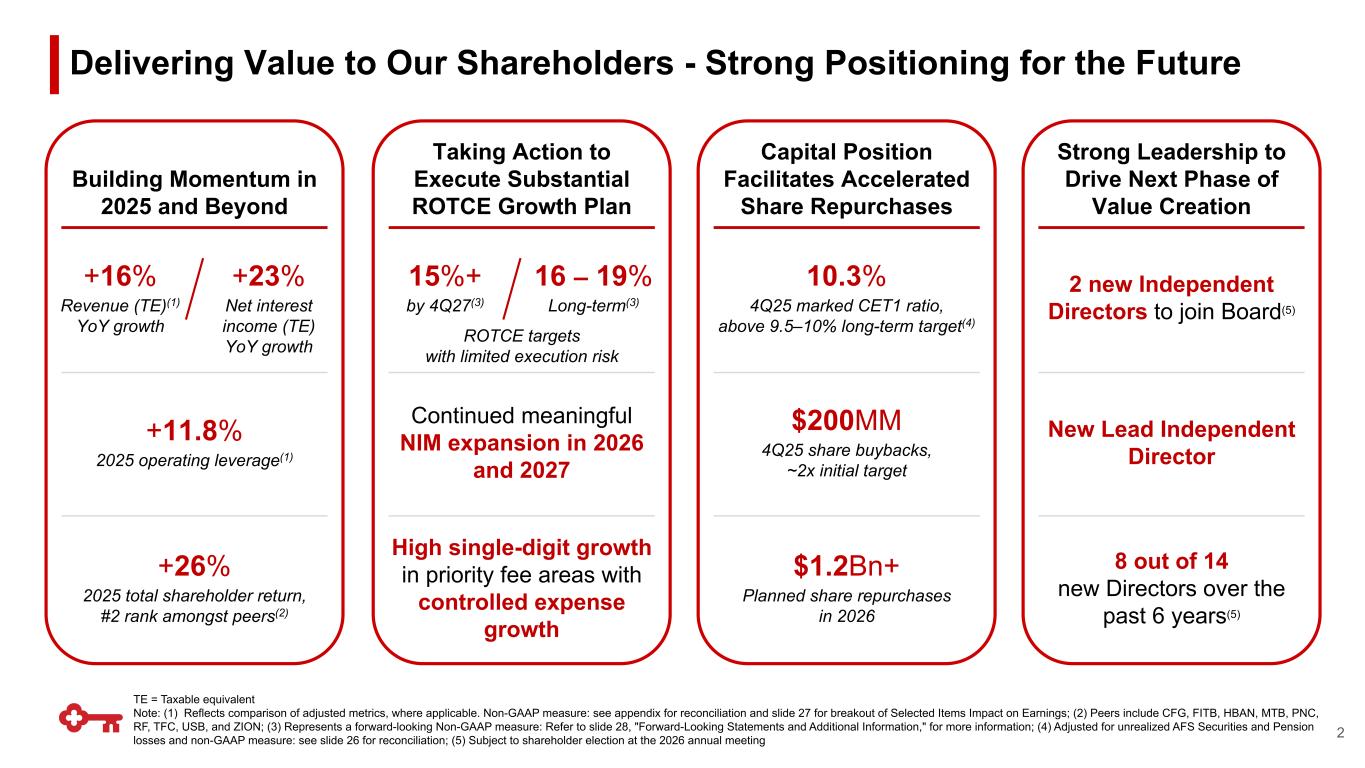
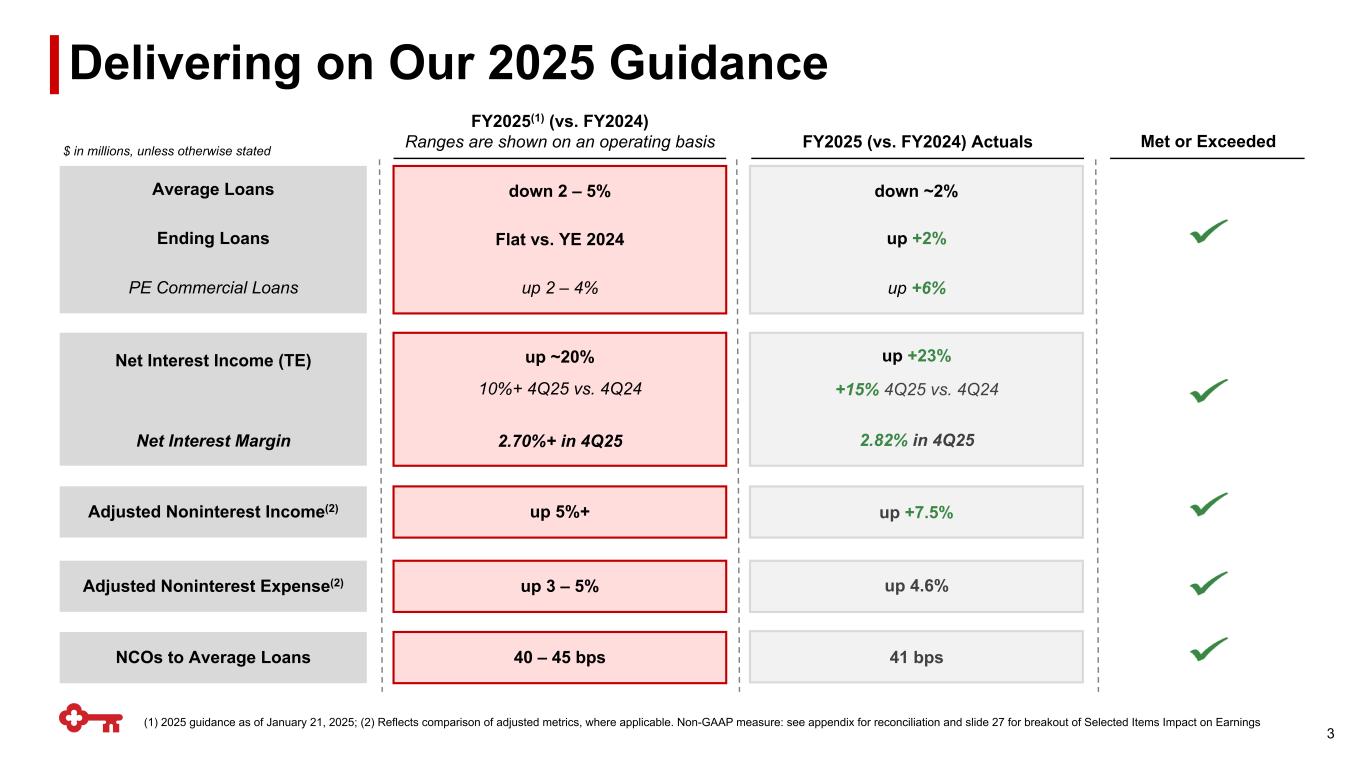
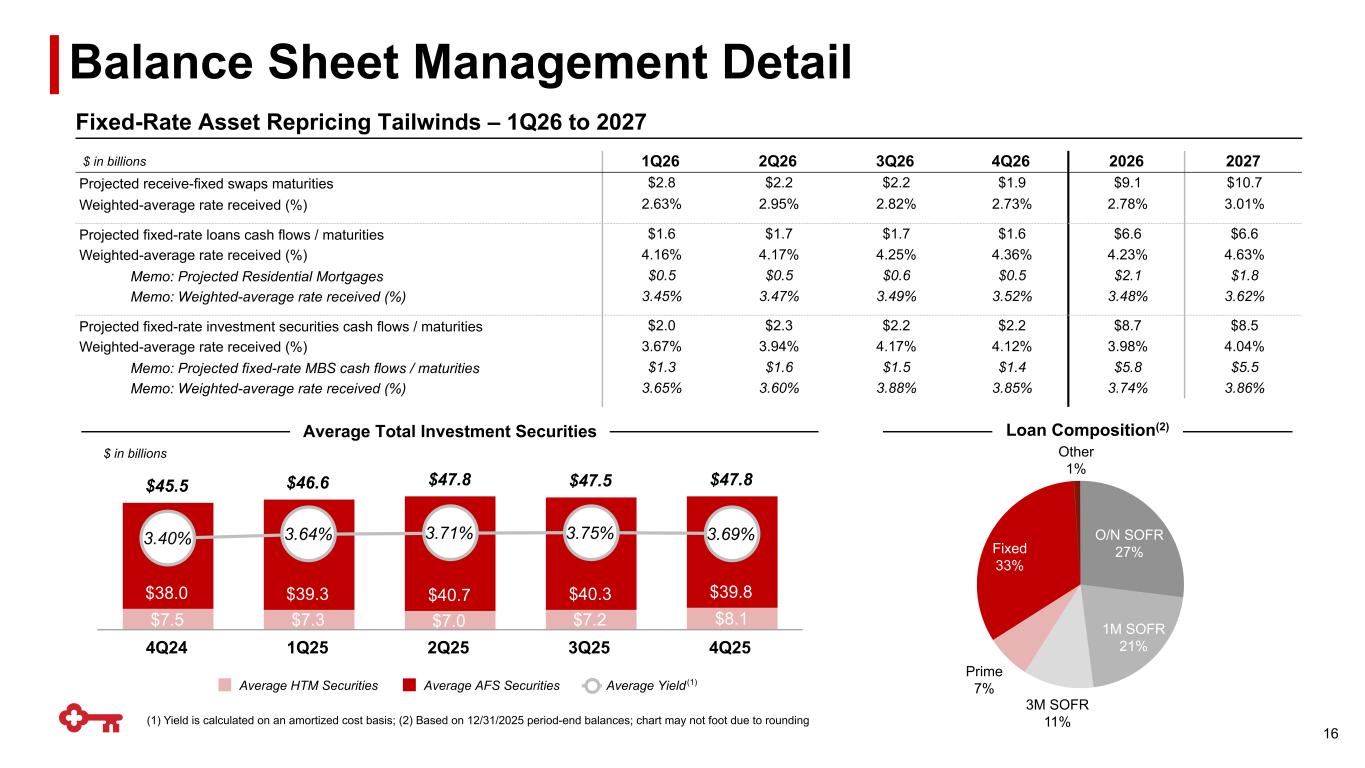
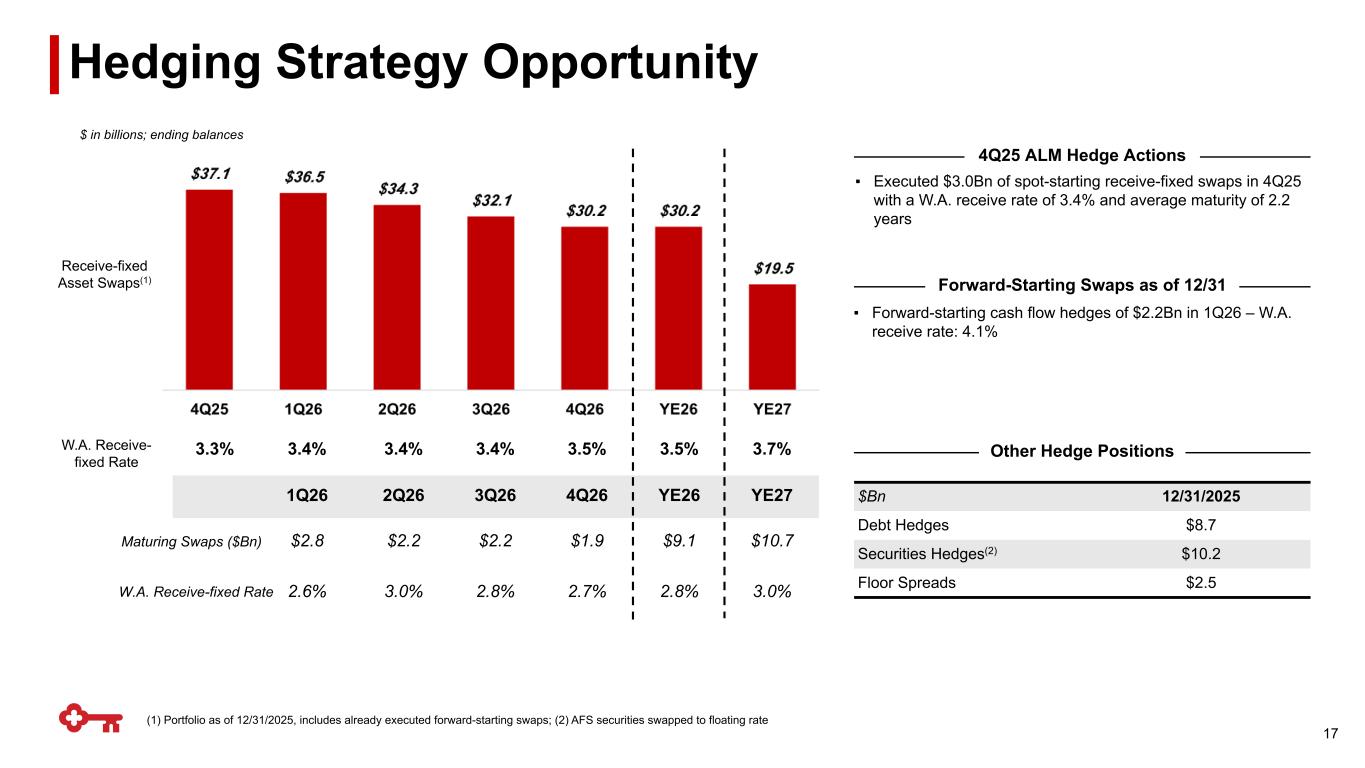
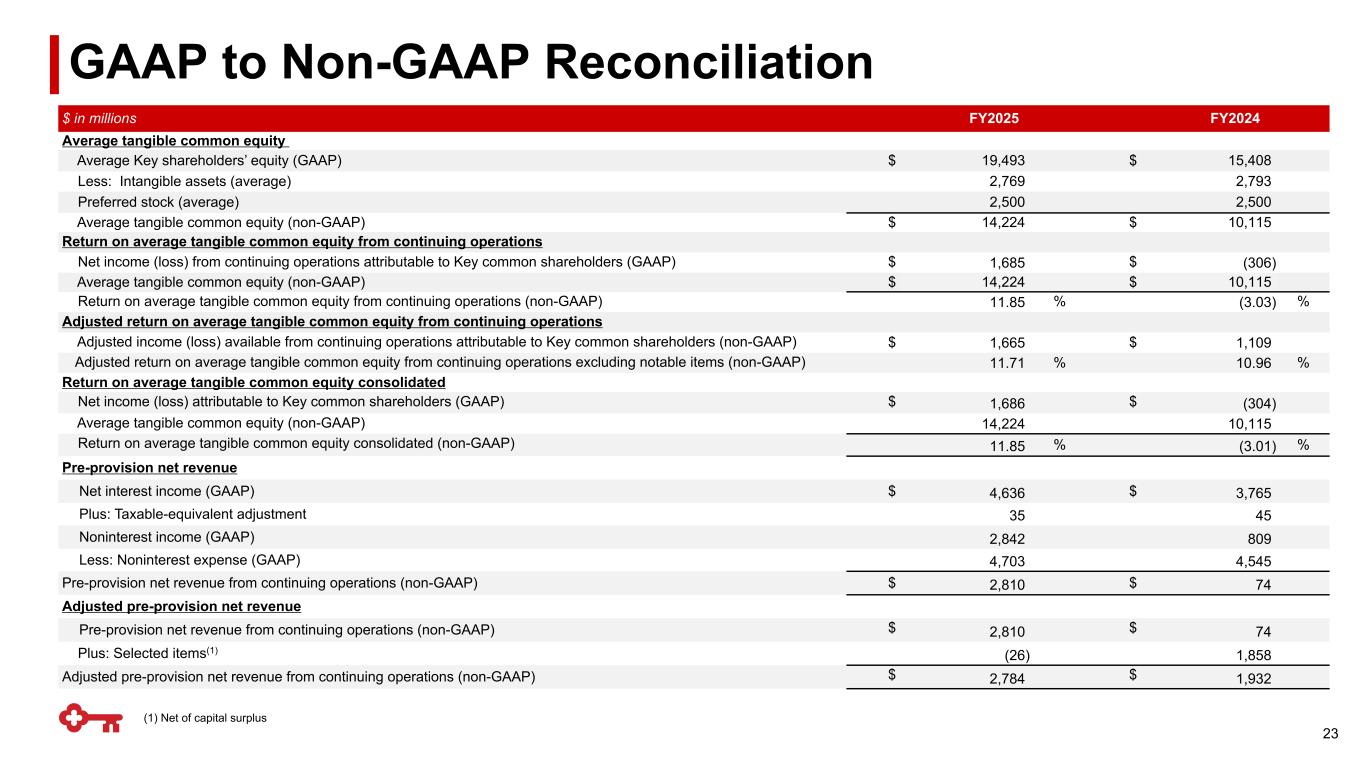
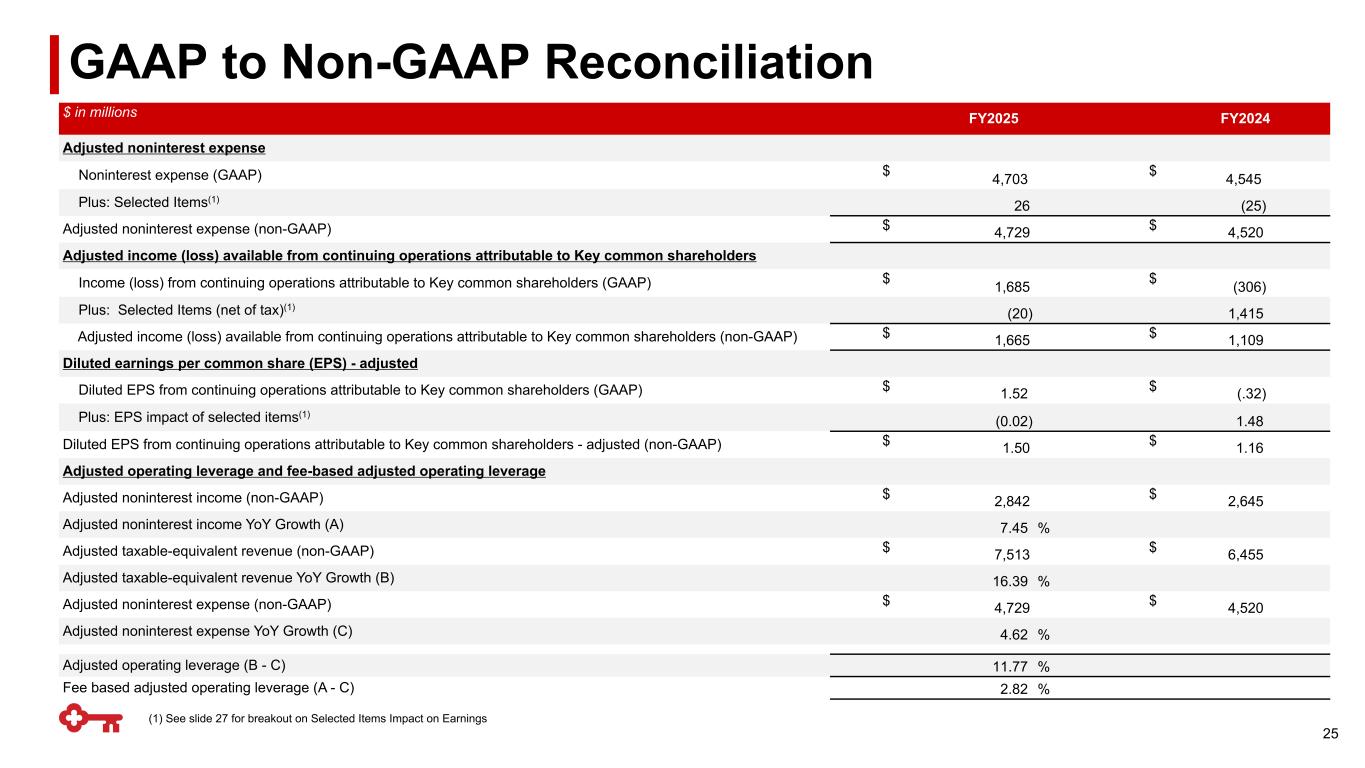
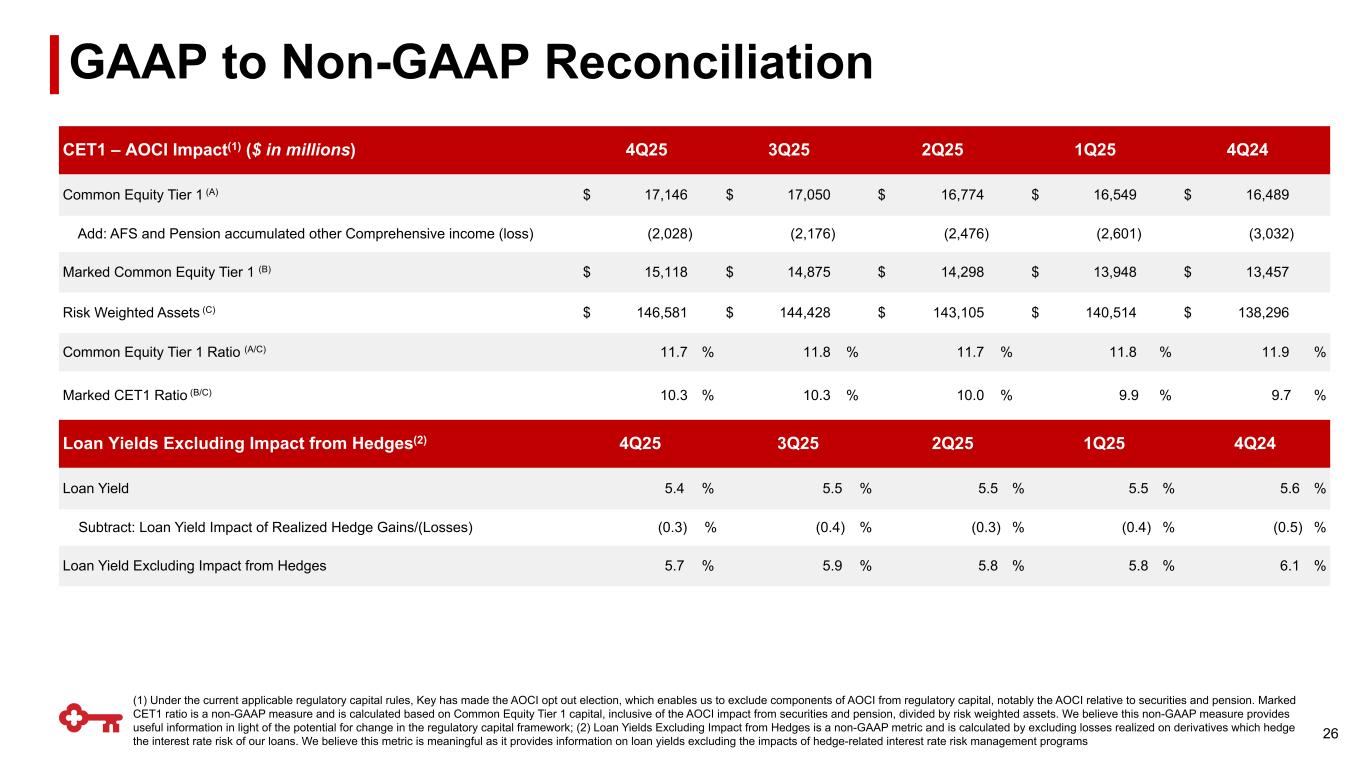
Thank you, Brian, and good morning, everyone. Our fourth quarter and full-year results demonstrate the continued progress we are making with respect to our organic path to achieving consistently higher returns on capital. We reported fourth quarter earnings of 43 cents per share. Revenue exceeded $2 billion, growing 12% year-over-year on an adjusted basis, while expenses grew 2%. Both fourth quarter NIM and net interest income were above our previously communicated targets. Asset quality metrics continue to trend in a positive direction, with net charge-offs, NPAs, criticized loans, and delinquencies all declining sequentially. We have also committed to a more meaningful return of capital to our shareholders, which commenced in the fourth quarter. We repurchased $200 million of common stock, two times the original commitment we made in October at an average price of $18 per share. In spite of stepped-up share repurchases, we continue to maintain peer-leading capital ratios. We ended the quarter with a 10.3% marked CET1 ratio. We intend to manage this ratio down to the higher end of our targeted capital range of 9.5% to 10% by the end of 2026. Combined with our business momentum and meaningful ongoing capital generation, this puts us in a position to accelerate our repurchase activity further in 2026. We plan to buy back at least $300 million of stock in the first quarter and anticipate repurchasing similar amounts in subsequent quarters throughout 2026. The fourth quarter puts an exclamation point on what was a substantial year of progress for Key and positions us to achieve even greater success going forward. We met or exceeded all of the financial targets that we communicated at the beginning of the year. We delivered full-year record revenue, which increased 16% compared to the prior year. With both net interest income and fee revenue growing greater than projected, expenses grew 4.6%. As a result, we generated approximately 1,200 basis points of operating leverage and PPNR growth of about 44%. Loan growth outperformed, particularly C&I loans, which grew at 9%, and the recycling of lower-yielding consumer loans into commercial loans enabled us to manage our funding costs more proactively. Deposit dynamics were favorable, with client deposits up 2%, while we remained disciplined with respect to pricing. Fee income growth was 7.5% as all of our priority fee-based businesses grew at a high single or low double-digit rate. Expenses were within our targeted range, even as we made meaningful investments in our franchise throughout the year and compensated bankers for our strong fee performance. We added nearly 10% to our frontline banker staff across wealth management, commercial payments, middle market, and investment banking. We invested an additional $100 million in technology focused on customer-facing capabilities that make it easier for our clients to bank at key. Lastly, we continued to maintain our strong risk discipline. Full-year net charge-offs were 41 basis points. Additionally, all leading indicators, non-performing assets, criticized loans, and delinquencies all moved in the right direction. These results would not have been possible without the talented team we have in place driving our strong momentum. Together, we delivered record revenue, strengthened our balance sheet, and met every commitment we set at the beginning of the year. Our team continues to demonstrate focus, resilience, and dedication, navigating a dynamic environment and delivering value to the stakeholders we serve, our shareholders, our clients, and our communities. I want to thank each of our teammates for their contributions to our performance. As we turn the page to 2026, Clark will go through our financial guidance shortly, but I am confident we will deliver another year of outsized revenue and earnings growth and make substantial progress toward our commitment to achieve a 15% plus return on tangible common equity by year end 2027. Seven, the current environment plays well to our strengths. We expect to continue to grow our priority fee-based businesses at a mid- to high single-digit pace as we capitalize on our strong pipelines and momentum. Additionally, we expect to see returns from our recent hires as they ramp up and further utilize our platforms, which we believe are under-leveraged. Coming off the second best year ever in investment banking, we continue to feel good about the trajectory of this business. Our pipelines remain at historically elevated levels. We raised nearly $140 billion of capital on behalf of our clients in 2025, retaining 20% on our balance sheet. The market environment remains favorable for continued new issuance in 2026. We anticipate middle market M&A activity to improve in 2026 after being muted for much of the past three years. We also expect financial sponsors who stayed largely on the sidelines with respect to middle market transactions last year, but typically generate a meaningful percentage of our fees to be more active this year. In wealth, assets under management reached a record $70 billion. We achieved a third consecutive year of record sales production in our Mass Affluence segment. Since we launched this business in 2023, we have added 54,000 new households, nearly $4 billion of AUM and $7 billion of total client assets to key. In commercial payments, fee-equivalent revenue grew 11% in 2025 as the investments we made in bankers, new geographies, and scaling embedded banking capabilities continued to build momentum. With respect to NII, we continue to have substantial tailwinds from fixed-rate asset repricing, as $17 billion of low-yielding swaps, securities, and consumer mortgages are expected to mature or prepay this year. Our loan pipelines remain healthy. Our outstandings in 2026 should benefit from the 9% commercial commitment growth we generated in 2025. We remain well-positioned for a variety of forward rate curve scenarios. As a result, I am highly confident we will grow revenues at a high single-digit rate this year, with expenses growing approximately half that rate, indicating substantial operating leverage again this year. In summary, Key is very well-positioned as we enter 2026. Our trajectory has never been better. Current macro conditions and client sentiment play to our strengths, given our differentiated business model and platforms. We anticipate that in 2026, we will successfully increase both our return on capital and our return of capital. And lastly, we will deliver another outsized year of revenue growth, earnings growth, and tangible book value growth. before i turn it over to clark i want to cover some changes to our board that we announced just this morning these changes reaffirm our board's commitment to strong corporate governance and long-term shareholder value first the board will nominate tony dispirito and chris henson for election as directors at key corps 2026 annual meeting of shareholders both candidates have impressive backgrounds in the financial services industry and bring capabilities that are directly aligned with Key's priorities. Tony Dispirito most recently served as Global Chief Investment Officer for Fundamental Equities at BlackRock. Tony has portfolio manager experience spanning over 30 years. He brings deep expertise in public markets, capital allocation, and long-term value creation. Chris Henson is a former senior banking executive with extensive experience leading large financial institutions. He most recently served as head of banking and insurance at Truist, and prior to that was president, chief operating officer, and chief financial officer at BB&T. We believe these additions will enhance an already highly engaged and very capable board as we drive the next phase of value creation for Key. Following the additions of Mr. Dispirito and Mr. Henson, the board will have added eight new directors during my tenure as CEO. We also announced that the lead independent director role has transitioned from Sandy Cutler to Todd Vesos. Todd, who currently serves as the CEO of Dollar General, has served as director of Key since 2020. Todd has been an excellent contributor to our board, and I look forward to working even more closely with Todd in his new role. Sandy Cutler will continue serving as an independent director to ensure a smooth transition to Todd. I would like to thank Sandy for his exemplary service, dedication, and significant contributions to Key as our lead independent director. Sandy has been a steady and principled presence in the boardroom, providing independent oversight as keep transformed and navigated periods of significant industry change. Additionally, Carlton Highsmith and Ruthann Gillis have informed us of their plans to retire from the board, effective at the annual meeting. As we announced last week, David Wilson has retired from the board, effective immediately due to health considerations. We are deeply grateful to David, Carlton, and Ruthann for their meaningful contributions and dedicated service to Key during their time on the board. With that, I'd like to turn it over to Clark. Clark?
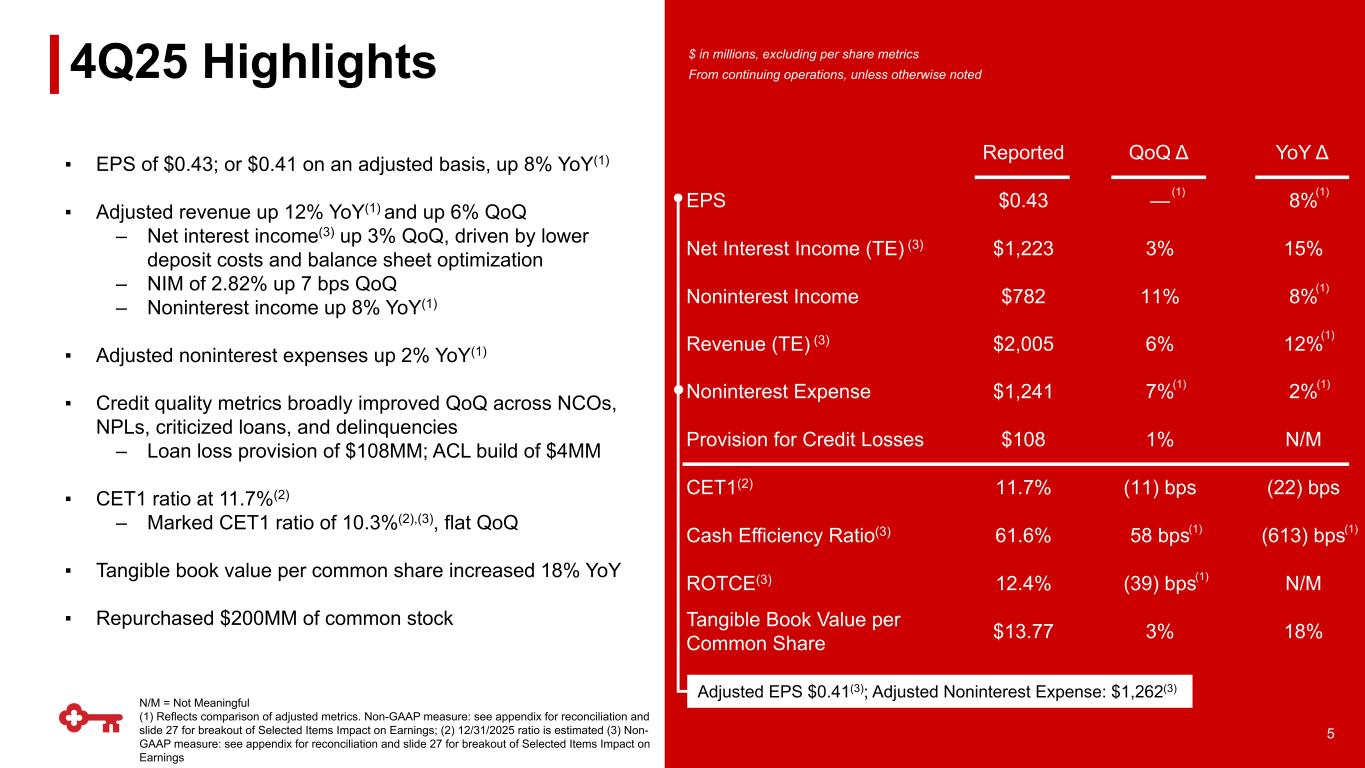
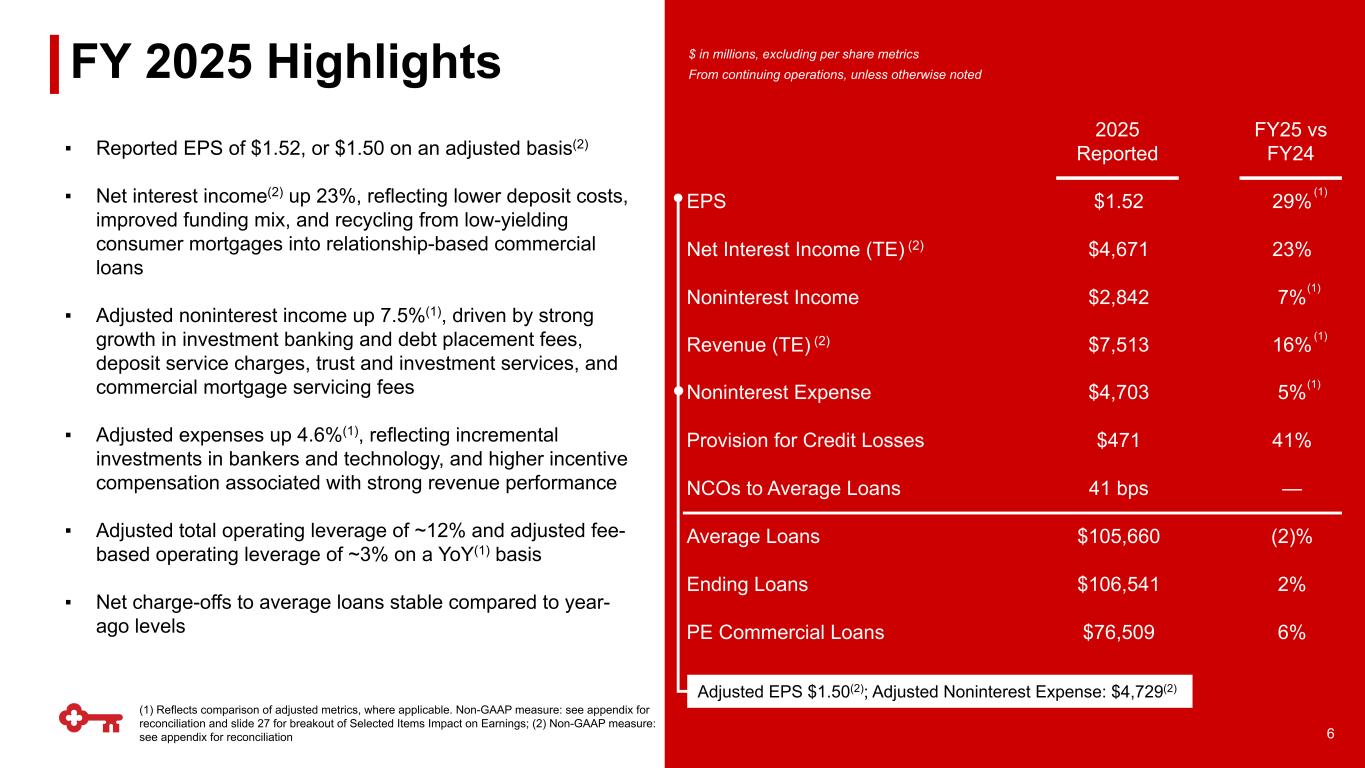
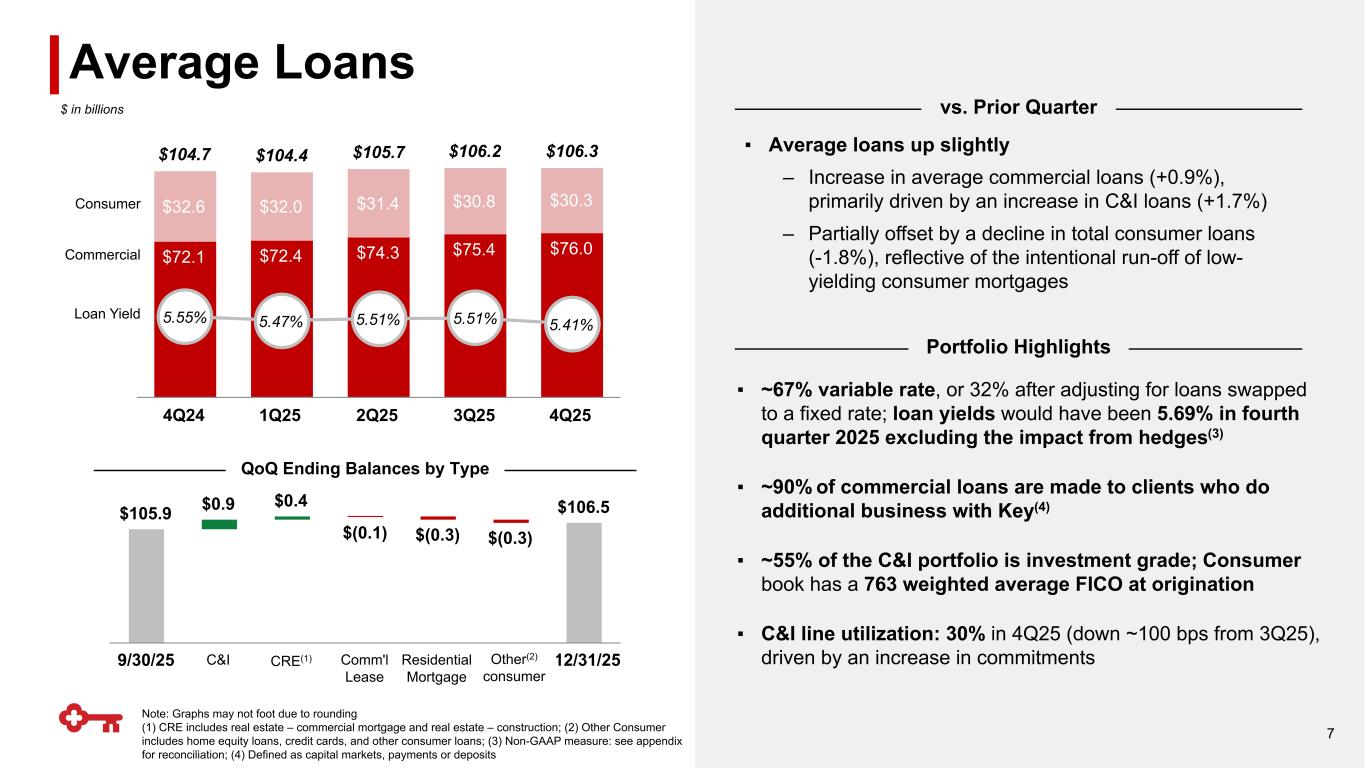
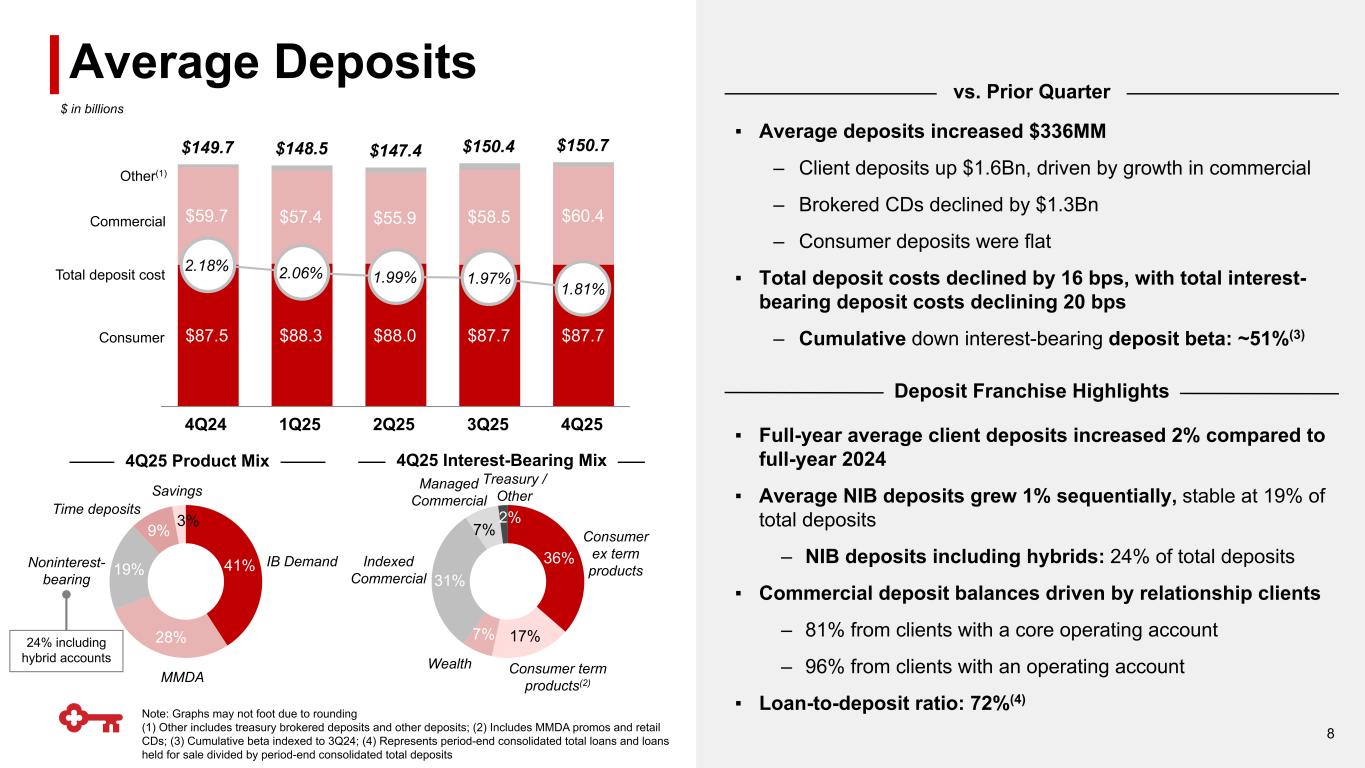
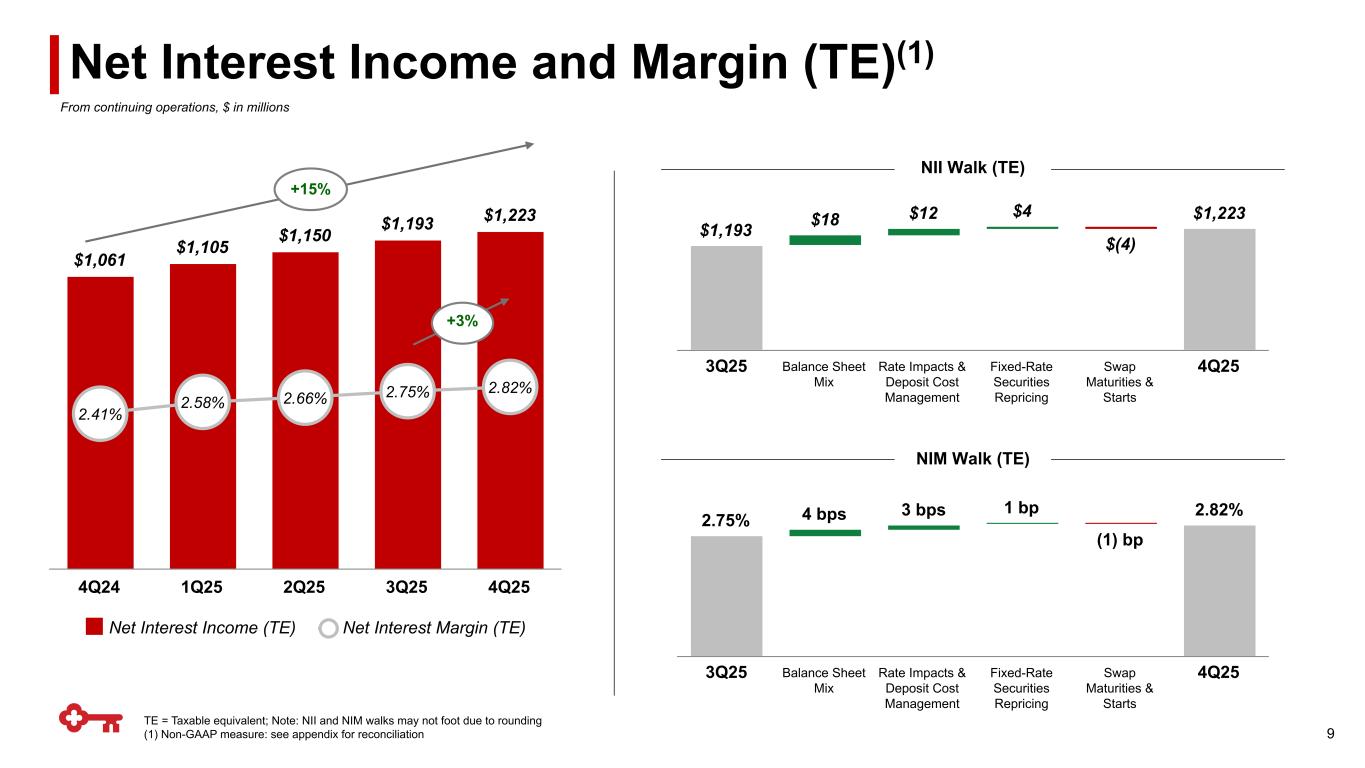
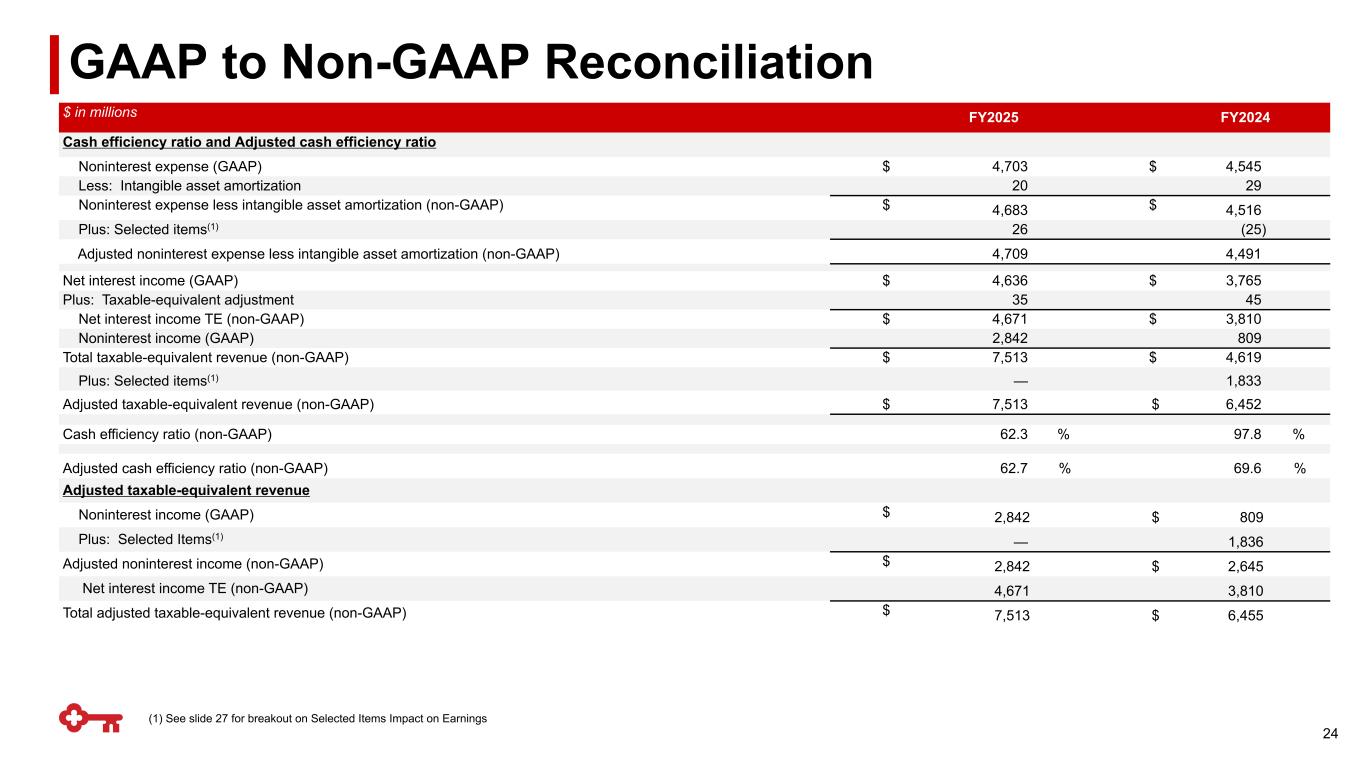
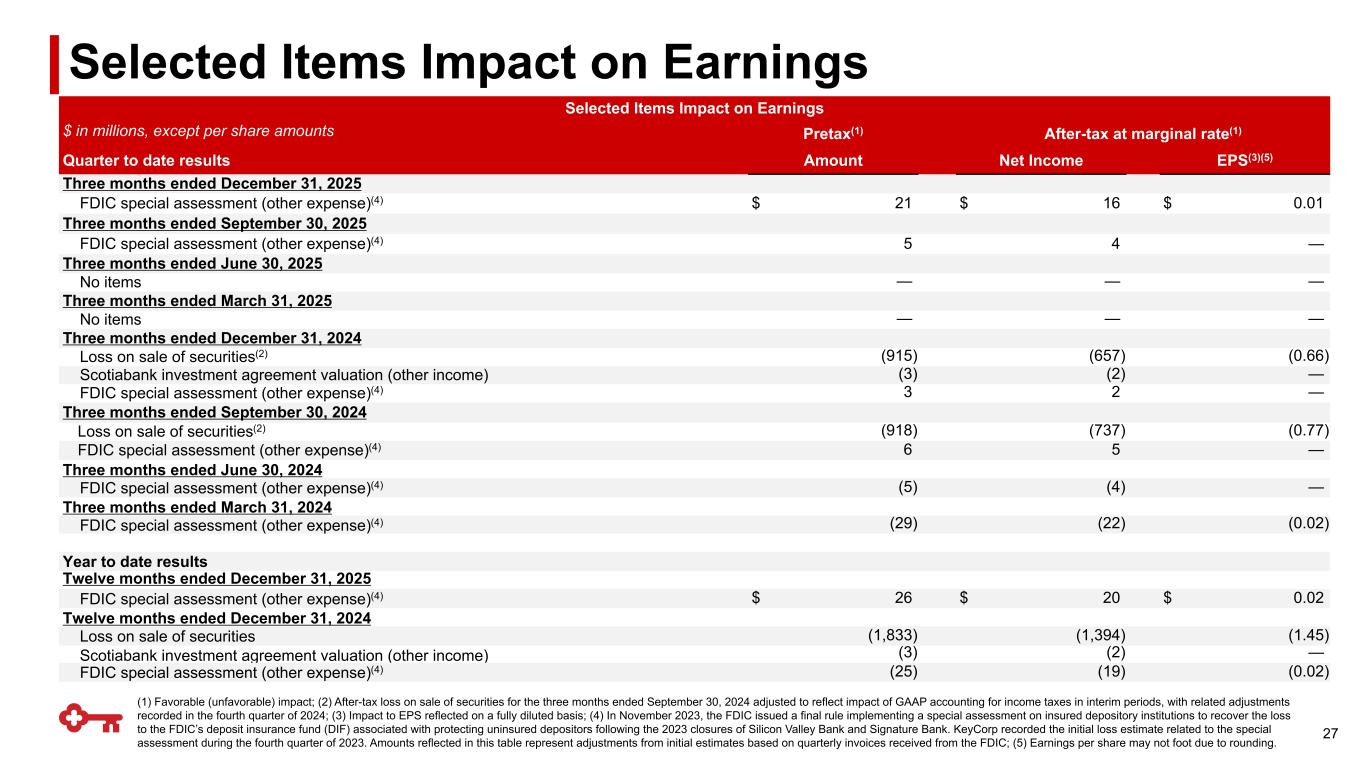
Thanks, Chris. Starting on slide five, our fourth quarter results demonstrated continued strong momentum across the franchise. As a reminder, the 2024 fourth quarter results were impacted by a securities portfolio repositioning, and all comparable periods included FDIC special assessment impact. As such, all year-over-year comparisons are on an adjusted basis. Fourth quarter earnings per share were $0.43 or $0.41 when adjusted. Fourth quarter revenue was up 12% year-over-year, while expenses increased by 2%. Tax equivalent net interest income was up 15% year-over-year. Non-interest income increased 8% year-over-year, reflecting broad-based growth across our high-priority fee-based businesses. Loan loss provision of $108 million included net charge-offs of $104 million and a very modest $4 million build. The build was largely a result of increased commitments, partially offset by reductions in MPAs and criticized loans. The fourth quarter net charge-off ratio was 39 basis points. Tangible book value per share increased 3% sequentially and 18% year-over-year. Turning to slide 6, Chris touched on our full-year earnings performance earlier, but just to add a little more context, both net interest income and fees outperformed our guidance this past year. Net interest income increased by 23% versus our original expectation for 20% growth as commercial loan growth was stronger and deposits were better from both a balance and beta perspective. Fees grew 7.5% versus our original expectation for 5% plus, as investment banking fees were up 13%, even without the benefit of expected levels of M&A activity for much of the year. Wealth, commercial payments, and commercial mortgage servicing all grew at high single digit to low double digit rates this past year. Expenses grew roughly 4.6%, primarily due to the hiring of frontline producers and the strong fee momentum. We achieved nearly 1,200 basis points of total operating leverage and 280 basis points of fee-based operating leverage in 2025, both better than we had expected coming into the year. Moving to the balance sheet on slide seven, average loans were relatively flat sequentially, reflecting a $1 billion increase in C&I loans, offset by the intentional runoff of $550 million of low-yielding consumer loans, as well as some net paydown activity in CRE. On a spot basis, commercial loans grew by about $1.2 billion, with growth in both C&I and CRE. Growth was primarily from the power and utility sector and from broad-based middle market growth across all of our regions. C&I line utilization decreased by approximately 1% sequentially to 30%, driven by an increase in commitments. C&I loan balance is outstanding, increased by $900 million. Turning to slide 8, average deposits increased by approximately $300 million sequentially, with $2 billion of commercial client deposit growth partially offset by a decline of $1.3 billion of higher-cost brokered CDs. Brokered CDs averaged $2.5 billion in the fourth quarter. Average non-interest-bearing deposits grew 1% sequentially and remained stable at 19% of total deposits, or 24% when adjusted for our hybrid accounts. Total deposit cost declined by 16 basis points to 1.81%. Our cumulative interest-bearing deposit beta declined modestly, as expected, to 51% through the fourth quarter, reflecting some impact from the recent Fed cuts that we would expect to pull through more fully in the coming months. We've taken proactive actions in reparsing deposits this past year by entering the year with a low loan-to-deposit ratio, limiting our incremental funding needs by remixing loans from consumer to commercial, and by gathering lower-cost commercial deposits, particularly in payments, while managing deposit costs in consumers as we actively rotated maturing CDEs into money market deposits. Overall, interest-bearing funding costs declined by 22 basis points, resulting in a cumulative interest-bearing funding beta of 67%. Slide nine provides drivers of NII and NIM this quarter. Tax equivalent NII was up 3% sequentially, driven by client deposit growth and continued balance sheet optimization efforts. We grew relationship commercial loans at relatively stable spreads to the existing book while running off lower yielding consumer loans. On the funding side, the commercial client deposit growth enabled us to allow the maturity of approximately $2.4 billion of higher-cost brokerage CDs, long-term debt, and other short-term borrowings. We exited the year with a net interest margin of 2.82%, an increase of seven basis points sequentially, and above our previously indicated target of 2.75% to 2.8%.
Our balance sheet remains positioned to be fairly neutral to additional Fed fund cuts as we move through 2026.
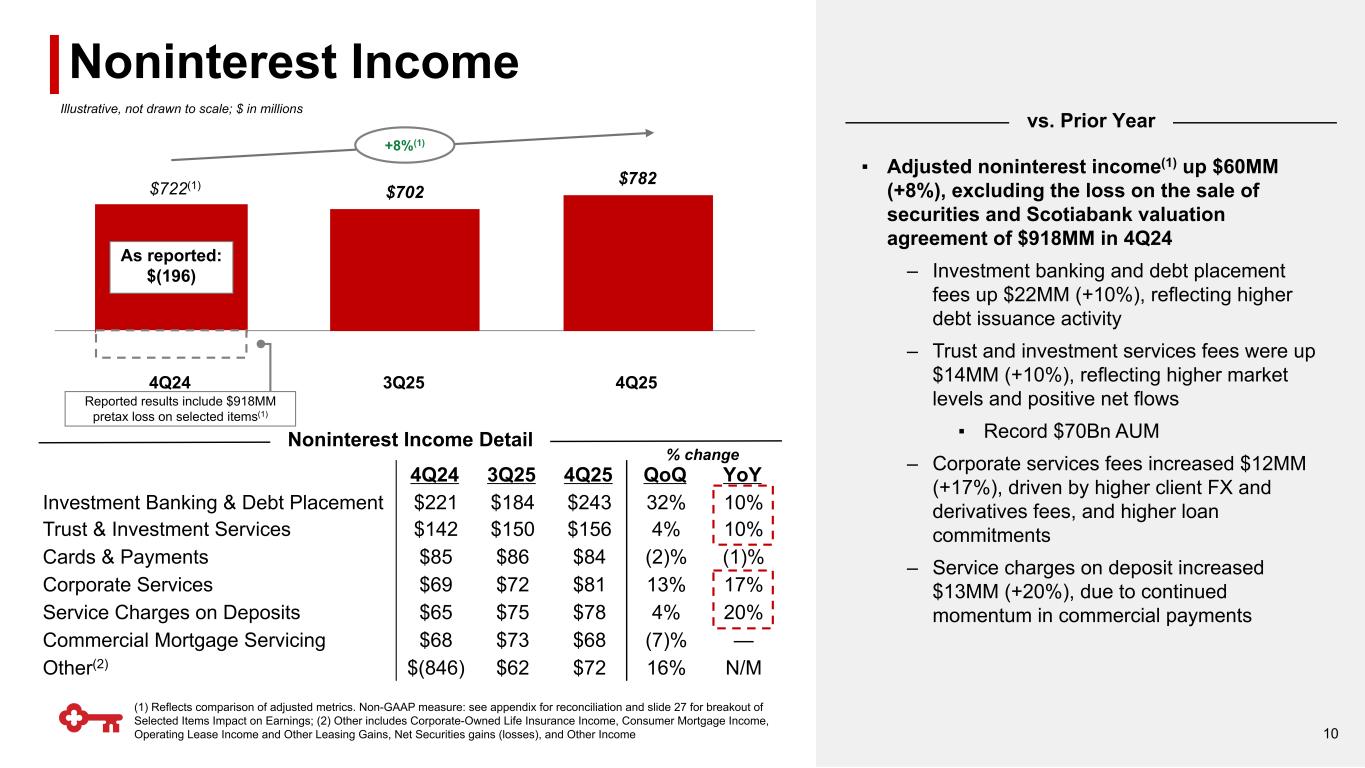
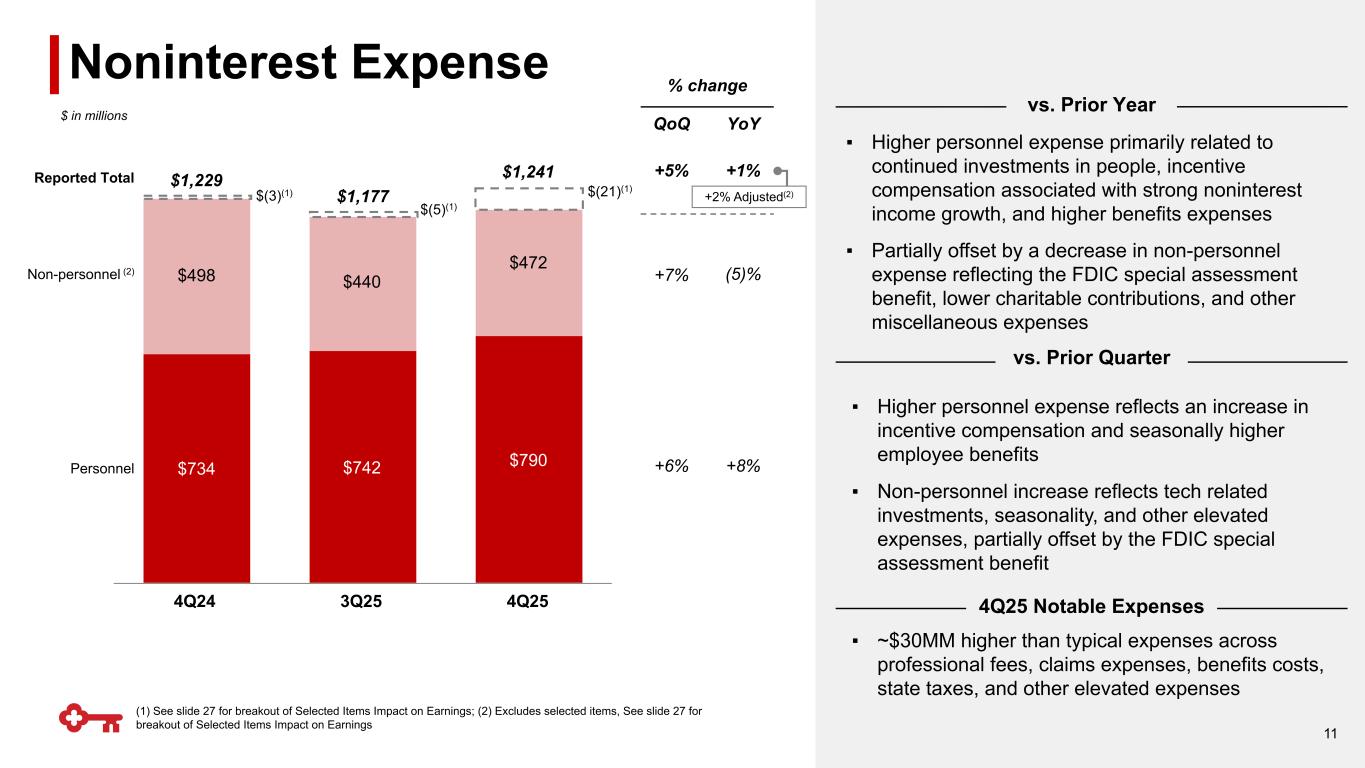
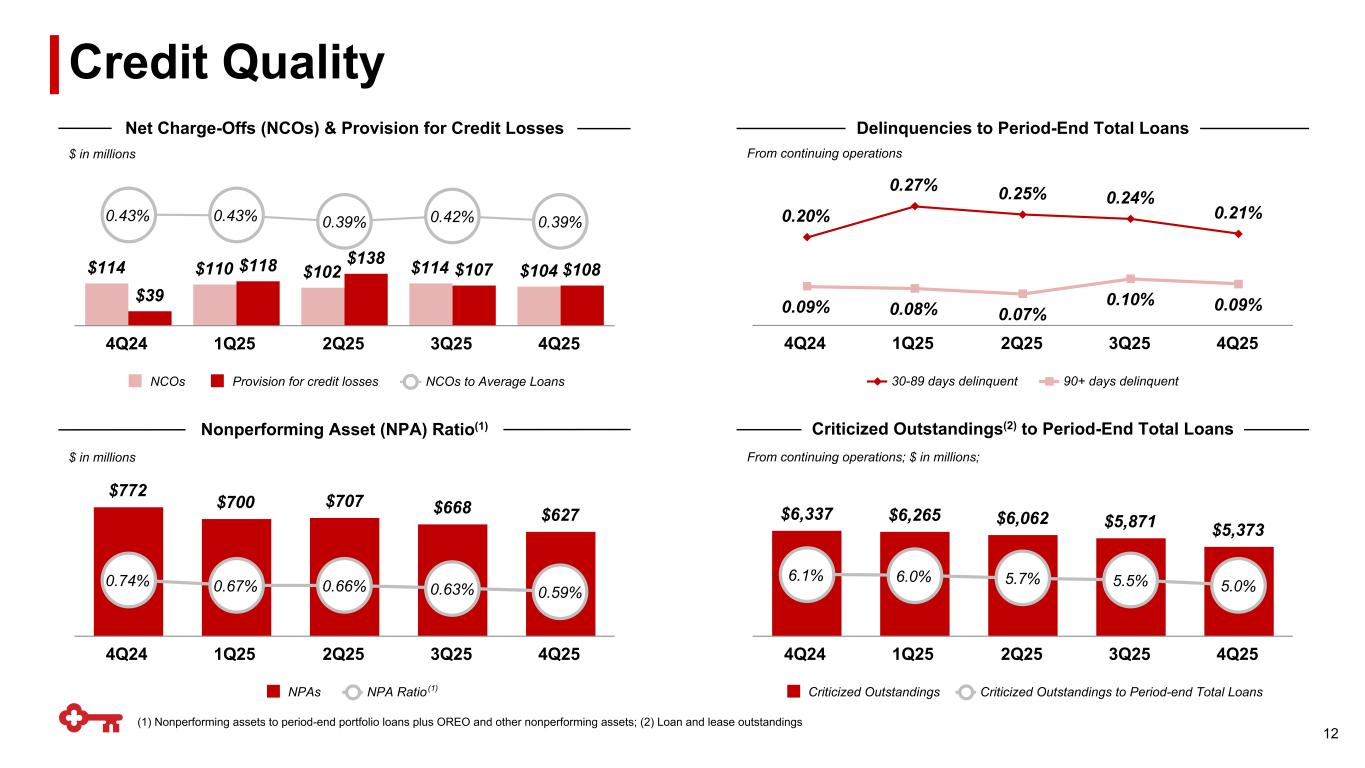
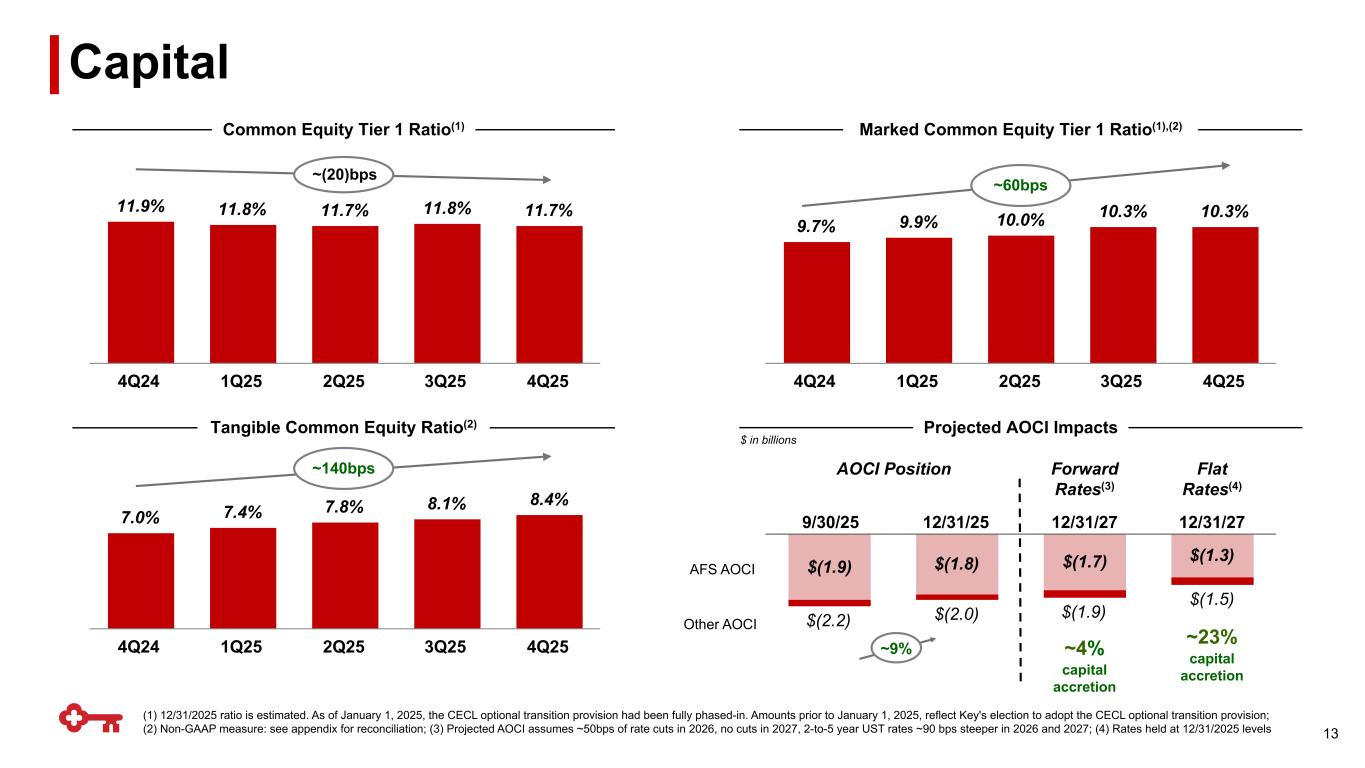
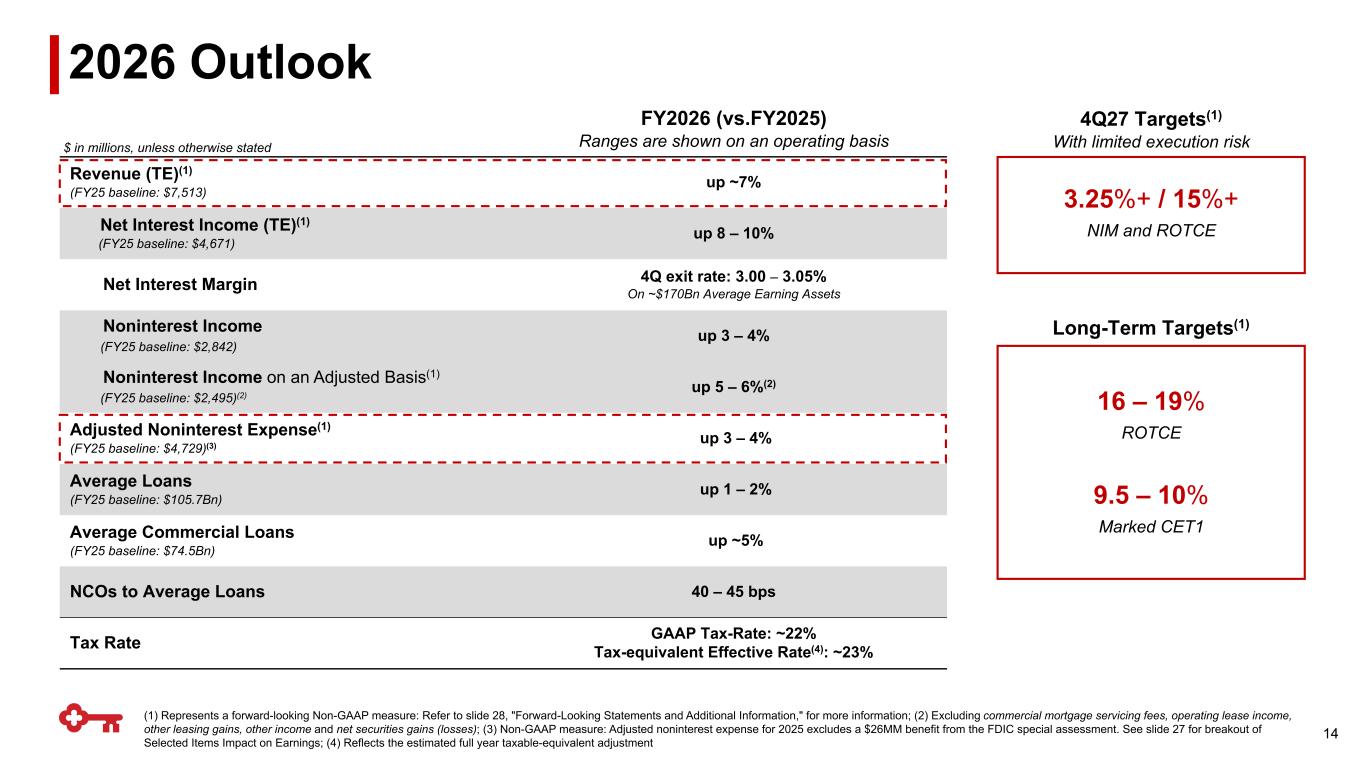
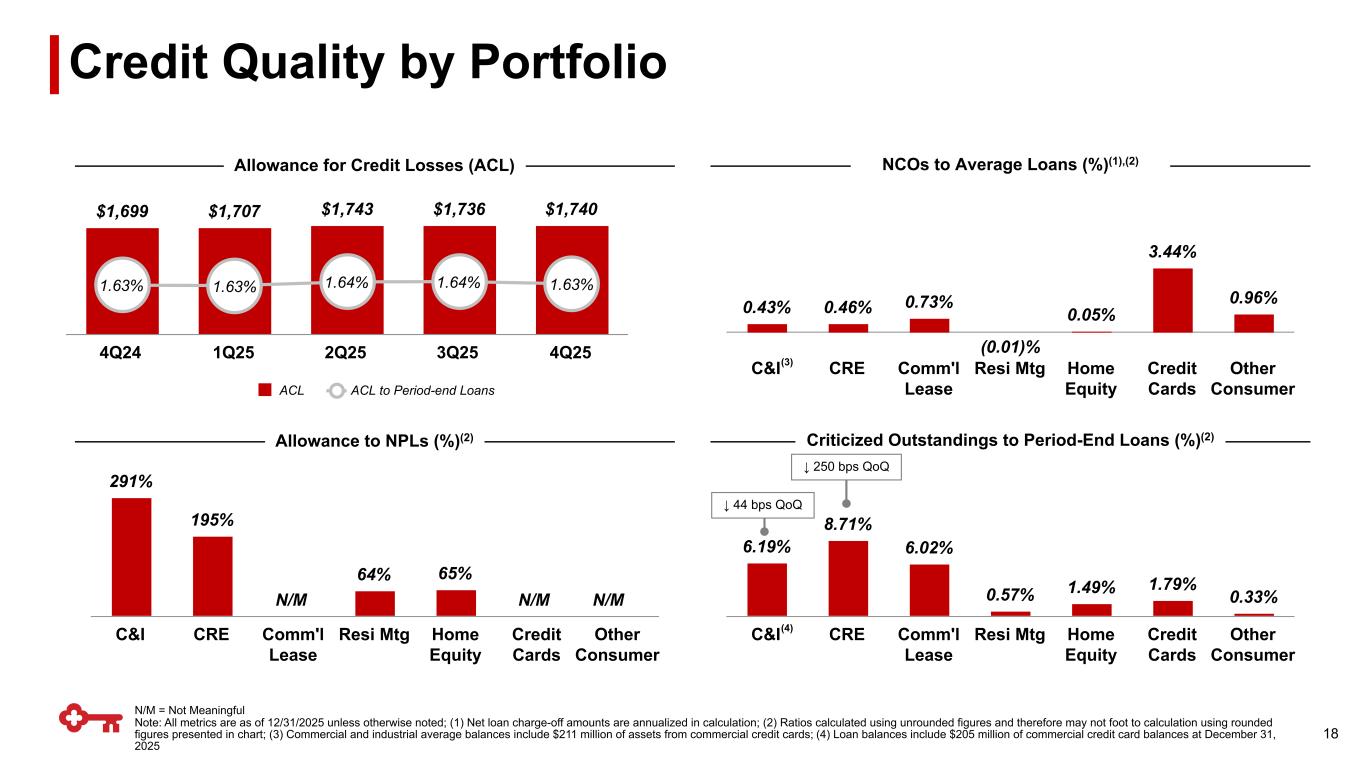
Turning to slide 10, adjusted non-interest income increased 8% year-over-year. Investment banking and debt placement fees were $243 million, an increase of 10% year-over-year. Growth was driven by debt capital markets and commercial mortgage debt placement activity. Sequentially, M&A activity also picked up after industry middle market volumes had been tepid for the first nine months of the year. We're encouraged by our M&A pipelines and at this point feel good about our ability to deliver investment banking, fee growth in the first quarter off of what had been a record first quarter in 2025. Trust and investment services income grew 10% year-over-year, reflecting record positive net flows and higher market values. Assets under management reached a new record high of $70 billion. Service charges on deposit accounts and corporate service fees increased by 20 and 17% year-over-year, respectively. The increase in service charges was driven by momentum and commercial payments, which drew fee-equivalent revenue at 12%, while corporate services income was driven by higher loan commitment fees and client FX and derivatives activity. Commercial mortgage servicing fees were $68 million flat year-over-year and down $6 million from the third quarter, reflecting the impact of lower rates on fees for lower interest-earning advances and successful resolutions within our special servicing book. Beginning this quarter, certain of our clients have elected to collectively hold a little over a billion dollars of escrow deposit balances with us in lieu of paying fees. This will have a de minimis impact on total revenue, but will benefit net interest income and NIM with an offsetting impact to fees of approximately $40 million annually. We expect commercial mortgage servicing fees to run at about $50 to $60 million per quarter in 2026. On slide 11, fourth quarter non-interest expenses were $1.3 billion, up 7% sequentially and 2% year-over-year. There were roughly $30 million of unusually elevated expenses in the fourth quarter, and therefore would not use this quarter as a run rate moving forward. Versus the year-ago quarter, growth was primarily driven by higher personnel expense related to frontline banker hires, higher employee benefits costs, and higher incentive compensation related to the strong revenue performance. Sequentially, expense growth was driven by investments in technology and talent, higher incentive compensation, seasonality in areas such as employee benefits costs, contractor and professional services spend, and marketing, as well as certain elevated expenses in the quarter. As shown on slide 12, credit quality is broadly improving. Net charge-offs were $104 million, down 9% sequentially, and were an annualized 39 basis points of average loans. full-year net charge-offs of 41 basis points were toward the better end of our full-year target range of 40 to 45 basis points non-performing assets declined by six percent sequentially and the npa ratio improved by four basis points to 59 basis points criticized loans declined by 500 million dollars or eight percent sequentially with broad-based improvements across cni and commercial real estate. Turning to slide 13, our CET1 ratio was 11.7% at quarter end as net earnings generation was offset by RWA growth associated with loan mix and commitments growth and capital return from share buybacks and dividends. Our marked CET1 ratio, which includes unrealized AFS and pension losses, was flat sequentially at 10.3%. As Chris mentioned earlier, we plan to repurchase at least $300 million worth of shares in the first quarter and at least $1.2 billion for the full year 2026. Slide 14 provides our 2026 guidance relative to 2025 and reiteration of our medium and long-term targets. We expect revenue to be up about 7% driven by net interest income growth of 8 to 10% and non-interest income growth of 3 to 4%. Adjusting for recent business decisions that net net will have no impact on earnings we expect non-interest income to grow five to six percent within that we expect investment banking fees to grow about five percent wealth fees to grow in the high single digits and commercial payments fees to grow in the low double digits we expect expenses to be up three to four percent this year or half the rate of revenue growth which implies substantial positive operating leverage of approximately 300 to 400 basis points in 2026 we expect average loans to grow one to two percent with commercial loans growing at about five percent as we continue to remix the runoff of consumer loans into higher yielding relationship based commercial loans we expect full year net charge off ratio to remain stable at 40 to 45 basis points finally we expect the tax rate to be approximately 22 or 23 on a taxable equivalent basis. In summary, subject to the usual macro caveats, we're confident that we will deliver another year of outsized organic revenue and earnings growth for our shareholders. With that, I will now turn the call back to the operator to provide instructions for the Q&A session. Operator?
Operator
Thank you. Question, please press star followed by one on your telephone keypad. If for any reason you would like to remove your question, please press star followed by two if you are streaming today's call and would like to ask a question please dial in and enter star one as a reminder if you are using a speaker phone please remember to pick up your handset before asking a question we will pause here to allow questions to register our first question will go to the line of ibrahim punwala with bank of america ibrahim your line is open Thank you.
Good morning. I guess maybe first for you, Chris, you talked about the capital plan, the board changes to the board this morning, all very clear. As we think about just from your standpoint, what's sort of from an organic perspective, what are the strategic priorities as we think about where you are spending your time? Is it about getting to the 15% growth fee at a faster rate, banker hiring, like just talk to us like where you're focused on as we think about 2026, which could lead to maybe better growth, better ROE for K. Thanks.
Sure. Well, thank you for the question. So first and foremost, I'm thinking about growing the business organically. And anytime we talk about that, we talk about really kind of the three key areas. One is middle market and payments. The other is our investment bank. And then lastly, wealth, and specifically mass affluent. That's where we've made a ton of investments. We think we have a great opportunity. Frankly, there's a lot of market disruption that's there to be had. And so what I'm focused on is we sit down with our teams every single week is, you know, we've added all these people, we've onboarded them, we inspect what they do, and making sure we're out there in the marketplace, you know, we have a right to win and we have a way to win, and we focus a lot on that. Next is, of course, the return on capital. And as we've talked about, we have a lot of levers that we can pull to get there. We've talked about 15%, but it's on the path to 16% to 19%. And a lot of that is mechanical, but there's a lot of things that we can do in terms of growing the business and generating those kind of returns. Next, we obviously think about return of capital. and I think we were pretty clear this morning as to what our path is in terms of return of capital, and so we're working on that. And then lastly is to continue to position the business for the next leg of growth. We've made all these investments. We announced some pretty significant changes to our board of directors today. We've hired a lot of people. We're in the marketplace right now hiring people. We're investing heavily in AI and technology. Our investments in tech and ops has gone from $800 to $900 last year to $1 billion this year. I think we're doing well with respect to implementing AI, but there's a lot more that we can do. We've done it in certain areas like our call centers, in certain areas like internal things, but there's opportunities to really rethink our entire business. For example, loan underwriting and processing. We can look at those whole horizontal areas and apply a lot of technology. It'll be money-saving, and by the way, it'll give you a better experience for our clients. So that's kind of what I'm focused on day in and day out. Thank you for the question.
That's helpful, and I guess maybe one follow-up. Clark, I think you mentioned investment banking fees should be up from a year ago. So it looks like you're resetting and just everything that you all have talked about sponsor activity, middle market activity, picking up that investment banking should be much stronger. Your fee guide seems conservative. Just tell us like how the assumptions underpinning that fee guide and why investment banking in that in the low 200s or the low to 200 or mid 200 range per quarter is not a reasonable sort of run rate going forward.
Yeah, thanks, Ibrahim. So maybe a couple of just specific comments. A 10% banker hire target for last year, we achieved just over 9%. So, again, the 10 is a guidepost. We didn't want to hit 10 just to do it. We were picking the right people in the right markets at the right price. In investment banking, it was closer to 5%. And, again, that market, you know, we added some excellent people, but it's competitive, obviously, and heating up. So we didn't stretch too far for people that weren't the right fit for us. That goes to the 5% guide. And while we saw our first, I think, pop in middle market M&A here in the fourth quarter, and we'd expect that to roll into the first quarter, we don't have a ton of visibility throughout the rest of the year that that'll continue. If we see that, we think there's clear upside to that guide. But at the moment, we're a little bit hesitant because we just haven't seen that trend continue for more than a quarter at a time at this point.
Operator
Next question. We'll go to the line of Ryan Nash with Goldman Sachs. Ryan, your line is open.
Hey, good morning, guys. Good morning, Ryan. Maybe as a follow-up to the last question, obviously 7% revenue growth, the exit run rate maybe looks a tad slower. You just talked in your remarks about hiring a handful of bankers so can you maybe just expand on your expectations for growth you know do you think that we could see a pickup as these bankers start producing really just trying to get a sense for how you're thinking about the conservatism of your of your growth guidance both in 26 and over the medium term thank you sure so we've we've done a lot of hiring we're going to continue to hire we've been very successful in doing that we've always said that the burn-in is about 12 to 18 months.
And by the way, we hired a bunch of people in the middle and late last year, so obviously that will take a little bit of time. Having said that, for example, some groups that I'm optimistic as we look forward.
Hey, Ryan, this is Clark. I might just add a couple maybe contextual points to that. Mentioned in the last answer, we hired just above 9%. If I break that out and think about where we hired folks in our consumer bank that number would have been more low double digits and what they're going to drive is kind of eight percent growth in the year across a consumer that they drive there's a bunch of fees and consumer that that are connected to these hires wealth as we said up high single digits and managed fees in wealth which we're transitioning away from transactional fees to manage fees should be up low double digits so So just to give you a flavor for that, middle market and payments, we're up about 8%. We're going to see FER growth, fee-equivalent revenue growth and payments up low double digits. And then, as I said, in investment banking, 5% hires and up 5%. The one, maybe a little bit more color on what I said in the last response, there are some elements of potential here that we haven't included. I mean, one, we haven't included, we haven't assumed for the full year that middle market M&A will return that lending and a fee opportunity. We haven't incorporated any cuts beyond the two that are in the forwards today, and we haven't increased from things like the bonus depreciation. We've talked to clients about that. They're talking about it. We just haven't seen it manifest yet. If it does, I think there's a lot of opportunity there for us to grow a little bit faster.
Got it. And Clark, maybe as a follow-up, when I look at the 4Q exit run rate guidance for net interest margin, average earning assets, it looks like the run rate for average earning assets is a little bit lower from the current level. Maybe just talk a little bit about what's causing that. Obviously, we know that there's the consumer runoff, but anything else? And when can we expect average earning assets to bottom and begin to grow again? Thank you.
Sure. So we did show, you know, actual loan growth this year. So commercial will continue to be strong at five or so percent. We'll see one to two percent loan growth in the year. So I think we've seen the bottom on earning assets and we'll start to, you know, to see that elevate over time. Maybe two quick comments on just the composition of the balance sheet that I think are important. One, we've talked pretty frequently about the remixing of C&I loans away from residential real estate primarily, so long-dated, low fixed-rate assets into broad-based relationship commercial assets, so that'll continue. And then secondly, on the deposit side, we continue to remix from brokered CDs and deposits into client deposits. So you'll see deposit balances for the year relatively stable, but we will take broker deposits basically to zero by the middle of this year and replace that completely with client deposit. So, again, it's really just creating much more efficiency in the balance sheet and sustainability. And I think the other component to your question, Ryan, is just the seasonality of the quarter. So, you know, every first quarter is our low point, and NII will see that again this year. We'll grow throughout the year, and I feel pretty confident that we'll exit the year with an NII that's, you know, 1.3 billion or more. So a little bit above, I think, the math you were doing there, but, you know, that sort of owns the seasonality and growth throughout the year.
Ryan, the only thing I would add to that is just to remind people our business model is a bit differentiated from others. When the markets are wide open, as they are right now, we only put about 20% of the capital we raise on our balance sheet, which obviously manifests itself in fees, but it certainly doesn't in balance sheet growth. So I would just add that.
I appreciate that. Thanks for the call, guys.
Operator
For the next question, we'll go to the line of John Pincari with Evercore ISI. John, your line is in.
Morning. As a follow-up to that, regarding your margin and NII expectations, could you maybe give us your deposit beta assumption that underlies that margin exit rate to 3 to 3.05 by the end of the year?
Right now, you know, we ended the year at a low 50s. 50s that came down slightly from the third quarter as we expected just given the cuts in the fourth quarter and the timing it takes to get primarily some of the consumer rates through the system we'd expect to pick that up this year but we do expect kind of low to mid 50s beta relatively stable deposit is a remixing of this into client 15 percent proxy that you reiterated
for year 27 you need to get some color on the components like how you're thinking about the margin underlying that, and then also you talked about the growth dynamics impacting the balance sheet and the remix. How do you think about the pace of growth that gets you to that, Rossi, as you think about it for 2027 and maybe the thoughts on efficiency components as well?
I did two, you know, three plus quarter 26. Similarly, 325 plus in the fourth quarter of 27, just the higher yields and run off the consumer. So that's sort of the organic rotation in the loan book. There is a bunch of fixed pricing going on, about $17 billion in 2026, and probably a similar amount over into better returns. So those two components and deposit management. I'd say about 75% of 26 growth is mechanical versus organic, and it starts to get a little bit closer to 50-50 as we move through that two-year cycle. The biggest driver of that is just the NIMM expansion that we've talked about. Our view this year, and there's some moving pieces on the fee side, but fees basically growing in line with are slightly better than expenses i think as you get into 27 we can continue to deliver positive fee-based operating leverage which will drive a little bit more returns and then we'll you know again continue to manage expenses and we've talked about the capital return in 26 we haven't committed to what that looks like in 27 at this point but presuming a constructive macro environment performance in our credit book you can see us pull some levers there that would allow us to comfortably get to that 15 or beyond got it thanks for all that color clark
Operator
sure thank you john our next question will go to the line of mike maya with wells fargo securities mike your line is open hi um you made some several changes to your board i guess you added tony and chris to your board and you changed the lead director and i just want to I know you've covered this in the past, but as far as your appetite for a bank acquisition, you know, where is that, you know, given these board changes, different boards can have different views. And then separately, as far as a non-bank acquisition, such as to propel your capital markets, investment banking, M&A business. And if you just clarify, do you have some visibility past the first quarter? I know you said first quarter should be up versus your record first quarter last year, but how do you see that playing out? So a few questions in there.
Thanks, Mike, and good morning to you. So a few things. Our capital priorities are unchanged. We've been pretty consistent about communicating them. I think I was unambiguous about our capital priorities at Goldman. Those, again, are first and foremost to support our clients. Secondly, to continue to invest in people and technology, and some of those are groups of people. I already touched on our investments in technology, which we're leaning into. Third is obviously to pay the dividend. That goes without saying. Fourth are complementary fee-based and capability-enhancing acquisitions, which was part of your multi-part question. The answer is yes. We're keenly interested in whether those are group hires, individual hires, or boutiques, and you can assume that we're out there and having discussions Discussions and we see probably everything that goes on out there and then lastly what's left over and we covered that today as well Is it is are the buybacks and obviously the buybacks are sort of a product. We're generating a lot of capital And we have we started with a lot of capital. So as you can imagine the ability to To have a pretty aggressive buyback program is there The last part of your question was visibility past the first quarter. It's the deal business. I would say we have very good visibility through quarter one. Also, our backlogs are at historically high levels. So, frankly, it's rather conservative. Great year without having a great start. And we will get off to a great start and we have good backlogs. Let's hope the markets stay in place and we can revisit it as the year develops.
Operator
And as far as the bank acquisition question part of this?
I thought I hit that head on twice. I'll do it again. We were unambiguous, Mike. That is not something we're focused on in spite of the fact that we have made some board changes. That doesn't change our philosophy of basically what our capital priorities are.
Operator
And just one last follow-up. You're calling for middle market M&A has been muted for three years. All right. We see the biggest players, you know, they're really starting to go gangbusters. It hasn't really trickled down yet. You're saying it's trickled down, sponsors should be more active, you have historically elevated levels. What's causing the delay and why is it turning now? And, you know, why don't you have visibility past the first quarter if you think it's back?
Well, I mean, we deal business and there's just a lot of uncertainty. The reason it's been muted for three years is basically what we've all, from the financial three cuts, and that does not really, I think it's pretty clear now that the 10-year, in spite of the turbulence, even in a day like today, that the 10-year is kind of range-bound, call it four to four-three, something like that. And you can transact very, very significantly there. So what happened last year is there was a lot of strategic deals, and then there were some very large financial sponsor deals. And what we see, based on the actual discussions we're having, both with the financial sponsors and at the PortCo level, is we think that's going to break free. As long as there's an inverse relationship between the holding period and the cash-on-cash return, I think there's going to be a lot of people looking for liquidity this year.
And, Mike, I just add that our capital markets fees came from, as we would normally expect, reversion to the long-term mean in the fourth quarter. And we would expect that, again, in the first quarter. The challenge in that market, particularly given the prevalence of private equity, has been more fund-to-fund transfers than actual outright sales. So, you know, what we need to break is them not trading across funds or within funds, but actually moving the properties across GPs, basically.
Operator
All right. Thank you. Sure.
Operator
Thank you, Mike. Our next question will go to the line of Gerard Cassidy with RBC Capital Markets. Gerard, your line is open.
Chris, can you share with us, when you look at your average loan in slide seven, there's the nice pickups after the first quarter of 2025, which, of course, all the uncertainty around Liberation Day in the spring of 2025. Can you share with us what your commercial C&I customers are feeling today versus, you know, nine months ago and their outlook? Are they just more comfortable living with the uncertainty that we're getting out of Washington when it comes to the policies this administration is pursuing?
It's a great question. I think there's a couple things that have happened in the last nine months. One, people have gotten used to having a fair amount of uncertainty, and I think people have adjusted to that. But there's been some significant hurdles for middle market companies that have been clarified. The first was Liberation Day, the tariff this weekend. The tariff thing has sort of played out, and I think most companies are very – The second thing that has played, not until depreciation, which is – We constantly interview our belief that their business will have passed in early July. So I think it's a combination of things. One, the recession that everyone had been predicting as imminent forever didn't happen. So that's one thing. These businesses, Gerard, are doing very well. They're generating a lot of cash. So you put all that together, and I'm actually pretty optimistic as we look forward.
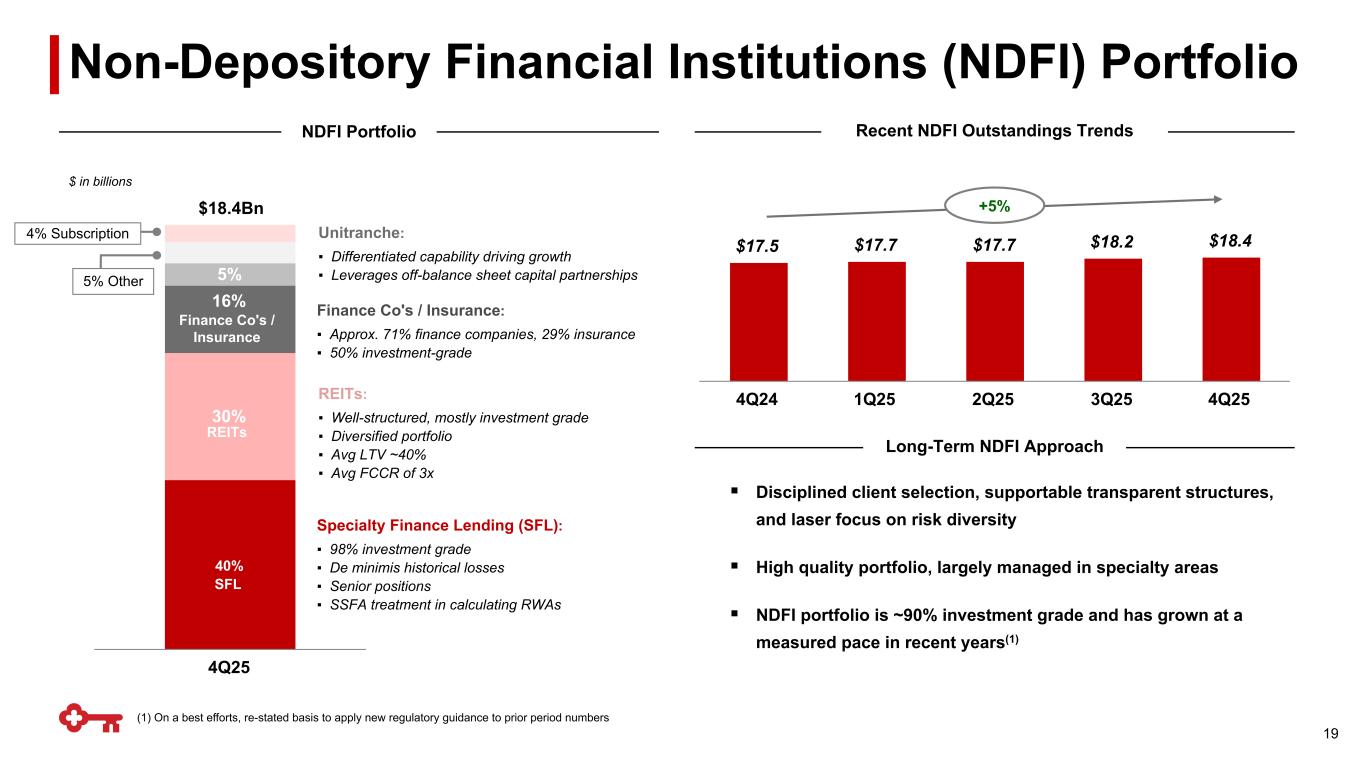
Appreciate that, Chris. And then you also gave us good details on your NDFI portfolio, slide 19. And can you just remind us, I know the quality of it is very strong, but what are you guys seeing there in terms of growth? And has there been any changes in trends on quality? It doesn't appear to be that way, but how about any further color on slide 19?
Sure. I'll give you a couple comments, and then I'm going to turn it over to Clark. One, the biggest piece of that is something we call SFL, which we've been in 20 years, and I think we've had one charge-off. Very, very high quality. The next thing is to the entity, which I think is a real thing, loan-to-value. The next piece of it are a lot of insurance companies, and as you well know, insurance companies are sort of required to keep a certain amount of capital. So portfolio, growth, reclass, and the way that...
And so I know you're familiar, Gerard, with all the regulatory reporting changes. We did not see an enormous amount of growth, particularly in the second half of that book. And I would say it's largely because in the finance lending business, we were turning away deals that we just did not think fit the structural integrity of what we're trying to do there. And if the head of our business was here, he'd say he turned down more deals in 2025 than he has in the prior decade and a half to two decades. So, you know, if we see a reversion to what we think the right standards are, you will see growth there. But to the extent we don't, we're, you know, we're happy.
Operator
Thank you, Gerard. Our next question goes to the line of Chris McGrady with QBW. Chris, your line is open.
Good morning. Thanks for the question. Chris or Clark, the CET1 target, you know, the 9.5 to 10 over time. I'm interested in kind of the walk from where you are today at 10.3, the consumption of it, right? You talked about buybacks of $1.3 billion plus this year. I would imagine at some point there's going to be a handoff to on-balance sheet growth versus, you know, syndicating more out. But any thoughts there would be great.
Kind of from a perspective of where we are and where we're going, you're exactly right. On a marked basis, we're at 10.3. And on the capital rules.
The components I might just give you, just, you know, 10, 3 to 10, call that half a billion dollars. We'll distribute another $700 million or more throughout the year. So we will pay out a ratio of 70% to 80%, which is dividends and buybacks in 2026. So, again, that gets us to the top end of the range, as Chris said. We'll keep an eye out for what changes occur on the regulatory front. the other two components or three components will be loan growth which obviously is is is our top priority and we'll continue to support that where it makes sense the second will be just the macro environment and overall credit performance so obviously the capital is there to support any issues the rating agencies and where we need to be and then take a look at where we are and how strong we feel about our own performance in the economy and then decide you know where we want to be in that range going forward.
Great and and on slide my follow be on slide 14 you may have hit it but I want to make sure the the walk between the 15 plus ROTC and 4Q of 27 and that 16 to 19 I'm interested kind of the timing I don't think you've given a timing for that 16 to 19 and also what do you think the biggest what do you need to do to get you know into that range beyond the 15% in the end of next year? Thanks.
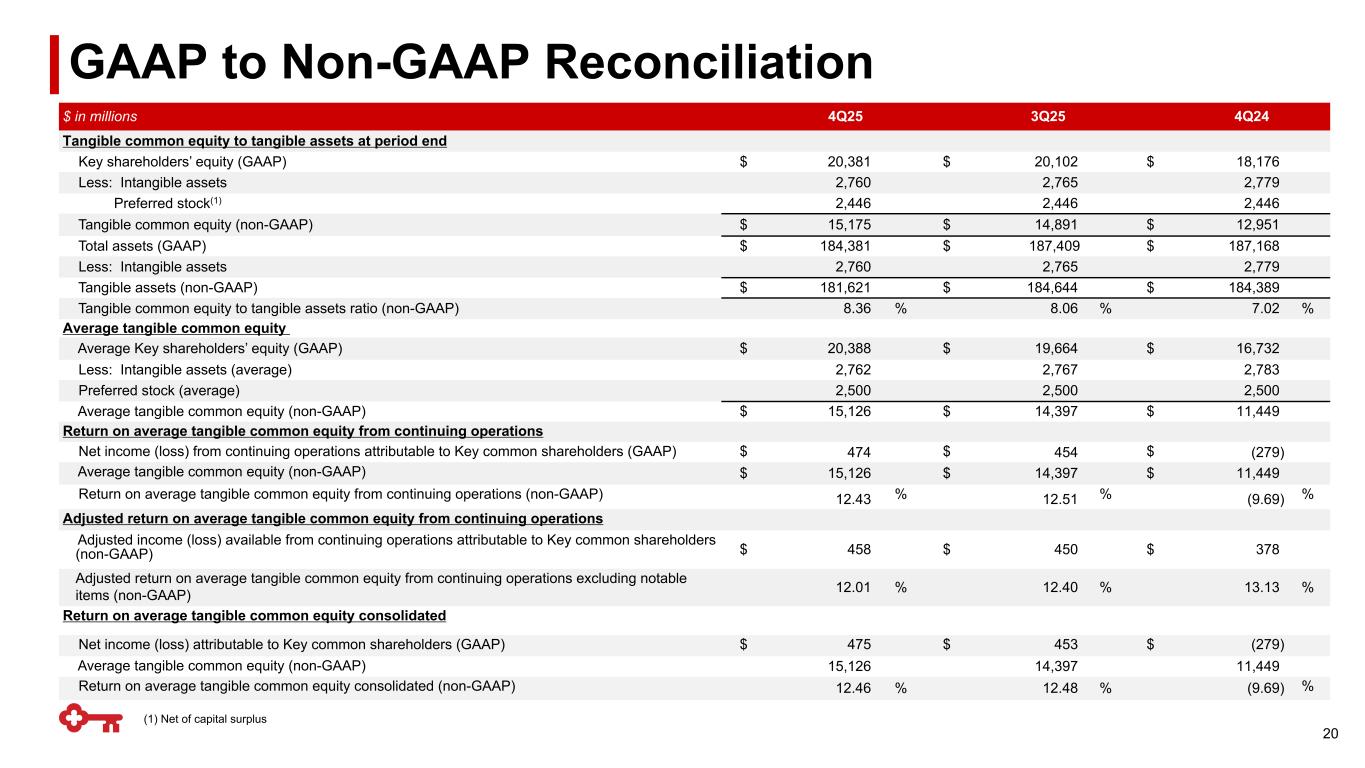
Sure. So the first answer to the first part of the question, we have not given a time that we will hit to our long-term goal of 16 to 19. But I can tell you this, the big hurdles, we say half of it to get to 15 is mechanical. Obviously, as we go forward, more and more of That will have to be business-generated, and we'll have to do that. And the other thing that you always have to do when you're talking about returns is we have to maintain our credit quality. There's nothing that – and, by the way, I'm quite confident that we will based on our model, but that's the other thing we're focused on.
Yeah, and I would just say, Chris, getting – you know, we've been a little bit on this balance sheet optimization path for the last – are going to be, which is, you know, reflected in a NIMH that looks like $325 plus, and then growing the balance sheet from their relationships, it's going to be growing fees at or above our expense growth rate, which, again, I think provides a little bit more leverage, and then managing capital to the right level. So, I think pulling all three of those as we go forward gets us.
That was great. Thank you.
Operator
Thank you, Chris. Our next question will go to the line of Matthew O'Connor with Deutsche Bank. Matthew, your line is open.
Good morning. It seems like commercial real estate, broadly speaking, has inflected with growth starting to pick up at least kind of industry-wide. And I was hoping you could talk about what you're seeing across your customer base there and how you think about the leverage to key. And I understand it's both a lending and fee opportunity. Thanks.
Yeah, Matt, thanks for the question. And I actually think our real estate platform is probably one of our very best platforms. We have not seen loan growth per se. I think if you look at our guide, basically what we're saying is that it'll be flat on an average basis this year, and it'll be up 3% from the fourth quarter of 25 to the fourth quarter of 26. That's a business that's an interesting one because we only have about $12 billion or so on our balance sheet, and we, in a typical year, would probably place even more than that into the markets, transactional activity. Most of it's been refinanced, and I think we're at a point now where the bid and the ask are coming together, and I think you're going to see a lot of activity. So I think that's some upside for us as we look forward.
Yeah, and I might, Matt, just give you some high-level views. So, we would think our CRE business in its entirety will grow, you know, probably 7%, 6%, 7%, 8% this year. I'd break that into our sort of traditional banking businesses, lending, and capital markets, and then just separate that from servicing, which we've talked a lot about and had a record year in 2025. That will be down this year, just given a couple components. From a total revenue standpoint, it would be roughly flat. down maybe low single digits on the fee side that will be down somewhat significantly owing really to three things one is a movement of some deposits which were previously placed going to our balance sheet which produces nii that's kind of a net neutral we do see advance on a race on advances coming down as fed funds and so far come down so that does impact the business and then obviously, as the market resolves, we see less special servicing and, again, coming off a record high. All in all, you know, again, down for the year, but coming off a fantastic 2025. It's a business we love and feel very good about, and we think to the extent CRE, as a broad market player comes back, we'll have more and more opportunities to grow our primary servicing. You know, we continue to love the commercial real estate business. I just want to give a little bit of context on the company.
Okay, thank you. That's a good detail.
Operator
Thank you, Matthew. Our next question will go to the line of Kevin Uzden, Ken Uzden with Autonomous. Ken, your line is open.
Thanks. Good morning. As you move forward to 2026, you mentioned you've done doing a lot of hiring this year, and that puts against a really good revenue start because of the baked in stuff you mentioned earlier. As you think about getting past this year when it's a little bit more of a 50-50 kind of baked in versus kind of just what the market gives, how do you think about just what the right natural expense growth rate of the company is and, you know, given the pace at which you're really leaning into hiring this year? Thanks.
Really long-term sort of two to three percent expense growth, and that is always going to include some meaningful component of, you know, continuous improvement where we're finding efficiencies and then reinvesting them. You know, you saw us at, you know, about four and a half in 25. We're talking about three to 4% this year. And I think we'll just step down over the next year or two to get to that longer term growth rate.
Just one follow up on the consumer book. You mentioned that you still expect some runoff for the year.
So relative to the 30 billion or so consumer loans at the end of the year what do you have a view of like when and where that bottoms as your as your runoff comes to us uh or you know heads towards the bottom thanks we've talked about this every every quarter we run off and obviously it depends what the rates are um just to refresh everyone's memory this most of this runoff are mortgages to doctors and dentists they yield about 3.3 percent so we think that we think they're money good but obviously from a balance sheet perspective we've you know the runoff is just fine we think the runoff will be about you know as I said about 600 million a quarter and I would suspect it depends on rates but I would suspect it would bottom out in the next couple years and what we're doing just so you know what we're doing what we're doing to try to get some consumer loan growth is we're really building out our home equity capabilities 50 of our customers have significant equity in their homes and so slowly but surely we're replacing that that mortgage product with home equity and then the other thing that we have that will kick in at some point is the rate cycle plays out is we still have our student lending platform that refinance Erika Najarian with UBS Erika your line is open I know it's a busy day for investors.
So just one cleanup question. You know, Clark, implied in the earlier questions is that the investor base is, you know, thinking that the guide is a little bit sort of, quote, quote, softer than high expectations, you know, no good deed goes unpunished. But just to level set, you did mention that there's a level of conservatism embedded in the guide in terms of the macro backdrop and so you know it feels like you know I guess it's a good conclusion to have it there's some conservatism or in the guide relative to what the macro kid could be in 26 yes so maybe I'll make a couple comments and then you can tell me if I was responsive here but you know the first point and I think you made it there is you know the strength of our 25 results obviously impact the year-over-year comparison.
But what I would say is the guide we're providing here is a little bit better than we would have expected a quarter or two ago in terms of absolute dollars. The growth rate obviously, you know, starts with where we ended the year. But I'd say, you know, overall, as we mentioned, we feel good about the numbers. There's obviously a lot of moving pieces for key in the economy here. But as you saw last year, I think we're pretty dialed in on running these businesses. And with regard to our forecasting, you know, as pieces come into clear focus, we'll share the updates throughout the year. So as of now, this really reflects the visibility we have in front of us. But our ability to outperform our guide last year was driven by the compelling trajectory of the businesses here and our ability to seize opportunities as we see them. And we'll continue to do them. But I would just underscore that we continue to be very confident in the guide and very positive about the direction of travel.
Got it, all I needed. Thank you.
Operator
Thank you, Erica. Our next question will go to the line of Manan Ghazalia with Morgan Stanley. Your line is open.
Hey, good morning. So I just wanted to follow up on all the comments made on the commercial loan growth side this morning. It feels like there's some strong momentum there. Rates are lower. You know, 60% or more expect that they will benefit from the OBBA. CRE is starting to look better. I think you noted in your deck that lines grew nicely in the quarter as well. So I guess the question there is, given the guide for commercial loans to grow at about 5% year-on-year next year or in 2026, is there room for growth to accelerate as we go through the ER? And is there some upside there as well?
Yes, I think there is. I mean, if you think about commercial at 5%, you've got C&I in there. They call it 7%. And I already talked about CRE. So I do think I to go up adjusting our risk appetite.
So we think we can shoot.
Great. And then Chris, you spoke about how much more there is to do on AI. And you also continue to hire more frontline bankers. So I guess when we look at the expense guide of 3% to 4%, can you just break out what level of investment spend that includes and what the ongoing efficiencies you're generating from the business are?
Yeah, so it's efficiencies yet with respect to AI. But I can tell you, I said we've stepped up $100 million in each of the last three years. And we also, by the way, have found through continuous improvement about $100 million in savings each and every year. And so I think that it's one of those things as we properly reconfigure key and start to look at these horizontal teams and use technology, I think we'll actually be able to fund a lot of it. Some kind of cost savings, obviously I could give you specific ones like a call to a call center, It costs $0.25 using AI, and if a human picks it up, it costs $9. Those are small, very focused things. We're focused really on more transformational activities.
So for me, thanks very much.
Operator
Thank you, Manon. Our next question will go to the line of David Giaverini with Jeffries. David, your line is open.
Hi, thanks for taking the question. So I had a follow-up on balance sheet growth over the medium term, so you're guiding to a flattish average earning assets. And in 26, what's a reasonable growth rate in average earning assets? As you hit your stride, say, over three years, is GDP plus the right way to think of it as your investments kind of take hold?
So the way we tend to think about that, David, is in our core industry verticals, When the market is open and we like the risk profile, we think we can grow GDP plus because of our focus and expertise in those areas. I think broadly sort of GDP with maybe a little bit of upside is right, and then consumer probably run a GDP.
So I think overall your combined loan growth probably looks – Quality, good trends in non-performing assets and criticized loans. Remind us of your ACL comfort level and reserve build outlook and then any areas you're watching more closely.
Yeah, so let me start with the reserve, and then Mo will maybe comment on the areas he's focused on. We've seen, and I side, the rotation from residential to C&I over time will require a little bit more reserving because C&I loans are going to, all other things being equal, have a little bit more credit costs than our super prime consumer loans and then the third piece is we just are still reflecting some macro uncertainty that continues to be out there I think there is some potential for release throughout the year if we get more clarity on that or the economy just you know gets visibly more stable broadly things like geopolitical risk etc but that's really what's reflected in that reserving at this point yeah I think that's well said Clark and again overall benign economic environment from our perspective.
Just a few watch areas that we're considering consistent with our, you know, culture of early risk identification. So, you know, consumer discretionary, that's about a $5 billion portfolio rising given.
Operator
Thank you, David. With no additional questions registered at this time, I'll go ahead and turn the call back over to you, Chris, for closing remarks.
That concludes our fourth quarter earnings call. Thank you for all of your interest in key to the extent people have additional questions please do not hesitate to reach out directly to Brian Monte thank you so much and have a good day goodbye that concludes today's conference call thank you for your participation enjoy the rest of your day