Operator
Good morning and welcome to KeyCorp's second quarter 2026 earnings conference call. My name is Megan and I will be your moderator for today. All lines will be muted during the presentation portion of the call with an opportunity for questions and answers at the end. If you would like to ask a question during that time, simply press star 1 on your telephone keypad. As a reminder, this conference is being recorded and I would now like to turn the conference over to Troy Gates, KeyCorp's Director of Investor Relations. Please go ahead.
Thank you, Operator, and good morning, everyone. I'd like to thank you for joining Key Corp's second quarter 2026 earnings conference call. I'm here with Chris Gorbin, our Chairman and Chief Executive Officer, Clark Kayett, our Chief Financial Officer, and Mo Rahmani, our Chief Risk Officer. As usual, we will reference our earnings presentation slides, which can be found in the Investor Relations section of the Key.com website. In the back of the presentation, you will find our statement on forward-looking disclosures and certain financial measures, including non-GAAP measures. This covers our earnings materials, as well as remarks made on this morning's call. Actual results may differ materially from forward-looking statements, and those statements speak only as of today, July 21, 2026, and will not be updated. With that, I will turn it over to Chris.
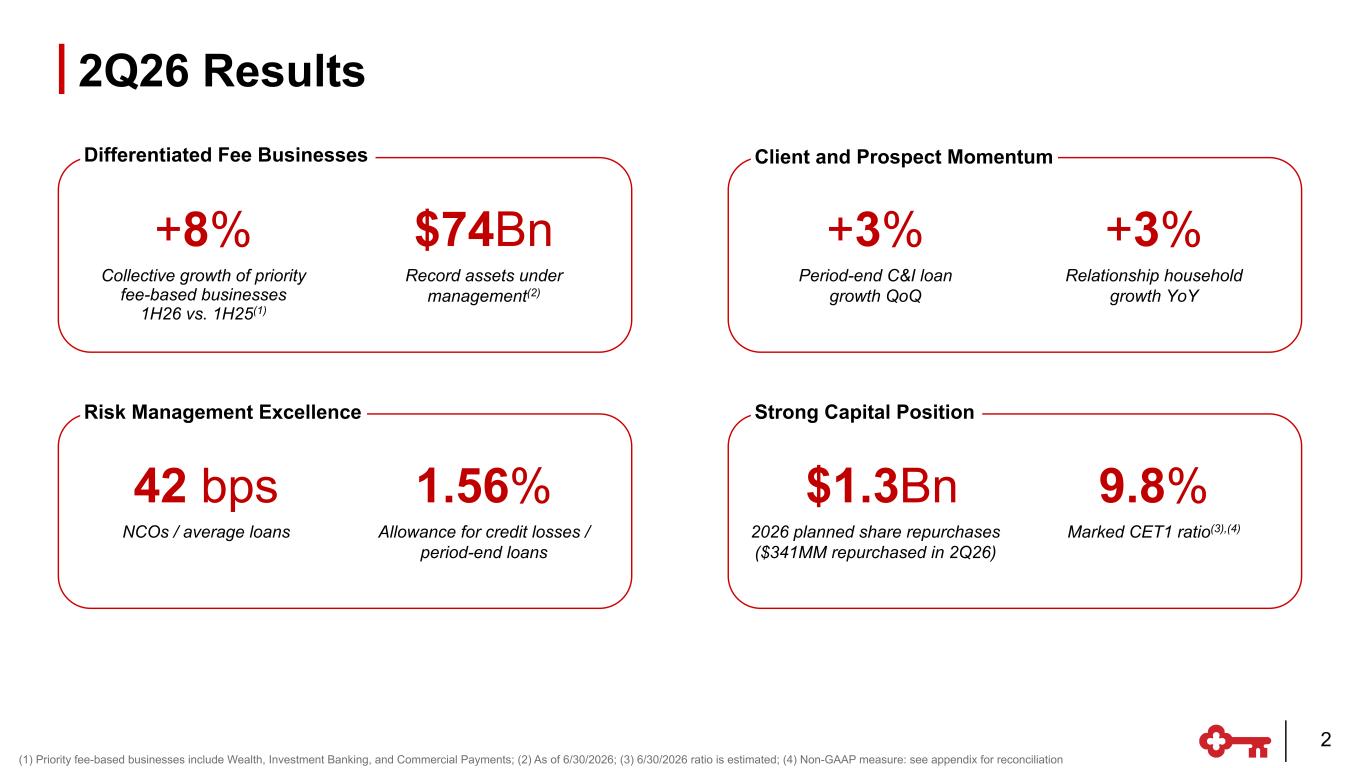
Thank you, Troy, and good morning, everyone. our second quarter results reflect strong business momentum and continued progress against our strategic and financial commitments. We reported second quarter earnings of 44 cents per share, up 26 percent year over year. Revenue grew 7 percent year over year, and pre-provision net revenue grew 9 percent. Net interest margin expanded sequentially to 2.89 percent, and we are on track to meet or exceed 3% by year-end, supported by several tailwinds that we expect will contribute to accelerated margin expansion in the second half of the year. Commercial loan growth remains strong. Period-end C&I loans increased $2.1 billion, or 3%, sequentially, reflecting continued success in attracting new clients across our markets, while concurrently deepening existing relationships. Our deposit franchise continues to perform well in a competitive environment, with total deposit costs declining two basis points during the quarter. Asset quality remains strong, while non-performing loans increased modestly during the quarter, reflecting idiosyncratic items. Broader portfolio performance remains stable, tightly managed, and consistent with our expectations. Our net charge-off ratio was 42 basis points during the quarter, in our year-to-date charge-offs remain at the low end of our 40 to 45 basis point full-year outlook. Given our stronger-than-expected business performance, I have even greater confidence in our ability to generate a return on tangible common equity exceeding 15 percent by the end of 2027 on our path to achieving our 16 to 19 percent long-term target. Importantly, we continue to deploy capital in a disciplined manner supporting client growth investing in the franchise and returning capital to shareholders through ongoing share repurchases during the quarter we repurchased more than 340 million dollars of common stock putting us on pace to achieve our full year share repurchase target of at least 1.3 billion dollars as we continue to repurchase our shares our strong capital position enables us to concurrently drive organic growth and invest in our business. As an example, during the quarter, we announced an agreement to acquire Clearwater UK. This transaction represents a strategic extension of our leading middle market advisory franchise and expands our ability to serve M&A clients and prospects internationally. We expect this transaction to close in the second half of 2026. While the macroeconomic environment remains uncertain, our momentum continues to be strong. We are seeing healthy client engagement, solid activity levels across our businesses, and remain well positioned to perform through a range of potential economic scenarios. We continue to grow clients. In the second quarter, relationship households increased 3%, and commercial clients increased 2% from the prior year. Commercial loan pipelines remained strong, up 6% from the prior year. Our priority fee-based businesses, investment banking, commercial payments, and wealth continue to perform exceptionally well. In the first half of the year, these businesses collectively grew 8% when compared to the first half of 2025. Investment banking pipelines are up 9% sequentially and remain at historically elevated levels, supported by record M&A and DCM pipelines. While middle market M&A activity has yet to normalize, we continue to see significant client engagement and remain confident in our expectation for mid-single-digit investment banking fee growth this year. In commercial payments, total gross payment fees increased 12% compared to the prior year, as investments we continue to make in bankers and scaling embedded banking build momentum. In wealth, assets under management reached another record $74 billion. Since the launch of our Mass Affluence Strategy in 2023, we've added 59,000 households, over $4 billion of AUM, and nearly $8 billion of total client assets to keep. Wealth remains a significant opportunity for us, as we are less than 10% penetrated with respect to our base of currently existing massive 4-1 households. Overall, we are encouraged by our second quarter performance and the sustained momentum across the business. As a result of our continued favorable loan momentum, we have increased our full-year guidance with respect to net interest income, revenue, and loan growth. Our guidance implies substantial positive operating leverage as we expect to grow revenues twice as fast as expenses in 2026. As always, our guidance reflects a range of potential interest rate scenarios and assumes markets remain constructive. We enter the second half of the year from a position of strength. The underlying trends across key remain favorable. We will continue to drive disciplined execution across our franchise. With that, I'll turn it over to Clark. Clark? Thanks, Chris.
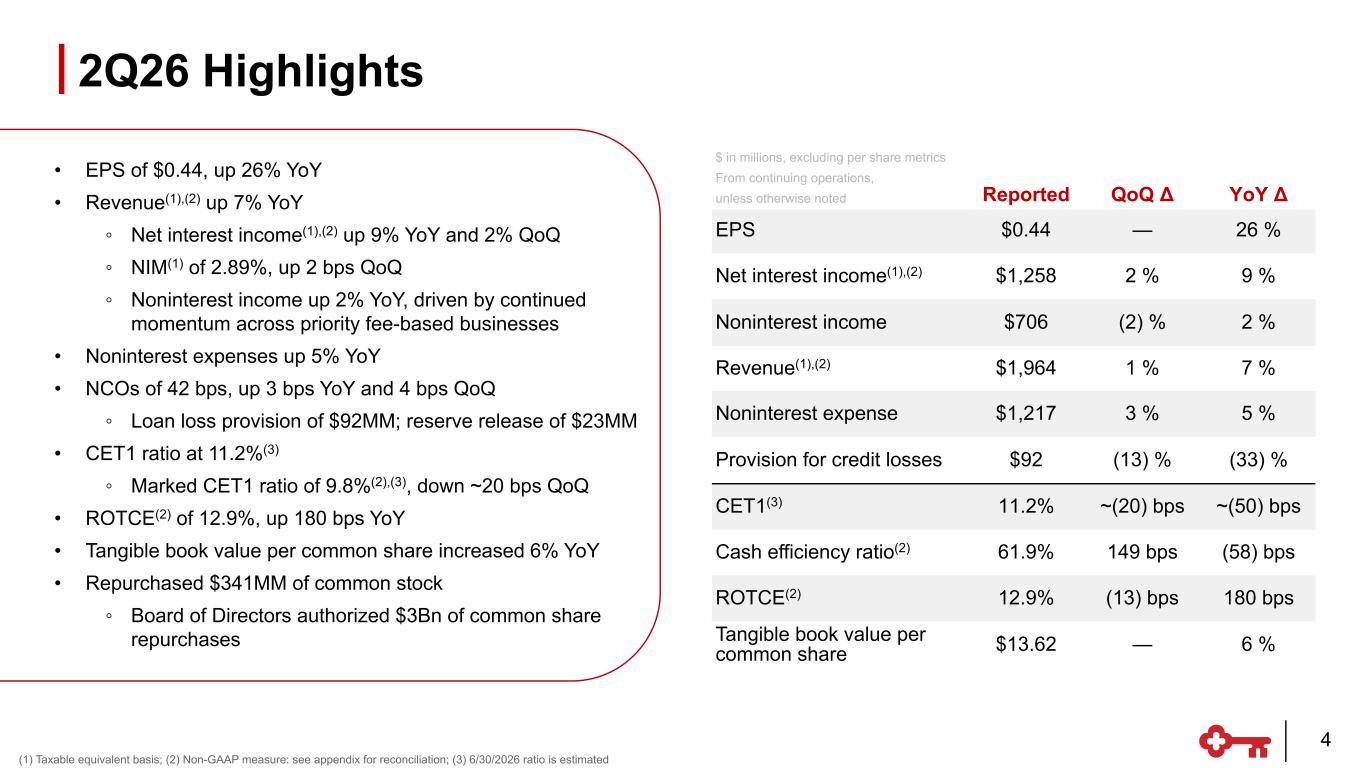
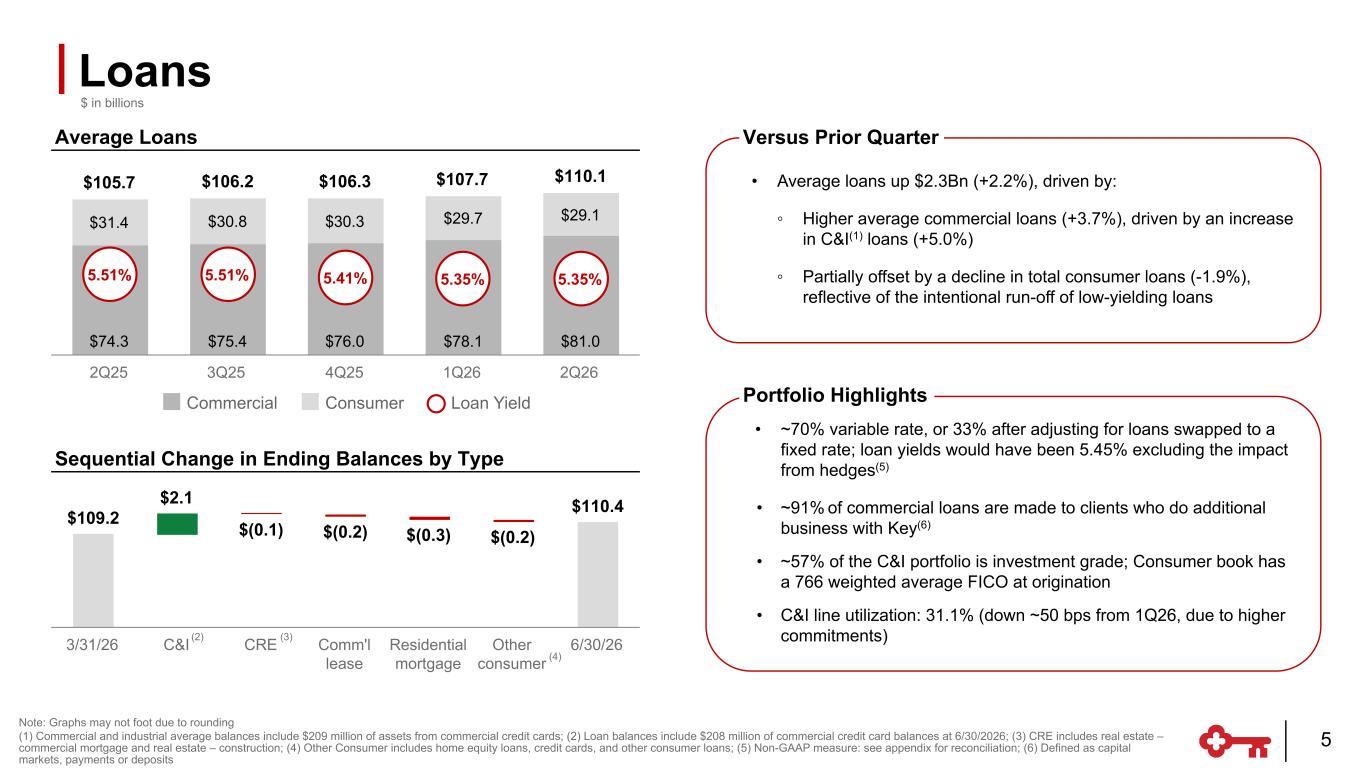
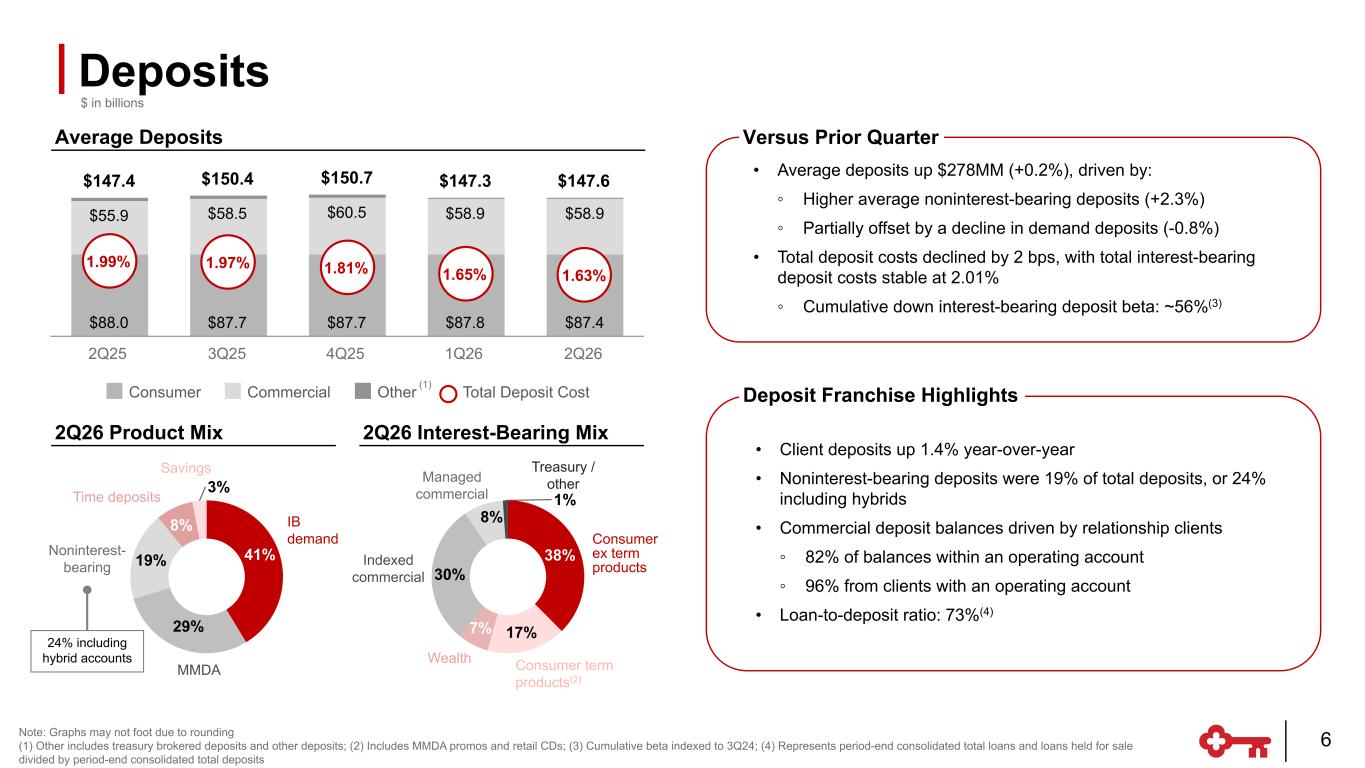
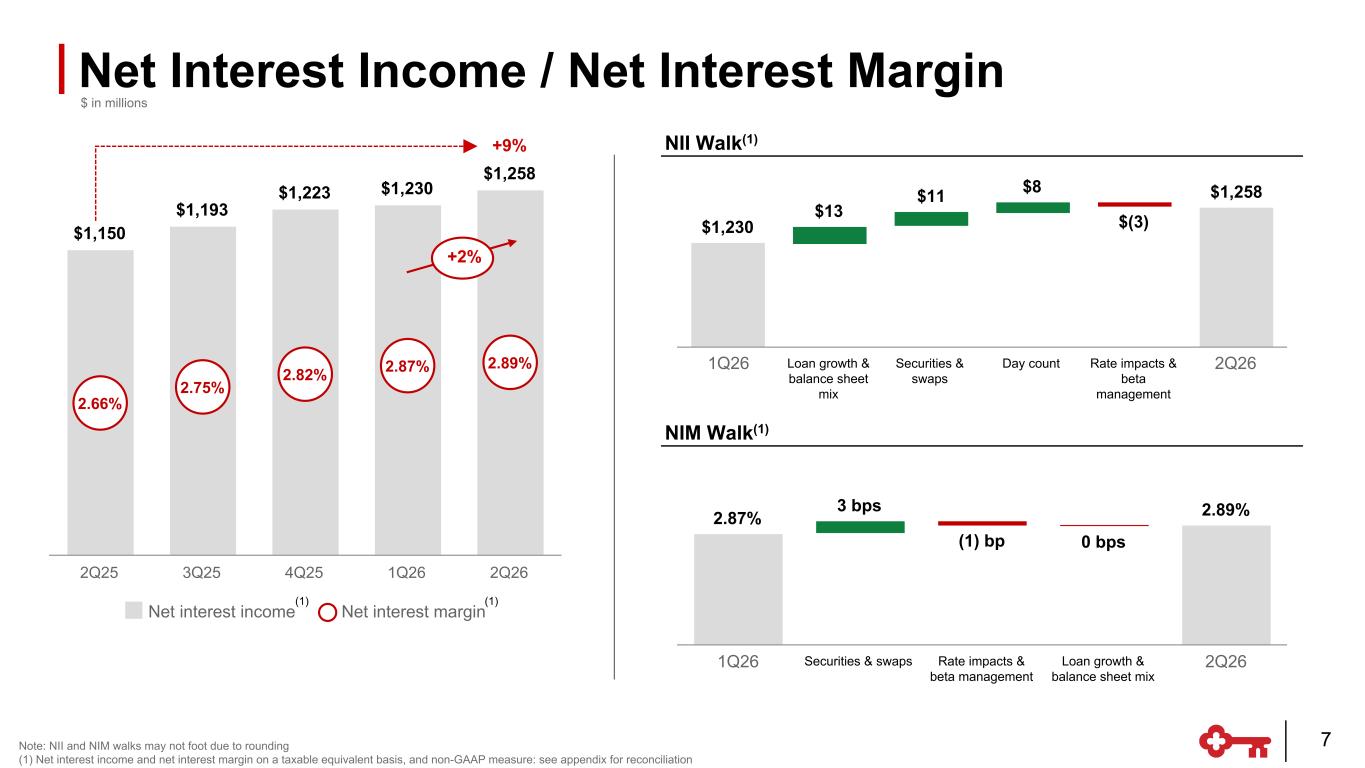
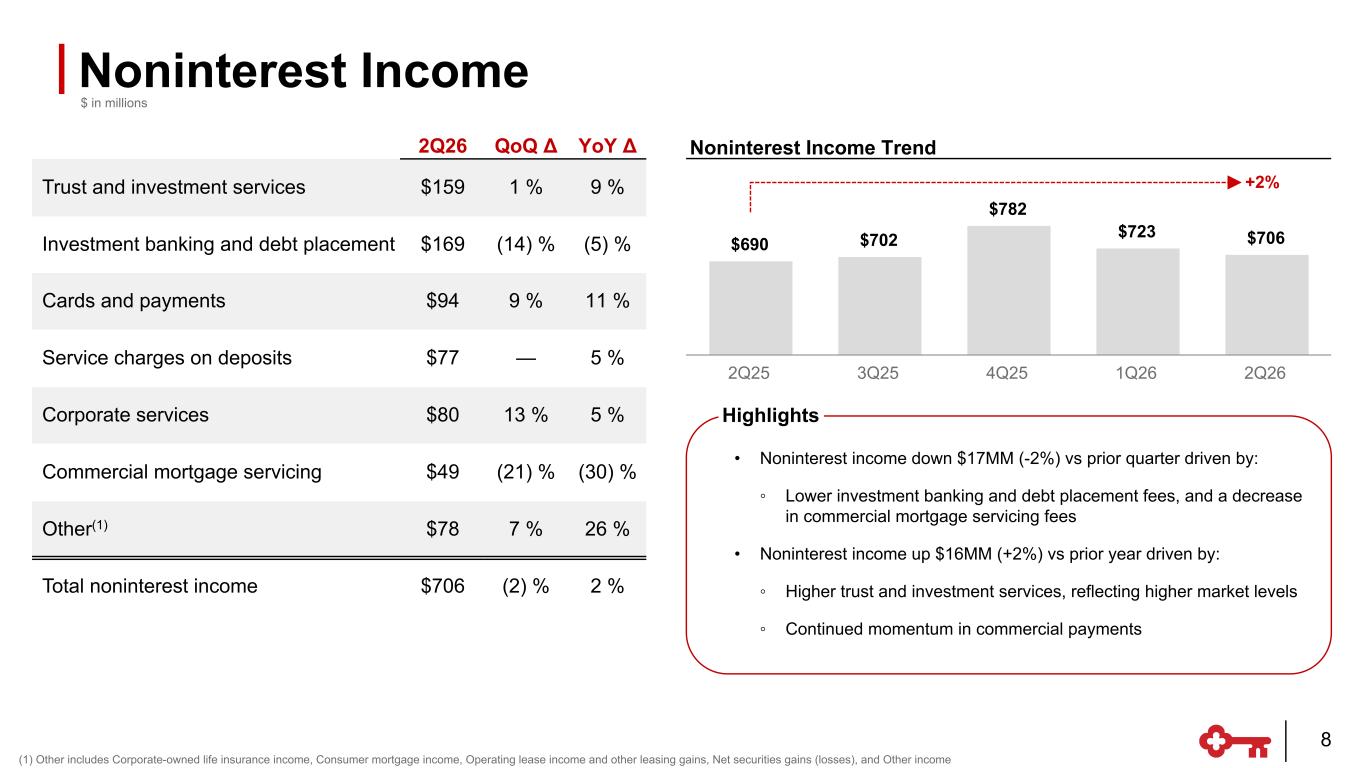
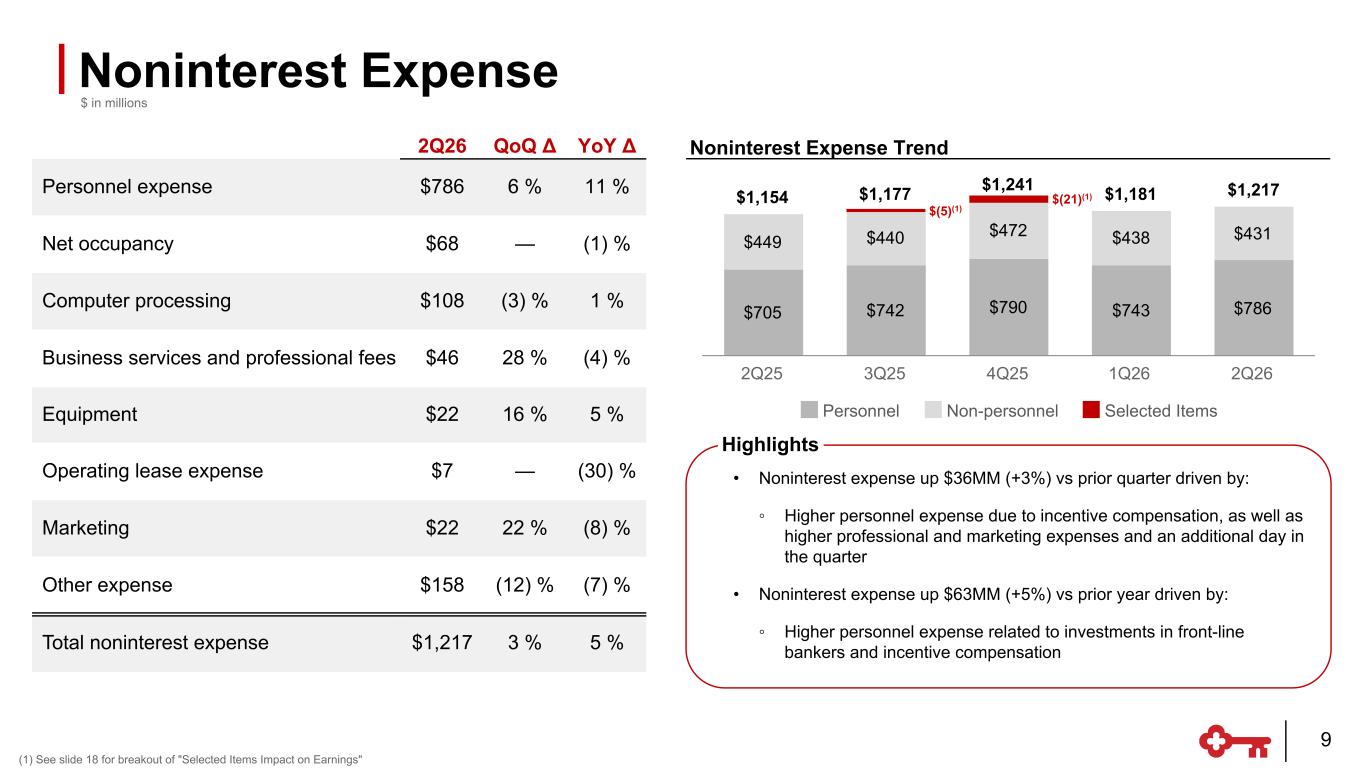
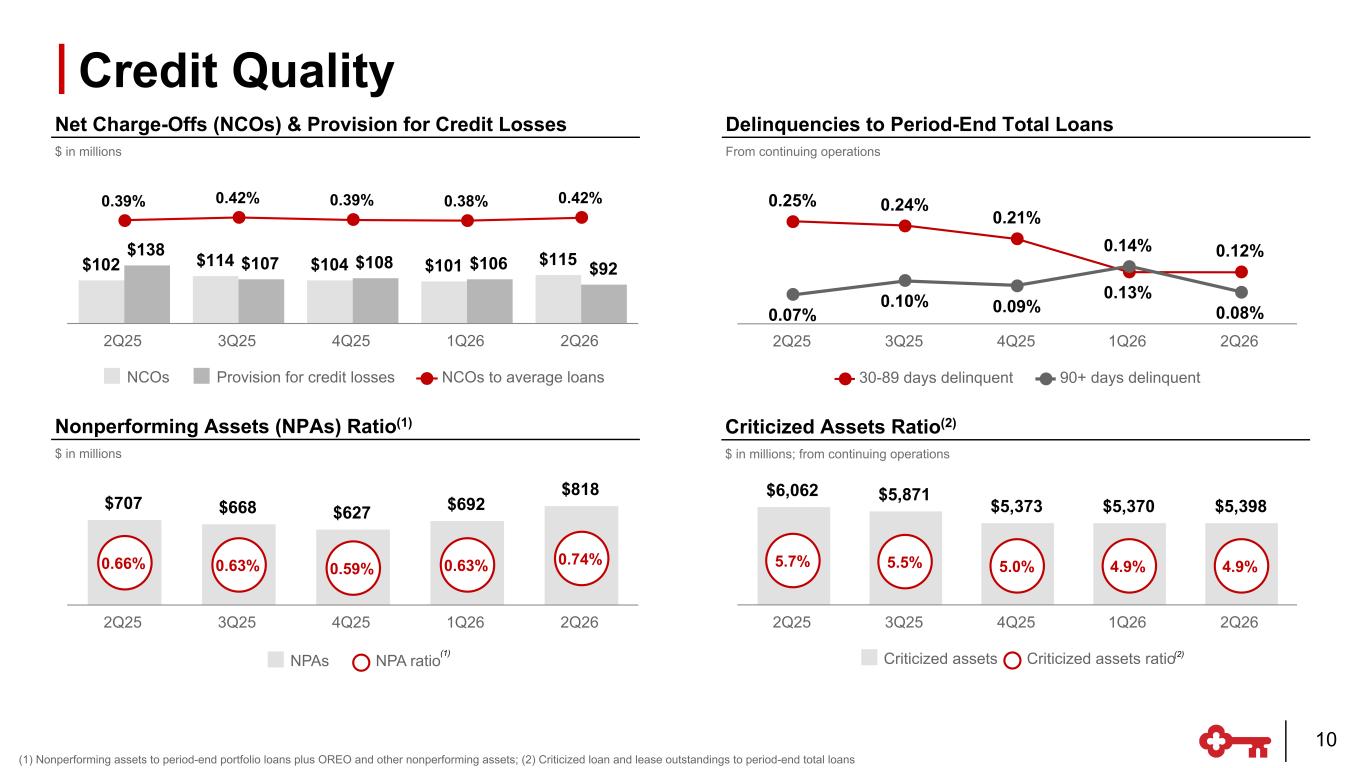
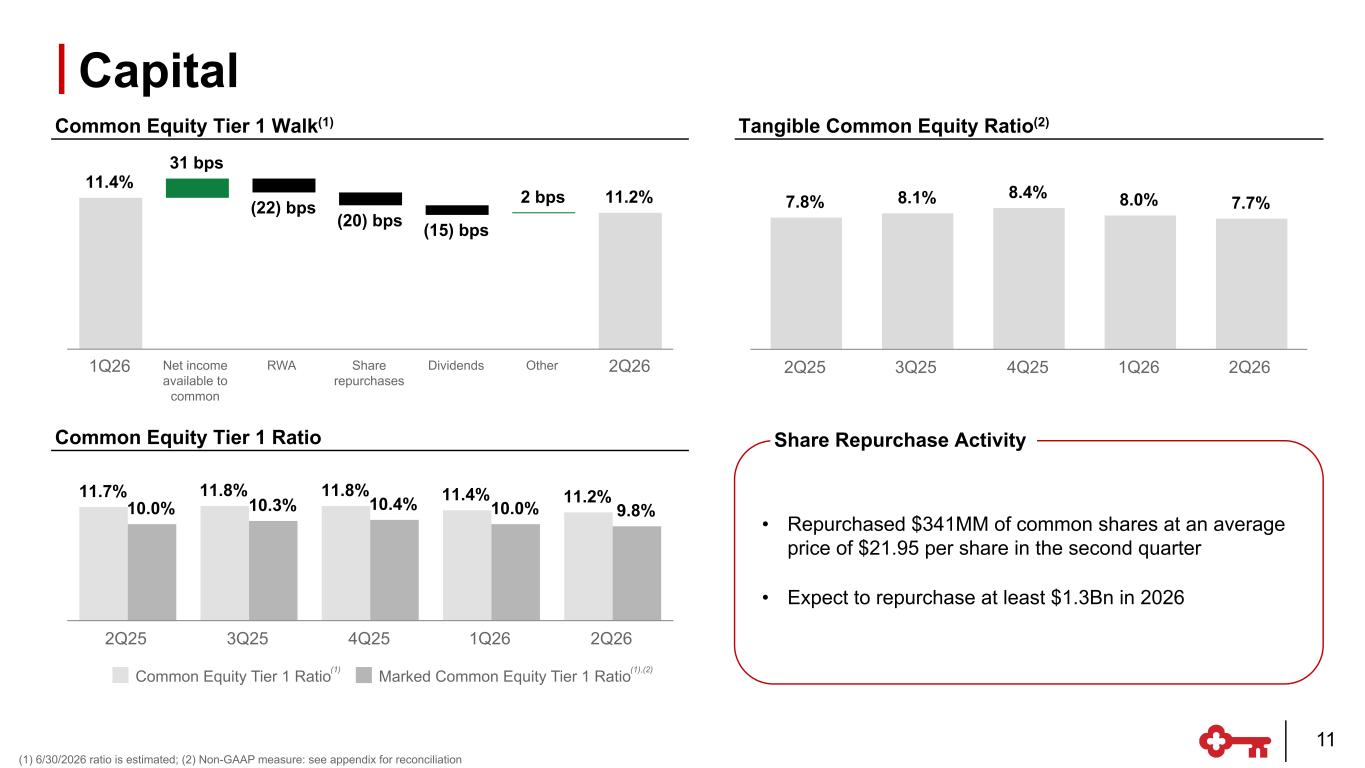
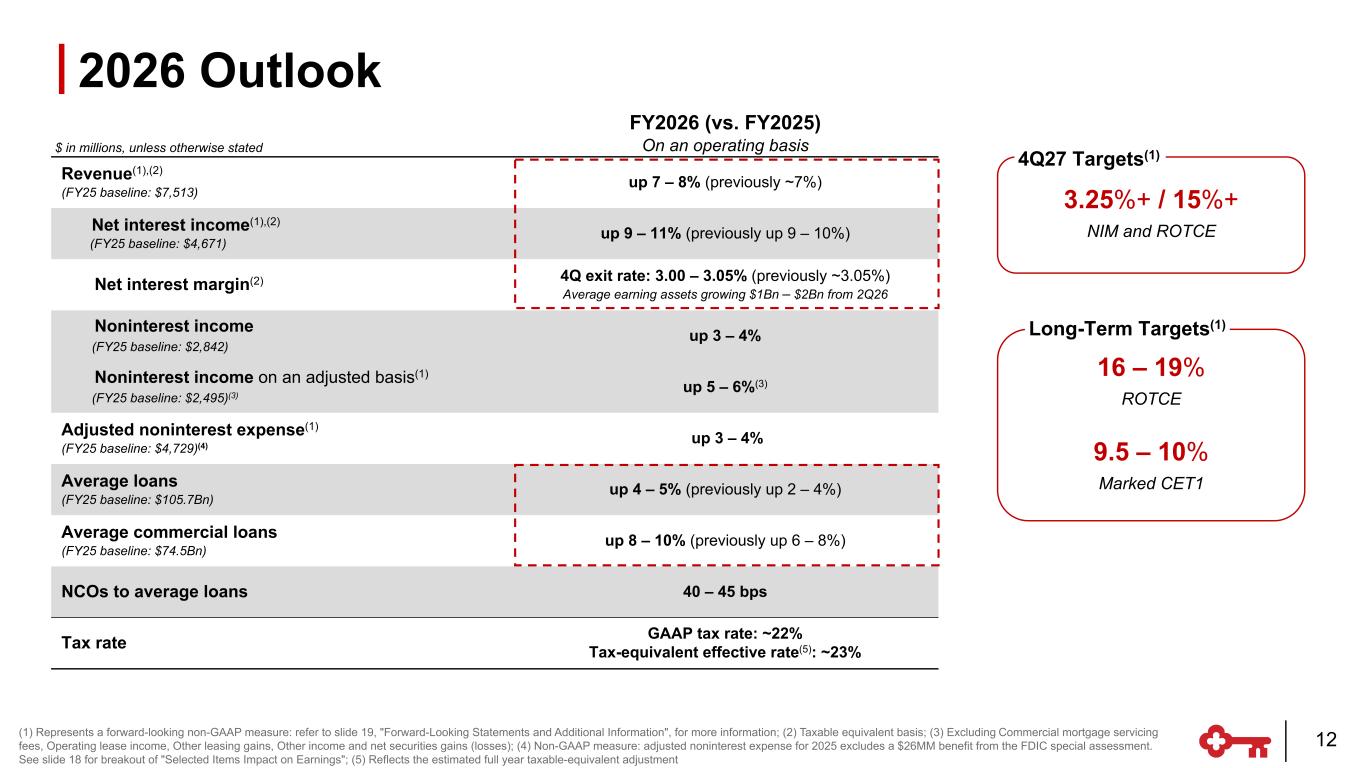
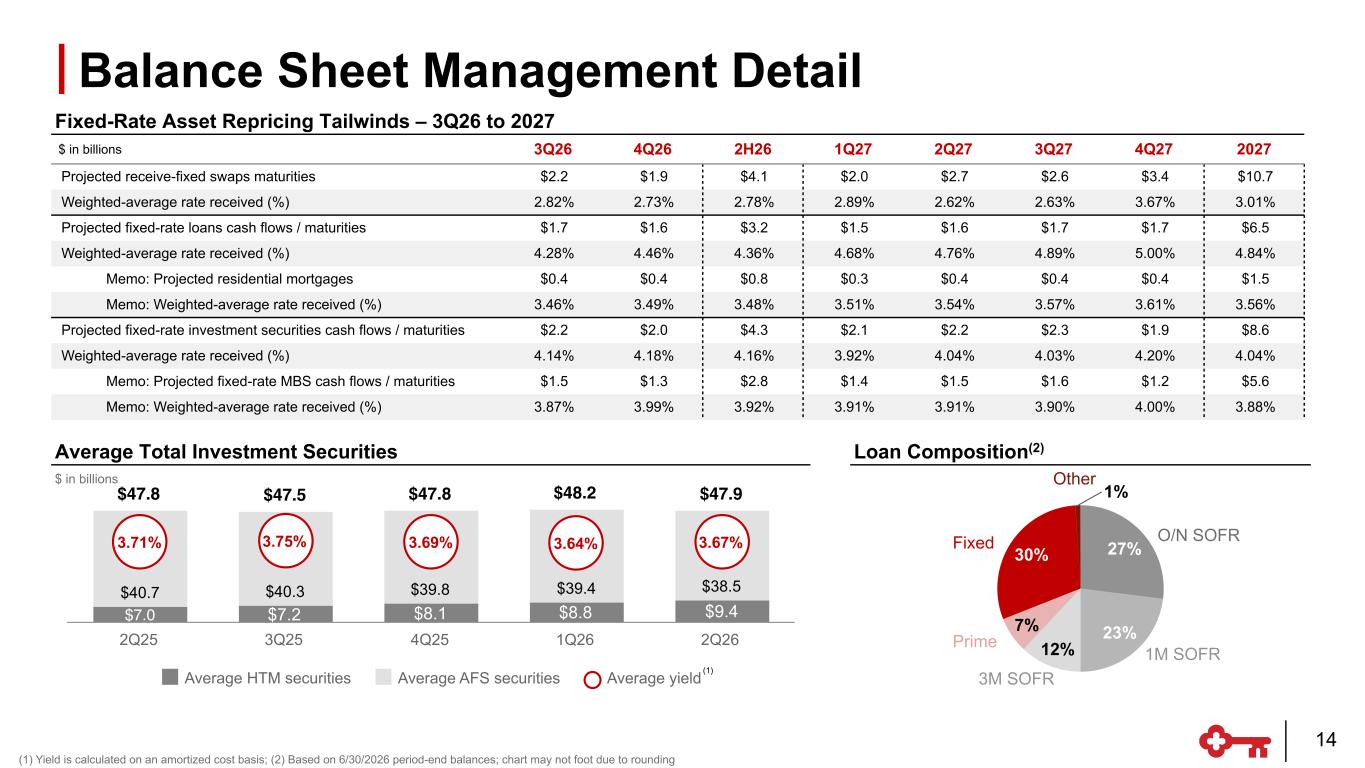
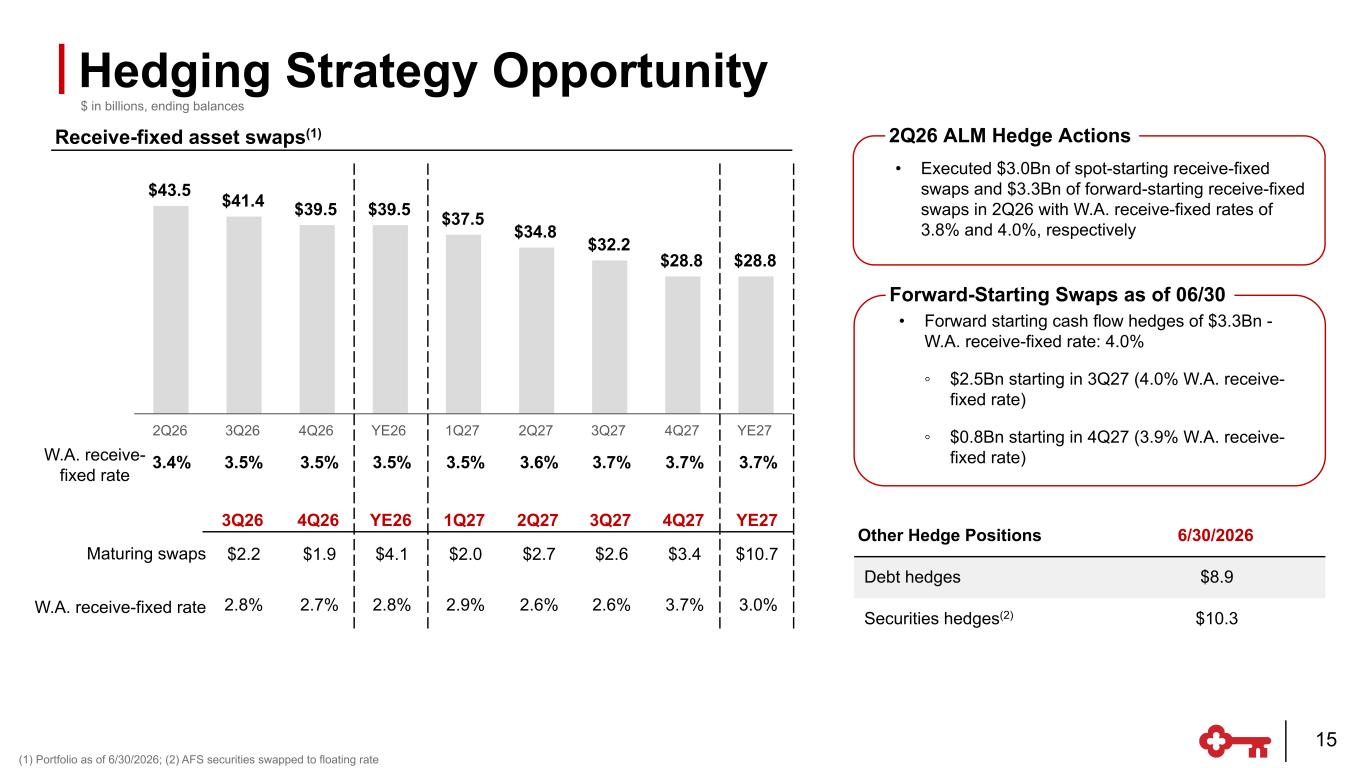
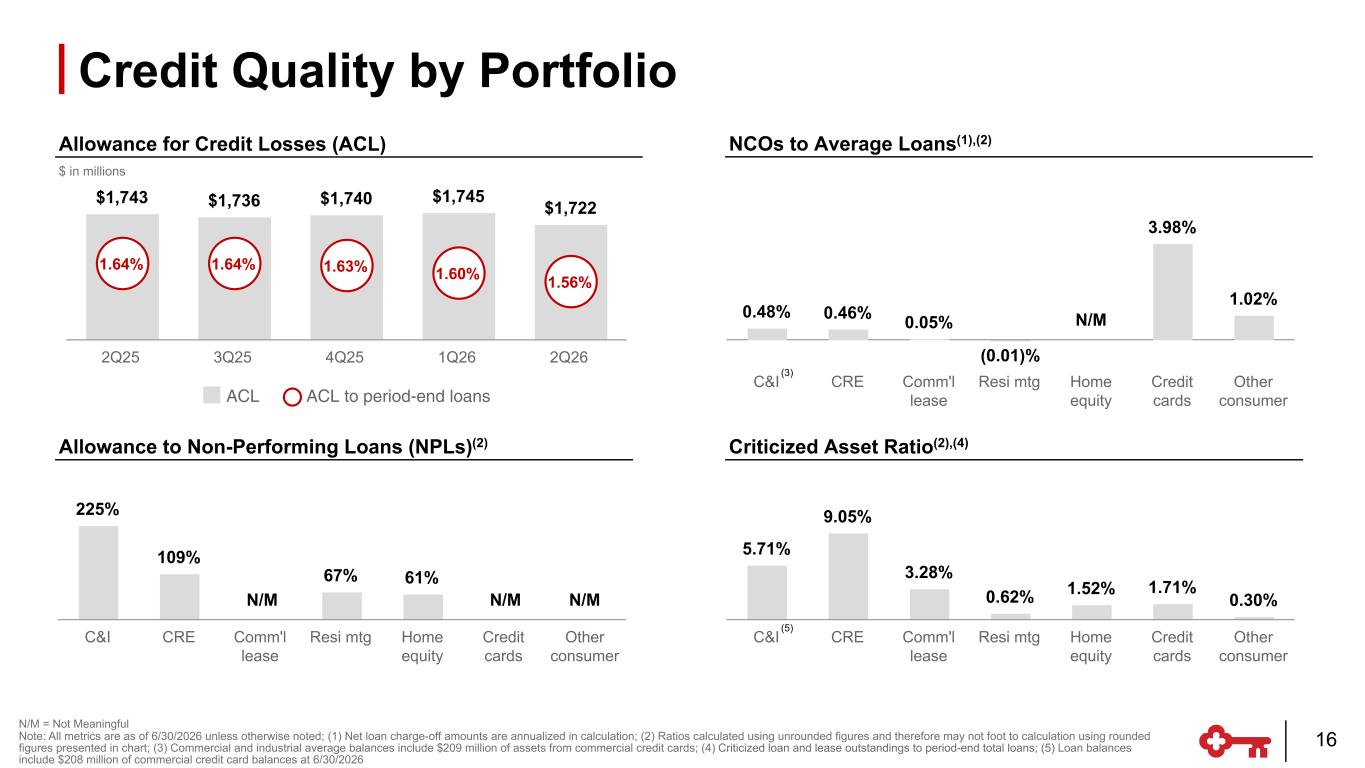
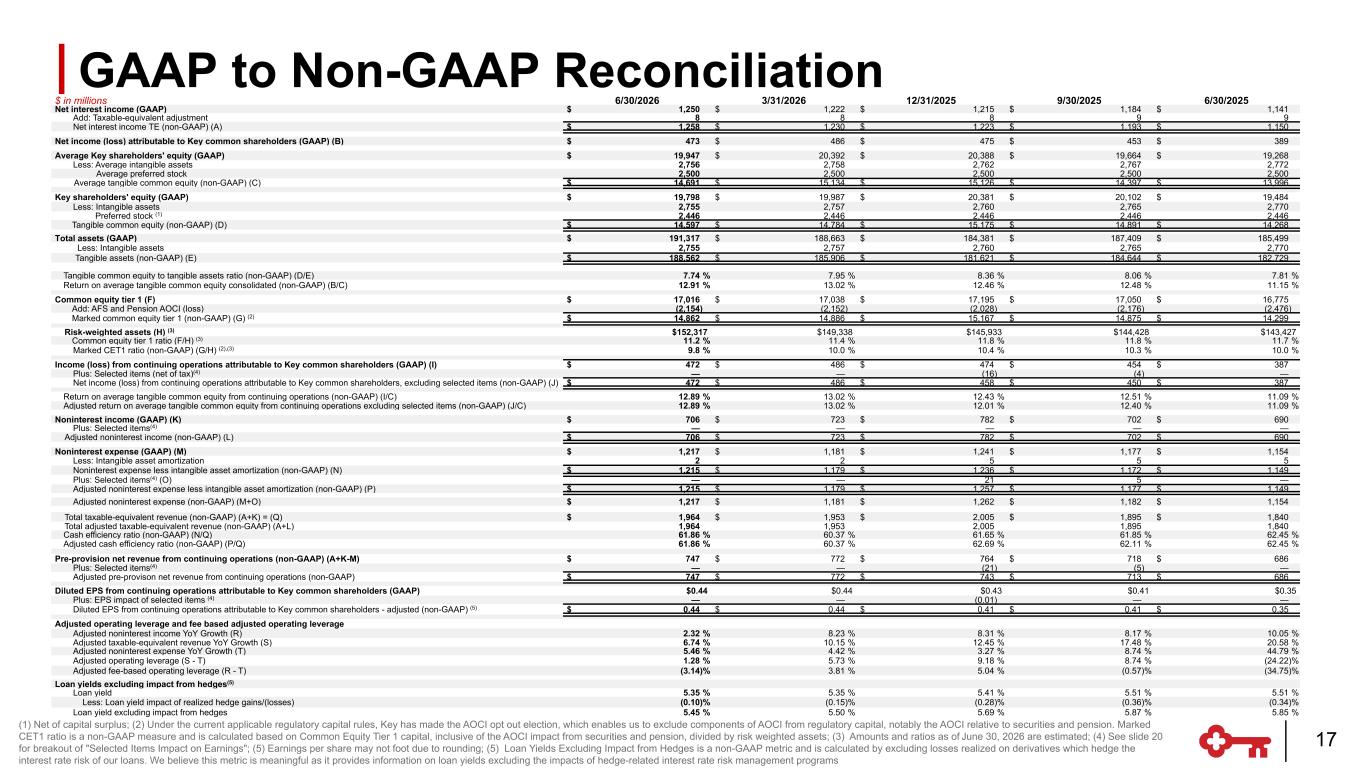
Starting on slide four, we reported second quarter earnings per share of 44 cents. Revenue was up 7% year over year, while expenses increased by 5%. Tax equivalent net interest income increased 9% year-over-year and 2% sequentially, primarily driven by commercial loan growth and portfolio repricing. Non-interest income increased 2% year-over-year. Loan loss provision of $92 million included $115 million or 42 basis points of net charge-offs and a reserve release of $23 million. The net release was driven by improvement in Moody's economic scenarios and a continued remix to higher credit quality relationships, partially offset by a qualitative bill to account for increased economic uncertainty. We grew tangible book value per share 6% year-over-year. Moving to the balance sheet on slide 5. Average loans were up $2.3 billion sequentially. Period end loans increased by $1.2 billion, driven by C&I growth of $2.1 billion, or 3%, partly offset by the ongoing planned runoff of low-yielding consumer loans. Growth was largely from new relationships and broad-based across industries and regions. The largest industry contributors were utilities, power, and renewables, real estate, and technology. C&I line utilization decreased 50 basis points sequentially to 31%, driven by higher commitments. Turning to slide six, average deposit balances were relatively flat sequentially and year-over-year, consistent with historical seasonal trends. average non-interest bearing deposits increased 2.3 percent sequentially representing 19 of total deposits or 24 when adjusted for our hybrid accounts as expected the average deposits for the quarter were consistent with q1 and we saw end of period deposits up versus prior quarter after troughing in may at the end of june deposit balances which closed the quarter at 153 billion dollars were temporarily elevated by about four billion dollars due to the timing of transaction activity among our relationship clients total deposit cost declined two basis points sequentially to 1.63 percent our cumulative interest-bearing deposit beta help study at 56 percent to support our continued strong commercial loan growth we supplemented funding with short-term borrowings given our expectations that client deposits will grow in the second half we used wholesale funds in the second quarter rather than repricing existing deposit relationships as a result total funding costs increased by one basis point we continue to pay close attention to deposit dynamics and will take proactive and strategic actions to manage funding effectively to achieve our goals we expect to increase average client deposits by more than two percent through year end slide seven provides drivers of NII and NIM this quarter taxable equivalent NII was up two percent and net interest margin increased two basis points from the prior quarter to 2.89%. The increase was driven by commercial loan growth, fixed rate asset repricing, and an additional day in the quarter. We continue to manage our balance sheet to a fairly neutral interest rate risk position as we move through the remainder of 2026. On slide eight, non-interest income increased 2% year over year. Investment banking and debt placement fees were $169 million dollars for the quarter in the first half of 2026 investment banking fees were 366 million dollars an increase of four percent compared to the same year ago period as chris mentioned our pipelines are at historically elevated levels compared to the prior quarter overall pipelines are up nine percent and m&a pipelines are up seven percent to a new record we expect third quarter investment banking fees to be up 20 plus quarter over quarter and remain confident in delivering mid single digit investment banking fee growth for the year. Trust and investment services income were 9% year-over-year, reflecting higher market values, and assets under management reached a new record high of $74 billion. Service charges on deposit accounts and corporate services fees each increased by 5% year-over-year. The increase in service charges was driven by growth in commercial payments, while corporate services income was driven by higher loan commitment fees commercial mortgage servicing fees were 49 million dollars down 21 million dollars year over year largely driven by lower deposit placement fees and special servicing fees at quarter end we were named primary or special servicer and approximately 735 billion dollars of commercial real estate loans of which about 270 billion is special servicing active special servicing third-party assets were flat sequentially at 10 billion dollars about half of which is office we continue to expect commercial mortgage servicing fees to run about 50 to 60 million dollars per quarter the remainder of the year on slide nine second quarter non-interest expenses were 1.2 billion dollars an increase of three percent sequentially and five percent compared to the year ago quarter the increase was driven by higher personnel expenses related to the investments in frontline bankers impact of keys higher stock price on incentive compensation as well as higher benefits costs. Sequentially, expenses increased due to higher incentive compensation, professional fees, and marketing expenses, as well as an additional day of the quarter. Expenses are expected to modestly pick up through the second half of the year, reflecting our ongoing investments in people and technology and incentive compensation associated with expected seasonally higher fees. We continue to expect to be within our full-year expense growth guide of 3% to 4%. Turning to credit, net charge-offs were 115 million dollars or an annualized 42 basis points of average loans. Criticized loans are relatively stable at an annualized 4.9 percent. Non-performing assets increased by 126 million dollars sequentially to an annualized 74 basis points of loan. The increase was largely driven by three credits in the real estate, consumer goods, and agriculture industries. Based on our current assessment, we do not expect these credits to result in meaningful incremental losses, and they do not alter our outlook for net charge-offs. Moving forward, we expect several sizable non-performing loans to resolve through the rest of the year. Overall, our portfolio remains healthy. Fundamental performance of our borrowers remains resilient and is tracking in line with expectations. Moving to slide 11, our CET1 ratio was 11.2 percent and our marked CET1 ratio was 9.8 percent at quarter end. As Chris mentioned, we continue to expect to repurchase at least $1.3 billion of our shares for the year. Moving to slide 12, we are increasing our 2026 guidance to reflect our loan growth outperformance. We now expect revenue to grow 78% compared to approximately 7% that was previously communicated. We also now expect full-year net interest income to increase 9% to 11% compared to the prior guide of 9% to 10%. This guidance holds under a fairly broad range of interest rate scenarios, including a Fed height scenario. We now expect to exit the year with a net interest margin in the range of 3 to 3.05 percent, with average earning assets increasing between $1 to $2 billion from the second quarter. This outlook assumes continued loan growth in a stable competitive deposit environment. While incremental balance sheet growth may be modestly margin dilutive, we are willing to trade NIM to a degree to add quality relationship clients with a strong return profile. Additionally, we continue to expect the benefits of over $9 billion of low-yielding fixed asset-free pricing through year-end, and disciplined deposit management to more than offset that impact. We now expect average loans to increase 4 to 5 percent compared to our previous guidance of 2 to 4 percent, and average commercial loans are now expected to increase 8 to 10 percent this year. The higher outlook reflects strong loan growth through the first half of the year, continued success in adding and expanding client relationships, and healthy commercial loan pipelines that continue to support growth in the second half of 2026. All other guidance remains unchanged in summary subject to the usual macro caveats and a constructive environment that remains broadly consistent with today we expect to maintain our strong momentum through the second half of the year and deliver a solid return on and return of capital to shareholders with that i would like to now turn the call back to the operator to provide instructions for the q a session operated thanks thank you we will now begin the q a session if you would like to ask a question please press star followed by one on your telephone keypad if for any reason you would like to remove your question please press star followed by two again to ask a question please press star one as a reminder if you're using your speaker phone please remember to pick up your
Operator
handset before asking your question the first question will go to the line of ryan nash with goldman sachs ryan your line is open hey good morning guys margin and it's chris we can't hear you okay sorry about that you started to okay but you started to talk about them and then you faded out sorry about that so i was saying what what drove the the the main pieces that drove the nim
miss i know you talked about the decision to use some wholesale funding and some lower loan yields and then maybe just talk about what's embedded in reaching the 305, including deposit costs, fixed rate asset repricing, and any other impacts you think we could see that happen this quarter that may not repeat. Thank you, and I have a follow-up.
Well, Ryan, first of all, thanks for the question. Let me just make a brief comment. You know, NIM is clearly an important metric for us, but as you can imagine, what we're most intensely focused on is our long-term return targets. By the way, both of which are still intact. So, Clark, you can maybe step us through the detail.
Sure. And then what ones we put on came, and you hit most of the elements there, Ryan, but about $9 billion of fixed-ass percent. As I mentioned, solid client deposit growth, so about 2% or $3 billion in the second half, largely from core operating deposit. And then while we do expect loan growth, we would expect it to moderate. And some of that is just Not that client activity will be down, but it will be a mix between percent plus with And then maybe as my investment banking fell a little bit shy of expectations.
You know, we're obviously seeing strong results across the industry. I know 1Q is a record, but maybe just talk about what drove the miss. And then when you look at pipelines, you mentioned, you know, you expect to be up 20% in 3Q. Maybe just talk about expectations that are embedded for the back half of the year.
We did come up short of what we had anticipated in the quarter. We obviously came off a great first quarter, and we're coming off strong comps in 2025. Having said that, we remain confident that we'll have the ability to grow mid-single digit. In the first half, we completed about $366 million, and so we're up about 4%. So as we mentioned, the pipelines are very, very strong. We're up 9% length quarter, up 31% year over year. And as you know, Ryan, there tends to be some seasonality in this business, and particularly in these middle market deals, a lot of people want to get them closed by year end. That's just a natural thing. So over time, we always see a step up in the back half of the year. When you mentioned that people were having great quarters, and indeed they are, what's interesting is to date there's been a real bifurcation between large deals and the middle market deals. Transaction volume is actually down 24% year to date. However, the value, believe it or not, is up 83%. So as you can see, a real skew. I feel good about how we're positioned. It's not as though any of these deal. And when I speak about pipe half of the year, the last comment I would make, and this sounds kind of counterintuitive. Clark just commented rates are either going to be higher for longer or potentially even go up. You know, today, the 10-year is obviously around 4, 6. I think that's actually a bet in a climate where people are anticipating a bunch of rate cuts and tend to kind of sit on the sidelines. So that might be more than you're looking for, but that's all I'm thinking about the business.
Thanks for the call, Chris.
Operator
Thank you, Ryan. Our next question will go to the line of Ibrahim Punawala with Bank of America. Ibrahim, your line is open.
Hey, good morning. Hey, good morning. I guess maybe on this whole NIM versus NII debate, Chris and Clark, you said something willing to trade NIM to add clients with a strong return profile. Maybe unpack that for us in that if loan growth is stronger, my read is there's pressure on incrementally pressure on the NIM, but as a management team, how do you think about that in the framework of the 16% to 18% rot C that you want to hit over the medium term? just contextualize how long does it take to make up for that name that you give up to drive growth on the free side or how we should think about the timeline there thanks yeah it's a great question and I don't think I don't think our target of 15 plus by 12 31 27 is in conflict with growing the business
generating more NII, generating more EPS. We are very targeted on who we want to do business with and we're fortunate enough to bring a lot of these new to client customers onto the balance sheet. We have about, put in perspective, about 58% of our C&I loans are investment grade. So obviously, and I've said this many times, you usually start by providing some capital, but in order to get the kind of returns that we have to get, we've got to do a lot more things for them. And usually that takes a bit of time. But I don't think, you know, I don't think it's a trade that's in conflict. I actually think growing the business with our targeted customers is actually helpful on our long-term path to achieve the kind of returns on tangible common equity that we're looking for.
Got it. And I guess maybe just to follow up, you mentioned the 2% deposit growth in the back half. Looks like you have a pretty decent line of sight in in terms of what's coming through. How should we then think about one, if there's any more color on that deposit growth drivers of that? And then just Chris, to your point about the 15% ROTC by fourth quarter 27, do we still feel good about the margin being the 325 plus that you've talked about in the past?
Yeah, so Ibrahim, it's Clark, thanks for the question. So we do have, we think very good visibility on that commercial in nature relationship. There's a seasonal build in the commercial book, pretty broadly known, is a rich price, we think. Some of that won't all be non-interest-sparing. As it relates to the 15% return in fourth quarter 27 and the related NIM target, what I'd say is, just to reiterate Chris's point, at the end of the day, returns really are the most important thing we're looking at over time and making them sustainable. That is not to say NIM is not an important, keep track of.
Operator
Thank you, Ibrahim. Our next question will go to the line of Chris McGrady with KVW. Chris, your line is open.
Great. Good morning, everybody. Clark or Chris, the operating leverage comment, obviously, is very wide this year. I'm interested in, I guess, sustainability and, again, what's factored into, you know, the medium term in terms of operating leverage. Can you continue to generate operating leverage into next year?
Look, we can manage expenses very effectively a few times here we like the pipelines you put those two together we do feel comfortable that we can drive operating leverage going forward we have talked before about you know kind of long-term expense growth target but gliding to that over time and that's a combination of you know continuous improvement efforts and finding opportunities to reinvest in And, you know, there's nothing, again, in our, as it may be, that tells us.
By the way, that's, you know, while we're investing significantly in the business, whether it's hiring or the billion dollars we're going to spend this year on tech and ops.
Wonderful. And then, Chris, on the buyback, you reiterated the billion three at least this year. Obviously, we have the Basel proposals. That'll be a tailwind. But I'm interested in just your views of the toggle between what appears to be strengthening growth and returning capital. I know you had a comment in the release about return on and return of capital.
Sure. So our capital priorities remain unchanged, Chris. The first is to support our clients and our prospects, and that's where we're going to focus. Secondly, what I just mentioned, we're going to continue to invest heavily in the business because we think there's a great opportunity. Third would be our dividend. And then lastly would be share with purchases. Obviously, we have an abundance of capital right now. We think if Basel III plays out of another 100.
Just north of that number, but I think we're in more about quarter approach, which may not get us exactly to the place we want to be quickly. But I think if...
And the other thing is we're generating a lot of capital.
Speaker 14
Thank you. Thank you.
Operator
Thank you, Chris. Our next question will go to the line of Erika Najarian with UBS. Erika, your line is open.
Hi, good morning. My first question is for you, Clark. You know, clearly, you know, the stock is opening lower, and I'm wondering if it's just a lower exit rate. You know, as we think about that path to 325. And obviously, you know, fully hear everybody loud and clear that, you know, client growth is way more important than just NIM. How much of the path from, let's call it 302 and 4Q of 26 to 325 is, quote, baked relative to the balance sheet dynamics that you see? So I guess what the market is trying to figure out in terms of the initial reaction is, you know, how safe is consensus EPS for 27 relative to the NIM outlook?
Yeah, great question, Erica. So one being flip at all, I think the difference between 305 and three to 305 people or shouldn't be the full year 20 full guidance for the year. But I think to your question sort of broadly on the structural piece between now and 1231 of 27 consumer mortgages, So, you know, solid. We continue starting in the second half here to see good positive growth, which obviously helps on the funding optimization side. And, you know, we'll see where we'll continue to play in that. Our view, I think, would be rates are probably relatively flat in the back half here.
Thanks. And I'll follow up offline to unpack that a little bit more. Chris, my second question is, where are we in the middle market investment banking cycle? So I think there has been hope that this capital markets renaissance, which is starting with large cap and strategics, is going to be multi-year. And I guess like, you know, as we think about, you know, a middle market activity, how much is key tied to sponsors versus how much is just tied to maybe sort of a lag in sentiment and proactiveness in terms of middle market activity?
That's a great question, Erika. I think we, I think the middle market activity is lagging the large activity. And I think what I mentioned earlier about interest rates, I think, has been a factor. I think what's been going on, frankly, in the private credit market has been a factor. For us, 40% of our fees are driven by private equity. And as you know, it's pretty well documented that the exits have been fewer and a lot more stretched out. So the early innings of, to use your words, the renaissance of middle market M&A. I'm actually very encouraged by what I see. And as you know, as long as there's an inverse relationship between hold period and cash-on-cash return, eventually those transactions will come out.
Operator
Thank you for that, guys.
Operator
Thank you, Erica. Our next question will go to the line of Manan Gasalia with Morgan Stanley. Manan, your line is open.
Hi, good morning. You, Clark, you made the point that lower loan spreads are coming from pivoting to higher quality clients. You know, I guess a number of banks have made that comment this quarter. The question is, what do you see that is driving that? You know, is it more demand related to CapEx and AI related investment spend from larger clients or is it something else?
Yeah, I mean, it's a great question, Manon. I think it is, you know, historically it's been a little bit more investment grade just given our capital markets platform to need those capabilities. You know, you've heard that across the quarter.
For example, a lot of the credit that's being provided is for the build out of the electrical infrastructure in this country. One of the things that AI has made abundantly clear is that there's a massive shortage both of power generation and distribution. And as you can well imagine, we are a significant player in that. And specifically, the people that are market leaders in that are very significant companies, for example.
Yeah. And I guess maybe the other element I might raise is, you know, we had some growth in our REIT portfolio.
Got it. And maybe as a related question, Chris, in your response to Ibrahim's question, And you spoke about it taking some time for, you know, the fees and other higher returning businesses coming through from some of the new clients. What's your level of conviction that you can bring in that business over the next year or so? And I guess the reason I'm asking that question is, you know, a couple of years ago, we just went through a round across the industry for running off some of the lower returning lending only relationships. So maybe if you can unpack on why you have more conviction on bringing in those fee-based businesses this time around.
Sure. So I guess the easy part of that question are with our existing customers, where every six months we go through a deep dive on all of our significant exposure. What are we getting in addition to the credit exposure? What are we pitching? and this is a discipline that we've had for a long time. You've probably heard me speak before that a properly graded commercial loan can't return its cost of capital. And that's why we're so committed to this targeted scale approach by industry. With respect to the new clients, we expect to hit our return hurdles and we expect to hit them within 12 to 18 months. And we're looking at those every six months. And so it's just a lot of discipline, but it's something that, as you know, we've been at for a long time. And we don't bat 1,000. There'll be some that we don't get the kind of returns that we expect to, and we will exit those. But we have a pretty good track record, particularly with our focus by industry group, where we can do a lot more for these companies with respect to payments. got it thank you next question we'll go to the line of john pincare with evercore isi john your line is open morning hey good morning on the um on back to the loan growth that um you know to towards higher quality but lower yielding again um you know to the answer to
Manon's question. Is there at all an intentional shift on your part focusing on these borrowers, or is it more of a market shift where you're seeing this? And related to that, are you avoiding any pockets of lending, whether it be NDFI related or areas like that, just given a backdrop? And then maybe can you just talk about loan pricing competition? Is there outright intensification around new loan yields that you're seeing impact this. Thanks.
Yeah. So first of all, where we focus, it's easier to talk about where we're focused than where we don't focus because we're really focused on seven industry verticals. And so within those verticals, we feel like we understand kind of who the winners are, who the losers are, who's gaining share, who's losing share, et cetera. So we're very focused on those industry verticals. Because we're focused on those industry verticals. As those companies grow, a greater percentage of them become investment-grade companies, and we continue to serve them. So that's really, it's all about our industry focus, which is a bit unique to us. With respect to a similarly graded credit, if you look, it kind of spreads over SOFR from a year ago to present. There's some degradation, but it's not that significant, John, candidly. It still goes back to my basic premise that if you're going to provide capital, you better be able to do a lot of other things because you're never going to get your returns based on the spreads today or last year.
And maybe to avoid that, we like our REIT business in the quarter. That is in the NDFI category. We grew our specialty finance lending business a little bit, call it usually significant. We're not from those for the purposes of avoiding the NDFI designation. We are not doing a particular few years. We have a handful of things. It's not a function.
Just one other thing. A lot of times people conflate NDFI with private credit.
So our NDFI numbers are more than twice what our private credit numbers are and within private credit unit trance we have our real estate lenders uh and we also have some okay thanks for that and then separately back to the margin just want to get a little bit more color around your i mean you cited the confidence in that 4q exit rate you cited that you see low execution risk um just what about the second quarter margin performance that surprised you negatively is now less likely to surprise you again? Was it the type of growth that you saw or the spreads or the rate backdrop? Maybe if you could just talk to us, why should we not worry about that as you cited the low execution risk on that exit name? Thanks.
Yeah. Between the asset growth and the deposit levels in the quarter. So you trough in mid-May And again, we trough sort of at the levels we – larger client balances on the loan. So, it is slowing. It just will be a little lighter. Given that we believe we can fill the – if the loan growth that we expect to see for the year had come in uniformly, I think you would see a smoother – Clark, thanks.
Operator
Our next question will go to the line of Matthew O'Connor with Deutsche Bank. Matthew, your line is open.
Good morning. i was hoping you guys could elaborate on the uh small deal that you did within the investment bank in terms of you know what product or or um you know where exactly it's adding speak to that so industry this is one where we've worked together we've worked on many deals over the last as a
consequence we were able to put together the deal i think it is both uh offense and defensive purposes. And I think it'll be a good buttress to our leading M&A practice.
And then maybe more broadly speaking, I mean, everyone's kind of leaning into, you know, the capital markets, flash banking set of businesses. And is there an argument that you want to be a little more diversified? You know, you've got obviously the strength in the middle market, which, you know, as you alluded to earlier, has not been as strong as some of the bigger kind of transactions out there. Just thoughts on, you know, if you need to branch out a little bit from your current expertise.
Yeah, we're always looking, thank you for the question, we're always looking at other industry verticals where we think we could be really relevant. And we also, as you know, have done, I think, a really good job of expanding our core middle market business in new cities that we haven't been in in the past. So we're always looking at where, and usually it's something that is an adjacency or tangential to what we're doing, but you can expect we'll continue to look for opportunities where there's big pockets of potential fees and where we think we have a good opportunity to win.
Speaker 14
Okay, thank you. Thank you, Matt.
Operator
Thank you, Matthew. Our next question will go to the line of Mike Mia with Wells Fargo. Hi.
Hey, Mike. So I'm not sure if your forecast will be correct. First, that you'll have 2% deposit growth with flat deposit rates. So that's the first point where I guess I'm questioning if we'll be on the third quarter earnings call or the fourth quarter earnings call. Well, it didn't quite play out the way we thought. And the other thing I'm not sure is if that 40% of fees driven by private equity is actually going to translate to something in investment banking. We've been hearing that for three years from you and everybody else. And the big banks had investment banking go up 50% year over year. Yours is down 5%. So I do think, like you said, that's kind of important. I did hear you that it should be up 20% plus in the third quarter, but two pushbacks, deposit growth, 2%, and then private equity, investment banking fees coming back. Thank you.
Sure. Well, let me touch on the 2% because it's something we haven't talked about on this call, but I think it's important. So about 10 years ago on the commercial side, we became very, very focused on primacy. 82% of our deposits, we have primacy. And the reason I share that is those same companies have other deposits that are elsewhere. They are our client. We know where the deposits are. We know what they cost. And we know we could go get them. So I give you that kind of as a backdrop because we're really tight on our disciplines around that. With respect to giving you additional confidence, Mike, with respect to our investment banking numbers. As I said, these pipelines are real. Timing of investment banking deals, as you know, is always a challenge. If you look at our long-term compound annual growth rate, I think you'll see that it's been very, very significant. We're coming off a record year last year. We're coming off a record first quarter. I think we've given some pretty conservative numbers, and it's our job to go out there and deliver those, and we will. Clark, what would you add to the 2% question?
Yeah. So, Mike, fair pushback. New clients we've had come on, and they don't come on. The process of them coming on. The second is just the year, and there is some seasonal deposit pricing. My point was that that will be relatively neutral from an impact standpoint. There isn't.
Okay, and one follow-up on the investment banking. And, Chris, I know you built that business. And, once again, 40% of fees from private equity. And, again, it's you and everybody else who's talked about sponsors coming back for at least the last three years. And we're just waiting. And one big competitor said, hey, they're starting to see momentum. And I don't know. Do you really think it's going to come back at some point? Or do you have any evidence that it's picking up a little bit? and do you really need it to come back for kind of a greater acceleration? And, you know, for your C&I loan growth, I think what you've said is the new normal is that your clients are used to the geopolitical uncertainties. They're pursuing their capital expenditures and building their plants and they're getting their equipment and all that. So why wouldn't that new normal also apply to middle market M&A?
Sure. So the direct question is we do need, because I mentioned it's 40% of the business with financial sponsors. We do need that to come back. I am confident that it will come back, looking both at our specific pipelines, these are engaged pipelines, and also what we're out there in the market with. And I think your comments with respect to loans is true. And what we've seen, and you saw it in the bifurcation between the big banks and the folks like us that are really focused on the middle market, is the big companies moved first. That's why we were just talking about the significant year over year. We have 12% C&I loan growth, mostly investment grade year over year. Real estate, we've got a backlog now. We expect pipelines to be up 18% from year end. So we're starting to see this activity, and I just think the middle market And frankly, the private equity holders are the last to move. And as I said earlier, I think one of the reasons they're the last to move is they try to optimize when they look for an exit. But you can only optimize so long before to generate the kind of returns that you need to so you can raise the next fund. You've got to come out. So thank you for the follow-up.
Operator
Thank you, Mike. Our next question will go to the line of Gerard Cassidy with RBC. Oh, my apologies. The next question is actually from Ken Uzden from Autonomous. Ken, your line is open.
Okay, great. We never take the place of Gerard. Two quick follow-ups. One on the deposit side, just I know you've given us some color now about expected growth and there was the transactional stuff in the second quarter. but can you just talk about non-interest-bearing mix? Should we be thinking more about the second quarter average as a growth point? And then related just on the consumer deposit side, can you just talk about ins and outs with regards to either maturing CDs and underlying account growth? Thanks.
Through the back halves, which we do try to adjust, we talked about three percent, we continue to see. And then I do think we'll see a little bit of pickup in CD and MMDA production here in the second half. So we have gone out in a few select markets with a little bit higher rates than we've had over the last four or five quarters. Expect a little bit of pickup, but...
And just one other question on credit. In your prepared remarks, you put a fine point on on the potential resolution of some of the bigger NPAs in the back half. I'm just wondering if you could just give us a little bit more granularity on – you had talked about this in conference season, about how you were watching a couple of things. So, you know, I just want to understand, obviously, the reserve went down. You mentioned that the underlying still feels really strong. And so just any points you can further on giving us the confidence that, you know, that that lost content is quite low and that the direction of travel on NPAs should be positive.
Yeah, so let me maybe just make a broad comment about the reserve and then Mo can hit. So, one, you know, we released despite the NPAs being up because generally the overall health of the portfolio is improving. Some of that is the, you know, higher credit throughout the year, and some of that is just economic, continued sort of constructive economics. When we look at that, our quantitative measures would have actually called for a significantly larger release, just given some of the geopolitical uncertainty we still feel out there and some, you know, again, some of them may play some qualitative build there and just, you know, reduce the size of that. So if it were purely quantitative here, we would have released quite a bit more. We just didn't feel...
To continue that theme relative to credit. Again, I think, as you all know, we have a very proactive risk culture in terms of risk identification. We did see an uptick in credit class and NPL, but really kind of based on a few factors. First of all, none of the migration was private credit related. And so we don't think that this is a harbinger of anything from a macro perspective that we are overly concerned about. But we had some names in the multifamily space, consumer goods, and then our agriculture book that just from a timing perspective, happy to have planned this quarter. Again, as we mentioned, when we see signs of migration, we act quickly because we also think that helps us from a resolution perspective. We do have specific reserves against our NPLs, which again is why we feel relatively confident that from an NCO guide perspective, we're still on track for our 40 to 45 basis points. Again, just some other little tidbits, the multifamily space, again, very strong. We've got those deals.
Operator
From the line of Gerard Cassidy with RBC. Gerard, your line is now open.
Hi, Chris. Ken's smarter. That was good to have him go first. The question, Chris, is just a bigger picture question. Obviously, the AI industry in this country is on fire. It's doing phenomenally well. It's growing by leaps and bounds, and everybody is benefiting from it, it seems like. So my question is, I'm always looking at the second derivative or third derivative of a strong industry because eventually the industry will slow down. The rate of growth, that second derivative is certainly going to slow down. And so have you guys been able to start preparing, you know, for credits that are not directly, you know, I know you're not building data centers, you know, with construction loans, but what are the second derivative customers that, aside from the HVAC guys and plumbers, that you may see have actually exposure to AI and when it slows down may lead to some issues with them down the road? Have you guys tried to map that out, or how will you map it out?
That's a great question. We have spent time. I'm not going to tell you that we're completely mapped out on it, but we spend time talking about it. Let me talk about where I think the trajectory is going to continue for a while, and then by definition, eventually, as they say, trees don't grow to the sky, so eventually there will be a reversal. But in the near term, and when I say near term, I'm talking about a five-year period. one of the things, and I mentioned it earlier on the call, one of the things that this has laid bare is just the absolute shortage of electrons in the United States. We have a shortage of power and we have a shortage of distribution. I've actually been very involved in this for the last couple of years in a couple of business groups I'm part of. And so I think that is going to continued, Gerard, literally for a long time. And I think the problem existed before, but it was exacerbated by the fact that these obviously huge data centers take down in some instances as much power as a small city. So that is on the positive side. So we're looking at that and I just wonder when the build out will finally end and kind of how that will play out. More near term is, you know, things like software companies. You know, we have, fortunately, less than about $300 million of exposure direct to software companies, in spite of the fact we have a good tech business. That's an area that we're worried about. Other areas that we're taking a look at are professional service areas. Think about lawyers, consultants, accountants.
You know, it's that there's no question that large language models are most easily applied in some of those instances so that's the kind of discussions we've been having you know around our table here and just from a portfolio rigor perspective again we conduct quarterly portfolio reviews and we are looking for emerging risk hotspots so this is something this your question about second derivative is actually perfect because those are the types of things that we're thinking about as well.
Thanks, Mo. Anything else? I appreciate that.
Yeah, you real quick, just coming back to Mo for a second. I know you mentioned the multifamily credit, but in those other, and you guys have strong credits, so I'm not terribly concerned about that today, but I'm curious, those two other credits, was it because the customers were over levered or did they lose a big customer of theirs that hit their cash flow? But I'm just curious what happened in those idiosyncratic issues that you guys have identified? Thank you.
Yeah, I know. Great question, Gerard. One was just a consumer name that was being impacted by tariffs, multi-bank deal. And so, again, we actually expect a probably formal resolution later this year, but it was a company that filed for bankruptcy. So, again, we sort of view that as it was tariff-related, but sort of idiosyncratic relative to that space. And I do think, again, And consumer probably is going to be still a choppy area relative to, as you think about, not only the K-shaped economy, but certain types of, you know, businesses as well. And so we're, again, increasingly selective there relative to the portfolio. But that was really the driver.
And then you might just talk about the ag deal was really – so we have some ag exposure that is in western Washington. and the biggest challenge there obviously people talk about fuel they talk about fertilizer the biggest challenge is workers there are there's not they're just not enough workers to properly to do the farming and just as an add-on since it's topical we no exposure to lettuce farming again potatoes and other things you might find in the Pacific Northwest I think the For consumer market at this point, Gerard is Amazon co-
Speaker 14
I agree with you, Clark. Absolutely. Thank you.
Operator
Our next question will go to the line of David Chiaverini with Jefferies. David, your line is open.
Hi, thanks for taking the questions. On fee income, good momentum in payments and wealth up 8% collectively year over year. Could you talk about the outlook there and drivers of that growth?
Let's start with payments. We've been investing in payments for a long time. Places like embedded banking, that's been a double-digit grower for us for each of the last few years, and we project it to be a double-digit grower for us as we go forward. So we've got a lot of traction there. With respect to our wealth business, that's a strong business. We're at $74 billion of AUM. We show that is up 9% year over year. But if you really looked at the fees related to wealth management, those are growing at about 14%. So that's a business we feel good about. And we've been very focused, as I mentioned, since 2023 on this mass affluence space, which we think is sort of an unmet need out there in the marketplace.
And then on deposit pricing, it sounds like it's very rate dependent, but how would you characterize the competitive environment in your markets? More intense or about the same versus, say, three to six months ago?
Um, when we talk about our markets, it's a little challenging to have one answer because we really view ourselves as being in three different geographic markets between the Northeast and Midwest and the Pacific Northwest or the West a little bit differently. They do have it from the beginning of the year. I think that's owing to some unique circumstances of, uh, I think given the loan growth and the right environment combination, we are definitely general, but it's really just. Very helpful.
Operator
Thank you, David. That concludes our Q&A session. I would now like to pass the conference call over to our CEO, Christopher Gorman, for any closing remarks.
Well, thank you, Megan, and thank you all for joining our call today. We appreciate your continued interest in Key. If you have any additional questions, please do not hesitate to reach out directly to Troy or others on the investor relations team. Thank you all. The meeting is now adjourned.
Operator
That concludes today's conference call. Thank you for your participation and enjoy the rest of your day.