Operator
Please stand by. Well, good day, everyone, and welcome to the Q1 2025 NOLS Corporation Earnings Call. This call is being recorded. At this time, I would like to hand things over to Ms. Sarah Cook. Please go ahead, ma'am.
Thank you, and welcome to our first quarter 2025 Earnings Call. I'm Sarah Cook, Vice President of Investor Relations, and presenting with me today are Jeffrey New, our President and CEO, and John Anderson, our Senior Vice President and CFO. Our call today will include remarks about booster expectations, plans, and prospects for NOLS, which constitute forward-looking statements for purposes of the safe harbor provisions under applicable federal securities laws. Forward-looking statements in this call will include comments about demand for company product, anticipated trends in company sales, expenses, and profits, and involve a number of risks and uncertainties that could cause actual results to differ materially from current expectations. The company urges investors to review the risks and uncertainties in the company's SEC filings, including but not limited to the annual report on Form 10-K for the fiscal year ended December 31, 2024, periodic reports filed from time to time with the SEC, and the risks and uncertainties identified in today's earnings release. All forward-looking statements are made as of date in this call, and Knowles declaims any duty to update such statements except as required by law. In addition, pursuant to Reg G, any non-GAAP financial measures referenced during today's conference call can be found in our press release posted on our website at Knowles.com and in our current form, in our current report on Form 8-K filed today with the SEC. This will include a reconciliation to the most directable comparable GAAP measure. All financial references on this call will be on a non-GAAP continuing operations basis unless otherwise indicated. We've made selected financial information available in webcast slides which can be found in the investor relations section of our website. With that, let me turn the call over to Jeff who will provide details on our results. Jeff?
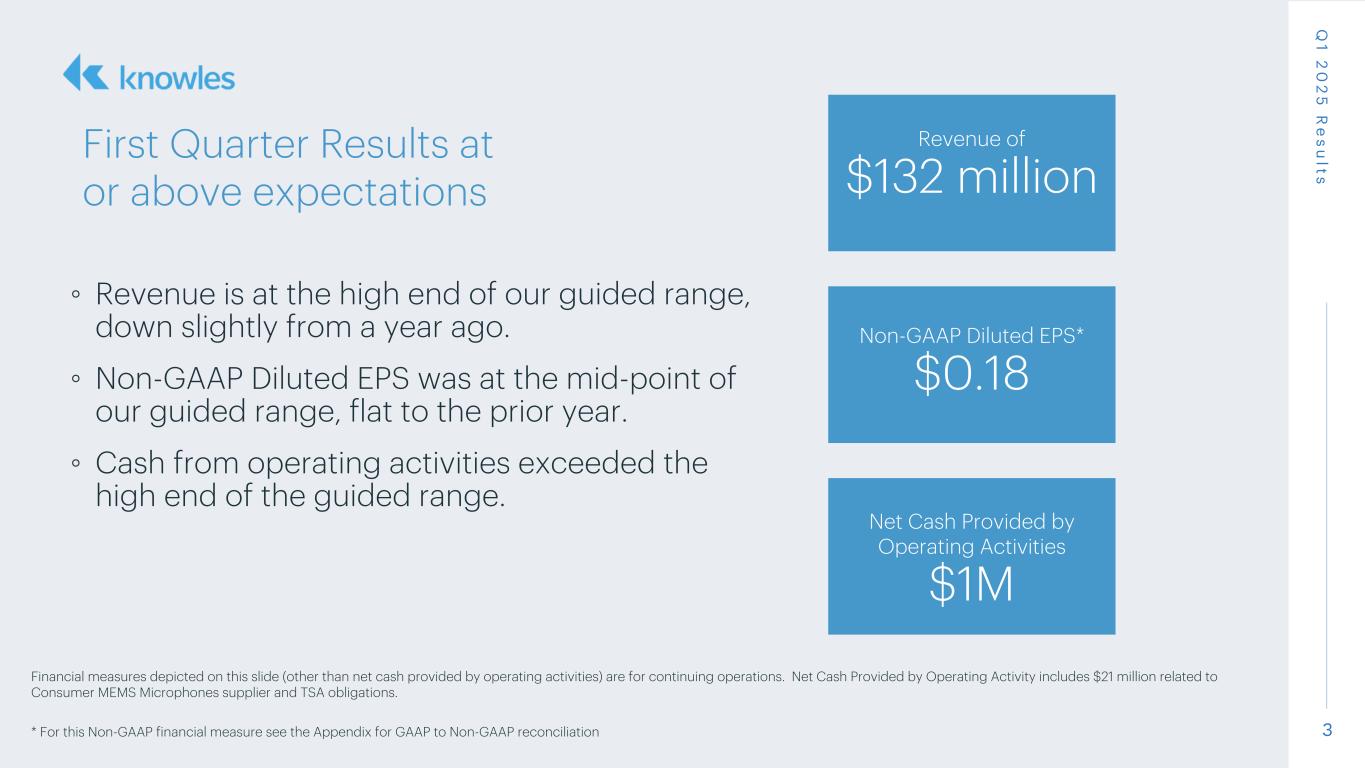
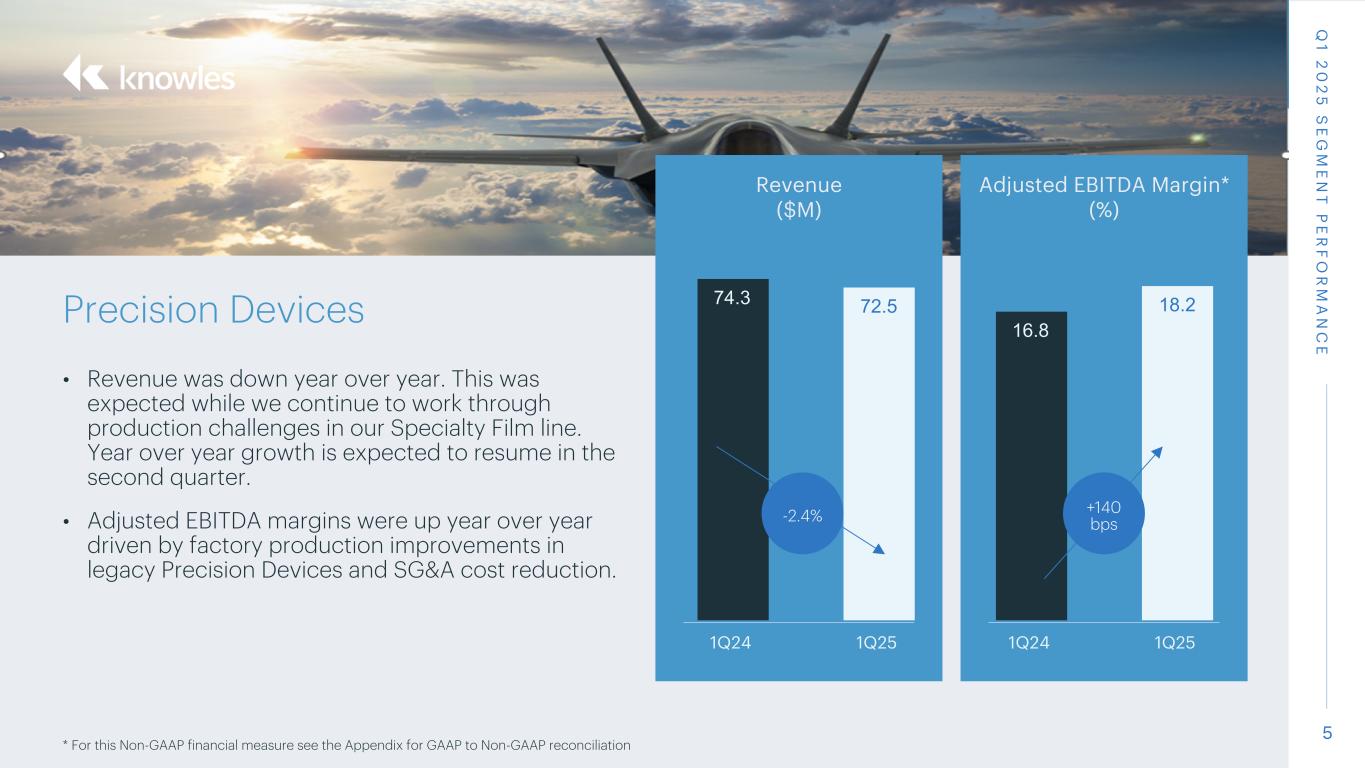
Thanks, Sarah. Thanks to all of you for joining us today. Before I provide our commentary on the Q1 results and report on what we are seeing in our markets for Q2 and beyond, I would like to touch on the tariff situation we are all hearing so much about. Obviously, there's a lot going on in the markets over the last few weeks. It has been and continues to be fluid, and while I'm being cautious about how it could impact our business, I believe Knowles is well-positioned to continue to deliver growth in earnings and revenue despite the current tariff environment. The tariff situation can be easily explained by breaking things into three major areas that could affect NOLS. First, and most simply, our direct tariff exposure. That is a revenue that could be subject to tariffs. Generally speaking, NOLS is a proximity manufacturer, meaning the vast majority of product built in the U.S. is shipped within the U.S., and product built in Asia ships to customers in Asia. Based on this proximity manufacturing strategy and our associated footprint, we estimate that less than 5% of revenue are subject to the current tariffs. In our markets of MedTech, Defense, and Industrial, our expectation is we can pass these tariffs onto our customers without significant loss of business. Second, there is an indirect tariff exposure or impact on our sourcing of raw materials for our different manufacturing locations. We have a world-class global supply chain team that, when possible, procures materials geographically close to our production facilities. We believe that less than 3% of our cost of goods sold will be impacted by current tariffs. We also anticipate being able to recover substantially all tariff impacts through price increases and surcharges. Finally, there is an impact on our customers' end market demand. This is the most difficult to predict at this moment, and while no company will be immune to the effect of tariffs, I believe the markets we serve in medtech, defense, and industrial sectors will be relatively insulated from tariff impacts. Let me explain a bit. The applications that our products serve in the medtech market have traditionally been considered essential. Our capacitors are in implantable devices, imaging, and ventilators, to name a few. Hearing aids have also been considered essential devices. Our historical experience shows economic shocks and subsequent recessions can have modest short-term impacts on these markets, but tend to have very little impact over the course of a year. I also believe that the defense programs we participate in are secure. In the past, the RF filters and capacitors that we sell in the defense space have generally been insulated from economic downturns. Lastly, in the industrial market, it is and has been more sensitive than Mentec and defense to recessions, but we are not currently seeing any impact on demand. We are obviously monitoring this closely as this could change based on the macroeconomic environment. Now I'll turn to our results. We started 2025 on solid footing in Q1, delivering revenue of $132 million at the high end of our guided range. EPS of $0.18 was at the midpoint of the guided range, and we delivered cash from operations exceeding the high end of the guided range. Turning to our segments, in Q1, MedTech and specialty audio revenue was $60 million, up slightly on a year-over-year basis, and seasonally down from Q4. Hearing health revenue was seemingly down, which was offset by strength in our specialty audio business and our supply of metal cans in connection with the sale of the consumer men's microphone business. As it relates to the current tariff environment, our historical experience shows that during times of economic uncertainty, there is often a short-term decline, followed by a rebound in demand in our hearing health business. By the way of example, in 2000, during the dot-com bubble burst, in 2008, during the financial crisis, and in 2020, during COVID, the market contracted for one or two quarters in response to the economic uncertainty, with demand returning quickly to normalized levels. This is evidenced by hearing health markets growing 2% to 3% annually over the last 20 years. That all being said, our backlog for the MedTech and specialty audio segment for Q2 is strong. Our partnership with our customers is leading to continued innovations, innovative solutions, enhancing the performance of their products. This coupled with our strong performance in especially audio business and new opportunities utilizing core competencies and medical markets leads us to continue to believe in our ability to grow throughout 2025 with year-over-year revenue growth accelerating in the second quarter. In the precision device segment, Q1 revenues was $73 million, flat to Q4. This was expected while we continue to work through production challenges in our specialty film line. Progress is being made. Our new prototype production line is up and running, improving the production flow. Yields are improving, and I have confidence in the team to continue to incrementally improve shipments throughout the first half of the year, with a larger ramp-up coming in the second half of the year. We are well positioned for growth in 2025 as the specialty film line rants to full production. Additionally, we have strong design and coating activity, especially in medtech, defense, and EV markets with our ceramic capacitors. In Q1, booking trends for precision device segment, independent of our previously announced $75 million plus energy order, was strong for the second consecutive quarter. The booking strength was broad-based across most of our end markets as we believe inventory levels are normalizing. It's noteworthy that bookings and shipments to our distribution partners across all our capacitor products were favorable as we continue to see their inventory levels reducing. This gives me confidence in the precision device segment expected return to year-over-year growth in the second quarter of 2025. In the first quarter, we purchased $5 million in shares and reduced our debt level by $15 million as our cash generation from operations exceeds the high end of our guidance range. We expect to generate robust cash from operations throughout 2025. This will allow us to continue to explore acquisition opportunities, buy back shares, and keep our debt at manageable levels. As we close out the first quarter of 2025, I'm excited about the opportunities we have in front of us. we continue to see strong design wins across our product portfolio with distribution orders increasing and inventory levels normalizing in the industrial markets coupled with increasing backlog and demand for our products i have greater confidence that we will see year-over-year growth for 2025. on may 13th we will be hosting our investor day where we will have the opportunity to lay out our plans for future growth in detail i'm excited you will have the opportunity to hear from several members of our senior leadership team as they will discuss our competitive advantages and why we win across the markets we serve. Now let me turn the corner to John to detail our quarterly results and provide our Q2 guidance.
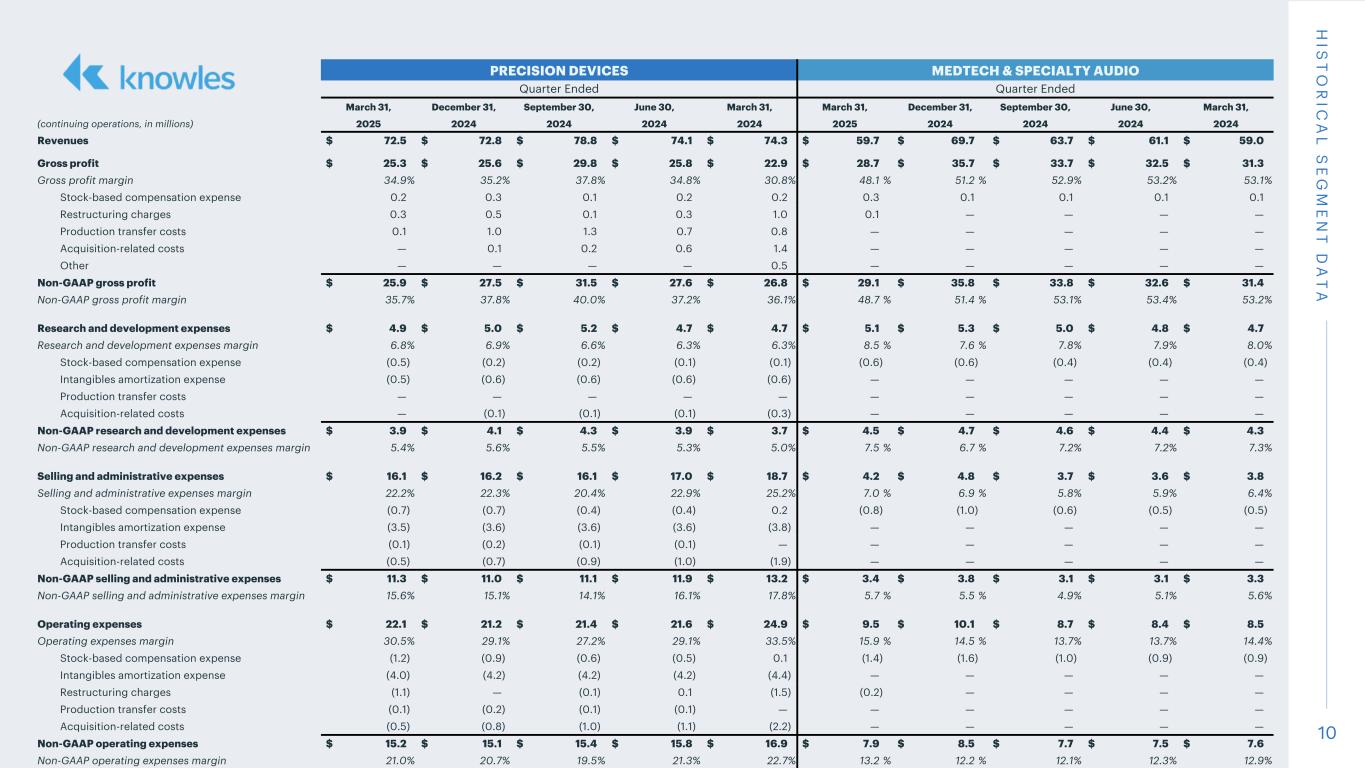
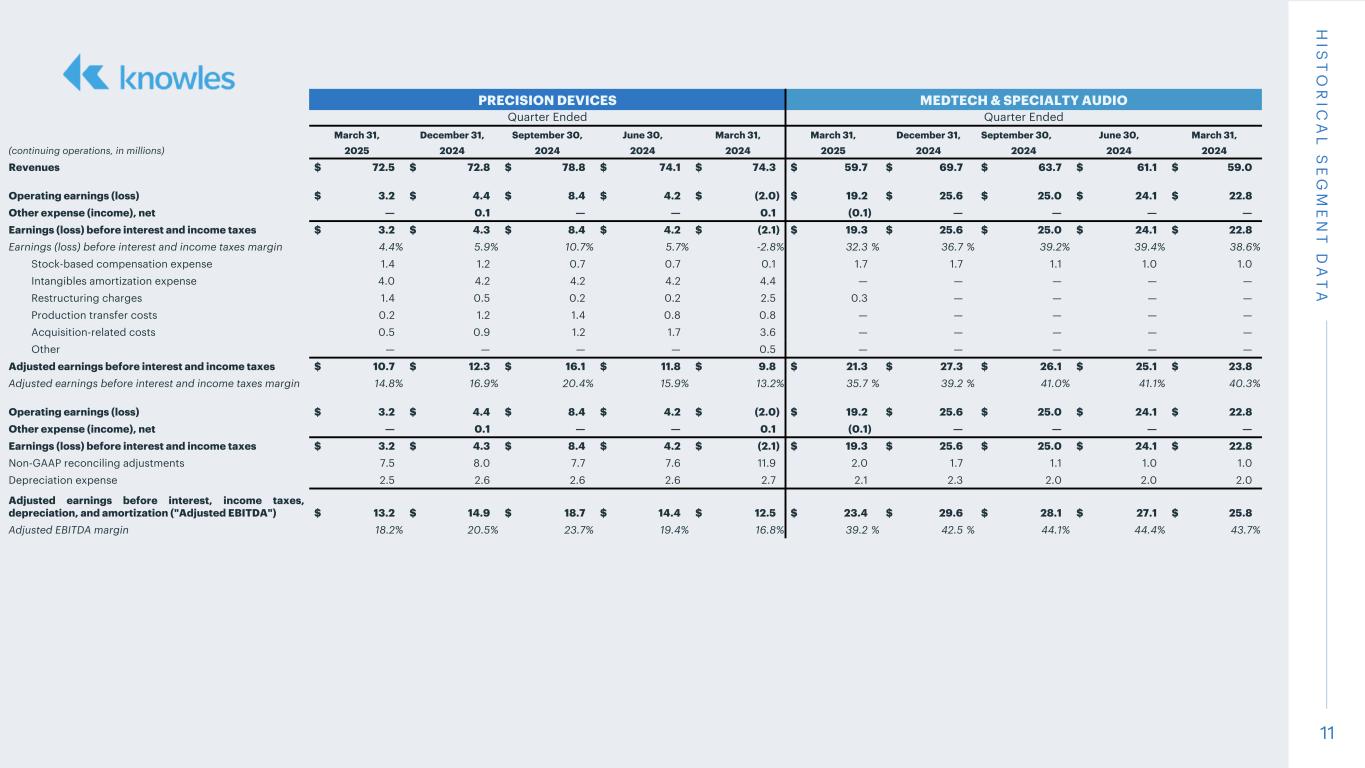
Thanks, John. We recorded fourth quarter revenue of $132 million, down 1% from the year-ago period and at the high end of our guided range. EPS was $0.18 in the quarter, flat from the year-ago period, and at the midpoint of our guidance range. In the MedTech and specialty audio segment, Q1 revenue was $60 million, up slightly compared with the year-ago period. Q1 gross margins were 48.7%, down 450 basis points versus the year-ago period. As part of our supply agreement with Sintient, we produced and supplied metal cans on a cost-plus basis, which negatively impacted gross margins by our nearly 200 basis gains in the quarter. The remainder of the year-over-year decline in gross margin was driven by unfavorable customer mix and the absence of a one-time benefit which was recorded in Q1 2020. While the supply agreement with Sentient is expected to continue through the remainder of 2025, we expect MSA gross margins to improve sequentially driven by mix improvements and higher capacity utilization resulting in full year gross margins in the low. The precision devices segment delivered first quarter revenues of $73 million, down 2% from the year-ago period and slightly above our expectations. Segment gross margins were 35.7% flat from the first quarter of 2024 as factory productivity improvements in our legacy precision device business were partially offset as we ramp up the specialty film product line. On a total company basis, R&D expense in the quarter was $8 million, flat with Q1 2024 levels. SG&A expenses were $25 million, down $2 million from prior levels driven by cost reduction actions taken to right-size spending in connection with the savings. Interest expense was $3 million in the quarter and down $2 million from the year-ago period as we continue to reduce our debt levels. Now, I'll turn to our balance sheet and cash flow. In the first quarter, we generated $1 million in cash from operating activities, exceeding the high end of our guided range, driven by higher-than-expected customer prepayments. It is important to note that cash from operations for the three months ended March 31st includes $21 million in cash used to settle supplier obligations related to the consumer mem's microphone business, which capital spending was $4 million in the quarter. During the first quarter, we repurchased 300,000 shares at a total cost of $5 million and reduced outstanding borrowings. We exited the quarter with cash of $102 million and $189 million of debt. That includes borrowings under our revolving credit facility and an interest-free seller note. Lastly, our net leverage ratio based on trailing 12-month adjusted EBITDA was 0.7 times. and we have liquidity in excess of $350 million as measured by cash on hand plus unused capacity under our revolving curve. Moving to our guidance, for the second quarter of 2025, revenues are expected to be between $135 million and $145 million. R&D expenses are expected to be between $8 million and $10 million. Selling and administrative expenses are expected to be within the range of $23 to $25 million. We're projecting adjusted EBIT margin for the quarter to be within a range of 19 to 21%. Interest expense in Q2 is estimated at $3 million and includes non-cash imputed interest. We expect an effective tax rate of 13 to 70. We're projecting EPS to be within a range of 21 to 25 cents per share. This assumes weighted average shares outstanding during the quarter of $90.1 million on a fully diluted basis. We're projecting cash generated by operating activities to be within the range of $10 to $20 million, which includes $9 million to settle supplier obligations related to consumer MEMS microphone business. Capital spending is expected to be $7 million. We expect full-year capital spending to be 5% of revenues as we increase our investments associated with capacity expansion relating to our specialty film line in conclusion based on increasing order activity and our growing backlog we expect to resume year-over-year revenue and additionally we expect another year of strong cash with that we'll move to the q a portion of the call thank you sir and everyone if you would like to ask a question please press star one on your telephone keypad again that is star one for questions we'll take our first question today from bob lavick cjs securities good afternoon
thanks for taking our questions hey bob we can barely hear you bob oh okay uh better better okay great sorry about that thank you um well first uh congrats a nice quarter and obviously a good outlook uh as well i think you know you hit a really important part with the uh you know the Minimal tariff exposure, appreciate that color of the 5% direct and 3% kind of indirect. Just sticking on the theme for a minute, though, maybe talk about your – you talked a little bit about MedTech, but overall end market customer exposure, how are you thinking about that? What are you hearing from your customers in this uncertain time right now around their outlooks and how it may impact you in the back half of this year?
Yeah, so first I would say, Bob, as I kind of said, we've not seen any change in demand. You know, in fact, obviously our expectations for Q2 are incrementally higher than they say were a quarter ago for Q2. I don't think any of this, you know, we've been kind of debating, we talked to a number of customers, this pull forward. I don't think it is. A lot of our product is custom, a lot of new designs, especially in MedTech and in defense. So I think in the med tech space, let me take that first. I think if you think about most of the devices we sell to, they're essential devices. And, you know, maybe you can, like with COVID, you know, put off a medical device for a quarter. But ultimately, if you need a pacemaker, you need a pacemaker, right? And I think this falls in the same category. A large percentage of hearing aids that are sold are actually customers that already have them. and they need new ones because they're either very old or they're not working anymore, and you become reliant, you know you need hearing aids, you have either moderate to severe hearing loss, you're going to go by your hearing aids. So generally speaking, I don't think we see that there's a lot of exposure. Defense, you know, I think most of the programs we're on are very insulated. We're not seeing any change in our defense. Now, that being said, I think the one area that we do probably have a little bit more exposure, like generally, is industrial. Now, here's what I would say about that. I've talked over the last few quarters about the inventory levels at our distributors, which service the majority of our industrial customers. A few quarters ago, I was talking about there was six months of inventory. Then I said there was four to five. Then I said four, four and a half. You know, we're seeing that inventory down level get to that three to three and a half months level, which is normalized inventory. And we're starting to see, again, because of that, an increase in order activity because as they see the demand, they're going to start falling into a dangerously low position on So, you know, I think from our perspective, you know, right now, as we look through the rest of the year, we feel pretty good right now about the rest of the year. Now, all things being said, somebody could wake up tomorrow, there could be something new, but the way the tariffs are today and how it's impacting our business, it feels like there's very minimal impact to us right now.
Okay, great. Appreciate the extra color. That's wonderful. And then in terms of the growth drivers of the business, obviously you have this, you talked about last quarter, the $75 million-plus capacitor order starting next year into an energy end market. you know how any any you know updates there any changes and any impact from that since it's you know a little bit vague to the to us you know from the macro environment or is that still you know strong and you're confident in that as well well i mean you know we we received a pretty substantial prepayment in the first quarter which drove our cash flow to be above the high end of the guided range so this customer is fully committed and we don't see any impact on delivery starting you know
Operator
in 2026. i think we've said in the past expect something in the neighborhood of about 25 million dollars of shipments on this that order in in 2026. super all right i will jump back in queue thank you the next question is from anthony stoss craig hallam capital group hey guys nice results um let just get a housekeeping one out of the way john can you um maybe i missed it can you talk about kind of gross margin trajectory starting with q2 and and where you think it ends up uh in q4 yeah tony you're talking about for the the total business total company yes total company yes yeah
so if you if you think about the results that we just issued just above just slightly above 41 percent in gross margins we're going to see pretty significant sequential improvement in that and it really have to look business by business but the the main drivers are going to be again with demand moving up our capacity utilization is going to improve both in the PD business as well as the MSA business both are increasing capacity in addition there's some mix improvement that is going to benefit us going into, you know, beginning in Q2. And really, we expect sequential improvement. I mean, Jeff mentioned this. We expect a stronger – given the uncertainty out there, we still expect a stronger back half than front half. And, again, that's going to drive sequential – we expect it to drive sequential gross margin improvement throughout 2025.
Yeah, I just want to add one piece. You know, I think we've talked about this in the past, Tony, about how capacity utilization has been really a holdback, especially in the precision device area in terms of gross margin over the last year, year and a half. And we're starting to see that start to dissipate as the demand is coming back. I didn't mention this in the prepared remarks, but the book to bill for precision devices was above 1.15 in Q1. I mean, it was strong. We had very, very strong orders for precision devices. And that's now, of course, not counting the $75 million energy order. Right.
Operator
Can you give us like a range exit, you know, margin to a company?
I would say 45 to 47% as we exit a year in gross margin.
Operator
Perfect. Perfect. And for you, Jeff, I mean, it's awesome that most of your production of PD in the U.S., do you think you might be able to pick up share from some of your competitors that don't produce much in the U.S.? I'm just curious your thoughts, how you think the rest of the year plays out. Are you seeing the inbound calls? Anything would be helpful. Tony, I was saving that for the next call, but I'll give you a little color here.
Here's the situation. I think with the dynamic and model nature of what's going on, I'm a little hesitant to start putting that out there to say yet, but we are definitely getting calls that says, okay, with these tariffs, you know, normally we had said, you know, we had walked away from some of these bit lower margin businesses, like, and now they're saying, hmm, maybe we should consider buying with you. And it's also security and supply. And so it would primarily really in the, like, more in the industrial space than med tech or defense. I mean, I don't think we're seeing anything like that, but in the industrial space, we're definitely seeing a number of customers initiate conversations with us, and it's more than a handful, saying, okay, we should start having some discussions. I want to see how this all plays out over the next quarter, but that definitely could be an upside in the back half the year that's not factored into what we're saying today.
Operator
That's really good news. I would lock them into long-term supply agreements, get them down quick. Thanks. Great execution, guys. I'll jump back in queue. Okay. Thanks, Tony.
Operator
And just a reminder, everyone, that is star one if you have a question. We'll go next to Christopher Rowland, Susquehanna.
Hey, guys. Congrats on the results. So my question is, if you could perhaps add some commentary around bookings, that's the book to bill above 1.5 is pretty incredible for PD. So what are we seeing for the back half? Are these really starting to fill out now? And then perhaps associated with that, I saw receivables were up. Does that kind of speak to the linearity in the quarter? Or would you just describe things as kind of accelerating?
I'll let John do a little checking on the receivables. But for a minute, just to be clear, the bookings were above 1.15.
1.15. I thought I heard 1.5. 1.15.
But not counting the $75 million order we received from energy, right? So if you counted that, the book to bill would be a crazy number. So we tried to, but it was pretty broad-based in PD, you know, across our capacitor products, filters, and, you know, both, you know, the legacy PD business as well as, you know, formerly the Cornell business. So it's been pretty broad-based. I think, you know, as I kind of said, what was most encouraging in the quarter is to see another step down of inventory at the distributors, where it's now getting, you know, we're starting to see, you know, that demand is going up, inventory is coming down. So we're getting very close to what I would sit there and say is, like, there's risk. And that's why we're seeing more orders from distributors, because they're starting to say their inventories are going to start falling below where they feel comfortable. And hence, you know, why we're getting strong bookings there. I would also add, you know, beyond the distributors, you know, and we'll talk more about some of the applications at the Investor Day. But we have a lot of new products, you know, from specialty film, a lot of new products going into production. So very good. That's very all positive PD. The second piece, I would just talk about, you know, MSA, MedTech and specialty audio. You know, we expect, you know, pretty strong sequential and year-over-year growth in Q2. And it's, you know, driven by, you know, and the customer mix should be a little bit better in Q2. We kind of talked about it kind of impacting the gross margins a little bit, but it should be better the customer mix in Q2. So, you know, I think, you know, I want to be cautious here, you know, but, Chris, but right now, as I look through the year, a lot of the orders we're getting, especially in MedTech and defense, they're not orders. These are not terms orders, like we get an order, deliver it, and then we're done. These are orders that are being booked for the rest of the year. And so we feel pretty good about the full year.
Question on receivables. Nothing unusual here. It's just timing of customer collections. Our receivables were at the end of Q1, kind of flat with 1231, but you're right. They were up a fair amount from March 31st of 2024. And again, nothing special. It's not like we're having collection issues or anything. It's just timing of payments. We have some customers, larger customers that have 331 year ends. Sometimes they pay before their year end. Sometimes it slips into Q2, but nothing alarming there.
Excellent. And I do not want to steal any thunder from the analyst day, but it seems like the business is solidifying. So I was wondering kind of what's next for Knowles, like how much focus is there on inorganic growth opportunities, like in new product segments, and then how much opportunity or how much of your focus is spent on inorganic opportunities outside of the company?
Yeah, and I think that's really great because good question, Chris. first let me talk about the organic opportunities. Each one of my business unit leaders will be presenting are going to go into these opportunities that they have, you know, over the next, you know, one, two, three years of where growth could come from. So they're all going to do that. On the inorganic side, you know, we are going to have, I don't know if we've announced the officially the presenters list, but our head of corporate development is going to be presenting at the investor day and to talk about, you know, our inorganic opportunities. I would sit there and say, and he would probably, our guy who does this, said, you know, a pretty significant portion of his time during the Cornell acquisition was also dedicated towards the divestiture of the consumer mems microphone business. He's freed up now to spend more time with his team on inorganic opportunities. And I think, I want to caution, you know, right now, like with the market the way it is, I think things are, like a lot of people are pausing on M&A right now. I'm glad our balance sheet looks great. We're in a great position. But, you know, we're ready when the right opportunity comes along to move that forward. And we're going to go into more detail about what we're looking for and, you know, the kind of metrics we're looking for, the type of products. We'll go into more detail on that at the Investor Day.
Fantastic. Thanks, Jeff, and congrats. Thanks.
Operator
At this time, no one else has signaled, but I'll give a final reminder. Star one, if you have a question, we'll pause for just a moment. And at this time, there are no further that does conclude our question and answer session, as well as our conference for today. We would like to thank you all for your participation. You may now disconnect.