Operator
Good afternoon and welcome to Landstar System Incorporated Second Quarter Earnings Release Conference Call. All lines will be in a listen only mode until the formal question and answer session. Today's call is being recorded. If you have any objections, you may disconnect at this time. Joining us today from Landstar are Frank Lonegro, President and CEO, Jim Applegate, Vice President and Chief Corporate Sales Strategy and Specialized Sprite Officer, Jim Todd, Vice President and CFO, Matt Miller, Vice President and Chief Safety and Operations Officer. Now I would like to turn the call over to Mr. Jim Todd. Sir, you may begin.
Thanks, Arlene. Good afternoon and welcome to Landstar's 2026 Second Quarter Earnings Conference Call. Before we begin, let me read the following statement. The following is a safe harbor statement under the Private Securities Litigation Reform Act of 1995. Statements made during this conference call that are not based on historical facts are forward-looking statements. During this conference call, we may make statements that contain forward-looking information that relate to Landstar's business objectives, plans, strategies, and expectations. Such information is by nature subject to uncertainties and risks, including but not limited to the operational, financial, and legal risks detailed in Landstar's Form 10-K for the 2025 fiscal year described in the section Risk Factors and our other SEC filings from time to time. These risks and uncertainties could cause actual results or events to differ materially from historical results or those anticipated. Investors should not place undue reliance on such forward-looking information, and Landstar undertakes no obligation to publicly update or revise any forward-looking information. I'll now pass it to Landstar CEO, Franklin Negro, for his opening remarks.
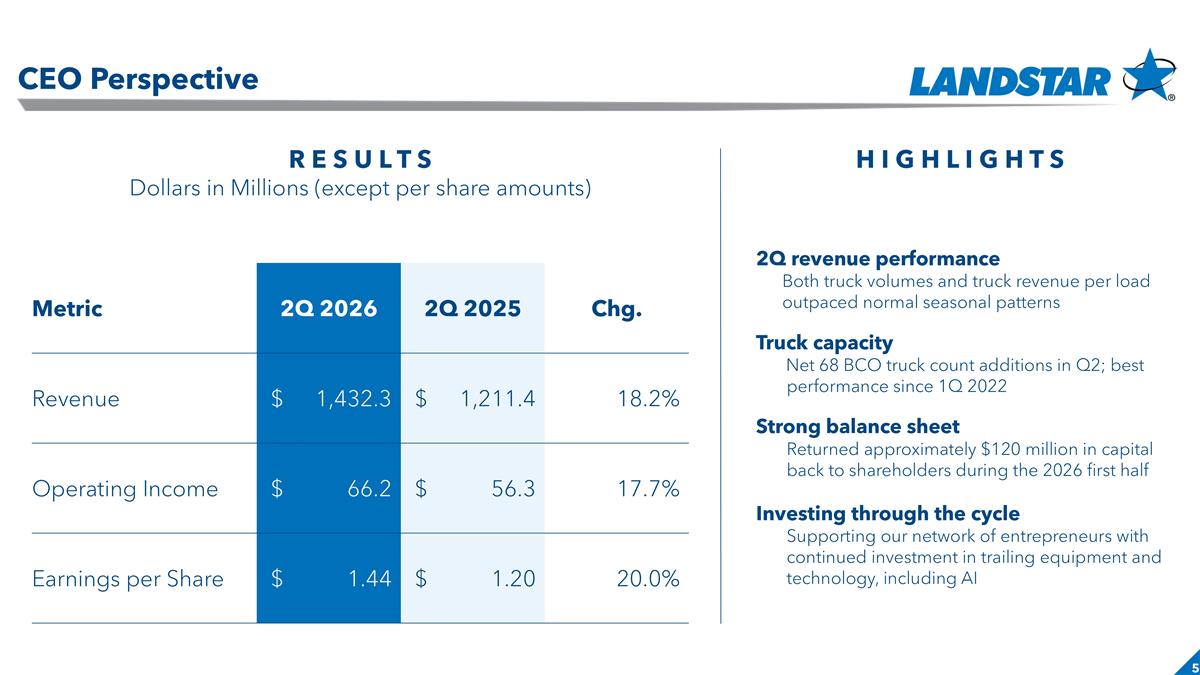
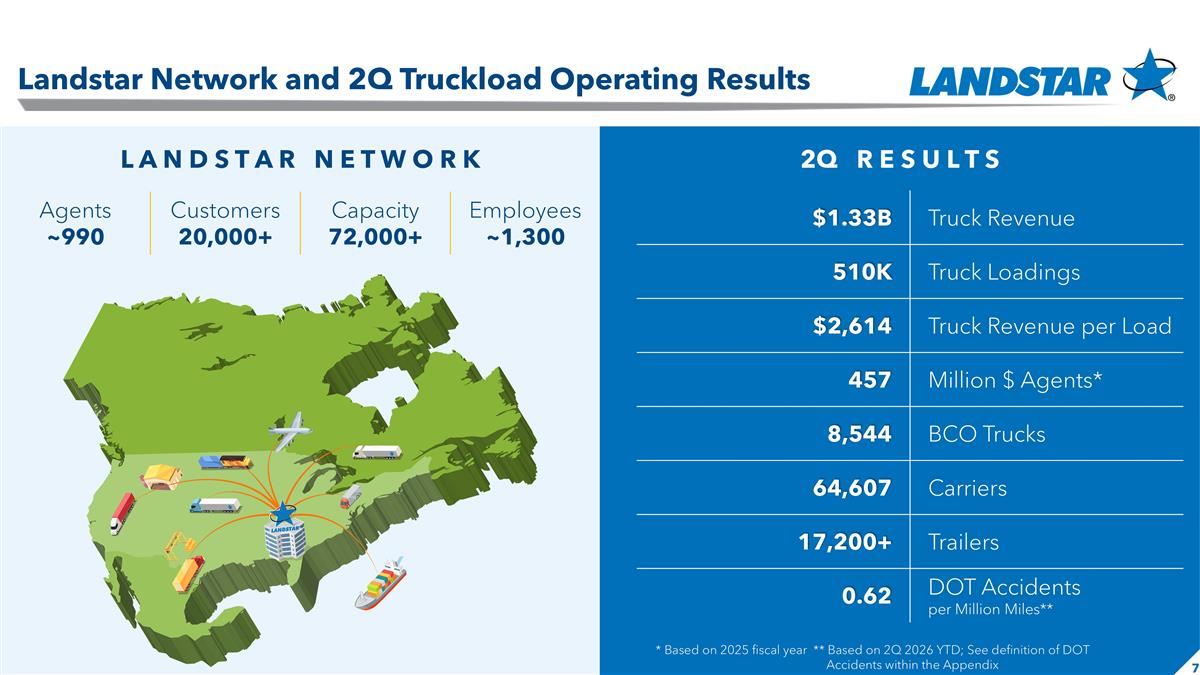
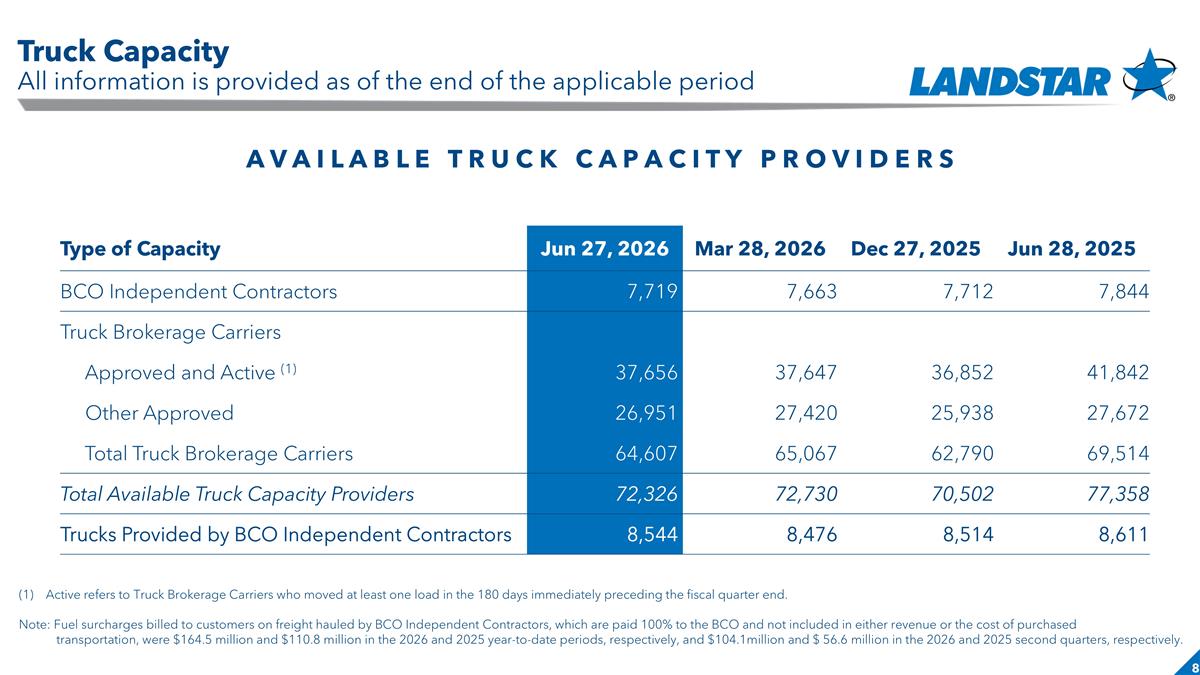
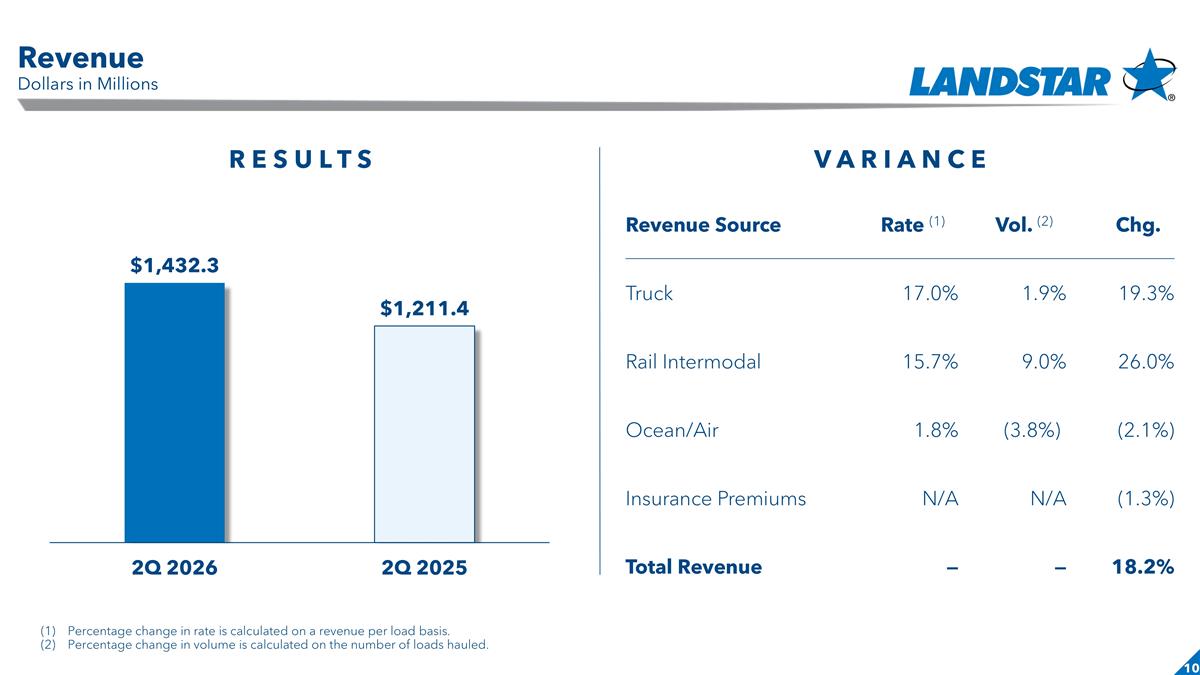
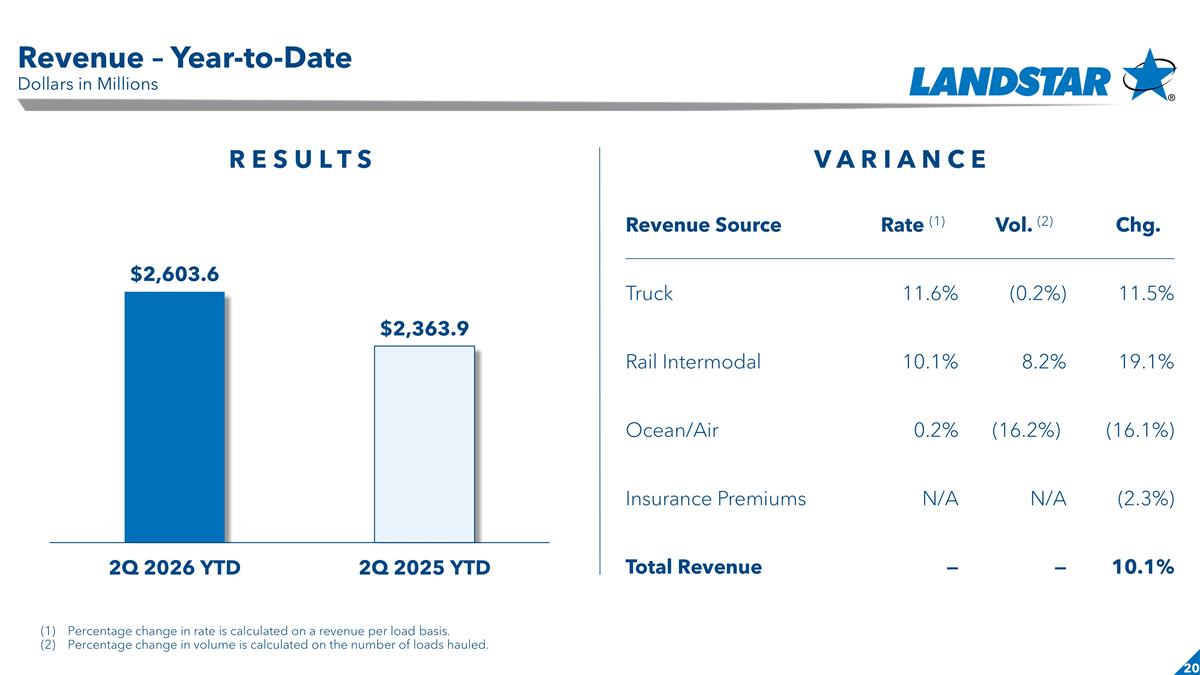
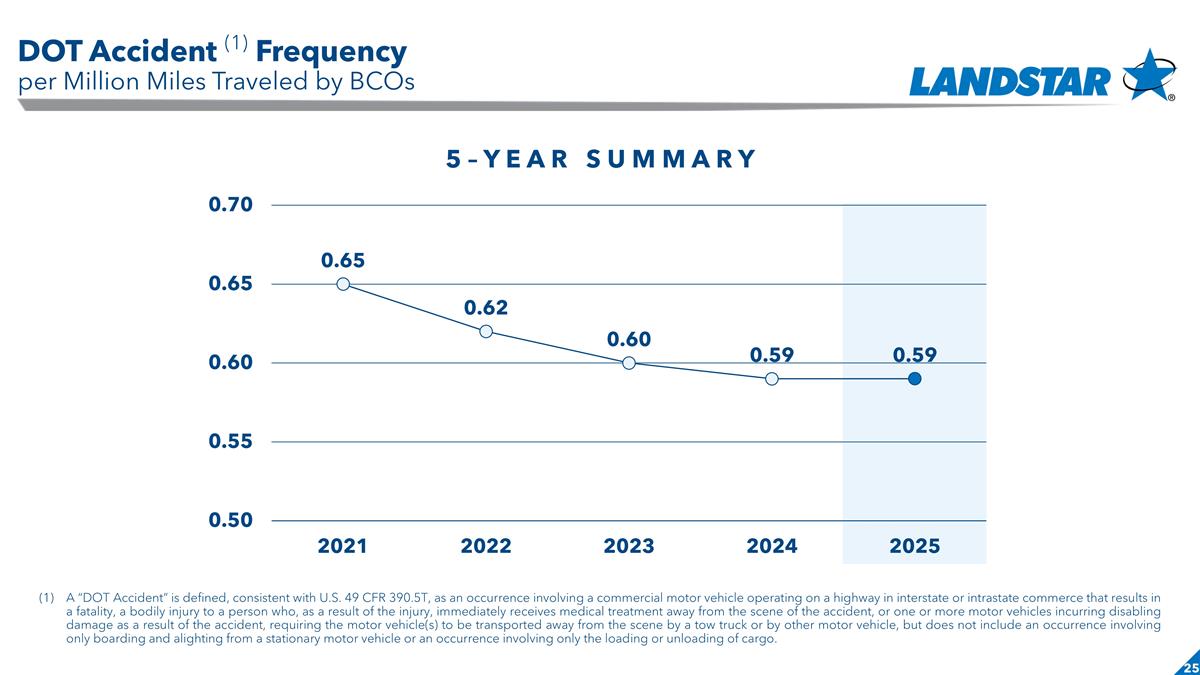
Thanks, JT, and good afternoon, everyone. I'd like to thank our BCOs and agents and all of the Landstar employees who support them every day. It was great to spend time with our Million Mile Safe Drivers and Roadstar honorees at our annual BCO All-Star event earlier this month in Orlando and to celebrate their incredible safety accomplishments. It was my honor to preside over Landstar's 53rd truck giveaway, awarding Million Mile Safe Driver and Roadstar honoree Herman Bergweno from Hatchville, Texas, with a new 2027 Peterbilt 579. The capability, resiliency, and level of commitment exhibited day in and day out by our network of independent business owners is unique in the freight transportation industry. Their dedication to safety, security, and service is one of the pillars of success at They are exceptional business leaders and key to driving the continued success of Landstar's business model. I was very pleased with our revenue and variable contribution performance during the 2026 second quarter, but the quarter was not without challenges that required our focus and attention. We had a challenging insurance and claims quarter with approximately $10.5 million of net unfavorable adjustment to prior year claims estimates. The prior year development experienced during the quarter was almost entirely attributable to five specific claims, three of which were truck brokerage claims. We believe greater federal clarity around carrier vetting and selection standards would help support a more predictable operations, insurance, and claims environment for truck brokers, carriers, and shippers. Transitioning to overall performance, revenue was up 18% year-over-year. As noted in our earnings release, our second quarter revenue per truck load and the number of loads hauled via truck both outperformed pre-pandemic typical seasonality, and the net VCO truck count performance was the strongest quarterly improvement since the first quarter of 2022. In one continued major bright spot, I am extremely pleased with the performance of Landstar heavy haul service offering. We generated approximately $164 million of heavy haul revenue during the 2026 second quarter, an 18% increase over the 2025 second quarter. This achievement was driven by a 9% increase in heavy haul volume and an 8% increase in heavy haul revenue per load. Notwithstanding the geopolitical uncertainty experienced thus far in 2026, our focus continues to be on accelerating our business model and executing on our strategic growth initiatives. We are continuing to invest in the foundational work that puts Landstar in a great position to leverage improving freight market conditions. We also remain focused on our commitment to continuous improvement in the level of service and support we provide to our customers, agents, BCOs, and carriers each and every day. On the new agent front, we were thrilled to welcome an $18 million freight broker from the Midwest to our agent network earlier this month. This represents one of the largest new agent signings in the past 15 years. Inbound interest and conversations with potential new agents has accelerated since the Montgomery decision was released in mid-May. We believe the value proposition of becoming a Landstar independent agent has never been stronger. Turning to slide 5, the freight environment in the 2026 second quarter was characterized by solid demand from a seasonal perspective, with the number of loads hauled via truck slightly outpacing normal seasonal patterns. the first time this has been achieved in the second quarter since 2021. This volume performance in the second quarter supports the ISM index readings from earlier this year with the ISM index above 50 for all six months of 2026. Truck capacity tightened significantly during the quarter, as evidenced by the very strong sequential truck revenue per load performance, coupled with a 129 basis point compression in our brokerage net revenue margin sequentially. Market conditions, which have favored the shipper since late 2022, have begun shifting rather rapidly in favor of the transportation provider. Considering that backdrop, Landstar's revenue performance was strong in the 2026 second quarter, with truck revenue per load 17% above the 2025 second quarter, and the number of loads hauled via truck up nearly 2% over the same period. Our balance sheet continues to be very strong, and our capital allocation priorities are unchanged. We will continue to patiently and opportunistically execute on our existing buyback authority to benefit our long-term stockholders. As noted in the slide deck during the 2026 first half, the company returned approximately $120 million to shareholders through dividends and share repurchases, and yesterday afternoon, our board declared a regular quarterly dividend of $0.44 per share, payable on September 9th, to stockholders of record as of the close of business on August 18th. This quarterly dividend includes a 10% increase over the amount of the company's regular dividend declared following each of the prior five quarters. We continue to invest through the cycle in leading technology and AI solutions for the benefit of our network of independent business owners and have allocated a significant amount of capital this year towards refreshing our fleet of trailing equipment with a particular focus on investing in new van equipment. Turning to slide seven and looking at our network, the scale, systems, and support inherent in the Landstar model help to drive the operating results generated during the 2026 second quarter. JT will get into the details on revenue, loadings, and rate per load in a few moments. Safety is critical to our continued success. Our safety performance is a direct result of the professionalism of the thousands of Landstar BCOs operating safely every day and the agents and employees who support the critical importance of safety, security, and service at Landstar, I'm proud to report an accident frequency rate of 0.62 DOT reportable accidents per million miles during the 2026 first half, well below the last available national average DOT reportable frequency rate released by the FMCSA for 2021 and lower than the 0.67 DOT accident frequency we reported during the 2025 first half. The company's long-run average is an impressive operating metric that speaks to the strength, skill, talent, and dedication of our BCOs and provides a point of differentiation our agents are able to highlight in discussions with our freight customers. We remain committed to driving a best-in-class safety culture. I'd also like to take a moment to recognize Landsar's 457 million-dollar agents based on our 2025 fiscal year results, a number we would expect to increase in 2026. Importantly, retention within the million-dollar agent network continues to be extremely high. Turning to slide eight, on a year-over-year basis, BCO truck count decreased by less than 1% compared to the end of the 2025 second quarter, but increased approximately 80 basis points sequentially. As noted above, our net 68 truck additions during the second quarter was the strongest quarterly improvement since the first quarter of 2022. Continuing that sequential trend, our BCO truck count has also increased during the first four weeks of the 2026 third fiscal quarter. We were also very pleased to see our trailing 12-month BCO truck turnover rate drop from 31.4 percent as of fiscal year in 2025 to 28.3 percent at the end of the 2026 second quarter. This is a positive trend that we hope will continue into the third quarter. I'll now pass the call back to JT to walk you through the 2026 second quarter financials in more detail.
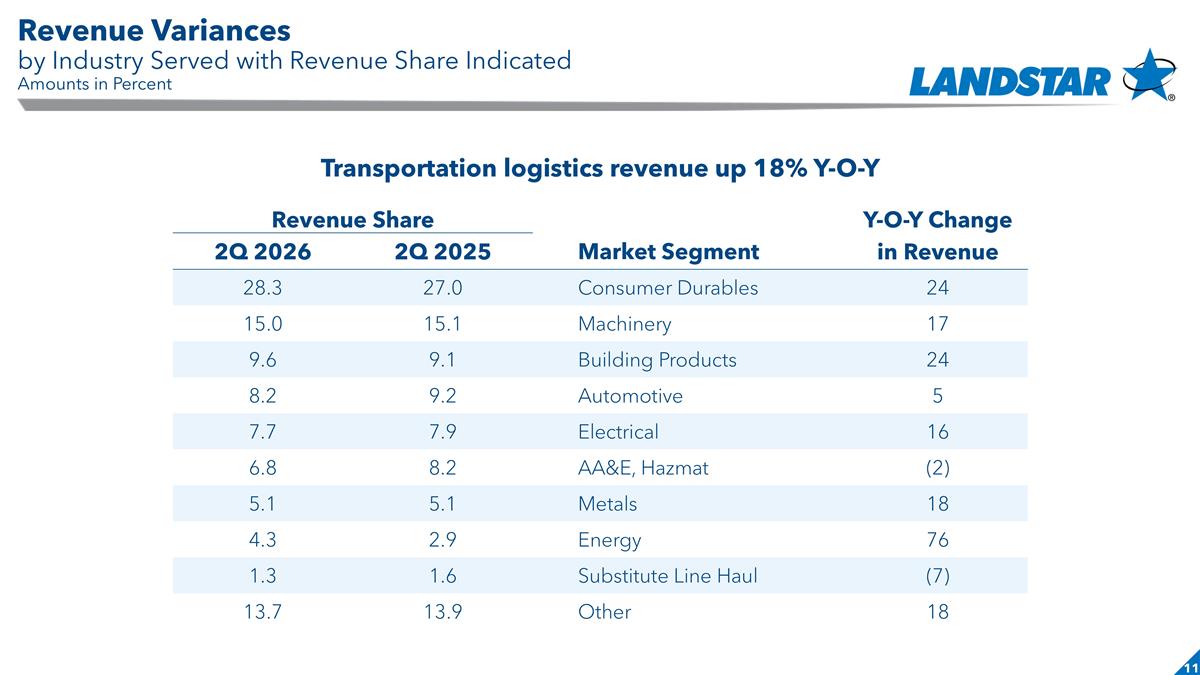
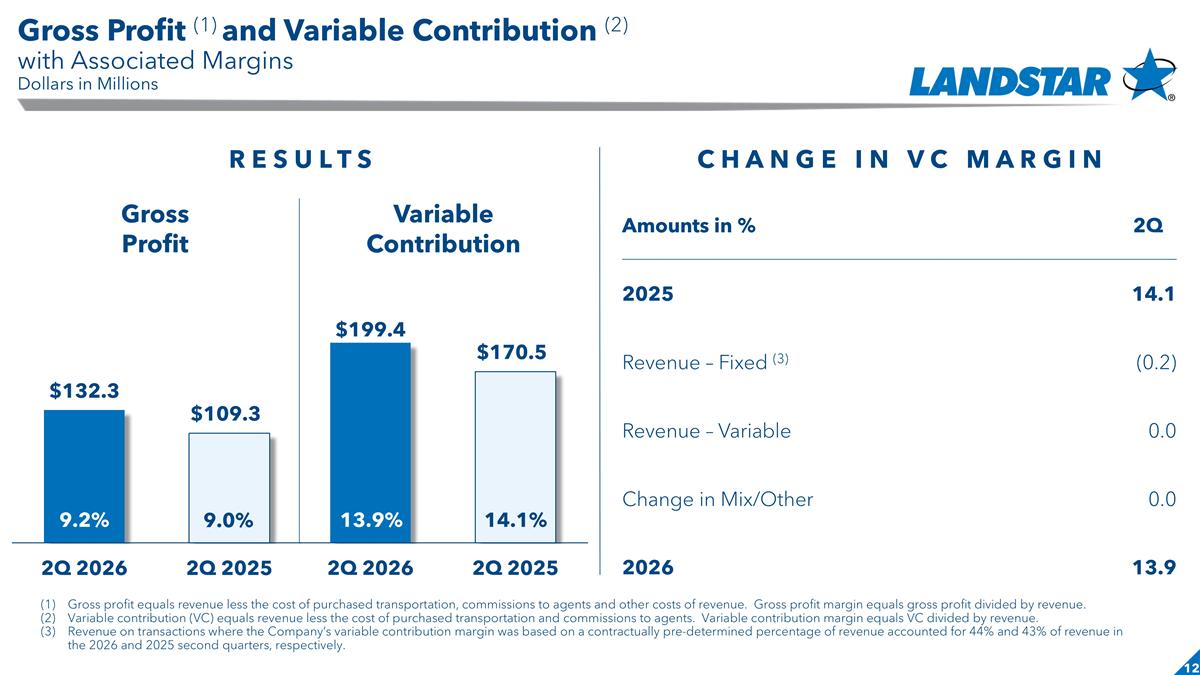
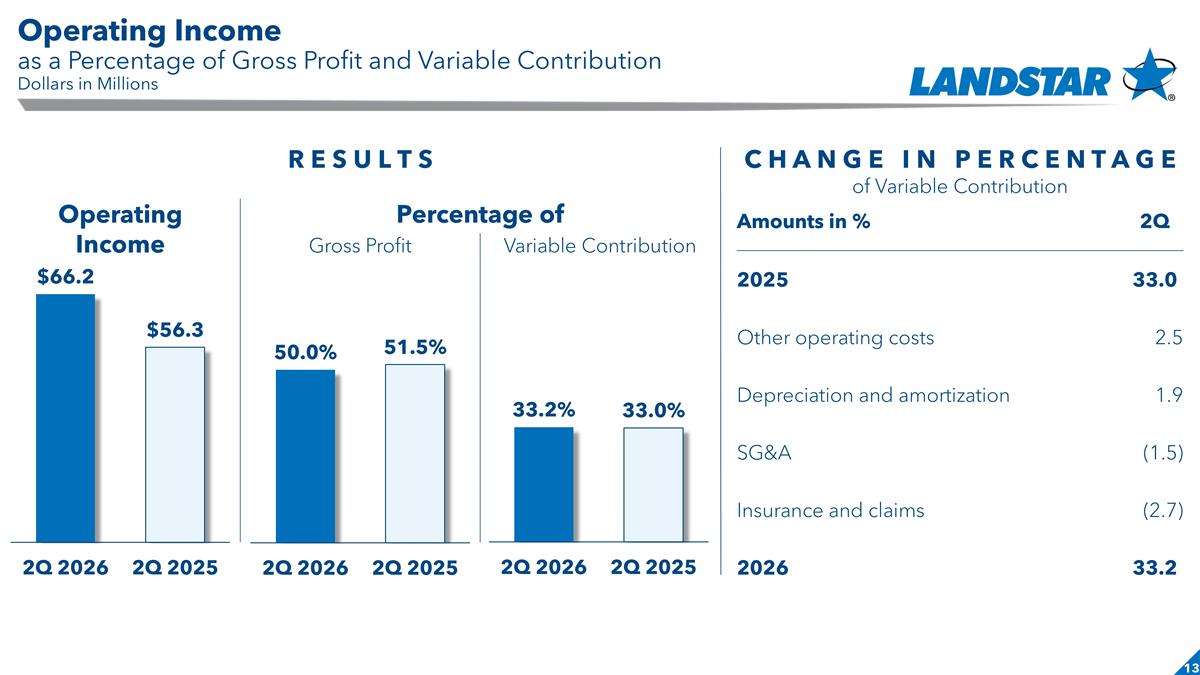
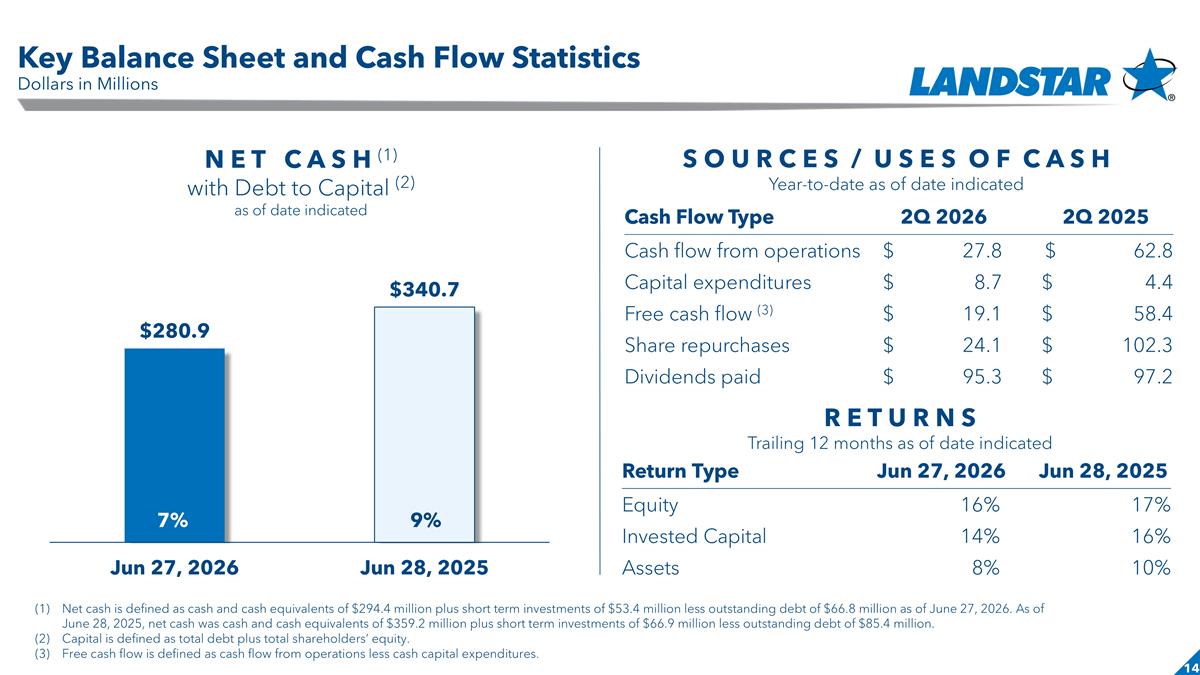
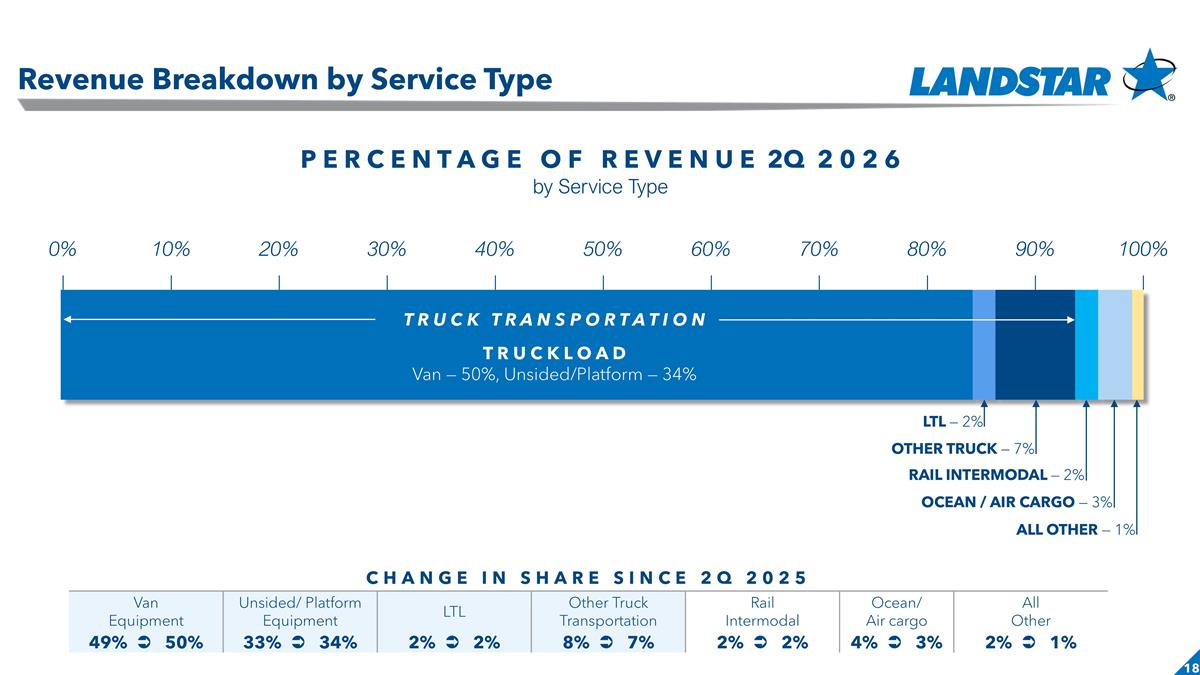
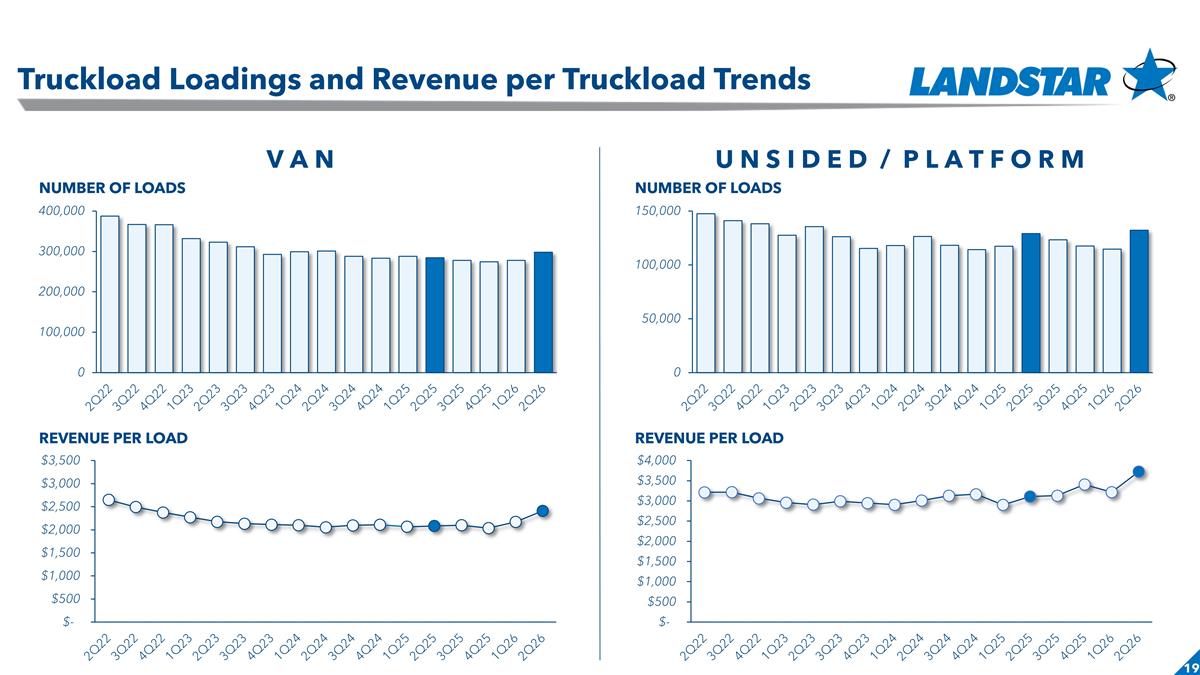
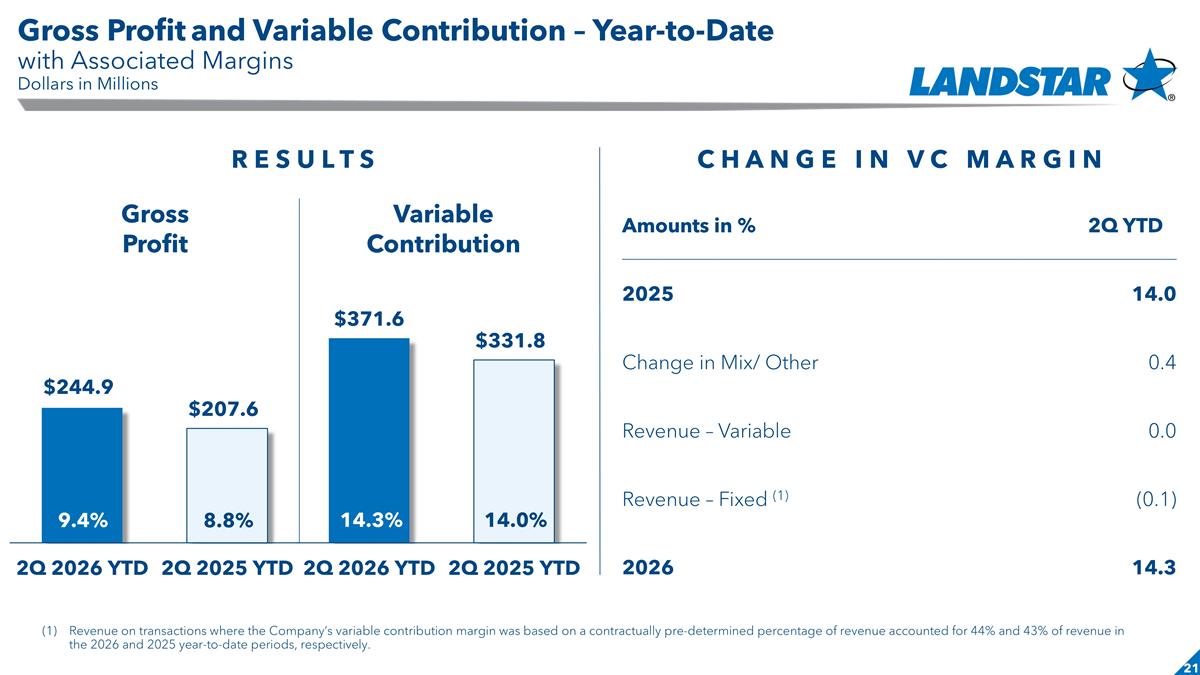
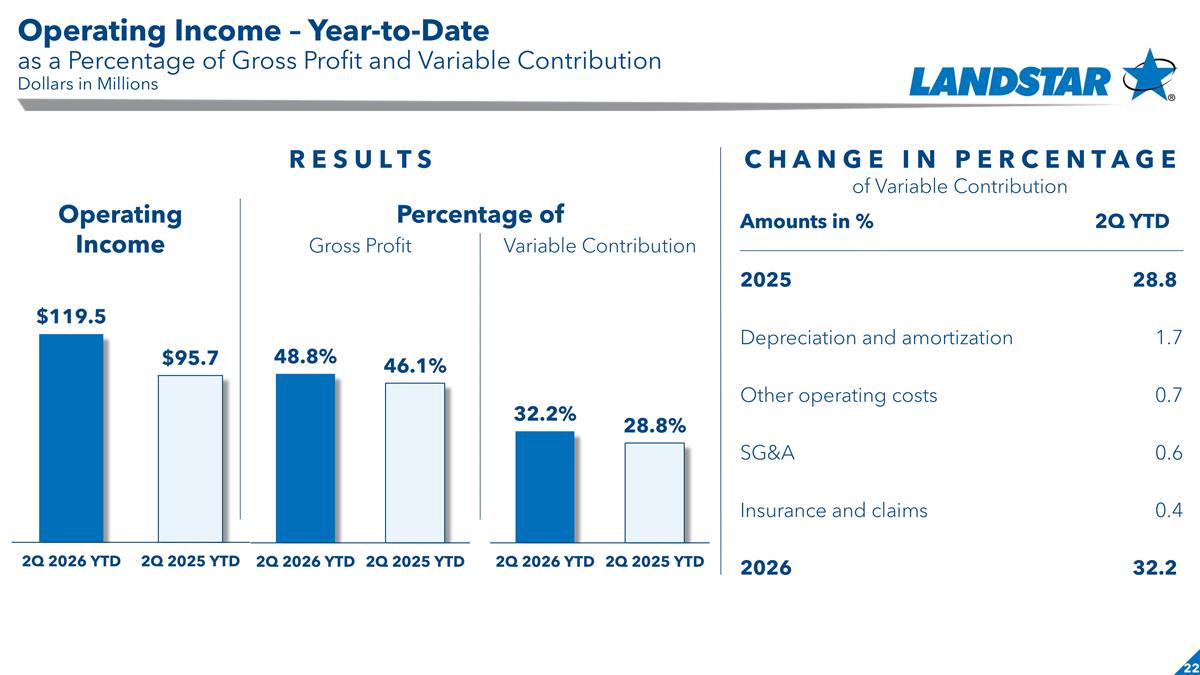
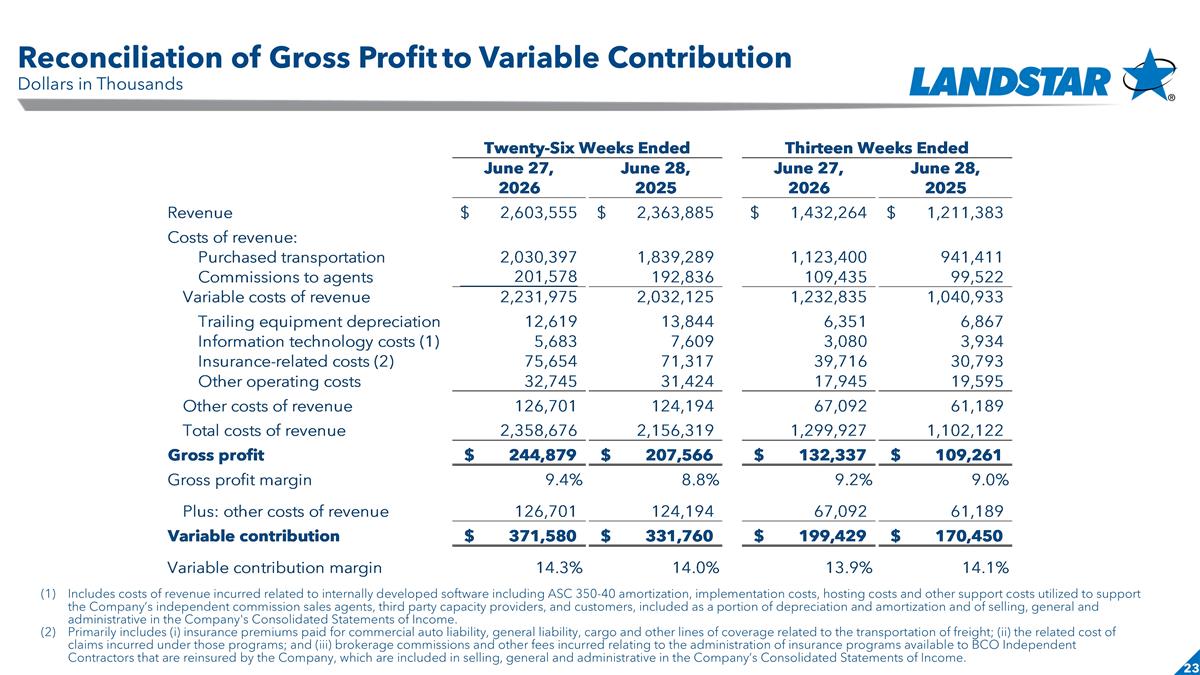
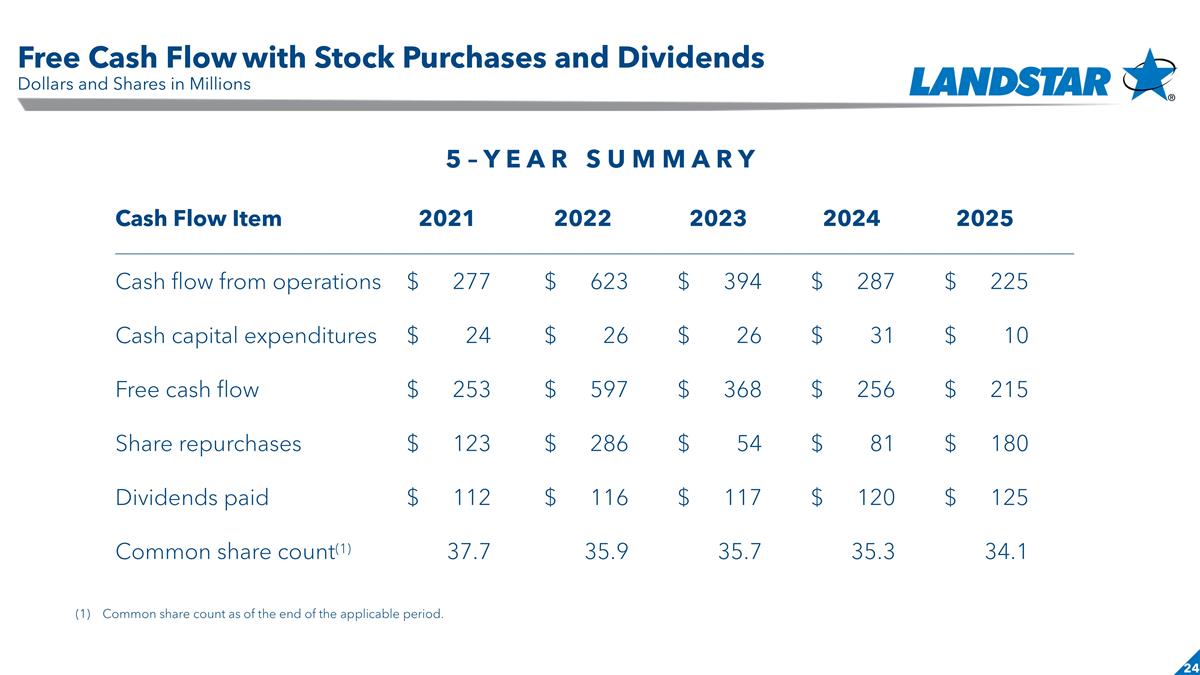
Thanks, Frank. Turning to slide 10, as Frank mentioned earlier, overall truck revenue per load increased 17% in the 2026 second quarter compared to the 2025 second quarter, primarily attributable to a 19.9% increase in revenue per load on loads hauled by unsighted platform equipment and a 15.8% increase in revenue per load on loads hauled by van equipment. On a sequential basis, truck revenue per load increased 14.4% in the 2026 second quarter versus the 2026 first quarter. That represents the largest sequential increase in truck revenue per load over the past 15 years, edging out the 13.5% sequential increase experienced during the 2020 third quarter. In comparison to overall truck revenue per load, we consider revenue per mile on loads hauled by BCO trucks a pure reflection of market pricing as it excludes fuel surcharges billed to customers that are paid 100% to the BCO. In the 2026 second quarter, revenue per mile on unsighted platform equipment hauled by BCOs was 10% above the 2025 second quarter, and revenue per mile on van equipment hauled by BCOs was 11% above the 2025 second quarter. Delving deeper into seasonal trends, revenue per mile and loads hauled by BCOs on unsighted platform equipment increased 5% from March to April, increased 2% from April to May, and increased 6% from May to June. Importantly, this sequential month-to-month performance as we move through the second quarter when compared against typical pre-pandemic trends suggest positive momentum in this aspect of our business. In fact, revenue per mile and loads hauled by BCOs on unsighted platform equipment outperformed typical pre-pandemic trends in each month during the second quarter. Turn to van freight. Revenue per mile and van equipment hauled by BCOs increased 3% from March to April, increased 3% from April to May, and increased 7% from May to June. Similar to the unsighted platform revenue per mile, revenue per mile and loads hauled by BCOs on van equipment outperformed typical pre-pandemic trends in each month during in the second quarter. It should be noted that month-to-month seasonal trends on unsighted platform equipment are generally more volatile compared to that of van equipment. This relative volatility is often due to the mix between heavy specialized loads and standard flatbed volume. As Frank alluded to, we've been particularly pleased with the sustained strong performance of our heavy haul service offering. Heavy haul revenue was up 18% year-over-year in the second quarter. Heavy haul loadings were up 9% year-over-year, and revenue per heavy haul load increased 8% year-over-year. Non-truck transportation service revenue in the 2026 second quarter was 6% or $5 million above the 2025 second quarter. The increase in non-truck transportation revenue was mostly due to a 50% increase in air revenue per load and a 16% increase in intermodal pricing. Turn to slide 11, we provided revenue share by commodity and year-over-year change in revenue by commodity. Transportation logistics segment revenue was up 18% year-over-year on a 16% increase in revenue per load and a 2% increase in volume compared to the 2025 second quarter. Within our largest commodity category, consumer durables, revenue increased 24% year over year and a 23% increase in revenue per load and a 2% increase in volume. Aggregate revenue across our top five commodity categories, which collectively make up about 69% of our transportation revenue, increased approximately 20% compared to the 2025 second quarter. While slide 11 displays revenue share by commodity, we thought it would also be helpful to include some color on volume performance within our top commodity categories. From the 2025 second quarter to the 2026 second quarter, total loadings of machinery increased 2%. Automotive equipment and parts decreased 1%. Building products increased 8%. And electrical loadings increased 31%. Even with the ups and downs in various customer categories, our business remains highly diversified with over 20,000 customers, none of which contributed over 8% of our revenue in the 2026, first half. Turn to slide 12. In the 2026 second quarter, gross profit was $132.3 million compared to gross profit of $109.3 million in the 2025 second quarter. Gross profit margin was 9.2% of revenue in the 2026 second quarter as compared to gross profit margin of 9% in the corresponding period of 2025. In the 2026 second quarter, variable contribution was $199.4 million compared to $170.5 million in the 2025 second quarter. Variable contribution margin was 13.9% of revenue in the 2026 second quarter compared to 14.1% in the same period last year. The decrease in variable contribution margin compared to the 2025 period was primarily due to decreased variable contribution margin on revenue generated by truck brokerage carriers as the rate paid to truck brokerage carriers was 136 basis points higher than the rate paid in the 2025 second quarter, partially offset by an increase in the percentage of revenue generated from BCO independent contractors. Turn to slide 13, operating income decreased as a percentage of gross profit due to higher selling general administrative costs in the 2026 second quarter. Operating income increased by approximately 20 basis points as a percentage of variable contribution. Other operating costs were $17.9 million in the 2026 second quarter compared to $19.6 million in 2025. This decrease was primarily due to the reclassification of the $4.8 million supply chain fraud charge established during the 2025 first quarter from customer bad debt to contractor bad debt during the 2025 second quarter. Excluding the $4.8 million P&L reclassification, other operating costs increased approximately $3.2 million. This increase was primarily due to increased trailing equipment maintenance costs, increased trailing equipment rental costs, and decreased gains on disposal of used trailing equipment. Insurance and claims costs were $39.4 million in the 2026 second quarter compared to $30.4 million in 2025. Total insurance and claims costs were 7% of BCO revenue in the 2026 second quarter as compared to 6.6% in the 2025 second quarter. The increase in insurance and claims costs as compared to 2025 was primarily attributable to increased net unfavorable development of prior year claim estimates, increased BCO miles traveled during the 2026 period, increased severity of current year trucking claims, partially offset by decreased frequency of both current-year trucking claims and current-year cargo claims. During the 2026 and 2025 second quarters, insurance and claims costs included $10.5 million and $2.3 million of net unfavorable adjustment to prior-year claim estimates, respectively. Selling general and administrative costs were $68.2 million in the 2026 second quarter compared to $55.7 million in the 2025 second quarter, excluding the impact of the previously mentioned $4.8 million reclassification, selling general administrative costs increased approximately $7.7 million as compared to the 2025 second quarter. The increase in selling general administrative costs was primarily attributable to an increased provision for incentive compensation, increased stock-based compensation expense, and increased information technology project costs, partially offset by decreased employee benefit costs. The provision for incentive compensation was $6.4 million during the 2026 second quarter as compared to $1 million during the 2025 second quarter. Depreciation and amortization was $10.4 million in the 2026 second quarter compared to $12.1 million in 2025. This decrease is primarily due to decreased depreciation on software applications and decreased depreciation on our fleet of trailing equipment. The effective income tax rate was 25.2% in the 2026 second quarter compared to an effective income tax rate of 24.6% in the 2025 second quarter. The increase in the effective income tax rate for the 2025 second quarter to the 2026 second quarter is primarily due to the impact of non-deductible executive compensation on the 2026 income tax provision. Turn to slide 14. Looking at our balance sheet, we ended the quarter with cash and short-term investments of $348 million. Cash flow from operations for the 2026 first half was $28 million, and cash capital expenditures were $9 million. It should be noted that free cash flow was negative during the 2026 second quarter, given the sharp sequential revenue growth experienced. The 2026 second quarter negative free cash flow represents only the third negative free cash flow quarter in the past decade. The other two comparable quarters were the 2020 third quarter when the freight economy recovered strongly from the early impacts of the COVID-19 pandemic and the 2017 fourth quarter when the ELD mandate took effect. Despite the significant net working capital draw experience during the 2026 first half, the company continues to return significant amounts of capital back to stockholders with approximately $95 million of dividends paid and approximately $24 million of share repurchases during the 2026 first half. The strength of our balance sheet is a testament to the cash-generating capabilities of the Landstar model. Back to you, Frank.
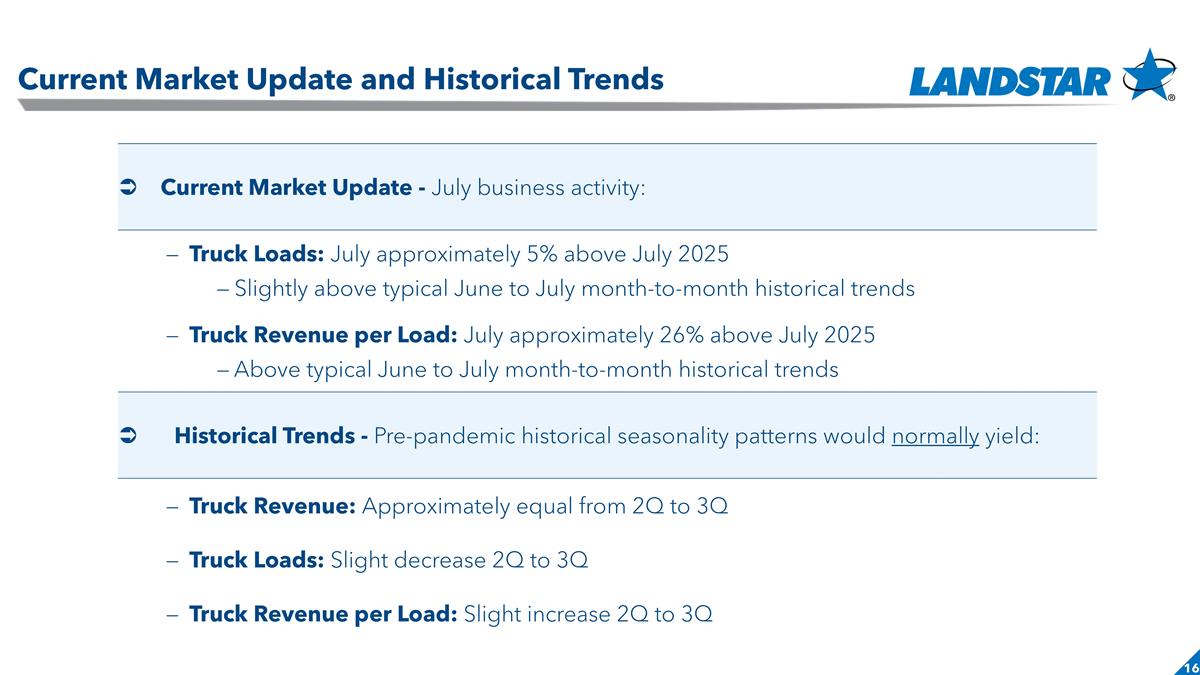
Thanks, JT. Before we jump into the current market update, I'd like to briefly touch on our press release from last Thursday. We're extremely excited to welcome transportation industry veteran Bill Clement as our new Vice President and Chief Commercial Officer, effective August 1st. Bill brings more than 30 years of transportation and logistics leadership experience with him to Landstar. We are eager to introduce Bill to our agent network over the coming weeks through a series of previously scheduled agent meetings throughout the country. Bill will be charged with supporting the success of our agent network, advancing customer relationships, and enhancing the effectiveness of the entire commercial organization. In addition, he will focus on accelerating growth across our strategic initiatives. Importantly, Bill has a proven track record of success in the transportation space. He will be a tremendous addition to our organization and help enhance our safety, security, and service value proposition to drive sustainable, profitable growth throughout our network. In addition, we're excited for Jim Applegate to step into his new role as Chief Strategy and Transformation Officer. This newly created position will leverage Jim's deep transportation and logistics experience and unique skill set as we strengthen our ability to deliver innovative solutions and create value for our agents, customers, capacity providers, and shareholders. Turning to slide 16, given the highly fluid freight transportation backdrop and an evolving geopolitical and macroeconomic environment, coupled with a highly volatile litigation and claims environment, the company will be providing third-quarter financial and operational commentary rather than formal guidance. Looking at historical seasonality from Q2 to Q3, pre-pandemic patterns would normally be expected to yield a sequential increase of approximately 1.5% in truck revenue per load, but an approximately 1.5% decrease in the number of loads hauled via truck, resulting in a relatively flat top line sequentially. Please also note that historically, the company has normally experienced a de minimis variance in variable contribution margin from the second quarter to the third quarter. The number of loads hauled via truck in July 2026 was approximately 5% above July 2025 on a dispatch basis, and revenue per load was approximately 26% above July 2025 on a process basis. As a result, we view anticipated truck revenue per load in July as outperforming normal seasonality, while anticipated July truck volumes are trending slightly ahead of normal seasonality. The slight seasonal outperformance in truck volumes during July was almost entirely attributable to a strong first week of fiscal July, driven in part by the timing of the 4th of July holiday. For context, the year-over-year truck volume increase during the last three weeks of fiscal July ranged from plus 1.5% to plus 3.5% on a dispatch basis. We're excited to build upon the positive momentum generated during the first half and are energized by the opportunity to support the best network of independent business owners in the transportation space, especially in an environment that after nearly four years appears to have turned in our favor. With that, Arlene, we'd like to open the line for questions.
Operator
Thank you very much, sir. At this time, we will begin the question and answer session. If you would like to ask a question, please press star 1 on your touchstone phone. Once again, that is star 1 to ask a question. To cancel your request, please press star 2. Our first question comes from the line of Scott Groove of Wolfe Research. Your line is now open.
Amy, thanks. Afternoon, guys. So I guess let's start maybe how you're thinking about the business post last week's nuclear verdict and how you think about your insurance costs going forward. Do you worry big brokers are just going to be more at risk of these big litigations? And then maybe, like, what are the positives that you could argue are coming out of this? And Montgomery, is this good for your ability to get BCOs or gain share from small brokers? Help us think through the pluses and minuses here.
Yeah, no, that sounds good, Scott. I anticipated that would come early on in the dialogue. Obviously, we watch what happens in litigation involving, you know, other brokers and other carriers just to get a pulse of what's happening in the environment. We have renewed our insurance tower for the next 12 months. That was effective June the 1st, so we're in good shape there. I feel like we are amply covered and I think did quite well. I'll let Matt and JT talk a little bit more about that one. I think scale remains important. I think safety remains very important. The folks who are going to be successful in this environment in the post-Montgomery world or those that put safety, security, and service high on the list. And as you've heard us say for the last couple of years, those are the things that we think we're good at and we're also the things that give us the opportunity when we do those well to have our agents sell that to customers. You heard us reference a new agent addition in the quarter, the Midwest broker that I mentioned of about $18 million. That dialogue started prior to Montgomery, but certainly under the possibility of an adverse verdict in Montgomery. So I think that what you're seeing is an environment where small to medium-sized brokers, you know, are concerned about an existential risk. And I think we're seeing our pipeline of potential agent candidates continue to increase and be, I'd say, in the individualized case, a little bit larger than what we've done historically. If we've generally played in the kind of sub-$5 million space for new agent additions, you know, we're beginning to see traction in numbers that are higher than that. But, Matt, maybe a little bit on the insurance piece and, obviously, your focus on safety, I think, could be important. And, JT, obviously, any commentary you want to provide.
Sure, sure. Appreciate that. I think it really reinforces why we're doing what we have been doing with a focus on safety, security, and service. You know, over more than 20 years in brokerage, we've always looked for ways to enhance our carrier vetting with people, process, technology, and information. Over the past four years, we've gone from over 100,000 approved carriers in the second quarter of 22 to just over 64,000 at the end of the second quarter, or 35% reduction. As new technologies and information become available, we're going to continue to do just that, exactly what we've been doing. We're always looking for opportunities to drive safety, security, and service. On the insurance front, to Frank's point, we had a very favorable outcome. On the auto liability tower, we were effectively flat. Again, that was a June 1 renewal. That was post-Montgomery decision, which I think was May 14th. And then on the broker liability, we were plus 3%. So net-net, I think we had a favorable outcome there.
Yeah, and I would just piggyback that, Scott. Certainly, you know, the Montgomery, half the country pre the SCOTUS ruling, you know, did not recognize F4A. So now we've got basically half the country that we used to be able to submit a very well-crafted motion for summary judgment and usually get out very high degree of probability. Those now will have to fight those, right? So that will look like the half of the country that did not recognize F4A pre Montgomery. summary. And then I think there's certainly going to be some element of plaintiffs being more emboldened to pursue these cases in terms of the figure that came out late last Thursday. I'm not familiar enough with the case. As you know, most of these things on big nuclear verdicts, and we're certainly aware on the BCO side, on the trucking side of the business, have got a big degree of experience with large losses, both at the trial level and settlement, but I would expect this thing to play out two, three, five years through the appellate process, et cetera.
Helpful. And then just a second question on the BCO count. So, ticked up a little bit. When we start hearing about rates up mid-teens now, mid-20s in Q3, we historically have seen like pretty dramatic increases in the BCO count. Is that something we should expect to start seeing in the back half of the year or in this world of more supply-driven tightness? Do you think it's any different in terms of how quickly the BCO count starts to really ramp?
Hey, Scott, thanks. Yeah, I mean, we're actually excited about seeing the trend improve here in the last few months. You know, when you look at where we started off the first, gosh, Matt, two or three weeks of January, you know, were a challenge for us and looked a little bit more like prior years. But I think we ended up the first quarter down a very, very modest amount. And in comparison to the past, we were modestly better, even though it was a slightly negative number. And then, you know, what Matt and his team are doing on the recruiting front and shrinking the time to qualify, obviously the rate environment is helpful to push more leads our way. But I think it is both the cycle, but I also think it's some of the structural things that Matt and his team are working on, Matt.
Yeah, I would say we're encouraged by what we're seeing, 68 trucks higher in the first quarter of – I'm sorry, in the second quarter of 2026. Best net truck count result in the quarter since the first quarter of 22. And it was the best second quarter result since 2021 and brings us to a positive net truck ads for the year. The net truck count trends improved in each month in the second quarter, and we saw continued growth in net truck counts during the most recent four-week period of July where we added a net 49 trucks. During the quarter, gross truck ads were up 4.2% sequentially, demonstrating growing interest on the ad side. And then during the quarter gross truck cancels, we're down 13.6% sequentially, demonstrating that those that are in the network are finding success. And then I would say that this is the 10th consecutive quarter of turnover improvement. The high watermark was 41% in the fourth quarter of 23. We finished the quarter at 28.3. That's beneath our long-term average. And then I would just say the variable pay model is incredibly compelling for those that are interested in finding a home in this environment. And you don't have to look further than 2018 we added plus 900 trucks, 2020 plus 750, 21 plus 870. Typically, the improvement in cancellations leads the improvement in ads, and we're beginning to see that improvement in ads.
Thank you, guys. Appreciate it.
Operator
Thank you. Our next question comes from the line of Jonathan Chappell from Evercore ISI. Your line is now open.
Thank you. Good afternoon. Jim or Frank, I recognize the reluctance to give guidance, but if we look at slide 16 here and you've provided some year-over-year context and, you know, historical trends that clearly we are not tracking to right now, is there any way through the first four weeks of the quarter to take these year-over-year magnitudes and kind of help frame out what the, how the 3Q is shaking out relative to those historical trends, you know, a little bit more than slight or slight above typical, you know, any type of magnitude would be helpful.
Hey, John. Yeah, I'm happy to. I would just start on the demand side. And really since March, we have been, you know, kind of plus or minus, you know, trailing 15-year averages on demand. One month will be slightly better. One month will be slightly worse. You saw the outcome for the second quarter where I think we were about maybe a little under 100 basis points better than typical 1Q to 2Q trends. We are 60 basis points better on a loads per workday June into July. So again, that dovetails with Frank's slightly better. But again, you've got probably four or five months now of demand kind of reconnecting to normal. On pricing, I think on the April deck we had significantly outperformed was the word we used on the slide, and that's because pricing was 640 basis points better than it typically is in April. We were nearly 400 basis points better in May, nearly 400 basis points better in June. We're holding about 150 basis points better than normal in July. John, hopefully that helps with the model.
Super helpful. Thanks, Jim. And then just a super quick follow-up. Obviously, there's a big narrative around AI, data center, infrastructure, et cetera. Sometimes that's favorable. Sometimes it's unfavorable. Your heavy hauls continue to do very strong. Is there any kind of end market exposure that you can point to there that either kind of proves or disproves this narrative that maybe the data center or infrastructure related construction may be slowing from kind of peak spend.
Hey, John, it's Frank, and then Jim Applegate will pick up after my lead here. But we're continuing to see strength in the data center business. We look at it like an ecosystem rather than specific to the hyperscalers. Obviously, there's energy-related items in there, and then you got all the cooling as well. So we're looking at it from the broader ecosystem perspective, when you look at the commodity breakdown in the deck and the commentary that JT provided, you're going to see, you know, building products has got a piece of it. Energy has got a piece of it. Machinery has got a piece of it. You know, there's a lot of different areas that have data center exposure. You know, we continue to see strong demand, especially from one of our largest customers, strong demand in that space and a continuing need for additional capacity. So we feel, you know, quite bullish about the things that are happening in the data center space and have not felt any pullback or suggested pullback in that space, certainly not in the last three or four months when we've all read the same articles that you're alluding to.
Yeah. And hi, Jonathan. Just to piggyback on what Frank's comments were, you know, from a customer perspective, we're seeing a lot of new customers pop into our top customer list this year. And a pipeline that's looking very strong and new customers that are starting to come through the woodwork here that we really frankly didn't anticipate that would be kind of jumping into the game. So, you know, with the existing customers that seem to have a continual appetite to invest and then, you know, kind of it's spreading across other providers and us getting exposure to these new customers, I see a strong pipeline not only here for the reign of the year, but hanging into 2027.
And John, just real quick, while the heavy haul service offering has certainly been helped out from some AI data center type demand. We had 22 customers in that vertical grow their volumes, their heavy haul volumes at Landstar by at least 50 loads in the quarter. And besides data center, you've got aerospace, you've got defense. You heard Frank talk about power and energy. So it really is broad base. It's not just one or two customers driving the bus there.
Great. Thanks, Jim, Jim, and Frank. Thanks, Drew.
Operator
Thank you. So our next question comes from the line of Jordan Alger from Goldman Sachs. Your line is now open.
Hey, everybody. This is Paul Stoddardon for Jordan Alger. Thanks for taking our question. I guess my question is seeing that the brokerage volumes are still running negative year over year, is this largely because we're not seeing a firming up of the volume, and are we seeing agents direct more volumes towards the BCOs?
Hey, Paul, I'll give you my take, and this is JT. So remember, the agents are going out to market to grow transportation volumes, and they are certainly constrained by customer preferences, but for the most part, they're trying to just serve their customer in access capacity. And then we run a non-force dispatch operation here at Landstar. So utilization, if you just take BCO utilization second quarter year to date and annualize it, we'd be at 101.9 BCO loadings. That is about five loads better than the previous all-time high. So I think the decline in brokerage, while there's certainly some probably customer preference there given the elevated fraud in the supply chain that's been going on since 2022, 2023, I think the BCOs are just more active in coming out of the longest down cycle from a rate side. They're hauling more loads, and as such, there's less freight to lay off to third-party carriers.
Got it. Thanks. And then I guess as a follow-up to that question, is it potential that since volumes are not growing at a meaningful amount compared to revenue per load, are we going to see less compression on VC margin because we're seeing more of those loads come through BCO? rather than brokerage?
It's a great question. So BCO mix, if you just look at BCO revenue as a percentage of total from first quarter to second quarter, it did dip sequentially. So you've got, and that's not abnormal in the second quarter, especially when you have a seven or eight percent sequential uptick in loadings. And the other factor there was, Paul, and mainly that's brokerage and diesel, which is having a tailwind to revenue per load on brokerage that it's not necessarily on VCO, but it is a tighter capacity environment, and as a result, I think you heard Frank mention our net revenue margin on brokerage business compressed to 129 basis points. Some of that is also fuel that you mark up on fuel surcharge is not as much as a line Got it.
Operator
Thank you. Our next question comes from the line of Brandon Oglinski from Barclays. Your line is now open.
Hey, good afternoon, guys, and thanks for taking my question. I think, Jim, maybe you mentioned that, you know, your insurance costs you held pretty much flat or maybe up slightly, even in a post-Montgomery world. I mean, is this something that we should expect on a go-forward basis, or is it just, like, everyone needs to experience what the claims are actually going to be like post-Montgomery, and maybe we could see a big reset there in the future?
Hey, Brandon. It's Frank Burst, and then, you know, JT and Matt may fill in some gaps here. I think the important thing in any insurance renewal is how your company performs on the most important measures, not the least of which is going to be safety and certainly the claims history. And then you've got the market phenomenon, which is obviously if you have some catastrophic issues that impact particular carriers who may be shared across the environment, that's going to impact the overall renewal market. Now, walking into the renewal in the April-May timeframe, I mean, we felt like we had a pretty good case for a strong renewal, even though the market had shown us some trends that were maybe working against the industry. But we're able to point to all of the BCO demographics. We're able to point to the balance sheet. We're able to point to the safety measures. We're able to point to the things that the underwriters look at and say, okay, this is a company that I want to underwrite.
Matt? Yeah, no, I would agree with you, Frank, and I think a lot depends. I mean, there's a lot to happen over the coming months and years, and certainly we have a renewal in June 1 of next year. There's an opportunity for FMCSA to do some things on the regulatory front, and then there's a variety of things that could happen in sort of litigation that may come out contrary to what we saw more recently. So I think there's a lot that can happen between now and then. So it's really tough to see.
And gentlemen, I appreciate that response. And I guess, Frank, are you trying to lay the case here that maybe not all is created equal? I mean, is this going to be a larger issue for smaller brokerages?
Well, the brokerage side, for sure. You know, you have, let's say, you move 100 loads and you have one or two that go bad as a small broker, as JT pointed out in an answer to one of the earlier questions, you're going to have litigation costs that you never had before. If you're in a jurisdiction that was in effect previously, but not in effect now because of Montgomery. So now you're going to be paying legal fees. As a reformed lawyer, I know that those aren't cheap. And then you have the possibility of a more extended litigation environment and potentially a verdict or a settlement. And as you know, margins in our industry are thin. And so there's only so many punches to the stomach you can take as a smaller player. So I do think, back to the point we talked about earlier on being attractive to small and medium-sized brokers, we think we offer a very compelling value proposition under the Landstar umbrella. And so we're beginning to see some traction there. As I mentioned, the one Midwestern independent broker that signed on as a new Landstar agent in the $18 million annualized range, that's a big deal for us. I mean, we'd love to attract folks like that who are out there every day and believe in the safety, security, and service proposition that we offer and we expect from the new agents that come on board. Appreciate it.
Operator
Thank you. Our next question comes from the line of Tom Waterwitz from UBS. Your line is now open.
Yeah, good afternoon. Wanted to just I guess ask, you've had a lot of questions on this but want to get a little more sense of how you look at things so um i guess in terms of the carrier selection how have you changed your criteria uh you know you mentioned the move down to 64 000 carriers is that for broker carriers do you think that that continues to go down and how do you look at it to say okay you know what what would we tighten up or what would we view differently just in terms of how we define a safe carrier that we would work with um so that's one and then just had one follow-up, too.
Yeah, for sure, Tom. Nice to hear your voice. I think on the carrier selection, we've always taken carrier selection very, very seriously. We've always looked to evolve that over time as new sources of information become available. And honestly, as different carriers have different track records of success in what they do out there moving every single day, Matt and his team do a really nice job of understanding exactly what those criteria are, and when things become safety-related, obviously, we have to move folks to the unapproved category and not use them anymore. So, like, those are things that Matt and his team are working on. Customers are beginning, you know, to ask for, at least at a high level, what our carrier vetting standards are, and so we're beginning to have some really good conversations with direct customers. I do think a point that Matt made earlier, and I mentioned in my prepared remarks, is going to be really important, and that is having some sort of minimum federal selection standards, vetting standards is going to be really, really important. Otherwise, you know, we're going to be subject to 50 different states, and if you counted every county, you know, that has a court, it's going to be, you know, hundreds, if not thousands of different interpretations of what reasonable care or ordinary care is in the selection of carriers. Matt?
Yeah, I think, you know, going from, as you highlighted, the 100,000 carriers down to 64,000 carriers, that all started with cargo fraud, right, and the investment in technology and the available technology that became available to us out of the advent of fraud helped us begin to drive further vetting standards within our organization and driving down those overall approved carriers in the network. That sort of dovetails with the safety parameters that we have as well. Folks that are not necessarily operating above board from a theft standpoint are likely not necessarily operating above board from a safety standpoint. And so we've been able to drive that down, and to Frank's point earlier, as information technology or an opportunity presents itself, we're going to continue to press that safety, security, and service emphasis.
Okay, great. And I guess just a second kind of related question. So, you know, Frank, you mentioned it would be helpful to get something from FMCSA MCSA that defines maybe parameters what can you give a little more of a sense of you know what you would want to see from them and then also just kind of what would you want to see from the courts that would maybe provide some precedence that would give you a little more clear look to say okay you know 600 million verdict against CH or whatever broker just just doesn't make sense because they did this and that right just some kind of thoughts on what would be helpful to you know kind of think about how that the risk uh you know the legal risk could could become more you know better looking forward yeah i think on the on the second point tom i think the the courts
are going to you know every every decision every verdict that comes out uh is going to set some level of new law and flesh out uh what is reasonable care in those uh situations so that's just going to take a fairly long period of time uh to develop and i think as it develops we'll see the balance set between, let's call it the plaintiffs and the defendants, as JT mentioned earlier. Right now, there's a little bit of buoyancy in the plaintiff bar in looking at cases that are tending toward broker liability issues. I think on the FMCSA side, as we talk to folks who are inside the beltway, so to speak, looking at minimum insurance standards for carriers is going to be important. That hasn't been touched in, Matt, 40 or 45 years or something like that. You know, thinking about minimum insurance standards for brokers in addition to carriers, you know, looking at literally, you know, kind of a 10-bullet checklist of, you know, did you check FMCSA? Did you check the technology tools that were available? Did you check their, you know, various records and things like that? You know, we've got to have something where we can go through our standards relative to a federal minimum and say, look, we exercised ordinary care. We were in compliance with the federal minimum standards, and I think that will help reset the balance between plaintiffs and defendants as well. And so I think there's going to be some time for this all to shake out. Right now, the best thing we can do is run the safest possible network we can. do you think that's coming soon from fmcsa or is that just kind of indefinite short answers i don't know um but i will tell you this um they've moved faster than any other fmcsa or dot organization in the last couple of years than any in history so if they have a mind to to tackle this uh this item my sense is it would happen uh on a quicker timetable than we're used to yeah great thank you Thanks for the time.
Operator
Thank you. Our next question comes from the line of Brian Osendick from JPMorgan. Your line is now open.
Hey, Gaffney, and thanks for taking the questions. Maybe first just real quick follow-up on the insurance side. I don't know if you've seen any changes in coverage, endorsements, or deductibles or anything along those lines for yourselves, and would you expect that to be part of how risk gets repriced across the industry from a broker-liability perspective?
I think over time, Brian, as people renew, they're all going to have to look at who's going to write, you know, first dollar coverage or, you know, at a certain deductible level. I mean, we have deductibles, you know, in our space. We have structured deals in our tower. You know, I think it's all going to depend on the risk assessment that insurance carriers and brokers do. You know, we did not have to make any meaningful adjustments in our self-insured retention levels this go around. but obviously that'll be subject to a dialogue next year. Yeah, I would just echo that, Brian.
The broker liability policies we have, which we have an initial policy and an excess policy, we renewed those as existing, I believe, Matt, at a very modest increase, policy year over policy year.
Okay, I appreciate that. Maybe just Jim Avilgate, obviously the company's been investing in technology for quite a while. You've been involved with that, but any sort of quick thoughts stepping into the new role for strategy and transformation? Maybe you can start with an update on just the AI initiatives at sort of the distributed level and also at the central level at corporate. Thanks.
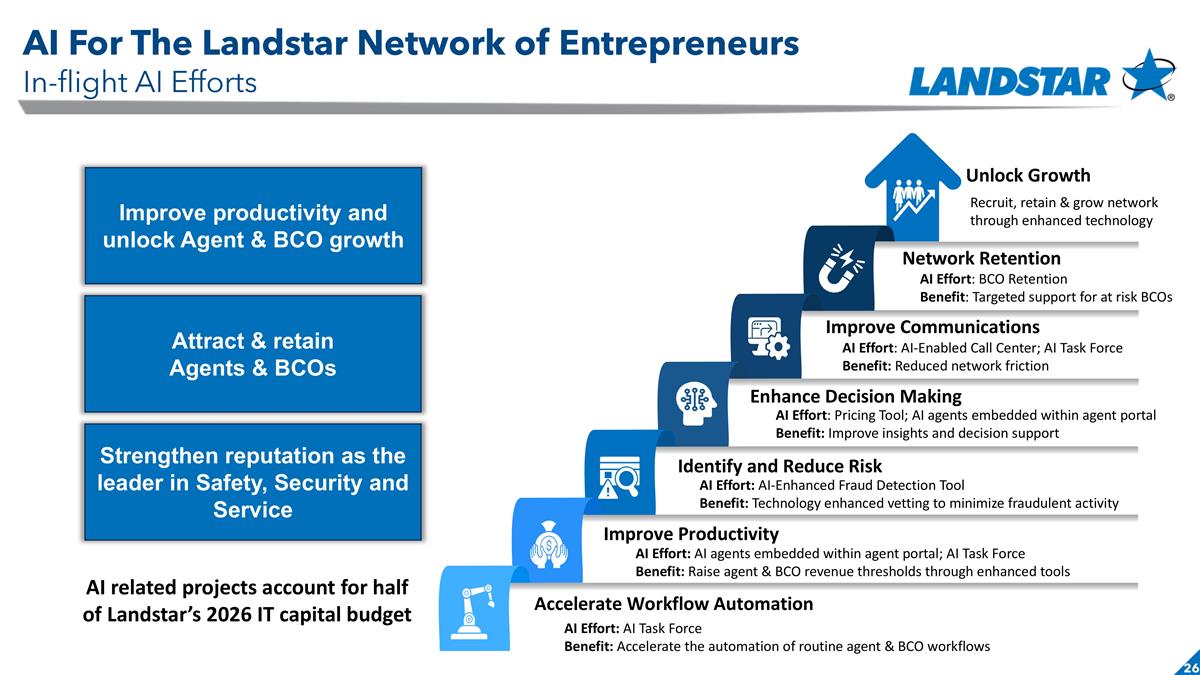
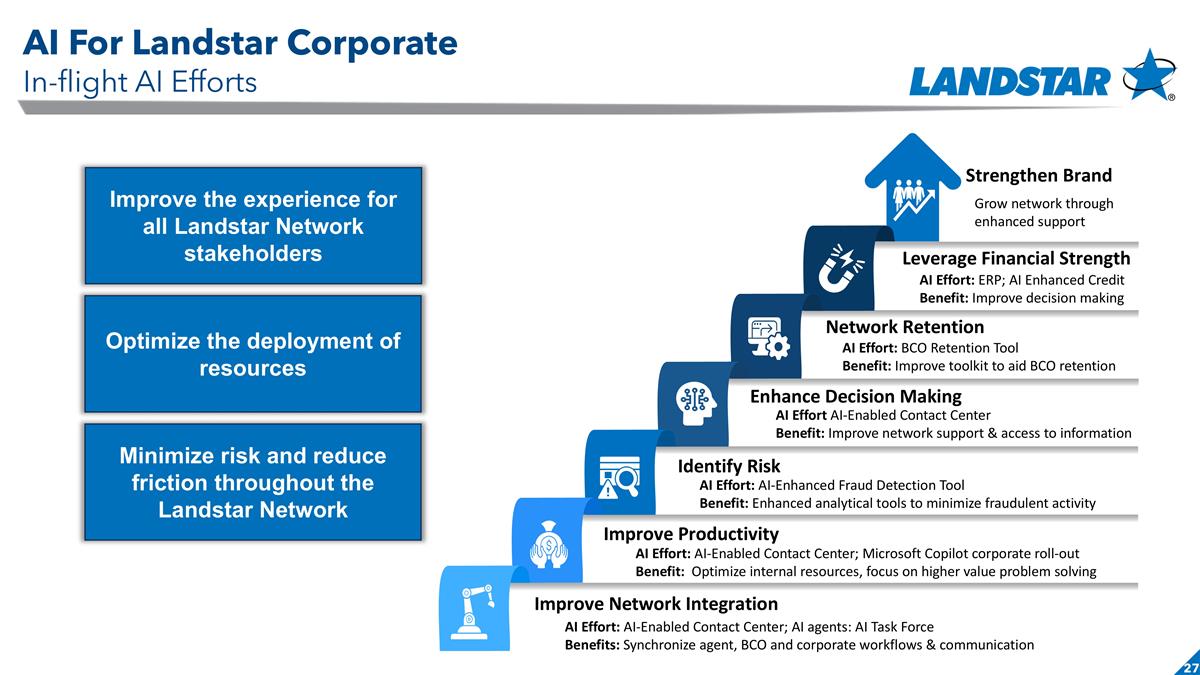
Thanks, Brian. We're going to finish up answering that question. Brian, you know my background, and I think we've had a lot of conversations around technology. I think right now is just a great time to really be looking at what technology can do for our agent network. As you know, we've made a lot of progress. I think I've spoken on a few different calls about the progress that we've been making around AI, both within the building and within our agent offices. We've delivered several applications that, you know, are improving agent workflow. We're getting faster information retrieval. We're improving exception handling, better data visibility, you name it. I mean, it's just really powerful what this new technology can do. I think as we get into the next phase here, we've got a real meaningful opportunity here to get the technology in the hands of the agents, and we're planning on ramping that up. Starting off in Q3, mid-Q3, we've got a plan in place to get out into our agent's offices. We have some repeatable applications that we can actually deliver to the agents, and our hope and really expectation is that they're going to be able to use those tools not only to get more efficient but to grow their business. So it's kind of a two-fold approach. One is, you know, kind of making sure that they can actually transition to technology, but then really getting that technology deployed the right way that they can redeploy the resources and us teaching them best practices and really kind of up in their game and really kind of delivering better solutions in the future on behalf of our customers. You know, as you guys know, you know, I think we've got the best model in the industry. It's not just the technology. It's making sure that you've got the right people in place to really deploy that technology. This is an execution business. Technology is not going to replace what our agents bring to the table. It's about relationships. It's about trust. It's about safety, security, service, delivering that throughout the network. And we're going to make sure that they can do that better than anybody else in the industry.
Okay, great. Thanks for your time.
Operator
Our next question comes from the line of Jason Seidel from PD Collin. Your line is now open.
Hi, thanks. This is Odeon for Jason Seidel. So maybe I can just start on VCO utilization. I'm just wondering how that looked in the second quarter. I imagine there's some excitement there with pricing moving up. I guess is there room for utilization to accelerate in the third quarter, maybe also into the fourth quarter? I know VCOs usually take some time off in the holiday season, but it's also like the first time the rate environment's been favorable in four years. So just any thoughts on utilization?
Yeah, thanks for the question. Good question. Obviously, we've been very happy with BCO utilization over the last three or four quarters. The cops will get harder as we lapped the third and the fourth quarter of last year. But, you know, if you just took a trend line against the kind of 101, 102 that we are, you know, we came into the last trailing 12 in the second quarter, I think you'll see that we'll continue to show utilization improvements on a year-over-year basis just based on the math. I think what you're seeing is the sort of pent-up demand to make money, given the fact that we've been in a three- or four-year freight recession. And, look, that's not lost on the BCOs. You know, they had some kind of leaner years in 22, 3, 4, as it was a declining market and into 2025, obviously. So I think they're making hay while the sunshine, so to speak, and making sure that they are able to get the loads. And I also give a lot of credit to the agents. You know, the agents are out there, you know, selling really good freight, and that puts it on the board for, you know, the BCOs to haul. So the fact that we have more BCOs and higher BCO utilization and we've got agents that are out there getting the premium freight, that's what makes this network special to Jim Applegate's good point. Matt, any other comments that you want to put on that?
Yeah, yeah, yeah. I would just say that, you know, utilization was up 12% year-over-year and 8% sequentially. And I just, you know, tip of the hat to the new BCOs coming into the network, they want to get to work. and also to the existing BCOs, they were in it for a pretty prolonged downturn, and they're also ready to haul more and more loads, and we're seeing that.
Yep. All right. That's good to hear. Maybe if I could just go back to the insurance topic, just a clarification. So, Frank, I think you mentioned the five claims reserve headwinds in the quarter, I think three related to truck brokerage. Were those brokerage reserves new reserves that you have now made in light of the Montgomery ruling, or were those kind of adjustments related to cases kind of, you know, in the normal course of business? I think like JT said, on, you know, the half of the country, where you still have to fight these.
Yeah, we did. That's a great question. I believe all three were $0 reserves previously. And then, you know, at each quarter end balance sheet date, we've got to reevaluate, you know, from a FAS-5 standpoint. And there is a nuisance value on some of these too, right, when you get your quote on what it's going to cost to take the initial trial and then appeal costs. But I think all three of those were zero. I'll confirm that when we're offline and get back with you.
Yes, no, that's very helpful context. Thank you very much.
Operator
Thank you. Our next question comes from the line of muscle majors from Stevens. Your line is now open.
Thanks for taking my question. If we look back historically, we can see the cost of the rising claims environment in your P&L clearly with the cost is percent of BCO revenue of the insurance and claims going from, what, 3% or less a decade ago to more like 7% and 8% more recently. But we've heard you talk about BCOs being more attracted to the network. We heard you talk some about attracting some larger agents. Is this shift starting to make the Landstar model and system and platform more valuable to the entrepreneurs on both sides? Is that an emerging trend, or are we reading too far into this?
Yeah, I think on the claims over time, JT will fill in the blanks on that one. Obviously, it's a combination of a lot of things that JT can unpack for you. I do think on the emerging trend idea, I do think that scale is going to continue to matter. I think scale players that have a long track record of being safe and secure and delivering a great service product for the end customer, I think we're going to begin to see more and more customers prefer scale players. I think they're going to have more and more customers that prefer BCOs just because of the track record of success that they have there. So, yeah, I'd say it is an emerging trend. I've got one data point. But certainly the pipeline of potential agent additions, if we're able to get some of those across the finish line, would add a couple more data points to that, you know, over the next handful of quarters. And then certainly Matt and all the great work that he's doing, he's, I think, seeing less cancels and beginning to see some green shoots on the addition side and on a net basis. That gives us, you know, a good trend in the BCO count. We saw that in the second quarter. We mentioned that we've seen an increase in July. So, yeah, I'd like to think that we are the leader in this space and are going to be successful even in a post-Montgomery world.
Hey, Baskin. So I would echo Frank's first thought there. The value proposition to become and join the Landstar Network, to be an independent freight agent or an owner-operator, BCO, is very, very strong. But I take your point on insurance, right? So in 2019, we had about 10,500 BCOs in the fleet, and we had an $80 million insurance year. And, you know, fast forward six years, seven years, you know, it's trending 2X that with 8,600 BCOs in the fleet. And, oh, by the way, our accident frequency and our DOT accident frequency, which are those more severe accidents, we're a safer company. And we were safe in 2019. We're even safer today. I don't think that's unique to Landsar, right? Claim cost severity has been going one way for some period of time. I think other industry peers would echo that. Certainly, the kind of new elements that Miller touched on earlier, 2022, 2023, the cargo claim environment has gotten really, really tough on the brokerage side. We've done a lot of good work there in terms of implementing a new team and best-in-class technology, both off the shelf and internally developed. And then clearly, this more recent phenomenon, our largest brokerage loss, at least based on the judgment entered last year, was $22.8 million. and if you recall on that one, the jury apportioned 15% of that 22.8 to Landstar and that's one that's currently under appeal. So on the owner-operator side of the business, clearly claim cost severity has been a pressure for the industry and the cargo and the brokerage stuff are more recent. At the end of the day, folks, if it's a higher cost for everybody, our view has been the industry participants are going to have to start to recapture some of that in the top line and I think some of that you're seeing in the first half of 26 playing catch up.
Operator
Thank you. Our next question comes from the line of Stephanie Moore from Jefferies. Your line is now open.
Good afternoon. Appreciate the color on just maybe the changing landscape in this post-Montgomery world, and I think your color around just the impact this could have on small and medium-sized brokers. Curious if this changes your view from an M&A standpoint. Historically, an area you didn't really play much in, but just given the event as of late? Is this something that you might look into differently, either on the small or medium brokerage front, or also, you know, anything that's interesting on the agent front as well? Thanks.
Yeah, no, good question, Stephanie. It depends on how you define M&A, right? If I look at the Midwest broker that signed on as an agent, obviously there's financial incentives to do that, so you could look at that as a kind of small M, small A type of M&A. You know, we've looked at a variety of different things over time, it's got to really fit the model. And so it's a limited environment of things that would fit the model. We're certainly not averse to looking at it and haven't looked at a number of possibilities over the last few years. We certainly have the balance sheet to be able to support it. But I think the best down-the-middle play for us is could we find five or ten more $18 million agents out of the Midwest? that want to come under the Landstar model, we're pretty good at doing that. So we want to make sure that we're deploying the shareholder's capital in the right way and in a risk-adjusted type of return environment. We think that that's a really smart play for us.
Great. I appreciate the time. Thank you.
Operator
Open. Great. I think there's no response from Bruce Chen. Our next question comes from the line of...
Operator
Bruce, are you there?
I'm here, yeah. Yeah, just appreciate the time, gents. Just a couple, hopefully, quick ones left from my side. You know, the first one here, I know it's a smaller part of the business, but it looks like LTL load count was down pretty meaningfully this quarter, revenue per load, you know, up. Anything to, you know, maybe glean from the underlying market there, or is that just agents, you know, maybe choosing to spend their time on more lucrative business?
I think with the LTL, it's really more agent-specific is why you're seeing a certain downturn there and customer-specific as well, too. It's not necessarily a customer preference thing that we're seeing across the board. So I wouldn't make a lot out of it. It is a smaller segment of our business, so sometimes it will have a bigger impact when you have a certain agent or a certain customer where you get a little transition.
Okay, super helpful. Got it. And then just a quick point of clarification. You talked about the traction with the new agent pipeline, which is certainly good news and makes a lot of sense. Is there any liability exposure to Landstar that might, you know, maybe come from those agents' prior claims, or is that something that gets extinguished once they come under the umbrella?
No, they maintain a separate corporate status, and so we would not inherit liabilities from them. Got it.
Operator
Thank you. Our next question comes from the line of Chris Weatherby from Wells Fargo.
Your line's now open. hey thanks guys thanks for squeezing me in here um i guess maybe just one question for me just to sort of wrap up as we think about the insurance piece of this and and maybe can you give us some context on what the backlog might look like from a case perspective i know you've increased some reserves around severity but as you think about particularly broker liability in the two plus months since montgomery has anything materially changed there as you sort of look at what you might be facing over the course of the next several quarters or a couple of years just get a sense of like if there's more activity going on in the market would be helpful.
Yeah. In terms of like new cases or something like that, Chris, I mean, we haven't seen any meaningful uptick or downtick for that matter. It's been pretty much steady as she goes. I mean, we did have a couple of cases as JT mentioned, the three that we referenced, you know, that were, you know, either ongoing and estimates went up or got settled. So there's like that's normal business. I just think that there's a renewed strength in the plaintiff's bar to try to press forward in the immediate aftermath of Montgomery and certainly the Robinson verdict and Godspeed to them challenging that successfully. But I just think it's going to be a normal course of events. If we have an issue with a brokered carrier, we should expect that we're going to get pulled into it. To me, it's a question of if we didn't do anything wrong, we shouldn't have to pay a dollar. Um, but my guess is we have to defend some of those and we may not have to sell some of those for nuisance value that if you go back five years, we wouldn't have had to do that.
But it's not to say that you've necessarily seen something pick up yet, sort of just been the wake up, you know, so far so good, I guess on, on the backlog. Okay, perfect. Thanks for the time. Appreciate it.
Operator
Thank you. We will take the last question from Harrison Bauer of Saskiana. Your line is now open.
Thanks for taking my question, fitting me in here. a lot of the discussion or really historically a lot of the inflationary part of insurance has been on the BCO side, but especially with some of the adverse claims on the brokerage side post Montgomery, is there any way to frame what either the total or per load claims insurance related legal fees might be on a BCO load versus broker load? And in the long run, do you see the risk for broker load converging at all towards the BCO load?
Great question, Harrison. So as you can imagine, we've had very, very well-developed loss triangles on BCOs going back decades. So as an example, I think we had 1,600 claims last year between our trucking program and our Unladen program, and we can look at cost per crash in those two programs going back 20 years. On the brokerage side of the business, Harrison, they're really few and far between. So at the Montgomery ruling, we went back and just looked at total loss, both the insured loss portion and the Landstar deductible portion. We used to have a million-dollar deductible. That's a $2 million deductible as of a couple of years ago versus our $5 million self-insured retention on the owner-operator side. Very, very low, like less than 20 basis points, less than 25 basis points of gross brokerage revenue. if you go back 15 years again with the largest loss reflected in our financials at about $23 million. I think there's a couple $5 million losses and below the two $5 million losses, they get smaller. And as I mentioned earlier on the call, that's with half the country recognizing F4A. So I certainly subscribe that the frequency of brokerage losses should at least 2X, XA, embolden plaintiff council factor. Does it get to owner-operator type levels? No, because if you look at the vast majority of accidents, they get settled in a primary layer, right? So the FMCSA requires the $750,000 primary insurance program to be a carrier. Landstar requires a million to get in our network. Probably 98% of the crashes are going to get resolved within that $1 million primary policy. The brokerage stuff comes in over and above that. And again, that's even without F4A, they're still, I'm not an attorney, so I've got to be careful here, but you still have to demonstrate a negligent selection or a broker exerting control over a third-party carrier.
And I think, Harrison, that last piece that JT just mentioned, he did pretty good as a non-lawyer. But I think that's the most important thing. Like, we had to have negligently selected that carrier. The fact that the carrier had an accident does not automatically make us live.
Okay, great. Thank you guys for the time today.
Good. Thanks, Harrison. In closing, the management team has been energized by our interactions with BCOs and agents thus far in 2026. We are encouraged by the current freight environment and what we believe is the strongest unsighted platform service offering, including Heavyall, in our industry. And regardless of the economic environment, the Landstar variable cost business model continues to generate free cash flow year after year. Landstar has always been a cyclical growth company, and we are well positioned to capitalize on the improving conditions and positive momentum in the freight markets. Thank you for joining us this afternoon. We look forward to speaking with you again on our 2026 third quarter earnings call in late October. Thank you.
Operator
Thank you for joining the conference call today. Have a good evening. Please disconnect your line at this time.