Operator
good morning everyone and thank you for participating in magnolia oil and gas corporation's second quarter 2026 earnings conference call my name is megan and i will be your moderator for today's call at this time all participants will be placed in listen-only mode as our call is being recorded i will now turn the call over to magnolia's management for their prepared remarks which will be followed by a brief question and answer session Thank you, Megan, and good morning, everyone.
Operator
Welcome to Magnolia Oil and Gases' second quarter earnings conference call. Participating on the call today are Chris Stavros, Magnolia's Chairman, President, and Chief Executive Officer, and Brian Corrales, Senior Vice President and Chief Financial Officer. As a reminder, today's conference call contains certain projections and other forward-looking statements within the meaning of the federal securities laws. These statements are subject to risks and uncertainties that may cause actual results to differ materially from those expressed or implied in these statements. Additional information on risk factors that could cause results to differ is available in the company's annual report on Form 10-K filed with the SEC. A full safe harbor can be found on slide two of the conference call slide presentation with the supplemental data on our website. You can download Magnolia's second quarter 2026 earnings press release, as well as the conference call slides, from the investor section of the company's website at www.magnoliaoilgas.com. I will now turn the call over to Mr. Chris Stavros.
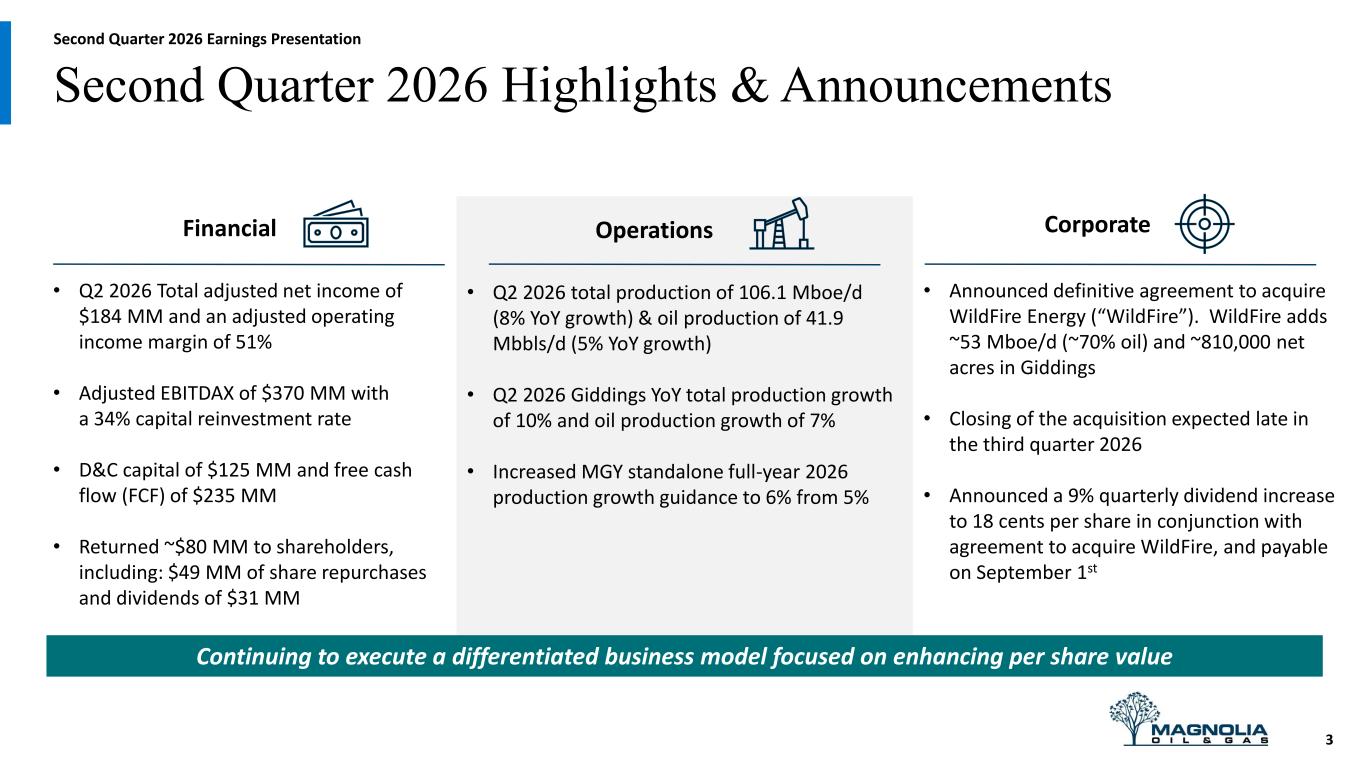
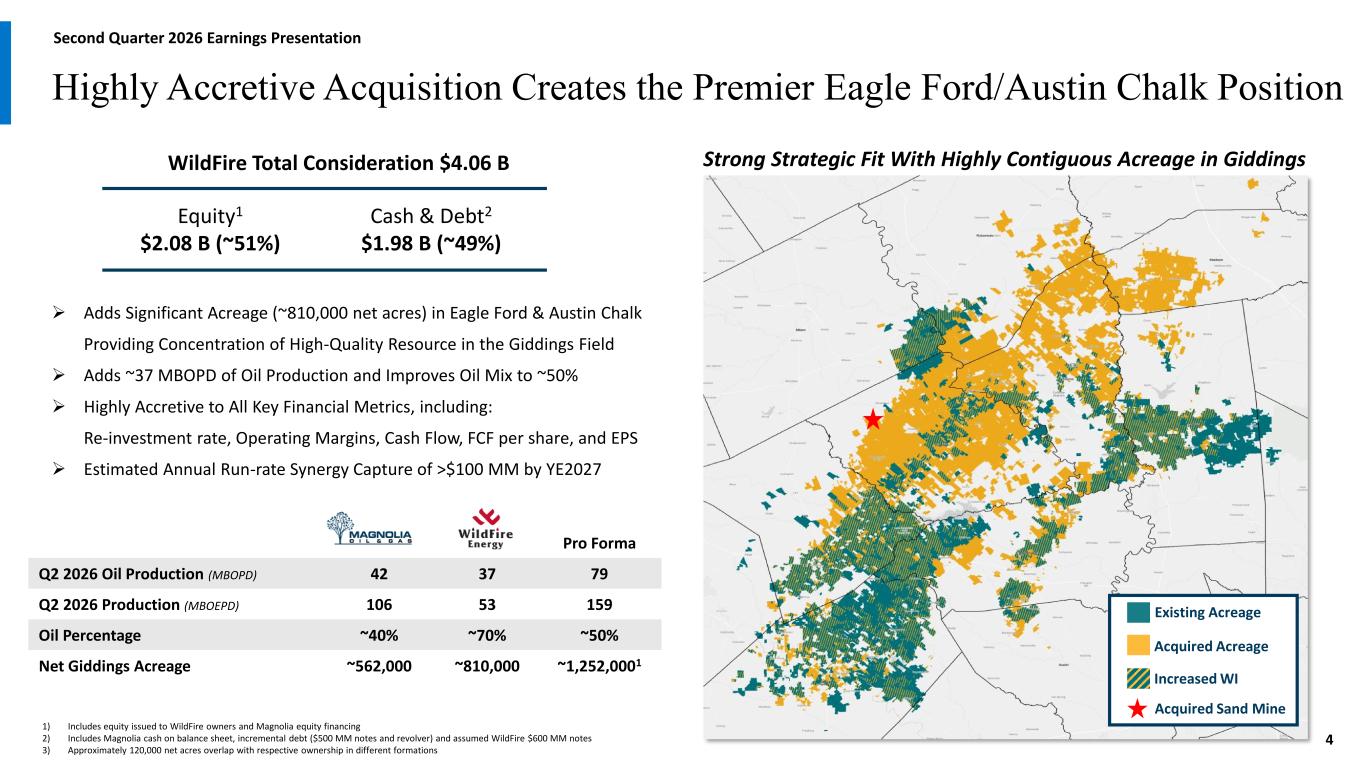
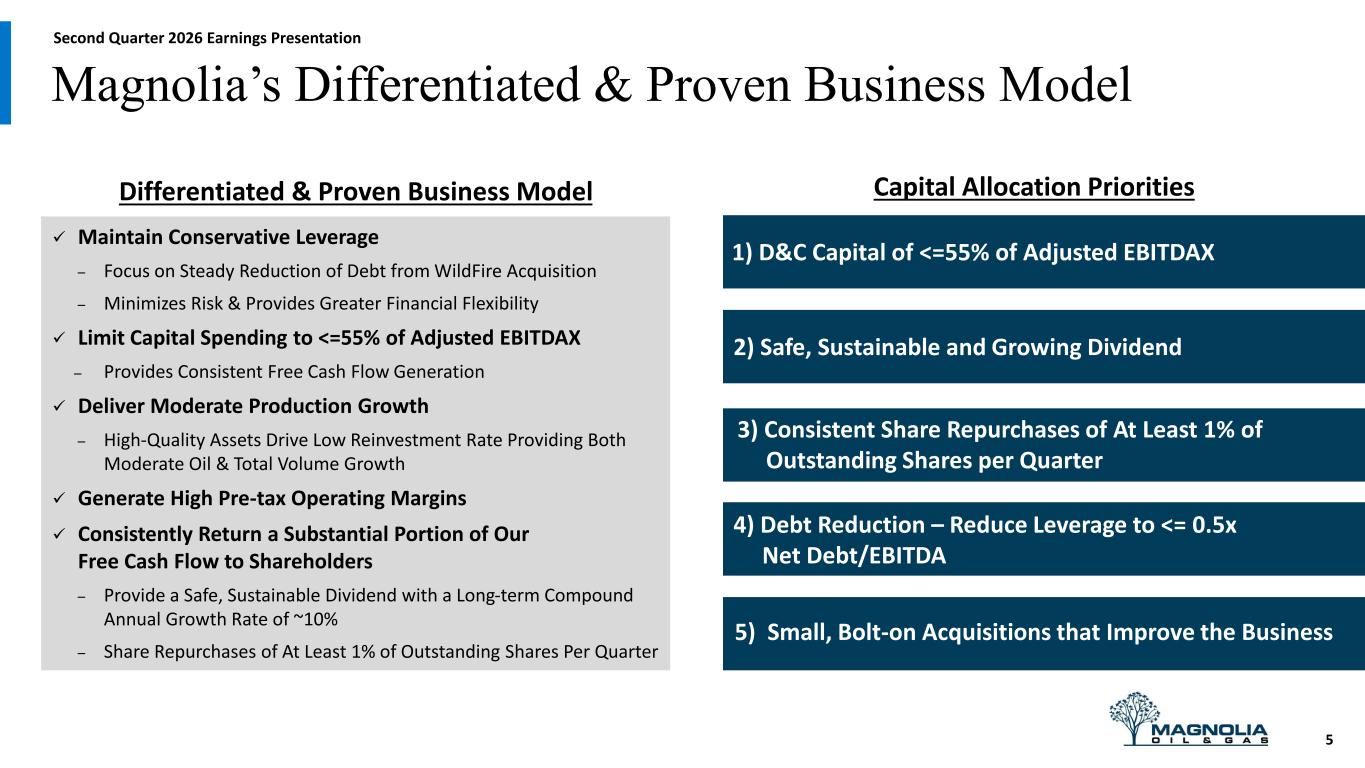
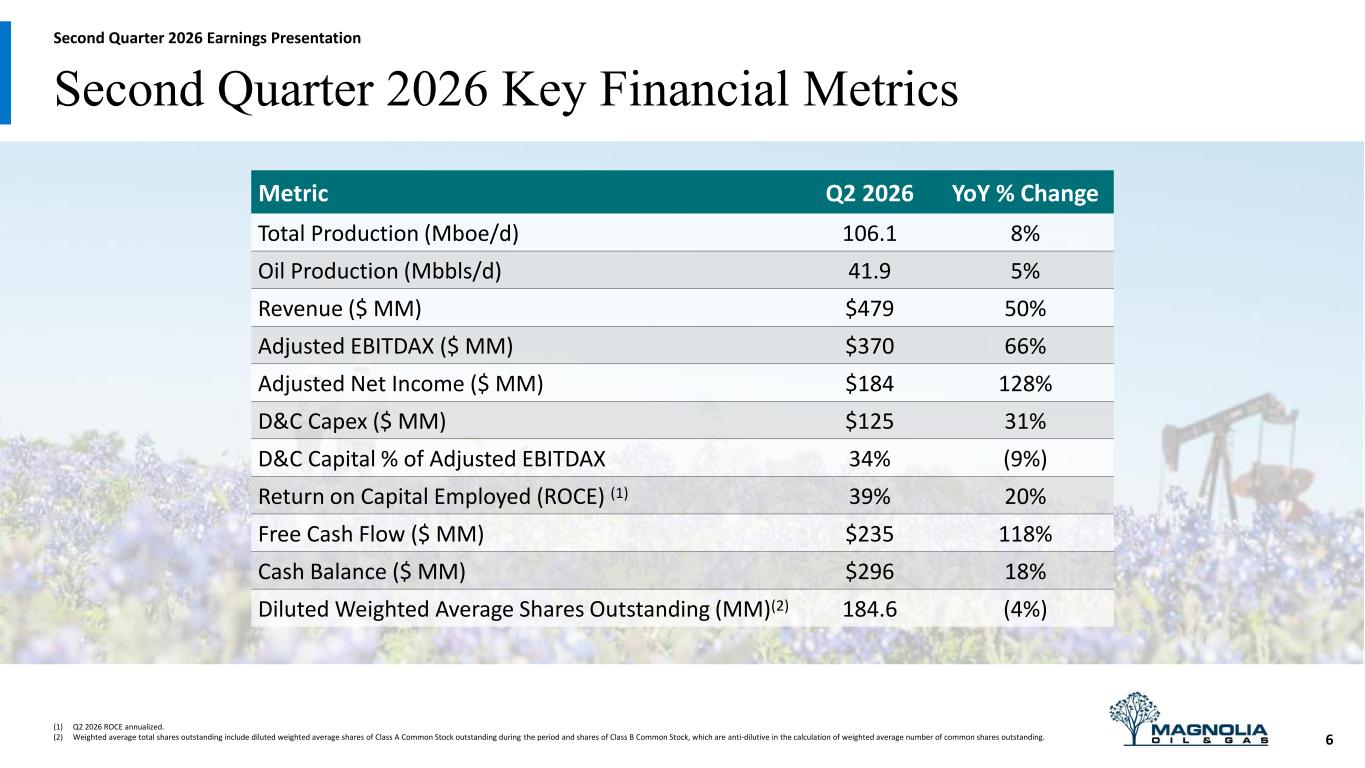
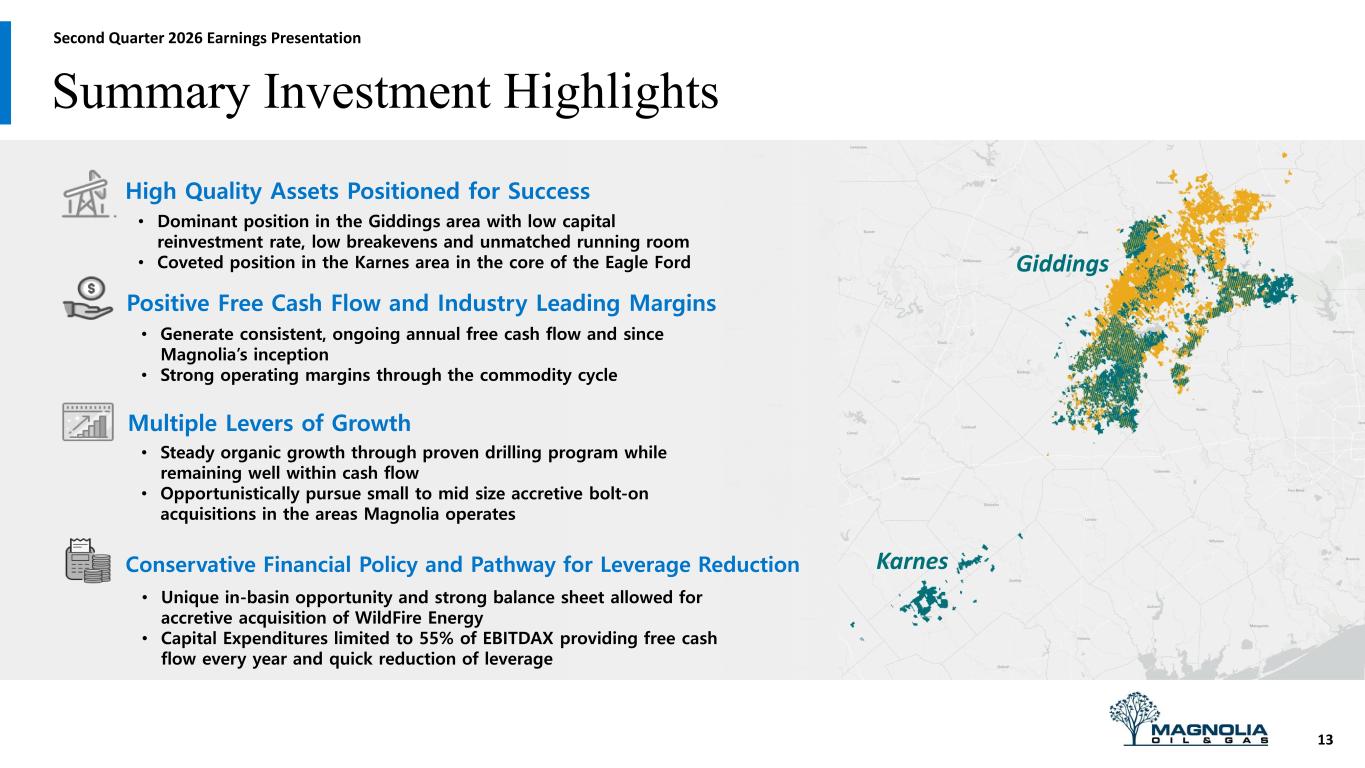
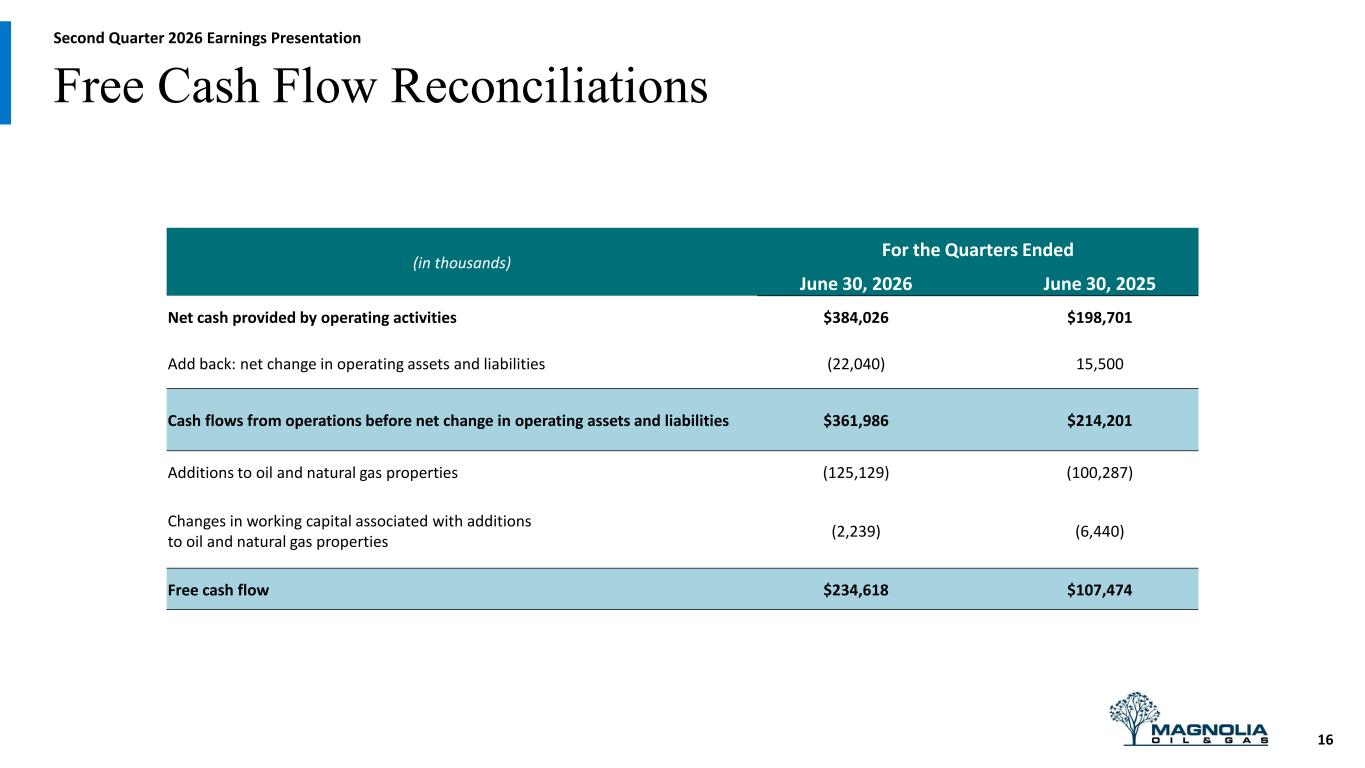
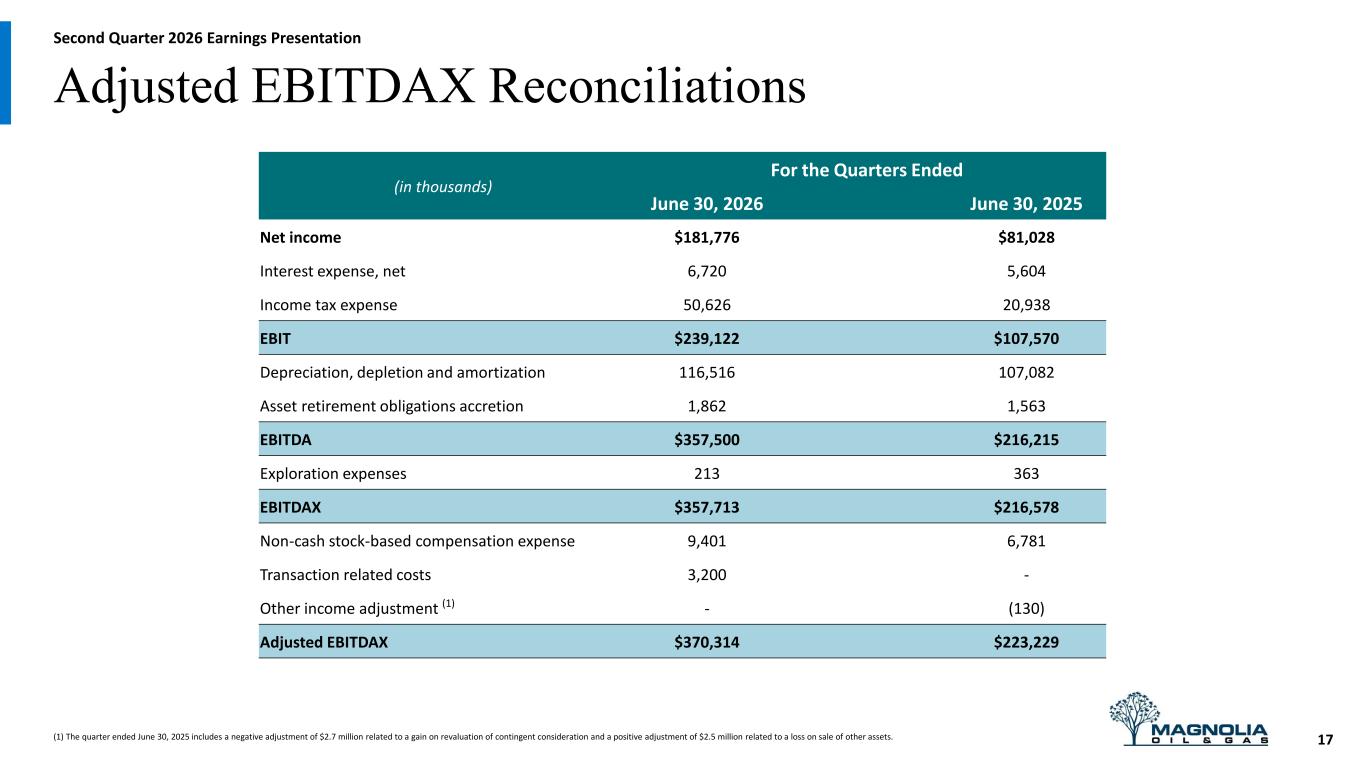
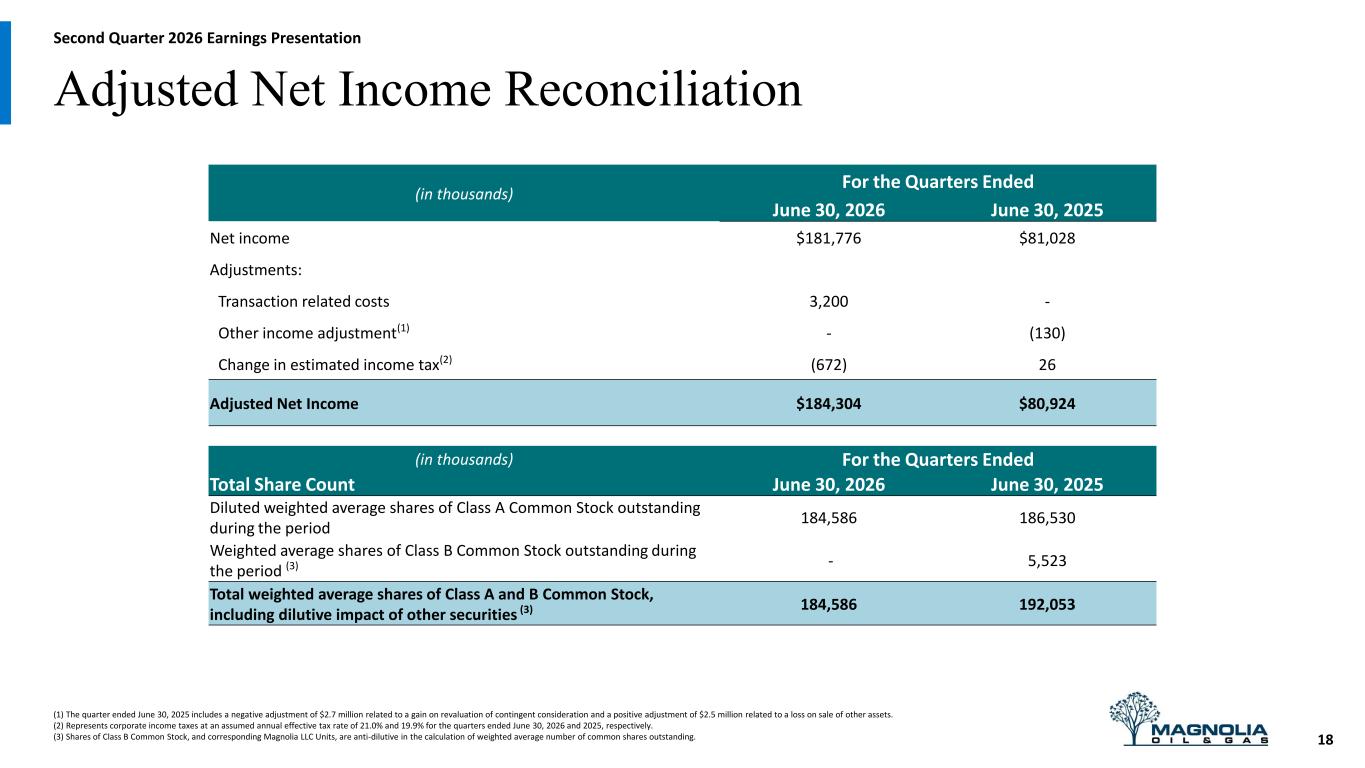
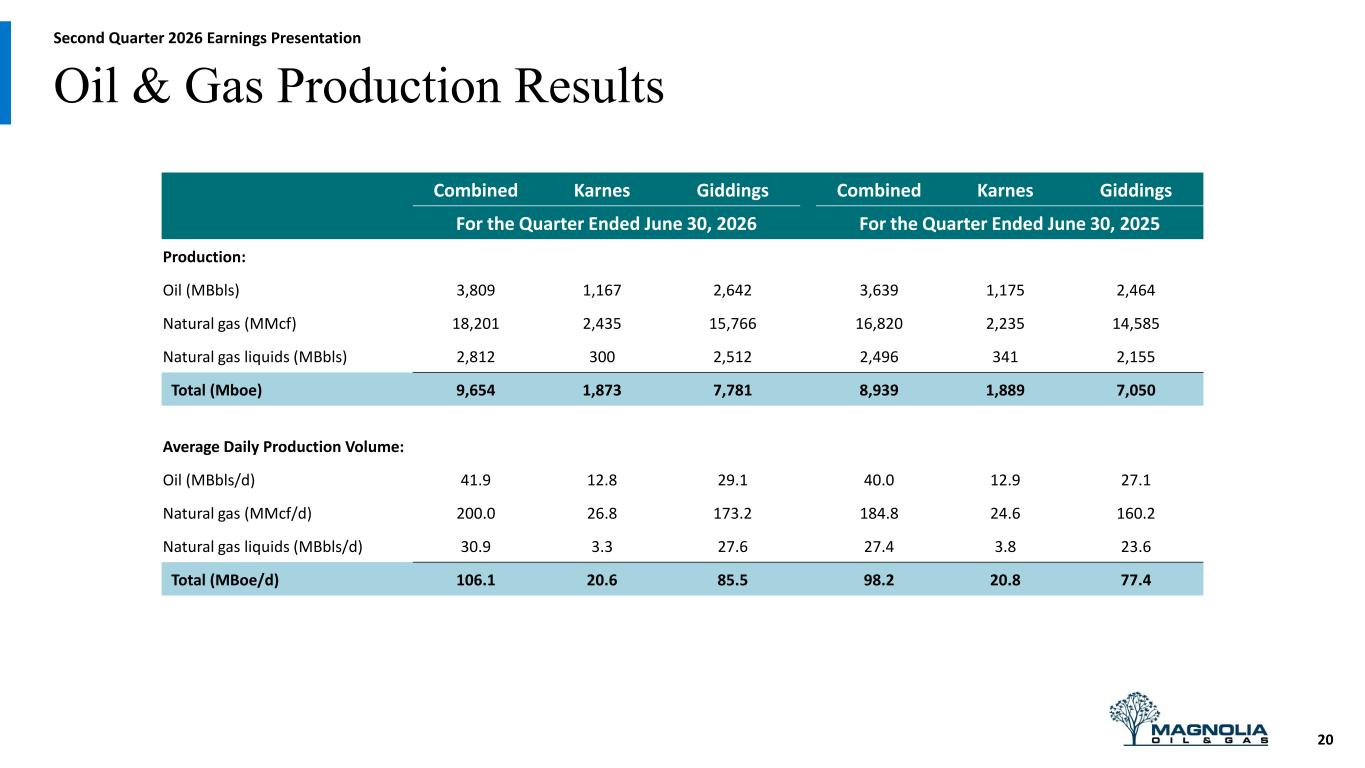
Thanks, Tom. Good morning, everyone. Thank you all for joining us today for discussion of our second quarter 2026 financial and operating results. I know that today is a very busy day of earnings. I will briefly cover our second quarter results, which continue to validate the consistent high-quality nature of our Giddings asset and provide strong overall financial results, returns, together with our current area business. I'll then highlight a few items related to the financing underlying our recent agreement to acquire Wildfire Energy. Brian will then review our financial results for the second quarter in greater detail and provide some additional guidance before we take your questions. Beginning on slide three in our quarterly investor presentation, Magnolia marked its eight-year anniversary by delivering another quarter of strong and consistent execution as seen through our financial and operating metrics, which continue to underscore the strength of our differentiated business model and the quality of our asset base. Our strong second quarter financial metrics were supported by both solid production growth and higher year-over-year oil and NGL prices. Our second quarter adjusted net income was approximately $184 million, or 99 cents per diluted share, with adjusted EBITDAX of $370 million during the period. Drilling in completion capital for the second quarter was $125 million, with a reinvestment rate of just 34% of our adjusted EBITDAX and our lowest quarterly rate of capital reinvestment since 2022. Our pre-tax-adjusted operating income margins averaged a very robust 51% for the quarter. Magnolia generated $235 million of free cash flow in the second quarter and returned $80 million of this free cash to our shareholders through a combination of our base dividend and our share of purchase program where we bought back just over 1.7 million shares during the quarter. Our ongoing discipline around capital allocation, strong operational performance, and continued focus on our financial returns allowed us to generate meaningful free cash flow and to continue to execute on our proven business model. For the second quarter of 2026, total company production volumes grew by 8% year-over-year at 106.1 thousand barrels of oil equivalent per day, above our expectations and earlier guidance, with oil production growing by 5% and averaging 41.9 thousand barrels per day. Both total production and oil production volumes established new quarterly records for the company. Based on the strong second quarter production, we are raising Magnolia's standalone full year 2026 production growth guidance to 6% from 5%. Production at Giddings continued to be the primary growth driver for Magnolia and setting a new quarterly record with total Giddings production increasing 10% year over year to 85.5 thousand barrels of oil equipment per day and oil production of 29,000 barrels per day with growth of 7% over the same period. Giddings production accounts for approximately 81% of Magnolia's total company volumes. Production in our Carnes area was relatively flat year over year at just over 20,000 barrels of oil equipment per day during the second quarter and which we expect to sustain for many years. The Carnes area assets continue to generate a significant amount of free cash flow for Magnolia. Turning to slide four, as we announced last month, we entered into a definitive agreement to acquire Wildfire Energy for a total consideration of approximately $4.06 billion. The acquisition will add approximately 810,000 net acres to Magnolia's Giddings area position and total oil and gas production of roughly 53,000 barrels of oil equivalent per day, including 37,000 barrels per day of oil. The acquisition of the wildfire oil and gas properties and acreage is a natural and strategic fit for Magnolia and greatly improves our business by extending our runway of advantage profitability and the durability of our significant free cash flow generation. The fit should be clear given the sizable overlap and with roughly 70% of Magnolia's existing acreage benefiting from the transaction with significantly more acreage benefiting from adjacency. Our combined position in the Giddings Field will amount to more than 1.25 million net acres with upside development opportunities across multiple benches, including the Austin Chalk, Eagleford, and Woodbine. The acquisition is a culmination of our extensive subsurface understanding, experience, and the demonstration of our proven resource capture in the Giddings field. This creates a premier upstream operation in South Texas by combining two high-quality and complementary assets near Gulf Coast markets, which offer premium pricing for our products. We expect the transaction to be immediately and highly accretive to our key per-share financial metrics, including cash flow, free cash flow and earnings, in addition to enhancing our DNC capital reinvestment rate. Wildfire is not only a strong fit for Magnolia, offering unique benefits, but it also provide several important characteristics we look for, namely focused, high-quality assets with concentrated scale, a low capital reinvestment rate, the ability to provide moderate production growth with high operating margins, and steady free cash flow, allowing for consistent and significant shareholder returns. Following the wildfire announcement, Magnolia executed multiple capital markets transactions to partially fund the acquisition. Magnolia issued 53.3 million new shares in a public equity offering for net proceeds of $1.23 billion, in addition to $500 billion of senior notes at a 6 and 5 eighths percent coupon due in 2034. These two transactions closed on July 22nd and August 5th, respectively. In total, the WIFAR acquisition will be funded with a balanced mix of approximately half equity and half debt, with the acquisition on track and expected to close late in the third quarter. Turning to slide five, one of the most important elements of the wildfire acquisition is that Magnolia's differentiated, proven, and highly investable business model remains unchanged. While the acquisition adds more leverage than we have carried historically, we believe this is very manageable. Given the significant increase in our free cash flow generation, we have a clear line of sight towards the reduction of debt, which we expect to be less than one times our net debt to EBITDA by year-end 2027, if not sooner, and returning us to our traditionally more conservative leverage profile. As part of our disciplined capital plan, we will continue to limit our D&C spending to 55% of adjusted EBITDAX, which provides consistent free cash flow through the cycle while delivering both moderate annual total production growth and oil growth. With our combined oil production mix of approximately 50%, we expect to generate high pre-tax operating margins and, in keeping with our business model, continue to return a significant portion of our free cash flow to our shareholders. This includes a safe, sustainable, and growing dividend, which is expected to compound at a rate of about 10% over the long term, in addition to our ongoing share of purchases of at least 1% of the outstanding shares per quarter. I often mention that one of Magnolia's primary goals is to be the most efficient operator of our best-in-class oil and gas assets, to generate the highest returns on those assets while spending the least amount of capital on drilling and completing wells. The combination of Magnolia and Wildfire creates a larger and stronger enterprise with a concentrated acreage position that offers moderate growth, best-in-class financial returns while generating significant free cash flow. Magnolia will continue to look and behave like it has historically, with an emphasis on managing both operational and financial risk and using the same differentiated and proven business model to continuously compound value for our shareholders. As we were briefly restricted from share repurchases while working on the wildfire acquisition, we expect to resume our share repurchases after today's quarterly results. I'll now turn the call over to Brian for further details on the quarter for some additional guidance.
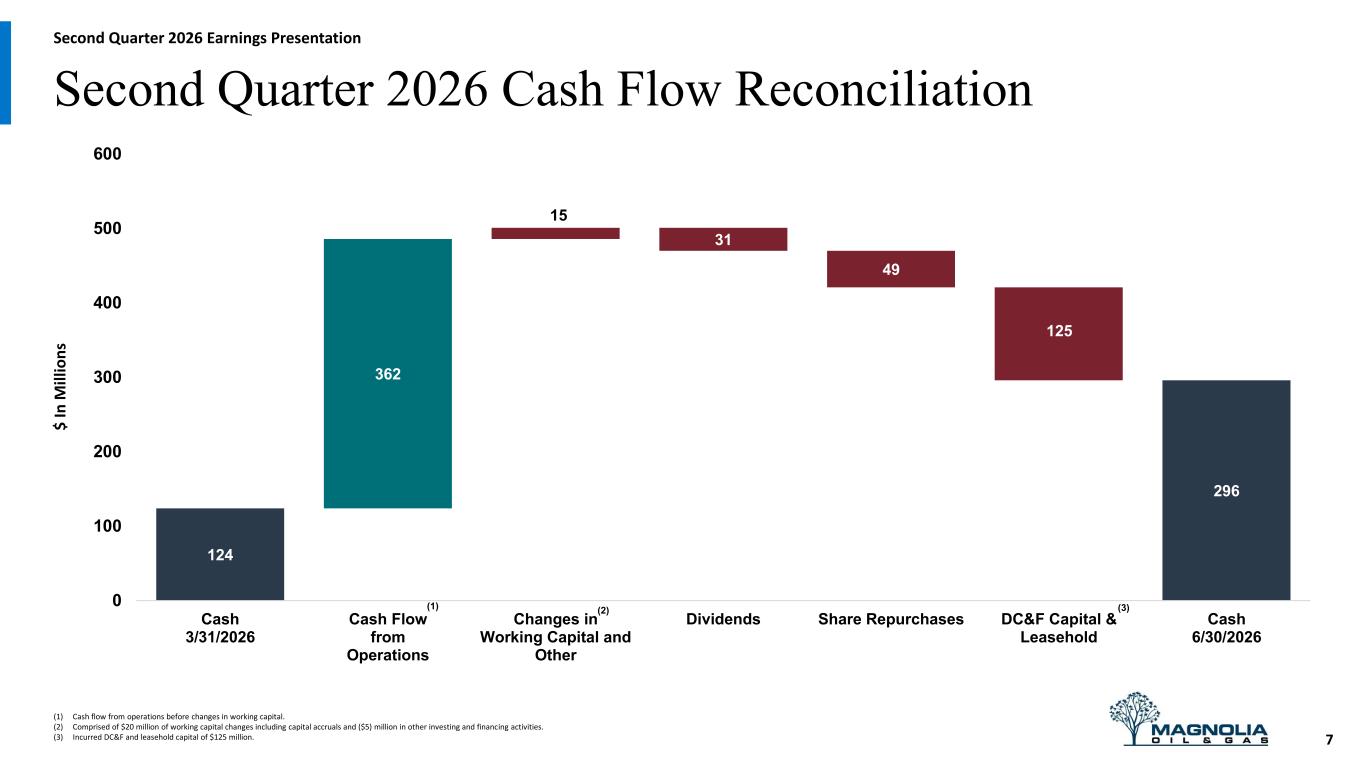
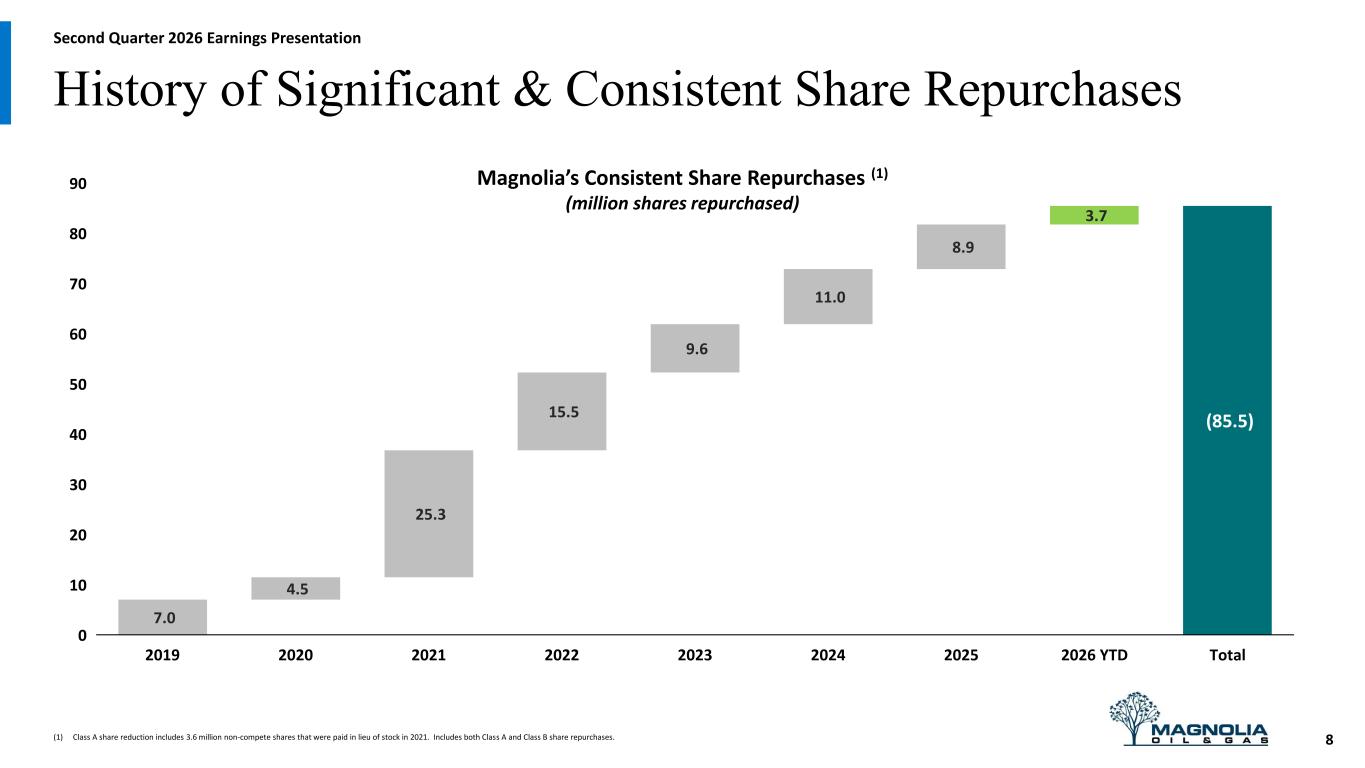
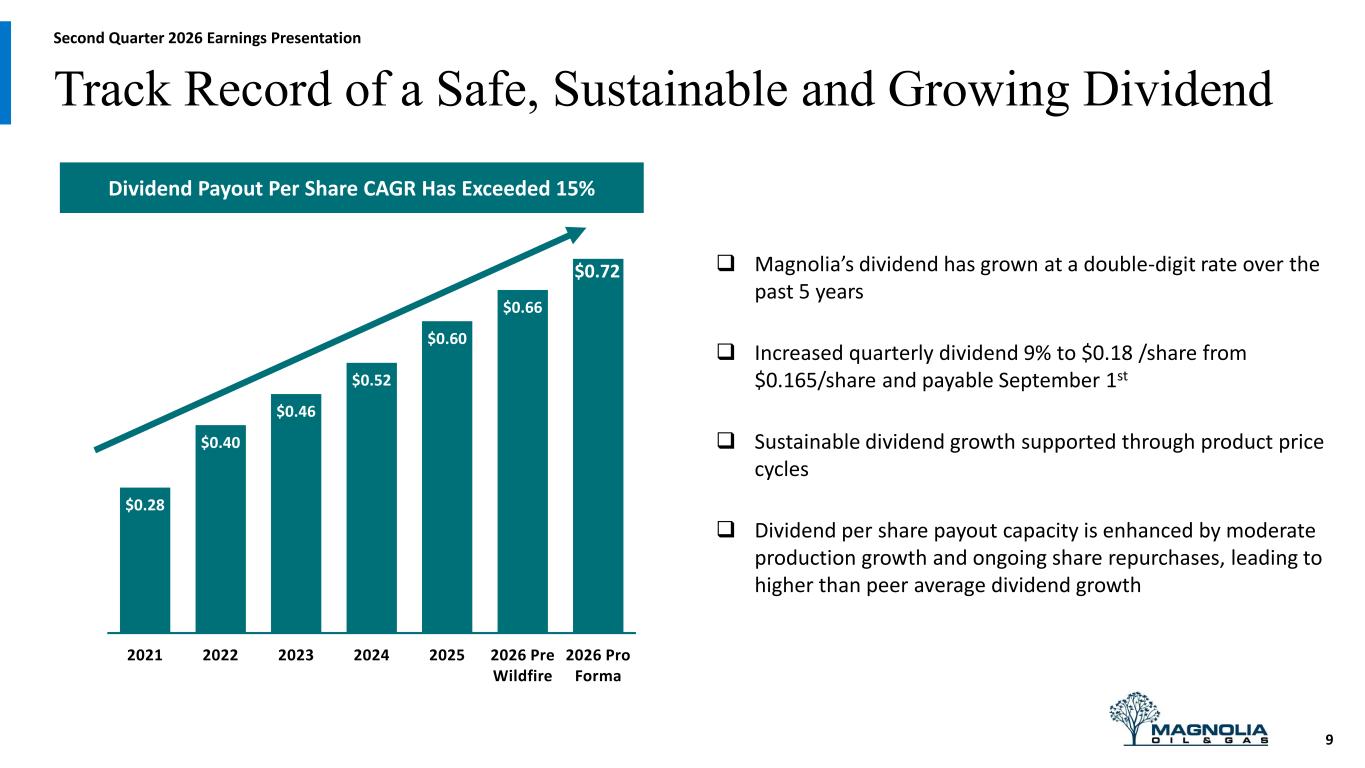
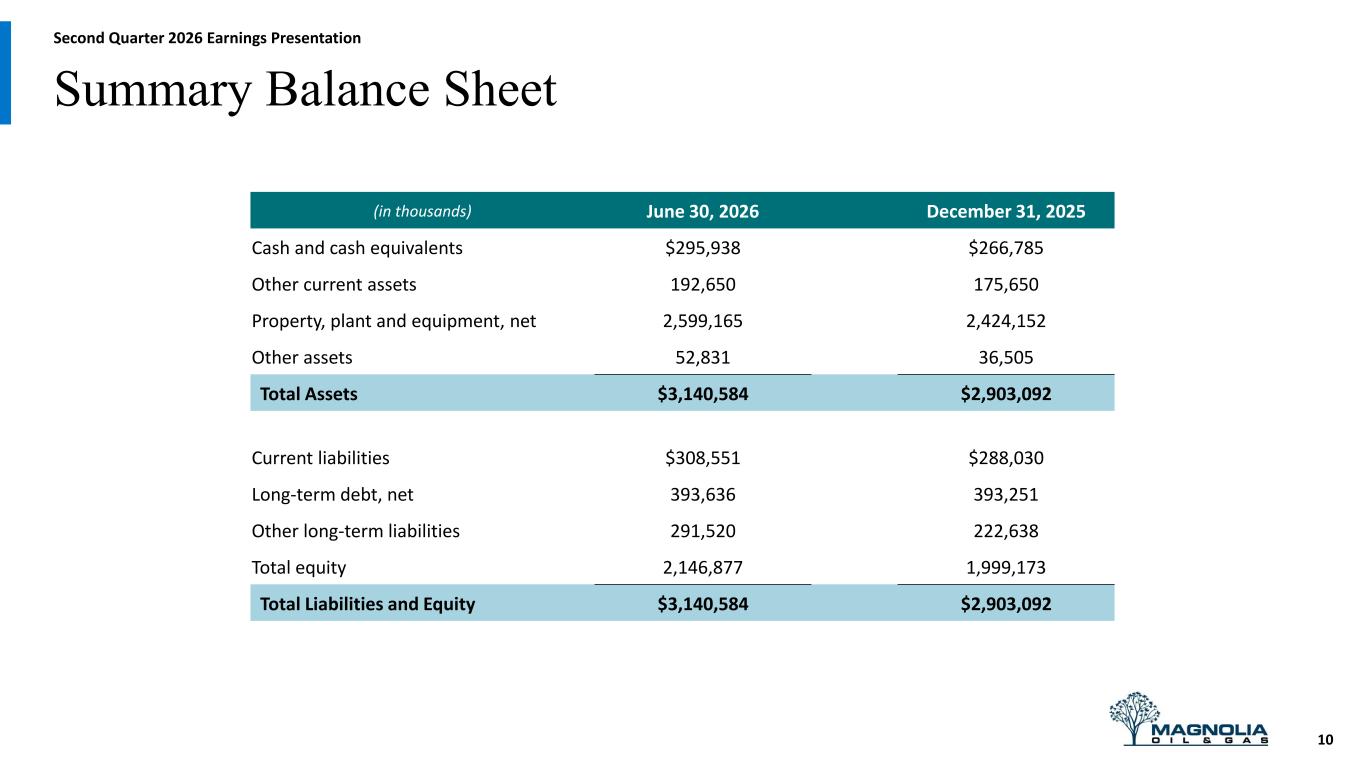
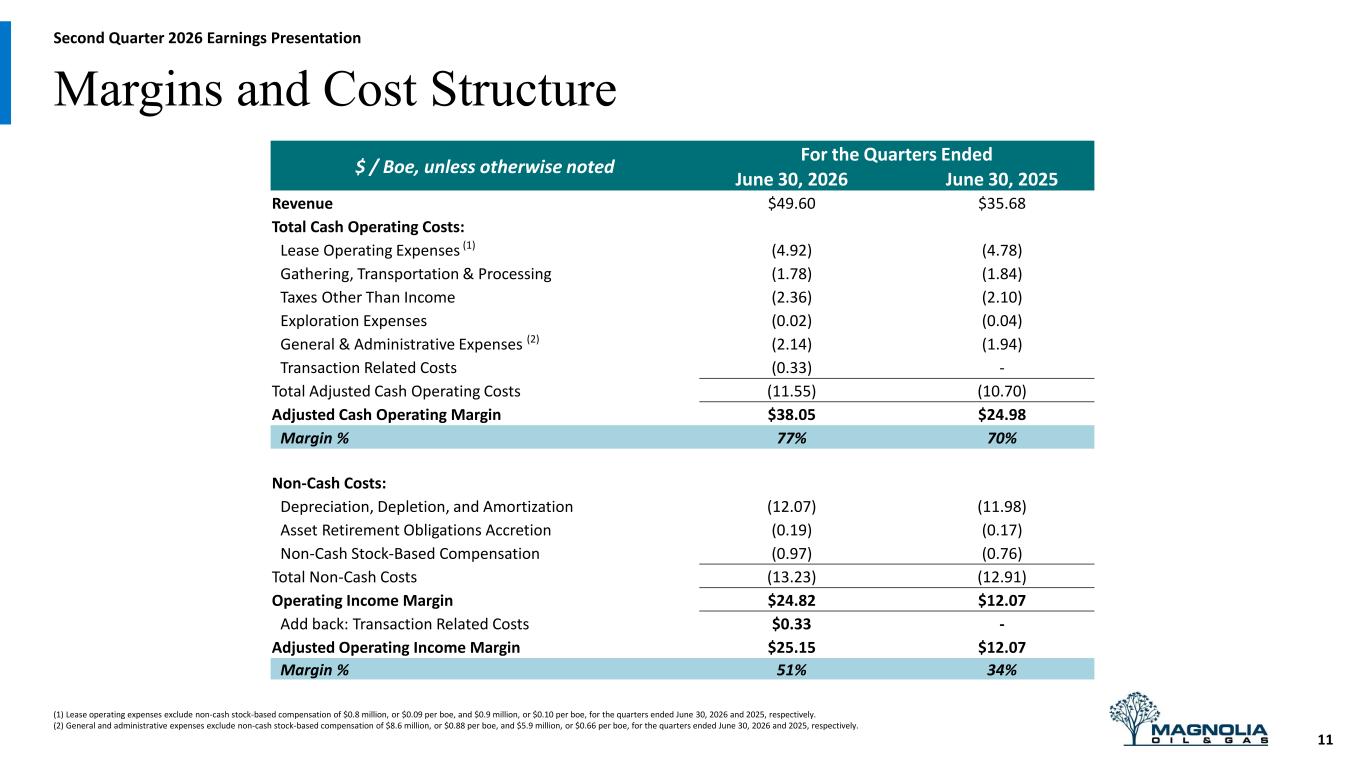
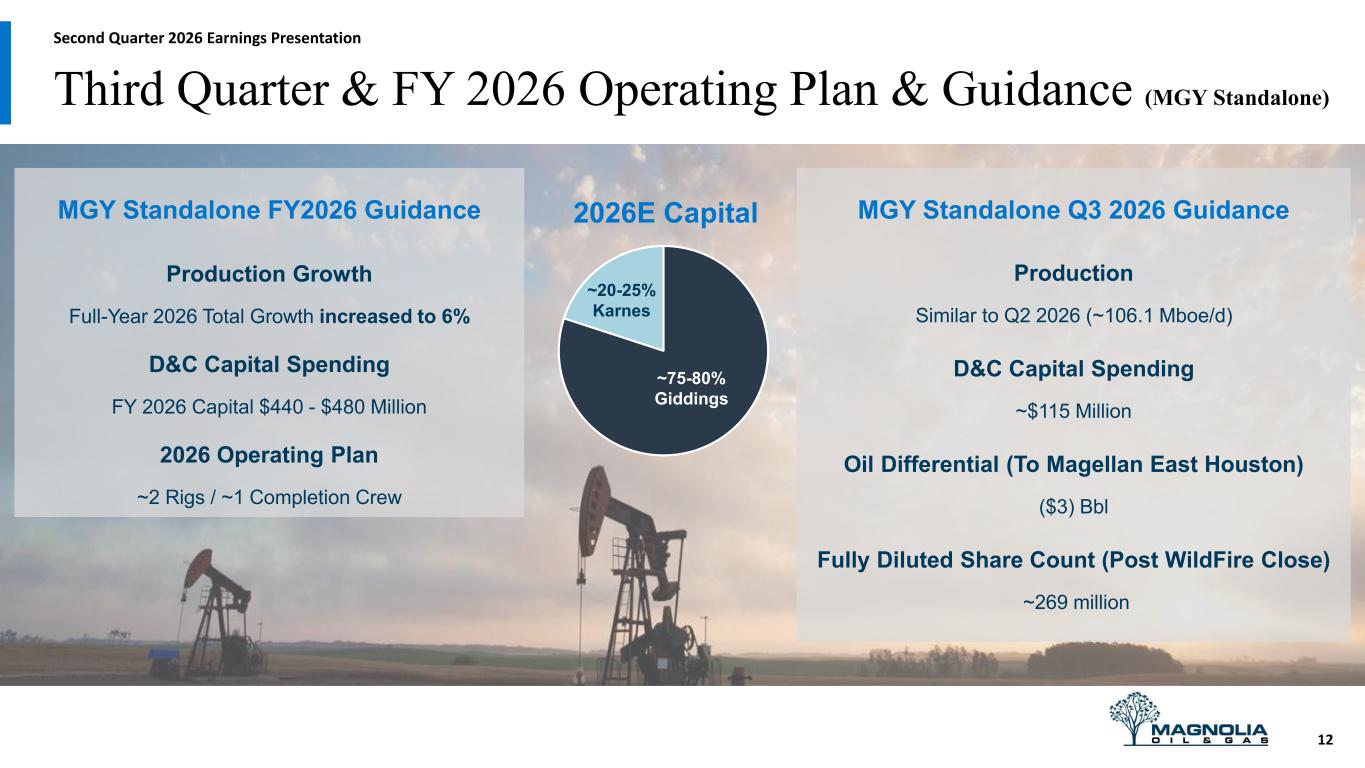
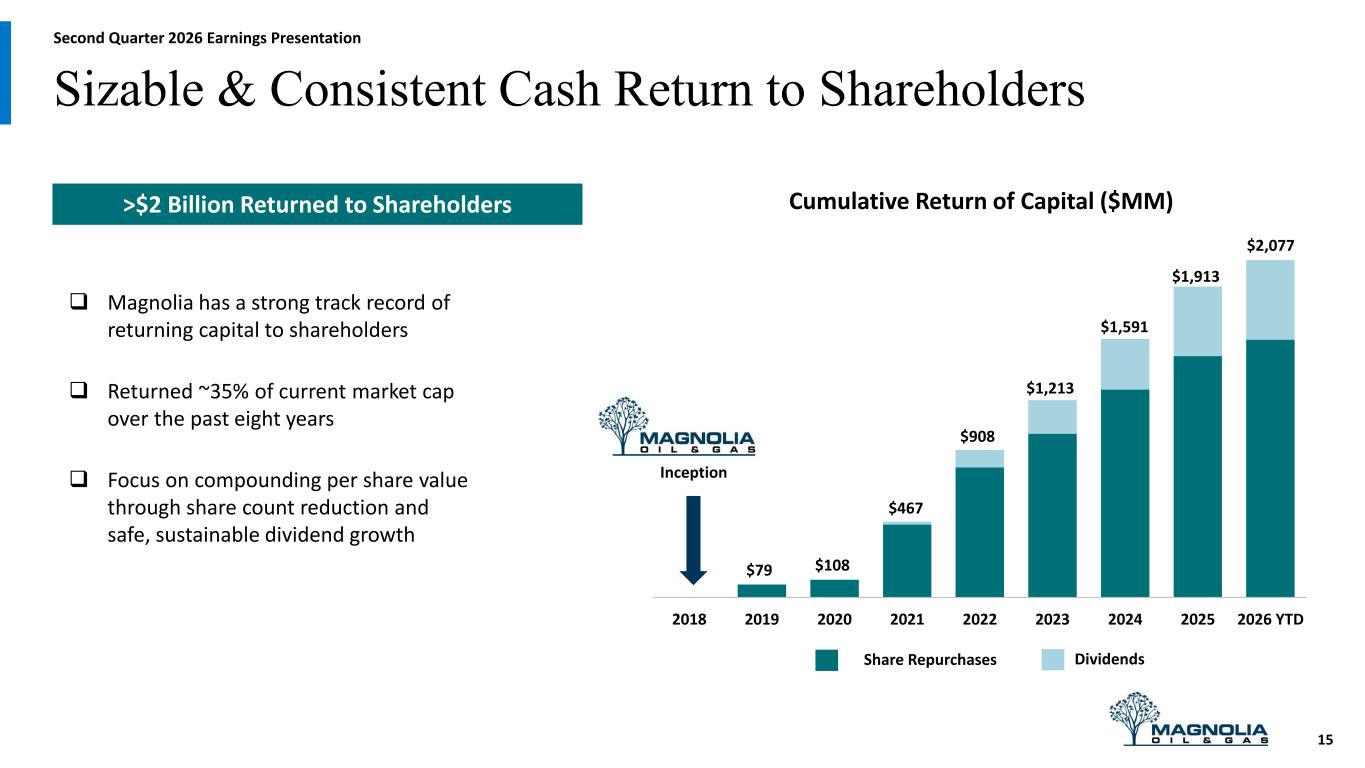
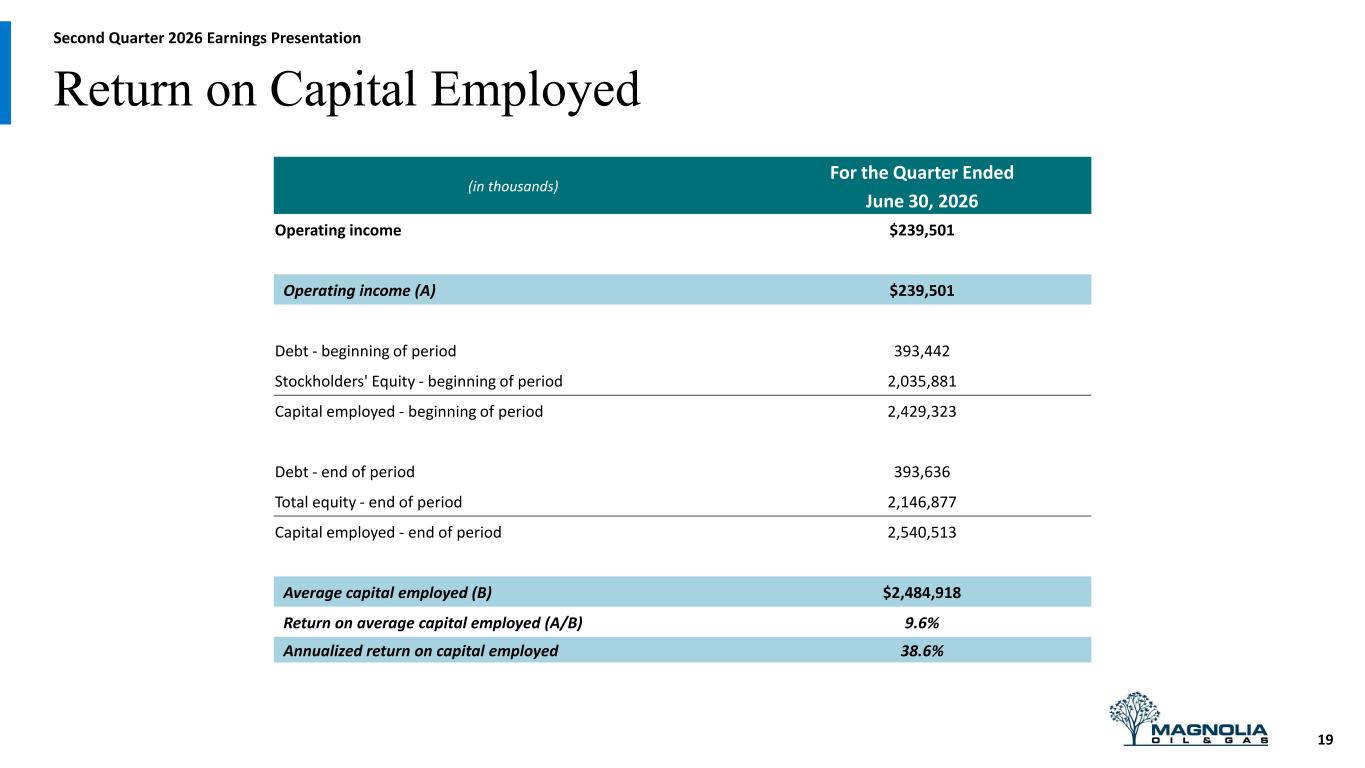
Thanks, Chris, and good morning, everyone. I will review some items from our second quarter results and refer to the presentation slides found on our website. I'll also provide some additional guidance for the third quarter of 2026 before turning it over for questions. Beginning on slide six, Magnolia delivered a strong quarter generating adjusted net income of $184 million, or $0.99 per dilute share. Our adjusted EBITDAX of the quarter was $370 million, with total capital associated with drilling completions and associated facilities of $125 million, representing just 34% of our adjusted EBITDAX. Second quarter production volumes grew 8% year-over-year to 106.1,000 barrels of oil equivalent per day, while generating free cash flow of $235 million. Our second quarter annualized return on capital employed was 39% as a result of higher prices and increased production. Looking at the quarterly cash flow waterfall chart on slide 7, we started the quarter with $124 million of cash. Cash flow from operations before changes in working capital was $362 million, with working capital changes and other small items impacting cash by $15 million. During the quarter, we paid dividends of $31 million and allocated $49 million towards share repurchases. We incurred $125 million in drilling completions and associated facilities and leasehold, and we ended the quarter with $296 million of cash, an increase of $172 million. Looking at slide 8, this chart illustrates the significant amount of share repurchases we have done since beginning the program in the second half of 2019. Since that time, we have repurchased 85.5 million shares. We repurchased just over 1.7 million shares during the quarter prior to being restricted due to the transaction, leading to the diluted weighted average shares outstanding of 184.6 million shares during the second quarter. We currently have 9.9 million shares remaining under our repurchase authorization. Turning to slide nine, our dividend growth has grown substantially over the past few years, including a 10% increase announced early 2026, an additional 9% increase announced a couple of weeks ago, in conjunction with our definitive agreement to acquire Wildfire, to $0.18 per share on a quarterly basis. Our next quarterly dividend is payable on September 1st and provides an annualized dividend payout rate of $0.72 per share. Our plan for annualized dividend growth is an important part of Magnolia's investment proposition and supported by our overall strategy of achieving moderate annual production growth, reducing our outstanding shares, and increasing the dividend payout capacity of the company. Magnolia continues to have a strong balance sheet, and we ended the quarter with $296 million of cash. Our $400 million senior notes did not mature until 2032, and our recently closed offering of $500 million senior notes associated with the financing of the Wildfire transaction matures in 2034. Upon closing, estimated late in the third quarter, we will also assume Wildfire's $600 million senior notes due in 2029. Also upon closing, our credit facility will increase to a $2 billion borrowing base with elected commitments of $1.75 billion, providing plenty of available liquidity. We thoughtfully financed the transaction with half equity and half debt, positioning Magnolia to have a very manageable debt load at the close of the transaction, allowing us to maintain our business model and our consistent return of capital program. With a significant increase to pro-former cash flows, our plan is to immediately begin to reduce our debt post-closing of the transaction. Our condensed balance sheet as of June 30 is shown on slide 10. Turning to slide 11 and looking at our per-unit cash costs and operating income margins. Total revenue per BOE increased approximately 39% year-over-year due to the strength in oil prices. Our total adjusted cash operating costs, including G&A, were $11.55 per BOE in the second quarter of 26, and our adjusted operating income margin for the second quarter was $25.15 per BOE, or 51% of our total revenue. Turning to guidance, third quarter DNC capital expenditures for Magnolia standalone is expected to be approximately $115 million. In addition, total production for the third quarter is estimated to be similar to second quarter levels, or approximately 106,000 barrels of oil equivalent a day. Our full year 2026 outlook for total production growth has increased to approximately 6% from our prior guidance of 5%. Oil realizations have trended back to our historical differentials, and we are anticipating prices for the third quarter to be a $3 per barrel discount to Magellan East Houston benchmark pricing. The fully diluted share count after closing the wildfire transaction is expected to be approximately 269 million shares. We expect our effective tax rate to be approximately 21% and cash taxes for 2026 to be minimal. We are now ready to take your questions.
Operator
We will now begin the question and answer session. To ask a question, you may press star then 1 on your telephone keypad. If you are using a speakerphone, please pick up your handset before pressing the keys. If at any time your question has been addressed and you would like to withdraw your question, please press star then 2. At this time, we will pause momentarily to assemble our roster. The first question comes from Neil Dingman with William Blair. Please go ahead.
Bert
Analyst — William Blair
Hey, good morning, team. This is Bert filling in. I know Wildfire hasn't closed yet, but maybe you could give early thoughts on maybe what a blended DNC plan might look like. Last call, I think you mentioned you're picking up the two rigs and a crew. That might imply 50-50, but we've kind of looked at the data in Giddings on Enveris, and that seems pretty strong. so it'd be impressive for the new assets to kind of get equal screen time. Just any thoughts on how you would prioritize the two assets?
Yeah, thanks, Ian. Warning. So, if you just simplistically took what we have, what we've been doing, and what they've been doing and combine it, that's not a bad starting point. So, there's two rigs for each of us and one completion crew for each of us. It's still very early. We haven't closed. We'll have more information for you probably later, you know, at the back part of this year and after we close on the combined business and our activity. I do believe that we can do better on a combined basis. We're obviously going through it. You know, as I've always said, our emphasis is to do this as efficiently as possible, and I think we'll be able to do that. We know the field very well. We know the subsurface very well. We've got some very good vendors to work with and good crews, and we'll be evaluating theirs, and collectively, I do believe that on a combined basis, we'll be able to do better.
Bert
Analyst — William Blair
That makes perfect sense. And then on the capital allocation of your free cash flow, you kind of laid out the five pillars. We assume most of it will go towards debt. But is there a large opportunity to add working interest, or I think you called it small bolt-ons? I just imagine there'd be some white space, but also that Wildfire was probably out there buying up everything they could. So I just didn't know if there was anything left in the area, or was that implying outside the kind of pro forma footprint?
No, I wouldn't tell you it's much outside the pro forma footprint. You know, they did a very good job with line of sight and looking sort of over the hill, if you will, on needing to sort of, you know, pick up additional working interests as they were going ahead, permitting wells and moving forward with drilling. So, they did a little of that certainly I do think that there are and will be opportunities for us to pick up additional working interests and royalties on a you know concentrated basis if you will here and there within the existing footprint of combined magnolia wildfire so I don't think we'll be moving you know vastly out of that footprint I think there's still plenty to work on these will be sort of the typical, usual blocking and tackling smaller bolt-ons that we've done that will amount to smallish amounts of money outflow, if you will. I wouldn't tell you that there's anything very, very large by any means. So, you know, the money, the free cash flow in excess of our return of capital plan will We'll go to the debt first and foremost, and then, you know, there's a little left over. We'll certainly be open to picking off some working interests and royalties to make us better and improve our capability.
Bert
Analyst — William Blair
That sounds like the right thing to do. Thanks.
Operator
The next question comes from Philip Youngworth with BMO. Please go ahead.
Yeah, thanks. I wanted to come back to the Austin chalk potential discussion for wildfire. Obviously, they mostly targeted the lower Eagleford, but they do have some strong chalk wells across the Robertson-Neilham area, offsetting you in Washington and also eastern Brazos County. But just wondering which of these areas do you think are more interesting? And could the chalk potential also just be more widespread across the footprint than just the areas that they've tested?
You could be right. Well, we'll certainly give it our best shot and try to figure that out. You know, this is an enormous footprint, obviously, 1.25 million net acres. So it's going to take us some time to work through. I think the areas that you identified are correct, in addition to areas in Burleson. So, no, there's a tremendous amount of potential upside. There has been up to now, vis-à-vis wildfire, sort of limited testing, drilling. um so i think there's a lot of low-hanging fruit if you will that that will be you know accumulated under magnolia's experience and expertise and just technical knowledge and we'll get at it uh over time into next year and beyond and continue adding to it so uh there's lots gonna be lots to work on uh to some extent you know our our folks are going to feel like kids in a candy store. So, there'll be lots to work on.
Sounds good. And then, could you talk about the acquired sand mine and the benefits here, just for able to quantify well-cost savings from the vertical integration and any optionality it provides you on completion design for both wildfire and legacy bagdolia?
Yeah, we didn't actually quantify it or break out the specific savings for the sand mine, but I would tell you in aggregate it's several million dollars of the synergies and cost-saving benefits that will get captured in the process. So that's something different for us, you know, owning a sand mine, but, you know, clearly We were sourcing and are sourcing most of the large majority of our sand requirements and demand from that mine, so it's important to us. And they've done a good job running it, so it'll be meaningful in the outcome in terms of what we're able to do going forward.
Operator
The next question comes from Carlos Escalante with Wolf. Please go ahead.
Hey, Chris and Brian. Thank you for taking my question today. My question is around how should we think about the trajectory of what you developed the next 12 months? said more explicitly, knowing that Wildfire was more of an Eagle Ford developer and you're more of an Austin Shock developer, what do you think is a good placeholder for us modeling the company to have for the next 12 months? Is it a transition from Eagle Ford at first onto Austin Shock or Or should we expect a more equivalent development in between both?
I think, no, I know the plan will be roughly a decent, roughly even mix of Eagleford and Schock. And that's not to say that, you know, there's anything, any issue one way or the other. It's just sort of that we'll probably initially have that balanced plan. And actually, that's an uplift if you want to think about where they will be coming from on their Austin chalk activity to where we're going to take it, because we think there's a lot more to capture there and given our expertise and experience, obviously. The benefit of the Eagleford for us in the transition is the fact that it's generally been done for many years there, not just by wildfire, but by previous operators. And so there's a lot of consistent operational experience and expertise, if you want to say that. And so we'll be looking at ways they've done things and to see if we can employ our model on top of that to see if there's any improvements. I think, frankly, I think there will be, just in terms of how we drill and complete, maybe even more so maybe drill. But I would tell you that the cadence will be fairly even between the two, but that would represent an uplift on the chalk, D&C, and activity relative to what they have been doing.
Got it. Fair enough. And then the deal carries a significant amount of oil leverage on their assets relative to where Magnolia has stood at a corporate level. So I wonder, because Carnes has usually been a source of that exposure to oil, if you can frame today's Carnes strategic fit to you in light of that.
Yeah, sure. I mean, as I mentioned in my remarks, the Carnes asset, we're very confident that we can hold that flat for many years and given some recent acquisitions that we've done to sort of bolster the available upside of development there. So we like the asset. It generates an enormous amount of free cash flow. So it really is sort of a cash cow, if you will. The way I would characterize it is it does provide ballast and stability for the overall organization. So it's a very important element of what we are and for the business model going forward. So, you know, we like Carnes. It's a good asset. It's very high-quality rock. And there's probably more things down the road that, you know, there, given the quality of subsurface that we've not yet gotten to and will over time.
Got it. Thank you, Chris.
Operator
The next question comes from Peyton Dorn with UBS. Please go ahead.
Hi, good morning, Chris and team. Thanks for having me on. I wondered if you could walk through the mechanics of the buyback a bit here for 3Q. Chris, it sounds like first from your comments that the restrictions are now over, so you'll be back in the market.
Are there any restrictions on the repurchases as we get closer to the deal close or any other nuances that we should be thinking about this quarter on the buyback? no we we've pretty much at this point we're moving to close uh we've pretty much um disclosed everything that we uh need to and are required to disclose so we're not in any any uh we don't have any uh material non-public information so we're open to repurchasing we're going to get at that ASAP and, you know, to the extent that the stock doesn't perform the way we believe it should or reflects the benefits of the transaction, we will choose to be, you know, potentially more aggressive than not. So, you should think that we'll be involved as soon as we can.
Great. That's helpful detail. And then if we could just go back to the capital allocation side. I'm just curious when you think about the expected larger scale post wildfire, if there's like a minimum type cash balance that you'd like to keep on hand on a go forward basis. And I guess what I'm really trying to get to is how actively or aggressively you'll be kind of repaying that revolver once the deal closes. Thank you.
Yeah, I mean, that will really be a priority for us getting that leverage and debt balance down quickly and fairly rateably. At current commodity prices, product prices, that'll move ahead at a decent clip, and you'll see it will mark time there, giving, obviously, the financials every quarter, and you'll sort of see it, see the debt come down every period. um and if we can find some extra money uh to put to it we we may do that um so it'll it'll be coming down at a good pace um you know i don't want to give too much in the way of specifics but that that will be a big focus and i feel very confident that you know the the one times or less like i said in my remarks, certainly by the end of next year, but frankly, probably sooner than that.
Okay, very helpful. Thanks for having me on. Okay, thanks.
Operator
Again, if you have a question, please press star, then one. Our next question comes from John Davenport with Johnson Rice. Please go ahead.
Hey, good morning, guys, and thanks for taking my question. I wanted to go focus on the production guidance increase from 5% or 6% year over year. I know much of that increases from the Gittings acreage. Actually, all of it is. I'm curious if it's simply just well outperformance of expectations so far, if you've made any changes on the DNC front that might be contributing to that.
No, there's nothing very meaningful in this particular period or in the last three to six months that I would tell you has been needle moving on the DNC fronts in terms of the well performance. It's really just good operational outcome from the wells that we brought online in Giddings, as you mentioned. So that's exactly what I would point to. And importantly, this is all, you know, standalone Magnolia. So we've done better than we anticipated. And that program is sort of continuing that way. So it's very specifically the well-performance.
OK, perfect. Yeah, thanks for the call. That's all I have today. OK, thank you.
Operator
The conference is now concluded. Thank you for attending today's presentation. You may now disconnect.