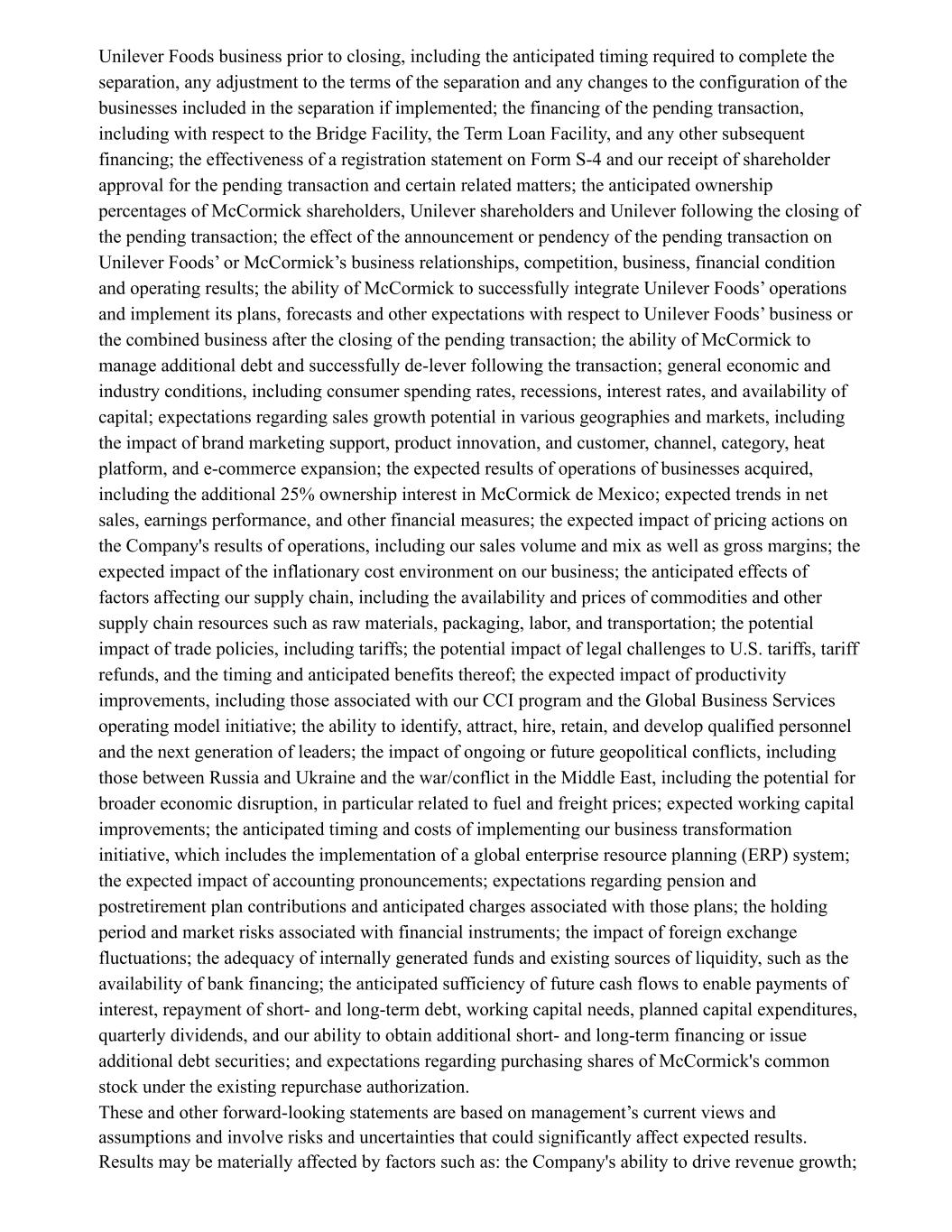
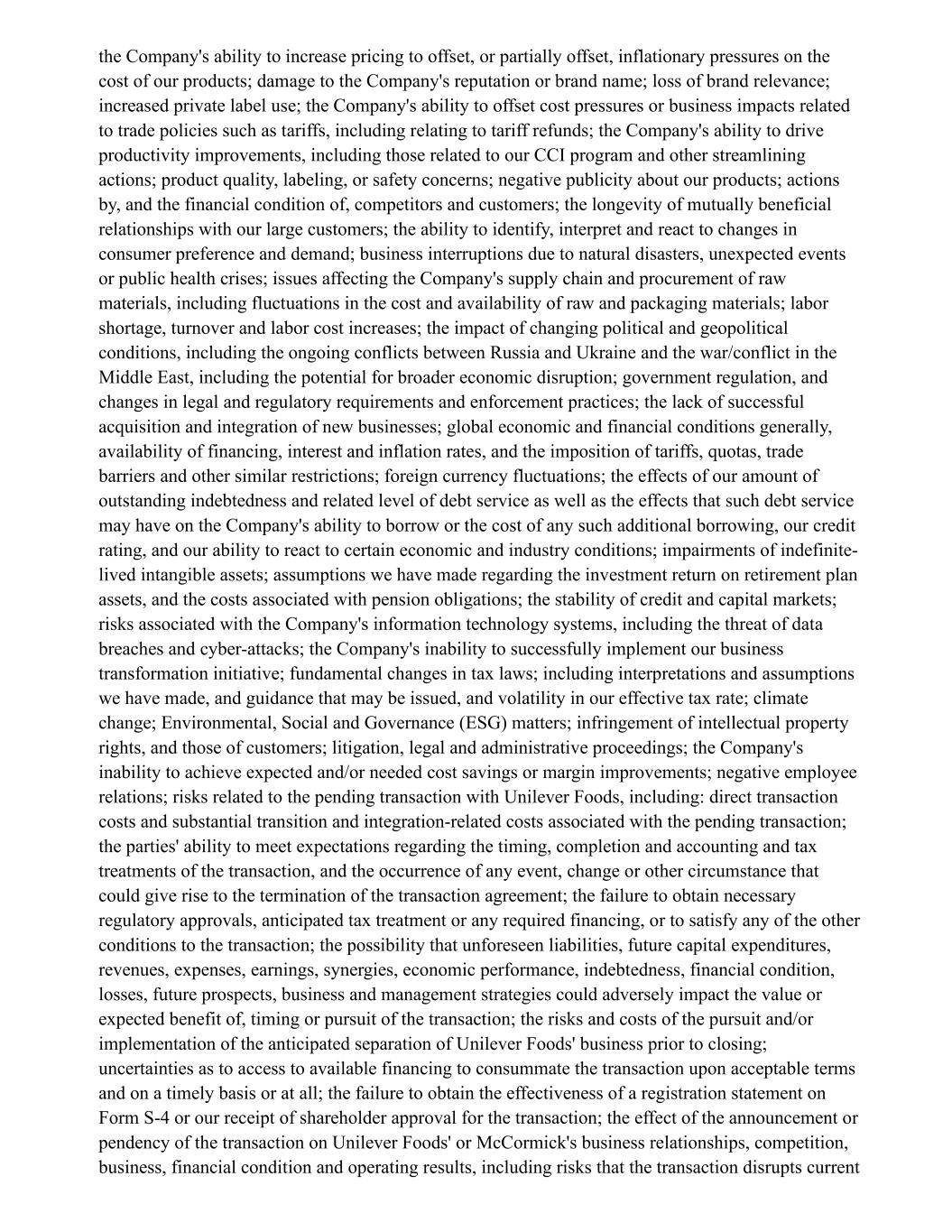
Good morning. This is Fatin Frehant, VP of Investor Relations. Thank you for joining today's second quarter earnings call. To accompany this call, we've posted a set of slides on our IR website, ir.mccorming.com. With me this morning are Brendan Foley, Chairman, President, and CEO, and Marcos Gabriel, Executive Vice President and CFO. During this call, we will refer to certain non-GAAP financial measures, the nature of those non-GAAP financial measures and the related reconciliations to the GAAP results are included in this morning's press release and slides. In our comments, certain percentages are rounded. Please refer to our presentation for complete information. Today's presentation contains projections and other forward-looking statements. Actual results could differ materially from those projected. The company undertakes no obligation to update or revise publicly any forward-looking statements, whether because of new information, future events, or other factors. Please refer to our forward-looking statement on slide two for more information. I will now turn the discussion over to Brendan.
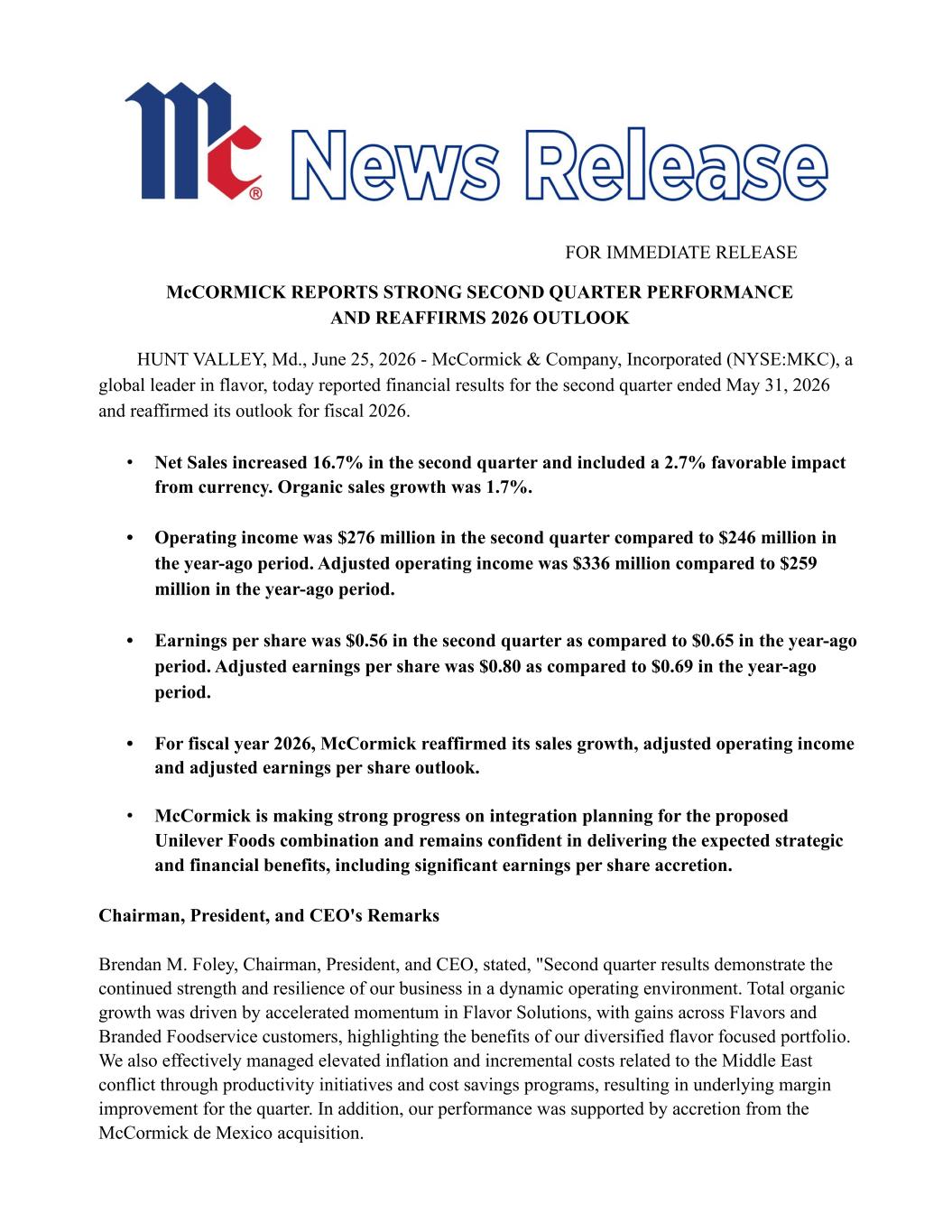
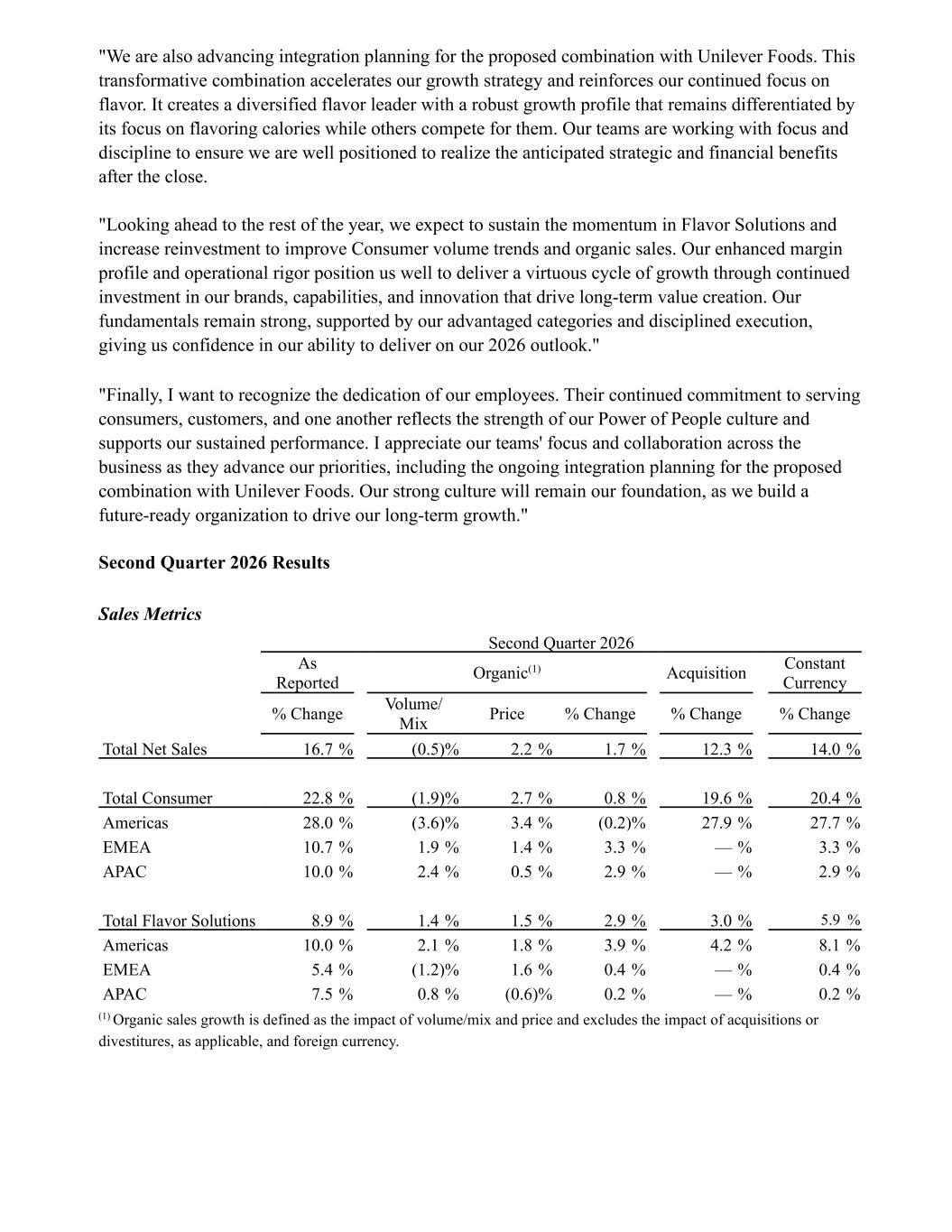
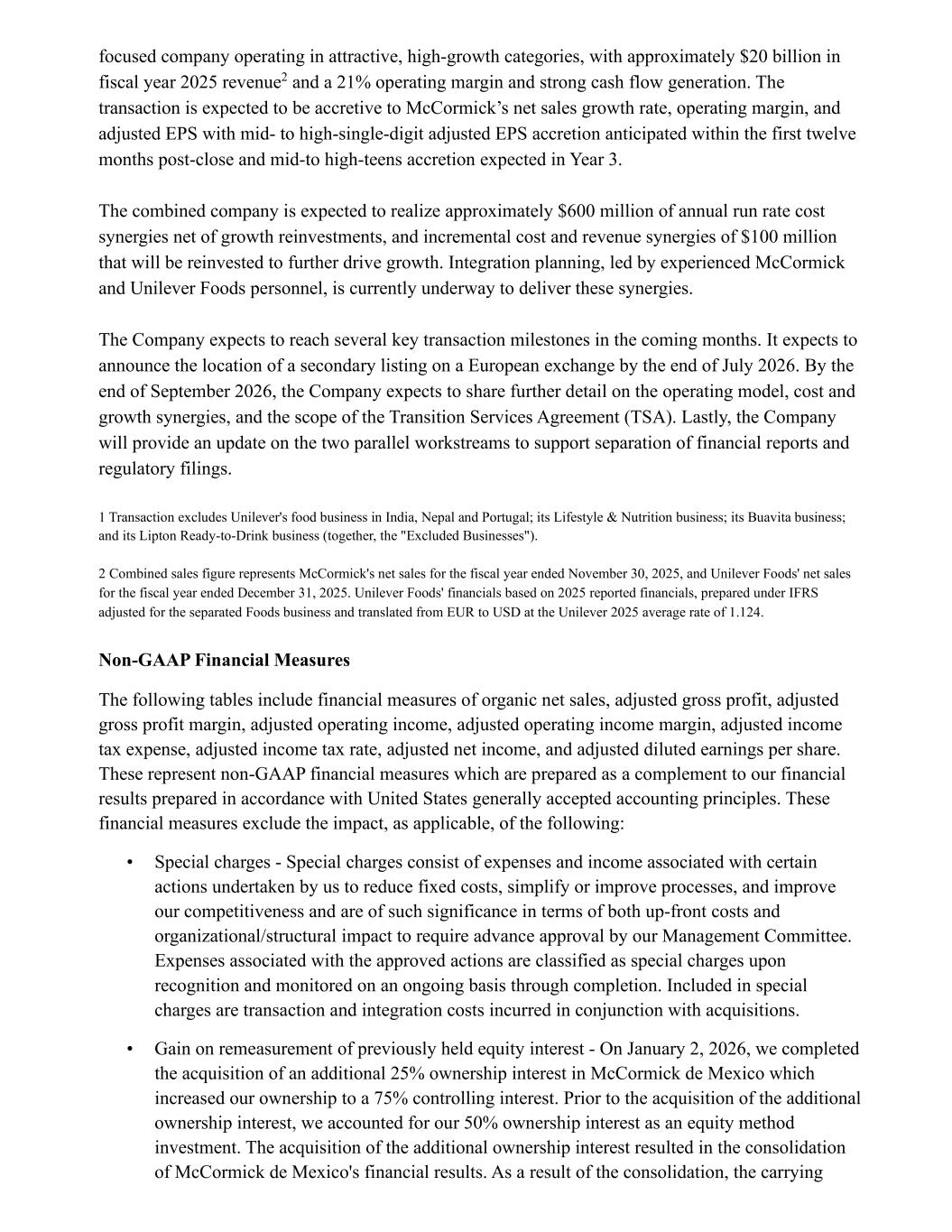
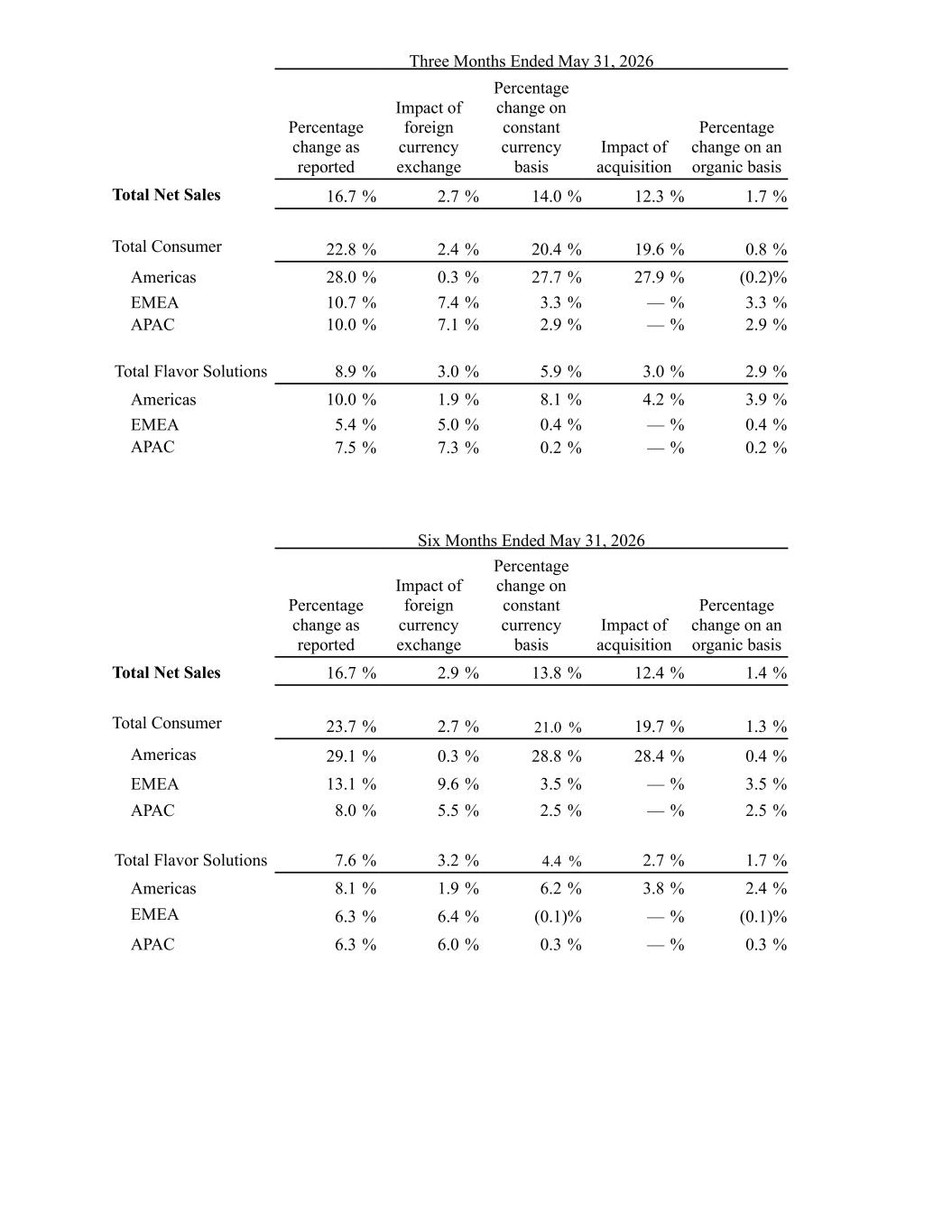
Good morning, everyone, and thank you for joining us. Our strong second quarter performance demonstrates the underlying strength and resilience of our business. We delivered robust sales growth, expanded underlying margins, and increased earnings. Our total results were supported by the McCormick de Mexico transaction. Organic growth was driven by the accelerated momentum in flavor solutions with growth across flavors and branded food service customers, highlighting the benefits of our diversified flavor-focused portfolio. Looking ahead, we expect to sustain the momentum in flavor solutions and increase reinvestment to improve consumer volume trends in organic sales. Our enhanced margin profile and operational rigor position us well to deliver a virtuous cycle of growth through continued investment in our brands, capabilities, and innovation that drive long-term value creation. Our fundamentals remain strong, supported by our advantaged categories and disciplined execution, giving us confidence in our ability to deliver on our 2026 outlook. Turning now to our results in slide four. In the second quarter, total sales grew by 14% in constant currency, reflecting acquisition contribution from McCormick de Mexico of 12% and organic sales growth of 2%. As expected, organic growth was driven by pricing. In global consumer, volumes were impacted by shifting demand patterns and increased price gaps in the Americas. Looking to the second half, we are implementing targeted actions to strengthen performance. We expect sequential volume improvement in the third quarter and volume growth in the fourth quarter, supported by refined revenue growth management initiatives, expanded distribution, targeted value-focused marketing, and innovation. In EMEA and Asia Pacific, we delivered sustained volume growth during the quarter, and we expect that momentum to continue for the remainder of the year. In global flavor solutions, volume growth exceeded expectations, driven primarily by the Americas. We benefited from growth across the flavor's customer base, including large CPG, private label, and high-growth innovators. In branded food service, growth was balanced across channels supported by distributor volume recovery, sustained demand and non-commercial channels, and strong e-commerce performance. Overall, the quarter reflects solid execution and strengthening fundamentals. Let's move to slide five and let me highlight for the quarter some of the key areas of success. Starting with global consumer, across key markets, food categories continued to soften. Against this backdrop, we saw good consumption trends. In spices and seasonings, share gains in Canada, France, Poland, and China continue to support global performance. In recipe mixes in the UK, we drove unit and dollar share gains for the last three quarters, supported by expanded distribution and customer wins. In Poland, new recipe mix launches under our Canvas brand are performing well. And most recently, we expanded our recipe mix portfolio in France with the Ducro brand, further strengthening our presence in the category. In mustard, U.S. unit share gains were driven by enhanced distribution, and we delivered the sixth consecutive quarter of dollar share gains in Poland. In hot sauce, in the U.S., we delivered dollar and unit share gains for the third consecutive quarter, supported by expanded distribution and innovation, including new Cholula sauces. We also drove share gains in the U.K. and Australia, reflecting strong execution and continued brand momentum across key international markets. We expanded total distribution points across the Americas, led by spices and seasonings, with incremental gains in condiments and sauces. Moving to flavor solutions. In flavors, innovation plans across our customer base started to commercialize, leading to strong growth across large CPGs, private label, and high-growth innovators. Innovation activity remains strong, particularly in cereals, soft drinks, sports nutrition, and snacking. We are capitalizing on these tailwinds in beverage innovation, protein and better-for-you growth, premiumization, and continued customer diversification. In branded food service, improving foot traffic drove both volume and sales growth. We continue to see momentum across non-commercial channels, retail food service, and independent operators. Importantly, we deliver tabletop and front-of-house share gains across Franks, Tallulah, and McCormick. Let me now touch on some areas where we are seeing pressure. Starting with global consumer and U.S. spices and seasonings, the category grew, but at a lower rate, reflecting consumers using more of what's in their pantry. Our consumption lagged the category within certain segments due to increased price sensitivity and increased competition, both private label and branded. We are responding with focused actions to drive growth, including disciplined promotional assortment strategies across channels. refined revenue growth management actions, targeted brand investment, and expanded precision marketing to reinforce McCormick's quality and differentiation, and consumer insight-driven innovation. We navigated a similar environment two years ago, and we have a clear understanding of the factors that impacted performance. We believe our initiatives position us to improve consumption trends and return to driving category growth. In recipe mixes, we have a strong core portfolio that spans multiple segments, We see opportunity to accelerate growth in Mexican flavors, one of the faster-growing segments in the category. We plan to realize this opportunity with innovation, expanded distribution, and focused brand investment behind authentic Mexican brands like Cholula. Moving to flavor solutions, in Asia-Pacific, primarily outside of China, and in the EMEA, QSR customer volumes were pressured by softer foot traffic. Looking ahead to the rest of the year, we expect volume trends to improve in Asia-Pacific, driven by customers, new products, and limited-time offers. Let me provide some more context on the state of the consumer. Geopolitical volatility, elevated fuel costs, and persistent inflation continue to weigh on consumer confidence. While affordability has been a consistent theme, the key shift this quarter, particularly given rising gas prices impacting budgets, was a more pronounced move towards value. as consumers became increasingly selective and focused on maximizing their budget. At the same time, a majority of consumers claim that they save for small premiums or indulgences, which includes flavor exploration. Health and wellness trends continue to shape behavior, driving sustained growth in perimeter categories, at-home cooking, protein, and broader, better-for-you categories across retail and food service. Within this environment, flavor remains a powerful constant. At-home cooking continues to benefit from consumers seeking affordable, healthier meal solutions and flavors the primary driver of purchase across occasions. As a result, spices and seasonings remain the top performer in terms of center store growth. The continued convergence of value-seeking behavior and health trends reinforces the central role of flavor and underscores our advantage position across our flavor-focused, diversified portfolio. Let's turn to slide 6 and to our growth plans for the remainder of the year that support our confidence and our ability to deliver on our top-line expectations. Starting with consumer, we expect second-half organic growth to be supported by improving volume trends. This improvement will be driven by expanded distribution, sustained renovation, refined revenue growth management to address increased price sensitivity in specific segments, including optimized price pack architecture. In addition, we will accelerate innovation and increase brand marketing, including precision marketing, designed to drive purchase intent and velocity across our core categories. Let me highlight some examples. We relaunched our seasoning blends line. Beyond new flavor introductions, we are optimizing price pack architecture to enhance value perception and improve accessibility at shelf, an important lever in today's value-focused environment. In addition, we continue to scale newer platforms, including our Finishing Sugars and Finishing Salts, with strong promotional tie-ins to globally recognized franchises, including Bridgerton, Harry Potter, and Paris Hilton. These partnerships expand household penetration, engage younger consumers, and reinforce the role of flavor as an affordable way to elevate everyday meals. For French's Mustard, we have activated a promotional partnership tied to the release of the new Minions movie. turning the mustard green using all natural colors because of one of the key characters in the movie. This type of culturally relevant activation brings excitement to the category and drives incremental traffic. In Flavor Solutions, we expect the momentum from the second quarter to be sustained for the remainder of the year. Our Flavors customer pipeline remains healthy, and we are seeing growth across all customers. We are leveraging expertise in regulatory, R&D, and product development to help customers navigate growing health and wellness demands with innovation. We're partnering with large and emerging brands as well as private label customers to flavor energy, hydration, and protein-based beverages, as well as protein and fiber snacks and zero-sugar drinks. Our win rate on health and wellness briefs remains strong, and we're focusing resources where we have the greatest opportunity to win across our four-taste competencies. savory, heat, naturally sweet, and citrus and fruit. In fact, in the second quarter, a majority of the briefs were tied to health and wellness innovation and renovation. Reformulation projects are increasing, particularly with large CPG customers, and we are beginning to see the benefit of this project activity launched to the marketplace. And finally, in branded food service, we expect to sustain the momentum from this quarter. The environment remains competitive and value conscious. Targeted investments in menu placements, innovation, and disciplined execution are expected to drive pockets of growth across customer channels. Before turning it over to Marcos, I'd like to provide a brief update on the Unilever Foods transaction on slide 7. Since the announcement on March 31st, we have made strong progress on integration planning. We have established a dedicated integration management office led by Andrew Faust, supported by 20 functional teams to ensure a seamless transition. Andrew previously helped successfully lead our RB Foods, Cellula, and Fona integrations. Unilever has established parallel teams. Altogether, there is more than 200 individuals fully dedicated to working across integration streams. From a separation standpoint, approximately 80% of Unilever Foods operates as a standalone organization, which reduces complexity. In addition, we are mapping integration plans country by country. This includes focusing on the 10 markets that represent nearly 75% of combined sales, where we have direct operational overlap in the top six. We expect TSA agreements, generally up to two years post-close, to ensure continuity across IT, distribution, and back-office functions. In addition, we are entering a second phase of detailed synergy planning. Based on the work completed to date, we remain confident in our previously announced targets for sales growth, operating margin, and adjusted EPS accretion. We expect mid- to high-single-digit adjusted EPS accretion within the first 12 months post-close and mid- to high-teens accretion in year three. Looking ahead, we expect to deliver several key milestones in the coming months. By the end of July, we expect to announce the location of a secondary listing on a European exchange. By the end of September, we expect to share further detail on the operating model, cost synergies and growth plans, and the scope of the transition services agreements. At the same time, we will continue to advance parallel work streams to support separation financial reports and regulatory filings. Importantly, we are advancing integration planning with rigor while maintaining discipline execution in our base business. Now, over to Marcus.
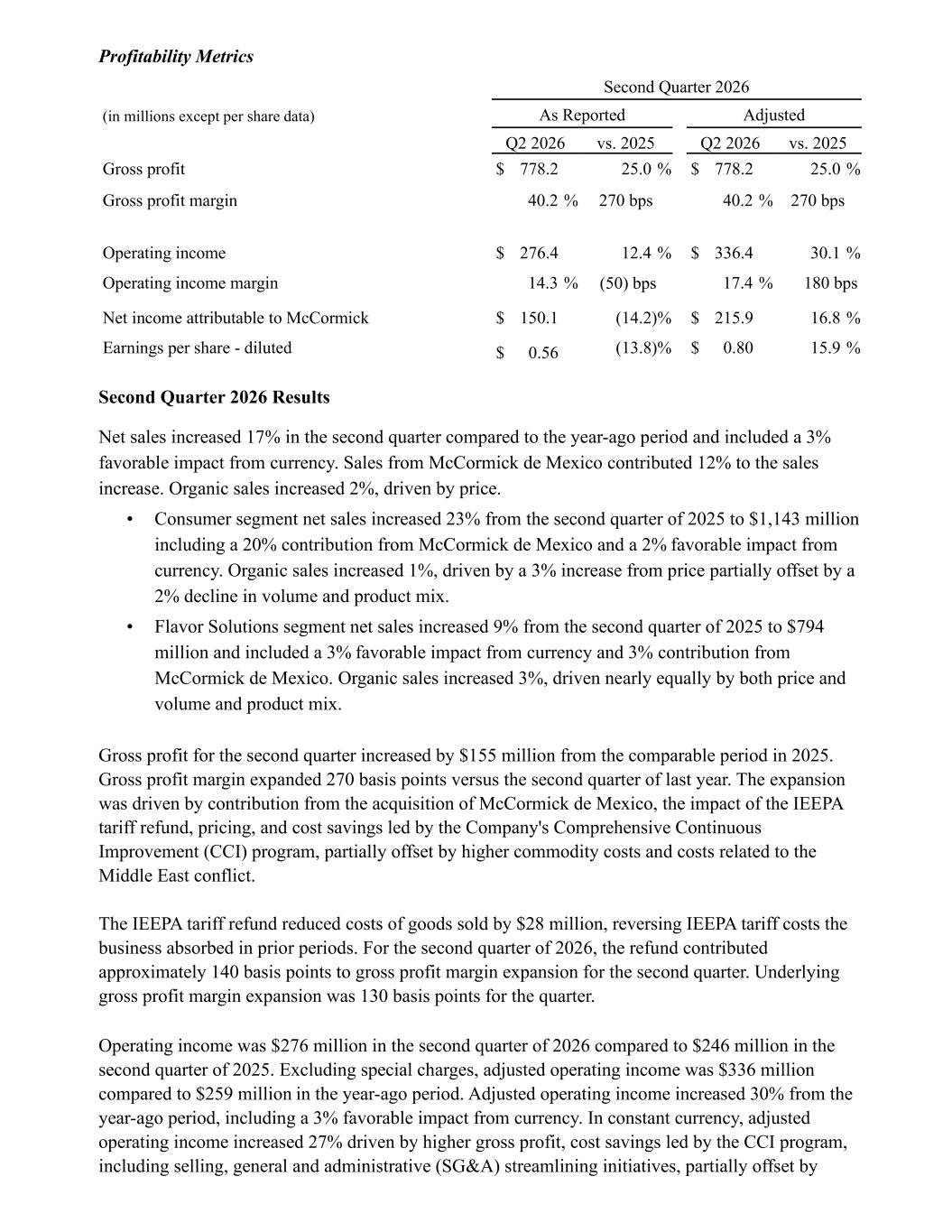
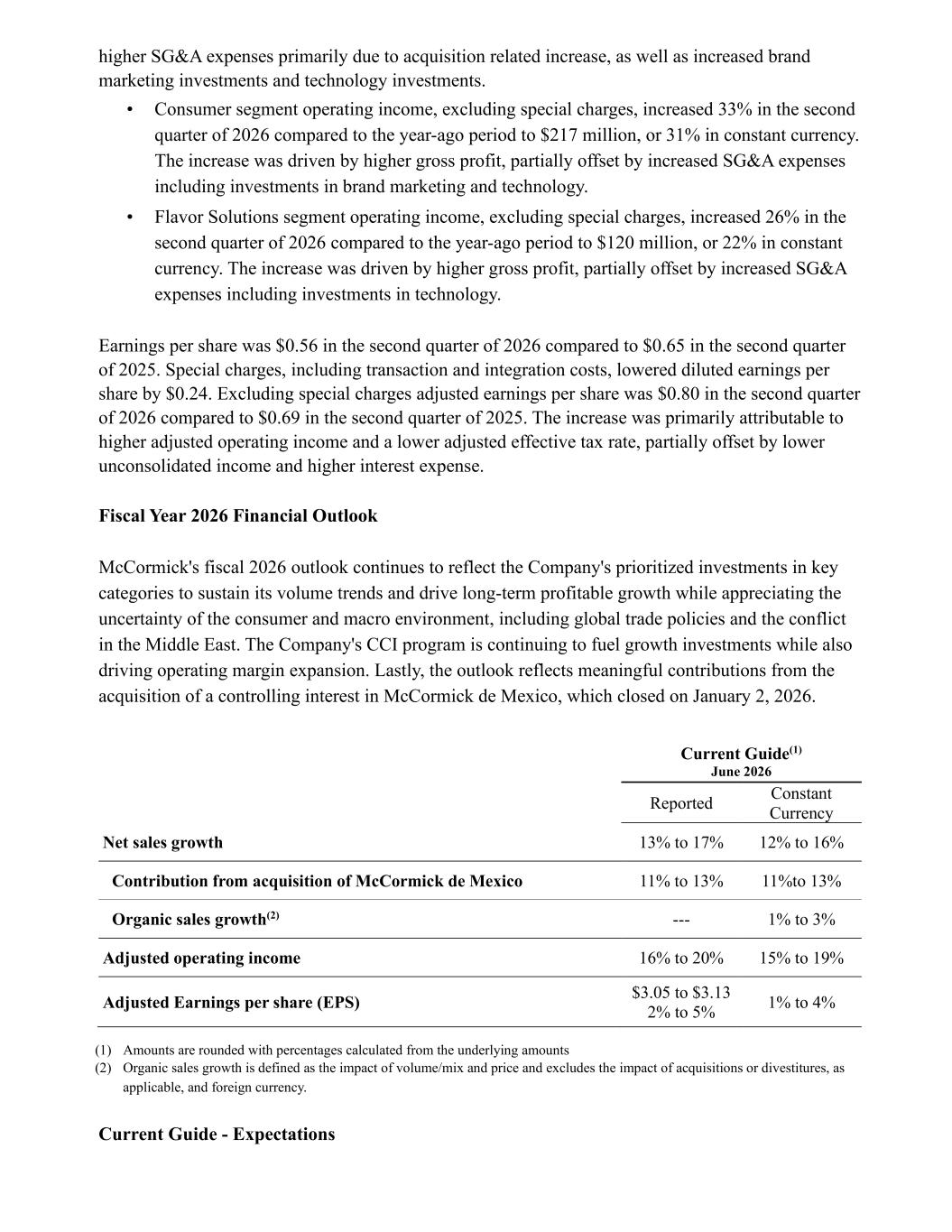
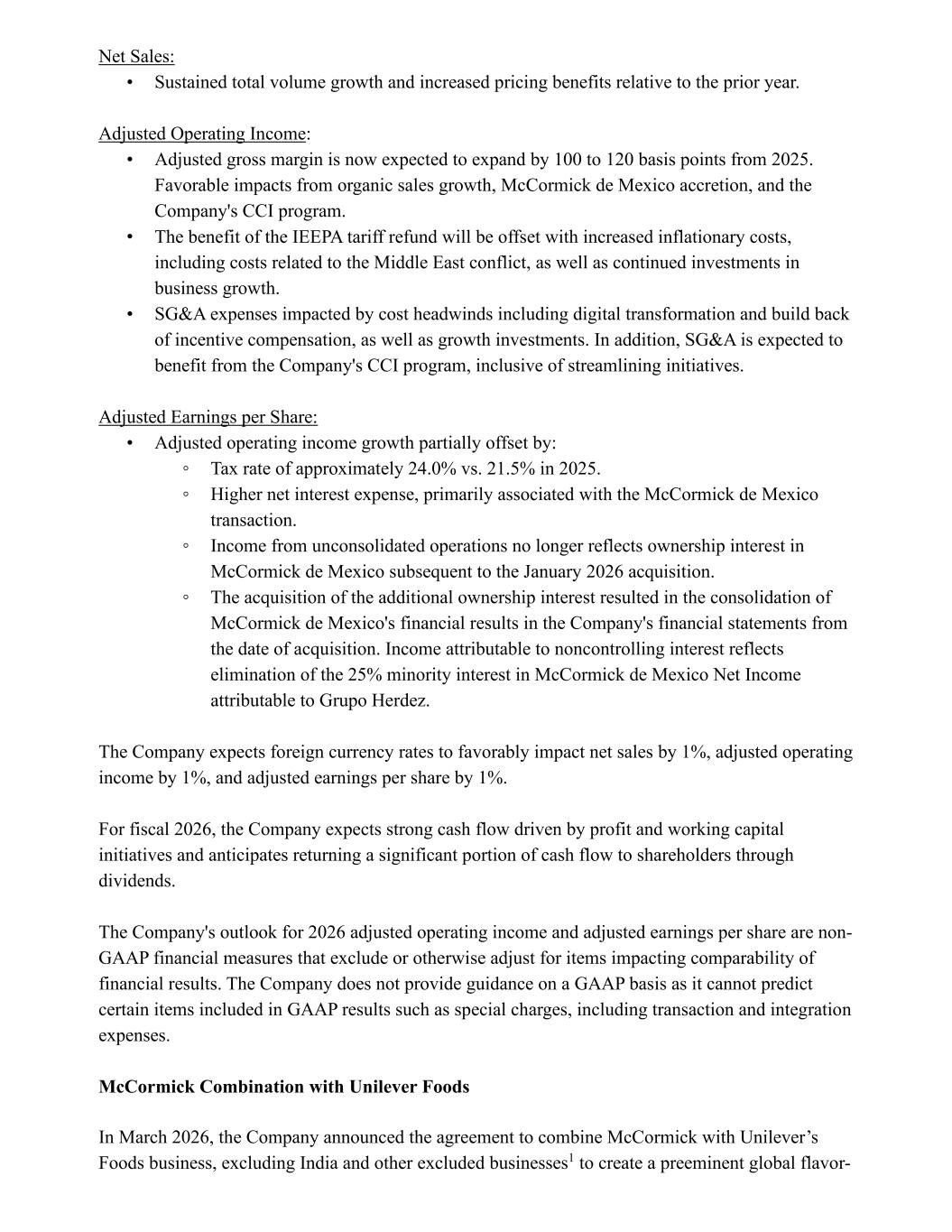
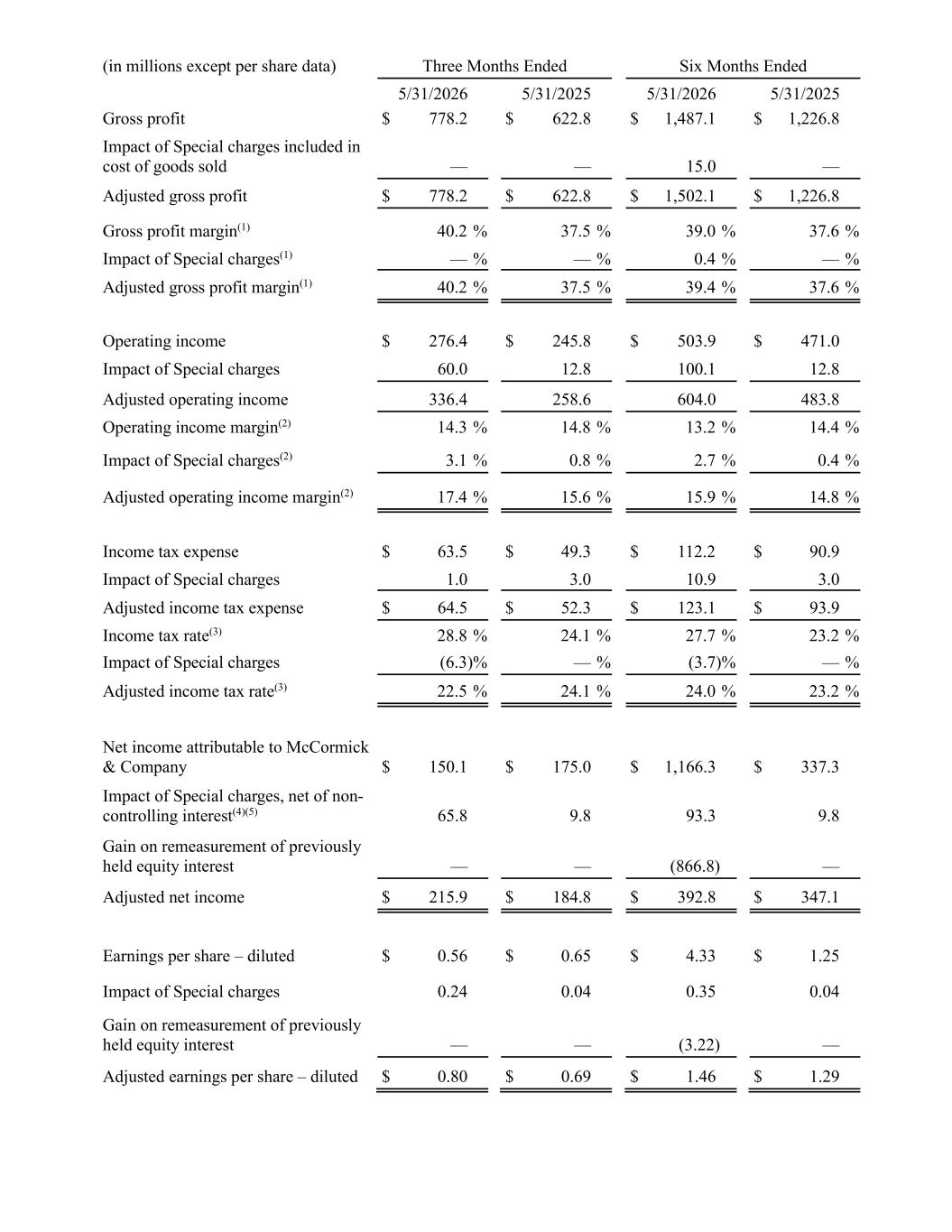
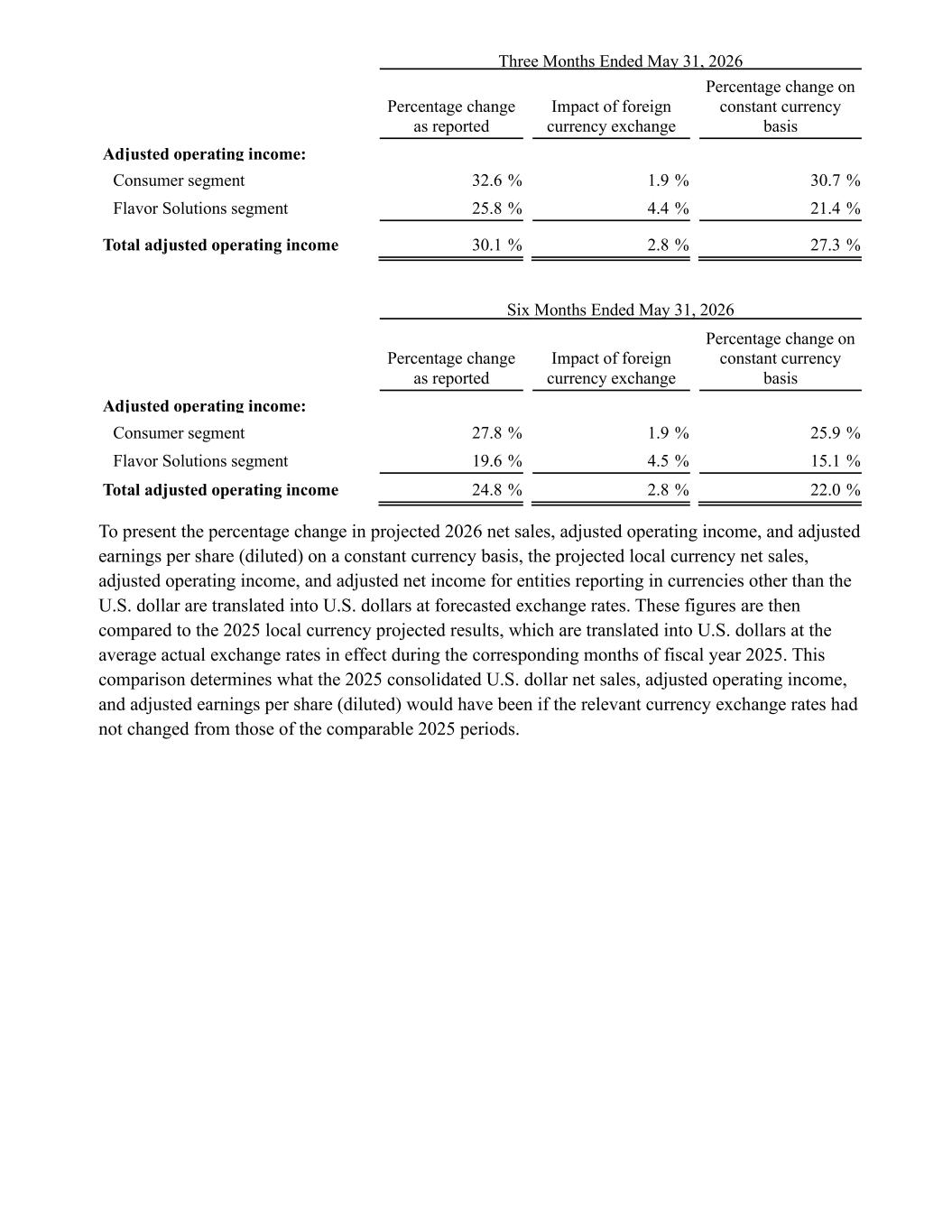
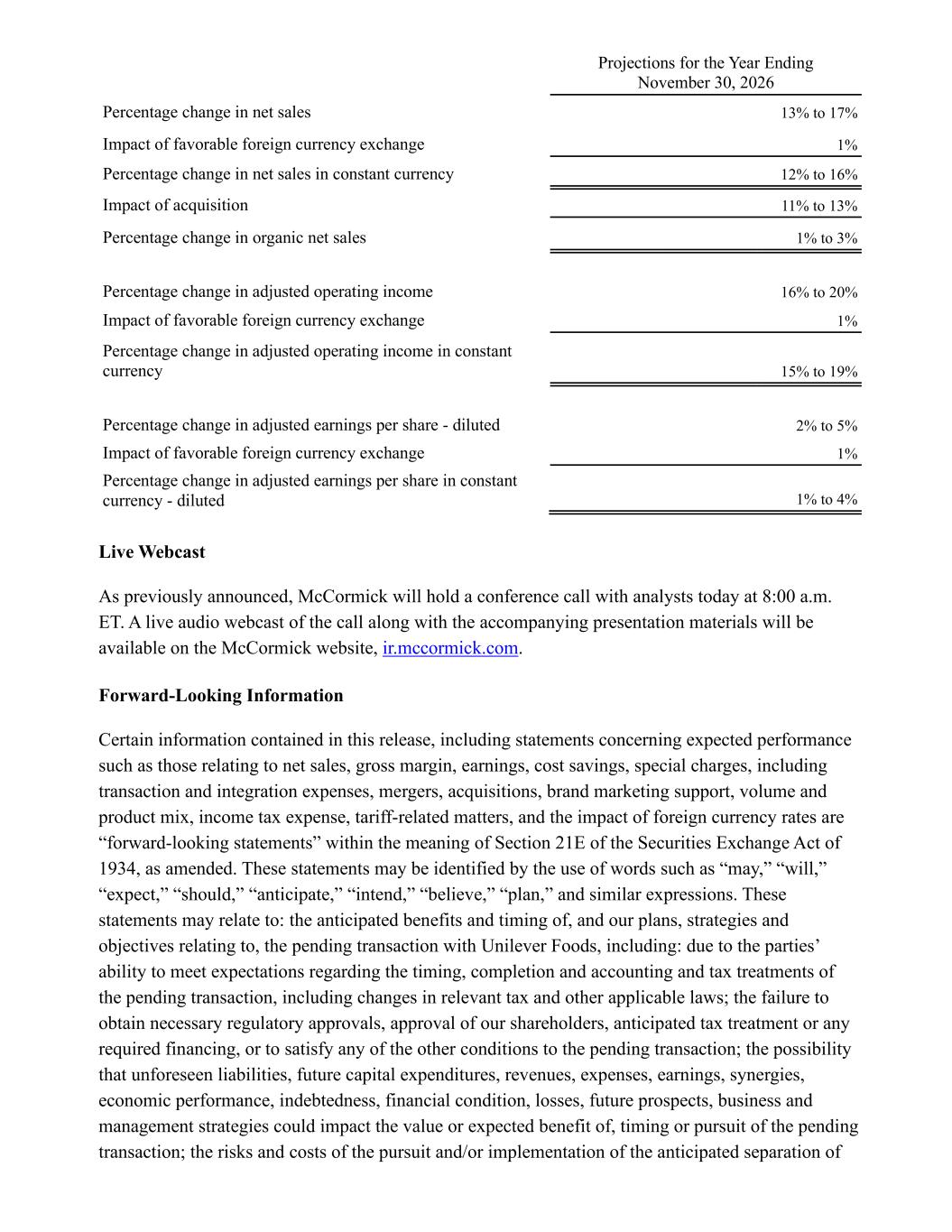
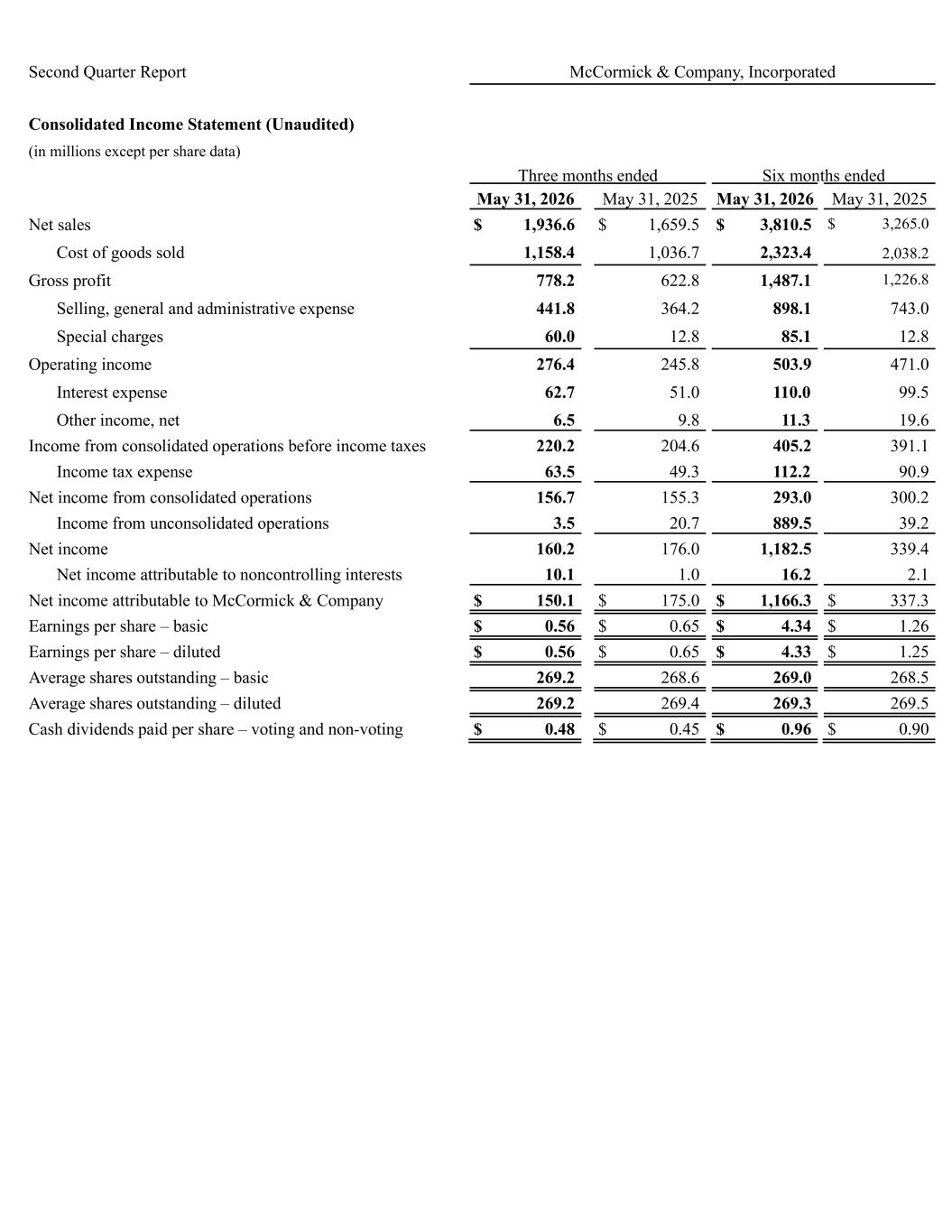
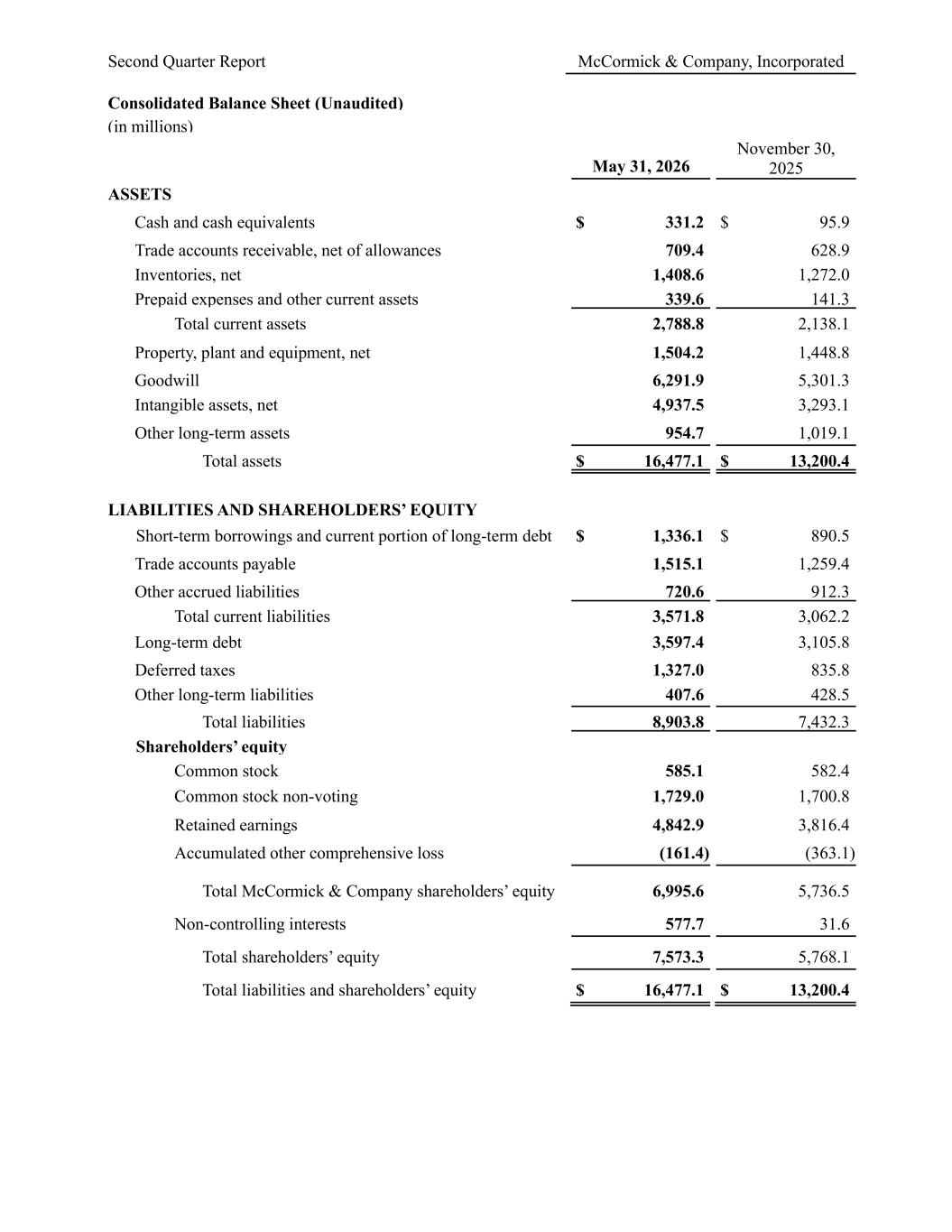
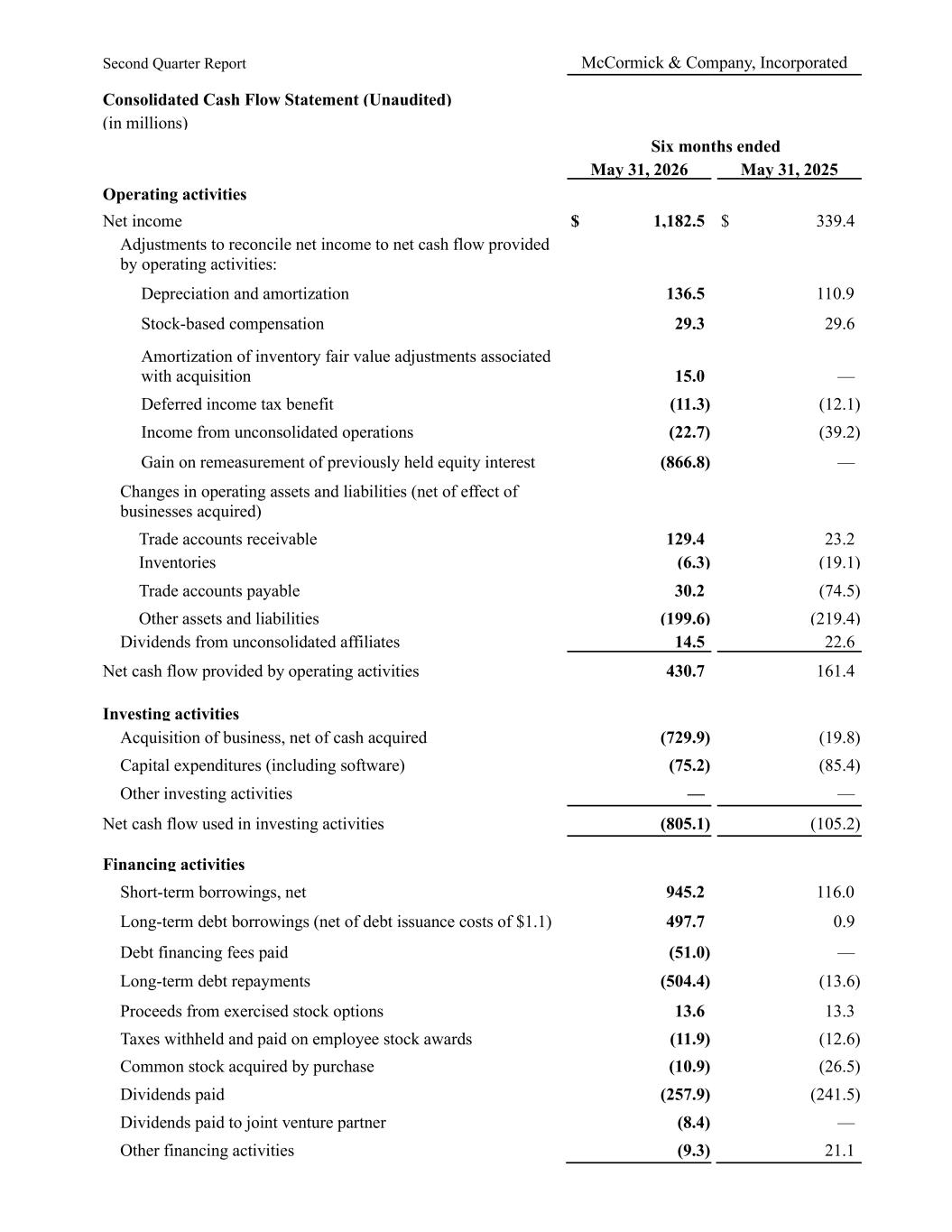
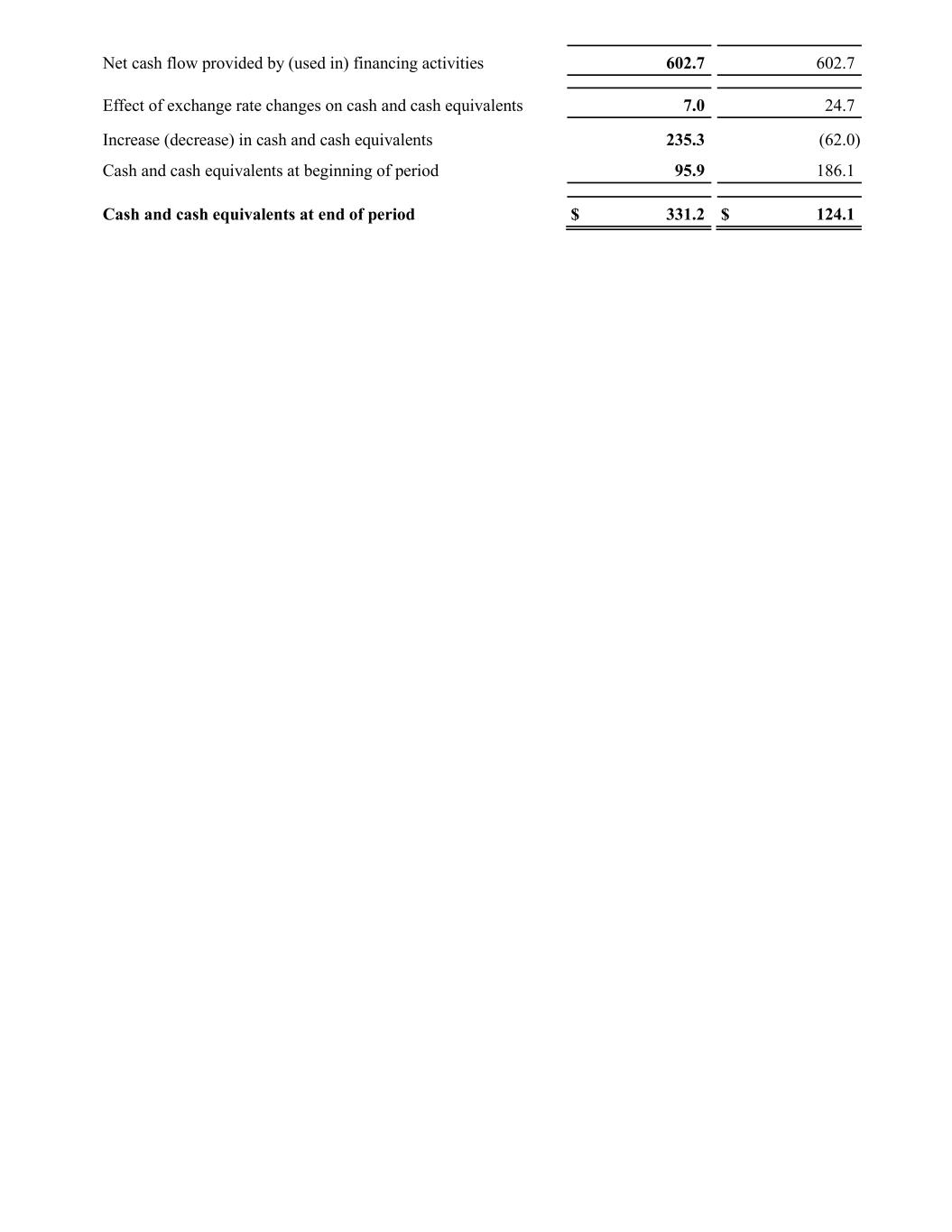
Thank you, Brendan, and good morning, everyone. Let's start on slide 9 and review our top line results for the second quarter. Total net sales grew 14% in constant currency and included a 2% in organic growth, with the balance driven by acquisition contribution. Moving to our consumer segment on slide 10, constant currency sales increased 20%, including a 1% increase in organic sales, with the remaining growth driven by acquisition contribution. Consumer organic sales in the Americas were flat, with pricing contribution of 3%, offset by volume decline. Volumes were impacted by shifting demand patterns and increased price gaps. Looking ahead, we expect volumes to improve in the third quarter and to deliver volume growth in the fourth quarter. In EMEA, we grew consumer organic sales 3%, driven by a 2% increase in volume and a 1% contribution from pricing related to targeted actions taken as a result of increased commodity costs. We're pleased with the sustained volume growth for the 10th consecutive quarter in EMEA. Consumer organic sales in the Asia Pacific region increased by 3%. The increase was driven primarily by volume and reflects the continued gradual recovery in China. In addition, we deliver strong results outside of China, primarily in Australia. Turning to our flavor solutions segment on slide 11, second quarter constant currency sales grew by 6%, reflecting a 3% acquisition contribution and 3% organic growth, driven equally by volume and price. In the Americas, flavor solutions organic sales increased 4%, reflecting a 2% price contribution and 2% volume growth. Volumes for the quarter were driven by strong performance across our flavors portfolio, including large CPGs and high-growth innovators, as well as robust growth in branded food service. In EMEA, organic sales were flat, driven by lower volume, reflecting soft QSR customers' volumes, due to a decline in food traffic, particularly in the UK. In the Asia-Pacific region, flavor solutions organic sales were flat, as 1% volume growth was fully offset by price, with strength in China tempered by softer QSR volumes in Australia. Moving to slide 12, gross profit margin expanded 270 basis points in the second quarter, driven by accretion from McCormick and Mexico, the benefit of a tariff of refund, surgical pricing, and savings from our Comprehensive Continuous Improvement Program, or CCI, partially offset by increased commodity costs. This tariff of refund reversed tariffs the business absorbed in prior periods. For this quarter, it drove 140 basis points of margin expansion year-over-year. Underlying gross profit margin expanded 130 basis points, demonstrating the resilience of our business and the strength of our brands in a dynamic environment. Selling, general, and administrative expenses, or SG&A, increased relative to the second quarter of last year, driven by the impact of consolidating McCormack to Mexico and increased investments in technology and brand marketing. At the percentage of sales, S&A was unfavorable by 90 basis points compared to the prior year. For the quarter, adjusted operating income increased by 30% or 27% in constant currency. This increase was driven by strong top line and gross margin expansion, partially offset by higher S&A. Our second quarter adjusted effective tax rate was 22.5% compared to 24.1% in the prior year, driven by a greater level of favorable tax items in the current period. Turning to segment operational results on slide 13, consumer-adjusted operating income increased 33% for 31% in constant currency, with adjusted operating margins expanding by 140 basis points. This expansion was driven by acquisition accretion and the tariff of refund, which primarily benefited the consumer segment. These benefits were partially offset by increased inflation and higher logistic costs driven by the Middle East conflict and tighter freight capacity, resulting from recent changes to U.S. federal regulations. Slaver Solutions adjusted operating income increased by 26% or 22% in constant currency and adjusted operating margin expanded by 210 basis points, reflecting our volume-driven top line and our continued focus on improving flavor solutions profitability, in line with our 2024 Investor Day commitment. At the bottom line, as shown on slide 14, second quarter, 2026 adjusted earnings per share was $0.80, an increase of 16% compared to the year-ago period, driven primarily by increased adjusted operating income, partially offset by non-controlling minority interests. The tariff refund contributed approximately $0.07 per share. On slide 15, we'll summarize highlights for cash flow and balance sheet. Cash flow from operations for the first half was $431 million, compared to $161 million in the prior year, driven primarily by higher profitability and improved working capital. We returned $258 million of cash to shareholders through dividends, and used $75 million for capital expenditures to expand capacity, advance digital transformation, and optimize our cost structure. We continue to expect a strong performance in our cash flow from operations for the fiscal year. Our capital allocation priorities remain balanced. This means funding investments to drive growth, returning cash to shareholders through dividends, and maintaining a strong balance sheet. We remain committed to a strong investment grade rating. At the end of this quarter, our leverage ratio was approximately 2.9 times, reflecting de-levering from the first quarter following the close of McCormick de Mexico. We expect to continue to make progress in paying down debt, positioning as well ahead of the Unilever Foods close. As previously noted, at close of Unilever Foods, we expect to have industry-leading operating margins of 21% and working capital benefits that support 100% free cash flow conversion from net income before any synergies. Post-close, we expect to continue investing in the business while driving margin expansion and delivering. Based on current estimates, after-brand investments, costs to achieve synergies and dividends, we anticipate having $1.5 to $2 billion available to pay down debt within the first two years and deliver two to three times. Longer term, we would target a leverage ratio of two to three times. Turning to slide 16 to review our 2026 financial outlook, which remains broadly consistent with what we shared on our last earnings call. A few call-outs. Starting with organic growth, we expect our consumer business volume to improve. driven by refined revenue growth management plans, new products, packaging renovation, expanded distribution, and increased brand marketing investments. In Flavor Solutions, we anticipate the volume momentum to continue and for this segment to drive total volume growth for the year. Across both segments, we expect Pricy to contribute more to organic sales growth this year compared to prior year. Our tariff cost assumptions, primarily related to the global 10% tariff, remain consistent, based on the latest developments and our current knowledge. While we anticipate incremental year-over-year cost pressure in 2026, we remain focused on mitigating the majority of the impact. In addition to the $28 million tariff refund in the second quarter, we expect an additional $3 million in the second half. For the full year, this benefit will largely help offset heightened inflationary pressures, including costs related to the Middle East conflict, which will continue to impact us for the remainder of the year. Turning to gross margin, first-half performance exceeded our implied guidance and included most of the full-year tariff of refund. This is a dynamic environment, and we continue to navigate several cost uncertainties. However, based on what we know today, we expect gross margins to expand by 100 to 120 basis points for the year relative to 2025. For the third quarter, adjusted operating income is expected to grow in the high single to low double digits year-over-year, supported by continued gross margin expansion. This will be partially offset by SG&A expenses due to the timing of ERP-related technology investments, the buildback of incentive compensation, and significant increase in brand market investments. Adjusted EPS is also expected to be impacted by the same items, as well as the lapping of a favorable tax rate in the prior year. Moving to slide 17, this slide summarizes the cost headwinds for 2026 and how we plan to offset them. Our guidance reflects strong underlying-based business performance and growth from acquisition. To close, we remain confident in the long-term strength of our business and our ability to deliver on our 2026 outlook. Through disciplined execution, focused on strategic investments, and continued productivity gains, we're driving sustained net sales and operating income growth, as well as generating strong cash flows to support our balanced capital allocation priorities.
Thank you, Marcos. I would like to close with three key takeaways on slide 18. Our fundamentals remain strong, supported by resilient long-term category trends, healthy and flavorful cooking, flavor exploration, and trusted brands, as well as the strength of our diversified flavor-focused portfolio. In the second quarter, accelerated momentum and flavor solutions more than offset consumer trends. We delivered strong organic growth, expanded underlying margins and increased profitability, driven by disciplined execution and productivity initiatives, the McCormick de Mexico acquisition, and effective cost management in a dynamic environment. We are also taking focused actions to improve consumer volume trends, sustain flavor solutions momentum, and invest in innovation, brand building, and digital capabilities. We remain confident in our long-term value creation plans, including delivering our 2026 outlook and advancing integration planning for the Unilever Foods combination, which accelerates our growth strategy and reinforces our continued focus on flavor, one of the most advantaged categories in CPG. The incremental growth is supported by industry-leading margins and a strong cash profile. To wrap up for the quarter, our performance reflects the power of our balanced portfolio, our leadership in flavor, and the agility of our teams around the world. I want to recognize all McCormick employees for their dedication and contributions. Their commitment and passion continue to drive our success. And now for your questions.
Operator
Thank you. If you'd like to ask a question, please press star 1 on your telephone keypad. A confirmation tone will indicate your line is in the question queue. You may press star 2 if you'd like to remove your question from the queue. For participants using speaker equipment, it may be necessary to pick up your handset before pressing the star key. Our first question comes from the line of Andrew Lazar with Barclays. Please proceed with your question.
Great. Thanks so much. Good morning, everybody.
The one key area, obviously, you highlighted in terms of weakness in the quarter was U.S. spices and seasonings, where I guess you experienced softening consumption trends and widening price gaps. I think McCormick went through something maybe somewhat similar several years ago and addressed it in some very specific ways. I guess my question is, is this time around any different than the last time? And if so, how so? And how does your approach several years ago inform how you plan to deal with this issue this time around?
Thanks for the question, Andrew. Our approach is broadly very similar to what we did over the last two to three years. And so I think the broad theme or the sort of headline answer to your question would be that. we're taking very much the same type of approaches that we did before I think there might be one or two things that's a little bit different today that might have been different back in the last two to three years and that is what we're seeing in the pressure that we've talked about it's happening more some very specific segments so it's not broadly across what is a very you know sort of many a category with many segments herb spices and seasonings and so we're seeing just more specificity in terms of some things that we have to go address, you know, overall. I would say the second thing that's different today is that the consumer pressure is even higher. So, because we've just seen inflation upon inflation layered into the consumer. And in this particular moment, in the second quarter, we definitely saw, you know, quite a spike, I think, particularly from sort of a non-food standpoint from inflationary pressure on the consumer. And is that temporary? I think most might think it is, but I think it's kind of a little bit different than what we would have seen before, which is more sustained pressure on the consumer. I think what's the same is what we've done in the past informs us to a very high degree on what we're going to do moving forward here. Many of the segments in which we implemented these programs continue to benefit even today, even in the second quarter, with the types of strategies that we've implemented. And the strategic approach to solve these particular segments is going to be the same. I think what's also, you know, I would say more of that on the differences, if you think about the digital landscape, it's really evolved a lot, even in the last two years. And so our AMP gets even more targeted as we think about, you know, sort of the solutions that we put in place to make sure that we're winning with the consumer and meeting them where they are. But I would say, you know, this time period, if I could reflect back on it, it just continues to reinforce the importance of speed and agility and response. And I really like how, you know, our team's responding in this environment, especially when we see kind of such inflection and change. And we like, you know, we're starting to read early results. We like what we see, you know, it's having the impact that we would expect it to have.
Really helpful. Thanks for that. And then it might be hard to sort of parse this out, but of the $31 million full year expected tariff refund benefit, I guess, what portion of that do you think is being used for this sort of reinvestment behind the more competitive environment versus covering some of the higher sort of hopefully what will be temporary sort of cost inflation that you're facing? Thanks so much.
Yeah, I'll answer that one, Andrew. So I think it's important to note that the Middle East conflict is really driving more inflation that we had not contemplated before if you think about our guide which is meet single digit cost inflation we're tracking towards the high end of that of that number which is about six percent right now so we are going to use the majority of the tax refund to offset these higher costs I mean this you know tariffs they heard us last year we're going to use it now to upset the majority you know this this costs, but also it's important to note that our underlying gross margin is really healthy. This is the second quarter in a row that we're driving in our incremental gross margin of about, even if you strip out the tariff refund, our gross margin was about 130 basis points up. So it's healthy. It talks about the resilience of our business, and then it gives us the room to invest back in the business and continue to drive top-line growth in the back half of the year.
Operator
Thank you. Our next question comes from the line of Peter Galbo with Bank of America. Please proceed with your question.
Hey, good morning. Thanks for the questions. Brendan, if I can ask a variation on Andrew's question. Obviously, within America's consumer, you've been faced with a bit of a game of macro whack-a-mole, I guess is how I would describe it. And you're taking actions. You're using the playbook that you've used in the past. Just how do we all gain confidence that this is sustainable, right, that the actions you're putting in place are going to work this time around will be somewhat sustainable and that you can kind of, I don't know, help to dampen some of this volatility that's been coming at you for what should be a relatively resilient category, but just seems like there's been one thing after another you've had to contend with. And I think that's really thrown, you know, us and investors kind of for a loop as we contemplate kind of the core of your business. So just would appreciate any additional thoughts on that.
I'm happy to do that, Peter. I think you all gave us a new term, which we'll use internally, of macro whack-a-mole. That's a new one for us, but we like it. You know, I think if you look back at the last two years, when we were dealing with this before, kind of building off of the previous question, you know, we were able to demonstrate, you know, sort of, you know, sustained improvement, you know, during that period of time. And, you know, those conditions were, as I described earlier, largely very similar, you know, in nature. So I think that that is, you know, one aspect I would share with, you know, investors is that, you know, we have a motivation to make sure that we continue to perform in a very healthy way, a volume-driven way within, you know, this part of our portfolio. And so, you know, we will work hard to make sure that we create even more resilience if it's needed. And I think that's what you're seeing, you know, throughout our performance right now, you know, whether it's the underlying performance in terms of gross margin or thinking about how we drive, you know, even continued increase in A&P up against our business. and also the continued focus around innovation, which is performing even more strongly this year than last year, I think those are the indicators that we have sustained focus and momentum across this portfolio. We're going to go through periods where we get sharp inflections like we saw in the second quarter, and there was a reasonable shift in the consumer behavior. But if you look at it over more of a longer-term period, I think we demonstrate the resiliency that we have been calling out overall. But to be clear, the external environment is presenting us new challenges. And as I've asked my organization at the beginning of this fiscal year is just one of our areas of strategic focus is just to continue building in resilience into the business, not knowing where or how we're going to need to use it, but just knowing that resiliency is really important to us and also investors.
Okay. Thanks for that. Marcos, if I could just ask a clarification question as well, I believe you provided pretty explicit guidance for the third quarter on operating income. Maybe you can help us bridge a little bit more explicitly down to the EPS line. I know there's some below-the-line items, obviously, that are different this year versus last year, but if you could put any sort of guardrails around the EPS rate of decline kind of for 3Q, I think that would be helpful. Thanks very much.
Yeah. So, Peter, on Q3, we provided some specifics on my prepared remarks. I mean, just to reiterate some of them, you know, from the net sales perspective, we believe, you know, we'll have solid net sales, continue the momentum and flavor solutions in consumer, continue the good momentum in EMEA and APAC and in the Americas, you know, improving the performance. Because margin expansion will continue, as I said, as well in the call. That drives what is really driving the operating profit to be high single-digit to low double-digit. It's really timing of expenses within S&A, the ERP timing, as well as incentive compensation by marketing. So that is the OP line. To your question about EPS, the biggest element, in addition to the elements that I just mentioned, is really the tax. the tax was about 16% I think last year and now if you think about the normalization of that tax in line with the full year guide of about 24% that creates 700 to 800 basis points roughly speaking of a headwind so that is really the key elements that you should think about in terms of you know the EPS and the below-the-line items okay thank you very much thank you our next question comes from the line of tom palmer with jp morgan please proceed with your question good morning and thanks for the question i wanted to start off maybe following
up on on pete's question on third quarter expectations but um i think that maybe there there's kind of two two pieces i want to break this into one is when we think about the organic sales growth, or sorry, the operating profit growth coming in maybe lighter than consensus estimates?
How much was maybe mismodeling on our part where you had expectations the whole time that some of these SG&A items might have been greater pressure points than we previously expected versus maybe some incremental costs to consider, including even on the on the inflationary side thanks well the we had at the honest GNA side that that's how we'll be modeling Tom in terms of the the cadence of of our spend in the back half of the year each one of the quarters obviously we don't provide quarterly guidance but you know it is more shifting more expenses into Q3 in terms of a brand more brand marketing you will see as I said the The program, the ERP program, is also hitting Q3 versus a year ago, and incentive compensation, as we talked about it before. So I don't think there's a change there in terms of what our internal expectations were. What we're seeing is definitely more inflation coming through, as I mentioned before, due to the Middle East conflict. And that is, you know, we're using the tariff refund to upset most of it, but it's still driving gross margin expansion, which is what I like about, you know, the balance of the year, which is we upgraded the call on gross margin to be 100 to 120 basis points for the full year. And you can take the inline, so the implied guidance for the second half, it should be the number that you take on. So, yeah, overall, I would say in line with our expectations, it's just a matter of the phasing of the SG&A expenses, really.
Okay, thanks for that. But on flavor solutions, I know sales growth can be lumpy from quarter to quarter. Brendan, in your prepared remarks, you noted a variety of tailwinds for the segment. One that stood out was reformulations. I think you previously expected it to be more of a fiscal 2027 driver. So kind of two questions in here. First, any lumpiness we need to keep in mind when thinking about the strength of the second quarter? And then second, what's driving the faster pace of reformulations, and should we think about that continuing to build in future periods?
Thanks for the question, Tom. You know, Flavor Solutions, but, you know, by the way, we're really pleased with the quarter. And as we look at the rest of the year, I mean, I think if I recall what I said at the beginning of the year when we laid out the guide, we thought that some of that improvement that we would expect to see come through, you know, certainly start to layer in as we went progressively through the year. I think what we saw here in the second quarter is obviously just even more strength to come through in terms of our overall performance. And it was broad-based. Hopefully, you got that from my prepared remarks. In terms of the drivers, I think what we're seeing right now is we're really encouraged by the scope of the pipeline that we're seeing. It's very healthy across a lot of our customer segments. And it's clear that that activity had amplified. So, I think that's a little bit of an insight into part of the spirit of your question, reformulation projects are increasing, particularly around from large CPG customers. And I think what's starting to kind of come through in the numbers, we're starting to see them commercialized maybe a little bit faster than what we had initially predicted. But I think there's another element to this, which is not just simply large CPG manufacturers driving reformulation. I think there's an element of just a market acceleration of health and wellness innovation. And you heard me kind of comment in my prepared remarks about where we're seeing that. And we're just seeing sort of more activity there. And I think that's also coming through in terms of the trends that we're seeing through private label customers and high growth innovators. And that seems to be sustained, if not continue to drive some really strong growth on top of what we're seeing is large CPG manufacturers also seeing more activity in market. There was another element for us, and that is just we saw more beverage innovation come through in the away-from-home market this quarter, which is more of an enduring trend. I think you'll see is that we definitely see more continued beverage innovation, and that came through in the away-from-home market this quarter, And I would expect that to, you know, continue to carry forward. Overall, though, we know that we think we're gaining share in this part of our business. And so it could be, is it an insight into, you know, where the broad food industry is going? We think it's more of an insight into our ability to gain share in this area. And I think that that is kind of the context that I have around, you know, our performance. Let's not forget branded food service. Branded food service is operating in an environment where we're seeing some nice, you know, sort of small traffic growth. We know the segments that are performing well. We see consumers kind of moving towards small indulgences and still going out to eat to kind of treat themselves. And so, but in that environment also, we're gaining share. So that's the context around our branded food service performance.
But overall, the food industry is innovating and we're benefiting from it. great thanks for all the detail very helpful thank you our next question comes from the line of steve powers with deutsche bank please proceed with your question hey great thank you and good morning um both brendan and marcos brendan maybe just following up on thom's question there and your answer i guess when you stack up that reformulation innovation health and wellness activity. For how long would you expect that to translate into what seems to be a favorable spread between how that's impacting flavor solutions and I think what we're all seeing and gleaning from end market consumption? Do you view that favorability more as a particular moment in time that has duration, or is it something that should prove more durable into in the future?
Well, because a lot of this is aligned with consumer trends, Steve, I kind of go there first. You know, what supports, you know, the activity and is it aligned with where the consumer's going? I believe it indicates more durability and, you know, broadly within the marketplace. So, you know, as you know, I've said before, I think the food industry has always been really good innovating around meeting the consumer with where they are. And I think this is a good example of just, you know, pipelines starting to materialize as we think about the marketplace.
Great. Thank you. And then, you know, you spoke to, you know, some of the anticipated outcomes of the integration planning work that you're doing over the next few months, including the announced location of the secondary listing by the end of July and further details on the operating model and synergies and the scope of TSAs by the end of September. I guess, Brett, maybe you could shed a little bit more light, if you could, on the work that's going on behind the scenes to get to those outcomes and how that day-to-day work is being organized alongside general business operations?
Well, as we noted in the prepared remarks, we certainly have a lot of dedicated resources, both at McCormick and at Unilever Foods, to really prosecute, obviously, this whole integration planning and everything else. And to give you just more context, more subjectively and, you know, kind of before we start to kind of report more detail as we get to the third quarter, I'm very encouraged by just the level of collaboration. I would almost call it a esprit de corps between both integration teams in terms of how they're operating and working together. And it is very, I would say, very disciplined and rigored. There are multiple work streams all organized by function or by specific actions and activity that have to happen, and they're all sort of progressing in parallel, and everyone has a timetable that they need to hit, and we're hitting those timetables. We did a checkup in this last week, and we're very encouraged by sort of that first three months, if you will, and we're right where we want to be in terms of the timeline. I don't expect everything's going to be perfect throughout the entire integration planning, but so far we really like how we started off, and it leaves us even more encouraged. And I know that my counterparts over at Unilever Foods would say the same thing. I think the other thing that I'm walking away with too after sort of the first three months after our announcement is just I'm even more excited about the combination than I was before. Just being able to, you know, and I think a lot of that's driven also by just being able to interact also with Unilever Foods employees and just really see the energy and the passion for the business, you know, from their perspective, just only leaves us even more excited about the future of this combination and what it's going to deliver. I mean, we still believe very much in what we said back in late March, and it's still true today, and it's now starting to really feel like it'll begin to come to life. We can't wait to really share more details on our milestones, but I just would step back and say the operational clarity and rigor with which the base business is operating versus the integration teams are operating, I think is really clear. And that gives me confidence that we can continue to do this as we go through up until close.
Operator
Thank you. Our next question comes from the line of Robert Mosca with TD Cowan. Please proceed with your question.
Hi. Thanks for the question. Brendan, you've definitely been in this position before navigating price gaps and trying to regain market share in spices and seasoning. But what I remember from last time is that it took longer than just, you know, just a couple of quarters to regain some competitiveness and to execute the volume-led strategy. It was multifaceted, you know, price gap changes and packaging changes as well. So the guidance implies, you know, a sequential improvement in volume in the back half. so it is there is there enough that you is it is there is there enough time here to execute the things that you want to execute to get volume back to positive in the Americas and then then a quick follow-up well thanks for the question Rob you know I think you're right it did take us a little bit longer you know when we were in this position before so I think it's a reasonable point to call out you know back then Rob we were implementing programs and layering them in you know sort of every other month etc and so you know I think we were it
was more of a sort of a broader program we were implementing at the time so there was a lot more to execute you know in that regard back then but also we were you know getting into making sure that you know from a customer relationship standpoint you know they were aligned with the strategy of really driving the category this way. And so that takes a lot of, you know, dialogue with customers back then. And so we really got through that in a really positive way. I think as you now sort of, you know, accelerate or fast forward into where we are today, you know, the dialogue that we have with customers is far more, you know, faster, a recognition of what we need to go course correct. You know, our ability to kind of implement quickly with our team with more speed and agility, I think also, you know, as I mentioned earlier in a previous question, sort of that digital landscape, you know, provides us even more capability, you know, to be able to do this. And so that is, I think, an important element of our ability to execute. Now, it's also important to know that we also have more gross margin, you know, sort of flexibility in which to make sure that we can drive investments in the right areas. But I'm really encouraged by sort of the speed of our response, and we're starting to see it in the marketplace right now. And, you know, I think that those are the differences between, you know, now and maybe when we did before is a much greater understanding of those levers and how they're going to operate and work. And we have a lot of confidence when we implement them.
My follow-up is on the seasonings subcategory. you know, if you really drill down here, brands of yours like Grillmates and Lowry's are losing share and it's to like some up and coming emerging brands. So when you talk about price gaps, is that related to that at all? Or is there something else here in terms of the positioning of your brands relative to theirs that you'd like to address as well?
Yeah, as I mentioned, that there were specific segments that we felt like we needed to address. And so that's, you know, not inconsistent with what you just called out. And I think price gaps can be a part of it, but I would say what we're seeing now, you know, in our category, it's a reflection of everything that we've been saying. These are really attractive categories. They're advantaged, they're structurally sound. And so it attracts more competition. And, you know, certainly, and even a lot more interest from private label. And so that should not necessarily be surprising. And so as we saw, especially in the second quarter, we saw a lot more competitive promotional activity, and I think that that probably reflected in the results overall. But it also, I think there's a consumer component there, and I think we have a handle on it, and we know what we need to do.
Operator
Our next question comes from the line of Alexia Howard with Bernstein. please proceed with your question good morning everyone um can we start by um just kicking the tires a bit on the operating margin um outlook for the combined mccormick unilever deal um 21 at close is already fairly high relative to other uh food companies around the world and obviously then getting up into the sort of 23% to 25% range is even higher. I think we're sort of looking from the outside and saying, well, obviously the marketing spend is healthy at 7% to 8%. And if, and this is a hypothetical, if the growth margins are sort of somewhere in the low 40s, that implies that the remaining SG&A outside of marketing spend is surprisingly low. And we're trying to figure out if that's sustainable for the long term. can you sort of give us confidence that this is actually something doable and it's not that the belt has been tightened so much on the remaining FGNA that it's going to be problematic as we get into the combined era next year? And then I have a follow-up.
Thank you for the question, Alexia. I'm going to address a couple of thoughts there, and then I may turn over to Marcos to see. He can tell me if I missed anything important. You know, as we look at – thanks for unpacking all of that. I think as we look at, you know, sort of the future margin profile of the business, you know, we think about the ability of continuing to invest in it. So thank you for calling out that, you know, these are also being done at what are industry-leading sort of healthy investment rates behind A&P and brand marketing and everything else. And so, you know, we had to make sure that investors, you know, understand that, you know, we want to continue supporting the business at increasing levels every year. Its impact on SG&A, I have to tell you, we don't see that as being unusually low in a future state. And I think what we'll have to do is probably, you know, as we go through this process and we go through this integration, is provide more context around that. I can't really right now today give you the level of detail that I think maybe you're looking for. But, you know, as we looked at it, modeled it, you know, internally on the McCormick side and even through conversations with our counterparts over there, this is not coming at the sort of some unusual profile on SG&A.
Yeah, I think you hit the key points, Brandon. I mean, operating margin is really being driven by gross margin expansion over the last few years. And the team has continued to invest in brand marketing, as you pointed out, Alexia. So we don't feel like the SG&A is at the low range or low place to be right now. Obviously, the 21% operating margin is the starting point of the combined company before any synergies. And when you layer synergies on top, you get to the range of 23% to 25%. So we do feel pretty confident about that profile.
Operator
Great. That's helpful. And just as a quick follow-up, coming back to flavor solutions, And you've talked about the benefits of reformulation kicking in. Two other things. Can I ask the branded food service channels that are seeing improved foot traffic, can you be more specific about which food service channels are seeing that recovery? And then you have a big snacking slash beverage company in there that I think has been struggling, and that's been a headwind in that category or segment for the past year or two. You mentioned that all customers are now seeing growth. Does that mean that that headwind's gone away? Thank you, and I'll pass it on.
Yeah, I think that specific about branded food service in your question, the segments in which we're seeing sort of more growth than the total food service industry would be we're seeing some growth in QSRs, especially in the Americas. And we're seeing growth in fast, casual, casual dining. And also, I think, yeah, non-commercial. Those four to five areas is where we are seeing right now, I think, you know, most of the growth in traffic, et cetera. That's the area in which I think we're also finding that our brand certainly can play and resonate. Or our ability to sort of help with flavor, you know, will help there, too. I think overall, though, there certainly has been pressure on the food service marketplace. So, you know, this element of, especially in the second quarter, just increased pressure on the consumer, certainly coming through not necessarily just food, but many other things that household budgets need. And I think that did have an impact on food service to some degree because it did decelerate in the quarter from the first quarter, in our view. But there was still growth, and the growth is happening in areas where, you know, we have been up to focus.
Thank you very much. I'll pass it on.
Operator
Thank you. Our final question this morning comes from the line of Max Gunport with BNP Powerbox. Please proceed with your question.
Thanks for the question. I just wanted to return quickly to the commentary on 3Q profit. So after 1Q results, you had signaled that 3Q would be above the low end of your 26 percentage range, so at least 16% year-over-year. So it does feel like a bit of a guide down with regard to 3Q, now indicating high small digits to low double digits. You mentioned SG&A timing. I just wanted to clarify, was there a shift in your view of SG&A expenses, so with a shift from 2Q into 3Q, maybe related to ERP and incentive comp timing relative to what was initially planned? Or is this also about incremental brand marketing investment versus what was initially planned. Thanks very much.
Hey, Max. So a few questions on your there. So the first one is in terms of, you know, when we put out the guide in the beginning of the year, we guide for the full year. We didn't guide by quarter. So, you know, the ranges that we put out there, 15 to 19 percent on constant currency was for the full year. The second point about the phasing, there's some phasing between Q3 and Q4. We're investing more heavily on brand marketing in Q3 than Q4, although Q4 is going to still see brand marketing absolute dollars strong, but year on year, we also had a very strong brand marketing spend in Q4 of 2025, so year on year is not going to be significant. And I think I hit these two points, and the other question was about, I think it was those Those are two questions, right, Max? Anything else that I missed?
Yeah, that covers it. Maybe I'm putting too fine a point of it, but you did say 2Q would be at the low end of the 26 guidance range, and you said 3Q would be better than 2Q. That's why I'm saying, essentially, it does, like, there is a change in tone, but I think your commentary does help a lot, so I appreciate that. And I just wanted to touch on cash flow quickly. So it's obviously been a much better first half than last year. You talked about working capital improvements. Can you just expand a bit on what's generating those working capital improvements relative to last year and the sustainability of that? Thanks very much.
Sure, Max. Max, this is one area that we are very pleased about, which is the cash flow in the first half of the year, $431 million, very substantial. Also, the leveraging position that we are right now in terms of 2.9 times, closing the quarter even after the acquisition of my max that we incur additional 750 dollars of that so that talks about you know our always our playbook about acquiring and paying down that quickly so working capital is also working our favor across all three levers of working capital inventory days you know payables and receivables but primarily inventory days as well as payables are the two main drivers of working capital that we're seeing right now.
Okay, great. Thanks very much. I'll leave it there. Sure.
Operator
Thank you. Ladies and gentlemen, that concludes our question and answer session. I'll turn the floor back to Ms. Freja for any final comments.
Thank you. Thank you, everybody, for joining today's call. If you have any additional questions, please feel free to reach out to me. This concludes our conference call for this morning. Thank you.
Operator
Thank you. This concludes today's conference call. You may disconnect your lines at this time thank you for your participation