Operator
hello everyone thank you for joining us and welcome to medical properties trust second quarter 2026 earnings conference call after today's prepared remarks we will host a question and answer session if you would like to ask a question please press star one to raise your hand to withdraw your question press star one again i will now hand the conference over to charles lambert senior vice president charles please go ahead good morning welcome to the mpt
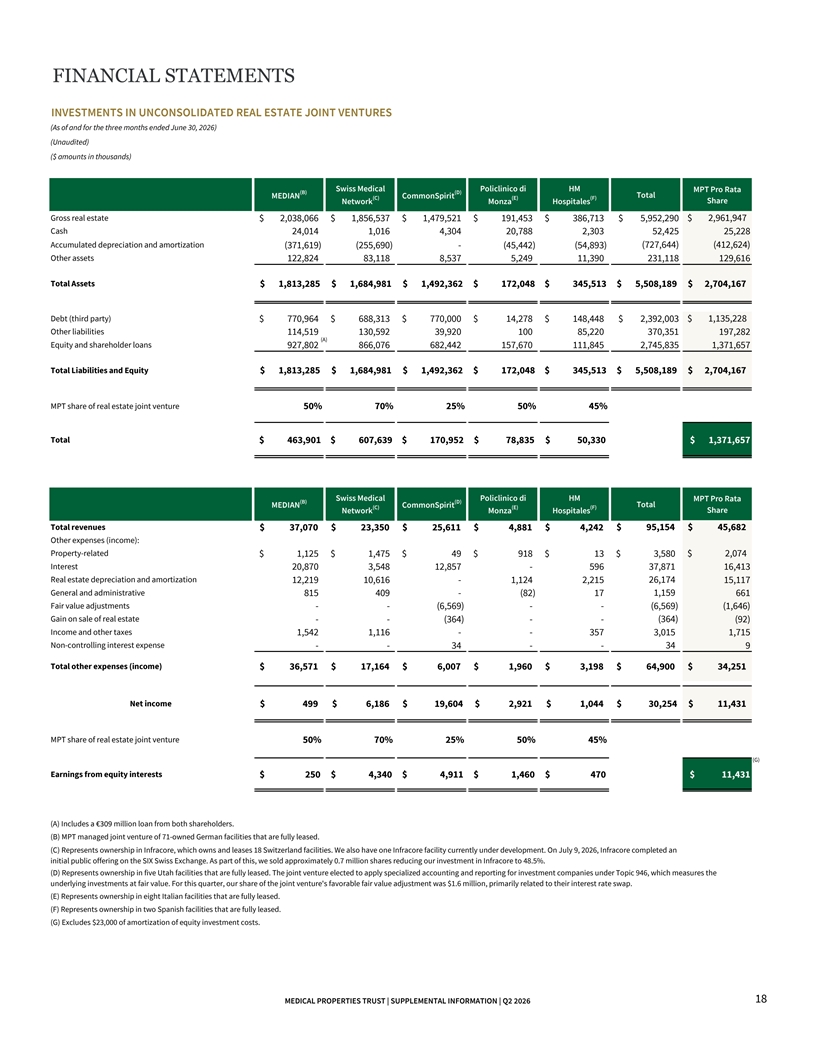
conference call to discuss our second quarter 2026 financial results with me today are edward k Aldag Jr., Chairman, President, and Chief Executive Officer of the company, Stephen Hamner, Executive Vice President and Chief Financial Officer, Kevin Hanna, Senior Vice President, Controller, and Chief Accounting Officer, Rosa Williams, Senior Vice President of Operations and Secretary, and Jason Fry, Managing Director, Asset Management and Underwriting. Our press release was distributed this morning and furnished on Form 8K with the Securities and Exchange Commission. If you did not receive a copy, it is available on our website at mpt.com in the investor relations section. Additionally, we're hosting a live webcast of today's call, which you can access in that same section. During the course of this call, we will make projections and certain other statements that may be considered forward-looking statements within the meaning of the Private Securities Litigation Reform Act of 1995. These forward-looking statements are subject to known and unknown risks uncertainties, and other factors that may cause our financial results and future events to differ materially from those expressed in or underlying such forward-looking statements. We refer you to the company's reports filed with the Securities and Exchange Commission for discussion of the factors that could cause the company's actual results or future events to differ materially from those expressed in this call. The information being provided today is as of this date only, and accept as required by the federal securities laws, the company does not undertake a duty to update any such information. In addition, during the course of the conference call, we will describe certain non-GAAP financial measures, which should be considered in addition to, and not in lieu of, comparable GAAP financial measures. Please note that in our press release, Medical Properties Trust has reconciled all non-GAAP financial measures to the most directly comparable GAAP measures in accordance with reg g requirements you can also refer to our website at mpt.com for the most directly comparable financial results and related reconciliations i will now turn the call over to our chief executive officer ed aldag thank you charles and thanks to all of you for joining us this morning on our second quarter 2026 earnings call before i begin today we'd like to extend our thoughts and prayers to the people of columbia after this morning's earthquake.
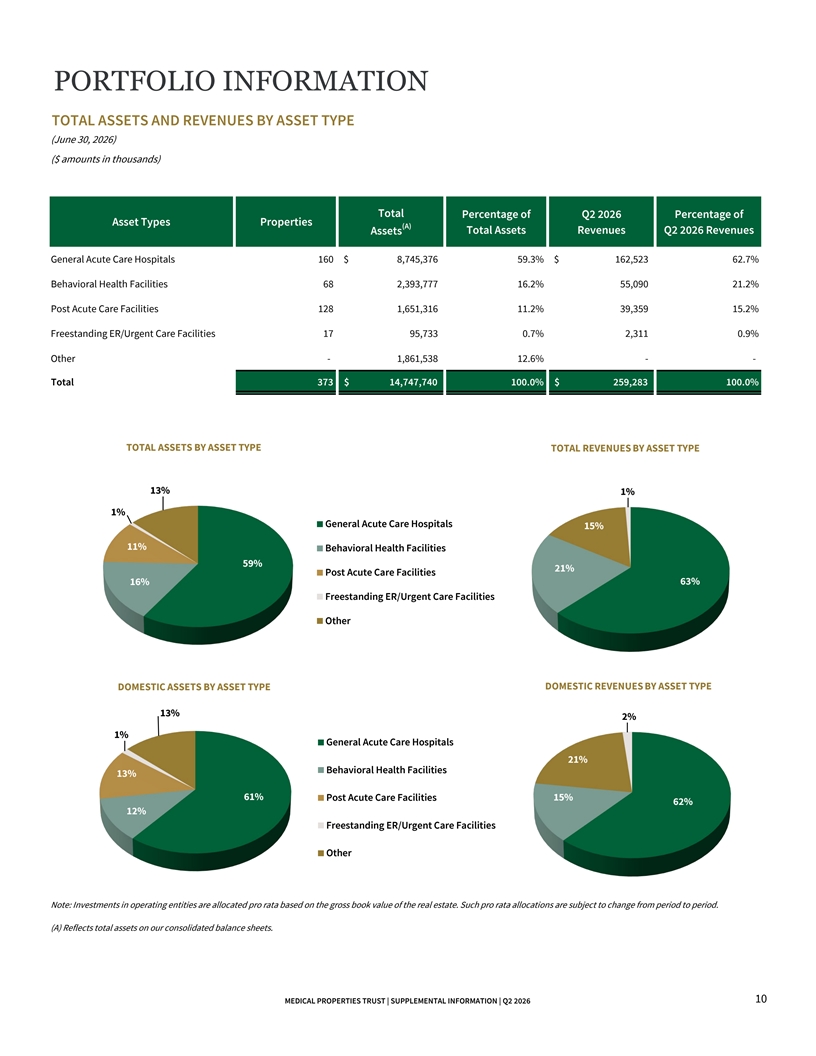
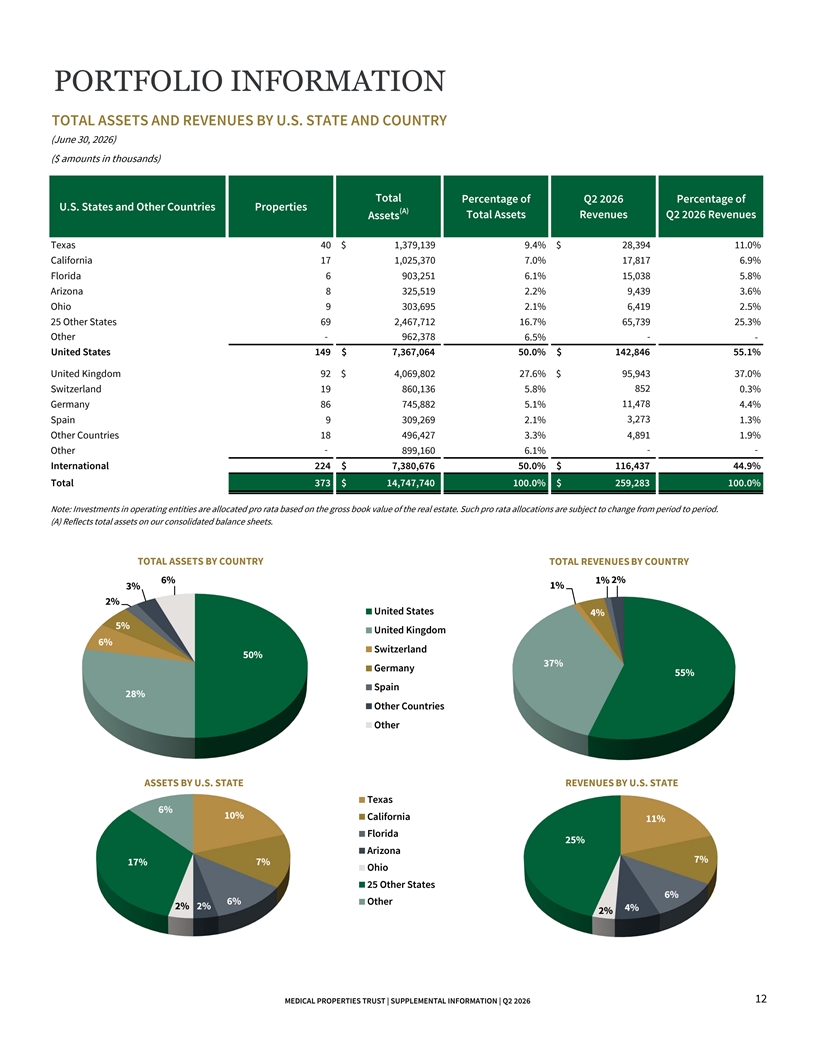
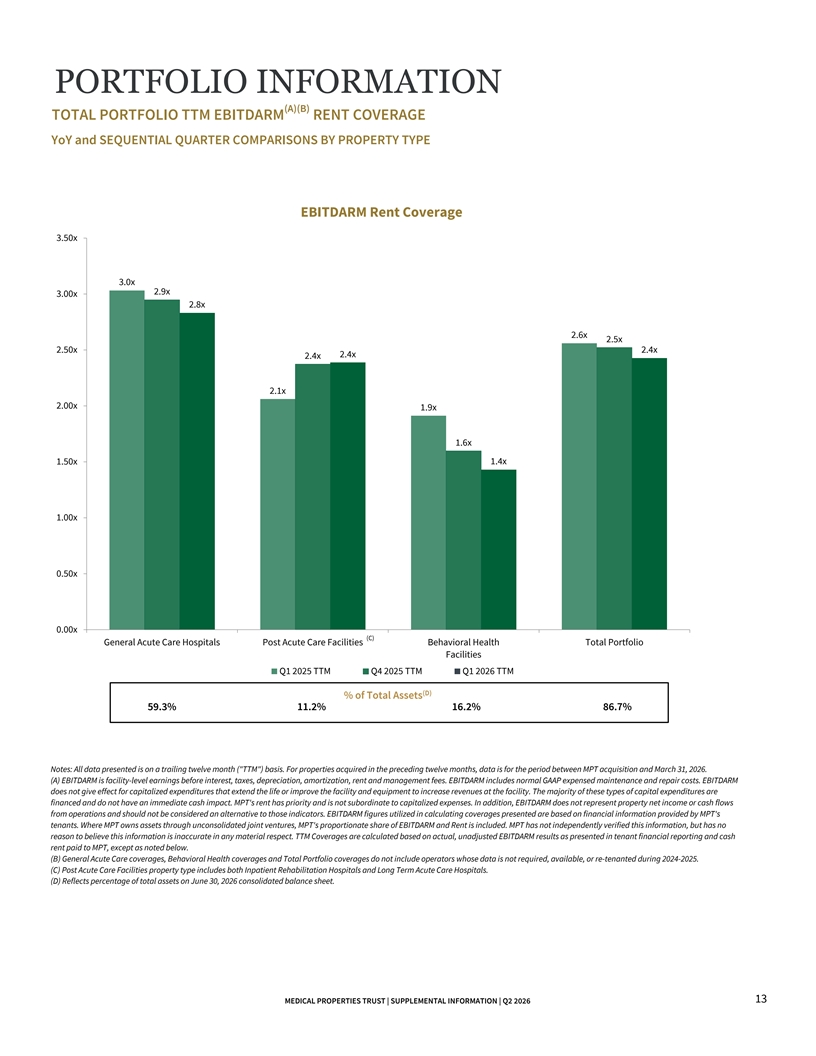
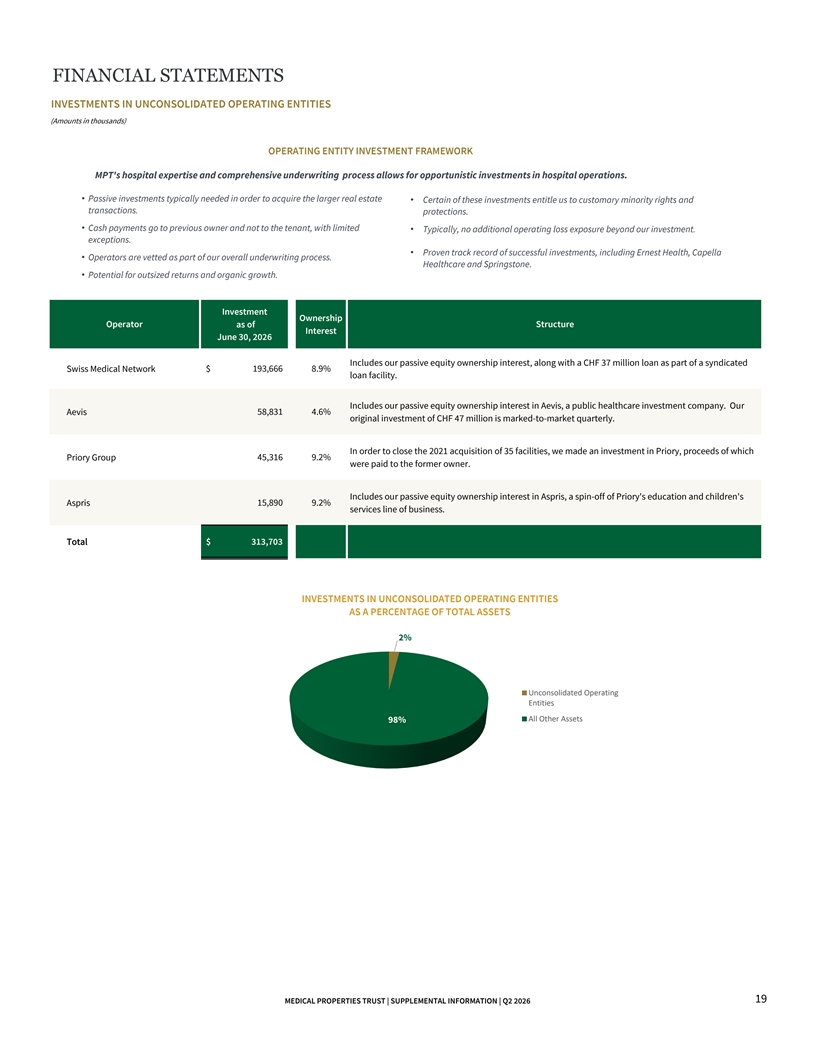
Now let me begin with the most significant update. Today we announced a comprehensive refinancing transaction that extends $2.4 billion of debt maturities to 2032, significantly reducing near-term maturities and positioning us well to pursue a balanced capital allocation strategy moving forward. Steve will discuss this transaction in more detail shortly. Turning to our performance highlights, total portfolio EBITDA coverage remains steady. As we continue to see robust demand for rehabilitation services around the world, our post-acute operators again delivered the strongest growth in the portfolio, with EBITDA increasing more than $70 million year over year, led by a 24% increase in median and a 13 percent increase in earnest health. General acute performance was stable. Behavioral health remains a source of pressure on the overall portfolio. Despite the increased importance and demand for these services, we continue to see around the world. In the UK market especially, revenue continues to be impacted by funding pressures at the NHS as the new administration in the UK works to rebalance its entire budget. I spent last week in the UK spending time with many of our operators there. I walked away from those meetings impressed with the level of activity across those facilities, confident in the opportunities for high quality general acute providers, and encouraged that behavioral market remains a compelling long-term investment. As most of you know, our Swiss joint venture went public this summer. It is now listed on the Six Exchange. Infracore continues to see attractive opportunities for growth, and the company was able to access capital for further growth. We retain a significant ownership position in Infracore and remain bullish on Switzerland and look forward to seeing our overall investments grow there. Finally, to further strengthen our portfolio, we consolidated all of our Scion Health, general acute hospitals, and LifePoint leases into one LifePoint master lease. As a part of this conversion, Scion transitioned certain MPT-owned acute hospitals to LifePoint, and we are pleased with the resulting single lease relationship with a mature operator with an enhanced credit profile. With the strong trends we continue to see across our diverse portfolio of operators, the proving enduring value of our assets, and a plan to clear the runway of debt maturities until late 2028, we are well positioned to achieve our goal of over 1 billion annualized cash rent by the end of the year and to create value for the shareholders moving forward. Rosa?
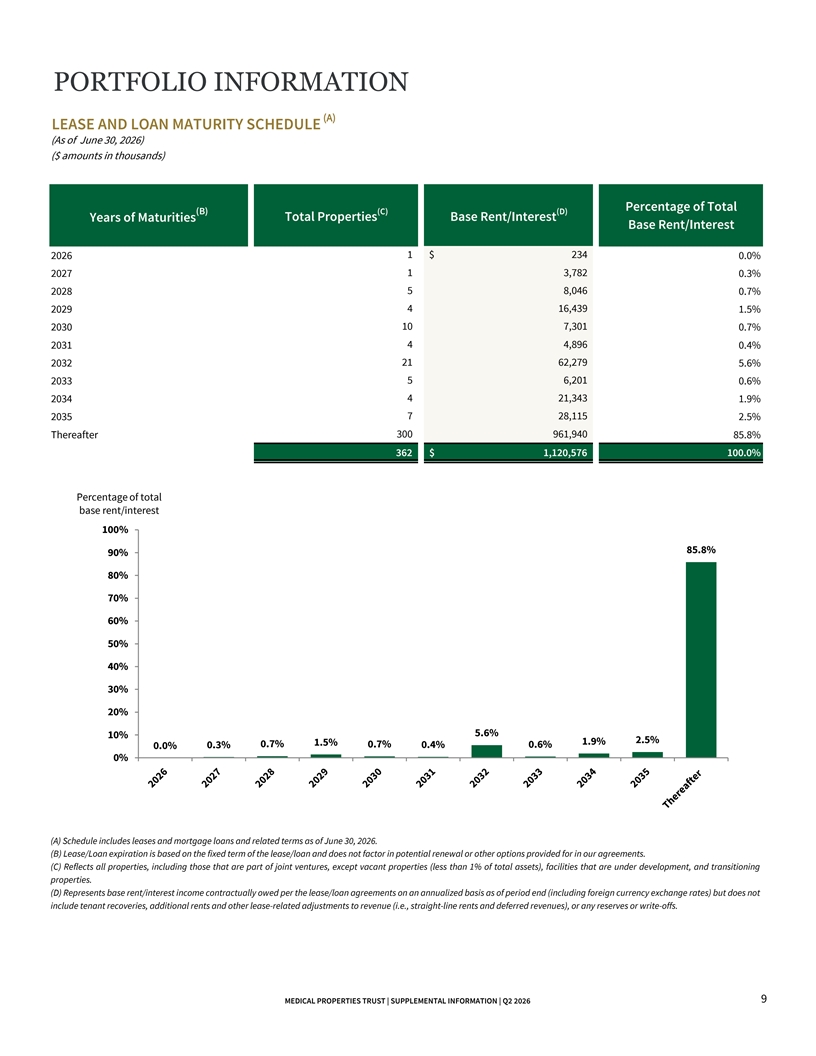
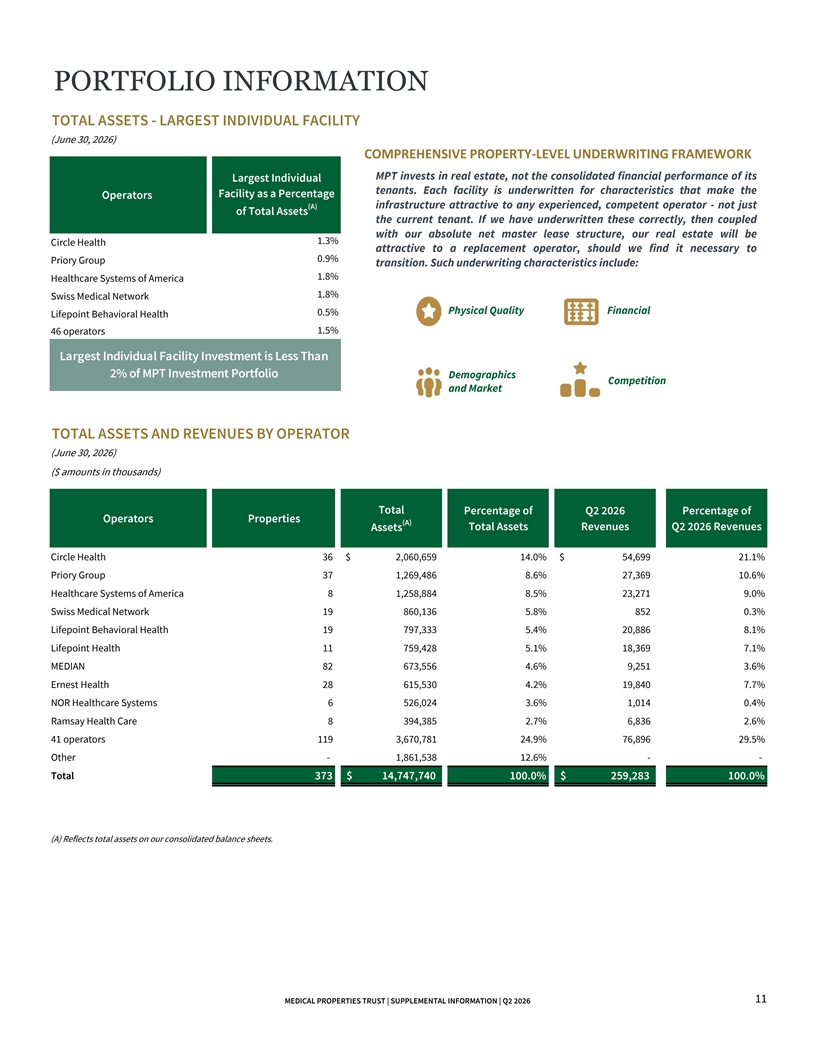
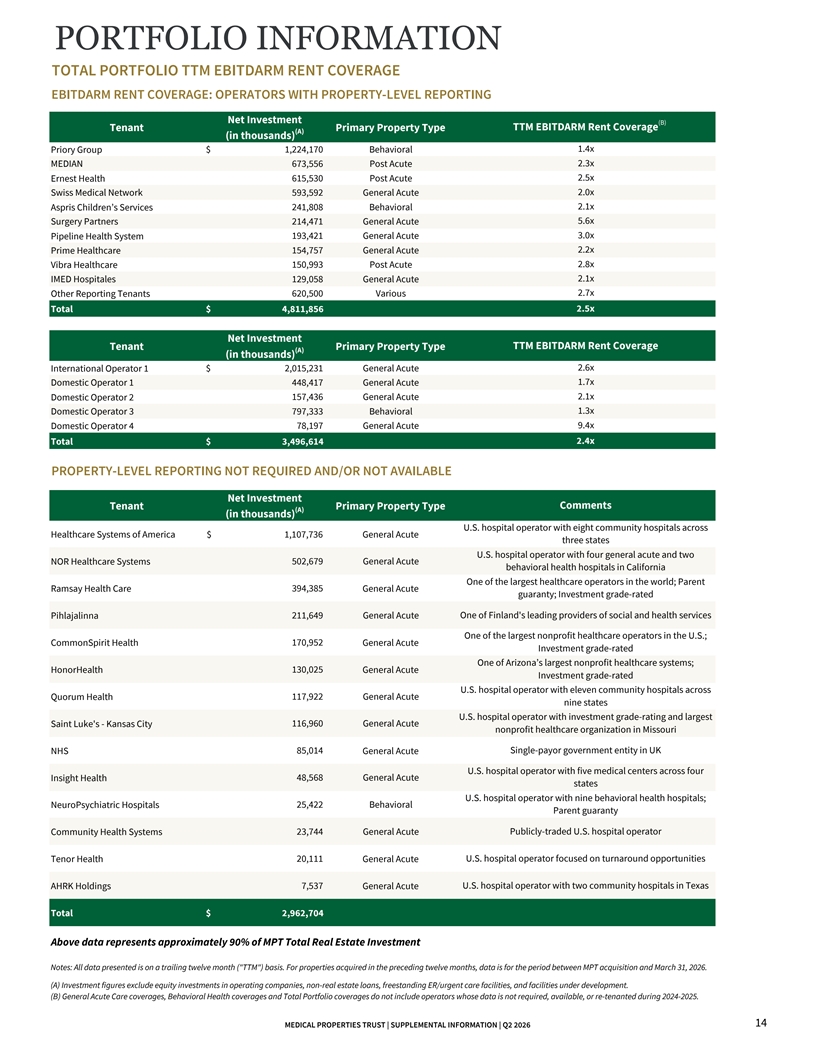
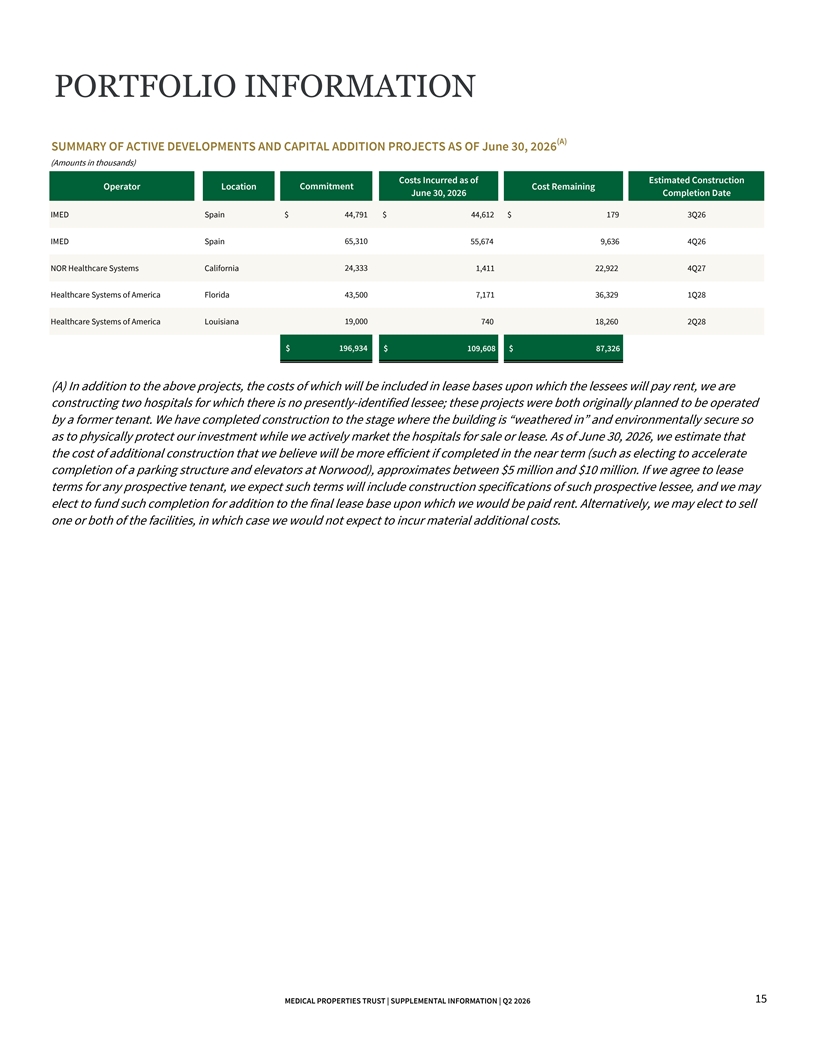
Thank you, Ed. As usual, I will walk through the trends we are seeing, the continued progress of our recently transitioned operators and the steps tenants are taking to enhance performance. Across our core portfolio, performance trends remain broadly stable. General acute operators still comprise the majority of the portfolio and reported aggregate EBIT DARM coverage of 2.8 times during the quarter. As Ed mentioned, our post-acute portfolio delivered another really strong performance with coverage of 2.4 times. Finally, our behavioral portfolio coverage was down slightly to 1.4 times, reflecting the discrete headwinds in the UK and US markets that we have discussed all year. For individual operator coverage details, we would encourage you to review the supplemental published on the Investor Relations page of our website. Our international portfolio continues to provide meaningful stability. Swiss Medical Network, Median, and Circle continue to produce strong, stable earnings, executing on their respective growth and innovation strategies. Swiss Medical Network is advancing its integrated care strategy with revenue growth supported by recent acquisitions, and an ongoing shift toward higher value outpatient and primary care. In Germany, median continues to build on its momentum, with year-to-date EBITDA running ahead of budget. At Priory, proactive measures are being taken to address challenges related to the previously discussed shift in NHS referral patterns. With the ongoing budget constraints in the UK, management is focused on implementing even more disciplined cost control measures and optimizing services to better align with demand. Turning to the US, NOR continues to produce strong results. NOR began paying 50% contractual rent in June. Operationally, nor delivered encouraging momentum with admissions, emergency department visits, and surgeries all higher year-over-year, reflecting volume recovery across the platform. The emergency department project at Culver City is progressing and remains scheduled to open in the fourth quarter of 2027. HSA, which operates hospitals in Florida, Louisiana, and Texas, saw mixed results in the second quarter due to certain disruptions that caused lower cash collections and volume declines in some markets. First, the Meditech EMR conversion caused a temporary inability to bill and collect cash for a period during the month of May, resulting in lower collections in May and June. Additionally, prior to the conversion, HSA transitioned its revenue cycle management to an outsourced firm. And because HSA operates in markets where they serve an above average number of indigent patients, reliance on supplemental payments from federal and state agencies is necessary. These payments are not always predictable and can therefore be a strain on cash flows. That was evident when the Florida supplemental funding that was due in April was delayed until August, which caused further short-term pressure on HSA's liquidity. With the Meditech conversion largely behind them, HSA has brought revenue cycle management back in-house and expects to improve revenue cycle and operational efficiency in the coming months. While cash collections are still lagging, HSA has received significant payments from the Florida Supplemental Funding Program in August, enabling them to begin repayment of the working capital advances we made during the quarter. While trailing 12-month EBITDA to cash rent coverage of two times, we remain cautiously optimistic about the trajectory of HSA and will continue carefully monitoring their operations. Our U.S. post-acute portfolio remains an area of strength. Earnest Health is a standout, and we're excited to see Earnest continue to grow with its acquisition of Reunion Rehabilitation Hospitals, adding seven hospitals with closing expected this summer. Finally, we remain confident in the long-term earnings power of these assets and in our path toward normalized rent across the portfolio. With that, I'll turn it over to Kevin.
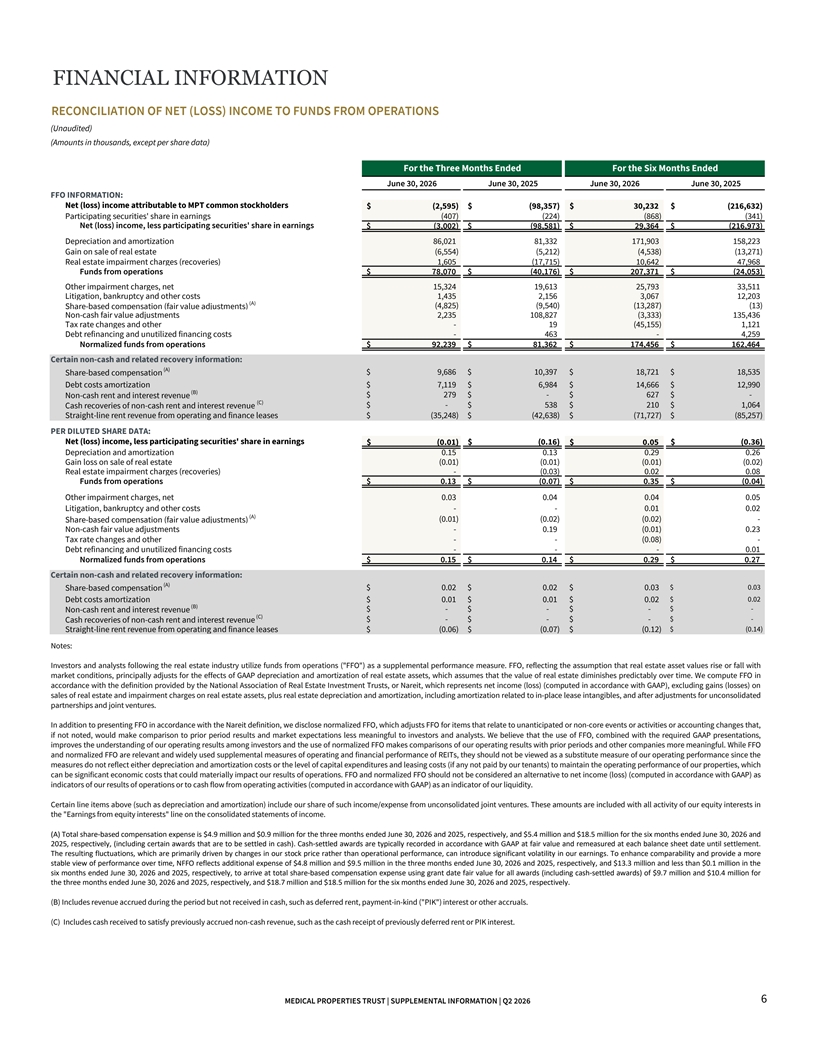
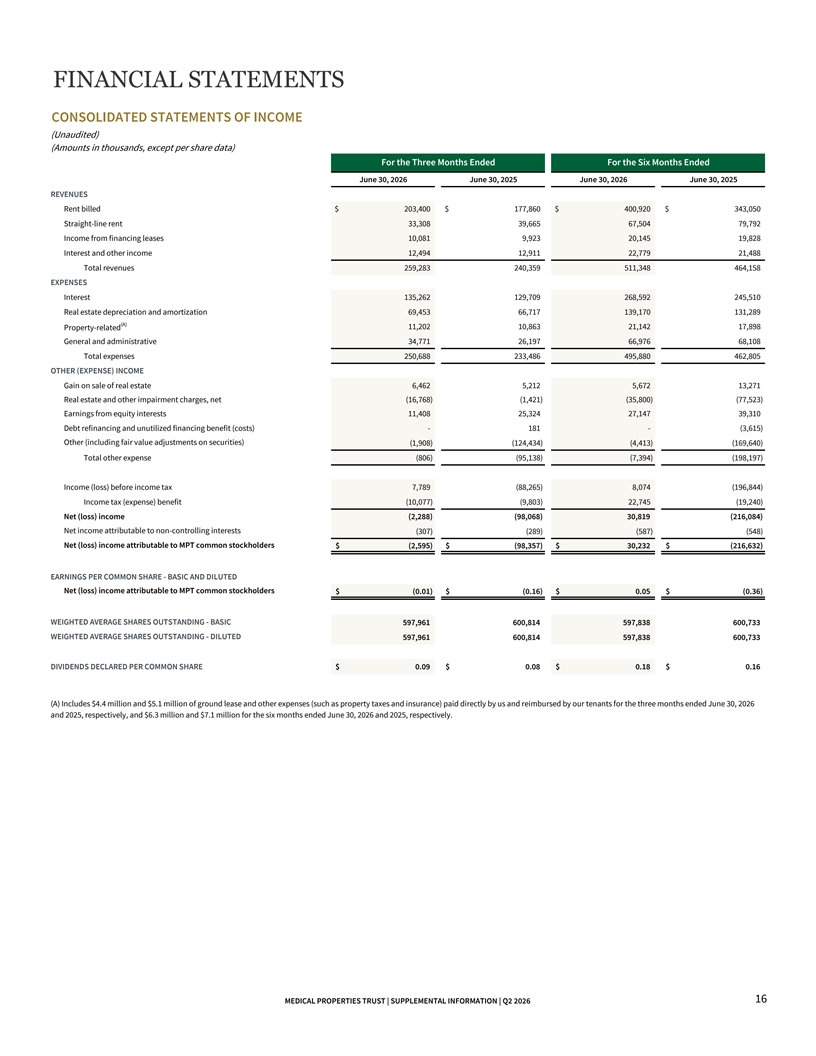
Thank you, Rosa. Today, we reported normalized FFO of $0.15 per share for the second quarter of 2026, which was in line with our expectations as last quarter's results were $0.14 per share, and we expected the rent from HSA and NOOR to continue to increase in accordance with their lease agreements. As a reminder, HSA is currently paying 75% of their contractual rents, increases to 100% in mid-September, while NOR started paying rent in mid-June equal to 50% of contractual rents, increases to 100% in mid-December. As Ed noted in his remarks, we have combined the LifePoint, LifePoint Behavioral, and all but one Scion post-acute property into a combined single master lease. Cash rent from this combined lease will be basically the same as it was previously. G&A expense for the quarter was higher year over year, primarily driven by stock compensation expense due to the change in fair market value of certain cash total stock awards and the increase in depreciation expense of the corporate headquarters building that was placed in the service during the first quarter of this year. Finally, during the quarter, we impaired approximately $17 million in working capital loans primarily related to the two steward replacement tenants in the Midwest. Steve? Thank you, Kevin.
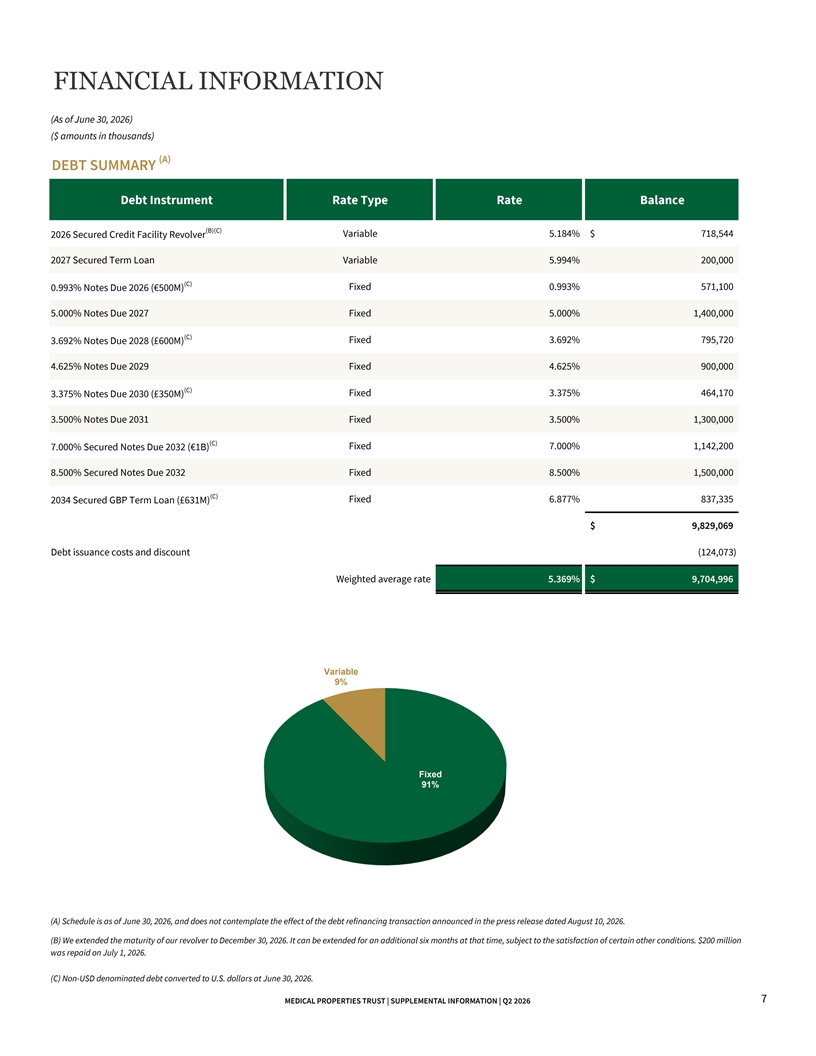
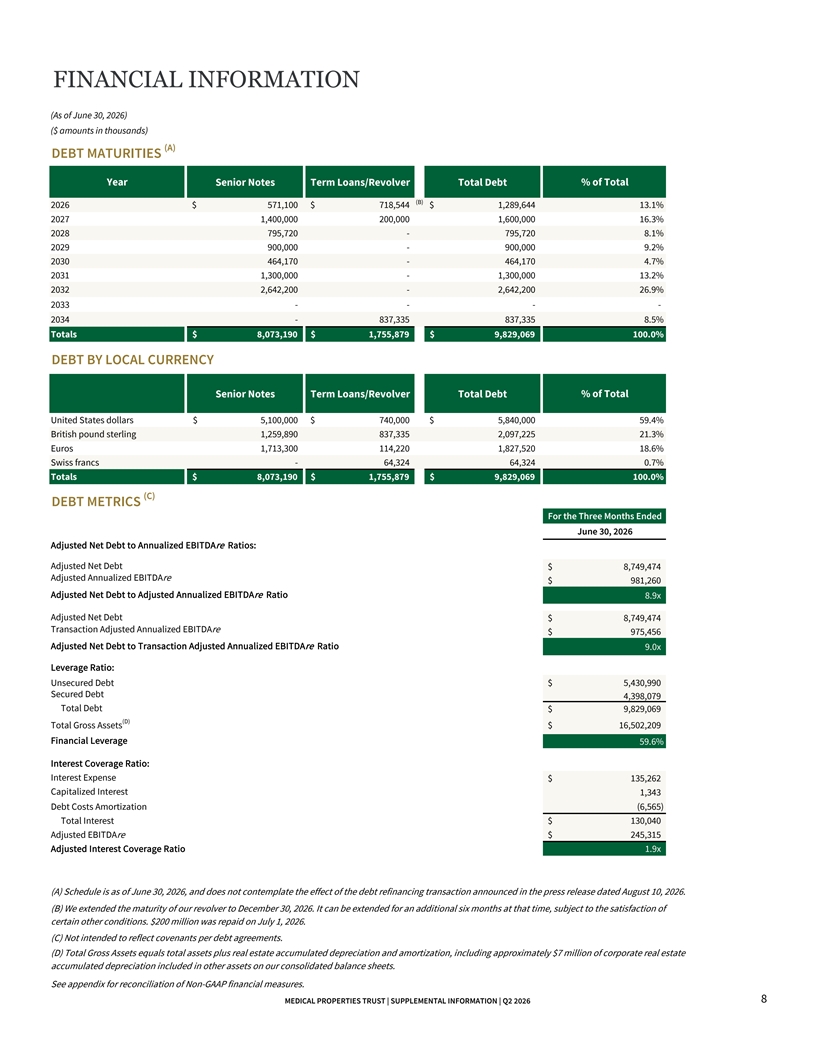
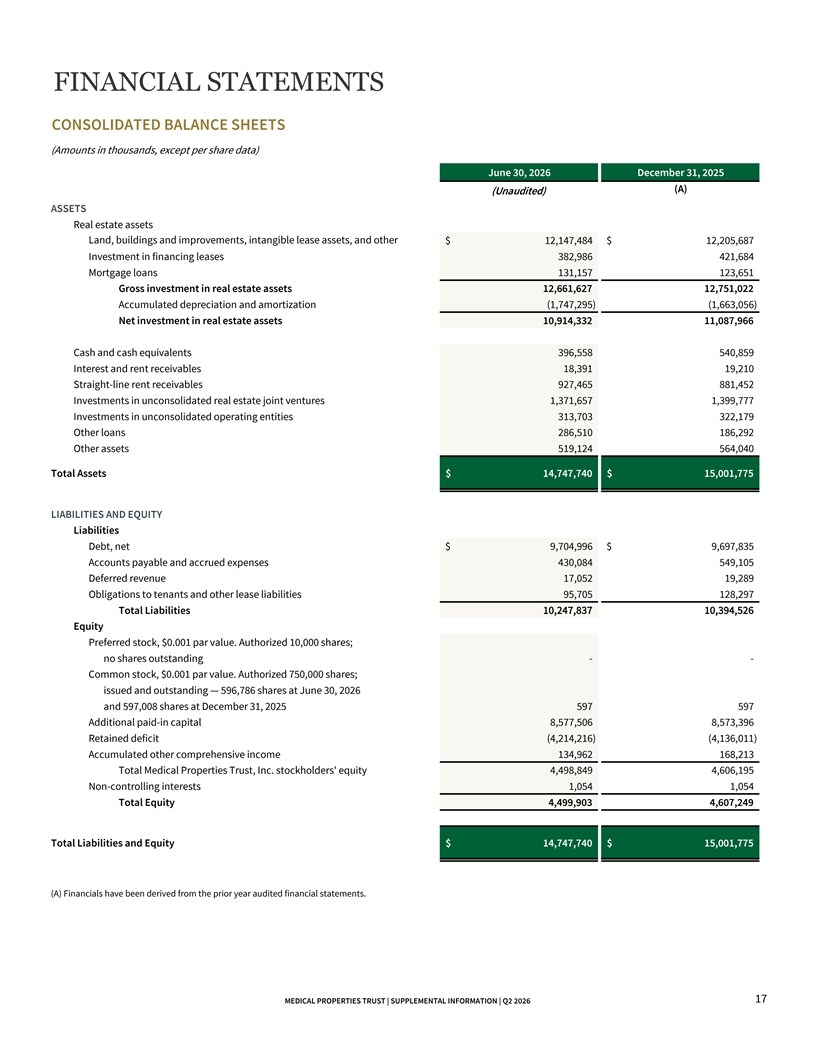
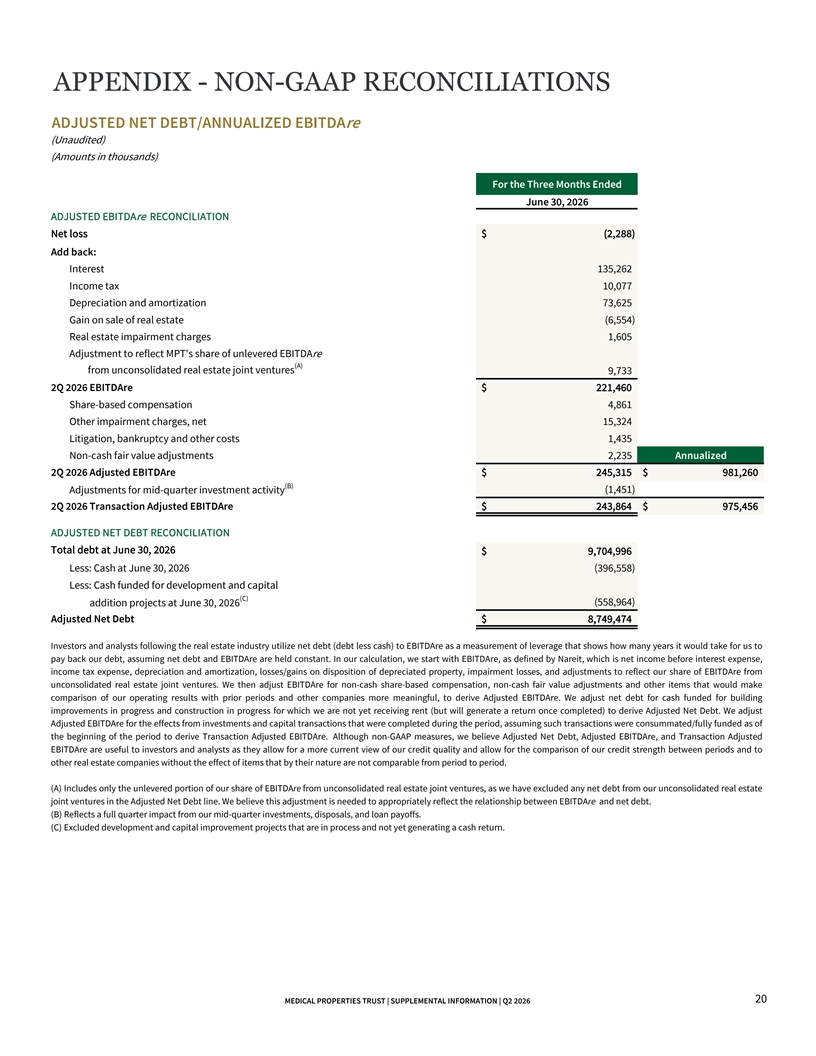
As Ed mentioned, this morning we announced a two-step process to fully satisfy our 2026 and 2027 debt maturities, totaling about $2.7 billion, along with an additional approximately $1.2 billion of longer-dated unsecured notes. Step one, which we expect to complete later today, is the issuance of $2.4 billion in secured notes, the proceeds of which which will be used as follows. First, to fully redeem the upcoming maturity of our 500 million euro in unsecured notes and approximately $738 million, or about 53 percent, of our unsecured notes due in 2027. We will also exchange at a discount another approximately $1.2 billion of longer-dated unsecured notes, reducing gross debt by about $123 million. Step two, which we have commenced and expect to complete in coming weeks, will repay the remainder of the 2027 unsecured notes, complete a new multi-year bank revolver, and repay our $200 million term loan due in June 2027. mpt will then have no debt maturing in 2026 or 2027 in fact our sole maturity over the next three years will be a modest balance of about 600 million dollars of notes due in june 2028 moreover with 1.1 billion dollars of expected liquidity based on recent and expected near-term asset sales we will have substantial flexibility for further delivering in the near term Also importantly, our single bond maintenance covenants that requires 150% of unencumbered assets over unsecured debt will be substantially improved, up to almost 300%, depending on how we deploy our liquidity. The new notes have a coupon of 9.25%, a five-and-a-half-year term that becomes prepayable after two years, and other customary retype provisions, all of which we describe and qualify by reference to the descriptions and documents included in a to-be-filed current report on Form 8K. I'll make a few additional observations about our overall financial position. Once again, and in several ways, sophisticated third-party investors have affirmed that market values of our hospital assets exceed their book values. First, some of the most sophisticated global fixed income investors underwrote the value of the assets that secure the $2.4 billion of notes we just discussed. Moreover, recent transactions, including the IPO of InfraCore in Switzerland, have established market values of our hospital assets above our original investments. In another pending sale that will close imminently, we will receive about $172 million in after-debt cash proceeds, reflecting a 60% increase over our original investment and an IRR of about 34%. up. In addition to these recently completed transactions, we are in discussions with potential buyers of additional assets that, if completed, will generate hundreds of millions of dollars more in sale proceeds at pricing well above our original investments. There's no assurance that these transactions will be completed, but the fact that sophisticated parties are even initially offering this level of pricing is encouraging validation of our overall asset values. Upon completion of these refinancings, we will retain significant additional collateral value and flexibility for future delivery. Just to reiterate, no debt maturities until June of 2028, and then a modest $600 million. Up to $1.1 billion in liquidity, dependent only on completion of certain asset sales that are already in process of being negotiated, and substantial cushion in our UAUD bond covenant that opens up opportunities for certain additional delevering strategies. In closing, our business model remains attractive, and growth opportunities continue to present themselves in our markets. With our assets continuing to demonstrate attractive market value and with significant liquidity on hand, we are well positioned to continue to focus on reducing debt while capitalizing on strategic growth opportunities. With that, we will open up the call for questions. Operator?
Operator
We will now begin the question and answer session. Please limit yourself to one question and one follow-up. If you would like to ask a question please press star one to raise your hand to withdraw your question press star one again we ask that you pick up your handset when asking a question to allow for optimum sound quality if you are muted locally please remember to unmute your device please stand by while we compile the Q&A roster. Your first question comes from the line of Mike Mueller with JPMorgan. Mike, please go ahead.
Yeah, thanks. Hi. So I guess for the balance of the 2027 notes that you're looking to pay off, is that just going on basically a new credit line? That's going to be the near-term mechanism? And what's going to be the rate on that facility?
No, that's not the expectation, Mike. In fact, phase two or step two, as we call it, will include, as I noted, the repayment of those 2027 notes, but it will not be just based on using the credit line.
Okay. Will it be all from asset sales?
No, we have a number of options that we've always had, including asset sales, uh including liquidity that we have in in and including additional uh secure debt opportunities got it okay um okay thank you your next question comes from the line of john kilikowski with wells fargo john your line is open please go ahead thank you hi good morning um just to clarify you know as i'm looking at the press release we talked through in the opening remarks about 26 and 27 but this also talks about refinancing the 27 through 21 or excuse me 2031 notes could you just kind of clarify that time and then and when this goes into place and then the pro forma cash interest from this move uh john we're having a lot of trouble getting your question here um and you know maybe you can try speaking up a little bit your yours was very very solved apologies can you hear me better now thank you all right thank you um i'm the opening remarks focused mostly on the 26 and 27 maturities but i'm also seeing commentary in the press release about the 27 through 2031 notes could you just talk through the timing and clarify is all of that being refined now as well and the pro forma cash interest number following this this move No, it comes in two steps.
Step one is the $2.4 billion that we announced this morning. That will fully prepay the 26s and cash and exchange combined of about $740 million of the 27s. And then step next, which we expect to complete in the coming weeks, will satisfy the remainder of the 27s. And in addition, as we mentioned during step one, we'll also exchange about a billion and a half dollars of the longer dated notes.
Okay. Very helpful. Thank you.
Operator
Your next question comes from the line of Michael Carroll with RBC Capital Markets. Michael, please go ahead.
Yeah, thanks. Can you guys provide some more color on the HSA situation? I mean, how confident are you that Conifer can push cash collections and where they need to be?
I mean, I believe you indicated last quarter that they were up to 82 percent from 78 percent, but it needs to be in the 90 plus percent range and it sounds like it dipped in may and june to do the um some of the transfers that you're talking about yeah mike it's been a lot slower than we hoped it would be it's still in the 80s uh the if you look from an operational the good news from an operational standpoint as rosa pointed out they're generating two times coverage but that doesn't do you any good if you're not collecting the cash and then you had the late payments from florida if you add all of that in together, we're cautiously optimistic, but they still have got to improve the cash collections greatly.
So what gives you confidence that they're able to do that? And did they already receive the Florida DPP payments? And that's how the first 20 million got paid back. And can you talk about how and when you expect the next 20 million will be paid? And it was unclear in the press release. I mean, is 10 million of that just going to be outstanding? or will that be repaid soon too?
So they have received approximately half of the DPP money from Florida. The other could come in as early as today, but certainly in the next week or so. And with that money, they'll pay back the additional $20 million. And then they will have the remaining $10 million repaid sometime in the next quarter.
And then just lastly from me i know nor was supposed to start paying rent in june um did they pay that rent um and are they current right now too yes nor nor did pay the rent and nor is doing well remember those are two different entities nor and hsa nor's operations are doing very well your next question comes from the line of michael diana with maxim group your line is open please go ahead Thank you.
I wanted to ask about asset sales. Could you just read a lot of moving parts? Could you review for us the asset sales you know you're going to make, the asset sales that you're probably going to make, and the calculus that you're using when you're determining whether or not to sell an asset?
So what we know has happened and is happening, in fact, as we speak, we mentioned the InfraCore transaction, which generates about 140, has already generated about $140 million in proceeds for us. And I'll just point out again, I'll reiterate that that pricing tested by the market was at a higher valuation than we carried the assets on our books. Secondly, today, a transaction is closing that we are regrettably not able to identify, but will be within a matter of hours. But we can tell you a transaction is closing that will generate after debt payment about one hundred and seventy two million dollars to us today. That's the transaction that I spoke of that, once again, validates across the portfolio the value of our assets exceeding, sometimes by a significant amount, our original investment. In this case, an aggregate 60% plus gain on our original recording of that investment, representing about a 34% IRR. In addition, we are in various stages of negotiation for a handful of other significantly valued assets, each of which, if they were to trade at the values that we're negotiating, would, again, represent significant gains over not just net depreciated value, but our original investment. We think that could be, realistically, over the next few weeks, another between $200 million and $400 million in cash proceeds. Possibly it could be more than that, but we're relatively confident that we'll be in that additional $200 million to $400 million proceeds level.
And, well, obviously that's very good news on sales value versus book value. what uh what what impact will this have on the income statement broadly so um obviously a great question um and it depends on a number of things that kind of you know self-evident to people in this call uh obviously the the gain on sale in other words we're earning rent typically on these assets based on our original investment. To the extent we can sell for more than that and take those proceeds and apply them to, for example, nine and a quarter percent interest that we just issued this morning, one would think that has a very positive, perhaps, you know, even accretive impact on normalized FFO. Obviously, timing of completion of the secured issuance we announced this morning, timing in terms of step two, the refinance of the bank facility and completion of pay down of the 27s, execution and timing of asset sales, and then further de-levering by use of these asset sale proceeds will all have an impact on go-forward normalized FFO as we'll continue to ramp up of the HSA and NOOR relationships. So as those become more definitive, we'll be able to better predict and return to providing run rate guidance in future quarters.
Okay, great. Thank you very much.
Operator
Your next question comes from the line of Pharrell Granath from Bank of America. Pharrell, your line is open. Please go ahead.
Thank you very much. Good afternoon or morning. My question is on any collateral restrictions. I know you had mentioned some of that in your opening remarks, but hoping that you just dive a little bit deeper on how you're thinking about any of your credit facilities maintenance covenants, as well as what would step two potentially influence on some of those unencumbered headroom that you'd still have available.
So both step one and step two have positive impacts on the UAUD. That really, Farrell is the only maintenance covenant we have. And while it will not go away because that's a bond covenant, the cushion, the headroom it brings, I mentioned earlier, the minimum, the requirement is one and a half times, and we've been in that range, 155 to 160 over the last several quarters, and we expect that with completion of step one, again, which will happen very likely today, that will go all the way up to an actual of almost 200% and completion of step next, we'll drive it up again as much as to 300%. So what that does is give us additional flexibility to use different strategies and give us the opportunity to further de-lever, which is the goal. The goal is not simply to continue to extend maturities, but to actually reduced leverage and these transactions we're announcing this morning take us a very long step toward being able to do that more aggressively.
And my second question is on, I know the Prime Minister of the UK has made some commentary about potentially having social care for all adults over there.
I'm just curious in your conversations that you're mentioning in your recent travels has that been coming up as a concern or actually a tailwind for the companies that are over there yeah so social care is very different than health care social care is primarily focused on end of life and and dementia type items and other items that aren't included in the current nhs services okay thank you your next question comes from the line of Vikram Malhotra with Mizuho.
Operator
Vikram, your line is open. Please go ahead. Good morning.
Thanks so much. Sorry if I joined later and missed this. Do you mind just clarifying, you know, for any additional like the 27 and any future, you know, maturities or other payments, just what the, you know, the thinking is post this transaction?
And I'm sorry, Vikram, the question was about 27?
Yeah, like just after you've done this transaction, you've pushed out the maturities, right? Like you said, there's nothing, you know, now through 26, 26, or I meant post 27. Just maybe give us the latest thinking on, you know, plans that you might sort of, you know, raise additional capital, take care of, you know, additional future maturities.
Well, the primary immediate liquidity comes from the asset sales. that even assuming, which we're not disclosing a new credit facility yet, but even assuming a meaningful decline in our current $1.3 billion revolver, we expect to reduce the out year, and I think this is your question, you're longer dated with the immediate reduction would come from asset sale proceeds.
Yeah, I guess I should have expanded. I meant like you said, look, we want to reduce actual overall leverage and in the view that cash flow maybe takes a bit longer to ramp up from all the transitions or just overall say there's another tenant issue that you haven't called out, but say there's something. I'm just trying to figure out like over the next two years, how to, like, in absolute get net debt and EBITDA down from here, if there's any other plan. And maybe that works into a broader question. As you were contemplating this, any latest thoughts on, I guess, I shouldn't call it simplifying, but maybe thinking the overall portfolio, you know, you've got U.S., you've got global, any thoughts on, like, taking pieces from here and doing a bigger, broader a strategic transaction?
Well, as we've been saying now, really going on a couple of years, we have a number of alternatives. Those really haven't changed with our announcement this morning. We retain all of them. And they include maybe some things that you may be alluding to. There are a couple of ways to easily raise liquidity for debt reduction. One I've described, You know, selling assets. We're doing that. Another is selling equity. Well, we don't think it's the right time to sell equity with the stock where it is. We think the valuation is significantly greater than that. And we think that's proved almost every time we sell an asset, that our assets are significantly more valuable than what's reflected on our balance sheet. So, but it'd be wrong not to acknowledge that that's one way to reduce debt. But we've cleared the runway to continue to be able to improve the operations, continue to see the asset values grow, and continue to pay down debt in ways that aren't so grossly dilutive to selling stock when you think it's not the right time to sell stock.
That's fair. And then just lastly, if I can clarify. So with the sales you're contemplating, like how should we think about where multiples are or cap rates are today? Like what's the broad, the range and how should we think about like a core asset in the U.S. versus maybe one that's most struggling? Maybe just give us some sense of other private markets valuing these assets relative to public.
I think that it goes across the board, but if you look at what Steve mentioned earlier in the call, every single one of the assets that we're in current negotiations with are eventually closed. We worked out marketing them. People came to us. There's a high demand for our assets, both in the U.S. and in Europe.
Operator
Your next question comes from the line of Michael Carroll with RBC Capital Markets.
Yeah, thanks. Steve, where is NPT at on its secured debt ratio. You correct me if I'm wrong here, but I think that covenant is about 40%, and it sounds like with the phase one secured debt issuance, that kind of puts you pretty close to that ratio. So does MPT have capacity to issue additional secured debt via phase two?
We do, but you're absolutely right, Mike. It does drive us up from where we were this morning, which was around 25% to much closer to that 40% level.
So then can you – so I guess will these additional asset sales give you more capacity to make more room on that secure debt ratio? And, I mean, I'm calculating that you're pretty tight where you don't really have much more secure debt. So is there any color on how you can regain additional secure debt via this phase two path?
So just by definition, you're right, Mike. Asset sales would provide more headroom for that. Use of proceeds to reduce debt would provide more headroom for that.
And then just lastly, can you talk about an update related to Norwood? And then what is NPT's cost basis in that asset? I know there is some filing saying that it's about $350 million. I was under the impression it was just above $200 million. Is that just additional dollars that NPT had to put into that asset to kind of weatherize it, which pushed that cost basis up into that mid $300 million range?
Mike, as you know, there's a lot of stuff going on with Norwood and various discussions with the state. We've made public statements. Those are listed on our website, and that's where we'll leave it right now.
Operator
There are no further questions at this time. i will now turn the call back to ed aldag ceo for closing remarks thank you very much for everyone's interest today if you have any additional questions please don't hesitate to reach out to us thank you very much this concludes today's call thank you for attending you may now disconnect