Operator
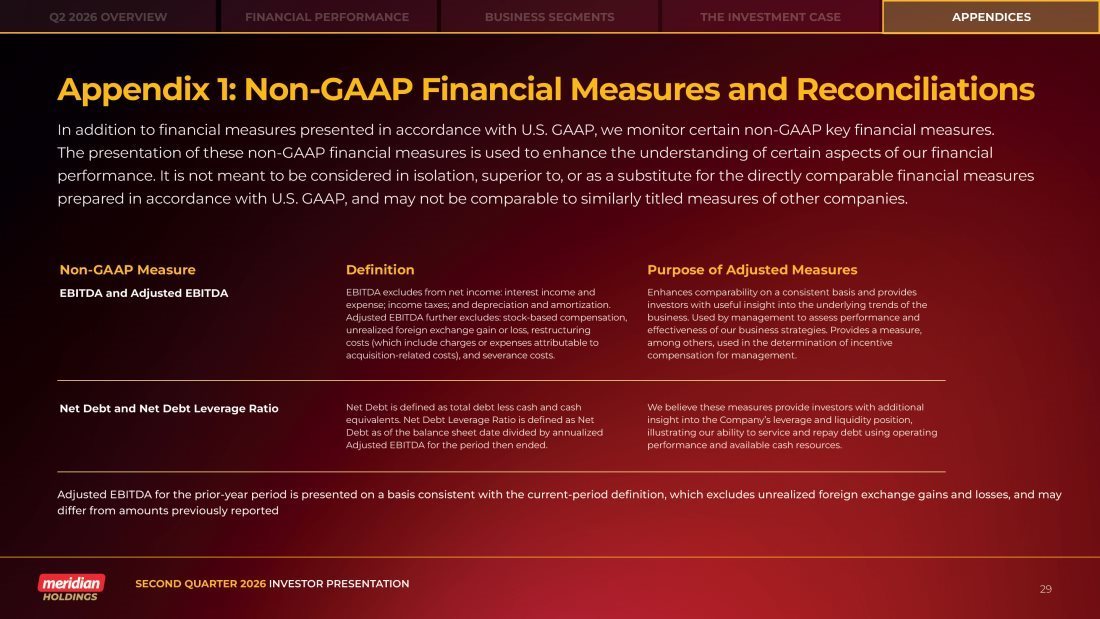
Good morning, everyone, and welcome to Meridian Holdings' second quarter, 2026 earnings call. On today's call are William Scott, Chairman and Interterm Chief Executive Officer of Meridian Holdings, Zoran Miljovic, Chief Executive Officer of Meridian Vet Group, a subsidiary of Meridian Holdings, and Rich Christensen, Chief Financial Officer of Meridian Holdings. Following management's prepared remarks, we will conduct a question-and-answer session. At the conclusion of the call, the recording and supporting materials will be available on the Meridian Holdings Investor Relations website at www.meridian-holdings.com. As a reminder, today's call will contain forward-looking statements within the meaning of applicable securities laws. These statements are based on various assumptions and subject to risks and uncertainties that could cause actual results to differ materially. For a complete discussion of these factors, please refer to our most recent 10-K and 10-Q filings and other public disclosures available at sec.gov. Non-GAAP financial measures will be discussed on today's call. Reconciliations to the nearest GAAP measures can be found on our earnings press release, available on our Investor Relations website. I will now turn the call over to William Scott, Interterm Chief Executive Officer of Meridian Holdings.
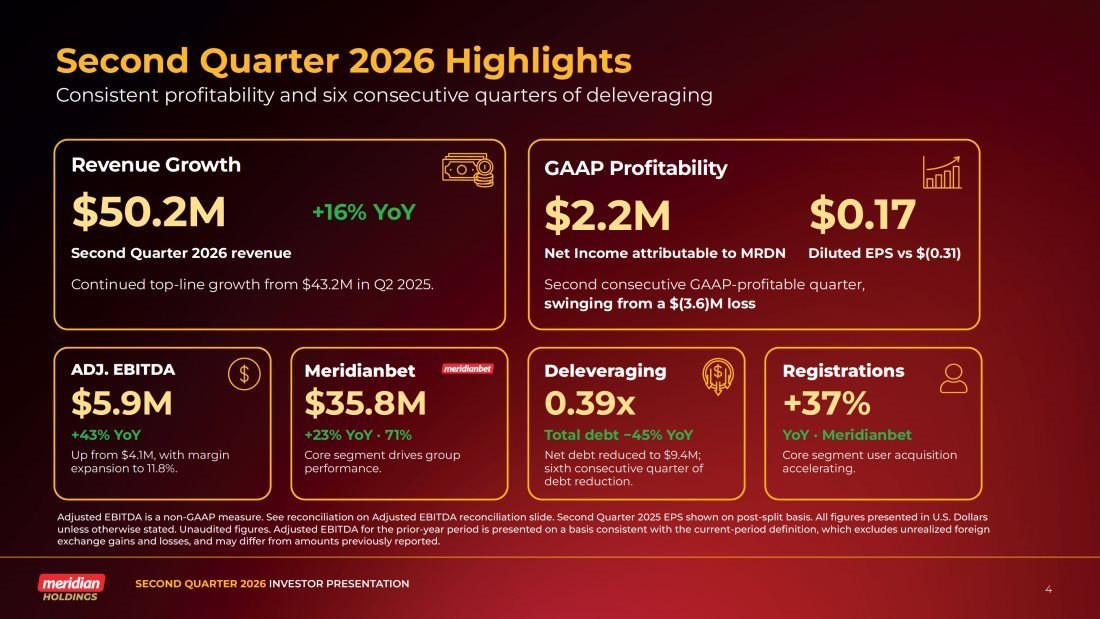
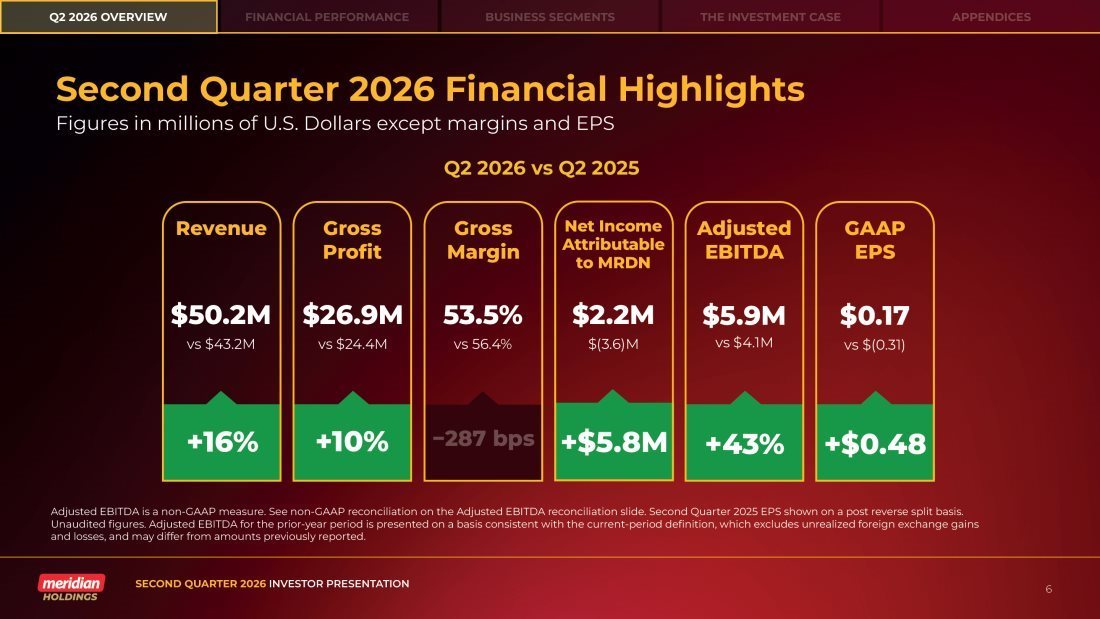
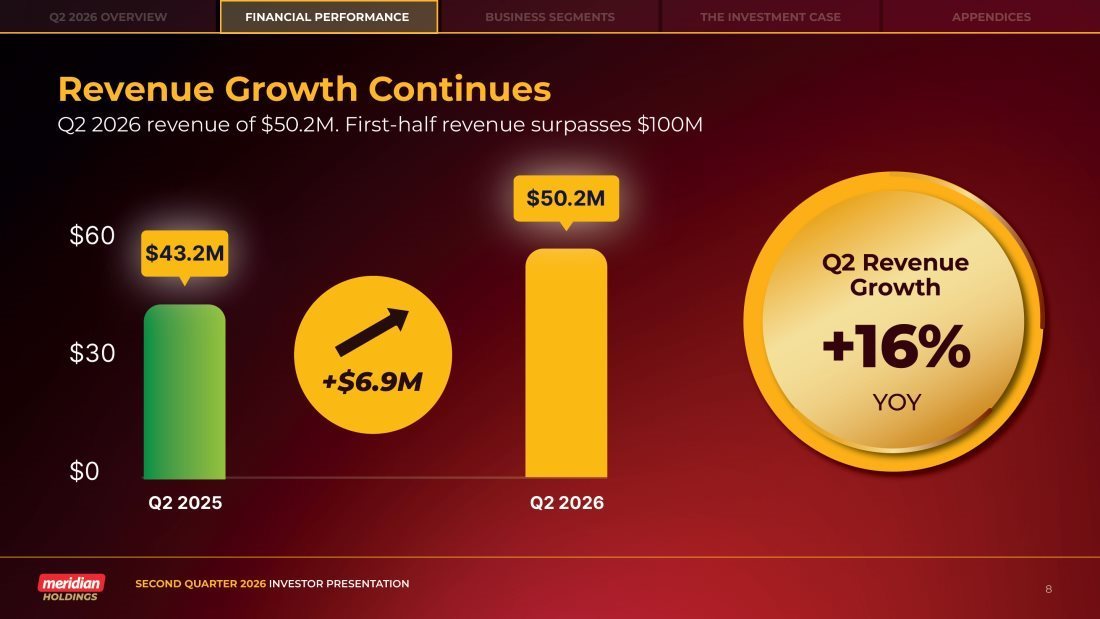
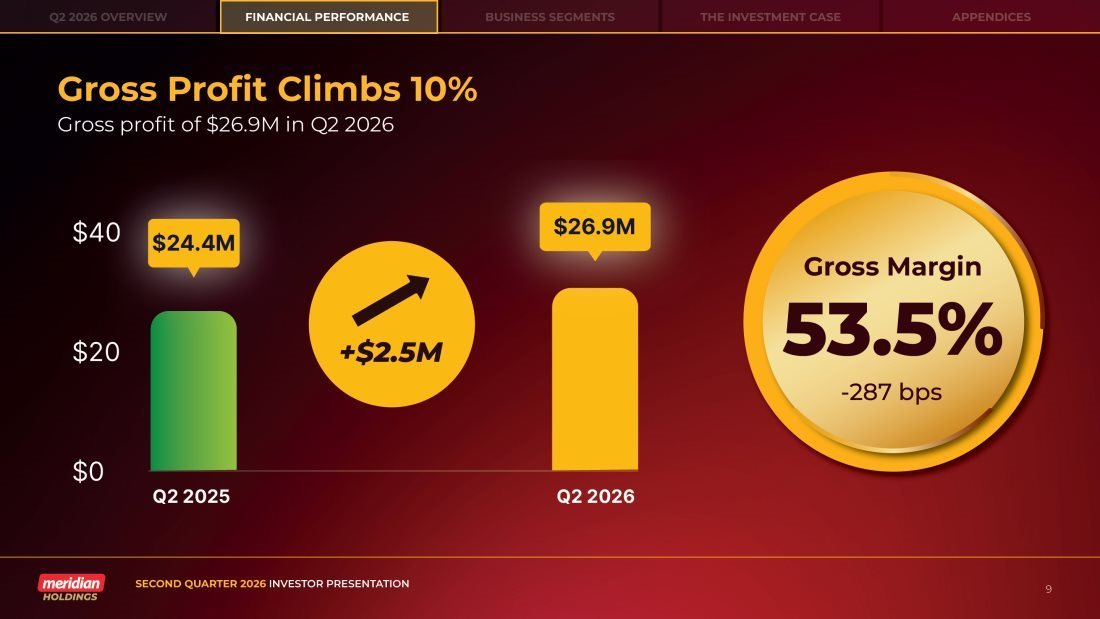
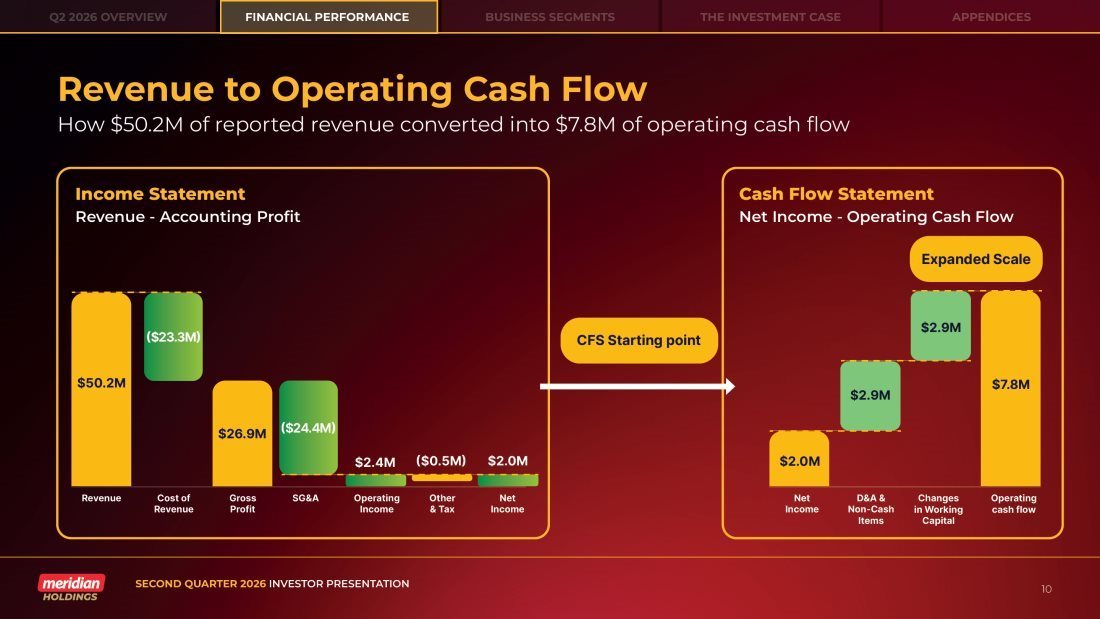
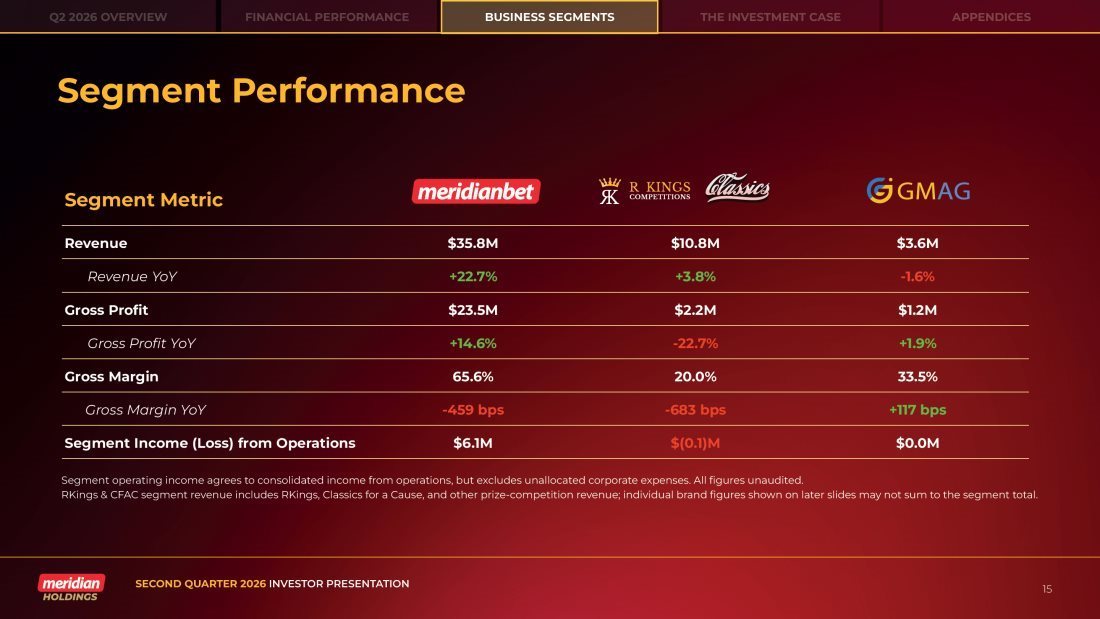
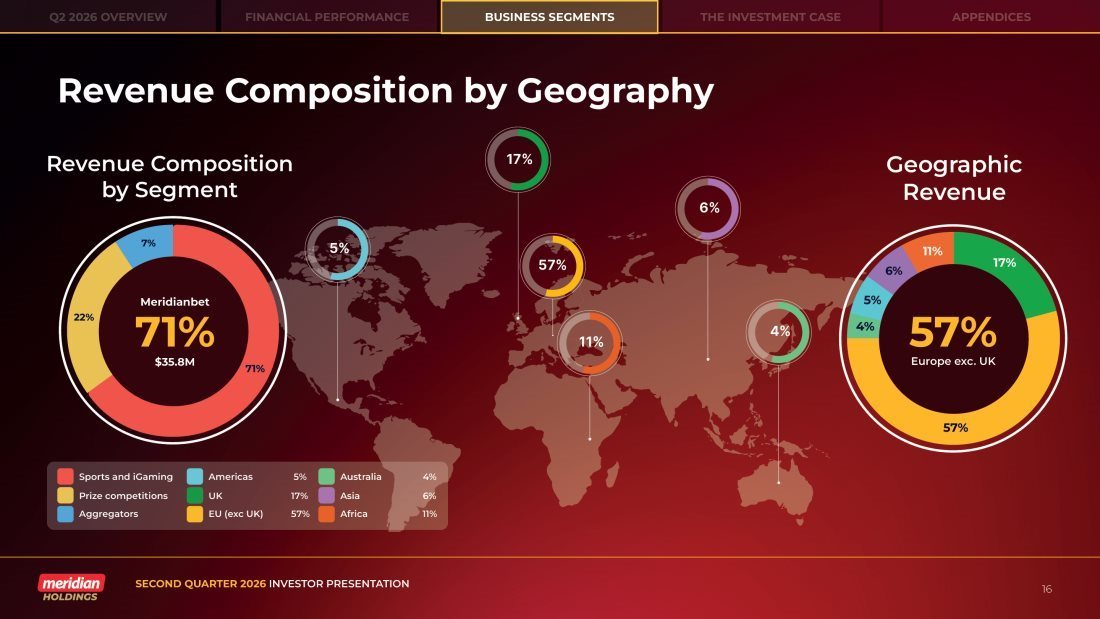
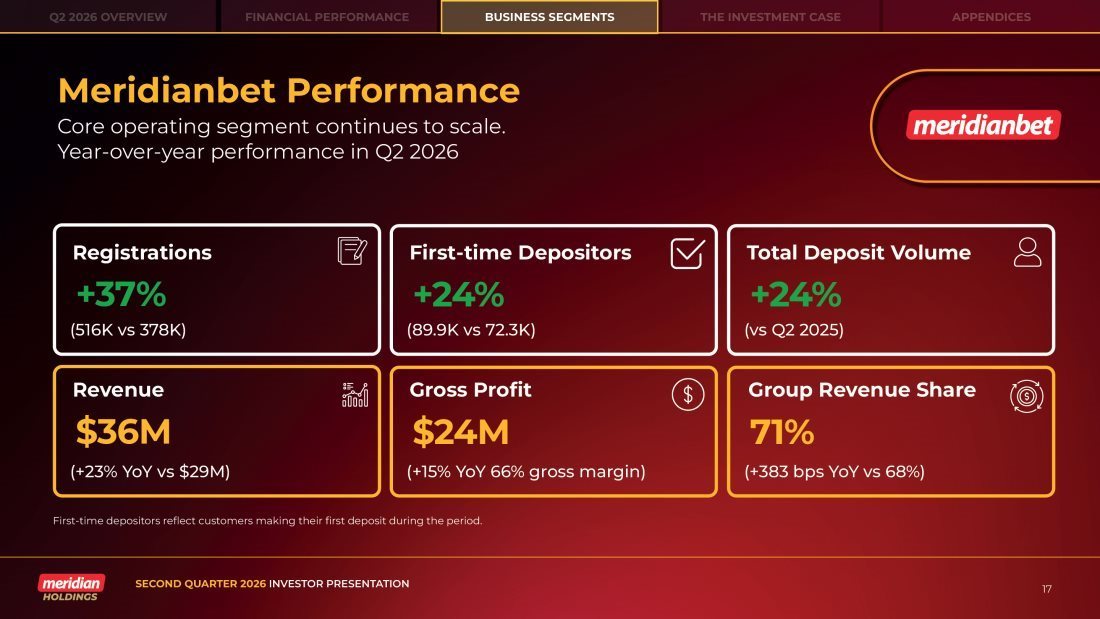
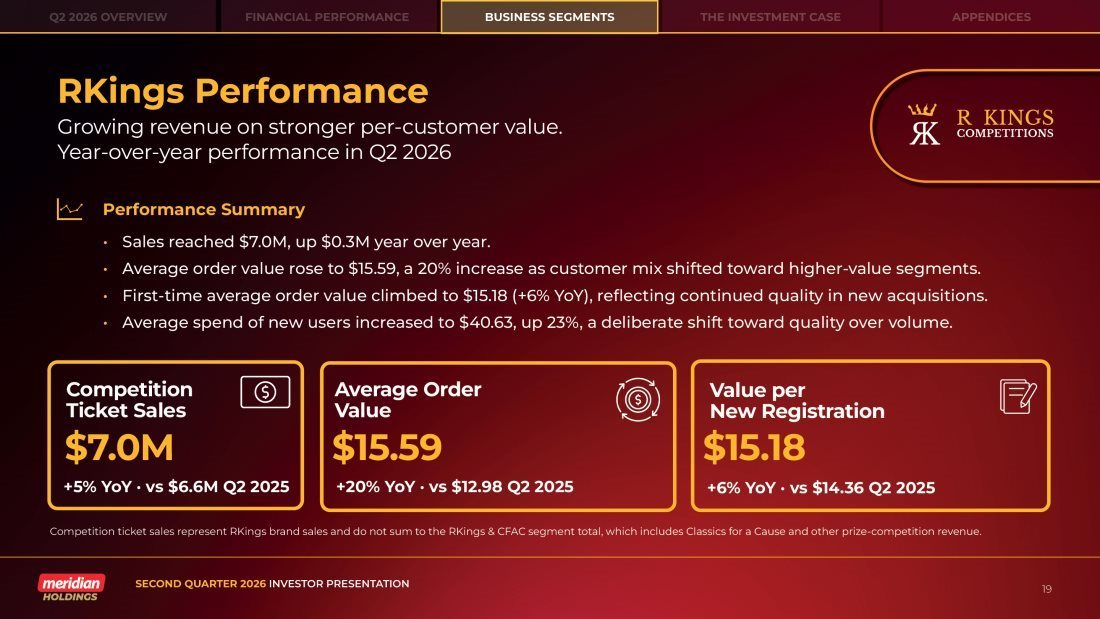
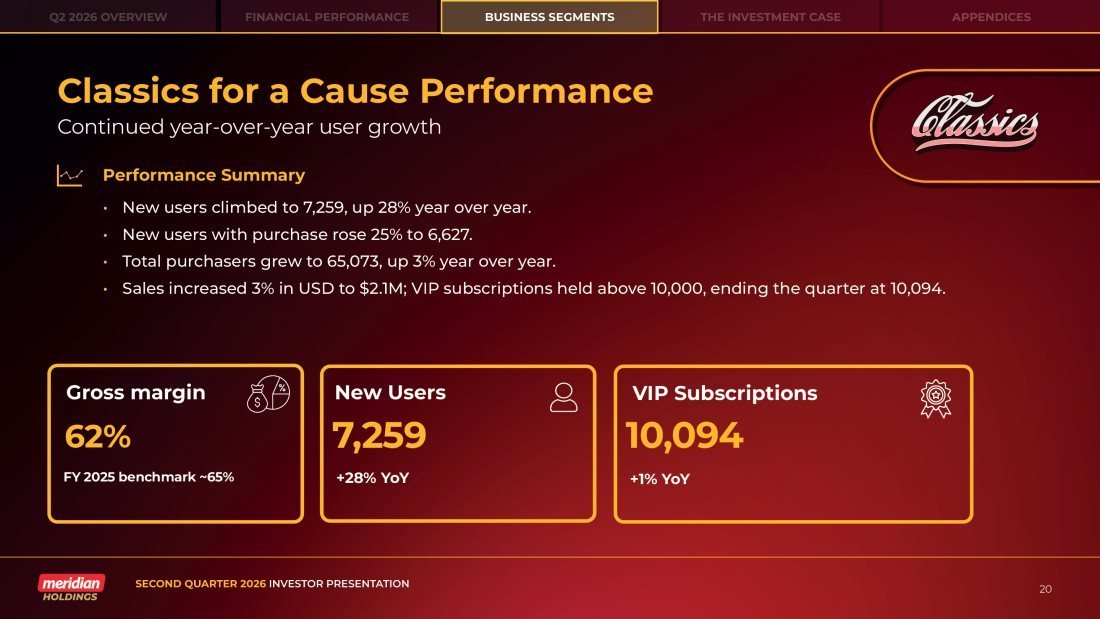
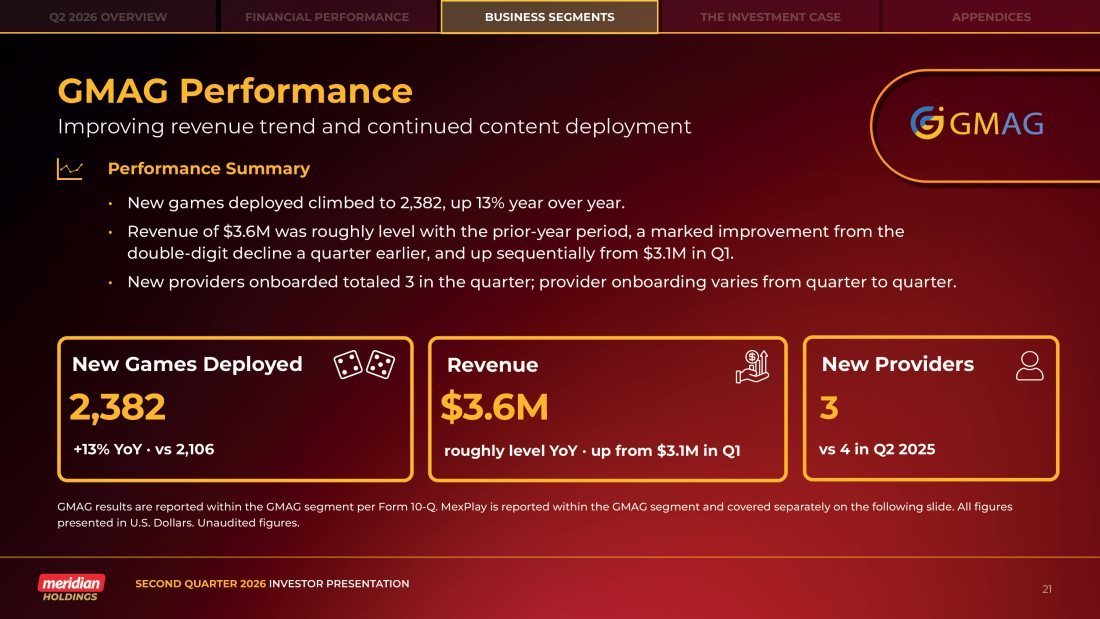
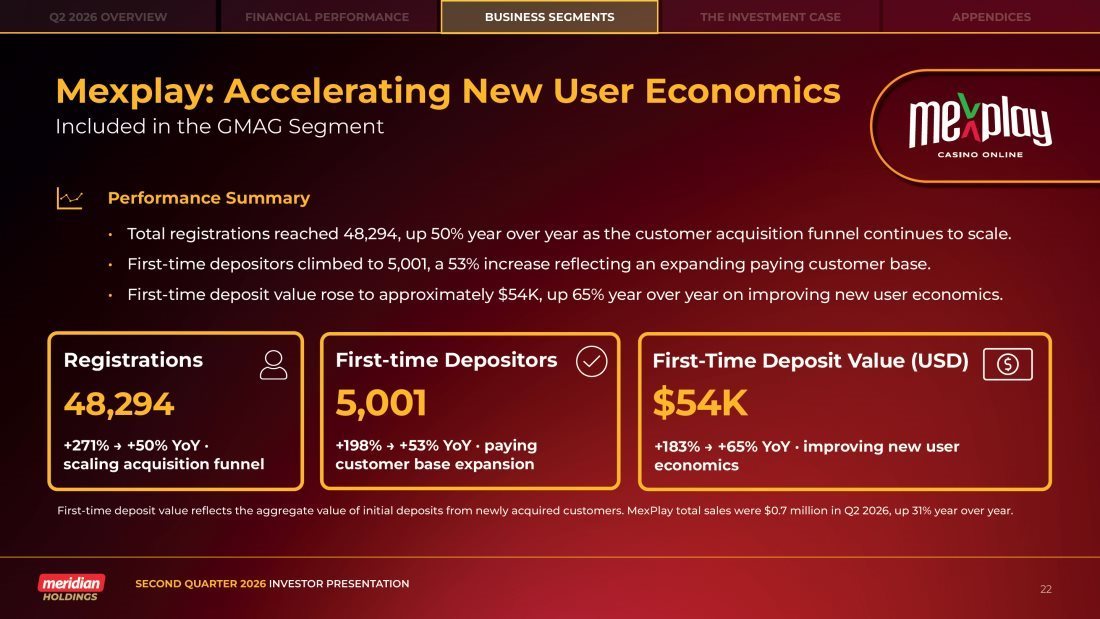
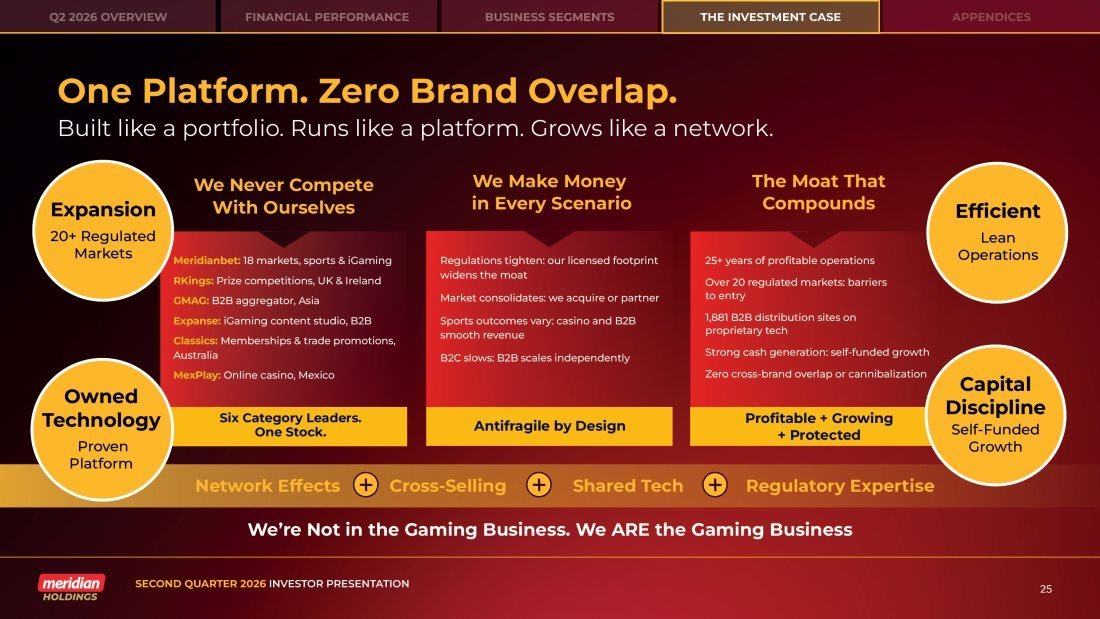
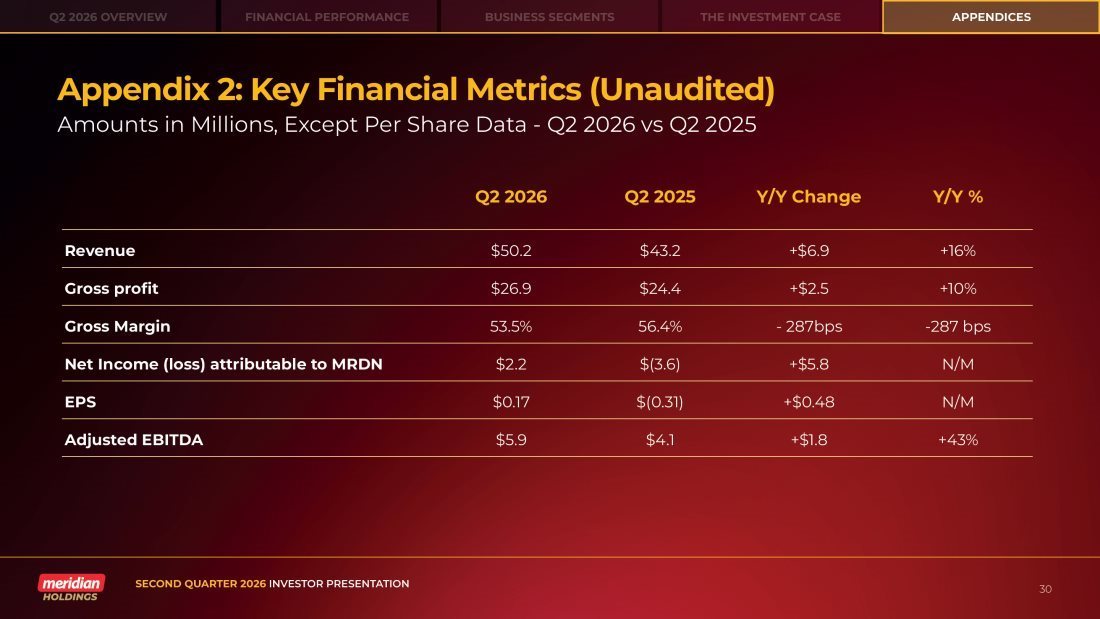
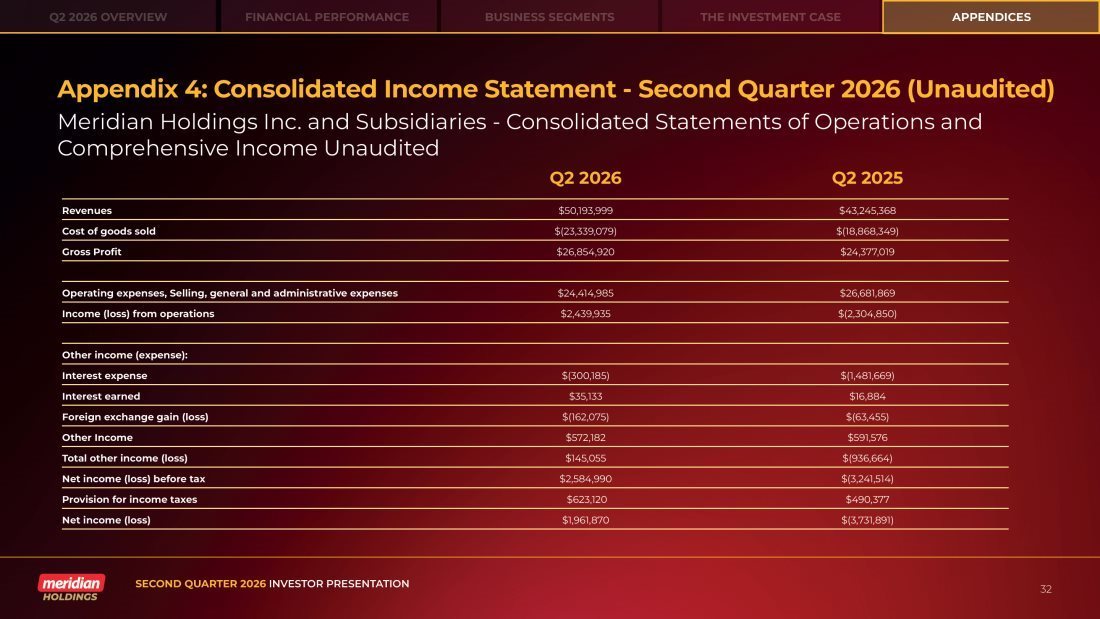
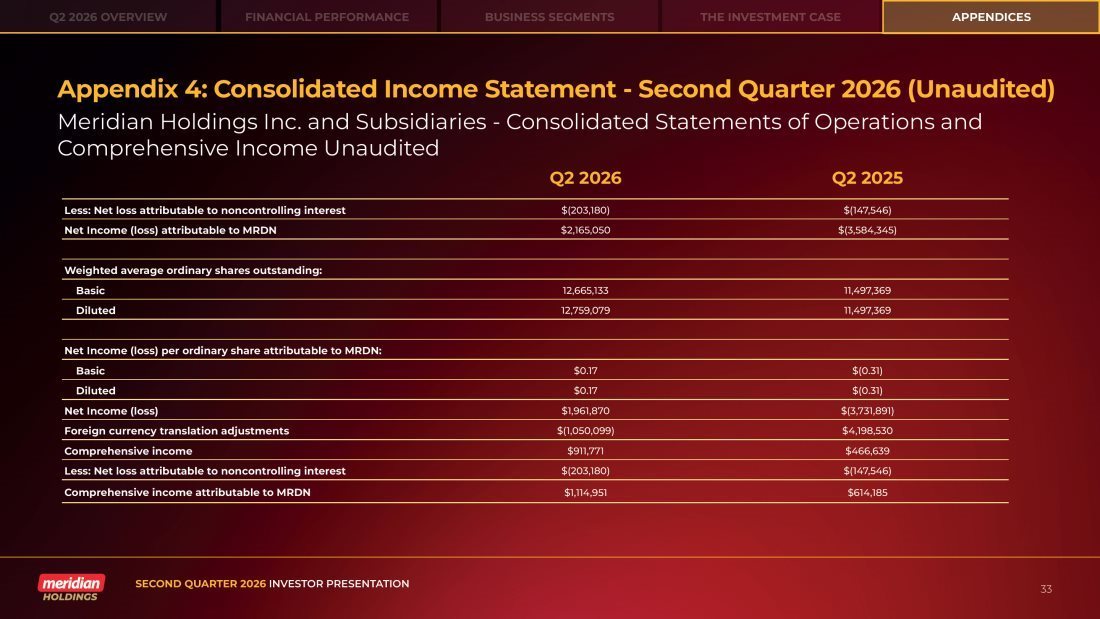
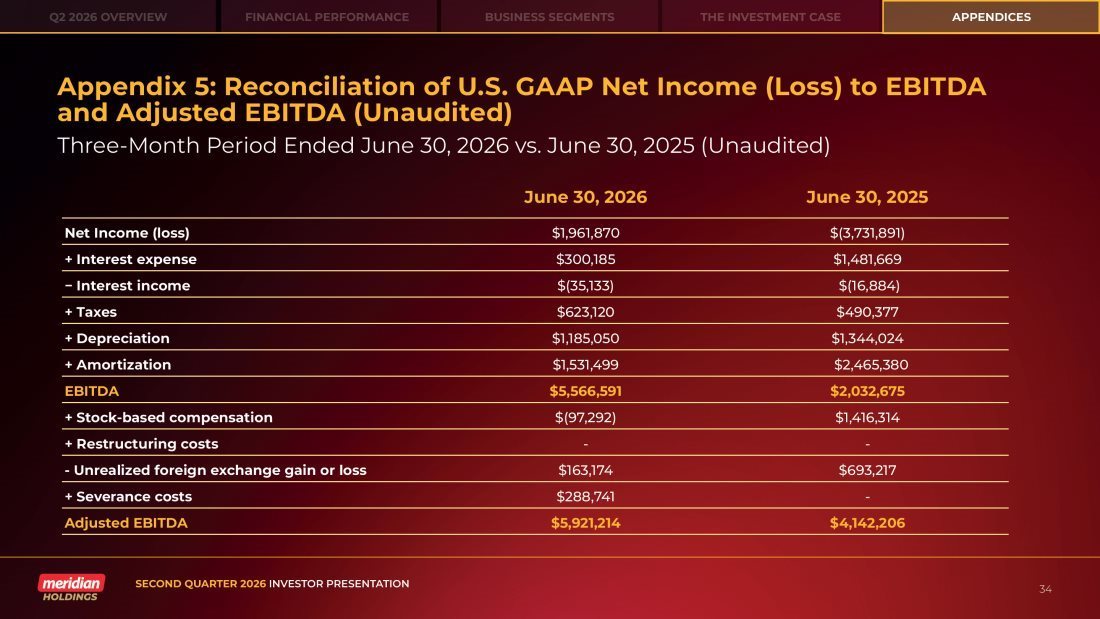
Thank you and good morning, everyone. We appreciate you joining us for our second quarter 2026 earnings call. Let me start with a headline. We've delivered strong revenue, secured a second consecutive quarter of gap profitability, could adjust the EBITDA and further strengthen our balance sheet. Furthermore, the first half of 2026 is the first in our company's history where revenue crossed $100 million. In the second quarter specifically, revenue was $50.2 million and net income attributable to Meridian was $2.2 million, or $0.17 per diluted share, gained a loss of $0.31 per share a year ago. Adjusted EBITDA grew 43% year-on-year to $5.9 million. And importantly, the balance sheet took another major step forward. Net debt fell 65% year-over-year to $9.4 million, marking our sixth consecutive quarter of deleveraging. I also want to be direct about one number that came in modestly below our own expectations. Where a revenue of $50.2 million represents a 60% year-over-year growth, the top line landed slightly below the range we guided it to last quarter. The reason is well understood the fact that in certain markets, the World Cup group stages can produce a run of results that are unusually favorable to bettors, not pressing sports foot margins during that period. We'll have discussed this in greater detail shortly, but the essential point is this. The shortfall came from sorting results, not customer demand. Wagering volume, deposits, and new customer registrations all set records in the quarter. When the volume is at record levels and margins temporarily below the trend, the business is getting stronger, and the margin follows the transactional volume over time. Beyond the quarter itself, the progression we committed to is on track. A year ago, this business reported a quarterly loss. Today, it is profitable with the second quarter running, generating cash at more than three times last year's pace. This is the compounding effect of operational discipline, and it does not depend on any single quarter's small team calendar. Interest expense is down roughly 80% due to the debt we have retired. With that, I'll walk through a bit more detail on the quarter as we speak to our operating segment results. Revenue for the second quarter was $50.2 million, an increase of $6.9 million, or 16%, compared to the $43.2 million in the second quarter of last year. Growth was led by Meridian Met, which delivered $35.8 million, up 23% year-over-year, and accounted for 71% of the total company revenue. For the first half of 2026, revenue was $100.3 million, up 17% year-over-year. This marks the first time that half-month revenue has exceeded $100 million in the company's history. Gross profit was $26.9 million, up 10% year-over-year. Gross margin was 53.5%, compared to 56.4% in the prior year. The margin movement reflects two factors that we will expand on. Forcebook margin compressed by the World Cup environment and casino hold that ran below its prior year rate even as casino wagering volume grew 27%. Both variance items tied to results and hold, not to pricing, competition, or cost structure. We've seen good progress with operating expenses. Selling, general, and administrative expenses were $24.4 million, down 8.5% from $26.7 million in the prior year quarter, even as revenue grew 16%. As a percentage of revenue, SG&A improved from approximately 62% to close to 49%. That is the operational leverage of this model becoming visible. Income from operations was $2.4 million compared to the operating loss of $2.3 million a year ago, a swing of $4.7 million. Interest spent was down to $0.3 million, down approximately 80% from $1.5 million in the prior year quarter, a direct result of the delivery actions taken over the past 18 months. Lower financing costs are now flowing through to the bottom line. Net income attributed to Meridian Holdings was $2.2 million, or $0.17 per diluted share, compared with a net loss of $0.6 million, or a loss of $0.31 per diluted share. in the prior year. This is the second consecutive quarter of gap profitability. Adjusted EBITDA was 5.9 million, up 43% from 4.1 million, with margin expanding approximately 222 basis points to 11.8%. Turning to our segments, Meridian Bet Group delivered revenue of $35.8 billion, up 23% year-over-year, with segment operating income up 91% to $6.1 million. Soren will cover the operational drivers in a moment. Our Arkings and Classics for a Core segment delivered combined revenue of $10.8 million, up 4% year-over-year, representing 22% of company revenue. Our GMAG reporting segment contributed $3.6 million in revenue in line with the prior year period. The segment contains two distinct businesses. The first is our B2B aggregation platform, which deployed 2,382 new games in the quarter, up 13% and added three new providers. The second is Nextplay, our consumer-facing online casino in Mexico, which is reported within the segment, but operated as a separate B2C growth business. Nextplay delivers another strong quarter with revenue up 31%, registrations up 50%, and first-time depositors up 53% year-over-year. With that, I'll pass over to Zoran to discuss MeridianBed Group's operational performance and results in detail.
Speaker 4
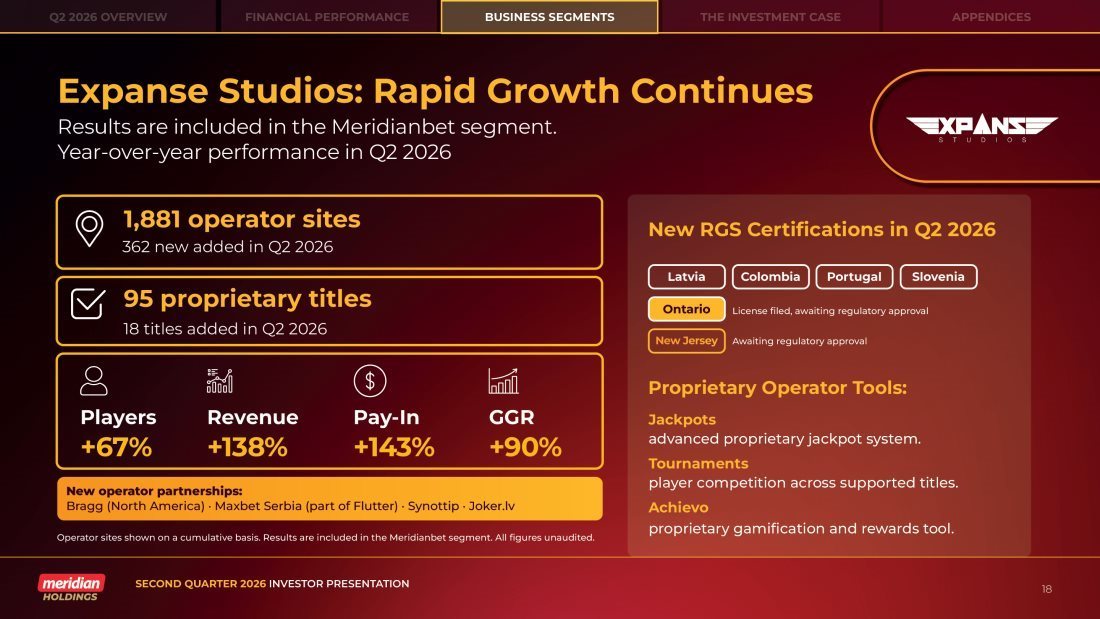
Zoran? Thank you, William. Good morning, everyone. MeridianBed delivered revenue of $35.8 million in the second quarter, up 23% year-over-year, with segment operating income up 91%. However, I would like to start with our customer metrics, which provide a clear indication of the trends this quarter. New customer registrations reached over 516,000, up 37% year-over-year. Additionally, first-time depositors grew 24%, and total deposits volume grew 24% to a record level. Depping gross gaming revenue grew 37% on record wagering activity and casino gross gaming revenue grew 12% on casino wagering volume that was up 27%. By every measure of customer demand, that was the strongest quarter in our history. As William mentioned, top-line revenue in the quarter was modestly the low expectations. This was driven by better-friendly results during the World Cup group stage. This part of competition saw many favorites winning, as well as high-scoring matches. That combination is the least favorable scenario for sportsbook operators, and certain markets and geographies we operate within were particularly affected by these trends. In our casino operations, hold also run below its prior year rate, including the impact of two major casino wins, totaling over 1.2 million in the quarter. These were result-driven movements. They compressed margin in a given period, and they normalize over time. What they don't do is tell you anything negative about underlying business, because the underlying business set volume records there is another important aspect of the world cup that i would like to highlight a tournament of this scale brings a wave of new players on the platform and our registration count increasing 37 percent is a part of that wave our job now is conversion and retention, turning tournament-driven sign-ups into long-term customers. That is precisely what our platform is built to do. The cohort we acquired this quarter is an asset that pays back over the quarters ahead. Turning to Expans Studios, our proprietary game studio within Meridian Data Group, Expans grew revenue 138% and gross gaming revenue 90% year-over-year. The studio now distributes nearly 90 proprietary titles across more than 1,800 active sites. During the quarter, we secured new market certifications in Latvia, Colombia, Portugal, and Slovenia, entered a North American distribution partnership with Break Gaming, went live with Maghreb Serbia, that's part of Flutter Entertainment, one of the world's largest online gaming operators, and sealed new operator partnerships, including Phenotype and JokerLV. We also launched new player engagement tools during the quarter, including jackpots, tournaments, and our Achivo gamification product. Every new title and every new operator connection compounds the value of this network at minimal incremental cost. Geographically, growth remained broad. The Europe, excluding UK, grew 90%, Africa grew 55%, and Central and South America grew 10%. Africa continues to be particularly standout, with first-half revenue up nearly 50% year-over-year. Our priorities for the second half are consistent. Convert and retain the customers' cohorts we acquired this quarter, continue scaling with expanse distribution, maintain pricing and risk discipline in the sports book, and keep operating with the cost discipline that produces quarter operating leverage. With that, I will turn the call to Rich to discuss our current financial position. Rich?
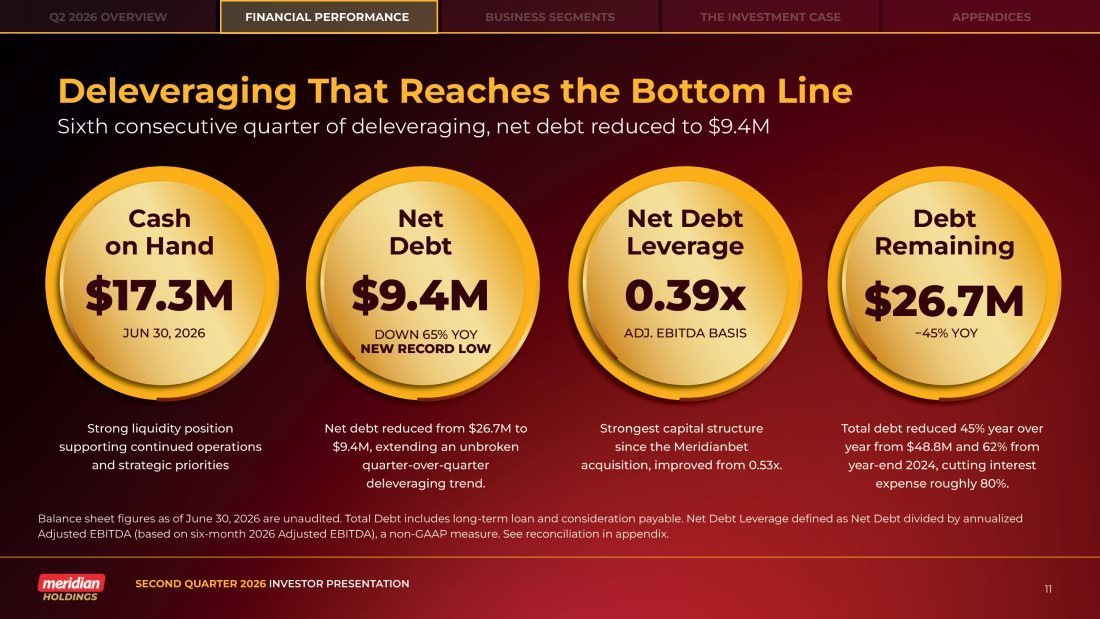
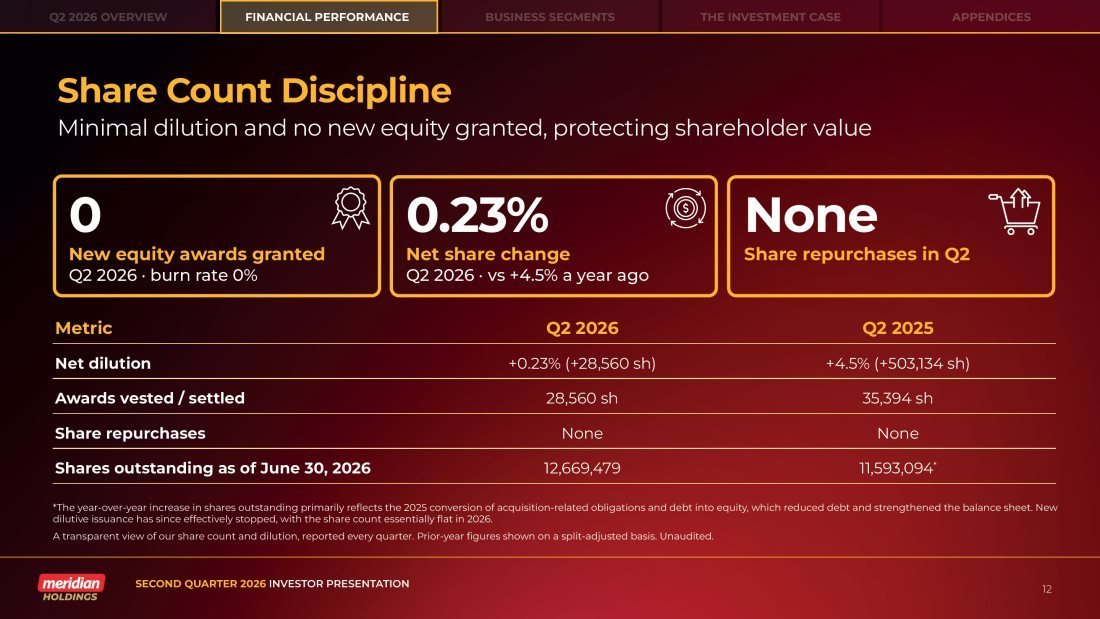
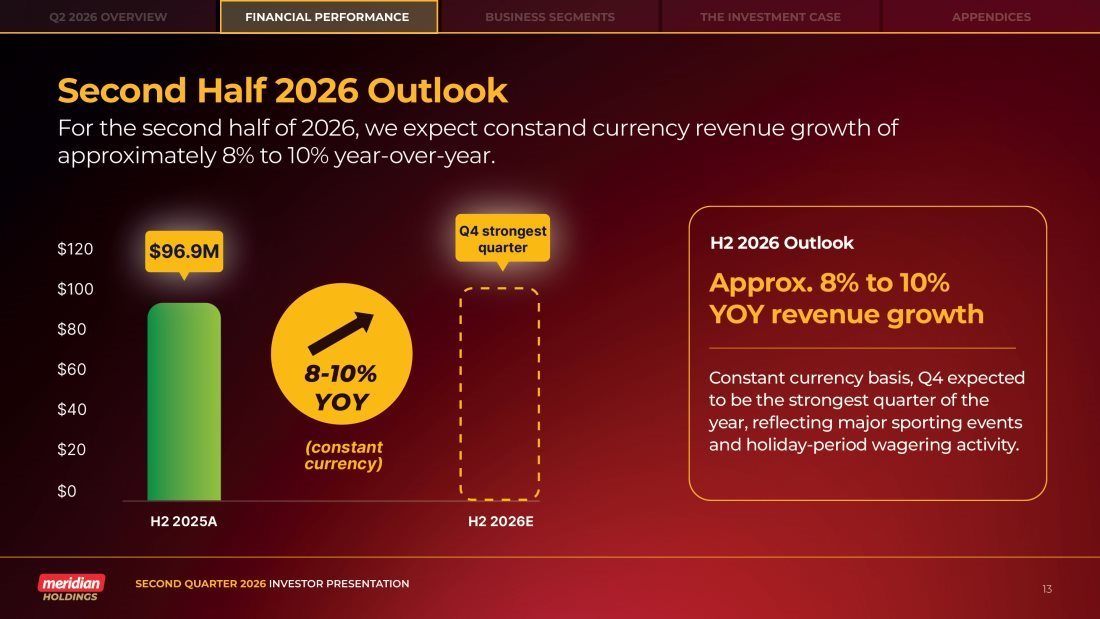
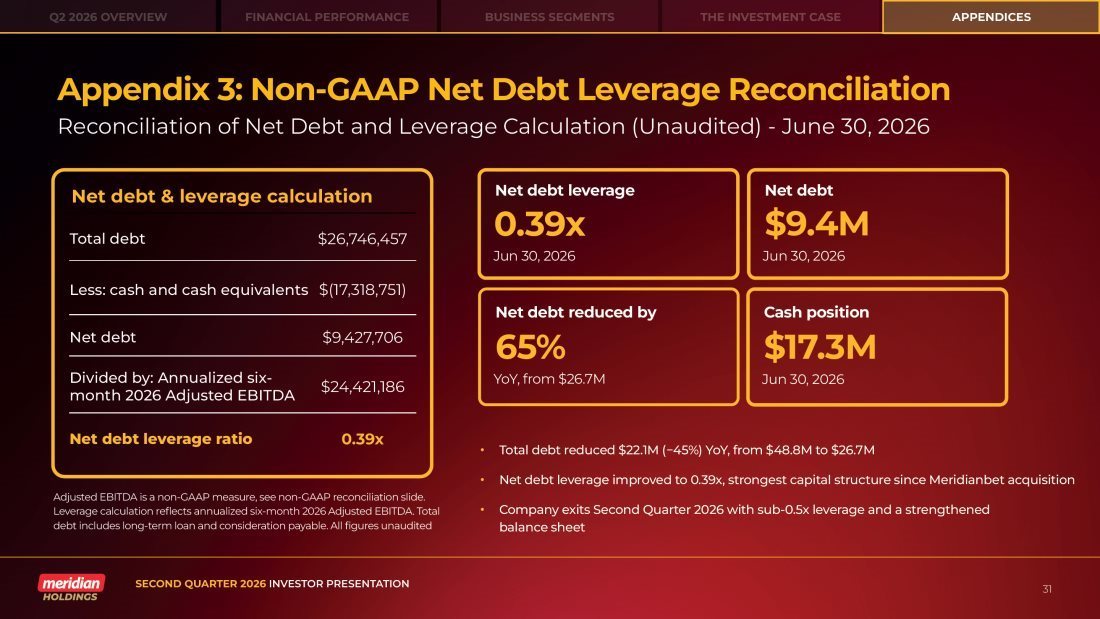
Thank you, Zoran, and good morning, everyone. During the second quarter, we greatly strengthened our balance sheet. At quarter-end cash and cash equivalents were $17.3 million and total debt was $26.7 million, down 45% year-over-year and down 62% from the end of 2024. Net debt was $9.4 million, down 65% year-over-year, and net debt leverage now stands at 0.39 times annual adjusted EBITDA, down from 0.53 times last quarter. This is the sixth consecutive quarter in which we've reduced debt. Our operating cash flow was $7.8 million in the quarter, more than tripled the $2.4 million generated in the prior year period. For the first half, operating cash flow was $13 million, up 28% year-over-year. That cash generation funded $2.8 million of debt repayment in the quarter and continued investment in our technology and operations without any capital raises one further point on capital structure shares outstanding were essentially flat in the quarter increasing 0.23 percent entirely from the vesting of previously granted employee awards no new equity awards were granted no shares were sold and no repurchases were required we intend to report these share count metrics to you every quarter as a standing part of our disclosure. As our balance sheet continues to strengthen, we are actively evaluating the right mix of capital allocation from high return growth investments to further strengthening our balance sheet. And we intend to make that decision with the same discipline that has guided every dollar we have deployed to date. Turning to our outlook for the balance of the year, for the second half of 2026, we expect constant currency revenue growth of approximately eight to ten percent year over year consistent with our historical seasonality we expect the fourth quarter to be our strongest of the year reflecting the concentration of major sporting events and holiday period wagering activity with that i'll turn the call back to william for closing remarks thank you rich before we open the line for questions let me summarize We delivered a second consecutive quarter of GAAP profitability to the first half revenue above $100 million for the first time in our company's history and drove a 43% increase
in adjusted EBITDA. Furthermore, operating cash flow has more than tripled and we're able to reduce debt by 65%, help bringing our net leverage down to 0.39 times and marking six consecutive quarters deep leveraging as it brought interest expense down 80%. Our focus for 2026 has not changed. We remain focused on operational discipline in every market, converting the customer growth as auto-delivered, continuing the balance sheet trajectory, and communicating with you clearly and consistently every quarter. To every shareholder, Alice and partner on this call, thank you for continued support.
With that, we'll call for questions. Operator.
Operator
Thank you. At this time, if you would like to ask a question, It is the star and one on your touchtone telephone. If at any point you find your question has been answered, you may remove yourself from the queue by pressing star two. Again, that is the star and one to ask a question. And we'll take our first question from M. Marin with Zax. Please go ahead. Your line is open.
Thank you. So I think that, you know, the new customer registrations represents a very strong metric. And I think going into the quarter, it's consistent with what you had sort of laid out in terms of what you were hoping for from the World Cup game. And as you said earlier in your scripted remarks, now your goal is conversion and retention of a large number of those new customers, new customer registrations. Can you give us a little bit more color on how the platform basically approaches that and also whether recent promotional events such as your new brand ambassador in Brazil ahead of the FIFA Games and the upcoming UFC event in Serbia, whether those also play into the goal of conversion and retention? Thank you.
I think I'm going to hand this question to Zoran because he knows the system and the best.
Thank you, Willem, and thank you for the question. As we predicted, obviously, that World Cup was by far the biggest sport event we ever experienced in terms of customers' activities. So in every single segment, so from the number of the bets that have been placed, turnovers which we achieved, customer registrations, and so on in terms of profitability as we said we were neutral and mildly positive so that was our position before the world cup only because there is low number of matches and basically every country where we operated that has national team participating will face a lot of emotional betting involved where it's like almost impossible to manage the risk. But overall, basically it was better than we predicted. So our internal forecast was from 2% to 4% margin. That was like the best outcome. Actually, we achieved over 6%. It was 6.2% margin overall, which we're really happy. It is, of course, below what is regular football betting. Regular football betting is approximately 10% to 11%, but it's actually for the World Cup better than we expected. In terms of customers acquisition, this is the record number of customers we ever registered. Actually, the record number of accounts we ever registered is like 519,000. So now we are busy turning them into customers. and if there was not a World Cup we would probably register like 350,000 a little bit around that so 520,000 approximately this is additional value that we got from World Cup so you can count it 170,000 customers were registered because of the marketing surrounding World Cup and World Cup is by far the biggest when it comes to marketing uh so what we are like doing we are trying to get integrated marketing approach so because we where we operate because we operate in many countries we try to use some marketing opportunities in one country to try to replicate this into another country making this excitement much bigger and of course lowering our marketing expenses and that That is what we did with UFC and with our new ambassador in Brazil, which is a very famous Brazilian football star, but actually he is Serbian origin, and he was playing for Red Star Belgrade, that is the biggest football club in the region. And that approach made big impact in the region of Southeast Europe and in Brazil as well. and also when it comes to UFC UFC is in terms of sports currently maybe the biggest brand by far and we use this opportunity to become sponsor of this event which will happen on Saturday in Belgrade, this is the first time when a UFC is coming to Belgrade and can you imagine that all tickets have been sold in 22 minutes, so it's like arena is like 18,000 visitors so you can imagine what kind of excitement that brings and also this is very important for our teams in the region because this is actually a regional event even this is happening in Serbia people that will come to this event will come from all over Southeast Europe so this kind of marketing approach we are undertaking so as much as possible to have integrated approach to marketing okay thank you and i have a follow-up housekeeping question on that event the ufc event so um i think in
the press release you talked about what some of the promotional um uh benefits will be to the the brand. And I think one thing is signage and also logo placement within the octagon. Now, that event will be broadcast internationally or, you know, pay-per-view, available via pay-per-view. Will the logo and the brand be visible internationally as well when that event is shown in other markets?
Yes, that is per our contract.
And also to add to that, it's also two fighters that are participating are also, even before USC events, they were like our ambassadors as well. And one of the fighters is from Brazil. The only Brazilian participant is actually sponsored by meridian and that sponsorship was made before the event and also one of most famous fighters from montenegro is also sponsored by meridian so this brings that situation as i said come to the point of integrated marketing so it's not event only it's also the fighters which are coming which are sponsored by us and basically meridian is very well known to be an early supporter of MMA, despite this situation with the UFC. We started sponsoring MMA fights 10 years ago, even more than 10 years ago. And at some point, Meridian, before Corona, let's say we were sponsoring like 100% of all events in this part of Europe, and almost 80-90% of all fighters have been sponsored by us at some point, of course. And now we are still number one when it comes to number of events we sponsor and number of fighters we sponsor as well in this part of Europe. Actually, number one by far. I think we are cumulatively have more sponsorships than all others combined.
Okay, got it. Thank you. And then one last question from me. I guess this would be foolish in terms of the balance sheet. So leverage went down and your debt... ratios went down, is the strategy to continue to reduce debt in absolute terms or, you know, as EBITDA grows, you know, and relative leverage ratios go down, is that, you know, where you feel more comfortable?
Thanks for the question, Marla. Yeah, we're really pleased with the debt, now it's come off over the past, you know, say 18 months. We're down 62% since year-end 2024. And what you're seeing with the leverage ratio is really that the two things, you know, in absolute terms, debt's coming down, net debt's down to 9.4 million. And then our adjusted EBITDA, the current calculation is effectively year-to-date times two adjusted EBITDA. and seasonality, you know, the last half of the year is much more profitable than the first half of the year. And so as we see EBITDA continue to expand, we'll see that, you know, that ratio to continue to come off. And from how we view debt is we don't like it, right? And so we'll continue to pay down debt because we're opportunistic. You know, in the future, as we see opportunities the opportunity you know debt you know we can re-leverage for exciting opportunities um but it's not something that we want to uh carry just for the sake of carrying you know we are down to a level that we're extremely comfortable i mean a quarter or excuse me 40 basis points on a turn is is pretty negligible and uh and we're happy with the deleveraging we've done we haven't and we have a fortress balance sheet at this point and so we can be opportunistic when we need to.
So that's kind of how we look at it.
Operator
Thank you. And we'll go next to Jack Varandered with Maximum Group. Please go ahead.
Okay. Good morning, guys. Congrats on the profitable results and continued debt reduction. Thanks for taking my questions. So I guess William and Zoran, maybe for both of you, It sounds like the revenue, you know, is a little bit softer due to favorable player outcomes, which is a good thing in the grand scheme of things, because the wagering was up, I believe. There's also the strongest revenue quarter, despite that, in your company history, as far as I can see. I guess, how much of a driver was the World Cup for 2Q? Kind of a two-part question here. How much of a driver was the World Cup in 2Q? And then do you expect that same kind of similar player outcomes for July World Cup betting when, you know, we're kind of in the final stages of the tournament, which should impact the re-Q?
Sorry, I just thought it was going to be an issue because there was something in my throat.
Thank you for the question. Basically, the World Cup was approximately one quarter of total revenues. So the split between casino and betting was like 53% for casino, 47% for sports betting, roughly. Within sports betting, 56%, 57% was World Cup. So the majority of money came from World Cup. And as I said, it is below what we usually achieve on football, 30% below, but far more, 50%, 60% more than we expected that we will achieve. So we achieved approximately 6.2% margin. Normally we achieve on football like 10%, but we expected 2% to 4% with this World Cup. So that's basically it. So it had a huge impact when it comes to revenues. So a quarter of the revenue was basically stuck into World Cup betting only. And June was particularly bad. so the margin in June was lower it was like 4% because many favorites were winning and usually when you have qualifications like any qualifications there are many goals have been scored whenever you have many goals that means that betting companies are losing but everything improved in July so in July where a lot of teams that obviously were not on the level that they compete went out and more or less same strength teams remained and that actually became much more exciting uh for us and improved a lot and from our core countries actually almost none of none not a single country where we operate actually had national team within a quarterfinals semifinals and so on so that made our life easier uh in that segment okay great so So it sounds like July was actually probably less favorable player outcomes, but still elevated wagering levels, which is a good thing for the business.
That was my presumption. Excellent to hear. And then I guess maybe for Rich, on the second half revenue guidance, so constant currency, good to hear, 8% to 10% up year over year with a more stronger fourth quarter as usual. Can you maybe speak to that year-over-year revenue growth trends at the segment level, just between the three segments you report? Are you expecting similar growth across all three segments year-over-year? Are some going to be more flat than others, maybe down? Any color would be helpful.
Yeah, sure. And I'm going to kind of structure my answer around a constant currency look, right, just to take some of the FX noise out of it. You know, we have seen the U.S. dollar, you know, strengthen recently, weaken prior to that. You know, it tends to have some of these more violent moves since it is a bit of a petrocurrency, at least acting as that currently. So if you look at the, if you kind of pull back the layers of this onion and you look underneath, what you're going to see is you're going to see Meridian continue to outpace the growth that we're expecting primarily in some of the smaller raffle ticket businesses. So when we talk about that 8% to 10% constant currency growth, our expectation is that Meridian is going to do roughly about 30% to 40% higher than that, and those other businesses will do about 30% or 40% lower than that. And what that really drives is it's a favorable mix shift, right, because Meridian has about a 70% gross profit, and those other businesses are in the mid to high 20s. And so it becomes more profitable, you know, income statement, and you get some operating leverage as you kind of move forward. And that's important to really tease out of even our current results. If you look at Q2 and you just look at our historical performance on the income statement, Meridian was short roughly about, call it 400 bps of gross profit due to all the reasons that Zoran has described to you. You know, there was some favorable casino outcomes of about 1.2 million. There's about the same amount of headwinds that we saw because of the World Cup, you know, those favorable outcomes that we mentioned. And then there was even some FX headwinds against our forecast of roughly about $700,000. If you move those back in and you get to more of a run rate gross profit for Meridian, we had a phenomenal quarter. We're really excited about the customer registrations being up 37% and even seeing what that is doing for our Q3 results so far. So anyway, that's kind of what we're seeing in Q3, Q4, kind of that mixed shift and kind of helping you kind of piece together what that means as far as the income statement moving forward. Anything else, Jack?
Yeah, no, that was great. That's really helpful, and I appreciate that. It sounds positive as well. Just maybe one more question for the whole team, I guess, if there's just any comments, because it has been a buzz topic in the space lately. is just on the prediction side of the emerging vertical globally now. Any strategic comments on the predictions market or the opportunity there and how Meridian fits in? And I know you've been involved with this for quite some time, but might as well ask you.
That is the most interesting question because everyone's got a very interesting debate with regards to it. And so, you know, what's the future? I think prediction markets, you know, Betfair was one of the first guys to do it, and they just, Betfair unfortunately didn't come up with a great name called Prediction Markets and they made it more towards a sophisticated player. I remember meeting them years ago saying, you know, make it, call it something simpler, you know, say a lay and, you know, et cetera, and you'll be more successful. So I think it's still, it's going to be their part of the mix coming out. And I know that, you know, we're obviously constantly looking at that. I know Zorin will add some more claims to that. But, you know, clearly, you know, it's very difficult to guess how successful it would be outside of the U.S. because, you know, in all the, you know, because in the U.S. it's very successful because it's California and Texas where there's no sports betting. So, you know, firstly, you know, it's interesting where it happens, but I think it does have a place. You know, everyone seems to think it has an interesting place in the market, whether it's going to be significant outside of the U.S. or not. And then from the U.S. perspective, one doesn't know. So it's, you know, as it became a huge market with one individual at the CFC, I don't know, CFC, I think it is, the futures exchange, at the same time it would become totally irrelevant if someone changes the rules. So, you know, it's either, hopefully, it'd either be too big that it can't fail or it'd get too big and someone will make sure it fails. It's very difficult to tell. Zoran, what's your view?
Thank you, William. Basically, Meridian is involved in prediction markets for many years. And we run it currently in three countries where it's regulatory allowed. We are currently improving our product and we are quite bullish on it. And in terms of profitability and volumes, in our system, it's still quite low. But it's a great marketing tool. So basically, this is the most effective marketing tool that exists because it's customers-driven marketing content. So what kind of ideas customers have on what they want to bet, it's like something that actually cannot be made up by any of the best marketing team by far. So that is the current state of prediction markets in Meridian. So we use it. We have it in, like, three countries. It's very small, but it's a great marketing tool. But we are, like, on the track to improve it a lot.
Okay, excellent. Well, Zoran, William, Rich, I appreciate the time. Congrats, and look forward to tracking the story. Thank you.
Thank you, and we'll take our next question from Steve Silver with Argus Research. please go ahead thanks operator and thanks for taking my questions and congratulations on the continued delivering the balance sheet and the operating cash flow expansion so you guys mentioned the strong registration growth ahead of the World Cup just curious as to whether there were any standout markets that you view as really the key opportunities for cross selling opportunities to casino moving forward or whether their registration expansion was more broad-based.
Thank you for the question.
We see the trends when it comes to cross-sell everywhere. So I couldn't basically take any market particularly, which I would highlight. But what is happening is that there is some kind of delay in terms of revenue split between casino and sports betting. for example Western Europe migrated majority of customers migrated to casino let's say maybe not 10 but 5 years ago since COVID happened let's say Eastern Europe is breaking even I think in 1 or 2 years from now so it's still like 52 sports betting 48 casino Africa also is let's say, 60% sports betting, 40% casino. And Central Latin America, we have a majority casino customers. They migrated already. So these trends are happening everywhere. So we can say that the trend percentage of migration is more or less similar. But the only difference is the region where the position of sports betting is in certain regions. Sometimes we see delays. like we see delays in Eastern Europe or we see delays in Africa in terms that sports betting is still dominant but you see that it's losing battle and it's just a question in as I said in Eastern Europe it will happen in one, two years most in Africa two to three years most when Casino will take over and that is basically with the influence of younger generations younger generations just want faster outcomes and Casino provides them that and that that's basically the whole theory behind it yeah and i think from an overall perspective i think the the world cup you know through the significantly additional games with additional
teams but i even the controversy amongst them etc made quite exciting obviously i i was slightly biased hit by more than most countries i live in spain so uh spain clearly were celebrating significantly with their results. But yeah, I think it's a lot of excitement from it. It got a lot of attention everywhere.
And one more, if I may. So you guys have been investing to scale operations for some time, and then you increased investment leading into the World Cup. So now that the World Cup has passed and the company has been achieving gap profitability over the last couple of quarters, I'm curious as to where you see the company's position just in terms of the overall investment cycle and what are some of the key areas for ongoing investment?
I had the detail to Zoran where we're making the investment, but the reality is that this is a journey, not a destination. Constantly have to keep improving the product, A, to keep ahead of the competitors. Obviously, we've built the Atlas system, which is a significant investment, but we have to constantly continue to invest to deliver in a highly competitive environment where competition is continuing to invest. But Zoran can give you a greater feel where the actual investment in Borbush will be. Obviously, he does speak about prediction markets.
Thank you for the question. I fully agree with William. Basically, on every single front, we are investing. So from improving our gaming systems and especially we had heavy investments when it comes to marketing software, so everything related to CRMs. And of course, we are also all the time looking for new opportunities to make some acquisitions of our B2B partners and so that is something that is always on the table. I cannot, of course, disclose anything, but we are constantly looking and investing into these areas.
Great. Thank you for taking the questions and good luck in the second half.
Operator
As a reminder, if you'd like to ask a question, it is star in one. We'll take our next question from Daniel. Daniel, you're coming with Freedom Broker. Please go ahead.
Daniel
Analyst — Freedom Brokers
Hey, guys. Hey, William, Zoran, and Rich. Congrats again with greater than expected results in the World Cup. Just, Zoran, you mentioned that you gained a big cohort of new customers. and how do you assess the retention rate i mean are these customers willing to stay more than the regular customers and um from which country are these customers from are they from brazil or europe or africa when we were talking about this 519 000 they came from all countries so it's Basically, our churn rate and retention rate depends from the market.
In the mature market where we are present for decades, our retention rate is higher and churn rate is lower. And vice versa, in the markets where we are new, basically, it's not actually hard to acquire a customer, But let's say to get new registrations, this is not a difficult thing. What is hard is to make first deposit and especially to make a second deposit in the countries where we are new, when there is no particular brand awareness and so on. So it's basically usual marketing headaches which we need to solve. So in the new countries, we need to develop a lot of brand awareness, which will enable us to have a high retention rate. so that is basically what we are busy with okay thanks and well basically most of the knockout games and the final games were in July and just briefly can you describe was favorable on your side or any expectation for us this World Cup when it reached to finals it was it was easy because as I said we didn't have any national team from the countries where we operate participating. If Brazil was in the World Cup, we would probably close the company. I'm joking, of course, but it would be a headache. Spain, England, France, whoever was participating, we don't operate there, so there was no emotional betting. For us, it was easy. When we reached the finals, we were very happy with any outcome was good for us. We didn't have that problem like companies operating in Spain. So companies that are operating in Spain are like demolished in July.
Yeah, and the very strange part is the Argentinians aren't very popular in Latin America. So everyone, you know, the only people supporting, you know, that's a bit of a joke, but the only country supporting Argentina was Argentina. You know, their fellow continents didn't want to support them, they were supporting Spain.
Actually, that was the biggest headache we had was bets in Brazil against Argentina. So everyone was just like... I think 99% of all bets were against Argentina. But the good thing is that once your national team is out, interest for World Cup decreases for 80-90%. So basically, even if in some countries they bet against another country, if their national team is not involved, That's a relaxed situation for us. So the biggest problem, if you have your national team participating and winning constantly, that's like losing the situation for every betting company, including us as well.
Daniel
Analyst — Freedom Brokers
Yeah, and just one more quick question. Well, in the U.S., soccer wasn't really popular before. And is there any expectations about the U.S. clients you gain? Do you expect them to keep betting on soccer events in the future?
Look, we're not operating in the U.S., so I can just tell you my opinion about it, but it's opinion-based. So this was record-level attendance in the U.S. This is by far the biggest sporting event, and basically a lot of private companies are making major investments when it comes to soccer, so I expect soccer will be very, very popular in the U.S. five, ten years. already popular among female population. As you know, I think US was fourth time consecutive world champions in FIFA World Cup because there is a FIFA World Cup for women And US were like four times consecutive champions. So it's actually quite popular in terms of female population, not yet there when it comes to male population, but it will get there. So I don't have a doubt.
I agree with Zoran I think that soccer is going to gain traction there from a betting perspective but in the US it's not like they needed another sport to follow, they've got big sports already so it will gain an importance but there's still NFL and hockey league and basketball etc.
Speaker 4
Okay yeah thanks congrats again Thank you very much Thank you.
Operator
At this time, we have no further questions in queue. I'd like to turn it back over to our speakers for any closing remarks.
I think, first of all, I want to congratulate, you know, everyone that works for Meridian for the hard work they put in, and particularly, obviously, Zoran and Rich, who kind of helped it. But it's been, you know, we fight every single day to make sure that we, We're focused on delivery, delivery, delivery. That's all we think about every day.
And thank you very much for being supportive shareholders.
Operator
We'd like to thank everybody for their participation on today's conference. Please feel free to disconnect your line at any time and have a great day.