Operator
Good day and thank you for standing by. Welcome to the first Western Financial Q2 2025 earnings conference call. At this time, all participants are in a listen-only mode. Please be advised that today's conference is being recorded. After the speaker's presentation, there will be a question and answer session. To ask a question, please press star 11 on your telephone and wait for your name to be announced. To withdraw your question, please press star 11 again. I would now like to hand the conference over to your speaker today, Tony Rossi.
Thank you, Josh. Good morning, everyone, and thank you for joining us today for First Western Financial's second quarter 2025 earnings call. Joining us from First Western's management team are Scott Wiley, Chairman and Chief Executive Officer, Julie Korkamp, Chief Operating Officer, and David Weber, Chief Financial Officer. We will use a slide presentation as part of our discussion this morning. If you have not done so already, please visit the events and presentations page of First Western's Investor Relations website to download a copy of the presentation. Before we begin, I'd like to remind you that this conference call contains forward-looking statements with respect to the future performance and financial condition of First Western Financial that involve risks and uncertainties. Various factors could cause actual results to be materially different from any future results expressed or implied by such forward-looking statements. These factors are discussed in the company's SEC filings, which are available on the company's website. I would also direct you to read the disclaimers in our earnings release and investor presentation. The company disclaims any obligation to update any forward-looking statements made during the call. Additionally, management may refer to non-GAAP measures, which are intended to supplement but not substitute for the most directly comparable GAAP measures. The press release available on the website contains the financial and other quantitative information to be discussed today, as well as the reconciliation of the GAAP to non-GAAP measures. With that, I'd like to turn the call over to Scott.
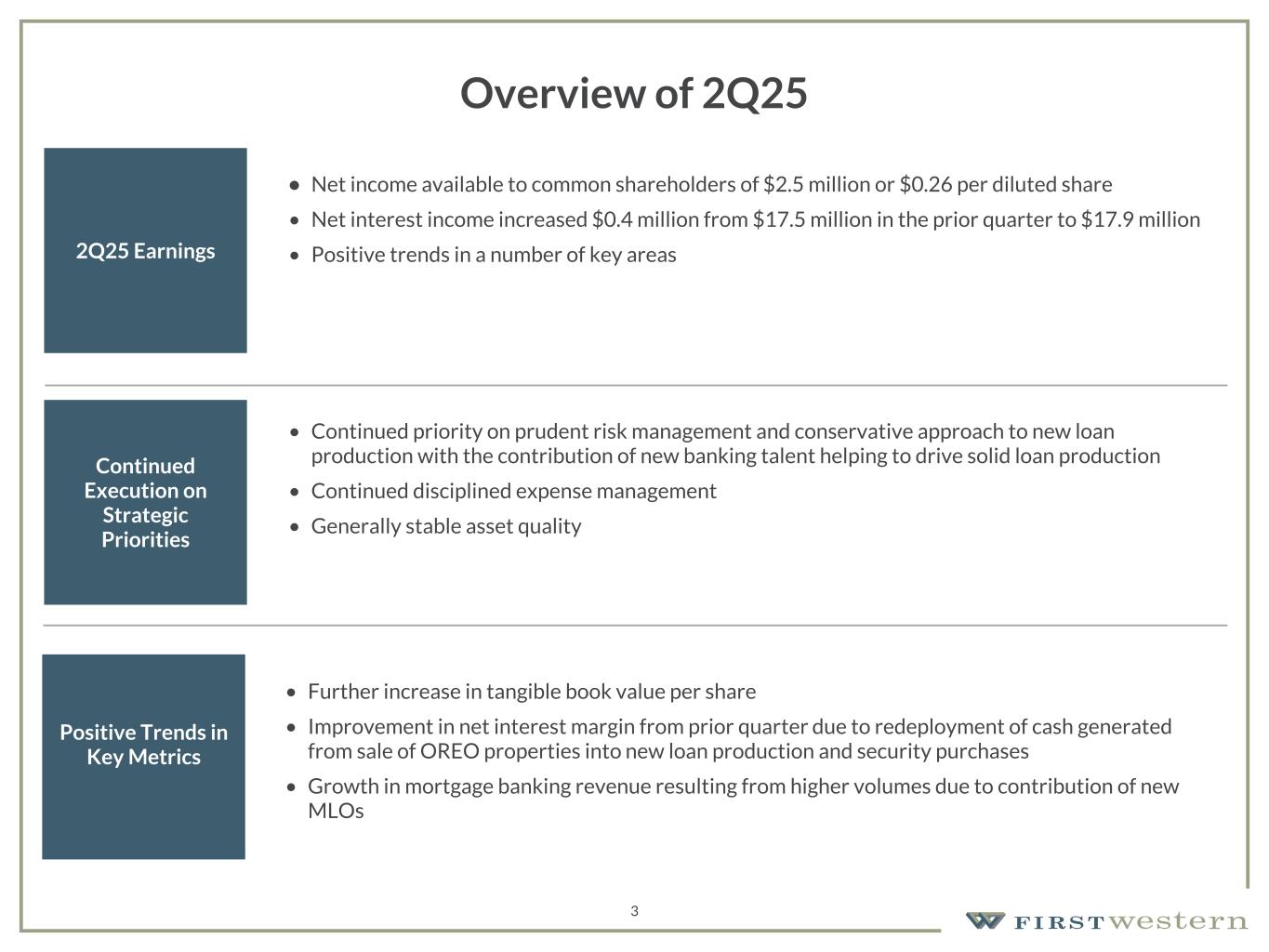
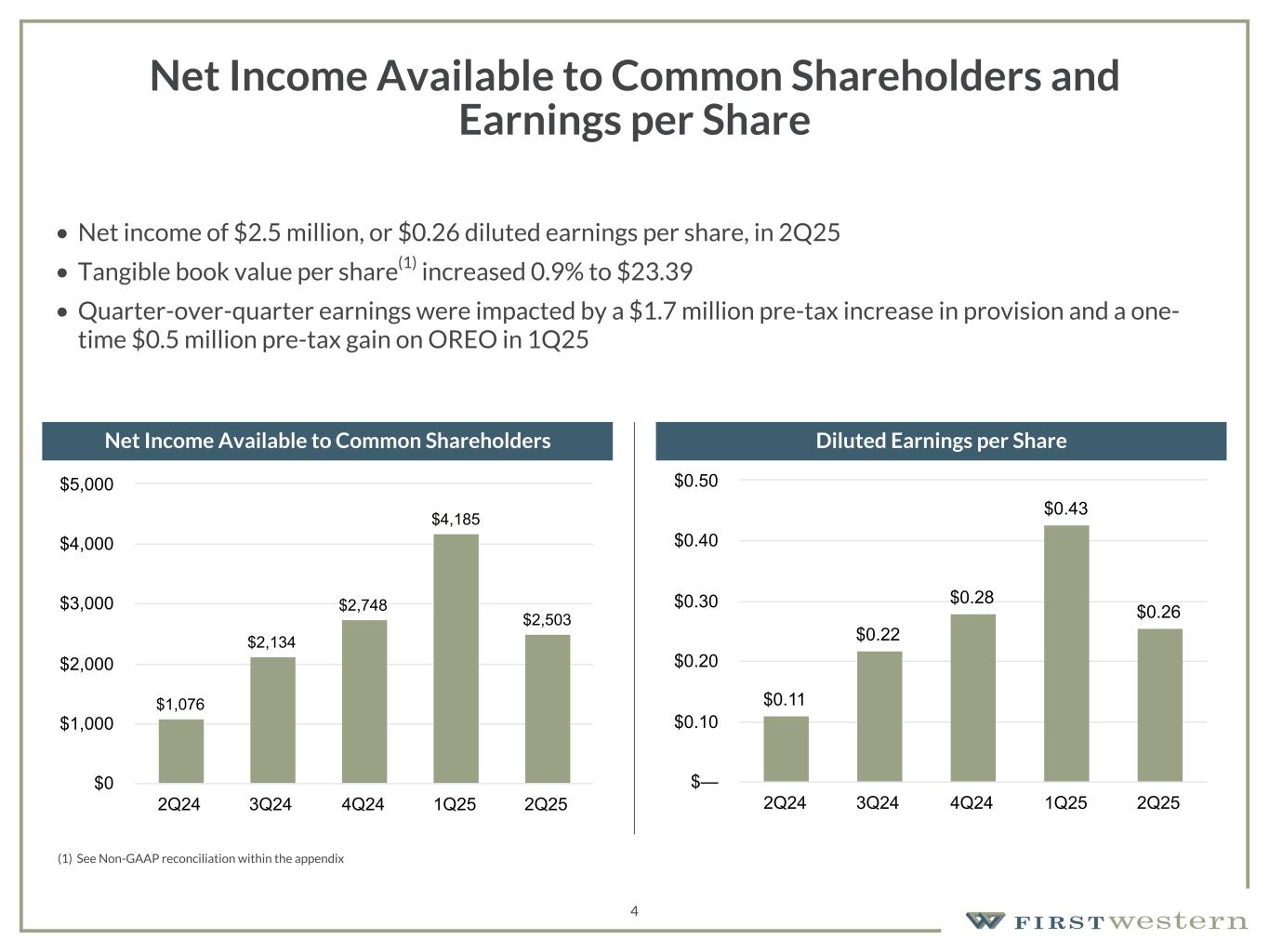
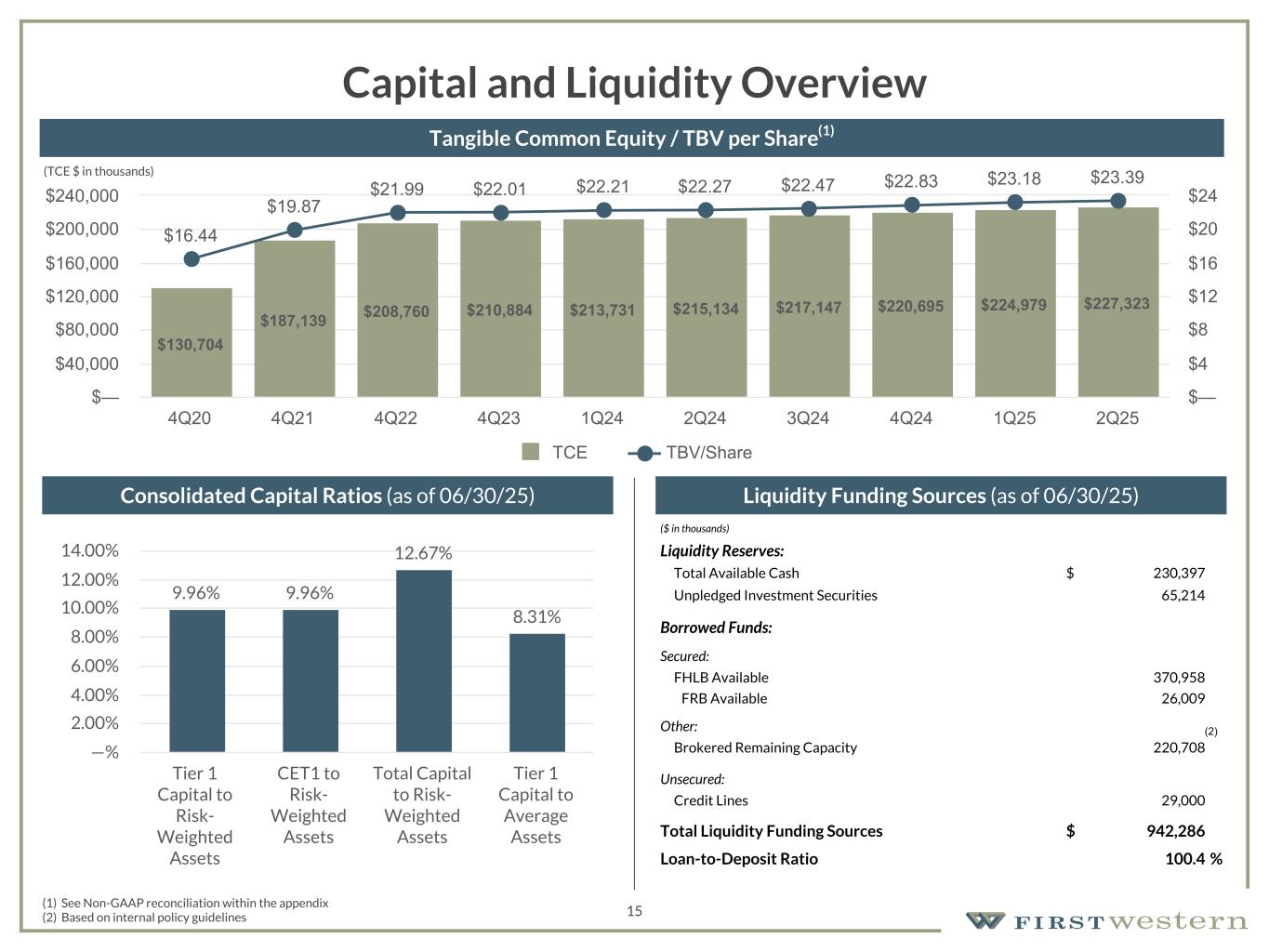
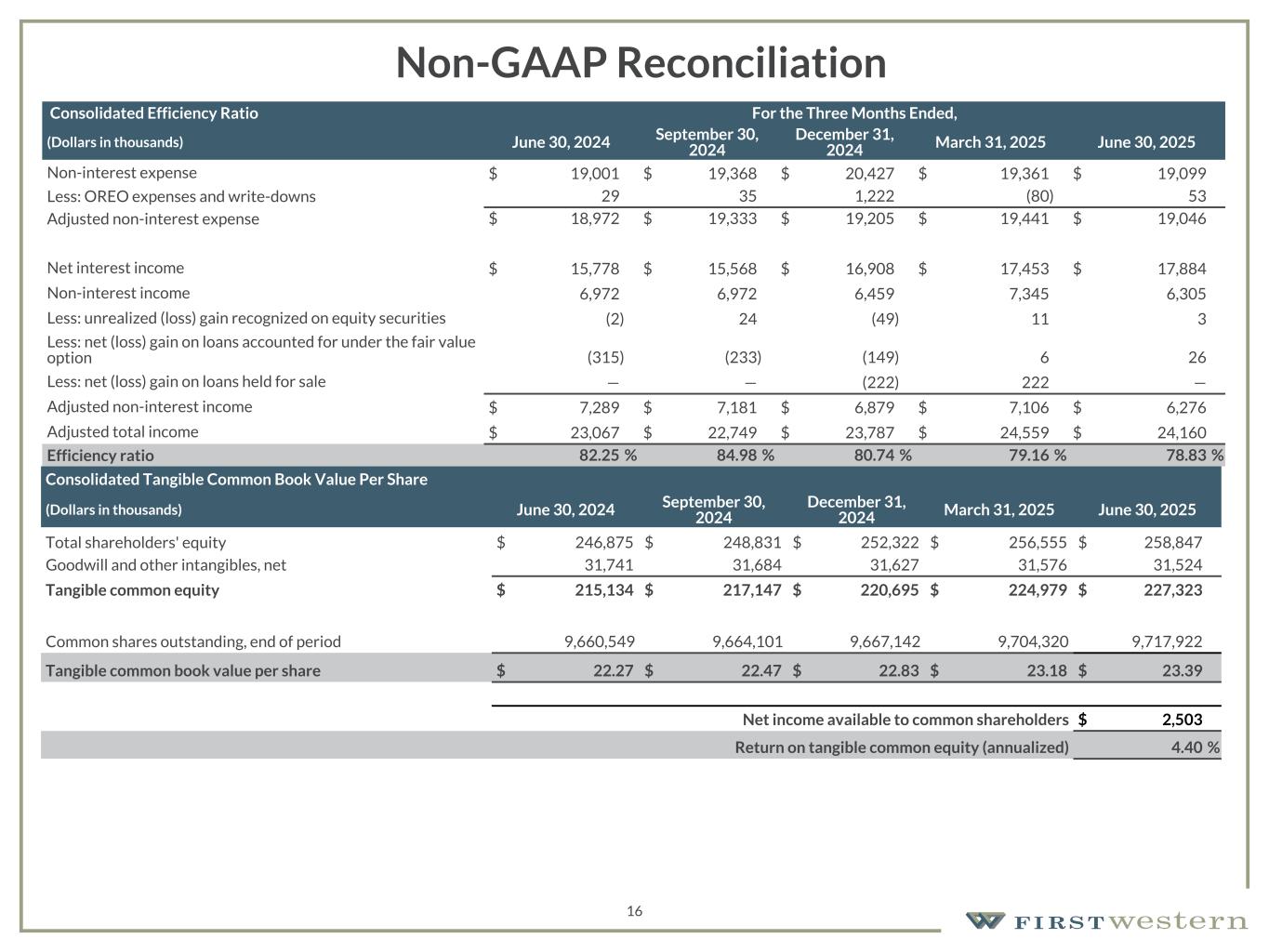
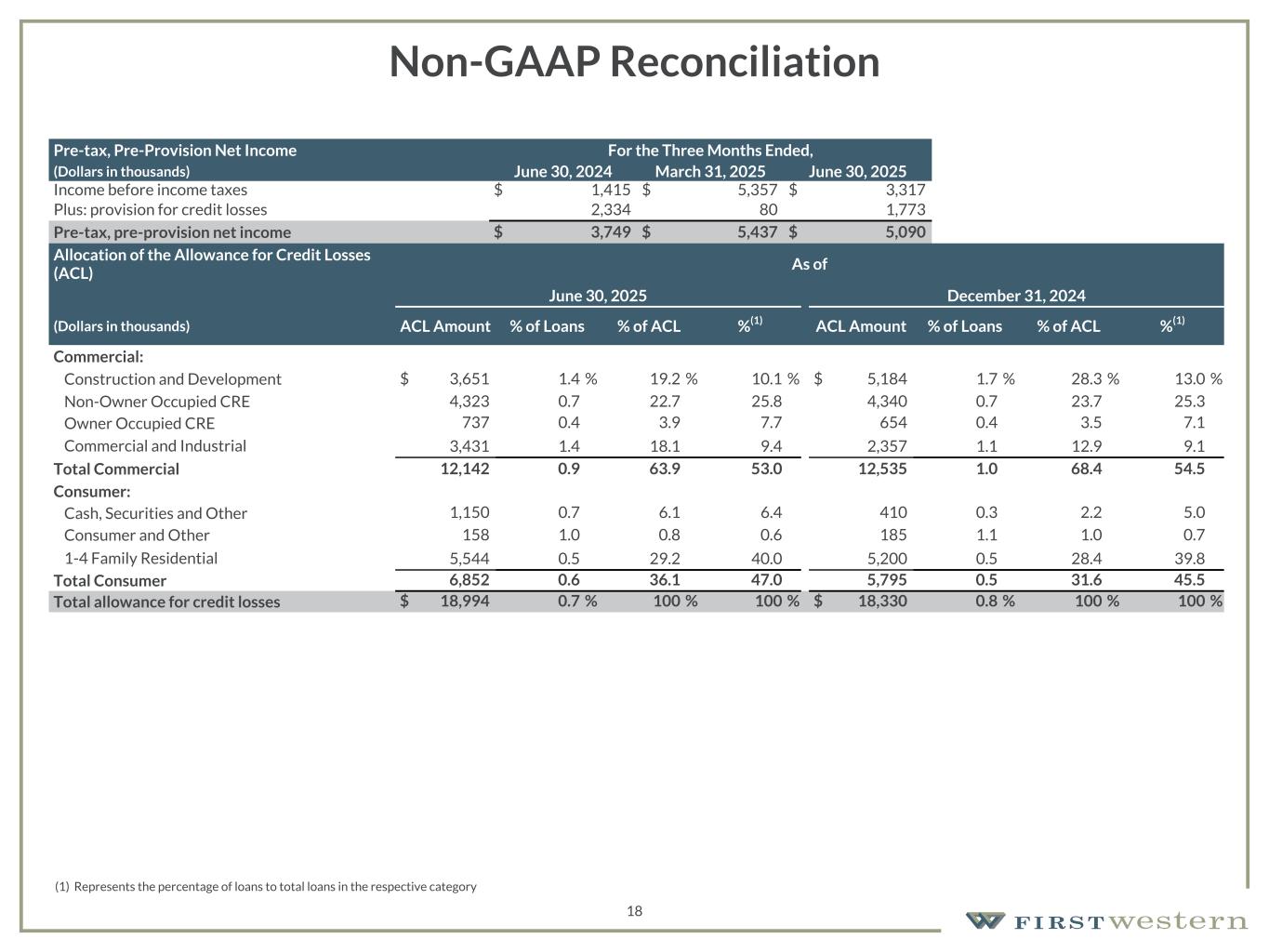
Thanks Tony and good morning everybody. We executed well in the second quarter and saw positive trends in many areas including loan and deposit growth, expansion in our net interest margin, well-managed expenses, and stable to improving asset quality. The market remains very competitive in terms of pricing on loans and deposits but we continue to successfully generate new loans and deposits by offering a superior level of service expertise and responsiveness, rather than winning business by offering the highest rates on deposits or the lowest rates on loans, as other banks are doing. We continued to maintain a conservative approach to new loan production with our disciplined underwriting and pricing criteria. As a result, the additions we made to our banking team over the past few quarters, as well as generally healthy economic conditions in our markets, we had a solid level of loan production, which was well diversified across our markets and as industries and loan types successfully lower deposit costs as well as redeploy the cash we generated from the sale of two oreo properties in into new loan production and securities purchases which contributed to the expansion we're seeing in our net interest margin and we continue to maintain disciplined expense control despite the inflationary environment as we capitalize on the previous investments we made in both banking talent and technology that have enhanced our business development efforts and overall level of efficiency, including a higher level of mortgage banking income. We also had generally stable asset quality during the second quarter. As a result of our financial performance and balance sheet management strategies, we had a further increase in our tangible book value per share, and we used our strong capital position to repurchase some of our shares during the second quarter, which was accretive to our tangible book value per share. Moving to slide four, we generated net income of $2.5 million, or $0.26 diluted share in the quarter. This was lower than the prior quarter due to a number of one-time gains that positively impacted our financial performance in the first quarter, as well as the higher level provision that we recorded due to the strong loan growth that we had late in the second quarter. Pre-provision net revenue basis, once the one-time items from last quarter are excluded, we had an increase during the quarter. In addition, it was about 5.1 million in Q2, down slightly from Q1, including those one-time revenue ads in Q1, but up about 36% year over year. With our prudent balance sheet management, our tangible book value per share increased by about 1% this quarter. I'll turn the call over to Julie for some additional discussion of our balance sheet and trust in investment management trends. Julie.
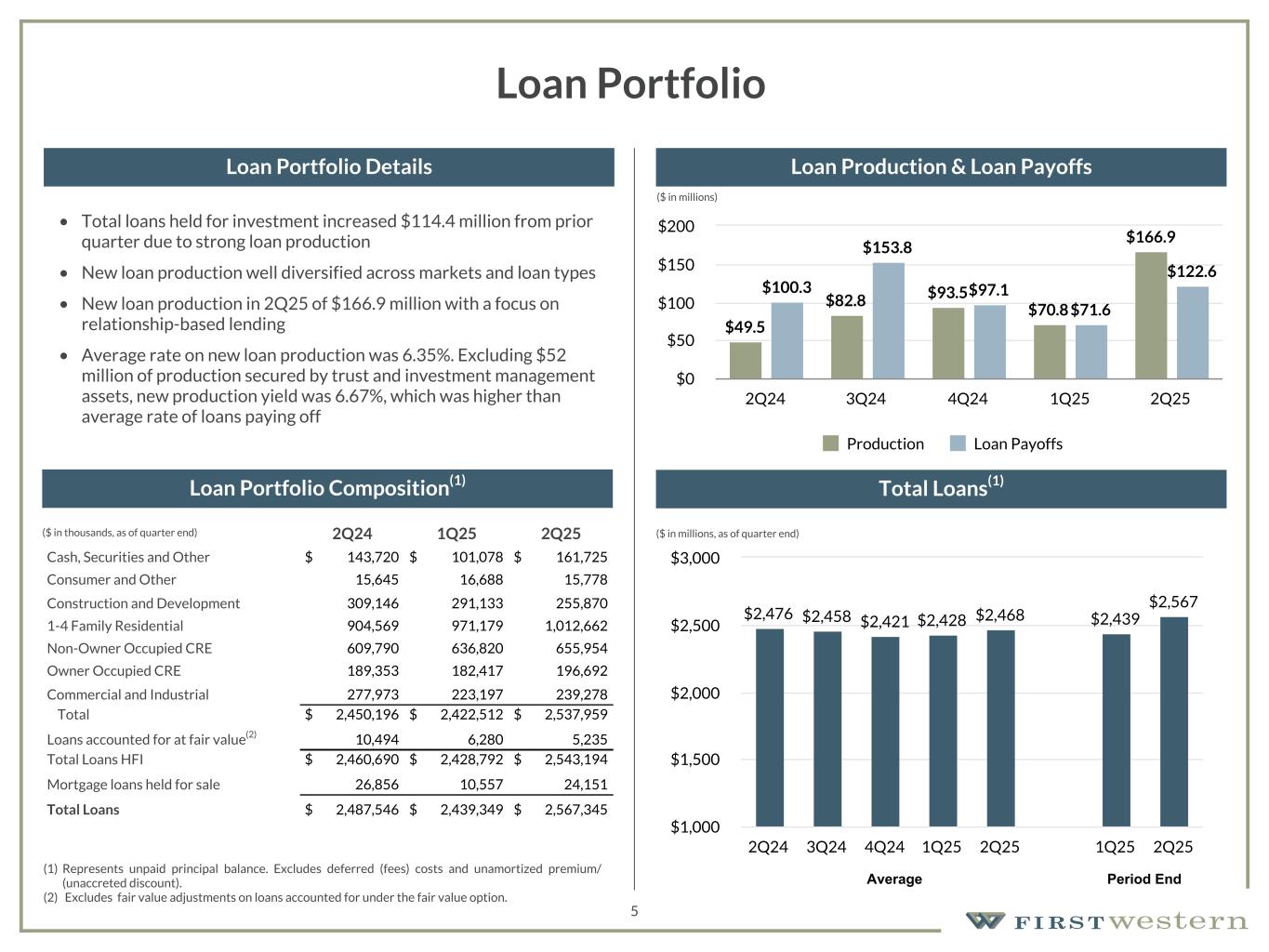
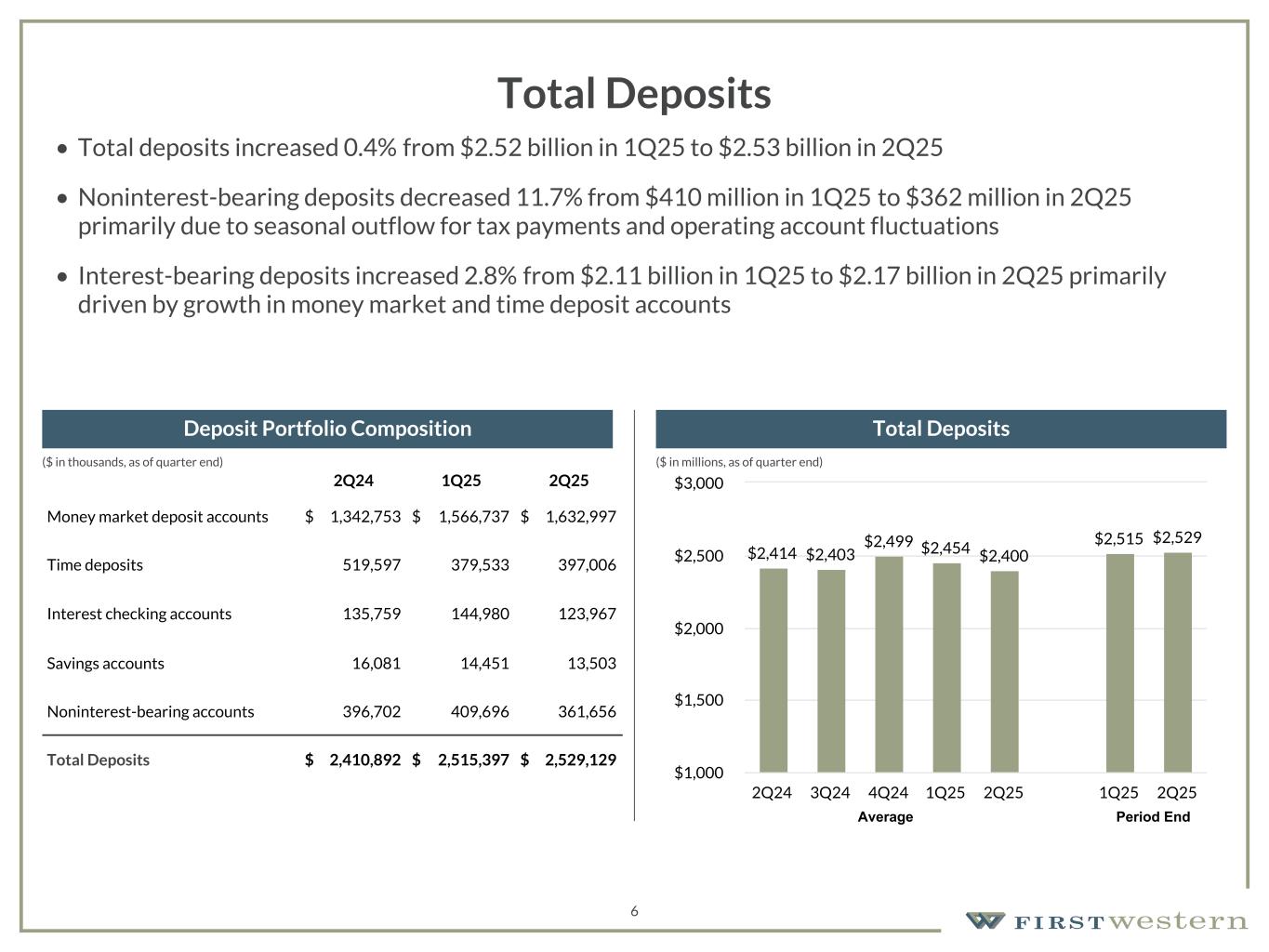
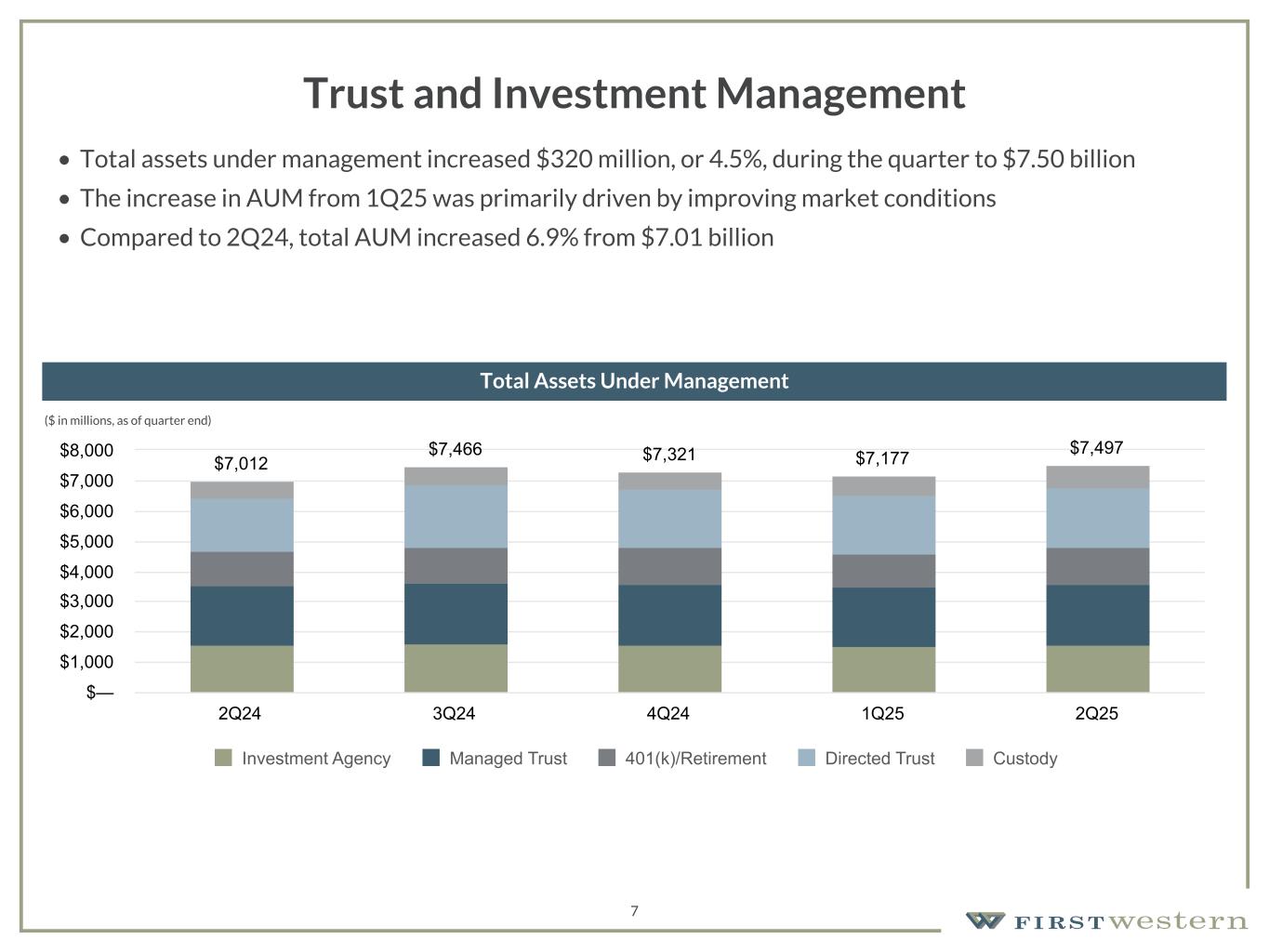
Thank you, Scott. Turning to slide five, we'll look at the trends in our loan portfolio. Our loans help for investment increased 114 million from the end of the prior quarter. We continue to be conservative and highly selective in our new loan production, but with a higher level of productivity we are seeing from the additions to our banking team that we have made over the last several quarters, we are seeing a solid level of new loan production. That new loan production was $167 million in the second quarter. This new loan production was well diversified and resulted in an increase in most of our portfolios. We are also getting deposit relationships with most of these new clients. We continue to be disciplined and we are maintaining our pricing criteria. This resulted in the average rate on new loan production being 6.35% in the quarter, or 6.67% excluding loans secured by trust and investment management assets originated in the quarter. Moving to slide six, we'll take a closer look at our deposit trends. Our total deposits were slightly up from the end of the prior quarter. We had a decline in non-interest bearing deposits due to typical seasonal outflows we see in the second quarter related to tax payments. This was offset by an increase in interest bearing deposits as a result of the successful execution in our deposit gathering strategies. Given the nature of our client base, following the seasonal outflow that related to tax payments in the second quarter, we typically see that these balances tend to build back up over the second half of the year. Turning to trust and investment management on slide 7, we had a $320 million increase in our assets under management in the second quarter, driven largely by favorable market performance. Over the past year, our AUM has increased nearly 7%. I'll turn the call over to David for further discussion of our financial results. David?
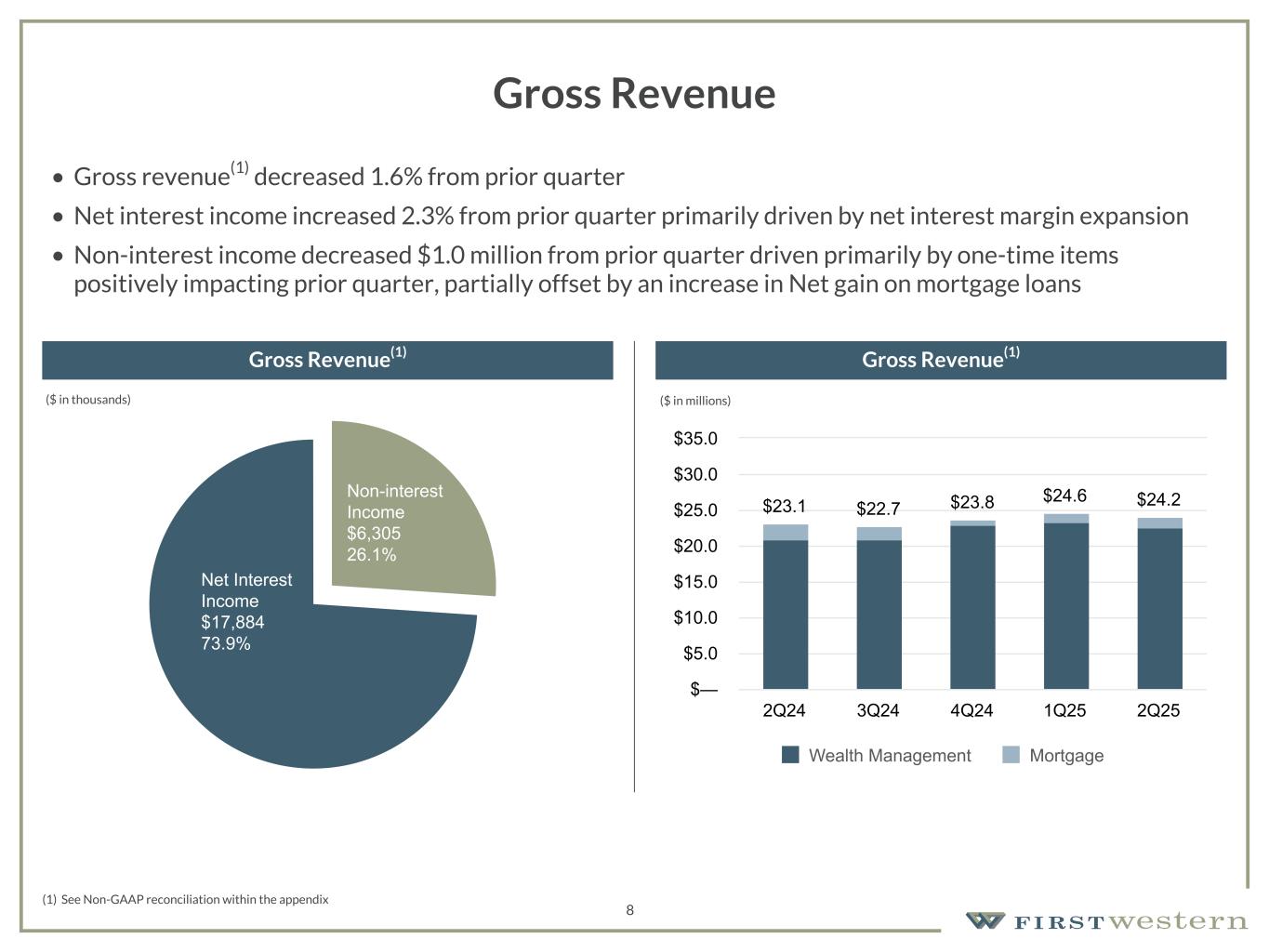
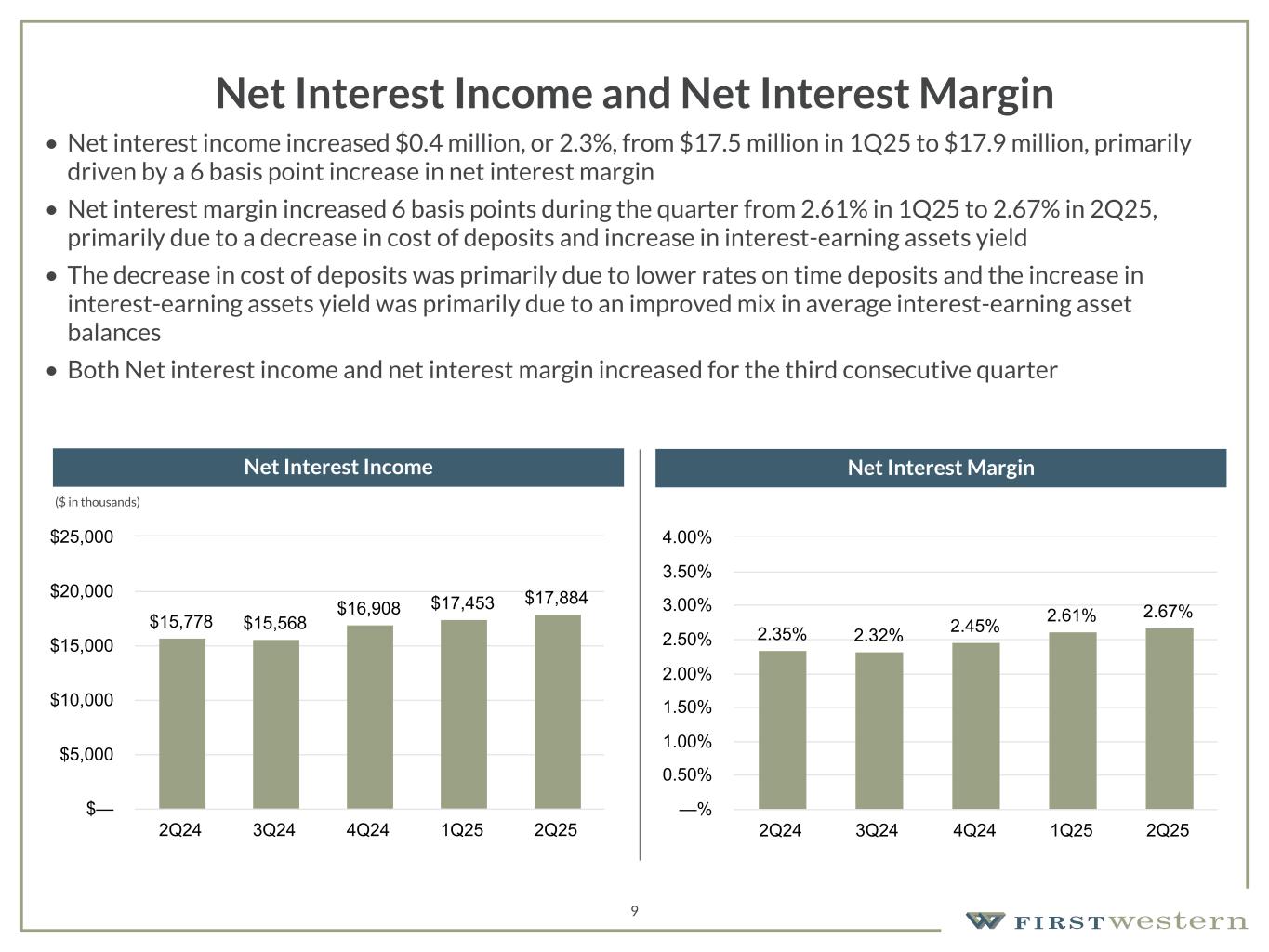
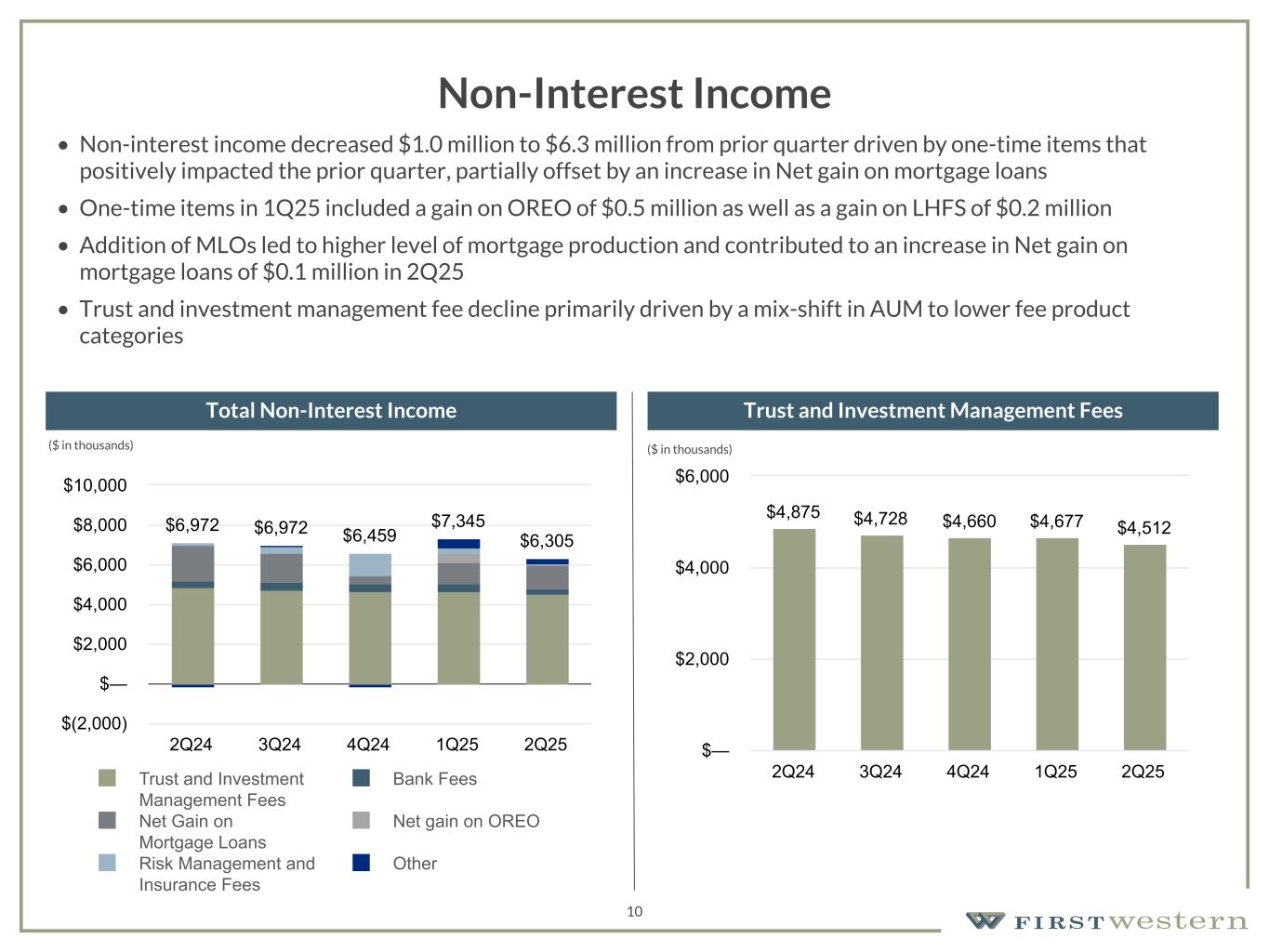
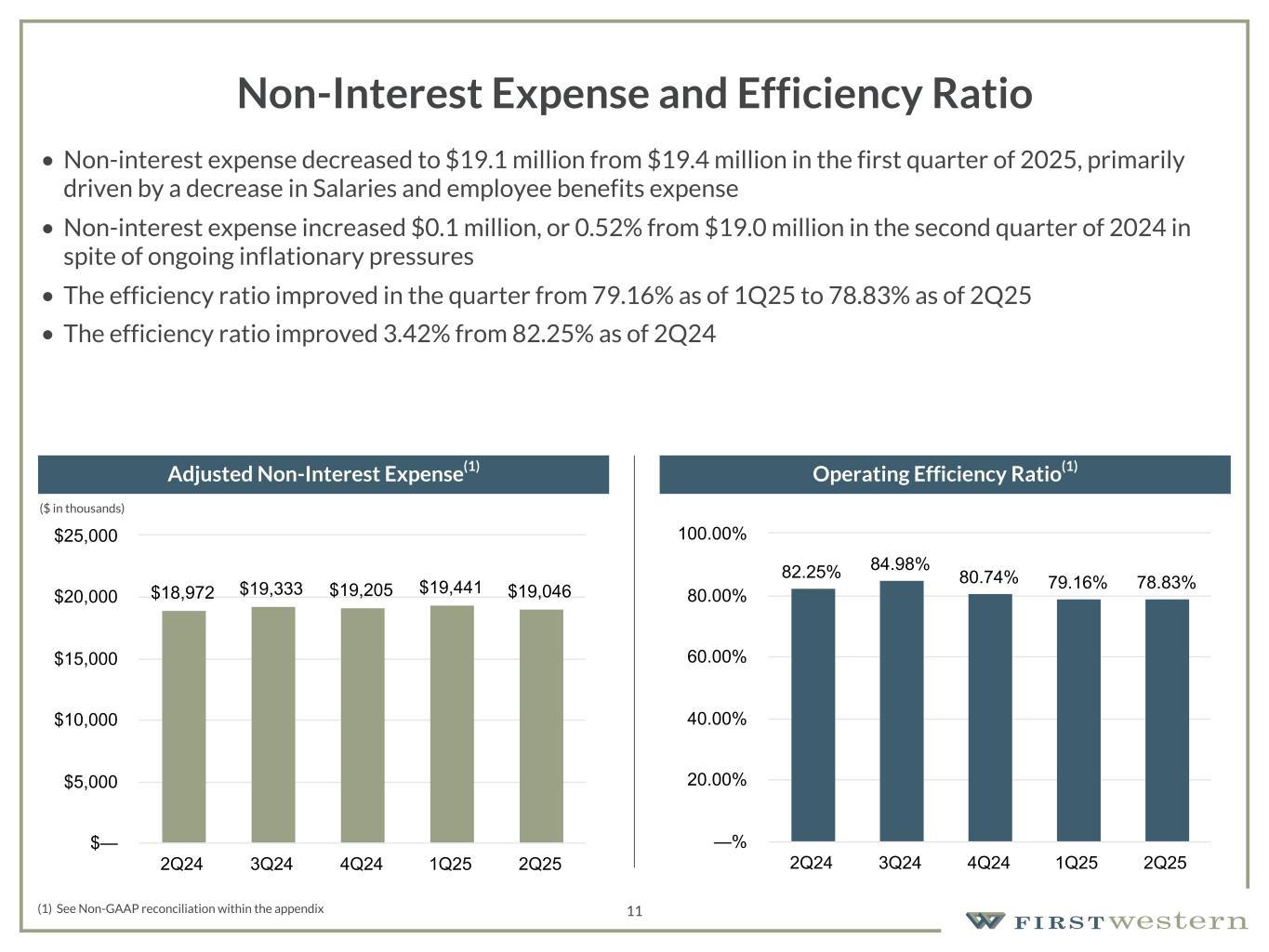
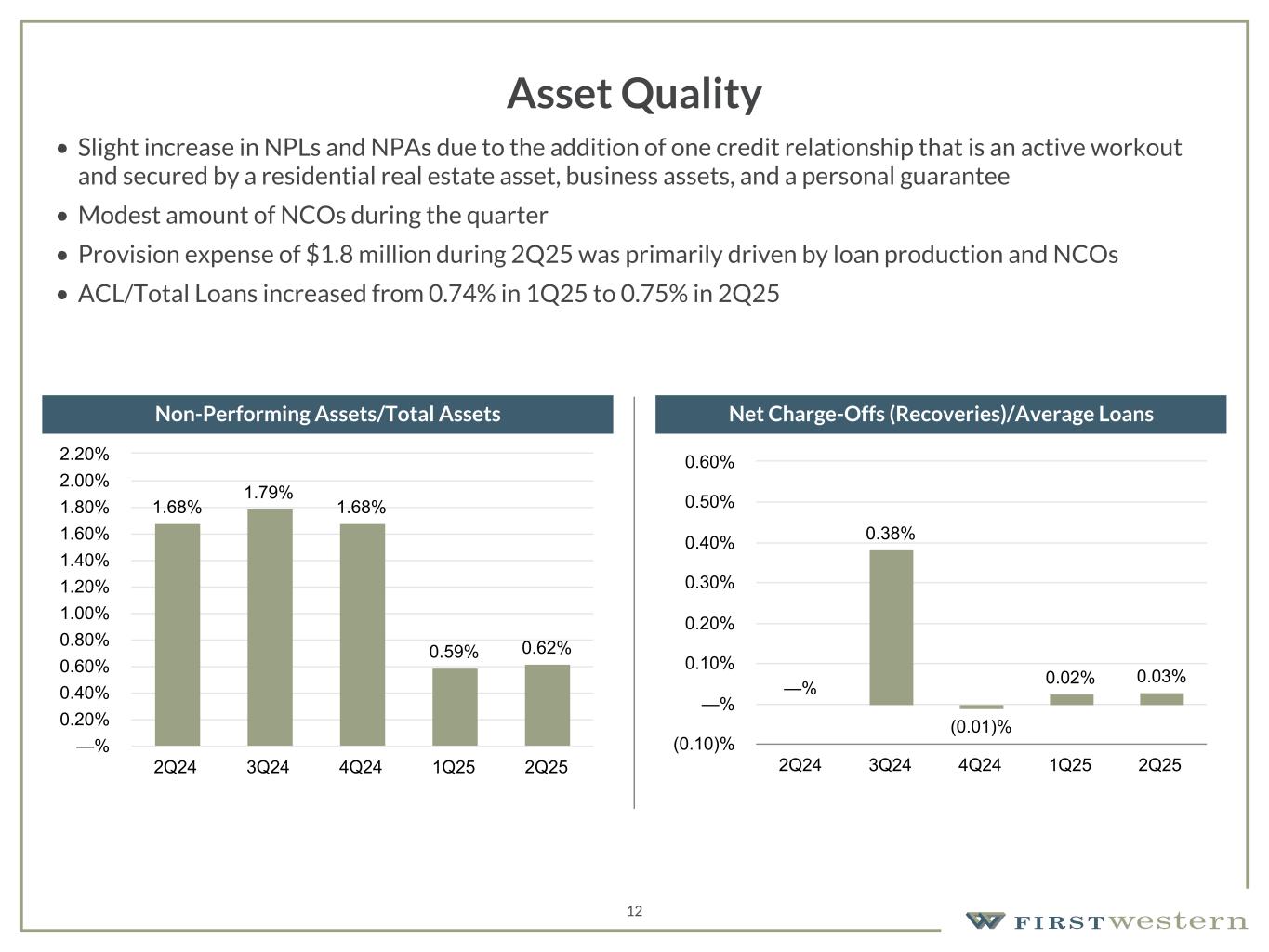
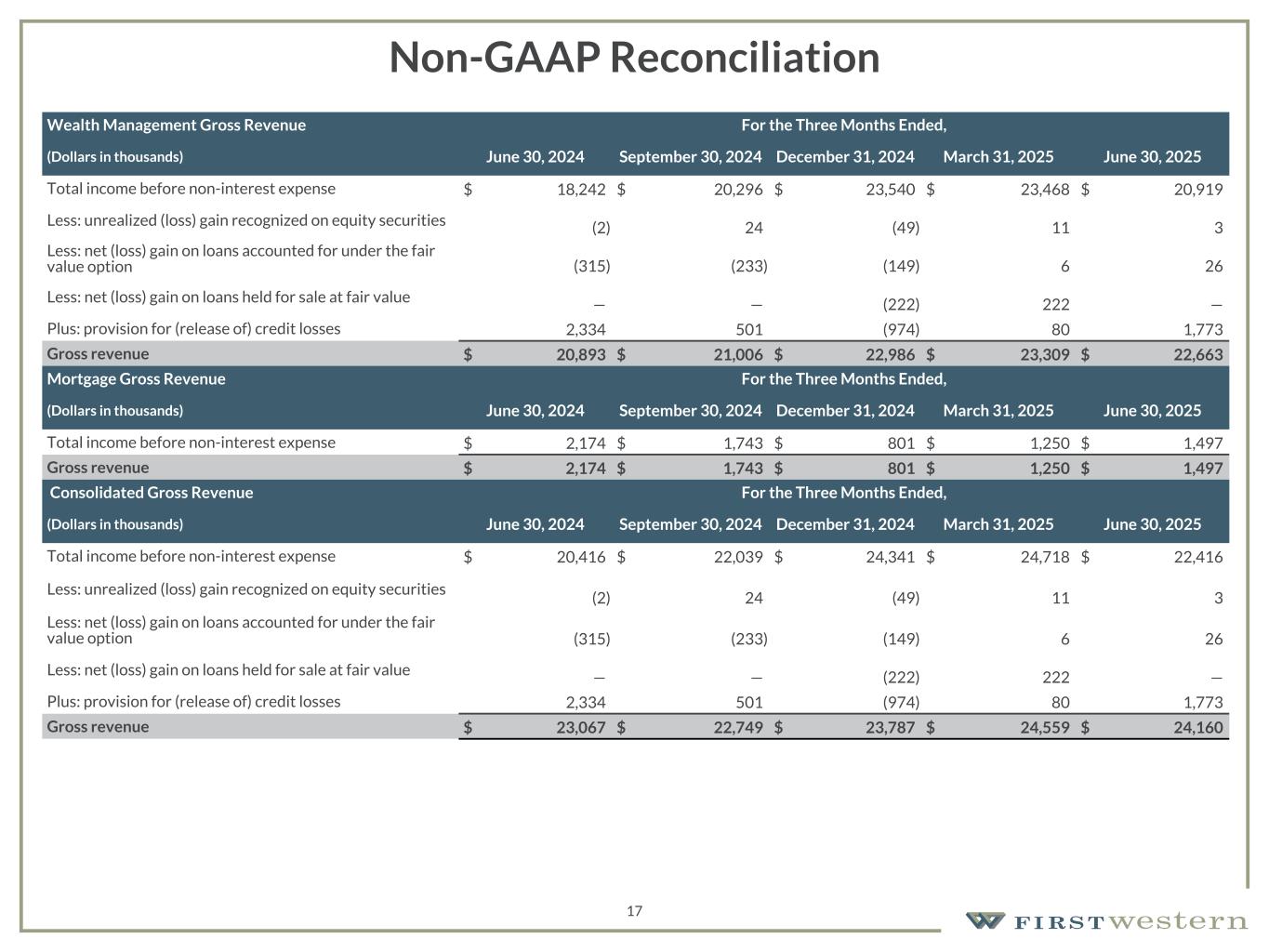
Thanks, Julie. Turning to slide 8, we'll look at our gross revenue. Our gross revenue was slightly down from the prior quarter due to some one-time gains we had in the first quarter that positively impacted our non-interest income, which was partially offset by an increase in net interest income. Now turning to slide 9, we'll look at the trends in net interest income. Our net interest income increased prior quarter due to an expansion in our net interest margin. Our NIM increased six basis points to 2.67. This was due to a reduction in as well as the payoff with the deployment of the cash we generated from this into new loan production and securities purchases, which increased our average yield on interest-earning assets. To deposit inflow trends over the past few weeks, we expect NIM to be relatively flat in the short term, but it should expand later in the year, which along with our balance sheet growth in the third one decreased by approximately one million from the this was due to one-time gains we recorded in the first course in gain on sale of mortgage loans PTIM fees have been trending down as our clients have shifted to lower margin services trend is a management priority and decreased approximately due to lower salary as we continue to tightly manage expenses while also making investments in the business indicated earlier we saw generally stable trends second quarter with slight increases in MPLs and MPs. We had one loan charge off in the quarter which had unique issues and is not reflective of broader trends we are seeing in the portfolio. A significant loan growth we had in the quarter. Turning to slide 13, I'll wrap up
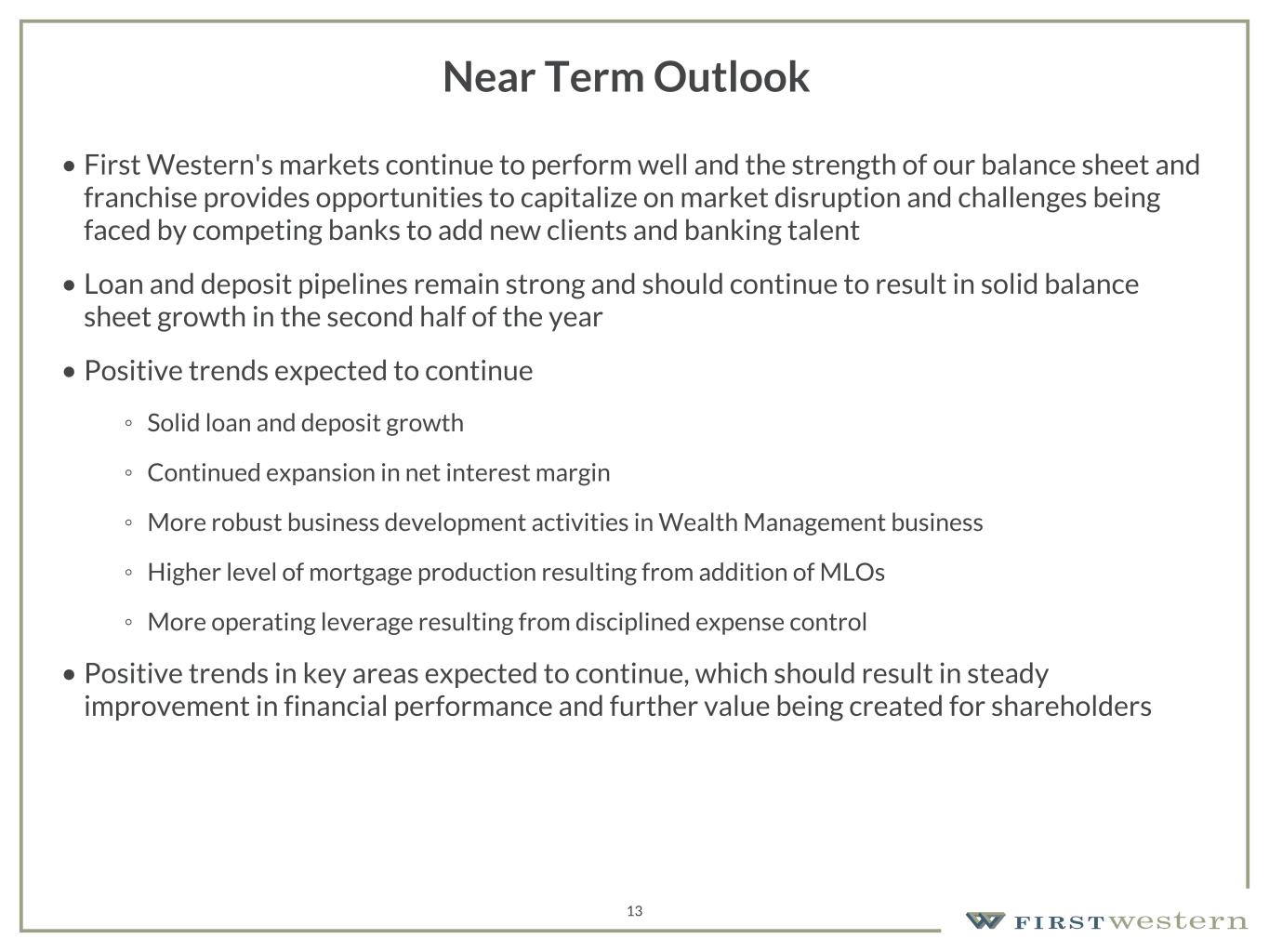
with some comments about our outlook. We see relatively healthy economic conditions in our markets. Our loan and deposit pipelines remain strong and should continue to result in solid balance sheet growth for the second half of the year. In addition to the balance sheet growth, we expect to see continued positive trends in our net interest margin, net interest income, fee income, and more operating leverage resulting from our discipline expense control. Based on the trends that we're seeing in the portfolio and the feedback we're getting from clients, we're not seeing anything to indicate that we'll experience any meaningful deterioration in asset quality. The positive trends we're seeing in a number of key areas are expected to continue, which we believe will result in steady improvement in our financial performance and further value being created for our shareholders as we move through the year. With that, we're happy to take your questions. Josh, please open up the call.
Operator
Thank you. As a reminder, to ask a question, please press star 11 on your telephone and wait for your name to be announced. If you withdraw your question, please press star 11 again. One moment for questions. Our first question comes from Matthew Clark with Piper Sandler. You may proceed.
Hey, good morning everyone. Good morning Matthew. First question just on the, it looks like you added some borrowings toward the end of the quarter. Just want to get a sense for the rate on those, whether or not those are overnight or term borrowings and I guess the plan to maybe pay those off as deposit growth comes through in the second
half yeah Matt yes they were overnight and yes the plan is to pay them off as our deposits come in like I said we we do plan to pay those off okay great and
then your cost of interest bearing in total deposits both down two basis points if you just curious what the spot rate was at the end of June and kind of what your expectations are for more relief in the back half?
Yeah, the spot rate at the end of June was $3.07. We do still have opportunity to continue to reprice down on the CD portfolio. You know, NIM expectations, we're thinking relatively flat. Due to into loan production, you know, we still are expecting NIM to expand in the fourth. we talked about last quarter kind of in the low um low to mid 270s okay great and then just last
one for me on expenses good cost control here this quarter better than the guide i think that was 19 and a half to 20 million um what are your updated thoughts on the run right here in the
back half yeah we're still thinking same range 19 and a half to 20. okay thank you we continue to
to think, Matt, that our path to success is not in cost cutting, right? It's in operating leverage from growing revenues with our current, you know, our focus has really been on just trying to make sure we're not seeing excessive growth in that. Thank you. Our next question comes from Woody
Lee with KBW. You may proceed. Hey, thanks for taking my questions. I had a quick follow-up on the NIMM outlook and I believe you said that you still expect to hit a low to mid-270s NIMM by year end and just wanted to get a sense of how sensitive that could be to how rate cuts play out in the
back after the year. Yeah, Woody, I think our guidance that we've previously spoken to as far in that million-dollar range at Tivoli Fair, we took a little bit of sensitivity off the balance sheet in the second quarter. So maybe it's $100,000 or so below that, but I think that's still a fair assumption as far as how a 25 basis point reduction would impact.
Got it. And then maybe shifting over to expenses and profitability, And you mentioned that you can continue to invest in the franchise, just longer-term focus. But I was hoping that you all could just kind of sort of peel back the curtain and just walk through sort of how you toggle between investing and seeing the profitability ramp actually play out.
Well, I think if you look at the history over the past several quarters, we've had pretty stable expenses. So I think, you know, our focus has been how do we take our current spend, make sure we're getting a maximum value out of that, and how do we take advantage of opportunities we see in the marketplace? You know, we brought in significant new hires from other local banks, First Republic, from Goldman Sachs, from UMB here, and those folks have been really helpful to the growth numbers that we started seeing in Q2 here. So, I mean, we do continue to invest. We continue to upgrade when vacancies come up. And, you know, hopefully we'll continue to do that in the back half of the year. That's our expectation. I don't think we need to increase our expenses significantly to achieve significantly higher revenues that are going to drive the operating leverage that we've seen since our IPO, where, you know, the expense is steady. You grow your revenues. That's going to have a really nice impact for our business.
Got it. And then last for me, I believe in the opening comments you called out, you know, building up trust fees is a top priority at this point. I know they were down a little bit quarter on quarter. Could you just give some additional color on thoughts on that business line and how you could increase fees from here?
Yeah, so we have now replaced most of our P-TEM leadership here to put in a more of a growth mentality than what we've had, you know, since the IPO, we've been pretty flat in P-TEM. Well, we've, you know, tripled the size of the balance sheet and dramatically improved our debt interest income. So, you know, our feeling is that this is an area of opportunity for us. We talk about that area as PTM, which stands for Planning, Trust, and Investment Management, PTM, and, you know, historically, we've put a lot of emphasis on the investment management and the trust side, and the trust has certainly grown nicely over the years, but we think that's a big opportunity on the planning side as well, and so we have brought in new leadership there. head of planning joined us right at the beginning of the second quarter and you know historically I would tell you we find it takes some time for these folks to get traction and not with him I mean there's really good stuff going on in terms of product development and new channel distribution you know historically we focused here on the B2C channel with our 19 offices and now we're launching a new b2b initiative that fits really nicely into some of the other capabilities of the organization beyond planning like our focus on cni and our focus on treasury management and our focus on uh retirement services business so uh so you know you don't see any of that in the numbers in q2 uh either on the expense or the um revenue side but i mentioned in his focused on and
All right. That's good to hear. Thanks for taking my questions.
Operator
Thank you. Our next question comes from Bill DeZone with Titan Capital Management. You may
proceed. Thank you. I had a couple of questions. First of all, what, if any, structural factors are holding you back from returning to a 3% or greater NIM?
I think the passage of time, Bill, you know, we've talked about that now on the past several calls that we thought that we would see a nice, steady improvement in them, which is what we've seen. I think, you know, I don't have the exact page in front of me here, but I think in the deck that's pretty evident. And, you know, what we've looked at internally is that we believe that our historic number of some number, like 315, 320 is what our business model should produce in a normal interest environment where you don't see inverted yield curve, you don't see rapid run-up in short-term rates like we saw there a couple years ago. So, you know, we do think we're going to trend back there and that's what we've been saying and that's what we've been seeing. So, you know, as David said, you know, We expect that to continue, I think, with the growth we saw at the end of second quarter and the funding and the fact that our deposits typically decrease, especially operating deposits in Q2 because of tax payments with our type of client. We'll see that continue to come back in the second half of the year. We'll see the improvement from that. I don't think we're gonna get to 315 here in the next couple of quarters. I'm not sure whether it takes to the end of next year or beyond that, but we do think we're going to see continued progress there. And every quarter, every month, where we see some nice organic growth, some improvement in fee income, some good cost control, NIM expansion, and organic growth, all of those things compound each other, drive the top-line growth that goes straight to the bottom line if we're not increasing it.
That's helpful, Scott, and just to be required to achieve that 315-320 other than a continuation and essentially seeing that it's just a matter of moving the business forward. Is that the correct interpretation?
I think that's safe to say. David, do you feel comfortable with that?
Yeah, I think that's fair, Bill. Great. Thank you. And then additionally, you have hired MLOs over the course of the last year and I think you said your mortgage volume was down. And I realize that the mortgage market is a bit, we have time to say wonky now, but help us understand why you think your volumes are down when your MLOs have increased.
Speaker 8
Yeah, Bill, I can take this one. You're right. We have been working to increase our MLOs, which helps us with just general production and geographic spread of that production. You know, they're in different locations, and we have more in the pipeline to continue to grow those. Industry-wide, I think the general mortgage industry has still not really rebounded. We have not seen the production that we typically see in the summer months, which are typically our higher seasonality months. I think we're seeing impact from the economic uncertainty, but also the interest rate uncertainty. And I think people are just not, you know, not in the buying and or selling part of life right now. And it appears that everybody's kind of staying on the sidelines. We are hearing that buyers believe that the home prices will start to decline at some point. And in the near future, I think that, you know, the interest rate certainty will help with that as well. I think that, you know, we might see a little bit more. But our general belief is that if we can continue to add individuals that aren't fixed costs to us, that bring in more production, that we will see the increase in revenues with that, as well as as economic conditions continue to improve. I would note, however, that we are contribution positive on mortgage for the year and we're last year as well. And so this is a contributing business. You'll see a lot of our production in the second quarter was through mortgages as well. One to four family residential mortgage increase in our mix. So very much a contributing part of the business. And, you know, from an earnings perspective is doing nice, paying nice dividends to us as well.
And so, Julie, to be clear, the decline in the mortgage volumes, you all see entire market-related as opposed to some internal challenge that you all need to be working on internally.
Speaker 8
That's correct, yes.
That's helpful. And then one last question. And relative to your customer's mindset, you know, on the, I guess I'll call it the cautious or not, what are you seeing and hearing from them today? I think you referenced that you had good luck. Has the mindset shifted over the course of the last few months as the macro environment? Share as much insight on all those factors as you can, please.
Yeah, that's actually a great question and I think really interesting, Bill, to try and understand, which you know isn't easy, right? So we do a mid-year review where we bring in all of our senior people for a couple days and earlier this week we had all of the leadership and the managers here Monday and then Tuesday all the PC presidents from the 19 locations stayed, and we had a PC president summit, and then we also had on Tuesday a PTEN summit working on some of the changes we have going on there. And so at the PC president summit, I asked the PC presidents that very question. I said, what are you seeing in terms of competitive environment, what do you see in terms of client demand? And each one of them said, as they always do, is due, that it's a very competitive environment, and they're still seeing cost pressure on the deposit side and cost pressure. But, you know, the facts are that we're seeing more bigger pipelines. We're seeing more demand, and I think the feeling is among those guys that are really close, men and women that are closest to our markets, that the caution that we saw early in the year has shifted, and people are kind of back to doing business. So I think your your question is spot on. I think we're still in a competitive environment. I think we're still seeing some market disruption that's good for us. In fact, I think that's probably accelerating,
and I think we're seeing... Great. Many questions. Thank you. I would now like to turn the call
Operator
back over to the management team for any closing remarks. Thanks, Josh. So I just want to thank
everybody for joining us on the call today. We have targeted improvements in asset quality and NEM, net instant margin, and organic growth. We've talked about that now for several quarters, and we feel that with the progress we're making there, we're going to return to our historic strong numbers, and we're seeing that over the past few quarters, and we see continued progress going into the second half of the year. This is driving more operating leverage, which is going to restore our strong and our internal and external trends that we see across our products and services and across our geographical footprint are all positive. We expect to benefit from these trends in the second half of the year and into 2016, all else being equal. We really appreciate the support, and thanks for taking the time today to listen to our earnings call. Thanks, everybody.
Operator
Thank you. This concludes the conference. Thank you for your participation. You may now disconnect.