Operator
Good afternoon, and welcome to Op5's Second Quarter 2026 Earnings Conference Call. As a reminder, this conference is being recorded. I am pleased to introduce your host, Jared Polak. You may begin.
Thank you, Operator. Good afternoon, and welcome to Op5's Second Quarter 2026 Earnings Call. Today, our Executive Chairman and CEO, Todd Schwartz, and CFO, Pam Johnson, will present our financial results, followed by a question and answer session. You can access the earnings presentation on our website and investors. During this call, OPFI may discuss certain forward-looking information. The company's filings with the SEC describe factors that could cause actual results, developments, and business decisions to differ materially from forward-looking statements. Please refer to Slide 2 of the earnings presentation and press release for our disclaimer statement covering forward-looking statements and references to information about non-GAAP financial measures, which will be discussed throughout today's call. Reconciliations of those measures, the GAP measures, can be found in the appendix to our earnings presentation and press release. In addition, certain important information related to the BNCC transaction is included in the registration statement on Form S-4 filed by OPFI in conjunction with the transaction. Investors are encouraged to read the Form S-4 and other documents filed with the SEC in conjunction with the transaction. Additionally, I'll find these PNCC and their directors and officers may be deemed to be participating in a solicitation of proxies in favor of the proposed merger. Please refer to the disclaimer information included in our earnings release. With that, I'd like to turn the call over to Todd.
Jared, and good afternoon, everyone. Thank you for joining us today. I'll first share a business update and then Pam will review our strategic investments and Q2 financial performance in detail. While Q2 fell short of our original financial expectations, we believe it was one of our most productive quarters from a strategic standpoint. We invested meaningfully in testing new products and improving existing products with the goal of strengthening our competitive positioning. We also took the additional time needed to refine our Lola system, laying what we believe to be a strong foundation for future growth and efficiency. That worked pushback rollout by a few months, but we're encouraged by the results and remain confident in our ability to hit our long-term financial targets. I will provide more detail on new product initiatives later in my remarks. First, I'd like to provide an update on our pending acquisition of BNC National Bank. We're pleased to announce that we've officially submitted our regulatory applications to the OCC and other governing agencies. We look forward to working with regulators throughout the approval process and aim to close the transaction in Q4 this year. We're excited to work with the D&T team to integrate and build the strongest possible strategic footprint, expanding product offerings, consumer choice, and credit access while reducing costs for our customers and extending community banking access to more of them. We'll provide further updates on this throughout the year. Next, I'd like to highlight an important development about FI, the upcoming line of credit launch with one of our bank partners. During the second quarter, we completed extensive testing around pricing, term structure, and customer behavior, and we are very encouraged with the results. The testing reinforced our belief that the line of credit product fills an important need for consumers, particularly during macro periods when affordability and monthly payment flexibility become increasingly important. Customers are increasingly gravitating towards products with lower monthly payments but longer repayment terms, as these options offer greater affordability and cash flow flexibility on a month-to-month basis. That preference was reflected in our testing results and reinforces why the line of credit product is such an important addition to our platform. The testing demonstrated meaningful opportunities to drive additional growth from both new and existing customers while diversifying our product offerings. We expect to launch the line of credit product next month. That timing was intentional and reflects a deliberate measure twice, cut once approach. Before its launch, we wanted to be fully confident in its pricing structure, customer experience, conversion dynamics, and expected performance. With testing now complete, we feel good about its readiness. The technical aspects of this product will have been developed and brought to market in under six months, a relatively short period of time. This is made possible by our new modular technology platform. Beyond enabling this launch, the modular platform creates a scalable foundation for future product innovation, allowing us to develop and introduce new offerings more efficiently. As a result of the slight timing shift in both the line of credit launch and Lola migration completion, originations came in below our original expectations during the quarter. Accordingly, we are revising our 2026 guidance. Our expectations for 2027 and 2028 remain unchanged, and we continue to believe we are on a path towards achieving approximately $3 of earnings per share by the end of 2028. Taking together, this has been an important quarter of progress for OpFi in laying the foundation for growth. We are well underway in our effort to strategically transform the business, investing more than $150 million this year to enable continued growth on our path to achieve $500 million of adjusted net income in the next five years. we remain focused on executing our shared vision of becoming a leading technology-enabled bank platform that offers essential credit access and community banking services to everyday Americans and businesses. With that, I'll turn the call over to Pam.
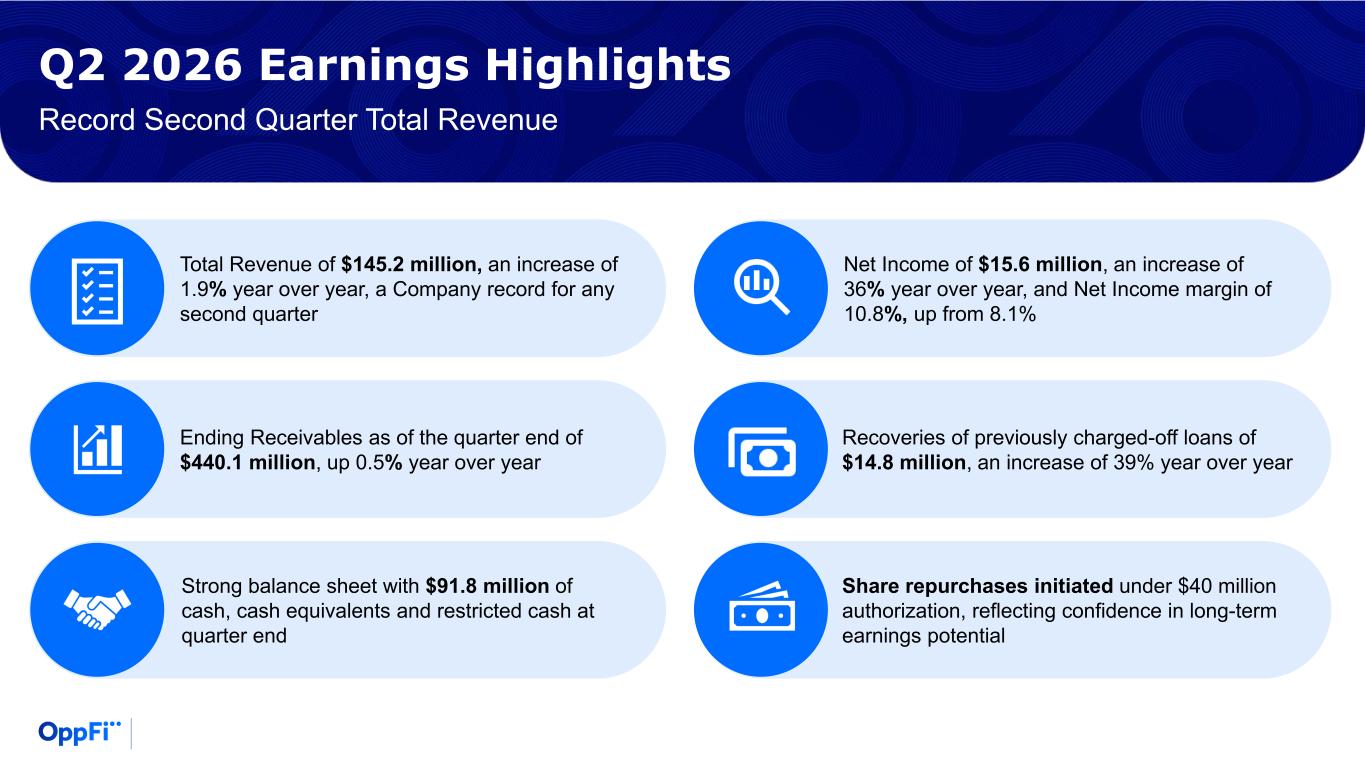
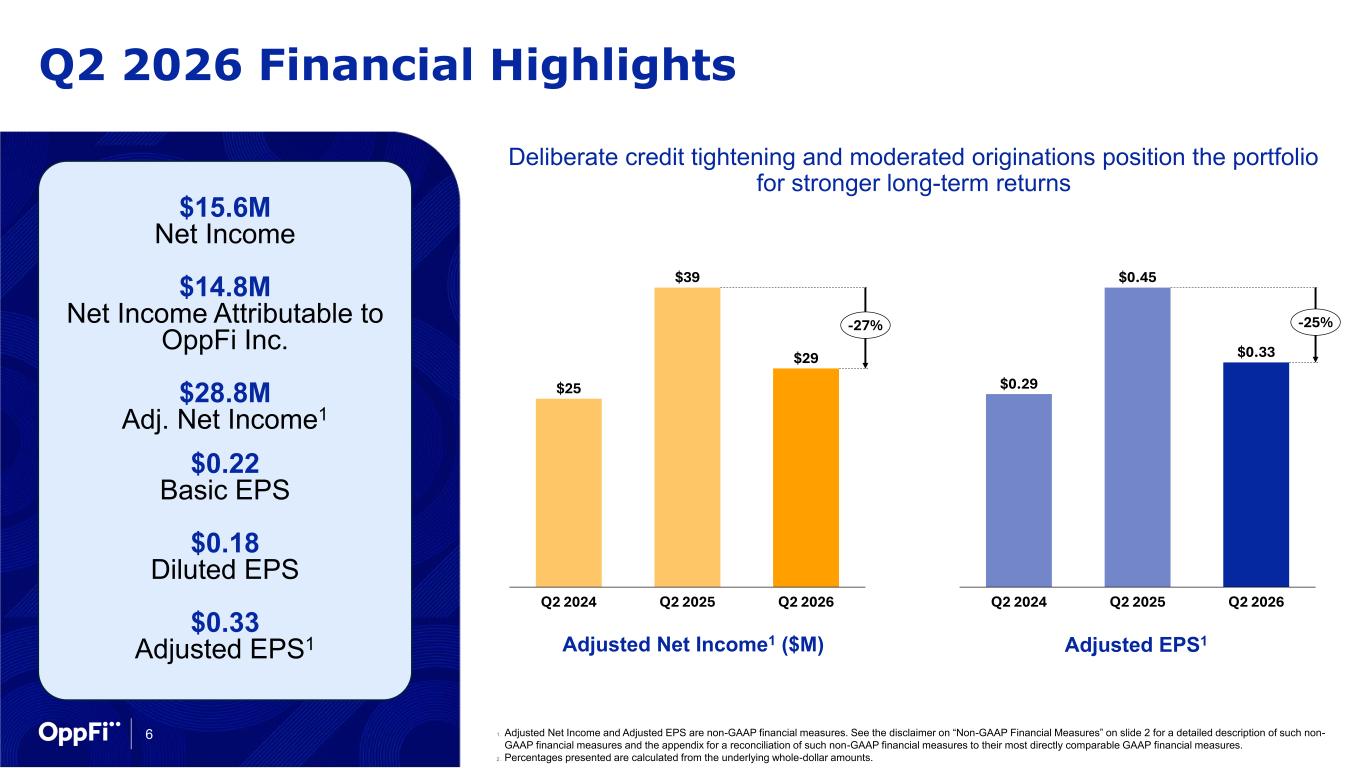
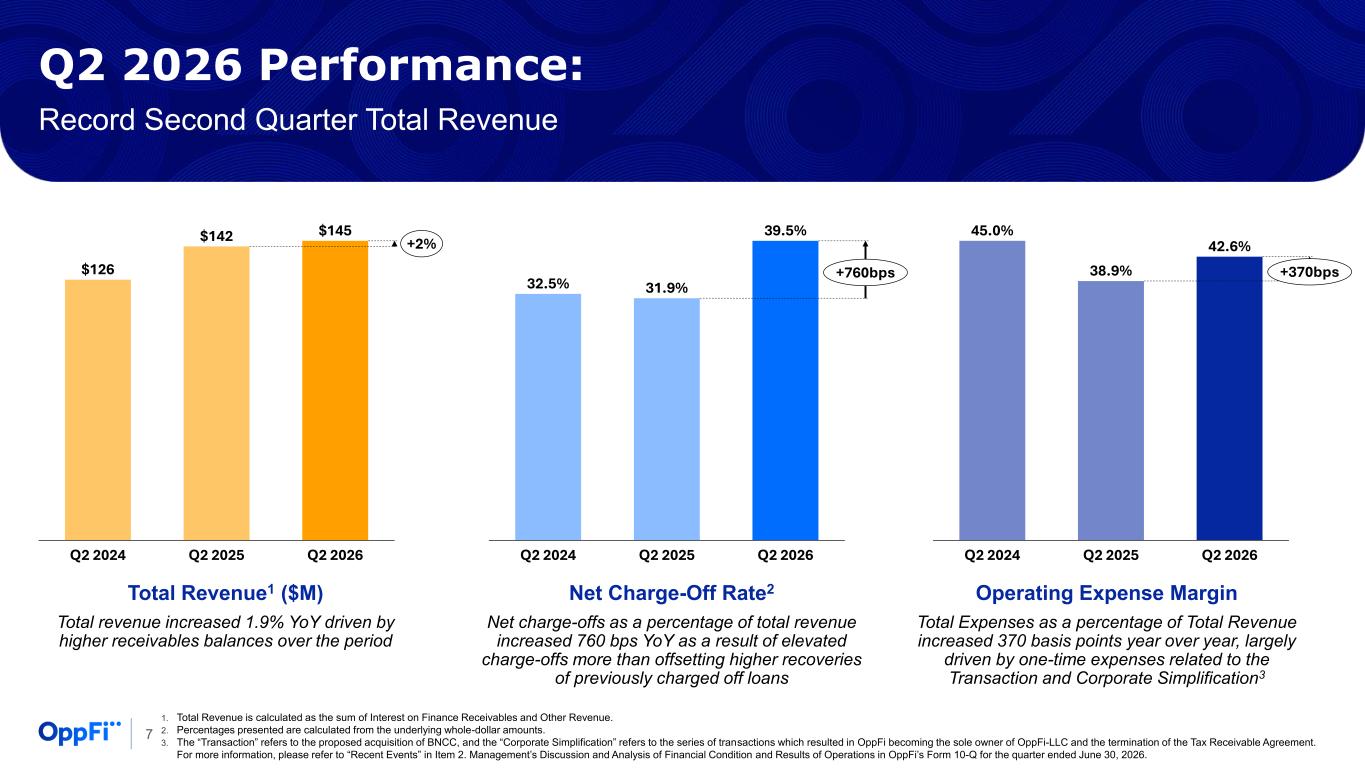
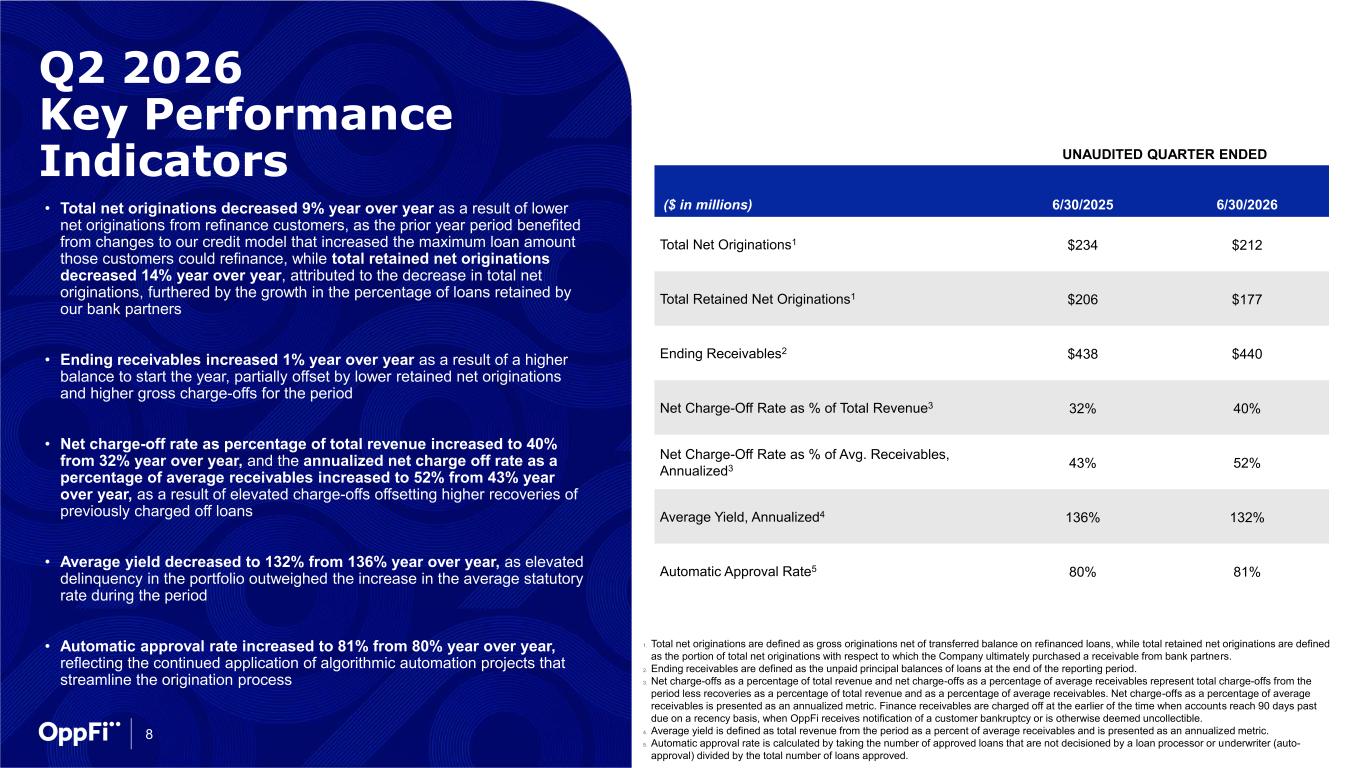
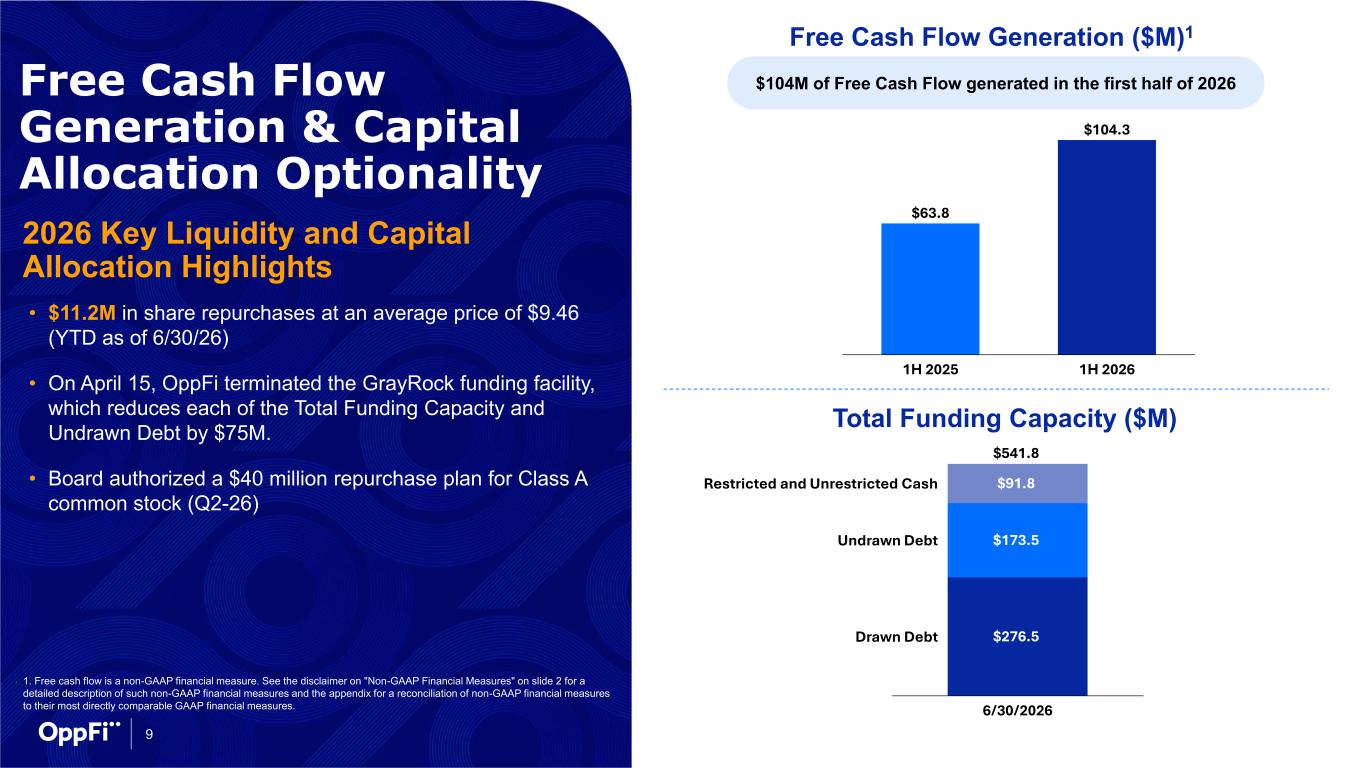
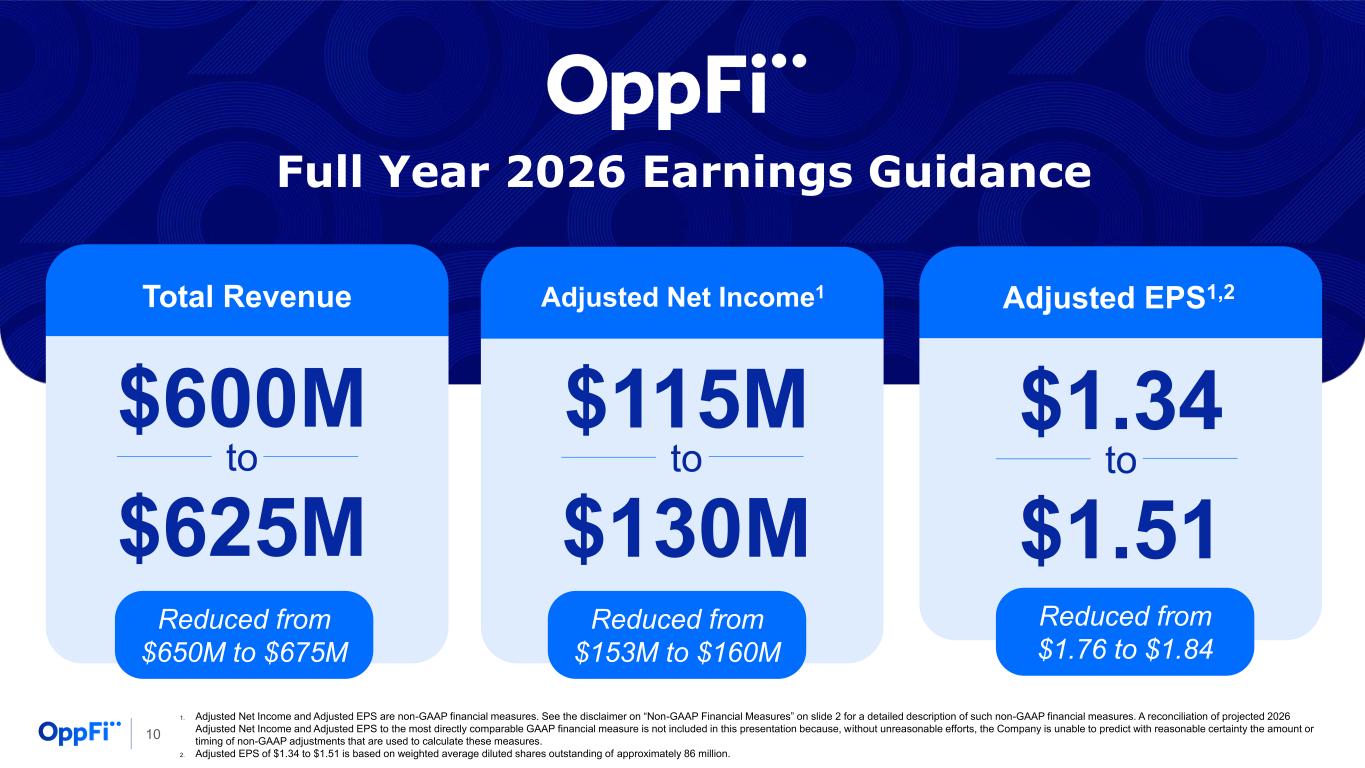
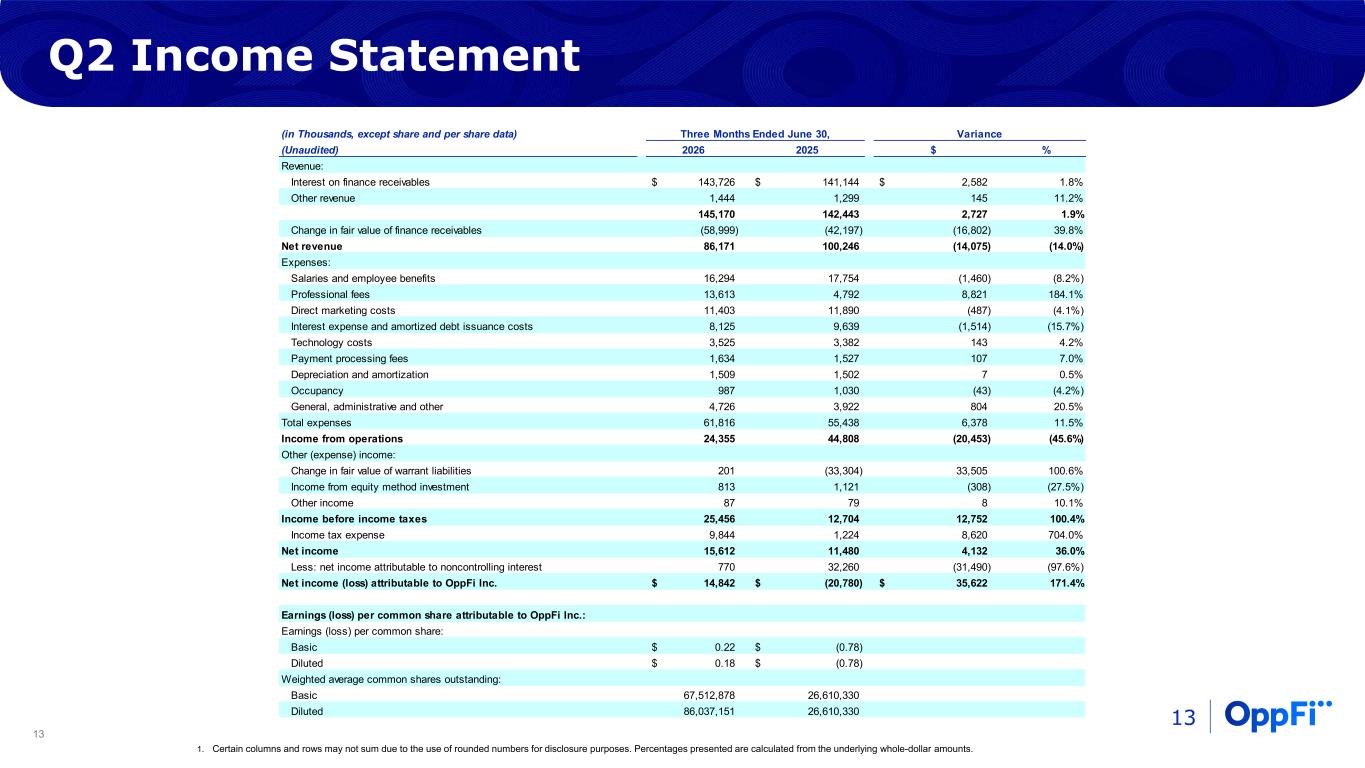
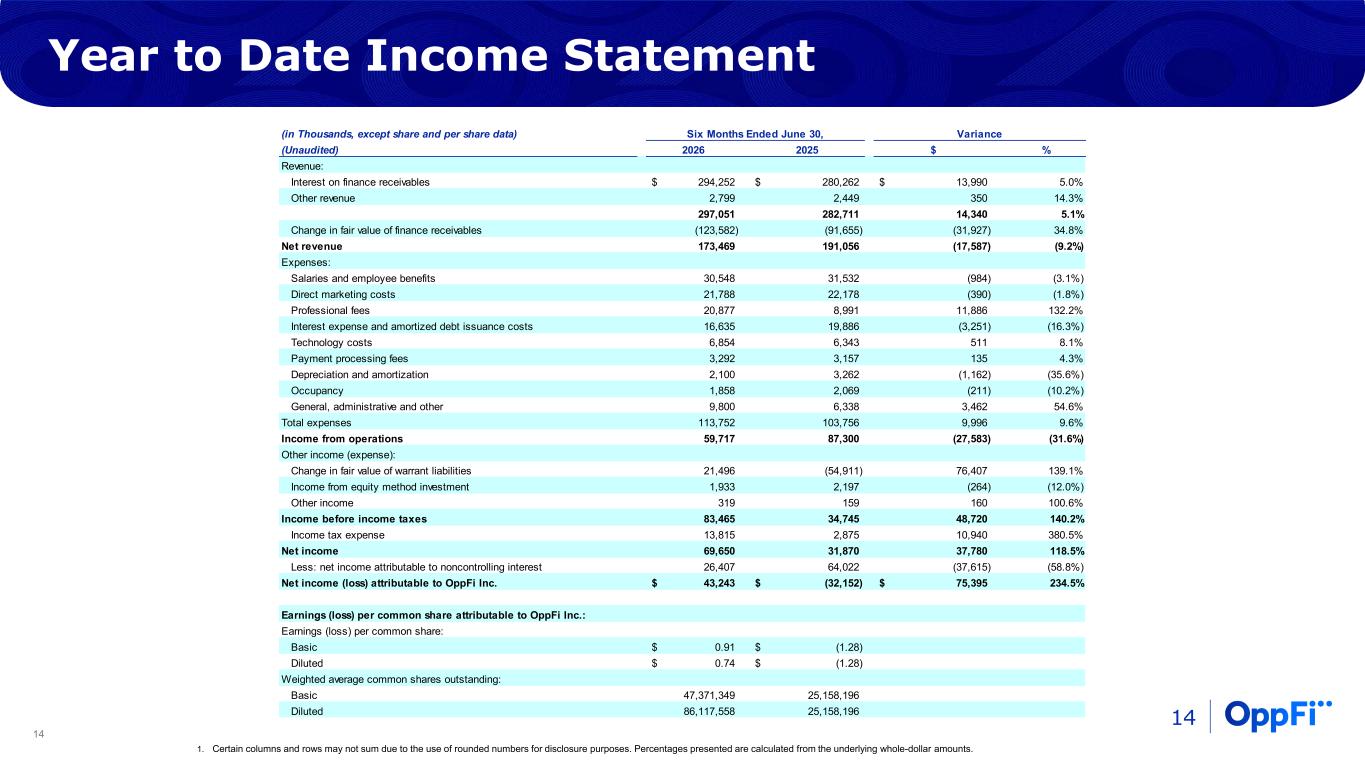
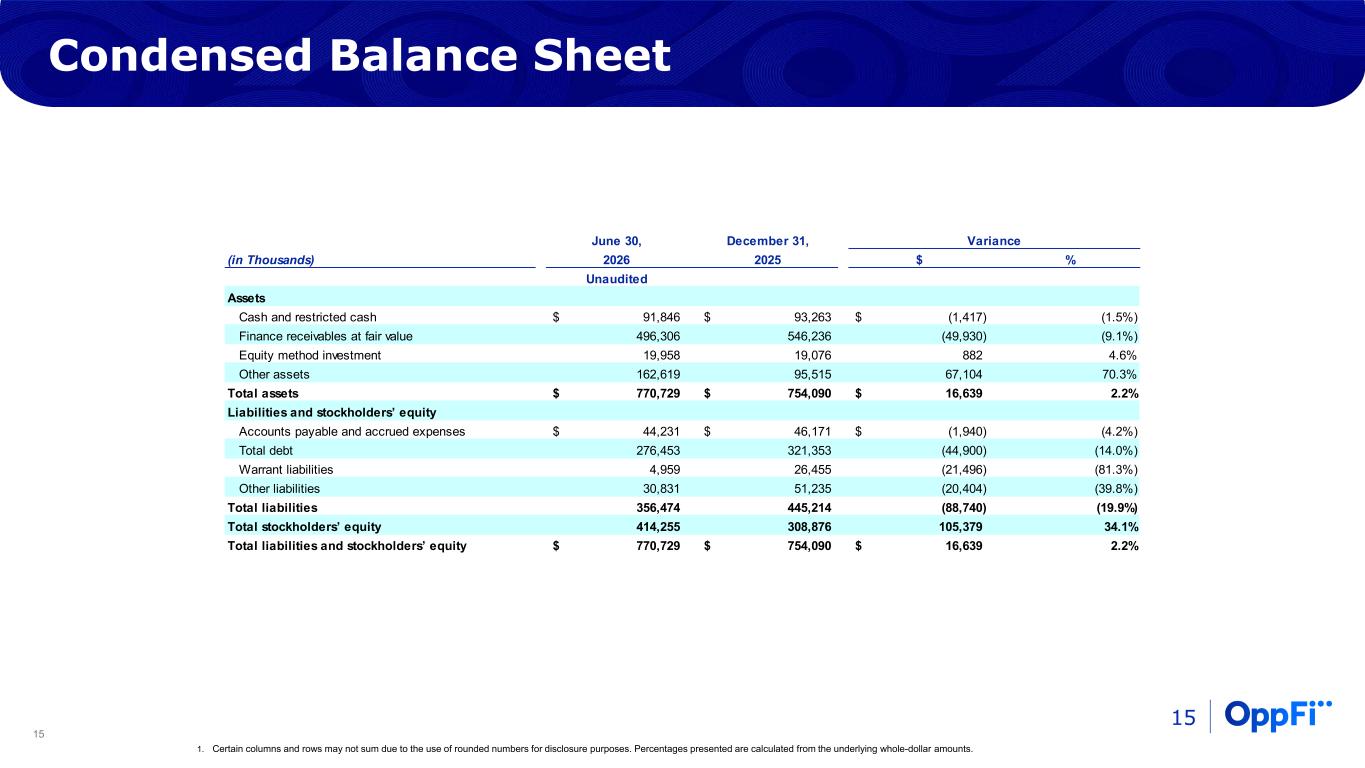
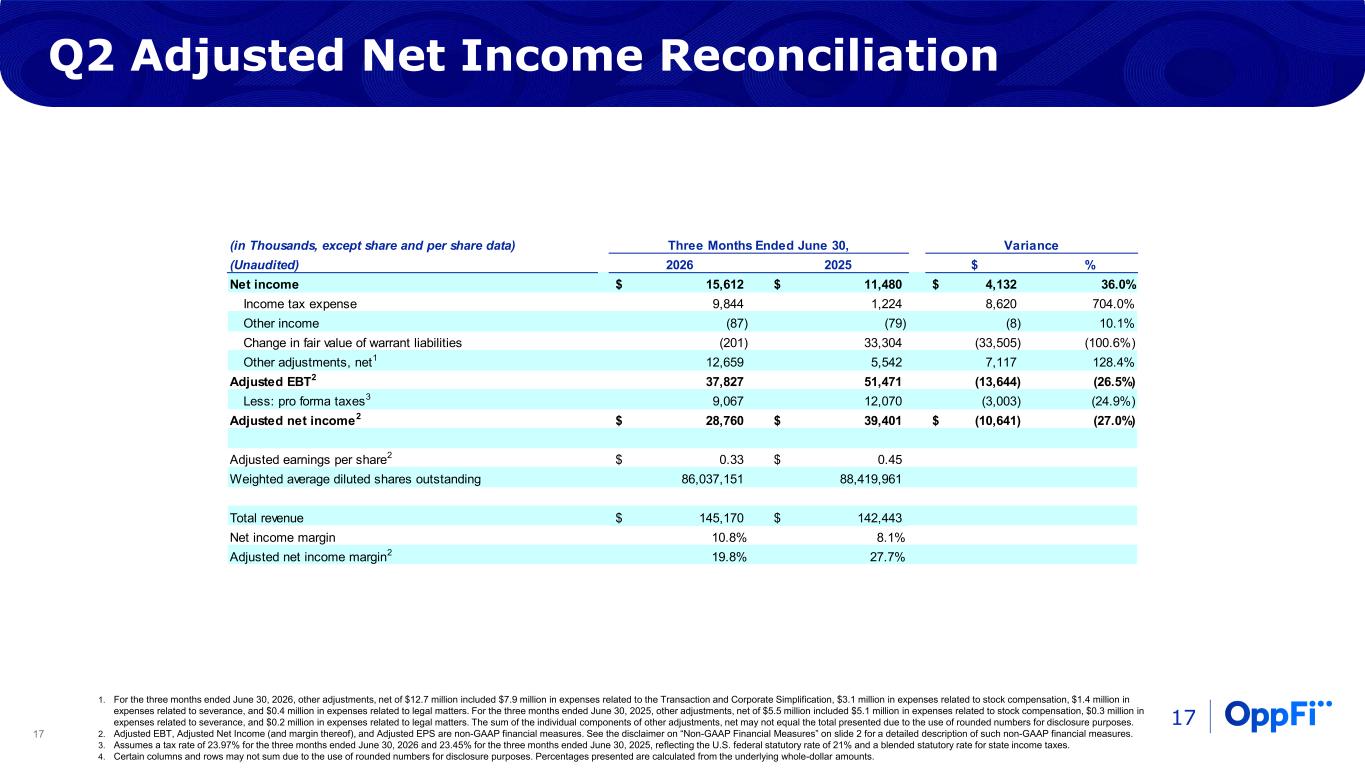
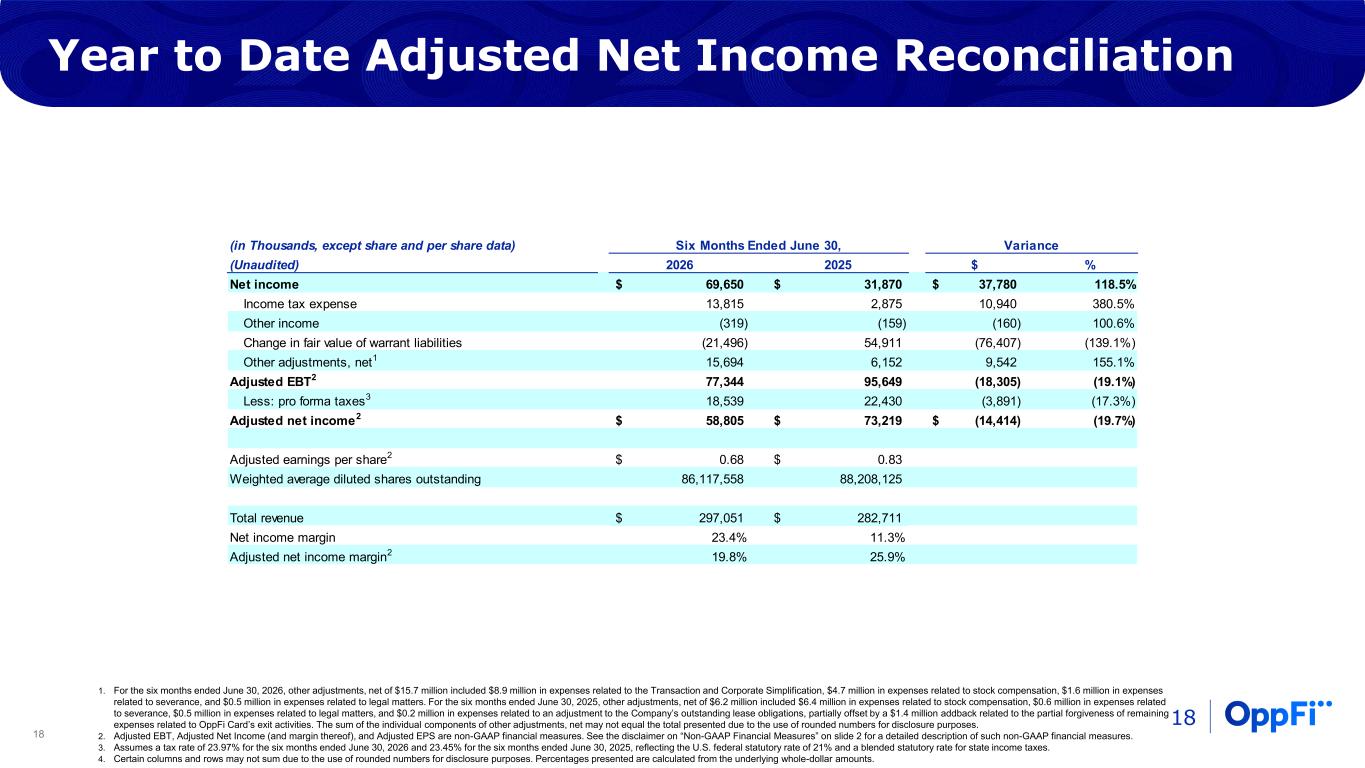
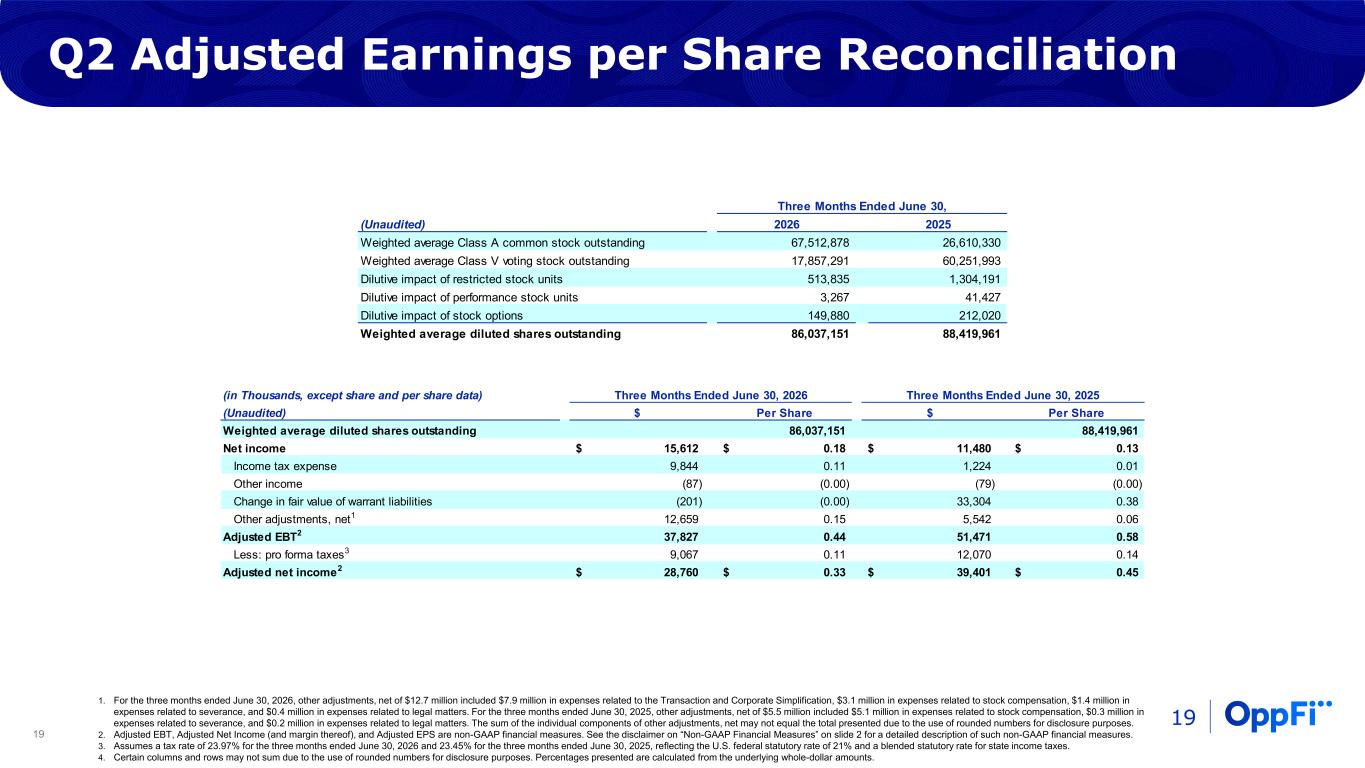
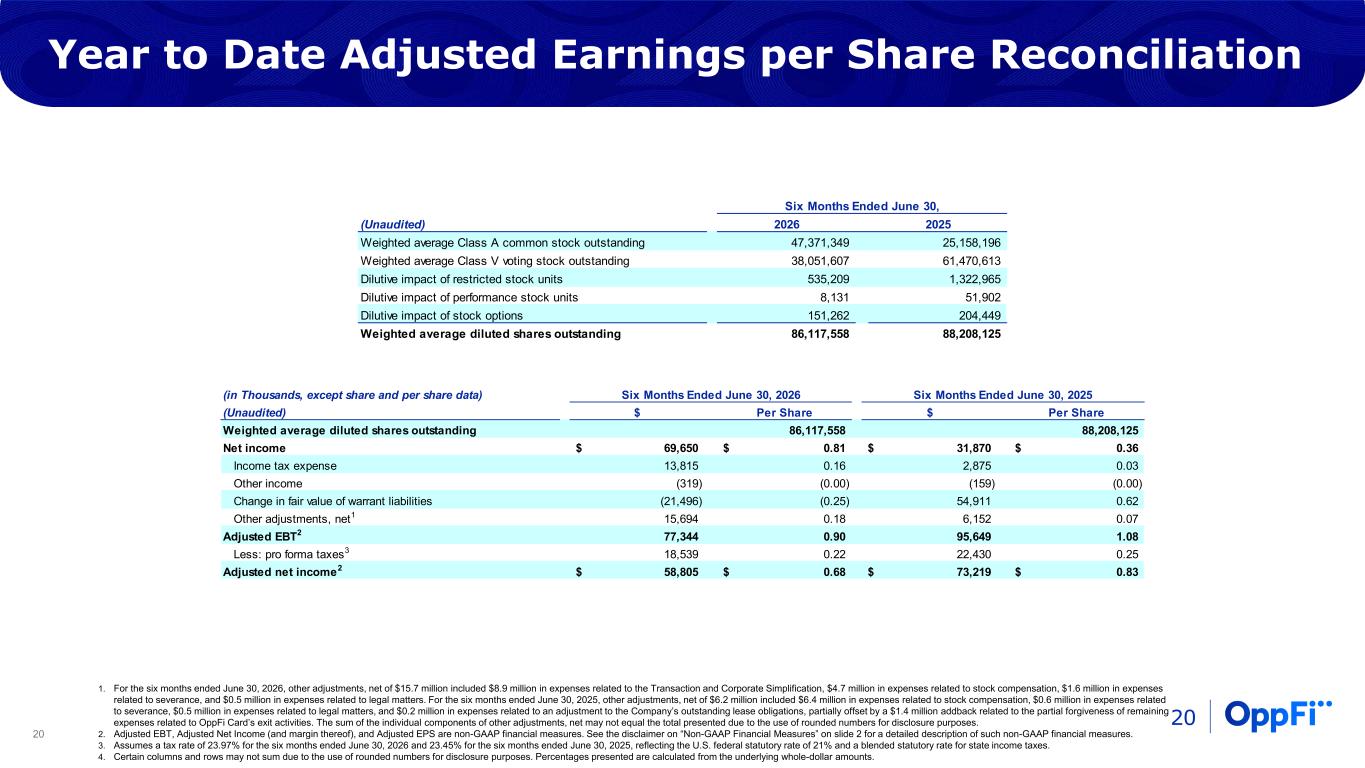
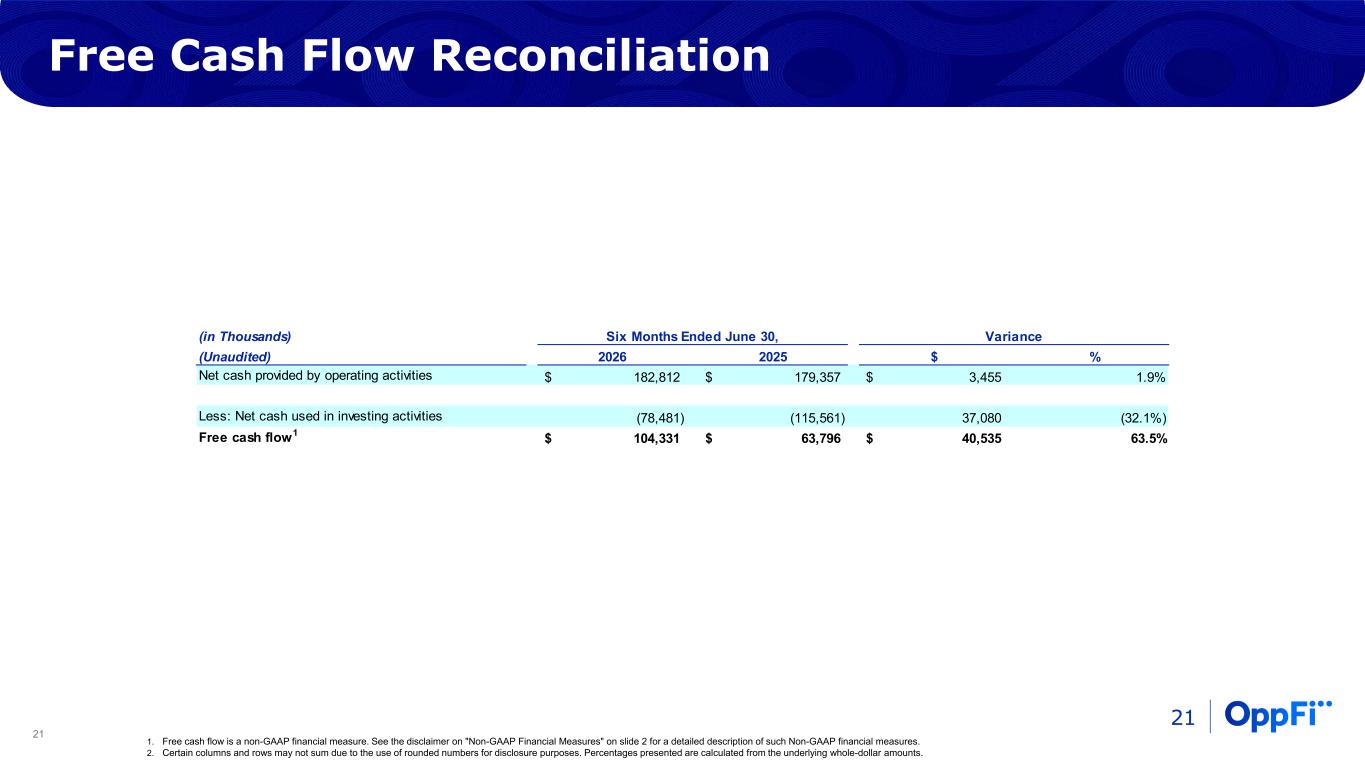
Thanks, Todd, and good afternoon, everyone. I want to build on Todd's comments regarding a quarter and our updated outlook. While we continue to see some variability in consumer credit trends, we are prioritizing balance sheet strength, unit economics, and margin stability over shorter-term volume growth. OutBuy has demonstrated throughout its history that disciplined underwriting, strong credit performance, and sustainable profitability create more long-term value than pursuing growth at any cost in the near term. Importantly, we continue to direct our focus toward building the foundation to unlock new long-term growth and our planned acquisition of BNC is expected to be financially transformative. We anticipate significant revenue synergies beginning in 2027 as we expand our ability to deliver a broader suite of financial products across the larger geographic footprint. These synergies are expected to be driven primarily by geographic expansion and cross-selling opportunities. In addition, we believe OpFi will be able to leverage BNC's capabilities and relationships to further grow our existing business lines. The combination of OpFi and BNC is expected to create a banking organization with capital levels well in excess of regulatory and market standards. Looking ahead to 2028, we expect the combined company to generate return on assets of at least 10% and returns on equity of at least 35%. Turning to our financial performance for the second quarter, we generated revenue of $145 million, a 1.9% increase over Q2 2025, an accompanying record for any second quarter. Originations for the quarter decreased by approximately 9% to $212 million compared to the prior year quarter as we tightened underwriting in segments where we believed risk-adjusted returns were less attractive. These actions were designed to help preserve portfolio quality and support long-term profitability. Net charge-offs as a percentage of revenue during the quarter increased to approximately 40 percent from 32 percent in the prior year period. And net charge-offs as a percentage of receivables increased to approximately 52 percent from 43 percent in the prior year period. Given the denominator effect, these charge-off metrics appear inflated in times of slower growth. Importantly, these charge-offs are partially offset by a meaningful improvement in recoveries, an area where we believe we maintain a distinct competitive advantage. Recoveries increased to approximately $15 million from $11 million in the prior year period. We continue to closely monitor consumer payment behavior and adjust our underwriting posture with agility as conditions evolve, and we remain confident that the actions we have taken to position a portfolio for stronger performance over time. Operating expenses remain well controlled as we continue to balance investment and strategic initiatives with disciplined expense management. Total adjusted operating expenses were approximately $49 million, or 34% of revenue, down slightly from 35% in the prior year period. On an unadjusted basis, given one-time expenses related to the BNC transaction and corporate simplification, expenses were 43% of revenue compared with 39% of revenue in the prior year period. While we continued investing in strategic initiatives, particularly those related to the BNC transaction and platform development, we maintained disciplined expense management across the rest of the organization. Taken together, adjusted net income decreased by 27% in the second quarter to approximately $29 million compared to the prior year period, and adjusted earnings per share decreased to $0.33 from $0.45 in the prior year period. Despite that, our adjusted net income margin remained strong at 19.8%. Looking at the balance sheet, we continue to maintain a robust financial position, ending the quarter with approximately $92 million in cash, cash equivalents, and restricted cash, alongside $277 million in total debt and $414 million in total stockholders for equity. Our total funding capacity was $541.8 million at quarter end, including $173.5 million of unused debt capacity. The strong liquidity position and balance sheet flexibility continues to provide a solid foundation for our capital allocation strategy and long-term growth objectives. On capital allocation, our balance sheet remains a significant source of strength. Our business continues to generate meaningful free cash flow, allowing us to invest in growth initiatives while simultaneously returning capital to shareholders. During the quarter, we began repurchasing shares under the board-authorized $40 million dollar repurchase program, reflecting our belief that the current valuation does not appropriately reflect the long-term earnings potential of the company. Given the timing shift in our launch of the line of credit product and completion of low-level system migration, we are revising our full 2026 guidance to total revenue of $600 million to $625 million, adjusted net income of $115 million to $130 million, an adjusted EPS of $1.34 to $1.51. While we are reducing our near-term outlook, our confidence in the long-term earnings potential of the company remains unchanged. Our expectations for 2027 and 2028 remain intact, and we continue to believe OpFi is building a stronger, more diversified, and more valuable platform. We remain confident in our path toward achieving a long-term objective of approximately three dollars of earnings per share by the end of 2028 with that i will now turn the call over to the operator for q a operator thank you at this time we will open the floor for questions if you'd like to ask a question you may press star 1 on your telephone d pad to remove yourself from the queue you may press star 2. again that That is star one to ask a question.
Operator
And we'll take our first question from David Scharf from Citizens Capital Markets. Please go ahead. Your line is open.
Good afternoon. Thanks for taking my questions. Todd, wondering if you can provide just a little more color on sort of your assessment of what you're seeing from your consumers vis-a-vis credit in what led to the tightening. You know, obviously it's been another earning season where there's, you know, been some pretty broad-based constructive commentary from most lenders about consumer resiliency in the face of inflation and whatnot. And maybe if you can just share a little more on what led to some of the tightening that you enacted in the quarter.
Yeah, I mean, we actually – it actually started last summer when we saw some consumer sentiment. You know, listen, I think if you look at the average of the last four years, you know, the charge-offs are – you know, we had a really strong two-year window there, and we're seeing some reversion on that, you know, back to – But with our risk-based pricing and with some of the term testing we're doing, one of the things I mentioned in my remarks is that the affordability is becoming very, very important for the consumer. So consumers are opting for more total costs to keep their monthly payments affordable. And, you know, we need to be responsive to competition and to what others are providing in the marketplace. And I think that's why we're so excited about the line of credit product. There's also things we can be doing on installment better to better serve our customers. I think if you're getting the payment to income wrong with customers, that is the fundamental rule of underwriting. You're going to cause more customer delinquency or less repayments overall. I think with our risk-based pricing and some of our term and some of our new marketing initiatives, we feel like really, really good for the second half that we're going to, you know, start to grow again and start to, you know, get that back on track. There were some, you know, head fakes with the war and everything going on. But, you know, we feel like, you know, from our business standpoint, you know, we can operate in any environment. And I think that, you know, if you look at our margin and our balance sheet, that was prioritized with everything going on with the transformation and the bank acquisition. and it was paraphrased, but we're getting back to growth now, and we think that there's a lot of opportunity. We're seeing some competitors provide, you know, some more affordability on the payments to allow for more growth, and so we think we can be very competitive and bring something to market that customers are going to be successful with.
Got it. Understood. And maybe as a follow-up, as we think about the second half outlook and the guidance reduction, is there a way to give us a sense for, you know, how much of that is related to the sort of a lower starting point and balances, you know, that you're exiting Q2 with in the delayed, in maybe a one-month delay in rolling out kind of Lola and in line of credit, you know, that being sort of one bucket and maybe the other bucket just being everything else, whether it be changes in, you know, lost trade assumptions, fair value. How much of it's just kind of a Q2 tightening and lower jumping off point versus are there any other factors that we should be aware of that's behind the guidance?
I mean, we've been operating in this credit environment now for, you know, over a year. So we're comfortable with where we're at there and see stability. It's really geared towards the late onset of some of the growth initiatives that we've had, you know, in the second quarter. We're making great progress. I mean, you know, from a financial growth perspective, the way it reports out to you guys in the street in this small three-month window, you know, it shows that we're growing forward. But, you know, when I think about what we're doing on a daily basis with the teams and the product initiatives, the migration, everything's going very well. And we think that we're just, you know, the business is going to, you know, we're trying to retool the business to set this thing up for a much larger multi-product platform. And so, you know, it is definitely kind of more of a late onset situation where, you know, we're not getting the line of credit in market as soon as we thought we would. and then also some of the migration things with data that we're working through to make sure that, you know, we're taking, I think I said it in my commentary, measure twice, cut once approach, and making sure, you know, and while keeping the balance sheet strong. Got it. Got it. Great. Thank you.
Operator
Thank you. We'll take our next question from DayStorms with Stonegate Capital Partners. Please go ahead. The line is open.
Maximus
Analyst — Stonegate Capital Partners
Hello. Good afternoon. This is Maximus. I'll be asking questions for DayStorms today. I just wanted to start off on Lola as, you know, the platform gets further rolled out in the second half of the year. Kind of just wondering where you think the biggest benefit will be first. Is it better compersion, servicing efficiencies, recoveries, or if you have any other color, that'd be great.
Yeah, we think it, you know, I think one of the benefits you're going to be seeing here is we have a new product coming to market in less than six months. And that's because it was completely built on the new system, which took advantage of our modular architecture and all the benefits of it. We didn't have to go into the legacy system at all to be able to develop it as a new product. And so that's one of the biggest things I'm excited about is cycle time for development and bringing things to market. And from a product standpoint, being able to, you know, work on things a much faster click. Our goal is to reduce our cycle times by 70% over the next year. And so that is also, it will allow us to push on some of these automated, you know, we actually made progress in the quarter. Our automated approval rate was up into the 80s, first time the companies achieved that. So we're continuing to make progress even on the legacy system, but this will unlock us to our ability to start to move those metrics higher and better service our customer. We think the cycle time from app to fund for some of the more manual applications is going to go down significantly. So it's another benefit of the new system.
Maximus
Analyst — Stonegate Capital Partners
I appreciate that. And then lastly, wanted to get a little bit more color on the line of credit as well. You had mentioned the testing that happened this past quarter, and I just wanted to see if you could dive in deeper into more of the findings or the discoveries that you guys have found out. And I also wanted to see if the lock, the line of credit, is going to be more specifically for new customers or as well current customers as well. Thank you.
Yeah, good question. Well, you know, first of all, I think the way customers can draw on their lines and the flexibility of when they draw as opposed to, you know, kind of the installment right now is done at a refinance or if someone's paid in full, you know, they would reloan out. So that ability to draw smaller increments over time and give the customer the flexibility of when they choose to do that, also coupled with, you know, the payment stream being a little bit longer dated to allow for more affordability of monthly payment. So we feel like those two aspects of this are really going to do a great job to respond to kind of some of the market dynamics we're seeing. You know, one of the things we will be testing is what customers select in a market where we're going to offer both. That isn't in the original launch plan. The original launch plan will allow for three new geographies for us to offer a line of credit to customers, so net new customers. But soon after, we will be, you know, in market where customers can choose which product they desire and what best fits their financial needs. And so, you know, as we run those tests, we'll be updating everyone with the results and kind of see where we think that the new product fits best in the market.
Maximus
Analyst — Stonegate Capital Partners
Great. That's all for me. Good luck next quarter. Thank you.
Operator
Thank you. We'll take our next question from Mike Rondell with Northland Securities. Please go ahead. Your line is open.
Thanks. You know, with the reduced outlook, just trying to understand between the line of credit product and the Lola migration, are those both about a month delayed? Trying to understand that a little bit better. And then, you know, revenue outlook down, I don't know, probably $40 million to $50 million, adjusted EPS about $0.40 at the midpoint. Is that more LOC versus Lola? Just trying to understand the breakdown there because it's kind of big numbers for these two delays.
Yeah, I mean, you know, the line of credit, like I said, opens up three new geographies. And, you know, we think there's meaningful volume to come out of it. So every month that it gets delayed obviously impacts our origination targets. I do think, though, that on the Lola side, it's less about that. It has delayed some of our product initiatives. So the way it would hurt originations for the Lola is we are originating new loans into the Lola system. It's the legacy products, and it's the product initiatives that we have scheduled but we're not able to enact because of the delay in the system. And so those are high ROI initiatives that we know will result in boost in origination growth. So when you couple that with the LLC and the delays, that is the reason for bringing down some of the origination targets. I do, however, feel, though, that we are hitting on some things now, and I do feel like, you know, we're going to be able to return to growth in the second half with some of the things we've been, you know, working on throughout the quarter and the testing with our customer intelligence.
Got it. And in characterizing it as a one-month delay or?
Yeah, our goal is to get this in market in September, so, you know, that would have, you know, effectively be a two-month delay from where we originally planned, but, you know, we feel pretty confident now, like, we're getting a lot closer and feel that, you know, there's a high likelihood that we can get this thing launched in September, which is, you know, exciting.
Lastly, you know, net charge-offs on average receivables, 52% on revenue, 40% versus 30%. I mean, despite that, I think you're kind of saying the credit environments you're worried about, but, you know, those increases seem kind of significant. Could you just reconcile that for us?
Yeah, I mean, listen, I think, first of all, our recoveries are, you know, from a percentage, not only on a dollar basis, you know, collecting more, but as a percentage as well. So the net number, you know, those are real, the recoveries. But what I will say is if we were growing at, you know, 9%, 10%, those numbers come down to, you know, about 500 basis points, right? So the 40% comes down to 35. So, you know, there is some elevation. We acknowledge that. And we've kind of talked about that, you know, over the last two quarters from the lows of early 25. But I do think it's a little bit exacerbated because of our, you know, on the origination side, a little bit of slower growth. So it exacerbates those numbers a little bit from our share point. But we are very happy to see the strong performance and recoveries, which always, you know, is welcome when looking at, you know, the total picture.
Lastly, I guess, any correct...
Yeah, I mean, all I can say, you know, we're in the middle of our comment period. All I can really say is we've submitted our application and are working with the regulatory agencies at this time. As soon as we have, you know, updates to provide, we will in the coming quarters. But as of now, that's, you know, we can't really comment on it more to say than, you know, we've submitted our business application and are working with the regulatory agencies.
Got it. Is it reasonable to still think by year end? Has that timeline changed in your guys' view?
Yeah, I mean, I would, you know, I would like to think so. You know, we're ready to fulfill on that timeline. Obviously, it's a little bit out of our control, but, you know, that would be, you know, our plan as of now is Q4.
Operator
Thank you. This concludes our question and answer session and brings us to the end of today's meeting. We appreciate your time and participation. You may now disconnect.