Operator
Good day and thank you for standing by. Welcome to the PAR Technology Fiscal Year 2026 Second Quarter Financial Results Conference Call. At this time, all participants are in a listen-only mode. After the speaker's presentation, there will be a question and answer session. To ask a question during the session, you will need to press star 11 on your telephone. You will then hear an automated message advising your hand is raised to withdraw your question please press star one one again please be advised that this call is being recorded i would now like to hand the conference call over to your first speaker today please go ahead thank you calicia and good afternoon everyone and thank you for joining us today for part technologies 2026 second quarter financial results call.
Earlier today, we released our financial results. The earnings release is available on the investor relations page of our website at partech.com, where you can also find the QC financials presentation, as well as in our related form, 8K, furnished to the SEC. Before we begin, please be advised that our remarks today will contain forward-looking statements. These forward-looking statements are subject to risks, uncertainties, and other factors which could cause actual results to differ materially from those expressed or implied by such forward-looking statements. For additional information on these factors, please refer to our earnings release and other reports filed with the SEC. Also today, we'll be discussing or providing certain non-GAAP financial measures, which we believe will provide additional clarity regarding our ongoing performance. For a full reconciliation of the non-GAAP financial measures discussed in this call, to the most comparable gap measure in accordance with SEC regulations, we see our press release furnished as an exhibit to our Form 8-K file this afternoon and our supplemental materials available on our website. Joining me on the call today is PARS CEO, Savneet Singh, and Brian Min, our PARS chief financial officer. I'd now like to turn the call over to Savneet for the formal remarks portion of the call, which will be followed by general Q&A. Savneet?
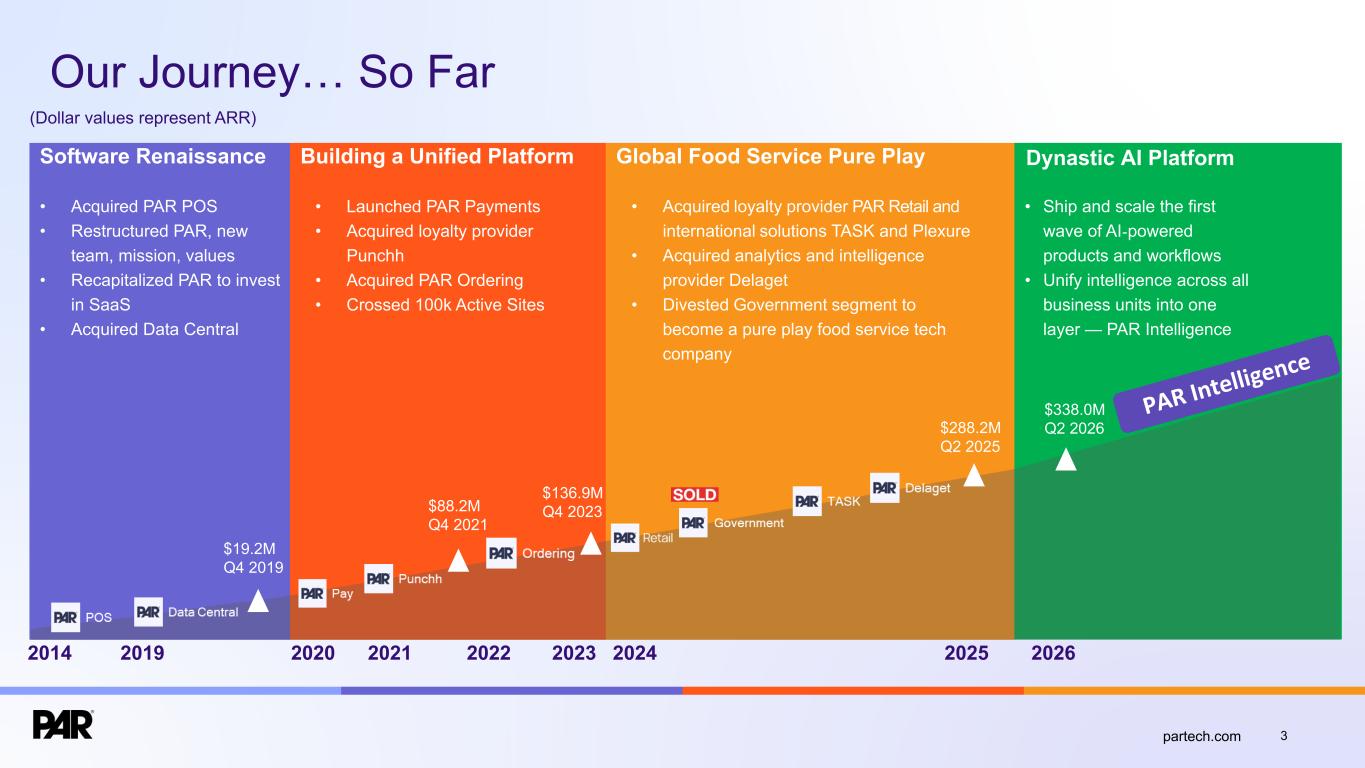
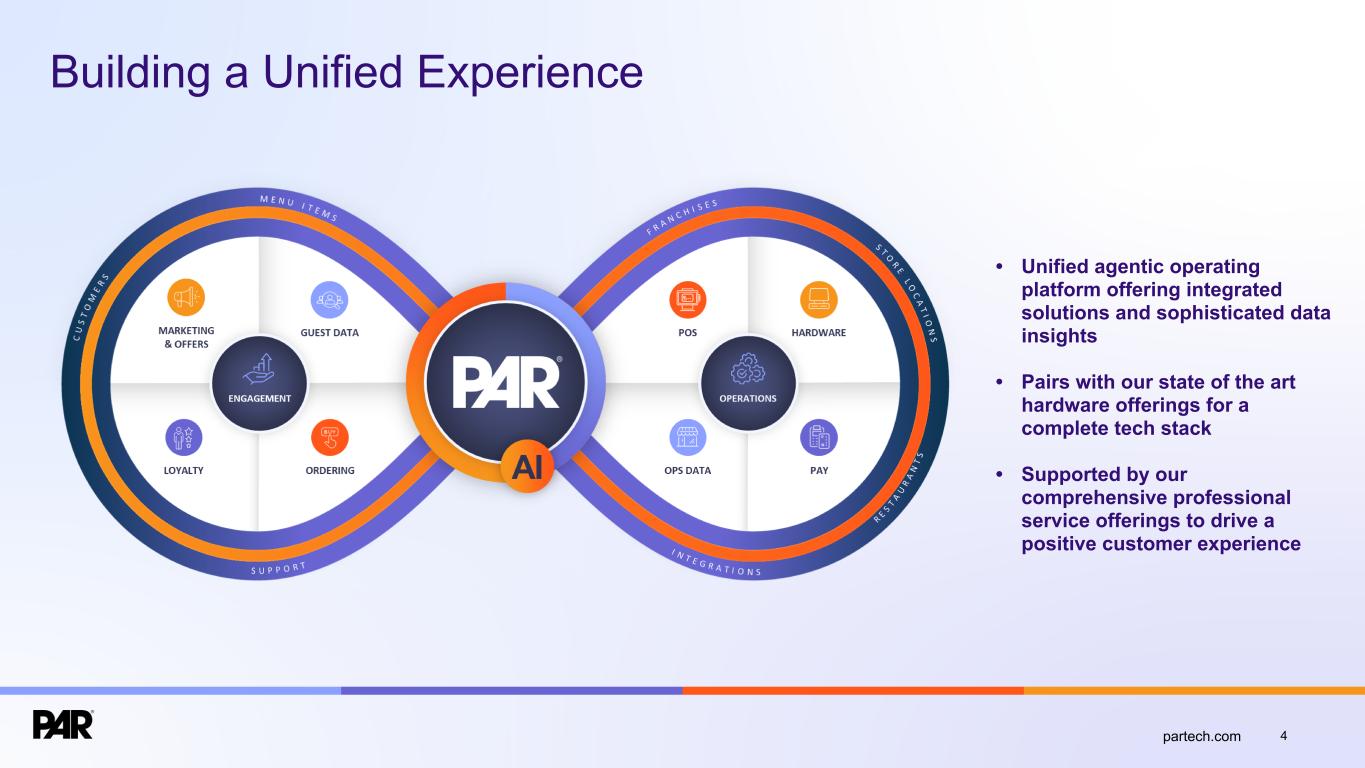
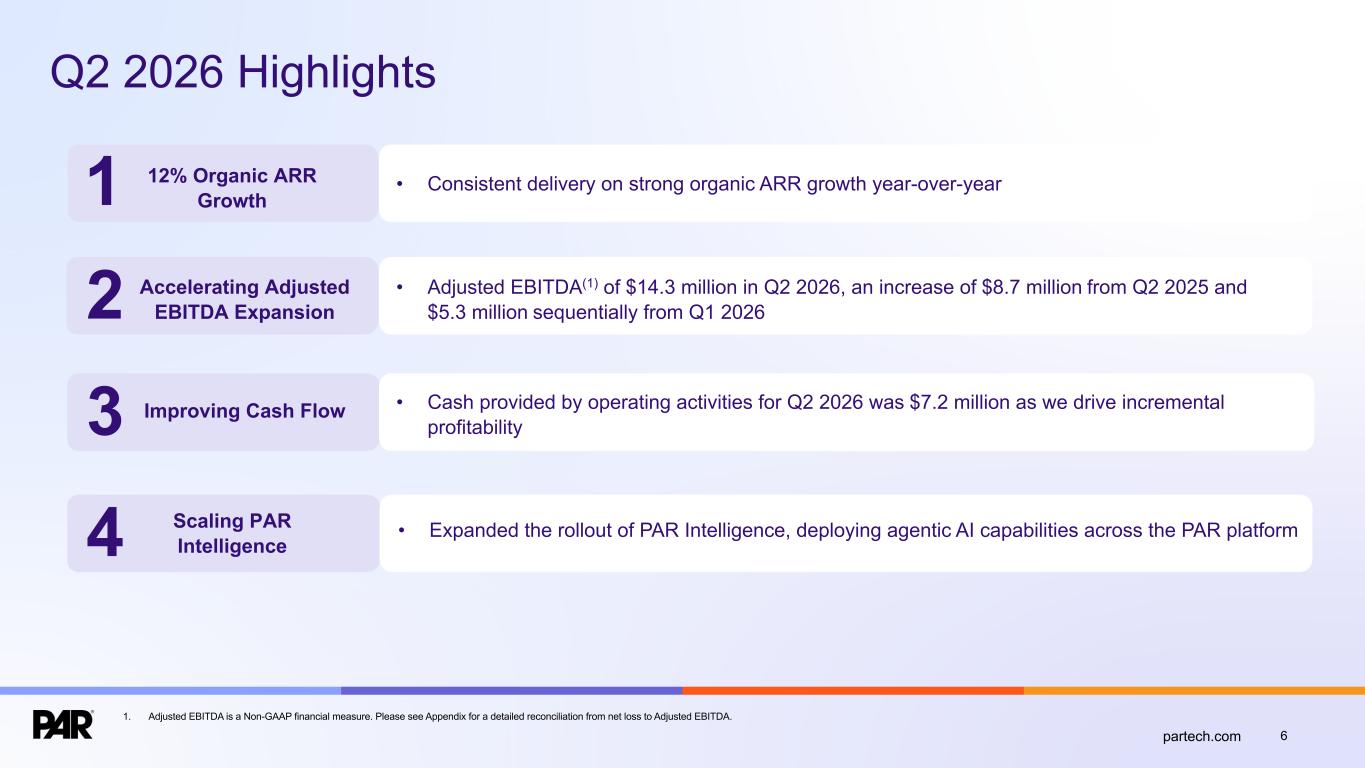
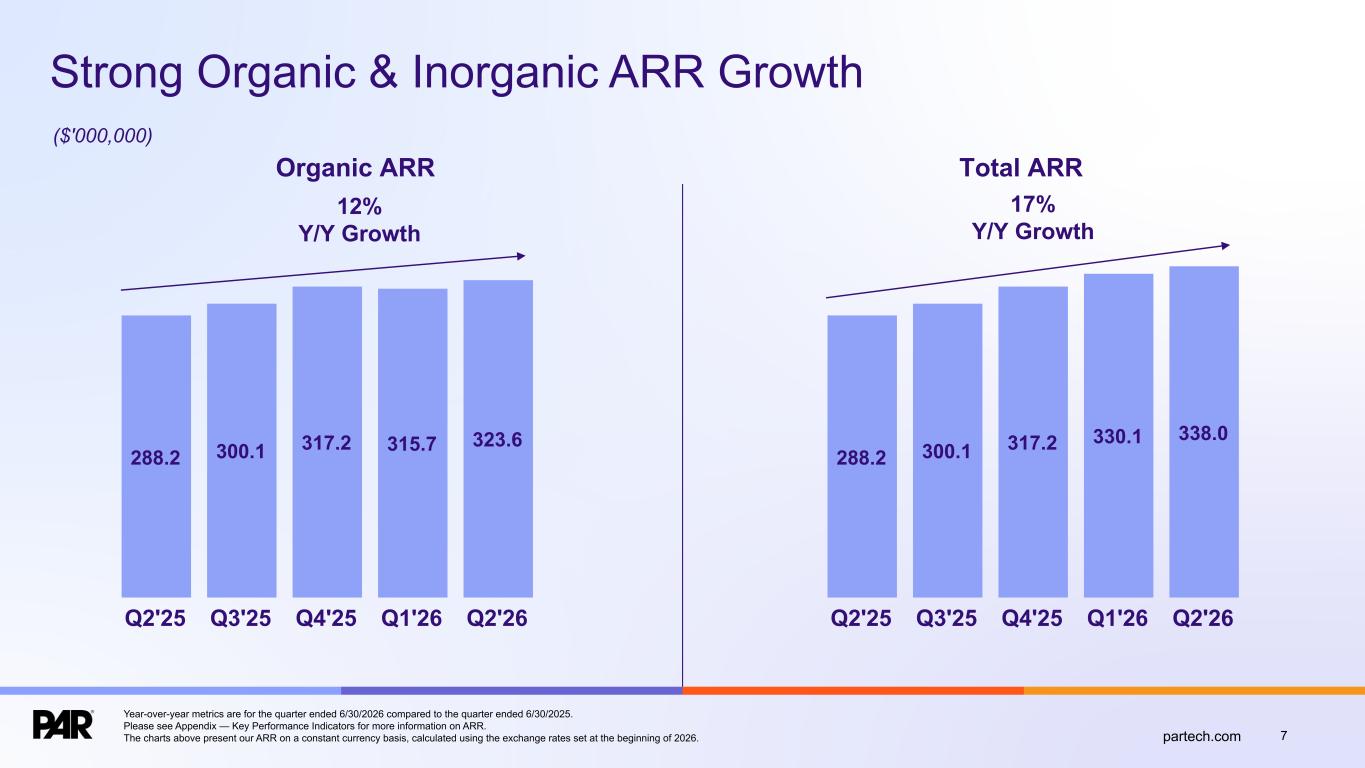
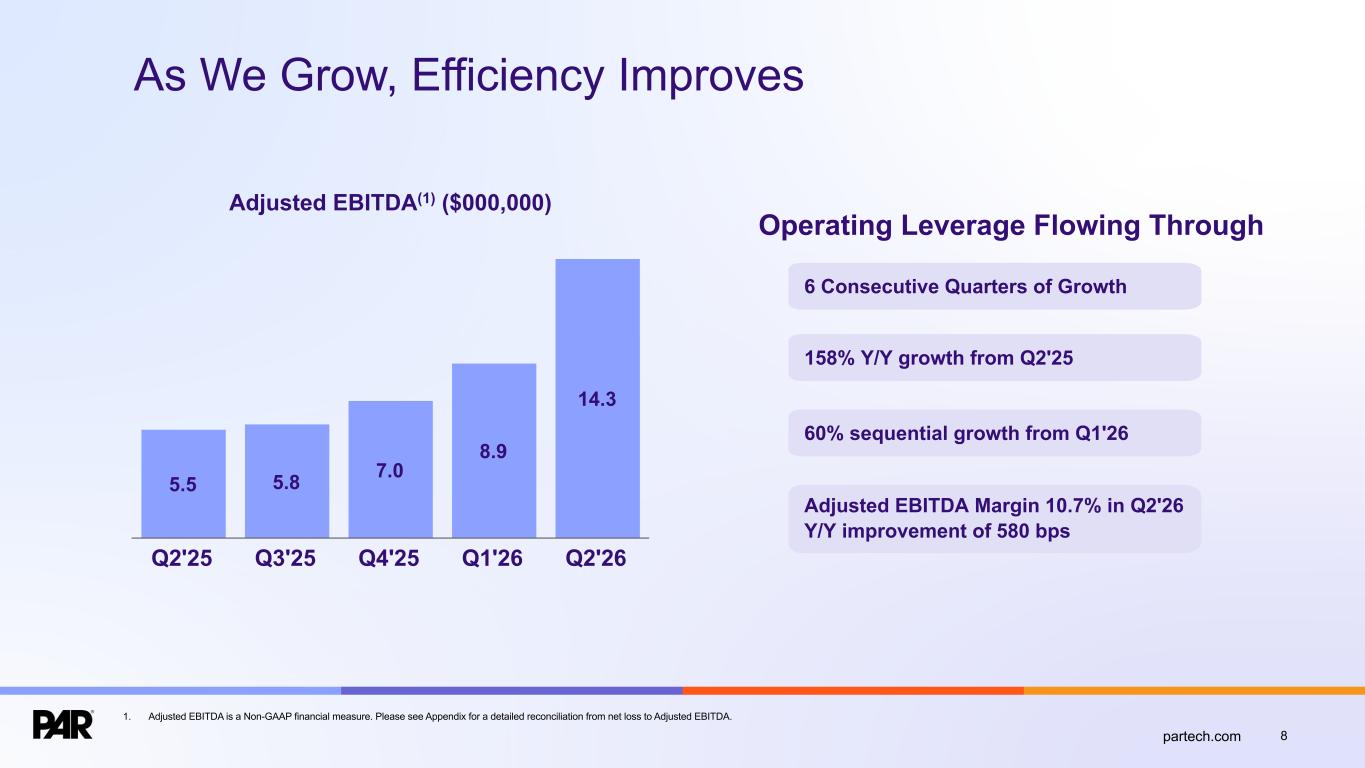
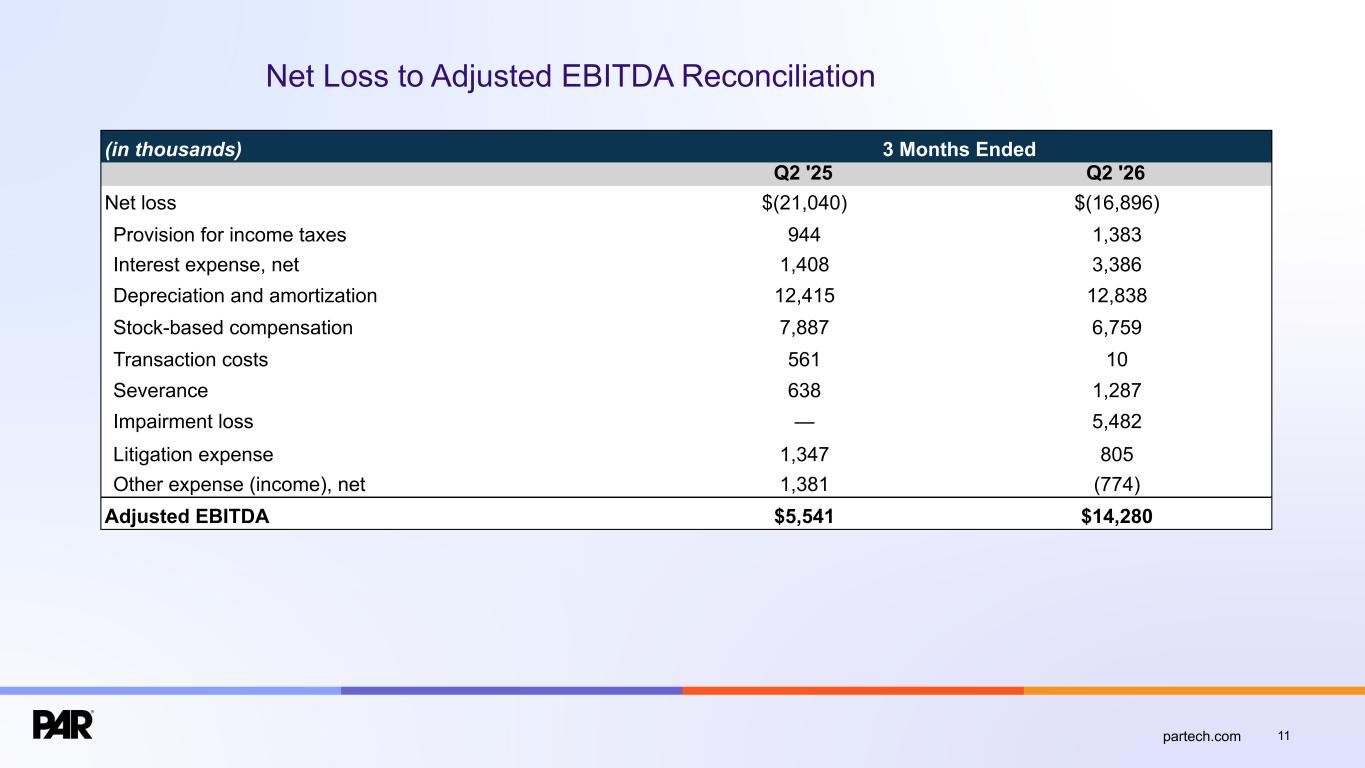
Thanks, Chris. and thank you all for joining us today. On our first quarter calls, we established clear financial and AI adoption targets and laid out what success looks like for PAR in 2026. Since then, we've been heads down executing against our three-pronged growth strategy, namely to, one, extend our competitive platform advantages in core markets, two, reinvest in product efficacy via powerful AI functionality, and three, aggressively expand and our total addressable market in areas where we can continue to leverage our inherent platform advantage. As Ben Graham's embassy famously said, in the short run, the market is a voting machine, but in the long run, it's a weighing machine. We plan to continue to stack weights on the scale. At par, we're always on offense. This is evidenced by our strong Q2 results and highlights which I'll start with today before handing the call to Brian to discuss our financial results in more detail and provide our outlook for the remainder of the year. Q2 was a starting shop in the show-me market. We delivered results ahead of expectations, expanded our platform footprint across both restaurant and retail, grew our PAR intelligence user base to roughly 20,000 sites, greenlit material TAM expansion initiatives in both restaurants and retail sectors, overhauled our cost structure, and strengthened our outlook for the remainder of the year. Most central to the Parsi of those pieces, we continue to prove the value and staying power of our platform strategy. Our customers are expanding their adoption across our portfolio, creating larger and more strategic partnerships. Our momentum is reflected in our AOR performance, our improving margin profile, and our growing pipeline of enterprise opportunities across both restaurant and retail markets. Let me start with a few highlights. We exited the quarter at approximately $338 million of ARR, representing over 17% year-over-year growth and 12.3% organic growth, and setting us up for a meaningful acceleration in the second half, as communicated earlier this year. We generated adjusted EBITDA of $14.3 million in Q2, an improvement of nearly $9 million from Q2 last year. The $14.3 million of adjusted EBITDA includes $1.3 million of overperformance in the quarter given by a specific hardware initiative by a large legacy enterprise restaurant customer. Without this project, the Q2 normalized number is $13 million in adjusted EBITDA against a previously forecasted range of $9.5 to $11.5 million. Our profit acceleration is done the right way, by leveraging the fixed scale of our operations while continuing to improve the unit economics of each product. As an example of this, across our core product base, the three-year blended ARPU CAGR sits at 8%, while the average platform deal term length is roughly double that of a point solution. These strong Q2 results reinforce our confidence that we can continue balancing growth and profitability while investing in strategic opportunities in front of us. Looking across the business, we're seeing encouraging momentum in nearly every major product category. Our restaurant vertical delivered a strong second quarter, securing the pipeline and backlog for the back half acceleration we spoke about on our last call. What stands out most is the continued success and durability of our platform strategy. Customers select PAR for its integrated solutions rather than purchasing individual products. An integrated product ecosystem is a perfect foundation to be the core restaurant AI partner of the future. as performance AI features require multiple systems working together in real time. A standalone AI wrapper or point solution cannot replicate a feature that bridges point-of-sale, inventory, labor, and guest data. Our end-to-end fully connected stack is the clear gold standard. Multi-product attachment on Q2 new engagement sits at nearly 100%. Wins included Guthrie's Chicken, Star Crew Japan, Nukes, BurgerVille, DPhil Brady's, and Badass Coffee. All included multi-products across point-of-sale, loyalty ordering, payments, and back-office solutions. Operationally, our deployment teams executed at scale. On the PARPOS side, we remain ahead of plan on Burger King activations and continue to see potential upside beyond our current year-end target. Additionally, we completed key development milestones in Papa John's upcoming platform deployment and are well positioned to kick off their implementation plan later this year. Separately, PAR Ops delivered its strongest quarter ever, activating nearly 700 locations. Looking ahead, we enter the back cost of the year with substantial operator product backlog, identifiable expansion opportunities, and a healthy pipeline. Combined, these factors suggest us to reach our ARR targets with additional upside if execution continues at the current pace. Now to go over engagement and ordering. Within Punch, growth remains solid despite the planned churn we experienced in Q1. The business continues to showcase strong margins, expanding customer utilization, and generating opportunities through set expansion, pricing actions, and new products. We are highly confident in the long-term value proposition of Punch as loyalty programs remain central to guest engagement and personalization strategies. With respect to par ordering, we delivered our best-ever quarter in Q2, closing six new deals. What's especially notable is that three of those wins came from customers migrating off the market's largest legacy ordering provider, reinforcing the competitive strength of our offering. Customers increasingly want fewer vendors, tighter integrations, and a simpler operating environment. Our single digital cockpit with PAR ordering is exactly that, allowing you to manage all your digital menus in one place. Every ordering deal this quarter includes other PAR products, whether that was point-of-sale, punch, payments, or a combination of all three. A specific highlight this quarter was seeing growing traction from our catering capabilities. Catering was a component of two of our six part ordering wins, and that's particularly meaningful because catering was our largest roadmap investment last year. We're now beginning to see those investments translate into customer demand and commercial results. It's a great example of how disciplined product investment can create new growth vectors over time, not only increasing ARPU, but separately enhancing overall product competitiveness. The relative competitive valuability is evidenced by par ordering delivering win rates above 50%, the highest success rate of any major product in our portfolio. Given the demand environment we're seeing, combined with the fact that payments is attached to every ordering deployment, we feel very confident in our ability to continue to grow this business consistently quarter after quarter. On the holistic product innovation front, we continue to meaningfully accelerate deployment across the organization. Compared to a year ago, we've increased delivery velocity roughly threefold. Simply put, we're building and shipping products faster than ever before, which allows us to respond more closely to customer needs and extend our leadership position in the market. Another area where we're seeing progress is AI. Our strategy has always been to leverage the unique data, workflows, and operational contacts that already exist across the platform. As customers adopt more of our products, the value of AI capabilities increases because they are trained in a richer and more connected view of restaurant operations. We're beginning to see that play out in the market. We're also preparing for a significant expansion regarding part intelligence, with over 20,000 locations planned to go live in the third quarter. These deployments validate what we're hearing from our customers. They want practical AI that helps operators make faster decisions, improve guest engagement, and drive measurable business outcomes. As previously expressed in our Q1 earnings, we view 2026 as an adoption year for part intelligence, and the focus remains on embedding AI into customer workflows, proving value at scale, and expanding usage across our install base. We're moving from a platform that reports what happens to one that optimizes in real time. As an example, customer loyalty initiatives can quietly leak money through promo abuse, misconfigured offers, unproven renewals, unclaimed funding, silent customer drop-off, and operators usually find out weeks later, if at all. We're building a system that catches this continuously and delivers a fix, not just the finding. This works because the data already lives in par, growing sharper with every order, every loyalty event, and every new site. The operator sets intent and approves the action, protecting margin and growing basket size, visits and upsells without growing the team. As adoption grows, we believe 2027 becomes the inflection point where AI contributes more meaningfully to revenue growth through premium capabilities, extended product attach rates, and deeper customer engagement. The combination of data, scale, and workflow integrations creates a long-term competitive advantage and further strengthens the value proposition of the PART platform. Now moving on to retail, this segment also continues to perform exceptionally well. We are particularly encouraged by the scale of opportunities we are pursuing today. On the platform side, we launched Bola Energy as well as two other enterprise retailers during the quarter. The par intelligence footprint expanded to roughly 17,000 par retail sites in the quarter, surpassing our initial adoption goal and moving us rapidly into optimization ahead of future monetization of par intelligence. On the R&D front, PAR retail completed a full rollout of agentic AI to all developers. This will improve engineering, collectivity, and accelerate innovation. Now turning to our newest product add to PAR Intelligence, Bridge. We're encouraged by the progress we've made since closing the acquisition in late March. What we're seeing is a rapid transition from integration to execution, with early proof that Bridge is not just another product in our portfolio, but an increasingly important part of the Data Intelligence Foundation that will power PAR's long-term AI strategy. In just a few months since closing, Bridge has added more than $1.3 million in new committed ARR from two signed customers, including an existing PAR restaurant customer. Importantly, both customers have signed agreements extending through 2029, demonstrating confidence in the value of Bridge delivers and underscoring a long-term opportunity we see ahead. These early results validate both customer demand and how Bridge will become a central component of future AI monetization. The story is not simply about Bridge itself. It's about the unique data foundation we're building across PARG that enables better insights, stronger customer outcomes, and a differentiated AI platform for restaurants and retailers. Turning now to PARC's TAM expansion efforts. Our business leaders are evaluated in parts on their ability to place bets that increase our ARPU or bring us into new product categories entirely. I touched upon some of these initiatives already, including Power Intelligence and Bridge, where we are seeing sizable cross-vertical potential and traction. In addition, on the restaurant side, we are surely launching both an AI-native kitchen display system as well as an AI-powered audio technology for drive-through. On the retail side, we have existing customers engaging us on technology expansion issues across your forecourt and backcourt systems as a system orchestrator rather than an integrator beforehand to call to brian i'd like to cover a few sim summary points one of the most encouraging developments in the first half of this year has been our ability to improve profitability while continuing to grow several operational initiatives are driving that progress first our point of business is benefiting from ongoing support efficiency improvements and automation initiatives our agents are using intelligent tooling to handle more volume per person while putting the customer first with a focus on speedy resolution second ordering is beginning to experience the benefits of scale as six costs are leveraged across a growing customer race here again intelligent tooling has had a material impact in driving opportunities third we are pushing aggressively on ai investments in closely tracking and optimizing the relative spend to efficacy ratio. 100% of our full-time employees are enabled on and using AI tooling, and we have recorded $14.9 million per year of estimated time savings and workflow optimization across our team in functions including sales, support, customer success, product, implementation, finance, and engineering. Our focus remains on converting efficiencies to realizable impact, whether that be dollar savings, deployment speed and capacity, or per-product person support coverage. These efforts are contributing to meaningful operating leverage and helping create a clearer path towards our long-term profitability objectives. Separately, the breadth of our pipeline and our TAM expansion issues gives us confidence in both our near-term outlook and our long-term growth trajectory. With that, I'll turn the call over to Brian.
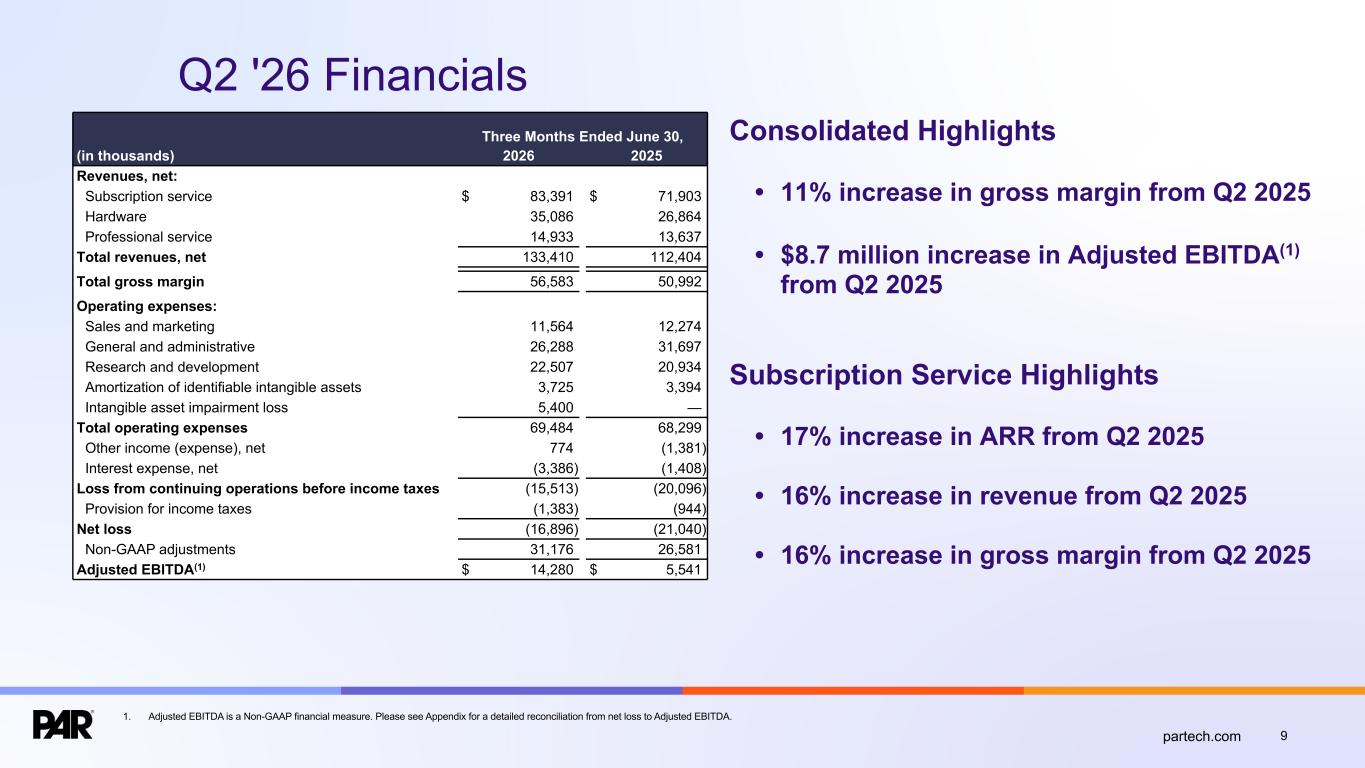
Thank you, Stephanie, and good afternoon, everyone. In C2, we continue to execute for our 2026 operating plan, delivering both total revenue and adjusted EBITDA that exceeded the high end of the guidance we introduced last quarter. We continue to drive organic growth across our products and the verticals we serve, and our disciplined management of OPEX is allowing the incremental margin contribution to flow through to the bottom line. For the sixth quarter in a row, adjusted EBITDA has grown sequentially, reaching $14.3 million in Q2, up 158% compared to Q2 prior year. Now to the financial details. Total revenues were $133 million for Q2, 2026, an increase of 19% compared to the same period in 2025, inclusive of distribution service revenue growth at 16%. Net loss for the second quarter of 2026 was $17 million, or a $0.41 loss per share, compared to a net loss of $21 million, or a $0.52 loss per share reported for the same period in 2025. Non-GAAP net income for the second quarter of 2026 was $7.5 million, or $0.18 diluted earnings per share. an improvement of $6.9 million compared to a non-GAAP net income of $0.6 million, or one cent diluted earnings per share for the prior year. Adjusted EBITDA for the second quarter of 2026 was $14.3 million, an improvement of $5.3 million sequentially from Q1-2026, and $8.7 million compared to the same period in 2025. Our sequential and annual improvement are a result of our ability to drive both growth and profitability. Now for more details on revenue. Substitution service revenue was reported at $83 million, an increase of 11 million or 16% from the $72 million reported in the prior year, and represents 63% of total par revenue. ARR exiting the quarter was $338 million, an increase of 17% from last year's Q2. Total organic ARR was up 12% year-over-year. We're entering the second half of the year with a large backlog of go-lives driven by both Burger King and Papa John's rollouts, in addition to a healthy pipeline across our products and verticals we serve. As such, we expect second-half-era growth to be meaningfully larger than the first half, a growth phasing that is similar to what we experienced in 2025. 5. Hardware revenue in the quarter was $35 million, an increase of 8 million or 31% from the $27 million reported in the prior year. This was our strongest hardware sales quarter in at least 10 years. The volume was driven by both refresh activity and expansion of partnership with our legacy customer, as well as continued penetration of hardware attachment into our expanding software customer base. Professional service revenue was reported at $15 million, an increase of $1 million or 10% from the $14 million report in the prior The increase was primarily driven by an increase in installation revenues associated with the rollouts of Tier 1 customers. Now turning to margins. Gross margin was $57 million, an increase of $6 million or 11% from the $51 million report in the prior year. The increase was driven by subscription services with gross margin dollars of $46 million, an increase of $6 million or 16% from the $40 million reported in the prior year. Gas-assistration service margin for the quarter was 55.2% compared to 55.3% reported in the prior year. Excluding the amortization of intangible assets, stock-based compensation, and severance, non-gas-assistration service margin for Q2-2026 was 65.1% compared to 66.4% in Q2-2025. with a modest change reflecting a shift in product mix as Q2 included a full quarter of bridge operations. We expect this baseline reset to reverse over the next few quarters as we execute to plan business model changes to bridge post the acquisition. Hardware margin for the quarter was 20% versus 27% in the prior year. This quarter's performance is in line with recent quarterly results which reflect the current tariff and supply chain constraint environment. We expect hardware margins to continue to be in the low 20s percent range moving forward. Professional service margin for the quarter was 23 percent compared to 29 percent reported in the prior year. This quarter's result was negatively impacted by timing of some of our hardware-related service contracts. Our outlook on go-forward professional service margins has not changed, and we expect a range of the mid to upper 20s percent. In regard to operating expenses, GAAP sales and marketing was $11.6 million, a decrease of $0.7 million from the $12.3 million reported for the prior year, driven by a reduction of organic sales and marketing expenses of $1.2 million, partially offset by $0.5 million of expenses from the recently acquired bridge product line. GAAP G&A was $26.3 million, a decrease of $5.4 million from the $31.7 million reported in the prior year. The decrease was substantially driven by strategic re-org changes implemented earlier this year. Gap R&D was $22.5 million, an increase of $1.6 million from the $20.9 million recorded in the prior year. The increase was primarily driven by R&D expense stemming from post-acquisition operations of the bridge product line, as organic R&D expense was relatively flat year-over-year. Operating expenses excluding non-GAAP adjustments was $51 million, a decrease of $3 million or 5% versus Q2 2025. For Q2, non-GAAP OPEX as a percent of total revenue was 38%, a significant 1,000 basis point improvement from 48% in Q2 of the prior year. Demonstrating our ability to scale efficiently and drive operating leverage. The realignment of operations into two verticals and the accelerated adoption of our AI tool set within our operations have enabled our teams to realize operational efficiencies and additional scale. Now to provide information on the company's cash flow and balance position. As of June 30, 2026, we had cash and cash equivalent of $77 million. Our cash balance was flat when compared to the prior quarter, with free cash flow of three million offset by cash use of three million for the final payout of the 2026 notes free cash flow for the quarter improved 11.5 million when compared to q2 2025 outpacing adjusted ebitda improvement of 8.7 million during the period we expect free cash flow conversion to continue to improve meaningfully for the remainder of the year as we continue to drive additional adjusted EBITDA critical mass, and execute to additional working capital tailwinds. To recap performance, Q2 marked another quarter of meaningful acceleration of profitability while continuing to grow the top line. This momentum is evident across the following key financial metrics. Revenue grew 19% year-over-year with sufficient service revenue up 16%. Non-GAAP opt-backs as a percent of total revenue improved 1,000 basis points from Q2 2025, and adjusted EBITDA was $14.3 million for the quarter, an improvement of $8.7 million from Q2 2025, and a $5.3 million sequential improvement from Q1. Now, let me share our expectations going forward. When we introduced formal guidance last quarter, our goal was to give investors greater transparency into the business. This quarter, full total revenue and adjusted EBITDA came in above the high end of the outlook provided. We are raising our full year 2026 outlook for both measures. These results reflect the visibility in our business while also driving operating leverage. For the third quarter of 2026, we expect total revenue in the range of $128 to $132 million and adjusted EBITDA in the range of $13.5 to $14.5 million. For the full year 2026, we now expect total revenue in the range of $516 to $523 million Up from the prior range of $500 to $515 million. An adjusted EBITDA in the range of $50 to $53 million. Up from a prior range of $44 to $47 million. A few points of context on the outlook. We expect subscription service revenue growth to continue to strengthen in the back half of the year. As we continue to roll out multiple Tier 1 accounts and go live with recent Tier 2 and Tier 3 platform wins to continue to build momentum, expanding our platform within our current customer base. On hardware, Q2 was a historic quarter and benefited from elevated Q1 refresh activity, and we expect hardware revenue to begin to normalize in the second half. Additionally, we anticipate hardware margins will stabilize in a low 20% range as our pricing actions continue to offset component cost pressures. On profitability, adjusted EBITDA of $14.3 million in the second quarter, combined with our outlook for the full year, reflects substantial improvement over 2025, driven by both continued top-line growth and a cost base we have structurally reset. Taking the elevated hardware revenue into consideration, a more normalized Q2 adjusted EBITDA would be $13 million when considering an appropriate baseline to build out second half of the year expectations. The restructuring actions we executed earlier this year are driving a step down in our operating expense run rate, with the second quarter reflecting the largest step change in that run rate. Looking to the balance of the year, we expect OPEX to stay relatively flat to modest growth as we plan to drive additional operating efficiencies to help support reinvestments into our highest return opportunities, most notably par intelligence and our authentic platform. That investment builds to the back half of the year within a disciplined framework that prioritizes durable and profitable growth. I'll now turn to call back over to Savneet for closing remarks prior to moving to Q&A. Thank you, Brian.
Q2 was an aggressive starting shot, but we are far from done. First, we've spent the back half of the year to see continued movement up in growth. AR growth accelerated from Q1 to Q2, and we expect it again to pick up in the second half of this year, similar to 2025. This is driven by the backlog of large deals we've spoken about, as well as a new influx of mid-tier wins. Second, our multi-product model continues to expand. I'm very excited to see how nearly all new deals are platform-based, and the resulting impact on AR will give us strong growth in later years. As restaurants begin to adopt more and more AI solutions, I expect the need for an end-to-end vendor will only expand. Third, our profitability expansion. Our numbers reflect the incredibly strong unit economics we're seeing in our business model. We continue to be encouraged how efficient an incremental customer ad can be, and we will continue to march our business towards best-in-class margins. Our ARPU is up across all core products. Our LTV-to-CAC ratio has more than doubled between platform versus point solution deals, and our contract lengths are increasing throughout. Optrax efficiency remains a focus, and in the quarter, non-GAAP R&D expense as a percentage of sales was 15%, sales and marketing expense was 8%, and G&A was 14%. Fourth, our aggressive trajectory on par intelligence adoption. We rounded out Q2 with roughly 20,000 live sites and have another 20,000 sites set to go live in Q3. We remain firmly on track for our $50,000 live site commitment for fiscal year 2026 and are developing additional functionality with clear commercialization potential. Finally, our continued commitment to aggressively expanding our TAM. We have made investments to organically launch new products across restaurant and retail. Our intense focus on margin expansion has not come at the cost of investments in our core products, and we remain committed to spending more on products development than the bulk of our enterprise peers. I believe the ultimate key to a successful business is its ability to reinvest its capital at high rates of return while not sacrificing areas requiring innovation. The rush to AI will be no different. While AI is often looked at as technical work, we think there will be as much cultural. In a world where every company will ostensibly have the same or similar AI tooling, it will be a race to the average. The companies that have a culture that allows them to take a leap of faith on AI will gain the competitive advantage. Simply using tooling to optimize the way we worked in the past will not lend itself to a differentiated competitive position. Instead, it will reinforce the status quo. We think you need to actually leverage AI in places that make you incredibly uncomfortable, where the power of intelligence leads to an enhanced judgment. Blessedly, we think winners will be companies that enable their managers to be both ICs and managers. Such companies will expect their leaders to take on more teams and more projects, not to be stuck in the org designs and best practices of the past. Winners will not only let AI filter resumes, but actually trust AI to filter into and present final candidates. Or in the case of restaurants, I think winners will be the ones who let restaurant managers press autopilot and let AI order inventory, great labor scheduling, and manage order flow while allowing the operator to focus on the highest value customer fetch points. A company culture willing to accept the risk to reinvent how it works, how it organizes, and how it leads will be the one that achieves differentiated competitive positioning. As I said earlier, par is always on offense. Always. That culture sets us up to win and adapt to today's opportunities. With that, Operator, we can open a lineup for Q&A.
Operator
Thank you. As a reminder, to ask a question, you will need to press star-11 on your telephone and wait for your name to begin up. To withdraw your question, please press star-11 again. Please stand by while we compile the Q&A roster. First question comes from the line of George Sutton of Craig Hallam. George, please go ahead.
Thank you, guys. Nice results. So I was pleased to hear about the confidence in the second half ramp in ARR. I'm wondering if you could give us a little more of a picture. I understand much of this is driven by deals you've already won and have planned, rolled out. When we talked a quarter ago, I think you talked about 80% of your opportunity has been signed for the year. Can you give us an update there?
Yeah, we feel very good from now to the end of the year. You know, we've got good visibility on the operator cloud side, the retail side, and we're getting there on engagement ordering. So we feel pretty good where we are now. You know, visibility has increased, which is why we, you know, gave the commentary that we feel good about the second half ramp.
On par intelligence, so it sounds like you had 20,000 in Q2 and you're adding 20,000, I believe, in Q3 and 50 for the full year, up against, I think, a base of about 170,000 plus locations. Can you give us a sense of the breadth of the wins that you're seeing relative to other competitors bringing their AI solutions in?
Yeah, I think the scale of rollout is obviously going faster than we expected. I think that's, you know, partly, obviously there's a rush to try these tools, but also the early wins that our customers are getting or are learning from it, you know, we just won a retail deal where I think a core part of us winning was, you know, candidly what we showed them on par intelligence. So I think, you know, we continue to be excited in the opportunity to sort of put product in front of our customers and then learn from that, iterate from that, and then, as I talked about, really monetize in 2027. You know, vis-a-vis our competitors, you know, I haven't seen tremendous push from most of our competitors to sort of become DGN's exclusion of the future. In fact, I'm not aware of somebody that's got sort of the installs that we have and the roadmap we have. And I think that's probably because it's very hard to give something useful to a customer when you are only providing utility in one part of their operations, whether that be in the back office or, you know, loyalty or ordering. I think the AI value comes when you have it across your products, and so there are only a few vendors that could potentially do that. So we have not seen a lot of momentum from our competitors here yet.
Super. Great to hear. Thank you.
Operator
One moment for your next question. The next question comes from the line of Stephen Sheldon of William Blair. Stephen, please go ahead.
Hey, thanks. First, just wanted to clarify the ARR expectations in the back. So I think you're saying that you'd expect it to get back to 2025 levels, which I believe was 15% organically. I guess could you get there in 3Q or is that more like a 4Q expectation? And then, Savinita, I think you said that if PAR keeps executing the way it has been recently, and it sounds like implementations are all going really well, there could be some upside to that. So, just wanted to – am I kind of hearing and thinking about that all correctly?
Yes, as soon as Brian, a good question. So, the reference also to in the phasing, if you recall from 2025, we did a significant amount of our AR increase in the second half, close to 30 million of incremental AR. are, and so we know we're lapping that, but we actually have more momentum going into the second half than we did last year, so it will be higher than we were last year. This is going to allow us then to go from the 12, you know, up to a higher percent in teams in regards to Q3 and Q4, but that will come steadily in Q3 and Q4.
And then to your second part of your question of, you know, the ability to exceed, yeah, I think if we continue at the fast pace we're going now, that's always that potential. So we are feeling, you know, right now things are going very well.
Got it. And then on par intelligence, I think you have a lot of options on ways to commercialize those capabilities. And I think you talked about probably seeing more commercialization next year. So can you maybe just update us on how you think it will impact monetization? I'm sure it helps with retention, might help with pricing. I mean, you know, could you sell some capabilities separately on a subscription or usage-based? I guess just how should we think about the commercialization of that?
Yeah, you know, I think, you know, we're going to look at commercialization as a subscription-based product more than likely. You know, we're going to test out a few models, but I think from the early goings, it looks like it'll be subscription-based. I suspect it'll be, you know, an add-on to what we do in the back office and or the loyalty side of our business where we see the most actual insights, where we see the customers have the most interest in paying and where we're driving the most ROI today. But, you know, we're using this year to really figure out where do they spend the most time, where do they get the most value, and then kind of coming back and making a win-win for them and for us.
Operator
One moment for your next question. Next question comes from the line of Ella Smith of JPMorgan. Ella, please go ahead. Thank you for taking my questions.
So, first, I was hoping to ask about the margin strength that you've experienced in the past few years. And as we look to 2027, how do you think about the sources of that expansion? Is there still meaningful room for cost cuts or operational efficiencies, particularly from past acquisitions? or do you expect most of the forward expansion to come from operating leverage versus your existing cost base as revenue scales?
I think it'll come from both. I think more it'll come from operating leverage. You know, we're growing and we expect, you know, growth rates to accelerate in the second half of the year, as I mentioned, and we're not adding cost to the fixed cost of the operating cost structure. So, I think it'll come more from operating leverage, although, you know, we do think there's opportunities to continue to take out excess costs within the infrastructure of the business. And so I think we'll see from both spots, but I think we'll be more driven by what we're doing from a growth perspective.
Very clear, so neat. And for a follow-up, since you made the decision to stop disaggregating ARR and active sites between engagement cloud and operator cloud, citing the growing prevalence of multi-product arrangements, how should investors think about tracking your go-to-market progress and attach rates across the products going forward, and what metrics do you think best capture the health of that bundling strategy?
I think it's two metrics. So one is just AR growth. I think as we have AR growth, it's representative of that multiproduct growth. And the second is ARPU. You know, as we have, you know, I see AR and site council, you can see ARPU. And, you know, you kind of look at it going backward, you can see it continues to climb up, climb up, climb up, and that's, you know, a result of the multiproduct attachment that you see. So, you know, we're trying to make it simpler. And as you said, with the platform strategy, breaking up the two becomes too challenging or also, I think, too complicated. And so having one metric or one site count allows us to provide more traditional metrics which we're excited about.
I mean, I'll just add to that, Ella, right, is the fact that it's actually clear now what a SHUARPU is, right, because we now have all the unique sites in there. So there could have been at times where there were sites that were both in EC and OC, engagement cloud and operator cloud, and now with their kind of unique brought together, you actually get true ARPU of that, and you get a better sense of what the white space is in our existing customer base, right? So, for instance, in some of these multiple product deals that we're doing, doing 10,000 ARPU in those sites, you can actually do the calculation and see what our ARPU is of total sites and see the multiple above that in regards to white space just in our current customer So, we want to be able to give you guys that kind of clarity to understand how to build that's modeling and understanding both from new logo growth and existing customer growth where the opportunities come.
Very clear. Thanks very much.
Operator
As a reminder, to ask a question, you will need to press star one one on your telephone and wait for your name to be announced. One moment for your next question. Next question comes from the line of Mae Young, Tom Don of Needham. Mae Young, please go ahead.
Thank you. Good evening. So, Neith, I wanted to just get an update on the Tier 1 RFPs. I know you've talked about several potential opportunities. I believe one is, you know, global and two are North America. I could be wrong on that. But if you could just give an update in terms of where you are on those RFPs and if there are maybe more that are in the pipeline that you think you could also potentially convert on. Thank you.
You know, we're making good progress. But, you know, when we get a win, we've also got to wait for our customers to put out the release. So there's a lag effect from winning to the information getting out there. But the market is very ripe right now. We continue to have, you know, growth in pipeline, as I said in the remarks. You know, I think it's the difference from, you know, this year and maybe last year. It's a much more diversified pipeline where we still have great momentum on the tier ones, but we're seeing more and more of these, you know, mid-tier customers like, you know, Pizza Factory talked about on the last call and others like that where you're able to do a multi-product deal that would be the value of a tier one point-of-sale deal, as an example. So, I think the difference from this year and last year is tier one is still strong. It's the mid-tier deals that we like because they're also a little bit of a faster sales cycle and I think even stickier because of the multi-product nature.
Got it. Just to clarify, there are still three tier ones. And the potential opportunity bag, or would you say there are more at this point?
I'd say there's still three, and I would say we've got more in early stage, but not yet where we put them in, you know, call them out.
And then just, you know, as a follow-up, I wanted to ask you more on the market. Are you sensing more of an urgency on the part of customers to modernize their tech stack? We've heard that from a couple of your peers that have recently reported. but it seems like the backlog is converting a lot faster than it was maybe some months ago or some quarters ago. Just wondering if you're seeing that trend as well, and that could have been maybe part of the reason you delivered a very strong quarter and obviously raised guidance as well. Just want to get a sense of the overall market urgency on the part of customer behavior in the era of AI.
You know, I think it's a continued urgency. I don't know if I'd say, you know, we felt something different this quarter to the last quarter, but I think it's a continued urgency. I think we certainly see a lot more focus on getting your infrastructure, your core foundation in place than we have in years past. But, you know, I think it's just a continued momentum from what we saw last quarter. Got it.
Congrats on the quarter. Thank you. Thanks, Mike.
Operator
One moment for your next question. The next question comes from the line of Andrew Hart of U.S. Bancorp. Andrew, please go ahead.
Hey, thanks for the question and nice results. Seb Neat, multi-product adoption, I think, keeps coming up in a lot of your answers. And I appreciate, I think, there was a comment about 100% of new customers were coming in with multi-product adoption. I guess, can you talk to us about a couple things? Maybe, one, if you look at your existing and sell base, like, what do you see that cross-sell opportunity as? I assume it's still really big.
And then what products are you leading with and then eventually tacking out as well? um yeah you know i think when we look at our base the average customer probably has about two products um and and that's grown from you know one and a half products just a couple years ago or not even that uh and you know our expectations that will continue to grow um you know if you look at the TAM that would you know essentially say we've got you know i don't know five times the the size of the base but if you if you go into detail you know we looked at it there's probably about a 3x opportunity within the core base if you think of it as a you know TAM stamp and SOM. And so I think if you look at the SOM, we think that there's probably, you know, two to three X the core base that we still have to go in there. The second part of your question, you know, we're usually always trying to lead with point of sale or loyalty as we think those are the two plant the flag type products. And then from there, we're upselling the rest of the suite. But, you know, if we land with point of sale, we have a tremendous opportunity to win the rest of the tech stack, and so we prefer to start there, but given the market today, particularly the push on AI, you are seeing that continued growth in loyalty, and so we'll work the other way on those leads.
Okay, thanks, and then just one more on par intelligence. I guess, what are you doing?
I appreciate that the monetization for it is at least a year out, maybe, but I guess, what are you doing to make sure the customers are actually utilizing it and and like maximizing the value prop is there a customer success team or like a human element where PAR is providing resources to make sure that the products maximizing its potential yeah we do have a customer success team that's engaging and working on it I think that the best way to answer your question is you know we're engaged with them you know we put the product in their hands we take a look at what's being used what's not being we used who's using it how they're using it and then we've got to keep iterating and actually we're using you know this this first release is to really push that out and to figure out what's adding value to the customers, what's not. And if it's not, why not? Why are they not using it? The reason they're not using it because it's technical? Is it, you know, not giving them ROI? So it's a lot of variation right now. I think we feel pretty confident that there's definitely products to monetize in here. And so now we're trying to narrow, you know, where that is and where we spend our investment dollars to double down. Thank you.
Operator
One moment for your next question. The next question comes from the line of Samad Samana of Jefferies. Samad, please go ahead.
This is Teddy Farley on for Samad. Thanks for taking our question, and congrats on the strong quarter. One more on Power Intelligence. Can you talk a little bit about the customer demographics or characteristics among the cohorts that have been using it? Anything to call out versus your overall customer base? Thank you.
You know, I think it's definitely been more from the engagement side of our suite. On retail, we certainly have a lot of early traction and adoption, very, very focused on, you know, I think the digital department is trying to figure out how to do one-to-one targeting, personalization, you know, data integrity exercises. So I think it's heavy on the engagement side. And, you know, but I don't know if we're yet at a point where we get to something that's categorical.
I think we're still just getting the product in people's hands. before we have any strong insights one moment for your next question line of will Nance of Goldman Sachs will please go ahead hey thanks for taking the question I'll go back to the earlier question just on KPIs and the consolidated reporting and you know if you look out you know talking about getting back to 20% AR Argos any any color you would share on just what the
right mix between site count and Arthur list is just kind of as you see it under the new reporting and you know how that could change over time as some of these fields we had implemented thank you you know I I think historically we were pretty much driven by site count where site counter of the vast number of our growth I think it'll be more balanced going future you know I don't have a perfect formula of you know it's going to be a half from one part half from the other but I think what I'll say is you know after the Q1 experience you know site counts going to continue to grow but given the multi-product success we're having, ARPU will be a much bigger driver than it has been historically. I think that's, you know, excellent because it provides a lot more cam for us. You know, it allows us to sell back into our base, not just depend on a net new logo. So, you know, I don't know if that's the perfect formula, but I think growth is going to have to come from both sides.
And what I would have said to that, Will, is also each, the dollar value of each site growth is actually meaningfully higher now than it used to be. It used to be one product for each site growth, right? So you who worked really hard for each of those sites for the one product and tried to cross-sell in. Obviously, you still work hard for each site right now, but now it's like 3x the value, right? So it's the metrics, then you think about it, to Sadneet's point, about the LTV to CAC ratio, changes noticeably on those new logo deals.
Okay, that's really helpful. And then just given the focus on, you know, companies trying to get their data aligned, the focus on kind of making sure you've got a clean system of record in order to harness, you know, some of the benefits of AI, just how is that impacting your go-to-market? I imagine data central is a big part of that, but, you know, what are you doing to kind of, you know, make sure that clients understand that, you know, working with a newer system will help them move faster and other aspects of trying to kind of move forward on AI adoption and things of that nature?
I mean, you've got the pitch there, but, you know, I think, you know, without question, the back office side, clearly data central is an awesome place to start kicking off those conversations, that understanding. A little bit too is just the maturity of our market, as you know, one of the funny things about software is as you buy software, you end up buying more software to manage that software, and obviously AI is set on steroids. So I think the market doesn't really need the pitch, it's more about who can implement it, who can scale with them, and then who can bring in those AI solutions. And as I talk on the call, I think we're getting to the point where more and more organizations are realizing it only works if you've got the data know, across your systems. It's going to be very hard to create true utility if you're just looking at one part of your system, i.e. if you're just looking at ordering or you're just looking at point of sale. It's hard to get, you know, utility out of that.
Appreciate all the comments.
Operator
Thank you. This concludes the question and answer session. I will now turn the call back over to Christopher Burns for any closing remarks.
Thanks, Felicia, and thanks everyone for joining us today. We do look forward to updating you further in the coming weeks. Have a good evening.
Operator
Concludes the conference call. You may now disconnect.