Operator
Greetings. Welcome to Ready Capital's Second Quarter 2025 Earnings Call. As a reminder, today's conference is being recorded. At this time, I'll now turn the conference over to Andrew Ahlborn, Chief Financial Officer. Andrew, you may begin.
Thank you, operator, and good morning to those of you on the call. Some of our comments today will be forward-looking statements within the meaning of the federal securities laws. Such statements are subject to numerous risks and uncertainties that could cause actual results to differ materially from what we expect. Therefore, you should exercise caution in interpreting and relying on them. We refer you to our SEC filings for a more detailed discussion of the risks that could impact our future operating results and financial condition. During the call, we will discuss our non-GAAP measures, which we believe can be useful in evaluating the company's operating performance. These measures should not be considered in isolation or as a substitute for our financial results prepared in accordance with GAAP. A reconciliation of these measures to the most directly comparable GAAP measure is available in our second quarter 2025 earnings release and our supplemental information, which can be found in the Investors section of the Ready Capital website. In addition to Tom and myself on today's call, we are also joined by Adam Zausmer, Ready Capital's Chief Credit Officer. I will now turn it over to Chief Executive Officer, Tom Capasse.
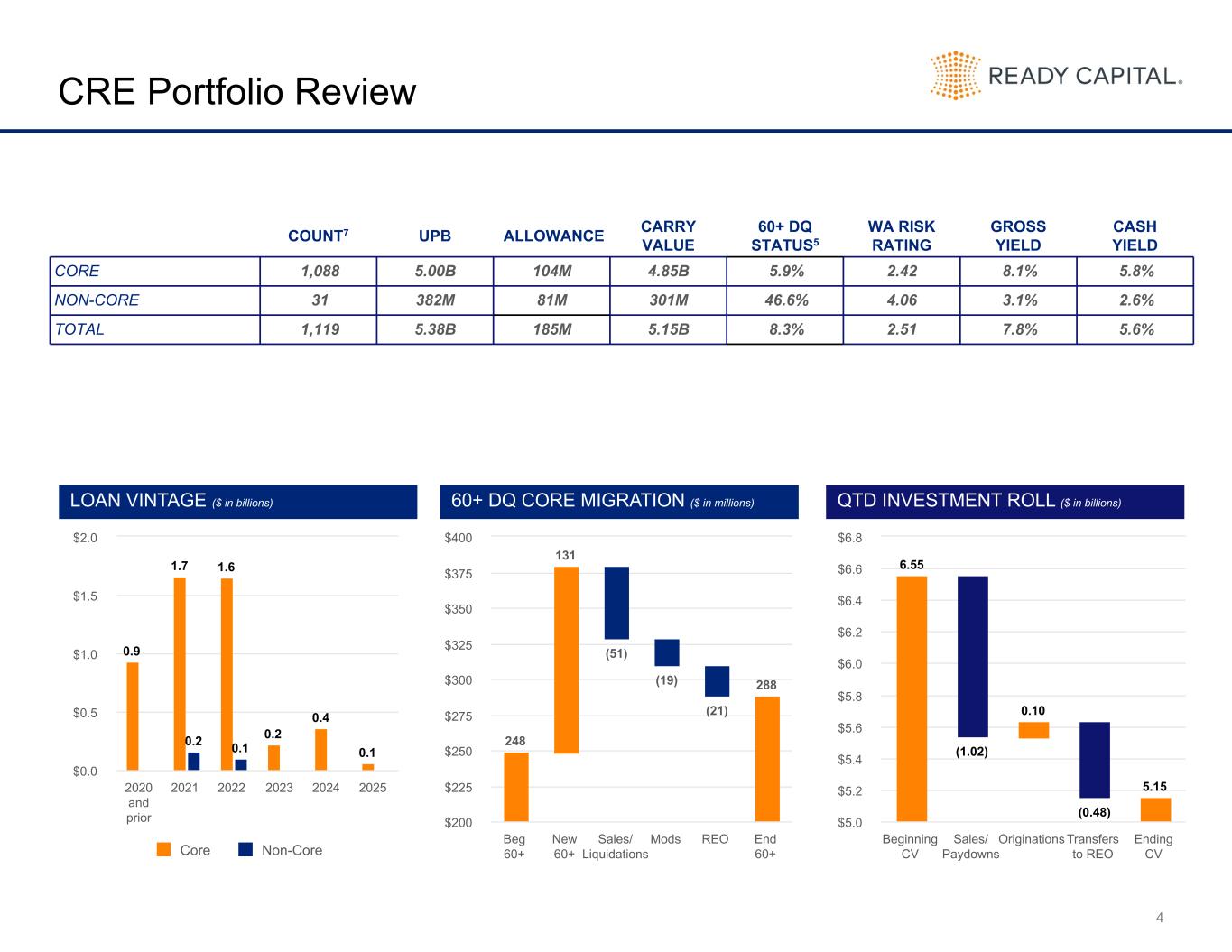
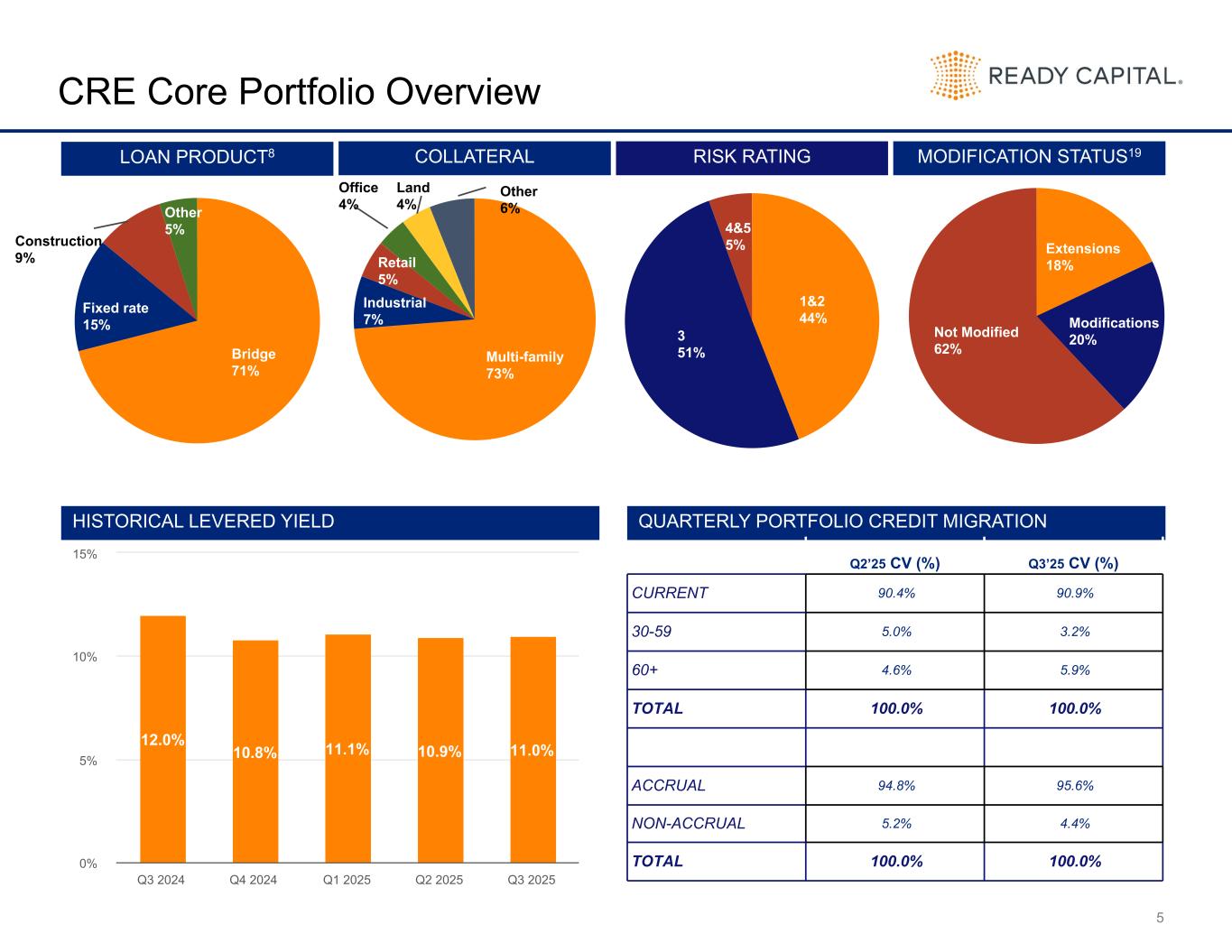
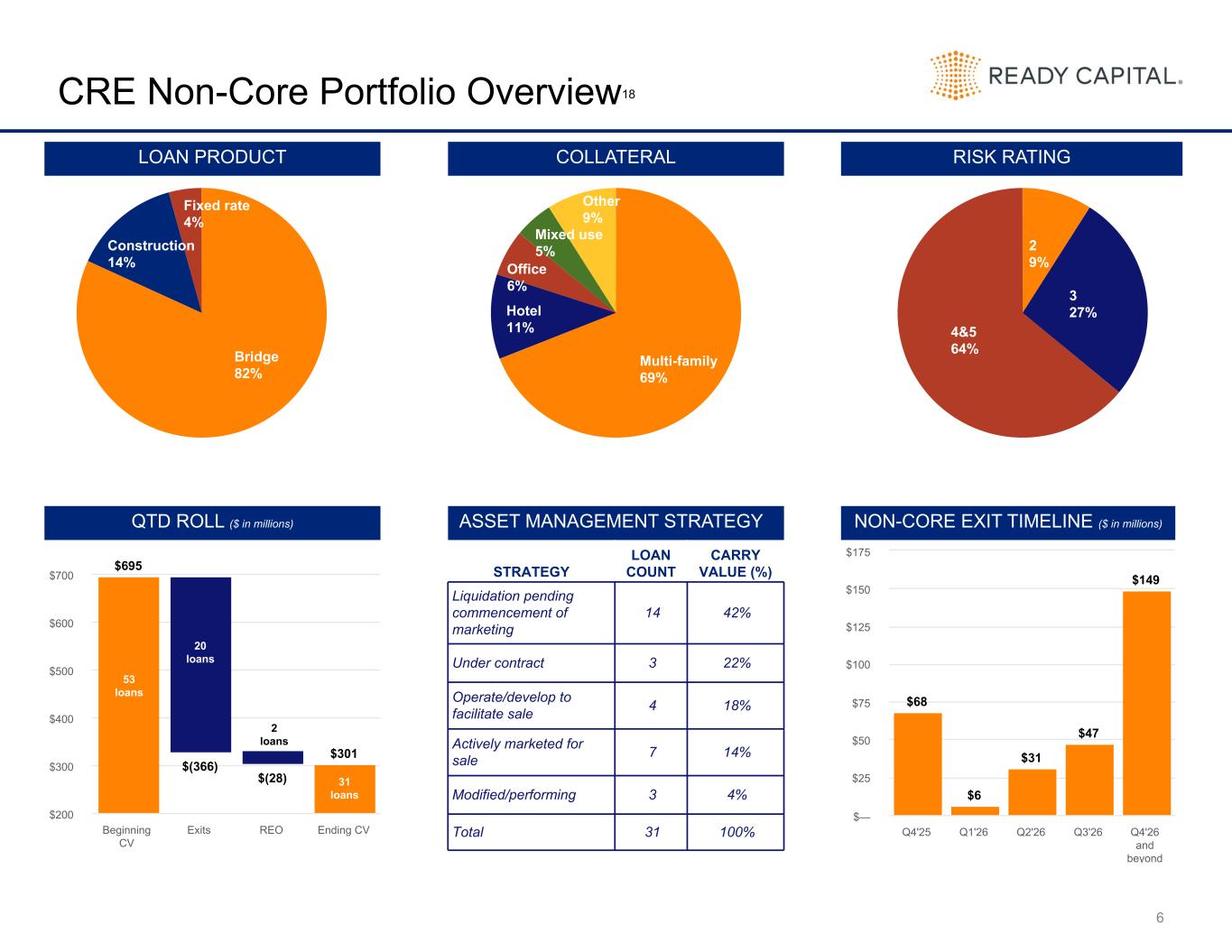
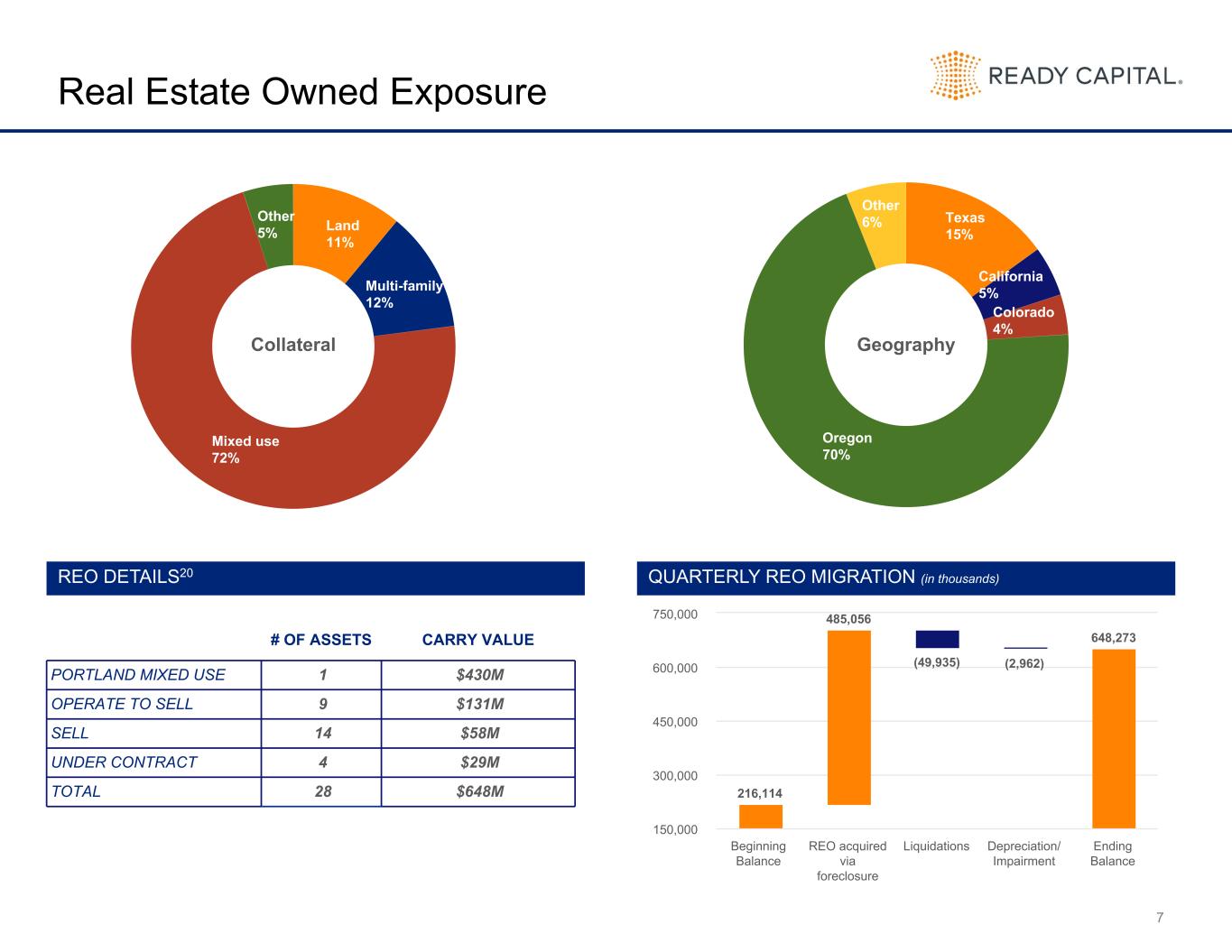
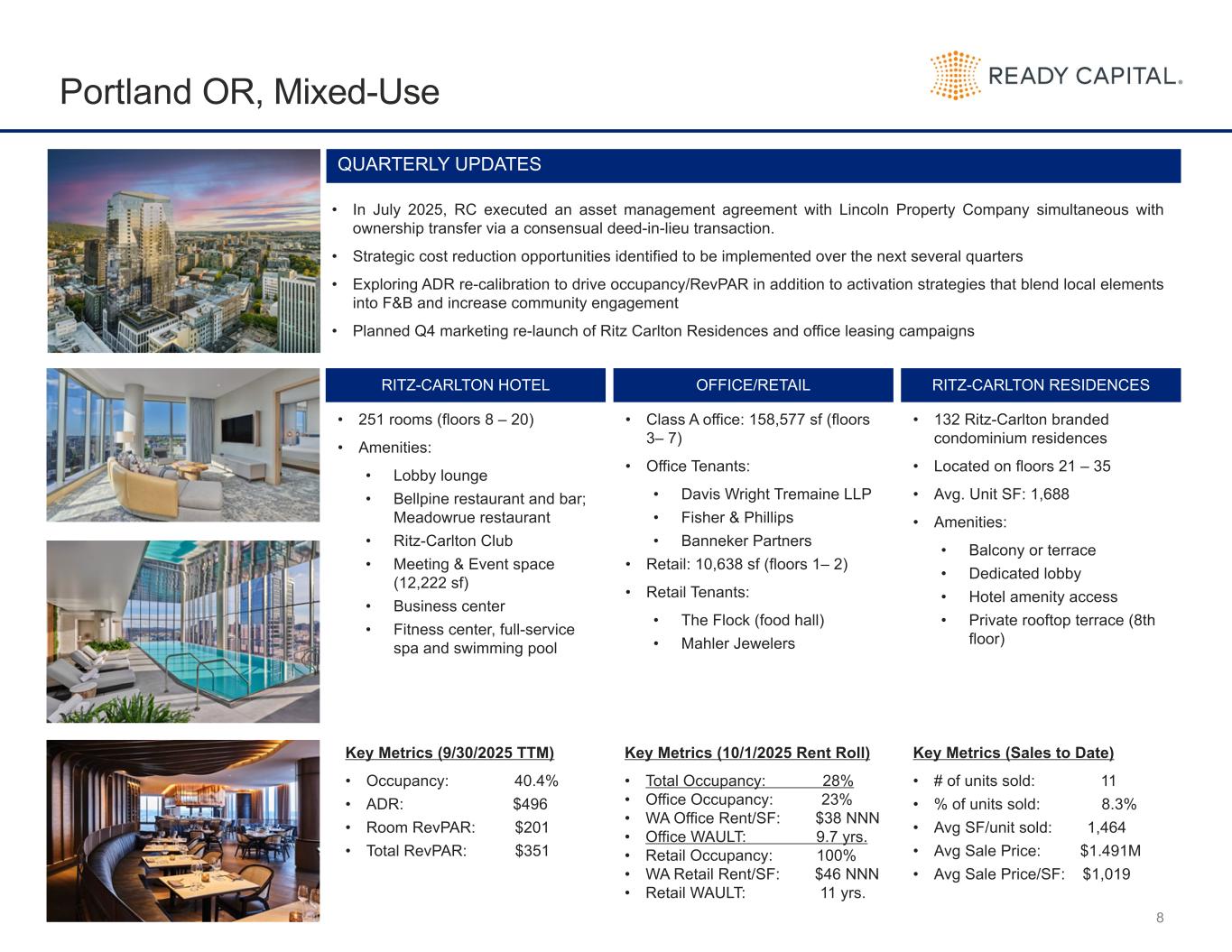
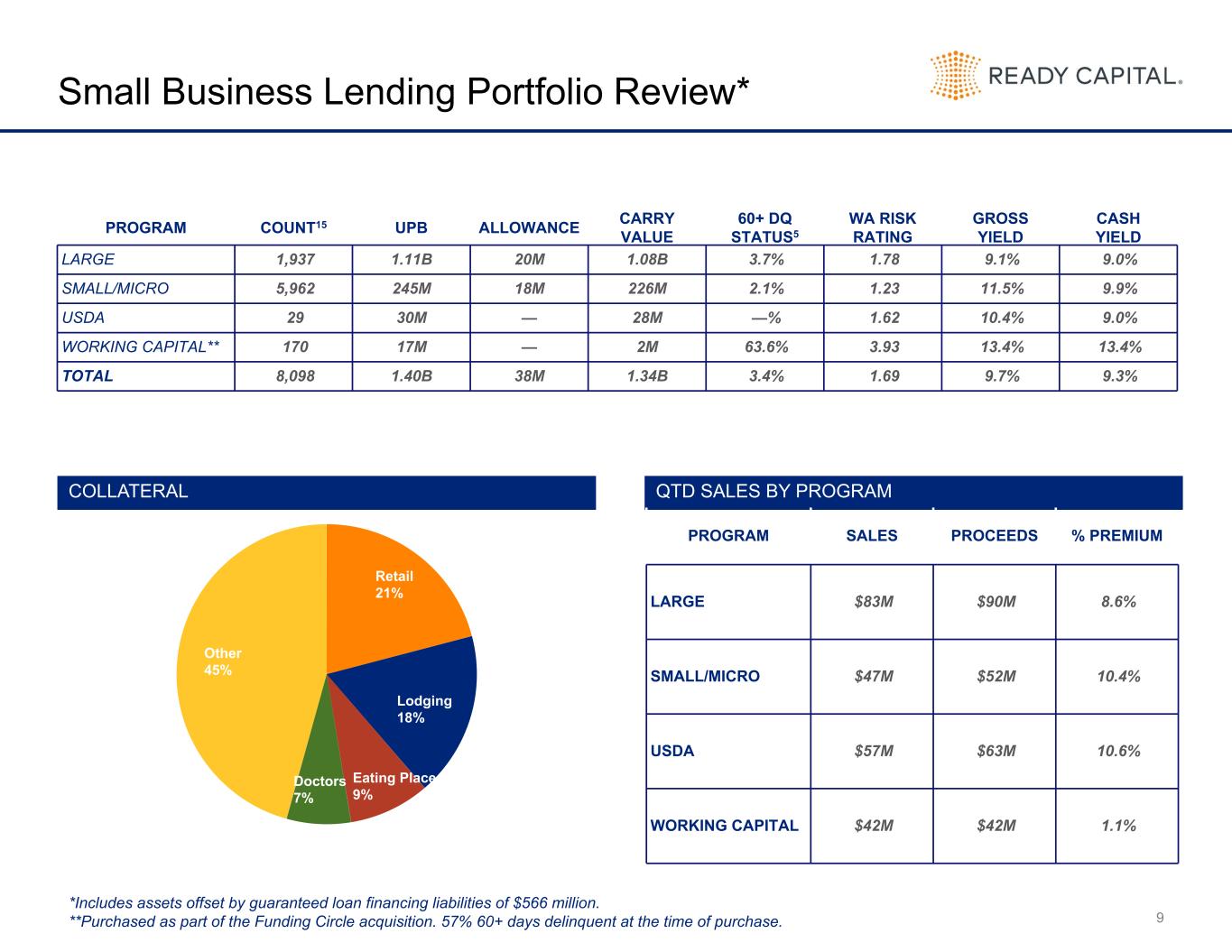
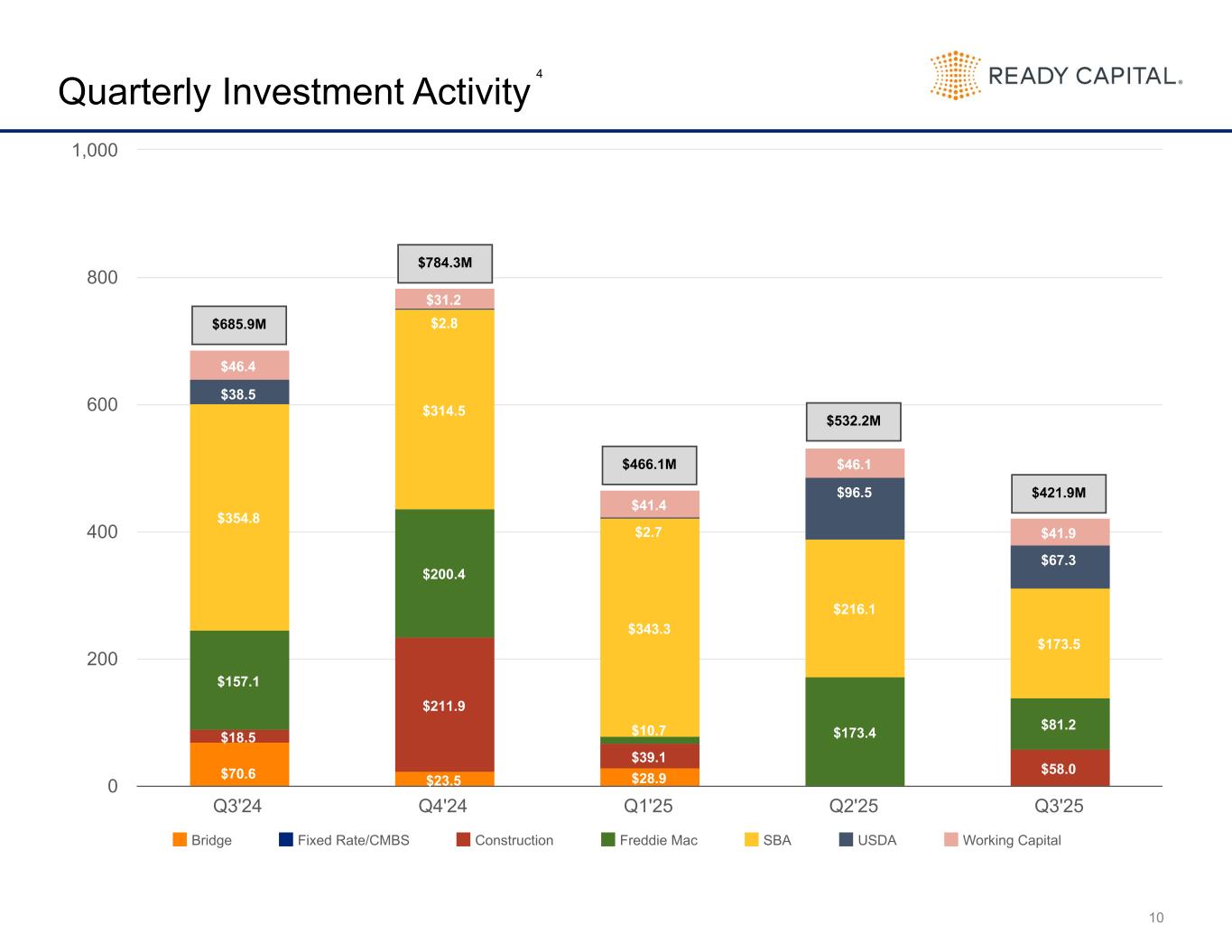
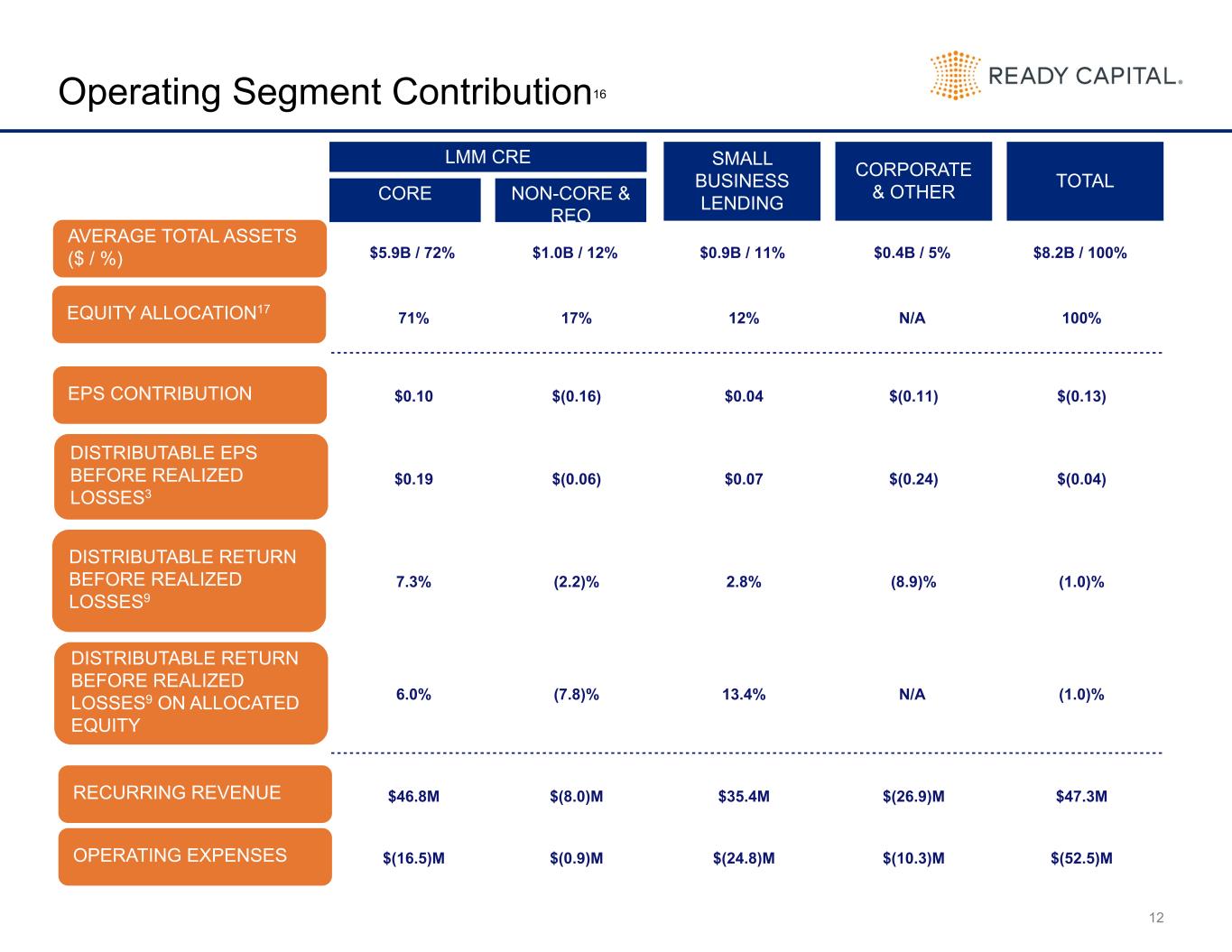
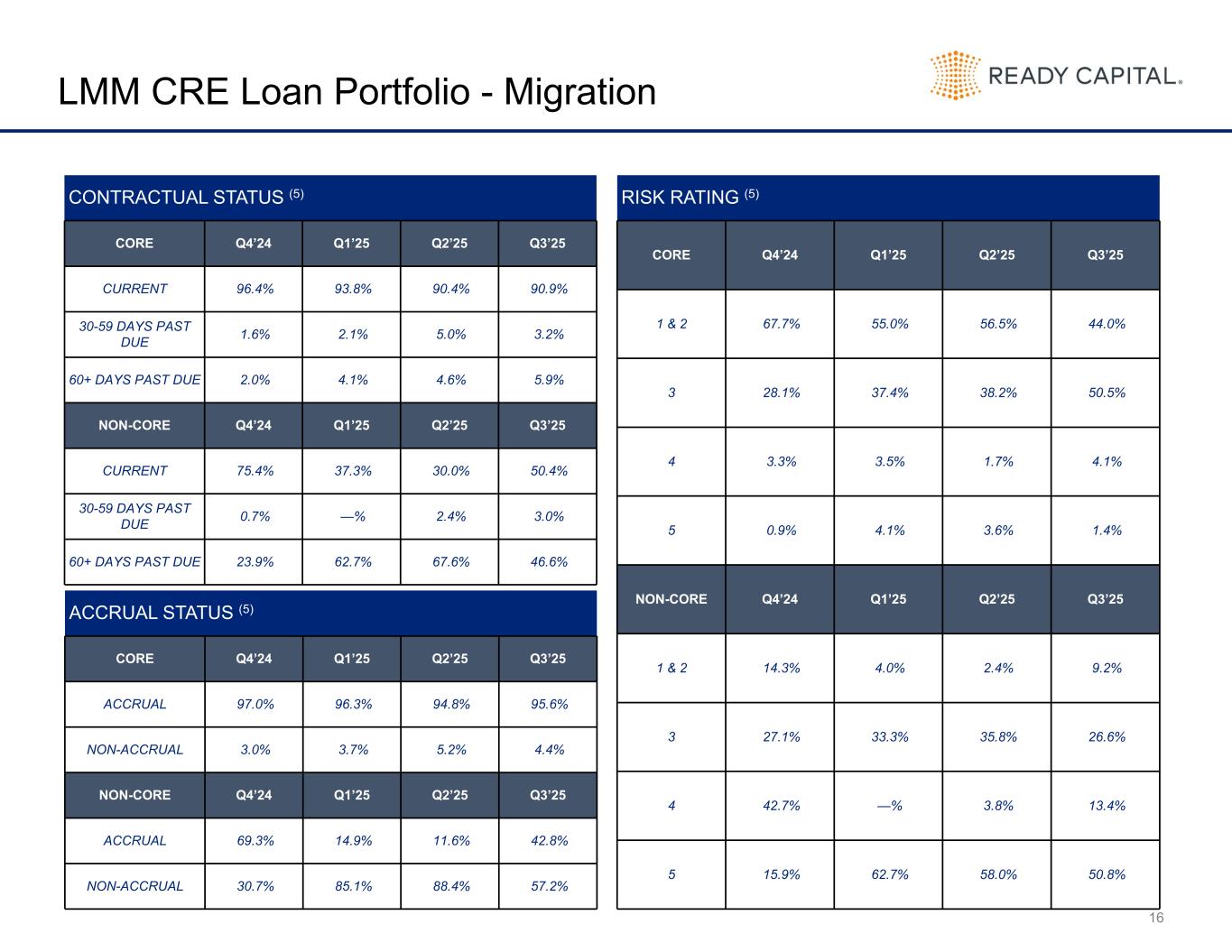
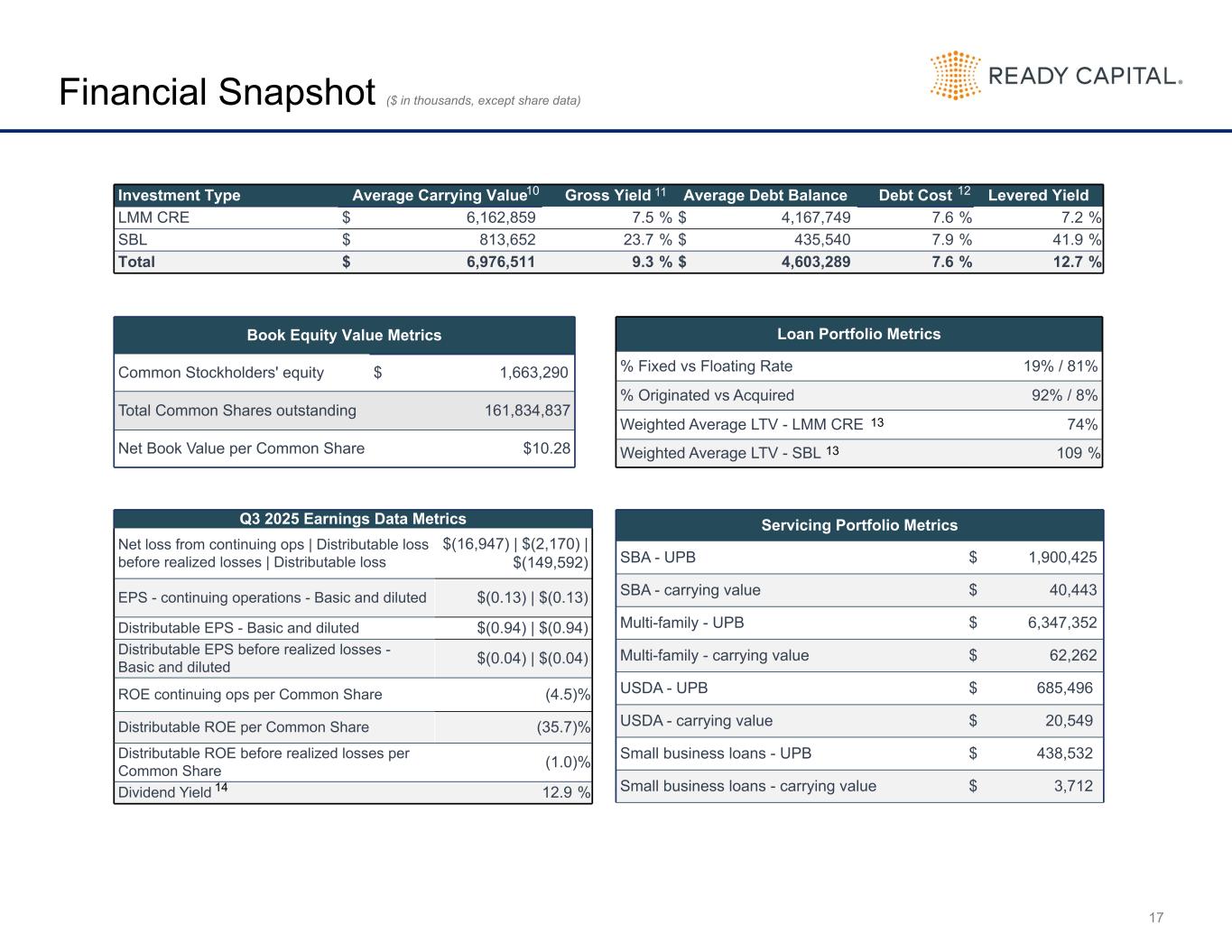
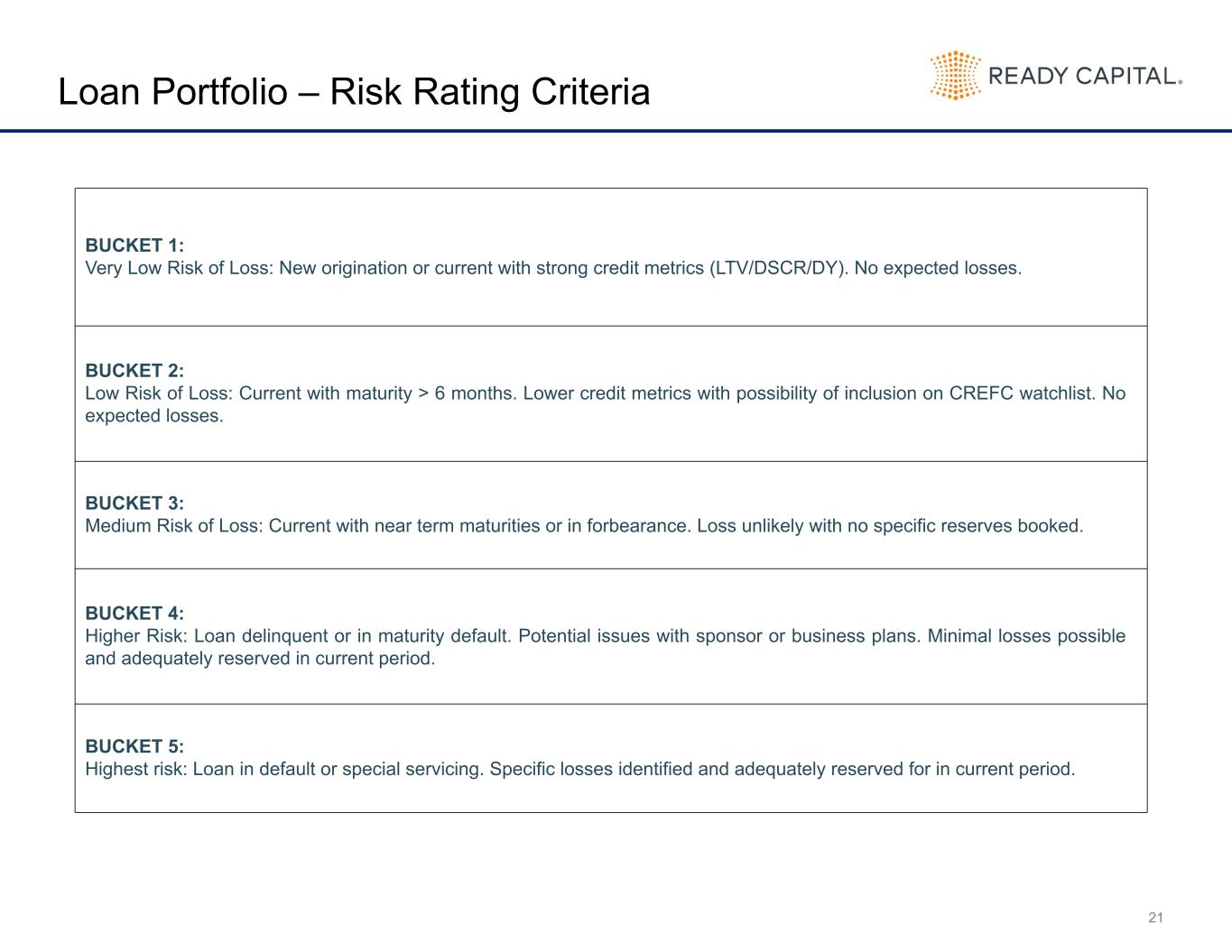
Thanks, Andrew. Good morning, everyone, and thank you for joining the call today. In the second quarter, we completed three initiatives to continue the repositioning of the company's balance sheet coming out of the CRE cycle, the financial benefit of which will be visible in the second half of the year and beyond. First, as part of the broader strategy, each loan in both the core and noncore portfolios is evaluated to determine whether the NPV of asset sales is more accretive to improving net interest margin by disposing of low-yield assets and reinvesting in new originations versus traditional on-balance sheet asset management strategies, such as loan modification. In this regard, we completed our first bulk sale earlier this week, selling $494 million of legacy multifamily bridge assets, generating net proceeds of $85 million. While the transaction settled in the third quarter, it reflects a sale process initiated in the second. The pool included 73% noncore, 27% core, 40% were delinquent, 33% risk rated 4 or 5 and 92% nonaccrual. An additional $26 million of REO included in this trade is expected to settle by mid-August. This transaction is strategically significant, eliminating 100% of the 2021 vintage syndicated loans, while allowing potential upside through retention of a preferred return if certain performance targets are met by the buyer. The pro forma financial benefit is twofold: an immediate increase of $0.05 per share per quarter, representing the removal of the negative carry associated with these assets; and longer term, an additional $0.02 per share per quarter from the reinvestment of the equity into market-yielding loans. In the third quarter, the cumulative loss from the transaction will flow through distributable earnings, with no material expected impact on book value per share as the transaction was reserved in the second quarter. Second, we took ownership of the Portland, Oregon mixed-use asset, which includes a Ritz-Carlton Hotel and branded residences along with Class A office and retail space through a consensual transaction that closed on July 21. We avoided a lengthy and costly foreclosure process, with a net cash outlay in the third quarter of $10 million. Since taking title and assuming operating control, we are moving quickly to stabilize the asset. We partnered with institutional property manager Lincoln Property Company and are evaluating residential brokers and Ritz residence sales strategies. From a performance standpoint, in the second quarter, RevPAR at the hotel was $192. The retail component is 100% occupied. The office is 23% leased, and to date, 11 of the 132 residences were sold at an average price of $1,123 per square foot. The negative carry from the asset was $5.3 million or $0.03 per share for the quarter. Ready Cap fully intends to provide financial and operational support to maximize the value of this premier hospitality asset in the Portland market. Now third, we took steps in the capital markets to enhance liquidity and increased warehouse capacity to support loan origination. In our CRE business, we collapsed two of the five outstanding CRE CLOs, improving advance rates by 7%, generating $71 million in proceeds, with nearly a 100-basis-point improvement in financing cost. In our SBA business, two of the three warehouse lines pending approval with the SBA were approved, adding $75 million of additional warehouse capacity that is expected to fund over $400 million of 7(a) production. Additionally, we closed a $100 million USDA warehouse facility, with a second $100 million facility anticipated to close in the third quarter. These two facilities will facilitate the ramp in USDA volume to our $300 million annual target. Collectively, these three actions, the sale of underperforming loans, taking ownership of the Portland asset to accelerate its stabilization, and expanding our funding capacity, generated $221 million of liquidity, providing capital for new loan originations to rebuild our net interest margin. As of the quarter end, the CRE loan portfolio totaled $6.1 billion, now clearly segmented into two parts: a $5.4 billion core portfolio, consisting of legacy loans favoring on-balance sheet, hold-to-maturity asset management strategies; and a $695 million noncore portfolio, consisting of lower-yielding assets, where asset management strategies favor accelerated liquidation. In the core portfolio, $527 million of payoffs and liquidations reduced the portfolio by 8% in the quarter. As expected, negative credit migration in the portfolio was muted, with only 17 loans totaling $71 million transitioning to 60-day plus delinquency. 60% of this 50-basis-point increase in the 60-day delinquency number was due to quarterly decline in the portfolio balance. Additionally, we modified 14 loans totaling $250 million, with a 40-basis-point decline in expected yield on those assets. Regarding the earnings impact of the core portfolio, the leverage yield decreased 20 basis points quarter-over-quarter to 10.9%, producing $43 million of net interest income or $0.26 per share. Several quarters of reduced originations and loan payoffs have reduced our CRE portfolio by over 30% from its $10.5 billion peak in the second quarter of 2023. As discussed previously, our bridge portfolio was primarily financed via the issuance of static CRE CLOs, with industry-type CLO triggers where weakening collateral performance resulted in loan payoffs, reducing senior bonds rather than providing capital for reinvestment. In turn, relative to the peer group, Ready Cap experienced more rapid deleveraging, with less free cash flow to make loans. After a prolonged focus on stabilizing the portfolio, liquidating underperforming assets and collapsing five of our eight CLOs, we anticipate reentering the origination market in the third quarter. Originations will focus on high-quality multifamily bridge loans underwritten at a lower LTV and healthy in-place debt yield designed to rebuild the core portfolio and facilitate our return to the CLO market in early 2026. Current lending margins of SOFR plus 275 to 300 and a CLO AAA market spread under 150 basis points support projected retained yields of 13% to 15%. Additionally, we continue to leverage our external manager, Waterfall's infrastructure to allocate capital to more liquid CRE debt securities. In our noncore portfolio, we have met 78% of our second quarter disposition targets, of which 3% settled in the quarter, with the remaining 97% closing post quarter end. In the second quarter, $9.6 million of loans were liquidated at a 105% premium to our mark, generating $3.8 million of liquidity. Post settlement of the bulk sale, the noncore portfolio was reduced by an additional 52% to $333 million of carrying value, consisting of 39 loans with an average price of 79. The quarterly yield on the noncore portfolio was negative 10.7%, resulting in a cost of $5.3 million or negative $0.03 per share. However, the continued liquidation of the noncore portfolio will minimize its financial drag. As of today, the combined noncore and REO portfolios total 12% of the company's investments, down approximately 25% from the beginning of the year. In our SBA business, as anticipated from the prior quarter's earnings call, quarterly origination volume decreased to $216 million due solely to capital constraints as we awaited the approval of increased warehouse capacity from the SBA. In addition to the approvals received to date, we anticipate an additional $100 million in warehouse capacity currently pending SBA approval. A planned future securitization of retained 7(a) unguaranteed interest would provide additional liquidity to fully fund the business. In 2024, we originated $1.1 billion of SBA 7(a) loans, and the platform has continued to carry the infrastructure and cost to originate more. Our current SBA pipeline in closing totaled $173 million. Now in terms of the outlook, there are three primary items that we expect to contribute to earnings improvement. First, the increase in new originations with capital generated from the continued liquidation of the noncore portfolio and other lower-yielding assets to further grow the net interest margin; second, stabilization of the Portland mixed-use asset, which is important for both reducing the current negative financial drag and facilitating the liquidation of the hospitality, office, and residential components; and third, our return of SBA 7(a) lending volumes to over $325 million per quarter and the long-awaited entry of Ready Capital to the USDA market at scale. We expect modest earnings growth in the back half of 2025 from these initiatives relative to the first and second quarter results. Assuming no significant deterioration in the macro environment, we expect to maintain our current dividend level until our earnings profile warrants an increase. With that, I'll turn it over to Andrew to go through quarterly results.
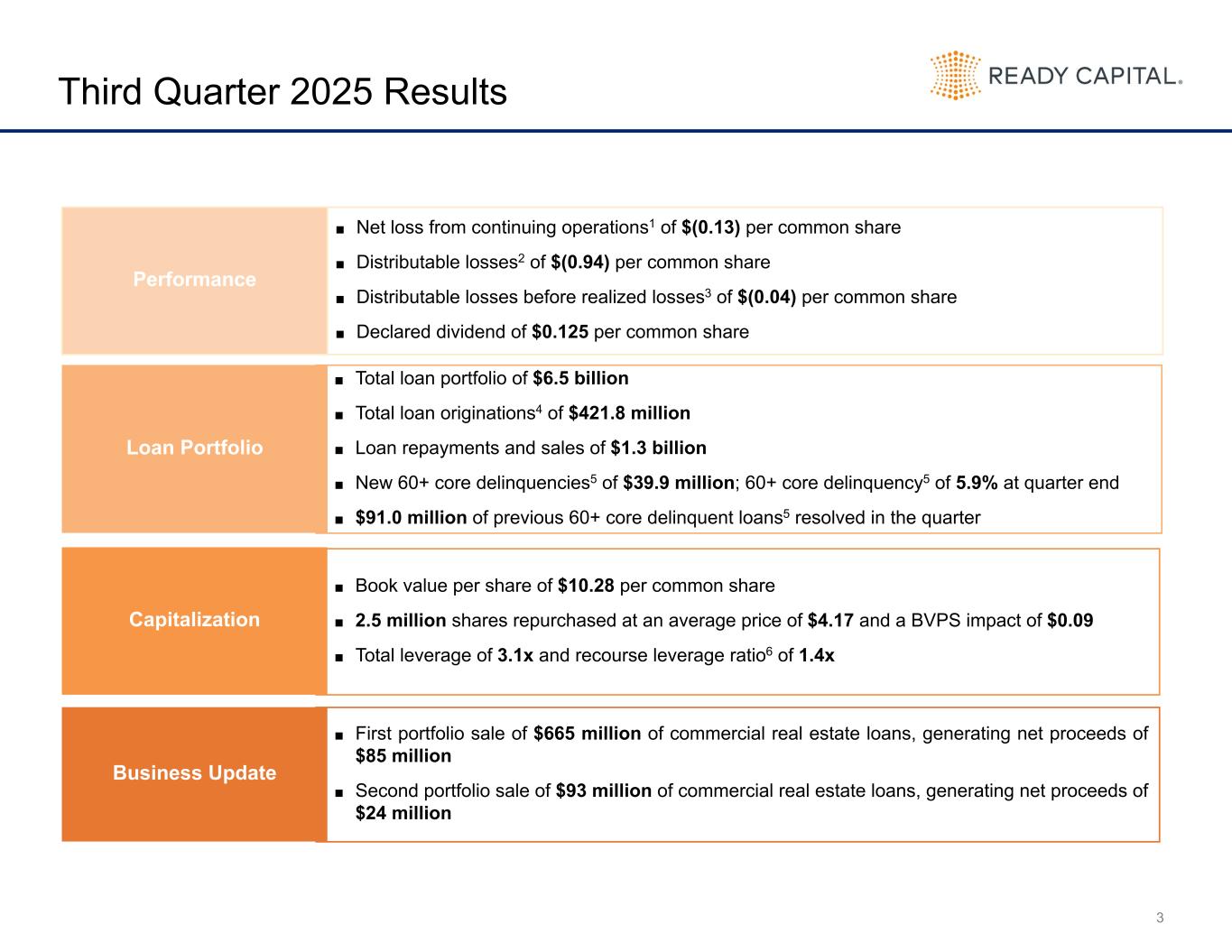
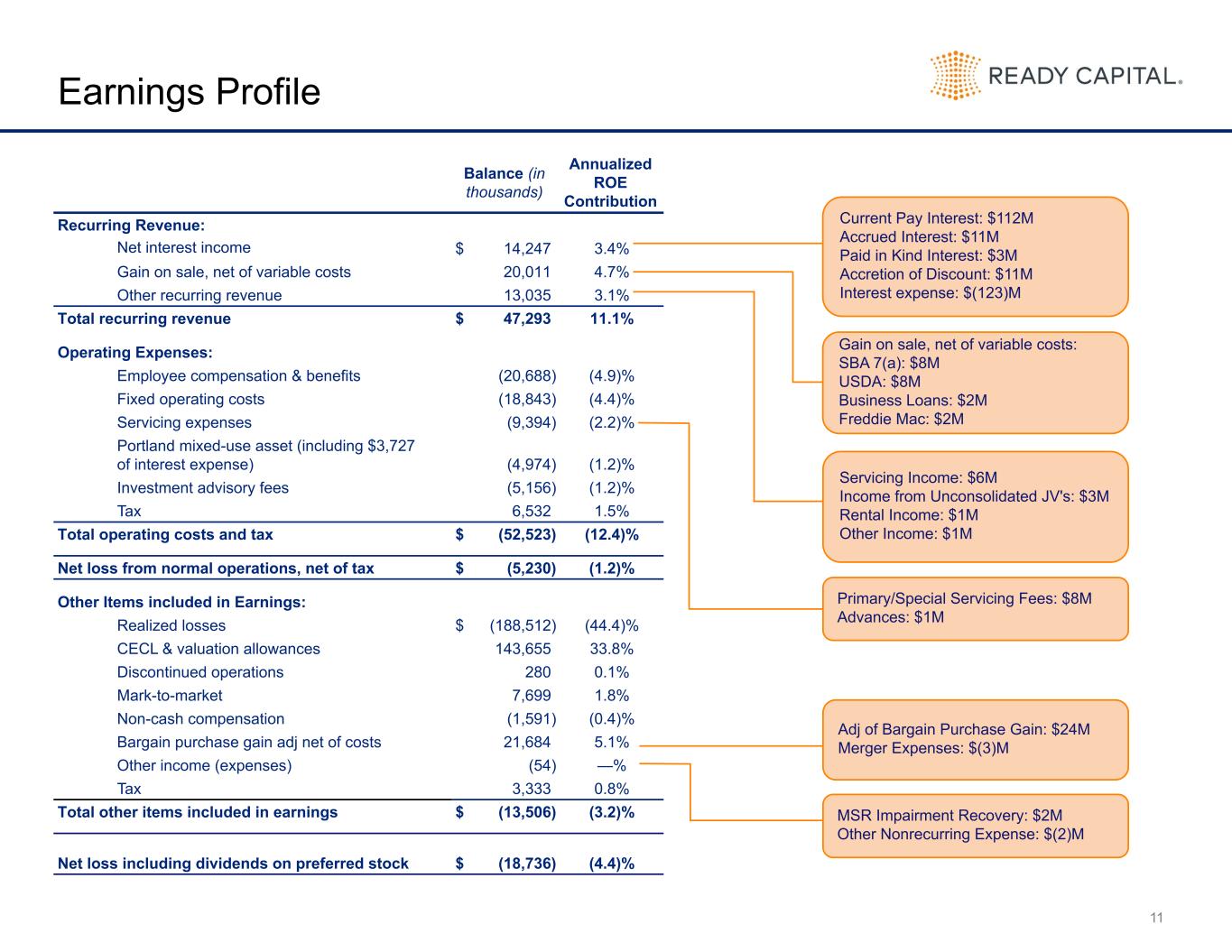
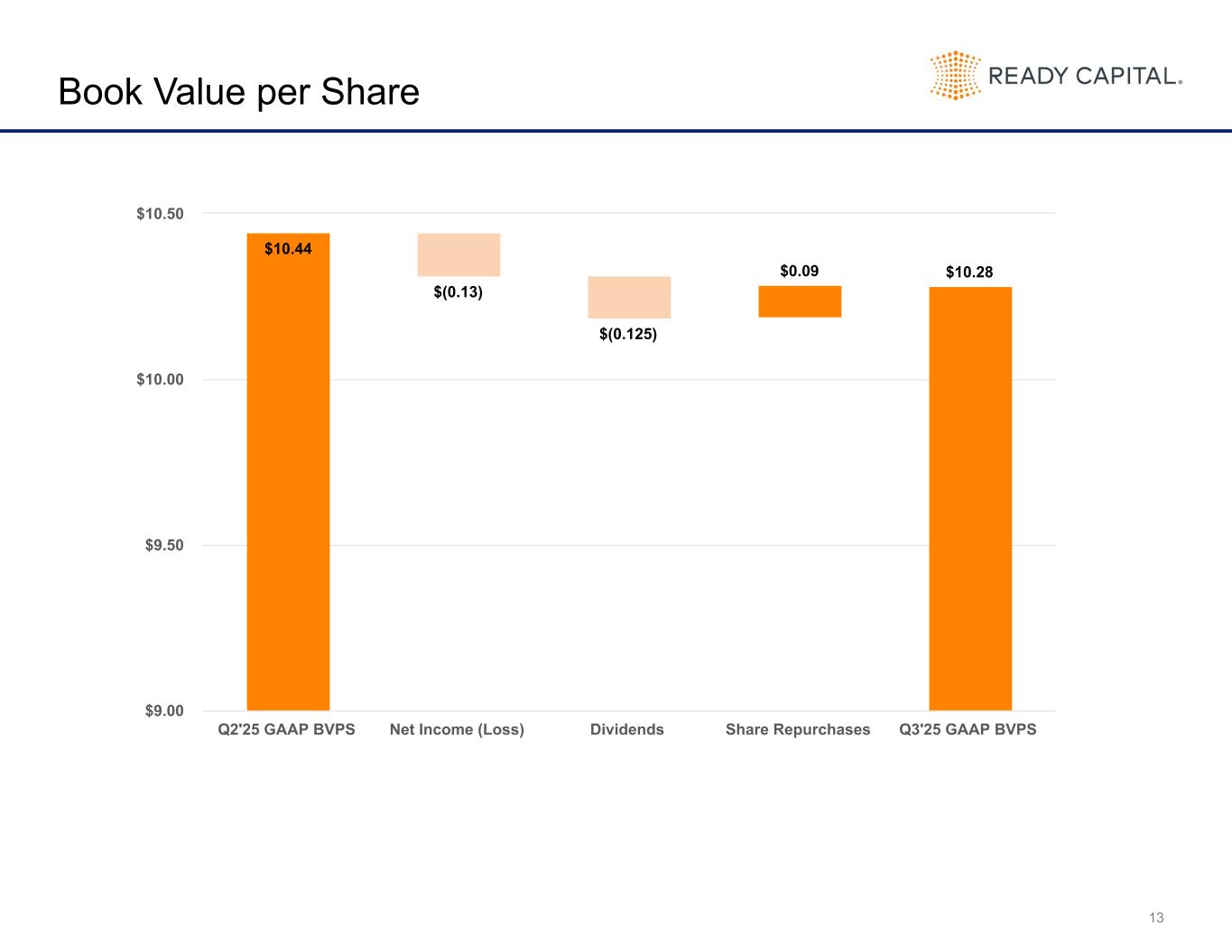
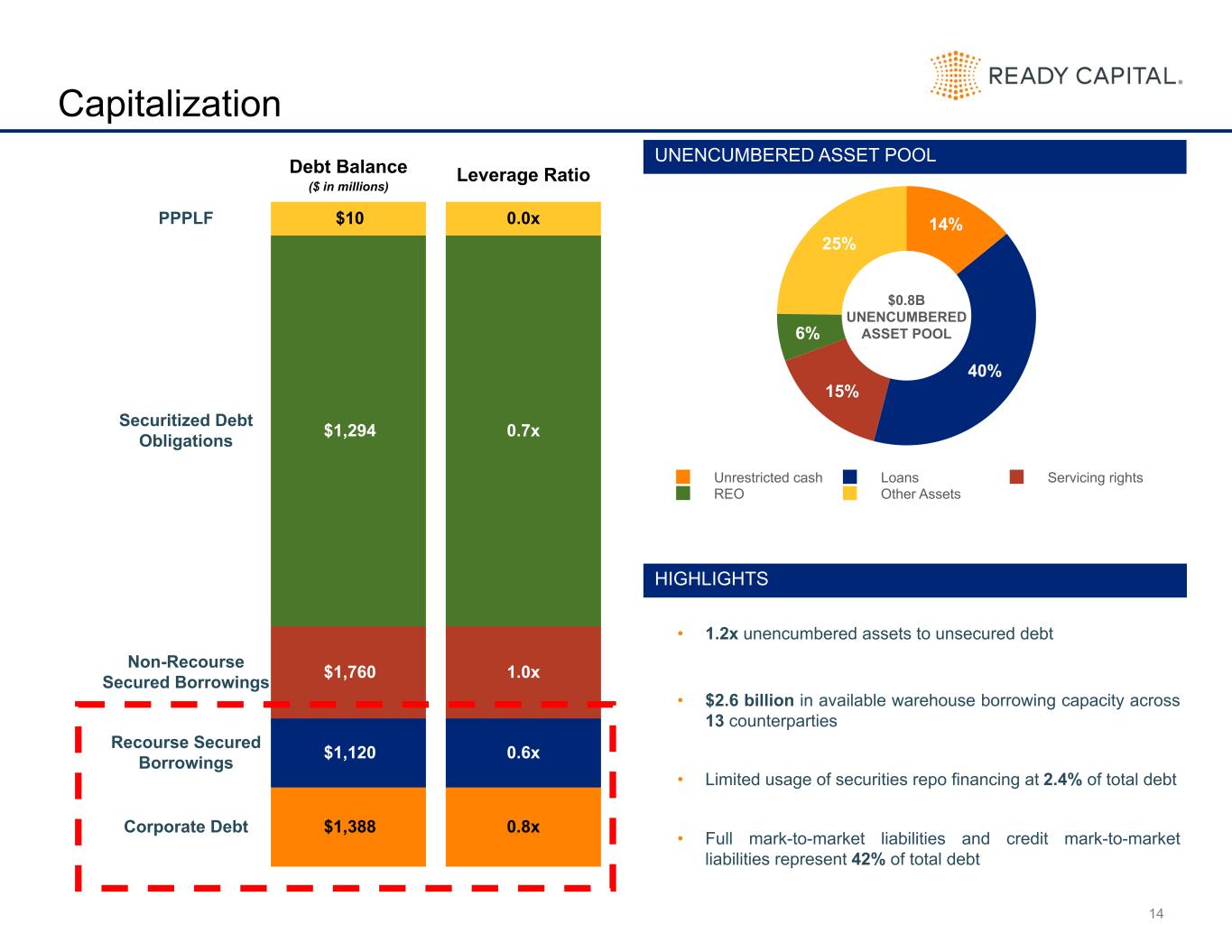
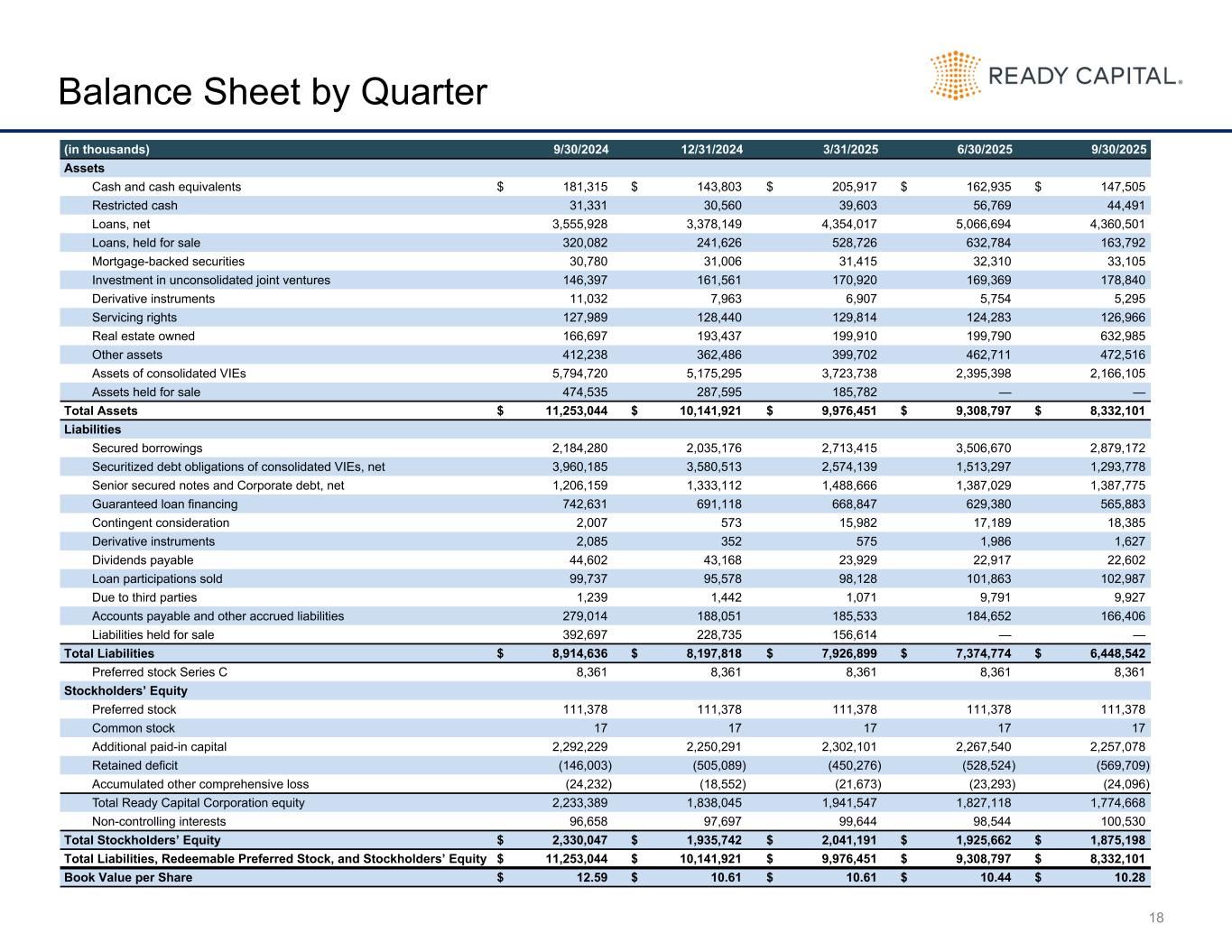
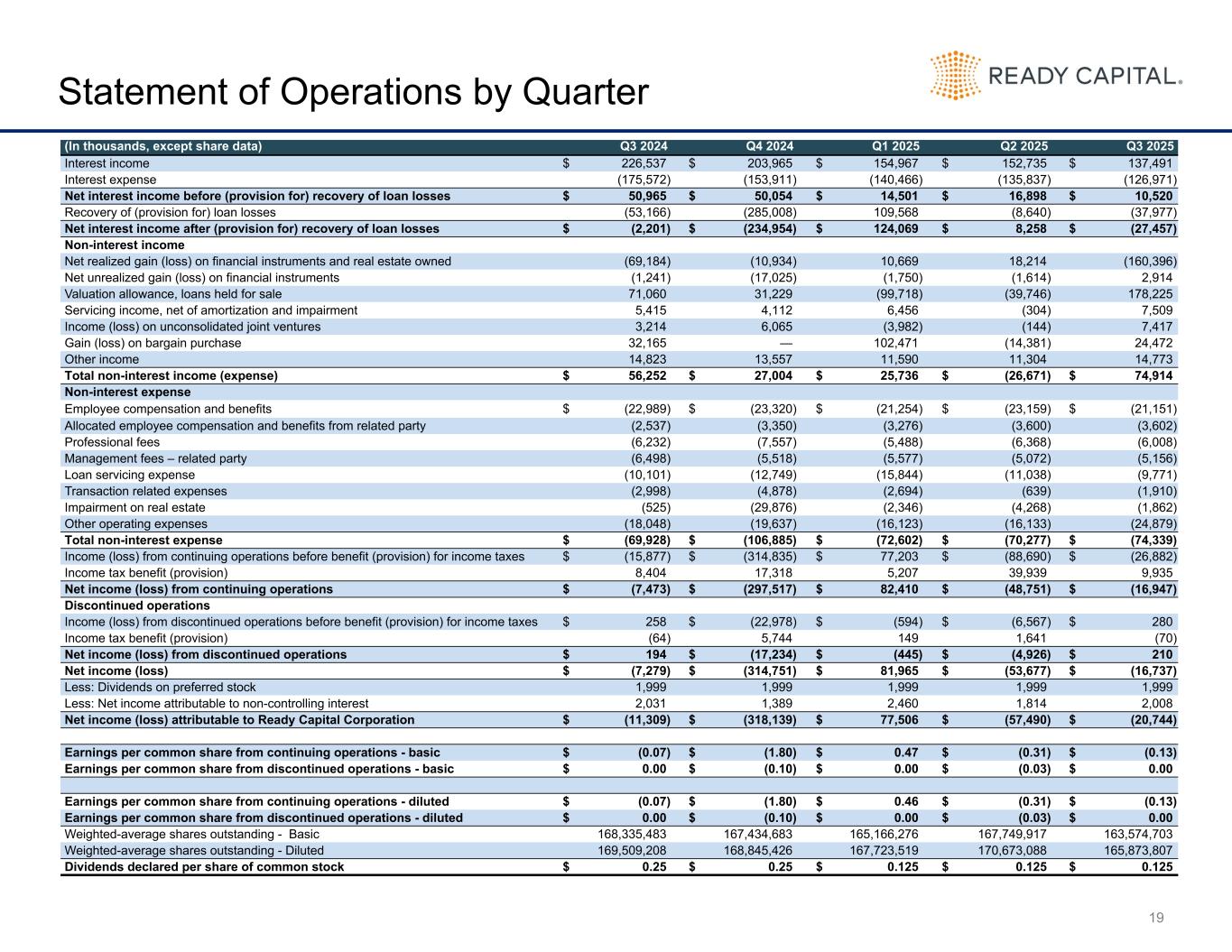
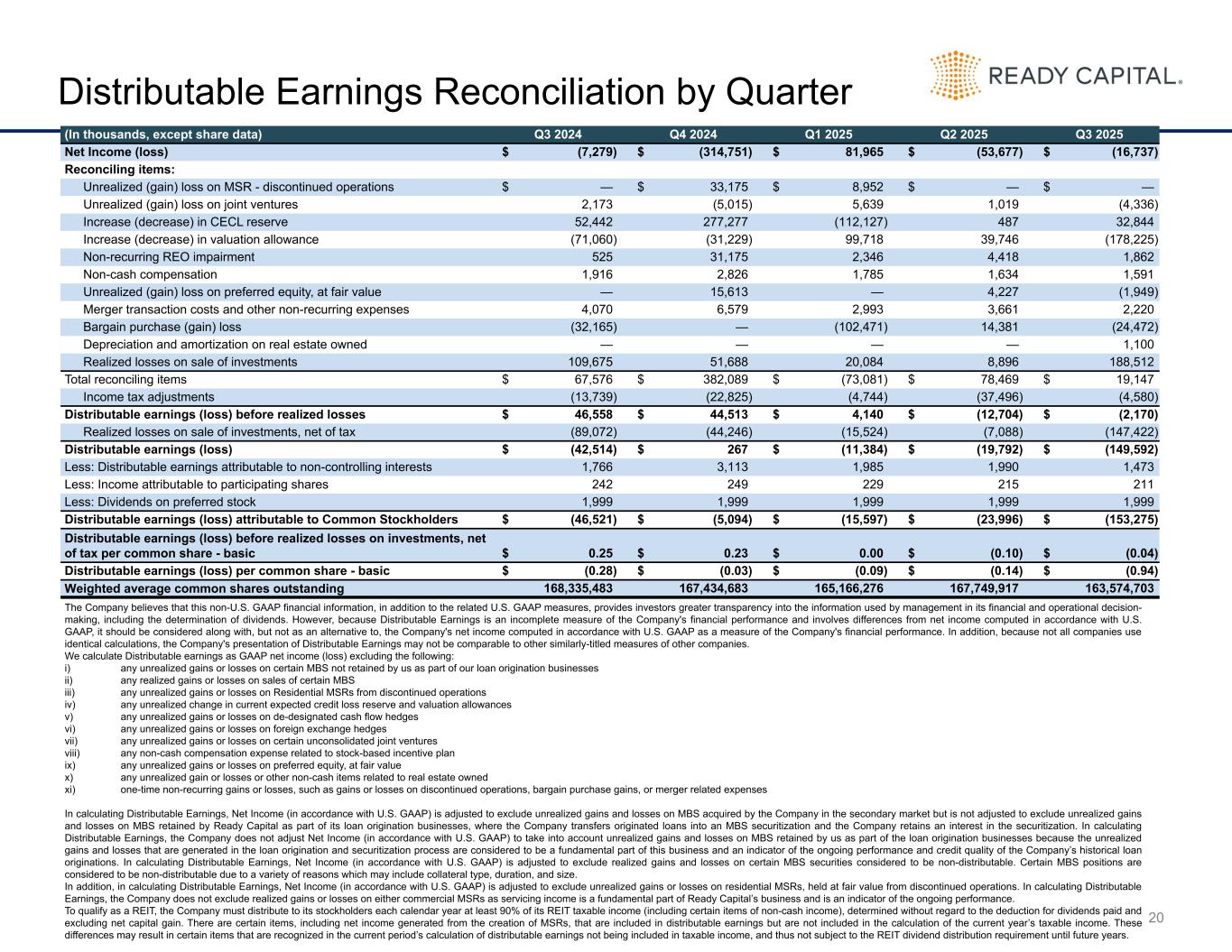
Thanks, Tom. For the second quarter, we reported a GAAP loss from continuing operations of $0.31 per common share. Distributable earnings were a loss of $0.14 per common share and $0.10 per common share, excluding realized losses on asset sales. Several key factors impacted our quarterly results. First, net interest income increased to $17 million in the quarter. The improvement was due to a full quarter of interest income from the UDF transaction and lower interest expense from lower leverage and a 5-basis-point reduction in borrowing costs, which averaged 6.8% for the quarter. In the core portfolio, the interest yield was 8.1%, and the cash yield was 6.1%. The interest yield in the noncore portfolio was 2.4%. Second, gain on sale income, net of variable costs, increased $2.5 million to $22.7 million. The change was the result of higher USDA and Freddie affordable volume, offset by lower SBA 7(a) volumes due to the pending approval of warehouse line increases with the SBA. The income was driven by the sale of $121.2 million of guaranteed SBA 7(a) loans at average premiums of 9.9%, the sale of $151 million of Freddie Mac loans at premiums of 265 basis points, and the sale of $41.9 million of USDA production at premiums averaging 9.7%. Realized gains from normal operations were offset by $8.9 million of realized losses from the sale of assets, all of which were adequately reserved for in previous quarters. Third, operating costs from normal operations were $58 million, representing a 5% increase from the previous quarter. Fourth, the combined provision for loan loss and valuation allowance increased $48.4 million. The additional $39.7 million valuation allowance was due to pricing adjustments on the trade Tom mentioned, which settled this week. The $173 million cumulative valuation allowance related to this trade will flip to a realized loss in the third quarter and be included in distributable earnings. The $8.6 million provision for loan loss was due to a net increase in the general provision of $800,000 and $7.8 million of specific reserves on assets which experienced deterioration in the quarter. And last, other items of significance included a $14.4 million reduction in the bargain purchase gain related to the closing of the UDF IV merger, $6.5 million of noncash impairment of the SBA and USDA servicing assets related to movements in the discount rate, and a $41.6 million tax benefit from losses associated with the loan pool sale. Income from normal operations net of tax, which can be found on Page 11 of the financial supplement, decreased $6.7 million to a $7.3 million loss in the quarter. Reoccurring revenue increases of $809,000 due to higher net interest income and higher gain on sale revenue were offset by a $7.5 million increase in operating costs due to higher accruals and a $4.8 million reduction in the tax benefit. On the balance sheet, a few key items to highlight. First, we completed the sale of our residential mortgage banking business, GMFS. Proceeds from the sale included cash equal to the adjusted book value of the business and an earnout over the next 30 months. The transaction resulted in a cumulative loss and disposition of $3 million. And second, we continue to reduce our short- to medium-term debt maturities. In the quarter, we retired $50 million of corporate debt using proceeds raised from the upside of our initial Q1 $220 million senior secured issuance. As of today, we have a total of $650 million of corporate debt maturing through 2026, including current maturities of $132 million. We are focused on extending those maturities over the upcoming quarters. Book value per share was $10.44 at quarter end, down $0.17 from March 31. The decline was primarily due to the dividend coverage shortfall, partially offset by the repurchase of 8.5 million shares at an average price of $4.41, which offset the reduction in book value per share by $0.31 per share. Liquidity remains strong, with unrestricted cash at over $150 million and just under $1 billion of total unencumbered assets. With that, we will open the line for questions.
Operator
The first question is from Crispin Love with Piper Sandler.
Speaker 3
First, Tom, you mentioned that you're reentering the origination market in the third quarter, and you said you expect modest earnings growth. I was wondering if you could just put a little bit of a finer point on that. Does that mean that you still expect distributable earnings losses in the near term? And then when do you think you can get to profitability and then closer to dividend coverage?
Yes. I'll let Andrew address that, but I want to add that our origination team is preparing to focus on the new vintage multifamily bridge, which will likely have about a 5-point lower attachment point and higher debt yields compared to the peak of the last cycle. This process will take around 120 days. In the meantime, we can leverage the significant CMBS trading capabilities of our external managers, allowing us to deploy cash immediately into those instruments as an initial step toward rebuilding the NIM. Andrew, with that context, could you elaborate on Crispin's question about the earnings ramp?
Yes, starting from what I would describe as normalized earnings for the quarter, which showed a loss of $0.04, the main difference to distributable earnings comes from items like MSR impairment. There are a couple of points that Tom noted in his remarks that are already accounted for. First is the joint venture sale, which will reduce negative carry and increase EPS by $0.05 per quarter. We expect that reinvesting that equity, which will happen during the third and fourth quarters, will generate an additional $0.02. This will help us reach positive normalized earnings. Other developments in the third quarter include the payoff of a $75 million repo related to the retained interest in one of our CLOs, which will contribute $0.01. Additionally, as our USDA platform approaches a normalized annual ramp of roughly $300 million, we anticipate earnings will increase by $0.02 per share. The return of SBA volume to levels we experienced in the second half of '24 is expected to enhance earnings by another $0.03 to $0.05. However, it's important to note that some of this increase will be offset by the need to refinance corporate debt, which is projected to reduce earnings by $0.03 to $0.05, based on the difference between current debt costs and our last deal pricing. These are the immediate growth expectations, with further growth anticipated from portfolio turnover, as Tom mentioned.
Speaker 3
Perfect. I appreciate you laying all that out. And then on the bulk sale of legacy bridge loans, can you first describe the type of buyers here broadly? And then how much is left to sell? And I think you might have said that that's all from the 2021 vintage. And then also, if you can just dig into a little bit the pricing of that sale versus initial originated values and then pricing prior to those Q2 final marks.
Yes, Adam, could you address this? To start, Crispin, we see a significant amount of capital being raised in real estate private equity focused on the multifamily sector, which is considered fundamentally strong due to the supply-demand dynamics. By 2025 and 2026, the oversupply from the boom years of 2021 to 2023 is being absorbed by the market, leading to stability in rents. In essence, there is approximately $300 billion to $400 billion of opportunity capital seeking to invest in these assets, primarily by acquiring the debt to take ownership and operate the properties. With that context, Adam, could you share more insights?
Speaker 4
The partners involved are a multifamily operator with a few thousand units and a fund partner managing around $1.5 billion in assets. They joined forces to acquire this portfolio, which is priced at approximately 77% of the unpaid balance. It's important to note that this portfolio had a significant concentration with two sponsors, GVA and Tides, meaning we are effectively eliminating all exposure to these sponsors. As Tom mentioned earlier, about 40% of the portfolio was over 60 days delinquent, notably in the noncore category, while 31% of the delinquent assets fell into the noncore sector. Additionally, there is about $31 million in real estate owned assets within this portfolio. Crispin, let me know if you have any further questions or if I addressed your inquiry.
Speaker 3
Yes. Just one last kind of quick follow-up. Is there anything left from the 2021 vintage in your portfolio, either core or noncore?
Speaker 4
Yes. There certainly is in the core portfolio.
Operator
The next question is from the line of Doug Harter with UBS.
Speaker 5
You talked about SBA volumes picking up. Can you talk about what is going to be the driver of that and your confidence as to the timing and as to when you're going to start to see that?
If you examine the industry volume, when the new administration took office, there was a noticeable decline across the industry. I believe it was about 10% to 15%. I am specifically referring to the 7(a) program, which generally sees approvals ranging from $25 billion to $30 billion per year, depending on Congressional authorization. This decline was largely a result of changes in operational procedures regarding small loans under the Biden administration. Consequently, the industry has adapted to these changes and revised its credit guidelines to be more conservative. We actually implemented these guidelines in our small loan program about three months before the SBA made its changes, so we are confident in our position. We are also witnessing a strong demand for small business loans, particularly in mergers and acquisitions. Additionally, we are a leading provider in the small loan program through our fintech division, iBusiness. One major challenge we have faced has been getting warehouse line approvals from the SBA, compounded by staffing changes in government agencies. However, we now have a clear plan to gradually increase our line, which is expected to reach around $75 million to $100 million. This situation has influenced the decrease in our 7(a) originations this quarter. On a positive note, we are also seeing growth in our USDA business, where we have historically been a top three lender, which will positively impact our profits in the small business segment. Andrew, do you have anything to add?
Yes. I think you will see volumes in the third quarter remain somewhat consistent with where they are in the second quarter. As Tom mentioned, the pending approval of that third warehouse line with the SBA will certainly open up capacity. But the full ramp back to a targeted $1.2 billion to $1.5 billion in annual originations is really going to come from clearing the existing warehouse lines through some capital markets transaction, as Tom mentioned. Whether that be a normal way securitization of 7(a) loans, which we've done a handful of, or participation sales, that will be the driver to really increase the capital needed to get back to those levels. So I would expect a ramp back there to happen more towards the back half of the second half of the year.
Yes. I would like to make one final point regarding SBA. We fully support the regulatory changes introduced by the new administration. Currently, there is a bill in Congress proposing to raise the loan guarantee cap from $5 million to $10 million for manufacturing facilities. We are focused on supporting this legislation, and if it is approved, we are developing specific origination strategies accordingly. This presents some potential benefits as we approach the fourth quarter and early 2026.
Speaker 5
Great. Appreciate that. And then on the unsecured issuance, can you just talk about your plans there given the higher costs you're seeing there now? Does that market still make sense financially? Or is it an important part of the capital structure that you want to continue even though the costs are elevated today?
Yes. If you look at the $650 million we have coming due, around $300 million of that is unsecured. Some of that being $25 par deals. So we think that market will play a part in the refinance of a portion of that $650 million. I do believe that the majority of that pending debt though will probably get placed through a secured issuance, whether it be utilizing the $100 million still available on our Q1 issuance or new security. And when you look at unencumbered assets and even excess coverage in existing deals, there's a significant amount of what I'll call clean performing product to support those issuances. So we remain confident in the ability to refinance those out. But certainly, acknowledge that the increased cost of that debt will put pressure on the earnings, as I described earlier.
Operator
Our next question is from the line of Jade Rahmani with KBW.
Speaker 6
So much to go through here, but I'll try to be somewhat brief. Just on Portland, will the assets be held on the balance sheet at $432 million? And did the $5.3 million carrying costs you cited reflect a full quarter impact? What's the 3Q estimate?
Yes, I can answer the first question, Jade, and then I'll let Adam talk about the operations. Yes, the initial valuation will be put on at that $425 million and then evaluated for impairment going forward from there.
Speaker 6
Okay. And then the quarterly carrying cost estimate?
Speaker 4
Yes. Jade, I'm sorry, your question is what on the $5.3 million?
Speaker 6
Yes. Is that a full quarter estimate for the carrying cost?
Yes, that was the full quarter impact.
Speaker 6
That affected the second quarter?
Correct. That $5.3 million was in the second quarter.
Speaker 6
But you foreclosed in July.
Yes, but we were holding it as a nonperforming loan in the second quarter. So that's the net expense.
Speaker 6
Now that you own it, what will the carrying cost be?
Yes. I think that's a fairly good estimate going forward. There are a couple of things that we are working on to help reduce that. One is to lower the financing cost associated with that asset. And then obviously, as the loan stabilizes, whether it be leasing of the office or a reduction in the amount of unsold condos, that number will come down.
Speaker 4
Yes, I believe the material operating cost would be considered positive news, as we would need to make tenant improvements when bringing a tenant into the office space to enhance their environment. Therefore, the significant costs would be associated with the asset making considerable improvements, reflecting a worthwhile investment.
Speaker 6
How much capital will need to be put in across the three categories?
Speaker 4
Yes. I mean, look, it depends on the type of...
Speaker 6
Sales spending.
Speaker 4
I'm sorry. I missed that last comment.
Speaker 6
How much capital will need to be put in, including marketing and sales spending?
Speaker 4
We acquired the asset about two weeks ago. Our partner, Lincoln, who is assisting with asset management, is currently developing a budget. At this time, the major expenditures are focused on marketing the condo units, for which we are also preparing a budget. This will be an important factor. The cost for tenant improvements will vary based on the tenants we attract, but we estimate around $150 to $200 per square foot for office tenant improvements. We have about 66% of the space left to lease. Additionally, there are other expenses related to the homeowners' association for the condo and other marketing aspects for this property.
But I think just as one comment, Adam, correct me if I'm wrong, but in relation to office and the future projected CapEx in relation to our basis, over 50% is a Ritz-Carlton that opened up in October of '23, which is on its way to stabilization. Trailing 12 RevPAR was a little bit over $200, so that doesn't require significant CapEx. And then the CapEx on the office, how many square feet of the 66% that's left, Adam? It's...
Speaker 4
Yes, it's about 70,000.
It's 70,000 square feet, which is minimal compared to typical office properties. That might involve some capital expenditures, but in addition to that, there may be some costs related to marketing strategies for the branded residences. However, these expenses will be significantly less than what you would see in other sectors like office space.
Speaker 6
Okay. Secondly, just on the dividend, conveying some sentiment from institutional investors that I have been in touch with, the company has a very large deferred tax asset, so plenty of shield to avoid having to pay a dividend. So based on current management expectations, why not eliminate the dividend and reallocate that capital toward, number one, debt repayment because there's significant maturities at a very high cost that was referred to? And then number two, once you feel really comfortable, you could allocate that towards the buybacks, which are continuing, which would stabilize book value and protect the company's equity base. So right now, the dividend is still quite costly. It would seem to make more sense to suspend it and then recommence once we're kind of out of the woods in this period of stress.
That's a fair question and it's largely related to our repositioning strategy. In this quarter, we successfully reached our goal to eliminate half of our noncore portfolio, despite a slight delay, which helped in addressing a significant drag. You also noticed our progress toward covering the dividend. Andrew, could you provide some insights related to Jade's question in this context?
Yes, I think it's a good question. As I mentioned earlier to Crispin's question, there is a bridge to an earnings profile. Assuming no further deterioration in the core portfolio, that gets close to that coverage. Now it's going to take some time, as I mentioned. But I think the Board will continue to evaluate the performance of the core portfolio as well as the progress on that walk I made earlier in evaluating the dividend.
Operator
The next question is from the line of Randy Binner with B. Riley Securities.
Speaker 7
I have a couple of follow-up questions. First, Andrew, regarding your discussion on the EPS walk to dividend coverage, at the end you mentioned that there would be some negative impact from higher anticipated interest expenses related to the debt maturity in 2026. Did the impact from the Portland property also factor into that EPS walk?
Yes. The EPS walk assumes that the Q2 negative carry remains somewhat consistent. If there are positive developments that lead to a financial outflow, it may have an impact but would result in higher revenue. The drag is already factored into that initial number.
Speaker 7
Okay. But it would take at least two quarters, if not three quarters. The way I'm putting these numbers together, you would be at $0.125.
Speaker 7
Okay. The question about the dividend has been addressed. I want to clarify something related to Crispin's inquiry. Regarding the $85 million of net proceeds from the loan sale, it was at 77% of UPB. I'm trying to confirm whether I understood this correctly. Did you sell $494 million worth and only net $85 million, or was that the amount after other offsets? I just want to make sure I have this clear.
Yes. So all of these assets were financed, whether that be on warehouse or inside our CLOs, so roughly $308 million went to pay off our warehouse lenders, and then there was another $128 million that went to repurchase those loans out of the CLOs, which is how we get to that $85 million of cash.
Speaker 7
Got it. You issued the $50 million and have $85 million in proceeds. Andrew, you mentioned the $650 million maturity wall coming up for 2026, but when we talk to investors about this in light of the recent raises, is it more like $600 million or potentially lower? Should we consider that the $50 million issued and these proceeds will be used to pay down debt, or are they allocated for other purposes? Will the $650 million remain as is and be refinanced separately? I'm trying to assess what the net maturity number for 2026 will be after considering everything we've discussed.
Yes. No, understood. I do think that a portion of that $650 million will come from just natural paydowns or repurchases in the market by the company. So I don't anticipate dealing with that maturity ladder fully through the issuance of new debt. With that being said, not 100% of the cash flow coming off the portfolio is going to go towards delevering for the simple fact that rebuilding the net interest income, as Tom mentioned, is really important to getting the earnings profile going in the right direction. And we have confidence in that just based on a lot of the work we've done over the last few months on the accessibility of the markets to help deal with that $650 million. But to your point, I don't anticipate 100% of that being refinanced. Some of it's going to come from us using the organic liquidity of the company to lower that amount.
Operator
The next question is from the line of Christopher Nolan with Ladenburg Thalmann.
Speaker 8
Was the Portland asset acquired? Or was that a legacy of Ready Capital?
Speaker 4
That was an asset that was acquired through the Mosaic merger.
Speaker 8
Okay. And then I guess looking back on all the fast-and-furious mergers that you guys did over the past years, and many of them seem, at least to the outsider, more as a financing vehicle. Going forward, what's your M&A strategy? Has it changed when you come back to that? Or is it still looking to capitalize on cheap, underlevered balance sheets?
We have, beyond the M&A transactions, a history with Ready Cap and the external managers of acquiring portfolios of distressed assets since the global financial crisis. This was a strategy we adopted leading up to the interest rate increase and the shift in the credit cycle. However, since 2023, our reliance on that strategy has diminished. We did make a very beneficial acquisition of the UDF lot loan business, and we are considering deploying additional capital in the future because it offers a high return on equity and limited exposure to the broader commercial real estate market. In the near term, we will likely rely less on M&A unless a deal is highly accretive. Adam, Andrew, do you have any thoughts on this as well?
Speaker 8
And Tom, on that small business comment, should we look for the equity allocation to small business to increase in coming quarters?
Yes, we plan to continue allocating equity to that business. As mentioned previously, it has significant inherent leverage because we sell off 75% of the 7(a) loans through participation. Under SBA rules, we can borrow against 60% of that. Additionally, it's a high return on equity business with considerable barriers to entry due to the limitations on nonbank licenses. Furthermore, the growth in the USDA business supports loans, which can go up to $50 million or $25 million, though I can't recall the exact figure. In summary, we will continue to allocate capital to support growth in this sector.
Speaker 8
Great. And then final question. I think Adam commented earlier about private equity entering in for multifamily. Should we look at that as sort of being opportunistic money given there's a large wall of maturing commercial real estate paper out there and the private equity is trying to get into the asset class on the cheap? Sort of is it a cyclical play by private equity playing into multifamily?
Yes, it's definitely a cyclical opportunity. In the pension fund sector, they categorize it as opportunistic commercial real estate. Consequently, we receive frequent inquiries from acquisition specialists at these commercial real estate equity firms since we have substantial opportunities for bulk purchases, unlike the smaller transactions typically found in the broker market. This point was mentioned in our prepared remarks. In both our core strategy, which includes paper and accelerated liquidation, and in our non-core strategy, our asset managers continually evaluate potential sales in the secondary market. If our on-balance sheet asset management strategies yield lower returns and we're focused on improving our net interest margin, we will consider selling at a discount and using the proceeds to quickly offset that discount with bulk sales. The reason this opportunity arises is due to the cyclical influx of capital targeting the multifamily sector, and we have a substantial legacy portfolio that can take advantage of this.
Operator
We've reached the end of the question-and-answer session. And I'll turn the call back over to management for closing remarks.
We appreciate everybody's time and look forward to the third quarter call.
Operator
This will conclude today's conference. You may disconnect your lines at this time. Thank you for your participation. Have a wonderful day.