Operator
Greetings. Welcome to Root's Third Quarter 2025 Earnings Conference Call. Please note, this conference is being recorded. I will now turn the conference over to Matt LaMalva, Head of Investor Relations and Corporate Development. Thank you, and you may begin.
Thank you for joining us. Root is hosting this call to discuss its third quarter 2025 earnings results. Participating on today's call is Alex Timm, Co-Founder and Chief Executive Officer. Megan Binkley, our Chief Financial Officer, will be unable to join us this afternoon due to a family medical matter. In her absence, I will be providing our financial results and will also be available for Q&A. Earlier today, Root issued a shareholder letter announcing its financial results. While this call will reflect items discussed within that document, for more complete information about our financial performance, we also encourage you to read our third quarter 2025 Form 10-Q, which was filed with the Securities and Exchange Commission earlier today. Before we begin, I want to remind you that matters discussed on today's call will include forward-looking statements related to our operating performance, financial goals and business outlook, which are based on management's current beliefs and assumptions. Please note that these forward-looking statements reflect our opinions as of the date of this call, and we are not obligated to revise this information as a result of new developments that may occur. Forward-looking statements are subject to various risks, uncertainties and other factors that could cause our actual results to differ materially from those expected and described today. For a more detailed description of our risk factors, please review our most recent 10-K, 10-Q and shareholder letter. A replay of this conference call will be available on our website under the Investor Relations section. I would also like to remind you that during the call, we will discuss some non-GAAP measures while talking about Root's performance. You can find reconciliations of these historical measures to the nearest comparable GAAP measures in our financial disclosures, all of which are posted on our website at ir.joinroot.com. I will now turn the call over to Alex Timm, Root's Co-Founder and CEO.
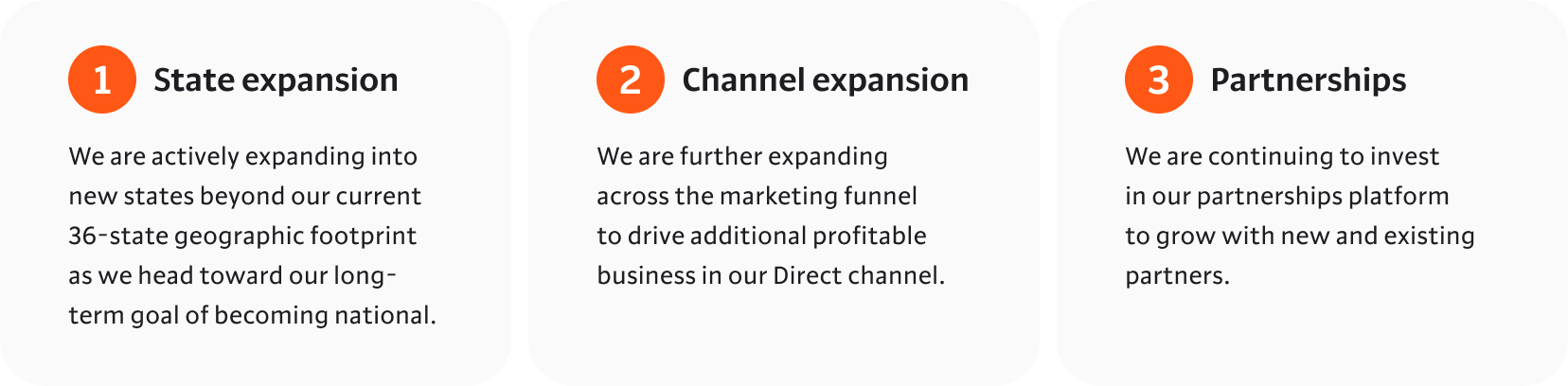
Thanks, Matt. The third quarter was another very strong quarter for Root, and we're excited by the momentum we are building. It was a record quarter for policies in force and revenue, driven by accelerating growth in both direct and partnership distribution channels. We achieved this growth while maintaining our exceptional loss ratio performance. As a technology company, we believe we have a structural and durable competitive advantage. This DNA is evident in everything we do, from our customer obsession, to our pricing technology, to the people we hire. It is what makes us special. And you saw that come through in the quarter across our pricing algorithm innovations, our partnership platform expansion and our direct marketing machine, all combining to generate exceptional performance. As one example, we deployed our newest pricing algorithm in the quarter, which is improving customer LTVs by 20% on average. This model allowed us to accelerate growth across all channels. And we aren't stopping there. In the quarter, we also launched our new UBI model, which, we estimate, has improved predictive power by 10%. We believe this speed of innovation is unmatched in the industry, and we have no plans of slowing down. Also in the quarter, you saw our growth strategy at work, more than doubling new writings in our partnership channel, launching Washington State and launching several experiments in new marketing channels. In our partnerships channel, we are extending our competitive advantage that provides seamless, easy purchase experiences with great prices to customers no matter how or where they shop. This represents a vast growth opportunity. Today, Root is only active in a very small fraction of distribution points in the insurance shopping ecosystem. This opportunity was on display in the quarter as we more than tripled our new writings year-over-year from independent agents, which now represents 50% of our partnership distribution. This channel alone is over $100 billion in premium nationally. And although we have made great strides, we are still active in less than 10% of agents, giving us a long and natural runway to rapidly expand our presence in this space. In our direct channel, new writings increased sequentially by high single digits despite increased competition. Combined with our new pricing model, we continue to invest in new real-time bidding algorithms that allow us to optimize for anticipated long-term economics. This machine continues to detect trends and changes in the marketplace and dynamically deploys our investments. We have also begun to see green shoots in a handful of new marketing channels, the focus of our R&D efforts. We plan to continue to accelerate our investments in these channels given our recent successes and react appropriately as the data emerges. Our success makes us excited and confident to invest further into the business to accelerate our pricing advantage, increase our distribution presence across channels and geographies and continue to create experiences customers love through product innovation. With a healthy capital position, excellent underwriting results and a culture of discipline and excellence, we are ideally positioned to accelerate our growth trajectory. Our goal remains to build the largest, most profitable personal lines insurance carrier in the United States, and this quarter represents marked progress toward that goal. I'll now turn the call back over to Matt for more details on the quarter.
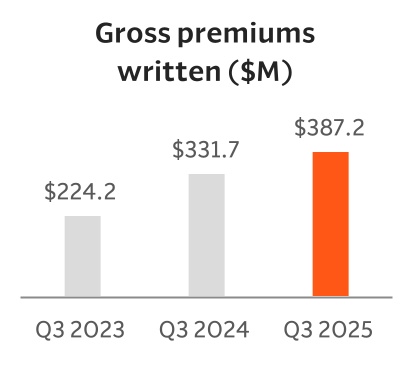
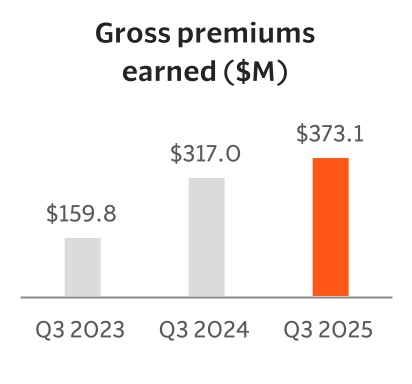
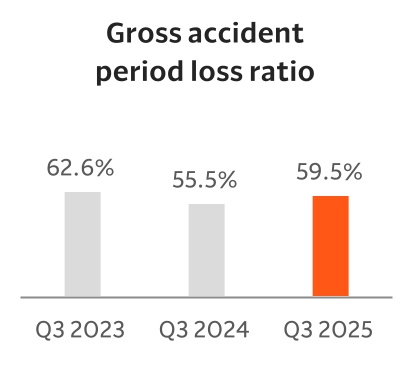
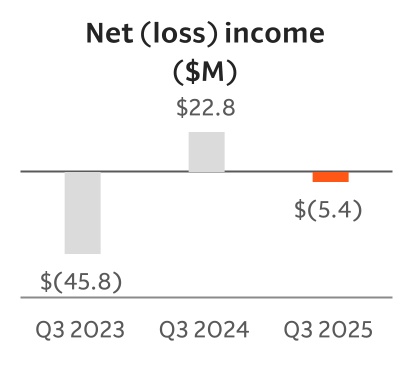
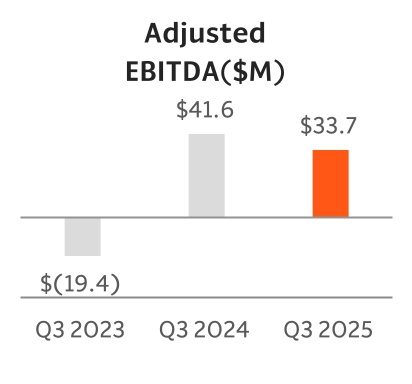
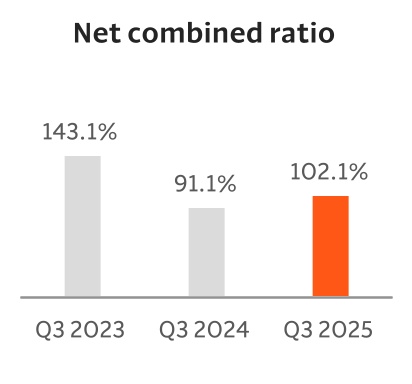
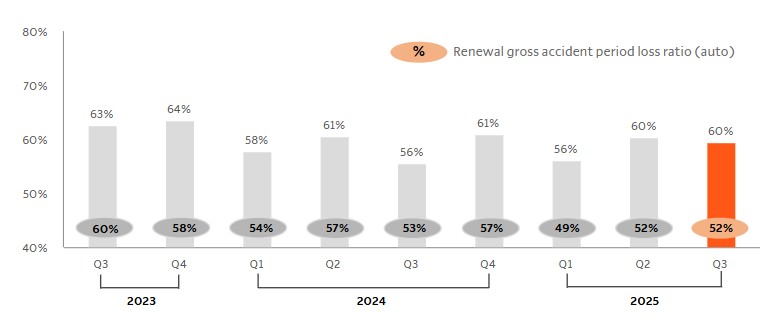
Thanks, Alex. For the third quarter, we recorded a net loss of $5 million, operating income of $300,000 and adjusted EBITDA of $34 million. As previously communicated, our net loss in the quarter was primarily driven by a $17 million noncash expense related to our warrant structure with Carvana. Of the $17 million, $15.5 million reflects a cumulative expense catch-up. This expense ultimately reflects the success of our partnership as the vesting of warrants depends on achieving policy origination milestones. Even with this expense taken into account, we have generated $35 million of net income on a year-to-date basis. In the third quarter, we accelerated growth while continuing to achieve our target unit economics. Year-over-year, we delivered double-digit percentage increases in policies in force, written premium and earned premium while achieving a 59% gross accident period loss ratio. These strong results were driven by the deployment of our latest pricing model, advancements in our real-time bidding algorithm and expanded partner integrations. Our capital position remains strong with unencumbered capital of $309 million at the end of the third quarter. Given our exceptional underwriting performance, we also continue to be in a position of excess capital across our insurance subsidiaries. This allows us to optimize our operating structure and deploy growth capital to the highest profit-yielding opportunities. We continue to take a disciplined and opportunistic approach to direct marketing investment, adjusting quarter-by-quarter based on prevailing competitive dynamics. On the partnership side, we are still early in scaling this channel, and we expect it to continue to increase as a percentage of our overall book over the long term. Looking ahead, we expect continued acceleration of policies in force growth and are excited to support that growth by increasing our investment in direct R&D marketing by roughly $5 million in the fourth quarter. Further, we anticipate a headwind to our loss ratio from typical seasonality in the fourth quarter, which is driven by elevated animal collisions and bad weather. Last year, the impact of the seasonality was roughly 5 percentage points of the accident period loss ratio, and we expect a similar impact this year. As we close out 2025 with exceptional underwriting performance, a healthy capital position and a strong culture, we are now focused on accelerating growth at our target unit economics. Put simply, we are optimistic that our superior technology will drive growth despite an increasingly competitive environment. We are just getting started. With that, Alex and I look forward to your questions.
Operator
Our first question comes from Andrew Andersen with Jefferies LLC.
Speaker 3
Sounds like some opportunities in the direct channel this quarter with some new writings increasing sequentially, high single digits. Maybe you could just talk about how that opportunity came to be and just the overall level of competitiveness you're seeing on the direct channel?
Yes. Thanks for the question. We are still seeing competition in the quarter and in the channel. But really, what has happened, and we've continued actually to see that even this quarter to date, a continued acceleration of new writings and growth in our direct channel and our partnerships channel and really every channel overall. And a big thing that's driving that is our price. Last quarter, we detailed that we shipped a new pricing algorithm that improved customer LTVs by 20%. That unlocks a lot of opportunity for us to continue to grow. And as we do that and we continue to refine pricing, continue to collect more data and continue to get better at it, you're going to continue to see us be able to grow despite increased competitive pressures. And that's exactly what you saw this quarter, and we're still seeing that quarter-to-date as well.
Speaker 3
And then on the severity number, plus 9%. It seems to have ticked up a little bit after kind of some 6s and 7s in recent periods. Can you maybe just talk about the change that you saw in severity this quarter, and if it requires any change to rate here?
We're not expecting any significant changes to our rates. Generally, our rates are adequate. There will be some adjustments made occasionally. The increase you observed this quarter falls within the normal range of fluctuations for these figures. We did notice a slight increase in our property damage area, specifically in vehicle collisions compared to our medical coverages. However, I believe it remains within the expected range of variation.
Operator
Our next question comes from Tommy McJoynt with KBW.
Speaker 4
Can you hear me?
Speaker 4
Awesome. You mentioned being active with less than 10% of independent agents. Can you just give us some color on how that figure has trended over the last couple of years so we can get a sense of the trajectory of your penetration? And then what's the process to go live with more agents?
Independent agents have been one of the most promising avenues for growth in our business, and we are just beginning to tap into this potential. We only started making significant strides with independent agents a couple of years ago. Last quarter, we revealed that we were engaged with less than 4% of all agents nationally, leaving a large portion of the market available. Historically, independent agents have consistently represented about one-third of the market for decades. We believe this channel will continue to be relevant, and we are just getting started. In the last quarter, we experienced a year-over-year growth rate of 3x in this segment, and we don't anticipate this momentum diminishing. We are actively marketing to agents, onboarding more of them, and enhancing our products to provide better service and pricing options for their customers. We see this as a highly attractive growth opportunity and have no intention of slowing our efforts in bringing on more agents.
Speaker 4
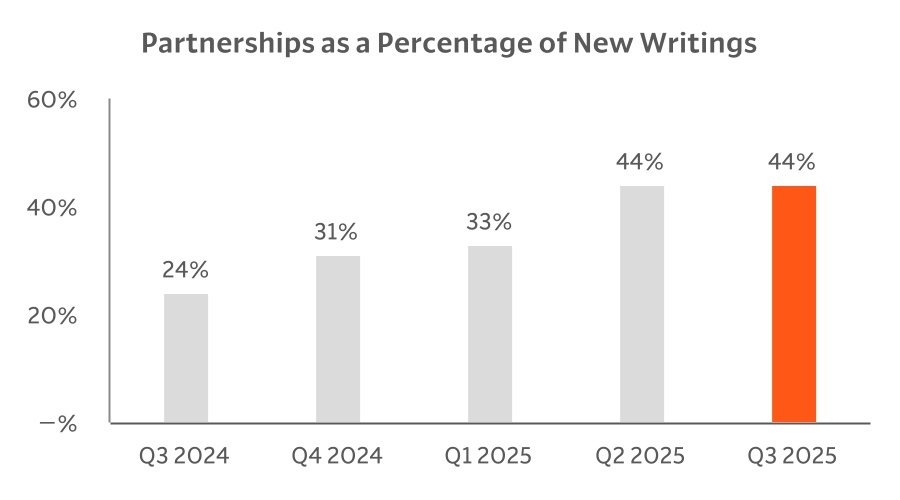
And then my second question is just that you gave us the partnership as a percentage of new writings in the quarter. But if we wanted to think about partnership as a percentage of earned premium, could we take a trailing 12-month average?
Speaker 5
So this quarter, you saw roughly flat partnership percentage of overall new writings, and that's because both of our channels grew very strongly. We're still continuing, as Alex mentioned, to see very strong growth in partnership driven by IIA, but we have the pricing model that we launched last quarter, which tends to be the tide that lifts all ships. So we are seeing very strong growth there. But when we look over sort of the medium to longer term, we do expect partnership to continue to grow and to continue to be an increasing proportion of our book over time.
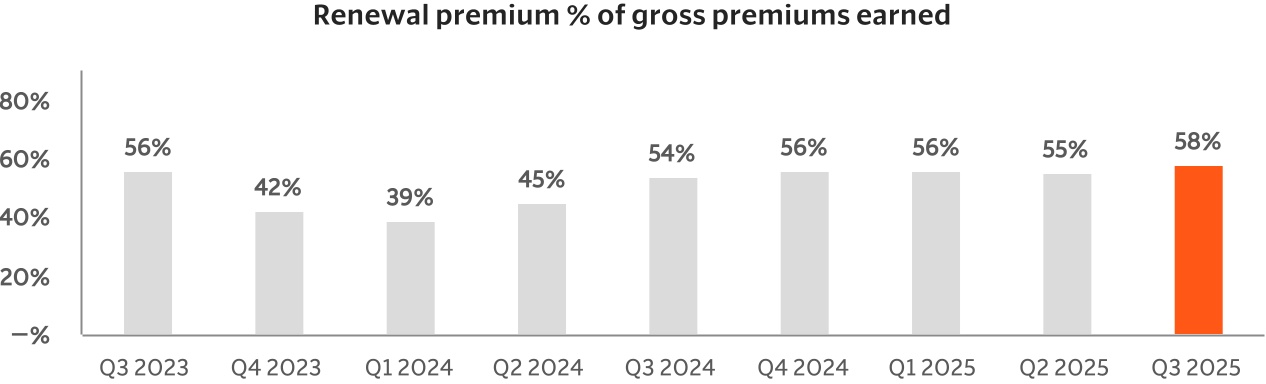
You are likely to notice higher average premiums in the partnership channel. This is due to larger policies associated with more vehicles per household in that channel, especially in the independent agency channel where many preferred businesses shop. Consequently, you can expect a greater focus on earned premium rather than just the trailing 12-month average.
Operator
Our next question comes from Hristian Getsov with Wells Fargo.
Speaker 6
My first question is on the average premium per policy. It actually went down quarter-over-quarter. And I was trying to get a sense of how much was that driven by that new pricing model? And then given you continue to trend well below the 60% to 65% target loss ratio, do you have more flexibility to maybe give up a little bit more on price to continue to win in this environment?
First, regarding average premium, we implemented a significant rate reduction in June, which was a double-digit decrease in Florida, a market of considerable size. Some companies had to issue refunds in Florida, and we aimed to offer the right prices to customers from the beginning, leading us to make that proactive rate decrease. Consequently, average premiums have decreased, positioning us well for the end of the year. While we are not currently lowering rates broadly due to our belief that we're pricing appropriately, we are experiencing a healthy loss ratio. This healthy ratio enables us to continue growing at an accelerated rate, as reflected in this quarter and so far this quarter-to-date.
Speaker 6
Got it. And then for my follow-up, any changes in the competitive landscape? Obviously, it remains elevated, but have you noticed anything, I guess, any recent changes? And then, do you have any color on how October PIF has trended versus the Q3?
Yes. October PIF growth has definitely accelerated compared to what you observed in Q3. We are not seeing that slow down, and we feel positive about it. The competitive environment remains very intense, with lower rates and a slower pace of rate increases in the market currently. Additionally, there are ongoing high levels of marketing and advertising. Specifically, in the direct channel, there is significant competition. However, we have demonstrated that we can continue to grow and execute effectively throughout this cycle. This growth is largely driven by our technology and new pricing models that enable us to thrive even in such competitive conditions.
Speaker 6
Got it. And if I could sneak one more in. Obviously, tariffs were a topic of discussion at the start of the year, and now it's kind of dwindled down, and I think people are maybe expecting less of an impact than they originally thought. I guess, have you guys seen any meaningful change in your data? And has your expectation for those impacts changed?
We have not seen that come through yet. Right now, it still looks like our expectations are basically in line with what we would expect from natural trends. Therefore, we don’t believe there is any impact from tariffs affecting inflation in the data or the numbers at this time. We do anticipate that loss ratios will generally increase in Q4 due to seasonality, which typically ranges from 3 to 5 points. While we might see some temporary increases in loss ratios in the fourth quarter, we don’t expect that to be driven by tariffs.
Operator
Ladies and gentlemen, this now concludes our question-and-answer session and does conclude today's teleconference as well. Thank you for your participation. Please disconnect your lines, and have a wonderful day.